STORIES
STOR IES V O L U M E 24
VOLUME 24
What makes a design last generations? Is it exceptional craftsmanship? Is it honest materials? Is it timeless design? For us, it’s all of these. That’s what makes a Neptune home. Over 30 stores across the UK and Europe neptune.com
£7* * Free if you are signed up with Neptune, ask a member of the store team
We have Neptune stores across the UK, Ireland and Europe. To see all of our homes, visit neptune.com/our-stores
STOR IES
UK Bath BA1 5BD Belfast BT7 3GB Bristol BS8 2QY Bury St Edmunds IP33 3PH Cambridge CB22 7PX Canterbury CT1 3TY Cheltenham GL50 4DW Chesham HP5 1NG Chester CH2 4JR Chichester PO20 2EW Chiswick W4 4HH Colchester CO3 8LT Edgbaston B15 3AA Farnham GU9 0BB Fulham SW6 2TD Guildford GU1 3AJ Hailsham BN27 1DQ Harrogate OPENING SOON Hove BN3 4QD Knutsford WA16 8TA Market Harborough LE16 7AF Newcastle at Fenwick OPENING SOON Reading RG10 9SA Redbrick WF17 6JF Southport PR4 6JA Swindon SN5 8YG Tonbridge TN9 1RF Weybridge KT13 8DX Wimbledon SW19 1RX Winchester SO21 1HL York YO32 9TW Wiltshire Outlet SN5 8YG
Store in store: Neptune by Treehouse Midmar, Aberdeen, AB51 7NB Neptune by Creative Classics, Ayr, KA7 2HD Neptune by Sims Hilditch, Bath, SN14 8JR Neptune by Woods of London, Blackheath, SE3 0TA Neptune by Hunters, Derby, DE1 1SY Neptune by Richard F Mackay, Edinburgh, EH11 2SG Neptune by Malone and Smyth, Fermanagh Neptune by Bridgewater Interiors, Gateshead, NE8 2AJ Neptune by Aberford Interiors, Leeds, LS25 3DP Neptune by The Georgian House, Ludlow, SY8 1AT Neptune by Appleyard, Norfolk, NR25 6AR Neptune by Wilton Kitchens, Salisbury, SP2 0HX Neptune by Holloways, Worcestershire, WR6 5DE Neptune by Bradley Gardens, Wylam, NE41 8JH
IRELAND Neptune by 1933, Co. Meath Neptune by Browsers, Limerick Neptune by Global Village, Dublin Neptune by Global Village, Wicklow Neptune by The Orchard, Co. Kildare Neptune by Trevor Morrow, Co. Mayo Neptune by Castle Cabinets, Kilkenny FRANCE Neptune Paris Neptune Paris Ouest Store in store: Neptune by Beaumont Trélissac Neptune by Fabrica, Eymet Neptune by Just Kitchens, Miélan Neptune by Sierra Home Samoens 74340
GERMANY Neptune Berlin Neptune Fellbach Neptune Tegernsee Store in store: Neptune by Helma Interior, Heidelberg Neptune by Faszination Oschatz AUSTRIA Neptune by Steinwender, Wien BELGIUM Neptune by O&V Home Interiors, Seneffe ITALY Neptune by Adi Arredamenti, Brescia LIECHTENSTEIN Neptune by Allure, Vaduz SWITZERLAND Neptune by Styles Interiors, Mont-sur-Rolle Neptune by Friolet Interiors, Zurich THE NETHERLANDS Neptune by The Classic House, Weteringbrug (near Schiphol)
Get in touch info@neptune.com @neptunehomeofficial 3592101/3608544
We do everything we can to make sure Stories is as environmentally sound as possible. The paper we use comes from responsible sources, and is also carbon balanced by the Woodland Trust. Please note that, while the colours shown in this volume are as accurate as possible, they will not always precisely match our paint shades. All information and pricing is correct at time of printing. 10.26 SVOL24
neptune.com
FOR EWOR D
As our 30th anniversary year comes to a close, it is a good moment to reflect on the values that are core to Neptune and have been since the beginning: our belief in using the best natural materials for the job (for example, avoiding the use of MDF or chipboard), our respect for both traditional craftsmanship and modern technology, and the importance we place on true service. These values underpin our purpose: to create timeless, classic designs of lasting quality at the best value we can achieve. Our reputation is fundamental to our business, and we always strive to go above and beyond for our customers, whether that is through our design advice in stores or the white-glove delivery services we offer. It is also why we produce Stories – not only as a way of saying thank you for your continued interest and loyalty but also to inspire and intrigue you. And not just about our latest collections – though we love talking about those too. In this edition of Stories, we delve into the fascinating history of the original Shakers, discover the extraordinary world of fungi, and celebrate the nostalgic joys of that school-lunch favourite, jelly. We also dive into the anatomy of a new dining chair, explain why the ergonomics of our sofas are just as important as the plumpness of the cushions, and try to solve that eternal interior design dilemma – whether to reveal or conceal your TV. We hope you enjoy this edition of Stories and will join us for the next chapter of our journey, as we continue creating homes with heart.
John Sims-Hilditch & Giles Redman Neptune co-founders
STORIES
CONTR IBUTORS Thank you to the talented authors and journalists who contributed to this edition, along with our fabulous team of in-house writers.
2
Suzanne Imre For many years, Suzanne Imre was the influential editor of interiors magazine Livingetc; a renowned style pundit and trend leader. Today, she works as a brand consultant, content director and writer. She lives in London and is always planning her next decorating project. @suzanne.imre
Georgina Blaskey London-based Georgina Blaskey is a British journalist and editor specialising in interiors, design, and luxury lifestyle. She is senior homes and interiors editor at SheerLuxe and features editor for SheerLuxe’s The Gold Edition. Her work has also appeared in The Telegraph, Country Living and Family Traveller. @georginablaskey
Jo Rodgers American-born Jo Rodgers is a journalist who lives in London and East Sussex with her husband and three children. She is a contributing writer at Vogue, Condé Nast Traveler, House & Garden, and Country Life. @jo_rodgers
David Nicholls David Nicholls is an author, brand advisor, and journalist, and currently a director at Homes & Gardens magazine. He lives between London and Pietrasanta in Tuscany where he and his partner, Claudio, recently opened a homeware shop called Almanac. @almanac.home @mrdavidnicholls
Giles Kime Hampshire-based Giles Kime is executive editor of Country Life magazine and author of a number of books on leading designers, including Nina Campbell and Neptune’s creative founder, Emma Sims-Hilditch, all published by Rizzoli. His most recent book on Kit Kemp was published in the spring. @giles.kime
Virginia Clark After studying and teaching classics in her early career, Virginia Clark joined the digital team at House & Garden where she spent eight years covering all things interiors. Now a freelance journalist, she specialises in decoration and design, drawing on years of experience writing about exceptional houses and the people who create them. @ginnyemily
Claudia Baillie Claudia Baillie is a London-based design and interiors journalist. Formerly the interiors editor at Sunday Times Style and editor at ELLE Decoration Country, she now writes for a broad range of publications across areas from designer profiles to homes, trends, architecture and travel. @claudiabaillie
SJ Axelby SJ Axelby is a leading interior portrait artist, renowned for her richly detailed paintings of extraordinary interiors. She has built an A-list international clientele, is the founder of the cult-favourite @roomportraitclub on Instagram, and is the author of three books published by HarperCollins. She works from her studio in the Chilterns. @sjaxelby
Sally Coulthard Sally Coulthard is a best-selling author and smallholder based in North Yorkshire. Her books weave together archaeology, history and the natural world to celebrate stories of the countryside. @salcoulthard Photograph by Andrew Montgomery
Gill Meller Gill Meller is a chef, award-winning food writer, teacher, and advocate for real cooking. Based in Dorset, Gill takes inspiration from the seasons, the landscape, and the local community of farmers, growers and fishermen. He writes about the joys of outdoor cookery and how making a fire and ‘cooking something good to eat over it’ can help us connect to a more natural, mindful way of life. @gill.meller Photograph by Matt Austin
VOLUME 24
CONTENTS
4 The anatomy of a chair
44 A warm welcome
6 Less doing, more being David Nicholls
46 The meaning of home SJ Axelby
10 This is the Regency pendant
50 Panel talk Virginia Clark
12 Shaped to fit Giles Kime
52 Blakeney blue, a hue with history
18 All things spice
54 This is the Larkhall drinks trolley
22 On reflection
56 The working home
24 Marking 30 years
62 Frame of mind Claudia Baillie
28 This is the Ascot dining chair 30 The beating heart Suzanne Imre 34 Turn up the heat Gill Meller 36 Conceal or reveal? 38 Shaken not stirred Suzanne Imre 42 An enduring beauty
64 Fun-guys Sally Coulthard 68 In the kitchen with Sarah Jane Bellmaine 74 A thing of beauty 80 Boutique retreat Georgina Blaskey 82 A wibbly wobbly world Jo Rodgers
3
THE A NAT OM Y
OF
A CHAIR
VOLUME 24
FROM STUDYING TO WOR KING TO R ELA XING, CHAIRS AR E A CONSTANT IN OUR DAY-TO-DAY ACTIVITIES, WITH EACH OF US SPENDING UP TO 10 HOURS (ON AVER AGE) SITTING. THAT’S WHY IT’S IMPORTANT FOR THEIR MATER IALS AND ERGONOMICS TO WOR K IN HAR MON Y WITH US AND OUR WIDER ENVIRONMENT.
H
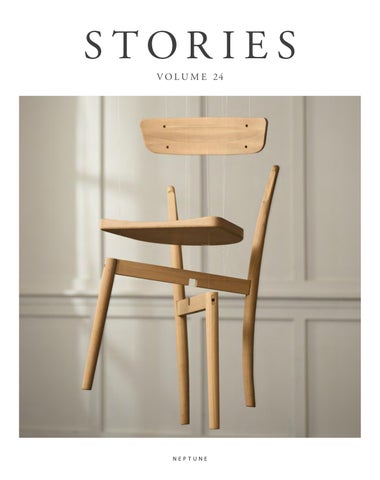
ave you ever wondered what actually goes into the construction of a chair? Our new Stirling chair’s pared-back silhouette tells all. Crafted from solid oak, it reveals the thread linking all of Neptune’s furniture collections: a commitment to natural materials, heritage craftsmanship, and comfort. Neptune’s lead designer, Mike Charlton, explains the creation process: ‘Our aim was to make a very simple chair with a small footprint but highlight all the craftsmanship within it.’ The most distinctive feature? The sculpted, supportive backrest, precisely engineered for ergonomic comfort, that showcases four, exposed dowel joints. The piece’s curving lines ‘are very tactile, so that all of the areas where you engage with the chair feel soft to touch.’ This flow continues through to the tapered legs, which highlight the timber’s natural beauty and structural integrity, fixed by traditional mortise-and-tenon joints. The Stirling’s neat surface area is achieved by the hidden ‘X’ frame, which features two crossing beams supporting the seat, forgoing the need for a classic – and more visible – square frame. The design’s attention to detail also demonstrates Neptune’s focus on timeless British craftsmanship. Complete with traditional joinery techniques and our Natural Oak IsoGuard® finish, it is a chair made for everyday comfort and durability. ‘For a more mid-century accent, you can opt for a leather seat pad,’ says Mike. ‘The recessed part lets the leather pad sink into the chair – it’s very deliberate.’ Recalling traditional dining and desk chairs, the Stirling can be seamlessly pulled into any room or table arrangement, its compact profile suiting smaller rooms and round or contemporary tables in particular. Like all Neptune designs, the Stirling chair offers endless possibilities, whether you have a country NEW home, townhouse or city apartment. You can rely on the oak craftsmanship for 2026 to do the talking – while you do the sitting.
Opposite: Stirling chair 5
L e s s ‘ d o i n g’
more ‘ b e i n g’
We m a y l i v e m o d e r n lives, but we still instinctively prepare ourselves and our homes for winter. The Japanese even have a poetic philosophy around the idea, as author and journalist David Nicholls discovers.
STORIES
W
inter has a way of revealing how much a home is asked to do. In summer, we move easily between inside and out: doors stay open, rooms borrow light from the garden, and comfort comes easily. Cold weather is different. It asks whether a house can hold warmth, how light is placed, and which spaces we return to again and again. There are many ways of coexisting with winter. Some traditions seek to master the cold; others make room for it. The modern enthusiasm for cold-water swimming belongs partly to the former: to enter the cold deliberately. But there are other, less heroic responses to winter. Not fighting the season but yielding to it. The Japanese word fuyugomori seems to offer one possible way into that thought. It can be translated as ‘winter seclusion’ or ‘winter retreat’ and has slight hibernation vibes to it. It’s not a commonly used expression; in fact, a Japanese friend told me she had to look it up. Rather, it belongs to older, poetic or particular contexts rather than to daily conversation. That caveat feels important. Don’t worry: fuyugomori is not the new hygge. It is not a lifestyle concept to be lifted wholesale from another culture. What interested me was the thought behind it: drawing inward through the coldest part of the year, conserving warmth, energy and attention until the season begins to turn. Fuyugomori’s place in Japanese literary culture can be seen in haiku, where seasonal words place the poem, and the reader, inside a particular moment of the year. One 17th-century verse by Matsuo Bashō captures the idea beautifully: Byobu ni wa / yama wo egakitsu / fuyugomori A mountain painted / on the folding screen / winter seclusion
8
There may be a real, snow-covered, impassable mountain outside, but it is the one inside the room, painted on the screen, that holds the imagination of the writer. In that sense, the word describes not cold itself, but what cold does to life and how we perceive it. The world becomes smaller and more concentrated: the screen, the room, the view from the window, the fire, the table, the bed. It is something many of us can recognise. As temperatures drop and nights draw in, we may find ourselves gathering in particular corners of the home, conducting the rites of winter we felt less need for a few months earlier: the lamp switched on while there is still afternoon in the sky, the blanket pulled from the back of the sofa, a fragrant something simmering on the stove. We inhabit a smaller radius, putting to one side, for a little while, the urgency of the world outside. The value lies in something simple and old: the recognition that our bodies still answer to the seasons, however modern our lives may be. As the light fades earlier and the air sharpens, we may find ourselves seeking warmer food, softer light, longer sleep, closer company and deeper rest. Winter draws us inward; perhaps the task is not to resist that movement, but to let our homes meet us there.
O ne 17t h- cent u r y ver s e by M a t suo B a shō captures the idea beautifully:
/
/ fuyugomori
/
/
Byobu ni wa yama wo egakitsu
A mountain painted on the folding screen winter seclusion
STORIES
This is the
R EGENCY PENDA N T
The sweeping curve of Park Crescent near Regent’s Park in London, designed by John Nash in the early 1800s (complete with Nursemaid’s Tunnel linking the crescent to nearby private gardens), has inspired films, books and architects for centuries. Now, it is the inspiration for our new Regency pendant – available as a long bar light and large or small pendants. A contemporary evolution of the classic chandelier, its swan-like brass neck and woven linen lampshades make an elegant statement over dining tables or in reception rooms. Discover our full lighting collection, visit neptune.com/lighting
10
NEW for 2026
NEW for 2026
Shaped to fit Can a comfortable sofa look as good as it feels? Country Life interiors editor Giles Kime welcomes the advances in sofa design that mean ergonomics and style can go hand in hand.
Louis sofa in Cotton Velvet Mustard
VOLUME 24
T
here’s a common misconception that the only comfortable sofas are huge and sprawling. The reality is rather different: comfort (as anyone lucky enough to fly in business class will know) is more about ergonomics than scale. Bulky furniture also creates a multitude of problems, not just because it puts pressure on precious space, but also because escaping the clingy embrace of a sprawling sofa can be like trying to extricate yourself from a beanbag – or, in extreme examples, a bouncy castle. The answer – like all successful, carefully considered design – lies in balance and proportion. For much of the 18th and 19th centuries, comfort and beauty were mutually exclusive, not just in furniture but also in clothing (think bustles, corsets, and those caged crinolines endured by many women). In upholstery, the emphasis was more on enhancing the appearance of neoclassical, Regency and Victorian interiors. A high price was paid for elegance, and relaxation took a back seat; the only concession to comfort was the rise of the coil spring, developed by coachbuilders keen to ensure passengers were protected from lumps and bumps on untarred roads. It wasn’t until stylistic rules were relaxed in the Edwardian era that upholstered furniture became more comfortable and easier to move. At the forefront of this revolution were the innovative workshops that popped up around Berners Street and Tottenham Court Road in London’s West End, the beating heart of the Victorian and Edwardian interiors industry. It’s a testament to the craftsmanship of good quality upholstery dating back to that period – the appeal of which lies not just in the materials employed but also finely tuned geometry – that they remain so sought after at auction today. My own such sofa is not only enduringly comfortable but has also been passed between four generations of my family.
Long Island in Hugo Sage 15
STORIES
Increasingly, strength lies not in bulk but in the infrastructure, which also creates opportunities for more elegant silhouettes, notably in the Art Deco period. These leaps and bounds were reversed, however, with the arrival in the 1950s of both mass production and synthetic materials that degraded quality, longevity, and aesthetic appeal. The ‘squashy’ sofa, however alluring it might sound, tends to be a euphemism for a large and graceless piece of furniture with little structure – and little in the way of support. The good news is that a new generation of upholstery is demonstrating that good-looking furniture can be comfortable. It’s an area in which Neptune has always excelled – from the softly rolled arms and pleated detailing of the new Louis sofa and the fine lines of the beautifully pared-down, Edwardian-inspired Eliza to the elegant, button-backed George. Then there is the timeless East Coast simplicity of the Long Island, whose deep cushions are significantly enhanced by elegant arms that inject a light touch, and which ensure that Long Island complements a space rather than dominates it. With their elegant proportions and generously deep seats, the best of today’s sofas prove that comfort and good looks can make a happy marriage. MEET LOUIS Inspired by the elegance of classic French interiors, our new two- and three-seater Louis sofas combine relaxed comfort with a more formal silhouette. Softly rolled arms flow around the frame, complemented by pleated detailing and deep feather-wrapped cushions. Finished with solid oak bobbin-inspired legs and a beautifully shaped back, it’s a sofa designed to look and feel inviting from every angle.
16
Discover our full upholstery collection, visit neptune.com/living
Eliza sofa in Pale Oat
STORIES
ALL
Spice THINGS
Update your f urniture with our spice paint palette to add energ y and depth to any room.
A
mong the many advantages of wooden furniture is its ability to be easily and regularly refreshed. From kitchen cabinetry to bar stools and side tables, a lick of paint can instantly breathe new life into pieces and introduce new colours to a room scheme. Furthermore, repainting helps extend the longevity of favourite pieces by hiding scuffs and marks, making furniture and cabinetry more cost effective and sustainable. Neptune co-founder John Sims-Hilditch has repainted his 20-plus-year-old Chichester kitchen three times and it still looks as good as new. Just be sure to opt for an eggshell finish as it is more robust, easier to wipe clean, and less likely to scuff than emulsion. Strong, bold colours are particularly well-suited to small paint-refreshing projects as they are a chance to test out colour schemes or introduce new shades to a space without the over-commitment of decorating an entire room. They can also be helpful if you want to change up a neutral scheme – a painted piece of furniture, balanced by some similar hues in cushions or textiles, will transform a plain space. Opposite: Chichester workstation in Saffron
18
VOLUME 24
19
STORIES
Our spice palette includes Saffron, Mustard, Paprika and Clove, and all offer the opportunity to inject energy and depth into a scheme. Saffron is a ‘true’ yellow. Richly pigmented, it is grounding and warm rather than bright – ideal for a statement piece of furniture in a room where you want to introduce light and energy.
The rich, pink-red tones of Paprika bring plenty of heat to a scheme without the glare and harshness of a purer red. While it is strong, it can work well in rooms with either neutral or deeper colour tones.
Mustard is more of a yellow ochre with a hint of olive. It feels vibrant in summer and warm in winter so works well on furniture positioned in north-facing rooms.
Clove hovers between decadent plum and a velvety deep brown, rooting a piece of furniture in the space and bringing a sultry, earthy mood to the room.
Chawton in Clove Opposite: Chichester washstand in Paprika 20
VOLUME 24
If you find the spice shades too bold, then consider a quieter paint shade like the rich green of Olive, with its balancing, restful quality, the heritage dark green of Constable Green, or the natural vibrancy of our latest green, Nettle. The warm brown of Saddle, too, works well applied to furniture. Sitting between russet and chocolate brown, it brings sophisticated strength to a scheme. As for application, you can go from a surprise flash of colour painted on the inside of a cupboard through to colour-drenching the whole room and wooden furniture within it. Alternatively, if you are feeling particularly creative, you could decorate furniture pieces with the spice palette, much as the Bloomsbury group of artists did to great effect all over Charleston House in Sussex. The choice is yours.
To order a Neptune paint card booklet, visit neptune.com/paint
21
STORIES
Think of a grand mirror as your secret design weapon – not only adding aesthetic interest to a room but helping you move light and play with space.
As far back as the late 17th century, mirrors have been used to play with a room’s proportions and light. Look no further than Louis XIV’s Hall of Mirrors in Versailles for proof. Today, they continue their double life as architectural features and clever room enhancers, as well as a way to check one’s reflection, in every room of the house.
the ceiling, making the room feel taller and more spacious. Mirrors are great at emphasising the output from other light sources too: ‘A mirror opposite a bright hallway creates the same effect by bouncing the light into a darker room, and positioning a lamp in front of a mirror will double its effect,’ adds Meaghan.
For Meaghan Hunter, Neptune art director and stylist, the introduction of mirrors into a living space provides opportunity to reflect a building’s history or even create a striking contrast. ‘If a room features lots of hard angles, such as square coffee tables and rectangular door frames, I find the introduction of a curved mirror creates a softness and a point of difference. Equally, with a period property that has arched doors and windows and exposed oak beams, I love mirroring (excuse the pun) the architecture with a striking arched oak floor-length mirror too,’ she says.
Our new Edinburgh curved mirror is a floor-length design with a distinctive arched silhouette that introduces architectural grandeur to any space. Designed to lean against walls, large mirrors mean you can play with scale and add a focal point to a room with height and natural texture. The larger a mirror, the larger it will make a room feel by amplifying the proportions.
One of the first considerations when choosing mirrors in a room is how the light filters in during the day. ‘Ask yourself whether light is coming through a window or diffused from another room as this will determine where to place your mirrors to best optimise it,’ says Meaghan. By placing a floor-length mirror opposite French doors or a large window, you will bounce the daylight around the room, creating a sense of space and brightness. The mirror can even be tilted to reflect the light up onto
Mirrors can also add interest in unexpected spaces. Just as portable lamps have been seen dressing garden tables, why not add an arched mirror to a garden room or orangery as a considered choice for making the space feel larger, and as an alternative to artwork. As Meaghan explains, ‘When plants are placed in front of a mirror, the reflection provides the effect of doubling the display for a fuller look. You’re reflecting the beautiful things in your room.’ Whether you are using mirrors as purposeful room enhancers, as decorative touches, or simply to check your appearance, choose a style that will play a starring role in the whole home.
Sherwood mirror in Vintage Oak Opposite: Edinburgh mirror in Vintage Oak 22
NEW for 2026
ON REFLECTION
Discover our full collection, visit neptune.com/mirrors
M AR K ING
30
YEARS
Some occasions deserve more than a single moment of celebration. As Neptune marked its 30th anniversary in 2026, we commemorated three decades of timeless British design with a series of events and new product launches honouring the people, ideas and craftsmanship that have shaped our story.
VOLUME 24
1996.
The year that Jerry Maguire was released, Dolly the Sheep became the world’s first cloned animal, and Microsoft introduced something called Hotmail. It also marked our beginning. Starting with a simple garden hammock, John Sims-Hilditch, along with friend Giles Redman, founded Neptune. In the first year of designing and making hammocks, they sold over 5,500 of them. The following year, they launched an innovative rocking deck chair, before expanding into garden furniture and later freestanding kitchen cabinetry and whole home collections.
30th Anniversary jute bag Opposite: Henley curved cabinet
25
VOLUME 24
30
years on, it felt fitting to mark the occasion with events that would welcome customers old and new, friends of the brand, and influential journalists to celebrate with us. Our stores are such a pivotal part of Neptune’s story. Throughout the summer, small events were held in stores across the UK, with drinks and sneak peeks at new collections to reward our customers and continue to share our vision for creating homes with heart. In Wimbledon, customers enjoyed an evening with food author Meera Sodha, where she shared the inspiration behind her recipes, the importance of keeping food traditions alive, and the process of designing her colourful Neptune kitchen. Marking 30 years provided us with the opportunity to release our iconic jute bag in a limited-edition Orla thistle print as an homage to our love of nature. We also unveiled the Henley curved cabinet at a press retreat in April. The new piece speaks to our core vision to create furniture that features natural materials, focuses on technical engineering and heritage carpentry, and celebrates innovative, quality design. In May, we exhibited at the RHS Chelsea Flower Show for the third year running, which was a wonderful opportunity to showcase our outdoor collections to new and existing customers. And the exciting launch of Broadway, our first outdoor kitchen, only enhanced the experience. Drawing on our expertise in crafting solid timber fitted kitchens, the weather-proofed Shaker-inspired Broadway is made with the same attention to detail and craftsmanship as our indoor collections.
Back at the start of spring, our milestone moments began with our Kin House press retreat. Journalists and friends of Neptune were invited to the Georgian manor in Wiltshire for workshops, panel discussions, and conversations over dinner. With a brief break in April showers, sunshine overhead and tulips in full bloom, the setting felt perfect for the occasion. The timeless nature of Neptune’s designs meant that our furniture and accessories seamlessly integrated into the stylish spaces of Kin House, creating a welcoming backdrop. Guests enjoyed a talk between Neptune co-founder John SimsHilditch, design director Fred Horlock, design service lead Lulu Keyzar, and leading interiors editor Suzanne Imre, where they discussed the delicate balance and creative tension between enduring design and fresh innovation. Discussions flowed from Neptune’s philosophy on creating forever homes and resisting flash trends to how the rise in ‘soft’ decorated kitchens has turned them into more emotional spaces at the heart of the home. The event included lunch with John and Emma Sims-Hilditch at their Wiltshire home and a chance to see the new Broadway outdoor kitchen in action. John shared how, in 2007, a search for a well-crafted kitchen at an affordable price led him to designing his own freestanding cabinets – the foundations of which became the Chichester collection – which are still looking as good as ever in their family kitchen nearly 20 years later. So, what have we learnt from over 30 years of design? Maybe that, while trends come and go, designing homes with heart is timeless.
27
STORIES
This is the
ASCOT DINING CH A IR
Looking for a dining chair that encourages guests to linger longer? The Ascot’s gently cocooning shape has been carefully crafted for relaxed sitting, while the stitched lumbar detailing offers both support and a distinctive tailored finish. In fact, although it was designed for dining, it is versatile (and comfortable) enough for working at a desk. Ascot has a tulipwood frame, natural oak turned legs and an exposed under-chair rail, and comes upholstered in rich tan leather or linen calico – all details which celebrate thoughtful craftsmanship and refined comfort. It’s the perfect match for any table. Discover our full dining collection, visit neptune.com/dining
Opposite: Ascot dining chair in Tan Leather 28
NEW for 2026
The
BE AT I NG HE A RT A kitchen is the heart of the home, but it should also feel integrated into your whole home, as Neptune co-founder John Sims-Hilditch tells editor Suzanne Imre.
T
hink of home and chances are you visualise your kitchen. Once the industrious, belowstairs domain of staff, today’s kitchens form the axis around which family life revolves. Cooking, eating, talking, working and relaxing. It all happens in the kitchen, which is why designing the right space requires serious consideration. ‘Historically, the kitchen was divided into zones,’ says John Sims-Hilditch, co-founder of Neptune, ‘but all too often today, cabinets are slammed together in a tight space without enough thought given to the four core zones: food storage, prep, cooking, and washing. And not forgetting the more recent fifth function: socialising.’
To talk to an in-store kitchen designer about your project, visit neptune.com/kitchen
Henley kitchen in Classic Oak Previous: Chichester kitchen in Driftwood with Constable Green island Opposite: Suffolk kitchen in Silver Birch
VOLUME 24
THE CHICHESTER COLLECTION It was the zoned layouts of hardworking historic kitchens that influenced the original concept for Chichester, Neptune’s first kitchen cabinet collection, famously the consequence of John not being able to find a timber kitchen that felt bespoke but was a fair price. The idea was to consider the different work zones as elements in the design, and then work out what sub-elements would be necessary to complete the space. The result was a disciplined collection of 16 cabinets that could fulfil any room brief. Each piece was designed to stand on its own, combine to make a group, or sit with the others like a fitted kitchen. ‘With Chichester, we took the idea of timeless craftsmanship rooted in classic country furniture, and made it relevant for today’s lifestyle,’ explains John. ‘But crucially, we created individual, standalone cabinets that work as part of the home and don’t have to feel like a fitted kitchen.’
THE HENLEY COLLECTION
THE SUFFOLK COLLECTION Next came Suffolk. ‘This was a further evolution in our thinking,’ says John. ‘The style was influenced by Shaker simplicity, and the variety of drawer sizes meant there were countless storage configurations. We also maximised space by dropping the kickboard as low as we could and making the frame as slim as possible to allow for more storage inside.’ John is keenly aware of that fifth zone – the kitchen social space. ‘The boundary has become fuzzy between where a kitchen ends and home starts,’ he explains. ‘At Neptune, we see the kitchen as the heart of the home, but we are interested in the whole home, so we have designed versatile pieces across our kitchen and home collections to integrate cooking and living.’ It means a Neptune kitchen can extend into a dining or relaxing space, with pieces such as the Chichester dresser, Suffolk dining table or Henley coffee table flowing seamlessly between rooms. Such thoughtful integration means today’s well-planned kitchens may share the zoning concepts of old, but most definitely sit front and centre in the modern home.
Following the success of Chichester, John was keen to introduce cabinetry designs which offered different aesthetics and configurations while retaining a common language through the use of zig-zag shelving, mortise-and-tenon joinery, concealed hinges, and no MDF or chipboard. First came Henley, a solid oak collection with less mouldings, making it feel more modern. ‘The wood’s finish was inspired by those I’d seen in Belgium,’ recalls John. ‘I wanted it to have a dusty oak texture, as if a layer of dust had softened the oak over the years.’ And whereas Chichester cabinetry has a practical slim drawer above a deep cupboard, Henley cabinetry is more evenly balanced between deeper drawers and cupboards with the addition of hidden drawers-within-drawers. 33
STORIES
Turn up the heat
Photography by Benjamin Pryor 34
VOLUME 24
For chef and food writer Gill Meller, the allure of cooking over flames is such that he has installed a cook's fireplace in his Dorset kitchen.
I
’ve always been captivated by fire. As a child, I loved making campfires and trying to cook on them. Thankfully, my repertoire of recipes has improved since then, but my fascination with cooking over flame has never really changed. Whether I’m on a quiet beach with a driftwood fire or cooking in the garden at home with friends, I still feel the same sense of excitement. Cooking over an open fire is one of the simplest ways I know to enjoy good food. Fire has entwined its way through our lives for thousands of years. It has given us warmth and light, and allowed us to cook our food. It’s brought people together and offered a sense of safety and belonging. I sometimes wonder if that’s why we still find ourselves drawn so instinctively towards it. Like anything, a little practice goes a long way. I’ve spent time learning how to cook safely with fire. It’s not like switching on the electric cooker and waiting for a timer to beep when your food’s ready, but it’s not a precise science either. It’s more of a craft, an ancient art. It connects me with my surroundings and engages all my senses. The very act is liberating. For a few hours, I can cast off the walls of convention and, with them, slip the tethers of time. I become a manager of heat, balancing distance, temperature and time. Recipes become simply ideas. Nature’s elements are there to balance against wood and charcoal.
Last year, we decided to give our kitchen a bit of an upgrade. We opened up the space by taking out a big internal wall, so now I can look out to sea while I’m cooking. I also built an open fire in the kitchen, something I’ve wanted for years. It’s very simple, set at waist height with a grill over the embers, almost Mediterranean in feel. I love cooking vegetables, fish and meat over it, carrying the same principles of outdoor cooking indoors. The food takes on a wonderful character from the smoke, while the slower pace and simple ritual of tending the embers feels exactly the same. At this time of year, I like to prepare supper in the morning, a stew or a braise of some kind, and let it cook gently over the fire throughout the day. I’ll add a little more wood occasionally, but I don’t want too many flames, just a gentle heat to keep the pot simmering away. When I’m not cooking on it, it’s still lovely to have it ticking over. I like the ambience it brings to the kitchen and the comforting smell of the wood smoke. I love to sit and watch the flames, particularly if the wind and rain are rattling the windows. More than that, though, it brings something of the outside in: the same slower pace, the same magic and romance of the flames, and the same simple pleasure of cooking over glowing embers. I love cooking outside, but during the hard Dorset winters, lighting the fire in my kitchen is the next best thing.
Discover Gill’s recipes at gillmeller.com 35
STORIES
Who hasn’t been there? The debate on where to position the television is a conversation repeated in many a household. The ‘fors’ want it as big as can be and easy to access; the ‘againsts’ want it tucked away, not disturbing the serenity of the room scheme. Luckily, these days, solutions are plentiful and designed to please everyone. Read on for our suggestions. Camouflage That blank, black rectangle that threatens to dominate your living space can quite easily be camouflaged by positioning it against a dark painted or papered wall where it will ‘melt’ into the surrounding shadow until it is turned on. Strong, deep paint shades like Navy or Constable Green are perfect for this purpose. Surround You can disguise the television by integrating it into a gallery wall of picture frames of varying sizes. Similarly, you can surround the screen with bookshelves. Both will distract the eye when the television is not on. For the latter, a modular television cabinet, like that in the Chawton collection, gives you freedom to build up the look of fitted cabinetry and shelving but bespoke it to your space. Hide Often the best way to tuck a television out of sight until required is inside a cabinet. The elegant new Henley television dresser is a showstopping piece of furniture and provides a generous home for a screen alongside storage for accessories.
Disguise Neptune co-founder John Sims-Hilditch fell into the ‘againsts’ camp and decided to do something about it, so he worked with the design team to create the Lynton television mirror. The mirrored frame sits over a wallhung flatscreen and doubles as a mirror when the screen is turned off. The trick is to make sure it looks like a mirror, so don’t hang it too low on the wall. Display Our homes should feel relaxing places, so for some, that means the television is a focus. The Henley corner television cabinet tapers at the back, allowing it to slot neatly into the corner of a room while media equipment can be tucked away in the cupboard below. Or our new Colton television cabinet is slim and discreet, and its low level reduces the impact of an exposed television in a room. So there you have it: proof that there is a television solution for every space.
Conceal Interior designer Jessica Horton, of the studio Deorling, created an ingenious solution to conceal a living room television in one of her projects. Bespoking the classic, fitted alcove shelves and cupboard unit on one side of a fireplace, Jessica commissioned a narrow faux shelf ‘door’ to sit on hinges that would swing open to allow a wall-hung television to be pulled out from behind it. When not in use, the shelf ‘door’ fits seamlessly back in place.
Colworth media cabinet in Classic Oak Opposite: Henley 5ft TV dresser in Classic Oak 36
NEW for 2026
Conceal or reveal?
It’s the eternal interior design conundrum:
where to position the television? Here, we share inventive ways to help disguise your screen or even make it disappear altogether.
SHAKEN NOT STIRRED
VOLUME 24
‘Beauty rests on utility’ was a favourite saying of the original Shakers, who viewed their handiwork as a testament to their beliefs, honing every item to perfection. Centuries later, that same philosophy still holds true today for the best furniture designs, as editor Suzanne Imre discovers.
Searching through the cinema listings in 2025, you might have come across a film starring Hollywood actress Amanda Seyfried as Ann Lee, the radical and revered leader of a small religious sect known as the Shakers. Rather like the group, The Testament of Ann Lee was quietly successful rather than a box office smash. Yet also like the group, it has slowly but surely gained an interested following. Rotten Tomatoes even scored it 86%, which is a rather decent rating. And over 250 years after Manchester-born Ann led her followers on a perilous journey to America to escape persecution, the influence and reach of the Shakers continues
to permeate our modern lives, most especially in the way we furnish and decorate our homes. For a group of 18th- and 19th-century farmers and labourers – who, at their peak, only numbered 6,000 – to have had the global design impact that the Shakers had is a rare thing. A small society which valued racial integration, gender equality and pacifism, the Shakers might have been ahead of their time in some ways, but they were not an obvious source of such longstanding interior inspiration. Yet they are responsible for some of today’s most-loved furniture designs and interior aesthetics. For the flat broom and swallowtail oval storage boxes, ladder-back chairs and pared-back fitted cabinetry, and even neat paper packets for seeds, we can thank the Shakers.
39
‘Make every product better than it’s ever been done before. Make the parts you cannot see as well as the parts you can see. Use only the best materials, even for the most everyday items. Give the same attention to the smallest detail as you do to the largest.’
Wardley Carver chair Opposite: Suffolk kitchen in Silver Birch
VOLUME 24
The group set out its approach to design – and life – in the 1821 Millennial Laws (surely making them the first ‘millennials’), which stated: ‘Make every product better than it’s ever been done before. Make the parts you cannot see as well as the parts you can see. Use only the best materials, even for the most everyday items. Give the same attention to the smallest detail as you do to the largest.’ Their focus on practical, efficient and simple design was born as much from necessity as from any pious conviction. Communal living meant a clean, clutter-free space was preferable, so these master craftsmen created discreet, built-in cupboards and drawers with distinctive joinery and sparse detailing, and designed chairs that could be hung from peg rails for easy sweeping of the floors. As time went on, in an effort to unify the various settlements, more prescriptive Millennial Laws were introduced. Beds should be painted green and curtains should be of a ‘modest’ colour and never red, striped, floral or otherwise patterned. All dwelling houses were painted light yellow or cream and workshops dark red, brown or grey. Flooring should be bare floorboards but could be varnished. Woodwork should be left plain or finished with a soft orange varnish. Mirrors should not be hung with decorative cords, and rocking chairs were reserved for the elderly. The list goes on. Given such restrictive rules to live by, it is little surprise that, by the 20th century, Shaker communities had dwindled (also not helped by the group’s adherence to celibacy). But their utilitarian, exquisitely made furniture legacy lives on, adapted into many furniture designs we value today.
A modern interpretation At Neptune, the Shaker-inspired Suffolk kitchen features simplified lines and a focus on the natural beauty of the solid timber. Its lack of ornamentation makes the cabinetry a versatile canvas for customisation. Similarly, the Shakers’ ladder-back chair design and swallowtail joints have been reinterpreted in the oak Wardley chair, while the Wardley wooden coat rack echoes the classic peg rails in Shaker homes. But maybe even more than individual pieces, the Shakers’ greatest influence on Neptune design has been on their approach to furniture making. ‘Whatever is fashioned, let it be plain and simple and for the good,’ state the Millennial Laws. ‘Design every item you make to last forever.’ It is an ethos that resonates loudly in the design studios of Neptune today.
41
E
A
N
N
D
U
R
I
N
B
E
A
U
T
Y
G
From the va st Appa lachia n Mounta ins to the comfort of your home, every piece of timber we use to craft furniture built to last a lifetime has a story worth telling.
I
t’s thought that around 73% of timber used in British furniture making is imported. At Neptune, our mission is to make furniture that will last 100 years, so sourcing from the most responsible forestry schemes is crucial. We work with those across the US and Canada that offer excellence in forest management and materials alongside decades of experience, ensuring we use only the best. Our philosophy is all about the right material for the right purpose. It’s why we use solid oak that showcases the beauty of natural timber, sourced from the hardwood forests of the Appalachian Mountains. Stretching over 198 million acres of land, this ancient chain of forested mountains, valleys, and rivers is one of the most climate-resilient and carbon-rich landscapes in the world. The hardwood from this region is superior due to nutrient-rich soils, replenished by consistent annual rainfall, and the ideal growing climate. Such conditions produce slow, even tree growth with tight rings and dense fibres, creating timber prized for its durability, strength and natural beauty, perfect for crafting furniture. The forestry management companies we work with are committed to sustainable practices. They are built on selective harvesting techniques which leave a more productive and higher quality timber stand, allowing for improved forest regeneration for future generations. In short, only mature trees are removed from the forest, providing space for more to grow. Hardwood forests are also naturally sustainable. The Appalachian Mountains are estimated to have more than twice as much new wood growth (than removal) than a couple of decades ago. As responsible timber furniture makers, we have always been clear that we want to work with the best wood suppliers to create furniture that lasts a lifetime. We’re committed to building and sustaining relationships with those whose standards are of global excellence, while also helping to ensure that the forests we rely on today continue to thrive for future generations. By crafting furniture designed to be cherished for a lifetime, we honour both the material and the forests from which it comes.
NEW for 2026
A
warm
W ELCOME
A familiar greeting after a long day or a weekend winter walk, the warming glow of a table lamp is one that says welcome home. Switched on, it invites you and your guests into any room, setting the mood for shared conversation or relaxing ‘me-time’ moments. And switched off? It can be the crowning feature of a space.
Chalford floor lamp in Darkened Oak Opposite: Thornbury table lamp in Natural Oak
VOLUME 24
W
oodcraft places both character and nature at the heart of any room by welcoming organic materials inside; it is something that unifies all Neptune’s home collections and our considered approach to design. The new Chalford table lamp is an authentic reminder of this. Following the flowing form of our original Chalford oak side table, it’s made using traditional turning techniques to create symmetrical beads and coves, which, in turn, spotlight the grain and knots of the solid oak. Whether the welcome glow in your hallway, the pairing to a favourite armchair, or even a centrepiece on your kitchen island, the Chalford proves its versatility by adapting to spaces wherever it is placed. No matter where you position them, wooden table lamps create warmth and a sense of balance. They stand timeless. The three-legged Thornbury also blends eras, bringing Edwardian-inspired design to modern homes, with our signature mortise-and-tenon joinery internal to the solid oak structure. Its elongated column seamlessly merges into the bead above the tapered legs, warranting a second glance in appreciation of its intriguing proportions. Bolder lamps, with exaggerated, unapologetic silhouettes, can even feel like collectible art in a room; after all, a table lamp doesn’t have to be merely a background accent, and is always more than a convenient light source. If you’re seeking a sculptural choice, our Dawes lamp could be the answer. Inspired by the bobbin table legs that originated in the seventeenth century, its delicate spheres are brought to life in a contemporary, honey-hued stain that illuminates the natural grain of the ash. For richer, more colourful room schemes, look to the confidence of Mason. Carved from solid ash to echo a chess piece, and with a dark, nut-brown finish, it will root spaces with a historical story of woodcraft, and is the type of design that soon becomes a talking point. These handcrafted wood-turning techniques – once the hidden reserve of table legs – are spotlighted in this new collection of lamps. Each is balanced by a simple, all-season linen lampshade, which can be swapped (for something more floral perhaps?) come spring. Every lamp’s ‘on’-status may be a functional alternative to the ‘big light’, but the tactile, natural surfaces of wooden table lamps will define the atmosphere of your entire interior space and always welcome you back home.
Discover our full lighting collection, visit neptune.com/lighting 45
STORIES
For author and artist SJ Axelby, home is the heart of her creative world: the inspiration for a new book and the starting point for a global painting community.
M
oving from the bustle of Old Amersham, just five miles away, marked a turning point – a return to the countryside that has always felt like home. Having spent much of my childhood in rural Wiltshire, it was that sense of space, fresh air and connection to nature that drew me to the Grade II listed barn I now call home. Set within an acre of land with uninterrupted views across the Chiltern Hills, the property was full of promise. Restoring it has been a true labour of love. When we first moved in, I remember feeling overwhelmed by what we had taken on – an ageing barn and overgrown land that had once been farmed. My late father simply smiled and said, ‘Just potter and enjoy it.’ Those words have stayed with me ever since.
46
Living in tune with my surroundings has become an important part of everyday life, grounding me through the rhythm of the seasons. That first year was spent outdoors, rotavating the land and slowly bringing it back to life. We planted row upon row of cutting flowers – cornflowers, dahlias and wigwams of fragrant sweet peas. Harvest time soon became one of my favourite rituals. Whether picking crops of courgettes, collecting apples to be pressed into our own juice, or cutting holly and winter berries for festive decorations, I have always loved bringing the outdoors inside. These simple, seasonal touches fill the house with a sense of place and ensure every room reflects the landscape beyond its windows.
The
MEANING of
HOM E
STORIES
For me, home is about comfort in every season. It’s the glow of a fire and candlelight in winter, or wrapping up in blankets as the evening air cools after a summer’s day. More than anything, I want everyone who walks through our door to feel instantly at ease – welcomed, comfortable and cared for. The cabin at the end of our garden was inspired by the quietly magical Deetjen’s Big Sur Inn in California. Designed by Red Sky Shepherd’s Huts as a retreat for writing and working, it has become one of my favourite places to spend time. From here, I watch the wildlife that visits the garden – from our family of bunnies to the muntjac deer, while red kites soar gracefully overhead. It is a place designed for slowing down, observing and often, at the end of a long day, this is where you will find me.
Similarly, my studio is my sanctuary. Framed by vast blue Crittall doors that open wide onto the garden, it is bathed in natural light – the perfect environment for painting. I love that it sits just beyond the house: separate enough to feel like my own creative world, yet close enough to remain connected to home. During lockdown I used the space to paint the rooms I longed to visit, and that is how my interior portraiture career took off. This, too, is where my Instagram account @roomportraitclub was founded; every week I invite people around the world to paint the same room. This painting club, now in its fifth year, has been a lifeline for many and a creative home for talented artists. Ultimately, everything begins here – this house, this landscape, and the changing seasons continue to inspire not only the way I live, but everything I create.
SJ Axelby’s new book, Seasonal Living, is published by Pavilion, part of HarperCollins.
48
VOLUME 24
Above: Photography by Red Sky Shepherd’s Huts and Claire Williams 49
PA N E L
talk
Frome coffee table in Warm Black
VOLUME 24
P WA L L S A N D C E I L I N G S CLAD IN TEXTURAL SHIPL A P BR ING I NS TA N T CH A R AC T E R A N D WA R M T H T O A ROOM. INTER IOR S JOUR NA LIST VIRGINI A CLAR K E X PL A I NS HOW TO MAKE THE PA N E L L I N G WOR K I N A N Y ST YLE OF HOME , F ROM COT TAGE TO TOW N HOUSE .
anelling is one of the easiest ways to give a room a sense of character, but the type you choose can make a vast difference to the atmosphere you create. We’re all familiar with the crisp orderliness of tongue and groove, but its cousin shiplap has an entirely different spirit: handcrafted, rough-hewn, and with a level of warmth and texture that other styles cannot match. Historically used on humble buildings such as barns, cabins and beach huts, shiplap has a familiar aesthetic that immediately evokes the countryside. ‘It has an imperfect, rustic quality, with far more character than standard tongue-and-groove panelling,’ says interior designer Vanessa Macdonald, who used shiplap to transform a garden cottage at her Oxfordshire home. For Neptune design director Fred Horlock, that imperfection is its great strength. ‘Shiplap has a softer, more natural finish than more widely used panelling, which helps diffuse strong light and create a warm and welcoming atmosphere,’ he says. Naturally, shiplap works beautifully in settings that are inherently rustic. It can also lend character to otherwise plain spaces, such as Vanessa’s cottage, which had originally been a garage before serving as an office. ‘It felt rather uninspiring, with low ceilings and very little character,’ she explains. ‘Shiplap introduced warmth and charm, helping to create the cosy, cottage-like atmosphere the space was lacking.’ Yet both designers believe its appeal extends far beyond country cottages. ‘It works particularly well in any space where the goal is to create a relaxed, informal atmosphere,’ says Vanessa. Fred agrees, noting that while shiplap can be used extensively in a country house – in a snug, hallway, kitchen or boot room – it can be equally effective as a decorative touch in a more formal townhouse. ‘A fully panelled cloakroom can make a wonderful feature,’ he says. Or, try shiplapped walls or ceilings to bring warmth to bedrooms and bathrooms – with the added benefit that they soften sound. Like other styles of panelling, shiplap can easily be painted and still retain its character. Softer shades and washed finishes emphasise the texture of the wood, but it can handle a bolder colour equally well. Vanessa has used a bright blue in her cottage bathroom, while Fred prefers deeper tones such as olive or slate that add depth and personality. Shiplap also helps set the tone for the rest of a room’s scheme. ‘Anything too polished or sophisticated would feel at odds with the rustic, informal atmosphere,’ says Vanessa, who layered in a jute carpet and muted linen upholstery. ‘Avoid anything too shiny or contemporary,’ adds Fred. ‘Natural materials and painted furniture sit far more comfortably alongside shiplap’s relaxed character.’
51
BL AK ENEY BLUE a hue with history
A distinctive shade of blue catches the eye along the coastline of Norfolk: a deep, almost teal shade that washes over the Blakeney Lifeboat Station. I t ’s a m a r k o f h i s t o r y.
B
uilt in 1862 and reconstructed in 1898, the iconic Blakeney Lifeboat Station may no longer be a working station, but this popular visitor centre for the National Trust still attracts attention for its striking colour and characterful shape, standing like a beacon on Blakeney Point. A traditional colour found along the Norfolk coastline, deep blue is commonly used on maritime buildings for its durability and visibility. The shade helps isolate these structures so they stand out against the grey shingle and saltmarsh landscape as recognisable landmarks for approaching ships. Our own deep blue takes its name from the Norfolk village where the lifeboat station stands. Balanced between teal and navy, Blakeney Blue offers a fresh yet solid take on this shade. Uplifting rather than austere, it pairs beautifully with soft whites for an elegant coastal scheme. While the Blakeney Lifeboat Station may be weathered in tone these days, our paint shade is striking, whether colour-drenched on walls and woodwork or used to paint furniture. Blue is a popular choice in interiors due to its strong connection to nature. From sky to sea, blue is all around us and provides a grounding influence, evoking a sense of calm and stability. Incorporating blue into the home taps into these natural associations, creating peaceful environments. This season, we’ve used Blakeney Blue on furniture as a contrast in more neutral rooms, subtly replicating the lifeboat station’s distinctive impact against the Norfolk coastline. We have also introduced the shade through accessories like our iconic Ella tumblers and Blyton candles, and as a highlight in new cushions, textiles, frames and artwork. However you chose to introduce an element of Blakeney Blue into your home, it is sure to bring with it a calming touch.
STORIES
This is the
LARKHALL DR INK S TROLLEY
Evolving from the Victorian tea trolley to the Art Deco cocktail cart, today’s modern drinks trolley is a must for anyone who enjoys entertaining with a flourish. Crafted from solid oak with a richly brushed vintage finish, the new Larkhall drinks trolley combines practical design with refined detailing. The finial handles and swivel wheels ensure smooth movement, while bottle rails keep those essentials secure. Complete with shelves and a removable stone prep surface, you can use it to store barware and mix drinks, or even as a console table with a lamp or objets on display. Discover our full collection, visit neptune.com/side-tables
54
NEW for 2026
STORIES
THE OFFICE , FROM HOME The dedicated home office or study is a real asset in a busy household. It allows privacy and concentration when working but also means business can be shut away at the end of the day. ‘The room should be focused on assisting productivity as much as the aesthetics,’ says Neptune design director Fred Horlock, who suggests the following: • Position a large desk centrally in the room with storage behind and more interesting open storage in your eye line. ‘This gives the room a sense of air and space,’ explains Fred. ‘The worst option is a desk pushed against a wall as it won’t give the user anything to look at when taking those important visual breaks from a screen. A central desk is also a commanding position and can psychologically help you feel more confident and in control.’ • Go for a mid-tone colour scheme; nothing too bright or white which can be tiring. For similar reasons, avoid anything too bold in colour. In a small room, you can prevent a sense of enclosure by painting the ceiling a colour. ‘Don’t use coloured walls and a white painted ceiling,’ says Fred, ‘as this makes the room feel like a box.’ • Introduce architectural elements – whether that is a fireplace, open shelving, or panelling – to anchor the room, balance the dominance of the desk, and add character. • Allow for a variety of lighting options. During the day, a cooler, natural light offers the best environment as it feels fresh, so look for LED bulbs in ‘cool white’ to ‘daylight’. As the day evolves, you can introduce lamps with ‘warm white’ bulbs. • Consider your background for online meetings. A mix of low-level, closed storage with open storage, shelving or artworks above allows you to display books and decorative pieces that will also add a sense of personality to the space.
Arundel dining table with Chawton bookcase in Nettle 56
The
WOR K I NG HOM E
NEPTUNE DESIGN DIR ECTOR FR ED HOR LOCK E X PL A I NS HOW TO CR E ATE A PRODUCTI V E WOR K ING S PAC E I N YOU R HOM E , F ROM A DEDICATED OFFICE TO A QU IET COR NER FOR A DMIN.
STORIES
T H E DUA L-F U NC T ION WOR K I N G S PAC E If you can’t assign one room as a sole-purpose office, then a dual-function space is the solution – a home office that doubles as a snug, a guest room, or maybe a crafting or yoga area. The key is to decide what the primary use of the room is and focus the decor around that. If the room is regularly used as a snug and occasionally for working from home, then lean towards a cosy vibe with darker colours. If the room is often used as a guest bedroom, consider wallpapering it and introducing softer elements like table lamps and throws. Fred advises: • Be curated and compact with office storage. Ideally, your workspace will consist of some closed cupboards, a neat desk that could double as a dressing or craft table, and a laptop rather than a desktop screen. • ‘This is a space you work in, rather than an “office”,’ says Fred, ‘but you still need a desk that offers good worktop space and storage. The new Eliot desk has drawer-like trays that can be pulled out for working and stowed away at other times.’ • The petite proportions of the Larsson writing desk make it an ideal option in a dual-purpose guest room and home office. Its decorative detailing ensures it won’t feel too office-y, and it will co-ordinate with other pieces in the Larsson bedroom collection. • A supportive chair, like the upholstered Shoreditch carver or Tilbury dining chair, is important, but avoid the classic, roller-wheeled desk chair as this will not integrate well. • Keep day-to-day office equipment in trays and boxes that you can put away at the end of work to return the room to its other use. • Opt for table and floor lamps rather than angled task lights (which will add to the sense of an office environment) or overhead lights (which will cast shadows over the desk).
Eliot desk with Tilbury carver chair 58
NEW for 2026
STORIES
T H E H I D E AWA Y O F F I C E Clutter is no one’s friend, and random papers, files and stationery will make a room feel untidy and disorganised. If you need an occasional place to work, do as the Georgians and Victorians did and introduce a writing space or corner with a made-for-purpose bureau or writing desk. ‘Think of these spots as a chance to slow down and be present in the task at hand, whether that is writing Christmas cards or doing a supermarket order,’ says Fred. • Creating a writing nook is a good way to utilise an under-used space: it can give an awkward corner, the empty back of a sofa, or a window area a new purpose, especially when its utilitarian aspects can be hidden away so it is visually appealing too. • ‘The key is to avoid high-traffic areas,’ says Fred. ‘Even if you’re spending 15 minutes booking flights, you need to be able to concentrate, so position the workspace in a quiet corner or even on an upstairs landing.’ • Look for statement pieces of furniture that will enhance the room as well as offer practical workspace. The Chichester workstation has room for a desktop screen and is a feature in its own right, sitting just as comfortably in a sitting room, dining room or kitchen. The Ardingly is an elegant oak console with a lid that flips up to reveal a desk area complete with cable management funnels and dedicated space for a laptop. • Light, glare and noise are still considerations, so think about where you position the writing desk and avoid having a window directly behind the seat. • As these pieces are not always in use, avoid positioning a permanent chair in front of the bureau. Instead, keep an upholstered footstool or chair nearby that can be pulled up as required.
Ardingly desk 60
Discover the full collection at, neptune.com/desks
FRAME of
MIND
A coloured frame can transform the way we see artwork, but choosing the right one is more of a skill than you might think, as design journalist Claudia Baillie explains.
VOLUME 24
W
hen curating a home gallery, we often spend hours selecting the perfect artwork, only to treat the frame as an afterthought. And while classic oak or gilt will always have their place, more of us are reaching for colour – a shift that can transform a piece from a simple picture on the wall to a beautifully resolved design statement. The secret, explains Georgia Spray, founder of art platform Partnership Editions and author of new book, How to Start an Art Collection, lies in achieving balance rather than a match. ‘People often select a bright frame because that colour already stands out in the art, but by accentuating it further, it can become overpowering. This pulls the eye to the frame, rather than letting it wander across the work.’ That balance begins with understanding the piece. ‘Ask yourself: does the frame detract from the overall feel of the painting?’ says Julia Collins, London-based art dealer and founder of Collins & Green Art. ‘A calming seascape will look wrong in a bright pink frame, and similarly, a graphic poster might look odd in ornate gold. Something like vintage botanical prints, however, will benefit from coloured frames, particularly if they’re hung in pairs or sets.’ Contemporary pieces can thrive when framed in colour as they share a modern energy, but for traditional works, a gentler touch might be needed. ‘You can still use colour effectively by choosing muted tones like a sage green for a landscape, or a navy or brown to ground a portrait,’ advises Georgia. Proportion matters just as much, and the frame’s profile will affect how it lands. ‘A chunkier design works nicely in a subtle shade, while a slimmer frame is a great way to use bold colour,’ explains Georgia. Punchy hues tend to require more breathing room too. ‘With a vibrant frame, choose a generous mount. Works on paper are more suited to colourful frames than canvases or textiles are, as you can use the mount to create space.’ Finally, consider how the frame’s finish interacts with the light and the wider room. ‘High gloss makes colours sing,’ says Georgia, ‘and will create a sophisticated contrast if you’re matching your frame to a painted wall.’ Meanwhile, matt painted frames have a velvety depth, and stained finishes allow wood grain to show through, adding organic warmth. Neptune’s marquetry Montpellier frame collection in blues, greens, yellow and pink, handcrafted using tulipwood, offers the same tactile appeal. At the end of the day, there are no hard rules when it comes to framing, although Julia warns that matching things very closely can make a space look too ‘done’. ‘But always follow your instincts,’ she concludes. ‘Don’t overthink how a frame looks, and search for the enjoyment. Ultimately, it’s your home and, if your heart loves your frame, then why ever not?’
Discover Georgia’s work at partnershipeditions.com and Julia’s at collinsandgreenart.co.uk Montpellier frames Opposite: Didmarton frame 63
STORIES
Fun-guys Murderers’ potions, symbols of prosperity, aphrodisiacs, and even furniture for fairies – mushrooms have held different, curious meanings to different cultures. From the realms of medicine to the dark corners of superstition, fungi have shaped our ancestors’ lives in ways few other organisms have, as author Sally Coulthard explains.
VOLUME 24
F
ew mushrooms capture that uneasy relationship better than dead man’s fingers (Xylaria polymorpha). Emerging as if from the underworld, these macabre fungi resemble a clump of human digits reaching upwards from the soil. Pale grey when young, they darken, wrinkle and harden with age until they look uncannily like the preserved fingers of an ancient cadaver. It’s easy to see why medieval Europeans might have shuddered at the sight. For centuries, they believed in revenants: corpses that rose from their graves to torment the living. Mushrooms such as dead man’s fingers added fervour to the fearful; Percy Bysshe Shelley later captured this unease, imagining (in his poem ‘The Sensitive Plant’) fungi as ‘the decayed dead / With a spirit of growth had been animated!’ If one mushroom reminds us how readily we project our fears onto nature, another reveals how long fungi have sustained us. The oldest direct evidence for mushroom eating comes from an astonishing source: spores trapped in the dental plaque of the 18,700-year-old ‘Red Lady’ from northern Spain. Among them were those of a bolete, suggesting our ancestors weren’t merely encountering mushrooms, they were deliberately seeking them out. Today, the best-known bolete is the porcini (Boletus edulis), celebrated in Italian cooking but found throughout temperate forests across the Northern Hemisphere. The Romans cooked with them so enthusiastically they even had a dedicated cooking pot, the boletari. Later, European settlers crossing the Atlantic foraged for familiar porcini in North American forests, including the enormous California king bolete – a comforting taste of home, only bigger.
65
STORIES
Illustrations by Clover Robin 66
VOLUME 24
Fungi Lore: The Myths, Folklore and Meaning of Mushrooms by Sally Coulthard is published by Quadrille.
Not every fungus looks so inviting. In conifer woods, devil’s tooth (Hydnellum peckii) appears scattered among the pine needles like giant molars glistening with ruby-red droplets that resemble fresh blood. Despite its alarming appearance, the young fungus is touchingly beautiful, with velvet-soft skin and a delicate blush-pink colour. The function of its gruesome globules remains something of a mystery, but they have been found to contain anticoagulant compounds. What a wonderfully mischievous trick of nature, hiding a medicine for blood-clotting inside something that seems drenched in the stuff. Perhaps that is fungi’s greatest lesson. Again and again, they refuse to be what we first imagine. Even the humble turkey tail, too leathery to grace the dinner table, has been treasured for centuries in East Asia for its medicinal properties, while in the forest, it performs the silent miracle of breaking down lignin and cellulose, returning nutrients to the woodland floor so that fresh life can begin. Mushrooms occupy a curious niche in the natural world. Many grow in secret, or spring up without warning overnight. Others seem to live forever, glow in the dark, or thrive where little else can. Fungi also develop close, intertwined relationships with other plants. Countryside dwellers had richly vivid imaginations when it came to naming fungi – the elfin saddle, for instance, or tippler’s bane. Many of these whimsical nicknames have disappeared into history or been lost to more sober scientific labelling – obsolete but outrageously inspired names such as Beelzebub’s cushion, sickener’s sister, wrinkle-twig, or guilty sprout. The more closely we look at mushrooms, the more they reveal, not only about themselves, but about us. We have feared them, feasted upon them, healed with them, and woven them into our stories. All the while, beneath our feet, they have simply been getting on with the ancient business of keeping the world alive.
In the kitchen with Sarah Jane Bellmaine Lead chef at The Provenist Mushrooms are nutritional powerhouses, packed full of vitamins, minerals and antioxidants. With their umami-like flavour, they are the perfect base for many autumnal recipes. Here, Sarah Jane Bellmaine, lead chef at The Provenist, shares three popular dishes she likes to serve in the colder months.
VOLUME 24
GR EEN R ISOTTO W I T H S AU T É E D M USH ROOM S Makes enough for six Comforting and nutritious, this green risotto works as a substantial main meal or an eye-catching starter for a dinner party.
W H AT YOU ’L L N E E D For the dressing 1.2l vegetable stock 80g seasonal greens (e.g. kale, cavolo nero, spinach or broccoli) 4 tbsp light olive oil Salt and pepper 45g salted butter 1 onion 5 cloves of garlic 400g risotto rice 120ml white wine Rosemary or thyme, optional 80g parmesan, or a vegetarian alternative 400g yellow chanterelle or wild mushrooms
W H AT TO DO 1 Bring your vegetable stock to a light simmer, then add your greens minus any woody stalks. Cook the greens until tender, then remove from the stock. Pour the stock into a jug. Blend your greens in a food processor with two tablespoons of oil and a little salt and pepper, then set aside. 2 Add a tablespoon of oil and about a third of the butter to a pan along with the finely diced onion. Cook on a medium heat until the onion is soft but without colour.
3 Crush three of the garlic cloves and add them with the rice to the pan. Gently toast off the rice before adding the white wine and reducing this until almost gone. 4 Pour in the stock one ladleful at a time, stirring continuously, allowing the rice to slowly soak up the stock before adding more. You can also add a few sprigs of rosemary or thyme to elevate the risotto if you like, just be sure to discard the woody stems before serving. 5 Once the rice is cooked with a slight bite, stir through the blended greens to create the most amazing green risotto. Follow this with half the parmesan and another third of the butter to emulsify the risotto and give it a glossy texture. Season and allow to sit with a lid on for a few minutes. 6 Meanwhile, sauté the chanterelle (or wild) mushrooms in the rest of the butter and a tablespoon of oil. Once they begin to colour, add the two remaining cloves of crushed garlic, and cook for a further two minutes, then season. 7 Serve the risotto with the mushrooms placed on top and a sprinkle of the remaining parmesan.
69
STORIES
CR E A M Y GA R LIC MUSHROOMS ON SOUR DOUGH Makes enough for two This is a favourite lunchtime option on The Provenist’s menu: quick and easy to make and bursting with flavour. Simply replace the butter and double cream with plant-based alternatives to make it vegan, and feel free to use your favourite bread, be it rye, seeded, or gluten-free.
W H AT YOU ’L L N E E D
W H AT TO DO
250g mixed wild or chestnut mushrooms 1 tbsp light olive oil 1 tbsp salted butter 1 clove of garlic, finely sliced 100ml double cream Salt and pepper, to taste 2 slices of sourdough Chives, chopped or snipped
1 Slice your choice of mushrooms and sauté them in oil in a frying pan for a couple of minutes before adding the butter and garlic. 2 Once the mushrooms are golden around the edges, add the cream and reduce until it is at your desired consistency. Season to taste. 3 Meanwhile, toast your sourdough (for an extra garlic kick, rub a raw clove across the surface once the bread is toasted). 4 Serve the mushrooms on top with a sprinkle of chives.
70
VOLUME 24
MUSHROOM A ND L E E K PA S T R Y RO L L Makes enough for six A vegetarian adaptation of the famous beef Wellington, this makes a great centrepiece for a Sunday lunch.
W H AT YOU ’L L N E E D
W H AT TO DO
250g new potatoes 1 punnet of chestnut mushrooms, diced 1/2 punnet of shiitake mushrooms, sliced 1 shallot, finely diced 1 leek, finely sliced 1 tbsp olive oil 2 cloves of garlic, crushed 25ml white wine 50g mature cheddar 1 egg, lightly beaten 25g panko breadcrumbs Salt and pepper, to taste 1 x 320g puff pastry roll Flaky sea salt Black onion seeds
1 Boil the new potatoes in salted water until they’re soft, then crush with the back of a fork. 2 Sauté the mushrooms, shallot and leek in olive oil for about 10 minutes until soft and slightly coloured. 3 Add the garlic and cook for a further 30 seconds to infuse the flavours, then pour in the white wine to deglaze the pan. 4 Tip the mushroom mix in with the crushed new potatoes then add grated cheddar, half the egg, and the panko breadcrumbs. Season to taste and stir to bind. 5 Form the mix into a sausage shape and place in the middle of the unravelled puff pastry. Egg-wash the edges and roll to your preferred shape. 6 Give the top an egg-wash too, before finishing with a sprinkle of flaky salt (I like Maldon) and black onion seeds. Bake at 175°C for 30 to 40 minutes.
73
STORIES
74
VOLUME 24
Beauty A thing of
Elegant design and palate cleansing colours bring a natural warmth to Sarah J o s s e l ’s C h i c h e s t e r family kitchen.
75
STORIES
76
VOLUME 24
W
hen beauty editor, broadcaster and author Sarah Jossel and her husband Edward moved into their large Victorian terrace in North West London, they knew they wanted to make it a home for their young family to grow up in. And while the property had been sympathetically extended by the previous owners, they also knew that the very contemporary, grey slate kitchen that sat at the back of the house, leading onto the garden, was not the look or feel they wanted to achieve. ‘While everything looked very smart, it felt cold and rather sterile, like a showroom,’ recalls Sarah. Instead, with a three-year-old and a one-year-old, the couple wanted to create a space that was sophisticated but also warm, comforting and liveable for their family. A place that worked just as well for family breakfasts, afternoon playtime for their daughters and entertaining friends in the evenings. Sarah describes their vision for the house décor as heritage-inspired and quintessentially British. ‘We wanted it to feel rich in character and textured, and for the kitchen to feel like a slice of the Cotswolds in the centre of London – but it should also feel like our family home.’ They discovered the answer to this look when they walked into Neptune Fulham. ‘Everything felt smart and had a country vibe but not in a cottage-core way,’ she adds. The couple worked with kitchen designer Claire, based at Neptune Swindon, to realise their vision. ‘The process was quite simple,’ recalls Sarah. ‘Once we’d chosen the Chichester cabinetry, we worked with Claire on the details. She asked us to consider things such as where the sun fell in the kitchen through the day and, for a busy, family kitchen, steered us away from using marble worktops. She sent us samples of both marble and quartz, and we couldn’t even tell the difference. We now love our quartz worktops.’
Chichester kitchen in Polenta 77
STORIES
Colour was always going to be an important element in the decoration. The couple had used strong colours in other rooms – green for the formal dining room, blue for the children’s playroom – but when it came to the kitchen, they wanted a ‘palate cleanser’. ‘One of the kitchens in the Fulham store was painted in Polenta and we fell madly in love with it,’ says Sarah, using it on the cabinetry and walls, combined with the pinky tones of Orkney White along the fourth wall. ‘Polenta is a statement colour but also a neutral and has proved to be a real conversation starter – everyone who comes in asks what the colour is.’ Originally, Sarah had envisaged a sink in the central island but again, Claire advised against this. ‘On social media you see these sinks in the middle of kitchens and imagine yourself standing chopping vegetables but in reality, in a busy kitchen, the sink area is more likely to be piled with plates. A feature sink is a terrible idea if you are at all messy,’ laughs Sarah. Instead, they positioned the sink in one corner and incorporated a double larder that ‘everything gets thrown into when visitors come!’ Keen to ensure the kitchen was a living and dining space, they built an upholstered banquette around a large circular Balmoral table and paired it with Wardley chairs to echo the Wardley bar stools at the island. The floor was laid with limestone tiles to extend that Cotswold farmhouse feel – ‘I didn’t realise that the bigger the slabs, the bigger the space feels,’ notes Sarah, and the couple added a fluted glass wall cabinet to display their glass and crockery in. The result is a warm, welcoming kitchen that balances a welcoming country feel with the sophistication of city living. ‘This is a place where we will create memories,’ observes Sarah, ‘our children can be unapologetically themselves in here and we can entertain and fill the kitchen with all our favourite people.’
78
Use our kitchen cost calculator to get an estimate of your Neptune kitchen’s cost, from cabinetry to installation. Then book a free consultation with our design experts. neptune.com/kitchen-estimator
STORIES
- Boutique retreat -
T h e r e ’s a r e a s o n w e s l e e p w e l l i n a b o u t i q u e h o t e l , according to SheerLuxe interiors editor Georgina B l a s k e y. B e y o n d c r i s p s h e e t s a n d i m p e c c a b l e service, the best hotel bedrooms offer something less tangible: a feeling of calm…
Amelie headboard with Etta bedspread in Natural
80
T
he appeal of a boutique hotel bedroom has little to do with extravagance. Instead, it’s the quiet confidence of a space where every element feels intentional – where soft lighting replaces harsh overhead glare, natural textures invite you to slow down, and comfort has been considered as carefully as aesthetics. It’s a feeling that’s less about recreating a hotel room at home and more about capturing the sense of escape it offers. For Neptune’s design director, Fred Horlock, the foundation of the look begins with the bed itself. ‘A strong headboard is a must,’ he says. ‘It anchors the space and gives an immediate premium boutique feel. Our new Amelie headboard with distinctive piping is a great option.’ Framed by matching bedside tables and carefully balanced lighting, the bed becomes the room’s natural focal point, while a restrained approach to furniture allows each piece to be appreciated. An upholstered chair tucked into a quiet corner, a generously sized patterned rug beneath the bed or a well-proportioned footstool at its end all lend the room a sense of permanence and ease without overwhelming it. That feeling of effortless luxury is something interior designer Lucy Barlow believes is often misunderstood. ‘The bedrooms I remember from great hotels aren’t necessarily the grandest,’ she says. ‘They’re the ones that make you instantly exhale.’ Rather than chasing a particular aesthetic, she suggests thinking about how the room feels at different moments throughout the day. The view from the bed, the softness of curtains filtering the morning light, somewhere to rest a favourite book before sleep – these are the details that transform a bedroom into a genuine retreat. Texture and layering play an equally important role, but don’t confuse that with excess. Fred recommends introducing complementary patterns through upholstery, curtains and cushions, offset
by crisp white bed linen that brings freshness and clarity to the scheme. ‘Avoiding perfectly matched fabrics or furniture that creates the impression of a room that has evolved naturally over time,’ he says. Lucy Barlow echoes the sentiment, favouring spaces that feel inhabited rather than staged, where layers are built through tactile materials, atmospheric lighting and meaningful objects rather than decoration for decoration’s sake. A palette of warm neutrals underpins the look. Shades inspired by weathered stone, aged timber, dried grasses and clay offer a softness that feels timeless, while natural materials such as linen, solid wood and unlacquered brass only become richer with age. Together, they create an atmosphere that is both refined and reassuring. Lighting, too, deserves careful consideration. Dimmable bedside lamps, a reading light, and a softly glowing table or floor lamp positioned elsewhere in the room bring depth after dark, allowing the atmosphere to shift effortlessly from morning to evening. Finally, don’t overlook the finishing touches. A beautifully scented diffuser, a treasured painting, a stack of well-thumbed books, or a ceramic collected on your travels all help tell your story. Because true luxury isn’t about perfection – it’s about creating a bedroom that feels deeply personal, effortlessly comfortable, and somewhere you’ll look forward to retreating to every evening. A few of our favourite boutique hotel stays Don’t necessarily expect coffee machines or trouser presses in every bedroom, these inspiring hotels and B&Bs are as much about the people, the buildings, and the locations. - Hotel Tresanton, St Mawes, Cornwall, England - Albergo Diffuso Cà Spiga, Lake Como, Italy - Couvent de la Salette, Millau, France - Casa Bonavita, Attard, Malta - Hotel August, Antwerp, Belgium
STORIES
I am a latecomer to jelly. Until a year or two ago, I never thought about it one way or the other. But then my eldest son started school, where jelly is its own food group, served every single day of the week in a variety of garish colours. It’s poured and set into plain glass cups, so nobody has to cope with the will-it-or-won’t-it drama of turning it out – the kids just excavate it with a spoon. In the dining hall, jelly classifies as a pudding. So pupils are purposefully selecting it over more obvious options, like chocolate cake, despite there being no discernible flavour beyond a dusty sort of sweetness. The colours do not correspond to any food in particular, either: the orange tastes the same as the green, or blue, or red, or black at Halloween. But it turns out that these things don’t matter. My son doesn’t mind if his pudding is a clinker. None of them do. Because flavour isn’t always the point, when you are seven. The point is fun.
From classroom favourite to refined dessert, writer Jo Rodgers reveals how she became a jelly convert, with the help of Nigel Slater. Then the requests for jelly came home, and the trouble really started. I’d never made it before and didn’t want to try. The alchemical workings of gelatine leaves – critical to achieving a pleasing jiggle, half the point of the whole operation – were a mystery. Recipe writers don’t appear to be on the same page as one another, gelatine-wise, so you are left feeling that you must lick your finger and hold it into the air. Most of the food industry folks who I would have looked to for jelly guidance are non-sympathisers anyway, with the exception of Nigel Slater, who is crazy about the stuff. ‘I see no reason why jelly can’t be for grown-ups, too,’ he wrote in the Observer. ‘The essence of the fruit, its heart and soul, set into a glistening, jewel-like dessert.’ I read that part out loud to my husband, who felt that the whole thing was a boondoggle, as we perused gelatine reviews on Ocado. I decided to start with Slater’s recipe for blackcurrant jelly. Like the school dining hall variety, it is poured into dishes and then chilled and scooped – if I didn’t gum it up at this lower degree of difficulty, I figured, we could progress to proper, wobbly jelly moulds. The ingredients were brief and unintimidating: fresh blackcurrants, boiled with sugar and water, then strained for their juice and cooled with dissolved gelatine. Slater believes that jelly should be served with a richer, dairy component, and I put a spoonful of crème fraîche on the top of the blackcurrant ramekins, as instructed, before dolling them out. Long story short, we have about half a dozen jelly moulds now. It is no surprise that the flavours you can make at home, using actual fruit, are unrecognisably delicious in comparison to the industrial kind. And that strange, kid-friendly texture – that joggle on the spoon? God help me, it is fun. Albury jelly mould 82
A wibbly wobbly world
STORIES
Bath
Belfast
Bristol
Bury St Edmunds
Cambridge
Canterbury
Cheltenham
Chesham
Chester
Chichester
Chiswick
Colchester
Edgbaston
Farnham
Fulham
Guildford
Hailsham
Harrogate
Hove
Knutsford
Market Harborough
Newcastle at Fenwick
OPENING SOON
OPENING SOON
Reading
Redbrick
Southport
Swindon
Tonbridge
Weybridge
Wimbledon
Winchester
York
Berlin
Fellbach
Paris
Paris Ouest
Tegernsee
With over 30 stores across the UK and Europe, our friendly teams look forward to welcoming you. To find your nearest store, go to neptune.com/our-stores 84
We have Neptune stores across the UK, Ireland and Europe. To see all of our homes, visit neptune.com/our-stores
STOR IES
UK Bath BA1 5BD Belfast BT7 3GB Bristol BS8 2QY Bury St Edmunds IP33 3PH Cambridge CB22 7PX Canterbury CT1 3TY Cheltenham GL50 4DW Chesham HP5 1NG Chester CH2 4JR Chichester PO20 2EW Chiswick W4 4HH Colchester CO3 8LT Edgbaston B15 3AA Farnham GU9 0BB Fulham SW6 2TD Guildford GU1 3AJ Hailsham BN27 1DQ Harrogate OPENING SOON Hove BN3 4QD Knutsford WA16 8TA Market Harborough LE16 7AF Newcastle at Fenwick OPENING SOON Reading RG10 9SA Redbrick WF17 6JF Southport PR4 6JA Swindon SN5 8YG Tonbridge TN9 1RF Weybridge KT13 8DX Wimbledon SW19 1RX Winchester SO21 1HL York YO32 9TW Wiltshire Outlet SN5 8YG
Store in store: Neptune by Treehouse Midmar, Aberdeen, AB51 7NB Neptune by Creative Classics, Ayr, KA7 2HD Neptune by Sims Hilditch, Bath, SN14 8JR Neptune by Woods of London, Blackheath, SE3 0TA Neptune by Hunters, Derby, DE1 1SY Neptune by Richard F Mackay, Edinburgh, EH11 2SG Neptune by Malone and Smyth, Fermanagh Neptune by Bridgewater Interiors, Gateshead, NE8 2AJ Neptune by Aberford Interiors, Leeds, LS25 3DP Neptune by The Georgian House, Ludlow, SY8 1AT Neptune by Appleyard, Norfolk, NR25 6AR Neptune by Wilton Kitchens, Salisbury, SP2 0HX Neptune by Holloways, Worcestershire, WR6 5DE Neptune by Bradley Gardens, Wylam, NE41 8JH
IRELAND Neptune by 1933, Co. Meath Neptune by Browsers, Limerick Neptune by Global Village, Dublin Neptune by Global Village, Wicklow Neptune by The Orchard, Co. Kildare Neptune by Trevor Morrow, Co. Mayo Neptune by Castle Cabinets, Kilkenny FRANCE Neptune Paris Neptune Paris Ouest Store in store: Neptune by Beaumont Trélissac Neptune by Fabrica, Eymet Neptune by Just Kitchens, Miélan Neptune by Sierra Home Samoens 74340
GERMANY Neptune Berlin Neptune Fellbach Neptune Tegernsee Store in store: Neptune by Helma Interior, Heidelberg Neptune by Faszination Oschatz AUSTRIA Neptune by Steinwender, Wien BELGIUM Neptune by O&V Home Interiors, Seneffe ITALY Neptune by Adi Arredamenti, Brescia LIECHTENSTEIN Neptune by Allure, Vaduz SWITZERLAND Neptune by Styles Interiors, Mont-sur-Rolle Neptune by Friolet Interiors, Zurich THE NETHERLANDS Neptune by The Classic House, Weteringbrug (near Schiphol)
Get in touch info@neptune.com @neptunehomeofficial 3592101/3608544
We do everything we can to make sure Stories is as environmentally sound as possible. The paper we use comes from responsible sources, and is also carbon balanced by the Woodland Trust. Please note that, while the colours shown in this volume are as accurate as possible, they will not always precisely match our paint shades. All information and pricing is correct at time of printing. 10.26 SVOL24
neptune.com
STORIES
STOR IES V O L U M E 24
VOLUME 24
What makes a design last generations? Is it exceptional craftsmanship? Is it honest materials? Is it timeless design? For us, it’s all of these. That’s what makes a Neptune home. Over 30 stores across the UK and Europe neptune.com
£7* * Free if you are signed up with Neptune, ask a member of the store team