“NEPSAC” and the NEPSAC logo are registered trademarks of the New England Preparatory School Athletic Council and may not be used or displayed without permission. New England Preparatory School Athletic Council qualifies as a public charity under Internal Revenue Code 501(c)(3).
NEPSAC ® News
APresident’s Letter
Tim Joncas
Westminster School
s the spring season comes to a close, many of our schools have celebrated graduations and sent departing seniors into the world, hopefully carrying with them the lasting lessons that education-based athletics uniquely provide. While wins, championships, and achievements matter deeply, the true value of sport has always extended far beyond outcomes alone. In a world that is becoming increasingly transactional and increasingly focused on measurement, rankings, and external validation, our collective commitment to creating transformative experiences for student-athletes has never been more important. We are constantly surrounded by metrics and reminders to quantify our lives, but the most meaningful parts of athletic participation cannot truly be measured: joy, purpose, resilience, belonging, sacrifice, trust, and the relationships formed between teammates and coaches over the course of a season.
Few understood this balance better than John Wooden. Despite winning 10 national championships in 12 years at UCLA and becoming one of the most successful coaches in the history of sport, Wooden rarely spoke about winning itself. Instead, he focused relentlessly on preparation, discipline, habits, character, and the daily pursuit of becoming your best self while demanding the same commitment to team from those around you.
His attention to detail became legendary. On the very first day of practice each season, Wooden taught his players how to properly put on their socks and lace up their shoes, believing that excellence begins with getting the small things right. Championship teams, in his view, were built long before championships were ever won. More importantly, Wooden believed deeply in team above self: be prepared, build grit, carry grace, and take care of one another. He understood that while athletics develop competitors, at their best they also develop people.
And that remains the enduring purpose of education-based athletics. Yes, we compete to win, and outcomes matter. But sports also teach young people how to live alongside others, how to handle adversity, how to sacrifice for something bigger than themselves, and how to become individuals worthy of the trust and reliance of a team.
As another academic year comes to an end, I want to thank the coaches, athletic directors, administrators, officials, families, and supporters across NEPSAC for the care, energy, and commitment you continue to invest in the young people entrusted to us. The impact of that work reaches far beyond fields, courts, rinks, and tracks.
Wishing everyone a restful and well-deserved summer.
TREASURER’S REPORT
by Jamie Arsenault, New Hampton School
Priority Topic: Online Payments and Financial Efficiency: To improve efficiency, accuracy, and accountability, NEPSAC continues to utilize its online payment system for the collection of dues and tournament fees. While some member schools have requested the option to submit paper checks, the volume and complexity of NEPSAC’s financial operations make manual processing increasingly difficult.
Each year, payments must be allocated across numerous organizations and accounts, including NEPSAC, regional associations, districts, coaches associations, SMAC, and tournament funds. The online payment portal provides a more efficient and reliable method for managing these transactions while improving reporting, recordkeeping, and financial oversight. It also significantly reduces the administrative burden and potential for errors associated with processing and tracking hundreds of individual checks.
We respectfully ask all member schools to submit dues and tournament fee payments through the NEPSAC Payment Portal and refrain from mailing paper checks.
Over the past year, NEPSAC has remained committed to strengthening its financial operations while continuing to support our member schools and constituent organizations through responsible fiscal management and strategic planning.
One of our major initiatives is the transition to a new banking partner. This change will provide enhanced accessibility, improved operational efficiency, and a more streamlined experience for managing NEPSAC’s financial affairs.
We are also working with the Coaches Association to review and modernize its executive leadership structure. As part of this effort, we are developing a framework that better supports the volunteers who serve in these important leadership roles and helps ensure the long-term success and sustainability of our Coaches Associations.
In addition, NEPSAC continues to explore strategic partnerships that align with our mission and provide meaningful benefits and opportunities for our member schools.
Thank you for your continued support of NEPSAC. We value your feedback and look forward to serving our membership in the year ahead.
Got news to share with other NEPSAC schools? Send the details to communications@nepsac.org and we’ll put it in the next issue.
A New Tradition: The Farmington River Classic
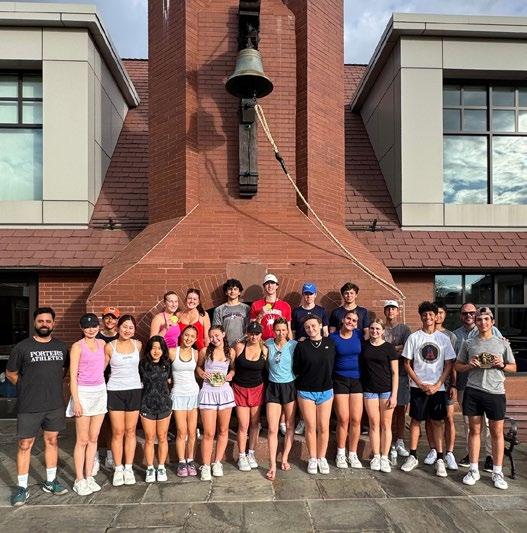
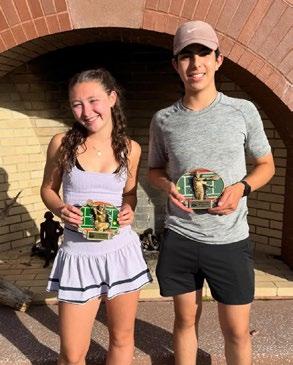
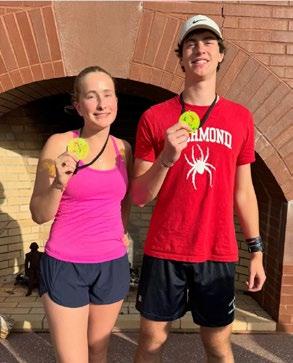
The Farmington River Classic is a new, fun tradition with Miss Porter’s and Avon Old Farms. The two schools joined together to plan and execute their first-ever mixed doubles tournament.
PAYMENT REMINDERS/TIPS
To be most efficient it is important that schools only create one account when making their payments. If you don’t remember your login information, simply click on the “Forgot your username or password?” link to enter your email address to receive instructions to reset your password. Remember to check your spam/junk folder for these instruction emails.
Please be aware that there is a processing fee to offset our cost with every online transaction. We are not able to refund processing fees, so please be diligent about this process and your record keeping.
How To View Your Account
If you already have a Username and Password, go to “View My Account” and enter your credentials to log in. After logging in, you will have access to “Payment History.” Use the available filters to view ALL of them or choose any date range or period.
Avon Old Farms
Thanks to Miss Porter’s School varsity tennis team for leading our first inaugural Farmington River Classic Mixed Doubles Tournament on Friday afternoon. Special shoutout to Coach Fahoum and his managerial team for tracking stats and congratulations to this year’s champions, Blair and José! Looking forward to this new tradition.
Miss Porter’s Varsity Tennis kicked off Long Spring Weekend on Friday with the inaugural Farmington River Classic!! We competed with and against AOF players during a great afternoon of tennis. Can’t wait until next year’s!
Championship Ring Supplier Supplier of NEPSAC Championship Trophies for over 10 years
• CH A M P ION S HI P RING S
CH A M P ION S HI P T RO P HI E S
W A RD PLA Q UE S
LASS & A CR YL IC A W A RD S
CH A M P ION S HI P BA NN E R S E CORD B O A RD S E D ALS & RI BB ON S ND M U CH MOR E UYS .CO M 695 -81 3 3 @ AWA RD-G UYS .CO M
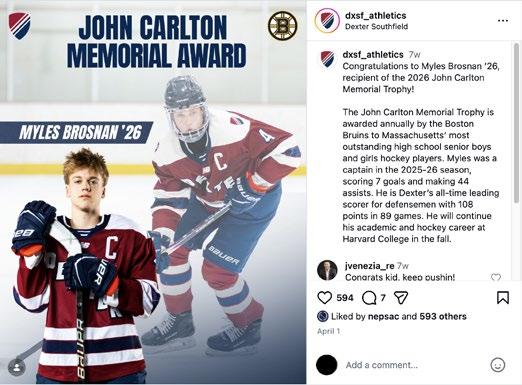
Bruins Announce 2026 John Carlton Memorial Trophy Recipients
by Boston Bruins
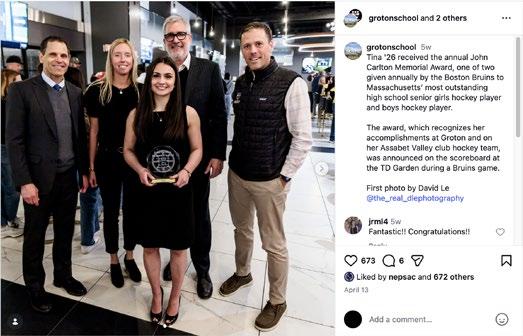
The Boston Bruins announced today, March 31, that defenseman Myles Brosnan of the Dexter Southfield School and forward Christina Scalese of the Groton School are the recipients of the 2026 John Carlton Memorial Trophies. The John Carlton Memorial Trophies are given annually by the Boston Bruins to Massachusetts’ most outstanding high school senior boys and girls ice hockey players. The award was established in 1983 to honor the late Bruins scout who was an advocate for the continued growth of Massachusetts hockey players at all levels of the game.
Both players will be recognized during the second intermission at the Bruins game against the Dallas Stars on March 31 at TD Garden.
Brosnan, a Winchester, Massachusetts native, is a defenseman at the Dexter Southfield School and served as captain for the 2025–26 season, recording seven goals and 44 assists for 51 points in 30 games. The 6-foot-1, 190-pound blueliner was a fourth-round pick of the Sioux City Musketeers and is Dexter’s all-time leading scorer for defensemen, with 108 points (19 goals, 89 assists) in 89 games. He was awarded Dexter’s Most Valuable Player, Neutral Zone Defenseman of the Year, First Team All-Prep honors, and the All-NEPSAC distinction in 2025-2026. Brosnan competed in the 2026 USA Hockey All-American Game, skated with the Sioux City Musketeers in the USHL Fall Classic and gained experience with the USA Hockey National Team Development Program (U18) in games against
Clarkson University and Saint Lawrence. For the 2026 NHL Draft, he is currently ranked No. 62 by The Hockey News and No. 104 among North American skaters by NHL Central Scouting. Brosnan will continue his academic and hockey career at Harvard University in the fall.
Scalese, a West Boylston, Massachusetts native, served as captain for the 2025–2026 season and helped lead the Groton School to a NEPSAC (New England Preparatory School) Small School Championship title. A four-time All-Independent School League (ISL) selection (2023–2026) and three-time All-NEPSAC honoree (2023–2025), she was also named ISL Co-MVP in 2026. As captain of both the Groton School and Assabet U19 teams in 2025, she led Assabet Girls Hockey to five Massachusetts State Tournament championships (2021–2025) and set the Groton School record for most
career points with 178. Additionally, Scalese was a member of the U.S. Under-18 team that won gold at the 2026 IIHF U-18 Women’s World Championship in Nova Scotia and silver at the 2025 tournament in Finland. Scalese will continue her academic and hockey career at Princeton University in the fall.
NEPSAC Spring 2025–2026 Tournament Champions
Be sure to hit the link below to see the All-NEPSAC athletes
GIRLS GOLF
Hamden Hall
GIRLS TENNIS
Class A Phillips Academy Andover
Class B St. Mark’s School
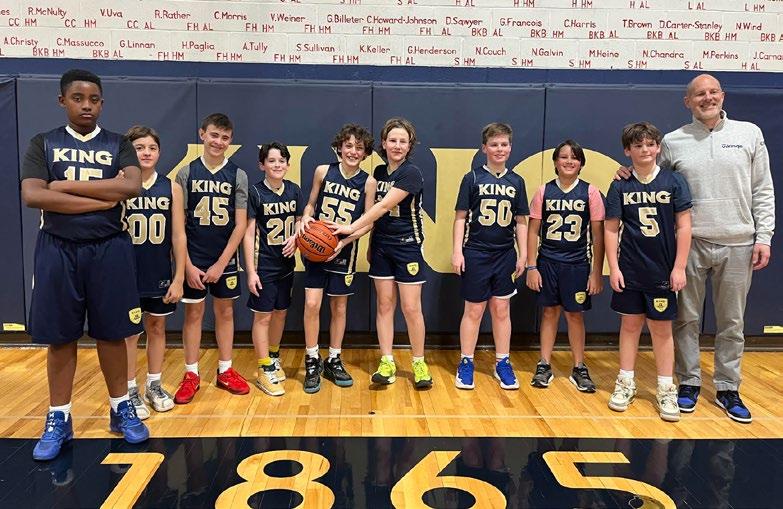
Class C King School
BOYS TENNIS
Class A Brunswick School
Class B Greenwich Country Day School
Class C King School
GIRLS WATER POLO
Choate Rosemary Hall
BOYS TRACK & FIELD
Division 1 Phillips Exeter Academy
Division 2 Noble & Greenough School
Division 3 Kingswood Oxford School
GIRLS TRACK & FIELD
Division 1 Phillips Academy Andover
Division 2 The Governor’s Academy
Division 3 St. George’s School
NEPSAC at the Boston Marathon
Brooks School
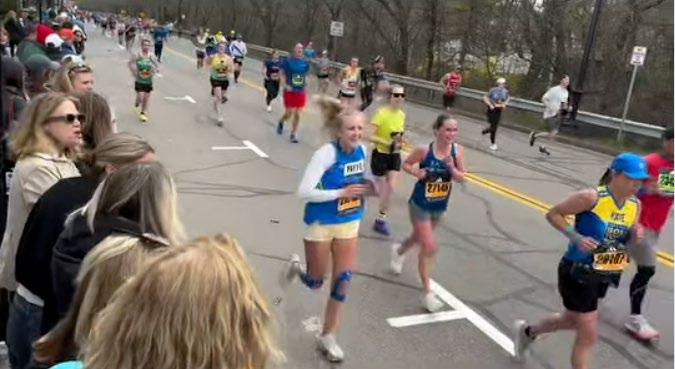
She did it! Mia Macklin-Dib ’26 completed the Boston Marathon on Monday after training for the race as her afternoon activity at Brooks this spring. Running in support of the Alzheimer’s Association, she also impressively raised more than $11,000 to fund research, care and advocacy for families affected by the disease, which has touched her own family. Congratulations, Mia! (Love that crowd support from her Brooks friends on the sideline in Wellesley!)
Concord Academy
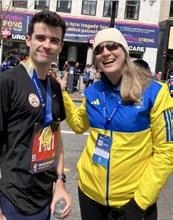
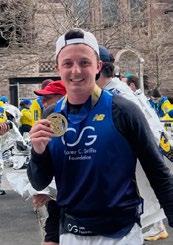
Congratulations to Concord Academy history teacher and assistant coach for cross-country and track and field, Mitchell Morris, for completing the Boston Marathon! He was in good company at the finish line—greeted by CA science teacher Susan Flink P’13, who volunteered at the marathon, handing out medals. Alum Lindsay Klickstein-Kahrs ‘15 also volunteered at the race, supporting runners in the medical tent. We’re grateful to be part of a community where faculty, alums, and friends show up for one another, on campus and beyond.
Dexter Southfield
From the Boston Marathon to the Youth Mile and 5K, the Dexter Southfield community showed up strong this weekend. Shoutout to our alumni, faculty, and students who took part, and congratulations to all on an amazing achievement. Alumni: Kaity O’Brien ’09, Sean Keohan ’17, Nicki Stanton ’18, Bobby Pearl ’19, Jonny Aldsworth ’19, Michael Freking ’23, Finn Maiona ’25. Students: Zoe Georgantas ’26. Faculty & Staff: Scott Souza, Abby Comella, Brian Owens.
Noble and Greenough School
So proud of our own Payton Maley running today in the Boston Marathon. Back in a boat tomorrow.
Cushing Academy Volunteering for Dana Farber. Photo by Christian Housh.
NEPSAC Spirit Award
The NEPSAC Executive Board is excited to announce a new initiative designed to recognize the outstanding professionals within our athletic departments. We are launching The NEPSAC Spirit Award to formally acknowledge athletic department members who demonstrate integrity, sportsmanship, dedication, and positive behavior that reflects the collective values of NEPSAC.
Any NEPSAC professional community member is eligible to submit a nomination. We encourage you to recognize deserving colleagues across your staff.
Winners will be announced on a rolling basis and you will be reminded to submit nominations regularly through the year.
NEPSAC SPIRIT AWARD NOMINATION FORM
We look forward to celebrating the exceptional spirit and dedication within our NEPSAC community.
The NEPSAC Spirit Award Committee:
Andrew Mitchell, Lexington Christian Academy
Jamie Arsenault, New Hampton School
Courtney Callanan, Rectory School
Rob Feingold, Fay School
Laurie Sachs, NEPSAC, The Rivers School
Erin Bradley
MAY 2026 | RECTORY SCHOOL
As a three-season varsity girls coach at the junior boarding school level, Erin fully embraces the true purpose of middle school athletics, which often presents unique challenges beyond those at the high school level. Erin consistently models exceptional sportsmanship, never running up the score and intentionally shaping each game to be a respectful and positive experience for student-athletes, coaches, officials, and spectators alike, aligning closely with NEPSAC’s Middle School Spirit of Competition Statement. She sets clear standards for behavior and thoughtfully adjusts her approach when outcomes are decided, emphasizing teamwork and development over results. She is the master at planning team bonding activities, which is a crucial part of building a team culture. She is the definition of the “triple threat” in boarding school communities: educator, coach, and dorm parent, a role that is increasingly rare and incredibly important. No matter how demanding her responsibilities may be, she consistently makes decisions in the best interest of her studentathletes. Erin is a true role model and mentor to the entire student body, especially to our female athletes. Having worked with many coaches, it is clear that Erin leads with integrity and represents the very best of Rectory and NEPSAC values.
Anne Armstrong
APRIL 2026 | BELMONT DAY SCHOOL
Anne Armstrong is more than a tremendous coach, educator, and leader. She is the very definition of school spirit at Belmont Day School. For more than two decades, Anne has been a constant and inspiring presence in the Belmont Day community, serving as both a beloved arts teacher and an outstanding cross country coach. Her impact reaches far beyond results or wins. She has a remarkable ability to bring students together, galvanizing them not only to participate, but to compete, connect, and fully embrace what it means to be part of a team.
Under Coach Armstrong’s guidance, countless students have discovered confidence in themselves as athletes, often in ways they never expected. She creates an environment where students feel valued, supported, and motivated to give their best. Her energy, belief in her students, and unwavering commitment to team culture help young people see themselves in a new light.
What makes Anne especially deserving of a Spirit Award is that her commitment to Belmont Day extends well beyond the school day or a single season. She continues to champion BDS spirit by attending local high school meets, cheering on former student-athletes as they compete against one another and celebrating the continued growth of the runners she once coached. That kind of lasting dedication speaks volumes about who she is.
In a small elementary and middle school community, Anne Armstrong truly bleeds blue and gold. She is a pillar of Belmont Day spirit, and her loyalty, enthusiasm, and deep love for the school and its students make her exceptionally deserving of this recognition.
Anne Schmidt-Sabia
JUNE 2026 | KENT SCHOOL
As the Kent School Athletics Operations Coordinator, Anne is the rock of the athletics program and has been for more than a decade. Anne handles her many responsibilities (and the needs of coaches and athletes) with class and good humor. Despite the fact that her contract only calls for Mondayto-Friday work, she is always available on weekends to help with emergencies or unanticipated issues. She is a fervent supporter of our teams, often driving hours in her off time to support Kent athletes. Kent is incredibly fortunate to have Anne in our community, where she stands as a true credit to her profession.
See all the awards here
TECH WITH: FIELDTURF
What does the new NFL Surface Standard mean for your program?
In December 2025, the NFL introduced new mandatory practices for the selection and maintenance of playing surfaces used for NFL games and practices. The new playing surface standards were developed and approved by the NFL and the NFL Players Association (NFLPA) Joint Field Surface Safety and Performance Committee, and evaluate surfaces using three primary metrics: impact, traction, and infill consistency. The program is a system design engineering benchmark to guide innovation and improve consistency across products used in the league.
FieldTurf has the most NFL-certified systems in the industry, a testament to our heavyweight infill system design backed by science.
Over 25 years ago, our founders had one goal: to build a system that would perform like elite natural grass and help change the game for athletes. After extensive testing and numerous system iterations, they reached their “ah-ha” moment and created the original FieldTurf system. Designed to match the weight of a natural grass soil profile, with a precise wide tufting gauge that allows the cleat to play in the infill, instead of on top of the carpet. “Looks like grass. Feels like grass. Plays like grass.” was never a marketing line. It was a design philosophy. A commitment to building systems that replicate the performance characteristics athletes expect from the best natural grass fields.
That philosophy has guided every decision since and has shaped FieldTurf into a world leader in artificial turf.
Like elite natural grass, a high-performance surface is defined by balance, with multiple components working together in synergy. Performance is never the result of a single component. It is the outcome of system design. Our proof is in the ground and backed by science. Independent and third-party research has consistently demonstrated how our approach delivers leading traction, player safety, and durability.
The new NFL Surface Standard did not redefine our design. It validated it.
With a focus on the relationship between player and surface, each product is evaluated against three mechanical metrics to ensure consistency across every stadium: impact, traction, and infill depth. The testing protocol uses two key testing devices that are exclusive to the NFL:
The BEAST
» Traction testing device that replicates the movements of an NFL player.
» Test Criteria: Peak torque ≤ 180 Nm (rotational traction)
The STRIKE
» Impact tester that helps determine the firmness of each field
» Test Criteria: 45 g ≤ Peak g ≤ 90 g
Approved systems obtain an official certification and are allowed to be installed at NFL stadiums and practice facilities.
What does this mean for your program?
The NFL’s new requirements establish a benchmark for entry and help evaluate system performance at the highest level, but the program represents only one of the many components that must be considered when designing and building a sports surface. Here are a few key considerations when evaluating your next field surface provider and system:
» Understand your program needs: Understand what your program needs are, performance levels, and need for grass-like characteristics.
» Be specific on the system specifications: Infill weight (Min of 6 lbs. Per sq ft.) and stitch gauge (¾”) make a difference.
» The system is only one component of your decision matrix: When selecting your partner, fiber quality, company reputation, installation expertise, warranty and more continue to be critical factors.
» Trust a proven company and system: Some vendors will create new systems to meet the NFL standard, many never installed before. Trust a partner that has experience.
Not all turf is created equal.
PLAYS LIKE HIGH-PERFORMANCE NATURAL GRASS
FIELDTURF HAS THE MOST NFL-CERTIFIED SYSTEMS IN THE INDUSTRY
NOT ALL TURF IS CREATED EQUAL
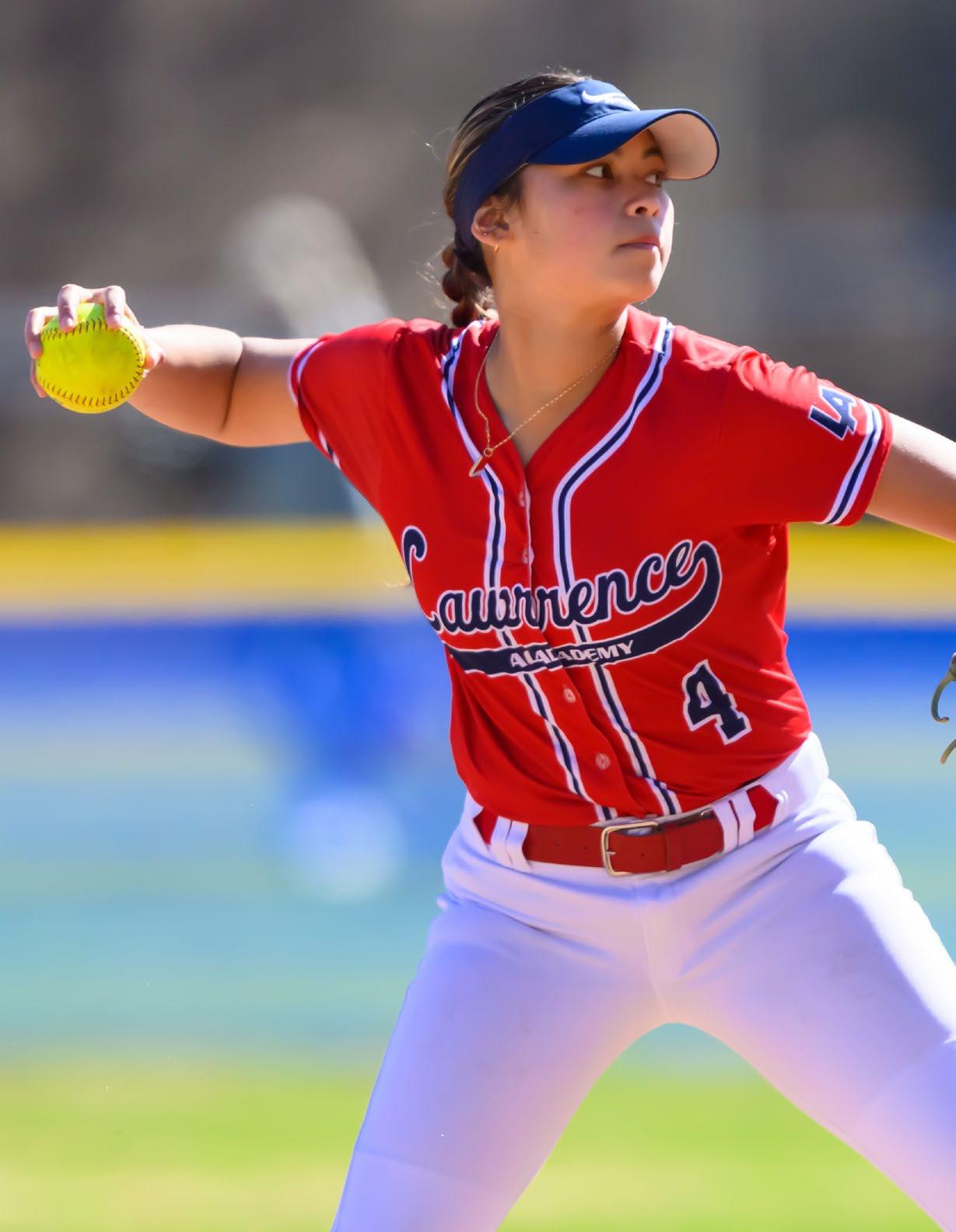
Boo will go from Lawrence Academy to American International College in Springfield, Massachusetts.
Preslie
Photo courtesy Lawrence Academy.
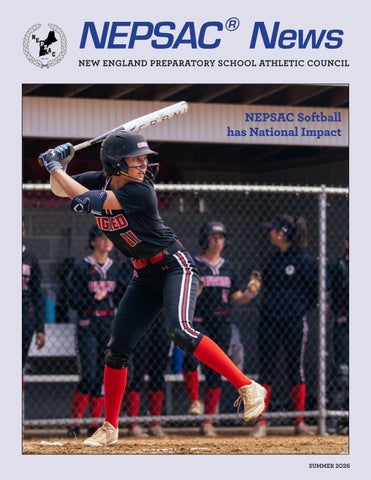
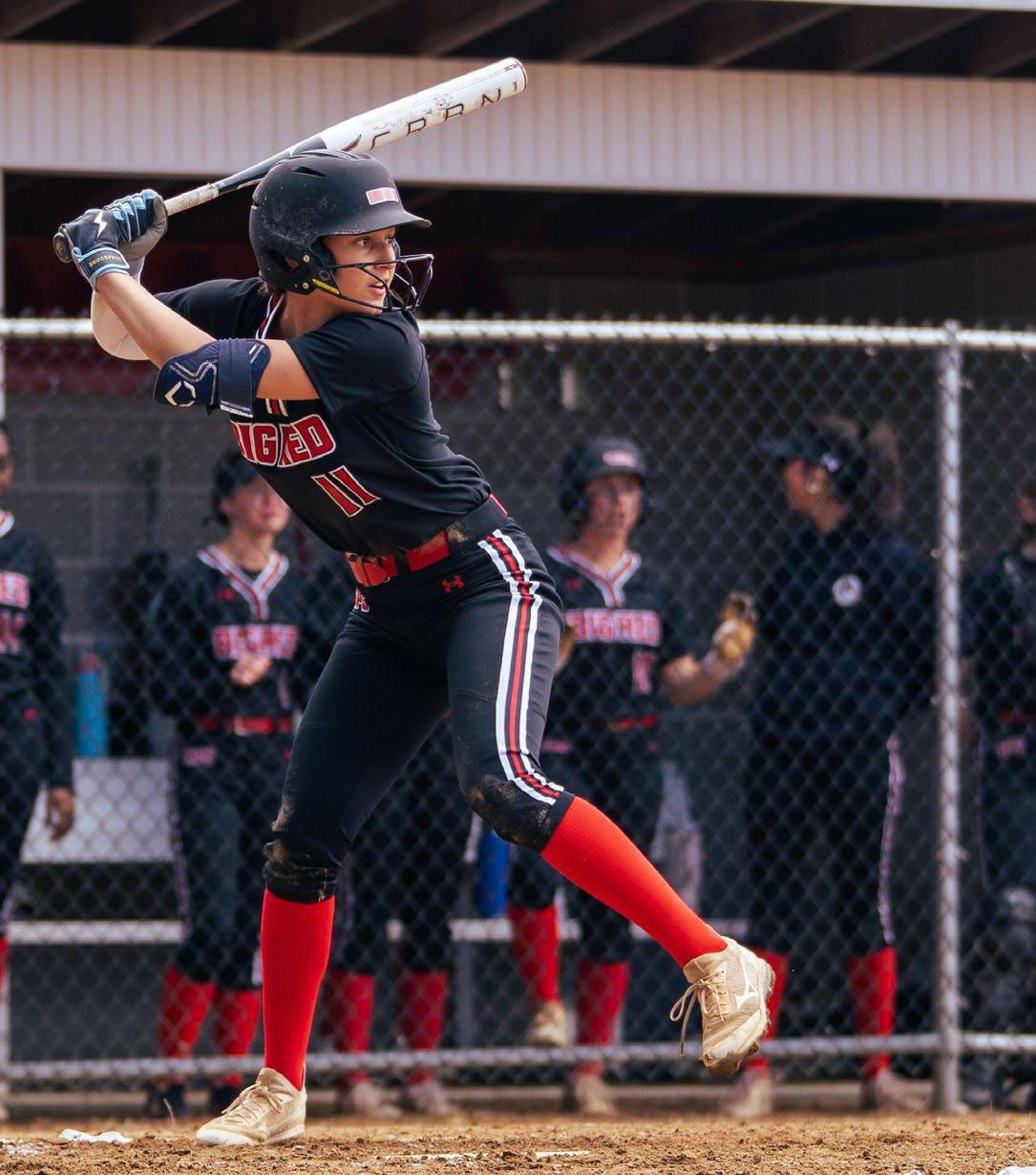
NEPSAC Softball has National Impact
by Sarah Boylan, St. Paul’s School
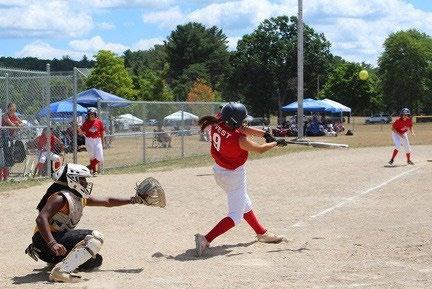
If you walk into nearly any restaurant around New England during the first week of June, odds are that the Women’s College World Series (WCWS) will be playing on TV. Last year, the WCWS set both viewership and attendance records, demonstrating that college softball has gotten the country’s attention. This year, big names like Megan Grant, who set the NCAA Division 1 single-season homerun record at UCLA, and Karlyn Pickens, who threw the fastest recorded pitch in history at Tennessee, are regulars on SportsCenter. Back in New England, softball is thriving, and the NEPSAC has continued to send players to all three divisions of the NCAA.
Kimball Union Academy, which most recently sent Alyssa “Lulu” Leppard to Amherst College, Zoie Steven to Worcester State, and Stella Kozak to Worcester Polytechnic Institute, continues its tradition of college-bound players. In fact, Leppard (KUA ’24) received Third Team NFCA All Region recognition. This year, KUA graduates outfielder Kennedy FitzSimons, who will play at Southern New Hampshire University in the fall. FitzSimons recorded a tremendous 0.476 batting average this season with a 1.290 OPS against strong Western New England and Lakes Region competition. At St. Paul’s School, recent graduates include Alison Jankowski (Middlebury College) and Heather Cotter (Worcester Polytechnic Institute). After graduating this spring, Jade Hill will head to Charlottesville to play in the Atlantic Coast Conference (ACC) for the University of Virginia. Hill is the most decorated player in St. Paul’s history, holding most of the school’s single season and career records. Coach Boylan commented on Hill’s contribution to the program: “More than her ability, Jade has been an exceptional captain for our program this year. Every girl on our team looks up to her. One of Jade’s biggest assets as a teammate is that she
St. Paul’s Jade Hill is Charlottesville bound, to play for the University of Virginia. Photo courtesy St.Paul’s School.
has very little ego. Despite her excellence, she never brings attention to herself and is highly supportive of everyone on the team, regardless of their skill level.” Hill’s stellar season earned regional acclaim when she was named the 2026 Boston Globe NEPSAC Softball Player of the Year. A three-sport athlete, Hill competed for the Varsity Volleyball and Ice Hockey Teams, winning the NEPSAC Large School Tournament in 2023. At graduation, Hill won the Loomis Medal—the school’s highest athletic award—which is given to the girl who has contributed the most to the athletic program.
Down in Connecticut, Sienna Stawiecki graduated from Marianapolis Preparatory School this spring and is headed to play Division II softball at Pace University. Stawiecki was a dominant force at the plate this season, batting 0.533 with a 0.553 OBP and an outstanding 1.753 OPS. She delivered in key moments for her team at the plate and was perfect on the bases with a 100% stolen base success rate. Coach James Baca wrote about Stawiecki’s career: “A team captain who consistently led by example on and off the field, she has set the standard for work ethic, competitiveness, and leadership throughout the year. Sienna extends a combination of leadership, offensive production, consistency, and overall impact to her teammates and the game.”
Up in the ISL, Lawrence Academy is sending Preslie Boo to American International College in Springfield, MA. Boo had a tremendous impact on Lawrence Academy’s season, helping lead the program to the semifinals of the Big East Tournament. Coach Boucher-Lavigne commented on Boo’s impact: “Preslie has been instrumental in the rebuilding of our program. Her skill and passion have made a lasting impact.” Also in the ISL, Milton Academy was anchored this year by catcher Sophia Crowley, who recorded a tremendous 0.754 batting average with a 2.761 OPS and 17 homeruns. Coach Maturo commented: “Sophia was a tremendous captain to our young team and led by example with her performances. She carries a high GPA and lives this game 365 days a year. Her career stats are impressive, and she is a great, statuesque representative for the NEPSAC and all players in the state.” In recognition of her incredible career, Crowley was named the Independent School League Player of the Year. Crowley is headed to the NESCAC to play at Bowdoin College. Rounding out the list are two Exonians also headed to Maine: Ella Shea (Colby College) and Paige Sweet (Bates College).
As NEPSAC programs continue to send elite talent to the college ranks, New England is cementing its spot on the national softball map. Another great season may be in the books, but the foundation for next year is already being laid. Mark your calendars for next spring, buy a lawn chair, and get ready to pack the stands. Who knows, the next Megan Grant or Karlyn Pickens might be lacing up her cleats and representing your school next spring.
KUA Outfielder Kennedy FitzSimmons is headed to Southern New Hampshire University. Photo courtesy Kimball Union Academy.
2026 NEPSAC Summit Participants
Austin Preparatory School
Berwick Academy
Brewster Academy
Cheshire Academy
Cushing Academy
Deerfield Academy
Fay School
Groton School
Holderness School
Lawrence Academy
Middlesex School
Milton Academy
Northfield Mount Hermon
Pomfret School
Tabor Academy
The Governor’s Academy
Williston Northampton School
Meeting the Moment: Cushing Academy Hosts the Largest Girls* in Sports Leadership Summit To Date
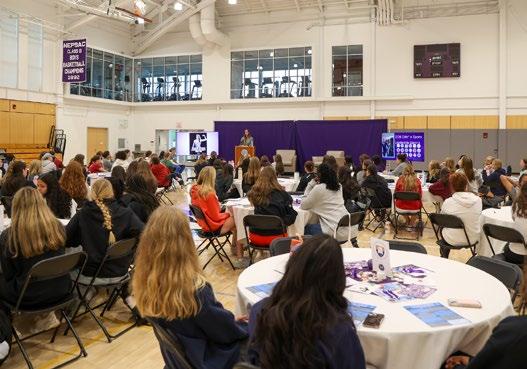
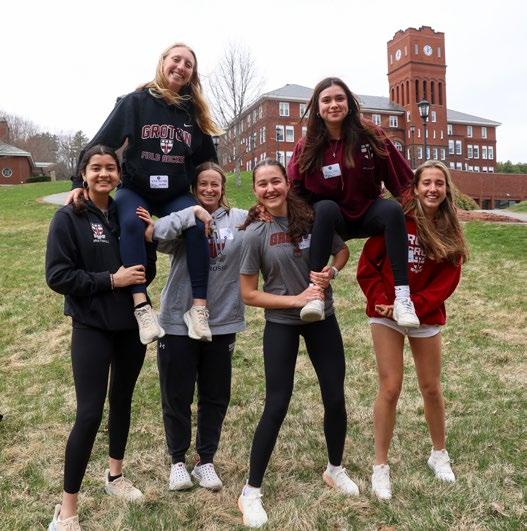
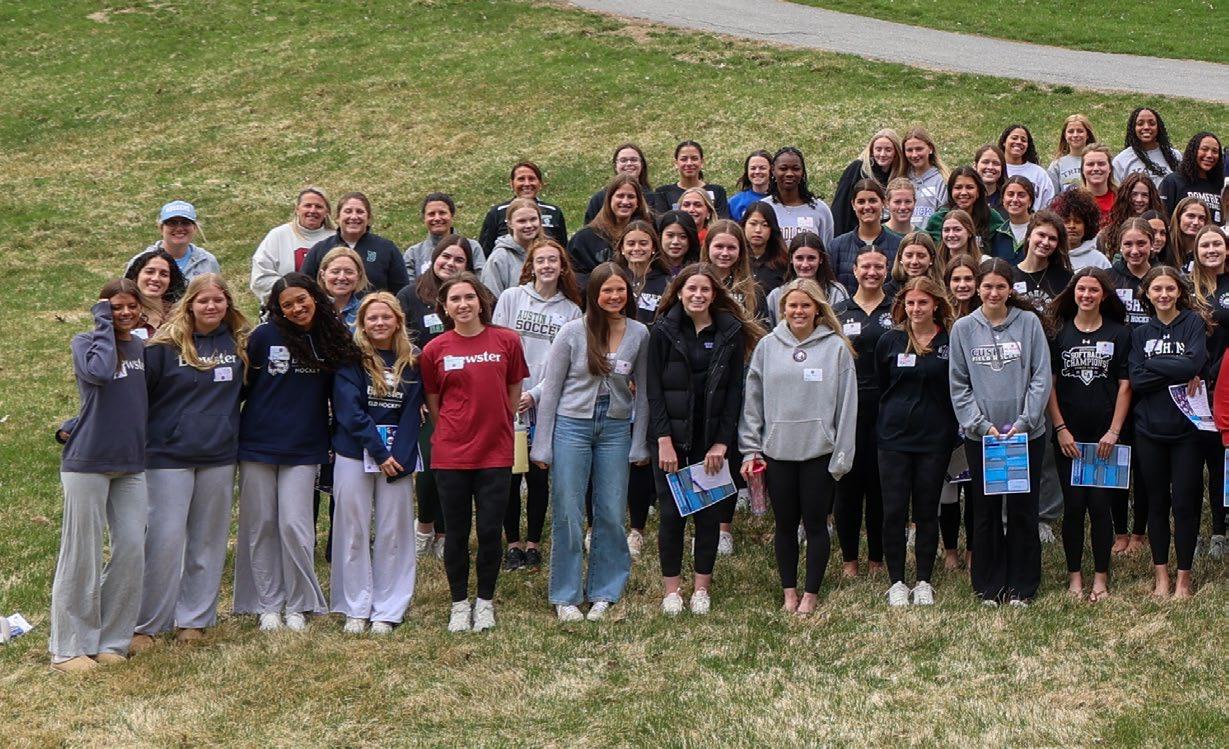
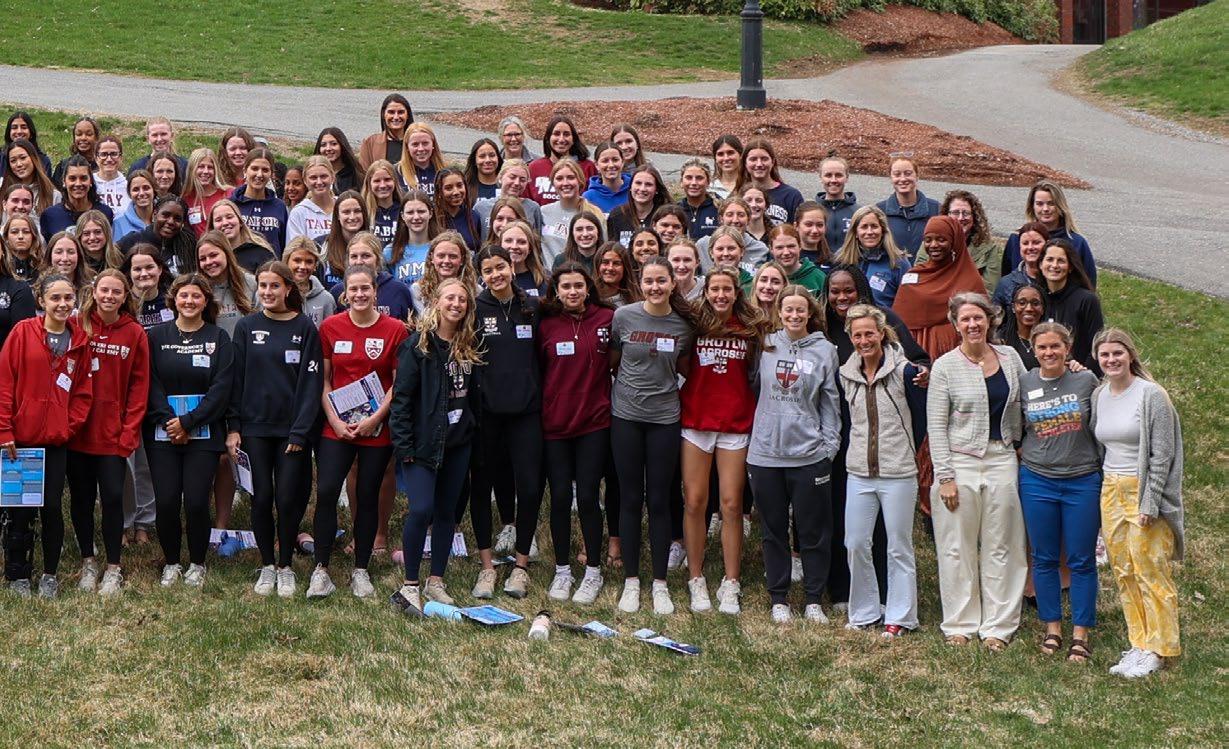
A new venue and a revamped schedule marked this year’s Girls* in Sports Leadership Summit, attracting more than 100 female-identifying students from 17 NEPSAC schools.
by Jennifer Willis
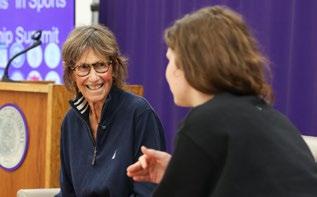
The event, hosted on April 13 at Cushing Academy, included a keynote address, interactive workshops, and a featured conversation, all centered around the theme, “Meeting the Moment.” Participants gained access to leaders and true pioneers in the world of sports and sports leadership, including a keynote address from Cushing alum Hayley Moore Kotyk, and an interview with tennis legend and Title IX advocate, Judy Dixon.
“Welcoming a record number of female-identifying student-athletes and hearing the messages from our incredible speakers and workshop leaders was inspiring and deeply affirming,” says Dr. Jennifer Willis, Cushing’s Director of Teaching and Learning. “We asked our participants to spend time throughout the day considering how they might show up when faced with a choice, emphasizing the impact that our decisions and our actions have on ourselves and those around us, as well as on our broader community and society. Across the various speakers and sessions, a clear throughline emerged as we challenged these young athletes and leaders to step into discomfort, to invest in culture and communication, and to manage pressure, both internal and societal, in ways that promote meaningful growth and change. It was another energizing day full of affirmation and inspiration!”
Founded in 2018 by Dr. Willis and Sarah Catlin, Cushing’s Director of Student Affairs and former NEPSAC field hockey president (Loomis ’94), the Girls* in Sports Leadership Summit has grown steadily each year. Katie Ftorek, Associate Director of College Counseling and coach for hockey and softball at Cushing (Deerfield ’04) and Mollee Malboeuf, Assistant Director of Student Affairs and coach for field hockey and basketball at Cushing (Cushing ’19) have both played integral roles in building the program over the last seven years.
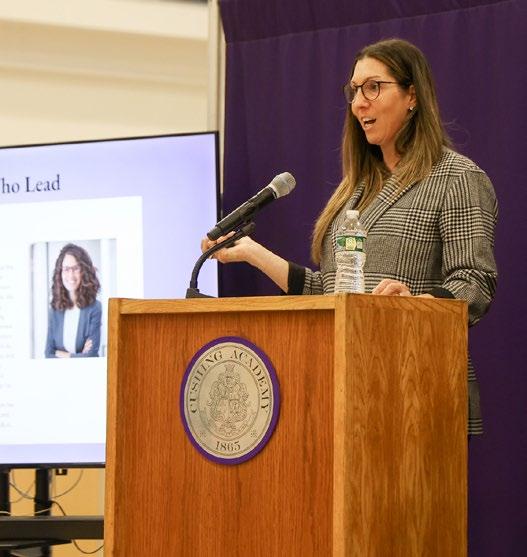
Hayley Moore Kotyk (Cushing ’04) spoke with confidence, authenticity, and vulnerability during her keynote address. Reflecting on her evolution as a leader during her time as an athlete and coach, as well as in leadership roles including general manager, team president, director of player development, commissioner, and executive vice president, Moore Kotyk identified multiple points in her journey where she had to push through the noise of negativity and doubt, relying on her belief in herself and the support and trust of others. Now as Senior Agent and Director of Women’s Hockey at Quartexx Management, Moore Kotyk continues to blaze a trail, creating more space for women in professional sports. Using her platform to empower and uplift the audience, Moore Kotyk spoke honestly about failure and confidence, and challenged the audience to push back on the idea that success and achievement are linear paths.
on the importance of reframing setbacks and stepping into discomfort as means for growth.
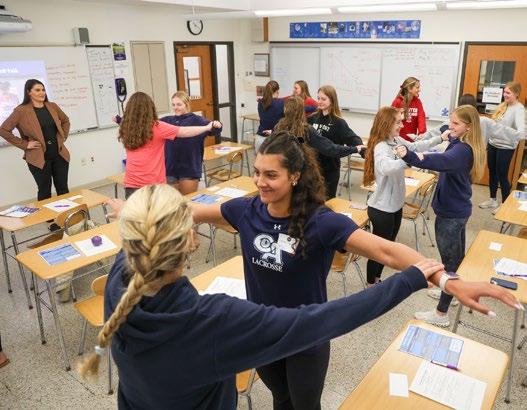
In addition to the keynote, attendees participated in three discussion-based workshops from a list of six options, including:
» The Mental Skills Playbook: Performing Under Pressure (Olivia Papakyrikos, Papakyrikos Therapy + Performance Inc., Cushing ‘12, )
» Off the Field: Working in Professional Women’s Sports (Stephanie Yang, Senior Director of Communications, Boston Legacy FC)
» Taking the Lead: Difficult Conversations (Dia Fortenberry, Asst. Athletic Dir. for Diversity, Equity, Inclusion and Engagements, Wesleyan University)
» Excellence without Exhaustion (Tiffany Corselli, Assistant Director of Student Life and DEIB Coordinator, History Faculty, Assistant Coach, Women’s Varsity Basketball, New Hampton School)
Keynote speaker Hayley Moore Kotyk, Senior Agent and Director of Women’s Hockey at Quartexx Management, reflected
Photo by Philip Wexler
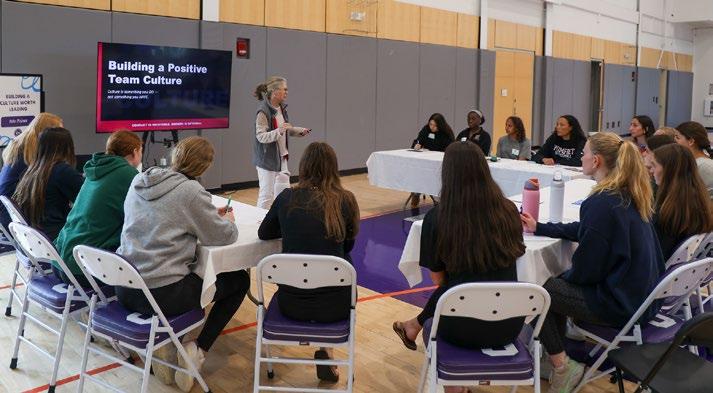
Students participated in “Building a Culture Worth Leading” a workshop led by Erin Fisher, Director of Wellbeing & Head Girls’ Soccer Coach at Pomfret School.
» Building a Culture Worth Leading (Erin Fisher, Director of Wellbeing & Head Girls’ Soccer Coach, Pomfret School)
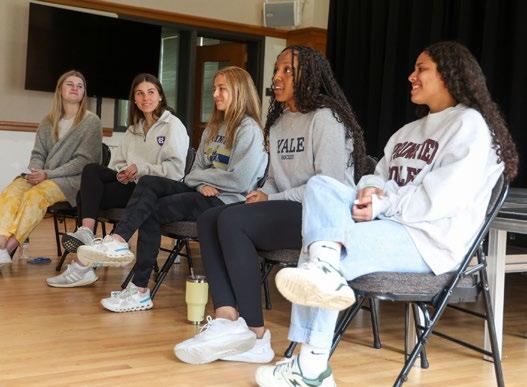
» In Her Shoes: A Panel Discussion with Girls* in Sports Leadership Summit Alums (Alums, Various Schools)
For the third year, participants had the opportunity to hear from current college students who had previously attended the Leadership Summit. This year’s speakers, Rio Gladchun (Holderness/ Trinity College), Adriana Hernández Feliciano (New Hampton/
Springfield College) Abby Lorion (Rivers/ College of the Holy Cross), and Kennedy Walker (New Hampton/Yale University), not only attended the 2024 Girls* in Sports Leadership Summit event as high school juniors, but also participated in the first In Her Shoes panel as audience members. In this year’s panel conversation, facilitated by Mollee Malboeuf, the current college-athletes offered advice and guidance for participants as they prepare for the next step.
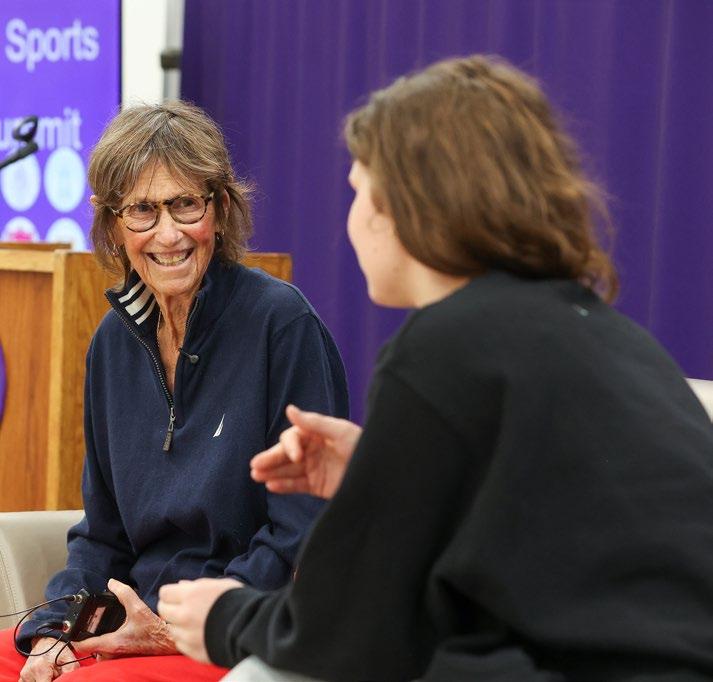
This year’s event also featured “A Conversation with Judy Dixon,” during which Coach Dixon shared stories from her time as a female athlete at the University of Southern California, a women’s coach at Yale University, and a sports broadcaster. Dixon reflected, “I got the message again, and again, and again that I needed to sort of stay in my lane…but being an athlete, I knew this wasn’t fair.” Judy provided a call to action, not only for current athletes to better understand the history of Title IX, but also the importance of building on the momentum and progress: “If you don’t understand the history, you won’t keep the passion of the fight…Do not settle for the answer ‘no.’ Do not.” Cushing Academy senior, Kamryn Zellars, hosted the conversation with Coach Dixon and expressed her gratitude saying, “We are so grateful for your time and so appreciative of all that you have done to meet the moment and fight
More than 100 student-athletes from 17 NEPSAC schools participated in this year’s Girls* in Sports Leadership Summit, hosted by Cushing Academy.
Photo by Philip Wexler
for the advancement of girls and women in sports!”
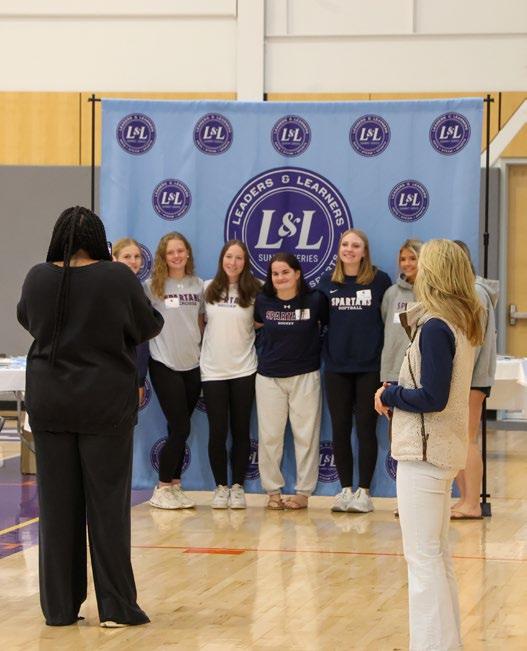
Through the continued support of Cushing alums and the Edward E. Ford Foundation, Cushing plays host to three events each year as part of the larger Leaders & Learners Summit Series. Focused on celebrating and developing leadership in female-identifying students across NEPSAC schools, the events include an Arts Summit in the fall (November), a STEAM Summit in the winter (January), and the original Sports Summit in the spring (April). For information and details about the Leaders & Learning Summit Series, contact Sarah Catlin (sacatlin@cushing.org).
Judy Dixon and Kamryn Zellars ’26 in conversation.
(Tabor Baseball) Diamonds Last Forever
by Rebecca Binder
Nikki Tredwell and Nick Chace met in college. Their relationship bloomed, and they began to plan a life together. As they learned about each other’s families, their conversations revealed something unexpected: Their families had already been connected for 80 years.
“I always thought in the back of my head that the stories Nick told me about his grandfather made him sound a lot like my grandfather,” Nikki says. “The little things they both did, or the phrases they both used. I’d never heard anyone else say that except in my own family.”
As Nick and Nikki compared stories about their grandfathers, both of whom have passed away, more similarities emerged. Both Alonzo Tredwell ’49 and Don Chace ’50 were passionate about sports, for example, especially baseball. One small detail, though, suddenly brought everything into focus.
“Nick said that his grandfather had gone to Tabor,” Nikki says. “I was like, ‘what? My grandfather also went to Tabor!’”
From there, curiosity quickly turned into action. Nikki and her mother — Ruthie Tredwell, Alonzo Tredwell’s daughter — reached out to Tabor to see if the school archives held any information on Tredwell.
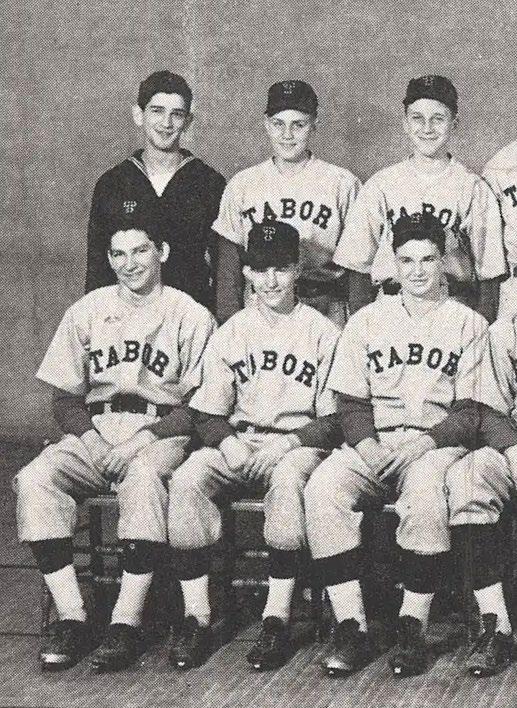
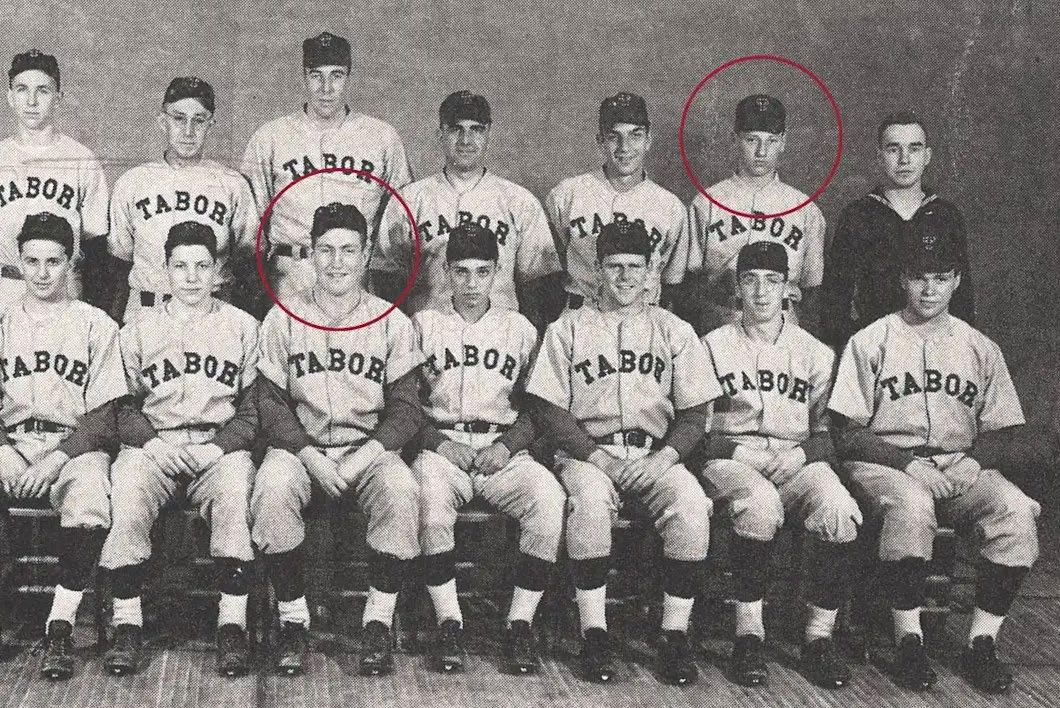
What followed exceeded every expectation. Tabor’s archives included rosters and photographs confirming that the two grandfathers attended Tabor at the same time and played together on the 1948–1949 varsity baseball team. Archivist Sophie Arnfield sent Ruthie Tredwell copies of rosters and team photographs, as well as articles documenting Tredwell’s and Chace’s time at Tabor.
The link between the two families might seem like a remarkable coincidence, but for Nikki and Ruthie, it’s more meaningful than chance. “It just feels full circle,” Ruthie says. “I’d do anything to talk to my dad for 10 minutes about this,” she laughs. “I’d ask him how well he knew Don Chace, because guess what?”
Nikki echoes her mother’s sentiment. “I wonder what it would be like to go back in time and tell them, ‘Hey, your grandchildren are going to get married,’” she says. The discovery also deepened her relationship with Nick and his family. “We were already very close,” she says. “But being able to intertwine our family histories is really amazing.”
Now, as Nikki and Nick plan their wedding, the past will be present in a very real way. Ruthie plans to display the archival photograph of the Tabor baseball team, which includes both grandfathers, at the celebration.
“They’re going to be at the wedding,” Ruthie says. “Absolutely.”
Even beyond the Tabor connection that links the Tredwell and Chace families, Ruthie says that seeing the names and faces from her father’s past brought decades-old memories rushing back. Tabor has always been a part of her life, she says. It shaped her father and his lifelong friendships. She recalls visiting campus as a child with her father for his class reunions. She remembers her father wearing a Tabor Baseball shirt to play baseball and softball games with neighbors over the years. Friday nights, she says, were
reserved time in which her father would “yuck it up” on the telephone with his Tabor classmates.
Some of the names on the roster, she says, even served as pallbearers at her father’s funeral.
“My dad’s friends from Tabor were our family,” she says. “I’ve known some of the names on that roster my entire life. I grew up going to their houses. Seeing them all an arm’s length away from each other in that baseball team photo means so much to me.”
For Nikki, the discovery was deeply emotional. “I never got the chance to meet my grandfather,” she says. “It’s very special to be able to feel closer to someone you’ve only known through stories.” It also highlights the lasting impact of the Tabor experience.
“Their years at Tabor were so formative,” Ruthie says. “They learned how to be friends, and how to be teammates, and they built these close friendships and strong traditions that lasted beyond school. Those shaped us too, and now here we are, back together again. You might not have a family; you might have a very small family; but your friends can be your family. The Chace family is wonderful, and they feel even more like my family now.”
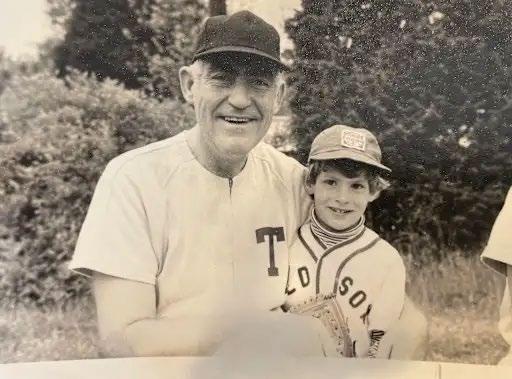
Above: Alonzo Tredwell ’49 (left) on campus for an alumni baseball game with a young relative.
Right: Nick Chace (left) and Nikki Tredwell (right) are engaged to be married. They recently discovered that their grandfathers played baseball together at Tabor almost 80 years ago.
Below: The 1948–1949 varsity baseball team. Don Chace ’50 (upper right) and Alonzo Tredwell ’49 (center) are circled.
Photos courtesy of the families/Tabor archives.
Athletes From 9 NEPSAC Schools Earn Gatorade Player of the Year Honors
The Gatorade Player of the Year award was established in 1985 to recognize the nation’s most elite high school student-athletes for their athletic excellence, academic achievement and exemplary character.
In each of the 50 states and the District of Columbia, one Gatorade State High School Player of the Year is chosen in each of the following sports: football, volleyball, boys and girls cross country, boys and girls basketball, boys and girls soccer, softball, baseball, and boys and girls track and field.
One winner from each of the twelve sports is chosen from each state and the District of Columbia.
The Gatorade State Player of the Year award winners are evaluated and selected on the basis of three criteria:
» Athletic Excellence - Standout performance in their respective sport made at the high school, club, national or international levels of competition.
FOOTBALL
PETER BOURQUE ’27
Tabor Academy
Marion, Massachusetts
ATHLETIC EXCELLENCE
The 6-foot-4, 205-pound junior quarterback passed for 2,241 yards and 18 touchdowns this past season, leading the Seawolves (9-0) to an undefeated campaign and the NEPSAC John Papas Bowl title. Bourque completed 63.3 percent of his throws at 10.8 yards per attempt while also rushing for 688 yards and 15 scores on 80 carries. The 2025 NEPSAC Class B Player of the Year and Offensive Player of the Year, he’s ranked
» Academic Achievement - Review of GPA and class rank, as well as SAT and ACT scores, and academic honors distinctions.
» Exemplary Character - Commitment to sportsmanship, character and community through membership and participation in positive activities.
As of June 5, 2026, 2025–2026, 11 NEPSAC athletes from nine schools in Connecticut, Massachusetts, New Hampshire, New York, and Rhode Island were named Player of the Year for 2025–2026 in football, volleyball boys and girls cross country, boys and girls basketball, and baseball. Awards in soccer and track and field will be made later in June.
as the nation’s No. 85 recruit in the Class of 2027 by 247Sports and the No. 130 recruit by ESPN. He participated in the U.S. Navy All-American Bowl in January.
ACADEMIC EXCELLENCE
Bourque has maintained a B average in the classroom. At the time of his selection, he had made a verbal commitment to receive athletic aid to play football at the University of Michigan in the fall of 2027.
EXEMPLARY CHARACTER
Also a varsity lacrosse player, Bourque has volunteered locally on behalf of the Special Olym-
pics. He has also donated his time to local youth sports teams, the Boston Veterans Food Bank and A Shot For Life, a sports non-profit that raises money for cancer research.
I haven’t seen a better player in New England. His frame is insane. He can make every throw. He’s also a really good athlete and for all the talent Tabor Academy has across the board, he’s particularly tough to defend. ~ Anthony Fucillo, head coach, Belmont Hill School
BOYS CROSS COUNTRY
NATHAN LEE ’26
Brunswick School
Greenwich, Connecticut
ATHLETIC EXCELLENCE
The 5-foot-9, 130-pound senior earned Third Team All-American honors with his 17th-place finish at the Brooks Cross Country Championships this past season. Lee also took second in the Brooks Northeast Regional Championships and won the New England Prep School Track Association Division 1 Championships, leading the Bruins to a sixth-place finish as a team. The state’s 2024-25 Gatorade Boys Track & Field Player of the Year, he concluded the season ranked No. 22 in the country in the MileSplit50 rankings.
ACADEMIC EXCELLENCE
Lee has maintained an A average in the classroom. He will attend Harvard University this fall, where he will run for the cross country and track teams.
EXEMPLARY CHARACTER
A senior prefect at Brunswick School, Lee has volunteered locally with Sneakers4Good and has donated his time to multiple community service initiatives through his church.
Nathan has enjoyed a stellar cross country career in all respects. It’s a tale of successes any athlete would envy.
~ Steve Polikoff, head coach, Brunswick School
2025–2026 Winners At a Glance
As of June 5, 2026. Any remaining honorees will be recognized in the fall issue.
FOOTBALL
Peter Bourque ’27, Tabor Academy VOLLEYBALL
Emily McKee ’26, King School
BOYS CROSS COUNTRY
Nathan Lee ’26, Brunswick School
GIRLS CROSS COUNTRY
Blair Bartlett ’27, The Lawrenceville School
BOYS BASKETBALL
Alex Egbuono ’26, Lawrence Academy
Antonio Pemberton ’27, Brewster Academy
Kamari Whyte ’27, Vermont Academy
GIRLS BASKETBALL
Fope Ayo ’26, Austin Prep
Lauren Bousquet ’26, Moses Brown School BASEBALL
Will Haggerty ’27, Moses Brown School
Kaiden McCarthy ’26, Vermont Academy
GIRLS CROSS COUNTRY
BLAIR BARTLETT ’27
The Lawrenceville School
Lawrenceville, New Jersey
ATHLETIC EXCELLENCE
The 5-foot-3 junior took second at each of the two premier national championship meets last month—the Nike Cross Nationals and the Brooks XC Championships—with times of 16:51.7 and 16:57.1, respectively. Bartlett crossed the line 1.6 seconds away from a national title in both races. She won the NJISAA Prep Class A state title this past season, leading the Big Red to a runner-up team finish. She was also the top American finisher in the U20 World Cross Country Championships earlier this month, placing 16th.
AACADEMIC ACHIEVEMENT
Bartlett has maintained a 4.11 GPA in the classroom. She will begin her senior year of high school this fall.
EXEMPLARY CHARACTER
Bartlett fulfills a number of duties in the realm of climate science,
VOLLEYBALL
EMILY MCKEE ’26
King School
Stamford, Connecticut
ATHLETIC EXCELLENCE
serving on her school’s Sustainability Council and as a council member with the Climate Action Club. She’s also an Executive Board Member of the National High School Climate Forum. Bartlett has donated her time in an outdoor leadership capacity as a ropes course instructor and by fundraising eight consecutive years for Swim Across America to support cancer treatment and palliative care. Also a member of the Lawrenceville School Hutchins Scholars in Science and Math, she has volunteered locally by co-leading a Lawrenceville Community Action Project, which helped middle and elementary school students learn to play tennis.
newcomer to the sport last fall Blair Bartlett quickly rose to become a generational talent. Even sickness the week of Nike Cross Nationals did not deter her from traveling across the country to race to a runner-up finish—the best showing in history by a New Jersey girl. Days later, a third trip across the country in eight days netted the same result at Brooks nationals. The cherry on top was her finish as the top American at the World U20 Championships. This “rookie” is the real deal. ~ Rich Gonzalez, PrepCalTrack
The 5-foot-11 senior outside hitter led the Vikings to a 23-0 record and a second straight New England Prep School Athletic Council Class A tournament championship this past season. McKee compiled 352 kills and 169 digs, including a 13-kill, seven-dig effort in King’s 3-0 win over Buckingham, Browne & Nichols School in the NEPSAC tournament final. The NEPSAC Class A Player of the Year, McKee also recorded 44 assists, 41 service aces and 28 blocks while posting a .602 kill percentage and a .477 hitting
Epercentage. She concluded her prep volleyball career as a four-time NEPSAC champion with 1,104 kills and an 85-1 overall record in uniform.
ACADEMIC EXCELLENCE
McKee has maintained a weighted 4.24 GPA in the classroom. She has signed a written letter of athletic aid to play volleyball at the College of William & Mary this fall
EXEMPLARY CHARACTER
McKee has volunteered locally with Inspirica, an organization dedicated to breaking the cycle of homelessness in Stamford. She has also donated her time with the King Connections Club and as a youth volleyball coach for children with special needs.
mily attacks from every position in the front row and is a tremendous defensive player in the back row. King School has been the best prep team in New England for the past few years and she’s been a major factor. ~ Jeff Dyreson, head coach, Loomis Chaffee School
BOYS BASKETBALL
ALEX EGBUONU ’26
Lawrence Academy
Groton, Massachusetts
ATHLETIC EXCELLENCE
The 6-foot-6, 220-pound senior forward led the Spartans to a 22-8 record and a berth in the NEPSAC Class AA quarterfinals this past season. Egbuonu averaged 25.1 points, 10.3 rebounds, 2.5 assists and 1.8 steals while shooting 49.9 percent from the field, 36.2 percent from beyond the arc and 75.1 percent from the line. The MVP of the 2025 Zero Gravity Prep Classic, Egbuonu was named All-NEPSAC Class AA and a finalist for the Independent School League’s Defensive Player of the Year award. He’s ranked as the nation’s No. 71 prospect in the Class of 2026 by ESPN.
ACADEMIC ACHIEVEMENT
Egbuonu has maintained an A average in the classroom. He has signed a written letter of athletic aid to play basketball at Marquette University this fall.
EXEMPLARY CHARACTER
Egbuonu has volunteered locally with Miracle League of Massachusetts and Nashoba Unlimited Basketball, both of which provide children with disabilities an opportunity to participate in sports. He has also volunteered with a local turkey drive through his AAU program, BABC, distributing meals to families facing food insecurity during the holidays.
Beyond being one of the best shooters in the country, Alex brings toughness, basketball IQ, and a willingness and ability to fill any frontcourt positional need his team requires to create an advantage. ~ Matt McKay, founder and CEO, Pro Insight
ANTONIO PEMBERTON ’27
Brewster Academy
Wolfeboro, New Hampshire
ATHLETIC EXCELLENCE
At the time of his selection, the 6-foot-1, 180pound junior guard had led the Bobcats to a 30-6 record, averaging 17 points, five assists, 3.6 rebounds and 1.8 steals. He also shot 53.1 percent from the floor and 40.1 percent from beyond the arc. Pemberton’s 16.3 points per game in the Nike EYBL Scholastic League ranked 10th among all scorers on the circuit. An Adidas 3SSB All-American while playing for Mass Rivals, he
Pis ranked as the nation’s No. 38 prospect in the Class of 2027 by 247Sports and No. 60 prospect by ESPN.
ACADEMIC ACHIEVEMENT
Pemberton has maintained a 3.1 GPA in the classroom. He will begin his senior year of high school this fall.
EXEMPLARY CHARACTER
Pemberton has volunteered locally with the St. Francis Church in Lawrence, Mass. He has also participated in a walk for the Jimmy Fund Foundation and works at his local YMCA in the summertime.
emberton stepped into a bigger role at Brewster this season and excelled with a larger responsibility as the Bobcats’ lead guard against the best competition in the country. He’s one of the most mature scorers I’ve seen in New England with his ability to get to his spots, and he thrives in the mid-range. He’s the best guard prospect in New England’s 2027 class. ~ Steve Hewitt, New England Basketball Journal
KAMARI WHYTE ’27
Vermont Academy Saxtons River, Vermont
ATHLETIC EXCELLENCE
The 6-foot-3, 180-pound junior guard led the Wildcats to a 21-14 record and a trip to the NEPSAC Class AAA semifinals as well as an appearance at the National Prep Championship tournament this past season. Whyte averaged 21.8 points, 6.2 rebounds, 2.8 steals and 2.2 assists per game on the year. A NEPSAC Class AAA First Team All-Conference selection, he concluded his junior campaign with 1,288 career points to become one of only four players in program
Ihistory to surpass 1,000. He’s ranked as the nation’s No. 140 prospect in the Class of 2027 by 247Sports and the No. 5 prospect in New England in his class by PrepHoops.
ACADEMIC ACHIEVEMENT
Whyte has maintained a 3.22 GPA in the classroom. He will begin his senior year of high school this fall.
EXEMPLARY CHARACTER
Whyte has volunteered locally as a basketball coach with Vermont Local Youth Community Service. He’s also a member of his school’s ecobiology club.
f you need a bucket, Whyte is as good as there is in New England at getting it done. He puts constant stress on defenses with his ability to get to the hoop and he’s elite at drawing fouls and getting to the line. He consistently puts up big scoring numbers no matter the competition level, and he’s a force as a perimeter defender. I think he’s still a bit underrated nationally as a prospect and he’s just scratching the surface of his potential. ~ Steve Hewitt, New England Basketball Journal
GATORADE PLAYERS OF THE YEAR
GIRLS BASKETBALL
FOPE AYO ’26
Austin Prep
Reading, Massachusetts
ATHLETIC EXCELLENCE
The 6-foot-5 senior center averaged 22.3 points, 17.3 rebounds and 4.1 blocks this past season, becoming the first player in Austin Prep history to eclipse both 1,000 career points and rebounds. Ayo was the New England Basketball Journal’s 2024-25 Class AA Defensive Player of the Year and a McDonald’s All-American Game nominee
BASEBALL
WILL HAGGERTY ’27
Moses Brown School
Providence, Rhode Island
ATHLETIC EXCELLENCE
Fope is certainly an impact player. She’s an intimidating defensive presence on the second line of Austin Prep’s zone defense, and has learned to use her body and length effectively to convert scoring opportunities on the blocks. From all of my interactions with her (games over the past four years and observations during AAU practices), I found her to be a high-character young woman. ~ Gregor Mackechnie, head coach, Proctor Academy
this year. She is ranked as the nation’s No. 45 recruit in the Class of 2026 by ESPN.
ACADEMIC ACHIEVEMENT
Ayo has maintained an A average in the classroom. She has signed a written letter of athletic aid to play basketball at the University of Michigan this fall.
EXEMPLARY CHARACTER
At the time of his selection, the 5-foot-10, 190pound junior right-handed pitcher and infielder had led the Quakers (11-11-1) to the No. 9 seed and the opening round of the double-elimination Division 1 state tournament. Haggerty compiled a 4-3 record on the mound through 23 games with a 0.89 ERA, 72 strikeouts and just 12 walks in 47.1 innings pitched. After the tournament’s opening round, he owned a batting average of .400 with 26 runs scored and nine RBI, producing a .529 on-base percentage.
KAIDEN MCCARTHY ’26
Vermont Academy
Saxtons River, Vermont
ATHLETIC EXCELLENCE
HACADEMIC ACHIEVEMENT
Haggerty has maintained a 3.47 weighted GPA in the classroom. He has made a verbal commitment to play baseball on scholarship at the University of Florida beginning in the fall of 2027.
EXEMPLARY CHARACTER
Haggerty has volunteered locally with the Moses Brown Christian Affinity Group, which helps raise funds for local nonprofit organizations, among other initiatives. He has also donated his time as a youth baseball instructor, coaching all ages of players.
is fastball is dominant and he has a very effective slider as well. He knows how to hold runners at bay and he mixes up his timing. He’s also a major part of Moses Brown’s offense and he’s solid defensively. ~ Ryan Long, head coach, Portsmouth High
The 6 foot, 190-pound senior right-handed pitcher led the Wildcats (15-6) to a berth in the Lakes Region championship game this past season. McCarthy went 3-0 with a 0.72 ERA, striking out 42 batters against just six walks while posting a 0.47 WHIP and a -0.69 Fielding Independent
MPitching ERA (FIP). He also batted .333 with one homer, eight RBI and nine runs. Ranked as the nation’s No. 44 prospect in his class by Perfect Game, he’s also ranked as the No. 77 overall prospect in the upcoming MLB draft by Baseball America and as the No. 79 prospect by Prep Baseball Report. He is a two-time Lakes Region Pitcher of the Year and a 2026 Perfect Game NorthEast All-Region First Team selection.
ACADEMIC ACHIEVEMENT
McCarthy has maintained a B average in the classroom. He has signed a written letter of athletic aid to play baseball on scholarship at the University of Tennessee this fall, but is projected as an early round selection in July’s Major League Baseball First Year Player Draft.
cCarthy is one of the best high school prospects scouts have ever seen from the state of Vermont. He will make draft history for the state if he’s selected inside the first three rounds, and has a chance to go in that range thanks to an elite combination of pure stuff and athleticism. He missed some time with an injury this spring, but he’s dynamic and fluid on the mound and can throw his fastball up to 99 mph with a pair of highspeed breaking balls that look like wipeout offerings. ~ Carlos Collazo, draft expert, Baseball America
EXEMPLARY CHARACTER
McCarthy has volunteered locally as a youth baseball coach.
A member of Austin Prep’s student government and leadership council, Ayo has volunteered locally in association with the Unitas Leadership Academy, a faculty-nominated role in a program that features mentoring, community engagement, and skill development. She also founded Sweet Desserts, an initiative that bakes birthday cakes for incarcerated juveniles.
LAUREN BOUSQUET ’26
Moses Brown School
Providence, Rhode Island
ATHLETIC EXCELLENCE
At the time of her selection, the 5-foot-11 senior guard led the Quakers (15-10) to the Division 1 championship game and also a berth in the open state tournament this season. She led the state in scoring through 25 games, averaging 27.3 points to go with 7.9 rebounds per game. The returning Gatorade Player of the Year, she surpassed 2,000 points for her career and had recorded 11 double-doubles this season entering the state tournament.
ACADEMIC ACHIEVEMENT
Bousquet has maintained a 3.45 GPA in the classroom. She has signed a written letter of athletic aid to play basketball at Marist University this fall.
EXEMPLARY CHARACTER
Bousquet has volunteered locally on behalf of multiple Providence-area elementary schools by helping children with their schoolwork. An active member of her church youth group, she has also donated her time at Greek Feast, where she performs traditional ceremonial dances.
There is no player in the state that you have to prepare for more than Lauren. Her ability to dominate the paint on both offense and defense as well as her longrange shooting from beyond the arc has made her an almost impossible defensive assignment. ~ Stephen Lenz, head coach, Barrington High
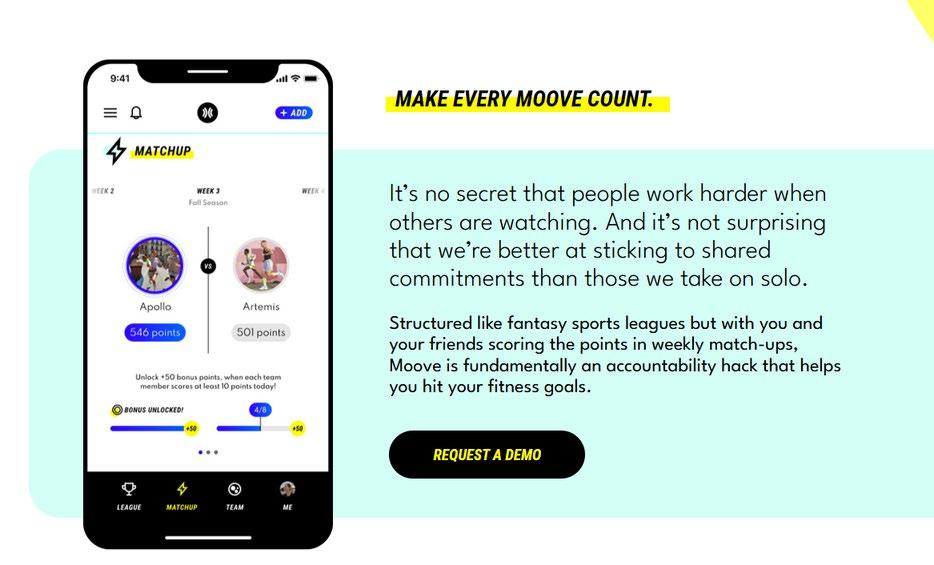
Moove is a fun, six-week fitness competition that helps teachers, coaches, and staff connect, move more, and support each other all through a gamified experience that feels like fantasy football meets wellness Teams compete in a private league, score points for activity, in hopes of making the playoffs, where one champion will be crowned. The Moove platform helps strengthen community, boost engagement/culture, and promote wellbeing across school communities
THE RIVERS SCHOOL | WESTON, MASSACHUSETTS
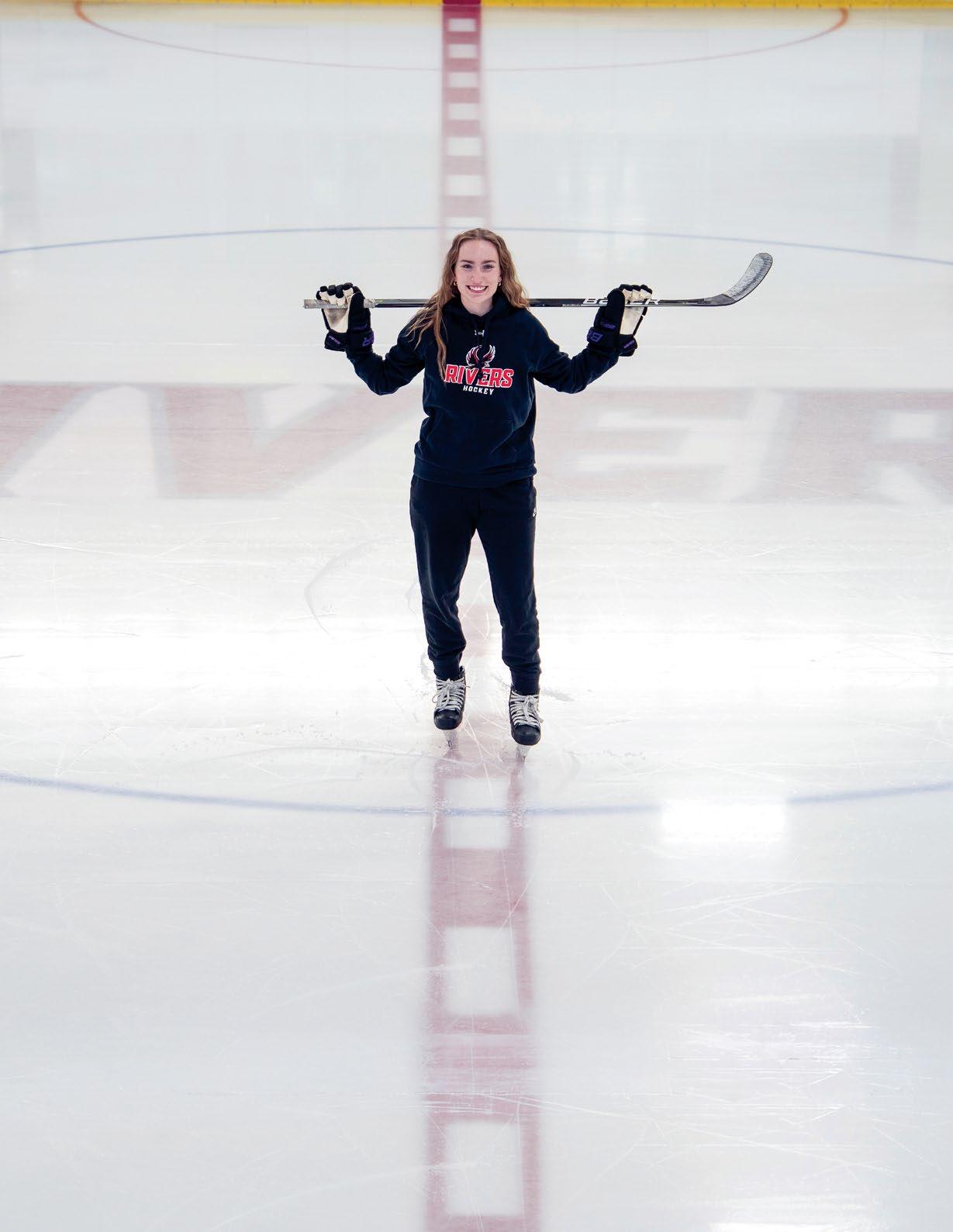
Still in the Game: Rivers Hockey’s Lasting Impact on Eve Stone ’22
by Shea MacLaughlan ’27 | photo by Grace Ramsdell
Eve Stone ’22 embodies the full-circle journey of a student-athlete returning to give back to the community that shaped her. While excelling in her senior season at Stonehill College this year as one of the top goalies in Division I, Stone also made the time to coach at Rivers.
Coming from a larger public school, she was first drawn to Rivers for its small class sizes and close teacher-student relationships. “I had never had that before,” she recalls, explaining that the tight-knit environment gave her both academic and athletic confidence.
Hockey quickly became central to Stone’s Rivers experience. Having always played goalie, she experienced a level of support from her teammates and coaches at Rivers that she hadn’t received at her previous school. “Being on this hockey team was probably the biggest part of my experience here,” she says. “I really felt comfortable with everyone and the coaches.”
Her dedication on the ice led to multiple NEPSAC tournament victories and MVP honors—achievements she believes reflect more than just athletic skill. “If anything, from my perspective, [the achievements] show that you have leadership,” she says, adding that her coaches and teammates
“really prepared me for college and pumped up my confidence.”
After sustaining an injury last year, Stone returned to Rivers from college not as a player but as a coach. “Even though I wasn’t able to play hockey, I was able to coach, and it really kept me engaged and going,” she says. After recovering from her injury, Stone continued coaching at Rivers. In that role, she focused on mentoring goalies and teaching resilience.
“Goalies are such a specific position that not many coaches truly understand,” she says. “I always say to the girls that resilience is the most important part of hockey. It’s really just about how you respond to adversity, not the adversity itself.”
“BEING ON THIS HOCKEY TEAM WAS PROBABLY THE BIGGEST PART OF MY EXPERIENCE HERE. I REALLY FELT COMFORTABLE WITH EVERYONE AND THE COACHES.” –EVE STONE ’22
Stone’s story highlights the lasting impact of Rivers’ supportive environment. By mentoring current players, she bridges the gap between student and coach. “I was in their shoes only four years ago,” she notes. Today, she strives to provide current athletes with the same confidence, guidance, and sense of community that made her own Rivers experience unforgettable.
This story originally appeared in the spring 2026 edition of the Riparian, Rivers’ alumni magazine.
Hopkins School: Highlighting Athletic Excellence Through Touchscreen Recognition Platform
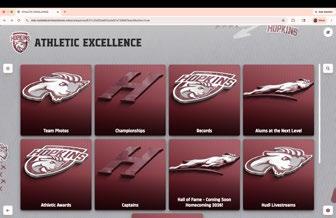
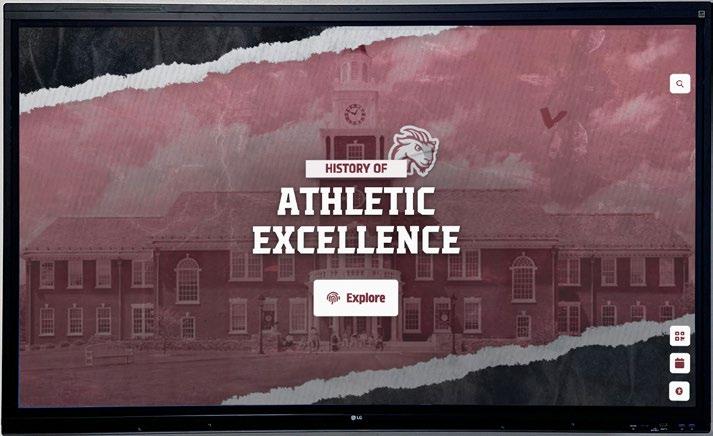
The Hopkins School, a highly accredited and third oldest independent school in the US has recently partnered with Rocket Alumni Solutions to transform its traditional static displays to an interactive digital experience that highlights their rich athletic history. Users have the opportunity to view championships, records, team photos, college athlete alumni, news, livestreams, captains and awards through Hopkins’ athletic excellence touchscreen display.
To power this new installation, Hopkins diligently curated their athletic history, combining decades of archival records with recent athletic achievements. By leveraging Rocket Alumni Solutions’ customizable templates, Hopkins successfully transitioned its tributes into a modern, visually stunning, and interactive digital exhibit that resonates with their entire school community.
Hopkins School’s recognition display serves as a centralized hub for all aspects of athletic excellence. Within the platform, all athletic awards are featured prominently. They range from annual sportsmanship awards to team specific awards, with several dating back to 1979, and one even being honored since 1929.
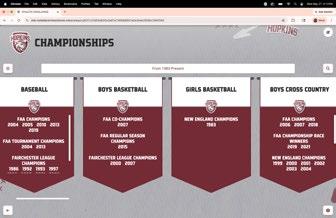
The championship section highlights every title a Hopkins team
has won since 1983, designed to resemble traditional physical banners.
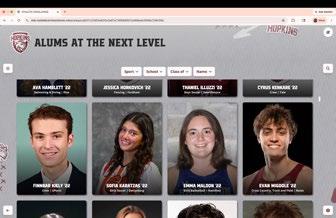
The “Next Level” alumni portion shows a list of Hopkins students who will be continuing their athletic careers throughout college.
Within the news stories folder Hopkins’ athletic website is embedded to feature articles written about athletes and teams. Similarly, the Hudl livestream folder integrates broadcast links for upcoming games and matches, making it easy for the community to stay connected in real time.
Hopkins’ display also includes sections for team photos, records, captains, with plans to add their Hall of Fame during the fall 2026. By preserving and presenting these athletic achievements, Hopkins grants their community the opportunity to continuously look back on their history.
“Hopkins has always taken great pride in the tradition and character of our athletic program. This platform allows us to honor that history in a dynamic, accessible way, celebrating the achievements of our student athletes while inspiring current and future Hilltoppers to see what’s possible,” said Rocco DeMaio, Hopkins’ Athletic Director. “It also gave us the push we needed to formally establish an Athletics Hall of Fame, ensuring that the legacy of those who built our program will be recognized for generations to come.”
Hopkins revolutionizes the way schools recognize their students in history by working with Rocket Alumni Solutions. Through this collaboration, the display is accessible at the on-campus touchscreen and online, ensuring that students, family, faculty and alumni can explore Hopkins School’s legacy.
TRUSTED AT OVER 80,000 INSTALLATIONS WORLDWIDE OVER THE LAST 25 YEARS
AT THE SURFACE OF WORLDCLASS VENUES & THOUSANDS OF HIGH SCHOOL PROGRAMS
INDUSTRYLEADING SYSTEM DESIGN WITH PROVEN DURABILITY & LONGEVITY
COMMITTED TO PROTECTING PEOPLE & PLANET THROUGH INNOVATIVE SUSTAINABILITY PROGRAM
ONE SOLUTION FOR YOUR ENTIRE VENUEEASY PROCESS FROM START TO FINISH
Sports Surfacing Partner
Squash, Service, and Meaningful Life
by Jim Kelley
What does it mean to have a “meaningful” experience? This is a question educators and coaches alike wrestle with every day at Brooks School where the school’s mission is to deliver an educational experience that is just that: Meaningful.
Students can find meaning in so many aspects of life at school. From the classroom to the playing fields and even in the broader community, Brooks helps students seek what is meaningful to them and find ways to share that dedication and passion with the broader world.
Andrés Burbank-Crump was born into this environment and spent his entire childhood on the North Andover campus where both of his parents were teachers, coaches, and administrators for more than three decades. Upon graduating from Brooks and subsequently from Williams College, Andrés found himself his own outlet for providing meaningful experiences just down the road in nearby Lawrence and the non-profit organization SquashBusters where he now serves as the Executive Director for Development and Partnerships.
“I wasn’t introduced to SquashBusters until after college since I had graduated from Brooks before they started operating on campus [in 2012],” Andrés recalls. “But once I saw the program in practice and how they spoke about relationships and a long-term vision it felt right.”
SquashBusters was founded in Boston in 1996 by Greg Zaff, a former professional squash player, with the goal of combining the sport with academic support and mentorship opportunities to help participants reach their full potential. They partnered with Northeastern University to build a squash facility in Boston in 2003
WATCH: Andrés Burbank-Crump shares his story with Brooks Students in an April 2026 Chapel Talk
and subsequently expanded to Lawrence in 2012 where they found willing partners in Brooks School and Phillips Andover Academy in the nearby suburbs.
SquashBusters would bring dozens of students to the Brooks campus throughout the year, making use of the squash courts and classrooms to put into practice their holistic student-development program.
“For me the partnership between Brooks and SquashBusters was such a clear example of how Brooks lives its values and really does seek to cultivate community,” Andrés said. “I was a part of the community service program in the afternoons while I was a student at Brooks and the school has always had a really strong relationship with the City of Lawrence and this connection is just an extension of that long-standing partnership.”
What started as two coaches and 28 students grew to over 100 students bussing back and forth from Lawrence to North Andover, squeezing into classrooms and squash courts as the schedule allowed. In 2024, SquashBusters Lawrence opened its own dedicated facility, The New Balance Foundation SquashBusters Center, which can now house more than 130 students in its classrooms, fitness center, and squash courts.
For Andrés, the journey to this point still feels surreal.
“I joke that for 13 years our enrollment target had to be multiples of 14 because of the limitation of the minibuses, but it was true! What the new facility has allowed us to do is take on as many
students as our coaches and resources can handle. Coaches have more energy because they aren’t driving, students can stay longer because there isn’t another group before or after them, and they can come as often as they want. It’s been a total gamechanger.
“To have been able to be here for the last 11 years and to see how it’s grown into what it’s become… It’s super exciting.”
While the facility has given SquashBusters its own space, Brooks has continued to support the organization. Four days per week student volunteers come to the Center to work with SQB’s students.
“It’s been really rewarding for me as a kid who grew up at Brooks to be able to introduce the two communities in more robust ways.”
The familial connection between his family and SQB goes beyond Andrés, however. His father, Doug, was a long-time squash coach and math teacher at Brooks. In 2020, Doug stepped away from Brooks and into a full-time role with SquashBusters before retiring just last year. His mother, Bobbie, spent some of SQB’s most formative years as the Director of Athletics and her commitment to setting aside time was instrumental in the continued growth of the organization.
“Every single member of the squash program at Brooks made us feel welcome and even if that meant they had to practice at 8:00 instead of 6:00 because we were there, they were always so positive and made us feel like a part of the community.”
While Andrés’ entry point with SquashBusters came after college, the entry point for the students they work with is much earlier. Each fall, members of the SQB team go into elementary and middle schools in Lawrence to introduce the sport of squash to a new cohort of students.
“It’s always funny because the sport itself has a funny name, so we go into these sixth-grade PE classes and bring our rackets and squashballs, plus some tennis balls and other balls that bounce a little better, and we pitch the program,” Andrés said. “Slowly the community’s perception of squash has become SquashBusters and everything our program entails.”
Now 13 years into its life in Lawrence, and 30 years overall, SquashBusters has been able to reap the benefits of their long-term student development model as students have matriculated to college and ultimately into the professional world.
Current CEO Rodney Galvao was a participant in the Boston program before going on to play collegiately at Bates College and like Andrés finding meaning in his work through SQB.
“I was always very quick to tell people how great Brooks is and how we live our values and our mission, but to have been able to experience it when I’m on the other side of the table and I’m the one asking Brooks for time and space and support has proven how true it is.”
Photos courtesy Andrés Burbank-Crump.
Baseball Ops Delivers a Professional Game Day Experience
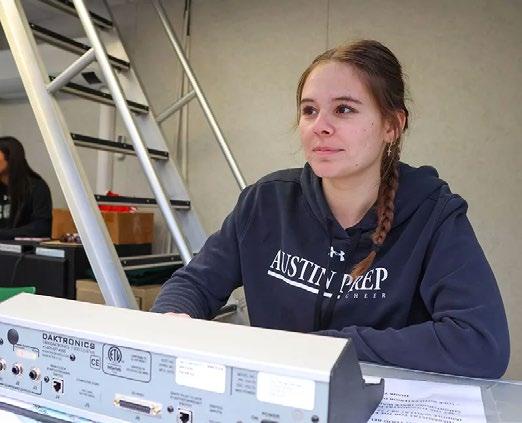
At Austin Prep, baseball games are more than the innings on the field. Behind the scenes, a studentrun Baseball Operations program manages every detail, from music and media to statistics and hospitality. Led by English faculty member Michelle Flaherty, with full support from Head Baseball Coach JP Pollard, the program has developed into a comprehensive, hands-on experience that mirrors the structure and expectations of high-level college athletics—an experience few college programs offer. For the students involved, it is a direct pathway into real-world roles in sports.
Built From the Field Up
Baseball Ops began as a small initiative within the baseball program and has grown into a structured system that now connects to both a Sports Operations club and a Sports Management course. Each year, students expand the program, adding new layers of responsibility and execution.
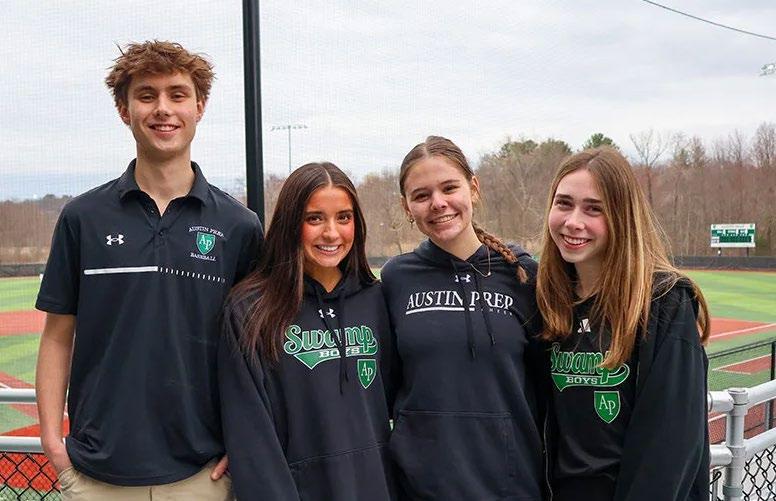
Austin Prep’s Baseball Operations team members Lucas Ortiz ’26, Sophia Fanuele ’26, Abby Ventullo ’27 and Katarina Burke ’27 all handle different aspects of sports management for the baseball team.
“The goal is hands-on learning for kids who may have an interest in sports management,” Flaherty said. “They can try different aspects and see if an area clicks with them, and see the actual impact of that.”
On any given game day, students are responsible for every operational element. They collect team lineups, manage music
and announcements, track live statistics, coordinate hospitality, and produce content in real time. The experience reflects the pace and expectations of higher-level athletics.
“Players and members of the program say, wow, our social media page looks like a college page,” Flaherty said.
Katarina Burke ’27: Making Real-Time Statistical Decisions
For Katarina Burke ’27 of Reading, Baseball Ops centers on statistical tracking and decision-making that directly impacts how the game is recorded and understood.
“It’s really just us trying to get our faces into the sports from a more behind-the-scenes look,” Burke said.
Using GameChanger, she tracks every play in real time, recording pitch-by-pitch data and determining whether a ball in play is scored as a hit or an error. Those decisions require knowledge, confidence, and quick judgment.
“You have to trust your knowledge and make those decisions at a fast pace,” Burke said.
Her work feeds directly into the official statistical record that players, coaches, and families rely on.
“I think of it as a privilege,” she said.
As a lead within the program, Burke also helps guide younger students and supports overall operations across multiple areas.
Flaherty points to her leadership and reliability as defining traits.
“She’s just a really strong leader and does pretty much everything,” Flaherty said. “She’s reliable, she follows up, and she brings other students into the program. She’s someone we can count on in any situation.”
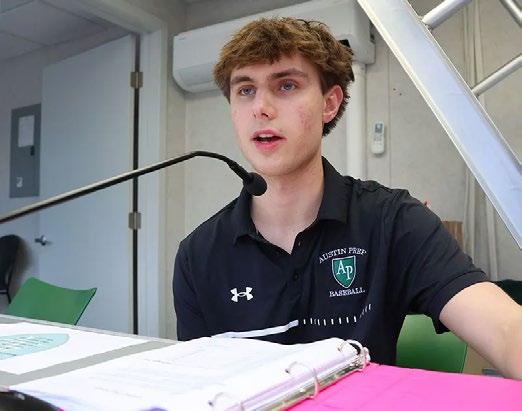
Lucas Ortiz ’26 serves as the voice of Austin Prep baseball, handling in-game announcements and player introductions throughout each game.
Lucas Ortiz ’26: The Voice of the Austin Prep Cougars
For Lucas Ortiz ’26 of Stoneham, Baseball Ops has become a platform to develop his craft as a live game announcer, serving as the voice that defines the energy and rhythm of each game.
“I realized that my favorite thing to do is talk about sports, watch sports, cover sports,” Ortiz said.
Now, Ortiz manages the full scope of in-game announcing, from pregame introductions to live updates throughout each inning. He studies lineups, confirms pronunciations, and adjusts in real time as the game evolves, bringing consistency and personality to every game he calls.
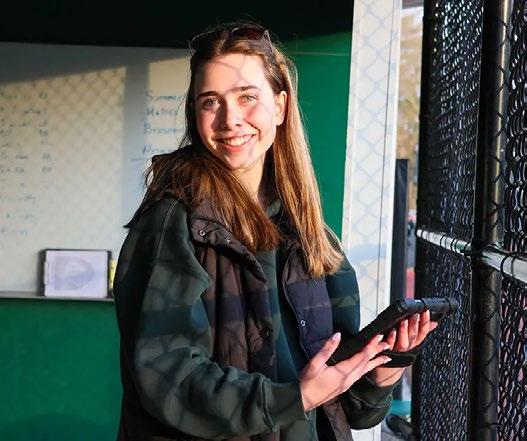
Katarina Burke ’27 uses GameChanger to track live statistics during an Austin Prep baseball game. Burke helps maintain the official statistical record in real time.
Flaherty also highlights his personality behind the microphone, where his humor and natural flair come through during each game.
“He’s our announcer, so he’s always on the mic,” Flaherty said.
“He’s just naturally good at it. He has a natural voice for it, and he turned out to be really, really good. He gets excited about announcing his peers, and he has his own unique way of doing it.”
Sophia Fanuele ’26: Curating the Game Day Soundtrack
For Sophia Fanuele ’26 of Wilmington, the game day experience begins with sound. She is responsible for managing every player’s walk-up music and building the soundtrack that carries throughout each game. She manages the entire operation from her iPhone.
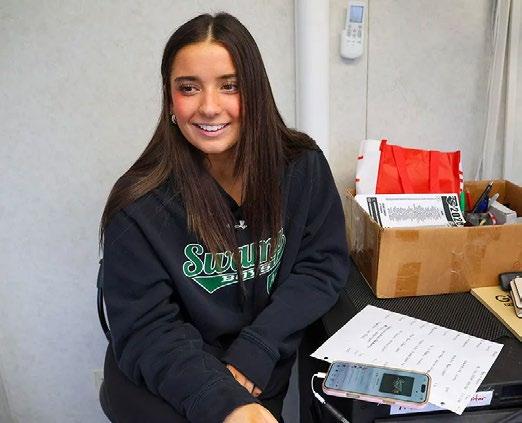
Sophia Fanuele ’26 manages walk-up music and game day audio for Austin Prep baseball, helping shape the atmosphere at the field.
“Learning what goes on and how the game works behind everything was really interesting,” Fanuele said.
Her role requires both preparation and real-time execution. Before the season, she gathers player song selections, organizes them, and builds out the full music system for game day. During games, she executes each walk-up song with precise timing, adjusting instantly for substitutions and lineup changes.
What separates Fanuele is her command of the details. She knows every player’s walk-up song off the top of her head, allowing her to operate seamlessly without disrupting the flow of the game.
“Being super attentive is really the only way that it’s going to work out,” she said.
Flaherty highlights both her composure and leadership within the program.
“She’s a very calm presence, and she’s great at encouraging younger students who are just learning,” Flaherty said. “She runs the walk-up songs, plays the anthem and times it exactly right, and builds the playlists—making sure everyone has the music they want.”
Abby Ventullo ’27 operates the scoreboard during an Austin Prep baseball game, keeping the count, outs, and inning information updated in real time.
Abby Ventullo ’27: Running the Scoreboard Without Missing a Pitch
For Abby Ventullo ’27 of Burlington, the scoreboard is her responsibility, requiring constant awareness of every pitch, count, and situation.
“It’s a lot of the background work… the stuff that elevates the game,” Ventullo said.
From balls and strikes to outs and inning transitions, she ensures that players, coaches, and fans always have accurate, real-time information. A current scoreboard not only enables players to track pitch counts and the score, but also allows parents and fans to stay engaged with the game as it unfolds. Her role demands focus and a strong understanding of the game itself.
“You just have to be paying attention to everything that’s happening,” she said.
Through the experience, she has developed a deeper appreciation for the complexity behind the scenes.
“You don’t realize how much work actually goes into it,” Ventullo said.
Flaherty emphasizes her confidence and versatility across multiple responsibilities.
“She has a strong understanding of the game, so she runs the scoreboard really well and always knows what’s happening,” Flaherty said. “She’s very confident and reliable. I can give her something and she’ll take it and run with it.”
Building Toward College and Careers in Sports
For the students involved, Baseball Ops is more than an activity. It is a launch point for future academic and professional pursuits. Through announcing, game management, music production, and statistical analysis, students gain direct experience in areas they are considering studying in college.
Whether pursuing interests in sports media, broadcasting, business, or analytics, they are building practical skills that translate beyond the field. They learn how to communicate, make decisions in real time, manage responsibilities, and work as part of a team under pressure.
The experience gives them clarity on what they want to pursue next—and the confidence that they can succeed when they get there.
Courtesy Austin Preparatory School.
Monday, November 9, 2026 Phillips
THE TAFT SCHOOL | WATERBURY, CONNECTICUT
Stats Wiz
by Zach Schonbrun ’05
When Jacob Goldstein ’15 was offered a job in the National Basketball Association, he worried briefly that it might be hard to maintain a work-life balance.
He told me this a week after the 2024–25 NBA regular season had ended in April; he had just returned from a vacation in California. It had been a great trip, he said. He got to watch a lot of basketball.
“It’s almost ironic, but vacation is really the first chance I have to sit down and watch other teams play,” Goldstein says. “Despite being in the league, I still am deeply, deeply obsessed with basketball.”
Goldstein spends almost all his waking hours—and some of his sleeping ones—thinking about basketball analysis for the Washington Wizards, for whom he is “the data guy”—technically, the manager of basketball research. His analytical input is now integral to almost every decision for the team, from whom they draft and sign to how players can improve their performance on the court.
gauges a player’s value, relative to a replacement player, in terms of how they help a team win. The leaderboard rankings are filled with the usual suspects—LeBron James, Stephen Curry, Luka Doncic. But where Goldstein’s metric stood out was its recognition of non-superstars—particularly lengthy, athletic forwards who can defend and shoot 3-pointers—whose contributions go beyond the standard box scores.
What he considered a hobby turned serious when met Dean Oliver, a basketball statistics guru at ESPN. Oliver got hired as an assistant coach for the Wizards—fancy that, an analytics expert on the bench—and in 2020, he approached Goldstein about working for the team’s research department. It was a dream opportunity, but Goldstein questioned his own qualifications.
GOLDSTEIN SPENDS ALMOST ALL HIS WAKING HOURS—AND SOME OF HIS SLEEPING ONES—THINKING ABOUT BASKETBALL ANALYSIS FOR THE WASHINGTON WIZARDS
“A really cool part of my job is explaining to a player, ‘Hey, here’s why this number matters [to your game],’” says Goldstein, 28. “‘Even though you are a million times better than me at basketball, here’s why getting better at this skill can make you a more impactful player.’”
Data analytics was introduced into professional sports by baseball’s Oakland Athletics in the early 2000s, and its influence exploded after the success of the book, Moneyball, by Michael Lewis. Professional basketball has embraced the numbers more eagerly than perhaps any other league.
It has created an entry point for people like Goldstein, who couldn’t play the game competitively at Taft because of head injuries he experienced when he was younger. He connected with the sport as a fan, and on social media he discovered a community of other “nerds,” he says, who loved introducing new ways to understand the game through creative stats.
Goldstein’s claim to fame is the invention of a new metric called Player Impact Plus-Minus, which he developed in college. It
“I didn’t have any academic background in statistics,” he says. “I took some stats courses in college, but I was not a stats major or a data science major. I was a mechanical engineer. I just taught myself everything I know.”
The Wizards hired him anyway, teaming him with Katherine Evans, who has a doctorate in statistics from Harvard and had been working with the Toronto Raptors. Goldstein said it could not have worked out better for him. “I generally think there are three things you need to get a job working for a sports team,” he says. “One of them is doing a good job. One of them is being in the right position at the right time. And the other one is getting lucky.”
A sports career isn’t for everyone. It demands almost complete devotion, eats up weekends and holidays, and the rebuilding seasons (as the Wizards have been shown) can be torturous. But Goldstein has caught the basketball bug. He says he wants to eventually run a franchise, as the general manager, and lead a championship dynasty.
“This was a hobby for me well before I ever dreamed it could be a career,” Goldstein says. “It still doesn’t seem real.”
Courtesy of The Taft School, Taft Bulletin, Fall 2025
Jacob Goldstein ’15, manager of basketball research for the Washington Wizards
Coaching by the Numbers:
USA Field Hockey Analyst Brings Insight to Canterbury
When Caroline Koziol joined the faculty of Canterbury School at the start of the 2025–26 academic year, she brought with her not only a passion for history but also a deep commitment to field hockey. An analyst for USA Field Hockey’s junior development program, she now serves as Canterbury’s Varsity Field Hockey coach—bringing a unique, multifaceted perspective to the program on the hilltop.
Caroline began playing field hockey in fourth grade and continued through all four years of college. While pursuing graduate studies at Dartmouth, she was disappointed to learn that Ivy League rules do not permit graduate students to compete in varsity athletics. But after meeting with head coach Mark Egner, she joined the team as the graduate student manager—a role that would ultimately grow into something even bigger.
At the time, Coach Egner was working with the U18 junior development team for USA Field Hockey. Knowing Caroline’s interest in the analytical side of the game, he connected her with an opening for a videographer and data analyst within the organization.
It was an exciting but challenging new role. Though she had a solid grasp on the fundamentals of analysis, learning the appropriate coding programs to deconstruct a play was a challenge.
“For example,” she says, “a coach might ask, ‘How many double turnovers happen in our defensive 25 versus our attacking 25?’ We would review film, code each instance in R or Python, count occurrences, and then map that data to a visual representation of the field. From there, we interpret the data and present those findings to coaches with recommendations.”
It’s a complicated process, but it’s one Caroline has come to value, particularly in her ongoing work with USA Field Hockey’s junior development program and its U18 athletes.
At training camps and weekly meetings, she and a team of field hockey experts carefully analyze their teams’ performance and collaborate on broad, long-term projects across USA Field Hockey. She’s excited to bring that ethos and expertise—and close connection to top coaches from across the country— to Canterbury.
But it’s not a one-way exchange. Caroline says coaching on the hilltop has had a positive effect on her analytic style.
“Coaching has changed how I communicate and deliver information, and has added a layer of perspective and empathy to my analysis,” she explains. “I think there’s an opportunity to use these dual perspectives to further strengthen the field hockey program at Canterbury.”
A key element of Coach Koziol’s plan is emphasizing improvement year-round.
“If they’re not playing, they should still be learning—watching games, taking notes, building their field hockey IQ,” she says. “I treat it like an academic subject: you have to learn and practice the material. How do you take a mistake from a game and fix it for next time? My goal is to turn my players into analysts as well.”
Photo by Alexa Saunchez, Canterbury School
BAY STATE GAMES
BAY STATE GAMES
FOR THE ATHLETE IN ALL OF US
The Bay State Games are Massachusetts’ largest Olympic-style spor ts festival, bringing together athletes of all ages and skill levels from across the state. For over 40 years, the Games have provided oppor tunities to compete in a wide range of spor ts, and showcase talent. Many alumni have gone on to excel at the collegiate, national, and professional levels.
WHY BSG?
Showcase talent in front of dozens of college scouts
Compete against high level athletes from Massachusetts & New England
Unlock scholarship oppor tunities & informational webinars for BSG athletes ONLY
Join a 40+ year tradition
Take aim at qualifying for a national event (State Games of America)
Build connections, teamwork, and spor tsmanship that last beyond the competition
Become an Ambassador - Build your resume & develop leadership and business skills
Lighting The Way For Ellington Athletics
On a crisp fall evening in late September, the lights above the high school football field turned on for more than just a game. They marked the beginning of a new chapter for Ellington athletics.
The Ellington Knights took the field for their first home football game under the school’s new sports lighting system. The theme of the night was “Light the Knight,” a fitting celebration for the team, the school, and the milestone taking place on the field. Families filled the stands, athletes stepped onto a bright field, and the community got to experience the impact of a project built around their needs.
That moment brought the purpose of the project into focus. Earthlight’s work with the Town of Ellington was designed to solve real challenges for the community, from limited field availability to long-term reliability, while delivering a lighting system built around the way the town would actually use it.
A Town-Wide Project Built Around a Real Need
While Ellington High School became the most visible example of the project’s impact, the work extended across several important spaces in town. Earthlight partnered with the Town of Ellington to complete lighting upgrades at Pinney Fields, Tedford Memorial Park, and Ellington High School, bringing new lighting to sports fields and their parking lots used by athletes, families, leagues, and residents throughout the community.
The scale of the project was significant. Across the three locations, the work included 239 Musco Sports Lights, 44 newly erected poles, and 17 new parking lot poles. It also involved a mix of new installations and retrofit work, which meant each site needed to be evaluated carefully based on its existing infrastructure, budget, timeline, and long-term use.
For Earthlight, this was the kind of project that required more than installation experience. It required planning, coordination, engineering, product knowledge, and a clear understanding of what the town wanted to achieve. With multiple sites, public spaces, and community expectations involved, the project was a major undertaking. It was also one Earthlight felt confident taking on because the goal matched the way the team approaches its work: understand the customer’s needs, build the right plan, and deliver a quality result.
That larger scope matters because the need behind the project was just as significant. The town needed more usable time on its fields, more flexibility for its athletic programs, and a better longterm solution for the community spaces people depend on.
For the Town of Ellington, the need for new sports lighting came down to one major challenge: time. With youth sports, school athletics, local leagues, practices, games, and weather-related reschedules all competing for field space, the town’s existing daylight hours were no longer enough.
As Tom Modzelewski, Ellington’s Director of Public Works, explained, “Right now our playing schedules are jam packed during the normal daylight hours, and we have overcrowding of fields and overscheduling of games.” The new lights helped address that challenge by giving the town more flexibility and extending the hours its fields and courts could be used.
That added time opens the door for more room in the schedule, helps the town better manage rainouts, and creates more opportunities for Ellington’s fields to serve the wider sports community. As Modzelewski noted, “another benefit to adding the lights is that we’ll be able to host other towns that may not have lights for later scheduled games.”
More playable hours mean more opportunities to practice, compete, and gather around the sports that bring the community together. For the town, it means getting more value out of the fields and facilities it already has.
This was not simply an upgrade for brighter fields. It was an investment in access, scheduling flexibility, and the long-term use of Ellington’s athletic spaces.
Building the Right Plan Through Value Engineering
From the beginning, this project required a thoughtful approach. The Town of Ellington had clear goals for what the new lighting needed to accomplish, but there were also important factors to work through, including budget, timeline, light spillage, long-term operating costs, and the needs of the surrounding community.
Earthlight’s role was to help bring those pieces together into a plan that made sense for the town. That meant looking beyond the lights themselves and considering the full project: how each site would be used, what the town had approved for the budget, and how to deliver a system that would perform well for years.
Budget was an important part of that process. The town had an approved budget, and Earthlight worked within those constraints while exploring different options to find the right solution. That included reviewing different pole options, looking at multiple lighting manufacturers, and identifying where existing infrastructure could be reused.
The project also required careful communication with the community. Light spillage was a concern for some residents living near the fields, so Earthlight met with townspeople and neighbors close to the project to walk through those concerns and help explain what they could expect. The goal was to give residents confidence that the new lighting would improve the fields without creating issues for nearby homes. Since the project was completed, there have been no complaints about light spillage.
Just as important was the timeline. The work needed to be completed before the school year started so the town, school, and athletes could have full access to the fields without the project getting in the way. Earthlight delivered on that timeline, completing the work in time for the first day of school and Ellington High School’s first night game under the new lights.
Once the town’s priorities were clear, the next step was finding the right solution for the cost available. For Earthlight, that meant looking at the project through the lens of value engineering: balancing performance, cost, control, long-term reliability, and the specific needs of each site.
That process shaped several key decisions. At Ellington High School, that meant retrofitting some of the existing poles instead of replacing everything outright, helping create a more cost-conscious solution without sacrificing the quality of the finished system.
Musco Lighting became the right fit because it supported the project’s larger goals. The system offered strong lighting performance, advanced control capabilities, reliable manufacturer support, and a 25-year warranty. It also allowed Earthlight to work with one manufacturer from foundation to fixture, which helped simplify the process on a project with multiple locations and several moving parts.
The controls were especially important. Through Musco’s “Control-Link Central” system, the town can schedule and manage the lights easily, helping reduce unnecessary use and making day-to-day operation simpler for the people responsible for the facilities. The lights also use precise directional control, helping direct light where it is needed and reducing unwanted spillover into surrounding areas.
The efficiency of the new system was clear in the installation itself. In one example, around 30 older lights were removed and replaced with 6 new lights on one pole, showing how a modern sports lighting system can do more with less. Across the project, those decisions helped Earthlight deliver a solution that was practical, high-quality, and built around the way Ellington would actually use the fields.
Sports lighting projects are not just about poles and fixtures. The electrical engineering behind the system is a major part of making everything work safely, reliably, and efficiently. For Ellington, the final plan brought all of those pieces together: the right product, the right controls, the right installation approach, and the right long-term value for the town.
Earthlight’s Ongoing Support
A project like this does not end when the lights turn on. For Earthlight, long-term service is a core part of the work. The goal is not only to deliver a quality installation, but to make sure the customer feels supported after the project is complete.
That long-term mindset was part of why Musco Lighting became the right fit for Ellington. Beyond the performance of the lights themselves, Musco offered strong ongoing service and a 25-year warranty, giving the town confidence that the system would be supported well into the future. For a public project serving schools, leagues, athletes, and families, that kind of reliability mattered.
More Time on the Field, More Opportunity for the Community
Earthlight approaches its own role the same way. The company’s service team is a pillar of the business, and customers should know they are backed by a team they can trust long after installation day. As Dustin Hugenin, Recreation Director for the Town of Ellington, said, “When the lights are installed and ready to go, Earthlight’s not going anywhere. They’ll be around to help and make sure that they’re operating as they intended.” The quote speaks to one of the most important parts of the project: longterm confidence. The town received a high-quality lighting system, but it also gained the support of a local team committed to helping that system perform for years to come.
About Earthlight
Earthlight Technologies is a family-founded and operated company based in Ellington, Connecticut, with offices in Massachusetts and Oregon. Our in-house teams provide turnkey design-build services for sports lighting, energy efficiency upgrades, EV charging, commercial and residential solar, battery storage, and ongoing service and maintenance.
Earthlight offers all NEPSAC member schools a no-cost site inspection and energy assessment to evaluate sports lighting needs, identify potential energy efficiency upgrades across campus, and explore EV charging opportunities.
Please call (860) 871-9700 and ask for Commercial Services or reach out to commercialservices@earthlighttech.com with any questions or inquiries. We look forward to hearing from you.
The Ellington Sports Lighting Project was an investment in the way the town uses its fields, supports its athletes, and brings the community together.
Across Pinney Fields, Tedford Memorial Park, and Ellington High School, the new lighting gives Ellington more usable time in the spaces people already rely on. Practices can run later, games have more flexibility, and families can gather for moments that were harder to make possible without the right lighting in place.
At Ellington High School, that impact was clear from the first game under the new lights. The “Light the Knight” theme captured more than school pride. It marked the beginning of a new chapter for athletes, families, coaches, and neighbors who now get to experience those fields in a new way.
For Earthlight, being part of that moment meant a lot. This project brought together the kind of work the company is built for: thoughtful planning, quality installation, long-term service, and a solution designed around the customer’s needs. But most importantly, it helped create something lasting for the community.
The result is more time on the field, more opportunities for local athletes, and a better experience for the town of Ellington for years to come.
NBC Features Cheshire Academy 12th Grader for Offering Free Tennis Clinic in Jamaica
Chase Harding combines athletic excellence with service, embodying Cheshire Academy’s mission of “Individual Growth. Global Purpose.”
When Chase Harding returned to his hometown of Kingston, Jamaica this summer, he didn’t just visit — he created opportunity. The Cheshire Academy 12th grader brought donated rackets and equipment to the neighborhood of Payne Land, where he hosted a tennis clinic for kids who may have never held a racket before.
“In Jamaica, tennis is not one of the sports that is very exposed,” Chase explained. “Jamaica is known for track and field.” He recognized that tennis requires resources that often cost money many families on the island don’t have, so he decided to change that.
With donated equipment from his tennis coach in Jamaica, Chase and his team set up portable nets on gravel and spent the day teaching basic tennis skills to local youth.
“Just to know that I was the one to physically place a racket in their hands, that’s just a great feeling,” he shared.
At Cheshire Academy, Chase is refining his game under the guidance of Coach Chip Boyd, working toward ambitious goals of
representing Jamaica on the national level and playing college tennis. But his vision extends far beyond personal achievement.
“It’s great to see what he’s doing,” said Coach Boyd. “I think there’s a lot of good to be developed through tennis in Jamaica.”
Chase is already planning additional clinics during his winter and spring breaks, with plans to expand to other parishes across Jamaica that have even less access to the sport.
His work exemplifies the Academy’s motto “Ich Dien” — “I Serve” — and mission of cultivating purposeful global citizens who understand that individual growth and global purpose go hand in hand.
Watch Chase’s story as featured on NBC Connecticut’s “Connecticut in Color”
Article and photo courtesy of Cheshire Academy.
Jimmy Freehill ’21 Balances Coaching and the PLL
Jon Bartlett, Director of Athletics, and the St. Sebastian’s Communications Office
St. Sebastian’s alumnus Jimmy Freehill ’21 has returned to Greendale Avenue as a member of the Varsity Lacrosse coaching staff while also continuing his professional lacrosse career in the PLL. A defenseman for the Philadelphia Waterdogs, Jimmy recently reflected on coaching at Sebs, life in professional lacrosse, and the lessons he carries with him from his time as an Arrow.
JF: The PLL has an interesting schedule that basically runs from late April until the end of September. We typically fly out to wherever we are playing on Thursday or Friday morning, practice that night and the next, and then play a game on Saturday or Sunday, and then fly back to our respective homes. I am usually with the team for 2–3 days a week, which is why I have had the time to coach at Sebs. While I wish we could play professional lacrosse all year round full-time (and I think it is actually getting close to being there), I am also really glad I have been able to spend my offseason and even my off days in-season coaching the boys at Sebs.
Q: What has been the best part of coaching at St. Sebastian’s?
JF: Being back on campus every day, with all of my former teachers and coaches, and all the current students (some that I actually used to share the hallways with) has been a blast. I feel very involved again, which is something I certainly missed when I was living in Denver for four years. I am also just a very competitive person, and I really wanted to help Coach Silipo and St. Sebastian’s lacrosse get to the next level, so being able to play a small part in that has been more fulfilling than I could have ever imagined.
Q: How does the PLL schedule work, where you play professional lacrosse, but also have time to coach at Sebs? How many days a week are you with the PLL team?
Q: How do contracts work in the PLL? Are you year to year?
JF: When you are drafted as a rookie you sign a 3-year rookie contract with your team. After those 3 years are over, you become an unrestricted free agent. I am currently on year 2 of my 3-year contract.
Q: What trait, or characteristic, did you take from St. Sebastian’s and apply it to your time at the University of Denver and then with the Philadelphia Waterdogs of the PLL?
JF: Two things come to mind for me here. Headmaster Burke always used to say, “I have never met a happy lazy person” and I think I really took that to heart. I don’t think I’ve had the career I’ve had because of talent, but rather because I have worked really hard, and that is in large part due to the culture at St. Sebastian’s. I think sometimes in high school settings, it is not always “cool” to work hard, but not at Sebs. My classmates/teammates and teachers/ coaches always pushed me to put my best foot forward no matter what I was doing. The other thing that comes to mind comes from the school motto: “Love God, work hard, and take good care of one another.” I would hope my teammates at Sebs, Denver, and now Philadelphia would say I take good care of them. Being a good teammate and leader is much more important to me than being a good lacrosse player, and that is another thing I learned from the many people I looked up to during my time at Sebs.
Q: Speaking of which, what is your favorite water dog?
JF: My labradoodle growing up was afraid of all bodies of water, but I did always used to want a Portuguese Water Dog, so I guess I’ll go with that.
Jimmy Freehill’ 21 coaches St. Sebastian’s varsity lacrosse team.
Q: Which would you say is more difficult, playing professional lacrosse or coaching high school kids?
JF: Great question. If I had to do all the work Coach Silipo has to do, I would say coaching high school kids, but luckily, I don’t. Playing professional lacrosse is definitely tough and it always seems to humble you right when you feel like you’re getting the hang of it. Coaching high school kids hasn’t given me too many issues yet, probably because I was in their shoes not too long ago, and it doesn’t hurt that they still speak that classic Sebs language we used to speak. Ultimately, I absolutely love doing both things, and find them to be really rewarding, so I am lucky to do both.
Q: How impressed are you with the talent level of our current St. Sebastian’s lacrosse team?
JF: Extremely impressed. These kids are unbelievable. The talent at Sebs and all around the ISL has always been really good, but I felt like this year was the best I have seen yet (Besides that 2019 Sebs team of course. We weren’t too shabby). Maybe even more impressive than the talent was the leadership of our captains. Tedy, Ty, David, George, and Brian were great. They were like another five coaches out there and certainly made our jobs a lot easier. Coach Silipo works really hard to make these kids better, and they are really lucky to have him, Coach Pohlman, Coach Leary, and Coach Nardella on their sideline.
Q: Is coaching lacrosse in your future?
JF: I certainly hope so. The sport has given me so much, that I’d love to keep giving back in any way possible. I love being around the game, especially when it can be on Frisoli Field at 1191 Greendale Ave coaching the Arrows.
Wendell Maxey: Called for Traveling
After spending four years at King School where I served as the Sports Information and Social Media Liaison for Vikings Athletics from 2018–2022 and contributing articles to NEPSAC News, I never thought I would be back on campus in North Stamford.
In the winter of 2024 and after a timely weekday phone call from Dean of Athletics, Micah Hauben, there I was on the basketball court with an eager group of Middle School student-athletes ready to give their all to be King of the court for the season. They played hard. We practiced harder. We learned from each other. They came together as a team. We all got better. And we ended up putting some big wins on the board on the road and at home in front of friends, family, classmates, and an ever-caring King community.
Little did the team know then, but this would be my lone season coaching basketball for the Vikings. One and done. Not because I didn’t want to run it back for another season in Stamford to watch these kind and cool kids continue to develop as people and aspiring hoopers, but because it was simply time. It was time to go. It was time to grow.
Likely emotional about having to say “goodbye,” I didn’t share with the team at the time, but I was ready to shoot for the stars myself once again. They heard that I used to cover the NBA, basketball overseas, and sports at large for the
previous 20 years. They asked about doing interviews, being in pro locker rooms, and watching all of those games. They asked about sports writing and contributing to ESPN.com, NBA.com, USA Today, and SLAM Magazine. They wanted to know about Kobe, and LeBron, and if I had written any books.
I shared how I’d contributed to book projects in the past, and continued to freelance write about sports during my tenure at King thanks to the support of Micah Hauben and Athletic Director Tom Decker. Certainly, I had visions of compiling and publishing a collection of short stories from my two decades writing about sports around the world. Deciding to take that giant step forward to actually work with a publisher and tediously sift through the editing process, that’s the daunting part of the tale along with previous rejection letters.
What I didn’t know is that I’d be hired as a contributing national writer covering high school sports for Sports Illustrated just three months after our winter basketball season happily concluded. That sent me on a whirlwind adventure of writing on student-athletes, coaches, and athletic directors across America that’s still going. Nor did I realize that I’d spent the next six months writing, editing, and creating the front cover for my new book, Called For Traveling: 20 years of Sports Writing from the NBA, to Europe, and Back Again
Published in April, 2026 and available in paperback, hardcover, and e-book on Amazon and Barnes & Noble, Called For Traveling spent the first four weeks at #1 on Amazon’s New Release list. Spanning two decades, featuring 70 professional athletes and coaches from the wide world of sports, and comprised of 60 individual chapters, the anthology also recounts my journey from covering the New York Knicks, Portland Trail Blazers, working as a scout for a professional team in Germany, and coaching high school basketball abroad and in the US. The book also opens with an acknowledgement chapter where I give credit to King School for fostering an athletics environment that encourages the “power of wonder” for students and staff alike. While I never physically attended the independent day school boasting 30 NEPSAC championships, my affinity and appreciation for the school’s rich history and standard in athletics remains forever a part of my own story.
With upcoming book festivals scheduled, speaking engagements booked, and Summer League in Las Vegas all on my summer “to-do” list, there’s forever a part of me that can’t help but look back before fully moving ahead. Once a Viking, always a Viking. If I had that King Middle School team around me right now standing at center court in the Upper School gym surrounded by championship banners and alumni names, I’d tell them to keep shooting their shots. They just might make it.
More about Wendell Maxey Get Called for Traveling
Coach Maxey and his King Middle School basketball team.
Evolutions at the Proctor Ski Area: Securing a Base for the Future
by Scott Allenby | Photos by Ryan Graumann and Lindsey Allenby, Proctor Academy
Throughout the late 1800s and early 1900s, Andover, New Hampshire was home to the largest ice house east of the Mississippi River on nearby Highland Lake, where ice was harvested each winter, stored in the ice house, and shipped to Boston via rail to be used in ice boxes around the city. Until 1927, The Winter Hill Ice Company utilized age-old technology of insulating large blocks of ice with sawdust to prevent melting and allow for the storage and transport of ice throughout the summer months (check out this amazing archival video). A century later, Proctor Academy is leveraging the same insulation principles to store its critical snowpack at the Proctor Ski Area in order to reduce its reliance on early-season snow-making efforts.
The practice of snow farming is a sustainable practice that involves plowing and storing snow from the end of one ski season to use as the base for the beginning of the next season under a thick layer of insulating material to protect the snow from melting
during the summer months. A practice utilized across Europe for decades is now gaining traction at ski resorts around the world as climate change challenges both the environmental and economic sustainability of their operations.
Through a generous donation, Proctor is joining the ranks of snow farming ski areas in the northeast. Utilizing a system designed by Snow Secure, Proctor Ski Area Manager Steele Henderson, Assistant Manager Mac MacDuffie, and their crew have farmed much of Proctor’s snow base from this season and have blanketed it with the Snow Secure system of insulating panels. Studies show that this practice will significantly reduce the reliance on the ski area for energy-intensive snow production early next season, as more than 70% of the snow pack on 10% of the hill will be secured for the start of next season. Some resorts have reported an 85% reduction in electricity consumption, while also conserving water pumped from the Blackwater River for Proc-
tor’s snow-making operation. Additionally, preserved snow retains its quality more effectively than artificially-made snow with a denser and more resilient quality while expanding Proctor’s ability to offer early season training to other ski programs and athletes throughout the northeast.
Proctor Ski Area Manager Steele Henderson notes, “We are excited to see how the Snow Secure system keeps our pile of snow throughout the summer. Ideally, we will be able to uncover and push the pile back out in early November to get the Proctor athletes, and potentially athletes from neighboring ski programs, on local early season snow which gives them the opportunity to be weeks ahead in their training programs. It will also allow us to change our plan of attack for early season snow making so that we can attempt to be open earlier top to bottom for Alpine and our Nordic facilities.”
Proctor Alpine Director, Jason Nelson adds, “Proctor Academy is always striving to have one of the best snow surfaces in the East. If you have the snow surface you can do anything. You can set up B net for protection and train any discipline you want in addition to hosting high-quality races. Proctor skiers, as well as college athletes from Dartmouth, Harvard, Boston College, Babson, UNH, and Colby Sawyer College, come to Proctor because of the great training and the snow surface that they can rely on. By partnering with Snow Secure and their snow storage solutions, Proctor is ensuring that this surface will stay consistent even earlier in the season and allow us to get the whole mountain open in a shorter snowmaking window. This past winter, the Western US experienced an unusually warm winter. This is one way for us to stay ahead of the curve and to continue to provide that surface to all of our student athletes who use the Proctor Ski Area.”
Made for the NEPSAC Athlete
Whether it’s a Lift for Life, charity game, tournament, or your own idea, Team UA gives athletes at any level the freedom to use your sport your way to create change
Build Leadership & Life Skills
Be Part of Something Bigger
An opportunity to take initiative, organize events, and inspire others all while gaining valuable leadership experience.
Contact: Jeff Baxter | Manager of Team UA
Help change lives and make a difference beyond sports by joining a movement of athletes using their platform to support the rare disease community.
King Clancy nominee Harris of Bruins opens pathways for youth hockey players
Defenseman 1 of 32 nominees for trophy that recognizes leadership, contributions to community by Jordan Harris / Special to NHL.com | Photo courtesy of the Boston Bruins
NHL Editor’s Note: The King Clancy Memorial Trophy is presented annually to the NHL player who best exemplifies leadership qualities on and off the ice and has made a noteworthy humanitarian contribution in his community. Each NHL club nominates a player to be considered for this recognition, and each nominee has a unique and powerful connection to his community efforts. Today, the Boston Bruins nominee for the 2025-26 season Jordan Harris shares his story.
As a kid from Haverhill, Massachusetts, I always had a connection to the Boston Bruins.
They were a familiar soundtrack every time my dad watched games on TV or listened on the radio. They were the players that my brother and I pretended to be as we grew up playing hockey together.
Putting on the Bruins jersey this year has been a dream come true. At the same time, being close to home has allowed me to reunite with many of the influences and inspirations for my community work.
My parents were the first to emphasize the importance of giving back, because other people looked out for us to make it possible to travel and develop in hockey. I held on to my parents’ lessons
when I started high school at Kimball Union Academy a couple of hours away, in New Hampshire where it was encouraged to be more than just a hockey player. KUA introduced me to classmates from all over the world and really broadened my mindset.
Then I went to college in Boston … at the best Boston college, in my completely unbiased opinion. Northeastern University pushed me to be better both on and off the ice, and the honor of captaining the Huskies helped me to explore what it means to lead.
Based on those experiences, this year felt like the perfect time and place to create a meaningful initiative.
That’s why we launched Harris’ Huskies.
Harris’ Huskies is a program to mentor local youth hockey players from SCORE Boston, a non-profit organization that supports kids who would not usually have the chance to participate in hockey, by connecting them to role models from the Northeastern University hockey team. SCORE Boston is a long-time community partner of the Bruins, and the Bruins have elevated this collaboration every step of the way.
We have a lot coming up for these kids: clinics, equipment donations, visits to Northeastern games, campus tours, and fun activations with the B’s. I’m lucky to plan these events with my fiancée, Codie, who also played at Northeastern.
It’s worth highlighting why SCORE Boston’s mission is so important. If we believe that hockey sparks positive experiences in people’s lives, then we should be reaching out to communities who historically haven’t had access or haven’t felt comfortable in the sport.
I’ve often talked about my family heritage my dad is Black and Jewish; my mom is white in case it resonates with kids who are unsure of their path in hockey. Maybe there’s one kid who hears my story and feels a little more confident to pursue their dreams. You never know who is watching or how far your words can go.
I’m also part of the NHL Player Inclusion Coalition, which is a group of players who work on projects to grow the game. The coalition can access grants from the NHL/NHLPA Industry Growth Fund, and I used that funding to bring Harris’ Huskies to life. The teamwork from everyone NHL, NHLPA, the Bruins, Northeastern, and SCORE has been unbelievable. I couldn’t be more grateful.
There were a lot of smiles on kids’ faces at our first clinic in February. There were also some phenomenal guest coaches wheeling around (Thank you to Molly Griffin, Katie Cipra, and Olivia Zafuto of the Boston Fleet all Northeastern alumni!). It’s been so cool to see the progression of the skaters as we’ve hosted events over the past few months.
What means the most, though, is how they seem to be having a blast.
Hockey has always felt that way to me not just because I love playing the game, but because it’s led me to great friendships and opportunities. I hope every kid who laces up their skates can find their own version of that story.
And I want to seize every opportunity that hockey gives me to make an impact in the community. During the season, I’ve joined my teammates in spending time with Bruins fans who are facing illnesses, delivering toys for the holidays, and distributing winter coats to families in need.
We’re in such a unique position in the NHL. But aside from our job as hockey players … we’re just people, you know?
We all have things we care about outside of the game.
When we get involved in those passions, we can tap into the most complete version of ourselves and use the strength of the hockey community to do a lot of good.
The time we have away from the rink is an invitation to set goals for how we want to show up for others. And those goals are equally as important as striving to be better on the ice.
I’ve found this to be true in every NHL city where I’ve been fortunate enough to play, but there’s nothing like giving back in a place that feels like home.
This article appears courtesy of nhl.com
SKUNK HOLLOW
Do you need a handbook, directory or magazine? How about a postcard, invitation or stationery? Or a program brochure, fundraising appeal or search piece?
Are you overwhelmed? Do you even know where to start?
Let me help. I have over 25 years of experience with school publications and printing production, and I am accustomed to tight deadlines and equally tight budgets
I can help you figure out what you want, pull the pieces together and deliver a final product you will be thrilled to share with parents and alumni.
Walker’s Field Hockey Connections Reach Across the Globe
In March, Ethel Walker Field Hockey Coach Colleen Kinkade brought Walker’s field hockey spirit to the international stage, traveling to Nottingham, England to coach the USA Men’s team at the 2026 World Masters Hockey Indoor World Cup at The University of Nottingham.
The team reflected the truly global nature of the sport, bringing together players now living in the United States who hail from countries including India, Pakistan, Ireland, Japan, Germany, and Australia.
Adding to the Walker’s connection, Coach Kinkade also had the chance to reconnect with former coach Ian Nicholson P’14, ’16, who was competing for the
Guyana team. It was a wonderful reminder of the lasting relationships and far-reaching community that field hockey continues to foster.
We are so proud to see Walker’s coaches and alumnae representing our school community on an international stage.
Below: back row (L-R): Varad Rajulu, Nils Hennig, Yadvindra Dhami, Paramjit Singh. Middle Row (L-R): Stanley Iyadurai, Trent Randall, Walter Velasquez, Colleen Kinkade, Malcolm Finnamore. Front Row: Ikuo Saito. Photo by TakeThatPhoto LTD, submitted by Colleen Kinkade
Ian Nicholson P’14, ‘16 and Colleen Kinkade. Courtesy of Colleen Kinkade.
Do Trendy Recovery Strategies Really Work?
What Athletes and Coaches Need to Know
Recovery strategies are increasingly trendy in the sports world, from new spa-like centers that feature ice baths, saunas, compression boots, and red-light therapies, to old staples like foam rollers and sports massage. But which recovery strategies really move the needle for athletes trying to optimize their recovery and performance?
Here, TrueSport Expert and the U.S. Anti-Doping Agency’s Science Director, Dr. Laura Lewis, explores what the science says about the trendiest recovery tools and shares the real secret to recovering as quickly as possible.
Ice baths and cold plunges
Ice baths have been making headlines for the last 20 years, and there are now a variety of reasons people are willing to hop in a freezing cold tub of water. Initially, they were just considered an athlete recovery tool, but since then, ice baths have also shifted to a mindset strategy or a more general “wellness” tool.
Ice baths have remained popular because they do help most athletes feel less sore after a workout, says Lewis. And
that helps athletes feel ready to push harder during their next workout, especially if the workouts are close together. (This is why we see ice baths being used between sprints at track and field events.)
Now, an ice bath does take extra time, so it’s important to understand that it’s not a necessity, says Lewis. Instead, plan your recovery based on how hard you’re training. “If you’re in a hard training block and have a competition coming up, that’s a smart time to use ice baths after work-
outs with the hope of feeling better and performing great,” she says.
There is one caveat to ice bath usage: Research has shown that ice baths can blunt some muscle growth adaptations, so if you’ve just done a heavy lifting session, you may want to skip the ice bath for the day, unless you need to feel less sore for a competition or another training session later.
Cold plunges don’t need to be pricey or complicated. A bag of ice in a tub of cold
water works as well as any trendy recovery spa ice bath. Aim for a tub that is 8 -15 degrees Celsius—any lower than that isn’t going to be more helpful, it will just be less comfortable. Lewis recommends staying in an ice bath for 5-10 minutes, as anything more is doing more harm than good.
Active recovery
For most young athletes, active recovery is a great strategy. Active recovery is exactly what it sounds like: Gentle movement performed outside of training that gets your muscles moving and blood flowing. Typically, this looks like walking, easy swimming, or a recovery-focused yoga class.
“For example, if you’re at a tournament and the hotel you’re staying at has a pool, having a gentle swim and moving your muscles in the water can be beneficial,” says Lewis. For young athletes who are still in school, this kind of gentle movement is important since most of the day, outside of training, is typically spent sitting at a desk.
However, Lewis is quick to point out that young athletes sometimes overdo the active recovery, turning a walk into a hard hike and a swim into fast laps. Make sure that your heart rate is low and that you’re truly just moving your body, not working. “You don’t want to get sore from your recovery walk,” she says.
Heat
Saunas and hot tubs have also been a hot topic for athletes in recent years. However, when it comes to recovery, the science is mixed. “Saunas are great for making you feel good, but they’re not really doing anything at the muscular level for recovery,” says Lewis.
About TrueSport
If an athlete does find that a hot tub or sauna helps with their soreness and makes them feel better, it’s fine to use, but Lewis cautions young athletes to pay attention to hydration levels. “For young athletes, we do need to be more worried about the increase in body temperature from the sauna, as well as making sure that they’re rehydrated afterwards, so it’s not something I generally recommend,” she adds.
Technology and tools
Any athlete on social media is likely seeing dozens of ads for different recovery tools like percussion guns, compression boots, red light therapy, and a vast array of mobility tools like rollers and balls. Unfortunately, Lewis says that most of these tools have minimal research behind them, so it’s difficult to say which are actually worth the price tag.
However, she’s quick to add that there are two great reasons to use a recovery tool if you find one that you like. “First, if it makes you feel better, even if it’s a placebo effect, that’s still positive,” she says. “And second, with these tools, you have to sit and use them. That means you’re actually sitting and taking time to focus on your recovery. That dedicated time for recovery is a great habit.”
Nothing beats sleep when it comes to recovery
Recovery tools can be helpful, but when it comes to the body’s most important recovery modality, nothing beats sleep. “If you’re not getting enough sleep, then you need to have a look at that first,” says Lewis. “We know that sleep is when the body is able
TrueSport®, a movement powered by the experience and values of the U.S. Anti-Doping Agency, champions the positive values and life lessons learned through youth sport. TrueSport inspires athletes, coaches, parents, and administrators to change the culture of youth sport through active engagement and thoughtful curriculum based on cornerstone lessons of sportsmanship, character-building, and clean and healthy performance, while also creating leaders across communities through sport.
For more expert-driven articles and materials, visit TrueSport’s comprehensive library of resources
This content was reproduced in partnership with TrueSport. Any content copied or reproduced without TrueSport and the U.S. Anti-Doping Agency’s express written permission would be in violation of our copyright, and subject to legal recourse. To learn more or request permission to reproduce content, click here.
to repair and grow the muscles that you’ve worked on during practice.”
That means your greatest recovery tool may just be a nap: “I like to call naps ‘adaptation sleeps,’” says Lewis. “Often, that’s more useful than any fancier recovery tool.”
If you’re not good at taking naps, then at minimum, make time in the day to relax your brain, turn off your phone, and simply be still. “Your mind needs to recover too,” Lewis says. “So, whether that’s reading a book, doing a meditation, or having a nap, those are all beneficial for your recovery.”
Takeaway
Making time to focus on recovery is a positive habit, almost regardless of the modality you choose. Ice baths, heat, tools like percussion guns, foam rollers, and compression boots can all be useful in making an athlete feel less sore and ready to play again—but no recovery tool is as effective as sleep. Prioritize sleep (including naps) and slot in other recovery tools if you have the time or inclination.
Remember to tag #nepsac in your social media posts!