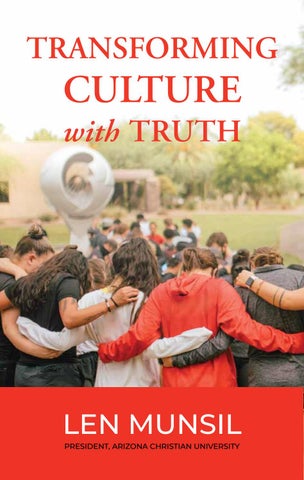
TRANSFORMING
CULTURE with TRUTH
LEN MUNSIL PRESIDENT, ARIZONA CHRISTIAN UNIVERSITY
LEN MUNSIL PRESIDENT, ARIZONA CHRISTIAN UNIVERSITY
TRANSFORMING
CULTURE with TRUTH SECOND EDITION
UNIVERSITY
Transforming Culture with Truth Second Edition Copyright © Arizona Christian University Press, 2020 All rights reserved under International and Pan-American Copyright Conventions. Reproductions or translation of any part of this work beyond that permitted by section 107 or 108 of the 1976 United States Copyright Act is unlawful without prior permission from Arizona Christian University Press. Arizona Christian University Press is the book-publishing division of Arizona Christian University, a private Christian university in Glendale, Arizona, that provides a biblically-integrated, liberal arts education equipping graduates to serve the Lord Jesus Christ in all aspects of life, as leaders of influence and excellence. Arizona Christian University exists to educate and equip followers of Christ to tranform culture with truth. Requests for permissions should be addressed to: Arizona Christian University Press 1 W. FirestormWay Glendale, AZ 85306 ISBN 978-1-7357763-0-9 Printed in the United States of America
D e d i c at i o n This book is first dedicated to the students of Arizona Christian University—past, present and future—and to the Trustees, faculty, staff and ACU community who have embraced this vision to allow God to work through them to transform our decaying culture with biblical truth. This book is also dedicated to my partner in life and in Kingdom mission, Dr. Tracy Munsil, who was my editor in college when I was 19 and resumed that role for both versions of this book, and to our eight adult children and their spouses—who through their careers and the families they are forming now have the opportunity to continue this transformational Kingdom work for a new generation.
CONTENTS • Introduction . . . . . . . . . . . . . . . . . . . . . .7 Arizona Christian University Core Commitments . . 27 ONE . . . . . . . . . . . . . . . . . . . . . . . . . 29 TWO. . . . . . . . . . . . . . . . . . . . . . . . . 39 THREE . . . . . . . . . . . . . . . . . . . . . . . 55 FOUR . . . . . . . . . . . . . . . . . . . . . . . . 71 FIVE . . . . . . . . . . . . . . . . . . . . . . . . . 89 SIX . . . . . . . . . . . . . . . . . . . . . . . . . 101 SEVEN. . . . . . . . . . . . . . . . . . . . . . . 109 EIGHT. . . . . . . . . . . . . . . . . . . . . . . 147 CONCLUSION . . . . . . . . . . . . . . . . . . 157 About the Author. . . . . . . . . . . . . . . . . . 161
5
I N T RO D U C T I O N • Many of our Christian institutions, especially the great Christian liberal arts colleges, come out of a tradition that tilts in the direction of separation from culture. Many are in isolated places where connection to our powerful urban centers is limited. We have often structured our institutions so that our students separate from the world “for a time,” as we say, so they may then “enter the world” prepared. This is the ivory tower model. This is the belief that there is something called pure learning.… But I do not buy into these notions. Such a tradition may have been appropriate for another time, but no longer. It seems abundantly clear that the gospel calls us into vigorous cultural engagement. Any preparation apart from this core commitment—to engage the culture—neglects the central call of the gospel on our Christian universities. We must engage the culture to change the world. In my opinion, this is the clear and critical direction for the future of the Christian university. —Dr. Philip W. Eaton Former President, Seattle Pacific University, 2011 Engaging the Culture, Changing the World: The Christian University in a Post-Christian World1
I
n spite of the brilliant technological, scientific and medical advances of our time, there is a sickness at the soul of America. We have forgotten who we are. More specifically, as Abraham Lincoln warned more than a 7
TRANSFORMING CULTURE WITH TRUTH
century-and-a-half ago, “we have forgotten God”2 and the central role of biblical Christianity in the formation of America and its foundational institutions—including its universities. Today those foundations are under attack like never before. Rather than celebrating our history—while recognizing our failure at times to live up to our aspirational principles—we are told to be embarrassed and ashamed. There are essentially two views of America and American history right now, and it seems every battle being fought in our culture—in politics, business, entertainment, education and more—is rooted in these contrasting views. One view recognizes that our nation, though flawed, was founded on truths that come from God and should be celebrated. The other view, which is rapidly increasing in our culture today, holds a counterfeit, revisionist perspective that almost requires us to tear everything down and start over. This view is on the increase because generations of students have been lied to about our history and taught to hate God, hate themselves and hate their country. Arrogant in their ignorance, in the name of attacking injustice, they seek to tear down the very system that taught them about justice and gave them the liberty to speak and protest. And most importantly, the freedom to overcome obstacles, pursue their dreams and determine their own destiny. But here is the truth that has been lost, and that we must recover: The United States of America, with all of its flaws and failings— because of the biblical principles present at its founding and the virtue of its many God-fearing people through the years—has been the most humane, selfless, peaceful, prosperous, welcoming and just nation in the history of the world. Not perfect, of course. We have been let down often by the failure of sinful people to live up to our core principles and values, enabling corruption, deprivation of liberty and many injustices, including moral atrocities like slavery and abortion. But our foundational core biblical principles—the value of every 8
INTRODUCTION
life, the freedom to pursue God, a separation of powers and limited government in recognition of man’s sinful tendency to abuse power, equal justice under law—these have created the best opportunity in human history for people to flourish and live out God’s purposes here on earth. And to be clear, these biblical principles can guide any culture, any people and any nation toward freedom and human flourishing. When the United States has successfully influenced other nations with these principles—when we have been as “a city set on a hill,” a model to other nations—their people have benefited as well. To the extent biblical principles guide nations, those nations will be blessed. America is exceptional only because it has so often embraced biblical principles of truth, justice and human rights that many nations don’t even pretend to honor. Every nation of the world—from Bible times to more recent history—has a history and a past. And without exception, those histories are filled with horrific examples of man’s inherent sinfulness, leading to wars of conquest, genocides and rampant injustices. But history today is taught to young people in our country without context. So it is that the one nation that has successfully welcomed and united people from all races and religions and nationalities with its principles of freedom and human rights is now condemned for xenophobia, racism and intolerance. The one nation that has sought to use its influence and at times its armies to advance freedom and liberate people from other nations is now condemned for its international influence. The one nation that has established and enforced principles of equality under the law, enabling people of all races, nationalities and backgrounds to succeed and flourish is now condemned as fundamentally unjust. The one nation every other nation turns to for help when disaster strikes—and that always sends help—is now condemned as selfish and greedy. This is madness. We have made the perfect the enemy of the good. But we should be capable of making a clear-eyed analysis of our flaws 9
TRANSFORMING CULTURE WITH TRUTH
and failings without condemning and repudiating our entire history as a nation. We have much to learn from our national history. We should celebrate the good, not seek to tear it all down. I’m reminded of the frustrated words of the prophet Jeremiah, unsuccessfully attempting to direct God’s people back to the truths from their history: Thus says the LORD, “Stand by the ways and see and ask for the ancient paths, Where the good way is, and walk in it; And you will find rest for your souls.” But they said, “We will not walk in it” (Jeremiah 6:16). I pray that would not be true for us today—I pray instead that we would look back to our godly heritage, find “where the good way is,” then pursue those “ancient paths” and “walk in [them].” To truly understand the biblical influences that led to the founding of America and to its higher education system, you have to go back before the American Revolution—to the Pilgrims who risked their lives on a perilous ocean crossing to flee religious persecution in Europe in 1620. While still aboard the Mayflower, these Christians agreed to foundational principles for the new community they would form when they went ashore. This document, which became known as the Mayflower Compact, stated they had come to the new world “for the glory of God” and to advance “the Christian faith.” They agreed to govern themselves in a “civil body politic” that would frame “just and equal laws” in the best interests of their community. I am descended from five signers of that document.3 Ten years later in 1630, before landing on American shores, and while still on their ship, the Arbella, John Winthrop delivered a sermon entitled “A Model of Christian Charity.” Winthrop, who would be elected governor a year later, essentially challenged the colonists to demonstrate Christian love, to bear each other’s burdens and thereby 10
INTRODUCTION
set an example for the world: “For we must consider that we shall be as a city upon a hill. The eyes of all people are upon us. So that if we shall deal falsely with our God in this work we have undertaken, and so cause Him to withdraw His present help from us, we shall be made a story and a by-word through the world.”4 Winthrop was referring to the words of Jesus from the Sermon on the Mount, recorded in Matthew 5:14-16: “You are the light of the world. A city set on a hill cannot be hidden… Let your light shine before men in such a way that they may see your good works and glorify your Father who is in heaven.” This vision of the United States of America has been embraced by American leaders across the political spectrum. Democrat President John F. Kennedy used this imagery in a final speech to the Massachusetts legislature in 1961, less than two weeks before his Inauguration as President. Republican President Ronald Reagan used this metaphor as a recurring theme throughout his campaigns and during his presidency. And Democrat President Barack Obama as a young Senator—two years before his election as America’s first African-American President—beautifully articulated this vision for American exceptionalism in a Commencement address at the University of Massachusetts in Boston: It was right here, in the waters around us, where the American experiment began. As the earliest settlers arrived on the shores of Boston and Salem and Plymouth, they dreamed of building a City upon a Hill. And the world watched, waiting to see if this improbable idea called America would succeed. For over two hundred years, it has. Not because our dream has progressed perfectly. It hasn't. It has been scarred by our treatment of native peoples, betrayed by slavery, clouded by the subjugation of women, wounded by racism, shaken by war and depression. Yet, the true test of our union is not whether it's perfect, but 11
TRANSFORMING CULTURE WITH TRUTH
whether we work to perfect it. Whether we recognize our failings, identify our shortcomings, and then rise to meet the challenges of our time…. Now, there may be some who doubt that much has changed—those who doubt that things are better today than they were yesterday. To them I say take a look at this class of 2006. More than half of you represent the very first member of your family to ever attend college…. I see students that have come here from over 100 different countries, believing like those first settlers that they too could find a home in this City on a Hill—that they too could find success in this unlikeliest of places.5 President Obama, like presidents before him, recognized that despite our flaws, the principles of the United States have provided opportunities for advancement unparalleled in the history of the world. That is why people trapped in oppressive socialist regimes from all over the world will sacrifice almost anything to get to America. If the anti-American activists who believe our nation has always been fundamentally evil and corrupt were correct, people would be fleeing the United States. Instead, they risk their lives to reach what the rest of the world understands is truly a “land of opportunity.” For now. And that’s the irony—the activists now seeking to tear down the United States in most cases are promoting the very unbiblical, leftist economic and social policies that the rest of the world is trying to escape. So, we need to start by remembering who we are, by recovering and re-implementing the biblical foundations that led us to becoming that “city on a hill.” Although many Americans today seem to have fully embraced secularist ideology, America began as a place where virtuous biblical 12
INTRODUCTION
principles were universally understood to be essential to the American idea of liberty. From the beginning of our nation, colleges and universities were created with that same biblical worldview, and with the expectation that they would produce Christian students of influence, excellence and high moral character. As Dr. Phillip W. Eaton indicates in his powerful book, Engaging the Culture, Changing the World: The Christian University in a PostChristian World,6 now is not the time for Christian universities to retreat further from the public sphere. More than ever, Christian universities today should focus on preparing leaders who can, by God’s grace, provide hope and healing to a wounded culture and to a lost generation. The leading American institutions of higher learning almost uniformly began with such clear purpose. Just 16 years after the Mayflower arrived, America’s first university was founded in 1636 for the explicit purpose of training “a literate clergy.”7 Students at Harvard University were governed by “Rules and Precepts” that required reading Scripture twice a day, with students required to report to their instructor about their Bible reading twice a day. The “Rules and Precepts" stated: “Let every Student be plainly instructed and earnestly pressed to consider well, the maine end of his life and studies, is to know God and Jesus Christ which is eternal life, John 17:3 and therefore to lay Christ in the bottome, as the only foundation of all sound knowledge and Learning.”8 The founders of Harvard believed “All knowledge without Christ was vain.”9 In the 18th Century, the founders of Yale wrote that “Every student shall consider the main end of his study to wit to know God in Jesus Christ and answerably to lead a Godly, sober life.”10 Requirements for students included: All scholars shall live religious, godly and blameless lives according to the rules of God’s Word, diligently reading the Holy Scriptures, the fountains of light and truth; and constantly attend upon all the duties of religion, both in 13
TRANSFORMING CULTURE WITH TRUTH
public and secret. Seeing God is the giver of all wisdom, every scholar, besides private or secret prayer, where we are all bound to ask for wisdom, shall be present morning and evening at public prayer…11 Imagine—public prayer was expected twice a day for Yale students—although additional private prayer was assumed! Prayers were focused on seeking wisdom from God. After all, what serious scholar could expect to find wisdom without asking God and without recourse to the truths of the Bible? That perspective permeated the American colonies and the early days of our nation. Noah Webster, author of the dictionary and founder of historic Amherst College, put it bluntly—“Education is useless without the Bible.”12 This perspective did not begin with American universities. The first universities in history developed in Europe during medieval times out of Christian monasteries, where the pursuit of knowledge and wisdom was tied directly into the pursuit of God’s truth. The Reformation had a profound influence on the direction of universities. How far universities have fallen from their initial purpose is obvious to any observer of higher education today. Today, a university like Arizona Christian University that holds to biblical truth is often criticized and attacked by a hostile culture. Having gone through the college selection process eight times with our own children, we were amazed at how even some of the most elite universities marketed themselves. At a time when underage drinking is a major national concern, we heard a paid admissions advisor for one elite, historic college tout how many local bars were within a block or two of campus at a meeting for hundreds of prospective students and their parents. At another college—during a weekend when parents were invited to visit—we were welcomed with rhyming chalk art letting us know that if we left our students there 14
INTRODUCTION
“for a year, [they would] turn them queer,” and informing us that “America was built on racism and genocide.” Numerous books have been written by secular scholars regarding the effect on our young people of the destructive “hook-up culture” that is prevalent on most college campuses. In short, the historic function of a university to teach and train students in the pursuit of God’s truth, and the desire for scholars to pray and seek wisdom while attempting to understand the history and meaning of the world and of life in a biblical context—all of that is gone. In its place, partying, sexual immorality and substance abuse—seemingly with the tacit approval of some university leaders. Combining those traumatic experiences with secular, left-wing indoctrination that promotes a false view of the world that either denies the existence of God or is antagonistic to biblical truth is beyond destructive. In too many circumstances, students have borrowed or paid tens or hundreds of thousands of dollars for the privilege of learning irrational and immoral nonsense while undergoing painful experiences that may require years of therapy to overcome. The consequences of this type of education coming from our universities are increasingly obvious. Our cultural leaders—in the arts, media, business, politics and elsewhere—have often been prepared and equipped with a worldview that can only succeed in tearing down what is true, good and beautiful. Two Christian leaders I admire recognized the problems with American universities and sought to do something about it. Each played a key role in encouraging and inspiring the decision I made to accept the presidency at Arizona Christian University, and to present a new vision for ACU to be at the forefront of preparing Christian leaders for cultural engagement. The first is Michael Farris, a founder of the Home School Legal Defense Association (HSLDA) and Patrick Henry College in Purcellville, Virginia, and now serving as President and CEO of Alliance Defending Freedom (ADF). I have been active in conservative 15
TRANSFORMING CULTURE WITH TRUTH
Christian pro-life, pro-family, parental rights and religious freedom issues for several decades, so I had already met him on numerous occasions. When we began thinking about college for our children years ago, we received a tour of Patrick Henry from Michael Farris, who was then its President. In November of 2006, the day after I lost the general election for Governor of Arizona, Tracy and I decided to get away from Phoenix and head north to Sedona to spend a day hiking, thinking, reflecting and discussing our future. A mutual friend contacted me that morning and let me know he was driving Farris from Flagstaff to the Phoenix airport, and could I meet with them? So it was that Tracy and I found ourselves sitting in a Starbucks in Camp Verde, reflecting on our political experiences (Farris had been the Virginia GOP’s nominee for Lt. Governor in 1993, also losing in the general election) and talking about the future. Farris suggested I had a unique gifting and recommended I consider leading a Christian university—not knowing I would be asked to do exactly that nearly four years later. He spoke about building a network of high-academic Christian universities—a modern-day Ivy League— to prepare and train Christian leaders. On that day in November of 2006, he definitely planted a seed, although I had no idea how God would open that door and shove me through it years later. Then, not long after becoming President of Arizona Christian University, I had opportunity to meet and spend time with inspirational Sen. Bill Armstrong, who served as President of Colorado Christian University in the Denver suburb of Lakewood from 2006 until his death in 2016. I was familiar with President Armstrong initially due to his political career as a successful three-term U.S. Congressman and two-term U.S. Senator from Colorado during the Reagan years. He was that rare evangelical Christian politician, someone who returned from nearly two decades in our nation’s Capitol with an even stronger Christian witness and a greater reputation for integrity and commitment to 16
INTRODUCTION
principle than when he left. Then I heard from my oldest son, who attended and ultimately graduated from Colorado Christian University, about the incredibly positive changes that occurred at CCU when President Armstrong took office. When I met with President Armstrong, he told me the most important element in CCU’s resurgence—and the key to any Christian university’s ability to stay on mission—was the adoption of what CCU referred to as “Strategic Objectives.” These guiding principles provided a common purpose and a rallying point for the community, and a clear distinctive that separated CCU from most other colleges, even colleges with a historic Christian purpose. President Armstrong made the adoption of these objectives a condition of his employment at CCU. After I shared my vision for a university that would equip and educate students to transform culture with biblical truth by preparing them to be leaders in the body of Christ in a wide range of disciplines and areas of influence, President Armstrong urged me to bring a similar set of principles to the Board of Trustees at Arizona Christian University. In 2012, that is what we did. ACU’s Core Commitments—with permission modeled on CCU’s Strategic Objectives—were adopted after discussion and refinement by ACU’s Trustees as the conservative, biblical guiding principles for our institution. They have been woven into our planning, our conversation, our accountability measures, our discussions with potential staff and faculty hires, and in the fall of 2014 became an important part of our new liberal arts curriculum—what we are referring to as “The CORE: Christian Liberal Arts for Cultural Transformation.” I know it can be confusing so let me try to clarify. Our curriculum as a University is based on our principles. Our principles are established by the Core Commitments—that’s the one-page statement of principles adopted by our Board of Trustees in 2012 and explained in more detail by this book. Those principles led to the 17
TRANSFORMING CULTURE WITH TRUTH
establishment in 2014 of our liberal arts curriculum—which is called “The CORE: Christian Liberal Arts for Cultural Transformation”—a series of courses taken by all ACU students that strategically integrates study of the humanities with the Bible. This book is designed to clearly articulate and amplify the Core Commitments of ACU for students, staff, alumni and supporters of the University. We at Arizona Christian University owe a debt of gratitude to President Armstrong for his inspirational leadership in the body of Christ and for his amazing generosity to ACU in sharing his ideas about higher education and the need for a set of conservative, biblical guiding principles for Christian universities. President Armstrong died after a long battle with cancer on July 5, 2016. My last time to be with him and learn from him was in a Denver hospital over Memorial Day weekend in 2016, a few weeks before he passed into the presence of his Savior. President Armstrong was an incredible friend and mentor to me, even encouraging me to write this book and providing an endorsement for its first edition. I miss his booming radio voice, childlike enthusiasm for the gospel and his constant emphasis on “Jesus, Jesus, Jesus!” We need more leaders like Bill Armstrong, and more universities like Colorado Christian University. The sense that something has gone deeply wrong with our country and our world is no longer confined to a handful of skeptics and pessimists. Apocalyptic films and sensational news headlines have been everywhere for the last decade. Economic uncertainty, international wars and civic unrest dominated news reports in recent years, leading to a widespread unease and fearfulness about the future. And then 2020 happened. All of the existing unease accelerated with the arrival of a global pandemic and subsequent lockdown, leading to vast and widespread job losses and economic uncertainty. The pandemic response, combined with increased political polarization and unsettling civic 18
INTRODUCTION
unrest, created a level of volatility unseen in more than a half-century. Civic unrest began with legitimate grievance and peaceful protests against ongoing incidents of racial injustice, but was quickly sidetracked by some activists into looting and property destruction as part of a broader and sometimes violent assault on law enforcement and the foundations of Western civilization and the United States. Decades of secularization in our culture—due to the steady removal of a biblical worldview from every area of cultural influence, especially popular entertainment and our entire educational system— left Americans largely defenseless against these rapid and frightening developments. With no relationship with God to turn to provide historical context, comfort and peace, many Americans retreated into fear, anxiety, panic and depression. Suicide, drug overdose, alcoholism, domestic abuse—all of these increased and are warning signs of a decaying culture with no answers to the trials of life. For Christ followers in America, it has felt like we have been on a long losing streak, helplessly watching this steady erosion of biblical truth’s influence in our culture. So many responses to the decay and decline of our culture have seemed defensive in nature, trying to just hang on, to hold the line against further decline. It is time for followers of Jesus to go back on offense, to go into all the world, and to be courageously Christian in a hostile culture. We need to build institutions of Christian influence that will last for generations, producing dedicated Christ followers who can bring the healing and hope of the gospel into every area of influence in our culture. In the same way that forces of secularization strategically gained influence in our culture over decades, we need to “play the long game” and build universities that reclaim education based on biblical truth to bring glory to God. At ACU, we hope to inspire tomorrow’s leaders to stand boldly for the things of God, and to bring biblical values and their faith in Christ into the center of culture as their generation moves into positions of influence in society. 19
TRANSFORMING CULTURE WITH TRUTH
ACU has specifically identified in its Core Commitments that there are several key areas of cultural influence and has sought to develop degree programs that will launch students into those vocations. Part of inspiring leaders is presenting examples of those who have been bold about their Christian faith while serving in positions of great influence—whether that influence vocationally is in the area of government, ministry, the family, business, education, media or entertainment.
ACU President Len Munsil thanks President George W. Bush after his speech March 16, 2011, at ACU’s 50th anniversary celebration. (Photo by Timon G. Harper.)
In 2011 Arizona Christian University began a new tradition of recognizing and honoring such Christian leaders by presenting the Daniel Award for Courageous Public Faith. The first award went to former President George W. Bush for his open reliance on God and biblical principles through a challenging war-time presidency. Whether you agreed with his decisions or not, he was always clear that he sought to ground his decision-making in a biblical worldview and prayed for guidance as he dealt with each new challenge. President Bush urged nearly 1,300 attendees at the Daniel Award event to support the “good work” of ACU in preparing leaders for tomorrow. President Bush represented the “government” sphere of influence, reflected at ACU in our Political Science degree and pre-law emphasis. 20
INTRODUCTION
The Daniel Award recipient in 2012 was the Reverend Franklin Graham, president and CEO of both the Billy Graham Evangelistic Association and Samaritan’s Purse. In speaking to supporters of ACU, Rev. Graham described Christian colleges and universities as “the last wall of defense against the rise of secularism” in America and the world.12 Rev. Graham, through his work as an evangelist and his nonprofit relief work through Samaritan’s Purse, represented the “church” or vocational ministry sphere of influence, reflected at ACU through our Biblical Studies and Christian Rev. Franklin Graham speaks after receiving the 2012 Daniel Award from ACU. Ministries degrees. Grammy Award–winning musician Michael W. Smith received our third Daniel Award in 2013 and performed a concert for an ACU audience.
Michael W. Smith performs after receiving the ACU 2013 Daniel Award.
Smith represented the “arts and entertainment” sphere of influence, though he achieved crossover fame in the secular recording industry,
21
TRANSFORMING CULTURE WITH TRUTH
he remained faithful to producing worship through albums that glorified Christ. That sphere of influence is represented at ACU through our Music and Music Education degrees, and our praise and worship emphasis. In 2015 the founders of Hobby Lobby, David and Barbara Green, came to ACU and addressed students at chapel and supporters at a dinner event, where we presented them with our fourth Daniel Award for Courageous Public Faith. The Greens were honored for the way they have conducted themselves as business owners through their commitment to sharing the gospel with and caring for their employees, along with their willingness to stand against an unjust government decree in order to defend innocent human life, all the way to the U.S. Supreme Court. The Greens represent the “marketplace” sphere of influence, reflected at ACU through our degree in Business Administration.
David and Barbara Green receive the 2015 Daniel Award from ACU Trustee Don King and his wife Mary King.
And in 2016, we celebrated a career dedicated to helping families by presenting the fifth Daniel Award for Courageous Public Faith to Dr. James Dobson, a psychologist who founded Focus on the Family and wrote multiple bestsellers about marriage and parenting. Generations of parents and families have been blessed by his wisdom and godly
22
INTRODUCTION
counsel that helped them build healthy families and marriages. Dr. Dobson represents the “family” sphere of influence, reflected at ACU through our degrees in Behavioral Health and Psychology, directed to using biblical counseling to restore marriages and strengthen family relationships.
Dr. James Dobson speaks after being presented with the 2016 Daniel Award from ACU.
As all of these leaders who have come to ACU have made clear, the need for a Christian university like Arizona Christian University that is committed to conservative, biblical principles has never been greater. And as the President of ACU since 2010, I have watched the God of the universe move mountains—working through His people—to provide miracle after miracle of provision and opportunity for Arizona Christian University. I have watched miracles of transformation and redemption in hundreds of students who leave on a different, Godordained trajectory after their time in ACU’s authentic Christian community. I speak from experience when I say—God is in this! Without Him, we can do nothing. With Him, we can do anything. ACU is here for such a time as this. Rather than play defense against an increasingly hostile culture, we must inspire winsome, persuasive, compassionate Christians who can move into centers of influence in
23
TRANSFORMING CULTURE WITH TRUTH
our culture and lead their generation and future generations toward the hope and transformative change offered through a relationship with Jesus. Only such an awakening will succeed in “transforming culture with truth.”
Chapter Notes 1 2
3 4
5
6 7
8
9
Philip W. Eaton, Engaging the Culture, Changing the World: The Christian University in a Post-Christian World. (Downers Grove, IL: IVP Academic, 2011), 127. Abraham Lincoln, Proclamation Appointing a National Fast-Day (1863), The Papers and Writings of Abraham Lincoln, Volume Six. Ed. Arthur Brooks Lapsley, The Project Gutenberg EBook, accessed August 20, 2014, http://www.gutenberg.org/files/2658/2658-h/2658-h.htm. Mayflower Compact, 1620. Bruce Frohnen, The American Republic: Primary Sources, ed. Bruce Frohnen (Indianapolis: Liberty Fund, 2002). 10/1/2020. https://oll.libertyfund.org/titles/669#lf0082_head_022. John Winthrop, “A Modell of Christian Charity,” 1630. Collections of the Massachusetts Historical Society (Boston, 1838), 3rd series 7:31-48), 27. 10/1/2020. https://history.hanover.edu/texts/winthmod.html [Language modernized by author]. Barack Obama, “University of Massachusetts at Boston Commencement Address,” June 2, 2006. 10/1/2020. http://obamaspeeches.com/074University-of-Massachusetts-at-Boston-Commencement-Address-ObamaSpeech.htm. Eaton, 2011. John Harvard, 1636. Tim LaHaye, Faith of Our Founding Fathers (Brentwood, TN: Wolgemuth & Hyatt Publishers, Inc., 1987), 32, quoted in William J. Federer, America's God and Country: Encyclopedia of Quotations (Amerisearch, Inc.: St. Louis, MO, 1999), 280. "Rules and Precepts," (1636), Harvard University, Old South Leaflets, in Sourcebook and Biographical Guide for American Church History, Peter G. Mode, ed. (Menasha, WI: George Banta Publishing Co., 1921), 74-75, quoted in William J. Federer, America's God and Country: Encyclopedia of Quotations (Amerisearch, Inc.: St. Louis, MO, 1999), 280-281. Harvard University, 1636, "Our Christian Heritage," Letter from Plymouth Rock (Marlborough, NH: The Plymouth Rock Foundation), 2, quoted in 24
INTRODUCTION
10 11 12
13
William J. Federer, America's God and Country: Encyclopedia of Quotations (Amerisearch, Inc.: St. Louis, MO, 1999), 282. "Rules and Precepts," 281. Ibid. Noah Webster, "Our Christian Heritage," Letter from Plymouth Rock (Marlborough, NH: The Plymouth Rock Foundation), 5, quoted in William J. Federer, America's God and Country: Encyclopedia of Quotations (Amerisearch, Inc.: St. Louis, MO, 1999), 676. Franklin Graham, 2012. Speech, Daniel Award Banquet, Arizona Christian University, Phoenix, AZ, April 23, 2012.
25
R
A
N
O
ΑΝΑΚ ΤΗ Α A
Ε
ROMANS 12:2
L E
Θ
N
A
ΟΡΦΟΥC
ΙΝ
Μ
E D
ΜΕ Τ
EST. 1960
Α
G L
ΩCΕΙΤΟΥ
C ΟΟ
Ν
I
Z
Arizona Christian University Core Commitments
Arizona Christian University shall: •
Before all else, be committed to Jesus Christ – accomplishing His will and advancing His kingdom on earth as in heaven.
•
Teach students to read, understand and trust the Bible, grounding them firmly in the truth through a biblical worldview.
•
Be devoted to evangelism and to prayer without ceasing.
•
Be committed to loving God with all our heart and soul, mind and strength, by pursuing excellence in spiritual formation, academics, athletics and extracurricular activities, doing all for the glory of God.
•
Teach students to think critically, speak and write clearly and effectively, use technology effectively, develop interpersonal skills, and pursue personal and professional ethics through biblical literacy and integration.
•
Provide opportunities for students to serve locally and globally, and promote a culture of lifelong commitment to servant-leadership.
•
Influence, engage and transform the culture with truth by promoting the biblically informed values that are foundational to Western civilization, including: 1. 2.
the centrality of family traditional sexual morality and lifelong marriage between one man and one woman 3. the sanctity of human life 4. compassion for the poor 5. a biblical understanding of human nature 6. an understanding of God’s purposes for limited government 7. personal, economic and religious freedom 8. free markets, capitalism, and property rights 9. natural law, the original meaning of the Constitution and judicial restraint 10. international human rights and the advancement of freedom throughout the world. •
Prepare students to be leaders of influence in their community, state, nation and world – through the church, the family, business, government, education, health care, media, the arts and every area of society.
•
Be a leading conservative Christian liberal arts university.
27
ONE • Arizona Christian University shall: Before all else, be committed to Jesus Christ—accomplishing His will and advancing His kingdom on earth as in heaven.1
I
am not a theologian. I’m not interested in getting into a debate on the end times and whether the return of Christ is imminent. It’s not that I don’t care. I care deeply. Scripture teaches us that the Lord will return in power and glory, and when He does it will be a great day. If it happens during my lifetime on earth, then on that day I won’t have to check off any more items on my to-do list, my back won’t hurt anymore, and I won’t have to pay any more bills or take out the garbage anymore. Hallelujah! I have my opinions like every other Christian, maybe better-informed opinions than some, not nearly as informed as others. But my study of Scripture and history leads me to two conclusions of which I am completely confident: 1) Just about every generation of Christ followers since Jesus walked the earth believed they were living in the end times. So far, they’ve all been wrong, and yet they all had what we have—faith, access to Scripture, and varying levels of spiritual discernment. There are those today who think every drop in the stock market, every skirmish in the Middle East, every global disaster or pandemic is a certain sign of the Apocalypse. Might they be wrong—like every previous generation of Christians? 2) Jesus was clear that no one but God the Father would 29
TRANSFORMING CULTURE WITH TRUTH
know exactly the day or the hour of His return (Matthew 24:36). For me, that’s enough. From my perspective, we don’t need to spend a ton of time thinking about it. We know how things end, and for those who have trusted Christ for their salvation, it is very good. Heaven! No pain, no tears, lots of celebrating. But what about here and now? We are told to be on the alert and to live expectantly, not to sit around waiting to be rescued. We have things to do. In fact, once we have committed our lives to Jesus, our time and our very lives are not our own. I Surrender All—Before all else, be committed to Jesus Christ… But whatever gain I had, I counted as loss for the sake of Christ. Indeed, I count everything as loss because of the surpassing worth of knowing Christ Jesus my Lord. For his sake I have suffered the loss of all things and count them as rubbish, in order that I might gain Christ (Philippians 3:7–8). I like leisure. I like entertainment. I enjoy going to movies and watching movies on TV. I like to read escapist fiction, usually action books involving men who dispense justice in some form, mainly to criminals or terrorists. I like to watch sports on television and in person. Here are some interesting realities. In my entire childhood, we went out to the movies maybe a dozen times or less. Movies on TV were rare and usually ran late at night or on weekend mornings. There were no recently released movies available. If you didn’t see a movie in a theater, it would be years before you could see it on television, if ever. There were a grand total of six TV stations to watch in Phoenix, Arizona, one of the largest metro areas in America. At midnight these stations would sign off and the picture 30
CHAPTER ONE
would go to static overnight. The genre of fiction I read now barely existed back then. You could listen to music only on a handful of popular radio stations. If you found an artist you liked, you would head to the record store to buy an album and then play it on your home stereo. Your musical choices were largely limited to what was popular enough to hear on the radio. When I was a boy, most sporting events that were televised occurred on weekends. My hometown basketball team, the Phoenix Suns, played 81 games, and only 13 were on television. Arizona didn’t have professional football or baseball, and there was typically only one nationally televised baseball “game of the week” to watch, often on tape delay. During football season, it seemed like the whole world stopped to watch Monday Night Football. Today by contrast, entertainment choices are omnipresent. There are a dozen new movies out in theaters every week of the year. Recent movies can be rented at any drugstore or grocery store for a dollar, or more likely, streamed online, along with a library of older films. Hundreds of entire television series are available for purchase, and “binge watching” entire seasons of TV shows is the norm. Today there are dozens of prominent authors turning out at least one book per year each in the escapist genres I enjoy most. Through streaming, music fans can explore every genre of music available and listen to any song by any artist at any time. And now sports fans can watch live sporting events just about every waking hour, plus great interviews and sports news coverage 24/7. Seasons have been extended and often overlap, more and more athletic teams and individual competitions have been created for a variety of sports—and yet there seems to be no risk of saturation or slowing. The truth is, in today’s world, we could entertain ourselves all the time, every waking moment, from childhood until death, and never run out of music, movies, TV shows and sports events to watch. When 31
TRANSFORMING CULTURE WITH TRUTH
we leave home we take our entertainment with us on our phones and tablets. And the things we are watching and listening to are really entertaining! I could probably fill my entire schedule each year just reading the kind of books I like to read for semi-mindless entertainment. I could certainly watch enough entertaining TV shows, movies or athletic contests to avoid doing much of anything else in my life. Oh, and also—social media! Another assault on the meaningful use of our limited time on earth. Between Twitter, Instagram, Tik Tok, Snapchat, Facebook—and whatever new social media site emerges in the days ahead—we have to actually consciously force ourselves to emerge from this all-encompassing virtual world into real life. The biggest difference from my childhood is there are no times of pausing, in the year, the season, the week, the day, the hour, no breaks from the omnipresent reality of entertainment—music, TV, movies, sports. There are no overnights with television off the air, no moments without access to music, no escape from social media notifications. No time to be alone with your thoughts—and with your God. Unless we make it. No matter how you spend your leisure time, the reality is that every genre of entertainment and leisure activity that people enjoy has expanded and can be consumed constantly in our 24/7 world. When I arrived at Arizona Christian University in the fall of 2010, the school had an aging infrastructure and limited Internet connectivity maintained by a one-person IT department. “You better hope he doesn’t get hit by a truck,” said my Dad, a retired Motorola software manager who volunteered his time a few days a week to help out. “You’d have to shut down the school.” Over the next few years, we added multiple new staff positions and poured massive resources into IT and Internet upgrades. And yet, to my great frustration, no matter how many upgrades we made, it seemed like every year we had connectivity issues. After an outage that led to my third “This can never happen again!” meeting with senior executives at the school, I asked why solutions were so elusive. 32
CHAPTER ONE
“Simple,” I was told. “In the last few years, the average student has gone from zero or one wireless device to three or four. They’re always online, and there are lots of movies and TV shows being streamed at any time of the day or night. As soon as we upgrade capacity and bandwidth, it’s overwhelmed by increased usage.” It takes incredible discipline, particularly for young people raised in a media- and entertainment-focused culture, to turn away from all of that, even for a time, to focus on anything else. Tiny little life issues like, for example, our relationship with God. Relationships with family and friends. Classwork. Jobs. Exercise. All suffer. At least in America, and much of the West, our pursuit of a significant, healthy and balanced life has been diminished by our unlimited access to media, entertainment and leisure activities. Leisure, entertainment, the arts and even social media can add emotional connection, depth and balance to the quality of our lives. But not if we are so busy entertaining ourselves or spending so much time in the virtual world that we forget to live life, or neglect to pursue God’s plan and purpose for our life. Contrast the distractions available to young people today with the life of David during his youth. The shepherd’s life involved quite a bit of downtime. It got dark early and no streetlights came on. All that darkness and downtime allowed David seasons of deep contemplation of his Creator, and led to some of the most beautiful and inspired poetic writing in world history: When I consider your heavens, the work of your fingers, The moon and the stars, which You have ordained; What is man that you take thought of him, And the son of man that You care for him? (Psalm 8:3–4) With all of life’s distractions in the early 21st Century, we have to choose to spend time with God and learn His ways. We have to choose prayer, meditation on the things of God, Scripture reading, fellowship, and worship over the pull of the latest social media noti33
TRANSFORMING CULTURE WITH TRUTH
fication or binge-worthy TV series. We have to choose our commitment to Jesus Christ, “before all else”—or the “all else” will become our life. As a kid playing baseball, whenever one of us would dive for a ground ball, someone would yell, “Way to sacrifice your body!” As Christ followers, that’s actually what we are called to do. Paul wrote, “I appeal to you therefore, brothers, by the mercies of God, to present your bodies as a living sacrifice, holy and acceptable to God, which is your spiritual worship” (Romans 12:1). Jesus asked for even more. “Then Jesus told his disciples, ‘If anyone would come after me, let him deny himself and take up his cross and follow me. For whoever would save his life will lose it, but whoever loses his life for my sake will find it. For what will it profit a man if he gains the whole world and forfeits his soul?” (Matthew 16:24–26). As Christ followers, our lives, our bodies, our time, no longer belong to us. They belong to the God who created us. The Will of God—…accomplishing His will… So, God created us and redeemed us through Jesus. Now what? Or, as theologian Francis Schaeffer asked in the title of his groundbreaking 1976 book, How Should We Then Live? The Bible is full of instruction on how we should relate to God and to each other. Instruction is always given for our good, not to punish us or restrict us. The Old Testament describes the creation of the world and of the first man and woman. Immediately after creating Adam and Eve, God provided our first instructions: “God blessed them; and God said to them, ‘Be fruitful and multiply, and fill the earth, and subdue it; and rule over the fish of the sea and over the birds of the sky and over every living thing that moves on the earth’” (Genesis 1:28). This is often referred to as the “cultural mandate.” In essence, God plants the first humans in a garden, and tells them (us) to create families and fill the earth by participating in activities of creation 34
CHAPTER ONE
and culture and work that lead to human flourishing and dominion. Despite our rebellion against God during the fall, this mandate is never revoked. Richard J. Mouw, former president and professor of philosophy at Fuller Theological Seminary, explains God’s plan in his book, Abraham Kuyper: A Short and Personal Introduction: Human rebellion made a mess of what God originally intended for the creation. But…God looked down upon this rebellious humanity and decided to start something new. He decided to choose a specific people—the ethnic Israelites, Abraham’s descendants—to be special recipients of his sovereign grace. He called them to organize their lives so as to show the rest of the world what it is like to live in obedience to the will of the Creator in all dimensions of human life. He gave them instructions not only about how to worship, but also about farming, family life, politics, economics, the fashioning of beautiful things, their relationships with other tribes and nations—in short, God chose Israel as a means of putting on display some of his original intentions for cultural processes and products. Once again there would be people on the earth who would direct their lives toward his glory, “filling the earth” and “having dominion” in ways that pleased the Creator. The initiative that God took with ancient Israel, however, was the first stage of something much more significant that God would eventually bring about. There came a time when the eternal God appeared in the flesh, as Jesus of Nazareth, to guarantee the success of the initiative begun in more ancient times.2 With man’s rejection of God’s plan in the garden, God ultimately provides Jesus to bridge the gap between man and God that was created by our sin. Jesus is the redeemer, but He is also the restorer of all that was lost in our understanding of our role and our participation in 35
TRANSFORMING CULTURE WITH TRUTH
God’s created order. He is the one in whom “all things hold together” (Colossians 1:17). As Mouw puts it: “That the redemption accomplished by Christ heals what was wounded by the Fall is certainly true in the redeeming of individuals.… But redemption reaches far beyond individuals.”3 Ultimately, “our salvation as individuals includes the obligation to align ourselves with God’s desire that his will is to be acknowledged and glorified in all areas of life. Our discipleship includes cultural obedience.”4 When Jesus ascends to the Father, He leaves us with the Great Commission: “Go therefore and make disciples of all nations, baptizing them in the name of the Father and of the Son and the Holy Spirit, teaching them to observe all that I have commanded you. And behold, I am with you always to the end of the age” (Matthew 28:19– 20). Again, we have clear instructions. Make disciples throughout the world, baptizing them and ultimately teaching them everything Jesus taught us. That is how we can accomplish His will. The Kingdom of God—…advancing his kingdom on earth as in heaven. Maybe like me you have heard variations of this message at times from Christians or from your church: “I don’t care at all about [politics, the economy, culture, etc.]. We already know the world is just going to keep going downhill until God destroys it all.” What a depressing, pessimistic, wrong-headed, and flawed message. If I believed that, I’m not sure why I would keep showing up every day…for anything. The issue here isn’t even about how the end comes or what it looks like. The issue is whether we should care. In a nutshell, the question is whether we should try to make the world a better place, or just let it fall apart. To conclude that we should just let the world fall apart would fly 36
CHAPTER ONE
in the face of so many scriptural passages that provide instruction on how we should live, how we relate to each other, how we should love and serve one another, and how we are to engage as “salt and light” in a fallen world. And as we shall see, spiritual decline is not inevitable. Not in our own lives and not in the lives of cultures and nations. Revivals and awakenings do occur, and they are genuine game-changers. But perhaps the most obvious refutation of that pessimistic mindset comes from the mouth of Jesus himself, when he taught us to pray: “Thy Kingdom come, thy will be done, on earth as it is in heaven” (Matthew 6:10). Jesus taught us to pray that the will of God would be done on earth as it is in heaven. It’s hard to reconcile that prayer with the notion that we should let the world fall apart. Instead, it should be seen for what it is—a call to engagement in the world, using the principles of God that Jesus taught us. What would such a world look like? We have seen glimpses on this earth of the peace, prosperity, safety, and joy we imagine in heaven from those cultures and communities most heavily influenced by biblical Christianity. It will never be perfect—not this side of heaven, due to man’s sinful nature. But the prayer of Jesus that we would pursue God’s will on earth as in heaven has to mean something. To me, it means that as Christians, we should do our best to learn, teach and live out the principles of God in our own lives, and also in every area of the world we touch. In fantasy writer Stephen Lawhead’s series of fictional books about King Arthur, he describes what a community might look like that lived out the principles of Christianity. Lawhead, who writes generally from a biblical worldview, provides a beautiful, aspirational and inspirational vision of the kind of community I believe Jesus is asking us to pray for and to work toward. In reality, it is a picture of heaven, the Kingdom of God—the very Kingdom Jesus asks us to pray would come “on earth as in heaven”: There is a land, a land of shining goodness where each man 37
TRANSFORMING CULTURE WITH TRUTH
protects his brother’s dignity as readily as his own, where war and want have ceased and all tribes live under the same law of love and honor. It is a land bright with truth, where a man’s word is his pledge and falsehood is banished, where children sleep safe in their mother’s arms and never know fear or pain. It is a land where kings extend their hands in justice rather than reach for the sword; where mercy, kindness, and compassion flow like deep water, and where men revere virtue, revere truth, revere beauty above comfort, pleasure or selfish gain. A land where peace reigns in the hearts of men. Where faith blazes like a beacon from every hill and love like a fire from every hearth; where the True God is worshipped and His ways acclaimed by all.5 That vision stirs my soul. I believe it is a vision of a nation, community and culture transformed by truth.
Chapter Notes 1 2 3 4 5
ACU Core Commitments, adopted by ACU Board of Trustees, Nov. 8, 2012. Available on page 27 of this text and at: https://www arizonachristian.edu/about/mission. Richard J. Mouw, Abraham Kuyper: A Short and Personal Introduction (Grand Rapids, MI: Wm. B. Eerdmans Publishing Company, 2011), 1112. Ibid., 13. Ibid., 15. Stephen R. Lawhead, Taliesin (New York: HarperCollins, Inc. 1987), 443.
38
TWO • Arizona Christian University shall: Teach students to read, understand and trust the Bible… All Scripture is breathed out by God and profitable for teaching, for reproof, for correction, and for training in righteousness, that the man of God may be complete, equipped for every good work. 2 Timothy 3:16
I
n many ways Arizona Christian University is the spiritual heir of Ivy League institutions of higher learning, like Harvard, that began with a focus on the truth of Scripture. I’ve visited Harvard’s campus and seen the famous statue of John Harvard, his right hand resting on an open Bible. Harvard’s well-known motto of Veritas—Truth—has been shortened from its original motto of Veritas pro Christo et ecclesia, which means “Truth for Christ and his Church.” The original motto can still be seen on several gates to Harvard Yard, as well as in Harvard’s Memorial Hall and Sanders Theatre. In its first century as a college, more than half of Harvard graduates became full-time Christian pastors. Today, Harvard needs Christian missionaries, which is why I am thankful for a recent ACU graduate who went to Harvard Law School. Arizona Christian University has a Harvard connection at its foundation. Our first president, Dr. Wallace Woods, attended Harvard for graduate school in addition to studying at Stanford and at Wheaton College. In the fall of 2010, when I was inaugurated as the sixth President of then–Southwestern College, Dr. Woods was in 39
Many see the problems that arise from a system of education that has forgotten God and rejects the very concept of truth. Only some propose solutions. But precious few do anything about it. Len Munsil is one of the very few who understands the problem and who is engaged in an effective, biblical response at Arizona Christian University. His book Transforming Culture with Truth gives you an excellent path to help guide your family, your church and your community in the pursuit of truth that will change lives and our culture. — MICHAEL P. FARRIS President and CEO, Alliance Defending Freedom
LEN MUNSIL is an attorney and the sixth President
of
Arizona
Christian
University,
serving since September of 2010. He was the 2006 Republican nominee for Governor of Arizona, and the founding President of The Center for Arizona Policy, the nation’s largest and most influential state-based Christian pro-family organization. He was selected by the Arizona Capitol Times as one of the “2020 Leaders of the Year” in the area of Education. He and his wife, Dr. Tracy Munsil, an associate professor at Arizona Christian University, are the proud parents of eight adult children. Their expanding family now includes three sonsin-law, two daughters-in-law, and 10 grandchildren (and counting). The Munsils live in Phoenix, Arizona.
$10.00 ISBN 978-1-7357763-0-9
51000>
N
O
E
N
A
G L D
A
L E
A
R
I
Z
9 781735 776309