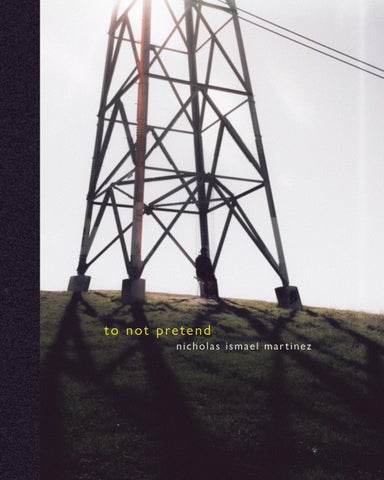
to not pretend nicholas ismael martinez
when all this extra time cedes to real life I realize I can't escape staring at the fields if nothing’s really real I'll make the winter now my home
vansire to not pretend
contents 3. MY 20 REFLEC TION, PER SONAL ESSAY 6. THINKING WITH TYPE 22. THINKING WITH COLOR 36. THINKING WITH MOVEMENT 40. THE REST IS METAMODERNITY 23. BIBILOGRAPHY
3
My 20 Reflection a personal essay about Vansire and what their song 'Reflection no. 6' means to me
The duo band “Vansire” from Minnesota has been able to become another staple in the genre of dream and bedroom pop. I was introduced to this band from listening to Spotify recommendations that stemmed from my current playlist of indie and bedroom pop music in early 2019. Their music immediately stood out to me having deep reverberated synths, groovy bass line, and low fidelity sound. I listened to much of their second album “Angel Youth” which had a mix of upbeat funk and calming melodies. Vansire consists of bandmembers Josh Augustin and Sam Winemiller, who had known each other since high school, meeting on a drum line and starting a mutual friendship. Sam had an idea to create music and asked Josh if they wanted to start a band “that sounds like mac (Mac DeMarco).” The first song they produced, “Bridges for the Young,” can be defined as “basement pop” being recorded on a broken iPad in a basement. The band saw success very shortly afterward when their song was played on the local radio that following summer in 2015. Producing their debut album “Reflections and Reveries” over one year from August 2015 to August 2016. Both band members started their first year in college, studying at two different institutions,
4
My 20 Reflection
Josh in Oberlin, Ohio, and Sam in Minneapolis, Minnesota. After working on and releasing their first EP “The Rolling, Driftless North” in January 2017, it would start the beginning of this duo’s long-distance friendship. In October 2020, they released their second EP “After Fillmore County” filled with much low-fidelity sound as their previous album, “Angel Youth” released in April 2018. The theme of love and hope is portrayed throughout “After Fillmore County” establishing how Josh and Sam feel about the long-distance while residing and attending college in two different US states. The song “The Latter Teens” imagines a long and fun-filled road trip along Highway 20 with a companion starting from Massachusetts through “the driftless zone” of southeastern Minnesota, eventually ending up at the pacific northwest shoreline. Additionally, other lyrics in the song “We'd be quintessential leads, who found love in the latter teens, I guess we'll wait and see” suggest that the band members found each other near the end of their teenage years, grew attached, and now must wait more time to be together until they graduate college. Josh reminisces on the song “Every Time Around” recounting when he met Sam and memories he has with him, but recently feels lonely without him and better with his presence. Despite the shortcomings from their studies, according to a studio tour video with Josh, he explains this will most likely be the last EP released before they graduate college in December 2020. Upon discovering this new EP in January 2021, the song that stood out to me was “Reflection No. 6”. While more heavily instrumental and slow-moving compared to the other songs on the EP, something about the opening and midway transition always made me feel a different way.
The song doesn’t feature a lot of vocals, however heavily reverberated, almost buried underneath the dreamy sounds of synths and guitar. It would sound like the narrator is saying that the time spent imagining a joyful scenario can’t last forever and eventually you will come back and face reality. While you may be uncomfortable in your current situation, you can learn to accept things for how they are and hope for the better. This might refer to the long-distance that’s between Josh and Sam, and how they will soon be together, but in the meantime, Josh is “staring at the fields” in rural Ohio. I’d chosen this song to describe how I felt near the end of my senior year of high school. The strings and piano at the beginning feel like the start of a dream, then when the guitar and kick drum come in sounds like the start of memories recalling within the short duration left of the song. During my senior year, there weren’t many opportunities to spend time with my friends due to the coronavirus. This paired with the fact that I had chosen to go to school far away meant there was little time left together. The experiences and moments I did get to enjoy are what I remember while listening to this song. I might not share the hardships of long-distance love that Josh and Sam express in their album, but I can say I miss my fiends and family after being gone for just a few weeks.
The term “Rolling, Driftless north” is used to identify the multi-state region of Minnesota, Wisconsin, Iowa, and Illinois
5
6
Thinking with Type
T h i n k i n g w i t h typ e SETS 1-6
How do I express the emotion, meaning, and musical elements of a song with typography?
In design sets 1- 4 I was limited to a single point size with the font Gill Sans Nova.
7
SET 1: COMPOSITION + S PAC E №1
№2
va n sire
r e f l
ref lection no. 66 .on noitcel fer
e c
ref lection no. 66 .on noitcel fer
t i o
ref lection no. 66 .on noitcel fer
n n o
ref lection no. 66 .on noitcel fer
. 6 ref lection no. 66 .on noitcel fer
a f t e r f
ref lection no. 66 .on noitcel fer
i l l m o
VA N S I RE
r e c
after fillmore county 2020
o u n t y o c t o b e r 16 2020
r eflection no. 6
2020 fillmore county ounty after lmore c fter fil nty a re f l e c t i o n n o . cou6 aft e r f i l l m o r e c o u n t y
Vansire
after fi llmor e county
october twenty twenty
№3
№4
8
Set 01: Composition + Space
№5
vansire reflection no. 6 10.2020
after fillmore county after fillmor e cou county nty y after fillmore afte re count o m l l fi r fi er llm ty aft or coun e
re
co un
after fi county e r o r fillm afte
after
fill
m
o
ty
after fillmore county after fillmore count llmore county y after fi
re county after fillmore llmo cou fi nty er a aft
fter
llmore coun ty
fillm ore cou nty after fillmor e county after
12
SET 2: COMPOSITION + S PAC E + L E T T E R S I Z E №7
ion no. 6 refl e c tion e f l ect ion no. 6 refl ect nn 6r re fl e c t i o o. 6 . o nn re fl e c ti o 6 . o . o n 6r n n fl e c t io n t io n o . 6 re o i n t fl e c ti o n c e e r fl n 6 re 6 ti o n n o . 6 re fl e c e c ti o n no. 6 fl o. re 6 . re f l e c tio n n o ec re fl e c t i o n n o . 6 6
after filmore county
reflection no. 6
o. 6 n ion t c e refl
ytnuoc eromlif retfa
6 .on noitcelfer
afte y r film unt o c ore orre cou m l i f r eflec . 6 nty afte tion . 6 refle ion no t v a n s i r e noo. c t e i o n fl 6 n e o i m m x x afte r t no. c y e t fl r n 6 ou filmre c ore e r o cou m l i f nty r e aft refl 6 . ect no ion n no. № 9ctio e l f 6 e r 6 .on noitcefler
after filmore county
reflection no. 6
refl ect ion no. 6
reflection no. 6
№8
reflection no. 6
refl ectReflection No. 6 xno. 6 ion ion no. t c e 6 refl y unt o c orre m l i f r eflec afte tion . 6 noo. n 6 o i t afte r filmreflec ore cou nty
ion no. 6 refl e c tion e f l ect ion no. 6 refl ect 6r e c t i o n n o. 6 o . re fl e c ti o n n fl re 6 . no. 6 r n no e fl e c t io n t io n no. 6 r o ti c on n i e t fl c e e 6 re fl 6r ti o n n o . 6 re fl e c n o n .6 . o ti o . 6 re fl e c re f l e c tio n n o 6 . c o n n e ec tio 6 re fl
x
l ec fle no. 6 f le c t io n o . 6 re f l e c 6 re e c ti o n n 6 re fl
m
e f l e c t i o n
on no. 6 n n o. 6 cti re fl e c ti o on no. 6 re f le c ti ti o n reflec 6 . 6 re fl e c ction no re f l e c fle no. 6 f le c t io n o . 6 re f l e c 6 re e c ti o n n 6 re fl
afterfillmore county Reflection No. 6 m
twenty twenty after fillmore county
e c t i on n o e fl e c t i on . n 6 o e fl 6r .6 re f lec 6r o . reflec t i o n re f tio lec o . reflec t i o nn .6 n o n n t . i n n o. 6 6 no. ot i o n o o. 6 re no re fl .6 6 re fl e c n noon tio fl e c n ec t e c o n n no . 6 r e f l e c re f tion rfel e c c t i . 6o n ion l e fl i e r 6 r i t e t f n e i n i n l e 6 t o o e . l o o c tio .6 . 6 c tion 6 r lec t 6 refl e c nno n o re f n l enco of l.e c tio n t . r f n c f . . t e i o i n n 6 6 f l ec n o. o e o . 6 re fl e c t re no fl e t i o n n . 6 re fr o n re f no. n6 n i r e . 6 6 re i o n n no.fl e6c re noo. 6 roe. 6 l eecct ii o n t i on l ec roe.f l e c t f l e c o n no f l en tion . . n f l ee fcl o re ct c n on n o . 6 i o n n r t i o nfl e eoc. ti n o e fl e e c t i tion no . c t i o c t i oonn n o. re f l e fl e 6 reecftl ei on.o6. 6 6 re rne fl o n 6 r re fl fl e c c t i o 6 r efl re . nn cn . re e fl o. re i o n t i o nnno ofl. 6 no o. 6 6 r n o.n t n o. n n tio ion t tio ion t
№6
6 refl e c t ion o. 6 refl e c t ion o. no n n re f l e n o .6 i n 6 n t c o . t e r c f o i . l re f on ec t o e 6 ti . 6 l f n c lec i n re fre n on o e no l . tio f r lec io 6 e fl e 6 re no. e n . 6 r nn o tio n . c tio 6 re f l e 6 f l . o e 6 o c r i c n o o . nn c t i o n n e f l e cfl e t t n i n n o o o c i t n nn o . lec o o n n e e t i n . o n l i o r i t o 6 n o i f o. n nc n e f 6 . o lec t n n o c t o . 66 r e i 6 o e e r i t fl e c or. re fl . r fl c re f f.l e ct tion ec t .6 re 6 re n o e frl ee c t io . 6 6 flreecftleion n o fl e fl e ion no .6 re n o 6 re o . 6 flec oti.o6n n o i o n f l e c t i. o6 n o n n re n n no. r 6 . n n o e e o o n o t n 6 . c ti n n n c 6 re n fl e c . . r . 6 re n o o 6 o i o . i o n . 6o l e t t 6 c tio o .fl e6 n r f t n i l e n o e c o c f . n c i n lec t re rcetfiloe e fl et i o n n rree f fl e i o n e c t n o e fl e i o n n o. 6 crt re t i ono le n fl no r 6 e f . 6 i o lne cnt o o . 6 . l e c 6 re c t i o . 6 f n f e . o re i o n . fl e n o o e r ion t t
10
Set 02: Composition + Space + Lettersize
ct re fle ct io n no . 6 re fle ion 6 . no on ti ec l f e 6r f l e c t i o n n o. e r 6 . o nn re fl e c t i o 6 . o. o n n ec tion n 6 r l f e r 6 . t io no fl e c t i o n e r e f l e c t i on n r 6 . 6 o n tion 6 re fl e c no . o e fl e c t i o n . 6 r 6 . o n re f l e c tio n ec r e f l e c t i o n n o . 6 6 ti . 6 r e f l e c on o n n t io
no
on no. 6 n n o. 6 cti re fl e c t i o ion no. 6 re f l e c t t i o n re f l e c 6 . 6 re fl e c ction no re f l e c fle no. 6 fl e c t i o n o . 6 re f l e c 6 re lec tion n 6 re f c t i o nreflec . 6 re fl e
6 refl e c t . ion no no n o 6 re f l e c .6 i t tion c o. re f e l f n lec n e o r . n tio r 6 e 6 f . o 6 lec t re fl i nn o . t n ec t o lec i o n n n ion o. 6 no. f t i on n n c o e i e o no. № 10 l r o. 6 6 re ti c t re f c 6 6 e f e r l l r e fl e e fl e f o. e fl e c tio c tion r e o . 6 flec t i on n o r n 6 n 6 . n n e o 6 n . . r no. . tio no on 6 c t ion n o . 6 r e f l e c no 6 c . i r e t e re fl t n fl e c t i o n no i o f l e c n n o r e f l e on no . re t ion 6 re 6 l e c re c t i o . 6 e c t i no . f l e ef . 6 . c tio fl e n o re fl o n e n r io .6 t no van s ir e re fl e ct i o n n o . 6 af t e r fi l l m o r e c o u n t y oct 2 020
tio f lec n n o . re 6 re f . 6 fl e l e n o 6 re c t i o n c tio no n on no. . 6 n c ti o. . 6 re f re f l l f l e i o n n no e e c c tio t i o n 6 re f re t n .6 l e c c t i o . 6 re f l e c t i n n o . 6 o. 6 lec tio ef o o no n le r n r r n f e e n f f l l ec n o. 6 o e on re i o n o. 6 r .6 c tio 6 o. c ti e r nn t n e f l n . f e c n l e io fl e c o. o c e t t n l n i n t o n o i re f o c on i n . io 6r no. re n fl e c t ct on e e e i l 6 f l r e r ef .6 fl e ct ef ct ec t i o n re e fl e n n o o . 6 6 r r e fl o . 6 i o n no l . n r n 6 r e f l ec . tio ion n no o. n t tio ion t
11
SET 3: CHARACTER WEIGHT № 12
reflection no. 66 . o n n o i t c e fl e r reflection no. 66 . o n n o i t c e fl e r reflection no. 66 . o n n o i t c e fl e r reflection no. 66 . o n n o i t c e fl e r reflection no. 66 . o n n o i t c e fl e r reflection no. 66 . o n n o i t c e fl e r vansire after fillmore county mmxx
VANSIRE REFLECTION NO. 6 REFLECTION NO. 6 REFLECTION NO. 6 REFLECTION NO. 6 REFLECTION NO. 6 REFLECTION NO. 6 AFTER FILLMORE COUNTY 2020
ref lect ion no. 6
re re reflfleect fl re e ctio flect ion ctiion n no on n no. noo. 6 . 66 re . 6 re refle refle fleccti flect tion ctiion on n on n no. noo. 6 o. 66 r . 6 re refl refle efleect flect c io ctiion tion re o n n n no fl re ect noo. 6 no.. 6 fle i o . 6 re 6 re cti n on no refle reflflec flect e ti . no ctiion ction . 6 6 re on n on n re flec noo. 6 noo. fle . 6 re . 66 r cti tion on refle reefle n flect flec no o. 6 ctiion ctio .6 on n tion r e re fl noo. 6 n nno. fle ec . 6 re o. 6 cti tio on n refle 6 flect no no. ctiion .6 6 on r re efl fle e cti cti on on no no .6 .6 re re fle fle cti c on tio no n n . 6 o. re 6 fle cti on
. 6. 6 .6 nono no n n 6 6 oo . . on 6 VA N S I R E ctci ti nono ti no. c M M X X flefle onon e n rere ctci ti efl tio r 6 6 e e c . . fl fl . 6 efle nono rere o r 66 n 6 onon . . n tci ti nono io no. c t n n e e c o o fl fl i i fle ion rere ctct re ect 6. 6 flefle . ee . 6 efl nono 6 6r r no 6 r n n . . oo oo n o. ti ti n n io eflcec ioinon ct n n fl e tt fl tio rere c c re ec 6. 6 efleefle . fl 6 rr nono . 6. 6 o. 6 re n n n . ioio nono on o cetct onon ti n n e i i c o fl fl t t AFTER fle ti rere fleflcec FILLMORE COUNTY re flec e e rr e r
ref lect ion no. 6
№ 13
ef lect ion o. 6
№ 11
№ 14
6
. re 6 re fle fle cti c on tio no n n . 6 o. re 6 fle cti on
6 . no on . 6 i t no n io
12
Set 03: Character Weight
reflection no. 6 no. 6 no. 6 no. 6 no. 6 no. 6 no. 6 no. 6 no. 6 no. 6 no. 6 no. 6 no. 6 no. 6 no. 6 no. 6 no. 6 vansire after fillmore county mmxx
№ 15
13
14
Thinking with type
The name ‘Vansire’ was chosen from a random name generator, it's meaning for another term for the marsh mongoose species. Vansire the band uses this illustration of a mongoose in their logo for music.
15
SET 4: MIXED FONT WEIGHTS + I TA L I C S № 16 V a n s i r e i n r e f l e c t i o n
n o . 6
a f t e r fi l l m o r e c o u n t y 2 0 2 0
№ 17
vansire reflection no. 6 after reflection no. 6 reflection no. 6 fillmore reflection no. 6 reflection no. 6 county twenty twenty
16
Set 04: Mixed Font Weights + Italics
№ 18
vansire twentytwenty a f t e r fi l l m o r e c o u n t y
ref lection no. 6
VA N S I R E
AFTER FILL MORE CO U N T Y
reflection no. 6
TWENTY TWENTY
ref lection no. 6
REFLECTION NO. 6 AFTER FILLMORE COUNTY TWENTY TWENTY REFLECTION NO. 6 AFTER FILLMORE COUNTY TWENTY TWENTY REFLECTION NO. 6 AFTER FILLMORE COUNTY TWENTY TWENTY REFLECTION NO. 6 AFTER FILLMORE COUNTY TWENTY TWENTY REFLECTION NO. 6 AFTER FILLMORE COUNTY TWENTY TWENTY REFLECTION NO. 6 AFTER FILLMORE COUNTY TWENTY TWENTY REFLECTION NO. 6 AFTER FILLMORE COUNTY TWENTY TWENTY REFLECTION NO. 6 AFTER FILLMORE COUNTY TWENTY TWENTY REFLECTION NO. 6 AFTER FILLMORE COUNTY TWENTY TWENTY REFLECTION NO. 6 AFTER FILLMORE COUNTY TWENTY TWENTY REFLECTION NO. 6 AFTER FILLMORE COUNTY TWENTY TWENTY REFLECTION NO. 6 AFTER FILLMORE COUNTY TWENTY TWENTY REFLECTION NO. 6 AFTER FILLMORE COUNTY TWENTY TWENTY REFLECTION NO. 6 AFTER FILLMORE COUNTY TWENTY TWENTY REFLECTION NO. 6 AFTER FILLMORE COUNTY TWENTY TWENTY REFLECTION NO. 6 AFTER FILLMORE COUNTY TWENTY TWENTY REFLECTION NO. 6 AFTER FILLMORE COUNTY TWENTY TWENTY REFLECTION NO. 6 AFTER FILLMORE COUNTY TWENTY TWENTY REFLECTION NO. 6 AFTER FILLMORE COUNTY TWENTY TWENTY REFLECTION NO. 6 AFTER FILLMORE COUNTY TWENTY TWENTY REFLECTION NO. 6 AFTER FILLMORE COUNTY TWENTY TWENTY REFLECTION NO. 6 AFTER FILLMORE COUNTY TWENTY TWENTY REFLECTION NO. 6 AFTER FILLMORE COUNTY TWENTY TWENTY REFLECTION NO. 6 AFTER FILLMORE COUNTY TWENTY TWENTY REFLECTION NO. 6 AFTER FILLMORE COUNTY TWENTY TWENTY REFLECTION NO. 6 AFTER FILLMORE COUNTY TWENTY TWENTY REFLECTION NO. 6 AFTER FILLMORE COUNTY TWENTY TWENTY REFLECTION NO. 6 AFTER FILLMORE COUNTY TWENTY TWENTY REFLECTION NO. 6 AFTER FILLMORE COUNTY TWENTY TWENTY REFLECTION NO. 6 AFTER FILLMORE COUNTY TWENTY TWENTY REFLECTION NO. 6 AFTER FILLMORE COUNTY TWENTY TWENTY REFLECTION NO. 6 AFTER FILLMORE COUNTY TWENTY TWENTY REFLECTION NO. 6 AFTER FILLMORE COUNTY TWENTY TWENTY REFLECTION NO. 6 AFTER FILLMORE COUNTY TWENTY TWENTY REFLECTION NO. 6 AFTER FILLMORE COUNTY TWENTY TWENTY REFLECTION NO. 6 AFTER FILLMORE COUNTY TWENTY TWENTY REFLECTION NO. 6 AFTER FILLMORE COUNTY TWENTY TWENTY REFLECTION NO. 6 AFTER FILLMORE COUNTY vansire TWENTY TWENTY
№ 20
№ 19
19
SET 5: MIXED TYPE SIZE C O M B I N AT I O N S № 21
V V reflection no. 6 after fillmore county twenty twenty
ansire
№ 22
ansire
R E F L E C T I O N N O. 6
after fillmore county t went y t went y
№6
Set 05: Mixed Type Size Combinations
№ 23
vansir e
reflection no. 6
ire
af ter fi llmor e c ounty oc t 2020
ansir
nt y t went y
V
№6
№ 24
ansire vansire oct 2020
№6
№6
№6
V
reflection №6 after fillmore county
18
№ 25
№6
19
SET 6: RULES + BLOCKS
№ 26
after fillmore county
reflection no. 6
vansire
mmxx vansire № 27
reflection no. 6 after fillmore county
mmxx
twenty
twenty
20
Set 06: Rules + Blocks
№ 28
V
a
n
s
i
r
e6
.o
n
no
itc
el
fe
r
after fillmore county 2020
mmxx vansire
after fillmore county
№6 reflection
xx
mmxx
№ 30
vansire featured in
after fillmore county
out this
october 2020
№ 29
21
22
Thinking with Color
T h i n k i n g w i t h c o lo r SETS 7 & 8
Through the trials of working with only type to create patterns, composition, and image, now the addition of color and illustration would open up new ways to express with type.
23
SET 7: TYPE + COLOR + G LY P H P AT T E R N S
24
Set 07: Type + Color + Glyph Patterns
№ 31
reflection no. 6 vansire
,,,,,, , , , , ,, , , ,,,,, , , , , , , , , , ,
Using circles to form a chaotic bottom left corner to describe the second half of song
after fillmore county 2021
25
№ 32 A radial motion gravitating outwards from the center onto the bleed, distrupted by another pattern of quotation marks
,,, ,, , , , , ,, , , , , , , , , ,, , , , , ,, , , , , , , ,, , , , , ,,,,,, , , , , , , ,, , , , ,
Vansire
,,,,,,,, , ,,, , , ,, ,,,,,,, , ,, , , , , , ,,, , , ,, , , ,, , , , ,, , , ,, , , , , , , , , ,
,,,,,, , , , , ,, , , ,,,,, , , , , , , , , , , , , , , , ,, , , , ,, , , , , , ,, , , , ,, , , , , , ,, , Reflection No. 6 after fillmore county oct 2021
,
, , , , ,
,,,, , , ,, , , ,
,,
, , ,,, ,, , , , ,, , , ,, , , ,,,, , , ,,,, ,,
,,
,,,,,,,
, , ,
26
Set 07: Type + Color + Glyph Patterns
№ 33
,,
,
,
,,
, , ,,
r e f l e c t i o n
,,,,,,,, , ,,, , ,, , , , , , , , , ,, , ,, , , , ,,
,,, ,, ,,, ,, ,, ,
Chaotic glpyh patterns, encasing the year, like it's in a reverberated room
, , ,
n o . 6
after fillmore county - vansire
▒░▓░▒▒░▓░▒▒░▓░▒▒ ▒░▓░▒▒░▓░▒▒░▓░▒▒ ▒░▓░▒▒░▓░▒▒░▓░▒▒░ ▒░▓░▒▒░▓░▒▒░▓░▒ ░▓░▒▒░▓░▒▒░▓░▒▒░ ░▓░▒░▓░▒▒░▓░▒▒░▓░ ▒▒░▓░▒▒░▓░▒▒░▓░ ░▓░▒░▓░▒▒░▓░▒▒░▓░ ▓░▒▒░▓░▒▒░▓░▒░▓ ▒▒░░▒▒░▓░▒▒░▓░▒▒ ▒▒░░▒▒░▓░▒▒░▓░▒▒ ▒░▓░▒▒░▓░▒▒░▓░▒▒░ ▒░▓░▒▒░▓░▒▒░░▒▒ ░░▓░▒▒░▓░▒▒░▓░▒▒░ ▒▒░▓░▒▒░▓░▒▒░▓░ ▓░▒▒░▓░▒▒░▓░▒▒░▓ ▓░▒▒░▓░▒▒░▓░▒▒░▓ ▓░▒▒░▓░▒▒░▓░▒▒░▓░ ░▒▒░▓░▒▒░▓░▒▒░▓ ░░▒▒░▓░▒▒░▓░▒▒░▓░ ▓░▒▒░▓░▒▒░▓░▒▒░ ▒▒░▓░▒▒░▓░▒▒░▓░▒ ▒▒░▓░▒▒░▓░▒▒░▓░▒ ▒▒░▓░▒▒░▓░▒▒░▓░▒▒ ░▓░▒▒░▓░▒▒░▓░▒▒ ▒▒░▓░▒▒░▓░▒▒░▓░▒▒ ▒░▓░▒▒░▓░▒▒░▓░▒ ░▓░▒▒░▓░▒▒░▓░▒▒░ ░▓░▒▒░▓░▒▒░▓░▒▒░ ░▓░▒▒░▓░▒▒░▓░▒▒░▓ ▒▒░▓░▒▒░▓░▒▒░▓░ ▓▓░▒▒░▓░▒▒░▓░▒▒░▓ ░▒▒░▓░▒▒░▓░▒▒░▓ ░▒▒░▓░▒▒░▓░▒▒░▓░ ░▒▒░▓░▒▒░▓░▒▒░▓░ ░▓░▒▒░▓░▒▒░▓░▒▒░
mmxx
,,, ,, , , , , ,,,,, , , , ,, , , , ,
,,,,,,,,, , , ,, , , , , , ,,, , , ,
27
≈≈ ≈≈≈ № 34
, , ,,
,,,,,,,
,,
,,,,
,,,,
,,
, , ,
,,
,,
staggered motion following the number ligature glpyh, on the nature of the low fidelty recording
vansire twentytwenty afterfillmorecounty
, , ,
28
Set 07: Type + Color + Glyph Patterns
№ 35 the implementation of multiple arrow glyphs to invoke the feeling of ascension I feel during the song
↑
↑ vansire / reflection no.6
↑
↑
after fillmore county
oct. 2021
29
SET 8: TYPE + COLOR + IMAGE
30
Set 08: Type + Color + Image
№ 36 abstract forms overlapping shapes to create a more distorted surreal space
vansire
REFLECTION № 6 REFLECTION № 6 SINGLE from
AFTER FILLMORE COUNTY
REFLECTION № 6
RELEASING
OCT 2021
31
№ 37 inspired by the swiss international grid, which is organized, adding a six made of circles dis-proportionally to for a simulated lucid effect
vansire reflection no. 6 after fillmore county twenty twenty
32
Set 08: Type + Color + Glyph Patterns
№ 38 building being reflected by giant windows of another building in a city
6 No. n tio lec Renfs i r e va
after fillmore county — EP
october 2021
33
№ 39 Dream pop and funk inspired, I took some inspiritation from another group "Vulfpeck" on their visual identity.
r e f l e c t i o n n o . 6 after fillmore county
vansire
10.21
34
Set 08: Type + Color + Glyph Patterns
№ 40 ambiguous distorted background as a play on the word 'reflection' in a frame subtle resembling an instant film frame
after fillmore2021 county october
V A N S I R E
35
36
Thinking with Movement
T h i n k i n g w i t h m ove m e n t V I D E O A N I M AT I O N
How can movement and scale represent sound? Considerations of time and movement allows exploration of different design elements.
37
SET 9: TYPE + TIME + MOVEMENT In this frame I synced up the bests per minute of the song with the outline/fill of the word time
Animated the lyrics 'i can't escape' followed by a sudden cut to negative frame then to black
Set 09: Type + Time + Movement
38
39 12
40
The Rest is Metamodernity
The Rest is Metamodernity; Bedroom Pop and the Post- postmodern Affec t July 2015 — Perched at a drum set, I contorted my body forward while Sam held an iPad as far as my headphone’s cord extended. I needed GarageBand’s metronome in my ear, but the short cord length had forced us into a stationary gymnastics routine. In search of an optimal recording angle, a push-pull of the cable between my head and Sam’s hands ensued. We twisted around, following the iPad's internal microphone while I attempted a steady tempo. Earlier that day we had decided to make our own song on a whim, but the process was slow with each take ruined by our laughter over the janky recording method. With summer in Minnesota as a backdrop, our listless high school ennui was in full swing. Hillary Clinton and Bernie Sanders were trading jabs in the early stages of the Democratic primary, the US Supreme Court had ruled same-sex marriage a constitutional right, and Donald Trump had just announced what critics were derriding as a long-shot presidential canidacy. With only drumline practice and Sam’s Jimmy Johns delivery job on the schedule, we had a great deal of time to kill. I mumbled some lyrics about the seasonal languor, and turned up the reverb until the song became a wash of major seventh chords. We had no audience or promotional outlet, but the creative process was cathartic. This was music for our aimless drives past the cornfields which skirted our hometown. We shared the track online and continued collaborating as the decade elapsed. July 2019 — Around 11 PM, we walked on stage in Los Angeles, eight dates into a national headlining tour for that same project. I had just returned from The Roxy’s green room to grab my in-ear monitors, taking note of a framed photo of Bob Marley standing in that same space. He was grinning, unphased to be playing one of the
Sunset Strip’s historic venues. After all, I realized, it was only historic thanks to legends like him. The gravity of that stage was hard to ignore. Vansire, the random-word-generator name for our small-time project, didn’t seem to belong on a list boasting the names of Bob Marley, Frank Zappa, and Bruce Springsteen. Sam’s brother Isaac passed me a setlist from stage left where he helmed bass. The curtain rose to reveal a big crowd, and I counted off our opening tune. The show was plagued with poor on-stage sound. Sam couldn’t hear his synthesizers the entire performance, culminating in an arm-swooping TURN IT UP gesture that went unnoticed by the person running monitors. Tensions with the staff were already high after our openers had been stuck with a line check due to a communication error (a hastier, undesirable alternative to a full soundcheck), followed by a mishap where one of their guitarist’s amps had been left in an alleyway unattended after a stage change. The show finished, and employees began hollering at the crowd to clear out. Fan hellos were cut short and we started the load out, eager to head towards our final destination that night, a warehouse in downtown Los Angeles where our friend Warner lived. We were going to sleep in a massive pillow fort. It was suspended from the ceiling, and according to Warner it had a human capacity of “twenty chilling, ten sleeping.” Mid-gear schlep, Sam heard a burly stagehand mutter to another, “I don’t know what the fuck kids are thinking these days,” seemingly baffled that a venue’s-worth of attendees would come see our performance. When Sam came into earshot, the guy clammed up. All parties were silent until our gear was back in the trunks of the minivans we were using to travel. In a completely different, less personally insulting way, I shared the same question as the stage-
May 20th, 2020 By Josh Augustin; Vansire
41
hand. What the fuck were these kids thinking? When the crowd sang back my lyrics, I couldn’t help but wonder how music that was so insular could amass a following in an entirely different locale. The inexplicable surreality of the situation--hundreds of Californian strangers chanting back descriptions of southeastern Minnesota’s topography--was astounding. It could, however, be partially explained by tracing musical trends in the preceding decade. In the intervening years from the time Sam and I first cobbled together a song, we had unwittingly been swept up in the rise of bedroom pop. Not quite a “genre” but notable enough to warrant a name, the style hit its peak around 2018. Young creators in the late 2010s began saturating the internet with ethereal low-fidelity music in such increasingly prevalent numbers that it came to be grouped under one umbrella. This nomenclature was previously reserved for a brand of guitar-centric lo-fi twee pop whose development could be traced to the no-fi stylings of Olympia’s Beat Happening, the minimalism of Young Marble Giants, the outsider qualities of Daniel Johnston’s work, and the jangly sensitiblites of artists featured on NME’s seminal C86 compilation. While the creative ethos of these artists endured, the late 2010s found bedroom pop undergoing a sonic shift from guitar-centered constructions to funkier synth-laden underpinnings. The term’s etymological shift from jangly to woozy was a culmination of musical trends that had been transpiring the entire decade, marked by the “summer of chillwave” on its front end.
July 2009: Tracing bedroom pop's origins In 2009, University of South Carolina graduates Ernest Greene and Chaz Bear were at their respective homes, experimenting with spacey, loop-based compositions. Greene, who had recently completed a Master of Library and Information Science degree, had been unsuccessful in his search for work as a librarian. After moving in with his parents, he built an online following with a steady stream of fuzzy musical offerings. A chopped-and-screwed sample of Italo Disco star Gary Low became the track Feel it All Around, a standout on his second EP which he released that fall as Washed Out. Chaz Bear
was layering crackling drum samples atop sidechained synthesizers that would ultimately land him a deal with Carpark Records and spark an influential run of albums across the decade as Toro y Moi. In that moment, both had captured generational malaise in a bottle, becoming the soundtrack for millennials grappling with the nation’s worst economic crisis in recent memory. 2009 found these creators inadvertently laying the groundwork for the subsequent decade’s obsession with reverb and vintage synthesizers, adding to an ever-expanding patchwork of Dillaindebted, Boards of Canada inspired musical influences that would constitute a starting point for the internet’s propensity towards a somewhat nihilistic brand of nostalgia expressed in analog warmth and 35mm aesthetics. In response to their work, The Wire critic David Keenan coined the term “hypnagogic pop,” one of the first formal nods to the deliberacy of the tape-warbled aesthetic choices made by these artists. The blogger Carles of the satirical blog “Hipster Runoff” invented the term “chillwave” as a descriptor for the music, an increasingly popular microgenre boasting innovations from figures like Neon Indian and Nite Jewel, with additional stylings from a steady slew of similarly titled projects like Teen Daze, Summer Heart, Memory Tapes, and Work Drugs. Beachier analogs Beach Fossils, DIIV, Real Estate, and Best Coast dropped projects that maintained a reverb-laden atmosphere, all of which consistently won critical acclaim from Pitchfork. The nascent rise of the indie-industrial-complex had not yet collapsed under its own weight in the first half of the decade. This meant that blogs and labels had a wealth of resources to put behind small bands, and by extension, corporations like Urban Outfitters were happy to cash in on the associated coolness of the blog-born microgenre brand with advertising and promotion. Acts like Youth Lagoon or Unknown Mortal Orchestra could be plucked out of obscurity after posting a single track, covered by major outlets, signed by a small to mid-sized independent label (Fat Possum, in their case) and launched into the festival circuit. The same aesthetic shift and increase in blog-driven scale was unfolding in hip-hop, as A$AP Rocky dropped his first single Purple Swag, SpaceGhostPurrp released the murky Mysterious Phonk, and Clams Casino
42
The Rest is Metamodernity
stormed the internet with a series of dreamy beat tapes (all of which bolstered the recognition of cloud rap, indebted to the pioneering work of Houston’s DJ Screw, and to the outsider rap of Lil B’s Clams Casino-produced I’m God and Viper’s You’ll Cowards Don’t Even Smoke Crack). Most bedroom pop practitioners were in middle school during the Great Recession: now we’re graduating college amidst our own recession. It was the middle years between these economic calamities where we witnessed a new vanguard gradually usher in an aesthetically-minded approach to hipness (Sam once aptly described it as “cool music for awkward people”). Those of us currently in our early twenties spent formative years hearing Mac DeMarco’s Juno-60 on Chamber of Reflection soundtracking parties, watching Tyler, the Creator shift from shockingly homophobic horrorcore to nuanced reflections on his own queerness, housed in increasingly sleek pop-leaning structures. His fourth album, Flower Boy, dropped July of 2017. Only two weeks later, Claire Cottrill uploaded the self-produced music video for her song Pretty Girl, positioning herself for a viral rise to fullblown celebrity status. Putting music on digital streaming platforms like DistroKid and CDBaby, a new crop of young creators took the stage outside of mainstream apparatuses, a creative
extension of previous trends but free of the structural trappings that characterized the preceding blog-first years. This type of music is decidedly pleasant to the ears, which largely accounts for its mainstream appeal. Coffee shops, fast food chains, and clothing retailers piped bedroom pop through their in-house speakers in a recent time when brickand-mortars could still be physically frequented. Breezy in its sonic quality and light in its lyrical content, it’s background music for what noted Marxist Guy Debord dubbed the “diffuse spectacle,” a hypnotic reverie of mass media which he describes as emblematic of an affluent economy, paradoxically personal and commodifiable. I find this phenomenon fascinating because beyond vaporwave, it’s the first truly post-geographic artistic movement to take place, one whose practitioners were born recently enough to mostly preclude pre-9/11 and pre-internet memories. Situated in a late-capitalist regime, bedroom pop signals a philosophical shift to a post-postmodern or “metamodern” emotional affect, a concept loosely alluded to in the last Vansire single that I’d like to expand upon. It’s a blueprint for contextualizing critical theory in today's world. On its face, this may seem like an esoteric exercise, but I think it provides helpful insight in terms of how we got here. Photo: Melisandre Martin
43
Post-Structuralism in a post-blog world In February of 1969, French philosopher Michel Foucault delivered a speech at the Collège de France which shook the academic world, positing the existence of an “author-function.” He took umbrage with the notion that the author precedes a text's existence as an all-encompassing source of meaning and significance. Authorship, he argued, is a culturally contingent fallacy, one that only developed in a societal context when names had to be attached to transgressive texts that warranted punishment in the eyes of a government. In his view, calling the author the originator of a work was a simplistic understanding of creativity, one that aligned with the historical fascination surrounding “genius,” glorifying the artist as a singular font of wisdom. Foucault’s author function shifts emphasis from the individual author’s ideas to a general discursive reality, suggesting that it’s more useful to contextualize texts as a product of institutional conditions, related studies, and popular mythos. In other words, Foucault would say that you are not the author of your own work. He didn’t consider the author-function to be limited to texts, writing “Certainly, the author-function in painting, music, and other arts should [be] discussed...” Foucault theorized an eventual moment in which structural changes would lead “the author function [to] disappear... in such a manner that fiction and its polysemic texts will once again function according to another mode,” where texts would be exchanged freely without concern of authorship. It’s my belief that the consumption and dissemination of bedroom pop in 2020 signals the arrival of this moment. Buried beneath the academic jargon, the arguments made by pioneering structuralists like Foucault are as pertinent today as they were four decades ago. The first time I read the essay, the concept of an authorless society struck me as an implausible and somewhat aspirational afterthought. Under a late-capitalist regime, how could fiction “not be limited by the form of the author”? The commodification-by-dispersion of any cultural text is arguably intrinsic to its existence insofar as any consumer’s means of access are characterized by their position in an economic con-
text. Consumers are situated in relation to the author, a “regulator of the fictive,” a role which Foucault calls “quite characteristic to our era of industrial and bourgeois society, of individualism and private property.” However, a closer look at the vehicles for discovery and distribution of bedroom pop songs does in fact reveal a de-centering of the author. During the movement’s 2017-2018 heyday, the most notable platforms for discovery were YouTube channels with large followings. Anonymous curators would post songs to their channels bound by an aesthetic of low-fidelity production and a sonic quality wrought with nostalgia. Comments on the videos engaged in a consumer-centered fictive, where viewers would describe scenes the music conjured in their mind, writing anecdotes
about their own lives. Some of these YouTube channels were known for re-editing visual materials into new music videos. Found footage, grainy VHS recordings, and various movies were (and continue to be) indiscriminately spliced with varying precision on top of music. In a video for the Vansire song Nice to See You (feat. Floor Cry), a YouTuber with the username “I’m cyborg but that’s ok” re-edited director Edward Yang’s 1985 masterpiece Taipei Story on top of the tune. On the channel “David Dean Burkhart,” one can watch the young protagonist of Phillipe Falardeau’s C'est pas moi, je le jure bike around and spread havoc to the tune of Current Joys’ Kids (the video sitting at 3 million views), or witness Bill Murray and Scarlett Johannsen share
44
The Rest is Metamodernity
intimate moments in Lost in Translation to the gentle swells of Cigarettes after Sex’s Nothing’s Gonna Hurt You Baby (sitting at 12 million views). On the found footage side, 3 million have viewed Burkhart splicing together 80s VHS prom footage to Foxes in Fiction’s Ontario Gothic. 5 million have viewed Craft Spells’ Nausea play on top of a video with a group of kids running around, miming fighting, and driving through their small town. In the top comment, a user writes “I don’t understand why I feel so much nostalgia I wasn’t even alive during that time period.” The editorial playlists of major streaming platforms like Spotify and Apple Music also dominated musical discovery in the scene. Both companies employ curators who add songs to various mixes organized by activity and mood like “Morning Coffee,” “Study Break,” “Sad and Lonely,” and “Chill Vibes.” Like the YouTube channels, this curatorial practice weaves a new cultural text—one characterized by aesthetic and aural consistency—from the musical work of many. The “Chill Vibes” playlist is a blank canvas for a listener’s lived experience and potential to experience situations which evoke chill vibes. A new narrative is realized through a curated sequencing of disparate music. This adds an authorless quality to the music’s consumption, and moves away from traditional modes like the album in which the primacy of the artist is established in the construction and sequencing of the work itself. The impact of these playlists is so significant that it’s changed the compositional practice of bedroom pop artists. Having to filter through thousands of submissions, curators are far likelier to promote songs that are immediately captivating. As such, more artists are releasing singles in lieu of albums. A stream of instantly catchy singles proves more successful in catching the attention of curators who oversee placement on official playlists. This is certainly the case for Sam and I. Our last two Vansire singles, That I Miss You and Metamodernity, are more or less confirmations of this hypothesis. After feeling dismayed with the way most tracks on our last full-length album fell by the wayside, both singles were a test in creating the most compressed and catchy form of a song. This becomes a self-perpetuat-
ing phenomenon. More artists create work that will achieve placement, leading to a content mill with an unending slew of similar songs (e.g. ones which directly match criteria for the Chill Vibes playlist or high potential for a TikTok format). This ensures a constant selection of new music to replenish the playlists. As a collage of music by far-flung practitioners, bedroom pop’s nascent rise can also be read as the inevitable creative legacy of a generation raised with internet access to infinite audio materials and culturally disparate locales. It is the distillation of what literary theorist Roland Barthes once described as “a tissue of citations” resulting from “thousands of sources of culture.” Bedroom pop’s origin itself is tenuous and indicative of the neoliberal propensity towards commodification under which it grew. The term didn’t take on its current definition until an editorial Spotify playlist of the same name emerged in January 2018. From the outset, this music has been inexplicably linked to its economic context and marketable potential to late-Millenial and Gen Z listeners. Furthermore, legitimate accusations of nepotism and industry insider-status have frequently been leveled at the genre’s pre-eminent figures. Polemics unfold across the internet, with individuals pointing out artists’ familial ties to music industry figures and attempts to conceal wealthy upbringings in what should theoretically be the most egalitarian kind of music making out there (music made in one’s bedroom). This is a tension at the heart of bedroom pop. Its folkloric construction hinges on an idealized vision of an individual making music in small spaces with inexpensive equipment, when in reality, just a few years of growing popularity have led to massive label deals with some of its main originators. While some of us still work in our bedrooms, an artist like Rex Orange County works with a team of engineers and songwriters bankrolled by Sony. Yet, we’re still placed sideto-side on the same playlists. This dissonance, fallout from a society “dominated by modern conditions of production” embodies what Guy Debord might describe as “the specialization of images of the world [evolv-
45
ing] into a world of autonomized images where even the deceivers are deceived.” Here, I think we arrive at the central dichotomy of a metamodern existence: a subconscious reconciliation of postmodern cynicism towards late capitalism, balanced with an embrace of romanticism.
Affect and Romanticism Romanticism hit its stride in the late 19th century, manifesting across all artistic mediums in reaction to what artists viewed as the most negative aspects of modernity and the Industrial Revolution. Their work celebrated nature, the past, and individual subjectivity in a world increasingly characterized by rationalization. Detractors of their work believed romantics were partaking in unproductive escapism, but their work can ultimately be read as an alternative. Rather than blind nostalgia, their movement was a space for art and self-expression, a struggle to construct a relationship between artist, subject, and society in which modes of living and cultural traditions were at risk of subsumption. A quick survey of popular bedroom pop songs makes me think that the Romanticist ethos still echoes. Mellow Fellow and Clairo’s How Was Your Day, Rex Orange County’s Loving is Easy, Girl in Red’s I Wanna Be Your Girlfriend, and Boy Pablo’s Feeling Lonely don’t possess lyrical revelations beyond the surface level sincerity alluded to in their titles. They all foreground the narrator’s personal experience, indulging in the emotion brought about by the song’s subjects. In an era of rapid modernization which—like those 19th century Romantics—threatens the existence of various modes of life and human cultures (climate change, far-right authoritarianism, pandemics, etc.), cultural texts which unabashedly indulge in romantic themes come to stand as a sort of political gesture by virtue of their mere existence. This gesture has clearly resonated with large swaths of young people who listen to this music around the world. Its romantic dialectic is what I consider to be the starting point of what can be identified as a post-postmodern affect, or a “metamodern” affect, in its ability to mediate romantic narratives of modernism within the poststructural and postmodern realities which led to bedroom pop’s actual development.
In Postmodernism, or, The Cultural Logic of Late Capitalism, literary critic Frederic Jameson traces what he describes as a “waning of affect” in an exploration of art and architecture. Of particular salience, I think, is his comparison of two visual works depicting shoes (Van Gogh’s A Pair of Shoes and Warhol’s Diamond Dust Shoes) and the different way viewers interact with these works. He writes: If this copiously reproduced image, [A Pair of Shoes], is not to sink to the level of sheer decoration, it requires us to reconstruct some initial situation out of which the finished work emerges. Unless that situation--which has vanished into the past--is somehow mentally restored, the painting will remain an inert object, a reified end product impossible to grasp as a symbolic act in its own right, as praxis and as production. This last term suggests that one way of reconstructing the initial situation to which the work is somehow a response is by stressing the raw materials, the initial content, which it confronts and reworks, transforms, and appropriates. In Van Gogh that content, those initial raw materials, are to be grasped simply as the whole object world of agricultural misery, of stark rural poverty, and the whole rudimentary human world of backbreaking peasant toil, a world reduced to its most brutal, menaced, and marginalized state... Now we need to look at some shoes of a different kind... Andy Warhol’s Diamond Dust Shoes evidently no longer speaks to us with any of the immediacy of Van Gogh’s footgear; indeed, I am tempted to say that it does not really speak to us at all. Nothing in this painting organizes even a minimal place for the viewer, who confronts it at the turning of a museum corridor or gallery with all the contingency of some inexplicable natural object... we have a random collection of dead objects hanging together on the canvas... [there is] no way to complete the hermeneutic gesture and restore to these oddments that whole larger lived context... All of which brings me to... what I will call the waning of affect in postmodern culture. ( Jameson)
Jameson positions the “waning of affect,” the purported affectless quality of Diamond Dust Shoes, as the characterizing affect of postmodernism itself. Van Gogh’s work is to a certain degree locational. We can locate the “raw materials'' associated with this painting, which Jameson describes as our cultural and historical
46
The Rest is Metamodernity
associations with a peasant engaging in agricultural labor. These “raw materials'' locate us emotionally and culturally. Warhol’s work, however, exists in its own vacuum. The abstracted nature of the image leaves us with no lived experience from which we can draw meaning. This constitutes a post-modern waning of affect in which we lose the “endowment of history and the social,” as Jameson writes. Bedroom pop mitigates this postmodern reality by employing romantic lyrical themes (manifesting what Jameson would call “raw materials”) that afford listeners an opportunity “to restore... a larger lived context.”. While bedroom pop alludes to grand romantic narratives, the technological circumstances under which songs are made place them somewhere closer to the visual abstraction of the Warhol piece hanging in a museum gallery, which Jameson describes as being “confronted... with all the contingency of some inexplicable natural object.” The music utilizes decades-old synthesizers and analogue machinery in an era characterized by digital 14 means of creation and dispersion. Any audio recording can easily be sampled and exported, a grotesque palimpsest of nostalgia for 20th century analogue visual and auditory materials placed inside a commodifiable and digital 21st-century neoliberal framework. Songs sample the crackle and hiss of vinyl, or emulate the warble of a tape deck, and are then streamed from a digital bank of music. This paradox transpires under the eyes of massive corporations collecting listeners’ metadata. The ability of these contradictions to coexist constitutes what I believe to be the post-postmodern, or “metamodern” affect. For our generation, born into a post-modern era, there’s a collective propensity towards content deemed authentic, a yearning for escape from the pervasive cynicism and irony of the postmodern paradigm. Metamodernity is an inadvertent attempt to reconcile the central contradictions of today’s life as consumers of media.
that can [possibly] be attributed to the Midwestern stereotype... / Maybe it was the fact that they were a couple of nice boys from Minnesota... / Vansire works best... when it’s just the two of them and their genuine feelings their songwriting engenders... These quotes highlight a direct yearning for authenticity. The image of Sam and I recording music in a Minnesota basement carries a relatively simple and romantic sentiment, one that I employed as a rhetorical strategy in the introduction of this essay. In the same way that Jameson could identify the raw materials which conveyed the emotional affect of Van Gogh’s A Pair of Shoes (agrarian economic structures, agricultural labor, the “working man”, etc.), listeners can easily delineate the raw materials of Vansire and complete Jameson’s purported “hermeneutic gesture” to restore a larger lived context. This might include cultural tropes like “Minnesota Nice,” Middle-American pastoralism, a scrappy origin story, buddy-comedy tropes, or any other number of caricatured readings which we implicitly identify in the zeitgeist. It’s hard to know how to operate creatively in this sort of self-aware situation, but a wariness of the metamodern paradigm and the story of bedroom pop itself provide useful templates for moving forward. It’s my belief that a metamodern outlook can provide a positive antidote to the cynicism of postmodernism. Today’s youth are well-aware of Debord’s “spectacle” in one form or another; it is metamodernism that finds them carving out spaces of comfort inside of it.
Josh Augustin writes and records music as part of the dream pop duo, Vansire with Samuel Winemiller. Originally from Rochester, Minnesota, he studied
This desire for genuineness rings true when I read articles and reviews about Vansire (an uncanny postmodern exercise in and of itself ). To cite a few disparate lines from pieces discussing the project’s perceived appeal: There’s something pure about Vansire that makes them beautifully familiar... / The band has a kind of friendly feeling...
in Technology in Music and Related Arts & Film at Oberlin College and Conservatory of Music. Sam Winemiller (pictured left) and Josh Augustin (right)
A N OT E O N T H E T Y P E This book is set in Gill Sans Nova, a typeface named after Eric Gill (1882-1940) who was a British sculptor, printmaker, and typeface designer. This edition of the typeface was designed by George Ryan from Monotype, released in 2015. I included this font because of the humanistic style of the lettering, best to convey the emotion hidden in Vansire's music, and that I eluded to in my perosnal essay.
Designed by Nicholas Ismael Martinez Printed and bounded at Broad Art Center, UCLA, Los Angeles, California Photos provided by Vansire, Audiotree, Nicholas Ismael Martinez
Va nsire's refl ec t i on n o . 6 s o u n d m a ke s m e fe e l l i ke I a m b a c k home i n t h e bay a re a , l i v i n g my l i fe b e fo re co l l e ge . D u ri n g t h e pa nde m i c , l i fe fel t s t r a n g e b e i n g aw ay f ro m t h e s o c i a l s c e n e a n d contin u i n g s c h o o l a l l o n l i n e . a l t h o u g h t h i s t i m e w i l l b e re m e m b e re d by mo s t a s d ep res s i n g , I s t i l l fi n d so l a ce i n t h e m u s i c I l i s t e n e d to wh en ever I wo u l d g o fo r a w a l k , d o h o m e wo r k , o r v i b e d i n t he c a r. a l on g w i t h my i n t e re s t i n d e s i g n , u si n g t y p o g ra p hy a n d ima g e t o exp res s on e o f my favo r i t e so n g s by Va n s i re w a s fu n b ut a l s o a rem i n i s c e o n t h e i n t e re s t i n g p a r t s o f my l a t t e r t e e n s .