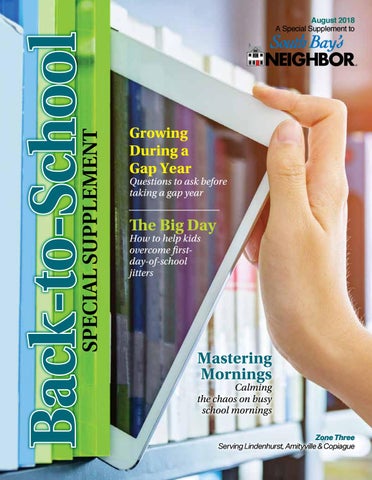
Special Supplement
August 20181 A Special Supplement to
SPECIAL SUPPLEMENT
Back-to-School
BACK-TO-SCHOOL
www.southbaysneighbor.com
Growing During a Gap Year
Questions to ask before taking a gap year
The Big Day How to help kids overcome firstday-of-school jitters
Mastering Mornings
Calming the chaos on busy school mornings
Zone Three Serving Lindenhurst, Amityville & Copiague ZONE THREE
For More Information, Call: 631.226.2636
2
Special Supplement
BACK-TO-SCHOOL
NYU Winthrop’s Multi-Specialty Care for Western Suffolk
NYU Winthrop Hospital is bringing individualized, quality, multi-specialty care to Long Islanders. Our commitment to each patient — Your Health Means Everything — is true for all our locations. ®
Make an appointment today with an NYU Winthrop physician at one of our conveniently located Western Suffolk practices. South Shore Cardiovascular Medicine 137 Broadway, Amityville (631) 264-2424
Winthrop Specialty Center East 1476 Deer Park Avenue, North Babylon (631) 462-1184
Family Medicine Associates of West Babylon 580 Sunrise Highway, West Babylon (631) 422-9355
This Center includes: • Winthrop Pediatric Associates • Winthrop Child Neurology Associates • Winthrop Pulmonary Associates • Winthrop Surgical Associates • Women’s Contemporary Care Associates
Suffolk Cardiovascular Consultants 1920 Deer Park Avenue, Deer Park (631) 392-1680 Winthrop Medical Affiliates at North Babylon 1486A Deer Park Avenue, North Babylon (631) 422-3200
Long Island Medical Care Services 986 Sunrise Highway, North Babylon (631) 587-6060
350021N0808
www.southbaysneighbor.com
ZONE THREE
For More Information, Call: 631.226.2636
Special Supplement
3
BACK-TO-SCHOOL
740 North Wellwood Ave., Lindenhurst
STILL ONLY
12
$
95
(One block north of Straight Path)
Tel: 631-225-1555
+TAX
MONDAY & TUESDAY ALL DAY
www.ginosoflindenhurst.com
PASTA SPECIALS
DINE-IN ONLY
Served with Homemade Bread, House Salad, Coffee or Tea and Cheesecake Spaghetti Carbonara
Rigatoni Bolognese
Spaghetti Aglio E Olio
Rigatoni Fiorentina
White cream sauce with bacon & peas Extra virgin olive oil, garlic & herbs
Penne with Butter Sauce Penne Fiorite
Broccoli florets & sundried tomatoes sautéed with garlic & virgin olive oil
Penne Marsala
Marsala sauce & mushrooms
Fresh ground hearty meat sauce Chicken, spinach & mozzarella cheese sautéed in a creamy pink sauce
Fusilli Casalinga
Sliced sausage or grilled chicken sautéed with broccoli rabe, sundried tomatoes & olives in a roasted garlic & virgin olive oil sauce
Spaghetti Francese
Spaghetti Pomodoro
White wine lemon butter sauce
Linguini Marinara
Eggplant sautéed in a marsala plum tomato sauce & ricotta
Homemade tomato sauce
Garlic & herb plum tomato sauce
Linguini Primavera (red or white) Vegetables sautéed in a plum tomato sauce (or) with garlic & virgin olive oil
Rigatoni Montanara
Baby spinach, sundried tomatoes & grilled chicken sautéed with garlic & oil
Spaghetti with Meatballs Fettuccine Alfredo
A “classic” alfredo cheese sauce
Add To Any Pasta Dish: Chicken $4.25 • Shrimp $6.95 Fresh Mozzarella $2.00 • Bacon $2.00 No Substitutions • Not valid holidays or with any other offers • No sharing
Penne Melenzane
Fusilli Pesto Rosso
Fried chicken in a blend of “San Marsano” & homemade pesto sauce
Rigatoni Gorgonzola
Sliced sausage, caramelized onions & peas sautéed with a creamy gorgonzola cheese sauce
Penne Ala Pesto
Pesto sauce tossed with ground pignoli nuts & parmesan cheese
*Farfalle Portobello
Portobello mushrooms, mozzarella, diced roma tomatoes in a garlic & oil brodino
Penne Madeira
Brown madeira wine sauce with grilled chicken & fresh mozzarella
Linguini Con Vongole (Clam Sauce)
Little Neck and New Zealand clams sautéed with roasted garlic, extra virgin olive oil & Italian parsley
*Spaghetti Papalina
Mushrooms, peas, onions & prosciutto in a pink cream sauce
Spaghetti Puttanesca
Filetto di pomodoro sauce sautéed with black olives, capers and a hint of anchovies
Fusilli Fantasia
*Rigatoni DiNapoli
Grilled chicken, peppers & onions in a marinara sauce baked with mozzarella
Penne Alla Vodka
Spaghetti with Sausage *Spaghetti con Zucchini Fritte
Escarole, cannellini beans & spicy crumbled sausage in a garlic & oil brodino Creamy pink vodka sauce, sautéed with imported prosciutto
Cubed pan fried zucchini tossed in a light garlic & oil brodino, crowned with homemade ricotta
BAKED PASTA *Sunday Dinner - Homemade Baked Ziti layered with sweet Italian sausage & topped with a crispy layer of melted mozzarella Baked Penne • Baked Ravioli • Homemade Meat Lasagna 350246N0815
www.southbaysneighbor.com
ZONE THREE
For More Information, Call: 631.226.2636
4
Special Supplement
BACK-TO-SCHOOL
ARE YOU TIRED OF THAT SAME OLD JOB? WE HAVE OPENINGS FOR SCHOOL BUS DRIVERS
Don’t miss an opportunity for a great job where you can serve your community and make good money doing it. We provide the training you need to obtain your commercial drivers license.
WE OFFER: • Flexible Hours • 401k Plans With Matching Funds • Health Insurance • Life Insurance • Emergency Family Leave • Safety & Attendance Bonus Twice A Year WAIT THERE’S MORE: SIGN ON BONUS RETIREES WELCOME! $1,000 FOR CDL DRIVER EASY TO DRIVE VANS BUS AND VAN FREE CDL TRAINING $500 For qualified candidates. FOR NON CDL DRIVERS WILL We will train you for the road test. TRAIN QUALIFIED APPLICANTS Call today to begin training!
LOOK
NEW STARTING SALARIES For September
BIG BUS
VAN
$20.73/Hr Benefit Rate $22.73/Hr *Non-Benefit Rate
$17.96/Hr Benefit Rate $19.96/Hr *Non-Benefit Rate
*Available after 90 days of employment
*Available after 90 days of employment
AND...
EDUCATIONAL BUS TRANSPORTATION 631.789.2300 CALL TODAY
350801N0815
• Positions available for mechanics and bus attendants • Become a NYS Certified school bus driver!
POSITIONS AVAILABLE FOR NASSAU AND SUFFOLK
www.southbaysneighbor.com
ZONE THREE
For More Information, Call: 631.226.2636
Special Supplement
5
BACK-TO-SCHOOL
How Does Classroom Design Impact Learning?
A
dults who think back to their time in the classroom may remember arrangements of rows of desks and industrial-looking seating. Classroom design was built around students facing the chalkboard, and teachers typically placed their desks at the front of the room to keep an eye on their students. Such arrangements have steadily been on the way out as classroom environments are changed to promote learning. According to the education resource The Professional Learning Board, different classroom arrangements have their own benefits and drawbacks. But the liberty to alter classroom layouts means teachers can experiment with what works for their teaching styles and which arrangements benefit their students. While rows may enable educators to see all students and keep them focused, students in the back may miss out and/or lose focus. Circle arrangements work well for class discussions, enabling all students to congregate around the teacher and participate in the conversation.
“Circle time” is a frequent component of pre-school and early elementary school lessons because it directs focus on the teacher and feels more intimate than laying the room out in rows. Group seating is another arrangement teachers may explore. Desks are arranged so they form small tables. Students can work collaboratively and discuss assignments. However, maintaining focus may be challenging when students are facing other students and may be more likely to chit-chat among one another. A study involving fourth graders in Germany investigated whether certain seating arrangements promoted greater student participation. Traditional rows and a semicircular layout were studied. Children in the semicircle asked more questions, but in both layouts, children who occupied central seating locations asked more questions and participated more per lesson. Another study conducted in 2015 and published in the journal
Building and Environment found that changing some elements of classroom design can increase student learning outcomes by 16 percent. Air quality, lighting and students’ sense of ownership of their classroom impacted the students’ abilities to learn more than seating arrangements, advises the study. Giving children choices, including flexible seating options, such as bean bag chairs, mats or cushions, standing desks, sofas, or individual workstations, can help students find arrangements that are best for them. Furthermore, teachers who rearrange furniture so that classrooms are cozy and inviting may see their students thrive.
environments. In fact, students in classrooms with big windows and daylight progress more quickly in reading and math than those in darkened rooms, according to a Heschong Mahone study cited in ScienceDirect. Overhead fluorescent lighting may interfere with student learning. Educators are urged to see their classrooms from students’ perspectives to evaluate how design may be impacting learning. A few easy changes can add up to big gains for students and teachers alike.
Lighting also is an important factor, particularly when glare can impact the ability to see smartboards or personal tablets, which are now widely used in classrooms. Natural light is preferred in classroom
Never be without power again! • Flex Financing % • Permits and Filing • Certified Factory Financing Available* Trained Installers • Full Product Support • Warranties and Service • Installation and Repair
0
Long Island Nor’easter’s More Than 35,000 Power Outages SOURCE: Oyster Bay Patch March 2018
346519N0815
The generator you buy will change your life, so you don’t have to change your life!
128 Pulaski Road, Kings Park, N.Y. 11754
631.544.0400
www.GetGenReady.com • office@GetGenReady.com • Licensed and Insured *WITH THIS AD ONLY. RESTRICTIONS MAY APPLY
www.southbaysneighbor.com
ZONE THREE
NASSAU LICENSE #H0107000000 SUFFOLK LICENSE # 2740-ME
For More Information, Call: 631.226.2636
6
Special Supplement
BACK-TO-SCHOOL
Be Aware of All of the Costs for College
C
ollege is often met with excitement and interest by students pursuing their passions and what they hope will be fulfilling, lucrative careers. And the rising costs of college, coupled with the growing number of students taking on substantial debt to finance their educations, make it necessary that prospective students consider their earning potential when deciding on a major. According to the College Board, the average cost of college tuition and fees for the 2017-2018 school year was $34,740 at private colleges, $9,970 for state residents at public
colleges, and $25,620 for out-ofstate residents attending public universities. Canadian citizens studying in Canada can expect to pay $6,571 per year, according to Statistics Canada. The cost of tuition and room and board may catch parents’ eyes, but there are some lesser known expenses associated with college that can make attending school even more expensive. According to Cappex.com, a website offering ideas on how to pay for college, the extra costs of college can cost between $250 and $500 per month. The following are some lesser known expenses that college students and their families may need to budget for this school year: Transportation: Commuter students will need to drive to and from campus, which involves
budgeting for gas, repairs and auto insurance. Students who live on campus may be subjected to a high fee for a resident student parking pass. Colleges in the United States earn an average of $4 million to $5 million in parking revenues each year, according to the most recent rate study from the National Parking Association. A typical four-year college or university in the United States charges about $635 per space for the school year. Other students use public transportation or ridesharing services to get around. Those fees can quickly add up, too. Students attending school far away from home also need to budget for plane tickets home during the holidays and other breaks. Fraternities and Sororities: Many students join Greek organizations to fully immerse themselves in the college experience and make new friends. Many of these groups charge fees to prospective pledges and then semester dues once students are accepted. Parties, trips, living expenses and other expenses may come up as well.
Added Fees: Many colleges and universities charge technology fees, sports center fees and activity fees. Exploring these fees in advance of the school year can help families create accurate budgets. Dining Out: Families spend hundreds of dollars on campus meal plans per semester, but students also like to visit local eateries during the school year. Snacks, lunches and dinners purchased from such establishments can cost hundreds of dollars per year. Farmer’s Financial Solutions, a division of Farmer’s Insurance, says off-campus dining expenses cost an average of $770 a year. School Supplies: A new laptop or tablet, textbooks and other supplies a professor requires can cost thousands of dollars. The College Board estimates students spend $1,300 on books and supplies in a typical school year. The cost to attend college extends beyond tuition and room and board. Many additional expenses can stretch families’ budgets.
Back To School is a GREAT time for Braces!
LINDENHURST ORTHODONTICS
Start your beautiful new smile with either braces or Invisalign!
Braces and Invisalign For Children & Adults
Beautiful Smiles Created in a Caring & Comfortable Setting
FREE Initial Consultation
Saturday And Evening Appointments Available Most Insurance Plans Accepted • Flexible Payment Plans Available
Treatment
New patients only. Must present this ad to redeem offer. Not valid with any other offers or reduced fee insurance plans. Expires 9/30/18.
2017
7
7
VOTED BEST ORTHODONTIST
DR. MATTHEW NISSENBAUM
www.southbaysneighbor.com
FREE Orthodontic Consultation
New patients only. Must present this ad to redeem offer. Not valid with any other offers or reduced fee insurance plans. Expires 9/30/18.
BRACES for Children and Adults
The American Association of Orthodontists recommends a check-up with an orthodontic specialist no later than age 7 * Most Insurance and Union plans accepted * No dental referral needed * Flexible monthly payments and NO interest * We welcome second opinions payment plans
349984N0815
350 OFF Full Orthodontic
$
221 N. WELLWOOD AVENUE, LINDENHURST
TEL:
(631) 225-8000
Just North of W. John Street / 1/2 Mile South Of Sunrise Hwy. ZONE THREE
Dr. Matthew Nissenbaum For More Information, Call: 631.226.2636
Special Supplement
7
BACK-TO-SCHOOL
Strategies Parents Use to Motivate Students
S
tudents may need some time to adjust at the beginning of a new school year. Summer vacations typically lack the structure of the school year, and it might be unfair to expect kids to seamlessly slip back into their more regimented lives as students. While some early school year sluggishness might be normal, that should wear off pretty quickly. If not, and students appear to be struggling to get motivated for their
schoolwork, parents can try various strategies that should help reignite youngsters’ passions for learning.
their studies. Keep the home quiet so students are motivated to focus on their studies.
Make your home more schoolfriendly. Summer is a relaxing time of year when parents have a tendency to relax rules around the house. But come the school year, parents must make sure their homes are as conducive to studying as possible. Resist the urge to turn the television on each night so students are not distracted from
Encourage participation in extracurricular activities. Various studies have examined the relationship between extracurricular activities and academic performance. A 2002 study published in the journal Sociology of Education found that participation in extracurricular activities is associated with improved grade point average, increased college attendance and reduced absenteeism. The link between participation in extracurricular activities and improved academic performance is still in need of study, but such participation may help children acclimate to the structure of the school year more quickly than they might if they do not participate in such activities. Encourage curious youngsters. Kids are curious, and fostering that curiosity can be a great way for parents to get their kids excited about learning. Whether it’s during the school year and part of their curriculum or on
summer break, encourage kids to engage in subjects that interest them. As kids learn more about the topics and subjects that interest them, they may develop a passion for learning that they can then take with them to the classroom. Express an interest in the subjects children are studying. Another way to motivate students at the dawn of a new school year is to express an interest in the subjects they’re studying. Ask questions about their studies and encourage them to share their thoughts and opinions. Engaging students about the subjects they’re studying can motivate them to explore those subjects more deeply than they otherwise might. Motivating kids to be excited about their schoolwork at the dawn of a new school year can sometimes be difficult. But parents can employ various strategies that can help their children readjust to life in the classroom and motivate them to perform to the best of their abilities.
E nroll NOW for September
Affordable Copiague Private Christian CARE PHARMACY 3 & 4 year old FULL DAY Pre-School School Academy and
Sunshine Preschool
NOTHING IS MORE IMPORTANT 3 or 5 Days PerYOUR Week HEALTH! THAN
FULL DAY Kindergarten & 1st Grade Your Small Classes WE withACCEPT a Qualified Staff Pharmacists CVS CAREMARK Over 25 Years of Quality Educa on HEALTHFIRST • MEDICARE 10% R IO SEN OUNT C S I D
MUCH MORE THAN DAYCARE!
F DELIREE VERY
MARSHAL WEINSTEIN
*** FULL DAY *** 3 & 4 YR. OLD PRESCHOOL AND LOWER ELEMENTARY GRADES $520.00 PER MONTH
MEDICAID EXPRESS SCRIPTS TRICARE • EMBLEM HEALTH • EMPIRE • BCBS
2675 Great Neck Rd Copiague NY 11726
Over 30 Years Of Quality Education
ZONE THREE
OPEN 7 DAYS Monday-Friday 9am-7pm • Saturday 10am-4pm Sunday 12pm-4pm
602 Wellwood Ave., Lindenhurst Just North of Sunrise Highway, Next To Outback Steakhouse
631-450-4404 • www.carerxplus.com
346136N0815
346011N0815
(631) 842-5993 www.southbaysneighbor.com
(631) 842-5993
AND ALL MAJOR INSURANCES
Enroll NOW for September
2675 Great Neck Road Copiague, NY 11726
JUNE MULFELD
For More Information, Call: 631.226.2636
8
Special Supplement
BACK-TO-SCHOOL
How to Make Applying Get Schooled on to College Less Stressful Education Savings
A
pplying to colleges is exciting for many high school students. But that excitement is sometimes tempered by anxiety. The college application process can affect students’ lives for years to come, so it’s understandable why some teenagers might feel stressed as they apply to college. The National Center for Educational Statistics says 69 percent of high school graduates in the United States enroll in college the fall after graduating from high school. Many students begin applying to college before entering their senior year of high school. Students can employ various strategies to make applying to college less stressful. Create an inventory of student experiences and awards. When completing their college applications, students submit a variety of materials. In addition to students’ track records in the classroom, schools will be interested in kids’ extracurricular activities, hobbies, volunteer work and even things they do during their free time. Parents and students can work together to develop a master list that includes information about what students have accomplished during high school. These may include involvement in certain clubs, participation in sports teams, advanced ranking in scouting programs or even a list of books read. Having this document handy will make it that much simpler to fill out college applications. Investigate the Common Application. The Common Application began as a niche program for select private liberal arts colleges, but now has grown into an organization that services more than 750 schools. The organization enables students to create an account and complete one basic form that will be accepted by all institutions who are members. www.southbaysneighbor.com
The CA helps students streamline the college application process and reduce redundancy. An alert system also helps applicants manage application deadlines. Avoid applying everywhere. Some students think that applying to dozens of schools will improve their chances of being admitted. However, applicants may be wasting their time applying to schools they have no intention of attending, and that only adds to the stress of meeting deadlines. Narrow down the possibilities to a handful of favorite schools and go from there. Use the resources at your disposal. Students who have access to guidance counselors, mentors, college centers or even teachers who are willing to help with the application process should use these resources wisely. In addition, iPhone and Android apps can help streamline the college application process. Consider scholarships concurrently. Some schools automatically consider applicants for scholarships, grants and work-study programs. But that’s not so with every school, so students may have to apply on their own or rely on third parties for scholarships. Fastweb is a leading online resource to find scholarships to pay for school. Advance preparation can make the college application process a lot less stressful for students and their parents.
A
ccounts to pay for college or even private high schools can be a smart way for parents to prepare for their children’s futures. Not every account is the same, and certain savings accounts could affect financial aid eligibility and taxes. It is in parents’ and students’ best interests to educate themselves on the various education savings plans available to them - and which ones make the most sense for their families. Families should do their research and work with professionals who understand the subtleties of school savings plans. For example, according to Cappex.com, a college information site, students’ income and savings have a larger, more negative impact on the availability of financial aid than the portion of their parents’ assets factored into the equation. Students with sizeable savings accounts in their name may end up adversely affecting their financial aid eligibility. A financial advisor and loan expert can advise families on these confusing financial facts. 529 College Savings Plan: 529 accounts are a popular education savings plan. They operate in a similar fashion to IRA and 401(k) plans in that savings for education are earned tax-free through investment opportunities. SallieMae says 529 plans are offered by states or educational institutions under Section 529 of the Internal Revenue Code. These tax-advantaged plans generally have no income limitations and high contribution limits. The usage of funds in 529 accounts are subject to regulations.
below a specified income level, says the resource SavingforCollege.com. Uniform Gifts to Minors Act Account: These accounts are not traditionally designed for education but can be established to offer gift assets to minors. The custodian of the account can sell the assets for the child’s benefit at any time, and once the child reaches 18 or 21, recipients can use the funds in whatever manner they choose. However, UGMA may affect financial aid eligibility. Roth IRA: Parents can open up a Roth IRA in their child’s name once the child begins earning income. Even though there are penalties to taking earnings out before the age of 59.5, exceptions include purchasing a first home or qualified education expenses. A Roth IRA isn’t subjected to legal and administrative fees that can come with trusts, which are another savings avenue. Canadian Education Savings Grant: With a CESG, parents can save for their child’s education by opening up a Registered Education Savings Plan. The government then matches the money up to a certain percentage and deposits it into the child’s RESP. The extra funds the government deposits are called the CESG. Parents can help finance their children’s educations through various savings plans. A financial advisor may shed more light on which products are best for families.
Coverdell Education Savings Account: Coverdell accounts are versatile in that they enable the money to be spent for elementary through college education, which is a larger range than other plans. This is another tax-free plan when used for school purposes. Coverdell contributions are capped at $2,000 per year, and they’re only available to families ZONE THREE
For More Information, Call: 631.226.2636
Special Supplement
www.southbaysneighbor.com
BACK-TO-SCHOOL
ZONE THREE
9
For More Information, Call: 631.226.2636
10
Back-to-School Ice Breakers to Ease First Day Fears
P
arents and educators can sometimes underestimate children’s anxiety over the dawn of a new school year. Many students feel nervous when wondering if their teachers will be nice or if they will make new friends. These worries may be compounded by the return to routine and the end of an enjoyable period of rest and relaxation. In 2015, CNN polled campers at a summer day camp outside New York City. The campers were elementary school students who were asked about what they were most nervous about for the return to school. Homework, tests, competition, greater expectations, grades and making new friends topped the list of fears. To help students transition to the classroom with fewer worries, teachers and parents may want to initiate ice breakers and other stress-reducing interactions. Here are some ideas: Buddy Up Many schools will give out classroom assignments a few days before the first day of school. Parents can investigate who is in their child’s homeroom and initiate contact with the parents of one or more of those students. Collectively, parents can make a buddy plan for students to arrive to school together and enter the classroom as a team. Coordinate clothing colors or have students wear another unifying symbol. This may allay fears and make the first day of school more fun. School Selfie Students can craft “school selfies” on a piece of paper using a smartphone image template. This selfie illustration will give the class key facts about each student and present an interesting, creative and enjoyable way for students to get to know one another. Student Word Search Word searches are entertaining and educational tools that can be put to use in the classroom. Parents or www.southbaysneighbor.com
Special Supplement
BACK-TO-SCHOOL
teachers can create word searches featuring the first names of all the students in the class. Children often enjoy searching for their own names, and then they can help others, opening up lines of communication. Word searches also can be customized for any subject. Therefore, if student names aren’t desired, the theme can be classroom items or school terms. Personal Introductions Students may worry about teachers mispronouncing their names or using a full name instead of a nickname. Rather than a traditional roll call, teachers can encourage students to introduce themselves to classmates, using their preferential name and including a brief synopsis of their interests and what makes them unique. Teachers also can initiate other ice-breakers by giving students a sheet with various questions, which students then have to complete by asking around among the other students. For example, “Who has a pet fish?” or “Find someone who has blue eyes.” The first day of school can be difficult for some children. Fun activities and some extra effort from parents and teachers can make the return to the classroom less stressful.
How to Ease Kids’ Transition to a New School
B
eing the new kid in school can be a tall order for youngsters. Children who change schools may face a host of challenges that studies suggest can affect both their social and academic development. In a 2010 study that followed students who entered kindergarten in 1998 through 2007, the Government Accountability Office found that 13 percent of students changed schools four or more times by the end of eighth grade. Such mobility can adversely affect students, as a study of 13,000 students in the city of Chicago found that children who had changed schools four or more times by the sixth grade were roughly a year behind their classmates. In addition to the toll transferring schools can take on their academic performance, students also may experience difficulty assimilating into their new schools. Though there’s no formula to make such transitions easier, parents can try various strategies to help their kids successfully adjust to new schools. Speak with children about the transition. Pathways.org, a notfor-profit organization devoted to providing free child development information to parents and health professionals, recommends parents speak with their children about transitioning to a new school. Encourage children to share what excites and worries them about the transition. The way parents discuss transitions can go a long way toward shaping how kids view the change.
education resource Edweek.org notes that the most common causes of students changing schools are residential moves related to parents’ jobs or financial instability. Parents on the lookout for a new job or those who may need to relocate for financial reasons may want to delay moving until the current school year has ended. Moving between school years gives families time to acclimate to their new communities. That means kids will get time to make new friends. Some familiar faces on the first day at a new school can go a long way toward alleviating the fears children may have. Volunteer at your child’s new school. Parental involvement at school can have a profound impact on children. The National Education Association notes that children whose parents are involved at school are more likely to perform academically than students whose parents are uninvolved. In addition, such students are more likely to have good attendance and exhibit stronger social skills than children whose parents do not involve themselves in their children’s school. It stands to reason that students transferring to a new school may benefit from parental involvement even more than other students, as seeing their parents approach a new school with excitement and energy may inspire children to follow suit. Transitioning to a new school is not easy for many students. But parents can help smooth that transition in various ways.
Stay true to your routine. Pathways also recommends parents of students who are transitioning to a new school do their best to replicate first day of school routines from years past. Some familiar traditions might help calm kids’ concerns about their first day in a new school. Assimilate into a new community before the school year begins. The ZONE THREE
For More Information, Call: 631.226.2636
Special Supplement
11
BACK-TO-SCHOOL
FREE ESTIMATES CALL TODAY AND LET US BEAUTIFY YOUR HOME
1-800-DRIVEWAY OR 631-242-5100
Driveways • Parking Lots • Masonry Sealcoating • Paving • Belgium Block Pool Surroundings • Blue Stone Cement Brick Walkways • Stoops Proudly serving the Long Island community for over 30 years
www.atlasasphalt.com www.southbaysneighbor.com
ZONE THREE
Suff. Lic. #57808-H
349990N0815
RESIDENTIAL • COMMERCIAL
For More Information, Call: 631.226.2636
12
Special Supplement
BACK-TO-SCHOOL
Help Kids Calm First-Day-of-School Jitters
T
he first day of school can be an exciting time, especially for children who have never before attended school. But even youngsters excited about the first day may also experience some jitters. Such nerves are normal, and parents can help kids calm those
jitters in various ways. Talk about the first day as it approaches. A child’s first day of school is a milestone, and parents may do various things to commemorate the occasion. The excitement leading up to the first
day can spark kids’ enthusiasm, but it also may lead to some anxiety about the unknown. Parents can quell those fears by discussing the first day as it approaches. Explain why the first day is so special, encouraging youngsters to share their feelings. If kids express fears about their first day, parents can explain they felt similarly on their first day of school but quickly adjusted.
to the morning routine may be more calm on their first day of school because of their familiarity with their new schedule. Going cold turkey on the first day of school may make kids less enthusiastic about attending school.
Let kids choose their own clothes. Parents may be tempted to buy special outfits for their children for the first day of school. But kids who are jittery about their first day may calm down if allowed to choose their own attire for the big day. A favorite T-shirt or outfit might be just the thing to comfort kids feeling a bit nervous about their first day of school.
Attend school orientation events and plan some play dates in advance of the first day. Seeing familiar faces might make kids forget all about their jitters when they arrive at school on the first day. Inquire about school orientation events and attend as many of those sessions as possible. If encouraged to do so, take kids along so they can meet prospective classmates. Arrange for play dates with those classmates in advance of the first day so kids have a few recognizable faces their own age come the first day of school.
Get a head start on your morning routine. As summer winds down, begin acclimating children to the morning routine they can expect when the school year begins. One to two weeks before the first day of school, start waking children up when they will need to be up for school. Kids who are accustomed
Start the day off on the right foot. The night before the first day of school, make sure kids’ outfits are clean, their supplies are packed and ready to go and their lunch is made. The less parents have to rush around on the morning of the first day of school, the calmer kids are likely to be.
Calm the Chaos on Busy School Mornings
M
ornings can test the patience and stamina of busy families as adults and children hurry to get out the door on time. Starting off the morning already stressed can lead to feeling tense throughout the rest of the day. There is no magic formula to make mornings less hectic, but the following are some ways families can streamline their morning routines: Make use of the night before. Morning madness may come about due to lack of preparation the previous night. The more that can be done the night before, the less there will be to do on weekday mornings. Encourage children to lay out clothes for the next day and take a shower or bath that evening. Make lunches the night before a school day, and gather all supplies from homework stations, restocking backpacks and gym bags so everything is ready to go come the morning. Get to bed earlier. Sleep experts say that if you need to rely on an alarm clock to get up in the morning, you may not be getting
www.southbaysneighbor.com
enough sleep. The National Sleep Foundation says school-aged children should get between nine and 11 hours of sleep a night. Teenagers require between eight and 10 hours of sleep per night, while adults need between seven and nine hours. A good night’s rest can reduce morning crankiness and get everyone moving more efficiently.
school or a special outing on the weekend. Follow a schedule. Make mornings the same each day so everyone knows what to expect. Uniformity can streamline tasks and ensure everyone knows what’s expected of them. Stay organized. Racing around
trying to find keys or jackets can be very stressful. Make it a point to return items to their proper places so that everyone knows where to look for the items they need. School mornings can be challenging, but with some ingenuity and forethought, the stress can be tamed.
Incentivize timeliness for kids. Children who are reluctant to head to school may need extra motivation to get out the door. Offer small rewards to kids when they get ready on their own or finish breakfast in a certain amount of time. Rewards can include a treat like choosing a favorite show to watch after ZONE THREE
For More Information, Call: 631.226.2636
Special Supplement
13
BACK-TO-SCHOOL
The Dental Plan For Everyone
SAVE UP TO 60% ON DENTAL CARE Starting As Low As
$
99/YR $99
FREE
$229
Sample List of Savings
Thousands of Dentists Nationally
3 MONTHS
$189
General Dentist Procedure Without EDP With EDP
6 Month Check – Up Routine Cleaning Filling (1 Surface) Amalgam Root Canal (Anterior) *Crown (Porcelain) *Complete Upper Denture Tooth Extraction X-Ray (Full Mouth)
With Purchase of 1 Year Membership. New Members Only When You Mention South Bay's Neighbor Newspapers. Offer Exp. 8/30/18
$60 $90 $110 $600 $995 $1,495 $150 $120
$14 $34 $42 $295 $495 $575 $62 $39
*LAB FEES NOT INCLUDED
Plus Save 25% on Braces and Implants
• Immediate Activation • This Is Not Insurance
Enroll Now: 631.272.5230 WWW.EDPDENTAL.COM
www.southbaysneighbor.com
ZONE THREE
NN
For More Information, Call: 631.226.2636
14
School Hygiene Tips
Promote Healthy Weight Starting with School Lunch
A
lthough there are a variety of theories behind the growing obesity problem plaguing North American adults and children, the most consistent findings point to caloric intake as the culprit. Here’s a simple equation to get to the root of the problem: Calories eaten > calories spent = weight gain.
According to National Health Examination Surveys, adult obesity trends in the United States between 1976 and 2014 indicate the percentage of the adult population classified as obese has roughly doubled to more than 38 percent in the last three decades. Children may be learning eating habits from their parents, potentially contributing to rising obesity rates in children as well. Recent findings from the Centers for Disease Control and Prevention indicate one in five school-aged children and young people in the United States is obese. In Canada, the Public Health Agency says roughly one in seven children is obese. Teaching children healthy eating habits starts at home and can extend to what students are given to eat while at school. The Center for Science in the Public Interest says schools across the country are working hard to improve school nutrition. Here’s how parents and school districts can help make school lunches more nutritious and delicious and lower in calories: Control snack intake. The U.S. Department of Agriculture says that more than one-fourth of kids’ daily caloric intake comes from snacking. Choosing smarter snacks may help reduce overeating. Good snacks can include grain products that contain 50 percent or more whole grains by weight; snacks in which the primary ingredient is a fruit, a vegetable, dairy product or lean protein; snacks that are a combination food that contain at least a 1⁄4 cup of fruits or vegetables; and foods that www.southbaysneighbor.com
Special Supplement
BACK-TO-SCHOOL
C
contain no more than 200 calories. Read nutritional information. When selecting foods for school lunches, parents should read the nutritional information to make sure they know exactly what they are feeding their children. Select foods that are low in saturated fats and cholesterol and high in fiber and nutrient-rich fruits, vegetables, grains and legumes. Go with water. Rethinking beverage choices can help control kids’ caloric intake. Many people don’t realize just how many calories beverages add to their daily intake. Even a six-ounce, 100-percent apple juice can include as many as 96 calories. Sodas and other soft drinks pack a hefty caloric punch. Water, seltzer and unsweetened iced tea are healthy beverage options. If milk is the go-to beverage, choose a reduced-fat version. Introduce new foods. Children can be notoriously picky eaters, but with patience and perseverance, parents can introduce new, healthy foods at lunchtime. Yogurt, hummus and salsa are healthy and can add flavor to vegetables and fruit. When making sandwiches, exchange refined breads for whole-grain varieties. Choose lean protein sources, and go heavy on vegetables and fruits for natural fiber, which will create feelings of satiety.
hildren are in close contact with others at schools and daycare facilities, where germs can be easily transmitted. Children may not be as conscientious as adults in regard to the health risks associated with poor hygiene. These tips can keep students stay healthy and help prevent germs from being transported home, where they can affect other members of the family:
can remove a number of germs. Keep ill children home from school, especially if they have a fever. Kids should not return to school until they are fever- or symptom-free. Toys and community supplies should be washed or disinfected regularly to kill germs. Cleaning classroom furniture regularly also can help establish healthy educational environments.
Hand washing is essential to good hygiene. Children should wash their hands with soap and water after using the bathroom, before eating and after playing outdoors. Children can bring along their own tissues and use them when their noses become runny. Tissues should be promptly discarded after use. Parents should ensure that fingernails are clean, as under the fingernails can be a breeding ground for bacteria. Clipping fingernails and regular hand washing
Did You Know?
Read the school menu. Let children indulge in ordering from the school menu when healthy options are featured. Urge them to try something unexpected, rather than sticking to chicken nuggets or pizza days. Healthy eating habits begin in childhood and can be initiated with school lunch.
Ransomware is a form of malware (malicious software) that takes over a computer. Ransomware can lock down all operations on a computer and deny users access to their data. Computer users cannot reverse this lock down without the help of the hacker, who usually requires a ransom in return for a decryption key. The costs can range from a few hundred dollars to thousands, say IT experts. The U.S. Department of Education has warned that hackers are employing ransomware as they target schools with insufficient security. According to the Federal Bureau of Investigation, schools are particularly vulnerable because their security is not always up to par and they have information that’s of value to hackers, including students’ personal information. According to McAfee, more than 4 million ransomware variants have been detected online, a 270 percent increase since 2013, and ransomware is expected to be a continuing and significant problem for schools.
ZONE THREE
For More Information, Call: 631.226.2636
Special Supplement
15
BACK-TO-SCHOOL
PHOTOGRAPHS FOR SALE Photos by: Jamie Lynn Ryan
50% OFF ALL ORDERS PLACED
USE PROMO CODE:
SCHOOL
VALID UNTIL 9/30/18
0815
www.SnapshotsAndSilhouettes.com
www.southbaysneighbor.com
ZONE THREE
For More Information, Call: 631.226.2636
16
Special Supplement
BACK-TO-SCHOOL
Ideas to Build School Spirit and Community
S
chools are often at the heart of a community. Schools are centralized places where people gather and friendships are formed. Creating an environment where school spirit is strong can be crucial to building a thriving community.
from simple things like wearing silly hats or rooting on the sports team to more complex activities, such as community service projects. The following are some ways students and educators can foster stronger school spirit by encouraging communities to get involved:
School spirit can make people smile and bring them together for a common goal. Creating a balanced environment in schools also can help students feel more comfortable and happier about attending class each day.
Invite guest speakers. Invite local community members to discuss their experiences or alumni share their memories of attending the school. Having students learn from these people can provide incentive for them to do well in school.
The National Federation of State High School Associations reports that, along with showing support for their school, high school students with school spirit perform better academically, are more engaged in social and civic matters and are generally happier than other peers. Those findings were part of a survey conducted by Harris Poll and involved 1,500 students who were asked about key factors like pride, academics and self-esteem at school.
Celebrate diversity. Various months or weeks of the year are dedicated to celebrating particular ethnic, cultural or special groups. Tie school spirit occasions into these events to commemorate the unique diversity at your school.
Activities for building spirit can range
Host “School Spirit Fridays.” An easy way to inspire school spirit is to ask faculty and students to wear school colors or attire featuring the school mascot each Friday. A short Friday pep rally also can excite the student body. Raise money for charity. Penny
Wars are a great way to raise funds for special interest projects and charities. Homerooms collect as many pennies as they can for a week. Rival classes “sabotage” by throwing nickels, dimes and quarters into the buckets. The pennies are tallied, and the other currency is subtracted from the total. The class with the most money wins a pizza party, and the funds raised are then donated.
classroom doors to coordinate with holidays or special themes. The winner receives a prize, such as more recess time or no-homework passes. These are just a few ways to boost school spirit. Schools can find more ideas to inspire school spirt by creating committees to connect with students and members of their communities.
Choose a new mascot. Ask students to vote for a new school mascot. While they are exploring the possibilities, kids can learn about unique or endangered animals in the process. Hold doordecorating contests. Students can decorate their
L NA L SIONTA ES RE F O E PRFFIC O
AL NT
RE
$1,800
Venerable & Charming Victorian Office Bldg. Very Short Walk To Village Shops, RR, Banks & Many Other Desirable Conveniences. Easy Access To All, From All. 3 Lge Rooms Totalling 500 Sq. Ft. 12x12, 12x10, 13x17 Plus Common Spaces. Perfect For Professional Offices.
FARMINGDALE
$499,000
4 Bedroom, 2 Bath Split In Excellent Cond. Renovated 15-18 Years Ago. Sprinkler System, 150 Amps. Woodward School.
AMITYVILLE
$185,000
Brand New, Never Lived In. Great Up & Coming Area. Granite, Stainless And Cherry Kitchen. Laundry In Unit, Handicap Friendly With Open Floor Plan And Wide Doorways, Oversized Windows Offer A Sunny, Airy And Uplifting Atmosphere.
BRENTWOOD
Family Home. Excellent For Large Or Extended Family.
$449,000
Hi Ranch , Located On An Oversized Property. Features Include 1st Floor, L/R, Full Bath, EIK, Bedroom, OSE. 2nd. Floor Features Updated EIK & Full Bath, 3 Bedrooms, Refinished Hardwood Floors. 2.5 Car Att. Garage. Accessory Apt., Permit Required. Large Shed In Rear.
FARMINGDALE
$469,000
Great Area And Schools, Walk To Shopping. Large Very Well Kept Home For Large Or Extended Family.
FARMINGDALE
$499,000
1 Of The Most Beautiful Homes On The Market. Everything Redone To The Best. Open, Bright & Magnificent. Huge 10’ Ceiling Entertaining Center w/ 3 Skylights. Finished Basement w/ Great Rm, 1/2 Bath & Fireplace. A Lot Of Storage. 200 Amps. Have Your Summer Vacation In This Gorgeous Backyard w/ A Dark Blue I.G. Pool.
AL NT
E
ER
OR ST
FARMINGDALE
$3,195
Great Neighborhood, Spacious And Warm
BETHPAGE
$1,500
Wide Open 600 Sq. Ft. High Ceiling Plus 600 Sq. Ft. Basement, Elec Only Expense, Elec Heat.
350186N0815
FARMINGDALE
CALL FOR A FREE APPRAISAL 265 Conklin Street • Farmingdale, NY 11735 • 516-752-8828 www.hardscrabblerealestate.com www.southbaysneighbor.com
ZONE THREE
For More Information, Call: 631.226.2636
Special Supplement
17
BACK-TO-SCHOOL
Build a Trendy School Wardrobe for Less
T
he dawn of a new school year requires restocking school supplies. But for some kids, the most important part of returning to school is making sure they look good walking through the door on the first day of school - and each day thereafter. The National Retail Federation says the average family with school-aged
kids expects to spend $630 this year on school supplies. A large percentage of that money will be spent on clothing. Naturally, parents want their children to have clothing they’ll love and feel comfortable wearing, but do not want to break the bank buying wardrobes for their youngsters. But parents can employ various strategies to ensure kids look good without Mom and Dad
JoJo Bow. Parents also may find more affordable alternatives to other trendy items.
going broke. Invest in few essential clothing items. Ask children what they are most interested in buying. One or two trendy shirts or an expensive pair of sneakers can be paired with seasonal pieces. The result is a trendy, affordable look. Shop discount retailers. Stores like TJ Maxx and Marshalls offer many brand-name items at a discount over department store prices. While these stores customarily stock items that may be a season or two out of date, they can help budget-conscious families nab some key clothing items at affordable prices. See if replicas will fit the bill. Girls may be enamored with an oversized hair accessory dubbed the JoJo Bow, an accessory popularized by celebrity Joelle Joni “JoJo” Siwa. They’re big and colorful, but the name-brand, authentic hair bows may be beyond some parents’ budgets. However, there are plenty of bows that can achieve the same look at a fraction of the cost of the
Choose a size larger. Children grow very fast, so it may be well worth the investment to purchase trendy items one size larger so kids can get more use out of the item. However, this likely won’t be possible with footwear. Share clothes. Savvy bargainhunters can swap gently worn shoes or clothing with other families when kids outgrow items. Spread out purchases. To make purchasing easier on the wallet, grab items here and there throughout the year and put them toward school wardrobe essentials, rather than cramming in shopping right before the school year begins. This approach also helps families shop sales and maintain a variety of pieces that make it easier to transitions kids’ wardrobes throughout the year. School clothes can make up a large chunk of back-to-school shopping budgets. Smart choices help families save money.
Sod Lawns • Overseeding & Aeration • Ornamental Shrubs • Privacy Planting Mulch • Seasonal Plantings • Land Clearing • Debris Removal
Make Your Home Beautiful.
351205N0815
Call now to schedule your FREE Consultation for Landscape Design & Maintenance for 2019!
N UP
FALL CLEA
$
50 OBFSF ALL JO led By Schedu 11/1/18
KASTE
LANDSCAPE & DESIGN INC.
Serving Long Island For Over 25 Years
888.454.5896
kastelandscape@aol.com • kastelandscapingDA.com • Nassau Lic. #H208026000 • Suffolk Lic. #43299-H www.southbaysneighbor.com
300 OFF Any Job
$
ZONE THREE
500 OFF Any Job
$
1000 OFF Any Job
$
of $3,000 or More
of $5,000 or More
of $10,000 or More
With This Coupon. Not Valid With Other Offers or Prior Purchases. Expires 11/30/18.
With This Coupon. Not Valid With Other Offers or Prior Purchases. Expires 11/30/18.
With This Coupon. Not Valid With Other Offers or Prior Purchases. Expires 11/30/18.
For More Information, Call: 631.226.2636
18
Special Supplement
BACK-TO-SCHOOL
How Technology Can Reinforce Lessons
T
echnology in and out of the classroom can be a polarizing subject. Proponents of tech in schools contend that students must be skilled in the ways of the world, which is increasingly being governed by technology. Detractors to tablets and smartbooks in the classroom may say it contributes to excessive time in front of a screen and can prove distracting over other means of learning. It is hard to deny the ways that technology has helped shape and improve education. Students who may not excel with the traditional tools of learning might benefit from applications geared toward offering assistance for their particular needs. Furthermore, technology, through its globalization, can put educators and students in touch with a wealth of resources - all at their fingertips. The following are the myriad ways that technology can enhance lessons in the classroom. Inexpensive Resources Technology can provide various online resources that go beyond the study guides and other materials
offered by textbooks. These resources can be very low-cost or even free, helping educators save money. For parents who need to reinforce lessons at home, the internet can help them collaborate with other parents and teachers and find fun ways to help their children learn. Quantifiable Results Technology can process data more quickly and efficiently than humans. Algorithms can be developed to help students learn faster. Tech can be customized in unique ways to help students learn. Not every student learns the same way. Technology provides for a multimedia approach that can combine visual and auditory tools to better teach students. Connect More Teachers can embrace technology, such as YouTube-powered guides to show students how to complete assignments or to go over information in the classroom. Students who missed class or need a little reinforcement can benefit from a second look at lessons in
in brainstorming sessions.
online videos available at all times on the internet.
Reinforce STEM
Some teachers employ QR codes on assignments that students (and parents) can scan to access further information or support materials. This can help kids further explore topics after school hours. Transcend Location Technology can connect people by voice, text or video, which means that learning is not limited to geographic location. Notes and materials can be shared with teachers or study groups through digital connections around the world in real time.
Data from the U.S. Bureau of Labor Statistics says employment in occupations related to STEM science, technology, engineering, and mathematics - is projected to grow to more than nine million by 2022. Technology plays a strong role in STEM careers. Honing these skills in the classroom can prepare students for professional arenas in which technology figures to play a sizable role. Technology has changed the education landscape in many beneficial ways.
Get Feedback Students can go beyond their school districts or communities to discover how others learn. High school or college students can rely on internet communities to provide a second set of eyes on papers to proofread for grammar or spelling mistakes or even to assist
How to Help Kids Learn to Love Reading
R
eading is a passion for many people. But even avid readers may not know just how far back their love of reading stretches. According to the American
Academy of Pediatrics, children who find pleasure in reading have the potential to become lifelong readers. In addition, studies have shown that reading to children can help kids become familiar with sounds, words and language, helping them in their earliest stages of cognitive development. So adults who love books might be able to trace their passion for pageturners to those times their mothers and fathers read aloud to them as youngsters. Parents who want to their children to learn to love reading can rely on various techniques to accomplish that goal. Make reading a routine. Routine is a necessity for
www.southbaysneighbor.com
parents, helping children learn when it’s time to eat, play and go to sleep, among other things. Parents can include reading to their children as part of their daily routines. As noted, doing so will promote language skills and cognitive development while also acclimating children to books and providing valuable time for them to bond with their parents. Create a distraction-free reading environment. When reading to children, parents can create an environment with little to no distractions. This allows kids to focus on their parents’ voices as well as the story they’re being told. Parents can turn off the television and the radio when reading to their kids. In addition, moms and dads should leave smartphones or tablets in another room so they aren’t distracted by alerts or tempted to check for incoming messages or emails.
Let kids pick their own books. When reading to youngsters, whether they’re babies, toddlers or already in school, parents can let sons and daughters choose their own books. Children might be especially enthusiastic about reading if they’re allowed to choose their own books and stories.
Read aloud together. Some children may shy away from reading if they struggle in their initial efforts to read. That does not mean kids won’t ultimately enjoy reading, it just means a little more effort may
ZONE THREE
be required on parents’ part to help kids overcome any issues they have. Reading aloud to children can help little ones learn how to become good readers, as they will learn how to pronounce words and form sentences. Kids who know how to read can be encouraged to read to their parents, which can instill selfesteem. If kids struggle with certain words or sentences when reading aloud, parents can read those words and/or sentences aloud to them and ask them to repeat the phrases back.
Reading can benefit children from the earliest stages of their lives all the way through adulthood. Parents can take various steps to foster a love of reading in their children.
For More Information, Call: 631.226.2636
Special Supplement
19
BACK-TO-SCHOOL
HEADS UP
WE DO KIDS’ BIRTHDAY PARTIES
Full Service Hair Salon We Specialize In...
CALL FOR DETAILS
• Men, Women & Children • Buzzes & Fades • The Latest Hair Color & Cut Trends • Bridal Party Specialist - We Will Come To You! • Waxing
STUDENT SPECIAL
WITH STUDENT ID Not Valid With Any Other Offer. With Coupon Only. Expires 9/15/18
Adults & Children
Please Call For Appointment, But Walk-Ins Always Welcome! Gift Certificates Available
Chairs For Rent P/T Shampoo/ Assistant Wanted
HOURS: Monday 10am-6pm; Tuesday 10am-8pm; Thursday 9:30am-8pm; Friday 9am-8pm; Saturday 9am-5pm; Sunday 9am-3pm. Closed Wednesday
5 Sit & Paint - Every 3rd Visit ½ Price!
$
ADULT SIPPING PARTIES
BACK TO SCHOOL KERATIN SPECIAL
150
$
Tuesdays - Saturdays 6pm-10pm
INCLUDES HAIRCUT (LONG HAIR EXTRA) WITH COUPON ONLY. EXPIRES 9/15/18
Check Out Our Website: HeadsUpHaircareInc.com LIKE US ON 351151N0815
168 E. MONTAUK HWY. • LINDENHURST
Ask For Katherine
TUESDAY THRU SATURDAY 11AM-4PM & 6PM-10PM SUNDAY 11AM-4PM
Marine Shopping Center Near Island Farms
631-225-1565
(Bring Your Own Beverages & Snacks For A Relaxing Evening!)
YOU CAN CREATE A CUSTOMIZED GIFT OR WE CAN CREATE IT FOR YOU!
Call For Available Dates
DAYS: TUES - SUN 11AM-4PM • EVES: TUES - SAT 6PM-10PM • CLOSED MON
306 35TH STREET • LINDENHURST 631-226-0361 (ACROSS FROM THE RAINBOW CENTER)
340354N0815
10% OFF
OPEN WALK-IN SESSIONS
ANY SERVICE
CELEBRATING OVER 95 YEARS OF CATHOLIC EDUCATION!
St. Martin of Tours Catholic School 30 Union Avenue, Amityville
631-264-7166
www.smtschool.org www.southbaysneighbor.com
ZONE THREE
345807N0815
• Half Day & Full Day Nursery • Half Day & Full Day Pre-K • Kindergarten Through 8th Grade • NYS Certified Teachers • Faculty Run Before & After Care • School Clubs • Regents Math • Service Learning • Stem Lab • Computer Lab, Chromebooks, iPads, Smartboards & Video Conferencing
346008N0815
CALL FOR MORE INFORMATION & TO ARRANGE A TOUR!
For More Information, Call: 631.226.2636
20
Tutoring Benefits and How to Find a Tutor that Fits
C
hildren tend to learn at their own pace, and certain subjects may challenge them more than others. In many instances, students can benefit from working with tutors.
Tutors can be very effective. Children who work with tutors and then see their grades improve may develop greater confidence and feel less anxious about going to school or taking tests. Without intervention like tutoring, at-risk students (those who are not meeting academic standards) may not pass their classes, and some may face year-end retention or experience difficulty keeping up in the next grade. The National Tutoring Association says students at all grade levels participating in tutorial programs improve their reading performance and can achieve significant cognitive gains. Tutoring can be the answer for students affected by inconsistent delivery of classroom content. For example, when families move, students may be forced to catch up in a new school where teachers may have different styles than students’ previous teachers. Students who have missed classroom time due to illness or injury may face similar difficulties. Sometimes children struggle because they have difficulty processing or remembering their lessons. In such instances, a fresh approach through one-on-one tutoring may be necessary. Parents and students have different tutoring options at their disposal. Some services may be offered through the school system at no extra charge. Pull-out instruction during the day or before or after school might be part of such services. Private tutors, academic coaches, peer tutors, online tutoring and home tutoring are other options. Depending on need, budget and comfort levels, families can explore these and other options at www.southbaysneighbor.com
Special Supplement
BACK-TO-SCHOOL
Student Cyber Security Precautions
T
their disposal.
The NTA says families should not discount peer tutoring. Peer tutoring is a cost-effective way to improve performance. This type of tutoring also can contribute to students’ social and cognitive development. According to Care.com, which helps consumers find tutors, caretakers and babysitters, one can expect to pay an average $10 to $15 for a peer high school student tutor. Comparatively, a private tutor, whether it’s a professional teacher or a tutor hired through a service, may charge as much as $75 per hour. Parents should contact their children’s schools for information about tutoring programs. Schools typically keep lists of tutors or tutoring programs. Examine credentials and seek recommendations prior to hiring a tutor to get a feel for the person and his or her teaching philosophy. Certified tutors also can be found by visiting www.ntatutor.com. Keep in mind that it isn’t enough for the tutor to know the subject matter. He or she also has to relate to your child. According to the tutoring firm Test Prep Authority, motivation plays a key role in the success or failure of a students’ work with tutors. Motivation may be compromised if the tutor and student do not connect. Tutors also should know how to present materials in ways similar to how it is being taught in school so that lessons are in sync.
hanks to advancements in technology, students and educators are increasingly turning to birth, tablets and computers when working on daily assignments and classroom activities. Students rely on the internet for research and keeping in touch with teachers and other students, and work is even assigned and completed via digital platforms.
accessed by anyone. Many cyber criminals gain access to information through these channels. Schools should have encrypted systems in place.
Despite the upside of technology, cyber crime is a potential pitfall of all that time spent online. The internet provides instant access, and that can put students at risk.
Limit what you share on the internet. Students are urged to be aware of what they share online. According to DataManagement, a computing service, information posted to social media is permanent, and deleted items aren’t necessarily gone. Exercise caution on social media. Don’t post unless it is something you would be comfortable sharing in public.
According to Verizon’s 2016 Data Breach Investigations Report, the education sector ranked sixth in the United States for the total number of reported “security incidents.” Schools are data-rich, meaning they give hackers access to information like identification numbers, birthdates, email addresses, financial data, medical records and more.
Watch out for phishing scams. Phishing usually occurs through fraudulent email messages that mimic the look of reputable solicitations. Scammers rely on these tactics to tempt people to click on links or download attachments that can put malware on a device and steal personal data. Exercise caution with all links and downloads.
Students must understand cyber security risks when working and sharing data online. The following are some tips students can follow:
Schedule routine backups. Data can be lost if a device crashes, so routinely back up personal devices and home computers. Backups can be stored on external hard drives or with cloud services.
Protect passwords. Students are urged to keep their passwords to themselves. This prevents others from using accounts maliciously or even in seemingly harmless ways that can put you in trouble, such as searching for inappropriate content in school. Choose complicated passwords that can’t be easily guessed, and opt for two-step authentication whenever offered. Use secured WiFi networks. Free or open WiFi connections are not encrypted, meaning they can be
Tutoring has helped many children gain confidence and succeed in school.
ZONE THREE
Exercise caution when filesharing. UC Santa Cruz’s information technology services says viruses and malware can be transmitted by filesharing software, and files offered by others may not be what they say they are. Only used school-approved filesharing options. Cyber security is something students should prioritize this school year. The right security measures can protect students, their classmates and their schools.
For More Information, Call: 631.226.2636
Special Supplement
21
BACK-TO-SCHOOL
Enjoy Some Family Time Before The Kids Go Back To School! ENTER FOR YOUR CHANCE TO WIN GIFT CARDS FOR DINNER & A MOVIE! ENTER 3 WAYS!
(1) EMAIL US YOUR NAME, ADDRESS & PHONE TO: contest@southbaysneighbor.com (2) ENTER ONLINE AT: www.southbaysneighbor.com (3) FILL OUT THE ENTRY FORM BELOW AND MAIL TO: NAME:______________________________________________________________ ADDRESS: ___________________________________________________________ CITY:_______________________________________STATE:______ZIP: ___________ PHONE NUMBER: _______________________________________________________ EMAIL: _____________________________________________________________ All Entries must be received by Friday 8/24/18 • Winner will be picked from all entries received. Some restrictions apply. Contest rules & regulations available at South Bay’s Neighbor Newspapers.
www.southbaysneighbor.com
ZONE THREE
349991N0815
South Bay’s Neighbor Newspapers: Back To School Contest 565 Broadhollow Rd., Suite 3, Farmingdale, NY 11735
For More Information, Call: 631.226.2636
22
3 Techniques to Help Kids Concentrate
C
lassrooms are now vastly different from the ones today’s parents were accustomed to when they were children. Technology has changed the face of classrooms, and while digital classrooms have revolutionized the ways kids learn, they also can make it more difficult for students to concentrate. Computers, tablets and smartphones can be invaluable resources for teachers and students. But when such devices compromise student’s ability to concentrate, parents may need to embrace various techniques aimed at improving kids’ ability to concentrate.
1. Discourage personal devices in the classroom. Computers and tablets can expand learning opportunities in the classroom, but parents who want their kids to focus on lessons can discourage the use of personal devices, such as smartphones or personal tablets, in the classroom. As noted by the Child Mind® Institute, apps and web content are designed to be user-friendly and addictive. In addition, modern youngsters socialize through their smartphones. Alerts or messages from social media apps or friends can distract kids from their lessons, which may adversely affect their academic performance. Unless teachers ask students to bring their personal devices to class, parents can discourage, if not restrict, their children to bring their smartphones or tablets with them to class. 2. Limit multitasking. A 2009 study from researchers at Stanford University found that heavy media multitaskers were more susceptible to interference from irrelevant environmental stimuli and from irrelevant representations in memory than light media multitaskers. Students who try to do too much at once may think they’re www.southbaysneighbor.com
Special Supplement
BACK-TO-SCHOOL
getting a lot done, but dividing their attention among several subjects may make it harder for them to fully understand or learn their class lessons. When studying, students who concentrate on one subject or task may understand materials more fluently than those who divide their attention among subjects or those who focus on studying while also performing other tasks. 3. Encourage strategic breaks. The Academic Success Center at Oregon State University notes that taking breaks can improve concentration and make studying more efficient and effective. When taking study breaks, students should set time limits on their breaks and change their scenery. Walking away from a book, device or computer screen for 10 minutes can help students avoid fatigue that can develop when they study for too long without a break. That fatigue can affect students’ ability to absorb the lessons they’re trying to learn, so parents can encourage students to take strategic breaks. Once per hour might be enough, but some students may benefit from more frequent breaks. The competition for kids attention in the classroom is greater than ever before. As a result, parents may need to encourage their children to embrace various strategies that can improve their concentration.
Organized Lockers Keep Students on Track
S
books by class. Keep books organized by class schedule so that books can be grabbed quickly during period changes. Put folders and notebooks with the textbooks so that all related items will be together.
chool is often a student’s home away from home. Spending an average of six hours per day and five days a week, 10 months a year in the classroom or on campus, students may feel as though they spend more time roaming school grounds than they do relaxing at home.
Lockers can be havens for students, giving them a place to store supplies and personal items and meet up with friends each day. Organized lockers may help students handle all of their responsibilities more capably. Developing organizational habits early on is a worthwhile lesson for students, helping them avoid tardiness and keep their assignments in order. Students typically keep a number of items in relatively small lockers, which only makes it more challenging to stay organized. The following tips can help students stay organized this school year: Make the most of locker space. Space is limited, but with some additions, lockers can be that much more functional. Insert a removable shelf to double the space available. Metal shelves are preferable, but adjustable plastic ones can be effective if they aren’t overloaded.
Add some personality. The Container Store suggests adding color and function with magnetic accessories to liven up the space. Dry-erase calendars, pencil/pen containers, a mirror, cubbies for notes and other tools, and magnetic picture frames are some ideas. Keep on top of trash. Routinely clean out the locker if things become unruly. Tucking a small waste pail in the bottom of the locker can be handy for taming garbage. Otherwise, periodically clean your locker during afterschool hours, emptying it of old assignments and taking clothes home for laundering. Keeping an organized locker can help students thrive in the classroom.
Install adhesive hooks on the door or an inside wall of the locker to hang clothing, bags and more. Invest in hooks that can hold a lot of weight. Organize ZONE THREE
For More Information, Call: 631.226.2636
Special Supplement
23
BACK-TO-SCHOOL
DESIGN THINKING
cooking class jewelry workshop cupcake wars
Marketing Challenge Boat Building Challenge Go Cart Building Woodloch Olympics Scavenger Hunt The Amazing Race Low-Ropes Challenge
EnviroNment
& social bonding Nature Walks Birds of Prey Program Bike Build (Charity )
higher order thinking
plan your customizable 4 season class trip at woodloch
woodloch.com/class-trips | 800.453.8263 option #2
www.southbaysneighbor.com
ZONE THREE
For More Information, Call: 631.226.2636
24
The Important Role of Vision in the Classroom
Communication Skills Kids Can Learn
A
n ability to communicate effectively is a life skill that can serve a person well at any age. Communication well is considered so essential that the Boy Scouts of America even require prospective Eagle Scouts to earn communication merit badges.
It’s never too early to help children become better communicators. From toddlerhood to grade school and beyond, learning how to interact with others are necessary at every stage. Developing communication takes time, but there are various techniques to help kids become better communicators. Great communication is a twoway process. Listening is often as important as speaking when communicating. Parents can help model good behavior by listening and letting children express themselves before offering their own opinions. Take turns in conversation. Rather than speaking at the same time or interrupting others, effective communicators take turns offering their thoughts. Listening to others can help shape what the other person might say. Speak regularly with one another. Initiate conversation frequently so that children become accustomed to speaking with adults and others. Chat about where you’re going when running errands or discuss television plots during commercial breaks.
Special Supplement
BACK-TO-SCHOOL
experiences.
Modify communication methods. Some children may struggle to communicate effectively. By working with speech/language pathologists and making the most of digital and other communication aids, parents make things easier for kids who are struggling to communicate. Ask for details. The organization Understood.org advises adults to focus on recall and sequencing when speaking with children. These skills are important and can be enhanced when kids offer details. These techniques can help children ultimately develop strong comprehension and writing skills. Speak with others. Encourage children to speak to their peers, adults and educators as much as possible to establish comfort in various communication settings. Doing so will help in the short- and long-term. Communicating is an important component of school, home life and future employment. Children who learn to communicate effectively are in position to thrive in school and later in life.
P
arents often go to great lengths to help their children succeed in the classroom. Offering homework help and/or hiring tutors can help kids achieve their academic potential, but parents should not overlook the effects their children’s vision can have on their performance in the classroom. The American Optometric Association notes that students perform visual tasks in the classroom throughout a typical school day. Kids rely on their vision when reading, writing or using computers. When that vision is not functioning properly, students’ performance may suffer. What are some warning signs that kids may be struggling with their vision? The AOA notes that undeveloped or poorly developed visual skills can make it difficult or stressful for youngsters to learn. But children may not always inform their parents if they’re struggling with their vision. Rather, the AOA says children with poor visual skills will typically avoid reading or other near visual work as much as possible. Students also may attempt to do their work, but do so with a lowered level of comprehension or efficiency. Discomfort, fatigue and shortened attention spans are other potential indicators of undeveloped or poorly developed visual skills. Children experiencing eye and vision problems also may suffer from frequent headaches, cover one eye, tilt their head to one side, lose their place when reading, see double, and/or hold reading materials close
to their face.
Are poor visual skills always diagnosed? Because undeveloped or poorly developed visual skills elicit many of the same symptoms associated with attention deficit hyperactivity disorder, some kids struggling with their vision may be misdiagnosed with ADHD. To ensure kids are accurately diagnosed, the AOA recommends that children receive routine eye examinations. This is especially important for schoolaged children, as vision changes frequently during this period. Visual problems like myopia (nearsightedness) or refractive errors like farsightedness or astigmatisms can adversely affect students’ academic performance. When should kids receive eye exams? The AOA recommends children receive annual eye examinations. More frequent examinations are recommended for children experiencing specific vision problems. School screenings are not sufficient, as the AOA notes that such screenings only test for distance visual acuity. Comprehensive optometric examinations are more thorough than school screenings and can reveal issues that can adversely affect students in the classroom. Undeveloped or poorly developed visual skills can adversely affect kids’ academic performance. But annual optometric examinations can detect vision problems that may otherwise go undiagnosed.
Make conversations relevant. Allow experiences that are happening around the family to shape conversations. Encourage curiosity and introduce new themes and vocabulary. The more the child gets to experience, the more inclined he or she may be to discuss those www.southbaysneighbor.com
ZONE THREE
For More Information, Call: 631.226.2636
Special Supplement
25
BACK-TO-SCHOOL
Are You Ready To Transform Your Life?
Become A Healthier, Happier You! 313 LBS.
SEPTEMBER 2016
CALL ME FOR A FREE HEALTH ASSESSMENT I LOST 110 LBS. IN 9 MONTHS!
Jason Santana Certified Health Coach
631.681.5767
jayshealthyvibes@gmail.com 203 LBS.
JUNE 2017
jayshealthyvibes
Lifelong Transformation, One Healthy Habit At A Time. healthyvibesj
jayshealthyvibes
www.jayshealthyvibes.com Average weight loss for Clients on the Optimal Weight 5&1 Plan® with support is 20lbs. Clients are in weight loss, on average, for 12 weeks.
www.southbaysneighbor.com
ZONE THREE
For More Information, Call: 631.226.2636
26
Special Supplement
BACK-TO-SCHOOL
Questions to Ask Before Taking a Gap Year
H
igh school seniors are on the cusp of significant change as they begin their final year of secondary school. As students try to decide what to do after high school, many will be preoccupied with applying to college and exploring their interests in the hopes of finding the right subject to study upon enrolling in college or university. Students consider those weighty decisions while simultaneously preparing to leave home for the first time and focusing on their schoolwork. While the vast majority of high school seniors will enroll in a college or university in the fall after they earn their high school diplomas, a small but growing number of teenagers are taking gap years. A gap year is a year away from the classroom between high school and college that students use to gain more life experience as they try to decide what they want to do with the rest of their lives. The Gap Year Association notes that gap year planning should be conducted with purpose and intent. While the gap year need not be as structured as a typical school year, a year entirely free of structure might not provide the insight students are hoping for. In fact, the Gap Year Association recommends students answer the following questions before taking a gap year so they can be sure they’re making the best decision possible: How can I make college possible after my gap year? The Gap Year Association recommends students confirm whether they need to defer, take a leave of absence or arrange for a Consortium Agreement in order
to enroll in college after their gap years. Make a note of all deadlines, including when tuition deposits are due, before taking a gap year so your enrollment is not jeopardized. How long do I have for my gap year? Fitting a gap year into existing academic structures should allow students ample time to get what they want out of their gap years and still afford them the chances to earn money via summer jobs. So students who plan to travel or volunteer overseas should aim to do so during the months they would normally be in school. Should I go with a group or go it alone? Students should assess how they have fared in collaborative situations in the past as they try to decide if a group setting or something more independent is best for them. Students may fare better in teams or working alone, and that can be used to inform their decisions. However, students who want to challenge themselves to grow may benefit by making a decision that takes them out of their comfort zones.
Where do I want to be, and what do I want to do? A lack of purpose or direction during a gap year will not provide students with much insight into themselves and the world. Students should determine where they want
to be and what they want to do (i.e., volunteer, teach, etc.) before deciding to take a gap year. What is my budget? Gap years can be enlightening, but they also can be expensive. Students should figure out how they’re going to finance their gap years in advance. Students who will need to work during their gap years should make sure work does not take up so much time that the goal of their gap year, namely learning about oneself, is compromised. Gap years can help students learn about themselves. But like many of the other decisions facing teenagers as they prepare to graduate high school, the decision to take a gap year requires careful consideration of a host of factors.
How much structure do I need? Some students may take gap years to get a break from the structure of student life. But students should be honest with themselves when assessing just how little
Did You Know?
According to the Gap Year Association, a gap year is a year “on” during which students, typically after graduating from high school, do not go directly to college. While no rules govern gap years, students who take them typically spend their year emphasizing experiential education. Some students challenge their comfort zones and make sacrifices during their gap years that they would not necessarily make if they went directly from high school to college. Many students take gap years because they are unsure of what they want to study in college, and such students typically use the gap year to explore potential majors and career paths that might be available to them once they earn degrees in those fields. Other students may take gap years to volunteer, feeling that a year of service is both a great way to give back and to better understand the world beyond the one in which they grew up. Burnout from the competitive pressures of high school is another reason many students take gap years. The Gap Year Association urges students considering gap years to do their research regarding the opportunities available to them during the year so their year is truly transformative and not merely a year to pass time without the pressures of school. www.southbaysneighbor.com
structure they can handle. A year completely free from structure can be disorganized and therefore not as enlightening as students hope. In addition, students must consider safety concerns when deciding how much structure they want. Going it alone with very little structure may put students in compromising, unsafe situations, a potentially dangerous course for students who have spent their lives within the often protective confines of school and family.
Did You Know?
The terms “college” and “university” are often used interchangeably, but there are distinctions between the terms. Specifications may differ based on where a school is located, but generally speaking, colleges offer only associate’s and bachelor’s degrees while universities offer those degrees as well as graduate degrees. Colleges may be private institutions that tend to have small student bodies, while universities boast more sizable enrollments. Universities also tend to be home to vast libraries and may feature teaching schools with major research projects being conducted at given times. According to the education resource CollegeRank, in order for a college to receive university status, it must first meet a few requirements. A university has the financial resources to support its graduate and professional programs and has the facilities and equipment required to meet the needs of students in those programs. The school also must be accredited and, depending on the location, possibly licensed and incorporated within that area. Despite the differences between colleges and universities, many students find they can achieve their academic goals whether they attend a college or university.
ZONE THREE
For More Information, Call: 631.226.2636
Special Supplement
27
BACK-TO-SCHOOL
TOP QUALITY AND LOW PRICES, FOR 30 YEARS WE’VE PROVEN IT CAN BE DONE • TOP QUALITY AND LOW PRICES, FOR 30 YEARS WE’VE PROVEN IT CAN BE DONE
UNIFIED
We Are The Commercial Condo / Co-Op Experts!
WINDOW SYSTEMS, INC.
NO SALES TAX
WINDOWS, DOORS, SIDING AND ROOFING
Get up to $500 Energy Tax Credit
SALE PRICES VALID AUGUST 1 - AUGUST 31, 2018
ROOFING
SIDING
COMPLETE RIP
Whole House Starting at
3195
4195
LAYOVER
2399
25% off based on $3.20 per sq ft
0% Financing or 25% Off for 5 years! Purchase
MASONRY
NEW REPAIR SERVICE WE NOW REPAIR OTHER COMPANIES' PRODUCTS
FREE in Home Estimates FULLY WELDED
COUPON
FULLY INSTALLED
BASEMENT WINDOWS CUSTOM MADE UP TO 32” x 18” REG. ON SALE
$39900
$18900
No Min. Req.
COUPON
STEEL SECURITY DOOR •3 Standard Sizes •Real Steel Construction •Dead Bolt and Door Knob •Black Powder Coat Finish •Glass and Screen FULLY INSTALLED
ON SALE
81500 $59900
$
Custom sizes and 10 colors available
CUSTOM PAINTED AND STAINED STEEL AND FIBERGLASS DOORS As Low As
995
COUPON
DOUBLE HUNG WINDOWS FULLY INSTALLED
$
INCLUDES CAULKING, STOP MOULDING AND DEBRIS REMOVAL REG.
CUSTOM MADE LOW E GLASS ARGON GAS ENERGY STAR
NO TAX
• 8 Coat Paint Finish • Adjustable Saddle • 20 Gauge/10 Gauge Reinforced Steel Frame • Magnetic Seal • Double Insulated Glass • Door Knob/Dead Bolt • Many Styles, Colors and Finishes to Choose From
PATIO DOORS
COUPON
BAY WINDOWS UP TO 6 FT. X 4 FT. REG.
$249900 SALE
$179900
FULLY INSTALLED
ADD $250 FOR CONTOURED ROOF
SOLID VINYL WITH ALL CLEAR BIRCH FRAMING
TM
OWENS CORNING
COUPON
AIR SEAL PILE
REG. REG. $ $ 89900 00
Features: Laminated Safety Glass Composite Window AAMA Gold Label Exceeds Energy Star Codes OC Zipper pile with Air Seal Technology Fully Capped Fully Installed
899 ON SALE $ 00 499 49900
LOW E GLASS / ARGON GAS TOP QUALITY STEEL REINFORCED & FULLY INSTALLED 5FT.
REG.
$199900 ON SALE $119900
ASK US ABOUT OUR
HUNTINGTON
GARAGE DOOR Raised Panel or Carriage Style • 2 Inch Thick Steel Door • New Tracks and Hardware
REG.
8' x 7'
ON SALE
$
$89900 ON SALE
$69900
FULLY INSTALLED
Includes cart away of your old door!
NEW INTERIOR DOOR PROGRAM!
PATCHOGUE
WESTCHESTER BROOKLYN
299 Peninsula Blvd. 373 West Jericho Tpke. 298 Medford Ave. (rt.112) 757 Central Park Ave Hempstead, NY 11550 Huntington, NY 11743 Patchogue, NY 11772 SCARSDALE, NY 10583 CALL FOR SHOWROOM HOURS
ON SALE $29900
CUSTOM SIZED
safe & sound WITH
599
$
GRIDS OPTIONAL IN ALL WINDOWS
EXCLUSIVE TO UNIFIED
COUPON
HEMPSTEAD
CUSTOM SIZED
Features:
SLIDERS OR HOPPERS
A1-SEN
COUPON
Fully Installed
NO TAX
REG.
FULLY INSTALLED
1859 Cropsey Ave Brooklyn, NY 11214
(516) 481-3000•(631) 612-2510•(718) 362-5222•(914) 358-9650
www.uwds.com www.southbaysneighbor.com
BBB Member Metro NY Long Island • Some items not available in all areas. A $39.00 fuel surcharge will apply to each contract. Nassau#1761650000 • Suffolk#19279 • NYConsumer Affairs#0856560 • Westchester Lic#WC-25660-H13 • Yonkers Lic#5208 • Conn. H.I. #HIC.0629286. *Metal removal add $25
ZONE THREE
(888) 631-2131 NN
For More Information, Call: 631.226.2636
28
Special Supplement
BACK-TO-SCHOOL
Tips for Studying Abroad
S
tudy abroad programs can change students’ lives, opening their eyes to other cultures and helping them to make memories that last a lifetime. Study abroad programs also may inspire a love of travel that students will foster for the rest of their lives. Students who have enrolled in or are considering enrolling in study abroad programs can make their experiences overseas more memorable if they take some time to prepare for life abroad before boarding the plane. Learn about your host country. Students who can successfully assimilate into their host countries may get more from their time overseas than those who do not. Studying a host country’s customs and history is a great way to learn about life there before your plane touches down. If the native language in your host country is different than your own, do your best to learn the language. While you won’t become fluent overnight, learning some basic words and phrases can make your time overseas go more smoothly and increase the chances
that you develop meaningful relationships with locals.
do your best to visit some during your time overseas.
Enthusiastically leave your comfort zone. Daily life might be vastly different in your host country than it is at home. Rather than dwelling on the differences between life overseas and life at home, embrace this chance to leave your comfort zone. Approach cultural differences with enthusiasm instead of skepticism, even trying local cuisine you might otherwise not experience back home.
Disconnect from your devices. Whether or not life at home is dominated by devices, use your time overseas to disconnect so you can fully experience your host city and country. Don’t miss out on the sights and sounds of your host country by spending too much time using your tablet or smartphone. Keep a journal. One of the best
ways to commemorate your time abroad is to keep a daily journal. You will no doubt enjoy many unique experiences while overseas, and keeping a daily journal is a great way to ensure you remember each of those experiences and all the people you meet along the way. Study abroad programs can benefit students in myriad ways, and a few simple strategies can ensure young men and women make the most of their time overseas.
Get out of the dorm. Study abroad programs include the word “study” in their titles, so students should recognize they will still need to devote time to their schoolwork. But during your down time, embrace chances to get out of your dorm room or apartment to soak in your host city. If your host country is in Europe, where traveling between countries tends to be simpler than in other regions of the world, learn about neighboring countries and
For More Information Regarding This Back-To-School Supplement, Our Newspaper, Seasonal Magazine Or Digital Marketing Opportunities, Call Today!
Serving The Community & Delivering Strong Results Since 1953!
565 Broadhollow Road, Suite 3, Farmingdale, New York 11735 Phone: 631.226.2636 • Fax: 631.226.2680 www.SouthBaysNeighbor.com • www.SeasonsMagazineOnline.com www.southbaysneighbor.com
ZONE THREE
For More Information, Call: 631.226.2636
Special Supplement
29
BACK-TO-SCHOOL
FALL REGISTRATION MONDAY - FRIDAY 4PM-7PM TAP
JAZZ
40 YEARS TEACHING EXPERIENCE
LYRICAL HIP HOP MODERN BALLET CONTEMPORARY VISIT OUR WEBSITE FOR CLASS DETAILS
350005N0815
CLASSES START SEPT. 9TH
REGISTER TODAY!
631-226-8800
Diane & John Reynolds
Call The Studio Or Visit Our Website WWW.DIANESDANCECENTER.COM
Pre-School & Kindergarten
One FREE Month Of Dance Buy 1 Get 1 New Students Only. Call Studio For Details. Expires 9/15/18
122 W. MONTAUK HWY., LINDENHURST Corner of South 3rd Street - Parking In Front
www.southbaysneighbor.com
ZONE THREE
For More Information, Call: 631.226.2636
30
Special Supplement
BACK-TO-SCHOOL
GRACE NURSERY SCHOOL
Your Trusted Neighborhood Nursery School Since 1990! Refer A Friend
And Each Of REGISTRATION FOR You Will Get 2018-2019 SCHOOL YEAR 10% OFF
Is Now Underway
September’s Tuition
DON’T MISS OUT! ENROLL NOW!
Soccer Shots Program Available Starting In September
OPENINGS FOR 2, 3 & 4 YEAR OLDS
STAINLESS STEEL LINERS CLEANING & REPAIR SPECIALISTS
Fireplaces • Gas/Oil Chimneys Damper Repairs • Draft Problems Corrected Animals Humanely Removed Stainless Steel Liners & Chimney Caps Installed Waterproofing • Chimneys Rebuilt
Chimneys Repaired, Rebuilt & Tuckpointing MEMBER NATIONAL CHIMNEY SWEEP GUILD
Fully Licensed & Insured
FREE ESTIMATES MASONRY SPECIALIST
516-766-1666 631-225-2600 www.chimneykinginc.net
WE HAVE SPECIAL CLASSES AVAILABLE 2 DAY CLASSES FOR 2 YEAR-OLDS 2 OR 3 DAY CLASSES FOR 3 YEAR-OLDS 3 OR 4 DAY CLASSES FOR 4 YEAR-OLDS
OPENINGS STILL AVAILABLE FOR ALL CLASSES
515 South Wellwood Avenue, Lindenhurst d Qualifie & Staff Caring
Contact Us At:
957-3917 www.graceumclindy.com (631)
gracenurseryschoollindy@gmail.com
Nassau County License # H0708010000 Suffolk County License # 41048-H • NYC License # 2061397-DCA
Ignite the Light!
Education for an Inspired Life
Individualized Literacy Academic Enrichment Montessori Methods Reggio Emilia Projects Creative Arts Immersions Mindfulness Training Personal Development Health and Wellness Civics and Debate Studies Green Living LOVE 175 S. 11th Street, Lindenhurst, NY 11757 631-226-3066 www.sparkelementary.com info@sparkelementary.com
Kid Esteem Montessori School has grown into...
“A child miseducated is a child lost.”
Pre-K to 6th Grade
John F. Kennedy
349983N0815
SINCE 1982
Done By Firefighters That Care!
350199N0815
CHIMNEY KING ENT, INC.
350002N0815
350241N0815
“Caring, Nurturing Child-Centered Environment”
Tell Us About Your Child’s Spark! www.southbaysneighbor.com
ZONE THREE
For More Information, Call: 631.226.2636
Special Supplement
31
BACK-TO-SCHOOL
Interested In Taking Private Music Lessons This School Year?
Need to rent an instrument?
CALL US TODAY! CALL TODAY TO SCHEDULE YOUR LESSONS AND RENTALS!
PRIVATE MUSIC LESSONS IN YOUR HOME!
HALF HOUR PER WEEK
BUY ONE LESSON GET 2ND LESSON
Prepay for 5 Lessons: $180 SAVE $20 Prepay for 10 Lessons: $350 SAVE $50 Prepay for 15 Lessons: $515 SAVE $85
New Students Only. Expires 8/30/18.
Prepay for 5 Lessons: $300 SAVE $25 Prepay for 10 Lessons: $600 SAVE $60 Prepay for 15 Lessons: $850 SAVE $125
1/2 PRICE
HOUR PER WEEK
WE RENT ALL INSTRUMENTS
349989N0815
For More Information, Visit Our Website: www.DianasMusicLessons.com To Schedule Your First Lesson, Call: 917-387-4516 or Email: DLambert@DianasMusicLessons.com www.southbaysneighbor.com
ZONE THREE
For More Information, Call: 631.226.2636
BACK-TO-SCHOOL
ZONE THREE
SUPERKIDS
CHRISTIAN DAYCARE/PRESCHOOL
REGISTER NOW (CALL FOR TOUR)
INFANTS TO PRE-K
349997N0815
BEFORE & AFTER SCHOOL PROGRAM
Call 631 592-2353
A SUPER PLACE FOR SUPERKIDS! 315 W. MONTAUK HWY (East side of E.W. Bower Building) | www.SuperKidsPreSchool.com
www.southbaysneighbor.com
For More Information, Call: 631.226.2636