PLANES DE ESTUDIO LAF > B.A. in Finance
LAF B.A. in Finance ( Edition 2026 )
Introductory Semester Courses
Week 1-5
Week Week 7-11 Week Week 13-17 6 12
Code Description VA1005 Introductory Courses
CL L CA UDC 24
0
18 24
First Semester Courses
Week 1-5
Week Week 7-11 Week Week 13-17 6 12
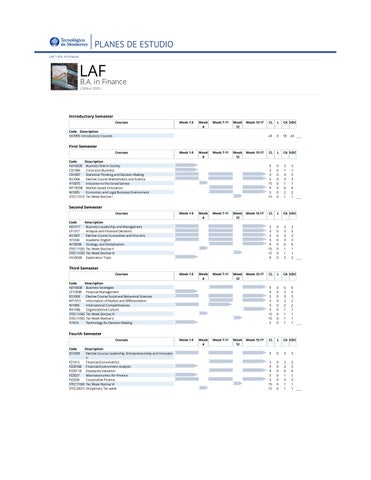
Code Description AD1002B Business Role in Society CD1006 Conscious Business CD1007 Statistical Thinking and Decision Making EG1006 Elective Course Mathematics and Science H1007S Induction to the Social Service MT1003B Market-based Innovation NI1005 Economics and Legal Business Environment STEC1101S Tec Week Elective I
CL L CA UDC 9 3 3 3 15 9 3 15
0 0 0 0 0 0 0 0
3 1 3 3 1 6 2 1
3 1 3 3 1 6 2 1
Second Semester Courses
Week 1-5
Week Week 7-11 Week Week 13-17 6 12
Code Description AD1017 Business Leadership and Management CF1017 Analysis and Financial Decisions EG1007 Elective Course Humanities and Fine Arts HI1034 Academic English NI1003B Strategy and Globalization STEC1102S Tec Week Elective II STEC1103S Tec Week Elective III VA1002B Exploration Topic
CL L CA UDC 3 3 3 3 9 15 15 9
0 0 0 0 0 0 0 0
3 3 3 3 6 1 1 3
3 3 3 3 6 1 1 3
Third Semester Courses
Week 1-5
Week Week 7-11 Week Week 13-17 6 12
Code Description AD1003B Business Strategies CF1003B Financial Management EG1008 Elective Course Social and Behavioral Sciences MT1013 Information of Market and Differentiation NI1006 International Competitiveness RH1006 Organizational Culture STEC1104S Tec Week Elective IV STEC1105S Tec Week Elective V TI1016 Technology for Decision Making
CL L CA UDC 9 9 3 3 3 3 15 15 3
0 0 0 0 0 0 0 0 0
6 3 3 2 2 1 1 1 1
6 3 3 2 2 1 1 1 1
Fourth Semester Courses Code EG1009
Description Elective Course Leadership, Entrepreneurship and Innovatio n FZ1013 Financial Econometrics FZ2010B Financial Environment Analysis FZ2011B Enterprise Valuation FZ2027 Macroeconomics for Finance FZ2028 Corporative Finance STEC1106S Tec Week Elective VI STEC2001S Disciplinary Tec week
Week 1-5
Week Week 7-11 Week Week 13-17 6 12
CL L CA UDC 3
0
3
3
3 9 9 3 3 15 15
0 0 0 0 0 0 0
2 3 6 1 3 1 1
2 3 6 1 3 1 1
Fifth Semester Courses
Week 1-5
Week Week 7-11 Week Week 13-17 6 12
Code Description EG1010 Elective Course Ethics and Citizenship FZ2012B Investment Portfolios FZ2013B International Finance FZ2029 Investments Fundamentals FZ2030 Financial Derivatives FZ2031 Risk Analysis STEC1107S Tec Week Elective VII STEC2002S Professional Life Planning
CL L CA UDC 3 9 9 3 3 3 15 15
0 0 0 0 0 0 0 0
3 6 3 1 2 3 1 1
3 6 3 1 2 3 1 1
Sixth Semester Courses
Week 1-5
Week Week 7-11 Week Week 13-17 6 12
Code Description OP3098 Professional Elective I OP3099 Professional Elective II OP3100 Professional Elective III OP3101 Professional Elective IV OP3102 Professional Elective V OP3103 Professional Elective VI STEC1108S Tec Week Elective VIII STEC1109S Tec Week Elective IX
CL L CA UDC 3 3 3 3 3 3 15 15
0 0 0 0 0 0 0 0
3 3 3 3 3 3 1 1
3 3 3 3 3 3 1 1
Seventh Semester Courses
Week 1-5
Week Week 7-11 Week Week 13-17 6 12
Code Description STEC1110S Tec Week Elective X STEC1111S Tec Week Elective XI VA3117 Elective I VA3118 Elective II VA3119 Elective III VA3120 Elective IV VA3121 Elective V VA3122 Elective VI
CL L CA UDC 15 15 3 3 3 3 3 3
0 0 0 0 0 0 0 0
1 1 3 3 3 3 3 3
1 1 3 3 3 3 3 3
Eighth Semester Courses
Week 1-5
Week Week 7-11 Week Week 13-17 6 12
Code Description FZ3004B Financial Innovation: Risks and Investment OP3013B Elective Multidisciplinary Professional STEC1112S Tec Week Elective XII STEC3001S Strategies and Guides for the Final Degree Exam
18 18 15 15
Academic credits CL L CA UDC
CL L CA UDC
The letter "CL" indicates the number of class-hours per week. The letter "L" indicates the number of laboratory-hours per week. The letters "CA" represents the number of semester credit hour of the course. Load Units
0 0 0 0
12 12 6 6 1 1 1 1
Program and Learning Outcomes Learning Outcomes Students will be able to make the most relevant financial decisions within a company or institution, such as investment strategies, financing, and/or risk management, leading to value creation for stakeholders. Within this managerial framework, students must always align with regulatory frameworks, including the axes of corporate social responsibility and sustainability. Graduate Profile Graduates of the Bachelor's Degree in Finance are prepared to design and manage investment and financing strategies that meet organizational objectives and respond to environmental conditions. They analyze financial and market information to make informed and effective decisions in risk and opportunity management, always within an ethical and responsible framework. The expected knowledge, skills, and attitudes in the curriculum are detailed below: Knowledge: - Design investment and financing strategies that achieve organizational objectives, based on the financial analysis of the company and the environment. - Develop investment strategies in financial markets with a comprehensive perspective that complies with current regulations. - Evaluate the exposure to risks of companies and institutions based on environmental conditions and current regulations. - Diagnose the current business context to build value propositions. - Analyze quantitative and qualitative information by applying mathematical reasoning, financial information concepts, programming techniques, statistical methods, and cutting-edge technological tools. Skills: - Propose the management model of organizations for the creation of shared value under conscious capitalism criteria. - Exchange oral and written messages that enable professional and social development. Attitudes: - Exhibit ethical behavior, based on principles of dignity, integrity, responsibility, and the common good. - Build personal and shared visions of sustainable futures through the analysis of multiple possible scenarios. - Develop conscious opportunities that generate economic, social, and environmental value. - Establish personal judgments or positions in various situations, based on a rigorous evaluation of information. Entry Profile To enter the Bachelor's Degree in Finance curriculum, students must meet a series of minimum requirements such as: Knowledge of basic and exact sciences, fundamental elements of logic, mathematics, and statistics. Basic understanding of research methodologies and techniques, critical reasoning, quantitative analysis, in addition to comprehension of academic readings in English, as well as notions of general culture and history. Skills for critical thinking, observation, and reasoning. Project development and the use of digital and technological tools for information analysis. Capabilities to express ideas clearly and effectively both verbally and in writing. Aptitudes for teamwork and assertive communication, problem-solving, and the use of some computer applications. Logical reasoning, leadership, and constant perseverance and dedication. Talented, enthusiastic individuals committed to the development of their environment and the well-being of society; individuals with the potential to successfully complete their professional careers and become leaders with an entrepreneurial spirit, human sense, and international competitiveness in the financial area and the business environment. Social awareness and understanding of the impact of finance on the sustainability of organizations and the planet.
Program Outcomes Learning Outcomes Students will be able to make the most relevant financial decisions within a company or institution, such as investment strategies, financing, and/or risk management, leading to value creation for stakeholders. Within this managerial framework, students must always align with regulatory frameworks, including the axes of corporate social responsibility and sustainability. Graduate Profile Graduates of the Bachelor's Degree in Finance are prepared to design and manage investment and financing strategies that meet organizational objectives and respond to environmental conditions. They analyze financial and market information to make informed and effective decisions in risk and opportunity management, always within an ethical and responsible framework. The expected knowledge, skills, and attitudes in the curriculum are detailed below: Knowledge: - Design investment and financing strategies that achieve organizational objectives, based on the financial analysis of the company and the environment. - Develop investment strategies in financial markets with a comprehensive perspective that complies with current regulations. - Evaluate the exposure to risks of companies and institutions based on environmental conditions and current regulations. - Diagnose the current business context to build value propositions. - Analyze quantitative and qualitative information by applying mathematical reasoning, financial information concepts, programming techniques, statistical methods, and cutting-edge technological tools. Skills: - Propose the management model of organizations for the creation of shared value under conscious capitalism criteria. - Exchange oral and written messages that enable professional and social development. Attitudes: - Exhibit ethical behavior, based on principles of dignity, integrity, responsibility, and the common good. - Build personal and shared visions of sustainable futures through the analysis of multiple possible scenarios. - Develop conscious opportunities that generate economic, social, and environmental value. - Establish personal judgments or positions in various situations, based on a rigorous evaluation of information. Entry Profile To enter the Bachelor's Degree in Finance curriculum, students must meet a series of minimum requirements such as: Knowledge of basic and exact sciences, fundamental elements of logic, mathematics, and statistics. Basic understanding of research methodologies and techniques, critical reasoning, quantitative analysis, in addition to comprehension of academic readings in English, as well as notions of general culture and history. Skills for critical thinking, observation, and reasoning. Project development and the use of digital and technological tools for information analysis. Capabilities to express ideas clearly and effectively both verbally and in writing. Aptitudes for teamwork and assertive communication, problem-solving, and the use of some computer applications. Logical reasoning, leadership, and constant perseverance and dedication. Talented, enthusiastic individuals committed to the development of their environment and the well-being of society; individuals with the potential to successfully complete their professional careers and become leaders with an entrepreneurial spirit, human sense, and international competitiveness in the financial area and the business environment. Social awareness and understanding of the impact of finance on the sustainability of organizations and the planet.
Undergraduate Code NEG
Name Business / Exploration
Campus that offer this program Campus
Number of periods offered
From
Chihuahua
Complete
Semester Aug - Dec 2026
Ciudad de México
Complete
Semester Feb - Jun 2026
Ciudad Juárez
3
Semester Aug - Dec 2026
Ciudad Obregón
3
Semester Aug - Dec 2026
Cuernavaca
3
Semester Aug - Dec 2026
Estado de México
Complete
Semester Feb - Jun 2026
Guadalajara
Complete
Semester Feb - Jun 2026
Hidalgo
3
Semester Aug - Dec 2026
Laguna
Complete
Semester Aug - Dec 2026
León
Complete
Semester Aug - Dec 2026
Monterrey
Complete
Semester Feb - Jun 2026
Puebla
Complete
Semester Feb - Jun 2026
Querétaro
Complete
Semester Feb - Jun 2026
Saltillo
3
Semester Aug - Dec 2026
San Luis Potosí
Complete
Semester Aug - Dec 2026
Santa Fe
Complete
Semester Feb - Jun 2026
Sinaloa
Complete
Semester Aug - Dec 2026
Sonora Norte
Complete
Semester Aug - Dec 2026
Toluca
3
Semester Aug - Dec 2026
Last update: 24/June/2025
Closed for new students
Graduate Requirements To obtain an undergraduate degree at Tecnológico de Monterrey, the following requirements must be met: 1. Have met, in accordance with the current regulations, the prior academic requirements of the corresponding curriculum, either through the initial assessment or the introductory-level educational units. 2. Have completed all the educational units of the corresponding curriculum, either by passing all the educational units at Tecnológico de Monterrey or by obtaining credit transfers or equivalency agreements in accordance with the corresponding regulations for part of the educational units with studies completed at other institutions and passing the remaining educational units at Tecnológico de Monterrey. 3. Have completed and passed at least 50% of the academic credits that make up the curriculum at Tecnológico de Monterrey. Flexibility in this regulation may be allowed in programs that are established jointly with other universities through an agreement. 4. Have completed the social service requirement in accordance with the prevailing legal provisions and the corresponding social service regulations. 5. Have taken the external exam, authorized by the Office of the Vice Rector for Academic and Educational Innovation, to evaluate the knowledge and skills acquired during the undergraduate program. This requirement applies only to students of undergraduate programs for which such exams exist. The result of this exam will be recorded in the student’s transcript. In programs where such an exam does not exist, students must take comprehensive exams designed for this purpose. This requirement applies only to students of undergraduate programs for which such exams exist. 6. Have demonstrated a B2 level of proficiency in English, referenced to the Common European Framework of Reference (CEFR), in one of the exams authorized by Tecnológico de Monterrey. 7. Have met any additional requirements established in their program and authorized by Tecnológico de Monterrey. The graduate's undergraduate degree certificate will be registered with the Mexican Ministry of Public Education, and they may request the issuance of the professional license for professional practice in Mexico. The validity of the degree or professional license in other countries requires compliance with additional governmental or institutional requirements.