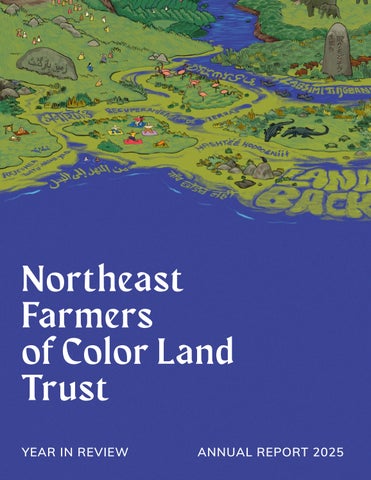
Northeast Farmers of Color Land Trust YEAR IN REVIEW
ANNUAL REPORT 2025
1 NEFOC Annual Report
Contents Cover Page Illustration “We Wept to be Reminded of Such Color” by Juan Carlos Franco
We Wept to be Reminded of Such Color
03
Remembering Unci Beverly Little Thunder
04
Mission and Wraparound Approach
06
Our Team
07
Sibling & Allied Partners
09
2025 Organizational Highlights Grow Food Northampton x NEFOC House and Farmland Kondolo Family Farm New Suns Community Center NEFOC Network Gathering Mutual Roots Fund LAND Project Grant Federal and State Policy Year in Review Coalition Corner: Black Farmer Ecosystem Liberating Investment in the Food & Farm Eco system (LIFE) HEAL Food Alliance Northeast Climate Disaster Relief Alliance
11
Gratitude & Acknowledgements
23, 26
Where We’ve Been
25
Financial Statements
27
Dog Eared Page: “Racism and Fascism” by Toni Morrison
28
2
NEFOC Annual Report
3
— TRACY K. SMITH
This past year highlighted the fragility and harm that our structural systems are built upon, and the enduring resilience of our frontline communities in building solutions in real time to meet the moment. As our frameworks of governance show their fractures, we recognize that these broken structures are not new wounds; they represent the continuation of long histories of dispossession, inequity, and extraction. Yet as we navigate the unsettling shifting tides, our commitment at the Northeast Farmers of Color Land Trust remains clear. We are devoted to the sovereignty of the land itself, the thriving of our more-than-human relatives, and the health of our communities of farmers, land stewards, and earth workers who are enacting a food future rooted in the vitality of all of our relations. In these troubling times, the work of NEFOC has been to move in concert with our comrades, collaborators, and sibling organizations; to listen deeply, build coalitions of care and solidarity, and to act strategically with placebased intention. Each seed planted, each acre reclaimed into Indigenous and PoC stewardship, and each relationship nurtured in 2025 are part of a wider
vision of food and land sovereignty across the Northeast. This vision is our roadmap to resistance, an affirmation of our collective abundance and possibility. These times are a reminder that we can’t solely fight for the future we want, we have to be actively modeling that future in the now. As the seasons turn, we look to the cycles of decay and renewal as our guides. We honor the departing of migrating birds, the slow freeze of the soil, and the persistence of wild medicines breaking through hardened ground. These moments remind us that even in the most unsettling seasons, transformation is always underway, our resilience inherent, and joy itself a radical remedy for the times we face. To everyone who has walked with us this year, who has offered time, collaboration, resources, energy, and care, we extend deep gratitude. Together, we are seeding futures of liberation, strengthening the power of WE, and tending to the Land in defiance of despair. May this peek into our year in review be both a reflection of what has been accomplished and an invitation to continue imagining and building with us.
With Care,
All of Us at NEFOC-LT
NEFOC Annual Report
A Letter From NEFOC-LT
Remembering Unci Beverly Little Thunder With deep reverence and love, we honor the life of Beverly Little Thunder (Unci, Lakota for “Grandmother”), one of NEFOC’s spiritual elders and beloved board members, as she walks with the ancestors. Bev was our ethical and spiritual anchor, a keeper of ceremony whose presence returned us to right relationship with one another, the Land, and all our relatives. I don’t remember when I first met Bev. She was simply there, like the ancient mountains of N’dakinna she called home, steady, rooted, offering shelter. I had been seeking an Indigenous woman who could hold sweats in a good way; not only did I find that, but I found a sister-auntie, an elder who lived reciprocity, responsibility, and fierce love. Bev showed up when others could not, often at the expense of her own comfort, tending the soil of our spirits so more life could take root after her. Bev guided our board and our hearts as only a true elder can. She took great joy when she could, and especially when we were able to claim space as queer Indigenous women. At our We The Land gathering, I can still see her clapping at the dance party, savoring a Negroni, body swaying until joy and exertion became one. Her laughter was a teaching: love and connection are the ground of transformation. Even this past summer at Kunsi Keya Tamakoce, the land she and her family steward, her light outshone pain. Her love for life, her people, all creatures of the land, and the Earth herself was undeniable and generous. Bev was fierce. She walked brilliantly in two worlds, ceremony and the everyday, and she refused to let the doorway to Spirit be narrower than our peoples. She evolved ceremony with courage, opening the Sundance arbor to women and Two Spirit people who had been kept outside the circle. She knew the risks, including to her safety and her life, and she did it anyway. She carried the responsibility to make
a path where there had been none, to protect those who entered, and to keep the fire when the winds rose. Founding the first Women’s and Two Spirit Sundance, where she was finally welcomed, is only one way she transformed the world by being unapologetically herself. Bev taught that ceremony is living, not a museum piece- that our ways, like our people, must breathe, grow, and make room for all our relations. Bev was a seed, and encoded within her were the instructions: Advocate. Live fiercely. Live free. Love all. Laugh often. Sweat. Dance. Drum. Sing. Build the world your children’s children’s children deserve. Get into good trouble. Repeat. The proof of her life’s impact is living all around us: her visionary daughter, Lushanya; her loving wife, Pam; the sacred land of Kunsi Keya; and the many communities now carrying her teachings seven generations forward. We will feel Bev’s absence keenly on this side of Sky World. And we take comfort knowing her ancestors- and all her beloved animal companions- welcome her home. Her spirit moves through us still, urging us to keep building, loving, and risking for the world she dreamed. We honor the grief and courage of Bev’s family, her wife, Pam; her daughter, Lushanya; and the entire Kunsi Keya collective. They invite support in all the good ways: letters, prayers, tending the Land, and a steadfast commitment to carry her vision forward. As we mourn Unci Bev, let us gather in gratitude and responsibility. In her journey, she reminded us: Mitakuye Oyasin. We are all related. We are all called to continue her work. May our spirits, like hers, come to the Great Spirit one day “without shame.” Until then, may we sweat, dance, drum, and keep building the world Bev imagined for us all.
— STEPHANIE MORNINGSTAR
4
NEFOC Annual Report
5
NEFOC Annual Report
Mission & Wraparound Approach
— FA N N IE LOU HAMER
MISSION
APPROACH
NETWORK
NEFOC’s mission is to return land to Indigenous, Black, refugee, migrant, and diasporic land stewards of color as a means of advancing food sovereignty, healing, cultural celebration, and community self-determination. We work to dismantle systemic barriers to land access through land rematriation, cooperative stewardship, and transformative policy change, ensuring that land remains in the care of those who cultivate deep, reciprocal relationships with it.
Our wraparound approach weaves together technical assistance for our land projects and network, education and knowledge mobilization, policy advocacy, and reciprocal relationships to create interconnected pathways to land access and long-term success for farmers and land stewards. Like a living ecosystem, these strategies reinforce and sustain one another, ensuring that every avenue leading to land security is uplifted and centered.
At the heart of NEFOC is our Network, an alliance of over 700 farmers and land stewards across the Northeast, who are reclaiming and redefining what it means to steward land in a way that is rooted in justice, kinship, and intergenerational care. Together, we are building a future of food and land sovereignty in the Northeast— one where regenerative farming, sustainable human habitat, ceremony, ecosystem restoration, climate resilience, and cultural traditions thrive. By addressing the root causes of land access challenges, we foster selfsufficient communities that generate and share knowledge, ensuring that land stewardship is not just an individual pursuit but a collective and enduring movement.
6
NEFOC Annual Report
7
OUR 2025 BOARD
— ME RLI N SH E LD RA K E
NEFOC Annual Report
Our Team
Astrid Castillo She/Her Relationships and Reciprocity Program Coordinator
Christine Hutchinson She/Her Black Land Stewardship Cultivation Program CoDirector
Iyeshima Harris She/Her Black Land Stewardship Cultivation Program Coordinator
Kenya Lazuli She/They Co-Director of Reparations Program
Larisa “Lala” Jacobson All Climate Justice & Advocacy Co-Director
Mandana Boushee She/Her Communications Manager, Relationships & Reciprocity Program
Robert Chang He/Him Policy & Advocacy Program Co-Director
Shingai Kagunda She/They Reparations Program Writer in Residence & Literary Curator
Stephanie Morningstar She/Her Executive Director, Relationships & Reciprocity Program Co-Director
Beverly Little Thunder
Jason Corwin, Phd
Leonardo Figueroa Helland, Phd
Onika Abraham Lee
She/Her
He/Him
He/Him/le’el/el
She/Her
10,000+
17,000
Via Instagram & Facebook
A Year
5,000
800
To Our Seasonal Newsletter
And Counting!
Followers
Subscriptions
64
Partnerships With First Nations, Black, Latinx, Asian, PoC Organizations & Allied Partners
$10,000,000
Bond Funding Advocated for farm land access for beginning farmers in CT
$150,000 Awarded
Website Visits
Network Members
10
Congressional & Senate Representatives Met with in Washington D.C.
$24,800 Distributed
Through our Mutual Roots Fund
Through our LAND Project Grant Program
$30,000 Redistributed
Through Black Farmer Ecosystem to four Black-led farms in NY
$4,500+ Awarded
in funding for eight farmers’ attendance at the 2025 BUGS conference in Detroit, Michigan
10,000
25
via conferences, events, & workshops in person 8virtual and NEFOC Annual Report
Across Turtle Island
Engagements
Conferences
NEFOC Annual Report
“We Wept to be Reminded of Such Color” by Juan Carlos Franco, Full size 24”x36”
9
Sibling Partners
Allied Partners
ALIZANA AGRICOLA
BERKSHIRE AG VENTURES
BLACK AND ARAB MIGRANT SOLIDARITY ALLIANCE
BOSTON COLLEGE LAW SCHOOL CLINIC
BLACK DIRT FARM COLLECTIVE
BUILDING TRUST
BLACK FARMER FUND
COOPERATIVE DEVELOPMENT INSTITUTE
BLACK FARMERS UNITED OF NEW YORK STATE
COOPERATIVE FOUNDERS OF THE NORTHEAST
BLACK YARD FARM
CORNELL SMALL FARMS PROGRAM
BRAIDING SEEDS FELLOWSHIP
ELMINA B. SEWALL FOUNDATION
BUFFALO GO GREEN URBAN FRUITS & VEGGIES
FARM AID
CATALYST COLLABORATIVE FARM
GLYNWOOD
CONSCIOUS HOMESTEAD VT
GROW FOOD NORTHAMPTON
CORBIN HILL FOOD PROJECT
HARVARD LAW TRANSACTIONAL CLINIC
CT BIPOC FOOD NETWORK
HARVARD CYBER LAW CLINIC
CULTIVEMOS
NATIONAL YOUNG FARMERS COALITION
FARM SCHOOL NYC
NEW SCHOOL - TISHMAN ENVIRONMENT & DESIGN CENTER
FIELD MERIDIENS FINCA LUNA BÚHO FOOD FOR THE SPIRIT GRASSROOTS GARDENS HEAL FOOD ALLIANCE HERBAN CURA KUNSIKEYA TAMAKOCE LAND IN BLACK HANDS LIBERATING INVESTMENT IN THE FOOD & FARM ECOSYSTEM LIBERATION ECOSYSTEM MIGRANT JUSTICE VT MOON AND STARS VT NATIONAL BLACK FOOD AND JUSTICE ALLIANCE NATIVE AMERICAN COMMUNITY SERVICES (BUFFALO) NATIVE AMERICAN FOOD SOVEREIGNTY ALLIANCE NATIVE LAND CONSERVANCY OPERATION SPRING PLANT THE RUCKUS SOCIETY SENECA LAND CONSERVANCY SOUL FIRE FARM UPROOTED AND RISING WILDSEED COMMUNITY FARM AND HEALING VILLAGE WILLOW PREC WOVEN ROOTS FARM 10
NEFOC Annual Report
NOFA-NY NOFA-VT NORTHEAST CLIMATE DISASTER RELIEF ALLIANCE NOVO FOUNDATION PACE LAW SCHOOL FOOD & BEVERAGE CLINIC PASA SUSTAINABLE AGRICULTURE RAFI-USA SEEDING POWER VERMONT VERMONT LAND TRUST VERMONT LAW SCHOOL CENTER FOR AGRICULTURE AND FOOD SYSTEMS WESTERN NY LAND CONSERVANCY WHY HUNGER WORLD FARMERS
11 NEFOC Annual Report
— T H ICH N H AT HANH
Organizational Highlights Grow Food Northampton x NEFOC House & Farmland
12
Kondolo Family Farm
13
New Suns Community Center
14
NEFOC Network Gathering
15
Mutual Roots Fund
16
LAND Project Grant
17
Federal & State Policy Year In Review
17
Coalition Corner
19
Black Farmer Ecosystem Liberating Investment in the Food & Farm Ecosystem (LIFE) HEAL Food Alliance Northeast Climate Disaster Relief Alliance
L AND PROJ E CT S P OTLIGH T
O RG A N I ZAT I O N A L HIG HL IG HTS
2025
Grow Food Northampton x NEFOC House and Farmland
The Northeast Farmers of Color Land Trust, in collaboration with Grow Food Northampton (GFN), is thrilled to spotlight our latest land project located in Western Massachusetts on site at GFN. This effort addresses a pressing need: farmers, particularly those from communities strategically marginalized by the mainstream food and farming system, face major barriers in securing both affordable housing and farmland. Extremely unaffordable housing combined with minimal farm income, means most of the farmers who lease land on Grow Food Northampton’s Community Farm can’t afford to live near their leased land and have to commute considerable distances. By pairing farmland with housing access, this project offers a powerful model for food sovereignty, the fair housing movement, and land justice. Following a rigorous application and review process, the Land Matching
12
NEFOC Annual Report
Committee, consisting of representatives from both GFN and NEFOC-LT, selected Aoma Muma, an experienced and culturally rooted farmer for his demonstrated farming experience, entrepreneurial growth, and commitment to community well-being. Originally from Kenya, Muma comes from a lineage of small-scale farmers and began his U.S. farming journey growing vegetables simply to feed his family. In 2011, he joined the World Farmers program in Lancaster, MA, and steadily grew his operation from a small family plot to a 19-acre commercial enterprise. Today, Muma owns and operates Bombeta Farms, with a strong presence in both wholesale and farmers markets across eastern MA. Muma specializes in growing culturally significant vegetables such as amaranth, chinsaga, and managu, in addition to Asian and Japanese crops and locally common vegetables and
pumpkins. “It’s very important that people can get these ethnic crops grown locally,” says Muma. “That way, families can keep their culture alive and teach the next generation the important food traditions that make them unique.” Beyond production, Muma is deeply engaged in mentorship and peer learning. He credits an elder Hmong farmer as a pivotal influence and has since taken on a mentorship role himself, supporting other growers in navigating the farming landscape in Massachusetts. This initiative reflects Grow Food Northampton and NEFOC’s shared vision for equitable land access and resilient food systems. By pairing land and housing, this collaborative effort sets a precedent for how communities can address both the farmland access and housing crises, while uplifting farmers of color as essential leaders in our agricultural future.
13
L AND P ROJ E CT S P OTLIGH T
2025
Kondolo Family Farm
The acquisition of Common Roots Farm- now Kondolo Family Farm- marks a deeply personal and transformative moment for NEFOC and for Buffalo’s East Side. This 66,000-square-foot urban farm is more than land coming under community care- it’s a homecoming. In soil once shaped by neglect and systemic disinvestment, we are now planting seeds of sovereignty, healing, and renewal. Located in the Broadway-Fillmore district, the farm has been quietly transforming both land and community since 2012. Founded by Josh Poodry and Terra Dumas of the Farmer Pirates Compost Cooperative, it began as an act of faith- an experiment in what could grow when care replaced abandonment. Over the years, it has become a living classroom for sustainable urban agriculture in one of Buffalo’s most foodinsecure neighborhoods. The infrastructure tells a story of persistence and love: a deep well with five irrigation zones, a covered wash station and cold storage, fruit trees and grapevines winding alongside herbs and vegetables nurtured by compost and organic amendments. What was once a vacant lot is now alive with possibility- a reminder that regeneration begins at the roots. This farm sits only a few blocks
from NEFOC’s Executive Director’s grandparents’ home, the neighborhood that gave her family life. Stephanie’s earliest memories are of this place: the sidewalks where she played with her cousins, the corner stores that once hummed with community, the catalpa, tree of heaven and horse chestnuts providing shade. Stephanie made a promise to do right by this neighborhoodto give back to the land and the people who made her life possible. Kondolo Family Farm is one way of keeping that promise. It represents what can happen when we return home not just to visit, but to repair, to restore, and to root ourselves in responsibility. In 2025, we leased the farm to Kondolo Mkongo, a Somali Bantu farmer who came to us through Providence Farm Collective. For years, Kondolo and many other New American farmers had to travel long distances to rural areas to tend their crops. Now, he can walk from his home, just a few blocks away, to his own farm. This proximity matters. It means that farming is no longer something that takes him away from his community, but something that strengthens it. Kondolo is signing a 99-year inheritable lease, ensuring permanent and secure land tenure for him and his family. This lease is a cornerstone of
NEFOC’s vision: to create pathways for BIPOC farmers to own and steward land across generations without fear of displacement. It’s a model of liberation through rootedness- proof that justice can look like staying. Through our partnership with Providence Farm Collective, Kondolo Family Farm will remain in community control under NEFOC’s Reciprocity Commons model- a way of holding land that honors Indigenous sovereignty while ensuring access and equity for Black and Brown farmers. NEFOC will also maintain portions of the land for communitybased agroforestry, bioremediation, and education projects that further restore relationship between people and place. As Buffalo becomes recognized as a potential “climate haven,” Kondolo Family Farm shows how food justice, climate resilience, and cultural repair can take root together. For a community still healing from violence and decades of neglect, this farm represents more than fresh food- it’s a restoration of dignity and belonging. Kondolo Family Farm is a promise kept—to Stephanie’s family, to this neighborhood, and to the land itself. It stands as living proof that even in places long written off, something beautiful and life-giving can still grow, and endure for generations to come.
NEFOC Annual Report
O RG A N I ZAT IONAL HIG HL IG HTS
L AND PROJ E CT S P OTLIGH T
O RG A N I ZAT I O N A L HIG HL IG HTS
2025
New Suns Community Center
"The Fall Festival was an affirmation of our most deeply held community values. People came from near and far to be in each other's presence, share food, stories, music, and laughter without reservation. It was a joy and privilege to participate, and I was grateful that this was happening in my town. My family looks forward to next year!" — GE O RGE LE U N G - T H E T FO R D, V T The New Suns Community Center continues to offer resources to the community through fostering inclusive space, creating liberatory programming and offering tools and resources at no cost to folks of Color in Vermont. Our Liberation Library was home to more dynamic programming than ever in 2025. We facilitated a series of reading groups; in an effort to encourage participants to think critically about political education, the role of literature in freedom movements, and our collective responsibility to centering the margins as the political climate feels more and more hostile. We chose Afrofuturist titles such as Octavia Butler’s Parable of the Sower, and Rasheedah Phillips’ Dismantling the Master’s Clock to do a deep dive into how both history and imagination teach us to survive. The Liberation Library hosted our annual Black Futures Month programming in February, including writing workshops, poetry, and Black liberation film discussions. The programming made it possible for Black
14
NEFOC Annual Report
folks in Vermont to dream, imagine, and plan for a world rooted in abolition and mutual aid. Our partnership with Vermont Village School, who work to reimagine school as a liberatory space for people of color, has been especially powerful in the past year. We started the year off by hosting a Lunar New Year’s festival, complete with dragon dance lessons and traditional foods. Later in the year our collaboration made political education accessible for youth of color in our local communities, and especially in the Upper Valley of VT and NH. The Liberation Library facilitated a middle-grade summer reading group, exploring how we name the ‘other’, how we heal our own feelings of un-belonging, and ways we fight oppressive systems as a collective. Utilizing our library facilities, Vermont Village school was also able to host a People’s Curriculum Study that yielded discussions around alternative education models that center Indigenous knowledge of the land and the environment. This year’s Fall Festival marked
our third annual event at New Suns Community Center. We were blessed with a gorgeous sunny day over the autumn equinox weekend in September of this year. This season’s celebration was a collaboration between our team and Liberation Ecosystem. We welcomed local makers, artisans, crafters and growers at our vendors market, which included arepas and empanadas from Moon and Stars VT, who partner with like-minded small farms & markets to source ethically-grown produce, and co-create a thriving, multicultural and just local food system. Throughout the afternoon, we hosted classes in basket-weaving and seasonal pastry-making; as well as Baguazhang: The Art of Change, facilitated by George Leung of Upper Valley Martial Arts, who is our neighbor in Thetford. We ended the day with a delicious Jamaican meal by K & P Catering and live music by Acqua Mossa, a Vermont-grown trio who offered a magical and intimate outdoor performance!
15
2025
NEFOC Network Gathering & Benefit
“What a beautiful moment we shared together, honoring the life of a hero. It was a true honor to attend the event. Yousef ’s work will be remembered for generations to come. We must continue to keep his light on.” — M AYRA R. On a beautiful day in October, in collaboration with Woven Roots Farm and Finca Luna Búho, we gathered together at Woven Roots Farm to celebrate the harvest season and community- bringing together farmers and folks working within the food systems network in the region. The night was also a benefit to honor the life and legacy of martyred Gazan farmer Yousef Abu Rabee-to learn about his story, the food sovereignty project he initiated that single handedly broke the siege of starvation in Northern Gaza, and the
work that is being done in his legacy and for the future of Palestine’s food and land sovereignty. The evening was an intergenerational, multi-cultural event, bridging together everyone from babies to elders, spanning from Turtle Island to Palestine and beyond, where we shared in a delicious Ghazzawi meal lovingly prepared by chef Samah Nijim, and ended the night spinning all on our grief on the dance floor with beats by DJ Akbar. The gathering was a reminder of how powerful it is to gather, share in food,
learning, remembrance, grief, and dance in the face of despair and as an act of defiance. We hold so much gratitude to Yousef, who in response to the horrible atrocities his family, his village, and his people have endured and are enduring at the hands of the occupation, time and time again, choose to turn towards each other, the plants, the land, and healing. Yousef’s response was always to grow food, to feed his people, and to lead with a lion’s heart. We have much to learn from Yousef’s legacy.
NEFOC Annual Report
O RG A N I ZAT IONAL HIG HL IG HTS
O RG A N I ZAT I O N A L HIG HL IG HTS
2025
Mutual Roots Fund
The Mutual Roots Fund supports agriculture oriented, joy centered gatherings that deepen relationships, encourage knowledge exchange, and build collective momentum for mutual aid, healing, and liberation among NEFOC members. The Mutual Roots Fund is considered the foundational stage of NEFOC’s “Farmer Pathway”, a way for members to connect, collaborate, and share practices before accessing larger opportunities such as land access or infrastructure support. In 2025, the Mutual Roots Fund distributed $24,800 across 12 community-led gatherings, each receiving $2,000 to bring their visions to life. Spanning urban, rural, and coastal communities from Connecticut to Maryland, New York, New Jersey, Massachusetts, and Maine, these events reached a wide range of
16
NEFOC Annual Report
people through celebrations, wellness retreats, cultural festivals, and strategy building sessions. Collectively, the gatherings uplifted Black, Indigenous, Afro-diasporic, and QTBIPOC land stewards, farmers, veterans, artists, and families by centering healing, joy, and collective resilience. Through shared meals, music, storytelling, and workshops, the fund helped support intergenerational knowledge exchange, food justice, cooperative economics, and deeper relationships to land and water. Highlights included healing centered gatherings like Healing by Growing Farms’ Healing Harvest Tasting & Farm Swap in Connecticut and Roots and Renaissance in Massachusetts; cultural celebrations such as Liberation Table in New York and the Afro-Diasporic Ocean
Festival in Far Rockaway; and wellness-focused events like A Day of Joy – Veteran Wellness Gathering in Maine. Other projects like Rooted in Joy in Maryland, Rooted in Reverence in Newark, and the Connecticut Farmer’s Festival, strengthened community ties through reflection, food, and intergenerational exchange. Visioning and outreach initiatives, including “A Vanderful Life” sessions and “Together We Own It” Market Day, advanced cooperative strategies and food justice for QTBIPOC and local communities. Collectively, these gatherings deepened relationships with the land, honored ancestral knowledge, and cultivated spaces of joy, liberation, and mutual care across the region.
17
O RG A N I ZAT IONAL HIG HL IG HTS
2025
The LAND Project Grant Program is a New York State initiative that expands access to capital, farmland, infrastructure, and technical assistance for socially and economically disadvantaged farmers. Through multiple funding tiers, the program meets a range of needs and scales of operation. By reducing barriers to entry, the LAND Project supports equitable participation in agriculture and strengthens the resilience of New York’s food and farm systems. Program guidelines around outreach, RFPs, and funding amounts were informed by members of our Community Committee, including an advisory board of five New York State farmers. Through Tier 1, Round 1, we have awarded $150,000 in grants to date, supporting 30 farmers with $5,000 each. The program will continue to distribute over $4 million in total funding across future tiers. Impact of Funded Projects in Tier 1 include:
•
To meet demand for African maize, a farmer purchased an electric sheller and mill, building toward independent maize processing and land expansion.
•
A grower launched a medicinal herb and spice business rooted in Indigenous knowledge. They plan to build a learning farm with workshops, greenhouses, and educational outreach.
•
A kimchi producer transitioned to ceramic fermentation vessels to enhance traditional production and reach institutional buyers.
•
•
A seed grower purchased an electric bean thresher and cleaning supplies to improve labor efficiency and meet larger seed contracts.
A farmer restored a vineyard to produce organic wine grapes. Funds will support trellising, soil inputs, and consulting for long-term vineyard health.
•
•
After losing access to shared infrastructure, one farm sought to replace critical high tunnel growing space.
A poultry farmer invested in durable chicken tractors and processing supplies to scale a growing halal chicken business.
•
A beekeeping farm registered its business and grew its hive count to 200, improving production with upgraded equipment
O RG A N I ZAT IONAL HIG HL IG HTS
2025
Federal and State Policy Year in Review 2025 has been an extremely challenging year for farmers and non-profit organizations who support and advocate on their behalf. We did not anticipate the speed, breadth and depth of the collapse in federal funding and programming that we have experienced since January. The impact of the assault on programs related to Diversity, Equity and Inclusion, to nutrition and health programs for farmers and their lower income customers, to programs incentivizing climate smart agricultural practices has been nothing short of devastating. Fortunately, NEFOC has not suffered as greatly as our sibling organizations and other collaborators, some of whom have had to lay off a number of their staff and cease some of their operations. The farmers in our network have been buffeted by major cuts to federal programs.
The abrupt freeze in payments from USDA to farmers who had active contracts to participate in USDA incentive/cost share programs not only disrupted plans for crops and infrastructure investment, but seriously eroded the trust farmers had in USDA. For BIPOC farmers who have suffered decades of discrimination from USDA and other federal agencies, this discourages them from participating in federal programs funded by their own tax dollars. In March, USDA canceled the Local Food Purchase Assistance Program and the Local Food for Schools Program. A lot of our farmers were depending on these programs to fund the sale of their produce to local food pantries and school districts, and were scrambling to find new markets for crops they had just sown from seed. Then, the USDA began terminating new hired staff, some of whom
were rehired. But in the chaos and sudden loss of job security, a lot of USDA staff opted for the buyout and voluntarily resigned. This included staff in local USDA offices – the loan officers, soil scientists, engineers and conservations specialists who meet with farmers and assist them with mortgages, operating loans, and soil, water and energy management and conservation programs. Some local USDA offices have lost 30% or more of their staff. For beginning farmers with limited capital, this loss of access to important programs and funding can set back the successful establishment and expansion of their businesses for years. In the summer, Congress passed the Big Beautiful Bill Act which slashed funding for food assistance programs, harming our farmers’ ability to feed lower income members of their Continued On Page 18...
NEFOC Annual Report
LAND Project Grant
Continued From Page 17... community, while slashing funding for Medicaid, which some of our farmers depend on for their own health insurance. The law also increased funding for immigration enforcement, ramping up the persecution of farm workers of color, undocumented or not. Lastly, the law did provide some significant assistance to large farm corporations, decoupling the traditional link between farmer programs and nutrition programs in the federal Farm Bill, and making it less likely that a long overdue Farm Bill will be passed before the next election in 2026. In response, NEFOC has been a regular participant in a coalition of other non-profits in agriculture who have been meeting almost weekly since this crisis began. This coalition was started by Dania Davy (formerly of the Federation of Southern Cooperatives and now of Land & Liberation LLC) and is now chaired by staff at Red Clover Collaborative. In this coalition, we share important information with collaborators, sibling organizations and other allies about federal actions and statements regarding the funding for our collective work. The coalition has also worked with lawyers and organizations who are suing the administration to stop the illegal abrogation of active contracts and Congressionally approved funding by the President’s executive orders. We have gathered stories on the impact of these federal cuts on farmers, and strategized how to advocate to the administration and Congress to stop these actions. NEFOC’s Policy Director traveled twice
18
NEFOC Annual Report
to Washington DC to attend briefings by USDA and Congressional leadership, and have met with Congressional and Senate representatives and staff from nearly every state in New England. In these meetings, we have shared the impacts of federal program cuts on small scale and beginning farmers in our region. Senators and Representatives continue to hear that BIPOC farmers are harmed by the actions of this administration and that these farmers want Congress to act to protect important programs. NEFOC has also worked to educate the farmers in our network about these cuts to funding and provide some guidance on how to navigate the changing landscape of federal support and the economy overall. Even small scale and beginning farms are not immune to the on-again/off-again tariffs, the rise in the costs of inputs like plants, fertilizers, supplies and equipment, and the weakening of consumer confidence at our markets. For farmers with little capital and infrastructure, it is challenging to build resilience by purchasing and stockpiling equipment and supplies in advance when prices may be lower. Therefore, it is critical to make contingency plans based on accurate information and forecasts. We continue to experience an information environment replete with misinformation, rumor, fear, uncertainty and doubt. As a result, NEFOC has shared verifiable, accurate information about federal actions to our farmers so they can make important decisions about their farms based on facts.
The regression of federal farm policy has renewed interest in state level farm policy. The states in our region continue to operate with budgetary constraints and are limited in their ability to fill all the gaps created by the losses in federal funding. But there are still opportunities for significant progress. NEFOC has participated in a coalition on Heirs Property Rights led by Professor Thomas Mitchell of the Initiative on Land, Housing and Property Rights at Boston College Law School. This coalition has been working to pass the Uniform Partition of Heirs Property Act in Massachusetts for several years. New efforts to pass this law are now making progress in Pennsylvania and Rhode Island, but we can celebrate that the law finally passed in New Jersey this summer. NEFOC continues to participate in coalitions in Connecticut, Massachusetts and Rhode Island to help new and beginning farmers get long term access to good quality farmland. These states have the most expensive farm land in the nation, and with the decline in farming in these states, farm land remains under grave threat of development for non agricultural uses. After years of advocacy, discussion, and negotiation with the CT Department of Agriculture and leaders in the CT General Assembly, CT passed a bond bill that aims to provide $10 million in funding for programs to increase affordable farm land access for new and beginning farmers. By itself, this funding will not solve all of the obstacles beginning farmers face in establishing successful farm businesses in CT, but it represents a significant investment in the future of farming in the state, and an opportunity for BIPOC farmers to acquire farm land by leveraging existing conservation easement programs and new instruments like Buy, Protect, Sell and the Option to Purchase at Agricultural Value. In a year where we have seen the assaults and roll back of nearly a century of progress at the federal level, it is gratifying to see some improvements for farmers at the state level. The farmers in our network continue to face tough challenges to access quality and affordable farm land, to build sustainable and economically viable businesses, and to feed their communities. NEFOC will continue to help farmers navigate these obstacles so that they can contribute to a stronger, healthier, more resilient local food system.
The Ecosystem has embarked on joining in Corbin Hill Food Project’s bold response to realizing a Black-owned, regional supply chain throughout New York State. The working name, “Storefront,” is the Ecosystem’s non-profit market project. More than a grocery store–it is a communitydriven market and gathering hub located at 140th x Frederick Douglass Boulevard in Harlem, New York. The Storefront is a sovereign intervention; a living, breathing ecosystem built to nourish bodies and the land, circulate capital, restore ancestral foodways, and innovate a food system led by Black farmers, for Black communities. However, it is not an experiment. It is a culmination of our broader food sovereignty movement spearheaded by us and for us, and proof that a Black food future is not only possible, it’s already underway. Whether it’s growing, aggregation, value-add production, or distribution, our Black food future is one that is rooted in legacy and built for longevity. One that listens, heals, and uplifts. One where the most historically disenfranchised farmers own their place in the market and the system itself.
In 2025, NEFOC remained deeply committed to continuing our partnership with the Black Farmer Ecosystem. Along with partner organizations Black Farmer Fund, Black Farmers United – NYS, Corbin Hill Food Project, and Soul Fire Farm, the Ecosystem provides unique but complementary services – including culturally-rich, climate-smart agricultural training; ethical, equitable land access; patient, blended investment capital; and collective, expansive marketing support.
NEFOC Annual Report
A Storefront in Harlem
19
Black Farmer Ecosystem
COAL I TI ON COR N ER
The Ecosystem’s BUGS Scholarship Over the past two years, the Ecosystem has provided 15 scholarships for Black farmers, leaders, and visionaries based in New York State to attend the annual Black Farmers & Urban Gardeners Conference – referred to as BUGS. Thanks to Ecosystem funders like the Solidaire Network, in 2025 the Ecosystem shifted to a public scholarship. NEFOC heavily contributed to the establishment of the inaugural program, and we awarded over $4,500 in funding for eight farmers’ attendance at the 2025 BUGS Conference in Detroit, Michigan. BUGS has served as a life-affirming, community-stewarded space for Black farmers nationally since its establishment in 2010. The conference has been a valuable investment for farmers’ personal development and strengthening New York State’s broader, regional Black farming and agriculture movement. Our constituents have expressed benefitting from the networking opportunities, workshops, and collaborative environment that BUGS offers. Even more so, it’s a platform to share their mutual passion and unique approaches to farming – equally inspiring our peers.
emPower Fund NEFOC continues to participate in the development and rollout of the emPower Fund, a redistributive fund launched in 2024 in collaboration with Professor Myles Lennon at Brown University. The emPower Fund is intended to support activities and projects that strengthen the work of New York’s emergent Black-led farms, food businesses and food sovereignty efforts and to document lessons learned and best practices that emerge from this effort. In 2024, the Ecosystem redistributed $30,000 to four Black-led farms in New York, and will allocate the next round in 2026.
COA LI TI O N CO RNE R
“L.I.F.E.”
Liberating Investment in the Food & Farm Ecosystem
Strengthening Food Justice Through Partnership: NEFOC’S Collaboration with LIFE The Northeast Farmers of Color Land Trust (NEFOC) is a proud member of the Liberating Investment in the Food & Farm Ecosystem (LIFE) collective- a network of movement-rooted organizations transforming how resources move through food systems. Together, LIFE partners are building an ecosystem of trust and accountability that challenges philanthropy to return to its original purpose: to serve life, not control it.
SAFSF Funders Dinner: Building CommunityControlled Alternatives
Farm Aid Funder Luncheon: Bridging Movements and Philanthropy
In June 2025, NEFOC joined LIFE partners to host the Sustainable Agriculture and Food Systems Funders (SAFSF) dinner, a gathering that brought funders and frontline organizers together to explore what true communitycontrolled funding can look like. Held in a lively and intentional setting, the dinner invited deep listening and honest dialogue about power, accountability, and the values guiding resource distribution. Through visual storytelling and facilitated conversations, participants examined the continuum between extractive philanthropy and community-led models grounded in solidarity and self-determination. The event’s core message was clear: stay rooted in racial justice, be accountable to the frontlines, not the headlines, and organize toward a world beyond traditional philanthropy. The dinner deepened relationships with funder allies ready to shift their practices, while also illuminating how different stakeholders understand, and sometimes resist, redistribution of power and resources.
In September 2025, LIFE and NEFOC cohosted a funder luncheon during Farm Aid’s pre-festival events- a historic first step in connecting philanthropic institutions with the grassroots movement for family farmers. Farm Aid was born out of the 1980s farm crisis, a moment when small family farmers were left behind by the very systems meant to sustain them. Today, the organization continues to bring thousands together in celebration and solidarity, yet institutional philanthropy has only recently begun engaging with this community. The lunch offered an entry point for funders to build authentic relationships with movement leaders. Shorlette Ammons, CoExecutive Director of Farm Aid, Leslie Hatfield of Grace Communications, Shantell Bingham, LIFE Co-ED, and NEFOC’s ED Stephanie Morningstar each shared reflections on the interconnected struggles and triumphs of farmers across the country, emphasizing that while BIPOC farmers face ongoing structural barriers, the current crisis extends beyond identity—it is an assault on the entire web of life and all who work to sustain it.
20
NEFOC Annual Report
June LIFE Retreat: Strategic Funder Organizing Following the SAFSF event, NEFOC participated in LIFE’s in-person organizing retreat in Albuquerque, where twelve core organizations gathered to reflect, strategize, and plan for the year ahead. Together, participants mapped out a shared approach to funder engagement, preparing for SAFSF 2026, developing internal learning sessions about the funding landscape, and clarifying what “movementled” and “community-controlled” mean across LIFE’s diverse membership. For NEFOC, the retreat reaffirmed that relationship is the foundation of power-shifting work. Transforming philanthropy is not only about changing systems, but also about cultivating trust, integrity, and alignment among those working to redistribute wealth and decisionmaking power.
In 2025, HEAL and the National Black Food and Justice Alliance convened Leading Our Own Future: Farming, Labor, and Justice for the Next Four Years, a virtual town hall uniting grassroots leaders and advocates in farming, labor rights, and climate justice, where NEFOC and other member representatives participated to discuss challenges and opportunities faced by BIPOC farmers and workers in the current political landscape, share practical tools and frontline strategies, and develop collective recommendations for action. This year, HEAL mobilized supporters across 48 states to send over 2,000 emails to Congress on critical issues, engaged in 27 policy advocacy efforts, and actively defended fair lending protections by working with policymakers and coalition partners. Throughout, as a vocal member who in the past has contributed to platform development, co-authoring an op-ed, and revisions and updates to narrative and advocacy goals, NEFOC prioritized amplifying the needs and challenges most present for our communities in the Northeast region. HEAL also advanced movement narratives through media coverage and educational outreach, while updating its policy platform to reflect evolving priorities, with NEFOC offering input and uplifting stories from the farmers and land stewards in our communities throughout this process. Among others, the alliance supported member-led campaigns addressing climate-related heat stress protections and farm bill reforms. Nearly $500,000 in grants was directed to 26 member groups, including funds raised via a Rapid Response Fund for urgent needs, with another $20,000 in mini-grants supporting political leadership school teams as they launched their own campaigns. HEAL and LIFE further influenced funding decisions through engagement with philanthropic networks, reinforcing our shared commitment to political power, equity, and resilient food systems led by frontline communities.
In October, Larisa, our Climate Justice and Advocacy Director, represented NEFOC at the fifth annual HEAL summit in Atlanta, GA, along with 80 other participants. Crackling with the energy of this moment of resistance and of communities coming together for mutual protection in the face of militaristic violence and abductions, member organizations shared updates, resources, and both the fierce resolve and grief so present at this time. With the goal of beginning to distill HEAL’s strategic priorities for the next five years, we reviewed key themes from member surveys and explored strategic questions about how HEAL can continue to strengthen and grow as a movement within its five core areas: connecting and uniting groups, advancing a shared narrative, political education and analysis, campaigns and policy work, and organizing resources for a BIPOC-led movement. We reflected on how HEAL might expand inclusiveness while continuing to promote deep relationships, political clarity, and a shared sense of purpose across its membership; how to balance learnings intended for the public, policymakers, and members; what collective goals should guide long term storytelling and communications; and how HEAL can organize resources more strategically—not only redistributing funds, but also influencing philanthropy, and mobilizing legal, communications, and policy expertise across the network. Other potent questions arose about our collective response to growing state violence and occupation, the attacks on migrants and rise of exploitative migrant labor systems, how local and regional efforts connect to work across Turtle Island, and how to build a stronger peer learning network across members. We also considered how HEAL can most effectively support local campaigns through communications, policy analysis, and organizing resources, and how members can better coordinate to increase impact, including in the fight for migrant justice.
Since 2022, NEFOC has been an active member of HEAL Food Alliance, a multi-sector national coalition of 58 member organizations spanning rural, urban, and Tribal communities nationwide and together representing over 2 million land stewards, food chain workers, advocates, and organizers building collective power for transformative change. We participate in both the policy working group and Liberating Investment in the Food and Farm Ecosystem (LIFE). In the 14 years since its founding, HEAL and its members have advanced accountability in the food and farm system — striving for equitable lending for farmers, stronger worker protections, and action against corporate consolidation and factory farming. HEAL’s advocacy helped secure historic gains in the Senate’s 2023 Farm Bill, including recognition of worker rights and traditional ecological knowledge, and redirected over $500 million in public food contracts. As we confront escalating social and political crises that endanger our communities alongside actions that erode key farmer, worker, and ecosystem protections; cement state control; and lead to deep harm to the beings that comprise the land, many member organizations like ours are under pressure, yet through formations such as HEAL, our collective strength and solidarity remain powerful.
Photo by Rion Moon & Jam Rose
NEFOC Annual Report
2025 WINS
HEAL Summit: “Growing Connective Power”
HEAL Food Alliance
21
COAL I TI ON CO R N ER
COALI TI O N CO RNE R
The Northeast Climate Disaster Relief Network
Despite vital roles tending the land and climate, BIPOC farmers and land stewards face heightened risks and impacts from climate disasters due to entrenched land injustices and systemic inequities in support programs. When storms strike, waters run low, or soils suffer, our communities are often denied the relief and resources needed both to recover and to adapt for future climate challenges. Many of us steward so-called marginal lands, and face capital constraints and insecure land agreements that also prevent climate adaptation and recovery measures, including coping with the well being and trauma effects of extreme weather events. Farmers bear overwhelming uncertainty from a fractured, sluggish system, especially for undocumented and BIPOC farmers who find themselves excluded from public programs. Discriminatory barriers to credit, technical assistance, and land security intensify these vulnerabilities, which in turn make recovery more difficult and threaten the survival of communities that have long stewarded the land with ecological knowledge and care. For BIPOC farmers in the Northeast, climate disasters can deepen historic and generational wounds, further limiting access to land and resources and putting livelihoods and communities at greater risk. Just as stability of land relationship can support the longer term connection core to fostering soil health and resilience, so too is the work of farmers toward stewardship and remediation integral to healing the land and sustaining our communities for future generations.
Purpose & Actions As a result of recent disasters and crop losses, legislation in late 2024 designated $220 million for a USDA Farm Recovery and Support Block Grant for small and medium scale farmers in New England, Alaska, and Hawaii who experienced losses from extreme weather in the previous two years. Though these programs are still under development, with NEFOC Policy Director Robert Chang having provided feedback to the state departments of agriculture, this infusion of funds into the region to address past losses represents a critical moment and opportunity, even as climate denial, resource slashes, and policing of language around climate justice intensify. First formed in May 2024 on the cusp of these developments, the Northeast Climate Disaster Relief Network includes nearly 20 organizations from across the region, representing farmer networks such as NEFOC, state food policy councils, farmland trusts, and other regional land stewardship and climate-related groups. With the core purpose of connecting to exchange knowledge and coordinate on climate disaster and weather-related loss relief for farmers, the initial focus has been setting goals around improving state-level policy, sharing funding strategies, and enhancing resources for farmers and land stewards. As
22
NEFOC Annual Report
the Network develops, we have prioritized inviting more organizations, policymakers, and funders into the conversation, and intend to actively expand participation to ensure that recommendations for future relief efforts are culturally informed, practically useful, and responsive to the realities of frontline farmers and workers. Actions include resource mapping, identifying gaps in disaster assistance, and envisioning new advocacy and support models. Among the significant gaps and challenges named are long delays in receiving federal disaster payments; exclusion of undocumented farmers from public programs; the complexity and burden of crop insurance paperwork; and insufficient emergency funding and navigational support for farmers. The group also recognizes the roles community based organizations and collectives currently play in providing immediate relief due to the slow and fragmented nature of government programs. To fill these gaps, the Network is exploring models and examples from other regions (such as California and the Pacific Northwest), and advocating for programs like permanent emergency relief, payroll insurance, monthly wage supplements for farm workers, and targeted support for historically excluded farmers such as those in
NEFOC’s communities. In the coming months, the Network is crafting a research and advocacy-driven report on how growing frequency and severity of climate disasters are impacting farmers and how current public programs and policies are falling short in supporting recovery and long term resilience. Highlighting stories from the fields, lessons learned, data on disaster impacts, and a map of the policy terrain, the Network will share concrete policy recommendations and a call to action for legislators and philanthropy to build a more equitable and timely support system. While identifying issues with existing programs and showcasing farmer strategies, the report aims to explore a vision of what is possible: coordinated advocacy, pooled resources, long-term investment, and a web of support that spans state lines and sectors. Among our hopes for the future are functioning, inclusive emergency relief programs; crop insurance that is affordable, accessible, and equitable; grants and unrestricted funds with low barriers and quick turnaround; and navigators to help farmers traverse the maze of federal and state programs.
23
Gratitude & Acknowledgement
NEFOC Annual Report
— A L ICE WAL KER 2025 was a challenging year across sectors nationwide, as many organizations, farmers, and advocacy groups faced the sudden loss of federal funding. Thanks to the incredible dedication of our donors and funders, we were able to weather the storm. Your support didn’t just help sustain our programs; it reminded us that Aaron Davies Agricultural Justice Project, Inc Alan Homans Alex Fischer Alexander Schults Alisa Klein Allison Brown Allison Patrick Amanda Hutchinson Amy A. Brodigan Amy Guptill Anastacia Bolina Andie Burkey Andrea Lomanto Angela DeFelice Angela Graveline Angela Windsor Anne Richmond Assabet Co-op Market August Public inc Aynsley Kirshenbaum
Banyan Coaching and Consulting Beate Klein Becker Ben Meyers Ben Sachs-Hamilton Benjamin Wolbach Bill Keegan Bill Ryan Black Farmer Fund Branch & Thorn Flower Farm Brian Taintor Brighid James Britton Haselton Bryton Moeller Caleb Braun Cedar Davidson Christa Collins Claire Barnett Common Ground Cooperative Fund of the Northeast Corinna Parker Corinne Bryson
we are part of a caring and impassioned community that is and will always be people powered. We are deeply grateful for your trust, commitment, and belief in the people and communities we are a part of and serve. With your support, our impact continues to grow, even in the toughest of seasons. David Crews
Hank Kastner
David Daiute
Hawthorne Valley Association
David Snyder
Helen Linda
Dr. Anne S. Nash
Holly L Antolini
Dr. Arlene S. Ash
Honeybee Fund
Dr. Kimberly Gibston
Hyunhee Shin
Dylan Rees
Jacob Israelow
Earth Island Institute
Jane’s Trust Foundation
Edlin Choi
Jeannie Bartlett
Elmina B. Sewall Foundation
Jen Burt
Emily Beinecke
Jennifer Drawbridge
Emily Tompkins
Jennifer Kidwell
Emma Whitty
Jennifer Lyman
Eric Becker
Jennifer Mihok
Eric Patel
Jess Gersony
Erinn Roberts
Jody Kamon
Eva Westheimer
Johnny’s Selected Seeds
Farm Aid
Jonah Fertig-Burd
First Unitarian Universalist Society
Jonathan Bete
Glynwood Center Grace Fund
Juli Anna Herndon Julia Kosowsky
24
NEFOC Annual Report
25 NEFOC Annual Report
Where We’ve Been Minnesota
New York
Farm Aid 2025
NOFA-NY
Massachussets HEIRS Property Conference NOFA-MA Woven Roots Farm Earth Echoes at Smith College
Washington D.C. NFU Fly-In
Connecticut Working Lands Alliance Annual Meeting
Michigan BUGS 2025
Georgia Heal Food Alliance
Arizona Centering Justice Symposium
New Mexico SAFSF Funder Organizer Retreat
Vermont LAOB Growing Roots Winter Conference
Gratitude & Acknowledgement Juno Lamb
Marni Rice
Nora Thompson
Scott T. Rhodewalt
Kallie Robertson
Martha and Hunter Grubb Foundation
North Star Fund
Sean Tierney
Martha Suquet
North Village Water Company
Select Seeds, Co.
Mary Bryant
NOFA-VT
Mascoma Bank
Novo Foundation
Massachusetts Woodlands Institute
Orange County Democratic Committee
Mattea Kramer
Pamela Toschik
Maya Rege-Colt
Pasa Sustainable Agriculture
Melanie Grisanti
Patagonia
Merritt T. Patridge
Patrick Rodgers
Michaela Grenier
Paul Franceschi
Mike Ghia
Peggy Newfield
Miriam Edwin
Peter J. Kirn
Mr. Alfred H. Schwendtner
Processing Foundation
Mr. Stuart Blood
Prudence Doherty
Ms. Andrea M. Rosen
Rayna Burmeister
Ms. Nancy A. Niemczyk
Rebecca Busansky
Mt. Toby Friends Meeting
Rebecca Francesca Cariati
Nancy Kanwisher
Reena Agarwal
National Young Farmers Coalition
Regenerative Agriculture Foundation
New Hampshire Charitable Foundation
Rex Dazzle
Kari Dolan Kathleen Doherty Kauri Fund Kerri Hilton kidsgardening.org Kira Jewett Kristiana Elite Kristin Boardman Laszlo de Simon Lauren Piotrowski Leigh Youngblood Lia Kahan Lindsay Gilmour Lisa Donahue Liz Carollo Liz Turner Louis Knolle Lucy Kahn MW Maida Ives Makoto Toyoda
26
Margaret S. Hough
New York State Department of Agriculture
Margot Weiss
Nicholas Milburn
Marina Poudret
Nola Kosowsky
Mark Niedergang
Nora Bradford
NEFOC Annual Report
Richard Siegel Robert Gill Robin Spencer Rural Vermont Samantha DiFalco
STAC State of New York Steve Fifield Sunflower Fund Susanna Penfield Sydney Leed Sylvia Lotspeich Greene Tammy Ryan The Herbal Scoop The Norcross Wildlife Foundation, Inc. The Quinn Foundation Thetford Historical Society Town of Thetford Ulum Pixan Ahtohil University of Maine Upper Valley for Palestine Vermont Bean Crafters Vermont Humanities Council Western New York Foundation WhyHunger William Green Winky Foundation You Have Our Trust Fund
27
Mutual Aid $21,376.96
Expenses
Contract Services $306,930.95
Traveling, Training, Office Expenses $100,869.32
Payroll $1,172,115.27
Grant Making $771,452
Administrative $103,874.71
Fiscal Sponsorship $184,658.07
Revenue Organization & Corporation $12,575.00
Major Donors $5K $360,000.00
Individual Donors $197,984.95
Government $197,984.95
Online Fundraising $17,227.50 Foundations $1,998,903.62
NEFOC Annual Report
Financial Statement
DO G EA R E D PAGE TONI MORRISON
Racism & Fascism Let us be reminded that before there is a final solution, there must be a first solution, a second one, even a third. The move toward a final solution is not a jump. It takes one step, then another, then another. Something, perhaps, like this: 1.
Construct an internal enemy, as both focus and diversion.
2.
Isolate and demonize that enemy by unleashing and protecting the utterance of overt and coded namecalling and verbal abuse. Employ ad hominem attacks as legitimate charges against that enemy.
3.
Enlist and create sources and distributors of information who are willing to reinforce the demonizing process because it is profitable, because it grants power and because it works.
4.
Palisade all art forms; monitor, discredit or expel those that challenge or destabilize processes of demonization and deification.
5.
Subvert and malign all representatives of and sympathizers with this constructed enemy.
6.
Solicit, from among the enemy, collaborators who agree with and can sanitize the dispossession process.
In 1995 racism may wear a new dress, buy a new pair of boots, but neither it nor its succubus twin fascism is new or can make anything new. It can only reproduce the environment that supports its own health: fear, denial and an atmosphere in which its victims have lost the will to fight. The forces interested in fascist solutions to national problems are not to be found in one political party or another, or in one or another wing of any single political party. Democrats have no unsullied history of egalitarianism. Nor are liberals free of domination agendas. Republicans may have housed abolitionists and white supremacists. Conservative, moderate, liberal; right, left, hard left, far right; religious, secular, socialist-we must not be blindsided by these Pepsi-Cola, Coca-Cola labels because the genius of fascism is that any political structure can become a suitable home. Fascism talks ideology, but it is really just marketing-marketing for power. It is recognizable by its need to purge, by the strategies it uses to purge and by its terror of truly democratic agendas. It is recognizable by its determination to convert all public services to private entrepreneurship; all nonprofit organizations to profit28
NEFOC Annual Report
7.
Pathologize the enemy in scholarly and popular mediums; recycle, for example, scientific racism and the myths of racial superiority in order to naturalize the pathology.
8.
Criminalize the enemy. Then prepare, budget for and rationalize the building of holding arenas for the enemy-especially its males and absolutely its children.
9.
Reward mindlessness and apathy with monumentalized entertainments and with little pleasures, tiny seductions, a few minutes on television, a few lines in the press, a little pseudosuccess, the illusion of power and influence, a little fun, a little style, a little consequence.
10. Maintain, at all costs, silence.
making ones-so that the narrow but protective chasm between governance and business disappears. It changes citizens into taxpayers-so individuals become angry at even the notion of the public good. It changes neighbors into consumers-so the measure of our value as humans is not our humanity or our compassion or our generosity but what we own. It changes parenting into panicking-so that we vote against the interests of our own children; against their health care, their education, their safety from weapons. And in effecting these changes it produces the perfect capitalist, one who is willing to kill a human being for a product-a pair of sneakers, a jacket, a car-or kill generations for control of products-oil, drugs, fruit, gold. When our fears have all been serialized, our creativity censured, our ideas “market- placed,” or rights sold, our intelligence sloganized, our strength downsized, our privacy auctioned; when the theatricality, the entertainment value, the marketing of life is complete, we will find ourselves living not in a nation but in a consortium of industries, and wholly intelligible to ourselves except for what we see through a screen darkly.
NORTHEAST FARMERS OF COLOR LAND TRUST c / o : Resist , PO Box 301240 Boston, MA 02130 www.nefoclandtrust .org connec t@nefoclandtrust .org Designed and ill ustrated by Cheeks Studio