
PolicyandProcedures
Reviewed: April2026
NextReview: April2027
1.WhatWeMeanbyWellbeing,Safeguarding,andProtectionatNeev
Our commitment at Neev Academy is deeply rooted in keeping the child at the centre for every dimension of the school life Our child-first approach enables the school to nurture a child-sensitive learning environment where we engage with children to ensure their wellbeing and safety. Our school is committed to zero tolerance for child abuse andsafetyviolationsinanyform.
At Neev, student wellbeing is conceptualised as being proactive, preventive, and responsive Each one describes a different kind of work the school does to make sure every child is safe, supported, and able to grow These help us upholdthespiritofourcommunitystandards.
● Wellbeing is proactive. At Neev, wellbeing is the sense of feeling secure, valued, and supported both within yourself and as part of a caring and connected community Wellbeing is lived and nurtured everyday through:
- Curiosity:Feelingexcitedtoexplore,askquestions,andenjoylearning.
- Effort:Tryingyourbest,evenwhenthingsarehard
- Hope:Believingthatthingscangetbetterandthatyoucangrow
- Belonging:Feelingaccepted,included,andcaredforinyourcommunity.
- Joy:Findingmomentsofhappinessinschool,relationships,andlearning
- Pride:Feelinggoodaboutyourchoices,actions,andhowfaryou'vecome.
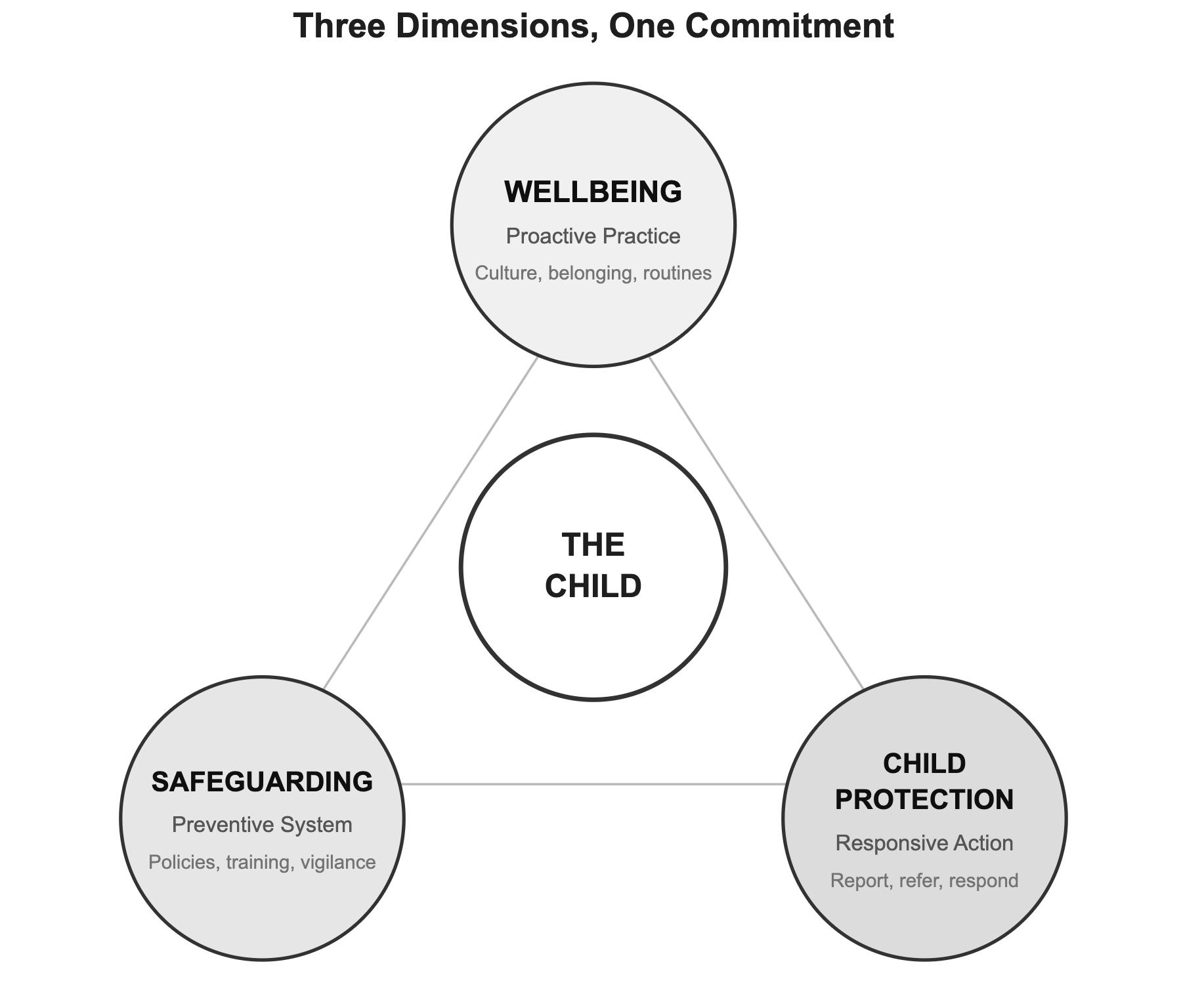
● Safeguarding is preventive. It is the proactive work of preventing harm. It covers the systems, practices, and behaviours through which the school keeps children safe, safer recruitment, staff conduct, supervision, training, building and online safety, curriculum on personal safety, and the routines that make harm less likely to occurandeasiertonotice.
● ChildProtectionisresponsive. Itistheschool'sresponsewhenachild hasbeenharmed,isatriskofharm,or hasdisclosedharm Itcovershow disclosuresarereceived,recorded, reportedtoauthoritieswhererequired, andactedonandhowthechildand familyaresupportedthroughandafter theresponse
The policy is guided by the three principles being proactive, preventive, and responsive It applies to all students, employees, visiting professionals, contractors, service providers, governors, parents, volunteers and any other person who comes into contact with students at Neev It applies on campus, while using school transport, on school excursions,atschool-sponsoredevents,inonlineinteractions,andduringoff-siteactivities.
Every child has an equal right to wellbeing, safeguarding, and protection regardless of age, gender, ability, caste, class, religion, or any other characteristic. Neev is committed to building a community that values diversity, equity, andinclusionandactivelyworkstocombatdiscrimination.
Every teacher and leader at Neev responsible for child wellbeing and safeguarding carries responsibility across the three dimensions of this policy: building a wellbeing culture, preventing harm, and acting when harm has occurred Thedispositionsbelowdescribewhatthisrequiresindailypractice
● Be responsive and pre-emptive - Treat early action as a priority Watch for changes or dips in mood, academicengagement,behaviour,andfriendships,andactonwhatyouobservebeforeconcernsescalate
● Know your learner (KYL) - Build an understanding of the whole child beyond subjects and theclassroom, whotheyare,howtheylearn,andwhatisshapingtheirexperienceatanypointintime
● Hold a shared language - Carry the same goals, standards, and expectations for children across subjects, classes, and contexts. Consistency across settings is what helps children read and meet expectations confidently.
● Be available - Hold space and establish systemstocheckinwithchildren,shapedbytheneedsofthecontext classroom,fieldtrips,learningjourneys,orone-to-one
● Be consistent - Hold wellbeing and safeguarding practices tight and steady across children, across theyear, andacrosscontexts
● Wellbeing and curriculum gohandinhand-Wellbeingandcurriculumarepartofthesamework Achild's wellbeingneedsareaddressedwithinteaching,notasaninterruptiontoit.
● Collaborate - Share what you know about a child with colleagues who also work with them Gather perspectivesfromacrosssubjects,sections,androles,sothatdecisionsrestonafullpicture
● Track the whole child - Maintain an ongoing record of how a child is doing across academic, social, emotional,andbehaviouraldimensions
● Welcome questioning - Treatachild'squestions(raisedrespectfully)aboutdecisionsaspartoftheirlearning, not as challenging authority. Engage with the question, share your reasoning, and revisit your decision if needed.
● Stayvisible- Avoidbeingalonewithachildbehindcloseddoors
● Notice and report - When a concern arises, raise it as a Report of Concern (RoC) with the Programme DesignatedSafeguardingLeadwithoutdelaywithinitialinvestigationconductedandrecorded.
● Hold confidentiality - Information about a child, a family, a colleague, or a safeguarding matter is shared only with those who need to know in order to act Do not discuss what you have observed or reported with others atschool,athome,oronline.Confidentialityprotectsthechildandtheintegrityoftheprocess.
● Do not promise secrecy - No adult may promise confidentiality to achildwhensafetyisatrisk Listen,take thechildseriously,andexplainthattheconcernwillbesharedwithsomeonewhocanhelp
● Trust your instinct - A sense that something is wrong with a child even without a specific reason is itselfreasonenoughtoraiseaconcern
2.1AdultInteractionsandBehaviorwithChildren:WhatThisLooksLike
The dispositionsabovetakeshapeineverydaypractice Thelistsbelowdescribewhatisacceptableandnotacceptable in adult interactions with children across theschool,fromPYPthroughDPandCP Thesearespecificbehaviours,not aspirations,andtheyapplytoeveryadultatNeev.
Acceptable Notacceptable
● Greetingchildrenwarmlyandusingtheirname.
● Speaking to and about children in age-appropriate,respectfullanguage.
● Listening to a child fully beforerespondingtoa question,concern,ordisclosure
● Holding one-to-one conversations in spaces
● Hitting, slapping, shaking, pushing, oranyform ofphysicalpunishment
● Shouting at, shaming, mocking, humiliating, or making personal remarks about a child's appearance,ability,identity,orbackground
● Comparing a child unfavourably with peers,
with windows, open doors, or another adult nearby.
● Offering brief, appropriate physical reassurance to a younger child (a hand on the shoulder, a side-hug) when comfort is needed and the child welcomesit
● Administering first aid or guiding a child to safetywithcareandvisibility.
● Praising effort, growth, and specific behaviour ratherthanpersonaltraits
● Correcting behaviour calmly, in private where possible,andwithrespectforthechild'sdignity.
● Engaging with a child's questions about decisionsandexplainingreasoning
● Communicating with children and parents through Neev-approved platforms, about school matters
● Reporting any concern about a child or any adult's conduct to the Programme Designated SafeguardingLeadwithoutdelay
siblings,orearlierwork.
● Being alone with a child behind a closed door, in a vehicle, in a washroom, orinanyspacenot visibletoothers
● Touching a child in ways that are sexual, intimate, prolonged, or unnecessary including kissing, sitting a child on the lap (beyond Early Years and only briefly), or touching that is not for comfort, first aid, or safety
● Using confinement, isolation, withdrawal of food, water, toilet access, or denial of breaks as discipline
● Promising secrecy to a child when safety may beatrisk.
● Contacting children outside school hours through personal phone, messaging, social media, or personal email, without school authorisationandparentalknowledge.
● Taking, sharing, or storing photographs or videos of children outside Neev-approved purposes.
● Accepting or giving significant gifts that fall outside ordinary courtesies between adult and child.
● Discussing personal problems, relationships, or maturethemeswithchildren
● Consuming or being under the influence of alcohol, tobacco, or other substances in the presence of children while in a professional capacity, including on school journeys and overnighttrips.
2.2SupportingPracticesandStructures
A wellbeing culture rests on practices and structures predictable systems and shared practices that operate across the programmes Each programme adapts the form to its own age group and context, while holding the intent consistent.
Neev has hard structures that enable a child-first approach whichincludetimetablesforbalancedtimeforavarietyof engagements, predictable routines, and dedicated time to building relationships. Other structures include a school calendar shared with the school community for transparency and events calendared forthedevelopmentofthewhole child A critical structure is our student government fostering student leadership, mentoring, and buildingmotivation andhousespirit
Neev draws from a bank of practices that includes morning meetings and form time, quality circle time, restorative practices, know-your-learner surveys, identity portraits, wellbeing surveys, peer mentoring and buddy systems, community events such as house days and the Neev Literature Festival, structured transition support across programmes and year groups, and proactive parent communication. The full bank, with the intentofeachpractice,is linkedhere
These practices are held accountable through governance The School Management Committee (SMC) and Child Protection Committee (CPC) meet quarterly, withmembershipdrawnfromtheHeadofSchool,Principal,Programme Heads, student government, and parent representatives The SMC oversees academic progress, wellbeing, health and safety, and operational matters The CPC reviewssafeguardingpractices,childprotectionconcerns,stafftraining,and the effectiveness of this policy Together, they ensure Neev's framework remainsrobust,responsive,andalignedwith statutoryandaccreditationrequirements.
3.WhenStudentsDriftfromExpectations
Neev holds clear protocols to respond to situations when students drift from expectations. Protocols designed to address the drift from expectations, support the child, and protect everyone involved These are understood by their category (the kind of break it is) and their severity (how significant the break is in the moment and inpattern) The eightcategoriesandfourseveritylevelsaresetoutbelow.
Driftsfromexpectationsarehandleddependsonwhereitsitsinthethreedimensionsofthispolicy:
● Wellbeing (proactive) - Noticing a change in a child, checking in, and engaging the child and parentsearly. Thisappliestomostbreaksatminorandmoderatelevels
● Safeguarding (preventive) - Acting on patterns and emerging concerns before the situation escalates This applieswhenmoderate-levelbreaksrepeat,orwhenaserious-levelbreakoccurs.
● Child protection (responsive) - Followingtheschool'sprotectionprotocolswhenachildhasbeenharmed,is atriskofharm,orhasdisclosedharm
3.1Theeightcategoriesofdrifts
● Physicality-Behavioursthatinvolvephysicalcontacttowardspeerswiththeintenttoharm
● Verbal disrespect (towards peers or teachers) - Communication intended to hurt others name-calling, labelling, shaming, sarcasm, or personal remarks on appearance, ability, identity, culture, or background Includesfacialexpressionsandbodylanguagecarryingthesameintent
● Non-compliance with instructions and expectations - Difficulty following instructions or meeting community standards across classroom and non-classroom settings. May show as ignoring directions, avoidingtasks,makingexcuses,orresistingparticipationdespiteremindersandsupport
● Troubled experiences (body, home, emotions) - A childexperiencingstrongemotionalturmoilarisingfrom an experience they are still making sense of loss of a parent, body-image distress, family separation, or similar Thebreakhereisachild'sstruggletofunction,notabehaviouraimedatothers
● Routines - A child struggling at school owing to absent or unstable routines, often rooted in the home environment,whichmayinturnaffectacademicengagementandwellbeing.
● No friends -Achildoftenfoundalone,morecomfortablewithadultsthanpeers,whofindsitdifficulttoform socialconnectionswithintheclassoryeargroup
● Singled out among friends - A child with low social standingintheirpeergroup,frequentlyexcludedfrom student-initiatedactivities,conversations,orplay
● Emotional expression and regulation - A child who struggles to express and manage their emotions, becoming overwhelmed, shutting down, crying,raisingtheirvoice,orwithdrawingandwhooftenneedsadult supporttocommunicatewhattheyarefeeling.
3.2Thefourlevelsofseverity
The same category of break can sit at different levels of severity depending on the incident, the pattern, and the impact.Severityisreadacrossthefollowingfourlevels.
Levels Descriptor
L1-Minor Low-level, isolated behaviours that briefly disrupt learning butcauseno harm Developmentally expected, resolvedthroughquickredirection.
L2-Moderate Repeated or deliberate behaviours that interfere with learning, affect others, or show resistance to redirection Beginning to show socialoremotionalimpact.
L3-Serious Behaviours that cause emotional, physical, or relational harm, or that significantly disrupt the learning environment Often intentional and resistanttopriorintervention.
HowtoIdentify Response
One-off incident; child responds to a reminder; no harm to peers or property; disruption is momentaryandcontained.
Repeats despite one or two reminders; impacts peer dynamics or task completion; mild social or emotional harm; defiance or avoidance pattern forming
Vandalism inside or outside school; verbal abuse or threats directed at peers or staff; racist behaviour or expression; personal display of sexual conduct; theft; smoking; active encouragement ofmisconductby others; bullying repeated targeting, intimidation, or exclusion of others, including harassment on social media; breaking the law or engaging in illegal activitieswherethematter does not constitute animmediate threat to safety. Requires leadershipinvolvement
Expectation-setting conversation between the student and the teacher
L4-Very Serious Behaviours that are dangerous, grosslyinappropriate,orconstitutea serious breach of the safety and dignity of others. Includes physical aggression, sexual misconduct, and conduct that violates the law at a level that puts the community at risk Immediate intervention required
Physical violence or abuse directed at peers or staff; sexual harassment, assault, or abuse; use or possession of any formof weapon; use or possession of drugs or alcohol; breaking the law or engaging in illegal activities that pose adirectthreat to safety, dignity, or theintegrity of the school community; discriminatory or targeted behaviour; repeat serious offences at L3 that have not respondedtointervention.
Advisory meeting between the teacher and the Section Head. Reflection required from the student Possiblelossofaprivilege Parentsareinformed.
Advisory meeting with programme leadership, Section Head, teacher, and parent Written reflection required Counselling support suggested or required. Responses may include one or more of the following as per the community standards: a behavioural or performance contract; detention; change of curriculum; monetary amends; denial of a letter of recommendation; suspension with academiccontinuity Wherethelaw has been broken, parents are informed and external authorities maybenotified
Advisory meeting with programme leadership, Section Head, and teachers Written reflection required. Counselling support required Responses may include suspension with or without academic continuity (rustication), formal contract, notification to universities, or permanent withdrawal Expulsion is subject to approval by theBoardofDirectors. Where a law has been broken, the matter is referred to external authorities alongside internal action
Zero-tolerance behaviours sexual harassment, assault, or abuse, and use or possession of any form of weapon resultinimmediateexpulsion,regardlessofpriorrecordorcircumstance.
4.RecognisingAbuseandHarm
Abuse takes many forms. Some are visible; many are not. Every adult at Neev is expected to recognise these forms andactonthemthroughthereportingandprotectionproceduressetoutinthispolicy.
● Physical Abuse. Deliberately hurting a child's body hitting,slapping,shaking,burning,orbiting Includes allcorporalpunishment,whichisbannedunderIndianlaw
● Sexual Abuse and Grooming. Any sexual offence under the POCSO Act, assault, harassment, exposure to sexual content, or use of a child in pornography Groomingishowitoftenstarts:anadultbuildstrust,pushes boundaries, andsecuressilence Itcanhappeninpersonoronline,andthepersondoingitoftenappearscaring andtrustworthy.
● Emotional Abuse and Discrimination. Persistent behaviour that damages how a child feels about themselves, intimidation, humiliation, threats, isolation, or impossible expectations When a child is repeatedly excluded or made to feel lesser because of who they are gender, caste, religion, ability, or any othercharacteristic thatisalsoemotionalharm.
● Neglect. Failing to meet a child's basic needs physical, emotional, educational,ormedical Atschool,this includesfailingtosupervise,ignoringknownrisks,oroverlookingsignsofdistress
● Self-Directed Harm. Achilddeliberatelyhurtingthemselves cutting,burning,restrictiveeating,substance misuseorexpressingthoughtsofsuicide Alwaysachildprotectionconcern ReporttotheCPOimmediately
● Peer-on-Peer Abuse. Children harming other children, bullying, sexual harassment, coercion, ragging, hazing, or sharing intimate images. Both children receive support. More details on this have been laid out here.
● Online Abuse. Harm through screens, cyberbullying, grooming, sexting, image sharing without consent, or exposure to harmful content If you become aware of it, do not ask the child to delete anything and immediatelyinformthesafeguardinglead.
4.1HowWeRecognisetheSigns
Indicators of harm vary in how they appearatdifferentages,butthesignsbelowareobservableacrosstheschool An adult's instinct that something is wrong with a child is reason enough to share a concern Some of themostessential indicatorsaresetoutbelow.
● Unexplainedinjuriesorinjuriesinconsistentwiththeexplanationgiven
● Suddenwithdrawal,regression,ormarkedchangeinmoodorbehaviour
● Reluctancetobenearspecificadults,peers,orspaces.
● Age-inappropriatesexualknowledge,language,orbehaviour
● Directorindirectdisclosure bythechild,oronbehalfofanotherchild
● Signsofself-harm:cuts,burns,restrictiveeating,ortalkofsuicide.
● Anxiety,secrecy,orsuddenchangearounddevicesandonlineactivity
None of these indicators alone confirms harm Teachers do not jump to conclusions and do not investigate They maintain strict confidentiality about what they have observed and pass the concern to the Wellbeing & Safeguarding Committee(inthenextsection).Ourteamistrainedaspartofchildprotectioninductionandannualrefreshers.
5.RightsandResponsibilities
5.1Student
As per the community standards, being a member of the Neev community requires all studentstohavethefollowing rightsandresponsibilities:
● Promoteequitythroughbeingaccepted,respected,heardandtreatedwithdignityandempathy Neev Academy • Page 8
● Value and respect diversity as a rich source of learning (gender, culture, appearance, ability, interests, preferences,wealth)
● Contributeandcollaboratetowardscommongoals,engagingactively
● Takeriskswithlearningandengageinproductivestrugglewithoutfearofmistakes
● Haveavoiceandchoiceinyourlearning,whilerespectingothers’learning
● Generate original ideas, acknowledge others and extend your learning with integrity in every task (Be your bestatalltimes)
● Showrespectfortherights,property,lawsandsafetyofyourself,othersandtheschool
● Foster physical and psychological safety in the community through developing relationships and ongoing dialogue
● Questiondecisionsyouconsiderinadequateorunwarrantedinahealthymanner
● Calloninappropriate,unjust,unethicalorillegalbehaviorwithoutfearofbeingjudged
5.2Parents
Parents are partners in their child's wellbeing, safeguarding, and protection at Neev. The rights and responsibilities below apply in an ongoing and regular manner, with additional ones that activate when a child has had abreakfrom expectationsorhasbeenharmed
OngoingandRegularPartnership:
Parentshavearightto:
● Meet with their child's teacher, programme head, or principal by appointment to discuss academic progress, behavioural concerns, peer-related issues, or any concern about a staff member
● Receive clear, timely communication about matters that affect their child's wellbeing or safety
● Have their opinions valued and considered in decisions about their child's learning and wellbeing
● Receive regularupdatesontheirchild'sprogress andhavetheopportunitytorespond.
● Raise welfare or safeguarding concerns and knowtheywillbetakenseriously
Parentshavearesponsibilityto:
● Be available todiscusstheirchild'sprogressand wellbeing when the school reaches out, and raise concerns through the appropriate channels form tutor,sectionhead,programmehead,or principal rather than approaching staff informallyduringschoolhours.
● To read all communications and to be aware of oractupontheinformationshared
● Inform the school of any changes at home such as health, family circumstances, or routinesthat may affect their child's wellbeing or safety at school
● Engagerespectfullyinallinteractionswithstaff, students, and other families in person, by phone, and online, modelling the behaviour we wantchildrentolearn.
● Attend scheduled meetings, read reports, and actively participate in their child's learning and wellbeingjourney.
● Respect the privacy of other children, families, andstaff Concernsaboutanotherchildorastaff member are raised with the school directly, not discussedpubliclyoronsocialmedia.
5.3Teacher
TeachersaretheprimaryadultswhotranslateNeev'scommitmenttowellbeing,safeguarding,andprotectionintodaily practice. The rights and responsibilities below apply in an ongoing and regular manner, with additional ones that activatewhenachildhashadabreakfromexpectationsorasafeguardingconcernarises
OngoingandRegularPractices
Teachershavearightto:
● Receive safeguarding training and induction before their first day and ongoing professional learningthroughouttheyear.
● Be heard when they raise a concern about a child, a colleague, or a practice and receive timelyfeedbackonwhathappenednext
● Access guidance and support from the CPO, counsellor, or programme leadership when navigatingadifficultsituation
● Be informed of any wellbeing or safety information about a child that theyneedtoknow in order to teach and support that child effectively.
Teachershavearesponsibilityto:
● Hold the dispositions and expectations set out in their programme, being responsive, consistent,andavailable.
● Know each learner beyond the classroom and track the whole child's academic progress and wellbeing following Neev's documentation protocols.
● Communicate proactively with parents about their child's progress, wellbeing, and any concerns.
● Raise concerns through the appropriate channels and within the timeframes set out in thispolicy.Neverinvestigateindependently.
● Maintain confidentiality about children, families, and colleagues Share information onlyonaneed-to-knowbasis
● Treat wellbeing and safeguardingaspartofthe curriculum,notseparatefromit
6.WellbeingandSafeguardingCommittee
A child's safety and wellbeingatNeevisnottheworkofonepersonoroneoffice Itisheldacrosstheschool butit needs a body that brings the whole picture together, holds consistent standards across PYP, MYP, DP, CP to ensures nothing falls between the gaps. This is the purpose of the Wellbeing & Safeguarding Committee: a single body that holds wellbeing, safeguarding, and child protection together. The Committee's composition reflects the three dimensionsofthispolicy Threeleaderssitaspeers,eachholdingonedimension
● The Head Wellbeing holds the wellbeing dimension the proactive workofbuildingawellbeingculture acrosstheschool
● The Deputy Safeguarding Lead holds the child protection dimension the child portfolio, leading safeguardingcaseworkandtheresponsewhenachildisatriskofharm.
● The Head of Student Services & Safety holds theoperationallayerofsafeguarding thepreventiveworkof keepingtheschoolenvironmentsafe:buildings,transport,kitchen,drills,visitors,andfoodsafety
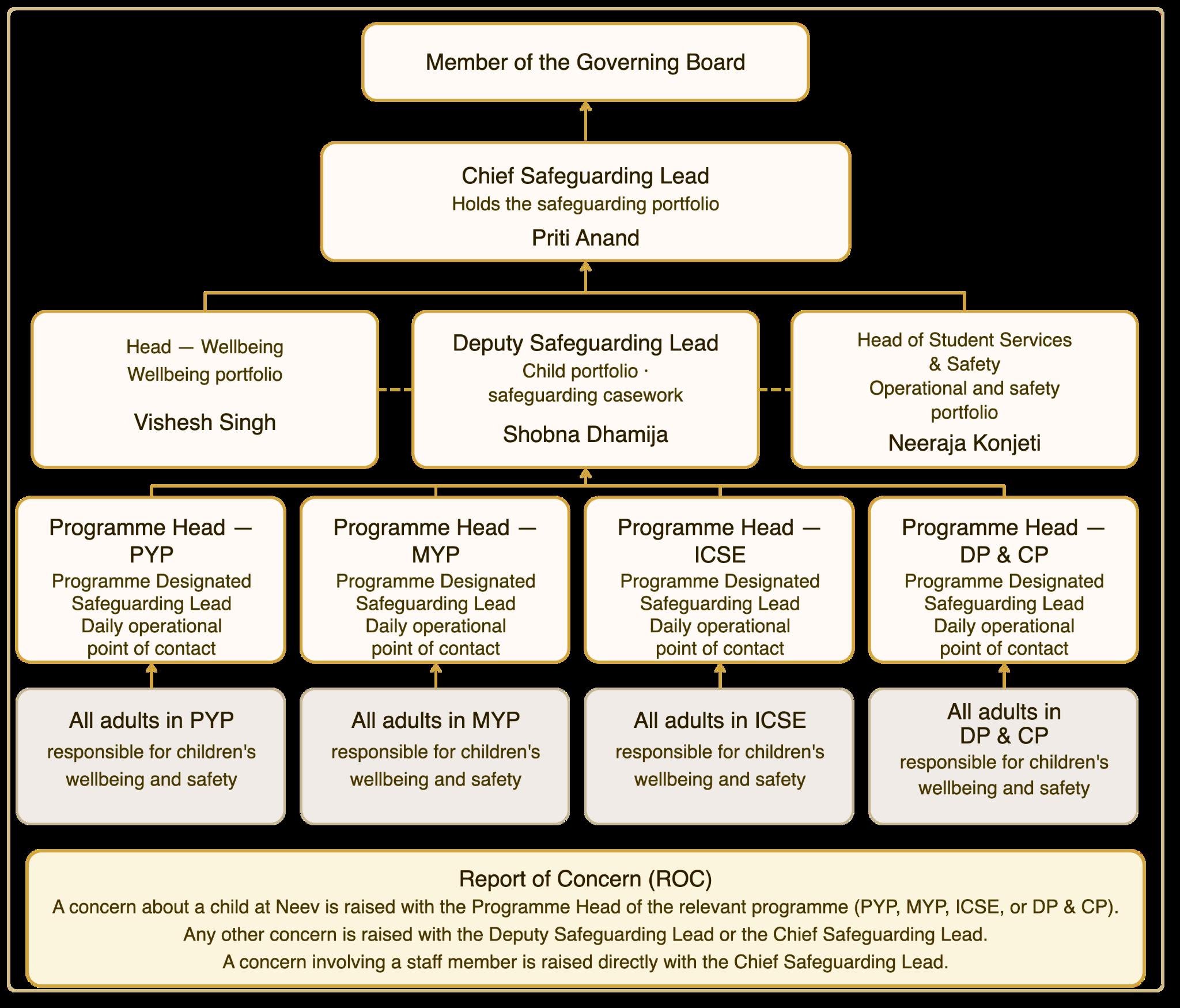
Under the leadershipoftheChiefSafeguardingLead,thesethreeleadersworktogethertopromoteachild-firstculture across the school The ChiefSafeguardingLeadholdstheseniorsafeguardingportfolio,convenestheCommittee,and carries ultimate accountability for the safety and wellbeing of children at Neev, reporting to the Member of the GoverningBoard.
How concerns reach the Committee matters as much as who sits on it AconcernraisedatNeeviscalledaReportof Concern (ROC). Every adult at Neev carries thedutytoraiseone.Concernsflowfromthebottomup:theProgramme Designated Safeguarding Lead for each programme is the daily operational point of contact accessible, available, and trained to receive concerns as they arise An ROC about a child is raised with the Programme DSL first; from there, it escalates to the Deputy Safeguarding Lead and, where the matter is serious, totheChiefSafeguardingLead The cases taken up are brought to theCommittee,wheretheyarediscussedandactedon.Thediagrambelowsetsthis out
7.Documenting,Reporting,andEscalations
Every child at Neev has one shared record: the Know-Your-Learner (KYL), maintained on Google SheetsorToddle. The form tutor owns the KYL, contributed to by all teachers in the section, and accessible to the programme counsellorandprogrammeleadership Ittracksacademicprogress,wellbeing,andbehaviourovertime
What goes into the KYL depends on severity as addressed in section 3. KYL entries are reviewed through three forums, each with a distinct purpose Behaviour Collaboratives are teacher forums that review KYL entries at a regular cadence to surface patterns and align on response across the section TheStudentAdvancementCell(SAC)
Neev Academy • Page 11
consults on academic and behavioural referrals and directs children to learning support or behaviour support as needed. The forms of support the SAC offers, the plans it uses (such asIndividualLearningPlansandIndividualised Education Plans), the access arrangements it can apply for, resources andthepathwaysforchildrenwithlearningand behaviouralneedsaresetoutinfullintheNeevInclusionPolicy
Additionally,theProgrammeLeadership(SectionHeads/GradeLeads,andProgrammeHeads)handleindividual casesatprogrammelevel,drawingonthecounsellorandsafeguardingleadasthesituationrequires Decisionsmade intheseforumsarerecordedbackintotheKYLsothechild'srecordremainscomplete
Incidentsinvolvingastudent'sphysicalwellbeing,includingaccidents,injuries,falls,faintingepisodes,orother medicalemergencies,shallberecordedintheIncidentRegisterbythestaffmemberwhodirectlywitnessedor respondedtotheincident Therecordshouldincludeafactualfirst-handaccountoftheeventtoensuretheaccuracy andauthenticityoftheinformationdocumented.
Whereaconcernmeetsthethresholdforstatutoryreporting includingmandatoryreportingunderPOCSO the ChiefSafeguardingLeadisresponsiblefornotifyingtherelevantauthorities,includingthelocalpolicestation,the ChildWelfareCommittee,orCHILDLINE(1098)asappropriate.Externalreferralsaredocumentedandtracked. ApplicablejurisdictionsandpolicestationsarelistedinAnnexureH
8.RaisingConcernsatNeev
AconcerncanberaisedbyanymemberoftheNeevcommunity astudent,aparent,orastaffmember.Noconcern istoosmall,andnooneneedstobecertainbeforeraisingone.Theprocedureforeachgroupissetoutbelow.
● Students StudentsRaisingaConcernatNeev
● Parents ParentsRaisingaConcernatNeev
● Teacher TeacherRaisingaConcernatNeev
9.LearningJourneys,FieldTrips,andSchoolSleepovers
Thissectionsitsacrossthesafeguardingandchildprotectiondimensionsofthispolicy Itsetsouthowchildrenare keptsafeinlearningawayfromtheclassroom.Theseexperiencesaredevelopmentallysequenced:childreninGrades 1–3takepartinon-campussleepoversthatpreparethemfortheindependenceofjourneystocome;fromGrade4to Grade12,childrentakelearningjourneysacrossIndia;anddayfieldtripsrunacrossallprogrammes
Beforeanyfieldtriporjourney,arecceassessesacademicalignmentandoperationalsafety,withobservations documentedintheprescribedformat;programmeleadershipandtheHeadofStudentServices&Safetyapproveeach triponthisbasis EverytriphasaseniorstaffmemberasIn-Charge withasecondIn-Chargeonlargertrips(such aslearningjourneys) andonlyNeevstaffsupervisechildrenoffcampus,atadefinedadult-to-childratio In-house first-aidkitsarecarriedonalltrips(includinglearningjourneys)andsleepovers;onlearningjourneys,arrangements aremadeforquick-responsevehiclesandatie-upwiththenearestpre-identifiedmedicalfacility
Sleepoversareheldoncampuswithin-housestaff.Onjourneys,childrenareaccommodatedseparatelyfromadults andshareroomswithpeers,withroomingthatrespectsgenderandtheneedsofeverychild.Parentalconsentissought foreverytripandsleepover Onanytrip,theIn-Chargeisthefirstpointofcontact;asafeguardingconcernisactedon immediatelyandraisedasaReportofConcernwiththeProgrammeHeadandChiefSafeguardingLead,whileinan emergencythechild'ssafetycomesfirstandNeev'semergencyprotocolsapply.LearningJourneySafetyandRisk ManagementManualislinkedhereformoreinformation.
10.SaferRecruitmentandTraining
10.1Recruitment HRProcessManual
Neev Academy – Wellbeing, Safeguarding & Child Protection Policy
Everyadultwhoworkswithourchildren,permanent,contractual,oroutsourced,goesthroughthesameprocessbefore they start. Background checks cover identity documents, qualifications, employment history, and references. A safeguarding induction is completed on or before the first day No adult begins unsupervised contact with children until all checks are cleared HR maintains a Single Central Record, audited annually by senior leadership Full recruitmentproceduresaresetoutintheHRProcessManual
10.2Training
Every adult at Neev responsible for children is trained, refreshed, and up to date. Trainingcompletionisrecordedby HR and reviewed by the Chief Safeguarding Lead. An adult who has not completed the required training may be restrictedfromunsupervisedcontactwithchildrenuntilitiscomplete Who
Teachers
MembersoftheWellbeingand SafeguardingCommittee
AllTeamMembers
AcademicandNon-academic
Transportstaff
Outsourcedpersonnel(security, catering,housekeeping)
11.Health,Safety,andSecurity
11.1Buildings
InductedtotheWellbeing,Safeguarding& ChildProtectionPolicy, ECISL1CourseonChildProtection
ECISLevel2Governors’Course
Induction+annual refresher
Induction+annual specialistrefresher
POSHPolicyRedressalandTraining Annual
Childsafety,firstaid,fireresponse,reporting Annual
Basicsafeguardingawareness,Codeof Conduct,andreporting Annual
Our campuses comply with the National Building Code and MoE School Safety Guidelines: earthquake-resistant construction, fire alarms and extinguishers at prescribed intervals, no exposed wiring, clean drinking water, hygienic and gender-separated sanitation, levelled playgrounds, secure and pest-free kitchens, annual whitewashing, and adequate ventilation Emergency exits are checked daily Therearenosecludedorisolatedareas;restrictedspacesare clearlymarkedandmonitored
11.2AccessControl
CCTV operates at all key points entrances, exits, corridors, staircases, playgrounds, cafeteria, and on buses monitored continuously, with faults repaired immediately. All visitors followasetprotocol:identityverified,purpose confirmed with administration,visitorbadgeworn,escortedatalltimes,andentryandexitlogged.IDcardsareissued to students, staff, contract personnel, parents, and authorised pick-up persons Security guards are posted at all entry andexitpointsandcompletesafeguardingtraining
11.3EmergencyDrills
The school maintains an Emergency Response Plan covering fire, earthquake, flood, bomb threat, medical emergencies, and intruder scenarios. Fire evacuationdrillsareconductedannuallyforallcampusesandbiannuallyfor
Neev Academy – Wellbeing, Safeguarding & Child Protection Policy
support staff Bus evacuation drills are conducted annually Evacuation plans arepostedoneveryfloor,andassembly areasaredesignatedandkeptclear.Everydrillisfollowedbyadebrief,andplansarerevisedbasedonwhatwelearn.
11.4FirstAid
The infirmary is staffed during all school hours. First-aid kits are maintained in laboratories, playgrounds, buses,the poolarea,andthekitchen,whicharecheckedandrestockedmonthly.Staffinvolvedinsports,swimming,andtripsare trainedinfirstaidandCPR Parentsareinformedeverytimeachildusestheinfirmary
11.5Transport
Transport safety means every child is accounted for, supervised, and protected from the moment they board to the moment they are received by an authorised adult This applies to daily commutes, field trips, and anyjourneywhere the school has a duty of care. The Transport Committee ensures that every bus, route, andpersoninvolvedmeetsthe same safeguarding standards we uphold inside the classroom. Full transport procedures, including bus standards, driver requirements, attendant duties, field trip protocols,andcrisisresponseduringtransport,aresetoutinAnnexure E:TransportSafetyPolicy
11.6OnlineSafety
The digitalworldcarriesthesamesafeguardingrisksasthephysicalone Internetaccessonschoolnetworksisfiltered and monitored. Digital-citizenship educationisembeddedinthecurriculum.Onlyschool-approvedplatformsareused for communication Incident-response procedures are in place for cyberbullying, grooming, sexting, and harmful content Parentalguidanceononlinesafetyisprovidedatorientationandthroughouttheyear Fulldetailsaresetoutin theITPolicyandtheDevicePolicy
11.7FoodSafety
Every meal served at Neev is FSSAI-compliant and prepared in hygienic, pest-free conditions Monthly menus are shared with parents. Kitchen staff undergo regular health checks. Daily food samples are tested before serving. Individual allergen plans are maintained. Any food-poisoning incident triggers immediate investigation and accountability Emergencyfoodandwatersuppliesforsevendaysarestoredonsite
12.MeasuringandImproving
TheheadofstudentsservicesandsafetyandtheChiefSafeguardingLeadconductacomprehensiveannualauditusing the school's School-Safety-Child-Protection-Checklist This is our living document and tool for turning policy into practice. It isusedtoconducttheannualsafeguardingauditsthatcoverinfrastructure,emergencypreparedness,access control, supervision, training compliance, transport, food safety, first aid, committee regularity, record-keeping, and thepsycho-socialenvironment Itisalsousedforspotchecksthroughouttheyear
13.StatutoryRequirements
The school complies with the statutory requirements of Karnataka and India while adhering to international expectations for the rights of children as stated in the United Nations Convention on the Rights of the Child (UNCRC) We are committed to upholding the rights and development of all children in our care, practising equity, equality, and non-discrimination We ensuretheprotectionandwelfareofchildrenasourresponsibilityandshallbeat thecoreofallactivities.
This policy is published on the Neev Academy website (www.neevschools.org) and is available for review by any member of the public, prospective family, or external body at any time It is also shared with all enrolled families at the start of each academic year and is included in the Staff Handbook, Student-Parent Handbook, and new-joiner inductionpack.
14.Annexures
Thesecompaniondocumentsareintegraltothispolicy
● AnnexureA: AnnualSafetyAuditChecklist
● AnnexureB: EvacuationPlans
● AnnexureC: FireFightingEquipmentLocationsandMaintenanceSchedule
● AnnexureD: First-AidKitLocationsandContentsSchedule
● AnnexureE: TransportSafetyStandardsandBusRouteDetails
● AnnexureF: IncidentReportForm,ProcessandReporting
● AnnexureG: EmergencyPlanningandThreatassessmentprocess
● AnnexureH: ApplicablePoliceStationsandJurisdiction
15.PolicyAcknowledgement
This policy has been approved by the Board of Governors and is effective from April 2026 Every member of our community is requiredtoread,understand,andacknowledgeiteachyear TheCPCreviewsthisdocumentannuallyor after a significant incident, legislative change, or accreditation directive AmendmentsareapprovedbytheBoardand communicatedwithin30days.Allversionsarearchived.
16.References
● InternationalBaccalaureateOrganization (2020) Programme standards and practices IBO https://www.ibo.org/globalassets/new-structure/become-an-ib-school/pdfs/programme-standards-and-practices -2020-enpdf
● InternationalMissingChildren.(2026,June9).EducationPortal-InternationalCentreforMissing& ExploitedChildren.InternationalCentreforMissing&ExploitedChildren.https://www.icmec.org/edportal/
● NewEnglandAssociationofSchoolsandColleges (2015) Child protection standards for NEASC-accredited international schools (developedwiththeInternationalTaskForceonChildProtectionandtheInternational CentreforMissingandExploitedChildren).NEASC. https://www.neasc.org/resources-members/international/child-protection-standards
● EuropeanCouncilofInternationalSchools (2025) Child protection certificate: Level 1 and Level 2 ECIS https://ecis.org/child-protection