ISSUE. 43
2026 OCTOBER
Neev Times
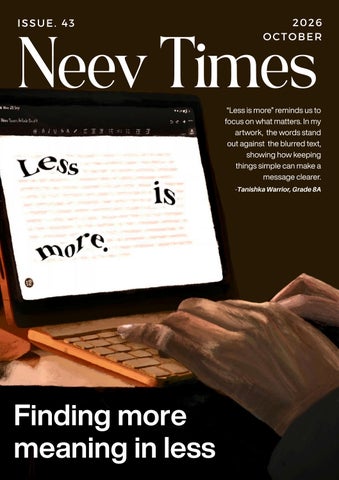
“Less is more” reminds us to focus on what matters. In my artwork, the words stand out against the blurred text, showing how keeping things simple can make a message clearer. -Tanishka Warrior, Grade 8A
Finding more meaning in less
economics & business How much food do we actually need? ~ Aarav Lohia - Grade 11C I ask myself this when filling my plate in the cafeteria. I have noticed that sometimes we take in more than we can finish. A little extra rice here, another spoonful there, and by the end of lunch, some of it is uneaten. It seems insignificant. After all, what difference can one unfinished plate make? But what happens when hundreds of plates do the same? Food waste is often treated purely as an environmental problem, but it is an Economic one too. Economics begins with a simple idea: resources are scarce. Food, like money, time, and energy, is a scarce resource, and producing it uses up other resources such as land, labour, and fuel. When food is wasted, everything that went into growing, transporting, preparing, and serving it is wasted too. The food that reaches our plates is a culmination of many people’s work. After meticulous preparation, it reaches us, only to be thrown away. This is where the Law of Diminishing Marginal Utility comes in: as we consume more of something, the extra satisfaction from each additional unit decreases. The first serving of rice satisfies us for more than the third.
Are we paying for convenience or consuming more than ever? ~ Kabir Kashyap, Grade 7C Humans have always looked for ways to make life easier. Today, apps like Amazon, Netflix, Swiggy, and Blinkit, paired with digital payment apps like Google Pay, make buying and delivery almost effortless. Monthly automatic payments, unlimited movies, and grocery deliveries within ten minutes silently remove the question we once asked ourselves: “Do I really need this?” Although these apps are marketed as making life easier, they also make it easier to purchase more than we intend. Surveys conducted in India, by CNBC, suggest that the majority of people assume that they spend approximately ₹1000 to ₹1500 a month on subscriptions, while their bank statements show the real figure is over ₹3500. Shopping and food apps work in the same manner. Amazon Prime subscribers, for example, tend to spend thousands of rupees more each year than non-members because free, fast delivery encourages them to place many small orders frequently.
However in a cafeteria, where the meal is already paid for, taking another spoonful feels free, so we keep adding food even after it stops benefitting us. Over time, these small spoonfuls accumulate to a substantial amount of waste. More food on our plates does not necessarily mean more satisfaction. Sometimes, less is simply enough. However, that does not mean we should deprive ourselves. Instead, it means being more conscious of what we take. We can always go back for more if we are still hungry, but we cannot undo food that has already been wasted. The idea of “Less is more” is about taking only what we need, valuing what we have, and recognizing that our choices have consequences beyond ourselves. This is important for preventing overconsumption in an increasingly consumerdriven world. The next time I am putting food on my plate, I will ask myself a slightly different question: “Do I really need more, or is this enough?”
Swiggy, Zomato, and Blinkit turn an occasional visit to the neighborhood shop into an everyday habit of ordering food and small goods on demand. In economic terms, these apps cut the cost of buying, in time and effort close to zero, and when something becomes easier, we are incentivized to do more of it. Quick commerce apps add urgency, with limited-time discounts that push people to buy on impulse. To be frank, these apps genuinely save us time, and that convenience has value. But they are also designed to turn quick comfort into habit, and when buying takes almost no effort, we end up buying more.
Why do people value scarcity more than abundance? ~Jai Arya - Grade 10A Scarcity affects prices through a simple economic concept: when supply falls but demand stays the same, prices skyrocket. Firms exploit this by creating artificial supply through limited editions, “drops” and premium releases. For example, Nike could easily produce far more of its Travis Scott sneakers, but it chooses to release them in small batches. With fewer units available, consumers are forced to compete for access, and many accept resale prices several times higher than retail, prices they would have rejected if the same shoe were abundant. Most of that premium goes to resellers rather than Nike, so what the company gains is hype and the brand desirability rather than the resale profit.
For example, Hermès Birkin bags deliberately restrict their supply, so carrying one signals wealth and access, and resale prices often exceed retail even though production costs are far lower. When a product is abundant and most people can own it, it no longer distinguishes anyone, and its value as a status symbol falls. Loss aversion strengthens this further. Behavioral economists, notably Daniel Kahneman and Amos Tversky, have found that people feel the pain of a loss more strongly than the pleasure of an equal gain. Limited-time drops and "only a few left" exploit this, as do social tactics such as “selling fast”, play on the bandwagon effect. Together, they make buyers fear missing out (FOMO), which pushes them to purchase quickly and at higher prices. Abundance removes that pressure, because there is always another chance to buy.
Furthermore, social signalling also increases the amount consumers are willing to pay. When a product is perceived as rare, owning it raises your social status, so buyers value it more.
debate and opinion Who Are We Without What We Own? ~Aadyaa Gupta, Grade 8B If we stripped away all of our materialistic possessions, how much of our identity would actually remain? More importantly, if our belongings were to reflect the type of people we are, why do we own boxes of toys that we no longer touch, or clothes that no longer match our style? More often than not, we confuse our products with our personalities. This disconnect became incredibly obvious to me at the beginning of the year. My classmates and I were asked to make a poster about ourselves. One student’s poster was almost entirely a list of her favourite skincare products and foods. I judged her at first. But the more I thought about it, the more I asked myself: if someone asked me who I was, what would I say? Would I also make a list of the objects I like and the things I want? Then it occurred to me, I would. The truth is that objects do not create quintessential personalities. They are simply shortcuts to defining ourselves without needing to think about what we actually stand for. So, if possessions don’t make up our identities, what does?
It is our values and morals that determine the people we are and the people we hope to be. Identity is not a skin you can shed, as if it is just a phase. Identity is who you are. Personally, I do not love the idea of being defined by objects. I am not the clothes I wear, the food I eat, or the brands stamped onto the side of my shoe. My reality is not confined to aesthetics and trends. I do not want to be known by the house I live in or the car my family drives, but by my zeal for the arts and my determination to succeed. I want to be remembered for my kindness and the relationships I develop. I want to be remembered for being my own person, not for being a mindless consumer. Perhaps we should spend this year discovering our personalities outside the bounds of what we own, and asking ourselves a much harder question: what truly makes us, us?
If we only considered buying things as buying objects, then this entire system wouldn’t work and no one would willingly be part of it, but yet millions are. And, if we were only buying products for just their use, then any item, no matter the ~Nimrat Kaur - Grade 8C brand, would amount to the same thing, but they don’t. We all like to believe that when we buy something, we’re Nowadays, we aren’t just buying things. We are buying only buying the thing itself. A product, a brand, a device, completely new identities, warped versions of ourselves that we show to others for standards and our personal belief of they’re all just items. But most times, it’s not that simple. what is shown to be good in society and what isn’t. Inanimate These things we choose to buy reflect more than just objects are now becoming the preconceived appearance of daily life uses. They tell us our preferences, our values, a person being good, successful, and happy, sometimes and most of all, the way we wish to be seen by others. without them even doing the real work required to make In today’s world, companies barely sell us just useful character, relationships, and your real identity as a human. objects. Rather, they pitch us ideas of false standards Also, because social media fosters a sense of belonging, it created by the media, signs of the “moral values” we also induces several of these standards, and in turn, is used choose to uphold based on just the products we buy, to create an ideal personal image of someone. And, since and a promise of a social status being met the second you buy something of that sort. Take, for example, luxury these brand images change quickly, we just end up throwing away items not because their use has gone, but because the brands like Hermes that create a sense of loyalty to identity we’ve attached to the object has. All in all, real themselves by making people buy smaller items like identity is made by taking internal actions and choices, and scarves before they even have access to purchase their when we as a population diminish our self-worth and sense most select and exclusive products, thus, owning those of self to just objects we buy, we are only seeing the brands, items creates a new identity of being “unique”. and not ourselves as humans.
Are We Buying Products Or Identities?
Can you opt out of consumerism without opting out of society? ~Meghna Sethuraman - Grade 10C Picture your ideal anti-consumerist. They endorse the idea that material wealth does not result in one's happiness and excessive buying truly harms the environment and overall society. They repair and reuse, attempt boycotts on major sales and rely on the principles of minimalism. However, a highly dedicated anti-consumerist must buy a smartphone and must pay corporate utility bills, merely to hold their job or catch up with news. While numerous lifestyle alterations are certainly admirable, a withdrawal from consumerism is near impossible because modern societal participation fundamentally demands market participation. Everyday infrastructure is designed to be commercialized: housing, healthcare, communication and food distribution continue to be commodified and capitalized on. It is not possible for one to opt out of buying if survival in a city is necessary. For example, practicing digital minimalism to the point of not owning certain devices, is not entirely realistic as a majority of mechanisms and processes in society are digitized, such as the accessing of a bank account, cashless transactions and the elimination of paper job resumes.
“Alternative” choices such as buying organic, eco-friendly or second hand goods, despite seeming like better options, are in fact still dictated by various market trends. Capitalism can fundamentally transform these acts of protest and shifts in decisions to generate profit. Lets say individuals begin to create forms of art and fashion with the intent of rejecting this very consumer culture. Large businesses and brands would take that same visual style, mass-produce it, and sell it back to the public. This phenomenon unfavorably strips the original opposition of its purpose and allows it to function as the driver of profit. However, it is important to note that individuals can drastically reduce their footprint through acts of thrift shopping, movements such as “the right to repair” and the overall practice of minimalism. These individual actions are noble coping mechanisms, although they do not allow you to fully opt out of society and disentangle you from a consumerdriven world. Society and consumerism are undoubtedly linked. True shifts will not come from individuals attempting to opt out alone, but from altering the social and systemic structures that force us to consume in the first place.
science and technology A Strained Relationship ~Ronit Salwan, Grade 9A Recent environmental phenomena have unveiled that the relationship between humans and the environment is a twoway street. Extreme events like “El Nino” have shown us human actions impact the environment, especially how the release of greenhouse gases (GHGs) have led to more severe and frequent events. Nature provides us with resources like food and water, and recent events have shown that humans (human activities), contrastingly, are damaging the same environment. Human activities such as the burning of fossil fuels and the release of 42 billion tonnes of carbon dioxide per year are a result of the demand for energy, resources, convenience, and economic growth. The impacts of these demands are now reflected through the events we see and experience. Rising ocean temperatures have caused widespread coral bleaching. Coral reefs are vital for marine ecosystems and yet humans are putting these ecosystems under extreme stress. The Amazon rainforest or “the lung of the world”, now has longer droughts, intense heat waves, and wildfires taking apart millions of trees. It has gone to the extent where parts of the Amazon now release more carbon than they absorb.
The Arctic, also, warms up speedily, with melting sea ice, thawing permafrost, and shrinking glaciers neglecting the habitat of ice-dependent species. Moving onto a local lens, the Bellandur Lake, once teeming with life, has been reduced to small patches of water and weed across its lake bed. We treated the lake as a landfill, in complete disregard of its value. This one instance shows how humans do not care about the environmental impacts when it comes to economic growth and urbanization. This further demonstrates the relationship between us and the world around us and it is a rather prejudiced one. Overall, through environmental changes occurring across the globe, the relationship between humans and the environment is clear: human activities enervate and overlook environmental systems, while changes in those systems affect ecosystems and the world as a whole.
When the Earth Retaliates ~Anshita Dalabehera, Grade 7A The perpetual loop of wanting, always wanting more is trapping our society. Moreover, the constant thirst and an inability to be satisfied, the planet is unable to fulfill our never-ending demands and keep up with our desires. This can be seen in the environmental events that are taking place. For centuries we have treated nature as an industrial warehouse on the input side and an inert sink on the outer side. We usually think that our actions have no consequences and dissolve into thin air, but nature responds through disrupted water cycles, intensifying storms and rapid shifts in temperature. We are left more vulnerable. One recent instance that displays the former is the flash flood that took place in August, 2026 impacting the Nepal China border, with severe impacts in and around Bhote Koshi and Trishuli River corridor as well as in Gyirong, Tibet Autonomous Region and China.
What essentially happened was a slope on Langtang Lirung mountain collapsed, triggering an ice avalanche that swept into the Bhote Koshi and Trishuli river systems, causing a devastating flash flood. While scientists have not come to a concrete conclusion on the causes, the event annihilated many communities and exemplifies how the environment can detrimentally impact human society. Hence, environmental crises such as the one that took place last month showcase that our society are not managers of the planet, but are participants within it. By doing less damage and demanding less, ecosystems get the opportunity to regenerate. However, humanity always believed in ‘more and more’, be it fossil fuels burned or deforestation. Recent environmental crises shatter the well believed illusion that nature is an inert backdrop, proving that our survival is tied to a fragile, reciprocal web. Chasing endless demands has caused damage. Embracing 'Less Is More' and understanding the value of less is our hope for a brighter future.
learning and culture The Racket Won't Swing for Me ~Sahas Disan, Grade 7D Every time a tennis star brings out a new racket, I want it. The ads make it look like the racket is the reason they win and play well. For a while, I imagined my serve would get faster the moment I held it. But a racket cannot swing itself. Students see new things all the time: shoes, water bottles, cards, the next version of a phone. An ad makes something look like it will improve your whole life. Then you get it, and just as soon, there is another thing to want. I don't think wanting nice things is wrong. I just don't want to spend more time thinking about how to keep up with things I “need” to buy. In tennis, what actually changes my game is boring: serving a hundred balls into the same box, sliding for one more shot, getting back on court after losing. No shop can sell me that. I can improve with the racket I already have, and I notice it happening. That feels better than unboxing something new and wanting the next one five minutes later. Before buying something, I want to ask: will I really use it, or do I mostly want to look like the players I watch? Sometimes the answer will still be yes. But if I pause first, I might find that I already have enough. I want to buy something only if there is a real use for it, not the other way: buy first and then find a use. After all, you are the one who swings, the one who wins, loses & learns, and that is far more important than a racket.
Questioning the Productivity Culture ~Naman Shastri, Grade 10C We have to talk about the notion of productivity. In the high school community, myself included, it’s almost become the norm to be ‘achieving’ set goals every day. These are almost always measurable, like ticking homework tasks off a checklist or making tangible notes on a topic we’ve already grasped. Whether this is making real progress or not, it’s the dopamine hit and the feeling of accomplishment that directs our actions. With the obvious risk of burnout from self-defeating priorities, is this habit beneficial in the grand scheme of things? There is a difference between being and feeling productive. A task being easily measurable makes it disproportionately attractive because of our brain’s natural reward system when we finish a task. Does this mean that when something isn’t as easily measurable, we simply undervalue it? Look at the difference between reading 20 pages of the textbook versus spending half an hour understanding one difficult concept. One has a tangible product to show for it. One allows for short-term satisfaction while the other fuels longterm improvement. In the end, our habits may turn counterproductive if we spend time repeating content and compounding the stress to finish something, instead of pushing ourselves to face challenges. Such challenges are, for most people, what drives long-term learning through genuinely healthy habits. It is these skills, uninterrupted reading, focused thinking, practising and exploring a new skill without an outcome, even spending time with friends and family, that a lot of us increasingly lack. We’ve constantly blamed digital technology for giving us distractions, alternatives, and ways out of these, but was it really the productivity culture all along?
NLF Blogs A Scoop On Poop ~Samaya Rao , Grade 9 Author and illustrator: Shweta Taneja and Sunaina Coelho Sloths do a poop dance, and some tropical beaches are made of poop! These were just a few surprising facts I learned at the Scoop on Poop masterclass for ages 9–12. I expected an entertaining but childish session. Instead, author Shweta Taneja and illustrator Sunaina Coelho turned an unusual topic into an engaging exploration of ecology. Ms. Taneja introduced a memorable idea: feces are data. Animal waste can reveal information about animals and their environment. She then led an interactive true-or-false activity, with children raising their hands, clapping or shouting “eww!” The room became lively and humorous, and both speakers welcomed questions such as “Do aliens poop?” and “Do plants poop?” Some facts stayed with me: elephants produce around 30 kilograms of dung daily, butterflies feed on elephant dung, and parrotfish grind coral and excrete sand that contributes to tropical beaches. Most importantly, we are all part of nature, even its messiest aspects. Waste and decay play essential roles in ecological cycles. Ms. Coelho then invited children to draw responses to the prompt, “How would you use poop as a weapon in your home?” She moved around the room, helping children develop their ideas and drawing skills. The session exceeded my expectations. Through humour, science and art, the speakers kept young readers curious and involved. I left with new knowledge and a greater appreciation for the parts of nature we usually overlook.
Murder in Threes ~ Anouk Gupta, Grade 6A How does one spin a murder story for children and craft a beautifully illustrated graphic representation together? We saw an example of this unfold in the immersive session, “Murder in Threes,” by Adithi Rao and Nandita Basu, which, additionally, happened to be the book launch for their new graphic murder mystery - The Bhootbusters of Himmat Nagar! Best-selling author Adithi Rao kicked off the session by introducing the book, along with a brief, charming reading from the first chapter. She expressed that the book had originally been written in 2020, during the pandemic, but never published; however last year, Nandita Basu produced stunning visual representations of the plot, and helped the text morph into a graphic novel. Afterwards, we watched in awe as two lines of text from the new book were quickly transformed into beautifully sketched rough comic panels before our eyes by Nandita Basu. It was frankly incredible to see how she listened to the lines once, and set right off to work, beginning first with the border of the panels, then filling in the rough shapes, and finally adding all the delicate little features and details. Towards the end of the session, as a learning experience, Adithi Rao offered three quirky writing prompts to the audience, between which we were each to individually select one and write a short paragraph of a story related to the chosen statement. Once we were finished, we were instructed to convert them into a comic strip - resulting in a variety of dazzling artworks by all the budding artists and listeners in the engaged audience. Overall, this was an amazing session, and I think we all acquired numerous skills in writing and in art over the course of the vibrant and lively interaction.
NLF Reading Challenge 2026: The Grand Finale The Grand Finale of the NLF Reading Challenge 2026 was the point at which three months of reading finally became a live test of memory, quick thinking and literary understanding. After beginning with hundreds of teams across India, the competition narrowed to four finalist teams, each having spent months reading the thirty books selected for the Challenge. What made the finale particularly engaging was the variety of its rounds. It was not simply a sequence of questions about characters and plots. Each round required the contestants to approach the books differently, which made the quiz feel dynamic rather than repetitive. The Taboo round was one of the most distinctive. Contestants had to lead their teammates towards an answer while working within the restrictions of the game. This made familiarity with the books especially important. A contestant could not simply remember a character's name, instead they had to know enough about that character to describe them through indirect clues without relying on the most obvious terms. The Rapid Fire round changed the pace completely. Here, hesitation became a liability. Questions came quickly, requiring contestants to retrieve details almost immediately. After reading thirty books, the challenge was no longer simply remembering what had happened in them, but being able to locate a particular fact in one's memory within seconds. The audience was also brought into the competition through audience-specific questions. These moments changed the atmosphere of the tent, with members of the audience eagerly raising their hands and responding to questions.
It was a fitting reflection of the festival itself: literature was not confined to the contestants on stage, but became something shared by everyone present. The crossword round offered a slower but equally demanding contrast. Its answers were connected to the books from the Reading Challenge, requiring contestants to draw upon details they had encountered during their reading. Unlike Rapid Fire, where speed was paramount, the crossword required contestants to make connections and use the structure of the puzzle to confirm what they remembered. The quiz also reached beyond the immediate plots of the books. Questions incorporated cultural details from India and other parts of the world, reflecting the range of the reading list. In this way, the Challenge encouraged students to see books not as isolated stories, but as introductions to unfamiliar places, traditions and perspectives. There was something particularly satisfying about seeing all of this knowledge tested in a single finale. A detail that might have seemed insignificant while reading a book could suddenly become crucial. A character remembered from weeks earlier could determine an answer. A cultural reference encountered almost casually could reappear in an entirely different context. That is what made the Grand Finale more than a conventional quiz. It tested the depth of the reading experience rather than simply the ability to memorise information. The contestants had to remember, recognise, connect and respond, often within a matter of seconds. After three months and thirty books, the final quiz became a measure of how much had truly stayed with the readers. And perhaps that is the most interesting thing about the NLF Reading Challenge: it showed that reading does not end when the last page is turned. Sometimes, that is when the real test of what a book has left behind begins. ~Vihaan Agarwal - Grade 8B
student voice Enough Without More
The Arithmetic of Enough
~ Samaira Khan, Grade 8 Vayu
~Abeer Kapadia - Grade 9B
As students, we are surrounded by the idea that more is better. More marks, more achievements, more activities and more knowledge. But sometimes I wonder if having more actually makes us happier, or if we have simply forgotten how to appreciate what we already have. I have noticed that after working hard for something, I often feel proud for a moment, but then I start thinking about what I could have done better.
There's a particular kind of silence that comes right after you finish something you worked hard for-a test, a performance, a deadline. For half a second, there's relief. Then, almost immediately, a quieter voice asks: what's next? That gap between finishing and feeling finished is where I think most of us actually live. We call this ambition, but it might just be arithmetic. Every achievement gets absorbed the moment it's earned, recalculated as the new minimum. An A becomes the baseline an A- falls short of. A win becomes the thing you're now expected to repeat. Success doesn't run out of value because we stop caring; it runs out of value because we're standing on it, reaching for the next rung, before it's even had time to mean something.
A good result becomes a reason to aim higher instead of something I can simply be proud of. The pressure to succeed can make us feel like we are never quite enough. It is tiring to always feel like there is another goal waiting for us. We also have information everywhere. If I am curious about something, I can find hundreds of answers within seconds. But not everything we see deserves our attention. Sometimes, scrolling through endless opinions and updates only makes us more confused. Knowing what to ignore can be just as important as knowing what to learn. Maybe simplicity is not about having less. It is about knowing when to stop chasing more. We do not need to be perfect, know everything or constantly prove ourselves. Sometimes, the most meaningful thing we can do is pause, look at how far we have come, and realise that being enough does not mean becoming more, it means learning to value who we already are.
Simplicity gets mistaken for the opposite of this: fewer subjects, fewer notifications, an empty desk. But an empty desk can still belong to a full, frantic mind. The actual discipline isn't subtraction. It's deciding, deliberately, what deserves your attention before the internet decides for you. We live inside a library that answers instantly and asks nothing back, so the muscle we're losing isn't curiosity; it's patience for not knowing yet. This kind used to force a question to matter before you chased its answer. Maybe that's the real cost of "more": not clutter, but amnesia. We forget what enough felt like because we're never still long enough to feel it. Somewhere between the last achievement and the next, there's a version of us who was already whole; we just moved past it too quickly to notice.
teacher speak
80 Years: A Bharat That Was Always Free 80 years. 80 years is what it took to free an India that was already free— had it not been brutally captured, barbarically injured, and made to question its own identity. It is always easy to stand on the other side of the line and judge a country by its per capita income, its technology, its population, its development. But let us travel back in time. To a time when education in India was at its peak— when a university could draw students from across the globe, because Bharat was a hub of knowledge. A system where the true definition of feminism existed— where women had the real power to choose: their love, Their knowledge, their politics, even their kingdoms. A country where agriculture found its roots, where a rich civilisation flourished along endless rivers. A country where debate was part of everyday life, yet deeply rooted in culture. So, if you want to be proud of anything today, do not be proud only that India is the fourth-largest economy. Or that we reached the southern pole of the Moon. Or that Mangalyaan reached Mars at a cost lesser than the making of a film. Do not be proud only of the numbers. Be proud that after being invaded, looted, divided, its harmony disrupted, its dignity wounded— Bharat still stands. With dignity. With the courage to fight every battle with fervour, strength and the same resilience that has carried it through centuries.
Be proud that, no matter the situation, Bharat does not have to abandon its values. It does not have to become barbaric to prove that it survived barbarism. It does not have to vilify its own people who questioned, challenged and helped build this nation. Because Bharat knows how to reflect. To learn from its past mistakes. To own them. And then— to look ahead. Towards a better change. A better world. A world where people can disagree, debate, learn, and still live in peace. Perhaps that is what 80 years of freedom truly means. Not just that we became free. But that, after everything, We still chose to remain Bharat. ~Moumita Saha, Grade- 6 FT & Senior Biology Teacher (ICSE)
reading Do you believe that the simplicity and attention that reading entails can help new generations live a more focused, analytical life? In a world increasingly dominated by digital technologies, reading can provide the simplicity and attention needed for new generations to live more focused and analytical lives. Reading requires sustained attention - unlike the constant switching and scrolling from digital content. This strengthens the ability to concentrate on one task or idea for a longer period of time. It can also help to increase the reader’s attention span and help them with other tasks, such as studying, solving problems and completing work. Reading encourages readers to pay attention to the little details and moments, and allows them to interpret, question, and connect ideas, rather than just consuming information. In many books, especially fictional books, or books lacking pictures, readers can create their own images of the characters, settings and scenarios. Furthermore, the simplicity of reading gives readers space to pause and reflect on what they’ve read. Unlike social media and digital technologies, a place with a book is a place without distractions. Constant notifications or new content competing for the viewer’s attention often diverts their attention. By having less distractions, readers get more time to form their own opinions, process ideas and consider different perspectives. Ultimately, the simplicity and sustained attention involved in reading can give new generations the space to think more deeply, rather than constantly moving between different forms of content, helping them develop a more focused and analytical approach to the world around them. ~Olive Harkness, Grade 10C
Why does today's culture push consumerism and short attention spans (fast fashion, YouTube) instead of valuing reading's simplicity and focus? No-one tells you to turn a page, that is a choice you make. Almost everything in our lives are chosen by something other than you. Class schedules, notifications, autoplay; In a book, you decide, when to stop, when to start, when to turn the page. You can go at your own speed. We can also call this “Steering” . It’s not about how much attention you have but its about who is directing that attention. Reading helps us with this, to understand this, we have to ask: “ when was the last time you decided the speed of something, instead of something deciding it for you? But it wasn’t planned like this, apps aren’t evil, they run on attention, the more time you spend, the more they profit, they’re built to pull you back in. Books don’t compete that way, once you own a book, nobody profits from how much time you spend on it. The difference isn’t good versus bad, it’s what each thing is built to want from you. The attention economy treats human attention as a scarce asset that digital platforms and advertisers capture, analyse and trade for profit but the attention economy doesn’t change on one persons habits, whether you read a book tonight or not the app will still be maximized the next day. Nothing in the system changes only because you were offline for a hour But it does keep the skill of self-direction alive in you, which matters regardless of what happens elsewhere. Even then, the habit of reading isn't pointless. Every time you choose to sit with something slow and undemanding of your attention economy, you're practicing the ability to direct your own focus instead of having it pulled. Reading is one of the last things left where you decide how fast to go. ~Aleena Bassam, Grade 7A
book review/recommendations The Inheritance Games The Inheritance Games by Jennifer Lynn Barnes is a mystery thriller about a girl named Avery who lives with her half-sister, Libby. When an eccentric old billionaire dies, he unexpectedly leaves Avery his entire fortune, disinheriting his family. Suddenly, she owns the Hawthorne family mansion, where everyone is either trying to ally with her or clearly wishes her dead. As Avery tries to discover why she inherited the fortune, she uncovers secrets and puzzles from the Hawthorne family's past. Along the way, she gets caught up with the charming yet hostile Hawthorne brothers. When someone makes an attempt on her life, the game takes a deadly turn. It is a thrilling story that shows how wealth and power are not a true definition of identity. Readers who enjoy mysteries, puzzles or suspense should give this book a read. -Amaira Belani, Grade 6A
Stuart Little Stuart Little by E. B. White is a lovely fictional book about an American family, the Littles, who surprisingly have a mouse for their second son. The Littles love to play ping-pong, and activities like fetching the balls are made much easier when you have a mouse in the house! Stuart may be small, but he is clever and adventurous. One day, he leaves his family and sets off on a big adventure of his own. The book follows the interesting situations he finds himself in along the way. This book is perfect for those who enjoy whimsical animal adventures and classic children's stories. It is a captivating story that can be enjoyed by all ages. -Amaira Belani, Grade 6A
The Whale Who Wanted More My review is about a book called "The Whale Who Wanted More," which I read way back in my early years. This book is about a whale who lives alone, and every day he hoards more and more things for his collection, but he never feels happy. Then one day, when he's looking for things to take, he comes upon a coral reef. There, the whale meets a crab who tells him, "Instead of taking, why can't you give? "The whale says, "I don't know what to give, though." The crab then tells him to think of anything he can give. The whale thinks and thinks, and he remembers the whale song his mother used to sing to him when he was a baby. Then he starts to sing the beautiful whale song, and all the animals in the reef come to see the whale. From then on, the whale realised that true happiness didn't come from taking things, but it came from sharing. That is why I thought of this book when I saw the topic "less is more." -Nivriti Vidisha Bharatram, Grade 3D
book review/recommendations “If you liked that book… read this one!” Recommend a book while drawing parallels to a similar novel. If you liked reading The Rainbow Fish as a child, you would love to read The Little Prince or The Quiltmaker’s Gift. If you are into Percy Jackson or Greek mythology, you should probably read King Midas and the Golden Touch. Children in the primary years could read books such as A Squash and a Squeeze or The Paper Bag Princess. For Dr. Seuss fans, The Lorax is a great choice. All these books are recommended in an article called “Becoming Minimalists.” These books have taught me the value of resources in our lives and how wasting them never helps us. Books are valuable resources, and treating them irresponsibly suggests that we are not grateful for them. Many children want books, while others waste them. I especially recommend The Lorax, which taught me this important lesson when I was a child. -Tanaya Amit Deshpande, Grade 5A
If you liked New from Here by Kelly Yang, then you must get your hands on PAWS: Priya Puts Herself First, because sometimes you just need to wipe the slate clean. Gabby, Mindy, Priya and Hazel have a dog-walking business called PAWS. This book fits the theme of “Less Is More.” In the third book, Priya’s landlord is kicking her family out of their home. Her parents find a new home in a neighbourhood far away from her school, friends and dog-walking business. Priya wakes up an hour earlier just to catch a bus to school. She finds it hard to keep going back and forth to make sure she doesn’t miss out on anything. She is tired almost all the time and realises that prioritising time with her friends is affecting her health. She finally moves to a new school in her new neighbourhood. She befriends two girls who later form another branch of PAWS. Priya still makes time to run the dog-walking business with her old friends and hang out with them. She now leads a happy and balanced life. I think people should read this book because it shows Priya’s struggle to prioritise herself and let go of old things. In life, sometimes we have to move on when circumstances require it and try to make the most of what we have.
-Kiara Bhalla, Grade 5A
junkyard
Misha Sharma, Grade 7A
Reya Mehta, Grade 1A
Tysha Raheja, Grade 8A
Ahaana Devatha, Grade 2A
LESS IS MORE: RIDDLE CORNER 1. The more you take away from me, the bigger I become. What am I? 2. I can be spent, saved or wasted, but never bought back. What am I? 3. I hold countless stories, yet I never speak. Borrow me, enjoy me and return me for someone else. What am I? 4. I’m the word that tells you to stop adding more. I mean your needs are met, even if your wants aren’t. What am I? 5. I begin as something unwanted. Give me another purpose, and I become useful again. What am I? 6. I cost nothing to give, yet I can make someone’s day richer. I appear on your face when happiness comes your way. What am I? Answers: 1. A hole , 2. Time, 3. A library book , 4. Enough, 5. Reused waste , 6. A smile
Editor-in-Chief: Idhant Rohin 11B Deputy Editor: Dhruv Nagri 11B, Amishi Daga 10C Chief Reporter: Vihaan Agarwal 8B Head, Learning & Culture Desk: Nikhita Chatterjee 12A Head, Books & Reading Desk: Avram Bucur 8D
Head, Debate & Opinion Desk: Devangshee Khemka 10B Head, Science & Technology Desk: Nishka Lahoti 11B Head, Business & Economics Desk: Armaan Malhotra 12A Head, Design & Production: Nishka Sehgal 9C Head, Digital &Multimedia Desk: Samaira Gupta 10C