DEPARTMENT DIRECTORY Governor Kelly Armstrong ADMINISTRATIVE DIVISION Game and Fish Director: Jeb Williams Deputy Director: Casey Anderson Chief, Administrative Services: Brian Hosek Grant Management Services Manager: Corey Wentland Administrative Staff Officer: Justin Mattson Administrative Assistant: Lynn Timm Building Maint. Supervisor: Brandon Diehl Human Resources Services Manager: Melissa Long Administrative Officer: Alan Peterson Financial Services Manager: Angie Morrison Accountant: Ashley Hillerson, Ashley Ryberg GIS Manager: Darrel Nucech Technical Operations Lead: Alan Reile Data Scientist: Shane Wegner Licensing Services Manager: Randy Meissner Assistants: Amanda Anstrom, Tracy Price, Tana Bentz, Tanya Mikkelsen, Elizabeth Klein Administrative Assistant – Dickinson: Stephanie Richardson Administrative Assistant – Devils Lake: Lisa Tofte Administrative Assistant – Jamestown: Tonya Kukowski Administrative Assistant – Riverdale: Mattea Bierman Administrative Assistant – Williston: Stephanie Wellman CONSERVATION AND COMMUNICATIONS DIVISION Division Chief: Bruce Kreft, Bismarck Communications Manager: Mike Anderson, Bismarck Editor: North Dakota OUTDOORS: Ron Wilson, Bismarck Communications Specialist: Zach Eshleman, Bismarck Marketing Coordinator: Cayla Bendel, Bismarck Digital Media Editor: Lara Anderson, Bismarck Photographer/Videographer: Ashley Peterson, Bismarck Marketing Specialist: Jackie Ressler, Bismarck Information Specialist: Dawn Jochim, Bismarck Graphic Artist: Kristi Fast, Bismarck Education Supervisor: Marty Egeland, Bismarck Education Coordinator: Jeff Long, Bismarck Hunter Education Coordinator: Brian Schaffer, Bismarck Outreach Biologists: Doug Leier, West Fargo; Greg Gullickson, Minot; Jim Job, Grand Forks Conservation Supervisor: Patrick Isakson, Bismarck Conservation Biologists: Sandra Johnson, Elisha Mueller, John Schumacher, Aaron Larsen, Greg Schonert, Bismarck Administrative Assistant: Amber Schroeter, Bismarck ENFORCEMENT DIVISION Division Chief: Scott Winkelman, Bismarck Investigative Supervisor: Jim Burud, Kenmare Investigator: Blake Riewer, Grand Forks Operations Supervisor: Jackie Lundstrom, Bismarck Warden Pilot: Vacant Region No. 1 Warden Supvr: Michael Sedlacek, Jamestown District Wardens: Corey Erck, Bismarck; Andrew Dahlgren, Milnor; Erik Schmidt, Linton; Greg Hastings, Jamestown; Noah Raitz, LaMoure; Nick Tschepen, Fargo Region No. 2 Warden Supvr: Paul Freeman, Devils Lake District Wardens: Jonathan Tofteland, Bottineau; Jonathan Peterson, Devils Lake; Alan Howard, Cando; Drew Johnson, Finley; Sam Feldmann, Rugby; Gage Muench, Grand Forks; Dale Skalicky, Langdon; James Myhre, Sheyenne Region No. 3 Warden Supvr: Joe Lucas, Riverdale District Wardens: Shawn Sperling, Minot; Keenan Snyder, Williston, Josh Hedstrom, Tioga; Riley Gerding, Kenmare; Clayton Edstrom, Turtle Lake; Conner Folkers, Garrison; Luke Aamold, Watford City Region No. 4 Warden Supvr: Dan Hoenke, Dickinson District Wardens: Kylor Johnston, Hazen; Zachary Biberdorf, Bowman; Courtney Sprenger, Elgin; Zane Manhart, Golva; Jerad Bluem, Mandan; Zachary Schuchard, Richardton; Dominic Falch, Killdeer Administrative Assistant: Lori Kensington, Bismarck WILDLIFE DIVISION Division Chief: Bill Haase, Bismarck Assistant Division Chief: Levi Jacobson, Bismarck Game Mgt. Section Leader: Stephanie Tucker, Bismarck Pilot: Jeff Faught, Bismarck Upland Game Mgt. Supvr: Jesse Kolar, Dickinson Upland Game Mgt. Biologist: Rodney Gross, Bismarck Migratory Game Bird Mgt. Supvr: John Palarski, Bismarck Migratory Game Bird Biologist: Mason Ryckman, Bismarck Big Game Mgt. Supvr: Bruce Stillings, Dickinson Big Game Mgt. Biologists: Brett Wiedmann, Dickinson; Jason Smith, Jamestown; Ben Matykiewicz, Bismarck Survey Coordinator: Chad Parent, Bismarck Wildlife Veterinarian: Dr. Logan Weyand, Bismarck Wildlife Health Biologist: Ryan Herigstad, Bismarck Game Management Biological Technician: Nate Rykerd, Bismarck Wildlife Resource Management Section Leader: Todd Buckley, Williston Wildlife Resource Mgt. Supvrs: Brian Prince, Devils Lake; Brian Kietzman, Jamestown; Dan Halstead, Riverdale; Blake Schaan, Lonetree; Judd Jasmer, Dickinson; Jens Johnson, Bismarck Wildlife Resource Mgt. Biologists: Randy Littlefield, Lonetree; Rodd Compson, Jamestown; Erica Sevigny, Williston; Jake Oster, Riverdale; Andrew Ahrens, Devils Lake; Broden Ullyott, Dickinson Wildlife Biological Technicians: Tom Crutchfield, Jim Houston, Bismarck; Dan Morman, Robert Miller, Riverdale; Jason Rowell, Jamestown; Scott Olson, Devils Lake; Zach Eustice, Williston; Colton Soiseth, Quentin Corcoran, Lonetree Private Land Section Leader: Kevin Kading, Bismarck Habitat Manager: Nathan Harling, Bismarck Private Land Field Operation Supvrs: Curtis Francis, East Region, Bismarck; Colleen Gleason, West Region, Bismarck Private Land Biologists: Zach Johnson, Colin Penner, Bismarck; Jaden Honeyman, Ben Reith, Dickinson; Ryan Huber, Riverdale; Renae Schultz, Jeff Williams, Jamestown; Terry Oswald, Jr., Harvey; Erica Sevigny, Williston; Brandon Ramsey, Matthew Parvey, Devils Lake Procurement Officer: Dale Repnow, Bismarck FISHERIES DIVISION Division Chief: Greg Power, Bismarck Fisheries Mgt. Section Leader: Scott Gangl, Bismarck Fisheries Supvrs: Russ Kinzler, Riverdale; Paul Bailey, Bismarck; Brandon Kratz, Jamestown; Aaron Slominski, Williston; Bryan Sea, Devils Lake; Lucas Rott, Riverdale Fisheries Biologists: Todd Caspers, Devils Lake; Mike Johnson, Jamestown; Jeff Merchant, Dickinson; Zach Kjos, Riverdale Fisheries Biological Technicians: Phil Miller, Devils Lake; Justen Barstad, Bismarck; Brian Frohlich, Riverdale; Ethan Krebs, Jamestown, Sanden O’Connell, WIlliston Production/Development Section Supvr: Jerry Weigel, Bismarck Aquatic Nuisance Species Coordinator: Benjamin Holen, Jamestown Aquatic Nuisance Species Biologists: Mason Hammer, Jamestown; Kyle Oxley, Bismarck Fisheries Development Supvr: Bob Frohlich, Bismarck Fisheries Dev. Proj. Mgr: Wesley Erdle, Bismarck Fisheries Development Specialist: Kyle Hoge, Jacob Heyer, Joe Fladeland, Bismarck Administrative Assistant: Janice Vetter, Bismarck ADVISORY BOARD District 1 ....................................................................................................Nathan Hovde, Alexander District 2 ..................................................................................................................Travis Leier, Velva District 3 ................................................................................................ Edward Dosch, Devils Lake District 4 ....................................................................................................... Karissa Daws, Michigan District 5 ............................................................................................... Doug Madsen, Harwood District 6 ......................................................................................Jordan Svenningsen, Luverne District 7 ..................................................................................................Jody Sommer, Mandan District 8 .............................................................................................................. Rob Brooks, Rhame
While North Dakota is on the eastern edge of the pronghorn’s range, the landscape these animals do occupy in the western part of the state is easy on the eyes, adding to the celebrated hunting opportunity for those lucky enough to draw a license.
Contributing photographers for this issue: Mike Anderson, Cayla Bendel, Sandra Johnson, Jesse Kolar, Zachary Eshleman and Ashley Peterson. Official publication of the North Dakota Game and Fish Department (ISSN 0029-2761) 100 N. Bismarck Expressway, Bismarck, ND 58501-5095 Website: gf.nd.gov • Email: ndgf@nd.gov • Information 701-328-6300 • Licensing 701-328-6335 • Administration 701-328-6305 • North Dakota Outdoors Subscriptions 701-328-6363 • Hunter Education 701-328-6615 • The TTY/TTD (Relay ND) number for the hearing or speech impaired is 800-366-6888
Periodical Postage Paid at Bismarck, ND 58501 and additional entry offices. Printed in the United States POSTMASTER: Send address changes to: North Dakota OUTDOORS 100 North Bismarck Expressway Bismarck, ND 58501-5095
Report All Poachers (RAP) 701-328-9921 In cooperation with North Dakota Wildlife Federation and North Dakota State Radio.
The mission of the North Dakota Game and Fish Department is to protect, conserve and enhance fish and wildlife populations and their habitats for sustained public consumptive and nonconsumptive use. ■ Editor: Ron Wilson
■ Graphic Designer: Kristi Fast
■ Circulation Manager: Dawn Jochim
OCTOBER 2026 • NUMBER 3 • VOLUME LXXXIX
CONTENTS 2
Late Bloom
6
PLOTS Acre Goal in Sight
10
A Bird in Hand
14
From Dust
18
A Fool’s Deal
19
Buffaloberry Patch
25
Back Cast
North Dakota OUTDOORS is published 10 times a year, monthly except for the months of April and September. Subscription rates are $15 for one year or $30 for three years. Remittance should be by check or money order payable to the North Dakota Game and Fish Department. Indicate if subscription is new or renewal. The numbers on the upper right corner of the mailing label indicate the date of the last issue a subscriber will receive unless the subscription is renewed. Permission to reprint materials appearing in North Dakota OUTDOORS must be obtained from the author, artist or photographer. We encourage contributions; contact the editor for writer and photography guidelines prior to submission. The NDGFD receives Federal financial assistance from the US Fish and Wildlife Service and the US Coast Guard. In accordance with Title VI of the Civil Rights Act of 1964, Section 504 of the Rehabilitation Act of 1973, Title II of the Americans with Disabilities Act of 1990, the Age Discrimination Act of 1975, and Title IX of the Education Amendments of 1972, the NDGFD joins the US Department of the Interior and its Bureaus and the US Department of Homeland Security in prohibiting discrimination on the basis of race, color, national origin, age, disability, sex (in education programs or activities) and also religion. If you believe you have been discriminated against in any program, activity, or facility as described above, or you desire further information, please write to: ND Game and Fish Department, Attn: Chief of Administrative Services, 100 N. Bismarck Expressway, Bismarck, ND 58501-5095 or to: Office of Civil Rights, Department of the Interior, 1849 C Street, NW, Washington, DC 20240.
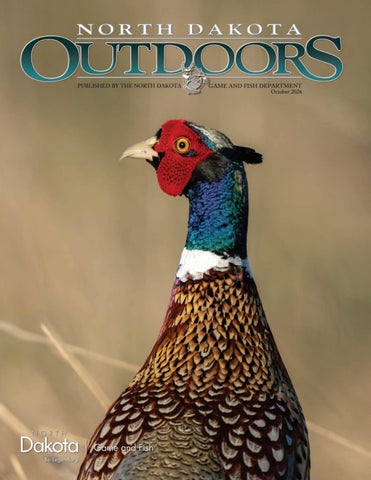
Front Cover Results of the North Dakota Game and Fish Department’s late summer roadside brood survey indicated ring-necked pheasant numbers are up slightly statewide from 2025. PHOTO BY ASHLEY PETERSON, BISMARCK.
BY ZACHARY ESHLEMAN
2 ■ ND OUTDOORS ■ OCTOBER 2026
I
t is early October, and North Dakota bird hunters are living in paradise. Waterfowl seasons are in full swing. Sharp-tailed grouse, Hungarian partridge and doves have been on the menu for weeks. Even snipe, sandhill cranes and woodcock are open for the taking. There is just one problem. The bird most of us see every time we cruise a gravel road still needs another week. Why are ring-necked pheasants so special that hunters have to wait until the second Saturday in October? The wait is not a tradition for tradition’s sake. It is a wildlife management decision built on how pheasants breed, how roosters dress themselves for fall, and how quickly a hunter has to decide to take a shot before a bird disappears into the next patch of cover. This decision is also related to why we harvest only male pheasants to begin with. Pheasants do not pair up the way most waterfowl and many other birds do. They are closer to wild turkeys in the sense that a successful rooster may father more than 10 broods in a year instead of sticking with one hen. That fact lowers the value of any individual male on the landscape. When a
hunter harvests him, other roosters nearby can cover the breeding. Think of it this way. If there are 10 roosters for 100 hens, reproduction is theoretically about the same as if there were 20 roosters for those same 100 hens. A hen will not raise more than one successful brood a year. Extra roosters do not create extra nests. The hens do. That is reason enough to keep hens off-limits, yet enforceability matters just as much. A legal bird has to look like a legal bird in a hurry, often against the sun, in the wind, and over a dog that is already on point. That’s why, for pheasants, the hunting season follows the plumage. North Dakota pheasants start life as little more than puffballs, and that can happen at different times in spring and summer. An early nest lost to weather, haying or a predator can push hens to attempt another one later into summer. Peak hatch in the state usually falls in mid-June, but late hatches keep trickling in long after that. Biologists call this puffball stage “downy,” and it lasts only about a week or two.
A group of young-of-the-year pheasants sit together on a September morning.
ND OUTDOORS ■ OCTOBER 2026 ■ 3
“Even after a couple of days, they’re starting to get their feathers,” said R.J. Gross, North Dakota Game and Fish Department upland game biologist. “They do it pretty quick, and it all depends on nutrition. They progress as fast as they eat bugs.” For at least their first 10 days, chicks eat almost nothing but insects. They need that protein to grow. Those bugs come from good brood-rearing cover: alfalfa, wildflowers or other forb-rich spots with some overhead protection and room for small legs to move. You will not usually find the youngest chicks in thick grass. Travel is too hard, and hunting insects is too slow. Over the next weeks, more and more feathers develop, and sex gets easier to see around 10 weeks. “I can really tell if it’s a hen or a rooster around that 10-week mark,” Gross said. “I’d say for normal people it’d be closer to 12 to 14 weeks, but at 10 weeks they’re starting to get a darker head and things like that.” Then comes formative plumage. It looks a lot like
A 10- to 12-week-old rooster.
4 ■ ND OUTDOORS ■ OCTOBER 2026
an adult rooster, only duller or more buffy. The white neck ring may be incomplete or faint. The tail is usually shorter. Spurs are smaller, duller and blunt, not the long, black, sharp hooks on older birds. These are the half-colored young roosters hunters sometimes jump early in the North Dakota season after a late nest. Finally, you have the adult plumage. New pin feathers can leave the head looking whitish for a time. The skin around the eye can fool people, too. “Sometimes they think that it’s a hen when it’s not because of their wattle,” Gross said. “A rooster pheasant’s skin around his eye is pretty red, whereas a hen’s is really pink. It’s a different hue. And a lot of times when they’re young and they look like that, people say that was a hen that cackled when it got up, but hens don’t cackle, so it was a rooster.” Season timing also reflects that adult roosters and juveniles molt on roughly the same calendar. Juveniles are building their first set of adult-like feathers
North Dakota pheasants start life as little more than puffballs, and that can happen at different times in spring and summer. An early nest lost to weather, haying or a predator can push hens to attempt another one later into summer. Peak hatch in the state usually falls in mid-June, but late hatches keep trickling in long after that.
through late summer and into fall, and adults are replacing worn plumage over about the same window, finishing as the young birds complete theirs. Knowledge of the dates regarding peak hatch and the timeline of pheasant development has been hard-earned through research. Department staff age wings and feet that hunters mail in. Spur length and shape separate young-of-the-year roosters from adults. In juveniles, growing primary feathers can even be measured back to a hatch week. “You want to be able to harvest a pheasant that you can tell is a rooster, which is usually around that 15-week mark,” Gross said. “So, you backdate 15 weeks from the opener that we have now. That’s about where most of our pheasant hatch has already occurred.” By then, most young roosters have enough color, enough of a neck ring and enough of a cackle that a careful hunter can tell them from hens. Latehatched birds are the exception, not the rule. They
are why the opening week or two still requires a second look. If a bird explodes from the grass and you are not sure, let it go. Listen for the cackle. Look for the darker head, the developing white ring, the longer tail and the redder skin around the eye. After the shot, North Dakota requires continued proof of sex. All roosters have spurs and hens do not, so a foot left on a dressed bird is enough. The wait for pheasants feels long when everything else is already open. But when you understand the birds and the ways these decisions are made, everything starts to make sense. It is about giving a young rooster time to look like what he is, so the hen walking beside him gets to raise a brood next year.
ZACHARY ESHLEMAN is the North Dakota Game and Fish Department’s communications specialist.
Downy stage pheasants with their mother.
ND OUTDOORS ■ OCTOBER 2026 ■ 5
[
[
A successful hunt on one of the many PLOTS tracts scattered across North Dakota’s rural landscape
6 ■ ND OUTDOORS ■ OCTOBER 2026
PLOTS ACRE GOAL IN SIGHT BY RON WILSON
A
s the Private Land Open To Sportsmen program leans closer to its 30-year milestone in 2027, the North Dakota Game and Fish Department’s longrecognized effort to provide walk-in access to hunters on private land is also nearing its goal of 1 million acres. This fall, hunters will find 925,000 PLOTS acres across North Dakota’s rural landscape, an increase of 45,000 acres from 2026. “Each year, we set a goal of adding 40,000 acres, including 6,000 acres of new habitat, and for the last three years we’ve been able to hit those marks,” said Kevin Kading, Department private land section leader. “We’re trending in that direction of hitting our 1-millionacre goal by 2028 and hopefully keep going after that.” It’s important to note that private land staff had to enroll 65,000 acres to hit the 45,000-acre mark in 2026 because every year some PLOTS tracts exit the program. “While there’s a lot of interest in the program and it’s still very well received by landowners, people are always coming in and out because that’s just the way it goes,” Kading said. “So, every year, we’re trying to make up ground as well.”
ND OUTDOORS ■ OCTOBER 2026 ■ 7
Some of that ground was made up this year thanks to the Governor’s Legacy Soil Health and Habitat Program, which was created to put more perennial grass on the landscape while improving soil health, water retention and wildlife habitat. While available funding for the voluntary pilot program allowed just 10,000 acres to initially be enrolled, nearly half of those acres were enrolled in the Department’s PLOTS program. “Some other highlights going into the fall for the PLOTS program include some really great partnerships, such as a partnership with Pheasants Forever to add more grass to the landscape on PLOTS,” Kading said. “We’ve also been working with Ducks Unlimited and North Dakota Natural Resource Trust for wetland restorations on PLOTS tracts. These efforts combined have helped add quite a few acres to the program this fall, helping to move the needle on habitat on PLOTS for 2026.” Also, $550,000 donated by hunters during the licensing period the last two years from unsuccessful lottery refunds and straight up donations,
8 ■ ND OUTDOORS ■ OCTOBER 2026
[
Hunters have seen the number of PLOTS acres climb in the last few years across the state.
[
[
[
Sharp-tailed grouse
was teamed with a $1 million Outdoor Heritage Fund grant and put directly back into the PLOTS program for habitat and hunter access. Kading said the Department also secured 20-year PLOTS and protection agreements on private forest areas in the Turtle Mountain region in Rolette and Bottineau counties, which also includes some aspen management. “We’re working with the North Dakota Forest Service and receiving a lot of local and stakeholder input for the projects in the Turtle Mountains,” he said. “This is just another example of the different partnerships we’re working with this year.” Kading said the PLOTS tracts scattered across the rural landscape are all different, sort of like the hunters who access these private lands open to hunting. Some might be looking for a spot to hunt deer, chase pheasants or set up waterfowl decoys in a wetland or field. “There are times when people might pull up to a PLOTS tract they found on a map
and find out that it’s a stubble field, but there’s a reason we put that in the program because there are either wetlands out in the middle of it for duck hunting, or it’s a good field hunting opportunity,” he said. “Or it might be a piece out in the western part of the state that’s native prairie, but it’s got some really nice woody draws. Or it might be a place to find some sharp-tailed grouse or mule deer, that type of thing. I’ve always said that not all PLOTS tracts are created equal. They’re all different and everybody has different hunting tastes and is looking for something different. This variety is a nice feature to have.” No matter the PLOTS tract, they all need to be treated the same … with respect. “These are private lands and we want people to really understand and respect that. The agreement that we have in place for PLOTS allows for walk-in access only. That’s the only thing that we’re asking that landowner to allow is that walkin access only,” Kading said. “So, anything else besides that would require the hunter to talk to the landowner directly and get written permission. If you wanted to go camping, horseback riding, shoot clay pigeons or shed hunt, which is one that
comes up quite a bit, those activities do require landowner permission. The only thing we’re asking that landowner to do is allow walk-in hunting for the active hunting seasons.” He added: “Every little action really makes a difference out there. Make sure to pick up your own garbage or pick up other people’s garbage. Leave the gates the way you found them. We even recommend picking up all your empty shells. We want to make sure we leave a good image out there for hunters and have that good relationship with those private landowners who enrolled their land in the program.”
RON WILSON is editor of North Dakota OUTDOORS.
PLOTS ONLINE The North Dakota Game and Fish Department’s Private Land Open To Sportsmen maps for 2026 are available online at the Game and Fish website, gf.nd.gov. This year features about 925,000 PLOTS acres. Because PLOTS tracts can be added or removed from the program throughout the year, hunters are encouraged to use the Game and Fish mobile app or other mapping and browser-based applications to locate and identify these tracts. Map sheets are updated weekly on the Department’s website. PLOTS maps highlight walk-in hunting access areas, identified in the field by inverted triangular yellow signs, as well as other public lands. The free printed PLOTS guides are available at most license vendors and other locations throughout the state. The guides are not available by mail, so hunters will have to pick one up at a local vendor or Game and Fish office or print individual maps from the website.
ND OUTDOORS ■ OCTOBER 2026 ■ 9
BY ZACHARY ESHLEMAN Bird banding has been used to study migratory birds for hundreds of years. In the United States, the first recorded instance happened around 1803 outside Philadelphia when John James Audubon tied silver thread to Eastern phoebes to see if they returned to the same nesting area each year. This early experiment still aligns with the purpose of modern banding. Researchers use banding to learn where birds come from and where they go. That lets conservation work focus on where it will do the most good, and it gives decisionmakers a current picture of what the most prized game birds are doing. Knowledge that modern bird hunters take for granted, such as the existence of the four flyways, the timing of different species’ migrations, and where prairie ducks winter, would not exist without this persistent effort. I wanted to see behind the scenes of how this data is collected and used, so I went to John Palarski, North Dakota Game and Fish Department migratory game bird supervisor, and asked to get out in the field with him this banding season. “By the time we get to August, that’s when our focus really shifts to duck banding,” Palarski said, “Throughout the whole month and all the way up until our regular waterfowl season opener, we’re out there.” Palarski, an avid waterfowl hunter himself, has a difficult task this time of year. In his words, he is looking to get “as many ducks as possible,” and it’s not like he can just shoot them out of the sky. With rocket netting, it is a one-shot deal, so the ducks cannot just trickle into the chosen location. He needs to find high numbers grouped together to make that one shot worth it. “I’m used to scouting, trying to find fields or water with lots of ducks, and getting access on private land. So, it’s very similar to hunting,” he said. “By the time we get to waterfowl season, I’m not necessarily burnt out on duck hunting yet. But it almost feels like I’m hunting them for two months before the season even starts.”
10 ■ ND OUTDOORS ■ OCTOBER 2026
A male wood duck is held after being banded by Game and Fish Department staff.
ND OUTDOORS ■ OCTOBER 2026 ■ 11
The two main capture methods are swim-in traps and rocket nets, and which one he chooses depends on a few factors. “The methods we decide to use to catch these different duck species actually kind of depends on the species. The swim-in traps do a really good job of catching species like redheads and bluewinged teal,” he said. “But if you’re really trying to target mallards and pintails, rocket netting is the best way to go.” That is how we ended up sitting in a blind together at 4 a.m., looking down on a bait line about 100 yards away. “If you’re getting out here when they’re already moving around, you’re way too late,” he told me the day before. So, there we were in the moonless night, as he monitored an infrared trail camera placed down by the bait pile. Two other biologists waited in a truck over a hill behind us, ready to bring the equipment and themselves as quickly as possible after the shot to limit the time the ducks spent in the net. Just as the light started to break, Palarski, now looking through binoculars at the ducks piling in, made the call and hit the trigger. The three rockets, which looked like pieces of metal pipe with holes drilled in the end cap, worked surprisingly well. They lifted the net and carried it about 30 feet, draping it over the ducks below. Then it was time to hustle. They worked to get the ducks quickly out from under the net and into crates, separated by species. This time around we got about half mallards and half wood ducks.
12 ■ ND OUTDOORS ■ OCTOBER 2026
Palarski already had the bands sorted by species, age and sex. The crew examined each bird for those traits, fitted a band so no edge would rub the leg, and released it. “The thing that’s quite remarkable is how resilient and how consistent things have been for the last 100 years,” Palarski said, “We’re still using very similar methods that are tried and true and still work today. That’s a testament to our forefathers who conceptualized this idea. It still works even in 2026, which is quite amazing.” What surprised me was how little the whole process seemed to bother the ducks. Most of them calmly waited in hand until it was over. “Some species like wood ducks, for instance, and male mallards, are seen as being trap happy. Meaning, we’ll catch them one day, and then we might shoot that net off at the same spot the following week and catch that same bird again on bait,” Palarski said, “You’d think that they would learn and say, ‘Hey, this bait pile is not safe. I got
“There’s a lot of effort that goes into catching ducks. It’s one thing to harvest a duck. It’s a totally different thing to capture that bird, put a band on it and release it in good enough shape to survive, and to do that at scale.” – JOHN PALARSKI
a rocket shot over the top of me the last time that I was here.’ But we’re catching a lot of these birds multiple times.” Banding ducks and geese, and collecting and maintaining the data, are excellent examples of the long-term thinking conservation science requires. It takes a lot of effort, and yet, each duck banded is just a small piece of data, and each year’s information is just a small piece of the truth. But when that information is combined with parts collection, visual surveys and time, a vast story is created. That story is paid for in long nights and early mornings by state, federal, provincial, tribal, and nonprofit crews across the United States and Canada. “Between those three pieces of information, that’s how we’re making a lot of our decisions related to harvest management of waterfowl species,” Palarski said. “It’s a critical component of those three that we need to make really good conservation decisions.” Once the bands are out in the ether, the fun part begins. Every week Palarski gets an email of every duck under the Department’s banding
permit that has been reported somewhere in the world. Maybe the bird was spotted through binoculars hanging out on a wetland, maybe it died and was found by a passerby, or maybe it tried to land in a well-placed decoy spread. “There’s a really neat marriage between hunters and the managers and biologists who are collecting the data, because we couldn’t do it without each other,” Palarski said. “We’re putting the bands on and collecting the data, but that really doesn’t help us out all that much unless hunters harvest those ducks and report the bands. That’s when it really becomes useful data.” So, the next time a banded duck drops into your spread, take a moment to report it. You’ll be closing the loop on a lot of people’s hard work, and you’ll be leaving your own mark on research that started more than 100 years ago and still guides conservation today. To report a band, go to reportband.gov or call 1-800-327-BAND.
ZACHARY ESHLEMAN is North Dakota Game and Fish Department’s communications specialist.
Nathaniel Rykerd, Department wildlife biological technician, releases a banded wood duck.
ND OUTDOORS ■ OCTOBER 2026 ■ 13
A German wirehaired pointer runs through Sheyenne National Grassland.
14 ■ ND OUTDOORS ■ OCTOBER 2026
BY ZACHARY ESHLEMAN
D
o you think North Dakota is flat? I beg to differ. As most North Dakotans know, walking across the prairie can quickly become a humbling experience. The land refuses to stay level. Rolling hills that appear gentle from the road become short, steep coulees and shallow draws that lead you downhill and back up, over and over again. Add a stiff wind that never seems to quit and ground cover that hides everything that would love to roll your ankles, and pretty soon a mile as the crow flies can easily feel like 2. This was my situation when I was invited to spend the weekend camping at Sheyenne National Grassland for the German Wirehaired Pointer Club of Wisconsin’s spring field trial. This was an out-and-back trial where two dogs start from camp in the first brace and then are swapped for two different dog-and-hunter duos for the return trip. A unique aspect of this weekend was that everyone who participated was on horseback, working their way through the native prairie as people have done for hundreds of years. The judges followed along, and so did a gallery of participants if they wanted to. I was the heavy-breathing guy bringing up the rear on Memorial
ND OUTDOORS ■ OCTOBER 2026 ■ 15
Day weekend, carrying camera equipment and realizing that I should probably accept the offer of a horse to ride that afternoon. Later that day, once I got on my horse, Dolly, it was hard not to feel a sense of nostalgia for a time I’ve never known. The way she effortlessly crested hills and stepped through the terrain I was struggling with brought the utility of these creatures in this environment to bear. Within the confines of Sheyenne, this ride took me straight back to a chapter of North Dakota history that has quietly faded into the corners of the state’s memory. Over a century and more ago, vast stretches of tallgrass prairie covered much of the eastern part of our state and the Great Plains beyond our borders. Big bluestem and switchgrass stood shoulder-high in places, and greater prairie chickens called out on the leks by the thousands each spring. Hunters and ranchers rode horseback with bird dogs through these same rolling sand hills and oak savanna patches. It was practical work, not sport alone. Dogs located birds for the table or for market, and horses carried riders across ground too rough for wagons and distances too great for walking. Agricultural settlement changed all that in a hurry. By the late 1800s and early 1900s, homesteaders broke most of the prairie sod for crops. Heavy grazing on what remained altered the plant mix, and much of the original tallgrass prairie disappeared. Today,
16 ■ ND OUTDOORS ■ OCTOBER 2026
only a tiny fraction survives unplowed in North Dakota, and Sheyenne National Grassland contains some of the largest pieces still intact. This national grassland originated from the federal government’s response to the Dust Bowl and the Great Depression in the 1930s. Under New Deal programs, the government acquired thousands of acres of suboptimal, eroded farmland and failed homesteads in Ransom and Richland counties that had been overfarmed and overgrazed. These lands, bought though Land Utilization Projects, were later transferred to the U.S. Forest Service, restored with native grasses, and formally designated part of the national grasslands system in the 1960s. What makes Sheyenne so special to me now is how modern management keeps the old landscape alive while still using the resources. The U.S. Forest Service oversees the roughly 70,000-acre public grassland with rotational grazing and prescribed burns. Cattle move through pastures on a schedule that mimics the natural patterns of bison herds long gone. Burns remove thatch, encourage native grasses and create open space for prairie chickens to nest and forage. Those practices helped the local prairie chicken population rebound from very low numbers in the 1960s. Sheyenne is still one of only two main strongholds for the birds in North Dakota, as the species faces broader habitat challenges across its range. These field trials themselves carry that same
The gallery follows behind competing dogs during a spring field trial.
thread. Organized events for pointing dogs date back more than 150 years in the United States, with roots in European traditions stretching even further back. The modern versions aren’t the same as they used to be, but neither is the world we live in. Modern gear has changed almost every aspect of the trials, from the equipment that handlers and dogs carry to the systems that track points and achievements from one competition to the next. It would be easy to take a dim view of these things and mourn the loss of simplicity, but I don’t find a lot of use in that. Instead, I see the dogs, the riders, and the land itself working together here. They turn a fading memory into something you can still see, hear and
feel on a spring morning when the wind moves through the tall grass and trees, the dogs point upland birds, and the horseback riders stride through the prairie. Later that night in the tent, my soundtrack was a gentle rain pitter-pattering on the canvas while calves called to their mothers in the distance. The air got cool again after a warm day, and I was thankful these pieces of the old world still carry on in modern North Dakota.
ZACHARY ESHLEMAN is the Game and Fish Department’s communication specialist.
Organized events for pointing dogs date back more than 150 years in the United States, with roots in European traditions stretching even further back.
ND OUTDOORS ■ OCTOBER 2026 ■ 17
BY ZACHARY ESHLEMAN
Linkin Hill holds an 8-pound, 15-ounce largemouth bass he caught in the Missouri River.
18 ■ ND OUTDOORS ■ OCTOBER 2026
T
o say an 8-pound largemouth bass in North Dakota is rare is a bit of an understatement. The current state record sits at 8 pounds, 8 ounces out of Nelson Lake, and that was all the way back in 1983. The only published 8-pluspound bass I could find since then was Jess Bitterman’s 8-pound, 4-ounce largemouth, written up in the Oct. 28, 1995, Bismarck Tribune when the Bismarck angler qualified for a national bigbass tournament. That’s why, when Linkin Hill made the deal with his father, Derek, that if he caught an 8-pounder his dad would mount it for him, it seemed like a no-brainer. “I made kind of a fool’s deal with him leading into the fishing season,” Derek said. “He threw out there, ‘Hey, if I ever catch an 8-pounder, can we get it mounted?’ And I was like, ‘That’s a pretty big largemouth for the area. Sure, I’ll take that bet.’” Derek should have known better. See, Linkin isn’t your average teen. At 13, he already has a drive for the next cast that is unmatched by most. He can be found on his bike in the morning before the sun comes up, riding by the light of his headlamp to one of his many favorite spots on the Missouri River. “I like walleye, but I like bass fishing a lot more. It’s just more fun to me,” Linkin said. “More casting, they fight well, and they’re fun because you can catch them on a bunch of different things.” If you want to seriously pursue this species along the Missouri, harbors and docks are the place to do it. These fish prefer warmer water and breaks from the Missouri’s current as opposed to pike or walleye. Knowing this, Linkin has developed a network of people who will let him fish their property, establishing trust by being trustworthy. “I talked to a lot of people, neighbors, a lot of people that fish, and they love it because they see him taking off on his bike with the backpack and however many fishing rods he can carry,”
“I made kind of a fool’s deal with him leading into the fishing season.” Derek said. “Maybe we see him at lunch … maybe we even see him at dinner, and he comes home at 8 or 9 at night smelling like a fish.” It was on one of those docks on Aug. 14, 2026, that Linkin landed the largemouth bass of a lifetime. “Me and my buddy, we woke up early and we came out here around 6, and we were fishing the docks of some people we know over here,” Linkin explained. “We walked up, and I saw him just sitting in between these docks over here. I cast at him and spooked him. Then we went over to that dock, and I caught him under it.” Linkin and his friend weighed the fish, but believing the scale was saying 8.15 pounds, they snapped some pics, called his dad to tell him about the mount he was going to get, and released it back into the water, thinking the fish was just shy of the state record. It was only later that they realized the scale was reading pounds and ounces. 8 pounds, 15 ounces. 22 inches long. With the fish back in the water and no way to verify, this catch will live in the realm of legend. A story people can doubt and argue about like fishermen love to do. An unofficial state record, likely beating the long-held standard by almost half a pound. That fish is still down there. A state record that could be hanging out just by your dock, but you’re going to have to get up pretty early if you want to beat Linkin to it.
ZACHARY ESHLEMAN is North Dakota Game and Fish Department’s communications specialist.
ND OUTDOORS ■ OCTOBER 2026 ■ 19
BUFFALOBERRY PATCH
Upland Bird Numbers Look Good North Dakota’s late summer roadside surveys indicated pheasant and sharp-tailed grouse numbers are slightly up from last year, while gray partridge numbers are down. Total pheasants observed (80 per 100 miles) are up 3.8% from last year. Broods per 100 miles (9.6) and average brood size (5.3) are similar to last year. The statewide number of pheasants observed per 100 miles is 57% above the 10-year average. Pheasants observed in the northwest were up 7% to 85 pheasants per 100 miles. Broods per 100 miles and average brood size were also up just slightly to 10.5 broods, with an average brood size of 4.7 chicks.
No Ducking Spread of ANS Waterfowl hunters need to do their part in preventing the spread of aquatic nuisance species into or within North Dakota. Hunters must remove aquatic plants and plant fragments from decoys, strings and anchors; remove aquatic plant seeds and plant fragments from waders and other equipment before leaving hunting areas; remove all water from decoys, boats, motors, trailers and other watercraft; and remove all aquatic plants from boats and trailers before leaving a marsh or lake. In addition, hunters should brush their hunting dogs free of mud and seeds. Cattails and bulrushes may be transported as camouflage on boats. All other aquatic vegetation must be cleaned from boats prior to transportation into or within North Dakota. Drain plugs on boats must remain pulled when a boat is in transit away from a water body. In addition, hunters are reminded of a state law that requires motorized watercraft, including motorized duck boats, operated on state waters and not licensed in North Dakota, to display an ANS sticker, including an ANS fee to be paid each calendar year. For more ANS information, including regulations, or to purchase the ANS sticker, visit the North Dakota Game and Fish Department website, gf.nd.gov.
20 ■ ND OUTDOORS ■ OCTOBER 2026
Not Bad News for Bighorn Population The North Dakota Game and Fish Department allocated five bighorn sheep licenses for the 2026 hunting season. This includes one auction license and four lottery licenses, three fewer than 2025. “The reduction in hunting licenses should not be regarded as bad news for the state’s population of bighorn sheep,” said Brett Wiedmann, Department big game biologist. “On the contrary, our population is at record levels and doing very well, but we like to harvest rams that are 8 years and older and the number of harvestable, mature rams is down due primarily to four consecutive years of poor lamb recruitment from 2015 to 2018.” The total number of licenses does not include the potential for an additional tribal license issued to a North Dakota resident per a memorandum of understanding with Three Affiliated Tribes Fish and Wildlife. This would be the second of three licenses granted in the MOA. In total, 22,739 applicants applied for bighorn sheep.
PLOTS Public Use Regulations The goal of the Private Land Open To Sportsmen program is to provide walk-in public access for hunting on private land. PLOTS agreements do not allow
activities such as horseback riding, camping, placing bait for any purpose, driving ATVs or snowmobiles, dog training and many others, without written permission from the landowner. The North Dakota Game and Fish has specific regulations that apply to public use on PLOTS tracts. By establishing these regulations, the Department can better fulfill its responsibility to private landowners and help protect property enrolled in the program. In addition, the regulations provide clarity to hunters, and law enforcement officers are in a better position to enforce activities on PLOTS property. Here’s a closer look: Why are stubble fields sometimes included in PLOTS? Lower quality habitat, such as a stubble field, is often included in a PLOTS agreement as part of a larger block of land that includes permanent, high-quality habitat. Landowners typically receive little or no payment for these low-quality acres, but there are cases where stubble fields are enrolled specifically for waterfowl hunting opportunities. Is hunting allowed on PLOTS where cattle are present? Yes. However, in such cases hunters should use good judgment and limit disturbance to the animals, and not shoot in their direction. In some cases, it may be best to come back another time as the landowner may have moved the cattle to another area or removed them completely from the tract. Is hunting allowed on PLOTS if there is an occupied dwelling within 440 yards? North Dakota statute prohibits hunting within 440 yards of an occupied dwelling, with exceptions. The first is the “landowner exception,” which allows a person to hunt on his or her own land even if doing so is within 440 yards of another’s occupied dwelling. The second exception is the “consent exception,” which allows hunting if the “occupier” consents to allow hunting within 440 yards of his or her building. When a landowner enrolls land into a PLOTS agreement, permission to hunt on the land is granted. There is also a “public lands” exception to this law. Private lands enrolled in a public access program, such as PLOTS, fall into this category since the landowner has signed an agreement granting public access. A hunter on public land, or PLOTS land, is not required to obtain the consent of the person occupying a building located within 440 yards of the hunter. For safety purposes, fluorescent orange “No Shooting Toward Building” signs are placed on these PLOTS tracts to notify hunters there is a building or dwelling nearby. Is driving on PLOTS to retrieve game or set out waterfowl decoys allowed? PLOTS land is walk-in access only and you cannot drive on it unless you get specific permission from the landowner. Exception: Some PLOTS tracts are enrolled
specifically for waterfowl hunting. These tracts are identified with a special green “Attention Waterfowl Hunters” sign. The PLOTS agreement for these areas allows driving access, on harvested cropland only, to allow hunters to set out decoys. Is target shooting allowed on PLOTS? No. PLOTS agreements are for walk-in hunting access only. All other activities require landowner permission. Are horses or ATVs allowed on PLOTS? No. PLOTS agreements are for walk-in hunting access only. All other activities require landowner permission. Is hunting in standing or unharvested crops on a PLOTS tract allowed? Yes, unless the PLOTS tract has a special sign stating “No Hunting in Unharvested Crop.” North Dakota statute prohibits hunting in unharvested cereal and oilseed crops, including sprouted winter wheat, alfalfa, clover and other grasses grown for seed, without the owner’s consent. However, when a landowner enrolls land into a PLOTS agreement, permission is granted to the public to hunt on the land; therefore, it is legal to hunt in standing crops on PLOTS unless there is a special sign. In those cases, after the crops are harvested the fields may be legally hunted. Are tree stands or ground blinds allowed on PLOTS? Yes, but they must be removed when a hunter leaves unless the landowner grants written permission to leave them overnight. The same rule applies to other hunting equipment, accessories or provisions. Is hunting over bait allowed on PLOTS? Hunting deer over bait is legal on PLOTS tracts but any type of bait qualifies as a “provision” for PLOTS purposes, and therefore bait must be removed when the hunter leaves, unless written permission is granted by the landowner. Is predator calling allowed on PLOTS? Yes. PLOTS tracts are open to all legal hunting. When are PLOTS lands open? All PLOTS tracts are open to walk-in public hunting access during all legal hunting seasons, or as signed. Are nonresident hunters allowed to use PLOTS? Yes, except for the first seven days of the pheasant season. (Exception: Nonresidents hunting on PLOTS land they own.) Nonresidents are also not allowed to hunt on Game and Fish Department wildlife management areas the first seven days of the pheasant season. The nonresident restriction on PLOTS and WMAs applies to all types of hunting, not just pheasant hunting. Nonresidents may hunt only on private land, excluding PLOTS during the first 9 ½ hays of the deer bow season. PLOTS landowners may hunt on their enrolled property. Is nontoxic shot required on PLOTS? Nontoxic shot regulations on PLOTS are the same as for other private land. Nontoxic shot is required while hunting ducks, geese, sandhill cranes, tundra swans, mergansers, snipe and coot statewide.
ND OUTDOORS ■ OCTOBER 2026 ■ 21
Nontoxic shot is not required to hunt upland game, turkeys or big game on PLOTS. Is it OK to park on oil pads when hunting a PLOTS tract? No. Most oil pads are either owned or leased by an energy company and parking a vehicle on them is considered trespassing. Can I drive on an oil field road on a PLOTS tract if it’s not located on a section line? No. Most oil field roads are either owned or leased by an energy company and driving on them is considered trespassing. Is it safe to hunt around oil wells? It is legal to hunt around oil wells that are located on PLOTS tracts but use extreme caution. Always attempt to stay upwind of any oil well due to the potential presence of hydrogen sulfide gas. Keep a safe distance and hunt away from the well, and don’t shoot in the direction of a well or any other infrastructure. Is shed hunting allowed on PLOTS? No. Private Land Open To Sportsmen property is limited to public walk-in access for the purpose of hunting within legal hunting seasons. Collecting shed antlers is not considered hunting as defined by North Dakota Century Code 20.1-01-02. All other activities, including shed hunting, require landowner permission. Is trapping allowed on PLOTS? Private Land Open To Sportsmen property is limited to public walk-in access for the purpose of hunting within legal hunting seasons, or as signed. State law requires trappers to obtain written permission from landowners or operators before placing or setting any traps or cable devices on private land, including PLOTS lands. The owner or operator may determine the length of time permission is granted. For those trappers who secure permission to trap on PLOTS lands, please keep in mind these lands are heavily used by upland game and waterfowl hunters and their dogs throughout their respective seasons. Hunters should familiarize themselves with traps and cable devices and be prepared by learning methods to release a dog if caught in a trap or cable device. Hunters should consider carrying a short-nosed cable cutter.
Motorists should watch for deer along roadways this time of year as juvenile animals disperse from their home ranges. October through early December is the peak period for deer-vehicle accidents. Motorists are advised to slow down and exercise caution after dark to reduce the likelihood of encounters with deer. Most deer-vehicle accidents occur primarily at dawn and dusk when deer are moving around. When you see one deer cross the road, look for a second or third deer to follow. Also, pay attention on roadways posted with Deer Crossing Area caution signs. Deer-vehicle accidents are at times unavoidable. If an accident does happen, law enforcement authorities do not have to be notified if only the vehicle is damaged. However, if the accident involves personal injury or other property damage, then it must be reported. In addition, a permit is required before taking possession of road-killed deer. Permits are free and available from Department game wardens and local law enforcement. A few precautions can minimize chances of injury or property damage in a deer-vehicle crash. • Always wear your seat belt. • Don’t swerve or take the ditch to avoid hitting a deer. Try to brake as much as possible and stay on the roadway. Don’t lose control of your vehicle or slam into something else to miss the deer. You risk less injury by hitting the deer. • If you spot deer ahead, slow down immediately and honk.
Duck Boat Safety
Check for Zebra Mussels
Waterfowlers hunting from boats are encouraged to wear properly fitted life jackets while on the water. Hunting coats with life jackets built in are light and comfortable to wear. In addition, wearing a life jacket will not only keep the overboard hunter afloat, but also slow the loss of critical body heat caused by exposure to cold water. Capsizing and falling overboard from small boats are the most common types of fatal boating accidents for hunters.
22 ■ ND OUTDOORS ■ OCTOBER 2026
Motorists Beware of Deer
The North Dakota Game and Fish Department is asking water recreationists and property owners to check for zebra mussels and other aquatic nuisance species when removing boat lifts, docks and other equipment from state waters. Ben Holen, Department ANS coordinator, said water recreationists and property owners play a vital role in ANS prevention. Zebra mussels attach to hard surfaces that are left in the water for long periods of time, first settling in tight spaces and areas that are protected from sunlight, Holen said. Equipment such as boat lifts and docks are high risk vectors
for spreading ANS, especially zebra mussels. Holen said it makes it easier to do a thorough search when equipment is taken out of the water in fall. Pay special attention to wheel wells, right angles on frames, and areas otherwise protected from sunlight. Feel for attached organisms that have small hair-like structures holding them in place. Small mussels can feel like rough sandpaper and adults can be as large as 2 inches long. Holen said if you think you’ve found a zebra mussel, take photos, write down any relevant information, such as how many were found and where, and report it online at the Game and Fish website gf.nd.gov/ans, or email Holen at bholen@nd.gov.
Dead Deer Permit North Dakota Game and Fish Department enforcement personnel issue the reminder that a permit is required before taking possession of a dead deer found near a road or in a field. Only shed antlers can be possessed without a permit. Permits to possess are free and available from game wardens and local law enforcement offices. In addition, hunters are reminded to properly dispose of dead deer. A deer carcass transported outside of its respective gun unit must be disposed of via landfill or waste management provider.
Order 2027 OUTDOORS Calendars The North Dakota Game and Fish Department is taking orders for its North Dakota OUTDOORS calendar, the source for all hunting season and application dates for 2027. Along with color photographs of North Dakota’s wildlife and outstanding scenery, it also includes sunrisesunset times and moon phases. Calendars must be ordered online by visiting the Game and Fish website, gf.nd.gov. The calendar is the North Dakota OUTDOORS magazine’s December issue, so current subscribers will automatically receive it in the mail.
STAFF NOTES Myhre Receives Highest Honor In August, James Myhre, North Dakota Game and Fish Department district game warden, was recognized by the North Dakota Peace Officers Association as the 2026 North Dakota Peace Officer of the Year. The North Dakota Peace Officer of the Year Award is the highest honor given by the Association. The award is presented to a North Dakota peace officer based upon the officer’s outstanding service, professional dignity, and unselfish personal contributions to the citizens of North Dakota. The award serves as recognition of those officers who display a consistent mark of excellence within their profession.
Nucech Joins Agency as GIS Manager Darrel Nucech has been named GIS manager for the North Dakota Game and Fish Department in Bismarck. He holds a Master of Science in Geography from the University of North Dakota and brings extensive experience in geographic information systems. His career began with the U.S. Forest Service’s Black Hills National Forest as a cartographic technician. Prior to joining the Department, Nucech served as GIS coordinator for the City of Bismarck, where he also gained valuable experience as a GIS technician and analyst.
ND OUTDOORS ■ OCTOBER 2026 ■ 23
BACKCAST W
e’re leaving town before sunrise, earlier than needed because the grouse will be feeding in the nearby crops when we get there and not loafing in the calf-high prairie grass where we can get at them, but it’s hard to dampen the eagerness of starting a new season that took 9 months to get here. We aren’t the only ones excited to get where we are going. Or maybe it’s not excitement, but a dubious concern that our small party of three, actually four if you count the bird dog, which you always should, are somehow headed to the exact same piece of public land in a big county that has its share of it. No matter their thinking, they pass us in a cloud of dust on a rural dirt road that should be negotiated with certain caution, not dirt track racing maneuvers. While there are things I’ll never be able to wrap my head around when it comes to humans, my understanding of sharp-tailed grouse falls below that. After nearly 40 years of chasing these birds — and not missing an opening weekend that I can remember — I am often dumbfounded after a weekend of hunting in agreeable country that things have worked in our favor more often than not. With my dog at home, likely already lazing on the couch after his Saturday morning pup cup from the nearby coffee joint, Boone, a bird dog not under my command who doesn’t flinch at the report of a shotgun and sprints back to the pickup when the trigger is pulled, works back and forth between the three of us. To me, he already looks birdy and it’s only been minutes since he crossed under the fence. His tongue is already hang-
ing out of his mouth where it will likely stay for the next 3 miles, but his owner says he’s not birdy yet, but we’ll know it when he gets a nose full. While it’s been too long since I’ve hunted behind a bird dog that I could scratch behind the ears and call my own, watching another hunter’s dog do things they are taught or wonderfully born with is still a beautiful thing. At this time of year, the opener, the second weekend in September, we expect the grouse to play nice. To hold and flush — but not all at once — at a respectable distance because that’s how it mostly goes. That’s what years of doing this have taught us. Yet, so far, we’ve yet to shoulder our shotguns and have only pointed fingers at sharptails flushing wildly, at 200 yards or more, just like they do later in the season when there is snow on the ground and the birds have been bumped by hunters and dogs often enough. Seeing grouse even from a distance is a good thing because we know they’re here, that we at least got the part correct about the kind of habitat these native creatures choose to reside. We blame this late season behavior, the jumpiness, on the wind because that’s all we can figure. The wind is stiff. It dries our sweat from humping it up and down hills but waters our eyes as we walk into it. When my hunting partners do flush birds, I’m looking the other way and don’t hear the unmistakable chuckle of grouse taking flight, but I do hear their shotguns bark, which is a sound we can all get behind on a day birds are hard to come by.
RON WILSON is editor of North Dakota OUTDOORS.
ND OUTDOORS ■ OCTOBER 2026 ■ 25
North Dakota Outdoors Magazine North Dakota Game and Fish Department 100 N. Bismarck Expressway Bismarck, ND 58501 To renew your subscription or change your address, call 701-328-6300 or go to gf.nd.gov/buy-apply.
Noah Raitz, North Dakota Game and Fish Department district warden in LaMoure, checks hunters during the early Canada goose season in mid-August. While the Department does not formally survey Canada goose production statewide, banding crews and observations over the summer suggested excellent production, especially along the Missouri Coteau. This was good news for Canada goose hunters, especially after a few years of population declines. PHOTO BY ZACH ESHLEMAN.
connect with us gf.nd.gov/connect