Editor: North Dakota OUTDOORS: Ron Wilson, Bismarck
Communications Specialist: Zach Eshleman, Bismarck
Marketing Coordinator: Cayla Bendel, Bismarck
Digital Media Editor: Lara Anderson, Bismarck
Photographer/Videographer: Ashley Peterson, Bismarck
Marketing Specialist: Jackie Ressler, Bismarck
Information Specialist: Dawn Jochim, Bismarck
Graphic Artist: Kristi Fast, Bismarck
Education Supervisor: Marty Egeland, Bismarck
Education Coordinator: Jeff Long, Bismarck
Hunter Education Coordinator: Brian Schaffer, Bismarck
Outreach Biologists: Doug Leier, West Fargo; Greg Gullickson, Minot; Jim Job, Grand Forks
Conservation Supervisor: Patrick Isakson, Bismarck
Conservation Biologists: Sandra Johnson, Elisha Mueller, John Schumacher, Aaron Larsen, Greg Schonert, Bismarck
Administrative Assistant: Amber Schroeter, Bismarck
ENFORCEMENT DIVISION
Division Chief: Scott Winkelman, Bismarck
Investigative Supervisor: Jim Burud, Kenmare
Investigator: Blake Riewer, Grand Forks
Operations Supervisor: Jackie Lundstrom, Bismarck
Warden Pilot: Mike Linden, Bismarck
Region No. 1 Warden Supvr: Michael Sedlacek, Jamestown
District Wardens: Corey Erck, Bismarck; Andrew Dahlgren, Milnor; Erik Schmidt, Linton; Greg Hastings, Jamestown; Noah Raitz, LaMoure; Gavin Herbert, Steele; Nick Tschepen, Fargo
Region No. 2 Warden Supvr: Paul Freeman, Devils Lake
District Wardens: Jonathan Tofteland, Bottineau; Jonathan Peterson, Devils Lake; James Myhre, New Rockford; Alan Howard, Cando; Drew Johnson, Finley; Sam Feldmann, Rugby; Gage Muench, Grand Forks; Dale Skalicky, Langdon; James Myhre, Sheyenne
Region No. 3 Warden Supvr: Joe Lucas, Riverdale
District Wardens: Shawn Sperling, Minot; Keenan Snyder, Williston, Josh Hedstrom, Tioga; Riley Gerding, Kenmare; Clayton Edstrom, Turtle Lake; Conner Folkers, Garrison; Luke Aamold, Watford City
Administrative Assistant: Lori Kensington, Bismarck
WILDLIFE DIVISION
Division Chief: Bill Haase, Bismarck
Assistant Division Chief: Levi Jacobson, Bismarck
Game Mgt. Section Leader: Stephanie Tucker, Bismarck
Pilot: Jeff Faught, Bismarck
Upland Game Mgt. Supvr: Jesse Kolar, Dickinson
Upland Game Mgt. Biologist: Rodney Gross, Bismarck
Migratory Game Bird Mgt. Supvr: John Palarski, Bismarck
Migratory Game Bird Biologist: Mason Ryckman, Bismarck
Big Game Mgt. Supvr: Bruce Stillings, Dickinson
Big Game Mgt. Biologists: Brett Wiedmann, Dickinson; Jason Smith, Jamestown; Ben Matykiewicz, Bismarck
Survey Coordinator: Chad Parent, Bismarck
Wildlife Veterinarian: Dr. Logan Weyand, Bismarck
Wildlife Health Biologist: Ryan Herigstad, Bismarck
Game Management Biological Technician: Vacant
Wildlife Resource Management Section Leader: Kent Luttschwager, Williston
Wildlife Resource Mgt. Supvrs: Brian Prince, Devils Lake; Brian Kietzman, Jamestown; Dan Halstead, Riverdale; Blake Schaan, Lonetree; Judd Jasmer, Dickinson; Jens Johnson, Bismarck
Wildlife Resource Mgt. Biologists: Randy Littlefield, Lonetree; Rodd Compson, Jamestown; Todd Buckley, Williston; Jake Oster, Riverdale; Andrew Ahrens, Devils Lake; Broden Ullyott, Dickinson Wildlife Biological Technicians: Tom Crutchfield, Jim Houston, Bismarck; Dan Morman, Robert Miller, Riverdale; Jason Rowell, Jamestown; Scott Olson, Devils Lake; Zach Eustice, Williston; Colton Soiseth, Quentin Corcoran, Lonetree
Private Land Section Leader: Kevin Kading, Bismarck
Habitat Manager: Nathan Harling, Bismarck
Private Land Field Operation Supvrs: Curtis Francis, East Region, Bismarck
Private Land Biologists: Zach Johnson, Colin Penner, Bismarck; Jaden Honeyman, Ben Reith, Dickinson; Ryan Huber, Riverdale; Renae Schultz, Jeff Williams, Jamestown; Terry Oswald, Jr., Harvey; Erica Sevigny, Williston; Brandon Ramsey, Matthew Parvey, Devils Lake
Procurement Officer: Dale Repnow, Bismarck
FISHERIES DIVISION
Division Chief: Greg Power, Bismarck
Fisheries Mgt. Section Leader: Scott Gangl, Bismarck
Fisheries Biologists: Todd Caspers, Devils Lake; Mike Johnson, Jamestown; Jeff Merchant, Dickinson; Zach Kjos, Riverdale
Fisheries Biological Technicians: Phil Miller, Devils Lake; Justen Barstad, Bismarck; Brian Frohlich, Riverdale; Ethan Krebs, Jamestown, Sanden O’Connell, WIlliston
Production/Development Section Supvr: Jerry Weigel, Bismarck
Aquatic Nuisance Species Coordinator: Benjamin Holen, Jamestown
Aquatic Nuisance Species Biologists: Mason Hammer, Jamestown; Kyle Oxley, Bismarck
Fisheries Development Supvr: Bob Frohlich, Bismarck
Fisheries Dev. Proj. Mgr: Wesley Erdle, Bismarck
Fisheries Development Specialist: Kyle Hoge, Jacob Heyer, Joe Fladeland, Bismarck
Administrative Assistant: Janice Vetter, Bismarck
ADVISORY BOARD
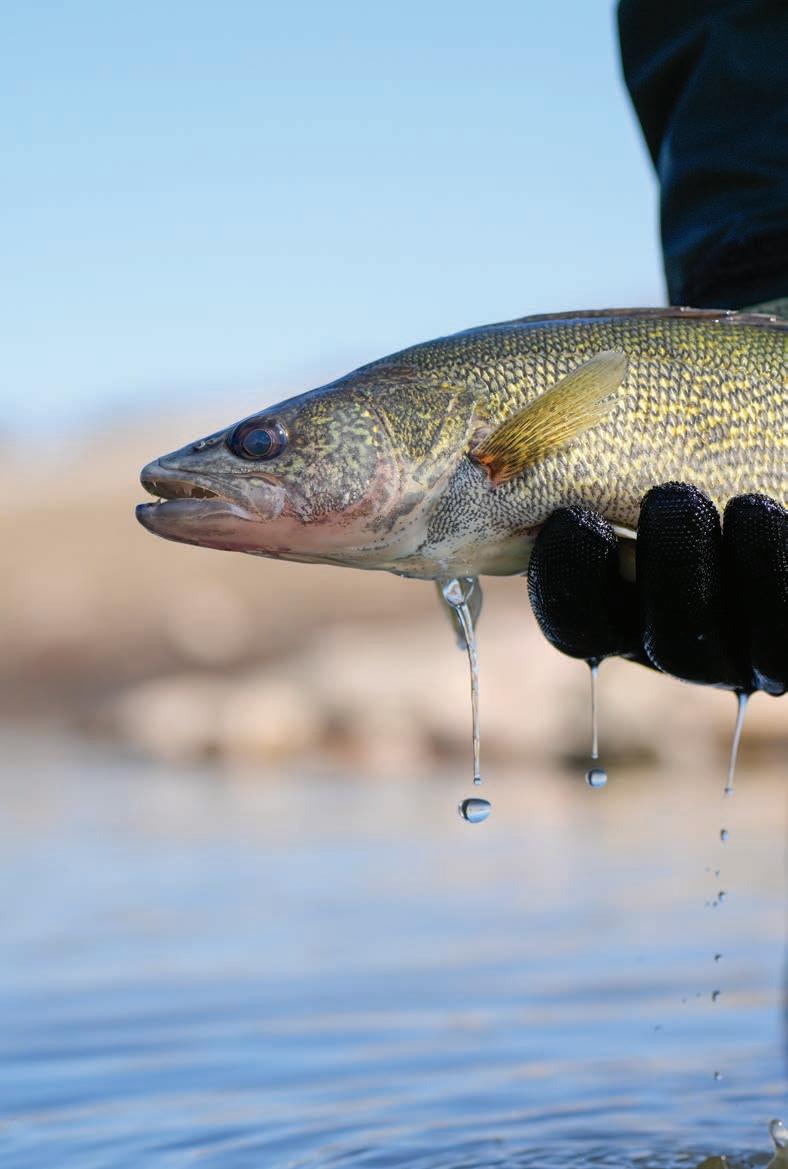
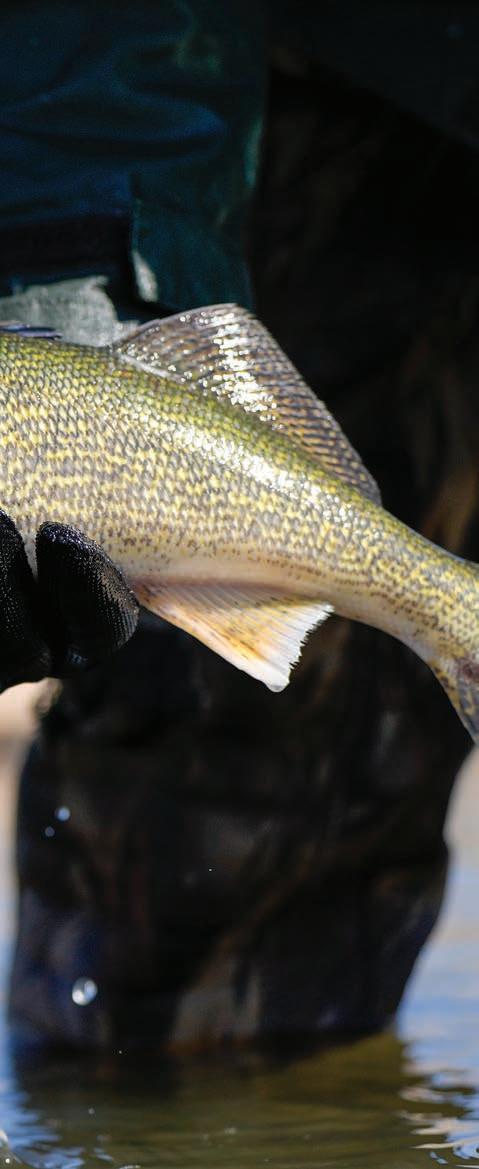
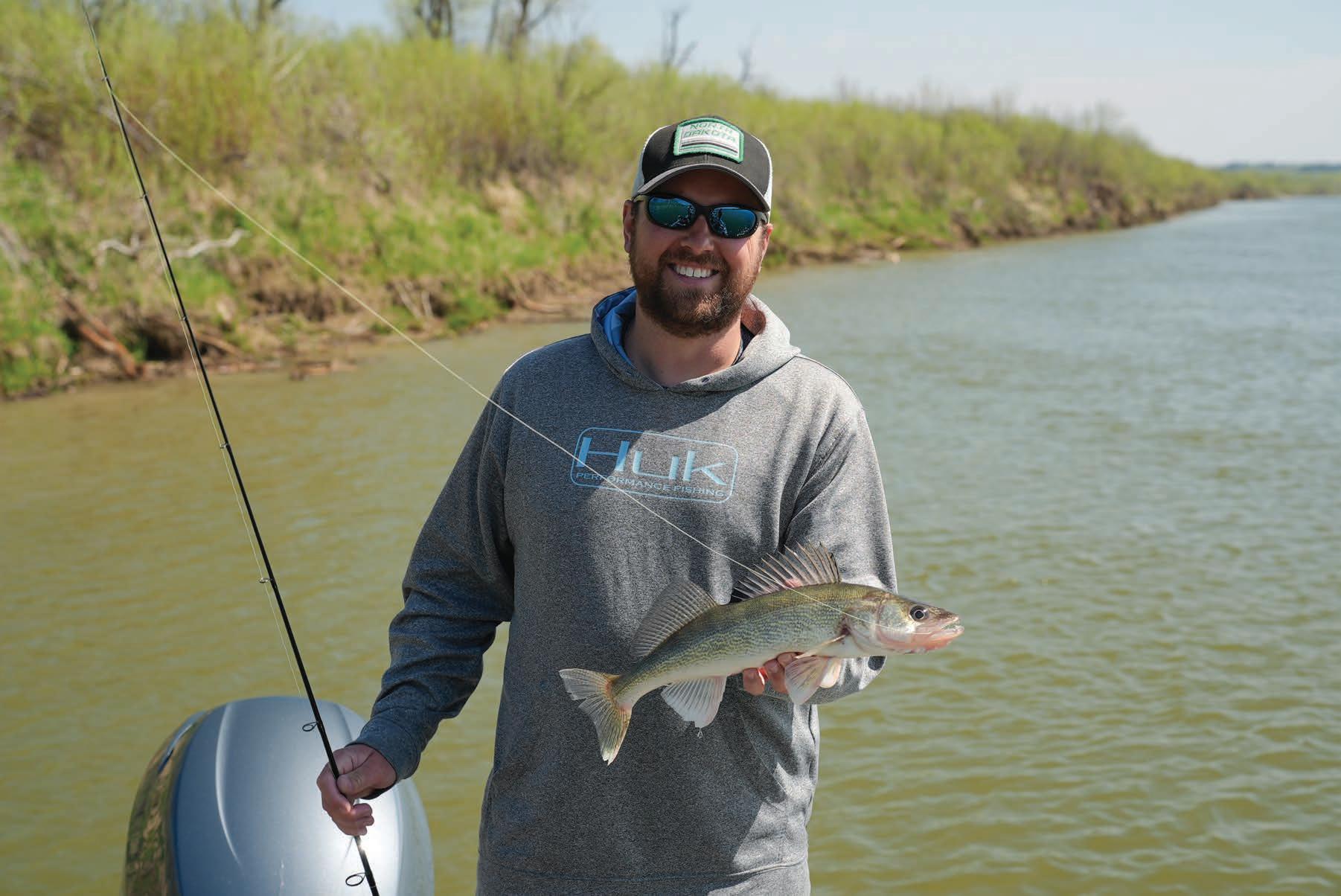
A walleye being released by a fisheries biologist during the North Dakota Game and Fish Department’s walleye spawning operation in spring at Lake Sakakawea’s Douglas Bay.
BY ASHLEY PETERSON, BISMARCK.
Nathan Hovde, Alexander
Travis Leier, Velva
Edward Dosch, Devils Lake
Karissa Daws, Michigan
Doug Madsen, Harwood
Jordan Svenningsen, Luverne District
Jody Sommer, Mandan District
Rob Brooks, Rhame
Contributing photographers for this issue: Cayla Bendel, Scott Clausen, Wesley Erdle, Zachery Eshleman, Sandra Johnson, Jesse Kolar, Garrett MacDonald and Ashley Peterson.
Official publication of the North Dakota Game and Fish Department (ISSN 0029-2761)
100 N. Bismarck Expressway, Bismarck, ND 58501-5095
Website: gf.nd.gov • Email: ndgf@nd.gov
• Information 701-328-6300 • Licensing 701-328-6335
• Administration 701-328-6305
• North Dakota Outdoors Subscriptions 701-328-6363
• Hunter Education 701-328-6615
• The TTY/TTD (Relay ND) number for the hearing or speech impaired is 800-366-6888
Report All Poachers (RAP) 701-328-9921
Periodical Postage Paid at Bismarck, ND 58501 and additional entry offices. Printed in the United States
POSTMASTER: Send address changes to: North Dakota OUTDOORS 100 North Bismarck Expressway Bismarck, ND 58501-5095
In cooperation with North Dakota Wildlife Federation and North Dakota State Radio.
PHOTO
The mission of the North Dakota Game and Fish Department is to protect, conserve and enhance fish and wildlife populations and their habitats for sustained public consumptive and nonconsumptive use.
North Dakota OUTDOORS is published 10 times a year, monthly except for the months of April and September. Subscription rates are $15 for one year or $30 for three years. Remittance should be by check or money order payable to the North Dakota Game and Fish Department. Indicate if subscription is new or renewal. The numbers on the upper right corner of the mailing label indicate the date of the last issue a subscriber will receive unless the subscription is renewed.
Permission to reprint materials appearing in North Dakota OUTDOORS must be obtained from the author, artist or photographer. We encourage contributions; contact the editor for writer and photography guidelines prior to submission.
The NDGFD receives Federal financial assistance from the US Fish and Wildlife Service and the US Coast Guard. In accordance with Title VI of the Civil Rights Act of 1964, Section 504 of the Rehabilitation Act of 1973, Title II of the Americans with Disabilities Act of 1990, the Age Discrimination Act of 1975, and Title IX of the Education Amendments of 1972, the NDGFD joins the US Department of the Interior and its Bureaus and the US Department of Homeland Security in prohibiting discrimination on the basis of race, color, national origin, age, disability, sex (in education programs or activities) and also religion. If you believe you have been discriminated against in any program, activity, or facility as described above, or you desire further information, please write to: ND Game and Fish Department, Attn: Chief of Administrative Services, 100 N. Bismarck Expressway, Bismarck, ND 58501-5095 or to: Office of Civil Rights, Department of the Interior, 1849 C Street, NW, Washington, DC 20240.
Editor: Ron Wilson Graphic Designer: Kristi Fast Circulation Manager: Dawn Jochim
PHOTO BY SANDRA JOHNSON, BISMARCK.
By Ron Wilson
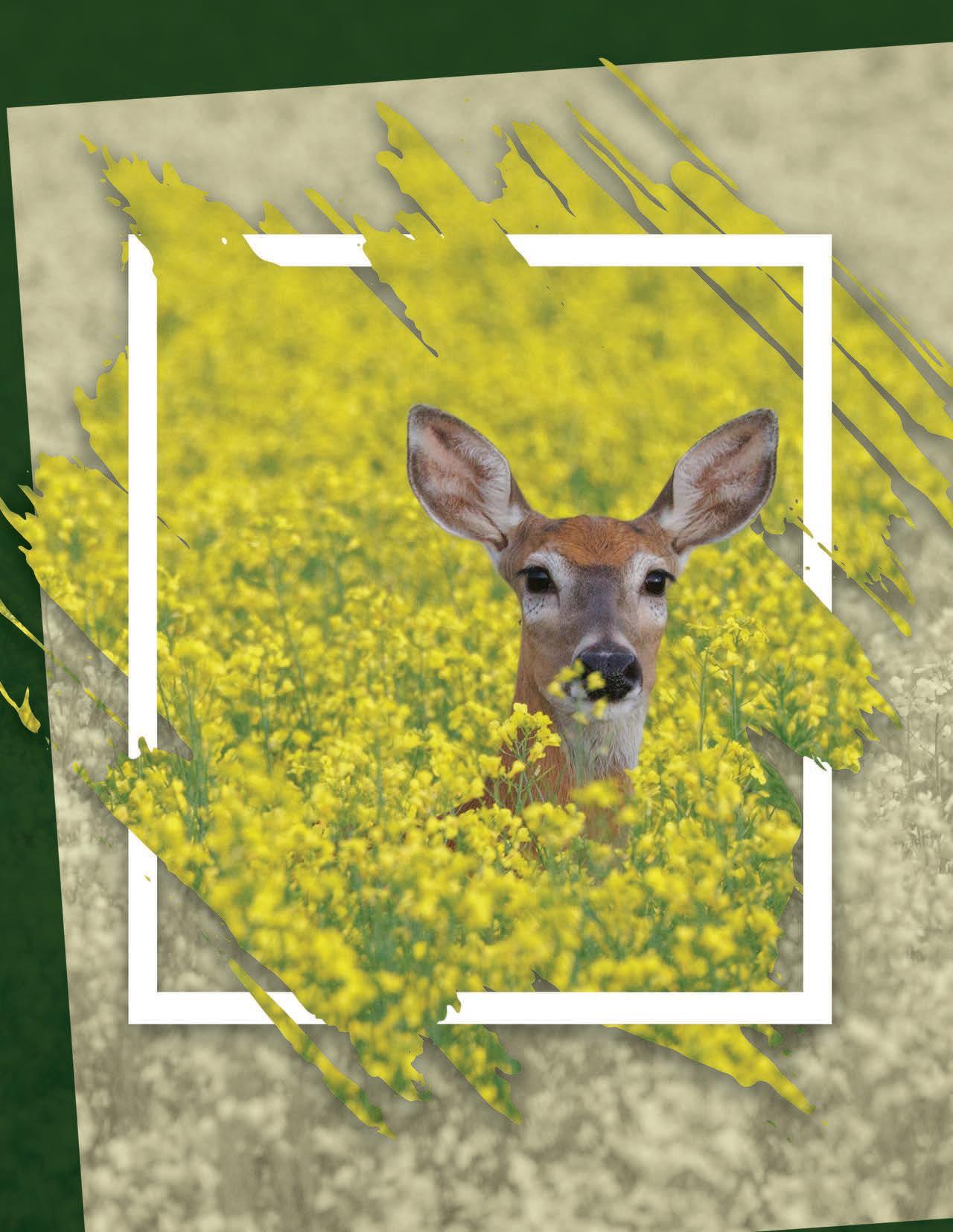
Bill Haase believes there are reasons to be optimistic. Deer were in good shape going into last winter, the third mild one in a row, which could lead to good fawn production in spring and summer where quality habitat is available.
“So, I think we’re going to start to see some pretty good recovery this year in the deer population in parts of the state,” said the North Dakota Game and Fish Department’s wildlife division chief.
Team that glass-half-full optimism with a conservative allocation of deer license numbers, the lowest in roughly 50 years, and that boost deer need to rebound to agreeable numbers is a possibility.
The Department made available 39,100 licenses to hunters for the 2026 season, down 3,200 from last year. Muzzleloader licenses were also reduced, and antlerless deer gun licenses were not made available in several hunting units.
Deer numbers are what they are today because of the prolonged effects of the staggering winter of 2022-23 and epizootic hemorrhagic disease outbreaks across a landscape with increasingly limited habitat in parts of the state.
“You have to keep in mind that when we did have a lot more habitat on the landscape and deer had to endure a really bad winter, like in 2011, recovery was much quicker because of the habitat
Today, deer are recovering, but it’s slow. Where there’s habitat, deer are doing better and I think hunters will see that.
available,” Haase said. “Today, deer are recovering, but it’s slow. Where there’s habitat, deer are doing better and I think hunters will see that.”
Even so, Haase cautions, the new norm for a rebounded deer population in North Dakota might not be what hunters remember from the good old days of 10 to 15 years ago.
Much of the decline in the total number of deer gun licenses in 2026 compared to last year was in the eastern third of the state, and the majority of those were antlerless licenses.
“That’s by design to try to help that herd recover, but I can’t guarantee that’s going to result in more deer next year because the habitat conditions are not that great right now,” Haase said.
“Fawn production is a big part of deer survival. And if you look around the eastern part of the state, you can see the cover for those deer is limited compared to what it used to be, say, 10 years ago.”
The main drivers of North Dakota’s deer population, Haase said, are habitat, weather and disease.
“But we can control harvest through our license allocations and that’s where we’re trying to be as conservative as we can,” he said. “Alongside that, we’re really focusing on habitat programs such
as the Governor’s Legacy Soil Health and Habitat Program. We’ve seen a lot of interest in this pilot program from landowners and we’re really hoping to expand it.”
The Governor’s Legacy Soil Health and Habitat Program is administered by the North Dakota Association of Soil Conservation Districts, with local delivery through soil conservation districts and partners.
“Also, CRP is offered again, and I saw they just had another open enrollment, which is another habitat opportunity for landowners,” Haase added. “We also have a long list of landowners who are interested in enrolling in our Private Land Open To Sportsmen program or doing habitat improvements.”
Some of the tools wildlife managers employ to determine license numbers made available to hunters each year include harvest rates, aerial surveys, depredation reports, hunter observations, input at advisory board meetings and comments from the public, landowners and agency staff.
“We certainly read all the hunter comments from our hunter surveys, and I would say the one comment we’ve heard more than any is that people want us to be conservative with deer license
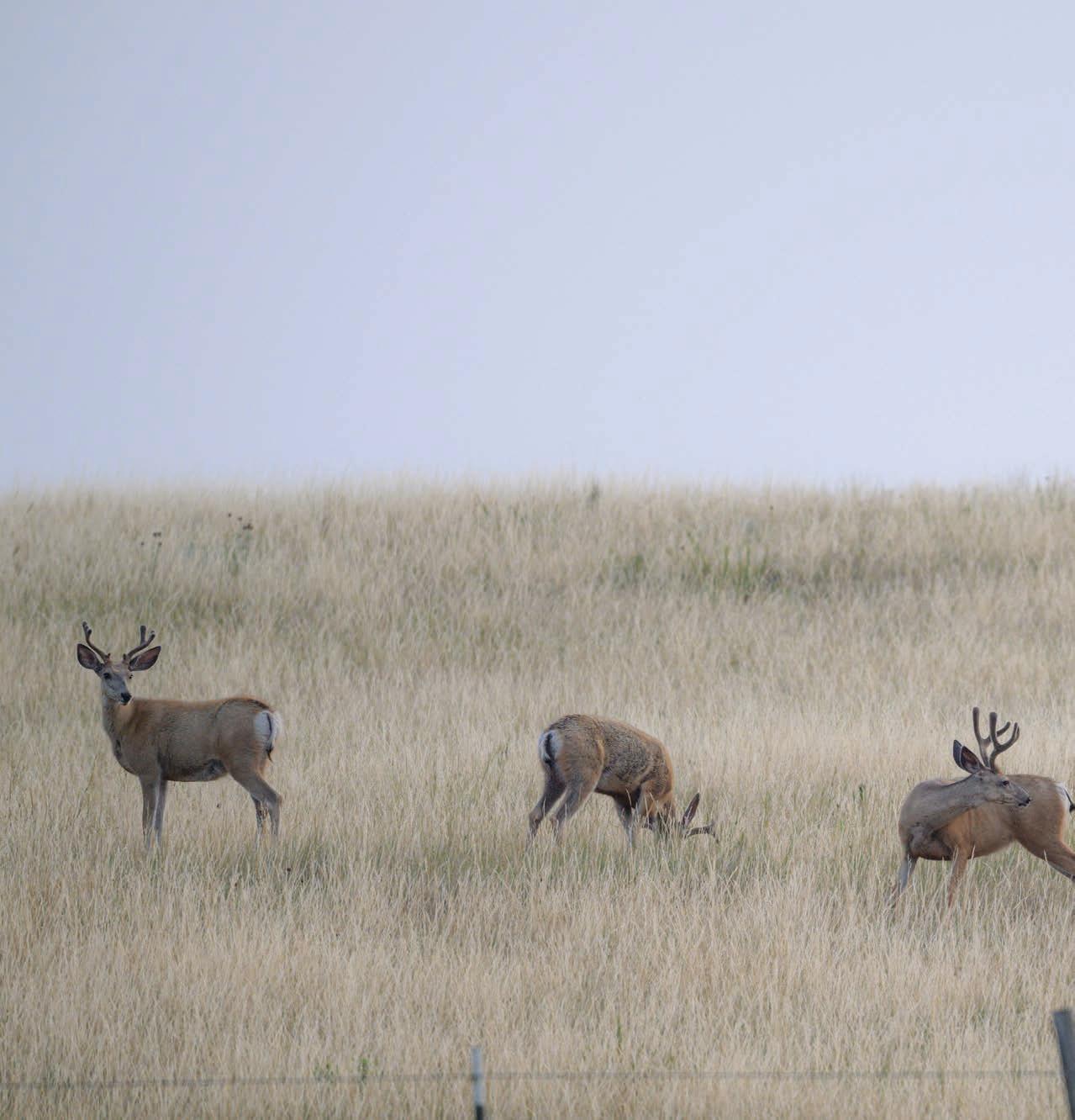
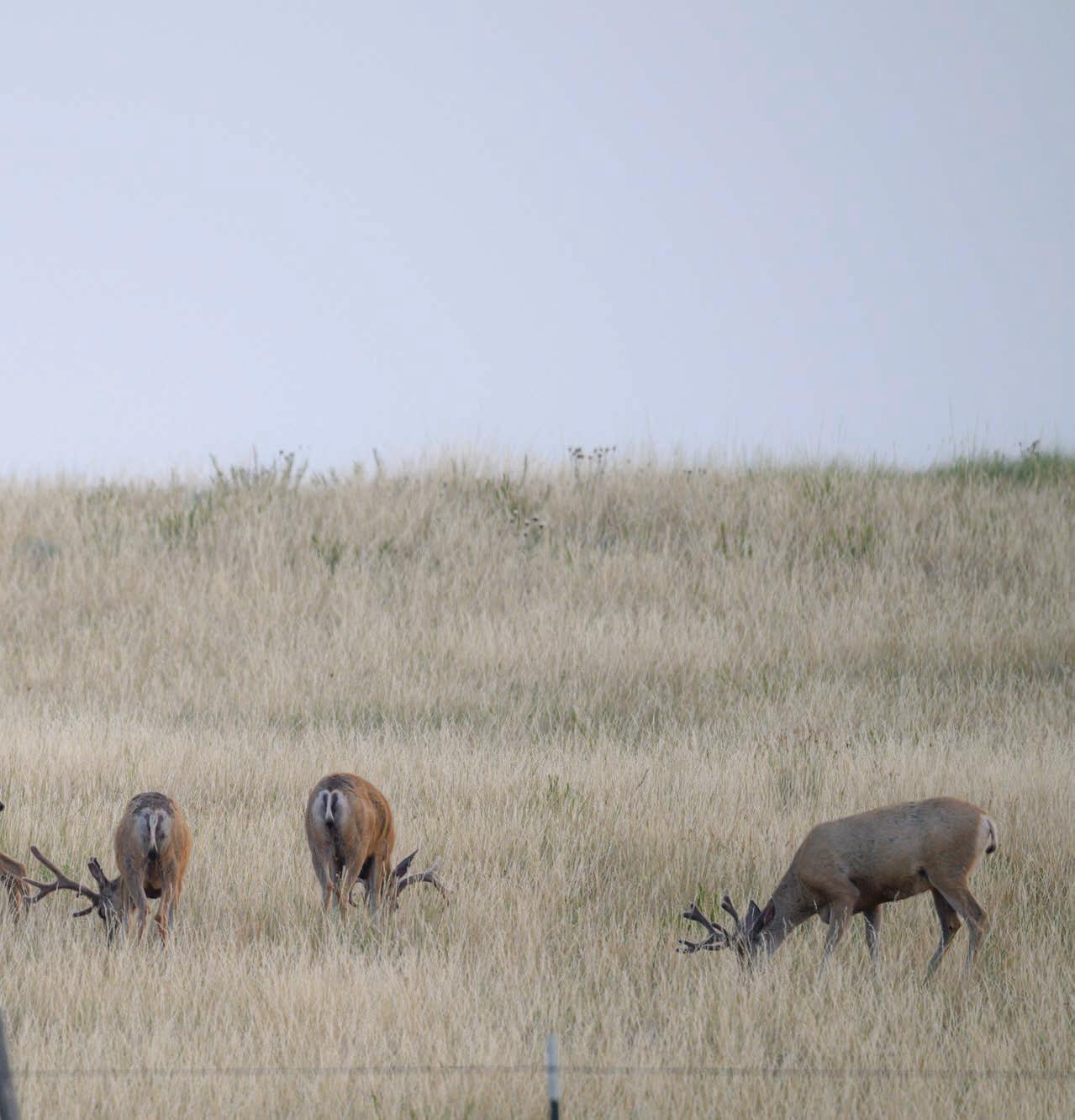
According to the Game and Fish Department’s spring survey, the mule deer population is up 31% in western North Dakota from 2025.
sales right now,” Haase said. “They’d rather have us issue fewer licenses to allow the deer population to recover as much as possible.”
While white-tailed deer numbers are down from where agency and big game biologists would like them to be, on the good news side of things, the spring mule deer survey showed western North Dakota’s is 31% higher than last year.
“It was a nice increase in the mule deer population, but our population was pretty low going into it. Luckily, we had perfect conditions … we had good moisture last year, so those deer had good fat reserves going into winter and did really well,” Haase said. “Most of the fawns must have survived because fawn production was low last year, so it’s a good sign to see an increase in the population.”
Even so: “We’re not quite where we want to be with that population,” Haase added. “So, we remained a little bit on the conservative side with mule deer gun license allocations for this coming fall.”
RON WILSON is editor of North Dakota OUTDOORS.
Nonresident Archery Notice
Of note regarding the 2026 bow season, nonresidents may not hunt on public land, including Private Land Open To Sportsmen, during the first 9 ½ days of the deer bow season. However, PLOTS landowners may hunt on their enrolled property at that time. Starting Sept. 14, nonresidents can hunt both private and public lands.
IN A
AN ANCIENT FISH MODERN RIVER
By Zachary Eshleman
It was a Wednesday morning in mid-May when I joined Paul Bailey on the Missouri River for a ritual that has been repeated every spring for the last 21 years. It was a warm, clear day as we set off south of Washburn, with the water flowing glass-smooth under our boat.
“A good day to fish for paddlefish is also a good day to find paddlefish,” remarked Bailey, North Dakota Game and Fish Department south central fisheries supervisor in Bismarck, as the other members of our small crew prepared the nets for a day’s work. He said nice days with low winds tend to yield the best results.
The tagging strategy was simple, but I wouldn’t describe it as easy. As filter feeders, these fish spend much of their time swim ming into the current, maximizing the flow
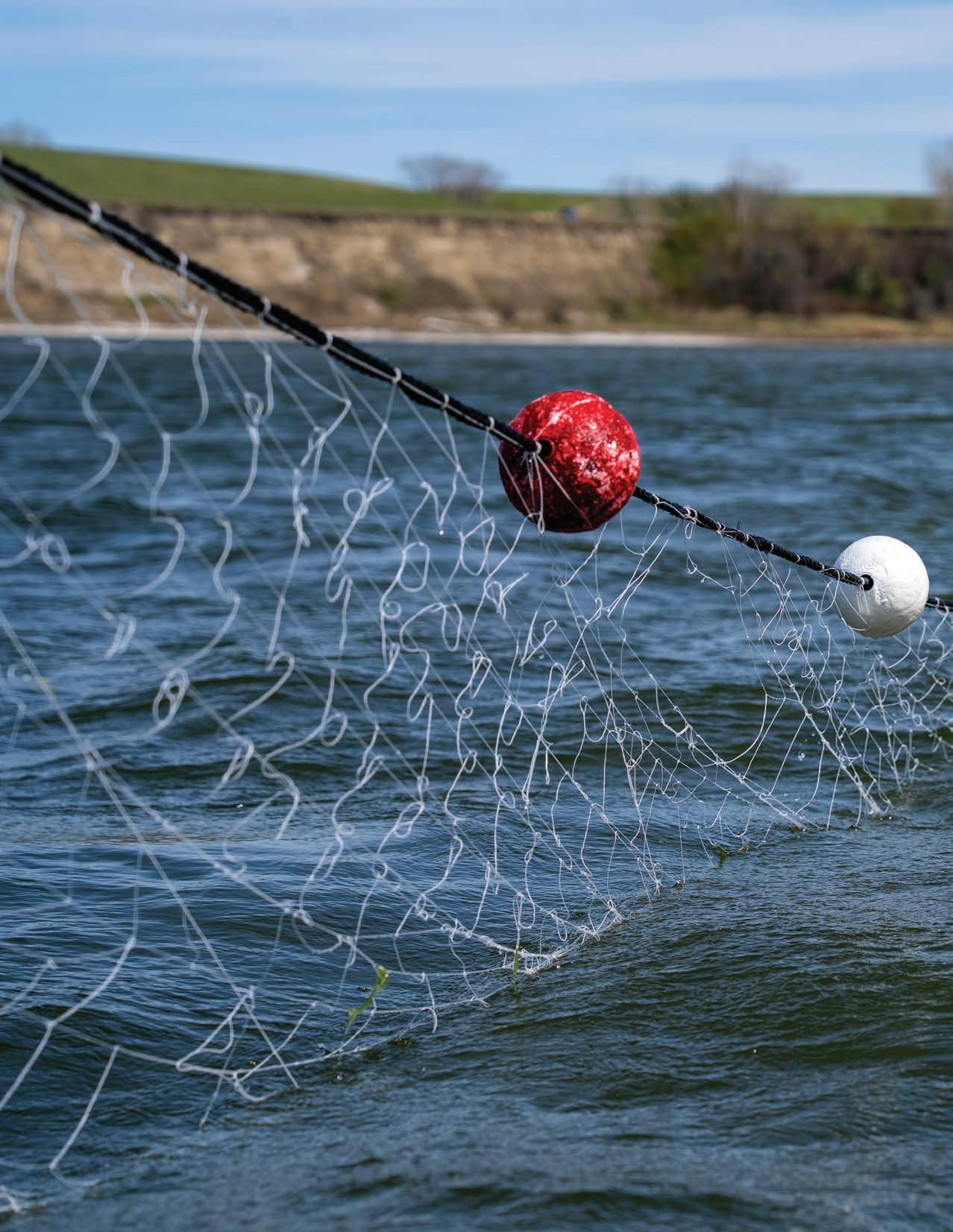
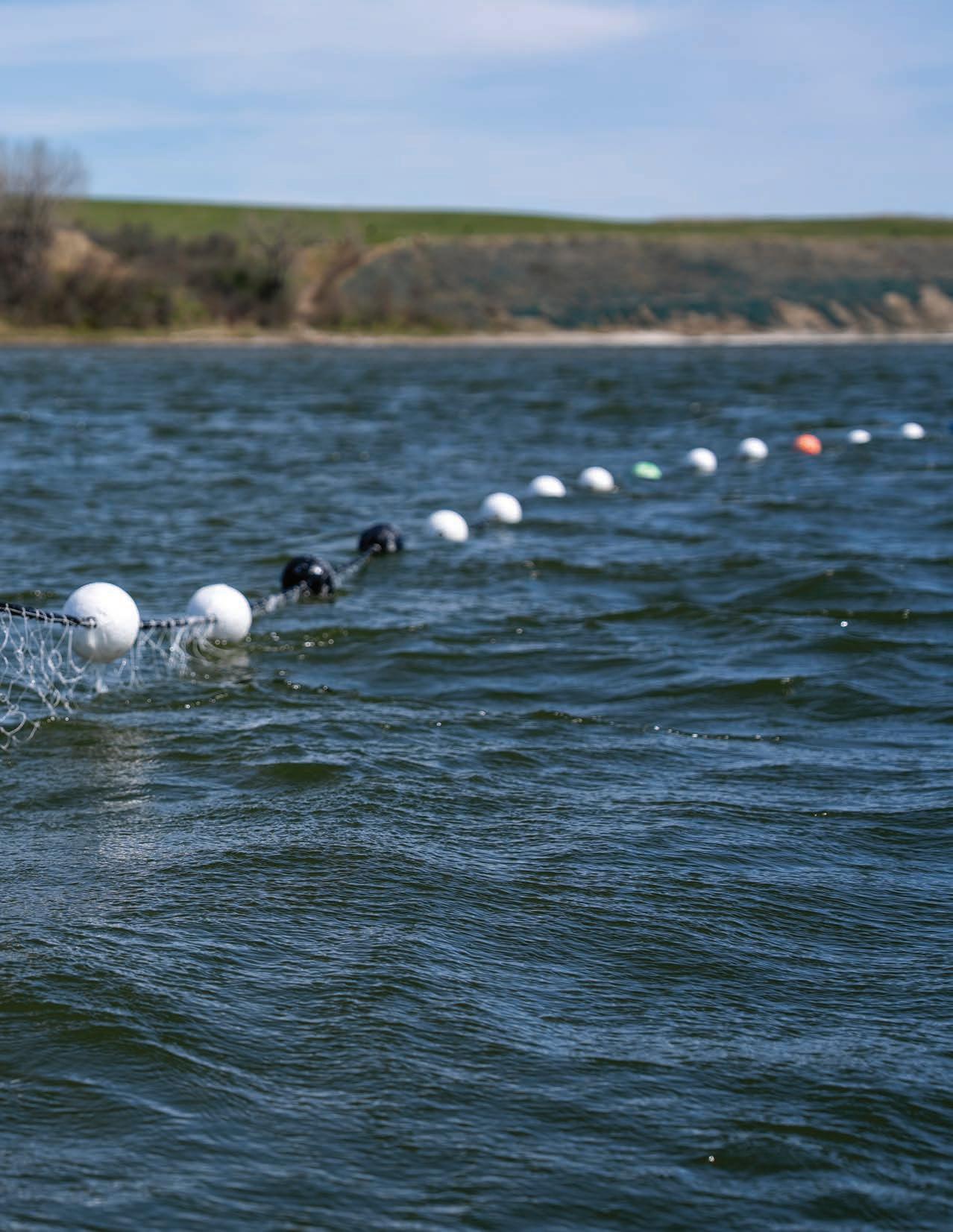
of water through their mouths and capturing zooplankton through highly developed rakers on their gills. So, we floated with the current and spread a gill net across a section of the river to meet fish on our way downstream. The net hung from a series of floats that acted as bobbers, showing us exactly when we caught a fish.
The first thing that surprised me about this process was the sheer number of fish we came across in such a short period of time. Looking out at the river, it’s hard to picture these huge fish spread across your field of view, but that’s exactly how it was. It’s not unusual for this team to tag 100 fish in a day, and we would regularly get a few in the net
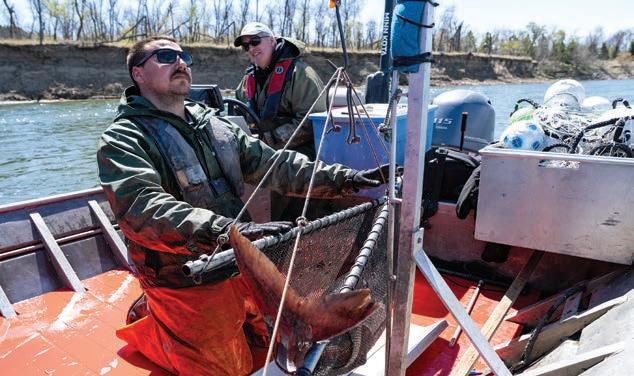
same time. With some of the fish weighing more than 90 pounds, it’s easy to see how just getting them on the boat and moving them around can quickly become a labor-intensive task.
By capturing as many fish as possible, marking them with a metal tag and noting length, weight and physical anomalies such as a bent rostrum, the fisheries team formed a picture of the health and behavioral tendencies of this unique population.
The paddlefish is often called a living fossil. It is closely related to sturgeons and has existed in North American freshwater systems for more than 100 million years. With a history like that, a 20-year population study may seem like little more than a blip on their timeline. Still, to understand why monitoring this fish matters to the Department, you need to understand its anatomy and its ties to our changing river systems.
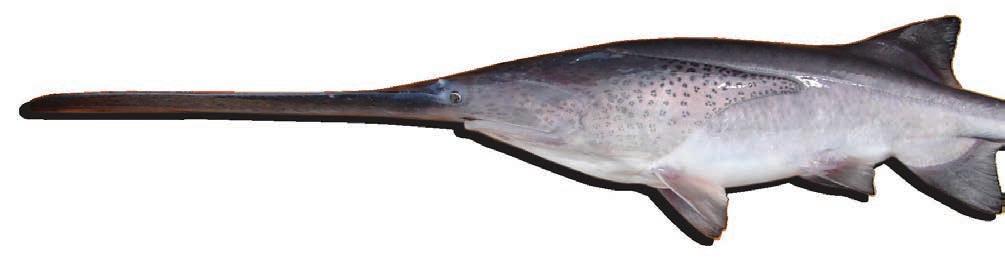
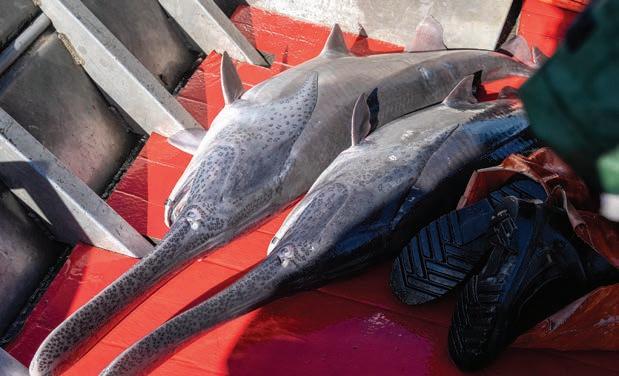
When you pull one from the water, the first thing that stands out is the large paddle, or rostrum, for which it is named. It feels solid and immovable, but it is actually a complex piece of the sensory system that helps this fish succeed in the turbid, flowing water it calls home.
“Paddlefish don’t have really good vision, but what they have instead are these ampullae of Lorenzini,” said Bailey. “They’re these tiny little electro-sensory receptors that go down the paddlefish’s gill cover and then all the way up their rostrum.”
This system acts as a sixth sense. It lets them detect the tiny electrical signals given off by the muscles and nerves of their zooplankton prey so they can locate groups moving through the river.
“After a paddlefish detects food, it opens its trap -
door-like mouth, and it has a free-floating jaw that can open pretty wide. On a large paddlefish, you might be able to fit a volleyball in there,” described Bailey, “and they just filter the water as they go.”
Being one of the few native filter feeders in North American fresh water makes this fish unique enough. Move back from the rostrum and mouth, though, and you find another feature that sets the species apart. There’s an opening on the gill cover called a spiracle. Paddlefish share this feature with sharks. The opening helps with water flow when the mouth is closed or the fish is resting. Paddlefish have no musculature to pull water across the gills. They need moving water to breathe.
“Paddlefish are an obligate ram respirator,” said Bailey, “so the paddlefish often will have its mouth open just a little bit as it is swimming to facilitate water movement over its gills.”
This also means that if you accidentally catch one, it can’t breathe properly while being held still in non-flowing water. It’s important to release it quickly and move it in the water to help it recover.
“They also have this unique structure on top of the head called a parietal eye, located here on their forehead,” Bailey explained, moving up from the spiracle. “It’s a kind of abstract X-shaped feature. It’s not an eye in the sense that it forms an image, but it is a photoreceptor.”
He said researchers are not entirely sure what this receptor tells the fish, but it likely signals seasons and day length to trigger hormonal changes, among other things.
“This eye is also sensitive to detecting shadows passing over the fish,” he continued, “so it could be
Lucas Rott, Department fisheries supervisor in Riverdale, weighs a paddlefish before releasing it into the Missouri River upstream of Bismarck.
useful, especially when this fish is little, for avoiding predation from birds and other hazards that might be overhead. Also, the zooplankton that paddlefish feed on are sometimes drawn to certain light conditions, so that could be another use.”
The idea of avoiding predation is interesting when you’re talking about the largest fish in our waters. Still, it takes a couple of years before their size keeps them out of danger. This transition has led to camouflage coloration and a musculature built for both long-range swimming and quick bursts of energy. That mix of traits also explains why they are shaped so differently from other fish in this area.
“They have this deeply forked tail and a very narrow but muscular portion at the rear of the fish called the caudal peduncle,” explained Bailey. “This is really indicative of a fish that’s a good long-distance cruiser. They also have this kind of torpedo body shape with their dorsal fin located much more rear of center. And that’s indicative of a fish that is a really good accelerator. So, paddlefish are capable of some pretty good burst swimming speeds when needed. They’re even capable of launching themselves completely out of the water. For a fish this large, it’s a pretty impressive feat.”
All of these adaptations have led to long-term success across a huge range that stretches from southwestern New York to central Montana, south to Louisiana and even to parts of Alabama and Texas. They also show how specialized paddlefish are for conditions that are becoming rarer in today’s dammed and altered river systems.
The paddlefish is now listed as threatened or vulnerable in several states. One of the interesting things about studying them in North Dakota is how our two populations show the effects that damming rivers and changing habitat can have on these fish.
There are two distinct populations in the state: a breeding population in Lake Sakakawea and the upper Missouri and Yellowstone rivers, and the population south of Garrison Dam. The lower group is believed to be sustained only through entrainment (fish flowing through the dam).
“We don’t believe we have any natural reproduction occurring down here. We’ve seen no evidence of that,” said Bailey, speaking of the area between Garrison Dam and Lake Oahe. “We’ve got much cooler water thanks to the bottom discharge of the lakes. That keeps those temperatures much lower than paddlefish need for reproductive purposes.”
According to Bailey, the upper population exists in a system much closer to what the fish is built for. That is why it has been able to breed and maintain a population that even allows for responsible harvest.
All this brings us back to the original question: Why is monitoring paddlefish so important for our fisheries as a whole?
The answer is that the paddlefish’s specialized adaptations make them a strong indicator of the health of the systems they live in. They are not like carp that can be tossed into any system and take over. They are built to succeed when rivers function as they did before human intervention. Their main food source is also the main food source of young game fish we know and love.
“Paddlefish can be considered one of the canaries in the coal mine when it comes to our fisheries,” said Bailey. “They feed low in the food chain. So, if you’ve got healthy paddlefish that are in great physical condition, feeding on abundant zooplankton, that’s a really good indicator that you’ve got good primary productivity in that fishery and that other fish species that rely on zooplankton are going to be doing well also. I mean, walleye are king. And after the walleye hatch, one of the main things they’re feeding on is zooplankton.”
Currently, the data on the population here look promising. The Garrison Reach population has held fairly steady since monitoring began, and the same goes for the upper population. Reproduction seems a little erratic year to year, but with a lifespan that sometimes exceeds 100 years, year-to-year swings do not affect the population as much as overall trends.
Paddlefish have moved through the waters of what is now North Dakota for more than 100 million years, surviving events that wiped out many other species on land and in the water. Their specialized anatomy reflects a deep adaptation to a very different Missouri River than the one that exists today. These living fossils now depend on both ecological conditions and human decisions to remain part of our world. Understanding them is critical to how we manage the river going forward. It will also help determine whether this ancient creature continues to endure or slowly fades from the waters it has inhabited for so long.
ZACHARY ESHLEMAN is the Game and Fish Department’s communications specialist.
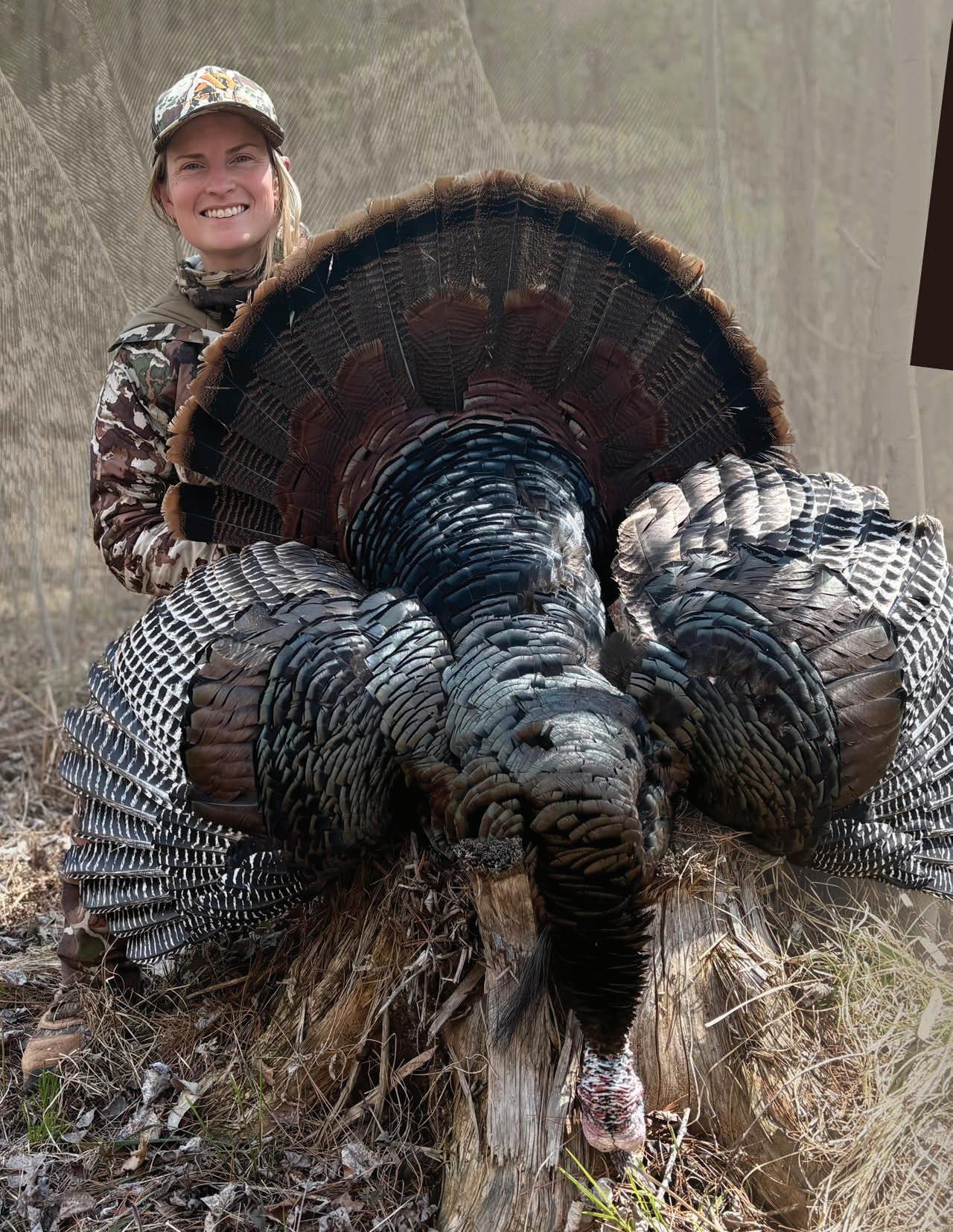
The author with a gobbler she harvested in spring.
By Cayla Bendel
Ihad the pleasure of galivanting through spring turkey season across landscapes both familiar and new-to-me, mornings blanketed in snow and afternoon sits where sweat rolled down my face. I slept in frosty tents, cozy cabins, and in the truck in travel center parking lots with the passenger seat limitedly reclined due to the pile of gear stowed behind it. Collectively with my husband, we each required a mid-season oil change on our vehicles, and the summer fun budget might be looking a little light thanks to unfavorable gas prices during this little mid-life turkey escapade of ours. I was caught saying several times in spring that we might have overdone it but if asked in a post-trigger high, I’d never admit it.
The following are a few lessons I picked up somewhere along the way, some about turkey hunting, most about life.
Nothing Goes as Planned
It’s honestly counterintuitive that I love turkey hunting so much. I’m a very type A person. Our meals are listed on a whiteboard on the fridge for the week, which forms the weekly grocery list. I can pretty much tell you what I have planned every weekend for the next nine months and likely beyond. I lay out my clothes the night before and pack my lunch. And when any of this is interrupted, it makes me anxious and irritable.
And naturally, I do this with hunting: “We’re hunting at location X this weekend, we are leaving at set designated time, we will hunt for this many days, we will fill our tags and return on Sunday to turkey nuggets.” It says so on the whiteboard. It’s almost laughable to type that out. Of course, that’s not how anything goes, particularly turkey hunting.
Inherently life happens. The Easter snowstorm cancelled our kick-off weekend. And instead, we enjoyed a surprisingly fun couple of days making snowmen, snow bunnies and snow forts with the uncontrollable laughter of my son cruising down a sledding hill etched in my brain for life. It also fortuitously led us to switch our cabin rental to a future weekend where it also snowed and I snuggled on a couch with my blanket and two dogs in my lap instead of shivering in a tent.
But in addition to external factors, turkeys themselves are so notoriously unpredictable. I don’t think I’ve ever wrapped a tag around a turkey leg and thought that’s exactly how I thought that would go.
And that’s what’s so addicting.
So much of the rest of our life is predictable and patternable, it’s what keeps us sane. Turkey season interrupts that in the most beautiful way.
I found myself unthinkably frustrated so many times this season. Replaying and dissecting encounters, trying to figure out what
went wrong and what I should do differently next time. And sometimes I think I struggle to accept that nothing went wrong, it just didn’t go as planned.
Turkey hunting is not an equation I can eventually learn how to solve without error. And that bothers me. But the result? A pounding heart, shaky arms and a trembling voice when it comes together in a moment and in a way I could have never scripted.
Slow Down
I was in the wheelhouse of dozens of gobblers this season. Obviously, far more birds than tags acquired or punched. And sometimes my postgame interview would have been embarrassing.
One morning, we had a gobbler committed, drumming, and when he finally crested a hill, he came out of his strut and walked away. My husband, Scott, was facing the wrong way for a shot and I was likely too exposed, especially as the one without a shotgun in hand.
Once I was tucked in a heavy patch of cedars with multiple gobblers responding for almost an hour when I grew impatient and worked my way along the outskirts to get a better look at what was happening. I bumped into some hens that were heading my way and likely could have pulled a gobbler or two with them if I had just stayed put.
One morning started with a distant gobble farther down the logging road we were on. We hopped in the truck, drove in that direction, parked and got out. As we were standing there listening, I literally jumped when the tom gobbled again in a tree not 40 yards from the truck.
Busted.
We had a close encounter with two males roosted near each other on the first morning of one of our trips. We convinced one within 20 yards of us based on the sound of him drumming but he never came in for a shot. We gave the birds a day and returned the following morning, excited to find them roosted in nearly the same spot. We hustled across an open forest edge at dawn to close the gap and when Scott struck his familiar slate call, you could perceptibly feel the woods go silent.
It’s just so easy to get caught up in the excitement and forget to think through the entire scenario and how to best approach it. And maybe that’s the point. No matter how many times you mess up, the thrill of that unexpected gobble just lends itself to erroneous decisions.
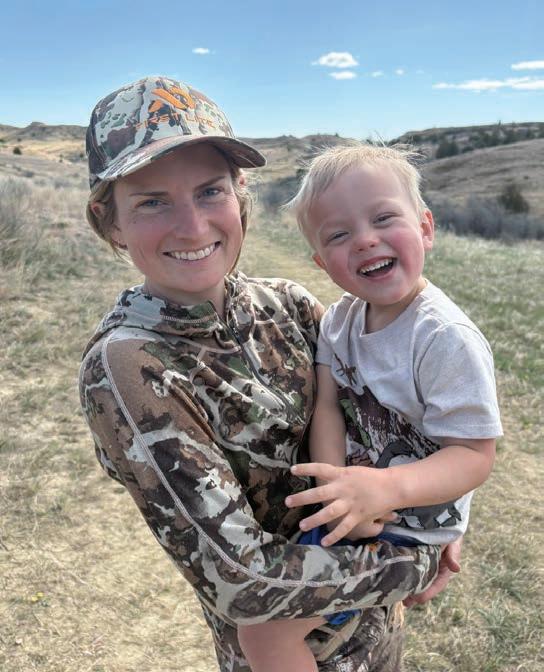
Mom and son take a break from turkey hunting in the badlands.
Don’t Forget to Have Fun
As someone who is very goal-oriented, when I get a tag, I intend to fill it because that’s the point, right? Of course, to an extent it is. But when I took the time to reconnect with why I truly enjoy hunting so much and remembered these little trips were vacations, I had more fun.
My favorite part about this spring was taking some true days off — no service, no logging in and just doing whatever I or whoever I was with felt like doing. One afternoon as wet heavy snow fell, we opted to watch a movie in the cozy rental cabin and rest up for an early, cold morning.
After one slow morning in the turkey woods, we were winding our way to a new area and I knew we would pass a resort famous for its fresh, Saturday morning donuts. I thought we didn’t have time for that. Scott scolded me when he asked where it was. When I said we had already passed it, he turned around and I tried not to let him see me smile.
When camping out west, I also found myself not wanting to be gone all day chasing turkeys. I wanted to go hang out with my son back at camp. Go on silly little bike rides and point out bugs and flowers and rocks.
On my last day hunting this spring, the writing was on the wall that my friend and I weren’t going to punch our tags. But rather than head back to pack up early,
we hiked to one more spot. I didn’t have much faith in it, too open of an understory. But why not hike a few more miles with a good friend, and soak in some western views. At the very top she found a lone spear of wild asparagus we threw in our breakfast hash on the Blackstone grill for our parting meal.
When I gave myself permission to shed expectations and outside judgement, I had more fun. If I just wanted to shoot turkeys, I would put the money and time I’ve spent this spring into guided hunts, knocking on doors or just overall hunting very differently in different places.
But as much as it wears on me, I want to be outside. I want to be cold. I want to explore new places. I want to hike the miles. I want to stop for the donuts. I want to spend time with the people I love. And I want to be challenged. I also want to shoot a turkey or two somewhere along the way.
CAYLA
BENDEL is the Game and Fish Department’s marketing coordinator.
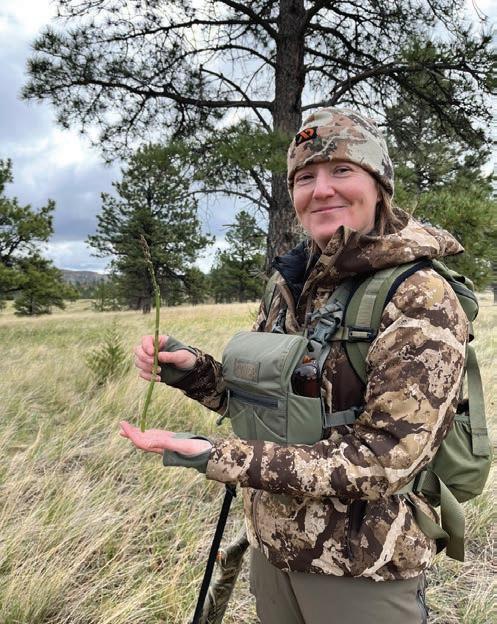
Amanda Crook with wild asparagus harvested in Montana while chasing spring toms.
BY SANDRA JOHNSON
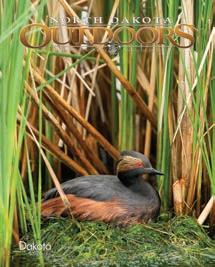
They’re neither duck nor coot.
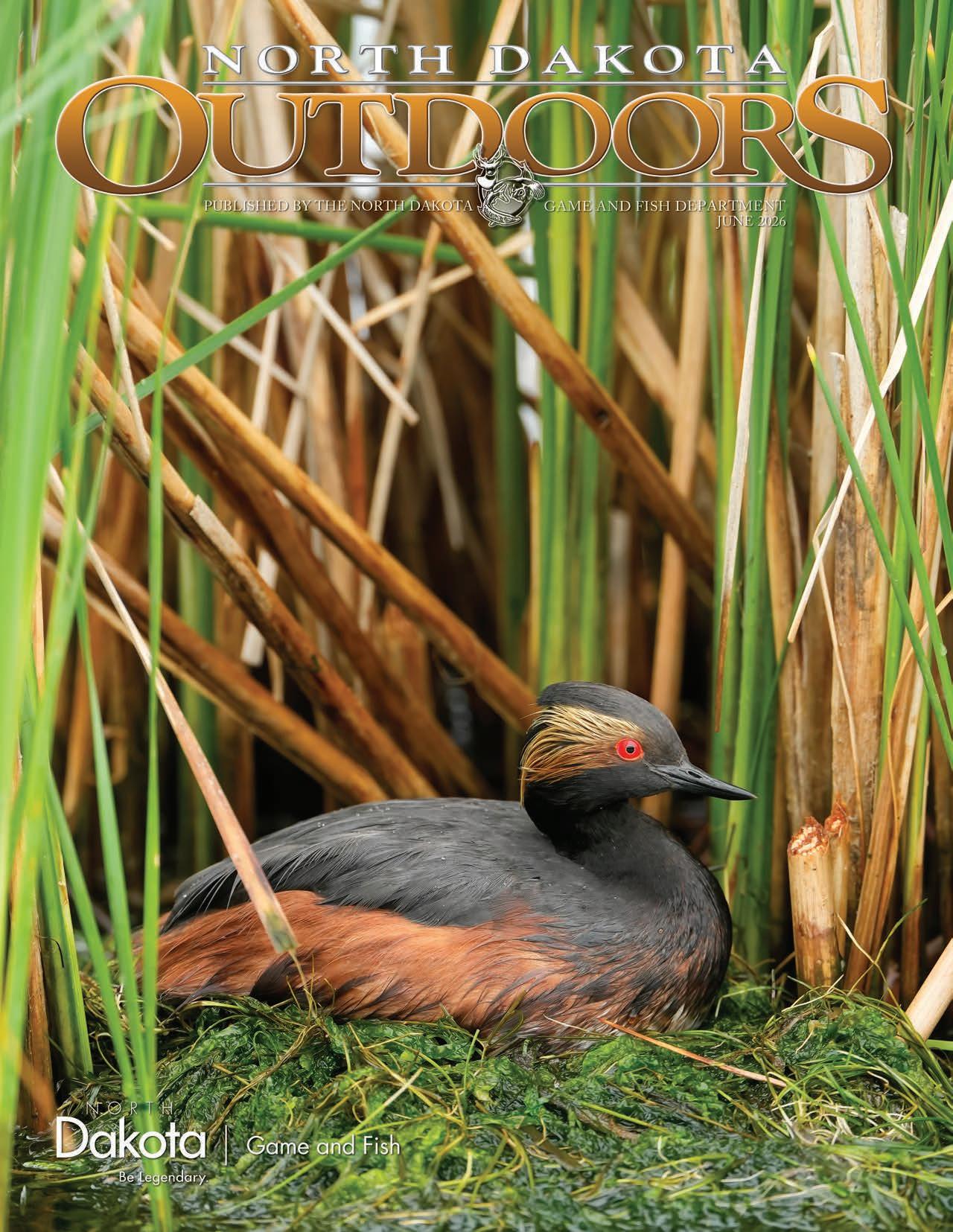
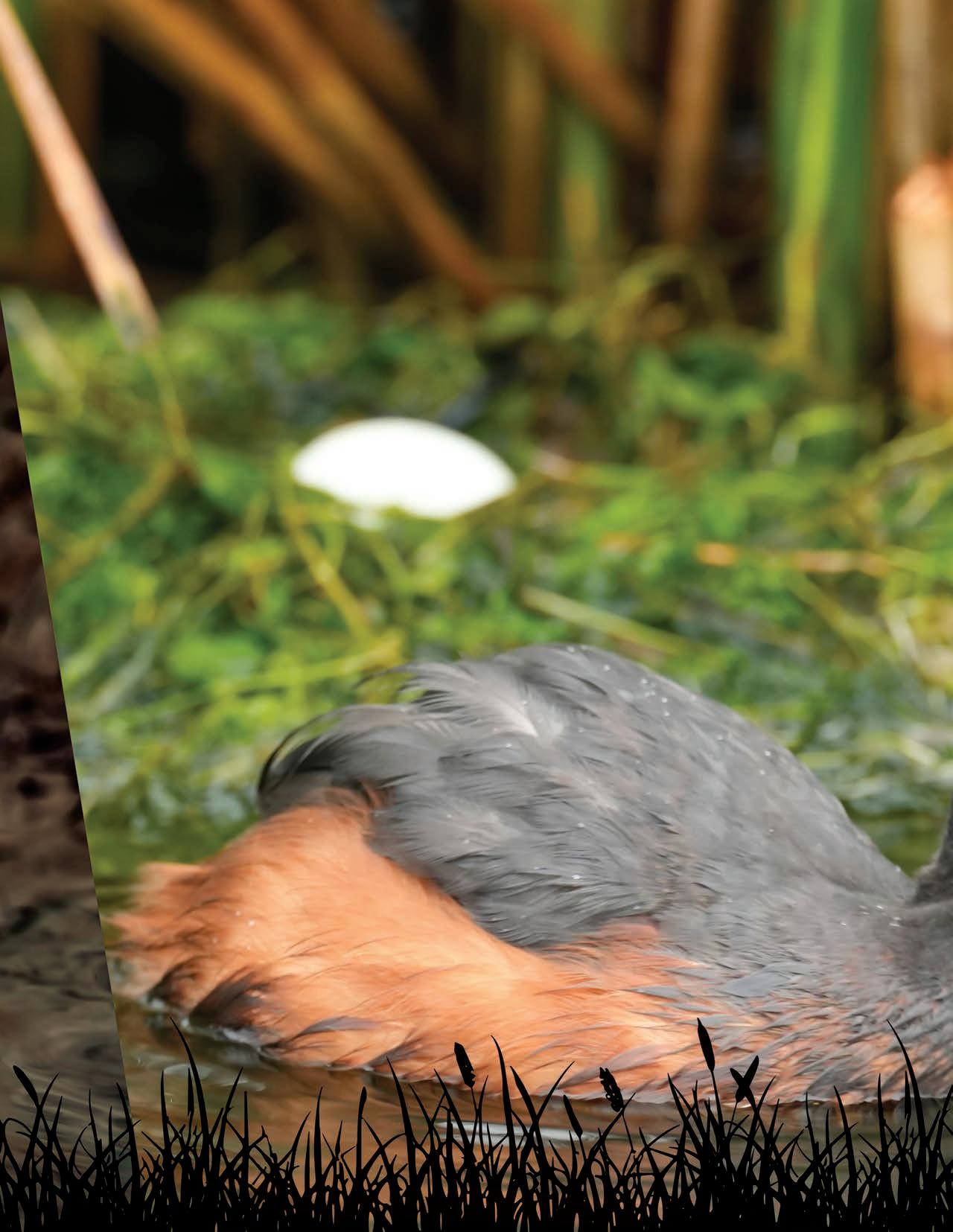
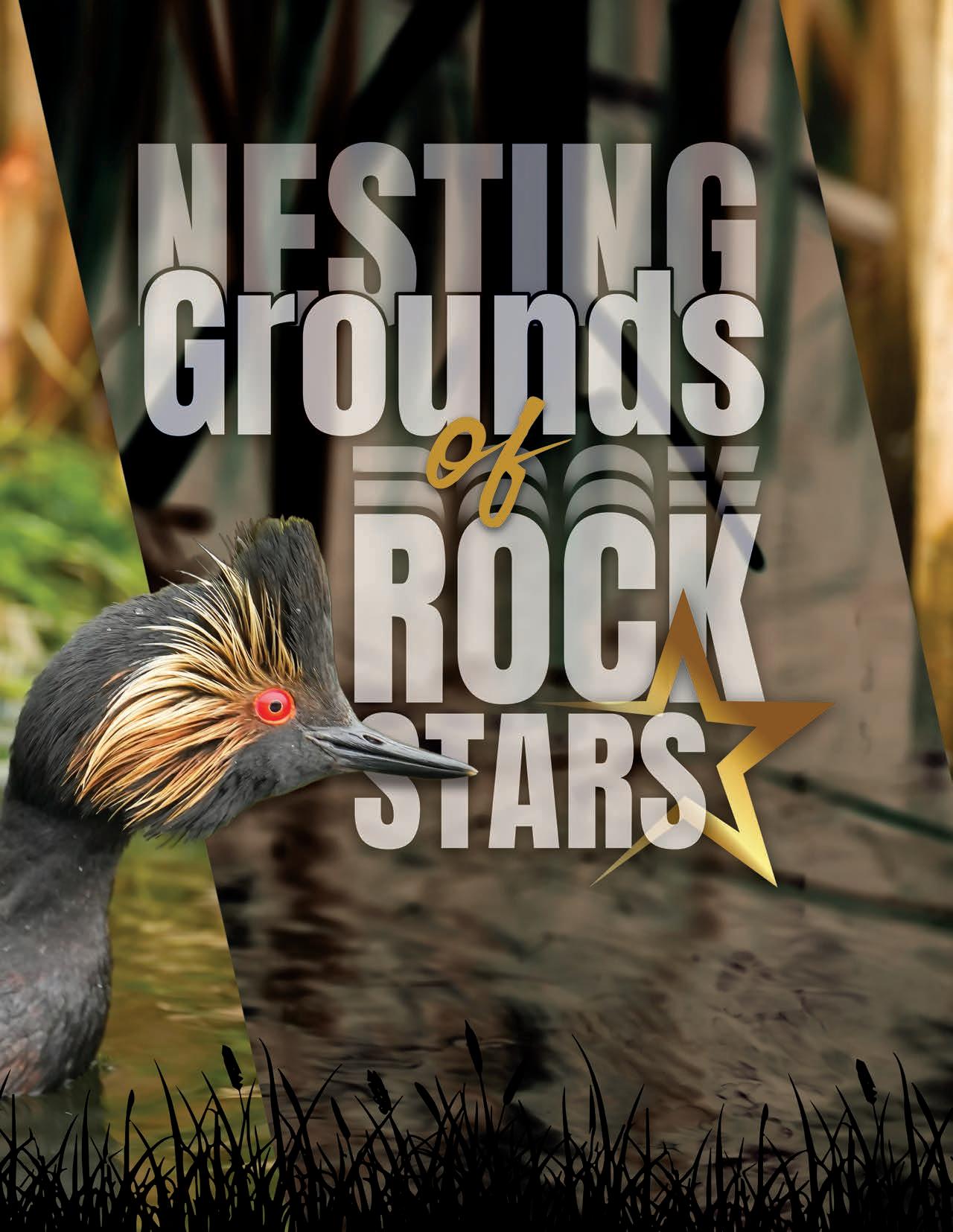
Eared grebes are in a class of their own, and a peculiar one at that. Their legs are placed at the far rear of the body and their toes are lobed. They have striking, flowing, golden ear tufts set behind a blaze red eye and poofy crown feathers.
Eared grebes are part bird, part 1980s rock stars.
Entirely bound to the water, the grebe’s body is built for diving and swimming underwater in pursuit of aquatic invertebrates and small fish.
One of the most important decisions they make is selecting a wetland to nest in when arriving in North Dakota in April and May. During this period, their flight muscles atrophy (shrink), leaving them unable to fly for several months. At the same time, their leg muscles increase by about a quarter, turning them into proficient swimmers, enabling them to run across the water during breeding displays, known as rushing.
The Prairie Pothole Region is a key nesting region for eared grebes. Eared grebes also nest throughout the Intermountain West. They are colonial nesting birds, which means they nest near each other in groups of two or more. Colonies range from single digit nests to several hundred. The largest eared grebe colony was recorded in the Great Salt Lake in Utah at 1,492 nests. North Dakota’s largest recorded colony, at least in recent times, is 636 nests. While North Dakota doesn’t have the largest colony, it has ample smaller- to medium-sized colonies (25 to 100 nests) spread
across the Missouri Coteau, Drift Prairie and a few south and west of the Missouri River.
Eared grebes form a new pair bond each spring. Together, the male and female build a soppy platform nest in water 1 to 4 feet deep. The nest is anchored to emergent or submerged vegetation or, occasionally, on a flooded fence post or other human-made structure. Nests within a colony are spaced several feet to several yards apart. Those close living quarters lead to frequent squabbles between neighbors, turning the wetland into a noisy concert.
On average, females lay three to four eggs, and incubation begins as soon as the first egg is laid. The nest bowl is saturated, and the eggs are
Eared grebes are part bird, part 1980s rock stars.
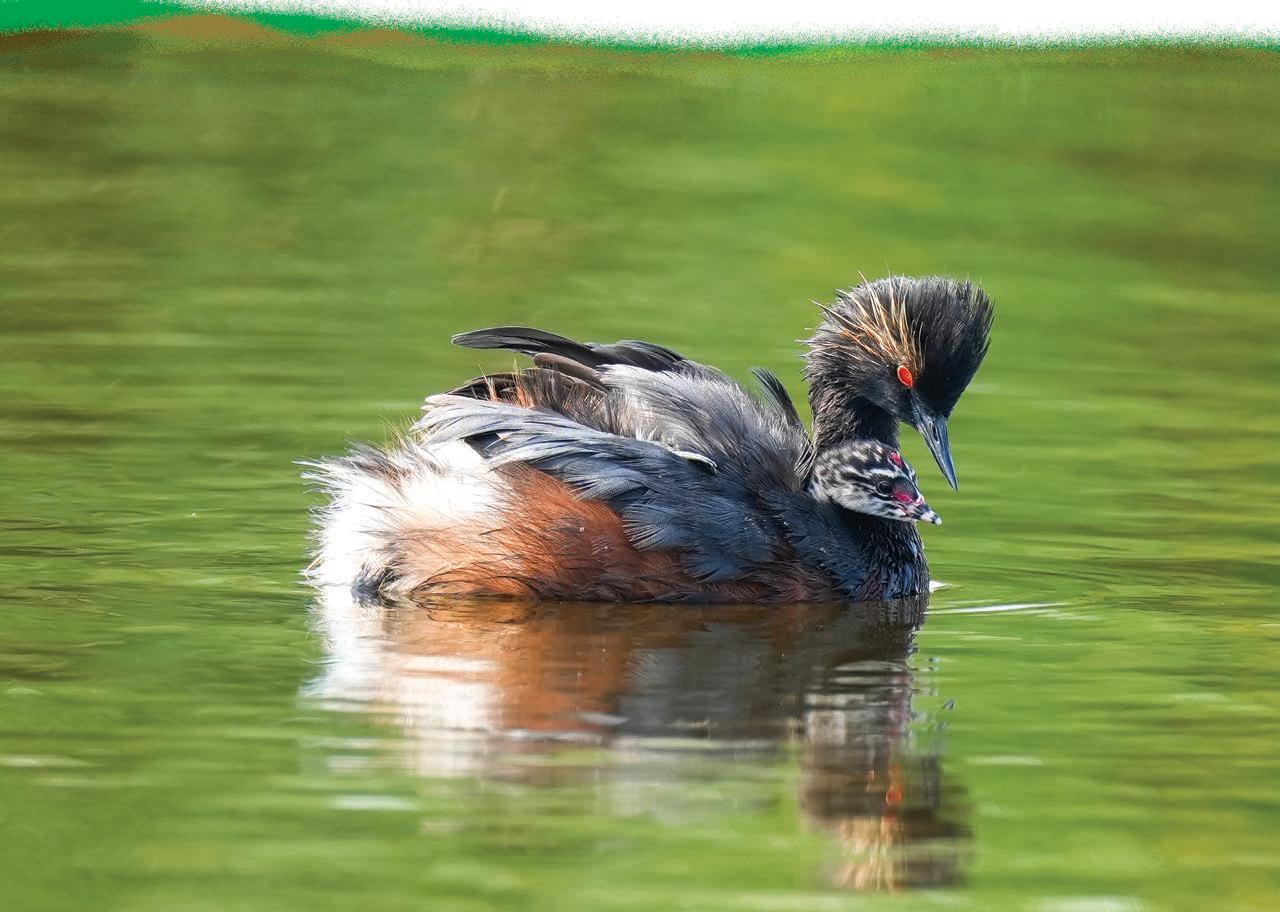
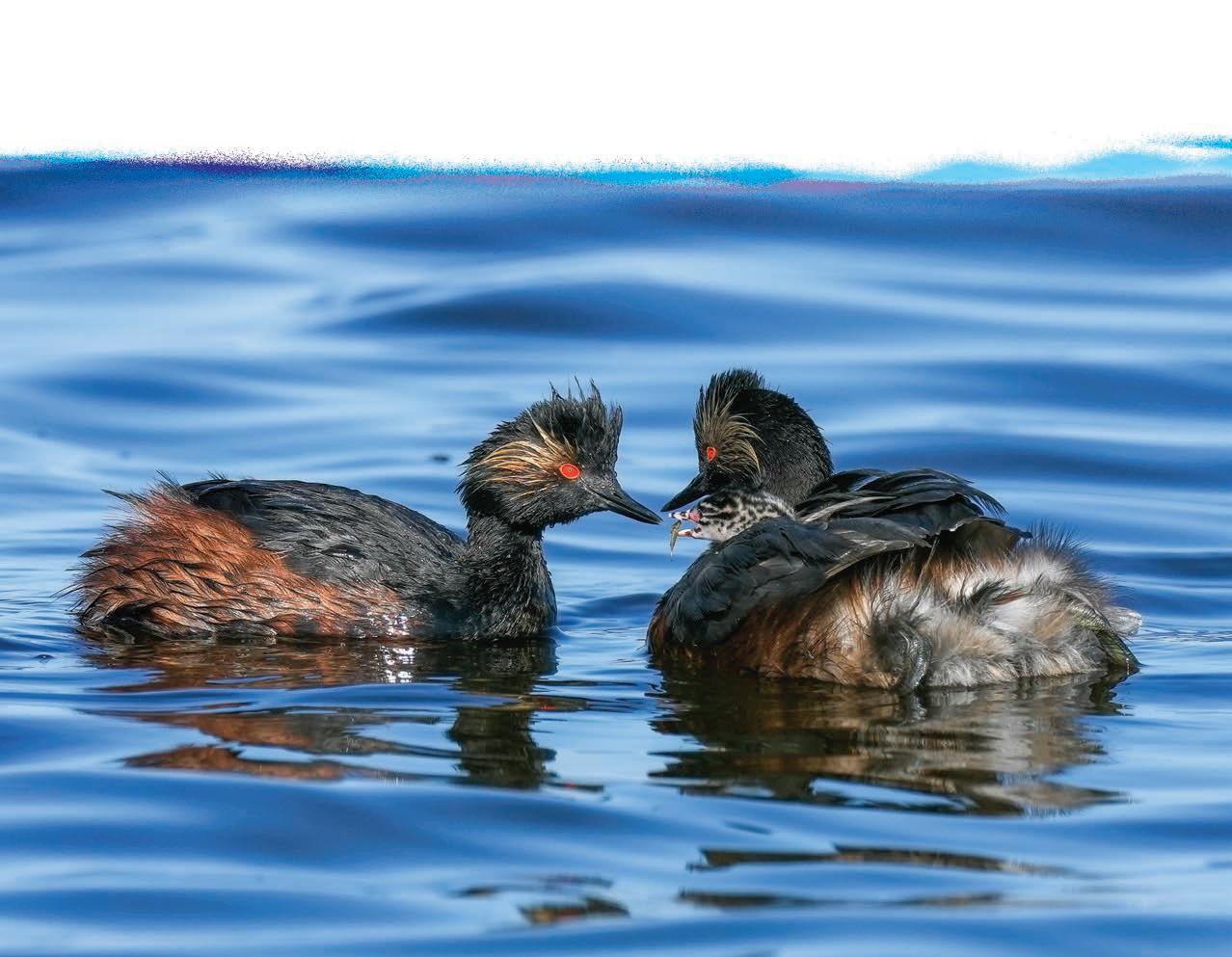
often partially submerged in water. Incubation lasts around 21 days and the eggs hatch asynchronously. Once all chicks have hatched, they spend the next 10 days riding around the wetland on their parents’ backs. The chicks sport bold black-and-white head stripes, a patch of exposed pinkish-orange skin on the head, and vibrant pink lores (skin between eyes and bill).
They’re like mini 1980s rock stars.
At around 10 days old, adults split parental duties, with each taking responsibility for one or more of the surviving chicks. By 4 weeks old, they’re too big to fit comfortably on the parents’ backs. The free ride is almost over, and chicks must soon learn to live on their own.
From mid-August through November, eared grebes depart the breeding grounds and migrate over the vast sagebrush landscape of Wyoming to the Great Salt Lake and other saline lakes in the West. They migrate only at night, aiming to complete the journey in a single, rapid, nonstop flight. Otherwise, they’re left hoping to find a suitable river or waterbody in dry landscapes to rest. Once at the Great Salt Lake, they feed almost exclusively on brine shrimp, nearly doubling their weight. After
several months, when the brine shrimp go dormant, eared grebes continue to coastal and inland areas of Mexico, Pacific Coast, or the Gulf Coast to spend the remainder of the winter.
In recent years, the Great Salt Lake and other Western saline lakes have experienced low water levels due to drought and water diversion. Lower lake levels hinder brine shrimp production. The deficit of this food source poses a risk to eared grebes, as well as the millions of ducks, shorebirds, and other waterbirds that depend on these vital habitats to refuel after the breeding season and prepare for winter. Viewed across their full annual cycle, it becomes clear that even the most common birds like eared grebe persist in a precarious balance elsewhere in their range.
SANDRA JOHNSON is a North Dakota Game and Fish Department conservation biologist.
By Zachary Eshleman
It’s a crisp Tuesday morning, and normally I would have woken up around 6 a.m., eaten breakfast with a cup of coffee, taken a shower, and made my way to work. Instead, it’s sunrise and I’m standing on the bank of the Missouri River, making my first casts as a new resident of the state. I have only just moved up here, but if I want 100 fish by Aug. 15, I figured I had better get started.
It’s moments like these that are the whole point of the fish challenges the North Dakota Game and Fish Department has offered for the past five years. Each of the five choices is unique, but the effects are the same. They get new and experienced anglers alike to step out of their comfort zone, discover new places to fish and chase species they might otherwise ignore.
“We’ve gotten a lot of interest each year; that’s why we keep
trying to come back with a new one. Over the last five years, we’ve had probably close to 1,000 different entries,” said Cayla Bendel, North Dakota Game and Fish Department’s marketing coordinator in Bismarck.
“I just always love hearing all the stories and seeing the same people come back to complete the new challenge.”
Past challenges include the classic, sportfish, rough fish and total catch challenges, with the parameters of each outlined at gf.nd.gov/fishing/fish-challenge.
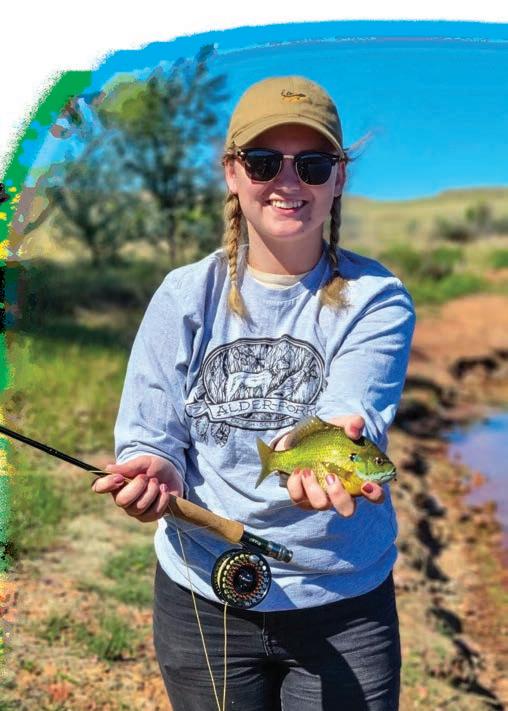
This year’s addition is the 100-fish challenge. It doesn’t matter what species you target, and we’re not chasing size records with this one. You simply have to submit one photo of yourself with one of your catches and record a list detailing how many of each species you caught.
This challenge was chosen for a couple of reasons.
“Well, for one thing we were just running out of species,” Bendel said, laughing, “but we also just want to bring people back to the joy of fishing, what it’s like to just catch any fish.”
With the challenge running from May 1 through Aug. 15, accomplishing it will take a little less than a fish a day. “No problem,” you might think, but if you are working five days a week, this brings your total of nonworking days to just 33. It’s an unfortunate calculation, but it’s what makes this year’s challenge such a unique opportunity. Instead of waiting for the weekend to try and pile it all on at once, it inspires anglers to chip away at the total anytime they can.
Find your community fisheries, figure out the local access areas you have always overlooked, and maybe most importantly, find the half-hour in your day where you can get in a few casts and remember what makes being an angler in North Dakota so special. With more than 400 lakes managed by the Department, completing this challenge in your own area should be more than doable.
“We have a growing number of community ponds that are getting stocked right now. These ponds are located within towns, within city limits and within little neighborhood developments,” said Bendel. “They’re often stocked with bluegill and perch, but increasingly we’ve been throwing in catfish and pike in some of those. If you only have an hour or a few minutes between activities, it’s the perfect way to get in some fishing easily.”
If you are new to fishing or you just want some fresh inspiration, head to the game and fish website and check out the “Where to Fish” page. It makes it easy to search for waters near you or filter by the species you want to catch. That comes in handy whether you’re working on the 100-fish challenge or one of the
species-specific ones.
This page also shows you exactly where to find boat launches, fishing piers and other facilities. You will find solid tips on everything from shore fishing for walleyes to cooking your catch. The site is full of other helpful resources too, and of course, it’s where you can buy your fishing license if you are over 16. For me, these tools have made it way less intimidating to explore new areas, and they remove a lot of the uncertainty around fishing public access. The Department also offers a free fishing weekend June 6-7, 2026, creating an ideal opportunity for beginners or those introducing friends and family to the sport without the need for a license that weekend.
Once you have completed one of the challenges, you can submit it on the same fish challenge page, and those who complete the challenge will receive a certificate and sticker. You will also get your photo on the website, and you can go back to the past years and see all those who completed the other challenges.
I don’t know if I’m going to hit 100 fish this summer. I might, but that number is not the point of participating in this challenge. There is one outcome I can guarantee: If I keep trying to complete it, explore new places and diligently keep notes on species and locations as I go, I will be a better fisherman by the end of the summer. There will be more food on the table, more memories to look back on, and more friends in my life than if I had not. Whether you’re chasing walleyes out on the lake or bluegills in a neighborhood pond, the 2026 fish challenge invites you to get outside and celebrate what makes North Dakota special.
ZACHARY ESHLEMAN is the Game and Fish Department’s communications specialist.
BUFFALOBERRY PATCH
2025 Deer Season Summary
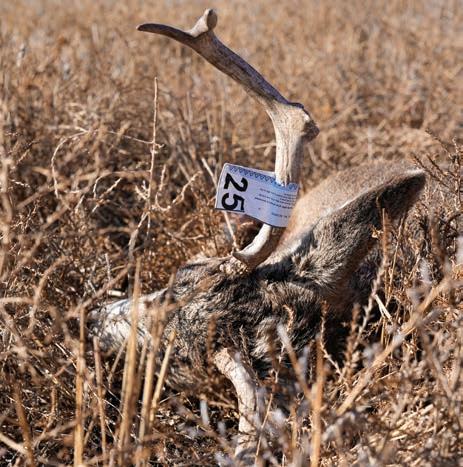
A total of 36,353 North Dakota deer hunters took approximately 20,877 deer during the 2025 deer gun hunting season, according to a post-season survey conducted by the state Game and Fish Department.
Game and Fish made available 42,300 deer gun licenses last year. Overall hunter success was 57%, with each hunter spending an average of 4.9 days in the field.
Hunter success for white-tailed deer was 53% for antlered and 45% for antlerless whitetails.
Mule deer license holder success was 82% for antlered and 82% for antlerless mule deer.
Hunters with any antlered or any antlerless licenses generally harvest white-tailed deer, as these licenses are predominantly in units with mostly whitetails. Though, mule deer made up a greater proportion of the harvest in the Slope and Missouri River hunting units. Any antlered hunters had a success rate of 65%, while any antlerless hunters had a success rate of 56%.
Game and Fish issued 11,598 gratis licenses in 2025, and 9,453 hunters harvested 4,452 deer for a success rate of 47%.
A total of 797 muzzleloader licenses were issued, and 665 hunters harvested 215 white-tailed deer (102 antlered, 113 antlerless). Hunter success was 32%.
A total of 27,341 archery licenses (24,553 resident, 2,494 nonresident white-tailed deer, 294 nonresident any deer) were issued in 2025. In total, 22,944 bowhunters harvested 6,610 deer (5,590 whitetails, 1,020 mule deer) for a success rate of 29%.
Legacy Program Adds Habitat, Access
The North Dakota Association of Soil Conservation Districts has completed the first enrollment cycle for the Governor’s Legacy Soil Health and Habitat Program. The program was launched through a $6.5 million Outdoor Heritage Fund grant awarded in December 2025, with the North Dakota Game and Fish Department serving as a co-applicant. The program was developed with input from agricultural and conservation partners and is designed to support grassland restoration, soil health, and wildlife habitat across the state.
The program provides five-year agreements that include annual rental payments, cost-share for grass establishment, and a first-of-its-kind $10 per acre crop insurance credit for unproductive cropland converted to grassland habitat. Producers who enroll acres into the department’s Private Land Open To Sportsmen program receive additional incentives.
Demand for the program was strong, with 458 applications submitted and nearly 20,000 acres offered for consideration, totaling approximately $10.5 million in requests, well above the available grant funding. Interest in PLOTS was also high, with nearly 6,000 acres offered for walk-in public access. Following review and ranking, the highest scoring applications were selected, fully obligating all grant funds through more than 9,000 acres of habitat and access projects for 2026.
The response demonstrates significant producer interest in grassland restoration and soil health practices, as well as strong support for a state-led program. The Governor’s Legacy Soil Health and Habitat Program was developed following recommendations from the Game and Fish Department’s 2024 Habitat and Access Summit, which identified the need for a state program to help offset ongoing losses in the federal Conservation Reserve Program.
The North Dakota Association of Soil Conservation Districts and the department are working with partners to explore longterm funding options to continue and expand the program.
Upland Game Seasons Summarized
North Dakota’s 2025 upland bird harvests were down for pheasants, grouse and gray partridge compared to 2024.
“We were not surprised by a decrease in pheasant harvest in the fall of 2025 based on decreases of chicks in our late summer roadside counts. Chick production was negatively impacted by
the cool, wet nesting season and these juvenile birds are often what make up a significant portion of a hunter’s bag. However, adult pheasant densities remain high due to good survival from the mild winter,” said RJ Gross, North Dakota Game and Fish Department upland game biologist.
Gross said given the number of roosters remaining on the landscape post-season, access was likely the most limiting factor for pheasant hunter success.
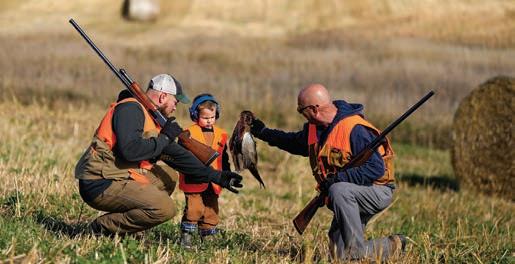
Last year, 53,008 pheasant hunters (down 4%) harvested 344,975 roosters (down 3%), compared to 55,401 hunters and 357,018 roosters in 2024.
Counties with the highest percentage of pheasants taken were Hettinger, Divide, Williams, Stark and McLean.
A total of 18,241 grouse hunters (down 16%) harvested 55,539 sharp-tailed grouse (down 24%), compared to 21,660 hunters and 73,010 sharptails in 2024.
Counties with the highest percentage of sharptails taken were Divide, Hettinger, Mountrail, Adams and Bowman.
Sharp-tailed grouse were down 38% in last year’s summer roadside brood counts.
“In addition to cool, wet weather in June, which is unfavorable for chick survival, we suspect sharptail may have been impacted by West Nile virus because they declined from spring surveys to late summer surveys. Those declines appeared to have hampered the rebounding population, and the 24% drop in sharptail harvest reflects this,” Gross said.
Last year, 18,343 hunters (down 16%) harvested 50,445 gray partridge (down 25%). In 2024, 21,887 hunters harvested 67,465 partridge.
Counties with the highest percentage of gray partridge taken were Stark, McLean, Hettinger, Williams and Divide.
“Although hunters harvested fewer pheasants in 2025, we are optimistic after yet another mild winter, that the high pheasant population should carry through to 2026,” Gross said.
However, since much of the fall forecast depends on nesting and brood-rearing success, hunters should stay tuned.
Safe Boating a Priority
While the North Dakota Game and Fish Department recognized National Safe Boating Week in May, agency officials encourage boaters to follow safe boating
practices during all open water months.
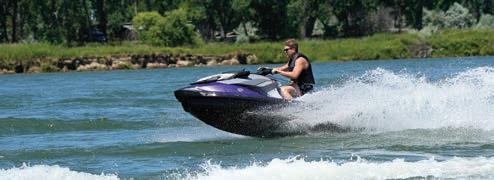
A boat should have enough U.S. Coast Guard approved wearable life jackets on board for all passengers. North Dakota law requires all children ages 10 and younger to wear a personal flotation device while in boats less than 27 feet in length. The law also requires all personal watercraft users to wear a life jacket, as well as anyone towed on skis, tubes, boards or other similar devices.
However, state law allows an individual engaged in barefoot skiing or surfing to wear a wet suit (a life preserver must be on board the towing vessel), and a person who is at least 16 years of age can windsurf or boardsail without wearing a PFD. Water users should make sure to wear life jackets of the appropriate size and in good condition.
Coast Guard statistics show that drowning was the reported cause of death in three out of every four recreational boating fatalities in 2024, and that 87% of those who drowned were not wearing life jackets.
It is also important children wear a PFD while swimming. Swimmers should know the water’s depth, as serious injuries can occur from diving. Large objects hidden below the water’s surface can lead to significant injury.
North Dakota boaters are also reminded that Class A and Class 1 vessels are required to have one hand, mouth or power-operated whistle audible for at least onehalf mile. This regulation also applies to kayaks, canoes, paddleboards and jet skis.
Regulations to help ensure safe boating this summer are found in the North Dakota Boat and Water Safety Guide on the Department’s website at gf.nd.gov.
Leave Baby Animals Alone
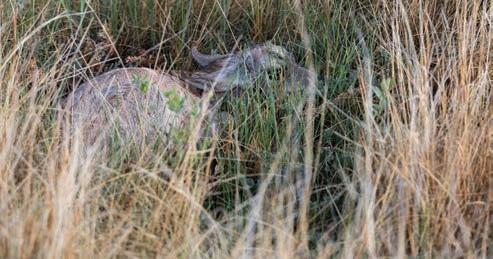
The North Dakota Game and Fish Department offers a simple message to the well-intentioned who want to rescue what appear to be orphaned baby animals this time of year: don’t touch them. Whether it is a young fawn, duckling, cottontail rabbit or a songbird, it is better to leave them alone.
Often, young animals are not abandoned or deserted, and the mother is probably nearby. Young wildlife are purposely secluded by adults to protect them from predators.
Anytime a young wild animal has human contact, its chances of survival decreases significantly. It’s illegal to
take wild animals home, and captive animals later returned to the wild will struggle to survive without possessing learned survival skills.
The only time a baby animal should be picked up is if it is in an unnatural situation, such as a young songbird found on a doorstep. In that case, the young bird can be moved to the closest suitable habitat.
Citizens should also steer clear of adult wildlife, such as deer or moose that might wander into urban areas. Crowding stresses animals and can lead to a potentially dangerous situation.
In addition, motorists are reminded to watch for deer along roadways. During the next several weeks young animals are dispersing from home ranges, and with deer more active during this time, the potential for car deer collisions increases.
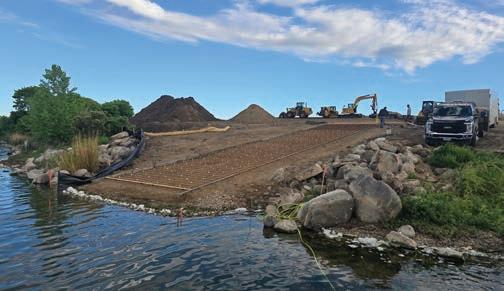
Spring and summer are busy times of year for North Dakota Game and Fish Department fisheries development personnel. Pictured here in early June is construction of a new boat ramp at Clear Lake in Pierce County.
Zap Park Board Honored
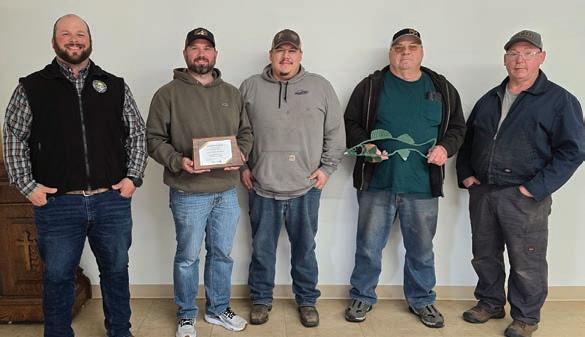
The North Dakota Game and Fish Department recognized the Zap Park Board with the 2026 certificate of appreciation for the difference the group has made on their local fisheries and facilities.
“Since the 1980s, the park board has been involved and has cooperated with Game and Fish on development and maintenance of a popular and valuable recreation site at Beaver Creek Bay on Lake Sakakawea,” said Wes Erdle, Department fisheries development project manager.
“Activities have included the construction and installation of a main boat ramp, a low-water ramp, several courtesy docks, a vault toilet, paved access road and parking area and numerous other amenities that have made this site a popular destination and public recreation area for many. In fact, the main boat ramp was reconstructed last year, and the park board incurred a large expense in cooperating on that project.”
Edle added that the Zap Park Board has assumed the important role of managing and maintaining all of these facilities throughout the year.
“As we all know, maintaining anything is just as important as the initial construction and the park board does an outstanding job in performing these duties,” he said.
STAFF NOTES
Warden Raasakka Retires
Mike Raasakka, longtime North Dakota Game and Fish Department game warden in Stanley, retired after nearly 39 years with the agency.
“Mike worked tirelessly to protect wildlife and those who enjoy it. From the busy waters of the Van Hook Arm to the deer, moose and waterfowl on the uplands, Mike was always there to do his job professionally and with the utmost dedication,” said Scott Winkelman, Department enforcement division chief. “Mike’s experience will be missed by many in his district and the Department.”
Left to Right: Wesley Erdle, Game and Fish Department fisheries development project manager, Brett Nodland, Elliott Hintz, Delvin Zahn and Kurt Gillig.
BACK CAST
grew up with a kid with a dog named Ruff. He was a good dog. A mixed breed that was mostly black with some white thrown in. Or maybe it was the other way around. No matter. What was certain was that people weren’t hustling out of work, and in some cases driving long distances, to simply lay eyes on Ruff and report to
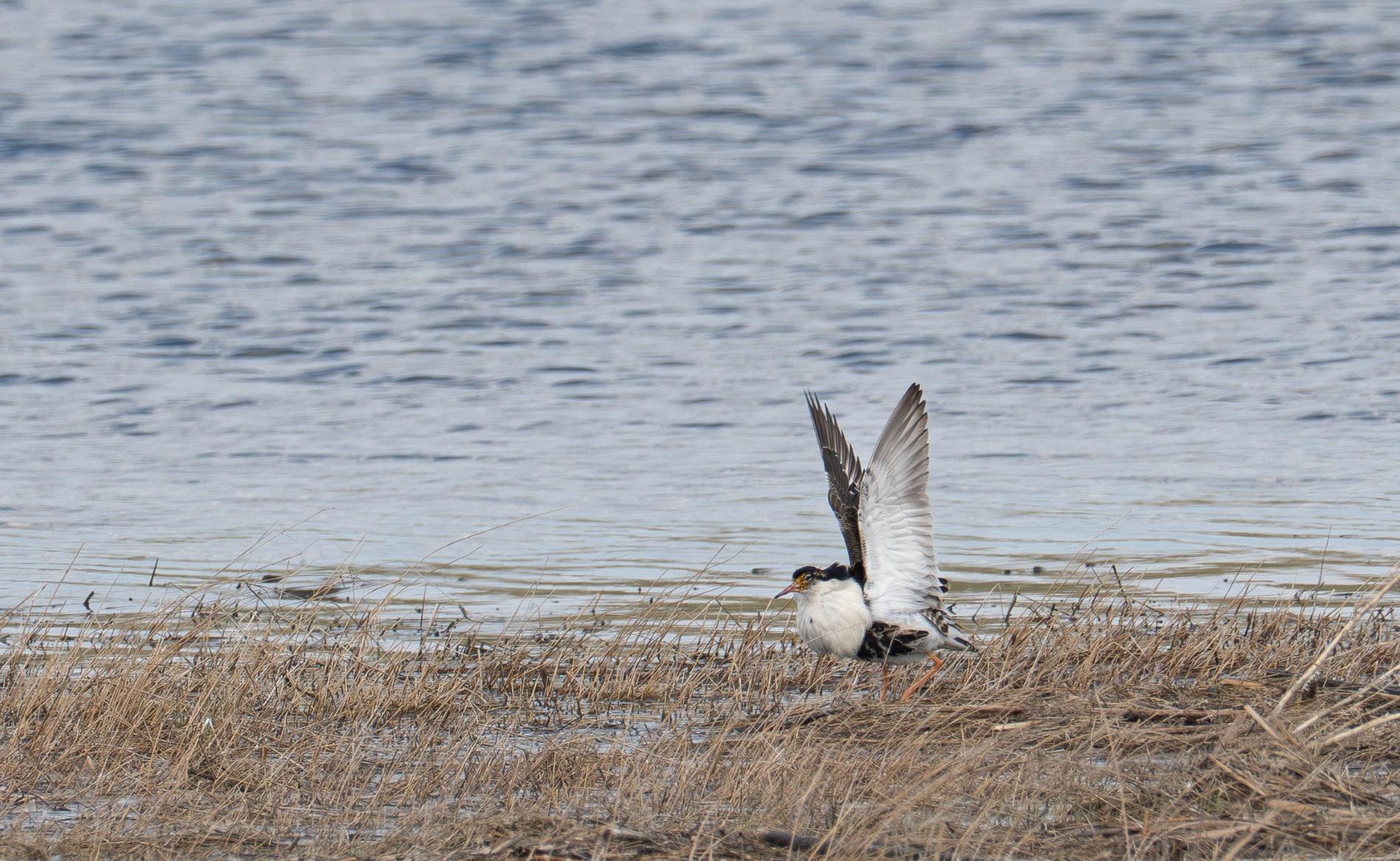
On May 6, while driving a test run for a long-running waterfowl survey in North Dakota, a bird rare to the state and a long way from where the species is typically found, was spotted by Mason Ryckman, Game and Fish Depart-
“What caught my eye was that there was so much white on the bird … I knew when I spotted it that I’d never seen a shorebird like that in my life,” Ryckman said.
The bird was a male ruff. A medium-sized shorebird that, scientists tell us, mainly winters in Africa but also across India and Southeast Asia, and breeds in bogs and wet, grassy meadows across northern Eurasia.
So, spotting this vagrant in a wetland along N.D. Highway 3 north of Steele was certainly news to North Dakota’s enthusiastic birding community.
To get confirmation on what he’d spotted, Ryckman sent a photo to Jesse Kolar, with the Game and Fish Department in Dickinson, and from there it got in the hands of Bob Anderson, with Valley City State University.
The latter, upon receiving the photo said at the time,
“Obviously, North Dakota is way out of this bird’s range and is another example how amazing birds are and the amazing things that they are able to do … fly across vast
oceans safely,” said Sandra Johnson, Department conservation biologist. “When word got out in the birding community, birders from Williston, Jamestown and elsewhere headed to the wetland north of Steele.”
While this strikingly uncommon visitor is interesting, so are the folks who ditch whatever plans and head to a wetland to spy a bird they’ve never seen before, knowing news of the ruff is maybe all they’ll get unless they act quickly because the bird, for whatever reason, has already lifted off and headed elsewhere.
These folks, I believe, are no different in their enthusiasm than, say, the angler who fishes six days in a row, no matter the weather, during the Missouri River’s spring walleye bite.
That kind of passion, no matter the outdoor pursuit, is easy to get behind and applaud.
Bird experts tell us the ruff got its name from the large, extravagant collar of feathers the male grows around his neck during the breeding season. They also tell us that breeding males gather on leks for a chance to mate with females just like sharp-tailed grouse have done for eons on prairie flat spots across North Dakota.
“North Dakota has very few rare bird sightings than other states like, say, Texas and Arizona where the birding communities are so much larger,” Johnson said. “The sighting of this ruff makes your wonder how many other super rare birds end up in North Dakota, and we don’t even know it.”
RON WILSON is editor of North Dakota OUTDOORS.
North Dakota Outdoors Magazine
North Dakota Game and Fish Department
100 N. Bismarck Expressway
Bismarck, ND 58501
To renew your subscription or change your address, call 701-328-6300 or go to gf.nd.gov/buy-apply.
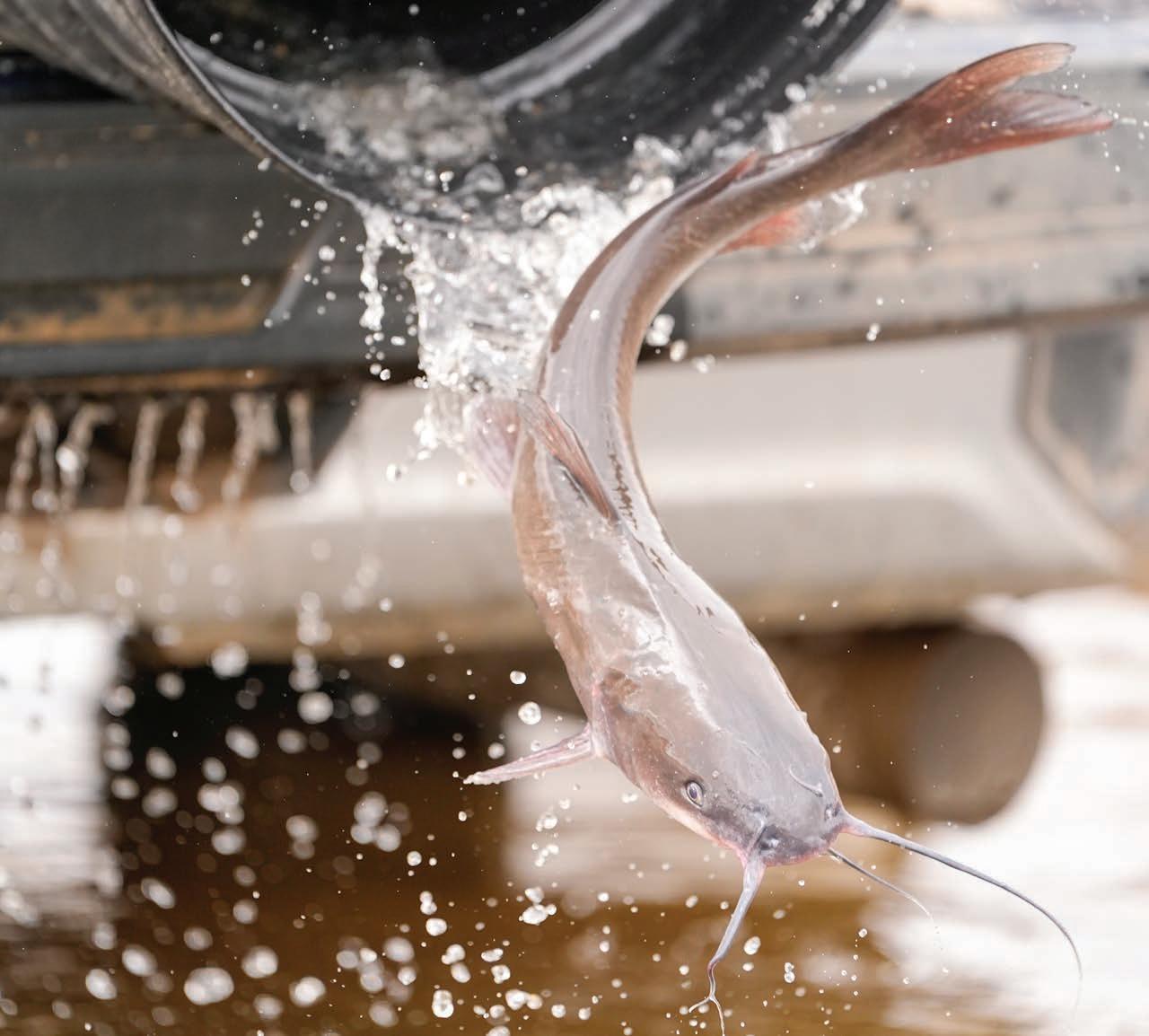
a variety of fish species by the Game and Fish Department.
A catfish being stocked in the OWLS Pond in Bismarck. The OWLS Pond is just one of the state’s many community fisheries found around North Dakota that are stocked with