DEPARTMENT DIRECTORY Governor Kelly Armstrong ADMINISTRATIVE DIVISION Game and Fish Director: Jeb Williams Deputy Director: Casey Anderson Chief, Administrative Services: Brian Hosek Grant Management Services Manager: Corey Wentland Administrative Staff Officer: Justin Mattson Administrative Assistant: Lynn Timm Building Maint. Supervisor: Brandon Diehl Human Resources Services Manager: Melissa Long Administrative Officer: Alan Peterson Financial Services Manager: Angie Morrison Accountant: Ashley Hillerson, Ashley Ryberg Business Services Manager: Vacant Technical Operations Lead: Alan Reile Data Scientist: Shane Wegner Licensing Services Manager: Randy Meissner Assistants: Amanda Anstrom, Tracy Price, Tana Bentz, Tanya Mikkelsen, Elizabeth Klein Administrative Assistant – Dickinson: Stephanie Richardson Administrative Assistant – Devils Lake: Lisa Tofte Administrative Assistant – Jamestown: Tonya Kukowski Administrative Assistant – Riverdale: Mattea Bierman Administrative Assistant – Williston: Stephanie Wellman CONSERVATION AND COMMUNICATIONS DIVISION Division Chief: Bruce Kreft, Bismarck Communications Manager: Mike Anderson, Bismarck Editor: North Dakota OUTDOORS: Ron Wilson, Bismarck Communications Specialist: Zach Eshleman, Bismarck Marketing Coordinator: Cayla Bendel, Bismarck Digital Media Editor: Lara Anderson, Bismarck Photographer/Videographer: Ashley Peterson, Bismarck Marketing Specialist: Jackie Ressler, Bismarck Information Specialist: Dawn Jochim, Bismarck Graphic Artist: Kristi Fast, Bismarck Education Supervisor: Marty Egeland, Bismarck Education Coordinator: Jeff Long, Bismarck Hunter Education Coordinator: Brian Schaffer, Bismarck Outreach Biologists: Doug Leier, West Fargo; Greg Gullickson, Minot; Jim Job, Grand Forks Conservation Supervisor: Patrick Isakson, Bismarck Conservation Biologists: Sandra Johnson, Elisha Mueller, John Schumacher, Aaron Larsen, Greg Schonert, Bismarck Administrative Assistant: Amber Schroeter, Bismarck ENFORCEMENT DIVISION Division Chief: Scott Winkelman, Bismarck Investigative Supervisor: Jim Burud, Kenmare Investigator: Blake Riewer, Grand Forks Operations Supervisor: Jackie Lundstrom, Bismarck Warden Pilot: Vacant Region No. 1 Warden Supvr: Michael Sedlacek, Jamestown District Wardens: Corey Erck, Bismarck; Andrew Dahlgren, Milnor; Erik Schmidt, Linton; Greg Hastings, Jamestown; Noah Raitz, LaMoure; Nick Tschepen, Fargo Region No. 2 Warden Supvr: Paul Freeman, Devils Lake District Wardens: Jonathan Tofteland, Bottineau; Jonathan Peterson, Devils Lake; Alan Howard, Cando; Drew Johnson, Finley; Sam Feldmann, Rugby; Gage Muench, Grand Forks; Dale Skalicky, Langdon; James Myhre, Sheyenne Region No. 3 Warden Supvr: Joe Lucas, Riverdale District Wardens: Shawn Sperling, Minot; Keenan Snyder, Williston, Josh Hedstrom, Tioga; Riley Gerding, Kenmare; Clayton Edstrom, Turtle Lake; Conner Folkers, Garrison; Luke Aamold, Watford City Region No. 4 Warden Supvr: Dan Hoenke, Dickinson District Wardens: Kylor Johnston, Hazen; Zachary Biberdorf, Bowman; Courtney Sprenger, Elgin; Zane Manhart, Golva; Jerad Bluem, Mandan; Zachary Schuchard, Richardton; Dominic Falch, Killdeer Administrative Assistant: Lori Kensington, Bismarck WILDLIFE DIVISION Division Chief: Bill Haase, Bismarck Assistant Division Chief: Levi Jacobson, Bismarck Game Mgt. Section Leader: Stephanie Tucker, Bismarck Pilot: Jeff Faught, Bismarck Upland Game Mgt. Supvr: Jesse Kolar, Dickinson Upland Game Mgt. Biologist: Rodney Gross, Bismarck Migratory Game Bird Mgt. Supvr: John Palarski, Bismarck Migratory Game Bird Biologist: Mason Ryckman, Bismarck Big Game Mgt. Supvr: Bruce Stillings, Dickinson Big Game Mgt. Biologists: Brett Wiedmann, Dickinson; Jason Smith, Jamestown; Ben Matykiewicz, Bismarck Survey Coordinator: Chad Parent, Bismarck Wildlife Veterinarian: Dr. Logan Weyand, Bismarck Wildlife Health Biologist: Ryan Herigstad, Bismarck Game Management Biological Technician: Nate Rykerd, Bismarck Wildlife Resource Management Section Leader: Todd Buckley, Williston Wildlife Resource Mgt. Supvrs: Brian Prince, Devils Lake; Brian Kietzman, Jamestown; Dan Halstead, Riverdale; Blake Schaan, Lonetree; Judd Jasmer, Dickinson; Jens Johnson, Bismarck Wildlife Resource Mgt. Biologists: Randy Littlefield, Lonetree; Rodd Compson, Jamestown; Erica Sevigny, Williston; Jake Oster, Riverdale; Andrew Ahrens, Devils Lake; Broden Ullyott, Dickinson Wildlife Biological Technicians: Tom Crutchfield, Jim Houston, Bismarck; Dan Morman, Robert Miller, Riverdale; Jason Rowell, Jamestown; Scott Olson, Devils Lake; Zach Eustice, Williston; Colton Soiseth, Quentin Corcoran, Lonetree Private Land Section Leader: Kevin Kading, Bismarck Habitat Manager: Nathan Harling, Bismarck Private Land Field Operation Supvrs: Curtis Francis, East Region, Bismarck; Colleen Gleason, West Region, Bismarck Private Land Biologists: Zach Johnson, Colin Penner, Bismarck; Jaden Honeyman, Ben Reith, Dickinson; Ryan Huber, Riverdale; Renae Schultz, Jeff Williams, Jamestown; Terry Oswald, Jr., Harvey; Erica Sevigny, Williston; Brandon Ramsey, Matthew Parvey, Devils Lake Procurement Officer: Dale Repnow, Bismarck FISHERIES DIVISION Division Chief: Greg Power, Bismarck Fisheries Mgt. Section Leader: Scott Gangl, Bismarck Fisheries Supvrs: Russ Kinzler, Riverdale; Paul Bailey, Bismarck; Brandon Kratz, Jamestown; Aaron Slominski, Williston; Bryan Sea, Devils Lake; Lucas Rott, Riverdale Fisheries Biologists: Todd Caspers, Devils Lake; Mike Johnson, Jamestown; Jeff Merchant, Dickinson; Zach Kjos, Riverdale Fisheries Biological Technicians: Phil Miller, Devils Lake; Justen Barstad, Bismarck; Brian Frohlich, Riverdale; Ethan Krebs, Jamestown, Sanden O’Connell, WIlliston Production/Development Section Supvr: Jerry Weigel, Bismarck Aquatic Nuisance Species Coordinator: Benjamin Holen, Jamestown Aquatic Nuisance Species Biologists: Mason Hammer, Jamestown; Kyle Oxley, Bismarck Fisheries Development Supvr: Bob Frohlich, Bismarck Fisheries Dev. Proj. Mgr: Wesley Erdle, Bismarck Fisheries Development Specialist: Kyle Hoge, Jacob Heyer, Joe Fladeland, Bismarck Administrative Assistant: Janice Vetter, Bismarck ADVISORY BOARD District 1 ....................................................................................................Nathan Hovde, Alexander District 2 ..................................................................................................................Travis Leier, Velva District 3 ................................................................................................ Edward Dosch, Devils Lake District 4 ....................................................................................................... Karissa Daws, Michigan District 5 ............................................................................................... Doug Madsen, Harwood District 6 ......................................................................................Jordan Svenningsen, Luverne District 7 ..................................................................................................Jody Sommer, Mandan District 8 .............................................................................................................. Rob Brooks, Rhame
Young pheasants in southwestern North Dakota get up off the ground to escape the morning dew. PHOTO BY JESSE KOLAR, DICKINSON.
Contributing photographers for this issue: Mike Anderson, Zachary Eshleman, Bill Haase, Jesse Kolar, Sandra Johnson and Ashley Peterson. Official publication of the North Dakota Game and Fish Department (ISSN 0029-2761) 100 N. Bismarck Expressway, Bismarck, ND 58501-5095 Website: gf.nd.gov • Email: ndgf@nd.gov • Information 701-328-6300 • Licensing 701-328-6335 • Administration 701-328-6305 • North Dakota Outdoors Subscriptions 701-328-6363 • Hunter Education 701-328-6615 • The TTY/TTD (Relay ND) number for the hearing or speech impaired is 800-366-6888
Periodical Postage Paid at Bismarck, ND 58501 and additional entry offices. Printed in the United States POSTMASTER: Send address changes to: North Dakota OUTDOORS 100 North Bismarck Expressway Bismarck, ND 58501-5095
Report All Poachers (RAP) 701-328-9921 In cooperation with North Dakota Wildlife Federation and North Dakota State Radio.
The mission of the North Dakota Game and Fish Department is to protect, conserve and enhance fish and wildlife populations and their habitats for sustained public consumptive and nonconsumptive use. ■ Editor: Ron Wilson
■ Graphic Designer: Kristi Fast
■ Circulation Manager: Dawn Jochim
AUGUST-SEPTEMBER 2026 • NUMBER 2 • VOLUME LXXXIX
CONTENTS 2
My 2 Cents
4
2026 Hunting Season Outlook
20
A Blind Spot: Agency Conducts Eye Worm Study
24
Conservative Harvest Strategies Continue
26
All Hands on Deck
28
Buffaloberry Patch
33
Back Cast
North Dakota OUTDOORS is published 10 times a year, monthly except for the months of April and September. Subscription rates are $15 for one year or $30 for three years. Remittance should be by check or money order payable to the North Dakota Game and Fish Department. Indicate if subscription is new or renewal. The numbers on the upper right corner of the mailing label indicate the date of the last issue a subscriber will receive unless the subscription is renewed. Permission to reprint materials appearing in North Dakota OUTDOORS must be obtained from the author, artist or photographer. We encourage contributions; contact the editor for writer and photography guidelines prior to submission. The NDGFD receives Federal financial assistance from the US Fish and Wildlife Service and the US Coast Guard. In accordance with Title VI of the Civil Rights Act of 1964, Section 504 of the Rehabilitation Act of 1973, Title II of the Americans with Disabilities Act of 1990, the Age Discrimination Act of 1975, and Title IX of the Education Amendments of 1972, the NDGFD joins the US Department of the Interior and its Bureaus and the US Department of Homeland Security in prohibiting discrimination on the basis of race, color, national origin, age, disability, sex (in education programs or activities) and also religion. If you believe you have been discriminated against in any program, activity, or facility as described above, or you desire further information, please write to: ND Game and Fish Department, Attn: Chief of Administrative Services, 100 N. Bismarck Expressway, Bismarck, ND 58501-5095 or to: Office of Civil Rights, Department of the Interior, 1849 C Street, NW, Washington, DC 20240.
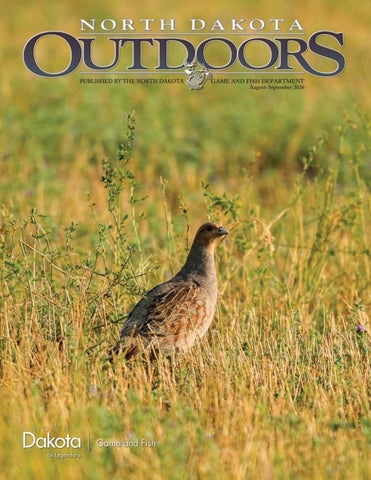
Front Cover
A gray partridge, also known as Hungarian partridge, photographed in late summer in North Dakota. PHOTO BY ASHLEY PETERSON.
My 2 Cents from the
DIRECTOR
A Good Fall, Opportunity for the Future There’s something about August in North Dakota that changes the way we look at the landscape. The days are still warm, crops are filling, and summer isn’t quite ready to give way. But for hunters, the signs of fall are everywhere. Equipment gets checked, bows get tuned, shotguns come out of the cabinet and conversations inevitably turn toward deer, pheasants, waterfowl and the possibilities of another hunting season. And from where I sit, there is plenty to look forward to this fall. Perhaps nowhere is that more evident than with pheasants. The spring pheasant outlook was encouraging, and the reports I’ve heard from people spending time on the landscape in summer have been equally positive. Hunters, landowners and others are reporting good numbers of hens with broods and seeing encouraging numbers of young pheasants. Those observations aren’t a substitute for the Department’s formal surveys, but they are certainly reason for optimism. It’s also worth remembering that wildlife populations are about more than what we see in a particular fall. Good numbers of birds and animals today are important, but the real challenge is making sure we have the habitat necessary to sustain those populations through the next decade and beyond. That’s why I’m particularly encouraged by the early response to Gov. Kelly Armstrong’s Legacy Soil Health and Habitat Program. The pilot program was created to put more perennial grass on the landscape while improving soil health, water retention and wildlife habitat. It is a voluntary program designed to work with producers and their agricultural operations, rather than against them. And North Dakota landowners have responded. During the first two enrollment periods, applications came from 46 counties and represented nearly 20,000 acres of interest. Because of available funding, only about 10,000 acres could ultimately be enrolled. More than half of those acres will also be enrolled in the Game and Fish Department’s Private Land Open To Sportsmen program. To me, that’s an important message. It tells us landowners are interested in conservation when programs are voluntary, straightforward and provide flexibility. It also tells us there may be an opportunity to take something that began as a pilot program and grow it into a much larger, longterm state initiative. We’ve seen what habitat can do. 2 ■ ND OUTDOORS ■ AUGUST-SEPTEMBER 2026
Many hunters remember the tremendous wildlife numbers North Dakota experienced during the height of the Conservation Reserve Program. At its peak, North Dakota had roughly 3 million acres of CRP. Today, that number is closer to 1 million acres, with additional acres expected to expire in coming years. We can’t simply recreate the past, nor should we expect one program to solve every habitat challenge. But we can build on what we’ve learned. A larger Governor’s Legacy program could become another important tool for keeping productive habitat on the landscape — benefiting pheasants, sharp-tailed grouse, deer, waterfowl and countless other species while also improving soil health and the long-term resilience of North Dakota agriculture. That’s the kind of conservation that can make a difference well beyond one hunting season. So, as we look toward fall, I’m optimistic. I’m optimistic when I hear reports of pheasant broods across the state. I’m encouraged by improving mule deer numbers in western North Dakota. And I’m encouraged by the willingness of landowners, agriculture, conservation organizations, sportsmen and state agencies to work together on solutions. But I think we should look beyond the next opening day. A successful fall is something to celebrate. A healthy wildlife population is something to appreciate. But creating the habitat that allows those populations to remain healthy for generations is the real goal. The opportunity is in front of us. If we can take the lessons learned from this pilot program, build on the tremendous landowner interest and develop sustainable funding to expand it statewide, we could leave a much better landscape for the next generation of hunters. And that, in my mind, would be a pretty good definition of a successful fall.
Jeb Williams
DIRECTOR, NORTH DAKOTA GAME AND FISH DEPARTMENT
BY BILL HAASE
here is a lot to be excited about for North Dakota’s upcoming hunting season. Waterfowl and upland game hunting prospects look excellent, while moose, elk and bighorn sheep populations remain at or near record levels. And mule deer, whitetailed deer and pronghorn populations continue to recover following the devastating winter of 2022-23. That winter brought historic snowfall and had a tremendous impact on resident wildlife. Harsh winters are a defining part of life on the Northern Plains, and they have always been one of the primary factors shaping wildlife management in our state. Wildlife populations naturally rise and fall with the severity of our winters. When quality habitat is available, those populations can recover remarkably quickly. Habitat is the key to North Dakota’s wildlife populations. More than 15 years ago, even when Conserva-
4 ■ ND OUTDOORS ■ AUGUST-SEPTEMBER 2026
tion Reserve Program enrollment was near its peak and habitat conditions were among the best we had seen, Randy Kreil, former Game and Fish Department wildlife division chief, warned readers in North Dakota OUTDOORS: “Don’t be fooled. You may see clear skies overhead, but there is serious trouble over the horizon.” Today, that warning has become reality. North Dakota’s landscape has changed dramatically since 2008. More than 2 million acres of CRP have been lost, native prairie continues to be converted to cropland, thousands of shelter belts have been removed, wetlands drained, and energy development has expanded across the state. As a result, wildlife populations, especially white-tailed deer, now take much longer to recover from severe winters. The lesson is clear: habitat is the foundation of healthy wildlife populations. The challenge is developing solutions that work for both wildlife and the people who own and manage the land.
More than 90% of North Dakota is privately owned, making private landowners essential partners in conservation. Many landowners value our hunting heritage and want to improve or preserve wildlife habitat, but conservation programs must also be practical and economically competitive. Historically, North Dakota has relied heavily on federal conservation programs, and they will continue to play an important role. However, federal programs alone are no longer enough to meet the challenges ahead. The Governor’s Legacy Soil Health and Habitat Program represents an important step toward addressing those challenges. Launched in spring as a pilot effort, the program quickly enrolled contracts for 10,000 acres of new perennial grass plantings. Administered by the North Dakota Association of Soil Conservation Districts in partnership with the Department and many other organizations, the program demonstrates what can be accomplished when conservation and agriculture work together. We are now working with the governor and legislature to identify long-term, sustainable funding that will allow this program to grow. Restoring habitat across North Dakota is a significant investment, and expanding these efforts to a landscape scale will require multiple funding sources and strong partnerships. The benefits, however, will extend well beyond wildlife by improving soil health, water quality, and the long-term resilience of our working lands. You can help. As lawmakers consider future funding for habitat conservation, stay informed and make your voice heard. There will be many competing priorities for limited state resources, and it is important that legislators hear from hunters, landowners and outdoor enthusiasts about the value of investing in wildlife habitat. Together, we can ensure future generations enjoy the same outstanding hunting opportunities that make North Dakota special. Have a safe and enjoyable fall, and best of luck during the upcoming hunting season.
BILL HAASE is the Game and Fish Department’s wildlife division chief.
Wild turkey
UPLAND AND SMALL GAME RING-NECKED PHEASANTS
Opens: Oct. 10 Closes: Jan. 3, 2027 Daily Limit: 3 Possession Limit: 12 Shooting Hours: Half-hour before sunrise to sunset. Compared to typical winters in North Dakota, pheasants and other wildlife experienced three mild winters in a row with most of the state receiving little to no snow during the last go-round. Results of spring’s crowing count survey showed higher numbers of breeding roosters throughout the entire pheasant range. The number of roosters heard calling was up anywhere from 4-41% throughout the state’s good pheasant range. Cover for nesting hens was above average in spring due to excess moisture from the timely fall and spring rains. Habitat was lush and green for early nesting attempts to be successful. However, July was exceptionally dry, and drought conditions were present in far southwestern North Dakota. It is expected that conditions during peak hatch were favorable for high chick survival in some parts of the state, but some laterhatched birds could have struggled during the dry and hot July. As of this writing in late August, we are conducting our late summer roadside brood counts, and preliminary numbers indicate hunters will see a similar number of adult birds and a few more juveniles in fall compared to 2025. As always, hunters need to be mobile and willing to move to different locations to find localized optimal hunting opportunities. It’s expected the west-central part of the state to have the best opportunities available in fall.
Rodney Gross, Upland Game Management Biologist, Bismarck
ND OUTDOORS ■ AUGUST-SEPTEMBER 2026 ■ 5
The Department decreased slightly fall licenses for wild turkeys in response to below average production last year in hopes of getting more adult males to survive until spring. It’s anticipated that the central and west-central parts of the state along river corridors will provide some of the better turkey hunting opportunities in the state this fall.
YOUTH PHEASANT
(For legally licensed residents and nonresidents ages 15 and younger.) Opens: Oct. 3 Closes: Oct. 4 Daily Limit: 3 Possession Limit: 6 Shooting hours: Half-hour before sunrise to sunset.
WILD TURKEYS
Opens: Oct. 10 Closes: Jan. 3, 2027 Shooting Hours: Half-hour before sunrise to sunset. The turkey population in many of our hunting units has been higher than normal the past few years due to increased production in the western half of the state. The state saw below average production on turkeys last summer so fall numbers were lower in parts of the state and jakes were hard to find during the spring hunt. The eastern part of the state has seen decreasing numbers of birds the last few years in response to the loss of quality turkey habitat. Early reports from brood surveys show a slight increase in the number of turkey broods on the ground, and similar adults in the west. Slightly higher turkey production numbers are expected this year thanks to favorable spring weather during the nesting season.
Rodney Gross
RUFFED GROUSE
Opens: Sept. 12 Closes: Jan. 3, 2027 Daily Limit: 3 Possession Limit: 12 Shooting Hours: Half-hour before sunrise to sunset. In the Turtle Mountains biologists documented a 40% increase from 2025, returning the population to the highest number of drums heard in the Turtle Mountains since 2009-10. Ruffed grouse drums heard in the Pembina Hills were down slightly (-15%) but remain above the 15-year average. Ruffed grouse hunting should be average to above average in North Dakota this year, which means a full day of walking should yield one to two ruffed grouse flushes. Ruffed grouse are rarely found at high densities in North Dakota. Ruffed grouse are uncommon in North Dakota because they live almost exclusively in aspen forests. They are only found in the Turtle Mountains and Pembina Hills. Although there was a small population in the J. Clark Salyer Wildlife Refuge in McHenry County, there have been zero reports of birds there since 2006. Jesse Kolar, Upland Game Management Supervisor, Dickinson
Gray partridge
SHARP-TAILED GROUSE
Opens: Sept. 12 Closes: Jan. 3, 2027 Daily Limit: 3 Possession Limit: 12 Shooting Hours: Half-hour before sunrise to sunset. The 2026 sharp-tailed grouse index (weighted average by area surveyed) was unchanged from 2025. Despite poor production in 2025 and reports of low densities, biologists suspect the mild winter facilitated high over-winter survival, yielding an overall stable population from 2025. While the 2026 brood routes are still ongoing at the time of the writing, preliminary results are showing increases in grouse density (+11%), brood sizes (+18%; 6 ■ ND OUTDOORS ■ AUGUST-SEPTEMBER 2026
average five chicks per brood). Unchanged were the abundance of broods observed (1/100 miles) and age ratio (+1.8%, 1.2 juveniles per adult). These numbers are not good enough to expect a rebound in the fall sharptail population, but after the decline in 2025, the trend held steady in 2026 and reproduction improved. It should be noted that the abundance estimates from Department brood routes have less certainty for sharptails because they do not gather at roadsides as predictably as pheasants or partridge. Our brood routes are not designed to measure grouse density like the spring lek counts. Improved reproduction was expected since the warm dry weather this summer was more beneficial to incubation and early chick survival (mid-May – mid-July) than the cold, wet weather experienced in 2025. However, in areas where drought was severe, grouse had to travel longer distances to find mesic areas with abundant forbs and insects for feeding chicks; we suspect the droughty conditions prevented a more rapid recovery of sharptails this summer. Statewide, sharptail populations remain near the 10-year average. The population in the northwest has fallen from where it peaked in the early 2020s, and the declines in 2025 have further prevented the southwest from recovering to the numbers hunters expect, especially in the Little Missouri National Grasslands. The eastern third of the state continues to hold very few grouse, as sharptails primarily reproduce on pastures and other grasslands. Sharptails nest almost exclusively in native prairies, pastures and planted grasses, so even though they move between nesting season and fall, the best places to find them are in areas near grasslands resembling native prairies. In fall they can often be found in shrub patches on hillsides, alfalfa fields, sunflower fields, and near harvested canola fields. Jesse Kolar
HUNGARIAN PARTRIDGE
Opens: Sept. 12 Closes: Jan. 3, 2027 Daily Limit: 3 Possession Limit: 12 Shooting Hours: Half-hour before sunrise to sunset. While the Department does not have a spring index for partridge, biologists continue to hear reports across the state of how many partridge people are seeing. However, this is the third consecutive year
that reproduction surveys for partridge are lower than where they were from 2019-23. On the late summer roadside counts, biologists are seeing slightly smaller brood sizes, fewer broods (-14%), and fewer partridge (-15%) than in 2025. Partridge reproduction had been excellent from 2019-23, and the population peaked in 2023. Despite slow declines, the population remains above average across the state. Hunters rarely go “partridge hunting,” but like last year, upland hunters could expect to put up a covey of partridge every 1-2 days (or more in some areas). One downside with lower reproduction is that the coveys will be smaller. Instead of seeing coveys of 12-15 birds, it’s likely hunters will notice many more coveys with fewer than 10 partridge. Although mainly a hunter anecdote, leaving at least five in a local covey, assuming normal winter mortality (up to 60%), should ensure a surviving pair for the following spring. Partridge overlap with pheasants and sharptails in North Dakota, but their preferred habitat is weedy edges, particularly along small grain fields. Focus on rock pile islands in stubble fields, lone trees or shrub patches in ditches, field edges, fence lines and abandoned farmsteads. Rodney Gross
TREE SQUIRRELS
Opens: Sept. 12 Closes: Feb. 28, 2027 Daily Limit: 4 Possession Limit: 12 Shooting Hours: Half-hour before sunrise to sunset. Tree squirrels may be taken statewide with firearms loaded with shot, rimfire rifles, or with bows and arrows legal for taking upland game.
ND OUTDOORS ■ AUGUST-SEPTEMBER 2026 ■ 7
White-tailed buck in velvet.
Big Game
Mule deer buck
WHITE-TAILED DEER Archery Opens: Sept. 4 Archery Closes: Jan. 3, 2027 Youth Gun Season Opens: Sept. 18 Youth Gun Season Closes: Sept. 27 Regular Gun Season Opens: Nov. 6 Regular Gun Season Closes: Nov. 22 Muzzleloader Opens: Nov. 27 Muzzleloader Closes: Dec. 13 The Game and Fish Department made available 39,100 licenses for the 2026 deer gun hunting season, a decrease of 3,200 from 2025. Many of these reductions came from antlerless licenses in the eastern one-third of the state, primarily in the Red River and Sheyenne-
8 ■ ND OUTDOORS ■ AUGUST-SEPTEMBER 2026
James River hunting units. Statewide hunter success for the 2025 regular gun season was slightly greater than 2024 at 57%. Hunter observation and harvest indices indicate deer populations are stable to decreasing throughout the state. Big game biologists were able to conduct winter aerial surveys for white-tailed deer in hunting units 1, 2D, and 2E this past winter. Deer densities in hunting unit 1 remained relatively unchanged, while densities in hunting units 2D and 2E were 37% and 22% lower than what was observed during the 2023 winter survey. The current trend of mild winters has resulted in minimal winter losses and the break in the drought pattern has resulted in conditions that correlate with good fawn and antler production. However, benefits gained from favorable weather patterns are tempered when the landscape is lacking in quality habitat. Loss of quality habitat, particularly winter cover and fawning habitat, continues to be a challenge for deer throughout the state. These losses limit carrying capacity resulting in an overall lower population and slows the potential for population growth after disturbances such as epizootic hemorrhagic disease outbreaks and severe winters. Without a significant increase in the amount of quality white-tailed deer habitat, lower deer densities and slower recovery after disturbances will likely be the “new normal” for North Dakota. A total of 16 deer tested positive for chronic wasting disease in 2025, all were harvested by hunters during either the bow or regular gun seasons. CWD was found in two new units: 2B (one white-tailed deer) and 3D2 (two mule deer). Other units where deer tested positive include 3A1 (five mule deer and one white-tailed deer), 3E1 (one mule deer and one white-tailed deer), 3E2 (one mule deer), 3F1 (one white-tailed deer), and 3F2 (two mule deer and one white-tailed deer). CWD surveillance for the 2026 season will focus on units in the southwestern portion of the state: units 2J1, 3B3, 3C, 3D1, 3D2, 3E1, 3E2, 3F1, 3F2, 4D, 4E and 4F. Hunters wishing to have their deer tested regardless of hunting unit may request a sampling kit online at the Game and Fish website, , gf.nd.gov, visit a Game and Fish district office, or drop its head off at one of the Department’s drop-off sites.
Summary of deer licenses for 2026: • Any Antlered licenses increased by 850. • Any Antlerless licenses decreased by 2,700. • Antlered white-tailed deer licenses decreased by 500. • Antlerless white-tailed deer licenses decreased by 450. • Antlered mule deer licenses decreased by 400. • Antlerless mule deer licenses remained the same. • 750 muzzleloader licenses were made available – 375 antlered white-tailed deer licenses and 375 antlerless white-tailed deer licenses. This is a decrease of 56 muzzleloader licenses from 2025. • 120 “I” licenses were made available for the youth deer hunting season (ages 14 and 15). “I” licenses are limited in number for units 4A-4F and are valid for any deer. There are unlimited “H” youth deer hunting licenses valid for any deer statewide except antlered mule deer in the above restricted units. • 40 “N” licenses were made available for the youth deer hunting season (ages 11, 12, and 13). “N” licenses are limited in number for units 4A-4F and are valid for any antlerless deer. There are unlimited “O” youth deer hunting licenses valid for any antlerless deer statewide except for antlerless mule deer in the above restricted units. • 240 nonresident any deer archery licenses were made available, down 60 from 2025.
Benjamin Matykiewicz, Big Game Management Biologist, Bismarck
MULE DEER Archery Opens: Sept. 4 Archery Closes: Jan. 3, 2027 Regular Gun Season Opens: Nov. 6 Regular Gun Season Closes: Nov. 22 The mule deer population in the badlands increased due to high over winter fawn survival despite below
average fawn production in 2025. Drought conditions have occurred in the badlands since 2020, and fawn production has been below the long-term average since 2017. The 2026 spring index was 31% higher than the 2025 index and 8% higher than the long-term average. A population increase combined with better widespread precipitation in the western badlands in summer provides optimism that hunting opportunities may increase in the future. The increase in mule deer numbers was greatest in hunting units 4B and 4C and lowest in 4F. For the 2026 season, 1,200 antlered and 400 antlerless licenses were made available to hunters. A mule deer buck license remains one of the most difficult licenses to draw but for those lucky few, it should result in a very high-quality hunt. Hunter success for mule deer buck hunters was 83% in 2025. Many challenges remain in the future population recovery of mule deer in the badlands. Encroachment of juniper in mule deer habitat, direct and indirect habitat loss due to oil development, predators and weather conditions, including extreme winters, are all hurdles the animals must face in the long-term recovery effort. Bruce Stillings, Big Game Management Supervisor, Dickinson
PRONGHORN Archery Only Opens: Sept. 4 Archery Only Closes: Sept. 27 Gun/Archery Season Opens: Oct. 2 Gun/Archery Season Closes: Oct. 18 North Dakota hunters will have the same opportunities to hunt pronghorn this fall as 2025. Although fawn production was a record low in 2025, mild winter conditions in 2025-26 resulted in good over winter survival and a slight population increase in 2026.
Mule deer bucks in the badlands.
ND OUTDOORS ■ AUGUST-SEPTEMBER 2026 ■ 9
The population estimate of 8,004 animals was 12% higher than 2025. Pronghorn increased the most in hunting units 1A, 1D and 10A, while population growth was minimal in hunting unit 4A. Fawn production was 54 fawns per 100 does, which was higher than last year, but below the long-term average of 61 fawns per 100 does. The buck to doe ratio remained stable at 31 bucks per 100 does. Lottery licenses can be used during the archery season (Sept. 4–27) with archery equipment or during the rifle season (Oct. 2–18) using legal firearms or archery equipment for those who do not hunt or harvest an animal during the archery season. Last year’s season was successful with 1,120 hunters harvesting 729 pronghorn for a success rate of 65%. Hunters with a lottery license had a hunter success rate of 87%. Bruce Stillings
BIGHORN SHEEP For season details, refer to the Game and Fish Department website, gf.nd.gov, or the 2026 bighorn sheep, elk and moose hunting guide. The Game and Fish Department’s 2025 bighorn sheep survey, completed by recounting lambs in March, revealed a record 378 bighorn sheep in the badlands of western North Dakota, up 8% from 2024 and 10% above the five-year average. The 2025 survey was the fifth record count in the past six years. Altogether, biologists counted 104 rams, 234 ewes and 40 lambs. Not included were approximately 40 bighorn
sheep in the North Unit of Theodore Roosevelt National Park and bighorns introduced to the Fort Berthold Indian Reservation in 2020. The northern badlands population increased by 8% from 2024 and was the highest count on record. The southern badlands population remained near its lowest level since bighorns were reintroduced there in 1966. Adult rams were near record numbers, but the ewe count surpassed the previous record by an impressive 14%. Lamb recruitment and winter survival of lambs were both well below average. Biologists reported that numerous lambs were observed with clinical signs of pneumonia during the summer survey, which was likely the primary contributor to the poor lamb recruitment observed in 2025. According to the Department’s veterinarian, it is not uncommon to experience episodes of low lamb survival when a population of bighorn sheep is exposed to certain pathogens. Based on annual disease testing the state’s population of bighorn sheep has not cleared bacteria introduced in 2014 that predisposes bighorn lambs to pneumonia, so highly variable rates of lamb recruitment in recent years are not surprising. Department biologists count and classify all bighorn sheep in late summer, and then recount lambs the following March, as they approach one year of age to determine recruitment. Currently, about 500 bighorn sheep comprise the populations managed by the North Dakota Game and Fish Department, National Park Service and the Three Affiliated Tribes Fish and Wildlife Division. A bighorn sheep hunting season is scheduled for 2026. The department allocated five licenses.
Brett Wiedmann, Big Game Management Biologist, Dickinson
Pronghorn in western North Dakota.
10 ■ ND OUTDOORS ■ AUGUST-SEPTEMBER 2026
Cow elk
MOOSE
For season details, refer to the Game and Fish Department’s website, gf.nd.gov, or the 2026 bighorn sheep, elk and moose hunting guide. The number of once-in-a-lifetime moose licenses remained unchanged in 2026 for this highly sought-after species. All aerial survey units were flown this past winter, and overall numbers appear stable. However, moose densities remain lower in traditional hunting areas, including the Turtle Mountains, Pembina Hills and along the Red River corridor. Some unit changes occurred for 2026. Units M4 and M1C were absorbed into units M8 and M5, respectively, and there will no longer be any closed units for moose hunting. A total of 296 licenses were made available for North Dakota’s 2026 fall moose season. Hunter success is expected to remain high, as success rates have historically exceeded 90%. Jason Smith, Big Game Management Biologist, Jamestown
ELK
For season details, refer to the Game and Fish Department’s website, gf.nd.gov, or the 2026 bighorn sheep, elk and moose hunting guide. North Dakota’s 2026 elk season features an increase in
licenses compared to 2025, with most of the additional opportunities in units E2, E3 and E7. The increases reflect a growing elk population, good harvest success, and ongoing landowner tolerance concerns in areas where elk are locally abundant on private land. Expanding license numbers is intended to provide more opportunities while helping manage elk distribution and reduce localized overabundance. License numbers in E1E, E1W, E4 and E6 remain unchanged from 2025. Overall elk numbers appear stable based on aerial surveys of core habitat and minimum winter herd counts. A total of 1,062 licenses were made available for the 2026 elk season. Elk hunting in North Dakota can be both mentally and physically demanding. While success rates are relatively high compared to other western states, hunters have averaged just over 60% over the past five years. Antlerless licenses are generally easier to draw but can be the most difficult to fill, often requiring extended time in the field. The season outlook for elk in 2026 is good, with success expected to be similar to recent years. As always, making landowner contracts, securing access and preseason scouting are critical components for a successful elk or moose hunt in North Dakota. Jason Smith
ND OUTDOORS ■ AUGUST-SEPTEMBER 2026 ■ 11
Blue-winged teal
breeding ducks on the landscape. The overall duck index was down 9.5% from 2025 while Canada geese were also down 6.5% from the year prior, continuing their recent declines. The state began to receive some rain shortly thereafter which improved conditions statewide, but especially in critical duck breeding areas in the central, northeastern and northwestern portions of the state. Waterfowl that settled in the state were able to take advantage of these improved conditions. Duck broods counted during the mid-July survey were up 55% from last year, with nearly every major species increasing. Gadwall, pintails and redhead production appeared especially strong, and the redhead brood count was the highest recorded in the survey’s history. The increased production should be welcome news to waterfowl hunters this year. A larger proportion of young birds entering the fall flight tends to make for better hunting. Although this year’s fall flight estimate was 8.7% higher than last year, it remains about 31% below the 1994–2016 average. Favorable weather can boost production in the short term, but long-term duck populations are also shaped by the amount and quality of breeding habitat. The loss of grasslands and continued degradation of wetlands across North Dakota have reduced the landscape’s ability to produce ducks. While the Department does not formally survey Canada goose production statewide, banding crews and observations from this summer suggested excellent production,
migratory Birds One of the big headlines earlier in spring was that North Dakota’s May duck index dipped below the longterm average for the first time since 1993. Fortunately for hunters, that wasn’t the end of the story. Despite fewer breeding ducks this year, the state produced substantially more ducklings than last year thanks to improved conditions following the May Breeding Duck Survey. Timely precipitation throughout critical duck breeding habitat in the state helped catalyze production. Winter left much of North Dakota with limited runoff potential due to frequent midwinter thaws. Aside from an early April snowstorm across south-central North Dakota that improved settling conditions for early-arriving species such as mallards and pintails, precipitation remained scarce through mid-May. As a result, wetland conditions during the May breeding waterfowl survey were similar to 2025, and warm, windy weather coincided with fewer
CANADA GOOSE HUNTING ZONES 42 ! (
Crosby !
! (5 DIVIDE
85 £ ¤
52 £ ¤
40 ! (
! (5
! (8
! (5 ! 89 ( BURKE
40 ! (
42 ! (
83 £ ¤
256 .
28 ! (
Bowbells
! (
!
BOTTINEAU
! (8 50 ! (
50 ! (
50 ! (
40 ! (
50 ! (
83 £ ¤
!
MOUNTRAIL
Williston 2 £ ¤
1804
.
1804
.
.
23 ! (
1806
Watford City
200 . 85 £ ¤ 68 ! (
68 ! (
23 ! ( 23 ! (
!
37 ! (
41 ! (
28 ! (
73 ! (
85
! (8
Manning
200 . . 200A
.
200 Stanton
! (
! (8
!
94 § ¦ ¨
!
22 ! (
Center
25
MORTON
Mandan
!
! (8
BRIAN HOSEK
21 ! (
Mott
Bowman
BOWMAN 85 £ ¤
21 ! (
! (
12 £ ¤ 22 ! (
!
.
! (1 ! ( 200 200 STEELE . . ! ( Cooperstown
49 ! (
! ( 34
.
21 ! (
1804
!
Hettinger !
! (8
12 ■ ND OUTDOORS ■ AUGUST-SEPTEMBER 2026
! (6 SIOUX
24 ! (
Fort Yates
! (6
34 ! (
34 ! (
20 ! (
! (3
!
. 1804
83 £ ¤
! (9
11 ! (
200 - . .
BARNES
46 ! (
!
Fargo
18 ! (
46 ! (
46 ! (
46 ! ( 32 ! ( 27 ! (
13 ! ! (
13 ! (
LaMoure
11 ! ( Ellendale !
11 ! (
! (1
18 ! (
RICHLAND
! (
13 ! Wahpeton
13 ! (
13 ! (
56 ! ( 11 ! (
27 ! Lisbon (
!
32 ! (
! (1
£ ¤
! (3 ! ! (3
94 § ¦ ¨
32 ! (
! (1
281
Ashley
29 § ¦ ¨
18 ! (
Valley City !
94 § ¦ ¨
!
38 ! (
32 ! (
! (1
13 ! (
13 ! (
18 ! ! ( Hillsboro 200A
56 ! (
30 ! (
Linton !
29 § ¦ ¨ 200 .
32 ! (
281 £ ¤ 46 ! (
!
! (3
24 ! (
31 ! (
45
GRIGGS
Steele
83 £ ¤
1806
200 .
! (
30 ! (
13 ! ( 8
! (
32 Finley !
18 ! ( 18 ! (
!
20 ! (
281 £ ¤
! (
22 ! (
45 ! (
65 ! (
1
STUTSMAN
3
Carson
! (8 !
67 ! (
!
.
Jamestown 94 § ¦ ¨
49 ! (
HETTINGER
SLOPE
20 ! (
200 FOSTER
36 ! (
Bismarck
15 ! (
15 ! (
1
26
83
!
!
18 ! (
15
Carrington
! (3
Napoleon
21 ! (
!
12 £ ¤
36 ! ( 14 ! (
1804
! (6 Amidon
36 ! (
OLIVER
STARK 85 £ ¤
EASTERN ! ( ZONE ! (
!
Grand Forks
2 £ ¤ 32 ! (
! (1
RIVER ! ( . ! ( ZONE £¤ 31
18 ! (
! (1
! (9
!
49 ! (
Dickinson
Medora
16 ! (
22 ! (
32 ! (
Lakota
200A
31
94 § ¦ ¨
35 ! (
!
!
17 ! (
!
281 £ ¤
30 ! (
200 .
41 ! (
83 Washburn £ ¤
15 ! (
!
52 £ ¤
!
. MISSOURI
!
BILLINGS
! (3
Mc Clusky
!
200 .
Fessenden
14 ! (
48 ! (
200
1806
MERCER
200 .
.
.
DUNN
200
41 ! (
37 ! (
!
15 ! (
New Rockford
MCLEAN
1804
22
Beach !
! (
37 ! (
.
WESTERN ! ( £ ¤ ZONE .
GOLDEN VALLEY
30 ! (
Grafton
WALSH
!
20 ! (
20 ! (
! (3
32 ! (
81 £ ¤
Devils Lake
19 ! (
57 281 ! ( £ ¤
52 £ ¤
29 § ¦ ¨
81 £ ¤
! (1
2 £ ¤
! (
! 19 Minnewaukan
53
53 ! (
17 ! (
! (
BENSON
! (5
! (1
20
! (
14 ! ( 19 ! (
23 ! (
23 ! (
22 ! (
MCKENZIE
16 ! (
! ( 41 ! (
52 £ ¤ 83 £ ¤
1806
18 ! (
66 ! (
17 ! (
30
!
PEMBINA
32 ! ( 66 ! (
17 ! (
3
WARD
! (8
1804
. 58 ! (
Minot
Cavalier
! (
66 ! (
Cando !
32 ! ( 5
!
!
!
.
!
£ ¤
Langdon
20 ! ( 66 ! (
Rugby
2 £ ¤
18 ! (
! (1 CAVALIER
281 £ ¤
TOWNER
66 ! ( 17 ! (
Towner !
MCHENRY
2
20 ! (
! (5
66 ! (
14 ! (
28 ! (
Stanley
2 £ ¤
30 ! (
28 ! (
50 ! (
40 ! (
WILLIAMS
30 Rolla !
60 ! (
52 £ ¤
! (4
! (
281 £ ¤
! (5 ! (3
Bottineau
! (5
! (5
5
43 ! (
14 ! (
RENVILLE
!
127 . 29 § ¦ ¨ 11
Forman !
32 ! (
! ( 11
! ( 18 ! (
11 ! (
DUCKS HIGH PLAINS/LOW PLAINS UNITS 42 ! (
Crosby !
! (5 85 £ ¤
52 £ ¤
40 ! (
! (5
! (8
! (5 ! 89 (
DIVIDE
40 ! (
42 ! (
83 £ ¤
256 .
28 ! ( Bowbells
BOTTINEAU
RENVILLE
!
BURKE
43 ! (
14 ! ( !
50 ! (
52 £ ¤
50 ! (
50 ! (
60 ! (
40 ! (
50 ! (
! (
83 £ ¤
40 ! (
WILLIAMS Stanley
2 £ ¤
!
Williston 2 £ ¤
1804
.
. 1804
1806
85 £ ¤
23 ! (
!
37 ! (
48
8
22
85
DUNN
200 .
16 ! (
200
1806
MERCER
200 .
Manning
Dickinson
!
GOLDEN Medora
!
16 VALLEY ! (
85 £ ¤
1804
94 § ¦ ¨
22 ! (
!
MORTON
49 ! (
! (8
BRIAN HOSEK
12 £ ¤
! (8
85 £ ¤
12 £ ¤ 22 ! (
ADAMS Hettinger !
! (8
! ( 49
! (
1804
13 ! ( 31 ! (
46 ! (
Fort Yates
! (6
!
34 ! (
34 ! (
!
83 £ ¤
11 ! (
! (1
CASS
!
94 § ¦ ¨
especially along the Missouri Coteau. This is good news for Canada goose hunters, especially after a few years of population declines. This year also brings a few regulation changes. Resident waterfowl hunters will be able to pursue waterfowl during the first nine days of the season (Sept 26. – Oct 4.). Nonresidents will be permitted to hunt waterfowl starting Oct. 5. Additionally, all waterfowl hunters will now have the opportunity to hunt geese all day after Nov. 29. This change is meant to help simplify regulations, as the Department has typically added additional days for all day goose hunting during the late season. While weather will ultimately determine when and where birds move through the state, this year’s improved hatch should provide hunters with more young birds than they encountered last fall. After an uncertain start to the breeding season, timely summer rains helped improve the fall outlook. Regardless of how the season unfolds, hunters are encouraged to spend time afield and enjoy the unique waterfowl opportunities North Dakota has to offer.
Ashley
29 § ¦ ¨
18 ! (
Valley City
94 § ¦ ¨
!
Fargo
18 ! (
! (1 46 ! (
46 ! (
32 ! ( ! 27 RANSOM 27 ( ! ( Lisbon !
LaMoure
13 ! ! (
13 ! (
56 ! ( 11 ! (
13 ! (
13 ! ( 11 ! (
DICKEY Ellendale !
11 ! (
! (1
18 ! (
32 ! (
! (1
281 £ ¤
! (3 ! ! (3
!
200 - . . -
38 ! (
32 ! (
BARNES
LAMOURE
MCINTOSH
TRAILL Hillsboro 200A
46 ! (
13 ! (
13 ! (
! (3 1804
! (9
46 ! (
30 ! (
!
.
18 ! (
32 ! (
56 ! (
LOGAN
Linton
EMMONS
SIOUX
STEELE 200 .
29 § ¦ ¨ 200 .
32 ! (
! (3 24 ! (
! (1
200 .
26 ! (
20
!
34
! ( 18 ! ( 18 ! (
GRIGGS Cooperstown
281 £ ¤
30 ! (
24 ! (
! (6
! (
32 Finley !
!
.
!
GRANT
22 ! (
Bowman !
BOWMAN
21 ! (
! ( ! 45
! (1
Jamestown
83 £ ¤
1806
21 ! (
Carson
Mott
! (8 !
200 . 20 ! (
! (1
STUTSMAN
! (
HETTINGER 21 ! (
67 ! (
200 .
! ( 45
65 ! (
20 ! (
FOSTER
281
3
.
!
15
15 ! (
Steele
Napoleon
SLOPE
!
Grand Forks
2 £ ¤ 18 ! (
15 ! (
36
KIDDER
!
! (6 21 ! (
Amidon !
GRAND FORKS
NELSON
! (1
Carrington
3
1806
STARK
EDDY !
281 £ ¤
30 ! (
36
14
- 83 BURLEIGH . ¤ . £ Bismarck 94 § ¦ ¨ Mandan 25 ! (
31 ! (
94 § ¦ ¨
36
!
OLIVER
49 ! (
18 ! (
15 ! (
LOW PLAINS ! ( ! ( ! ( £ ¤ ! ( UNIT ! ! ( (
31 ! ( ! ( Center
! (8
32 ! (
!
! (1
! (9
. 48
!
22 ! (
! ( 57 281 ! ( £ ¤
15 ! (
200 .
SHERIDAN
41 ! (
!
200A
BILLINGS !
200
83 Washburn £ ¤
31 ! ! (
52 £ ¤
Mc Clusky
200A
200 .
200 .
81 £ ¤
35 ! (
Lakota
! (
!
17 ! (
!
20
30 ! (
! (3 Fessenden
!
!
32
WELLS
14 ! (
Grafton
WALSH
! (
Devils Lake
19 ! (
32 ! (
1
2 £ ¤
New Rockford
41
17 ! (
20 ! (
MCLEAN
37
66 ! (
! (
! (3
53 ! (
! ( . HIGH PLAINS ! ( ! ( ! ! ( ( . . UNIT £ ¤ . . 37 ! (
30 ! (
29 § ¦ ¨
81 £ ¤
! (1
! (
BENSON
18 ! (
66 ! (
20 RAMSEY ! (
! 19 Minnewaukan
52 £ ¤
53 ! (
1804
Beach
41 ! (
28 ! (
73 ! (
! (3
! (5
!
PEMBINA 32 ! (
17 ! (
PIERCE
14 ! (
! (5
!
19 ! (
23 ! (
23 ! (
22 ! (
MCKENZIE
68 ! (
68 ! (
23 ! (
Watford City
41 ! (
52 £ ¤
Cavalier
66 ! (
Rugby
2 £ ¤
MCHENRY
!
WARD
23 ! (
1806
200 .
Minot
83 £ ¤
.
.
58 ! (
Towner !
66 ! (
!
32 ! (
!
Langdon
20 ! (
Cando 17
! (
14 ! (
28 ! (
! (8
1804
66 ! (
17
2 £ ¤
MOUNTRAIL
.
!
! ( 281 £ ¤
TOWNER
18 ! (
! (1 CAVALIER
5
28 ! (
50
20 ! (
!
! (5 ROLETTE 30 ! ( ! (3 66 ! (
! (5 ! (8
! (4
! (
30 Rolla
281 £ ¤
Bottineau
! (5
! (5
Wahpeton 13 !
RICHLAND
SARGENT !
Forman 32 ! (
! ( 11
11 ! ( 18 ! (
! (
127 . 29 § ¦ ¨ 11 ! (
YOUTH WATERFOWL SEASON (For legally licensed residents and nonresidents ages 15 and younger.) Opens: Sept. 19 Closes: Sept. 20 Shooting Hours: Half-hour before sunrise to sunset. Daily Limit: Ducks and geese – same as regular season.
SPECIAL VETERAN AND ACTIVE MILITARY WATERFOWL SEASON (For legally licensed veterans and members of the Armed Forces on active duty, including members of the National Guard and Reserves on active duty, other than for training.) Opens: Sept. 19 Closes: Sept. 20 Shooting Hours: Half-hour before sunrise to sunset. Daily Limit: Ducks and geese – same as regular season (does not include bonus blue-winged teal).
EARLY CANADA GOOSE HUNTING John Palarski, Migratory Game Bird Management Supervisor
Opens: Aug. 15 (statewide) Closes: Sept. 7 (Missouri River Canada Goose Zone), Sept. 15 (Western Canada Goose Zone), Sept. 22 (Eastern Canada Goose Zone) Shooting Hours: Half-hour before sunrise to sunset. Daily Limit: 15 Possession Limit: 45
ND OUTDOORS ■ AUGUST-SEPTEMBER 2026 ■ 13
CANADA GOOSE REGULAR SEASON Opens: Sept. 26 (residents only), Oct. 5 (nonresidents) Closes: Jan. 1 (Missouri River Canada Goose Zone), Dec. 24 (Western Canada Goose Zone), Dec. 19 (Eastern Canada Goose Zone) Daily Limit: 5 (Missouri River Zone), 8 (all other zones) Possession Limit: 15 (Missouri River Zone), 24 (all other zones)
WHITE-FRONTED GEESE (Statewide) Opens: Sept. 26 (residents only), Oct. 5 (nonresidents) Closes: Dec. 6 Daily Limit: 3 Possession Limit: 9
LIGHT (SNOW) GEESE (Statewide)
Opens: Sept. 26 (residents only), Oct. 5 (nonresidents) Closes: Jan. 3 Daily Limit: 50, no possession limit Shooting Hours for all Geese: Half hour before sunrise to 2 p.m. Exception: Shooting hours are a half hour before sunrise to sunset on all Saturdays and Wednesdays through the end of each season. Hunting is allowed all day beginning Nov. 29.
REGULAR DUCK SEASON
LOW PLAINS UNIT Opens: Sept. 26 (residents only), Oct. 5 (nonresidents) Closes: Dec. 6 Shooting Hours: Half-hour before sunrise to sunset. HIGH PLAINS UNIT Opens: Sept. 26 (residents only), Oct. 5 (nonresidents) Closes: Dec. 6
Opens: Dec. 12 Closes: Jan. 3 Shooting-hours: Half-hour before sunrise to sunset. Daily Limit: Six ducks (including mergansers), which may include no more than five mallards (two of which may be hens), three pintails, two redheads, two canvasbacks, one scaup and three wood ducks. In addition to the daily bag limit of ducks, an additional two blue-winged teal may be taken from Sept. 26 through Oct. 4. Possession Limit: Three times the daily limit.
SANDHILL CRANES
Opens: Zone 1 and 2: Sept. 19 Closes: Zone 1 and 2: Nov. 15 Daily Limit Zone 1: 3 Daily Limit Zone 2: 2 Possession Limit Zone 1: 9 Possession Limit Zone 2: 6 Shooting Hours: Half hour before sunrise to 2 p.m. Exception: Shooting hours are a half hour before sunrise to sunset on all Saturdays and Wednesdays beginning Sept. 26 through the end of each season. The mid-continent population of sandhill cranes remains healthy heading into the 2026 fall hunting season. Each spring, the U.S. Fish and Wildlife Service conducts an aerial survey along Nebraska’s central Platte River Valley. Although final 2026 numbers are still pending, preliminary data indicate another strong population estimate. Over the past decade, this population has shown an upward trend. The three-year average population estimate, which guides regulatory decisions, reached a record high last year at more than 1 million cranes. As a result, North Dakota hunters can expect abundant opportunities to pursue sandhill cranes again in 2026. The two zone – Zone 1 west of U.S. Highway 281 and Zone 2 east of U.S. Highway 281 – structure for sandhill cranes will continue. The two zones will have the same season lengths (58 days) and dates but will again have different bag limits. Zone 1 has a daily bag limit of three cranes; in Zone 2 the daily bag limit is two. The possession
Redhead 14 ■ ND OUTDOORS ■ AUGUST-SEPTEMBER 2026
limit in Zone 1 is nine cranes, and six in Zone 2. Nonresident sandhill crane hunters can pursue sandhill cranes with either a valid nonresident small game or waterfowl license, in addition to a crane permit. Nonresident sandhill crane permits are valid for use within the dates and zones of nonresident waterfowl or small game licenses selected during purchase. Hunters are also reminded to be sure of their target before shooting, as federally endangered whooping cranes may be present throughout North Dakota during fall. Report all whooping crane sightings to the North Dakota Game and Fish Department in Bismarck at 701-328-6300. Mason Ryckman, Migratory Game Bird Biologist
DOVES
Opens: Sept. 1 Closes: Nov. 29 Daily Limit: 15 Possession Limit: 45 Shooting Hours: Half-hour before sunrise to sunset. North Dakota continues to be an important breeding area for mourning doves within the Central Management Unit. Field observations across the state suggest strong production and abundance this year. As with the previous season, favorable weather conditions, including timely spring rainfall across much of the state, supported successful nesting and likely resulted in solid recruitment. While official data from the Game and Fish Department’s late summer roadside counts are still pending for 2026, trends over the past five years have shown an upward trajectory in dove numbers. Furthermore, age ratios of juvenile to adult birds captured during statewide banding efforts are nearly identical to 2025, suggesting reproductive success was comparable despite localized differences in weather conditions. Dove hunters can expect good to excellent hunting opportunities during early September, before cooler weather prompts migratory movement to the south. Scouting ahead of the season remains important to locate areas where birds are concentrated. As the season approaches, doves will begin concentrating near agriculture fields, particularly around harvested small grain or oil seed fields where abundant food sources are available. With prolonged periods of hot, dry weather across North Dakota this summer, water is expected to become an increasingly important factor in dove distribution as the season approaches. Hunters should pay particular attention to stock ponds, dugouts, wetlands, and other reliable water sources, as doves often make pre-
dictable morning and evening flights between feeding areas and water, especially when natural water becomes scarce. Eurasian collared doves continue to expand their range and are now common in nearly every city and small town in North Dakota. However, they are seldom found in rural areas and are rarely harvested during typical dove hunts. Still, these birds may be taken during the dove hunting season and, if harvested, count toward the daily bag and possession limits along with mourning doves. Some hunters may be randomly selected by the U.S. Fish and Wildlife Service to participate in a wing survey, which involves submitting one wing from each dove harvested early in the season for analysis. Additionally, hunters are reminded to check for leg bands on mourning doves and report any banded birds directly to the Bird Banding Laboratory at reportband.gov. Band recovery information provides valuable data that helps biologists monitor mourning dove survival, migration, and population trends across North America. Mason Ryckman
CROWS
Fall Season Opens: Aug. 15 Closes: Nov. 2 Spring Season Opens: March 13, 2027 Closes: April 25, 2027 Daily Limit: No limit on crows. Shooting Hours: Half-hour before sunrise to sunset. In addition to the crow season, crows may be taken when committing or about to commit depredations as specified in federal law.
SNIPE
Opens: Sept. 12 Closes: Nov. 29 Daily Limit: 8 Possession Limit: 24 Shooting Hours: Half-hour before sunrise to sunset.
WOODCOCK
Opens: Sept. 19 Closes: Nov. 2 Daily Limit: 3 Possession Limit: 9 Shooting Hours: Half-hour before sunrise to sunset.
ND OUTDOORS ■ AUGUST-SEPTEMBER 2026 ■ 15
Mountain lion
Furbearers For more season details, refer to the North Dakota Game and Fish Department website, gf.nd.gov, or the 2026-27 Hunting and Trapping Guide. We are excited to announce the opening of a regulated trapping season for marten in North Dakota this winter. Marten were historically found in wooded areas in northeastern North Dakota. But, by the early 1900s, they were considered extirpated from the state. We can thank our neighbors to the north for their translocations of this furbearer into the Turtle Mountain Provincial Park in Manitoba, Canada in the late 1980s, which eventually led to the species return to our state as well. In recent years, research conducted by the North Dakota Game and Fish Department and Michigan State University provided the information necessary to responsibly move forward with a regulated marten trapping season. With the opening of a marten trapping season, we will also be lifting restrictions on fisher trapping in the Turtle Mountains. The fisher and marten trapping seasons will run in conjunction with one another for seven days beginning in late November. Marten and fisher trapping are open statewide but limited to North Dakota residents only. And the limit is one fisher and one marten per trapper. Trappers are encouraged to use caution when setting traplines for marten, as they are not especially difficult to catch. As such, deploying just a few well-placed traps during the seven-day season will likely be sufficient to catch a marten during the allotted time. We also continue to expand river otter trapping opportunities as data from previous seasons informs our management. This coming winter will mark the 10th year since we re-opened otter trapping in the state. We are removing the otter harvest limit this coming season and switching to a three-week season. The bag limit will remain one otter per person, but this switch should allow more trappers an opportunity to harvest an otter than in previous seasons. 16 ■ ND OUTDOORS ■ AUGUST-SEPTEMBER 2026
Furbearer population trends are a mixed bag going into this coming season. Coyote numbers are still good and should be similar or slightly higher than the previous seasons, but spring surveys indicated they are 32% below their 20-year average. Muskrat numbers will be similar to last year, with the Prairie Pothole Region having the highest numbers according to spring surveys. Last year, hunters and trappers took 74 bobcats (66 in Zone 1 and eight in Zone 2), 23 fishers, and four mountain lions in Zone 1 (all in the late season). We monitor population trends for these species using data collected from the carcasses of those animals taken during the hunting and trapping seasons. Trends indicate bobcat and fisher numbers are similar to their long-term averages. The mountain lion population trend remains low. We encourage people to continue to report their black bear sightings online at https://gf.nd.gov/hunting/ furbearers/furbearer-observation, including trail camera photos of bears.
Stephanie Tucker, Game Management Section Leader, Bismarck
MOUNTAIN LION HUNTING
Zone 1 (early) Opens: Sept. 4 Closes: Nov. 22 Zone 1 (late) Opens: Nov. 23 Closes: March 31, 2027 Zone 2 Opens: Sept. 4 Closes: March 31, 2027 The overall harvest limit on mountain lions in Zone 1 is once again 15, with an early season limit of eight, and a late-season limit of seven (or three females, whichever comes first). If the early season ends before eight mountain lions are taken, a conditional season could reopen after the late season, if the late season limit is reached prior to March 25. There is no mountain lion harvest limit in Zone 2. Mountain lions may be hunted statewide by residents using legal firearms or archery equipment during regular hunting hours. Beginning Nov. 23, mountain lions may also be hunted by pursuing with dogs. Cable devices and traps are not allowed. The limit is one lion per hunter. Kittens (lions with visible spots), or females accompanied by kittens, may not be taken. Hunters must either contact the local game warden or Department field office or register their harvest online via their account and make arrangements to have their lion inspected and tagged.
RIVER OTTER TRAPPING OR CABLE DEVICES
Opens: Nov. 23 Closes: Dec. 13 Limit of one per person. Trappers must either contact the local game warden or Department field office or register their harvest online via their account to report their harvest within 12 hours and make arrangements to have their river otter tagged.
FISHER AND MARTEN TRAPPING OR CABLE DEVICES
Opens: Nov. 23 Closes: Nov. 29 Open statewide for North Dakota residents. Limit is one fisher and one marten per person. Trappers must contact the local game warden or Department field office or register their harvest online via their account to report their harvest within 12 hours and make arrangements to have their fisher or marten tagged. For more information, see the North Dakota 2026-27 Hunting and Trapping Guide.
BEAVER AND RACCOON TRAPPING, HUNTING OR UNDERWATER CABLE DEVICES Open: Year-round. For more information, see the North Dakota 2026-27 Hunting and Trapping Guide.
BEAVER AND RACCOON CABLE DEVICES ON LAND
Opens: Nov. 23 Closes: March 15, 2027 From March 16, 2027, through May 10, 2027, cable devices must be within 50 feet of water; and must be no
more than 4 inches off the ground. Beaver dams may be dismantled when their presence causes property damage.
WEASEL TRAPPING, HUNTING OR CABLE DEVICES
Trapping Opens: Oct. 24 Hunting and Cable Devices Opens: Nov. 23 Closes: March 15, 2027 Weasels may be hunted statewide with rimfire or precharged pneumatic air guns of .22 caliber or smaller and archery equipment.
MUSKRAT AND MINK TRAPPING, HUNTING OR CABLE DEVICES
Trapping Opens: Oct. 24 Hunting and Cable Devices Opens: Nov. 23 Closes: May 10, 2027 Muskrat huts may be opened for insertion of traps or cable devices; however, the huts must be restored to their approximate original condition to prevent freeze-up. Beginning March 16, 2027, non-floating colony traps must be under at least 2 inches of water, and trapping or using cable devices on the outside of any muskrat house or structure of any size is prohibited; traps may be placed completely inside a muskrat house or structure of any size; foothold traps must be submerged under water at all times or must have a protective covering (except when used on float sets); body-gripping traps used in water can have no more than 2 inches of the trap above the water or must have a protective covering. Beginning May 1, 2027, float sets must have a protective covering. Mink and muskrat may be hunted statewide with rimfire cartridges or pre-charged pneumatic air guns of .22 caliber or smaller and archery equipment.
Beaver
ND OUTDOORS ■ AUGUST-SEPTEMBER 2026 ■ 17
BOBCAT TRAPPING, HUNTING OR CABLE DEVICES
Zone 1: Nov. 7 Cable Devices Opens: Nov. 23 Closes: March 15, 2027 Beginning Nov. 23, bobcats may also be trapped using cable devices and hunted by pursing with dogs. The pelt and carcass of each bobcat taken in Zone 1 must be presented to Department personnel for inspection and tagging prior to sale or transfer of possession, but no later than 14 days after the close of the season. Zone 2: Nov. 23 Closes: March 15, 2027 Limit is one bobcat per person in Zone 2 and total harvest limit is eight. In Zone 2, anyone who harvests a bobcat must either contact the local game warden or Department field office or register their harvest online via their account to report their harvest within 12 hours and make arrangements to have their bobcat tagged. For more information, see the 2026-27 Hunting and Trapping Guide.
RED FOX, GRAY FOX, COYOTE TRAPPING, HUNTING OR CABLE DEVICES
Day Hunting and Trapping Open: Year-round Night Hunting and Cable Devices Opens: Nov. 23 Cable Devices Closes: March 15, 2027 Night Hunting Closes: May 31, 2027 Red fox, gray fox and coyote may be hunted at any hour from Nov. 23 through May 31, 2027. Any hunter who engages in the hunting of red fox, gray fox or coyote during the time from a half-hour after sunset to a half-hour before sunrise, must hunt exclusively on foot. Hunters can use night vision, artificial light, thermal vision, and infrared light equipment during the night hunting season. Hunters are prohibited from using archery equipment (including crossbows) for night hunting until after the close of the archery deer season.
BADGER TRAPPING, HUNTING OR CABLE DEVICES Hunting and Trapping Open: Year-round Cable Devices Opens: Nov. 23 Closes: March 15, 2027
Coyote
18 ■ ND OUTDOORS ■ AUGUST-SEPTEMBER 2026
SMALL GAME, WATERFOWL, FURBEARER REGULATIONS North Dakota’s 2026 small game, waterfowl and furbearer regulations are set, with some noteworthy changes from last year. Changes include: • Opening day for ducks, geese, coots and mergansers for North Dakota residents is Sept. 26. Nonresidents may begin hunting waterfowl in North Dakota on Monday, Oct. 5. • Starting Nov. 29, shooting hours for geese will be one-half hour before sunrise to sunset to the end of the respective goose season. • Ruffed grouse can now be taken statewide. • American marten will be allowed for take for the first time in 2026. The season will mirror the fisher season. • Fisher can now be trapped statewide, removing the restricted area in the Turtle Mountains where American martens are located. • River otter harvest will change to a three-week season, running from Nov. 23 through Dec. 13. Previously, the season was Nov. 23 through March 15, closing after the quota of 30 otters was met. Hunters and trappers can find upland game, migratory game birds and furbearer/trapping regulations on the Game and Fish website at gf.nd. gov. Printed guides are available at vendor locations.
RAP (REPORT ALL POACHERS) PROGRAM. This program encourages people to report wildlife violations, remain anonymous if they prefer, and receive monetary rewards for convictions based on their information. Anonymous callers will be given a special code number and are not required to give their name. Rewards range from $100 to $1,000 depending on the nature and seriousness of the crime. Call 701-3289921. Call this number only to report game and fish violations. The reward fund is supported by private donations. If you wish to donate to the RAP program, tax deductible contributions can be sent to RAP, Box 1091, Bismarck, ND, 58502-1091.
ND OUTDOORS ■ AUGUST-SEPTEMBER 2026 ■ 19
Ring-necked rooster
20 ■ ND OUTDOORS ■ AUGUST-SEPTEMBER 2026
BY ZACHARY ESHLEMAN Last September, a short video from Montana made its way through upland hunting circles. In it, hunter Joe Crafton pressed a finger to the eye of a sharp-tailed grouse he had just shot. Several small, wriggling worms slid across the bird’s pupil. Crafton had checked three grouse and four gray partridge that day. Every one of them carried eye worms. “I was unaware they had infections on these species or this region until now,” he wrote online. Posts like this got people talking. The parasites, nematodes of the genus Oxyspirura commonly called eye worms, raised questions for hunters who pursue these birds across the country. Now, North Dakota’s Game and Fish Department is bringing the possibility of eye worms in the state under scrutiny. This simple and timely study, launched in the 2025 hunting season, is asking three questions: Are eye worms already here in our sharp-tailed grouse, gray partridge or pheasant populations? If so, how common are they? And what is their effect?
Rodney Gross, North Dakota Game and Fish Department upland game biologist, remembers the moment interest took off. “It became a hot topic in the quail world,” he said, and he discussed how the buzz began when a researcher promoting a medicated feed designed to kill the parasites appeared on the MeatEater podcast discussing their prevalence in Texas. Then came the aforementioned discovery in Montana. In North Dakota, the reaction was quieter. “I’ve only had two or three people call me worried about it,” Gross said. Still, he wanted to be proactive and start gathering data while populations are strong. Eye worms are not thought to harm overall populations, so by starting this study while populations are strong it will be easier to analyze their full effect when there are fluctuations in the future. With feasibility and budget in mind, this study was kept simple using a method proven to be successful by similar studies conducted in Kansas and Texas. Gross turned to hunters within the
ND OUTDOORS ■ AUGUST-SEPTEMBER 2026 ■ 21
Department and others in the scientific community in North Dakota. “I know a lot of people here shoot a lot of pheasants and grouse, so I figured, ‘Hey, if you shoot one, just chop the head off, bag it, mark when you got it, where you got it, and send it to me,”’ he said. His call out for samples was answered, and Gross received 1,031 heads throughout the season. The total broke down to 900 ringnecked pheasants, 90 sharp-tailed grouse and 41 gray partridge. Samples came from 27 counties. Recent research in Texas found that eye worms were quite prevalent, being found in 57% of sampled bobwhite quail. However, Gross was not expecting anything like those numbers up here. North Dakota has fewer grasshoppers and harsher winters than southern ranges. Both factors likely limit how the parasites spread. Gross and other staff started processing last season’s samples in May 2026. They examined both eyes using a probe under the eyelids, a method that is 82% effective compared to full dissection and much faster. A few heads were also fully cut open and dissected as a quality control method. When worms appeared, staff removed them with tweezers, counted them and preserved samples for further work. A subset of eyes also went for histopathology review.
Game and Fish staff use a pick to locate eye worms behind the eyelids of a pheasant harvested during the 2025 hunting season.
22 ■ ND OUTDOORS ■ AUGUST-SEPTEMBER 2026
Rodney Gross (left) and Ryan Herigstad (right) examine the heads of pheasants, sharp-tailed grouse and gray partridge during the Department’s eye worm study, recording findings from more than 1,000 birds.
The results show eye worms are present in North Dakota upland birds, though at low levels for most species and with light parasite loads overall. Ringnecked pheasants had a 6.6% rate. Staff found eye worms in 60 of the 900 heads. Sharp-tailed grouse showed a higher rate at 45.5%, with 41 positives out of 90 heads. Gray partridge came in at 7.3%, with three positives out of 41 heads. Eye worms appeared in 18 of the 27 counties sampled. Most worms sat under the nictitating membrane, the bird’s third eyelid. Parasite loads stayed well below those reported in Texas and Kansas studies. Across all 1,031 birds, only 17 carried more than five worms. Just eight birds had more than 10. The highest count in a pheasant was 12 worms. One sharp-tailed grouse had 35. For pheasants and gray partridge, the picture stays positive. Populations continue to thrive even with eye worms present. The parasites do not appear to limit survival or reproduction for these species. Although, the worms can impact individual birds to varying degrees depending on the extent of the infection, up to causing complete blindness. Sharp-tailed grouse warrant a closer look. The higher rate in this first sample lines up with a poor reproduction year last summer. However, a cold, wet nesting season likely drove much of that outcome, but
eye worms could add stress in tough years. Scientists need data from multiple good and bad reproduction seasons to understand any real effect of the parasites. Other prairie grouse populations have shown eye worm rates near 95% in some studies, yet those birds maintain healthy numbers overall. Gross and the team are not concerned that eye worms currently limit sharp-tailed grouse in North Dakota. As the first study of this kind in the state, this baseline data matters. With pheasant numbers climbing and sharp-tailed grouse holding steady, the Department wants to document conditions while populations are strong. For a hunter who interacts with these game birds, the prevalence of these parasites is only one side of this story. Questions of meat contamination and safety of their hunting dogs also weigh heavily on those in the upland community. Fortunately, there is no danger to humans or dogs from eye worms; although feeding raw meat from game birds to dogs is still not advisable because of the possibility of other parasites. As Gross put it, this study isn’t about a panicked reaction; it’s about facts. In a world of viral social media scares, sometimes the best story is the one that starts with a hunter, a pocketknife and a plastic bag and ends with data instead of rumor.
EYE WORM LIFE CYCLE > A female worm lays eggs in the eyes of an infected bird. > Tears wash the eggs down the tear ducts into the mouth. The bird swallows them. > The eggs pass through the bird’s digestive system and are excreted in its feces. > An intermediate host, usually a small arthropod such as a grasshopper, eats the eggs. > A susceptible bird eats the infected arthropod. Larvae are released in the bird’s gut. > The larvae migrate through the esophagus and pharynx to the tear ducts and eyes. > In the eyes, the larvae mature into adult worms and begin producing eggs, restarting the cycle.
ZACHARY ESHLEMAN is North Dakota Game and Fish Department’s communications specialist
The results show eye worms are present in North Dakota upland birds, but at low levels for most species and with light parasite loads overall.
Sharp-tailed grouse
ND OUTDOORS ■ AUGUST-SEPTEMBER 2026 ■ 23
CONSERVATIVE HARVEST STRATEGIES
CONTINUE BY RON WILSON
24 ■ ND OUTDOORS ■ AUGUST-SEPTEMBER 2026
N
orth Dakota is on the eastern edge of the pronghorn’s range, which means there is just enough suitable habitat to support a small population that can provide unique and limited opportunities for hunters most years. That’s the reality. “Pronghorn are a landscape scale species. They prefer large grassland ecosystems, with a lot of shrubs and forbs in the mix. They like those large expanses of wide-open country, like what you see in Montana and Wyoming where their core range is,” said Bruce Stillings, North Dakota Game and Fish Department big game management supervisor in Dickinson. “North Dakota is much more of a fragmented habitat type, and we don’t have those large expanses of grasslands and shrublands, so we’re really hamstrung by the number of pronghorn the state can support.” Following an aerial survey from late June until early July in western North Dakota that took more than 200 hours to complete, big game biologists estimated just over 8,000 animals, and the Game and Fish Department then made available 1,310 pronghorn licenses for this fall, the same number as last year. All 18 hunting units will be open. The statewide population increased 12% from 2025 but conservative harvest strategies continue to encourage population growth. Survey results indicated the fawn to doe ratio in 2026 was 54 fawns per 100 does, which is slightly below the long-term average of 61 fawns per 100 does. The buck to doe ratio remained stable at 31 bucks per 100 does. “Most pronghorn hunting units will have the same number of licenses as last year,” Stillings said. “Hunting units 8A and 3B will have slightly fewer licenses where hunting units 1D and 4C will have a few more licenses, but overall, it’s going to be the exact same number of licenses as last year.”
Stillings said the annual aerial survey, which covers more than 15,000 square miles, gives biologists the most accurate perspective on how the pronghorn population is doing. “Pronghorn are highly visible and every year you get people who say ‘Hey, I took a drive and saw 15 animals out in a hay field … I think the numbers are really good this year.’ Then on the other hand, you’ll have landowners who have been on the landscape for 30, 40 years and are seeing very few animals in their travels and say the season should be closed,” he said. “That’s why we do a complete coverage of the survey units that encompass the hunting units. We take into account the little groups of 15 scattered throughout, but then we cross those areas that are limited in pronghorn numbers or don’t have any animals at all.” Stillings said North Dakota’s pronghorn population is in a better place than a year ago, considering the stable buck to doe ratio that will provide some limited hunting opportunities, and the bump in fawn production that, while still below the long-term average, is much better than 2025. Even so, Stillings said the state’s pronghorn population needs a helping hand from Mother Nature in the coming months to help fuel the rebound. “Number one, we’re going to need a nonextreme winter event that doesn’t knock the population back to where they have to start at ground zero,” he said. “We’re going to need to see precipitation continue to increase across the pronghorn’s entire range ... let those vegetative conditions improve so ultimately, we can get better fawn production and survival. Those fawn crops are what really drives the population.”
RON WILSON is editor of North Dakota OUTDOORS.
ND OUTDOORS ■ AUGUST-SEPTEMBER 2026 ■ 25
Game wardens conduct a mock arrest on Sweet Briar Lake during their yearly in-service training.
S D N A ALL H K C E D ON BY ZACHARY ESHLEMAN
26 ■ ND OUTDOORS ■ AUGUST-SEPTEMBER 2026
B
oaters at Sweet Briar Lake got a nice surprise as they pulled up to see 20 North Dakota Game and Fish trucks at the ramp. No, this wasn’t some massive sting operation. Instead, it was the yearly in-service training where game wardens from across North Dakota gather for hands-on training to prepare for the unique situations they encounter while checking hunters, anglers and boaters. With the busy boating season upon us, the sessions focused special attention on working around boats and the scenarios that can arise on North Dakota lakes and rivers. Jerad Bluem, a district game warden covering Morton and Sioux counties, explained the purpose. As state-licensed peace officers, wardens must complete a set number of training hours each year. Most of that comes from outside the Department and covers general police skills. So, this particular session zeroed in on the parts of the job that are specific to game and fish work. “Everybody thinks of hunting and fishing, but boating is one of our primary responsibilities. We are the agency tasked with boating enforcement,” explained Bluem. That includes checking registration, required safety equipment such as life jackets and fire extinguishers, and enforcing laws against boating under the influence. These group training sessions also serve a bigger purpose. Most wardens work alone in their districts day-to-day, but on the water, they often work in twoofficer or even three-officer teams. Practicing together like this helps remove any confusion and keeps the way they respond to situations consistent no matter who they work with. “We also want to have consistency across the state,” said Bluem. “The procedure that I do in Mandan should be the same procedure that somebody does in Devils Lake.” The training included two main scenarios. In one, officers practiced arresting a person for boating under the influence and safely resolving the situation while still on the water. In the other, a routine field check for a missing fishing license turned up an extraditable warrant from another state. Wardens had to make the approach by boat, manage their own vessel and the suspect’s vessel, account for weather and other conditions, and complete the arrest. The main focus through both of these was safety for the officers and everyone involved. Basics of boat
handling and proper use of life jackets become crucial in this regard when dealing with these tense situations. The real value of the day, Bluem said, is the chance to work through these situations in a controlled setting before they happen with the public. Officers first practiced the moves on land, then took them onto the boats. They built confidence and refined their own process while working with partners they hadn’t before. The mix of experience levels added another layer. Wardens with 30 years on the job trained alongside those with less than a year of field time, and both sides could benefit. “Everybody gave their opinion on what would work best for the particular scenario,” Bluem said. “The 30-year game warden can give advice to the first-year game warden, while the first-year game warden thinks of things that the 30-year doesn’t. Together we come up with the safest option for the public. At the end of the day, if we have to do our job, we want to do it effectively, safely and within our authority.” That shared focus on safety and consistency is what the training is designed to deliver, so wardens across North Dakota are ready every time boats hit the water. ZACHARY ESHLEMAN is North Dakota Game and Fish Department’s communications specialist.
Game warden Dominic Falch participates in a training scenario involving a waterborne arrest.
ND OUTDOORS ■ AUGUST-SEPTEMBER 2026 ■ 27
BUFFALOBERRY PATCH Hunting, Trapping Guide Hunters and trappers can find the North Dakota 2026-27 Hunting and Trapping Guide, which includes upland game, migratory game bird and furbearer hunting/trapping regulations and other information, by visiting the state Game and Fish Department’s website, gf.nd.gov. Printed guides are available at the usual license vendor locations. The 50-plus page guide also features a colored duck identification guide, aquatic nuisance species information, Tom Roster’s Nontoxic Shot Lethality Table and more.
Waterfowl Habitat Stamp, Federal Duck Stamp Requirements North Dakota law requires all waterfowl hunters, regardless of age, to have a state-issued waterfowl habitat restoration stamp in possession while afield this fall. Waterfowl include ducks, geese, swans, mergansers and coots. The electronic waterfowl habitat restoration stamp costs $5 and money generated from e-stamp sales is earmarked for the Waterfowl Habitat Improvement Fund, which is aimed at improving and restoring waterfowl habitat and supporting youth hunting programs. 28 ■ ND OUTDOORS ■ AUGUST-SEPTEMBER 2026
In addition, a federal duck stamp is required for waterfowl hunters 16 and older beginning Sept. 1. The federal electronic duck stamp is valid for the entire waterfowl hunting season. A physical stamp will be mailed in March 2027 to individuals who purchased the e-stamp. Those interested in buying physical federal duck stamps can purchase them at many U.S. Postal Service offices or the Amplex website, and Amplex should be used for hunters wanting to support conservation by purchasing extra duck stamps. The federal duck stamp costs $25. An additional $4 processing fee is added. This year’s stamps are available for electronic purchase through the North Dakota Game and Fish Department’s website, gf.nd.gov, or license vendors registered with the Department’s licensing system.
It’s Easy to Get HIP Migratory bird hunters of all ages need to register with the Harvest Information Program prior to hunting ducks, geese, swans, mergansers, coots, cranes, snipe, doves and woodcock. Hunters must register in each state they are licensed to hunt. Hunters can HIP certify when purchasing a license by visiting the North Dakota Game and Fish Department website, gf.nd.gov. Those who registered to hunt during the spring light goose conservation order in North Dakota do not have to register with HIP again, as it is required only once per year. HIP registration is a cooperative program designed to determine a sample of hunters to measure harvest of migratory birds for management purposes.
Game Wing Survey Hunters can help in the effort to manage upland game birds in the state by collecting feathers from harvested birds and sending in wing envelopes. Birds included in the North Dakota Game and Fish Department’s upland game wing survey, which has been in practice for decades,
UPLAND GAME HUNTERS
We examine and measure feathers and/or legs from pheasant, grouse and partridge harvested by hunters to determine age and sex of each bird. We use this information to assess reproduction rates and sex ratios in our upland game populations. By contributing proper samples, you can help us monitor our upland bird populations to help improve future management of these species.Thank you! DIRECTIONS: Place wings, feathers and legs in inner envelope, place up to 3 inner envelopes in this envelope and mail. Samples used by species are as follows:
Pheasant
Sharp-tailed Grouse
Wingtip cut at line B
Partridge A
B
Feathers from top of head B C
Entire wing cut at line A
2 longest tail feathers Wingtip cut at line B
Lower leg
PLEASE DO NOT WRAP IN PLASTIC OR PLASTIC BAGS!
COUNTY WHERE SHOT: ______________________ DATE SHOT: __________ Pheasant _______ Sharp-tailed Grouse _______ Partridge ________ Name and Address of Hunter: ________________________________________________________________ ________________________________________________________________ _______________________________________________________________________ Check Here If You Want More Envelopes:
SFN 6456
are ring-necked pheasants, sharp-tailed grouse, gray partridge (commonly referred to as Hungarian partridge), turkeys and ruffed grouse. Collecting enough pheasant samples is typically never a problem, but securing enough sharptail and partridge feathers can be. Game and Fish biologists will take as many sharptail and partridge feathers as they can get because the more collected, the better the data. Biologists can determine sex and age ratios from wings and tail feathers, survival, nesting success, hatch dates and overall production. What biologists learn from the samples is vital to helping manage North Dakota’s upland game birds. Hunters interested in receiving wing envelopes should visit the Game and Fish website, gf.nd.gov, or contact the Department’s main office in Bismarck at 701-328-6300 or email ndgf@nd.gov. Hunters can also get wing envelopes at Game and Fish District offices in Devils Lake, Jamestown, Riverdale, Dickinson, Williston and Lonetree Wildlife Management Area near Harvey.
WMA Equipment Restrictions While it was legal for hunters to place tree stands, ground blinds and game cameras on state wildlife management areas in late August, they are reminded that equipment set out prior to that date, or left on a WMA after Jan. 31, is considered abandoned property and is subject to removal. In addition, an equipment registration number, or the owner’s name, address and telephone number, must be displayed on all equipment requiring identification. Owners can generate an equipment registration number by visiting My Account at the Game and Fish website, gf.nd.gov. One registration number will be issued that can be used on all equipment that requires identification.
Fall Fire Danger Index With hunting seasons and other fall activities underway, hunters and other outdoor enthusiasts need to be aware of the daily fire danger index. There is a lot of fuel on the landscape, and hunters are urged to keep up with the daily rural fire danger index, which is issued by the National Weather Service, to alert the public to conditions that may be conducive to the accidental starting or spread of fires. In addition, county governments have the authority to adopt penalties for violations of county restrictions related to burning bans. These restrictions apply regardless of the daily fire danger index and remain in place until each county’s commission rescinds the ban. Hunters should consider bringing along a shovel, fire extinguisher, extra water and heavy fabric for putting out
accidental fires. However, individuals who are not trained firefighters should not attempt to fight a fire that is out of control. Instead, contact the nearest rural fire department immediately. Also, hunters should stay clear of tall vegetation when parking a vehicle. The fire danger index can change daily depending on temperature, wind and precipitation forecasts. If the index reaches the high, very high or extreme category, open burning is prohibited; off-road travel with a motorized vehicle is prohibited, except for people engaged in a trade, business or occupation where it is required; and smoking is restricted to inside of vehicles, hard surface areas, homes or in approved buildings. Information on current fire danger indexes is available at NDResponse.gov.
Banded Birds Hunters should check harvested migratory birds for bands this fall and report federal bands at reportband.gov. In addition, the bird banding lab has a mobile-friendly reporting site that will aid hunters to report bands via mobile devices. The band number, date and location of each recovery are needed. After the band information is processed, hunters can request a certificate of appreciation, and information about the bird will be returned in an email. Hunters can keep all bands they recover. Information received from hunters is critical for the management of migratory game birds.
Sandhill Crane Permits Required North Dakota’s sandhill crane season opens Sept. 19 and continues through Nov. 15. In addition to other licenses required, resident hunters need a $10 crane permit, while nonresidents need a $30 permit. Hunters can apply online at the North Dakota Game and Fish Department website, gf.nd.gov. Harvest Information Program certification is required.
PLOTS Found Online The North Dakota Game and Fish Department’s Private Land Open To Sportsmen Guide for 2026 is now available online at the Game and Fish website, gf.nd.gov. The guide will feature about 923,000 PLOTS acres. Because PLOTS tracts can be added or removed from the program throughout the year, hunters are encouraged to use the Game and Fish mobile app or other mapping and browser-based applications to locate and identify ND OUTDOORS ■ AUGUST-SEPTEMBER 2026 ■ 29
these tracts. Map sheets are updated weekly on the Department’s website. The PLOTS guide features maps highlighting these walk-in areas, identified in the field by inverted triangular yellow signs, as well as other public lands. To maximize the use of hunter dollars, fewer signs will be placed on PLOTS tracts in the future. The cost savings will be directed to the addition of more habitat and access. The free printed PLOTS guides are available at most license vendors and other locations throughout the state. The guides are not available by mail, so hunters will have to pick one up at a local vendor or Game and Fish offices or print individual maps from the website.
Pull to the Right North Dakota hunters need to be cautious of farm, ranch and other traffic when traveling on rural roads. Fall is a busy time in the state as farmers and ranchers are harvesting crops, moving cattle, hauling bales and moving heavy machinery. Knowing this, hunters driving around on country roads should slow down when meeting another vehicle and pull well to the right when topping a hill. To maintain positive landowner/hunter relations, Game and Fish Department officials said hunters should move to the right side of the road to allow wide farm vehicles to pass, park vehicles in a place that will not block a roadway, field approach or gate, pick up trash and empty shells, and not clean game in the road ditch or approach.
Watchable Wildlife Photo Contest Photographers interested in sending photos for the North Dakota Game and Fish Department’s Watchable Wildlife Photo Contest are asked to follow the guidelines for submitting their work. 30 ■ ND OUTDOORS ■ AUGUST-SEPTEMBER 2026
Photographers should go to the Game and Fish Department’s website at gf.nd.gov/wildlife/watchablecontest. Then it is a matter of providing some pertinent information about the photo and uploading it. Doing so helps both with ease of submitting photos for the photographer and managing those images for Department staff. The contest is now open and the deadline for submitting photos is Oct. 2. For more information or questions, contact Patrick Isakson, Department conservation supervisor, at pisakson@nd.gov. The contest has categories for nongame and game species, as well as plants/insects. An overall winning photograph will be chosen, with the number of place winners in each category determined by the number of qualified entries. Contestants are limited to no more than five entries. Photos must have been taken in North Dakota. By submitting an entry, photographers grant permission to Game and Fish to publish winning photographs in North Dakota OUTDOORS, and on the Department’s website.
STAFF NOTES Wildlife Resource Leader Retires
Ryberg Fills Accounting Postion
Kent Luttschwager retired in August after 35 years with the North Dakota Game and Fish Department. At the time of his retirement, Luttschwager was the agency’s wildlife resource Kent Luttschwager management section leader in Williston, a position he held for the entirety of his employment with the Department. “Kent had a long and impactful career, and his contributions to wildlife conservation and the Department will leave a lasting legacy,” said Bill Haase, Todd Buckley Department wildlife division chief. Todd Buckley, who has served the Williston district for the past 14 years as a PLI biologist and resource biologist, has filled Luttschwager’s position.
Ashley Ryberg recently filled the North Dakota Game and Fish Department’s fiscal services accounting position. Ryberg joined Game and Fish from the North Dakota Tax Department, where she served as a compliance officer in Bismarck.
Sevigny Named Wildlife Resource Biologist Erica Sevigny was named wildlife resource management biologist in Williston for the North Dakota Game and Fish Department. Sevigny has worked for the agency for a number of years in a variety of roles, most recently as a private lands biologist in Williston beginning in 2021.
Gleason Fills Private Land Position Colleen Gleason was named west region private land field operation supervisor for the North Dakota Game and Fish Department in Bismarck. Gleason joined the agency from Owosso, Mich., where she served in a private land biologist position shared by Ducks Unlimited, Michigan Department of Natural Resource and the U.S. Fish and Wildlife Service.
NDO Podcast Duo Honored ND Outdoors podcast received the 2026 Media Outreach Trees Award sponsored by North Dakota State UniversityNorth Dakota Forest Service. The award was Cayla Bendel and Casey Anderson, hosts of presented in August at NDO podcast. the Trees Bowl at the Fargodome to NDO hosts Casey Anderson, North Dakota Game and Fish Department deputy director, and Cayla Bendel, Department marketing coordinator. The Trees Awards recognizes individuals, organizations and agencies who contribute in an outstanding way to forestry activities including fire mitigation, tree planting or environmental education. These efforts improve North Dakota’s forest resources, enhance quality of life, and impact the state’s health, safety and economy.
WMA Partnership Award Winner The North Dakota Game and Fish Department recognized Gene Harris in July with its Wildlife Management Area Partnership Award. Harris has been a cooperator since 2014 on the Killdeer Mountains Wildlife Management Area. “Gene has been an instrumental Judd Jasmer (left) and Gene Harris. part in helping develop water improvements, fencing, food plot establishment, overall grazing and habitat management whether it be from assistance on the ground to providing input or ideas to improve the overall productivity of the WMA,” said Judd Jasmer, Department wildlife resource management supervisor in Dickinson. “His forward-thinking mindset and willingness to work with the Department has made the partnership a great experience and a benefit to not only Game and Fish but to the sporting public who utilize the WMA.” ND OUTDOORS ■ AUGUST-SEPTEMBER 2026 ■ 31
NOW AVAILABLE NDGF MOBILE APP • DIGITAL LICENSE STORAGE • ONLINE PURCHASING • NOTIFICATIONS/MESSAGING • SUNRISE/SUNSET TIMES • REPORTING
NDGF IN APP STORE 32 ■ ND OUTDOORS ■ AUGUST-SEPTEMBER 2026
BACKCAST T
hese days, starting at sunrise, wildlife biologists are driving predetermined 20-mile routes on rural backroads to get some insight into how fall’s upland game bird seasons may shake out compared to, say, last year or the year before. If you were to encounter one of these individuals, and there are a number of them, you’d wonder, because of their sluggish pace of about 15 mph, if they’d lost something and that something might be resting in the ditch. What they are looking for, as part of the Game and Fish Department’s long-running late summer roadside brood counts, which run from July 20 to Aug. 31, are upland birds ... pheasants, sharp-tailed grouse, gray partridge, the usual suspects. When they spot one, no matter the species, they’ll stop, wander into the roadside vegetation, clap their hands and stomp their feet to flush whatever is hiding. When the birds fly, they count what they see, mentally separating the adults from young. Biologists have been doing this across North Dakota for 50-plus years. They’ve long told hunters who dig some insight into what fall might hold, it’s not a true count of the population, but rather an index, a comparison of production from year to year. I’m one of those hunters who dig some preseason insight into the land we hunt. Yet, any inside understanding into this chunk of the countryside is self-earned as the land is not part of the brood survey routes run by agency biologists. They say the ingredients for the perfect brood survey morning include clear skies, no wind and plenty of dew. The latter pushes the birds out of hiding to dry out on fence lines, rock piles and gravel roadsides where passersby can spot and count them.
This morning, almost mid-August, the weather conditions are textbook. The majority of the pheasants we do see are sunning on top of round bales surrounding a cattail-choked slough that’s a sonofagun to push in fall, but worth the trouble. If being easily distracted isn’t a trait agency wildlife managers want in their brood run personnel, then I wouldn’t be long for the task. When we see deer on land where the population has been slow to rebound, just like in other parts of the state, the binoculars come out and we start counting heads, some with antlers, some not. Wet pheasants will have to wait as we wonder out loud where we think they are coming from and where we think they are headed. We understand that the deer gun season isn’t for two-plus months, and that the landscape will change significantly following harvest and Mother Nature’s mood in November. Even so, talking strategy, envisioning which rockpile you’d sit on to intercept their comings and goings makes for good conversation. The marks of this morning, as we are keeping a rough count, is a bumper mourning dove population, maybe a dozen pheasants or fewer, nine deer, seven of which are mule deer, including a buck with an interesting rack. While it’s not a true count of the wild game populations that we hunt off of these backroads, it’s more than we knew yesterday and that’s enough.
RON WILSON is editor of North Dakota OUTDOORS.
ND OUTDOORS ■ AUGUST-SEPTEMBER 2026 ■ 33
North Dakota Outdoors Magazine North Dakota Game and Fish Department 100 N. Bismarck Expressway Bismarck, ND 58501 To renew your subscription or change your address, call 701-328-6300 or go to gf.nd.gov/buy-apply.
A pheasant hunter in southwestern North Dakota connects on rooster flushed from thick cattail cover. According to Game and Fish Department upland biologists, hunters should likely see a similar number of adult birds in fall compared to 2025 and a few more juveniles. PHOTO BY ASHLEY PETERSON
connect with us gf.nd.gov/connect