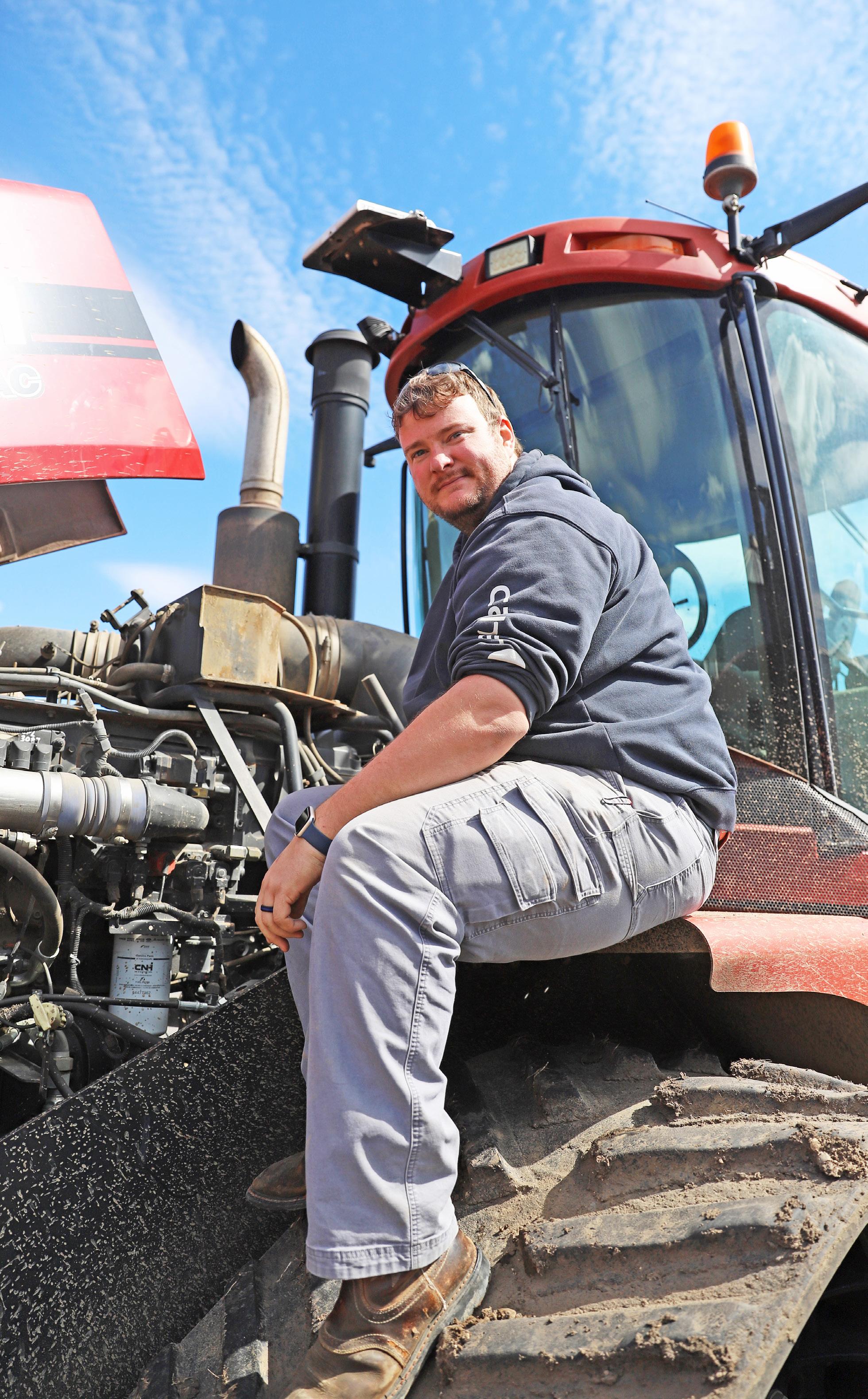
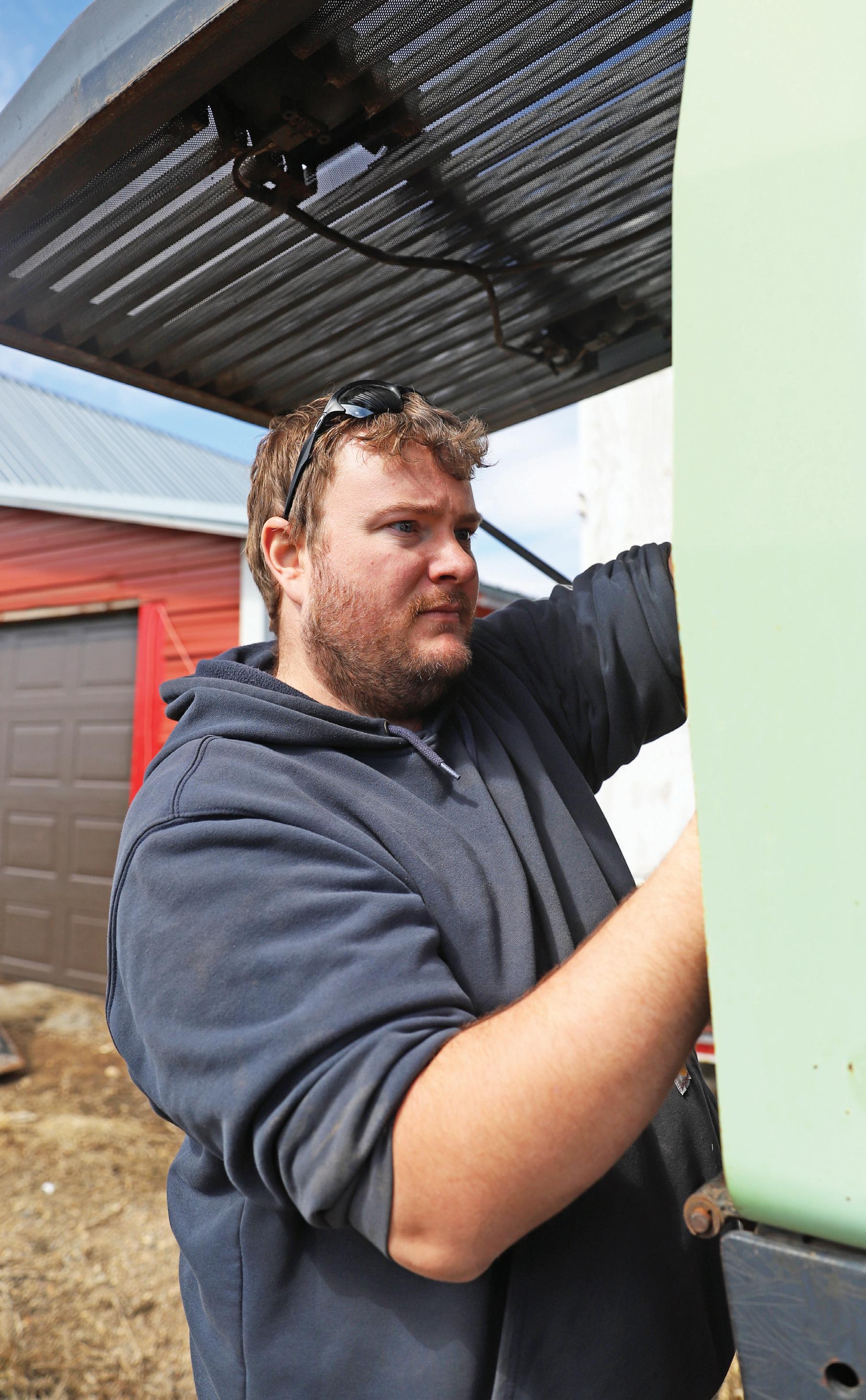
At 33, Jarett Keith of Sherwood looks to grow his operation amid high input costs, sluggish farm economy
I am Shelby Olson, and I was born and raised in Valley City. I met my husband Jacob in college and married him in 2019. We have two beautiful children, Teddi (4) and Jeter (2) and reside in Fort Ransom. I have been an agent since 2024. Prior to that, I had been a customer service rep for Lance Gulleson since 2022. If I am not working, I am usually at the lake, playing volleyball or watching UND football! Fun fact about me — I am fluent in American Sign Language.
I love the fact that everyday is different, and I am constantly learning. In insurance, nothing is stagnant. I love educating people on coverage protection and how to do so in a way that fits into their budget.
I am a board member and a coach for our Lisbon Junior Olympic volleyball team. I am on the Standing Rock Lutheran Church board. I am a local volleyball official, a volunteer for sportsman club, and an active member in Ransom County community events.
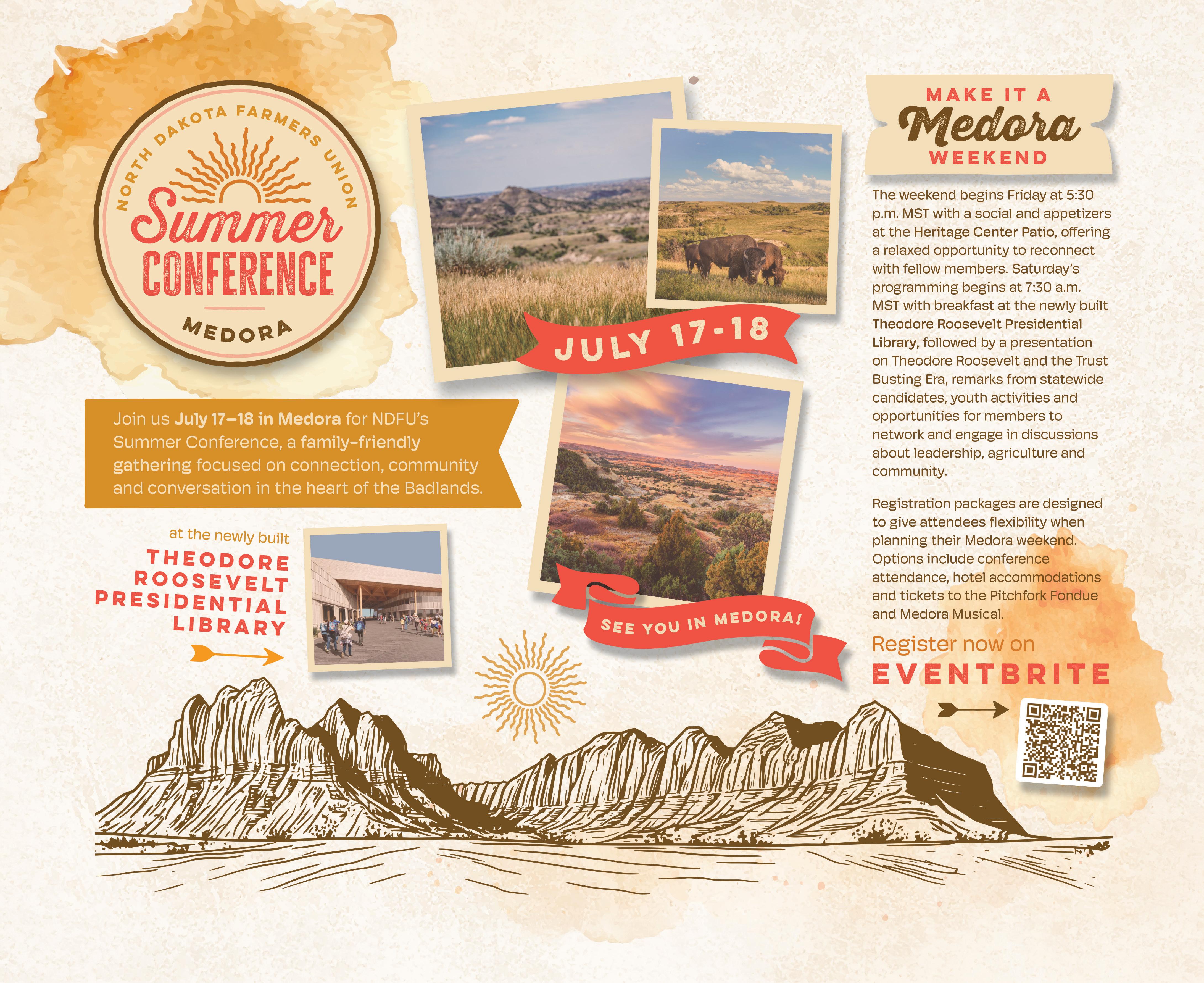
Let's come together in Medora!
It is always special when we bring Farmers Union members together. It’s inspiring to see a room full of family farmers and ranchers learning from each other, enjoying life-long friendships and building new ones. It is always fun to see the youngest Farmers Union members learn about co-ops for the first time and to see the oldest impart their wisdom on the next generation. That’s something we need to do more than once a year. And that is why we are hosting our very first Summer Conference in Medora on July 17 and 18!
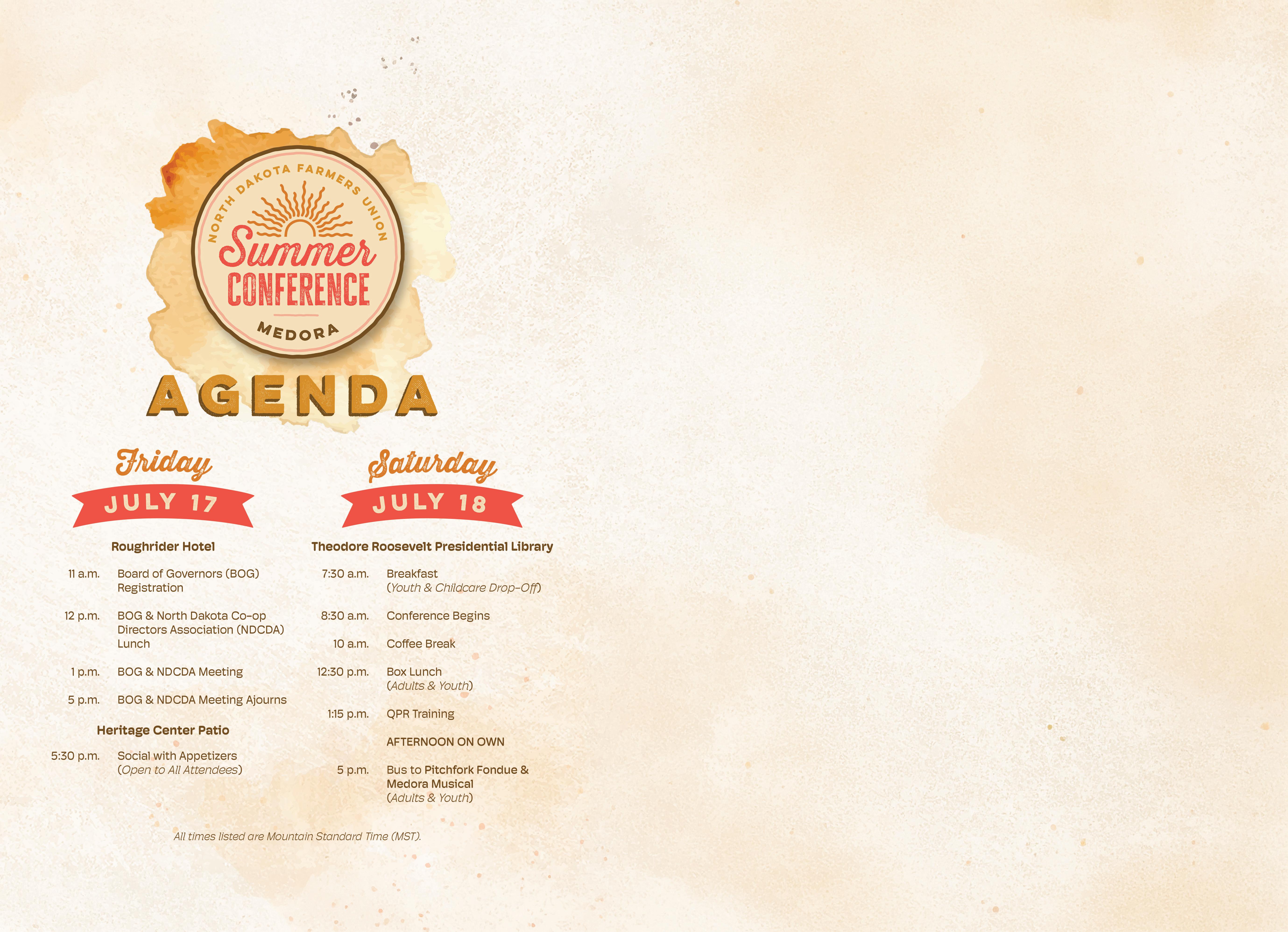
The Summer Conference is a first-ofits-kind event tailored to young Farmers Union families, county leaders and co-op directors. The event kicks off on Friday with our Board of Governors and the North Dakota Co-op Directors Association meetings. The business of our organization is important, and so is the work of our co-op leaders. Why not do that work in beautiful Medora?
Saturday, we will move to an incredible venue: the brand-new Theodore Roosevelt Presidential Library (TRPL). We are building an excellent agenda that will feature speakers on farm policy and the state budget. We’ll also hear from statewide political candidates. If you’re looking for more education, we are offering an
optional Question-Persuade-Refer Suicide Prevention training. Let’s face it: farming and ranching is a stressful business, and we need more people in our communities who can recognize and respond to the warning signs of mental health crises.
While Mom and Dad are learning, the kids will be too. We have childcare for the youngest Farmers Union members. Kids age K-12 can enjoy a morning learning about co-ops, touring the Chateau de Mores, and getting a behind-the-scenes tour of the Medora Musical!
We won’t just be using the TRPL as a meeting space. Parents can meet up with your kids for a box lunch on the TRPL lawn (or roof)! From there, you can enjoy the afternoon exploring Theodore Roosevelt’s White House, his Elkhorn Ranch cabin, and exhibits featuring his rise to the presidency. And of course, the event will cap off with an evening at the Pitchfork Steak Fondue and the Medora Musical.
It is always special when we bring Farmers Union members together. Abby, the girls and I are looking forward to a weekend of learning and fun with our Farmers Union family. We’ll be spending July 17 and 18 at the Summer Conference in Medora. Hope to see you there!
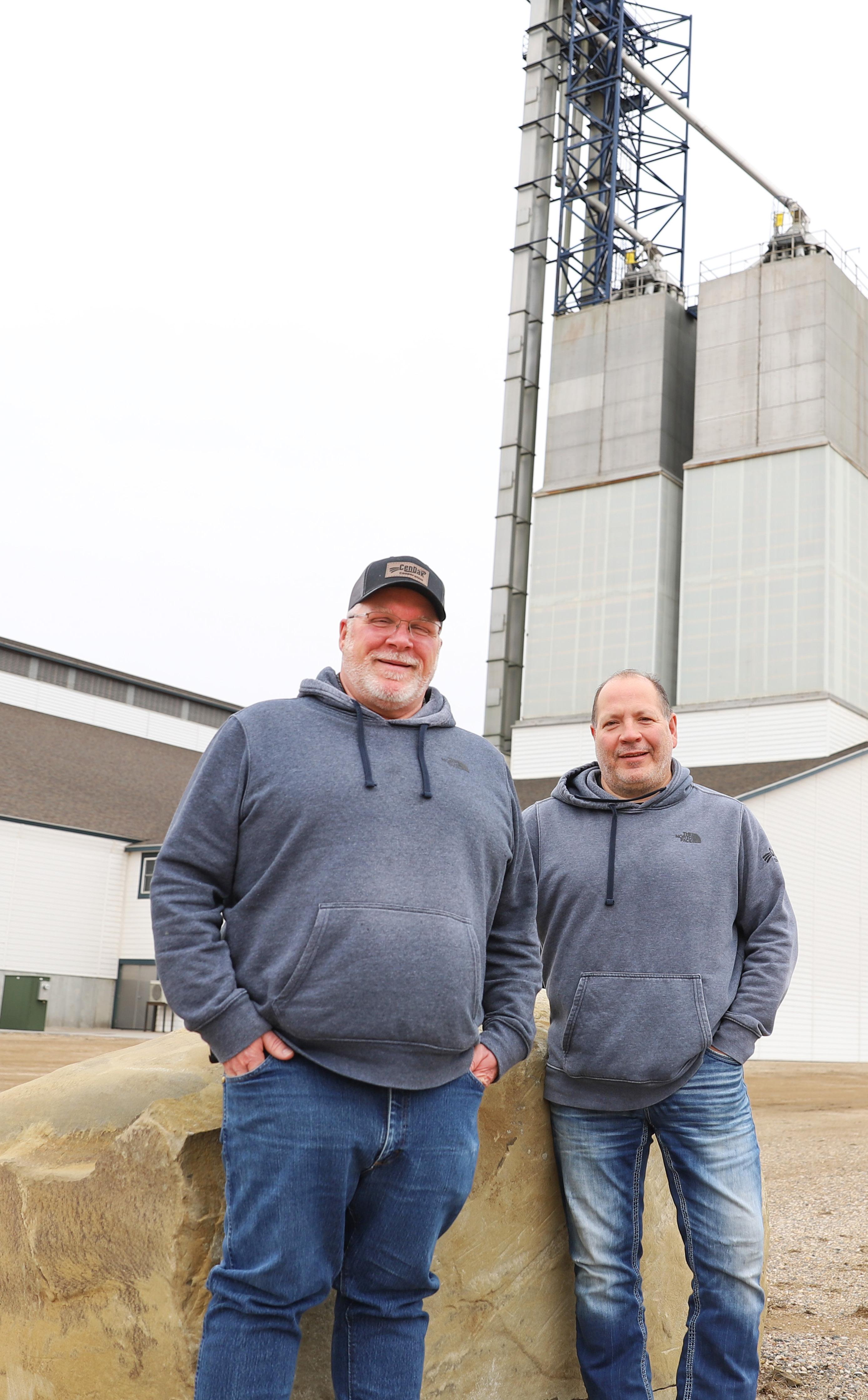
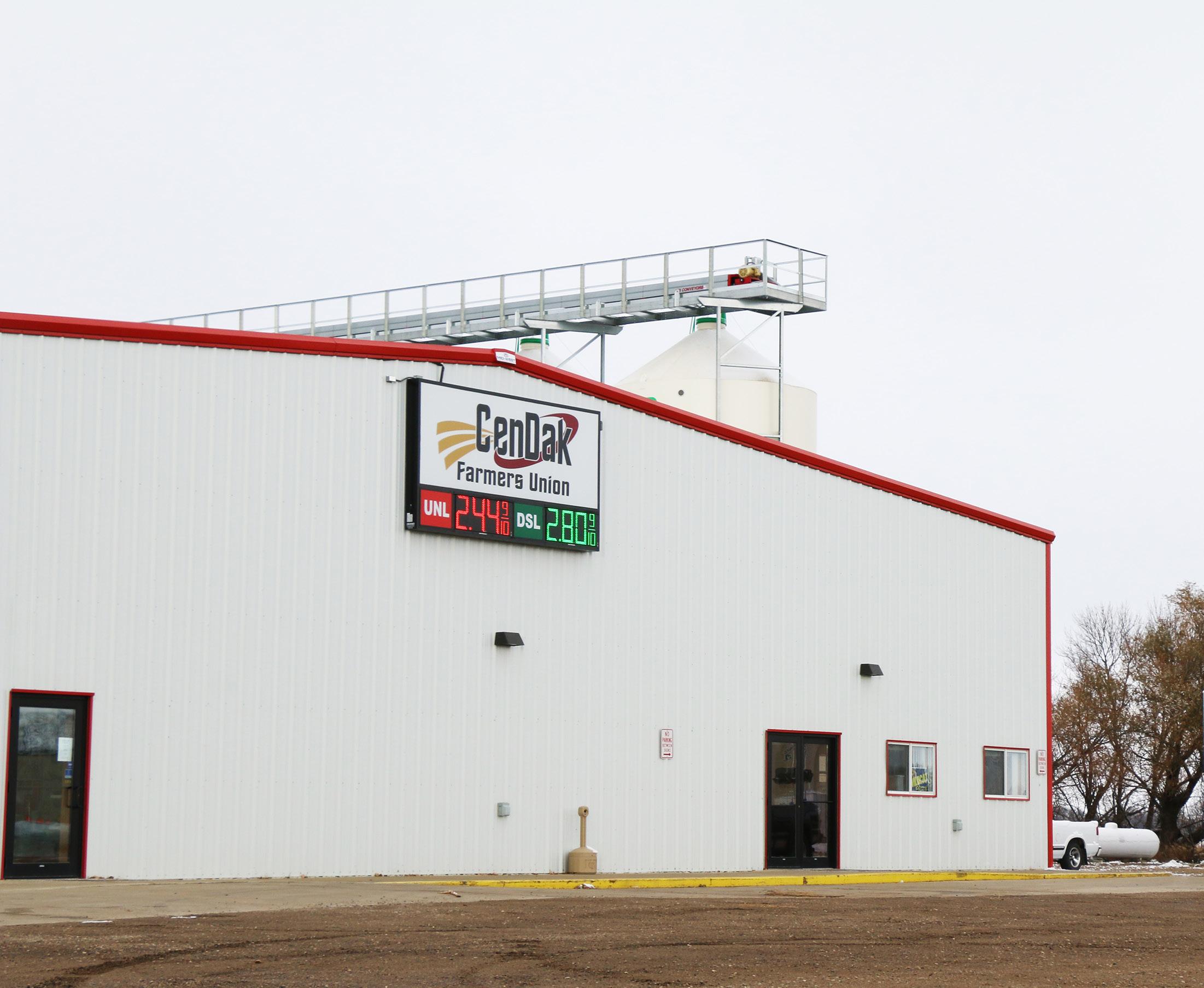
CenDak Cooperative general manager Tony Gratton, right, and agronomy manager Brian Dinger stand in front of their Hamberg fertilizer facility.
'No
normal anymore'
CenDak Cooperative continues to balance high fertilizer costs, potential supply disruptions
Tony Gratton and Brian Dinger of CenDak Cooperative never imagined they would wake up checking the news for updates on the Strait of Hormuz.
If you’re in the fertilizer business, there’s no getting around it.
“There’s no normal anymore,” said Gratton, who is general manager. “I don’t even know if we’d recognize normal if it slapped us in the face.”
As the conflict in Iran continued through April and cargo ships — many carrying much-needed fertilizer — were blocked from traveling through the Strait of Hormuz, farmer-owned cooperatives like CenDak are working through high costs and potential supply disruptions.
CONTINUED TO NEXT PAGE
Story and photos by Chris Aarhus, NDFU
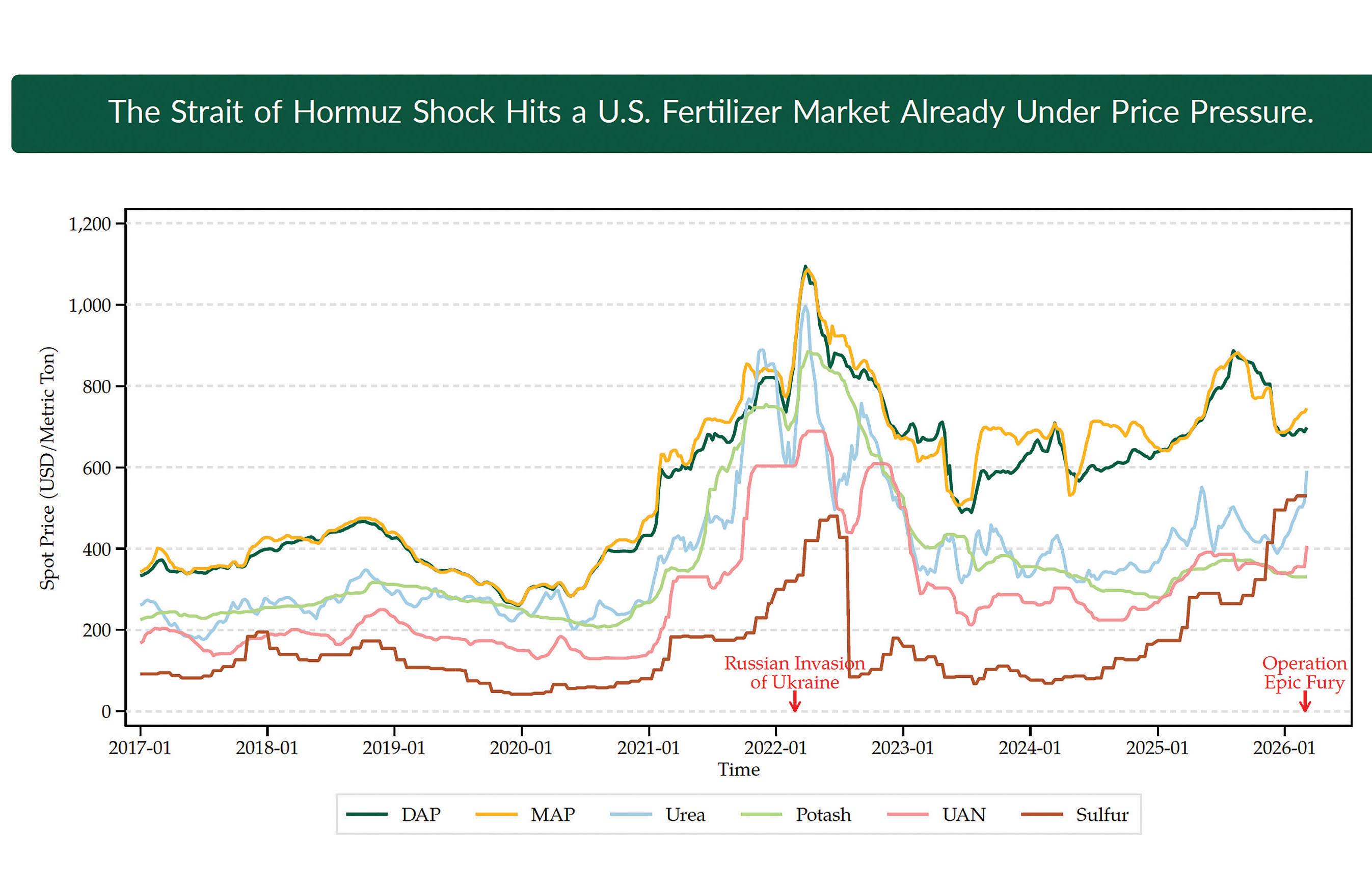
Source: NDSU Center for Agricultural Policy and Trade Studies using data from Bloomberg
CONTINUED FROM PREVIOUS PAGE
“These extremes that we’re dealing with every day makes it hard to manage and that’s not only for the farm, it’s for our cooperative, too,” Gratton said. “The risk and reward are much greater.”
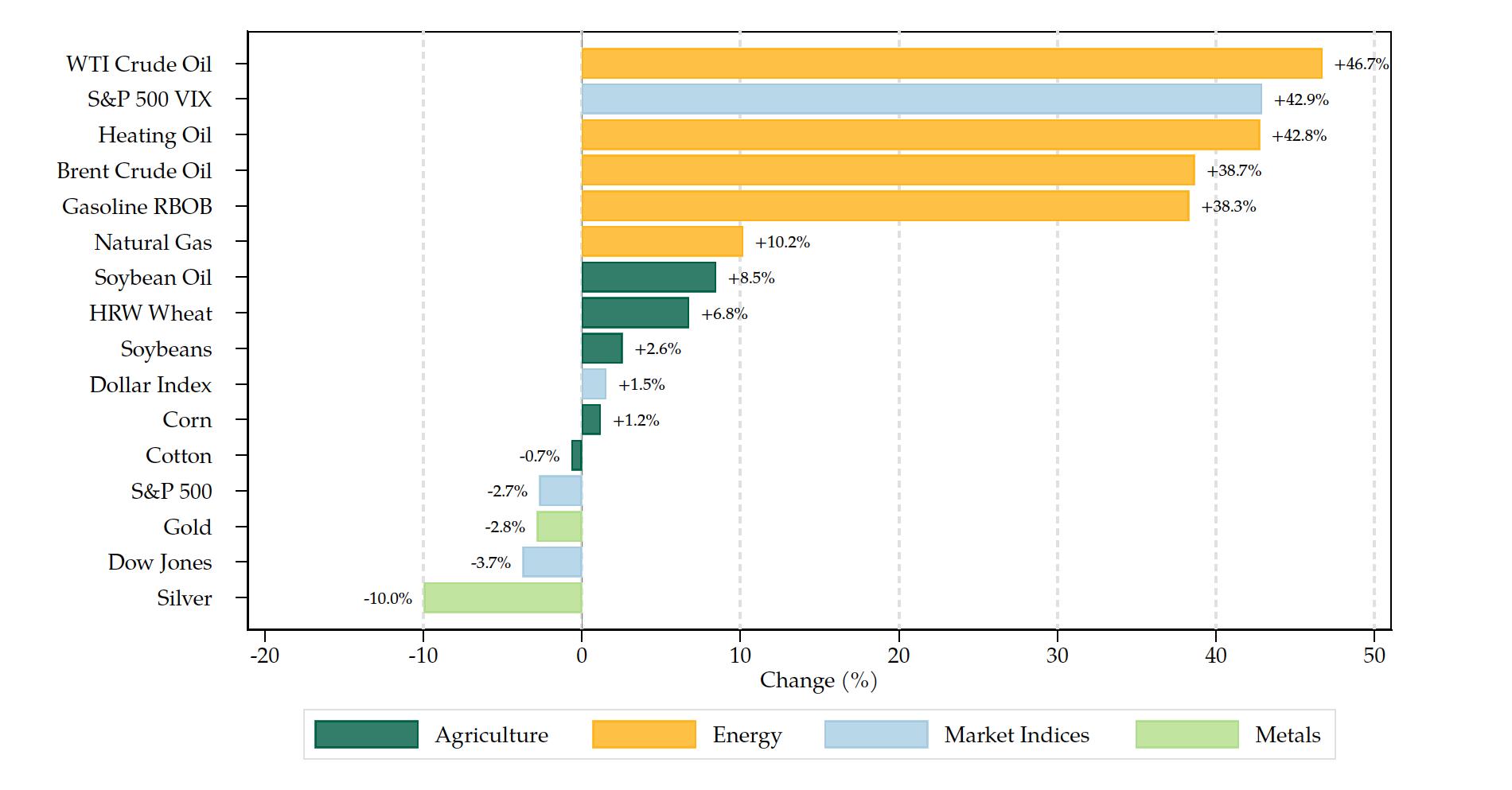
In a rapidly changing news cycle, it’s become somewhat of a guessing game for co-op managers. Within a 36-hour period in the middle of April, Iran opened the Strait of Hormuz and then closed it again, causing chaos with not only the price of oil but the stock market.
“Saturday mornings are usually quiet, but we knew when the first bombs hit (Feb. 28),” said Dinger, who is CenDak’s agronomy manager. “When I’m getting texts and emails from guys in the industry on a Saturday morning, you know something’s wrong.”
Now, it’s a normal part of Dinger’s life, receiving alerts on the situation every hour.
“You have to stay up on it,” he said. “Otherwise, you’re behind the 8-ball.”
CenDak has locations throughout central North Dakota with its main office located in Fessenden, serving an assortment of growers. Gratton said his members were already feeling the economic squeeze.
‘They’re hurting,” he said. “This is probably the worst farm economy we’ve seen in our lifetimes. You look at commodity prices and
u THE STRAIT OF HORMUZ
Read about how the conflict in Iran directly affects farmers and the cost of fertilizer. Page 12
where inputs are and put them together, it’s not penciling out.”
Supplying producers with fertilizer is a balancing act between pricing and timing, even without foreign conflict. Managing that supply to keep farmers in the fields isn’t easy.
“You (base) that off your sales each month, so you try to have inventory for that month and stay ahead of it,” Dinger said. “In the spring, we can empty our plant in five or six days.”
Timing is always a factor, Gratton said, because 90 rail cars holding 9,000 tons of fertilizer need to be unloaded. CenDak uses trucks to move fertilizer when it needs to, but it works best if its fertilizer-in, fertilizer-out.
“Our plants aren’t big enough to hold that much — they have to be empty,” Gratton said. “You hope the trains come in when you’re real busy. We’ve had it both ways, where you get a rainy spell and the tons aren’t going out, and the train is sitting there and you’re paying demurrage on it. And then if you’re empty and waiting on a train, you definitely don’t want that.”
With pricing, many farmers pre-bought their fertilizer last fall from CenDak, locking in at roughly $525 a ton. The cost has grown
to more than $800 a ton, making margins extremely tight for the co-op and for cash buyers.
“There are some days where (the price) is going up so fast, (suppliers) just pull the bid,” Dinger said. “We can’t even buy.”
That means the co-op has had to be cautious about managing price volatility while ensuring supply, which is important for Gratton and his team.
“It’s made it challenging pre-buying our fertilizer,” Gratton said. “But as a farmer-owned cooperative, we need to make sure we have supply. Our management team has to calculate the odds (with price) and deal with that. But having supply for our growers, that’s what’s most important.”
Dinger, who’s been in the agronomy business for 37 years, is hopeful the overseas conflict will be over soon, but he also doubts that will solve all of the issues with supply and demand.
“We need more production across this country,” he said. “We just don’t have enough here.”
With the high cost of inputs across the farm economy, communication with suppliers is vital in making sure both parties understand the situation from each other’s perspective.
“Have constant conversations with them,” Dinger said. “Don’t be afraid to ask a question. We’re all trying to do the best we can to keep (farmers) ahead of things. We want (farmers) to ask us the difficult questions, so they know that we’re doing right by them.”
Gratton emphasized that in today’s farm economy, farmers need to understand their break-even price. He also encouraged them to do what they can to manage stress and stay intentional in their daily work, so their thoughts don’t drift and affect decision-making.
“We never want to see anybody get hurt — you can always come back out tomorrow and fix things. Sometimes, it’s best to just walk away,” he said. “(This situation) has been challenging all the way around. It seems like the last six months has just been a stream of black swan events, just things you’re not expecting popping up out of the blue.”
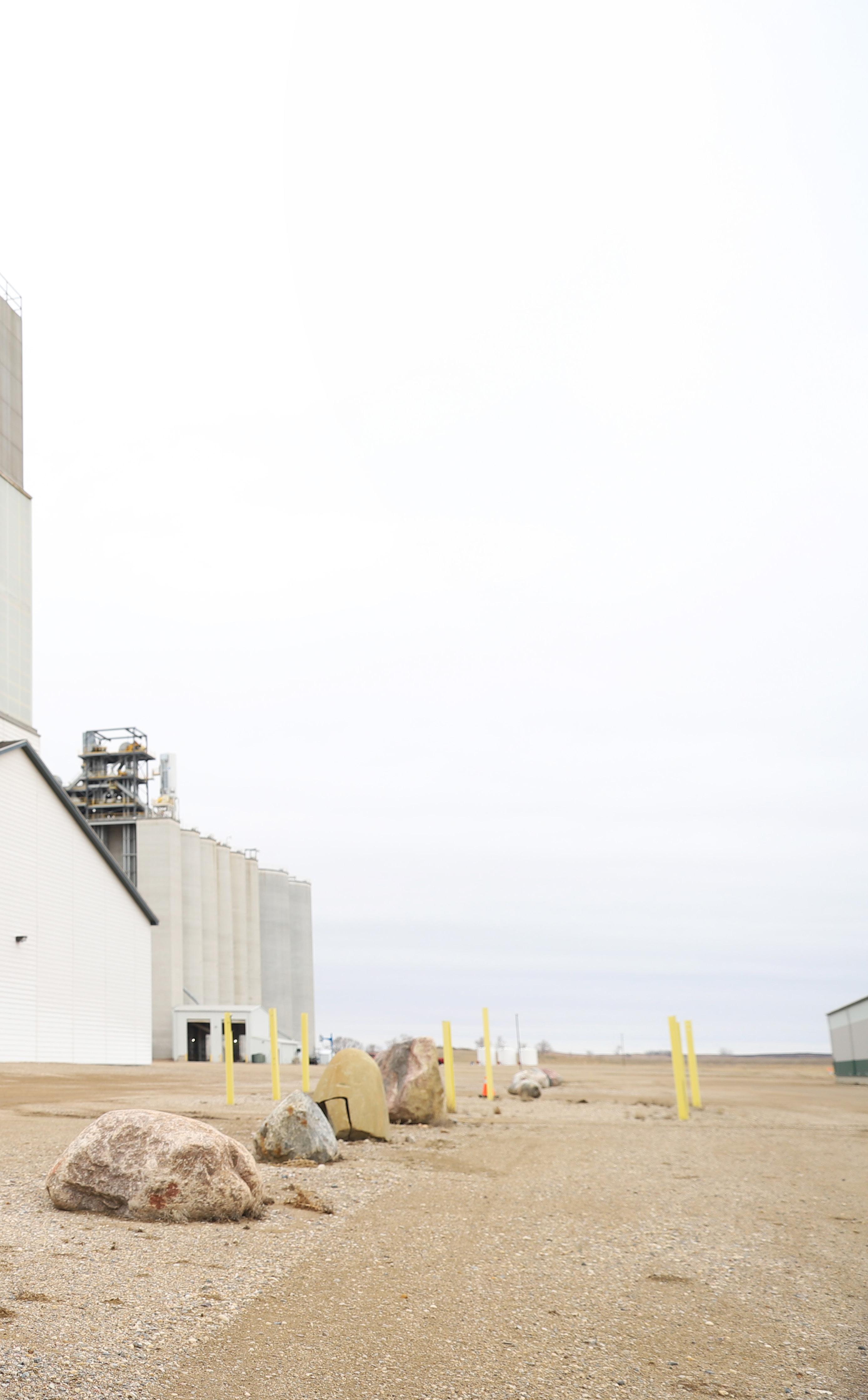
CenDak Cooperative, with its Maddock location pictured here in this file photo, sees it as a top priority to ensure its farmer-members always have access to fertilizer, general manager Tony Gratton said. An overseas conflict disrupting the price and potentially the supply haven't made Gratton's job any easier.
A global chokepoint
The closure of a 21-mile wide waterway between Iran and Oman could have lasting impacts on farmers and their planting decisions
By NDFU Government Relations team
Graphics courtesy of NDSU Center for Agricultural Policy and Trade Studies
The Strait of Hormuz, now virtually a household term, has long shaped global energy markets. The Spring of 2026 revealed it also determines what farmers can afford to plant.
For generations, American farmers operated largely insulated from conflict in the Middle East. Oil prices rose and fell, wars came and went, and production continued. That insulation began to erode when tensions between the U.S. and Iran led to the closure of one of the world’s most critical shipping lanes—the Strait of Hormuz — sending immediate signals to farm operations that rely on fertilizer inputs.
The Strait of Hormuz is a narrow, 21-milewide waterway between Iran and Oman that connects the Persian Gulf to the open ocean. Roughly one-fifth of the world’s oil supply moves through it, along with significant volumes of liquefied natural gas and key fertilizer inputs, including ammonia and nitrogen. Following the launch of Operation Epic Fury in late February, Iran halted transit through the strait, placing additional strain on an already tight global supply chain.
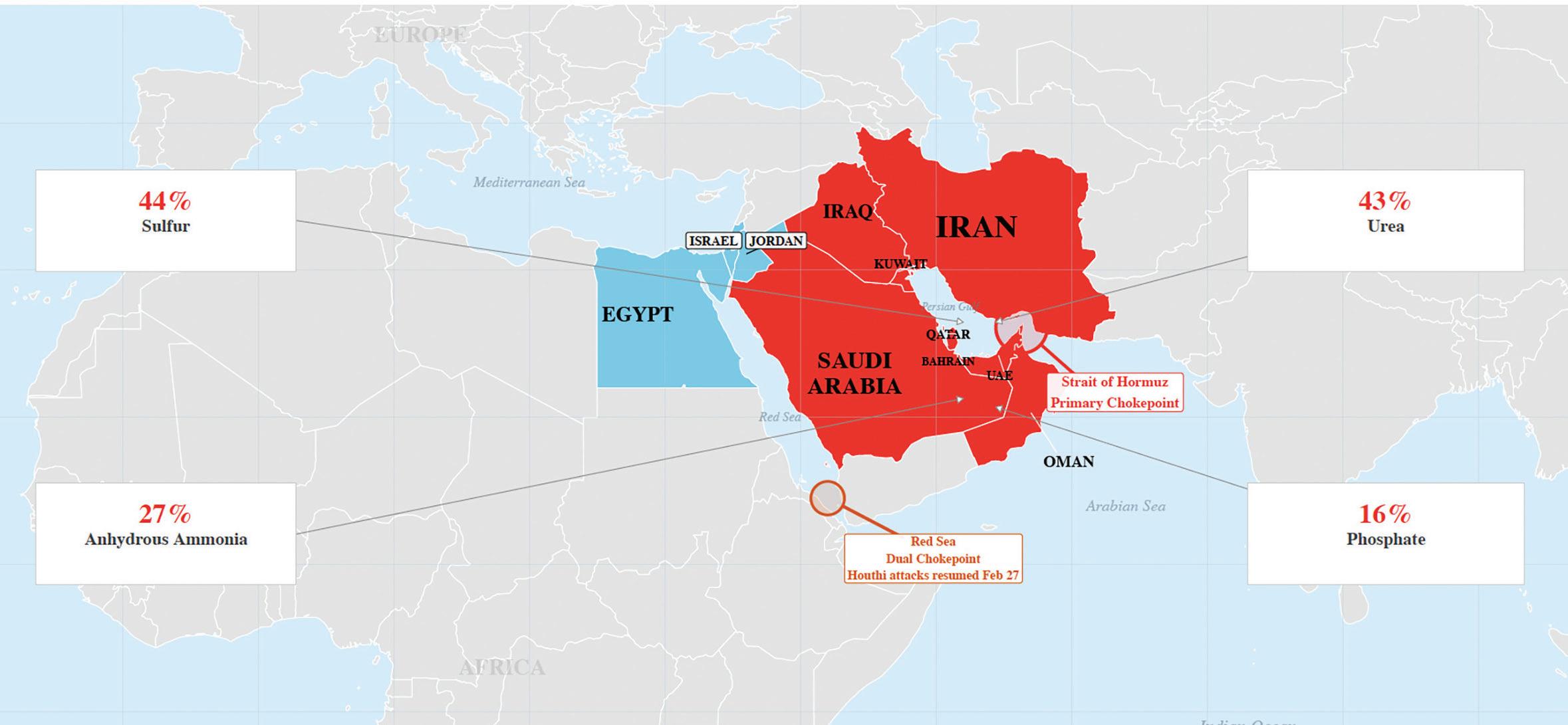
Global fertilizer exports through the Strait of Hormuz: Major Trade Flows (39 MMT in 2024) Note: Arrow width indicates the export volume. Fertilizer includes anhydrous ammonia, DAP, MAP, sulfur and urea.
Even before the conflict began, DTN’s retail fertilizer survey showed all eight major fertilizers were higher year over year. Anhydrous ammonia was up 16 percent, while urea rose 12 percent. Prices climbed further as the conflict escalated. The wholesale price of urea ranged from $460 to $480 per short ton the week of Feb. 27. By April 3, that range had increased from $876 to $1,259.
Inventories remain tight. “It’s not like there’s a whole lot of fertilizer sitting on the shelf,” said Veronica Nigh, an economist at The Fertilizer Institute. “It’s very much a just-in-time business model.” The U.S. is roughly 25 percent short of typical spring supplies. Farmers who did not pre-buy may find limited availability or prices that are out of reach.
The geography of vulnerability
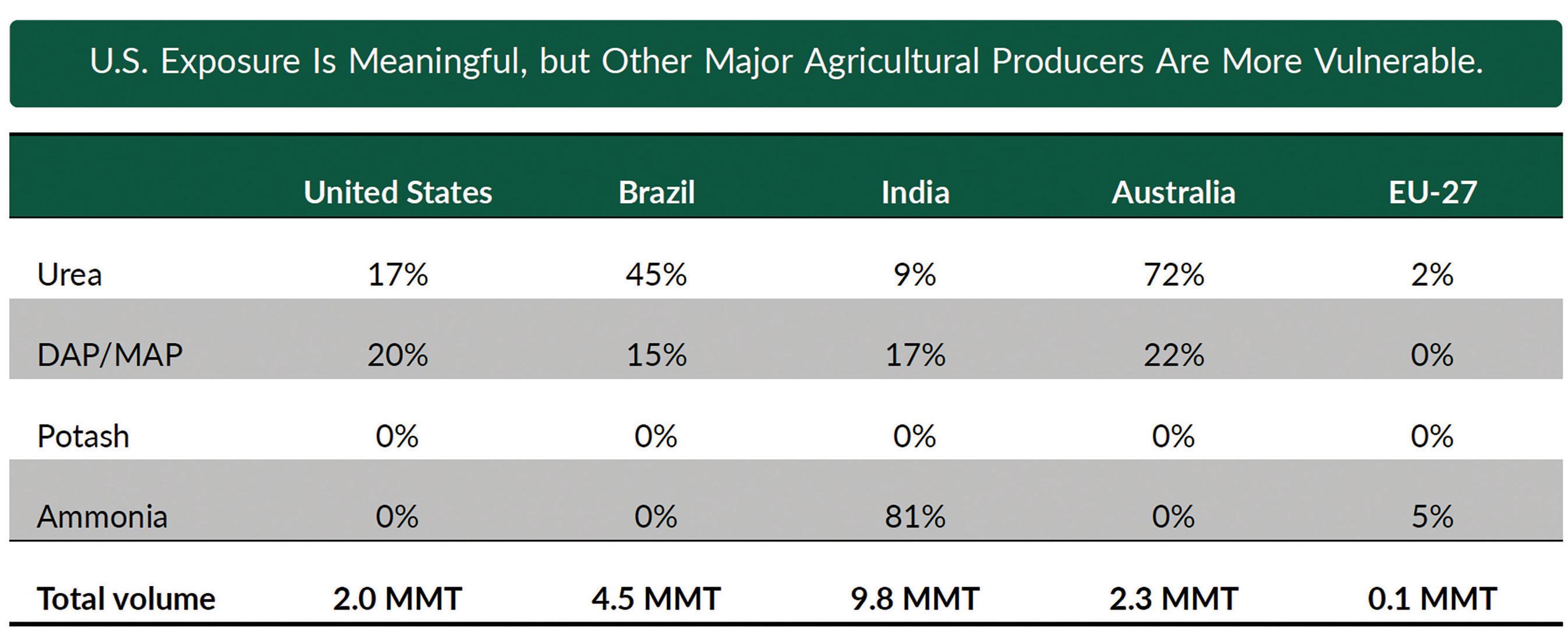
A March analysis by NDSU's Center for Agricultural Policy and Trade Studies lays out
Source: NDSU Center for Agricultural Policy and Trade Studies using data from Bloomberg
The share of national fertilizer consumption transiting through the Strait of Hormuz. Note: Vulnerability defined as imports from the Middle East divided by domestic consumption (production+total imports−total exports), based on physical product tons. Total volume reflects 2024 export volume from the Middle East for urea, DAP/MAP, potash, anhydrous ammonia, and sulfur.
Source: NDSU using 2023 data from FATOSTAT (2022 data for U.S. production), IFASTAT, and the S&P Global Trade Atlas.
The share of global fertilizer trade disruption at the Strait of Hormuz. Note: Red indicates directly affected Persian Gulf exporters (Iran, Iraq, Saudi Arabia, Qatar, UAE, Oman, Kuwait, and Bahrain). Blue indicates secondarily affected regional producers/exporters exposed to spillover disruption, including Egypt (gas cutoff risk), Jordan, and Israel. Percentages in the call-out boxes show the share of global exports of sulfur, urea, phosphate, and anhydrous ammonia supplied by neighboring Persian Gulf countries.
CONTINUED FROM PREVIOUS PAGE
the situation: The Persian Gulf accounts for roughly 40 percent of seaborne urea exports, approximately 44 percent of sulfur, more than a quarter of traded ammonia and significant phosphate volumes via Saudi Arabia.
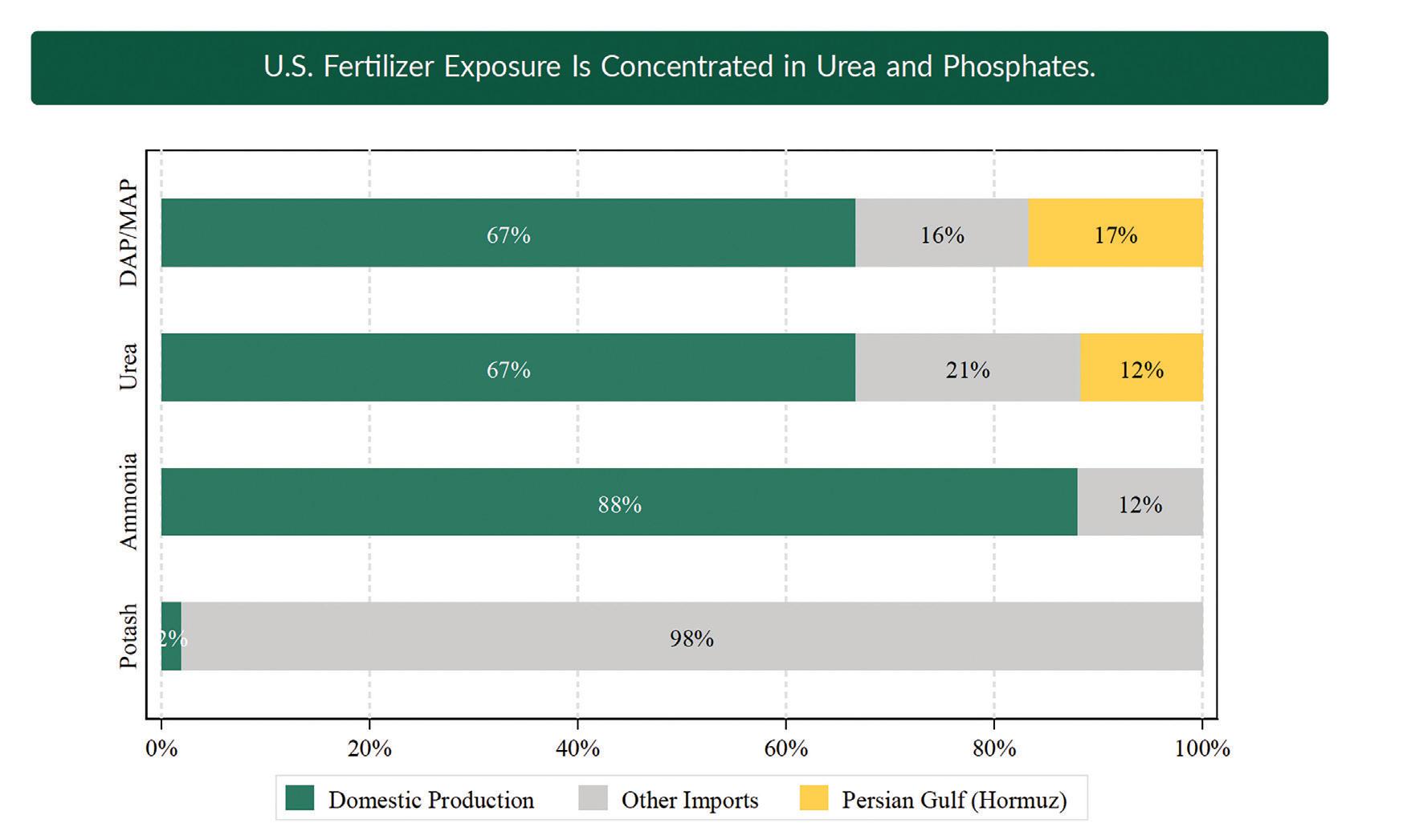
For U.S. farmers specifically, an estimated 17 percent of U.S. urea passes the Strait of Hormuz, while roughly 20 percent of U.S. phosphate fertilizer consumption comes from the Gulf — with Saudi Arabia providing over half of U.S. ammonium phosphate imports.
Why this is worse than 2022
Many observers have drawn comparisons to 2022, when Russia's invasion of Ukraine drove fertilizer prices to historic highs. NDSU economists say the parallel understates the current impact. In 2022, Russian fertilizer was not physically removed from the global market — it was rerouted. Sanctions shifted trade flows, but the product still reached buyers. In 2026, Gulf-derived product is physically trapped behind a closed Strait. Inventories cannot be refilled, and plants shut down because product simply does not reach the global market.
The farm revenue outlook makes everything worse. In 2022, strong crop prices cushioned the blow of high input costs. If the Strait remains closed for two to four months, farmers could face fertilizer prices approaching 2022 peaks but without the corresponding crop price increase.
Federal response and domestic limits
USDA Secretary Brooke Rollins told a House Appropriations panel in April that farmers will face continued pressure from the Iran conflict, with fertilizer prices expected to take months to ease. In the meantime, USDA is scrutinizing the fertilizer sector. Deputy Secretary Stephen Vaden criticized The Mosaic Company for idling plants and cutting production. USDA, the Department of Justice (DOJ), and the Federal Trade Commission (FTC) are investigating potential anticompetitive practices and encouraging farmers to report concerns. In North Dakota, using Bakken natural gas for in-state fertilizer production has been studied for years, with Spiritwood often cited as a potential site. In 2025, NextEra Energy withdrew from a planned $1.3 billion project near Spiritwood, and earlier plans from CHS Inc. for a nitrogen fertilizer plant in 2015 also fell through, both citing financial feasibility. The state remains heavily reliant on imports and is often the “last mile” for delivery. Today, the only in-state facility operates in Beulah.
The overriding uncertainty
The trajectory for fertilizer prices and the downstream impact on planting decisions depend almost entirely on how long the Strait remains closed to commercial shipping. Fertilizer shipments from the Gulf can take weeks to reach U.S. ports, then must move by barge, rail or truck into the interior.
If disruptions persist, the effects will continue to compound across the agricultural and food supply chain.
Source: NDSU using 2024 export data from the S&P Global Trade Atlas.
The U.S. fertilizer supply by source in 2023 (Nutrient Basis). Note: Persian Gulf exporters include Iran, Iraq, Saudi Arabia, Qatar, UAE, Oman, Kuwait and Bahrain.
SOURCES
Arita, S., Chakravorty, R., Kim, J., Lwin, K., & Steinbach, S. (2026, March). Agricultural Trade Monitor. NDSU Center for Agricultural Policy and Trade Studies. https://www.capts-ndsu.com/_files/ ugd/3c6228_42c06a38caea467a9c164b72e53cdcea. pdf
Dalheimer, B., Bellemare, M. F., & Loughmiller, C. (2026, March). The geopolitics of food and agriculture. Purdue University & University of Minnesota. https:// papers.ssrn.com/sol3/papers.cfm?abstract_id=6351338
Squire, M., Zhang, D., Jackson, L., & White, E. (2026). Fertilizer prices jump as Strait of Hormuz closure hits farmers. Successful Farming / Agriculture.com. https:// www.agriculture.com/fertilizer-prices-jump-as-strait-ofhormuz-closure-hits-farmers-11923021
Zhang, D., & Jackson, L. (2026). China taps fertilizer reserves as Hormuz closure disrupts global supply. Successful Farming / Agriculture.com. https://www. agriculture.com/partners-china-taps-fertilizer-reservesas-hormuz-closure-disrupts-global-supply-11925417
Zhang, D., & Jackson, L. (2026). Iran war deprives U.S. farmers of affordable fertilizer as spring planting looms. Successful Farming / Agriculture.com. https:// www.agriculture.com/partners-iran-war-deprives-us-farmers-of-affordable-fertilizer-as-spring-plantinglooms-11926782
Quinn, R. (2026, March 18). Retail fertilizer prices rise across multiple categories. DTN Progressive Farmer. https://www.dtnpf.com/agriculture/web/ag/crops/ article/2026/03/18/8-retail-fertilizer-prices-higher-4ugd/3 c6228_42c06a38caea467a9c164b72e53cdcea.pdf
The market response to Operation Epic Fury (changes between Feb. 27 and March 9, 2026).
Source: NDSU using data from Bloomberg.
Source: NDSU using data from The Fertilizer Institute.
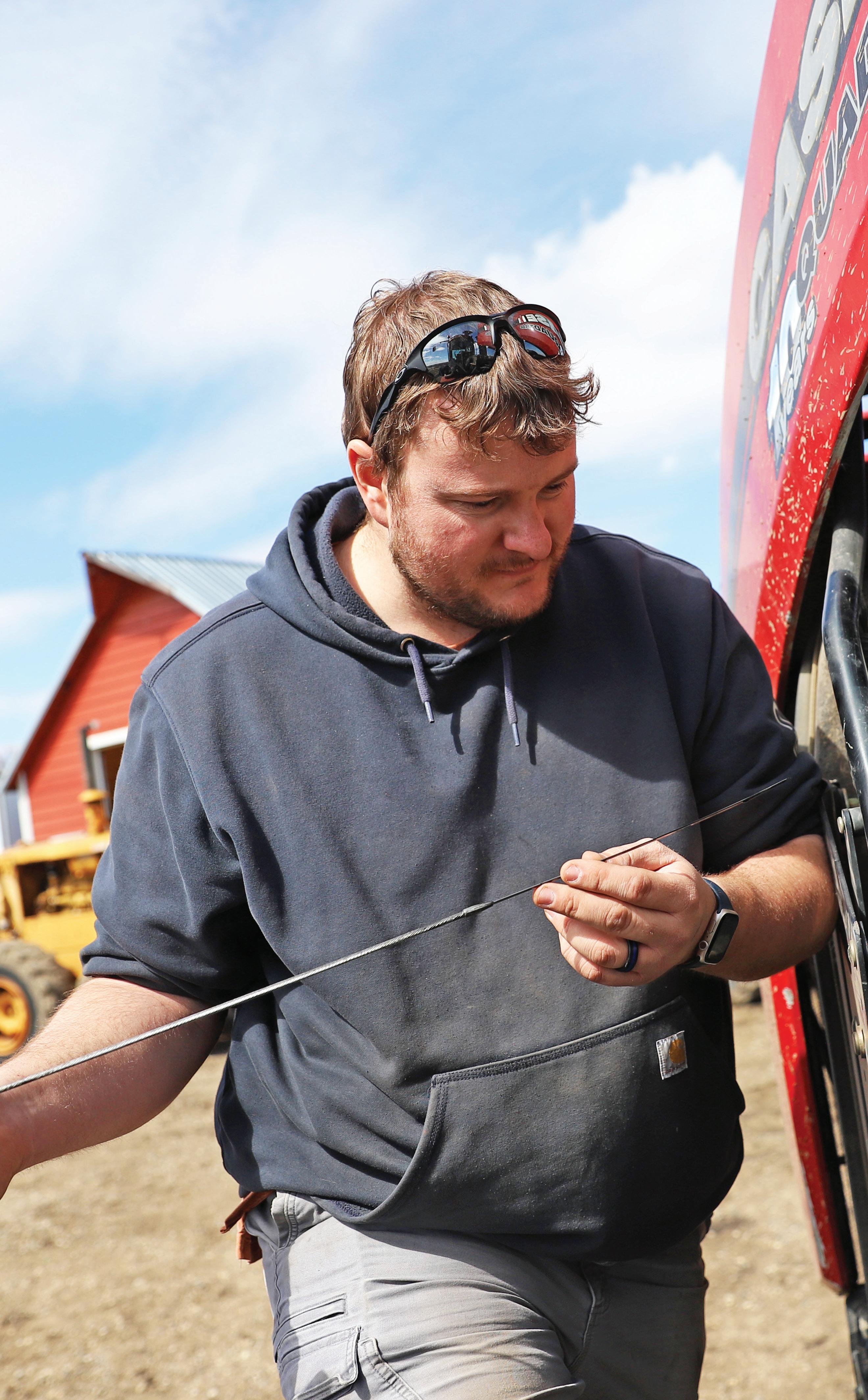
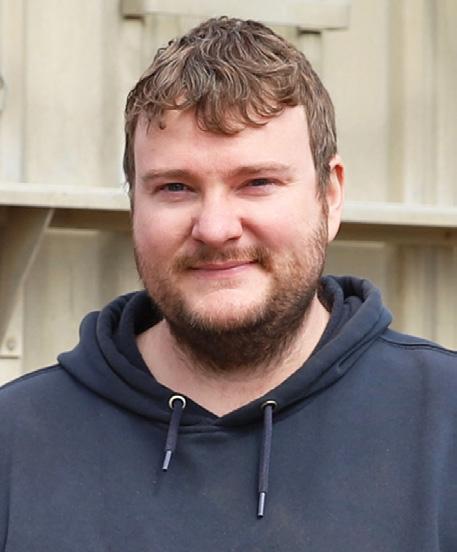
Jarett Keith of Sherwood is a young farmer in his fourth season. The 33-year-old is expanding his operation this year amid high fertilizer costs and a struggling farm economy.
'INSANE NUMBERS'
High fertilizer prices, struggling farm economy are top of mind for 33-year-old Jarett Keith of Sherwood
Jarett Keith had a steady full-time job in the rural area he grew up in when he felt the call back to the family farm.
A diesel mechanic by trade, the 33-year-old Sherwood native had helped his parents — Steven and Jerri — in their operation during the busy seasons. In 2023, he returned to his roots, and he was a bit surprised by what he found.
“Everything’s expensive,” he said. “I always had an idea of how farm expenses work. When you’re the one writing the checks and paying the bills, it’s much more apparent.”
For young and beginning farmers without considerable equity, managing the high cost of inputs in today’s farm economy has become challenging. Every decision carries a consequence that could put a beginning farmer out of business.
Entering his fourth season with his own operation, Jarett and his wife Maribel are expanding. They’re renting 10 additional quarters this year,
CONTINUED TO NEXT PAGE
Story and photos by Chris Aarhus, NDFU
“I welcome it, and I’m excited to be fortunate enough to grow. But I’m also a little scared, because I look at the numbers. And when I see that I’ll be spending a million dollars to farm this year, that’s a heck of a lot of money. It’s just insane numbers we deal with.”
Jarett Keith, 33-year-old farmer from Sherwood who is expanding his operation.
CONTINUED FROM PREVIOUS PAGE
essentially doubling the acres they farm in what should be a proud moment for Jarett Keith and his growing operation.
“I welcome it, and I’m excited to be fortunate enough to grow,” he said. “But I’m also a little scared, because I look at the numbers. And when I see that I’ll be spending a million dollars to farm this year, that’s a heck of a lot of money. It’s just insane numbers we deal with.”
High costs are everywhere for farmers, whether it’s equipment, equipment repair, seed, chemical or fuel. Keith is fortunate to share in equipment and storage expense with his parents and his sister and brother-in-law, Lacey and Ben Ethen.
Lately, however, it’s been the cost of nitrogen fertilizer that has farmers stressed for the coming year. With shipping through the Strait of Hormuz disrupted by the conflict in Iran, every farmer is tracking both the price and supply of fertilizer.
VOLATILITY ON THE FARM
Keith didn’t pre-buy all his fertilizer at once, and he paid a price for that, though he looks at the bright side.
“I could have saved over $20,000 if I would have booked it a month earlier, but at least I didn’t lose out on the price I got,” he said. “Had I waited longer, it might have cost me an extra $75,000.”
This year, he’ll spend nearly $250 an acre to fertilizer his corn and canola, both of which are high-input crops.
“The two good markets up here that consistently bring a decent price with good yields are corn and canola,” he said. “They’re nitrogen-dependent crops.”
Keith is also planting peas and soybeans, going away from cereal grains this year.
“They don’t pencil out,” Keith said of wheat and durum. “And to be honest, soybeans and peas are somewhat difficult to make pencil,
u THE STRAIT OF HORMUZ
Read about how the conflict in Iran directly affects farmers and the cost of fertilizer. Page 12
too, but you save a fair amount on fertilizer with them.”
Even if it’s the high-input crops that give farmers the best chance at breaking even in what is setting up to be a difficult year in farm country, there is a still a line in the sand for Keith.
“As bad as fertilizer gets, crop markets are still more of a deciding factor for us in what we’re going to plant,” he said. “If fertilizer jumps up to $1,000 a ton in the future, we’d be looking at putting in a heck of a lot more peas.”
As fertilizer prices climb past $800 a ton, both farmers and cooperatives are holding their breath, hoping for some normalcy by the fall when farmers start purchasing supply for the next year. For a young producer, it’s simply another layer of uncertainty in the already unpredictable nature of modern farming.
“The volatility is where most of my stress comes from,” he said. “Farmers have to gamble on everything. You contract at a price, and then it jumps up a dollar, and you’re upset, and you start second-guessing yourself.”
It doesn’t help that farmers operate in an industry that’s heavily consolidated. According to USDA, three companies control 93% of the fertilizer sales in North America, while four companies control 60 percent of the global seed market.
“There has to be a shift here, because they know they have us,” he said. “You can’t not buy fertilizer. You have to buy chemicals and seed. You have to buy parts and machinery. We need an adjustment of not just being looked at as a pass-through for money. We need to be treated fairly. Most farmers are not asking for the world when it comes to prices. Five dollar a bushel corn makes us money as long as (inputs) aren’t so crazy.”
C amp Farmers Union
for a summer of adventure
kids who love adventure, like making crafts, laugh loud & often, enjoy playing sports,
reward lasting friendships unforgettable memories
Kick off your boots and jump into summer fun at Farmers Union Camp!
james river heart butte
June 8-11 .......... Junior 1
June 16-20 ...... Senior 1
June 23-26.......Junior 2
June 29-July 2 . Junior 3
July 6-10 ......... Senior 2
July 13-16 ........ Junior 4
July 20-23 ....... Junior 5
July 27-31 ....... Senior 3
June 9-12 ......... Junior 1
June 15-19....... Senior 1
June 22-25 .......Junior 2
June 30-July 3 Junior 3
July 7-11........... Senior 2
July 14-17 ........ Junior 4
July 21-24........ Junior 5
July 28-Aug 1 . Senior 3
The youth's grade needs to have been the last completed grade. Pricing shown is early bird pricing. After May 15, the price will increase by $24.
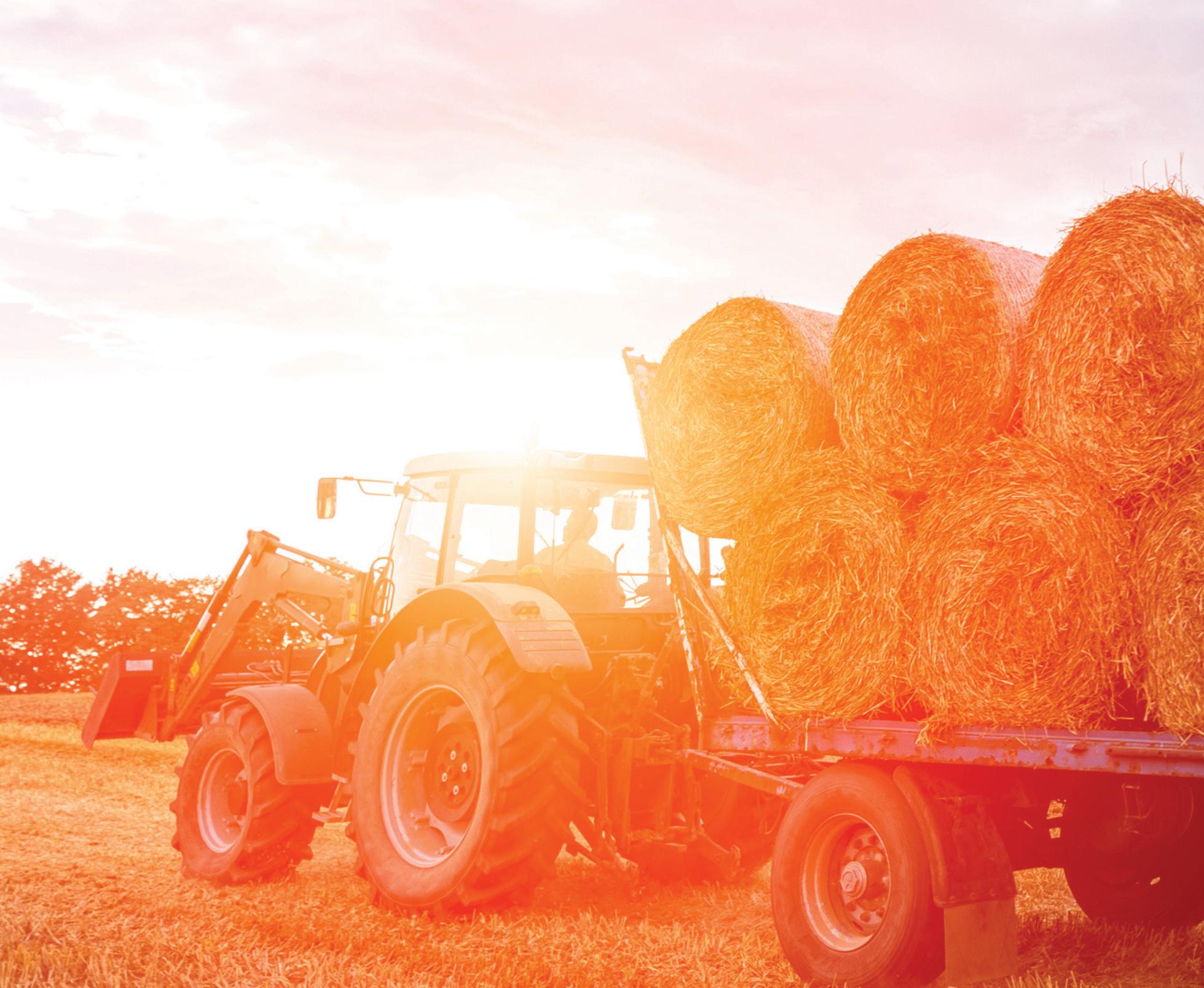
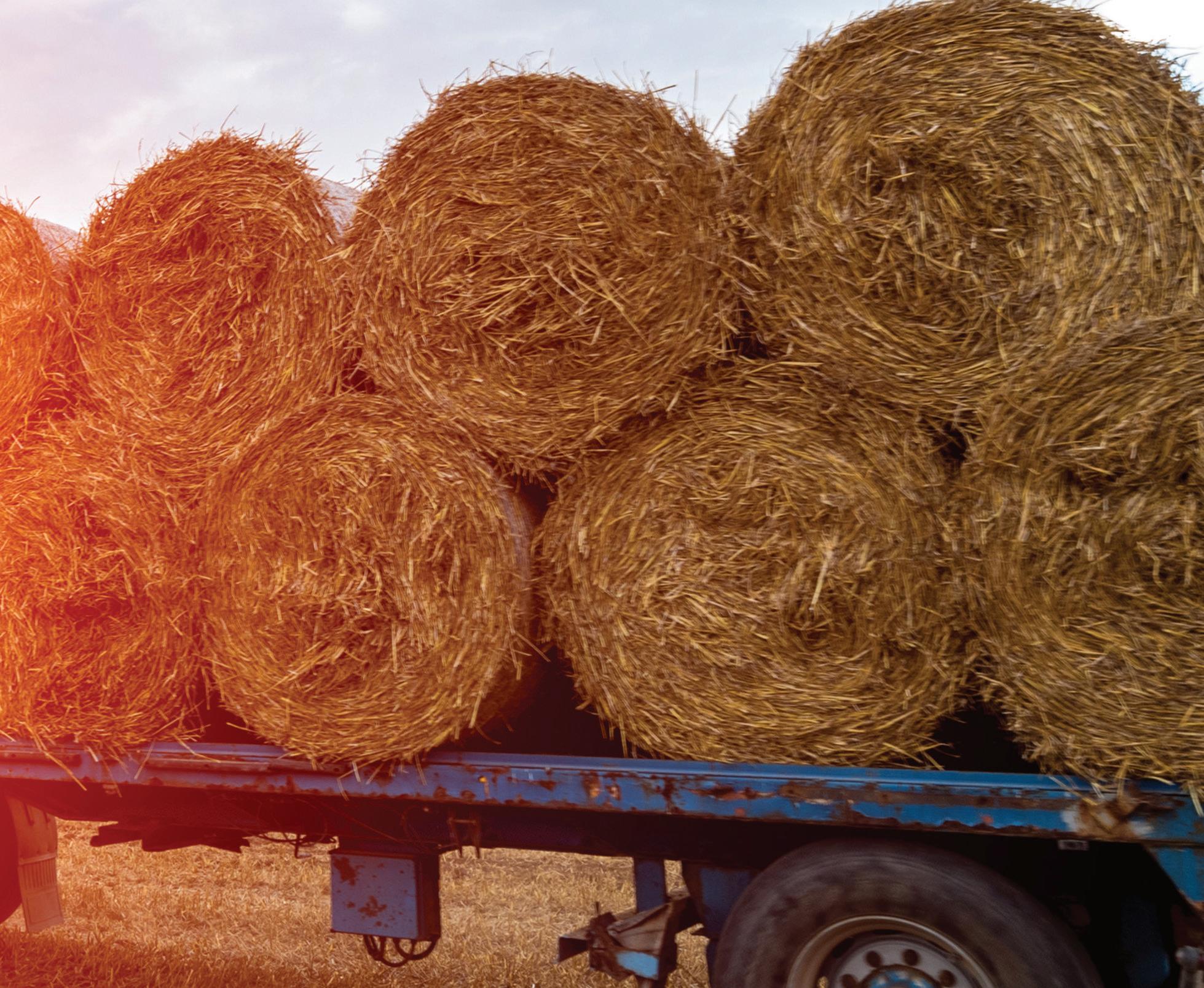
Farm equipment roadway crashes most often occur with tractors, planters, combines and other large machinery. Farm trucks and trailers, given their size, weight and speed, are also at risk. Safety experts advise ensuring trucks and trailers are in good operating condition, clearly marked with required lighting and loaded securely.
“In the rush of a spring planting season and the summer growing season, the focus is on field equipment,” said Angie Johnson, North Dakota State University Extension farm and ranch safety specialist. “Unfortunately, trucks and trailers can become something of an afterthought.”
Loads such as seed, fertilizer, equipment and haybales are subject to vibration, swaying, centrifugal force, inertia, wind and other forces during transit. Johnson says improper load securement is common.
“If those loads aren’t properly secured, they may topple onto the roadway, slide forward into the cab or fall backward off the truck or trailer,” said Johnson.
“Farmers do get relief from some regulations, but the regulations that cover load securement aren’t among them,” said North Dakota Highway Patrol Trooper Joshua Anderson, truck safety expert. Those regulations are set by the Federal Motor Carrier Safety Administration.
Bulk materials such as manure, seed and fertilizer that are not confined in containers should be contained in a vehicle and covered
to prevent them from falling onto the roadway, said Anderson. For other cargo, such as seed bags and hay bales, load securement regulations are based on weight and length. Anderson provides the following guidance:
Half the article’s weight must be accounted for in the working load limit (WLL) of the securement devices. For example, when hauling 3,000 pounds of hay bales, the WLL of the devices used (such as straps or chains) must be equal to half that weight, or 1,500 pounds. If the WLL is not marked on the device, federal regulations provide WLLs for multiple types of tie-downs.
The WLL calculation also depends on the number of sides of the vehicle/trailer to which the securement device is attached. If it is attached to both sides, credit is given for the device’s entire WLL. If the device attaches to only one side of the trailer (such as a chain on a piece of equipment looped through a ring and back to the same side), credit is given only for half of the WLL.
Multiple cargo items loaded side by side
(such as three round bales) can be secured with the same tie-down, but the weight of all three must be accounted for in the load limit calculation.
If the article is shorter than 5 feet or less than 1,100 pounds, a single tie-down is sufficient. Two tie-downs are required for items (a) 5 feet long or less and more than 1,100 pounds, and (b) 5 feet to 10 feet long. For every additional 10 feet (or fraction thereof), add another tie down. For example, a 24-foot load requires four tie-downs: two for the first 10 feet, one for the next 10 feet and one for the last 4 feet. A trailer loaded with hay bales would likely require two straps on the front stack and one on each subsequent stack — Anderson said any trailers on the highway with just the front and rear stacks strapped aren’t legal.
With structures like a headache rack or gooseneck hitch to prevent forward movement, only one tie-down is required for every 10 feet. However, ensure the cargo does not extend above the protective structure. This problem often occurs on gooseneck trailers when bales or other cargo are stacked above the gooseneck.
Purdue University Extension provides indepth instructions for securing all kinds of loads, as well as specific guidance on securing hay bales for transport.
“It’s easy to think that a load is secured ‘good enough’ for a short haul or convenience,”
Johnson said. “But if you need to make a quick maneuver to avoid a road hazard or if you need to make a sudden stop, that’s when having that load properly secured is essential.”
Johnson said it is also important that securement straps and chains are in good condition. Straps that are frayed, punctured, partially cut or extremely weathered will have a dramatically reduced load limit and will be flagged as a violation by law enforcement.
Del Peterson, a safety expert with the NDSU Upper Great Plains Transportation Institute, noted that farmers and ranchers should be aware of load restrictions along their routes.
“Those seasonal weight restrictions protect roads from damage when they are most susceptible in the spring,” said Peterson. “On rural gravel roads, ignoring weight restrictions could result in trucks and trailers becoming stuck, with possible damage to the roadway or the equipment.”
Peterson also noted that many rural bridges are posted for low load capacities.
“Some of those bridges are approaching 100 years old and were never designed for the loads that we now regularly see,” says Peterson. “Add to that the wear and tear they’ve seen over the years, and you can see why the weight limits are low. Find an alternate route.”
— Article courtesy NDSU Ag Communications
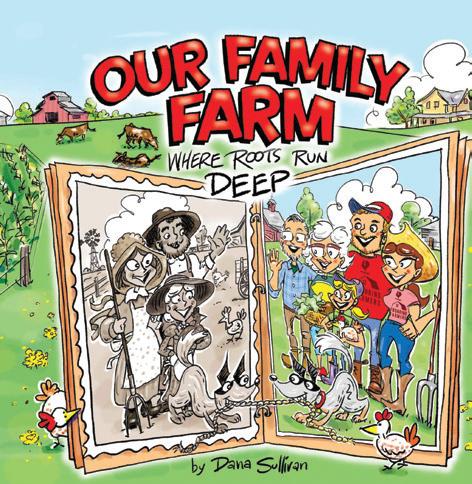
the fifth children’s book from North Dakota Farmers Union
$16.95 plus tax
Dusty's class joins in on the fun, as they take a field trip to the farm to dispel common farming myths and learn where food comes from!
Giving back
Some people walk into a room and light it up — and 14-year-old Porter is absolutely one of those people. Before KOP Cares Month officially kicked off — a month where different businesses across the King of Prussia region raise money for the Children’s Hospital of Philadelphia (CHOP) — the Founding Farmers King of Prussia team had the honor of welcoming Porter and four guests for a special dinner through the CHOP Ambassador program.
A multi-sport athlete with a heart as big as his determination, Porter competes in taekwondo, basketball, baseball, horseback riding, and on a Special Olympics swim team. The Founding Farmers team was proud to roll out the welcome mat and dedicate an evening entirely to celebrating him — because that's exactly what he deserved.
Moments like that dinner with Porter serve as a reminder of exactly why KOP Cares Month is so special and more than a fundraising campaign. Throughout April, Founding Farmers gave back to CHOP in two meaningful ways: by donating a percentage of sales from April 6-19 (KOP Restaurant Week) directly to the hospital, and by inviting every guest to round up their check to support this incredible cause.
CHOP has been a cornerstone of the Greater Philadelphia community for generations, and Founding Farmers was proud to do their small part in supporting the families and kids who depend on
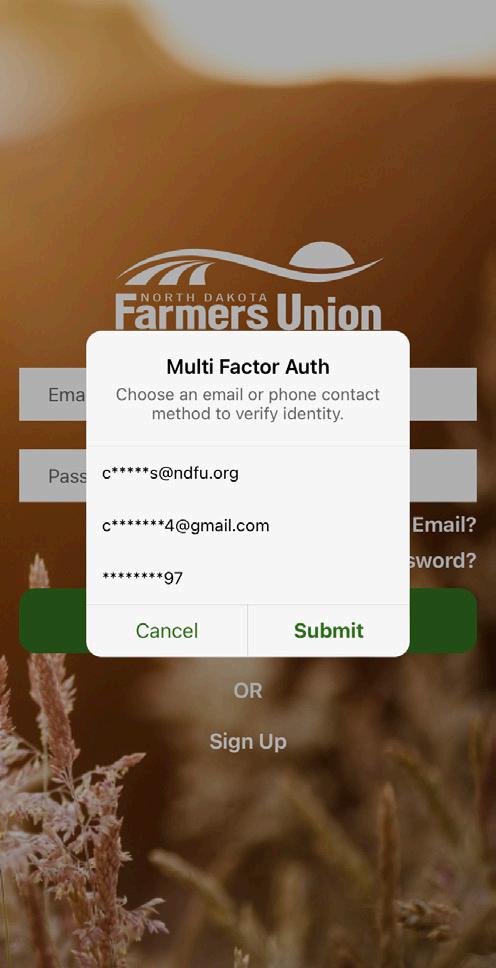
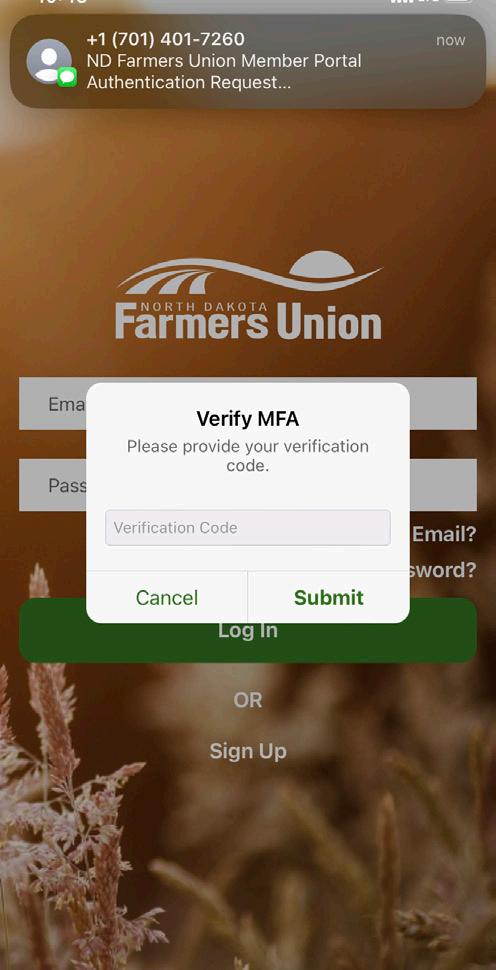
NDFU MOBILE APP How to use the
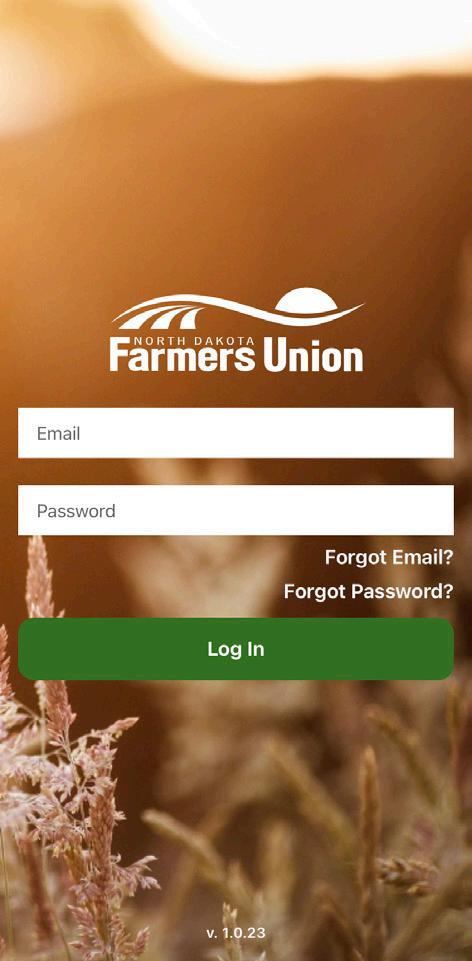
Members can use the same email address and password they use for the NDFU portal to log into the app. If you do not know your password, use the “Forgot Your Password” option. NDFU must have an email address on file for you to use the app. If we do not have an email address for you, please call 1-800-366-6338 or email us at ndfu@ndfu.org to have it attached to your account.
1
Login with your email address and password. Use the email address where you receive your NDFU communications.
If you don’t know your portal password, use the Forgot Your Password option!
2
Follow the on-screen prompts to login. NDFU utilizes two-factor authentication for security purposes.
Choose to receive your two-factor code via text or email!
3
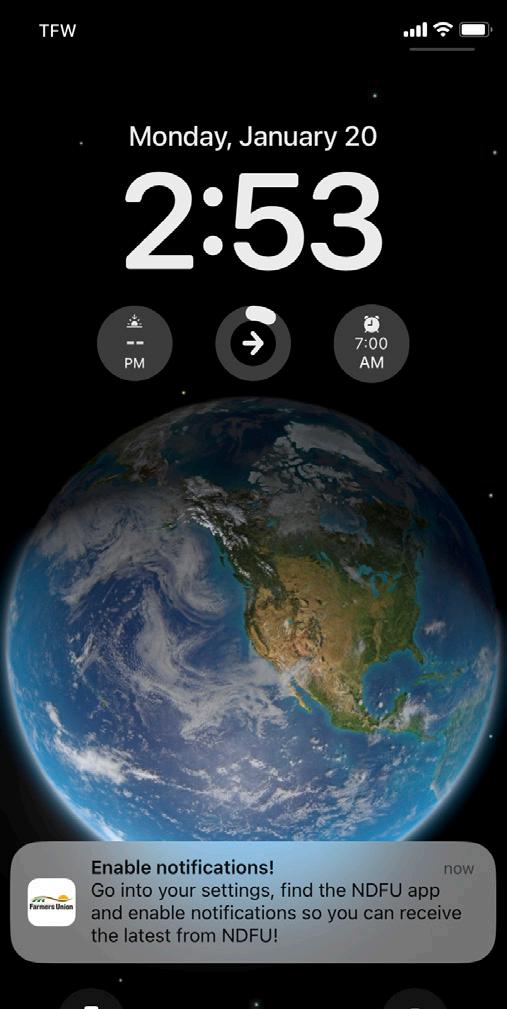
Enter the code to get into the app. If the texting option does not work the first time, try again and choose the email option.
You will stay logged into the NDFU app continually, providing you open the app once a month!
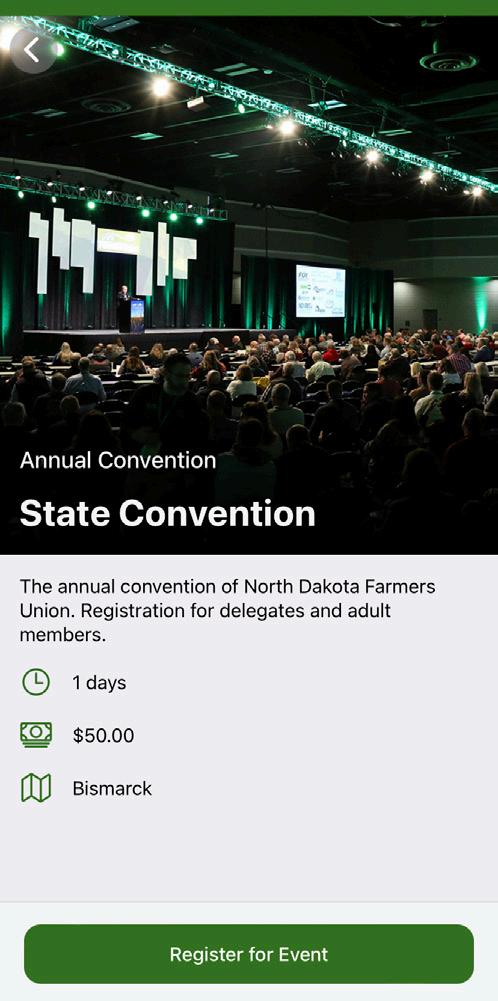
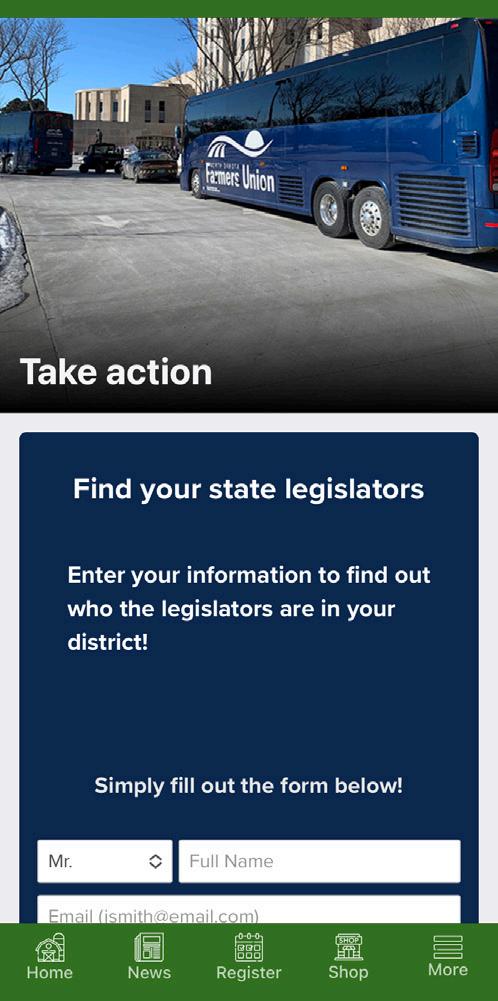
Three of the features of the app include a home screen with notifications, state convention registration and the ability to find and contact your legislators about important issues!
FREQUENTLY ASKED QUESTIONS
Do I have to be a member to log into the app?
Yes. The app is for NDFU members. Those who would like to become members can sign up at NDFU.org!
What if NDFU doesn’t have my email address? Like any online service, we require an email address to use the mobile app. Contact us at 1-800-366-6338 or ndfu@ndfu.org to have an email address added to your account. Additionally, if we have a different email address on file than the one you’re currently using, you can use the one we have on file or contact us with your new address.
NDFU has my email, but I’ve never used the online portal. What’s my password? Search NDFU in the app store or scan the QR code. Download the app, use the Forgot Password link on the login screen and follow the on-screen prompts to set a new password using the email address we have on file for you!
If you continue to have trouble logging in, contact Chris Aarhus in the Communications Department at 701-952-0118 or caarhus@ndfu.org.
CLASSIFIEDS
Ads must be submitted through the online form at www.ndfu.org. Click “Classifieds” at the very bottom of ndfu.org and fill out the online form. Ads must be re-submitted each month. No exceptions! Deadline is the 15th of every month. Limit 75 words.
MEMBERSHIP DUES MUST BE CURRENT!
FARM
FOR SALE
IHC COMBINE, 2005 IHC 2388 combine, near new, dual drive tires, very clean $35,000; 6" Renn Roller Mill $200; Roll up tarp for Ford F150 5 1/2-inch box $250; 701-240-9211, Gavin Foss, Maddock.
JD 2014 DB60 PARTS: 36 Seed Tube Sensor Wire Harnesses, 36 Trimble True Count Air Clutches -3 control boxes/Air tanks to run clutches for 3 row shutoff/ Trimble Wiring/Hoses (Complete 36 row set up). 36+ Steel Closing Wheels & Dry Rate Controller with harness. 701-321-5711, John Kempf, Ashley.
GRAIN BINS TO GIVE AWAY, 3000 bu. (18 ft diameter) , 1500 bu (12 ft diameter), must be moved from the property. Located 13 miles south of Ray, ND. Still have tractor tire chains for sale, 18.4x34 and 20.8x38. 701-570-2370, Kenneth Schmidt, Ray.
DRILL FILL AUGERS. 1 16’ 5” with spout, 1 16 6” with poly flighting and spout, 1 8’ 5”” no spout. 1 extra Hyd motor. Outback S-lite guidance system, 3 new garage doors, 8’ x 20’ steel white in color, 5 sections, 5 panel with windows all complete. Call or text. 701-430-3348, Jack Vadnie, Clifford.
D17 TRACTOR; JD hay rake; Homemade twowheel trailer. 701-270-0184, Harold Severson, Lakota.
566 JD BALER, 9 wheel Gehl hay Rake with hydraulic, 14’ case hay conditioner and a Sioux calf catcher all equipment has been stored inside. 701-269-8693, Betty Job, Windsor.
CHISEL PLOW, 21' International chisel plow with drags, $1000. 14' JD chisel plow $500. 24' Wilrich field cultivator with drag $600. 20' 470 disk with hydraulic lift $1400. 2-10' JD 9350 grain drills $500. 770 International reset 6 bottom plow $600. 701-320-5104, Edwin Haisley, LaMoure.
COVER, Surrey cover for cabless tractor; Farm King Auger, 60 ft,10-inch, side delivery, needs a new bearing in bottom, needs some TLC. 701263-1206, Lathan Romsos, Bottineau.
TRACTOR, 15-30 McCormick Tractor make offer, 1 New Tire LT245-75R-Load Range E. 2-Cream Separators, 4-wheel Steel Running Gear, 1 Covered Wagon Running Gear, 1905 All metal JD Hand Operated Corn Sheller, like new has paint and serial number. larryn@westriv.com. 701-548-8020, Larry Nagel, Shields.
500 GALLON PROPANE TANK; several 32 gallon rubber. garbage cans; old time Maytag ringer washing machine & tubs; Queen size bed and mattress. 701-629-9003, Doug Halden, Stanley.
2016 TOOLCAT, 800 hours. 2022 Sitrex v-rake 14 wheel. All good condition. 701-529-4887, Joseph Price, Douglas.
WANTED
TRACTORS, IH 706, 806, 1206, 756, 856, 1256, 1456, 1066, 1466, 1566 on up; 4520, 4620, 5010, 5020, 6030; MMs 950s on up; Olivers 1965 on up; ACs 175, 200, 210, 220, D-19, running or not. 701-628-2130, Jerry Lumley, Stanley.
HAY RAKE, Gehl 206 6-wheel. 701-226-4055, Lloyd Giese, Steele.
COMPLETE CREAM SEPARATOR. Prefer a manual crank one but will consider a motorized one. 701-290-5200, Loren Myran, Taylor.
MISCELLANEOUS
FOR SALE
VACUUM CLEANERS, 2-year and 5-month old Kirby Upright Vacuum cleaner and Shampooer. Only used one time, used but like brand new. Bags, hoses and cleaners included. $2000. 701361-5823, Dean Hill, West Fargo.
1963 PONTIAC BONNEVILLE, Hard Top, Restored; Tow Bar by Blue OX & Electronic Tow Car Brake System; Small cargo trailer, Highway equipped, like new; Gulf Cart by EZGO, Runs great. 701-350-2553, Dale Giedd, Devils Lake.
1983 PEWTER BELT BUCKLE, "I Was Saved by PIK", Limited Edition #7803. 1983 was the year of Payment in Kind farm program. Belt is newnever worn. Has raised design of a barn, bins, wheat, corn, sorghum, barley. Made by Iowa Premium and Specialty Company. $25 plus postage. 701-725-4373, Penny McCormack, Des Lacs.
SULKY, $280 has padded bench seat, knobby spoke tires with shocks, heavy metal shaves, great shape. Nylon driving harness leather re-enforced padded breast strap $185. Silver spotted black 15" seat with tappadaros $1800. 15 " seat, Adam Reichert Haliday ND saddle $600. 701-202-1174, Chip Liebel, Mandan.
NARRAK ELECTRIC ADULT TRICYCLE, 20x4 fat tires. Hydraulic brakes, rear differential. New in Oct of 2025, less than 200 miles; Due to major back surgery I can no longer ride tricycle. Asking price $1100.OO. Call 701-361-7343, Don Carlson, Fargo.
TRAPS, Northwoods 1.75 foothold fox and coyote traps. 4 good used atv tires; Two 27x11.00r14 and two 27x9.00r14-8ply. 701320-3172, Mike Carlson, Jamestown.
ANVILS, 4 to choose from 85 to 200 pounds, all in very good condition with good square edges. Massey Harris porcelain sign measures 8' by 30", and one Coke porcelain sign that measures 44" by 16" both in very good condition. 701220-5746, Val Ganje, Bismarck.
BEAR CAT GRINDER MIXER PARTS. I probably have the last inventory of new Bear Cat parts which is available anywhere. I have 2 gear cases, new gear case gears, shafts, hammers, bearings, and several other miscellaneous parts. Keep that dependable grinder mixer running for years yet. Check with me as I may have the new parts you need. Text me or leave a message. 701-833-2220, Jerome Behm, Burlington.
SCREEN to show slides on or other pictures, excellent condition; Old Snowmobile Trophies; Leonard Ice Box, mint condition all original; Tom Moran painting Landscape picture of the Mountains; Civil War picture/ prints; Smith Corona manual Typewriter. Good condition; Men's leather motorcycle pants /jacket. 701263-1206, Lathan Romsos, Bottineau.
POWER POLES, 3 - 40' Class 1 utility power poles. $50 for all. Have skid -steer. Will help load. 701-317-8010, Larry Kalash, Grand Forks.
4-WHEELER, 2015 Honda-4 Wheeler Ribcon 4 X 4, 1,700 Hours, 6,500 Miles, New Battery; New Tires on Front, Doesn’t use oil, No transmission problems what-so-ever; Asking $5,600 with new set of tires 5,900. larryn@westriv.com. 701548-8020, Larry Nagel, Shields.
3 GUNS: Winchester 94 lever action .410, 2 boxes of 2 1/2” shells, 20” bbl. Checkered walnut wood. $1150. #3 Ruger .223 single shot restocked with better wood than original with Leupold 3X9 scope $1300. Savage Fox SxS 12 gauge shotgun beautiful checkered walnut, $1000. I can send photos of all 3. Like new. 30 miles north of Williston. I can ship to a FFL or maybe meet within 75 miles. 701-580-3357, Martin Hanson, Zahl.
2015 POLARIS GENERAL. It has front and rear bumper, winch, rocker sliders, center rear view mirror, side view mirrors, audio system ,3160 miles; Schwarts machinery trailer winch, fold down sides hyd tail. 701-320-1580, David Mutschler, Wimbledon.
WANTED
FUJI BIKE PARTS, whole or parts of a Fuji GoDevil mini-bike from mid 1960s; Also, whole or parts vehicles of 1950s/1960s VWs. 701-2195847, Joel Herman, Harwood.
SIGNS, ADVERTISING, COLLECTIBLES, My son and I are looking for things to add to our collection. Old Signs, Farm Related, Gas & Oil, Advertising, Highway Signs, Railroad related items, License plates, oil cans, barber/salon items. Old items w/ small town advertisingmirrors, thermometers. Paying cash and will travel. Text/Call anytime. Would love to visit with you. Or stop and visit me along I-94. 701-9890495, Bryan Behm, Medina.
OLD STUFF, advertising signs for gas and oil, soda pop, farm machinery, Highway Patrol metal door signs , I'm also looking for old road signs some have the Indian Head logo, some have reflective marbles. I collect ND license plates, ND picked arrowheads, old animal traps, old gas pumps, oil cans, crocks, old metal toys. ND small town metal trade tokens. I will travel to your location. 701-220-5746, Val Ganje, Bismarck.
PRAIRIE DOG HUNTERS to hunt on my land. Make reservations now. larryn@westriv.com. 701-548-8020, Larry Nagel, Shields.