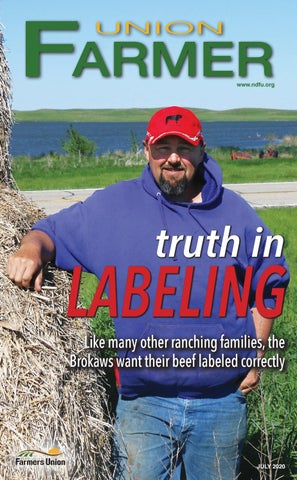
FARMER UNION
www.ndfu.org
truth in
LABELING Like many other ranching families, the Brokaws want their beef labeled correctly
JULY 2020
GET TO KNOW A FARMERS UNION INSURANCE AGENCY
Kudrna-Johansen Agency I’ve been an agent for Farmers Union Insurance for 32 years in our Dickinson office. I’m married to Bertie and we have four adult children and six grandkids from newborn to 8 years old. I grew up in South Heart and moved to Dickinson to attend Dickinson State and stayed Daryl Kudrna in town after graduation. I have been a member of the Farmers Union Agent Association, DSU Boosters, Dickinson Home Builders, Elks and Eagles. Farmers Union Insurance has been a great place to work! This position has allowed me to work with the great people of North Dakota. I’ve been able to work with family and friends and meet many new people who have become new friends. Farmers Union allows us to have a local office and to hire local people to support us. Farmers Union offers us up-to-date competitive products that allow us to serve our clients. Farmers Union Insurance truly is a great place to work. Not only a job, but a career!
I grew up in Medicine Lake, Mont., before I moved to Dickinson in 2001 to attend Dickinson State University. I have lived in Dickinson ever since and have worked as an agent for Farmers Union Insurance for 10 years. I am married to Allaina Johansen and have three daughters. Aaron Johansen My oldest daughter is Maddi, who is 12, and my wife and I welcomed twin girls 9 months ago, Avery and Alise. The thing I like about my job the most is getting to work with farmers. I grew up on a farm and still help on the family farm when I can. I enjoy working in the office but also getting the opportunity to go to my customers’ farmsteads to review policies and talk about what is happening in the world of farming. I enjoy talking about the different ways people farm and the equipment they think works best for them. I have made many contributions to Dickinson State University and specifically to the athletic department. I came to Dickinson State University as an athlete and participated in playing football and running track for the Blue Hawks. I am still a huge fan of the Blue Hawks and was a board member for the Booster Club for many years.
Kudrna-Johansen Agency 620 W Villard Dickinson ND 58601 PH: (701) 483-9090
UNION FARMER MAGAZINE Volume 67 • Number 7
The UNION FARMER is published monthly by North Dakota Farmers Union at 1415 12th Ave SE, Jamestown, ND 58401. EDITOR: Chris Aarhus 800-366-8331 ext. 118 caarhus@ndfu.org Annual subscription is $30 with membership. Periodicals postage paid at Fargo, ND. POSTMASTER: Send address changes to: NDFU • PO Box 2136 Jamestown, ND 58402-2136 Copies mailed this issue: 31,403 • USPS 016-211
SIMPLY DIFFERENT! FIND US ON THE WEB:
www.ndfu.org
http://ndfu.org/news/union-farmer
Read the Union Farmer online
CONNECT WITH US: North Dakota Farmers Union NDFU Tours @NDFarmersUnion @NDFarmersUnion
BOARD OF DIRECTORS: President: Mark Watne • Vice President: Bob Kuylen • Secretary: Wes Niederman Treasurer: Ronda Throener • Jon Iverson; Shane Sickler; Tyler Stafslien; Ryan Taylor; Michelle Ziesch. 2 • July 2020 • Union Farmer
NDFU continues to work for producers
Farming and ranching are never easy occupations, but generally they come with some rewards. Lately, the rewards have been very limited to nonexistent. In fact, we continue to set ourselves back in our financial condition to the point where it has become harder to recover and harder for the next generation to farm or ranch, let alone want to farm or ranch. It is hard for those outside of agriculture to understand the differences in farming and ranching compared to other businesses. They forget the unpredictability of the weather, the market fluctuations caused by influences (like trade wars or pandemics) that are beyond the farmer’s and rancher’s control, the monopolistic practices that control inputs/services and markets, the fact that farmers pay freight both ways to and from market and have no way to pass on costs of their operation. The United States is fortunate to have the lowest cost of food in the world per disposable income. So, during tough times it is important to have a farm bill that can be a strong safety net to maintain our successful food production system. Our current window of time is beyond tough. It is an economic crisis and we have to work to provide economic stability to our food production system. Everything that challenges farmers has come to a head. The longtime obstacles that have been ignored for years and impeded the success of family farms and ranches are starting to be addressed. Your organization has been working very hard to represent you through these tough economic times. The help of each of you, as members, has been extremely valuable as we develop and work for economic assistance. No program is perfect. When we started fighting for disaster assistance, we were happy to just see cash flowing. Now, we will work to find more dollars and to be more equitable and uniform in dispersing the dollars to those in need. I am proud of our success in disaster programs, but even more proud of the successes that NDFU and its members have accomplished to help shape the Coronavirus Food Assistance Program (CFAP):
Use of local price. The Market Facilitation Program (MFP) never accounted for regional differences in crop prices and basis. While not an outright win, CFAP payment rates distinguish between different classes of wheat, providing a more accurate picture of regional prices. Payment limits. The CFAP program strikes a better balance between payment limits and payment rates. The program’s payment limits are more restrictive than the MFP but looser than Farm Bill payment limits. Regional Payment Disparities. North Dakota will get its fair share of CFAP funding. USDA estimates only about an eighth of program payments will end up going to cotton and sorghum. Those southern crops received a disproportionate share of MFP payments. Many challenges remain – USDA’s determinations of inventory, timeline for determining payments, a few crops still with no support, unharvested crop inventories, monopolistic practices – and the fact that our farm bill is unable to solve these challenges. This forces us into a state of constant request for disaster assistance. We are already on the next round of assistance to fix inequities and future challenges. Lessons should be learned from our trade and pandemic challenges. A large food inventory is only good if you can get it to people. Farm programs are necessary and need to be enhanced. Concentration in the marketplace cannot happen or go on unchecked without destroying the market and costing consumers. Trade needs to be done correctly and we should never start a trade war on our own.
Inclusion of minor oilseeds. NDFU and other North Dakota groups pushed hard to have canola and sunflowers included in the program. In developing the calculations, USDA went out of their way to find more reliable data sources for those commodities. NDFU.org • July 2020 • 3
POLICY HOPPER FROM NORTH DAKOTA FARMERS UNION
QUESTIONS LOOM ON PREVENT PLANT
In the heart of the Prairie Pothole region, North Dakota farmers are no strangers to prevented plant (PP) coverage. Farmers in other states can’t say the same. With a record 20 million acres prevented from planting last year, broad pressure from farm groups and Congress drove the United States Department of Agriculture (USDA) to increase PP payments and flexibility. Those changes only applied to a single year but revealed a general acknowledgement that PP coverage doesn’t exactly make farmers whole. This year, while North Dakota continued to face difficult planting conditions, a different scenario played out nationally. Spring planting in most states actually finished ahead of schedule in 2020. North Dakota farmers, battling standing 2019 crop, heavily saturated soils and wet spring weather, weren’t so lucky. The state lagged behind all others and its own five-year average for planting progress. Many producers are left wondering whether USDA will again enhance PP coverage in 2020. While there are few definitive answers right now, NDFU is closely tracking developments and working to keep you up to date. To file a claim or ask specific questions about your prevented plant coverage, visit your Farmers Union Insurance agent.
If I have a standing 2019 crop, will I be eligible for PP coverage?
The determination will be made on a case by case basis, but USDA’s Risk Management Agency (RMA) has offered some general guidelines. If the standing crop is yours, you should be eligible for
4 • July 2020 • Union Farmer
PP. If this is your first year renting or farming that land, you are probably not eligible. Talk to your Farmers Union Insurance agent to address your specific situation.
Will USDA allow me to hay or graze my cover crop on PP acres?
Farmers always have the option to hay or graze a cover crop on PP acres after November 1 without it impacting their indemnity. Last year, RMA made a one-time decision to move the haying and grazing date up to Sept. 1. North Dakota’s congressional delegation recently joined 25 other senators and members of Congress on a letter asking RMA to grant that same flexibility in 2020. RMA had not responded to the request as of print time.
Will USDA provide PP “top-up” payments in 2020?
Last year, USDA authorized PP top-up payments adding 10% to PP payments for producers with Harvest Price Exclusion and 15% for producers with Harvest Price Option. With much less pressure to increase PP payments this year, it seems less likely USDA will provide top-up payments. At the same time, Congress has spent nearly $3 trillion since February and plans to spend more. The topup payments would be a drop in the bucket. As of June 10, the safest bet is to plan for prevented plant coverage to function the same as it did before 2019. But rest assured, NDFU will continue to advocate on your behalf to maximize support and flexibility for producers who were prevented from planting.
Get the latest from NDFU Are there legislative issues really important to you? Are you curious about what NDFU is working on? Let us know! Sign up for our biweekly legislative email at ndfu.org!
Pierce County Farmers Union president R Jay Paul and county secretary Sheila Ostrem haul grocery bags out to cars as they line up outside the Rugby Food Pantry. 6 • June 2020 • Union Farmer
HELPING SMALL COMMUNITIES With a Community Stewards grant from NDFU, Pierce County Farmers Union donates $750 to Rugby Food Pantry BY CHRIS AARHUS, NDFU
Pierce County Farmers Union (PCFU) ordinarily does a co-op meal at the Pierce County Fair each summer, but not with the ongoing pandemic. Instead, the organization teamed with the Rugby Food Pantry and donated time and money. With the help of a $500 Community Stewards grant from North Dakota Farmers Union, PCFU donated $750 to the food pantry and helped distribute groceries to 60 needy families in the Rugby area. “We thought about the Community Stewards program and NDFU donating to the Great Plains Food Bank and thought, you know, this would be a good project to do,” PCFU President R Jay Paul said. He credited county secretary Sheila Ostrem with the idea. Ostem said it made sense considering all of the problems associated with the pandemic. “What better way for us to get out there and help,” Ostrem said. “Through all of this with people losing their jobs and some who may not have a job to go back to, if we can do something to help the community, we should do that.” Vonnie Degenstein, who has been running the Rugby Food Pantry for 30 years, said the community has been great about donating. “People have been very generous with us,” she said. Paul said lending support to this cause is important considering the circumstances. “It’s hard for some people,” he said. “People have gotten laid off. I heard on the news that people at home are spending $100 more a month on groceries on average than they did before. We wanted to help folks out.”
NDFU.org NDFU.org••June July 2020 • 7
RESEARCH SUGGESTS CLOSER LOOK AT Much has not been made of Frank H. Knight’s 1921 famous distinction between risk and uncertainty. In Knight's interpretation, “risk” refers to situations where the decision maker can assign mathematical probabilities to the randomness of magnitude with which he is faced. In contrast, Knight's “uncertainty” refers to situations when this randomness of magnitude cannot be expressed in terms of specific mathematical probabilities. Analysis of risk, a concept in relative variation, is not new to agriculture and has been the subject of research at least for a century. A farm bill refers to a multiyear, multicommodity federal support law in the form of federal farm programs for farm commodities. The federal farm programs were introduced as part of New Deal legislation proposed by incoming President Franklin D. Roosevelt in 1933 to address declines in farm prices and net farm income. The primary intent of the federal farm programs is to reduce risks faced by the producers at the time of random losses. With reduced risk, producers are willing to adopt innovative production practices/technology to increase their farm production that they would
8 • July 2020 • Union Farmer
otherwise not be willing to adopt if they faced more risk due to the absence of federal farm programs. Since 1933, the design of farm policy has changed or maintained the status quo approximately every five years with the authorization of a new farm bill. In 1938, the Federal Crop Insurance Corporation (FCIC) was created to provide protection not only against price and income variation but also from the Great Depression. The U.S. Department of Agriculture’s Risk Management Agency (RMA) for the Federal Crop Insurance Corporation administers the crop insurance program in the U.S. Unlike other insurance policies, federal crop insurance is a unique public-private product sold and serviced by private insurance companies. New crop insurance policies were introduced or existing policies were amended in 1940, 1977, 1980, 1996, 2000, 2002 and 2008. Although U.S. federal farm policies, including traditional farm and crop insurance programs, rarely are intended to alter the structure of U.S. agriculture, the effect of these programs on the structure has long been an economic as well as a political concern.
A NEED TO TAKE A FARM POLICIES A fundamental question in the mind of academics, policymakers, commodity groups and, most importantly, producers is: Are farm programs introduced as part of the farm bill addressing the risks associated with farm income and exports? Second, does a need exist to strengthen the “trade aspect” of the farm bill, given exports are a major component of our agriculture? To address these aspects of the farm bill and risk, let us take a look at North Dakota’s agricultural sector farm income, farm program payments, and exports and their associated risks. Traditionally, trends and risk or variations in cash income, program payments and exports are used by producers, policymakers and commodity groups to gauge growth in North Dakota agriculture. Research shows an increasing trend for cash income, with a peak of $11.03 billion in 2013, and increasing exports peaking at $4.89 billion in 2014. At the same time, federal government directfarm program payments also showed an increasing trend, with a peak of $1.178 billion in 2000. With changes in consumer preferences domestically and, more importantly, global economic and political issues, a need exists to not only take a look at risk defined as fiveyear deviations (approximately five years for each farm bill) but also a closer look at the relationship between farm policies introduced as part of the farm bill and its importance to alleviate risks faced by the producers. Even though research shows an increasing contribution of trade with a peak of 48% in 2008 and 2018, the farm bill does not explicitly address the export risks faced by North Dakota producers. For example, recent risks faced by producers include retaliatory tariffs and COVID-19, with high impact to producers’ cash income. Farm policies introduced as part of the farm bill do not address these uncertainties;
however, policies are developed ex-post (based on actual results rather than forecasts) and not ex-ante (based on forecasts rather than actual results). A need exists to introduce farm policies as part of the farm bill to address short-, intermediate- and long-term gross cash income risks. Second, a need exists to identify the downside risk associated with gross cash income, exports and farm program payments. Are current farm policies and associated farm program payments introduced as part of the farm bill addressing North Dakota producers’ gross cash income risks or variation? The average gross cash income showed an increasing trend, with a peak during the farm bill period of 2008 to 2014 of $9.48 billion. The farm program payments did not show an increasing trend but peaked during the farm bill periods of 1996 to 2000 at $686 million and 1985 to 1988 at $618 million, while the exports showed an increasing trend. Looking at the deviations or risk, gross cash income and exports had the highest risk during the farm bill period of 2008 to 2014, but the farm program payments were not the highest, suggesting no link exists between the deviations or risk faced by producers and potential help to the producers from farm program payments. This could be attributed to a lack of linkage between risks faced by the producers and farm policies that are supposed to help the producers at the time of risks. This also suggests a need to take a closer look at farm policies and have a discussion with producer groups to create future policies that would address uncertainties exante and not ex-post. Saleem Shaik is a professor in the NDSU Agribusiness and Applied Economics Department. Article courtesy of NDSU Ag Communications.
NDFU.org • July 2020 • 9
'TRICKING CONSUMERS' Confusion with 'Product of USA' label on meat has Brokaws pushing for Country-of-Origin-Labeling
N
ear the end of March, Ryan Brokaw sat at his kitchen table curious about how lucky the family ranch had been in selling its calves in February. He was shocked. “I would have lost $65,000 on three loads of calves,” said Brokaw, a thirdgeneration rancher near Forbes, N.D. “It hadn’t even been a month. (The prices) went down that far. Our family was lucky.” As boxed beef prices shot upward and live cattle prices dropped during the pandemic this spring, ranchers again found themselves on the short end of the stick. Ryan’s wife, Marcie, grew up on a ranch 18 miles west of their home, where her father still runs the operation. Ryan said her father tends to sell a little bit later.
“My father-in-law didn’t sell any cattle,” Ryan said. “He feeds a little bit longer than I do. These are just guys doing their program and feeding into March and April. Can you imagine the hit those guys took and the stress they had? You can’t withstand many years of that.” While the Justice Department is looking into market manipulation among the beef packers – four companies own 85 percent of the market – Brokaw is focusing his efforts on truth-in-labeling, particularly CONTINUED ON NEXT PAGE
Story and photos by Chris Aarhus, NDFU Editor
10 • June 2020 • Union Farmer
NDFU.org • July 2020 • 11
FROM LEFT: Avery, Trent, Marcie and Ryan Brokaw have a third-generation ranch near Forbes, N.D.
Country- of-Origin-Labeling (COOL), as a way to help ranchers get a premium price for their product and make up for lost revenue.
What is COOL?
Country-of-Origin-Labeling was signed into law in May 2002 as part of the farm bill but faced long delays in implementation until its final rule took effect in March of 2009. COOL is a consumer labeling law that requires products be labeled with their country of origin. The rule was in place for several commodities, but Canada and Mexico filed a complaint with the World Trade Organization in October of 2009, arguing the rules for beef and pork meant less favorable treatment for imported livestock, than those born and raised domestically. The complaint argued COOL was inconsistent with international trade
12 • July 2020 • Union Farmer
obligations. In November 2011, the WTO’s dispute settlement body essentially ruled in Canada and Mexico’s favor, though the U.S. also claimed victory in part of the ruling. The U.S. appealed the decisions that went in the opposition’s favor four months later. In July 2012, the WTO appellate body issued its report, affirming the dispute settlement body’s ruling. The WTO gave the U.S. until May 2013 to implement its recommendations and rulings. In response, the U.S. made changes to its law to identify the country in which each production step occurred. In July 2013, the National Cattlemen’s Beef Association, the National Pork Producers Council, the North American Meat Association (now the North American Meat Institute) as well as commodity groups from Mexico and
"They’re using our good name to promote the beef they’re bringing in from other countries." Ryan Brokaw on 'Product of USA' labeling
Canada filed a lawsuit, alleging COOL was unconstitutional. National Farmers Union intervened in the lawsuit in favor of COOL, and North Dakota Farmers Union donated $40,000 to help defend the law. In early 2014, Canada and Mexico asked the WTO compliance panel for a more lucid review, also asking for permission to levy $3 billion in retaliatory tariffs against the U.S. The panel ruled that the changes made to the COOL law by the U.S. were inadequate, which was later affirmed by the appellate body. In June 2015, the House of Representatives passed a bill (H.R. 2393) to repeal mandatory COOL for beef and pork. Six months later, the WTO authorized Canada and Mexico to institute retaliatory tariffs. Just 11 days after the WTO’s ruling, H.R. 2393 was incorporated into omnibus appropriations legislation, effectively repealing
COOL. The rule still stands for many other products including fruits, vegetables, fish and poultry.
Label problems
The Brokaws have a joint operation of 750 cow-calf pairs with Ryan’s brother Dylan and his wife Ava. Ryan and Marcie have two sons, Trent and Avery. The family is significantly invested in the future of ranching. “We are a true family ranch – we have zero hired hands,” he said. “It’s the Brokaw family that runs this place.” Ryan and Marcie have tackled the need for COOL together, writing letters to the editor as well as a letter to North Dakota Agriculture Commissioner Doug Goehring. Ryan has made CONTINUED ON NEXT PAGE
NDFU.org • July 2020 • 13
The "Product of USA" label on beef and pork doesn't mean it was born or raised in the U.S. Label regulations state the product only has to be repackaged in the U.S. to earn the "Product of USA" label.
multiple calls to his congressional delegation’s offices. “He doesn’t even call Bismarck anymore – he calls right out to (Washington, D.C.),” Marcie said. Like many ranchers, Ryan has serious problems with the current “Product of USA” label that goes on meat. Currently, the label’s guidelines say the product, such as hamburger, must undergo “substantial transformation.” But that means cattle raised and finished in another country are shipped to the U.S., processed, inspected by the USDA and then labeled American. The minimum requirement for the label is that it has to be packaged in a USDA-inspected facility. “My biggest problem is that we’re tricking the consumer,” he said. “We’re putting the ‘Product of USA’ label on stuff being shipped in from 23 different countries. All the packers have to do is bring it in and re-pack it, and they can stamp ‘Product of USA’ on it. “Everything is labeled except beef and pork. (NDFU District 6 Director) Shelly Ziesch made a pretty wise statement. If the ‘Product of USA’ label didn’t mean anything, why would they put it on there? They know it means something. They’re using our good name to promote the beef they’re bringing in from other countries." Marcie said she worries about the nation’s ability to pin down the source in a public health crisis. “Even if it came from another country, it says ‘Product of USA,’ so what happens to our markets?” she said. “If you get mandatory COOL, you know if that meat is from the United States. 14 • July 2020 • Union Farmer
If something bad happens with our own meat, we can handle it. You can’t do that if it’s coming from somewhere else. “It bothers me, because they label everything else. You go to the grocery store and pick up avocadoes, you know they came from Mexico.”
Fixing labels
Ryan said he doesn’t know of any ranchers in his community against COOL, but acknowledges they exist. “There are guys that believe COOL would cost us money, but when we had COOL, it never cost me a dime,” he said. “Lawmakers should have stuck to their guns. I think we would have been fine. Yeah, we might have had tariffs to pay (for imported beef), but it wouldn’t have been a big deal. I’ve always said, put the choice in front of the people that eat the meat.” After Ryan’s letter about COOL was published in the Bismarck Tribune, a woman from Bismarck wrote him a letter, asking him about the “Product of USA” label on the meat she buys. She doubted its accuracy and wanted confirmation. She didn’t leave a phone number, but the Brokaws tracked her down anyway. “She said, I know you’re busy, but I don’t trust that label, but I’m not sure,” Ryan said. “I said, you’re right not to trust that label. If she wants to take the time to learn about this, you dang right I’m gonna talk to her. Our message to all consumers is to get educated about the labels on your meat.” The Brokaws said, to start, they want to see
Fruits are one of several commodities that have Country-of-Origin-Labeling on its products.
the “Product of USA” label addressed, and that appears to be happening, but not in support of producers. The Food Safety and Inspection Service (FSIS), which regulates the labeling of meat products sold in commerce in the U.S., took comments from stakeholders on both sides after the Organization for Competitive Markets and the American Grassfed Association submitted petitions in the fall of 2018, to be later joined by a petition from the United States Cattlemen’s Association. NDFU submitted comments in support of the petitions, arguing that “Product of USA” must be restricted to animals born, raised and slaughtered in the U.S. In March, FSIS announced it would initiate a second round of rulemaking on the “Product of USA” label, acknowledging the label’s confusion for consumers. However, FSIS is looking to solve the problem by making it clearer to consumers that the current label only means processed and packaged, as opposed to actually changing the definition to “animals born, raised and slaughtered in the U.S.”
For the family
The pandemic has opened consumers’ eyes to the value of knowing where their meat comes from, Ryan said, adding that not every consumer has access to a local rancher and would value American-raised beef in the grocery store. “There are more people actually wanting to buy
a product of the U.S.A.,” he said. “They want to buy from local ranchers, but trying to get a butcher appointment around here is difficult.” Marcie said having beef labeled with its country of origin gives consumers an option for those that don’t have access to a local rancher, and it encourages consumers to be curious about where their food comes from. “I want to teach my kids where their food comes from, where it’s grown and how it’s raised,” she said. “One day, if they choose to move to the big city, they know what they’re looking for because they were taught. Mandatory COOL is a way for them to know.” U.S. packers and processors remain steadfastly against COOL, mostly because of the disruptions in the supply chain, which they argue will eventually cost ranchers money. Ryan vehemently disagrees with that notion and believes consumers would economically support COOL. He sees COOL as an avenue to help keep his children on the ranch. “Ranching goes pretty deep in our family – I’m fighting this for my kids,” he said. “We’re at a critical juncture in the cattle business. We’re gonna run out of young people if we don’t have any way for these young kids to start farming and ranching. We need to get our industry fixed." “We’re not out here to get rich,” Marcie added. “We want to make a living, teach our kids the value of what we’re doing, and hopefully, some day pass it on to them.” NDFU.org • July 2020 • 15
Watch for heat stress, summer pneumonia in beef cattle
Summers usually are mild in North Dakota, compared with the southern states, but hot, humid days do occur in North Dakota and can be dangerous and even deadly for cattle. “The combination of heat and humidity creates stress on livestock because respiration is the predominate route for cooling,” says Karl Hoppe, Extension livestock systems specialist at North Dakota State University’s Carrington Research Extension Center. “Once cattle start to pant, some heat stress has occurred.” Keeping the internal body temperature at normal is possible with panting and adequate shade and water. Sometimes cattle will stand in ponds to cool off on a hot day. Bison also will wade into water to cool off on a hot summer day. “Healthy cattle can handle some heat stress,” says Gerald Stokka, NDSU Extension veterinarian and livestock stewardship specialist. “However, too much heat, along with high humidity, can result in excessive heat stress, leading to death.
16 • July 2020 • Union Farmer
Cattle can get relief from heat stress when the nights are cool. Night cooling for beef cattle occurs when the nighttime temperature falls below 72 degrees.” Producers also should be aware of the increased risk of “summer pneumonia” in suckling calves following heat stress. An increased respiratory rate, along with the stress of heat, may overwhelm the natural defense mechanisms of the lungs. In calves that may be compromised due to inadequate intake and absorption of immunity (colostrum) from the dam, the risk is even greater. Calves that develop pneumonia may not be discovered until too late in the course of the disease. Early signs may be calves off by themselves, dams with full udders, a drooped ear and rapid respiration. Adult cattle and yearlings that have experienced respiratory disease early in life or postweaning may have decreased lung capacity and will be at a greater risk of heat stress.
“Cattle that have damaged lungs due to pneumonia may die on the first moderately warm day,” Stokka says. He urges producers to consult with their veterinarian for confirmation of the heat stress diagnosis and for treatment options. Night cooling allows the animal to cool off and get relief from heat stress. When night cooling doesn’t exist, cattle have a difficult time handling the heat stress the next day. “Usually, healthy cattle won’t die from heat stress on the first hot day,” Hoppe notes. “Cumulative days of heat stress without night cooling physiologically challenge cattle. After three days, some cattle can’t handle the heat and humidity and die.” Brahma and brahma-crossbred cattle are more tolerant to elevated heat and humidity. Bos indicus breeds (Brahma crosses) often are included in the cow herd breeding program in southern states. For northern cattle, reducing heat stress includes providing drinking water in adequate amounts and access to the water. Provide at least 2 inches of water per trough space per head. Providing shade also will help cattle reduce elevated body temperatures. Cattle will seek windy locations, wet places to stand, or ponds to wade in to help cool off. Cattle with dark hides tend to show heat stress and have higher internal body temperature than cattle with lighter-colored hide. For feedlot cattle, moving feeding time to later afternoon or evening will help reduce heat stress. Several hours after consuming a meal, the
fermentation and digestion of feed creates heat. By feeding later in the day, the heat produced from digestion will develop during the night and not add to the daytime heat stress. Usually, the fatter the cattle, the more difficulty in handling heat stress, Stokka says. Heat stress can be forecast and is based on temperature, wind speed, humidity and solar radiation. The National Weather Service and U.S. Department of Agriculture have a heat stress forecast website at https://tinyurl.com/ HeatStressForecaster. When heat stress is anticipated, cooling the ground may help. This can be done by putting water on the pen surface and/or adding bedding to change the pen’s surface color, which normally is black. Wetting the bedding also may help. Using sprinklers or fire hoses to cool cattle that already are panting isn’t a good practice, Hoppe says. Spraying water onto the cattle raises the humidity and can increase heat stress. However, when cattle are in severe heat stress, soaking the animals with water may be necessary for their survival. Cattle are at danger of death from heat exposure when: • The heat index is 75 or greater for a 72-hour period. • The heat index during a 48-hour period is not lower than 79 during the day and not lower than 75 during the night. • The daytime heat index reaches 84 or higher for two consecutive days. Article courtesy of NDSU Ag Communications.
Poultry execs indicted for price fixing Four current and former executives at Pilgrim's Pride Corp. and Claxton Poultry Farms, both of which produce chicken, were indicted in May for price fixing. Those indicted include the current CEO and a former vice president of Pilgrim's Pride and the president and vice president of Claxton Poultry Farms. Pilgrim's Pride, of which JBS USA is a majority shareholder, is the second largest poultry processor in the United States. From 2012-2017, the four allegedly colluded to artificially inflate the price of birds sold to grocery stores and restaurants. The case highlights the need for greater antitrust enforcement, National Farmers Union (NFU) President Rob Larew said in a statement. "Companies are only able to employ anticompetitive business practices when they've amassed control over their respective industries. In this instance, just five companies control 60 percent of the chicken market in the United States." Other areas of the meat sector are even more concentrated; for instance, just four companies each dominate 66 percent of the pork industry and 85 percent of beef. Unsurprisingly, corporations in both industries have been accused of price fixing in recent years. Larew indicated that NFU "wholeheartedly" supports these legal challenges, legislators should take action to address the root of the problem. He encouraged them to "enforce antitrust policy; restore competition in the agricultural marketplace; reinstate the Grain Inspection, Packers and Stockyards Administration; and develop strong protections for farmers."
NFU URGES FINALIZATION OF ORGANIC LIVESTOCK RULE
In comments, NFU urged the U.S. Department of Agriculture's (USDA) Agricultural Marketing Service (AMS) to finalize the Organic Livestock and Poultry Practices (OLPP) final rule without further delay. The rule, which was published in January 2017, would clarify animal welfare standards under the National Organic Program (NOP), by outlining how organic livestock is raised, handled, transported, and slaughtered. Currently,
18 • July 2020 • Union Farmer
organic certifiers are inconsistently applying animal welfare standards to farming and ranching operations, causing confusion among consumers and undermining the integrity of the organic label. By providing clearer guidelines, the OLPP rule would mitigate the problem by standardizing organic livestock and poultry practices that producers need to meet for the voluntary NOP. In doing so, it would ensure greater trust in the certified organic seal, as well as level the playing field for all organic livestock and poultry producers. Despite its popularity among consumers and producers alike, the rule was withdrawn in March 2018, much to NFU's chagrin. In his latest comments, Larew reiterated his concerns. "NFU continues to stand in strong support of the OLPP Rule," Larew wrote, highlighting its role in "ensuring consumer confidence in the organic seal." He then called on the agency to reverse its earlier "ill advised" withdrawal.
NFU BACKS CARBON CREDIT CERTIFICATION BILL
A bipartisan bill introduced in early June would create a certification program at the U.S. Department of Agriculture for technical service providers to work with farmers as they implement practices to sequester carbon and sell the credits. The bill, known as the Growing Climate Solutions Act also calls for an advisory committee at USDA composed of farmers, government officials, and representatives from private markets to provide guidance on how Congress and USDA can reduce barriers to entry for carbon markets and resolve challenges faced by farmers. NFU endorsed the bill, saying it would "provide certainty to those looking to participate in carbon credit marketplaces." The bill aligns with a special order of business passed at the organization's 188th anniversary convention encouraging USDA and other federal agencies "to explore opportunities for family farmers and ranchers to realize financial benefit from the ecosystems services generated through improved management practices including voluntary marketplace initiatives and voluntary federal support programs."
To those who have already donated ...
THANK YOU!
FOR YOUR GENEROUS GIFT TO THE NDFU FOUNDATION Donations of more than $1,000 are recognized at the state office on the NDFU Donor Recognition wall. Giving levels include: COBALT – $1,000 to $4,999 BRONZE – $5,000 to $14,999 GOLD – $15,000 and above. Donations can be mailed to: NDFU Foundation, P.O. Box 2136, Jamestown, ND 58402-2136 Please note if the gift is in honor of someone. For more information, contact Lucy Bardell, assistant to the president, at 701-952-0114 or lbardell@ndfu.org. The NDFU Foundation was established in 2000 to raise funds for Farmers Union’s renowned youth education program. As a Farmers Union supporter, you are part of a larger mosaic – a piece of the spirit and light – that can help establish a permanent, sustainable fund for NDFU’s youth program. Please consider a donation.
remraFNDFU.org noinU • 02•0June 2 yrau rbeF• •19 6 2020
NDFU is doing a cookbook!
submit your recipes email Brittany Rodin at brodin@ndfu.org or mail it to North Dakota Farmers Union 1415 12th Ave. SE Jamestown ND, 58401 20 • June 2020 • Union Farmer
NDFU.org NDFU.org ••April May 2020 • 15 19
TRY OUR SCRATCH SODA!
Founding Farmers
Raspberry Lime Rickey RASPBERRY SYRUP
Ingredients (makes one serving) 2 cups granulated sugar 2 cups water 4 cups fresh raspberries, rinsed 1 tablespoon fresh lemon juice INSTRUCTIONS Combine sugar and water in a 2-quart saucepan. Bring to a boil, reduce heat, let simmer 5 minutes. Remove from heat and allow to completely cool. Combine sugar syrup, raspberries, and lemon juice in a quart-size container. Cover and refrigerate overnight. Strain syrup through mesh strainer. Discard raspberries. Cover and store syrup in refrigerator for 4-5 days.
RICKEY
Ingredients (makes one) 2 ounces lime juice 1½ ounces raspberry syrup 3-4 drops rose water 6 ounces club soda fresh raspberry (for garnish) lime wedge (for garnish) INSTRUCTIONS Add all ingredients to a tall Collins glass and stir. Add ice and garnish with a raspberry and lime wedge.
NDFU.org • June 2020 • 21
CLASSIFIEDS
Ads must be submitted through the online form at www.ndfu.org. Click “Classifieds” at the very bottom of ndfu.org and fill out the online form. Ads must be re-submitted each month. No exceptions! Deadline is the 15th of every month. Limit 75 words. MEMBERSHIP DUES MUST BE CURRENT!
FARM EQUIPMENT FOR SALE SEMI TRAILER, good condition, road ready, excellent for storage, located in Beulah. 701-391-5685, Gordon Cermak, McClusky. BUCKET, 025R John Deere 51"; 60" lawn mower, 270 hours. 701-696-2572, Jim Enlow, Manvel. FERTILIZER SPREADER, six-ton mobility spreader, real nice shape; 50-inch Dixon mower, ZTR, real nice shape, but motor needs some work. Make an offer. 701-7718653, Kenny Heilman, Rugby. HAY RAKE, 2018 Columbia SR9 wheel finger rake with wind guards, always kept inside, used on 50 acres one time, $5200 firm, please leave message. 701-3080156, Ronnie Dick, Lisbon. HARDWARE, from John Deere 1600 chisel plow, best offer. 701-875-4278, Jon Heller, Williston. MODEL 1015 IH pickup head with westward model 388, 7 belt, steel teeth, hydraulic $1600; John Deere 1610 chisel plow 41ft, new 4" shovels, new 3 bar Herman harrow, 4 new tires. $7000; 366 CI Chevrolet truck motor. 2000 miles, runs good. $600; 8 ft Aluminum utility box. Locking side panels (no keys). $900; (4) 590x15 tires, tubes are new and 2 wheels for concord air seeder $200; 701-789-0966, Allen Gruman, Cooperstown. 2 HAY MOVERS, one is 10x32 ft, hydraulic drive, like new, other is 12x28 ft, good condition. Both L hydraulic drives. 701-6274942, Lyle Locken, New Town. 4 WHEEL STEEL TRAILER to park in corral; 15-30 McCormick Tractor; 2 cream separators; Late-model Super M, w/live PTOl; 1 new tire LT245-75R-17 Load Range E; Saddle & 2 bridles; 1905 JD metal corn sheller; Covered wagon running gear; Kirschman drill, 3 & 4 Btm. Pony& Packer; 1950 2-wheel bicycle; Small square bale buncher. larryn@westriv. com. 701-597-3730, Larry Nagel, Shields. 2004 NEW HOLLAND HAYBINE, 18 ft, with reverser. Machine is in very good shape. Always shedded. 2 years on new sickles, guards, and hold-downs. Cut approximately 300 acres per year. 701-2020400, Ron Monzelowsky, Bismarck. USED GRAIN HANDLING EQUIPMENT. Hopper bins, 10' U-trough, 8" leg spouting, grain dryer and grain cleaner. Make a reasonable offer. 701-640-5096, Ray Zajac, Lidgerwood. JOHN DEERE 6620, combine; Morris 2 chisel plow, 29 ft. 701-626-7270, Jim Haugen, Butte.
JD 16 FT CHISEL PLOW, $450. IH Farmall M tractor, narrow front; 22ft Noble V blade plow $250.; 4 row corn cultivator, 3pt hitch, $250; 8x16 flatbed trailer, made from a truck chassis, has a steel floor and a tilt bed, $450; Horse drawn 2 row corn planter and a one row corn cultivator; and a western saddle with padded seat, bridle, pad and breast collar. 701-483-4825, Richard Jablonsky, Dickinson. 2002 VOLVA L50D WHEEL LOADER, good shape. new tires, starter, alternator, and batteries, ready for work. 701-4482633, Clifton Peterson, Ruso. 656 INTERNATIONAL, 5 speed gas engine, runs good. Tires at 75%. Farmhand 225 loader with it, all in good condition. 701-220-1808, Tom Welder, Wilton. CANOLA ROLLER; Case 1203 swather, 195 hours, mint condition, always shedded; Macdon 25 ft pull-type swather. 701-2631206, Lathan Romsos, Bottineau. TIRES, 2-1300x24 foam fill tires 10 bolt rims; 10x71 Westfield low profile swing out hopper $3,500; Leon 425 Silver Spreader 22.5 tires, $8,500; 4000 Brandt grain vac, $6,500. 701-391-1852, Marc Sundquist, Baldwin. CASE IH 75A Farmall FWD tractor w/540 loader, no cab, 202 hrs; 40 used Lange anhydrous knives; anhydrous nitrolator w/ hyd shut off & hoses; steel fence posts; used cult/shovels; transition & aeration screens & fans; closing wheels & hdw for 50 ft 3320 Bourgault air seeder; Antique pump jack w/wooden lift arms; farm scale; hopper bins; used Case IH 8230 feeder chain; dog house on 4x4 skids; Kawasaki generator KG 1500B. 701-629-9003, Doug Halden, Stanley.
WANTED HAY HEADER, 6566 Hesston 16 ft, used and in good condition. 701-878-4966 or 701-471-9777, Chester Brandt, Hebron. 116 OR 220 MELROE SPRAY COUPE. 701-263-5223, Leonard Hoskin, Maxbass. TRACTORS; IH 806, 1206, 856, 1256, 1456, 1066, 1466, others. JD 5010, 5020, 4320, 4620, 6030 and others. MM, 950, 1000, 1050, 1355, others. Oliver, 1960 and newer, AC, 210, 220, D-21, others. All wanted running or not. 701-628-2130, Jerry Lumley, Stanley.
MISCELLANEOUS FOR SALE 4-WHEEL TRAILER with flatbed, excellent condition, great for hauling square bales; Valve grinding machine, complete with many extras. 701-771-8653, Kenny Heilman, Rugby. CUPOLA, 7-foot, in good condition and other things off barn roof; 14-foot Lund fishing boat with 15 hp Evinrude motor. 701-320-7709, Wayne Becker, Dazey. SAUSAGE STUFFER, good condition, $200. Lozier shelves and glass display case, approx. 24 feet. Located in Beulah. 701-391-5685, Gordon Cermak, McClusky. GRILL PROTECTOR, Chevy Silverado “Ranch Hand”. Cost $860. Will sell for $385. Fit 2015-19 year models. larryn@ westriv.com. 701-597-3730, Larry Nagel, Shields.
PICK-UP TOPPER, fits 8-foot box, blue gray color with racks for guns and fishing rods; Antique fireplace screen and tools; Craftsman table saw, mid-1960s, vintage, excellent condition, solid steel built; Craftsman router, excellent condition. 701263-1206, Lathan Romsos, Bottineau. ELECTRIC WHEELCHAIR, Quantum series power chair, works good but needs charge cord. 701-252-6455, LaDona Tarno, Jamestown. WELDER, Lincoln rod electric welder, brand new, never used, worth $400. Asking $360 obo; Roto tiller, good shape, $200 obo. 701-663-7973, Chris Heim, Mandan. PROFORM 920E ELLIPTICAL. Less than 2 years old. Like new. I don't have the space. Asking $600. Email clemensduo@ hotmail.com. 701-659-0705, Jessica Clemens, Jamestown.
WANTED HONDA 4-WHEELER, like a 420 or 500 model, must be red with all the options. 701-771-8653, Kenny Heilman, Rugby. OLD STUFF, ND motorcycle or car license plates, old signs like advertising, gas, oil, farm machinery, or pop. Old gas pumps and oil cans that are in good condition. Arrowheads that were picked up in ND. Crocks, thermometers, or calendars that have small town or store names on them. 701-220-5746, Val Ganje, Bismarck. 7.3 DIESEL ENGINE, International for 1992 Ford F250, must be in good shape. 701-875-4278, Jon Heller, Williston. PRAIRIE DOG HUNTERS to hunt on my land. Make reservations now. larryn@ westriv.com. 701-597-3730, Larry Nagel, Shields.
VEHICLES FOR SALE
2001 CADILLAC, sedan, loaded, tires good, real nice and clean, silver, DHS model, low miles. 701-771-8653, Kenny Heilman, Rugby. 2004 OLDSMOBILE SILHOUETTE, van, dependable daily driver, great for hauling stuff everything stays clean and dry, runs good, has minor body damage, high mileage, tan in color. Dependable, we drive it every day to and from work and to the lake every weekend. $1500 obo. 701-2205746, Val Ganje, Bismarck. 1996 CADILLAC Fleetwood Brougham. White w/ white vinyl top. New tires, rotors, brakes, air shocks. V8 350 Motor. Very good condition. larryn@westriv. com. 701-597-3730, Larry Nagel, Shields. 2012 DODGE PICKUP, ¾ ton, 4-door, gas. 701-391-1852, Marc Sundquist, Baldwin. 1986 BUICK PARK AVE ELECTRA. Do not need anymore. 701-629-4957/701-6299937, Lori Lefor, Stanley.
WANTED VEHICLES, 1966-77 Ford Bronco or International Scout, entire vehicle in any condition or parts. Dylan Ekstrom, Forman, 701-680-1079. DIESEL TANDEM TRUCK, like a 1900 IH series or Eagles IH series, would consider a triple axel. 701-771-8653, Kenny Heilman, Rugby.
Book your seat now aboard the NDFU motor coach for a seven-day getaway to...
SAFETY
Branson
MADE SIMPLE
ATV SAFETY TIPS Always wear a helmet Never ride on public roads Don’t let children operate adult size ATVs
Dedicated to preventing injuries and saving lives.
Nov. 2-8 or Nov. 30- Dec. 6 LIMITED SEATS AVAILABLE $1,100 a person (double occupancy) $1,400 a person (single occupancy)
SPRING CLEAN Price includes transportation, lodging, attractions and some group meals.
Call 800-366-8331 for trip info! Ask for Eunice (ext. 108) or Jeff (ext. 111)
AND SAVE SOME
A private non-profit.
www.ndsc.org
GREEN
Freshen up your home for less with discounts from:
SPRING CLEAN
AND SAVE SOME
GREEN
Freshen up your home for less Log in to ndfubenefitsplus.enjoymydeals.com with discounts from: NDFU.org • July 2020 • 23
Farmers Educational and Cooperative Union of America, ND Division
PERIODICALS – POSTAGE PAID
1415 12th Ave SE PO Box 2136 Jamestown, ND 58402
We Know Farming
This year’s crop… It’s your livelihood for today and tomorrow. Severe weather, can mean disaster unless you’re protected. We’ll see that you are, because we know farming. Home Auto Crop Life Health Business Farm & Ranch
• • • • • • •
Not all products underwritten by Farmers Union Insurance.
Contact John Brown
For more information, email us Town, State at info@fumic.com or Phone 000.000.0000 visit www.fumic.com
Other information
S I M P LY D I F F E R E N T