Defining Loss there are masterpieces buried with the artist, words left unsaid, poems dead in an unopened notebook, art unfinished, stories not written, narratives gone with the wind, souls untouched, happiness unborn, unforgiven mistakes, regret (so much regret), hidden truths, blatant hypocrisy, and a love still unknown.
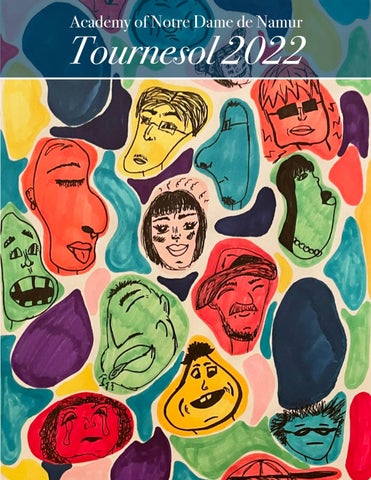
May 2022 Academy of Notre Dame de Namur 560 Sproul Road Villanova PA 19085 Phone: 610.687.0650 Cover by Grace Cullen ‘24 Inside Cover by Gabi Abruzzo ‘26 Inside Cover Poem by Ava Trask ‘22 Back Cover by Amy White ‘22 Inside Back Cover by Maia Isabel Salas ‘23
Editor-in-Chief: Andrea Wat ’22 Editors: Sarah Deeney ’23 Lorna Petrizzo ’23 Toni Frank ’24 Kiley Rusak ’24
We feel privileged to present the 2022 Tournesol, which we have compiled and edited assiduously. The works we received this year are nothing short of stirring. The pieces relay various narratives that reflect the creativity, voice, and lived experiences of our school community members. Thus, there should be something for everyone, so to speak, but they all align with our selected motif: the facilitation of a change from darkness to lightness. It parallels the process of returning to “lighter” days that offer more personal interactions, more laughter, and more creativity, which we can appreciate now more than ever. Though life may bring us pain, grief, and frustration, we can also find solace in knowing that life is constantly in motion, and it brings us moments of peace, hope, and contentment. The motif is writ large in our daily conversation and correspondence. In a sense, designating this as our theme is meant to establish the necessity of art in one’s life in the same way that daily conversation must exist in one’s life. So then, to all who take pleasure in the “quotidian sublime,” a phrase used by our featured interviewee Airea D. Matthews, this publication should quench that nearly unslakable desire.
Bridget Fahey ’25
Table of Contents Defining Loss
Ava Trask ’22
Dear Mr. Malcolm X
1
Emma Oyakhire ’22
Teenage Dream
2
Celeste Giangiulio ’24
I Watched Us Grow Apart
3
Lila McCormick ’27
A Lesson in Time
4
Maddie Frank ’22
The Salesman
9
Evelyn Stauffer ’24
Tayta’s Knees
11
Charlotte Lignowski ’22
Essay on the Breadwinner
16
Mallory DuBois ’28
Wolves
18
Kiley Rusack ’24
Excerpt from The Fireflies’ Observer
21
Lorna Petrizzo ’23
Fine China
22
Grace Yacobe ’25
Taxes Unfair! We Have a Solution!
24
Lauren Ruck ’24 & Marianna Pilacik ’24
Glazed Ginger
26
Molly Taft ’24
Schopenhauer the Curmudgeon and Female Socialization
27
Sarah Deeney ’23
Mr. Darcy
34
Grace Yacobe ’25
An Ode to Spring Rolls
35
Lindsay McBride ’23
As I Walked Through
37
Alexis Hutchinson ’27
Ava
38
Amy White ’22
Heaven
38
Amy White ’22
Mirror
38
Amy White ’22
Divine
38
Amy White ’22
Bella Vista
39
Kiley Rusack ’24
I am in Love with Life
40
Ava Trask ’22
Scholastic Gold Key Winner
Dear Mr. Malcolm X By: Emma Oyakhire ’22 Temples across the country emerged As you became the spokesperson for the Nation of Islam Seeking the beheading of inequality
Kendall Mattson ’23
Beliefs that separation from the oppressor and civil rights inhabited a utopia for the Black community Propelled itself to the front of your brain While others viewed it as a dystopia Today, they believe that everything is not about race. And they are right, everything is not about race, but everything is about equality. Equality for others is not oppression for them. To be unaware of how race shapes inequality is to consume the fear of being wrong. Consequently, that fear of being wrong will destroy us all. You possessed the power of knowing who you are and what you believed in Knowing we can not have freedom peacefully if the people refuting our freedom are not peaceful. In the presence of today, Where the violence in your time mirrors the violence in mine, Is having hope that our voices will one day be heard before it is too late a naive dream? Would you still envision a day our cries will shower the dream of the oppressor relinquishing the torment of injustice rather than the oppressed having to demand it? Do you still believe salaam is possible? What kept you fighting even when the room went dark?
Teenage Dream Based on songs written by Taylor Swift
She walks in the party, she looks at her phone. Out with her friends, she’d much rather be alone. The idea of being lonely, but not that lonely feeling, “A dream,” she thinks as she stares at the ceiling. The purple LEDs have her lost in the light, Thinking about that very first night. He picked her up and they drove in the car, If only the relationship could’ve gone that far. She remembers the feeling from those familiar leather seats, Their love was hotter than the August heat. But the prejudice in this love affair broke the scale, In the end, it was just a twisted fairytale. Her short black dress no longer looks the same, Because there’s no association to his name. She still wears the necklace he gave, Though they went down faster than a burning flame. The loud music reminds her of him, That familiar song sounding much more grim. It was too good to be true, it felt like a dream… I guess the teenage dream is not what it seems. Written by: Celeste Giangiulio ’24
Emma Lange ’27
Grace Cullen ’24
Katie Hull ’23
Julia Youakim ’23
Lila McCormick ’27
Scholastic Award Winner
A Lesson on Time Maddie Frank ’22 It was 5:50 at night, and neither students nor sound occupied room 315. The classroom was a place of darkness, and I waited in the hallway in fear of disturbing the stillness and isolation that was unusual for the classroom on a Monday night. One by one students trickled into the class, and I had no choice but to leave the safety of the hallway to take my seat before it was time for Theology 1000: Faith, Reason, and Culture to begin. As the only high school student in a college class of mostly sophomores, I had immediately gravitated to the desk in the far right corner on my first day back in August. Upon settling myself into my own corner for Monday night class, I scrolled through Instagram as I waited for class to start. While I had made one friend in the class, I could not relate to the college student conversations around me about fall break trips. No one wants to hear that you spent “fall break” at high school each day. In my high school student in a college classroom induced isolation, I realized that while the darkness had dissipated with the flip of a switch, the silence remained. No professor had greeted me upon arrival, no music played from my professor’s Wake The **** Up playlist, and no lesson plan was introduced for the day. My professor was never late and never behind schedule, but room 315 remained without the presence of a teacher. When the clock hit 6:15, the students around me
Michaela McDougall ’24
discussed leaving class as our professor had yet to show. The high school student in me could not even fathom walking out of class because the teacher was late. Even with the knowledge that I am only two years younger than the rest of the students, I still felt out of place in my mindset, and it was particularly unpleasant to have another experience serve as a reminder of my isolation. When the clock hit 6:20, my professor walked into the classroom.
“My best friend just died. I just got a call on the way to class.” Everyone in the room froze. No one expected her to explain her lateness this way. Sitting down behind her desk, she wiped her tears and looked up at the class. She thanked everyone for remaining in class and explained that she was abandoning the entire lesson plan for today on the declaration that she had something more important to teach us about the real world. “Hug the people you love. Call the people you love.
McKenna Davis ’23
Reach out to those who matter to you. Life can take anyone away, so hold those people close.” No one in the class spoke. The weight of her words were still settling into our minds as she put a movie on the screen. The movie gave her some time to cope with her new reality without needing to teach the rest of class. Evangelism in the early 2000s in America appeared on the screen as the documentary
Jesus Camp filled the room. My eyes were turned towards the screen, but my thoughts were not focused on if creationism deserved to be taught in public school education. My mind was fixated on my professor’s words. It only took one phone call to shatter her life. A life that must now exist without the presence of her best friend. We can lose anyone at any time. Every student in the classroom has someone we would call our friend and our family. All of us could be in our professor’s position on any given day. All of us could miss a final opportunity to tell someone we loved them, and many of us have already missed the opportunity to say goodbye to someone we love. I know I can say that I missed the chance to say a final I love you to my great grandfather before he died.
Victoria Hiscott ’23
Looking around, I was not the only student that seemed to be looking at the screen with a mind miles away from Jesus Camp. Eyes around me stared off into space or stared at the screen not truly taking in the documentary in front of us. Every class I have felt isolated from my classmates. Each class I have felt out of place like I was playing the role of a college student just to be picked up by mom to return home. For the first time in class, I did not feel alone, isolated, or out of place.
Kendall Mattson ’23
Every student felt the weight of the fragility of life. We might all have different backgrounds and experiences, but we all share the fear of losing the ones we love or missing that final goodbye. As the students in my class walked out of the classroom that night, no one joked in the hallway about time moving slowly during class. How could we wish for time to move faster when we needed those moments to hold tight to the ones we love?
Hope Wenzel ‘23
Amy White ’22 Scholastic Art Winner
Talia Cherry ’24
Andrea Wat ’22
Kendall Mattson ’23
The Salesman Evelyn Stauffer ’24 A man raps on the door with a gleaming smile His suit is well kept, but not the newest style While his teeth are blinding his eyes are dim, He is cleanly shaven with a cleft chin. He straightens out and starts to begin his spiel, As he drones on and on about “Oh what a deal… Oh what a deal, this you can’t miss out on, An insurance bargain that will soon be gone. It's not everyday that your home can be protected For the price of half of what is to be expected
Kendall Mattson ’23
I would get in trouble if my boss knew what I was tellin you But you seem like a nice guy and I just knew, I Knew that a guy like you could use a break And that you need some help, not just for your sake But think of the kids, you just want to play Who if something goes awry, YOU’D have to pay But my business model is plain and simple… As he drones on you notice his forced dimple And the look in his eyes that see you as dumb You decide you might as well have some fun. What's your name, I have to commend you It's not everyday that I meet a guy who, Knocks on the door of the nicest man in town Who loves to feel safe and won’t let you down,
Amy White ’22
I’ll buy the largest bundle and them some, Just give me a minute to grab my pen from The next room over it will just be a minute, Just think of the check you will be getting, why I bet it will reach my limit, As the man stands at the door in anticipation, You take a stand at the window, that will be your station. The spot where you can stand and watch his heart shatter, As he realizes you will not be the reason he can put food on his platter.
Shelby Parker ’26
Scholastic Award Winner
Tayta’s Knees Charlotte Lignowski ’22 “You’re not doing it correctly, Celina,” Tayta told me. “I’m just sweeping. How can I be doing that wrong?” I asked. Tayta grabbed the wooden broom from my hand before adjusting her hijab. “Because you’re using it as if you were defending yourself in a jihad, Celina.” I watched as Tayta swept over the areas of the floor I had already done and I realized that maybe she was right. Tayta’s strokes were quick, yet gentle while mine were jerky and caused the dust to fly rather than condense into neat little piles. One can only watch another sweep for so long, however, and my mind soon began to wander in it’s typical fashion. Tomorrow was Laylat al-Qadr. I was very excited, but also quite worried as I was unsure of what my good deed was going to be. My thoughts were interrupted by the faint sound of Tayta’s stomach growling due to sawm. I tried to stifle a giggle, and Tayta glared at me. “Sorry,” I whispered, looking at the ground and hoping I wouldn’t have to read the Surah in silence as punishment. Luckily for me, Tayta resumed her sweeping. “What were you thinking about, Celina?” I looked up at Tayta. “I know you were thinking about something, silly girl,” she continued, “You had that look on your face.” I sighed. Tayta knew me much too well. Sometimes Ella Shaak ’26
even better than I knew myself.
“I don’t know what my good deed will be for tomorrow, Tayta,” I said, my eyes meeting her warm brown ones. “We will give zakat by donating money.” “But that’s what we do every year,” I whined, “I want to do something bigger.” Tayta stopped sweeping and leaned on the broom. “Celina,” she said with a sigh, “It is not the size of the deed that makes it worthy in Allah’s eyes, but rather the thought that comes with it.” Her voice had that usual hint of finality, signaling to me our conversation would go no further.
I slid off my stool just as the clock in the hall began to strike. Tayta handed me the broom and began walking away as quickly as her aching knees allowed her. Tayta’s knees not only prohibited her from being as nimble on her feet as she used to be, but they also kept her from going to the masjid to recite her daily prayers. Her salat was instead spoken at home, in a small and quiet corner of the living room that she made sure was clean each morning before performing her wudu. I decided to go to the park after returning the broom to its rightful spot and as I closed the door behind me, I could hear Tayta reciting the shahada. “La ilaha illallah wa muhammad rasulullah,” she said. Her voice was calm despite the fact I knew she wished more than anything she was able to go to the masjid.
Bridget McTear ’23
Ellen Shank ’22
Nieve Morrison ’28
While I was walking in the park, I saw something shiny in the grass and at a closer look realized it was a golden oil lamp. I picked it up and turned it over in my hands, admiring the way it caught the sun and released it again. The details were delicate, most likely done by hand, and the gold was clean. Well, mostly clean aside from one small smudge of dirt. I tried using my sleeve to wipe it off, and the lamp began to shake, causing me to drop it. The lamp clattered to the ground as a green fog spiraled out of it. Now floating before me was a being I had only heard of in stories from Tayta. “Salaam!” the genie’s voice boomed. “Salaam, my master -” then he stopped. “Hey, kid, you’re not my master.” His skin was a pale green color and he wore a gold vest and belt to match. Mesmerized, I could barely manage to speak. “Uhhh...no, I’m not. I’m Celina.” “Well where’s my master?” “How am I supposed to know?” I said, shrugging my shoulders. “Because you have his lamp,” the genie replied. Neither of us spoke for a moment. I thought it would probably be best not to mention to him that I had found said lamp lying on the side of a park’s pathway. “Does this mean I’m your new master?”
Victoria Hiscott ’23
Lucy Hughes ’23
“I guess so, kid, except my old master never got his last wish, and I can’t just start over.” My eyes grew wide and a smile spread across my face. “So I get an extra wish?” “Uh…no,” the genie said, crossing his arms. Upon seeing my disappointment he added with a sigh, “But I suppose I can give you the last of his three.” “Really?” I took a step closer and he nodded. My mind then began to fill with everything that I could wish for. Perhaps a pony. I remembered last year when Tayta took me to a fair where there were games, prizes, food, and a beautiful pony. It was grey, dappled with white, and I wanted more than anything for the animal to be mine. I would have taken the pony for a ride, but Tayta and I had to leave because her knees had been bothering her too much. Although, wishing for a pony was most likely not the best idea. After all, I didn’t want just any old pony, I wanted the little grey one from the fair. And besides, I know Tayta would never approve of a pony sitting in our backyard. Maybe a baby sister instead. Some of my friends at school had baby sisters
Talia Scarpa ’24
and they told me how much fun they are to play with, to dress up, and to talk to. Yet, they also told me how much baby sisters smell, and cry, and scream, and…no. I definitely did not want a baby sister. Tayta had enough trouble taking care of me with her poor knees as it was. The last thing she needed was another little me running around the house. The genie’s loud voice snapped me out of my daydreams. “Kid, what’s taking so long? I don’t have all day.” “Hang on,” I told him, “Don’t rush me.” I continued to think, yet with every good idea I came up with, I also thought of a reason why I shouldn’t wish for it. There was one idea that came to mind, however, that only seemed better the more I thought about it. This wish of mine would make me happy, and someone I loved even happier. It was still a day early, but perhaps Allah would make an exception for this good deed of mine. Taking a deep breath, I spoke my wish aloud. “I wish my Tayta’s knees didn’t ache anymore. Not at all and never again.” I beamed from ear to ear and the genie stared at me.
“That’s it? You do realize I’m not giving you any more wishes after this, right, kid?” I nodded and he shook his head before snapping his fingers. “Well, there you go,” he said and I thanked him, watching as he spiraled back down into the golden lamp. Just as I bent down to pick up the lamp again, it faded away. Gone forever. I began walking home. Despite the disappearance of the stunning lamp, a smile was on my face because I knew how much better my Tayta’s life would now be. Her work around the house and caring for me
Andrea Wat ’22
would be much easier. She would finally be able to go to the masjid to recite her salat just as she had always done and longed for more than anything. Now that Tayta’s knees would no longer ache, we could take walks in the park together, and maybe even go back to that fair and find the gorgeous pony again… I opened the door to my house and hoped Tayta had finished saying her salat. “Tayta?” I waited for a response. “Tayta, I’m home.” I closed the door behind me as I walked inside. Then, there was the faint sound of Tayta’s voice, still reciting, yet I could tell by the words she was coming close to the end. I went into the kitchen, sat at the table, and waited for Tayta. A few moments later, I heard: “Celina? Where did you go, you silly girl?” “I’m in the kitchen, Tayta!” I tried not to giggle as she walked in, a
Bridget McTear ’23
quizzical look on her face. She stopped in the doorway. “What’s wrong, Tayta?” I asked. “Nothing, Celina. It’s just that my knees feel…” “They hurt?” I asked, holding back a smile. “Well, I guess that’s the problem. No, they don’t hurt.” My Tayta furrowed her eyebrows and looked down at her knees. She took a few steps forward, then backwards. “The strangest thing. They were awful earlier today, but now…” She continued walking around the kitchen, bending her knees every which way. She was chuckling and I soon noticed the gloss of tears that covered her eyes. “Tayta,” I stood up. “Tayta, why are you crying?” Tayta wiped her eyes with the sleeve of her dress. “Oh Celina, I have just gotten so used to my poor, old knees, that I forgot what it felt like for them to be…to be normal. I mean, I practically feel good as new.” I
Avery Holzer ’28
walked over to my Tayta who was still crying and wrapped my arms around her legs.
She placed a hand on the top of my head and whispered to me: “Do you know, Celina, how long I have asked Allah to make me feel brand new?” I nodded. “Yes, Tayta. I know.” I debated whether I should tell my Tayta then and there that it was I who had met a genie and wished for her knees to ache no more. I was the one who had blessed her in this way and brought her such happiness. I decided not to though. Not only did I realize that Tayta would most likely not believe a story like that, but I now understood that we do not do good deeds for the sake of praise and acknowledgement, rather, we do them for the sake of others. We do good deeds to make a small difference for a person, to make someone smile. Was that not what my original intention had been when I had made my wish? All I had really wanted was to give back to my Tayta for all she has done for me. “Tayta,” I said. “Yes, silly girl?” Tayta ruffled my hair. “I just wanted to say that I love you.” I looked up at my beautiful Tayta, my arms still hugging her legs. She looked down at me, the joyful tears staining her withered cheeks and her thin lips forming a lovely smile. “And I love you,” she said. “I love you very, very much.”
Alyssa Meakim ’25
Essay on the Breadwinner Mallory DuBois ’28 Excerpt from Mallory’s Essay about the book Breadwinner by Deborah Ellis and overcoming fear and intimidation. Malala Yousafzai once said, “I am stronger than fear.” This quote shows that people can overcome fears and struggles in life. In the historical fiction novel Breadwinner by Deborah Ellis, the Taliban ruled over Afghanistan in the 1990’s. Due to the harsh Taliban government, women were not allowed outside of their homes without being accompanied by a man. Parvana, an eleven year old girl, learns to be stronger than her fear of the Taliban. At the time, her father was in jail, her older brother was dead, and her younger brother was too young to accompany her outside of her house. Her family was stuck in a one room flat because the bombs had destroyed their previous home. Parvana preserveres when she cuts her hair to look like a boy, and she shows strength when she goes out of the house to buy food to support her family without a man accompanying her. Her actions show that she is stronger than her fear of the Taliban, and that she is intelligent and courageous.
Ellen Shank ’22
Scarlett Hart ’23
art ’23 h n r a B Rylee
Bryanna Young ’24
y ’24
Cherr Talia
Scarlett Hart ’23
Wolves By: Kiley Rusak ’24 We’re savage beasts, we hunt and we kill With immeasurable amounts of blood that we spill We prey on the innocent, attack the unguarded It’s all fun in games, we laughed as they darted Hidden in shadows, our prey unsuspecting They’re unprotected, let us attack, like lightning They are in pain, crying out to cold ears Like we would care, we feast on their fears But wait, what if we were to get caught? Just kidding! Who cares about a wolf. Isn’t it illegal? Not anymore! They aren’t protected, for that we are sure! They’re barely endangered anymore, can’t you see? They’re beasts anyways, need to be brought to their knees Though they are innocent and even kind I’ll, for my own benefit, call them a fiend I’ll use their image to sell hunting rifles Why would I care whose life I could stifle That is the way of my business you see I call innocents monsters, more money for me.
“Wolf” -Kiley Rusak ’24
Amy White ’22
Kiley Rusak ’24
Nieve Morrison ’28
Charlotte Lignowski ’22
Excerpt from The Fireflies’ Observer By: Lorna Petrizzo ’23 I strayed from the beaten path late one night And when I thought all was lost there was a flash of a neon light I chased after it hysterically And pushed myself through the foliage desperately At last I fell through a barrier of brambles and trees When I saw no bonfire I wondered what I did to deserve this disease Like rain my tears fell silently to the ground Angrily the grass my fists did pound But then something made me look up to the sky And my breathing went awry The last of my tears fell And like that I was under awe's mystic spell Though the pain I felt was intense The fireflies' elegance and glamor was more immense People don't slow down enough to see The splendor of the world made for you and me
“Ambitious Wanderer” - Kiley Rusak ’24
Fine China By: Grace Yacobe ’25
Oh how I wish I was used like the rest, With a brave lion on my crest. A lot less blue, Maybe even forged of bamboo. Oh those plastic plates, Cleaning up after all those ridiculous dates. I promise I will love you more, To clean me will not be a difficult chore. Why is my blue plate on show, With swirls of white that remind you of powdery snow? Have I done something wrong, Do my colorful swirls interpret a different folk song? Why would you work after hours to buy me, If you won’t even serve me with chai tea? I promise I am not fragile and will not break, Just at least serve me with your favorite cheesecake. I am trapped in a cupboard with no key, My face turned towards a window facing the sea. Please if you are worried that I might endure cracks, I believe as though they explain my life as a movie finally hitting its climax. I loathe this life that you have given me, That ends with my life recycled in the sea. I would rather be shattered across the kitchen floor, Then stay another year behind this god-forsaken door. Artwork: Ellen Shank ’22
Marli Dorn ’22
Ellen Shank ’22
Amy White ’22 Scholastic Art Winner
Lorna Petrizzo ’23
Taxes Unfair? We Have a Solution! Lauren Ruck ’24 and Marianna Pilacik ’24 There are many problems happening in our country today, but a major concern that needs to be addressed is that taxes are not equitable to each level of income. The working class is being forced to give up too much of their income to sustain proper living. With every debate on how to fix this problem, there has been no one, clear answer that will solve the problem in its entirety. Until now. What we’re about to say may shock you, it may even terrify you, but the only real way to stop the government from taking too much money is to commit tax fraud. It’s as simple as that, don’t pay your taxes. Now, you might be thinking, won’t this just make everyone a criminal? The answer is yes! The exception is that if everyone is a criminal, no one is a criminal. There would be no society to run and no one to deal with the consequences of everyone corrupting taxes. You may be concerned that the IRS is just going to find you and throw you in jail. Well, that is a small possibility, but the IRS cannot incarcerate everyone. There are around 329.5 million people living in the United States, and taking out the number of children who don't pay taxes, it would be a total of 256.5 million people paying taxes every year. Now, once you commit tax fraud, the IRS comes into play to punish your actions. That means if the IRS wants to be successful, they have to find roughly 85.5 million people per year, which comes down to them having to locate and detain about 234,247 people per day. That is impractical and impossible. With all of this math involved, the IRS must track down 3 tax evaders per second.
Talia Cherry ’24
Scarlett Hart ’23
Lorna Petrizzo ’23
Daily IRS employees would easily fall behind in work to meet their quota; they would not be able to find so many people per day due to bathroom breaks and lunch breaks. These interruptions risk them losing about 3,960 people per break. The employees’ bosses will become understandably frustrated, the employees will be sick of their boss’ attitude, and they will ultimately quit their job; now they too join the game of survivor. So, tax season comes and goes and you didn’t do your taxes. That’s perfectly fine! Now the games begin. You only need to keep avoiding the IRS for three years. The easiest way to survive is to cover up your tracks and go off the grid. It truly is fairly simple and it will not last forever. Eventually the IRS will lose, but in the meantime they will be able to catch a handful of people. However, we are not worrying about them; we’re worrying about you. This is everyone for themself. You take care of yourself and only yourself and you’ll make it out ok. The IRS will seize those who don’t know how to survive on their own. So in the process of tax evasion, you are helping to grow a smarter, more agile population, and who doesn’t want that? Although this plan can be seen as full proof, it is understandable that people will not approve of this plan. There are going to be people who are too scared to break the law. These people are the ones who have worked hard for their whole life and don’t want to ruin it. These people are obviously the weak ones and don't know how to defend themselves (such disappointments). You have to realize that if we do not do something about the inequitable taxes, then your hard work will be put to waste, going back to where you started. If you join in on this nationwide scandal, you will be protecting your worth, dignity, and future. This plan only works if we each do our part, so once again we urge you to commit tax fraud! Spread equality and leave us with a superior population.
Glazed Ginger Molly Taft ’24 PPU3-13D Swirling caramel covers my walls Oh what a dream it would be To watch an acorn as it falls From a Glazed Ginger colored tree In October the world stands suddenly still And the ground crunches under your feet While the house smells like chai and the air has a chill And the geese fly down south in their staminous fleet I recall the color given to me PPU3-13D
Marli Dorn ’22
Schopenhauer the Curmudgeon and Female Socialization Sarah Deeney ’23 Airea D. Matthews is the Assistant Professor of Creative Writing and co-director of the Creative Writing Program at Bryn Mawr College as well as the 2022-2023 Poet Laureate of Philadelphia. I met with Matthews on the 16th of April, the Saturday before Easter, to discuss Simulacra (2017), its genesis, and its afflatus. The following is an excerpt from our conversation.
First, please state your full name. Airea Dee Matthews And is there any significance to where your name comes from? Yes, so odd story: my mother swiped my name from someone who would’ve been my godmother. My godmother apparently had a still born and she was going to name the child Airea, but then my mother - I think my mother and she were pregnant at the same time - named me after my godmother’s stillborn daughter.
Were you close with your godmother at all? I never met her actually - I think the name thing was a bridge too far for their friendship. It evaporated! I’m asking about your name because I think titles and names are important within hyperreality and simulacra, so I wanted to talk about the title of your work, Simulacra. It is in reference to Jean Baudrillard. It refers to, of course, imitations that fail to make reference to the original, or representations of representations. Broadly, I think that the title explains that the work is an investigation of and in support of how simulacrum is founded in a lot of human relationships and experiences, but I think you would probably be able to provide a much more personal and interesting explanation.
I came across the title Simulacra because I was into Jean Baudrillard’s work. Jean was - I want to say more of a social theorist - and was thinking about the ways that society works. When you think about the simulacrum, it's kind of an imitation of an imitation, so things are never as they seem. When you think of examples of simulacra or simulacrum, Disney comes to mind; Disneyland is a type of simulacrum. It’s trying to imitate something that never was. It’s trying to imitate some degree of perfection that doesn’t really exist in the real world. When I think about simulacra, I also think quite a bit about mirrors. You know how you look in a mirror, but you can never see your true reflection unless you have a mirror reflecting back at you as you look at the mirror? When you see yourself in the mirror you actually need two mirrors in order to see yourself truly. When you’re facing one mirror, that’s actually just a projection of what you look like, but when you hold a mirror behind you and you look into that mirror, that’s actually what you probably look like. I started thinking about reflections of reflections, and how that creates a sort of echo in relationship to identity. A lot of how we form identity is based on what I call these kinds of enmeshed symbols that we see in society, like “oh, if I am this I am supposed to be this way,” and we create our own identity based on an imitation of something else. I kind of wanted to confront that, because for me it rings true and false at the same time. Yes, we create our identity based on some degree of mimicry, like what we see and we do - we see a performance of one kind of identity and then we then perform our own identity - but I do think that we have influences into that. For me, when I think about the influences that have impacted the way that I write, I think about writers like Baudrillard, who was making a commentary around social relationships, how we see ourselves relative to others. I saw a relationship for me with the poet Anne Sexton. I have battled with depression for very many years, so when I read Sexton, or Plath, or really almost any confessional poet, I saw in that some layer of mirroring, something on which I was reflecting back on myself.
An easy assumption is that all mirrors and all reflections are bad. You find comfort in Sexton, right, it’s not necessarily a wholly bad thing to have these mirrors. Right, it’s kind of like that it’s true but it’s also false. It’s not bad to have these mirrors. It’s actually not bad to have negative models, people who you admire but there’s still things that they’ve done that you don’t want to replicate. We can find those almost anywhere, we can find them in our families, or we can find them in our own actions, like in some previous iteration of me, I wouldn’t want to have been that person. Looking at Sexton, I love Sexton’s work, I love how Sexton works, I love her writing; I don’t want to end up like Sexton. Sexton killed herself in 1974 in a Red Charger in her garage. So I look at the fullness of the depiction, so I can see a clearer view of who I want to be and who I actually am. That makes a lot of sense. I was wondering, at what point in your writing did you decide on the title, was it at the beginning or towards the end? It was all the way at the end. I couldn’t think of a title. That book has had several titles over the years - a lot of them - and none of them really stuck because they didn’t feel like they were the right thing. I knew that I wanted to frame it around a theorist somehow, but I didn’t know what theorist, and I just had to come across Baudrillard to realize “oh yeah, this makes sense.” The title for me is the last thing - like the roof on the house. I almost always think of the title last. The title for my next book actually, one of my older sons came up with, because every title I came up with was insufficient for what I was trying to do. That’s true for individual poems, too: I’ll come up with the tile for an individual poem well after the poem is done.
That reminds me, I just read this morning that Nausea by Sartre had like, many, many titles before it was chosen. Exactly! So it’s probably a pretty common experience for writers. Yeah, exactly, it’s like you pick one title - and I always think a title initially is just a placeholder, it’s something you use so you can say you’re working against something. For my second book, the first title was called “Broke,” and then I thought, that’s not it, and then with the second title I thought, that’s not it either. They just hold the place - it gets back to your first question. The naming is important. You just put something there until you have a name. I stay open. I’m terrible at titles, quite frankly, it’s hard for me to name something a lot of times, so I almost always have to do it last. I know some people are really good at it and they can just come up with a name quickly, that’s just never been my ministry.
Lily Hahn ’23
Amy White ’22
Baudrillard believed that capitalist society is driven by consumerism, and I thought of that in connection to how our Want consumes ourselves, which you write about so frequently, with Narcissus and other allusions and characters. Although it’s not that important of a connection, I still find myself interested in it, and I think that has to do with what I was reading in your foreword by Carl Phillips, and he was discussing how present this is in your writing: as human beings, we really want answers; they give us more assurance in our intelligence, for one. So much of your writing is in the form of questions, and, for example, Anne Sexton presents responses that are not totally in continuation with the questions asked. I was thinking about how as a reader of poetry, the answer you are craving is the meaning of the work, so it works on so many levels. I was then thinking, it’s not just for readers; it can end up being very specific to women, because I think women often search for guidance out of fear. Essentially, I was wondering how you differentiate - and you do this through your writing the journey of experiencing want and experiencing simulacrum between women and men.
That’s a great question - I’m going to come to the question but I’m going to back up a little bit. I think that whenever I come to a poem, to get to the idea of questioning, and I think this is true for all poets, when I come to the page and think I have something I want to write, the thing that leads me to writing is a question. Everytime you’re writing you’re interrogating something, you’re asking a question either of the world around you, or of your interior landscape, or of the people around you. Poetry starts fundamentally with a question. There is a thing that the poet Keats talked about, something called negative capability. Negative capability, as it relates to poetry, is the ability to sit, and be uncomfortable, or to be conformable, with uncertainty. You don’t have this reaching back in a poem for answers, it’s just that you’re living the questions of the poem, so I think the difference between men and women would be the degree of comfort with living the question, and how comfortable are you with not coming to some resolution about a thing. Although I ask a lot of questions in Simulacra, I don’t necessarily answer any of them; it’s just me being unsure and uncertain, which is my predisposition in the world because I’m always asking questions: I’m interminably curious. I just want to always ask questions of things. I know it irritates people and I’m never doing it in a way in which I’m trying to second guess someone else, I’m just trying to ask. I think much of it has to do with how comfortable you are with the question of desire. Women, for the most part, have been socialized not to ask questions about desire. We’ve been socialized to be the object of desire, but never to question it. This is how we get into those weird societal norms about what beauty is and what desire is and what longing and what want are, and how it’s good for someone to want you. We’ve never really pushed back on it because we’ve been taught to be the object of desire. Western men have been taught to engage desire, to express desire. Women have not been socialized to express desire in that same way; we’ve been socialized to express it in different ways, more socially acceptable ways. I think those would be the two differences you would see as it relates to desire, a lot of it has to do with socialization. The mere fact that you have a woman who is asking questions that are not necessarily polite questions around desire is a form - and I didn’t know this until you just asked this question actually so now I’m very excited about it - of rebellion. Yes, yeah. Much of Simulacra circles around this idea of rebellion; I never put it together until you just said it, but it does, it circles around this question of how do we approach desire, and how are we allowed to, and how do we buck the tradition and the societal norms and start asking about our own objectivity, how we’re objectified, and how we begin to talk about desire, and that it’s ok; it’s an ok topic.
Continued on 32
6 Shelby Parker ’2 “Star Crossed Lovers in Romeo and Juliet”
37
Yeah, exactly. And one of the things you had mentioned towards the beginning of your response, talking about negative capability and the poet asking questions and such, it made me think, I had read that one critique of Baudrillard is that he did not present a conclusive solution or case for fighting to maintain reason as reflections of reflections become all we know, and it made me think about how the theorist has a lot more expectations put upon them to come up with solutions. I think this type of questioning without resolution ends up being a really good responsibility for the poet to take on because the poet has more in common with a commentator than a diplomat, a theorist is not necessarily the same. Absolutely, that is absolutely true. We look to theorists in the same way we look to theories, we’re looking for solutions, looking for possibilities. We don’t necessarily come to poetry looking for solutions. We come to poetry looking for language, we come to poetry looking for a type of beauty, or we come to poetry looking for the same kind of questions that we’re asking. As I was thinking about that point I was wondering if there were any limitations to your creativity that you encounter when you’re trying to incorporate theory, or does it feel a lot more natural? I think for me it feels so natural because I read a lot of theory, and I read it but I don’t say that I read it and understand it. I read it because I’m curious, and I want to understand it. So when I riff off of theory, I feel freedom in poetry to riff off it according to my own understanding of it, if that makes sense. I don’t feel like I have to enter into theory as a scholar, I can just enter into theory as a questioner, someone who just has some questions about it and who wants to frame their questions around theory, which is kind of my thing. I’ve really done it in the first book, the second book isn’t out yet but it will be out next summer, it’s really doing the same thing where I’m just using theory to frame these larger questions that I have. It’s not necessarily to poke holes into the theories; they’re just theorists that I find interesting. I find Baudrillard interesting for the same reason I find Arthur Schopenhauer interesting. Schopenhauer was a philosopher. They’re curmudgeonly; it’s fascinating to me. Something that is inherent in their exposition, or expository writing, that has the undergirding of a curmudgeon. When I think about curmudgeons I think about grandpas, like the time-weary grandpa who’s like “mra ra ra!” I think they actually have a lot of wisdom, you know? Schopenhauer talked in one of his essays about reading: he said that when you read, it’s not necessarily important to move from one thing to another, it’s important to let some of the knowledge of the reading sink in. He used the analogy of a bed with a spring, where you don’t want to come off of the book and spring back up, you want some of it to sink in a little bit, you want to make sure that you understand what it is that you’re reading. That helped me and gave me some permissions because I thought oh, I write into my own understanding. As I said earlier, I don’t write into “the” understanding of a theory, I write into my own understanding of it. That has freed me in ways that I can’t even express to dip into theory and continue to dip into theory. These guys are really interesting, they’re really fascinating. They tend to write a lot because, I don’t know why, but they live long. God bless them!
“Night in the Forest”
by Kiley Rusak ’24
Shelby McG
owan ’27
Mr. Darcy Grace Yacobe ’25 I never worry and I’m never blue, Even if I know I’ll never have you. Your heart is yours to give away, And once again it is not my day. And it hurts so bad, but I’m okay, I’ll just keep telling myself that it’s better this way. Don’t you ever forget,
Nieve Morrison ’28
But this is not a threat. I will never get down, Even if it’s impossible to find love in this godforsaken town.
Your honesty and virtue shine, Although I hoped you would be mine. But I never worry and I’m never blue, I can just hide away my love for you. Life is as you perceive it, so I’m happy if you believe it. I’ll stay in Pemberley, And keep you in my memories. Please don’t forget about me, I’ll be waiting beside our favorite oak tree. My darling Elizabeth,
Andrea Wat ’22
I vow to be with you until your death.
Scholastic Silver Key Award Winner
An Ode to Spring Rolls Lindsay McBride ’23 The styrofoam container creaks as I carefully open its crinkled foam jaws. Unclasping its folded closure reveals the beautiful wraps, crisp and brown from their warm bath in a pool of fragrant oil. Rather than the boring water we bathe ourselves in each day, I’d much prefer to be where the spring rolls are. Wrapped tightly, the entirety and whole existence of the spring roll evokes peace: a soft savoriness, enough to satiate but not to overwhelm. A single bite is enough to infuse a mouth with flavor and delight, and remind that perhaps something is good in the world. For costing mere dollars, the spring rolls are worth more than they charge. Although my ancestors couldn’t ascribe their roots to Vietnam, the spring rolls from the nearby Vietnamese restaurant aren’t selective about where their consumers originate. They are eager to be unwrapped, cherished, and appreciated for their culinary value. It’d be wonderful if spring rolls could be the currency of the world, but inflation would make them too big to eat. That’s boring, though; I much prefer the idea of an expanding, increasingly giant roll of tastiness. I met with two friends to catch up a few weeks before school began. We all made the fatal mistake of ordering the pumpkin pancakes, but maybe that’s what you get for thinking pumpkins will be ready in August. An older woman was sitting unaccompanied at a table, immersed in her newspaper and sipping a coffee. Both of my friends remarked how lonely and disheartening the sight of this solo woman was. Yet, the stimulation of hearing others gathered to eat — not having to partake in these interactions yourself — while hearing the perpetual background noise of your own mind, is a perfect combination to me. Although being alone is often looked upon as shameful or regrettable, I see no faults. When you grow up siblingless, the idea that you are your own best companion in life is just a fact, not anything to be embarrassed about. The image of this woman sitting alone immediately triggered my memory of the movie Up, a childhood classic etched into my brain — I cannot unsee Carl watching Ellie take her final breaths, each haggard inhale increasingly difficult and closer to becoming the last. Although Carl is depicted as a jaded, cranky elder, he is simply adjusting to a life devoid of love. Fulfilling Ellie’s wish, he finally visits Paradise Falls in Venezuela, precisely as she dreamed. Up runs out of screen time to include my favorite food, but spring rolls in Venezuela are called lumpia; they contain the same fillings, but with a modified wrapping. Able to be transplanted into any culture, spring rolls can find their way into the mouths and hearts of hungry children, mothers, and fathers wherever they are sent. Pristinely adaptable and universally enjoyable, spring rolls encompass a culture in one meal. They contain a region’s finest vegetables, most prized animal products, and highest quality grains. Although I rue the distant day where my sense of taste will slowly creep too far away from me, depriving my ability to explore cultures and countries in the way I love most, I can perpetually count on the crisp first bite of the spring roll. I can count on the distinct flavors to meld into one another while clinging to their flavor profiles, identically to the unique combination of experiences for each person who consumes it. And I can count on my fingers the number of times I will say no to a delicious spring roll: zero. Artwork by Nieve Morrison ’28
8 Peyton Clay ’2
Grace Galia ’24
Alexis Hutchinson ’27
Gabi Abruzzo ’26
Poems by Amy White ’22
Artwork by Marli Dorn ’22
Bella Vista Kiley Rusak ’24
Bella Vista, beautiful and pristine Calming, peaceful, and serene Brilliant blue of the Caribbean Ocean Indefinite the sound of waves in motion Pure, unadulterated, a work of beauty The luscious plants vibrant and fruity Oceanic beings swimming by listlessly Eating, sleeping, and playing blissfully Uncorrupted by surrounding stresses A place to wear beautiful, sunny dresses A place to destress, be calm, and relax A place to eat food, have drinks, and snacks Join me in viewing the beautiful scene The brilliant, spectacular Bella Vista marine
Celeste Giangiulio ’24
Ava Trask ’22
I am in Love with Life but he slowly descends with the fleeting twilight while the gentle colors of the sun rise. golden, amber, and scarlet gradients settle along the horizon as another chance is born. amidst all the beauty, he somehow manages to cradle my aging face with delicacy in his palms. it is a tender moment of bliss compared to the stinging poignancy of time. i feel selfish and greedy for keeping his light to myself, but i still don’t want him to leave. this moment is the epitome of perfection, but my soul still throbs in agony and my breath is caught in my throat. isn’t it funny how humans waver between absolute fulfillment and pure heartache? hums of acknowledgement leave me feeling so empty, but so content at the same time. when he lightly grazes my neck to feel the thrumming of my pulse for the last time, fire sparks in the depths of my heart. and only in that second, a human being, such as myself, will feel briefly alive.