Extreme Makeover: The Uniform Guidance – April 2024
NCURA Awards & Election Results
GREY AREAS
IN THIS ISSUE: As research administrators, we often joke that “It depends!” is the answer to every question we encounter, but that statement is based in truth. There are no black-or-white answers to many of the questions we face on a daily basis, and the ability to operate in the grey area is what makes research administrators invaluable resources. In this issue, we explore the grey area: the liminal space between yes and no, right and wrong.
Some grey areas in research administration are ever-present, especially those related to changing regulations and interactions with faculty. Katie Wood, Danielle Wheeler, and Amanda Hatcher explore their experiences learning to thrive in the grey while sharing the challenges they faced as they started new positions in different areas of research administration. Navigating these waters can be treacherous, but luckily our authors are here to help. Gil Tran and Mark Davis help demystify the recent changes to 2 CFR 200 in “Extreme Makeover: The Uniform Guidance–April 2024 Edition,” while Kay Gilstrap, Cara Dominick, and Robyn Remotigue explore the role of department administrators in helping faculty navigate uncertainty.
Other grey areas come from exploring new frontiers. The quest to harness the power of artificial intelligence and machine learning is expanding grey areas and prompting discussions about ethical use in many areas of research administration. In “Navigating the Grey: Balancing Research Compliance and Innovation,” Swapnali Chaudhari discusses how research compliance professionals are working to keep up with changes as faculty utilize AI more frequently in human subjects research. Ann Bell’s article, “Legal Constraints and Compliance Around Use of AI and the Role of PreAward Administrators as Stakeholders,” focuses on the grey areas pre-award administrators face while finding ways to utilize AI functionality in their jobs and providing guidance to faculty looking to incorporate AI in their proposal preparation process.
Whether the grey areas you face in your day-to-day work are new or familiar, we hope that our authors’ discussions of the various ways in which they navigate these grey areas can help you develop solutions that balance the needs of researchers with the compliance risks faced by our institutions. N
Kathleen Halley-Octa, MA, CRA is a Co-Editor for NCURA Magazine Magazine as serves as a Manager with Attain Partners. She has worked in research administration for more than a decade and has experience at both the central and departmental level. She can be reached at kmhalleyocta@attainpartners.com
African Center for Global Health and Social Transformation
Global - Asia Pacific
Bella Blaher
University of Melbourne
Global - Europe
Jérôme Rickmann
Aalto University
Nicolas Schulthess
Lucerne University of Applied Sciences and Arts
Global - Middle East
Kathleen Furr
Cornell University
EXECUTIVE
EDITOR
Marc Schiffman
NCURA
COPY
EDITORS
Beth Jager
Claremont McKenna College
Paulo Loonin
Duke University School of Medicine
Kelly Millsaps
University of North Georgia
Kasey Schubert
Tufts University
Global - U.S.
MC Gaisbauer
University of California, San Francisco
Christopher Medalis
School for International Training
Pre-Award
Bruxanne El-Kammash
University of Chicago
Katherine Kissmann
Texas A&M University
Predominantly Undergraduate Institutions
Michelle Gooding
Barry University
Shuna McMichael
Occidental College
Research Development
Camille Coley
University of San Francisco
Self-Care
Kristen Massey
University of Tennessee
Minessa Konecky
Minessa InK
Senior Administrator
Lisa Nichols
University of Michigan
Lindsey Spangler
Duke University School of Medicine
Spotlight on Research
Derek Brown
Stanford University
Systems/Data/Intelligence
Thomas Spencer
University of Texas Rio Grande Valley
Lisa Stroud
University of Florida
Training Tips
Abby Guillory
University of Texas Rio Grande Valley
Work Smart
Hagan Walker
Prisma Health
Young Professionals
Carol Bitzinger
Ohio State University
Katie Gomez
Southern Utah University
Dear Colleagues,
TMESSAGE FROM YOUR PRESIDENT
By Kris Monahan, NCURA President
he theme of this issue of the magazine is “grey areas,” pointing to the context-specific and complex questions that research administrators face. Research administrators must be highly skilled professionals who are solutionsoriented around highly complex matters, where each situation requires deep understanding of the individual circumstance. While this magazine theme focuses on “grey areas” of research administration, I am also struck by the “greying” of the research administration workforce and the need for NCURA to continue to create pathways and pipelines to this profession.
I have been reading reports about the “silver tsunami” and the “greying workforce.” I started receiving my own AARP publications a few years ago although I hardly see myself being anywhere close to retirement. The reports are mixed with some projecting a wave or tsunami of retirements and others predicting that the modern senior workforce is healthier and working much later than previous generations. The Bureau of Labor Statistics projects that more than one in five older adults will be in the labor force by 2032. It’s unclear how specifically this will impact high stress careers such as research administration which is why NCURA needs to plan for professional development for all parts of the pipeline. And, NCURA is doing just that!
NCURA offers student affiliate memberships, a young professionals program, and an emeritus membership. NCURA will continue to study and analyze the pipeline and industry trends to develop unique and distinct membership value for members at all stages of the research administration career. Demographics are evolving and changing and the world in which we work is moving at lightning speed with accelerated technology.
Rest assured that the NCURA Board, leadership, standing and select committees are actively and intentionally strategically thinking and planning about how to support research administrators at every
“NCURA will continue to study and analyze the pipeline and industry trends to develop unique and distinct membership value.”
point in their career. As the demographics and workplace needs change, the professional development that is needed will continuously be refreshed with dynamic content and delivery approaches to meet the needs of all our members.
All the best,
Kris A. Monahan, PhD, is the 2024 NCURA President and serves as Senior Director, Sponsored Projects and Research Compliance at Providence College. She can be reached at kmonaha6@providence.edu.
Working with Faculty in the Grey Areas
By Kay Gilstrap, Cara Dominick, and Robyn Remotigue
Departmental Research Administrators (DRAs) are typically the bridge between all things research administration and researchers. Regarding the grey areas, DRAs often find themselves as interpreters, protectors, or advocates. Navigating grey areas requires effective communication, collaboration, and interpretation of institutional policies and vague regulations. It involves working closely with faculty members, administrators, and other stakeholders to find mutually acceptable solutions that uphold the integrity of the research enterprise.
One challenge for DRAs is that regulations, whether at the national, state, or institutional level can change. Therefore, the DRA must know where to locate the most recent policies and procedures to support decisions. This is why training, effective communication, documentation, and more are essential for the DRA to manage the grey areas.
Below are some best practices to consider in addressing grey areas in research administration:
• Clear policies and procedures
• Training and education
• Effective communication
It is essential to develop clear policies and procedures, including comprehensive policies that clearly define expectations, roles, and responsibilities. For example, in the pre-award process, it is helpful to have a roles and responsibilities checklist to provide to the faculty. Such a checklist provides a clear expectation about the researcher’s responsibilities and where the DRA will assist.
Providing regular training and education opportunities for all stakeholders involved in research administration is essential. It is necessary to offer training sessions to explain policies and procedures and current updates
that cover topics such as conflict of interest, research ethics, and regulatory compliance.
Effective communication is a part of the process in all these best practices. It is essential to foster open lines of communication among faculty, DRAs, and institutional regulatory compliance. Maintaining open and transparent communication is a proactive approach to identifying any potential issues that can be solved before they escalate into significant problems. Clear communication with faculty ensures they are fully aware of compliance and ethics standards so they can adhere to them. It helps to maintain research integrity and protects all those involved. Effective communication fosters a collaborative environment to provide the necessary support and guidance.
When involved with the day-to-day management of awards for researchers, the DRA encounters the grey areas almost daily, especially with purchases. Although we have Uniform Guidance, agency guidelines, award terms and conditions, institutional policies, etc. to guide us in determining allowability, many areas could be improved. When confronted with a questionable purchase, after reviewing all guidance available, the best way to determine whether a purchase is allowable if the guidance does not contain the answer is to ask questions. We recommend you ask: “How does it benefit the project and only that project you want to charge it to? When will it be used? Is the purchase within 90 days of the award term date?” The answers to these questions should provide what is needed to make an informed decision. For example, a DRA receives a requisition with a list of items to purchase for a wet lab within the first six months of an award. The list includes six bottles of clear nail polish. The initial thought is that it is not allowable; however, the DRA asks, “How does the nail polish benefit the award?” The researcher responds, “We are using it to seal microscope slides. The nail polish is the same chemically as the sealant we would purchase from a scientific provider, but the nail polish is at least $10 cheaper
per bottle.” That is a reasonable justification that the DRA attaches to the requisition and approves.
Navigating the grey areas can be particularly challenging for a new DRA since the order of precedence could be more intuitive. If the institution has excellent training, it will be made aware of the federal, agency, state, and institutional guidelines and how to determine what is needed. With time and experience, the grey areas become more accessible. Cara Dominick, one of the co-authors and an early-career research administrator, would like to share her insights on the grey areas, aiming to assist newcomers to the profession:
“As a new departmental research administrator, I have been lucky to assist in pre- and post-award worlds. Working directly with faculty, some are seasoned grant recipients, while others look to me to guide them through the proposal process. I love the variety of experiences and opportunities to facilitate for each of my ‘clients.’ Regardless of a researcher's grant experience, common topics arise that require me to ask more questions and understand more fully what their project entails and how I can best present their proposal or request.
For example, sometimes travel for a conference is listed on the budget. However, the budget justification or scope of work states that the conference is outside the provided budget period. The grant is about to expire, and the researchers would like to use the remaining travel funds for a conference outside the budget period. Both cases can be accommodated if the DRA works with the researcher to determine the appropriate budget period for the proposal or whether a no-cost extension should be requested to expand the project period to allow for the trip. If we, as DRA’s, do not pay close attention to those details, they may result in the disallowance of those expenses. Another common request is to reallocate budget funds. Even when the original budget is robust and detailed, circumstances can change significantly during the project period. Researchers may find remaining funds in one line item but need more funds in another. To facilitate, we need to
determine why they are not using their funds as intended initially or what has happened to change their fund focus so we can provide the appropriate information to the central office and the sponsor for approval. We need to understand what the new budget will look like and how the funds will be used to ensure they meet the sponsor's criteria for a budget.”
By recognizing and proactively addressing grey areas, DRAs can support the integrity and success of research activities while navigating the complex landscape of research administration. Further, when research administrators, whether departmental or not, work together, navigating grey areas becomes easier. N
Kay Gilstrap, Director of Research Services at Georgia State University, has 30+ years of experience as a research administrator, including being part of Georgia State’s research administration training program. She has served NCURA as Traveling Workshop Faculty, Financial Research Administration; Treasurer-Elect/Treasurer 2024; and is a graduate of NCURA’s Executive Leadership Program. She can be reached at kgilstrap@gsu.edu.
Cara Dominick, Grants & Contracts Officer for Georgia State's Andrew Young School, supports the Economics, Experimental Economics, and Social Work Departments. With a finance background, Cara manages research finances, ensures compliance, and facilitates initiatives. She is also a board member of Atlanta Angels Nonprofit and serves as President. She can be reached at cdominick1@gsu.edu.
Robyn Remotigue, Executive Director at the University of North Texas Health Science Center at Fort Worth's Research Services. She is currently the NCURA Vice Chair of Nominating & Leadership Development Committee and is a faculty member for NCURA's SPA II workshop, a peer reviewer, and Region V Mustang Mentoring Program Chair. She can be reached at robyn.remotigue@unthsc.edu.
Navigating the Grey: Balancing Research Compliance and Innovation
By Swapnali Chaudhari
AInnovation
Research Compliance
Artificial Intelligence (AI) is an emerging modality being utilized across different facets of research and related fields. It is becoming an increasingly fundamental component in various areas of health care, drug development, device monitoring, record keeping, and funding. There is much unknown about collecting, sorting, analyzing, and producing in the AI space. As research administrators, we face ambiguity in the use of AI in all fields of research, and the application of ethical concepts is very philosophical at this point. The application of artificial intelligence ranges from data collection and pattern recognition in healthcare to more complex tasks like predictive modeling and autonomous decision-making, to creating a platform to access federally funded research studies and reporting statistics on projects per institution, state, and current field-based trends.
rtificial Intelligence (AI) is an emerging modality being utilized across different facets of research and related fields. It is becoming an increasingly fundamental component in various areas of health care, drug development, device monitoring, record keeping, and funding. There is much unknown about collecting, sorting, analyzing, and producing in the AI space. As research administrators, we face ambiguity in the use of AI in all fields of research, and the application of ethical concepts is very philosophical at this point. The application of AI ranges from data collection and pattern recognition in healthcare to more complex tasks like predictive modeling and autonomous decision-making, to creating a platform to access federally funded research studies and reporting statistics on projects per institution, state, and current field-based trends.
One significant challenge is how researchers can ensure the ethical use of artificial intelligence in their research while pushing the boundaries of innovation. Due to the broad use of artificial intelligence, it is important that research administrators understand how data sourcing, privacy concerns, regulatory implications, and sponsor requirements intersect with emerging uses of AI. Understanding where, how, and what data AI sources is very crucial as there is a huge surge in data generation. Currently, data is sourced from numerous channels, including social media, open datasets, mobile de- vices, sensors, etc. Although the main concerns with AI use in research are still emerging, several risk factors are already evident. Firstly, privacy impli- cations arise from using sensitive data without proper consent and the po- tential of not adhering to the minimum necessary rule under HIPAA. Additionally, governance issues, security, privacy concerns, and reliability are top challenges to AI adoption in enterprises. As new AI models emerge and are utilized in research and healthcare, these issues become increasingly significant.
One significant challenge is how researchers can ensure the ethical use of AI in their research while pushing the boundaries of innovation. Due to the broad use of artificial intelligence, it is important that research administrators understand how data sourcing, privacy concerns, regulatory implications, and sponsor requirements intersect with emerging uses of AI. Understanding where, how, and what data AI sources is very crucial as there is a huge surge in data generation. Currently, data is sourced from numerous channels, including social media, open datasets, mobile devices, sensors, etc. Although the main concerns with AI use in research are still emerging, several risk factors are already evident. Firstly, privacy implications arise from using sensitive data without proper consent and the potential of not adhering to the minimum necessary rule under HIPAA. Additionally, governance issues, security, privacy concerns, and reliability are top challenges to AI adoption in enterprises. As new AI models emerge and are utilized in research and healthcare, these issues become increasingly significant.
While all stakeholders involved in a research project likely need training on ethical uses of AI, training research administrators and translating the information in lay terms to the other partnering units across the research enterprise will be vital for institutions who want to successfully utilize AI tools. Currently, sponsors rely heavily on PIs to disclose how and to what extent they have utilized AI during proposal development. Research administrators can play a vital role in closing this significant gap by understanding the limitations of ethical applications if adequate information is not provided.
communities due to the disclosure of specific characteristics associated with those groups. This harm can arise with the use of data sourced by AI without proper consent. For staff in regulatory offices like IRB, partnering with research administration specialists can help navigate through these grey areas and help approve sound research design, ensure ethical conduct of research, and protect the participants. For example, detailed information about how AI tools will be used must be provided in the documents submitted to the Institutional Review Board (IRB) and disclosed in consent documents so that research subjects are aware of how their data will be interfacing with AI.
Options for research administrators to get up to speed on AI applications in research and ethical implications:
due to the disclosure of specific characteristics associated with those groups. This harm can arise with the use of data sourced by AI without proper consent. For staff in regulatory offices like IRB, partnering with research administration specialists can help navigate through these grey areas and help approve sound research design, ensure ethical conduct of research, and protect the participants. For example, detailed information about how AI tools will be used must be provided in the documents submitted to the Institutional Review Board (IRB) and disclosed in consent documents so that research subjects are aware of how their data will be interfacing with AI. Options for research administrators to get up to speed on AI applications in research and ethical implications:
• Seek added coursework in our existing learning management systems, like CITI Program’s Essentials of Responsible AI or Technology, Ethics, and Regulations courses
• Seek added coursework in our existing learning management systems, like CITI Program’s Essentials of Responsible AI or Technology, Ethics, and Regulations courses
• Enroll in training offered by professional organizations like NCURA’s AI Symposium or NCURA Online Learning: AI in Research Administration: Unlocking Efficiency and Innovation
• Enroll in training offered by professional organizations like NCURA’s AI Symposium or NCURA Online Learning: AI in Research Administration: Unlocking Efficiency and Innovation
• Utilize resources provided by federal agencies, like the FDA’s “Artificial Intelligence and Machine Learning in Software as a Medical Device” or NIH’s “Artificial Intelligence at the NIH”
• Utilize resources provided by federal agencies, like the FDA’s “Artificial Intelligence and Machine Learning in Software as a Medical Device” or NIH’s “Artificial Intelligence at the NIH”
While all stakeholders involved in a research project likely need training on ethical uses of AI, training research administrators and translating the information in lay terms to the other partnering units across the research enterprise will be vital for institutions who want to successfully utilize AI tools. Currently, sponsors rely heavily on PIs to disclose how and to what extent they have utilized AI during proposal development. Research administrators can play a vital role in closing this significant gap by understanding the limitations of ethical applications if adequate information is not provided. There are compliance concerns about the use of AI in research, particularly regarding the potential risk of harm to subsets of individuals or communities
There are compliance concerns about the use of AI in research, particularly regarding the potential risk of harm to subsets of individuals or
AI will gradually become embedded in all areas of research due to its broad potential for use across disciplines and the constant evolution of technology. However, universities and federal agencies alike are actively providing resources and training to support research administrators in understanding and managing the use and growth of AI in research. As research administrators, we are not alone in this journey. We have the support and guidance we need to seek training and illuminate the delicate balance between technological progress, advancing science, and ethical responsibility. N
AI will gradually become embedded in all areas of research due to its broad potential for use across disciplines and the constant evolution of technology. However, universities and federal agencies alike are actively providing resources and training to support research administrators in understanding and managing the use and growth of AI in research. As research administrators, we are not alone in this journey. We have the support and guidance we need to seek training and illuminate the delicate balance between technological progress, advancing science, and ethical responsibility. N
Swapnali Chaudhari, MBBS, MS, CRC/CRA, [she/her/hers] is the Director of Rutgers’ Institutional Review Board/Human Research Protection Program. With over a decade of experience in the medical research community, her career encompasses extensive reviews of new studies, clinical trials, and regulatory compliance, coupled with a medical background as a physician in New Mumbai, India. She can be reached at swapnali.chaudhari@rutgers.edu.
2024 NCURA Election Results
Shannon Sutton, Director, Sponsored Programs, Western Illinois University, has been elected to the position of Vice President/President-Elect of NCURA. As an involved NCURA member for more than 20 years Shannon has served as NCURA Treasurer, on the Board of Directors, as Chair of the Nominating & Leadership Development Committee, and Chair of the Financial Management Committee. Shannon also served as Co-Chair the Financial Research Administration Conference, and as a member of the Education Scholarship Fund Select Committee. Shannon has received the Julia Jacobsen Distinguished Service Award, the Region IV Distinguished Service Award, and went through NCURA’s Executive Leadership Program. Shannon currently serves as a faculty member for the Level I: Fundamentals of Sponsored Projects Administration workshop, and as an NCURA Peer Reviewer. On being elected as Vice President/President-Elect, Shannon says, “I am truly honored and excited to serve as the next Vice President/President-Elect for NCURA. I eagerly anticipate collaborating with our diverse membership at all levelsleadership, committees, task forces, and members - to continue to shape and advance the future of NCURA and the research administration community. As Helen Keller said, ‘Alone, we can do so little; together, we can do so much.’ I look forward to supporting research administration ... together.”
Jill Frankenfield, Associate Vice President, Sponsored Programs Administration, University of Maryland, Baltimore, has been elected to the position of At-Large Board Member. Since Jill joined NCURA in 2005, she has served as the Chair and Member of the Education Scholarship Fund Select Committee and as Chair of Region II. Jill went through NCURA’s Executive Leadership Program. Jill is currently serving as a faculty member of the Contract Negotiation and Administration workshop and a NCURA Magazine Contributing Editor. On being elected to this position, Jill says, “Thank you to my colleagues for your trust in electing me to the Board of Directors. I am honored and look forward to working with the other Board Members to advance the strategic goals and mission of NCURA.”
Scott Niles, Manager, College of Engineering Team, Office of Sponsored Programs, Georgia Institute of Technology, has been elected to the position of At-Large Board Member. Over his 17 years of NCURA membership, Scott has served as Chair of Region III, Secretary of Region III, and as a NCURA Magazine Copy Editor. Scott went through NCURA’s Executive Leadership Program. On being elected to this position, Scott shares, “I’m honored and thrilled to have been elected by my peers to this important role within NCURA. I look forward to working with everyone in this capacity to help further NCURA’s mission and its members!”
Both Frankenfield and Niles will begin serving January 1, 2025, for a two-year term. Sutton will take office January 1, 2025, for one year after which she will succeed to a one-year term as President of NCURA.
By Dean Gerstein
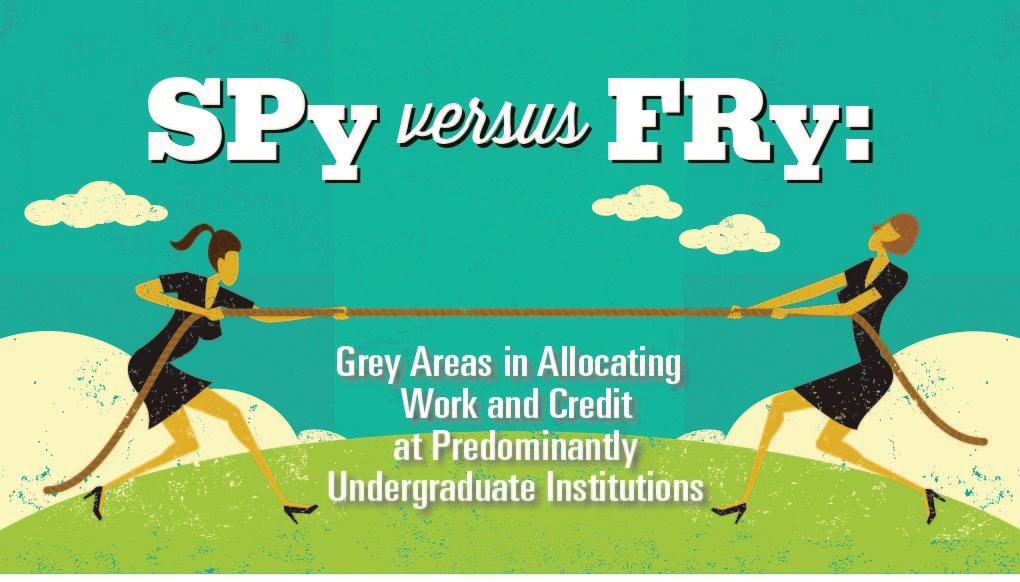
Research administration is customarily divided into three parts, each with its own distinctive lingo, policies and procedures, and reporting lines: one in academic affairs, the second in advancement, and the third in finance. The part in academic affairs is generally called something like sponsored projects/programs/research (SP), although some have adopted hipper titles such as knowledge enterprise, discovery, or innovation. The part in advancement is usually called some variation of corporate, foundation, or government relations (FR). The finance part is usually called grants accounting or sponsored programs accounting and commonly focuses on post-award, although many accountants are also housed in SP.
The external funding environment is populated by a varied menagerie of actors and sectors. There are individual donors, local family foundations, donor-advised funds, regional and national foundations, all having bureaucracies that range from nascent to highly developed. Government agencies are characterized by their territorial span, from local to state to regional to federal to international. Commercial entities with research & development divisions or philanthropic arms may be in-house or separate. And of course, there are nonprofit organizations, independent research councils/centers, colleges/universities, medical centers, and the ubiquitous chameleon, “not elsewhere classified.”
Relations Between Internal Components and External Sectors
Relations between internal components and external sectors is further complicated by several mediating dimensions:
The first dimension is the constellation of restrictions, terms, and conditions that are often categorized as the principal types of funding agreements: gifts, grants, cooperative agreements, and contracts; and the nonlinear chameleon: “other transaction authorities.”
The second dimension is subject matter, glossed into broad fields of humanities, arts, sciences, and professions, and then finer fields; but complicated by anti-categorical designations like multi-, inter-, cross- and transdisciplinary. The social sciences, with their qualitative, quantitative, and mixed methods, are the chameleon here.
The third mediating dimension is the topography of research and development (R&D), which for most agencies is codified into basic research, applied research, and experimental development. For Department of Defense, development is further discriminated as categories dot-3 through dot-7.
Finally, the concentric aspects of research activity are recognized by the federal fudge phrase, “research-related.” This includes the inner core of project-based knowledge creation and middle and outer spheres of research training for students and other participants, workforce development or pipeline funding; and research promotion and dissemination through channels other than peer reviewed scholarly publications, broader impact, clinical significance, and interpreting the humanities. These activities are essential to the sustainability of the core enterprise.
Given three types of internal components and many combinations of sectors, agreements, fields, etc., no single alignment is best between the internal organizational components and the external flow of opportunities. Each organization determines which internal component should focus on which kinds of external funding opportunities—that is, the division of labor between SP and FR.
Strategies for Dividing the Labor
There are several possible strategies for dividing the labor. The two most frequent are by type of funder or type of agreement. A campus can place all public funders with SP and all private sectors—corporate, foundation, nonprofit—with FR. Or it can give all foundations to FR, all corporate, professional, and public agencies to SP. The principal here is that specialized expertise about the respective sectors becomes the key driver and result.
A second dividing principle is type of agreement. For example, an institution may decide that all gifts regardless of sector will be handled by FR and all other agreements by SP. Or all gifts and grants go through FR, all cooperative agreements and contracts through SP. In either case, expertise about the agreements becomes the key driver and result. For example, the nuances, considerations, and courting rituals associated with gift agreements; or the compliance, risk assessments, and reporting requirements involved with
WORK SMART
Navigating the Gray Areas of Human Subjects Research: A Guide for Research Administrators
By Ford Simmons
Questions involving human subjects are not always easy to answer. What we may think is human subjects research may simply be basic research not covered under your local Institutional Review Board (IRB). Determining what is and what isn’t human subjects affects how we apply and manage federal projects once awarded.
Per 45 CFR 46, a human subject is “a living individual about whom an investigator (whether professional or student) conducting research… obtains information or biospecimens through intervention or interaction with the individual, and uses, studies, or analyzes the information or biospecimens; or, obtains, uses, studies, analyzes, or generates identifiable private information or identifiable biospecimens.” (DHHS)
From the definition above, human subjects involve direct contact with other people, data, biospecimens and even medical records. Consider the following:
• Does the project involve a physical intervention, such as drawing blood?
• Is private information collected and examined?
• Are biospecimens collected?
• Is there a personal interaction between the study team and subject?
If the project qualifies as human subjects research, consider possible exemptions from federal human subjects regulations. Typically, a study is considered exempt if conducted in an educational setting, observes public human behavior, collects publicly available data and specimens, and more. When in doubt, consider using the fantastic National Institutes of Health Exemption Infographic: https://grants.nih.gov/policy/human subjects/research.htm.
Recognizing human subject involvement and possible exemptions of a project will make for a tighter proposal and an easier time managing an award. N
Reference
U.S. Department of Health and Human Services. Definition of Human Subjects Research. www.hhs.gov/ohrp/regulations-and-policy/regulations/45-cfr46/index.html
Ford Simmons, MLIS, is Grants & Contracts Administrator III at the Medical University of South Carolina. He reviews, negotiates and processes federal, foundation and corporate awards and contracts. Ford serves as an active member of NCURA Region III as Website Coordinator, and on yearly Region III Conference Program and Planning Committees. Ford was named NCURA Region III 2024 Volunteer of the Year. He can be reached at simmonwi@musc.edu.
contract agreements.
The merit of either approach makes allocation relatively simple for FR and SP to follow. A third approach sacrifices simplicity by combining the first and second cuts. For example, all gifts and grants from foundations, corporations, and nonprofits go through FR, all public sector grants, cooperative agreements, and contracts, regardless of funder, go through SP.
It is unlikely that subject matter expertise, basic vs. applied vs. development or research vs. training vs. dissemination will be a dividing line for SP and FR, though individual expertise about science, humanities, or training, might be concentrated in one unit, especially in predominantly undergraduate institutions with fewer staff.
However the portfolio is divided, some opportunities will challenge the division of labor. For instance, if FR handles private-sector proposals, its understanding of private donors and gift agreements may be critically important to SP when pursuing federal opportunities that require non-federal cost match (e.g., Challenge Grants and some Department of Education proposals).
Nonprofit intermediaries who solicit proposals for federal pass-through grants may require FR to draw on SP’s knowledge of public agency expectations and requirements. Further, intermediaries themselves—pass-throughs and subawards—can be a challenge in the case of public-private partnerships.
Shifting circumstances can lead to changes in division of labor. Workload issues, staff retention/recruitment difficulties, a drought in one side’s funding stream, new personnel and/or priorities in the institutional C-suite (new fundraising campaigns or aspirational goals) may skew existing SP/FR workloads such that the current basis for work division becomes untenable. Rebalancing availability of staff with opportunities may override previous allocation logic.
Final Considerations
Two final considerations: collecting credit and communicating with the client community.
All offices want maximum credit in the eyes of their hierarchy, so helping each other with pre-award or post-award raises the question of who should record the resulting proposal effort or award win. The right answer is both should take credit. Ultimately the financial unit will ensure the record reflects that each dollar is only counted once. So, credit-taking in the separate tracking systems of FP and SP need not worry about duplication— credit need not be mutually exclusive.
The clients (PD/PIs/CoPIs) should not be expected to understand SP/FR allocation—no matter how simple, how often they are reminded, or how prominently the rule is posted. All clients need to know is there is no wrong door. If they find an opportunity and contact the office that handles it, great! If not, that office can efficiently and cheerfully transfer them to the right person/unit, assured that SP/FR are supportive of each other. And if the PI has a project in mind and wants assistance finding the right funder, both SP and FR are on call for any exploration of funding opportunities.
Navigating the external funding environment is complex and dynamic, however, it is infinitely manageable with a flexible and cooperative spirit. N
Dean R. Gerstein, PhD, is the Director of Sponsored Research at Pomona College. He is currently responsible for public sector proposals and awards. He was previously at Claremont Graduate University (evolving SPy/FRy splits), NORC at the University of Chicago, and the National Academies of Sciences, Engineering, and Medicine. He is a PI, Co-PI, and consultant on several NSF GRANTED projects. He can be reached at dean.gerstein@pomona.edu.
Navigate the everchanging compliance landscape
Achieve your compliance objectives without compromising research progress.
Tap Huron’s unparalleled research compliance expertise for help:
• Interpreting and applying guidelines for your greatest research compliance priorities
• Implementing effective compliance programs without compromising ef昀ciencies
• Integrating appropriate compliance controls as you scale your research programs and infrastructure
As experts in research and compliance, Huron is here to help. Visit huronconsultinggroup.com/expertise/research-enterprise
By Ann Bell
In an evolving landscape of legal regulations and legislation amidst a lack of policy guidance, universities and their compliance staff have the difficult job of navigating enterprise and personal use of thirdparty artificial intelligence (AI) platforms.
Pre-award research administrators have been asking for guidance from universities, federal agencies, and professional groups on options for using AI in their work. For those of us who may not know how to code or analyze risk in new software packages, it is easier to give up than to mount a learning barrier and adopt a new process. No one knows what to tell Principal Investigators (PIs) about using AI in their submissions and federal agencies have provided little to no guidance. Additionally, preaward administrators have a lot of expertise when it comes to compliance, yet few are asked to be on advisory committees examining the question of how to use AI in higher education.
I argue that these two issues, lack of guidance and lack of input, must be addressed quickly because, as we are all too aware, submissions will not slow down. The reward in using AI must outweigh the risk; at this point, each individual pre-award research administrator must use their own professional ethical code to make decisions during the knowledge vacuum.
As of 2024, no federal privacy regulations have been enacted covering nonprofit institutions that are not health-care specific (through insurers as
covered entities) or through regulations such as the Family Educational Rights and Privacy Act (FERPA). No U.S. federal agencies are attempting to regulate privacy and AI. Until April of this year, the focus had been on private industry, leaving higher education and nonprofits without a path forward. A newly drafted bipartisan House and Senate American Privacy Rights Act (APRA) has been unveiled that would cover nonprofits in addition to large businesses (Zweifel-Keegan, 2024). However, based on the current draft language, it is possible that nonprofit universities connected to state governments will be excluded in the definition of a covered entity (Thompson Reuters, 2024).
There are several reasons for this recent federal push on comprehensive privacy legislation, the first important step toward AI regulation. The European Union had already outpaced the United States as the global leader on privacy and AI with the adoption of the General Data Protection Regulation (GDPR) in 2016 and the passage of the AI Act this year. Even Canada is ahead of the United States in implementing regulation for AI (Government of Canada, 2023). In October of last year, the Biden Administration published the first Executive Order on AI, calling on Congress to enact legislation (Andrews, 2023). As of May of this year, 19 states have already created laws and executive orders for privacy and AI, making it difficult for businesses to navigate the individual jurisdictional requirements. The time for
federal legislation appears to finally be on the horizon, but there are still many steps in the process before regulations would be in effect for covered entities including universities. Nonetheless, the importance of this new development in federal legislation with the APRA draft cannot come soon enough. Most of the enacted state privacy laws exempt higher education and nonprofits. Given the wealth of personal information universities and colleges store and the fact that data security incidents are quite common, the exclusion of institutions from state and federal regulations are, at best, questionable public policy.
Research administration professionals want to be able to adopt AI for their own work to decrease administrative burden, but few groups inside higher education have moved forward with enterprise platforms able to protect data and personal information. Universities and colleges have been slow to adopt and upgrade their business processes with the plethora of available AI tools; for instance, each school may have several license options for Office 365, and some employees may not have full access. Thus, individual use of large language models (LLMs) remains rampant, uncontrolled, and deployed outside of the university’s infrastructure (Rahman & Watanobe, 2023).
Use of LLMs and automated decision models come with the “black box” problem, the inability to know what and how data was used to make decisions (Adadi & Berrada, 2018; Minh, Wang, Li, & Nguyen, 2022). Because the training data for Generative AI scraped large amounts of intellectual property from the internet, the end user may not know that the output is an expressive or derivative work (Sag, 2020) or if the output relied on biased training data sets (Ajunwa, 2020; Schwartz et al., 2022). Using nonprivate LLMs like Microsoft Copilot to analyze personal research or improve draft articles can potentially expand the training data set if the user is unaware of the privacy terms and conditions. The totality of this situation and the lack of training presents multiple risks to PIs, employees, students, patients, and intellectual property.
Institution-wide data governance committees will be an important first step toward developing ideas and procedures to manage the inherent risks to privacy posed by AI systems. Because LLMs and automated decision models create output based on deep learning algorithms beyond the control of the developer or user, potentially harmful or biased outputs must be audited, requiring human oversight to control (Davidovic, 2023). Privacy professionals have been alerting their clients and the public regarding the inherent risks posed by AI systems, specifically the unauthorized surveillance of people, breaches and manipulation of personal information, biased outputs/other negative societal impacts, and invasive psychological and behavioral profiling (Securiti, 2023). Because the risks of using AI technologies can be particularly impactful on employees, students, and faculty members, limited protections combined with a lack of governing policies on AI use will act synergistically to increase risk of misuse.
The formation of participatory governance workgroups should be represented by various stakeholders to advance AI governance policies on development, deployment, use, and training. Importantly, considerations for participatory governance structures should be carefully mapped and managed so that the process does not disenfranchise particular points of view (Wong, Morgan, Straub, Hashem, & Bright, in press). By volunteering to be on these committees, research administrators can and must advocate for their teams and faculty members.
AI platforms have the potential to disrupt and potentially change the entire grant ecosystem. Therefore, recommendations for policies related to proposal submissions should be focused on potential misuse of AI to generate proposals and data: constraints should be in place to ensure that submissions are not the work of an AI model, and that Principal Investigators are accountable for their work. However, use of AI can be beneficial in generating
ideas and hypotheses, and therefore navigating appropriate use cases for AI in higher education should be an important priority of these committees. Additionally, leveraging AI platforms to decrease administrative burden is important, but it will not diminish the role of pre-award administrators in the grant process. Especially at the department level, research administrators often have strong personal relationships with their PIs that cannot be easily replaced by a chatbot. In addition, it is difficult to imagine how the ever-changing federal regulations can be rapidly implemented by AI across all the compliance steps necessary prior to submission nor how AI in this process could ever be independent of human oversight. Nonetheless, institutional leaders may be tempted to use AI platforms to justify constraining human resources, negatively impacting their research administration teams.
To mitigate the possibility of negative AI impacts, research administrators and our associated colleagues must bring valuable insight to these workgroups, educating leadership in the process. If pre-award administrators are not integral to the process of developing institutional policy on AI, there may be unintended consequences affecting the workforce and our roles as knowledge professionals. N
Ann Bell is a Grant Writer and Proposal Specialist in the Costello College of Business at George Mason University. She has 30 years of research experience in higher education, with over 10 peer-reviewed publications. She works with faculty in the college on research development, grant submissions, and pre-award research administration. She can be reached at kabell@alumni.vcu.edu.
References
Adadi, A., & Berrada, M. (2018). Peeking inside the black-box: A survey on explainable artificial intelligence (XAI). Ieee Access, 6, 52138-52160. doi:10.1109/access.2018.2870052. https://ieeexplore.ieee.org/document/8466590 Ajunwa, I. (2020). The Paradox of automation as anti-bias intervention. Cardozo Law Review, 41(5), 1671-1741. https://scholarship.law.unc.edu/cgi/viewcontent.cgi?article=1490& context=faculty_publications
Andrews, C. (October 30, 2023). White House rolls out comprehensive executive order on AI. Internaional Association of Privacy Professionals. Retrieved from https://iapp.org/news/a/white-house-rolls-out-comprehensive-executive-order-on-ai Davidovic, J. (2023). On the purpose of meaningful human control of AI. Frontiers in Big Data, 5. www.frontiersin.org/articles/10.3389/fdata.2022.1017677/full Government of Canada. (2023). The Artificial Intelligence and Data Act (AIDA)-Companion document. Retrieved from https://ised-isde.canada.ca/site/innovation-bettercanada/en/artificial-intelligence-and-data-act-aida-companion-document
Minh, D., Wang, H. X., Li, Y. F., & Nguyen, T. N. (2022). Explainable artificial intelligence: A comprehensive review. Artificial Intelligence Review, 55(5), 3503-3568. https://sejong.elsevierpure.com/en/publications/explainable-artificial-intelligence-acomprehensive-review
Rahman, M. M., & Watanobe, Y. (2023). ChatGPT for education and research: Opportunities, threats, and strategies. Applied Sciences-Basel, 13(9), 5783. www.mdpi.com/20763417/13/9/5783
Sag, M. (2020). Copyright law's impact on machine intelligence in the United States and the European Union. FIU Law Review, 14(2), 293-298. Retrieved from https://heinonline.org/HOL/P?h=hein.journals/fiulawr14&i=302
Schwartz, R., Vassilev, A., Greene, K., Perine, L., Burt, A., & Hall, P. (2022). Towards a standard for identifying and managing bias in artificial intelligence (NIST Special Publication 1270). National Institute of Standards and Technology. www.nist.gov/publications/towards-standard-identifying-and-managing-bias-artificialintelligence
Securiti. (2023). Building a framework for AI governance. Retrieved from https://securiti.ai/whitepapers/building-a-framework-for-ai-governance
Wong, J., Morgan, D., Straub, V. J., Hashem, Y., & Bright, J. (in press). Key challenges for the participatory governance of AI in public administration. In S. Giest, B. Klievink, A. Ingrams, & M. Young (Eds.), Handbook of Governance and Data Science.
Zweifel-Keegan, C. (April 11, 2024). Top takeaways from the draft American Privacy Rights Act. International Association of Privacy Professionals. Retrieved from https://iapp.org/news/a/top-takeaways-from-the-draft-american-privacy-rightsact/?mkt_tok=MTM4LUVaTS0wNDIAAAGSbYmc7OKfVQhxoPOsWfAnW3dFfvEgpS59eXSezqxe_qLEUceRe5USxJsqOzDsa5e04Op0mS47I_H7ptQwbeg_5lY-vK2X3Z8tFOIlYveRI4ATg
Gift GREY AREAS vs
Research administrators grapple with the challenge of distinguishing between gift and grant funding. While resources exist to help us navigate these uncertainties, we frequently make decisions about the grey area of “gift vs. grant” on our own. Many institutions establish policies that guide the “gift vs. grant” discussion; even with these policies in place, the funding determination can still be difficult to make with confidence.
Common Challenges
In some instances, the award documentation itself can cause confusion. For example, the title of the award says, “Gift Agreement,” but the agreement terms clearly suggest that the award is a grant. Always read the award language closely and look for the terms more “typical” of a grant, such as:
• A period of performance
• Technical or financial reports
• Project milestones
• Deliverables
Identifying these grant terms is essential, and yet even this scrutiny can leave room for interpretation.
Different Perspectives
Sponsored Programs and Advancement Offices
Disagreements may arise between an institution’s sponsored programs office and advancement office. Sponsored programs teams might feel frustrated to learn that “gifts” contain the terms more typical of a grant. Remember to empathize with advancement colleagues, who often have fundraising quotas, to avert any frustration from the “gift vs. grant” grey area. Advancement colleagues might prefer to designate ambiguous awards as gifts to reach their fundraising targets. Alternatively, as research administrators, we may find ourselves pushing for funding to be classified as a grant, as we aim to support and develop sponsored research.
Research Administrators and Researchers
Researchers may also want to influence a funding determination, particularly if the researcher has an existing relationship with a funder. A researcher might have a vested interest in the “gift vs. grant” determination, which leads them to push to classify funds in a particular way. Remember that while your Principal Investigator (PI) may be an expert in their field of study, you are the expert in research administration! As research administrators, we must interpret and navigate our institution’s policies, federal and state guidelines, and award terms and conditions to make an informed funding determination decision. While this may not always result in the PI’s preferred classification, it is our responsibility to ensure that funds are correctly allocated to guarantee they are managed accurately.
Grant Funding Determination
By Jaclyn Prechtl and Noelle Strom
Strategies for Resolution
To resolve any possible tension, collaboration is key. Establish strong communication channels between your sponsored programs and advancement offices to facilitate better cooperation and understanding. Plan to meet regularly with your advancement colleagues to discuss new opportunities and share perspectives. Similarly, foster trusting relationships with your PIs so that they know they can rely on your expertise when it comes to making an accurate funding determination.
Practical Tips
When you’re faced with a new award with unclear terms, consider the following questions:
• Does the funding have restrictions?
• Can the funds be revoked easily?
• Are there prior approvals required for expenditures?
• Are there specific deliverables?
• Are funds required for specific activities?
• Are payments contingent on any specific outcomes?
• Are there reporting requirements?
• Are there patents or intellectual property?
If you continue to disagree with your advancement office or your PIs, suggest that your office form a committee to review and determine the status of unclear awards. This collaborative approach can help lead to a more accurate funding determination.
Conclusion
Navigating the grey area of a gift vs. grant funding determination takes careful analysis, empathy for others’ perspectives, and collaboration. By seeking to understand the motivations of different offices and establishing clear communication channels, research administrators will be well-equipped to make a well-informed funding determination. N
Jaclyn Prechtl, MBA, is the Director of Research for the School of Pharmacy and Pharmaceutical Sciences at the University at Buffalo. As Director, Jaclyn provides strategic leadership and direction of research development and administration activities within the School. She oversees and provides operational, financial support, policy formulation, and resource stewardship. She can be reached at jaclynpr@buffalo.edu.
Noelle Strom, EdD, MBA, CRA, is the Director of External Funding in the College of Arts, Humanities & Social Sciences at the University of Denver. As a scholar-practitioner, Dr. Strom’s research interests include optimizing operational efficiency, advancing research administration practices, and enhancing the research ecosystem within higher education institutions. She can be reached at Noelle.Strom@du.edu.
Board Update
In June, the NCURA Board of Directors met virtually for our board meeting. Our President, Dr. Kris Monahan called the meeting to order and gave welcoming remarks, including:
n Hawaii FRA/PRA meeting success, the importance of people coming together and noting it was the largest attendance of all time.
n March board meeting, importance of regional engagement, this was a topic of conversation and has continued, including utilizing the regional quarterly meetings with the board to discuss regional activities and thoughts on increased engagement.
n Sister Society engagement, in April, Kris and NCURA Vice President Denise Moody attended the European Association of Research Mangers and Administrators (EARMA) Conference, and Kris attended an in-person meeting of the International Network of Research Management Societies (INORMS) in Odense, Denmark.
n NCURA continues to be partner on many GRANTED initiatives. Kris participated on behalf of NCURA on June 11th at a University of Vermont event and has been engaged with a group of institutions on their year-long strategic planning and problem-solving sessions.
NCURA Executive Director, Kathleen Larmett shared with the board that the:
n NCURA Symposiums being held in Old Town Alexandria, Virgina in June have good attendance. This includes the 2nd AI Symposium (the first being held in August 2023), the research security symposium, and the pre-and-post-award symposium.
n The Global Initiatives university capacity building program for the Republic of Georgia concluded in May with a multi-city and university tour for 12 research administrators led by NCURA’s Global Initiatives staff. The program has been very well received. The Global Initiatives team is planning US Grant Management training in a number of locations outside of the US.
An AM66 update was given by Denise Moody. Acknowledgement was given to the extensive and amazing work of the co-chairs, program committee, and NCURA staff. Lots of exciting activities have been planned, including a new Discovery & Innovation Showcase.
In addition, a number of action items were put forward by several select and standing committees for discussion and approval. The following were approved:
n Nominating and Leadership Development Standing Committee Distinguished Educator nominations
n Professional Development Committee Traveling Workshop Faculty nominations
n Select Committee on Peer Programs/Peer Review reviewers
n Select Committee on Diversity, Equity, and Inclusion guiding principles
The June board meeting gave an opportunity to reflect on the exceptional work that NCURA members, volunteers, and staff do, and that we work best, when we work together. The meeting concluded with excitement for the upcoming AM66. Everyone was looking forward to the summer and to coming together in-person in D.C.
On a personal note, I look forward to connecting/reconnecting with people at AM66.
Bryony Wakefield, PhD, is the Immediate Past President of NCURA. She serves as Executive Director, Research Services at the University of Glasgow. She can be reached at Bryony.Wakefield@Glasgow.ac.uk.
BO ARD O F D IRERECTOCTORS RS
Pr P r e s i de d e n t !"#$%&'()*)(% !"#$%&'()'*+#,,'-'*
Vi V i c e Pr P r e s i d e n t +,(#$,%&''-.% ./(&0/%12*3(12%2/2'*4#"** 5%#6'&%)7,*3((#$72%#(**
Im I m m e d i a t e P a s t P r e s i d e n t /".'(.%0)1,2#,3-% 8(%$'"1%29*#4*:,71-#;*
Tr T r e a s u r e r 4#5'6*.%78*)#3,.% <=#671*>'44'"1#(*8(%$'"1%29*
Se S e c r e t ar a r y +#)(,%9#33,:")(-% 8(%$'"1%29*#4*?#"2=*@7A#27 Ex E x e c ut u t i v e D i r e c t or o r !)6*3,,(%&;%<)"5,66% =)6#'()3%>'?(8#3%'2%@(#A,"$#6.%% B,$,)"8*%C-5#(#$6")6'"$% DA)%/EF"(-)3% B%(-C1*+#,,'-'*.#(&#(* D5#3.%+,A,",?G% 8(%$'"1%29*#4*D#/2=*+7"#,%(7* &)".%<'?#$,%9,)3.% >#=(1*E#FA%(1*8(%$'"1%29** &,3)(#,%9,:3% 8(%$'"1%29*#4*G%1)#(1%(HI7&%1#(* +,"#81%H'(,$% J(9K*+,%(%)7,*L'1'7")=*:"#/F** <)?")%!#(I$3,.% 8(%$'"1%29*#4*!%221M/"-=** =)(8.%<,J#$% 8(%$'"1%29*#4*+7,%4#"(%7H3"$%('** =#8'3,%=#8*'3$% G71=%(-2#(*8(%$'"1%29*%(*D2N*.#/%1** K,")3-#(,%L#,"",% 5#12#(*+=%,&"'(C1*E#1F%27,** <'"#%C((%78*?36M% 8(%$'"1%29*#4*<'K71*72*D7(*O(2#(%# +)A#-%75,3$,"% 8(%$'"1%29*#4*<'(('11''* 4*'5)$%7N,(8,"% 8(%$'"1%29*#4*<'K71*L%#*:"7(&'*P7,,'9* C$*3,.%76)*3,% +#,#"7&#*D272'*8(%$'"1%29* <#$)%0'66"#8*% DL3*3(2'"(72%#(7,* 7?$)(%O#N1#(% 8(%$'"1%29*#4*?';*E76F1=%"'*
On April 22, 2024, OMB issued a Final Rule for Guidance for Federal Financial Assistance. NCURA is working on a new version of our desk reference.
STAY TUNED!
By Katie Shoaf, Karen Fletcher, and Gabriele Casale
If you work in research administration, you’ve likely fielded urgent questions (often at the 11th hour) from a Principal Investigator (PI) seeking clarity about pre-award processes, including next steps, and which office, unit, or employee handles which element of pre-award. This gray area in research management is certainly not new. Here we will discuss how our institution attempted to clarify and articulate the gray roles and responsibilities in pre-award services for our PIs and our own research staff. In short, what is missing between research administration and PIs is a common language. Here we flip the script and approach the problem from the perspective of the PI navigating the (serpentine) approval process.
Who’s on First Appalachian State University (App State) is a mid-sized master’s comprehensive institution with a predominantly undergraduate population. Our 20,000 students are mentored and taught by a faculty of about 1400, approximately 700 of whom are tenured or on the tenure track. The centralized Office of Research & Innovation (ORI) is led by a Vice Provost and is composed of four units: Sponsored Programs (SP), Grants Resources and Services (GRS), Research Protections (RP), Research Design and Analysis (RDA); and a Research Faculty Fellow - a professor with a course release to work with ORI on strategic initiative planning and implementation. Our institution received $22M in extramural funding in FY23.
What’s on Second
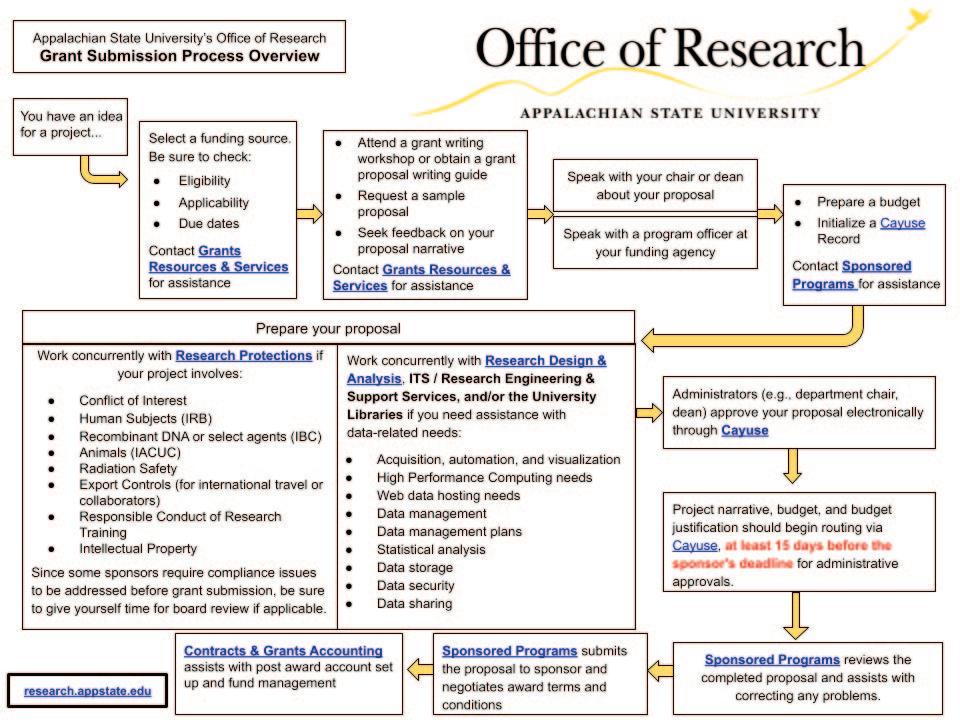
To explain pre-award services, we formerly utilized the below “Grant Submission Process” flowchart, which follows a proposal from ideation to award. It explains all the possible offices and scenarios that a researcher might need to navigate to shepherd an idea into a funded proposal.
We found, however, that there remained a misunderstanding between this flowchart and faculty connection to the process. To address this gray area of shared-language disconnect, we decided to create another flowchart. In the spirit of not reinventing the wheel, we reached out to the National Organization of Research Development Professionals (NORDP) listserv to see how other institutions have visualized and articulated pre-award processes and responsibilities. We received fliers, flowcharts, websites, slide decks, and infographics, which are available in this open-access folder.
We quickly realized that as different as every Office of Research is at different institutions, so too, are their corresponding visualizations and explanations. Recognizing that there was still a gray area between what PIs prioritize and what the administrative processes look like at App State, we decided to emphasize the PI experience.
We enlisted the help of our faculty fellow and a whiteboard, and asked him to describe his experience of submitting a grant and we captured this visually: What did he do when he had an idea? What steps did he take on his way to working with our Sponsored Programs unit? We then asked our Director of SP to conduct the same exercise from her perspective, and…lightbulbs! The faculty fellow’s side of the whiteboard showed a primary concern
with writing the proposal, collecting supplementary material on time, and not wanting to worry about his proposal being submitted late. The Director of SP’s side of the whiteboard contained details about deadlines, research administration responsibilities, signatures, and compliance checks. These parallel illustrations revealed that the “Grant Submission Process” flowchart was not generating the clarity necessary for faculty to understand, value, and accommodate the numerous steps that Sponsored Programs staff have to take to submit a proposal.
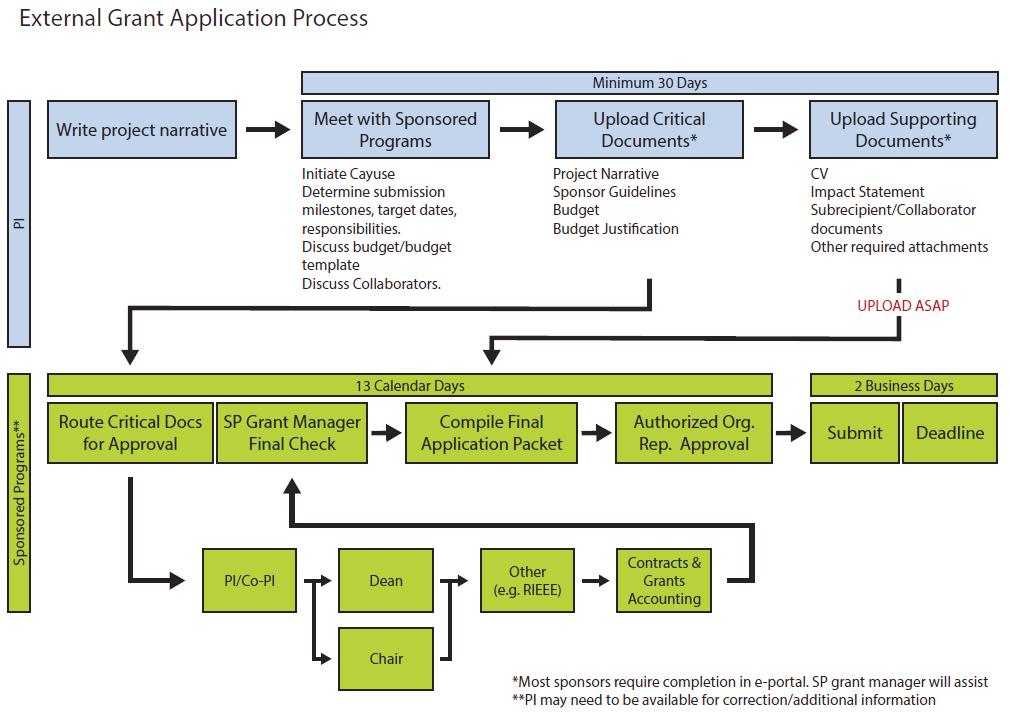
As a result of this realization, we focused on generating a common language between faculty and staff that reconciled the gray area between the two whiteboard renderings. We developed a flowchart, dividing it horizontally into two sections, noting what the faculty is responsible for and what the Sponsored Programs staff are doing behind the scenes. We referred to this as the swan metaphor: the faculty member is the swan, responsible for writing the proposal on the surface, while the Sponsored Programs personnel - the swan’s feet - furiously pushing documents through processes “underneath the water.”
Our final product is this flowchart, which represents a PI-centric view of App State’s ORI proposal submission and interaction between the faculty and office. In contrast with the proposal-centric flowchart that described the support available and staff expertise, this visual highlights the division of responsibilities between the PI and administrative staff while also providing a timeline and action steps to get a proposal submitted. We have started sharing this flowchart with every single faculty we know is working on a
proposal and use it to frame proposal preparation meetings; faculty have expressed gratitude in seeing the process laid out clearly with a timeline attached. Because this approach is currently serving us well, we anticipate creating a full series of flowcharts, each of which will offer clarity and insight into pre- and post-award processes from the PI perspective.
I Don’t Know is on Third
Our reflective ideation exercise was highly valuable. We learned that the gray area between proposal development and pre-award is better understood by creating a common language between ORI staff and the faculty. Both groups have different sets of needs, priorities, restrictions, requirements, and most of all, perspectives.
As you articulate your research administration roles and responsibilities to your faculty, consider collaborative conversations with the faculty voice. Conscientiously considering how we explain our roles in a way that minimizes confusion and communicative chaos around the gray areas of preaward processes can help ensure that, much like the swan and its paddling feet, the faculty and the pre-award staff work together towards a smooth submission.
Utilizing clear visuals can shift the exchange from confused researchers saying “I DON’T KNOW WHAT I’M TALKING ABOUT” to a more confident, informed interaction. This ensures that when a research administrator says, “Take it easy,” even if the gray area is tough to explain, we will help get you where you’re going. N
Reference
Retrieved from Mother of Providence Regional Catholic High School website, 2014. Who’s on First. https://mpregional.org/documents/2015/1/Whos_on_First.pdf. Original document used in Penn State University’s Integrative Arts Department’s course INART10: The Popular Arts in America: Mass Media Arts.
Katie Shoaf is Associate Director of Grants Resources & Services in the Office of Research and Innovation at Appalachian State University, where she specializes in internal grants management, limited submissions, supporting research teams, peer-review programs, and researcher development. Katie can be reached at shoafkm@appstate.edu.
Karen Fletcher is Director of Grants Resources & Services in the Office of Research and Innovation at Appalachian State University, where she specializes in proposal development, faculty research development, mentoring and strategic research advancement. Karen can be reached at fletcherkl@appstate.edu.
Gabriele Casale, PhD, is a Professor in the Department of Geological and Environmental Sciences, and the Faculty Fellow in the Office of Research and Innovation at Appalachian State University where he serves as a faculty liaison for ORI staff and leadership. Gabe can be reached at casalegm@appstate.edu.
Research Management Review
Standard, Expedited, or Exempt: Can ChatGPT Determine IRB Review Category?
Emmett Lombard, Gannon University
Exploring Marginality, Isolation, and Perceived Mattering Among Research Administrators
Denis Schulz, California State University San Marcos, Karen Gaudreault, University of New Mexico, and Ruby Lynch-Arroyo, University of Texas at El Paso
A Case Study of Research Administrator Perceptions of Job Satisfaction in a Central Research Administration Unit at a Private University
Noelle Strom, University of Denver
BOOK REVIEW: The SAGE Handbook for Research Management, 1st ed.
Chloe Brown, Texas State University
BOOK REVIEW: The Mentor’s Guide: Five Steps to Build a Successful Mentor Program, 2nd ed.
Clinton Patterson, Texas A&M University
Call for Articles
The Research Management Review invites authors to submit article proposals. The online journal publishes a wide variety of scholarly articles intended to advance the profession of research administration. Authors can submit manuscripts on diverse topics.
There was a popular TV show in the early 2000’s called “Extreme Makeover: Home Edition” where the whole premise was to take a torn-up, run down, dysfunctional house and turn it into a beautiful dream house for a deserving family. At the end of the show, everyone (the family, the producers, the director, and the construction workers) cried for joy because of the incredible transformation. In 2013, OMB built the original home that housed all the grant requirements (administrative, costs and audit) applicable all the grantees. It combined all the previous eight OMB Circulars into a Uniform Guidance, located in the Title 2 Part 200 of the CFR (Code of Federal Regulations). Some revisions and renovations were made in August 2020, but the recent April 22, 2024 OMB revisions resulted in an extreme makeover of the original home.
We will explore the main objectives of this Extreme Makeover – Uniform Guidance 2 CFR Edition, the main and essential revisions by specific subparts, and the areas that require immediate attention for an implementation that is effective on October 1, 2024.
OMB Objectives
The four objectives listed by OMB for these revisions are to: (1) incorporate statutory requirements and administration priorities, (2) reduce agency and recipient burden, (3) clarify sections that recipients or agencies have interpreted in different ways, and (4) rewrite applicable sections in plain language, improving flow, and addressing inconsistent use of terms. In the roll-out of the updated Uniform Guidance on April 4, 2024, the White House added that: “These updates to what is known as the Uniform Grants Guidance will streamline and clarify requirements for Federal funding… These changes will allow agencies and recipients of Federal funds to focus more time and money on delivering meaningful results for the American people.”
The Final Revisions – April 22, 2024
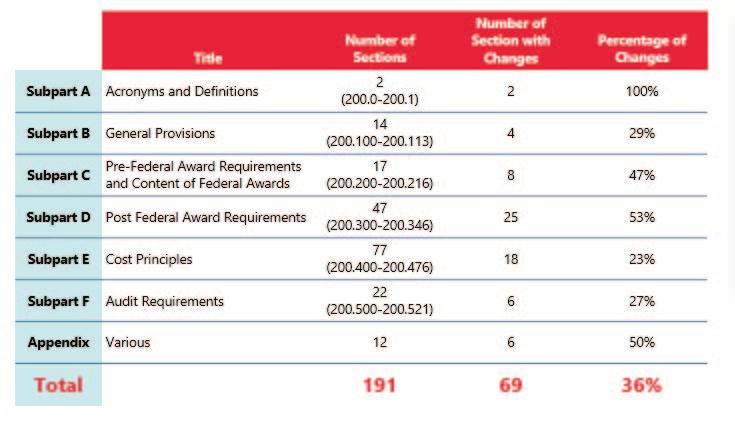
This makeover to the Uniform Guidance is certainly the most substantial since its creation in 2013. Indeed, for the six subparts (A through F) and
twelve appendices (I through XII) in the 2 CFR Part 200 Uniform Guidance, OMB revised 69 out of 191 sections, equaling 36 percent of the document. The massive, published document is 573 pages long or the same length as an average Harry Potter fantasy novel (570 pages/book). It is not an easy leisure reading for the faint of heart but unfortunately a must read for all research administrators. It is also impossible to provide details of all the revisions in a single article. Therefore, we will focus on the most impactful changes for each subpart that require your attention.
Subpart A - Definitions – the major revisions include (1) the new thresholds for equipment (from $5,000 to $10,000) and subaward (from $25,000 to $50,000); (2) the expansion of “intangible property” to include data, websites, trade secrets, intellectual property; (3) the inclusion of “associated software” in “special purpose equipment”; and (4) new definitions for “participant” and “prior approval.” OMB replaces “non-federal entities” with “recipient and subrecipient” and “F&A” with “indirect costs.” The new threshold definitions will have an impact on the indirect cost rate calculation, but also have the potential of reducing the administrative burden for property accounting. The new definition for “intangible property” adds grantee’s responsibilities for intangible assets generated from federal projects.
Subpart B - General – The former Applicability table (formerly 200.101) is eliminated, and grantee must now read the six subsections to determine the applicability of the subpart requirements in accordance with the types of awards received from the Federal government. A major and critical change is the addition of “credible evidence” in the last section 200.113 of subpart B. This change requires a grantee to promptly report to the Federal government (i.e., awarding agency and inspection general) or pass-through entities when it has “credible evidence” of any violations of Federal criminal laws or statutes. OMB states that “credible evidence” is more appropriate for standard of reporting as it does not require a grantee to make a legal determination that a criminal law has been violated before reporting. While “credible evidence” is not described in this section, the pre-amble mentions that “credible evidence” here has the same definition as section 73 FR 67064 of the Federal Acquisition Regulations (FAR).
Subpart C - Pre-Award – There are three major changes in this
Subpart: (1) the requirement for agencies to streamline the NOFO (Notice of Funding Opportunities), (2) the update for “fixed amount award policy”, and (3) the clarification of the use of prohibited telecommunications and video surveillance by Chinese companies. The NOFO change requirements will be conducted by the Federal agencies and grantees should see the results and impact for all grant programs announced on or after October 1, 2024. For the “fixed amount award” policy, the revision increases the threshold to $500,000 (from $250,000), adds that grantees are entitled to any unexpended funds and confirms that “unexpended funds are not considered profit”. However, the use of fixed amount awards by the grantee still requires prior approval. For the telecommunications and video surveillance equipment and services in section 200.216 that was added in the 2020 revision, OMB clarifies that although the costs are not allowed on federal grants, its use is permitted if purchased with non-federal funds.
Subpart D - Post Award – This area receives a major makeover, particularly in the procurement area. It starts with the elimination of the reference to the FFATA requirements in the Statutory and national policy requirements section (200.300) but adds two new subsections on discrimination based on sex orientation or gender identity. It does not mean that the FFATA requirements for subaward reporting are gone as all the requirements still apply in accordance with 2 CFR Part 170 – Reporting Subaward and Executive Compensation Information. The internal controls section adds a requirement for cybersecurity measures (200.303). It confirms the treatment of “voluntary uncommitted cost sharing” in the computation of indirect cost rate based on an OMB memorandum dated January 5, 2001 (200.306 (k)). The increase to the equipment and supplies threshold from $5,000 to $10,000 along with the more flexible treatment of unused supplies are described in this subpart (200.314). Note that $10,000 is the upper limit for equipment and supplies. Grantee has the discretion to keep the current threshold or decide on a threshold lower than $10,000. The procurement sections add many new elements such as (1) allow Indian tribes to follow their own policies, (2) allow the use of geographic preference and project labor agreements, and (3) add references for veterans-owned business and green products. The increase threshold for fixed amount subawards to $500,000 is discussed in section 200.333. A complete reversal in
Summary Count of Revisions by Subpart
termination policy is made in section 200.340 as a former termination policy flexibility by the Federal government (200.340 (2)) was deleted.
Subpart E - Cost Principles – This subpart is the “kitchen” of a home and is the most important subpart for research administration. It dictates the budget, spending, and performance of any research projects. The objectives of any Federal and Single audits typically focus on this area of compliance. The top five changes are: (1) eliminate the DS-2 reporting and filing requirements (this requirement was only required for universities), (2) eliminate 9 out of formerly 25 prior approval requirements (or a 36% reduction in prior approval requirements), (3) allow grantees to report of indirect cost rate dispute to OMB, (4) raise the de-minimus rate to 15% of modified total direct costs, and (5) allow data costs and evaluation costs. The increase of the de-minimus rate is well received and applauded by the smaller grantees with minimal resources to prepare and negotiate a formal indirect cost rate, but as a pass-through entity, a grantee must review the impact of the increased costs to its project budget. The cost items for data and evaluation costs (200.455 (c)) are the first new major cost items added to the Uniform Guidance since 1995 when OMB allowed interest costs to non-profit organizations. The allowability of the costs will have a huge impact on program performance in the long run as grantees are now permitted to spend and recover costs to make sure that program data are well managed and the performance evaluation on a specific program can be made to improve its outcomes. These new cost items are included in the “Organization costs” section 200.455 and the costs can be charged to Federal grants as direct or indirect costs.
Subpart F - Audit – The two changes are (1) the raise of the single audit threshold from $750,000 to $1 million and (2) the authority for federal cognizant agencies for audit to grant extension for single audit submission (previously only OMB has this authority). The higher Single Audit threshold will result in more smaller grantees being excluded from the Single Audit requirements and thus lessen their audit burden. However, if you are relying on the single audit as a tool for subrecipient monitoring, you must now explore other methods to monitor the subrecipient.
Appendices I-XII – Appendix I has the most substantial changes in the Appendices as OMB completely restructures the contents and requirements for Federal agencies to issue the Notice of Funding Opportunities (NOFO). The goal is to simplify the NOFO requirements and make the NOFO more customer-friendly to the potential applicants. OMB directs the Federal
agencies to include key information at the top of the NOFO, write the NOFO in plain language and reduce the wording by 25% over the previously issued version. Agencies are required to submit an implementation plan to OMB by August 1, 2024, and implement their approved plan in fiscal year 2025 (starting October 1, 2024).
Appendices III, IV, and VII have one minor update that is related to the change in threshold for subawards and the modified total direct costs. This change will an impact of the indirect cost calculation and reimbursement.
Effective Dates
The effective for the final revisions is October 1, 2024 (with earlier implementation by agencies allowed). Although, it sounds straight forward, it is a little more complicated than a simple single date. There are actually three different dates depending on the nature of the changes: (a) administrative changes, (b) financial and cost changes, and (c) indirect cost rate and reimbursement changes.
(a) Administrative changes – such as prior approval requirements, new procurement standards, mandatory disclosure (with credible evidence); the revisions are effective for all federal awards that start on or after October 1, 2024.
(b) Financial and cost changes – such as the new threshold for equipment and supplies, the new 15 % de minimus rate, the new Single Audit threshold; the revisions are effective for the first fiscal year starting October 1, 2024. For example, if your institution’s fiscal year runs from July 1 through June 30, the effective date is July 1, 2025 (or FY 2026). Remember that the grantee must make internal decision regarding the threshold levels and change its policy documents before they become effective.
(c) Indirect cost rate and reimbursement changes – the changes in the equipment and subaward thresholds will have an impact on the indirect cost rate and reimbursement. The changes will cause a decrease in the rate (as the base is larger) but the overall recovery should be the same (as the lower rate would apply to a larger base). No changes in the rate due to the threshold change are allowed until the next submission of the indirect cost proposal. The current negotiated rates are to be used on the current modified total direct cost bases (without the threshold increases) until new rates are established. As an example, if your institution already has a predetermined rate of 50% for fiscal year 2025 (July 1, 2024 through June 30, 2025), you will continue to apply the
50% to the first $25,000 of the subawards and the supplies of $5,000 in fiscal year 2025. However, if you have submitted an indirect cost proposal to the Federal government and it is currently under review or if you are requesting an extension of your current rate, the federal cognizant agencies for indirect costs may ask you to prepare an impact statement to establish future rates with the new thresholds. (See simple example of Indirect Cost Rate impact).
Implementation Plan
The sound of “October 1, 2024, fiscal year 2025 or next indirect cost proposal” may appear like a distant future and an ample time for implementation, but the preparation to take advantage of all the OMB revisions need to take place immediately. The action must be done strategically, and all the cost and administrative impacts must be considered for final decisions prior to implementation. An implementation plan must be developed, includes practical deadlines, and properly communicated to all grant stakeholders at the institution. At the minimum, the plan should include actions regarding the following areas.
• Indirect cost policies (especially with DS-2 elimination)
• Internal Control Policies (including cyber security)
• Financial Statement Policies
Indirect Cost planning
• Plan for next indirect cost proposal submission
• New rates are required for any subaward and equipment threshold changes
• New rates can include equipment deprecation recapture
TCurrent research project budget proposals
In preparing the current proposal budget for projects that begin on or after October 1, 2024, a grantee must consider the following:
• Changes for equipment threshold
• Changes for subaward threshold
• Possible change for indirect cost rate
• Allowable data costs and program evaluation costs
• Direct administrative costs to the project
• Use of fixed amount award
• Optional tool for subrecipient monitoring (for subrecipients with less than $1 million federal expenditures)
Conclusion
Hoorah, the Uniform Guidance extreme makeover is now complete, October 1 is our official move-in date! However, before moving in, we need to learn and appreciate all the renovation/improvement details to properly use, benefit and comply to them. Most importantly, we must immediately develop a proper plan for a scheduled implementation. That plan must be thoughtful, sensible, and well communicated with all parties involved in grants at the institution. The time for action is NOW! N
Gil Tran, CPA, Senior Specialist Leader at Attain Partners, is a 27-year veteran of OMB. He played an integral role in the development of the 2013 Uniform Guidance. Gil started his grant career as a research administrator at Georgetown University. He can be reached at hmtran@attainpartners.com.
Mark Davis is a Partner and founding member and leader of Attain’s Education, Nonprofit, and Commercial Services practice. He has been consulting for 35 years and has worked as a key business advisor to more than 100 major research universities and academic medical centers, nonprofits and hospitals. Mr. Davis assists institutions to accomplish strategic, organization and financial goals, manage risk and compliance. He can be reached at mcdavis@attainpartners.com
Hot Topic: The Uniform Guidance – April 2024
By Angela Wishon
he wait is over and just in time for summer reading. So, forget grabbing the latest New York Times best seller before you head to the beach or lounge poolside. This page-turner will have you captivated from the moment you crack it open. You will be glad that you reached instead for the recently updated Uniform Guidance, 2 CFR Part 200, (“UG”), our Hot Topic for this issue of NCURA Magazine. These are the most substantial revisions that OMB has made to the UG since its original publication in 2013. OMB states their purpose for the revisions is to reduce burden on grant recipients and increase transparency. In “Extreme Makeover: The Uniform Guidance–April 2024 Edition,” Gil Tran and Mark Davis address the key revisions and provide major takeaways for the research administrator. The article ties nicely with the free webinar offered in June and sessions at regional and national NCURA meetings this spring and summer.
Over the course of the next year, NCURA Magazine will continue to provide articles related to the UG revisions and how institutions are working to implement these regulatory changes while remaining compliant with their award terms. N
Angela Wishon, JD, is Senior Editor for NCURA Magazine and serves as the Vice President for Research Compliance and Administration at Prisma Health. Angela has served as a site visitor for AAHRPP and OHRP, on NCURA’s SPA II Workshop faculty, as a CTSA Regulatory Knowledge Core Director and routinely presents on research compliance and regulatory topics She can be reached at angela.wishon@prismahealth.org.
A Guide to Effective Strategies and Recommended Practices
The research management ecosystem is complex and diverse with multiple stakeholders supporting the research infrastructure.
NCURA’s comprehensive resource can help to support your team and partner offices across your institution. It covers the full range of issues impacting the grant lifecycle with more than 20 chapters including:
• Research Compliance
• Subawards
• Audits
• Export Controls
• Administering Contracts
• Sponsored Research Operations Assessment
• Pre-Award Administration
• Intellectual Property & Data Rights
• F&A Costs
• Regulatory Environment
• Communications
• Organizational Models
• Post-Award Administration
• Special Issues for Academic Medical Centers
• Special Issues for Predominantly Undergraduate Institutions (PUIs)
• Training & Education
• Staff and Leadership Development
By the Numbers
• 1100 index references
• 40 articles added over the past year
• 21 chapters
• Updated 4 times a year
• 1 low price
With today’s remote work environment this comprehensive PDF resource can be shared with yourinstitution colleagues.
Recent Articles Include:
• Evaluating the Impact of Internal Submission Deadline Policy on Grant Proposal Success
• Preparing for and Surviving an Audit: Helpful Tips
• When Did You Say Your Proposal Was Due? Working on Short Deadlines
• Defining and Documenting Financial Compliance for Complex Costs
• Troublesome Clauses: What to Look for and How to Resolve Them
• Rewards of a Two-Part Subrecipient Risk Assessment
• Proposal Resubmission: Overcoming Rejection
• Mitigating Audit Risk at Small Institutions
• Fundamentals of Federal Contract Negotiation
• Managing Foreign Subawards from Proposal to Closeout
• How to Reduce Administrative Burden in Effort Reporting
• Strategies for Increasing Indirect Cost Recovery with NonFederal Sponsors
• A Guide to Industry-University Cooperative Research Centers (IUCRCs)
• Building Research Administration Community Through Service
• Turning Off Turnover - The Use of a Progression Plan to Attract and Retain Employees
2024 Awards
Robert C. Andresen Outstanding Achievement in Research Administration Award
Nancy Lewis, Associate Vice Chancellor, Research Administration, Office of Research, University of California, Irvine is the 2024 recipient of the Robert C. Andresen Outstanding Achievement in Research Administration Award. This award recognizes a current or past NCURA member who has made 1) noteworthy contributions to NCURA, and 2) significant contributions to the profession of Research Administration. First awarded in 1994, this award is NCURA’s highest honor.
During Nancy’s 26 years of NCURA membership, she has made countless contributions to NCURA and the research administration profession. Nancy has served on the National Board of Directors, as a Co-Chair of the 65th Annual Meeting, and on the Nominating & Leadership Development Committee. Nancy has served on numerous committees in her region, including serving as Region VI Co-Chair of the LEAD Me Program. Nancy was awarded the NCURA Region VI Helen Carrier Distinguished Service Award in 2017.
Jason Park, University of California, Irvine, shared Throughout her 36-year career, Nancy’s body of work is a testament to our research administration profession and to NCURA. Nancy’s service has had a profound impact on both regional and national efforts such as the LeadMe mentoring program, DEI, Nominations and Elections Committee, program committee along with the countless presentations she has given to share and impart knowledge to new research administrators. Nancy is generous and giving with her time and energy as her NCURA volunteer history is extensive both at the regional and national level.
Ashley Stahle, Colorado State University, says Throughout her career, Nancy has been a beacon of knowledge and mentorship, actively contributing to the professional development of others. Her leadership roles in workshops, presentations, and discussion groups for esteemed institutions NCURA and the University of California exemplify her commitment to knowledge dissemination and capacity building within the research administration community.
Jennifer Cory, Stanford University, adds Nancy’s service goes beyond participating – her unrivaled energy for serving our community sets her apart, as do her thoughtful and practical approaches toward research administration’s unique challenges and her innate ability to foster a collaborative environment. She is approachable, relatable, knowledgeable, and always willing to lead, mentor, and contribute.
Csilla Csaplár, University of California, Santa Cruz, contributed that Nancy demonstrates an unrivaled dedication to advancing
the mission of NCURA, and to leading innovation in research administration, growing research administration as a profession, and developing a well-rounded and resourceful workforce in our field. Her leadership has been instrumental in driving both regional and national efforts with a standard of excellence and incorporation of diversity, equity, and inclusion.
Bruce Morgan, University of California, Irvine, says Nancy is an experienced research administrator with almost 24 years’ experience in the University of California system. She is an expert in all areas of sponsored projects administration and those research administration areas and functions with which it intersects. She stands out as a high-quality leader having led dynamic and diverse sponsored projects administration teams at the Irvine and Santa Barbara campuses.
On receiving the award, Nancy states, “I am honored to be recognized as this year’s recipient of the Robert C. Andresen Outstanding Achievement in Research Administration award. This award is a testament to the invaluable partnerships and opportunities provided by NCURA. I am grateful for the opportunity to contribute to NCURA and the profession, and for the meaningful impact we achieve together, fostering innovation, discovery, and a shared commitment to excellence.”
Nancy will receive the Robert C. Andresen Outstanding Achievement in Research Administration Award on Monday, August 5, 2024, during the 66th Annual Meeting Award Ceremony.
2024 Awards
NCURA Julia Jacobsen Distinguished Service Awardees
This year the NCURA Nominating and Leadership Development Committee selected four veteran NCURA members to receive the Julia Jacobsen Distinguished Service Award. This award recognizes members who have made sustained and distinctive contributions to the organization. Each recipient has contributed to NCURA’s success in numerous ways and for many years. The following summaries provide a snapshot of their service and contributions in addition to the many presentations they have made at regional and national meetings and conferences over the years. The 2024 Award recipients are:
Tolise Dailey, Director, Training & Education Development and Communication & Outreach, Office of Research Administration, Duke University. In Tolise’s 25 years of NCURA membership, she has served on the Board of Directors, the Nominating & Leadership Development Committee, the Professional Development Committee, the Select Committee on Diversity, Equity, and Inclusion, and the Education Scholarship Fund Select Committee. Tolise has also served on Annual Meeting, Financial Research Administration Conference, and Pre-Award Research Administration Conference Program Committees. She was also a member of the Presidential Task Force on Diversity and Inclusion and as a Financial Research Administration Workshop Faculty member. Tolise currently serves as a Co-Editor of NCURA Magazine and as a Level II: Sponsored Projects Administration-Critical Issues in Research Administration Workshop Faculty member. As a recipient of this award, Tolise states, “It is an honor to receive the Julia Jacobsen Distinguished Service Award. This recognition is a testament to my service and dedication to research administration and NCURA. Quote from my Nana, ‘When you get a seat at the table, stand for something.’”
David Smelser, Senior Director, Innovation & Optimization, Office of Research, Innovation, and Economic Development, University of Tennessee. Since David became an NCURA member in 2009, he has served on the Board of Directors, as the Chair of the Education Scholarship Fund Select Committee, as a Co-Chair of the 65th Annual Meeting, and as Secretary of Region III. David has also served as a Co-Editor of NCURA Magazine, as Chair for the NCURA Research Program, on the Professional Development Committee and on the Salary Survey Task Force. David received the Region III Distinguished Service Award in 2018. David is a graduate of NCURA’s
Executive Leadership Program and is currently a member of the Board of Directors. David shares, “It’s a true honor to receive the Julia Jacobsen Award. When I look at the list of past recipients, so many of them have played a part in my career. Hopefully, receiving this award means I’m helping my fellow research administrators in their own careers. If I’ve done that, then all the time I’ve spent serving NCURA has been time well spent.”
Amanda Snyder, Associate Director, Office of Sponsored Programs, University of Washington. During her 20 years of NCURA membership, Amanda has served on the Board of Directors, the Select Committee on Global Affairs, as Chair of Region VI, and on Annual Meeting, Financial Research Administration Conference, and Pre-Award Research Administration Conference Program Committees. Amanda has served as both Co-Chair and Mentor for the Region VI LEAD Me Mentor Program. Amanda is a graduate of NCURA’s Executive Leadership Program and Leadership Development Institute. Amanda currently serves on the Nominating & Leadership Development Committee. As a recipient of this award, Amanda adds, “It is such an honor to receive this award. NCURA has been integral to my career since my first research administration position. I am extremely grateful that my supervisor encouraged me to become involved in NCURA from the very start. Similarly, I am grateful to all those members who helped me find a variety of volunteer opportunities within the organization that have enriched my experience and have opened many doors along the way.”
Martin Williams, Grant and Compliance Manager, Vaughn College of Aeronautics and Technology. As a member of NCURA since 1997, Martin has served on the Professional Development Committee, the Nominating
Tolise Dailey
David Smelser
Amanda Snyder
Martin Williams
& Leadership Development Committee, and on Annual Meeting, Financial Research Administration Conference, and Pre-Award Research Administration Conference Program Committees. Martin has also served as Chair of Region II, as a Mentor in the Region II Cheryl-Lee Howard Mentor Me Program, and as a Contributing Editor for NCURA Magazine. Martin is a graduate of NCURA’s Executive Leadership Program and received the Region II Distinguished Service Award in 2013. Martin currently serves as a Co-Editor of NCURA Magazine. In reaction to the award, Martin says, “Receiving the Julia Jacobsen Distinguished Service Award is very humbling. NCURA has been the north star guiding me since I first learned way back in 1997 that what I was doing was a unique profession with a name. Working at a small
institution can be both lonely and filled with insecurities about compliance and good practice. NCURA provided me with a judgement-free community to learn, to grow, to be more effective, and to give back. The NCURA members I worked with helped me stretch in ways that I had never envisioned and will forever be thankful for. Thank you to everyone who has helped me feel welcome, appreciated, and remembered.”
The Distinguished Service Award recipients will be recognized during the upcoming 66th Annual Meeting Award Ceremony on Monday, August 5, 2024. Please join us in thanking them for their service and their contributions!
2024 Distinguished Educator Designation Awardees
The NCURA Distinguished Educator designation recognizes exceptional contributions through the ideation, creation, and delivery of NCURA’s national and global research administration educational offerings. An individual holding the Distinguished Educator designation is one who has had a major impact on multiple educational levels in professional development within NCURA. This year the recipients are:
Eva Björndal, Eva has served as Chair of Region VIII, and on the Annual Meeting, Financial Research Administration Conference, and Pre-Award Research Administration Conference Program Committees. Eva has served as a member of the Select Committee on Global Affairs, the Nominating & Leadership Development Committee, and the Professional Development Committee. She has presented multiple Global Workshops, including workshops in Vienna and the Czech Republic. She has also contributed to NCURA’s Sponsored Research Administration: A Guide to Effective Strategies and Recommended Practices. Eva is a graduate of the NCURA Executive Leadership Program and currently serves as a member of the NCURA Board of Directors.
Tricia Callahan has served on the NCURA Board of Directors, as Co-Chair of the Pre-Award Research Administration Conference, and on Annual Meeting, Financial Research Administration Conference, and Pre-Award Research Administration Conference Program Committees. She has also served as Region IV Secretary. Tricia is a graduate of NCURA’s Leadership Development Institute as well as the Executive Leadership Program. Tricia is a co-author of the NCURA publication Crafting Fully Compliant Budgets and was a chapter editor and author for NCURA’s Sponsored Research Administration: A Guide to Effective Strategies and Recommended Practices. Tricia received the Julia Jacobsen Distinguished Service Award. She currently serves as a faculty member for the Level I: Fundamentals of Sponsored Projects Administration Workshop, as a Peer Reviewer, and as a Co-Chair for the 66th Annual Meeting.
Eva Björndal King’s College London
Tricia Callahan Emory University
Abby Guillory University of Texas Rio Grande Valley
Tony Ventimiglia Auburn University
Abby Guillory has served as Chair and Member of the Education Scholarship Fund Select Committee, as well as on the Annual Meeting and Financial Research Administration Conference Program Committees. Abby is a co-author of the NCURA publication Crafting Fully Compliant Budgets and has also contributed to NCURA’s Sponsored Research Administration: A Guide to Effective Strategies and Recommended Practices. Abby currently serves as the Vice Chair of the Professional Development Committee, as a faculty member for the Level I: Fundamentals of Sponsored Projects Administration workshop and as an NCURA Magazine Contributing Editor.
Tony Ventimiglia has held the positions of NCURA President, Vice President, Secretary, and Region III Chair. He has served on the Board of Directors, as the Chair of the Nominating & Leadership Development Committee, as a Level I: Fundamentals of Sponsored Projects Administration workshop faculty member and has been Co-Chair of both the
Annual Meeting and the Pre-Award Research Administration Conference. Tony is a graduate of NCURA’s Leadership Development Institute and Executive Leadership Program and received both the Julia Jacobsen Distinguished Service Award and Region III’s Distinguished Service Award. Tony was a chapter editor and author for NCURA’s Sponsored Research Administration: A Guide to Effective Strategies and Recommended Practices. He currently serves as a faculty member for the Contract Negotiation and Administration Workshop and a Peer Reviewer.
Crafting Fully Compliant Budgets
This publication introduces foundational concepts and best practices in sponsored project budget development. Topics include:
• Sponsor Requirements
• Allowable Direct and Indirect Costs on Federal Awards
• Cost Sharing
• Budget Justification
• Salary Limitations
• Types of Budgets
• Requirements and Nuances for Federal and Non-Federal Awards
• Sample Calculations and Explanations
• Administering Research Contracts
• Compensation-Personal Services: Documenting and Supporting Salary Charges to Federal Award
• Crafting Fully Compliant Budgets
• Financial Management of Sponsored Program Awards
• How to Effectively Manage an Audit
• Improving Efficiencies: Assessing the Sponsored Research Operation
• International Research Collaborations
• A Primer on Business Continuity
• A Primer on Export Controls
• Understanding & Managing Sponsored Program Administration at Predominantly Undergraduate Institutions
Bridging Gaps in International Research Administration
By Beth Kingsley
The globalization of research allows research administrators to facilitate research worldwide. Just as the research administration propels research, the globalization of research can boost social and professional connections with other countries and cultures. As one of the most common entryways into global cooperation, subawards are crucial in developing international partnerships and collaborations. These valuable subrecipient relationships also intensify the nuances already reflected in the standard research administration motto, “It depends,” or, as I heard from a research administrator from the country of Georgia, “We have many cases.”
While certain potential pitfalls inherent to issuing a foreign subaward are easier to identify, a potentially hidden danger is to treat all international subrecipients the same. Each entity brings its own country’s laws and institutional policies to navigate an appetite for risk and cultural hurdles. By navigating these choppy international waters, we can extract lessons from specific situations to remember for future globe-trotting collaborations. For this article, I will use a recent situation in which Yale University implemented a subaward with an entity in South America, which shall, from now on, be referred to as South America University (SAU).
It took 289 days from the project start date to fully execute the subaward – considerably longer than Yale’s average time. A quick recap of the delays includes the following: SAU's current financial structure makes cost reimbursement projects challenging, it did not have a PHS-compliant FCOI policy, and its review and signature process was time consuming. Our experience overcoming these delays has helped us inform future interactions with SAU and provided potential solutions for mitigating delays with other international subrecipients.
FCOI. Yale requires all subrecipients to implement their respective FCOI policy rather than agree to utilize ours. This can create significant delays, particularly with foreign subrecipients who need direct funding from Public Health Service (PHS) agencies. While this is addressed in our initial proposal subrecipient compliance documentation, the action steps required are often only recognized by our subrecipient after we receive the Notice of Award. We provided guidance documentation and directed SAU to the federal agency policy. Still, as they could only receive the federal funds once they had a compliant policy, the subaward was delayed for some time. The lesson we extracted from this situation is that the wheels of bureaucracy move at different speeds in different places. Therefore, it is crucial to inform subrecipients of this requirement as early as possible.
Payment Terms. Due to language barriers, we did not understand SAU’s concerns regarding the cost reimbursement billing terms in their subaward. It was not until we had a Zoom meeting that we finally understood that
their institution could not sign an agreement with payment terms of cost reimbursement. As a fixed amount subaward had not been considered at the time of proposal, and requesting permission to issue one from the federal awarding agency would have resulted in an additional delay, our solution was to incorporate advanced payment terms into the cost reimbursement subaward. While working on an advanced payment basis is an extra administrative burden, particularly for the department research administrators to track appropriately, it opens doors for Yale to expand our collaborations to institutions we could not work with under the standard cost reimbursement terms. Signature. Even once the FCOI and payment terms were finalized, SAU still needed two months to sign the subaward document. This was due to their signature processes and procedures, and the individual considered an Authorized Organizational Representative for their organization (very high in the institution and, therefore, difficult to reach). A similar signature delay occurred in their first amendment, so to encourage a quicker signature for SAU’s second amendment, a signature deadline was incorporated into the amendment.
Solution Themes. A one-size-fits-all approach is unsuitable for resolving issues across different institutions; each may require a tailored solution. Language, culture, processes, local laws, and geographical locations can all contribute to new solutions while at the same time becoming an engine for innovation and adaptation. However, a few themes emerged out of this situation that one can broadly apply when collaborating with international partners:
1. Identify common delays and advise in advance
2. Communicate early and often
3. Ensure the subrecipients concerns are correctly recognized and addressed appropriately
4. Provide multiple methods of contact to help facilitate understanding.
While increased globalization benefits research, research administrators can also benefit personally and professionally. Discovering other perspectives, interpretations, and nuances in research administration and collaborating to find solutions enhances our ability to facilitate research and increases our capacity for worldwide problem solving. N
Beth Kingsley, CRA, is the Associate Director of the Subaward Management Team at Yale University. She manages the central office team. She has been in research administration for over a decade, is active in NCURA and FDP, and is a certified research administrator. She can be reached at elizabeth.r.kingsley@yale.edu
Education Scholarship Fund Select Committee Update
The Education Scholarship Fund Select Committee (ESFSC) advances the research administration profession through scholarships to our members for graduate education. We actively foster relationships with institutions that offer a master’s degree in research administration and focus fundraising efforts at the Annual Meeting. The ESFSC has supported our NCURA colleagues since 2018, and we continue to advocate for educational opportunities through fundraising and the awarding of four $2500 scholarships per year.
We are delighted to announce the Spring 2024 EFSFC Scholarship recipients:
Kristen Hartung University of Arkansas, enrolled at University of Central Florida.
Stephen Cornelison University of Virginia, enrolled at University of Central Florida.
Congratulations to both Kristen and Stephen! We want to thank all of the great NCURA members who applied for a scholarship this round.
Fall 2024 Application
Thinking of applying? For more information, visit Education Scholarship Fund Process. Check out the requirements and get ready to put your best foot forward while you wait for the next application to open!
Donate to ESFSC
Want to help our scholarship efforts? Be sure to look for us at the Annual Meeting in D.C. Your gift ensures we can continue to provide invaluable funds toward the ever-rising costs of graduate education. We are currently committed to providing two $2500 scholarships twice a year, and we need your help to make sure we can continue to meet this great goal. As our Spring 2024 applicants pointed out, the cost of education is spiraling, and with the competing costs of life, a graduate degree can be hard to justify. You can help someone make important strides in their education and career through your donation.
Volunteer with Us!
The ESFSC is a fantastic way to give back to your profession. This coming fall, be on the lookout for calls for applications to serve on the committee. Terms are for two years, and no previous volunteer experience is required. Although the time commitment is minimal (1-2 hours per month), the satisfaction of serving on such an important committee is hugely rewarding. We look forward to having you join us!
From Dark to Light: Leveling Up Research Analytics Expertise
By Baron G. Wolf, Robert Pilgrim, and Lou Hurst
Overview
The first-ever national Research Analytics Summit was held in Albuquerque, New Mexico in March 2024 and successfully brought together experts and administrators to focus on the integration of data analytics, analysis, benchmarking, and competitive intelligence in research administration. The summit featured workshops, presentations, discussion sessions and the launch of the Research Analytics Mentorship Program (RAMP) to enhance data proficiency and promising practices among professionals working in a variety of positions within different types of institutions. The summit was supported through a conference grant from the U.S. National Science Foundation’s GRANTED program (grant no. 2324388). The GRANTED program within the U.S. National Science foundation is focused on addressing systemic barriers within the nation’s research enterprise by improving research support and service capacity at emerging research institutions. The program aims to identify transformative approaches and innovation within the research ecosystem to share knowledge, create skill development, and serve researchers throughout the scientific community regardless of the type of institution. The GRANTED program has a core focus on reducing barriers and increasing access to research funding at emerging research institutions and minority-serving institutions. The support received from the GRANTED program marked a significant step toward advancing innovation, networking, collaboration, and promising practice development within the field of research analytics. More than 195 participants attended the summit from more 145 institutions and organizations from across the United States, Canada, the United Kingdom, and the United Arab Emirates
Steering Committee
The summit was led by Dr. Baron Wolf, Assistant Vice President for Research & Director of Research Analytics at the University of Kentucky, who also served as the principal investigator and project director. The steering committee for the summit included notable experts in the profession, among them Ms. Lori Schultz, formerly Assistant Vice President for Research Intelligence at the University of Arizona and who recently accepted a new position at the University of Texas-San Antonio. Dr. Andrea Christelle, Vice Provost for Research at Diné College, Dr. Robert Pilgrim, Associate Director for Data Strategy and Insights at the University of Arkansas's Division of Research and Innovation, and Ms. Louetta Hurst, Proposal Development Officer at the University of Kentucky. The committee was able to develop a broad, diverse and enriching mix of experience in institutional research, strategic planning, data analytics, and research administration.
Importance of Data-Informed Decision-Making
In the ever-changing domain of research administration, the significance of data-informed decision-making is increasingly considered essential. There is a growing consensus among research administrators that it is imperative to build a data analytics strategy into strategic planning and daily work, but they rarely have formal opportunities to network and learn about the data specific to their work, and how to use it effectively. This need prompted organization of the inaugural National Summit on Research Analytics, which has now established itself as a pivotal gathering for professionals in this emerging field within the research enterprise. The summit effectively highlighted the crucial areas where data-informed decision-making intersects with research administration. Many attendees shared that while they previously considered data analysis and the use of business intelligence tools ancillary to their primary roles, data analysis is now a core function. The event was designed to empower professionals by providing them with the necessary skills and knowledge to enhance their performance and the operations of their respective institutions. This shift is aimed at transforming their approach to encompass a more analytics-driven perspective in their work. The summit provided a host of outcomes, including the introduction of a professional mentoring program, a group to network with well beyond the conference, avenues for professional development, and access to materials from the conference proceedings. Designed to facilitate collaboration, the summit enabled participants to establish invaluable networks with fellow professionals. The summit responded to the urgent necessity for integrating sophisticated data analytics in research administration. It highlighted the pressing demand for professionals equipped with data-centric strategic capabilities, emphasizing the importance of convening such an event at this time. In an environment where effective grant management and strategic institutional planning are paramount, the summit provided essential resources and connections, fostering a community poised to pioneer advancements in research analytics.
Presentations & Sessions
The agenda for the summit included a diverse array of sessions covering a wide range of research analytics topics. Sessions encompassed hands-on workshops for applying research analytics tools, dialogues concerning the function of research analytics in various institutions, and innovative talks on integrating artificial intelligence into research administration. These sessions tackled both the technical and strategic facets of research analytics, equipping attendees with a comprehensive understanding of the field. The summit kicked off with an opening plenary panel titled “What is Research Analytics?” featuring Dr. Baron Wolf, Ms. Lori Schultz, Dr. Robert Pilgrim,
Dr. Andrea Christelle, and Ms. Lou Hurst, setting the stage for the summit by defining the scope and impact of research analytics. The sessions throughout the summit were focused on a framework of research analytics capabilities that includes both Human Capital and Technology and Skills. The framework for the summit is illustrated in figure 1.
Session themes included:
• Collaboration & Institutional Strategy: Sessions like "Bridging the Gap for Research Analytics" by Ashley Stauffer and Paulina Krys (Penn State), and "It’s about time: Gaining insights from turnaround time metrics” by Christopher Perkins and Julia Zappi (Rutgers U.) which focused on leveraging data to improve workload performance and services.
• Analytics & Data Governance: Dr. Robert Pilgrim (U. of Arkansas) led a session on empowering analytics in lean teams, while Ms. Lori Schultz (formerly U. of Arizona, currently U. of Texas-San Antonio) delved into "Data Governance & Stewardship 101," reflecting the summit's focus on managing and leveraging data effectively.
• Training & Development: In keeping with the educational objectives of the summit, several hands-on training sessions were designed to build skills, such as "Introduction to Descriptive Research Administration Statistics using Excel" by Alex Wagner (Emory U.).
• Innovative Technologies & AI: The application of AI and advanced technologies in research analytics was a notable theme, with sessions like “Unlocking Opportunities: Leveraging Generative AI in University-Sponsored Programs Research Administration” by Lisa Wilson, Alex Wagner, and Tubal Yisrael (Emory U.), showcasing cutting-edge approaches.
• Research Impact & Collaboration Networks: The agenda included discussions on building research collaboration networks and leveraging data for growth and infrastructure design, such as “CollabNext: A person-focused open knowledge graph for collaborations with emerging researchers by Lew Lefton (Georgia Tech).
• Policy, Ethics, & Data Use: Sessions such as “Do Your Policies Stand Up to Your Data?” by Ms. Lori Schultz (formerly U. of Arizona, currently U. of Texas-San Antonio) addressed how one can use data to validate an existing institutional policy, or define the need for one.
The summit concluded with a session featuring the steering committee, encapsulating the insights and learnings from the two-day event, which i ncluded open discussion and dialogue. Overall, the Research Analytics Summit 2024 offered rich interactions through discussions, from foundational concepts and strategic collaborations to the ethical use of data and the latest technological innovations, highlighting the multifaceted nature of research analytics and its pivotal role in advancing academic and institutional research objectives.
Feedback from Attendees: Themes & Directions
To assess the effectiveness of the Summit in achieving its objectives, an evaluation survey was administered to attendees following the event.
A total of 96 responses were received. The overwhelming majority (99%) of respondents stated that the conference met their expectations overall, while 93% stated that, based on their experience, they would “definitely” or “probably” attend a similar conference in a future year. Further, large majorities of respondents indicated that they experienced benefits from attendance that aligned with project objectives:
Importantly, a key benefit of the Summit was that members of different institutions, including those of different scales and types, could gain ideas from one another’s existing research analytics strategies. A total of 81 (84%) of respondents reported that this was a primary goal in attending the summit, and as reflected in openended feedback, many respondents felt this goal was satisfied (see sample comments below). Another common theme expressed was a new sense of empowerment to advocate for research analytics with institutional leaders and executives—i.e., knowing how to “make the case” for its importance and obtain their support for further institutional investment (although some respondents still expressed concerns or anticipated future challenges in this area).
In terms of personal professional development, many respondents shared their excitement about the ability to network with colleagues engaged in similar work at other institutions— including through mentorship—and to become part of an emerging community of practice.
Figure 1. Research Analytics Capabilities Framework
Sample Comments from Attendees
“[The Summit] helped me understand the field of Research Analytics and where it sits within Research Administration which will enable me to make more connections at my institution for projects to improve our departmental (and hopefully, institutional) processes.”
“[I] gained exposure to a few different avenues of research development to pursue, as well as a group of professionals nationally that are working on similar initiatives.”
“It allows me to have a better informed conversation with my leadership team about what other institutions are doing and how it is working which I hope will allow for more changes at my current institution.”
“I left the conference with ideas for what data I should be capturing and how better to present it. I learned how research analytics can help with positioning my college to be more competitive in a way that will support grant seeking and grad student and faculty recruitment.”
“My institution already provided me with access to data and programs that I did not have prior to the summit. I am meeting with my Dean next Monday to start looking at the analytics I can provide. Overall, moving along in a new and enhanced direction.”
specific needs of mentee institutions. Through the GRANTED funded project, the RAMP program is supported to provide financial support to mentors. This will ensure they have the dedicated time to support mentees in this continued learning experience.
RAMP was designed with several objectives, aimed at fostering a supportive and collaborative environment for research administrators from diverse institutional backgrounds. The main goals of RAMP included:
• Developing Proficiency: Enhancing the data analytics capability of research administrators, allowing them to interact with data more efficiently and with greater confidence.
• Promoting Innovation: Stimulating the generation of new institutional analyses to provide insights into the operational and strategic elements of research administration.
• Fostering Engagement: Establishing a platform for active involvement in regional and national conversations on sophisticated research analytics within the higher education field.
RAMP represented more than a mentorship scheme; it is an investment in the future of research analytics within the research administration field. By pairing experienced analytics professionals with those looking to improve their skills, RAMP is designed to benefit not only individual participants but also the collective progression of the field. The program aims to:
• Energize a Community: Connecting colleagues and creating mentor-mentee relationships, RAMP fostered an active and dynamic community of practice.
• Transfer Skills: Knowledge and abilities disseminated through RAMP were anticipated to have a cascading effect, empowering research administrators and augmenting the analytics acumen within their respective institutions.
decision-making. The event underscores the summit's dedication to capacity building and professional empowerment. It marked a fundamental shift towards preparing a workforce adept in data, ready to navigate the complexities of the contemporary research environment. As the community moves ahead, both the summit and RAMP are expected to steer the strategic direction of research institutions forward, nurturing a climate of innovation and sculpting the future of research and scholarship. This transformative experience put participants at the leading edge of research administration. N
For more information on future participation, the community is encouraged to visit the summit website and explore the summit repository which includes sessions and recorded content from the meeting: https://uknowledge.uky.edu /research_events2
Research Analytics Mentorship Program (RAMP)
A notable component of the summit was the creation of the Research Analytics Mentorship Program (RAMP). This program was carefully crafted to fill a gap in the research administration community – the advancement of data analytics proficiency and sharing of best practices. Twenty-five individuals from various institutions have volunteered to serve as subject matter experts and mentors to more than sixty-three individuals. These sixty-three mentees will meet several times per month over the next 6-months to learn, work on projects, and end with a “Lightning-Talks” as a group. This program allows for more one-on-one development, networking, and capacity building to meet the
• Advance Higher Education: The concerted efforts of RAMP participants were intended to push the envelope on the application and discourse of research analytics in higher education.
• Develop the Network RAMP is envisioned as the beginning of an ongoing dialog and skill-building network focused on research analytics in higher ed.
Conclusion & Next Steps
The national summit on research analytics, in conjunction with the RAMP mentorship program, presents a considerable advancement for research administrators. This initiative allowed them to deepen their understanding of research analytics and embrace data-informed
Baron G. Wolf, PhD, Assistant Vice President and Director, Research Analytics is a national leader in data-informed decision making and the use of analytics within research administration. His own research has been funded by the U.S. National Science Foundation and the Institute of Museum and Library Services. Dr. Wolf served as the project director and chair of the Research Analytics Summit planning committee. He can be reached at baron.wolf@uky.edu
Robert Pilgrim, PhD, Associate Director for Data Strategy and Insights at the University of Arkansas specializes in leveraging analytics to propel sponsored research and strategy. Dr. Pilgrim has a passion for the emerging field of AI within research administration and served on the steering committee for the Research Analytics Summit. He can be reached at rpilgrim@uark.edu.
Lou Hurst, Proposal Development Officer at the University of Kentucky has background in English and Victorian scientific writing and assists with research development activities and proposal development. Lou served on the steering committee of the Research Analytics Summit and is the co-lead for the RAMP mentorship program. Lou can be contacted at Lou.Hurst@uky.edu.
Balancing Innovation & Compliance:
Research Administrators Navigate the Grey Area
By Monica Stinnett
In the realm of research administration, decisions are rarely clearcut. Research administrators often find themselves operating in the grey area, where the lines between right and wrong, yes and no, blur. This limited space presents unique challenges, but it is also where administrators demonstrate their value by crafting solutions that balance the needs of researchers with the compliance risks faced by institutions. However, if we work in a culture that does not respect our profession and the opinions resulting from our expertise in the field of research administration, the grey areas will never reduce or reach a mutual decision. In this article, we will discuss navigating the grey area and highlight the indispensable role of departmental and college-based research administrators in fostering innovation while upholding ethical standards.
The grey area in research administration arises from the tension between fostering innovation and ensuring compliance with regulatory standards. Researchers are driven by discovery and advancement, often pushing boundaries and challenging existing norms. However, this pursuit of innovation must adhere to ethical principles, legal regulations, and institutional policies. Enter the departmental research administrator to serve as an intermediary, bridging the gap between researchers’ aspirations and institutional requirements.
One of the primary challenges in the grey area is navigating ethical dilemmas Research administrators encounter situations where the ethical implications of a decision are not black or white. For example, they may struggle with issues such as authorship disputes, conflicts of interest, or data management
practices. In such cases, administrators must rely on ethical frameworks, institutional guidelines, and professional judgment to make informed decisions.
For instance, when faced with a potential conflict of interest involving a researcher's financial interests and their research project, administrators must carefully assess the situation and apply appropriate mitigation strategies. Small Business Innovation Research (SBIR) and Small Business Technology Transfer (STTR) applications and awards are highly scrutinized to ensure that the minimum required effort is met, intellectual property and patents are managed properly, and all foreign relationships and affiliations are disclosed appropriately. The minimum requirements of effort on projects must align with required teaching loads unless course buyouts are approved prior to submission. Explaining that one can only have a maximum of twelve calendar months of effort and that “double dipping” is not allowed is always necessary when hiring new faculty or beginning a project. Scientists are passionate about their research and justifiably do not want to turn down the opportunity for a project that piques their interest. At times, we use a variety of strategies, including disclosure of conflicts, withdrawing from decision-making processes, or establishing independent oversight mechanisms to ensure the integrity of the research. To build trust in your decision-making, you must be transparent and listen to the stakeholders. It is important to take emotion out of the situation, research it, and seek advice from central offices.
Another aspect of navigating the grey area involves striking a balance between fostering innovation and maintaining compliance. Research administrators play a crucial role in facilitating research projects while safeguarding the interests of the institution and the broader research community. Innovation often entails taking calculated risks and exploring uncharted territories. However, these pursuits must be conducted within the bounds of regulatory compliance and institutional policies. Administrators must work closely with researchers to identify potential compliance risks early in the project lifecycle and develop proactive strategies to mitigate them.
For example, when reviewing grant proposals or research protocols, administrators must assess the potential ethical and regulatory implications of the proposed research activities. When submitting a new opportunity, administrators must confirm that the university is eligible to participate in a project with the sponsor. Sometimes, sponsors have mandatory terms and conditions that the university cannot agree to, especially concerning publication rights. Other concerns require collaboration with institutional review boards, legal counsel, or compliance officers to ensure that the research aligns with ethical standards and regulatory requirements.
Navigating the grey area requires collaborative problem-solving and interdisciplinary cooperation. Research administrators must engage with individuals from diverse backgrounds, including researchers, compliance officers, legal experts, and institutional leaders, to address complex challenges effectively.
By fostering open communication and collaboration, administrators can leverage the expertise of various offices to develop creative solutions that balance competing interests and priorities. This collaborative approach not only enhances the quality of decision-making but also builds trust and credibility within the research community. The University of California at San Diego was recently in the news for having all funding put on hold because one principal investigator failed to turn in the required final reports for two of his grants (Diep, 2024). Departmental and college-based research administrators must know their areas of influence and control. We act as the liaison between the faculty and central offices to ensure these incidents do not occur at our institutions.
Dual-use research, which has the potential for both beneficial and harmful applications (NIH Office of Science Policy, 2024), pushes the limit of the grey area in research administration. Administrators must navigate the
“Research administrators play a crucial role in facilitating research projects while safeguarding the interests of the institution and the broader research community.”
delicate balance between promoting scientific progress and mitigating the risks associated with the misuse of research outcomes. In addressing dualuse research challenges, administrators may implement risk assessment protocols, oversight mechanisms, and security measures to minimize the potential for misuse while preserving the benefits of scientific inquiry. This can involve collaboration with institutional compliance and export control offices, government agencies, regulatory bodies, and international collaborators to develop a strategy for managing dual-use research responsibly.
The grey area in research administration presents multiple challenges that require varying approaches and collaborative efforts. Research administrators play a pivotal role in navigating this terrain, balancing the need for innovation with the demands of compliance and ethics. By encouraging open dialogue, ethical decision-making, and interdisciplinary collaboration, administrators uphold the integrity of the research enterprise while facilitating meaningful scientific advancement. N
References
Diep, F. (2024, April 10). One scientist neglected his grant reports. Now U.S. agencies are withholding grants for an entire university. The Chronicle of Higher Education. https://www.chronicle.com/article/one-scientist-didnt-turn-in-his-grant-reports-nowfederal-agencies-are-withholding-grants-for-an-entire-university
NIH Office of Science Policy. (2024, April). Biosafety and biosecurity policy: Dual use research of concern. National Institutes of Health. https://osp.od.nih.gov/policies/biosafetyand-biosecurity-policy#tab0
Monica Stinnett, MBA, CRA, Director of Research Operations for The College of Arts & Sciences at The University of Alabama at Birmingham, is a graduate of The University of Alabama at Birmingham’s Blaze Leadership Academy and was named SRAI Future of the Field in 2022. Monica's responsibilities at UAB include policy development and implementation, pre-award activities, post-award financial activities, and risk mitigation. She can be reached at mwstinn@uab.edu.
NCURA Magazine I August 2024
Silent THE GREY AREA OF REMAINING
By Maria Marti Prieto, Sia Gosheva-Oney, and Jeff Warner
An often contentious and intricate aspect of negotiating research agreements between U.S. and European-based partners is how to navigate which law shall govern an agreement. This complexity arises primarily due to the fundamental differences in legal systems, with the U.S. operating under a common law system and most European countries following civil law traditions. Such differences can lead to varying interpretations of contractual terms and enforcement mechanisms, resulting in challenges for both parties to accept a single governing law.
Source: OpenStax. (2022). Types of Legal Systems around the World. In M. H. Mark Carl Rom, Introduction to Political Science (S. 345-349). OpenStax Attribution 2.0 Generic (CC BY 2.0).
One of the main concerns for both parties is ensuring that their legal rights and obligations are clearly defined and enforceable under the chosen jurisdiction. The approach to negotiating governing law provisions at U.S. institutions of higher education varies based on the risk tolerance of an institution and the statutory requirements of the state where the institution is located. The preferred approach for most institutions is to have the governing law provision set out in the state and county laws where the institution is located. The preferred approach mitigates financial risk as this is where their counsel is licensed, so the risk of needing to secure outside counsel is reduced. Local governing law also mitigates the risk of violating such laws as the institution has the necessary internal controls in place and alleviates the risk of the institution agreeing to comply with conflicting laws. Certain public institutions may also be limited by their state’s statutes. For example, public institutions in the state of Florida are unable to agree to be governed by the laws of another state or country. Conversely, European institutions might advocate for their own legal frameworks, viewing them as more apt for managing the complexities of international collaborations and research specifics. Additionally, it should be noted that many institutions will not accept other governing laws due to restrictions in their internal regulations and national laws. This is particularly true for public institutions, which frequently cannot agree to foreign governing law. More often than not, European institutions opt for the commonly and widely accepted Belgium law, which is often used in international collaborations among EU-based institutions, working together.
In U.S.-European research agreement negotiations, such situations can create a grey area in which neither side feels entirely secure, potentially delaying negotiations and complicating the establishment of mutually beneficial agreements. Effective resolution often requires skilled negotiation and a willingness to engage in compromises, but also a detailed understanding of what the scope behind the agreement is and what potential complications from agreeing on a governing law would bring to the collaboration. Potential solutions nonetheless include the agreement on a neutral jurisdiction or the incorporation of a comprehensive dispute resolution mechanisms to mitigate possible risks associated with the chosen governing law. This frequently results in a predicament where European-based institutions would only accept their own national or Belgium law, whereas U.S. institutions would accept their state or federal ones.
One interesting solution to this problem is the so-called “remaining silent” option to the governing law clause. This would imply that the negotiating parties would not agree on a common governing law at the time of signature of said research agreement. In other words, remaining silent on clauses in an agreement means to not solve the problem but instead to “cross that bridge when we get there.” However, agreeing to remaining silent may be a delicate issue for Europeans, who are used to addressing as many potential scenarios as possible in their agreements in advance. Any research administrator having had dealt with European research projects will have noticed that agreements tend to be quite extensive and very detailed. A great example is Horizon Europe Grant Agreements which can easily be at least a 100 and more often are over 400 pages long. Oftentimes during contract negotiations, European research administrators will prefer to anticipate in a very detailed manner the course of action to be taken in case a certain situation should arise during the project, however unlikely said situation should be. This strategy is seen as a risk mitigation mechanism and therefore, remaining silent is only seen as the last resort for many European institutions.
Surprisingly for Europeans, the remaining silent approach creates legal and financial risks also for U.S. institutions. For example, if the other party to the agreement is a non-U.S. institution, remaining silent increases the risk of having to apply a foreign country’s laws and litigate in a foreign country’s legal system in the event the other party takes legal action.
“EFFECTIVE RESOLUTION OFTEN REQUIRES SKILLED NEGOTIATION AND A WILLINGNESS TO ENGAGE IN COMPROMISES”
However, many U.S. institutions are comfortable with this risk as it allows for agreements to move forward to execution more quickly. The argument of leadership at these institutions is that it would require more financial resources and increase the risk of losing out on funding to require that their institution only enter into agreements with an explicit local governing law provision.
A strategy that institutions employ to ensure stakeholders have an opportunity to comment on and approve of the risk created by remaining silent on governing law is an informed participation letter or agreement, which is a mechanism to outline the risk created by a provision in an agreement and have those potentially affected by the risk accept it. One could use an informed participation letter or agreement where remaining silent on governing law creates so much risk that a central office is uncomfortable signing off on it, and they need the department to accept the potential for covering the costs associated with governing law of another state or country. Research administrators both at U.S. and European institutions should always consult with their leadership and legal counsel to develop an understanding of institutional risk tolerance and limitations created by state statutes or institutional policies before reviewing and negotiating governing law provisions.
And perhaps an even better solution to remaining silent would be to do the opposite instead and open the dialogue, since there may be more similarities between U.S. and European institutions than originally thought. It seems that neither Europeans nor Americans are that happy with remaining silent after all. But what other options are there to explore? Dear NCURA community, let`s discuss! N
Maria Marti Prieto is a research administrator from Barcelona, who now lives in Switzerland. She is currently a Research Manager at the University of Zurich, where she advises researchers regarding competitive funding and negotiates research contracts. She is also passionate about innovation and technology development. She can be reached at maria.marti@research.uzh.ch.
Sia Gosheva-Oney is a Research Advisor and Project Manager at ETH Zurich. Sia advises researchers on EU- and US funding opportunities and negotiates research agreements. She serves on the editorial board of the Research Management Review. She can be reached at sia.gosheva@sl.ethz.ch.
Jeff Warner is the Manager of the Award Team in the Office of Sponsored Research at the University of California San Francisco. The group he works with is responsible for the review, negotiation, and execution of agreements with nonprofit sponsors. He has been a research administrator for 15 years, working in central offices at several University of California campuses and the University of Central Florida. He can be reached at jeff.warner@ucsf.edu.
One of life’s greatest rewards is to witness the blossoming of an idea or a person. It is an effervescing of human ability that provides both inspiration and confirmation of how extraordinary people can be. According to Merriam-Webster (n.d.) dictionary, effervescence is “the property of forming bubbles,” or to have “an appealingly lively quality.” I liken the effervescence of champagne to the dynamic and inspiring nature of effective leadership. In fact, effervescence comes from the French word which means to flower out. Leaders have the privilege and responsibility to create environments that stimulate growth, foster safety and inclusion, and allow team members to truly flower out and blossom through active participation and support. As stated in the definition, effervescence gives the bubbly, lively, and energetic quality to champagne. Leadership acts similarly in that effective leaders can energize and galvanize through their presence and inspire and motivate their team into action, creating an atmosphere of vibrant energy and inspiration. Irrespective of the action, a leader’s energy can be infectious, much like the bubbles in champagne. The effervescent nature of champagne is a catalyst for change in mood, making a moment special. Leaders create mood and serve as catalysts for change that drives innovation, inspires transformation across many spectrums, and propels organizations and people toward new and improved outcomes.
Professional Development is a key component to any employment experience. Whether to improve skills, increase knowledge, network, or remain current in an ever-changing profession, an organization’s eagerness to support their team’s continued development is incredibly important. A commitment to professional development not only enhances individual growth but also significantly contributes to the overall success and innovation within the organization. As an office demonstrates its support for professional development, the more a team can become willing to participate in behaviors that would further embolden a culture of support and degree attainment. However, while there are several types of professional development, some are more costly than others. In my own office, we decided to promote academic development through the tuition remission benefit that was available to all and had no direct impact on my departmental budget.
In 2019, we introduced the Champagne Toast program to recognize the professional development accomplishments of our team. (As a side noteIn 2023, I was the Chair of NCURA’s Select Committee for Diversity Equity, and Inclusion. Our final webinar of the year, titled “Decentering Alcohol and Recentering Values & Professional Development: Inclusive Practices in Higher Education,” was extremely impactful and provided many reasons
Thinking of a Master Plan:
Creating Cultures that Flower Out Success
By Lamar Oglesby
why alcohol as a focal point in professional development spaces can be counterproductive. As a result, we are strongly considering changing the name of our program from the “Champagne Toast” and removing the champagne gift. We are proud to decenter alcohol from this professional development program, and there is little concern this would negatively impact the program as it is deeply ingrained into the office culture). My dear research administrators, allow me to assure you that no alcoholic beverages are purchased with federally sponsored or institutional funds – nor is it consumed on university premises. Quite honestly, it is not about the champagne. When you think of winning a championship in professional sports, or celebrations of the most significant moments in life (weddings, retirements, promotions, etc.), you think of champagne. Reliving the journey, recognizing the significance of the achievement, and sharing that joy with others is culminated with a toast. If the individual does not partake, we respectfully gift them something else. Again, the moment is not about the champagne, it is about celebrating our colleagues as if they just won a championship – because for many, they did when they achieved their goal. We make it a point to celebrate our colleagues, and add the gift of champagne to put a cap (pun intended) on how the achievement is recognized, reminding the team that it is merely a symbol of what has been achieved.
First, we had to establish some criteria around what professional development was worthy of a Toast. While it is crucial to recognize and encourage all forms of development, a Toast celebrates the completion of degrees from an accredited program at an institution of higher education, or the completion of a professional certificate through an accredited professional organization (e.g., Certified Research Administrator, Certified Financial Research Administrator, Certified Pre-award Research Administrator, etc.). Whether completing a degree or passing a qualifying exam, self-determination, discipline, and personal investment are required. Since implementation of the program, the results have been very impressive. Within the last five and a half years, 19 individuals have completed a master’s program while in our office, one individual has completed a doctoral program, and eight professional certificates have been earned. There are another five individuals currently enrolled in master’s programs, and three additional team members who are awaiting acceptance into various programs. Considering the size of our team (51 full-time staff), this is a significant achievement.
Professional and Career Development Supported by Transparent Leadership
During the interview process for new hires, ample time is spent speaking to
office culture. For instance, how various programs for engagement satisfy our commitment to diversity, equity, and inclusion and our commitment to professional development. We want to establish our commitment to service excellence and our commitment to our team members becoming the best version of themselves during their time with us. Academia is the ocean we swim in and advancement into leadership roles within higher education environments is often linked to an individual’s academic journey and success. As we recruit, we share with our candidates our support of the tuition remission benefit provided by the University. Education and professional development must be a priority for leaders who are invested in creating more leaders. In one of my favorite books, Narrative of the Life of Frederick Douglass, an American Slave by Frederick Douglass, the reader is taken through young Douglass’ journey of being denied formal education, which led to an unsanctioned and unyielding thirst for self-education, which later compelled him to become an activist-educator and likely the world's foremost promoter of Black Education during his time. What I have learned is that becoming (more) educated is an accomplishment, but creating a culture of academic success in a professional environment leads to greater professional achievements, which are merely a byproduct of growth being experienced from the various programs.
A commitment to professional development comes with an understanding that people could develop themselves into other opportunities – and that is completely fine. We are not in the business of enslaving talent. Our interest is in developing individuals and not merely employees. Effective managers create environments that are not impacted severely when someone leaves; effective leaders create an environment where people are inspired to grow within the office or elsewhere. Sure, this creates managerial challenges, but turnover is typically attributed to a lack of growth, burnout, and a lack of engagement. The organizational structure we created has been refitted to support a career ladder to harness the team's growth, but there are many other factors that incite employees to move on to another role. While we have lost many graduates to other opportunities, we have retained the majority. Also, there could be geographical challenges such as saturated markets, and in my experience as a post-award central administrator, there can be a moderate level of cyclical turnover due to the poaching of central administrators from local departmental units, which often have larger budgets for similar roles. Often, as I share this program with colleagues, I am asked, “Aren’t you afraid that once they get their degree or certificate they’ll leave?” It is a realistic question, and I guess would be scary to those department heads that are unprepared or lack understanding of their roles as leaders. Parenting and leadership are closely related dynamics. Consider the responsibility of a parent to nurture, protect, and develop their child to become self-sufficient, productive, and better version of themself. Now imagine that same question, in this context. Aren’t you afraid if they leave? Isn’t that the point? If we do the job properly, yes, they will be prepared to take on larger and more impactful roles, eventually moving on with an appreciation of your support and guidance.
Managerial Support and Team Effectiveness
This is where the rubber meets the road. This goes beyond talking and encouraging team members to identify a certification to study or a program to enroll in. For example, most master’s programs can take two years on average. Throughout the journey, this is where leadership is most valuable. So much can happen professionally and personally within a two-to-three-year period. Therefore, it is important to remind team members pursuing degrees or certificates they have ongoing support, anticipating their fatigue and checking on their progress. Preparing for exams, papers, and capstone projects are important as there is a possibility these could impact productivity. Rallying the team together to support one another during such a pivotal time does so much to galvanize excitement for a fellow team member's
success. Sponsor deadlines may be approaching during a capstone project and the recipient of assistance from their colleagues feels a sense of safety and knows they are a part of a team that supports their individual success. The team member who steps in to support a colleague feels a sense of camaraderie and is personally invested in the success of another. Personal goals now become team goals and are much simpler to attain. Additionally, a mentor/mentee relationship can also begin to form, as a cycle of trust and respect will occur. Seeking development and continued education drives individuals to engage with others who have obtained a level of distinction that is desirable, and being inquisitive about others' journey to success is a proven way to get someone’s attention and potentially acquire a mentorship relationship (Cooper & Oglesby, 2024).
By involving the team from the beginning of the enrollment process (assisting in the statement of interest and providing reference letters), throughout the program by baking this journey into the university performance management system, all the way through completion, the team members are highly involved and invested in the success of their colleagues. Personal goals become team goals, and we celebrate the completion of these goals together. Within this environment, individuals are encouraged to flower out and blossom within a structure of team effectiveness.
The Power of Recognition
This is the fun part. When done correctly, it is a reminder to the team that together we can do anything. Supporting internal projects that improve the employee experience and work environment from a functional standpoint, or improve the experience of our customers, is always great. As previously mentioned, there have been many opportunities to celebrate over the past few years with the completion of so many projects. However, through this program, I have learned that a powerful fabric has been formed when focus and intention are on celebrating moments of personal achievement. The moment we receive confirmation of completion or passing test scores, we announce the accomplishment to the team. This is done through several communication channels. Within the department, there are various newsletters and announcements at the larger division meetings. At the team meetings, we all rise as a team and cheer as loudly as we can to celebrate our newest inductee into the Champagne Toast, allowing them the opportunity to speak (if they choose) about their journey, thank those who supported them, and receive their bottle of champagne.
Celebratory moments serve as powerful mechanisms of positive reinforcement. Positive reinforcement is a behavioral concept that encourages desired behaviors by providing rewards or positive outcomes following those behaviors. The reward is not champagne. The reward is the other 50 people standing, cheering, and applauding your accomplishment with real smiles of joy on their faces. The success of this program lies in timely, consistent, and meaningful positive reinforcement, encouraging behaviors that strengthen the culture of professional development over time. N
References
Cooper, B. & Oglesby, L. (2024). Maximizing mentorship. NCURA Magazine 56(3), 16-18. www.ncura.edu/Portals/0/Docs/Magazine/2024/NCURAMagazineMayJune2024.pdf Merriam-Webster. (n.d.). Effervescence. In Merriam-Webster.com dictionary. Retrieved June 10, 2024, from www.merriam-webster.com/dictionary/effervescence
Lamar Oglesby, M.Ed, CRA (he/him) is contributing editor for the Mentoring and Pipelines Track of NCURA Magazine. He serves as Executive Director of Research Financial Services at Rutgers University. Lamar is the Immediate Past Chair of Region II and currently serves as the Chair of the Region II Leadership Development and Nominating Committee. He is also the Immediate Past Chair of NCURA’s Select Committee for Diversity, Equity, and Inclusion. He can be reached at lo170@research.rutgers.edu.
OVER,UNDER, AROUND,and THROUGH Legal
Grey Spaces and Office of General
Counsel–Office of Sponsored Projects Collaborations
By Andrew Kau
Lawyers and research administrators have this in common: we are rule followers. More than that, we are often the colleagues whom faculty, students, administrators, and others in the higher education community approach to explain or clarify the rules. Sometimes, this is an easy task of pointing to a policy, guidance document, or an FAQ. But as many of us know, it is often not so easy. Office of General Counsel–Office of Sponsored Projects (OGC-OSP) collaboration is particularly important to provide considered advice and manage institutional risk when navigating in the “grey spaces.”
What makes for grey? As the title of this article suggests, legal grey areas, paradoxically, can result from both over- and under-regulation. Over-regulation can lead to complexity and ambiguity as institutions attempt to harmonize and apply an expansive set of requirements. Under-regulation, by contrast, can lead to vagueness and the need to make discretionary judgments to fill
in the gaps. This article provides examples of both scenarios: the ongoing regulation of the research security space with respect to foreign influence and common discretionary scenarios that arise in intellectual property (IP) negotiations with private sponsors. Working “around” and “through” such grey spaces to reach constructive and considered decisions often involves risk assessments and judgments that require close collaboration between OGC and OSP.
1. Research Security and Foreign Influence
Research security, particularly with respect to foreign influence, is an area where concerns around issues such as the improper transfer of intellectual property to foreign entities or faculty not disclosing their support or funding from external entities have resulted in significant legislative and regulatory developments. Key documents from the Executive Branch are the
Presidential Memorandum on United States Government-Supported Research and Development National Security Policy (“NSPM-33”) from 2021, the Guidance for Implementing National Security Presidential Memorandum 33 (NSPM-33) on National Security Strategy for United States Government-Supported Research and Development from 2022, and the Office of Science and Technology Policy (OSTP) Draft of the Research Security Programs Standard Requirement from 2023. These documents, among other things, seek to harmonize disclosure standards across federal agencies regarding “other” research support and set standards for research security programs. On the legislative side, the National Defense Authorization Act (NDAA) for Fiscal Year (FY) 2021 also imposed disclosure requirements with respect to “other” research support, including requiring both individual and institutional certifications. Additionally, the CHIPS & Science Act of 2022 prohibited certain researchers’ participation in so-called “malign foreign talent recruitment programs” associated with “countries of concern.”
Research security is an area where increased regulation has led to complexity and a certain amount of ambiguity. A good example is the increased disclosure requirements around “other support.” Close collaboration between OGCs and OSPs is required to properly capture reporting of in-kind support or consulting activities, and to analyze the highly fact-specific scenarios that inevitably arise. Another example requiring close collaboration relates to agency risk evaluation processes regarding foreign influence. Guidance and training are necessary regarding the risk criteria applied by various agencies, for example, in the form of a “risk matrix,” even as the application of these factors, including the possibility of mitigation, may be a highly fact-specific determination.
The CHIPS Act, and the NSF’s Proposal & Award Policies & Procedures Guide 24-1 (PAPPG), also require institutions to make annual reports of gifts and contracts of over $50,000 received from “foreign sources” associated with “countries of concern.” While this requirement duplicates in certain respects a requirement under Section 117 of the Higher Education Act, the threshold is lower, and the NSF may request copies of the underlying agreements. The PAPPG effective May 2024 clarifies reporting requirements around tuition payments from individual families, but, if Section 117 is any guide, questions may continue to arise around definitions.
2. Intellectual Property
IP is an example of an area where institutions have discretion in areas in the shadow of regulation. Specifically, while the Bayh-Dole Act provides the U.S. government with IP rights in federally funded projects, negotiations with private sponsors over IP terms can result in more grey areas. The NCURA presentation, Navigating “It Depends…”, discussed how institutions may take “cookie-cutter” versus “custom” approaches with corporate sponsorships depending on various factors such as the volume of traffic (White-Jones et al., 2021). Institutions may therefore take different approaches, but the below represents some common factual scenarios.
• Sponsors requesting assignment of IP. The Bayh-Dole Act makes it difficult to assign ownership of IP. In practice, most universities do not assign title to IP even if a sponsored research agreement is funded entirely privately due to the risk of potential exploitation by the private sponsor.
• Sponsors requesting upfront commercial licenses. While possible, this scenario has several downsides from a university perspective. It diminishes the ability for a university to create commercially viable IP: if already licensed to a sponsor, there is minimal incentive for another party to license the IP. Furthermore, it diminishes the ability for the Principal Investigator (PI) to collaborate internally or with other institutions because other collaborators may not want their research swept
“Over-regulation can lead to complexity and ambiguity as institutions attempt to harmonize and apply an expansive set of requirements. Under-regulation, by contrast, can lead to vagueness and the need to make discretionary judgments to fill in the gaps.”
into the license. To approach such situations, a university may first want to review whether it or the PI has IP in the general subject area. If not, it may be prudent to have the PI acknowledge the IP risk and the loss of future commercial IP potential with non-sponsor third parties.
• Sponsors requesting onerous or unusual IP terms. An example might be a sponsor that requires rights to “Background IP” defined in such a way that is not limited only to new IP generated from the funded PI’s lab but could potentially reach other university labs and licensed IP. Such situations may require a similar approach to that discussed above: if the PI plans to publish all their research, and there is no other existing or contemplated IP in the same area, the risk is likely low. If so, training and education of the PI with an acknowledgement of the potential risks is a possible pathway.
As this article has discussed, grey areas can come in different flavors. In some cases, such as foreign influence, close monitoring of regulatory developments and frequent communication between OGC and OSP is important to ensure alignment in areas of ambiguity where judgment and interpretation may be most necessary. In other cases, such as the IP space, institutional risk tolerance for engagement with private sponsors may vary, leading to a certain amount of business discretion. OGC can support by issue-spotting and advising as to the risks of proceeding with unusual arrangements. N
Reference White-Jones, A., Mayo, D., & Hanold, J. (2021). Navigating “it depends…” [Video]. NCURA Online Learning. https://onlinelearning.ncura.edu/products/navigating-it-depends#tabproduct_tab_overview
Andrew Kau joined Yale University’s Office of the General Counsel in 2019. Andrew earned his B.A. summa cum laude from Yale College and his J.D. from Yale Law School. His work focuses primarily in the practice areas of Corporate Governance, Litigation, Research, Student & Academic Affairs, and Trusts & Estates/Development. He can be reached at andrew.kau@yale.edu.
Arecurring theme in research administrator (RA) conversations lately is the significant turnover (50-100%) experienced over the past 12-18 months by organizations all over the country. These departures have been attributed to burnout, unmet requests for help, and better opportunities elsewhere. The details of the conversation vary, but it’s evident that we have a systemic issue that will require multifaceted solutions. One tool to combat these challenges that we have control over is setting and maintaining our boundaries.
As an RA, navigating boundaries is complex due to the multiple stakeholders and priorities involved with each of our jobs. And if I’m being honest, every time I set a boundary, I tend to be the first to compromise it because I am a people pleaser, I want to get things done, I’ll have to do it eventually anyway, I feel guilty for not doing it… whatever the reason, I disrespect my own boundaries.
I hear this a lot, and Meredith Feuerbach at Dartmouth had some sage words to help with this: “Faculty are my peers, not my bosses.” In some cases, you may work directly for your investigator, but even so, it’s crucial to view faculty as equals rather than quasi-managers. While RAs support faculty, they rely on our expertise for the business operations of research. Meredith says, “We provide a service without being subservient. This mindset helps me to not prioritize every faculty request as if it's an emergency.” Many RAs work tirelessly over weekends to deliver immediate responses; but others choose not to follow that path unless the situation is genuinely urgent and time sensitive.
The challenge lies in distinguishing what truly qualifies as urgent and time sensitive. Having experienced the pre-American Recovery and Reinvestment Act (ARRA) and COVID eras, I've seen the intensity triggered by significant funding influxes, leading to every request becoming a high priority.
The Grey Area of Research Administration Boundaries
By Minessa Konecky
Over time, expectations have drifted, often blurring the lines of what's reasonable regarding workload, calendar access, and overall demands on RAs. It's essential to maintain clear boundaries to prevent the erosion of these standards.
“It’s never too late to give boundary setting a fresh start”
Resistance is a common reaction when introducing new boundaries. For example, creating an internal deadline for grant submissions is unlikely to be universally welcomed, but this doesn't necessarily indicate a mistake in direction. Instead, it signals the need for a thoughtful transition that compassionately balances the needs of RAs, PIs, and the organization. When tensions inevitably arise, these are opportunities to reassess and improve our processes, ensuring the new boundaries facilitate smoother operations while firmly remaining in place.
Practical Steps in Boundary Setting
This all sounds good in theory, but what about in practice? According to the enthusiastic responses on the Res-Admin Listserv, the practical application is strong with a lot of RAs. In response to a query about boundaries, my inbox was flooded with messages about the challenges and successes of setting and maintaining boundaries as an RA.
Julieanne Lock at the University of Michigan sets a clear example: “No work email on my cell phone.” She doesn't have her work email connected to her mobile, and she advises her staff to do the same. “This policy establishes a firm boundary that we are not accessible around the clock. Plus, how often does a 10:00 PM email truly require an immediate response? In our field, we are not dealing with life-or-death scenarios, so everything can wait until the next business day when we are back at our computers.” Amen.
Managing Manufactured Urgency
Working in grants management can be highly emotional; people often panic, escalating issues by sending emails to everyone imaginable. This becomes particularly problematic when leadership prioritizes appeasing PIs over establishing systems that support a robust research administration. It’s critical for RAs to maintain a well-calibrated sense of urgency and not get swept up in others' panic. Admittedly, this is challenging, but remember: almost every problem can be solved. We’ve figured everything out so far, and we will continue to figure it out. What's needed most is thoughtfulness and a reduction in intensity to effectively manage these situations.
Julieanne says that one of her best skills is learning the art of saying “Not right now.” We want to help our researchers, but it's vital to evaluate our current workload and decide if a new request is truly urgent or can wait and balance the load accordingly. This discernment helps maintain balance and prevent burnout, preserving our well-being and efficacy in our roles.
Bad Habits are Bad for Boundaries
Reflecting on our daily habits can reveal why our schedules feel overwhelmingly full. It's worth considering the practices that contribute to this feeling, such as the tendency to fill every minute with tasks, often without allowing for any downtime. This relentless scheduling can lead to burnout and reduce our effectiveness.
Michael Spires from Oakland touches on a crucial habit that can help mitigate this issue: “Try to book meetings that last less than a full hour, and to avoid back-to-back meetings (in person or virtual). That gives me at least 10-15 minutes in between for mental refreshment/preparation for the next meeting, time to grab a snack or take a bio break, etc.”
Adopting such practices, as Spires suggests, can significantly impact how we manage our workload. By consciously choosing to insert breaks and shorten meetings, we allow ourselves moments to breathe and reset, ultimately enhancing our productivity and well-being throughout the day. It's a small change that can lead to substantial improvements in how we feel and perform professionally.
Mindset & Approach
It's essential to examine why we establish boundaries and how we define the expectations placed upon us and those we impose on ourselves. There are a great many tasks we can complete but is that task the best use of our skillset? Julieanne posted, “I'm cautious to not set a precedent of writing sections of proposals or reports, as it's not a part of my job description and is a difficult habit to break once started. This is a very public reminder to my team that we don't undertake such tasks, no matter how politely we’re asked.”
Many RAs are self-proclaimed people pleasers. It's important to monitor how much time we spend on tasks outside our job descriptions. If these tasks are considered part of our roles, then job descriptions should be amended to reflect the actual responsibilities and ensure appropriate compensation.
How Management Helps (and Hurts) Boundaries
I must acknowledge that it's significantly easier to establish these boundaries
when you have the support of your department and leadership. To effectively combat burnout, it's crucial for managers and leaders to support their staff in establishing and maintaining reasonable boundaries. If a staff member sets a boundary, but then faces a complaint from a researcher, and the manager's knee-jerk reaction is to insist on immediately addressing the researcher's demands, this not only undermines the boundary but also signals that the manager doesn’t value the staff's effort to protect their time, workload, and mental health. When leaders consistently expect their team to be “always on” or “always available,” whether explicitly or implicitly, it perpetuates a cycle of burnout, high turnover, and ultimately drives talented individuals away from the field due to unsustainable stress.
There are some incredible managers out there who not only support their staff but also clearly define and visibly uphold these boundaries—you know who you are, I quoted many of them in this article. Thank you for being such incredible leaders.
Takeaways
Setting boundaries effectively can help prevent the overwhelming feeling of realizing it’s 4:00 PM and you haven’t completed the 15 tasks you promised for the day, potentially leading to a mental breakdown. There was a time when the RA workload was such that we could do all the things, but as Kris Monahan remarked during the NCURA Region I Meeting this year, our profession is evolving.
This moment in time offers us an opportunity to identify our “true north,” to assess any drift and to consider how we can reorient and recalibrate. Who hasn’t felt the satisfaction of resetting your workspace or doing a deep house cleaning? It’s never too late to give boundary setting a fresh start, even though it can be hard to maintain when work continues to pour in. The most poignant line came from Sherie Donahue of University of California, Riverside, who says that “the work will always be there and no matter how good we are, the world will survive when we are gone.” N
Top 10 Boundary Setting Tips
These are 10 tips that are recognized as crucial by RAs.
1. Don’t have your work email on your phone
2. Use the “Delay Send” on your mail service provider
3. Block out time every day for lunch – AND TAKE IT
4. Block out flow time, dedicated work time, focus time each day
5. Turn off all audio and visual popups/pings for all apps
6 Avoid back-to-back meetings
7. Keep meetings to under an hour
8. No Friday meetings
9. Get comfortable saying, “I’m dealing with a couple of deadlinedriven items at the moment, but I can add this to my list and get to it next week”
10. Manage urgency: “Not right now”
Minessa Konecky is a trailblazer in reshaping work culture, infusing joy and fulfillment into the heart of professional life by optimizing efficiency flows. With over 20 years of expertise in research administration, they are a seasoned strategist who passionately empowers others through their innovative “Commitment to Clockout” series on YouTube. Their passion lies in harmonizing the life cycle management of research awards with work-life integration. You can reach them at me@minessa.com.
ORDER YOUR COPY!
Leadership and management are complicated. The “soft stuff” of managing people can be the most challenging aspect. NCURA has a new resource to help!
In this new publication, we discuss the principles of research administration, the art of leadership, the skills of communication, the management of personnel, and the importance of people skills.
TOPICS INCLUDE:
CHAPTER 1: THE CHALLENGE OF RESEARCH ADMINISTRATION
CHAPTER 2: THE ART OF LEADERSHIP IN RESEARCH ADMINISTRATION
CHAPTER 3: COMMUNICATION: THE MOST IMPORTANT LEADERSHIP SKILL
CHAPTER 4: CIVILITY AND THE LANGUAGE OF EFFECTIVE LEADERSHIP
CHAPTER 5: KINDNESS: A COROLLARY TO CIVILITY
CHAPTER 6: WORKING WITH DIFFICULT BOSSES
CHAPTER 7: WORKING WITH DIFFICULT EMPLOYEES
CHAPTER 8: FIGHTING BURNOUT
CHAPTER 9: CLIENT SERVICES AND THE FUNDAMENTALS OF RESEARCH ADMINISTRATION
CHAPTER 10: RECRUITING AND RETAINING TALENTED STAFF
Research Administration has libraries and entire buildings dedicated to the rules and expectations that must be followed in order to successfully navigate funding agencies, peer-reviewed journal expectations, research compliance, and export controls, just to name a few. These guidelines and regulations are designed to allow those conducting research to provide context to make a determination of allowability. We say “it depends” for a reason; in the world of cutting-edge research, it is rare that a clear decision can be made without context or justification.
However, in the world of electronic systems or reporting, there is little room for context by design. When confronted with a dropdown that only has three choices, and your answer needs to fall somewhere in between, how does a research administrator resolve this juxtaposition in their work?
For both internal and external systems, those entering the data–whether an administrator, data analyst, or investigator–will have a different perspective than those reviewing the data. With these different perspectives come potential gaps in context that can change the meaning or outcomes of our requests and our work.
The question fields in electronic systems are not always designed with the business needs of research administrators as a primary consideration. Often, the goal of these systems is to force an answer that fits cleanly into a report or into a data-driven decision point later in the process. When we are forced to provide an answer that does not meet the reality, sometimes there is a default to say, “Well, that is close enough.” This trap can often cause incorrect reporting, poor decision-making, or an audit finding.
Given that, how do we navigate the seemingly insurmountable need to explain the context and justification in a world where systems are designed to be black and white?
The first step is to understand the question and the use of the data being requested. Asking “why” can often help us to make a determination and avoid the failure of “close enough.”
When responding, look for guidance in the form of help text (often in an information dot) or in a separate document that may be labeled as training or a data dictionary. These guidance documents are often available, and they are sometimes designed to help the user navigate a rigid system, but also to help administrators understand the desired outcomes. Are you being asked to complete this question because it will be used in an external report like the NSF Higher Education Research and Development Survey (HERD), or will the answer be used to determine which coordinator will be assigned? These question/outcome pairings are often overlooked but can have a strong determination as to the context of your answer.
If the documentation does not meet the need, investigate systematic tools that are put in place to help users. For many question types, there may be
Navigating the Data-Driven World vs “It Depends”
By Gary Audirsch and Thomas Spencer
an “other” selection. When “other” is picked, this will often populate a new question that allows for manual entry to provide context. If the “other” option is not there, check to see if the system allows for attachments.
Attachments can be used in several different ways, sometimes to add additional context, or in the case of Microsoft Excel, you may be able to upload more rows than are allowed. Be careful, as sometimes these areas for additional context are not automatically reviewed by reporting tools or seen by reviewers unless there is a prompt, and this may be limiting.
Finally, if there is no system help or ability to provide additional context, we fall back on our communication skills. If you need help or want to provide context, ask. Electronic systems and their associated pages will often have a way to reach out to the business owner to ask questions. You want to make sure you are not reaching out to the technical team, as they often do not control the content. Often, by picking up the phone or sending an email, you can talk to a system subject matter expert who can provide the necessary guidance.
In some cases, when there is a deadline–for example, a progress report is due–and you are unable to find answers to questions, smart practice is to open a formal ticket with a date and time stamp that allows you to demonstrate that you did your best to meet deadlines while you were waiting on guidance.
As systems become more complex, the data they collect is often more and more granular, removing the ability to provide context. Some systems will be lacking or poorly designed, but well-designed systems will provide tools that may not be obvious or may take additional time to complete. When all else fails, reach out. Research and research administration are going to continue to demand flexibility when we are presented with an “it depends.” N
Gary Audirsch is the Director of Business Intelligence and Application Services at the University of Chicago. He has worked in higher education and research for over 12 years, including six years at the University of Texas Southwestern Medical Center. He has worked in Information Technology roles for over two decades. He can be reached at garya@bsd.uchicago.edu.
Thomas B. Spencer, PhD., MBA, is the Associate Vice President for Research Operations and Associate Professor of Health Sciences in the Department of Health and Biomedical Sciences at the University of Texas Rio Grande Valley and teaches in the Johns Hopkins Research Administration master’s degree program. He has worked in academia and research administration for 22 years and is currently a member of the Board of Directors for NCURA. He can be reached at Thomas.Spencer@UTRGV.edu.
Research Administration in Africa
Navigating the Murky Challenges of Grants Management
IT DEPENDS!
By Mordecai Tayebwa
Research and grants management is inevitable for the birth and survival of any research project embodying a broad spectrum of tasks including grants application, managing donor budgets, monitoring goals, and ensuring compliance with donor regulations. The ability for research and grants personnel to operate in several grey areas makes them an invaluable resource for any institution. Nonetheless, their work is often treated with much frivolity.
In my more than ten years’ experience as a grants manager, I have supported different institutions albeit with one too many challenges. Inadequate understanding of our role is a huge encumbrance in resource allocation and prioritization on projects and in institutions. Many perceive the research and grants administration role as merely developing budgets and contracts, making it easy for them to be laid off in times of crisis. Additionally, many funding organizations always undergo a series of policy, procurement, management, and reporting reforms. Owing to this, research and grants administrators have to always sail above the changing tides by keeping abreast with trends. The monicker, ‘It Depends!’ is common language among people of my profession because each donor has different requirements from another. Thus, grants and research personnel have to be vigilant and deal with each as a different entity from another. It is not a one size fits all!
Moreover, mistrust between awarding institutions and recipients remains a glaring challenge too. Some donors ask for a great deal of information although this information may have been submitted in the past. Also, limited funding for our work continues to inhibit operationalization of research and grants management work. In today’s competitive and narrow funding landscape, many research administrators in Low- and Middle-income countries operate on meagre budgets (about 8% of the budget overheads) compared to their counterparts in the developed world whose work often receive up to 80% of budget overheads.
Yet bureaucracies in attaining approvals from Internal Review Boards
(IRBs) often delay a project’s start and activity timeline and the balancing of multiple projects delivers an overwhelming feat for research and grants administrators. An example is once when I had to coordinate more than five sites with over five stakeholders each to produce the proposal, budget, justification, and letters of support among other requirements. Working overtime throughout the year easily became a norm and so did burnout.
To address these challenges, I recommend the institutionalization of awards by governing councils of research administrators. This will go a long way towards boosting staff morale and encouraging newer folk to participate in the profession. Additionally, having effective leadership that prioritizes and upholds research and grants administration as a crucial aspect of any project goes a long way in upholding the goals of the profession.
Furthermore, research administrators should be supported to pursue professional trainings across continents to cope with current trends and different research associations across the African continent should be merged into one to make it stronger and more inclusive for professionals from different countries.
Although it is an uncertain time for many in the research and grants administration profession, I am confident that we can tackle existing challenges with strategic planning, effective communication, and robust training. Onwards and forward we go! N
Mordecai Tayebwa is the Head of Grants at the Ministry of Health Uganda and a Business/sustainability Manager at Makerere University Lung Institute and a Research Management Professional. He has more than 10 years of experience in grant writing, management, and administration, researching funding opportunities, crafting compelling proposals, and Resource mobilization. He can be reached at tayebwa.mordecai@gmail.com.
Research Program Update
The NCURA Research Program is founded on the tenets of NCURA’s core values, with the goal of enhancing research and education programs that increase both public and private support for NCURA. The purpose is to create opportunities for NCURA members, faculty, and staff to innovate and pursue excellence in developing and sustaining critical partnerships in several areas. This year the following projects were recently awarded grants:
A Qualitative Inquiry of Research Administrator Perceptions of Job Satisfaction – PI: Noelle Strom, University of Denver ($14, 716)
The purpose of this study is to examine the experiences of research administrators in the NCURA community and how those experiences affect their perceptions of job satisfaction. A literature review exposes a demonstrable gap in empirical data on perceptions of job satisfaction in research administrators. Consequently, this dearth of data inhibits our ability to develop evidence-based solutions to address perceptions of low job satisfaction. This study will expand on the limited existing literature that explores job satisfaction as experienced by research administrators. Through the lens of self-determination theory, the study will identify and explore the various elements that contribute (both positively and negatively) to the perceptions of job satisfaction as experienced by members of the NCURA community. Identifying and understanding the elements that affect NCURA members’ perceptions of job satisfaction will better equip decision makers at research administration institutions with information on how to enhance the positive elements of the work of a research administrator and to mitigate the negative elements of the work.
An Investigation into the Variables of Research Administration Office Staff Size at R2 Institutions – PI: Chris Winders, University of Missouri-Kansas City ($7,169)
This research study aims to achieve two primary objectives: firstly, to identify the variables utilized by Research Administration Offices (RAOs) in U.S. R2 Institutions of Higher Education to establish and justify appropriate staffing levels, and secondly, to discern the relative importance attributed
to these variables. As there does not appear to be an industry standard for determining the appropriate staffing levels within RAOs, study results may help IHEs evaluate and refine their current practice for the identification of appropriate RAO staffing levels. The following questions will guide data collection and analysis: What variables do RAOs at R2s consider to determine the size of their staff? Of these variables, which are deemed most important?
CRAVE
- Cancer Research Administration Virtual Experience – PI: Eric Miller, University of Florida ($8,115)
This project seeks to create an immersive, semester-long, remote research administration internship specifically designed to engage and connect undergraduate students with cancer research. Participants will receive hands-on experience with the University of Florida Health Cancer Center’s (UFHCC) Office of Research Administration in addition to structured interactions with members of the broader University of Florida research administration community to gain exposure to a breadth of topics in research administration. They will also engage directly with faculty who are members of the UFHCC to gain a basic understanding of cancer research, healthcare and the issues surrounding it. The purpose of this program is fully remote, structured exposure to research administration with a focus on cancer research for undergraduate students at institutions that may likely not have a robust research infrastructure given their level of research activity. N
To learn about previous funded projects visit www.ncura.edu/MembershipVolunteering/NCURAResearchProgram/ NCURAResearchProgramFundedProjects.aspx
Institutions’ Experiences with the Department of Defense Policy for Risk-Based Security
Reviews of Fundamental Research:
A SUMMARY OF RESULTS FROM COGR’S SURVEY OF MEMBER INSTITUTIONS
By Kristin H. West
In response to concerns about malign foreign influence on fundamental research, federal research funding agencies have implemented requirements designed to ensure that researchers provide complete and accurate disclosures of all appointments, affiliations, and research funding sources. These disclosures may reveal current or former affiliations with individuals or entities in countries of concern (CHIPS Act, 2022), and funding agencies must then determine how to assess their risk to national security, whether that risk can be mitigated, and how that risk should impact funding decisions.
In June 2023, the Department of Defense (DoD) outlined its risk assessment and mitigation process with its publication of the Policy for Risk-Based Security Reviews of Fundamental Research (“Policy”) and the accompanying DoD Component Decision Matrix to Inform Fundamental Research Proposal Mitigation Decisions (“DoD Matrix”). Although DoD expects all its research funding components (“Components”) to eventually implement the DoD Matrix, some Components currently continue to employ their existing matrices (“Component-Specific Matrix”). For example, the Defense Advanced Research Project Agency (DARPA) has adopted the DOD Matrix, while DEVCOM Army Research Laboratory’s (ARL) continues to use the Army Futures Command (AFC) Army Research Risk Assessment Protection Program (ARRP), which was implemented prior to the publication of the DoD Matrix.
COGR Survey: COGR is an association of over 200 public and private U.S. research universities and affiliated academic medical centers and research institutes. It focuses on the impact of federal regulations, policies, and practices on the performance of research conducted at its member institutions. Between March 14 and April 8, 2024, COGR conducted a member survey to gather information about their experiences with the DoD and Component-Specific Matrices (risk reviews). A full survey report is available on COGR’s website.
Survey Demographics: Eighty-two institutions participated in the web-based survey. Of the institutions that responded, 52 were public institutions and 30 were private. 56.3% of responding institutions received between $5 and $50 million in research funding from DoD components as reported on the most recently published NSF HERD Survey.
One-half of the institutions that answered the COGR survey reported receiving a request from a Component to provide a research security risk mitigation plan, with over 85% of those requests coming from the Army/ARL. Requests were typically sent to principal investigators and/or sponsored programs offices.
DOD COMPONENTS REQUESTING SECURITY RISK MITIGATION PLANS
Key Survey Findings:
• Requesting Components frequently did not provide the institution with the specific reason(s) why a risk mitigation plan was necessary.
• Requesting Components seldom provided a draft risk mitigation plan or template, and 90% of institutions from which plans were requested developed their plans from scratch using the Component’s request letter. Responders also reported that it took significant time to initially draft and negotiate a risk mitigation plan.
Average Time to Draft Plan (Total Responders: 41)
Time to Negotiate Plan
Aver. Time Between Initial Plan Submission & DOD Approval or Rejection (Total Responders: 36)
• Commonly required risk mitigation plan elements include international travel reporting, threat awareness training, reporting of suspicious contacts with foreign operatives, and reporting/restrictions on certain collaborations with persons/entities in countries of concern.
Measures Required in Risk Mitigation Plans (Total Responses: 62)
Analysis of Other Responses & Free Text Excerpts (Total Responses: 40)
Restrictions/Prohibitions on Collaborations
Reporting of International Travel Assoc. with the Award
DoD Restricion (e.g., prior approval on research dissemination)
DoD Approval of Co-Authorship with Peers in COCs
DoD Approval of Collaboration with Peers in COCs
DoD Approval to Travel to Foreign CoC
Other (See
Reporting of Suspcious Contacts
Number of Reports (each report may identify multiple items)
• 65% of responders were able to successfully negotiate risk mitigation plans, but just over one-third of responders’ plans were rejected, and in 83% of those cases the Component did not provide a clear reason for the rejection.
Award not Finalized because Mitigation Plan Could Not be Agreed Upon (Total Responders: 38)
% of Time DoD Provided Clear Explanation for Rejecting Mitigation Plan (Total Responders: 12)
Receipt of Formal Rejection Letter (Total Responders: 13)
Conclusion: Research institutions that submit proposals to DoD Components should be prepared for the possibility that the Component will require an acceptable risk mitigation plan as a condition of the award to address research security risks presented by researchers’ disclosures. The drafting and negotiation of a plan can add significant time to the award process, and in a substantial number of cases, plan negotiations proved unsuccessful. Further, several institutions commented that they were not offered an opportunity to negotiate plan terms, and in some cases received no response to submitted mitigation plans. DoD Components could assist institutions in this process by providing template risk mitigation plans, clearly setting forth the reason(s) plans are required, and describing expectations for mitigation measures that are novel to fundamental research settings (e.g., reporting suspicious contacts by foreign operatives). N
Reference
Currently defined as The People’s Republic of China, the Democratic People’s Republic of Korea, the Russian Federation, and the Islamic Republic of Iran per the CHIPS and Science Act of 2022, Pub. L. No. 117-167 136 Stat. 1366 (2022). www.congress.gov/117/plaws/publ167/PLAW-117publ167.pdf
Kris West is the Director for Research Compliance and Ethics at the Council on Governmental Relations (COGR). She provides regulatory analysis and advice in the areas of human and animal research regulation, conflicts of interest and commitment, research integrity, and research security. She previously served as Emory University’s Chief Compliance Officer. She can be reached at kwest@cogr.edu.
International Partnerships and Collaboration
By Denise Moody, Kris Monahan, and Rosemary Madnick
The International Network of Research Management Societies (INORMS) brings together research management societies and associations from across the globe (https://inorms.net), including NCURA, European Association of Research Managers and Administrators (EARMA), and Canadian Association of Research Administrators (CARA), and other associations from across the globe. The INORMS Council includes officers of the member societies who meet throughout the year to learn from and support each other. Many of NCURA’s Region VIII global members are active with associations in their respective parts of the world.
The EARMA conference was held April 23-25, 2024, in Odense, Denmark with the theme “Where is RMA Going? The Future of RMA in a Rapidly Changing World.” There were approximately 1,500 attendees and a recognition of the importance of sustainability woven into every aspect of the conference, such as the digital name badges that were turned in at the end of the conference, the carefully selected foods, and the innovative locally sourced, gala dinner. The session topics proved that our global partners face the same challenges as our U.S.-based members, and the keynote panel discussion on “How artificial intelligence is transforming research management” was timely and relevant to the trends we see in our profession. EARMA’s Equality, Culture, Diversity, and Inclusion (ECDI) new thematic working group hosted a panel discussion on the working group’s focus and EARMA’s commitment to ECDI. The session focused on upcoming initiatives aimed at promoting a more inclusive and diverse research management and administration community within EARMA. There were interesting and engaging session types such as PechaKucha, which are brief twenty-second slides to share stories and passions. The conference included over sixty research posters on research management topics, one on one meet ups, and tremendous networking opportunities. While the U.S. delegation at the meeting was small, less than twenty from U.S. institutions, the amount of interest in U.S. funding and partnerships was evident by the session topics, conversations, and networking.
Following the EARMA conference, the CARA conference was held May 12-15, 2024, and included more than 500 attendees in Calgary, Canada with the theme “Connecting Under a Big Sky: Innovation in Research Administration.” Keynote speaker Dr. Malinda Smith from the University of Calgary shared her perspective on Equity, Diversity, and Inclusion (EDI) in the Canadian ecosystem as well as the challenges and barriers to EDI that are prevalent even as funders and institutions implement EDI-centered approaches. While the Canadian government has provided funding for research involving Indigenous Communities, several sessions provided important reminders that respect, appreciation, and flexibility must be considered when collaborating with Indigenous Communities.
A day prior to this year’s EARMA conference, the INORMS Council met and selected CARA’s proposal to host the 11th INORMS World Congress in Montreal, Canada in May 2027. The CARA proposal highlighted program
partnerships with NCURA and the National Organization of Research Development (NORDP), as well as a safe, accessible, and friendly location of Montreal. The INORMS Council also discussed research management as a profession and the ways in which the Council can continue to support and promote the profession.
Two years ago, the INORMS Council selected EARMA’s proposal to hold the 10th INORMS World Congress in Madrid, Spain, in May 2025 with the theme “A sustainable profession in a sustainable world” (https://earma.org/conferences/inorms-congress-madrid-2025). The call for proposals will be announced in early summer.
NCURA is a constant participant in global discussions about research administration/research management with our sister societies. While the world is big and strikingly diverse, the world of research administration is connected and the problems of managing research are strikingly similar. Connections, collaborations, equity, and partnerships will always be important in the profession of research management across the globe. N
Denise Moody is the Director of Research Operations, Systems, and Policies at The Lundquist Institute for Biomedical Innovation. She serves as NCURA’s Vice President/President-Elect, Traveling Workshop Faculty, and a member of the Professional Development Committee. Previous roles include Regions I and VI advisory committees, Nominating & Leadership Development Committee Chair, and peer reviewer. She can be reached at denise.moody@lundquist.org.
Kris Monahan, PhD, is the Senior Director of Sponsored Projects and Research Compliance at Providence College. She currently serves as NCURA’s President and on the INORMS Council and can be reached at kmonaha6@providence.edu.
Rosemary Madnick is the Vice President of Research Administration at The Lundquist Institute for Biomedical Innovation and currently serves as NCURA’s Nominating & Leadership Development Committee Chair, Traveling Workshop Faculty, and Select Committee on Peer Programs member. She is on the INORMS 2025 Annual Conference Programme Standing Committee (ACPC) and has been a member of the EARMA ECDI working thematic group. She can be reached at rosemary.madnick@lundquist.org.
Community Health Workers OUT OF THE GREY AREA, AND INTO THE LIGHT
By Sheleza Mohamed
The Coronavirus disease (COVID-19) pandemic devastated families significantly, altered our social norms, routine lifestyle paradigms, and reshaped the economic structure, whilst reinforcing and deepening our dependency on technology. Paramount to all else, COVID-19 highlighted the gap in our healthcare and research systems. During this crippling time, many people focused on satisfying the most basic of Maslow’s Hierarchy of Needs. While some of us relearned the importance of family, for others it served as a wake-up call for their health, and others refocused on finding the elusive work-life balance.
Personally, COVID-19 decimated my family, and as a collective unit we suffered tremendous loss, after loss, after loss. Four years later and my cell phone has more numbers of loved ones that are no longer with us than I care to count. And, before you ask the question, I will be proactive in answering the question. Yes, my family lives across the United States. This is often the question when I share the tragedy of what befell my family during the pandemic. It is easier to disassociate from the stories we saw on the news or hear from family friends sitting around the kitchen table, even around the virtual kitchen table. Categorizing the impacted as those, them, not here, anything to give ourselves the emotional and social commitment to sever our connection to the events is easier than to understand the true issue at hand. Real talk, not everything is a Tik Tok video.
On a social and societal institutional construct level, we relearned and witnessed a critical gap widening in our healthcare system, compounded by research services. We learned that despite COVID-19 disproportionately impacting black and brown communities in the United States, that these same groups were underrepresented in COVID-19 vaccine clinical trials (Khalil, et al. 2022). Due to the time constraints, little was done to improve the enrollment and participation from underrepresented groups for the vaccine testing (Vasquez Reyes, 2020). The call to action that is before us is to work strategically to level the field for future global and local health
events, to address the health equity issues also known as Social Determinants of Health (SDH), and formation of a more trusting, synergetic relationship between individuals and healthcare providers.
Background
A crucial step in moving forward is first acknowledging the reason we are at this unfortunate juncture in which black and brown communities have an untrusting relationship with research initiatives. Generational experiences and trauma contribute to this rocky relationship.
History is an excellent educator and sheds light on this fragmented relationship. My own family history is intertwined with examples of this muddled relationship. I was born in Guyana (formerly British Guiana), South America. I am a product of indentured laborers, a term coined to explain the British kidnapping and transportation of peoples from India. In the early 1960s, my parents sought proactive care for their 3-year-old child that ended with a doctor injecting the child with a virus without their consent. Additionally, the doctor did not use standard practice for skin preparation for the vaccination. The child became gravely ill within days. My sister, Selena Mohamed, died at age 3. My mother still grieves, and this event is now part of our family trauma. Every doctor’s visit is unconsciously marred with the undertone and memory of this event. This is how family medical trauma occurs and transfers.
My family history is not unique, but unfortunately one that is exponentially replicated throughout the West Indies. Beginning in the late 1700s, there was a shift to empirical studies utilizing fundamental elements of clinical trials. In 1768, a British doctor freely experimented with smallpox inoculation on a population of ~850 enslaved people in rural Jamaica. Important to note, the enslaved could not provide consent. The goal of the inoculation was to maintain the viability of the enslaved to keep production undisturbed by a smallpox outbreak (Shashkevich, 2017).
Bringing it closer to the home, there are many stories of exploitation of women of color, the ordeal endured by Henrietta Lacks and her family, the United States government coercion and eugenics sterilization of Puerto Rican women funded by USAID grant (Galarza, nd), the Monster Study conducted by the University of Iowa, U.S. Public Health Service Syphilis Study at Tuskegee, and so much more.
In a book by Dr. Bruce Perry and Oprah Winfrey, they discuss the concept of generational trauma. Traumatic experiences are shared within community units, and anxiety is transmitted from generation to generation (Perry, 2021). “Even the great-great-grandchildren of enslaved people can experience the anxiety their parents feel about the danger of sending them out into the community. In response to parents’ behavior, a child’s “body has already begun to experience the world as dangerous, even though he does not understand the dangers at that young an age,” Tronick said.” Fear of research experiments and the healthcare system is indeed rooted in generational truths, history, and community structures (Zimmerman, 2023).
Social Determinants of Health and Equity
According to the American Public Health Association (n.d.), several factors contribute to health disparities and inequity rooted in the uneven distribution of social and economic resources. These inequities stem from structural racism.
On a global level, the World Health Organization (WHO) has identified and defined the Social Determinants of Health (SDH) influencing non-medical factors that in turn impact health outcomes. Depending on an individual’s socioeconomic position, their social determinants of health can positively or negatively affect their health equity. Examples of SDH, include, but are not limited to, food and job insecurity, social inclusion and non-discrimination practices, social protection and income, and access to health services and pertinent health educational information. The WHO’s research indicates that social determinants may be paramount to the healthcare services received or lifestyle choices, and studies suggest that the impact may be as significant as 30-55% of health outcomes (The World Health Organization, n.d).
Adopting the WHO’s social determinants of health model, the Center for Disease Control (CDC) designed objectives in five specific domains of economic stability, education access and quality, healthcare access and quality,
“The call to action that is before us is to work strategically to level the field for future global and local health events to address the health equity issues.”
neighborhood and built environment and social and community context. This initiative is also incorporated into the U.S. Department of Health and Human Services (DHHS), Office of Disease and Prevention and Health Promotion, Healthy People 2030 to enhance health and wellbeing over the next ten years (DHHS, Healthy People 2030).
Beginning in 1999, the CDC focused on Racial and Ethnic Approaches to Community Health (REACH) that targets reducing high rates of chronic diseases for specific ethnic groups. Fast forward to 2021, the National Center for Chronic Disease Prevention and Health Promotion leads the CDC expanded efforts with a six-pillar framework to address Social Determinants of Health (SDOH). Two initiatives surround partnerships and collaboration and community engagement (The Center for Disease Control, 2023).
Out of the Gray and Into the Light: Community Health Workers Community Health Workers (CHWs), non-medical public health workers, are trusted members of the community that serve as a conduit of information for specific health populations. CHWs function as a liaison and provide a cultural gateway between healthcare services, social services, and the
community. “CHWs offer interpretation and translation services, provide culturally appropriate health education and information, help people get the care they need, give informal counseling and guidance on health behaviors, advocate for individual and community health needs, and provide some direct services such as first aid and blood pressure screening” (NHLBI, 2014).
Community Health Workers training is typically comprised of 160 interactive hours that include 60 weekly classes with instruction material, 40 hours of homework, and 60 hours of hands-on experience. Once successfully completed, a certification is obtained. CHWs must demonstrate skills in eight core competencies: knowledge base on specific health issues and skills in communication, interpersonal, service coordination, capacitybuilding, advocacy, teaching, and organization. The wide-ranging competencies aim to optimize delivery of community-based behavioral health services to advance health equity and promote positive outcomes. Certifications must be renewed each year in conjunction with completing 20 continuing education units.
CHWs are critical to rebuild community trust. A demographic survey conducted in 2021 by the National Association of Community Health Workers and funded by Johnson & Johnson, with CHW respondents from ~900 CHWs in 859 zip codes revealed that 62.3% are not Hispanic or Latino Origin, majority female, with some college or 2-year degree (National Community Health Workers, nd).
In 2022, the United States Health and Human Services announced $226.5 million to develop Community Health Worker Training Program administered by Health Resources and Services Administration (HRSA). The aim of this program initiated by the Biden-Harris Administration is to garner more community health workers to serve as the interface on the front line to galvanized communities and directly engender trust to link venerable health populations to a range of health care services related to chronic disease care, substance abuse and mental health services administration, COVID-19 care, and other critical services (DHHS, 2022). The Community Health Worker Training Program is comprised of a multiyear program built around a platform that encapsulates education and firsthand training to develop and foster a pipeline of a new generation of public health workers.
Furthermore, in November 2023, the U.S. Department of Health and Human Services (DHHS), through the Substance Abuse and Mental Health Services Administration (SAMHSA), announced notice of funding
“Great opportunities exist within research administration to utilize community health workers in assisting with the execution of programmatic work especially as the federal grantor’s desire to partner with community-based organizations (CBOs) expands and we advertise and enroll for clinical trials.”
opportunities to assist local communities with the growing pertinent overdose epidemic and to confront the mental health crisis. These grants will aim to work with CHWs to assist communities in the delivery of community-based behavioral healthcare services (SAMHSA, 2024).
Call to Action
Great opportunities exist within research administration to utilize community health workers in assisting with the execution of programmatic work especially as the federal grantor’s desire to partner with community-based organizations (CBOs) expands and we advertise and enroll for clinical trials. CHWs are crucial to providing clinical linkage to the community, community outreach and integration amongst minority populations. CHWs can assist with facilitating internal collaboration and communication,
Figure 2. Community Health Worker Training Programs
systematically implementing programmatic work. By taking a panoptic view and approach, the CHWs will also be able to facilitate and improve health outcomes in addition to the critical step of data extraction.
As we tackle social determinants of health locally, regionally, nationally and globally, the community health workers are at the forefront of these health initiatives to meet the growing healthcare disparities and are critical to positively impacting health outcomes. To learn more about Community Health Worker certification, their work, and for resources please visit: the national association of community health workers at https://nachw.org and the American Public Health Association at https://www.apha.org/APHACommunities/Member-Sections/Community-Health-Workers/Resources. Due to my own family’s history, I am passionate about advocating for community services and the utilization of CHWs. We must galvanize community health workers, engage Community Based Organizations (CBOs) by adding value and uplifting a community, and to make meaningful impact to increase trust and participation in studies by black and brown communities. N
TNOTABLE PRACTICES
Grey Areas
References
American Public Health Association. Creating The Healthiest Nation: Advancing Health Equity. www.apha.org/-/media/Files/PDF/factsheets/Advancing_Health_Equity.ashx Center for Disease Control. (2023) Social Determinants of Health. www.cdc.gov/publichealthgateway/sdoh/index.html
Galarza, Samantha. Sterilization of Puerto Rican Women. The Intercultural Leadership Institute. https://weareili.org/timeline/sterilization-of-puerto-ricanwomen/#:~:text=Between%20the%201930s%20and%20the,of%20sterilization%20in%20t he%20world.
Khalil L, Leary M, Rouphael N, Ofotokun I, Rebolledo PA, Wiley Z. Racial and Ethnic Diversity in SARS-CoV-2 Vaccine Clinical Trials Conducted in the United States. Vaccines (Basel). 2022 Feb 14;10(2):290. doi: 10.3390/vaccines10020290. PMID: 35214748; PMCID: PMC8875029.
National Association of Community Health Workers. Diversity of CHW: Respondents by Geography, Ethnicity, Race and Cultures. https://nachw.org/wpcontent/uploads/2022/09/CHW_sheet_diversity_2.pdf
National Heart, Lung, and Blood Institute, (2014, June). Role of Community Health Workers. www.nhlbi.nih.gov/health/educational/healthdisp/role-of-community-health-workers.htm Perry, B. D. 1., & Winfrey, O. (2021). What happened to you?: Conversations on trauma, resilience, and healing. First edition.
Shashkevich, Alex. (2017, August 10). Stanford scholar traces medical experimentation on slaves in 18th-century Caribbean colonies. Stanford News. https://news.stanford.edu/pressreleases/2017/08/10/medical-experimeribbean-colonies
Substance Abuse and Mental Health Services Administration, 2024 February 2, Biden-Harris Announces $28 Million in Funding Opportunities for Grants Expanding Treatment Services for Substance Use Disorder, [Press Release], www.samhsa.gov/newsroom/pressannouncements/20240202/biden-harris-administration-announces-28-million-fundingopportunities-grants-expanding-treatment-services-substance-use-disorder
U.S. Department of Health and Human Services, 2022 April 15, HHS Announces $226.5 million to launch Community Health Worker Training Program, [Press Release], www.hhs.gov/about/news/2022/04/15/hhs-announces-226-million-launch-communityhealth-worker-training-program.html
U.S. Department of Health and Human Services, Office of Disease Prevention and Health Promotion. Healthy People 2030, Retrieved [2024 February 4], from https://health.gov/healthypeople/objectives-and-data/social-determinants-health Vasquez Reyes M. The Disproportional Impact of COVID-19 on African Americans. Health Hum Rights. 2020 Dec;22(2):299-307. PMID: 33390715; PMCID: PMC7762908. World Health Organization. Social Determinants of Health. Retrieved [2024 January 27], www.who.int/health-topics/social-determinants-of-health#tab=tab_1 Zimmerman, Rachel. The Growth Guide: How does trauma spill from one generation to the next? 2023 June 12. The Washington Post.
Sheleza Mohamed, FACHE, MBA, MHA, CRA, CFRA, CPRA, serves as the inaugural government grants director at the American Heart Association and holds the designation of the American College of Healthcare Executives Fellow. Sheleza contributes to research administration as an active National Council of University Research Administrator member, writer, and 2024 Chair for NCURA Region V. Sheleza can be reached at Sheleza.Mohamed@heart.org.
he profession of research administration is filled with grey areas and often riddled with challenging questions that sometimes even experts cannot easily respond to. Many of these tricky questions and scenarios land in the “it depends” bucket—a place where the nuances and finer points of research administration come into play. Over my twenty-plus years in research administration, and as a trained accountant working in post-award financial management, it can be frustrating when the answers are not clear-cut. Changes in regulations are constant in research administration, resulting in frequent uncertainty as to how we should interpret and subsequently respond to the latest changes. As to how we should tackle changes, one mantra should guide us all: “When in doubt, reach out!” Communicating with research administrator colleagues across your network and the sponsor on the front end can save countless hours of headaches and repeated effort later. We (research administrators) will once again adopt and manage these new regulations.
At times, the answers we find may lead us further into grey areas. Many questions will need to be clarified and answered with, “it depends.” Learning directly from the sponsor exactly “what depends on what” is the key to unlocking the answers we need and navigating out of the grey and into the black-and-white procedures we are looking for. The only certainty we continue to face in our profession is the constant change in regulations. Supporting research... together, we should continue to share solutions along with sharing information amongst each other to collectively better understand and mitigate the uncertainty in our profession. Dealing in grey areas can be frustrating; however, recognizing that we are all in this together and just trying to make sure we are accurately interpreting regulations and adopting processes consistently can resolve most audit matters within our institutions. We can all be just as confused together as we strive to find the answers and continue building a community of research administrators who are up to date on the latest rules and regulations. As we do this, we will inevitably decrease the amount of time we spend trying to get to the bottom of the “it depends” bucket. N
Mario R. Medina, PhD, MPAcc, CRA is Senior Director, Sponsored Programs Administration at the University of Kansas Medical Center. He serves as the Vice Chair of the Select Committee on Peer Programs. He can be reached at Mmedina3@kumc.edu.
Whether you work at a research institution or a predominantly undergraduate institution, the importance of providing quality services to your faculty in support of their research and scholarship is undeniable. NCURA offers a number of programs to assist your research administration operations and to ensure a high-quality infrastructure that supports your faculty and protects the institution.
Please contact NCURA Peer Programs: NCURA Peer Advisory Services and NCURA Peer Review Program at peerreview@ncura.edu
Research Administration in Asia Pacific
Operating in the Grey Area
By Madeline Grey and Monique O’Callaghan
Many aspects of research administration are governed by black and white rules, regulations, and guidelines. It is the research administrator’s responsibility to ensure compliance and accountability and manage risk. While this is an important aspect of the role, the best part is the opportunity to work in the more nuanced grey “it depends” space as this draws on a range of creative, strategic, and interpersonal skills.
Research administrators navigate the ambiguity of this space by developing solutions that enable our researchers to showcase their research and build their careers while knowing they are in safe hands and fully compliant with the rules! For example, In Australia, within the strict confines of the federally funded Australia Research Council grant submission word and page limits, what often makes the difference is the professional and expert advice research administrators can provide based on their experience and learnings.
As with all funding opportunities around the world, the burden of administrative compliance rests on the shoulders of research administrators. From supporting a wide range of researchers and colleagues about what has worked well or not worked so well, this is the value add of research administrators in the “it depends” space.
What to consider as a research administrator when you are operating in the “grey,” where you’re navigating between yes and no, right and wrong, and the all-time favourite phrase for research administrators use “it depends”:
• Work with researchers to understand the particular scenario/problem/issue. Ask questions and build an understanding of what they are trying to navigate and what they want to achieve. Sometimes it is about how to log onto a funders platform to start their application.
• If you’re navigating a policy or guideline, start from a position of trying to understand the underlying intent/principles of that policy. Consider if the landscape has changed, is the policy/guideline having unintended consequences. Is this a niche issue or are many researchers/teams/institutions likely to be impacted? The updating by NIH of their policy regarding foreign subawardees last year, NOT-OD-23-182, has had an impact on international institutions and the need to educate their researchers.
• Consider various stakeholder needs and expectations. Understand what is negotiable/not negotiable on each side, and don’t be afraid to ask why. Know who to contact in your institution if you are not sure, for example legal services or research integrity units.
• Consider using tools like a risk management matrix to consider the details of a specific scenario – what is the likelihood and consequence of possible outcomes or impacts? Can some of the risks be mitigated by tweaking the request?
• Use your experience and the experience of those around you to understand precedents, possible consequences and flow on effects. The last thing your institution wants to see is its name splashed across the front page (or page 3) of the newspaper!
• Don’t make the decision alone – think about whether the request is best considered by bringing together a group of experts to consider options or make recommendations.
• Before making a decision or recommendation, consider whether the decision can be justified in a transparent way? If you make this decision, how do you ensure consistency and equity -have you set a precedent you cannot maintain?
• Look for creative solutions and use your communication, negotiation, and diplomacy skills to manage expectations along the way! Also reach out the NCURA community as there is a wealth of knowledge and experience across the world at your fingertips.
We worry about AI taking over our jobs and what will the future of research administration look like but regardless of what type of research is conducted, or the support offered to researchers, the key is the human and interpersonal element – the supportive, helpful and tailored conversations you have with the researcher about what they want to achieve. N
Madeline Grey has worked in research management and administration at the University of Melbourne for 18 years. She previously worked for the Victorian Parliament and her PhD is on women’s political representation. Her current role is Director, Research & Industry in Melbourne Law School leading a large portfolio that supports the full breadth of the Law School’s academic research, research training, research development, 25 Research Hubs and the Academic Research Service. She can be reached at greym@unimelb.edu.au.
Monique O’Callaghan has recently been appointed as Director, Research Support and Evaluation, in the Faculty of Medicine, Dentistry & Health Sciences at the University of Melbourne. Monique has over two decades of experience in research administration and enjoys working with colleagues to implement research support programs and respond to the changing biomedical and health research landscape. She can be reached at maocal@unimelb.edu.au.
Navigating the Gray Areas of Compliance and CommunityEngaged Research
Challenges and Solutions
By Adrienne Tanner
In research administration and compliance, the correct answer is always, “it depends.” Well, not always, but the joke exists for a reason. When applying regulations and policies to human subjects research, it can sometimes feel like trying to fit a square peg into a round hole. Indeed, research is not always designed with strict parameters and concrete study procedures in place, which may make it difficult for Institutional Review Board (IRB) analysts and IRB members to determine how to apply the regulations governing human subjects research to such activities. Additionally, certain requirements can be challenging for institutions to enforce when faced with a fluid research design and interactive components, and research administration and compliance analysts must devise creative methods to maintain compliance with regulations and policies while, at the same time, enabling worthy research to proceed. In fact, research administration and compliance analysts function much like the researchers they guide: investigating and experimenting with the flexibilities afforded by various regulations and policies and building upon prior precedents.
What is Community-Engaged Research? As a campus without a medical school, UC Berkeley’s IRB has a predominantly social-behavioral research portfolio. Between July 2022 and June 2023, for example, 79% of the approved studies (new and continuing review) were for social-behavioral research (Tanner, 2023). In comparison to biomedical research, social-behavioral research can involve more gray areas, as risks, benefits, and study procedures are not always well defined. One such gray area that UC Berkeley’s (UCB) IRB has grappled with over the years has been the review of community-engaged research (CER). CER is a method of social-behavioral research often utilized in the fields of public health, sociology, anthropology, psychology, and social welfare. Community engagement is the “process of working collaboratively with and through groups of people affiliated by geographic proximity, special interest, or similar situations to address issues affecting the well-being of those people. It is a powerful vehicle for bringing about environmental and behavioral changes that will improve the health of the community and its members. It often involves partnerships and coalitions that help mobilize resources and influence systems, change relationships among partners, and serve as catalysts for changing policies, programs, and practices” (ATSDC, 2015).
Challenges associated with CER: CER does not usually fit nicely into the parameters of 45 CFR 46, the federal regulations governing human subjects research, because CER is often:
• experiential
• interactive
• not easily bounded by time and place
• exploratory
• subject to change (new questions emerge during research)
• comprised of blurred boundaries among normal activities, communication, and data collection (Tanner, 2018)
Within a human subjects research application, the IRB asks for defined information including recruitment materials, study procedures, informed consent documents, and a clear description of risks and benefits. In general, UCB’s IRB does not approve vague or uncertain study procedures, nor procedures which have not been fully formed or for which study instruments have not been created. However, CER researchers are not always able to provide the information that IRBs typically require due to fluid recruitment strategies, vague descriptions of study procedures (intended to provide freedom to researchers to modify their study procedures while in the field), cultural considerations that conflict with the required elements of informed consent, and difficulty determining the potential benefits of the research and, thus, challenges with identifying the risk-benefit ratio. In addition, conflicts or delays may occur due to partners’ input on the creation of instruments, or wanting to maintain control of certain aspects of the research which conflict with normalized IRB procedures and requirements. Because of these uncertainties and, as a result, added review hurdles, the IRB review process can take longer and require more back and forth when researchers and IRB analysts are not seasoned in handling the nuances associated with CER. The good news is, however, that human subjects research regulations allow for flexibility and creativity in their application and, when appropriate IRB review strategies are implemented, CER can be supported and approved without additional delay.
Collaborative activities to address challenges: In the summer of 2021, UCB’s IRB office was approached by a few UCB-based CER
researchers who were concerned by the perceived “pain points” associated with IRB review. As those in the IRB world will find familiar, many of these pain points were based on misunderstandings regarding the perceived rigidity of the federal regulations and misinterpretations regarding internal policies and requirements. A CER Working Group, made up of several Berkeley faculty and other researchers, IRB staff, and IRB members, was formed to discuss challenges associated with CER and brainstorm possible solutions. The CER Working Group acknowledged that some of these “pain points” was a mismatch between the standard method of IRB review and the participatory nature and shifting focus of CER. Some concerns could be quickly resolved by clearing up these misunderstandings, other issues would require creative strategies to allow for additional flexibility when it came to CER.
Specific issues of concern included:
• The blurred boundary between “not human subjects research” and “human subjects research” when goals and intents suddenly change.
• Dual and evolving roles. Research participants may act as co-researchers, helping to design questions, and researchers may become research participants themselves.
• Lack of control/autonomy in comparison to traditional research projects.
• The need for quick IRB review turnaround times, especially related to meeting the needs of community partners. Projects are often partnerdriven and timelines and can evolve quickly.
• Challenges of working with multiple IRBs, such as competing requirements for approval and “chicken-and-egg” submission and approval timelines across institutional and study site IRBs.
• No two CER projects are exactly the same, so there is no blueprint for CER IRB reviews.
Solutions/recommendations: In response to the concerns raised, the CER Working Group (and a subsequent subset of group members) came up with several solutions/recommendations:
• CER researchers are encouraged to contact UCB’s IRB office in advance to determine appropriate strategies ahead of time.
• UCB’s institutionally-defined exempt category - category 70 - should be utilized for non-federally funded/regulated, minimal risk research. (HRPP, 2024)
• Descriptions of multiple recruitment and procedure scenarios may be included to facilitate flexibility while in the field. This will help to avoid the need for onerous/impracticable amendment submissions.
• Less experienced CER researchers should seek guidance from seasoned CER researchers to reduce errors in IRB applications and, subsequently, to reduce IRB review times.
• Sharing approved protocols among CER researchers (e.g., building a library of CER protocols) to create a framework for other/new CER researchers to utilize, saving them time.
• Researchers who think their activities may eventually rise to the level of human subjects research can start their IRB application in the online protocol system and have it ready for submission if/when needed. While this may create more work up front, it will greatly facilitate the process if/when the need for IRB review arises.
• Taking advantage of the amendment processes when research activities are evolving. Amendments are reviewed faster than brand new protocols, and the IRB can prioritize their review when needed.
• Updating CER researchers’ understanding of the processes and procedures associated with IRB review, such as using the UCB’s IRB website, cphs.berkeley.edu. Highlighting pertinent guidelines, definitions, FAQs, informed consent templates, and other information can assist researchers’ understanding of the IRB review process, and avoid misperceptions that commonly include:
• Assuming that IRB review is required as a rule when outcomes will be published/disseminated.
• Lack of awareness regarding the options to waive documented and/or one or more elements of informed consent, parent permission and/or child assent, when applicable.
• Erroneously presuming that data obtained for another, non-research purpose can never be used for researchers’ purposes. Instead, there is a mechanism under expedited review category 5 to review “research involving materials (data, documents, records, or specimens) that have been collected, or will be collected solely for non-research purposes (such as medical treatment or diagnosis)” (NIH, 2021).
• Mistakenly thinking that site permissions are required with the IRB application, when that practice ended several years ago.
• As a result of the collaborative and iterative CER Stakeholder Working group, our IRB office developed a series of related FAQs for our website to further assist CER researchers, especially those newer to human subjects research and IRB review.
• These FAQs cover such topics as defining CER, identifying special challenges associated with CER and IRB review, and, importantly, various informed consent strategies for activities such as participatory research, community-partnered work, and permission/assent related to research involving youth. While UCB’s IRB office provides consent templates as starting points, these templates do not have to be used if they don’t suit the circumstances of the project.
“open dialog … enables creative solutions and buy-in”
While IRB review of CER is just one example of the many “gray areas” research compliance analysts navigate on any given day, it exemplifies the importance of open communication with stakeholders and collaborative efforts when establishing pathways forward for non-standard research. Not only does this open dialogue create space for researchers to be heard and for IRBs to be made aware of related pain points in the field, but it also enables creative solutions with buy-in from all stakeholders. Gray areas in the realm of research administration and compliance will never be a thing of the past, but they can be navigated successfully while maintaining regulatory compliance and upholding the standards that are so critical to conducting ethical research. N
References
Tanner, A. (2023). 2022-2023 CPHS Annual Report https://cphs.berkeley.edu/reports/cphs_ophs_annualreport_20222023.pdf
Agency for Toxic Substances and Disease Registry, Centers for Disease Control, (2015). Principles of Community Engagement, 2nd Edition, Chapter 1: Community Engagement: Definitions and Organizing Concepts from the Literature, subsection What Is Community Engagement. www.atsdr.cdc.gov/communityengagement/pce_what.html
Tanner, A., & Kohashi, C., (2018). Square Peg, Round Hole: When Community Based Ethnographic Research Meets the Federal Regulations. Poster session presented at the annual meeting of Public Responsibility in Medicine and Research (PRIM&R), San Diego, CA. Human Research Protection Program, University of California Berkeley, 2024. Exempt Category 70. https://cphs.berkeley.edu/guide/exemptcategory70.html
Adrienne Tanner, MSL, CIP, the Assistant Director at UC Berkeley’s Office for Protection of Human Subjects (OPHS), supports the Committee for Protection of Human Subjects (CPHS), UC Berkeley’s Institutional Review Board (IRB). Adrienne oversees day-to-day activities, interprets regulations and policies, and reviews and monitors human subjects research. Adrienne is a Certified IRB Professional (CIP) and has a Master of Studies in Law (MSL) degree from the University of Southern California (USC). She can be reached at a.tanner@berkeley.edu.
What Color Grey is it? It Depends on the Light
By Krista Cole
Before I started my career, I felt using the phrase “it depends” was the worst response that I could provide. I thought it projected insecurity and doubt in my knowledge, experience, and understanding of the topic. However, my mindset has changed, and I now recognize that “it depends” is the first step towards looking at a problem in a clear and critical manner. Now “it depends” are my two favorite words in the English language and the dreaded words of my colleagues, family, and friends.
The biggest reason why a first response should be “it depends” is because rarely do we receive the information needed to provide a simple “yes” or “no” answer. How does one “know” if the answer is a “yes” or “no” if we have not been given answers to essential questions? The rationale for “it depends” is because no two projects are factually the same. For example, a preliminary question an experienced research administrator will ask is “who is the funder?” This fundamental question will indicate which regulations (2 CFR 200, FAR, etc.) are going to be applicable, and what internal policies (state law and institutional policies, etc.) are appropriate to provide guidance.
What are the questions that should be asked?
One of my favorite “it depends” is when a principal investigator asks me how long it will take to have an agreement in place. In my experience, I have learned to not make guarantees, as there are way too many variables to define a timeline. I need to collect all the facts such as funding source, scope of work, are there students working on the project, is data going to be shared, is intellectual property going to be developed, etc., and then of course “it depends” on what the other party is willing to accept. Fortunately, most principal investigators understand my response because they also function in a field of “it depends.”
Knowing the source of funding for a project is crucial because even in a federal award, the projects will differ greatly. There is an overabundance of details in a federal award, which need to be considered. For example, is the prime sponsor the Department of Energy, National Institutes of Health, or the National Science Foundation? Are we the prime or a subrecipient? Are there students on the project? Are there any foreign nationals on the project? Is any intellectual property going to be developed? Does the project involve human subjects? Are animals involved in the project? Another good question to ask is what kind of agreement is being used: contract, grant, cooperative agreement, or a fellowship? All the answers to these questions have the potential to change the outcome.
Now that we are thinking about the questions to help us navigate the grey area, here are some scenarios.
Scenario # 1:
Department of Defense (“DOD”) funding creates the optimum “it depends” questions because the DOD has established eight different categories of funding, and the funding category determines the terms and conditions (Congressional Research Service, 2022). If DOD funding is identified as 6.1 the project will be identified as basic research. If the DOD funding is identified as 6.2 the project will be identified as applied research (Congressional Research Service, 2022). This identification is important because basic and applied research is considered fundamental research, and if the project is identified as fundamental research there should not be any publication restrictions within the terms and conditions. This funding categorization is also important to know because maybe (1) your institution may not be in a position to comply with the terms and conditions that the DOD determined are necessary because of the funding categorization, or (2) maybe your principal investigator wants the freedom to publish or has a foreign national as a post-doctoral researcher or a PhD candidate to assist with the project and the type of funding might be too restricting.
Scenario # 2:
One of the most common questions that I get is whether a data use agreement (DUA) is required. A DUA is an agreement generally used when nonpublic or restricted data is transferred to an outside organization or a third party. The approach to a DUA is dependent on what kind of data is going to be shared because there are different laws and regulations that govern specific types of data (HIPAA or FERPA, etc.). Another scenario that occurs with a DUA is when a principal investigator at your organization wants to receive data from another party and use the data as part of their research. When this scenario occurs it is important to know what your organization’s policies are concerning certain types of data because maybe your organization cannot accept that kind of data (classified, etc.). In addition, maybe your organization needs advance notice before any data is transferred because a regulatory data environment needs to be created so the data is properly transferred, secured, and stored in compliance with the laws and regulations governing that type of data. Another aspect to consider is what
are the restrictions on the data because you will want to make sure that your principal investigator can use the data in publications and be able to retain the data per your organization’s retention policies or for publication requirements. If the data is connected to human subjects or animal-related data, there are additional facts that will need to be known and considered because you might need to include other departments as part of your review (Institutional Review Board, IRB, or Institutional Animal Care and Use Committee, IACUC). DUAs are complex and detail driven, and knowing what questions to ask will drive you to your answer on how to handle a DUA.
“The biggest reason why a first response should be “it depends” is because rarely do we receive the information needed to provide a simple “yes” or “no” answer.”
Scenario #3:
The primary mission of the majority of our institutions is to educate, create, and disseminate knowledge making the freedom to publish essential to this mission. This means it is imperative for universities to have the ability to publish freely. Many things are nuanced and the ability to publish is no different. I once ran into a sponsor who was unwilling to remove language for the results to be shared from the agreement without prior approval. After having conversations with both the sponsor and the principal investigator, I learned that all the results from the project were going to be posted to a website that was available to the public, hence the principal investigator would also be able to access the results. My office was then able to successfully negotiate language into the agreement stating, “Approval is not required when the material is publicly available.” This language allowed the principal investigator to use the results freely for publication in academic journals.
Conclusion
Working in research administration means often working in the grey, but by embracing “it depends” we force ourselves to take a step back, ask and analyze the important questions, and arrive at a clear and comprehensive solution. We joke that it always depends, but it does indeed… depend. N
Reference
Congressional Research Services, Department of Defense Research, Development, Test, and Evaluation (RDT&E): Appropriations Structure, Updated September 7, 2022. Retrieved, May 15, 2024, from https://sgp.fas.org/crs/natsec/R44711.pdf
Krista Cole, JD, is a Contract Manager in the Office of Research Support and Operations at Washington State University. She is currently helping to plan the 2024 NCURA Region VI & VII meeting this coming September. She can be reached at krista.cole1@wsu.edu.
Updating the Federal Demonstration Partnership’s Financial Conflict of Interest (FCOI) Clearinghouse
By Amanda Humphrey, Lindsey Spangler, and April Pepperdine
The FCOI Clearinghouse was conceptualized and developed by the Federal Demonstration Partnership (FDP) in 2012 to reduce the administrative burden for recipients and subrecipients of Public Health Service (PHS) funding. It is a simple database where institutions can confirm their policy meets the PHS requirements. Recipients use the FCOI Clearinghouse to verify whether entities self-certified that they have a complaint PHS FCOI policy instead of issuing and collecting redundant subrecipient forms to comply with the PHS regulations. The database currently contains over 1,400 institutional self-certifications from FDP members and non-members.
The FCOI Clearinghouse has proven to be an ongoing success and is one of the most highly visited FDP web pages. However, this vital resource has not been modernized since its launch over 10 years ago. The FDP’s Conflict of Interest (COI) Subcommittee worked with the Expanded Clearinghouse to recommend essential updates and changes to the FCOI Clearinghouse. To complete an update to the FCOI Clearinghouse, and with FDP’s website modernization, FDP launched a new self-certification database that is more flexible and accurately reflects the emerging complexities of various COI requirements by federal funding agencies.
This new database encourages institutions to understand and comply with federal funding agency-specific COI requirements to continue reducing inter-institutional administrative burden. While not all program or funding announcements contain specific statements as to the applicability of the PHS FCOI regulations, agencies do list their award management guidelines on their website, which would include any Conflict of Commitment (COC) and FCOI expectations. Before submitting a proposal, institutions should check for relevant COC and FCOI requirements on the federal funding agency’s website. For example, the NIH Grants Policy Statement (GPS) and the NSF Proposal and Award Policies and Procedures Guide (PAPPG) both contain FCOI and COC requirements (generally called COI).
The updated FCOI Clearinghouse:
1. Aligns with the COI certification language in the FDP Expanded Clearinghouse, which includes allowing certification of policies that comply with the requirements of additional federal funding agencies such as NSF, DOE, and NASA
2. Links directly to the profiles of FDP Expanded Clearinghouse member institutions where the COI certification language can be found
3. Includes a new option to add central mailboxes in addition to identifying the authorized representative’s contact information, which will allow institutions to list a generic mailbox for their institution, which is helpful to minimize the risk an issue will go unresolved as people transition roles and institutions
4. Allows users to edit the institutional information as needed (such as a change in authorized representative)
5. Requests periodic recertification of the COI information to ensure it is accurate and current
We hope many FDP and non-FDP members will continue participating in the FCOI Clearinghouse. Here are the action items your institution needs to take:
1. Expanded Clearinghouse and FDP Member: If your institution is in the Expanded Clearinghouse and has already attested to the additional COI certifications for NSF, DOE, and NASA, you do not have to do anything. Your institutional profile on the FCOI Clearinghouse will point to your Expanded Clearinghouse entry. If your institution still needs to attest, your authorized representative must do so now.
2. Registered in the FCOI Clearinghouse: In March 2024, the FDP COI Subcommittee reached out to the contacts on file for institutions registered in the FCOI Clearinghouse to ask them to register in the new clearinghouse. If you are registered in the current FCOI Clearinghouse, we encourage you to re-register your institution.
3. Those who have never registered with the FCOI Clearinghouse: We invite you to register if your COI policy complies with federal funding agency requirements (e.g., PHS, NSF, DOE, NASA).
The new FCOI Clearinghouse was launched in early March 2024. We encourage you to transition to it as soon as possible. The current archival version of the FCOI Clearinghouse will be retired on January 31, 2025, and will no longer be available. N
Amanda Humphrey, CRA, MBA, is Northeastern University's Chief Research Operations Officer. She oversees the research security, export compliance, and training programs and contributes to compliance and operational objectives. She also contributes to NCURA, FDP, and the Association of Research Integrity Officers (ARIO). She can be reached at a.humphrey@northeastern.edu
Lindsey Spangler, JD, is the Associate Dean for Research Integrity at Duke University. Lindsey oversees research security and COI at Duke and is an FDP COI Subcommittee Co-Chair. She can be reached at lindsey.spangler@duke.edu
April Pepperdine, MPA, is the University of Michigan's COI director. She oversees the campus program for research-related individual and institutional COIs, outside activity disclosures, and international engagement-related sponsor documentation reviews. She is also a co-chair of the FDP COI Subcommittee. She can be reached at apepperd@umich.edu
Summary of SCOPE Workshop
By Baron G. Wolf and Rachel Miles
For more than a decade, responsible research assessment has evolved in academia from the inception of declarations, principles, and organizational statements to more action-oriented initiatives, such as the Coalition for Advancing Research Assessment (CoARA), Tools to Advance Research Assessment (TARA), and the SCOPE Framework for Research Evaluation
In 2018, The International Network of Research Management Societies (INORMS) Research Evaluation Working Group introduced the SCOPE Framework as a roadmap, or a process, for evaluating research responsibly. The acronym SCOPE stands for its five-stage process:
• START with what you value
• CONTEXT considerations
• OPTIONS for measuring
• PROBE deeply
• EVALUATE your evaluation
Over the past six years, the INORMS Research Evaluation Working Group has worked closely with groups across the academic sector to help them use the SCOPE Framework in their own research evaluation exercises. In 2023, the Institute of Museum and Library Services (IMLS) awarded a grant (grant number: LG-254850-OLS-23) to Dr. Baron Wolf, Assistant Vice President for Research and Director for Research Analytics at the University of Kentucky, and Co-PI Rachel Miles, Research Impact Coordinator at Virginia Tech University Libraries, to workshop the SCOPE Framework in the US at a two-day, in-person forum that brought together librarians, researchers, university administrators, and research managers and provided formal training in making strategic decisions using research evaluation methods. The
forum took place in Albuquerque, New Mexico, March 13-14, 2024 (https://evaluationforum.uky.edu).
What was the purpose of the forum?
The purpose of the forum was to build a community of practice of university administrators, research managers, and academic librarians in the fields of research impact, research analytics, research development, and scholarly communication; bring experts together at a forum; and to develop experts’ skills and improve their methodologies in research evaluation.
What was covered?
Day 1
First, participants signed up for specific topical breakout sessions, which they had to commit to for the entirety of each day of the forum during the breakout sessions. The specific topical areas included:
• How do we evaluate research/researcher diversity (department-level)?
• What does it mean to be a high-quality institution?
• How do we evaluate research excellence for a department within arts and humanities?
• How should promotion and tenure be evaluated (individual level)?
Morning Plenary Sessions
The forum kicked off with a keynote session from Dr. Nicky Agate, Associate Dean for Academic Engagement at Carnegie Mellon University Libraries and the co-lead on the HuMetricsHSS Initiative. This was a pre-recorded session and emphasized the “power of values-enacted frameworks for understanding and evaluating all aspects of scholarly life well-lived” (HuMetricsHSS, 2024).
Dr. Erica Conte, Director of Funding Strategy and Stewardship at Unity Health Toronto, introduced the SCOPE Framework followed by a plenary group exercise: “Apply SCOPE to a University Ranking Methodology” by Dr. Elizabeth (Lizzie) Gadd, Head of Research and Innovation Culture and Assessment at Loughborough University. This session was a deep dive into each step of the framework to determine if it could pass the litmus test of SCOPE based on the methodology used by an individual university ranking methodology. Spoiler alert: it didn’t live up to SCOPE’s expectations. This was a forum-wide group exercise to prepare attendees for the remaining workshop content.
In the afternoon, Tanja Stróm, Senior Advisor at Oslo Metropolitan University, virtually presented “Exploring the ‘S’ and ‘C’ of SCOPE” as a precursor to the breakout session exercises. The ‘S’ stands for ‘Start with what you value.’ In other words, the group or organization conducting the evaluation should first consider its own values rather than others’ values (external drivers) or using the available data (the Streetlight Effect). SCOPE defines values as judgments made about what we deem important (INORMS, 2021). The ‘C’ stands for ‘Context considerations’ and focuses on two primary questions: why are you evaluating and who (or what) are you evaluating?
Afternoon Breakout Sessions
The breakout sessions focused on deploying the ‘S’ and ‘C’ of the SCOPE Framework with each specific topical area. Lead by a facilitator who was trained in the SCOPE Framework, each group brainstormed these stages of the Framework, with one member acting as a recorder of information, and participants engaged in group discussion and questions.
Day 2
Morning Plenary Session
Dr. Baron Wolf opened the forum with a plenary session in the morning, which focused on the ‘O’ of the SCOPE Framework: Options for evaluating. The purpose of this stage is to explore both qualitative and quantitative options for evaluating the values selected within the chosen contexts. As a general rule, quantitative measures should be used for quantitative things: citations, research expenditures, and student numbers are all quantitative while research impact and quality are qualitative and should be measured qualitatively (INORMS, 2021).
Morning Breakout Sessions
These breakout sessions focused on the ‘O’ SCOPE Framework. There are two additional frameworks that can also be used to help when selecting options and metrics/indicators:
During the breakout sessions, participants were encouraged to either write on large white pages provided or use sticky post-its to add qualitative and quantitative options to the values.
Afternoon Plenary Session 1
Dr. Conte presented on the ‘P’ of the SCOPE Framework: Probe deeply. This step is likely the most challenging step of the Framework and requires evaluators to probe for potentially harmful impacts and possible unintended consequences. Four main questions should be considered:
1. Who might this discriminate against?
2. How might this be gamed?
3. What might the unintended consequences be?
4. What is the cost-benefit?
Afternoon Breakout Sessions
These breakout sessions focused on the ‘P’ SCOPE Framework: Probe deeply.
Afternoon Plenary Sessions
Tanja Stróm presented on the ‘E’ of the SCOPE Framework: Evaluate your evaluation, which was not a part of the breakout sessions, since it must be done post-evaluation. After designing and implementing your evaluation, you should not stop here. Often, unintended consequences come to light, despite completing the Probe stage. Re-run the SCOPE Framework on your evaluation:
• What value did you get from the evaluation?
• In what contexts might you evaluate your evaluation?
• What are your options for evaluating your evaluation?
• Can you probe the evaluation outcomes to identify any unintended consequences or discriminatory effects?
After evaluating your evaluation, you can either redesign it or rerun it (INORMS, 2021).
After the ‘E’ plenary session, groups reported on their breakout sessions, discussed what went well and what didn’t, and asked questions of other group participants and facilitators. The discussion was quite lively with most feeling that they would like to take the SCOPE Framework back to their organizations while a handful still felt skeptical.
Finally, the closing plenary session was presented by Dr. Gadd related to trust and transparency in our systems of research assessment, evaluation, and practice. It focused on why these things matter and the harm some evaluations cause to both individuals and entities. The SCOPE Framework is being used across the globe in a variety of settings, including national funding strategies and individual institutional settings. To learn more about the framework, please visit: https://inorms.net/scope-framework-for-researchevaluation. Each of the groups are currently working on white papers to be published on the outcomes of the forum and the specific topics covered throughout the workshop. Those white papers will be available via an open access repository and/or journal later in 2024. If you have questions about the SCOPE Framework or the Responsible Research Evaluation Forum, please contact Baron Wolf or Rachel Miles. N
Baron G. Wolf, PhD, Assistant Vice President for Research and Director of Research at the University of Kentucky leads efforts to foster more responsible use of data to inform decision making with in the research enterprise. Dr. Wolf is a member of the INORMS Research Evaluation Working Group and had needed funded by the U.S. National Science Foundation and the Institute of Museum and Library Services. He can be reached at baron.wolf@uky.edu
Rachel Miles, M.L.S., Research Impact Coordinator at Virginia Tech University Libraries, supports administrators and researchers with research metrics, research assessment, research analytics, science communication, researcher profiles, and the research information management system. She leads efforts in university governance for improving practices and culture in research assessment. She is a committee member of the LIS-Bibliometrics Committee and the blog manager for The Bibliomagician. To contact Rachel, She can be reached at ramiles@vt.edu.
New Beginnings in Research Administration
By Katie Wood, Danielle Wheeler, and Amanda Hatcher
Katie, The Research Compliance Manager
When I first started my job as a Grant and Contract Compliance Manager in the financial research administration department of the central office, I noticed that some of the accounting and other adjacent teams were operating with limited members, including some temporary staff. However, over time, we have made considerable progress in our staffing, which has brought about a sense of stability and growth. This transition has underscored the importance of our collective efforts and the need for a unified starting point.
Even though I had experience in post-award research administration in the department, being a part of the central office was new to me. I quickly realized that setting effective goals and sticking to timelines was critical to success in this role. To set goals that would be achievable and effective, I asked myself a series of questions, such as what actions I could take independently, what tasks would require assistance from others, and how I could set myself and my colleagues up for success. Additionally, I considered how I could pave the way for future growth and development in the role. To ensure success, I have been dedicating time to office hours, offering continued one on one support to staff and faculty who need my help, and providing training presentations followed by working sessions. I have found that this approach has helped me and my colleagues to stay on track and meet our objectives efficiently and effectively.
Despite our best efforts, setting timelines has been one of our most significant challenges as we deal with so many moving parts in the machine. It is easy for one thing to go wrong and cause a hold on the rest of the work. However, technical difficulties did not stop our collaboration! When working with deadlines, I find it essential to break out the tasks into different action items and allocate or ask for assistance from the experts in those areas.
For example, my next training presentation includes at least three others from various functional teams who will dive deeper into their step in the timeline of the effort certification processes. Seeing how each step leads into the next will help remind us that we are all working together and cannot do it alone.
Danielle, The Research Financial Compliance Auditor
Starting a new career in research administration with no prior experience in this field and joining as a research financial compliance auditor has been an exciting and challenging experience for me. Though I had previously worked with federally funded projects, financial research administration compliance was a completely new arena for me. To get up to speed with financial research administration compliance, I had to learn the processes as a whole and familiarize myself with the terminology by taking training courses, attending webinars, reading procedures, and asking questions to understand how a central office operates.
My first step towards understanding research administration involved reading training materials and taking courses that focused on how preaward, contracts, post-award, and accounting work together. Initially, I joined as a new member of the central office, surrounded by others who had minimal experience--about six months. With the knowledge I gained from these trainings and my previous experience with internal control processes, I compared the training content to our existing practices. I had many questions and wanted to understand the whole process. To do so, I interviewed more seasoned individuals, such as Directors and Lead Analysts, and read policies and procedures to familiarize myself with existing practices.
In financial research administration compliance, it is crucial to check all the boxes to ensure that we follow the proper procedures. With new
employees joining the team, the individual steps can be overlooked. Therefore, it is essential to have appropriate procedures in place for reviewing the documentation submitted to ensure that funds are being properly used for specific projects. Proper training is of utmost importance. New staff need to be trained to understand the significance of missing documentation, as it could lead to a significant fine, halt progress on a research project, or even result in the project being terminated.
Amanda, The Research Leadership
As a leader and manager in various higher education teams, I have gained a considerable amount of experience. However, when I moved into research administration, I faced a new set of challenges. Understanding the roles and responsibilities of a new position can be daunting, especially when the organization has gone through significant turnover in all areas related to the research enterprise. In such situations, it is crucial to learn the roles, observe potential process gaps, and identify the needs to improve the processes.
It is important to avoid thinking that immediate change is the answer and that you have knowledge greater than those that came before you. Such an attitude can create conflict and friction amongst already stressed and overwhelmed colleagues. Instead, it is essential to learn, observe, train, and collaborate to develop relationships of trust across departmental lines and create an atmosphere of readiness for change. Once trust is established, those gaps and shortfalls can be more openly discussed.
Fostering a culture of honest communication, an earnest desire to improve processes--even if that means admitting that you could use help— and being vulnerable about your gaps in knowledge are integral to creating an environment conducive to change. No one office should be unilaterally changing processes or impacting culture alone. All related parties need to
understand the entire lifecycle of an award. Making a change without understanding the impacts down the line of our colleagues will just frustrate team members and slow down any appetite for change.
Creating a culture of collaboration is critical in facing the new challenges in research administration. As awards grow more complex and competition gets stiffer, creating a firm foundation of communication and process improvement is key to growing our research enterprise successfully. Who knows what science will unfold! N
Katie Wood, CFRA, is the Grant and Contract Compliance Manager for the Office of Research Budget and Finance at the UNT Health Science Center. She is an active member of NCURA and a graduate of the Region V Mustang Mentoring Program (2021). She can be reached at katie.wood@unthsc.edu.
Danielle Wheeler, is the Research Financial Compliance Auditor for the Office of Research Budget and Finance at UNT Health Science Center. Danielle is a graduate of UNT with a degree in accounting and has six years external audit experience. She can be reached at Danielle.wheeler@unthsc.edu.
Amanda Hatcher, MBA, is the Director of Grant Accounting and Fiscal Compliance for the Office of Research Budget and Finance at the UNT Health Science Center. She is an active member of SRAI. Her responsibilities at UNTHSC include grant accounting activities, effort certification, and fiscal compliance related to internal and external audits. She can be reached at amanda.hatcher@unthsc.edu.
WITH NCURA PUBLICATIONS
Expand your knowledge with these easily readable, concise and affordable resources. ORDER YOUR COPIES TODAY!
•A Primer on Clinical Trials
•Compensation –Personal Services: Managing and Reporting Effort
•Cost Sharing: An Overview
•Facilities and Administrative Costs in Higher Education
•Establishing and Managing an Office of Sponsored Programs at Non-Research Intensive Colleges and Universities
•A Primer on Intellectual Property
•The Role of Research Administration
•Writing and Negotiating Subawards
•OMB Uniform Guidance Desk Reference
It’s Allowable! The Importance of Questions in Research Administration TRAINING TIPS
By Christyne Anderson, Luke Lynch, and Candice Ferguson
If you have a question in research administration, you’ve certainly heard the phrase, “It depends…” Why can’t our answers be “yes” or “no”? It’s because research administration is not that simple. We support many areas within research administration and thus support the facilitation of research funded by many sponsors. Some sponsors adhere to the code of federal regulations and other U.S. statutes, while some adhere to foreign law.
Many of our institutions defer to four critical principles regarding cost allowability with sponsored funding: allowable, allocable, reasonable, and consistent.
1. Allowable: Allowable costs are those that are permitted to be charged to a sponsored project based on the sponsor's guidelines, award terms and conditions, other applicable regulations, and institutional policies.
2. Allocable: Allocable costs directly benefit the sponsored project or can be reasonably distributed proportional to the benefit received.
3. Reasonable: Reasonable costs are those that a prudent person would incur in similar circumstances, considering factors such as the nature of the project, the scope of work, the industry standards, and the organizational policies.
4. Consistent: Consistency requires that costs be treated uniformly across different projects and funding sources within an organization.
What’s deemed an allowable cost for one sponsor may not be allowable for another. Cost allowability is contingent upon adhering to cost principles but truly guided by the scope of work being funded and whether the cost is necessary to advance that work.
Given the wide range of possibilities and scenarios in research administration that may spark the “it depends” answer in the classroom, trainers can use this ambiguity to initiate conversations and discussions to explore the various nuanced scenarios where a cost would or would not be allowable. These discussions, which will often cause students to reflect on their knowledge and experiences in their positions, underline the importance of asking the questions themselves to gain new information.
That said, when fielding questions in research administration, it’s helpful to consider the following steps and teaching methods to address them effectively:
1. Ensure your understanding of the situation. Ensure you understand the cost or activity in question and how it supports the scope of work being funded. Additionally, call upon students to discuss their experience with the situation and what they might do or whom they may consult if the allowability of the cost needs to be made apparent. Have students reflect upon their knowledge gaps and where they could find the correct answers.
2. Apply layers of the regulatory framework. Apply cost principles to determine if a cost may be unallowable based on federal regulations, sponsor guidelines or policies, or institutional policies. This is a great place to ask students which policies—institutional or sponsor—they should follow when policies, procedures, or regulations conflict with each other. It also begs a good understanding of our sponsors and institutional policies, as both come into play with sponsored research projects.
3. Change the situation. If you feel that something may not be allowable, consider that situation and what variables could make it permissible.
Sometimes, understanding what we may feel comfortable with charging helps us to isolate parts of a problem that could make this unallowable. This could be a great place to have a class activity where different situations or scenarios are raised, and the students decide, given the details of the scenario, why a cost would be allowable or why not. Introducing a scenario or problem-based learning is a fantastic way for students to interact with and apply regulatory guidance. It is also a great exercise to help students craft questions for Principal Investigators that reach the heart of allowability.
4. Broaden the view. Take a step back and consider what this may mean for similar questions. Are you prepared to allow this from now on? This is also a place where a class discussion may be raised to solicit any personal situations our staff have faced and how they have dealt with them, or—with the information they have now—how they may deal with them differently in the future.
5. Make a case. Summarize the scenario with all the information and document your response. We can also promote group work in the classroom, using realistic case studies that showcase the situation, and ask the students if some aspect of the scenario changed and how the decision might change. It’s also essential to share audit findings related to allowable costs within this space. It provides a complete picture of the implications of our decisions as good stewards of sponsored projects.
It is essential to remember that in the nuanced, ever-changing field of research administration, questions are often just as important as the answers, and asking the correct type of question will aid in finding the best answer. This activity is essential and highlights the need for research administrators who constantly reflect upon and build their knowledge base and consider the various scenarios and vast information banks they work with daily. It also stresses that as educators or trainers, we create atmospheres in our classrooms that encourage open dialogue to spark these meaningful discussions, encourage questions and reflection, and keep our staff seeking more information. N
Christyne Anderson is the Associate Director for Training and Compliance in the Office for Sponsored Programs at Harvard University. In this role, she is the point of contact for sponsored audits, training university-wide and responsible for areas of financial compliance. Christyne has over 14 years of experience in grants management in both large and small institutions of higher education as well as non-profit organizations. She can be reached at Christyne_anderson@harvard.edu.
Luke Lynch, MEd, is Assistant Training Coordinator in Sponsored Projects Administration at the University of Minnesota. In his role, he develops and teaches courses on various topics in research administration and helps manage a curriculum certification program. He is an active member of NCURA and has presented at several regional meetings. Luke may be reached at lync0172@umn.edu.
Candice Ferguson has been a passionate trainer and research administrator for more than 10 years. She currently works as the Associate Director, Research Education & Training at Georgia State University. Outside of her work, Candice enjoys serving through NCURA, gardening, hiking, camping, and spending time with family and friends. She can be reached at cferguson25@gsu.edu.
Stay Compliant with Research Security Backed by Government Experts
Stay compliant with NSPM-33, the CHIPS and Sciences Act, and more with Cayuse ThreatShield, powered by IPTalons
With research security and global con昀icts of interest under new government scrutiny, it’s more important than ever before to ensure your teams are protected from security threats and the severe consequences for noncompliance including:
Lawsuits and multimillion-dollar 昀nes
Loss of funding and accreditation
Reputational damage to individuals and organizations
That’s why the research administration experts at Cayuse teamed up with the national security experts at IPTalons to deliver ThreatShield: a modern research security service built to keep your organization and staff safe from evolving threats.
Scan here or visit Cayuse.com/threatshield to learn how we provide essential security services, including proactive threat detection, global con昀ict of interest discovery, supply chain vulnerability detection, and more.
With over 30 years of development leveraging real-world research experience and over a dozen electronic research administration solutions used by over 650 organizations worldwide, Cayuse remains the most trusted software for a reason!
Visit https://cayuse.com/ for a closer look at our connected, full-lifecycle research suite.
NCURA Regional Corner
REGION I
www.facebook.com/ncuraregioni
The Region I Communication and Membership Committee launched the Region I Member Spotlight initiative in January 2024 with a goal of engaging with the larger Region I community. To date, seven spotlights have been posted to social media. These member spotlight posts have garnered the most engagement of any social media posts.
On June 10, we hosted another successful Wicked Good Chat. The speaker generously giving their time was Melissa Maher, Harvard Medical School. Melissa led a presentation and discussion about recent trends in data use agreements. Melissa pointed out several trends in data use agreements including: the increased use of multi-party agreements terms addressing publication embargos, PIs with multiple appointments, and institutional (rather than data set / collaboration specific) DUAs.
Over the next few months, we have an exciting lineup of Wicked Good Chats (WGC). All WGCs take place via Zoom and are free. These sessions are designed to provide a brief overview of the topic and then allow for open discussion. We do not record these sessions to allow for open discussion. Topics in development this year include time management skills, change management, biosketches and current and pending forms, and what I learned at nationals.
Congratulations to Stacy Riseman on being elected Chair-Elect for 2024 and Chair in 2025. This was due to the position vacancy early this year.
The Region I PDF Mentor Cohort Pilot program will kick off in July with ten participants (five mentors/five mentees). The committee received 18 applications, and selection was completed by blind review, all identifying applicant information was redacted. The pilot duration is five months and will include monthly group focus sessions, each presented by a cohort mentor (with ≥ 5 years of experience). Additionally, there will be a 1:1 mentor/mentee match that will vary each month of the program. The program goal is for participants to enhance professional growth while building relationships.
Lastly, we are excited to hear from the membership; we’d like to know what members would like to see offered within Region I. We encourage the membership to get involved. A strong membership means a strong Region I.
Nicholas Fisher is the 2024 Chair of Region I and serves as the Research Administrative Director at Boston Children’s Hospital Department of Urology. He can be reached at Nicholas.Fisher@childrens.harvard.edu.
REGION II Mid-Atlantic
www.ncuraregion2.org
www.facebook.com/groups/ncuraregionii
NCURA Region II is pleased to announce that registration is now open for our 2024 Fall Meeting in Pittsburgh, PA! With more than 40 sessions available and five half-day Wednesday workshops offered at no additional cost, this year’s diverse program will have something for everyone. Bulk discounts are available for groups of five. Early Bird discounts will end on Sept 13, 2024! You are now able to book your room at the Kimpton Monaco at a discounted rate of $209/night (plus tax). Group rate is available through Oct 19, 2024. Please visit the 2024 Region II Fall Meeting website for more information. We look forward to connecting with you in Pittsburgh in November!
Congratulations to our AM66 Travel Award winner Zachary Fredbloom! Zachary is a Pre-award Grants and Contracts Specialist at The Research Foundation for The State University of New York, Stony Brook University. We look forward to hearing about your experience.
At the Annual Meeting, we will be announcing the process for nominations for the Region II Meeting Travel Award. Stay tuned for more information.
As a result of mid-year officer vacancies, join me in welcoming the new Region II Chair-Elect, Cassie Moore from the University of Maryland; Treasurer-Elect, Jenn Vessio from Johns Hopkins University; and Secretary, Soraina Baez from the Stevens Institute of Technology. All three volunteers bring a wealth of Region II experience to their 2024 new positions. We are excited to have them on board!
As announced previously, the DEI 2024 book club selection is The Inclusive Organization: Real Solutions, Impactful Change, and Meaningful Diversity, by Netta Jenkins. We will be focusing on Chapters 1, 4, 6 and 8. We are now excited to announce that we have scheduled two brown bag book discussions to be held on Sept 25th and Oct 23rd from 12–1pm. Watch your email for links to these sessions or check the DEI webpage for more information. You will NOT want to miss these.
Watch for announcements on the Region II website, Facebook, Collaborate and in e-blasts and the quarterly newsletter. Please reach out to me if you have any suggestions for programming, networking opportunities or events/activities. We are here for YOU!
Sandy Collier is the Chair of Region II and serves as Director of Operations and Finance at the University of Maryland, College Park. She can be reached at collier@umd.edu.
REGION III
www.facebook.com/ncuraregioniii
Happy summer from Region III! We had a flamingo-fabulous meeting in Fort Lauderdale, Florida in May and members were thrilled to see colleagues and network. At the lunchtime business meeting on May 7th, we recognized members of the 2024 Program and Planning Committees for their efforts. We were also excited to announce our regional award winners. Steve Koogler (Emory University) received the Region III Distinguished Service Award. Kendra Ellis (Duke University) won the Pam Whitlock Rising Star Award. Pam was there to personally present the award! Ford Simmons (Medical University of South Carolina) was awarded the Sandy Barber Volunteer Award. Additionally, Shekinda Ward (Vanderbilt University) received our first travel award for the region since COVID. Congratulations to our amazing awardees! We appreciate all you do for Region III.
The business meeting ended with our traditional Region III Executive Committee leadership transition: Natasha Williams (Emory University) completed her term as Immediate Past Chair, Carpantato “Tanta” Myles (Georgia Institute of Technology) moved into the role of Immediate Past Chair, and Jeanne Viviani-Ayers (University of Central Florida) became Chair. Our previous Chair-elect, Laneika Musalini (University of Denver), has accepted a new position within Region VII. With that, our new Chairelect is Celeste Rivera-Nunez (University of Central Florida). She will take up this important role in the region immediately. We will have our normal election cycle coming up soon after the Annual Meeting. We are also excited to welcome a number of new committee coordinators to our flock. We are grateful for their commitment and look forward to seeing their accomplishments over the next year.
Finally, we are excited to announce that our May 2025 Region III’s Spring Meeting will take place in Louisville, Kentucky. Planning is underway led by our Chair, Jeanne Viviani-Ayers. If you are interested in volunteering, please let us know!
We hope to see lots of Region III members at this year’s Annual Meeting August 4-7, 2024! Until then, be sure to connect for the latest regional news by connecting on Facebook, Twitter, Instagram, the RIII Members Collaborate Community, and at NCURARegionIII.com.
Rebecca Wessinger is the Region III Secretary and serves as the Assistant Director of Research Development for the University of South Carolina, College of Engineering and Computing. She can be reached at Rineharr@mailbox.sc.edu.
It has been a very hectic summer thus far but hopefully everyone has had some time to rest and recharge!
There has been a very recent change in Region IV leadership we wanted to announce. Barbara Bittner has let us know that, due to personal reasons, she will need to step away from her role as chair-elect of Region IV. While I am sorry to hear this and know that Barb would have made an awesome chair-elect, I am so grateful for Barb’s leadership to Region IV and have so appreciated working with her over the past few years. Barb will continue some of her duties with the communications committee.
To determine next steps we consulted the Region IV bylaws, which state: “If, while serving as the Chair-elect, the Chair-elect is unable to complete the term for any reason, the Region IV Chair, in consultation with the Board of Directors, will appoint a Chair-elect to serve until the next scheduled election. At which time, both a Chair and a Chair-elect would be elected.”
After consulting with the Region IV executive committee, Board and other NCURA leaders, I am very pleased to announce that Sandy Fowler has agreed to serve as the chair-elect of Region IV. Sandy is the Assistant Dean for Research at the College of Agricultural and Life Sciences at the University of Wisconsin-Madison. She has many years of service to NCURA, both regionally and nationally. Sandy recently served as the program lead for Region IV’s Ann Arbor meeting and did an awesome job.
We wanted to acknowledge and thank all Region IV members serving on the AM66 Program Committee. They are:
• Lydia Estrada, Northwestern University, Medical / Clinical / Industry Track
• Liz Grinstead, University of Chicago, Pre-award / Research Development Track
• Lisa Nichols, University of Michigan-Ann Arbor, Federal / Sponsors / Agencies Track
• Craig Reynolds, Van Andel Institute, Research Compliance and Ethics Track
• Jennifer Rodis, University of Wisconsin-Madison, Federal / Sponsors / Agencies Track
• Roger Wareham, University of Wisconsin-Green Bay, PUI / ERI (Emerging Research Institutions) Track
As we think about AM66, we also want to keep the 2025 Region IV Spring Meeting on everyone’s radar. We are thrilled to be hosting next year’s meeting in Chicago, May 4-7, 2025 at the Swissotel. We hope you’ll put this on your calendar but, first, here’s looking forward to a great rest of summer!
Roger Wareham is the 2024 Chair of Region IV and serves as the Director of Grants and Research at the University of Wisconsin-Green Bay. He can be reached at warehamr@uwgb.edu.
REGION V
www.ncuraregionv.com
www.facebook.com/ncuraregionv
Our 2024 fall regional meeting registration is open! Please visit our conference website to register. Our program offering is robust, and designed with you, the research administrator, in mind with a varying assortment of offerings for the early career to the senior leader. The program committee led by our education chair, Vanessa Lopez, and our entertainment chairs, Liz Kogan and Laura Rosales, continue to do phenomenal work at developing an engaging, didactic program for our fall regional meeting.
We highly recommend that you book your hotel room early. For hotel information and meeting updates, please www.ncuraregionv.com/fall2024-meeting.
Our keynote speaker, Stacy Pritt, brings a wealth of knowledge and experience. Dr. Pritt currently serves as the Associate Vice Chancellor and Chief Research Officer at The Texas A&M University System. Additionally, I am delighted that our regional meeting will host a special guest speaker, Gil Tran. Mr. Tran is a distinguished and honored veteran of the Office of Management and Budget (OMB). Sessions involving Uniform Guidance will be held on Tuesday, November 5, 2024, for those of you who can stay. Our 2024 program includes workshop offerings for a nominal fee and even a free offering:
1. A Complete Overview of Proposals and Proposal Submissions
2. The Grant Cycle from a Department’s Perspective
3. Overview of Clinical Trials and Crash Course on Budgets
4. Research Administration – Putting all the pieces TOGETHER!
5. Budgeting Basics: Dual Perspectives in Budget Creation to aid in Central and Departmental Office Collaborations
6. Interviewing in a Virtual World (free session).
Also, we also secured several grantors. I can’t wait for their insight! For those focused on career growth and development for 2025, RACC will also be hosting a Certified Research Administrator (CRA) Body of Knowledge session. Specifically to register for this session, please visit https://racc.memberclicks.net/ncura-region-v-2024.
Our 2024 Lunch and Learn Series continues to occur monthly, second Wednesday of each month at 12pm CST and provides our membership a plethora of current topics from our thought leaders and an easy and free opportunity to obtain recertification hours. For information on upcoming sessions: www.ncuraregionv.com/professional-development-opportunities-in-region-v.
I sincerely appreciate all our volunteers for AM66 as well as our upcoming regional meeting. Our region would not be thriving without your continued support and active participation. Be on the lookout for eblast from our volunteer coordinator Michelle German.
Sheleza Mohamed, FACHE, MBA, MHA, CRA, CFRA, CPRA, is Region V Chair and serves as National Director, Government Grants Administration at the American Heart Association. She can be reached at sheleza.mohamed@heart.org.
REGION VI Western
www.ncuraregionvi.org
www.facebook.com/groups/729496637179768
As summer is in full swing, we look back at what we have accomplished together the past 6 months and all the amazing things in store for the remainder of 2024.
Our Education and Professional Development Committee continues to develop and provide important offerings for the very popular lunchtime series. Upcoming seminars currently scheduled include topics such as the subaward series part 3, meet your officers and the LeadMe program info session for 2025. Please continue to visit our website for updates. We recently had a very successful Collaborate Conversation featuring yours truly and vice chair Matthew Michener on “Remote/Hybrid Work: Research Administrators Perspectives” where registration exceeded max capacity. Thank you to all those who attended and shared your perspective and insight. A big shout out and thank you to Amanda, Carla, Laura, Audrey, and co-presenter Trisha for organizing an amazing session! And finally, our membership officially exceeds 1300 members!
This year at AM66, we will rediscover Y-our journey while celebrating a few accolades.
We are also looking forward to the big announcements about the location of AM68 and RM2025. We have a fantastic carnival game prepared for the Tuesday night event so prepare to have some fun! We are in need of volunteers at the meeting. Please sign up using the links in the volunteer opportunities email. And to everyone attending, please be sure to stop by at our connection table to pick up your regional lanyard, swag and to say hello. We would love to meet you!
Are you ready for the Q? Our fall regional meeting in Albuquerque is right around the corner! Registration is now open, and the program and schedule are available on the RM2024 website, www.ncuraregionvi.org/rm2024 Register now and come join us as we will be “Reaching New Heights Together.” Both our planning and program committee have been hard at work to create an awesome experience for our attendees. The program has one of the most comprehensive sessions yet featuring 7 tracks and 5 workshops. Planned events include a hot air ballon glow night event by the Rainbow Ryders, board game night, a flamenco dance performance and finally, music and dance! In addition, we have an amazing keynote speaker that will inspire and move us to embrace “the Land of Enchantment.”
If you would like to volunteer at the meeting, please contact our Membership and Volunteer–Meetings Chair Mich Pane at michiko@stanford.edu for more information. Looking forward to seeing you all there!
Jason Park is the Region VI Chair and serves as Director of Contracts and Grants for the School of Biological Sciences at the University of California, Irvine. He can be reached at jpark@uci.edu.
www.facebook.com/groups/NCURARegionVII
Greetings Jackalopes! I want to open this message with a big THANK YOU to Region VII’s leadership and volunteers. I am so impressed with the intentional work and energy they bring to support Region VII members. Here are some of the things we’ve been working on:
• The Professional Development and Education Committee, led by Lori Shuler, University of Wyoming, organize and provide free educational offerings. In July, Joelina Peck, Arizona State University, and Jennifer Jenkins, Utah State University, hosted a session about what it means to manage up, why it’s important to careers, and best practices for managing up.
• The Communications Committee, led by Trisha Southergill, Colorado State University, keeps our members up to date on social media and quickly responds to website updates as we have details ready for the Regional Meeting.
• Our Awards Committee, led by our Members-at-Large, Eric Everett, University of Idaho, and Tracy Gatlin, Montana State University, finalized our Travel Award winners and are working on our Volunteer of the Year award.
• Ashley Stahle, Colorado State University, and Sarah Martonick, University of Idaho, led the regional Elections and Nominations Committee to fill our slate of officers for 2025. I am excited to see new people interested in joining the Region’s leadership!
• Our Volunteer Coordinator, Garrett Steed, University of Colorado Anshutz Medical Campus, connects our members with volunteer opportunities and works to fill meeting volunteer needs and to schedule activities.
If you have not yet registered for the 2024 NCURA Regional Meeting, there’s still time! Our Regional Meeting in Albuquerque will be an amazing meeting with excellent professional development opportunities and events that embody the New Mexico spirit (did someone say balloon glow, poet laureate and flamenco dancers?). Albuquerque itself is a gem of a city–filled with great places to eat and opportunities to explore the local culture, natural beauty, and local sports teams.
For more details about our activities and the Regional Meeting, visit www.ncuraregionvii.org.
Stay connected to the Region: Join our Facebook page and the Region VII community on NCURA Collaborate or visit our regional website: www.ncuraregionvii.org
Want to volunteer? Contact Volunteer Coordinator Garrett Steed, garrett.steed@cuanschutz.edu. Garrett will be able to advise on the various opportunities available.
Alexa Van Dalsem is the Chair of Region VII and Director of the Office of Contracts and Grants at the University of Colorado Boulder. She can be reached at alexa.vandalsem@colorado.edu.
Dear Region VIII members, I hope you are keeping well and will enjoy some downtime over the summer months (for those of us in the northern hemisphere!).
Earlier this year our members were invited to submit alternative designs for the future branding of Region VIII. This was followed by a voting process which gave you all the opportunity to decide between retaining our current branding or choosing a new logo design. I am delighted to announce that an overwhelming majority opted to change the branding, and we will formally launch our new logo at the Region VIII Business Meeting at AM66.
For those who are attending AM66 in August, we look forward to seeing you there. For the Region VIII Monday evening social event, I am pleased to announce that we will be hosted by the Australian Embassy in Washington, DC. A warm thanks to Connie Killey and Ellen Thompson from our Advisory and Executive Committees for making this happen. A workshop tailored to the international community will also take place on Thursday 8th August at the University of Maryland, College Park. Registration for both of these events is now open.
Region VIII will again partner with our friends in Region V for NetZone at this year’s AM66. The theme this year will be “One Love, One Heart” and we are looking for volunteers from Region VIII to get involved. We are also looking for help to staff the Region VIII registration desk. Both of these opportunities will give members the chance to mix with other professionals from the wider NCURA community.
For those who are unable to attend the Annual Meeting this year, we hope to connect with you later this year. Keep an eye out for upcoming activities–we have an exciting program of events planned in the fall.
If you are interested in volunteering at AM66, or in getting involved with other future activities, please contact us at ncura.regionvii@gmail.com.
Joey Gaynor is the Chair of Region VIII and he serves as Senior Research Funding Specialist at Trinity College Dublin. He can be reached at joey.gaynor@tcd.ie.
NCURA Member Milestones
Jaquion Gholston is now Assistant Vice President, Post Award & UARC Operations, Office of Research at Howard University.
Dennis Paffrath-Nelson is now Associate Vice President for Research Administration at Temple University.
Bryony Wakefield will be moving to serve as the Director of Research Management & Innovation at King’s College London in September.
Bruce Morgan, Associate Vice Chancellor for Research Administration at UC Irvine, has retired after four decades of service in the UC system.
David Smelser is now Senior Director of Innovation & Optimization in the Office of Research, Innovation, and Economic Development at the University of Tennessee, Knoxville.
Marianne R. Woods, Director of the Master of Science Degree in Research Administration is retiring after 10 years at Johns Hopkins University. She is a former Senior Associate Vice President for Research at the University of Texas at San Antonio, Region V Chair, Founding Chair and Past Chair of the NCURA Select Committee on Diversity, Equity, and Inclusion. She is the recipient of NCURA’s National Outstanding Achievement in Research Administration Award, the Distinguished Educator Award, the National Distinguished Service Award, and the Distinguished Service Award Region V.
Do you have a milestone to share? Email schiffman@ncura.edu.
National Council of University Research Administrators
Now, More Than Ever…
The Impact of Your NCURA Membership
• Advanced Online Networking Search: based on areas of responsibility and expertise
• Online Member Directory: to connect with your peers
• Collaborate: NCURA’s Professional Networking Platform, including discussion boards and libraries sorted by topical area
• Automatic membership in your geographic region
• NCURA’s Resource Center: your source for the best of NCURA’s Magazine, Journal, YouTube Tuesday and Podcast resources, segmented into 8 topical areas
• 10% discount on tuition to JHU’s Master of Science in Research Administration program
• NCURA Magazine: new issues published six times per year, and all past issues available online
• Sample Policies & Procedures
• NCURA Magazine’s e-Xtra and YouTube Tuesday delivered to your inbox each week
• Special member pricing on all education and products
• Podcasts and session recordings from our national conferences
• Access to and free postings to NCURA’s Career Center
• Leadership and Volunteer Opportunities
• Scholarships for Graduate Education in Research Administration
• NCURA Fellowship Program: apply to travel to an organization in another part of the world to learn and support global collaborations
Mason Research On Supportive Decision Making Could Help People Living With Dementia
By Melanie O'Brien
Guardianship has long been the traditional way to support decisionmaking for people living with Alzheimer’s disease and other forms of dementia, but recent research conducted by George Mason University philosophy professor Andrew Peterson investigates an alternative that allows for more autonomy and a greater sense of dignity.
The approach is called supported decision making, and Peterson and his colleagues at the University of Pennsylvania have received a $3.1 million grant funded by the National Institute on Aging to investigate how it can improve health outcomes for people living with Alzheimer’s disease and other forms of dementia. The research is being conducted at the Penn Memory Center, an internationally recognized facility for diagnosis and care for persons living with dementia, where Peterson is an affiliate researcher.
“Dementia is a disease that robs people of their autonomy,” said Peterson, an assistant professor in the Department of Philosophy and Institute for Philosophy and Public Policy. “A serious challenge for people in the early stages of disease is that they usually have mild impairments in only one aspect of decision making. This doesn’t mean that they can’t make decisions, as guardianship would suggest. Rather they just need support from trusted others: if they can’t remember facts from a doctor’s appointment, a care partner can attend and take notes; if they have difficulty deliberating between choices, a care partner can talk them over during morning coffee.”
In a New York Times opinion piece about Britney Spears’ high-profile court-appointed guardianship, Peterson and his fellow researchers wrote that the difference between guardianship and supported decisionmaking is analogous to the difference between a dictatorship and selfrule. “Unlike guardianship, which creates an all-powerful guardian and strips the subject of the right to make decisions, in supported decisionmaking, the individual retains final control over key decisions,” they said.
Supported decision making was originally developed for persons living with intellectual and developmental disabilities, but Peterson said the framework holds great promise for people with neurodegenerative disease. The advantage of supported decision making, Peterson said, is its familiarity.
“We often, if not always, make decisions with the advice and support of trusted others, such as friends, family, mentors, and work colleagues,” he said. “This makes our decisions better, even for people with no cognitive problems. Supported decision making formalizes this process so expectations and roles are explicit, and persons living with dementia can maintain their independence for as long as possible.”
Peterson and his colleagues will develop best practices for supported decision making in memory care facilities. Although supported decision making is rapidly gaining traction in the law, there is a paucity of data about the benefits of this approach. Does supported decision making
resolve decision making conflict? Do persons living with dementia show improvements in quality of life when using supported decision making? And what role should geriatricians play in facilitating this decision-making process? Peterson and his colleagues aim to answer these questions.
The research team is taking a phased approach. First, they will develop a supported decision-making toolkit. To do this, Peterson and his colleagues are interviewing patients and their care partners, memory care physicians, and law and bioethics experts. From these interviews and consensus process, they will develop a list of needs and plausible best practices for supporting decision making.
In the second phase of the study, the team will conduct a clinical trial, in which some patients and care partners will be encouraged to use supported decision making while others are not. They will compare these groups with outcome measures related to quality of life, life satisfaction, sense of dignity and agency, and decision-making conflict.
By the end of the study, Peterson said they aim to have a supported decision-making guide that can be scaled to other memory centers nationwide, as well as an evidence base that can justify changes to guardianship law. N
For the complete article visit www.gmu.edu/news/2023-07/mason-research-supportive-decisionmaking-could-help-people-living-dementia
Andrew Peterson
THE NCURAApp!
Take 5 minutes a day for your professional development –be informed and inspired with new articles posted daily to the NCURA App!
Reading is, and always has been, the habit of the highly successful.
Learn
Be Inspired
Gain New Perspectives
Available for iOS and Android devices! “NCURA” in your app store or use the QR code to take you directly there!
NCURA Calendar of Events
TRAVELING WORKSHOPS
• Level I: Fundamentals of Sponsored Projects
Administration Workshop
September 30 - October 2, 2024 Fort Lauderdale, FL
• Contract Negotiation & Administration Workshop
September 30 - October 2, 2024 Fort Lauderdale, FL
• Financial Research Administration Workshop September 30 - October 2, 2024 Fort Lauderdale, FL
VIRTUAL WORKSHOPS
• Departmental Research Administration Workshop
September 9-12, 2024 1:00-5:00 pm ET
REGIONAL MEETINGS
• Region II (Mid-Atlantic) November 10-13, 2024 Pittsburgh, PA
• Region V (Southwestern) November 3-6, 2024 Corpus Christi, TX
• Region VI (Western)/Region VII (Rocky Mountain) September 22-25, 2024 Albuquerque, NM
NATIONAL CONFERENCES
• Annual Meeting August 4-7. 2024 Washington, DC
• Financial Research Administration Conference March 17-18, 2025 San Diego, CA
• Pre-Award Research Administration Conference March 20-21, 2025 San Diego, CA
ONLINE TUTORIALS—10 week programs
• A Primer on Clinical Trials
• A Primer on Federal Contracting
• A Primer on Intellectual Property in Research Agreements