In partnership with the NC State Broadcast Meteorology Club
Mar. 6 - Mar. 19 Forecasted by Jackson Timberlake, a third-year in
Junior pitcher Wynne Gore pitches the ball during the game against UNC-Wilmington at Dail Softball Stadium on Friday, Feb. 28, 2025. The Wolfpack lost to the Seahawks 5-4.
CORRECTION: In the Black History Month issue (Feb. 27, 2025), Technician misattributed the photographer of the back cover photo. Griffin Bryant is the photographer. Technician regrets the error.
Joint Biomedical Engineering Department renamed following $20 million donation
The Joint Department of Biomedical Engineering, a partnership between UNC-Chapel Hill and NC State, is expanding thanks to a $20 million donation.
The endowment, from alum Ross Lampe Jr., will primarily facilitate research and commercialization at the department. It will also be renamed to the Lampe Joint Department of Biomedical Engineering at NC State University and UNC-Chapel Hill.
According to NCCareers.org, biomedical engineering is a surging career in North Carolina. Paul Dayton, department head and chair of the Joint Department of Biomedical Engineering, said this donation showcases the importance of biomedical engineering in North Carolina.
“We’re the third largest program in the country by graduating B.S. Biomedical Engineering degrees,” Dayton said. “That shows the importance of this program and developing the workforce, the biomedical workforce.”
Matthew Fisher, associate professor and director of graduate studies in the department, further highlighted the importance of biomedical engineering in the state.
“I think if you look at the Research Triangle and the number of biomedical companies in the area, it helps statewide to show that biomedical engineering really is a strong presence in North Carolina,” Fisher said.
Dayton also emphasized the funding
will primarily be used for research and commercialization, the process of bringing products to market. This can include help with patents to finding commercial applications for research in the department.
“The funds will be used to support faculty and students in commercializing R&D funding and intellectual property,” Dayton said. “BME is very entrepreneurial.”
Fisher echoed these claims.
“More than half of our BME faculty have spun out companies, and a significant portion of those companies employ some of our Ph.D students,” Fisher said.
The department specializes in five research areas — regenerative medicine, rehabilitation engineering, pharmaco -
CRIME ON CAMPUS
NC State’s weekly log of major incidents across campus.
ARREST
Gorman Street and Burt Drive
March 2, 2025 at 7:47 p.m.
WEAPON ON EDUCATIONAL PROPERTY
Dail Softball Stadium March 2, 2025 at 1:40 p.m.
A subject was arrested for DWI, open containers and a fictitious tag. Weapons violation resulting in an arrest.
engineering, biomedical imaging and biomedical microdevices.
Fisher said the donation will enable Ph.D. research for graduate students.
“The endowment will enable that in a number of ways,” Fisher said. “By allowing us to obtain state of the art equipment or support our research faculty to apply for grants, which would then be executed by students.”
Dayton said there is also some flexibility in the funding for the department to communicate research and initiatives to the public. Funding can be used to adapt to new and changing developments in science and technology.
Dayton said the funding will allow the department to grow research and commercialization output through the
next decade, as well as increase enrollment and hire more faculty and staff. The funding does not support increasing faculty and staff positions, but the University’s engineering expansion will fund additional hiring.
“Biomedical engineering will be one of the departments that’s growing as part of that, and this endowment will help support the faculty and students as that happens,” Dayton said.
Fisher said the donation will allow the department to prepare students for a growing field.
“We’ve already seen, I would say, over the past few years more and more of our students going into industry in biomedical engineering,” Fisher said. “This will really allow us to position our students to be attractive for those positions.”
Fisher also said the donation will open opportunities for graduate students in the department.
“If you look at the size of our program, it’s been increasing steadily every year,” Fisher said. “… I think this donation really allows us to fuel that.”
The Lampe family has been a long-time financial supporter of NC State, with Lampe Drive also being named after his grandfather, J. Harold Lampe who was the dean of the College of Engineering. Ross Lampe Jr. is an engineer by trade, and is currently a graduate student at the College of Veterinary Medicine.
“Dr. Lampe and his family have a long history of supporting NC State,” Dayton said. “We’re really thankful for Dr. Lampe’s support and interest in BME.”
ARREST
Gorman Street and Wolf Village Way March 1, 2025 at 7:10 p.m.
A subject was arrested on outstanding warrants.
TRESPASS VIOLATION
Weisiger-Brown Athletic Facility Feb. 27, 2025 at 8:41 a.m.
A subject was arrested for a trespass violation.
JERMAINE HUDSON/TECHNICIAN
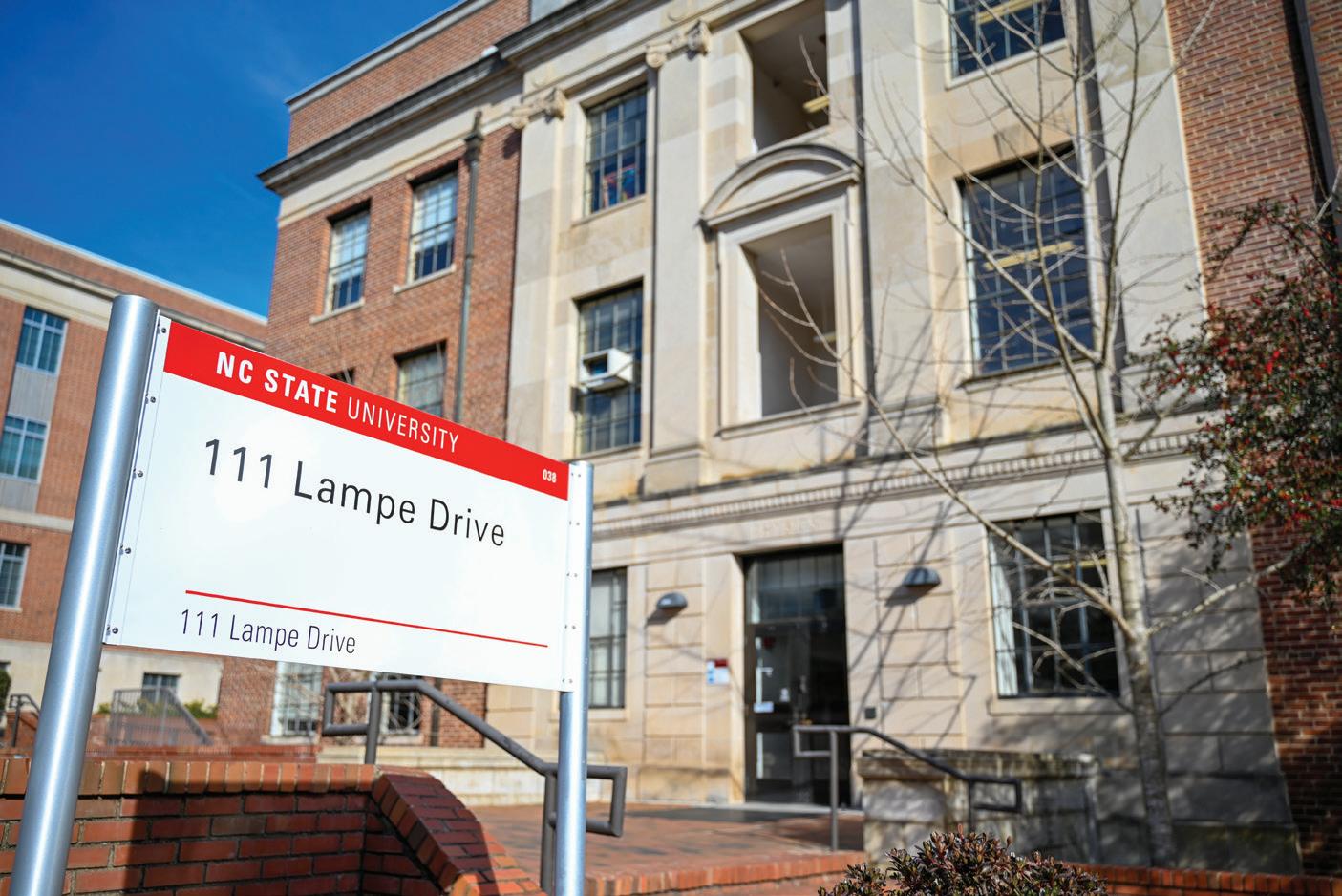
111 Lampe Drive, which sits on Lampe Drive, pictured on Tuesday, Feb. 20, 2024.
Jackson Davenport Correspondent
4 TECHNICIAN
Asian Students Association open to all for events, education
Dae Reed Staff Writer
The Asian Students Association at NC State aims to promote community and belonging for all students while providing educational resources about a variety of Asian cultures and experiences.
Mana Tangirala is a third-year in international studies and vice president of the Asian Students Association. She said the association helped her find her community and avoid feeling isolated from her background.
“When I came to NC State, I was like, ‘Oh, I don’t need to assimilate,’” Tangirala said. “I have people here. I can just be myself and these people would understand.”
Christopher Kha, a fourth-year studying sociology and co-president of the Asian Students Association, said he found the ASA to be an opportunity to learn about others and expand his cultural horizons, instead of being secluded in his identity group of Hmong Americans.
“It just opened my mind up even more,
seeing all these cultures, because I knew about all these cultures, but just being able to see it and exploring them just amazed me,” Kha said. “It’s just something that I always wanted, because I never grew up with things like this.”
There are other Asian-oriented groups on campus, such as the Pakistani Student Association, Chinese Undergraduate Student Association and the Korean American Student Association. Tangirala said that although their purposes overlap, the groups are trying to help the same communities and cater to under-served groups.
“I try to make sure that we acknowledge all parts of Asian culture, not just what we think is Asia because it’s not a monolith stereotype,” Tangirala said. “It’s a diverse part of the world.”
Kha said collaborations with other groups are also important to their mission. They collaborate with cultural clubs and other organizations, such as the Asian-interest sorority Kappa Phi Lambda, to bring broad education to as many people as possible.
“Our purpose is to bring people together through Asian cultures, not just one culture,” Kha said. “We want to be able to expose them to all cultures around Asia.”
Kha said small community spaces are important, and so are wider events, to acknowledge diverse cultures. Something like Asian Pacific Islander South Asian American Heritage Month, which is being celebrated on campus from March 15 to April 15, brings wider recognition to their club and purpose.
“It gives people the opportunity to know that, you know, we are out here, and we have the culture, and though it’s predominantly white school at NC State, just know that we do have the diversity here,” Kha said.
Tangirala said ASA tries to cater to anyone who may be interested in Asian topics, whether they are knowledgeable or not.
“I love the ASA community because it’s not just Asian Americans; it’s people from different countries, like foreign-born people on campus, who are able to connect with people in the U.S.,” Tangirala said. “We try to make sure every single person,
even if you’re not Asian, you feel like you belong.”
Most of the club’s events are centered around an Asian-related holiday or tradition, and they try to cover a wide range of cultures. They host events for events like Diwali and Chinese New Year. At their recent bingo night, squares featured different Asian ingredients to expose participants to new diverse traditional foods.
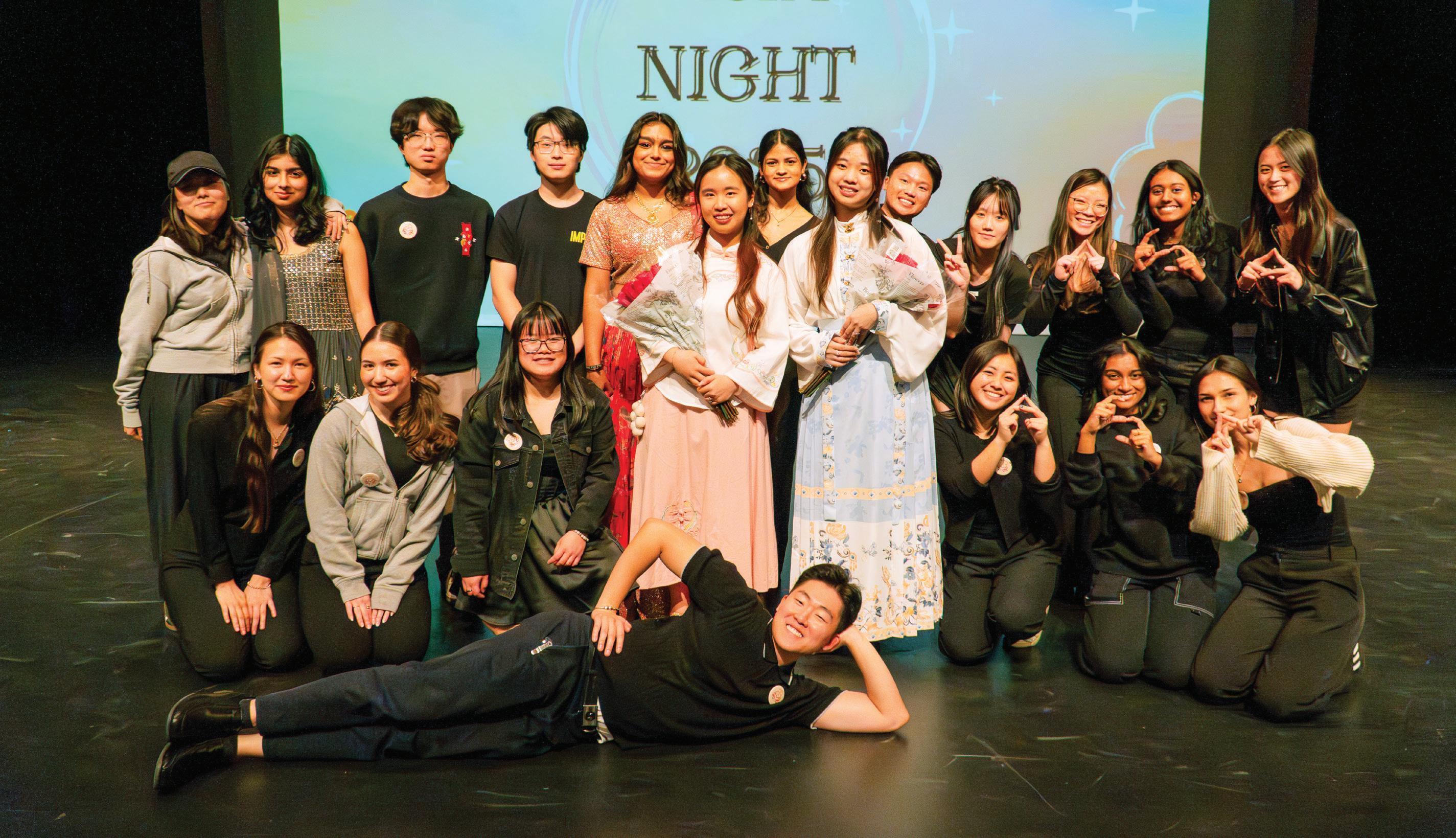
Asia Night is ASA’s largest annual event which hosts a variety of Asian performers. This January, it was hosted in Stewart Theatre and featured student and community-based performers showing off their talents.
Upcoming events for APISSA Heritage Month include a field day and collaborations with other Asian-interest organizations at UNC-Chapel Hill and Duke University. “Bamboo Bids,” an auction of community donations, will be held on March 6. More information can be found on the Asian Students Association’s Instagram page.
COURTESY OF CHRISTOPHER KHA
The Taiwanese NC State alum who revolutionized prostate cancer detection
NC State alum T. Ming Chu developed a prostate-specific antigen test, revolutionizing prostate cancer detection. His journey from Taiwan to NC State laid the foundation for a career that has impacted millions of lives worldwide.
Chu graduated from National Taiwan University in 1961 before arriving in the United States in 1963. He pursued a master’s degree in food science at NC State, graduating in 1965. He then earned a doctorate in biochemistry from Pennsylvania State University in 1967.
At NC State, Chu established an endowment in honor of his mentor and professor, Leonard W. Aurand, a distinguished scholar in enzymes, lipids and flavor biochemistry at NC State. Aurand recommended Chu to his mentor at Penn State, where Chu received his doctorate.
After postdoctoral fellowships, he joined Roswell Park Comprehensive Cancer Center in 1970, where he became director of cancer research in 1977 and professor of experimental pathology at the State University of New York at Buffalo.
At Roswell Park, Chu led a team that sought a protein marker linked to prostate cancer.
Dr. Matthew Nielsen, professor and chair of urology at the UNC-Chapel Hill School of Medicine, said Chu’s development of the PSA test revolutionized prostate cancer detection, ushering in what he said experts now refer to as the “PSA era.”
“His contributions were really transformational for literally millions and millions of men and the people who care about them, not just in the U.S., but all around the world,” Nielsen said.
Prior to the development of the PSA test, Nielsen said less than 5% of men were able to find out they had prostate cancer while it was potentially curable.
The PSA test is a blood test that targets prostate-specific antigen, a protein uniquely produced by prostate cells. Nielsen said the test uses antibodies specific to this protein to detect prostate disease, particularly cancer, radically transforming patient care by allowing for earlier detection.
Chu’s test received FDA approval in 1986 as a monitor for treatment response and disease recurrence, and in 1994 as an early detection aid. Since then, an estimated one billion PSA tests have been administered worldwide.
Chu’s work has garnered numerous
CONTRIBUTED BY NCSU SPECIAL COLLECTIONS
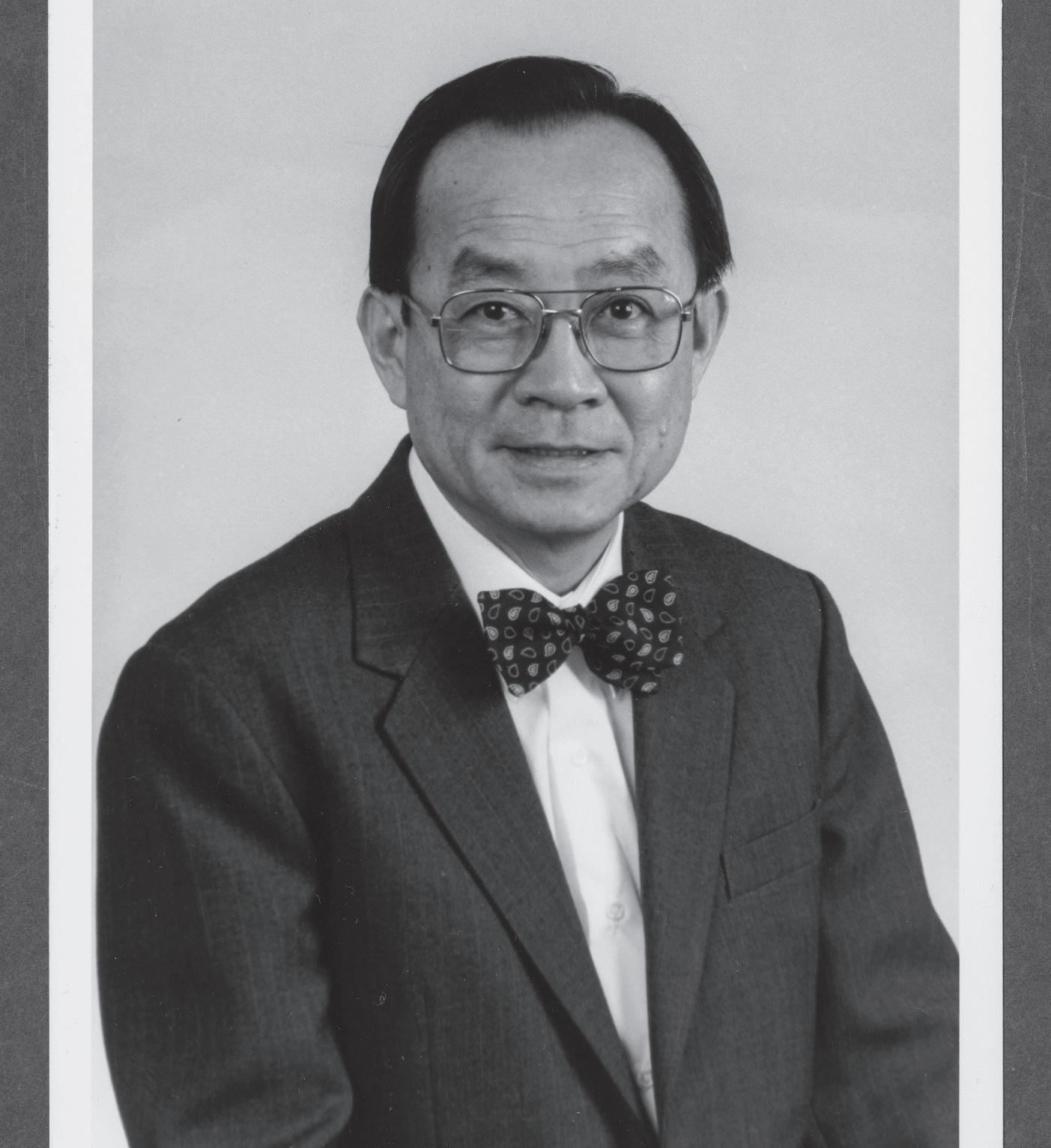
[DR. T. MING CHU], [UA014_011-004-BX0043-028-014], SPECIAL COLLECTIONS RESEARCH CENTER, NORTH CAROLINA STATE UNIVERSITY LIBRARIES, RALEIGH, NORTH CAROLINA.
accolades, including the Presidential Award of the American Urological Association and recognition by the American Association for Cancer Research as one of the “Landmark Scientific Discoveries of the 20th Century.”
Although the test was widely embraced for early detection, it faced a period of decline following concerns about overdiagnosis and overtreatment. Studies emerged questioning the overall benefit of widespread screening, leading the U.S. Preventive Services Task Force to recommend against routine PSA testing in 2012. As a result, Nielsen said rates of PSA testing decreased and, subsequently, so did the number of new prostate cancer diagnoses.
However, this decline had unintended consequences.
“Now the rates of prostate cancer are starting to creep up again, but a larger fraction of men who are diagnosed now are diagnosed with advanced disease,” Nielsen said. “So it’s sort of like we’re back to the future.”
Recognizing the drawbacks of diminished screening, Nielsen said urologists have since shifted towards a more per-
sonalized approach. Today, the PSA test is often combined with other tools like the MRI and used in conjunction with active surveillance for low-risk cancers, allowing for more selective identification and treatment of aggressive disease.
Americans in science and education. Crystal Chen Lee, associate professor in English education at NC State and a daughter to Taiwanese immigrants, said Chu’s pathway to the U.S. as a graduate student was fairly common among Asian immigrants at the time.
“Many Asian Americans who are in academia, they also came here for graduate school,” Lee said. “I actually am a product of that. … That was the pathway for a lot of Asian Americans to come to America, especially Taiwanese Americans, because America was very friendly to Taiwanese, especially through the graduate school path.”
The “friendliness” that Lee mentions toward Taiwanese immigrants during this period can be attributed to a complex interplay of factors. The U.S. had separate quotas for mainland China, Taiwan and Hong Kong, which meant that Chinese immigration into the U.S. came almost exclusively from Taiwan in the mid-1970s.
The Immigration and Nationality Act of 1965, also known as the Hart-Celler Act, played a pivotal role in reshaping immigration patterns. It prioritized skilled workers and those with advanced education, which opened doors for many Taiwanese students seeking graduate degrees in the U.S. This act, coupled with the political alignment between the U.S. and Taiwan, created a welcoming environment for Taiwanese students.
Lee also noted that in the mid-20th century, the U.S. tended to accept more immigrants from certain Asian countries than others, such as Taiwan. This selective acceptance, driven by Cold War politics and a need for skilled labor, meant that individuals like Chu had opportunities that were not as easily available to those from other Asian nations.
His contributions were really transformational for literally millions and millions of men and the people who care about them, not just in the U.S., but all around the world,
- Dr. Matthew Nielsen
Lee said these immigration patterns have lasting impacts.
“Many Asian Americans who have really come here for graduate school have contributed to science and contributed to the growth of the American economy and research development,” Lee said.
Nielsen said Chu’s contributions to science have changed the world.
“The world is a completely different place because of the contributions he made,” Nielsen said. “He’s one of many examples of people who came from all over the world and availed themselves of the opportunities that were available here and made a massive impact on humanity.”
Chu’s journey from Taiwan to NC State exemplifies the contributions of Asian
Matthew Burkhart News Editor
Critical Asian Narratives and Engagement at NC State to host annual Asian Artist Showcase
Critical Asian Narratives and Engagement at NC State is set to host its annual Asian Artist Showcase, themed “Habitat,” on March 8 from 6 to 9 p.m. in the Piedmont-Mountains Ballroom of Talley Student Union. The showcase, a cornerstone event of the organization, aims to provide a platform for Asian American artists to display and sell their work, fostering community and promoting representation on campus and beyond.
Founded in 2021, CRANE emerged from a need for an Asian American identity-centered club at NC State.
George Cyriac, a fourth-year studying mechanical engineering and one of CRANE’s coordinators, said the organization was created because there was little space for NC State’s Asian American students to convene outside of organizations more specific to Asian nationalities.
“We wanted to very much focus on what it was like to be an Asian American, specifically,” Cyriac said.
Harrison King, a third-year studying biological engineering and the media chair at CRANE, said that while the club is most known for its artist showcase and arts-related activities, its primary focus is on Asian American culture and community.
“First and foremost, we are an Asian American cultural club,” King said.
Both Cyriac and King discovered CRANE through the showcase, participating as artists before joining the board. They said the showcase is often a gateway for students to connect with CRANE and find a sense of belonging.
Beyond the showcase, CRANE hosts workshops, talking events and socials to educate and engage with the Asian American community. These initiatives cover a range of topics, from voter education to discussions on navigating identity and culture.
Crane extends its reach beyond NC State students, inviting artists and community members from across North Carolina and beyond to participate in the showcase.
“We definitely think we have something special with the showcase,” Cyriac said. “To the point where UNC doesn’t have something like that, so we get a lot of UNC people who join us for it.”
This year’s theme, “Habitat,” was chosen to reflect the experiences of building
community and finding a sense of place, particularly for Asian Americans.
“Every year we try to have a theme that relates in some way with the Asian American community and essentially building the sense of community,” Cyriac said.
As someone who immigrated to the U.S. four years ago, Cyriac said CRANE and a united Asian American community on campus helped him find a sense of belonging.
“I felt that CRANE did help me sort of find a new space for myself, and I did build a new environment for myself and all,” Cyriac said. “We came together and thought ‘Habitat’ could allude to that.”
King said “Habitat” also refers to creating or reclaiming space in the community for Asian Americans.
“We’re talking about habitat as reclaiming habitat, and Asian American stigma — working past that to feel really part of a community instead of ostracized from it,” King said.
Attendees can expect a diverse range of artistic expressions at the showcase, reflecting the experiences of Asian Americans. While CRANE’s social media imagery has leaned towards earthy
and natural aesthetics, Cyriac said artists are welcome to submit work that resonates with them, regardless of the theme.
The showcase primarily operates as a platform for artists to sell their work directly to attendees, with CRANE taking no commission.
“We just provide a platform so artists can either market their work or sell,” Cyriac said.
King said in the past, CRANE has provided grants and supplies to support artists in creating work for the showcase.
The application process for artists involves submitting samples of their work and providing information about their artistic practice. The selection process is primarily focused on ensuring the artwork is appropriate for the setting and that the artists have a feasible plan for displaying and selling their work.
CRANE hopes that the artist showcase will contribute to Asian American representation and visibility on campus. King said the showcase has seen impressive attendance numbers in the past and has become a central part of the organization’s outreach efforts.
“CRANE has been a huge help to us,
and we’ve also seen that in other artists and other Asian Americans that we see in our workshops and such, and we feel like we grew that community over time, and we’re really proud of it,” King said. Cyriac emphasized CRANE’s role in uniting different facets of the Asian American community at NC State. As a “third culture kid,” meaning his parents were from one country, he grew up in another and later moved to the U.S., Cyriac said he found it challenging to find a sense of belonging in other cultural organizations on campus.
“CRANE gives a platform for some people who might not be able to find community in any of the other smaller clubs,” Cyriac said. “... CRANE is a pretty broad umbrella organization, and it gives space for a lot of different communities.”
CRANE collaborates with other student organizations and departments on campus. On March 27, CRANE will be partnering with the Multicultural Students Association to host a Chat ‘n Chew, where various Asian American topics and issues will be discussed over a meal.
KAELA BELINGON/TECHNICIAN
Denna Huang talks to visitors at her table during the Asian Artist Showcase in the Talley Ballroom on Friday, March 31, 2023. Artists at the event sold their art, such as painting and photography, to visitors and students.
Matthew Burkhart News Editor
Art2Wear pop-up gallery and live event at the Gregg Museum
Kelsey Bohn Staff Writer
The Gregg Museum of Art and Design opened a new Pop-Up Gallery Lounge entitled “Art2Wear: Through the Archives” Tuesday. The exhibition is in partnership with NC State’s Art2Wear club, which hosts an annual studentled showcase that displays a variety of innovative, wearable art designs.
The gallery will include a vast history of archival looks, photos and repurposed art from over 20 years of Art2Wear shows.
Keerthi Nagapudi, a fourth-year in design studies and a co-director of Art2Wear, explained how the gallery provides a unique opportunity for the community to interact with the designs in an up-close, intimate way.
“There is such a rich history to Art2Wear, and we wanted to show that,” Nagapudi said. “In the lounge, you can see a timeline and a showcase wall that has pictures and descriptions about artwork from the very beginning to now.”
The lounge will promote a cozy, leisurely experience that invites visitors to take time to notice the intricate details that designers meticulously crafted.
“These collections and designs are so personal to the designer, and that being overlooked is tragic,” Nagapudi said. “I’m really glad they have a platform to shine.”
The idea for a partnership with the museum arose in tandem with the desire to further engage those at NC State and the greater community with Art2Wear.
When Sara Segerlin, the director of the Gregg Museum, began her role, she dedicated herself to making the Gregg a collaborative, community-centered space.
“The Gregg Museum is a nontraditional classroom for NC State students to explore sub-
ject matter in coursework to enhance learning and also cultivate projects,” Segerlin said.
Segerlin described the partnership between the Gregg and Art2Wear as mutually beneficial. The Gregg provides a space for Art2Wear to host their event in a nontraditional format while simultaneously accomplishing their own goal to foster learning and community engagement.
“I hope that this exhibition will promote Art2Wear and the College of Design to a broader audience,” Segerlin said. “I want the NC State community to feel celebrated and to have pride in the legacy of Art2Wear.”
On April 24, Art2Wear will host a live event entitled “Revive” at the Gregg Museum. This show challenges designers to reimagine traditional ideas into wearable art that can be presented creatively to an audience.
Lydia Spears, a fourth-year studying art and design, is a co-director of Art2Wear. She said
the event encourages designers to expand the reveal of their collections past a fashion show and into an immersive story with elements such as choreography and audience interaction.
“This year we’re doing a more elaborate style, where the crowd goes through the museum, but the looks are placed throughout in minimal sets,” Spears said.
This creates a more dynamic show, where the nontraditional nature of the art matches the personalization that an abstract viewing experience provides.
“We’re trying to make our identity as a club not just about being a fashion show or an art show, but a mix between the two,” Spears said. “We wanted our designers to do something more noncommercial than a fashion show.”
Creating wearable artwork for a live event demands careful attention to many non-visual aspects. Designers must consider how to create breathable designs and select dynamic models
in order to carry out a set between three and five minutes.
Elle Newkirk, a fourth-year studying environmental design in architecture and a designer for Art2Wear, has tackled the performance aspect of this year’s show by selecting dancers to model her collection.
“I was really excited when I heard that the show was going to be a different format this year,” Newkirk said. “The opportunity to do a live art performance in the Gregg instead of the runway has been really cool, especially in getting to work with my models.”
Newkirk spoke about creating a collection of three looks called “Palingenesis,” which incorporates the theme “Revive” by exploring how traditional Korean fashion is reinvented by new generations.
“In Asia, there’s a pretty big movement of young people modernizing their traditional wear, and I’m creating my own spin on that,” Newkirk said. “I’m exploring the little rebirths and deaths you go through as you continue to grow and learn, and each of the three looks represent a different aspect of that process.”
Each collection displayed at “Revive” will bring an entirely unique take on the theme, coupled with a performance set to reinforce their vision and immerse the audience into a night of creativity, appreciation and community engagement.
“Art2Wear: Through the Archives” at the Gregg Museum of Art and Design will be open to the public from March 4 through July 5. The live event, “Revive,” will take place April 24, also at the Gregg. Ticket sales for “Revive” will begin March 17. More information can be found on Art2Wear’s Instagram, @ncsuart2wear.
Tuesday Pil incorporates Filipino heritage into upcoming novel
Rocky Berhe Assistant Opinion Editor
Right now, 21-year-old Tuesday Pil is a fourth-year studying English. They recently acquired an agent for their novel “Tala Tolentino and the City of Star Blossoms.” Acquiring an agent is a lofty goal, one that most aspiring writers never accomplish, let alone before their first legal drink.
Pil, however, has been working at this for nearly a decade.
“The story I tell people is that I had to write this story for a creative writing class when I was in third grade, and then I got a D on the assignment — which was kind of extra, to be honest — but I got a D on the assignment, and then to spite the teacher, I started writing something else,” Pil said. “Then I accidentally was like, wait, I actually really like this. And I just kept writing and writing.”
Their family worked in healthcare and had no knowledge of what to do with a writing
prodigy, so they hired a tutor who showed Pil the ropes.
“[My tutor] published a few books of her own and was mostly just working as an English tutor,” Pil said. “Then my dad went to her — I was writing this book, and it was really bad, but I guess she was kind of impressed by how much I wanted to write when I was that young.”
Aside from their personal practice and motivation, they were pushed by their tutor and brought to workshops for more experience.
“I was, I think, 10 at the time, and then throughout 10 to 13, she was the one that taught me how to query, and taught me about publishing,” Pil said. “She brought me to workshops with her so I was getting a lot of experience doing that. And then by the time I was 13, I had this fully edited novel that I was sending out.”
COURTESY OF BETHANY FAULKER
PIL’S FILIPINO NOVEL
continued from page 7
Pil often referred back to their earlier work, seemingly without any awareness of the skill it takes for an adolescent to write a decent literature review, let alone an entire novel. This detachment from the precarity of their situation extended to the unique perspective Pil possessed as a Filipino immigrant.
“I was reading a lot of fantasy books,” Pil said. “Usually by white authors, so a lot of my characters were actually white or ethnically ambiguous sometimes, but most of the time they were white characters. There were, like, no Asian characters in it.”
Going to college helped them find a place in literature and fully visualize themselves as a character in a book.
“It was really in college and going to literary spaces and interacting with a lot of different writers, I think, is what finally made me feel like I can see myself on a page, and I can write myself in there, and not be weird about it,” Pil said. They mentioned their high school was diverse with a decently-sized Asian population.
Coming to NC State, a predominantly white institution, was a bit of a shock that forced them
to examine their writing.
“There was a bit of fear in it because, what if nobody understands what the heck I’m talking about because it’s from a cultural standpoint,” Pil said. “Then I just kind of learned not to care.
It gives me a certain perspective to write from, and more depth and stuff like that. It helps me process how I grew up versus how other people grew up around me.”
They also credited an expanding taste in
literature to their comfortability with incorporating sociological themes into their work.
“I was reading more and more, non-white authors at that point too,” Pil said. “And kids books — I was thinking, ‘Oh, if they can do it, why can’t I do it?’”
It’s impossible to ignore the backlash against children’s books which dare to include Black and diverse characters. Right-wing lawmakers claim children aren’t capable of understanding “complex” and “difficult” themes.
“I don’t shy away from it,” Pil said. “My age range is 8- to 12-year-olds, so it can’t be horrifying. But that’s definitely an age where kids are learning a lot about themselves, and honestly, if you try to hide things from them, they’re gonna be really curious. So I kind of explore it plainly.”
Pil applies this philosophy to their use of Tagalog in their writing. They refuse to italicize their native language or any language other than English.
“Sometimes I’d toss in a whole phrase, and I wouldn’t translate it,” Pil said. “And honestly, sometimes, I refuse to translate it.”
When it comes to recreating stereotypes, Pil tries to balance authenticity and depth in their characters, specifically the family dynamics.
“I try to show multiple facets of it, and instead of it being a hard rule, there is room for change and redemption and I think that’s how you can still use the tropes but, transform them in a way.”
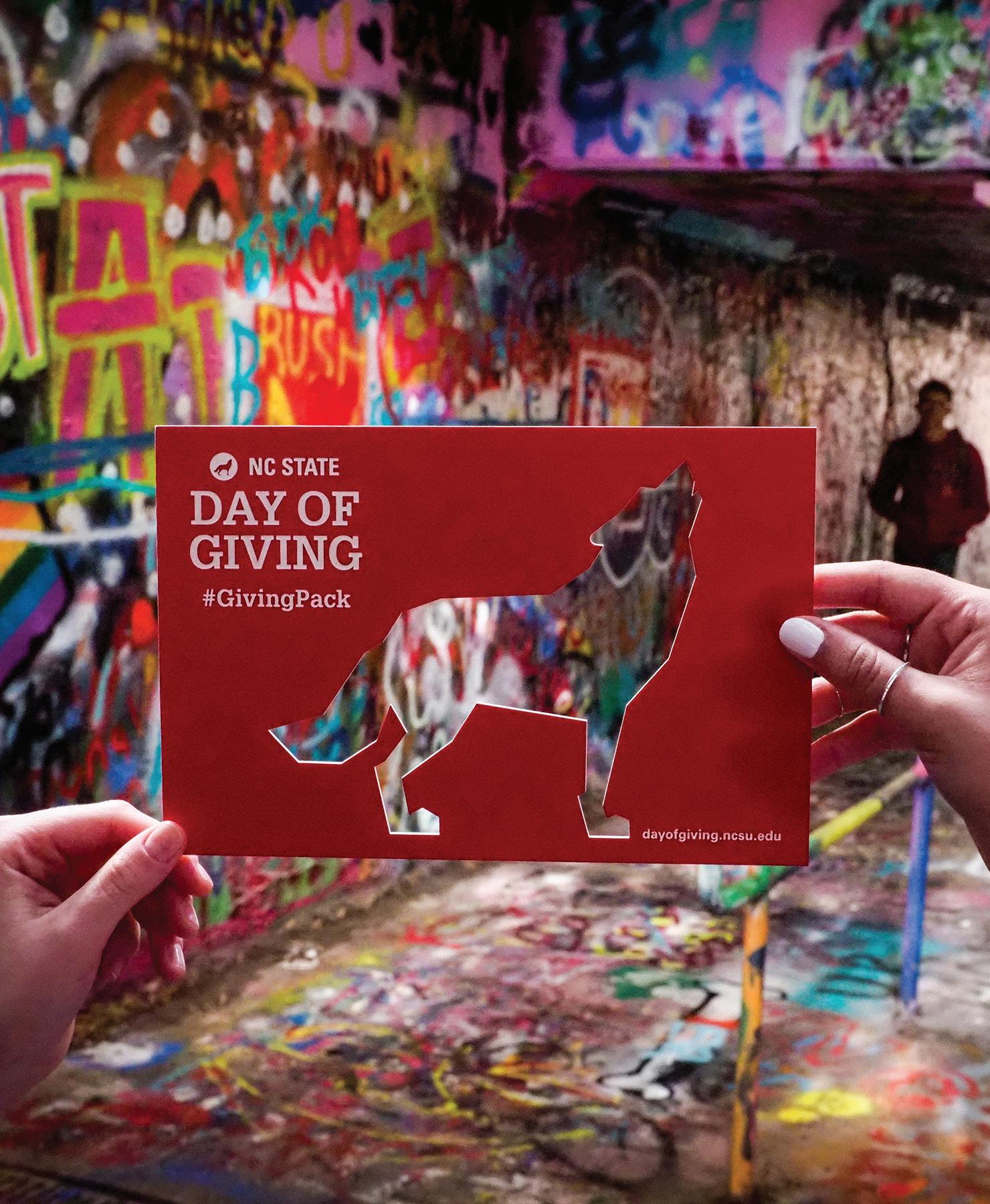
Everything you love about NC State — like your favorite programs, campus spaces and wellness resources — is made possible thanks to our donors. On Day of Giving, your passion inspires them to fuel our Wolfpack’s future.
It’s easy to make a difference for programs you love:
• Compete in social media challenges using #GivingPack and share your NC State story.
• Take part in activities at student events happening across campus to win swag.
• Participate in the student referral link challenge to win swag and bonus funds for the programs that matter to you.
• Check out what your college is doing on Day of Giving and get involved with your friends.
Learn more at dayofgiving.ncsu.edu/info/students
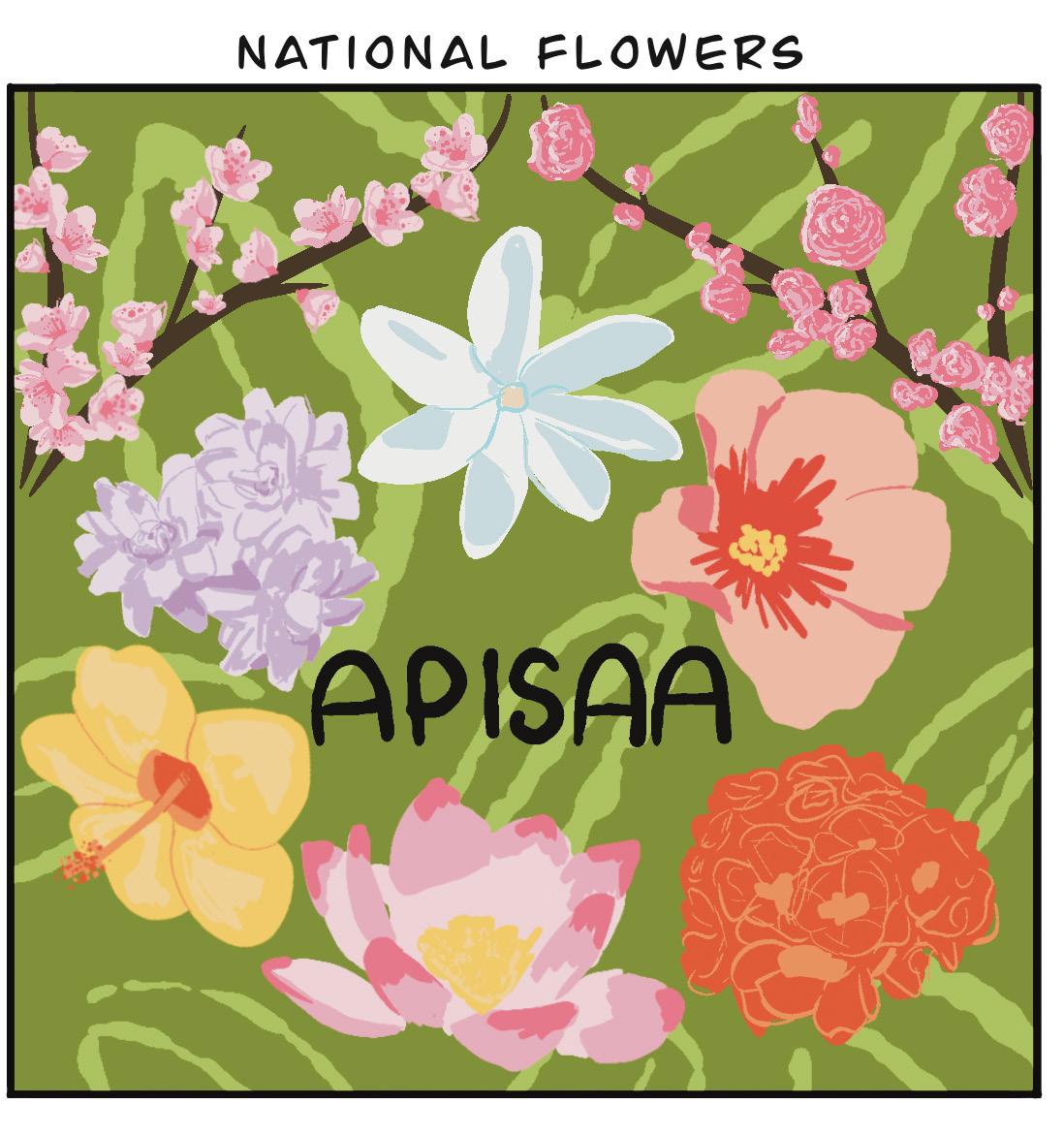
National Flowers
Jordan Ramsey, Staff Cartoonist
A fourth-year studying art and design
Become the camera friend
Photography is an art. It might not be an art in terms of brushstrokes or molding clay, but it’s an art in terms of having an eye for what to capture.
The decision to take a photo in itself is an act of creativity; you’ve decided to make a moment — a visual composition — everlasting. I started taking photos when I was about five years old. To call it photography would be a stretch, but a camera has never been far from my hands.
Bits and pieces of the early 2010s are still tangible in my fuzzy photos and shaky videos; my dad’s silly faces, tooclose pictures of my pets and playing with my sibling.
It was simple — if I loved it, I took a photo.
Now, it isn’t always so simple. Careful curation dominates a lot of our approach to photography and the way our generation shares photos. Our photos are
often tied to our image rather than to our heart.
Treating photography as capturing essence, however, is game-changing.
“The camera friend” is a term I’ve seen thrown around a few times online. It describes the person in the friend group who brings the small digital camera to the party or the friend “who’s always recording memories.”
The more I saw these posts and videos, the more I grew to empathize with it.
I imprint my friends onto film negatives and keep printed photos on my wall. Sometimes I feel self-conscious trailing behind my friends to take photos of trees or sheepishly shooting videos on trips to the beach.
But I’ve found that it plants my feet in time. Time goes by more slowly.
I will remember the moment. And it will live on. It’s taking the essence of my life — beauty, joy and curiosity — and making it tangible.
I like to say I inherited my love for a camera from my grandfather. It’s when
I see the boxes upon boxes of photo slides and countless photo albums that I remember why I do it. You see his life, through his eyes, amidst the photos. Decades. Birth. Celebration. Beauty. Play. He can’t even remember these memories, but they live on.
The viewfinder is not just the mechanical tool of a camera. It genuinely captures human vision and the curiosity that comes with it.
We are in these moments of our lives once — they are fleeting. A photo is taken with intention, remembering those moments with care.
There’s a quote from James Thurber that was adopted as the fictitious Life Magazine mission statement in “The Secret Life of Walter Mitty”: “To see the world, things dangerous to come to, to see behind walls, draw closer, to find each other and to feel. That is the purpose of life.”
It is with creativity and eagerness that we achieve this most profoundly. It’s the essence of the human spirit that wants to
make itself known while exploring what’s around us.
And really, though, we love through what we choose to create, what we choose to capture amidst the race of time.
We’re in a time that is derealizationinducing. Uncertainty and fear are commonplace. But I urge you to slow down — and slow down creatively. Slow down with love and with intention. Pick up a roll of film and an old camera. Create an Instagram post where perfection isn’t the goal. Have a camera roll full of nature.
Becoming the camera friend is becoming the documenter of not only your worldview but of the people, emotion and world around you. Photo albums are treasured for so long because they defy one of our greatest challenges: time. We are here now, and in a photo, we always will be.
When we are doubtful, fearful and despondent, it’s our most crucial time for creativity. To create is to explore, hope and feel. To create is to live.
Community is everywhere if you know where to look
Have you ever moved into a new environment — say, a different city or school — excitedly expecting to branch out and meet more people who enjoy the things you do, kind of like back home, only to not be able to find them anywhere? As if certain communities only exist online?
Going from a place where your favorite artists, shows or fashion trends are the norm to a place where no one seems to have even heard of them is an odd feeling. On the internet, it’s easy to find those who just get it with minimal scrolling. Out in the real world, the search for those like us can make you an outsider rather than part of a collective.
I remember living this when I began my first semester at NC State. As a girl who loves archival fashion and underground hip-hop, being from the culturally enriched city of Charlotte meant that I didn’t need to go far to find the connections I was looking for.
That is, up until I moved to Raleigh. There’s no doubt that NC State’s not exactly the most diverse university out there, but the school is no monolith.
Community exists everywhere — you just have to know where to look.
This means that no, you can’t just sit around recluse today and expect your perfectly tailored posse to come up to you. Even the kids who seemed to have started the semester off with a full friend group put themselves out there; they knew where to look.
So it begs the question, where are we supposed to look? And how does one effectively branch out?
The first and best place to start is by, you guessed it, being yourself. If you wear your personality like a cape and are attuned to what truly excites and fulfills you, meeting people in an everyday setting will be a breeze. You’ll make new friends and acquaintances or even gain new knowledge from passersby.
There will be some people who you’ll meet but not exactly be aligned with, and that’s okay. It takes time, but the right connections will come naturally.
One of my favorite ways to express myself is through my clothing. I like to refer to it as virtue signaling through outfits. The philosophy is that certain subcultures have their own aesthetics; if a skater could spot another just through the style of their baggy clothing, then maybe a fashion aficionado could notice my 1199 bracelet.
Moreover, another great way to put yourself out there is by getting involved. Social media exists as a tool to inform us on what’s going on locally. We could only be so thankful for sites such as Instagram or Reddit that use internet communities to spread information and organize events out in the real world.
The most important part of getting involved is actually showing up — not just watching on the sidelines. Even the smallest things like house shows or popups have the ability to keep you in close proximity to like-minded people.
My personal connection to getting involved in Raleigh is the monthly vintage markets on campus. After spending hours sifting through over 20 vendors, I always make sure to follow my favorite
vendors in hopes of seeing them again anywhere around the state. Through community, they typically know each other and post each other’s events in support. Because of this, I’ve found beautiful new stores to shop at that I probably could have never found on my own. You never know who you’ll meet or what you’ll see just from being present. Sometimes, it takes a single experience to feel like you’ve found your people. There’s no exact route to take when it comes to finding community. Sometimes, all you need to do is follow your passions and wait for the proper opportunities to present themselves. There are countless ways to indulge in all the things you like — and NC State actually encourages it. The Taylor Swift: Through the Eras course previously offered is one example of how students are supported in indulging in their favorite things.
This just goes to show that community exists everywhere for those willing to find it.
Logan Lowery Correspondent
Wilhemina Ampomah -Sraha Correspondent
We should all be angrier at the normalization of racism against South Asians
The Indian subcontinent is home to over 1,000 different mother tongues and hundreds of different cultures and ethnicities, so why does the Western world narrow down South Asians to the stereotypically exotic and shallowly Bollywoodish image to represent us all?
As a diasporic South Asian, I am exhausted and frankly angry with the casual racism and cultural appropriation that my people face on a daily basis. The casual racism has been so normalized that speaking out against it feels like an overreaction.
And by casual, I’m referring to the unending and overexaggerated mockery of South Asian accents in all their stereotypical glory. I refer to the casual uses of slurs such as “Curry Muncher” and “Paki” that have roots in racial violence but get thrown around in an attempted humorous manner. I also refer to the degrading and demeaning references to how “smelly” and “gross” our food is. Growing up, I never realized how much of this casual racism is instilled in us by Western media. Usually, Hollywood likes to show South Asians as the nerdy awkward friend that is usually a straight-A student with strict parents, or bargaining immigrants with a thick accent who own a corner shop, such as Apu Nahasapeemapetilon from “The Simpsons” or Padma and Parvati Patil from “Harry Potter.”
The women are either hypersexualized as exotic beauties or submissive and overly traditional such as Pinky in “The Namesake” and Jess Bhamra in “Bend It Like Beckham.” Our culture is shown
in a way that makes it seem ridiculous and one-dimensional, helping enforce stereotypes against South Asians rather than showing us as human beings with depth and individuality.
This completely limits the views of how the world sees South Asians.
The stories are always the same too — South Asia is portrayed as a backwards, poverty-ridden and dangerous place with the main character wanting to leave. Or it’s shown as overly exotic and outlandish to the point it resembles a circus. The stories always surround the main character struggling with their culture, not allowing South Asians to explore their individuality and complex problems and emotions, reinforcing the fact that South Asians are defined solely by their race and ethnicity.
This racism and misrepresentation tends to be dismissed as harmless, which not only demeans our experience but also proves to actually be extremely harmful. These stereotypes affect how society perceives us; affecting job opportunities, social interactions and even personal identity.
For example, South Asians have a 49% lower rate of being admitted into Ivy League schools than white applicants with the same extracurricular and academic qualifications. And while South Asians have high participation in professional fields, they are rather underrepresented in leadership roles. In 2020, Asian American men account for only 3.8% of leadership positions in the federal sector, while Asian American women account for 3.2%.
Growing up, this casual racism created internalized racism and the feeling of be -
ing alienated and even ashamed of being South Asian. As a kid, I hated being brown, especially looking at my peers, and being bullied for my food. Just generally being brown, I would often wish that I was white. I wanted to have white friends, and I started distancing myself from my culture and roots.
It was only when I got more mature and older that I realized how messed up this mindset was, and that it was due to the casual racism I faced and felt so normalized towards.
The same can be said for cultural appropriation of various South Asian cultures and nations other than India and Pakistan.
South Asian cultures like Pakistani, Indian and Bangladeshi have been commodified by the same society that once ridiculed it. It’s infuriating to see something that I was made fun of for doing as a kid, and many kids of South Asian descent, suddenly become a trend when white people begin doing it, such as oiling my hair which has been a tradition in South Asian culture for centuries. And then the trend gets accredited to white people.
It doesn’t stop there. Yoga has also been capitalized on and marketed as some sort of exotic wellness treatment that strips it of its spiritual, cultural and even religious roots. Golden milk — also known as Haldi Doodh in Urdu/Hindi — is becoming trendy and marketed as healthy and healing without acknowledging that it comes from South Asia and that it has been used in our society for centuries.
Another trend that comes to mind is the Scandinavian scarf trend that took over TikTok this past summer. A white
influencer commented on a picture of a white woman wearing a scarf with a dress as very “European” and “Scandinavian.”
This “scarf” is a cultural South Asian clothing article that women have worn for centuries called “Shalwar Kameez” and “Dupatta.”
It goes unnoticed when brown women are adorned in this type of attire, but suddenly when a white European woman wears it, it is so chic and cute and becomes trendy. Suddenly they are credited for creating this type of clothing, despite it being in South Asia for centuries.
Simply put, either South Asians aren’t given credit for their culture, or then they are proclaimed as “exotic” and worn in a way that resembles costumes by Western influencers and celebrities.
These appropriations aren’t just minor offenses that irk me; these are examples of how South Asian culture gets stolen, exploited and attributed to white people. These are examples of how there are always double standards in the West: When a brown person does it, they are weird, ridiculed and shamed for it; and when a white person does it, it suddenly becomes trendy and cool.
Let me make one thing clear: Our culture isn’t for you to steal.
Our culture isn’t some exotic commodity for you to take advantage of whenever you feel convenient. Our culture and ethnicity aren’t some jokes to be made fun of and to laugh about. It’s time that Western media began changing their approach to portraying South Asian people. And it’s about time people in the Western world understand that.
Seemal Syed Correspondent
My identity is too complex to be checked in a box
“What are you?”
It’s a question that has tested me for the past two decades. Explaining my identity to others has become a routine, an unraveling of nested dolls, each layer revealing another question.
Out of simplicity — or maybe spite — I like to stress others out by asking, “You tell me. What do you think I am?”
As an Guyanese-American person of Indo-Caribbean descent, the labels available to me have never quite fit. Filling out racial and ethnic information on official documents is a familiar nightmare. White? Check. Asian? Check. Asian Indian? Well, technically.
Most of the time, I end up defaulting to “Prefer Not to Answer.”
When I tell people I’m Asian, their eyes narrow in confusion. My family is Indo-Caribbean; ethnically Indian, but not from India. Guyana complicates the
narrative further — a South American country with Caribbean cultural ties, neither Hispanic nor widely recognized. The census forces me to choose one box: Asian. But marking that box feels like a half-truth.
Indo-Caribbean people are often erased from the broader Asian narrative — a reminder that the diaspora is more fractured and diverse than the categories we’re expected to fit into. My ancestors were Indian indentured laborers, brought to the Caribbean under British colonial rule.
That history isn’t widely taught, leaving people like me to explain ourselves over and over again. Even then, the explanation feels incomplete.
One of the strangest parts of navigating my identity is the shadow of Jonestown. When I mention Guyana, people either don’t know where it is or immediately ask, “Are you familiar with Jonestown?”
No. Heavy on the sarcasm.
The Jonestown massacre looms large in American memory, reducing an entire
country to a singular tragedy. It eclipses the vibrant culture, resilience and history of Guyana itself. My family’s homeland is more than a single horrific event — but that’s rarely how others see it.
My identity exists in liminal spaces; between continents, between races, between languages.
These experiences have made me hyper-aware of how the world perceives race and ethnicity; how people expect identities to fit into neat, predefined boxes. But the Indo-Caribbean identity defies those expectations. It’s a hybrid, a testament to resilience and adaptation.
Yet the structures that define race and ethnicity in the U.S. rarely make room for people like me. My identity exists in liminal spaces; between continents, between races, between languages.
The older I get, the more I realize how important it is to keep explaining. If I don’t, who will?
The “Asian” box on the census doesn’t tell the full story. It doesn’t acknowledge the histories of indentured servitude, forced migration or the vibrant cultures that emerged from those legacies. It doesn’t account for the feeling of invisibility, of knowing you belong to a community that is rarely represented or understood.
To be Guyanese-American is to be a question mark in other people’s minds. But my identity isn’t something that needs to be simplified for the sake of others. It’s something to be celebrated in all its layered, complicated beauty.
GRAPHIC BY LUCY OSBORN
Nicole Bharrat
Video Editor
How Owen Lloyd’s viral disqualification fueled his championship comeback
Daniel Susann Staff Writer
At the 2024 swimming and diving ACC Championships, NC State’s graduate Owen Lloyd became one of the biggest names in collegiate swimming — mostly from outrage.
Lloyd was the first to touch the wall in the 1650m championship heat event, claiming his first ACC gold medal. In celebration, he hoisted himself onto the lane line and pumped his fists.
But then he lost his balance, falling into the neighboring lane of the second place finisher, teammate then-fifth-year Ross Dant. Lloyd was disqualified for interfering with another swimmer during the race and as a result lost his gold medal. Although Dant had already finished, and Lloyd was not interfering with any of the other swimmers, Lloyd was still disqualified according to the rulebook and Dant was ruled the winner.
When news broke of the disqualification, the arena filled with boo’s. Dant stood on a diving block, giving a thumbs down to the officials as Lloyd held his head in his hands, letting all of his emotions out from the shock of his disqualification.
The swimming world was outraged —
members of the community found examples of times this rule had not been enforced and shared them on the internet. Dant, sticking up for his teammate and friend, called it the “dumbest rule in swimming.” He gave his gold medal to Lloyd, saying that Lloyd won it fair and square.
“He’s a great teammate, and what he did last year was awesome,” Lloyd said. “And it was a big part of the reason why it went so viral — him protesting during his interview. He handled that so well.”
Dant said his actions that day were simply a reflection of NC State’s swimming culture.
“I would hope that everyone that found themselves in the situation I was in would do something similar,” Dant said. “I would say that anyone on the team would do exactly that.”
In the coming year after losing his gold medal, Lloyd channelled his frustration with the disqualification into successful training habits. Instead of letting the disqualification get to him, Lloyd used it as motivation for a redemption arc.
Halfway through this season, Lloyd was one of the favorites in the 1650m, but that all changed when Cal’s Lucas Henveaux joined the field in January.
“The Belgian Olympian Lucas Henveaux
was added to Cal’s roster, kind of this last minute thing with some fuzzy eligibility stuff,” Lloyd said. “I won’t get into that, but I was really upset about that. And then he popped a 14:29, which actually would have beaten me at ACCs, at one of their meets.”
Lloyd didn’t let Henveaux get in his head either. Instead, he got his revenge by winning the same event he was disqualified in to secure 2025 gold with a time of 14:31.64, adding a second gold medal to his collection with his name officially in the record books.
This time he celebrated the gold medal performance in his lane. Lloyd finished five seconds ahead of second place, finding redemption in his final ACC Championships.
“I never thought that I would have millions of people see me crying on the internet,” Lloyd said. “I definitely still have some negative emotions with it, but yeah, I don’t know where I’d be or what would have happened if I hadn’t gotten DQ’d.”
After everything that happened at the Greensboro Aquatic Center that day in 2024, Lloyd felt a lot of pressure a month later in the NCAAs. The swimmer finished the NCAA 1650m in 14:39.18, two seconds slower than his 14:37.04 at the 2024 ACC Championships.
“I definitely had a lot of nerves going into
that meet that kind of held me back,” Lloyd said. “But being able to deal with that at that meet, I think, helped me a lot for this past weekend.”
After giving up his medal in 2024, Dant does not have anything to commemorate the event, except for the memories and maybe the mark he left on the swimming community for standing up for Lloyd.
“I was at Chipotle, a little bit after it happened, maybe a month or two,” Dant said. “And the server recognized me, loaded up my bowl with double rice, double chicken and everything, and didn’t charge me for it.”
The only physical display celebrating Dant’s accomplishment is the banner hung in Casey Aquatic Center listing his name, event and year. Now, as their collegiate stories come to a close, Dant’s and Lloyd’s names will hang in the rafters together as ACC champions.
Lloyd’s story isn’t over yet. He will compete as one of the favorites at the NCAA championships March 26-29 in Federal Way, Washington. After graduation, Lloyd plans to become a swim coach and help young swimmers reach their full potential, just as his team did when he was a walk-on four years ago.
ALEX MANUEL/TECHNICIAN
Graduate swimmer Owen Lloyd flexes after placing second in the 500m freestyle during the meet against UNC in Casey Aquatics Center on Friday, Jan. 17, 2025. NC State men defeated UNC men 165-134.
Built for March: No. 7 NC State women’s basketball poised for postseason success
Connor VanDerMark Assistant Sports Editor
It’s been a rough year for NC State athletics. With disappointing seasons from both football and men’s basketball and baseball struggling early, most major sports have emphatically fallen short of expectations.
But one thing is for certain: Wolfpack fans can always count on head coach Wes Moore and No. 7 NC State women’s basketball.
Already earning a share of the ACC regular season title, knocking off a No. 1 team and earning the No. 1 seed in the ACC Tournament, the fun is only just beginning for the Wolfpack.
But does it have what it takes to recreate last year’s postseason magic? Win the ACC Championship? Go to the National Championship? There is no better time than now for NC State to establish itself as a powerhouse in women’s college basketball.
When looking at NC State’s resume, a few things stand out. For one, the Wolfpack is an undefeated 16-0 at Reynolds Coliseum, a feat it shares with just four other teams in the Net Rankings Top 25. This is crucial for the first two rounds of the NCAA Tournament. Even if NC State loses in its first matchup of the ACC Tournament, it will most likely host the first two rounds of March Madness. When the red-and-white plays in front of its home crowd, it seems like no team can beat it.
The other thing that stands out is the Wolfpack’s five losses, all of which came away from home. Luckily for the Pack, the ACC Tournament is played in nearby Greensboro, North Carolina, meaning the Tobacco Road teams will have a slight leg up over the rest of their ACC foes in travel and fanbase.
However, this could be an issue in the NCAA Tournament. The Sweet 16 and Elite Eight sites are Spokane, Washington and Birmingham, Alabama — nowhere near the City of Oaks. If it were to repeat its Final Four run, it’d be in Tampa, Florida, which is once again, far away from Raleigh.
It’s worth noting that four of NC State’s five losses were to teams that currently sit in the Top 15 of the AP Poll. Critics could use this against the Wolfpack, saying that it can’t beat top competition when it matters most. But once again, the red-and-white proved doubters wrong with key wins against thenNo. 10 Duke and then-No. 1 Notre Dame. The reason? Moore figured out his lineup. Moore knew he had to find help in the portal after Mimi Collins and River Baldwin graduated in 2024. He brought in graduate forward Caitlin Weimar, an 18 pointsper-game scorer from Boston University. However, Weimar got hurt before the season
even started. Additionally, graduate center Lizzy Williamson went down with a seasonending injury. Without Weimar and Williamson, Moore was forced to rely on two freshmen — forward Tilda Trygger and center Lorena Awou. It seemed almost unfair for the two rookies, who were supposed to ride the bench and learn from their veteran counterparts. Instead, they got thrown into the fire as soon as the season started.
Awou barely got playing time early, while Trygger struggled in 22 minutes played against then-No. 1 South Carolina in just the second game of the season. NC State’s inexperienced frontcourt was a key reason the Wolfpack got off to a shaky 4-3 start. But as the season continued, they began to settle into their respective roles. Trygger learned to use her size in the post while also providing a threat from long range. Awou cleaned up her rookie mistakes to become a dominant scorer and rebounder in the paint. But relying on freshmen as his post players wasn’t the only unorthodox approach that Moore took — he also has four guards in his starting lineup. Typically, teams have a center and two forwards to provide size, defense and rebounding. But in Moore’s lineup, senior guard Saniya Rivers plays the three position while graduate guard Madison Hayes plays the four. It all works because of them. At six feet tall, Hayes is extremely undersized for the four position. However, even with her smaller frame, Hayes makes up for it with effort. The veteran averages a team-leading seven rebounds per game
and has recorded five double-doubles this season.
Rivers is simply an anomaly. Standing at 6-foot-1, her long frame makes her a defensive menace, averaging 1.7 steals and 1.3 blocks per game. Furthermore, Rivers is also excellent on the glass, grabbing 6.5 rebounds per game. And as if all that wasn’t enough, Rivers is a playmaker, averaging nearly four assists per game and can be the primary ball handler whenever needed.
The out-of-position versatility that Hayes and Rivers provide allows senior guard Aziaha James and sophomore guard Zoe Brooks to shine as three-level scorers. James and Brooks have proven to be one of the best backcourt duos in the nation, averaging a combined 32.5 points per game. Both have shown the ability to take over a game when needed — James scored a career-high 36 points against Duke, while Brooks scored a career-high 33 against Notre Dame. Both have earned Player of the Week honors from multiple publications. With the postseason now here, this dynamic duo will be one to fear.
NC State will face either Virginia Tech or Georgia Tech in its first game of the tournament as it already advances to the quarterfinals because it’s the No. 1 team. Earlier in the season, the Wolfpack smothered the Hokies in a lopsided 85-57 victory in Raleigh while it downed then-No. 20 Georgia Tech 83-68 in Atlanta. No matter who it faces, NC State will be a heavy favorite.
If it makes it to the semifinals, the Wolf-
pack will likely face either UNC-Chapel Hill or Florida State — both intimidating opponents. It took a difficult two-point loss to UNC in Chapel Hill, but the Tar Heels are currently dealing with injuries that could affect their postseason outlook. Although NC State crushed the Seminoles by 23 points in Tallahassee, Florida State is still riding the momentum after defeating Notre Dame in South Bend — the only team to do so this season.
If NC State advances to the championship game, it will likely face either Notre Dame or Duke. It took double overtime to dethrone the Fighting Irish and a career day from James to defeat the Blue Devils in Raleigh. The Wolfpack isn’t one to shy away from a challenge, and it would like revenge against Notre Dame for its loss in last year’s ACC Championship, but head coach Niele Ivey is sure to have schemed for Moore’s offensive onslaught after its loss two weeks ago.
The Wolfpack has shown nothing but perseverance and determination this season as it has marched into the postseason. If NC State can win the ACC Championship, it will likely be a No. 1 seed in the NCAA Tournament, marking the first time the Wolfpack has done so since 2022.
No matter the outcome, this has been a program-defining season for Moore and the Wolfpack as they stake their claim in women’s collegiate basketball. But with a deep postseason run, NC State can transcend greatness and become etched in history.
ALEX MANUEL/TECHNICIAN
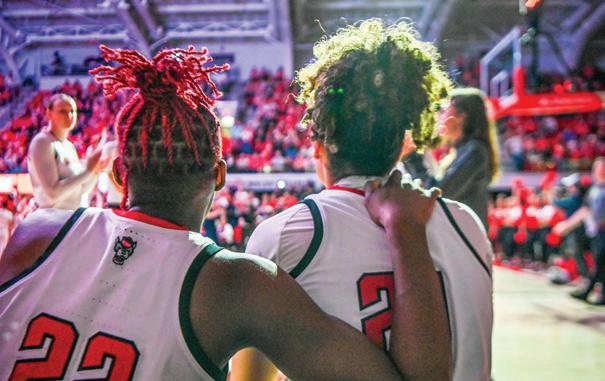
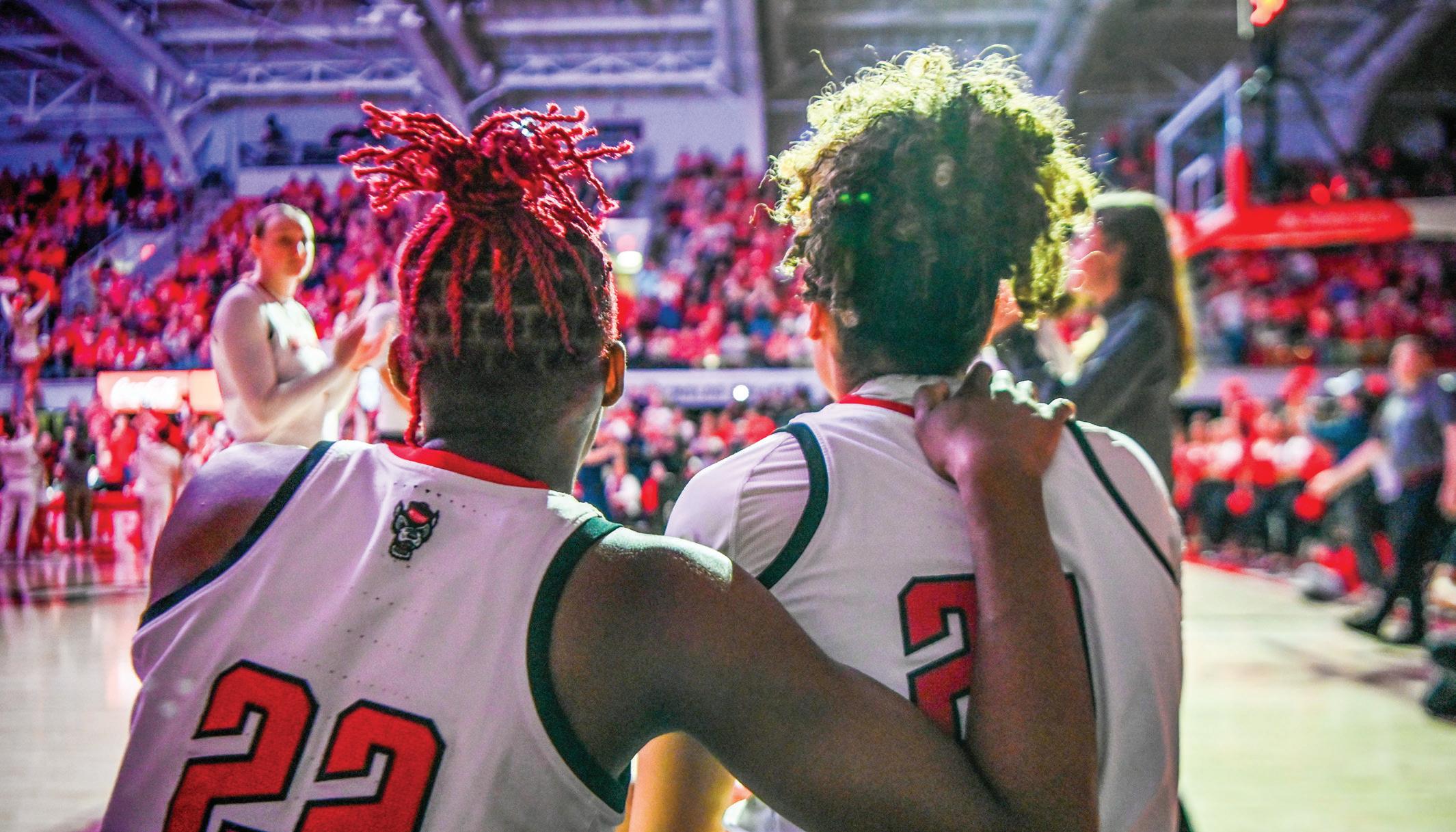
Senior guard Saniya Rivers and graduate guard Madison Hayes prepare for introductions before the game against Wake Forest in Reynolds Coliseum on Thursday, Feb. 27, 2025. The Wolfpack beat the Demon Deacons 78-57 on Senior Night.
Spencer’s culture drives NC State men’s tennis to program-best No. 6 ranking
Ethan Bakogiannis Managing Editor
NC State men’s tennis reached its highest-ever ranking in program history at No. 6 in the ITA national rankings on March 10, 2020.
The Wolfpack, led by head coach Kyle Spencer, didn’t play another match that season.
While the COVID-19 pandemic dis rupted the Wolfpack’s potentially-best season in program history, there’s no stopping Spencer’s squad in 2025. Five years later, NC State has climbed its way back to its highest ranking in history at No. 6 per Tuesday’s ITA rankings.
Spencer has led his team back to No. 6 by engineering a team and program culture designed around family, perse verance, competition, effort and simply living in the moment.
The Pack’s head coach since 2017, Spencer led his team to six wins against ranked teams this season, three of which have come against top 10 teams. Just like in the Pack’s impressive 4-2 win over then-No. 6 Stanford, NC State has found production from both the older, veteran players at the top of its lineup and the younger players at the bottom.
While seniors No. 24 Braden Shick and No. 55 Luca Staeheli lead the way on Courts 1 and 2, players such as red shirt freshman Jules Leroux and William Manning man the bottom of the lineup,
providing crucial wins in each and every one of NC State’s ranked wins.
Spencer said these impressive results from his younger players in high-pressure spots were a product of a competitive culture within the team, one that drives his players to the peak of their potential.
“We’ve gotten production from a cou -
to do is we’re going to fight in every position — one through three in the doubles and one through six in the singles,” Spencer said. “We’re going to fight, and we’re going to play for each other. And so to me, if we go and do those things, we’ll be in every match, and then it will just be how we handle certain situations.”
With this mentality, the Pack has not
Spencer’s culture. Traits like perseverance, a strong connection to its highenergy home crowd and living up to the occasion in the biggest, most important moments all stem from him.
However, it’s ultimately up to the players to buy in and follow through on that culture.
“We talk about perseverance, we talk about being a family, we talk about how these matches are about the environment and their unique occasions,” Spencer
This culture is what makes NC State able to stand up to and beat college tennis titans such as Stanford. Now a college titan in its own right, the Wolfpack is eyeing its best season in program history if it continues the trajectory it is on
A perennially challenging set of ACC opponents stands in its way, but watch out for the red-and-white to make its deepest, most successful push for the remainder of the 2025 season, all built
“The thing that I’m so, so proud of is the team environment and the family and the community that we’ve built here,” Spencer said. “And so that’s what we rest on, and that’s what we’re excited about. And the competition is an expression of all those things that are part of the foun-