Project-Based Learning • Civil Rights Inquiry • Foreign Language Integration • Curiosity and Civic Engagement
Curious Learners, Engaged Citizens
A Quarterly for Creative Teaching in Grades K–5 September/October 2026 Volume 39, Number 1
SAVE THE DATE NCSS Annual Conference Chicago, IL | Dec 4 – 6, 2026
https://www.socialstudies. org/conference
©2025 National Council for the Social Studies
contents September/October 2026 Volume 39, Number 1
NCSS OFFICERS Joe Schmidt (President) Colonial Williamsburg Foundation, Williamsburg, VA David Kendrick (President-Elect) Loganville High School, Loganville, GA Annie Whitlock, Ph.D. (Vice President) Grand Valley State University, Allendale, MI Tina M. Ellsworth, Ph.D. (Past President) University of Central Missouri, Warrensburg, MO BOARD OF DIRECTORS
p. 2
Issue Notes Valencia Abbott pp. 3–8
Terrell Fleming Lynchburg City Schools, Lynchburg, VA (2027) Kimberly Huffman Wayne County Schools, Smithville, OH (2027) Stephen Masyada, Ph.D. Lou Frey Institute and the Florida Joint Center for Citizenship, Orlando, FL (2027)
Project-Based Learning to Develop Young Children’s Civic Engagement
Laura McFarren Derby North Middle School, Derby, KS (2029)
Margit E. McGuire and Margo Radovich
Ebony McKiver Social Studies Accelerator, Marion, IA (2029)
pp. 9–15
Grab a Suitcase and Explore the World: Collaborating with Families in the Community to Open the World to Young Learners Kenneth Vance Anthony and Kelly M. Moser pp. 16–20
Where Stories Meet Sources: The SCAPE Strategy for Young Historians Amy Allen, Tonya Beharry, and Dalton Savage Pullout, P1–P4
Sources and Questions for the SCAPE Strategy Amy Allen, Tonya Beharry, and Dalton Savage pp. 21–26
Stepping Out of History’s Shadow: Exploring Reverend Fred Shuttlesworth’s Civil Rights Advocacies in Birmingham John H. Bickford, Jeremiah Clabough, and Rebecca Smith pp. 27–32
Teaching Young Learners with the C3 Framework Curiosity for the Common Good: Inquiry as a Catalyst for Civic Responsibility Chris Hass and Katie Kelly p. 32
Member Spotlight
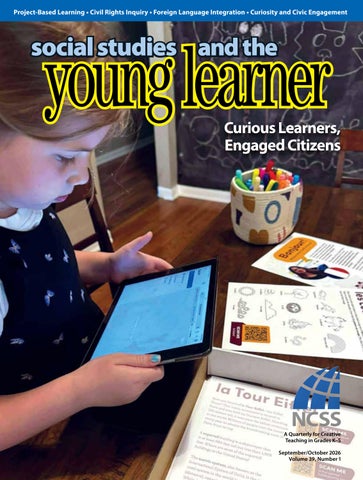
ON THE COVER: Child scans the QR code to learn more information about the Eiffel Tower. See “Grab a Suitcase and Explore the World: Collaborating with Families in the Community to Open the World to Young Learners,” by Kenneth Vance Anthony and Kelly M. Moser, on pp. 9–15 in this issue.
Stephanie Nichols Narragansett Elementary School, Gorham, ME (2028) Renita Parks Memphis, TN (2028) Sarah B. Shear University of Washington Bothell, Bothell, WA (2029) Gabriel Valdez Fort Worth Independent School District, Fort Worth, TX (2028) Amy Walker Olathe Unified School District 233, Olathe, KS (2027) Anne Walker Forest Park High School, Woodbridge, VA (2028) Ryan Werenka Troy High School, Troy, MI (2029) EX OFFICIO Jeff Bourque House of Delegates Steering Committee Chair (2026–2027) Executive Director Kelly McFarland Stratman Deputy Executive Director Joy Lindsey Department Directors Timothy Daly Director of Operations Laura Godfrey Director of Publications Ashanté Horton Director of Meetings and Exhibits MEMBERSHIP in the National Council for the Social Studies (NCSS) is open to any person or institution interested in the social studies. All members receive the NCSS journal of their choice (Social Education or Social Studies and the Young Learner), as well as the e-newsletter, The Social Studies Professional (two issues per month), access to the online NCSS publication archives, the online Middle Level Learning supplement, and discounts on NCSS conference registration, books, and professional development programs. Members who choose Social Studies and the Young Learner as their journal also receive the September and May-June issues of Social Education. Comprehensive members receive all books in the NCSS Bulletin series published during the membership year. Regular membership rates for individuals are $90 per year. Rates for students and retired persons are $53 per year. For rates and benefits of institutional membership, and further information on all levels of membership, go to www.socialstudies.org/membership. SUBSCRIPTIONS to Social Studies and the Young Learner are available to non-member institutions. A print-only subscription is $68 per year. Online subscriptions for Social Studies and the Young Learner are available through the IngentaConnect platform. Visit www.socialstudies. org/publications/subscriptions and www.ingentaconnect.com/content/ncss. The online subscription is worldwide, IP supported, and SERU friendly for $171 per year. The online-plus-print subscription is $194 in the United States (add $11 for Canada and $45 international to cover mailings). SINGLE COPIES of Social Studies and the Young Learner are $6.00 (member price), $7.95 (non-members) plus shipping and handling. Contact 1-800-683-0812. Single articles are available (pdf: $14.95 for non-members) at www.ingentaconnect.com/content.ncss. NCSS members can access articles through the online archives. P.O. BOX: To become a member or subscribe (as an institution) by mail, send a check to NCSS, P.O. Box 79078, Baltimore, MD 21279-0078. RETURN ADDRESS: Social Studies and the Young Learner, NCSS, 8403 Colesville Rd, #1100, Silver Spring, MD 20910, USA.
September/October 2026 1
Social Studies and the Young Learner 39 (1) p. 2 ©2026 National Council for the Social Studies https://doi.org/10.66392/KJFH5321
EDITORIAL STAFF Editor, Scott M. Waring, University of Central Florida Associate Editor, Laura Godfrey Department Editors, Teaching Young Learners with the C3 Framework, Emma Thacker, Kathy Swan, John Lee, & S. G. Grant Art Manager, Rich Palmer
EDITORIAL BOARD Amy Allen – Virginia Tech Sohyun An – Kennesaw State University Michelle Bauml – Texas Christian University Kristy Brugar – University of Oklahoma Lisa Brown Buchanan – Elon University Tina Ellsworth – Northwestern Missouri State University Eric Groce – Appalachian State University Tina Heafner – University of North Carolina Charlotte Lynda Herrera – George Mason University Janie Hubbard – The University of Alabama Dawnavyn James – University of Buffalo Sarah Montgomery – Wartburg College Scott Morrison – Elon University Kim O’Neil – National Board for Professional Teaching Standards Brianne Pitts – Western Michigan University Tracy Rock – University of North Carolina Charlotte Liz Saylor – University of Georgia Corey Sell – Metropolitan State University of Denver Jay Shuttleworth – City University of New York, Queens College Emma Thacker – James Madison University Christina Tschida – East Carolina University Irenea Walker – Illinois State University SOCIAL STUDIES AND THE YOUNG LEARNER (ISSN 1056-0300) is published by National Council for the Social Studies (NCSS) four times a year: September/October, November/December, January/February, and March/April. Logotype is an NCSS trademark. Contents ©2026. ONLINE: Visit SSYL at www.socialstudies.org/publica tions/ssyl and www.ingentaconnect.com/content/ncss. READERS: The editors welcome suggestions, letters to the editor, and manuscripts to our peer-reviewed journal. Guidelines at www.socialstudies.org/publications/ ssyl; submit at www.editorialmanager.com/ncssjournals; questions to ssyl@ncss.org; 301-850-2498. Contributors express their own views, reflecting divergent opinions. DELIVERY AND CHANGE OF ADDRESS: View and update your record, www.socialstudies.org/membership; send new address to membership@ncss.org; or call 800296-7840 ext. 111. Callers outside the U.S. and Canada use 301-588-1800 ext. 111. PERMISSION to reproduce articles for academic use, contact Copyright Clearance Center, Academic Permissions Service, 222 Rosewood Dr., Danvers, MA 01923; 978-750-8400 (phone), 978-750-4470 (fax). ADVERTISING: Maribell Abeja-DeVitto, Account Manager MAbejaDeVitto@smithbucklin.com; 312-673-5483 Visit www.socialstudies.org/advertising for rates and specifications. INDEXED by Institute of Education Sciences, eric. ed.gov. POSTMASTER: Send address changes to Social Studies and the Young Learner NCSS, 8403 Colesville Rd., #1100 Silver Spring, MD, 20910 USA
2 Social Studies and the Young Learner
ISSUE NOTES The invitation to write this introduction came as a total and welcome surprise. This year of accolades—2025 Gilder Lehrman North Carolina History Teacher of the Year and 2025 National History Teacher of the Year—has created ripples and opportunities. Yet this felt different. During teacher PD, I look to work with elementary teachers because they get the job done; I am in no way in their league. Then I recalled my four years on the Carter G. Woodson Book Committee, which introduced me to countless elementarylevel books and conversations about what works in those Valencia Ann Abbott classrooms, and my dear friend Michelle McLaughlin, 2025 National History whose elementary social studies pedagogy sessions at the Teacher of the Year, Gilder Lehrman Institute North Carolina Social Studies Conference have taught Member of the Carter G. me so much. With this in mind, I accepted this task, not Woodson Book Award because of any award, but because teaching social studies Selection Committee and history and telling these important narratives matter, whether we teach kindergarten, fourth grade, middle school, or high school. Every day in classrooms, educators help shape the people, citizens, and culture that define the past, present, and future. The articles in this issue of Social Studies and the Young Learner highlight how storytelling, project-based learning, familycommunity connections, local history, and inquiry can help young learners understand their roles in the world around them. “Project-Based Learning to Develop Young Children’s Civic Engagement” by Margit E. McGuire and Margo Radovich explores how storytelling and project-based learning can develop civic skills. “Grab a Suitcase and Explore the World: Collaborating with Families in the Community to Open the World to Young Learners” by Kenneth Vance Anthony and Kelly M. Moser extends project-based learning through family and community connections, helping students connect global study with local history and geography. “Where Stories Meet Sources: The SCAPE Strategy for Young Historians” by Amy Allen, Tonya Beharry, and Dalton Savage introduces an interdisciplinary strategy that helps students become readers and historians by examining setting, characters, action, plot, and ending. A student once called my class an undercover English class, and I have learned that storytelling is one of the best ways to teach history. Stories give students an entry point into the past while helping them make connections across disciplines. “Stepping Out of History’s Shadow: Exploring Reverend Fred Shuttlesworth’s Civil Rights Advocacies in Birmingham” by John H. Bickford, Jeremiah Clabough, and Rebecca Smith demonstrates how local history can broaden students’ understanding of the Civil Rights Movement while developing historical thinking. Finally, “Curiosity for the Common Good: Inquiry as a Catalyst for Civic Responsibility” by Chris Hass and Katie Kelly in the Teaching Young Learners with the C3 Framework column positions inquiry as an active practice through which students learn to see themselves as participants who can shape civic life. Together, these articles remind us that young learners are not simply preparing for future civic participation. Through meaningful stories, local connections, inquiry, and active engagement, they are already becoming historians, citizens, and participants in the world around them.
Social Studies and the Young Learner 39 (1) pp. 3–8 ©2026 National Council for the Social Studies https://doi.org/10.66392/ZUIW8088
Project-Based Learning to Develop Young Children’s Civic Engagement Margit E. McGuire and Margo Radovich Democratic societies depend on civic engagement, and one such indicator is voting. As each election season approaches, voting gains more attention—who votes and why. Those who teach young children know that voting is an important understanding, and the early years are ideal for teaching the concept as well as developing the dispositional values of voting in a democratic society. “Civic teaching and learning that begins in elementary school—prekindergarten–grade 5 (P–5)—uses these pivotal years of childhood to instill knowledge, skills, and values that will nurture engaged, empathetic citizens, as well as benefit students academically and professionally in the long term.”1 For young children, the concrete act of voting develops an understanding of “making a choice” and why voting matters—laying a foundation for meaningful engagement in democratic practices.2 We all have heard young children say, “That’s not fair!” One way to address this is through project-based learning where children can grapple with understanding and resolving fairness issues when there are differing points of view and priorities. This article describes a kindergarten project entitled, “Project-Based Storypath: Solving Problems in the Park,” and explores how deliberation and voting became central to the learning process, honoring young children’s capacity for civic engagement while developing their “political thinking characterized by intentional choices to influence change through strategic tactics.”3 Through voting, children also learn how to engage in civic action. As Payne et al. argue, “embodied lived experiences” expand children’s agency and civic capacities.4 The narrative structure of project-based Storypath embodies these attributes. When young children were confronted with the everyday problems of creating an imaginary community park, teachable moments emerged. Children holding differing viewpoints had to grapple with possible solutions
to resolve civic problems using a critical lens.5 These kindergartners had to consider important choices about their park and persuade others to their point of view—in effect, thinking politically—deliberating and then voting to resolve differing priorities.
Project-Based Storypath
Project-based Storypath is an instructional approach grounded in inquiry and the principles of equity-centered social studies: transdisciplinarity, children’s lived experiences, and the belief that children are knowledgeable, capable, and “can learn about and act on behalf of others in ways that are meaningful to them.”6 The approach (known internationally as Storyline) utilizes the attributes of story—setting, characters, and plot—to organize curriculum content, in this case, an integrated project about creating a community park. Learning goals were grounded in political thinking, civic action, deliberation, collaboration, problem solving, and literacy applied in context. With these broad goals in mind, the teacher centered children’s identities and assets to first plan then create a community park.7 Developmentally, “an interdisciplinary approach that considers multiple areas together is typically more meaningful than teaching content areas separately,”8 and a project that is connected through a storyline capitalizes on “one of the basic forms in which we organize events and facts to make them meaningful…. [The story form] is a reflection of a fundamental mental structure. It is a basic intellectual tool we use in making sense of the world and experience.”9 We know that young children engage in imaginative play, and play is a fundamental part of their learning and joyfulness.10 Thus, students played the role of park planners who must make important decisions and solve problems. September/October 2026 3
Introducing the Storypath
A letter from the “mayor,” inviting the students to plan a park “just right” for their community, set the stage for the project episodes (see Figure 1). Children were asked if they could design a park that was “just right” for their community—in effect the compelling question for the Storypath project. The mayor’s letter began an inquiry about park features that combined what the children knew about parks and what they imagined for their story. See pp. 7–8 for a summary of episodes, activities, and corresponding standards.
Figure 2. Park planner peg dolls
Figure 1. Letter from the “Mayor”
As the narrative unfolded, children navigated between real and make-believe as they took on the roles of park planners. “This sounds hard,” said a child, expressing concern about creating a park. Another child, showing calm determination, said, “We can do this.” And the excitement grew. The project got underway as children discussed, examined photographs of parks nearby and in the other regions of the world, and then individually drew their own pictures of a “just right” park. As children worked individually, they shared park stories and ideas with peers that highlighted their range of experiences. Of course, not everyone agreed on what to include in the park. This set up the first critical incident: What features should be included in the park? How will we decide? How will these features meet the needs and wants of the community? This problem led to a deeper understanding of the park planner’s role: how to plan for the park, what their role in such plans would be, and how they would work together to make decisions.
Role-Playing the Park Planners
The next episode began with an inquiry: What is the job of a park planner? Children shared ideas about the knowledge and skills needed for the role and then engaged in creating park planner “peg dolls” (see Figure 2). As children became more immersed in the story, they considered skills needed to work in the park and the tasks necessary to design a park that 4 Social Studies and the Young Learner
would meet the needs and wants of the community. Literacy skills of speaking and listening were reinforced as children introduced their peg dolls to their classmates, bolstering confidence for their roles as park planners and deepening their understanding of park features. As the park continued to develop, children often, without prompting, used their peg dolls for imaginary play in the park during “play-to-learn” time, affirming their engagement in the storyline. To support their role-playing each day, children donned plastic hard hats and work vests as they entered the Storypath project lessons.
Figure 3. Voting options for park design
Civic Deliberation and Voting—The Park Features
With a range of ideas and the park planner roles in place, students were ready to deliberate on specific features for the park. The episode began with the question, “What should we include in our park?” Based on their earlier discussions and drawings, different ideas about park features—the geographic setting for the park and the needs and wants of the community—naturally emerged, mirroring real-life events in park planning. This laid the groundwork for political
thinking, deliberation, and voting. Interestingly, in this classroom, children’s designs overlapped, but with two critical differences: Should the park include a human-made lake or an off-leash dog area? (see Figure 3). This dilemma was the first of many decisions that came directly from the children’s own ideas, experiences, and imaginations. Thus, a teachable moment emerged: How do we decide? The children had the opportunity to deliberate on the pros and cons of each option so they could make an intentional choice. They were invested in the outcome, feeling empowered to advocate for their individual choices and to persuade others to their viewpoint, so much so that this interest resulted in discussions at home with families, during recess, and at lunchtime. As they considered the benefits of each of the two options, they were prepared for the next lesson, which asked them to think of a time that something felt unfair. Young children have a strong sense of fairness, and they eagerly shared their personal experiences, many of which were based on interactions with siblings. These lived experiences grounded deliberations about their planned park, leading them to consider a fair approach to resolve their disagreement about park features.
Using a Children’s Book to Develop Understanding
To introduce the concept of voting, children listened to Mariya Anderson’s The Bungled Jungle Vote.11 Different species of animals, each with their own priorities, are tasked with deciding on a new successor. A lowly poop fly challenges the animals to consider how their needs overlap, introducing the concept of the “common good.” The animals decide voting will be fair and allow everyone a voice. This readaloud framed a follow-up discussion in which the students unanimously agreed that a playground should be included in their park. Next, children were asked, “When there are two worthwhile choices, how do you decide what to do?” For young children, the idea of considering what is good for the group, not just for themselves, is challenging. This led to a discussion of alternatives to voting. Should we fight about it? Should we not build a new community park? Is voting a fair way to decide between the two different plans? Ultimately, the children agreed that voting was a fair way to decide on the final plan. This deliberative process linked the importance of understanding opposing viewpoints with the emotional attachment to the outcome of the voting process; indeed, children understood that voting was a tangible act in the decision-making process.12
The Voting Experience
The physical act of voting required explicit instruction. Children learned how to cast a vote and that voting is an independent, private act. It was important to explain that when votes were cast and counted, one idea would prevail. This outcome was challenging for young children to know
that their idea might not be chosen. To carry forward the real-life experience, they used a voting booth, made from a testing privacy folder, and an official ballot box. They wrote the number one or two, differentiating the two plans. After leaving the voting booth, children received “I Voted!” stickers. They took the voting process seriously and looked forward to their turn at the voting booth to vote on the design decision. The final plan included the dog park (with the most votes), walking trails, a large grassy field for sports, and, of course, the playground. With the first civic decision made, children worked collaboratively to construct a twoand three-dimensional representation of their park. As a constructivist, inquiry-based process, learning was guided by questions—the teacher and children asking questions as they figured out how to organize and make the features for their park. The Storypath setting episodes have numerous pedagogical benefits. All children, regardless of skills, language, or prior experience, had agency as each contributed to the creation of the park and voted on its final design. Engagement and motivation for learning were evident as children enthusiastically contributed ideas and then cooperatively worked with peers to make the park.13
A Place to Play
The next episode focused on decisions about what playground equipment would be included. This episode had unlimited possibilities for civic learning and deepening the understanding of the common good—the good of the community as a whole. To help children think more deeply about this next step, a mother and her son, who uses a wheelchair, were invited to the classroom to share the importance of making parks inclusive for all children. They successfully advocated for the park planners to update the design of the play equipment so that all children could use the park. To personalize this understanding, the children used a wheelchair to navigate through bark chips on the school playground. Such firsthand experiences within the context of the Storypath made the concept of accessibility a powerful learning experience. Building on that experience, photographs of accessible play equipment for the playground were shared, which resulted in redesigning the play area to be welcoming to all children. The park “construction” then continued in small groups as they discussed, negotiated, and created playground equipment that works for all children. For example, children included a merry-go-round with a base that was flush with the ground for easy wheelchair access.
Integrating Literacy
Literacy skills were integrated into the lessons as authentic outcomes of the children’s work. For young children, and especially for language learners, agency is closely linked to their sense of capability, so contributing to word banks September/October 2026 5
and writing about the park became an authentic outgrowth of each episode. Throughout the process, children demonstrated their learning as they drew, talked, and wrote about their park experiences. For example, after many discussions about voting, children completed starter sentences: “Voting is fair because….” These activities were designed to reap the pedagogical benefits of authentic buy-in to the storyline, reinforce their learning, and develop the political thinking of deliberation, voting, and/or reaching consensus to create the “just right” park.
Problems in the Park
As in any good story, there was “trouble,” and in this episode, children grappled with a common problem in public parks. One day, children arrived in the classroom to find litter scattered throughout their created park. They were dismayed. What can we do about the litter? Their concern was evident and addressed during the morning meeting. One child indignantly stated, “We worked really hard on the park! This is not okay!” Later that day, the class revisited the earlier discussion of the “common good.” Who is responsible for taking care of the park? If the park is a community park, is the community also responsible for its care? The children decided to add garbage and recycle cans to the park. They also realized that they needed rules for the park, so they considered rules they had at home, at school, and in the classroom. The question “Why do we need rules?” centered the discussion, guiding the children to explore expectations for using the community park and to understand that the rules applied to everyone. Then the class brainstormed and worked in groups to create signs of rules to be displayed in the park (see Figure 4).
park’s name. Once again, political thinking was evident as children made specific choices about which names they found appropriate, then made the case for their favorite name, using persuasive skills to advocate for their choice. Interestingly, they also decided to involve others in the voting process by having children brainstorm ideas for park names with their families. The ballot listed twelve names, including Heatwave Park, Washington Park, Green Meadow Park, Friends and Pet Park, and Pokémon Playground. They decided that the voting process should extend over a few days to give adequate time for others in the school community to participate. Staff, family volunteers, and siblings in the building were invited to vote; excitement about the park project spread beyond the classroom. The class discussed why voting on the park name was important in the decision-making process. The children stated, “It’s fair.” Building on previous learning, the teacher reinforced the concept of voting as an agreement for making a fair decision. The children understood that the park’s name was not “mine” or “yours,” but “ours.” They agreed that the name with the most votes would be chosen, and that voting was the fairest way to decide. The teacher also acknowledged that it was okay to be disappointed if a preferred park name was not the winner. Ultimately, the voters chose “Rainbow Magic Park,” which was perfect; rainbows and magical creatures had been an unplanned theme throughout the year. The project concluded with a dedication ceremony, mirroring real-life park dedications. The children’s presentations showcased the project components and their learning. Families, siblings, and staff attended to celebrate, and the principal, as the “mayor,” cut the ribbon to dedicate the community park.
Final Thoughts
Figure 4. Park rules including “no smoking” and “clean up after pets.”
A Name for the Park
A final deliberation was to determine a name for the park. The children decided it would be fair to have a vote on the 6 Social Studies and the Young Learner
Project-based Storypath provides a framework for organizing learning through challenging tasks that are enjoyable and maximize cognitive growth. Posing questions to guide the creation of a community park offered a range of learning opportunities while also accounting for students’ contributions, insights, and experiences. In creating this Storypath about voting, we focused on political thinking, a topic that some might think young children were not ready for. But with careful scaffolding and concrete, personal experiences, the children were developmentally ready. Throughout the process, the teacher maintained direction by posing questions to challenge and affirm children’s contributions, reinforcing their skills of deliberation and curiosity while developing their understanding for the common good. An important outcome of such a project is to put in place the building blocks of understanding of how democracy works. Voting is a cherished right and responsibility, but unless young people understand its importance and believe their vote matters, continued on page 8
Table 1. Summary of Episodes, Activities, and Corresponding Standards Connections to C3 Framework The Storypath Project uses both compelling and supporting questions to guide the inquiry process through each of the episodes. Dimension 1: Developing Questions and Planning Inquiries is threaded throughout the Storypath as children imagine themselves as park planners guided by the compelling question: What kind of park would be “just right” for our community? Dimension 2: Applying Disciplinary Concepts and Tools is organized so that children make connections to the geographic setting and civic understandings and processes of creating the park guided by supporting questions. Dimension 3: Evaluating Sources and Using Evidence occurs as children “live” the experience of the events, forming the basis for making and supporting evidence-based claims for the community park. Connections to Common Core Literacy Standards Literacy standards are integrated into the Storypath project as skills necessary to complete the tasks to move the story forward. (1) Comprehension and Collaboration: SL.1; (2) Presentation of Knowledge and Ideas: SL.4; (3) Production and Distribution of Writing: W.4; and (4) Vocabulary Acquisition and Use: L.6. Solving Problems in the Park: Storypath Episodes and Activities
C3 Framework: Dimension 2 Focus
Setting: A Community Park Learners create a visual representation of a park. • Introduce the Storypath project by reading an invitation from the “mayor.” • Ask questions to connect known information to new understandings. • Introduce and reinforce new academic language. • Share and discuss photos of parks from other communities both near and far. • Share ideas about a “just right” park for their community. • Work individually to design the basic aspects of the park and share ideas with classmates. • Facilitate discussion about the setting, affirming student agency, assets, and contributions. • Facilitate the creation of a word bank for speaking, reading, and writing activities. (Estimated time: 3 to 4 lessons.)
Geography D2.Geo.3.K-2 Use maps, globes, and other simple geographic models [drawings of parks] to identify cultural and environmental characteristics of places. D2.Geo.5.K-2. Describe how human activities affect the cultural and environmental characteristics of places.
Characters: Park Planners Learners imagine themselves as park planners, then play those roles throughout. • Make wooden peg dolls to represent themselves and learn about park planners. • Introduce park planners to apply speaking and listening skills and reinforce understanding of how parks shape the culture and environment of the community. (Estimated time: 2 to 3 lessons; park planner introductions spread over a number of days.)
Geography D2.Geo.5.K-2. Describe how human activities affect the cultural and environmental characteristics of places.
Critical Incident: Park Features Learners grapple with what park features to include through deliberation and then vote. • Share ideas in a “meeting of park planners.” • Make decisions through an inquiry process that requires deliberation and voting. • Introduce the concept of voting using a children’s book e.g., The Bungled Jungle Vote. • Construct a 2D and 3D park based on children’s ideas, negotiations, and voting. (Estimated time: 3 to 4 lessons.)
Geography D2.Geo.5.K-2. Describe how human activities affect the cultural and environmental characteristics of places.
Critical Incident: The Playground Equipment Learners are confronted with accessibility for all children and decide how to modify their play area by including inclusive playground equipment. • Discuss how parks meet the needs and wants of the community. • Introduce the concept of accessibility and interact with a child who uses a wheelchair. • Deliberate on how to make a playground inclusive. • Introduce the concept of compromise to decide on types and placement. • Draw/create the playground equipment. • Present the playground equipment and decisions for their placement. (Estimated time: 3 to 4 lessons.)
Geography D2.Geo.5.K-2. Describe how human activities affect the cultural and environmental characteristics of places.
Critical Incident: Litter in the Park Learners encounter litter in the park and must decide what to do. • Facilitate discussion of the litter problem and how to respond. • Implement the resolutions about the litter (litter bins and signs). • Guide the writing of rules for the park and making the signs for the park. • Share the children’s work. (Estimated time: 3 to 4 lessons.)
Civics D2.Civ.3.K-2. Explain the need for and purposes of rules in various settings inside and outside of school. D2.Civ.9.K-2. Follow agreed-upon rules for discussions while responding attentively to others when addressing ideas and making decisions as a group. D2.Civ.10.K-2. Compare their own point of view with others’ perspectives. D2.Civ.11.K-2. Explain how people can work together to make decisions in the classroom.
Civics D2.Civ.10.K-2. Compare their own point of view with others’ perspectives.
Civics D2.Civ.10.K-2. Compare their own point of view with others’ perspectives. D2.Civ.11.K-2. Explain how people can work together to make decisions in the classroom.
Civics D2.Civ.10.K-2. Compare their own point of view with others’ perspectives. D2.Civ.11.K-2. Explain how people can work together to make decisions in the classroom.
September/October 2026 7
Concluding Event Learners vote on a park name and plan a ribbon cutting ceremony to share their learning. • Guide learners’ reflection on their learning. • Brainstorm ideas for a park name and determine the best way to decide—voting. • Negotiate who should vote and why. • Write invitations to families and others to the ceremony. • Facilitate presentations of students’ learning about the community park. (Estimated time: 3 to 4 lessons.)
Geography D2.Geo.5.K-2. Describe how human activities affect the cultural and environmental characteristics of places or regions. Civics D2.Civ.11.K-2. Explain how people can work together to make decisions in the classroom.
Note. Early in the Storypath project, the children considered including plants and trees. A guest speaker from a local nursery shared about native plants and why such plants were important. This can be an authentic science integration, time permitting.
PROJECT-BASED LEARNING from page 6 our democracy will suffer. These lessons have far-reaching effects in our communities (e.g., voting for school boards, city councils, state representatives, or initiatives), and starting the learning experiences in the early years is essential for building both the understanding and dispositions toward being an informed voter. Notes 1. Jessica R. Wolff and Nan Eileen Mead, Civic Learning in the Early Grades is a Whole-Child, Whole-School Endeavor: Key Principles for Fostering Civic Education in the Elementary Years (DemocracyReady NY at the Center for Educational Equity at Teachers College, Columbia University, 2025), 3, www.democracyreadyny.org/publications. 2. Norline Wild, “Exploring the Presidential Election in One Pre-K Classroom,” NAEYC Blog, October 18, 2024, www.naeyc.org/resources/blog/exploringpresidential-election-one-pre-k-classroom. 3. Laurie Stevahn and Margit E. McGuire, “Storypath: How Civic Advocacy Through Creating Music Empowers Civic and Political Thinking in Elementary Classrooms,” The Journal of Social Studies 49, no. 2 (2024): 117–135, https://doi.org/10.1177/23522798241300325. 4. Katherina A. Payne et al., “Reconceptualizing Civic Education for Young Children: Recognizing Embodied Civic Action,” Education, Citizenship and Social Justice 15, no. 1 (2020): 38. https://doi.org/10.1177/1746197919858359. 5. Katy Swalwell and Katherina A. Payne, “Critical Civic Education for Young Children,” Multicultural Perspectives 21, no. 2 (2019): 127–132. 6. Anna Falkner and Noreen Naseem Rodriguez, “Toward an Equity-Centered Approach to Early Childhood Social Studies,” Young Children 79, no. 1 (2024): 6–16.
7. This highly diverse classroom included children whose families recently immigrated from Latin America, Asia, the Middle East, and Europe. There were 11 boys and five girls. 8. National Association for the Education of Young Children, “Developmentally Appropriate Practice,” position statement, April 2020, 12, www.naeyc.org/ resources/position-statements/dap/contents. 9. Kieran Egan, “Teaching as Storytelling: A Non-Mechanistic Approach to Planning and Teaching,” Journal of Curriculum Studies 17 (1985): 399, https://doi.org/10.1080/0022027850170405. 10. Kristen M. Kemple et al., “Maximizing the Power of Play Through Supportive Practices,” Teaching Young Children 17, no. 4 (July 2024): 24–27. 11. Mariya Anderson, The Bungled Jungle Vote (Mariya Anderson, 2020). 12. Li-Ching Ho et al., “Teaching and Learning about Controversial Issues and Topics in the Social Studies,” in The Wiley Handbook of Social Studies Research, ed. Meghan McGlinn Manfra and Cheryl Mason Bolick (John Wiley & Sons, Inc., 2017), 319–335, https://doi.org/10.1002/ 9781118768747. ch14. 13. Wendy Elmo and Jill Wells, “Storyline: Enhancing Learning and Teaching Through Co-Constructed Narrative,” Psychology of Education Review 38, no. 2 (September 2014): 23–27; Sharon Ahlquist, “The Storyline Approach: Promoting Learning Through Cooperation in the Second Language Classroom,” Education 3–13 43, no. 1 (March 2024): 40–54, https://doi. org/10.1080/03004279.2015.961692.
Margit E. McGuire is Professor Emeritus of Teacher Education and Social Studies at Seattle University. She can be reached at mmcguire@ seattleu.edu. Margo Radovich is an Elementary Teacher in the Edmonds School District in Edmonds, Washington. She can be reached at radovichm550@ edmonds.wednet.edu.
www.socialstudies.org/bookstore 8 Social Studies and the Young Learner
Social Studies and the Young Learner 39 (1) pp. 9–15 ©2026 National Council for the Social Studies https://doi.org/10.66392/WQSM3369
Grab a Suitcase and Explore the World: Collaborating with Families in the Community to Open the World to Young Learners Kenneth Vance Anthony and Kelly M. Moser
On a sunny weekend morning, three young boys between the ages of 6 and 10 line up with their mom to enter the local public library, eagerly awaiting a Bulldog Explorers suitcase. The boys each grab their own suitcase, tearing it open like a Christmas present. They pull out each object, placing it on the colorful library carpet. “I have my own Play-Doh!” shouts one of the boys. “Guatemala? Daddy went to Guatemala,” says another.
Bulldog Explorer suitcases at the local library ready for families to pick up.
A Narrowing Curriculum
The learning experience described above is the direct result of a narrowing elementary school curriculum. While teachers know that social studies matters, recent studies show that
elementary schools devote less than three hours a week to the subject—often squeezed in after literacy and math.1 This limitation denies students valuable opportunities to explore diverse cultures, understand multiple perspectives, and learn how to participate meaningfully in civic life. This reality served as the catalyst for developing Bulldog Explorers, a partnership between Mississippi State University, the Starkville-Oktibbeha County Public Library, and families in the Starkville, Mississippi, community. As two teacher educators, (Kelly, a world language teacher educator in the Department of Classical & Modern Languages and Literacies and Kenneth, an elementary teacher educator in the Department of Teacher Education and Leadership), we relied on the updated definition of social studies offered by National Council for the Social Studies (NCSS)—“the study of individuals, communities, systems, and their interactions across time and place”2—to create Bulldog Explorers, a monthly kit designed to spark curiosity about the world. This new definition, like previous versions from 2010,3 1994,4 and even 1916,5 emphasizes that at the elementary level, social studies should be interdisciplinary, thereby integrating it with English language arts, the arts, and STEM.6 Additionally, by highlighting the cultural and human dimensions of learning—what John Dewey once described as the “educational center of gravity”7 of any subject—social studies provides the tools Louis L’Amour believed all education should deliver: “a widening and deepening of life, for increased appreciation of all one sees or experiences.”8 At precisely the moment when such understandings are most needed and when diversity is under attack, social studies is too often treated as optional rather than essential. As September/October 2026 9
a result, our goal here is to provide teachers and stakeholders with details about Bulldog Explorers so they can replicate the initiative in their local schools and communities, ensuring that all students have access to quality social studies and world language programs.
What Is Bulldog Explorers?
Bulldog Explorers is a program that offers monthly kits, which we call suitcases, to local families. Each suitcase features a different country and person from the Department of Classical & Modern Languages and Literacies at the university, which provides a real-world connection to diverse peoples, cultures, and languages. Children are introduced to a language chunk, giving them the opportunity to communicate in another language about their personal lives. For example, the Dominican Republic suitcase includes activities for children to use Spanish, such as me gusta/ no me gusta (I like/I don’t like), to practice talking about various food preferences. The Italy suitcase engages young learners in communicating about their hobbies (e.g., Io cucino; Io pedalo [I cook; I bike]). Each suitcase includes thematically connected hands-on activities with related materials, and families document their journey by pasting a country flag in a passport provided in each box. Families pick up a suitcase, enjoy the activities together, and keep
Child completes colorful rice carpet modeled after Semana Santa alfombras from Guatemala.
10 Social Studies and the Young Learner
all the included materials—nothing needs to be returned to the library. While monthly kits are not new, Bulldog Explorers is innovative in several ways. First, it is entirely free and requires no subscription. Each month, a new Bulldog Explorers suitcase was released. Fifty free suitcases were made available to families through the Starkville Public Library and advertised through social media and the library. For example, one family said, “We chose Italy because we were traveling there later in the year.” Second, each suitcase features local people and places, supporting small businesses and reflecting the diverse cultures and languages found in town.
Exploring Guatemala: An Example Suitcase
The Guatemala suitcase features Magda, a Guatemalan teacher of Spanish at the university. By scanning QR codes embedded on the activity pages, young learners accessed audio recordings from Magda and learned the words for colors in K’iche’, one of the many Mayan languages spoken in Guatemala. As they travel through Magda’s home country, they create their own t-shirt using typical colorful patterns found on the huipil, faja, and corte (top, sash, skirt, respectively). They learn about muñecas quitapenas (worry dolls) and use their new words to create and describe their own colorful worry dolls made from yarn and pipe cleaners. They
Children complete art activity from the Guatemala suitcase.
consider how the Maya created a number system and use it to practice basic mathematics, and they learn about spirit animals, identifying their own spirit animal using their own birthdate. Young travelers also found maps of Mississippi and Guatemala in their suitcase, encouraging them to compare how Indigenous peoples have shaped both places. The activity emphasized that the Maya remain an important part of Guatemala’s cultural identity, just as the Choctaw, who still live in Mississippi, have influenced Mississippi’s history, place names, traditions, and contemporary culture. The Guatemala suitcase activities are interdisciplinary and integrate English language arts, world languages and cultures, and performing and creative arts activities, thereby meeting the NCSS definition of social studies. Further, each box serves to expand students’ understanding of the world in which they live with tasks that engage them in making connections between the country studied and local his-
torical, cultural, and geographical contexts. For example, while students might not have firsthand experiences with the Maya, they can reflect on the importance of Indigenous civilizations in the state as they practice new map skills. The Guatemala suitcase includes 12 learning activities for children to complete at home with their family. We designed these activities for children ages 6–12, realizing that the amount of family supervision needed would vary. Also, we knew that families would choose the activities based on their children’s interests. For example, one mother commented that “we didn’t do everything,” and a grandmother stated that they always gravitated toward the recipes because her “grandson really liked the recipes.” Table 1 provides a description of each activity and curricular alignment, revealing cross-curricular connections to the four traditional elementary subjects: math, science, reading, and social studies.
Table 1. Activities and Curricular Connections for the Guatemala Suitcase Curricular Connections Activity
Description
Art
English Language Arts
Foreign (World) Language
Culture
Introduction to Guatemala and K’iche’ language
Introduction to Guatemala, the Spanish and K'iche' languages, and general cultural information.
X
X
X
Geography exploration: borders, landlocked status, comparison with the students’ state
Introduction to geography of Guatemala including its location, borders, and comparison with the students’ state.
Traditional Guatemalan dress (el traje típico)
Opportunity to explore traditional Maya clothing and symbolism, including designing a shirt using cultural symbols.
Indigenous peoples and historical comparison
Overview of the students’ state’s Indigenous peoples, comparing them to the Mayas in Guatemala.
X
Map skills and exploration of native lands
Opportunity to study historical and current maps to analyze native lands and population shifts in the state.
X
Learning colors in K’iche’ and Spanish
Introduction to K'iche’ words for colors and allows students to identify and pronounce their favorite color.
X
X
X
X
Playing cincos (marble game) Introduction to a traditional Guatemalan marble game, including game setup and rules. Creating worry dolls (muñecas quitapenas)
Opportunity to make Guatemalan worry dolls to help manage stress and emotions.
Maya numeral activities
Introduction to Maya number system and includes a simple math activity using Maya numerals.
Discovering Maya spirit animals
Opportunity to learn about Maya spirit animals (ways) and draw their own based on birthdays.
Volcano science experiment
Hands-on science experiment to simulate a volcano, discussing real Guatemalan volcanoes.
Creating Semana Santa alfombras (carpets)
Activity to create colorful rice carpets modeled after Semana Santa alfombras (carpets) in Guatemala.
Geography
X
X
X
X
X
X
X
History
X
X X
X
X
X
X
X
X
X
X
X
X
X
X
X
X
X
September/October 2026 11
Bulldog Explorers and Partnerships with Parents and a Local Library
Critical to the Bulldog Explorers program is the partnership with families due to decreased social studies instruction in school. The Bulldog Explorers program is an example of homebased parent involvement (PI) in education, as it provides families with structured educational resources that encourage learning beyond the classroom. By equipping parents with accessible materials, the program supports engagement and fosters a culture of learning within the home.9 One barrier to home-based PI, however, is that parents may feel unqualified to support their child’s learning due to their own educational background or lack of familiarity with academic content.10 To mitigate this challenge, we designed activities that parents and children can work on together without any prior knowledge of the topics. The activities in each suitcase • require little expertise from parents, removing barriers related to education level and confidence;11 • provide structured guidance, ensuring parents feel supported in facilitating learning experiences; and12 • include resources and materials for many activities at no cost to families. Additionally, one of our goals in creating the Bulldog Explorers program was to reach as many families as possible. Consequently, we collaborated with the local children’s
Child shows Dominican Republic flag in passport.
Table 2. Materials in Guatemala Suitcase
Materials Provided in the Suitcase Material
Purpose
Approximate Cost (for 50 boxes)
marbles
to play cincos
$23
pipe cleaners
to make worry dolls
$21
yarn
to make worry dolls
$10
wooden beads
to make worry dolls
$20
Play-Doh
to simulate a volcano
$50
paper cups
to simulate a volcano
$23
total
$147
Note. Printing was about $2.50 per activity sheet. The activity sheets included information about the featured country as well as the activities the students completed.
Materials Families Need to Provide Material
Purpose
crayons/markers
to design their shirt
rice
to make the alfombra
food coloring
to make the alfombra
baking soda
to simulate a volcano
vinegar
to simulate a volcano
12 Social Studies and the Young Learner
Child scans the QR code to learn more information about the Eiffel Tower in the France suitcase.
librarian to advertise and distribute the suitcases. Libraries are particularly effective distribution points because they are seen as "community anchors" by minority families and those from lower socioeconomic backgrounds.13 According to a 2015 Pew Research study,14 libraries are essential community institutions for lower-income Americans and communities of color. By distributing the Bulldog Explorer materials at a public library, we remove barriers related to cost, parental education levels, and logistical challenges.15 We also elected to offer the suitcases free to families after considering charging a small fee to cover some of the costs. Depending on the materials included, the cost of making each box has ranged from $1 to $5, with more than 50% of that cost coming from printing in some cases. See Table 2 for a list and cost of supplies related to the Guatemala suitcase as well as the materials families needed to provide. The low cost of production and the provision of boxes to families for free, along with its alignment with flexible engagement strategies, such as take-home kits and community partnerships, showcase a scalable model for promoting lifelong learning and parental involvement in education. Initially, the cost of Bulldog Explorers was covered through a small, university grant. Since that time, we have funded the project on our
For the full Guatemala suitcase document, see www. socialstudies.org/social-studies-and-young-learner/39/1/ grab-a-suitcase
own through departmental funds and a generous donation from the Mississippi State University Foundation. All 50 suitcases are typically picked up by families within just a few hours of becoming available, illustrating the demand for this type of home-based learning opportunity. This highlights the genuine interest of local families in learning about their world. Initial survey feedback indicated that the activities are effective at supporting learning at home. A large percentage of parents surveyed indicated that the suitcases activities increased their child’s knowledge of the world (91%), increased their child’s curiosity about the world (87%), and led their child to look up additional information (75%). Parents have shared that the suitcases spark real connections for their children, linking the activities to what they already know about the world around them. One child, for example, connected what they learned about the Maya to Indigenous peoples in their own community. A parent working with the Dominican Republic suitcase used it as a chance to talk about geography, explaining that the Dominican Republic is on an island “that is surrounded by water on all sides,” while comparing it to Florida, where their relatives live, pointing out that it is a peninsula “because it is surrounded on three sides by water.” Another parent described how the France September/October 2026 13
suitcase inspired them to weave in more reading at home: “One thing that I’ve been trying to do is incorporate…reading and so we found and read a book about Monet and wanted to look at some of his art.” Interestingly, we assumed that the same families would go to the library each month to pick up a suitcase. However, the librarian shared, “We are seeing families come into the library for the first time...they’re also checking out books to learn more about their neighbors.” Additionally, data from our survey indicated that 89% of the suitcases are picked up by parents and the rest are teachers (8%) or another adult (2%). In one case, a children’s minister at a local church used the suitcases with the children in her ministry. Most of the children whose parents retrieve a suitcase are at the target age of the activities and materials, grades 4–5 (56%). See Table 3 for more grade-level information. This is exciting because we are reaching elementary-aged children in our community who we feel are missing out on social studies and world language education opportunities. Table 3. Grades of Children Using Bulldog Explorers Suitcases
Grade Band
Percentage
K–1
22%
2–3
19%
4–5
56%
6–8
3%
Moving Forward
While the Dominican Republic, Italy, and Guatemala served as the foundation for the first three suitcases, the program has been so successful that we will continue for at least a year. The sidebar lists the suitcases we have created thus far. Additionally, due to ongoing conversations with the children’s librarian, future suitcases might feature many of the community’s families, demonstrating the diversity found locally. To celebrate and make visible the multicultural backgrounds of the community, families will be invited to participate in reading stories and sharing images, cultural practices, and artifacts as others pick up their suitcases.
Countries and Topics Represented in Suitcases Dominican Republic Italy Guatemala France Colombia Poland Burkina Faso Taiwan
Uzbekistan (and opera) Argentina Holidays Mexico Japan Women Germany
14 Social Studies and the Young Learner
Additionally, this project has strengthened collaboration within our own institution. As teacher educators from different academic departments, we have benefited from ongoing dialogue about the status of elementary world languages and social studies education in our local schools. Teacher candidates enrolled in our methodology courses played an active role by helping to create activities and by engaging directly with the children’s librarian and families during distribution days at the library.
Adaptations for Classroom Teachers
We are confident that the collaboration described here is possible in K–12 contexts as well. For example, middle and/or secondary students could create suitcases for younger learners, thereby demonstrating their understanding of various social studies concepts. K–12 teachers can collaborate in ways to identify cross-curricular connections, whether they create suitcases themselves or design projects that require students to do so. Additionally, while our suitcases became more complex over time, it initially began as a simple concept. Our first suitcase, the Dominican Republic, included a language activity, a dance tutorial, a country profile, a recipe, and a craft. Teachers could create a monthly newsletter that features a specific country, enrolled students from that country (if the students approve), and a cultural practice. The suitcases can also serve as an opportunity for teachers of other academic disciplines that have been marginalized in the school curriculum to collaborate (e.g., English as a Second Language, physical education, art, and music). Further, the suitcase model can extend classroom learning into the home or enrich after-school programs. It can serve as an alternative to traditional homework, offering meaningful learning experiences that families can easily support without specialized knowledge or expertise. The model’s potential for classroom use has been validated by requests from local gifted and social studies teachers to incorporate our materials and activities into their classrooms. Other opportunities to adapt the program include schools using the suitcase ideas as the basis for enrichment programs in academic camps or intercession activities. Our local school district runs a modified year-round school calendar which includes two two-week long intercessions. We are in the process of planning an intercession camp based on Bulldog Explorers. Finally, other organizations that serve youth, including Boys and Girls Clubs and church groups, can benefit from the suitcase idea. We know of one local church that has used Bulldog Explorer suitcase activities. The church leader commented that “the Bulldog Explorer boxes have been such a blessing, and the children truly look forward to them each month.” We have also recently shared all suitcase files with a local fifth- and sixth-grade teacher who plans to use the information and activities with her students.
Conclusion
We are thrilled that local families have been supportive of Bulldog Explorers thus far. Initial feedback has revealed that just like us—two teacher educators, our teacher candidates, and a local librarian—families are engaged in learning together. Given a current political environment that disfavors diversity, we find this initiative to be of critical importance to advance the academic experiences of young learners in our community and celebrate diverse backgrounds. Bulldog Explorers has led families to learn more about their neighbors, their understandings about the world around them, and to travel the world just by visiting the local library. Notes 1. Kenneth Anthony, “Public Education Is Supposed to Prepare an Informed Citizenry—Elementary Teachers Have Just Two Hours a Week to Teach Social Studies,” The Conversation, May 4, 2022, https://theconversation. com/public-education-is-supposed-to-prepare-an-informed-citizenryelementary-teachers-have-just-two-hours-a-week-to-teach-socialstudies-180379. 2. National Council for the Social Studies, “Definition of Social Studies,” www. socialstudies.org/about/definition-social-studies. 3. Michelle Herczog, “Using the NCSS National Curriculum Standards for Social Studies: A Framework for Teaching, Learning, and Assessment to Meet State Social Studies Standards,” Social Education 74, no. 4 (2010): 217–224. 4. National Council for the Social Studies, Expectations of Excellence: Curriculum Standards for Social Studies (1994). 5. Mary Nelson, ed., The Social Studies in Secondary Education: A Reprint of the Seminal 1916 Report with Annotations and Commentaries (ERIC Clearinghouse for Social Studies/Social Science Education, 1916/1994), ERIC Document ED 374-072.
6. National Council for the Social Studies, “Definition of Social Studies.” 7. John Dewey, Democracy and Education, Project Guttenberg, https://www. gutenberg.org/files/852/852-h/852-h.htm#link2HCH0016, para 7. 8. Louis L’Amour, Education of a Wandering Man (Bantam Books, 1990). 9. Kenneth Anthony and Mark Wildmon, “Broadening the Concept of Parent Involvement: Home School Families as a Pattern for Traditional School Parent Involvement,” Journal of Unschooling and Alternative Learning 17, no. 33 (2023): 27–57. 10. Kim Soo-yong and Nancy E. Hill, “Including Fathers in the Picture: A Meta-Analysis of Parental Involvement and Students’ Academic Achievement,” Journal of Educational Psychology 107, no. 4 (2015): 919–934. 11. Garry Hornby and Raymond Lafaele, “Barriers to Parental Involvement in Education: An Explanatory Model,” Educational Review 63, no. 1 (2011): 37–52. 12. Christine McWayne et al., “A Multivariate Examination of Parent Involvement and the Social and Academic Competencies of Urban Kindergarten Children,” Psychology in the Schools 41, no. 3 (2004): 363–377. 13. John B. Horrigan, “Lower Income Americans and Communities of Color More Likely to See Libraries as Community Anchors,” Pew Research Center (2015), www.pewresearch.org/internet/2015/09/15/lower-incomeamericans-and-communities-of-color-more-likely-to-see-libraries-ascommunity-anchors 14. Horrigan, “Lower Income Americans and Communities of Color More Likely to See Libraries as Community Anchors.” 15. Michael M. Barger et al., “The Relation between Parents’ Involvement in Children’s Schooling and Children’s Adjustment: A Meta-Analysis,” Psychological Bulletin 145, no. 9 (2019): 855–890.
Kenneth Vance Anthony is a professor at Mississippi State University and can be reached at kva3@msstate.edu. Kelly M. Moser is a professor at Mississippi State University and can be reached at kmb479@msstate.edu.
What’s Happening in Your State Council? Did you know that most states have an NCSS Affiliate Council? These councils give social studies educators a local space to:
� Connect with colleagues in your area � Engage in professional development and community events � Recognize and celebrate outstanding teaching and scholarship � Participate in awards and programs at the state level
Find your state’s affiliate council and get connected today! Visit www.socialstudies.org/affiliates and click on your state to connect. Join your local council — and bring the power of NCSS to your community. September/October 2026 15
Social Studies and the Young Learner 39 (1) pp. 16–20 ©2026 National Council for the Social Studies https://doi.org/10.66392/KBRV7521
Where Stories Meet Sources: The SCAPE Strategy for Young Historians Amy Allen, Tonya Beharry, and Dalton Savage Elementary classrooms are full of stories: stories told by teachers, read in picture books, and shared by students themselves. These stories offer rich opportunities to build students’ understanding of history, culture, and identity. This article introduces the SCAPE strategy—Setting, Characters, Action, Plot, Ending—as an interdisciplinary framework to support students’ development as both readers and historians. Each phase of SCAPE deepens engagement with a text while inviting students to analyze complementary historical sources. In doing so, the strategy supports inquiry, perspective-taking, and literacy growth in ways that are developmentally appropriate and instructionally feasible.
Why Pair Social Studies, Literacy, and Primary Sources?
Integrating social studies and language arts makes the most of limited instructional time while deepening learning in both areas.1 When reading historical fiction or biography, students encounter vocabulary, text structures, and comprehension challenges aligned with literacy standards, while also exploring people, places, and events through story.2 Primary sources (e.g., maps, photographs, letters, artifacts) add another layer, equipping students to think like historians by analyzing evidence, asking questions, and drawing conclusions.3 This approach both supports reading comprehension and content knowledge and fosters critical thinking.4 Students learn to compare perspectives, make connections across texts, and reflect on how history is constructed and remembered.5 Primary sources help surface voices and experiences often excluded from textbooks and prompt discussion about bias, inclusion, and memory.6 When integrated intentionally, literacy routines and social studies practices reinforce one another, aligning with interdisciplinary frameworks like the C3 Framework and helping students build disciplinary 16 Social Studies and the Young Learner
skills and civic understanding.7
What is the SCAPE Strategy?
SCAPE is an interdisciplinary teaching strategy designed to integrate social studies and language arts in elementary classrooms. While traditional story grammar emphasizes literary structure, SCAPE uses broader narrative components that explicitly align with literacy standards, scaffolding foundational comprehension by using developmentally appropriate terminology and preparing students for more advanced literary analysis. Additionally, SCAPE invites students to think historically by connecting narrative to reality, supporting an integrated and well-researched approach to literacy and social studies: selecting high-quality picture books as narrative anchors and pairing them with carefully selected primary sources.8 Through SCAPE, students explore each story element while simultaneously examining historical contexts through primary sources. For example, when studying Setting, students analyze maps, photographs, or even audio recordings from the time period. When focusing on Characters, they look at primary source photographs and census records or read letters and journal entries written by real individuals. SCAPE also offers a natural entry point for culturally sustaining pedagogy by encouraging students to engage with stories and sources that reflect a diversity of perspectives, including those historically marginalized in textbooks and curricula.9 Because SCAPE is not tied to specific texts or figures, this framework can be adapted for a range of identities, histories, and communities, such as Indigenous nations, Latinx laborers, Chinese railroad workers, or women’s suffrage movements. In this way, SCAPE supports culturally sustaining pedagogy by helping students see themselves and others reflected in historical narratives. continued on page 17
Social Studies and the Young Learner 39 (1) ©2026 National Council for the Social Studies https://doi.org/10.66392/AWDL5471
PULLOUT
SCAPE Strategy and Bill Pickett SETTING • Where did cattle travel, and why? • How did geography shape cowboy life? • Who lived in these regions before the cattle drives?
Source 1. The Best and Shortest Cattle Trails From Texas, Wyandotte, Kansas, https://texashistory.unt.edu/ ark:/67531/metapth493031, accessed June 1, 2026, University of North Texas Libraries, The Portal to Texas History, https://texashistory.unt.edu; HardinSimmons University Library. Used with permission.
CHARACTERS • What can we learn about Bill Pickett from this image? • How does the photo match or differ from the illustrations in the book? • What details suggest his skill or reputation?
Source 3. Bill Pickett. Unknown photographer, circa 1925, safety film negative. Tad S. Mizwa Collection, Dickinson Research Center, National Cowboy & Western Heritage Museum. 2001.036.012. Used with permission.
Source 4. The Bull-Dogger Poster. Norman Film Manufacturing Company, 1923, poster. National Cowboy & Western Heritage Museum. 1983.023. Used with permission.
Source 2. Panoramic Photograph of the Miller Brothers 101 Ranch in Oklahoma, 1915, Department of the Interior, Office of Indian Affairs, National Archives, https://catalog.archives.gov/id/311003275. September/October 2026 P1
Social Studies and the Young Learner 39 (1) ©2026 National Council for the Social Studies
Source 5. 29¢ Legends of the West commemorative stamp featuring Bill Pickett, October 18, 1994, National Postal Museum. Image available online at https://postalmuseum.si.edu/object/ npm_1995.2075.93. ACTION • What risks did Pickett take in this sport? • What does this image tell us about rodeo culture? • How do action and performance contribute to historical legacy? PLOT • What story is being told in this image? • Who was part of these shows and who wasn’t? • What role did Bill Pickett play in shaping ideas about cowboys and the West?
Source 6. Screenshot from “The Bull Dogger,” Norman Studios, April 6, 2014, www.youtube.com/watch?v=zEHTyymQIWo. Original film, 1922.
Source 7. Virgil T. Brown, 101 Ranch Show, ca. 1927, photograph, Library of Congress, www.loc.gov/item/2007663386.
ENDING • How is his legacy preserved today? • Why is it important to remember figures like Bill Pickett? • What do these celebrations say about American identity and inclusion?
TEXAS CONNECTION, FT. WORTH, TX SATURDAY, FEBRUARY 14, 2026 1:30 PM & 7:30 PM Cowtown Coliseum 121 E Exchange Ave Fort Worth, TX 76164 MEMPHIS, TN BILL PICKETT INVITATIONAL RODEO APRIL Rodeo for Kidz Sake FRIDAY, APRIL 10, 2026 | 10 AM Rodeo Performances SATURDAY, APRIL 11, 2026 1:30 pm & 7:30 pm Agricenter - The Show Place Arena 105 S. Germantown Pkwy Memphis, TN 38120 ***NEW DATE*** ATLANTA GA BILL PICKETT INVITATIONAL RODEO Rodeo for Kidz Sake FRIDAY, APRIL 17, 2026 10 AM Rodeo Performances SATURDAY APRIL 18, 2026 12:00 NOON & 7:30PM Georgia International Horse Park 1996 Centennial Olympic Pkwy Conyers, GA TEXAS CONNECTION, FT. WORTH, TX SATURDAY, MAY 16, 2026 1:30 PM & 7:30 PM Cowtown Coliseum 121 E Exchange Ave Fort Worth, TX 76164 TEXAS CONNECTION, FT. WORTH, TX 1:30 PM & 7:30 PM Cowtown Coliseum 121 E Exchange Ave Fort Worth, TX 76164
Source 8. Courtesy of Bill Pickett Invitational Rodeo
P2 Social Studies and the Young Learner
OAKLAND, CA BILL PICKETT INVITATIONAL RODEO SATURDAY, JULY 11, 2026 | 2:30 PM SUNDAY, JULY 12, 2026 | 2:30 PM Rowell Ranch Rodeo Ground 9725 Dublin Canyon Rd, Castro Valley, CA 94552
LOS ANGELES, CA BILL PICKETT INVITATIONAL RODEO SATURDAY, JULY 18, 2026 | 7:00 PM SUNDAY, JULY 19, 2026 | 3:30 PM Industry Hills Expo Center 16200 Temple Ave. City of Industry, CA ATLANTA GA BILL PICKETT INVITATIONAL RODEO SATURDAY AUGUST 1, 2026 | 7:30PM SUNDAY AUGUST 2, 2026 | 3:30PM Georgia International Horse Park 1996 Centennial Olympic Pkwy Conyers, GA TEXAS CONNECTION - FT. WORTH, TX SATURDAY, AUGUST 15, 2026
1:30 PM & 7:30 PM Cowtown Coliseum 121 E Exchange Ave Fort Worth, TX 76164
WASHINGTON, DC BILL PICKETT NATIONAL FINALS CHAMPIONSHIP RODEO WEEKEND Rodeo for Kidz Sake FRIDAY, SEPTEMBER 18, 2026 | 10:00 AM Rodeo Performances FRIDAY NIGHT, SEPTEMBER 18. 2026 7:30 PM Bill Pickett Championship Rodeo SATURDAY, SEPT. 19, 2026 1:30 PM & 7:30 PM The Show Place Arena 14900 Pennsylvania Ave Upper Marlboro, MD ***NEW DATE*** TEXAS BUCKLE SERIES CHAMPIONSHIP Texas Connection - Ft. Worth, TX SATURDAY, OCTOBER 17, 2026 1:30 PM & 7:30 PM Cowtown Coliseum 121 E Exchange Ave Fort Worth, TX 76164
Social Studies and the Young Learner 39 (1) ©2026 National Council for the Social Studies
Additional Primary Sources
Source 9. Photo of bulldogging, from Black cowboy Bill Pickett, bulldogging in Phoenix, Ax[sic] at Eastpark Arena May, 1905. Unknown photographer, 1905, photographic print. John Santangelo Collection, Dickinson Research Center, National Cowboy & Western Heritage Museum. 1994.010.0002. Used with permission.
Source 11. Sheet music for “The Dying Cowboy” from John A. Lomax, Cowboy Songs and Other Frontier Ballads, 1910, republished in 1922, Library of Congress, www.loc.gov/item/23026571, pp. 39–40.
Source 10. Screenshot of a video of re-recorded cowboy songs from “Dom Flemons | Black Cowboy Songs and More from the American Songster,” Library of Congress, September 16, 2020, YouTube, https://www.youtube.com/watch?v=2Bs3oBalv6w.
Source 12. Photograph of George Lee Miller, 1899–1928, https://gateway. okhistory.org/ark:/67531/metadc962677/ (accessed June 8, 2026), The Gateway to Oklahoma History, https://gateway.okhistory.org; Oklahoma Historical Society. Used with permission. September/October 2026 P3
Social Studies and the Young Learner 39 (1) ©2026 National Council for the Social Studies
Additional Primary Sources (continued)
Source 13. Chisholm Trail mural, located in Sundance Square, Fort Worth, TX, photographed by Carol M. Highsmith, ca. 1980–2006, Library of Congress, www.loc.gov/item/2011630465.
Source 14. Photograph of Bill Pickett, announcing his death on April 2, 1932. From The Black Dispatch, July 2, 1932, www.jstor.org/stable/ community.38751173.
P4 Social Studies and the Young Learner
Source 15. Site map of 101 Ranch from 101 Ranch, State Highway 156 between Ponca City & Marland, Ponca City, Kay County, OK, 1933, Library of Congress, image 3, www. loc.gov/item/ok0070.
Social Studies and the Young Learner 39 (1) pp. 16–20 ©2026 National Council for the Social Studies
WHERE STORIES MEET SOURCES from page 16
Teaching with Bill Pickett: Rodeo-Ridin’ Cowboy
The picture book biography Bill Pickett: Rodeo-Ridin’ Cowboy introduces young readers to the legendary African American cowboy and rodeo performer. Born in 1870 in Williamson County, Texas, Pickett was the descendant of formerly enslaved people and Cherokee or Choctaw ancestors and spent most of his life working as a ranch hand in Taylor, Texas. Pickett invented the rodeo technique known as “bulldogging,” inspired by watching trained bulldogs (i.e., steer wrestlers) wrestle stray steers to the ground. He developed his own method: riding at full speed, leaping from his horse, and bringing the steer down, biting the animal’s lip to gain control. While this specific technique eventually fell out of use as the sport evolved, Pickett’s innovation and daring performances made him famous. He and his four brothers founded the Pickett Brothers Bronco Busters and Rough Riders Association, touring widely throughout Texas, Arizona, Wyoming, and Oklahoma. He also became the first African American man inducted into the National Rodeo Hall of Fame.
The book offers students a powerful opportunity to consider how race, innovation, and memory intersect in U.S. history. Though a rodeo pioneer, Pickett’s contributions are often overlooked in dominant historical narratives. His story complicates the mythologized image of the American West, which often centers white cowboys and erases the contributions of African Americans, Indigenous peoples, and Mexican vaqueros.10 In this lesson, students are encouraged to ask: Who gets remembered? Who is celebrated? Why? For instance, the teacher can guide students to consider how the 101 Ranch “White House” (see Source 2 in the Pullout) served as a center of spectacle and performance and how African American performers like Pickett navigated fame, racism, and erasure in public memory. Similarly, when analyzing images from the Wild West Show or the “Legends of the West” stamp series (see Source 5 in the Pullout), students are invited to consider how history is constructed, commemorated, and (sometimes) contested. Choosing Pickett as the focal point models foregrounding underrepresented figures while still meeting standardsaligned goals. Each primary source aligns explicitly with
Extending SCAPE Through Anti-Bias Education SCAPE can also be used as a support for anti-bias education.* Its four core goals align closely with SCAPE’s structure. • Identity: SCAPE encourages students to identify who is in a story, where they are from, and how their actions shaped the past. Students explore both individual and group identities, strengthening self-awareness and empathy.
the represented communities and evaluating whether the story centers the perspectives of historically marginalized people with complexity and agency. Using a critical anti-bias lens during book selections ensures that SCAPE lessons foster equity and inclusion.
• Diversity: Pairing texts with historical sources that reflect a range of perspectives helps students notice whose voices are present and whose are missing, creating space to challenge dominant narratives and affirm counterstories.
Sample Texts for Anti-Bias Education • Funny Bones by Duncan Tonatiuh
• Justice: Students examine inequality or resistance in SCAPE’s focus on “Plot” and “Action.” Teachers can scaffold conversations that highlight systemic oppression, helping students develop language and tools to question historical bias. • Activism: The “Ending” element encourages reflection on legacy and change. Students consider the long-term impact of individuals or movements and may ask “Is this story still unfolding?” and “What can we learn from it today?” Text selection also matters. Books should reflect a range of identities and lived experiences and offer historically grounded narratives that challenge rather than reinforce stereotypes. We recommend prioritizing texts written and illustrated by members of
•
The Only Woman in the Photo: Frances Perkins and Her New Deal for America by Kathleen Krull, illustrated by Alexandra Bye
•
Brave Girl: Clara and the Shirtwaist Makers’ Strike of 1909 by Michelle Markel, illustrated by Melissa Sweet
•
Brave Ballerina: The Story of Janet Collins by Michelle Meadows, illustrated by Ebony Glenn
•
Someday is Now: Clara Luper and the 1958 Oklahoma City SitIns by Olugbemisola Rhuday-Perkovich, illustrated by Jade Johnson
•
Paper Son: The Inspiring Story of Tyrus Wong, Immigrant and Artist by Julie Leung, illustrated by Chris Sasaki
* Louise Derman-Sparks et al., Anti-Bias Education for Young Children and Ourselves (NAEYC, 2010).
September/October 2026 17
information in the picture book and is paired with a letter from SCAPE to build historical context, develop literacy skills, and support critical inquiry.
Standards Alignment
The SCAPE strategy aligns with state standards for both social studies and English language arts. For example, Oklahoma third-grade social studies standard 3.3.7, “Describe cowboy life and cattle drives as typified by experiences along such routes as the Chisholm Trail and the impact of Mexican ranching traditions on the cattle industry and cowboy culture” and English/Language Arts Standard 3.3 R3, “Students will find examples of literary elements: setting, plot, characters, characterization.”11
Implementing the Strategy Setting12
Begin by immersing students in the American West during the late 1800s and early 1900s. Before reading the book, show students a map of the cattle trails in Texas, Oklahoma, and Kansas; invite students to analyze the map; and discuss (see Source 1 and questions in the Pullout). Teachers might also introduce the photograph of the 101 Ranch “White House” (see Source 2 in the Pullout), where the Miller family ran one of the largest ranching operations in the U.S. Students can compare this image with the site map of the ranch (see Source 15 in the Pullout) to understand the layout and scale of operations. These visuals set the stage for understanding the world Bill Pickett navigated as a cowboy and performer.
Characters
Although SCAPE uses the word characters to align with familiar story structure terms and literacy standards, it is important to clarify that Bill Pickett (and others) are historical figures, not fictional characters. Teachers can clarify that distinction and model respectful language by asking “Who are the real people in this story?” and “How do we know their stories?” After reading the first few pages of the book, shift the focus to Pickett himself. Use the photograph of Pickett on horseback, taken at a rodeo performance, to extend the biography into the realm of historical inquiry (see Source 3 and questions in the Pullout). For upper elementary students, the teacher may choose to pair this image with the poster for The Bull-Dogger (see Source 4 in the Pullout), the silent film starring Pickett, and discuss how he was represented in media. They can also highlight his inclusion in the “Legends of the West” U.S. postage stamp series (see Source 5 in the Pullout), prompting discussion about memory, recognition, and who gets celebrated in American history. 18 Social Studies and the Young Learner
Action
As students listen to the text about Pickett’s invention of bulldogging, share the video of him performing the stunt (see Source 6 in the Pullout) to help students visualize the events of the story and interpret real-life documentation of rodeo performance. Using this video also reminds students that primary sources can come in different forms, including audio and video recordings. See pullout for discussion questions.
Plot
Next, explore how Pickett’s life fit into broader themes of westward expansion, entertainment, and racial identity. After reading about Pickett’s decision to join the 101 Ranch Wild West Show, examine the primary source photo of a Wild West Show performance at the 101 Ranch (see Source 7 in the Pullout). This large-scale reenactment included dramatized scenes from frontier life and was a major public spectacle. See pullout for discussion questions.
Ending
To conclude, shift from past to present. Show the 2026 Bill Pickett Rodeo Invitational poster, a full-color flyer promoting modern-day events that celebrate his legacy. Students can reflect on the enduring impact of Pickett’s work (see Source 8 and discussion questions in the Pullout). To complete the lesson, wrap up with a grade-appropriate writing activity, inviting students to summarize Pickett’s life using SCAPE to frame their summaries. Encourage students to draw direct connections between the visuals and the story’s elements to reinforce both historical understanding and narrative structure. As a more comprehensive summative assessment, students could select one SCAPE element and write a short essay or create a presentation explaining how that element helps us understand Pickett’s historical significance. A student might focus on “Characters” and analyze how Pickett is portrayed in both the picture book and one primary source, identifying similarities, differences, and what they reveal about identity and representation. Others might explore “Ending” by considering Pickett’s legacy. These assessment options promote synthesis, analysis, and perspective-taking—all key components of critical historical thinking at the elementary level.
Alternate Way to Implement This Strategy
As a small group activity, SCAPE encourages students to collaborate, reason through historical evidence, and engage in deeper inquiry. One effective variation involves using the SCAPE graphic organizer alongside curated sets of primary sources. After reading Bill Pickett: Rodeo-Ridin’ Cowboy, students work together as a class, in pairs, or independently to expand on the five elements of SCAPE. Students first brainstorm potential answers for each category. Under Characters,
students might list: • Bill Pickett • His wife and family • Cowboys on the Chisholm Trail • Rodeo spectators • The owner of the Wild West Ranch
After generating ideas, each group receives an envelope with six or more primary sources. It’s important to include at least six sources to eliminate obvious one-to-one matches and encourage careful analysis and discussion. While no two groups should receive identical sets, every group should have at least one image that could plausibly correspond to each SCAPE category. A set of potential images that can be used with this text is available in this issue’s Pullout. Together, students examine and place each primary source in the corresponding category, supporting their decisions with evidence from the image and the text. Because a source could align with multiple categories, there are no “correct” answers. This ambiguity fosters rich discussion and helps students practice evidence-based reasoning. After completing their charts, the class reconvenes to share and compare their decisions. Groups explain their reasoning and respond to alternative ideas from classmates. This final step reinforces critical thinking, perspective-taking, and the understanding that historical interpretation often involves multiple valid viewpoints. This group-based approach is helpful for differentiating instruction. It allows for movement, peer support, and multiple entry points for students with varying reading levels or language backgrounds. It also models historical thinking as a collaborative, interpretive process rather than a search for predetermined answers. Whether a framing tool for discussion or as a constructivist sorting activity, SCAPE encourages students to engage in core historical thinking practices, such as sourcing (Who made this? Why?) and corroboration (How do these texts and images agree or differ?), deepening
disciplinary literacy through analysis and interpretation.
SCAPE in Action: Examples from the Classroom
Amy and Dalton introduced the SCAPE strategy during a professional development workshop at the Briscoe Western Art Museum in San Antonio, Texas, for 30 elementary social studies teachers participating in a grant-funded program. Teachers analyzed seven primary sources in small groups using a graphic organizer. In reflections, 19 of 30 participants planned to implement the strategy: • I typically do not use a graphic organizer, but after this [workshop], I realize how valuable it can be. Seeing its benefits firsthand has shown me how it can help organize thoughts, enhance understanding, and improve overall planning. • Although I devote much of my effort towards helping students decode words and sentences, I feel that the SCAPE strategy, when paired with visual cues and scaffolded to focus on character, action and setting, could fortify student decoding skills while providing them with the foundational comprehension skills they will require to succeed across all content areas. • Students love straightforward ways to organize the characters, setting, actions, problem and ending of a story—and this organizer gives an easy and effective framework for students to show understanding and transcribe it to a summary of a book. • I have been teaching story elements in my classroom, and seeing this different approach to using those elements provided me with another valuable teaching tool. Teaching story elements in a nontraditional way allowed my students an artistic way of showing what they know. Tonya, a fourth-grade reading and social studies teacher, now regularly uses the SCAPE graphic organizer in both subject areas. Her classroom includes a highly diverse group of learners—students in Exceptional Student Education (ESE), English Language Learners (ELL), students who are hearing impaired, and those on the Autism spectrum. SCAPE supported all learners by guiding them through foundational literacy elements in a structured, interactive way, helping students move beyond surface-level understanding to engage with character reactions, conflict, themes, and key story events. SCAPE also increased engagement, comprehension, and collaboration. Students who struggled with writing could write short phrases rather than complete sentences, reducing overwhelm while still demonstrating understanding. Students who cannot write out the information could use pre-typed phrase strips to categorize and paste the information under the relevant sections. Heterogeneous grouping allowed ESE September/October 2026 19
and ELL students to receive peer support, and teams debated where to place different SCAPE elements, fostering collaboration and communication skills and learning to defend their reasoning. The SCAPE graphic organizer also provided Tonya a quick and concrete tool for formative assessment. Challenges included time management, differentiation, and resource availability. Fully incorporating SCAPE can be difficult if some students leave for special classes. Beyond this, some students struggled with abstract elements like themes and character motivations/actions. To combat this, teachers should form mixed-ability groups with defined roles so all students feel equally respected and valued. Assessing individual comprehension was more challenging, and obtaining enough copies of the book was a logistical challenge. Reflecting on these challenges helps teachers develop tangible solutions for real classroom implementation.
Conclusion
More than just a literacy tool, the SCAPE strategy is a bridge between story and history. In elementary classrooms, picture books are often used to foster comprehension, empathy, and imagination. Nonfiction picture books like Bill Pickett: Rodeo-Ridin’ Cowboy present real individuals, places, and events in an accessible and compelling narrative form, providing an opportunity to explore what history is and how it is constructed. Too often, young learners experience history as a set of disconnected facts or simplified stories. SCAPE encourages students to engage with history as a form of narrative inquiry built from evidence, shaped by perspective, and open to interpretation. Pairing a narrative nonfiction text with authentic primary sources helps students recognize that the people in the book were real, the places existed, and the events unfolded in ways that can be explored, questioned, and better understood. This shift from “a story about the past” to “a story built from the past” is essential in developing students’ historical thinking skills and empowering them as young historians.13 In particular, this approach may help demystify the work of historians. Rather than seeing history as something fixed and complete, students begin to see it as constructed, based on evidence, shaped by choices, and open to multiple viewpoints.14 It also reveals that not all historical narratives have been told equally, and that with primary sources, students can uncover stories excluded from traditional textbooks.15 Ultimately, SCAPE invites students to see themselves as both readers and researchers. It honors their natural curiosity and storytelling instincts while equipping them with tools to analyze, evaluate, and reflect. By implementing this strategy, teachers build a foundation not only for literacy and social studies achievement but for civic understanding and critical thinking skills that matter far beyond the classroom. 20 Social Studies and the Young Learner
Notes 1. Linda Bennett and Elizabeth R. Hinde, Becoming Integrated Thinkers: Case Studies in Elementary Social Studies (National Council for the Social Studies, 2015); Sara B. Demoiny and Stacie L. Finley, “Thoughtful Social Studies Integration: It’s Possible!” Social Studies Journal 38, no. 2 (2018): 39–47. 2. See Erin Green, “All Labor Has Dignity: An Inquiry into the Memphis Sanitation Strike,” Social Studies and the Young Learner 36, no. 3 (2024): 17–24. 3. Scott Waring, The Educator’s Handbook for Teaching with Primary Sources (Teachers College Press, 2013); Stephanie van Hover et al., “From Source to Evidence? Teachers’ Use of Historical Sources in Their Classrooms,” The Social Studies 107, no. 6 (2016): 209–217, https://doi.org/10.1080/003779 96.2016.1214903. 4. National Council for the Social Studies, Position Statement on Powerful, Purposeful Teaching and Learning in Elementary Social Studies, September 2024, www.socialstudies.org/position-statements/position-statementpowerful-purposeful-teaching-and-learning-elementary-social; Avishag Reisman, “Reading Like a Historian: A Document-based History Curriculum Intervention in Urban High Schools,” Cognition and Instruction 30, no. 1 (2012): 86–112. 5. Peter Seixas, “Assessment of Historical Thinking,” in New Possibilities for the Past: Shaping History Education in Canada, edited by Penney Clark (University of British Columbia Press, 2011), 139–153. 6. James W. Loewen, Lies My Teacher Told Me: Everything Your History Textbook Got Wrong (Simon & Schuster, 1995); James V. Wertsch, Mind as Action (Oxford University Press, 1998); Lee Ann Potter, “Teaching Difficult Topics with Primary Sources,” Social Education 75, no. 6 (2011) 284–290. 7. National Council for the Social Studies, The College, Career, and Civic Life (C3) Framework for Social Studies State Standards: Guidance for Enhancing the Rigor of K–12 Civics, Economics, Geography, and History (2013); Kristy A. Brugar and Annie McMahon Whitlock, “Explicit and Implicit Social Studies: Exploring the Integration of Social Studies and English Language Arts in Methods Courses,” Canadian Social Studies 51, no. 1 (2020): 1–13; Elizabeth R. Hinde, “Revisiting Curriculum Integration: A Fresh Look at an Old Idea,” The Social Studies 96, no. 3 (2005): 105–111. 8. Tom Bober, Elementary Educator’s Guide to Primary Sources: Strategies for Teaching (Libraries Unlimited, 2019). 9. Django Paris, “Culturally Sustaining Pedagogy: A Needed Change in Stance, Terminology, and Practice,” Educational Researcher 41, no. 3 (2012): 93–97, https://doi.org/10.3102/0013189X12441244; Noreen Naseem Rodríguez and Katy Swalwell, Social Studies for a Better World: An Anti-Oppressive Approach for Elementary Educators (Norton, 2022). 10. S. Kay Gandy, “Legacy of the American West: Indian Cowboys, Black Cowboys, and Vaqueros,” Social Education 72, no. 4 (2008): 189–193. 11. Oklahoma State Department of Education, Oklahoma Academic Standards: Social Studies, 2019, https://oklahoma.gov/content/dam/ok/en/osde/ documents/services/standards-learning/social-studies/OklahomaAcademic-Standards-for-Social-Studies.pdf 12. We have positioned this step as an introduction, before beginning the read aloud. Depending on the text, the primary sources available, and the student ability levels, a teacher may choose to begin reading the story before introducing this strategy. 13. Sam Wineburg, Historical Thinking and Other Unnatural Acts: Charting the Future of Teaching the Past (Temple University Press, 2001). 14. Seixas, “Assessment of Historical Thinking.” 15. Potter, “Teaching Difficult Topics with Primary Sources”; Noreen Naseem Rodríguez et al., “Reading Beyond the Book with Primary Sources,” The Reading Teacher 75, no. 6 (2022): 749–754. Amy Allen is an Associate Professor of History and Social Science Education in the Elementary Education program at Virginia Tech. She can be reached at allenamy@vt.edu. Tonya Beharry is an elementary teacher at Broward County Public Schools. She can be reached at tonya.beharry@browardschools.com. Dalton Savage is an education coordinator at the National Council for History Education. He can be reached at dalton@ncheteach.org.
Social Studies and the Young Learner 39 (1) pp. 21–26 ©2026 National Council for the Social Studies https://doi.org/10.66392/HFUU8135
Stepping Out of History’s Shadow: Exploring Reverend Fred Shuttlesworth’s Civil Rights Advocacies in Birmingham John H. Bickford, Jeremiah Clabough, and Rebecca Smith Social studies scholars, journalists, and historians consistently try to shine a light on local historical figures and events throughout US history, as local history enables students to view the past in tangible ways.1 This is especially true with civil rights topics. For example, the centennial anniversary of the Tulsa Race Massacre in 2021 received substantial national coverage; however, many local historical figures who championed the battle for civil rights in their respective cities have failed to get the recognition they deserve. One such individual is Reverend Fred Shuttlesworth, who surprisingly has only one biography exclusively focusing on his civil rights advocacies in the Birmingham metropolitan area throughout the 1950s and 1960s.2 In this article, we discuss and outline a seven-day project in which fourth graders at a suburban elementary school in the Birmingham metropolitan area examined some of Rev. Shuttlesworth’s civil rights advocacies. Fourth-grade Alabama social studies standard SS10.4.14.1 focuses on the important individuals of the modern civil rights movement, which includes Rev. Shuttlesworth. Students read excerpts from primary and secondary sources to analyze how Rev. Shuttlesworth took civic action to challenge Jim Crow segregation laws in Central Alabama. Additionally, they watched a play developed by a local history museum—Vulcan Park and Museum—about Rev. Shuttlesworth’s contributions to the 1950s and 1960s civil rights movement. The project closed with a summative writing assignment in which students articulated the impact of Rev. Shuttlesworth’s civil rights advocacies in and around Birmingham.
Brief Historical Overview of Rev. Fred Shuttlesworth
Rev. Shuttlesworth faced significant obstacles with his civil rights advocacies in Birmingham. Epithets of “Bombingham,” “The Most Segregated City in America,” and “Dynamite Hill” still resonate and convey the depths of racism present in Birmingham during the 1950s and 1960s.3 Against this backdrop, Rev. Shuttlesworth was determined to bring the unfolding national changes to civil rights laws to Birmingham, despite facing threats, the bombing of his house, and other violence.4 Rev. Shuttlesworth’s advocacies in Central Alabama worked to address the many ways that Jim Crow segregation laws impacted and shaped African Americans’ daily lives. For example, after the monumental Brown v. Board of Education Supreme Court case prohibited segregated public schools, he attempted to integrate schools in the Birmingham metropolitan area by enrolling his children at Phillips Academy, an all-white high school that he had to drive past to take his children to the all-Black Parker High School. His efforts also affected public transportation. The Supreme Court upheld the 1956 Browder v. Gayle decision from the Alabama State Court, which effectively ended segregation on public transportation. However, it largely took Rev. Shuttlesworth travelling by trains and buses to gain local attention in order to actualize this national law in Birmingham. Additionally, he tried to open economic opportunities by working to get African Americans hired in local department stores and on the Birmingham police force.5 He resisted Birmingham’s September/October 2026 21
city officials, most notably the police chief, Eugene T. “Bull” Connor. Rev. Shuttlesworth would probably become most known through his leadership of the Birmingham’s Children Crusade, documented in the infamous images of police officers attacking and arresting children engaged in nonviolent protest.6 He should be featured in the social studies curriculum as a local figure who, through various forms of nonviolent civil disobedience, worked to better his community in Birmingham, arguably the epicenter of the civil rights movement of the 1950s and 1960s.
Impetus for the Seven-Day Project
Drs. Bickford and Clabough connected with fourth-grade teacher Miss Rebecca Smith to help her to build on her students’ prior understandings and galvanize their thinking with new ideas. Miss Smith and Dr. Clabough’s location in Birmingham—knee-deep in civil rights history—provided a tangible foundation for the nine- and ten-year-olds. Students were learning about their hometown and how events in Birmingham shaped the country. Rev. Shuttlesworth was a rousing local hero often overlooked in national headlines and dominant narratives about the civil rights movement, which primarily focused on Dr. King’s nonviolent civil disobedience opposing Jim Crow segregation laws. Students were learning about Rev. Shuttlesworth, a homegrown hero, who had a history of resisting segregation and white supremacy. Miss Smith wanted her students both to do history like historians, by analyzing primary and secondary sources for their meaning, and to think like citizens in a democracy, addressing social injustices in their local communities. To create the seven-day project, we relied upon various images, interviews, and oral histories from three digital repositories: the Library of Congress; Ohio Wesleyan University’s Civil Rights Trail: Primary Sources, Birmingham; and the Civil Rights Movement Archive’s The Children’s Crusade: Birmingham—1963.7 Miss Smith then individualized the project based on her teaching methods and her fourth graders’ interests.
Teaching Hard History with Local Elements Using the C3 Framework
Our project aligns with best teaching practices suggested by specialists of hard history and scholars of social studies education. Hard history—the traumatic events from the past that cause citizens to question their national identity8—includes the study of white supremacy in America, such as the psychic and physical violence of chattel slavery, lynching, convict leasing, and sharecropping. Rev. Shuttlesworth’s resistance to Jim Crow grounds this project within hard histories. Our project melds the C3 Framework with hard history by helping students unpack primary and secondary sources to examine various barriers Rev. Shuttlesworth faced. The compelling question—What makes a local hero?—is buoyed 22 Social Studies and the Young Learner
by supporting questions: How did Rev. Shuttlesworth’s civil rights advocacies have a positive impact on Birmingham? Which people and groups resisted segregation? Which people and groups supported segregation? While the students did not answer the questions directly due to time constraints, these queries directed the inquiry by examining sources and answering analysis prompts. Using local history as the curricular catalyst and the C3 Framework as a guidepost (see Figure 1), we situated the class to do history like local historians.9 Students, especially curious fourth graders, have the cognitive tools to recognize historical problems, engage in robust investigations about meaningful topics, weigh evidence using disciplinary literacy, and communicate conclusions.10 Figure 1. Dimension 2 C3 Framework Indicators in this Project
D2.Civ.2.3-5. Explain how a democracy relies on people’s responsible participation, and draw implications for how individuals should participate. D2.Civ.12.3-5. Explain how rules and laws change society and how people change rules and laws. D2.Civ.14.3-5. Illustrate historical and contemporary means of changing society. D2.His.4.3-5. Explain why individuals and groups during the same historical period differed in their perspectives. D2.His.10.3-5. Compare information provided by different historical sources about the past. D2.His.16.3-5. Use evidence to develop a claim about the past. D2.His.17.3-5. Summarize the central claim in a secondary work of history.
Day One: Introducing Rev. Shuttlesworth’s Civil Rights Advocacies
Each of Miss Smith’s class periods was about 40 minutes. Jumping right in, she started day one by playing a clip from a 1961 television interview with Rev. Shuttlesworth in which he describes the “glorious struggle” of the civil rights movement as well as the violence and threats he confronted over the years.11 Afterwards, Miss Smith led a robust, student-centered discussion about their interview takeaways. Using an accessible trade book, Fred Shuttlesworth: Civil Rights Actionist, Miss Smith led a read-aloud as students followed along.12 Reading prompts—Why did Rev. Shuttlesworth argue that he needed to work to integrate buses in Birmingham immediately? Why was it so important that Rev. Shuttlesworth attempted to integrate buses in Birmingham?—directed students’ reading, thinking, and writing. In answering these questions, students unpacked sources to construct meaning, consider perspective, explore context, and determine
Figure 2
Figure 3
historical significance. Students started this work on Day 1 and finished on Day 2.
These questions helped students to analyze the contents of each photograph and to visualize the challenges civil rights activists faced in Birmingham. Miss Smith said the students really connected to the photographs because they could see the racial discrimination that Black people in Birmingham faced, bringing this abstract concept to life. Photographs are relatively accessible primary sources that students can interpret, scrutinize for details, make meaning, and connect to other sources.14 Students consistently used details from the photographs to discuss racism in Birmingham and around the United States.
Day Two: Analyzing Rev. Shuttlesworth’s Motivations
Miss Smith started the second day with activities to spark the students’ recall of tasks from day one. Students reread the trade book in the same groups.13 Students responded in writing to a few analysis prompts to articulate Rev. Shuttlesworth’s motivations (see Figure 2). The analysis prompts directed students to unpack meaning from this secondary source by directing students to specific locations to support their claims. Students completed the analysis handout during the first two days of the unit.
Day Three: Analyzing Photographs
On day three, students examined a set of photographs from the Civil Rights Movement Archive (https://www.crmvet.org/ images/imgbham.htm) related to the civil rights movement in Birmingham, including the Children’s Crusade, the Ku Klux Klan, and Rev. Shuttlesworth. In small groups, students completed the following questions for each photograph (see Figure 3): 1. What do you think from looking at the photograph? 2. What do you know from looking at the photograph? 3. What questions do you have about the photograph?
Day Four: Analyzing an Oral History
Miss Smith added complexity to students’ understandings using additional primary sources. Students listened to an oral history, following along with a written transcript.15 In the interview, Gloria Washington Lewis-Randall recounts her experience in 1963 when, at just 15 years old, she marched with other children in what became known as the Birmingham Children’s Crusade, organized in part by Rev. Shuttlesworth. This oral history enabled students to hear a foot-soldier from the Birmingham civil rights movement articulate the importance of Rev. Shuttlesworth’s leadership. Oral histories are ideal primary sources for young learners because they are collected in accessible, conversational prose and provide tangible details connected to other sources.16 After listening September/October 2026 23
Figure 4
Figure 5
to this oral history, Miss Smith asked students to articulate the connections between Lewis-Randall’s story and what they have already learned about Rev. Shuttlesworth’s civil rights advocacies (see Figure 4). One student, whose work is in Figure 4 and is representative of other students’ work, connected Lewis-Randall’s experiences to those of Rev. Shuttlesworth and discussed white segregationists’ tactics that Rev. Shuttlesworth and Lewis-Randall faced.
This form of text-based writing was novel to students and reflects the type of assessments advocated for in the C3 Framework.19 By instructing students to use evidence from primary and secondary sources to summarize Rev. Shuttlesworth’s impact and legacy with civil rights in Birmingham, the project asks students to establish historical significance, which is a key element of historical thinking. To help students arrange their ideas prior to writing, they completed a graphic organizer to assemble key points for their historical eulogy, including an introduction, two or three acts of advocacy, and why the advocacies mattered (see Figures 6 and 7). It is important to provide effective scaffolds, like the graphic organizer in Figure 7, to help elementary students structure
Day Five: Engaging with a Historical Play
On day five, students watched an hour-long play about Rev. Shuttlesworth put on by a local museum, Vulcan Park and Museum (see Figure 5). The play featured—and in doing so reinforced—content covered in the first four days of the project about Rev. Shuttlesworth’s family life and civil rights advocacies. At the end of the play, students asked the actors questions about Rev. Shuttlesworth and Ruby Shuttlesworth, his wife. Using historical plays allows students to humanize historical figures by dramatizing their actions, obstacles, and successes.17 Students can lose themselves in engrossing historical plays, becoming emotionally invested in the content.18 On day five, students were fully engaged, listening actively and giving rapt attention to the play.
Day Six: Prewriting with the Graphic Organizer
On day six, Miss Smith started by giving instructions for the summative writing assignment: a historical eulogy. Assume the role of a newspaper reporter in Birmingham. Write a eulogy for Rev. Shuttlesworth. Your eulogy should summarize Rev. Shuttlesworth’s civil rights advocacies and his overall impact on Birmingham. You should cite evidence in parenthesis from sources examined over the course of the project. Your eulogy should be a half-page in length. 24 Social Studies and the Young Learner
Figure 6
Figure 7
their writing assignments.20 As they completed the graphic organizer, the teacher walked around the class to help, clarifying the structure and purpose of a eulogy.
Day Seven: Finishing and Editing Historical Eulogy
On day seven, students finished drafting, editing, and revising their historical eulogy for Rev. Shuttlesworth. As they worked, the teacher walked around the class to help students. The fourth graders consistently wrote a full paragraph (see Figure 7). One student, whose work is in Figure 7, utilized content from sources examined over the course of the project to discuss Rev. Shuttlesworth’s contributions to Birmingham’s civil rights movement. The writing activity enabled fourth graders to communicate newly constructed understandings. In doing so, students’ text-based writing demonstrated both their historical thinking (specifically, establishing historical significance) as well as their efforts in the writing process (e.g., planning, drafting, revising, editing) over the course of the project. Historical eulogies are quality pathways that enable students to commemorate the historical significance of people, like Rev. Fred Shuttlesworth, who had a profound impact on their local communities.21
Conclusion
This curricular unit enabled fourth graders to engage with complex historical content like historians; specifically, they contextualized and established the significance of a historical figure. Students were engaged with Rev. Shuttlesworth’s advocacies and hardships, which they learned as they unpacked complicated primary and secondary sources and made meaning from diverse sources, such as the play performed by Vulcan Park and Museum. Doing so empowered students to view local history as a construction within the dominant narrative and to consider how ordinary citizens can be potentially powerful historical figures. Our project was designed to explore a local leader’s civil rights advocacies. These approaches could be replicated to examine historical figures in other cities and time periods. Teachers can select primary and secondary sources for their own projects using national resources, like the Library of Congress or National Archives, and local resources, like a state or county historical society. Teachers could partner with local and nonprofit groups and museums to access engaging sources and to develop engaging experiences, like a historical play. Some potential figures who acted locally but had national impact might include Fannie Lou Hamer (Mississippi), Ida B. Wells (Tennessee), Robert Smalls (South Carolina), and John Roy Lynch (Mississippi). Exploring a local civil rights leader helps to shine a light on the struggles within the elementary students’ local community and allows them to learn their own city’s or region’s history by completing classroom activities that embody the best social studies teaching practices. Through this approach, students grasp that change occurs as much on the local level as the national level. Notes 1. Sam Wineburg, Why Learn History (When It’s Already on Your Phone) (The University of Chicago Press, 2018), 166. 2. Andrew Michael Manis, A Fire You Can’t Put Out: The Civil Rights Life of Birmingham’s Rev. Fred Shuttlesworth (University of Alabama Press, 1999). 3. Nick Patterson, Birmingham Foot Soldiers: Voices from the Civil Rights Movement (History Press, 2014), 23–32; Charles E. Connerly, “The Most Segregated City in America”: City Planning and Civil Rights in Birmingham, 1920-1980 (University of Virginia Press, 2005), 167–216. 4. Taylor Branch, Parting the Waters: America in the King Years 1954–1963 (Simon & Schuster, 1988), 198; Manis, A Fire You Can’t Put Out, 151–156. 5. Manis, A Fire You Can’t Put Out, 82–83, 125–128, 151–156, and 322–325; Frank Sikora, The Judge: The Life and Opinions of Alabama’s Frank M. Johnson, Jr. (University of Georgia Press, 1992), 53–57. 6. John Lewis, Walking with the Wind: A Memoir of the Movement (Simon & Schuster, 1998), 233; Diane McWhorter, Carry Me Home: Birmingham, Alabama: The Climatic Battle of the Civil Rights Revolution (A Touchstone Book, 2001), 313–320. 7. “The Children’s Crusade: Birmingham—1963,” Civil Rights Movement Archive, accessed June 17, 2025, www.crmvet.org/images/imgbham.htm; “Civil Rights Trail: Primary Sources, Birmingham,” Ohio Wesleyan University Library, updated Aug 23, 2024, https://library.owu.edu/c. php?g=985750&p=7180167. 8. Magdalena H. Gross and Luke Terra, “What Makes Difficult History Difficult?” Phi Delta Kappan 99, no. 8 (2018): 51–56. 9. Jeremiah Clabough et al., “‘We Are All Birmingham’: Fourth Graders’ Inquiry into an Oft-Racialized City and Its Suburbs,” Social Studies and the Young Learner 36, no. 3 (2024): 9–15; Jason Harshman and Lauren Darby, “The Lemme History Detectives: Researching Rights, Race, and Activism
September/October 2026 25
within Local History,” No Reluctant Citizens: Teaching Civics in K–12 Classrooms, ed. Jeremiah Clabough and Timothy Lintner (Information Age Publishing, 2018), 53–66. 10. John Bickford et al., “Fourth-Graders’ Reading, Thinking, and Writing about Historical Source,” Social Studies Research and Practice 15, no.1 (2020): 57–82; John Bickford et al., “Fourth-Graders’ (Re-)reading, (Historical) Thinking, and (Revised) Writing about the Black Freedom Movement,” Journal of Social Studies Research 44, no. 2 (2020): 249–261; John Bickford and Jeremiah Clabough, “Complicating Master Narratives with Primary Sources in a Fourth Grade Guided Inquiry,” Social Studies and the Young Learner 32, no. 3 (2020): 20–25. 11. “CBS Reports: Who Speaks for Birmingham?” CBS News, May 18, 1961, Library of Congress, www.loc.gov/exhibits/civil-rights-act/multimedia/ fred-shuttlesworth.html. 12. William A. Nunnelley, Fred Shuttlesworth: Civil Rights Actionist (Seacoast Publishing, 2003), 48–52. 13. Nunnelley, Fred Shuttlesworth: Civil Rights Actionist, 53–56. 14. Gideon Boadu, “Re-Positioning Historical Thinking: A Framework for Classroom Practice,” Social Studies Research and Practice 15, no. 3 (2020): 277–289. 15. Gloria Washington Lewis Randall, Kids in Birmingham 1963, January 2023, https://kidsinbirmingham1963.org/marching-for-freedom-led-to-manydays-in-jail/. 16. William Thomas Okie, “Teaching for Surprise: Oral History, Document Interpretation, and Historical Thinking in an International Context,” The History Teacher 58, no. 1 (2024): 77–106.
17. Rachel Mattson, “Theater of the Assessed: Drama-Based Pedagogies in the History Classroom,” Radical History Review 102 (2008): 99–111. 18. Thomas N. Turner, Essentials of Elementary Social Studies, 3rd ed. (Pearson, 2003), 192–193. 19. Erin Washburn et al., “The Use of a Cognitive Strategy to Support ArgumentBased Writing in a Ninth Grade Social Studies Classroom,” Literacy Research and Instruction 55, no. 4 (2016): 353–374. 20. Chauncey Monte-Sano and Sarah Thomson, “‘It’s Not That Simple’: Re-Thinking Historical Writing Tasks Based on Insights from Disciplinary Experts,” The History Teacher 55, no. 3 (2022): 391–418. 21. Tina M. Ellsworth and Toni Gates, “There Is No Kansas City without Black Kansas City,” Social Studies and the Young Learner 35, no. 4 (2023): 3–8. John H. Bickford is Professor of Social Studies/History Education in the Department of Teaching, Learning, and Foundations at Eastern Illinois University. Jeremiah Clabough is Professor of Social Studies Education in the Department of Curriculum and Instruction at The University of Alabama at Birmingham. Rebecca Smith is a 4th-grade teacher in the Homewood School in Homewood, Alabama.
Publish With NCSS NCSS welcomes manuscripts from members interested in publishing in one of our periodicals—Social Education, Middle Level Learning, or Social Studies and the Young Learner. We are looking for substantive articles and lesson plans in any of the social studies disciplines. We are very interested in publishing more articles on psychology and geography. We welcome articles on the following topics: • Social and Emotional Learning • Teaching Civil Discourse • Formative Assessments • Fostering a Global Mindset • Teaching about Climate Change • Teaching Social Studies to English Language Learners 26 Social Studies and the Young Learner
• Teaching about Equity and Diversity • Promoting Cultural Inclusion • My Favorite Lesson Plan NCSS is strongly committed to advocacy for the social studies. We welcome articles on any form of advocacy in which you have engaged. For more details (including the preferred length of manuscripts and procedures for submitting them), see www.socialstudies. org/publications/how-submit
Social Studies and the Young Learner 39 (1) pp. 27–32 ©2026 National Council for the Social Studies https://doi.org/10.66392/PPAJ8923
Teaching Young Learners with the C3 Framework Curiosity for the Common Good: Inquiry as a Catalyst for Civic Responsibility Chris Hass and Katie Kelly Inquiry-based instruction offers a powerful opportunity to integrate authentic civic education into our daily social studies teaching. When we invite students to investigate questions that matter to them, their communities, and the broader world, we shift the purpose of their work as budding social scientists from merely consuming facts to exploring what it means to strengthen our democracy.1 Inquiry positions social studies as a daily practice: observing the world closely, asking critical questions, examining multiple perspectives, weighing evidence, and engaging in critical dialogue to identify and examine social beliefs and practices they perceive as threats to fairness or equity. In this way, civic learning becomes more than just preparation for future participation in civic life; it becomes an active process through which students learn to see themselves as participants who can shape their communities and influence the world around them. Focused inquiries support students in building these identities as agents of change. Instruction that is aligned with the Inquiry Design Model—that roots instruction in studentcentered learning, makes real-world connections, and designs units that meet diverse needs2—supports students in exploring essential questions, investigating issues they perceive as unjust or in need of change, and developing habits of mind and practical tools of advocacy and activism. They learn to ask better questions, gather information ethically, listen generously, and take informed action. In doing so, social studies becomes a framework for understanding their world while also providing them the knowledge and skills to improve it. In this approach, students are not led to predetermined conclusions; rather, they are supported in generating their
own questions, examining multiple perspectives, and constructing evidence-based understandings of complex issues. In this column, we situate the integration of civic learning within the broader structure of our most recent book, From Empathy to Action: Empowering K–6 Students to Create Change Through Reading, Writing, and Research (2026),3 which explores how inquiry-based teaching can support students in becoming change agents within their communities. This work aligns closely with the Inquiry Arc of the C3 Framework.4 While the following inquiries were not designed to follow the C3 Framework explicitly, they reflect its central commitments to student-driven questioning, disciplinary thinking, evidence-based reasoning, and informed civic action. Here, we detail how elementary teachers can use this inquiry-based approach while positioning students to develop a greater understanding of and empathy for others; identify and inquire into issues within their community, nation, and world; and gain the knowledge and skills necessary to take action. Lastly, we recognize that teachers are working within a wide range of policy and community contexts, some of which place constraints on text selection and the discussion of contemporary or controversial issues. The inquiry-based approaches we describe are not dependent on any single text or topic. Rather, they are grounded in instructional practices—inviting student questions, examining multiple perspectives, and engaging in evidence-based dialogue—that can be enacted using a variety of approved curricular materials. Even within constrained contexts, teachers can support students in developing curiosity, perspective-taking, and critical thinking by creating space for student-generated questions and facilitating September/October 2026 27
respectful, open-ended discussions.
Inquiry as a Means of Developing Empathy
In Last Stop on Market Street by Matt de la Peña, CJ and his grandmother experience their city through different lenses—one noticing what is missing, the other noticing what is beautiful.5 As an anchor text for this section, the story illustrates how children’s literature can spark inquiry into perspective, community, and the ways people make meaning of the world around them. Their contrasting perspectives highlight how people interpret the world in unique ways and how curiosity can expand our understanding. While highquality children’s literature can serve as mirrors reflecting our identities, it also serves as a window into experiences beyond our own.6 Thoughtfully selected texts not only enhance literacy skills but also help students explore social, historical, and civic questions, positioning them as both observers of and participants in the broader world. When encouraged to ask questions, explore multiple perspectives, and consider how people’s backgrounds shape interpretations, students begin to recognize the complexity of human experience. Literature opens the door to curiosity, and inquiry equips students to step through it by analyzing historical events, examining social systems, and exploring contemporary issues. Through this process, students develop emotional empathy (the ability to feel with others) and cognitive empathy (the ability to understand differing perspectives), laying the foundation for active, thoughtful participation in their communities. Connecting stories to real-world contexts allows them to see how understanding and compassion contribute to democratic citizenship. A compelling example of this work comes from a fourthgrade classroom. One student mentioned seeing a Confederate flag during a recent shopping trip; her father explained it symbolized hatred and racism. Rather than ignoring the comment, the teacher recognized an opportunity for critical inquiry. She assured the class they would revisit the topic the next day, allowing time to plan a developmentally appropriate, thoughtful discussion. The following day, she read That Flag by Tameka Fryer Brown,7 a picture book about two best friends, Kiera and Bianca, whose friendship becomes strained when Kiera (who is Black) learns about the racist history of the Confederate flag displayed by Bianca’s family (who is white). The teacher prepared students for a conversation involving differing perspectives and potentially strong emotions, emphasizing that disagreement is natural and that empathy and respectful listening are essential civic skills. To deepen understanding, the teacher shared the author’s note and additional primary and secondary sources, including historical photographs and contemporary examples of the flag’s use. These materials introduced students to foundational skills, such as examining symbols, interpreting documents, 28 Social Studies and the Young Learner
considering context, and asking questions. The author’s note and contextual materials modeled how to analyze evidence, understand intent, and situate ideas within historical and social frameworks. After reading, students engaged in collaborative inquiry discussions, examining the conflict between the characters, considering what the flag represents, and exploring how symbols can unite or divide communities. Students then wrote letters to the characters, reflecting on the story, asking questions, and offering advice. One student wrote to Kiera, acknowledging her pain and encouraging her to share her feelings with Bianca to foster greater understanding. Another reflected that Bianca might not have understood the flag’s meaning and could respond differently once she learned more. In these letters, students practiced cognitive and emotional empathy while developing civic competencies, such as respectful dialogue, evidence-based reasoning, and reflection on how individual actions affect communities. While we highlight That Flag, similar inquiries can be supported through a wide range of texts that invite students to consider perspective, symbolism, and historical context. Next, the class expanded the inquiry by connecting the book to personal experiences, contemporary and historical media images, and other texts, such as An American Story by Kwame Alexander and The Other Side by Jacqueline Woodson.8 The teacher curated a diverse collection of texts for students to explore multiple perspectives, analyze realworld issues, engage empathetically, and see themselves as active community members. These texts scaffolded civic understanding and dialogic thinking, demonstrating how literature can anchor inquiry and civic reasoning (Table 1). The class later met virtually with author Tameka Fryer Brown, who explained the book was inspired by the 2015 Charleston church shooting, which reignited debates over the Confederate flag. She described Kiera and Bianca as representing diverse experiences and perspectives, drawn from her own life yet broadly relatable. She emphasized that her books are meant to encourage young readers to confront injustice and pursue what John Lewis called “good trouble.” She modeled ways to engage thoughtfully with complex issues, including interpreting controversial symbols with truth, context, and empathy. Students not only learned history but also explored how their voices, curiosity, and creativity can make a positive difference. Literature, paired with inquiry and responsive teaching, helped them recognize that civic engagement begins with curiosity and the willingness to understand another’s perspective. By responding to a child’s question with carefully selected texts and an invitation to collaboratively create meaning together, the teacher demonstrated that children’s literature can serve as a catalyst for civic inquiry, allowing students to develop empathy, explore complex social issues, and see themselves as active participants in shaping a more
Table 1. Picture Books Aligned to NCSS Themes and C3 Framework Inquiry Connections
Picture Book
NCSS Theme(s)
C3 Framework Connections
Civic/Inquiry Focus
A Bike Like Sergio’s (Boelts)
D2.Civ.2–D2.Civ.5
integrity, fairness, economic ethics
Brave Girl (Markel)
D2.His.16; D4
labor rights, collective organizing
Click, Clack, Moo (Cronin)
D2.Civ.12; D4
collective bargaining, negotiation
The Day You Begin (Woodson)
D1; D4
belonging, identity, empathy
Dreamers (Morales)
D2.Geo.6; D2.His.2
immigration, resilience
A Flag for Juneteenth (Taylor)
D2.His.2–D2.His.4; D4
Emancipation, traditions, communal memory
Her Right Foot (Eggers)
D2.Civ.1–D2.Civ.5
democratic ideals, immigration
Let the Children March (Clark-Robinson)
D2.His.6–D2.His.14; D4
Protest, activism, social change
Malala’s Magic Pencil (Yousafzai)
D2.Civ.1–D2.Civ.5
education rights, global citizenship
The Sandwich Swap (Queen Rania)
D1
perspective-taking, conflict, inclusion
Swashby and the Sea (Ferry)
D1; D2
community change, relationships, compromise
That Flag (Brown)
D1.3–D1.5; D2.His.2–D2.His.4; D3
Symbolism, historical memory, civic dialogue
They All Saw a Cat (Wenzel)
D1.2–D1.4
perspective-taking, observation, interpretation
This Is the Rope (Woodson)
D2.Geo.6; D2.His.1–2
Great Migration, family stories, continuity
The Undefeated (Alexander)
D2.His.5–D2.His.6; D4
African American history, resilience, national identity
We Are Water Protectors (Lindstrom)
D2.Geo.2–6; D4
environmental stewardship, collective responsibility
The Youngest Marcher (Levinson)
D2.His.14; D4
youth activism, justice
CULTURE TIME, CONTINUITY & CHANGE PEOPLE, PLACES & ENVIRONMENTS INDIVIDUAL DEVELOPMENT AND IDENTITY
equitable world. The goal of this inquiry was not to direct students toward a single interpretation, but to support them in examining the historical context, considering multiple perspectives, and reflecting on how symbols can carry different meanings across communities.
Inquiry as a Means of Developing Awareness
Reading That Flag not only helped one student process a real-world encounter but also created a shared experience for the entire class to build awareness of issues surrounding this cultural symbol. As primary sources, the book and images became a lens to explore differing perspectives, understand the historical and contemporary significance of the flag as a symbol, and practice emotional and cognitive empathy. The text functioned not only as a tool for literacy instruction but also as a catalyst for civic learning, demonstrating how literature can help children navigate the social complexities they encounter beyond the classroom. Beyond the text set curated to build awareness about the
INDIVIDUALS, GROUPS & INSTITUTIONS POWER, AUTHORITY & GOVERNANCE GLOBAL CONNECTIONS CIVIC IDEALS & PRACTICES
Confederate flag, the teacher also selected multiple-perspective texts throughout the year to expand the limited accounts offered by the required social studies textbook. For instance, through texts authored by cultural insiders, such as The People Shall Continue by Simon Ortiz and We Are Still Here by Traci Sorell,9 students gained a deeper understanding of Indigenous histories and the ongoing impacts of past injustices. Additionally, the teacher invited her students to conduct critical readings of the required textbook, paying careful attention to how it differed from other texts. Reflecting on the narrow and sanitized textbook, one student commented, “It’s whitewashing! When a person wrote it, they left out a lot of details of the story and it probably has some racist parts.” Engaging with multiple sources allowed students to interrogate dominant narratives, develop empathy, and connect historical events to contemporary issues. Students began noticing inequitable representations in other contexts, such as the textbook cover, which sparked further inquiry and advocacy, including writing letters to the publisher about September/October 2026 29
the exclusion of students of color from the cover. Carefully selected texts offer increase students’ awareness of issues that affect those within their classroom, community, and world, and the NCSS Notable Social Studies Trade Books for Young People database (www.librarycat.org/lib/NCSS) contains numerous titles for integration into social studies and literacy blocks. Another way we can support students’ awareness and engagement with issues is to create a structure within the morning meeting where they can share and discuss their observations, questions, and tensions. One way we do this is through classroom journals.10 These stapled booklets of paper are designed specifically for students to jot down things they have seen or been thinking about that appear to lack adequate logic, explanation, or justice. A child might write “Why do the boys in class laugh at each other when a girl beats them?,” “Why haven’t there been any Black presidents?,” or “Why do so many people throw trash in the recycle bin?” Each question becomes an opportunity for critical dialogue and even action. One example of this work is in Taylor Wuerfel’s kindergarten classroom. Taylor introduced a shared “Book of Wonders” where her students record questions that spark their curiosity (see Figure 1). Establishing this routine required intentional modeling. First, Taylor showed students how to use the journal. Tying this structure to her literacy standards, she next helped them distinguish between a statement and a genuine question and then guided them in crafting sentences that began with capital letters and ended with question marks. Lastly, Taylor demonstrated how these written questions invite classmates to join in conversation to make sense of seemingly complex questions and issues. To make this practice a consistent part of the day, Taylor set aside roughly ten minutes during each morning meeting for student-led Figure 1. Kindergarten students write questions in the Book of Wonders, like “Why do animals hunt?” and “How do you make pizza?”
30 Social Studies and the Young Learner
discussions fueled by their inquiries in the Book of Wonders. As with books that introduce issues to our students, these discussions present opportunities to take action. After one kindergartener posed the question, “Why does so much food get thrown away at lunch?” Taylor helped her students brainstorm solutions, launch an inquiry into composting, and then create a plan for collecting compostable waste to reduce the amount of garbage going into the landfill (Figure 2). In this way, inquiry became not just an instructional routine but a civic habit—one that nurtured her children’s capacity to notice an issue within their immediate community, imagine alternatives, and collectively take informed action. Figure 2. Kindergartners move from talk to action, collecting food waste from the cafeteria to compost outside their classroom.
Developing the Skills of Advocacy and Activism Through Inquiry
Inquiry can also be the means for students to learn about advocacy and activism. In Chris Hass’s second-grade classroom, he framed this inquiry with questions, such as What is activism? What is advocacy? Who are the people who take action? Why do these people choose to act? What does this look like? What are the outcomes? To help his students answer these questions, they read a collection of picture books (see Figure 3) that featured characters, both real and imagined, who identified issues within their communities and then acted to create positive change. With each book in the text set, the class added to an anchor chart detailing (1) the book’s title, (2) the issue at hand, (3) who had the power to take action, (4) a description of the action taken, and (5) the outcome. During a discussion of one book, one child raised his hand and declared, “I know one person took action but really everyone had the power to do that. She’s just the only one who actually did.” From that statement came a new class mantra, EVERYONE has the power to create positive change, yet only some will actually use it.
Figure 3. Advocacy and Activism Text Set
Brave Girl: Clara and the Shirtwaist Makers’ Strike of 1909 by Michelle Markel, illus. Melissa Sweet Drum Girl Dream: How One Girl’s Courage Changed Music by Margarita Engle, illus. Rafael López
Language Journal. Each journal provided space for students to question the way the world works and then invite others into collaboratively creating new understandings. Each time someone shared a particularly thought-provoking topic about an issue facing their community, it was added to another anchor chart (Figure 5).
Emmanuel’s Dream: The True Story of Emmanuel Ofosu Yeboah by Laurie Ann Thompson, illus. Sean Qualls
Figure 5. Anchor chart listing issues the class had discussed over the course of the year.
Hands Around the Library: Protecting Egypt’s Treasured Books by Karen Leggett Abouraya, illus. Susan L. Roth Sit In: How Four Friends Stood Up by Sitting Down by Andrea Davis Pinkney, illus. Brian Pinkney Sophia Valdez Future Prez by Andrea Beaty, illus. David Roberts What Do You Do with a Voice Like That? The Story of Extraordinary Congresswoman Barbara Jordan by Chris Barton, illus. Ekua Holmes
After reading and analyzing a small handful of these books together, Chris sent each child home with their own picture book to read and analyze with their families. In doing so, he invited parents and caregivers into the process of building knowledge about what it means to be an advocate or an activist for the issues that are most important to us. After bringing their books and analysis charts back and presenting them to their peers, Chris invited the class to name all the ways they had learned that people have taken action to create change within their communities, adding each action to a new anchor chart (Figure 4). Figure 4. Anchor chart with students’ ideas for “How do people take ACTION to make things better?”
I n C h r i s’s second-grade classroom, he provided journals for students to record observations or questions to discuss with the class, similar to Taylor’s “Book of Wonders.” These included the Classroom Community Journal, Culture Journal, Science Journal, Math Journal, and
After analyzing the text set (see Figure 3), each student chose one issue they were especially concerned about, conducted research during a literacy-based inquiry into informational texts, and then developed a plan of action to advocate for positive change. Over the next few weeks, students inquired into their self-selected topics, such as deforestation, the quality of school lunches, the overtesting of elementary students, homelessness, euthanasia in animal shelters, and improved playground supplies for healthier bodies. After their research, these second-grade students drew upon what they had learned about advocacy and activism to educate others, collect signatures on self-created petitions, write persuasive letters to school and community leaders, and, when possible, set up one-on-one meetings to discuss these issues further with those who had the most power to create change. Through this process, inquiry became the bridge between learning and doing something about issues. By researching questions they cared deeply about and taking informed action, students experienced firsthand that advocacy is not abstract or distant, but a practice grounded in curiosity, knowledge, and the belief that their voices, no matter how young, can make a difference.
Discussion
Instead of an add-on, inquiry-based learning can be seamlessly woven into social studies and ELA instruction. By inviting students to pose meaningful questions, explore multiple perspectives, and examine issues that affect their lives and communities, social studies becomes a lived, everyday practice rather than a static body of knowledge. Each of the examples shared in this column illustrates how inquiry serves as a bridge moving students from empathy September/October 2026 31
to awareness, from understanding to action. Through intentional text and source selection and regular discussion of real-world issues, students develop the skills and dispositions essential for civic responsibility, specifically, how to listen empathetically, evaluate evidence, and take purposeful action. Classroom spaces that center and celebrate student voice, offer agency and choice, and support collective problem-solving embody the conditions necessary for democratic life. Ultimately, inquiry cultivates a vision of civic engagement rooted in the common good. It helps students see themselves not as citizens-in-waiting, but as capable participants in the present and as individuals whose curiosity, compassion, and commitment can contribute to more just and thriving communities. Notes 1. National Council for the Social Studies, Position Statement on Powerful, Purposeful Teaching and Learning in Elementary Social Studies, September 2024, www.socialstudies.org/position-statements/position-statementpowerful-purposeful-teaching-and-learning-elementary-socia. 2. S. G. Grant et al., Inquiry-Based Practice in Social Studies Education: Understanding the Inquiry Design Model (Routledge, 2023). 3. Chris Hass et al., From Empathy to Action: Empowering K–6 Students to Create Change Through Reading, Writing, and Research (Routledge, 2026). 4. National Council for the Social Studies, The College, Career, and Civic Life (C3) Framework for Social Studies State Standards: Guidance for Enhancing the Rigor of K–12 Civics, Economics, Geography, and History (2013).
5. Matt de la Peña, Last Stop on Market Street, illus. Christian Robinson (G. P. Putnam’s Sons, 2015). 6. Rudine Sims Bishop, “Mirrors, Windows, and Sliding Glass Doors,” Perspectives: Choosing and Using Books for the Classroom 6, no. 3 (1990): 1–11; Lester L. Laminack and Katie Kelly, Reading to Make a Difference: Using Literature to Help Students Speak Freely, Think Deeply, and Take Action (Heinemann, 2019). 7. Tameka Fryer Brown, That Flag, illus. Nikkolas Smith (HarperCollins, 2023). 8. Kwame Alexander, An American Story (Little, Brown Books for Young Readers, 2023); Jacqueline Woodson, The Other Side, illus. E. B. Lewis (G. P. Putnam’s Sons, 2001). 9. Simon J. Ortiz, The People Shall Continue, illus. Sharol Graves (Children’s Book Press, 2017); Traci Sorell, We Are Still Here: Native American Truths Everyone Should Know, illus. Frané Lessac (Charlesbridge, 2021). 10. Heidi Mills et al. Looking Closely and Listening Carefully: Learning Literacy Through Inquiry (National Council of Teachers of English, 2004).
Chris Hass is an Assistant Professor of Early, Elementary, and Reading Education at James Madison University. His teaching and research interests include inquiry-based instruction, social justice education, and student advocacy. You can contact him at hasscl@jmu.edu. Katie Kelly is a Professor at Furman University in Greenville, South Carolina. As a former teacher and literacy coach, Katie’s teaching and research interests include engaging children in meaningful literacy experiences and practices to foster lifelong literacy, equity, and justice. You can contact her at katie.kelly@furman.edu and @ktkelly14.
Hana Jun is a second-year Assistant Professor of Education at Valparaiso University in Valparaiso, Indiana. She teaches social studies content and methods courses for preservice elementary teachers, and her research examines how students and teachers understand gender in history. Dr. Jun received the 2025 NCSS Larry Metcalf Exemplary Dissertation Award. Q. Why did you become a teacher? A. I wanted to find a way to bring others to the history I loved. That wish is what led me into a high school history classroom in South Korea, and it still shapes what I ask about social studies education. Q. What teaching success or career achievement are you most proud of? A. I recently completed my Ph.D. at Indiana University, and I am deeply honored that my dissertation on teachers’ and students’ historical understanding of gender in South Korea received the 2025 NCSS Larry Metcalf Exemplary Dissertation Award.
32 Social Studies and the Young Learner
Q. When and why did you join NCSS? A. I joined NCSS in my very first year of graduate study, and over time it has become an important professional and personal community for me. Q. How has being a part of a professional association like NCSS enriched your career? A. Through this collaborative network, I have learned so much from educators, researchers, and leaders, and their mentorship and support played a significant role in my decision to become a teacher educator. Last year’s conference was especially meaningful because it felt full circle, as my preservice teachers experienced NCSS much as I once had by presenting their work, learning from others, and feeling supported as emerging social studies educators.
Rather than a familiar if disheartening tale of how language constrains classroom practice, this book presents images of desirable methods which capitalize on the relationships between language and meaningful social studies. —Stephen J. Thornton, Professor of Social Science Education Emeritus, University of South Florida
Keefer, Parker, and their colleagues are adamant in their sociocultural framing of the lives and realities of emergent multilingual students and their families, as well as social studies teachers. Filled with invaluable instructional approaches, and a consciousness of the need for resources, leadership, and policies that are fundamental to linguistically and culturally diverse classrooms, this project attends to the diversity of languages, cultures, and content needed to prepare the next generation of citizens. —Cinthia Salinas, Ruben E. Hinojosa Regents Professor in Education, The University of Texas at Austin
Empower bilingual learners through meaningful social studies inquiry.
Teaching Social Studies in Language Immersion Contexts is the essential resource for PreK–8 educators navigating the intersection of language and content learning to meet the needs of our growing bilingual and immersion student population. Grounded in research and built for the classroom, this book offers an inquiry-based framework for integrating culturally and linguistically responsive strategies into any immersion setting. From biliteracy strategies and primary source analysis to differentiation and assessment, expert contributors provide classroom-ready instructional sequences for teaching social studies in Arabic, Chinese, French, Korean, and Spanish. Each chapter equips teachers with the theory, strategies, and resources needed to design engaging, student-centered learning experiences. Through a celebration of bilingualism’s cognitive, economic, cultural, and social power in a global society, this book empowers educators to leverage students’ full linguistic strengths, making language a gateway to deeper, more meaningful social studies learning.
From biliteracy strategies and primary source analysis to differentiation and assessment, expert contributors provide classroom-ready instructional sequences for teaching social studies in Arabic, Chinese, French, Korean, and Spanish. Each chapter equips teachers with the theory, strategies, and resources needed to design engaging, student-centered learning experiences. Through a celebration of bilingualism’s cognitive, economic, cultural, and social power in a global society, this book empowers educators to leverage students’ full linguistic strengths, making language a gateway to deeper, more meaningful social studies learning. Price: $39.95 https://ncss.users.membersuite.com/ shop/store/browse
Keefer & Parker (Eds.)
Empower bilingual learners through meaningful social studies inquiry. Teaching Social Studies in Language Immersion Contexts is the essential resource for PreK–12 educators navigating the intersection of language and content learning to meet the needs of our growing bilingual and immersion student population. Grounded in research and built for the classroom, this book offers an inquiry-based framework for integrating culturally and linguistically responsive strategies into any immersion setting.
নমস্কার Teaching Social Studies in Language Immersion Contexts
Teaching Studies in Language Immersion Contexts: Pedagogy and Methods for Integrating Content and Target Language Acquisition
A Book from NCSS Hola
안녕
Habari
Hello
Hallo
םולש שלום
Bonjour Olá
你好
नमस्ते
TEACHING SOCIAL STUDIES IN LANGUAGE IMMERSION CONTEXTS: Edited by Natalie Keefer and Jerry L. Parker
Classroom-Ready K-5 Social Studies Builds literacy Integrated with ELA Standards-aligned
Scan the QR code to learn more!
s-w.co/classroom-ready