Silent Debate • Supreme Court Review • Decentering the West •Teaching the Holocaust
Inquiry and Memory in the Social Studies Classroom
The official journal of National Council for the Social Studies Volume 90, Number 5 October 2026 www.socialstudies.org
FEATURES 249
Can Discussion Be Silent? Introducing Silent Debate as a Strategy for Fostering Student Voices Amidst Political Polarization Jennifer Knisely and Al Wood When traditional discussion methods fall short, silent debate—turning spoken dialogue into a structured, writing task—helps students engage thoughtfully with contentious topics.
261
What Is History? What Is Historiography? Luis Martínez-Fernández These ready-to-use readings, quotations, and activities introduce students to historiography— the often-overlooked question of how historians interpret and write about the past.
274
Five Reasons to Decenter the West in World History Teaching Stephen Jackson Making the case for shifting away from a Westerncentered approach in the history classroom, this article argues that a more global framework better reflects current scholarship and offers students a fuller picture of human heritage.
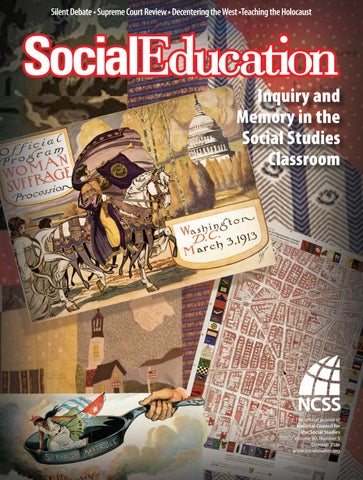
ON THE COVER: Top Left: Official program, woman suffrage procession, Washington, DC, March 3, 1913 (Library of Congress). On Right: Map of 80 “Places of Remembrance Holocaust Memorial” signs in Berlin’s Bavarian Quarter (Arty26 via Wikimedia Commons). Bottom Left: Louis Dalrymple cartoon from the humor magazine Puck, 1898, urging war with Spain over Cuba (Wikimedia Commons). Upper Backdrop and Center: Commemorative quilt from Arlington National Cemetery’s Section 60 Memorial Collection (Arlington National Cemetery).
October 2026
Volume 90, Number 5
DEPARTMENTS 256
Lessons on Law The Supreme Court in 2026: Constitutional Questions in a Political Minefield Catherine Hawke The Supreme Court’s recent constitutional rulings, its unusual entanglement with the Trump administration’s political battles, and its upcoming docket offer rich material for engaging classroom discussions on critical contemporary issues.
268
Sources and Strategies Formulating Questions from a Congressional Report: Investigating the 1913 Woman’s Suffrage Procession Colleen Smith Examining primary sources related to the 1913 woman suffrage march and subsequent Senate hearings can launch an engaging lesson on the First Amendment right to assembly and how that right plays out in practice.
281
Teaching the C3 Framework C3 Teacher’s Double Dog Dare Inquiry Challenge: How Does War Shape a Country’s Future? Kathy Swan, Alicia Saccomanno, and John Lee Taking on this year’s “Double Dog Dare Challenge,” a group of teachers show what it looks like to adapt the IDM blueprint’s structure to their own students while exercising creative, professional judgment.
www.socialstudies.org | 245
FEATURES
DEPARTMENTS
294
Teaching the Geography of Nazi Antisemitism: Learning About the Holocaust with the “Places of Remembrance” Memorial Chad S.A. Gibbs and Melissa Yarborough This lesson—featuring a Google Earth walking tour and the “One Family in Berlin” case study—helps students map how discriminatory laws gradually restricted Jewish daily life in Nazi Berlin.
301
Ordinary Objects, Extraordinary Meaning: Arlington National Cemetery’s Section 60 Memorial Collection Emily Rheault Kumar Studying images of items left at veterans’ graves in Arlington National Cemetery teaches students to analyze artifacts as evidence and reveals how 9/11’s legacy still shapes memory decades later.
287
Inclusive Social Studies Making Difficult History Accessible to English Language Learners: Using Graphic Novels to Teach About the Holocaust Ashley Sarvis and Jing A. Williams Using the graphic novel White Bird: A Wonder Story, this article shows teachers how graphic novels can help English language learners access rigorous Holocaust instruction without diminishing complexity.
248 NCSS Notebook 305 NCSS Member Spotlight
What’s Happening in Your State Council? Did you know that most states have an NCSS Affiliate Council? These councils give social studies educators a local space to:
� Connect with colleagues in your area � Engage in professional development and community events � Recognize and celebrate outstanding teaching and scholarship � Participate in awards and programs at the state level
Find your state’s affiliate council and get connected today! Visit www.socialstudies.org/affiliates and click on your state to connect. Join your local council — and bring the power of NCSS to your community.
246 | Social Education | October 2026
NCSS OFFICERS Joe Schmidt (President) Colonial Williamsburg Foundation, Williamsburg, VA David Kendrick (President-Elect) Loganville High School, Loganville, GA
EDITORIAL STAFF Jennifer Bauduy Editor Laura Godfrey Director of Publications and Resources Rich Palmer Art Manager
Annie Whitlock, Ph.D. (Vice President) Grand Valley State University, Allendale, MI
SOCIAL EDUCATION DEPARTMENTS Elementary Education Andrea S. Libresco
Tina M. Ellsworth, Ph.D. (Immediate Past President) University of Central Missouri, Warrensburg, MO
Inclusive Social Studies Stacie Brensilver Berman, John M. Palella, Diana B. Turk
BOARD OF DIRECTORS Terrell Fleming Lynchburg City Schools, Lynchburg, VA (2027) Kimberly Huffman Wayne County Schools, Smithville, OH (2027) Stephen Masyada, Ph.D. Lou Frey Institute and the Florida Joint Center for Citizenship, Orlando, FL (2027) Laura McFarren Derby North Middle School, Derby, KS (2029) Ebony McKiver Social Studies Accelerator, Marion, IA (2029) Stephanie Nichols Narragansett Elementary School, Gorham, ME (2028) Renita Parks Memphis, TN (2028)
Instructional Technology Michael J. Berson, Meghan McGlinn Manfra Lessons on the Law Tiffany Willey Middleton Research & Practice Jeremy Stoddard Sources and Strategies Lee Ann Potter Teaching the C3 Framework Kathy Swan, John Lee, S.G. Grant NCSS EXECUTIVE DIRECTOR Kelly McFarland Stratman DEPUTY EXECUTIVE DIRECTOR Joy Lindsey
Sarah B. Shear University of Washington Bothell, Bothell, WA (2029)
NCSS DIRECTORS Timothy Daly Director of Operations
Gabriel Valdez Fort Worth ISD, Fort Worth, TX (2028)
Laura Godfrey Director of Publications and Resources
Amy Walker Olathe USD 233, Olathe, KS (2027)
Ashanté Horton Director of Events
Anne Walker Forest Park High School, Woodbridge, VA (2028) Ryan Werenka Troy High School, Troy, MI (2029) EX-OFFICIO Jeff Bourque House of Delegates Steering Committee Chair Windham High School, Windham, NH (2026–2027)
SOCIAL EDUCATION (ISSN 0037-7724) is published by National Council for the Social Studies (NCSS) six times a year: September, October, Nov/Dec, Jan/Feb, March/April, and May/June. Logotype is an NCSS trademark. Contents © 2026. The views expressed in this publication are those of the authors and not necessarily those of NCSS. ONLINE: Visit us at www.socialstudies.org/publications and www.ingentaconnect. com/content/ncss. READERS: The editors welcome suggestions, letters to the editor, and manuscripts to our peer-reviewed journal. Guidelines at www.socialstudies.org/publications; submit at www.editorialmanager.com/ncssjournals; questions to publications@ ncss.org. Contributors express their own views, reflecting divergent opinions. Send manuscripts for departments to the department editors. DELIVERY AND CHANGE OF ADDRESS: View and update your record, www.social studies.org/membership; send new address to membership@ncss.org; or call 800-296-7840 ext. 111. Callers outside the U.S. and Canada use 301-588-1800 ext. 111. PERMISSION to reproduce articles for academic use, contact Copyright Clearance Center, Academic Permissions Service, 222 Rosewood Dr., Danvers, MA, 01923; 978-750-8400 (phone), 978-750-4470 (fax). ADVERTISING: Maribell Abeja-DeVitto, Account Manager, MAbejaDeVitto@smith bucklin.com; 312-673-5483 Visit www.socialstudies.org/advertising for rates and specifications. INDEXED by Institute of Education Sciences, eric.ed.gov and by ProQuest, www. proquest.com. POSTMASTER: Periodicals postage paid at Silver Spring, MD, and additional mailing offices. Send address changes to Social Education, NCSS, 8403 Colesville Rd., #1100, Silver Spring, MD 20910, USA.
Become an NCSS member! Use your smartphone’s camera to scan this QR code or go to www.socialstudies. org/membership.
MEMBERSHIP in the National Council for the Social Studies (NCSS) is open to any person or institution interested in the social studies. All members receive the NCSS journal of their choice (Social Education or Social Studies and the Young Learner), as well as the e-newsletter, The Social Studies Professional (two issues per month), access to the online NCSS publication archives, the online Middle Level Learning supplement, and discounts on NCSS conference registration, books, and professional development programs. Regular membership rates for individuals are $90 per year. Rates for students and retired persons are $53 per year. For rates and benefits of institutional membership, and further information on all levels of membership, go to www.socialstudies.org/membership. SUBSCRIPTIONS to Social Education are available to non-member institutions. A print-only subscription is $114 per year. Online subscriptions for Social Education are available through the IngentaConnect platform. Visit www.socialstudies.org/ publications/subscriptions and www.ingentaconnect.com/content/ncss. The online subscription is worldwide, IP supported, and SERU friendly for $199 per year. The online-plus-print subscription is $252 in the United States (add $11 for Canada and $45 international to cover mailings). SINGLE COPIES of Social Education are $6.00 (member price), $7.95 (non-members) plus shipping and handling. Contact 1-800-683-0812. Single articles are available (pdf: $14.95 for non-members) at www.ingentaconnect.com/content.ncss. NCSS members can access articles through the online archives. P.O. BOX: To become a member or subscribe (as an institution) by mail, send a check to NCSS, P.O. Box 79078, Baltimore, MD 21279-0078. RETURN ADDRESS: Social Education, NCSS, 8403 Colesville Rd., #1100, Silver Spring, MD 20910, USA.
www.socialstudies.org | 247
Social Education 90 (5) ©2026 National Council for the Social Studies
There is a Japanese proverb that states, “Better than a thousand days of diligent study is one day with a great teacher.” This issue of Social Education is filled with articles prepared by great educators exploring topics in new and innovative ways that meet students’ needs and foster critical lifelong learning skills. In “Can Discussion Be Silent? Introducing Silent Debate as a Strategy for Fostering Student Voices Amidst Political Polarization,” Jennifer Knisely and Al Wood explore how silent debate—turning spoken dialogue into a writing task that preserves debate’s back-and-forth structure—gives teachers a structured way to help students engage thoughtfully with contentious topics and reflect before responding. In Lessons on the Law’s “The Supreme Court in 2026: Constitutional Questions in a Political Minefield,” Catherine Hawke examines the Supreme Court’s recent term—including major rulings on the Second Amendment, voting rights, and separation of powers—and previews the cases the justices will take on this term, offering teachers rich material for critical discussion as students navigate an increasingly complicated civic landscape. Luis Martínez-Fernández, in his article “What Is History? What Is Historiography?”, equips teachers with practical strategies—including book review analysis, paired readings of monographs and reviews, and a quotation-based discussion activity— to introduce high school students to the concept of historiography and to distinguish between lowercase history and uppercase History. Our Sources and Strategies column demonstrates how educators can deepen students’ knowledge of historic milestones by exploring the Congressional Record. In “Formulating Questions from a Congressional Report: Investigating the 1913 Woman’s Suffrage Procession,” Colleen Smith uses primary sources from the procession and the Senate hearings that followed to show civic participation in practice, guiding students through observation, reflection, and question-formulation while examining freedom of petition and assembly. In “Five Reasons to De-Center the West in World History Teaching,” Stephen Jackson advocates for moving away from Eurocentric frameworks in teaching history and highlights why globally focused approaches better reflect historical scholarship and the diversity of human heritage.
248 | Social Education | October 2026
NCSS Notebook In the Teaching the C3 Framework column, Kathy Swan, Alicia Saccomanno, and John Lee share how different teachers reshaped an inquiry blueprint for their students. “C3 Teacher’s Double Dog Dare Inquiry Challenge: How Does War Shape a Country’s Future?” demonstrates how inquiry design can flex across grade levels and classrooms while staying true to its core structure. In the Inclusive Social Studies column’s “Making Difficult History Accessible to English Language Learners: Using Graphic Novels to Teach about the Holocaust,” Ashley Sarvis and Jing A. Williams argue that graphic novels offer a valuable scaffold for teaching difficult histories to English language learners without compromising historical rigor and outline concrete instructional approaches. Chad S.A. Gibbs and Melissa Yarborough, in “Teaching the Geography of Nazi Antisemitism: Learning About the Holocaust with the ‘Places of Remembrance’ Memorial,” share two exercises— using the “Places of Remembrance” Google Earth tour and the “One Family in Berlin” case study—to help students visualize how discriminatory laws gradually restricted Jewish daily life and freedom in Nazi Berlin. In “Ordinary Objects, Extraordinary Meaning: Arlington National Cemetery’s Section 60 Memorial Collection,” Emily Rheault Kumar helps students practice historical thinking by analyzing photographs of gravesite artifacts from Arlington National Cemetery. She teaches students to observe evidence carefully, draw reasoned conclusions, and sit with the uncertainty historians often face. Undoubtedly, each of us can name a great teacher who influenced who we are today. Like our featured authors—like NCSS’s members in classrooms across the country, every day—that teacher made us think. For that, and for them, we are grateful, and we are left with a lifelong habit of learning. Feedback is always welcome. Please email us at socialed@ncss.org. Kelly McFarland Stratman is the Executive Director of NCSS.
Social Education 90 (5) ©2026 National Council for the Social Studies https://doi.org/10.66392/RRIS2329
Can Discussion Be Silent? Introducing Silent Debate as a Strategy for Fostering Student Voices Amidst Political Polarization Jennifer Knisely and Al Wood Energetic, informed, and empathetic discussion is not only a highlight of effective social studies classrooms and a core component of the C3 Framework,1 but is also a cornerstone of American democracy. Yet bringing students to a point where discussions are, in fact, energetic, informed, and empathetic takes work—a lot of work. There are many strategies that help teachers ensure that students prepare researched arguments, give space for peers to contribute, and actually ponder perspectives that differ from their own. In the midst of political polarization around the 2016 election, one of the authors of this article, Jennifer, found herself struggling to slow down discussion during such activities and make students think with empathy before they spoke. Put simply, class discussions, even with intentional planning, turned into feelings-hurting free-for-alls. Such experiences not only have a negative impact on class community building, but can also negatively impact relationships between teachers, schools, and parents in an era of heightened political polarization and skepticism toward the teaching of political issues in public schools. Jennifer teaches in a rural region of Michigan’s Upper Peninsula, where political polarization and skepticism toward the teaching of political issues runs deep. While the county in which she teaches
is largely white and conservative (Donald Trump received 60-65% of the county’s vote in the 2016, 2020, and 2024 elections), there are many students and community members who do not identify as conservative or wholly support President Trump’s decision making. Nearly one-third of Jennifer’s students are also Indigenous, further broadening the perspectives represented in her classroom. Thus, despite the community often being stereotyped as “conservative,” Jennifer recognized the diversity of political thinking and lived experiences represented by her students and their families. Additionally, she saw the value of introducing students to political viewpoints held by people in other parts of Michigan and other regions of the United States. Therefore, despite the difficulty she had with facilitating respectful political discourse in her classroom, she wanted to identify a teaching strategy where students could analyze various perspectives on issues of public significance, construct their own opinions, and dialogue with others without engaging in personal attacks. The Importance of Navigating Political Polarization Researchers Walter Parker and Diana Hess have described the importance of teaching with and for
www.socialstudies.org | 249
discussion, explaining that while using contentious topics in the classroom is a powerful “hook” for engaging student interest about social studies topics, students must also be explicitly taught how to engage in dialogue around contentious topics.2 Parker explained that to mold students into effective civic actors with the knowledge and skills to advocate change in their communities, teachers need to foster “political friendship” among classmates.3 In political friendships, fellow citizens (or, in our case, classmates) do not necessarily have to like one another, but rather, they have to hold solidarity with one another, listen to one another, and trust one another. Parker also wrote extensively on his adaptation of Structured Academic Controversy (SAC) as an example of a strategy teachers can use to teach the skills of political friendship.4 In a SAC, groups of students engage in a discussion around a political issue in a manner which respects and considers different viewpoints and requires consensus-building before creating space for students to articulate their own, informed perspectives at the end of the activity. While Jennifer embraced strategies such as SAC early in her career, she realized after the 2016 election that much of what we know about teaching with and for discussion did not account for the increased political polarization that accompanied the rise of the Tea Party and Donald Trump’s presidential campaigns. Several articles in a special Social Education issue titled “Teaching Social Studies in Polarized Times” (Jan/Feb 2024) also showed that political polarization is impacting classrooms nationwide.5 However, these articles also showed that students do want to discuss contentious topics and that establishing routines for deliberation can facilitate the faster development of political friendship among students. Ultimately, however, most strategies for teaching with and for discussion still depend upon students being able to listen to their peers and engage in civil dialogue. Jennifer needed a strategy operating as a prologue to these approaches. As in many rural communities, most of Jennifer’s students have known each other since elementary school. In other words, the seeds of political friendship had been planted among many of them years before. But given the community’s
250 | Social Education | October 2026
political tensions, discussion could only work if she actively cultivated that trust; otherwise, it risked backfiring. Losing discussion as a teaching strategy would have been disastrous to Jennifer, since she saw it as vital not just for the classroom, but for developing leaders who could one day collaborate to help their small town grow. The Power of Silent Debate Given these stakes, Jennifer needed a structure that did more than give students opportunities to engage in political discourse. Rather, she needed a structure to teach students how to engage in political discourse. While strategies such as SAC take strides toward articulating a deliberate interaction process for students, Jennifer found it difficult to have students divorce themselves from their own opinions long enough to engage in these step-by-step procedures for engaging with empathy. How could Jennifer proceed with facilitating discussions when polarization was so strong that the mere act of vocalizing ideas led her class into chaos? This is where Jennifer saw a place for silent debate. She was first introduced to silent debate as a strategy for incorporating writing across disciplines by transforming verbal dialogue between students into a written product. In some ways, silent debate was like a “chalk talk” discussion,6 except instead of having the whole class or larger groups of students publicly brainstorm written responses to any open-ended question on a whiteboard or poster paper, silent debate asks students to craft those written responses to a debatable question back-and-forth in pairs using a T-chart. Jennifer made modifications to this writing-focused strategy to incorporate the development of empathy and discussion skills and reinforce student comprehension of social studies content. At first, silent debate, which Jennifer had learned about in a professional development training more than a decade earlier, was just another strategy she employed to help students construct understandings of important social studies topics. However, when she reached a point where traditional strategies for facilitating discussion and debate became untenable during the 2016 election, silent debate became Jennifer’s central approach for introducing contentious
topics in a controlled fashion where students would think and reflect before constructing ideas. How Silent Debate Works Following are eight steps for facilitating an effective silent debate activity in the classroom. 1. Develop a Strong Question The first step to a successful silent debate is discerning the right question for students to deliberate. Silent debate should be reserved for topics that are (1) “open” for debate in your community; (2) have at least one proposed policy that would address the issue; and (3) would not be harmful for students to advocate for or against that proposed policy.7 Researchers Daniel Krutka and Mark Hlavacik outlined the circumstances under which deliberation is and is not a good teaching strategy.8 When those circumstances suggest deliberation is not a good approach, then silent debate isn’t the best option, either. Figure 1 outlines a few examples of questions Jennifer and co-author Al Wood have used or would consider
using with a silent debate. 2. Curate a Bank of Effective Sources Successful silent debates also require carefully curated sources for students to consider when learning about each perspective. Often, students have pre-existing opinions on these topics, so it is important that your collection of sources represents multiple viewpoints, similar to a documentbased question activity or Inquiry Design Model (IDM) lesson plan.9 Based on the context of a particular question and the amount of time allotted for the activity, anywhere from 2-4 sources is appropriate. It is important to provide more than one source so students synthesize multiple perspectives and construct their own multi-faceted understanding of the topic. But it is also important to not get so bogged down by analyzing sources that the “debate” part of the activity becomes an afterthought. When curating sources, consider including at least one video as a way for struggling readers to establish a baseline of content knowledge
Figure 1. Example Silent Debate Questions U.S. History: 1. Should Andrew Jackson have re-chartered the Third National Bank of the United States? 2. Should the United States have joined the League of Nations? 3. Should the United States have more quickly withdrawn troops from the Vietnam War? 4. Should the United States have used nuclear weapons to end the Cold War, as was done in World War II? World History: 1. Should your community adopt a direct democratic system of policymaking? (Include as a local connection when teaching about Greek vs. Roman democracy.) 2. Should Alexander the Great be admired or condemned? 3. Was the French Revolution successful? 4. Was the Treaty of Versailles the main cause of World War II? Civics/Government: 1. Should the state or the family decide driving, drinking, and voting ages? 2. Should there be training requirements for public officials to hold office? 3. Should your state keep/expand/allow mail-in voting? (Language will vary based on students’ context.) 4. Should there be an 18-year term limit for Supreme Court justices? Economics: 1. Should there be a minimum wage? (Alternative: Should the minimum wage be increased to $15/hour?) 2. Should the federal government forgive student loan debt? 3. Should the federal government adopt a proportional (or “flat”) income tax structure? 4. Should your community impose a 1% local income tax to improve local infrastructure?
www.socialstudies.org | 251
that they can apply while engaging with textual sources. For history-based questions, we have had success finding text- or image-based sources from DBQs or IDMs already curated by Digital Inquiry Group (formerly SHEG) or C3 Teachers. These sources have often already been adapted for modern, grade-level language. The Library of Congress also has excellent text- and imagebased sources, but these may require additional adaptation for diverse reading levels. To find text- and image-based sources for civics, economics, or geography-related questions, we suggest locating news articles that cover different aspects or perspectives on a topic. When using sources from news outlets with more complex vocabulary (e.g., New York Times), we have seen teachers successfully use vetted AI programs such as Diffit to create variations of one article at multiple reading levels.10
candace moore and Jane Lo, building the trust necessary for political friendship requires students to engage in deliberation and gradually learn, through experience, what empathy and solidarity look like.11 Parker also reinforced that norms have to be co-constructed with students and will not be perfect the first time. Sometimes norms will have to be “tried on” and adjusted over time.12 In this way, trust building cannot happen in one day, and insisting that students perfectly master debate guidelines cannot be a precursor to effective discussion. Instead, you and your students will need to help one another reinforce and gradually build familiarity with the norms of political friendship through ongoing, structured, moderated, and equitable classroom discussions, and be ready to refine norms over time. Figure 2 outlines a few norms Jennifer uses in her classroom, as one example that could work for you.
3. Help Students Silently, Individually Analyze Sources As students independently analyze the sources, they should have a clear sense of the central question for the debate. We prefer to use paper-based sources, even though we have both taught with Google Classroom, because students can physically highlight or underline passages they consider relevant for the central question. Students should both highlight (or underline) key passages and add a brief note explaining how each one connects to the central question. These notes are evidence that students are actually thinking about what they are reading, instead of just highlighting or underlining to give an illusion of comprehension. These notes will also help jog students’ memories about each source as they engage in the “debate.” For whole classes in need of reading comprehension support, reviewing the sources could follow an “I do, we do, you do” structure accompanied by graphic organizers or guiding questions.
Figure 2. Example Classroom Discussion Norms
4. Establish or Remind Students of Classroom Discussion Norms Remember that the goal of a silent debate is not only to help students learn about a public policy debate, but to also help students develop the skills of political friendship. For researchers
252 | Social Education | October 2026
• Keep your arguments tied to the central question for the debate. • Disagree with arguments, not people. • Ensure your arguments can be supported with evidence. • You can disagree with someone’s opinions, but it doesn’t mean their opinions aren’t valid. • Speak as if you are right. Listen as if you are wrong. • Enter the debate with a flexible (not fixed) mindset and seek to understand differing points of view. • Make sure each partner has fully articulated their idea before taking back the T-Chart to write your response. 5. Assign Roles After students analyze the sources and are prepared to be political friends, assign each student a partner, and assign each partner a position on the question (either position “A” or “B”). On the whiteboard or screen, indicate which position corresponds with “A” or “B.” Often, the position students are assigned does not match their personal opinion on the issue. Once students are assigned a position, they should independently use their knowledge from the sources to craft a few
arguments supporting their assigned perspective. 6. Facilitate the Silent Debate Once prepared to argue their assigned perspective, ask students to join their partners and give each pair two T-charts. To begin, position A will write one of their arguments on the left side of one T-chart. Next, position B will write a response to that argument on the right side of that T-chart. Then, position A will respond to position B’s response on the left side; position B will respond to that response on the right side; and so on. Allow students to exchange the T-chart back and forth for 3-4 minutes. Then, using the other T-chart, ask position B to pose an argument from their assigned perspective and allow 3-4 minutes for a new exchange around that argument. It is important that students engage in these exchanges silently and communicate their ideas in writing only. The slower pace of this writing-centered exchange positions students to thoughtfully consider their partners’ thoughts and removes opportunities for students to interrupt or speak over one another. Silent debate also gives both students a platform to share their ideas with less risk than sharing in front of an entire class. During the two cycles of silent exchange, the teacher should walk around the room to offer logistical clarifications and ensure students follow the guidelines. Teachers should also use a timer to provide students with a transparent expectation for the depth of each silent exchange. It may also be more effective to indicate a minimum number of responses from each side in lieu of a set time for each exchange. 7. Have Groups Learn from Each Other After engaging in two cycles of silent exchange (one cycle starting with an argument from each partner), give each student a sticky note. It may help to give all position A students one color and all position B students another color. On these sticky notes, ask students to write down their partners’ best arguments from either of the silent exchanges. Students will then put their sticky notes on a central list in front of the class. Once all sticky notes are posted, ask students to come to the front of the class and review their peers’ “best arguments” for each position. In larger classes,
feel free to split arguments into several stations and structure this step like a gallery walk, where students rotate between stations every 30-60 seconds. Asking students to consider arguments posed by the other silent debates is important for several reasons: 1. It builds a deeper understanding of the issue, as students are positioned to consider arguments beyond those shared with their partner. 2. It allows students to recognize additional rationales for arguments they personally disagree with. 3. With explicit framing, this step allows students to transition from representing an assigned opinion to constructing their own opinion. 4. It helps students to see that opinions are shaped by arguments, not feelings. Figure 3 shows a few pictures from one of Jennifer’s recent silent debates, where she asked students to consider the question, “Should public officials be required to attend training prior to holding office?” Students advocating minimum training requirements explained the importance of education in areas of history, morality, ethics, and budgeting. These students also compared the work of politicians to other fields, like medicine or professional football, which require experience as a condition of employment. Students opposed to minimum training requirements brought up the limiting effect of additional required training, citing that education does not always equate to better job performance and might chase away people who would do a good job despite not having formal training. Other students with this viewpoint argued that the public has a distrust of the government, and by not having set educational requirements, fresh ideas and perspectives can be introduced. 8. Have Students Individually Form Their Own Opinions Once students review these “best arguments,” they should formulate their own thoughtful written response to the central question. Often, these
www.socialstudies.org | 253
personal reflections take the form of an “exit ticket,” either through Google Forms or on a half-sheet of paper. It is important to ensure that student responses are crafted with multiple sentences of argumentdriven rationale. Encourage students to consider ideas from the initial sources, the arguments from their T-charts, and the “best arguments” posted on sticky notes at the end of the debate. While “exit ticket” style assessments are often overlooked for the sake of limited time at the end of class, it is important to ensure ample time for students to use this reflection as a transition from representing an assigned perspective to developing the agency to construct political thinking of their own. Remembering that this activity is designed to be a first step in coaching students toward engaging in public discourse, it is also important to ensure students do not feel pressured to publicly display the ideas from their reflections. Students should feel safe using these reflections to “draft” or “test drive” ideas and be empowered to modify their thinking at any point in the future.
Figure 3. Photos of a T-Chart and of sticky notes used during the “best arguments” phase of a silent debate on whether public officials should attend training to hold public office
Conclusion Even in the face of growing political polarization, silent debate shows that, with structure, students can engage in discourse about contentious topics. Even in communities that seem heavily polarized, there are still nuances in opinion, which means there are
254 | Social Education | October 2026
still chances for discussion. These nuances also show that with increased polarization comes an increased silencing of marginalized voices. Silent debate presents a path for helping students to recognize, build empathy for, and deliberate with opinions different from their own and amplify marginalized voices. In small towns like Jennifer’s, the stakes are high for teaching these skills because students won’t be able to simply avoid the people they disagree with. Thus, silent debate should only be seen as a starting point for teachers seeking a strategy for scaffolding their students into vocal discussion structures such as Structured Academic Controversy. Ultimately, contributing to a democratic society requires communicating and living in community alongside those with whom we disagree. Silent debate is a way to recognize that while building students toward discussion may require varied approaches in different communities, discussion is important even in the most polarized of contexts and cannot be abandoned. Notes 1. National Council for the Social Studies, The College, Career, and Civic Life (C3) Framework for Social Studies Standards: Guidance for Enhancing the Rigor of K-12 Civics, Economic, Geography, and History (NCSS, 2013): 62. 2. Walter C. Parker and Diana Hess, “Teaching With and For Discussion,” Teaching and Teacher Education 17, no. 3 (2001): 273-289, https://doi.org/10.1016/ S0742-051X(00)00057-3; Walter C. Parker, “Public Discourses in Schools: Purposes, Problems, Possibilities,” Educational Researcher 35, no. 8 (2006): 11-18, https://doi. org/10.3102/0013189X035008011. 3. Walter Parker, “Listening to Strangers: Classroom Discussion in Democratic Education,” Teachers College Record 112, no. 11 (2010): 2815-2832, https://doi. org/10.1177/016146811011201104.
4. Walter Parker, “Feel Free to Change Your Mind. A Response to ‘The Potential for Democratic Civic Education,’” Democracy and Education 19, no. 2 (2011): 1–4. 5. Rachel Hutchins, “The Political Polarization of PreAdolescents: Affective Polarization in America’s Youth,” Social Education 88, no. 1 (2024): 20–23; Paula McAvoy et al., “Discussing Politics in Polarized Times: How Structure Can Help,” Social Education 88, no. 1 (2024): 24–29. 6. Scott L. Roberts, “The ‘Chalk Talk’ 2.0: Using Google Docs to Improve the Silent Discussion in Social Studies,” The Social Studies 104, no. 3 (2013): 130-136, https://doi.org/10.1 080/00377996.2012.703972. 7. Diana E. Hess, Controversy in the Classroom: The Democratic Power of Discussion (Routledge, 2009); Daniel G. Krutka and Mark Hlavacik, “How Do We Discuss Controversial Issues that Confront Injustices?: Three Approaches to Framing Critical Inquiries,” Social Education 86, no. 3 (2022): 197–203. 8. Krutka and Hlavacik, “How Do We Discuss Controversial Issues that Confront Injustices?” 9. Kathy Swan, John Lee, and S.G. Grant. Inquiry Design Model: Building Inquiries in Social Studies (NCSS & C3 Teachers, 2018). 10. For more information on Diffit, see https://web.diffit.me. 11. candace moore and Jane Lo, “Talking Our Way into Trusting,” Social Education 88, no. 1 (2024): 30–33. 12. Parker, “Listening to Strangers,” 2829. Jennifer Knisely teaches high school social studies in Michigan. She holds a bachelor’s degree in secondary social studies education from the University of Michigan and a master’s degree in learning disabilities from Northern Michigan University. Al Wood is an Assistant Professor of secondary social studies education at Georgia Southern University. Previously, he taught social studies methods at Michigan State University and middle and high school social studies in northern Arizona.
Moving? Keep your Social Education magazine subscription coming. Use the QR code to sign into your online NCSS profile and update your address. It’s easy.
www.socialstudies.org | 255
Social Education 90 (5) ©2026 National Council for the Social Studies https://doi.org/10.66392/FREM6746
Lessons on the Law
The Supreme Court in 2026:
Constitutional Questions in a Political Minefield Catherine Hawke The Supreme Court term that ended in June 2026 saw the justices digging into long-studied constitutional issues: the Second Amendment, voting rights, the separation of powers, immigration, and citizenship. But this was also a Court deeply entangled in the modern political debates and challenges of President Donald Trump’s second administration—as demonstrated by how many of the cases involve “Trump” or a member of his cabinet as the petitioner or respondent. For an institution that has long viewed itself as outside of the normal D.C. political swamp, the last few terms, and the 2025–26 (October 2025 or OT25) term in particular, are anything but removed from it. Here, we discuss some of the more consequential cases from this last term and look at what’s ahead in the next term. Part I. Term in Review Second Amendment and Guns The justices heard two gunrelated cases, giving them a chance to explore their evolving Second Amendment approaches. These cases followed the seismic shift in the legal approaches to gun regulations spurred by the Court’s ruling in New York State Rifle & Pistol Ass’n v. Bruen, 597 U.S. 1 (2022). Bruen reoriented how courts assess gun regulations, holding that gun regulations are only constitutional if they are “consistent with the Nation’s historical tradition of firearm
regulations.” However, Bruen left open how, precisely, to apply this “historical-analogy method.” This year, the Court clarified the new standards and the manner in which the Bruen theory should be applied, while also leaving much open for interpretation and exploration. First, United States v. Hemani (Docket No. 24-1234) presented the Court with the question of the constitutionality of a federal law that forbids the possession of a firearm by someone who is an unlawful user of a controlled substance. Specifically, Ali Hemani was charged under the federal law in 2022 after law enforcement agents searched his family
256 | Social Education | October 2026
home as part of a terrorism investigation. Hemani fully cooperated and turned over a gun, acknowledged the presence of marijuana and cocaine in the home, and admitted to regular marijuana use. According to the government, the moment Hemani used the controlled substance, marijuana, he could no longer lawfully possess a firearm. Hemani claimed that the law, as applied to him, violated his Second Amendment rights. The government countered that the law was permissible under the Bruen standard, as one could find a historical analogy in laws prohibiting firearm possession by “habitual drunkards.” The government drew a connection between the current law and the historical example, claiming that both were intended to protect the public and punish those who regularly use intoxicants. The Court ruled unanimously, affirming that when the government seeks to restrict Second Amendment rights, it must first show that the restriction aligns with historical
regulation. Here, the Court found the government’s analogy to habitual drunkard laws was inappropriate for three reasons: habitual drunkard laws require a conviction before a defendant loses Second Amendment protections; habitual drunkard laws are an attempt to improve the lives of the intoxicated individuals, not simply to reduce firearm violence or punish individuals; and the current federal law does not require any evidence that the individual is incapacitated or a danger. The Court was clear its ruling was limited and attempted to provide clarity on Bruen’s application: the government must show a historically grounded principle to justify the class of individuals burdened, the method, or the rationale behind the restriction. The Court also tackled the question of where individuals can carry arms in Wolford v. Lopez (Docket No. 24-1046). Wolford involved a challenge to a Hawaii law that prohibited licensed firearm permit holders from carrying firearms onto private property that was open to the public (for example, any store, restaurant, or other publicly accessible business) without the property owners’ explicit consent, most likely through a posted sign. The Court sided with the gunowner, holding that Hawaii’s law violates the Second Amendment. The Court was not persuaded by Hawaii’s historical analogies, including state customs and laws, an antipoaching law, and
post-Civil War Black Code. In assessing these analogies, the Court made clear that historical analogies for Second Amendment restrictions must have been widespread, broadly accepted, and similar in purpose. Separation of Powers The OT25 continued the Court’s recent foray into the separation of powers, particularly as it relates to the power of the president over the administrative agencies that make up the “alphabet soup” of our federal government. In a pair of cases, Trump v. Slaughter and Trump v. Cook, the Court directly addressed the power of President Trump to fire leaders at two government agencies, the Federal Trade Commission and the Federal Reserve. Between the two rulings, the Court held that removal protections for agency leadership violates the president’s Article II powers, except as applied to the Federal Reserve, which the Court noted was a “different sort” of agency. Although on the surface these cases may seem nuanced and potentially limited, they will likely be seen as the tipping point in a significant shift in our understanding of government powers. Professor of Law Steven D. Schwinn noted in the American Bar Association’s Preview of US Supreme Court Cases: [These holdings] give tremendous new power to the president, and at
the same time take away power from Congress and the administrative agencies. In one, the Court gave the president vast new power to remove officers from independent agencies at will. In the other, the Court carved out an exception, but only a weak one, which, as a practical matter, likely gives the president far more authority to remove an officer from the Federal Reserve than Congress ever intended. First Amendment A trio of cases explored the hotly contested arena of First Amendment law, with the surprising outcome of a fairly unanimous set of opinions. This set included: Oliver v. City of Brandon (Docket No. 24-993), involving a street preacher’s lawsuit to enjoin (or legally prohibit) potential future prosecutions for public proselytizing; First Choice Women’s Resource Center, Inc. v. Davenport (Docket No. 24-781) in which a religious nonprofit pregnancy resource center challenged a state request to produce documents, including the names and contact information of individual donors; and Chiles v. Salazar (Docket No. 24-539), centered on the constitutionality of a Colorado law aimed at conversion therapy that barred licensed mental health professionals from discussing any treatment aimed at changing a patient’s
www.socialstudies.org | 257
Amendment freedoms from government overreach. Birthright Citizenship Any review of the OT25 term would be incomplete without at least a mention of one of the most highly watched cases: Trump v. Barbara (Docket No. 25-365), aka, the birthright citizenship case. As one of his first acts during his second term, President Trump issued Executive Order 14160 (EO), stating that the U.S. government would not recognize American citizenship for those children who were born to a father who was not a permanent legal resident or citizen of the United States
and a mother who was either (a) unlawfully present in the United States or (b) lawfully, but temporarily, present in the United States. Critics immediately pushed back, viewing this EO in direct conflict with the Fourteenth Amendment and the standard set by the over 125-year-old case United States v. Wong Kim Ark, 169 U.S. 649 (1898), that almost all people born in the United States are legally recognized as U.S. citizens. In a 6-3 ruling, the Court agreed with the critics of the EO and reaffirmed this fundamental constitutional principle. In writing for the majority, Chief Justice John Roberts asserted
(Photo by Melissa Bender/NurPhoto via AP)
sexual orientation or gender identity. So, three First Amendment cases are all sitting at the heart of various culture debates: religion, abortion, and sexual orientation and gender identity. In the first two cases, all nine justices sided with the individual challengers; in the third, eight justices backed the challenger, with Justice Ketanji Brown Jackson the lone dissenter. Overall, the Court kept a keen eye on government actions that appeared to discriminate against a speaker’s viewpoint or associational rights, proving itself quick to protect First
Murad Awadeh of the NY Immigration Coalition speaks in lower Manhattan on June 30, 2026, celebrating the Supreme Court’s ruling in Trump v. Barbara, which struck down the 2025 executive order restricting birthright citizenship.
258 | Social Education | October 2026
“Citizenship, then and now, was a right to have rights—to freely participate in our political community. The Framers of the Fourteenth Amendment extended that promise to ‘every free-born person in this land.’… We keep that promise today.” Part II. Looking Ahead The new Supreme Court term appears to present the justices with a few tried-and-true issues, as well as, maintains the Court’s place front and center in our political debates. Second Amendment, Again The Court will continue to refine its post-Bruen Second Amendment jurisprudence in Viramontes v. Cook County (Docket No. 25-238). This case focuses on AR-15s and other similar semiautomatic weapons, asking the Court to determine whether the Second and Fourteenth Amendments guarantee an individual’s right to possess such firearms. While the cases in the most recent term focused on broad definitions and applications of the historical analogy, this case will likely answer a more nuanced question: historically, exactly what “arms” are covered by the Second Amendment? Religious Discrimination First Amendment issues are on the docket again, with at least two religion and speech-related headliners slated for argument: St. Mary Catholic Parish v. Roy (Docket No. 25-581) and Grand v. City of University Heights (Docket No. 25-965). Grand is a more traditional religious
discrimination lawsuit brought by an Orthodox Jewish man against a city official who required that he obtain a special permit to host a prayer group in his home. St. Mary Catholic Parish asks the justices to revisit the complicated and nuanced case of Employment Division v. Smith (1990), which involved drug rehabilitation counselors desiring to use peyote as part of their religious practice, through the lens of LGBTQA rights. Here, the Court will consider whether the state of Colorado’s exclusion of Catholic schools from participation in its universal preschool program due to the Catholic schools’ unwillingness to admit LGBTQA children
or children from LGBTQA families. The schools argue the state’s failure to issue them an exception to this requirement amounts to religious discrimination given the other policy exceptions granted by the state to nonreligious schools. Gender Identity of Youth Gender identity of minors is another topic that will reappear before the Court in 2026 with International Partners for Ethical Care, Inc. v. Ferguson (Docket No. 25-840). This case involves the ability (or legally, the standing) of parents to challenge a Washington state law that allows runaway teens to receive health care
Current Supreme Court cases in the Classroom Free, downloadable, editable, current. Preview in the Classroom features non-partisan, easy-to-understand overviews of current cases before the U.S. Supreme Court. Developed from the American Bar Association’s Preview of United States Supreme Court Cases, which analyzes every case slated for oral argument, the resources offer expert quality at your fingertips.
ambar.org/classroompreview
www.socialstudies.org | 259
and mental health treatment, including gender transitions, at licensed state shelters without the parents’ consent. The new law is an amendment to longstanding protocols requiring statelicensed youth shelters to notify parents within 72 hours whenever a runaway minor arrived at their facility. Parents could then retrieve their child immediately. The only exception to that notification requirement arose when informing parents would expose the minor to abuse or neglect. The new law added “when a minor presents seeking ‘protected health care services,’” which the legislature defined to include “genderaffirming treatment,” as another exception to the 72-hour parental notification rule. The amendment sets no timeline for reunification with parents and parents receive no information about the child’s location or condition. The petitioners are five sets of parents in Washington state whose children experience gender dysphoria and who refuse to affirm a gender identity contrary to their children’s biological sex. The parents argue that the law presents concrete harms to them and their children, including: violations of their rights to direct their children’s upbringing, including their religious faith; fear of provoking a runaway situation with their child; a chilling effect on free speech regarding gender, names, and gender identity within affected families;
and loss of parental rights to consent to their children’s health care. Election Law As of this writing, there was only one election law case slated for oral argument, Republican National Committee v. Mi Familia Vota (Docket No. 25-1017). It asks the Court to determine whether Arizona can require U.S. citizens to produce evidence of their citizenship when registering to vote, and whether the National Voter Registration Act’s “quiet period” provision prohibits the state from evaluating and potentially rejecting evidence, thereby disenfranchising a potential voter, within 90 days of a federal election. It is worth noting that Arizona has required U.S. citizenship as a qualification to vote since statehood in 1912. In short, this is one of the numerous election issues, including challenges to maps and new voting regulations from the states and federal government, in various federal cases that will bubble up and down a few times on the Court’s emergency docket between now, the date this article goes to print, and the 2026 midterm election. No review of the upcoming term would seem complete without mentioning them, but there is simply too much uncertainty to offer much more analysis here. Although many issues from the last and current terms are constitutional in their nature, they are also, in this day, political hot potatoes for an institution that has generally
260 | Social Education | October 2026
shied away from being exactly that: political. Given the trajectory of the second Trump administration’s policies and priorities, it is likely what we’ve seen thus far is more of a trend and less of an exception. It sets all of us Court-watchers up for some rich, robust critical discussions in and out of the classroom, as we engage with students navigating this complicated world. Catherine Hawke is Deputy Director of the Division for Public Education at the American Bar Association. She edits Preview of United States Supreme Court Cases, a publication that previews every case scheduled for oral argument. She also directs the Association’s Summer Teachers Institute that is held annually in partnership with the Federal Judicial Center.
Lessons on the Law is a contribution from the American Bar Association’s Division for Public Education. The ideas and opinions expressed herein are the author’s and should not be construed as official policy of the Association or any of its entities, including but not limited to: Board of Governors, House of Delegates, and the Standing Committee on Public Education.
Social Education 90 (5) ©2026 National Council for the Social Studies https://doi.org/10.66392/ROPC6894
What Is History? What Is Historiography? Luis Martínez-Fernández
Lowercase and Uppercase h/History Long before the first historical works were written, and even before humans recorded events, our ancestors participated in “history”: actions unfolding in specific chronological and geographical settings. This may be called lowercase history. Uppercase, or capital-H, History emerged later as the recording, interpretation, and writing of the past, eventually developing into a professional academic discipline. Edward Ross Dickinson explains the distinction:
with a capital H is a way of learning and thinking about the past…. It is the collective project of “historians” … who study history, with a lowercase h, which is what happened in the past.1 I explain the distinction to students by noting that soldiers “write” lowercase history on battlefields, while historians write uppercase History at their desks. What Is Historiography? I introduce historiography with an easy-toremember formula: History is the study of history, while historiography is the study of how History is researched and written. Historiography examines how historians have interpreted the past across time and from differing perspectives. It focuses on historians’ methods, sources, theories, and interpretations, as well as on the evolution of the discipline itself.
photo by dariusz sankowski, pixabay
Whether in high school or college, most history courses, curricula, and textbooks move directly into subject matter with little opportunity to reflect on what history is, how historians produce knowledge, or why historiography matters. Pressed for time and expected to cover large amounts of material in only a few weeks, instructors rarely pause to discuss the nature, evolution, and purposes of the historical discipline. This article offers readings, classroom activities, and instructional strategies that instructors can incorporate into virtually any history course to introduce students to the two meanings of h/History and to the meaning and importance of historiography. The lesson plans and activities may be adapted for either upper-level high school or college courses and are especially suitable for the first week of class.
By History, with a capital ‘H,’ I mean not our knowledge of what happened in the past, the record of past events, but rather History as a field of inquiry, a “discipline” in the academic sense. History
www.socialstudies.org | 261
Historiography in High School Courses Despite its importance, historiography is largely absent from high school history instruction. Major curricular frameworks—including the 1996 National Standards for History, NCHE’s History’s Habits of Mind, the College, Career, and Civic Life (C3) Framework, and the AHA’s American Lesson Plan: Teaching US History in Secondary Schools (2024)— do not include sustained instruction on either the nature of History or historiography.2 At most, they briefly reference historiographical thinking as a skill. The National Standards for History, for example, encourage students to “hold interpretations of history as tentative, subject to changes as new information is uncovered, new voices heard, and new interpretations broached,” and to “evaluate major debates among historians concerning alternative interpretations of the past.”3 Similarly, History’s Habits of Mind emphasizes that historical narratives “can be interpreted differently.”4 The AHA’s American Lesson Plan also recommends “introducing students to historiographical debates,” although surveyed teachers ranked that objective last among 10 instructional priorities.5 These materials, however, offer little guidance on how to achieve such goals. This article seeks to help instructors do precisely that. One accessible strategy is to introduce students, especially those in AP or dual-enrollment courses, to the genre of the scholarly book review, having them read and write reviews to build familiarity with the form. Teachers can ask students to locate a review of a History book and identify the elements discussed by the reviewer. The Library of Congress’s “Finding Book Reviews Online” is especially useful for this purpose. Students quickly discover that reviews address questions such as: • What is the author’s background? • What is the book’s thesis? • How is the work organized? • What methods or theories are employed? • What are the book’s strengths and weaknesses? • What audiences might benefit from reading it?
262 | Social Education | October 2026
Such exercises introduce students to historiographical thinking by encouraging them to evaluate historical interpretation rather than simply absorb historical content. Historiography in College Courses At the college level, historiography is usually confined to introductory methods courses, historical methods seminars, or capstone experiences. It is seldom integrated into geographically or topically focused undergraduate courses such as Middle Eastern history or the US Civil Rights Movement. Historiographical instruction, however, should be part of all history courses. One effective strategy is to assign students excerpts from a historical monograph alongside a scholarly review of that same work. Whenever possible, the selection should relate directly to the course topic. Students thereby learn to distinguish between History itself and historians’ interpretations of History. In my undergraduate Cuban and Caribbean history courses, I begin with a session on geography and devote the following meeting to Caribbean historiography—that is, how historians have interpreted and written about the region over time. Students read Louis A. Pérez’s essay “In Service of the Revolution: Two Decades of Cuban Historiography, 1959–1979.”6 The article demonstrates how the Cuban Revolution used historical writing to legitimize political change, redefine national priorities, and emphasize new ideological and international alignments.
Rand McNally & Co. Rand, McNally & Co.’s New Business Atlas Map of Cuba. Scale not given. Chicago: Rand McNally & Co., 1898. (via Wikimedia)
I ask students to identify Pérez’s central argument, beginning with clues in the title itself. The phrase “in service” suggests that historical writing functioned politically in support of the revolutionary state. Students also encounter Pérez’s nuanced argument that Cuban historiography did not begin anew after 1959. Before the revolution, Cuban historians had already developed revisionist and nationalist approaches that challenged older narratives. The revolutionary government later appropriated many of those revisionist traditions. This discussion provides an opportunity to distinguish between “policy History”—traditional narratives supporting national institutions and identities—and “revisionist History,” which challenges or reinterprets established interpretations. When assigning research papers in historiography and methods courses, I require students to identify a focused body of scholarly books and articles on their topic and include a brief historiographical discussion in their introduction. These discussions should explain how historians have approached the topic from differing perspectives, using different sources, methods, and theoretical frameworks. Historiographical Materials Instructors seeking to incorporate historiography into their courses should look for historiographical essays that trace the evolution of scholarship on a specific topic. Book reviews published in journals such as the American Historical Review or the Journal of African History are also valuable teaching tools. In both high school and undergraduate settings, instructors may assign excerpts from broad historiographical essays or, preferably, essays directly related to the course topic. Classroom Activity: Quotes on History and Historiography This activity encourages students to reflect on the meanings of history, History, and historiography through quotations about the nature, purposes, and limitations of historical study. Some quotations address the distinction between history and History, while others introduce historiographical themes such as interpretation, objectivity,
Sample Historiographical Essays • Hattem, Michael D. “Historiography of the American Revolution.” Journal of the American Revolution (Aug. 27, 2013). https://allthingsliberty.com/2013/08/ historiography-of-american-revolution. • Pilbeam, Pamela. “The Historiography of the 1789 Revolution from Alfred Cobban to Recent Times.” French History and Civilization (Aug. 15, 2021): 199-205. https://h-france.net/rude/ wp-content/uploads/2021/08/15-PILBEAM.pdf. • Smith, Timothy B. “Change Over Time: Mississippi’s Civil War Historiography.” Journal of Mississippi History 83 no. 1 (2021): 11-26. https://aquila.usm.edu/jmh/vol83/iss1/4. • Ware, Susan. “American Women: An Overview.” Library of Congress Research Guides. https:// guides.loc.gov/american-women-essays/ overview.
Sample Sources on How to Teach Historiography • Ayres, Amir Taron. “Teaching Historiography in Middle and High School.” Edutopia (Feb. 15, 2023), www.edutopia.org/article/ middle-high-school-historiography. • Doran, Matt. “Historiography for the Secondary Social Studies Classroom.” (Oct. 18, 2014). www.21socialstudies.com/blog/historiography. • Swafford, Emily. “Teaching Historiography in the K–12 Classroom.” AHA22 (March 24, 2022). www.historians.org/perspectivesarticle/teaching-historiography-in-the-k-12classroom-an-aha22-online-recap-march-2022. • Twaddell, Shane. “Teach Historiography in High School!” Coffee House Historian (Aug. 29, 2022). https://coffeehousehistorian.com/2022/08/29/ teach-historiography-in-high-school. • Zucker, James. “Teaching Historiography in High School.” OAH Blog (Jan. 13, 2016). www. oah.org/process/james-zucker-teachinghistoriography-in-high-school.
www.socialstudies.org | 263
narrative, causation, and historical change over time.7 The activity may be adapted to different academic levels by selecting quotations appropriate to students’ intellectual maturity. Some quotations are straightforward (“No single man makes history”), while others require deeper reflection (“The past isn’t what it used to be”). Activity Objectives This exercise helps students: • understand the evolving nature of History as a discipline; • recognize the role of interpretation in historical writing; • identify differing historiographical approaches; • distinguish between lowercase history and uppercase History; • think critically about how historians construct knowledge. Analyzing Quotes Students should read selected quotations carefully and multiple times. Instructors may discuss quotations collectively, assign them to small
groups, or post them around the classroom and ask students to gather near the quotation they find most compelling or intellectually challenging. Students can then explain and defend their selections before the class. For advanced high school or undergraduate courses, instructors may ask students to identify the quotations they find most intellectually difficult and explain why. Students may also analyze whether “history” in each quotation refers to lowercase history or uppercase History and identify historiographical concepts such as interpretation, subjectivity, revisionism, or narrative style. The quotations also provide opportunities for contextualization. Students might research the author’s historical setting, intellectual influences, and methodological assumptions. For example, Leopold von Ranke’s insistence that History represent “what actually happened” reflects nineteenth-century positivism and the professionalization of historical scholarship. Similarly, the phrase “The past isn’t what it used to be” can lead students to recognize that while the past itself does not change, historians’ interpretations and methods continually evolve.
History Quotations Quotations appear in chronological order. Italicized comments are meant for instructors to introduce and contextualize each quote. 1. “[History] is what actually happened.” Leopold von Ranke (1824).8 This quote by German philosopher and historian von Ranke represents the idea that historians should stick to documented facts, leaving out moralizing, opinions, and interpretations. It reflects nineteenth-century Positivism. 2. “History, to be above evasion or dispute, must stand on documents, not on opinions.” Lord Acton (1895).9 This quote is from British historian Lord Acton’s inaugural address at Cambridge University. Acton was a Liberal politician who emphasized the role of criticism and moralizing in historical research, lecturing, and writing. 3. “Those who cannot learn from history are condemned to repeat it.” George Santayana (1905).10 This often repeated quotation from philosopher and essayist Santayana highlights the relevance of lowercase history as a guide to present situations. 4. “Every true history is contemporary history.” Benedetto Croce (1921).11 While here the word “history” is ambiguous, it refers to History. The intended meaning is that written History, even about remote times, is influenced by the curiosities, beliefs, and concerns of the historian’s present.
264 | Social Education | October 2026
5.
“Who controls the past controls the future: who controls the present controls the past.” George Orwell (1949).12 This party slogan comes from the dystopian novel Nineteen Eighty-Four about a dictatorial regime that seeks absolute control over education, language, the media, and the historical record. The word “past” here means written History. Those who control it gain power over the future; those who control the government presently, control the writing about the past. 6. “Let us guard against stripping our science of its share of poetry.” Marc Bloch (1953).13 Extracted from Bloch’s classic The Historian’s Craft, this quote recognizes that History is a social science, like anthropology, but it is also one of the humanities; its practitioners having the responsibility of writing with better prose than other social scientists. 7. “Social science has almost what amounts to a horror of the event. And not without justification, for the short span is the most capricious and the most delusive of all.” Fernand Braudel (1958).14 Originally published in the Annales journal, this quote reflects Braudel’s emphasis on long-term historical structures (the longue durée) rather than specific historical events, a perspective central to his landmark work The Mediterranean and the Mediterranean World in the Age of Philip II. 8. “Study the historian before you begin to study the facts.” E.H. Carr (1961).15 In this quote, in What Is History?, Carr stresses the importance of learning about a historian’s background, context, and training to better understand their work. 9. “I have two goals. First, that readers be interested, drawn by a historical account, amused by its comic aspects, saddened by the tragic elements, captured by the possibilities of the past; and second, that readers be aware that there could be another way of looking at things besides the one I offer.” Natalie Zemon Davis, (2010).16 This is Davis’s response to an interviewer’s question about her decision to not share theoretical implications with her readers. She prefaced the above quotation, saying “A book is not a lesson.” 10. “History is a long and endlessly interesting argument, where evidence is everything and storytelling is everything else.” Jill Lepore, (2008).17 This quote is from an article Lepore wrote for The New Yorker. She prefaces her assertion stating that “when it comes to telling stories, historians have much to learn from novelists.” She is promoting a literary form of historical writing that while based on documented facts embraces the narrative style of great novels.
Sources on the Two Definitions of History • Bain, Robert B. “They Thought the World Was Flat?” In How Students Learn: History in the Classroom, edited by M. Suzanne Donovan and John D. Bransford, 179–214. National Academies Press, 2005. • Dickinson, Edward Ross. Teaching History in Higher Education: Ethics, Aims, Methods. Cambridge University Press, 2025. • Dunn, Ross E. “Constructing World History in the Classroom.” In Knowing, Teaching, and Learning History, edited by Peter N. Stearns, Peter Seixas, and Sam Wineburg, 121-140. New York University Press, 2000. • Jenkins, Keith. “Teaching History Theory: A Radical Introduction.” In History in Higher Education, edited by Alan Booth and Paul Hyland, 75-96. Oxford: Blackwell, 1996.
Recommended Readings on the Nature of History Educators may want to consult one or more of the following books, considered classic reflections on the nature of the historical discipline: • Bloch, Marc. The Historian’s Craft. Vintage, 1953. • Carr, E.H. What Is History? Vintage, 1962. • Gaddis, John Lewis. The Landscape of History. Oxford University Press, 2004. • Lepore, Jill. Deadlines: Essays. W.W. Norton, 2023. • Tuchman, Barbara. Practicing History: Selected Essays. Random House, 2011.
www.socialstudies.org | 265
Long-Term Benefits of the Activity For many students, this activity provides a first encounter with the distinction between history and History and with the idea that historical interpretation changes over time. Students learn that each generation produces its own History, shaped by new questions, methods, and theoretical approaches. Exposure to historiography also encourages students to think more like historians: critically evaluating primary and secondary sources, recognizing interpretation and bias, and
distinguishing between credible scholarship and unreliable claims. Notes 1. Edward Ross Dickinson, Teaching History in Higher Education: Ethics, Aims, Methods (Cambridge University Press, 2025), 1. 2. Gary B. Nash and Charlotte Crabtree, National Standards for History Basic Edition (1996), https://phi.history. ucla.edu/nchs/historical-thinking-standards/overview; National Conference for History Education (NCHE),
Student Guidelines for Book Reviews Book reviews are a common form of academic writing. A review gives readers a brief account of a book’s subject and argument, evaluates how effectively the author makes that argument, and helps readers decide whether the book is worth reading. For this activity, the goal is to become familiar with the form of a book review. As you read and write reviews, pay attention to how reviewers combine summary and evaluation. Selecting a Book Choose a scholarly book appropriate to the course, ideally one published within the last decade. Books written by scholars and published by university or academic presses are generally scholarly. If you are unsure whether a book is appropriate, check with your instructor. Format Begin with the book’s bibliographic information, following the format below: Shaping the Discourse on Space: Charity and Its Wards in Nineteenth-Century San Juan, Puerto Rico. Teresita Martínez-Vergne. Austin: University of Texas Press. 1999. xv, 235 pp. Reviews should be approximately 2–3 pages, double-spaced, unless otherwise specified. Follow the assigned style guide. Contents A good review usually addresses several of the following questions: • What is the book about? What are its main topics? • How is the book organized? • What is the author’s central argument or thesis? • How does the book fit within the existing historiography? Does it support, challenge, or add to what historians have already said about this subject? • What evidence or sources does the author use? • How effectively does the evidence support the argument? • What are the book’s main strengths and limitations? • What does the book contribute to our understanding of its subject? • How clearly and effectively is it written? • Who would benefit from reading it? You do not need to answer every question. Select those that help you describe, evaluate, and recommend the book. Remember: a book review is more than a summary and more than an expression of whether you liked the book. It explains what the author is trying to do, how well the author does it, and why that matters to readers.
266 | Social Education | October 2026
3. 4. 5.
6.
7.
“History’s Habits of Mind,” https://ncheteach.org/ conference/history-of-habits-of-mind; National Council for the Social Studies, College, Career, and Civic Life (C3) Framework for Social Studies State Standards (2022), www. socialstudies.org/system/files/2022/c3-framework-forsocial-studies-rev0617.2.pdf; and Nicholas Kryczka, coord., American Lesson Plan Teaching US History in Secondary Schools: A Report by the American Historical Association (2024), www.historians.org/wp-content/uploads/2024/09/ American-Lesson-Plan-1.pdf. Nash and Crabtree, National Standards, Standard 3. NCHE, “History’s Habits.” Only 29% of teachers rated that objective as “important/ very important” while 13% deemed it “not at all important.” Kryczka, American Lesson Plan, 132. Louis A. Pérez, Jr., “In Service of the Revolution: Two Decades of Cuban Historiography, 1959-1979,” HAHR (February 1980): 79-89, https://read.dukeupress.edu/hahr/ article/60/1/79/149783/In-the-Service-of-the-RevolutionTwo-Decades-of. Harvard University, Kennedy School’s Belfer Center, “Notable Applied History Quotes,” (February 2021), www.belfercenter.org/sites/default/files/2024-12/20212-23%20AH%20Notable%20Quotes.pdf; Ference M. Szasz, compiler, “Quotations about History,” in William Cronon’s webpage, www.williamcronon.net/handouts/
szasz_history_quotations.html; See, for example: Maxime Lagacé, “210 History Quotes that Will Surprise and Inspire You,” https://wisdomquotes.com/history-quotes. 8. von Ranke quoted in Roger Smith, The Norton History of the Human Sciences (W.W. Norton, 1997), 385. 9. Lord Acton, A Lecture on the Study of History (Cambridge University Press, 1895), 45. 10. George Santayana, The Life of Reason, or the Phases of Human Progress (Charles Scribner’s Sons, 1905), 284. 11. Benedetto Croce, History: Its Theory and Practice (Harcourt Brace, 1921), 12. 12. George Orwell, Nineteen Eighty-Four (Knopf, 1992), 260. 13. Marc Bloch, The Historian’s Craft (Knopf, 1954), 7. 14. Fernand Braudel, On History (University of Chicago Press, 1982), 28. 15. E.H. Carr, What Is History? (Knopf, 1962), 17. 16. Natalie Zemon Davis, A Passion for History (Truman State University Press, 2010), 13. 17. Jill Lepore, “Just the Facts, Ma’am,” The New Yorker (March 17, 2008), www.newyorker.com/magazine/2008/03/24/ just-the-facts-maam. Luis Martínez-Fernández is Pegasus Professor of History at the University of Central Florida. A multiple award-winning author, he has researched, written and lectured widely on Latin America and the Caribbean.
A Classroom With Purpose: A Guide to Teaching Social Studies Today A Classroom With Purpose: A Guide to Teaching Social Studies Today is a roadmap for educators at every stage of their careers. Drawing on the wisdom of experienced teachers and field experts, it offers practical strategies, thoughtful resources, and real-world insights to help build confidence and resilience in the classroom. Designed to grow with you, this guide serves as both a trusted reference and a source of encouragement. Mark it up, annotate the pages, and return to it often as inspiration for sustaining a purposeful, fulfilling career in teaching social studies. Where was this book during my pre-service and early in-service years!? A Classroom With Purpose contains the sort of practical, ready-to-use advice that every first-year social studies teacher (and let’s be honest, the rest of us too!) needs to make the jump from being a student to teaching students, especially finding and building a community of support networks and continually growing. Readers will walk away with tips and tricks for building critical thinking skills and civic engagement from some of the best in the social studies world. —Glenn Wiebe, Instructional Consultant, Co-Author of The Social Studies FIELD Guide: Strategies & Tools to Captivate Students, Cultivate Critical Thinking, and Create Engaged Citizens
Price: $35.95 https://ncss.users.membersuite.com/shop/store/browse
www.socialstudies.org | 267
Sources and Strategies
Social Education 90 (5) ©2026 National Council for the Social Studies https://doi.org/10.66392/JYQP4016
Formulating Questions from a Congressional Report:
Investigating the 1913 Woman’s Suffrage Procession Colleen Smith • Organizers of and participants in the March 3, 1913, Women’s Suffrage procession in Washington, DC, exercised their First Amendment rights of petition, assembly, and speech to advocate for a woman’s right to vote. • Members of Congress exercised an inferred constitutional power to conduct investigations on behalf of the American people when they sought the testimony of participants soon after the parade, regarding what transpired during the march.1 • Students—when they formulate questions, follow up with research, and share their findings—also exercise important civic actions, namely thinking, learning, and participating.
T
wo documents from 1913 tell two different stories about the same afternoon: an official program that promised an orderly, dignified march for woman suffrage, and Senate testimony describing a very different scene on Pennsylvania Avenue. The official 20-page program of the 1913 Women’s Suffrage Procession reflects the many people involved in organizing and executing the parade and offers a glimpse into the careful crafting of the parade’s message through imagery and language. Yet, like many careful
acts of civic engagement, it does not capture the enormous challenge of making the procession a reality. Petitioning and assembling is not often glamorous: It can feel tedious and discouraging. Organizers had to use their knowledge of local and federal processes and still they encountered barriers to making the parade happen. Alice Paul, a 28-year-old prominent organizer within the women’s suffrage community, believed that a parade on behalf of women’s suffrage, to take place on the day before President-elect Wilson’s
268 | Social Education | October 2026
inauguration, would reinvigorate a national campaign to give women the right to vote.2 Paul and others submitted the necessary paperwork (petition) for a parade permit on December 31, 1912. Organizers encountered opposition to the proposed route and timing of the parade. In mid-February they were granted a permit, however, they still lacked police protection: Organizers sought to secure an orderly, safe march and requested support from the District of Columbia police force as well as the U.S. military to ensure that streets were clear and street cars would suspend traffic. Organizers of the march even lobbied leaders in the U.S. Congress to lend their support. On March 1, two days before the parade, Congress issued a resolution that stated the parade should be able to run along the requested route and directed DC police to provide protection for the event.3 Overall, the parade was a huge success. Large crowds (at least 250,000 according to newspaper accounts of
the time4) showed up to view the procession of over 5,000 marchers, and it captured the public’s attention.5 All went well for the first few blocks of the route; however, crowds eventually began piling into the street and made it nearly impossible for the women to continue marching. Despite police presence, little was done to protect the order of the parade. According to witness interviews, women were “jeered, tripped, grabbed, shoved, and many heard ‘indecent epithets’ and ‘barnyard conversation.’”6 The mistreatment of the marchers by the crowd and
the police was reported by the press and led to congressional hearings.7 Senate Resolution 499 directed an investigation of the conduct of “District police and the police department of the District of Columbia” in connection with the women’s suffrage parade.8 The Committee on the District of Columbia appointed a subcommittee to carry out the investigation; the subcommittee met on Thursday, March 6 and questioned witnesses, gathering up to 700 pages of testimony. The results of the committee’s investigation were printed May 29, 1913. The following day the
Washington Herald ran a story about the committee’s findings, with the headline “Police Cleared of Negligence.”9 More than 150 witnesses testified about their experiences. Featured in this article is a section from one witness, Helen Gardener. Gardener was one of the organizers of the march and participated in the procession. Representing “writer” in Section Four of the parade, Gardener was part of a float titled, “An Enlightened Press is Making an Enlightened People.” Class Warm up: Observations Begin by distributing or
Image 11 of Official Program Woman Suffrage Procession. Washington, DC, March 3, 1913.
www.socialstudies.org | 269
displaying image 11 (see previous page) from the official program of the woman suffrage procession (www.loc.gov/resource/ rbpe.20801600/?sp=11); do not, however, share the title or subject of the source with students. Invite students to spend some time observing the item. Depending on students’ familiarity and practice with analyzing primary sources, reminding students of the goal of observation in this context may be helpful: to look for and note details about the source that stand out or catch their attention. Students might observe that the paper is divided into three sections; is black and sepia-toned; does not include color; includes some illustrations or sketches in addition to text; the words “women,” “ladies,” “girls” come up frequently; and it lists addresses and street names.
Note: While making and sharing their observations, students may also bring their reflections, or hypotheses, about the item, such as: “This is from a long time ago,” “It is about a parade in Washington DC,” or “This has something to do with women voting.” Encourage students to refrain from making inferences at this point and instead keep their focus on details of the item.
observations about the item, invite them to shift their thinking and reflect on the source. If students struggle to know what reflecting means in this context, teachers might offer prompts such as “Why do you think someone made this?” “What do you think was happening at the time this was made?” “Who do you think was the intended audience and why?” Now ask students to pose questions they may have about the item. Encourage students to use their observations and reflections as possible inspiration for further questions. For example, if a student observed that the item referenced the word “float” four times and they used that observation, along with other details, to infer this item had something to do with a parade, a question might be: “Why was there a parade and was it just for women?” Once students have had some time to practice formulating questions, pause the group. Summarize what students just practiced: closely examining a source by observing details, developing reflections, and constructing questions. Now reveal information about the item (item record: www.loc.gov/ item/2020780515), and if time allows, invite students to look at the program in its entirety.
Practice with Reflections and Questions After students spend time formulating and sharing
270 | Social Education | October 2026
Explain that students will now examine a related primary source: an excerpt from testimony before the U.S. Senate about what happened at the parade, who was responsible, and what, if any, corrective or disciplinary actions should have been taken. Additional Analysis Distribute or point students to page 447 of the Report of the Senate Committee on the District of Columbia (www.loc.gov/resource/ llserialsetce.06512_00_00002-00530000/?sp=479&st=image) and page 448 (www. loc.gov/resource/ llserialsetce.06512_00_00002-00530000/?sp=480&st=image). Explain that the excerpt is coming mid-way through someone’s testimony (statements that become part of a government record) to the U.S. Senate. Direct students to examine this source as they analyzed the woman’s suffrage parade program. First, they will make observations about the text, looking closely at details, words, and phrases that stand out. Next, students should reflect on what they observed and formulate inferences or reflections about the text. The Library’s Primary Source Analysis Tool may be useful (www.loc.gov/static/ programs/teachers/gettingstarted-with-primary-sources/ documents/Primary_Source_ Analysis_Tool_LOC.pdf ) for helping students record and
see their thinking. After students have generated initial observations and reflections, invite them to consider what questions arose as they examined the testimony. Encourage students to generate as many questions as they can. Students may craft both closed questions (can be answered yes/no) and open questions (which require more detailed response). Clarify that both types of questions can be useful, depending on
a research goal and invite students to adjust their questions accordingly. For example, students might practice shifting a closed question into an open question or vice versa. Once students have drafted a range of questions, challenge them to prioritize what questions they are most curious about. As students make their selections, they should consider the additional information they will need to know and how they might find that information.
Note: The suggestions for helping students develop questions are adapted from the Question Formulation Technique by the Right Question Institute (RQI). For more information, see: https://rightquestion.org.
Lead a class discussion based on questions posed by students. What do students notice about the questions
Pages 447–448 from Suffrage Parade: Report of the Committee on the District of Columbia, United States Senate, Pursuant to S. Res. 499, of March 4, 1913, submitted by Senator Wesley L. Jones (Washington, DC: U.S. Government Printing Office, 1913). United States Senate, Committee on the District of Columbia. www.loc.gov/item/2024874993
www.socialstudies.org | 271
they’ve crafted? Are there common themes, ideas, or shared curiosities? Encourage students to conduct their own research, possibly using digital materials from the Library shared in this article. Before students begin their research, invite them to reflect on the opening statement of the Official Program of the Woman’s Suffrage Procession: “The purpose of this National Procession is to give expression to the nation-wide demand for an amendment to the United States Constitution enfranchising women.”10 Bring students’ attention to the phrase, “give expression to.” Invite students to speculate on why organizers of the procession might have chosen those words and how the phrase connects to civic participation in a democratic society. Notes 1. “Necessary and proper” clause and inferred ability to conduct inquiry. Congress’s power to conduct investigations stands on equal footing with its authority to legislate and appropriate. Article I, Section 8, Clause 18, of the U.S. Constitution. 2. Library of Congress Blogs, Women’s History Month: Celebrating the 100th Anniversary of the Suffragist March of 1913 with Primary Sources, https://blogs.loc.gov/teachers. 3. Suffrage parade. Report of the Committee on the District of Columbia United States Senate pursuant to S. Res. 499, of March 4, 1913, directing said Committee to investigate the conduct of the district police and police department of the District of Columbia in connection with the woman’s suffrage parade on March 3, 1913,
The collections of the Library of Congress include many resources related to the 1913 Woman’s Suffrage Procession and the Congressional Hearings that followed. Examples that are available online include: Full Congressional Inquiry The Report of the Committee on the District of Columbia is over 800 pages and includes a summary of the committee’s findings, images and data from the parade, and the testimonies of witnesses, including Mrs. Gardner’s full report. The list of witnesses (www.loc.gov/resource/llserialsetce.06512_00_00002-0053-0000/?sp=19) is useful for finding different sections and testimonies. The summary, or conclusion of committee is helpful as an orientation to the inquiry and findings of the report (www.loc.gov/resource/ llserialsetce.06512_00_00-002-0053-0000/?sp=3). Chronicling America Historical newspapers offer a valuable perspective about the suffrage parade. How the event was reported, whether that reporting differed by location and the extent to which newspapers published findings from the congressional inquiry are all worth exploring. Filtering tools allow newspaper searches by date, key words or phrases, and location or publication. Using search terms like “parade, procession, women, suffrage” can be helpful, as would specific dates, e.g., 03/04/1913 (one day after the parade). www.loc.gov/collections/chronicling-america. Resource Guide and Essay, Women’s Suffrage Parade This research guide and essay includes links to additional sources related to the parade as well as useful secondary information to support research. https:// guides.loc.gov/american-women-essays/marching-for-the-vote. Women’s Suffrage Primary Source Set This set of 18 different primary sources is an excellent starting point for learning more broadly about the Women’s Suffrage Movement. The set includes the official program of the woman suffrage procession. www.loc.gov/classroom-materials/ womens-suffrage. Online Exhibit: Shall Not Be Denied An excellent resource for both primary sources and secondary information about the “largest reform movement in United States history,” the digital version of the exhibit covers the decades-long campaign for voting rights and the people who shaped it. www.loc.gov/exhibitions/women-fight-for-the-vote.
Teaching with the Library of Congress Blog If you try these suggestions, or a variation of them, with your students, tell us about your experience! During the last week of October, the Teaching with the Library of Congress Blog at blogs.loc.gov/teachers/ will feature a post tied to this article and we invite you to comment and share your teaching strategies.
272 | Social Education | October 2026
with hearings and list of witnesses. Submitted by Mr. Jones. May 29, 1913. Ordered to be printed, with illustrations | Library of Congress, www.loc.gov/item/2024874993. 4. The Washington Herald (Washington, DC), Mar. 4 1913, www.loc.gov/item/ sn83045433/1913-03-04/ed-1. 5. Marching for the Vote: Remembering the Woman Suffrage Parade of 1913 - American Women: Topical Essays - Research Guides at
6. 7. 8.
9.
Library of Congress, https://guides. loc.gov/american-women-essays/ marching-for-the-vote Marching for the Vote. Marching for the Vote. Suffrage parade. Report of the Committee on the District of Columbia United States Senate. Image 3 of The Washington Herald (Washington, DC), May 30, 1913 | Library of Congress, https://www. loc.gov/item/sn83045433/1913-0530/ed-1.
Teaching Social Studies in Language Immersion Contexts: Pedagogy and Methods for Integrating Content and Target Language Acquisition
10. Image 3 of Official Program for the Woman Suffrage Procession. Washington, DC March 3, 1913. | Library of Congress, www.loc.gov/resource/ rbpe.20801600/?sp=3&st=image Colleen Smith is an educational resources specialist at the Library of Congress. For more information on the education programs of the Library of Congress, please visit www.loc.gov/ teachers.
A Book from NCSS
Empower bilingual learners through meaningful social studies inquiry. Teaching Social Studies in Language Immersion Contexts is the essential resource for PreK–12 educators navigating the intersection of language and content learning to meet the needs of our growing bilingual and immersion student population. Grounded in research and built for the classroom, this book offers an inquiry-based framework for integrating culturally and linguistically responsive strategies into any immersion setting. From biliteracy strategies and primary source analysis to differentiation and assessment, expert contributors provide classroomready instructional sequences for teaching social studies in Arabic, Chinese, French, Korean, and Spanish. Each chapter equips teachers with the theory, strategies, and resources needed to design engaging, student-centered learning experiences. Through a celebration of bilingualism’s cognitive, economic, cultural, and social power in a global society, this book empowers educators to leverage students’ full linguistic strengths, making language a gateway to deeper, more meaningful social studies learning. Price: $39.95 https://ncss.users.membersuite.com/shop/store/browse
www.socialstudies.org | 273
Social Education 90 (5) ©2026 National Council for the Social Studies https://doi.org/10.66392/RMCV2082
Five Reasons to Decenter the West in World History Teaching Stephen Jackson
In recent years, there has been resurgent interest in more forcefully centering the West or Western civilization in social studies and history education. States including Virginia, Florida, Idaho, Oklahoma, and South Dakota have reoriented elements of their social studies standards in the 2020s to enhance coverage of Western civilization, often at the direct expense of world history content.1 Perhaps most controversially, the State Board of Education in Texas initiated a contentious review of the Texas Essential Knowledge and Skills (TEKS) in 2025 by adopting what the American Historical Association (AHA) calls “an unusual and radically restructured new framework” for K-8 education that significantly reduces world history content and places a greater emphasis on Western civilization.2 The reduction in world history content marks a reversal of gains in more globally oriented content with the previous edition of the TEKS, and also sits oddly with the fact that Texas enrolls a large number of students taking the Advanced Placement World History (APWH) course that is centered around a global framework.3 Contemporary debates over the proper place of the West in world history education are reminiscent of parallel controversies in the 1980s and 1990s. In the K-12 space, this was most notable with the conflict over the National History Standards, which reflected the global approach to the subject advocated by leading world historians and the AHA, but were ultimately denounced by the United States Senate in a contentious episode of the “history wars.”4 Despite the setback,
274 | Social Education | October 2026
world history has experienced rapid growth in the decades since.5 A global approach to world history found a firm footing in the American curriculum in 2002 with the launch of the Advanced Placement World History course.6 The course, which limits the amount of European content to reach a more integrated, or, in the parlance of some world historians, “humanocentric,” approach to the human past, has grown swiftly since its 2002 debut.7 Today’s calls for enhanced coverage of the West in history teaching are nevertheless somewhat ironic, since, despite the gains of the World History Association’s approach, the most common paradigm for world history in American schools remains the “Western Civ Plus” model. This model adds content on the non-Western world while still privileging the “rise of the West” as a central narrative arc of modern human history.8 The original California History-Social Science Framework in the 1980s, for instance, centered Western civilization in the years 1500-Present, and the framework has been mostly left intact in subsequent revisions.9 A key issue with the “Western Civ Plus” model is that it treats civilizations as distinct and disconnected, whereas global approaches to world history emphasize exchanges and connections across time and space. As this debate continues to unfold, world history teachers have several key roles to play. In addition to their role in the classroom, they can influence world history teaching by serving on state standards committees, or by engaging in curriculum development or textbook selection
processes. Yet research shows that many world history teachers have not had formal training in the subject, and have fewer opportunities for professional development than in other social studies subjects, indicating a need for information on the current state of the debate between advocates of Western civilization and more global approaches to world history.10 As the prevailing winds of curricular policymaking seem to favor ever more content about the West in the 2020s, this article provides a counterpoint, offering five reasons why educators should decenter the West as they teach
world history. Throughout, I argue that the centrality of “the West” as a way of organizing historical material rests, at best, on ahistorical thinking. At its worst, it masks an exclusivist Eurocentric nationalism. Reason 1: We Cannot Meaningfully Define “The West.” A central problem in centering the West in world history education is that educators, policymakers, and historians do not agree on what defines it. Georgios Varouxakis recently traced the long and complicated history of the idea of the “West,” the meaning of which has shifted significantly in the past two centuries. He argues that “attempts to give ‘the West’ an essence, an inherent and unchanging definition, nature, or character, are misplaced.”11 In other words, each generation redefines the term to suit their own interests and historical understanding. In the 2020s, there is an especially notable divergence between policymakers, who tend to prefer concrete and uncomplicated treatments of Western civilization, and historians, whose specialized work reveals widespread economic, technological, and cultural diffusion over time. Consider the stark differences between the following definitions. The first comes from a leading collegiate textbook on Western Civilization by prominent academics in the field: The history of the West is the story of an ongoing process, not a finished result with one fixed meaning. There is not one Western people or culture that has existed from the beginning until now. Instead, the history of the West includes many different peoples and cultures.12
Frontispiece for one of the most popular textbooks of the nineteenth century. Samuel G. Goodrich, Peter Parley’s Common School History: Illustrated by Engravings, new ed., rev. and brought down to the present time (E. H. Butler & Co., 1857), frontispiece, via HathiTrust.
Compare that to a very traditional interpretation of Western civilization in a recently enacted Florida state standard in history, which requires students to “explain how Western civilization arose from a synthesis of classical Greco-Roman civilization, Judeo-Christian influence, and the cultures of northern European peoples promoting a cultural unity in Europe.”13 A 2026 proposed bill in the state of Iowa took the civilizational fixedness of the West even further, requiring teachers
www.socialstudies.org | 275
to emphasize “Western civilization’s exceptional and praiseworthy history,” and insisting upon “the concept that Western civilization’s history shall be viewed as factual, not as constructed, shall be viewed as knowable, teachable, and testable, and shall be defined as the creation of a civilization based largely on the ideals and institutions of liberty.”14 Whereas the textbook depicts a complicated and shifting historical process involving multiple peoples and cultural forces, the Florida standard and Iowa bill insist that Western civilization is a discrete and concrete historical phenomenon. The ramifications of this definitional issue run deep. The West is variously defined in geographical, cultural, or political terms. But when examined historically, they all run afoul of the basic norms of historical thinking. Geographically, where does the West begin and end? Is Russia included? What about Latin America? Historians defining the West using cultural signifiers run into similar issues, since any of the multiple possible criteria fall apart on closer inspection. The Islamic World, for instance, had just as much a role in preserving and disseminating Greek culture for centuries as did Medieval Europe. Politically, the story of the West is often defined as the rise of democracy. But monarchy or empire has typified European history far more than democracy until relatively recently in world historical terms, and assuming a linear trajectory to the emergence of democracy is not historically tenable. Besides, by the late twentieth century, numerous countries not typically identified as Western have embraced democracy, in some cases equaling or exceeding the United States in indicators of democratic vibrancy.15 Defining the West and Western civilization remains an intractable problem because, at heart, our understanding of the West is an exercise in reading history backwards. In search of a dominant narrative of historical progress, we imagine a linear progression of culture or civilization from the ancient Near East, to the Greeks, to the Romans, and thence to Medieval Europe and, eventually, to contemporary Europe and European settler colonies such as the United States. But this invents a whole series of connections that historical actors at the time would not have understood, stripping them of agency in their own story.
276 | Social Education | October 2026
Globally oriented world history courses, by contrast, have a much broader and more defensible articulation of their scope. The approach to world history taken by the National History Standards, for example, rested “on the premise that our schools must teach a comprehensive history in which all students may share. That means a history that encompasses humanity.”16 If history is an attempt to better understand the past, a globally oriented framework is more historically robust than an approach that privileges the poorly defined concept of the West in human history. Reason #2: “Our” Heritage has Always Been Broader Than the West. It may be argued, though, that focusing on the West is more a cultural choice reflecting the nation’s heritage than it is a statement of historical accuracy. Indeed, a striking feature of the public debate about the West in history and social studies education is the widespread assumption that the United States is and has always been fundamentally Western. There are at least two major reasons to question this premise. First, throughout its history, many residents of the United States hailed from backgrounds traditionally regarded as non-Western. To state the obvious, Indigenous Americans were here far before the arrival of European colonists. Additionally, until the early nineteenth century, the average voyager crossing the Atlantic was an African in chains, including hundreds of thousands of enslaved persons forcibly transported to the territory that became the United States.17 Further, immigrants from all over the world have made the journey to the U.S., arriving increasingly from non-European backgrounds by the end of the twentieth century.18 All of these groups have contributed to American cultural, social, and political institutions, and have every right to be included in any articulation of “our” heritage. Second, the development of the ideals of freedom enshrined in the Declaration of Independence and the Constitution were products of global interactions. Within colonial U.S. society, ideas of freedom emerged, in part, out of the trans-Atlantic engagement between European colonists, Indigenous Americans, and enslaved Africans. According to Aziz Rana, the treatment of
Indigenous and enslaved Americans was in fact foundational to quintessentially American ideals of liberty, in what he calls the two faces of American freedom.19 Excluding or marginalizing non-Europeans from America’s global heritage rests on a historically inaccurate understanding of our past. Reason #3: Centering the West is Fraught with Historical Baggage. There is a long history of American educators glorifying European history at the expense of the rest of the world. Well before the terminology of the West came into vogue, early nineteenthcentury educators relied on several tropes to justify centering European history in their world historical narratives with a course they called General or Universal History. For Emma Willard, an influential educator and one of the best-selling General History textbook authors of the antebellum era, Christian Europe was “that portion of the globe which for many ages past has been the seat of learning, and the centre of a dominion which has reached to the farthest east, and the remotest west.”20 By the late nineteenth century, the predominant justification relied on racial stereotypes. William Swinton said that world history should only concern itself with nations “whose achievements have influenced the general current of the world’s affairs,” including especially the Aryan race who, according to Swinton, had “always played the leading part in the great drama of the world’s progress.”21 Educators gradually replaced overtly racist justifications for European superiority with the language of the West and Western civilization by the mid-twentieth century. This process began in earnest with the post-World War I development of the Western Civilization course in higher education, which remained dominant in general education criteria for much of the late twentieth century.22 Within this discourse, the West is normally regarded as normative and or the leading or superior civilization on the planet.23 Earlier religious and racist narratives were thus repackaged into a story of civilizational superiority. Reason #4: Focusing on the “Rise of the West” Distorts History. Our public discourse today continues to borrow
the language and some of the ideas of the Western Civilization course popular on American college campuses in the mid-twentieth century. Studied as its own unique historical phenomenon, and with great care and attention to contemporary scholarship, the Western Civilization course has been and continues to be an important part of general education requirements in history.24 But applying that framework to the entire human past creates significant problems. Assuming that the rest of the world will or should follow the same trajectory as the West, or that the West has always been superior to other regions, fundamentally distorts human history.25 Critiques of Eurocentrism, or the improper privileging of European history, still ring true of traditional World History courses taught at the K-12 level, and historical distortions caused by Eurocentric thinking can be found in recently revised state standards emphasizing Western civilization.26 These distortions are often caused by marginalizing histories from Africa, Asia, and Latin America, or by failing to integrate the historical connections between societies over time. The 2025 standards issued by the state of Oklahoma, for instance, call for coverage of the “politics, science, and philosophy contributing to human advancement and the rise of modern institutions of self-government,” in which only one out of 13 sub-standards refer to a non-European territory.27 Another example comes from Texas, where, out of the 15 topics and subtopics on the Medieval Era recommended by Content Advisers in early 2026, only three related to non-European cultures and peoples.28 Compare the lack of attention to the non-European world in those standards to the opening unit of the AP World History: Modern course, which paints a far richer portrait of global engagement. The opening unit covering the period 1200-1450 discusses critical developments in East Asia, Dar al-Islam, South and Southeast Asia, the Americas, Africa, Europe, and concludes the unit by focusing on comparisons between these regions.29 Reason #5: Decentering the West does not Necessitate Abandoning European History. Finally, decentering the West neither diminishes nor denounces the history of Europe. The ancient
www.socialstudies.org | 277
Greeks and Romans, the Renaissance, the Scientific and Industrial Revolutions, and the Enlightenment absolutely have a place in a world history class, as is exemplified by the major open-access resources developed by educators and world historians.30 The difference is that globally oriented instructional materials consider these topics in a transnational context, demonstrating that European developments were inextricably entangled with the rest of the world throughout history. Consider, for instance, the Industrial Revolution. According to Kenneth Pomeranz, it was a combination of resources extracted from colonies as well as easy access to vital mineral deposits such as coal that led to what he calls the Great
Divergence, or the industrial takeoff that transformed Britain in the nineteenth century.31 But not only was Britain’s industrialization the result of global interactions, so were the ramifications of the Industrial Revolution. A globally focused unit on the subject by the OER Project encapsulates these complicated dynamics with lessons highlighting the global roots of British industrialization, the transnational spread of industrialization in the modern world, and specific case studies involving China and Japan.32 The solution to the problem of over-focusing on the West is, therefore, not to simply add more peoples to the narrative, but to rethink the narrative entirely. As the World History for Us All curriculum points out, “a world history education should include the whole world and not just part of it…. Nations and civilizations are worthy of study, but their histories, peoples, and traditions are always embedded in global space.”33 A globally focused world history better accords with historical scholarship and is more inclusive both of American and human heritage than alternatives focused on the rise of the West that run the risk of essentializing and distorting human history. Teachers can find a wealth of open-access resources to help them decenter the West freely available online.34 Notes
Figure 2. The third of three plates by popular textbook author Henry W. Elson, depicting his “Historical Obelisk”—what he considered to be the most important events in human history, nearly all of which were European. Henry W. Elson, How to Teach History: A Manual of Suggestions for the Teacher (E. L. Kellogg & Co., 1901), via HathiTrust.
278 | Social Education | October 2026
1. See Idaho Department of Education Content and Curriculum, Idaho Content Standards: K-12 Social Studies (Idaho Department of Education Content and Curriculum, Revised 11/20/2025); Florida Department of Education, Florida’s State Academic Standards: Social Studies (Florida Department of Education, 2024); Oklahoma State Department of Education, Oklahoma Academic Standards: Social Studies, 2025). The 2025 Oklahoma standards were later struck down by the state Supreme Court; South Dakota Department of Education, South Dakota Social Studies Standards, April 17, 2023; Board of Education, Commonwealth of Virginia, History and Social Science Standards of Learning for Virginia Public Schools, 2023. On Virginia and South Dakota, see Beau Dickenson, Brendan Gillis, and Chris Jones, “Defending History: Educators Stand up to Protect Virginia’s Social Studies Standards,” Social Education 87 (NovDec 2023): 345-354; Stephen Jackson, “The Hillsdale Effect: South Dakota’s Troubling New Social Studies Standards,” Social Education 87 (NovDec 2023): 355-360.
2. For information on the 2025 TEKS review in Texas, see American Historical Association, “Texas Social Studies TEKS Revision Field Guide,” www.historians.org/whyhistory-matters/your-voice-matters/texas-social-studiesteks-revision-field-guide/; Texas Education Agency, “Social Studies TEKS Review 2025,” https://sboe.texas. gov/state-board-of-education/teks/social-studies-teksreview-2025. 3. For the Texas standards currently in place, see Texas Education Agency, Social Studies, https://tea.texas.gov/ academics/subject-areas/social-studies. For more on world history’s evolution in Texas, see Stephen Jackson, The Patchwork of World History in Texas High Schools: Unpacking Eurocentrism, Imperialism, and Nationalism in the Curriculum, 1920–2021 (Routledge, 2022). 4. See Gary Nash, Charlotte Crabtree, and Ross Dunn, History on Trial: Culture Wars and the Teaching of the Past (Vintage Books, 1997); Linda Symcox, Whose History? The Struggle for National Standards in American Classrooms (Teachers College Press, 2002). For the Congressional Resolution, see Congressional Record, Jan. 20, 1995. S. 1290. 5. By 2005, the proportion of students taking world history reached 77 percent. Sean Cavanaugh, “World History and Geography Gain Traction in Class,” Education Week 26, no. 28 (2016): 10. On the global growth of world history, see Ross Dunn, “World History Education Around the World,” The History Teacher 55, no. 2 (2022): 189-227. 6. For more on the original content of the course, see Linda Black, “Advanced Placement World History: A Rigorous but Manageable Course for High School,” The History Teacher 32, no. 2 (1999): 289–292. 7. According to Ross Dunn, APWH reached two million students per year by 2016. Ross E. Dunn, “Introduction,” in The New World History: A Field Guide for Teachers and Researchers, eds. Ross Dunn, Laura J. Mitchell, and Kerry Ward (University of California Press, 2016), 8. 8. See Robert B. Bain and Tamara L. Shreiner, “Issues and Options in Creating a National Assessment in World History,” The History Teacher 38, no. 2 (2005): 241–271. For a recent look at the prevalence of the Western Civ Plus model, see Susan Douglass, “Culture Wars or Pax Historica? Trends and Models in State World History Standards Since 1994,” World History Connected 20, no. 1 (2023): 1-23. 9. Ross E. Dunn, “The World History Courses in the New Framework,” Social Studies Review 56 (2017-18): 25-30. 10. A 2013 study found that only 6.4% of professional development opportunities for social studies teachers centered the topic of World History (compared to 16.7% for U.S. History). Anne-Lise Halvorsen, “K-12 History Education:
Curriculum, Instruction, and Professional Development,” in The Status of Social Studies: Views from the Field, eds. Jeff Passe and Paul G. Fitchett (Information Age Press, 2013), 175. On teacher training in world history, see Brian Girard and Lauren McArthur Harris, “Global and World History Education,” in Wiley International Handbook of History Teaching and Learning, eds. Scott Alan Metzger and Lauren McArthur Harris (John Wiley & Sons, 2018): 253-279. 11. Georgios Varouxakis, The West: History of an Idea (Princeton University Press, 2025), 343. 12. Lynn Hunt et al., The Making of the West: Peoples and Cultures, 7th ed. (Bedford St. Martin’s, 2022), ix-x. 13. Florida Department of Education, Florida’s State Academic Standards—Social Studies, 2023, 157. https://www.fldoe. org/core/fileparse.php/20653/urlt/6-4.pdf. 14. The proposed bill did not ultimately become law. House Study Bill 714, Iowa Legislature, 2/10/2026, www.legis.iowa. gov/legislation/BillBook?ba=HSB714. 15. The 2024 Democracy Index rates the United States just a tick higher than Chile, and well below Japan, for instance. Economist Intelligence Unit, “Democracy Index 2024,” Our World in Data website, accessed November 18, 2025. https://ourworldindata.org/grapher/democracy-index-eiu 16. Gary B. Nash and Charlotte Crabtree, National Standards for History, “Approaching World History,” UCLA Public History Initiative, https://phi.history.ucla.edu/nchs/ preface/developing-standards/#section-1. 17. According to Steven Mintz, enslaved Africans constituted four-fifths of trans-Atlantic voyagers from 1492-1820. Steven Mintz, “What Every College Graduate Should Know About Slavery: Twenty-Three Essential Facts About Slavery and its Aftermath,” Inside Higher Ed, Aug. 14, 2022; of the total number of enslaved Africans transported across the Atlantic, about 4.5% were taken to mainland North America. Ira Berlin, “Historical Context: Facts About the Slave Trade and Slavery,” The Gilder Lehrman Institute of American History, Revised in 2025, www. gilderlehrman.org/essays/historical-context/facts-aboutslave-trade-slavery 18. On contemporary and historical trends in immigration to the United States, see Stephanie Kramer and Jeffrey S. Passel, “What the Data Says about Immigrants in the U.S.,” Pew Research Center, Aug. 21, 2025. 19. Aziz Rana, The Two Faces of American Freedom (Harvard University Press, 2010). 20. Emma Willard, A System of Universal History in Perspective (F.J. Huntington, 1835), 239. 21. William Swinton, Outlines of the World’s History (Ivison, Blakeman, Taylor, and Company, 1874), i, 3.
www.socialstudies.org | 279
22. See Gilbert Allardyce, “The Rise and Fall of the Western Civilization Course,” The American Historical Review 87, no. 3 (1982): 695-725; see also Allardyce, “Toward World History,” Journal of World History 1, no.1 (1990): 23–76. 23. See J.M. Blaut, The Colonizer’s Model of the World: Geographical Diffusionism and Eurocentric History (The Guilford Press, 1993). 24. See Michael Doyle, “‘Hisperanto’: Western Civilization in the Global Curriculum,” Perspectives on History (May 1, 1998); Lynn Hunt, “Reports of its Death were Premature: Why ‘Western Civ’ Endures,” in Learning History in America, eds. Lloyd Kramer, Ronald Reid, and William Barney (University of Minneapolis Press, 1994), 34–43; EvaMaria Swidler, “Defending Western Civ: Or How I Learned to Stop Worrying and Love the Course,” World History Connected 4, no. 2 (2007). 25. For an overview of the literature on the continued presence of Eurocentrism in world history materials, see Girard and Harris, “Global and World History Education”; Jackson, The Patchwork of World History in Texas High Schools, Introduction. 26. See Douglass, “Culture Wars or Pax Historica?”; Girard and Harris, “Global and World History Education”; Jackson, The Patchwork of World History in Texas High Schools. 27. Oklahoma State Department of Education, Oklahoma Academic Standards: Social Studies, 2025, 95–96. The 2025 Oklahoma standards were modified slightly in 2026 after the Oklahoma Supreme Court blocked the implementation of standards drafted under controversial former Superintendent Ryan Walters. The revised 2026 standards do not meaningfully alter the example made here. See David Prock, “Oklahoma Board Approves New Social Studies Standards After Court Ruling,” News on 6, March 27, 2026. 28. Texas State Board of Education, “Content Advisor Recommendations: Key Topics and Subtopics,” January 2026, 31-32.
29. College Board, AP World History: Modern, Course and Exam Description, 2023, pp. 35–36. https://apcentral. collegeboard.org/courses/ap-world-history. 30. See OER Project Courses, www.oerproject.com/AllCourses; National Center for History in the Schools, UCLA, “World History for Us All,” https://whfua.history. ucla.edu; for other resources, see UCLA Department of History, “World History Content Standards,” https://phi. history.ucla.edu/nchs/world-history-content-standards; History for the 21st Century, www.history21.com; World History Commons, https://worldhistorycommons.org. 31. Kenneth Pomeranz, The Great Divergence: Europe, China, and the Making of the Modern World (Princeton University Press, 2000). 32. OER Project World History 1750, “Unit 3: Industrialization,” www.oerproject.com/World-History-1750/Unit-3. 33. World History for Us All, “Why an Integrative World History Curriculum?” https://whfua.history.ucla.edu/ foundations/integrated.php. 36. In addition to those noted above, see also Digital Inquiry Group, “History Lessons,” www.inquirygroup.org; American Historical Association, “Vetted Resources: World History,” May 20, 2021, www.historians.org/resource/ vetted-resources-world-history; Teachers will also find a trove of useful online resources from the journal World History Connected, https://journals.gmu.edu/whc, and can find additional resources through the Alliance for Learning in World History, University of Pittsburgh, www. worldhistory.pitt.edu/education/alliance-learning-worldhistory. Stephen Jackson is Associate Professor of Educational Leadership and Policy Studies at the University of Kansas. He is currently writing a book investigating narratives of civilizational superiority in world history education throughout American history.
www.socialstudies.org/bookstore 280 | Social Education | October 2026
Social Education 90 (5) ©2026 National Council for the Social Studies https://doi.org/10.66392/VKOG7911
Teaching the C3 Framework
C3 Teacher’s Double Dog Dare Inquiry Challenge:
“How Does War Shape a Country’s Future?” Kathy Swan, Alicia Saccomanno, and John Lee We created the Inquiry Design Model (IDM) blueprint to elevate teachers’ capacity to design and teach inquiry.1 The blueprint makes visible the core elements of inquiry and how those elements cohere. These elements are critical, but equally important is what isn’t written into the boxes of the blueprint. The blueprint provides the structure, but the teacher provides the craft. Teachers are invited to customize the blueprint with their own instructional knowledge and flair.2 An inquiry teacher decides how best to stage a compelling question, select a set of sources, and tailor the summative tasks to land with her particular students. A blueprint is a starting point, not a finished building. It provides a plan for inquiry instruction, but the final design takes shape through the decisions teachers make for their students. Every IDM blueprint carries a Creative Commons BY-SA (Attribution-ShareAlike 4.0 International) license, empowering teachers to draw on their professional judgment, adapt the inquiry for their context, and make it their own.3 We like to think of this as creative
license and believe every teacher who picks up an IDM blueprint should be empowered to make their own path to implementation.
The Double Dog Dare Inquiry Challenge highlights this design commitment. It is a playful and adventurous undertaking we documented last year when a group of third-grade teachers took on an inquiry that asked, “How does our garbage hurt us?”4 The response was
so positive, we have turned it into an annual feature for C3 Teachers. This year’s challenge centered on the compelling question: “How does war shape a country’s future?” In this article, we show how inquiry teachers took up the dare, doubled down on their craft, demonstrated what it looks like to teach with a creative inquiry license mindset, and what that can mean for curriculum and students. The Starting Point for the Double Dog Dare Inquiry Challenge: “How Does War Shape a Country’s Future?” We began our latest Double Dog Dare Inquiry Challenge with an inquiry we designed and piloted on the question, “How does war shape a country’s future?” This inquiry was originally written for eighthgrade students to examine the consequences of World War I on four countries: Germany, Russia, the United States, and continued on page 283
www.socialstudies.org | 281
How does war shape a country’s future? Staging the Compelling Question
Draft a list of questions historians might ask when determining how war impacts a country. Categorize the questions into political, social, and economic questions (Graphic Organizer).
Supporting Question 1
Supporting Question 2
How did WWI affect countries differently?
Which country was most affected by WWI?
Formative Performance Task Select a piece of evidence that shows how each country was significantly impacted by WWI.
Formative Performance Task Rank countries from most negatively affected to least negatively affected by the war.
Featured Sources
Featured Sources
Case Study A: Germany Case Study B: Russia Case Study C: United States Case Study D: France
Summative Performance Tasks
Use featured sources from Formative Performance Task 1.
Argument
How does war shape a country’s future? Select a claim that best predicts how WWI will shape the future of Germany, Russia, United States, and France and provide evidence and reasoning that substantiates your claim.
Extension
Conduct additional research into the ways that WWI changed the world (technologically, socially, medically, etc.) Source: “How did WWI change the world?”, BBC, November 9, 2018.
Taking Informed Action
Interview a historian using the questions generated during the inquiry about WWI and how wars shape a country’s future, including more recent wars (e.g., wars in Ukraine, Afghanistan, Gaza). Invite other students to the session and discuss ways to remember and honor the past.
Example of a Case Study from the Inquiry, “How Does War Shape a Country's Future?”5
282 | Social Education | October 2026
France. Students begin the inquiry by generating questions historians might ask about the war and categorizing those questions as either political, economic, or social questions. From there, students investigate the consequences of war in the countries through case studies and select evidence from disciplinary sources that shows how each country was impacted. Students rank the countries from most negatively impacted to least, and then select a claim that best predicts how the First World War might shape the future of these countries. Students extend those claims by researching how World War I changed the world in terms of medical, social, and technological outcomes. Finally, students take informed action by interviewing a historian about modern warfare in Ukraine, Afghanistan, and Gaza, and the ways those wars are shaping each country’s future. How Did Inquiry Teachers Double Dog Dare the Inquiry? We sent out a call for the second annual Double Dog Dare Inquiry Challenge to enthusiastic teachers from districts within our C3 Teachers Inquiry Leadership Academy.6 We originally invited high school teachers, but an innovative fifth-grade teacher saw the inquiry and thought she could adapt it for her fifth-grade students, and we agreed wholeheartedly. For all of these teachers, the
blueprint was a vehicle for carrying students on their inquiry journey. The challenge for our teachers was to pick up the blueprint, make it their own, and then take it for a drive with their students. Many of the teachers kept the content the same, focusing on World War I. Other teachers flexed the content of the inquiry to match their scope and sequence in U.S. and World History. The revised blueprints focused on the aftermath of other wars including the Civil War, Spanish American War, World War II, Cold War, or Vietnam War. The timing and instructional emphasis of the adapted inquiries differed for these teachers. One teacher chose to use the inquiry as an anticipatory lesson in advance of a larger unit on World War II. Another teacher needed to cover broad content ideas in a short amount of time and reorganized the formative work as learning stations. Several of the teachers saw the inquiry as a culminating assessment that helped students build a summative argument or project at the end of their unit. In the sections that follow, we highlight aspects of the blueprint reimagined by the teachers and how each teacher made the blueprint their own. We organized these vignettes around the blueprint’s question-task sequence to show how an inquiry design with IDM can be interpreted in diverse ways while remaining true to its core design. continued on page 285
Route 1: Ms. Kelsey Dickerson Took Her Inquiry License for a Spin
How does war shape a country’s future? Draft a list of questions historians might ask when determining how war impacts a country. Categorize the questions into political, social, and economic questions (Graphic Organizer).
Economy
ty cie
So
s
? Po liti c
Staging the Compelling Question
Ms. Dickerson is in her second year teaching tenthgrade World History at Ryle High School in Boone County, Kentucky. The challenge was announced after her World War I unit, so she quickly adapted the blueprint to focus on World War II.7 Drawing on the original blueprint, she modified the Staging the Compelling Question exercise. Students still generated questions about the political, social, and economic consequences of the war, but instead of considering its impacts broadly, they used what they had just learned about the Treaty of Versailles to focus specifically on Germany’s postwar experience. We applaud her decision to position the inquiry at the beginning of the unit, where it generated curiosity about cause-and-effect relationships and encouraged students to anticipate the historical developments that followed. Way to take the wheel, Ms. Dickerson!
www.socialstudies.org | 283
Route 2: Ms. Brittany Trott Put Her Inquiry License in Gear Supporting Question Expert Group 1 How did the arms race become a lasting legacy of the Cold War? Supporting Question Expert Group 2 How did economic alliances become a lasting legacy of the Cold War? Supporting Question Expert Group 3 How did propaganda become a lasting legacy of the Cold War?
Ms. Trott has more than 20 years of experience teaching ninth graders at Lafayette High School in St. Louis, Missouri. But even veteran teachers can discover new curricular roads. With the help of deepIDM,8 Ms. Trott redesigned the inquiry to align with her Cold War unit.9 Using deepIDM as a design partner, she reimagined the formative work into a jigsaw exercise. Students were organized into “expert groups” to become specialists on key elements of Cold War competition between the United States and the Soviet Union, including military buildup, economic alliances, and propaganda. After becoming experts on different dimensions of Cold War competition, students moved into heterogeneous groups to combine their knowledge and craft evidentiary arguments addressing the original compelling question: “How does war shape a country’s future?” Groups applied their evidence to either the United States or the Soviet Union. Kudos to Ms. Trott for steering inquiry in a new direction.
Route 3: Ms. Robin Landes Took the Source Route With Her Inquiry License Featured Sources Document A: Excerpt from President William McKinley’s War Message to Congress, April 11, 1898. Document B: Out of the Frying Pan, Louis Dalrymple, 1898. Public domain, via Wikimedia Commons. Document C: Miss Cuba Receives an Invitation from the Chicago Record-Herald, Chicago Record-Herald, 1901, Chicago, Illinois. Document D: Excerpt from Herring, G. C. (2017). The American Century & Beyond: U.S. Foreign Relations 1893–2014. Oxford University Press.
Ms. Landes is a veteran teacher of eleventh-grade U.S. History at Gar-Field High School in Woodbridge, Virginia. Ms. Landes recognized that the inquiry was a natural fit for her unit on the Spanish American War, where students examined U.S. involvement in Cuba.10 Some of her students had family connections to Cuba and were aware of the long-standing tensions between the two countries. She used the inquiry to help students trace those tensions back to their historical roots. She curated a set of featured sources inviting students to consider how different groups experienced and perceived American involvement. The primary and secondary sources she selected (e.g., political cartoons, letters, speech excerpts, and historical narratives) asked students to weigh evidence and compare perspectives, rather than accept a single narrative. Ms. Landes reported that students said they had never learned this history before and some were excited to continue their inquiry at home by asking family members about their own family histories and connections to Cuba. Ms. Landes rolled down the inquiry window and took the scenic source route—and her students enjoyed the view!
Route 4: Dr. Christy Cartner Made a Strategic Pit Stop with Her Inquiry License How does war shape a country’s future?
Summative Performance Tasks
Select a claim that best predicts how WWI will shape the future of Germany, Russia, United States, and France and provide evidence and reasoning that substantiates your claim.
Are either of these a decent claim?
Dr. Cartner is an expert inquiry teacher at Bryan Station High School in Lexington, Kentucky.12 She recognizes that before students can evaluate historical claims, they first need to understand what makes a claim effective. Before the Summative Argument Task in the original WWI inquiry, she created a purposeful pause to build students’ skills as claim writers.13 Dr. Cartner introduced students to two simple claims about herself, “Dr. Cartner had a childhood” and “Dr. Cartner was a child” and asked students whether either of these made a decent claim. She knew students would find them problematic. Students then examined a slideshow of family photos from Dr. Cartner’s childhood: the summer camping trips, game nights, and family reunions that shaped her life. These photos provided the evidence for their next task to strengthen the original claims with specificity, evidence, and reasoning. Dr. Cartner demonstrated how to slow down to speed up in an inquiry.
Dr. Cartner had a childhood. Dr. Cartner was a child.
284 | Social Education | October 2026
Route 5: Ms. Katie Smith Reroutes the Blueprint With Her Inquiry License
Extension
Develop a research project (research paper, video explanation, or infographic) on the Civil War’s immediate aftermath and its impact on the country or the ways Americans remember the conflict today.
Ms. Smith is a fifth-grade teacher at Wild Horse Elementary in St. Louis, Missouri. Inspired by the original blueprint, she recognized that the same compelling question could help students make sense of another defining moment in American history, the Civil War.14 One of her notable design moves was transforming the Extension into a student-driven research project. Students could follow their own lines of inquiry, investigating either the war’s immediate aftermath and its impact on the country or how Americans remember the conflict today. But the inquiry journey did not end there. Students could choose their own way to showcase their findings—through a research paper, video explanation, or infographic. Ms. Smith didn’t just extend the inquiry—she gave students the keys to drive it.
Route 6: Ms. Megan Somers Used Her Creative Inquiry License to Explore New Terrain
Taking Informed Action
Consider how Vietnam should be remembered by analyzing the existing Vietnam War Memorial in Washington, DC, and creating a design for a new memorial that includes more perspectives from the war experience.
TEACHING THE C3 FRAMEWORK from page 283 Conclusion The IDM blueprint was designed to make the architecture of an inquiry visible and enable the craft of inquiry teachers. Its power lies in the space left open for teachers to create. The blueprint puts teachers in the driver’s seat. IDM gives teachers the license to honor the blueprint while choosing the best route to meet their students’ needs. Each teacher who accepted the challenge reminded us that
Ms. Somers teaches tenth grade at Normal Community High School in Bloomington, Illinois. To prioritize student voice in her classroom, she adapted the original blueprint to examine the Vietnam War, encouraging her students to consider not only how conflict transformed the U.S. at the time, but also how it continues to shape the nation’s collective memory.15 Ms. Somers reimagined the Taking Informed Action task by asking students to consider how a country remembers war. Students explored the current Vietnam War Memorial in Washington, DC, delving into the emotions and perspectives it evokes. Ms. Somers wants her students to appreciate how we have chosen to remember Vietnam, but also how her students believe it should be remembered in the future. The final task was to create a new Vietnam War memorial, shaping its legacy through the students’ eyes. By asking students to become designers of public memory, Ms. Somers entrusted them to shape history themselves. Nice inquiry off-roading, Ms. Somers!
implementing an inquiry is not about following a single path to a predetermined destination—it is about making purposeful choices along the way. In this Double Dog Dare Challenge, our teachers began with the same inquiry, but each traveled their own route. Perhaps that’s the lesson of the challenge. Good inquiry design is not about the destination, it’s about knowing when to take the wheel, make an unexpected turn, slow down or speed up, and even give students the keys. We look forward to continuing the C3 Teachers’ Double Dog
Dare Inquiry Challenge and celebrating the creativity, curiosity, and courage of teachers who take the journey. Keep your eyes peeled for this year’s challenge featuring the inquiry “Who’s Missing in History?” Your creative inquiry license is waiting. Where will your inquiry journey take you? Notes 1. S.G. Grant, Kathy Swan, and John Lee, Inquiry-Based Practice in Social Studies Education: Understanding the Inquiry Design Model, 2nd ed. (Routledge, 2023); Kathy Swan, S.G. Grant, and John Lee, The Inquiry
www.socialstudies.org | 285
2.
3.
4.
5.
Design Model: Building Inquiries in Social Studies (NCSS, 2018); Kathy Swan, S.G. Grant, and John Lee, Blueprinting an Inquiry-Based Curriculum (NCSS, 2019); Kathy Swan, S.G. Grant, and John Lee, Revolution of Ideas: A Decade of C3 Inquiry (NCSS and C3 Teachers, 2023). Kathy Swan, John Lee, and S.G. Grant, “The Art of the Blueprint: Inquiry in the Classroom,” Social Education 87, no. 6 (2023): 367-387. Creative Commons, “Licenses List,” accessed July 16, 2026. https:// creativecommons.org/licenses Kathy Swan, John Lee, S.G. Grant, Emma Thacker, and Laura Darolia, The Inquiry Teacher: Tools for the Elementary Classroom (C3 Teachers, 2025); Kathy Swan, John Lee, Emma Thacker, and Laura Darolia, “How Do I Make Inquiry My Own? Embracing the Instructional Artistry of the IDM Blueprint,” Social Education 89, no. 6 (2023): 369-374. Carl-Ludwig Holtfrerich, The German Inflation 1914–1923: A Heterodox Controversy. Berlin: Walter de Gruyter, 1986; Unknown Photographer. Unemployed Men Queued Outside a Depression Soup Kitchen Opened in Chicago by Al Capone. February 1931. Photograph.
National Archives and Records Administration, Washington, DC, Wikipedia: Great Depression; Thomas Fleming and Adam Hochschild. Quoted in “Germany Suffering Economic Warfare.” Great War Project, Feb. 11, 2018; “German Colonies in Africa.” 2026. Map. Wikimedia Commons, accessed July 16, 2026, wikimedia.org. 6. C3 Teachers, C3 Teachers Inquiry Leadership Academy, professional learning network supporting district implementation of inquiry-based social studies instruction, https:// c3teachers.org/academy. 7. Kelsey Dickerson, interview by Kathy Swan, Feb. 25, 2026. 8. C3 Teachers, deepIDM, an AI-supported suite of inquiry design tools developed to help educators create and refine Inquiry Design Model (IDM) blueprints, https:// deepidm.ai/ 9. Brittany Trott, interview by Kathy Swan, Feb. 19, 2026. 10. Robin Landes, interview by Kathy Swan, March 23, 2026. 11. Louis Dalrymple. Out of the Frying Pan. 1898. Cartoon. Public domain, via Wikimedia Commons. 12. Christy Cartner, Kathy Swan, and Ryan Crowley, “What Can Women Teach Us About Equality? An Inquiry-Based Curricular Approach
to a Gender and Women’s Studies Course,” Social Education 87, no. 3 (2023): 184–190; Kathy Swan et. al., “Power, Injustice, Costs, and Benefits: Looping Curricular Concepts with the Inquiry Design Model,” Social Education 85, no. 3 (2021): 167–172. 13. Christy Cartner, interview by Kathy Swan, Feb. 18, 2026. 14. Katie Smith, interview by Kathy Swan, March 9, 2026. 15. Megan Somers, interview by Kathy Swan, Feb. 20, 2026. Kathy Swan is Professor of social studies education at the University of Kentucky & cofounder and codirector of C3 Teachers. Alicia Saccomanno is a Senior Fellow at C3 Teachers and a Middle School Teacher at Mary Queen of the Holy Rosary School in Lexington, Kentucky. John Lee is Professor of social studies education at North Carolina State University & cofounder and codirector of C3 Teachers.
Note: This article is an adapted excerpt from our upcoming book, The Inquiry Teacher: Tools for the Secondary Classroom coming to a bookstore near you in June 2027.
Publish With NCSS NCSS welcomes manuscripts from members interested in publishing in one of our periodicals—Social Education, Middle Level Learning, or Social Studies and the Young Learner. We are looking for substantive articles and lesson plans in any of the social studies disciplines. We welcome articles on the following topics: • Social and Emotional Learning • Teaching Civil Discourse • Formative Assessments • Fostering a Global Mindset • Teaching about Climate Change
286 | Social Education | October 2026
• Teaching Social Studies to English Language Learners • Teaching about Equity and Diversity • Promoting Cultural Inclusion • My Favorite Lesson Plan For more details (including the preferred length of manuscripts and procedures for submitting them), see www.socialstudies.org/publications/ how-submit
Social Education 90 (5) ©2026 National Council for the Social Studies https://doi.org/10.66392/BXRV2630
Inclusive Social Studies
The Inclusive Social Studies column focuses on expanding how teachers, administrators, scholars, and students think about inclusive practices in an effort to make content and practices more representative of and engaging for all learners. This month’s column, which shares strategies for making difficult histories more accessible for English Language Learners, encapsulates these goals. This article begins by establishing why nuanced histories can be challenging for students who are not proficient or fluent in English. It asserts that visual sources, specifically graphic novels, have the power to enhance students’ understanding of and access to historical content in ways that invite them to share their thoughts and ideas as contributing members of the classroom community. Sarvis and Williams’ work addresses strategies for introducing topics that represent human struggle while providing opportunities for students to build historical empathy by actively engaging with high quality materials. We believe this work can help teachers, educators, and students alike. —Stacie Brensilver Berman, New York University; John M. Palella, Brown University; and Diana B. Turk, New York University
Making Difficult History Accessible to English Language Learners: Using Graphic Novels to Teach about the Holocaust Ashley Sarvis and Jing A. Williams Many topics taught in secondary history classrooms involve traumatic events and morally complex decisions, such as slavery, the displacement of Indigenous peoples, the incarceration of Japanese Americans during World War II, and the Holocaust. These “difficult histories” require students to confront injustice, violence, or oppression while grappling with emotional burdens and ethical questions about complicity, responsibility, resistance, and survival.1 They
often challenge the dominant narrative of the nation or region.2 The concept originated with Britzman’s notion of “difficult knowledge,” defined as “the painful and traumatic curriculum that represents history as the woeful disregard for the fragility of life while seeking to create new meaning from the ravages of humanly induced suffering.”3 Researchers have since refined the definition. One study identifies five criteria: the event is (1) central to the
nation’s story, (2) frequently challenges traditional narratives, (3) relates to current national problems, (4) often involves violence condoned or perpetuated by the nation, and (5) challenges existing historical understandings.4 Another describes difficult histories as narratives and curricular forms that “incorporate contested, painful and/or violent events into regional, national or global accounts of the past.”5 Such histories go beyond chronological cause-and-effect, prompting
www.socialstudies.org | 287
students to confront uncomfortable truths. Yet access to these histories is not equally distributed. English language learners (ELLs) are often excluded from sustained engagement with them—not due to cognitive limitations, but because instruction relies heavily on dense language and unmediated primary sources. This exclusion also cuts students off from examining questions of justice, power, and human rights. Inclusive social studies instruction must ensure all students, especially ELLs, have access to intellectually and morally complex histories. This article argues that graphic novels offer a valuable pedagogical scaffold for teaching difficult histories to ELLs without compromising historical rigor, and outlines concrete instructional approaches for educators. Challenges of Teaching Difficult History to ELLs Teaching difficult history is demanding: the content is emotionally intense, and teachers must balance historical accuracy with a classroom environment where students feel safe discussing uncomfortable issues. These challenges intensify for ELLs, who face additional barriers—limited academic vocabulary, unfamiliar historical contexts, and dense informational texts. Abstract concepts like antisemitism, propaganda, resistance, or systemic discrimination are especially hard to grasp without sufficient background knowledge and language proficiency.
The Holocaust as a Case Study of Difficult History The Holocaust illustrates how graphic novels can teach difficult histories effectively. Understanding it requires grasping systemic discrimination, escalating state violence, moral dilemmas, resistance, and survival—demanding both academic language proficiency and historical imagination from ELLs. Without sufficient support, they may grasp basic events and timelines but miss the fuller symbolic and contextual meaning. Graphic Novels as a Pedagogical Tool to Support ELLs Visual scaffolds are a key strategy for teaching ELLs,6 helping students build meaning when academic vocabulary limits comprehension. Graphic novels serve learners at every level: They “enable the struggling reader, motivate the reluctant one, and challenge the highlevel learner.”7 Studies show graphic novels particularly benefit ELLs in social studies by combining images, text, and color to construct and convey meaning across multiple modalities.8 This makes historical content more accessible while lowering cognitive load, keeping material at grade level even for difficult histories.9 Graphic novels also foster historical empathy: illustrated facial expressions and body language provide emotional cues that would otherwise require advanced inferential reading skills, while visual depictions of locations,
288 | Social Education | October 2026
symbols, uniforms, and environments clarify historical context for students lacking background knowledge. ELLs often show greater motivation with graphic novels—students previously disengaged from the content became more willing to explore it further.10 Given these advantages, graphic novels require careful planning as pedagogical tools to achieve optimal learning outcomes.
Classroom Implementation To explore the use of graphic novels in teaching, we implemented a two-week instructional unit on the Holocaust in two sections of the same high school English as a Second Language class. Both sections contained 15 students from grades 9-12. Their English proficiency was on the lower end of the WIDA proficiency levels, which range from 1.0 (Entering), when a student is first beginning to learn a new language, to 6.0 (Reaching), when a student has mastered both social and academic language at the highest level.11
The students in this class were considered Emerging (2.0) and Developing (3.0) language learners who know and use social English as well as general academic English, with visual support. This unit met the National Council for the Social Studies themes: TIME, CONTINUITY, AND CHANGE, and POWER, AUTHORITY, AND GOVERNANCE. Most of the instructions in both sections were identical, including lectures, readings, and primary source analysis. The unit started with the “Overview of the Holocaust” lesson plan from the U.S. Holocaust Memorial Museum.12 This multi-day lesson explored the questions: • What was the Holocaust? • How and why did the Holocaust happen? Additionally, the lessons “Resistance During the Holocaust”13 and “Rescue and Survival in Hiding”14 were incorporated into this unit. These combined lessons helped create a solid foundation for learning about the Holocaust. The only instructional difference between these two sections was that one group was also provided with the graphic novel White Bird: A Wonder Story, by R. J. Palacio. White Bird is a work of historical fiction that tells how Julian’s grandmother recounts her childhood in Nazi-occupied France, where a kind, disabled boy and his family hide her and save her life. Among the many graphic novels on the Holocaust (see Further Resources on p. 291),
we chose this one because its narrative structure and visual format provided students with contextual images and vocabulary related to the historical events discussed in class. The themes within the Holocaust unit, such as resistance and hiding, were also found throughout this graphic novel. The students read the novel in
short segments, two to three chapters per day, during the class’s regular independent reading period. As a result, the book did not require additional instructional time. We provided students with a list of key vocabulary and page numbers to preview before each reading. At the end of each reading segment, we guided the students
Illustration from White Bird: A Wonder Story (A Graphic Novel) by R. J. Palacio, copyright © 2019 by R. J. Palacio. Used by permission of Alfred A. Knopf, an imprint of Random House Children’s Books, a division of Penguin Random House LLC. All rights reserved.
www.socialstudies.org | 289
in discussing the symbols they recognized and the emotions conveyed in characters’ faces. Student Learning Outcomes The most significant outcome of incorporating White Bird into Holocaust instruction was not simply improved comprehension, but increased access to difficult historical content for students who might otherwise have struggled to fully participate in the lesson. The graphic novel provided multiple entry points into Holocaust history through the integration of images and text, allowing students to engage with complex ideas despite limited English proficiency. During reading activities, students frequently used illustrations to interpret unfamiliar vocabulary and historical concepts. Rather than disengaging when encountering challenging language, students examined visual details such as uniforms, facial expressions, symbols, and settings to construct meaning and maintain engagement. These visual supports appeared to reduce frustration and provide students with alternative ways for understanding the content. The graphic novel also expanded opportunities for inclusiveness during classroom participation. Students who had typically contributed only brief responses began offering longer answers and asking questions about the experiences of individuals being studied. During discussions, students regularly referenced images from White Bird when
discussing vocabulary such as discrimination, resistance, occupation, and survival. The visual context provided by the graphic novel allowed students to participate in conversations even when they lacked the language proficiency to independently analyze the standard informational texts.
Student reflections provided further evidence that the multimodal format made the Holocaust history more accessible. Several students commented that the images helped them understand what life was like during the period, allowing them to visualize historical settings
Illustration from White Bird: A Wonder Story (A Graphic Novel) by R. J. Palacio, copyright © 2019 by R. J. Palacio. Used by permission of Alfred A. Knopf, an imprint of Random House Children’s Books, a division of Penguin Random House LLC. All rights reserved.
290 | Social Education | October 2026
and events. Others noted that the combination of images and text made the content feel less overwhelming while still allowing them to engage with the same content as their peers. Rather than simplifying Holocaust history, the graphic novel appeared to provide scaffolds that enabled students to access and discuss complex histories that might otherwise have remained inaccessible. These outcomes suggest that graphic novels can serve as a powerful tool for inclusiveness in social studies classrooms. By reducing linguistic barriers without diminishing rigor, graphic novels can help ensure that ELLs are able to participate meaningfully in the study of difficult history alongside their peers.
Strategies and Considerations for Classroom Implementation When including graphic novels in instruction on difficult histories, educators should approach their use intentionally and with care. Based on our teaching practice, we have summarized the following tips for educators to consider when using graphic novels in their classrooms. 1. Integrate Content and Language Objectives. For ELLs, teachers need to pair content and language objectives to ensure understanding of historical events while developing linguistic skills. In our unit, the content objective stated that students would explain how Nazi policies affected Jewish families during World War II. The language
objective focused on ensuring that students would describe historical events orally and in writing using academic vocabulary, such as occupation, resistance, and discrimination. After reading sections of White Bird, students practiced using these terms in discussions and short written reflections. 2. Pre-Teach Vocabulary. Difficult historical events often include numerous Tier 2 and Tier 3 vocabulary (e.g., antisemitism, resistance, occupation, propaganda) that should be introduced before reading. Tier 2 words are academic vocabulary used across multiple content areas, while Tier 3 words are less common but specific to a particular content area, such as history. Previewing the text pages that include the vocabulary is helpful in
Further Resources •
Anne Frank’s Diary: The Graphic Adaptation, by Ari Folman, illustrated by David Polonsky. Pantheon, 2018.
•
The Librarian of Auschwitz: The Graphic Novel, by Antonio Iturbe, adapted by Salva Rubio, illustrated by Loreto Aroca. Godwin Books, 2023.
•
Courage to Dream: Tales of Hope in the Holocaust, by Neal Shusterman, illustrated by Andrés Vera Martínez. Graphix, 2023.
•
Maus, written and illustrated by Art Spiegelman. Pantheon, 1996.
•
The Girl Who Sang: A Holocaust Memoir of Hope and Survival, by Estelle Nadel, Sammy Savos, and Bethany Strout, illustrated by Sammy Savos. Roaring Brook Press, 2024.
•
Run and Hide: How Jewish Youth Escaped the Holocaust, written and illustrated by Don Brown. Clarion Books, 2023.
•
White Bird Discussion Guide, written by Pat Scales, www.rhcbooks.com/wpcontent/uploads/2024/05/RHCB_WhiteBird_ DiscussionGuide.pdf
•
White Bird Educators Guide, written by Dr. Rose Brock, www.rhcbooks.com/wpcontent/uploads/2024/05/RHCB_WhiteBird_ EducatorsGuide.pdf
•
•
The Hiding Place: A Graphic Novel, by Corrie ten Boom, Elizabeth Sherrill, and John Sherrill, adapted by Mario DeMatteo, illustrated by Ismael Castro. Chosen Books, 2024. Hour of Need: The Daring Escape of the Danish Jews during World War II, by Ralph Shayne, illustrated by Tatiana Goldberg. Yellow Jacket, 2023.
www.socialstudies.org | 291
building understanding before encountering the word in the chapter.15 In our unit, students previewed selected pages from the graphic novel where the vocabulary appeared. Seeing the images with the vocabulary helped them connect the words to the historical content. For example, when learning the word occupation, students examined the image showing the control of a town by Nazi soldiers (see p. 290). 3. Maintain Historical Rigor. Graphic novels should be used to enhance, not replace, informational texts and primary sources. While graphic novels can help students visualize historical events, teachers should ensure that students can distinguish between historical fiction and historical evidence. In our unit, students first examined primary sources, such as historical photographs and survivor testimonies, to build a background. After reading White Bird each day, the class discussed which elements of the story were fictional and which reflected the documented historical events learned through the primary source investigation. For example, students compared scenes of Jewish children in hiding from White Bird with the survivor accounts describing similar circumstances. 4. Support Historical Understanding Through Visual Inquiry. In addition to being visually appealing, the images in graphic novels usually provide
information about the time period. Guiding ELLs to examine images through a critical lens to consider what they reveal about emotions, perspectives, and historical settings would help them develop a deeper historical understanding and visual literacy while supporting language development through discussion and interpretation. In our teaching, we asked students these questions to facilitate image analysis: • What details in the image tell us about the time period? • What symbols in the image can help us understand the historical setting? • What emotions are conveyed through the facial expressions of the characters? When examining a page depicting Nazi soldiers in uniform walking through the village, students identified items, such as armbands and reactions of townspeople. 5. Balance Content with Sensitivity. Given the nature of difficult history, teachers should preview the text carefully and ensure that context is provided. It is essential to establish rules for respectful discussion. In our unit, students were instructed on how to engage in respectful conversations prior to learning. Students were reminded that the purpose of studying difficult history is to understand the past and learn from it. After
292 | Social Education | October 2026
reading each day, students were given time to reflect through short written responses before discussing the material as a class. This reflection time helped students process their emotions before engaging in whole-class discussion, allowing conversations to remain thoughtful, respectful, and grounded in historical understanding rather than immediate emotional reactions. Conclusion As classrooms become more linguistically diverse, questions of inclusion in social studies education must extend beyond representation to issues of access, particularly access to difficult histories. Teaching difficult histories demands intentional scaffolding and deliberate preparation, particularly for ELLs, who often face barriers posed by dense vocabulary and abstract concepts and text-heavy instructional materials in topics such as the Holocaust. This classroom example demonstrates that graphic novels, when integrated into rigorous instruction, are not merely supportive texts but powerful instructional tools that broaden access to complex history and foster deeper understanding. Beyond supporting comprehension, graphic novels can foster more inclusive learning environments by helping ELLs participate more fully in classroom discussions, engage confidently with emotionally complex topics, and contribute meaningfully to historical inquiry. Ensuring that ELLs can fully engage with
difficult histories affirms their place as legitimate learners of the past and participants in civic learning. When educators intentionally design instruction that expands access to complexity, inclusion becomes not an add-on, but a central goal of social studies education. Notes: 1. H. James Garrett, Learning to be in the World with Others: Difficult Knowledge & Social Studies (Peter Lang, 2017). 2. Alice Pitt and Deborah Brizman, “Speculations on Qualities of Difficult Knowledge in Teaching and Learning: An Experiment in Psychoanalytic Research,” International Journal of Qualitative Studies in Education 16, no. 6 (2003): 755-776. 3. Deborah P. Britzman, “Between Psychoanalysis and Pedagogy: Scenes of Rapprochement and Alienation,” Curriculum Inquiry 43, no. 1 (2015): 95-117; Deborah P. Britzman, Lost Subjects: Toward A Psychoanalytic Inquiry of Learning (SUNY Press, 1998). 4. Bill Lewis, “Teaching Difficult Histories: Approaches for the Classroom,” Agora 56, no. 3 (2021): 49–51. 5. Terrie Epstein and Carla L. Peck, ed., Teaching and Learning Difficult Histories in International Contexts: A Critical Sociocultural Approach (Routledge, 2018). 6. Bárbara C. Cruz and Stephen J. Thornton, Teaching Social Studies to English Language Learners, 3rd ed. (Routledge, 2025). 7. Jacquelyn McTaggart, “Graphic Novels: The Good, The Bad and the Ugly,” in Teaching Visual Literacy Using Comic Books, Graphic Novels, Anime, Cartoons and More to
Develop Comprehension and Thinking Skills, ed. Nancy Frey and Douglas Fisher (Corvin Press, 2008), 27–46. 8. Jeremiah Clabough and Caroline Sheffield, “Examining the Cold War in the 1980s with Comic Books,” The Social Studies 113, no. 4 (2022): 157–170; Marium Abugasea Heidt, Martha M. Frech, and Henry “Cody” Miller, “Graphic Novel as Curricular Counter-Narratives for English Language Learners and Emergent Bilinguals,” Multicultural Perspectives 25, no. 2 (2023): 116-125; Jie Y. Park, “‘Breaking the Word’ and ‘Sticking with the Picture’: Critical Literacy Education of US Immigrant Youth with Graphic Novels,” English Teaching: Practice & Critique 15, no. 1 (2016): 91–104. 9. Caroline C. Sheffield, James S. Chisholm, and Penny B. Howell, “More than Superheroes and Villains: Graphic Novels and Multimodal Literacy in Social Studies Education,” Social Education 79, no. 3 (2015): 147–150; James S. Chisholm, Ashley L. Shelton, and Caroline C. Sheffield, “Mediating Emotive Empathy with Informational Text: Three Students’ Think-Aloud Protocols of Gettysburg: The Graphic Novel,” Journal of Adolescent & Adult Literacy 61, no. 3 (2017): 289-298. 10. Christian W. Chun, “Critical Literacies and Graphic Novels for English-Language Learners: Teaching Maus,” Journal of Adolescent & Adult Literacy 53, no. 2 (2009): 144-153; Simpson W. L. Wong, Hoyee Miao, Rebecca Wing-yi Cheng, and Michael Chi Wing Yip, “Graphic Novel Comprehension Among Learners with Differential Cognitive Styles and Reading Abilities,” Reading & Writing Quarterly 33, no. 5 (2017): 412–427.
11. WIDA English Language Development Standards Framework, 2020 Edition: Kindergarten–Grade 12 (Board of Regents of the University of Wisconsin System, 2020). https://wida.wisc.edu/ resources/wida-english-languagedevelopment-standardsframework-2020-edition. 12. U.S. Holocaust Memorial Museum (USHMM), “Overview of the Holocaust,” Holocaust Lesson Plans, www.ushmm.org/teach/holocaustlesson-plans/overview-of-theholocaust. 13. USHMM, “Resistance During the Holocaust,” Holocaust Lesson Plans, www.ushmm.org/m/pdfs/ USHMM-Resistance-OnlineLesson.pdf. 14. USHMM, “Rescue and Survival in Hiding,” Holocaust Lesson Plans, www.ushmm.org/m/pdfs/ USHMM-Rescue-Hiding-OnlineLesson.pdf. 15. Hallie Yopp and Ruth Yopp, Literature-Based Reading Activities: Engaging Students with Literary and Informational Text, 6th ed. (Pearson, 2014).
Ashley Sarvis teaches English Language Learners at Huron High School and is a doctoral student at the University of South Dakota. Her professional focus is making social studies and history accessible and engaging for multilingual learners. Jing A. Williams is Professor of Social Studies Education at the University of South Dakota. Her scholarly interests include global perspectives on social studies education and the teaching of difficult histories.
www.socialstudies.org | 293
Social Education 90 (5) ©2026 National Council for the Social Studies https://doi.org/10.66392/YKFI7920
Teaching the Geography of Nazi Antisemitism:
Learning About the Holocaust with the “Places of Remembrance” Memorial Chad S.A. Gibbs and Melissa Yarborough On June 4, 1993, residents of the Bavarian Quarter district of Berlin awoke to the sight of a new art installation and memorial that caused shock, anger, and confusion—at least at first. Around the neighborhood and central square, artist Renata Stih and art historian Frieder Schnock had attached the first 17 signs (of what would eventually become about 80) to light poles, with short inscriptions on one side and a graphic representation on the other. One example has an image of a house cat on the front with the inscription on the reverse, in German, reading “Jews may no longer keep pets, 02/15/1942.”1 Despite the date—1942, the height of Nazi persecution of Berlin’s Jewish population—many Berliners failed to grasp what they were seeing. The simple graphic and verbal signs of what is now called the Orte des Erinnerns, or Places of Remembrance, monument are designed to honor victims of the Holocaust by displaying the ubiquity, depth, and depravity of Nazi anti-Jewish laws. Not having been warned of this new installation, however, on that Friday morning in the early 1990s, many residents called police to complain that someone had put up signs denying rights to Jews all over again. The artists had begun putting up the signs about a week before their intended public unveiling, catching many off-guard. Police took the first signs down while the city tried to calm fears and find a way to help even the most casual observer understand what they were seeing.2
294 | Social Education | October 2026
Today, the neighborhood is accustomed to its decentralized monument, and each of the 80 signs now bears a small plaque describing the installation’s purpose.
This map displays the location of 80 signs of the Places of Remembrance Holocaust Memorial in Berlin’s Bavarian Quarter, created by artists Renata Stih and Frieder Schnock. (Arty26 via Wikimedia Commons)
Places of Remembrance spreads its message throughout the Bavarian Quarter to show how inescapable Nazi hatred by law truly was; instead of housing a message about daily discrimination in a single place like most museums, this decentralized approach forces viewers to encounter legalized hatred everywhere they go.3 Stih and Schnock chose this location for its rich Jewish history. A May 1933 census counted 16,261 Jews living in the area.4 The war and the Holocaust left almost nothing of that community. The Places of Remembrance memorial provides educators several means to teach about the long lead up to what the Nazis termed the “Final Solution” and the lived experiences of hatred enshrined in law. Discriminatory laws shrink the world of possibility for targets of hate while also more literally limiting the physical space open to the persecuted group. To help students understand these realities of exclusion in geographic space, we have designed a pair of exercises that make use of the Places of Remembrance memorial. Teaching with Places of Remembrance Prior to using these exercises, students should have basic familiarity with the Holocaust, specifically the beginning stages when Jews experienced antisemitic propaganda and the loss of fundamental rights. Our first exercise makes use of Google Earth to move students through each sign of the Places of Remembrance memorial while describing the impacts of each piece of legislation depicted (bit. ly/placesofremembrancetour).5 This highly visual and intricately mapped classroom experience is ideal for secondary level students and useful for today’s technological and visual learners. The street view tour of the Places of Remembrance memorial also gives students an environment in which to imagine life under these laws, and a chance to visualize where Jews could and could not go in Nazi Berlin. As students navigate the tour, they see how normal daily life for Jews was stripped away, piece by piece, and how the buildup to genocide commenced with a system of social and geographic exclusion. This slow progression of persecution becomes real when students “walk” the same streets of the once thriving Jewish community in Berlin.
Each of the Places of Remembrance signs pairs a Nazi antiSemitic law on one side with a corresponding image on the other. This sign reads: “Drivers’ licenses and automobile registrations belonging to Jews are void and must be returned. December 3, 1938.” (Victoria Nesfield via Flickr CC BY-NC 2.0)
To support student success with the Google Earth tour, educators should provide explicit instruction on how to navigate the platform. A gradual release model (“I do, we do, you do”) is an effective approach for scaffolding this process. Teachers should introduce the learning objective of humanizing victims and examining how antisemitism evolved gradually through legal restrictions on Jews. Next, distribute the link to the Google Earth Tour (bit.ly/placesofremembrancetour) and questions in Table 1a and begin the tour by going through the first 2-3 street art signs with students. For the “I do” step, the teacher reads each restriction aloud to students. Then, for “we do,” the teacher facilitates a brief class discussion on each modeled sign—prompting students to analyze the social, political, and emotional impact of the restrictions. Once students have observed the
www.socialstudies.org | 295
modeling and practiced the analytical process as a class, they can continue the tour independently, examining the remaining signs. Have students respond to the prompts in Table 1a to deepen their critical thinking and strengthen their understanding of the progression of antisemitic policies.
Table 1a: Guiding Questions for Students Grades 9-12 1. The tour begins with a sign that says, “costs for treatment by a Jewish doctor after April 1, 1933, will not be reimbursed by the City of Berlin’s public health insurance company” and ends with a sign that says, “all files dealing with anti-Semitic activities are to be destroyed (February 16, 1945).” Describe the changes that took place as you progressed through the tour. 2. Choose at least 3 restrictions from the tour that stood out to you the most. Why did these stand out to you? 3. The street art depicts restrictions placed on Jewish people from 1933 to 1945. The artist created this in 1993. Why might the artist have chosen Berlin to place the street art?
titled “Pills,” that talks about a Jewish professor who took his own life by overdosing on a sleeping aid. Students find this assignment engaging and often express surprise at the extent and specificity of the restrictions imposed on Jews, particularly those affecting basic human needs such as access to food, housing, and even public spaces like beaches or park benches. Next, in an alternative essay assignment instructional design intended for students at the high school or early collegiate level, provide students with a two-page document titled “One Family in Berlin” (available at https:// holocaustcenter.charleston.edu/resources). The Katz family depicted did not exist, but they are a composite of many real German Jewish lives at the start of the Nazi era. Through their description and a list of the laws depicted in the Places of Remembrance memorial, students are asked to write about how the lives of this family would change and how their world would become increasingly constricted under the weight of Nazi discrimination.
4. Describe the significance of the street art memorial. What is the importance of it still being in place today? 5. The restrictions began in 1933, although World War II did not officially begin until 1939. What impact or effect might these restrictions have had on German Jews from 1933 to 1939? The use of a Google Earth virtual walking tour with all 80 street art signs in chronological order brings the experience of this art memorial to the secondary classroom as little else could. Each sign features a condensed version of a regulation, the year, and a colored image to represent the law in question. The Google Earth tour created by one of our authors shows the most recent street view of the sign itself, and the English translation as found in Stih and Schnock’s companion book.6 By posing discussion questions related to the chronology, we find that students can consider the changes that took place for Jews from 1933 to 1945. Teachers may also modify the tour to fit their students’ age group. Changing the exercise to make it appropriate for certain age groups might, for example, include removal of the sign
296 | Social Education | October 2026
This Places of Remembrance sign depicts a loaf of bread on the side shown here. The reverse side reads in German: “Jews in Berlin are only allowed to buy food between four and five o’clock in the afternoon. July 4, 1940.” (Victoria Nesfield via Flickr CC BY-NC 2.0)
After reading about the Katz family, students examine the laws depicted in the Places of Remembrance memorial and consider guiding questions (Table 1b).7 Their written response should demonstrate understanding of the laws and their impact, either as a short paper citing
specific laws and showing change over time, or as a creative piece—a diary or letters to friends outside Germany describing their changing situation and fears as the laws take effect. Either way, assignments should show understanding of how Jews experienced Nazi discrimination. For further context, students could research a Holocaust survivor’s testimony and compare that experience to what they gleaned from the Google Earth tour or Katz family activity.
Table 1b: Guiding Questions for Advanced Placement and Early Collegiate Students Primary Questions Provided under the heading “After reading ‘One Family in Berlin,’ read this list of laws and think about the following questions:” 1. How would each law impact the Katz family? 2. How does each law restrict the family’s movements or options? 3. How would each law make the family more or less visible to other Germans? Secondary Questions Provided under the heading “While reading the laws you should also consider:” 1. Would this law remove Jews from a certain place or places? 2. Would the law force Jews into a certain location? 3. Would the laws combine to remove Jews from public view? 4. How might the laws change the outward appearance of the family? Pedagogy Google Earth is a creative tool for engaging students, particularly in Geography classes, and for exploring the Places of Remembrance memorial.8 It allows students to deepen their understanding of a location and events that occurred there. Paul G. Fitchett and Amy J. Good, in their work on teaching about genocide with GIS, find that simply discussing genocide is not enough for students. They point to a need for a better understanding of human rights and highlight the role geography can play in strengthening those teachings.9 Google Earth offers a relatively easy, no-cost means of reaching toward those goals.
Fitchett and Good additionally contend that students can deepen their understanding of the human condition by analyzing atrocities such as the Holocaust, thereby developing historical empathy. The virtual tour seeks to foster empathy by helping students envision the experiences of Berlin Jews living under Nazi anti-Jewish laws. An essential component of Holocaust education is teachers’ preparedness to support students who may be emotionally affected by the material while also managing their own responses to teaching about genocide. Teachers who use trauma-informed practices are better equipped to respond because they cultivate strong relationships with their students.10 The Reflective Circle Education Model (a structured peer-supervision framework for teachers), together with strong student-teacher relationships, can help teachers respond effectively if the accounts of legal persecution presented in Places of Remembrance evoke strong emotional reactions from students. Alignment to Guidelines The U.S. Holocaust Memorial Museum’s Guidelines for Teaching About the Holocaust provides appropriate and effective teaching in Holocaust education (Table 2).11 By aligning Places of Remembrance to these guidelines, we contextualize and humanize the Nazi regulations put in place against Jews using material appropriate for students. These exercises are designed to be part of a larger unit on the Holocaust and therefore do not explicitly define the Holocaust. Places of Remembrance also does not show the lived experiences of real individual German Jews during this time, though teachers could supplement this exercise with memoirs or other firsthand accounts. In our alignment with the C3 Framework, we see that the Places of Remembrance exercises provide insight into how legal discrimination escalated from 1933 to 1945. The C3 Framework encourages critical thinking and inquiry while also recognizing the limitations of sources. Use of the memorial as a teaching tool promotes further inquiry and investigation by having students look at the impacts of these regulations and investigating witness and survivor accounts depicting German Jewish life during this time.
www.socialstudies.org | 297
Alignment to History Standards As educators based in South Carolina, we have aligned our Places of Remembrance exercises to our local secondary social studies standards (Table 3), which complement the content addressed in the exercises. The deconstructed skills for many of the social studies standards in
South Carolina include continuities and changes, context, evidence, and periodization which would include the use of primary sources. In the Modern World History course, students are expected to analyze and explain the relationship between the Holocaust as state-sponsored systematic persecution and totalitarianism. Working with the
Table 2: Alignment with U.S. Holocaust Memorial Museum Guidelines for Teaching About the Holocaust Guideline
Yes
No
Alignment of Places of Remembrance
Define the Term “Holocaust”
The Places of Remembrance memorial does not explicitly define the Holocaust but helps place its events in historical context.
The Holocaust Was Not Inevitable
The art memorial shows the escalating Nazi laws against Jews, helping students understand that the Holocaust developed through a series of deliberate decisions rather than being inevitable.
Avoid Simple Answers to Complex Questions
The street art highlights Nazi restrictions, encouraging students to consider their complex effects on everyday life.
Strive for Precision of Language
The Places of Remembrance provides examples of discriminatory laws, allowing teachers to distinguish between prejudice, discrimination, and persecution using additional primary sources.
Strive to Balance the Perspectives that Inform Your Study of the Holocaust
The Places of Remembrance uses Nazi laws alongside visual representations, providing opportunities to discuss both the perpetrators’ policies and the experiences of those affected.
Avoid Comparisons of Pain
Places of Remembrance focuses on Nazi restrictions against Jews, and teachers should guide discussions to avoid ranking the suffering of different groups.
Avoid Romanticizing History
The Places of Remembrance Google Earth tour presents the realities of Nazi restrictions and can be supplemented with primary sources from victims and perpetrators to provide a fuller historical understanding.
Contextualize the History
Places of Remembrance’s chronological structure helps students understand the historical development of Nazi persecution within the broader context of the Holocaust and World War II.
Translate Statistics into People
The memorial includes only one personal quotation, so additional first-hand accounts are needed to better connect historical events to individual experiences.
Make Responsible Methodological Choices
The Places of Remembrance memorial presents Nazi restrictions through accessible artwork rather than graphic imagery, making it suitable for students while encouraging critical reflection on their impact.
“Guidelines for Teaching About the Holocaust - United States Holocaust Memorial Museum,” www.ushmm.org/teach/ fundamentals/guidelines-for-teaching-the-holocaust.
298 | Social Education | October 2026
Places of Remembrance memorial allows us to chronologically show the gradual persecution of Jews and the erosion of their rights. The memorial promotes inquiry into the creation of the Universal Declaration of Human Rights by looking at legal discrimination of Nazi Germany. Teachers could extend this activity by providing students a condensed list of the Universal Declaration of Human Rights12 and have students identify rights that were violated as they navigate the Places of Remembrance Google Earth tour. Connections can be made to U.S. History standards when examining postwar migration and refugee patterns following the Holocaust. This supports student understanding of broader postwar global trends and the United States’ response to an international human rights crisis.
Table 3: Alignment to Curricular Standards and Frameworks The College, Career, and Civic Life (C3) Framework for Social Studies State Standards
D2.His.1, D2.His.4, D2.His.8, D2.His.10, D2.His.12, D2.His.14; D2.Geo.5, D2.Geo.7, D2.Geo.9
South Carolina Social Studies College and Career Ready Standards
HG.1.2.PR; HG.1.5.HS; MWH.4.CX
Collectively, these standards emphasize historical inquiry, source analysis, historical perspective, migration, geography, and contextualizing World War II and the Holocaust. Alignment to Geography Standards In Human Geography students are expected to understand the interconnections between past and current conditions. These standards are centered around the themes of places and regions, environment and resources, human systems, and applied geography. The Places of Remembrance memorial can help explain migration and demographic changes in Germany, among other European countries, post-World War II. Students can group the remembrance art by individual year or sets of three to four years, then compare that to population changes in Berlin, allowing students to observe trends over time, while identifying sets of laws that impacted emigration from Berlin more
than others. This provides students with a deep understanding between antisemitic legislation and emigration trends, deepening the connection between geographic and historical thinking. Conclusion As temporal distance between the Holocaust and the present grows, students can experience disconnection from its grave historical significance, and consequently may struggle to empathize with victims. The Google Earth virtual walking tour allows students to travel virtually to a place they may never get to, while exploring restrictive laws enacted against Jews. The variety of street art is visually appealing, yet informative, making the tour a dynamic way to learn about the early stages of the Holocaust, how the laws changed over time, and how each regulation changed the lived space of Berlin for Jews and other targeted groups. As students progress through the tour, many begin to empathize with those forced to endure these laws. Students who completed this exercise were shocked when looking at the sign titled “Cat,” because it states that Jews were no longer allowed to have household pets. It is, at least at first, difficult for them to grasp the depths of Nazi cruelty. Students are encouraged to imagine they had to face these restrictions, as many are relatable to adolescents. The relatability helps create a personal connection that leads to emotional and intellectual understanding. Similarly, the “One Family in Berlin” exercise is intended to humanize and individualize the enormous scale of the Holocaust. While not as visual as the tour, students working with the Katz family example have frequently noted how thinking about each person and each law made it possible for them to consider how Nazi regulations harmed everyday people, reaching down into every minute of their daily lives. This view of the Holocaust at the lived and personal scale is what these exercises are all about. Teaching about the onslaught of legal discrimination under the Third Reich using the Places of Remembrance memorial offers excellent opportunities for student growth intellectually and empathetically. It is our hope that these lessons can help students think about the Holocaust in personal terms and allow secondary educators to highlight the lived experiences of early Nazi victimization.
www.socialstudies.org | 299
Notes 1. Renata Stih and Frieder Schnock, eds., Orte des Erinnerns / Places of Remembrance (Berlin: Stih & Schnock, 2009), 7. 2. Stih and Schnock, 7–10. 3. Stih and Schnock, 9–10. 4. Stih and Schnock, 7. 5. Melissa Yarborough, “Schöneberg Remembrance Art Google Earth,” Google Earth Tour, accessed December 9, 2024, bit.ly/placesofremembrancetour. 6. Stih and Schnock, Orte des Erinnerns / Places of Remembrance. Google Earth Tour link: bit.ly/ placesofremembrancetour. 7. Interested teachers can find these materials at this link: https://holocaustcenter.charleston.edu/resources. 8. Ilovan Oana-Ramona, ed., “The Use of Laptop Computers, Tablets and Google Earth/Google Maps Applications During Geography Club Seminars,” Romanian Review of Geographical Education, no. 4/1 (Feb. 28, 2015): 29–44. 9. Paul G. Fitchett and Amy J. Good, “Teaching Genocide through GIS: A Transformative Approach,” The Clearing House: A Journal of Educational Strategies, Issues and Ideas 85, no. 3 (April 2012): 87–92.
10. Anne E. Southall, Lindy P. Baxter, and Fiona Gardner, “Transforming Trauma-Informed Understanding into Trauma-Informed Practice: The Reflective Circle Education Model,” Australian Journal of Education 67, no. 1 (April 2023): 62–75. 11. “Guidelines for Teaching About the Holocaust - U.S. Holocaust Memorial Museum,” www.ushmm.org/teach/ fundamentals/guidelines-for-teaching-the-holocaust. 12. Amnesty International provides a simplified version: www. amnestyusa.org/wp-content/uploads/2017/11/SimplifiedUDHR.pdf.
Chad S.A. Gibbs is the Zucker/Goldberg Endowed Chair in Holocaust Studies at the College of Charleston. His research focuses on Jewish resistance and Holocaust pedagogy. His book Survival at Treblinka was published by University of Wisconsin Press in 2026. Melissa L. Yarborough is a social studies and Holocaust education teacher at Stratford High School in Berkely County, South Carolina. She holds an Ed.D. in Personalized Learning and Competency Based Instruction and is currently pursuing an Ed.S. in Educational Leadership.
Teaching Social Studies to Multilingual Learners of English Teach social studies with equity and confidence. This practical guide helps K–12 educators engage multilingual learners through research-based strategies, lesson plans, and culturally responsive approaches that build disciplinary knowledge, academic language, and student voice while maintaining rigor across social studies classrooms.
Price: $42.95
https://ncss.users.membersuite.com/shop/store/browse
300 | Social Education | October 2026
Social Education 90 (5) ©2026 National Council for the Social Studies https://doi.org/10.66392/VMWN7304
Ordinary Objects, Extraordinary Meaning: Arlington National Cemetery’s Section 60 Memorial Collection Emily Rheault Kumar A child’s handwritten letter, a Bronze Star medal, a Boy Scout neckerchief, and Civil War-era Minie balls: each was left at a gravesite in Section 60 of Arlington National Cemetery, where visitors come to remember a loved one, friend, fellow service member, or stranger who lost their life during Operation Enduring Freedom (OEF) or Operation Iraqi Freedom (OIF).1 These objects, and hundreds more, are preserved in Section 60’s Memorial Collection. These uniquely personal physical items offer insight into how individuals chose to express grief, maintain connections with the deceased, and honor the lives of service members in the decades following the Sept. 11, 2001, terrorist attacks and the U.S. military’s deployment in response. By analyzing these items together and individually, students can see how the legacy of Sept. 11 extends far beyond that single day, shaping how service members’ loved ones remember them decades later. The Legacy of 9/11 On Sept. 11, 2001, al-Qaida terrorists hijacked four commercial airliners, crashing two into the World Trade Center in New York City and one into the Pentagon in Arlington, Virginia. The fourth aircraft, United Airlines Flight 93, crashed in Pennsylvania after passengers fought to regain control of the plane. The attacks killed nearly 3,000 people and prompted American military action in the Middle East. Less than one month after the attacks, U.S.
military forces deployed to Afghanistan as part of Operation Enduring Freedom, the first of several military operations that became collectively known as the Global War on Terrorism. Over the next two decades, more than two million Americans served in Iraq, Afghanistan, and other nations around the world. More than 7,000 members of the U.S. military lost their lives during these conflicts, and tens of thousands more were wounded.2 This year marks the 25th anniversary of the terrorist attacks, a milestone that makes it especially important to honor not only those who died on Sept. 11, but also the generation of service members who volunteered to serve in its aftermath. Consider two individuals interred in Arlington National Cemetery’s Section 60: Spc. Daniel Lucas Elliott (Grave 9723) and Staff Sgt. Joseph Edgar Phaneuf II (Grave 8512). Their stories illustrate the sacrifice and sense of duty of so many service members laid to rest in Section 60. Elliott was only 12 years old when he watched the Sept. 11 attacks unfold. The experience profoundly changed his worldview, according to his mother, and from that day forward he was determined to serve in the military to help prevent another attack. On his 18th birthday, he enlisted in the Army Reserve, served two tours in Iraq, and was killed by an improvised explosive device in 2011, just days before his 22nd birthday.3 Likewise, Staff Sgt. Joseph Edgar Phaneuf II (Grave 8512) reenlisted in the National Guard after Sept. 11 out of a renewed sense of duty.4
www.socialstudies.org | 301
After serving tours in both Iraq and Afghanistan, he was killed in 2006 when a roadside bomb struck his armored vehicle near Mihtarlam, Afghanistan.5 Their stories illustrate how the legacy of Sept. 11 extended beyond the attacks and led thousands of Americans to volunteer to serve in the conflicts that followed. Section 60: A Landscape of Remembrance Within Arlington National Cemetery, no place better illustrates this legacy than Section 60. Although Section 60 occupies only a small portion of the cemetery, it contains more than 1,000 graves of service members who died during OEF and OIF. Those service members are among the graves of veterans from other conflicts, including but not limited to the Spanish-American War, World War I, Vietnam, and the Battle of Mogadishu. As service members killed in Iraq and Afghanistan were brought home, Section 60 became a place where mourners gathered to remember them. Many visitors expressed that remembrance by leaving mementos at gravesites. Some left military items, such as challenge coins, medals, unit patches, or insignia. Others left photographs, handwritten notes, children’s toys, sports memorabilia, holiday decorations, or objects that reflected a loved one’s personality, interests, or life beyond military service. Together, these items transformed individual gravesites into personal spaces of remembrance. Recognizing the significance of these objects, Secretary of the Army Pete Geren directed the U.S. Army Center of Military History on Oct. 1, 2009, to begin a Section 60 “Pilot Program” to collect items left at the graves of service members who died in action or from wounds received during Operations Enduring Freedom and Iraqi Freedom. The program was administered by the Center of Military History museum personnel until the establishment of the Arlington National Cemetery History Office, which assumed responsibility for the program. As of 2026, the Memorial Collection has been processed, catalogued, and preserved. It now resides in climate-controlled areas at the Veterans Curation Program in Alexandria, Virginia. There are over 3,000 items in this collection, including:
302 | Social Education | October 2026
• Over 1,000 military-related items: badges, patches, challenge coins, medals, etc. • Nearly 100 toys: stuffed animals, action figures, dolls, etc. • Over 300 photographs Items from Section 60’s Memorial Collection These .69 caliber Minie balls, used during the American Civil War, were found on a grave in Section 60. The choice may reflect an interest in Civil War history, though the reason for leaving them is not documented. Commemorative quilts like this one were sometimes made to honor service members who died.
This Game Boy system likely represents one service member’s personal interest. Because electronic components can deteriorate over time, curators and technicians have taken care to prevent damage to it or other items in the collection. These medals may represent a service member’s military career and sacrifice. From left to right: the Navy/Marine Corps Achievement Medal; the National Defense Service Medal; the Afghanistan Campaign Medal; the Global War on Terrorism Service Medal; the Armed Forces Reserve Medal; and the NATO Medal. This U.S. Navy SEAL patch features a frog (the symbol for “frogman,” as SEALs are sometimes called) along with the motto “Mal Ad Osteo,” meaning “Bad to the Bone.” Comrades of service members who died often left items behind related to the specific unit in which they served.
Using These Items in the Classroom For most items in the collection, we do not know who left them, what relationship they had with the deceased, or why a selected object was left. When analyzing photographs of such items, students, like historians working from secondary sources, must first observe each image carefully before drawing evidence-based conclusions. What does the object reveal? What can it suggest about the person being remembered or the individual who left it? Just as importantly, what questions remain unanswered? Through this process, students discover that historical interpretation often involves balancing evidence with uncertainty.
visiting the gravesite and leaving letters he had written to him. To help students analyze and understand this item, ask: a. What can you infer about this boy and his dad? b. Why do you think this boy wrote this letter?
Specific Object Analysis Note: The images in this activity are available for classroom use at
1. Letter with Drawing: One reason people leave items at gravesites is to maintain a connection with the deceased. This letter shows how a child remembered and connected with his father,
2. U.S. Air Force Weapons School: This is a patch that would be added to a military uniform. Patches, insignia and other items that adorn uniforms were frequently left at gravesites. Ask students: a. What does the patch show? b. What can you infer about the person buried at the gravesite where it was left? c. Why do you think someone would have left this item?
Historical artifacts have many meanings and can take on new symbolism over time. For example, while a military medal presented during a service member’s career may have originally recognized achievement or valor, that same medal, when left at a gravesite, could become a tribute to a life lost during war. Likewise, a Star Wars action figure left at a gravesite can become a reminder of what a fallen service member cared about and a way of bringing their personality into a place of mourning. Although the objects themselves remain unchanged, their meanings shift because of the context of where they were left. Encourage students to consider both the original function of an object and the new meanings it can take on as part of an act of commemoration.
Items from the Section 60 Memorial Collection will soon be on display at the 9/11 Memorial & Museum in New York City, in their new “In Their Honor: 25 Years of 9/11-Inspired Service” exhibit. For other Arlington National Cemetery education materials visit https://education. arlingtoncemetery.mil. Discover the stories of veterans through the Department of Veterans Affairs’ National Cemetery Administration's Veterans Legacy Memorial at www.vlm.cem.va.gov.
www.socialstudies.org | 303
3. Iron Man and Mermaid Toy: Not every item left at a Section 60 gravesite points directly to military service. Some objects, like the Iron Man action figure and mermaid toy, speak to the interests and personalities of service members and their loved ones. For these objects, ask students: a. Describe this object. What is its purpose? What details do you notice? Does it appear well-used or new? b. Why might someone choose to leave this object at a gravesite? c. What might this object suggest about the person being remembered? d. What memories or experiences might this object represent? e. Who do you imagine left this item: a child, a sibling, a friend, a fellow service member? Why?
examine one or more items from this article. Start by sharing a photograph of the item and ask the students questions about the item: What is it? What do you think it was designed for or how do you think it was intended to be used? Is it handmade? If it has text, what does it say? What questions do you have about this item? After taking a few minutes to brainstorm, share the context of where the item was found—it was left at the gravesite of someone who died during OEF or OIF—and some background on Sept. 11 and the subsequent conflicts; Arlington National Cemetery; and the Section 60 Memorial Collection. Reshare the original item and examine it again with this added knowledge. Some questions to ask students include: a. Does your understanding of this item change with the new information? b. What can you hypothesize about the relationship between the person who left the item and the person on whose grave they left the item? c. Based on the item, what can you guess about the person at whose gravesite this item was left? 2. Reflect. After completing one or more object analyses, either as a class or in small groups, reflect on the practice of leaving items at a gravesite. Ask students: a. Why would someone leave an item at a gravesite? b. What sorts of items do you think former service members might leave? c. What sorts of items do you think family members might leave? 3. Write. To conclude, ask students to write a poem or a short story inspired by one or more items they analyzed. Notes
General Object Analysis: 1. Object Analysis. As a class or in small groups,
304 | Social Education | October 2026
1. Operation Enduring Freedom: the U.S. war in Afghanistan, launched October 7, 2001, following the September 11 attacks; Operation Iraqi Freedom, the U.S.-led invasion of Iraq, launched March 20, 2003, to oust Saddam Hussein, citing concerns about weapons of mass destruction.
2. U.S. Department of Defense, Casualty Status, Jan. 30, 2025, www.congress.gov/crs_external_products/IF/PDF/IF11182/ IF11182.2.pdf 3. “Fallen Youngsville soldier enlisted to prevent 9/11-type attack,” WRAL News, Sept. 10, 2011, www.wral.com/ archive/10113426. 4. Staff Sergeant Joseph Edgar Phaneuf II, PBS National Memorial Day Concert video preview (2021), www. facebook.com/memorialdayconcert/videos/reflecting-on20-years-since-911/756659898346924.
5. “Remembering Staff Sergeant Joseph E. Phaneuf II,” Connecticut Veterans Bulletins, https://ctvetsbulletin. org/2025/12/15/remembering-staff-sergeant-joseph-ephaneuf-ii. Emily Rheault Kumar is the Education Program Director, contract, for Arlington National Cemetery. She holds an MA in Public History from American University.
Social Education 90 (5) ©2026 National Council for the Social Studies
Jessica Culver is a social studies teacher for grades 10-12 in Ozark, Arkansas. She successfully defended her Ed.D. dissertation in March 2026 and became Dr. Culver. Her dissertation focused on concurrent college credit courses in rural schools. She has been an educator for 24 years. Q. Why did you become a teacher? A. Education changed my life for the better and opened doors I never thought possible; I became a teacher to provide students with those same opportunities and help them connect to the power of education. Q. What teaching success or career achievement are you most proud of? A. I am proud of helping students become civically involved. Watching students run a voter registration drive, volunteer at early voting, read to our elementary school students, plant flowers for Earth Day, interact with members of Congress, travel for educational experiences, or participate in virtual exchanges all makes me proud of students.
For inquiries about Social Education advertising, call Maribell Abeja-DeVitto at 312-673-5483 or e-mail MAbejaDeVitto@smithbucklin.com
Q. When and why did you join NCSS? A. My first NCSS conference was in 2022. I joined to become more involved in social studies education; I am now president of the Arkansas Council for the Social Studies (ACSS) and have friendships with educators from across the country. Q. How has being a part of a professional association like NCSS enriched your career? A. NCSS helped me discover opportunities, programs, resources, and organizations that greatly improve my educational practice. I am so glad to be part of NCSS and ACSS.
ADVERTISING INDEX Teach TCI.......................................................................back cover
Information about advertising rates and specs can also be found at www.socialstudies.org/advertising
www.socialstudies.org
See where it takes your district
teachtci.com/social-studies