Exoneration and the Justice System • AI as a Tool for Inquiry • Discussion in Social Studies • Social Action in Elementary Ed
Teaching 9/11 on the 25th Anniversary
The official journal of National Council for the Social Studies Volume 90, Number 4 September 2026 www.socialstudies.org
FEATURES Special Section: Teaching 9/11 on the 25th Anniversary Guest Editors: Megan Jones and Noah Rauch
189
Introduction Beth Hillman Marking the 25th anniversary of 9/11, this collection offers educators engaging resources and perspectives for teaching students about the attacks and their lasting impact.
191
From Our Desks: Educators Reflect on Teaching 9/11 Introduced by Megan Jones In these personal reflections, teachers grapple with teaching 9/11 to students with no direct memory of the attacks.
197
Ordinary Lives, Extraordinary Lessons: Teaching 9/11 25 Years Later Megan Jones First-person narratives and an accompanying lesson plan harness the power of storytelling to engage students with 9/11.
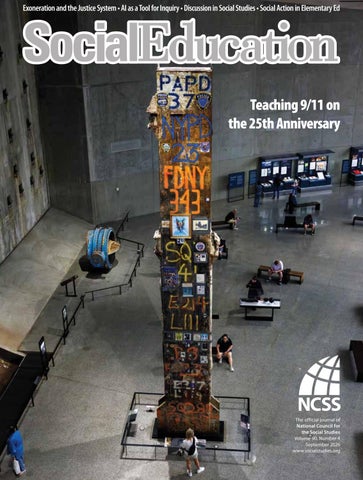
ON THE COVER: The Last Column, the final piece of structural steel removed from Ground Zero, now stands in Foundation Hall at the National September 11 Memorial & Museum. It is covered in inscriptions, badges, posters, and spray-painted tributes from recovery workers, first responders, and victims' families, among them “343,”“37,” and “23,” honoring the FDNY, PAPD, and NYPD members killed on 9/11. (Photographer David Starke/National September 11 Memorial & Museum)
September 2026
Volume 90, Number 4
DEPARTMENTS 208
Lesson on the Law Using Exoneration Stories to Discuss the Justice System Tiffany Middleton Relatable human stories bring the complexities of our legal system to life and can launch rich classroom investigations into topics like mass incarceration, individual rights, and the role of government.
227
Sources & Strategies Piquing Student Curiosity About Amending and Annotating the Constitution, Particularly During the Progressive Era Lee Ann Potter Using primary sources from the Congressional Record, teachers can engage students in exploring Progressive Era reform efforts and the surprising history of how the Constitution has been studied and marked up over time.
233
Teaching the C3 Framework AI Makes Inquiry More Urgent: Recommendations for Responsible Use in Social Studies Education John Lee, Jordan McGaughey, and The C3 Teachers Leadership Academy AI Working Group Practical recommendations—from modeling ethical AI use to using AI as a thought partner in inquiry design—help teachers integrate artificial intelligence in ways that strengthen student inquiry.
www.socialstudies.org | 185
FEATURES 203
Special Section (continued)
Big Questions, Hard Conversations: Teaching 9/11 to the Next Generation Jennifer Lagassé The suggested activities and resources can spark critical conversations and help students understand 9/11 and its continuing impact.
207
Member Spotlight Kristin Stelfox
216
“Setting the Conversation on Fire”: What Youth Want from Social Studies Discussions Andrew J. Schiera and Andrew O. del Calvo Feedback from more than 100 high school students reveals what makes classroom discussions work—from crafting open-ended questions to balancing teacher participation.
DEPARTMENTS 240
Elementary Education A Year-Long Study of Social Change Andrea Libresco, Kara Pranikoff, Clio Bodie, Zach Libresco, Ruth Longobardi, Jennifer Steinberg, and Kim Tolksdorf Fifth graders take center stage in a year-long social action study, presenting on topics from climate justice to disability rights.
4 NCSS Notebook
232
Library of Congress Digital Collections on 9/11 Curated by Lee Ann Potter Three curated collections bring together interviews, oral histories, and archived websites to support teaching about September 11, 2001.
Middle Level Learning, available online
221
What Should We Listen for in Social Studies Discussions? Abby Reisman, Timothy Patterson, and Lightning Peter Jay Built around four social studies-specific dimensions—content, source scrutiny, empathic imagination, and ethical action—the Social Studies Discourse Instrument gives teachers a fresh, nonevaluative lens on classroom discussion.
186 | Social Education | September 2026
Middle Level Learning, published three times a year online, features lessons and activities for middle school teachers. Access the current issue and back issues at www.socialstudies.org/ middle-level-learning.
Use your smartphone’s camera to scan this QR code
NCSS OFFICERS Joe Schmidt (President) Colonial Williamsburg Foundation, Williamsburg, VA David Kendrick (President-Elect) Loganville High School, Loganville, GA
EDITORIAL STAFF Jennifer Bauduy Editor Laura Godfrey Director of Publications and Resources Rich Palmer Art Manager
Annie Whitlock, Ph.D. (Vice President) Grand Valley State University, Allendale, MI
SOCIAL EDUCATION DEPARTMENTS Elementary Education Andrea S. Libresco
Tina M. Ellsworth, Ph.D. (Immediate Past President) University of Central Missouri, Warrensburg, MO
Inclusive Social Studies Stacie Brensilver Berman, John M. Palella, Diana B. Turk
BOARD OF DIRECTORS Terrell Fleming Lynchburg City Schools, Lynchburg, VA (2027) Kimberly Huffman Wayne County Schools, Smithville, OH (2027) Stephen Masyada, Ph.D. Lou Frey Institute and the Florida Joint Center for Citizenship, Orlando, FL (2027) Laura McFarren Derby North Middle School, Derby, KS (2029) Ebony McKiver Social Studies Accelerator, Marion, IA (2029) Stephanie Nichols Narragansett Elementary School, Gorham, ME (2028) Renita Parks Memphis, TN (2028)
Instructional Technology Michael J. Berson, Meghan McGlinn Manfra Lessons on the Law Tiffany Willey Middleton Research & Practice Jeremy Stoddard Sources and Strategies Lee Ann Potter Teaching the C3 Framework Kathy Swan, John Lee, S.G. Grant NCSS EXECUTIVE DIRECTOR Kelly McFarland Stratman DEPUTY EXECUTIVE DIRECTOR Joy Lindsey
Sarah B. Shear University of Washington Bothell, Bothell, WA (2029)
NCSS DIRECTORS Timothy Daly Director of Operations
Gabriel Valdez Fort Worth ISD, Fort Worth, TX (2028)
Laura Godfrey Director of Publications and Resources
Amy Walker Olathe USD 233, Olathe, KS (2027)
Ashanté Horton Director of Events
Anne Walker Forest Park High School, Woodbridge, VA (2028) Ryan Werenka Troy High School, Troy, MI (2029) EX-OFFICIO Jeff Bourque House of Delegates Steering Committee Chair Windham High School, Windham, NH (2026–2027)
SOCIAL EDUCATION (ISSN 0037-7724) is published by National Council for the Social Studies (NCSS) six times a year: September, October, Nov/Dec, Jan/Feb, March/April, and May/June. Logotype is an NCSS trademark. Contents © 2026. The views expressed in this publication are those of the authors and not necessarily those of NCSS. ONLINE: Visit us at www.socialstudies.org/publications and www.ingentaconnect. com/content/ncss. READERS: The editors welcome suggestions, letters to the editor, and manuscripts to our peer-reviewed journal. Guidelines at www.socialstudies.org/publications; submit at www.editorialmanager.com/ncssjournals; questions to publications@ ncss.org. Contributors express their own views, reflecting divergent opinions. Send manuscripts for departments to the department editors. DELIVERY AND CHANGE OF ADDRESS: View and update your record, www.social studies.org/membership; send new address to membership@ncss.org; or call 800-296-7840 ext. 111. Callers outside the U.S. and Canada use 301-588-1800 ext. 111. PERMISSION to reproduce articles for academic use, contact Copyright Clearance Center, Academic Permissions Service, 222 Rosewood Dr., Danvers, MA, 01923; 978-750-8400 (phone), 978-750-4470 (fax). ADVERTISING: Maribell Abeja-DeVitto, Account Manager, MAbejaDeVitto@smith bucklin.com; 312-673-5483 Visit www.socialstudies.org/advertising for rates and specifications. INDEXED by Institute of Education Sciences, eric.ed.gov and by ProQuest, www. proquest.com. POSTMASTER: Periodicals postage paid at Silver Spring, MD, and additional mailing offices. Send address changes to Social Education, NCSS, 8403 Colesville Rd., #1100, Silver Spring, MD 20910, USA.
Become an NCSS member! Use your smartphone’s camera to scan this QR code or go to www.socialstudies. org/membership.
MEMBERSHIP in the National Council for the Social Studies (NCSS) is open to any person or institution interested in the social studies. All members receive the NCSS journal of their choice (Social Education or Social Studies and the Young Learner), as well as the e-newsletter, The Social Studies Professional (two issues per month), access to the online NCSS publication archives, the online Middle Level Learning supplement, and discounts on NCSS conference registration, books, and professional development programs. Regular membership rates for individuals are $90 per year. Rates for students and retired persons are $53 per year. For rates and benefits of institutional membership, and further information on all levels of membership, go to www.socialstudies.org/membership. SUBSCRIPTIONS to Social Education are available to non-member institutions. A print-only subscription is $114 per year. Online subscriptions for Social Education are available through the IngentaConnect platform. Visit www.socialstudies.org/ publications/subscriptions and www.ingentaconnect.com/content/ncss. The online subscription is worldwide, IP supported, and SERU friendly for $199 per year. The online-plus-print subscription is $252 in the United States (add $11 for Canada and $45 international to cover mailings). SINGLE COPIES of Social Education are $6.00 (member price), $7.95 (non-members) plus shipping and handling. Contact 1-800-683-0812. Single articles are available (pdf: $14.95 for non-members) at www.ingentaconnect.com/content.ncss. NCSS members can access articles through the online archives. P.O. BOX: To become a member or subscribe (as an institution) by mail, send a check to NCSS, P.O. Box 79078, Baltimore, MD 21279-0078. RETURN ADDRESS: Social Education, NCSS, 8403 Colesville Rd., #1100, Silver Spring, MD 20910, USA.
www.socialstudies.org | 187
Social Education 90 (4) ©2026 National Council for the Social Studies
Earlier this year, our nation celebrated an important milestone, the 250th anniversary of the signing of the Declaration of Independence. As those commemorations continue, we approach a more recent historic anniversary. It has been 25 years since the tragic events of September 11. In 102 minutes our nation was changed forever, a fact that is poignantly and thoughtfully conveyed at the 9/11 Memorial & Museum. Our special section on this anniversary was crafted with equal care. The guest editors, Megan Jones and Noah Rauch, have curated a selection of articles focused on how to teach about 9/11 using the power of personal stories and reflections, including this issue’s NCSS Member Spotlight. Beth Hillman, President and CEO of the 9/11 Memorial & Museum, sets the context with her introduction, and Megan Jones and Jennifer Lagassé offer inthe-classroom resources for teaching about 9/11, including how to explore difficult conversations. Those themes of learning through stories and engaging in challenging conversations continue throughout this issue. In our Lesson on the Law column, Tiffany Middleton explains the legal process of exoneration by exploring a survey of notable exonerees and the systemic factors behind wrongful conviction. She offers classroom-ready resources and databases for teaching about the post-conviction justice system. Andrew J. Schiera and Andrew O. del Calvo, drawing on feedback from 119 high school students, share what youth want from social studies discussions. Their article, “Setting the Conversation on Fire,” distills seven insights—from crafting openended questions to balancing teacher participation and facilitation—that reveal what students value in these conversations. In “What Should We Listen for in Social Studies Discussions?” Abby Reisman, Timothy Patterson, and Lightning Peter Jay introduce readers to the Social Studies Discourse Instrument (SSDI), a tool that allows teachers to assess and develop classroom discussions across four social-studies specific dimensions—content, source scrutiny, empathic imagination, and ethical action.
188 | Social Education | September 2026
NCSS Notebook In our Sources & Strategies column, the Library of Congress’s Lee Ann Potter provides primary-source resources to spur students’ curiosity. In “Piquing Student Curiosity About Amending and Annotating the Constitution, Particularly During the Progressive Era,” she explores Progressive Era reform efforts and how the Constitution has been annotated over time. Potter also presents the “Library of Congress Digital Collections on 9/11”—three digital collections about September 11—to help educators deepen classroom discussions in light of the 25th anniversary. In Teaching the C3 Framework, John Lee et al. offer practical recommendations for using AI as a tool—from modeling ethical use to serving as a thought partner in inquiry design. Their focus: integrating AI in ways that strengthen, rather than replace, student inquiry. Finally, Andrea Libresco et al. share the results of their year-long social action study. It places fifth graders at the center of their learning, enables them to see the relevance of social studies topics to their daily lives, and fosters meaningful civic engagement. As Beth Hillman reminds us, part of the 9/11 Memorial & Museum’s mission is to “inspire an end to the hatred and intolerance that caused the terrorist attacks.” That starts with the building blocks of the C3 Framework: curiosity, inquiry, discussion, and civic action. They are the foundation of a healthy democracy, they are skills for life, and they are what will get us to NCSS’s vision of “a world in which all students are educated and inspired for lifelong inquiry and informed civic action.” Thank you for your contributions to making that vision a reality. As always, we welcome your feedback. Please submit comments to email socialed@ ncss.org. Kelly McFarland Stratman is the Executive Director of NCSS.
Social Education 90 (4) ©2026 National Council for the Social Studies https://doi.org/10.66392/CHYP7586
9/11: 25th Anniversary
Introduction Beth Hillman Aware that new knowledge takes hold faster if there’s something to which it can attach, wise teachers often take time to connect their students to a subject before introducing the subject itself. This year, the 25th anniversary of 9/11 offers a powerful tool to classroom teachers who want to address what happened on and after the attacks. Media coverage and commemorative events tied to the 25th anniversary will both evoke memories of 9/11 for those who lived through it and provide context for classroom lessons. As an anchor for the presentation of new material and a springboard for discussion, the 25th anniversary is an opportunity to help our students understand more fully a day that changed the trajectory of the world we live in today. That opportunity is why this issue of Social Education includes several articles focused on teaching 9/11. They draw on what we at the National September 11 Memorial & Museum have learned through nearly two decades of pursuing our mission: To commemorate the people killed that day, educate visitors and students about 9/11, and inspire an end to the hatred and intolerance that caused the terrorist attacks. Teaching and learning as well as memorialization were at the heart of early efforts to collect artifacts and record stories. Today, digital outreach to teachers and students is nearly as fundamental to our mission as the preservation of our sacred site and the authentic storytelling it makes possible. When the 9/11 Memorial opened on the 10th anniversary of the attacks in 2011, it welcomed visitors who came to pay their respects and honor victims. Designed and operated with great care for the dignity of those victims and their families, the Memorial now occupies the center of the 16-acre rebuilt World Trade Center site. In the years that followed, four towers would be added
around the Memorial, including One World Trade Center, as would the Oculus, a dramatic transit and retail hub; the striking Perelman Performing Arts Center; and the elegant St. Nicholas Greek Orthodox Church and National Shrine. Today, a fifth tower is under construction and is slated to be completed by 2031. Then as now, the 9/11 Memorial & Museum will occupy the center of the World Trade Center, marking the site where the Twin Towers once stood and telling the stories of the people whose lives were ended, changed, and rewritten here, at the Pentagon, and aboard Flight 93. More than 96 million people have visited the Memorial since 2011, and more than 27 million have visited the Memorial Museum since it opened in 2014. The 9/11 Memorial & Museum’s collection of more than 83,000 items and its growing exhibitions are extraordinary resources for teachers and learners. In articles written for this issue, and in materials available online, our dedicated specialists and some of the brilliant teachers they’ve had a chance to work with use those resources to share ways to teach about 9/11. Over the years, our education team has helped to teach about 9/11 to millions of people. While we hope many teachers and students will at some point find a way to get to New York City and visit the Museum, we also offer digital teaching tools updated every year with new content and voices and made accessible to anyone who wants to learn. Witnessing the monumental artifacts and encountering the first-person accounts told in the Museum is a material and emotional journey well worth taking, but so is learning about 9/11 through personal stories, timelines, and artifacts that can come to life in classrooms, especially those led by courageous and compassionate teachers. Each year, we add new content to our
www.socialstudies.org | 189
Museum exhibitions to deepen and strengthen our ability to reach visitors with authentic, engaging stories of what happened on and after 9/11. The articles in this issue reflect the first-hand storytelling that animates so much of that new content, which is more powerful than ever because of the longer, broader view that comes with 25 years of perspective. In “From Our Desks: Educators Reflect on Teaching 9/11,” seven educators share how participating in the 9/11 Memorial & Museum’s Summer Institute for Educators shaped their teaching of 9/11. The authors teach in various grades from elementary through high school and possess from one to 37 years of classroom experience. Reading their thoughts reminded me of both the vividness of 9/11 memories for those of us who have them and the way in which sharing those memories, or sharing others’ first-hand recollections, can inspire curiosity and compassion in students. “Ordinary Lives, Extraordinary Lessons: Teaching 9/11 25 Years Later” is a primer on this year’s Anniversary Digital Learning Experience by its primary architect, Megan Jones. As Vice President of Education at the Memorial & Museum, Megan led the development of this year’s featured film by drawing on In Their Honor: 25 Years of 9/11-Inspired Service, a 25th anniversary special exhibition that will open to the public on September 12, 2026. Megan’s article, and the program itself, reveal how stories of 9/11 can teach empathy, leadership, and the enduring legacy of service. Essential but sometimes overlooked elements of 9/11 that are highlighted include the ongoing and devastating health consequences of the toxic dust that blanketed lower Manhattan
190 | Social Education | September 2026
after the collapse of the towers and the attacks’ impact on children who lost a parent that day. In “Big Questions, Hard Conversations: Teaching 9/11 to the Next Generation,” Jennifer Lagassé offers a detailed, step-by-step approach to crafting an effective lesson plan. She relies on questions and student engagement to uncover the nature of both vivid memories and historically significant moments, in the process linking individual consciousness to global narratives. By offering tools that use individual stories of loss or transformation as toeholds into sometimes hardto-access narratives of global power and public health, Jennifer’s article reflects the inquiry-based, authentic model of storytelling that the Museum has long prioritized. Finally, in the Educator Spotlight, Kristin Stelfox reveals how 9/11 education intersected with her own path in teaching, noting especially how much the community of NCSS educators has enriched her work. Her sense that the attacks changed everything is a sentiment we often hear at the 9/11 Memorial & Museum. And Kristin’s ability to engage her students in figuring out how and why everything changed is evidence of what great educators can do with material as powerful as the artifacts and stories in our museum. I’m grateful for Kristin and every educator out there who is helping us learn more about how to teach and understand 9/11, twenty-five years later. Beth Hillman is President and CEO of the 9/11 Memorial & Museum in New York City.
9/11: 25th Anniversary
Social Education 90 (4) ©2026 National Council for the Social Studies https://doi.org/10.66392/SDXR2597
From Our Desks:
Educators Reflect on Teaching 9/11 For many educators, September 11, 2001, is more than a historical event, it is a deeply personal and emotional experience that they lived through. Twenty-five years later, however, that direct connection is no longer universal: The next generation of teachers, and their students, were either not yet born or too young to remember the attacks. Whether they experienced the day firsthand or not, all educators are entrusted to teach its lessons. To help educators meet this responsibility, the 9/11 Memorial & Museum created a Summer Institute for Educators. The Institute is a transformative, week-long professional development program that brings together teachers from across the country and around the world to engage firsthand with speakers, educational resources, and curriculum strategies in order to support the vital, and challenging, task of teaching 9/11 to the next generation. In the reflections that follow, educators from elementary to high school share how the Institute shaped their understanding of 9/11, inspired their teaching strategies, and deepened their commitment to ensuring that the attacks and their ongoing legacy are never forgotten. These narratives highlight the pivotal role teachers play in passing the lessons and legacy of 9/11 on to future generations.
—Megan Jones, Vice President of Education at the 9/11 Memorial & Museum
Photo by Michael Hnatov
Jason Rude, New Hampton Middle School, New Hampton, Iowa, seventh- and eighthgrade social studies teacher with 18 years of teaching experience.
Jason Rude, on right
On September 11, 2001, I was sitting in my eleventh grade English class in Decorah, Iowa. [The teacher] was in the front of the room. I was
on the right side of the room, third chair back, wall-mounted TV directly in front of me. Our principal came on the intercom and said, “Channel One will not air today, but if you turn on CNN there’s been some kind of attack at the World Trade Center.” My first thought was “Again?” as I remembered the 1993 bombing. It’s wild how vivid those memories are 25 years later for me, and all those who lived through the experience. Years later, I became a teacher, and when I saw the 9/11 Memorial & Museum Summer Institute for Educators advertised, I knew I had to be a part of it. I grew up in a responder family. My father was a state patrolman and volunteer firefighter. My brother is a state patrolman. I am an EMS first responder and work on our local ambulance and rescue squad. I’ve long been fascinated by what that day would have been like as a responder, and what it was like to smell the smoke. For many years, I had never met anyone that had seen it with their own eyes. When this opportunity arose, I knew it was my chance to finally ask the questions to the people who were there.
www.socialstudies.org | 191
Copyright Ben Hider
My all-time favorite [session] from our week was the one with Jerry Roberts, a retired FBI agent. His stories of the investigation of the 1993 attack, coupled with the investigations on and after 9/11 that led to the capture of terrorists was fascinating. I grew up listening to law enforcement stories. I would listen to old police officers talk for hours about the things they had seen and done. This, for me, was like sitting around the table with the “old guys” listening to them share their experiences. Moreover, I had read and watched TV shows about some of these investigations, so hearing the actual stories behind them was incredible! My students are fascinated by our 9/11 unit. We examine several aspects but specifically focus on personal stories. We read the book Ground Zero by Alan Gratz, which allows us to discuss the event on a deeper and broader level. We’re able to provide context about what led to 9/11, and what resulted in its aftermath. Students want to know why it happened. For the most part, they know what happened, but they don’t understand why. Because we take an approach of looking at the years prior and the events and actions of both the U.S. and alQaeda (and the Middle East as a whole) we’re able to paint a picture that explains what led to it. Because of the book we read as a class, we’re able to establish how it continues to affect them (the students) to this day. Isabella Forget, Weirton Elementary School in Weirton, West Virginia, third-grade teacher with one year of teaching experience.
Isabella Forget, on right
I was not born until two years after 9/11. Some
192 | Social Education | September 2026
people may ask, “If you weren’t even born when it happened, then why did you want to attend the 9/11 Memorial & Museum Summer Institute for Educators and teach about 9/11?” My answer: Not having a lived memory of 9/11 made me want to learn about it, so that I could teach it to my future students, who would also not have a memory of the attacks. I also believe that we have a responsibility to do more than just hold a moment of silence. It is so important to make sure that students know what happened on 9/11. We owe it to those who were killed and [those] who continue to feel the effects of 9/11 to make sure it is never forgotten.
This allowed me to share what happened on 9/11 at a level that was appropriate and comfortable for my students. Having the opportunity to attend the 9/11 Memorial & Museum Summer Institute for Educators was one of the most remarkable and meaningful programs that I have ever had the honor of participating in. It gave me direct access to information about the events leading up to the attacks, what happened on the day, and what happened afterwards. It also allowed me to hear first-hand accounts of that day. One of the speakers that stuck with me the most was Bill Spade,1 a firefighter who responded to the World Trade Center. Hearing his emotional testimony is something that I will never forget. I shared his story with my third graders. We discussed what it meant to be a hero. This allowed me to share what happened on 9/11 at a level that was appropriate and comfortable for my students. They reflected on the lesson by writing letters to their heroes, as well as making tribute roses to send to the Memorial. Seeing the way that third graders connected with 9/11, an event that happened 25 years ago, had a lasting impact on us all. My students connected with these personal stories the most. We talked about the resilience of communities, how so many came together after
Copyright Ben Hider
Jolynda Chenicek, PhD, Florida Virtual School, Florida, sixth- and eighth-grade teacher with 27 years of teaching experience.
Jolynda Chenicek, on left
I remember clearly where I was on September 11, 2001—at my home in Tallahassee, Fla., with my then soon-to-be one-year-old son—watching in horror the aftermath of this tragedy. I had just started grad school as well, working on my PhD in history at Florida State University. This was a huge topic of discussion the entire semester and it shaped the beginning of my graduate school experience. I didn’t know anyone personally impacted by 9/11, but I remember how the global community united together in defiance of this unspeakable tragedy. My then one-year-old son is now living and working in New York City and has been there for over two years. I was motivated to attend the 9/11 Memorial & Museum Summer Institute for Educators to learn about the resiliency of both the city and our country after 9/11. I wanted to learn from those who experienced it firsthand and who are preserving the history for future generations so that I could take what I learned and pass it on. I’ve shared my 9/11 presentation with my middle school students, as well as other teachers in my school, so that we can make sure 9/11 is never forgotten. That to me is why we teach about 9/11.
The long-term impact of 9/11 and how it continues to affect those who worked at Ground Zero or lived in the city in 2001 is my lasting impression. We watched the documentary Dust as a cohort and heard from Bridget Gormley,2 the director, who shared the story of her father, FDNY firefighter William Gormley, and his friends, other first responders who became ill in the aftermath of working at Ground Zero. I teach online, so we had a special live lesson on 9/11. My students were so engaged and so receptive to learning more about why 9/11 happened and its impact on our country. I was impressed with how respectful they were during my lesson, as they asked deep questions about the events of the day. We reviewed several New Yorker covers that were published related to 9/11 (see www.911memorial.org/visit/museum/ exhibitions/past-exhibitions/cover-stories). I think this activity helped them to think deeply about the immediate impact and reaction to 9/11 in our country. Without a doubt, the personal stories of those who lived through 9/11 have the most impact on my students. I shared stories about first responders, like Bill Spade and Captain Richard Thornton, and their heroic actions. I also shared the story of Roselle, the guide dog; so many of my students felt a personal connection to this story as they thought about their own pets or support animals. Tina Heinecke-Kurtz, Silver Lake Intermediate School in Oconomowoc, Wisconsin, eighthgrade teacher with 31 years of experience. Copyright Ben Hider
the attacks, and how this is something they can do too. The 9/11 Memorial & Museum Institute for Educators helped me deepen my knowledge about 9/11 and equipped me with the tools to teach about it at the elementary level.
Tina Heinecke-Kurtz, on left
www.socialstudies.org | 193
194 | Social Education | September 2026
facts; it provided the missing context for his own family’s history. When students engage with this history through a lens of sensitivity and inquiry, they do more than memorize a timeline. They begin to decode the often-unseen influences that have shaped their communities and their homes. By fostering these vital connections, we empower learners to make sense of the world they have inherited. Ultimately, the goal is for every student to walk away not just with knowledge of the past, but with a deeper, more empathetic understanding of the people and stories that define their personal lives. Nick Wightman, Bountiful High School in Bountiful, Utah, eighth- and eleventh-grade social studies teacher with 14 years of experience. Copyright Ben Hider
On September 11, 2001, I stood before my science students in our small Midwest town, anchored by the weight of the world’s uncertainty and the quiet miracle of a six-month pregnancy with my second child. After a day spent navigating the collective shock of students and colleagues alike, I returned home to a flickering news screen that brought the tragedy into sharp, devastating focus. A man was being interviewed, his grief raw and visible; his wife had been in the North Tower and, like me, she was six months pregnant. In that moment, the distance between my serene home and the chaos of lower Manhattan vanished. During the 9/11 Memorial & Museum Summer Institute for Educators, I sought to bridge the emotional gravity of the past with the academic rigor of the classroom. My primary objective was to integrate the robust text sets developed by my English Language Arts team with the Museum’s profound collection of primary sources, visceral first-person testimonies, and silent, haunting artifacts. The most profound takeaway was the realization that inquiry-based learning, when anchored by the Museum’s curated archives, transforms “hard history” into a bridge for critical thinking and empathy. I walked away with a deep appreciation for the pedagogical integrity of the materials provided by the 9/11 Memorial & Museum Education Department. My decision to integrate these resources into my practice—and to share them with peers and preservice teachers—stemmed from the Museum’s unique ability to provide first-person narratives and professionally vetted primary sources. These materials ensured that my instruction remained academically rigorous and age appropriate, allowing students to navigate the complexities of the attacks, their ongoing global repercussions, and the storied history of the World Trade Center with both clarity and sensitivity. During this past year, I witnessed the profound moment when abstract history transitioned into personal realization. This transformation was most poignantly captured by a student who lingered after the bell, waiting until the room was empty to share a quiet revelation. He spoke of his father’s silent decision to reenlist, a choice that had long been a source of confusion in their home. In that moment, the curriculum did more than teach
Nick Wightman, on left
I started my teaching career at a middle school in rural Utah in 2012. I taught early U.S. history to eighth graders until I left for the greater Salt Lake area in 2015. I now teach AP and regular U.S. history to eleventh graders at a suburban high school, 15 minutes north of Salt Lake City. On 9/11, I was not far from where I am today. I was a sophomore in high school, sitting in my religion class, just north of where I currently teach. A student mentioned a fire in a New York City building, when another student chimed in with information about a plane hitting a building. I had just visited New York in June, just two months earlier. I thought how strange it was that a plane had only crashed into one building when the city’s buildings were so close together. It never
occurred to me that the building was the World Trade Center. As the day passed, I went to the rest of my classes, went home, and was glued to the news until I went to bed. Since that time, I’ve been fascinated by the events of 9/11. When the opportunity came up to attend the 9/11 Memorial & Museum Institute for Educators, I’d never been more interested in experiencing the Museum for myself. I had taught 9/11 each year to my U.S. History students, not only for its historical significance, but also because I’d been a witness to it at an impressionable age. I cannot overstate how impressive the Institute was both academically and emotionally. Guest speakers like Bill Spade,3 who was an eyewitness to the events, helped me understand the personal and emotional cost of that day on a whole new level. The 9/11 Memorial & Museum staff curated material that was relevant, accessible and engaging; material that I still use today. Generally, my students find 9/11 fascinating, but maybe overwhelming. There’s a lot to unpack with the content and the emotional elements that are included. Inevitably they connect with the acts of heroism and personal stories from that day. Stanley Praimnath and Brian Clark’s story of escaping the South Tower is one that always stands out4 —and the undeniable heroism of the passengers of Flight 93. I’m honored to have participated in the Institute. It has been an incredible experience that I will cherish forever, not just the content learned or acquired for teaching, but the feelings it produces in me—humility, honor, duty, and dignity—for those who acted, and continue to act, bravely in the face of tragedy.
Copyright Ben Hider
Patricia Radigan, New York City Public Schools, elementary and middle grades teacher with 37 years of experience.
Patricia Radigan, on left
I remember that day as if it were yesterday. Having just returned from sabbatical, I was teaching a group of second graders when I received news that the North Tower had been attacked. All I could think of was my older brother [of the New York City Fire Department, (FDNY)] and countless friends (also FDNY or NYPD) and World Trade Center workers who were either there at the time of the attacks or would be getting there shortly thereafter. A mixture of disbelief and dread came over me; it wasn’t until later that night that it was confirmed that my brother was alive along with others who had raced to the scene. Seventeen years passed until I retired from teaching in July 2018. I was fortunate to read a book called Saved at the Seawall: Stories from the September 11 Boat Lift by Jessica Dulong, a multitalented woman who I am lucky to call my friend. Her book inspired me to write a curriculum on the 9/11 boat lift, the largest waterborne evacuation in U.S. history, that focused on the heroic actions of so many that day including Captain Rick Thornton of NY Waterways. During the 9/11 Memorial & Museum’s Summer Institute for Educators, he recounted his experience evacuating people out of lower Manhattan on his ferry on 9/11. In July 2024, I participated in the Summer Institute, along with teachers from all over the country and the world. This experience continues to influence my work today. I attended the Institute because it is my firm belief that we must educate our youth about this event. Children have a right to know how their world changed on that day in their city, their state, their nation, the world. Listening to first-person accounts from people like retired firefighter Bill Spade will stay with me forever (I have family members who served in the FDNY dating back from 1920 to 2004).5 Hearing personal accounts like Bill’s lends an entirely different lens to the listener. I returned to the 9/11 Memorial & Museum Summer Institute the following summer as a speaker, leading a professional development session about what I had learned the previous year and highlighting the importance of teaching 9/11. The experience was invaluable to me both personally and professionally. The education staff at the museum is both knowledgeable and sensitive to all the participants. A very difficult subject
www.socialstudies.org | 195
is treated with reverence and respect. I personally think professional development programs like the 9/11 Memorial & Museum Summer Institute for Educators should be mandatory for all social studies teachers. The program offers a well-rounded approach to the history of 9/11.
Copyright Ben Hider
Nicole Zupke, Oconomowoc Area School District in Oconomowoc, Wisconsin, fourthfifth- and eighth-grade teacher with 15 years of experience.
Nicole Zupke, on right
September 11, 2001, is a date that shaped the course of American history and my life as an educator and parent. On the morning of 9/11, I was pregnant with my second child and was on my way to drop my first son at daycare. As I drove through our small town of Oconomowoc, Wisc., and listened to the radio, I learned that a plane had struck one of the towers of the World Trade Center. At first, we all assumed it was a tragic accident. That assumption quickly dissolved when the second plane hit. I drove straight home with my son and began calling my family. The vulnerability, confusion, and grief of that day are emotions I still carry. Like so many Americans, I also remember learning that another plane struck the Pentagon and that United Airlines Flight 93 had crashed in Pennsylvania. The scale of the attacks was overwhelming, and the sense of innocence lost was immediate. A sense of responsibility carried through to my career in teaching and motivated me to attend the 9/11 Memorial Museum Institute for Educators. An eighth-grade ELA teacher, I recognize that my
196 | Social Education | September 2026
students were born years after the attacks. For them, 9/11 is not a lived memory but a historical event. I wanted to deepen my understanding so I could move beyond dates and facts. Teaching 9/11 is not simply about recounting events; it is about fostering empathy, critical thinking, and civic awareness. My lasting impression from the Institute was the emphasis on personal narratives. Hearing firsthand accounts from survivors, first responders, and family members underscored the power of storytelling in preserving history. I was particularly struck by how educators can use primary sources— oral histories, photographs, and letters—to create a more meaningful learning experience. Rather than presenting 9/11 solely as a geopolitical turning point, the Institute encouraged us to frame it as a deeply human story of loss, resilience, and unity. My students respond with a mixture of curiosity and resolve. Many are surprised to learn how daily life changed after 9/11—airport security, public safety measures, and even cultural attitudes. What they connect with most are the stories of ordinary people who acted with extraordinary courage. The heroism of firefighters, office workers helping strangers, and passengers on Flight 93 resonates deeply. Students also connect with the idea of community—the images of people supporting one another in the aftermath. Notes 1. Bill Spade, 9/11 Memorial and Museum, Webinar, www.911memorial.org/learn/students-and-teachers/ webinar-stories/webinars/bill-spade-0 2. Bridget Gormley, www.911memorial.org/webinars/bridgetgormley 3. Bill Spade. 4. “Flashlight Symbolizes Survivors’ Journey to Safety,” The MEMO Blog, 9/11 Memorial and Museum, www.911memorial.org/connect/blog/flashlightsymbolizes-survivors-journey-safety 5 Bill Spade.
Megan Jones, Vice President of Education at the 9/11 Memorial & Museum, wrote the introduction and compiled these excerpts.
Social Education 90 (4) ©2026 National Council for the Social Studies https://doi.org/10.66392/RMXJ6643
9/11: 25th Anniversary
Ordinary Lives, Extraordinary Lessons: Teaching 9/11 25 Years Later Megan Jones “No day shall erase you from the memory of time.”— Virgil, Aeneid Heroes Among Us For Chief Terri Tobin, joining the New York Police Department (NYPD) wasn’t just a career choice, it was “in her genes.”1 Law enforcement ran in her family, and she had long admired the pride and camaraderie her relatives found in the job. Years into her career with the NYPD, she would face a day that tested her courage in ways she could never have imagined. On the morning of September 11, 2001, Tobin, then a lieutenant in the NYPD Office of Public Information, voted in the city’s mayoral primary election before heading to work at One Police Plaza, just a few blocks from the World Trade Center. Soon after Flight 11 struck the North Tower, she was sent to respond to the scene, not knowing that it had been a deliberate attack. Arriving at the Trade Center, she looked up just in time to see Flight 175 crash into the South Tower. Photograph by Jin S. Lee
Forged in steel recovered from the World Trade Center, the quote above is mounted at the 9/11 Memorial & Museum as part of the artwork, Trying to Remember the Color of the Sky on that September Morning—a testament to remembrance. But for students born after September 11, 2001, how do we ask them to remember something that they did not experience? The answer lies in the power of stories. It is the stories that keep the memories of those lost alive while also giving students who were not yet born a way to connect with and understand the events of that day. Storytelling is one of the most effective tools educators have, and that strategy sits at the heart of the education programming at the 9/11 Memorial & Museum. The Museum’s educational commemorative program, the Anniversary Digital Learning Experience, features a film highlighting personal stories of those directly affected by 9/11. A live chat allows students to have conversations in real-time with Museum staff on the anniversary. It offers students the opportunity to hear directly from those who experienced the attacks and their aftermath and to witness courage amidst the chaos, resilience in the face of grief, and the capacity of ordinary people to act in the face of unimaginable circumstances. Exposing students to stories like these ensures that 9/11 is not simply a date in a history textbook, but an opportunity—25 years later—to teach empathy, leadership, and the enduring legacy of service.
Students visiting the 9/11 Memorial & Museum
www.socialstudies.org | 197
Copyright David Starke
“It was such a fierce explosion,” she recalls. “It was unbelievable.”2 Tobin and fellow officers rushed to evacuate people, guiding them down stairwells and through smoke-filled hallways for nearly an hour. Hearing reports of a third plane, Deputy NYPD Commissioner Joe Dunne instructed Tobin to retrieve a Kevlar helmet from the Emergency Service Unit. That order may have saved her life, as moments later, the South Tower collapsed. The ground shook, debris rained down, and Tobin was hurled across the street. Her ankle twisted and her hearing was damaged as a chunk of concrete and rebar struck her helmet, splitting it in two. It absorbed enough force, though, to prevent even worse injury. As darkness and dust swallowed the streets around her, she recalls thinking that this was going to be the end of her life.
Terri Tobin Looking at Last Column
However, as the dust cleared, Tobin was able to move and eventually regroup with other first responders who were helping people reach boats evacuating Manhattan. In the chaos, she ignored her own injuries, realizing only later that a six-inch shard of glass was lodged between her shoulder blades. After it was removed by fellow first responders, she was taken by boat to Ellis Island and then to a hospital in New Jersey for emergency surgery to remove a piece of concrete embedded in the back of her head. After the successful surgery, she asked her brother to take her back to Ground Zero, along with other rescue personnel eager to leave the hospital that night. Years later, like many first responders, Tobin would face lingering health issues from that day. But she says, “9/11 confirmed that I was doing
198 | Social Education | September 2026
exactly what I was meant to do.”3 Her bravery earned her the Medal of Valor, and she continued to serve in the NYPD until retiring as chief of interagency operations in 2024. Meanwhile that same morning, Richard Eichen’s day began like any other. He took the PATH train from New Jersey to the World Trade Center, bought a coffee and a bagel, and headed to his new office on the 90th floor of the North Tower. It was his first week at Pass Consulting Group, and he didn’t yet have a key. As he waited in the hallway, a loud bang threw him across the floor. Dazed, he scrambled to his feet and joined others from the office, including Lucy Gonzalez and coworker Charlie Egan, as smoke curled from the ceiling, and the faint crackle of fire grew louder. Together, they called the building’s main office, alerting them that people were trapped, but Eichen realized that they didn’t have time to wait. They needed to evacuate immediately. “We’re not leaving anybody behind,” Eichen said, gripping Gonzalez’s hands.4 Step by step, they descended the stairs. On the 25th floor, Gonzalez collapsed from exhaustion and smoke inhalation. Fire department responders revived her, and Eichen carried her the rest of the way down, refusing to stop until they reached the lobby. Minutes later, the 110-story North Tower collapsed behind them, engulfing lower Manhattan in an immense dust cloud. Once outside, Eichen ensured Gonzalez was in the hands of paramedics before making his way to Downtown Beekman Hospital for treatment of a severe head injury. Hours later, still in his hospital Richard Eichen and Lucy Gonzalez 2011 Courtesy of Richard Eichen
Brothers in Service For Patrick and James Dowdell, childhood was a patchwork of sun, surf, and music. Days were spent riding waves near their home in Queens; evenings echoed with the sound of bagpipes as they played in the backyard with their father, Kevin. When Kevin wasn’t at work as a firefighter with the FDNY (Fire Department of New York), the three were inseparable.
Courtesy of the Dowdell family
gown, he checked himself out and began walking across the Brooklyn Bridge to his parents’ home in Queens. A stranger stopped and offered him a ride, and finally, he was reunited with his family. A decade later, Eichen reconnected with Gonzalez. On the 10th anniversary of 9/11, they stood together beneath the Survivor Tree at the 9/11 Memorial. Its branches stretched skyward, scarred yet resilient, a symbol of their own journeys of survival. The stories of Tobin and Eichen illustrate that courage, strength, and compassion can emerge even in the darkest moments.
Kevin Dowdell with Patrick and James
Kevin Dowdell joined the FDNY in 1990, rising to the rank of lieutenant. His career was defined by service: He responded to the Oklahoma City bombing in 1995 with FEMA and to the 1993 World Trade Center attack. On 9/11, Kevin and his team from Rescue 4 rushed to the Trade Center’s
www.socialstudies.org | 199
South Tower. He died that morning. Although his remains were never found, his Halligan bar, a firefighter’s tool, was recovered, engraved with “KD R4.” In the immediate aftermath of 9/11, Patrick and James volunteered at Ground Zero, assisting Rescue 4 with rescue and recovery efforts. Having grown up around the firehouse, they were welcomed with open arms as the sons of Lt. Dowdell. They spent long days at the site, and when they were not there, they were attending funerals, memorials, and wakes—nearly every weekend—honoring the firefighters who had been killed. With the FDNY pipe band, the brothers played bagpipes at these ceremonies, offering music as both a tribute and a farewell. Beside them through it all was their mother, strong and steady, demonstrating that life had to go on in the face of tragedy. Patrick, a freshman at Iona University in 2001, had been preparing his West Point application guided by Kevin’s encouragement. After his father’s death, he pressed forward. In 2002, he was accepted to West Point, graduating in 2006. He went on to serve two deployments, one in Iraq, one in Afghanistan, each a tribute to his father’s courage and commitment. Meanwhile, James was a student at Xavier High School, already inspired by his father’s example. After Kevin’s death, that calling grew stronger. James joined the FDNY Fire Academy and graduated in 2006. In 2025, he was promoted to lieutenant, his father’s rank, on what would have been Kevin’s 70th birthday, a moment honoring his father’s legacy and the enduring bond between father and son. On April 20, 2002, Kevin Dowdell was laid to rest. As their father’s casket was lowered into the ground, Patrick played “Going Home” on the bagpipes while James accompanied him on the snare drum. The Dowdells’ story is one of love, service, and legacy. It reminds us that courage and service can ripple across generations, inspiring others to rise, to lead, and to honor those who came before. From Grief to Purpose In August 2006, two young girls stepped off a bus at America’s Camp in the Berkshires of Massachusetts. Like the other children arriving
200 | Social Education | September 2026
that day, they carried a loss that had reshaped their childhoods: Caitlyn McIntyre and Olivia Perez-Johntry had both lost their fathers on September 11, 2001. They could not yet know that the summer ahead would mark the beginning of their healing and play a lasting role in shaping the women they would become. What they did know was far more immediate: They wanted, desperately, to feel like normal kids again. Caitlyn was just five when her father, Port Authority (PAPD) Police Officer Donald McIntyre, ran into the South Tower and never returned. Caitlyn and her father, Donald J. McIntyre Courtesy of Caitlyn McIntrye
Olivia was ten when her father, Anthony Perez, went to work on the 103rd floor of the North Tower and was killed in the attack. Caitlyn’s memories of her father were shaped largely through stories told by family and fellow Port Authority police officers. Olivia’s memories of the day were vivid—sitting in orchestra class, sensing something was terribly wrong—but much of the years that followed faded into emotional darkness. By the time they arrived at America’s Camp, both girls had been living under an identity assigned to them: a “9/11 kid.” Camp offered something radically different. For one week, grief was understood without explanation. They could swim, laugh, dance on tables, and whisper secrets in bunks. They could simply be kids again. That summer, campers participated in creating The Feathers of the Phoenix, a large sculpture continued on page 202
Lesson Plan: Ordinary Lives, Extraordinary Lessons Time: 1 class period (45–60 minutes) Focus: Students will explore personal stories from 9/11 to understand how storytelling preserves memory and connects history to the responsibilities of today’s generation. Learning Objectives Students will be able to: • Analyze personal narratives from 9/11 to identify examples of courage, resilience, leadership, and service; • Explain the power of storytelling in shaping how individuals and generations remember historical events; • Use evidence to support claims about the lessons these stories convey; • Reflect on how 9/11 stakeholders can be stewards of history. C3 Framework Alignment Dimension 2 (Civics): Civic virtue and public service • D2.Civ.7.6-8, 9-12 — Apply civic virtues and democratic principles in real-life contexts. • D2.Civ.10.6-8, 9-12 — Examine how personal and civic values influence public action. Dimension 3: Using evidence to support claims • D3.3.6-8, 9-12 — Identify evidence that supports a claim. • D3.4.6-8, 9-12 — Develop arguments using disciplinary evidence. Dimension 4: Communicating conclusions about civic responsibility • D4.1.6-8, 9-12 — Communicate conclusions supported by evidence. • D4.6.6-8, 9-12 — Draw on knowledge to take informed civic action. Essential Question How can personal narratives inform the next generation’s understanding of 9/11 and convey enduring lessons from the attacks? Lesson Activities 1. Warm-Up (5–10 minutes) Display image of Trying to Remember the Color of the Sky on That September Morning by artist Spencer Finch available online at www.911memorial.org/connect/blog/ trying-remember-color-sky-september-morning. Tell students that the artwork is located at the 9/11 Memorial & Museum and that the piece is made up of 2,983 watercolor squares representing victims of the 2001 and 1993 attacks. Ask students to read the quote contained within the installation, “No Day Shall Erase You From the Memory of Time” from Roman poet Virgil’s Aeneid. Share that each
letter was forged from World Trade Center steel by artist Tom Joyce. Ask students: • What does this quote suggest about remembrance? What makes you say that? • Why might remembering be important for people of your generation who were not alive during 9/11? Facilitate a brief discussion based on students’ responses and tell them that they will be exploring several first-person stories from 9/11. 2. Small-Group Analysis (20–25 minutes) Divide students into groups and share that they will be reading stories from several groups directly affected by 9/11. Assign each group one section from this article: • Heroes Among Us • Brothers in Service • From Grief to Purpose Ask each group to identify: • One example of courage, leadership, or resilience; • One quotation as evidence to support their example; • One lasting impact of the person’s actions. When the groups finish, ask each group to share their responses in a full class discussion. 3. Reflection (10–15 minutes) Ask students to return to their groups and discuss the following prompt: Choose one person from this article. What lesson/s does their story offer your generation, and why is it important? Be ready to support your ideas with at least one example or quote from the article. 4. Closing Question End the lesson by asking students the closing question: What responsibility does your generation have in carrying forward stories like these? Note: The reflection activity and closing question can also be done as individual writing prompts.
n Activity Extensio um’s al & Muse 1 Memori /1 9 e e c n th e r Experi Register fo Learning l a it ig D e th ry d in Anniversa als feature sk e individu th atching, a r a w e e h il to ries. Wh o t st A ir s. e n th uestio article tell own any q ns to write d ts n ir questio e e d u th st can ask ts n e e v d li u e g th the end, st staff durin to Museum to om 9:00am y fr tl , c 6 e 2 ir 0 d 2 , 1 1 r e eptemb chat on S ). T 3:00pm (E
www.socialstudies.org | 201
Courtesy of Olivia Perez-Johntry
EXTRAORDINARY LESSONS from page 200
Olivia and her father, Anthony Perez
symbolizing rebirth. Each child designed a feather representing personal grief, hope, or memory. Those feathers were placed beneath the wings of the phoenix, while counselors added their own across the top, forming a symbolic canopy of protection. For Caitlyn and Olivia, the project captured something essential: Loss would always be part of their story, but it would not define it. As they grew older, both transformed grief into purpose. Caitlyn felt called to nursing, and in 2018, she became a registered nurse, dedicating her life to what she refers to as “quiet acts of service.” During the darkest months of the COVID-19 pandemic in New York City, she was the first to volunteer for hospital shifts, stepping into danger and uncertainty just as her father had on 9/11. On her wrist, she wore a bracelet engraved with his badge number, repeating quietly before each shift: “If he can do it, I can do it.”5 Olivia found her path in education. Now a high school science teacher, she begins each school year not with a syllabus, but with a story. She speaks candidly about 9/11 and her mental health struggles in the years that followed—the memory gaps, the anxiety, the grief, and the hope that shaped her adolescence. By weaving her story into broader conversations about resilience, she helps students understand that 9/11 is not confined to textbooks; it lives in people. Through teaching, she carries her father’s legacy forward, ensuring that his life continues to have tangible impact, shaping how her students understand
202 | Social Education | September 2026
resilience and their own capacity to endure. For educators, their intertwined stories offer a clear lesson: When young people are given space to process trauma, surrounded by peers who understand and adults who guide with care, grief can become not only survivable but transformative. In commemoration of the 25th anniversary of 9/11, on September 11, 2026, all six of these individuals will share their stories directly with students through the 9/11 Memorial & Museum’s Anniversary Digital Learning Experience. Their experiences show that even in the face of tragedy, the human spirit endures, reminding every generation that ordinary people can create extraordinary legacies. Register for the DLE at 911memorial.org/dle. Notes 1. Austin Glickman, “From the Rubble: A 9/11 Survivor’s Story with Retired NYPD Chief Terri Tobin,” The Muster Room Podcast, Sep. 10, 2025, 1:52, www.youtube.com/ watch?v=QpiBglpCv0c&t=116s. 2. Glickman, “From the Rubble,” at 13:00. 3. Glickman, “From the Rubble,” at 48:40. 4. Jenny Pachucki, “9/11 Survivors Reunite at Survivor Tree 10 Years Later,” The MEMO Blog, www.911memorial.org/ connect/blog/when-every-step-mattered-911-survivorsstory. 5. Bobby Egbert, “A Thread of Courage and Love: Daughter of Fallen 9/11 Port Authority Officer Finds Strength in Her Father’s Sacrifice,” (2021), https://socalput.com/wp-content/ uploads/2017/11/Bobby-Egbert-article.pdf. Megan Jones is the Vice President of Education at the 9/11 Memorial & Museum. She can be reached at mjones@911memorial.org.
Social Education 90 (4) ©2026 National Council for the Social Studies https://doi.org/10.66392/HOID7491
9/11: 25th Anniversary
Big Questions, Hard Conversations: Teaching 9/11 to the Next Generation On the 25th anniversary of the 9/11 attacks, the 100 million Americans too young to have a lived memory of the event will include not just students, but a new generation of educators.1 At this critical transition point, it is more important than ever to ground conversations about 9/11 in both the facts of the day and the humanity of those affected. This is no easy task. In an information landscape where we are inundated with breaking news, it’s natural for students to wonder why the events of 9/11, which may feel as distant to them as the Second World War or American Revolution, are still important to learn about. What follows are suggested activities and resources to spark critical conversations and help students understand how 9/11 continues to shape their world in ways they may not even realize. The outlined activities align with the following dimensions of the C3 Framework: D2.His.1.9–12. Evaluate how historical events and developments were shaped by unique circumstances of time and place; D2.His.2.9–12. Analyze change and continuity in historical eras; and D2.His.3.9–12. Use questions generated about individuals and groups to assess how the significance of their actions changes over time and is shaped by the historical context. Activity: The Most Impactful Historical Events of Your Lifetime To begin, ask students to make a list of the top five events during their lifetime that they think have had the biggest impact on the country. Then ask students to share and compare their lists to see where they overlap and diverge. Look for any themes.
Photograph by David Starke
Jennifer Lagassé
A 9/11 Museum Education staff member leads a group of high school students through the Museum
Next, ask students to return to the top event on their list and do a silent reflection activity, jotting down their thoughts and responses to the following questions: • Where were you when you heard about this event? • What did you feel? • What did you see or hear around you? • Why do you think you remember it so vividly? Once students have finished reflecting, ask them a final summative question: • What makes certain days unforgettable? Transition to a discussion of 9/11 by sharing with students that in 2016, the Pew Research Center conducted a study (Americans Name the 10 Most Significant Historic Events of Their Lifetimes) where
www.socialstudies.org | 203
Photograph by Jin S. Lee
they asked four generations of Americans (Silent Generation, Baby Boomers, Generation X, and Millennials) to list the top 10 events that happened in their lifetime that had the biggest impact on the country.2 While there were several differences between generations, one result was crystal clear: 76% of respondents, regardless of age, identified 9/11 as one of the most impactful historical events of their lifetime.3 In fact, it was the number one most mentioned event across all four generations. This helps demonstrate that 9/11 was a unifying experience for Americans, fundamentally altering daily life and national identity. In the same way students remembered their most important event, people who lived through 9/11 can often describe exactly where they were and the details of how they felt that day. This can give students insight into the scale of 9/11’s impact, while creating a connection point with those who experienced it directly.
Students taking notes during a field trip
Laying the Factual Foundation While discussing 9/11 is often emotionally challenging, it can be equally intellectually difficult. As we move further from 2001, we can’t assume our students have an accurate understanding of 9/11. The 9/11 Memorial & Museum has helpful resources to answer the key question “What happened on 9/11?” clearly and concisely. To begin, pose the question “What happened on 9/11?” to students. Ask them to tell you what they know, and what they have questions about. This provides an opportunity to assess prior knowledge and identify possible misconceptions they may have. Once you have a sense of what students know and are wondering about, begin by giving a simple, factual explanation of the 9/11 attacks. To do this,
204 | Social Education | September 2026
screen with your students a two-and-a-half-minute video created by the Museum for students that introduces the 102-minute timeline of the attacks with supporting visuals (see “What Happened on 9/11?, Part I”);4 or you can use the suggested language below, which aligns with that resource: On the morning of September 11, 2001, 19 terrorists who were a part of the Islamist-Extremist group al-Qaeda hijacked 4 commercial airliners and used them as weapons to attack important symbols of American power. At 8:46am, Flight 11 was deliberately crashed into the North Tower of the World Trade Center. Just 17 minutes later, a second plane was deliberately crashed into the South Tower of the World Trade Center, making it clear this was not a terrible accident, but a purposeful attack. New York wasn’t the only target. At 9:37am, Flight 77 was deliberately crashed into the Pentagon, headquarters of the US Military in Arlington, VA. A fourth plane, Flight 93, was headed toward the US Capitol, where our lawmakers work. Passengers on this flight were able to contact loved ones on the ground who warned them of the attacks in New York City. Fearing their plane would also be used as a weapon, the passengers and crew voted to fight back against the hijackers, who crashed the plane into an empty field outside of Shanksville, PA. Back in New York, both towers of the World Trade Center were so badly damaged that they fully collapsed. The South Tower fell first, and the North Tower followed at 10:28am. All of these events happened in only 102 minutes. On 9/11, 2,977 were killed.
With this foundation in place, you have addressed the basics of what happened on 9/11. If you want students to dig deeper, you can now return to the initial conversation where you assessed their prior knowledge. Some of their questions may have been answered,
Bridget Gormley: Bridget was 11 years old on 9/11. That day her father, FDNY firefighter William Gormley, responded to the World Trade Center with Ladder 174 in East Flatbush, Brooklyn. While William survived 9/11, in January 2017 he was diagnosed with bladder cancer directly linked to his exposures at Ground Zero, passing away in June of that same year.7 In the wake of her father’s death, Bridget began researching 9/11-related health effects, working to document and raise awareness of the vast
Bridget being filmed for the 9/11 Memorial & Museum’s Digital Learning Experience Photograph courtesy of Carlton Shelley II
Demonstrating Ongoing Relevance Through Personal Narratives Now that students have a framework to consider the large-scale impact of 9/11 and a factual understanding of what happened, they are ready to hear directly from those that experienced 9/11 and to examine how the events of that day continue to impact us. The following suggested narratives are part of the Museum’s Digital Learning Experience Archives (www.911memorial.org/learn/students-andteachers/DLE-archives), a freely accessible collection of first-person accounts of the attacks and their aftermath created as part of our annual commemorative educational program, the Anniversary Digital Learning Experience.6 All the speakers profiled here were themselves young people on 9/11. To learn about four “next generation” speakers who are participating in the 2026 program, see “Ordinary Lives, Extraordinary Lessons: Teaching 9/11 25 Years Later” by Megan Jones in this issue of Social Education.
community impacted by 9/11-related illnesses. This culminated in the release of her documentary film titled DUST: The Lingering Legacy of 9/11 in 2021. Photograph by Jin S. Lee
but there may also now be new questions or threads of inquiry they would like to follow. At this point, divide students into groups and have them explore an interactive timeline on the 9/11 Memorial & Museum’s website (https:// timeline.911memorial.org/timeline/10681), which offers a minute-by-minute breakdown of the morning of September 11, 2001, including images, documents, and audio clips.5 As students explore, ask them to be prepared to report what they discovered using a 3-2-1 format: three things they learned, two interesting ideas or things they were surprised by, and one lingering question they have.
Carlton Shelley II: On 9/11, Carlton was a student at Emma E. Booker Elementary School in Sarasota, Florida, where President George W. Bush was visiting when he was informed of the attacks.8 That year, as his class’s graduation Carlton Shelley II speaker, Carlton shared the impact the attacks had on him, noting “I will always remember that I am one of the 9/11 class.”9 Years later, Carlton enrolled in the US Military Academy at West Point, becoming a member of the 9th Cavalry Regiment, a historically all-Black unit also known as the Buffalo Soldiers.10 Brielle Saracini: On 9/11, Brielle was in fifth grade in her hometown of Yardley, Pennsylvania. Her father, Victor J. Saracini, was the Captain of United Airlines Flight 175, the plane that struck the South Tower of the World Trade Center.11 In the years after the attacks, Brielle found comfort and community through organizations that brought together children who lost loved ones on 9/11, and in her interview, she shares reflections about what helped her process her own grief.
www.socialstudies.org | 205
Photograph courtesy of Brielle Saracini
9/11-related health effects, and the experiences of Muslim Americans.14 Recommended grade levels for each resource are provided. Notes
Brielle Saracini (middle) with Derek Jeter at Yankee Stadium
You can watch these narratives as a class, or split students into groups and assign each a different speaker. As they listen, use the following questions to help check for understanding. • Where was this person on 9/11? • What is unique about this person’s experience? • How did 9/11 impact them immediately? How did it impact them over time? Have students share the information they gathered. As a class, close the lesson by asking students to reflect on the following quote from Bridget Gormley, “9/11 didn’t end on 9/11 for me. I’m living with it today.”12 How does 9/11 continue to impact people, even 25 years later? Why is it important for younger generations to keep learning about the attacks? Resource Spotlight: 9/11 Primer The 9/11 Primer is a digital resource that provides educators and online learners with foundational information about the World Trade Center and the Twin Towers, the 9/11 attacks and their aftermath, and the rebuilding of the World Trade Center site (https://911memorial.org/learn/resources/911primer).13 It is divided into six thematic modules. Within Module 6: Repercussions of 9/11, educators will find primary sources, first-person video stories, public program video recordings, lesson plans, interactive timelines, and object highlights that help explore a range of ongoing impacts of the 9/11 attacks, including the War on Terror,
206 | Social Education | September 2026
1. Our World in Data, “Number of Births,” https:// ourworldindata.org/grapher/number-of-births-per-year?ti me=2000..2026&country=~USA. 2. Claudia Deane, Maeve Duggan, and Rich Morin, Americans Name the 10 Most Significant Historic Events of Their Lifetimes (Pew Research Center, Dec. 15, 2016), www. pewresearch.org/politics/2016/12/15/methodology-80. 3. “Americans Name the Top Historic Events of Their Lifetimes,” (Pew Research Center, Dec. 15, 2016), www. pewresearch.org/politics/2016/12/15/americans-name-thetop-historic-events-of-their-lifetimes. 4. “What Happened on 9/11?, Part I,” 9/11 Memorial & Museum, www.911memorial.org/learn/students-andteachers/lesson-plans/what-happened-911-part-i. 5. September 11 Attack Timeline, 9/11 Memorial & Museum, https://timeline.911memorial.org/timeline/10681. 6. Digital Learning Experience Archives, www.911memorial. org/learn/students-and-teachers/DLE-archives 7. “Rescue & Recovery: In Their Own Voices with Bridget Gormley” (Aug. 29, 2022), www.911memorial.org/connect/ blog/rescue-recovery-their-own-voices-bridget-gormley. 8. “Stories of Hope: The Power of Unity and Resilience,” https://911memorial.org/connect/blog/stories-hopepower-unity-and-resilience. 9. “Carlton Shelley,” webinar, https://911memorial.org/learn/ students-and-teachers/webinar-stories/webinars/carltonshelley, 3:53-3:56 10. “Stories of Hope: The Power of Unity and Resilience.” 11. “Daughter of 9/11 Flight Captain Reflects on Support Shown to Her Following the Attacks,” https://911memorial.org/ connect/blog/daughter-911-flight-captain-reflects-supportshown-her-following-attacks 12. “Bridget Gormley,” webinar, https://911memorial.org/ webinars/bridget-gormley. 13. 9/11 Primer, https://911memorial.org/learn/resources/911primer. 14. “Repercussions of 9/11,” https://911memorial.org/learn/ resources/911-primer/module-6-repercussions-911 Jennifer Lagassé is the Director of Education at the 9/11 Memorial & Museum. She can be reached at jlagasse@911memorial.org.
Social Education 90 (4) ©2026 National Council for the Social Studies
9/11: 25th Anniversary
Kristin Stelfox is a secondary social studies teacher based in Stony Brook, New York, with 13 years of experience. Her expertise centers on AP World History: Modern, with a particular focus on World War I studies. Q. Why did you become a teacher? A. I came to teaching during a career shift in 2013. Prior to the classroom, I was in the aviation and national security industry, which still holds a place in my heart. Public service has always been important to me, and I love telling a good history story, so teaching felt like a natural blend. Every day, I help young adults understand the causes and effects of major global events by asking them to see larger trends and to see themselves as part of history rather than as casual observers. Q. What teaching success or career achievement are you most proud of? A. New York State recently implemented a Seal of Civic Readiness diploma distinction, which recognizes high school students who demonstrate proficiency in civic knowledge, skills, actions, and mindsets. To help students earn their Civic Engagement credit, I’ve created a blended NATO/ UN simulation that asks students to take on the role of European nations and come to a consensus regarding the ongoing war in Ukraine. Students are randomly assigned a country, complete independent research, form working groups, write a position paper, and then build a comprehensive peace plan. I love watching the students wrestle with the nature of the conflict and how to navigate the varying needs and limitations European countries are currently dealing with. It places them in the driver’s seat with me supporting their research and guiding them to reliable sources. Q. When and why did you join NCSS? A. I joined NCSS in 2023 when I attended my first conference in Nashville with the 9/11 Memorial & Museum. The NCSS community is one that not only advocates for the importance of social studies education, but truly lives up to the hype. I leave
every session with at least one new idea or way of approaching content. The keynote speakers over the years have also been extremely uplifting and help remind us all why our role in the classroom is as vital as ever. Q. How has being a part of a professional association enriched your career? A. This professional association has deeply enriched my career. NCSS encourages sessions and exhibitors from many perspectives and asks attendees to actively contribute their feedback. This relationship fosters a deep sense of community where teachers can lean on each other, ask for authentic feedback, and contribute new ideas. Teachers are on the front lines of the newest educational tools and trends, and NCSS is there to help us navigate what can feel like constant change. Q. Why do you teach 9/11? A. I teach 9/11 because it is important to my community on Long Island, but also a pivotal turning point in our nation’s history. My students have no living memory of that day, but their entire lives have been shaped by it. Q. What strategy or resource has been the most successful when teaching 9/11? A. I use the 9/11 Memorial & Museum’s Digital Learning Experience every year to help students see both a day-of summary and hear from those that experienced the tragedy up close. The program is excellent instruction for our September start to the school year and helps focus on the hope and resilience of first responders and families. The Museum also has lesson plans for varying levels of instruction and academic disciples. These are excellent additions when we revisit 9/11 as part of the Global History curriculum in whole.
www.socialstudies.org | 207
Social Education 90 (4) ©2026 National Council for the Social Studies https://doi.org/10.66392/VIDB1715
Lessons on the Law
Using Exoneration Stories to Discuss the Justice System Tiffany Middleton It is not uncommon these days to see news stories about people who have been released from prison after being wrongly convicted of a crime. They are typically surrounded by loved ones and supporters, recounting their stories of long-sought justice, hope, and fresh beginnings following a loss of time that can never be recouped. Sometimes they are causes célébres, garnering high profile support, like the Central Park Five, convicted for the assault and rape of a woman in 1989. Since 2002, they have been known as the Exonerated Five. One of the Five, Yusef Salaam, along with authoring an award-winning memoir, Better, not Bitter: Living on Purpose in the Pursuit of Racial Justice in 2021,1 was elected to New York City Council in 2024. There are many outstanding books telling the stories of others, such as Anthony Ray Hinton’s The Sun Does Shine,2 which has seen a wide educational reach in recent years, and the 2025 book The Jailhouse Lawyer by Calvin Duncan,3 who is now seeking public office in New Orleans. In recent years, there have been the blockbuster successes of the Making a Murderer documentary television series and the Serial podcast. The facts of these stories alone generate rich classroom discussion about the legal system, technology, and justice. It might seem counterintuitive given the systemic failures and flaws exonerations may highlight, but grappling with the complex realities of the legal system alongside the relatable human stories offers an opportunity to explore controversial topics, including: mass incarceration, individual rights, discrimination and bias, justice, the role and purpose of government, and how we wish to live together in a society. Wrongful incarceration—and discussable,
208 | Social Education | September 2026
student-friendly data—exists in every state, as well as in the federal prison system. Experts estimate that the total rate of wrongful imprisonment in the U.S. justice system is as high as 5%. Most of the incarcerated people in America are in state prison systems. To put this in perspective, there are over one million people in state prisons compared to fewer than 300,000 in federal facilities. Exonerees make up just 1% of the total incarcerated population, and 97% are from state prison facilities. This combination of national scope and state-level data makes the issue ripe for local connections, news coverage, and legislative action. Each exoneree’s story has specific facts, follows trends for reasons for exoneration, and follows a typical procedural structure. This Lessons on the Law article looks at the legal process of exoneration in the United States, distinguishes it from other post-conviction relief like pardons, discusses challenges all exonerees face, and offers resources for incorporating exonerees’ stories and other post-conviction topics into the classroom. Exoneration vs. Other Post-Conviction Procedures Exoneration is the legal process that acknowledges an official mistake of the legal system and removes the guilty conviction. It rescinds the wrongful accusation or conviction of someone, removes these from their record, and cancels any resulting sentence. If an individual is already imprisoned for the conviction, they are released and their criminal record formally changed. Exoneration is different from the other post-conviction legal terms that do not reflect any wrongful findings of guilt:
AP Photo/Bebeto Matthews, File
Raymond Santana, Yusef Salaam, and Kevin Richardson (from left to right), three of the five men exonerated in the Central Park jogger case, speak at a news conference outside New York’s City Hall, June 27, 2014. The city is naming a Central Park gate in honor of the five Black and Latino men, who were wrongfully convicted as teenagers of the 1989 rape and spent years in prison before being exonerated.
Acquittal is the finding of “not guilty” in response to a charge. “Not guilty” means that there was insufficient evidence to arrive at “guilty” beyond a reasonable doubt in order to convict. Parole is state-monitored release time after time served in prison. It could be granted early or planned to follow prison time in the original criminal sentence. Violation of the terms could result in a return to prison. Probation is state-monitored time served in public instead of prison. Like parole, it could be part of an early release or included in the terms of the original criminal sentence, and a violation of terms could result in imprisonment. Exoneration is also different from the executive actions certain government officials may be able
to take to release someone from prison: Clemency is the umbrella term for the executive actions a government official may take on behalf of someone in prison. Commutation still acknowledges guilt and preserves the individual criminal record but “sets aside” portions of the sentence, effectively reducing the sentence. Such an action could result in immediate release of an individual or move their release date sooner than originally planned. Pardon is the term for executive forgiveness of a conviction, while still acknowledging guilt and preserving the individual criminal record. People who are pardoned are still guilty in the eyes of the law with conviction still on their record.
www.socialstudies.org | 209
It is important to remember that of these legal designations, only exoneration acknowledges wrongdoing by state actors within a state government and removes a conviction. Path to Exoneration There is not a singular legal path for exoneration, but according to the National Institute of Justice they happen for two basic reasons. First, there exists factual evidence that demonstrates the innocence of a person, like DNA analysis removing them from the incident. Or new information might demonstrate that a criminal act did not actually ever take place. For example, in cases where caregivers were charged with abuse, or when accidental deaths or suicides were initially thought to be homicides, or when incidents were labeled arson, assault, or theft and these crimes end up not being true. Second, a crime was in fact committed by someone, but the wrong person was found guilty. Most women who are exonerated (73% according to the Innocence Project, citing data from the National Registry of Exonerations) are exonerated from the first reason—the crime did not occur.4 Both types of exoneration have become more common in the past 30 years thanks to advances in science and technology, especially DNA analysis. Advances in understanding about the fallibility of forensic science have also played a role. Phenomena like tunnel vision, cross-racial identification, eyewitness error, damaged or unclear evidence, unreliable polygraphs, abusive interrogations, forced confessions, and prosecutorial misconduct all contribute to wrongful convictions. There are several contributing factors to wrongful convictions. The overwhelming majority of exonerations are due to eyewitness misidentification and prosecutorial misconduct. Those two factors were cited in almost all of the exonerations in 2025, according to the National Registry of Exonerations. Other less common factors include faulty forensics, false confessions, and unreliable informants.5 The overwhelming majority of exonerations happen in state courts. Only 3% of exonerations happen in the federal system. In all examples, once the new evidence is discovered, affected parties, typically through their lawyers, petition
210 | Social Education | September 2026
courts of jurisdiction for a new review of the charges and imposed sentence. Depending on the jurisdiction, that process may have multiple steps, like petitioning a prison review board. Within the federal system, the First Step Act of 2018 is one noteworthy recent piece of legislation. Signed by President Trump (with celebrity Kim Kardashian by his side) during his first term, the First Step Act provided for many reforms to the federal prison system, but most notably, empowered an incarcerated person to petition directly to a federal court for reexamination of their case, rather than working through a review board or other legal gatekeeper. In both the state and federal systems, the court either agrees with the petition or dismisses it; and, assuming review, may officially clear someone of the conviction. Evolution of Science In some ways the federal government set the stage for an expanded role of science in criminal justice. The constitutional Framers understood that, as renowned jurist William Blackstone put it in 1769: “It is better that ten guilty persons escape, than that one innocent suffer.” Many of the rights in the U.S. Constitution include procedural safeguards, such as fair trials and access to legal counsel, as well as protections against illegal searches and self-incrimination. All of these reflect a deep understanding of the importance of not convicting an innocent person. In 1895, in a case named Coffin v. United States, the Supreme Court explicitly affirmed the right to a presumption of innocence until proven guilty— nothing more or less than that standard. In the unanimous opinion by Edward White, the Court explained: “The principle that there is a presumption of innocence in favor of the accused is the undoubted law, axiomatic and elementary, and its enforcement lies at the foundation of the administration of our criminal law[.]” Pattern-based forensics like the study of fingerprinting, bite marks, and blood stains became popular in the early twentieth century; but over time, experts proved them unreliable as they could be prone to false positives and human misidentification. In 1998, the National Commission on the Future of DNA Evidence was
created by the Department of Justice to advise then-U.S. Attorney General Janet Reno on ways to “maximize the value of DNA in our criminal justice system.” The Commission’s primary goal was to maximize the investigative power of DNA technology while balancing constitutional rights and public trust. It developed key recommendations across five key areas of the justice system: 1. Crime Scene Investigation: Created protocols for police to properly protect, detect, collect, and preserve DNA evidence. 2. Post-Conviction Issues: Recommended uniform procedures to utilize DNA evidence to exonerate wrongfully convicted individuals. 3. Legal Issues: Explored the admissibility of scientific evidence and privacy protections regarding DNA databases. 4. Research and Development: Addressed the evolution of DNA technologies to make testing faster, more sensitive, and more informative. 5. Databases: Aided in expanding and managing the FBI’s Combined DNA Index System (CODIS), the national database used to link crime scene profiles with known offenders. DNA eventually became the gold standard for evidentiary proof. In 2009, the National Academy of Sciences released a landmark report that harshly criticized forensic fields like bite mark, firearm, and blood-stain analysis. The report stated that, aside from DNA, almost no forensic method has been proven to consistently link physical evidence to a single, specific person with complete certainty. In the twenty-first century, more understanding of the human brain and its propensity toward unconscious biases further compromised the reliability of forensic sciences. In 2016, the President’s Council of Advisors on
Science and Technology (PCAST) issued a report warning that subjective feature-comparison methods (like examining bullet marks) are highly prone to human bias and must be scientifically tested for validity. Today, the forensic science field is more regulated and required to disclose their margins for error. The Exonerees The National Register of Exonerations currently catalogs 3,831 exonerations and more than 35,913 years of liberty lost since 1989.6 Through a website full of resources and real-life stories, one can learn about broad trends and dive into individual stories. Sorting by race, most of the exonerees are Black (2,053), followed by white (1,189), Hispanic (493), along with 83 undefined. The most-exonerated-of crime is murder, while the least-exonerated-of crimes are juvenile and adult sexual abuse and sexual assault. The longest wrongful incarceration in the database is Glynn Simmons, with 48 years, 1 month, and 17 days, or from 1975 to 2023, in Oklahoma. When Simmons was 22 years old, a witness misidentified him, following an armed robbery that resulted in the death of Carolyn Sue Rogers at a gas station in Edmonds, Oklahoma. Simmons was convicted of her killing and sentenced to death. Factual evidence discovered in 2023 revealed that the witness who identified Simmons also identified four other suspects across eight different lineups, while five people issued affidavits testifying that Simmons was in nearby Harvey, Oklahoma, at the time of the robbery; and the prosecution never shared this information with Simmons’s defense team as the law required. Sandra Hemme served the longest wrongful incarceration of any woman in the United States, having falsely confessed to a crime in Missouri in 1980 at age 20. She was convicted and sentenced to life in prison without parole. She served 43 years, 3 months, and 8 days, and was released in 2024 with the help of the Innocence Project, the non-profit legal organization dedicated to exonerating wrongfully convicted individuals. Hemme had an unmanaged mental illness that contributed to her false confession, which prosecutors refused to acknowledge at the time. Other notable exonerees include:
www.socialstudies.org | 211
Sabrina Butler: Butler is the first of two women in the United States to be exonerated from death row. She was wrongly convicted of her infant son’s death, which was later proven to be caused by a congenital medical condition. Henry McCollum and Leon McCollum: Two half-brothers spent over 31 years behind bars in North Carolina after being wrongfully convicted of a 1983 murder and rape. They were exonerated in 2014 after DNA testing linked the true perpetrator to the crime scene. Melissa Lucio: She was wrongly convicted and sentenced to death for the accidental death of her daughter after a fall down a flight of stairs. She falsely confessed after more than five hours of continuous interrogation despite asserting her innocence 86 times verbally and 35 times non-verbally by shaking her head. Lucio spent 17 years on death row in Texas for a crime that never happened. Marty Tankleff: He served almost 18 years in prison for the murder of his parents, which he was coerced into confessing to as a teenager. He was fully exonerated in 2007, became a licensed attorney, and now teaches at Georgetown University. Steven Avery: Best known as the subject of the Netflix docuseries Making a Murderer, Avery initially served 18 years for a 1985 rape before being exonerated by DNA evidence in 2003, only to be convicted later for a separate 2005 murder. Rubin “Hurricane” Carter: A prominent middleweight boxer, Carter was wrongfully convicted of a triple murder in New Jersey in 1967. After fighting the conviction for nearly two decades, his case was overturned in 1985 due to
212 | Social Education | September 2026
widespread prosecutorial misconduct and racially motivated police work. National databases like the National Registry of Exonerations and the Innocence Project catalog thousands of stories like these and compile immense amounts of national and state-by-state data that is presented in manipulable visual charts for students to explore. The National Registry also includes a Group Registry that catalogs cases linked by a common pattern of systematic official misconduct—for example, cases where a single police officer or unit was responsible for multiple wrongful convictions. If you want to structure conversations about policing, or consent decrees, or teach in a place with relevant standards, exploring the National Registry’s Group Registry might offer grounded, factual, nonpartisan data. Challenges for all Exonerees Exoneration is the start of a long road to healing and starting over for the affected people and their families. Depending on their circumstances or the details of their incarceration, they may emerge from incarceration without education, work experience, or access to social services. They may suffer from trauma or physical or mental illness that requires care. They all face grief and struggle with lost time and opportunities that might have come along in a life outside of the system. They may endure social stigma and struggle to reintegrate into society. It is up to each state to determine how—or if—they will assist these individuals with programs, services, and resources. In terms of additional legal challenges, exonerees typically pursue compensation from the state for the lost time and opportunity costs. Compensation for wrongfully imprisoned people is not uniform across the states. Currently 38 states have compensation laws for wrongfully imprisoned persons. Each state governs eligibility for compensation, including the application process, dollar amounts, payout policies, time limits, rules about prior convictions, legal status at time of wrongful arrest, and rules about taxation. For example, Ronald Taylor was convicted of sexual assault and sentenced to 60 years in prison in Texas. After 12 years of incarceration, DNA evidence demonstrated his innocence, and
Miguel Roberts/The Brownsville Herald via AP
Sonya Valencia Alvarez, sister of death row inmate Melissa Lucio, pleads for her sister’s innocence surrounded by family and friends on the steps of the Cameron County Courthouse in Brownsville, Texas, Feb. 7, 2022. Lucio was convicted in 2008 of capital murder for the death of her two-year-old daughter. In October 2024, a judge found Lucio innocent.
Taylor was freed. Under Texas’s state statutes for compensation, Taylor was eligible for $80,000 for every year that he was wrongfully imprisoned. Instead of receiving the $1.1 million resulting from that calculation, he received an offer for $20,000. Eligibility requirements in Texas’s compensation law required that Taylor be free of prior convictions to be eligible for the full compensation amount. Taylor had been on parole when he was wrongfully convicted for sexual assault charges. If an exoneree lives in a state that does not have a compensation law in place, they are not entirely out of legal options. These individuals have the option of filing lawsuits against the state, which may or may not be accepted by courts. They also have the option of petitioning state legislatures directly to pass legislation (a “private bill”) authorizing their compensation. In 2004, Wilton Dedge was exonerated after spending 22 years in prison in Florida for a crime he did not commit. Upon release, Dedge was not entitled to compensation from the state, and the lawsuit he filed seeking
compensation from the state was dismissed by a trial court. To seek compensation, Dedge was forced to seek assistance through a private bill in the legislature, which was eventually awarded. But nothing about this was fast or without additional legal maneuvering and cost. Advocates argue that routing compensation through private bills politicizes the process and disadvantages exonerated individuals without the resources to navigate it, creating unequal access to justice. Compensation should not be a political issue or based on an individual’s resources. The National Registry of Exonerations catalogs exoneration compensation laws across the nation, state-by-state. This resource is very accessible for students to use to learn about what laws exist, or might be pending, in their states. Depending on the state, there may be opportunities for civic action by students. Opportunities and Resources for Classroom Discussions Exploring exoneration stories creates
www.socialstudies.org | 213
opportunities for student inquiry and critical discussion about current events. Any of these resources might foster these discussions.
is imprisoned in the state. Includes a text media release about relevant state legislation.
“After the Verdict: Understanding the PostConviction Process and Fostering Discussions about the Justice System,” American Bar Association Division for Public Education (2026) https://tinyurl.com/DCCSS26. In this presentation folder, ABA Division for Public Education staff Catherine Hawke and Tiffany Middleton share classroom-ready resources for working through four short inquiries with high school students. Each includes discussion questions and close reading option and may be done with small groups or standalone:
What are collateral consequences of conviction?—Directs students to the National Inventory of Collateral Consequences of Crime (https://niccc. nationalreentryresourcecenter.org), which hosts an extensive database of collateral consequences of crime. It is sortable by jurisdiction, offense, duration, and several other variables. Includes a text reading about the national “Ban the Box” movement to eliminate the “Have you ever been convicted of a crime?” checkbox from job applications.
How do judges sentence convicted individuals?—Uses primary sources of real federal sentencing chart and excerpt of United States Code for Robbery to graph a sentence for someone convicted of that crime. Starts a conversation about what judges do. Includes a text excerpt from United States v. Booker (2005), which established that federal sentencing guidelines are “advisory” rather than “mandatory.” What is a life sentence? Who is serving those sentences?—Directs students to the Life Sentencing Dashboard at Wilson Center for Science and Justice About Law at Duke Law (https://wcsjdukelaw.shinyapps.io/life-sentencesdashboard) to view a dashboard about life sentences, including state-by-state data vs. national data. Includes a text excerpt from Miller v. Alabama (2012), which established that life sentences with parole for juveniles is cruel and unusual punishment no matter what the offense. What is the prison population in [your state]?—Directs students to Prison Policy Initiative (www.prisonpolicy.org) to look at state-specific data about who
214 | Social Education | September 2026
Two excellent databases of exoneree stories and data that lend themselves to student projects: 1. Innocence Project, https://innocenceproject.org The Innocence Project does not have a formal curriculum, but there are K-12 teaching materials that use their resources, developed by other educators, widely available online. 2. National Registry of Exonerations, https:// exonerationregistry.org For general justice education programs, the nation’s first penitentiary is a historical site with robust digital programming often geared toward student audiences: •
Eastern State Penitentiary, https:// easternstate.org
District attorneys are often the deciders about the prosecution of crime in a jurisdiction, so learning about their work is another entree into conversations. These are outstanding resources: 1. Philly D.A. Independent Lens, www.phillyda.tv 2. National District Attorneys Association, www.ndaa.org
Finally, look around your community. Courthouses are public spaces that welcome interested visitors. Local professionals—such as judges, public defenders, or other members of state and local bar associations—might be available to come into classrooms. There might be an exoneree nearby willing to share their story with students. Regardless of how you get there, it is simply important to get there to foster conversations with students. The nature of the exoneration story in our media consumption society makes them engaging and accessible windows into inquiries, close reading, critical thinking, and civil discourse. Notes 1. Yusef Salaam, Better, Not Bitter: Living on Purpose in the Pursuit of Racial Justice (Grand Central Publishing, 2021). 2. Anthony Ray Hinton, The Sun Does Shine: How I Found Life, Freedom, and Justice (St. Martin’s Griffin, 2019); Anthony Ray Hinton with Lara Love Hardin and Olugbemisola Rhuday-Perkovich, The Sun Does Shine: An Innocent Man, A Wrongful Conviction, and the Long Path to Justice, Young Readers Edition (Square Fish, 2024) 3. Calvin Duncan and Sophie Cull, The Jailhouse Lawyer (Penguin Press, 2025)
4. Daniele Selby “8 Facts About Incarcerated and Wrongfully Convicted Women You Should Know,” The Innocence Project, https://innocenceproject.org/news/womenwrongful-conviction-incarceration-facts-iwd2020. 5. The National Registry of Exonerations, 2025 Annual Report (April 6, 2026). 6. The National Registry of Exonerations, https:// exonerationregistry.org. Tiffany Middleton is Associate Director of Educational Programs in the American Bar Association’s Division for Public Education. She is the national administrator of the Silver Gavel Awards for Media & the Arts and has an educational background in American history. Lessons on the Law is a product of the American Bar Association through its Division for Public Education. The mission of the Division is to advance public understanding of law, and its work is overseen by lawyer members of the ABA Standing Committee on Public Education. The thoughts and ideas expressed here are the author’s own. Nothing here should be understood to reflect official policy of the American Bar Association or any of its entities, including its Board of Governors, House of Delegates, and Standing Committee on Public Education.
Moving? Keep your Social Education magazine subscription coming. Use the QR code to sign into your online NCSS profile and update your address. It’s easy.
Current Supreme Court cases in the Classroom Free, downloadable, editable, current. Preview in the Classroom features non-partisan, easy-to-understand overviews of current cases before the U.S. Supreme Court. Developed from the American Bar Association’s Preview of United States Supreme Court Cases, which analyzes every case slated for oral argument, the resources offer expert quality at your fingertips.
ambar.org/classroompreview
www.socialstudies.org | 215
Social Education 90 (4) ©2026 National Council for the Social Studies https://doi.org/10.66392/PGGP1552
“ Setting the Conversation on Fire”:
What Youth Want from Social Studies Discussions Andrew J. Schiera and Andrew O. del Calvo It was a warm mid-July day, and Jabari was participating in three social studies discussions. He was part of a five-day summer institute we (two teacher educators), designed to support early-career social studies teachers to plan and rehearse discussions.1 With a strong commitment to centering youth voice, we invited Jabari and dozens of other youths to participate as students in discussion rehearsals and provide feedback to teachers. After the first discussion, a teacher educator asked whether rephrasing the initial question could have helped the discussion “catch fire.” Jabari responded that the problem ran deeper than the question’s framing: To setting the conversation on fire, I felt like we didn’t have the chance to openly discuss it as a whole group…. Usually when we have those open discussions, when you give your opinion and someone else gives theirs, you kind of find that mutual ground. You might not necessarily come to an agreement but you understand where you think it should be started. Jabari’s words echo scholars and practitioners who believe that teaching with and for discussion can support social studies inquiry and develop students as citizens coming-of-age in a democracy.2 Yet we are rarely as democratic when it comes to actually listening to youths’ perspectives about this teaching practice. After briefly summarizing the existing scholarship on discussion, we illuminate seven insights gleaned from 119 high school-aged youths’ feedback on teachers’
216 | Social Education | September 2026
discussion facilitation in two summer institutes and a social studies methods course.3 A participant shares feedback on using UNO cards as a discussion scaffold.
What Research on Discussion Says In Making Classroom Discussions Work, Jane Lo describes discussions as collective conversations with diverse viewpoints, opportunities to reconsider one’s own perspectives, and the co-construction of knowledge together.4 In social studies, discussions can develop students’ orientations as citizens who are democratic participants, critical thinkers, and justice-seekers.5 In civics discussions, teachers must select authentic issues to deliberate, curate meaningful resources, consider their stance, guide the discussion, and address students’ emotions.6 In history discussions, teachers position students as critical thinkers about the past while orienting them to each other, primary and secondary sources, and historical thinking skills.7 Critical discussions that interrogate oppression and advance liberation require building community, centering student knowledge, sharing power, and supporting youth agency.8 These works exemplify how discussion
advances all dimensions of the C3 Framework: developing inquiries, employing disciplinary tools and concepts, cogenerating claims, communicating conclusions, and taking informed action. While helpful, the existing research has centered on what scholars, practitioners, administrators, and teacher educators think social studies discussions should be, overlooking the voice of a key stakeholder: youth. Youth participants share feedback on the discussion process with social studies teachers.
What Youth Wanted from Social Studies Discussions Across two summer institutes and one preservice social studies methods course, 119 youths from a large mid-Atlantic city gave feedback to 40 social studies teachers rehearsing 43 discussions. We ensured youth were generously compensated for their time and expertise, just like adult guest speakers would be.9 The majority of youth were in 10th, 11th, or 12th grade. Eighty-two percent identified as students of color, mirroring the demographics of youths across the city and underscoring the importance of BIPOC (Black, Indigenous, and People of Color) youth speaking back to urban education systems as the ultimate stakeholders of their education.10 Listening carefully to their feedback in their own words, we heard seven consistent themes on what youth wanted from social studies discussions.11 1. Central Question The youth appreciated discussions organized around a “focus question” or “big question.” These questions needed to be “open-ended,” so they could exercise “creative freedom” and “dig deeper.” In some cases, the participants disliked questions that involved predetermined sides or
binary questions (e.g., “agree or disagree with the following statement…”) because they wanted to develop nuanced claims. They also appreciated when lessons enabled them to formulate an initial opinion, which they could return to at the end of the discussion to see if their views had changed. For instance, one participant noted that “none of us even knew how to answer it when you first asked, but at the end, we had a better idea.” In short, participants wanted an authentic, shared problem space so that they could inquire deeply, individually and collectively—i.e., a “really great question for all of us to try and figure out.” 2. Discussion Facilitation Several youth used the word “provoke” to describe how they wanted teachers to facilitate classroom discourse and stimulate their thinking. Recalling a positive experience with facilitation, one young person explained that the teacher “would add a new question and then I would go like, think.” This necessitated teachers asking questions that weren’t “yes or no” and that built off students’ responses. This also involved followup questions to “[k]eep the discussion moving” when it was in a good flow, to “get it going again” when it lagged, and to offer “more guided questions” when it got confusing. The youth also highlighted a key tension between facilitation that enabled student agency and the need for teacher facilitation. They felt it was important for teachers to intervene when students were “slowly straying away from the topic,” “repeating the same ideas,” or “going back and forth on the same stuff.” Simultaneously, youth were keenly aware that teachers could overfacilitate and “not give us … room to answer the question.” In sum, the young people understood that teacher facilitation could elicit deeper thinking, offer new paths to explore, refocus when discussion went astray, and clarify when students were confused. 3. Multiple Perspectives As Jabari stated, “setting the conversation on fire” requires an “open discussion” where “you kind of find that mutual ground.” Our young participants consistently stressed the desire to encounter multiple perspectives in discussion, or as another
www.socialstudies.org | 217
put it, to “think about different points of views.” In one case, a youth observed there had not been enough “cross-dialogue” between perspectives and explained, “we didn’t really get to debate or discuss.” To remedy this, students suggested the teacher use small groups made up of two people with each perspective, or invite students to “switch their perspective” and “defend each side.” In giving feedback on a civic litigation, two participants disagreed on the tension between seeing multiple perspectives and not excusing wrong behavior. In assigning blame for the failure of Reconstruction to white Democrats, white Republicans, and the larger system of white supremacy, one youth liked how “we were forced to see the perspectives.” Another disagreed, wanting “more freedom to say they’re both more guilty,” adding, “I know you want to see both sides, but it’s an uncomfortable conversation where … it’s kind of like letting one side off.” A third youth described a more nuanced discussion where “it wasn’t like I said ‘yes’ or ‘no’ linked to one side over the other. It was more like different perspectives and how that can be incorporated into what you think.” Collectively, participants surfaced the dilemma teachers must navigate: balancing inquiries with multiple perspectives with avoiding harmful “bothsides” narratives. 4. Participation Youth were keenly aware of patterns of participation, describing discussions that ranged from featuring “a diverse amount of voices” to involving “mostly just like three people.” To broaden participation, they suggested strategies such as inviting new voices, using thumb polls, cold-calling, assigning participation grades, and monitoring airtime norms. They also recognized how classroom geography shaped participation. As one youth explained, sitting in a circle “encouraged more people to talk because we were face to face.” When participation was not equitable, youth identified its causes. For example, when “two or three people [were] more passionate about the subject than everyone else so it starts to become a back and forth,” they emphasized the importance of teachers finding ways “to get some other people involved.” At the same time, youth acknowledged that frequent contributors can help “run the class
218 | Social Education | September 2026
smoothly,” even as teachers work to “spread it out” more evenly. Doing so required nuance. One youth recommended that teachers “forcefully” draw people into the conversation because “everyone should be part of the conversation at least once.” Yet youth also recognized the tension between expanding participation and preserving a studentcentered exchange of ideas. When “people are going back and forth,” teachers should not “cut that off and bring in people that don’t have anything to say.” Overall, youth demonstrated a sophisticated understanding of the balance between fostering equitable participation and maintaining the flow of discussion necessary for critical engagement. 5. Safety Youth identified several factors that made discussions feel safe and conducive to participation. They were sensitive to cues that teachers were looking for a single correct answer. As one youth explained, if “you feel like there’s only one right answer, then that stops really voicing your opinion because it’s going to be shut down.” Similarly, teachers who frequently interrupted students could make them feel “shut down.” Even moments of silence could heighten anxiety, as students worried about saying something “dead wrong.” Youth also described practices that helped them “feel more open to share.” They appreciated teachers who “allow[ed] time for us to think” before responding. Many valued opportunities to discuss ideas with a partner or small group before sharing with the whole class. Clear norms and expectations also fostered a sense of safety. One youth recalled a teacher who emphasized “being respectful of each other” while encouraging students to contribute: “I want you to get out there and say something and you can help start the conversation.” Another praised a teacher who prepared students emotionally before a discussion about prisons, approaching the “hard topic with care” and giving students space to “feel comfortable” and “ready to talk.” Together, these examples suggest that youth viewed emotional safety, intellectual openness, and supportive discussion structures as essential conditions for meaningful participation. 6. Teacher Participation The students often expressed a desire for teachers
to discuss with them not only as facilitators, but also as fellow discussion participants. One youth captured this distinction by telling a teacher, “I kind of wish you participated a little bit. Not the way that teachers ask, ‘Oh, what are your thoughts?’ but just saying what you thought about it, maybe, a little bit, slightly.” As with facilitation, students generally preferred moderation rather than extremes. They did not want teachers to dominate discussions, but many encouraged them to “say your own opinions more,” “join the conversation,” and do so “in the position of a student.” Teacher participation helped students learn more about their teachers and signaled genuine engagement with the topic. As one participant explained, “[You] told us your opinion on it and that you researched it on your own,” in contrast to teachers who seemed to communicate, “‘This is what I have to teach you … so I just ran a Quizlet.’” At the same time, students were mindful of the influence teachers’ views could carry, particularly in civic and political discussions. One participant encouraged teachers to be “a little bit more mindful” and “try not to say, ‘Oh, I’m going for this,’ but instead try to go with the idea of what [students are] saying.” The student linked this caution to the possibility of parental backlash, observing that “it’s always one parent who’ll be outraged.” Another drew a clear distinction between participation and indoctrination: “I really liked that you told us your opinion but you didn’t teach to it.” Taken together, these comments suggest that students wanted teachers to participate as co-inquirers and fellow citizens while remaining careful not to use their authority to steer students toward particular conclusions. 7. Connecting Past, Present, and Lived Experience Students valued examining primary sources to understand “what was happening at that time,” but they also wanted teachers to help them connect historical inquiry to contemporary issues and their own lives. As one participant explained, many social issues “go back long periods of time … those issues that we thought were handled in the past, they come back now.” Another reframed the purpose of studying difficult histories: “You can use history more as a tool than rather, ‘Hey, look at this
horribly sad thing that happened 300 years ago that you should maybe care about’ … [because] what happened in the past is changing what’s happening now.” At the same time, students noted that making connections across multiple contexts of time and place could be “kind of confusing” without sufficient support and guidance. To bridge past and present, students wanted teachers to treat their lived experiences as legitimate sources of knowledge and to support them in making “real world connections,” as several participants described. For example, during a discussion about how racism prevented local subway construction in the 1960s, one student encouraged a teacher to “not be afraid to ask questions to students who might have current experiences” with transportation access. To “open you up to new information,” the student suggested asking, “What is it like for you and what are the things that you go through?” and “How do your life experiences relate to this and how does that make you feel about the topic?” Overall, students wanted discussions that connected historical inquiry to contemporary life while providing enough structure to help them navigate those connections in meaningful ways. Conclusion Discussion is challenging work. These seven insights help us hear what youth, in their own words, actually want from social studies discussions. Their insights could point educators towards specific professional growth resources. For example, students’ comments about central questions suggest the importance of careful question design, such as the framework offered by Conrad and Gallagher’s four stages of critical inquiry question development.12 At the same time, students’ experiences with discussion will vary across identities, communities, grade levels, content areas, and relationships to schooling. For that reason, our central recommendation is simple: build a practice of listening to students. Teachers can ask students about their prior experiences with discussion, pause discussions to gather feedback about participation, facilitation, or safety, and invite “glows” and “grows” that inform future discussions. Because students are the primary participants in classroom discussions, their perspectives offer a valuable source of
www.socialstudies.org | 219
insight alongside teachers’ professional judgment, curricular goals, community contexts, and the broader scholarship on discussion. Drawing on students’ experiences can help teachers build classroom communities with and for discussion. Underlying students’ insights is a belief in the democratic value of discussion. Discussions provide a forum for students to investigate important questions, encounter multiple perspectives, and develop their own stances. Given the constraints on social studies teachers at this historical moment, preparing students for democratic participation is more important than ever. While students recognized the complexities of discussing controversial and consequential issues, they consistently expressed a desire to engage them together with peers and teachers. One youth brought this sharply into focus: “Just be mindful. Just have fun with it. Kids need hard discussions.” Notes 1. Funding for this project was supported by a grant from the James S. McDonnell Foundation [220020590], PIs Abby Reisman and Tim Patterson, and by The Collaboratory for Teaching and Teacher Education at the University of Pennsylvania’s Graduate School of Education. Jabari is a pseudonym. 2. Walter C. Parker and Diana Hess, “Teaching with and for Discussion,” Teaching and Teacher Education 17 (2001). 3. For a deeper analysis of the scholarship, methodology, and youths’ insights, see Andrew J. Schiera and Andrew O. del Calvo, “What Youth Want from Discussions: Practice, Participation, and Democracy in Social Studies (Teacher) Education,” Theory & Research in Social Education 54, no. 1 (2026): 30–66, https://doi.org/10.1080/00933104.2025. 2517327; and Visions of Education Podcast. Episode 226, https://visionsofed.com/2026/06/08/episode-226-whatyouth-want-from-discussions-with-a-j-schiera-andandrew-del-calvo/. 4. Jane Lo, Making Classroom Discussions Work: Methods for Quality Dialogue in the Social Studies (Teachers College Press, 2022), 3. 5. Jenni Conrad et al., “To What Ends? Analyzing Teacher Candidates’ Goals and Perceptions of Student Talk in Social Studies Discussions,” Journal of Social Studies Research 47, no. 2 (2023): 79-91. 6. Judith L. Pace, “How Can Educators Prepare for Teaching Controversial Issues? Cross-National Lessons,” Social Education 85, no. 4 (2021): 228-233.
220 | Social Education | September 2026
7. Abby Reisman et al., “Facilitating Whole-Class Discussions in History: A Framework for Preparing Teacher Candidates,” Journal of Teacher Education 69, no. 3 (2018). 8. Dane Stickney, Elizabeth Milligan Cordova, and Carlos P. Hipolito-Delgado, “Get Out of Your Own Way: Sharing Power to Engage Students of Color in Authentic Conversations of Social Inequity,” in Making Classroom Discussions Work: Methods for Quality Dialogue in the Social Studies, ed. Jane Lo (Teachers College Press, 2022), 176-191. 9. Robert Petrone, Nicholas Rink, and Charlie Speicher, “From Talking about to Talking with: Integrating Native Youth Voices into Teacher Education via a Repositioning Pedagogy,” Harvard Educational Review 90, no. 2 (2020). 10. Gaston Alonso et al., Our Schools Suck: Students Talk Back to a Segregated Nation on the Failures of Urban Education (New York University Press, 2009). 11. We intentionally preserved youths’ language, especially where transcription software misrepresented the speech of Black youth. See April Baker-Bell, Linguistic Justice: Black Language, Literacy, Identity, and Pedagogy (Routledge, 2022). 12. Jenni Conrad and Jennifer Gallagher, “Designing Questions for Critical Inquiry,” Social Education 87, no. 1 (2023): 22–30.
Andrew J. Schiera is an Assistant Professor of Literacy and Teaching, Learning, Research and Practice at the University of Colorado Boulder, where his research focuses on justice-oriented teacher education, democratizing the field through youth and practitioner knowledge, and how novice social studies teachers learn to facilitate discussions. He previously taught in Philadelphia public schools. Andrew O. del Calvo is an Assistant Professor of Urban Teacher Education at the Rutgers Graduate School of Education. Andrew’s work investigates connections between discussion, identity, writing, civic engagement, and social justice through curriculum design and teacher education. He previously taught in New York City public schools.
Social Education 90 (4) ©2026 National Council for the Social Studies https://doi.org/10.66392/CXLS3163
What Should We Listen for in Social Studies Discussions?
Abby Reisman, Timothy Patterson, and Lightning Peter Jay Picture this: in an eighth grade social studies classroom in a Philadelphia suburb, two dozen students are discussing Jewish resistance during the Holocaust.1 They are seated in a circle, calling on one another without teacher intervention, speaking at times so softly as to be barely audible, and, at other moments, exploding into animated, cacophonous disagreement. Over the prior two days, students had read a dozen accounts of Jewish resistance—from Abba Kovner’s rousing speech in the Vilna ghetto to excerpts from Anne Frank’s diary.2 Their discussion centers on a single historical question: Was there significant Jewish resistance to the Holocaust? For 30 uninterrupted minutes, students probe this question from multiple angles. They debate significance—like the student who asks whether escaping was more effective than fighting back. They consult the evidence—like the student who cites the account of a woman who lied about her identity, to argue that survival itself qualifies as resistance. And they make it personal—like the student who asks what her classmates would have done in the same situation. Throughout, students grapple with the individual and collective risks entailed in choosing to resist. The discussion is profound, meaningful, and authentic. For the students and teacher in the room, it feels alive. But what makes it any good? And what would it take to replicate that experience with different content? The most impressive features of this discussion— that students sustained high levels of participation and engagement, that they listened to and built upon one another’s ideas, that they posed open questions, and that they occasionally referenced the texts—might be found in discussions across
subject areas. But what should we listen for when we consider the quality of social studies discussions? Given the multiple purposes for discussion in social studies classrooms, this question is more elusive than one might imagine. To help teachers, coaches, and students describe the qualities of valuable social studies discussions, we designed an observation protocol called the Social Studies Discourse Instrument (SSDI).3 Drawing from NCSS thematic strands and the C3 Framework, the tool describes different elements of student learning made possible during social studies discussions.4 Designing the Social Studies Discourse Instrument Like the more commonly used Danielson Framework,5 the SSDI is a tool to observe, analyze, and improve classroom instruction. Unlike the Danielson Framework, SSDI is not designed to be evaluative. We present it to support teacher selfreflection and professional development because a shared language for instruction can help teachers make more informed classroom decisions. Our quest for a comprehensive tool to describe social studies discussions grew out of our own divergent perspectives. As members of DISCUSS Philadelphia, a larger research project exploring how novice and early career social studies teachers develop as discussion facilitators, we held a range of views about what makes social studies discussions worthwhile. Some of us listened for the extent and complexity of students’ engagement with the focal content. From this perspective, discussion was high quality if it helped students articulate more nuanced understandings of a
www.socialstudies.org | 221
given topic. Others wanted students to engage in critical interrogation of the evidence. For a discussion to be great, students should consider the provenance and reliability of a given source. Still others wanted students to empathize and imagine the emotions, motivations, and context of others, and even to recognize that try as we might, we can never fully understand another’s experience. Finally, there were those of us who viewed discussion as a jumping off point for developing students’ agency over their own lives. They listened for students to propose ethical actions that would contribute to more just futures. Together we viewed dozens of videos of whole-class discussions in middle and high school classrooms. The discussions ranged from Socratic seminars to debates, from current events to ancient history. As we watched, we noted the multiple and, in practice, conflicting dimensions of social studies discussion that reflect a broader field, encompassing many disciplines and competing visions of civic preparation. In designing a tool that could identify which, if any, of these indicators were observable in a given social studies discussion, we began by conducting a review of the existing observation protocols. Our search landed upon the Science Discourse Instruction (SDI).6 As its name suggests, the SDI was initially created to describe conversations in science classrooms, but many of the assumptions about high-quality student and teacher talk are transportable. The SDI contains two domains, which we adopted wholesale. Domain 1 focuses on teachers’ actions during a discussion and scores teachers’ moves on three dimensions: ask, press, and link. These dimensions describe how consistently and well a teacher asks open-ended questions, presses students to offer elaborated claims with reasoning or evidence, and links multiple student ideas to one another. This teacher-focused domain is complemented by Domain 2, which focuses on students and is composed of three dimensions: explain, co-construct, and critique. These dimensions record whether students explain their ideas with both a claim and reasoning, build on their peers’ ideas, and challenge their peers’ ideas. Together, these six dimensions from the SDI provided a language to describe whether a classroom discussion featured
222 | Social Education | September 2026
student voice, collaborative dialogue, and meaningful teacher support. To tailor the SDI for social studies content, however, we needed to add an additional domain (see Figure 1).
Figure 1. The Dimensions of the Social Studies Discourse Instrument
Domain 3: Dimensions of Social Studies Substance After much trial and error watching dozens of classroom videos and coming to agreement on how to describe student contributions, we ultimately designed the SSDI’s Domain 3 to include four dimensions—content, source scrutiny, empathic imagination, and ethical action (see Table 1). Each of these dimensions operates independently, enabling teachers to decide if they want a specific discussion to target all four dimensions or focus on one skill at a time. Next, we describe each of these dimensions and offer an example of what evidence of this dimension looks like in practice. Content Social studies discussions should offer students opportunities to think deeply about content. But social studies content is extraordinarily broad. It involves “the study of individuals, communities, systems, and their interactions across time and place that prepares students for local, national, and global civic life” and includes subjects
Table 1. Social Studies Discourse Instrument’s Domain 3 Dimension
Indicators of Proficient Practice
Indicators of Emergent Practice
Content
• Students frequently refer to information in the available resources or draw on external knowledge to make claims or pose relevant questions and • Student comments relate to social studies themes and content and • Students’ comments do not contain substantial errors and • Several comments demonstrate complexity and nuance
• Students may refer to the information in the available sources or draw on external knowledge, but this knowledge is not used to make extended claims or • Student comments contain substantial errors or • Student comments do not connect to socials studies themes and content
Source Scrutiny
• Students may use evidence to • Students frequently comment about sources or question their support their claims but they do not origin/authorship or trustworthiness and comment on the origin/authorship or • Students suggest alternative sources of knowledge to supplement trustworthiness or the existing resources and • Students acknowledge the limits of trying to reconstruct the past • Students occasionally note the sources’ origin/authorship or briefly comment on from the documentary record or the limits of any single piece of their trustworthiness evidence
Empathic Imagination
• Students frequently make comments that demonstrate an effort to imagine experience and/or emotion and/or agency and/or context of others and • Students acknowledge both similarities and differences between their experiences and those of others and the challenge of fully understanding another’s experience
• Students may note the experience of others, but they do so without deeply imagining people’s experience, emotion, agency, and/or context or • Students do not make comments about the experiences of others
Ethical Action
• Students make frequent comments that connect their ethical evaluations to future actions and • Students’ proposed future actions are ideally within their locus of control, but they may suggest future actions for others to enact or hypothetical student actions
• Students make explicit ethical evaluations of the content they’re discussing but they do not propose future actions
ranging from history to geography to civics.7 Given this scope, we designed the content dimension to capture the complexity and nuance of students’ comments about social studies content, as defined by NCSS. A discussion that demonstrates students’ proficiency in content features comments that use accurate information from class resources or their own knowledge to make detailed assertions or ask thoughtful questions. Students’ comments also need to show complexity—like considering opposing viewpoints, questioning binary thinking, or treating knowledge as something that can change over time.8 In a discussion with more emergent demonstrations of content, students might offer simplistic or one-sided ideas that fail to draw upon relevant information. In the previously described classroom discussion, students demonstrated proficiency in
content. They not only spoke extensively about the Nazis, the Warsaw and Vilna ghettos, various resistance leaders, and the procedures for surveillance in the concentration camps, but they did so with nuance and an appreciation for the impossible conditions and choices Jews faced. Some students rejected the binary between significant and insignificant resistance; others offered sophisticated understanding of the consequences of different forms of resistance. Taken together, the comments indicated the discussion served as an opportunity for students to share and deepen their understanding of Jewish resistance to the Holocaust. Source Scrutiny Argumentation is central to social studies discussions and requires proficiency in the critical evaluation of evidence.9 In the SSDI, we call this
www.socialstudies.org | 223
dimension source scrutiny, highlighting how well students evaluate the sources of information they use to make claims. We define a “source” broadly: primary and secondary documents, a story students heard at home, or even one’s own life experience. Any of these can be used to support students’ comments during a discussion. But every source has limits. For example, a source might be one-sided, created for a specific purpose, or missing important information. With source scrutiny, we consider how well students analyze these limits. In proficient discussions, students might ask questions like: Who created this source? Why did they create it? Who might have a different perspective on this topic? Students may also suggest other sources that could help confirm or challenge the account. These questions may not detail all the forms of verification necessary in our increasingly disinformation-cluttered world, but they demonstrate an understanding of the importance of questioning evidence. In proficient demonstration of source scrutiny, students consider the limits of the available evidence, whereas in emergent discussions students may accept the available sources without question. Students’ demonstration of source scrutiny in the opening vignette largely represented emergent practice. They occasionally referred to the sources, but at no point did they interrogate their trustworthiness. Their hesitance to question the sources’ reliability may have been related to the nature of the available documents, which were almost exclusively first-hand testimonials of Jewish experiences in the ghettos or the camps. Also, the central question, which prompted them to assess the significance of the resistance, not its existence, may have positioned students to accept the accounts as given. The student who mused about how many accounts of individual resistance were likely never documented and lost to history, however, did show an insight into the limitations of the documentary record. If the class had developed this idea further, it would have increased the level of source scrutiny in the discussion. Empathic Imagination Part of learning social studies is understanding individuals and groups from different times, places, and backgrounds. Empathic imagination
224 | Social Education | September 2026
is when students put themselves in someone else’s shoes by imagining what life might be like for people whose experiences, emotions, or situations differ from their own. A key part of developing empathy is recognizing that one cannot fully know what others have experienced.10 In discussions, proficiency in empathic imagination sounds like students trying to make meaningful connections with others’ experiences, how they might have felt, what choices they faced, or what their lives were like, while also considering the limits of their own capacity to fully understand another life or time. In discussions with emergent demonstration of empathic imagination, students either didn’t consider the experiences of others, or they did so in simplified, one-dimensional ways. Nearly every comment in the resistance discussion involved students imagining the experiences, emotions, agency, and context of Jews during the Holocaust, while also explicitly acknowledging the limits of their ability to understand what it was like to face such impossible choices. They spoke extensively of the terror Jews felt. They imagined what it must have felt like to hide in a cramped space for years. They empathized with those who, against all odds, clung to hope of escape or survival. And they attempted, cautiously and with humility, to imagine how they would have reacted in similar circumstances. The discussion demonstrated the highest levels of empathic imagination. Ethical Action Finally, we want students who participate in discussion to see themselves as active participants in democracy, willing to take “informed action.”11 The final dimension in the Social Studies Discourse Instrument’s third domain focuses on ethical action and considers whether students link their ethical evaluation of a topic to concrete future actions.12 As suggested by the C3 Framework, such proposals might include organizing a schoolbased project, writing to a local official, or simply rethinking how they engage with others. If students propose ethical actions that are hypothetical or general steps that others might take, the discussion is still considered proficient, but the goal is for students to develop actions within their locus of control. In discussions with emergent demonstrations of ethical action, students might
offer ethical evaluations, but they stop short of considering next steps or future actions. At no point in the discussion about resistance did students propose concrete future actions that would repair past harms, prevent their recurrence, or commemorate those who resisted. The discussion was deeply ethical, as students clearly viewed resistance to oppression as a positive, desirable response that affirms individual and collective humanity. But students never considered what actions might be within their locus of control as a means of reckoning with this horrific past. Conclusion By applying the SSDI to the opening vignette we can see that the discussion was, in fact, rich and productive not only in terms of its general features—students offered extended and reasoned claims, listened to, built upon and challenged one another’s ideas—but also in terms of its social studies substance. Students engaged with the content deeply and demonstrated high proficiency in empathic imagination. Although we saw less evidence of proficient source scrutiny and ethical action, these absences may have resulted from the nature of central question and available sources, rather than from students’ ability. We believe the SSDI holds great potential to support teacher planning, reflection, and professional development. With a defined language of practice, a teacher who is thrilled about a discussion in their classroom can move beyond commenting generally about students’ “amazing contributions” or “awesome engagement” to noting the depth of their empathic imagination. A colleague or coach who observes a teacher facilitating a discussion in which students rarely engage the documents might use this instrument to debrief with the observed teacher, identifying missed opportunities for students to interrogate the sources and question their trustworthiness. Collaborating with peers, the SSDI could become a tool for teacher action research, for supporting students’ reflections on their classroom discussions, or for comparative conversations with teachers in other content areas to identify shared aims around discourse. From there, the instrument can also support planning and reflection. The teacher who facilitated the opening discussion
might consider planning the next discussion in a way that intentionally prompts students to consider ethical actions. A department might use SSDI to identify focal areas as targets for growth or development. A quality discussion need not target every SSDI dimension simultaneously. We are certain that as teachers develop familiarity with the tool, they will become increasingly skilled at developing questions and resources that scaffold student engagement in one dimension or another. Since its inception, social studies has been a sprawling subject area encompassing multiple disciplines and myriad conceptualization of civic preparation. Amidst these diverse visions, discussion has emerged as a fundamental instructional activity for developing precisely those dispositions necessary to support democracy. And yet, without a shared language of practice about the different dimensions of social studies learning, teachers cannot begin to articulate their content-specific goals and assess student development. We hope the Social Studies Discourse Instrument can begin to address this gap. Notes 1. Abby Reisman observed this classroom discussion in spring 2025 as part of a job-embedded professional development session focused on discussion in social studies classrooms. 2. “Responses to the Mass Murder of Jews in Vilna and Rescue Efforts,” Yad Vashem–The World Holocaust Remembrance Center, www.yadvashem.org/vilna/during/germanoccupation/responses-to-the-mass-murder.html; Anne Frank, The Diary of a Young Girl: The Definitive Edition (Doubleday, 1995) 3. Lightning Peter Jay et al., “The Social Studies Discourse Instrument: Validating an Observation Tool for Classroom Discussions,” Theory & Research in Social Education 53, no. 3 (2025): 371-402. 4. National Council for the Social Studies, National Curriculum Standards for Social Studies: A Framework for Teaching, Learning, and Assessment (NCSS, 2010); National Council for the Social Studies (NCSS), The College, Career, and Civic Life (C3) Framework for Social Studies State Standards: Guidance for Enhancing the Rigor of K-12 Civics, Economics, Geography, and History (NCSS, 2013). 5. Charlotte Danielson, Implementing the Framework for Teaching in Enhancing Professional Practice (ASCD, 2009): 2-3.
www.socialstudies.org | 225
6. Evan J. Fishman et al., “A Practice-Based Professional Development Program to Support Scientific Argumentation from Evidence in the Elementary Classroom,” Journal of Science Teacher Education 28, no. 3 (2017): 222–249; Jonathan F. Osborne et al., “Impacts of a Practice-Based Professional Development Program on Elementary Teachers’ Facilitation of and Student Engagement with Scientific Argumentation,” American Educational Research Journal 56, no. 4 (2019): 1067–1112. 7. National Council for the Social Studies, “New Definition of Social Studies Approved,” NCSS, Nov. 8, 2023, www. socialstudies.org/media-information/definition-socialstudies-nov2023 8. Abby Reisman, “Entering the Historical Problem Space: Whole-Class, Text-Based Discussion in History Class,” Teachers College Record 117, no. 2 (2015): 1–44; Sam Wineburg, Historical Thinking and Other Unnatural Acts: Charting the Future of Teaching the Past (Temple University Press, 2001). 9. Alexander Cuenca, “Proposing Core Practices for Social Studies Teacher Education: A Qualitative Content Analysis of Inquiry-based Lessons,” Journal of Teacher Education 72, no. 3 (2021): 303-307. 10. Jason L. Endacott, “Reconsidering Affective Engagement in
Historical Empathy,” Theory & Research in Social Education 38, no. 1 (2011): 36-37; Evelyn Palma Flores and Natalia Albornoz Muñoz, “Between Identification and Empathy to Elaborate the Difficult Past: An Experience of a Classroom Debate with Chilean Children,” Journal of Peace Education 19, no. 1 (2022): 40-42. 11. The College, Career, & Civic Life (C3) Framework for Social Studies State Standards, 62. 12. Mark Hlavacik and Daniel G. Krutka, “Deliberation Can Wait: How Civic Litigation Makes Inquiry Critical,” Theory & Research in Social Education 49, no. 3 (2021): 438-439. Abby Reisman is an Associate Professor at the University of Pennsylvania’s Graduate School of Education. She studies the teaching and learning of history with special attention to how teachers facilitate classroom discussions about the past. Timothy Patterson is an Associate Professor of social studies education in the College of Education and Human Development at Temple University. Previously, he was a social studies and language arts teacher in the Philadelphia area. Lightning Peter Jay is an Assistant Professor in the School of Education at the University of Colorado Boulder. His research focuses on social studies education, teacher education, and making history education more relevant, rigorous, and student-centered.
Publish With NCSS NCSS welcomes manuscripts from members interested in publishing in one of our periodicals—Social Education, Middle Level Learning, or Social Studies and the Young Learner. We are looking for substantive articles and lesson plans in any of the social studies disciplines. We are very interested in publishing more articles on psychology and geography. We welcome articles on the following topics: • Social and Emotional Learning • Teaching Civil Discourse • Formative Assessments • Fostering a Global Mindset • Teaching about Climate Change • Teaching Social Studies to English Language Learners • Teaching about Equity and Diversity
226 | Social Education | September 2026
• Promoting Cultural Inclusion • My Favorite Lesson Plan NCSS is strongly committed to advocacy for the social studies. We welcome articles on any form of advocacy in which you have engaged. For more details (including the preferred length of manuscripts and procedures for submitting them), see www. socialstudies.org/publications/ how-submit
Social Education 90 (4) ©2026 National Council for the Social Studies https://doi.org/10.66392/MKGC1513
Sources and Strategies
Piquing Student Curiosity About Amending and Annotating the Constitution, Particularly During the Progressive Era Lee Ann Potter
The Congressional Record is the official record of the proceedings of Congress. It is published daily when the House of Representatives or the Senate is in session. Proceedings may include legislative activity, member remarks, communications from the president, and more. But, on June 3, 1912, it also included the full text of the United States Constitution. It did so because Senator Clarence Clark of Wyoming had risen to the Senate floor and made a request. He declared, “I hold in my hand a document entitled ‘The Constitution of the United States of America.’ I ask that it be printed as a Senate document and that a thousand additional copies be also ordered printed, and I further ask that the document, with the exception of the index, be printed in the Record.” Ten months later, on April 15, Senator Reed Smoot of 1913, Senator Clark rose again Utah asked why, and Senator on the Senate floor and made Clark responded, “For the a similar request. He said, “At information and for the benefit the last Congress, I submitted of the people. Considerable to be printed as a Senate interest is being evinced, Document the Constitution of I will say, throughout the the United States with annotaUnited States to-day as to tions. There has been such the present Constitution and demand for it that the edition proposed amendments. I has been exhausted. I ask think it would be a matter of now that it be reprinted with public interest.” There were corrections to date as a Senate no objections, and it was document and that 1,500 so ordered (www.congress. gov/bound-congressionaladditional copies be printed for record/1912/06/03/senatethe use of the Senate.” Again, section p. 7530). no one objected and it was
so ordered (www.congress. gov/bound-congressionalrecord/1913/04/15/senatesection p.197). The Progressive Era during which Senator Clark served was a time of significant political and social reform. The interest in the Constitution that he noted and sought to address was also substantial. During the 62nd Congress alone (which met from March 4, 1911, to March 4, 1913), 211 congressional bills were proposed to amend the Constitution. In the preceding 61st Congress there were 216 such proposals, and in the 63rd Congress that followed there would be 715.1 In the 10 weeks just before Senator Clark made his second request for printed copies of the Constitution, two amendments had been ratified: • On Monday, February 3, Congress received notice that Delaware continued on page 230
www.socialstudies.org | 227
228 | Social Education | September 2026
www.socialstudies.org | 229
had ratified the resolution that Congress had passed and sent to the states in July 1909. Delaware was the 36th state to do so. As a result, the 16th Amendment, establishing the federal income tax, was added to the Constitution; and • On Tuesday, April 8, the 17th Amendment, establishing the direct election of U.S. senators by popular vote, was ratified. It replaced the practice of senators being appointed by state legislatures that Article I, Section 3, of the Constitution had required. Provide students with the two pages of the Congressional Record that are reproduced in this article (one from June 3, 1912, and one from April 15, 1913). Encourage them to pay particular attention to the sections involving Senator Clark that appear under the heading “The Constitution of the United States,” and also make note of other congressional actions on those two days. Lead a class discussion asking students to brainstorm what issues and events they think may have motivated Senator Clark’s requests or what they think he meant by “the Constitution of the United States with annotations.”
If the class discussion’s focus is on the issues and events students think may have motivated Senator Clark’s requests, share information with students about the Progressive Era. (Items included in the “Progressive Era Reforms” Primary Source Set from the Library of Congress at www. loc.gov/classroom-materials/ progressive-era-reforms may be useful.) Tell them that between 1895 and 1921, more than 4,500 congressional bills were proposed to amend the Constitution. These dealt with issues involving child labor, woman suffrage, the environment, temperance, the judiciary, monopolies, direct election of senators, and more.2 Assign pairs of students to research one or more proposed amendments to the Constitution from this period, investigating the changes they proposed, who proposed them, and what happened to the proposals; and report their findings back to class. Encourage them to refer to the Congressional Record as they conduct their research (www.congress.gov/ congressional-record). If the class discussion’s focus is on what students think Senator Clark meant by “the Constitution of the United States with annotations,” tell students that according to the Merriam-Webster Dictionary, an annotation is “a note added
230 | Social Education | September 2026
Courtesy of the Library of Congress
PIQUING STUDENT CURIOSITY
from page 227
A young girl tends her machine at the Walker County Hosiery Mills, Lafayette, Ga. (Lewis Hine, ca. 1913). Images like this, taken for the National Child Labor Committee, helped fuel the Progressive Era campaign to end child labor in America.
by way of comment or explanation.” Invite students to propose what information they think would be valuable if it were to be included with the text of the Constitution—especially if they were members of Congress. They might suggest adding the dates when Amendments were ratified, or pieces of legislation that have been passed that
ry of he Libra t h it w g Teachin Blog ss e r g n o C mber, of Septe f k e e w t e las rary o During th ing with the Lib c.gov/ h c .l a s g o the Te log at blo a post tied to B s s re g Con t ture you to le s will fea teacher , and we invite these f le this artic you used any o ith your if s w n o stio w us kn or sugge s e rc u o res . students
related to a particular section, or perhaps notes about relevant Supreme Court cases. After students have created a list of valuable annotations, introduce them to the Constitution Annotated at https:// constitution.congress.gov, and invite them to compare their list with what the site includes. You might suggest that they begin exploring the site by selecting “Browse Explanations” from the top right of the homepage, or by searching on a particular amendment. Inform students that the Constitution Annotated traces its beginnings to the requests made by Senator Clark more than 110 years ago.3
Notes 1. The Amendments Project (TAP), created by researchers at Harvard University, is a searchable archive of the full text of nearly every amendment to the U.S. Constitution proposed in Congress between 1789 and 2022 (more than 11,000 proposals). See: https://amendmentsproject. org. 2. See again The Amendments Project (TAP): https://amendmentsproject. org. 3. Meghan C. Totten, posted by Kelly Goles, “What is the Constitution Annotated?” In Custodia Legis Blog post from the Law Library of Congress, Aug. 11, 2021, https:// blogs.loc.gov/law/2021/08/what-isthe-constitution-annotated.
Lee Ann Potter is the Director of the Office of Professional Learning and Outreach Initiatives at the Library of Congress. For more information on the education programs of the Library of Congress, please visit www.loc.gov/teachers.
Progressive Era Reforms www.loc.gov/classroom-materials/progressive-era-reforms The “Progressive Era Reforms” Primary Source Set from the Library of Congress offers students the opportunity to examine various aspects of social, economic, and political reforms from roughly the 1890s to the 1920s. The set includes 18 primary sources—photographs, cartoons, newspapers, manuscripts, and maps—that highlight many of the issues reformers hoped to address during this time period, as well as the efforts of these reformers and the results of their labor. Featured topics include: • • • • • • •
Anti-trust reforms Consumer protections Worker protections – including the rise of labor unions and fight against child labor Urban reform – including tenement reform Election reforms – including women’s suffrage Prohibition, and Environmental conservation and the expansion of national parks and monuments.
The Constitution Annotated https://constitution.congress.gov The Constitution Annotated—officially The Constitution of the United States of America: Analysis and Interpretation and sometimes referred to as CONAN—is Congress’s Constitution of record. A Senate document, the Constitution Annotated provides a comprehensive overview of how the Constitution has been interpreted over time. This regularly updated resource is written in “plain English” and is useful for a wide audience: from constitutional scholars to those just beginning to learn about the nation’s most important legal document. A Research Guide to the site is also available at https://guides.loc.gov/constitution-annotated.
www.socialstudies.org | 231
Library of Congress Digital Collections on 9/11 Curated by Lee Ann Potter Often, when educators think about the primary sources available from the Library of Congress (LOC), they think about resources that are from the distant past. Colonial newspapers, photographs from the Civil War, maps tracing westward expansion, posters from the New Deal era, and more are all available. But within the online digital collections of the LOC are more contemporary ones, featuring resources in additional forms of media. Three of these relate specifically to September 11, 2001. Their eyewitness accounts, manuscripts, and web expressions can provide students with personal insight into events of 9/11 and the reactions and responses that followed. They include: • The September 11, 2001, Documentary Project (www.loc.gov/collections/september-11th-2001-documentary-project) captures the reactions, eyewitness accounts, and diverse opinions of Americans and others in the months that followed the terrorist attacks on the World Trade Center, the Pentagon, and United Airlines Flight 93. Patriotism and unity mixed with sadness, anger, and insecurity are common themes expressed in this online presentation of almost 200 audio and video interviews, 45 graphic items, and 21 written narratives. This collection captures the voices of a diverse ethnic, socioeconomic, and political cross-section of America during trying times and serves as a historical and cultural resource for future generations. The voices of men and women from many cultural, occupational, and ethnic backgrounds are represented. Some of the interviews are from people who were in the World Trade Center and the Pentagon during the attacks, but the majority of the interviews are from other parts of the United States—from those who first heard the news on television or radio, and from teachers, friends, family, and other members of their communities. In all, materials were received from 27 states and a U.S. military base in Naples, Italy. • The September 11, 2001 Web Archive (www.loc.gov/collections/september-11-2001-web-archive) preserves the web expressions of individuals, groups, the press and institutions in the United States and from around the world in the aftermath of the attacks in the United States on September 11, 2001. The selected websites are broadly composed of U.S. and nonU.S. government sites, press, corporate/business, web portal, charity/civic, advocacy/interest, religious, school/educational, individual/volunteer, professional organization sites, and others. • The Benjamin Luft Collection of 9-11 Oral Histories (www.loc.gov/collections/benjamin-luft-collection-of-9-11-oralhistories) consists of video interviews of individuals impacted by the September 11, 2001, World Trade Center disaster, as well as interviewees’ photographs and manuscript materials documenting their experiences at the site. The collection primarily contains first-person narratives of World Trade Center site disaster workers: police officers, firefighters, construction workers, demolition specialists, ironworkers, veterinarians, paramedics, and other volunteers. The interviews were conducted between April 2010 and September 2020. Dr. Benjamin J. Luft is the Edmund D. Pellegrino Professor of Medicine at Stony Brook University and an internationally recognized expert in the treatment of Lyme disease and AIDS-related conditions. In 2001, Luft, a native New Yorker, responded to 9/11. While visiting the disaster site, he concluded that the exposure to debris and traumatic work would have medical impacts on first responders. Inspired to help, he created what became the Stony Brook WTC Wellness Program for the 9/11 responder community and its associated clinics. The oral history project was conducted in association with Stony Brook University, the clinics, and the Wellness Program. The initial launch of this online digital collection contains 42 excerpted interviews created by Luft for educational purposes.
232 | Social Education | September 2026
Social Education 90 (4) ©2026 National Council for the Social Studies https://doi.org/10.66392/IZTL8863
Teaching the C3 Framework
AI Makes Inquiry More Urgent: Recommendations for Responsible Use in Social Studies Education John Lee, Jordan McGaughey, and The C3 Teachers Leadership Academy AI Working Group Where does the mind stop and the rest of the world begin? —Andy Clark and David Chalmers1 For social studies educators, the above question, put differently, looms large: Where does the inquiry stop and the rest of the world begin? The answer we probably want is, there is no distinction. Inquiry is in the world and thus never really stops. However, we live in a world that’s less than ideal; a world where we end our inquiries, make our judgements, and move onto the next thing. Inquiry starts and inquiry ends. Teachers teach, students learn, learning gets assessed, and we do it again. But what if we indulge ourselves, linger with inquiry and allow the line to blur where inquiry is in the world and never really ends? The idea that inquiry is more than what we learn and what is in our head is where we begin our thinking about using AI in social studies. What is in our head occupies
so much of our attention in an inquiry. All of this thinking about thinking can obscure the purposes of inquiry, as helping us to act in the world. We don’t want inquiry to only live inside our heads. Engaging with others and acting on what we learn through inquiry is what we want. Inquiry is best represented through encounters with people, sources, the teacher strategies and scaffolds, the tools we use to express our knowledge, and, yes, in our uses of artificial intelligence. AI, like many other human tools, helps us to extend our thinking in the world, to better remember, compose, calculate, reason, and inquire. Print technology was another one of those cognitive extenders. As books, pamphlets, and newspapers became more widely available, ideas traveled with unprecedented speed and
reach, helping create the conditions for the Enlightenment. Print did not simply change how we transmit thought; it reorganized our thought, changing habits of perception, memory, knowledge-making, and social life2—for good and for bad.3 Later technologies (e.g., steam power, electrification, telecommunications, the Internet, and the Web) similarly changed the scale, speed, and structure of human thinking. And now we are facing another, perhaps even more transformative technology in AI. As social studies educators we are compelled to examine and reflect on this AI moment. So, we did just that. The C3 Teachers Leadership Academy AI Working Group At C3 Teachers, we have spent the last year examining our uses of artificial intelligence
www.socialstudies.org | 233
by engaging in an inquiry that asked the question: Can AI be good for social studies? Our examination was conducted through a working group established as a strand of the 2025–26 C3 Teachers Leadership Academy (https:// c3teachers.org/academy). Our group consisted of classroom teachers who brought their
invaluable knowledge and experience to our inquiry. We examined how AI works along with the concerns and opportunities presented by AI for social studies. In our work, we defined artificial intelligence, considered what it means to be AI literate, and developed a set of recommendations for social studies educators who
are AI active or curious. In the following sections, we offer answers to our questions along with a set of recommendations for the field on using artificial intelligence in social studies. Preface: The AI Dilemma Artificial intelligence is rapidly changing how information is produced, accessed, and
An Inqiry on AI Compelling Question
Can AI be good for social studies?
Content Angle
Teachers today face a patchwork of district guidelines and a spectrum of comfort with AI—from enthusiastic early adopters to reluctant hold-outs. This uneven landscape shapes not only how they source and build instructional materials but also how AI tools ultimately influence student learning.
Staging the CQ
Discussion about the social implications of using AI in everyday life.
Supporting Question 1
Supporting Question 2
Supporting Question 3
What do we know and believe about AI?
What do we know and believe about inquiry and AI?
Formative Performance Task
Formative Performance Task
Formative Performance Task
Discussion about the recent history of generative AI.
Developing a list of opportunities and concerns about using AI in social studies.
Featured Sources
Featured Sources
Featured Sources
• “Timeline of AI Major Events” from USF Libraries • “What is Generative AI” from IBM
• “Considering the Social and Economic Sustainability of AI” by Rosalie Waelen and Aimee van Wynsberghe • “ChatGPT produces more ‘lazy’ thinkers: Evidence of cognitive engagement decline” from SCALE Initiative • “A New AI Lexicon: Function Creep” by Arif Kornweitz
• “Essay on the Extended Mind” by Andy Clark and David Chalmers • TeachAI (2025) “AI Guidance for Schools Toolkit”
How does AI work?
Creating guidelines for using AI to support inquiry in social studies.
Summative Performance Task
ARGUMENT
Construct a policy paper on how AI can be used for good in social studies.
EXTENSION
Share the policy paper at the C3 Teachers Academy meeting in April 2026.
Taking Informed Action
Prepare an article for publication representing the views of our AI strand.
* Featured sources are suggested and links are provided. It may be that these links are broken and we apologize in advance for the inconvenience.
This inquiry is available at https://c3teachers.org/inquiries/ai-and-social-studies
234 | Social Education | September 2026
Participants at the C3 Teachers Leadership Academy exploring the impact of AI on Social Studies.
interpreted. Using AI, students can connect with information and process that information in ways that are remarkable. AI chatbots can generate explanations, summaries, and arguments on demand. The hard work of inquiry can just be boiled down to a few prompts and responses. When AI can do the intellectual work of inquiry, what is left for us? This dilemma shaped our work. The more helpful AI becomes, the more we worry that we are becoming less human. At the same time, the more we use AI the more we move outside of our minds and extend ourselves in useful ways. AI continues to mystify and surprise us. We find ourselves reaching for increasingly bold declarations: AI is the new electricity.— Andrew Ng Machine intelligence is the last invention that humanity will ever need to make. — Nick Bostrom A year spent in artificial intelligence is enough to make one believe in God.— Alan Perlis
There is nothing “artificial” about this technology—it is made by humans, intended to behave like humans and affects humans. — Fei-Fei Li The development of full artificial intelligence could spell the end of the human race. — Stephen Hawking In the era of artificial intelligence, when human dignity is threatened by new forms of dehumanization, ours is the pressing duty to remain profoundly human.— Pope Leo XIV Whether apocalyptic, measured, or hopeful, to be sure AI has our attention. What We Know and Believe About AI We believe artificial intelligence can be a transformative force when it is aligned with human purposes, guided by human judgment, and grounded in respect for the human condition. We believe realizing this potential requires a sustained commitment to safety, human agency,
www.socialstudies.org | 235
and the preservation of human dignity. This is a perilous moment in the development of AI, as major players compete to define the boundaries of innovation, responsibility, and safety. The big AI players are staking out ground and are posed to shape how we think and interact in profound ways. Generative AI is advancing at a remarkable pace, driven by rapid user adoption, escalating demand for computing power, and unprecedented investment from firms such as NVIDIA, Microsoft, OpenAI, and Meta. By some estimates, worldwide AI spending could reach roughly $2.5 trillion in 2026, an amount larger than the annual GDP of Italy, Canada, or Brazil.4 The scale of AI investment has brought with it anxiety that the pursuit of increasingly powerful systems could outrun our ability to govern them wisely. The most extreme fears imagine a dystopian future in which machines escape human control or threaten human survival.5 Yet even without What is AI? AI in this project means: tools that generate, revise, summarize, classify, translate, tutor, search, or analyze text/images/audio/ video—especially generative AI. What is AI Literacy? AI Literacy is the developing ability to critically evaluate, ethically apply, and consciously integrate AI systems to enhance human agency, pedagogy, and problem-solving for educational good.
accepting those scenarios, the central concern remains urgent: how do we ensure that AI develops in ways that preserve safety, human agency, and human dignity? This question now shapes debates across technology, business, politics, and religion. Our working group spent the past year examining these issues and considering how the field might respond through a set of recommendations for using artificial intelligence in inquiry-based teaching and learning. We approached this work from the perspective of more than a decade of experience advancing inquiry in social studies education. Through the Inquiry Design Model and related projects— including Making Inquiry Possible, Building an InquiryBased Curriculum, Building Blocks of Inquiry, and our newest endeavor, The Inquiry Teacher6—we have worked to help educators design more powerful forms of inquiry learning for the classroom. With these guidelines, we extend that work into the emerging terrain of artificial intelligence. Our aim is to articulate best practices for using AI in ways that strengthen, rather than diminish, inquiry. This work is grounded in a set of core values that will remain constant as technologies change. Our Core Values: We are anchoring our recommendations in a set of belief statements that shape our thinking about inquiry.
236 | Social Education | September 2026
• Trust is essential to inquiry, teaching, and learning. • Learning is activated when we ask compelling and supporting questions that drive and sustain inquiry. • Students develop knowledge when they “wrestle with the problem at hand,” engaging with sources and evidence. • Making claims grounded in evidence and reasoned through dialogue is the primary goal of inquiry. • We become better people when we communicate arguments with others and act as responsible citizens in a democracy. The intersection of inquiry and AI returns us to the question of how technologies change the ways people think, interact, and make meaning. AI is uniquely positioned as a technological innovation because it enters into the process of inquiry. It’s not just delivering information or speeding up the process. AI technologies are extending and becoming embodied in our inquiry practices. We’ve written earlier about how AI can be used to extend inquiry design through the deepIDM tools we are developing.7 In this work on deepIDM, we suggest that AI can enlarge dialogic engagement, aid in knowledge construction, and support metacognition. Inquiry learning is already dialogic: learners think with sources, teachers,
peers, disciplinary concepts, and the questions that emerge through investigation. Generative AI may intensify this quality of dialogue by offering realtime responses that can prompt, challenge, summarize, and redirect thinking. Used well, it can support students as they construct questions, evaluate evidence, test claims, consider counterarguments, and communicate conclusions. Used poorly, it can short circuit the very habits of mind inquiry is designed to cultivate. For that reason, AI does not make inquiry less necessary. It makes inquiry more urgent. Within this context, we offer these recommendations for teachers who are using artificial intelligence or are curious about the possibilities. The recommendations are organized at two levels. The first offers broad guidance that applies across a range of educational contexts. The second focuses more specifically on teaching and learning through inquiry in social studies. Foundational Recommendations for Responsible AI Use 1. Do No Harm with AI (or Use AI for Good) With our first recommendation, we are grounding ourselves in a bold statement that we believe must shape our work with AI. We feel strongly that social studies educators must guard against any harm that may come from using AI. Put another way, we must always strive for our uses of AI to align
with our educational intentions and values. This conviction comes from an unabiding care for our students, the desire to build a culture of trust, and the goal of helping our students become the best people they can be. All uses of AI must flow from these convictions. 2. Prioritize Long-Term AI Literacy and Recognize that AI Literacy is Fluid This view suggests that literacy is not a fixed skill to be achieved, but an evolving process of making meaning. We emphasize “long-term” literacy because literacy is lived, contextual, and continually developing. Its definitions and functions are shaped by the communication worlds people inhabit. In a print-centered world, literacy has often been associated with reading, writing, and text comprehension. But literacy also includes the ability to engage with representations of human thought across visual, oral, graphical, and expressive forms. These capacities are essential to civic, intellectual, and human life. At the same time, literacy has always been a moving target. Languages change, conventions come and go, and technologies, like AI, reshape how people communicate. For these reasons, AI literacy should be understood as fluid: a set of practices that change as the conditions for thinking and interaction change. 3. Use AI as an Additive Tool and Not a Replacement for Instruction
Here, we are recognizing that AI’s value is not self-evident. Whatever AI adds, extends, or supplements must be judged in relation to what and who it serves. This recommendation, then, may be less about treating AI as a supplement to existing practices and more about situating AI within the human condition itself. AI is no longer simply an optional tool that stands outside human activity. In the present moment, it is increasingly embedded in the ways people think, communicate, create, learn, and make decisions. Having said that, humans must steward and shape AI so that its benefits remain aligned with human values. 4. Extend Human Thinking with AI We feel strongly that AI integration should not bypass the personal (human) rigor required for students to engage in intellectual work. In social studies, a human-in-the-loop approach is especially important because our work is not simply to retrieve information or produce answers. Social studies asks students to interpret human experience, examine evidence, consider perspectives, deliberate, and imagine human goodness. For that reason, AI should be understood as part of a human endeavor rather than as a substitute for it. Used well, AI can extend students’ intellectual capacity by helping them generate questions, examine possibilities, test interpretations, and refine arguments. But the responsibility
www.socialstudies.org | 237
for judgment must remain with human learners and educators. This isn’t a defensive posture, but is instead a stance that aims to strengthen human agency through inquiry teaching and learning. 5. Model Ethical Uses of AI As teachers, we must take seriously our responsibility to model the practices we hope students will develop. If we believe AI can extend human thinking, then we should make that process visible. Teachers can show students when, why, and how they use AI to generate questions, clarify ideas, examine alternatives, revise explanations, or test claims. This kind of transparency helps students see AI use not as a shortcut around learning, but as a practice that requires judgment, care, and ethical awareness. Modeling ethical AI use requires transparency about what we asked, how we assessed the response, what we kept or discarded, and why human judgment remained essential. Our actions teach as powerfully as our words. Students will learn how to use AI responsibly not only from what we tell them, but from what they see us do. Recommendations for Inquiry Teaching and Learning 1. Use AI as a Thought Partner in Inquiry Design Teachers can use AI as a thought partner to scaffold the development of questions, evidence-based claims, and more complex lines of inquiry. In this
role, AI should not replace the intellectual work of students or the professional judgment of teachers. Rather, it can help teachers design supports that move students toward stronger thinking. Used well, AI can help teachers anticipate where students may struggle and create scaffolds that make the inquiry process more accessible without reducing its rigor. For example, teachers might use AI to generate questions, model possible lines of reasoning, develop prompts for source analysis, create formative feedback questions, or help students test the strength of emerging claims. In each case, the teacher remains the instructional designer, deciding how AI-generated supports fit the goals of the inquiry and how they can deepen, rather than shortcut, student thinking. 2. Experiment with AI to Enhance Instruction and Assessment The extent to which AI might help teachers in the process of instruction and assessment remains an open question. We do not want to hand off the teaching and grading of student work or the preparation of feedback without carefully reviewing what has been produced. However, efficiencies may be gained by using AI to support selected aspects of instruction and assessment. Given the centrality of assessment to inquiry, both formative and summative, a human-in-the-loop condition is critically important. What AI can do for us in this process is
238 | Social Education | September 2026
still emerging. For that reason, we recommend experimenting with AI tools to identify best practices for using AI to enhance inquiry instruction and assessment. 3. Use AI to Customize Learning This may be the holy grail of AI for learning: the longimagined AI “tutor” that knows the student, understands the expected outcomes, recognizes the teacher’s instructional preferences, and supports students in accomplishing the learning goals. There are two issues here. First, AI can approximate one-to-one tutoring and personalize support for individual students, but learning is also fundamentally social and depends on interaction with teachers and peers. Second, the more effective AI becomes at helping students complete work, the greater the risk that it may reduce productive struggle, weaken independent thinking, or create overreliance. The goal, then, is to use AI to differentiate or customize inquiry learning experiences while carefully managing these two conditions. Conclusion AI changes the conditions for inquiry by shaping how people ask questions, gather evidence, test claims, generate interpretations, and think together. Given these changes, educators using AI must continue to cultivate reflective thought, disciplinary reasoning, evidence use, and civic judgment. They also need to adapt by developing
new ways to build knowledge, expand intellectual horizons, and ask better questions. This is the work of inquiry: learners engaging with ideas, evidence, tools, other people, and the material world to shape and answer meaningful questions. We are experimenting with uses of AI grounded in these guidelines through our deepIDM project (https://deepidm. ai) and invite you to join us in shaping the role of AI in social studies education. Notes 1. Andy Clark and David Chalmers, “The Extended Mind,” Analysis 58, no. 1 (1998): 7–19. http://www.jstor. org/stable/3328150.
2. M. McLuhan, The Gutenberg Galaxy (University of Toronto Press, 2011). 3. Neil Postman, Technopoly: The Surrender of Culture to Technology (Vintage, 2011). 4. “Gartner Says Worldwide AI Spending Will Total $2.5 Trillion in 2026,” Gartner (Jan. 15, 2026), www. gartner.com/en/newsroom/pressreleases/2026-1-15-gartner-saysworldwide-ai-spending-will-total2-point-5-trillion-dollars-in-2026. 5. Eliezer Yudkowsky and Nate Soares, If Anyone Builds it, Everyone Dies: Why Superhuman AI Would Kill Us All (Little, Brown and Company, 2025). 6. To learn more about these projects visit c3teachers.org 7. John Lee and Jordan McGaughey, “deepIDM: Designing Inquiry
with AI,” Social Education 89, no. 5 (2025): 300–305. John Lee is a Professor of Social Studies Education at North Carolina State University & Co-founder and Co-director of C3 Teachers. Jordan McGaughey is the 6th-12th Grade Social Studies Coordinator for the Rockwood School District in St. Louis, Missouri. Jordan is also the Co-president of the St. Louis Social Studies and History Resource Consortium, and in 2017 was a recipient of the Milken Educator Award.
What’s Happening in Your State Council? Did you know that most states have an NCSS Affiliate Council? These councils give social studies educators a local space to:
� Connect with colleagues in your area � Engage in professional development and community events � Recognize and celebrate outstanding teaching and scholarship � Participate in awards and programs at the state level
Find your state’s affiliate council and get connected today! Visit www.socialstudies.org/affiliates and click on your state to connect. Join your local council — and bring the power of NCSS to your community.
www.socialstudies.org | 239
Social Education 90 (4) ©2026 National Council for the Social Studies https://doi.org/10.66392/CYVM1905
Elementary Education
A Year-Long Study of Social Change Andrea Libresco, Kara Pranikoff, Clio Bodie, Zach Libresco, Ruth Longobardi, Jennifer Steinberg, and Kim Tolksdorf It is mid-June—not a time usually associated with productive work in school. At P.S. 234 in New York City, however, there is a hubbub of intellectual and social activity. After eight weeks of research, including reading current articles and books, going on trips, and hearing from multiple speakers, both in person and on Zoom, students across the fifth grade have completed the investigations for their Social Justice Deep Dive Projects. The five different groups, made up of students from three fifth-grade classes, are sharing their work on Disability Rights, Climate Justice, LGBTQIA+ Rights, Food Justice, and Housing Justice with families and the school community. Their displays in the different classrooms include timelines, vocabulary, and micro/macro action plans (e.g., micro: use less water; macro: talk to the principal about how the school can reduce carbon emissions). Each topic also has particular artifacts: 1. Clio Bodie’s Disability Rights group shares their “Spread the Word” pledges and their book, The ABC’s of The Disability Rights Movement, with entries that include: • F is for FAPE: FAPE stands for Free Appropriate Public Education. It is part of the law called Individuals with Disabilities Education Act (IDEA) that was passed in 1975. Before IDEA many children with disabilities were not allowed to go to school. IDEA says that all children get FAPE, so children with disabilities get free education and the support that they need in a public school.
240 | Social Education | September 2026
• H is for Heumann: Judith (Judy) Heumann was an activist who fought for the rights of all people with disabilities. She was a wheelchair user and was very important in the Disability Rights Movement. She is known as the “Mother of the Disability Rights Movement.” She led the 504 Sit-In, started Disabled In Action, and worked for disability rights in the White House. She lived from December 18th, 1947 - March 4th, 2023. 2. Zach Libresco’s Climate Justice group displays compost buckets, letters to elected officials (see below), as well as their climate and environmentally themed poetry book, Poetry for the Planet: • Dear Mayor Mamdani, We are fifth grade students…. We have researched your position and hope that you continue to show support for policies that help our planet with climate change. In our Social Studies Deep Dive group, which focuses on climate change, we have been learning about many things like carbon footprints, the science of how to learn about past climates, and current climate activism. We have learned that some things have a bigger impact than others, like using fossil fuels, and how big buildings use a lot of energy. We watched a video of Greta Thunberg, who said that the adults have to fix their mistakes instead of leaving it all up to the kids. We care about this so much because we want a future. We know that you have the power to change how people look at climate change.
We got to talk to Belinda Chiu [from Mayor's Office of Climate & Environmental Justice] who told us about the work the city is doing to make playgrounds more sustainable. What other projects is the city working on and how can we help? We want to help make a change, not just for ourselves, but for the whole younger generation. There are many ways you can help. We know that one very important one is to invest in renewable energy companies that could help our planet. Thank you for everything you are doing and for reading our thoughts. The Crying Earth the Earth cries and coughs cries of its fallen nature coughs of the singed air Cuyahoga Cuyahoga burns as the people watch it burn the birds drop like flies
3. Jennifer Steinberg’s LGBTQIA+ Rights group exhibits LGBTQIA+ flags with descriptions, a poster discussing the significance of pronouns, and their reviews of books that have been banned due to LGBTQIA+ content: • Pronouns are important because they are a big part of showing who you are. • Saying right pronouns is one of the ways to respect somebody. • Our Subway Baby1 is about a gay couple that discovers an abandoned baby in a train station, and they decide to adopt it. This book teaches us about all different kinds of
families and how with love they are amazing, no matter how they are created. Our Subway Baby deserves five stars because it truly is a beautiful book about LGBTQ power. 4. Ruth Longobardi’s Food Justice group shows the result of its successful school-wide food drive, partnering with City Harvest2 and collecting more than 300 pounds of food; they display their Food Waste Posters, Reduce Our Food Print Pledges, and book project, Seeds of Change: How Food Justice Activists are Changing the World and How We Can Too! The book includes facts about food justice and profiles of many activists: • 10 things we want you to know about food justice: 1. You can reduce food waste by knowing about food labels. The best-buy date is not the expiration date. 2. Food waste makes it so other people can’t get enough food to eat—only buy what you need. 3. No matter how [little] money you have there are places where you can eat. Community cafes let people eat no matter what. 4. Food justice is impacted by people: It can be made worse by people because of discrimination, or food waste, or other things. But it can be made better by people, even kids like us. 5. Everyone deserves the right to eat fresh, healthy food. 6. Food waste is everywhere, and households waste the most food. 7. Perfectly good food gets wasted just because it does not look good. 8. When people are separated from land, they lose access to food. 9. Even though everyone should have access to healthy food, not everyone does. 10. Seeds can help keep your culture alive. • Jamiah Hargins: Crop Swap LA3 Problem: Jamiah Hargins is trying to fix the fact that not all people have food security and that they do not have access
www.socialstudies.org | 241
to fresh healthy food. Many people only have access to a couple of grocery stores for millions of people. It is food apartheid. They do not put grocery stores in lowincome neighborhoods. Solution: Jamiah teaches people how to grow fresh food in microfarms. A microfarm is where you grow food in your yard. Jamiah also sells food to people for a lower price. He also goes to homeowners and he asks if they want to grow a garden. Facts: He has 20 workers who all help grow the garden. They also help teach people how to grow a garden. They also donate and sell food for cheaper prices. LA Crop Swap is a microfarm where you trade what you have a lot of for what other people don’t have a lot of. Ask yourself this: Do you have a garden in your yard and if so are you planting edible stuff? Try this: If you are not growing food in your yard, you should try. You can start by growing edible flowers, tomatoes, and basil. Inspiration: Jamiah inspired me to make a garden in my yard. I want to grow strawberries. 5. Kim Tolksdorf’s Housing Justice group shares its voter guide, providing data on the housing crisis, as well as where mayoral candidates stand on issues of housing production goals, tenant protections, public housing, and rental assistance. • In 2023-2024, more than 146,000 children experienced homelessness. This is 1 out of 8 school kids in NYC. Many homeless kids are under the age of five! In March 2025, 110,642 people slept in shelters. There is a severe shortage of affordable housing. From 1996 to 2017, the city lost 1.1 million affordable housing units. While student-created artifacts vary according to topic, each project cultivates student knowledge, facilitates opportunities for advocacy, empowers student voice, and makes connections to the
242 | Social Education | September 2026
community. Each of the five groups displays the essential questions students used in their investigations.4 Attendees are encouraged to “Ask our fifth graders how these questions relate to the social justice deep dive topic that they have studied!” Essential Questions • Harm: What were the harms that this group of people faced? How and why did these harms exist? • Resilience How were people resilient in the face of these harms? • Change: What were the pathways to create change? Who worked to create change? What changes did they want? How did they create change? • Lasting Impact: What is the lasting impact of this change? How does this connect to the present day? What change is still happening? What change still needs to happen? The fifth graders are quite comfortable fielding these essential questions. They have been grappling with them all year as they moved through different units—all highlighting the theme of social justice. Scaffolding Students All Year Long Throughout the year, the teachers prepare their students with both the content and skills to take deep dives into current social justice issues. Fifth graders at P.S. 234 study a variety of social change movements in U.S. history, with units on: U.S. Government; Immigration & Labor Movements; Women’s Suffrage & Women’s Rights; and the Civil Rights Movement & Racial Injustice. Across each unit of study, the teachers frame their exploration, learning, and assessments through the same previously detailed essential questions. Throughout the units, students learn about advocates and the skills they employed; thus, the learners are prepared to emulate these historical changemakers, laying out micro and macro action plans for the issues they care about. Teachers nurture the students, who will leave elementary school with the ability to identify patterns of power that transcend time periods and
societies, ask critical questions, seek out multiple perspectives, and connect with community organizations. Thus, students are empowered to apply their learning about social justice to a current movement as 10-year-olds and, as they move forward in their lives, as civic actors.
For example, in the Immigration & Labor Movements unit, when students learn about the Triangle Shirtwaist Factory Fire, they examine a variety of documents,5 including: headlines, photographs of the factory and the demonstrations that followed, a model of the ninth floor where the fire began, political cartoons, oral histories of survivors, and a timeline. They also examine political cartoons and photographs related to present-day worker actions at Amazon.com and Starbucks. Students use the essential questions to identify harms, resilience, change, and lasting impact. Along the way, they have their own questions: • Why would somebody want to keep the door closed? • Is the threat of workers stealing a reason they should die? • Why didn’t they have fire drills? Why weren’t there fire extinguishers? Why weren’t workers kept safe? • When was there reform? Did it happen soon after? What kind of reform was there after this? • What happened next? Was there justice for the victims, the survivors, and the bosses? Students’ questions lead to closer readings of the documents and a hunger for justice. They identify the people working in factories who lacked power and were fighting to gain it (mostly young, immigrant women) and the people who held power (in this case, the owners of the
factory Max Blanck and Isaac Harris, immigrant men). They are upset about the people who died and conclude that the practice of locking doors needed to change. They recognize that the Triangle Fire was a tragedy, but it caught a lot of people’s attention and helped lead to a big change, though not right away. As one student concluded, “Sometimes, it takes a long time for change to happen.” Documents related to Amazon.com and Starbucks (ripped from the headlines), about working conditions, lead students to make connections between historical and current labor issues, between harms then and now. Students are well-positioned to assess the changes for workers regarding wages, benefits, working conditions, and the recognition of unions. They also assess whether there are goals yet to be achieved regarding workers’ rights and conditions of labor. Teachers Scaffold Their Own Learning The students’ recursive inquiries into social change have been planned thoughtfully and deliberately by their teachers, who have become a learning community of their own. From fall 2024 to spring 2025, with the support of their principal, the teachers reframed their curriculum with the help of Kara Pranikoff, consultant and former teacher at P.S. 234. With Kara, the community of fifth-grade teachers reworked their units throughout the year to build background knowledge and skills for the culminating experience. Although different teachers have their own emphases and support different projects during the units and in the social justice movement projects, they share common goals and strategies: • cultivating student knowledge through a range of materials, including student-facing books and videos, kid-friendly definitions, and various primary and secondary sources; • facilitating opportunities for students to connect the past to the present by deepening student knowledge about both the history of these social change movements as well as various current events issues, then providing opportunities for students to advocate for change within their own government and communities;
www.socialstudies.org | 243
• empowering student voice and choice (thus, groups were made with students across fifthgrade classes), while providing opportunities for students to acknowledge and teach others about bias and misconceptions; • partnering with people and organizations in their own community that are actively engaged in the social change work they are studying and inviting them to visit the school and share their knowledge with their students.
engagement necessary for a well-functioning democratic society and global community.6 More succinctly, after these fifth-grade teachers presented a session at last year’s NCSS conference, I overheard one attendee say to another, “If I were the parent of a fifth grader, I would make sure that, come hell or high water, my child was in one of those fifth-grade classes!” After seeing their materials and student work, who wouldn’t? Notes
If their goal is informed activism, Kara and the teachers are attentive to balancing information about injustice with examples of hope, resilience, and progress. Hence, their redesign elevates local changemakers as role models, helping students to see the power of resistance and collective action. Their visitors include rangers at national monuments, representatives from local organizations, scientists, experts in their fields, family members of their fifth-grade students, and current high school students who are graduates of P.S. 234. Each visitor deepens student understanding and can inspire student activism in powerful ways. The teachers want fifth-graders to leave with a genuine sense of agency, able to contribute to a more inclusive and equitable society.
1. Peter Mercurio, Our Subway Baby (Dial Books, 2020) 2. City Harvest, one of New York City’s largest food rescue organizations, www.cityharvest.org. 3. Crop Swap LA, an organization that works to eliminate food scarcity in Los Angeles by growing food on unused urban spaces, www.cropswapla.org. 4. Grant Wiggins and Jay McTighe, Understanding by Design (Association for Supervision and Curriculum Development, 2005). 5. The bulk of the documents come from Cornell University International Labor Relations School, “Remembering the 2011 Triangle Factory Fire” (Cornell University, 2018). trianglefire.ilr.cornell.edu. 6. National Council for the Social Studies, “Position Statement on Powerful, Purposeful Teaching and Learning in Elementary Social Studies” (NCSS, 2024).
You and Your Students Can Engage in Powerful Social Change Work This year-long social action study is the opposite of mile-wide, inch-deep social studies. Rather, it is “powerful social studies,” which places learners at the center of the learning endeavor, is grounded in intellectual quality that allows learners to see the relevance and applicability of social studies topics to their daily lives, and fosters civic
Andrea S. Libresco is professor of social studies education and civic engagement at Hofstra University. Kara Pranikoff is an education consultant and coach who taught in New York City schools for over 20 years. Clio Bodie, Zach Libresco, Ruth Longobardi, Jennifer Steinberg, and Kim Tolksdorf are fifth-grade teachers at P.S. 234 in New York City.
ADVERTISING INDEX
For inquiries about Social Education advertising, call Maribell Abeja-DeVitto at 312-673-5483 or e-mail MAbejaDeVitto@smithbucklin.com
9/11 Memorial & Museum................................................................199
Information about advertising rates and specs can also be found at www.socialstudies.org/advertising
Illinois Holocaust Museum & Education Center.................Cover 2
244 | Social Education | September 2026
9/11 Memorial & Museum........................................................Cover 4
I TEACH 9/11
KATY T. MILTON, WV
This September, on the 25th anniversary of 9/11, guide students through history with the free 9/11 Anniversary Digital Learning Experience. The program includes a film with inspiring first-person accounts and a live chat with Museum educators. Register at 911memorial.org/DLE. If you are unable to participate with your class on 9/11/2026, the film will be available on demand throughout the year.
ANNIVERSARY DIGITAL LEARNING EXPERIENCE