NOVEMBER 2026
BOARD NOMINATIONS CALL FOR
SWEEPING THE JOURNAL OF CHIMNEY AND VENTING TECHNOLOGY
2
NCSG SWEEPING MAGAZINE
TABLE OF CONTENTS 10
Call for NCSG Board Nominations Five NCSG board positions are open for nominations through December 8.
12
The Squeeze on the Flue Changing energy laws and building codes are reshaping the chimney and hearth industry across the Northeast.
16
Price at the Pump Chimney companies are feeling the impact of rising fuel costs during busy season.
20
6 Tommy Mello To Keynote 2027 NCSG Convention Home service entrepreneur Tommy Mello brings his business growth and leadership experience to NCSG’s 50th anniversary convention in April 2027.
Showing Up Matters Kade Lancaster shares how a trip to Capitol Hill changed his perspective on industry advocacy.
22
Spazzacamini in the Valley of the Chimney Sweeps Jeff Simmons shares a family journey to Italy celebrating chimney sweeping traditions, history, and a promise kept.
24
Zen and the Art of Chimney Sweeping A reflection on how chimney sweeping experience becomes deeper understanding and professional judgment.
28
How AI Can Grow Your Online Presence Learn how AI search affects your business’s visibility and why human oversight still matters.
N O V E M B E R 2026
3
Darwin Award
Have you ever seen some interesting things on the job?
Submit a photo with your name and location to marketing@ncsg.org.
SWEEPING THE JOURNAL OF CHIMNEY AND VENTING TECHNOLOGY
NATIONAL CHIMNEY SWEEP GUILD 1255 SW Prairie Trail Parkway Ankeny, Iowa 50023-7068 (317) 837-1500
November 2026, Volume 50 #10
Staff Kailah Schmitz, CAE, Executive Director director@ncsg.org
Policy ACTION CENTER Let us know what’s going on! Submit industry concerns to NCSG’s Policy Action Center. We post live on the website and look into how we can take action. While you’re there, you can also check out the blog for past issues we’ve addressed. Check your email and Facebook to stay up to date!
Jessica Thornton, Associate Director and Certifications Coordinator jessica@ncsg.org Jonathan Erdman, Director of Education education@ncsg.org Sydney Kaizer, Director of Marketing and Communications; Sweeping Editor marketing@ncsg.org Brittney Burton, Membership and Events Coordinator bburton@ncsg.org Libby Almendarez, Membership, Certifications, and Digital Coordinator office@ncsg.org
DISCLAIMER The views expressed in Sweeping do not necessarily reflect the views of the National Chimney Sweep Guild (NCSG) or its staff.
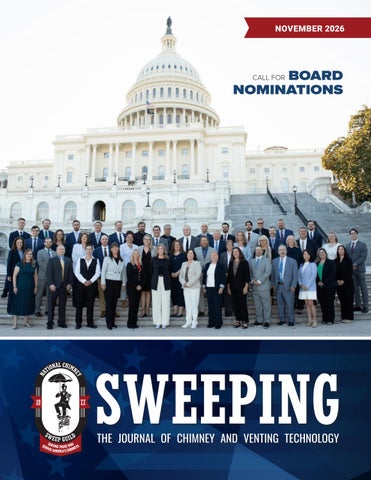
On the Cover: Industry advocates attend the HPBA Congressional Fly-In in Washington, D.C. Read one NCSG member's experience at the Fly-In on page 20.
4
NCSG SWEEPING MAGAZINE
ADVERTISING To advertise, email Malisa Minetree at sweepingads@me.com or call (317) 603-7854. NCSG further reserves the right to reject at any time any advertising determined not to be in keeping with the publication’s standards. Acceptance of advertising by Sweeping does not necessarily constitute endorsement of products or services advertised. NCSG does not make any effort to review or substantiate claims made by advertisers. PHOTOGRAPHY Stock images by iStock, Adobe. ARTICLE SUBMISSION NCSG encourages industry partners to submit press releases and articles to the editor at marketing@ncsg.org. Submissions should contain items of interest or importance to the chimney and venting industry. Submissions should not contain direct solicitations, prices, or other forms of advertising verbiage. Submissions may contain images or artwork attached in a JPG format. In all cases, NCSG reserves the right to edit submissions for space limitations, keep the release and publish at a later date, or refuse to publish the release for any reason. Neither publishing, nor refusing to publish the submission should be considered a statement of NCSG’s opinion regarding the release. © 2026 National Chimney Sweep Guild
LETTER FROM THE PRESIDENT
T
The election cycle is over! We’re done listening to candidate advertisements for a while—at least until the next round begins. This month, your November Sweeping magazine focuses on advocacy/government affairs, an important topic for all of us in the chimney and hearth industry. As chimney professionals, our work is guided by laws, government regulations, codes, and standards. Best practices also require technicians to follow installation manuals and manufacturer instructions. In her article on page 12, Karen Arpino, executive director of the Northeast Hearth, Patio & Barbecue Association (NEHPBA), shares updates from the Northeast and discusses what chimney businesses should be doing now to address changing trends. Have you gotten involved in the government process? Many professionals in our industry spend time educating legislators about the hearth and chimney profession. The National Chimney Sweep Guild (NCSG) continues to have representatives serving on various codes and standards committees.
By Debbie Wiedwald, President, National Chimney Sweep Guild
On page 20, Kade Lancaster, general manager of Top Hat Chimney Sweeps, shares about his visit to Washington, D.C. this past summer with other hearth professionals to advocate for fuel choice and preserving options for homeowners and businesses. Kade is a current participant in the HPBA Government Affairs Leadership Academy (GALA). I was fortunate to participate in the 2024–2025 GALA class and attend the 2025 Washington, D.C. Fly-In. These experiences reinforced for me how important it is for our industry to have a voice in the legislative process. Both Karen and Kade’s articles highlight the importance of being involved. Chimney professionals have valuable expertise to share with government officials. We are passionate about educating homeowners—and legislators—about ways to maintain and preserve their homes. If you would like to join the NCSG Government Affairs Committee, or if you are aware of new regulations that could restrict the work of chimney professionals, please reach out to me at debbie@blackburnschimney.com. Becoming an NCSG board member is another great way to share your expertise and provide leadership within the Guild. Board members help guide initiatives that support the professionals who service America’s chimneys. Be sure to watch for the board nomination deadline if this is something you may be interested in— there are additional details on pages 10-11. NCSG staff, board members, and volunteers are also busy preparing for the 2027 NCSG Convention & Trade Show on April 6–10 in Hershey, PA. Read more about our keynote speaker on page 6, and mark your calendar to register during the early bird window in late November. I hope your winter burning season is going well. As always, please reach out to me or any NCSG board member to share your ideas about how the Guild can best support you and your work. ■
N O V E M B E R 2026
5
KEYNOTE SPEAKER
TOMMY MELLO By Sydney Kaizer, Director of Marketing and Communications, National Chimney Sweep Guild
S
Some National Chimney Sweep Guild (NCSG) members may already know Tommy Mello from The Home Service Expert podcast, his books, or his appearances throughout the home service industry. For those who do not, his story starts in a place familiar to many contractors: doing the work himself and figuring out how to build a business along the way. Mello is the founder of A1 Garage Door Service, a company he started while carrying $50,000 in debt and working more than 80 hours a week. By 2017, the company had reached $25 million in annual revenue. Today, A1 Garage Door Service generates more than $200 million in
6
revenue, employs more than 700 people, and operates in 20 states. In April, Mello will bring that experience to Hershey, Pennsylvania, as the keynote speaker for the 2027 NCSG Convention & Trade Show, the main event of NCSG’s 50th anniversary celebration. Much of Mello’s work now focuses on helping other home service business owners learn from the lessons behind A1’s growth. He hosts The Home Service Expert podcast and is the author of Home Service Millionaire and Elevate: Build a Business Where Everybody Wins. His writing and speaking cover hiring, company culture, leadership,
NCSG SWEEPING MAGAZINE
sales, marketing, operations, and building a company that can grow beyond its owner. That home service background is what makes Mello especially relevant to an audience of chimney professionals. While the service may be different, many of the challenges are familiar: finding and developing good employees, creating systems, earning customers’ trust, and figuring out how to grow without doing everything yourself. The 2027 NCSG Convention & Trade Show will be held April 6–10, 2027, at Hershey Lodge in Hershey, PA. The Black Friday registration special opens November 27. ■
Home service entrepreneur and A1 Garage Door Service founder will keynote NCSG's 50th Anniversary Convention & Trade Show in 2027
Photo courtesy of A1 Garage Door Service
7
November is the month for reflection and gratitude. Where would we be without YOU?! What a blessing it has been to partner in business with so many of you!
Quality custom chimney caps, chase covers, pot toppers, and shrouds.
CALL US TODAY! 704-839-0329 • 844-775-7737 OwensChimneyCovers.com
Innovative Solutions and Coatings
In stock and ready to ship We’re staying busy during your busy season
ChimneySaver Pro
PriorFire Retrofit Fireplace is lightweight and easy to install
Purchase any of our products at
Saversystems.com
Cerfractory Flue Sealant
Formula 51
All Weather CrownCoat
Cerfactory Foam
Our products are proudly made in the USA Nationwide shipping | Orders over $1499 ship free 1-800-860-6327 | SaverSystems.com | Richmond, Indiana
BOARD NOMINATIONS CALL FOR
10
NCSG SWEEPING MAGAZINE
DUE DEC. 8
N
Nominations are now open for the 2027–2028 National Chimney Sweep Guild (NCSG) Board of Directors.
2-YEAR TERM
This year, NCSG is seeking candidates for Region 1 Director, Region 3 Director, Region 5 Director, At-Large Director, and At-Large Supplier Representative. Each position carries a two-year term. The NCSG Board of Directors plays an important role in guiding the work of the Guild and representing the interests of members across the country. Directors help establish organizational priorities, provide input on programs and member resources, support industry advocacy efforts, and contribute to the continued growth and direction of NCSG. Board service also offers members an opportunity to become more involved in the organization and contribute their experience and perspective to discussions affecting the chimney industry. Candidates may nominate themselves or be nominated by another eligible member. Directors are expected to take an active role throughout their term. Responsibilities include attending four board meetings each year, participating in online discussions, welcoming new members, contributing to Sweeping magazine, serving on an NCSG committee, and supporting other Guild initiatives as needed. Candidates must meet the eligibility requirements for the position they are seeking, including applicable NCSG membership requirements.
Five board positions are open for members who are interested in representing their peers and contributing to the direction of NCSG
Nominations are due Tuesday, December 8. Members interested in serving, or in nominating another qualified member, can review the full eligibility requirements and submit a nomination at https://ncsg.org/membership/2027-2028-ncsgboard-of-directors-nomination or by scanning the QR code on this page. ■
N O V E M B E R 2026
11
The Squeeze on the Flue How electrification mandates and changing building codes are affecting the market for chimney and hearth professionals across New England and New York
By Karen Arpino, Executive Director, Northeast Hearth, Patio & Barbecue Association
A Market Being Reshaped The most consequential legislation is not always labeled “chimney,” “fireplace,” or even “solid fuel.” Increasingly, it appears in climate statutes, energy codes, municipal building bylaws, and decarbonization programs. The immediate effect may fall on builders and mechanical contractors, but the long-term consequence can be fewer new flues, fewer gas hearth installations, and a gradual shift in the service mix that has supported many chimney sweep and hearth businesses. Supporters describe these policies as necessary steps toward lower emissions, healthier indoor air, and more efficient buildings. From the
12
trade’s perspective, however, rules written around “fossil-fuel equipment” or “building energy needs” can sweep broadly enough to affect fireplaces, venting systems, liners, inspections, and future maintenance demand. The risk is not one single ban across the region; it is a patchwork of state and local restrictions that can change what may be installed from one town or permit date to the next.
New York: The Most Immediate Shift New York’s All-Electric Buildings Act is the region’s clearest example. State guidance says that, beginning in 2026, most new buildings seven stories or shorter must use electric heat and appliances. Taller residential buildings and smaller commercial
NCSG SWEEPING MAGAZINE
Karen Arpino, NEHPBA Executive Director buildings enter the program in 2029. Existing buildings, repairs, renovations, and additions are generally outside the statewide requirement, and the law contains exemptions for uses such as hospitals, certain commercial kitchens, manufacturing, agriculture, emergency power, and projects where reliable electric service cannot be provided in
time. For sweeps and hearth dealers, the practical concern is straightforward: covered new construction will not create the same pipeline of gasfireplace vents, boiler flues, or other fossil-fuel exhaust systems. The existing-building market remains substantial, but companies serving fast-growing new-home corridors may see installation work contract first and maintenance work soften later. Legal challenges and implementation disputes have added uncertainty, making permit dates, project type, and local enforcement critical facts on every job. Two pending New York measures reveal that the policy fight is not settled. Assembly Bill A2003, the proposed “Rural Energy
Freedom Act,” would exempt wood burning for recreation, building heat, and cooking from certain state greenhouse-gas requirements. Senate Bill S5391 and its Assembly counterpart A210 would protect fuel-burning cooking appliances from future prohibitions. These proposals may be favorable to portions of the hearth industry, but as of this writing they remain in committee and should not be treated as law.
Massachusetts: Local Rules, Regional Consequences Massachusetts has taken a municipal route. Under the state’s Fossil Fuel-Free Building Demonstration Project, up to 10 participating cities and towns may require new construction and major renovations to be
fossil-fuel-free and may enforce those rules through the buildingpermit process. The program is limited geographically, but its significance is larger: it creates operational models that other municipalities may seek to copy if lawmakers expand the program. For a sweep or hearth dealer working across municipal lines, that creates a compliance map rather than a single statewide rule. A fireplace or fuel-fired appliance package acceptable in one town may be unavailable for a comparable project in the next. Major renovations can be especially tricky because a project’s classification—not simply whether the structure already exists—may determine whether the local restriction applies. Contractors should avoid relying on last year’s permit
N O V E M B E R 2026
13
experience or a neighboring town’s interpretation.
Rhode Island: A Proposal Worth Watching Rhode Island House Bill 5450, introduced in 2025, proposed an All-Electric Building Act that would bar permits for most new commercial, residential, and mixed-use buildings that were not all-electric when applications were submitted after December 31, 2026, subject to stated exceptions. The bill’s definition would exclude natural-gas, propane, and oil equipment and infrastructure used for building energy needs. The House Municipal Government and Housing Committee held H5450 for further study on March 20, 2025, and the bill did not advance before the 2025 session ended; it therefore did not become law, however these types of bills are regularly submitted in Rhode Island. Separately, Rhode Island’s current code framework now incorporates updated international building, mechanical, fuel-gas, and energy standards, including electricreadiness provisions. Even where combustion equipment remains lawful, newer energycode requirements can alter project design, electrical capacity, documentation, and coordination among trades. A sweep who also installs hearth or venting equipment should treat code adoption dates as a business issue, not merely a plan-review detail.
14
recognizing advanced wood heat as a potential lower-carbon resource. Connecticut retains specific siting, chimney-height, and fuel restrictions for outdoor wood-burning furnaces. Federal law requires EPA certification for covered new residential wood heaters offered for sale throughout New England and New York. Maine and New Hampshire are also energy choice states; New Hampshire supports customer choice and has updated its building-code package. Maine maintains licensing and installation standards for solidfuel appliances and chimneys. Taken together, these varied approaches—from emissions standards and licensing requirements to energy choice protections—show that the region is not moving in a single direction, and that chimney and hearth professionals must track both restrictions and safeguards in each state.
What Chimney Businesses Should Do Now Join your HPBA trade association affiliate. Extensive advocacy and government affairs work is constantly in the works! Track rules by permit jurisdiction. Maintain a simple matrix of state law, participating municipalities, effective dates, project thresholds, and exemptions.
The Wider New England Picture
Use your HPBA affiliate executive director as a resource. They can help you distinguish proposed legislation from enacted laws, understand regulatory developments, and identify the potential consequences for your business.
Not every state is moving at the same pace. Vermont’s climate framework continues to target emissions from the thermal sector, while also
Document inspections carefully. As installations become less common in some markets, defensible inspection reports, photographs, and code references
NCSG SWEEPING MAGAZINE
become even more valuable. Diversify without abandoning the core trade. Existing chimneys will still require sweeping, relining, water-leak diagnosis, masonry repair, caps, dampers, and safety inspections for decades. Engage early and constructively. Trade associations should comment on definitions, exemptions, grandfathering, emergency-heat provisions, rural grid constraints, and realistic compliance dates before rules are final.
From Opposition to Expertise The strongest industry response is not a blanket rejection of every climate or energy measure. It is specific, technical, and grounded
in field experience. Policymakers need to understand the difference between a decorative gas appliance, a primary wood-heating system, a historic masonry fireplace, and an emergency heat source. They also need practical information about existing housing stock, electrical-service limitations, inspection capacity, and the safety consequences of deferred maintenance. The market is changing, but it is not disappearing. Companies that monitor legislation, explain the rules accurately, and position themselves as building-safety experts will be better prepared than those that learn about a new restriction at the permit counter. In this environment, regulatory literacy may become as important to a chimney or hearth business
as draft measurement and camera inspection.
Source Note Primary references include the New York State Assembly’s all-electric buildings guidance, the New York Legislature’s A2003 bill page, the New York Legislature’s S5391 bill page, the Massachusetts Municipal Fossil Fuel-Free Building Demonstration Project, Rhode Island H5450, the Rhode Island Building Code Commission, and official state materials from Vermont, Connecticut, Maine, and New Hampshire. This article is a trade overview, not legal advice; readers should confirm current statutes, regulations, local bylaws, and permit guidance before acting. ■
THE PRODUCTS YOU NEED. THE SERVICE YOU DESERVE.
NOVO THE NEW AMERICAN BACKYARD
www.raymurray.com
800-628-5044
N O V E M B E R 2026
15
Industry News Watch
PRICE AT THE
PUMP By NCSG Staff
Rising fuel costs are forcing service companies to rethink travel charges, routing, and pricing
Busy season means more jobs on the schedule and more miles on the road. This fall, those miles are costing considerably more. The national average for a gallon of regular gasoline reached $4.48 on September 24, according to AAA, up from $4.10 a month earlier and $3.16 at the same time last year. AAA called it the highest national average ever recorded for that time of year. That increase is creating another pricing consideration for service businesses that rely on trucks and vans to reach customers. The issue recently surfaced in an National Chimney Sweep Guild (NCSG) member discussion about
16
whether rising gas prices are affecting busy-season pricing. Some members said they have increased travel costs for jobs outside their immediate service area, while others said they prefer to account for transportation costs within their overall service price rather than adding a separate trip charge. Contractors in other home service industries are facing many of the same decisions. Irrigation & Lighting reported in May that irrigation contractors were looking for ways to offset rising fuel expenses without necessarily passing them directly to customers as a fuel surcharge. For one contractor interviewed
Continue the conversation with fellow NCSG members in our members-only Facebook group
by the publication, fuel was the company's second-highest expense behind labor. Instead of adding a separate charge, several contractors said they were focusing on tighter geographic scheduling, more efficient routes, reducing truck idling, and stocking vehicles more carefully to cut unnecessary trips. One company chose to raise its billable technician rate rather than introduce a fuel surcharge. Fuel surcharges are showing up elsewhere in the service industry as well. An August article from law firm Kaman & Cusimano noted that condominium and homeowners associations have increasingly encountered fuel or
gas surcharges from contractors, particularly landscaping and other recurring-service vendors. The firm advised customers to pay close attention to how contracts address those additional charges. For chimney companies, there may not be one response that fits every business. Service area, route density, vehicle efficiency, and the amount of driving required for each appointment can all affect how much rising fuel prices cut into a job.
"THE COST OF GETTING TO THE JOB IS BECOMING HARDER TO IGNORE."
But with gasoline roughly $1.30 higher than it was a year ago as sweeps move through one of their busiest stretches of the year, the cost of getting to the job is becoming harder to ignore. ■
N O V E M B E R 2026
17
18
NCSG SWEEPING MAGAZINE
Certification Spotlight
Taking the Next Step Daecus Vance turned an early start in chimney sweeping into a career he loves
Which NCSG certification do you hold? Certified Chimney Professional (CCP)
When & how did you get your start in the chimney and venting industry? I started as an apprentice at 16 years old. We had a gentleman who owned his own business in my hometown of Saint Louis [who] needed help. So I offered, and 6 years later I am now a Certified Chimney Professional (CCP).
What inspired you to pursue an NCSG certification, and what does earning it mean to you and your career? I wanted to take the next step in advancing my training and making myself more valuable to the chimney sweep community.
What would you say to someone who is considering becoming NCSG certified? I would highly recommend it. It gives you and customers that extra peace of mind, and it separates you from most other sweeps.
What is something people might be surprised to learn about you? My work is my hobby. I truly do love chimney sweeping.
No prerequisites or classes required to take the CCP exam. Best for someone with 1-3 years of experience.
N O V E M B E R 2026
19
Showing Up Matters My experience at the HPBA Congressional Fly-In
By Kade Lancaster, General Manager, Top Hat Chimney Sweeps
T
he goal of the Hearth, Patio & Barbecue Association (HPBA) Congressional Fly-In was to help lawmakers understand why energy choice matters to the hearth, patio, and barbecue industry and the consumers we serve.
I raised my hand, asked a question, and started a conversation. Nothing dramatic. I wasn't a lobbyist or a policy expert. I was a chimney sweep who cared enough to speak up.
Our focus was the Energy Choice Act (H.R. 3699/S. 1945), legislation intended to limit state and local restrictions on energy choice. For our industry, this isn't just a policy debate. It's about preserving options for homeowners and the businesses that serve them. I arrived in Washington as an Alabama member of the National Chimney Sweep Guild (NCSG), representing HPBA. I left with a different understanding of advocacy. My most memorable moment happened not in a committee room, but over coffee with my U.S. Senator. At Senator Katie Britt's “Coffee with Katie,” a gathering for Alabamians visiting Washington, I thanked her for her work on affordability, particularly for her efforts to help younger generations afford their first homes. I then connected housing affordability to energy choice, asking how she viewed access to propane, natural gas, and biomass as part of that conversation. I pointed out that Alabamians still have energy choices that people in other parts of the country increasingly find restricted.
20
NCSG SWEEPING MAGAZINE
Photo courtesy of HPBA
Photo courtesy of HPBA
HPBA Leaders Academy By Jason Tolleson, Senior Director, Government Affairs, Hearth, Patio & Barbecue Association
A
s Kade's story shows, this program has always been about more than just learning to lobby. That's exactly what's shaping its next chapter.
During the Fly-In, I met with Representative Mike Rogers, a cosponsor of the House bill, and staff from Senator Tommy Tuberville's office. Tuberville cosponsored the Senate bill. I also met with staff representing Virginia and Georgia. One conversation particularly stuck with me. A staffer for Senator Jon Ossoff, originally from Puerto Rico, immediately understood the importance of fuel choice when storms disrupt power. It was a reminder that energy options aren't merely political talking points; they can matter when families face unexpected outages.
Starting with the incoming 2027 class, it will officially be called HPBA Leaders Academy. It's more than a rebrand—it puts a bigger emphasis on leadership development and industry education, while maintaining a strong focus on advocacy training. Industry education is a big part of the shift. Participants will get a real look at how the hearth, patio, and barbecue industry works as a whole, including sitting down with the people actually running the industry and hearing directly from leaders in segments they don't normally interact with.
Some congressional offices already understand our concerns. Others need to hear directly from the people working with homeowners every day. If we don't share our experiences, we leave a gap in that conversation.
The industry doesn't just need people who can speak up in front of legislators. It needs leaders who can guide their companies, mentor others, and shape the industry's future from the inside out. This evolution gives participants a fuller toolkit: the confidence to advocate, the skills to lead, and a real understanding of the industry they're leading in. It's an investment in the industry's long-term bench strength.
Whether you're a chimney sweep, retailer, installer, manufacturer, or supplier, your experience matters. If you're considering a future Fly-In, go. You don't need to be a policy expert to make a difference—just show up, share your story, and raise your hand.
Information on the HPBA Leaders Academy, including the application for the 2027 class, is available on www.hpba.org. The application deadline is December 15, and you must be an HPBA member to participate. ■
Advocacy starts with individual voices, and our industry's voice is strongest when we use them together! ■
Scan for more information about the HPBA Leaders Academy
N O V E M B E R 2026
21
The American delegation at the 2026 International Chimney Sweep Meeting.
SPAZZACAMINI in the valley of the chimney sweeps By Jeff Simmons, Vice President, Top Hat Chimney Sweeps
In Santa Maria Maggiore, located in the heart of the Vigezzo Valley, there is a small museum that is one-of-a-kind in Italy. It preserves the historical memory of an ancient profession that contributed both tragic and fascinating chapters to the history of this valley.
22
NCSG SWEEPING MAGAZINE
Traditional sweep clothing, bicycle, and equipment during the festivities.
I
have wanted to go to the International Chimney Sweep Meeting in Santa Maria Maggiore, Italy, for almost as long as I have been a chimney sweep. This September, I finally marched through the streets of the Valley of the Chimney Sweeps with the American delegation. Better yet, my children and grandchildren were there with me.
Meeting local families and sharing the celebration in Santa Maria Maggiore.
If you know National Chimney Sweep Guild (NCSG) gatherings, imagine that feeling on steroids. Sweeps from around the world arrive in traditional clothing with their flags and equipment. We may not speak one another’s languages, but a handshake, a hug, and a smile go a long way. I went with a little concern about how Americans would be received. That concern vanished quickly. The sweeps from other countries welcomed us warmly, and the Italians were especially generous. It seemed everybody wanted one of our American flags.
A Song I Will Never Forget
Jeff Simmons, Top Hat Chimney Sweeps Vice President
My favorite moment began when a young man from another country came up to our group and played the first few notes of “The Star-Spangled Banner.” We all started singing. He did not know the whole melody, so he stopped playing. We kept singing, a cappella, right there in the middle of an Italian mountain village. I got chill bumps. Surrounded by sweeps from so many countries, I felt proud to be an American and grateful to belong to this worldwide trade.
The History Behind the Celebration The celebration has a serious history, too. At the Chimney Sweep Museum in Santa Maria Maggiore, I learned about the piccoli rüsca, children from poor families who were sent away
with chimney sweep masters for seasonal work. Some were very young. Their size let them reach spaces that an adult could not, and the work could be dangerous, cold, and cruel. The museum preserves their stories so they are not forgotten. Sweeps from Valle Vigezzo traveled throughout Europe. The international gathering, which began in 1982, celebrates the profession and remembers its past. Seeing traditional sweep clothing, bicycles, and brushes in the streets made that history feel close. It also reminded me how far our trade has come.
A Promise Kept This trip meant more to me than finally seeing an event I had dreamed about for decades. During my wife’s last days with cancer, she asked me to take our entire family to Italy for this gathering. I promised her I would. Walking in the parade with my children and grandchildren, I was keeping that promise. I have been away from the day-today chimney business for some time, but Italy reminded me that I am still a chimney sweep. The connection I feel to other sweeps, in Alabama and across the world, has never gone away. If you have thought about attending, go. March with your fellow sweeps. Meet people whose language you cannot speak. Visit the museum and learn about the children who worked before us. And, if you can, bring your family. What a blessing this trip was. God bless chimney sweeps, and God bless America! ■
Scan to learn more about the International Chimney Sweep Meeting
N O V E M B E R 2026
23
ZEN AND THE ART OF CHIMNEY SWEEPING By Ian E. Myers, Myers Chimney
A Note to the Reader
How does observation become understanding?
Despite its title, this is not a book about how to sweep a chimney. Chimney sweeping is simply where the questions found me.
And perhaps most importantly: How can the understanding earned by one generation survive long enough to benefit the next?
For more than 20 years, I have worked around solid-fuel systems-as a technician, inspector, educator, investigator, and participant in the development of professional standards. During those years, I learned many technical things. Some were taught to me in classrooms. Some came from standards and manufacturers. Others came from experienced people generous enough to share what they had learned.
Those questions eventually became the philosophical foundation of Solid-Fuel Maintenance Intelligencе™.
But another kind of education was taking place. The work itself was teaching me. A recurring deposit pattern. A homeowner's casual observation. A system that behaved differently from what I expected. A report written years earlier that suddenly made a present condition understandable. A question that remained unanswered long enough for another observation to illuminate it. Gradually I became interested not only in what professionals know, but in how professionals come to know what they know. How does technique become experience? How does experience become judgment?
24
NCSG SWEEPING MAGAZINE
This volume does not attempt to explain that system technically. That work belongs elsewhere. Instead, this book concerns the habit of mind from which the system emerged: observation without haste, inquiry without ego, documentation with purpose, respect for evidence, and the willingness to allow reality to correct our conclusions. I have written about chimney sweeping because it is the profession I know. But I do not believe these questions belong to chimney sweeps. They belong to anyone whose work asks them to observe carefully, exercise judgment, accept responsibility, preserve knowledge, and leave their profession a little wiser than they found it. The chimney is where this inquiry begins. Where it leads belongs to every thoughtful professional.
The Discipline of Inquiry Observe honestly. Question thoughtfully. Reflect patiently. Discover relationships. Preserve understanding. Serve others.
Chapter One: Learning To See I cannot remember the first chimney I swept. Nor can I remember the first appliance I inspected. I suspect that is true for many professionals. Our earliest days are often filled with information. Measurements. Procedures. Terminology. Safety practices. We concentrate so intensely on learning what to do that we seldom notice what the work itself is trying to teach us. That is exactly as it should be. Every profession begins with technique. Mine certainly did.
From all of us at Sand Hill, THANKS for GIVING us your support. We are grateful for you!
Phone us at 800.258.5496 or email info@sandhillwholesale.com
When I first entered the solid-fuel profession, I believed I was learning how to sweep chimneys. How to inspect installations. How to recognize deficiencies. How to write reports. Those skills were essential. Without them nothing else could follow. Looking back now, however, I realize something else was happening. The profession was quietly teaching me how to see. At the time I had no language for that thought. I simply noticed that experienced technicians often recognized things I completely overlooked. They were not necessarily looking longer. They were seeing differently. A slight change in deposit texture. A subtle distortion in a connector pipe. An almost casual remark made by a homeowner. A faint pattern repeated across several unrelated maintenance visits. None of these observations seemed remarkable by themselves. Yet experienced professionals somehow sensed their importance. For many years I assumed this ability was simply called experience. Eventually I became less satisfied with that explanation. Experience alone did not explain what I was witnessing. Some individuals accumulated years. Others accumulated understanding. The difference fascinated me. I began asking a question that has remained with me throughout my professional life. What exactly changes inside a person as experience gradually
N O V E M B E R 2026
25
becomes judgment? That question became one of my greatest teachers. It accompanied me into homes. Onto roofs. Into attics. Into classrooms. Into committee meetings. Into fire investigations. Into conversations with manufacturers. Into discussions with insurance professionals. Everywhere I looked, I found remarkably capable people. Yet the most accomplished among them seemed to possess one characteristic in common. They had learned to see relationships that others had not yet noticed. That realization gradually changed the way I approached every maintenance visit. I no longer entered a home simply looking for deficiencies. I entered wondering what this system might teach me that the previous one could not. That small shift in attitude changed everything. Suddenly the maintenance visit became more than maintenance. It became inquiry. The chimney became more than a venting system. It became a
historical record. The homeowner became more than a client. They became part of the evidence. The report became more than documentation. It became the beginning of a conversation that future observations might one day continue. Without realizing it, I had begun practicing something I would not have words for until many years later. Maintenance intelligence. Not as a system. Not as software. Not even as a methodology. But as a habit of mind. Looking back, I now believe that every profession experiences a similar transformation. At first we learn to perform the work. Eventually, if we remain curious, the work begins teaching us how to think. Everything that follows in this manuscript grew from that single realization. Not that I had become more knowledgeable. But that I had slowly learned to see. If experience alone does not explain professional judgment... What does? ■
TRUSTED BY HOMEOWNERS FOR OVER 40 YEARS
PRE-INSULATED ALL FUEL LINER KITS
Pre-Insulated All Fuel Liner Kits
SUITABLE FOR ALL FUELS
Pellet Wood
Gas
Oil
AMERICAN MADE
Pre-insulated chimney liners optimize draft efficiency and maximize structural safety by maintaining high flue temperatures and isolating thermal energy.
T 1.800.654.5600 | F 1.888.889.3539 | sales@z-flex.com | www.z-flex.com
2026 ZFlex_Sweeping_Pre Insulated Liner Kit_7.5x4.75.indd 1
26
NCSG SWEEPING MAGAZINE
2026-09-10 5:23:58 PM
The premier chimney cap for keeping smoke out of living spaces. • Vacu-Stack® works with single wall, double wall, triple wall, or masonry. • Solves draft problems related to hills and mountains, tall trees, and tall buildings near the chimney.
the authentic Available from leading distributors nationwide.
many attempts to copy it over the last 40+
years, there is only one Vacu-Stack®.
for it by name
• Standard construction is 100% austenitic stainless steel; also available in other alloys including copper and Type 316 for marine/coal appliances. Improved Consumer Products, Inc. PO Box B Attleboro Falls, MA 02763 (508) 695-7000 Fax: (508) 695-4209
www.chimneycaps.com
have been
Always ask
• Sizes available from 3” to 30”+; custom and oversize available. Air cooled and non-air cooled. Model VSA-TDW for air cooled chimney
Although there
and look for
the seal of authenticity on top of the cap.
100% made in USA
N O V E M B E R 2026
27
MARKETING UPDATE How AI Can Grow Your Chimney Business's Online Presence— If You’re Checking Its Work By Taylor Hill and Carter Harkins, FutureNow Marketing
C
Chimney and hearth businesses are competing for a shrinking pool of customer attention in a search landscape that changed almost overnight. AI tools like ChatGPT, Gemini, and Google's new AI Mode are no longer novelties; they're becoming a primary way homeowners find, vet, and choose a sweep or repair contractor who will service their chimney this season. Understanding how these systems decide who to recommend, and knowing where they can lead a business astray, matters more than ever.
AI Is NOT a Search Engine; It's a Prediction Engine The starting point is realizing what an AI model actually is. Despite the "search" branding, tools like ChatGPT, Gemini, and Claude aren't looking anything up in a database. They're prediction engines: systems trained on a massive slice of the public internet, articles, reviews, directories, forums, social posts, that learn which brands, words, and ideas tend to appear together. Think of it less as a librarian pulling a fact card and more as the world's most well-read intern, one who has absorbed nearly everything ever published, right or wrong, but remembers it as impressions and patterns rather than exact quotes. That has a practical consequence for how a chimney business shows up. An AI model's opinion of a company is a reflection of the internet's opinion, not an independent judgment. It isn't deciding whether it likes a business, it's mirroring what's already been said about it: who gets mentioned, in what context, how consistently, and whether it's found on many sources. If the internet is vague or silent about a company, the AI will be too. AI search is just looking for three things: presence (is a business even in the data it reads), consistency
28
NCSG SWEEPING MAGAZINE
(does everything say the same name, service area, and specialty), and corroboration (do multiple trusted sources repeat the same story). Whatever is most clearly, consistently, and repeatedly tied to a customer's need is what gets recommended.
How You Can Turn AI Into a LeadGeneration Tool This gives chimney businesses a real, actionable road to AI search success. AI can be turned into a genuinely useful marketing tool if it's fed the right questions. Ask an AI model to grade a webpage the way an SEO expert would, by target keyword, technical setup, and content depth, and it will return a structured table of grades and fixes: title tags, meta descriptions, header structure, local SEO signals. Ask it to compare a company's site against a named competitor's, tallying headline counts, benefit claims, and messaging gaps, and it will surface differentiators worth adding to the page. Ask it to pretend to be a homeowner shopping for chimney repair or an annual sweep and list the questions it would want answered, and those become ready-made FAQ content. Even a company's own phone calls become fair game: feeding call transcripts into AI can reveal the questions callers ask most often, cost, scheduling, service area, creosote and safety concerns, and where staff are leaving those questions unanswered, your company insight no competitor has access to.
The Fundamentals Still Rule None of this changes the fundamentals that have always mattered: keyword-rich titles and headers, alt tags, schema markup, and fresh customer reviews. If anything, those fundamentals matter more in
an AI-driven search world, because they're the raw signal AI reads when deciding who to recommend. This means if you have had ongoing search engine optimization, you are ahead of the crowd.
Caution: AI's Confidence Problem Here's the part that gets glossed over: AI is confident even when it's wrong, and that overconfidence can do real damage if nobody checks its work. In one real test, we used an AI assistant to review one of our client websites, and it gave us a list of what needed fixing. It came back fast, with a specific, authoritative-sounding list of bugs: broken metadata, a stray character breaking a phone link, a call-to-action pointing to the wrong domain. It reads as expert analysis. But since we know the website and what matters, we pushed back and said that didn't look right, and the AI admitted the truth: a good chunk of what it had listed came from parsed, cached HTML rather than the live, rendered page, and some of those specific claims were exactly the kind of thing that kind of parsing gets wrong. The tool wasn't lying, but it was also doing what these systems do, filling gaps with the most statistically likely answer and presenting it with the same tone of certainty whether it's correct or not. In other words, AI's confidence folds faster than a folding chair.
Ask 10 Times, Get 10 Answers That pattern shows up in a second, quieter way too: ask the same AI model the identical question multiple times, and the answer changes. One test ran a single query, asking for the best chimney sweep companies in a given city, 25 times against several AI models, and found the mention rate and
recommended ranking for the same companies swung significantly between runs. Even opening a private browser window and asking the same question 10 times in a row can produce 10 different answers. AI search doesn't return one fixed truth; it returns its best guess in the moment, and that guess has real variances built into it.
AI Is Great When You Know What To Check For Put those two things together and the lesson is straightforward. AI is an extraordinarily useful research assistant and a genuinely powerful way to audit a website, benchmark a competitor, mine phone calls for customer insight, and draft the content AI search itself is most likely to cite. It can do in minutes what used to take a marketing team days. But it should never be the last set of eyes on anything that goes public. Every AI-generated grade, gap analysis, or fix belongs in front of someone who actually knows the business, the website, and the customer before it gets published, submitted, or acted on. Treat AI's output the way you'd treat a sharp but overeager new hire's first draft: valuable, fast, worth using, and always worth checking. For chimney and hearth businesses, that combination, AI-assisted attraction, AI-assisted competitive positioning, and AI-assisted measurement, paired with a human check at every step, is what actually moves the needle. It's not about winning an AI popularity contest. It's about making the phone ring consistently, with callers who already know who you are, have seen your reviews, and are ready to buy. That's a business result, and it still requires a person to verify that what AI told you to do is actually correct. ■
N O V E M B E R 2026
29
INSURED & INFORMED Advocacy Through Better Insurance Understanding By Gordon Sheucraft, Risk Advisor, SouthPoint Risk
F
For many businesses, insurance is something you think about when a policy renews, a certificate of insurance is requested, or a claim occurs. But understanding your insurance before those situations arise can be one of the most valuable forms of risk management.
Your Business Changes; Your Insurance Should Be Reviewed You may add employees, purchase vehicles, expand into masonry or roofing work, begin installing products, purchase new equipment, or take on larger commercial projects. Those changes can affect your insurance in ways that aren't always obvious. For example, adding a new service could change how a carrier views your operations. Purchasing a vehicle creates commercial auto considerations. Hiring employees brings workers' compensation requirements and additional liability exposures. Even changes in the ownership or location of a building can affect property coverage. A good practice is to review your insurance whenever there is a meaningful change in the business, not just once a year at renewal.
Understand the Difference Between Coverage and Limits
30
exclusions, conditions, definitions, and limits that determine how that coverage applies. The same principle applies to commercial auto, workers' compensation, property, and umbrella policies. Understanding your limits is crucial. A $1 million liability limit sounds straightforward, but your policy may have different sub limits or specific provisions that affect certain types of claims.
Certificates Aren't the Same as Coverage Another common source of confusion is the certificate of insurance. A certificate is generally evidence of insurance; it is not the insurance policy itself. A certificate may show that certain coverage and limits were in place on the date it was issued, but it does not change the terms of the underlying policy. If a customer or general contractor asks you to add additional insured status, provide a waiver of subrogation, or meet a specific contractual insurance requirement, the actual policy endorsements and requirements matter, not simply the certificate.
Make Insurance Part of the Business Conversation Advocacy starts with asking questions.
Having a particular coverage does not necessarily mean every situation is fully covered.
When reviewing your insurance, don't be afraid to ask:
There are two separate questions to ask:
1. What are my largest exposures?
1. What does my policy cover?
2. What are my policy limits?
2. How much coverage do I have?
3. What exclusions should I understand?
For example, a general liability policy may provide coverage for certain third-party bodily injury or property damage claims, but the policy will contain
4. Are my current operations accurately described?
NCSG SWEEPING MAGAZINE
5. Have any recent changes affected my coverage? 6. What contractual insurance requirements should I be aware of? 7. What should I do if I have a potential claim? The goal isn't to become an insurance expert. The goal is to understand enough about your insurance to make informed decisions about your business. For chimney professionals, advocacy means having a voice within the industry. It also means advocating for yourself by understanding the risks you face, and the insurance protections designed to address them. The better you understand your insurance, the better equipped you are to identify questions, manage risk, and protect the business you've worked so hard to build. ■
N O V E M B E R 2026
31
COACH'S CORNER Strong Leaders Lean By Phillip Stoller, President and CEO, SaverSystems
T
“The crew’s waiting on your order, sir. What would you like us to do?” In all my years as Ernest Shackleton’s second-in-command, I’d never seen him pause like that. He stood there, staring at the ice gripping our ship, the Endurance. The creaks, cracks, and groans of the hull told us the truth we didn’t want to say out loud: we weren’t getting to Antarctica. The crew shifted uneasily. We knew how much this meant to him. We also knew stubbornness could kill us. Then Shackleton turned and said, calm as anything: “Ship and stores have gone—so now we’ll go home.” No long speech. No justifying the change. Just a decision, blunt and clear, that saved our lives. The fear didn’t vanish, but something stronger took its place—resolve. We weren’t chasing glory anymore. We were chasing survival. When I first read this story, I was struck by the thought that Shackleton’s courage wasn’t in sticking to the dream. It was in letting go of his dream for the sake of his people. His dream was to cross Antarctica. His duty was to his team.
32
It takes gritty courage and steely determination to willingly sacrifice one’s dream to honor one’s duty. That’s where I want to pause the story and talk to you—not as Shackleton’s second-in-command (which I’m clearly not) but as someone who studies leadership and how it really works when things get rough. Because moments like that—moments where you’re forced to change course—are where the strongest leaders prove themselves. We’ve all heard the phrase, “The plan is the plan.” It’s meant to signal strength. But more often than not, it signals rigidity. In business, just like in the Antarctic, sticking to the original course when conditions have clearly changed can sink you—and not just you, but your whole crew. Shackleton could have clung to his goal, risking everything to “finish what we started.” Instead, he adapted. He put his crew first. Here’s the part that still amazes me: they didn’t lose faith in him when he shifted the mission. They trusted him more. It’s the same in leadership today. People want to know their leader sees the reality on the ground. They want to know their wellbeing matters more than a goal or vision originally presented
NCSG SWEEPING MAGAZINE
in some PowerPoint deck nine months ago. If you lead, here’s what Shackleton would tell you: • Hold the goal with open hands. Clench your fists around it, and you’ll break it— or even worse, you’ll break the people you are meant to serve. • Steer before the storm swallows you. Adjusting course early costs far less than waiting until the ship’s already taking on water. • Let your people see their reflection in your eyes. When they know you see them, really see them, they’ll row harder, longer, and through darker nights than you can imagine. Shackleton didn’t make history by crossing Antarctica. He made it by saving every man on his crew. Here’s a challenge for you. If you truly love your team—if you want them to come through the storms not just alive, but stronger—be the leader they need, not just the one you set out to be. Change course when it’s time. Put them before your pride. Let them know, in words and in action, that you’ll get them home. Because strong leaders don’t just hold the wheel... they hold their people. ■
Lighter. Drive Results Faster. Lift Smarter Safer. Smarter.
317 Rte. 27 Raymond, NH 03077
Est. 1994
RBG Inc. - Since 1994 view our lifts Sales - service - parts - demos aerial work platforms and bucket trucks excellent for the Chimney industry call or email us today! 34
NCSG SWEEPING MAGAZINE
raymondbucketguys.com
(603) 895-3803
REGIONAL UPDATES REGION 2
Jonathan Cross Region 2 Director
W
We live and breathe NFPA 211 daily. It's the foundation of our safety standards and legal defense. However, standards are not written in a vacuum; they are shaped by the professionals who use them in the field every day. As the technical committee prepares the groundwork for the 2030 edition, our active participation is critical. If a section in Chapter 14 or 15 feels ambiguous, if clearance requirements don't reflect modern appliance designs, or if inspection protocols create unnecessary operational friction without improving safety, now is your window to fix it. When sweeps don't speak up during the public input phase, our voices are not heard. Instead, changes may be steered by manufacturers, engineers, and municipal officials who rarely step onto a roof or pull a camera through a tight flue. Here's how to submit public input: • Log in at nfpa.org/211 with a free account. • Under "Next Edition," select "Submit Public Input Online." • Choose a section, propose wording (strikethroughs for deletions, underlines for additions), and explain how the change improves safety, clarity, or field execution. Let’s ensure the 2030 edition of NFPA 211 works for the dedicated sweeps who keep homes safe across our region. Take 15 minutes this week to review the current standard, talk with your crew about common field pain points, and submit your input! ■
AT-LARGE
Cory McGill At-Large Director
I
It is the end of September as I write this. Heating oil is hovering around $6/gallon, propane $2.40, natural gas $2.40/therm, electricity 36.6¢/kWh, pellets $425/ton, and firewood $300/cord. I plugged those numbers into Efficiency Maine’s heating-cost calculator. The estimated annual cost? Wood came in lowest at $1,233, followed by natural gas at $2,151, propane at $2,349, ductless heat pump at $2,554, pellets at $2,656, oil at $4,189 and electric baseboard at an eye-watering $8,045. Suddenly, the phones ringing off the hook makes more sense. Here in the Northeast, oil and propane heat are common. This fall, homeowners are looking at their heating bills and remembering that woodstove they haven’t used in years. Apparently $6 oil is an excellent marketing campaign for chimney sweeps. That brings us to advocacy. Massachusetts, along with many states, is actively pursuing building electrification and reduced reliance on fossil fuels. Whatever our individual opinions about those policies are, those making them need real world information about affordability, reliability, and the role wood and biomass can play in heating homes. If our industry isn’t part of those conversations, decisions will still be made, just without our perspective. Advocacy means making sure we have a seat at the table. ■
N O V E M B E R 2026
35
NEW MEMBERS Welcome to the newest companies to join the National Chimney Sweep Guild in August and September 2026! NCSG membership is company-wide, which means employees of member companies can take advantage of member benefits, too. Log in or create your account to access member resources, education, technical support, industry news, and more at ncsg.memberclicks.net/login.
Kindled Timber Indianapolis, IN Join Date: 8/11/2026
Utah County Masonry Saratoga Springs, UT Join Date: 9/10/2026
Cornerstone Chimney West Chester, OH Join Date: 9/24/2026
Ironflue Chimney Sweep & Fireplace Care Hamden, CT Join Date: 8/20/2026
Water-Oak Chimney Watertown, CT Join Date: 9/15/2026
Olde School Contractors Palisades Park, NJ Join Date: 9/28/2026
Elite Chimney Solutions, Inc. Warwick, RI Join Date: 8/26/2026 A & A Chimney Sweep and Repairs, Inc. Philadelphia, PA Join Date: 9/1/2026
Bridgeway Partners – M&A Advisory Henderson, KY Join Date: 9/16/2026 Sacramento Chimney Sweep Citrus Heights, CA Join Date: 9/20/2026
Keep your membership information up to date! Did you know homeowners can search for NCSG member companies and certified individuals on the membership directory on our website? Keep your business contact information current by logging into your NCSG member profile and reviewing your profile details. Visit ncsg.org and click Log In.
36
NCSG SWEEPING MAGAZINE
UPCOMING EVENTS 20 MENTOR 27 CONNECT
Mark your calendar for these chimney industry events coming up in 2027!
JAN. 29-30
FEB. 2
Find event updates and additional details at ncsg. org/training-and-events/ event-calendar
Pennsylvania Guild Winter Meeting & Holiday Party
Mentor Connect
FEB. 22-26
MAR. 3-6
APR. 6-10
Sweeps Week at Warrior Horse
HPBExpo27
2027 NCSG Convention & Trade Show
Virtual (Zoom)
Pittsburgh, Pennsylvania
Nashville, Tennessee
Frierson, Louisiana
Hershey, Pennsylvania
APR. 7 NCSG Annual Membership Meeting Hershey, Pennsylvania
N O V E M B E R 2026
37
2026-2027 Board of Directors President; Region 4 Director
Region 6 Director
Blackburn’s Chimney Sweeps debbie@blackburnschimney.com
Professional Chimney Sweep prochimneymichaele@gmail.com
Debbie Wiedwald
Michaele Dempsey
Vice President; At-Large Director
At-Large Director
Smalling Masonry gary.smalling@smallingmasonry.com
Done Right Chimney cory@donerightchimney.com
Gary Smalling
Cory McGill
Treasurer; Region 1 Director
At-Large Director
Hudson Valley Chimney Service rmurphy@hudsonvalleychimney.com
Chimney Monkey brett@chimneymonkey.com
Robby Murphy
Brett Conklin
Secretary; Region 3 Director
At-Large Director
Chimspector drew@chimspector.com
Lords Chimney leeroff@lordschimney.com
Drew Stein
Lee Roff
Region 2 Director
At-Large Supplier Representative
D.J. Cross/Cross Break Sheet Metal jon@djcrossinc.com
KW DRAFT brianb@rmmanifold.com
Jonathan Cross
Brian Barclay
Region 5 Director
Roland Perez
AAA Home Services and Aaron's Chimney Services roland@myaaahomeservices.com
2026-2027 Committee Chairs Advocacy
Ethics
Membership
Blackburn’s Chimney Sweeps
AAA Home Services
Professional Chimney Sweep
Debbie Wiedwald
Michaele Dempsey
Bylaws
Events
NFPA 211; NFPA 54
Chimney Monkey
KW DRAFT
SureFire Training Academy
Brett Conklin
Brian Barclay
Jim Brewer
Certification
Governance
NFPA 31; Tech. Advisory Council
Total Chimney Care
Chimspector
Fireside Sweeps
Steve Sobczak
Drew Stein
Steve Scally
Education
Marketing
UL 1390; UL 1391
Smalling Masonry
Lords Chimney
Freeman Fire
Gary Smalling Cory McGill
Done Right Chimney
38
Roland Perez
Lee Roff
Brett Conklin
Chimney Monkey
NCSG SWEEPING MAGAZINE
Dan Freeman
THINKING OF SELLING YOUR CHIMNEY SERVICE BUSINESS?
We Sold Our Businesses to Endura. Here’s Why. Gene Kaposy
Vince DeCrisi
Jeremy Mitchell
Chim Chimney Joined Endura in 2024
ChimneyTEK Joined Endura in 2025
Mr. Smokestack Joined Endura in 2026
Growth
Legacy
Support
“I wanted a team that would help add value to my business: recruiting, accounting, operations, marketing. I knew my business would grow because of Endura.”
“The brand stayed the same, the team stayed in place, and we’ve been able to invest more into the business than before. It still feels like our company, just stronger.”
“Since joining Endura, we’ve been able to fill open positions faster, with great talent, and provide more career opportunities. It’s made a huge impact on our team.”
– Jeremy Mitchell
– Vince DeCrisi
– Gene Kaposy
Join Endura’s Fast-Growing Family of Strong Local Brands Since 2024, our proven team has supported numerous owners like you to achieve their goals and build bigger futures for themselves and their people. If you’re thinking about selling, make sure you evaluate all your options before choosing the right partner for the future of your business – and the team that helped you get here.
Ready to Explore Your Options? You don’t have to be ready to sell. Let us know what matters most for your company and your people. www.endurapropartners.com
National Chimney Sweep Guild 1255 SW Prairie Trail Parkway Ankeny, Iowa 50023-7068