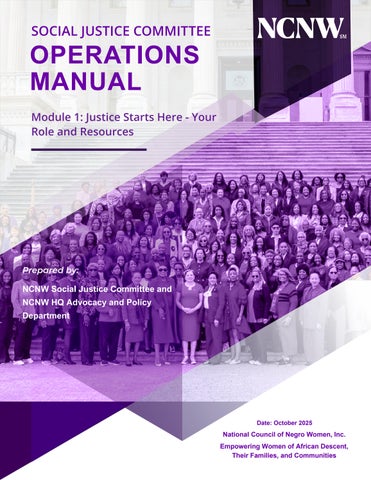
SOCIAL JUSTICE COMMITTEE
OPERATIONS MANUAL Module 1: Justice Starts Here - Your Role and Resources
Prepared by: NCNW Social Justice Committee and NCNW HQ Advocacy and Policy Department
Date: October 2025
National Council of Negro Women, Inc. Empowering Women of African Descent, Their Families, and Communities
2
Social Justice Operational Manual
CONTENTS Dedication Roles and Responsibilities Purpose What is Social Justice at NCNW? Duties of the National Social Justice Committee (SJC) How do Social Justice Committees Operate at the State Coalition/Section (Community and Collegiate) Level? Role of the SJC Chair on the State Coalition Level Role of the SJC Chair on the Community Section Level Role of the SJC Chair on the Collegiate Section Level Role of the President on the State Coalition Level Role of the President on the Community Section Level Role of the President on the Collegiate Section Level SJC Chair Criteria
NCNW Policy Foundations NCNW 2024 Resolutions NCNW Current Policy Priorities and Relevant Resolutions
Direct Action Planning and Execution Basic Calendar/ Potential Activation Days How to Use the NCNW Advocacy Action Form (AAF) Social Justice Action Guidelines NCNW SJC Advocacy Action Report NCNW Media Relations Guidelines
Legal Guidance On Activations and 501(c)(3) Restrictions
Appendix A: Full List of NCNW Affiliates Appendix B: Full Details of NCNW Current Policy Priorities and Relevant Resolution Healthcare Economic Empowerment Education Social Justice
3 4 4 4 5 5 6 7 8 9 10 10 11 12 12 13 14 14 15 17 17 18 20 21 23 24 24 27 29 30
3
Social Justice Operational Manual
T
hese guidelines are built on the legacy of Mary McLeod Bethune as a model for social justice activism, emphasizing education, self-reliance, community empowerment, and the fight for racial and gender equality. By focusing on Mary McLeod Bethune’s remarkable life and work, the National Council of Negro Women (NCNW) Social Justice Committee (SJC) will serve as powerful tools for education, reflection, and action, inspiring individuals to continue the fight for a more just and equitable world.
4
Social Justice Operational Manual
Roles and Responsibilities Purpose This operations manual is the first of a series of modules aimed at operationalizing state and section level social justice committees (SJC). This manual is specifically for the following: state coalition presidents, state coalition SJC chairs, section (community and collegiate) presidents, and section (community and collegiate) SJC chairs.
What is Social Justice at NCNW? The NCNW is committed to elevating social justice to transform systems, policies, and institutions so that they are equitable, inclusive, and enhance the lives of women of African descent, their families, and communities. Social justice within NCNW focuses on direct action to address the root causes of inequality and injustice. This includes: Advocating for legislative and policy changes that advance equity in healthcare, education, social justice, and economic empowerment. Organizing around systemic issues such as voter suppression, environmental justice, reproductive rights, and racial bias in the criminal justice system. Driving civic participation to guarantee Black women's perspectives shape leadership, governance, and policy decisions. Social justice at NCNW is not the same as direct service. While both are vital, they serve different purposes: | Direct service addresses immediate needs (e.g., food drives, coat giveaways, tutoring). Direct action aims not just to address immediate needs but to challenge and transform the underlying systems that create those needs in the first place by advocating for structural changes such as living wages, equitable education, and accessible healthcare for all.
5
Social Justice Operational Manual
Duties of the National Social Justice Committee (SJC) As outlined in the NCNW 2024 Bylaws, Article XI, Section 4N, the duties of the Social Justice Standing Committee are as follows: 1. Develop and implement social justice initiatives, advocate for policies that address systemic inequalities, and collaborate with local sections, affiliates, and community partners to promote equity and justice. 2. Educate NCNW members and the broader community on social justice issues and provide resources and support for advocacy efforts. 3. Approve NCNW Section and State Social Justice activity submissions as deemed necessary according to policies & procedures. 4. Screen, amend, and recommend resolutions. 5. Report all resolutions it receives and may report a resolution with “no recommendation.” 6. Reject resolutions that do not adhere to the published criteria. 7. Prepare and distribute proposed resolutions within thirty (30) days before the National Convention.
How do Social Justice Committees Operate at the State Coalition/Section (Community and Collegiate) Level? Each NCNW state coalition and section (Community and Collegiate) will establish a Social Justice Committee that aligns with the national agenda, mission, and values. The role is to review andsupport The NCNW core principles and NCNW Resolutions by identifying specific, actionable steps your section (Community and Collegiate) can take to advance equity and justice in your local, state, and national communities. This includes partnering with affiliates and/or local organizations, planning social justice activations, and connecting with local leaders to build relationships and advocate for long-term change. The work of SJCs should always reflect the organization’s commitment to access, equity, participation, diversity, and civil and human rights.
6
Social Justice Operational Manual
Direct action includes, but is not limited to: Meeting with your legislators on a national and state level A letter-writing or phone-banking campaign to address a social justice issue A candidate forum where all candidates have the opportunity to speak A community gathering to address a social justice issue An event to increase awareness about a social justice issue A protest to address a social justice issue, such as a freedom to learn rally You may NOT fundraise for or support a political candidate in your official capacity in NCNW as a member. There can be no use of NCNW symbols, stationary, etc. that can be used for such activities. You MAY fundraise or support a candidate in your personal capacity as an individual. Note: If your direct action or advocacy effort meets the NCNW Advocacy Action Form Criteria (see page 15), you must complete the NCNW Advocacy Action Form before the advocacy action and receive approval. This ensures we remain in compliance at the national level and protect the 501 (c) (3). Regardless of whether your action meets the criteria, you are required to submit the NCNW SJC Advocacy Action Report Form within 10 days after the activation. This helps us document impact, celebrate successes, and strengthen our collective advocacy work.
Role of the SJC Chair on the State Coalition Level The State Coalition SJC Chair serves as the leading representative of NCNW advocacy work at the state level. This role is central to advancing NCNW national social justice priorities through effective statewide coordination, strategic partnerships, and local engagement. Key Responsibilities: 1. Lead Statewide Social Justice Initiatives a. Align all state-level advocacy efforts with NCNW national social justice priorities. b. Develop and execute initiatives that respond to your state’s specific needs. i. Examples: 1. Attend and provide testimony at state legislative hearings that are approved by the national office. 2. Host candidate forums and public policy discussions 3. Lead or support initiatives that encourage voter registration, education, and turnout.
2. Build Strategic Relationships and Affiliate Partnership Development a. Establish and maintain relationships with: i. NCNW affiliate chapters and partner organizations within the state ii. Elected officials and their staff iii. Community leaders and issue-based coalitions b. Strengthen and support the growth of NCNW affiliates to increase coordination and collective impact.
7
Social Justice Operational Manual
3. Convene the Sections and Strengthen the SJC Infrastructure a. Lead the collaboration among section-level SJC Chairs to ensure a unified advocacy strategy for your state. b. Drive two-way communication by ensuring national directives reach local sections and local issues are elevated to the national team. c. Ensure state coalition advocacy activities support and reflect NCNW Bylaws, Policies, and the National Policy Agenda. 4. Facilitate Communication with National SJC a. Attend quarterly meetings with the National SJC to: i. Report state-level activities and developments ii. Elevate issues and concerns from the community and collegiate sections iii. Stay informed of national strategies and relay them back to local leaders. 5. Reporting and Compliance a. Submit the NCNW Advocacy Action Form as required. b. Complete the SJC Advocacy Action Report Form within 10 days of any advocacy activity. c. Ensure all state-level actions and events adhere to NCNW compliance standards and protocols.
Role of the SJC Chair on the Community Section Level The Community Section SJC Chair leads NCNW social justice work within their local community. This role is essential to advancing advocacy efforts on the ground while aligning with both state and national NCNW priorities. This role is accountable to both the State President and the National Social Justice Committee. Key Responsibilities: 1. Lead Local Social Justice Planning and Action a. Plan and execute social justice initiatives at the community level that reflect the NCNW mission and priorities.. b. Stay informed about local and state legislation, policies, and community concerns. c. Collaborate with other section committees to increase the reach and impact of social justice efforts. 2. Mobilize Local Members and Foster Participation a. Engage and mobilize section members and collegiate members around relevant social justice issues. b. Encourage participation in local campaigns, forums, service events, and issue-based outreach. c. Create opportunities for active member involvement in advocacy work. 3. Build Local Partnerships and Affiliate Partnership Development a. Cultivate relationships with local affiliate organizations, community leaders, and stakeholders. b. Strengthen the NCNW presence and voice within your community through sustained partnership-building.
8
Social Justice Operational Manual
4. Coordinate with the State Coalition a. Participate in your state coalition’s activities to ensure local initiatives support broader state and national strategies. b. Attend quarterly meetings with the state coalition to report on local activities and receive guidance. 5. Communicate Across the SJC Infrastructure a. Stay in regular communication with the State SJC Chair and other local section leaders to ensure consistency and alignment. b. Provide updates and share resources with your section’s membership and leadership. 6. Reporting and Compliance a. Submit the NCNW Advocacy Action Form as required. b. Complete the SJC Advocacy Action Report Form within 10 days of any advocacy activity. 7. Support the Nearby Collegiate Sections using the Collegiate Liaison a. If you have a collegiate section nearby, proactively connect with their leadership. b. Offer mentorship, coordination, and joint programming opportunities to strengthen their advocacy efforts and bridge intergenerational work.
Role of the SJC Chair on the Collegiate Section Level The Collegiate Section SJC Chair is the driving force behind NCNW advocacy efforts on campuses around the country. This role centers on mobilizing the student body, aligning activities with the NCNW mission and priorities, and fostering partnerships that extend beyond campus into the broader community. Key Responsibilities: 1. Lead Campus-Based and Community Social Justice Efforts a. Develop and implement advocacy initiatives that reflect the NCNW mission and are relevant to student populations. b. Focus on campus issues and policies while also connecting to NCNW national priorities. c. Integrate the Core Four (Education, Healthcare, Civic Engagement, and Economic Empowerment) into programming and events tailored to student interests and needs. 2. Mobilize Students and Promote Civic Engagement a. Engage students in social justice work through voter education, registration drives, issue-based forums, and direct action. b. Create opportunities for students to be active citizens on and off campus. c. Use creative, student-friendly approaches to raise awareness and increase participation in civic life.
9
Social Justice Operational Manual
3. Build Campus and Affiliate Partnerships a. Partner with campus organizations, departments, and local NCNW affiliate chapters to expand the impact of your work. b. Coordinate joint events, advocacy campaigns, or educational programs that reflect shared goals. c. Help establish or grow relationships between your collegiate section and surrounding communities. 4. Collaborate with Your State Coalition a. Attend quarterly meetings with the state coalition to report on collegiate actions and gain strategic insight. b. Align campus initiatives with the broader work of NCNW across your state. 5. Ensure Documentation and Reporting a. Submit the NCNW Advocacy Action Form and SJC Advocacy Action Report Form within 10 days of each activity. b. Make sure all campus actions are compliant with the NCNW guidelines and reflect its values and standards. 6. Stay Connected to the Nearest Community Section and Establish Collegiate Liaison a. As per the 2024 bylaws, the collegiate liaison will facilitate communication between the collegiate section and the community section b. Establish and maintain a working relationship with the nearest NCNW community section. c. Seek mentorship, collaboration, and alignment on initiatives that benefit both college and community members. d. Lead efforts to build intergenerational strength and sustainability in advocacy.
Role of the President on the State Coalition Level The State Coalition President provides direct support and guidance to the State Coalition SJC Chair. Key Responsibilities: 1. Appoint State Coalition SJC Chair based on established criteria. 2. Lead and support community and collegiate sections in advancing social justice initiatives. 3. Serve as the state’s primary spokesperson on social justice matters as guided by the national NCNW leadership (National Board Chair, President and CEO, and National SJC). 4. Act as liaison between the National Office, National Social Justice Committee, State SJC Chair(s), and Section Presidents.
10
Social Justice Operational Manual
If your section is in a state without an active coalition, please contact the SJC at socialjustice@ncnw.org.
Role of the President on the Community Section Level The Community Section President provides direct support and guidance to the Community Section SJC Chair. Key Responsibilities: 1. Appoint Community Section SJC Chair based on established criteria. 2. Raise awareness of local social justice concerns within the section and the broader community. 3. Inform and educate section members about the NCNW national social justice priorities and initiatives. 4. Build relationships with affiliate organizations and assist them in developing a local social justice agenda aligned with the NCNW mission. 5. Establish a working relationship with the president of the nearest NCNW Collegiate Section to encourage collaboration and intergenerational engagement.
Role of the President on the Collegiate Section Level The Collegiate Section President provides direct support and guidance to the Collegiate SJC Chair. Key Responsibilities: 1. Appoint Collegiate Section SJC Chair based on established criteria. 2. Raise awareness on campus about both campus-specific and local social justice concerns. 3. Inform and educate section members about NCNW national social justice priorities and initiatives. 4. Inform and educate members about NCNW national social justice agenda and how it connects to student issues 5. Build relationships with NCNW affiliates and other collegiate sections to support the development of a strong social justice agenda. 6. Establish a working relationship with the president of the nearest NCNW Community Section to encourage collaboration and intergenerational engagement.
11
Social Justice Operational Manual
SJC Chair Criteria The Presidents of the State Coalitions, Community Sections, and Collegiate Sections will use the following criteria to evaluate and appoint the most suitable candidate for your state coalition’s or section’s SJC Chair: Position Overview: The SJC Chair leads direct action and advocacy efforts that align with the NCNW mission to advance equity in economic empowerment, healthcare, education, and social justice. The SJC Chair is responsible for supporting and coordinating efforts based on the elevation of policies, legislation, and campaigns focused on women of African descent, their families, and communities. This leader mobilizes members, builds community partnerships, and ensures local action that supports the NCNW mission and goals. The ideal Chair is a visionary leader who is rooted in their community, inspiring others, supportive of building coalitions, and able to navigate challenges with care. Key Responsibilities: Lead social justice initiatives aligned with the NCNW mission and core policy priorities. Develop goals, strategies, and benchmarks to track progress in social justice endeavors. Build and maintain partnerships with community leaders, elected officials, and NCNW affiliates. Collaborate with SJC Chairs statewide and nationwide to support coordinated advocacy and coalition work. Maintain open communication with state coalition social justice committee chairs and the National Social Justice Committee Co-chairs. Recruit and lead your social justice committee, fostering collaboration, accountability, and alignment with NCNW goals. Collaborate with the fundraising team to secure resources and pursue grants that support the section’s social justice initiatives. Ensure compliance with 501(c)(3) rules Seek approval for advocacy actions and follow through with reporting advocacy actions to the National Headquarters. Time Commitment: This role requires a visible dedication to NCNW goals, with regular attendance at section, state, and national meetings. With the expectation to actively participate in events, and a commitment to engage with affiliates and community partners. This should be conveyed to whoever accepts this position. Qualifications: Expertise in social justice and the NCNW mission and policy priorities Collaborative leadership
12
Social Justice Operational Manual
Excellent communication skills Experience in community organizing, advocacy, and/ or civic engagement Ability to resolve conflict and lead with cultural competence and emotional intelligence Strong project management and strategic planning abilities Ability to maintain compliance with NCNW bylaws, policies, and 501(c)(3) regulations Note: This role is not suited for individuals with conflicts of interest, including but not limited to political candidates, those in polarizing positions, and those who might seek either.
NCNW Policy Foundations NCNW 2024 Resolutions The resolutions agreed upon during the NCNW Biennial Convention, held October 9–13, 2024, serve as guiding priorities for our advocacy and social justice work. These resolutions can be reviewed in full in our NCNW resource list on the NCNW Website. Economic Empowerment Diversity, Equity, and Inclusion Resolution Economic Justice to Close the Black Wealth Disparity Gap Equal Pay and Discrimination Against Black Women Education Freedom to Learn/Black History in Schools Resolution Increase STEM Education in Black Communities to Enhance the U.S. Economy Healthcare Reaffirming the organization’s Commitment to Reproductive Justice and Freedom Post Dobbs Black Male Mental Health Disparity Justice Building Vaccine Confidence Among African Americans Strengthening Mental Health and Well-being for Women and Girls Tobacco Control
13
Social Justice Operational Manual
Social Justice The CROWN Act to Prohibit Discrimination Based on Natural Hair, Protective Hairstyles in the World John Lewis Voting Rights Advancement Act-Protection and Expansion of Voting Rights and Voter Protections Missing and Murdered Black Women and Girls 60th Anniversary of Freedom Summer in Mississippi, 1965 Voting Rights and Black Women Resolution in Support of the Safer Supervision Act Protecting Our Legacy: Decreasing Gun Violence Against Black Women, Their Families, and Communities Against War and Its Collateral Damage on Women and Children
NCNW Current Policy Priorities and Relevant Resolutions Our current political environment across the country is rapidly evolving and, at times, volatile. While the NCNW core four issues remain central to our advocacy, we have expanded our focus to address the most urgent and emerging issues facing our communities today. These evolving priorities reflect what the NCNW Policy & Advocacy team is closely tracking at the national level, and they may take different forms in your local context. This summary is intended to strengthen your advocacy efforts by providing a framework grounded in both lived experience and strong policy analysis. All of our policy priorities are directly connected to NCNW resolutions. For a detailed breakdown of each priority area and the associated resolutions, please see Appendix B. Healthcare
Economic Empowerment
Chronic Diseases
Child Tax Credit
Health Equity
Equal Pay
Reproductive/Maternal Health
Housing
Mental Health
Bridging the Digital Divide
Nutrition and Food Insecurity
Workforce Development
Vaccine Access/Coverage
Employment and AI Fairness
14
Social Justice Operational Manual
Education
Social Justice
Freedom to Learn
Caregiving
Voting Rights
HBCU Funding and PBI Funding
Gun Violence
Civil Rights Protections in Online and AI Environments
Student Loans
Missing and Murdered Black Women
STEAM Education Digital Literacy and Skills Development
Human Trafficking
Veterans Affairs
Algorithmic Bias Surveillance and Privacy Protections
Direct Action Planning and Execution Basic Calendar/ Potential Activation Days Date
Event / Commemoration
January 15 (or 3rd Monday)
Martin Luther King Jr. Day
February (All Month)
Black History Month
March (All Month)
Women’s History Month
March 10
Harriet Tubman Day
March 13
Breonna Taylor Remembrance Day (2020)
March 24
Birthday of Dorothy Height (1912)
April (All Month)
National Minority Health Month Sexual Assault Awareness Month
April 7–13, 2025
Black Maternal Health Week
May (All Month)
Mental Health Awareness
May 1
International Workers’ Day (May Day)
May 17
Brown v. Board of Education Supreme Court decision (1954)
May 25
Anniversary of George Floyd’s Death
June (All Month)
Gun Violence Awareness Month
June 2
National Gun Violence Awareness Day (“Wear Orange”)
June 19
Juneteenth National Independence Day
July 2
Civil Rights Act of 1964 was signed into law
15
Social Justice Operational Manual
July 7- 11, 2025
Black Women’s Equal Pay Day Week of Advocacy
July 10
Birthday of Mary McLeod Bethune (1875)
August 6
Voting Rights Act of 1965 was signed into law
August 23
International Day for the Remembrance of the Slave Trade and Its Abolition
August 26
Women’s Equality Day (certification of the 19th Amendment, 1920)
August 28
Anniversary of The March On Washington (MLK - I Have a Dream Speech in 1963)
September 16, 2025
National Voter Registration Day
October (2nd week)
Reproductive Justice Week
October 4
National Day of Action for Missing and Murdered Black Women and Girls
October 15
Founding of the National Black Women’s Health Project (1983)
October (All Month)
Domestic Violence Awareness Month
October (All Month)
Breast Cancer Awareness Month
November 11
Veteran’s Day
December 1
World AIDS Day
December 5
Montgomery Bus Boycott begins (1955)
December 10
Human Rights Day
How to Use the NCNW Advocacy Action Form (AAF) If your state coalition or section wants to take action on a social justice issue and/or needs support from the National Office, you can submit a request using the NCNW Advocacy Action Form. This process helps bring important local issues to the attention of national leadership (National Board Chair, President and CEO, and National SJC). for review and possible activation. Step 1: Determine if You Need to Submit the Advocacy Action Form You DO need to complete the form if your state coalition or section is planning to: Participate in a political or candidate forum or training Provide testimony at a public hearing Host a candidate forum (all candidates need to be invited) Organize or join a protest or march
16
Social Justice Operational Manual
Hold a press conference or engage in media outreach Send out an action alert to your section membership Publicly support or oppose legislation Meet with an elected official or legislative body while representing NCNW Deliver public testimony on behalf of NCNW You DO NOT need to complete the form if your state coalition or section is planning: Nonpartisan voter registration activities Educational sessions or direct service projects not related to advocacy Step 2: Access the Form The Advocacy Action Form is available on the NCNW website Fill out the form with details about the issue and the type of support your Section is requesting. Step 3: What Happens After You Submit the Form Once the Advocacy Action Form (AAF) is submitted, a 5–7 business day review period begins. Days 1–3: National SJC Review The National Social Justice Committee (SJC) reviews the request. The National SJC submits its recommendation to the Advocacy & Policy (A&P) staff regarding approval or denial. Days 4–6: National Review & Final Determination The A&P staff reviews the request and consults with NCNW Legal, the CEO/President, and other designated leaders. Final approval or disapproval or editing is determined Day 6 or 7: Notification NCNW Headquarters notifies the member who submitted the form of the final decision and/or recommendations. Emergency Requests If the issue is urgent, mark it as an emergency on the form. The National Social Justice Committee will contact the General Counsel directly by phone AND email to fast-track the review. The GC will follow up with the applicant as soon as possible.
17
Social Justice Operational Manual
Oversight and Access All submitted forms will automatically be sent to a designated national email address. The National Social Justice Committee will maintain a monthly roster to track and monitor submissions.
Social Justice Action Guidelines When planning an event or activation, review this checklist:
*** AAF - Advocacy Action Form
NCNW SJC Advocacy Action Report This form must be completed by SJC Chairs whose sections have carried out an advocacy action. It allows the National SJC and NCNW HQ to track outcomes, measure community impact, and support future funding and organizing efforts. Here is the link: https://ncnw.jotform.com/251534095760054
18
Social Justice Operational Manual
NCNW Media Relations Guidelines NCNW President & CEO, NCNW General Counsel, NCNW Specified Department Vice President, NCNW Communications Department Designee, and, based on specific cases, an alternate spokesperson (Section/ Affiliate Presidents and the designated communications person of the Section/Affiliate will be able to speak to the media on half of NCNW. THE CHAIN OF COMMAND NCNW President & CEO NCNW Legal Counsel NCNW Specified Department Vice President NCNW Communications Department Designee NCNW Section/Affiliate President NCNW Section/Affiliate Communications Designee (as designated by the Section/Affiliate President) Each spokesperson will convey NCNW provided talking points provided. The Section/Affiliate spokesperson will: Speak on-the-record with local reporters from all prioritized media and Serve as primary quoted attribution in reference to a specified local initiative. All All spokespersons should be trained to present to the media by reviewing the prepared fact sheet and talking points, while participating in a mock interview that demonstrates they have a grasp of the information provided. Training for the spokesperson(s) can be administered by the communications staff at NCNW Headquarters in person or via zoom, whichever is most convenient. Understanding the media plays an essential role in informing the community and will do so with or without help, the number of media representatives request can reach 20 or more for information are likely to be made by phone or e-mail. Begin an inquiry log for requests for information from the media. This will help avoid overlooking callbacks and returning emails. The log will be shared with communications staff at NCNW Headquarters to vet which media opportunities are appropriate. We ask that all logs be presented no less than 72 hours to be able to have a timely response to media also while meeting their deadline. Assume the media knows nothing about NCNW. The spokesperson will educate the media on NCNW and any specified subject area. The most important members of the media are local reporters, who will be the main source of information for community members. All national and international media inquiries should be directed to the NCNW Headquarters, Communications Department.
19
Social Justice Operational Manual
When speaking to the media, stick to the talking points and keep your answers brief. Instruct media on gathering visual images as they cannot take pictures of participants of a Section sponsored event without consent. After the interview, monitor television, radio, print, internet coverage of the event(s). Collect copies of everything possible for current consideration of the need to respond, clarify or correct misinformation and later for organization and documentation of possible damages, litigation, response to the community, etc. Because NCNW is a 501(c)(3), designated spokesperson(s) cannot comment on political campaigns and/or cannot endorse political candidates. In the case of a crisis situation, Sections/Affiliates are to notify the NCNW President & CEO as soon as possible to give all details that pertain to the crisis. They are not to talk to media or make any statements until they hear from NCNW Headquarters, which might be the NCNW President & CEO, NCNW General Council, NCNW Attorney, and/or NCNW Chief Communications Officer. . SOCIAL MEDIA Communicating on social media platforms can be the most rewarding and cost-effective tool of public relations and marketing communications. We also want you to keep in mind a few rules when using social media, especially when engaging in grassroots efforts. They are: 1. Going live is not permitted without prior permission from NCNW Headquarters. So much that is not controllable can happen when going live; therefore, to keep control of real situations and moments in time, going live is not permitted without prior permission from NCNW Headquarters. It is best to function in the moment. 2. Don’t feed the trolls. Internet trolls are provocateurs who join discussions to bait others for an often not too nice response for their fun. Do not engage. 3. Don’t engage in patrician politics. NCNW is a 501(c)(3) organization, and we do not take party sides or endorse political candidates. Just stay away from this Fs. 4. Share responsibly. Make sure the information shared is true and factual. All posts should be representative of NCNW by always using proper grammar and punctuation and remembering that tone matters.
20
Social Justice Operational Manual
5. Think before you post. Again, nothing is private on social media. Please be mindful that the information you post is correct and appropriate. Respect your followers/audience in addition to the social platforms, their rules, for which you are posting. For questions or a need for additional information, please contact the NCNW Communications Department, comms@ncnw.org, 202-737-0120.
Legal Guidance On Activations and 501(c)(3) Restrictions I. Purpose and Scope This is intended to educate the Social Justice Committee on the legal boundaries of permissible public engagement under federal tax law applicable to 501(c)(3) organizations. It provides direction on how to responsibly and legally engage in advocacy, issue education, civic participation, and public events while safeguarding the tax-exempt status of NCNW. II. Legal Foundation: What Is a 501(c)(3) Organization Permitted to Do? Under the Internal Revenue Code (IRC), 501(c)(3) organizations such as NCNW are classified as charitable, educational, or religious organizations. They are afforded tax-exempt status with the following non-negotiable constraints: Absolute prohibition on political campaign activity (candidate-related activity). Limited lobbying permitted under IRS rules (subject to “insubstantiality” or the 501(h) election). Issue advocacy is allowed, provided it is nonpartisan and non-electoral. Civic engagement (e.g., voter registration) is permitted only if neutral and educational. Interacting with elected officials is allowed when done for educational or community purposes and not in connection with campaigns or elections. Important: NCNW does not engage in political campaigns, endorse candidates, or participate in any activity that may be perceived as partisan, including public demonstrations targeting elected officials or events designed to advance campaign-style goals. III. Key Definitions and Legal Interpretations 1. Political Campaign Intervention (Absolutely Prohibited) This refers to any direct or indirect action in support of or opposition to a candidate for elective public office. This applies before, during, and after official election periods. Prohibited Conduct Includes: Endorsing or opposing candidates or appointees by name.
21
Social Justice Operational Manual
Attending or co-hosting campaign-style rallies with elected officials. Using the name, logo, or signs of NCNW at political events. Not offering opposing political views equal time. Example: If a U.S. Senator hosts a rally to oppose a political appointee and includes NCNW signage, that is political campaign intervention—even if the Senator is currently in office. 2. Lobbying (Limited Permissibility) Lobbying is an attempt to influence specific legislation, either by directly communicating with lawmakers or urging the public to act. Types of Lobbying: Direct Lobbying: Direct communication with legislators about legislation. Indirect Lobbying (Grassroots Lobbying): Asking others to convey a message to legislators and governmental officials. Conditions for Permissible Lobbying: Must be insubstantial to NCNW activities Must be tracked and reviewed internally. Consider filing a 501(h) election for clearer IRS guidelines. Non-Lobbying Alternatives (this is preferred): Educational forums or briefings on issues (without mentioning bills or officials). Sharing policy research or analysis without urging action. 3. Issue Advocacy (Permissible with Guardrails) Issue advocacy is the communication of important topics to educate the public, not to support or oppose candidates or legislation. Permitted Example: “Black maternal health outcomes are worsening due to a lack of equitable access. NCNW supports efforts to expand culturally responsive healthcare.” Risky Example (Grassroots Lobbying): “We urge our members to call Senator Smith and oppose SB 1050.” Prohibited (Campaign Intervention): “We must support Senator Jones in her fight to stop Secretary Smith’s dangerous healthcare agenda.” Disclaimer: - Disclaimer: Certain actions led by the National office, such as national campaigns, federal advocacy efforts, or partnerships with external organizations, are governed by established processes and require coordination at the National level. These initiatives may not be replicated or
22
Social Justice Operational Manual
launched independently by sections. Any efforts that may overlap with national work will be reviewed by national leadership to ensure alignment, consistency, and compliance. 4. Interactions with Elected Officials (Non-Campaign Context) NCNW Sections may engage with public officials for community benefit, but these interactions must be strictly nonpartisan. Permissible Actions: Attend meetings to share concerns or policy suggestions. Hold briefings or events that do not reference elections. Recommended Language: “Thank you to Mayor Smith for taking the time to meet with us to discuss maternal health disparities. NCNW is a nonpartisan organization and does not endorse candidates.” IV. Trigger Terms: Internal Risk Flags That Require Escalation The following words or phrases in flyers, speeches, social media, signage, or press materials should trigger immediate review by NCNW Legal or Advocacy staff: High-Risk Triggers: “Elect [Name]” / “Vote for [Candidate]” / “Defeat [Candidate]” “Endorsement” “Kick-off tour” “Join us to protest [official’s name]” “Ballot initiative” or “Referendum” “Rally against [politician or appointee]” Use of the NCNW logo at political events Moderate to High Risk Triggers (Context Dependent): “Speaking out against [X]” (if X is a candidate) “Holding [X] accountable” during campaign periods “Campaign of resistance” or “Tour for justice” Events led by a single political figure aligned with a campaign agenda “Mobilize against [government agency]” or any messaging that reflects a partisan goal
23
Social Justice Operational Manual
V. Conclusion Compliance with 501(c)(3) restrictions is essential to the NCNW mission, reputation, and tax-exempt status. Sections should err on the side of caution and seek legal or internal review when in doubt.. Allowed: Host nonpartisan voter education and public forums. Share neutral, fact-based information. Conduct civic engagement efforts without endorsing candidates.
Meet elected officials for community-oriented discussions.
Use disclaimers like:
“NCNW is a 501(c)(3) organization and does not endorse candidates for public office.” Not allowed: Endorse or oppose candidates, appointees, or ballot measures. Host fundraisers in the name of NCNW for political candidates. Use NCNW resources (staff time, branding, social media) to support political campaigns. Participate in or attend campaign events on behalf of NCNW. Share or repost partisan content using NCNW communication channels. Display the NCNW logo on signs or materials at events with political messaging. Sign coalition letters targeting individuals unless reviewed for compliance.
Appendix A: Full List of NCNW Affiliates A National Affiliate Organization is a national women’s leadership and service organization, or the women’s division of such an organization, that has active chapters in at least five states. At the state level, NCNW sections are encouraged to build strong relationships with these affiliates. This includes attending their events and activations, inviting them to participate in your initiatives, and maintaining open lines of communication. These partnerships provide valuable opportunities for mutual learning, collaboration, and shared advocacy. By working together, NCNW sections and affiliates can strengthen their impact and more effectively advance social justice priorities across communities. The SJC Chair has the opportunity to partner with affiliates to join, create, and/or support advocacy efforts that align with our mission and purpose.
24
Social Justice Operational Manual
Alpha Kappa Alpha Sorority, Incorporated
Les Gemmes, Incorporated
American Federation of Teachers (AFT)
Sigma Gamma Rho Sorority, Inc. National Association of Black Social Workers Swing Phi Swing, Social Fellowship, Inc. National Assoc. of Negro Business & Prof. Women’s Clubs Tau Gamma Delta Sorority, Inc.
Auxiliary of the National Medical Association Chi Eta Phi Sorority, Incorporated Chums, Incorporated Continental Societies, Incorporated Delta Sigma Theta Sorority, Incorporated Eta Phi Beta Sorority, Incorporated Gamma Phi Delta Sorority, Inc. Iota Phi Lambda Sorority, Incorporated
Mocha Moms, Inc.
National Association of University Women National Bar Association, Women Lawyers Division National Black Nurses Association, Inc. National Coalition of 100 Black Women National Coalition on Black Civic Participation
National Women of Achievement, Inc.
The Charmettes, Inc. The House of the Lord Churches, Women’s Department The Links, Inc. & Links Foundation, Inc. Top Ladies of Distinction, Inc. Women’s Home & Overseas Missionary Society, AME Zion Church
National Delicados, Inc.
Women’s Missionary Council, CME Church
Ladies Auxiliary, Knights of Peter Claver
National Grand Chapter Order of Eastern Star
Women’s Missionary Society, AME Church
Lambda Kappa Mu Sorority
National Sorority of Phi Delta Kappa, Inc.
Zeta Phi Beta Sorority, Inc.
Jack and Jill of America, Incorporated
Las Amigas, Incorporated
Appendix B: Full Details of NCNW Current Policy Priorities and Relevant Resolutions
Healthcare Chronic Diseases Relevant Resolution(s): Tobacco Control; Reaffirming the NCNW Commitment to Reproductive Justice and Freedom Post Dobbs NCNW advocates for healthcare to cover treatments that help combat chronic diseases such as cancer, diabetes, obesity, and more. This includes advocating for the Treat and Reduce Obesity Act, which aims to provide medicare coverage for treatments that help with diabetes and obesity. Chronic diseases such as cancer, diabetes, sickle cell, asthma, and more disproportionately impact Black Americans. Due to disparities in care, chronic diseases are more prevalent among Black and low-income people. We also support the ban of menthol and flavored tobacco products, which include vapes and electronic cigarettes. These products contribute to the rates of chronic diseases in our community, especially among youth.
25
Social Justice Operational Manual
Addressing the disparities in care, chronic diseases are more prevalent among Black and low-income people. The coverage of medicines that treat these diseases is under Medicaid/Medicare, including advocating for the Treat and Reduce Obesity Act, which aims to provide medicare coverage for treatments that help with diabetes and obesity. Implementation of health programs based on the prevention of these diseases. Health Equity Relevant Resolutions(s): Reaffirming the NCNW Commitment to Reproductive Justice and Freedom Post Dobbs; Black Male Mental Health Disparity Justice; Building Vaccine Confidence Among African Americans; Strengthening Mental Health and Well-being for Women and Girls; Tobacco Control NCNW supports equitable access to healthcare and advocates for policymakers to ensure that healthcare is protected. We support universal access to healthcare, expansion of Medicaid/Medicare coverage, increased funding for research and treatment, proactive measures to address racial discrimination in healthcare, and the protection of reproductive rights. Universal access to healthcare Expansion to Medicaid/Medicare coverage Increased funding for research and treatment The protection of reproductive rights Proactively addressing racial disparities and bias in healthcare services Reproductive/Maternal Health Relevant Resolution(s): Reaffirming the NCNW Commitment to Reproductive Justice and Freedom Post Dobbs; Strengthening Mental Health and Well-being for Women and Girls Black women and women of color are disproportionately impacted by maternal mortality and morbidity. According to the National Institutes of Health (NIH), Black women are 3.3 times more likely to die from pregnancy-related causes than white women. According to the CDC, 80% of maternal deaths are preventable. NCNW advocates for increased funding and coverage for reproductive and maternal health and the implementation of management protocols for women dealing with postpartum conditions such as hemorrhages, hypertensive disorders, and cardiovascular disease. Increased funding and coverage for reproductive and maternal health. The implementation of management protocols for women dealing with postpartum conditions such as hemorrhages, hypertensive disorders, and cardiovascular disease. Resources to increase the number of care providers and offices in various states and localities that lack specialized reproductive and maternal care services.
26
Social Justice Operational Manual
Mental Health Relevant Resolution(s): Black Male Mental Health Disparity Justice; Strengthening Mental Health and Wellbeing for Women and Girls; Tobacco Control NCNW advocates for mental healthcare and for policymakers to take the necessary measures to address the mental health crisis. This includes increasing resources and funding for mental health facilities, professionals, and coverage, and ensuring mental health resources are provided in schools to help children with existing conditions. Furthermore, NCNW advocates for addressing the high suicide rates in the Black community and taking proactive measures to decrease the rates of suicide. The expansion of mental healthcare services Coverage of treatment for mental health in our healthcare system Funding for mental health facilities that are under-resourced Increasing mental healthcare in schools and ensuring that the proper professionals are available for children with mental health issues Nutrition and Food Insecurity Relevant Resolution(s): Reaffirming the NCNW Commitment to Reproductive Justice and Freedom Post Dobbs; Black Male Mental Health Disparity Justice; Strengthening Mental Health and Well-being for Women and Girls NCNW advocates for access to nutritional foods in Black communities. Low-income communities, often those that are disproportionately Black and Brown, fall into the category of food apartheid, meaning there is a lack of grocery stores with access to quality foods. Instead, there are usually only fast food restaurants, resulting in unhealthy food choices. This can contribute to the high rates of chronic diseases such as diabetes and obesity in the Black community. Furthermore, hunger amongst Black people is disproportionate, resulting in 1 and 5 Black people experiencing food insecurity. This includes Black children, 29% of whom live in foodinsecure households according to Feeding America. According to the Economic Research Service (ERS) by the U.S. Department of Agriculture (USDA), food insecurity is the limited or uncertain availability of nutritionally adequate and safe foods, or limited or uncertain ability to acquire acceptable foods in socially acceptable ways: Funding to address hunger in low-income communities Increasing access to healthy foods Funding for community gardens in areas with high rates of hunger Combating child hunger Vaccine Access/Coverage Relevant Resolution(s): Building Vaccine Confidence Among African Americans NCNW advocates for access to vaccines and coverage of vaccines, including coverage of vaccines under Medicare and Medicaid. U.S. vaccination rates for influenza, SARS-CoV-2 (COVID-19), and respiratory syncytial virus (RSV) remain below 50%. Existing healthcare disparities and misinformation regarding vaccines contribute to low vaccination rates in Black communities. Furthermore, these diseases impact Black communities at higher rates than other groups. NCNW supports:
27
Social Justice Operational Manual
The coverage of all vaccines under Medicare and Medicaid Increasing vaccine rates in Black communities, including other vulnerable populations Addressing vaccine misinformation through increasing health/healthcare literacy among vulnerable communities Increased diversity of health professionals
Economic Empowerment Child Tax Credit Relevant Resolution(s): Economic Justice to Close the Black Wealth Disparity Gap NCNW supports the Child Tax Credit and fair taxation to assist Black women and their families in achieving economic opportunities. The Child Tax Credit allows families to improve their economic standing: Offering credit opportunities to families who are caregivers to children with caregiving needs. Providing economic support to mothers and families, including low-income families Equal Pay Relevant Resolution(s): Diversity, Equity, and Inclusion; Economic Justice to Close the Black Wealth Disparity; Equal Pay and Discrimination Against Black Women NCNW supports equal pay for all regardless of race, gender, religion, or background. Advocating for equal pay at both the state and federal levels to close the wealth/wage gap and to end discriminatory payment practices and regulations is our central recommendation. In addition, NCNW supports: Equal wage/salary regulation Raising wages Wage transparency from employers Implementation of unbiased procedures when deciding wages Relevant Resolution(s): Economic Justice to Close the Black Wealth Disparity Gap; Equal Pay and Discrimination Against Black Women. NCNW advocates for fair and affordable housing for. We call on policymakers to address the housing crisis, as well as the discrimination that Black and Brown homebuyers/owners face in the housing market. This includes appraisal bias, which has become a common practice in the housing market. The Brookings Institution found that homes in majority-Black neighborhoods are about two times more likely to be appraised under the contract price than homes in majority-white neighborhoods. The study also found that homes in Black neighborhoods are valued roughly 21% to 23% below what their valuations would be in non-Black neighborhoods, resulting in $162 billion in cumulative losses for Black communities. Furthermore, we seek to address other forms of housing discrimination, including redlining and income discrimination.
28
Social Justice Operational Manual
Regulating real estate/rental companies to ensure that they don’t engage in discriminatory practices Addressing housing monopolies in urban centers Building more affordable and safe housing Repurposing unused spaces for affordable housing Bridging the Digital Divide Relevant Resolutions (s): Diversity, Equity, and Inclusion; Economic Justice to Close the Black Wealth Disparity Gap; Equal Pay and Discrimination Against Black Women Recognizing that the present digital divide is a glaring ( where does this divide exist??) representation of the differences in access to the internet and other communication technologies, we also recognize that the digital divide has a disproportionate impact on Black women, their families, and their communities. This digital divide exists not only in rural, low-income, and underserved urban areas. Specifically for Black households, approximately 40 percent, as opposed to 28 percent of White American households, don’t have high-speed, fixed broadband. In dense urban areas such as Chicago and Baltimore, Black households are twice as likely as their White counterparts to lack a high-speed internet subscription. In the rural South, 38 percent of Black households don’t have broadband, compared with 23 percent of White households, according to McKinsey. We affirm that reliable internet connectivity, digital literacy, and technological resources are necessary for full participation in today’s digital society. We support equal access to the internet for Black women and affirm that the digital divide is rooted in both affordability and the infrastructure to connect with broadband services. We call for more implementation of programs such as the Broadband Equity, Access, and Deployment Plan (BEAD), which will expand the availability of broadband infrastructure in underserved areas, as well as plans such as the Affordable Connectivity Program (ACP), which help to close the affordability gap. Workforce Development Relevant Resolutions (s): Diversity, Equity, and Inclusion; Economic Justice to Close the Black Wealth Disparity Gap; Equal Pay and Discrimination Against Black Women NCNW supports workforce development for women of African descent, their families, and their communities. This includes federal funding to bolster the workforce in low-income and disadvantaged communities. This includes: Directing government agencies to provide resources and opportunities for states and localities to fuel job creation Expansion to employment access, job training, education, and support services Employment and AI Fairness Relevant Resolutions (s): Diversity, Equity, and Inclusion; Economic Justice to Close the Black Wealth Disparity Gap; Equal Pay and Discrimination Against Black Women We emphasize the need for fair and unbiased use of artificial intelligence (AI) in employment practices. Without human intervention, it is easy for algorithms used in the recruiting process to reproduce bias from the real world. NCNW supports:
29
Social Justice Operational Manual
Regulations that prevent discrimination in hiring, promotion, and other employment-related decisions driven by AI. Transparency and accountability in AI systems to ensure that Black women have equal opportunities in the job market and are not subjected to unfair treatment by automated processes, nor are they displaced by these automated systems.
Education Freedom to Learn Relevant Resolution(s): Freedom to Learn/Black History in Schools NCNW supports the freedom to learn and advocates for the teaching of the history of marginalized groups, including Black History, in schools. We are against attempts to erase and rewrite the history of marginalized groups in the school system. Furthermore, we believe that the removal of books that promote diversity and proper representation of Black and Brown people is discriminatory. NCNW will continue to advocate for: The protection of Black history curricula in schools and the protection of curricula that teach about other marginalized groups. Prevention of book bans, especially books that promote diversity, equity, & inclusion. HBCU Funding and PBI Funding Relevant Resolution(s): Freedom to Learn/Black History in Schools; Increase STEM Education in Black Communities to Enhance the U.S. Economy NCNW advocates for increased funding to Historically Black Colleges and Universities (HBCUs) and Predominantly Black Institutions (PBIs). According to the American Council on Education, 54 percent of overall revenue at HBCUs comes from federal, state, and local sources, compared to 38 percent at non-HBCU institutions. NCNW supports increased government funding at all levels to strengthen HBCUs and PBIs. Student Loans Relevant Resolution(s): Economic Justice to Close the Black Wealth Disparity Gap NCNW advocates for lawmakers to take measures to decrease student loan debt and to make college more financially accessible. The financial disparity from student loan debt between Black and White students has tripled over the last 4 years, according to the Legal Defense Fund. This has further contributed to the obstacles that prevent Black people from building wealth. NCNW supports: Federal forgiveness of student loan debt Regulations of loan companies that carry out predatory lending practices. Increased federal funding to help cover education costs, as well as addressing practices within higher education institutions that have led to increased costs.
30
Social Justice Operational Manual
STEAM Education Relevant Resolution(s): Increase STEM Education in Black Communities to Enhance the U.S. Economy NCNW recognizes the need for and the critical importance of science, technology, engineering, arts, and mathematics (STEAM) education and STEAM mentorship in empowering and advancing Black women. We believe that access to STEAM education and mentorship opportunities should be open to all without systemic barriers. We are committed to a future where all Black women have equal opportunities in education and careers in STEAM. Digital Literacy and Skills Development Relevant Resolution(s): Increase STEM Education in Black Communities to Enhance the U.S. Economy Digital literacy and skill development are key to the empowerment of Black women in the digital age. NCNW supports: Efforts to make digital literacy training accessible and complete, including computer literacy, internet use, online safety, and technology skills. Advocating for digital education in schools, community centers, and workforce development programs that prioritize increased digital skills, to ensure Black women have the knowledge and skills needed to successfully navigate and thrive in the digital world.
Social Justice Caregiving Relevant Resolution(s): Economic Justice to Close the Black Wealth Disparity Gap; Equal Pay and Discrimination Against Black Women NCNW is committed to advocating for policies that support Black women caregivers and their families. Black women disproportionately serve as caregivers, balancing the demands of their own lives with the needs of their loved ones and others. This role often includes caring for children, elderly family members, and individuals with disabilities. The NCNW aims to address the unique challenges faced by Black women caregivers and to promote policies that provide the necessary support and resources for them to thrive. This includes: Advocating for an increase in funding and resources for caregivers and their families Increased resources for senior and early child care facilities Additional resources for individuals with disabilities and other special needs Gun Violence Relevant Resolution(s): Protecting Our Legacy: Decreasing Gun Violence Against Black Women, Their Families, and Communities; Missing and Murdered Black Women and Girls NCNW is dedicated to addressing the critical issue of gun violence, which disproportionately affects Black women and their families. Gun violence is a public health crisis that demands comprehensive and effective policy solutions. Our policy platform for gun violence prevention aims to reduce gun-related injuries and deaths through advocacy, education, and community engagement. Including:
31
Social Justice Operational Manual
Proactive measures to address gun and community violence through common-sense gun laws The prevention of gun access to individuals with a history of domestic violence Regulations of gun sellers who sell from private collections, and an expansion to background check requirements for the purchase of firearms Human Trafficking Relevant Resolution(s): Missing and Murdered Black Women and Girls; Against War and Its Collateral Damage on Women and Children NCNW is committed to addressing the grave issue of human trafficking, which disproportionately affects Black women and black youth. Black women and girls are more vulnerable to trafficking than other races, with 40% of all victims and survivors of sex trafficking found to be Black in a two-year study by the U.S. Department of Justice. Human trafficking is a violation of human rights and a form of modern-day slavery that must be eradicated. Our policy platform on human trafficking aims to prevent trafficking, protect survivors, and prosecute traffickers, while addressing systemic factors such as lack of quality education, lack of access to healthcare, and economic disparities such as high unemployment rates and homelessness among youth and women. We advocate for: Increased resources for law enforcement and communities to prevent human trafficking Increased education around human trafficking and prevention Resources for survivors of human trafficking, including housing access, healthcare, and traumainformed care Missing and Murdered Black Women Relevant Resolution(s): Missing and Murdered Black Women and Girls; Against War and Its Collateral Damage on Women and Children. NCNW is committed to addressing the crisis of missing and murdered Black women and girls. This issue represents a violation of human rights and a significant public safety concern. Our policy platform aims to advocate for the prevention of disappearances, improve response protocols, support affected families, and ensure justice for victims. Including: Improving the collection of data around missing and murdered Black women and girls The establishment of a special task force aimed at investigating and preventing violence against Black women and girls in the Department of Justice
32
Social Justice Operational Manual
Veterans Affairs Relevant Resolution(s): Economic Justice to Close the Black Wealth Disparity Gap; Equal Pay and Discrimination Against Black Women; Strengthening Mental Health and Well-being for Women and Girls; Reaffirming the NCNW Commitment to Reproductive Justice and Freedom Post Dobbs. NCNW is dedicated to supporting Black women veterans and their families. Black women serve in the military with honor and distinction, yet they often face unique challenges during and after their service. We aim to address these challenges, ensuring that Black women veterans receive the recognition, support, and resources they deserve. This includes: Resources to provide housing for veterans to address the homelessness crisis among veterans Job and educational opportunities for veterans who transition into civilian life Access to healthcare resources, including mental health and resources to address chronic diseases veterans may have contracted while serving. Voting Rights Relevant Resolution(s): John Lewis Voting Rights Advancement Act-Protection and Expansion of Voting Rights and Voter Protections; 60th Anniversary of Freedom Summer in Mississippi, 1965 Voting Rights and Black Women. One of the primary objectives of NCNW is ensuring that Black women and their families can vote and participate in our democracy without restrictions. Our voting rights policy initiatives aim to eliminate barriers, promote access, and safeguard the integrity of the system. This includes: Support for the passage of the John Lewis Voting Rights Advancement Act to address voter suppression Increase the registration of eligible voters Increase the number of polling locations Civil Rights Protections in Online and AI Environments Relevant Resolution(s): Increase STEM Education in Black Communities to Enhance the U.S. Economy NCNW recognizes the urgent need for protecting civil rights in online and AI environments. NCNW recognizes the critical importance of educating our community about the effects of artificial intelligence and digital technologies on civil rights. We are supportive of: Awareness campaigns and education programs that keep Black women informed about their rights in the digital spaces and provide resources to navigate issues arising out of AI and technology. A proactive approach, ensuring that policies adopted protect civil rights in the digital age, and also to save communities and individuals from being victims of misinformation and disinformation.
33
Social Justice Operational Manual
Algorithmic Bias Relevant Resolution(s): Increase STEM Education in Black Communities to Enhance the U.S. Economy; Diversity, Equity, and Inclusion; Economic Justice to Close the Black Wealth Disparity Gap; Equal Pay and Discrimination Against Black Women NCNW encourages regular auditing and review of algorithms currently in use and in development in decision-making to ensure that there is no bias incorporated and to ensure equity of outcome. We support: Regulation that combats artificial intelligence bias, particularly against Black women in all aspects of life, the workforce, criminal justice, healthcare, housing, education, etc. AI transparency. People have the right to be told when and how an AI system is going to be used within a decision-making process, such as job recruitment. For now, there are biases in facial recognition technology, employment screening, college admission decisions, social media, and handwashing sensor technology. Surveillance and Privacy Protections Relevant Resolution(s): John Lewis Voting Rights Advancement Act-Protection and Expansion of Voting Rights and Voter Protections; 60th Anniversary of Freedom Summer in Mississippi, 1965 Voting Rights and Black Women We understand the importance of protecting the privacy and civil rights of Black women and their communities in digital spaces. NCNW supports: Strong oversight and regulations that limit the use and scope of surveillance technology, including facial recognition technology, so that it does not disproportionately target or harm Black communities Strong and comprehensive data privacy legislation to protect the personal information of consumers and ban data brokers from participating in discriminatory practices. This includes the key principles from the model Civil Rights Act, which we believe should be incorporated into the American Privacy Rights Act (ARPA).
34
Social Justice Operational Manual
NOTES
35
Social Justice Operational Manual
NOTES
National Council of Negro Women, Inc. 633 Pennsylvania Avenue, NW Washington, DC 20004 www.ncnw.org