Nursery Landscape Publication of the North Carolina Nursery & Landscape Association, Inc.
2026 NCNLA
SCHOLARSHIPS Growing the Green Industry’s Next Generation
SUMMER 2026
Robert Cagle Memorial Golf Tournament
Aquatic Noxious Weeds
For more information visit us online at www.triangleturf.net © 2024 Triangle Turf & Ornamental. Please read and follow label directions for use.
20
Contents SUMMER 2026
Nursery & Landscape notes
COMMENTARY
INDUSTRY RESEARCH
President’s Message 4
Aquatic Noxious Weeds 30
Executive Vice President’s Message 5
Wood-Boring Insects 34
NCNLA NEWS
IN EVERY ISSUE
Certified Plant Professional Update 6
Calendar of Events 3
Future Plant Professionals 8
Advertisers Index 37
Robert Cagle Memorial Golf Tournament 10 Legislative Update 12
30
AROUND THE INDUSTRY Member Spotlight: G.D. Garris Lawn Care 16 From Paper to Place 18
COLLEGIATE CORNER Student Spotlight: Isaiah Palestino 20
22
Blue Ridge Community College 22 Wilkes Community College 24 2026 Scholarship Recipients 25
GROWING LEADERS Putting the ‘Culture’ Back in Horticulture 29
16
24
GET 4X UP TO
POINTS
ON SELECT PORTFOLIO FRESH PICKS
MARCH 16 - OCT 31, 2026
4X Online | 3X In-Branch
PREMIUM PLANTS. STAND OUT FROM OTHERS. When you’re serious about quality, turn to SiteOne’s exclusive Portfolio Nursery Collection. We offer unique, reliable, and readily available premium plants. Hand selected and regionally procured to deliver quality and varieties your customers expect. Get them at your nearest SiteOne Nursery Branch or delivered to your jobsite with Nursery Direct.
Scan The QR Code To Find Seasonal Specials Near You
NOT A PARTNERS PROGRAM MEMBER? Members enjoy exclusive rewards and benefits. Join for free today at SiteOne.com/Partners
Nursery & Landscape notes
NCNLA EVENTS
Published by
North Carolina Nursery & Landscape Association, Inc. 968 Trinity Road, Raleigh, NC 27607 NCNLA Staff Katie Bennett Executive Vice President Cyndi Lauderdale Director of Education Kathryn Stansbury Director of Business Development & Strategic Partnerships Wendi Doak Director of Marketing & Communications Rayna Bailey Operations Manager Nursery & Landscape Notes is published quarterly by the North Carolina Nursery & Landscape Association, Inc. (NCNLA), covering news, research, education and business in the nursery and landscape industries. The publication is distributed to approximately 825 horticulture producers, landscape professionals and industry suppliers. Nursery & Landscape Notes is provided as a member service.
Visit www.ncnla.com for more information.
CPP Exam: Live Plant Exam September 16 Raleigh, NC
CPP Review October 15 Asheville, NC
CPP Exam October 16 Asheville, NC
Green & Growin’ 27 January 18-22, 2027 Greensboro, NC
Save the date!
INDUSTRY EVENTS NALP’s ELEVATE November 8-11, 2026
Tampa, FL www.landscapeprofessionals.org/ELEVATE
2026 NCNLA Board of Directors Officers
Directors
Jon Schwarz President Pender Pines Garden Center Hampstead, NC
Hunter Casey Casey Nursery Inc. Goldsboro, NC
Art Miller Vice President/ Secretary/Treasurer Carolina Creations Landscapes Inc. Shallotte, NC Dana Massey Past President Plantworks Nursery Rougemont, NC
Meredith Croom Grants Creek Nursery Jacksonville, NC John Gossett Gossett’s Landscape Nursery Inc. High Point, NC Dylan Gragg North 40 Nursery Morganton, NC
Jason Tebben Savatree/ Arborscapes Pineville, NC
ON THE COVER
Educational Advisors Jason Davis University of Mount Olive Mount Olive, NC Mark Weathington JC Raulston Arboretum Raleigh, NC
Todd Lange Gregory Poole Equipment Company Raleigh, NC
Advertising For advertising inquiries and publication schedule, please contact Wendi Doak at wdoak@ncnla.com or 919-819-9119, ext. 1002. The inclusion of products or brand names in this publication is not an endorsement by the North Carolina Nursery & Landscape Association. Mission: To provide essential value to our members through education, marketing, and advocacy. Vision: To promote and protect the interests of North Carolina’s green industry. Connect with NCNLA facebook.com/NCNurseryandLandscapeAssociation instagram.com/ncnla ncnla.com | BuyNCPlants.com | GreenandGrowin.com
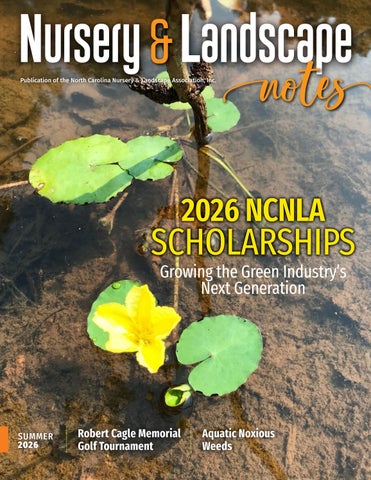
Yellow floating heart (Nymphoides peltata), an invasive aquatic weed, features heart-shaped leaves with scalloped edges and bright yellow flowers. Photo: Jared Driscoll, NCDA&CS
Learn more about this species in the “Aquatic Noxious Weeds” article on page 30.
Dues Contributions or gifts to NCNLA are not tax deductible as charitable contributions. However, they may be tax deductible as ordinary business expenses. A portion of your dues is not deductible as an ordinary business expense to the extent that NCNLA engages in lobbying. The estimated non-deductible portion of your dues assessment is 20%. ©2026 NCNLA
SUMMER 2026 || NURSERY & LANDSCAPE NOTES
3
NCNLA PRESIDENT’S LETTER
Changing the Conversation About Landscapes As summer ramps up, so have the drought conditions across almost the entire state and much of the Southeastern United States. Water supplies and electrical grids are being put to the test in this extreme heat, and as horticultural professionals we are the first to recognize and see the effects of these weather events. We are also typically the first to feel the impacts, both in our daily operations and in our sales. Landscape irrigation is almost always one of the first things to be restricted or completely cut off by local municipalities during drought conditions. Unfortunately, the message the public receives from such restrictions is that our landscapes are not a necessity. That makes our industry look like a burden or a luxury — one that only takes water away from the public. I feel this is one of the biggest challenges, and also one of the biggest opportunities, for the green industry. The message we need to be speaking loudly is that we are here to help and make a difference. The green industry has more influence on Jon Schwarz water use, infiltration, reclamation, and even the electrical grid than most people Pender Pines realize. Everyone knows we use water, but we need to educate people on how we also Garden Center help save water and reduce energy use. As an industry, for example, we have always innovated and found ways to do more with less through efficient practices like drip irrigation and pot-in-pot nursery production. As a student of landscape horticulture student at NC State, the principles of green infrastructure and sustainability were drilled into me. However, that knowledge is still almost completely foreign to the general public. The average person doesn’t realize how much our landscapes influence and help manage extreme temperatures, droughts, and floods, or how landscapes can lessen the effects of such weather events. When we design landscapes, we need to use the principles of passive solar savings by planting shade trees that keep parking lots, buildings, and rooflines shaded in the summer, while allowing sunlight through in the winter. Just imagine the vast amounts of energy savings (and business) we could create if all new developments were required to have truly sustainable landscape plans built around those principles. Acres of residential property with multiple layers of vegetation aren’t just prettier — they help keep the environment cooler, absorb rainfall, and even improve mental health. We should continue educating ourselves and the public about better lawn care practices, such as allowing grass to grow longer between mowings instead of cutting it so short that the soil is left exposed. We also need to teach proper irrigation practices, including deeper, less frequent watering, as well as gradually weaning mature landscapes off irrigation when appropriate. All of this is made possible through professional design and installation by maintenance companies dedicated to putting the right plants in the right places, creating landscapes that are more than something we simply pass through in our daily lives. NCNLA has always been about educating, supporting our industry, and bringing attention to the many benefits we provide to North Carolina and beyond. So, I’m asking all of us to speak up, educate the public whenever we can, and continue doing the outstanding professional work we do.
Jon
4
NURSERY & LANDSCAPE NOTES || SUMMER 2026
NCNLA EXECUTIVE VICE PRESIDENT’S LETTER
Growing Through the Heat As I write this, much of North Carolina continues to experience a summer of intense heat and persistent drought. For many of our members, these aren’t simply weather headlines, they’re daily operational challenges. From managing irrigation and crop stress to balancing installation schedules and protecting crews from extreme temperatures, this season has tested every corner of our industry. To help members stay informed, NCNLA has added a link on www.ncnla.com (under the Resources menu) to North Carolina’s “How Hot is Too Hot?” Heat Health Alert System, where you can sign up to receive localized heat alerts and safety information for your area. We encourage you to take advantage of this free resource to help protect your employees and plan work safely during periods of extreme heat. Despite these challenges, our industry continues to demonstrate the resilience, Katie Bennett NCNLA Executive Vice President
Katie
innovation, and professionalism that define North Carolina’s green industry. While navigating this busy season, NCNLA is working to strengthen our industry through education and professional development. One exciting milestone this fall is the return of live plant identification for the North Carolina Certified Plant Professional exam. Working in partnership with the North Carolina Department of Agriculture & Consumer Services (NCDA&CS), we are excited to reintroduce live plant material for the plant identification portion of the exam on September 15 in Raleigh.
Since 2021, the plant identification portion of the exam has utilized photographs to ensure consistency during testing. While that format served candidates well and will continue, we’re pleased to once again offer a live plant option. We’re grateful to NCDA&CS for partnering with us to make this enhancement possible, and we look forward to welcoming this year’s candidates. As summer comes to a close, I’d also like to remind you that NCNLA membership renewals are just around the corner. All memberships expire on September 30, and we hope you’ll join us for another exciting year of education, marketing, and advocacy. You should have recently received a renewal packet by mail that includes your membership renewal form and a contact information update form. We encourage you to complete and return the packet or renew online — whichever is most convenient for you. We’re also excited to introduce ACH payments as a new payment option for membership renewals and event registrations. This secure and convenient option will be available during the renewal process, and we encourage you to take advantage of it. Your membership is what allows NCNLA to advocate for our industry, provide valuable educational opportunities, strengthen relationships with policymakers, and support the continued growth and awareness of North Carolina’s green industry. Thank you for your continued investment in our association. I hope you enjoy this issue of Nursery & Landscape Notes. Together we are building a stronger future for North Carolina’s green industry.
SUMMER 2026 || NURSERY & LANDSCAPE NOTES
5
NCNLA NEWS
Certified Plant Professional Update Are you up for CPP renewal? Check your NCNLA profile to confirm your renewal date. NCNLA would like to thank Laura Ponder and Rachel Meriwether of Blue Ridge Community College for hosting the Certified Plant Professional (CPP) exam on May 4, 2026. This was the first time the CPP was administered and offered through an online platform. NCNLA held the CPP review and exam at the Tuckaseegee Arboretum and Gardens at the City of Charlotte Landscape Management facility. Special thanks to Brody Butler and the City of Charlotte Landscape Management staff, who helped host and carry out this two-day event. The support of host CPP exam sites has allowed NCNLA to continue to offer CPP exams in various parts of the state, making testing more accessible to the industry. Congratulations to the following individuals who have earned their CPP accreditation: Lisa Barbera — Orris LLC Jenna Bowman Stacey Longshore — Outdoor Images Management Marie McFadden Daniel McMullen — Blue Ridge Community College
Audrey Miller — Metrolina Greenhouses Elizabeth Oldham — Blue Ridge Community College Cassia Owen — Blue Ridge Community College Stephanie Staropoli McDowell — Blue Ridge Community College Kimberly Yurkovich — Blue Ridge Community College
Cyndi Lauderdale, NCNLA Director of Education, leads the CPP review class in Charlotte.
Brody Butler, City of Charlotte, reviews live plants in the Tuckaseegee Arboretum for the CPP exam.
All upcoming 2026 CPP review and exam dates are located at www.ncnla.com/events. Please note that we are offering a live plant identification exam this year. For more information about the CPP program, to renew/reinstate your CPP certification, or to register for an upcoming exam, visit www.ncnla.com/CPP or email cpp@ncnla.com. 6
NURSERY & LANDSCAPE NOTES || SUMMER 2026
Lemon Glow
Fire Falls
C.M.Wilson
Rosea Superba
CAM TOO CAMELLIA NURSERY, INC.
Grown with Love - Sold with Pride Bernice Boddy
l
Cold Hardy Zone 6 l Cold Tolerant Zone 7 l New Hybrid Zones 8 & 9
Londontowne Blush
Wholesale Only (800) 758-8121 www.camtoocamellia.com 805 Oakbury Ct., Greensboro, NC 27455 camtoo@earthlink.net
Jacks
Adeyaka
Dad’s Pink
Dream Weaver
SUMMER 2026 || NURSERY & LANDSCAPE NOTES
7
NCNLA NEWS
Future Plant Professional Spring 2026 Update Dr. Jason Davis Assistant Dean of Biological Sciences University of Mount Olive
The spring 2026 academic period represented the second semester in which North Carolina public school teachers were able to provide opportunities for students through the Future Plant Professional (FPP) program, an industry-recognized credential developed and endorsed by NCNLA that also serves as proof of learning for Horticulture II — Landscape Construction. In terms of career readiness and technical education, policymakers and academic leaders often focus on credentials across various fields of study that equip students with skills and experience, thereby setting them apart from their peers. Within the horticultural industry, the private Pesticide Applicator License previously was the only state-recognized credential available to horticulture students, leaving opportunities and federal funding for industry-recognized credentials out of reach for many. Years ago, NCNLA offered the Certified Young Plant Professional (CYPP) credential, which was designed as an entry-level recognition for high school horticulture students. However, challenges related to testing and inconsistencies among classroom curricula limited the program’s growth and long-term success. In response, the NCNLA Board of Directors and staff put together a committee of horticulture educators to develop a new credential that uses current technology, aligns closely with classroom instruction, and recognizes student achievement. The result of these efforts was the FPP, an industry-recognized credential designed to provide a stronger entry point into the green industry while supporting students on their path to becoming a Certified Plant Professional (CPP). 8
NURSERY & LANDSCAPE NOTES || SUMMER 2026
The FPP acts as a solid stepping stone for students who have shown interest in one of the green industry’s many aspects and who have more than a basic understanding of plant identification, hardscape, plant installation, turf, etc. This introductory step helps prepare students for progression toward becoming a “master craftsman” in the industry, making the path from FPP to CPP clearer and more intentional. This spring, 614 students completed the FPP exam, with 282 earning their FPP credential — a 52% success rate. Since the program’s inception in Fall 2025, NCNLA has awarded 471 FPP credentials.
As momentum behind the FPP continues to grow, many instructors are either renewing their CPP certifications or preparing to take the CPP exam for the first time. Since the FPP program’s inception, NCNLA has created numerous resources to help teachers prepare high school students for the FPP exam. In addition, during summer 2026 the University of Mount Olive will host a free online training focused on CPP and FPP plant identification. For more information on the Future Plant Professional program, please visit https://ncnla.com/page/FPP.
NC HIGH SCHOOL LANDSCAPE
COMPETITION FEBRUARY 19–20, 2027
Presented By
The NC High School Landscape Competition aims to inspire, educate, and acknowledge high school students pursuing careers in the industry by offering a rigorous, hands-on, and industry-aligned competition that promotes skill development, professionalism, and networking. Hosted at:
Sandhills Community College 3395 Airport Road Pinehurst, NC 28374
Contact the 2027 Hosts: Hilarie Blevins blevinsh@sandhills.edu 910-695-3885 Ginny Ferguson fergusonv@sandhills.edu 910-695-3882
Cooperating Institutions
Scan to Learn More
NCNLA NEWS
NCNLA
2026 Robert Cagle Memorial Golf Tournament Driving the Future of the Green Industry
O
n Monday, June 15, NCNLA members and industry partners gathered at Lochmere Golf Club in Cary, NC, for the 2026 Robert Cagle Memorial Golf Tournament. The annual event once again brought together friendly competition, meaningful connections, and a shared commitment to supporting the future of North Carolina’s green industry. Held in memory of Robert E. Cagle, the tournament celebrates his passion for education and his dedication to helping students pursue careers in horticulture and landscaping. Every swing, sponsorship, and registration helps strengthen the NCNLA Scholarship Fund, providing financial assistance to deserving students who are preparing to become the next generation of industry professionals. The tournament continues to thrive thanks to the generosity of Kevin and Robby Cagle, who host the event each year in memory of their father — along with the many sponsors, volunteers, and participants whose support makes the day possible. Their commitment reflects the spirit of an industry that believes in investing in those who will shape its future. Congratulations to Our 2026 Winners The competition was spirited throughout the day, with golfers enjoying great weather, friendly rivalry, and plenty of memorable moments. In addition to the on-course contests, participants also had the opportunity to relax with complimentary chair massages provided by The NOW Massage — Midtown Raleigh/Wake Forest.
10 NURSERY & LANDSCAPE NOTES || SUMMER 2026
Congratulations to this year’s winners: Individual Contests • Longest Putt— No. 1: Joe Ritchie • Longest Putt — No. 2: Kellen Summers • Closest to the Pin: Gene Queen • Longest Drive: Gene Queen Team Awards • 1st Place — Gross: Brad Rollins, Jason Workman, Andy White, and Chris White • 1st Place — Net: Jeremy Shaver, Luke Shaver, Charlie Shaver, and Nate Crisco Each member of the Gross and Net championship teams received a $100 cash prize in recognition of their outstanding performances. Thank You to Our Sponsors The Robert Cagle Memorial Golf Tournament would not be possible without the generous support of our sponsors and participating companies. Their contributions help make scholarships possible for students pursuing careers in horticulture, nursery production, landscape management, and related fields. NCNLA extends its sincere appreciation to every golfer, sponsor, and volunteer who helped make this year’s tournament a success. Your support honors Robert Cagle’s legacy while creating opportunities for future leaders of the green industry.
ROBERT CAGLE MEMORIAL GOLF TOURNAMENT
A special THANK YOU to our sponsors! Hole Sponsors Bland Landscaping Carolina CAT Cyn-Mar Fairview Garden Center Greenthumb Nursery Gregory Poole Hackney Nursery Hills Machinery másLabor Nature’s Select Nature’s Vision New Garden Landscaping NurserySouth Piedmont Carolina SiteOne Spivey’s Nursery T.H. Blue Worthington Farms Breakfast Sponsor Morris Newlin Nature’s Vision Lunch Sponsor SiteOne Beverage Cart Sponsor Flatlands Insurance Group Closest to the Pin Sponsor Stone Center Longest Drive Sponsor Greenleaf Services Longest Putt Sponsor NCNLA Chair Massage Sponsor Greenthumb Nursery Provided by The NOW Massage — Midtown Raleigh/Wake Forest
SAVE THE DATE! June 14, 2027 We look forward to welcoming everyone back next year for another day of golf, fellowship, and giving back. To learn more about the NCNLA Scholarship Fund or future fundraising events, visit www.ncnla.com or contact the NCNLA office at info@ncnla.com.
Congratulations to the Winners!
Longest Putt — No. 1
From left: Kevin Cagle, Joe Ritchie and Robby Cagle.
1st Place — Gross
From left: Kevin Cagle, Jason Workman, Andy White, Chris White and Robby Cagle. Not pictured: Brad Rollins.
Closest to the Pin & Longest Drive From left: Kevin Cagle, Gene Queen and Robby Cagle.
1st Place — Net
From left: Kevin Cagle, Jeremy Shaver, Luke Shaver, Charlie Shaver, Nate Crisco and Robby Cagle.
Not pictured: Kellen Summers, Longest Putt — No. 2 winner
As Seen on the Green
SUMMER 2026 || NURSERY & LANDSCAPE NOTES
11
NCNLA NEWS
NCNLA Recognizes Rep. Jeffrey McNeely While Momentum Builds for Agricultural Workforce Reform Katie Bennett Executive Vice President, NCNLA
NCNLA continues to strengthen its voice for the green industry through advocacy at both the state and federal levels. This summer, those efforts were highlighted by recognizing a legislative champion in North Carolina while celebrating significant progress on one of our industry’s highest federal priorities: agricultural workforce reform.
Rep. Jeffrey McNeely Named NCNLA Friend of the Industry
During an NCNLA PAC fundraiser on Aug. 4, NCNLA proudly presented the Friend of the Industry Award to North Carolina Representative Jeffrey C. McNeely, in recognition of his steadfast support of North Carolina’s nursery and landscape industry. Rep. McNeely has consistently demonstrated a willingness to listen to and understand the challenges facing green industry businesses. No stranger to the agriculture industry, Rep. McNeely earned his B.S. in Agricultural Economics from
NC State University and manages his family business, G&M Milling Co. His accessibility, leadership, and commitment to agriculture make him a deserving recipient of this year’s award. He was, and continues to be, a strong supporter of Hurricane Helene relief efforts, advocating for assistance to Western North Carolina nurseries as they recovered from devastating storm damage, helping ensure that the industry’s needs were part of the broader recovery conversation. NCNLA extends its sincere appreciation to Rep. McNeely for his continued partnership and dedication to strengthening one of North Carolina’s most important industries.
Major Progress on the Securing Agriculture’s Workforce Act
At the federal level, agriculture reached a significant milestone this summer with the introduction of H.R. 9535, the Securing Agriculture’s Workforce Act (SAWA) by House Agriculture
(Left to Right): Chris Butts, Georgia Fruit and Vegetable Growers Association; Linda Pryor, NC Apple Growers Association and Blue Ridge Apple Growers Association; Samantha Youb, International Fresh Produce Association; Kimberly Foley, Tobacco Associates, Inc.; John Hollay, National Council of Agricultural Employers; Blake Thaxton, Alabama Fruit and Vegetable Growers Association; and Linda Andrews, NC Farm Bureau. 12 NURSERY & LANDSCAPE NOTES || SUMMER 2026
Rep. Jeff McNeely receives NCNLA’s Friend of the Industry Award during the NCNLA PAC Fundraiser at Jericho Farms in Pikeville, NC, on August 4, 2026.
(Left to Right): Michelle Grainger, NC Sweetpotato Commission; Kimberly Foley, Tobacco Associates, Inc.; U.S. Representative Glenn “GT” Thompson (PA-15); and Olivia Gyapong, Virginia Farm Bureau.
Committee Chairman G.T. Thompson (R-Pa.). The bipartisan legislation represents years of collaboration among agricultural organizations working to modernize the H-2A Temporary Agricultural Worker Program and establish a more stable, predictable workforce for American agriculture. For the first time in nearly four decades, there is meaningful momentum in Congress to modernize the H-2A program. The current law has remained largely unchanged since 1986, despite dramatic changes in agriculture and a nearly fourfold increase in H-2A participation over the past decade. Outdated eligibility requirements, an unpredictable wage structure, and a fragmented application process have created unnecessary costs and workforce uncertainty for employers across specialty agriculture. SAWA seeks to address these long-standing challenges by expanding program eligibility, establishing greater wage certainty, and streamlining the administrative process so employers can more efficiently access the workforce they need. Since 2025, NCNLA has proudly been a member of the Ag Wage Reform Coalition alongside 36 participating organizations. In North Carolina, coalition partners include the North Carolina Apple Growers Association, Blueberry Council, Christmas Tree Association, Strawberry Association, Sweetpotato Commission, Tobacco Growers Association, Tomato Growers Association, Vegetable Growers Association, Watermelon Association, and many others. Together, these organizations are speaking with one unified voice to advance practical agricultural labor solutions. To learn
more about the Ag Wage Reform Coalition and its efforts, visit agwagereform.com. NCNLA has also worked closely with AmericanHort, answering every call to action and supporting its advocacy efforts throughout the legislative process. As an NCNLA member, you should be receiving regular Lighthouse Partner advocacy alerts from AmericanHort. If you are not receiving these updates, please contact the NCNLA office to ensure you stay informed about opportunities to engage with lawmakers.
What SAWA Means for the Green Industry
Several SAWA provisions would have a direct and positive impact on North Carolina’s nursery and landscape industry, including: • Expanding H-2A eligibility to include redefining the term agricultural labor or services. The bill aims to include the handling, planting, drying, packing, packaging, processing, freezing, or grading of any agricultural or horticultural commodity in its unmanufactured state, without regard to the ownership or location of such facilities or activities; the transportation and preparation for transportation of any agricultural or horticultural commodity, in its unmanufactured state from the farm to the place of storage, first processing, or first marketing; and the installation of horticulture commodities. • Extending the allowable employment period for H-2A workers by removing the outdated seasonal work requirement, while retaining the temporary nature of employment (350 days or less). • Modernizing and streamlining the H-2A application and certification process through a centralized online application system. • Providing long-term wage certainty by codifying the current Adverse Effect Wage Rate (AEWR) methodology. SUMMER 2026 || NURSERY & LANDSCAPE NOTES
13
NCNLA NEWS Together, these reforms would provide greater certainty in planning projects, retaining skilled employees, and meeting customer demand throughout longer growing and installation seasons. Following SAWA’s introduction, members of the Ag Wage Reform Coalition met with Chairman Thompson to thank him and the House Agriculture Committee for their leadership on agricultural workforce issues, and to discuss the path forward. The coalition asked a simple but important question: How can we help get SAWA across the finish line? Chairman Thompson’s response focused on two priorities: • Expand support. Continue growing the coalition by encouraging members of Congress, agricultural organizations, businesses, community leaders, and citizens from every political background and region to publicly support the legislation. As Chairman Thompson emphasized, “We need it to be so BIG, it can’t FAIL.”
• Educate the Judiciary Committee. Help ensure members of the Judiciary Committee understand that agricultural workforce reform is about more than labor policy — it’s about strengthening America’s food security, which ultimately strengthens our national security.
Looking Ahead
The introduction of SAWA marks an important milestone, but significant work remains before the legislation becomes law. After advancing through the House, the bill must still pass the U.S. Senate before it can be sent to the president. With a limited legislative window before Congress adjourns ahead of the midterm elections, continued advocacy over the coming months will be critical. NCNLA will continue working alongside AmericanHort, the Ag Wage Reform Coalition, and other agencies to advocate for commonsense workforce policies that strengthen North Carolina’s green industry. Now is the time for all members
7801 Clinard Farms Road High Point, NC 27265 WWW.GOSSETTSNURSERY.COM
(336) 454-2548
1-800-487-2555
Fax: (336) 454-6347 Email: sales@gossettsnursery.com
Located: 5 miles west of Greensboro, on NC 68, two miles south of I-40
14 NURSERY & LANDSCAPE NOTES || SUMMER 2026
to make their voices heard. We encourage you to contact your U.S. Representative and Senators and ask them to support the Securing Agriculture’s Workforce Act. Personal stories from growers, landscapers, garden centers, and allied businesses help lawmakers understand why workforce reform is essential to the future of our industry. When opportunities arise to contact lawmakers, share your story, or participate in grassroots advocacy, we encourage every member to get involved. Together, by speaking with one unified voice, we can help ensure that North Carolina’s growers, landscapers, garden centers, and allied businesses have access to the workforce they need to continue growing our industry and serving communities across the state.
CONTACT YOUR REPRESENTATIVE
NCNLA’s mission is to provide essential value to our members through education, marketing and advocacy.
Growing People. Growing Business. Growing North Carolina. ncnla.com
AROUND THE INDUSTRY
NCNLA MEMBER SPOTLIGHT
»
Five Minutes with Glenn Garris, G.D. Garris Lawn Care
G.D. Garris Lawn Care LLC Charlotte, NC Owner/operator Glenn Garris In business Since 1983 Number of employees 5 Member of NCNLA Since 2008 Favorite offerings from NCNLA Green & Growin’ show and continuing education programs
How did you get into the business? When I was around 12, I needed to earn money to attend Boy Scout camp. So, I went door to door in the neighborhood with my 20-inch push mower, knocking on the doors of people my family knew and asking if I could cut their lawn for two dollars (the yards in that neighborhood were about quarter-acre lots). Edging with handheld clippers, which I did on my hands and knees with those old-fashioned knife-blade clippers, was an additional 50 cents. Those were the days. I joined the Charlotte Fire Department in 1979, and in 1983 I started my business as a permanent side hustle. When I retired in 2007, my business became my new full-time job, and I’ve been full steam ahead ever since. What is a typical day like for you and your staff? My day starts around 5:00 AM with a trip to the warehouse to pick up equipment, a stop for breakfast, and 16 NURSERY & LANDSCAPE NOTES || SUMMER 2026
What have you gained from your involvement in the NCNLA? Through NCNLA I was able to take the necessary steps (and tests) to become a registered landscape contractor and Certified Plant Professional. That opened some doors that had previously been closed to me. I also value the relationships I have formed with other NCNLA members over the years. It’s good to be able to just talk things out with somebody who really understands what you’re up against in this business. I’ve also met some great vendors at the Green & Growin’ Marketplace and do business with them when I can. Our small businesses need to support one another.
then a return to the office to get my plan together for the day. I maintain my long-range planning in an old-fashioned spiral notebook, so I can keep notes on what’s coming down the pike and make sure I have all the pieces in place when a job starts. The most important part of my morning is talking to my wife, Susan. She runs the office and, when needed, will come out and lend a hand on a job. She is my sounding board and sometimes my voice of reason. She knows the customers — who pays on time and who needs prodding, and how to deal with those customers who can be a challenge. What has been the most rewarding part of your career? Teaching/mentoring has been the most rewarding part of my career. Over the years, I’ve had a few employees I encouraged to start their own lawn care businesses, and it has been great to see them succeed. I recently had the privilege of assisting with the plant identification review for the CPP exam here in Charlotte, and I enjoyed sharing what I’ve learned about plants over the years. Sharing knowledge is its own reward. What is your company best known for? We’re best known for my personal love
of demo work. It’s very rewarding to take a median of plants that are past their prime from old and tired-looking to fresh and new, with just some clean mulch. I drive my wife crazy when we’re tooling around town and I slow down to look at work I’ve done, to make sure the maintenance contractor is taking good care of my plantings. We also build block retaining walls, install paver patios, and do ice and snow abatement when the weather calls for it. Oh, and we do landscaping work.
What advice do you have for someone interested in or just starting in the industry? My best piece of advice is something my wife has told me for years: Don’t undervalue yourself. Don’t try to be the low bid every time. What you do takes skill, and if somebody wants to engage your services, it’s because they need your expertise — so charge accordingly. I’d also say be a lifelong learner. You’re never too old to learn something new, and the rules I learned in kindergarten still apply: Pay attention in class, and use your ears and your mouth in the proper 2-to-1 ratio when somebody is laying down knowledge.
What issues are you concerned about as a company in the green industry? The rising cost of insurance to be able to operate day to day has increased exponentially in the past few years. I worry that this might discourage people from getting into the industry. Also, good labor is hard to find. It’s hot, dusty work that can be hard some days. I’ve had folks work for a few days and decide that it’s not for them. There have been times when it seemed nobody wanted to work with their hands or learn the skills to run commercial mowers and other machinery. I currently have a young employee who hopes to start his own landscaping business one day, so I hope we’re getting back to a place where people are enthusiastic about occupations in skilled labor industries like the green industry. SUMMER 2026 || NURSERY & LANDSCAPE NOTES
17
AROUND THE INDUSTRY
From Paper to Place: How Landscape Plans Become Real Landscapes Every successful landscape begins with a vision — but it takes an entire team to bring that vision to life. By Barbara Geiger Board Administrator North Carolina Board of Landscape Architects
When someone admires a beautifully designed park,
a welcoming streetscape, or the inviting entrance to a business, they rarely think about how that landscape came to be. They see mature trees providing shade, colorful plantings softening the architecture, attractive walkways inviting them to explore, and open spaces where people naturally gather. What they don’t see are the months — or sometimes years — of planning, collaboration, and craftsmanship that transformed an idea into a place. Every landscape has a story that begins long before the first tree is planted or the first shovel breaks ground. It Starts with Listening Contrary to popular belief, landscape architects don’t begin a project by selecting plants. They begin by asking questions. Who will use this space? What is the client’s vision? How does water move across the site? Which trees should be preserved? What opportunities and constraints already exist? Every site tells a story. The landscape architect’s job is to understand that story before writing the next chapter. A successful landscape respects what is already there while thoughtfully shaping what will come next. Before a single line is drawn, landscape architects spend time understanding the land itself — its topography, soils, drainage patterns, vegetation, and surrounding environment. They also consider local regulations, accessibility requirements, and longterm maintenance needs. The answers to these questions become the foundation for every design decision that follows. Turning Ideas into Plans Once the site has been analyzed, ideas begin to take shape. Concept sketches evolve into detailed construction drawings that communicate every aspect of the project. These plans do far more than show where trees and shrubs belong — they illustrate grading, drainage, pedestrian circulation, hardscape materials, lighting, site furnishings, irrigation, and countless construction details. These drawings become the common language shared by everyone involved in the project. For contractors, they provide the information needed to price and build the project accurately. For growers and nurseries, 18 NURSERY & LANDSCAPE NOTES || SUMMER 2026
they help identify the quantity, size, and species of plant material that will be needed. For owners and permitting agencies, they demonstrate how the project will function and meet applicable requirements. The plans aren’t simply artistic renderings — they’re technical documents that guide construction from beginning to end. When Paper Meets Reality No matter how carefully a project is designed, construction always reveals surprises. Hidden utilities appear where none were expected. Soil conditions differ from what was anticipated. Existing tree roots require protection. Drainage patterns change once excavation begins. This is where collaboration becomes invaluable. Experienced landscape contractors bring practical knowledge that helps solve field challenges while maintaining the overall design intent. Landscape architects work alongside contractors to evaluate adjustments, answer questions, and ensure that changes continue to support the project’s goals.
Designers depend on growers to provide healthy, high-quality plant material that reflects the design intent, while growers provide valuable feedback that can influence plant selection and availability. Together, they create landscapes that have the greatest chance of thriving for years to come.
Rather than viewing these conversations as problems, successful project teams see them as opportunities to improve the finished landscape. The Importance of Quality Plant Material One of the most exciting moments in any project is the arrival of the plants — but selecting quality plant material is about much more than appearance. Nursery professionals understand which species are thriving, which cultivars perform best in local conditions, and what is realistically available during a project’s construction schedule. Their expertise often helps landscape architects make informed decisions long before installation begins. The relationship between landscape architects and growers is built on trust.
Construction Is Where Vision Becomes Reality As installation progresses, countless details come together. Trees are planted at the proper depth. Soil is amended where necessary. Irrigation systems are tested. Walkways are aligned. Grades are fine-tuned to direct water away from buildings and into landscaped areas designed to manage stormwater. Each task may seem small on its own, but all of these elements together help determine whether a landscape simply survives or truly succeeds. The craftsmanship of landscape contractors plays an enormous role in the final outcome. Even the best design depends on careful installation and attention to detail. A Landscape Continues to Grow Unlike a building, a landscape is never truly finished.
Plants mature. Trees develop broad canopies. Perennials fill in. Shrubs soften hard edges. What may appear sparse during installation often becomes lush and inviting over time. Maintenance professionals become the next chapter in the story, ensuring that landscapes remain healthy and continue to reflect the original vision. The most successful landscapes are those that become better with age. More Than a Set of Drawings It’s easy to think of landscape plans as simply a collection of drawings. In reality, they represent months of observation, problem-solving, creativity, technical knowledge, and collaboration among professionals who share a common goal. From the first site visit to the final inspection, landscape architects, growers, contractors, suppliers, and maintenance professionals each contribute something essential to the finished project. So, the next time you walk through a thoughtfully designed landscape, take a moment to look beyond the trees and flowers. Consider the planning, expertise, and teamwork that made the space possible. While every great landscape begins on paper, it only becomes a place through the dedication of the people who bring it to life. SUMMER 2026 || NURSERY & LANDSCAPE NOTES
19
COLLEGIATE CORNER
STUDENT SPOTLIGHT Nursery & Landscape Notes is introducing you to the next generation of green industry professionals by featuring current and recent college students with plans to pursue careers in the field.
»
Isaiah Palestino Hometown: Cashiers, NC College: Blue Ridge Community College Graduation date: Fall 2026 Major/Area of study: Lawn and Landscape certificate (horticulture) Horticulture-related places you have worked: I currently work on the golf course maintenance crew at The Country Club of Sapphire Valley, where I started right after I graduated high school. Growing up and during high school, I worked with my father for his landscaping company, as well as assisting him with maintaining the grounds of a private community in Cashiers, NC.
How did you discover horticulture?
I found horticulture in high school through my agriculture/horticulture teacher, Nicklaus Pressler, at Blue Ridge School and Early College. Nicklaus also happened to be my soccer coach. So, not only did he teach me the foundation of horticulture in his classes, but we also were able to work together maintaining the soccer field surface, as well as learning hydroponics and growing plants indoors in controlled environments. What were your most valuable experiences, either in school or from other exposure to the industry, and why?
My most valuable experience was definitely from high school, being able to get hands-on experience working on our soccer field and feeling a sense of pride in the results. Another extremely valuable experience was fully immersing myself in golf course maintenance. Being able to see a completely different side of turf maintenance and cultural practices has me constantly learning, continually challenging me to be the best employee and co-worker I can be — which also inevitably helps make me a better person. 20 NURSERY & LANDSCAPE NOTES || SUMMER 2026
What were your favorite college classes and why?
One of my favorite college courses was my Soils and Fertilizer class, where I got a better understanding of the nutrients and macronutrients plants need to survive and thrive, how they absorb them, and how nutrient availability in the soil affects plant health. Another favorite was Machine Operation and Maintenance, which was super hands-on. I loved diagnosing and fixing equipment — everything from cleaning air filters and draining old fuel to taking apart carburetors and learning how they work. What are your plans after graduation?
After graduation I plan to stay on at the Country Club of Sapphire Valley and work my way up in the golf course industry. I also want to take advantage of every opportunity to learn new skills. What advice would you give to a student interested in the field?
Immerse yourself in your future field of work and make sure you actually enjoy it. If you don’t love what you do, you’re not going to want to get better at it, and as a result your job will probably become less than enjoyable. What is your favorite plant and why?
My favorite plant is the Japanese maple tree. There is a variety for everyone, and they have beautiful, vibrant colors that give each one its own distinct personality.
SUMMER 2026 || NURSERY & LANDSCAPE NOTES
21
COLLEGIATE CORNER
Growing and Learning at Blue Ridge Community College
Students work on managing the cover crop in vegetable production areas during the summer Organic Crops Production class.
Rachel Meriwether Department Head, Horticulture Program Blue Ridge Community College
The horticulture department at Blue Ridge Community College works continually to expand opportunities for its students through innovative curriculum design, hands-on learning, and strong industry connections. As the horticulture industry continues to evolve, we want to ensure that our program remains focused on preparing students with the practical skills and technical knowledge needed for successful careers in nursery production, landscape management, arboriculture, controlled-environment agriculture, and related fields. One of the newest additions to the curriculum is the Arboriculture course, which has been designed to provide students with foundational knowledge and hands-on experience in tree care, pruning, tree health, and professional arboricultural practices. We are working directly with Bartlett Tree Care to offer opportunities for hands-on practice with tools and techniques that would otherwise not be accessible to them. 22 NURSERY & LANDSCAPE NOTES || SUMMER 2026
Students working diligently to seed crops for the spring plant sale.
Our program is also expanding its living laboratory spaces with the installation of a new campus orchard. This space will enable students to study fruit-production systems, including high-density apple-growing techniques, while gaining experience with pruning, training, integrated pest management, and orchard management. We are also in the process of renovating and expanding our nursery production capabilities, which will allow students to gain experience with a wider range of plant-production practices. This will give us the room needed to focus more heavily on the propagation and long-term maintenance of larger woody species alongside our perennial collection. Students continue to utilize the department’s new high-tech greenhouse, funded by the Golden LEAF Foundation. The facility incorporates modern automation, environmental controls, and advanced growing technology, providing students with real-world experience using the same types of systems they will encounter in today’s controlled-environment agriculture industry.
Students work on the pepper crop during the summer Organic Crops Production class.
In addition, the department has made great progress toward strengthening career readiness by incorporating third-party industry credentials into the curriculum, allowing eligible students to use financial aid resources to offset certification costs. We also continue to invest in student professional development through funded
travel opportunities, including attendance at NCNLA’s annual Green & Growin’ conference and a fall educational trip to the Triangle region to visit gardens, horticultural organizations, and industry partners. These experiences help students build professional networks and connect classroom learning with the broader horticulture industry.
All the hard work paying off during the spring departmental plant sale. SUMMER 2026 || NURSERY & LANDSCAPE NOTES 23
COLLEGIATE CORNER
Branching Out: Horticulture at Wilkes Community College Donna Riddle Lead Horticulture Instructor Wilkes Community College
Established in 1998, the Wilkes Community College (WCC) Horticulture Department is one of 10 horticulture programs in the North Carolina Community College System. WCC’s associate program offers coursework in plant identification and
production, landscape installation and maintenance, plant and soil sciences, pest management, and greenhouse and nursery operations. Other credentials include a one-year diploma, as well as multiple certificate options for those who prefer a shorter path to getting their hands dirty (in the best way). Students in the WCC program support campus operations by assisting with landscape maintenance projects,
Wilkes Community College students at the National Collegiate Landscape Competition
24 NURSERY & LANDSCAPE NOTES || SUMMER 2026
including design, installation, pruning, mulching, and pest control, often with the help of local volunteers. They also gain hands-on experience beyond campus by producing plants for an annual greenhouse sale, attending the NCNLA Green & Growin’ trade show, and participating in the National Collegiate Landscape Competition. In addition to hosting the Northwest North Carolina Regional FFA Rally, WCC is one of three community colleges collaborating with North Carolina State University and the University of Mount Olive to host the North Carolina High School Landscape Competition. As part of the event, which is hosted each year by one of the member colleges to help boost student awareness and participation throughout the state, college and high school teams take part in multiple events supported by the state landscaping industry. The competition features hands-on events such as irrigation installation, plant identification, landscape maintenance, equipment operation, paver installation, pest identification, and tree climbing. Future plans for the WCC program include working closely with local industry, renovating greenhouses, expanding curriculum opportunities on automation and artificial intelligence, exploring therapeutic horticulture, and continuing to gain real-world experience on campus and community projects. For more information about the department, scan the QR code or contact Donna Riddle at deriddle368@wilkescc.edu — just don’t be surprised if her response includes a plant pun or two.
Scan to learn more about Wilkes Community College’s horticulture program.
Growing the Green Industry’s Next Generation NCNLA Awards $20,000 to 2026 Scholarship Recipients Each year, NCNLA proudly invests in the future of the green industry through its scholarship program. This year’s recipients have already distinguished themselves through academic achievement, leadership, service, and hands-on industry experience. Whether they’ve grown up working in family businesses, started businesses of their own, or discovered a passion for horticulture through school and internships, each student represents the bright future of North Carolina’s nursery and landscape industry. This year, NCNLA awarded the Robert E. Cagle Memorial Scholarship and four NCNLA Scholarships to students pursuing careers in horticulture, landscape management, plant science, and related fields. We recently asked each recipient to share how they discovered their passion for the industry, the experiences that have shaped their career goals, and what lies ahead for them. Congratulations to our 2026 scholarship recipients. We look forward to following their journeys and the contributions they will make to North Carolina’s green industry.
Robert E. Cagle Memorial Scholarship Carter Hoyle
2026 Scholarship Recipients Robert E. Cagle Memorial Scholarship Carter Hoyle NC State Agricultural Institute
NCNLA Scholarships Preston Thomas North Carolina State University Josue Sanchez-Medrano University of Mount Olive Carson Park North Carolina State University Maria Napoli North Carolina State University
NCNLA: How did you first become interested in the nursery and landscape industry? Hoyle: In a small town like Bahama,
Carter Hoyle, of Bahama, NC, is the recipient of the 2026 Robert E. Cagle Memorial Scholarship. This fall he will attend the North Carolina State University Agricultural Institute to study turf management, with a focus on landscape management. Carter has been building his own landscaping business since he was 10 years old, growing it from a small neighborhood lawn care service into a successful venture that now serves both residential and commercial clients. In addition to running his business, Carter has excelled academically, served as a volunteer firefighter, and dedicated countless hours to serving his school and community. His long-term goal is to expand his business while promoting sustainable landscaping practices and mentoring future entrepreneurs.
life can be pretty boring for a young kid. I started Carter’s Landscaping at age 10, and that changed everything for me. What began as a fun summer hobby quickly became the center of my life and changed my perspective on everything. Running a business as a teenager isn’t easy — especially while also busy as a student. I’ve learned to manage schedules, oversee full-time employees, and overcome obstacles that most people don’t experience at such a young age. Growing up on 14 acres in a rural area also taught me to appreciate the environment, wildlife, and being outdoors. I developed a deep respect for the land and the impact that growth can have on it, whether from development or natural events. NCNLA: What have been your most valuable experiences, either in school or through industry exposure, and why? Hoyle: For my fifth birthday, all I
wanted was a weed eater, and I’ve always had a passion for landscaping. Over the years I’ve learned from landscape mentors, small-business owners, a local farmer, and even from my own mistakes. Some of my greatest experiences have come from completing projects SUMMER 2026 || NURSERY & LANDSCAPE NOTES 25
COLLEGIATE CORNER and seeing the final results. Being able to turn something into the vision I had is incredibly rewarding. I’ve also spent many hours at Kiefer Nursery in Durham learning more about plants and landscape design. I’m grateful that so many people have trusted me with large projects and helped me grow.
NCNLA Scholarship Recipients
NCNLA: What college classes or areas of study are you most looking forward to, and why? Hoyle: I’m especially looking
Preston Thomas
forward to the Plant Growth and Development course because it focuses on environmental factors that affect plant growth. Understanding how plants respond to nutrients and other conditions will help me better install and maintain my customers’ landscapes. I’m also excited about Principles of Soil Science because North Carolina has such a wide variety of soil types. Learning which plants thrive in different soil conditions will be extremely valuable. Another class I’m looking forward to is Sociology of Agriculture and Rural Society, which explores issues affecting rural communities, including technology, growth, and poverty. The knowledge I gain at NC State will help me grow professionally while allowing me to make a positive impact on my community, from both an economic and environmental standpoint. NCNLA: What are your plans after graduation? Hoyle: I plan to continue
running my business while attending college, with the help of my fulltime employees. After graduating from NC State, I want to expand my company into more commercial work by applying the knowledge and certifications I’ve earned. I also hope to mentor young entrepreneurs and give back to others the same way so many people have invested in me.
26 NURSERY & LANDSCAPE NOTES || SUMMER 2026
In addition to the Robert E. Cagle Memorial Scholarship, four students received NCNLA scholarships in recognition of their academic achievements and commitment to the future of the green industry.
NCNLA: How did you first become interested in the nursery and landscape industry? Thomas: Working at my family’s
nursery and landscaping business introduced me to the industry and taught me many valuable skills. While I enjoyed working with plants and being outdoors, participating in FFA horticulture events and competitions is what truly sparked my interest in the industry and inspired me to pursue it as a career. NCNLA: What have been your most valuable experiences, either in school or through industry exposure, and why? Thomas: My most valuable
experiences have been working at Swift Creek Nursery and participating in FFA horticulture and landscape competitions. Those experiences have helped me develop skills in plant identification, nursery operations, equipment operation, landscaping, and teamwork. They have also given me confidence in a professional setting and reinforced my desire to build a career in the nursery industry.
Preston Thomas, of Clayton, NC, is a student at NC State majoring in horticulture, with a concentration in production systems and entrepreneurship. Preston has built a strong foundation in the nursery and landscape industry through his family’s business, Swift Creek Nursery, as well as his involvement in FFA and collegiate horticulture competitions. His experiences in the classroom and field have fueled his passion for nursery production, and he hopes to use his education and industry experience to help grow his family’s business while continuing to build his career in horticulture. Along the way, Preston has earned both the FFA State Degree and the prestigious FFA American Degree, competed in state and national horticulture competitions, and served as a member of NC State’s HortPack competition team.
NCNLA: What college classes or areas of study are you most looking forward to, and why? Thomas: I am most looking
forward to classes in plant propagation and nursery management. In plant propagation, I am especially interested in learning more about grafting. I’m also excited to develop stronger skills in nursery management so I can better understand how to run and organize nursery operations. I believe these areas of study will give me practical knowledge that I can apply throughout my career in the nursery industry.
NCNLA: What are your plans after graduation? Thomas: I’m still figuring out exactly
what I want to do after graduation, and I’m keeping my options open. I may work for different nurseries or landscaping companies to gain experience and learn new skills, or I may return to work at my family’s business. Right now, my goal is to
continue learning and gaining experience that will help me build a successful career in the nursery and landscape industry.
Josue Sanchez-Medrano
Congratulations to all of our 2026 scholarship recipients!
as a professional, and contribute to practices that benefit both businesses and the environment.
Carson Park
and landscape competitions helped me discover a passion for working with plants and seeing how horticulture can positively impact communities. NCNLA: What have been your most valuable experiences, either in school or through industry exposure, and why? Sanchez-Medrano: Working
Josue Elias Sanchez-Medrano, of Vidalia, GA, is a graduate of Hobbton High School in Newton Grove, N.C., and a plant science major at the University of Mount Olive. He developed a passion for horticulture through hands-on experience in greenhouse production, FFA, and community service. From serving as a greenhouse intern at Hobbton High School to working at the University of Mount Olive Student Farm and Arboretum, he has gained valuable experience while dedicating more than 80 hours to agricultural education and community outreach. Josue hopes to combine his horticultural knowledge with emerging technologies to help shape the future of the green industry. NCNLA: How did you first become interested in the nursery and landscape industry? Sanchez-Medrano: My interest
in the nursery and landscape industry began through horticulture classes and my involvement in FFA at Hobbton High School. Spending time in the greenhouse and participating in nursery
as a greenhouse intern at Hobbton High School and as a student worker at the University of Mount Olive’s Student Farm and Arboretum has been especially valuable. Those experiences have taught me responsibility, teamwork, and adaptability while giving me hands-on experience caring for plants and maintaining diverse growing environments.
NCNLA: What college classes or areas of study are you most looking forward to, and why? Sanchez-Medrano: I am most
excited about the Plant Science and Precision Agriculture courses because they combine scientific knowledge with technology and problem-solving. I look forward to learning how data and innovative practices can improve plant production and help address challenges facing modern agriculture and horticulture. NCNLA: What are your plans after graduation? Sanchez-Medrano: After
graduation, I hope to build a career where I can apply my knowledge and hands-on experience to support plant production and the green industry. I also want to continue learning, grow
Carson Park, of Raleigh, NC, is a horticultural science major at NC State, with a concentration in landscape design, construction, and management. Carson has immersed herself in the green industry through leadership, internships, and campus involvement. From serving as a North Carolina State FFA officer to interning with Bland Landscaping and competing on NC State’s HortPack team, she continues to build the knowledge and experience needed to pursue a career in landscape design and agricultural education. NCNLA: How did you first become interested in the nursery and landscape industry? Park: During my sophomore year of
high school, I was enrolled in a secondlevel horticulture class. While the first-level class focused on the basics, including plant identification, plant care, and working in the school greenhouse and garden, the second-level class introduced me to landscaping. As part of the course, we were assigned to design a landscape for a local event venue. SUMMER 2026 || NURSERY & LANDSCAPE NOTES 27
COLLEGIATE CORNER Although I had always enjoyed my horticulture classes, this project allowed me to explore horticulture and landscape architecture in a whole new way. I vividly imagined the landscape and carefully refined my design, trying to bring my vision to life. After presenting my project and receiving feedback, I knew I wanted to pursue a career in landscape design. Throughout the rest of high school, I remained heavily involved in agricultural education courses and FFA, both of which continued to strengthen my knowledge and passion for horticulture.
ecologically sustainable landscapes. After graduation, I hope to continue gaining experience as a landscape designer. Ultimately, I plan to return to school to earn a Master of Landscape Architecture degree and use my background in agricultural education to teach horticulture at the university level.
Maria Napoli
NCNLA: What college classes or areas of study are you most looking forward to, and why? Park: I’m most excited to continue
developing my horticultural knowledge through studio design classes. I enjoy having opportunities to express myself creatively and think outside the box while solving landscape design challenges. I’m also looking forward to continuing my progress toward earning a minor in landscape architecture. NCNLA: What are your plans after graduation? Park: I plan to use my remaining
time at NC State to deepen my knowledge of creating beautiful, functional, and 28 NURSERY & LANDSCAPE NOTES || SUMMER 2026
NCNLA: What have been your most valuable experiences, either in school or through industry exposure, and why? Napoli: I am grateful for the
industry experience I gained because it allowed me to work hands-on and discover where my interests fit within horticulture. I was able to build on that experience through academics and volunteer work, which strengthened my skills and helped prepare me for college. Those opportunities have given me a better understanding of the areas I want to focus on as I continue my education.
NCNLA: What have been your most valuable experiences, either in school or through industry exposure, and why? Park: My classes at NC State have
given me a strong understanding of the science and framework behind the horticulture industry. Courses in plant identification and landscape design have expanded my plant knowledge and changed the way I look at the landscape around me. This summer, my internship with Bland Landscaping as a landscape design and estimator intern has given me valuable real-world experience. I’ve participated in site visits, learned design software, priced projects according to budget, and presented proposals to clients. Each of these experiences has helped build my confidence as a horticulturist, and I look forward to continuing to grow during my remaining time at NC State.
NC State Extension Area Specialized Agent for Commercial Nursery and Greenhouse in the Central Region, who encouraged my interest in the field and helped inspire me to pursue horticulture as a career.
NCNLA: What college classes or areas of study are you most looking forward to, and why? Napoli: I am looking forward
Maria Napoli, of Lexington, NC, will begin studying horticulture, with a concentration in production systems and entrepreneurship, at NC State this fall. Through her work at Barbee Farms and High Rock Nursery, leadership in FFA, and volunteer service with the NC Cooperative Extension, Maria has already gained valuable hands-on experience in both edible and ornamental horticulture. She looks forward to building on that foundation as she prepares for a career in horticulture management or as an Extension agent. NCNLA: How did you first become interested in the nursery and landscape industry? Napoli: I became interested
through the hands-on experience I gained while working in the industry during high school. I also developed a strong connection with Stacey Jones,
to taking Post-Harvest Physiology, Entomology, and Plant Pathology. I believe these classes will give me a deeper understanding of the many factors involved in the field of horticulture and help prepare me for my future career. NCNLA: What are your plans after graduation? Napoli: After graduation, I plan
to begin working in the horticulture industry, either with a horticulture operation or as an NC State Extension Agent.
GROWING LEADERS
Putting the ‘Culture’
Back into Horticulture Dr. Jason Davis Assistant Dean of Biological Sciences University of Mount Olive
Perhaps you’ve heard a saying that goes something like, “Good ideas are borrowed. Great ideas are stolen.” The quip is often attributed to artist Pablo Picasso, who reportedly said, “Good artists borrow, great artists steal” (Pullein, 2026). I will be the first to admit that I am not above stealing a good idea. To be honest, I am always looking for ideas to help improve myself and my work, because at the heart of many successes lies a group culture that permeates individual efforts. In leadership theory, we describe the interaction of shared beliefs, values, focus, and purpose as an organization’s culture. At its essence is the collective brand that the members of an organization share (Lawrence, 2024). The culture is the heart and soul of the organization. Some organizations canonize their culture through their mission, goals, policies, rules, etc., while others often have unwritten expectations shared among their members. In addition, an organization’s culture is not limited to its members — outsiders often perceive such a culture through their interactions. Now, you might be wondering why you should care about the culture of your business, operation, or organization. The answer? Because there is a correlation between your culture and your bottom line. An organization’s culture is positively related to profits, customer satisfaction, employee morale, productivity, and lower stress levels (Gallup, 2026). In short, your culture directly impacts your profitability. Organizational culture can be expressed in numerous ways, including the following: Positive work environment: Job satisfaction, or how individuals feel about their work, isn’t only about salary or benefits — it’s often shaped by whether you like the individuals you work with, find the work challenging, have ownership of an aspect of the process, feel safe, and/or feel comfortable. Purpose: Understanding the motivations behind the efforts of all individuals in an organization helps provide direction and momentum. Communication: Clear, reasonable, open, professional communication helps ensure that everyone is pulling together and reduces unnecessary work and frustration. Leadership and management: Leadership is sometimes described as “doing the right thing,” while management
is described as “doing it right.” The reality is that we are never purely leaders or purely managers — we constantly straddle the area between the two, where we manage multiple aspects of human engagement, from personal interactions to entire groups. So, how can we positively impact our organizational culture? • Recognize achievements and milestones among your team members (birthdays, work anniversaries, professional certifications, coursework, etc.). • Listen. • Advocate for others. Provide opportunities for others to utilize their strengths and experiences to enhance the organization. • Communicate clearly and consistently. • Share ideas. There is always room for improvement. • Onboard new employees, mentor, and grow individuals. • Create periodic opportunities for everyone to gather and socialize. Often with a meal! • Provide clear and consistent leadership that offers coaching, direction, and accountability. Most importantly, just as the industry continually changes and adapts, we must adapt our organization’s culture to find the best fit as we put the “culture” back into horticulture. References Davis, Robert J. (2017). North Carolina Agricultural Teachers’ Job Satisfaction. North Carolina State University. https://www.lib.ncsu.edu/resolver/1840.20/34419 Kerwin. Jenna (2024). 5 Ways to Build a Strong Organizational Culture. https://www.excelsior.edu/article/ strong-organizational-culture/ Lawrence, Tracy (2004). The 4 Types of Organizational Culture—Which is Best? https://www.forbes.com/sites/tracylawrence/article/ organizational-culture/ Pullein, Carl (2026). Good Productivity Ideas Are Borrowed. Great Ones Are Stolen. https://www.carlpullein.com/blog/good-productivity-ideasare-borrowed-great-ones-are-stolen/20/9/2023 SUMMER 2026 || NURSERY & LANDSCAPE NOTES 29
INDUSTRY RESEARCH
Aquatic Noxious Weeds
Steve Troxler, Commissioner
A Closer Look at Two Problematic Regulated Species Jarred Driscoll Weed Program Manager NCDA&CS — Plant Industry Division
P
lant enthusiasts often spend time admiring water lilies, cattails, and other iconic species that thrive in wetlands and ponds. For most people, however, aquatic plants rarely receive much attention. Hidden beneath the water’s surface or tucked away in marshes and drainage ditches, these plants often go unnoticed — until they become a problem. In the regulatory world, certain plants are designated as noxious weeds. This designation means that laws or regulations have been established to prohibit their sale, propagation, transport, and intentional distribution. While many people associate noxious weeds with invasive terrestrial plants, aquatic species can pose equally significant threats. Aquatic noxious weeds function much like their land-based counterparts. The primary difference is that they require water to survive and complete their life cycles. Their designation as “noxious” reflects the potential harm they can cause to agriculture, natural ecosystems, and public resources. As a result, both state and federal regulations restrict their movement and cultivation. For the green industry, these regulations create an important responsibility. Growers, retailers, and landscapers must not only understand which plants customers want, but also which species are prohibited — so that what they provide to the public doesn’t fall under state or federal regulation. The North Carolina Department of Agriculture & Consumer Services (NCDA&CS) — Plant Industry Division, the regulating body for nursery trade in the state, classifies several aquatic plant species as noxious weeds, with additional species listed under federal noxious weed regulations. The primary purpose of regulating plant species is to limit both artificial and natural spread by prohibiting the sale, distribution, or production of designated noxious species. A secondary goal is to address existing infestations in the natural environment whenever feasible. However, not all species can be managed this way — some are already too widespread to make eradication, or even meaningful control, a realistic expectation. The North Carolina Department of Environmental Quality (NCDEQ), under the Aquatic Weed Control Act of 1991, is also permitted to designate aquatic plant species as noxious
30 NURSERY & LANDSCAPE NOTES || SUMMER 2026
Figure 1. Yellow floating heart on the surface of water. Heart-shaped leaves with scalloped edges and yellow flowers are characteristic of this species.
under its rules. Both the NCDA&CS and NCDEQ work to prevent the introduction and spread of noxious aquatic plants. Among North Carolina’s regulated aquatic weeds, two species deserve special attention. Yellow Floating Heart Yellow floating heart (Nymphoides peltata) is an aquatic plant that will occasionally appear in commerce, despite its regulated status. At first glance it has attractive ornamental qualities, making it easy for unsuspecting buyers to mistake it for a desirable pond plant. As its name suggests, yellow floating heart produces heart-shaped leaves that rest on the water’s surface (Figure 1). The leaves lie flat and often display distinctive ruffled margins. During the growing season, bright yellow flowers emerge above the water, creating an appealing display. Unfortunately, this beauty masks the plant’s invasive potential. Once established, yellow floating heart can rapidly expand and form dense mats that crowd out native vegetation and alter aquatic habitats. Because of its ability to spread aggressively, yellow floating heart continues to be classified as an aquatic noxious weed, making it illegal to sell and distribute within North Carolina. The NCDA&CS actively manages all known infestation sites across the state, with each location typically receiving an average of three treatments per season until eradication is achieved. Over the past seven growing seasons, six infested sites of yellow floating heart have successfully been declared eradicated. Giant Salvinia North Carolina also has experience battling the highly aggressive giant salvinia (Salvinia molesta), which spreads rapidly across the surface of water, blocking sunlight, reducing oxygen levels, impeding water flow, displacing native plants and wildlife, and preventing recreational activities on infested bodies of water. A free-floating aquatic fern, giant salvinia is widely regarded as one of the most destructive aquatic weeds in the
Figure 2. A close-up of the distinctive “egg-beater” hairs found on giant salvinia. Photo courtesy of the Florida Fish and Wildlife Conservation Commission.
The inset picture shows a free-floating plant. Courtesy Jarred Driscoll, North Carolina Department of Agriculture.
world (Figure 2). Its growth can be explosive under favorable conditions, capable of doubling its biomass in a matter of days. A single plant can quickly multiply into a densely infested floating blanket that covers entire water surfaces (Figure 3). The negative impacts of giant salvinia infestations extend beyond ecology, however. Infestations of this noxious weed can also impede water flow, clog drainage systems, and inhibit boating and fishing. During flood events, floating mats of giant salvinia can slow the movement of water, prolonging flooding and creating stagnant areas that become ideal mosquito-breeding habitat.
A location infested with giant salvinia was discovered in Columbus County near the South Carolina border during summer 2020, and since then NCDEQ has made substantial progress in managing the infestation. Nevertheless, continued monitoring and management remain essential to ensure that the plant does not regain a foothold or spread to new waterways. Staying Vigilant Aquatic weeds may be easy to overlook, but their impacts can be profound and long-lasting. Whether through the sale of ornamental pond plants or the SUMMER 2026 || NURSERY & LANDSCAPE NOTES
31
INDUSTRY RESEARCH
Figure 3. A giant salvinia infestation in Columbus County, NC.
accidental introduction of invasive species into local waterways, a single infestation can alter an ecosystem for years, threatening native habitats, recreational opportunities, and water resources. Awareness remains one of the most effective tools for prevention. By understanding which species are regulated and recognizing their identifying characteristics, members of the 32 NURSERY & LANDSCAPE NOTES || SUMMER 2026
green industry and the public can help protect North Carolina’s wetlands, ponds, rivers, and lakes from some of the state’s most troublesome aquatic invaders. Early detection for any noxious weed species remains paramount. Cooperative efforts with public and state agencies provide a much greater chance for control — or, better yet, eradication.
If you find giant salvinia or yellow floating heart or see it in the landscape, please report your finding to Jarred Driscoll, NCDA&CS — Plant Industry Division regulatory weed program manager at Jarred.Driscoll@ncar.gov or 919-707-3741. Images and the location of any new plant or pest of concern can be reported at newpest@ncagr.gov.
HIGH QUALITY CONTAINER GROWN PLANTS
OLD COURTHOUSE NURSERY If you need liners for field planting or potting up, finished sized material for your holding yard, or any other high quality container grown material…
OLD COURTHOUSE NURSERY HAS YOU COVERED! Visit our website for pictures, current availability and more info about our operation Contact us Today (910) 293-9374 323 Old Courthouse Rd • Warsaw, NC 28398 oldcourthousenursery@embarqmail.com www.oldcourthousenurserync.com
Earn
CPP CEUs with NCNLA!
NCNLA events are approved CPP CEUs For more information about the Certified Plant Professional Program, visit www.ncnla.com/CPP SUMMER 2026 || NURSERY & LANDSCAPE NOTES 33
INDUSTRY RESEARCH
A Practical Guide to Managing
Wood-Boring Insects JC Chong Technical Development Manager — Ornamentals SEPRO Land
W
ood-boring insects, or borers, are pests that are certainly familiar to producers and managers of ornamental trees and shrubs. Granulate ambrosia beetles, for example, can cause up to 15% losses to redbud and dogwood crops in a wet year, if no management is applied. Strikingly, emerald ash borers are expected to lead to about $900 million in management costs between 2020 and 2050, according to a paper, “Hotspots of pest-induced US urban tree death, 2020-2050,” published in 2022. During that same 2020-2050 time period, the health of maple, oak, Prunus, and pine trees in urban landscapes will be severely impacted by invasive insects — particularly scale insects and beetles, including wood-boring beetles. In many borer species, larvae cause the greatest amount of damage by tunneling and feeding under the bark, which eventually destroys the conductive tissues and cambium (Figure 1). The affected trees become structurally compromised and weakened, which leads to decline, dieback, breakage, and death. Some borers create wounds that facilitate disease invasion, while others actively vector plant pathogens. Two Things to Remember A couple of facts should be constantly on our minds when managing borers. First, borers are indicators of deeper issues with how trees are grown and managed. Soil compaction; mechanical, fire, sun, and freezing injuries; drought; flood; and other stresses seem to make trees more susceptible to attacks in nurseries or landscapes. Borers have an amazing ability to detect
34 NURSERY & LANDSCAPE NOTES || SUMMER 2026
Figure 1. A flatheaded appletree borer feeds under the bark of a maple tree, causing the bark to crack and slough off the trunk.
subtle changes in tree physiology and home in on stressed trees, which are also less resistant to attacks. For example, granulate ambrosia beetles are able to detect minute amounts of alcohol released from flood-stressed redbud and dogwood trees, then selectively attack those stressed trees. This fact suggests that the concept of “right plant, right place” and the importance of growing healthy trees are fundamental to preventing borer attacks. The second fact relates to how borers live. Larvae feed under the bark, so they are protected from direct contact with insecticides sprayed onto the bark surface. Although some borer species may be effectively managed with systemic insecticides (more on this later), almost all species require that insecticides target the narrow window between when adults land on trees and larvae bore into the trees. This fact reinforces the importance of detecting and identifying borer species quickly, so the most effective insecticides for those species can be applied within the appropriate treatment window. Major Borer Pests Four major groups of borers are the most common: bark and ambrosia beetles, flatheaded borers, longhorn beetles (also known as roundheaded borers), and
clearwing borers. Each group contains multiple problematic species. Granulate ambrosia beetles and flatheaded appletree borers are major pest species in the nurseries of the Carolinas. Granulate ambrosia beetles attack a wide range of broadleaf tree species in the spring, while flatheaded appletree borers are a major pest of maple trees and other deciduous tree species. The sheer number of varieties of problematic borer species in landscapes can be bewildering. Pine trees are often attacked by pine engravers, turpentine beetles, and other bark beetles. Granulate ambrosia beetles and black twig borers can be quite devastating to some deciduous tree species. Clearwing borers attack dogwood, Prunus, and other thin-bark deciduous species. Flatheaded appletree borers can raise their ugly heads on maples planted as street trees. Twig pruners and twig girdlers are longhorn borers that create nuisances for gardeners every year. Your local extension service and the online resources they offer may help you identify borer species, understand their biology, and decide what to do. The Handbook of Wood Boring Insects of Ornamental Trees and Shrubs in the Eastern United States, edited by me and published by the Entomological Society of America, is the most current resource. This handbook contains colorful pictures and easy-to-understand descriptions to help you identify and understand the biology of the most common species. Management-focused chapters also provide the most up-to-date summaries of research on how to deal with borers. Monitoring is Half the Battle Knowing when to start insecticide treatment is critical in preventing attacks. To do that, you must first know when the adult borers are flying and laying eggs. Flights of ambrosia beetles from woodlots into nurseries can be monitored with alcohol-baited traps, which come in two main varieties: soda bottle traps and bolt traps. The old-school way is to construct a soda bottle trap, which consists of a two-liter soda bottle (with windows cut in the bottle wall) connected to a smaller plastic bottle via a piece of water hose or a Tornado Tube (Figure 2). A bottle filled with ethanol solution (released from a wick
— lasts a week) or a commercially available ethanol lure (lasts a month or more) serves as the attractant in the soda bottle, and soapy water or antifreeze solution serves as the killing agent in the smaller water bottle. The soda bottle traps should be hung along the edge of a nursery to detect incoming ambrosia beetles. As follow-up, the killing agent should be poured into another container weekly so that ambrosia beetles can be identified. It’s typically recommended to start insecticide spraying as soon as the first beetle is captured. Although the soda bottle trap works well, it captures all ambrosia beetle species that are attracted to ethanol, and identifying all the collected beetles is a chore that requires specialized training. Also, soda bottle traps capture beetles that are actively flying but may not be ready to attack trees. Insecticide sprays targeting these early flyers may be premature and therefore wasteful. To overcome these shortcomings, I recommend using a bolt trap, which can be constructed from any thin- and smoothbark tree. Cut a section of tree trunk, 2-3 inches in diameter and 10-12 inches in length, from maple, magnolia, poplar, or crapemyrtle trees that are destined as culls, or from the upper smooth section
Figure 2. A soda bottle trap used for monitoring ambrosia beetles. The ethanol lure solution is dyed red and the killing agent is dyed green to make it easy to see when refills are needed.
of sweetgum trunks. Drill a well (about a half-inch in diameter and 3 inches deep) in the middle of the bolt and fill the well with ethanol solution (50-75%), then cap with a cork, hang the bolt along the edge of the nursery, and monitor them once or twice a week. Ambrosia beetles bore into the bolt, creating the telltale frass tubes that will tell you precisely when the beetles are ready to attack (Figure 3). Start an insecticide spray program as soon as the frass tubes appear on the bolts. Other monitoring trap options do exist. Flatheaded borers of many species, including flatheaded appletree borers, can be monitored with sticky purple prism traps or vertical pole traps. Visit https://content.ces.ncsu.edu/ how-to-make-a-purple-prism-trap-tomonitor-emergence-of-adult-metallicwood-boring-beetles-bupresti for a useful guide on how to construct these traps. Insecticide spraying should begin as soon as beetles are captured. Clearwing borers are monitored with sticky Delta or wing traps baited with pheromone lures. Often developed to attract specific species, these lures are very easy to use. The activity of adult longhorn beetles can be monitored with funnel or panel traps baited with pheromone lures. While some lures are species-specific, most attract a wide range of species. Additional research is still needed to refine current monitoring recommendations. Selecting the Right Management Tool is the Other Half of the Battle As previously mentioned, growing healthy trees is the first and most crucial step in preventing borer attacks. We know very little about how to use biological control to manage borers. So, plant growers and managers rely primarily on insecticides to serve as their management tools. And thanks to a number of USDA-funded multistate research projects on flatheaded borers and ambrosia beetles, we know quite a bit about using insecticides to manage borers. Borer identity matters when it comes to selecting insecticides. Several multiyear field experiments have conclusively demonstrated that pyrethroids (particularly bifenthrin and permethrin) are the only insecticides that provide consistent
Figure 3. A bolt trap hung from a metal shepherd’s hook. Frass tubes protruding from the bolt trap indicate that the ambrosia beetles are actively attacking and insecticide spray should be applied.
prevention of ambrosia beetle and flatheaded borer attacks in nurseries and orchards. Monitoring adult flight activity is critical to identifying the optimal application time. Repeated applications are needed, since adult flight periods often span several weeks. Although a drench application of systemic insecticides does not prevent or cure trees of ambrosia beetle attacks, it can be effective against flatheaded borers, clearwing borers, and longhorn beetles. Systemic insecticide options include neonicotinoids (such as dinotefuran and imidacloprid) and diamides (such as chlorantraniliprole). Sufficient systemic insecticide must be applied before attacks occur. For example, one drench application of imidacloprid on red maple trees soon after transplanting can prevent more than 80% of damage from flatheaded appletree borers in maple crops over a three-year period. Borers are major pests for those involves in tree production and care. Recent research and experience have taught us that the aggravation they caused can be greatly reduced with some diligence in how we grow and care for trees, monitor adult activities, and select management tools. Juang (JC) Chong is the technical development manager for the Ornamental Market at SEPRO Land. Before joining SEPRO Land, JC served for 16 years as a professor and extension specialist of turf & ornamentals entomology at Clemson University. For his day job, JC develops new pesticides and pest management tools, and also provides education via his talks and “PestTalks” newsletter. JC will also bring his expertise to Green & Growin’ 27 as a speaker in January 2027. SUMMER 2026 || NURSERY & LANDSCAPE NOTES 35
SAVE THE DATE
January 18-22, 2027 www.greenandgrowin.com
7 Registration Opens November 2
AD INDEX CAM Too Camellia Nursery................................................................................7 Certified Plant Professional........................................................................... 33 Gossett’s Nursery...............................................................................................14
COMPLETE IRRIGATION SYSTEMS *With 100 Years Combined Experience*
Gra-Mac Irrigation..............................................................................................37 Green & Growin’ 27 — Save the Date......................................................... 36 JoCoPlants...............................................................................................................7 Kirk Davis Nursery .............................................................................................37 NCNLA ....................................................................................................................15 NC High School Landscape Competition....................................................9
2310 NC Hwy 801 N // Mocksville, NC 27028
800-422-3560 gramacirr@yadtel.net www.gramacirrigation.com
Old Courthouse Nursery................................................................................. 33 Pender Nursery.................................................................................Back Cover Plantworks Nursery...........................................................................................37 SiteOne.....................................................................................................................2 Triangle Turf........................................................................ Inside Front Cover
SUMMER 2026 || NURSERY & LANDSCAPE NOTES 37
NC Nursery & Landscape Association, Inc. 968 Trinity Road Raleigh, NC 27607
NONPROFIT ORG U.S. Postage PAID Raleigh, NC Permit #2255
Discover Diversity AT PENDER NURSERY
Pender Nursery is the grower of the most diverse mix of quality plant material in North Carolina, growing over 500 different varieties of plants. We specialize in Encore Azaleas®, woody ornamentals, perennials, grasses and trees.
PH: 919-772-7255 • FX: 919-773-0904 • sales@pendernursery.com • www.PenderNursery.com • 2620 Wall Store Road • Garner, NC 27529
FERNS PERENNIALS
GROUND COVER TREES
ORNAMENTAL GRASSES VINES
EDIBLES WOODY ORNAMENTALS