14
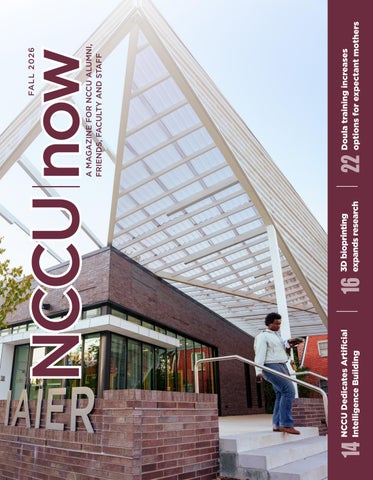
NCCU Dedicates Artificial Intelligence Building
16
3D bioprinting expands research
NCCU now
22
Doula training increases options for expectant mothers
A MAGAZINE FOR NCCU ALUMNI, FRIENDS, FACULTY AND STAFF
FA LL 2 02 6
14 Ribbon Cutting for Grand Opening of IAIER Building Photo by DeAndres Royal ’10
2 I NCCU NOW I SPRING 2026
FA L L 2 026
TABLE OF
6 Innovation
64 Athletics
Nursing students present at international conference
Henry King – from pro football to police chief
________________________
__________________
37 Leadership & Service From robots to culinary arts, NCCU camps inspire young minds
ON THE COVER
High schoolers come to campus for robots, drones, hospitality and real estate
16 Transformation
_______________________________________ Doctoral student uses satellites and machine learning to assess flooding risk
On Aug. 10, 2026, NCCU dedicated a building for its Institute for Artificial Intelligence and Emerging Research (IAIER).
28 Resilience
________________________ NCCU’s all-women quiz team wins first national championship
61 Giving
_________________ Hilton’s establish scholarship and charter alumni chapter
52 Alumni News
________________________ Alumni news and accomplished Eagles
NCCU wins Honda Campus All-Star Challenge
For the latest NCCU NEWS, visit www.nccu.edu.
NCCU NOW I FALL 2026 I 3
MESSAGE from the CHANCELLOR Dear Eagles, In the month prior to the publication of this edition of NCCU Now, we celebrated the milestone of reaching an enrollment of 10,000 students for the first time in the history of North Carolina Central University (NCCU). This accomplishment validates years of hard work by every facet of our university community. Prospective families hear about the groundbreaking achievements of current students, faculty and staff, and are drawn to be part of what is happening. Current students are nurtured and given opportunities to excel and are deciding to persist in finishing their degrees. Alumni find purpose, deliver impact in their chosen careers and come back to support the next generation of scholars. This edition of the magazine tells our story from a broad range of perspectives. You will learn how the university expands access to an NCCU education by streamlining the evaluation process for transfer students. NCCU also expands access by an enriching range of summer camps for high school students held on campus each year. Our faculty, staff and students transform primary knowledge into practical solutions for the challenges facing the citizens of North Carolina and beyond. Whether it is AI-assisted drug discovery, providing legal services to families in need, building a cutting-edge hospitality program or quantifying the impact of green algae on cholesterol, Eagles work hard to put “Truth and Service” into action. NCCU’s alumni deliver meaningful and enduring results in communities, institutions and vocations around the world. We are thrilled to illustrate a selection of their stories of leadership and hope they will inspire you to continue making your purpose take flight wherever you are. Thank you for your ongoing support of North Carolina Central University. In Truth and Service,
Karrie G. Dixon, Ed.D.
Chancellor North Carolina Central University
4 I NCCU NOW I FALL 2026
For the latest NCCU NEWS, visit www.nccu.edu.
NCCU NOW MAGAZINE
is published by North Carolina Central University’s Office of Communications and Marketing, 1801 Fayetteville Street, Durham, NC 27707. View the FALL 2026 digital version and past issues at issuu.com/nccentraluniv
NCCU NOW CONTRIBUTORS CHIEF BRAND OFFICER Stephen W. Fusi EDITOR Mark Lawton SENIOR GRAPHIC DESIGNER Jeffrey Williamson WEB CONTENT MANAGER Jay Morrow ’95 WRITERS Attiya Dunn ‘25, Stephen W. Fusi, Syria Gilmore ’21, Terri Godwin Hyman '99, '03, Anthony Jeffries, Mark Lawton, Quiana Shepard, André Vann '93, ’95 COPY EDITOR Cassandra Harper PHOTOGRAPHY DeAndres Royal ’10, Aaron Daye '05
NCCU BOARD OF TRUSTEES CHAIR Courtney Crowder ’00 MEMBERS David Alexander ’94, ’99 Farad Ali Atty. Roderick G. Allison ’95 William V. Bell G. Keith Chadwell Ryan Combs Francesca D. Gary Haneef A. Eiermann ’27 Michael Goodmon Lisa F. Martinez Dr. Orlando R. Stovall ’76 Atty. Antwan Thornton ’15 CHANCELLOR'S CABINET CHANCELLOR Karrie G. Dixon, Ed.D. EXECUTIVE VICE CHANCELLOR Atty. Alyn Goodson ’11 VICE CHANCELLOR AND CHIEF OF STAFF Gary Brown, Ph.D. PROVOST AND VICE CHANCELLOR FOR ACADEMIC AFFAIRS Ontario S. Wooden, Ph.D. VICE CHANCELLOR FOR ADMINISTRATION AND FINANCE Laurie Wilcox VICE CHANCELLOR FOR STUDENT AFFAIRS Angela Alvarado Coleman, Ed.D. INTERIM VICE CHANCELLOR FOR INSTITUTIONAL ADVANCEMENT Patricia Mitchell VICE CHANCELLOR FOR TRANSFORMATIVE PARTNERSHIPS AND ECONOMIC DEVELOPMENT Kuldeep Rawat, Ph.D.
Chancellor Dixon throws opening pitch at Durham Bulls game on August 25th.
DIRECTOR OF ATHLETICS Louis "Skip" Perkins, Ph.D., ’94, ’98, ’00
NCCU NOW I FALL 2026 I 5
■ I N N O VAT I O N
HELPING PATIENTS UNDERSTAND CLINICAL TRIALS WITH AI BY NICOLE HODGES
In clinical research, one of the greatest challenges is not discovering new treatments. It is helping people understand treatments. At North Carolina Central University (NCCU), Tracie Locklear, Ph.D., research assistant professor of pharmaceutical sciences and program lead for Clinical Research Sciences, sees this firsthand. Clinical trial consent forms can span 20 to 25 pages and are often written at a level more suited for researchers than patients. Yet informed consent is critical. To address this gap, Locklear partnered with Weifan Zheng, Ph.D., professor of pharmaceutical sciences, to develop an AI-supported training tool designed to help future clinical professionals communicate more clearly and confidently. The system is built to read official clinical trial documents, including consent forms and federal research guidelines. It then allows users to ask questions about the study and receive explanations grounded in those approved materials.
6 I NCCU NOW I FALL 2026
Weifan Zheng, Ph.D.
Nursing Students Present at International Conference BY MARK LAWTON
By June, Jazmine Locklear presented five times on improving health outcomes for members of the Lumbee Tribe. Locklear, a student in the accelerated (16-month) Bachelor of Science in nursing (BSN) program at North Carolina Central University (NCCU), is excited about the health care possibilities that opened in December 2025 when Congress fully recognized the Lumbee Tribe of North Carolina. “The passage is something we have been waiting on for a long time,” Locklear said. She most recently presented in mid-March at the Creating Healthy Work Environments conference in Washington, D.C., organized by Sigma Theta Tau International Honor Society of Nursing. Locklear was one of three NCCU nursing students who presented. Also participating were Hailey Turner, who presented on the
screening strategies for high-risk women. This is the first time nursing students from NCCU presented at the international conference.
most recent guidelines on hypertension (high blood pressure) and Noa Leger, who presented on optimizing breast cancer
Civil Rights Attorney Ben Crump Visits NCCU Law School BY TERRI G . HYMAN
Renowned civil rights attorney Ben Crump visited North Carolina Central University (NCCU) School of Law in March, ahead of his recent campus book signing as part of his “Worse Than A Lie” book tour. Hosted by the Student Bar Association, Crump engaged with students, sharing insights from his legal career and offered words of encouragement to the next generation of legal advocates. Known for his work in high-profile civil rights cases, Crump emphasized the importance of using the law as a tool for justice, advocacy and meaningful change. Crump also spoke to a larger audience during a session moderated by School of Law alumni Harry Daniels and Robyn Sander continuing the conversation on civil rights, advocacy and the role of legal professionals in advancing justice. NCCU NOW I FALL 2026 I 7
NCCU SENIOR AWARDED $10,000 SCHOLARSHIP B Y D A N YA L E D A N I E L S
TERVONNA POLLARD, A SENIOR AT NORTH CAROLINA CENTRAL UNIVERSITY (NCCU), HAS BEEN NAMED A RECIPIENT OF THE FREDERICK DOUGLASS BICENTENNIAL SCHOLARSHIP (FDBS). The $10,000 award was presented April 15, 2026, in the School of Business by Tony Signore, chairman of Taylor Global and founder of the scholarship program. The scholarship was established to honor the legacy of the great orator and abolitionist by supporting high-achieving seniors at historically Black colleges and universities (HBCUs). For Pollard, an aspiring digital marketing professional, the award represents the culmination of a journey defined by perseverance. "When I began my freshman year, there were times I did not have the financial resources and wasn’t sure how I would make it to my senior year,” said Pollard. “This scholarship has helped relieve financial stress and has allowed me to stay focused on completing my education and pursuing my future career goals in digital marketing."
8 I NCCU NOW I FALL 2026
I N N O VAT I O N ■
NCCU Advances Research and Community Impact with $10M Award B Y M A R K L AW TO N
A $10 million subgrant could have wide-ranging impacts on scientific efforts at North Carolina Central University (NCCU). NCCU received $10 million, part of a $69 million grant Duke University received in August 2025, to conduct translational science. The money originated from the National Institutes of Health. Translational Science is the study of converting medical research into better health outcomes. This involves identifying barriers toward successfully implementing research and finding solutions. Part of the goal is to accelerate the process from scientific discovery to improving health. “We are a community-engaged organization,” said Deepak Kumar, Ph.D., professor of pharmaceutial sciences, who leads this effort at NCCU. “It is really important for us to translate evi-
Ideas include:
dence-based discoveries to the community.”
•
Seronda Robinson, Ph.D., professor and co-director of the
Training researchers how to work with communities and vice versa.
Health Equity, Environment and Population (HOPE) program at
•
Offering pilot funds to faculty to conduct research.
NCCU, anticipates the seven-year grant could be used to expand
•
Creating ethno-dramas – theatrical productions designed to
existing community engagement efforts.
raise awareness of specific health topics. •
Data dashboards – both building them and making them more accessible – for a variety of information, including demographics, environmental concerns, food insecurity, Wi-Fi access, etc. Funds from the $10 million will be distributed widely, going to
about 11 departments at NCCU, said Faye Calhoun, Ph.D., retired interim director of the Julius L. Chambers Biomedical and Biotechnology Research Institute (JLC-BBRI).
NCCU NOW I FALL 2026 I 9
■ I N N O VAT I O N
MASS COMMUNICATION STUDENTS DOMINATE AWARDS AT PRESS INSTITUTE B Y C H AV I S C A R T E R
North Carolina Central University (NCCU) mass communication students earned 20 awards in February 2026 in the annual competition held during the 75th Southern Regional Press Institute at Savannah State University. The total was more than double that of any other participating school. The awards were for college students across the Southeast. Entries were judged by Savannah-area media professionals. Out of 39 total awards across 13 categories, NCCU students won more than half and received the most first-place honors. They also swept three categories: Best News Photography, Best Mini-Documentary and Best Radio Drama.
Awards Breakdown: First Place Best News Photography – Andy Kavul, Morgan McNeil and Daijah Boyd Best Mini-Documentary – “Hoops and Heart” Best Advertisement – Jabari Robinson News Story – De’Zaria Lucas Best News Site – Campus Echo Second Place Best Podcast/Internet-Streamed Show – Dylan Franks and William Dozier News Package – Jay’lynn Harrison, Central News Best Mini-Documentary – Jabari Robinson Best Radio Drama – K’Mari Greene Editorial/Opinion Column – K’Mari Greene Sports Story – Charles Green News Story – Amiya Neal Third Place Best News Photography – Mesa Jones and Alex Murphy Best Features Photography – Daijah Boyd, Lelah Cannady and Morgan McNeil Best Podcast/Internet-Streamed Show – Chidinma Ukpabi and Denaijah White Best Mini-Documentary – Julia Washington Best Radio Drama – Derek McKoy Feature Story – Amiya Neal 10 I NCCU NOW I FALL 2026
I N N O VAT I O N ■
FROM AN HOUR TO SECONDS: NCCU ADVANCES TRANSFER CREDIT EVALUATION WITH AI B Y M A R I K A DA N I E L
The North Carolina Central University (NCCU) Office of Transfer Services is advancing innovation in higher education following its March participation in the Quantum Leap AI Summit. During the conference, NCCU showcased its implementation of the Light Leap Prism Platform, an AI-powered solution designed to streamline the transfer credit evaluation process. The platform reduces evaluation time from an average of 45 – 60 minutes to approximately 12 seconds. As a result, Cindy Love, Ph.D., director of transfer services, received the Light Leap Innovator of the Year award, highlighting NCCU’s leadership in applying emerging technology to improve transfer processes. The decision to adopt the platform was influenced by new system-wide expectations.
NCCU NOW I FALL 2026 I 11
■ I N N O VAT I O N
Marcus Anderson
Jason Armstrong
Nana Asante-Smith
Eddie M. Buffaloe Jr.
Renee Nicole Clark
Charmaine Fuller Cooper
Stevie Dunk
Lilyn Hester
Dr. Derrick Jordan
Ramonda Kyser
Jamaal K. Livan
Kim Ratliff
Gregory Scott
James Sills, III
Dr. Deanna Townsend-Smith
Kimberly A. Williams
Trish Hardy Wray
CAPTAINS OF INDUSTRY APPOINTED TO REJUVENATE NCCU BOARD OF VISITORS BY STEPHEN FUSI
North Carolina Central University (NCCU) has appointed a set of industry leaders as members of the NCCU Board of Visitors. The NCCU Board of Visitors assists the university in accomplishing its mission and strategic priorities, while serving as ambassadors of the university in their communities and professional and personal networks. The board has not been operational since 2022. NCCU Chancellor Karrie G. Dixon has made it a priority to revitalize the board. "Reactivating the NCCU Board of Visitors is an important step in strengthening the university's connections across industries, communities and regions," said Dixon. “Their service will help expand opportunities for our students, elevate our partnerships and advance our impact as a driver of economic growth and public good." The Board Members are: •
Marcus Anderson, Grammy & Stellar Award nominated musician
•
Jason Armstrong, retired police chief, keynote speaker,
•
Ramonda Kyser, senior vice president, alignment and activation, Truist Bank
•
public service consultant
Jamaal K. Livan, senior vice president, global commercial banking, Bank of America
•
Nana Asante-Smith, senior associate attorney, Parker Poe
•
Eddie M. Buffaloe, Jr., deputy chief, Raleigh Police Department
•
Renee N. Clark, director, annual giving, Southern Environmental
•
Gregory Scott, business owner
Law Center
•
James H. Sills, president, M&F Bank
•
Charmaine Fuller Cooper, state director, AARP South Carolina
•
Dr. Deanna Townsend-Smith, senior director, Dudley Flood
•
Stevie Dunk, senior corporate regional sales manager
•
Lilyn Hester, head of external affairs, Google
•
Kimberly Williams, owner/realtor, Right Time Realty
•
Dr. Derrick Jordan, chief operations officer, NC Department of
•
Trish Hardy Wray, associate general counsel,
Public Instruction 12 I NCCU NOW I FALL 2026
•
Kim Ratliff, civic engagement director, Alliance Center for Education
Center
Duke Energy Corporation
I N N O VAT I O N ■
GRANT FOR EVALUATING SCHOOL OF THE BLIND B Y M A R K L AW TO N
North Carolina Central University (NCCU) received a $70,000 grant to evaluate The Governor Morehead School for the Blind in Raleigh, N.C. “We will evaluate what’s happening with education for the students, what’s happening at the leadership level and what’s happening with staff and teachers,” said Alexis Redford, Ph.D., an assistant professor in the School of Education who applied for the grant. The grant was awarded by the North Carolina Collaboratory, an entity established in 2016 to use and disseminate research expertise from across the University of North Carolina System for practical use by state and local governments. “All our research will be taken to the state legislature so they can make decisions,” Redford said. NCCU houses a visual impairment training program, the only such program in the state of North Carolina. The grant runs from January 2026 to June 2027. Researchers will include Redford, two other NCCU faculty members and an expert from Arizona.
NCCU NOW I FALL 2026 I 13
■ I N N O VAT I O N
14 I NCCU NOW I FALL 2026
I N N O VAT I O N ■
IAIER BUILDING MARKS NEW CHAPTER FOR AI EDUCATION AND RESEARCH AT NCCU BY NICOLE HODGES
THE INSTITUTE FOR ARTIFICIAL INTELLIGENCE AND EMERGING RESEARCH (IAIER) AT NORTH CAROLINA CENTRAL UNIVERSITY (NCCU) IS ENTERING A NEW CHAPTER WITH A DEDICATED BUILDING. Dedicated on Aug. 10, 2026, the IAIER building serves as a university-wide hub where students, faculty, staff, community members and industry partners can engage with emerging technologies through hands-on learning, research and collaborative programming. As the first artificial intelligence institute of its kind at a historically Black college or university (HBCU), IAIER continues to position NCCU as a leader in responsible and ethical AI innovation. The roughly 5,000-square-foot building cost $7.2 million and was funded by Title III grant funding and NCCU trust funds. The building includes the AI Literacy Studio, Machine Learning and Data Science Studio, Robotics and Emerging Tech Lab, XR Innovation Sandbox, Ethics and Governance Classroom and Innovation Atrium. These spaces are designed to support AI literacy, machine learning, robotics, immersive technology, responsible AI training and interdisciplinary collaboration. For students, the building creates new opportunities to gain practical experience with AI tools, industry credentials, research projects and workforce-focused programs. For faculty and staff, it offers a space to explore AI applications across disciplines, develop research and participate in professional learning. For community and corporate partners, it provides a place to connect with NCCU’s growing AI ecosystem. “The IAIER building gives our work a home,” said Siobahn Day Grady, Ph.D., founding director of IAIER. “It creates a space where students, faculty, staff and partners can come together to learn, build and lead in an AI-enabled world.”
NCCU NOW I FALL 2026 I 15
■ T R A N S F O R M AT I O N
Bioprinting the Future at NCCU B Y M A R K L AW TO N
Research involving bioprinting is ramping up at North Carolina Central University (NCCU). Three-dimensional (3D) bioprinting is a technique used to print living cells in a pre-designed pattern. Those living cells or tissue could be used for skin regeneration or the manufacture of human organs. Bioprinters are used to print living cells or tissue in a pre-designed pattern. The technology is still in its infancy. The first attempts to achieve such cell growth took place in 1998, according to the National Library of Medicine at the National Institutes of Health (NIH). Researchers put the cells they want to grow, along with a biomaterial such as gelatin or collagen, into the 3D bioprinter. Researchers then adjust pressure, temperature, layer height and other factors to achieve 16 I NCCU NOW I FALL 2026
optimal growth. Over at the Julius L. Chambers Biomedical and Biotechnology Research Institute (JLC-BBRI), students in the laboratory of Nicole Salazar Velmeshev, Ph.D., are using the university’s bioprinter to create 3D models of breast cancer cells. They aim to understand how different biomarkers contribute to the uncontrolled growth of cancer, and then try out treatments and see how they affect those markers. “We have traditionally worked with cell lines in two dimensions (flat),” Velmeshev said. “3D structures are a more physiologically relevant model. The outer cells will be more exposed. The cells on the inside would not be as vulnerable to a drug. (3D) responds in a way more in accordance with how the human body would react.” Another advantage of 3D bioprinting is that it does not
require the use of animals for testing. “New regulations are coming from a lot of government funding agencies,” said Eric Saliim, program manager of the NCCU Fab Lab and an adjunct instructor in the department of biological and biomedical sciences. “They want to do away with animal testing. 3D bioprinters put us more in line.” Ufana Riaz, Ph.D., of the department of chemistry and biochemistry, and her graduate students at the BBRI are developing tissue patches for wound healing. By designing materials that resemble the body’s own tissues, we can improve compatibility,” Riaz said. “This approach helps reduce the likelihood that the body will reject the implanted patches.” Workforce Development For the last few years, the university has owned one bioprinter. That is about to change, thanks to a 2025 grant of $1,273,500 from the National Institute of Biomedical Imaging and Bioengineering at the NIH. The grant will allow the university to buy three new bioprinters over
three years. The first arrived at NCCU in March. “It’s an emerging technology; it is growing and still new,” said Saliim. “We are looking to put our students on the cutting edge to get them involved with that technology while it grows.” “These are skills people really want to see now,” Velmeshev said. “We can get students prepared here and go on to top bioengineering programs to make contributions in science and technology.” Part of the grant will be used to bring in experts in bioengineering, supply stipends to students and perhaps hire faculty in the last years of the grant. “3D bioprinters will open up possibilities in advance of biomedical implants, pharmaceutical and drug delivery and wound healing research,” said Riaz. “It will increase workforce development. It is already promoting interdisciplinary research." Saliim would like to start a credentialing program for students with a manufacturer of 3D bioprinters. He also conceives of developing a bioprinting center at NCCU.
T R A N S F O R M AT I O N ■
Seismologist at NCCU Researches Earthquakes B Y M A R K L AW TO N On April 25, 2015, Hari Ram Thapa had stopped by the university in Nepal, where he was studying physics, when a 7.8-magnitude earthquake struck. The earthquake inspired Thapa to change his degree trajectory. He completed his master’s thesis, then moved to Italy to earn a doctorate in geophysics and seismology. “We live in a country with a lot of earthquakes but no seismologists,” said Thapa. After working for three years as a research consultant, he moved to Durham to work as a postdoctoral researcher in the department of environmental, earth and geospatial sciences at North Carolina Central University (NCCU). Earth’s surface is made up of large moving pieces called tectonic plates. Although these plates move very
We live in a country with a lot of earthquakes but no seismologists” HARI RAM THAPA, PH.D. Postdoctoral Researcher Department of Environmental, Earth and Geospatial Sciences
slowly, over time they can get stuck where they meet. When this happens, pressure builds up underground until it is suddenly released, causing the shaking we feel as an earthquake. Most earthquakes are not a big deal, according to the U.S. Geological Survey. Worldwide, an estimated 500,000 earthquakes can be detected with instruments. An estimated 100,000 of those can be felt by humans. But only about 100 of them cause damage. “The most damaging earthquakes are usually those that occur relatively close to the Earth’s surface,” said Thapa. “This is because the seismic energy has less distance to travel before reaching the ground, so the shaking is stronger where people and infrastructure are located.” In addition, said Thapa, “shallow earth-
quakes often occur in the brittle upper crust, where rocks can suddenly break and slip, producing stronger and more destructive ground shaking at the surface. As you go deeper into the Earth, temperature and pressure increase, and rocks tend to deform more slowly rather than breaking suddenly.” The danger to people is not from the initial shaking. “Most earthquake-related deaths are not caused by the ground shaking itself, but by its secondary effects such as collapsing buildings, landslides and tsunamis,” said Thapa. Thapa’s research uses seismic waves recorded by ground stations to study what lies beneath Earth’s surface. He focuses on understanding the structure of the Earth’s crust and upper mantle in earthquake-prone regions such as central Europe and the northwestern Himalaya. His earlier work has produced detailed three-dimensional images of underground rock properties and identified major boundaries within the Earth’s crust using different types of seismic waves. More recently, he has also been studying much shallower layers beneath the ground, including soil and near-surface geology, using high-frequency seismic signals recorded at local stations in the eastern U.S. These studies help improve understanding of how different ground conditions may respond during earthquakes. Thapa examines the first waves generated by an earthquake: primary, or P-waves, and the P-wave train that follows. “When a P-wave travels through the Earth, it carries information about the materials it passes through, which scientists use to infer the structure of the subsurface,” said Gordana Vlahovic, Ph.D., chair of the department of environmental, earth and geospatial sciences. Vlahovic supervises Hapa’s research and has also co-taught two graduate courses with him. “Our research aims to understand the structure and behavior of the Earth’s crust and uppermost mantle in earthquake-prone regions, in order to improve knowledge of how the ground is built and how it responds to earthquakes,” Vlahovic said.
NCCU NOW I FALL 2026 I 17
■ T R A N S F O R M AT I O N
AI TRANSFORMS DRUG DISCOVERY AT NCCU B Y Q U I A N A S H E PA R D The future of medicine is being written not only in laboratories, but also in lines of code at North Carolina Central University (NCCU). Weifan Zheng, Ph.D., a professor in the department of pharmaceutical sciences, leads research placing NCCU at the intersection of artificial intelligence (AI), biomedical discovery and workforce development. ACCELERATING THE SEARCH FOR NEW MEDICINES Before joining NCCU, Zheng spent several years in the pharmaceutical industry working with computational machine learning, long before the term ‘AI’ became widely used. On average, it takes more than a decade and costs $2.6 billion for a drug to reach the market. Only 12% of new molecular entities entering clinical trials are approved by the U.S. Food and Drug Administration, according to Pharmaceutical Research and Manufacturers of America.
18 I NCCU NOW I FALL 2026
Zheng’s research aims to shorten that timeline and reduce costs by using AI to identify promising drug candidates before they are synthesized in a lab. “We use computational tools to help scientists select potential drug molecules before they are even made,” Zheng said. “If we can do as much work as possible inside the computer first, we can save enormous amounts of time and resources.” Through techniques such as biomedical text mining, knowledge graphs and deep neural networks, Zheng’s lab analyzes scientific literature and biological data to uncover patterns researchers might otherwise miss. TURNING DATA INTO BREAKTHROUGHS FOR RARE DISEASES One of the most significant applications of this work is happening through Zheng’s collaboration with Kevin Williams, Ph.D., a professor of pharmaceutical sciences in the Biomanufacturing Research Institute and Technology Enterprise (BRITE), who has spent his career researching breast cancer therapeutics. Williams focuses on inflammatory breast cancer (IBC), a rare and highly aggressive form of the disease that is difficult to diagnose because it does not typically form a lump and is often missed by routine mammograms. According to the National Cancer Institute, IBC accounts for 1% to 5% of all breast cancer cases in the U.S., and approximately 8% to 10% of related deaths. It is more common in women younger than 40 and more prevalent in Black women. “It’s a hard disease to treat and a hard disease to diagnose,” Williams said. “So, we’re trying to find new ways to identify and target it.” Identifying potential treatments traditionally requires screening hundreds of thousands of compounds in the lab, a time-consuming and resource-intensive process. Together, Zheng and Williams are using AI to streamline that approach.
T R A N S F O R M AT I O N ■ By applying text mining and machine learning models, Zheng’s lab analyzes millions of studies to uncover connections between diseases and existing drugs, with the goal of identifying drugs that could be repurposed. “The answer may already exist in the literature; we just can’t find it by reading millions of papers,” Williams said. “AI allows us to make those connections.” Their work has produced published research led by Xiaojia Ji, Ph.D., senior research scientist in Williams’ lab, with AI-generated predictions now being tested in lab models. The collaboration also uses computational methods to analyze gene expression in cancer cells, identifying therapies that may help restore normal function. “The AI gives us the prediction,” Williams explained. “Then we validate it in the lab.” UNLOCKING NEW USES FOR EXISTING DRUGS The approach is part of a broader focus on drug repurposing, identifying new medical uses for existing medications. By analyzing large volumes of biomedical research, AI models can reveal connections between approved or previously tested drugs and diseases they were not originally designed to treat. Because many of these drugs already have established safety data, this approach can significantly shorten the path to clinical use. “If a new disease emerges or an urgent health crisis happens, developing a new drug from scratch can take years,” Zheng said. “But if we can identify an existing drug that might work, we can potentially move much faster.” INVESTIGATING THE ROOT CAUSES OF DISEASE Beyond drug discovery, Zheng’s research explores whether many diseases share a common biological origin. His lab studies bioenergetics, the process by which the body converts nutrients into cellular energy. When this process breaks down, it may trigger a cascade of chronic conditions. “If our cells cannot properly generate energy from the food we eat, many systems in the body begin to fail,” Zheng said. “You may start to see diseases such as cancer, Alzheimer’s or metabolic disorders.” AI AS A TOOL Inside Zheng’s lab, AI is a practical research tool. Using the programming language Python alongside AI systems such as ChatGPT, Zheng and his students build computational models that analyze biomedical data and generate predictive insights. “I jokingly say ChatGPT is my best technician,” Zheng said. “It helps generate the code I need, and then my job is to verify and refine it.” A PLATFORM FOR COLLABORATION The partnership between Zheng and Williams highlights a broader strength at NCCU: collaboration across disciplines. Williams, who has also worked with public health experts to raise awareness about IBC and improve diagnostic criteria, sees these cross-campus connections as essential to advancing research. “The biggest lesson is to reach across disciplines,” Williams said. “Whether it’s AI, public health or clinical research, bringing those perspectives together is where real progress happens.”
PREPARING STUDENTS FOR THE AI ERA While Zheng’s research holds promise for the future of medicine, he believes its most immediate impact may be in the classroom. At NCCU, undergraduate and graduate students participate directly in his research projects, learning to apply AI tools to real scientific questions. Since 2023, more than 10 students have worked in Zheng’s lab. Biruktawit Sanbi, a graduate student in pharmaceutical sciences who earned her undergraduate degree from NCCU in December 2025, says the hands-on experience has reshaped how she approaches research. “I’ve always been interested in pharmacy, but research helped me understand what happens behind the drugs, how they’re developed and how they work,” she said. “That’s what made me want to focus more on the science.” After taking a data science course as an undergraduate, Sanbi began exploring how AI could enhance her research. She used tools like ChatGPT and biomedical databases to analyze large volumes of scientific literature and identify potential drug candidates for further study. “You can’t just rely on AI; you have to guide it and verify the results,” she said. “It helps you move faster, but the responsibility is still on the researcher.” Now in her first semester of her master’s degree program, Sanbi plans to continue working in AI-driven drug discovery and hopes to build a career as a scientist in the field. “I want to contribute to developing drugs that can improve people’s lives,” she said. “Students are the future,” Zheng added. “Wherever they go, they will carry these tools and ideas with them.”
“If a new disease emerges or an urgent health crisis happens, developing a new drug from scratch can take years,” Zheng said. “But if we can identify an existing drug that might work, we can potentially move much faster.”
—Weifan Zheng, Ph.D. professor in the department of pharmaceutical sciences
NCCU NOW I FALL 2026 I 19
■ T R A N S F O R M AT I O N
SATELLITES & MACHINE LEARNING FIGURE IN DOCTORAL CANDIDATE’S RESEARCH B Y M A R K L AW TO N
A doctoral candidate at North Carolina Central University (NCCU) is using machine learning and satellites to assess the risk of flooding in several parts of North Carolina. Tony Bawo Esimaje grew up in Nigeria, where he earned both a bachelor’s and master’s degree in agricultural economics. He earned a second master’s degree – in plant sciences – at Tel Aviv University in Israel before returning to Nigeria. In Jos, Nigeria, he was hired by a nongovernmental organization to set up a greenhouse farm to grow roses. “Jos has high insecurity,” Esimaje said. “It has bandits and Boko Haram (a jihadist militant group that has carried out large-scale acts of violence).” The rose-growing operation was a hub for children whose parents had been murdered. The aim was to train the children to be self-sustaining. Esimaje was successful in setting up the greenhouse farm, which is still in operation. He then moved to Bayelsa, Nigeria, where yearly floods rise to waist level. “Residents use boats and canoes to cross the area,” Esimaje said. “The area becomes landlocked during the flooding.” Past efforts to establish a farm by the local government were unsuccessful. Esimaje established a fish spawning operation along with a greenhouse to grow bell peppers and beef tomatoes. When his contract ended, he joined the University of Africa, – Toru-Orua, for one year as an adjunct lecturer before moving to Durham, N.C., and earning a third master’s degree – this one in environmental, earth and geospatial sciences – at NCCU. Predicting Flooding Esimaje’s doctoral research is an amplification of his master’s research, which involved looking at two variables – carbon dioxide and black carbon – which interact with the atmosphere and increase global warming. “Those aerosols trap energy from sunlight and hold it longer and modify a warming effect in the atmosphere more than they ought to,” Esimaje said. “Finding that this could cause an intricate interaction that may lead to flooding interested me." Flooding is the costliest natural disaster in the United States, causing an average of $8 billion in damages annually, according to the National Oceanic and Atmospheric Administration (NOAA). In 2024 alone, Hurricane Helene caused an estimated $78.7 billion in total damages, making it one of the costliest hurricanes in U.S. history. In 2024, Esimaje began working on a doctorate in integrated biosciences with a concentration in behavioral health and data science. His research, titled “Composite Flood Vulnerability Index Using Machine Learning: 20 I NCCU NOW I FALL 2026
A High-Resolution Approach for Urban Resilience,” aims to assess the risk of flooding in three areas of North Carolina: New Bern – a coastal city that has been struck by several hurricanes. Durham – which is relatively flat and has been flooded mostly due to runoff. Asheville – situated in the Southern Appalachian mountain region, which was hit by Hurricane Helene in 2024, causing catastrophic inland flooding along the French Broad River and its tributaries. Esimaje collects data from multiple satellites. “Each satellite has its own specialty,” he said. He uses Sentinel-1 (SAR C-band radar for all-weather flood detection), Sentinel-2 (optical multispectral imagery for vegetation and water indices), Landsat 8/9 (land cover and temperature) and NASA’s UAVSAR (L-band polarimetric radar capable of detecting flooding beneath forest canopies). In all, he collects 14 different types of data. Those include rainfall, topographical area, imperviousness, soil hydrologic groups, Topographic Wetness Index, Height Above Nearest Drainage, Normalized Difference Vegetation Index and Normalized Difference Water Index. He then uses machine learning to understand the three different terrains. Machine learning is a subcategory of artificial intelligence. It uses algorithms that can learn patterns from training data and therefore make accurate inferences about new data. Over time, Esimaje aims to narrow down the geographic areas to census tracts and automate the process of creating flood risk reports “so industries and individuals have access to it.” Such reports would first be sent to a professional for evaluation and interpretation before going to the end user. That’s important, says Zhiming Yang, Ph.D., an associate professor and Esimaje’s doctoral advisor. “We’re talking about application,” Yang said. “To see if a local government or agency can use it. A lot of people depend on the Federal Emergency Management Agency (FEMA). Some of their flooding information is outdated and maybe not accurate.” Esimaje’s research has already attracted national recognition: it is supported by a NASA grant and preliminary findings were presented at the NCCU Graduate Research Symposium and NC Space Symposium.
T R A N S F O R M AT I O N ■
Doctoral Student Aims for Open Science BY M A R K L AW TO N
C
HIMA OKOLI SEEKS TO CREATE ONE-STOP SHOPPING FOR PEOPLE CONDUCTING RESEARCH IN GEOSCIENCES.
With the aid of artificial intelligence (AI), he plans to build an online data portal. An open GIS data portal is a publicly accessible online platform where geographic data can be freely searched, viewed and downloaded, and sometimes analyzed by anyone. “My long-term goal is that you shouldn’t need to go to any other place if you visit the portal,” said Okoli, a doctoral student in integrated biosciences at North Carolina Central University (NCCU). Information in the data portal could include tutorials, publications, documents, maps, spatial datasets, dashboards, satellite imagery, templates, etc. In the world of science, Okoli’s planned portal aligns with the FAIR (findability, accessibility, interoperability and reusability) principles developed in 2016. “We are starting to live in an era of open and free data,” said Associate Professor Tim Mulrooney, Ph.D., Okoli’s doctoral advisor. “If NASA or the National Science Foundation gives you money for research, it should be open and avail-
able to taxpayers.” Not all geoscience information, however, is easily accessible. “There is classified GIS information, particularly what the military works with,” Okoli said. “In the past, most research has been proprietary. If you want to carry out the same research, it takes a lot of emails. Not just the results but the methods as well.” Okoli experienced a lack of accessible data when researching a dump site in Carrboro. “The data was on a government portal and needed a lot of approvals,” Okoli said. One challenge of creating a geosciences portal is knowing where to start. “It’s the first of its kind here,” Okoli said. “There is no template or other example to look at.” Creating such a portal requires a lot of skills, Mulrooney said. Okoli is well prepared, with programming skills, management skills, data management, data organization, data visualization and statistical analysis. In the spring 2026 semester, Okoli formed focus groups to determine what information is most inter-
esting to the research and academic community. After (partially) creating the portal, he will distribute surveys that test user experience. FROM NIGERIA TO DURHAM Okoli earned a bachelor’s degree in engineering at the Federal University of Technology in Owerri, Nigeria, in 2015. “In my junior year, I realized I had more interest in geoscience or geography,” he said. He was accepted into a master’s program in geological and earth sciences at NCCU (he also took some classes at the University of North Carolina at Chapel Hill). Mulrooney found funding for Okoli and agreed to supervise him. Okoli taught a statistics course for people in geoinformation sciences, data science for geosciences, field mapping – using drones and GIS technology
to collect data points in the field and put them into a map – and drone mapping. Along the way, he helped map a trail in Hillsborough using four different GPS devices to see which device was most accurate. After completing his master’s degrees, he decided to earn a doctorate. “I took the path of behavioral health and data science,” said Okoli. Along the way to earning a doctorate, Okoli worked with Associate Professor Siobahn Day Grady, Ph.D., in an AI pilot program organized by the office of the North Carolina State Treasurer. After completing his doctorate this December, Okoli would like to work in government policy at either the state or federal level or even for the United Nations.
NCCU NOW I FALL 2026 I 21
■ T R A N S F O R M AT I O N
Doula Program Supports Moms Across Eastern North Carolina BY QUIANA SHEPARD
IN PARTS OF RURAL NORTH CAROLINA, AN EXPECTANT MOTHER MAY DRIVE MORE THAN AN HOUR TO REACH A HOSPITAL THAT DELIVERS BABIES. For families living in small towns in the eastern region of the state, access to maternity care often means navigating long distances, limited services and a shrinking number of 22 I NCCU NOW I FALL 2026
hospitals.
T R A N S F O R M AT I O N ■ But pregnancy does not pause for geography.
frequently serve patients from surrounding
these communities,” Hoffler says. “They’re
That reality is driving a new initiative
counties like Northampton, Edgecombe,
building relationships with families they
from North Carolina Central University’s
Bertie, Warren, Franklin and Martin, com-
know. That’s how you build trust.”
(NCCU) Rural Health Hub, where leaders
munities where maternity services may be
are training a new generation of commu-
limited.
nity-based birth doulas to support mothers before, during and after childbirth.
But even when medical care is avail-
The first cohort included 12 doulas, each supported with scholarships covering training, certification and materials. Participants
able, families often lack consistent support
completed coursework through DONA
A doula provides emotional, physical
throughout pregnancy and postpartum
(Doulas of North America) International,
and informational support during preg-
recovery, which typically lasts from 6 to 8
one of the leading doula certification organi-
nancy, labor and the weeks following birth.
weeks.
zations, along with CPR training, childbirth
Unlike doctors or midwives, doulas do not provide medical care, but they help families
That gap is where doulas make a difference.
understand their options and navigate the childbirth experience.
education and professional development workshops. To become certified, each trainee must attend three qualified births within
Building Care from the Community Up
their first year, with the Rural Health Hub
For Undi Hoffler, Ph.D., CD (DONA),
Launched in December 2025, the Com-
director of the Community-Based Doula
munity-Based Doula Training Program is
through healthcare partnerships, including
Program, the mission of the program begins
part of the university’s broader Rural Health
Blue Cross Blue Shield through the Doula
with a simple truth.
Hub initiative, a nonprofit organization
Exchange.
“Birth is sacred,” she said. “It’s beautiful. It’s a miracle. Families deserve to experience
focused on improving health outcomes in underserved communities.
helping connect them to opportunities
For Rose Lewis, a member of the first cohort, the program builds upon years of
that moment with dignity, support and confi-
community-based work. A Nash County
dence.”
resident, nonprofit founder and community health worker, Lewis has long helped families
When Access Is Miles Away
access essential services, from transportation
Across the United States, maternal mortality
to healthcare.
rates remain among the highest in developed
“Access to information and education,
nations. Although rates have declined since
that’s what inspired me,” Lewis said. “Espe-
the pandemic, significant disparities persist.
cially for our Black and brown communities.
Black women experience mortality rates
Many expectant mothers don’t know what a
three to four times higher than white and
doula is; they’re confusing it with a midwife.
Hispanic women, according to the Centers
So just bringing awareness can make a differ-
for Disease Control and Prevention.
ence in their outcomes.”
The numbers are also concerning in rural communities. Approximately 21% of rural counties are classified as maternity care deserts, according to the National Center
Through her nonprofit, Equipping the The first cohort of the Community-Based Doula Training Program.
Community Organization Inc., Lewis has supported families across the lifespan, from navigating Medicare and Medicaid services
for Health Statistics. In addition, 13.4% of
Based in Enfield, N.C., the hub serves
to medical appointments and other support-
women in rural areas have no birthing hos-
as a center for community engagement and
ive services. In that work, she noticed a gap
pital within 30 minutes, compared with 9.7%
workforce development. Rather than recruit-
in support during pregnancy.
nationwide.
ing professionals from outside the region,
“I kept seeing resources for after the
the hub focuses on training individuals who
baby gets here,” she said. “But what about the
olina,” Hoffler explains. “People are traveling
already live in the communities they will
support leading up to birth?”
hours just to receive care.”
serve.
“It’s an access issue in eastern North Car-
Hospitals in Halifax and Nash counties
“It’s important that our doulas come from
Her motivation became personal after a woman connected to her extended family (continued on page 24)
NCCU NOW I FALL 2026 I 23
■ T R A N S F O R M AT I O N died during childbirth and her own daughter
want for the families I serve.”
access may be limited.
Why Doulas Matter
“When moms understand their bodies and
experienced a high-risk pregnancy. “Everything turned out okay with my
“Information is power,” Hoffler said.
daughter,” she said. “But I saw how stressful it
Research shows that doula support can
was. Not every woman has someone there to
significantly improve maternal outcomes.
their options, they can advocate for themselves.”
According to a 2025 study in the American Journal
Restoring a Longstanding Tradition Doulas are gaining renewed attention
of Obstetrics and
in healthcare, with the North American in-
Gynecology, births
dustry projected to grow at an annual rate of
attended by doulas are
8.41% and reach $25.36 billion by 2033, ac-
associated with lower
cording to a 2026 Market Research Intellect
cesarean rates, fewer
report, but the practice has deep historical
medical interventions
roots.
and improved new-
Long before childbirth became primarily
born health indicators.
hospital-based in the 1930s, community
Mothers also report
birth workers played a central role in guiding
higher satisfaction and
families through pregnancy and delivery.
confidence in their
Over time, the medicalization of child-
birth experiences.
birth pushed many traditional birth workers
But Hoffler empha-
aside. Today, research and advocacy are
sizes that the impact
helping bring their role back.
extends beyond delivery day. "A lot of maternal
“The research shows that having a doula improves outcomes for moms and babies,” Hoffler said. “But it’s also about restoring the
mortality happens
kind of support families once had in their
after birth,” she said.
communities.”
“We want moms to understand when
support and encourage them.” Now, Lewis focuses on helping mothers understand their options and advocate for themselves. “When you’re informed, you can advocate for yourself,” she said. “That’s what I 24 I NCCU NOW I FALL 2026
Expanding the Network
something isn’t right
The Rural Health Hub’s doula training
and feel empowered to
program is ready to receive its second cohort
seek help.”
in April 2026.
Doulas often
The long-term vision is a statewide
stay connected with
network of trained doulas embedded in rural
families during the
communities.
postpartum period,
“Just because someone lives in a rural
helping mothers
county doesn’t mean they should lack mater-
process their birth
nal healthcare support,” Hoffler said.
experiences, adjust to new parenthood and recognize warning signs that require medical attention. That consistent support can be especially valuable in rural areas where healthcare
T R A N S F O R M AT I O N ■
NCCU Researcher Harnesses Green Algae to Advance Cholesterol Treatment B Y M A R K L AW TO N
AN ASSOCIATE PROFESSOR AT NORTH CAROLINA CENTRAL UNIVERSITY (NCCU) IS RESEARCHING A COMPOUND THAT COULD REDUCE CHOLESTEROL AND ITS RELATED DISEASES. In 2020, Dayami Lopez, Ph.D., of the department of pharmaceutical sciences, started researching a compound isolated from green algae. The compound has two potential impacts. First, it can enhance the impact of cholesterol-reducing drugs known as statins. “The compound helps the liver remove as much cholesterol from the blood as possible,” said Lopez. “By having less cholesterol in the blood, there is less chance of cholesterol accumulation in the arteries.” Too much cholesterol in the arteries causes atherosclerosis (sometimes referred to as ‘hardening of the arteries’). Cholesterol and other fats cause arteries to narrow, blocking blood flow. The cholesterol plaque can also burst, leading to a blood clot. Atherosclerosis can lead to heart disease, which is the second leading cause of death in North Carolina (cancer is first), according to the National Center for Health Statistics. Atherosclerosis can also lead to strokes, the fourth leading cause of death in North Carolina. Second, the compound can reduce inflammation, which helps prevent muscle
pain, a well-known side effect of cholesterol medications. Inflammation, according to the Cleveland Clinic, is a normal part of the body’s response to injuries and invaders (like germs). It promotes healing and helps a person feel better. But inflammation that occurs without an injury or invader can harm healthy parts of the body and cause a range of chronic diseases. “The compound has the potential to be used with diabetes, cancer and Alzheimer’s disease,” Lopez said. “Any disease that involves inflammation.” One aspect of the research has been sped up by using artificial intelligence (AI). Students in Lopez’s laboratory use AI to search literature and find relevant articles in multiple databases. “In the past, I had to have a couple of students look at a bunch of papers in PubMed,” Lopez said. “It took weeks.” Lopez’s research is moving into animal studies. After that comes finding funding and organizing clinical (human) trials. According to the World Heart Federation, 39% of the world’s adult population has high cholesterol. “Cholesterol is critical,” said Lopez. “Many people experience high cholesterol. We have good potential to help millions of people worldwide.”
NCCU NOW I FALL 2026 I 25
■ T R A N S F O R M AT I O N
As Vaping Grows, NCCU Scientists Investigate Unanswered Questions B Y M A R K L AW TO N
While no one claims that electronic cigarettes are good for you, there is a perception that e-cigarettes are less harmful to users than tobacco. E-cigarettes entered the United States market about 20 years ago. Manufacturers originally promoted e-cigarettes as a method for smokers to wean their way off tobacco. Rob Onyenwoke, Ph.D., an assistant professor in the department of biological and biomedical sciences at North Carolina Central University (NCCU), says that doesn’t work. “People who will try (tobacco) cigarettes will still try cigarettes,” Onyenwoke said. “They will also vape.” About 8% of the U.S. adult population has used electronic cigarettes, 7.3% in North Carolina, said Onyenwoke. Perhaps more concerning is the number of young people who use e-cigarettes: 6% of all students in the U.S., per Onyenwoke. That includes 7.8% of high school students and 3.5% of middle school students. “It’s a youth culture thing,” said Vijay Sivaraman, Ph.D., associate professor in the department of biological and biomedical sciences. Sivaraman and Onyenwoke have collaborated on research on e-cigarettes, which has led to 15 published papers. Their research has focused on the impact of vaping on lungs, the impact on the pulmonary system, whether e-cigarettes exacerbate pneumonia and whether vaping makes people more susceptible to viral diseases, 26 I NCCU NOW I FALL 2026
including Covid. What is the Attraction? E-cigarettes use an e-liquid which often contains nicotine, in volumes that equal the nicotine in 20 tobacco cigarettes. When electronic cigarettes are used or “vaped,” that e-liquid is heated until it transforms into vapor. The Food and Drug Administration’s opinion on e-cigarettes when they first came on the U.S. market was that they were less harmful than tobacco. “We pushed back on that,” said Sivaraman. “You are taking a complex chemical mixture and heating it to 300 degrees. Chemicals change as they vaporize. Other chemicals are being brought into airways.” The e-liquid also contains nicotine salts, a form of nicotine that is combined with an acid. “It goes down smoother,” said Sivaraman. “You can take in more.” Globally, e-liquids come in 15,000 different flavors. Those include bubble gum, mint and frosted cupcake. It’s like candied cereals drawing in the little kids,” said Sivaraman. “Also, the devices are pretty cool looking. And e-cigarettes don’t put off an odor as noxious as regular cigarettes.” Both Onyenwoke and Sivaraman say the jury is out on how harmful e-cigarettes are compared to tobacco.
“They both have their own problems,” Sivaraman said. “Tobacco has a lot of carcinogens (substances that promote cancer).” “We just don’t know yet,” said Onyenwoke. “It took a long time to convince people that tobacco cigarettes were bad for them, decades and decades.” Workforce Development While vaping is bad for users, conducting research on e-cigarettes and other inhaled toxins has benefited NCCU students. Seventeen master’s students and three doctoral students who have worked in either Sivaraman’s or Onyenwoke’s labs have graduated. Almost all had papers published in academic journals, either as first or second authors, and the master’s students have moved on to positions in biotechnology, clinical research organizations and the Environmental Protection Agency. “School can be challenging, but if you hold on and get a graduate education, you can do well with a degree from NCCU,” Sivaraman said. “Research Triangle Park sees us as a producer of workforce.” “Students get jobs in the biotechnology sector,” said Onyenwoke. “They use all the skills (they learn at NCCU): analytical techniques, genetics, cell biology. We want students to be heavily involved in the research.”
T R A N S F O R M AT I O N ■
NCCU NOW I FALL 2026 I 27
■ RESILIENCE
At 7 years old, Nadia Att-
construction and design.
more '25 drew her first original fashion design, not from a stencil, not from a book, but
An Unexpected Discovery Then came the Fab Lab,
straight from her imagi-
a space where science meets
nation. Her mother’s eyes
design.
widened, and she proudly
Opened in 2015, NCCU’s
shared Nadia’s sketches with
Fab Lab is the first at a histori-
anyone who would look. That
cally Black college or univer-
moment ignited a calling.
sity (HBCU), established
Nearly two decades later,
through the collective efforts
the spring 2025 North Caroli-
of the Innovation Inclusion
na Central University (NCCU)
Initiative at the Massachu-
graduate is transforming fash-
setts Institute of Technology
ion in an unexpected way,
and Title III support from the
blending science, sustainabil-
U.S. Department of Education.
ity and digital fabrication to
The lab serves as a digital pro-
create garments inspired by
totyping hub where students
the human body itself.
can experiment with tools
“I’ve always known what
such as 3D printers, embroi-
I wanted to do,” Attmore said.
dery machines and fabrica-
“Every choice after that was
tion technologies that turn
to hone my skills and refine
ideas into tangible creations.
my vision.”
Fab Lab Program Manager Eric Saliim recognized Att-
A Campus That Felt
The Future of Fashion is in the Lab B Y Q U I A N A S H E PA R D
28 I NCCU NOW I FALL 2026
Like Home
more’s potential immediately. “I would say she’s kind of a
Attmore was drawn to
visionary,” he said. “Once you
NCCU not just for its fashion,
give her a concept, she can
apparel and textile design
take it places you didn’t think.
program, but for the sense of
And not only that, she has the
belonging it offered.
execution to make it happen.”
“On my first day on campus, I knew I was in the right place,” she said. Within the program’s
Attmore first encountered the lab during a class project. “We went over to use some of the equipment for an
close-knit department,
assignment, and I remember
students became collabora-
thinking, I didn’t even know
tors and professors became
we had all of this here,”
mentors, encouraging young
she said.
designers to experiment and
Curious, she returned
develop their creative voices.
the following semester to
That environment helped
complete internship hours.
Attmore sharpen her artistic
Working alongside Fab Lab
instincts while learning the
mentors, Attmore learned
fundamentals of fashion
to code, experiment with
RESILIENCE ■ A Designer Without Limits
biomaterials and transform
opportunity. After gradu-
program. The material sym-
unconventional substances
ating from NCCU in May
bolizes the creativity, sacrifice
Cultural identity and
into wearable textiles.
2025, she was accepted into
and energy poured into her
Black creative expression also
the Fabricacademy Textile
artistic work.
shaped Attmore’s vision.
Her curiosity quickly evolved into something
and Technology Academy, a
The ‘sweat’ component
“Central gave me the
more interdisciplinary. At
globally recognized program
takes form through kombucha
freedom to be expressive in
one point, Saliim even gave
blending digital fabrication,
leather, a biomaterial grown
my skin, in my culture,” she
Attmore a new title: fashion
textile technology and biol-
from fermented tea cultures.
said. “My HBCU experience
engineer.
ogy. Hosted at NCCU’s Fab
By cultivating the material
reinforced my commitment
Lab, the nine-month program
herself and transforming it
to pour creativity back into
(Computer-Aided Design),
connects students to a world-
into textile, Attmore captures
Black fashion and culture.”
working with electronics and
wide network of designers,
the endurance and growth
After graduating from
looking at circuitry,” he said.
engineers and researchers,
required to bring ideas to life.
the Fabricacademy program.
“She was actually doing the
while allowing them to devel-
The design will also incorpo-
Attmore hopes to explore
work of an engineer. She just
op hands-on projects locally.
rate a 3D-printed spine, rep-
creative directing, costume
hadn’t thought of what she
The Fab Lab serves as the
resenting resilience and the
design, trend forecasting and
was doing as the merge of
only university node for the
backbone of creative labor.
sustainable textile innovation
those two worlds.”
program in North America.
“She was designing in CAD
Finally, the ‘tears’ element
while continuing to push the
Through the program, Att-
explores how struggle can
boundaries of fashion and
Learning at the Edge
more expanded her creative
transform into beauty. Att-
technology.
of Innovation
toolkit, mastering tools such
more uses crystallized bioplas-
“I see her definitely being a
Unlike traditional class-
as 3D printers, embroidery
tic to form sculptural textures
trendsetter in fashion,” Saliim
rooms, the Fab Lab encour-
machines and digital fabrica-
that shape the garment into a
said. “Now that she has these
ages experimentation and
tion software.
corset-like structure, symbol-
new techniques to add to
izing emotional release and
what her genius already is, it
artistic transformation.
really blows the lid off what
discovery.
“Traditional fashion design
“One is the application
focuses heavily on garment
piece, because you are going
construction,” Attmore said.
“I’ve cried while mak-
to get your hands on the
“But the Fab Lab opened my
ing this project,” Attmore
technology,” said Saliim. “And
eyes to a whole new side of
says. “I’ve bled; I’ve sweated
two is awareness of emerg-
design, thinking about mate-
working so hard on it. All of
ing technologies. Because of
rials, technology and what’s
those elements truly bring the
the Fab Lab and its network,
possible before the garment
design to life.”
students are exposed to things
even exists.”
that represent the future of different fields.” The open
Projects like Attmore’s illustrate how the Fab Lab
When Fashion Meets Biology
expands students’ thinking.
environment allows students
Attmore’s signature proj-
“When students move
to chart their own creative
ect is “Blood, Sweat and Tears.”
from traditional techniques
paths.
Each component of the
into coding and digital
“In a class there’s a script,
garment interprets the phrase
fabrication, they start seeing
a syllabus, a course of study,”
‘blood, sweat and tears’ using
themselves in spaces they
said Saliim. “But here in the
sustainable biomaterials and
never thought they would be,”
Fab Lab, you kind of own
digital fabrication techniques.
said Saliim. “They start asking,
The ‘blood’ element is
‘What if?’ and that opens up
that path.”
she can do.”
That freedom sparked
represented through BioYarn,
what they believe they’re
new possibilities for Attmore
a sustainable fiber Attmore
capable of doing.”
and eventually led to a larger
learned to produce during the
Nadia Attmore
NCCU NOW I FALL 2026 I 29
■ RESILIENCE
STUDENT BECOMES THE FIRST EAGLE TO COMPLETE THE MISTER JOURNEY
BY ARI E L GE R MAI N
Freshman Year
Sophomore Year
Junior Year
Senior Year
Student Becomes the First Eagle to Complete the Mister Journey BY ARI E L GE R MAI N
30 I NCCU NOW I FALL 2026
RESILIENCE ■ WHEN MALACHI GRIDDINE ARRIVED AT NORTH CAROLINA CENTRAL UNIVERSITY (NCCU) AS A FIRST-YEAR STUDENT FROM FAYETTEVILLE, N.C., HE HAD NO IDEA HE WOULD ONE DAY MAKE UNIVERSITY HISTORY. Today, the mass communication (public relations) major holds a distinction no other Eagle has earned. Griddine became the first student in university history to serve consecutively as Mister Freshman, Mister Sophomore, Mister Junior and Mister NCCU. "When my name was announced as Mr. NCCU, it felt surreal at first," Griddine said. "Since my freshman year, this was something that I've wanted." The dream took shape almost immediately after he won the title of Mister Freshman. During a conversation with then-Mister NCCU Gabriel Basin, Griddine learned that no student had ever completed the entire Mister progression. "Naturally, I kind of made that my mission,” Griddine said. “I'm like, 'You know, I have to. I have to be the first one to do it.'" Members of the Royal Court represent NCCU at campus, alumni, community and special events, collaborate with university leadership, support campus programming and advocate for the student experience. Whether representing NCCU in professional settings, participating in volunteer initiatives, or engaging with community partners, Griddine views himself as an ambassador. "I represent NCCU by carrying the university's values into every space I'm in," he said. During his freshman campaign, he earned the title after competing against nine other candidates. Five students sought the Mister Sophomore title, and another student challenged him for Mister Junior. Although no one opposed him for Mister NCCU, Griddine viewed his final campaign as an opportunity to demonstrate that his leadership had earned the confidence of the campus community. His campaigns were anything but ordinary. Griddine developed a comprehensive student-centered marketing strategy that combined traditional campaigning with digital engagement. He designed campaign flyers, built a strong social media presence and met students where they were - both online and across campus. Nearly 50 student volunteers joined his campaign, helping distribute materials, engage classmates in conversation, share campaign messages on social media and maintain a visible presence throughout the university. "Those efforts helped me reach a broad audience of students and ultimately earn the opportunity to serve as the 27th Mister NCCU," he said. Service has remained at the heart of every leadership position Griddine has held.
He has organized events connecting students with employers and career opportunities, educated students on financial literacy and long-term wealth creation, and advocated for initiatives that enhance the student experience. Listening to students, supporting their personal and professional growth, and creating opportunities for success have become hallmarks of his leadership. Leadership, however, has had challenges. "I had to be patient and respect my role while serving on someone else's court," he said. "That experience taught me the importance of humility, teamwork and trusting the leadership process." Outside of Royal Court, Griddine has continued expanding his leadership portfolio. He previously served as Area 3 District Director for Alpha Phi Alpha Fraternity, Inc., and as vice president of the Gamma Beta Chapter, experiences that further strengthened his commitment to collaborative leadership and service.
NCCU NOW I FALL 2026 I 31
■ RESILIENCE
NCCU’s All-Women Quiz Team Wins First National Championship B Y R O N N I B U T T S , J A N I C E DA R G A N , C L AY TO N M AC K J R . , A N D T E A H S M I T H
North Carolina Central University (NCCU) captured its first-ever Honda Campus All-Star Challenge (HCASC) national championship, making history with an all-women team and a dramatic, come-from-behind finish. Competing April 11-14, 2026, in Torrance, Calif. NCCU defeated defending champion Hampton University in a high-stakes, best-of-three final to claim the title and a $100,000 grant. NCCU’s team is the first all-women squad to represent the university and only the third all-women team in HCASC history to win a national championship. “This is a breakthrough victory for NCCU,” said Clayton Mack Jr., NCCU HCASC head coach and associate director for the Division of Extended Studies. “This team combined brainpower, focus, resilience, and most of all, teamwork when it mattered most. Their belief in each other propelled them to victory.” The six-member varsity team includes: • • • • • •
Ronni Butts (captain), Charlotte, N.C., junior political science major Chantel Chestnutt, Goldsboro, N.C., junior history and political science major Alena Dockery, Youngsville, N.C., junior political science major Genayah King, Painesville, Ohio, junior accounting major Jadzia Kowalczyk, Garner, N.C., freshman art and design major Iman Shakur, Columbia, S.C., senior biomedical sciences major
32 I NCCU NOW I FALL 2026
Founded in 1989, the HCASC is the nation’s premier academic competition for students at historically Black colleges and universities.
RESILIENCE ■
ZAMIR VAZQUEZ MAKES HISTORY AS NCCU’S FIRST PRE-ARCHITECTURE GRADUATE BY Q U I A N A S H E PA R D
A
t just 2 years old, Zamir Vazquez already knew what he wanted to be. “I was always drawing,” he recalls. “My mom told me architects get to draw a lot, and then a light bulb went off in my brain.” That light never dimmed. In May 2026, Vazquez graduated from North Carolina Central University (NCCU) as the first student to complete the university’s pre-architecture concentration requirements in the art and design department, launching a new academic pathway for aspiring architects at the university.
A Leap of Faith Four years ago, architecture wasn’t an option at NCCU. Vazquez had planned to attend another institution, but accreditation concerns made him pause. Then came an unexpected opportunity: NCCU was planning to launch a new pre-architecture concentration. He took the risk. “When I arrived in 2022, we didn’t even have a professor yet,” he said. “But I believed in what it could become.” By his sophomore year, Scott Singeisen, associate professor and coordinator of the pre-architecture concentration, was hired. What began with Vazquez as the sole student has grown to 15 students enrolled. “Zamir could have transferred to an already established architecture program, but he chose to stay and invest in his journey here,” said Singeisen.
“In fall 2023, it was just the two of us proving this program could work. Because Zamir stayed, more NCCU students see architecture as a real and attainable path. That’s impact.” Building More Than a Degree Making history hasn’t fully sunk in yet. “It feels like I’m just pursuing my dream,” Vazquez said. “But it’s an honor to pave the pathway for those who come after me.” And that’s exactly what he’s done. He serves as founding president of NCCU’s chapter of the National Organization of Minority Architecture Students (NOMAS), connecting students with professional firms across the Triangle through tours, site visits and industry engagement. “Building that bridge is important,” he said. “We get to see what it’s actually like and go into the profession better prepared.” For him, the most rewarding moment of his academic career is simple: “Walking around campus and seeing other architecture students. For a long time, it was just me," Vazquez said. Now, seeing them show up to tours and opportunities; it’s amazing to see how far the program has come.” Beyond his pre-architecture studies, Vazquez mentors peers and leads in multiple student organizations, including the Soccer Club, Men’s Achievement Center and the Eyrie Initiative. His message to others is direct: “If someone like me can do it, then they can do it, too.” What’s Next Vazquez says attending a historically Black college or university shaped the kind of architect, and advocate, he intends to become. “It’s important to have minorities in these positions,” he said. “So, we can advocate and represent people who don’t have a voice.” He has been accepted into master’s programs at the University of North Carolina at Charlotte and North Carolina State University, clear validation that NCCU’s emerging program is preparing students to compete alongside graduates of long-established architecture schools. Ultimately, Vazquez plans to open his own architecture firm, designing homes for his family and for communities in need; building structures and, more importantly, opportunity. NCCU NOW I FALL 2026 I 33
■ RESILIENCE
NCCU FOUNDER'S GREAT-GRANDSON RETURNS TO EARN MASTER'S DEGREE B Y M A R K L AW TO N
T
HOUGH HE HAD A LIFELONG INTEREST IN NORTH CAROLINA CENTRAL UNIVERSITY (NCCU), Isaac Green attended Duke University for his undergraduate degrees – economics and history. “It was a period not too far after Civil Rights, when a lot of people had fought to open the doors to Duke so Black kids could go there,” Green said. “When I was in high school, counselors felt I was well qualified.” Green later earned an MBA at Columbia University and then spent a career in investing, eventually opening his own company in Durham, N.C. Now, “mostly” retired, Green began a master’s program in January 2026 at NCCU, the university founded by his great-grandfather, Dr. James E. Shepard. Dr. James E. Shepard It is hard to overstate the 34 I NCCU NOW I FALL 2026
importance of Shepard to NCCU. He not only started the university in 1910 (originally named the National Religious Training School and Chautauqua for the Colored Race), he solicited money from around the country and the North Carolina General Assembly, sold James E. Shepard his own home and business to support it, sold the university and recovered it in 1915, oversaw its transition in 1925 into the North Carolina College for Negroes – the nation’s first state-supported liberal arts college for Black students, kept prices down (prior to 1915, students paid $10 for six weeks of courses and $3.50 for room and board), kept an
eye on students to make sure they followed a strict code of conduct, gained accreditation, overcame campus fires in 1925 that burned down the administration building and dining hall and served as the university president until his death in 1947. “He was born as the era of Reconstruction was ending,” Green said. “His father, Rev. Augustus Shepard, had certainly been enslaved by Gov. Charles Manly (1849-1851), but he went on to be an early graduate of Shaw University with a divinity degree. Through their work in the church and promoting education and literacy, they (Shepard and his wife, Annie Day Shepard) spent their lives
uplifting the Black community, with ideas of achieving full citizenship and full participation in everything that America had to offer.” A Family Tradition Attending NCCU is a family tradition, starting with his grandmother, Annie Day Shepard Smith, who graduated in 1917. Green’s mother, Carolyn Smith Green, started coursework in 1947 during the last year of Shepard’s life (she graduated summa cum laude in the class of 1951) and, along with Marjorie Shepard, Dr. Shepard’s daughter and the college librarian, lived with him in the Shepard House until he died. “She was close to her grandfather and wanted to be near him as his wife, Annie Day Shepard, and his mother, Hattie Whitted Shepard, who had both passed away earlier that year,” Green said. Green’s father, Dr. James P. Green, was awarded a Doctor of Humane Letters degree by NCCU in 2001, the same
RESILIENCE ■ year Green’s sister, Carolyn Green Boone, earned a juris doctor degree at NCCU. His brother James P. Green, Jr. is a double Eagle, having earned a bachelor’s degree in public administration in 1980 and a law degree in 1985 and served as adjunct faculty in the public administration department for many years. Green’s son, Isaac Hughes Green II, has taught English at NCCU as an adjunct instructor for the past five years. Early Awareness Green has attended the annual Founder’s Day program at NCCU upwards of 50 times, starting as a small child. When he was deciding on a topic for a term paper in middle school, his mother suggested writing about his great-grandfather. One of his sources was a script for a pageant put on by the NCCU Department of Theatre and Dance titled, “The Life and Times of Dr. James E. Shepard,” which featured 200 characters and a 40-person choir. He later read a book by Helen Edmonds, Ph.D., former chair of the history department and later dean of the Graduate School of Arts and Sciences. “In her book on the history of political fusion in North Carolina, there are a number of references to the Shepards and their involvement in politics,” Green said. Parallels At NCCU, Green is studying history. “I have always been interested in the remark-
able strides African Americans made after emancipation after 1865,” Green said. “My people came off plantations with limited opportunities and non-existent economic resources. Still, they managed to build a society, open colleges, start churches and businesses. Within a generation, they were able to live nearly on par with the rest of America.” During the era of Fusion politics (1894-1900) in North Carolina, Green had three ancestors who served in the state legislature – John Monroe Paschall, William B. Henderson and Isaac Hughes Smith, for whom he is named. “I always wanted to know about those folks,” Green said. “All of them had been enslaved in their younger days. What was the process and mechanism for how they achieved what they achieved?” During Reconstruction (1865-1877), African Americans made great progress, Green said. When the white supremacy movement became strong, African Americans were locked out of politics, lost their right to vote and were driven into Jim Crow segregation. “Yet in another couple of generations, there was the Civil Rights Movement, and African Americans had gotten through to the other side,” Green said. “What happened in the interim? What did the Black community do when America turned its back on them and reneged on its promise of equal citizenship?” Green sees parallels between then and now. “In the
current era, Americans might be entering a new era of white supremacy, now referred to as white nationalism,” Green said. “There have been massive layoffs of Black government workers and pressure put on colleges to change their curriculum to specifically exclude topics of African American history.” While his plans after graduation are to be determined, he has considered writing about this history, perhaps even a book. “I hope that I can be part of helping the community move forward, following in the footsteps of Dr. Shepard,” Green said.
Isaac Green
NCCU NOW I FALL 2026 I 35
■ RESILIENCE
BUILDING FROM THE GROUND UP: BERKITA S. BRADFORD ON RESTORING NCCU'S HOSPITALITY PROGRAM B Y AT T I YA D U N N THE NORTH CAROLINA CENTRAL UNIVERSITY (NCCU) HOSPITALITY AND TOURISM ADMINISTRATION PROGRAM WAS BUILT ON A SPECIFIC VISION. In 1997, Beverly Bryant, Ed.D., founded it to close a real gap: the underrepresentation of minorities in hospitality management. By 1998, the first class of 12 students began. In 2005, when Berkita S. Bradford, Ph.D., joined the department as an assistant professor, the program was vibrant, respected and growing. Bradford left. She built a career at other institutions. And then, in March 2024, she came back, this time as department chair. What she walked into was a program still feeling the weight of the COVID-19 pandemic, which devastated the hospitality industry and shook student confidence in the field. Enrollment suffered. The culinary lab was brand new but not yet fully operational. None of it discouraged her. "Had I come here and the program was steady and stable, all of these creative ideas that I have, and my colleagues in Hospitality and Tourism Administration have, we would not get to use them," she said. "We're able to really dig deep, work hard, and restore it not only back to where it was before, but beyond that." Bradford brings uncommon standing to that work. As a commissioner for the Accreditation Commission for Programs in Hospitality Administration (ACPHA), the accreditation body that certifies the program she now leads, and president of the HBCU Hospitality Management Consortium, she is simultaneously running the only ACPHA-accredited hospitality program in North Carolina and helping set the national standard for what such programs should look like. She was tapped to write the foreword for Calvin Stovall's Hidden Hospitality — one of 158 books nominated for the Museum of 36 I NCCU NOW I FALL 2026
African American History Stone Book Award, a signal that her reach extends well beyond the classroom and into the broader cultural conversation about who belongs in hospitality leadership. Bradford is carrying that idea forward with the same clarity, and the numbers are starting to reflect it. NCCU hospitality graduates achieve a 92% career placement rate, with alumni building careers in Bermuda, Turks and Caicos, and across major brands including Hyatt, Hilton, Marriott, Aramark and Disney's theme park operations. Among them: Zweli Williams, owner of Zweli's Kitchen and First Lady of Durham. Active partnerships are expanding, with conversations underway with Brinker International, the parent company of Maggiano's and Chili's restaurants. Programming like the 10:40
Teas puts students in the room with working professionals, building the kind of relationships that turn into opportunities. One of the program's guiding principles is to earn its reputation close to home before claiming it elsewhere. "If you're not respected and known and celebrated in your own backyard, it's going to be hard to do it elsewhere," Bradford said. The next milestone in that plan: hiring a chef instructor to anchor the culinary lab's dual role as a hands-on learning space and a community resource that offers food safety training, cooking instruction and nutritional education to Durham residents beyond campus. "By year five, we should really, really see some changes," Bradford said. "Our students are fabulous. I think we're on the path to do that."
LEADERSHIP & SERVICE ■
NEW APPOINTMENTS Joseph Karl Grant, J.D. DEAN, SCHOOL OF LAW
Kuldeep Rawat, Ph.D. VICE CHANCELLOR OF
Jon P. Gant, Ph.D. VICE PROVOST FOR FACULTY AFFAIRS
DiAnna Washington, Ph.D. VICE PROVOST FOR STUDENT SUCCESS
Karen Keaton Jackson, Ph.D. ASSOCIATE PROVOST, ACADEMIC PROGRAMS
TRANSFORMATIVE PARTNERSHIPS & ECONOMIC DEVELOPMENT
Ariel Aponte
ASSOCIATE VICE CHANCELLOR
Joy Hartfield, Ed.D.
ASSOCIATE VICE CHANCELLOR FOR STUDENT AFFAIRS
FOR MILITARY AFFAIRS
Robert Thibeault
SENIOR ASSOCIATE VICE CHANCELLOR/DEPUTY CHIEF FINANCIAL OFFICER
Nicole Jackson UNIVERSITY REGISTRAR
SGA PRESIDENT RECEIVED 2026 ALL IN CAMPUS DEMOCRACY CHALLENGE AWARD B Y A R I E L V. G E R M A I N
The ALL IN Campus Democracy Challenge (ALL IN) recognized Sha’Lexus Sanders for mobilizing students and expanding civic engagement efforts on campus. Sanders was a senior political science major at North Carolina Central University (NCCU), where she served as Student Government Association (SGA) president and student representative on the Board of Trustees. She led more than 1,000 students to participate in the Soar to the Polls initiative in 2024, surpassing the campus's 2020 polling site numbers and contributing to NCCU’s recognition as a Most Engaged Campus for College Student Voting. Sanders has also held roles with the North Carolina General Assembly (intern for Representative Amber Baker), Campus Vote Project and Rally NC, and continues to champion student voice, equity and access in higher education and beyond. The ALL IN Challenge, an initiative of the Civic Nation nonprofit organization, empowers colleges and universities to strengthen nonpartisan student civic engagement across 1,000 campuses nationwide. NCCU NOW I FALL 2026 I 37
From Robots to Culinary Arts, NCCU Camps Inspire Young Minds B Y M A R K L AW TO N
LIKE SOMETHING OUT OF A SCIENCE FICTION MOVIE, THE SECOND-FLOOR HALLWAY IN THE NORTH CAROLINA CENTRAL UNIVERSITY (NCCU) SCHOOL OF BUSINESS WAS INVADED IN MID-JULY BY MOVING ELECTRONIC DEVICES. One day, rising 8th- and 9th- graders used laptop computers to program spherical robots about the size of a softball. The robots’ mission was to move between several pieces of duct tape on the floor. This was the most interesting part for Tobias Perry, 14, a student at Northway College and Career Academy. “We code them and they move,” said Perry. “Last year we drove them manually with a joystick.” Coding isn’t always easy. “Control the robots,” called out Surma Mukhopadhyay, Ph.D., an assistant professor in the School of Business. “Don’t let the robots control you.” The 23 participants were at the School of Business for the Cybersecurity, Drone and Robotics Summer Camp. The camp, in its third year, is funded by a grant and was free for the participants. Deanne Cranford-Wesley, Ph.D., director of the cybersecurity lab at NCCU, would like to expand the camp, which this year had 60 applicants. 38 I NCCU NOW I FALL 2026
“Most of the participants didn't have any prior experience in programming,” Cranford-Wesley said. “Cybersecurity, drones and robots are STEM (science, technology, engineering and math) topics that the majority of students don’t get in school.” On another day of the one-week camp, participants wore safety glasses and used laptops to program a flight for small drones. The goal was to fly the drones through three plastic hoops of different sizes and heights. Sounding like a swarm of bees, the drones went up and down. Some struck walls. One caused a counselor to flinch when it snuck up behind her (unintentionally). Others flew through a hoop or two. Michaela Hanson, 13, a student at the Durham School of the Arts, managed to fly her drone through two hoops. “Today we are learning how to code and program a flight path,” Hanson said. “It’s fun learning about it.” Building their Knowledge of Commercial Real Estate At a construction site near downtown Raleigh, high schoolers wearing hard hats and yellow vests asked questions of construction foremen on the site of the new Red Hat Amphitheater.
LEADERSHIP & SERVICE ■ How did you get this project? What is the salary for a construction foreman? When do you pour cement? Why are you putting in carpet? The eleventh- and twelfth-graders were taking part in the Next Gen Real Estate Investors and Developers Camp, a one-week camp in July based out of the School of Business at NCCU. In its second year, the camp brings in two to four volunteer speakers per day from the Durham Housing Authority, architectural firms, banks, developers, interior designers and brokers. Students also attend an etiquette luncheon and take part in two field trips. “We want students to have a better understanding of real estate from the commercial side,” said Michele Arnold, camp director. “Not just thinking real estate is selling homes.” Students work in groups to develop a commercial project on a site just west of the School of Business. Sara Wallace and her group decided on a mixed-use building with restaurants on the ground floor, a lounge on the second floor, student housing plus a rooftop activity space. “Like a glass dome sort of area where people can study and hang out,” said Wallace, a senior. Naomi Wintz, a junior at Research Triangle High School, previously attended NCCU camps in wealth management and entrepreneurship. “I want to be able to hone in on what I want to do as a career,” Wintz said. “Going to these camps helps.” Jesse Marley-Jones, a junior, and her campmates are planning an entertainment center that will include a lounge, café-kitchen, music store and dollar store. Collaborating on the project, however, has its challenges. “We are all thinking different things and have our favorite aesthetics,” said Marley-Jones. Zeda Thomas, a junior in business administration at NCCU and a camp (continued on page 40)
NCCU NOW I FALL 2026 I 39
■ LEADERSHIP & SERVICE counselor, describes the participants as enthusiastic. “They want to learn more,” said Thomas. “They are excited about building their project and networking with each other.” The camp costs $50 for the week and includes meals. It is popular, with 45 registrants, though there is room for only 29. Hospitality Camp Gets Cooking with Inaugural Session The culinary lab on the third floor of the School of Business is largely composed of stainless steel refrigerators, sinks, ovens, trays, bowls, etc. Around three stainless steel tables, 15- to 18-year-olds gather and listen as Altarius Moody explains the steps for preparing honey-lime-garlic-butter salmon. It’s more complex than one might think. It starts with washing hands, putting on disposable gloves, and using separate cutting boards and sinks for meat vs. vegetables (to prevent the spread of bacteria). Participants wear black chef hats and aprons. “For many of them, this is their first experience working in a commercial kitchen,” said Moody, distance education coordinator and clinical instructor in the NCCU Hospitality and Tourism Administration Program. “The way we cook in a commercial kitchen is very different from how we cook at home.” Moody taught this inaugural Hospitality Camp with the assistance of Jalen Nwachukwu, a private chef, an NCCU employee in the department of transportation and a student in the NCCU hospitality program. Knife skills were taught two days previously, and after washing and patting the salmon dry, some of the teenagers attempted to cut the fish into four-ounce fillets. Other participants began preparing risotto, broccoli or asparagus. “I want to be able to cook and present for myself,” said Kaydence Cornett, 40 I NCCU NOW I FALL 2026
15, who attends Durham School of the Arts. “To present food.” At home, she can prepare macaroni and cheese or pasta alfredo. While her career goal is to become a forensic scientist, she could imagine cooking as a side job. Nwachukwu demonstrates how to pan-sear salmon while participants peel and chop garlic, prepare sauces and monitor cooking times. Rhythm and blues tunes play over a speaker system while participants store prepared items in a walk-in refrigerator, stir pots on a gas range or heat butter and honey in miniature sauté pans. “The rice and risotto need to be cooking,” said Moody, about halfway through the two-hour cooking session. He and Nwachukwu walked around the kitchen answering questions, giving advice, reminding students how much time is left and demonstrating knife use. Isaiah Hicks has prepared salmon before – sort of. “My mom did most of the work,” he said. “I just helped out a little.” He enjoyed the NCCU Hospitality Camp, particularly preparing a fruit parfait. He also brought home a pizza he prepared from scratch, which his family said they liked. While his career goals include becoming a professional baseball player and attending college to become a physical therapist, he could also see himself working in a restaurant. “That might be a back-up plan.” After kitchen clean-up, Nwachukwu demonstrated how to “plate” (arrange) the food on a plate. Participants then went to an adjoining classroom to eat their culinary efforts. The one-week Hospitality Camp also included guest speakers, a networking lunch with hospitality professionals and a visit to a dessert business.
■ leadership and service
NCCU Law Students Gain Courtroom Experience Serving Families BY TERRI G. HYMAN
THE NORTH 42 I NCCU NOW I FALL 2026
NORTH CAROLINA CENTRAL UNIVERSITY (NCCU) SCHOOL OF LAW FAMILY LAW CLINIC
continues its commitment to the community. Under the leadership of Professor Katrina Smith ‘09, clinical students Ivan Cunningham, Sterling Elliott, Nadteya Glover, Janelle Moore, Melody Moorehead IV, Kylie Kelly and Taylor Wheeler have delivered positive results for families navigating complex legal matters. In spring 2026, students successfully represented clients in child custody and summary judgment of divorce proceedings in Wake and Durham counties. One of the most profound moments came when second-year law student Elliott presented a summary judgment motion after overcoming several procedural hurdles. When the court granted the divorce, the client broke down in tears, bringing years of uncertainty to an end. “It was a humbling experience,” Elliott said. “Knowing that someone was relying on us to represent them during a difficult time in their life helped me understand the trust the community places in us and how important it is to be a good steward of that trust.” In another case, Moore, Wheeler and Moorehead IV helped a grandmother secure sole legal and physical custody of her granddaughter, providing stability and protection for the child. For Wheeler, the experience revealed just how immediate the impact of family law can be.
leadership and service ■
KNOWING THAT SOMEONE WAS RELYING ON US TO HELP REPRESENT
THEM DURING A DIFFICULT TIME IN THEIR LIFE HELPED ME UNDERSTAND THE TRUST THE COMMUNITY PLACES IN US AND HOW IMPORTANT IT IS TO BE A GOOD STEWARD OF THAT TRUST."
— STERLING ELLIOTT, clinical student
“What surprised me the most is how immediately the work we do impacts someone’s life,” she said. “In other areas of law, things can feel more removed or delayed, but in family law, the decisions being made in the courtroom can affect a family that very same day. “Seeing that firsthand was really powerful for me,” Wheeler continued. “When you stand up in court and advocate for your client, the outcome can shape something as significant as where a child will call home until they’re 18 years old or how a family moves forward when a divorce is finalized the same day as the hearing. It reinforced that what we write and say in the courtroom has the ability to change someone’s life, and that is a responsibility I take very seriously.” Through the clinic’s classroom component, students refine their advocacy skills before entering the courtroom. Professor Smith assigns students older case files and asks them to prepare oral arguments as if they are presenting before a presiding judge. Students also draft hearing scripts and outline their legal arguments in preparation for upcoming
court appearances. “I was surprised by how often we simply had to lend an ear to our clients,” Elliott said. “Many of the cases we handle are very emotional. Sometimes clients just need someone to sit with them on the phone for a moment and know that someone hears them and empathizes with what they’re going through.” Beyond litigation, the NCCU Family Law Clinic continues its partnership with Legal Aid of North Carolina. Students lead monthly divorce workshops to expand access to justice for individuals navigating the legal system. Working directly with clients has also challenged students to translate complex legal concepts into plain language. “The process of identifying issues, applying the rules and reaching a conclusion remains the same,” Elliott said. “But explaining it to clients is different from writing a law school exam answer. Clients don’t need us to read a statute; they need us to explain how it applies to their case.”
NCCU NOW I FALL 2026 I 43
■ leadership and service
NCCU LAW STUDENTS SERVE AS SUMMER PUBLIC INTEREST INTERNS BY TERRI G. HY M A N
FOUR North Carolina Central Universi-
ty (NCCU) School of Law students spent the summer advancing access to justice after being selected as 2026 Stevens Public Interest Fellows. The fellowship honors the legacy of U.S. Supreme Court Justice John Paul Stevens by helping remove financial barriers for law students committed to serving underserved communities through public interest work. The 2026 NCCU Law Fellows are Iverson Infranco, Jajour Lambert, Hannah Mitchell and James Striplin. Striplin spent the summer as a compliance and loan processing intern with Institute Capital Inc., a Community Development Financial Institution dedicated to expanding economic opportunity in underserved communities. His work included supporting compliance and loan processing while helping entrepreneurs and small businesses gain access to financial resources. "It's not just legal advocacy in the traditional sense but also building systems that make opportunity more equitable in the first place," he said. 44 I NCCU NOW I FALL 2026
Iverson Infranco
James Striplin
Striplin said the fellowship also deepened his understanding of how law, finance and community development intersect while strengthening practical skills he will carry into his legal career. "My time at NCCU School of Law gave me the foundation, friendships and values that made this fellowship possible," he said. "That grounding in advocacy, community engagement and servant leadership is what I've leaned on this summer.” Mitchell completed her fellowship with Emancipate NC, where she contributed to legal research, case development, police report reviews, social media initiatives and other projects supporting the nonprofit organization's civil rights advocacy. "I knew that I wanted to work in civil rights, but I also knew I wanted to remain connected with the community," Mitchell said. "This fellowship gives me the chance to do both, without stressing over financial burdens." Throughout the summer, Mitchell collaborated with community members, attended trials and supported attorneys on a variety of projects, gaining firsthand experience in nonprofit legal advocacy. She said the fellowship also provided valuable insight into issues affecting North Carolina residents. "NCCU School of Law has prepared me by giving me a strong academic background, especially in courses like civil procedure," Mitchell said. "Further, the School of Law has given me the opportunity to engage in legal research, which has become an important skill in my role as an intern."
student success ■
From Military to Masters BY M A R K L AW TO N
TYNEKA HOWARD HAD A SIMPLE REASON FOR JOINING THE AIR FORCE IN 2000 AT THE AGE OF 17. “I wanted to see the world,” Howard said. “I wanted the most cost-effective way to do it.” Howard, earned a master’s degree in school administration at North Carolina Central University (NCCU) in spring 2026, succeeded. She was based in Nebraska, Germany, Arizona, Oklahoma, Washington, D.C., Texas, Korea and Virginia. In addition, she was deployed to Iraq and Qatar. Howard started her military career in administration, rising from mail clerk to executive assistant to the Secretary of the Air Force. “I learned how it all comes together,” Howard said. “The operations, the logistics, how folks are promoted. When anything hits the fan and you see it on the news, the media called that office. It was nothing for a four-star general to come into the office and want to have a conversation with the Secretary.” After 14 years, she switched to intelligence, which included supporting operations in South America and Asia for two years. She also rose in rank, working her way up to master sergeant (E7). She retired in September 2020. “I made a decision to retire because my son was getting ready to enter high school. I wanted to give him stability.”
Back to School While attending high school in Virginia, Howard participated in Junior Reserve Officer Training Corps (JROTC). And throughout her Air Force career, she volunteered in high schools. When Howard moved to Raleigh, N.C., it was natural for her to find em-
ployment leading the JROTC program at Sanderson High School, overseeing more than 100 cadets per year. There, she found the overlap between the Air Force and education is curiosity. “To be a true intelligence analyst, you have to be nosy,” Howard said. “In education, you also have to be nosy.” The then principal at Sanderson, Gretta Dula, Ed.D., who is an adjunct instructor in the NCCU School of Education, was impressed by Howard. “She wanted to learn all the facets of her school,” Dula said. “She took cadets to nursing homes to spend time with elderly residents. She took them to patriotic events in the community. She wanted to be in on school improvement plans. She really wanted to be part of the total school community.” After five years, Dula suggested Howard earn a master’s degree so she could move up to K-12 school leadership. “I looked at a lot of Master of School Administration programs,” Howard said. “NCCU makes sure leaders are prepared to work in culturally diverse schools.” After graduation, Howard aims to land her first assistant principal position. “Then we will see what happens,” said Howard. “If you work hard and hone your craft, good things will come to you.”
NCCU NOW I FALL 2026 I 45
■ student success
Saving the Rivers, Diving with Sharks and Earning Degrees
B Y M A R K L AW TO N
SOME PEOPLE EARN A COLLEGE DEGREE (OR TWO) and then move into a
career. Lisa Rider built her career in environmental service long before returning to school. Rider, who earned a master's degree in public administration in spring 2026 at North Carolina Central University (NCCU), started volunteering for environmental nonprofits when she was age 11 or 12. “It gave me an opportunity that no classroom could provide,” said Rider. “I saw the impact of litter, improper waste disposal, solid waste problems and environmental neglect that would affect both nature and people.” As an adult, her volunteering led to professional work in the Keep America Beautiful program in the Onslow County government. She later served as a deputy director for the county’s solid waste department. In 2015, she joined eXXpedition, a month-long, all-female scientific sailing trip from Brazil to Guyana, which focused on plastic pollution in the ocean. “That experience was powerful for me,” Rider said. “It connected the local issues with the larger global picture.” After 15 years working for the Onslow County government, Rider took a position as executive director with Coastal Carolina Riverwatch, a nonprofit based in Beaufort, N.C., that works on water quality issues. 46 I NCCU NOW I FALL 2026
From Work to School Over the years, Rider earned an associate degree, but most of her certifications and continuing education have been specific to the roles she worked in at the time. Only in the last few years, as a mid-career professional, has she earned college degrees. In 2025, she completed a bachelor’s degree in behavioral and social sciences at NCCU. “I only applied to NCCU,” she said. “It was the only university that aligned with who I am and what I value: Educational access, leadership, civil rights and public purpose. The work I do lives in that same space.” Next, she applied to the executive
Master of Public Administration (MPA) program at NCCU. “At this point in my career, I wanted a program that puts all the pieces in one opportunity,” Rider said. “Budgeting, strategic planning and organizational leadership.” And that, said Chris Paul, Ph.D., is exactly what the executive MPA program at NCCU offers. “The MPA as a whole is intended to prepare students for public service and meeting community needs,” said Paul, an associate professor and chair of the public administration program. “Advantages to the program are developing management skills and creating a professional network.”
student success ■
Paul noted that Rider is developing a project she worked on in an NCCU economics course. The project explores how North Carolina could create a statewide framework to help rural communities address failing septic systems, wastewater challenges and contaminated private wells. Rider studies online while continuing to lead Coastal Carolina Riverwatch. Diving with Sharks While working for Onslow County, Rider met a community college student who did environmental volunteer work. The student needed someone to gain certification so she could have a diving partner. “Once I had that first experience of breathing underwater, I was hooked on the possibility of what I could experience,” Rider said. She worked her way up from rescue diver to dive master to diving instructor. She has dived in Florida, Puerto Rico, the Cayman Islands, Brazil and Italy, although she still enjoys diving off the coast of North Carolina. “North Carolina has prime diving for shipwrecks,” Rider said. “I also enjoy diving with sharks.”
tamination, wastewater infrastructure gaps and public health in rural North Carolina, with an emphasis on data-driven policy solutions. She had a paper on wastewater modernization, governance and public management accepted for presentation at the CIMPAD 14th International Conference on Public Management, Policy and Development in Angola. She aims for Coastal Carolina Riverwatch to build strong partnerships across science, technology and local government and to play a more active role in shaping statewide policy on wastewater and water infrastructure. Nor has Rider lost her desire for more formal education; she is researching doctoral programs in organizational leadership.
Back to Work While Rider plans to continue at Coastal Carolina Riverwatch, she also sees an immediate impact from her master’s degree studies. She will present at the North Carolina Public Health Summit on failing septic systems, private well con-
NCCU NOW I FALL 2026 I 47
■ student success
NCCU Class of 2026 Urged to Lead with Purpose and Courage B Y M A R K L AW TO N
IN HER INTRODUCTION OF REV. DR. GWENDOLYN BOYD, the guest speaker for the graduate and professional ceremony at North Carolina Central University (NCCU), Chancellor Karrie G. Dixon warned, “If you have not heard her speak, hold on to your seats, graduates.” Boyd served as the 14th president of Alabama State University, worked in the Johns Hopkins University Applied Physics Laboratory, was the 22nd national president of Delta Sigma Theta Sorority Inc. and is an ordained minister in the African Methodist Episcopal Church. In her speech, Boyd did not disappoint. She spoke fast, with the cadence of a preacher and the ideas of a historian. She started by acknowledging the challenges students overcame. “You have done all the assignments, faced all the challenges; early morning, late night,” she said. “You have paid all your bills so that you could cross this stage today. Some are the first in your families to graduate from college. Some balanced work and family and completed your academic assignments with excellence. Some of you have conquered the doubts, your own and that of others, about whether you should be here.” Boyd added, “And some of you arrived unsure if you should be here. But look at what the Lord has done! “You are getting ready to leave here, knowing without a shadow of doubt that you are prepared for whatever life throws your way.” Boyd moved on to what graduates could face next. “This world you are entering is complex, challenging, chaotic, confusing and crazy,” she said. “It needs your intelligence and integrity. It needs your innovation and compassion.” The class of 2026 is well prepared, Boyd said. “The graduate programs are not just about mastering content. It’s about stewardship of knowledge. You have learned how to ask better questions. How to interrogate assumptions. How to test hypotheses. How to distinguish between data and noise.” Boyd cited the trans-Atlantic slave trade, Jim Crow laws and mass incarceration. “Through it all, we rose,” she said. “We built families, businesses, movements, cultures.” She ended her talk with advice: REV. DR. GWENDOLYN BOYD
48 I NCCU NOW I FALL 2026
• • • • • •
• •
Pray every day. Choose your friends carefully. Stay focused on your future. Know your worth and don’t settle for anything less. Take reasonable risks. Dream big. If your dreams don’t scare you, they are not big enough. Trust God and hold onto hope. Finish strong and take a victory lap every day.
Boyd left the stage to a standing ovation. Eagles are No Ordinary Barnyard Fowls During the baccalaureate ceremony for the College of Arts, Social Sciences and Humanities, Dena King ’06 described what graduates could learn from NCCU’s Eagle mascot. King is the former U.S. attorney for the Western District of North Carolina, the first person of color to hold that position. “Eagles are some of the largest birds,” King said. “They have broad wings that allow them to fly at great heights. Flying high is not always easy but it provides you with greater perspective. I challenge you to rise above the distractions in life and limitations others try to place upon you.” Eagles are fearless. “They don’t hide from storms but instead use the storm winds to rise higher,” she said. “Students, storms are going to come in your life. There will be setbacks. Doors are going to close. When those storms come, don’t run. Use that storm to rise higher and higher, because you are an eagle.” Eagles are resilient. “They are known for endurance and ability to thrive in harsh circumstances,” she said. “If you don’t know it by now, this
You are getting ready to leave here, knowing without a shadow of doubt that you are prepared for whatever life throws your way" ____
REV. DR. GWENDOLYN BOYD COMMENCEMENT SPEAKER
579 UNDERGRADUATE DEGREES
89
JURIS DOCTORATE DEGREES
394 MASTER’S DEGREES
1,062 TOTAL GRADUATES
30,805 COMMUNITY SERVICE HOURS
world can be harsh. It’s the challenges that really define who we are. During those difficult moments when we have to dig deep inside just to keep going. Those are the moments that build our resilience; they strengthen our character and ultimately shape who we are.” Eagles only eat fresh food. “Eagles, choose what feeds your growth: emotional, mental, physical and spiritual. Don’t settle for what is stale or lifeless; don’t feed into bad influence and negativity. Surround yourself with the people, places and things that are going to move you forward rather than hold you back.” Find your Identity Ray Lewis is an author, motivational speaker and former defensive player for the Baltimore Ravens who was inducted into the Pro Football Hall of Fame. Lewis spoke about finding one’s identity. “Once you decide who you are in life, everything in your life starts aligning with it,” Lewis said during the baccalaureate ceremony for graduates of the College of Health and Sciences, School of Education and School of Business. “Life doesn’t just give you what you want. It responds to who you are.” Lewis suggested several ways to build identity: •
Train your mind. “Stop grabbing your phone and instead pick up a bible every morning.” • Stop needing approval to move. • Get comfortable being alone. • Stop complaining about your life to other people. • “The wrong people will break you. The right people will pray with you and build you.” Life can be difficult, but that difficulty can be a benefit. (continued on page 50)
NCCU NOW I FALL 2026 I 49
■ student success “Most people run from storms,” Lewis said. “Sometimes a storm isn’t there to break you, but it is there to shake you out of your comfort zone.” He added, “What you align with comes from energy you carry, which comes from the identity you live. If you move with discipline, you attract structure. If you move with focus, you attract opportunity. If you move with excuses, you attract more of the same.” During each commencement ceremony, North Carolina Gov. Josh Stein spoke in a video presentation. He told graduates, “It’s OK not to know what you want to do with the rest of your life. You just have to take one next step.” Chancellor Dixon delivered the final words. “Today, you are not simply earning a degree — you are embracing the responsibility to use your knowledge, your growth and your purpose to make a meaningful difference in the world,” she said. “Class of 2026, lead with integrity. Listen with compassion. Speak with conviction. Make room for others. And never forget the people and the university that helped shape this moment.” Honors In a new commencement activity, three cadets were sworn in as new ROTC officers by Major Bill Burgdorf and Lt. Col. David Norwood of the Bull City Battalion. They are Second Lt. Nyree Bacchus, Taveon Pierce and Octavious Smith. Rachele Gold, Ph.D., professor of English, received the UNC Board of Governors Award for Excellence in Teaching.
ATTY. DENA KING
• •
professor of counselor education Kellyn Hall, Ph.D., professor of communication disorders Alex Marshall, Ph.D., associate professor of biological and biomedical sciences
Also recognized were valedictorians Nicolas Geen and De’Shun Wood, both of whom earned a bachelor’s degree in criminal justice. The following students earned the NCCU Student Service Impact Award: Sahniya Angelique Bilkerdyk, Siya Collins, Zariya Kay Cowan, Victoria Nicole Diggins, Tavia Lenise Ferebee, Tashiona Monet Holmes, Taylor Marie Stewart and Mark Quincy Stout.
Degrees awarded during 147th Commencement An estimated 1,062 students earned degrees, including 579 bachelor’s degrees, 394 master’s degrees and 89 Juris Doctorates. The majority of graduates, 875, are from North Carolina. Maryland was the next most represented state with 36 graduates, followed by Virginia with 23 and Georgia and South Carolina with 19 graduates each. There were four graduates from other countries; one each from Portugal, Spain, the Czech Republic and the Netherlands. Graduates engaged in 30,805 hours of community service worth an estimated $1,031,659.
Receiving the NCCU Award for Excellence in Teaching were: • • • •
Stephanie Freeman, Ph.D., director of the Arts and Humanities Jennifer Wiley, clinical instructor of criminal justice Yvette Bonaparte, Ph.D., associate professor of marketing Taheera Blount, Ph.D., assistant
50 I NCCU NOW I FALL 2026
RAY LEWIS
What you align with comes from energy you carry, which comes from the identity you live. If you move with discipline, you attract structure. If you move with focus, you attract opportunity" R AY L E W I S C ommencement Sp e a ker
NCCU NOW I FALL 2026 I 51
■ alumni news T E L L U S YO U R S T O RY à Did you land a new job, receive a promotion or earn a
degree or professional award? These are accomplishments we want to announce. Email now@nccu.edu with a 300 dpi photo and include your graduation year, college and major.
NEWS I EVENTS I IN MEMORIAM
NCCU LAW SCHOOL ALUMNUS D. COLE PHELPS APPOINTED DISTRICT COURT JUDGE BY TERRI G. HYMAN
North Carolina Central University School of Law alumnus D. Cole Phelps ’13 has been appointed as a District Court judge for Judicial District 2, serving Beaufort, Hyde, Martin, Tyrrell and Washington counties. Gov. Josh Stein announced Phelps' appointment to fill the vacancy created by the appointment of Judge Regina Parker ’92 to the Superior Court. Phelps is the founder and managing partner of The Law Office of D. Cole Phelps, PLLC, and serves as legal counsel for the Town of Robersonville. With the appointment, Phelps joins the distinguished ranks of 171 NCCU School of Law alumni serving as judges across North Carolina. An additional 34 alumni serve on benches in other states.
52 I NCCU NOW I FALL 2026
alumni news ■ N AT I O N A L A L U M N I A S S O C I AT I O N
A L U M N I R E L AT I O N S à Alumni Relations serves to develop, coordinate and
foster programs to keep you informed and involved with NCCU. For information, call 919-530-6363, emailalumni@nccu.edu or visit nccu.edu/alumni.
à
For news, information and or to join a local alumni chapter, visit nccualumni.org or email info@nccualumni.org or call 919-530-5222.
NCCU NOW I FALL 2026 I 53
■ alumni news
NCCU Alumni Association: Chapter of 2026 is the Durham Chapter
Alpha Lambda celebrates 95 years More than 300 Delta initiates, along with family, friends, and guests – including Leonardo Williams, the mayor of Durham – gathered to honor the 95 years of sisterhood, scholarship, service and social action of the chapter.
Pictured: Dr. Karrie G. Dixon (center), Chancellor of North Carolina Central University (NCCU) and a member of Delta Sigma Theta Sorority, Incorporated, joins the 1976 Initiates and 2026 Class of Golden Eagles of Alpha Lambda Chapter, during its 95th Anniversary celebration, held on the campus of NCCU in Durham, NC, May 29–31, 2026.
With an eye toward its Centennial in 2031, Alpha Lambda Endowment, Inc., is building on its legacy with an ambitious goal: to grow its scholarship endowment to $1 million by 2031.
Share photos of your milestones— such as weddings, births, legacy announcements,
SHARE YOUR MILESTONE
reunions with classmates — or memories from your days on campus for potential publication online, on social media and/or in our magazine. Photos must be digital and 300 dpi or higher and can be submitted by emailing to now@nccu.edu.
54 I NCCU NOW I FALL 2026
alumni news ■
NEWLY ELECTED OFFICERS FOR THE NATIONAL ALUMNI ASSOCIATION: President - Nikki Davis-Green, ’98 Vice President - Darwin Mills, ’91 Secretary - Kelli E. Davis, ’02 Treasurer - Janelle Jackson-Terry - ’00, ’04
2026 NCCU ALUMNI AWARDS BANQUET HONOREES Rising Eagle Award: Laronte Bryant (Region IV) Truth and Service Award: Dr. Lavern Perscell (Region IV) Geri Simmons (Region III) Distinguished Alumni Award: Christopher Noelle Boozer (Greensboro, NC) Volunteer of the Year: Kishka Gooden (Region I) Gregory Lewis (Region IV) Alumnus of the Year: Stephanie Wilson Jones (Raleigh-Wake Chapter) Chapter of the Year: Durham Alumni Chapter Founder’s Legacy Award: Mona Parks (Raleigh-Wake Chapter)
’84 I Robert Gaddy Jr. was named chief of police at North Carolina Central University. ’99, '14 I Lawrence Jenkins was promoted to chief financial officer at Civic Credit Union, a not-for-profit financial institution. ’11 I On July 9, the Teacher Resource Center in Rocky Mount was renamed the Dr. Evelyn Shaw Wilson Teach Resource Center. Wilison, ’11, worked as a home economics extension agent for the Edgecombe County Cooperative Extension Services for 30 years.
GADDY
JENKINS
MILLS
JONES
BRYANT
’18 I Alicia S. Mills was promoted to captain in the U.S. Army JAG Corps on April 18, 2026. She is currently stationed at Fort Meade, Md., and serves as Legal Assistance Attorney and Special Victims’ Counsel within the Office of the Staff Judge Advocate. ’18, ’20 I Malik D. McKay and Timmesha A. McKay ’18 were married in McDonough, Ga., on May 2, 2026. Malik is an accountant grant specialist in the Clayton County Public School System and Timmesha works in public health analysis at the Center for Disease Control and Prevention.
NCCU NOW I FALL 2026 I 55
■ alumni news
’54 | IVAN N. DIXON, (1931-2008) was born in Harlem, New York City. He acted in plays, earned a degree in drama from North Carolina Central University (NCCU) in 1954 and was a member of Omega Psi Phi Fraternity, Inc. He also performed in Broadway productions, including “Cave Dwellers” by William Saroyan and “A Raisin in the Sun” by Lorraine Hansberry. He appeared in a variety of television series, including “Perry Mason,” “Outer Limits” and “The Twilight Zone.” He is perhaps best known for playing the role of James Kinchloe in “Hogan’s Heroes” from 1965 – 1970. From 1970 – 1993, he worked primarily as a television director on TV series and movies, including “The Waltons,” “Rockford Files” and “The A-Team.” He died in Charlotte.
56 I NCCU NOW I FALL 2026
'58 | JOHN H. BAKER, JR., (1935-2007) was the first African American sheriff in North Carolina, a position he held for 24 years. Raised in Raleigh, N.C., he graduated from NCCU in 1958, where he also played football. He was drafted that same year into the National Football League (NFL) by the Los Angeles Rams and later played for the Philadelphia Eagles, Pittsburgh Steelers and Detroit Lions. During the off-season, he returned to Raleigh and worked as a youth counselor with the police department. He retired from the NFL after 11 years and worked as an aide to U.S. Sen. Robert Morgan. In 1970, he was appointed to the state parole commission, the first African American to do so. In 1978, he was elected sheriff of Wake County, the first since Reconstruction (1865-1877), and was reelected to the position for 24 years. During his time in office, he promoted a charter school in the county jail, which ran from 1997– 2006. Baker received an honorary doctorate from NCCU.
alumni news ■
NCCU Now magazine aims to feature alumni with accomplishments in various fields, including acting, law, public office, government service, athletics, law enforcement, military and religion. We look forward to highlighting other accomplished alumni in future issues of NCCU Now.
’78 | BARRY C. BLACK was elected the 62nd chaplain of the United States Senate in June 2003, the first African American to hold that office. Before that, he served in the U.S. Navy for 27 years, retiring in 2003 as chief of Navy chaplains and with the rank of rear admiral. Born in 1948 in Baltimore, Md., he earned multiple degrees, including a master’s degree in counseling from NCCU, a doctorate in theology from Eastern Baptist Seminary and a Doctor of Philosophy in psychology from United States International University. His autobiography “From the Hood to the Hill: A Story of Overcoming” was published in 2006.
’85 | REV. DR. WILLIAM J. BARBER, II At NCCU, Barber organized a Martin Luther King Jr. march, led a protest against tuition policy changes and a campaign to open a voting precinct on campus, and served as a representative for Rev. Jesse Jackson’s presidential campaign. At NCCU, he was Student Government Association president, and he graduated from the university in 1985 with a degree in political science. He went on to earn a Master of Divinity degree at Duke University. In 1993, he began serving as a pastor at Greenleaf Christian Church in Goldsboro. He continued his social activism – leading the North Carolina chapter of the NAACP and organizing the Historic Thousands on Jones Coalition to advocate before the N.C. General Assembly on issues of fairness in wages, voting rights, criminal justice and other areas. He also led a series of Moral Monday civil rights marches in Raleigh and, in 2016, spoke at the Democratic National Convention. He has continued his activism in recent years. He was arrested in 2021 in Washington, D.C., during a peaceful protest for voting rights and higher wages and again in 2025 while praying in the United States Capitol Rotunda. Earlier this year, he organized a 51-mile protest march from Wilson to Raleigh to protest congressional gerrymandering. In 2018, he was named a MacArthur Fellow. Barber currently serves at Yale Divinity School, where he is the founding director of the Center for Public Theology and Public Policy. He received an honorary doctorate from NCCU.
Thanks to André Vann '93, ’95, university archivist, for supplying and verifying
NCCU NOW I FALL 2026 I 57
■ alumni news
’58 | JULIUS LEVONNE CHAMBERS, (1936-2013) was born in Mount Gilead, N.C. He earned a degree in history in 1958 at NCCU (then called North Carolina College at Durham) and went on to study law at the University of North Carolina at Chapel Hill, becoming the first African American to edit the North Carolina Law Review. He then earned a master’s degree in history from the University of Michigan and a Master of Laws degree from Columbia University. In 1964, he founded a law practice in Charlotte, which eventually became the first integrated law firm in North Carolina. The firm argued several cases before the U.S. Supreme Court that helped shape evolving civil rights law, including Swann v. Charlotte-Mecklenburg Board of Education, which upheld busing as a means of desegregating schools. Chambers' efforts were met with violence by white supremacists. His car was destroyed by a bomb in 1965 during a speaking engagement in New Bern, N.C. On Nov. 22, 1965, during the first hearings of the Swann school busing case, Chambers' home was bombed along with three other homes of African American leaders. In February 1971, his office in Charlotte was firebombed. In 1984, Chambers became director-counsel of the NAACP Legal Defense Fund. From 1993 – 2001, he served as chancellor of NCCU. While there, he started the Julius L. Chambers Biomedical and Biotechnology Research Institute and established the university’s first 10 endowed chairs. 58 I NCCU NOW I FALL 2026
alumni news ■ ’64 | MAYNARD JACKSON, (1938-2003) was born in Dallas, Texas. He earned a degree at Morehouse College and later completed a law degree at NCCU in 1964. He worked for the National Labor Relations Board. In 1970, he was elected vice mayor of Atlanta, and in 1973, he was elected mayor – the first African American mayor of Atlanta or any major southern city. He worked to improve race relations and led much of the progress on several major public works projects, including upgrading an airport terminal. The airport was later renamed Hartsfield-Jackson Atlanta International Airport. He opposed construction of freeways through city neighborhoods. He died in Arlington, Va. ’79 | JACQUELINE BEATTY-SMITH, was raised in Tomahawk, N.C. and earned a degree at NCCU in 1979. She served in the U.S. Army, and for more than 35 years, in the federal government as executive director of Human Capital Management, Policy, and Programs at the Department of Homeland Security. She has mentored generations of NCCU students and has been active for more than 40 years in the NCCU Alumni Association (NCCUAA) at both the local and national levels. She served as president of the Metro DC chapter from 2015–2017 and is a life member of that chapter and the Durham chapter. Besides donating money to scholarships, Beatty-Smith has participated in various NCCU activities, including the 2025 scholarship gala, assisting with food pantry donations, engaging in various MLK Day of Service projects, serving as a liaison with St. Joseph A.M.E. Church and been involved in advocacy projects including You Can Vote and Black Vote Matters, Stroll to the Polls and Souls to the Polls. Beatty-Smith is also a recipient of the NCCUAA Founder’s Award (Lifetime Achievement). '54 | CHARLES “TEX” HARRISON, (1933–2014) was born in Indiana and raised in Texas. He earned a degree in physical education and played basketball under NCCU coaches John McLendon and Floyd Brown from 1950–1954. The 6-foot-3-inch Harrison was discovered by the Harlem Globetrotters in 1954 when he played against them as a member of the College All-American Team during the World Series of Basketball. As a player, he performed for three popes, had tea with Queen Elizabeth and Prince Philip and ate caviar with First Secretary Nikita Khrushchev. Both the team and he were awarded the Athletic Order of Lenin Medal in 1959, during the Cold War. After playing for 18 years, he continued with the team as an advisor and coach. He was inducted into the Alex M. Rivera Athletics Hall of Fame at NCCU.
NCCU NOW I FALL 2026 I 59
■ in memoriam
In Loving Memory: Mourning the loss of our NCCU Students
’58 | EDWARD L. HUDSON, 89, Richmond, VA, July, 22, 2025
’78 | KENNETH EDWARD CREWS, 70, Stem, NC, June 6, 2026
’59 | IVA DOLL DRUMWRIGHT MCCRAE, 102, Durham, NC, May 14, 2026
’62 | GEORGE BRIDGERS, 91, Durham, NC, June 11, 2026
’79 | STANLEY RAY SETTLES, 69, Knoxville, NC, Nov. 21, 2024 ’80 | RONNIE C. ARMSTRONG SR., 69, Greensboro, NC, Dec. 4, 2025
’62 | JACK JOHNSON, 85, Accomac, VA, April 6, 2026
’88 | DARRY ANTONIO PITTMAN, 61, Raleigh, NC, May
’64 | VIRGINIA LEE SMALLS HAWKINS, 83, Mount Vernon,
23, 2026
NC, May 14, 2026
’89 | BARBARA C. HORNE BROWN, 70, Durham, NC, July
’64 | MACK ALEXANDER,
11, 2026
84, Durham, NC, June 9, 2026
’64 | CARL W. JOHNSON,
’89 | MARIE DORETTA BYRD ALEXANDER, 55, Washington,
85, Marleton, GA, June 11, 2026
DC, Aug. 8, 2025
’65 | CLARA SHAVONE RICHARDSON SCARBOROUGH, KIANNA JONES, 24, The Eagle community lost one of its own on Thursday, Aug. 20. Ms. Kianna Jones, a junior behavioral and social sciences major.
83, Durham, NC, May 18, 2026
’68 | BARBARA ANN LOFTIN, 79, Ashbury, NJ, June 9, 2026
Affectionately known as ‘Sunshine’, Jones was a native of Lumberton, N.C., whose vibrant spirit touched many lives. She was a dedicated member of Curve Appeal, NCCU’s first full-figured student modeling troupe. Jones was also a make-up artist and student ambassador for several clothing brands. But the role she cherished most was being a mother to her 2-year-old daughter. She worked hard to create a bright future for her while pursuing her own dreams with grace, passion and drive.
’73 | JACQUELYN EULALAH LEWIS GLENN, 74, Charlotte, NC, May 18, 2026
’74 | SLYVIA JONES WADDELL, 73, Conyers, GA, Sept. 11, 2025
’75 | REGINALD "CORNBREAD" JONES, 74, Durham, NC, June 4, 2026
’75, ’84 | JOHN "BO" SMITH, ’52 | ANNA NOVELLA LAWSON DAVIS-REEVES, 96, Nashville, TN, Dec. 4, 2025
’53, ’60 | MYRTLE JONES MCNEILL, 96, Durham, NC, Aug. 6, 2026
60 I NCCU NOW I FALL 2026
’54 | DR. ANN ELVONNE GARRETT ROBINSON, 92,
88, Durham, NC, April 6, 2026
New Haven, CT, June 27, 2026
’76 | MARYLAND ZELLWOOD JONES, 72, Charlotte, NC, May
’55 | DR. ELLIOTT "EB" BROWN PALMER SR., 93,
21, 2026
Raleigh, NC, March, 20, 2026
’76 | REV. CLARENCE SHUFORD JR., 74, Granite Quarry, NC, June 21, 2026
giving ■
Together in Life, Together in Service BY SY R I A G I L M O R E ’ 2 1
FOR CALVIN AND GLENDORA HILTON, NORTH CAROLINA CENTRAL UNIVERSITY (NCCU) WAS MORE THAN THE PLACE WHERE THEY EARNED THEIR DEGREES. Both arrived at NCCU determined to create opportunities beyond what they had known growing up. Calvin, an accounting major from Monroe, N.C., was number six of seven children. Growing up in a large family taught him the values of hard work, responsibility and perseverance. Glendora, a business education major from Warren County, N.C., was the middle child with two brothers and was raised by her widowed mother. Watching her mother's resilience inspired Glendora to pursue higher
education and build a life centered on faith, family and service. Their paths crossed during their sophomore year in an 8 a.m. English class. "I remember this guy walking into class speaking to everybody," Glendora said. "I thought, 'Well, he doesn't know me, so I don't have to worry about him speaking to me.' But that's how we met." After graduating in 1978, the couple married and built a life together while raising two sons. Calvin established a distinguished career in finance, human resources and executive leadership, eventually retiring as senior vice president at Bread Financial.
Glendora began her career as a health claims examiner before transitioning into pharmaceutical sales. After the birth of their second son, she chose to retire to become a fulltime wife and mother while remaining active in her community through volunteer work and years of teaching Sunday school. As Calvin's career advanced, the family relocated to Dallas after he accepted a new professional opportunity. His executive responsibilities required frequent travel, and Glendora became the steady foundation that kept their family grounded. The Hiltons remained deeply connected to NCCU, helping charter the original Dallas-Fort Worth Alumni Chapter (continued on page 62) NCCU NOW I FALL 2026 I 61
■ giving to strengthen relationships among Eagles living in the region. In 2012, they established the Calvin and Glendora Hilton Endowed Scholarship Fund to support students with demonstrated financial need. "We wanted to establish something that demonstrated our commitment to give back and to give back something long term," Calvin said. "I still remember receiving a scholarship when I was a student. I don't remember the amount, but I remember that it made a difference." Today, the Hiltons hope their scholarship inspires students to pursue their dreams and encourages fellow alumni to invest in the future of North Carolina Central University.
62 I NCCU NOW I FALL 2026
giving ■
Creating Pathways with Purpose B Y SY R I A G I L M O R E ’ 2 1
WHEN JESSICA WATSON '19 RETURNED TO NORTH CAROLINA CENTRAL UNIVERSITY (NCCU) AS A REPRESENTATIVE OF FIDELITY INVESTMENTS, SHE CAME FULL CIRCLE. As senior manager of talent acquisition at Fidelity, Watson helps lead enterprise-level early-career and HBCU engagement strategies. Since joining the company in September 2023, her work has focused on engaging with career services, faculty and student organizations so students understand the opportunities Fidelity offers and how to navigate corporate America. "Every time I'm on campus on behalf of Fidelity, it feels like being welcomed back home at the Nest, and I get to pour into current students the same way people poured into me as an undergrad,” Watson said. “It's a full-circle moment I don't take for granted." A Winston-Salem native, Watson came to NCCU on a full academic scholarship after deciding she wanted the HBCU experience. As a psychology major, she immersed herself in campus life through student government, the Honors Program, campus tours, orientation leadership, Royal Court and the Alpha Chi Chapter of Alpha Kappa Alpha Sorority, Inc. Those experiences helped her discover how much she enjoyed creating positive experiences for others and ultimately led her to pursue a master's degree in human development and education. "HBCUs give you honorary aunties and uncles and grandparents – people who are genuinely looking out for you – and that mattered so much to me as a student," Watson said. She credits faculty including Jonathan Livingston, Ph.D., and Tony Frazier, Ph.D., along with Kelsey Highsmith, formerly Kelsey McCrae, with helping shape her journey. Today, that same spirit of service guides her work. Watson works closely with NCCU's School of Business, including Dean Anthony Nelson, to understand where students need additional support, from resumes and mock interviews to interview attire, professional development and conferences. This summer, three NCCU students interned with Fidelity, including Mister NCCU Malachi Griddine and the student body president, Haneef Eiermann. "We're a community, and communities move forward by pouring into each other," Watson said. "Central was a pivotal part of my life. They paid every cent of my education, so it feels like the least I can do is show up and return the favor. I may not always be able to give financially the way I'd love to, but I believe my sweat equity and presence on campus is its own kind of investment."
Everytime I'm on campus on behalf of Fidelity, it feels like being welcomed back home at the Nest." Jessica Watson '19 NCCU NOW I FALL 2026 I 63
■ at h l e t i c s
A TEAM PLAYER IN FOOTBALL AND POLICING BY ANTHONY JEFFRIES
64 I NCCU NOW I FALL 2026
at h l e t i c s ■
Henry King’s proudest football memory isn’t the weight-room records he set, the three consecutive strongest player of the year awards or being an integral part of the offense as a tight end at North Carolina Central University (NCCU) in the early 1990s. It came when former head coach Larry Little asked him to put those achievements aside for the betterment of the team. “If he believed in me enough that I could bump down and play tackle and still get the job done for our offense, I was honored,” said King, a former teammate of current head coaches Trei Oliver of NCCU and Shawn Gibbs of N.C. A&T State University. “Now, I was like, my stats will get messed up, but the fact that a football Hall of Famer, an offensive guard,
believed in me and lined me up to be an offensive tackle, I couldn’t turn that down.” King was one of the strongest players to ever suit up for the Eagles’ football team. He set team records in squats, bench press and power clean in addition to being a reliable pass target. Yet, his fondest moment was moving from tight end to the not-so-glamorous position of offensive tackle for three games. That team-first mindset is what made King a highly successful law enforcement leader. King was police chief of Edenton, N.C., for six years and one of five African Americans to serve as president of the North Carolina Association of Chiefs of Police. For King, policing starts with bridging the gap between police officers and a sometimes-skeptical public. “To be successful in this career of law enforcement, you have to win over people,” King said. “Unless the city council in whatever city or town you are in is going to give you a thousand police officers, you can never put a police officer on every corner that is
going to witness a crime. What better person to be your eyes and ears than the community?” King saw the impact of community policing while growing up in Durham, N.C., where a resource officer at Carrington Junior High inspired him to be a policeman. “Whenever we would cut up, be the class clown or be in the hallway when we weren’t supposed to be, she escorted us back to class and gave us that verbal lecture,” King said. “I always looked up to her. She was a deputy in the Durham County Sheriff’s Office. She held us accountable but gave us some room.” King learned leadership, accountability and discipline under former Eagles’ coaches Little and Bishop Harris, and former legendary coach Ken Browning of Northern High School in Durham. He also interned with the NCCU Police Department. Those lessons shaped his approach to law enforcement. After a stint in the U.S. Marine Corps, King spent 18 years in the Rocky Mount, N.C., police department, where he rose from police officer to captain of the Criminal Investigation Division. His time in Rocky Mount prepared him to be Edenton Police Chief. During his six years as chief of the small eastern town, he helped (continued on page 66)
NCCU NOW I FALL 2026 I 65
■ at h l e t i c s
King was one of the strongest players to ever suit up for the Eagles’ football team. He set team records in squats, bench press and power clean in addition to being a reliable pass target. change citizens’ perceptions of the police. He started appearing downtown, handing out report cards promoting public safety and placing them on the windshield of cars. It was King’s idea to use BolaWrap, a non-lethal restraint device. Designed to wrap an individual around either the arms, legs or waist, BolaWrap is used to restrain an uncooperative or emotionally disturbed person without hurting or shocking them. The Edenton Police Department was the first in North Carolina to implement the device. “I am always looking at innovative ways to take people into custody, to not harm them and also to not harm a police officer,” King said. “If there is a way to take them into custody and no one gets hurt, that is a win-win for everybody. We live in a society now where drugs are much harder, and people are really suffering from mental illness, and sometimes we want to be able to take people and give them proper help.” King gained statewide recognition. He received The Order of the Long Leaf Pine Award, North Carolina's highest civilian honor giv-
en by the Governor for exemplary service. He was also named Chowan County Officer of the Year and served as Honorary Secretary of State for the Day after two decades on the N.C. Anti-Counterfeiting Trademark Task Force. “Chief King embraced Edenton and Edenton embraced him,” said former long-time Edenton Town Manager Anne Marie Knighton, who hired King. “Community policing and connecting officers with the youth were his main focuses. He gave 110 percent to his job every day.” King continues to put others before himself as deputy chief of police at Winston-Salem State University. In addition to police duties, King has DJ’d at basketball games, playing music which hyped the crowd. “They looked at me with the 'Rock' eyebrow. Is that the police?” said King, laughing. “I had to get the type of music they wanted to hear. Then I had to find the clean version and put the two together so that they could have a good time. If that can help bridge the gap and cause a conversation between the students and us, I’ll be happy to do it.”
Please send address corrections to Advancement Services, Phone: 919-530-7399 or mail to 1801 Fayetteville Street, Durham, NC 27707. At a cost of $1.79 each, 10,000 copies of this public document was printed for a total of $17,942 in the Fall of 2026 and distributed to NCCU supporters and donors. NCCU is accredited by the Southern Association of Colleges and Schools Commission on Colleges to award baccalaureate, master’s, education specialist and doctoral degrees. Contact the SACSCOC at 1866 Southern Lane, Decatur, GA 30033-4097 or call 404-679-4500 for questions about the accreditation of NCCU. Copyright 2024, North Carolina Central University.
66 I NCCU NOW I FALL 2026
NCCU NOW I SPRING 2026 I 67
North Carolina Central University 1801 Fayetteville Street Durham, NC 27707
Non-Profit Org. U.S. Postage PAID Permit No. 359 Durham, NC