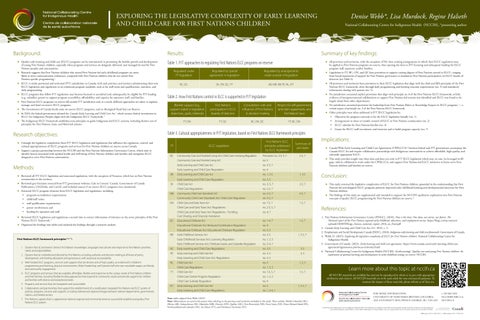
EXPLORING THE LEGISLATIVE COMPLEXITY OF EARLY LEARNING AND CHILD CARE FOR FIRST NATIONS CHILDREN
Background:
● Quality early learning and child care (ELCC) programs can be instrumental in promoting the healthy growth and development of young First Nations children, especially when programs and services are designed, delivered, and managed by and for First Nations peoples and communities.
● Research suggests that First Nations children who attend First Nations-led early childhood programs are more likely to meet communication milestones, compared with First Nations children who do not attend First Nations-specific programming.
● ELCC is under provincial and territorial (P/T) jurisdiction in Canada, with each province and territory administering their own ELCC legislation and regulations to set minimum program standards, such as for staff ratios and qualifications, nutrition, and daily programming.
● ELCC programs that follow P/T regulations may become licensed or accredited and, subsequently, be eligible for P/T funding (e.g., subsidies, grants) to support program accessibility, affordability, and capacity for operators, staff, and families.
● First Nations ELCC programs on reserve fall outside P/T jurisdiction and, as a result, different approaches are taken to regulate, manage, and fund on-reserve ELCC programs.
● The Government of Canada funds some on-reserve ELCC programs, such as Aboriginal Head Start on Reserve.
● In 2024, the federal government released the Canada Early Learning and Child Care Act, 2 which ensures federal investments in ELCC for Indigenous Peoples aligns with the Indigenous ELCC Framework. 3
● The Indigenous ELCC framework establishes nine principles to guide Indigenous-led ELCC systems, including distinct sets of principles for First Nations, Inuit, and Métis-led systems.
Research objectives:
● Untangle the legislative complexities from P/T ELCC legislation and regulations that influence the regulation, control, and cultural appropriateness of ELCC programs and services for First Nations children on reserve across Canada.
● Support a project partnership between the NCCIH and the First Nations Information Governance Centre, which aims to identify factors associated with optimal health and well-being of First Nations children and families and strengthen ELCC designed to serve First Nations communities.
Methods:
● Reviewed all P/T ELCC legislation and associated regulations, with the exception of Nunavut, which has no First Nations communities in the territory.
● Reviewed grey literature sourced from P/T government websites, Gale in Context: Canada, Government of Canada Publications, LEGISinfo, and CanLII, and included sources if on-reserve ELCC programs were mentioned.
● Extracted ELCC program elements from ELCC legislation and regulations, including:
• programs accreditation requirements;
• child/staff ratios;
• staff qualification requirements;
• parent involvement; and
• funding for operators and staff.
● Reviewed ELCC legislation and regulations a second time to extract information of relevance to the seven principles of the First Nations ELCC framework. 3
● Organized the findings into tables and analyzed the findings through a narrative analysis.
Results:
Table 1. P/T approaches to regulating First Nations ELCC programs on reserve
Summary of key findings:
● All provinces and territories, with the exception of NS, have existing arrangements in which their ELCC regulations may be applied to First Nations programs on reserve, thus opening the door to P/T licensing and subsequent funding for ELCC program staff, operators, and/or families.
● Legislation in YT, BC, ON, and QC have provisions to support varying degrees of First Nations control in ELCC, ranging from broad expressions of support for First Nations governance to mandatory First Nations participation on ELCC boards of directors (see Table 2).
● All provinces and territories have provisions in their ELCC legislation that align with the third and fifth principles of the First Nations ELCC framework, often through daily programming and learning outcome requirements (no. 3) and mandatory information sharing with parents (no. 5).
1. [System that is] anchored in distinct First Nations knowledges, languages and cultures and responds to First Nations priorities, needs and responsibilities.
2. [System that is] controlled and directed by First Nations, including authority and decision-making at all levels of policy development, and funding allocations and governance, with reciprocal accountability.
3. Well-funded ELCC programs, services and supports that are diverse and of high quality, as evidenced in children’s programming and learning, physical environments, Elders’ leadership, well trained staff who earn equitable wages, and family and community engagement.
4. ELCC programs and services that are available, affordable, flexible and responsive to the unique needs of First Nations children and their families, including flexible funding approaches that respond to community needs and provide supports for children and families with diverse and exceptional needs.
5. Programs and services that are transparent and accountable.
6. Collaborations and partnerships that support the establishment of a coordinated, integrated First Nations-led ELCC system of policies, programs, services and supports, including national and regional linkages between relevant departments, governments, nations, and related sectors.
7. First Nations capacity that is supported at national, regional and community levels to successfully establish and guide a First Nations ELCC system.
Table 2. How First Nations control in ELCC is supported in P/T legislation
Table 3. Cultural appropriateness in P/T legislation, based on First Nations ELCC framework principles
● No jurisdiction contained explicit provisions that align with principle no. 6 of the First Nations ELCC framework, as little evidence of intergovernmental collaboration to support First Nations-led systems was identified and ELCC was found to be largely siloed from other departments.
● No jurisdiction contained provisions for leadership from First Nations Elders or Knowledge Keepers in ELCC programs — a critical aspect of principle no. 3 of the First Nations ELCC framework.
● Other principles were often addressed in P/T ELCC legislation by:
• Objectives for program curricula or for the ELCC legislation broadly (no. 1)
• Arrangements to share or transfer control of ELCC to First Nations communities (no. 2)
• ELCC subsides for First Nations families (no. 4)
• Grants for ELCC staff recruitment and retention and to build program capacity (no. 7)
Implications:
● Canada-Wide Early Learning and Child Care Agreements (CWELCCA) 5 between federal and P/T governments accompany the Canada ELCC Act and require collaborative partnerships with Indigenous communities to achieve affordable, high-quality, and culturally appropriate ELCC.
● This study provides insight into what does and does not exist in P/T ELCC legislation which may, in turn, be leveraged to fill gaps, inform collaborative work under the CWELCCA, and support First Nations-led ELCC initiatives to better serve First Nations children and families on reserve.
Conclusion:
● This study reviewed the legislative complexities of ELCC for First Nations children, grounded in the understanding that First Nations-led and designed ELCC programs promote improved early childhood learning and developmental outcomes for First Nations children.
● The findings of this study are supplemental and intended to support the NCCIH’s qualitative exploration into First Nations concepts of quality ELCC programming for First Nations children on reserve. 6
References:
1. First Nations Information Governance Centre (FNIGC). (2016). Now is the time: Our data, our stories, our future. The National report of the First Nations regional early childhood, education, and employment survey. https://fnigc.ca/wp-content/ uploads/2020/09/fnigc_fnreees_national_report_2016_en_final.pdf
2. Canada Early Learning and Child Care Act, S.C. 2024, c. 2.
3. Employment and Social Development Canada (ESDC). (2018). Indigenous early learning and child care framework. Government of Canada.
4. Webb, D. (2025). Exploring the legislative complexity of ELCC for First Nations children National Collaborating Centre for Indigenous Health.
5. Government of Canada. (2023). Early learning and child care agreements. https://www.canada.ca/en/early-learning-child-careagreement/agreements-provinces-territories.html
6. National Collaborating Centre for Indigenous Health (NCCIH). (forthcoming). Quality care and young First Nations children: An exploration of optimal learning and development in early childhood settings on reserve. NCCIH.