

The Discipline and the African World 2026 Report:
An Annual Report on the State of Affairs for Africana Communities

From the National Council of Black Studies Annual Report Committee
Report Preparation Team
Editor
Dr. Serie McDougal III, California State University, Los Angeles
Associate Editor
Dr. Michael Tillotson, State University of New York, Cortland

Editorial Board
Dr. Valerie Grim, Indiana University
Dr. Maulana Karenga, California State University, Long Beach
Dr. James Stewart, Professor Emeritus, Pennsylvania State University
Production and Communications
Ms. Venus Kent
General Disclaimer: The analyses, opinions, and recommendations in this report do not represent official positions of the National Council of Black Studies.
TABLE OF CONTENTS
Statement from the NCBS President, by Valerie Grim, Ph.D.............................................5
Unfound Decolonization: Coups d’Etat and the Pressure within the Neocolonial State in Africa by Nkosilathi Moyo, Ph.D. ..........................................................................20
Moving Forward as New Threats Emerge in Mozambique by Gwinyai P. Muzorewa, Ph.D.............................................................................................................................30
Reviving Our Roots: Reframing African Diasporic Spirituality for Black Jamaican Women’s Identity by Sophia L. Williams...................................................................43
A Black Spirit by Jon-Jama Scott
A Musical Examination of Black History: Keeping through the Oral Tradition of Griots by Jordan Davidson..........................................................................................68
Uplifting Black Identity and Studying Abroad by Vernon C. Lindsay, Ph.D.............78
Remembering Earl Little as a Gullah Man from Georgia: A Case Study by J. Vern Cromartie, Ed.D...........................................................................................................88
From Our Eyes: Political Erasure in the Fight for Black Liberation by Laura Mae Lindo, Ph.D................................................................................................................102
The Algorithmic Gaze: Deepfakes, Surveillance, and Black Futures by Shuntavia N. James, Ed.D...............................................................................................................115
The Future Challenges of Black Studies in the United States 2025–2035 by Reynaldo Anderson, Ph.D., & Christina Hudson A.B.D...........................................................127
A Case Study in Developing a 21st-Century Africana Studies Journal: An Assessment of the First Three Years of Siyabonana by Andrea Ringer, Ph.D., Shelby Pumphrey, Ph.D., Aimee Glocke, Ph.D., & Sekh Ra Maat, Ph.D...............................................139
The State of African History in the Discipline by Daniel P. Roberts III, M.A., & Clyde Ledbetter Jr., Ph.D. .........................................................................................155
The Black Studies Program (BSP) at Iowa: Darwin Turner Papers and the Institute for
Afro-American Culture at the University Iowa, a Report by James Alexander Robinson IV, Ph.D.
COMMENTARIES
Burkina Faso and the African World Revolution: Notes from Afrocentricity International’s 11th Annual Convention and the Need for Translative Work by Tarik A. Richardson, Ph.D..................................................................................................182
Statement from the National Council for Black Studies President by
Valerie Grim, Ph.D.
Academic Excellence | Social Responsibility | Cultural Grounding
Reflections on the National Council for Black Studies’ Discipline and the African World 2026 Report
As we continue to live in a society where some individuals want to make African Americans invisible by erasing our history, co-opting the words and phrases of our past leaders (i.e. like the ways that some have abused the color blind phrase to reinscribe White hegemony and supremacy), and by conflating White privilege with their kind of meritocracy, while, at the same time, searching for ways to demean and demote African Americans using false interpretations of Black life and experiences, this 2026 NCBS Annual Report reminds us that we are connected through shared experiences throughout the global world. This report provides additional understanding as to how Blackness is perceived on and off the African continent, and it illuminates other daily struggles concerning worldwide liberation and autonomy. As we tell our stories, our histories and identities are front and center. We make no apology for who we are and how we are standing up for ourselves. The body of works assembled in this report addresses forces that continue to be at work corrupting
and interrupting ways that we transmit Blackness and our cultural identities for the benefit of our own spiritual, cultural, and racial uplift. Who we are is connected to our collective memories and traumas as well as our creativity, achievements, and successes. Together, the stories and analyses that evolve from our collective works have created an unbreakable sense of belonging. Understanding how we belong to each other is our quiet, but steady, superpower. Furthermore, while this issue of The Discipline and the African World 2026 Report provides broad understandings relative to the discipline as well as provocative analyses concerning issues related to our progress, continuous struggles to move forward, and achievements of African descended peoples, it offers insights concerning many issues and ideas, ranging from science, history, and culture to community engagementthatareusefultosustainingourexistencesconcerningwherewegofromhere: Improved and Enriched Community Living or Deeper Chaos and Conflict?
The 2026 Annual Report is divided into five sections. Section One, Continental African Politics and Decolonization, provides helpful analyses about residual and internalized patterns of colonialism through two very dynamic essays. One of the essays examines the history of colonization, coups, and neocolonialism in continental Africa, while the other focuses on content that reveal strategies for moving forward. Both essays illuminate the importance of African descended people working together to establish effectual human agency that reduces harm that threatens the internal security of African descendent people.
In Section Two, Roots, Memory, and Identity, readers are provided discussions that reframe ways that African diasporic spirituality can be conceived as well as means by which we can use the experiences of people in Jamaica and a Gullah community in Georgia to devise meanings of spirituality. Roots, Memory, and Identity are intellectual concepts where, on these pages, we come to understand that remembering is the power of our oral tradition and the strength of our Afro-
futuristic hopes. This section encourages us to actualize philosophical, intellectual, and communitypracticed strategies designed to produce and maintain cultural resilience through various agentive intersections within Pan-African global world scopes and visions.
The Politics of Black Visibility comprises the third section of this 2026 NCBS Annual Report
Authors in this section examine how political erasure of Black peoples’ fight for liberation and the ways that some algorithmic and deepfakes representations have worked together to re-narrate a version of Black history that on the one hand engages in greater surveillance of Black people, while, on the other, presents Black people in such a way that their futures are threatened through racialized image manipulation, especially as this manipulation relates to Black people’s struggle with America’s criminal justice system. Based upon discussions in this section, we hear a call for Black communities to become their own architects utilizing individuals who can develop on-the-ground intelligence through observations and interactions that are consistent with our actual realities and ways of being as well as ones who can create community-based intelligence that is combined with views that explain how we understand and experience the world and everyday life.
In section four, The State of Black/Africana Studies, are four dynamically engaging essays. Their collective themes focus on moving beyond surviving to thriving by establishing ways that Black Studies become more self-sustaining, insist even more on maintaining Africana epistemology through Black Studies epistemic integrity, and continue to possess complete control over the future direction of the discipline. The topics discussed in these essays raise important questions about such initiatives as Project 2025’s impact on Black communities, the 2027 AI initiatives, and the Genius Act and the threats it poses to intellectual frameworks and approaches. Because of these kinds of developments, there is a need for strategic clarity and proactive, not reactive, preparations, for example, to address how Black communities must prepare culturally and economically for the
onslaughtofnegativeimpactstechnology (especiallyroboticsandtheirabilitytoreducehumaninput regarding work) will have on our communities. Research-based analyses related to the aforementioned areas should be reported in current and newly evolving Africana Studies journals that provide greater access, and in Black Studies journals that utilize different research methods that provide knowledge production that bridges the gap between scholarship and community, especially during this digital age. Moreover, the focus on journal creation in this section reminds us that more attention needs to be given to scholarship related to pre-colonial African history beyond the Nile Valley. Deep knowledge of African-centered history and culture is essential to maintaining and developingAfricanaStudiesworld-wide.Whileinthepast,therehavebeenuniversitycommitments, in some places, that supported Africana Studies departments’ and programs’ efforts to establish centers and institutes to maintain a study of African diasporic peoples and their existences, that moment no longer exists within many institutions. This current transition now requires Africana Studies scholars and practitioners, with the support of global Black communities, to create entities outside of institutions of higher education that will foster sustained in-depth studies of Black life to further develop the discipline.
The Commentaries section of this NCBS Annual 2026 report include insightful and thoughtful comments rooted in a discourse concerning the value of Black Studies theories. One discussion features Afrocentricity, a theoretical approach that has provided much thought for debate concerning the utilization of Black/African centered perspectives for analyses. Additional focus asks us to consider the importance of using a Pan-Africanist approach to develop on-going global perspectives regarding Black existence and the accessibility of scholarship and practices that bring more peoples and communities to the conversation concerning ways forward for Black people. African descended peoples, working together in global worlds to address continental issues for themselves,must continueto be a conversationwe engage onmany different levels. Thereis abelief
that Africa becomes stronger if those on and away from the continent focus on helping to build a strong African Diaspora that supports the continent. The idea of “OneAfrica”is envisioned bysome as a component of reimagining ways that Blacks in the United States can create more freedom and liberation for themselves by reconceiving and reconceptualizing strategies that bring African descended people to the center of their own ideas for social, economic, political, cultural, and racial survival throughout the world.
Social responsibility is one of the three tenets of the National Council for Black Studies’ disciplinary focus. Much of this 2026 Annual Report helps us understand the value of being community-engaged. Moving forward, greater attention must be given to the kinds of engagement that lends to critical assessment and interrogation that translate to active-centered learning from a Black perspective that helps our people create pathways forward during these retrogressive moments. Takentogether,essaysinthisreportencourageustoreturntosocialresponsibilitythrough memory, community-engaged research, practice, and actions. Reading the essays collectively, as a means by which to develop protocols to address specifichistorical issues andquestions ofoppression and exploitation, may help those interested in the reparation question better understand how to develop a strategy that translates discussions from ideas to action and to a focus that includes not only compensation and institution building, but also reclamation of land and other valuable properties that can regenerate Blacks in the USA and throughout the world.
This Discipline and the African World 2026 Report is timely, especially now, as we live during a time when great efforts and very successful strides are being made to erase the horrific encounters and experiences of Blacks in America and Africans in the African Diaspora from the pages and annals of colonial, imperial, and capitalist histories of dominating and oppressive nations that have often placed greed above humanity. No matter how great the power to forge disingenuous
curriculums, dehumanizing legislations, and criminalizing actions against those seen as the other, WE WHO BELIEVE IN FREEDOM, EQUITY, DIVERSITY, and INCLUSION WILL NOT REST. WE WILL NOT QUIT STANDING UP FOR HUMANITY. There is no eraser broad or strong enough to take away our value nor to disappear Black/Africana Studies from the minds and mouths of those who believe in truth and justice for our peoples and their achievements. This is why NCBS publishes an annual report. We must talk to each other and speak to the world uncomprisingly about our abilities to determine for ourselves what we need and how we will bring about change for ourselves.
Recognizing that struggles and conflicts exist in nearly every corner of the world where there is a respectable percentage of Blacks and Africans working to achieve their dreams, we keep at the forefront of our efforts struggles dealing with human rights, civil rights, women’s rights, and the rights of children. NCBS cares about such issues as sex trafficking, poverty, militarism, imperialism, police brutality, hunger, economic devastation, immigration, oppression of gender and sexual identities, inequitable existences in employment, unequal education, homeliness, the criminalization of the poor, and many other issues, situations, and policies negatively impacting Black people throughout the world.
Through The Discipline and the African World, 2026: An Annual Report on the State of Affairs for Africana Communities, we want you to know what we stand for. We stand for academic excellence, cultural grounding, and social responsibility. We name ourselves, so we are the ones identifying who we are, and we say loudly and proudly that we are dedicated to speaking our truths and to establishing correct and evidenced perspectives (untwisted) aligned with a self-determined agency that guards and sustains our internal security. Neither our sense of purpose or self, whether real or imagined, will be undermined by continuous misrepresentations of our ancestors, their
histories, andthecontributions they(andwe)have madeto help make abetterworld. Let us converse together (begin again) concerning what should be the work of the National Council for Black Studies organization as well as for the Africana/Black Studies discipline at this current moment. Let us reimagineattacks onour cultural values andonwhoweare as apeople as an opportunity to empower ourselves to move beyond “JUST SURVIVING TO THRIVING.”
Dr. Valerie Grim
President, National Council for Black Studies
Professor,AfricanAmerican andAfrican Diaspora Studies, Indiana University
Preface
The news media has been referred to as the “fourth estate” by some (Carlyle, 1993), and even as the fourth branch of government by others (Cater, 1959). This is because large, popular global media outlets have long demonstrated their ability not just to inform, but to decide what counts as a crisis, set political agendas, and help the global citizenry decide what situation is the most consequential and deserving of our collective consciousness from one moment to the next. Without fail, the result is that situations linked to major powers (the U.S., Israel/Palestine, Iran) become the ones that occupy the consciousness of many. If theAfrican/Black global citizen is not careful, theAfrican world’s own concerns can be pushed to the margins of their consciousness and become background noise. The result is a faulty prioritization of theAfrican world’s most pressing concerns. This annual report contains a section titled Continental African Politics & Decolonization, which features two articles: Nkosilathi Moyo’s “Unfound Decolonization: Coups D’etat and the Pressure within the Neocolonial State inAfrica” and Gwinyai Muzorewa’s “Moving
Forward as New Threats Emerge in Mozambique.” They are a reminder to us of how critically importantAfrican countries’autonomy and security are. Moyo explains how the momentum and language ofAfrican independence movements have been manipulated under neocolonial conditions, often using the rhetoric of revolution to achieve neocolonial ends. He provides a typology of coups d’état to help differentiate the ill-intended from the truly Pan-African.
Muzorewa’s essay, on the other hand, sheds light on a situation in Mozambique at the intersection of terrorism and resource wars locating the region at the center of the global contest for strategic minerals. Yet he takes an approach grounded in the philosophical framework of ubuntu as a global model and a call forAfrica thinkers to approachAfrican needs, concerns, goals, and imaginations through home-grown lenses. This section is a reminder to people ofAfrican descent that the struggle forAfrican sovereignty is not abstract or distant, no matter how it is treated in popular media. It is ongoing, urgent, and in need of persistent attention and vigilance by the discipline, if
no one else.
This struggle, however, is not limited to the political arena, it is being waged at the levels of culture and memory as well, in ways that reaffirm Paul Robeson’s reminder that the battlefront is everywhere. The transmission ofAfrican/Black people’s ancestral memories and identities across generations is too important a task to leave to institutions outside the control ofAfrican people and those who share a concern for their wellbeing. The essays in the section Roots, Memory, and Identity explore many different means thatAfricana people use to connect and reconnect with their roots for the purposes of resistance and revitalization.
In her essay “Reviving Our Roots: ReframingAfrican Diasporic Spirituality for Black Jamaican Women’s Identity,” Sophia L. Williams explores theAfrican-derived Jamaican tradition of Kumina and the efforts made to demonize and misrepresent it. She uses the womanist liberation theology framework to discuss how reclaiming the tradition is a way of restoring Black women’s spiritual authority in the twenty-first century. In his essay “ABlack Spirit,” Jon-Jama Scott describes a spirit within Black people’s artistic DNAthat remains despite the tide of commercialization. He identified the historic and present power of this spirit to evoke a socially conscious energy connecting Black people to their ancestors and moving them toward liberation while resisting commercialism and self-destructive avenues.Asimilar spirit can be found in artistic expression. In her essay “AMusical Examination of Black History: Keeping through the Oral Tradition of Griots,” Jordan Davidson evokes the tradition ofAfrican griots to explain the ways that Black musicians have continued to do griot work in maintaining ancestral knowledge and cultural memory. She also explores the roles of capitalism and cultural appropriation, through the vampire metaphor of the movie Sinners, to discuss the forces that have been at work to corrupt and interrupt the transmission of Black cultural identity. What can be done to restore identity and memory? In his essay “Uplifting Black Identity and StudyingAbroad,” Vernon C. Lindsay
discusses the transformative power of studying abroad, particularly on theAfrican continent, to enhance Black students’sense of belonging, identity, and confidence beyond what can be accomplished in a classroom. He makes many points, including a timely argument for aligning Black Studies courses with study-abroad opportunities. He also highlights the Umoja Community Education Foundation as a model that illustrates how non-profit organizations rooted in Black Studies principles can fill the funding gap left by government cuts to study-abroad opportunities while also building Pan-Africanism across geography. In his essay “Remembering Earl Little as a Gullah Man from Georgia:ACase Study,” J. Vern Cromartie uses primary sources to highlight an important and eye-opening layer to Malcolm X’s geographic and cultural identity. He also sheds light on Earl Little and the cultural and social-political lessons he imparted to Malcolm X, which he then carried into his own leadership and shared with the world. His recovery of this less-known history is itself an act of agency and ancestral memory.
People ofAfrican descent are visible and exercise visibility in everyday life in countless ways, from the names we give ourselves, the intellectual and artistic products we create, and the organizations we create, to the ways we represent ourselves, express our voices, and protect, and grow what we create. Yet althoughAfrican-descended people cannot be made to disappear in a literal sense, their voices, visibility, and agency can be misrepresented, erased, suppressed, and made invisible in other ways. These forces that seek to render Black people invisible are likely to be extensions of the same neocolonial pressures that Moyo and Muzorewa analyze on the continent and now find themselves in present algorithms.
In the section of this report titled The Politics of Visibility, two essays deal with this idea and how it relates to the present moment. In “From Our Eyes: Political Erasure in the Fight for Black Liberation,” Laura Mae Lindo builds on current understandings of the types of invisibility that Black people face by unpacking the concept of political invisibility. The essay explains the
ways Black politicians are celebrated and projected as symbols of the political establishment’s progressivism while they are isolated and undermined in their efforts to build collective power to make change. She also explains the historical consciousness and other resources Black communities need to assert visibility and agency. In her essay “TheAlgorithmic Gaze: Deepfakes, Surveillance, and Black Futures,” Shuntavia N. James puts new deepfake technologies in the long historical context of racialized image manipulation. She illustrates the real impacts that deepfakes can have on Black defendants in the criminal justice system and on Black protesters exercising political voice. She calls on Black communities to become architects of more ethical forms of artificial intelligence through the framework of algorithmic dignity.
The NCBSAnnual Report is a space where ongoing, current disciplinary conversations take place. That is why there is a dedicated space in each report that focuses on the state of Black/Africana Studies. This year, all four essays in this section are concerned with the sustainability, epistemic integrity, and future direction of the discipline.
In their essay “The Future Challenges of Black Studies in the United States 2025–2035,” ReynaldoAnderson and Christina Hudson examine the interaction of three forces posing threats to the discipline: Project 2025’s conservative policy agenda, the rapid advancement of artificial intelligence as articulated inAI 2027 initiatives, and the GeniusAct and its intellectual property framework. They urge the discipline to respond to these threats with strategic clarity, proactively engaging with technology from its own center. This could position Black Studies scholars as not just critics but architects of more just and culturally grounded technological and policy tools and spaces. In their essay “ACase Study in Developing a 21st CenturyAfricana Studies Journal:An Assessment of the First Three Years of Siyabonana,Andrea Ringer, Shelby Pumphrey,Aimee Glocke, and Sekh Ra Maat document the founding and evolution of Siyabonana as a peerreviewed, open-access,African-centered journal rooted inAfrican-centered principles. Their
discussion of pathways to developing Siyabonana is highly informative and provides a great historiography of disciplinary journals as well. They make the case for this new journal in its uniqueAfrican-centeredness and inclusivity while providing a replicable model for expanding the discipline’s publishing infrastructure in the digital age. Ringer, Pumphrey, Glocke, and Maat’s essay is in part a reply to Anderson and Hudson’s call for the discipline to engage the future in digital spaces strategically. In their essay “The State ofAfrican History in the Discipline,” Daniel P. Roberts and Clyde Ledbetter describe their systematic review of journal articles, faculty publications, and doctoral dissertations from 2009 to 2024, which revealed that the discipline is producing disturbingly little scholarship on pre-colonialAfrican history outside of the Nile Valley. Drawing on the concept of sankofa and the call forAfrica-inclusivity, they argue that centered and geographically expansive knowledge ofAfrican history is foundational to the discipline’s core mission, and they offer concrete recommendations for departments, individual scholars, NCBS, and journal editors. Finally, in his essay “The Black Studies Program at Iowa,” JamesAlexander Robinson IV makes an important contribution to the historiography of the discipline. He draws on the Darwin T. Turner Papers to recover the foundational and underrecognized role the University of Iowa played in the formation of Black Studies as a discipline. Through Turner’s intellectual vision, the Institute forAfro-American Culture, and the Iowa Consortium for Black Studies, Robinson explains how one institution’s early investment in the discipline helped shape its theory, pedagogy, and institutional infrastructure for decades to come.
The Commentaries section of this report features TarikA. Richardson’s essay “Burkina Faso and theAfrican World Revolution: Notes fromAfrocentricity International’s 11thAnnual Convention and the Need for Translative Work,” in which he provides a firsthand account of his travel to Ouagadougou, Burkina Faso, as part of a Pan-African delegation attendingAfrocentricity International’s eleventh annual convention. The account is particularly fascinating, as the country
has evoked recent conversations around issues of sovereignty and liberation. He argues that Black Studies must remain intentional in its orientation and engagement to maintain a global Pan-African perspective that does not reduce theAfrican world to theAfricanAmerican experience. He further argues that the discipline must take on an urgent and largely unmet responsibility to translate foundationalAfrican-centered scholarship that remains inaccessible to English-speaking scholars and communities. Ultimately, closing out the report, Richardson’s essay challenges the discipline to take on what it means to be truly Pan-African. The essays in this year’s report are a reminder of how necessary and urgent the discipline of Black Studies remains. The media can and will likely continue to send its messages about whose struggles matter and whose are secondary, but the scholars, artists, activists, and community members in this year’s report demonstrate thatAfrican people will continue to imagine, build, and sustain their own futures regardless.
References
Carlyle, T. (1993). On heroes, hero-worship, and the heroic in history. University of California Press.
Cater, D. (1959). The fourth branch of government. Houghton Mifflin.

CONTINENTAL AFRICAN POLITICS & DECOLONIZATION
Unfound Decolonization: Coups d’Etat and the Pressure within the Neocolonial State in Africa by
Nkosilathi Moyo, Ph.D.
HumanitiesAmped
Baton Rouge, Louisiana
Africa is a continent beleaguered by coups d’état. In 2023, The Voice of America reported that since 1950,Africa has accounted for the most coups globally, with 220 cases, including both successful and failed coups.As recently as 2024, there was at least one coup attempt inAfrica, in the DRC (Manyukwe, 2025). Ibelema (2008) writes that “the thrust of scholarly analyses of military coups inAfrica is that they result from the structural factors ofAfrican politics” (p. 120). Specifically, I treat coups as troubled expressions of unfound decolonization, which is a condition that continually frustrates the Pan-Africanist vision ofAfrican unity, sovereignty, and liberation.
African Decolonization: Failed, Unfinished, or Unfound?
Fanon (2001) considered decolonization a radical transformation of colonized societies, involving three dimensions: the political, the cultural, the psychological. He was aware that
colonization primarily meant the European invasion of aboriginal lands, aboriginal cultures, and aboriginal psychologies. Decolonization, then, must have been conceived and practiced as, above all else, an insurgent ejection of the outlined invasions from aboriginalAfrican life. This, idealistically, would have been a true decolonization. Frankly, that never happened. Instead, the revolutionary risings launched by the masses inAfrica against European occupation, starting in the 1950s and aimed at decolonization, quickly transmogrified into mere struggles for political independence. This was due primarily to the hijacking of the masses’revolutionary movements by nationalist elites whose sights were never on decolonization, since, as Fanon (2001) lucidly notes, their message to the colonizers was always “Give us more power” (p. 46). Note: power, not decolonization. When these misleading, opportunistic, conniving elements commandeered the decolonization efforts initiated by the masses in the villages and the forests, the impulse for decolonization was lost. The vision for decolonization dissipated.
Ultimately, the Europeans transferred power the corrupting power to the nationalist elites, and then independence was born, not to signal decolonization, but, paradoxically, to institutionalize its betrayal. Who was unaware of this paradox? Who danced in the streets as nationalist flags replaced European flags? The answer is: the people. They believed they were witnessing the triumph of the revolutionary (decolonial) struggle that they had started in the villages and forests. Little did they realize they were now cheering a distorted outcome, the result of nationalist elites who never sought “the radical overthrowing of the system” getting into bed with the colonizers for the simple exchange of power (Fanon, 2001, p. 46). As the postindependence era, the period of neocolonialism,1 illustratesAfrican independence was a transition that marked a failed, unfinished, or, as I argue, unfound decolonization.
“Failed” means that there is no chance thatAfrica will ever decolonize, and the neocolonial
1 Attah (2011) defines neocolonialism as “the survival of the colonial system in an ex-colony” (p. 55).
state remains the last stage ofAfrican socio-political structural development. “Unfinished” implies that decolonization is at present ongoing inAfrica; and perhaps it is, but of this I am not aware. This is not to say that the people are not making efforts to decolonize their lives. They have been decolonial since the 1950s, if not since colonialism, but the state is not engaging their efforts. Lastly, “unfound” suggests that decolonization in Africa today remains unknown not because it is unknowable, but because the neocolonial state has not given it room to surface freely, leaving it as a suppressed potential.2 Akin to every suppressed impulse of the people, decolonization finds an outlet in cultural production: films, songs, poems, dances even the people’s private journals under mattresses and pillows. They use such media to dream of a new Zimbabwe, Congo, Ghana, andAlgeria, and ultimately a newAfrica.
The Neocolonial State: Its Texture and Mimicry
Being an outright betrayal of the people’s dream and vision for decolonization, the neocolonial state must subsist, in form and function, through mimicry of its long-lost kin, the classical colony. Power is centralized. Repressive state apparatus prevails. Cultural and psychological tools of decolonization are suppressed. Poverty reigns supreme in the people’s quarters. These are some traits of the neocolonial state, asAttah (2011) propounds that neocolonialism has “political, social and economic characteristics” (p. 56).
In the neocolonial state, government is always a top-down affair. The so-called elected officials, who in fact elect themselves through “riggings by the ruling party,” must always dictate social order to the people, leaving no room for dialogue or for cultivating the Pan-Africanist aspect of unity between the government and the people (Attah, 2011, p. 329). Plainly said, as Fanon (2001) observed, the post-independence government treats the people as “children,” expecting from them “obedience and discipline”; that is, the people can only receive orders and cannot offer
2 Unfound decolonization is therefore a repressed potential for anti-colonial socio-political transformation.
suggestions for the government of their own lives (p. 146). To ensure (or insure, as in protect) this evidently colonialist dynamic, the repressive state apparatus, specifically the military and the police, is set on the people like dogs on an intruder, to harass, harm, and even murder whenever the people express their will, which is usually a will to govern together with the supposedly elected officials.
After failing to express their will directly in the public sphere, or alongside such an effort, the people resort to cultural methods for what Freire (2005) termed “conscientization,” for social critique, for awakening, for revolution the sites for mapping unfound decolonization.
Unfortunately, in the neocolonial state, even this is a cause for exile if one seeks to evade beatings and kidnappings that occur when the neocolonial force “invades homes at will, usually after midnight,” or death (Bulhan, 2015, p. 246).
Moreover, the neocolonial state is a realization of the observation of Memmi (2006), that “the greatest corruption frequently accompanies the greatest poverty” (p. 8). Be it the violent mistreatment of the people or some other kind of absurdity, the neocolonial state inAfrica is a state of alarming corruption, and the poverty induced by this fact is lamentable. The World Population Review (2025) lists the five most poverty-stricken countries in the world today as Burundi, Central African Republic, Somalia, Mozambique, and the Democratic Republic of Congo.Acommon factor is clear: all these countries areAfrican, and it must be added that this destitution gnaws through the bones not of the political elite, but of the masses, the people.
That considered, what is unmistakable is that the neocolonial state is a state of “indigenous colonization” (Sule et al., 2024, p. 64). It is closely akin to the classical colony, being oppressive to theAfrican people. However, unlike the classical colony, an entity that was entirely alien to the children ofAfrica, the neocolonial state is like a parent who abuses her own children by mimicking the methods of an abominable relative. Thus, like such a parent, the neocolonial state must be
confronted with internal upheaval, a brutal tension, and sooner or later it becomes bloated from this pressure the pressure of betraying the people, of selling out their hopes for social conditions that dignify their humanity. Inevitably, as the pressure builds, it culminates in what Cebotari et al. (2024) have termed “political fragility” (p. 3). Then it bursts. The coup d’état is that burst.
Coups d’Etat, Savior–Junta Rhetoric, and Popular Reception
Put another way, coups d’état are toAfrican states what volcanoes are to the earth: organic, violent eruptions that build from internal tension. The tension that the neocolonial state faces is the need to terminate the very foundations that define and sustain it, those discussed in the preceding paragraphs.As an explosion of the pressure menacing the neocolonial state, the military takeover erupts in violence (physical or symbolic), promising renewal and reconstitution that is, promising decolonization.
This promise is performed in what I call the savior-junta rhetoric: often-misleading speeches brimming with language of liberation, anti-corruption, restoration of sovereignty to the people, and national rebirth; speeches that often focus narrowly on reconstructing the nation, and barely on the continent, thus illustrating the diversion of the coup from the historical PanAfricanist vision for reconstructing the continent. Consider, for instance, Nigeria in 1983, when a military coup ousted President Shehu Shagari and installed General Muhammadu Buhari, who promised “to ensure that the difficult and degrading conditions under which we are living are eliminated” and to save “our great nation from total collapse” (Nilspeace, 2015). He was selling nationalist hope to the people, as happened in a more recent instance, that of Zimbabwe in 2017, when a coup replaced President Robert Mugabe with Emmerson Mnangagwa, who promised “a Second Republic” and even professed reverence for the will of the people, declaring “The voice of the people is the voice of God” (Burke & Graham-Harrison, 2017).
Because savior-junta rhetoric ostensibly supports transforming the neocolonial state in the
interest of the nation, coups are rarely frowned upon by the people; they are often met with cheers. Ibelema (2008) affirms that “coup announcements typically engender widespread jubilation on the streets” (p. 130). Both cases of coups d’état presented here were received favorably by the people. Buhari was “initially popular” (Sil, 2023); Mnangagwa was welcomed by a “cheering crowd” (DW, 2017). In both the Nigerian case and the Zimbabwean case, the junta was hailed as the bringer of a new day at last by the masses, whose hope stemmed, among other factors, from the fact that the strongman who occupied the presidency, and to whom the betrayal of the people’s movement for decolonization was imputed, the face of neocolonialism, had fallen, and that now must come the moment we all have been waiting for: decolonization.
The Illusion of Change
To their chagrin, the people often soon learn that the junta is a chameleon. It changes color. The rhetoric of hope, of goodwill, and of collective good that it furnished the people at the onset, besides legitimizing the junta, masked the longings of a few military generals, their wives, children, relatives, friends, and even concubines to fatten their pockets with the nation’s resources. Moreover, it soon becomes unmistakable that the coup was only a matter of marrying new faces to the old order. Enabled by being in charge of the neocolonial structure, these new faces will now spoil themselves with the loot from the nation’s resources; that is what they craved, after all. While these robbers plunder the resources that rightfully belong to the people, neocolonial repressive systems intensify, keeping the people at bay and detached from the government. In Nigeria, Buhari’s promises terminated in “iron-fisted rule” and “human rights abuses” (Chibelushi, 2025). In Zimbabwe, Mnangagwa’s government “turned out to be an unanticipated horror” (Mutekwe, 2023, p. 1).
It is out of these realizations that the masses begin to descend back into their despondence, their shell of hopelessness seeing clearly that decolonization remains unfound. Not only has the
junta reproduced the old regime, but the new faces are perhaps more brutish than the old. One hears this in murmurs among the masses in Zimbabwe: “Mugabe was a better leader,” “I never thought I would miss Mugabe so much,” “The new leader is coldhearted.” The people conclude that President Mnangagwa is more heartless than his predecessor.
Western Exploitation ofAfrican Coups: Some Cases
What should be clear toAfricans is that military takeovers rarely bring genuine revolutionary social change, though some have. They are also susceptible to external manipulation. How? There is historical evidence of Western powers exploiting coups d’état onAfrican soil. In 1960, Belgium and the U.S. took advantage of a coup in the DRC that ultimately replaced the PanAfricanist statesman Patrice Lumumba with Joseph Mobutu, as a Western strategy of “changing the scenery,” installing a Western puppet to rule post-independence Congo (Reid, 2023, p. 266). This would not be the only Western-backed coup inAfrica targeting Pan-Africanist leadership. Among other coups acrossAfrica, the West again backed the coup that dissolved the presidency of Kwame Nkrumah in post-independence Ghana in February of 1966 (Nkrumah, 2001, pp. 33–51).
By supporting these coups, the West was thwartingAfrica’s assumption of revolutionary social change post-independence and fixated on keeping Africa in a perpetual state of unrealized decolonization.
Diverse Kinds of Coups, Similar Outcomes
This conduct by the West, of historically exploiting military takeovers inAfrica, raises the question of whether coups inAfrica are monolithic.At the least, there are what I consider imperialistic coups, myopic coups, and revolutionary coups.As was treated above in the discussion of Western-supported coups that deposed Pan-African political leadership inAfrica, imperialistic coups are those used by the West to directly advance its imperialist impositions onAfrica. Myopic coups are those whose vision, lacking direct Western support and benefit, pretends or wishes to
seek socio-political transformation of the neocolonial state. However, lacking imagination, these terminate in the reproduction of the status quo; both Buhari’s and Mnangagwa’s coups belong here. Lastly, there are revolutionary coups. These are “rooted in revolutionary fervor or principled, if sometimes naive, attempts to steer the polity in the right direction” (Ibelema, 2008, p. 126). Think of Burkina Faso’s Thomas Sankara, whose “abiding sense of mission, clarity of purpose, and sincerity of efforts to empower and uplift his country’s peasants stand out as shining examples of an alternative possibility” (Kandeh, 2004, p. 62). Though coups differ in shape and purpose, they lead to a similar destiny: more coups.
Pan-Africanism and the Decolonial State
To save itself from both the coup syndrome and neocolonialism,Africa must decolonize in both the continental and national spheres, primarily by adopting Kwame Nkrumah’s notion of a United States ofAfrica, wherebyAfrican countries dismantle their national borders, a trait of classical colonialism constructed in Berlin and a major cause ofAfrican disunity, as well as an enabler of national corruption, pillage, and plunder. To remove borders is to remove the veil behind which governments engage in these abominations with impunity, owing to colonially inherited state sovereignty.Africa needs not colonially inherited state sovereignty but a state ofAfrican sovereignty, whose achievement first requires unity through intra-African borderlessness and the formation of a union of decolonial states
In emerging decolonial states in a unitedAfrica, state administrators must work with the people by engaging cultural production, since decolonization cannot be realized through imposition from above, as that would risk reproducing neocolonial power relations. Institutionally, a decolonial state would operationalize its collaboration with the masses by (1) recognizing cultural production not as mere entertainment but as a platform for imagining political possibilities, (2) creating platforms to collect and analyze protest poetry, narratives, music, films, etc., as
expressions of civic engagement, (3) forming popular parliaments where filmmakers, writers, dancers, and visual artists present their dreams of justice, governance, and dignity to be debated and refined for policy adaptation, (4) spotlighting artistic collectives that explore topics like land redistribution, mass repression, and corruption, and use these to shape social discourse or pedagogy.
Conclusion:AnAppeal to Pan-African Studies
Given my treatment of the Pan-African ideal as an imperative facet of decolonization required in Africa today, Pan-African Studies must center the study of the coup crisis on the continent. By doing so, Pan-Africanists will uncover what I attempt to uncover in these pages: that neocolonialism, a Black-faced colonialism which, because of its Blackened texture, is often imperceptible and easy to overlook, is foundational toAfrica’s contemporary problems. The neocolonial conditions out of which coups erupt defy the Pan-African call for unity between the political elite and the people, between nations balkanized by colonial borders, and, as coups literally attest, between the military and the government.
Marcus Garvey’s slogan “Africa for theAfricans” should have been fulfilled byAfrica’s independence from formal colonial rule. However, Pan-African Studies must stress thatAfrican independence scarcely surrenderedAfrica into the hands of theAfricans; instead, it proffered the continent to a Blackened colonial system that continually deniesAfrican masses the Pan-Africanist precept of collective liberation.
References
Attah, N. E. (2011). The historical conjuncture of neo-colonialism and underdevelopment in Nigeria. Journal of Social Sciences, 4(2), 55–75.
Bulhan, H.A. (2015). Stages of colonialism inAfrica: From occupation of land to occupation of being. Journal of Social and Political Psychology, 3(1), 239–56.
Burke, J., & Graham-Harrison, E. (2017, November 22). Emmerson Mnangagwa to be sworn in as Zimbabwe’s president on Friday. The Guardian. https://www.theguardian.com/world/2017/nov/22/emmerson-mnangagwa-to-be-sworn-inas-zimbabwes-president-on-friday
Cebotari,A., Chueca-Montuenga, E., Diallo, Y., Ma, Y., Turk, M. R.A., Xin, W., & Zavarce, H. (2024). Political fragility: Coups d’état and their drivers. International Monetary Fund.
Chibelushi, W. (2025, July 15). Muhammadu Buhari: Ex-Nigeria president’s political life in pictures BBC News. https://www.bbc.com/news/articles/czxw2wn5v52o
Duzor, M., & Williamson, B. (2023, October 3). Coups inAfrica. VOA News. https://projects.voanews.com/african-coups/
DW. (2017, November 22). Zimbabwe: Mnangagwa returns to Harare, replace Mugabe. https://www.dw.com/en/zimbabwe-crisis-emmerson-mnangagwa-returns-to-harare-toreplace-mugabe/a-41478772
Fanon, F. (2001). The wretched of the earth. Penguin Books.
Freire, P. (2005). Pedagogy of the oppressed. Continuum.
Ibelema, M. (2008). The African press, civic cynicism, and democracy. Palgrave Macmillan.
Kandeh, J. D. (2004). Coups from below: Armed subalterns and state power in West Africa. Palgrave Macmillan.
Manyukwe, C. (2025, July 18). Africa’s appetite for coups grows as military leaders strengthen
their grip. Index on Censorship. https://www.indexoncensorship.org/2025/07/africasappetite-for-coups-grows-as-military-leaders-strengthen-their-grip/ Memmi,A. (2006). Decolonization and the decolonized (R. Bononno, Trans.). University of Minnesota Press.
Mutekwe, P. (2023).An embodiment of hope and unanticipated horror: Civil society’s expectations and views on the transition from Mugabe to Mnangagwa. The African Review, 51(3), 285–305.
Nilspeace. (2015, March 31). Gen. Muhammade Buhari – first speech after military coup, 31 December, 1983 and general Ibrahim Babangida – speech on 27. August 1985 after overthrowing Gen. M. Buhari. MinBane. https://minbane.wordpress.com/2015/03/31/genmuhammade-buhari-first-speech-after-military-coup-31-december-1983-and-generalibrahim-babangida-speech-on-27-august-1985-after-overthrowing-gen-m-buhari/
Nkrumah, K. (2001). Dark days in Ghana. Panaf Books.
Reid, S.A. (2023). The Lumumba plot: The secret history of the CIA and a cold war assassination. Knopf.
Sil, N. (2023). Nigerian military topples president Shagari: Military history and science. EBSCO. https://www.ebsco.com/research-starters/military-history-and-science/nigerian-militarytopples-president-shagari
Sule, B.,Attah, N. E., Sambo, U., Kachalla, B. L., & Tsoeu-Ntokoane, S. (2024). Dr coup d’état in WestAfrica: Aresurgence of military rule in the 21st-century? Journal of Central and Eastern European African Studies, 4(3-4), 53–73.
World Population Review. (2025,August 1). Poorest countries in the world 2025.
https://worldpopulationreview.com/country-rankings/poorest-countries-in-the-world
Moving Forward as New Threats Emerge in Mozambique
by
Department of History, Philosophy and Religion
Lincoln University
Early on October 5, 2017, thirty jihadists attacked police stations in Mocímboa da Praia district in northern Mozambique. This was the beginning of as many as seventeen significant attacks in the region through 2020 (Mwakideu, 2021). Although the initial response of government was to downplay the events, they were later forced to come to terms with them. As the national military of Mozambique was under-equipped, under-trained, and overwhelmed by this asymmetrical warfare, the government had to ask for external help. Even though there was an extensive history of regional cooperation for common shared values, such as liberation for itself and its neighbors, Mozambique opted to first seek assistance from Portugal and the United States to train its troops (African Research Bulletin, 2021). They followed this by turning to Russia, by way of the Wagner Group, and then the Dyck Advisory group, a paramilitary from South Africa. It was not until April 2020 that Mozambique turned to the Southern African Development Community (SADC) to intervene.
Gwinyai P. Muzorewa, Ph.D.
From October 2017 onward, these events in Mozambique constitute a new chapter of the country’s confronting its choices and dealing with the consequences. To this point, Mozambique chose corporate interests and wealth for the elite over the well-being of its people. The marginalized and neglected “least of these,” make up 70 to 90 percent of the country’s population of 33 million people. The north of Mozambique, where the vast majority of attacks took place, has also been the site of the nation’s greatest sources of prospective wealth, but it has produced the country’s most marginalized people. That is, until they could no longer be forgotten. Using the philosophical framework of ubuntuism, this work seeks to analyze related historical of events as well as to forward a constructive approach to the issues cited here. Ubuntu, as discussed by Stanlake and Tommi Samkange, is Southern African in origin and contextualizes humanness, or one’s own humanity, especially as it relates to the state of another person where consideration of them is as critical as the consideration of oneself (Samkange & Samkange, 1980).
Central to the unfolding events and insurgent violence enacted in northern Mozambique are the vast reserves of liquified natural gas (LNG) and the people who have been marginalized from having a share of the bounty of their own ancestral homeland. Discovered in 2011, the LNG reserves are estimated to hold 100 trillion cubic feet of gas and have the potential to produce 89 million tonnes per annum (MTPA; Makonye, 2023). Yet the indigenous people of the north have had to endure a sequence of betrayals by their government. Beginning with the opening of the liberation struggle against the colonizer, Portugal, the north of Mozambique was the site of early battles and victories that made winning the whole country possible. From Eduardo Mondlane’s receiving shelter in Julius Nyere’s Tanzania and the founding of FRELIMO in 1962 to when the baton was passed to Samora Machel in 1969, the participation of the north of Mozambique was critical to progress. Their brand of African nationalism, that Marxist ideology adopted by the founding fathers, emphasized the people as central to their efforts. By extension, post-
independence Mozambique stood with both Zimbabwean and South African nationalists, who used the country as headquarters while they waged wars for liberation. That possibility can be attributed to the sacrifices and gains that Mozambique experienced during its own liberation struggle. When we fast forward to the early 2010s and vast deposits of LNG were discovered there, they only complemented the estimated 23 billion tonnes of coal, ample deposits of rubies, and rich farmland and fisheries.
Foreign investors leaped and bounded to invest in Mozambique. The president at the time, Armand Guebuza, took the helm in the aftermath of a bitter civil war with RENAMO, a relic of apartheid era South Africa that had grown to rival the founding party FRELIMO politically. Nevertheless, the ruling FRELIMO administration steered affairs of state toward political party advantage, and perhaps also personal wealth accumulation. This activity, which amounted to as much as 2 billion USD between 2013 and 2016, led to the withdrawal of the planned investments. This led to an upended economy of national debt amounting to 137 percent of the national GDP by the end of 2016 (Macuane et al., 2017). Total Energies of France emerged as the largest stake holder in Mozambique’s LNG by 2017. However, the indigenous people of the north were removed from their homelands, not compensated, and excluded from the promise of an economically prosperous future they hoped for.
When the insurgency began, the president of Mozambique at the time, Filipe Nyusi, himself originally from the north, led a government that first denied that the violence was occurring at all. When the military failed to contain the situation, he turned to others who were calculated to effect calm militarily with no transparency. It was first to the Russian mercenary group Wagner, and after that the South Africa–based para-military organization Dyck Advisory Group. Neither was up to the task of not only confronting the jihadists but also adding to solutions that would address the core issues that instigated the insurgency (DW News, 2023). A massive
attack on the LNG plants near the town of Palma from late March to early April of 2021 propelled Mozambique to more earnestly engage the Southern African Development Community (SADC) to come to the aid of Mozambique, itself a founding member. The hesitation with engaging SADC to address the issues of the insurgency lay in the exposure of the ill-gotten choices of profits and political power over the direct prioritization of the masses of Mozambique. The existential threat to Mozambique that the jihadists posed was nevertheless well understood. Across Africa, terrorism has increased dramatically in the last two decades. The potency of jihadism acrossAfrica has accelerated. In approximately 10,000 attacks between 2017 and 2022, there were been 40,000 deaths. The first six months of 2023 alone claimed as many as 8,500 lives across 1,500 attacks (Accord, 2021). The history of jihad on the continent has produced precedents that might assist in the anticipation of what to expect and in planning to counter the insurgency. Thus it is worthwhile to review their modus operandi inAfrica:
1. Challenging state power: They wish to assume state control by destroying symbols of the government, and to delegitimize the state.
2. Grievance-based recruitment: They recruit and cultivate as contacts people who wittingly or unwittingly participate in their activities. Such illicit activities are exacerbated when government officials themselves are involved in illicit trade, as they seek to cover up their transactions.
3. Violence: The use of violence not simply to kill people, but to terrorize them.
4. Fight and fade: When the state is able to push back and defeat insurgents militarily, the latter melt away. Foreign fighters typically leave the country if they can.
5. Financial viability: Once they have secured an area, jihadists go about making it financially viable. This is accomplished quickly utilizing international trade networks.
6. Sharing intelligence: Jihadists share information and expertise, which helps them
become ever more sophisticated in their attacks.
7. Attrition by terror: This would be a war of attrition where the larger force, which is usually expensive to run, is depleted of morale, resources, or both. Yet the governing authorities are forced to return every time as the social contract has it that the government has to protect its people. Without that response, government power and legitimacy erode, and the jihadists look to fill the vacuum and set themselves up as the alternative (Faleg, 2021).
This is not an exhaustive list of the modus operandi of jihadists inAfrica, but a brief overview of some of the factors that have allowed them to thrive and withstand larger, better regimented state forces.
Thus, in the days following the April 6, 2021 attacks, SADC assessed the role that the region would play in the crisis. A quick reactionary force from South Africa promptly arrived. On April 13, South African commanders of the South African National Defense Forces established their presence (SABC News, 2022). This included retaking small towns in the area and repatriating its residents. However, the military leadership was clear that attacks would not stop there if there was no significant intervention (Mlambo & Masuku, 2022). Fierce fighting later resumed in Cabo Delgado, but it was contested. However, lack of confidence in the state and its ability to protect its citizens and assets was shared by the French, as on April 26, 2021, Total declared force majeure. It would be approximately three months until more substantive actions were taken by SADC concerning Mozambique. On July 15, 2021, they deployed the Southern African Mission in Mozambique (SAMIM). Countries that contributed soldiers, consultants and logistical support included Angola, Lesotho, Botswana, Tanzania, Zambia, Zimbabwe, Malawi, and South Africa (Accord, 2021). The extraterritorial Rwanda also joined hands, nearing and later outpacing the number of troops that the largest regional supporter, South Africa, had committed to the fight. The
SAMIM mandate was reviewed and renewed as the situation in Mozambique dictated.
The mission was terminated in July 2024. In the interim, Mozambique had an opportunity to pivot and prioritize its commitments to its own people. The opportunity to approach a greater institutionalization of African unity on African terms presented itself. Nevertheless, the regional SADC and Rwanda were factors to be reckoned with. By 2022, of the estimated 3,000 fighters, 200 had been killed in action while 300 remained active and visible combatants. Thus the majority of the 2,500 “al Shabaab” were unaccounted for. Meanwhile, the Mozambican military had been trained to take over operations (Kigali Today, 2023). Other developments, included restoring electricity and other infrastructure, had been partially completed in the area. These represented positive developments toward restoring civilians to their lives there and the development of the Palma district (Igihe, 2021).
Renewed Offensives
Atrifecta of events, however, disrupted the progress that security measures had achieved. First came the return of Total, then the announced termination of SAMIM, followed by protests against the elections of late 2024. Of these three, Total’s return was perhaps the catalyst that energized the insurgency in February. This was preferred to their waiting until SAMIM had departed in July 2024.An intensification of terrorist attacks and deaths could also be observed at that time.Another factor that allowed for greater insurgency activity was the 2024 presidential election cycle, as the jihadists thrived on instability. In one instance, protesters opened the jails, where among others, as many as 300 insurgents were being held.All escaped, and from January to August 2025 approximately 500 terrorist incidents were reported.
Where and Who Were These Attackers?
Locals in the north called them “al Shabaab,” or “the youth” not to be confused with the Somalia-based organization. For their own part, the insurgents called themselves Ahlu-Sunnah wal
Jama’a (ASWJ; Herdt & Christianson, 2023). According to Sérgio Chichava, their origins extend far beyond the first attacks in October of 2017. In the Macomia district, among a population that was almost exclusively Muslim, radicals rose to challenge the status quo of existing religious institutions. Predominantly young men were willingly recruited by the organization and took up arms against their government on the basis of grievances against the same and with the hope of gaining some revenue. There was also a leading element of religious fervor. ASWJ, from the time of their 5 October 2017 attacks, made overtures to larger, more established jihadist organizations on the continent, including the Somalia-based al Shabaab and the northern Nigerian Boku Haram. Affiliations with larger and more established organizations, such as the Islamic State (ISIS/ISIL) were also forged as the violence in Mozambique gained international attention.
SADC: Origins and Developments
The multi-national entity SADC was founded on April 1, 1980 in order to counter the economic and political prowess of an apartheid-era South Africa (South African Development Community, 2021). Over forty years later, the threat was different, yet the need to demonstrate solidarity was at hand. Moreover, their orientation and reasons for fighting in the region were ideologically aligned with the goals of nation building. Mozambique was and is in need of those willing to join hands and lift arms for the love of their people, and for the long haul.
Moreover, the emerging threat in Mozambique was known to have the potential to spread to neighboring countries, if not to the whole region. Thus, if for nothing other than the base denominator of self-preservation, the concepts of Pan-Africanism or at least regional cooperation were evidently overdue, as as many as 2,900 civilians were killed between 2017 and 2021 (African Research Bulletin, 2021). The military response was urgently needed and was responded to robustly. Equally necessary are increased regional trade and integration toward economic strengthening and mutual growth. Mozambique’s hardships highlight the need to build more
permanent structures for shared security, including intelligence sharing, military industrialization, and the building out of regional communication and logistics infrastructure (ZBC News, 2020).
Over and above Mozambique’s looking to its regional partners in security, it is worthwhile to look to them again for help in other sectors. Potential partners for assistance with LNG might includeAngola. Experts in mining, processing, and exporting precious stones may be found in Botswana. Precious metal extraction may be available from Zambia. Further assistance in closing the educational gap may lie in Zimbabwe and SouthAfrica. Greater regional stability and mutual growth by way of barter trade might resolve some of the region’s concerns, such as the development of national institutions, including the military, schools, hospitals, food production, roads, and energy architecture. This observation and recommendation is in accordance with the humane element of interconnectivity. This hunuism, this ubuntuism, finds expression when one is doing right by another. The possibility of it being financially viable, both in the short term and for the duration, is incidental but still welcome. Their absences, however, open a door for us to be in terror from even our own youth.
As with every strong relationship, there are elements of vulnerability. An area of growth that is needed is transparency. That means less opportunity for corruption. These vulnerabilities have proven fatal but now must be confronted if Mozambique is to move forward. Beyond these institutions, old, new, and aspirational, there is a need to revisit the concepts of African nationalism and Pan-Africanism on the basis of the principles of ubuntuism, or humanness, in which the well-being of the people is the true measure of success or failure. While they were originally forged in the crucible of the fight against colonialism, they can only be upheld by people continuing to fight for Africans against twenty-first century challenges. These remedies call for going beyond the reconfiguration of the distribution of wealth following extractive processes. They call for the prioritization and inclusion of indigenous people
in the orchestration of their own homeland and the future. Centralizing the masses not only allows for the possibility of successes such as that of LNG in northern Mozambique, but in other industries there too. The support of the people who have a vested interest in positive developments will make it succeed. They would also be the first ones to stand it up again if the industry collapsed. Moreover, it will overcome the grievance-based recruitment practices of jihadists. The momentum started by SAMIM should continue, adjusted to operationalize the prospects for local prosperity in addition to exporting national goods. Such locally derived partnerships, like all good relationships, take time to find working balances and maturation.
References
Accord. (2021). Terminating insurgency in Mozambique: Reflections on the SADC mission in Mozambique. https://www.accord.org.za/ajcr-issues/terminating-insurgency-inmozambique- reflections-on-the-sadc-mission-in-mozambique
African Research Bulletin. (2021), Mozambique: Insurgency Spreads.African Research Bulletin: Political, Social and Cultural Series, 57 (12): 22987B-22988A.
https://doi.org/10.1111/j.1467- 825X.2021.09806.x
Al Jazeera News. (2024, February 29). Mozambique fighting: Tens of thousands flee renewed attacks. https://youtu.be/uJTh_MqMXq8
Chichava, S. (2023, May 22). Muamudo Saha e a guerra “santa” contra os “porcos”: A fase inicial da insurgência em Cabo Delgado [Muamudo Saha and the “holy” war against the “pigs”: The initial phase of the insurgency in Cabo Delgado]. Information on Development, Institutions and Social Analysis. IESE - Instituto de Estudos Sociais e Económicos. http://www.iese.ac.mz.
DW News. (2012,April 6). Mozambique’s military retakes town of Palma after days of fighting. Youtube. https://www.youtube.com/watch?v=kiad9WODRrI
DW News. (2023, May 1). Why are Russian oligarchs forming private armies? Youtube. https://youtu.be/KsS3KLvqMyM
Faleg, G., & Mustasilta, K. (2021, June). Salafi-jihadism inAfrica:Awinning strategy. European Union Institute for Security Studies, 1–7.
Herdt, C. S., & Christianson, J. (2023, June 15). Mozambique: A nation of unrealized potential. Center for Strategic and International Studies. https://www.csis.org/analysis/mozambiquenation-unrealized-potential.
Igihe. (2021,August 9). A heart-warming moment between Cabo Delgado residents and Rwandan soldiers. Youtube. https://youtu.be/fvaQeSf80mM
Kigali Today. (2023, June 21). President Kagame’s take on Africa’s efforts to mediate Russia/Ukraine conflict: Press conference. Youtube. https://youtu.be/uGEqHE8Dj6A
Louw-Vaudran, L. (2022, September 8). The many roots of Mozambique’s deadly insurgency: New Field research in Cabo-Delgado sheds light on one of Africa’s least understood violent conflicts. Institute for Security Studies https://issafrica.org/iss-today/the-many-roots-ofmozambiques-deadly-insurgency
Macuane, J. J., Buur, L., & Monjane, C. M. (2017). Power, conflict and natural resources: The Mozambiquan crisis revisited. African Affairs, 117(468), 415–38
Makonye, F. (2023, December). Critiquing the scramble for Mozambique’s liquefied natural gas (LNG) and oil by foreign powers: Case of Cabo Delgado province. African Journal of Development Studies, 13(4), 565–76.
Mlambo, V. H., & Masuku, M. M. (2022). Terror at the front gate: Insurgency in Mozambique and its implication for the SADC and SouthAfrica. Public Affairs, 22 (Suppl. 1), e2700, 1–8, https://doi.org/10.1002/pa.2700
Mwakideu, C. (2021, March 29). Mozambique’s escalating extremist violence. DW News. https://www.dw.com/en/mozambiques-extremist-violence-poses-threat-for-neighbors/a57043563
SABC News. (2021, March 30). Mozambique: Humanitarian crisis around the gas rich northern area. Youtube. https://youtu.be/N9c4gSHJwrk
SABC News. (2022,April 13). Relative stability in Cabo Delgado, Mozambique: SANDF.
Youtube. https://youtu.be/siIg0s4KidI
Samkange, S., & Samkange, T. M. (1980). Hunhuism or ubuntuism: A Zimbabwe indigenous political philosophy. Graham Publishing.
SouthernAfrican Development Community. (2021,August 21). SADC day message by SADC
chairperson H. E. Filipe Jacinto Nyusi, president of Mozambique. Youtube.
https://youtu.be/Qrzun2OuDOw
ZBC News. (2020, May 19). Mozambique Insurgency: SADC member states urged to support the government. Youtube. https://youtu.be/CEnMedwvW1Y

ROOTS, MEMORY, AND IDENTITY
Reviving Our Roots:
Reframing African Diasporic Spirituality for Black Jamaican Women’s Identity
by
Sophia L. Williams
Independent Researcher
African American Studies
University of Florida Alumna
Starting in the early sixteenth century and continuing for almost four hundred years, more than three million stolen Africans were shipped to the Americas in the trans-Atlantic slave trade, becoming the principal labor force of the New World (Gomez, 2005). Inundated with the abuse enforced under slavery, the spirituality of our African ancestors was systematically criminalized, demonized, and reduced to frivolous superstitions through colonial Christianity reaffirmed with Eurocentric historiographies (Dill, 2019; Gomez, 2005; Stewart, 2005; Think Africa, 2023). In the wake of Tacky’s Rebellion in 1760, the Assembly of Jamaica passed the first Obeah Act, which criminalized African spiritual practices and was meant to ensure the security of colonial power structures against rebellion (Paton, 2019). As a result, both enslaved and free Black people were
creolized, assimilating Obeah and other African religions into the predominantly Christian culture (Obeah and the Law, 2018).
Notwithstanding these challenges, African spiritual knowledge continues to be sought after and has remained a source of spiritual protection, healing for the sick, and ancestral guidance for those afflicted by worldly troubles (Stewart, 2004). Jamaican Kumina, whose ritualistic practices draw on Akan ancestry and facilitate connection between the human and ancestral worlds, exemplifies this continuity. The leaders and keepers of the Kumina religion and culture are women known as Kumina queens who are highly respected in Jamaica for their spiritual authority (Stewart, 2004). However, this knowledge has been overshadowed by centuries of anti-African and misogynistic scholarship (Agorsah, 1994; Gotlieb, 2000).
Both on the African continent and in the diaspora, people have adopted and identified with Eurocentric labels against their ancestors’ indigenous religions, forcing them underground and ultimately shaping contemporary disconnections from ancestral spiritual knowledge. In this paper, I examine Kumina as a case study to explore how the strategic erasure and regulation of nonChristian African-derived religions have shaped their contemporary existence, and how the redetermination of these practices can function as a site of resistance for Black women’s religious identities in the twenty-first-century African diaspora (Stewart, 2004). Conducting a qualitative case study that integrates historical–critical analysis, this study is interpreted through womanist liberation theological and decolonial theoretical frameworks to illuminate how African religions can sustain religious multiplicity, spiritual authority, and diasporic continuity in the face of colonial legacies.
Literature Review
Epistemic Violence on African-Derived Religions
Historian Stephanie A. Camp (2004) described the paternalist model of enslavement as
hegemonic cultural control and violent discipline that forced from enslaved people obedience and consent for their subjugation. Violence under slavery did not present itself solely in physical punishment; it was also enacted discursively in language, ideology, and silence. Sadiya Hartman reminds us that there are “absences and silences” in colonial archives of slavery, an intentional obliteration of Black life meant to render the past unrecoverable and African subjectivity illegible (Hartman, 1997, as cited in Legrand, 2025, p. 11). Sylvia Wynter further critiques Western modernity for constructing “man” as the universal human, a process that normalizes distancing oneself from Black people by marginalizing other ways of being and knowing (Wynter, 2003, p. 261). This epistemic violence functioned alongside the legal repression employed by missionary Christianity and Eurocentric historiography to cast African religions as superstition, witchcraft, and devil worship. While the literature effectively documents this repression and erasure, “critical fabulation,” the act of merging historical research with narrative reconstruction, offers a methodological response to archival silences by recovering suppressed meanings and centering contemporary restoration and transformation (Anderson & Derr, 2021; Legrand, 2025, p. 11). The African religious traditions born from Jamaica’s unique cultural and spiritual fusion served as a means of cultural preservation clandestinely practiced within the boundaries of African communal life. This deliberate strategy to neutralize African collective power produced long-term fractures in generational knowledge transmission, treating African religions as historical phenomena rather than a living system (Page & Woodland, 2023).
Gender, Religious Authority, and Redetermination in the African Diaspora
The assimilation of African people into Christianity included the reinforcement of strict gender roles in religious institutions, introducing a male-dominated leadership structure that directly contrasted with African traditions of strong female authority (Stewart, 2005). Both on the African continent and in the diaspora, people have adopted and identified with Eurocentric labels
against their ancestors’ indigenous religions, internalizing the symbols and ideas of the White oppressive imagination and harboring misconceptions of Afro-diasporic religio-cultural languages, symbols, and attitudes (Stewart, 2005; Uzomah, 2022). Womanist theologian Dianne Stewart’s (2004) concept of redetermination provides a sociological lens for understanding how Black women navigate multiple religious systems as a strategic adaptation to structural constraint. Her literature positions Black women’s religious practices as forms of agency through which social identity, healing, and resistance are negotiated within the diaspora.
Commodification, Spiritual Economies, and Contemporary Disconnection
Recent sociological analysis examines how the African spiritual practices incorporated into global spiritual and wellness economies are detached from their sociohistorical and ethical contexts. In their book Healing Justice Lineages, scholars Cara Page and Erica Woodland (2023) state that the historical criminalization, demonization, and commodification of our people have disconnected us from the practices of our ancestors. Spirituality has become a transactional tool for social capital, prioritizing marketability over communal accountability and generational knowledge, making us inadvertently complicit in this commodification. This critique highlights how our lack of grounding has left us not knowing how to properly traverse the spiritual networks of our ancestors, through deliberate efforts by white supremacy to keep us systemically controlled (Page & Woodland, 2023). This perspective underscores the importance of examining religious systems such as Kumina as social institutions for healing our intergenerational connections and reclaiming our spiritual traditions.
Kumina’s Ritual Ceremonies and Religious Epistemologies
Kumina was established in post-emancipation Jamaica between 1841 and 1865 (Stewart, 2004). Descendants of Yoruba indentured laborers retained their cultural traditions in the Westmoreland and Hanover parishes, while the Bakongo traditions were maintained in St. Thomas
(Stewart, 2004). A ceremonial tradition centered on ancestral veneration, spirit possession, and ritual movement, Kumina functioned as both an art form and a system through which African descendants sustained identity and communal cohesion in the aftermath of slavery (Morrish, 1982).
From its inception, Kumina represented not merely a folk tradition but an embodied religious epistemology transmitted through ritual, memory, and women’s leadership.
Central to this epistemology is the role of Kumina queens, whose authority is grounded in ritual mastery and spiritual knowledge. As historian Ivor Morrish (1982) notes in his book Obeah, Christ, and Rasataman, Kumina was originally an African ceremony to memorialize the departed, in which members of the tribe were physically possessed by spirits through dances led by a master of ceremonies and a queen or mother of Kumina. She held the knowledge of all the folksongs and would often lead the ceremonies at certain junctures. The purpose of these ceremonies was to invoke ancestral spirits, gods, and evangelical guardians to protect the worshippers from evil spirits and dangers that surrounded them. They believed that birth, marriage, death, and entombment are fraught with danger, and that the human spirit is susceptible to invasion by evil duppies unless protected by the ceremonial prayers and ritual.
Every ceremony begins with a greeting to African tribal gods1 heralded by the rhythmic beating of drums. They are welcomed and fed by a sacrificial goat, and when the room is filled with the energy of ancestral spirits, the ceremonial dance begins. In this ritual, the spirits are asked for economic, social, and medical help, and thanks are always given for any aid received. Through spiritual possession, Kumina rejects Western binaries that separate the sacred from the secular, locating divine power in the body and ritual rather than in institutional doctrine.
1 Among the gods that were traditionally invoked was Macoo, who would cause a possessed living person to climb up poles and trees backwards. Kanuba is a spirit who comes from a paternal lineage. In these contexts, a living person who was possessed by a god or spirit would be referred to as a zombie.
Theoretical Framework
The karmic power of spirituality has proven a critical tool for rebellion on the journey to liberation. Black liberation theology focuses on the social, economic, and political liberation of all African Americans, emphasizing our unapologetic Blackness and religiosity, particularly utilizing the voices of Black men to speak on behalf of Black women (Gross, 2008; Laughinghouse, n.d.).
Womanist theology emerged from Black liberation theology, centralizing the lived experiences of Black women. Womanist theologians Katie Cannon, Jacquelyn Grant, and Delores Williams employed Alice Walker’s framework, womanism, to reject universalized models of religion and liberation and to examine the nature of intersectional oppression, including capitalism, gender inequality, and racial discrimination, that marginalizes Black women’s lived experiences (Laughinghouse, n.d.). Ritual practices, strategies of survival, and the teaching of this knowledge, historically dismissed as folklore or superstitious, are reinterpreted as legitimate forms of knowledge production and moral reasoning. By connecting “our cultural values, oral traditions, and social experiences to our spirit forces,” womanist theology cultivates meaning in our lives to liberate Black women, and by extension all of humanity (Laughinghouse, n.d., p. 2).
Womanist theology employs religion as a prophetic strategy to scrutinize the relationship between gender and power within religious contexts, aiming to reclaim and reconstruct the identities of Black women for themselves (Laughinghouse, n.d.; Reliford, 2023; Stewart, 2005).
Christian missionaries and colonial officials projected “respectable” womanhood, emphasizing submission, purity, and domesticity and positioning these traits as markers of moral and religious respectability (Sharpe, 2003). This directly contrasts with African traditions that honored women as leaders, warriors, and mediums. Women who resisted these colonial gender norms and continued to practice African spirituality were deemed dangerous, immoral, or even criminal, reinforcing the idea that Black women’s power and autonomy, especially in religious spaces, were
unnatural and unacceptable (Clemons & Grieser, 2023). Womanist liberation theology provides the radical permission to be self-determined in our spiritual journey, resisting predominant and preconceived notions of the spaces we occupy in our Blackness and womanhood.
Methodology
This study employs a qualitative, theological analysis methodology grounded in womanist liberation theology. I analyze and interpret existing historical scholarship and documented ritual practices related to Kumina. These sources are examined through a womanist theological lens that centers Black women’s spiritual authority, embodied knowledge, and ancestral epistemologies. This approach is particularly suited to the study of African-derived religious traditions, as it resists colonial frameworks that marginalize spiritual practice and validates lived religious experience as a site of knowledge production.
Analysis
Womanist liberation theology centers on Black women’s lived spiritual knowledge, challenging Western classes of thought that privilege rationality, written archives, and institutionalized religion. Within this framework, Kumina queens are theologians and political authorities whose legitimacy is grounded in ancestral lineage, ritual efficacy, and communal resistance. As will be explored in the analysis, Kumina as a knowledge system is part of the search for identity, a movement that returns to African religious ideas of ancestor survivorship, spiritpossession, sacrifice, and racial unity (Morrish, 1982).
In her assessment of Kumina, Dianne Stewart (2004) exposes the recognition of Kumina queens within a paradox of Jamaican society shaped by postcolonial power structures. The queens are given great respect and recognition for their spiritual roles as ritual leaders, healers, and mediators between the spiritual and social worlds, but they struggle to overcome poverty, social marginalization, and stigmatization (Stewart, 2004). Jamaica’s most distinguished Kumina queen
in postcolonial society, the late Imogene Kennedy, transitioned to the spirit world in 1997. Queen Kennedy received national attention for the cultural significance of Kumina awarded the Order of Distinction on January 8, 1983 and recognized in National Heritage Week. However, this visibility did not translate into sustainable resources or institutional protections. Instead, the state’s celebration of Kumina reflected the colonial scripts of African religion in popular Jamaican thought, visible only when stripped of theological depth and communal authority. This framing transforms Kumina into a cheap spectacle that commodifies Black women’s spirituality, reinforcing gendered and racialized institutions in postcolonial Jamaica (Stewart, 2004; Uzomah, 2022). This contradiction is lensed by womanist liberation theology, in that Black women’s spiritual authority is both revered and devalued, revealing how colonial legacies persist through neoliberal colonial politics. Kumina thus emerges as a contested site where African-derived religion survives through women’s leadership while remaining vulnerable to commodification, marginalization, and epistemic erasure.
For practitioners of Kumina, this tradition is a system of belief and rite of passage that is more important than any art form promulgated and recreated by Jamaican intellectuals at the University of the West Indies in Kingston’s Creative Arts Center Theatre.2 Reductionist efforts to minimize Kumina into a spiritual performance3 for Jamaican folk music disregard the fact that, as Morrish (1982) notes,
Kumina is a dimension of spiritual life and aspirations that is both elemental and transcendental: elemental in that its roots are in the soil of Africa and in the transplanted spirits of the negroes; transcendental in that Kumina is not so much a particular belief as an awareness that pervades all the spirits of the participants providing them with some cosmic
2 Jamaican intellectuals at the University of the West Indies in Kingston maintained that Kumina was purely an art form that provided a sophisticated replication of African dance and ceremonial movements (Morrish, 1982).
3 Spiritual performance is defined by Cara Page and Erica Woodland (2023) as the act of publicly teaching or sharing spiritual knowledge without adequate training or grounding in the traditions they are sharing.
identity they are one with the gods, with their ancestral spirits and with one another.
(p. 62)
Kumina and other African-derived religions’ endurance represents a profound form of diasporic continuity that resists the erasure of African religious worldviews in the Caribbean. Through collective survival theology, Kumina maintains an unbroken spiritual conversation between Africa and its diasporic descendants. The state’s epistemic violence sought to undermine Black women’s authority as knowledge producers and recontextualize Kumina as palatable, aestheticized, and controllable rather than politically and theologically disruptive.
However, a womanist theological framework reclaims Kumina as a site of liberation rather than loss. By centering the voices, labor, and spiritual philosophies of Kumina queens, this analysis affirms the tradition’s capacity to challenge colonial legacies and articulate alternative visions of sacred power. Drawing on Stewart’s concepts of redetermination, practitioners actively reinterpret religious traditions to meet contemporary needs while remaining rooted in ancestral epistemologies. It is a living system not rigidly defined by doctrinal purity, but sustained by diasporic memory and a redefinition of power beyond Western theological and sociological frameworks. On the whole, Jamaican Black women navigate life amid oppression, misogynoir, and cultural suppression with the aspects of this pragmatic epistemology that emphasize healing, wellbeing, and purposeful life experiences.
Discussion
The findings of this study reveal that Kumina is a spiritual system that sustains multiple religiosities, women-led spiritual authority, and diasporic continuity in the face of colonial legacies. Rather than being a folkloric tradition, Kumina actively resists epistemic violence imposed by colonial Christianity in the foundations of its traditions. Viewed through a Black womanist liberation theology framework, Kumina emerges as a site where spirituality functions as
both cultural survival and political resistance. The criminalization and vilification ofAfricanderived religions relied on binary frameworks that positionAfrican cosmologies as dangerous threats to social order and Western Christian frameworks as universal and civilizing.As analysis shows, Kumina was rendered a performative religious system in society because it sustained alternative sources of authority, healing, and communal power, specifically under the leadership of Black women.
The historical demonization ofAfrican-derived religions is not merely a colonial artifact but a recurring strategy of social control that continues to shape contemporary political and cultural discourse. Similar narrative strategies have emerged, particularly in the Christian nationalist movements led by Donald Trump’s presidential administration. In championing a conservative, Christian-ledAmerican society, discourses frame immigration, racial justice, and LGBTQIA+ rights as threats to the purity of the nation, echoing earlier colonial strategies that demonized African spiritual practices to justify repression (Page &Woodland, 2023). The system recognized the power ofAfrican traditions and used the ideals created by colonial dictatorship to dismantle their strongholds and reduce them from the transcendental and divine power they held in the same context of Christianity to mundane blasphemous attacks on the sanctity of society.
We have come to believe that socially constructed rules are law, and our socialization into these institutions, where racism and systemic discrimination are embedded in every sector of society, cultivates psychological stress with no reprieve in sight. When we are forced to question good and evil, right and wrong, and man versus other, we exclude classes of thought that could counter hegemonic spiritual systems that embrace multiplicity. Central to this resistance is the role of Kumina queens, who keep this tradition alive despite being challenged by colonial patriarchy and Christian gender norms. Their authority is found in lineage, embodied knowledge, and communal recognition, preserving our collective well-being and continuity over generations.
Finally, this study highlights how contemporary commodification ofAfrican-derived spirituality represents a continuation of colonial control through marketized economy. When spiritual practices are detached from their history, ritual discipline, and communal accountability, they risk reproducing the same erasures enacted through historical criminalization (Page & Woodland, 2023). Kumina’s insistence on ancestral grounding and communal ethics offers a critical alternative, reaffirmingAfrican-derived religion as a living system of meaning, resistance, and liberation within theAfrican diaspora. Black women’s religious identities encompass complex dimensions of the supernatural world, often allowing for multiple religious traditions to coexist within their lives. Jamaicans have engaged in negotiating multiple religious worlds to access spiritual power and obtain alternative modes of healing and recovery. What might appear to be contradictory phenomena in the practice of more than one spiritual tradition are readily reconciled in moments of Jamaican empowerment, especially for women. This religious coexistence is sometimes lived out individually in daily ritual practices of prayer and herbology.At other times, it is carefully and systematically circumscribed in written texts for collective edification. In exploring specific ways in which many Black women have historically practiced, and continue to practice, bothAfrican-derived religions and, in particular, Christianity, I have become convinced of the need for more expansive approaches.
Future Research
The healing justice framework explored by Cara Page and Erica Woodland (2023) speaks to the corrosion ofAfrican spiritual practices by White supremacist religious narratives pervading young and impressionable minds, with social media as a conduit for this change in acknowledgement of our ancestors’spiritual traditions. Just as in the 1800s, when historians would spread their charged rhetoric of the “cult” traditions they witnessed, people with power are able to speak to those who are less educated and easily shape their beliefs with unnuanced information,
seemingly giving them all the facts with no credibility and no encouragement to conduct more research (Morrish, 1982. p. 61). That is why it has become so much easier to just forget about these teachings when they are strategically hidden from us. Thus in my future research I would critically analyze archival records in Jamaica, documenting the silences and strategic distortions of the truth to weave a narrative within the archive’s silences, overshadowed by the legacy of colonialism.
Conclusion
Womanist theology can be a resource for women as we return to a White nationalist mainstream society. Spirituality is essential to our livelihood and our identity, and it should not be compromised for the sake of hegemony. Our spirituality is ancient and grounded in both nature and the supernatural, and we were once venerated spiritual warriors. From our introduction to the New World, we have been defined as the other and marginalized as such. Our spirituality has been demonized, controlled, and commodified into a frivolous tradition, made for profit, and we buy into this commodification, not realizing the dangers of haphazardly taking part in these traditions without doing the spiritually grounding work of looking to our ancestors for guidance and learning from them. It is within this space that we are safeguarded from the assimilation of Whiteness, free to explore our ancestral knowledge and employ it as a site for resistance and richness (Pearson, 2022).
Black women in Jamaica have continued to resist and reclaim their spiritual authority. Modern movements aimed at decolonizing religion have helped to restore respect for African spiritual traditions and the women who uphold them. These acts of resistance highlight the resilience of Black women in preserving their cultural and spiritual heritage despite centuries of colonial oppression. Society turns to the healing instruction of Kumina queens, but they are not recognized and venerated as cultural artifacts in need of protection. In the future, I hope to recontextualize the meaning of African religions and offer an understanding that African religions
venerated historical women figures in ways that were once natural to us. Due to dehumanization by White scholars, people have begun to fear it. We have feared something that we don’t understand, and my passion has always been to secure ways to protect Black womanhood and to center our autonomy and agency. I believe these religious systems can serve as sites for resisting how society views women and for instilling in us the leader warrior queens we were predestined to be.
References
Agorsah, E. K. (1994). Maroon heritage. Canoe Press (IL).
Anderson, C. N., & Derr, H. L. (2021). Using critical fabulation for history-based playwriting. HowlRound Theatre Commons. https://howlround.com/using-critical-fabulation-historybased-playwriting
Camp, S. M. H. (2004). Closer to freedom: Enslaved women and everyday resistance in the plantation south. University of North Carolina Press.
Clemons, A. & Grieser, J. (2023). Black womanhood: Raciolinguistic intersections of gender, sexuality & social status in the aftermaths of colonization. Daedalus, 152, 115–29.
https://doi.org/10.1162/daed_a_02021
Dill, K. (2019). Poco mania. My Life in Transition. https://kengdill.com/poco-mania/
Gomez, M. A. (2005). Reversing sail: A history of the African diaspora. Cambridge University Press.
Gottlieb, K. (2000). “The mother of us all”: A history of Queen Nanny, leader of the windward Jamaican maroons. Africa World Press.
Gross, T. (2008). Black liberation theology, in its founder’s words. NPR. https://www.npr.org/2008/03/31/89236116/black-liberation-theology-in-its-founders-words
Hartman, S. (1997). Scenes of subjection: Terror, slavery, and self-making in nineteenth-century America. Oxford University Press.
Laughinghouse, C. (n.d.). Womanist theology: A summary. Student Christian movement https://www.movement.org.uk/resources/womanist-theology-101
Legrand, D. M. (2025). The terror of the threshold: on impermanence, enclothed hauntology, and rest. Masters Theses. https://digitalcommons.risd.edu/masterstheses/1381
Morrish, I. (1982). Obeah, Christ, and rastaman. James Clarke & Co.
Obeah and the law. (2018). Early Caribbean Digital Archive.
https://ecda.northeastern.edu/home/about-exhibits/obeah-narratives-exhibit/obeah-and-thelaw/
Page, C., & Woodland, E. (2023). Healing justice lineages. North Atlantic Books.
Paton, D. (2019). The racist history of Jamaica’s obeah laws. History Workshop.
https://www.historyworkshop.org.uk/empire-decolonisation/the-racist-history-of-jamaicasobeah-laws/
Pearson, I. (2022, August 25). The spiritual sound technologies of Jamaica. Burnaway. https://burnaway.org/magazine/accompong/
Reliford, L. W. (2023). The liberating theology that transformed my understanding of God. Sojourners. https://sojo.net/articles/liberating-theology-transformed-my-understanding-god
Sharpe, J. (2003). Ghosts of slavery. University of Minnesota Press.
Stewart, D. M. (2004). Womanist theology in the Caribbean context: Critiquing culture, rethinking doctrine, and expanding boundaries. Journal of Feminist Studies in Religion, 20(1), 61–82. http://www.jstor.org/stable/25002490
Stewart, D. M. (2005). Three eyes for the journey: African dimensions of the Jamaican religious experience. Oxford University Press.
Think Africa. (2023). Forms of control and punishment employed by slave holders in the Americas and Caribbean. https://thinkafrica.net/slavery-controls/
Uzomah, M. M. (2022). Religio-cultural perspectives and their contributions to the historical development of education and the civilization of nations. West African Journal of Educational Sciences and Practice, 1(1). https://doi.org/10.57040/wajesp.v1i1.184
Wynter, S. (2003). Unsettling the coloniality of being/power/truth/freedom: Towards the human, after man, its overrepresentation; An argument. New Centennial Review, 3(3), 257–337.
https://doi.org/10.2307/41949874
A Black Spirit by
Jon-Jama Scott, Ph.D. candidate
American Culture Studies
Bowling Green State University
This essay discusses a Black spirit: an idea I believe is the artistic DNAof hip-hop dynamic creators and listeners.ABlack spirit is a force that moves the artist and thinker to express the human condition and attempt to treat others as full human beings.ABlack spirit points to a struggle to be well informed, to support cooperative efforts to enhance access to food, clothing, and shelter, and to advocate for those who cannot. ABlack spirit may seem like a religious signifier, but is here cultural, scholarly, community, and activist work. “Black” represents our people, places, and activities. “Spirit” represents an energy helping to address these assaults and can renew a commitment to valuing common humanity. We share an evolutionary origin, and our ability to endure as a species will require us to value established practices that achieve social cooperation. Scholarship, artistic production, insights, and contributions are rarely original. This thesis is evidence of understanding and appreciation for what has been said or done before.
Continuous building is anAfrican tradition, and Molefe K.Asante and Maulana N. Karenga
reasoned that Black Studies is more than a body of data; it is a way of approaching and interpreting it (Karenga, 1993). One of the ways we do that is by studying our creative productions.ABlack spirit forces us to deal with dueling perspectives: those we can sense and those we can observe. The Black productions that I am building upon have a spirit, a force, which is private and public. I am concerned with style and substance. It is as W. E. B. Du Bois described the origins of Black creative impulses in 1925: “Personal and universal . . . ‘combined with a certain group compulsion’” (Karenga, 1993, p. 393). Here the idea is especially concerned with one of the meanings of the Black aesthetic, an embrace of the “criteria by which Black art could not only be judged in terms of its creativity and beauty, but also in terms of its social relevance” (Karenga, 1993, p. 394). Thus, interrogating the roots and routes of Black agency; the strategies for collective liberation, memory, and futurity, for example, with students and in my own work, necessitates that I leverage Baldwin prior to Ellison, and TupacAmaru Shakur rather than Shawn Corey Carter.A Black playwright looked at a similar idea and said,
The Black Spirit is a primordial aesthetic of mellifluous, polyrhythmic, spontaneous and infinite dimensions. . . . Black drama can and does clarify and elevate noble dimensions of the Black Spirit when the drama reinforces and informs Black people that they are needed by one another and further, shows Black people how to reach out to each other across this need. (Scott, 1972, p. ii.)
Scholarly critiques of hip-hop have in part argued that it reinforces negative images of Black culture.After reading critical scholarship (hooks, 1994; Kitwana, 2002; Rose, 2008) one can better understand how the commercial success of hip-hop has been incentivized to curate caricature-laden depictions of Black culture, transforming complex social realities into marketable stereotypes for mass consumption. For the better part of its commercial history, hip-hop artists have benefited from espousing the virtues of financial freedom, rugged individualism, and coercing
of the opposite gender into sexual submissiveness. Lately, the women are becoming more lyrical than the men in exercises of commodification and exploitation. In “Selling Hot Pussy,” Bell Hooks argued that the image of the “wild woman” was not really interrupting the reality that Black women are the most abused and humiliated group in society. Rather, Hooks wrote that artists are portraying themselves “as the autonomous Black woman whose sexuality is solely a way to exert power. Inverting old imagery, she places herself in the role of dominator” (hooks, 1992, p. 126). Hip-hop music has made a one-eighty from the era of Badu, Lyte, Hill, Latifah, and others not so much dismantling houses of oppression, and more like maintaining them.Audre Lorde (2022) questioned the wisdom of women using tools of a racist patriarchal society to try to understand the fruits of that society. She wrote, “It means that only the [narrowest] perimeters of change are possible and allowable” (Lorde, p. 94). Lorde maintained that examination of the lives of women should include an examination and celebration of their many differences. However, some popular and lauded contemporary women emcees (Cardi B. and Megan Thee Stallion, for instance) are thematically consistent. Further, the brand of eroticism they present is rife with tales of degrading and humiliating men in ways that deserve critical attention, and many male rappers’chronic dehumanizing of women spans hip-hop’s history. While Rhapsody and Noname have a modest fanbase and represent that genealogy of women rappers of the 1980s and 1990s, they are not as popular as those who espouse the value of red bottoms and good knees.
Joan Morgan (1995) has written that definitions of feminism are as different as the women who argue for their respective meanings. She defined hers as one that prioritized the welfare of Black women and the Black community, and said that “Black-on-Black love is essential to the survival of both (p. 152). Like Morgan, I wanted to know why many of my favorite emcees were clearly angry with Black women, and their lyricism revealed much. The veneer of machismo that seemed impenetrable was a mask over the sadness experienced and reflected in their art and
actions.An inability to love ourselves perpetually threatens our ability to love and respect Black women. Eventually achieving respect and love for Black women needs to come from within: “Feminism needs to confront the ways in which we are complicit in our own oppression” (Morgan, p. 156). I strive to give attention to Black intellects and their associated poetics. My research riff departs from the texts about hip-hop that center tales of its innocence and exploitation or golden eras and subsequent periods of underdevelopment. One steady feature of scholarly works on hiphop is the historical plot of artists who embrace capitalism, patriarchy, and misogyny. These alliances coincided with increases in their commercial success. The father, teacher, and lover I want to become ought to rigorously contest those virtues and attempt to avoid becoming part of that trajectory.
Author Daniel Omotosho Black’s The Coming (2015) explains how the power of the African spirit, despite extreme conditions of human trafficking, produced a particular insight and a necessity to explore who Black people are to each other. The middle passage forced us to reckon with what was taken for granted, forgotten, or stripped of us: “We were wonderful, but we were not flawless. . . . We knew excellence because we knew failure. We were human beings” (Black, 2015, p. 11). That awareness has informed my deeper appreciation for hip-hop’s predecessors: Gil Scott Heron, Curtis Mayfield, Marvin Gaye, Nina Simone, and Stevie Wonder. That awareness and spirit, that coming and total recall, combined with the present pregnant moment, might have prompted Kendrick Lamar to admonish Drake with the release of an album’s worth of music over forty-eight hours. That aware microphone-wielding person has an affinity for deep study and the reasons we listen to, read, and fall in love with Hill, Badu, Morrison, Giovanni, and Lorde.ABlack spirit urges us to protect and celebrate ourselves. The deepest struggle a Black spirit presents us with is the knowledge that part of our destiny and fleeting lives is a consciousness of purpose.
I wondered recently if Tupac Shakur (who prophesied about his death and seemed to
tragically run toward it in his actions) was taking a leap into the arms of his ancestors.According to Daniel Black (2015), we often viewAfricans’jumping overboard during the middle passage as acts of suicide, a radical resistance to what was happening and would happen, a giving up. Having considered that, one also considers whether Black’s theory could be applied to better understand a hip-hop generation whose response to suffering could be summed up in the title of a Shakur work from 1991: “I Don’t Give a Fuck.” What if we could understand something different than what has been said about the forces that produced hip-hop and seemed to take away its brightest minds. According to Black, seemingly leaping toward one’s death was a decision to know and leverage the strengths among our greatest harvesters and teachers and healers that were being swept away from our gods, values, families, land, and ways of knowing. Some had to be listening and willing, in consultation with the other victims of human trafficking, to join their ancestors to become more powerful than they would be on earth.
Perhaps there were conversations in the middle of theAtlantic Ocean in the sixteenth and seventeenth centuries that were similar to words flowing from Malcolm X to a Detroit audience in February of 1965, or from Dr. Martin Luther King Jr. in Memphis, days and hours, respectively, before their transitions, or from Tupac Shakur in 1996: “Probably be murdered for the shit that I said, but I bring the real, and be a legend, breathing or dead” (Shakur, 1996).Africans were on the way to and from theAmericas, to and from the realm of the living: new people with old bones and shared blood who might whisper to one another, looking for siblings in the whirlwind. Sonia Sanchez (2017) once argued that poets do not write to perform; they write for themselves, and to understand the world. Poets are part of a continuum of acknowledging ancestors by loving language. She has reminded us that that loving language is speaking to those who have come before you, and through this communication keeping the “love of life alive,” which is difficult in a society that assassinates people and stimulates artists to best one another instead of listening to one
another (Sanchez & Kelly, 2017, pp. 1036–41). I have noticed a similar scenario in the world of academia. Black scholars struggle to let our spirits breathe. Negotiating two worlds: theAfrican andAmerican, disciplined craftsperson and robber baron.ABlack spirit can stabilize a spine, turn a dirty glass of water into palatable wine, lay a foundation and functional “high” to negotiate worlds profoundly divided.
Hip-hop culture and its studies do not benefit from myths and simple stories about their origins. Participants and scholars feature melodic and experiential complexities.Amiri Baraka explained that music is how he defined the world and himself that there was not one kind of music, though “music” means Black music, where improvisation is a central feature, which is an emotional and philosophical experience providing clarity on how you became who you are (Baraka, 1997, p. 65). This was what Daniel Black says was “the coming,” and survived the voyage from Africa to America’s shores and was perhaps speaking through Dr. Black when he delivered the commencement speech in May of 2024, telling the graduates of ClarkAtlanta, “See, you got to know where you come from. You got to know who you with. You got to know who you have been taught by. You got to know who you rubbing shoulders with” (CAU-TV 23, 2024, 19:11–19:19).
The traffickedAfricans, and in hip-hop’s case the reactionary culture, have been equipped with and challenged by two selves that Du Bois identified more than a century ago. The key, according to me, is to let a Black spirit be your guidepost to righteousness, knowing that this field of violence we are confronted with could cause you, during a struggle, to underestimate where and who you are and what you can become. So for example, a god emcee found himself dealing with competing insights: the son ofAfeni Shakur and the persona Makaveli the Don. Tupac Shakur, stimulated to pivot away from making blue-note critiques of the state and its apparatuses, was cajoled to embrace and promote the capitalist ethos. The poet carried the weight of state
surveillance as a Black Panther Party baby and coped with that reality by basking in unhealthy behaviors. After that came the fatigue. It is conceivable that one might leap, no longer having to mute ancestral voices pleading with one to remember, repopulate, and press on. With as much of a Black spirit as he could muster, in the moment, in the coming and going, he might have imagined that in the next realm were not the interruptions of what we mean to others, but an opportunity to reconnect to what Black people mean to each other. He was, like so many, a child in his worldly actions. One reverberation of his transition is artifacts that are useful to motivate and reach students, just like we utilize the work of Ida B. Wells or Sojourner Truth. Sankofa: We go back and bring forward.
In 1967 Nina Simone said, There was a general feeling among us that the time for revolution was ripe, and if we didn’t work all out to make it happen, we might not get another shot at it for years. It was a funny thing, but the more difficult and dangerous the fight the more optimistic I felt. (Simone & Cleary, 2003, p. 112).
I believe the poets who make lesson plans are dealing with a time of revolution. Certainly, this is a time of discomfort, a time of wanton behavior by a benighted authoritarian government. Simone realized something in June 1963, after Medgar Evers was shot in the back in his driveway while his family waited on him inside the home. She realized something in September 1963, after the basement of Sixteenth Street Baptist Church exploded in dynamite, killing four children. She realized something in 1964 after she watched on television the governor of Mississippi, Ross Barnett, walk into the courtroom and shake the hand of the man accused of shooting Evers. We realize it in 2026 as masked little men with big guns terrorize us. Simone realized what it meant to be Black here, and it came as a rush of fury, hatred, and determination. In church language, the truth entered her and she “came through” (Simone & Cleary, 2003, p. 89).
As a force in music, a Black spirit continues to pushAfrican communities and individuals to consider, create, and strive for liberation. I side with the ideas expressed by Reiland Rabaka (2013), that music is a soundtrack and culture is a movement. Rap music and hip-hop have accumulated other forms and movements. They feature some aesthetics and politics that precede the hip-hop generation. These influences create a sense of responsibility. I accept that I inevitably fall short of my ancestors while committing to build upon their lessons and contributions for our struggle in this time.
References
Baraka,A. (1997). The autobiography of Leroi Jones. Lawrence Hill Books.
Black, D. (2015). The coming. New York: St. Martin’s Press.
CAU-TV 23. (2024, May 20). 2024 Official commencement address. YouTube. https://www.youtube.com/watch?v=L3gZplooDV0.
hooks, b. (1992). Black looks: Race and representation. South End Press.
hooks, b. (1994). Outlaw culture: Resisting representations. Routledge.
Karenga, M. (1993). Introduction to Black studies (2nd ed). University of Sankore Press.
Kitwana, B. (2002). The hip hop generation: Young Blacks and the crisis in African American culture. Basic Civitas Books.
Lorde,A. (2022). The master’s tools will never dismantle the master’s house: Comments at “the personal and the political” panel (Second Sex Conference, October 29, 1979). In Gloria Anzaldúa & Cherríe Moraga (Eds.), This bridge called my back (40th anniversary ed., pp. 94–97). State University of New York Press. https://doi.org/10.1515/9781438488295-034
Morgan, J. (1995). Fly-girls, bitches, and hoes: Notes of a hip-hop feminist. Social Text, 45, 151–57. https://doi.org/10.2307/466678.
Rabaka, R. (2013). The hip hop movement: From R&B and the civil rights movement to rap and the hip hop generation. Lexington Books.
Rose, T. (2008). The hip hop wars: What we talk about when we talk about hip hop and why it matters. New York, NY: Basic Civitas Books.
Sanchez, S., & Kelly, S. (2017). Discipline and craft:An interview with Sonia Sanchez. African American Review, 50(4), 1033–41. https://doi.org/10.1353/afa.2017.0158.
Scott, J. S. (1972). The Black spirit: A trilogy of original plays and a treatise on dramatic theory in contemporary Black drama [Doctoral dissertation, Bowling Green State University]. OhioLINK.
Shakur, T. (1996).Against all odds [Song]. On The Don Killuminati: The 7 Day Theory. Death
Row/Interscope.
Simone, N., & Cleary, S. (2003). I put a spell on you: The autobiography of Nina Simone (2nd Da Capo Press ed). Da Capo Press.
A Musical Examination of Black History: Keeping
through the Oral Tradition of Griots
by
Jordan Davidson, Ph.D. Candidate Department of Music
University of California, San Diego
Black artistic innovation consistently resists erasure by relying on different modes of oral storytelling. With oral storytelling, we create space for myth in the everyday, re-envision reality to be hospitable to all people, and create grassroots systems of communication. The deathlessness (Diaz & Diaz, 2017) of Black spirit finds ways to preserve its soul in every condition, keeping us in the future, sheltering us so that we may drink, be warm, and live life. The figures I will discuss are griots, real and imagined, who create homes in hostile territories as a sublimation of trauma, inventing new presences as companions in a cold world. Centering blueswoman Ma Rainey and Sinner’s Sammie, we will watch them create a life for themselves and their loved ones by making and sharing art given directly back to the Black community. Then we will reflect on how Black studies as a discipline serves to massage out meaning from sacred griot storytelling, allowing deeper understandings of narratives to flow within the communities griots serve.
In Sammie and Ma Rainey’s stories we see separations between the ways people react to racial trauma. These trauma responses cause people to pick sides that might exclude their own families, or similarly lead them to deviate from fellow artists in a movement. In Black Quantum
Futurism: Theory & Practice, Moor Mother says we as “Blacks in America have been forced to reinvent ourselves . . . outside of the notion of proven reality-based practices” (Phillips & Ayewa, 2015, p. 8). Artists who carry the duty of griots engage in the labor of reinvention, drawing on higher powers to stay grounded. Griots recall something we had before. The genius in Ma Rainey and in Sammie, whether in fiction or reality, is their ability to direct people through portals and connect them to ancestral methods of living (King Britt, personal communication, June 2025). Ma Rainey’s and Sammie’s boldness allow other people to be near to freedom. Rituals of resistance come from our ancestors and provide joy that the world cannot take it away (Caesar, 2025a; 2025b).
Three Ma Raineys
Ma Rainey, as a figure, returns generationally, from her songs to August Wilson’s play to George C. Wolfe’s movie adaptation. The fictionalizations of her investigate the trauma of Black American women and men through the microcosm of a studio session. Viola Davis plays Gertrude Ma Rainey, Mother of Blues; Chadwick Boseman plays Levee Green, a trumpeter and composer; and Coleman Domingo plays Cutler, guitarist, trombonist, and bandleader. Other characters include her dancer and mistress Dussie Mae, nephew Sylvester, pianist Toledo, bassist Slow Drag, manager Irvin, and music businessman Sturdyvant.
The musicians are stuck in the basement learning songs. Levee thinks his up-tempo songs are better than Ma’s hip-churning blues, while the bandleader, Cutler, defends Ma’s arrangements. The White management prioritizes foot-tappin’ rhythm, but Ma Rainey stands up for herself. She requires her due: “All they want is my voice. Well, I done learned that, and they gonna treat me
like I want to be treated no matter how much it hurt them” (Wilson, 1985, p. 61). People meant to work for her, work against her, yet she asserts herself in small and large ways: demanding Irvin go down and buy her the “nickel a bottle” coke (Wilson, 1985, p. 63) that he forgot to procure that hot day. After recording with Sylvester, who announces titular lines on the song, she leverages her legal power to secure her own and her family members’ threatened livelihoods. Wilson’s Ma Rainey is protective and generous.
Levee is the new boy, and he sticks out like a sore thumb or a shiny shoe. A promising trumpeter and composer, he has fresh ideas and bountiful charisma. Fatally, Levee’s character is trapped by the childhood trauma of his mother being gang-raped and his father subsequently being lynched. His arc in the film and play is one of bad luck. He copes with trauma by inflating his ego and repressing his memories. Following suit, he makes any fatal error he can: sleeps with Ma’s girl Dussie Mae, loses his job, is rejected as a composer, and murders an innocent Black man when he can’t confront the White man who snubbed him. At many costs, Levee attempts to ingratiate himself with the White record manager in the hopes it will bring him out on top. His struggle for personal ambition flares out in a tragedy executed by his own hands.
In Fred Moten’s refiguring of Marxist thought, the music industry remakes the Black body and the Black voice into a commodity. Levee is ruined when lured by commodity as savior; however, Ma Rainey stands up straight in the “irreducibility” (Moten, 2003, p. 8) of her sound to go from human to object, and is triumphant. When Black artists can prioritize storytelling over capitalism, it carries forward histories from their communities which reveal precious nuances and intimacies of quotidian Black life while feeding pleasure into the lives of those same people.
In Ma’s songs we hear her tenderness, her queerness, and her permission to be real. Blues greets her in the morning: “This be an empty world without the blues. I take that emptiness and try to fill it up with something” (Wilson, 1985, p. 67). The elusive power of Black music evades
capture. It cannot be controlled by a record label. You might get something that looks like it, but it will be a counterfeit. Something of it can be bought and sold, but soulful music is a testimony made in sounds unintelligible to a gentrifying audience.
Like writers such as Toni Morrison, Ma wrote her music for a Black audience. Her songs frankly yet poetically bear her agony:
I’m a lone bo-weavil, been out a great long time . . .
I’m gon’ sing these blues to ease the bo-weavil’s lonesome mind
I don’t want no man to put no sugar in my tea . . .
Some of them so evil, I’m ‘fraid they might poison me
I went downtown and bought me a hat
I brought it back home, I laid it on the shelf
Looked at my bed, I’m gettin’ tired of sleeping by myself.
(Rainey, 1924, verses 2 & 4)
In “Bo-Weavil Blues” Gertrude Ma Rainey is self-pitying and paradoxical. She is loveless. Men terrify her, but she longs for someone’s affections. She invokes bluesman Bo Weavil Jackson, signifying the blues itself as her companion. Life is monotonous but her music sweetens her tea.
Ma Rainey wants to give space for Black people to be. The imagery of “trap[ing her voice] in them fancy boxes” (Wilson, 1985, p. 63) signifies an unterminated connection to slavery and the White understandings of the productions of a Black body. The White men in these record labels operated on presumption that there was not much of a mind up there, so they could pull out her voice and use it for parts. The realities of subjugation play themselves out now in Chicago clubs. In response, Black women, who make places for their own, need to be reminded of their own “selfhood” (Adeyemi, 2022, p. 17). For both New York in the 1920s and Chicago in the 2010s, a pleasure in identity formation, shared and celebrated by one’s community, rewards the labor.
The play gives much more attention than the film to the character Slow Drag, the band’s bass player, who represents her southern Black audience, whose experiences are inseparable from her music and her success and who still find themselves tied to agricultural life and its cultures and wisdoms. Her impact goes beyond herself and her family and extends to political work in the Black community, who rely on her as she relies on them. Similarly, the characters in the narrative define who Ma is by who she keeps around and who she lets go. The play and the film are as much about her people as they are about her, if not more so.
The Ma Rainey in her eponymous play sees the world for what it is, but she also knows who she is. We long to capture Black stars’ voices and have them as our own yet discredit their genius. Artists seek a way to have ownership of themselves, both in literal ways, like in owning masters, and in metaphysical ways, like being grounded spiritually. The film foregrounds Ma Rainey’s power both through her earlier presence in the story (the first scene instead of half-way through the text), but also through the casting of Viola Davis. Viola Davis accesses an uncompromising degree of power and vulnerability from one glance to the next, her make-up adding a level of warrior’s focus, its thick smears are otherworldly and striking. It is Ma’s own vision of beauty.
Self-ownership can materialize as independence from their label or their fans. Gertrude Ma Raine pivoted. She retired and moved down to Georgia, serving the Friendship Baptist Church where her brother, Thomas Pridgett, Jr., was deacon. She left the blues and was a pious Christian. Yet she maintained parts of her old life through owning and operating two theatres in Georgia through to the end of her life (Davis, 1999). To nourish the community with history-keeping, griots must take in nourishment directly from the experiences of their communities. Griots must have a garden of their own (Walker, 1983).
Sinner’s Sammie
Amiri Baraka intimates that White people can imitate Black art, but first they must witness Black people performing it. “stealing Music . . . stealing energy (lives): with their own concerns and lives finally, making it White Music” (Baraka, 1967, p. 205). In Ryan Coogler’s 2025 film Sinners, White people attempt to capture Black people’s music. Sinners is a historical fiction/gag horror movie set in Clarksdale, Mississippi. Sammie, nineteen, a preacher’s boy and blues singer and guitarist, joins his cousins, the mischievous twins Smoke and Stack, who just returned from Chicago to open their juke joint on land bought from a KKK leader. Little do they know, vampires are prowling in the area ready to lurch.
Part of the work of Sinners is to complicate the idea of sinning, which informs the stories we tell about ourselves and others. The film is based on notorious bluesman Robert Johnson, who according to rumor gave his soul to Eshu Elegba, a Yorubá orisha (divinity), who is misunderstood by Western society as a devil figure (Davis, 1999). In Yorubá there is no concept of the devil or of beings that are purely good or evil. Eshu Elegba is a trickster who opens and closes different pathways for people when they are at crossroads. His tricks rearrange how people consider life and its trials. In Sinners, Sammie is introduced in media res, bloodied with scars on his cheek and a decapitated guitar in tow. His figure is juxtaposed against a pristine White chapel, and in it are his fellow sharecroppers. The same split happens in Johnson’s rumor and Sammie’s introduction, where the symbolism is misread because of incomplete contextualization.
Like Johnson, Sammie possesses a preternatural gift for the blues. His gift is desired by the character Remmick, who leads a pack of White vampires. Remmick’s bloodlust causes plenty of collateral damage. Freedom and power are held up in Sammie’s barreling voice. Irish jigs presented in the film for laughs are well-composed but have no soul behind them. Next to the blues, the vampires’ jigs are pitiable, yet their groove gathers more stank as more Black folks are bitten from the juke joint and transformed into vampires by Remmick’s side. A powerless but well-
crafted jig turns into an irresistible ring shout.
Remmick has a suppressed soul and cannot feel the sun. He is unable to experience freedom on his own. Therefore if he wants a taste of it, he must leach it from others. He tries to entice followers like a grifter, and after they rebuff him he resorts to waiting them out at the edge of the forest. The remaining forces of Black and Brown folks from the party reside inside the joint, where for a while it is safe. They refuse to turn over their cherished griot, who brings church to the dance floor. Musicologist Fredara Hadley would call their way of stretching out the night for a spiritual gathering a form of “tarrying” (Nelson, 2025, 42:30).
Freedom, however temporary, is a theme of the film. In daytime, before they are bitten, it shows the men in ideal freedom. Liberation theology tells us we must all be free for any of us to be free; it exists only in relation to one another (Gutierrez, 1988; Diawara, 2009). In tandem, music and dance give us the experience that no one owns us, not even ourselves (J. Power-Sotomayor, personal communication, February 2024). A sense of belonging forms within community through cultural experiences. The loss of a selfish self and the ongoing investment in “active and lived solidarity” (Gutierrez, 1988, p. 23) develops the experience of freedom. The question of sin returns when we ask, what is the sanctity of having this experience outside of church?
Sammie sings to his preacher father, “Something I been wanting to tell you, for a long time/ It might hurt you, hope you don’t lose your mind” (Göransson & Saadiq, 2025). The blues shines his inner light: “I’m full of the blues, holy water too” (Göransson & Saadiq, 2025). In this song, “Lied to You,” the film becomes radically fantastical. Sammie’s music travels across space and time conjuring spirits. “Lied to You” is grounded in blues with guitar, piano, foot stomps, and voice. The tune transforms when dramatic reverb kicks in and tilts the sonic atmosphere. The room “swirls” (New York Times, 2025, 1:55). Sammie’s voice vibrates through it. We hear a “gumbo” (Democracy Now, 2025, 4:46) of unexpected sounds from different times and places, entering one
by one: shakers, an Asian plucked string instrument, an electric funk guitar, African polyrhythmic skin drums, trap drums. It feels like church.
Religion can make sense of the universe. Yet for some people, organized religion fed through the institution of slavery becomes a repressive force to react against and subvert. Davis mentions Black churchgoers banishing sinful blues people from their communities, adding “but precisely because they offer enlightenment on love and sexuality, blues singers often have been treated as secular counterparts to Christian ministers” (Davis, 1999, p. 124). In Sinners, we see Black religion in Sammie’s preacher father’s caring, strict Christianity, and in conjure woman Annie’s motherly Vodou. These schisms cause stress, which Sammie bears. He passes forward the secrets and the accomplishments of his people by literally “singing their praises” (Combs, 2020, 6:57). In community, griots carry our sins, which makes them unsettling figures (Combs, 2020). Like Sammie, blueswomen such as Ma shared and interpreted “harsh realities . . . of the Black experiences” (Harrison, 1988, p. 10) in the early 1900s, doing noble work in the shadows.
Black Studies is a tradition of griots propelled forward by oral storytelling like the swing of a blues song. Black Studies learns and honors who we’ve been and is actively making who we are meant to be. Ma Rainey’s dedication to the soul of blues shows people how to make something of their own. In Sinners, generations of storytellers are honored, from Robert Johnson to cameos by veteran blues singer and guitarist Buddy Guy and breakout blues guitarist Christone “Kingfish” Ingram, revealing the eternal cycle of griot work. Black Studies scholars Amiri Baraka, Saidiya Hartman, and Fred Moten look at griots’ art through new perspectives, reconceiving history. Black identity and its study are always forming and turning over (Muñoz, 2009), relying on people listening to the old and the new to stay alive. Black studies allow us to decipher and acclimate to Black imaginaries to reform worlds.
References
Adeyemi, K. (2022). Feels right: Black queer women and the politics of partying in Chicago. Duke University Press.
Baraka, A. (1967). The changing same: R&B and the new music. In Black music (pp. 181–210). Akashic Books.
Caesar, S. (2025a). Higher ground (Live) [Song]. Jazz at Lincoln Center.
Caesar, S. (2025b). This joy [Song]. Jazz at Lincoln Center.
Combs, T. (2020, March 20). Arthur Jafa tells us what a griot is and what they carry. YouTube.
https://www.youtube.com/watch?v=lmi_MRU86Pg
Davis, A. Y. (1999). Blues legacies and Black feminism: Gertrude “Ma” Rainey, Bessie Smith, and Billie Holiday. Vintage.
Democracy Now. (2025, April 25). “Sinners”: Director Ryan Coogler on his latest hit, delta blues, his Mississippi roots & vampires. YouTube.
https://www.youtube.com/watch?v=Pjb_eH0C_vQ
Diawara, M. (2009). Conversation with Éduard Glissant aboard the Queen Mary the II (2009) [Interview]. Nka: Journal of Contemporary African Art, 28, 4–19.
Diaz, N., & Diaz, L. K. (2017). Deathless [Song]. Cmrra; Downtown Music Production; Iya Ibeyi; Universal Music Productions.
Fanon, F. (2004). The wretched of the earth (R. Philcox, Trans.). Grove Press.
Göransson, L., & Saadiq, R. (2025). I lied to you [Song]. Proximity Music.
Gutiérrez, G. (1988). A theology of liberation: History, politics, and salvation. Orbis Books.
Harrison, D. D. (1988). Black pearls: Blues queens of the 1920s. Rutgers University Press.
Moten, F. (2003). In the break: The aesthetics of the Black radical tradition. University of Minnesota Press.
Muñoz, J. E. (2009). Cruising utopia: The then and there of queer futurity. New York University Press.
Nelson, S. (2025, April 8). A history of funk music and Black liberation of the 1970s. Independent lens. YouTube. https://www.youtube.com/watch?v=QrgV35cBHVs
New York Times. (2025, May 2). Conjuring the past and future of Black music in “Sinners”: Anatomy of a scene. YouTube. https://www.youtube.com/watch?v=HCRRZwgClDM
Phillips, R. & Ayewa, C. (2015). Black quantum futurism: Theory and practice. Volume 1.
Afrofuturist Affair/House Of Future Sciences Books.
Ponniah, G. (2021, January 7). What Ma Rainey’s Black bottom changes from the August Wilson play. Screen Rant. https://screenrant.com/ma-rainey-Black-bottom-netflix-movie-augustwilson-play-differences/
Rainey, M. (1924). Ma Rainey: Bo-weavil blues (take 2) [Song]. Genius. https://genius.com/Marainey-bo-weavil-blues-take-2-lyrics
Walker, A. (1983). In search of our mothers’ gardens: Womanist prose. Harcourt Brace Jovanovich.
Wilson, A. (1985). Ma Rainey’s Black bottom (reissue edition). Plume.
Uplifting Black Identity and Studying Abroad
by
Vernon C. Lindsay, Ph.D. Scholar in Residence
Umoja Community Education Foundation
“You can’t convince me that you can’t write. It’s in your DNA.” I leaned forward in my seat as the professor on a study abroad panel discussed her recent trip to Egypt in a packed lecture hall with Black students at the University of California, Bakersfield campus. The Umoja Community Education Foundation (UCEF) had organized the panel as part of its 2025 Student Leadership Summit, which included interactive workshops for Black and non-Black student leaders from community colleges and universities in California and Washington. Opportunities offered through Umoja’s International Student Fellowship Program enabled the professor to take eight students enrolled in her writing course to Egypt (Umoja, 2025a). Despite opposition, nonprofit organizations such as the UCEF provide Black students with resources to study abroad. They enable students identifying as Black,African, andAfricanAmerican to receive the educational, self-efficacy, and culturally affirming benefits of traveling to and learning in locations with
connections to theAfrican diaspora.
The professor on the panel connected the definition of medu neter (divine speech) to the students’ ability to succeed in academic endeavors. She described her observations of the medu neter during the cohort’s travels and noted that Greeks referred to the ancient Kemetic writings as hieroglyphics. The distinguished professor answered questions while sitting next to students from herAfrican-centered Umoja English course. One student commented about their travels to Egypt as an extension of the course’s curriculum: “It taught me to embrace belonging and confidence. It taught me to continue searching for that history.” Other student panelists echoed sentiments about feelings of belonging and how connecting the topics in their assignments to experiences in Egypt inspired them to learn more and embrace accurate depictions of their ancestral lineages.
ThroughAfrican-centered courses, programs, and services, the Umoja Community Education Foundation is enhancing the lives ofAfricana people. The non-profit organization has its headquarters in Sacramento, California and works with eighty high schools and higher education institutions in Washington and California. Eighteen guiding practices with African-centered themes support their mission to “actively serve and promote student success for all students through a curriculum and pedagogy responsive to the legacy of theAfrican andAfricanAmerican Diasporas” (Umoja, 2025b). Assisting Black students to travel abroad aligns with Umoja’s mission, its practices, and its commitment to affectingAfrican diasporic communities. International trips can create Pan-African relationships with the potential to shape movements.
Benefits of and Research on Black andAfrican American Students StudyingAbroad
The limited individual and labor market benefits are among the criticisms of study abroad programs. Recent studies suggest that although students gain meaningful experiences from learning and living abroad, these experiences do not always open doors to educational and employment opportunities (Mihut, 2025; Netz, 2021; Roy et al., 2019; Waibel et al., 2017; Wiers-Jenssen et al.,
2020). Research also indicates that gender, ethnicity, and socioeconomic backgrounds influence participation (Bottcher et al., 2016).According to recent data, 5.9% of Black college students study abroad, and the majority identify as women (Open Doors, 2025; NAFSA, 2025). By aligning Black studies courses with study abroad opportunities, we can enhance the academic benefits and encourage more students of theAfrican diaspora to develop a global perspective on themselves and their communities.
Further research is needed to comprehend the broader scope of Black identity and life abroad. Current research indicates that race and space influence Black students’enrollment in study abroad programs (Fine et al., 2024). In learning destinations where much of the population identifies as Black or of African descent, the benefits include establishing strategies for collective liberation, learning second languages, and experiencing an overall sense of belonging in school and the surrounding community. Given the current anti-Black, anti-diversity climate fueled by diversity office closures and funding cuts on many college campuses in the United States, these experiences are crucial. Data also recognizes the challenges that students identifying as Black and orAfrican American encounter when traveling abroad, such as racial micro-aggressions, global antiBlackness, and stereotypes (Lott & Brundage, 2022). The discipline of Black studies can help students develop self-concept beliefs and self-efficacy skills to handle racial and ethnic challenges at home and abroad.
As diversity, equity, and inclusion policies in higher education continue to face backlash from the federal government, many students do not feel safe on college and university campuses.
On October 28, 2025, the National Council for Black Studies’national office hosted a conversation in which Black students discussed “Losing DEI and Leading the Resistance.” Black college students want to feel that they belong on campuses, and eliminating DEI services influences their experiences. Recent admissions trends reflect that more students are considering enrolling in
international institutions. Schools in the United Kingdom report a 14 percent increase in applications from the United States since November’s election (Mowreader, 2025). There is a growing need among students to learn in countries outside the federal government’s control.
Studies suggest that historically Black colleges and universities (HBCUs) play an essential role in exposing students to study abroad programs and resources (Covington, 2017).According to recent survey data compiled by the National Center for Education Statistics, the 99 HBCUs in the United States enroll almost 300,000 students. Each institution has a mission that reflects similar goals of providing Black,AfricanAmerican, and other non-Black students with an education that prepares them for employment and entrepreneurial endeavors on a global scale. In Howard University’s mission statement, it declares “The University is committed to continuing to produce leaders forAmerica and the global community” (Howard University, 2025). Despite high enrollment and recent funding increases (Betts, 2025), HBCUs like Howard University encounter financial challenges in expanding study abroad programs under the current administration.
StudyAbroad’s Funding Hurdles
Areduction in opportunities to receive federal financial support for scholarship endeavors outside of the United States affects students and faculty members. The federal government canceled the Fulbright-Hays International programs, which offered grants to students and faculty to conduct research abroad (Blake, 2025). Policymakers in the U.S. Department of Education also announced the termination of $350 million in federal support to Hispanic and predominantly Black-serving institutions (Watson, 2025). The funding challenges persist for institutions focused on Black education.
Due to anti–diversity, equity, and inclusion policies, providing financial support to students fromAfrican diasporic communities interested in studying abroad is complex. To cover differences in tuition between domestic and international institutions, travel expenses, and housing costs, many
study abroad programs rely on partnerships with transnational schools, private donors, and state and federal funds. In some instances, non-profit organizations like the Umoja Community Education Foundation can support higher education institutions by receiving grant funding to provide travel fellowships to students engaged in their culturally responsive courses, programs, and services.
It is also important to note that any financial or academic support that takes racial markers into account risks scrutiny. In 2025, Craig Trainor, the acting assistant secretary of the U.S. Department of Education Office for Civil Rights, sent a letter to colleges and universities to cease diversity programs and hiring practices or risk “the loss of federal funding.” In response to Trainor’s warnings and federal actions, college admission offices eliminated the use of demographic tools that helped them identify students from various socioeconomic and racial backgrounds (Hudson, 2025). The termination of critical resources for academic, financial, and other forms of support affects retention and recruitment policies at colleges and universities across the United States. Such challenges will create additional systemic obstacles in providing access to study abroad programs for students from diverse communities, yet solutions do persist.
Do StudyAbroad Programs Matter?
In Molefi K.Asante’s 1987 book The Afrocentric Idea, he writes,
There is of course, a considerable legacy of writing inAfrica. Dating back to the earliest book still extant, the Book of the Going Forth by Night (also known as the Egyptian Book of the Dead), writing has been prominent inAfrica among priests and royalty. The adinkra ideograms of theAsante, the nsibidi of the Ejagham, and the sacred symbols of the Benin Obas are but a few examples ofAfrican writing. None of the earlyAfrican writing systems owe anything to Western systems. (p. 60)
Reading about theAfrican contributions to writing in a book offers one pathway to gaining
knowledge and skills. Traveling to, seeing, and touching the words ofAfrican ancestors elevates the learning experience.
As the professor and her students explained in the introduction of this paper, visiting the African continent enhanced their comprehension of and connection to the course’s topics. One Black student on the panel said, “I want to move forward with drive and determination. I want to make sure my children get the abroad experience, because it teaches confidence.” For Black students, study abroad programs can enhance self-concept, instill self-efficacy, and empower future global citizens. The Umoja Community Education Foundation made the experiences possible through financial resources acquired by a grant. In 2025, an additional twenty students studied in Ghana, France, Italy, Japan, Spain, and England. These travels produced learning outcomes, offered life-altering experiences, and expanded communities.
We must collaborate to address educational challenges in theAfrican diaspora.Additional institutions like the Umoja Community Education Foundation can be established in other locales. Umoja began with a handful of concerned Black academics in 2006 at an academic conference. Our founding elders often share how they started Umoja without money and without permission. For nine years, they volunteered their time and financial resources before establishing a 501(c)(3), applying for grants, and qualifying for state funding. From the elders’commitment to the academic and cultural success of Black students, “Umoja has grown enrollment by 25% annually for three consecutive years, serving over 15,000 scholars in 2023–2024, and aims to serve 100,000 students by 2030” (Mayes & Naguib, 2025). By establishing a mission aligned with the knowledge of Black Studies, committing to the process of creating institutions, and identifying funding opportunities, other non-profits and businesses can duplicate and expand the work of Umoja.
The Umoja Community Education Foundation is one entity among many models aimed at fostering academic excellence and establishing diasporic connections. Ed-Trust West, the United
Negro College Fund, the National Council for Black Studies, Black Students in California United, and theAfricanAmerican Male Education Network and Development provide similar programs, services, educational materials, or financial resources. We must continue to build on the Kiswahili definition of umoja, which means unity in English. Through the discipline of Black studies and community partnerships, we can teachAfrican diasporic students about their history and engage in a form of resistance that Jarvis R. Givens (2021) terms fugitive pedagogy. By coupling this with studying abroad, we can expand the ancestral teachings of Black history pioneer Carter G. Woodson. Nurturing Pan-African ideas and liberation movements through travel is a pivotal activity for students who identify as Black,African, andAfricanAmerican.
References
Asante, M. K. (1987). The Afrocentric Idea. Temple University Press.
Betts, R. (2025). UNCF applauds funding increase for HBCUs. UNCF. https://uncf.org/news/uncfapplauds-funding-increase-for-hbcus
Blake, J. (2025, May 9). Education dept. cancels Fulbright-Hays applications, at least for now.
Inside Higher Ed. https://www.insidehighered.com/news/global/studyabroad/2025/05/09/fulbright-hays-grants-canceled-year
Böttcher, L.,Araújo, N., Nagler, J., Mendes, J., Helbing, D., & Herrmann, H. (2016). Gender gap in the ERASMUS mobility program. PLoS One, 11(2), e0149514. https://doi.org/10.1371/journal.pone.0149514.
Covington, M. (2017). If not us, then who? Exploring the role of HBCUs in increasing Black student engagement in study abroad. College Student Affairs Leadership, 4(1), article 5. https://scholarworks.gvsu.edu/csal/vol4/iss1/5
Fine, F. C., Reed, B. K., Duffy, N. L.,Adelson, K. L., Combs, F. J., & Tillman-Steward, K. (2024).
Spatialized race and sense of belonging: Experiences of Black students in study abroad.
Frontiers, 36, 131–62. https://doi.org/10.36366/frontiers.v36i1.820.
Givens, J. R. (2021). Fugitive pedagogy: Carter G. Woodson and the art of Black teaching. Harvard University Press.
Howard University. (2025). Mission. https://howard.edu/about/mission
Hudson, W. (2025, September 8). The college board ends a tool that helped colleges find disadvantaged students. The EduLedger. https://www.theeduledger.com/leadershippolicy/article/15754741/college-board-ends- tool-that-helped-colleges-find-disadvantagedstudents
Mayes, E. & Naguib, A. F. (2025). Umoja at a glance: Understanding the impact of Umoja’s
campus programs’ cultural responsive education model. Center for Policy & Research on Student Success. https://umojacommunity.org/center-policy-research- student-success
Mihut, G. (2025, June 16). The value of study abroad beyond labor market benefits. International Higher Education https://doi.org/10.6017/895b9e0d.80731359
Mowreader,A. (2025, July 21). Record number of U.S. students apply to U.K. Institutions. Inside Higher Ed. https://www.insidehighered.com/news/quick-takes/2025/07/21/more- usstudents-apply-uk-colleges-post-trump
NAFSA:Association of International Educators. (2025). Percent of US study abroad students by race/ethnicity. https://www.nafsa.org/policy-and-advocacy/policy- resources/trends-usstudy-abroad
National Center for Education Statistics. (2025). Historically Black colleges and universities: https://nces.ed.gov/fastfacts/display.asp?id=667
Netz, N. (2021). Who benefits most from studying abroad?Aconceptual and empirical overview. Higher Education, 82, 1049–69. https://doi.org/10.1007/s10734-021-00760-1
Open Doors (2025). U.S. study abroad. https://opendoorsdata.org/annual- release/u-s-study-abroad
Roy,A., Newman, A., Ellenberger, T., & Pyman,A. (2019). Outcomes of international student mobility programs:Asystematic review and agenda for future research. Studies in Higher Education, 44(9), 16301644. https://doi.org/10.1080/03075079.2018.1458222
Trainor. C. (February 14, 2025) Dear colleague letter SFFA v Harvard. U.S. Department of Education. https://www.ed.gov/media/document/dear-colleague-letter-sffa-v-harvard109506.pdf
Umoja. (2025a). Umoja international fellowship program. https://umojacommunity.org/umojainternational-student-fellowship-program
Umoja. (2025b). Umoja mission and vision statements. https://umojacommunity.org/mission-and-
vision-statements
Waibel, S., Rüger, H., Ette,A., & Sauer, L. (2017). Career consequences of transnational educational mobility:Asystematic literature review. Educational Research Review, 20, 81–98. https://doi.org/10.1016/j.edurev. 2016.12.001.
Watson, J. (2025, September 11). Trump administration cuts $350 million in grants to minorityserving colleges. The EduLedger. https://www.theeduledger.com/leadershippolicy/article/15755140/trump-administration- cuts-350-million-in-grants-tominorityserving-colleges
Wiers-Jenssen, J., & Støren, L. (2020). International student mobility and the transition from higher education to work in Norway. Higher Education. https://doi.org/10.1007/s10734020-00564-9.
Remembering Earl Little as a Gullah Man from Georgia: A Case Study by
J. Vern Cromartie, Ed.D.
Sociology Department
Contra Costa College
During the 1930s in Georgia, the Savannah Unit of the Works Project Administration (WPA) conducted interviews with formerly enslaved Black people. Tonie Houston, a Gullah man and elderly preacher living in Savannah’s Tatemville section, was among those interviewed.
Eventually the interviews were published in the book Drums and Shadows. It contains the historical knowledge of working-class Gullahs who survived the trauma of slavery (Savannah Unit, 1986).
As noted by the Savannah Unit (1986), Tonie Houston was asked a question about the definition of Gullah during the interview. The interviewer reported:
When asked the meaning of so many “Gollas,” he replied, “All duh people wut come from Africa aw obuhseas wuz call ‘Golla,’ and dey talk wuz call ‘Golla’ talk.” His knowledge of their language, gained by association with the Africans, was scant. Among the words he
remembered were mussungo (tobacco), mulafo (whiskey), and sisure (chicken). A cow was called gombay and a hog gulluh. (p. 66)
Tonie Houston pointed out that the term Gullah referred to the African people who came to the United States in bondage from Africa or elsewhere in the diaspora, and to the pidgin or creole language they brought with them. After slavery, Gullah also referred to their descendants and their cultural heritage, which contains many Africanisms (Savannah Unit, 1986). During slavery, many Gullahs were sold by White people like Charles Lamar and Joseph Bryan and ended up all over Georgia and elsewhere, including Telfair County and Richmond County (Montgomery, 1908; Wells, 1967; DeGraft-Hanson, 2010). When they migrated, those Gullahs often took their culture with them, including values, norms, and material products (Turner, 1949). DeGraft-Hanson (2010) credited Gullahs with having “historical memory” wherein “people remember and articulate their history” (p. 1).
This paper will remember Earl Little as a Gullah man from Georgia, using the definition of Tonie Houston. It will also trace Earl Little’s paternal and maternal lineage as well as his social background, which includes being the father of a famous son, namely Malcolm X. In addition, this paper will analyze the two theories regarding the death of Earl Little and its impact on his family of procreation. The research methodology employed in this study comes from Babbie (2020) and involves mixed method: the case study method and the secondary data analysis method. The research technique involves content analysis of primary and secondary source documents.
Paternal and Maternal Lineage of Earl Little
The paternal and maternal lineage of Earl Little can be traced to Georgia using primary source documents. The father of Earl Little was John Little. According to the Georgia Department of Public Health (1940), John Little was born during slavery on September 15, 1859, in Talbotton, Georgia, a hamlet located in Talbot County. When he died on May 4, 1940, John Little was an 81-
year-old widower. At the time of his death, John Little was living in Taylor County’s Reynolds, Georgia, a hamlet located 21 miles from Talbotton, Georgia. As the Census Office (1880, 1900) indicates, John Little also once lived in Taylor County’s Carsonville, Georgia, a hamlet located 15 miles from Talbotton. His death certificate shows that John Little was buried in Reynolds, Georgia’s Carsons Cemetery (aka Bentley-Carson Cemetery) on May 12, 1940. The death of his wife Ella Little reveals that she was buried on June 18, 1932, in the same cemetery. Thus, public records show that the Little family clan had a presence in Talbot County and Taylor County.
The death certificate of John Little was completed by his daughter Alice Little. She indicated that the father of John Little was Jim Little and his mother was Peggy (Fords) Little. Thus, the grandfather of Earl Little and paternal great-grandfather of Malcolm X was Jim Little (Georgia Department of Public Health, 1940). Both John Little and Jim Little were born during slavery and were enslaved by a White family with the surname Little. In his autobiography, Malcolm X (1965) stated “My ‘X’ replaced the white slavemaster name of ‘Little’ which some blue-eyed devil named Little had imposed upon my paternal forebears” (p. 216). Although his date of birth and date of death are unknown, Jim Little probably died in or before 1880. The 1880 census lists his wife Peggy (Fords) Little as the head of family (Census Office, 1880).
Social Background of Earl Little
According to Malcolm X, his father Earl Little (aka Early Little) “was from Reynolds, Georgia, where he had left school after the third or maybe fourth grade” (p. 2). However, the Michigan Department of Health (1931) states in the death certificate of Earl Little that he was born on July 29, 1891, in Butler, Georgia. Both Reynolds and Butler were hamlets in Taylor County. At the time of his death, Earl Little was married to Louise Little (aka Louise Norton and Louisa Norton), his second wife, who was listed as the informant on the death certificate. The Bureau of the Census (1930) indicates that the year prior to his death, Earl Little and Louise Little had a
household including these six children: Wilfred Little, Hilda Little, Philbert Little, Malcolm Little, Reginald Little, and Yvonne Little. As Payne and Payne (2020) have noted, Wesley Little, the seventh child of Earl Little and Louise Little, was born in 1931 and “had just turned fourths months” when his father died.
Payne and Payne (2020), Marable (2011), and Perry (1991) have all acknowledged that Daisy Little (aka Daisy Mason) was the first wife of Earl Little. With Daisy Little, Earl Little had three children, named Ella Little, Mary Little, and Earl Little, Jr. Thus before he died, Earl Little fathered ten children. It should be noted that the death certificate of Ella Little, the wife of John Little, reveals that one of Earl Little’s daughters with Daisy Little shared a first name with his paternal grandmother Ella Little (Georgia State Board of Health, 1932).
When he was still living with Daisy Little in Georgia, his father, John Little, advised his son Earl Little to take his family and leave the state. John Little feared that the radical ways of Earl Little would get him killed in Georgia (Payne & Payne, 2020). After around ten years of marriage to Daisy Little, Earl Little left Georgia and moved to Philadelphia. However, Earl Little went to Philadelphia without his wife and their three children. Following his arrival in Philadelphia, Earl Little became involved with the UNIA (Payne & Payne, 2020; Perry, 1991).
At a UNIA meeting in Montreal, Canada, Earl Little met Louise (Norton) Little. Like Earl Little, she was involved with the UNIA. After a whirlwind courtship, Earl Little married Louise Little in May 1919. She had been in Montreal for two years after migrating there from Grenada, where she was born and raised. Following their marriage, Louise Little moved to Philadelphia with her husband. On February 12, 1920, Louise Little gave birth to their first child, namely Wilfred E. Little. Eventually, Louise Little would have seven children by Earl Little and one child by another man after the death of Earl Little (Payne & Payne, 2020; Perry, 1991).
After their departure from Philadelphia in 1921, Earl Little lived with his wife Louise Little
and their children in several states, namely Nebraska, Wisconsin, Indiana, and Michigan. Earl Little also served as in the leadership of UNIA branches in Omaha, Nebraska, and Milwaukee, Wisconsin between 1921 and 1927. In addition, Earl Little was active with forces of the UNIA in East Chicago, Indiana, and Lansing, Michigan between 1927 and 1931 (Vincent, 1989; Marable, 2011). As a leader of the local UNIA branches, Earl Little became a target. Despite a 1925 KKK visit to his home when he was away, Earl Little continued to serve as an advocate for the UNIA (X, 1965).
Although Marcus Garvey was convicted of mail fraud in 1923, placed in prison in 1925, and banished from the U.S. in 1927, Earl Little and Louise Little remained active with UNIA (Vincent, 1989). On June 8, 1927, Earl Little joined W.M. Townsend and Robert Finney, as officers of the International Industrial Club of Milwaukee, in sending a letter to President Calvin Coolidge requesting that he “release Marcus Garvey from the five-year sentence withou[t] deportation” (Little et al., 1989, p. 561). However, Coolidge commuted Garvey’s sentence in November 1927 and deported him to Jamaica in December 1927 (Mugleston, 2008).
Two Theories Regarding the Death of Earl Little
When Earl Little was killed by a streetcar, two theories emerged. One theory came from the White authorities, and it became their version. The other theory came from the Little family, and it became their version. The White authorities claimed that the streetcar hit Earl Little because of an accident or suicide. The version of the White authorities was published in the White-owned newspapers (“Man Run Over by Street Car,” 1931; “Set Inquest,” 1931). By contrast, the Little family maintained that racist White people caused the streetcar to hit Earl Little and caused massive fatal injuries. The Little family version was published in The Autobiography of Malcolm X and in an interview with the oldest brother of Malcolm X (X, 1965; Little, 1995).
On September 28, 1931, Earl Little died in Lansing, Michigan at Sparrow Hospital. The
death certificate of Earl Little identified “the principal cause of death and related causes of importance” (Michigan Department of Health, 1931, p. 1). That document said that Earl Little died from “internal injuries, left arm and left leg were crushed when run over by a M.&E. street car” (Michigan Department of Health, 1931, p. 1). Earl Little’s occupation was identified as minister. W. Ray Gorsline, a White man, signed the death certificate as a medical doctor and coroner (Michigan Department of Health, 1931).
According to reports in the White media, W. Ray Gorsline conducted an inquiry regarding the fatal injuries of Earl Little. Those reports followed Gorsline and related that Earl Little sustained his injuries beneath the wheel of a streetcar at the corner of Detroit Street and Michigan Avenue. Thus the White authorities held that the injuries of Earl Little were caused by an accident or suicide (Michigan Department of Health, 1931; “Man Run Over by Street Car,” 1931; Set Inquest,” 1931). By contrast, Louise Little, her son Malcolm X, and other family members held that the injuries of Earl Little were caused by a homicide in which he was placed on the tracks of a streetcar to be run over (X, 1965; Little, 1995).
In his autobiography, Malcolm X (1965) said that his mother had “a vision of my father’s end” (p. 9). Later the same day, police officers came to her home and informed Louise Little that Earl Little was in a hospital with severe injuries. Malcolm X recalled, “His body was cut almost in half. He lived two and a half hours in that condition. Negroes then were stronger than they are now, especially Georgia Negroes. Negroes born in Georgia had to be strong simply to survive” (p. 10). With that statement, Malcolm X acknowledged his Georgia roots. He also stated his father “was a real Georgia Negro” (p. 7). In addition, Malcolm X said that his father was the type of Georgia man who believed in providing for his family. According to Malcolm X, his father believed that “families should be protected in the case of death” and had two insurance policies (p. 11). One policy of about $1,000 paid out right away. It was smaller than the other policy. The
second policy’s holders balked at paying out and claimed that Earl Little had committed suicide.
In the Little family, Malcolm X (1965), his mother, and other family members believed that “the Black Legion or Klan had killed my father, and the insurance company had pulled a fast one in refusing to pay my mother the policy money” (p. 15). Without the strong leadership of Earl Little, the nuclear family Malcolm X was born into began to become dysfunctional. On the one hand, Louise Little fell into a deep depression and had difficulty feeding her family at times. On the other hand, Malcolm X “began to get caught stealing now and then” (p. 15). The stealing led Malcolm X to go into the system and be labelled a juvenile delinquent.
Malcolm X (1965) acknowledged that Louise Little had had a very difficult time dealing with the death of Earl Little and trying to raise her children as a single parent with little money. He said, “Eventually my mother suffered a complete breakdown, and the court orders were finally signed. They took her to the State Mental Hospital at Kalamazoo” (p. 21). Malcolm X further related, “In 1963, we got my mother out of the hospital, and she now lives there in Lansing with Philbert and his family” (p. 21). He believed that his family was “destroyed” in the late 1930s after Louise Little was placed in a mental institution and her younger children, including Malcolm X, became wards of the state (p. 22). Subsequently, as is the case with many foster children, Malcolm X became a victim of the school-to-prison pipeline (Carson, 2008).
Summary and Conclusion
This paper has remembered Earl Little as a Gullah man from Georgia using the definition of Tonie Houston. It has also traced his paternal and maternal lineage, as well as his social background, which includes being the father of a famous son, namely Malcolm X. In addition, this paper has analyzed the two theories regarding the death of Earl Little and its impact on his family of procreation. Despite his tragic death, the record shows that Earl Little was a dynamic man full of agency and ingenuity.
John Little, the father of Earl Little, knew that his son was a dynamic man full of agency and ingenuity. He also knew that his son’s agency and ingenuity were seen as a threat by local White people. To keep Earl Little from getting killed by hateful White people in Georgia, his father urged him to leave the state. Unfortunately, if Malcolm X and his mother Louise Little were correct, Earl Little was killed by hateful White people in Michigan after he left Georgia. Even though his son Malcolm lost his father at the age of six, Earl Little had exposed him to the social movement known as the UNIA. Within the UNIA, Earl Little contributed leadership in the Omaha Division, Milwaukee Division, and Indiana Harbor Division of the organization before his death (X, 1965; Marable, 2011; Vincent, 1989).
Earl Little and his wife Louise Little faced continuous danger as they promoted the program of the UNIA. In the face of that danger, they showed their children the importance of working within a Black social movement. Whereas Earl Little served as the president of the Omaha Division in 1926, Louise Little served as its reporter to The Negro World (Vincent, 1989). As might be expected of a Gullah man like him, Earl Little transmitted the importance of culture and of involvement with Black social movements to his children (X, 1965).
On the one hand, Earl Little took his family to Georgia to meet their kinfolk and to learn values and norms from elders (Little, 1995). In the case of Wilfred Little, he stated, “I remember once I went back down there, and I used to listen at night to the stories that the women would tell about slavery, and what had been told to them by those who preceded them” (p. 10). He added, “When I was a little boy, the real old people around me were ex-slaves, and the other old people were the first generation out of slavery” (p. 10).
Nevertheless, when Gullahs migrate to the North or elsewhere, they and their descendants sometimes lose a sense of self and identity while trying to cope with the more urban environment. Gullahs also face being ridiculed and mocked by Black assimilationists because of long-held
Africanisms. In addition, migration among the Gullahs has meant the loss of heirs’ property in many cases. Campbell (2008) advised Gullahs to address the loss of heirs’ property by taking the initiative to “preserve family land for residential use and economic ventures” (p. 160). He also advised Gullahs to “encourage family villages, and long-term leasing in preventing transfer of family land ownership” (p. 160).
On the other hand, most, if not all, of the children of Earl Little and Louise Little joined the social movement known as the Nation of Islam (NOI). In the case of Malcolm X, he gave the Nation of Islam 12 years of his life. After that, he used his agency to create the Muslim Mosque, Inc (MMI) and the Organization of Afro-American Unity (OAAU) as social movements. Although he was eventually killed by a group of assassins connected to the NOI, Malcolm X followed the pathway of Earl Little into the leadership of Black social movements (Marable, 2011).
The lives and legacies of Earl Little and Malcolm X reflect agency, dynamism, courage, and the supreme sacrifice by a Jegna, as defined by Nobles (2002). Nobles related that a Jegna is an Amharic word used for a special person and extraordinary role model who has met the following six criteria: (1) been tested in struggle or battle; (2) demonstrated extraordinary and unusual fearlessness; (3) shown determination and courage in protecting Black people, their land, and their culture; (4) shown diligence and dedication to Black people; (5) produced exceptionally high-quality work; and (6) dedicated themselves to the protection, defense, nurturance and development of Black young people by advancing Black people, place, and culture. During their lifetime, Earl Little and Malcolm X met them all. Whereas Earl Little exercised agency while speaking truth to power on behalf of the UNIA, Malcolm X exercised agency while speaking truth to power on behalf of the NOI, MMI, and OAAU. For Black people to thrive in the USA, it is imperative that leaders like Earl Little and Malcolm X continue to establish and lead Black social movements at the local, national, and international levels. Sadly, those leaders often become
targets and sacrifice their lives whether they have Gullah roots or not.
References
Babbie, E. (2020). The practice of social research (15th ed). Boston: Cengage.
Bureau of the Census, Department of Commerce. (1930). Fifteenth census of the United States: 1930 population. Lansing township, Ingham county, Michigan. Supervisor’s district number 13, enumeration district number 33–50. Washington, DC: National Archives.
Campbell, E. S. (2008). Gullah cultural legacies: A synopsis of Gullah traditions, customary beliefs, art forms and speech on Hilton Head Island and vicinal islands in South Carolina and Georgia (3rd ed.). Hilton Head, SC: Gullah Heritage Consulting Services.
Carson, C. (2008). Malcolm X. In Henry Louis Gates, Jr. & Evelyn Brooks Higginbotham (Eds.), African American national biography, volume 5 (pp. 367–69). New York: Oxford University Press.
Census Office. (1880). Tenth census of the United States, 1880. Schedule No. 1: Population. 77th district Carsonville G.M. No. 743, supervisor’s district number 5, enumeration district number 76. Washington, DC: National Archives.
Census Office. (1900). Twelfth census of the United States, 1900. Schedule No. 1.: Population.
Carsonville militia district no. 743, supervisor’s district number 3, enumeration district number 70. Washington, DC: National Archives.
DeGraft-Hanson, K. (2010, February 18). Savannah’s ten Broeck race course and 1859 slave sale. Southern Spaces. https//:southernspaces.org
Georgia Department of Public Health. (1940). John Little certificate of death. Atlanta: Georgia Department of Public Health.
Georgia State Board of Health. (1932). Ella Little certificate of death. Atlanta: Georgia State Board of Health.
Little, E., Townsend, W. M., & Finney, R. (1989). Letter to President Calvin Coolidge dated June
8, 1927. In Robert A. Hill (Ed.), The Marcus Garvey and universal negro improvement association papers, volume 6, September 1924 December 1927. Berkeley: University of California Press.
Little, W. (1995). Our family from the inside: Growing up with Malcolm X. Contributions in Black Studies: A Journal of African and Afro-American Affairs, 13/14, 7–47.
Man run over by street car. (1931, September 29). Lansing State Journal, 1.
Marable, M. (2011). Malcolm X: A life of reinvention. New York: Penguin Books.
Michigan Department of Health. (1931). Earl Little certificate of death. Lansing, MI: Michigan Department of Health.
Montgomery, C. J. (1908, October–December). Survivors from the cargo of the negro slave yacht Wanderer. American Anthropologist, 10, 611–23.
Mugleston, W. F. (2008). Marcus Garvey. In Henry Louis Gates Jr. & Evelyn Brooks Higginbotham (Eds.), African American national biography, volume 3 (pp. 462–64). New York: Oxford University Press.
Nobles, W. W. (2002). From Ezalei to the Jenoch: The force of the African family for Black men in higher education. In Lee Jones (Ed.), Making it on broken promises: African American male scholars confront the culture of higher education (pp. 173–187). Sterling, VA: Stylus.
Payne, L., & Payne, T. (2020). The dead are arising: The life of Malcolm X. New York: Liverwright Publishing Corporation.
Perry, B. (1991). Malcolm: The life of a man who changed Black America. Barrytown, NY: Station Hill Press.
Savannah Unit, Georgia Writers’ Project, Works Project Administration. (1986). Drums and shadows: Survival studies of Georgia negroes. Athens, GA: University of Georgia Press.
Set inquest thursday in street car death. (1931, September 30). Lansing State Journal, 12.
Turner, L. D. (1949). Africanisms in the Gullah dialect. Chicago: University of Chicago Press.
Vincent, T. (1989, March/April). The Garveyite parents of Malcolm X. The Black Scholar, 20, 10–13.
Wells, T. H. (1967). The slave ship wanderer. Athens: University of Georgia Press.
X, M. (1965). The autobiography of Malcolm X. New York: Grove Press.

THE
POLITICS OF BLACK VISIBILITY
From Our Eyes: Political Erasure in the Fight for Black Liberation
by
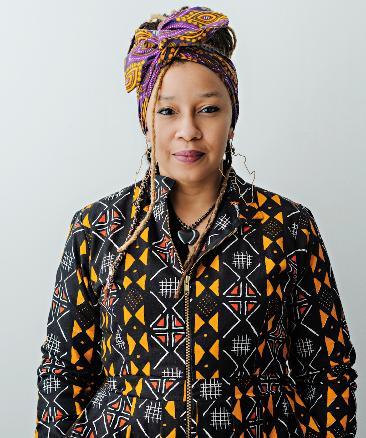
Laura Mae Lindo, Ph.D. Department of Philosophy
University of Waterloo, Waterloo, Ontario (Canada)
She opened her eyes, and they were staring right at her.
Finally.
She inhaled deeply, relishing in the moment of being seen.
In fall 2024, I mounted a new course entitled Black Existential Thought. Cross-listed with Philosophy, Black Studies, and Gender and Social Justice, the timing was . . .interesting. Amid rising tides of anti–critical race theory rhetoric in the United States and Canada, the attack on Black Studies that we see today could be felt, lurking around the corner . . . readying itself in preparation to pounce. But by drawing students’ attention to the long history of works by powerful Black philosophers and scholars, we did more than simply discuss existential thought through the lens of Black communities. We steadied ourselves in our “why,” reminded that resistance to antiBlack racism wherever and however it appeared remains a central tenet of Black Studies
everywhere. And while I wish I could say that this resulted in an overtly radical shift for my students, the truth is that our understanding of why these conversations remained critically necessary at this time in history was slower . . . slower, yet steady. Slow enough to root new ideas of what it means to exist-while-Black more deeply in ourselves, encouraging us to find more spaces to share what we were learning about and mulling over each week; steady enough to unpack how it felt to be living historical realities of the 60s and 70s in real time today. As the semester gained momentum, a common theme appeared as a thread linking each scholar, a thread that challenged Eurocentric notions of existentialism, bringing a sense of urgency to our classroom discussions. And as the U.S. election results rolled in, my students raised concerns in my course that turned that simple thread into a rope of a thousand strands, each one carrying with it the weight of existing as “Black” in an anti-Black world.
* * *
She opened her eyes, and they were staring right at her.
She had woken up feeling nauseous, the election results raining down and popping off like gunshots to her soul . . .
The racism that drove the results hidden under banners of pride, a pattern of exclusion meant to hide what has yet to be theorized . . .
She woke up and realized that they could not wait for theory to make its way to the light of day, Their lives stand in the way.
So, she stood up to say.
“Nope.”
(“She said NO?”)
She heard their whispers, clearing her throat and completing her thought:
“Not Today.”
They looked away.
* * *
I began by introducing students to The Racial Contract by Charles W. Mills (2022) to help them understand the political framework that created the conditions for anti-Blackness to thrive. For Mills, this political reality was White supremacy. White supremacy, Mills explained, was a political system built on a notion of race that naturally facilitated the development of racist structures privileging White people over all others in the polity. Its reach was global, allowing people around the globe to devalue, ignore, and erase the existence of people of colour in general and, more specifically, Black people: “From the inception, then, race is in no way an ‘afterthought,’ a ‘deviation’ from ostensibly raceless Western ideas, but rather a central shaping constituent of those ideals” (Mills, 2022, p. 14).
But how can people witness the brutality of the state as it embarked on centuries of the enslavement of Black people, embedding within this legally sanctioned system of horrors the brutal (mis)treatment of those who were enslaved? How could people look at another living, breathing
person, and feel justified in including them as little more than property in the eyes of the law?
Mills (2022) explained this reality by introducing the notion of an “inverted epistemology,” also referred to as an “epistemology of ignorance”: a new epistemological starting point that recognized that “the officially sanctioned reality is divergent from actual reality” (Mills, p. 18). Thus, the violent treatment of Black people across North America, throughout the Caribbean, and beyond was legally sanctioned, described as “necessary” given the litany of stereotypes about Black people that served a specific purpose: to justify this dehumanizing treatment. Mills again explained:
So here, it could be said, one has an agreement to misinterpret the world . . . but with the assurance that this sort of mistaken perceptions will be validated by white epistemic authority, whether religious or secular. (p. 18)
The polity, Mills (2022) demonstrated, was a place where this “official epistemic community” had signed onto a social contract that would allow them to build systems that were grounded in their political and ideological allegiance to White supremacy: they built and maintained schools that erased the histories of Black people’s resistance so that the Black person would forever be a “victim of” them rather than a “survivor for” countless generations to come; health systems that trained their medical staffs to believe that Black people’s pain thresholds were far higher than their White counterparts’, making it clear that when they said they were in pain their pleas could be ignored; and employment systems that disqualified Black people before they even arrived. People of all colours could belong to this epistemic community as long as they agreed to the rules of the game (p. 18). As Mills states, “These phenomenon are in no way accidental . but prescribed” (p. 18).
As my students worked through the readings, I helped them connect the dots, sharing examples of how the same realities described by Mills (2022) then continued to plague our social and political landscapes today. Then, with the students’ full attention, we called upon the work of
Lewis Gordon (2022) and his text Fear of a Black Consciousness to help us take our next critical step.
* * *
She opened her eyes, and they were staring right at her.
She moved to the left, wondering how deeply her movements were seen by them.
(Their eyes remained fixed, looking past her while following her every move . . .)
She moved to the right, feeling uncomfortable as she tried to match their gaze.
(Their eyes remained fixed, looking past her while following her every move . . .)
She opened her mouth to speak . . .
(They looked away, turning their back and leaving her alone in the room where she had once been surveyed.)
* * *
Gordon’s (2022) work deepened my students’ understanding of Black existential thought by walking them through five types of invisibility experienced by Black people around the world. First came racial invisibility. With this, Gordon explained that Black people were not seen as human by virtue of their (obsessive) hyper-visibility. And while this hyper-visibility should have resulted in their being authentically seen in their fulness, the obsession made Black people appear
in the world solely as objects found in places where they simply did not belong. Others watched and counted them, perceiving them through a layer of invisibility that rendered Black people into sub-humanhood, forever in the way, forever unwanted, forever less than human.
Second came indigenous invisibility. Here Gordon (2022) suggested that Black existence was historically wedded to time on the land. But with the advent of the economy of slavery, institutions transformed Black people into little more than (Black) bodies. Black communities were made invisible first by having the land they had once cared for and nurtured stolen, and second by “indigeneity” being moved to the past, rendering it little more than a romanticized history while simultaneously denying Black communities access to a future.
Third came gendered invisibility. With a desire to embed an intersectional lens in his analysis of invisibility, Gordon (2022) turned his attention to the unwillingness to consider gender beyond the binary. In spaces around the world the gender binary was not as prominent until Western hegemonic conceptions of gender were imposed on it, sometimes even violently. However, the binary served another important purpose: the binary ushered in a silencing of women that resulted in a normalized voicelessness of the “woman,” her humanity further denied.
Fourth came exoticized invisibility. Here Gordon (2022) suggested that even when Black people are shown care, it is often superficial in kind. Turned into near magical status, this act of invisibility may be what upholds the many "firsts” that continue to be celebrated. For example, thinking specifically of Ontario, in 2018 I was the first Black person to be elected either provincially or federally in Waterloo Region. My uncle, Dr. Alvin Curling, was the first Black Canadian to hold a cabinet-level position in Ontario when he was appointed minister of housing in 1985, and in 2003 he became the first Black elected speaker of Ontario’s legislative assembly. Zanana Akande was the first Black woman to be elected to the Legislative Assembly of Ontario in 1990 and the first Black woman to serve as a cabinet minister in Canada, where she was the
minister of community and social services. Jean Augustine was the first Black woman to serve as a member of the House of Commons of Canada in 1993, where she was the parliamentary secretary to Prime Minister Jean Chrétian and later was appointed the minister of state for multiculturalism and the status of women in the Cabinet of Canada. And yet, as we celebrate firsts well into 2024, these firsts reveal a lack of togetherness. And this togetherness matters, especially for those who want to be seen within traditional politics. Together, we can fight for Black liberation. Together, we can coordinate our legislative practices with an aim to dismantle systemic barriers that affect Black communities in housing, or employment, or education, or healthcare, or criminal justice, or community services, or anything else. By contrast, our “unicorn” status continues to hold us back because a single vote is simply unable to create the change we need to broaden our pathway to liberation in a meaningful way. Our “unicorn” status requires us to be the only one . . . the first. And our unicorn status makes us (and keeps us) less than human.
Gordon’s (2022) analysis ends with a fifth example: epistemic invisibility. Here Black people are holders of illegitimate knowledge because if our ideas were taken seriously, they would violate our invisible status. Once our ideas, our knowledge, and our understanding are seen, our humanity becomes undeniable. Not open to having that, the state uses every tool to ensure that our knowledge is rendered invisible. Our histories removed from textbooks, our stories kept out of traditional publishing houses, off television screens, and outside of production studios. Our traditional political systems are deemed irrelevant, unsophisticated, and naïve, ensuring that they and the knowledge they hold, become and remain invisible. Black elders are denied a space of reverence, for their wisdom is considered too disruptive because it connects us to a history denied. We are denied the humanity inherent in creating knowledge, assessing knowledge claims, accessing knowledge of those that came before us, and teaching knowledge to those generations that are coming up behind.
And yet the more I considered these powerful examples of (non)existence for Black people, the more I felt something was missing. In the classroom, our conversations returned time and again to Mills (2022) and the movement of White supremacy in the political sphere. And as we spoke, I returned time and again to my own experiences with traditional politics. As the former member of provincial parliament for Kitchener Centre and Ontario’s critic for anti-racism and equity as well as for colleges and universities (and before that, citizenship and immigration), I had plenty of experience with the ways in which the state made Black people invisible. I had also held the inaugural role of chair of the first ever Black caucus in Ontario at a time when the largest number of Black people ever had been elected to a single party during an election (that number was 5). Technically, Black people had arrived at Queen’s Park, and we did our best to organize in powerful ways. But as soon as we began to see the impact of the changes we were seeking, we were pushed aside for the sake of “others” across the province. Their needs were reflective of the majority. Their desires were more important. Their humanity was affirmed. Ours, denied.
That was when it became clear: there was one more invisibility that could be added to Gordon’s (2022) list: political invisibility, the erasure of Black presence in traditional political spaces. Given Black existential philosophers emphasizing that Black people’s existence is predicated on the political, political invisibility must also be named. This socio-political space, then, includes both our existence as invisible subjects and our resistance to the same. Thus while each example of invisibility poses an existential threat to Black existence in theory, this invisibility is a threat to our humanity in practice. As Fanon (1991) reminds us in his text Black Skin, White Masks, at risk is a single story: “Nothing doing. I explode” (p. 60). The intricate and strategic role the polity plays in our explosion as Black people cannot be denied.
She opened her eyes, and they were staring right at her.
She spoke.
(they watched on . . .)
She yelled.
(they watched on . . .)
She screamed.
(they turned and ran.)
Left alone at last, she closed her eyes.
What became visible as we thought more and more deeply about the existential realities of Black existence was an undeniable pattern. Black people, when attempting to use their positions of privilege to make their humanity visible, are pushed out of the political sphere. Deemed “noncompliant,” the rub becomes their refusal to remain quietly invisible. They demand to be seen in a world that was crafted upon their (invisible) backs. Bettina Love (2023), drawing on Carol Anderson’s work in her analysis of White supremacy’s movement through the educational system, reminds us that
White rage is not just angry White parents shoving and spitting on Black children attempting to enter an all-White school. White rage is what has built America’s institutions, working to cunningly craft laws, policies, covenants, and approaches that undercut democracy, halt Black advancement, and cage Black bodies while leaving White supremacy intact and often even stronger. (p. 17)
And White rage, I surmise, remains an integral part of the political movement of White supremacy as outlined by Mills (2022), for that White rage is what helps to institutionalize anti-Blackness while denying the reality of ongoing, state-sanctioned violence while this institutionalizing is being done (Love, 2023, p. 1). This violent rootedness of anti-Blackness is, in effect, what we mean
when we speak of “systemic violence,” and it is the impact of this rootedness that we analyze when we explore its impact on Black people. In Canada, Robyn Maynard (2017) forwards a parallel analysis in the text Policing Black Lives: State Violence in Canada from Slavery to the Present. There, Maynard writes,
At least as early as the mid-1980s Black female activists and community workers have been decrying how state-funded VAW [Violence Against Women] organizations have systematically neglected the needs of Black women. . . . Black women continue to report being marginalized within rape crisis and sexual assault centres, being largely denied culturally relevant and appropriate services and being excluded from movements against gendered violence (James 2007). The states has been complicit in de-prioritizing Black women’s realities and needs, and anti-violence funding has reproduced the “deep division of access to resources along colour and class lines” apparent within larger Canadian society (James 2007). This replicates long-standing histories of erasing Black women’s realities and normalizing violence against them. (Maynard, 2017, p. 154)
Thus Black people find themselves time and again trying to navigate both an epistemological and an existential conundrum, all while the system continues to deny Black humanity. Let’s talk about these epistemic and existential conundrums.
Thinking first of the epistemic conundrum, Black communities are forced to reckon with the reality that what was once created to “protect” knowledge and knowledge production is now used to promote and perpetuate racist language and outcomes. “Woke,” which meant that Black people now understood how the (White) political system operates, has been re-positioned as a threat. This knowledge threatens the dominance of the system of White supremacy at home and abroad. Book bans in schools and libraries deny our access to Black stories of resistance and existence. “Parents’ First” movements deny the needs Black parents have long fought for to ensure
that their children are seen and their experiences affirmed, opting instead to monitor who is doing anti-racist education and filing complaints against the same. And “back to basics” is really a call to a different time when Whiteness was the norm, anti-racist work was not valued, and being “colourblind” and (ironically) “tolerant” was the goal of our social world.
Turning our attention to the existential conundrum, we see that it too relies heavily on our understanding of the political system of White supremacy outlined by Mills (2022). White supremacy is a coherent and intentional political system that has and continues to structure our social world. Anti-racist work for Black lives becomes dangerous. A threat to the political system, anti-racist work is marginalized to ensure that the tools it provides remain limited. Black resistance is de-historicized, and Black existence is condemned. This de-historicizing serves to ensure that new generations of Black activists, educators, and scholars feel the “newness” of their sociopolitical plight, allowing them to fall prey to “common sense” ideas like the slow pace of change (page 10 of my draft) De-historicizing creates a sense of normalcy for the superficial concessions from those in power that ignore the root causes of anti-Black racism in every sector we attempt to access. And de-historicizing allows hegemonic systems to continually make use of the same tools to maintain their dominance and promote the colonial project of White supremacy in Ontario, across Canada, and around the globe. And all of this while claiming (a) multicultural “tolerance” in Canada and (b) a strict adherence to equity and inclusion principles. As Gordon (2000) argues and Du Bois (2015) stated so many centuries before,
Deny it as we may, as a consequence or cause of a multitude of evils the problem of the color line is a persisting problem a problem that, in the eyes of a thinker such as Derrick Bell, in his Faces from the Bottom of the Well, is here to stay. Born from the divide of black and white, it serves as a blueprint of the ongoing division of humankind. The color line is also a metaphor that exceeds its own concrete formulation. It is the race line as well
as the gender line, the class line, the sexual orientation line, the religious line in short, the line between “normal” and “abnormal” identities. (Gordon, 2000, p. 63)
And it is the persistence of the colour line that makes grappling with political erasure within Black existential thought all the more necessary today. This is why we do what we do in the ways that we do: To align our present with lessons from our past. To remind ourselves that we have come further than we feel. To speak into existence the future our ancestors imagined impossible. To speak into the future. To speak. And to be the future. * * *
And with that, I closed my eyes, Knowing that for once, I was finally seen.
References
Du Bois, W. E. B. (2015). The problem of the color line at the turn of the twentieth century: The essential early essays (N. D. Chandler, Ed.). Fordham University Press.
Fanon, F. (1991). Black skin, white masks. Grove Weidenfeld.
Gordon, L. R. (2000). Existentia Africana: Understanding Africana existential thought. Routledge.
Gordon, L. R. (2022). Fear of Black consciousness. Farrar, Straus and Giroux.
Love, B. L. (2023). Punished for dreaming: How school reform harms Black children and how we heal. St. Martin’s Press.
Maynard, R. (2017). Policing Black lives: State violence in Canada from slavery to the present. Fernwood.
Mills, C. W. (2022). The racial contract (25th anniversary ed.). Cornell University Press.
The Algorithmic Gaze: Deepfakes, Surveillance, and Black Futures
by
Shuntavia N. James, Ed.D.
Assistant Professor of Criminal Justice
Department
of Behavioral and Social Sciences
Fort Valley State University
In the digital era, the creation and circulation of deepfakes highly realistic, AI-generated synthetic media has introduced unprecedented challenges for truth, justice, and representation. While these technologies raise concerns across society, their implications for Black communities are uniquely severe, layered atop centuries of racialized visual distortion, criminalization, and surveillance (Benjamin, 2019; Browne, 2015). Deepfakes do not simply misrepresent individuals; they destabilize the evidentiary foundations upon which legal systems, public trust, and racial meaning are constructed.
This paper situates deepfakes within a historical continuum of racialized media manipulation, tracing a lineage from blackface minstrelsy and colonial photography to modern surveillance infrastructures and algorithmic governance. Particular attention is given to the criminal justice system, where visual and audio evidence often determine guilt or innocence, and where emerging technologies increasingly shape policing, prosecution, and public perception. At
the same time, the paper foregrounds the ways Black communities are responding to these threats through culturally grounded, collective, and future-oriented strategies.
Deepfakes and the Stakes for Black Studies
Within the discipline of Black Studies, deepfakes represent more than a technological problem; they constitute a contemporary site of struggle over Black representation, epistemic authority, and political power. Black Studies has long interrogated how visual culture, state surveillance, and knowledge production have been mobilized to define Blackness as deviant, dangerous, or disposable. From minstrelsy and colonial archives to mugshots and predictive databases, images have functioned as tools of racial governance. Deepfakes extend this history by automating distortion and embedding racialized assumptions into artificial intelligence systems. As such, they demand engagement from Black Studies scholars concerned with culture, justice, and liberation, positioning synthetic media as a critical frontier in ongoing debates about Black visibility, agency, and self-determination in the digital age.
From Blackface to Digital Manipulation: A Historical Continuum
Black representation in visual culture has long been shaped by distortion, control, and political intent. Nineteenth-century blackface minstrelsy functioned as an early form of synthetic media, in which White performers fabricated racial caricatures through exaggerated gestures and imagery, naturalizing myths of Black inferiority and criminality (Lott, 2013). These visual distortions justified slavery, segregation, and racial violence by presenting fiction as cultural truth. These early visual distortions established a template for later technologies that would claim objectivity while reproducing the same racial hierarchies. The emergence of photography and criminological documentation extended these logics into purportedly objective forms. Bertillonstyle mugshots and early surveillance photography visually encoded Blackness as criminality through pseudoscientific classification, reinforcing racial hierarchies under the guise of neutrality
(Browne, 2015). Film further amplified these narratives. The Birth of a Nation (1915) portrayed Black men as violent threats, legitimizing carceral expansion and racial terror that would shape U.S. criminal justice policy for decades (Alexander, 2010).
During the mid-twentieth century, visual surveillance became an explicit tool of political repression. The Federal Bureau of Investigation’s Counterintelligence Program COINTELPRO systematically collected and manipulated photographs, recordings, and dossiers of Black activists such as Assata Shakur to frame them as national threats rather than freedom fighters (Churchill & Vander Wall, 2002). These state-produced images prefigured contemporary algorithmic misrepresentation, revealing a through-line from analog surveillance to digital criminalization. Yet Black communities have never been passive recipients of visual harm. Early filmmakers such as Oscar Micheaux produced counter-representations that challenged racist imagery and asserted Black narrative authority (Musser, 2009). This tradition of counter-visuality prefigures contemporary resistance to deepfake exploitation. Deepfakes, then, are not anomalies; they are evolutions: new technologies reproducing old struggles over narrative control.
Deepfakes, Criminal Justice, and the Algorithmic Gaze
Deepfakes pose profound risks to the integrity of the criminal justice system. Visual and audio evidence, long treated as objective markers of truth, are increasingly vulnerable to manipulation. A systematic review of deepfakes and legal systems identifies threats ranging from falsified evidence to the erosion of public trust in judicial outcomes (Sandoval et al., 2024). In one widely reported case, a Maryland high school administrator used AI to fabricate racist audio recordings of a principal, triggering public outrage and reputational harm before the recording was exposed as false (Associated Press, 2025). Because criminal courts often privilege visual and audio evidence as neutral arbiters of truth, the introduction of synthetic media threatens to undermine not only individual cases but the legitimacy of evidentiary standards themselves.
Legal scholars warn that deepfakes destabilize foundational principles such as due process and evidentiary reliability (Citron, 2019; Ferguson, 2021). Within an adversarial system that privileges visual confirmation, the inability to authenticate footage risks both wrongful conviction and wrongful acquittal. Visual criminology reminds us that crime is not only witnessed but socially constructed through images that circulate as truth (Carrabine, 2012; Surette, 2015). Deepfakes exploit this dynamic by producing artificial “proof” that aligns with racial bias and public suspicion. For Black defendants, this dynamic is especially dangerous, as racialized expectations of criminality increase the likelihood that fabricated or manipulated media will be perceived as credible rather than contested.
These dangers are intensified by the rise of predictive policing technologies. Predictive policing systems rely on historical crime data and algorithmic forecasting to anticipate criminal behavior, often reproducing racial bias by encoding over-policing of Black communities into future enforcement decisions (Ferguson, 2021). When paired with deepfake technologies, such as fabricated surveillance footage, manipulated body-camera audio, or falsified suspect videos, the predictive turn in policing threatens to solidify racialized suspicion as algorithmic fact. In this context, deepfakes do not merely distort evidence; they extend the carceral gaze from reactive punishment to anticipatory control, framing Blackness itself as risk.
Globally, similar patterns are emerging. During Nigeria’s 2023 elections, doctored political videos circulated widely, undermining trust in the democratic processes (Onuoha, 2023). In South Africa and Brazil, manipulated media has portrayed Black protest leaders as violent instigators, reinforcing colonial and racialized narratives of disorder (Rini, 2023). These examples demonstrate how deepfake technology intensifies existing scripts of Black criminality across the African diaspora. Taken together, these cases illustrate that deepfake technologies do not introduce new forms of racial harm so much as they intensify existing postcolonial narratives that frame Black
political expression as inherently threatening. Across the African diaspora, synthetic media thus operates as a transnational mechanism through which racialized suspicion is reproduced under the banner of technological innovation.
Ethical and Policy Responses: Limits and Possibilities
Governments have begun to address synthetic media through legislation such as the DEEPFAKES Accountability Act and California’s AB 602, which target election interference and nonconsensual digital harm. However, these policies often fail to address the racialized dimensions of algorithmic exploitation or the ways deepfakes intersect with existing inequalities in policing and prosecution (Benjamin, 2019; Citron, 2019). These regulatory approaches tend to treat deepfakes as isolated technical abuses rather than as technologies operating within historically unequal systems of surveillance, policing, and prosecution. Black lawmakers, scholars, and advocacy organizations have been central to advancing more inclusive approaches. The Congressional Black Caucus Foundation’s Tech 2025 initiative calls for equitable AI governance and sustained investment in historically Black colleges and universities as leaders in ethical technology research (Congressional Black Congress Foundation, 2023). These efforts suggest that addressing deepfakes requires more than punitive regulation; it demands Black leadership in policy formation, digital education, and technological design. Without centering racial justice and community accountability, policy responses risk reproducing the very inequities they claim to prevent.
Agentic and Culturally Grounded Resistance: Toward Praxis
Resistance to deepfake exploitation must be understood not as a reactive defense against misinformation, but as a proactive praxis rooted in Black intellectual traditions, collective governance, and cultural self-determination. Across the African diaspora, Black communities are developing strategies that combine education, advocacy, and creative reclamation. Organizations
such as the Algorithmic Justice League and Data for Black Lives have foregrounded algorithmic bias, transparency, and digital rights as civil rights issues (Buolamwini, 2018; Milner, 2020).
Community-based groups in cities such as Detroit, Atlanta, and Oakland have launched deepfake literacy initiatives that teach participants to identify manipulated media, verify sources, and document digital harm for legal recourse (MediaJustice, 2023). These efforts echo earlier traditions of Black media literacy and investigative truth-telling, exemplified by Ida B. Wells’s data-driven exposure of lynching as racial terror (Giddings, 2008). Culturally grounded resistance draws on African-centered epistemologies that conceptualize knowledge, image, and technology as communal resources rather than private commodities. Afrocentric theorists such as Molefi Kete Asante (1987) argue that representation must center African agency and collective well-being. From this perspective, resisting deepfakes is not solely a technical challenge but a moral and cultural imperative to reclaim control over Black imagery and self-definition. Framed this way, resistance to deepfakes is not merely about detection or correction, but about reclaiming the ethical conditions under which Black images, data, and identities are produced and circulated.
Translatable Strategies across the African World
Resistance strategies emerging in the United States resonate globally. In South Africa, organizations such as Code for South Africa employ data activism and AI literacy to counter political misinformation (Mutsvairo & Karam, 2021). In Nigeria, Paradigm Initiative promotes digital rights education and ethical technology governance, while artists incorporate AI tools into Afrofuturist media that challenge colonial archives (Nwachukwu, 2022; Ogunleye, 2021). In Brazil, Afro-Brazilian collectives such as PretaLab and Coletivo DiJe use digital storytelling and AI workshops to combat racial misinformation and amplify Black women’s leadership in technology (Silva, 2022). While these initiatives emerge from distinct national and political contexts, they share a common commitment to digital sovereignty, collective education, and the
ethical governance of emerging technologies. Taken together, these initiatives demonstrate that deepfake literacy, community-based governance, and creative reappropriation are adaptable across diverse African-descended contexts. They foster transnational solidarity through shared digital ethics rooted in collective care and cultural sovereignty.
Algorithmic Dignity and Black Digital Futures
Rather than asking how Black communities can survive emerging technologies, the framework of algorithmic dignity asks how they can shape, govern, and transform them.
Algorithmic dignity refers to the recognition of Black humanity, agency, and cultural sovereignty within AI design, governance, and application. Unlike dominant frameworks of algorithmic fairness or transparency, algorithmic dignity centers historical harm, collective agency, and cultural sovereignty as foundational design principles rather than afterthoughts. Rooted in the ethics of ubuntu and restorative justice, it envisions a future in which Black communities are not merely protected from technological harm but positioned as architects of ethical innovation (Benjamin, 2019; Collins, 2000). In practical terms, this framework calls for synthetic evidence exclusion standards requiring independent verification before AI-generated media is admitted in court. It supports community-owned detection cooperatives that oversee verification tools and data governance, shifting accountability from corporate actors to collective stewardship. It also emphasizes the role of HBCUs as hubs for interdisciplinary AI research grounded in cultural ethics, as demonstrated by initiatives at Howard University and Morgan State University (Howard University, 2024; Morgan State University, 2024).
As Ruha Benjamin (2019) argues, justice-oriented design must move beyond technological benevolence toward technological justice: toward repairing historical inequities rather than reproducing them. Within this vision, generative AI becomes a site of restoration, enabling the reconstruction of lost histories, the amplification of silenced voices, and the assertion of narrative
sovereignty. In this vision, deepfake technology is transformed from a tool of domination into a medium of collective authorship, where Black futures are imagined and protected on our own terms. This approach aligns squarely with Black Studies’ longstanding insistence that technology must be interrogated not only for what it does, but for whom it serves and whom it disciplines.
Conclusion
Deepfakes extend a long tradition of racialized image manipulation, yet they also invite renewed resistance rooted in African-centered traditions of truth, creativity, and communal ethics. Their implications for the criminal justice system underscore the urgency of equitable AI governance, forensic reform, and public education. History demonstrates that Black communities have consistently transformed technologies of control into tools of resistance, from the printing press to the digital camera. By embracing collective stewardship over AI, fostering deepfake literacy, and demanding algorithmic accountability, communities across the African world can move toward an era of algorithmic dignity one in which technology serves liberation rather than domination.
References
Alexander, M. (2010). The new Jim Crow: Mass incarceration in the age of colorblindness. The New Press.
Asante, M. K. (1987). The Afrocentric idea. Temple University Press.
Associated Press. (2025, April 29). Former school athletic director gets 4 months in jail in racist AI deepfake case. https://apnews.com/article/487ea673b0449077cb23e7970546cb9f
Benjamin, R. (2019). Race after technology: Abolitionist tools for the new Jim Code. Polity Press.
Browne, S. (2015). Dark matters: On the surveillance of Blackness. Duke University Press.
Buolamwini, J. (2018). Gender shades: Intersectional accuracy disparities in commercial gender classification. Proceedings of Machine Learning Research, 81, 1–15.
Carrabine, E. (2012). Just images: Aesthetics, ethics and visual criminology. British Journal of Criminology, 52(3), 463–89. https://doi.org/10.1093/bjc/azr087
Churchill, W., & Vander Wall, J. (2002). Agents of repression: The FBI’s secret wars against the Black panther party and the American Indian movement. South End Press.
Citron, D. K. (2019). Deepfakes: The looming crisis for national security, democracy, and privacy. California Law Review, 107(6), 1753–1819.
Collins, P. H. (2000). Black feminist thought: Knowledge, consciousness, and the politics of empowerment (2nd ed.). Routledge.
Congressional Black Caucus Foundation. (2023). Tech 2025 policy brief: Advancing equitable artificial intelligence and innovation. https://cbcfinc.org/publications/tech-2025-policybrief/
Ferguson, A. G. (2021). The rise of big data policing: Surveillance, race, and the future of law enforcement. New York University Press.
Giddings, P. (2008). Ida: A sword among lions; Ida B. Wells and the campaign against lynching.
Amistad.
Howard University Office of Research. (2024). Center for applied data science and analytics: Annual report. https://research.howard.edu/data-science-analytics
Lott, E. (2013). Love and theft: Blackface minstrelsy and the American working class. Oxford University Press.
Lott, J., & Brundage, T. (2022). Race, racialization, and racism: Students of color and short-term study abroad learning. Journal of Language, Identity & Education, 24(2), 468–482. https://doi.org/10.1080/15348458.2022.2149532
MediaJustice. (2023). Deepfakes and disinformation. https://mediajustice.org/news/deepfakes-anddisinformation/
Milner, Y. (2020). Data for Black lives manifesto. Data for Black Lives. https://www.d4bl.org/manifesto
Morgan State University. (2024). Center for urban artificial intelligence policy: Strategic initiatives. https://www.morgan.edu/urban-ai-policy
Musser, C. (2009). Oscar Micheaux and his circle: African American filmmaking and race cinema of the silent era. Indiana University Press.
Mutsvairo, B., & Karam, B. (2021). Data activism and postcolonial resistance in Africa. Palgrave Macmillan.
Nwachukwu, I. (2022). Digital rights and data justice in Nigeria. African Journal of Communication, 28(1), 55–73.
Ogunleye, F. (2021). Afrofuturism, technology, and storytelling in Nigerian media. Journal of African Cultural Studies, 33(2), 187–203.
Police Chief Magazine. (2022). Law enforcement in the era of deepfakes. https://www.policechiefmagazine.org/law-enforcement-era-deepfakes/
Rini, R. (2023). The epistemology of deepfakes and racial misinformation. Ethics and Information Technology, 25(2), 143–60.
Sandoval, M. P., et al. (2024). Threat of deepfakes to the criminal justice system: A systematic review. Journal of Law and Digital Society, 12(2), 45–63.
Silva, D. (2022). Digital storytelling, race, and technology: Afro-Brazilian women and the politics of visibility. Latin American and Caribbean Ethnic Studies, 17(3), 389–407.
Surette, R. (2015). Media, crime, and criminal justice: Images, realities, and policies (5th ed.).
Cengage Learning.
Zehr, H. (2015). The little book of restorative justice (Rev. ed.). Good Books.

THE STATE OF BLACK/AFRICANA STUDIES
The Future Challenges of Black Studies in the United
States 2025–2035
Reynaldo Anderson, Ph.D.
Christina Hudson A.B.D., Ph.D. candidate
Department of Africology and African American Studies
Temple
University
by &
Department of Africology and African American Studies
Temple
University
Political, economic, technological, cultural, and legislative forces influence and reshape the landscape of scholarly disciplines. Black Studies emerged out of a confluence of events including the anti-colonial struggle and the civil rights and Black Power movement in the late 1960s and now faces a convergence of potential transformative forces: Project 2025, the advancement of artificial intelligence articulated in AI 2027 initiatives, and the Genius Act (Karenga, 1993; Montgomery, 2024). This article examines how these forces might affect the future of Black Studies, considering both the challenges they present and the opportunities they may create.
Since its inception, Black Studies has been in a precarious position, and Black Studies scholars have had to fight not only to bring the discipline into existence but also to keep it, define it, and prove its validity as a discipline like all others. The rise of alt-right extremists who are gaining traction within the government is yet another challenge the discipline must hold its ground
against. As a discipline that has always had to defend its legitimacy and fight for resources, Black Studies has developed resilience and adaptability. Mastering the domains of technology artificial intelligence and digital assets specifically as well as the educational and political arenas is an essential task as Black Studies navigates the shifting terrain of power. In the current political landscape, it is imperative that Black Studies, as a field, develop a strategy for contending with the intersection of conservative policy agendas that threaten its very existence within the academy, AI advancement, as illustrated by OpenAI and DeepSeek, and potential reactionary legislative reforms spurred by these developments.
It is important to note here that while we recognize Africana Studies as a global, diasporic intellectual framework, the term “Black Studies” is used deliberately in this article to reflect the discipline’s historical emergence, institutional positioning, and contemporary precarity within the United States academy. This analysis centers on U.S.-based policy initiatives, legislative agendas, and technological infrastructures that directly threaten domestically situated programs. As such, “Black Studies” is employed as a contextual and strategic designation rather than as a rejection of Africana Studies as a broader paradigm. In this sense, the terms are not treated as oppositional, but as analytically distinct designations shaped by geography, institutional history, and political context. We further recognize that the nomenclature of Black Studies programs varies across the nation; programs are called African American Studies, Pan-African Studies, African Diaspora Studies, Africology, and so forth. Although these designations are underwritten by distinct epistemological, methodological, and cultural justifications, adjudicating those differences is beyond the scope of this article, which is concerned with state power, policy, and institutional vulnerability rather than disciplinary ontology. Thus, “Black Studies” is used herein as an umbrella designation for U.S.-based programs variously named Africology, Africana Studies, African American Studies, Pan-African Studies, and related formations, insofar as they are subject to the
same policy regimes, institutional vulnerabilities, and technological pressures.
The Impact of Project 2025 on Black Studies
While its primary focus is on the consolidation of executive power, the Heritage Foundation’s Project 2025 is largely an ultra-right policy agenda undergirded by racist political formations that threaten to drastically alter the academic landscape. At its core, Project 2025 advocates for a substantial reduction in federal involvement in education, challenging diversity initiatives, and restructuring funding priorities, all of which could directly affect Black Studies programs across American institutions. Project 2025’s stance against what it terms “identity politics” and “divisive concepts” in education signals an attempt to attack the heart of the Black Studies project to delegitimize academic frameworks. The discipline’s examination of systemic racism, power structures, and historical inequities could be reframed as “divisive” or as reverse racism rather than scholarly inquiry. This political shift threatens to undermine the field’s intellectual legitimacy in public discourse and policy considerations. The potential funding or restructuring of the Department of Education, as suggested in Project 2025 and currently operationalized, will lead to significant reductions in federal support for diversity initiatives in higher education. Programs like McNair Scholars, which have been vital pathways for underrepresented students to enter graduate programs, including Black Studies, might be eliminated or face severe cuts. Similarly, research grants that support scholarship in Black Studies could be redirected towards areas deemed more “neutral” or “traditional.” Project 2025’s emphasis on “traditional American values” and “classical education” could marginalize the critical perspectives and methodologies that are central to Black Studies.
The field’s interdisciplinary approach, its critique of dominant narratives, and its centering of Black experiences could be positioned as outside the desired educational framework, potentially leading to institutional pressures to conform or contract. In this context, “interdisciplinary” denotes
the longstanding methodological practice within Black Studies of drawing on fields including political philosophy, economic theory, psychology, history, cultural analysis, and social theory to analyze Black life and struggles as structurally produced rather than confined to a single disciplinary lens. Historically, Black Studies emerged and evolved in response to political pressures. The very founding of the discipline was a response to exclusionary practices in academia and in the broader society. Although Project 2025 presents significant challenges, it might also catalyze a renewed articulation of the importance of Black Studies, foster solidarity among scholars, and generate creative responses that strengthen the field’s foundations and reach.
As institutions consider implementing Project 2025 policies, Black Studies departments and programs will need to strategically emphasize their contributions to critical thinking, historical understanding, and cultural literacy values that transcend political divides and align with the core mission of higher education.
Black Studies in the Scenario of AI 2027
Artificial intelligence stands poised to transform higher education by 2027, with implications that both challenge and potentially enhance Black Studies. As AI technologies advance, they offer opportunities for innovative teaching methodologies, enhanced research capabilities, and greater knowledge dissemination, thereby amplifying the reach and impact of Black Studies. However, these same technologies also present significant concerns regarding algorithmic bias, the digital divide, data centers and their impact on local environments, and the potential homogenization of knowledge production (Benjamin, 2019; Harrington, 2025).
Approached through the lens of Black Studies, which challenges systemic racism, power structures, and historical inequities that give rise to the current shortcomings of this emerging technology; and Afrofuturism 2.0/Ancestral Intelligence as the human-in-the-loop component to use an Afrocentric lens, drawing on Africological approaches to critique and develop A.I.; it seems
that AI tools could actually democratize access to Black Studies content and methodologies.
Virtual reality experiences allow students to “walk through” historical events like the Harlem Renaissance or the Civil Rights Movement, creating immersive learning experiences that deepen understanding and empathy (Kokotajlo et al., 2025). Natural language processing could help people translate and analyze texts in African diaspora languages, expanding the corpus of available materials for study.
AI-assisted research tools could help scholars identify patterns and connections across vast archival networks, potentially uncovering overlooked aspects of Black history and culture. Currently, AI systems are trained on existing data, which often reflects and perpetuates historical biases and exclusions. Without careful intervention, AI in education might reinforce Eurocentric canons and methodologies, further marginalizing Black perspectives. There is also the risk that AI could flatten the nuanced, context-specific approaches that Black Studies scholars have developed, reducing complex cultural and historical analyses to simplified algorithms. Suppose AI becomes central to educational delivery and research. In that case, historically Black colleges and universities (HBCUs) and programs serving predominantly minority populations might be disadvantaged if they lack the resources to implement these technologies fully. To navigate these challenges, Black Studies programs must actively engage with AI development and advocate for inclusive training data, transparent algorithms, and equitable access. Scholars in the field should focus on developing new competencies in digital humanities and data science, enabling them to shape AI implementations rather than merely respond to them. Collaborations between Black Studies departments, computer science programs, and industry partners could help ensure that AI development in education considers diverse perspectives and needs. Looking ahead, it is clear that the future of Black Studies in the era of AI 2027 will depend on how proactively the field engages with these technologies, shaping their development and deployment to align with the discipline’s
commitments to justice, equity, and the centrality of Black experiences. Black Studies can navigate this technological transition while maintaining its distinctive intellectual contributions if it approaches AI as both a subject of critical analysis and a tool for advancing the field’s goals.
Challenges and Opportunities for Black Studies in the Genius Act
The focus on enhancing innovation and intellectual property rights of the Genius Act presents both challenges and opportunities for Black Studies. This legislative framework, designed to foster creativity and protect intellectual property in an increasingly digital and globalized world, has implications that extend into financial institutions, legal frameworks, and academia, including fields like Black Studies that have historically navigated complex questions of cultural production, appropriation, and recognition (Anus et al., 2025; Nichols, 2025). Specifically, the Genius Act’s emphasis on individual innovation and commercial applications could potentially undervalue the collective, community-based knowledge production that has been central to many Black intellectual and cultural traditions. Black Studies have often highlighted collaborative modes of knowledge creation and the importance of oral traditions, communal practices, and shared cultural expressions that do not easily fit into conventional intellectual property frameworks. There is a risk that strengthening individual IP protections could further marginalize these alternative modes of knowledge production and dissemination.
In addition, the Act’s potential emphasis on STEM fields and commercially viable innovations might redirect resources away from humanities disciplines, including Black Studies. If institutions increasingly prioritize research and education that generate patents and marketable products, departments focused on critical theory, historical analysis, and cultural studies might face reduced funding and institutional support. However, the Genius Act also presents opportunities for Black Studies to assert the value of its distinctive contributions. The field has long examined questions of cultural appropriation and attribution, the economic exploitation of Black creativity,
and issues directly relevant to contemporary debates about intellectual property rights. Black Studies scholars could position themselves as essential voices in discussions about how to create more equitable systems for recognizing and rewarding diverse forms of innovation.
Moreover, the Genius Act could potentially create openings for Black Studies to demonstrate its relevance to innovation ecosystems. The field’s emphasis on understanding complex social systems, navigating cultural differences, and recognizing marginalized perspectives could be framed as essential competencies for practical innovation in diverse societies. Black Studies programs could develop new initiatives that connect their traditional strengths with contemporary questions about ethical innovation, inclusive design, and culturally responsive entrepreneurship. Black Studies departments could strategically respond to the Genius Act by developing partnerships with law schools, business programs, and STEM departments to explore the intersections of race, innovation, and intellectual property (McGee, 2023). Such collaborations could generate new research directions, attract diverse funding sources, and demonstrate the field’s relevance to pressing contemporary issues. By engaging proactively with the Genius Act’s provisions and implications, Black Studies can advocate for intellectual property frameworks that recognize and value diverse knowledge traditions while also positioning itself as an essential contributor to conversations about ethical and inclusive innovation in the twenty-first century.
Sustainability of Black Studies in the Face of Project 2025, The Genius Act, and AI 2027
This analysis is in conversation with Chapter 17 of Higher Flight: Refocusing Black/Africana Studies for the 21st Century, which emphasizes the necessity of future-oriented thinking, institutional adaptability, and strategic clarity as essential to the survival of the discipline. As Higher Flight argues, Black/Africana Studies must remain grounded in its historical mission while actively responding to evolving political, economic, and technological conditions that reshape higher education. Building on this framework, the present article extends that analysis by
examining how contemporary policy initiatives and artificial intelligence development intensify these pressures and demand new forms of strategic engagement.
The convergence of Project 2025’s policy agenda, the Genius Act’s emphasis on innovation and intellectual property, and the rapid advancement of artificial intelligence creates a complex environment for Black Studies to navigate. Sustaining the field in this context requires strategic responses at multiple levels: institutional, pedagogical, technological, and political. Institutionally, Black Studies departments may need to diversify their funding sources to reduce vulnerability to potential federal funding cuts under Project 2025. Taken together, these domains constitute a set of strategic recommendations aimed at preserving the intellectual autonomy, institutional viability, and relevance of Black Studies in an era of policy retrenchment and accelerated technological change. This might involve cultivating alum networks, developing partnerships with community organizations and private foundations, and creating revenue-generating programs such as executive education or consulting services. Departments might also strengthen their positions within universities by demonstrating their contributions to institutional goals such as student success, community engagement, and interdisciplinary innovation.
Pedagogically, Black Studies can enhance its sustainability by adapting its teaching approaches while maintaining its core commitments. This might include incorporating digital literacy and AI critical analysis into curricula, developing hybrid or online programs that extend reach beyond traditional student populations, and creating educational experiences that highlight the field’s relevance to contemporary challenges in technology, policy, and society. Programs that demonstrate how Black Studies perspectives inform ethical innovation or responsible AI development could attract students and support from unexpected quarters. Technologically, Black Studies must engage critically with AI while also leveraging its potential. This means advocating for representative data sets, participating in the design of educational AI tools, and developing
digital archives and resources that preserve and disseminate Black intellectual traditions. Such efforts might include the development of Black Studies–led digital archives for AI training, curriculum-specific AI tools grounded in Black epistemologies, and interdisciplinary collaborations that position Black Studies as ethical and ontological consultants in AI design and deployment. It also requires cultivating technological fluency among faculty and students, enabling them to use AI tools critically and creatively rather than being passive consumers of technology shaped by others. Politically, sustaining Black Studies will require coalition-building and strategic advocacy. This includes forging alliances with other disciplines facing similar challenges, engaging with policy debates on education and technology, and articulating the public value of Black Studies in terms that resonate across political divides. It might also involve developing new narratives about the field’s contributions to American society and global understanding, emphasizing how Black Studies enhances critical thinking, historical awareness, and cultural literacy for all students. Perhaps most fundamentally, sustainability requires that Black Studies continue to produce scholarship and pedagogy that demonstrates its intellectual vitality and social relevance. In this context, engaging artificial intelligence as both an object of critique and a site of intervention is a strategic imperative for the future of the discipline. By generating insights that help society understand and address pressing challenges, from racial inequities in healthcare to the implications of algorithmic bias, the field can assert its indispensability even in a changing landscape.
The history of Black Studies suggests reasons for both concern and optimism. The field has always faced skepticism and resource constraints, yet it has consistently demonstrated resilience and adaptability. By approaching Project 2025, the Genius Act, and AI 2027 with strategic clarity and creative response, Black Studies can navigate the challenges while seizing opportunities to reaffirm its essential role in American higher education and intellectual life.
Conclusion
As Black Studies confronts the potential impacts of Project 2025, AI advancements, and the Genius Act, the field stands at a critical juncture that demands both vigilance and vision. The challenges are substantial: potential policy shifts that could undermine diversity initiatives and critical perspectives, technological transformations that might reproduce historical biases, and economic frameworks that could devalue certain forms of knowledge production. However, within these challenges lie opportunities for Black Studies to reaffirm its relevance, expand its reach, and deepen its impact. The field’s historical foundations provide valuable resources for this moment.
Born of student activism and intellectual conviction, Black Studies has always had to articulate its value and fight for its place in the academy. This legacy of advocacy and innovation can inform contemporary responses to new threats and opportunities. Similarly, the field’s intellectual traditions its critique of power structures, its recovery of marginalized voices, its analysis of resistance and resilience offer vital tools for understanding and navigating the current landscape.
In the coming years, the sustainability of Black Studies will depend on strategic adaptation that does not compromise core values. This might mean embracing new technologies while subjecting them to critical analysis, developing new funding models while maintaining intellectual independence, and finding new ways to demonstrate relevance while continuing to challenge prevailing assumptions and inequities. Ultimately, the future of Black Studies in the face of these converging forces will be determined not just by external policies and technologies, but by the collective actions of scholars, students, administrators, and advocates who recognize the essential contribution the field makes to our understanding of the past, present, and possible futures.
As emphasized above, this article does not debate disciplinary nomenclature but rather focuses on the policy and institutional contexts in which U.S.-based Black Studies programs operate. Strategically responding to challenges while also seizing opportunities for innovation and
impact will position Black Studies to not only survive but also adapt successfully to the changing landscape of American higher education.
References
Anus, M., Khan, M. A., Ngadi, T. D., & Ramakrishnan, S. A. (2025). The GENIUS Act and stablecoin adoption in 2025: Legal, computational, and financial stability perspectives (SSRN Scholarly Paper No. 5418014). Social Science Research Network.
https://doi.org/10.2139/ssrn.5418014
Benjamin, R. (2019). Race after technology: Abolitionist tools for the new Jim Code. Polity Press.
Gaskins, N. (2023). Interrogating algorithmic bias: From speculative fiction to liberatory design.
TechTrends, 67(3), 417–25.
Harrington, S. A. (2025, May 20). AI 2027 and the law: Transformative implications for legal practice, employment, and education. Social Science Research Network.
https://ssrn.com/abstract=5260499
Karenga, M. (1993). Introduction to Black studies. In E. Cashmore, E. Cashmore, & J. Jennings (Eds.), Racism: Essential readings (pp. 209–216). SAGE Publications
Kokotajlo, D., Alexander, S., Larsen, T., Lifland, E., & Dean, R. (2025, April 3). AI 2027. https://ai-2027.com/
McGee, E. (2023). Fear, fuel, and fire! Black STEM doctoral students’ career decisions during the Trump presidency. International Journal of Qualitative Studies in Education, 36(5), 716–37.
Montgomery, P. (2024). Project 2025: How Trump loyalists and right-wing leaders are paving a fast road to fascism. Political Research Associates.
Nichols, R. (2025). How banks can begin planning around the GENIUS Act. ABA Banking Journal, 117(5), 22–23.
Stewart, J. B. (2010). Higher flight: Refocusing Black/Africana studies for the 21st century.
University of Illinois Press.
A Case Study in Developing a 21st-Century Africana
Studies Journal:
Andrea Ringer, Ph.D.
Associate Professor of History
Affiliate Faculty, Africana Studies
Department of History, Political Science,
Geography & Africana Studies
Tennessee State University
An Assessment of the First Three Years of Siyabonana by &
Shelby Pumphrey, Ph.D.,
Assistant Professor
Pan-African Studies Department
Women’s, Gender, and Sexuality Studies
Department
University of Louisville
Aimee Glocke, Ph.D.
Sekh Ra Maat, Ph.D.
Professor of Africana Studies
Associate Professor of Africana Studies
Department of Africana Studies
California State University, Northridge
Department of History, Political Science, Geography & Africana Studies
Tennessee State University
Editing and operating an Africana Studies journal in 2025 is unlike anything the elders and the ancestors experienced in the past. With artificial intelligence (AI), social media, new technological advances, and constant changes to higher education, research, creative works, and artistic expression have all taken on new forms, making the dissemination and publications of these works also in need of a revolution. Yes, this can bring about many new challenges, but more importantly it can bring about new and limitless opportunities. Therefore, the purpose of this essay is to document the origins and evolution of Siyabonana as a peer-reviewed open-access journal where academics, activists, artists, and other community members can publish and engage. It highlights the contributions of the editorial team and journal contributors and reflects on the editorial process with limited financial resources. By doing so, though not a step-by-step guide, this report may serve as a model for others who are interested in creating an open-access journal.
Intellectual Precursors
The mission of Siyabonana cannot be understood outside of the radical journals and publications dedicated to research production in the discipline of Africana Studies and for the global African world. Whereas early Black newspapers, magazines, and journals are maps for scholars, writers, activists, and artists (within the discipline of Africana Studies and beyond), as a discipline-based entity, Siyabonana traces its origins to the first Black Studies journal, The Black Scholar. The mission of its founding publisher, Nathan Hare, and founding editor, Robert Chrisman, both pioneers in creating the first Black Studies department at San Francisco State College, now University, was unquestionably inspired by the Black power era and the search for new ideas and practical theories about survival and liberation under racial capitalism. In his first editorial, Hare (1969a) lays out the simple but challenging mission of the journal: “to serve as a vehicle for the development of a viable and revolutionary black ideology” (p. 2). As San Francisco State College hired Hare to be the “first coordinator of a black studies program in the country” (Hare, 1969b, p. 59), it was Hare and Chrisman’s goal for The Black Scholar (TBS) to be a disciplinary journal where contributors could become just that: Black scholars who are dedicated to challenging Eurocentric approaches to knowledge production and ways of living and perceiving reality. Even today, The Black Scholar continues to publish cutting edge Africana Studies discourse.
Siyabonana also looks to the disciplinary journals emerging between 1970 and 1980 that similarly sought to define the discipline. This increase in the number of Africana Studies journals coincides with the ebb and flow of the evolution of Africana Studies as a discipline. With their creation of the Journal of Black Studies (JBS) in 1970 via SAGE publishing, Molefi Kete Asante and Robert Singleton began publishing well researched and discipline-defining articles that challenged this misconception. The journal published “fresh scholarly insight into an area of study
that had been dominated for a hundred years by those whose interests were usually framed in ways that supported the status quo society” (Asante, 2020, p. 3). This remains the Afrocentric goal of JBS today.
In 1977, after Talmadge Anderson began his tenure as director of the Black Studies program at Washington State University, he became the founding editor of the Western Journal of Black Studies (WJBS). Not a decisively Afrocentric journal, nor one that intentionally adhered to the philosophy of Hare, like TBS and the JBS did in their missions, WJBS sought to increase solution-orientated scholarship that would define Black Studies as a discipline (WJBS, n.d.).
Although the Western Journal of Black Studies is no longer accepting submissions, with its last publication having been in 2018, that journal remains a model, like TBS and JBS, for creating and sustaining publishing spaces for scholars both within the discipline and beyond. It is therefore to these “big three” journals that the founding editors of Siyabonana pay initial homage.
The second and third waves of journals are our disciplinary predecessors. By 1975, Bertha Maxwell, William M. King, Valerie Edmunson, and many others created the major disciplinary and professional organization the National Council for Black Studies (NCBS), which led to the founding of their journal The Afrocentric Scholar in 1992. In 1995, it became the International Journal of Africana Studies. Scholars also assembled the Journal of African American Studies (1995/2003) and Souls: A Critical Journal of Black Politics, Culture, and Society (1999).
Siyabonana finds these journals to be exemplars of well-researched and -written scholarship by scholars, activists, and artists from across the humanities and social sciences who labor in the service of Africana world communities.
The third wave of Africana Studies journals began in the early 2000s. The rise of these journals can be understood as an extension of Abdul Alkalimat’s push for eBlack Studies: that is, digitizing primary and secondary disciplinary scholarship and educational resources in the age of
the internet and social media. This turn to digital publishing, which overlaps with the institutionalization period, opened the way for Itibari Zulu, for example, to revive and digitize his Journal of Pan African Studies (JPAS) in 2006, even though the first issue of JPAS appeared in print in 1987, with only a few subsequent issues because of financial challenges (Zulu, 2006, p. 5). Like the disciplinary journals that came before it, particularly the big three, JPAS reemerged to attract contributors who center their research in the lived experiences of the Africana world community. But that is not what makes JPAS radically brilliant and unique: to the best of the authors’ knowledge, it was the first open-access peer-reviewed journal with a secondary mission to advocate for “universal access to the internet as a human rights issue linked to wealth creation, social transformation and human development; the acquisition and application of the new technologies for the information-underserved; and complete Pan-African access to the global information/knowledge infrastructure essential to human development” (Zulu, 2006, p. 5). This was its goal until the untimely passing of Zulu in 2019.
The editors believe that publishing communities will continue to create digital, openaccess, peer-reviewed journals for the discipline to guarantee that knowledge and creativity are barrier-free and accessible to all people. In the past year and half, the creation of Karen Cook Bell and Sheneese Thompson’s Freedom: The Journal of Research in Africana Studies (2024) and the University Kansas’s Africana Annual (2024), both of which appear to be well-funded entities, are indicative of this trajectory.
The Conceptualization, Mission, and Naming of the Journal
Two key events set the tone for conversations leading to the conceptualization of Siyabonana. The first was the end of an era: the editors of the Western Journal of Black Studies released their final issue in 2018. The second was the unexpected passing of Itibari Zulu in 2019, and the new editors being unable to continue the publication. The journal’s website, however,
remains active, and all the articles are still accessible. As a result of these changes, Sekh Ra Maat and Andrea Ringer, faculty in Africana Studies and History at Tennessee State University, a historically Black college and university (HBCU), and Aimee Glocke, Africana Studies faculty member at California State University, Northridge, a Hispanic-serving institution (HSI), began to seriously consider the need for more discipline-specific and open-access journals in the tradition of both WJBS and JPAS.
However, Maat, Ringer, and Glocke wanted to go beyond the limitations of not only WJBS and JPAS, but the remaining African-centered and Afrocentric journals in particular. Only one of the three faculty members had received tenure and promotion, and the tenured faculty member would soon be seeking promotion to full professor. All three were therefore concerned about the waning number of journals that published African-centered scholarship. This was not just about our tenure and promotion cases and scholarly interests, but it was about an even younger generation of scholars, activists, and artists who were unquestionably accustomed to engaging with online content and who were decisively inclusive, and African-centered, Afrocentric, or doing work grounded in some strand of cultural nationalist thought, the Black radical tradition, or African or Black feminist traditions. In late 2020, Maat, Ringer, and Glocke therefore decided that their contribution to solving what they perceived to be a problem would be to create and co-edit a journal that would be African-centered, inclusive, and accessible.
By 2021, during the formative stage of what would become Siyabonana, Maat, Ringer, and Glocke sought to identify other initial co-editors. This task was challenging for several reasons. First, it was important to select individuals whose research, teaching, and disciplinary interests were squarely positioned in the discipline, even if their doctoral degrees were not in Africana Studies proper. Given the initial thoughts about the work of the journal, any additional co-editor had to be able to help think about the specifics of an African-centered mission. It is important to
note here that race and cultural background were not primary factors when they were considering the make-up of the co-editorial team. Any person, regardless of race and culture, can adopt an African-centered or Afrocentric approach to knowledge (Asante, 1988; Asante & Dove, 2021; Myers, 1993), and furthermore can dedicate their life and scholarship to challenging Wite supremacist capitalist heteropatriarchy (hooks, 2013).
Second, a non-negotiable criterion for any additional co-editor was that they be LGBTQIaffirming and uncompromising about the humanity of queer people. For Maat, Ringer, and Glocke, this was especially important because the majority of African-centered publications and units often do not consider research on Africana queer folks to be a viable contribution to the African-centered movement and the liberation of Africana world communities (Story, 2008; Maat, 2023). Finally, and very importantly, any additional co-editor had to be an innovative scholar and possess solid writing, editing, and organizational skills.
With these criteria in mind, Maat, Ringer, and Glocke explored their personal scholarly networks to identify three additional folks to serve on the initial six-member co-editorial team.
Ringer and Glocke brought Lawrence Jackson (George Mason University), Sheba Lo (California State University, Northridge), and Rebekkah Mulholland (California State University, Sacramento). Maat asked Shelby Pumphrey, a new assistant professor of women, gender and sexuality studies and Pan-African Studies at the University of Louisville, to become the journal’s book review editor. It is also important to note here, too, that none of the co-editors had journal management experience, nor journal editing experience, beyond editing special issues in other journals; we would learn together.
In the editorial note for the inaugural issue of Siyabonana in 2023, the co-editors articulated the mission for the journal (even though the mission was decided by the six co-editors in 2021). In fact, consensus about the mission came quite easily, as the rationale for the journal led to the
mission. The mission therefore reflects qualities of preceding journals, because Siyabonana is an “open-access, online, peer-reviewed academic journal that publishes original research and creative intellectual work on key issues within the discipline of Africana Studies and across the global African world” (Maat et al., 2023, p. i). This part of the mission is important because it places Siyabonana in the tradition of the Western Journal of Black Studies by being discipline-specific and dedicated to promoting solution-oriented scholarship for the Africana world. The mission, furthermore, also speaks to transcending print based media. In the tradition of JPAS, Siyabonana uses African-centered approaches to knowledge production and is an exclusively open-access digital entity; its very existence is only possible because of editors like Itibari and scholars like Alkalimat who dared to conceptualize new spaces and platforms for disciplinary scholarship.
Although using theories and methodologies that challenge Eurocentric approaches to knowledge production is central to the mission of Siyabonana, the editors also intentionally express open support of queer scholarship in ways that most African-centered and Afrocentric journals, publications, manuscripts, and academic units do not (Story, 2008). The co-editors strongly believe that this effort is one of the most radical shifts in the African-centered movement.
The final preliminary act was to name the journal. Naming is important within African traditions, and the co-editors considered many options before deciding on Siyabonana. The coeditors also wanted to choose a title for the journal that came from a traditional African language and captured the journal’s mission, approach, ideology, and philosophy. One of the original coeditors, Sheba Lo, spoke with her mentor, Thabo Lehlongwa, who suggested siyabonana for the title because Siyabonana literally means “we see each other” in isiZulu, the language of the AmaZulu, the people of the heavens. In using the reflexive form of this word, we acknowledge each other’s humanity, our common spirit, and the lived experiences that bind us together. From
the journal’s perspective, this lens of global connectedness provides the foundation for us to work together towards a liberatory discourse, scholarly activism, and the structures of selfdetermination. (Siyabonana, n.d.)
Finding inspiration in the proverbial nature of the term, the co-editors felt confident that this small community of scholars could live up to the term and attract contributors whose work would reflect this ideal and purpose. Finally, while the co-editors settled on the second name for the journal, The Journal of Africana Studies, they remained indecisive about whether the word “the” in the name should be capitalized. The editors had no desire to pronounce that this journal was the preeminent journal in Africana Studies; but, ultimately, the co-editors decided to capitalize “the” in the tradition of The Black Scholar.
Why Open Access?
The majority of Africana Studies journals remain inaccessible to folks who are unaffiliated with academic institutions. The Black Scholar, Journal of Black Studies, Journal of African American Studies, and Souls: A Critical Journal of Black Politics all have digital versions of their print journals, where older issues are now digitized and available. Many of these journals also published articles online prior to their inclusion in a particular print issue. However, most articles remain behind paywalls or are only accessible through affiliation with an academic institution. Prices for access can also be exorbitant. Others offer printing models where certain articles are open access and barrier-free, but not all articles are accessible. The editors of Siybonana believe that Itibari Zulu (2006) had the right idea: free access to liberatory work is nonnegotiable (p. 5). If an important purpose of our scholarship and creativity is to respond to the needs and desires of our communities, that is, to serve our communities, why are our journals inaccessible?
Highly-regarded print journals outside of the discipline of Africana Studies have created peer-reviewed, open-access, digital companions to their print editions. Organizations like the
African American Intellectual History Society (AAIHS), the National Council for Public History (NCPS), and the Labor and Working-Class History Association (LAWCHA) have thriving and rigorous blogs that provide contributors the opportunity to create public-facing work. AAIHS is perhaps the stand-out among these examples, with the growth of their blog that eventually formed their online platform Black Perspectives. This space offers scholars, activists, and artists new ways to interact with each other and their work, and allows for transmedia storytelling: the art and process of telling stories over multiple platforms (Jenkins, 2006). These blogs do indeed give authors new avenues to write and publish peer-reviewed works in accessible platforms, and they are important contributions to academic discourse. In many ways, they spur real-time conversations and are incredibly responsive to new scholarship.
But online journals are categorically akin to print journals in the ways they interact with and present scholarship. Although the rigor of peer-review has remained unchanged in the rise of scholarly online journals, the new platform has expanded opportunities to open accessibility of creative academic work, particularly over the last fifteen years. Recent Africana Studies journals, like Freedom: The Journal of Research in Africana Studies and Africana Annual, and innovative journals like Southern Cultures and Radical Teacher, offer the same rigor as their print counterparts in creative and often visual deliveries. Siyabonana seeks to do the same.
Given the academic home of the six co-editors, Siyabonana is therefore an online journal that is published by scholars laboring at HBCUs and HSIs. Housing the journal in these spaces provides a unique opportunity for some of the most unmined historical and theoretical scholarship, but it also means that editors have to contend with the structural racism that had a hand in first creating those institutions. HBCUs and HSIs are often historically underfunded, and faculty workloads are significantly higher than at predominately White institutions (PWIs). For example, at least four of the co-editors consistently carry a 4×4 teaching load while also serving as co-editors
of the journal. It is important to note that soon after the co-editors published the first issue, Sheba Lo, one of the original six co-editors, stepped down due to capacity (a heavy teaching load and large service obligations), leaving five co-editors. Moreover, with the exception of a kind donation from the Dean’s Office of the College of Social and Behavioral Sciences at California State University, Northridge to lay the groundwork for the journal’s online platform, the co-editors’ institutions are often unable to financially support the journal (Maat et al., 2023, p. ii). Thus, these financial constraints also inform the co-editors’ desire to publish Siyabonana as an online openaccess journal.
In a very reflective way, editors of online open-access scholarly journals often find ways to regularly wrestle with the significance of their publishing modalities in their essays and published works. Concerns about teaching during the early years of covid-19, in particular, gave these online journals significant space to theorize on the ways that the pandemic had shaped the relationship between scholarship and the digital world (Snyder and González, 2021). In the same sense, it was important to the editors to theorize in Siyabonana’s first issue on the significance of its founding in its digital platform. This occurred in the inaugural issue, on Africana Studies programs in the sorts of spaces that the journal is housed in: HBCUs and HSIs. This inaugural issue was published in 2023, only two years after the co-editors’ initial conversations about the founding of the journal.
Editorial Board: Selection and Responsibilities
The co-editors intentionally chose a non-hierarchical organization model. There is no editor-in-chief, senior editor, or associate editor. Since the journal’s inception, the co-editors have attempted to operate in accordance with the meaning of the term siyabonana. As a small publishing collective, the co-editors share responsibilities, which include making the decisions regarding the structure, direction, and vision of the journal, approving themes for special issues of the journal, and voting on potential editorial board members. As promoting the journal is also the co-editors’
responsibility, many have presented on behalf of the journal at two Africana Studies conferences: The National Association of African American Studies (NAAAS) in 2022, and the National Council for Black Studies (NCBS) in 2024.
Of the five remaining co-editors, Maat and Glocke are the current co-managing editors (eventually, the co-managing editor positions will rotate among the co-editors). The co-managing editors are responsible for the day-to-day work of the journal. For the co-managing editors, who also have large teaching and service loads, ensuring that the journal is rigorous and operating at a high academic level is challenging, especially without course release or funding for the work being completed.
When choosing the editorial board and the council of elders, the first criterion was that each person needed training and research in the discipline of Africana Studies, though some exceptions were made for scholars who had earned doctoral degrees in other disciplines but were doing the work of Africana Studies in their respective fields. The co-editors wanted Africana Studies scholars to be from diverse backgrounds, including coming from HBCUs, HSIs, and PWIs, research institutions and teaching institutions, various geographic locations, multiple generations, diverse perspectives and views (Afrocentric, Marxist, African and Black feminist, etc.), and different genders, gender identities, gender expressions, sexual orientations, economic classes, and cultural backgrounds.
The Siyabonana website states that the journal is “accepting intellectual and creative work from diverse scholars, activists, writers, and artists who resemble the Editorial Board’s diverse training and scholarship, The Journal of Africana Studies intentionally positions itself as an inclusive and affirming discipline-based African-centered entity” (Siyabonana, n.d.). But what connects this community of scholars is their scholarly or artistic activist orientation, and their dedication to and investment in the present and future state of Africana Studies. Like the co-
editors, editorial board members also volunteer their time. This is why early in the conceptualization stage, the co-editors made the executive decision to limit their responsibilities. However, the editorial board is still responsible for editing the articles submitted for review, and also for copyediting the articles (if possible).
Lastly, the co-editors created a council of elders that consists of elder scholar/artist activists in the discipline of Africana Studies, because honestly, none of the founding co-editors had any idea how to create an academic journal. Even though many of the co-editors had held positions on editorial boards in various academic journals, both inside and outside the discipline of Africana Studies, our council of elders continues to mentor, advise, and offer feedback and suggestions on all areas of the journal. Our council of elders for Siyabonana include Greg Carr (Howard University), David L. Horne (California State University, Northridge), Nathaniel Norment, Jr. (Morehouse College), Karin Stanford (California State University, Northridge, and an NCBS board member), Adebayo Oyebade (Tennessee State University), and Wosene Yefru (Tennessee State University), who has now become an ancestor.
The
Editorial Process
Peer Reviewing
The co-editors seek to produce high-quality scholarship that reflects the best of the Africana Studies traditions. There is no compromising on the need for blind peer review. For regular editions of the journal, each article is blind-reviewed by two editorial board members and a copy editor, and both co-managing editors also read through every article before it is published. For special editions of the journal, the editors of the special editions review the articles. A copy editor also reviews each article, and again, both co-managing editors read through all the articles before publishing them. This means that each article published in the journal is reviewed by up to five people before it is published, ensuring the highest standard possible.
Book Review Editing
Engaging in early career publications, like book reviews, provides important professional development by helping students to sharpen their analytic skills and focus their writing.
Publications have become an even more important aspect of professional development within the professoriate, as some assistant professors are expected to arrive at their first position with an already established record of publication. As students are learning to synthesize ideas, organize arguments, and place scholars in conversation with the larger discourse emerging from the discipline, publication experience serves as a critical function (Barkowski et al., 2015). One of the primary roles of the book review editor is to solicit submissions. Pumphrey intentionally reaches out to graduate students, especially those enrolled in Africana Studies programs, to submit book reviews. She actively pursues Africana Studies graduate students, like those enrolled in the PanAfrican Studies Department at the University of Louisville, as Pumphrey saw this as a rich professional development opportunity. Through book review publication, students gain valuable experience in academic publishing, including learning how to analyze arguments and assess evidence, as well as practical skills like adherence to publication schedules.
Searching for Balance: Concluding that Publishing Is Challenging
The journal has had a consistent publication schedule. After our inaugural issue, “Africana Studies at Historically Black Colleges and Universities and Hispanic Serving Institutions,” in winter 2023, the co-editors began to discuss how many issues the journal should publish each year. Over the past three years, the co-editors have published three regular editions of the journal (summer 2023, winter 2024, and spring 2025) and four special editions (including the inaugural edition).
But the co-editors conclude that this robust publication schedule must change. Without funding, and with high teaching loads, large class sizes, cultural taxation, and other difficulties at
our home institutions, the co-editors have decided to reduce the number of general editions published to one a year, and to include one special edition each year. Not only are the special editions edited by new authors to the journal, which lightens the co-editors’s workloads, but special editions allow the editors to highlight a certain topic or area in the discipline of Africana Studies that does not receive much attention and needs space to evolve. The discipline of Africana Studies only moves forward when we continue to push the boundaries of the discipline and ensure there is space for all voices and ideas. The future of Siyabonana is bright. The overall attitude of the entire editorial team remains positive as the search for financial support to support the work of this diverse publishing community is obtained, allowing the journal to move one step closer to its optimal capabilities.
References
Al-Hadid, A. (2000). Africana studies at Tennessee state university: Traditions and diversity. In D. Aldridge & C. Young (Eds.), Out of the revolution: The development of Africana Studies (pp. 93–114). Lexington Books.
Alkalimat, A. (2014). eBlack studies. https://alkalimat.org/eblackstudies/
Asante, M. (1988). Afrocentricity. Africa World Press.
Asante, M. (2020). Virtual theme collection: Body politics; Making Black lives matter. Journal of Black Studies, 0(0), 1–5. https://doi.org/10.1177/0021934720970070
Asante, M., & Dove, N. (2021). Being human being: Transforming the race discourse. Universal Write Publications.
Barkowski, J., Deems, C., & Ellison, C. (2015). Publishing in academic journals: Strategic advice for doctoral students and academic mentors. The American Sociologist, 46(1), 99–115.
Hare, N. (1969a). “Behind everything under the sun . . .” The Black Scholar, 1(2), 2–3.
Hare, N. (1969b). The challenge of a Black scholar. The Black Scholar, 1(2), 58–63.
hooks, b. (2013). Writing beyond race: Living theory and practice. Routledge.
Jenkins, H. (2006). Convergence culture: Where old and new media collide. NYU Press.
Maat, S. (2023). Toward Africana queer theory in Africana studies: The case for African cosmology. In A. Oyebade (Ed.), Transformations in Africana studies: History, theory and epistemology (pp. 126–44). Routledge.
Maat, S., Glocke, A., Ringer, A., Jackson, L., Mulholland, R., & Lo, S. (2023). Editors’ note. Siyabonana: The Journal of Africana Studies, 1(1), i–iii. https://www.journalofafricanastudies.com/siyabonana-vol1no1
Norment, N. Jr. (2019). African American studies: The discipline and its dimensions. Peter Lang. Myers, L. J. (1993). Understanding an Afrocentric world view: Introduction to optimal
psychology. Kendall Hunt.
Siyabonana: The Journal of Africana Studies. (n.d.). Home. https://www.journalofafricanastudies.com/
Snyder C., & González, S. (2021). Towards a pedagogy of transnational feminism when teaching and activism go online. Radical Teacher, 121, 66–76.
Story, K. (2008). There’s no place like “home:” Mining the theoretical terrain of Black women’s studies, Black queer studies and Black studies. Journal of Pan African Studies, 2(2), 44–57.
The Journal of Negro Education. (n.d.). Mission and history. https://jne.howard.edu/aboutus/mission-and-history
Western Journal of Black Studies. (n.d.). Mission statement. https://public.archive.wsu.edu/wjbs/public_html/index.html
Zulu, I. (2006). Editorial: The journal of Pan African studies online. Journal of Pan African Studies, 1(3), 4–6.
The State of African History in the Discipline

Daniel P. Roberts III, M.A.
Department
of Africology and African American Studies
Temple University
Clyde Ledbetter Jr., Ph.D.
by &
Department of Social & Behavioral Studies
Cheyney University of Pennsylvania
What is the current state of scholarly production on African history in Africana Studies?
The impetus for this query comes from the authors’ shared experiences teaching African world history courses (both virtually and live in Ottawa, Canada) over the past three years. In our conversations while preparing lectures and curating course materials for our students, we lamented the lack of recent scholarship on African history we could use that emerges from our discipline, Africana Studies. Although we applaud the discipline’s reclamation of and engagement with classical African civilizations of the Nile Valley, we felt that other regions of the continent were neglected from its scholarly production in recent times. Where are the works on Kanem-Bornu?
How have the various paradigms and methodologies of the discipline been utilized to give us new perspectives on the kingdom of Kongo? Does anyone care about the Nile Valley after the classical period? To explore this, the authors conducted a preliminary investigation into the recent (since
2009) scholarly treatment of African history by the discipline through an examination of journal articles, faculty publications, and doctoral dissertations.
To begin, we grounded our investigation in the ideas of three Africana scholars: the great Chancellor Williams, Maulana Karenga, and Rita Kiki Edozie. Writing in The Teaching of History (1967), Williams argued that “African history texts generally fall into two broad categories”: one which does little more than present the history of Europeans in Africa, and another which suggests that Africa lacks sufficient written materials to construct a useful image of the African past (Williams, 1967). In his better-known work The Destruction of Black Civilization, Williams addressed the lack of state-specific scholarship on African history. For Williams, the issues to be addressed in the writing of African history were
1. Extant literature either assumes that African history is void outside of interactions with Europeans.
2. There remains insufficient historiographical information to construct an accurate picture of African history.
3. There is a lack of literature on specific states and empires in pre-colonial Africa.
More recently, Karenga reinforced the primacy of African history to the discipline in Introduction to Black Studies, when he discussed the process of sankofa. Karenga wrote, “This process of returning to the source in the constant quest for valuable and diverse knowledge of African peoples and African culture has become a central concept and practice in all fields of Black Studies history, religion, sociology, politics, economics, creative production, psychology, etc. It is from this ongoing process of sankofa that Black Studies scholars discover and recover some of its most important paradigms” (Karenga, 2010). Lastly, writing in the Journal of Pan African Studies in 2012, Rita Kiki Edozie argued for “Africa-Inclusivity,” described as “the inclination for the Black Studies curriculum to foster both a regionally deep, comparatively robust, and globally
interconnected distinctive approach to Africa as the discipline evolves” (Edozie, 2012). Although her work focuses on nomenclature, faculty orientation, and curriculum considerations, this short piece explores scholarship produced in the discipline.
To ascertain where we are as a discipline in producing and utilizing African historiographical (or primary) sources in knowledge production that would address the issues highlighted by Williams, feed the sankofa process of Karenga, and further ensure the Africainclusivity of Edozie, we explored several different dimensions of scholarly production from the past fifteen years. First, we looked for articles on African history before colonialism (excluding those focused on European- or Arab-initiated enslavement) published in four of the discipline’s leading journals. Second, we reviewed the scholarly output by the faculty in National Council for Black Studies’ (NCBS) member institutions (those that are departments or programs) as well as by current faculty in departments that offer doctoral degrees in the discipline. Last, we examined dissertations produced by departments in the discipline. For each type of work in all three dimensions, we recorded the geographic focus and the chronological period covered to get an idea of what we have done recently as a discipline and what remains to be explored.
Findings: African History Scholarship in Our Discipline’s Journals
A total of twenty-five articles were published in the selected journals concerning the history of African people before colonialism during the period between 2009 and October 2024. The Journal of Black Studies contained the most articles, with fourteen. Eight articles dealt with Ancient KMT (Egypt; Alameen-Shavers, 2018; Asante & Ismail, 2009; Cook, 2014, King, 2015; Samuels, 2015; Samuels, 2021b; Siame, 2013; Williams, 2014), three dealt with Africans in the Roman Empire (Asante & Ismail, 2010; Asante & Ismail, 2016; Imrie, 2019), one covered Liberia (Echeruo, 2010), and two focused on Yorubaland (Babalola, 2017; Ogundiran & Ige, 2015). Seven articles were published by the Journal of Pan African Studies. Two articles focused on Nigeria,
two on Ethiopia, one on Africans in Europe, one on the East African coastal region, and one on Africa in general (Ogiogwa, 2017; Okpalaeke, 2018; Miftah, 2017; Jalata, 2012; Rashidi, 2016; Mukuthuria, 2009; Karenga, 2012). The Western Journal of Black Studies published three such articles. One covered Africa in general, one focused on Ancient KMT, and another focused on what would become Algeria (Karenga, 2012; Clark, 2012; Cook, 2012). The Journal of African American Studies published only one article on pre-colonial African History. This was 2023’s “400 Years? Ancestors Disappear! Historical Misorientation and Disorientation in the Year of Return and the 400 Years Narrative” by Kambon, Songsore, and Aketema (2023), which presents the African presence in the Americas before 1492.
Graphically, the articles whose subject matter concerned Africans on the continent before slavery-colonialism can be viewed in Figure 1.
Figure 1
Subjects of Articles on Pre-Colonial Africa
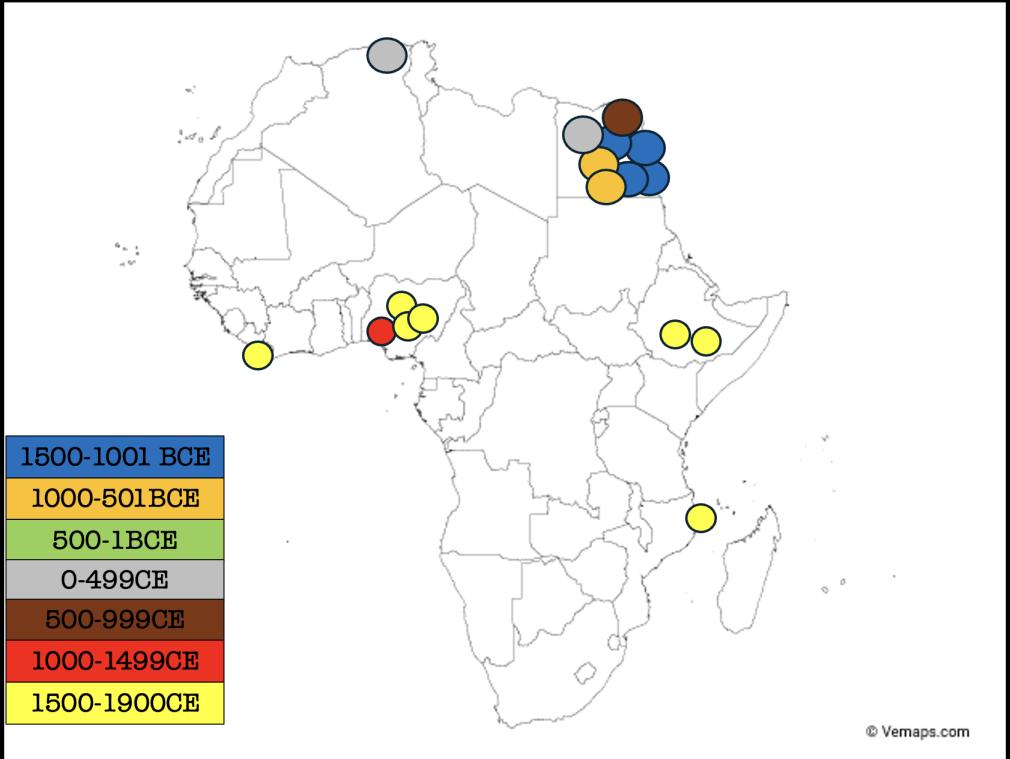
African History Scholarship Produced by NCBS-Affiliated Faculty
Next, we examined the scholarship of faculty in departments and programs that have made institutional commitments to NCBS as well as those departments that grant doctoral degrees in the discipline. The former are displaying their commitment to the discipline by being institutional members of its leading organization. The latter are the faculty responsible for producing the scholars with terminal degrees in the discipline and theoretically should be pushing it forward while also being committed to its core goals, including the study of African history. The authors catalogued any publications of faculties in both groups since 2009 that had as their focus African history prior to slavery-colonization.
Works produced by faculty institutionally affiliated with NCBS
From the current faculties of the thirty-six affiliated departments and programs, two pieces of scholarship were published over the past fifteen years that were on Africa prior to colonization. Both came from scholars at the University of Kansas. In 2024, Amal El Haimeur produced “Sayyida Alhurra: A Forgotten North African Queen and War Leader” for Africana Annual, and Rahina Muazu wrote “West African Qur’an Manuscript,” published in the Journal of Qur’anic Studies in 2016 (Haimeur, 2024; Muazu, 2016).
Works produced by faculty in Africana departments with doctoral programs
Of the sixteen institutions listed by NCBS as non-joint program doctoral programs, only three (Berkley, Ohio State, and Temple) currently have faculty members who have published on pre-colonial African history in the past fifteen years. Temple’s department produced five such works, split up among two scholars (Molefi Asante and Kimani Nehusi). Asante’s History of Africa (in its fourth edition as of 2024) is a text focused on general African history, while the other work by Asante and the three from Nehusi focused on ancient Egypt/KMT (Asante, 2013; Nehusi 2010; Nehusi, 2012; Nehusi, 2013). The work coming from the Ohio State by Scopas S. Poggo,
“Pharonic Dynasties of Egypt 1400 B.C.E.,” also focused on ancient Egypt/KMT (Poggo, 2012).
From Berkley, G. Ugo Nwokeji published “Slavery in Non-Islamic West Africa, 1420–1820” in Cambridge World History of Slavery (Nwokeji, 2011).
Graphically, the works of both groups which were non-general histories can be viewed in Figure 2.
Figure 2
Subjects of Articles by NCBS-Affiliated Faculty
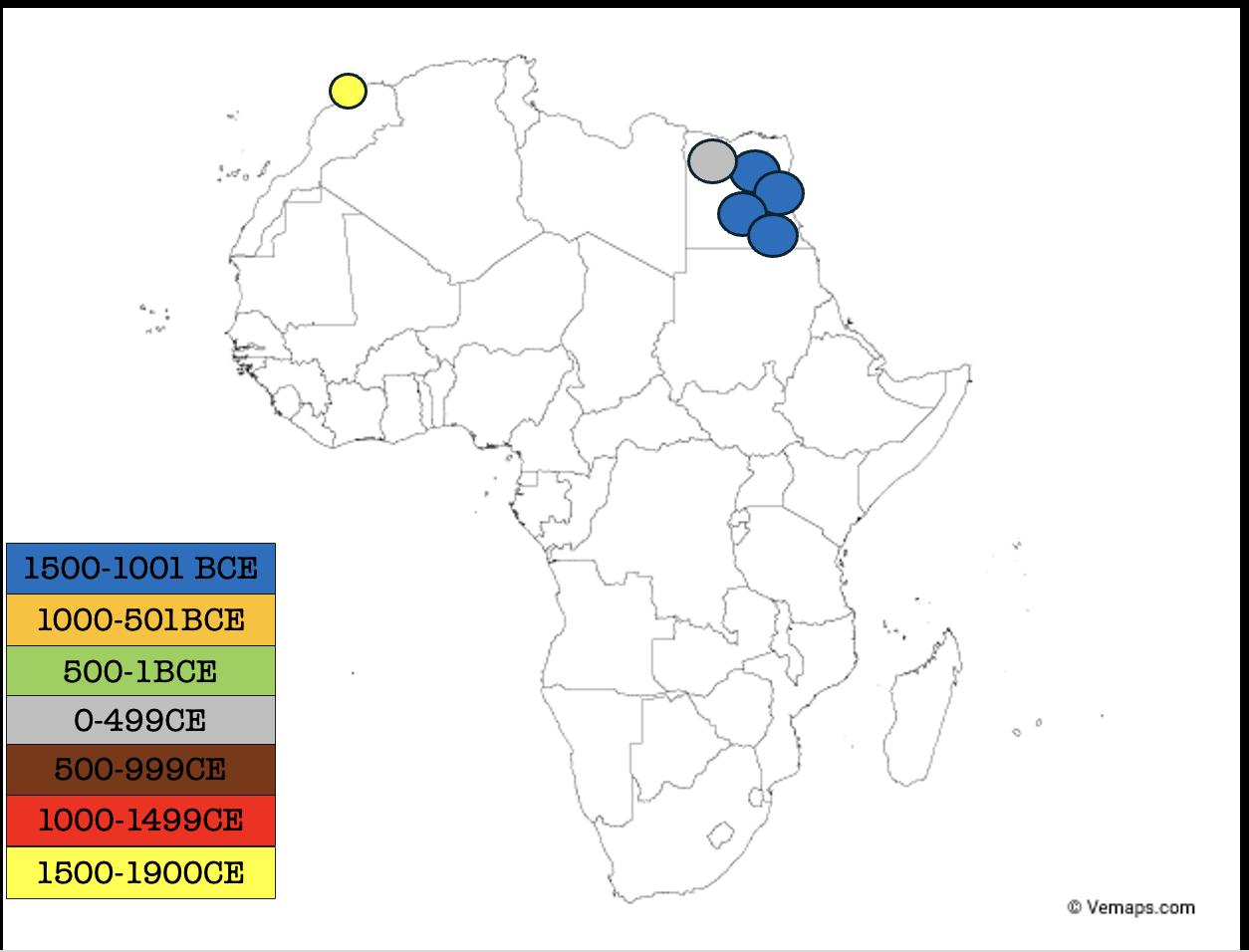
African History in Africana Studies Dissertations
Finally, we searched for dissertations focused on pre-colonial African history and completed as part of doctoral degree programs at the sixteen institutions explored in the previous section. Temple produced five such dissertations. Four dealt with some aspect of ancient KMT/Egypt (Alameen, 2013; Samuels, 2021; Atwater, 2023; Walee, 2023) and one with the African roots of Swahili ontology (Richardson, 2022). Outside of Temple’s department, only one dissertation has been written dealing with African history prior to colonialism since 2009. This was
Blair Rose Zaid’s In Search of Homeland: Bantu Expansion as Pre-Modern African Diaspora, defended at the University of Michigan in 2019.
Figure 3
Subjects of Dissertations
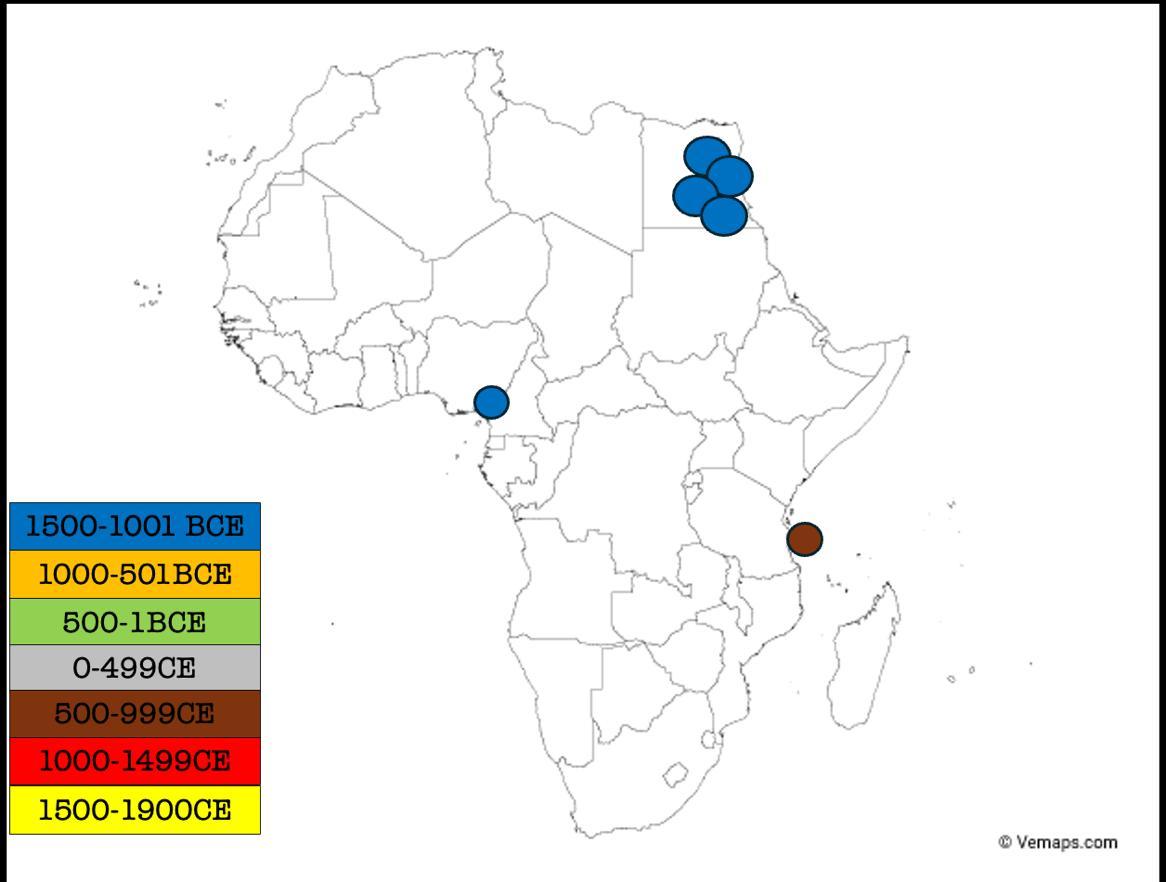
Discussion
Although by no means exhaustive, this cursory analysis of recent scholarship produced on the history of pre-colonial Africa shows that we as a discipline have much more work to do to meet the goals of Williams, contribute to the sankofa process of Karenga, and ensure the Africainclusivity of Edozie. We offer the following observations:
First, the discipline is not producing enough scholarship on pre-colonial African history outside of the Nile Valley civilizations. As a result, the works that are produced on the history of most of the continent (chronologically and geographically) continue to be done by scholars who are not methodologically rooted in the discipline. Secondly, more must be done by the discipline to
elucidate in greater detail the experiences of specific states and empires in pre-colonial Africa, as advocated by Williams. Although the publication of Molefi Kete Asante’s History of Africa (2024) is one of the few works on African history to emerge from our discipline in recent years, and is valuable for its paradigmatic approach, it is designed to only introduce readers to the various nations, personalities, and events of the African past. Conversely, some of the most robust areaspecific contemporary scholarship in pre-colonial Africa comes from scholars such as John Thornton and his wife, Linda Heywood, both of whom are professors of history and African American Studies at Boston University. Both have published extensively on Central Africa. Yet neither has published in journals of the discipline, presented at conferences of the discipline, or approached the study of African history using methodologies rooted in the discipline. Current and future scholars in the discipline must combine the paradigmatic approach of an Asante with the focused inquiry of a Heywood.
Recommendations
To close, by being solution oriented we put forward the following recommendations to departments, individual scholars, NCBS, and journal editors in the discipline. For departments, we offer two recommendations. First, we recommend the use of more primary sources in undergraduate and graduate African history courses, such as the literature of traditional court historians, transcribed oral histories, and cultural custodians. Most discourse on African history is based on an overreliance on secondary sources, and this is at the expense of authentic firsthand accounts. By using more primary sources, scholars will not only gain access to culturally-grounded or centered information straight from the source, but gain the room to develop their own interpretations of the historical data. Second, we encourage the graduate level to be more focused on African language training. We put this forward for two primary reasons: one, to better utilize existing written sources in scripts (Ge’ez, Ajami, Coptic, Amharic, etc.), and two, to have a deeper
philosophical appreciation for the cultures being studied.
For individual scholars, we recommend the application of the ideas, concepts, and approaches of scholars such as C.A. Diop and Williams to places outside of the Nile Valley (i.e., polyvalent research teams using modern scientific techniques). Most concepts and ideas put forth by various African-centered writers (such as Diop’s attempt to demonstrate the Africanity or Blackness of Kemet through the identification of clearly African cultural practices) have been primarily applied to the Nile Valley. But their credibility will be tested (or affirmed) by the use of more than one geographical region of the continent for case studies.
For NCBS, we propose cyclically highlighting areas of inquiry in African history to be the focus of scholarly production in the discipline for given periods of time (i.e., the decade of Central Africa, or the demi-decade of Amazigh history). This will create opportunities for upcoming scholars to learn new information about areas which have been largely neglected, and this in turn will lead to a new generation of scholars producing new scholarship which will greatly expand the discipline. Finally, for journal editors, we recommend the running of more special issues and the soliciting of studies on African history before colonialism.
References
Alameen,A. V. (2013). Women’s access to political power in Ancient Egypt and Igboland: A critical study [Doctoral dissertation, Temple University,AfricanAmerican Studies].
Alameen-Shavers, A. (2018). Not a trophy wife: (Re)interpreting the position held by queens of Kemet during the New Kingdom as a political seat. Journal of Black Studies, 49(7), 647–671.Asante, M. K. (2013). Herodotus on Egypt. Philadelphia: Ramses.
Asante, M. K. (2024). History of Africa: The quest for eternal harmony. New York: Routledge.
Asante, M. K., & Ismail, S. (2009).Akhenaten to Origen: Characteristics of philosophical thought in ancientAfrica. Journal of Black Studies, 296–309.
Asante, M. K., & Ismail, S. (2010). Rediscovering the “lost” Roman Caesar. Journal of Black Studies, 606–18.
Asante, M. K., & Ismail, S. (2016). Interrogating theAfrican Roman emperor Caracalla: Claiming and reclaiming anAfrican leader. Journal of Black Studies, 41–52.
Atwater, R. J. (2023). Maatian manhood: A cultural model toward geru-maa [Doctoral dissertation, Temple University,Africology andAfricanAmerican Studies].
Babalola,A. B. (2017).Ancient history of technology in westAfrica: The indigenous glass/glass bead industry and the society in early Ile-Ife, southwest Nigeria. Journal of Black Studies, 501–27.
Clark,A. (2012). Hagar the Egyptian:Awomanist dialogue. Western Journal of Black Studies, 48–56.
Cook, W. (2012). SaintAugustine and the spread of Christianity. Western Journal of Black Studies, 220–27.
Cook, W. S. (2014).Acomparative analysis between the Nile valley’s liberal arts tradition and the development of western education. Journal of Black Studies, 683–707.
Echeruo, M. J. (2010). Edward W. Blyden, “the Jewish question,” and the diaspora: Theory and practice. Journal of Black Studies, 544–65.
Edozie, R. K. (2012). The emerging Black studiesAfricanist:Acase study of MSU’s triple heritage AAAS PhD program. Journal of Pan African Studies, 5(4).
Haimeur, A. E. (2024). SayyidaAlhurra:Aforgotten NorthAfrican queen and war leader. Africana Annual, 44–60.
Imrie,A. (2019).Africanus princeps? The emperor Caracalla and the question of hisAfrican heritage. Journal of Black Studies, 370–82.
Jalata,A. (2012). Gadaa (Oromo democracy):An example of classical African civilization. The Journal of Pan African Studies, 126–52.
Kambon, Ọ., Songsore, L., &Aketema, J. (2023). 400 years?Ancestors disappear! Historical misorientation and disorientation in the year of return and the 400 years narrative. Journal of African American Studies, 304–28.
Karenga, M. (2010). Introduction to Black studies. LosAngeles: University of Sankore Press.
Karenga, M. (2012). Grounding Kawaida womanism:ASankofa reading of ancient sources. Western Journal of Black Studies, 11–22.
King, L. D. (2015). The nation in antiquity: Unification, civil war, and national liberation in ancient Kemet. Journal of Black Studies, 239–57.
Marah, J. K. (2012). From the temples of Egypt to emperor Haile Selassie’s Pan-African university:Ashort history ofAfrican education. The Journal of Pan African Studies, 143–71.
Miftah, M. (2017). Key dimensions inAbyssinia-Ottoman relations in the sixteenth and seventeenth centuries:A critical review of literatures. The Journal of Pan African Studies, 265–78.
Muazu, R. (2016). West African Qur’an Manuscript. Al-Maher, Journal of Qur’anic Studies.
Mukuthuria, M. (2009). Islam and the Development of Kiswahili. The Journal of Pan African Studies, 36–45.
Nehusi, K. S. (2010). The system of education in Kemet (ancient Egypt): An overview. Occasional Monograph no. 14. Lagos: Centre for Black andAfricanArts and Civilization.
Nehusi, K. S. (2012).African Ritual of Libation: History and Meaning. Ankh: Reveu D’Égyptologie et des civilisations africaines, 118–142.
Nehusi, K. S. (2013). The It Netjer or father of the god in Kemet. Revista de la Sociedad Uruguaya de Egiptología, 11–13.
Nwokeji, G. U. (2011). Slavery in non-Islamic westAfrica, 1420–1820. In D. Eltis, & S. L. Engerman, The Cambridge World History of Slavery volume 2, AD 500–AD 1420 (pp. 81–110). Cambridge: Cambridge University Press.
Ogiogwa, J. I. (2017). Old Oyo or Ijebu-Oyo pottery: The vessels of Oke-Eri. The Journal of Pan African Studies, 170–87.
Ogundiran,A., & Ige, O. A. (2015). “Our ancestors were material scientists”:Archaeological and geochemical evidence for indigenous Yoruba glass technology. Journal of Black Studies, 751–72.
Okpalaeke, P. C. (2018). Continuity and change in the funeral culture of the Umuna people in Nigeria from pre-colonial times to 2000A.D. The Journal of Pan African Studies, 74–88.
Poggo, S. S. (2012). Pharonic dynasties of Egypt 1400 B.C.E. In O. Patterson, & J. G. Golson, Cultural Sociology of Africa, Part 2: 1400–1900. Thousand Oaks: Sage Publications.
Rashidi, R. (2016). The Black saint Maurice: African saint in early Europe (photo essay). The Journal of Pan African Studies, 150–66.
Richardson, T.A. (2022). The African roots of Swahili ontology: An investigation into the
Africanity & historiography of a coastal society [Doctoral dissertation, Temple University, Africology andAfrican American Studies].
Samuels, T. (2015). Herodotus and the Black body:Acritical race theory analysis. Journal of Black Studies, 723–41.
Samuels, T. (2021a). Translation as a cultural act: An Africological analysis of Medew Netcher from a Jamaican perspective [Doctoral dissertation, Temple University,Africology and AfricanAmerican Studies].
Samuels, T. (2021b). Undoing the Hottentoting of “the queen of Punt”:AJamaicanAfronography on the Kemetiu depiction ofAti of Punt. Journal of Black Studies, 3–23.
Siame, C. N. (2013). Katunkumene andAncient Egypt inAfrica. Journal of Black Studies, 252–72.
Walee, L.A. (2023). Luminescence embodying vitality and life:Acomprehensive examination of Kemetic myth and astronomy. Africology and African-American Studies
Williams, C. (1967).African history. In J. S. Roucek (Ed.), The Teaching of History (pp. 74–86). New York: Philosophical Library.
Williams, J. (2014). FromAset to Jesus: The history of the goddess Aset in ancient Kemet from circa 3000 BCE until the removal of feminine salvation circa 400 CE. Journal of Black Studies, 102–24.
Zaid, B. R. (2019). In search of homeland: Bantu expansion as pre-modern African diaspora [Doctoral dissertation, Michigan State University,African andAfricanAmerican Studies].
The Black Studies Program at Iowa: The Darwin Turner Papers and the Institute for AfroAmerican Culture at the University Iowa, a Report by
James Alexander Robinson IV, Ph.D.
Assistant Professor of Black Studies
Ethnic, Gender, Historical, and Philosophical Studies Department
Metropolitan State University, Saint Paul-Minneapolis
The recent deposit of the Darwin T. Turner papers into the University of Iowa Archives and Special Collections marks a seminal contribution to Black Studies scholarship, teaching, and research. Black Studies at Iowa makes special appearances between 1969 and 1978 in its Institute for Afro-American Culture (originally named the Institute for Negro History and Culture) or “The Summer Institute.” In particular, these Turner papers document ten years of its Summer Institute at which a primarily Black intelligentsia from across the country gathered to confer annually during this first decade of formation of the field of Black Studies. They also help to document Dr. Turner’s conception and vision, and the work of a Black Studies program (BSP) as the hidden curriculum underlying his intellectual leadership in development of Afro-/African American Studies from a program to a department at the University of Iowa in Iowa City and in the Iowa
Consortium for Black Studies.
What does one mean by “black studies” and “black studies program”? One could analyze the terms. The Oxford English Dictionary describes “black” as an English word with a difficult history. Black Studies’ “disciplinarization,” or discipline-building, operates with the nuances of the word “black” as an adjective, a noun, and a transitive or intransitive verb depending on the context. Here the roots of the term “discipline” emerge from discere, or “to learn.” Capitalization is used for “Black Studies” as a proper name in the discipline. Black Studies and Afro-American Studies and their cognates are equipollent: related disciplines with equal powers, as similar as sociology is to anthropology. Given the almost sixty years of unfolding of the discipline, one may now demarcate progress through at least three disciplinary formations: “black studies,” “Black studies,” and “Black Studies.” Reflexively, one can observe and understand the field formation from a position in its history and theory as it moves toward being a maturer discipline. Black Studies is this emergent phenomenon as a cognitive domain. The Turner papers offer insights into Black Studies Programs.
At the emergence of the field, no institution placed as many scholars in “black studies” before the academic and public readership as the University of Iowa did. Three of the earliest monographs attempting to standardized the field were written by scholars with Iowa connections, as was a later study documenting the field’s subsequent growth (Ford, 1973; Rose, 1975; Bright, 1977; Rooks, 2006). In 1968, famed Iowa alumna Margaret Walker, the acclaimed poet of “For My People,” served as advisor to the Institute for the Black World at Atlanta, founded one of the longest standing Black Studies “institutes” in the United States at Jackson State College in Mississippi the Institute for the Study of the History, Life and Culture of Black People, now renamed the Margaret Walker Center and shared timely thoughts on Black Studies as well (Walker, 1971). Meanwhile fellow alumnus Nick Aaron Ford, who penned a major study of the
nascent field in Black Studies: Threat of Challenge, also help to found the Center for Black Studies at Morgan State College in Maryland (Ford, 1973; Fisher, 1971). Other Iowa alumni also made significant contributions to the field at this historical moment. San Francisco State College faculty member and Iowa alumnus DeVere Pentony’s article “The Case for Black Studies” is often cited and is widely anthologized (Pentony, 1969). Alumnus C. Vivian Henderson of Atlanta University sat on the board of the Ford Foundation during its early years, providing major funding for “Black Studies.” It even produced one of the earliest doctoral dissertations on Black studies in the discipline (Hulberry, 1972). The university’s investment in Black Studies programs can be seen with its development of an Afro-American Studies department that offered bachelor’s and master’s degrees as well as a Ph.D. through an interdisciplinary, interdepartmental process. The university’s program centered the plan for a consortium of Black Studies among university and colleges around the state. Black Studies at Iowa contributed to advancing intellectual life in America.
In the beautiful struggle for “Black Studies,” the history and theory of “black studies” took strategic and tactical turns at Iowa beginning in the 1960s. In Iowa City, the University of Iowa’s innovative approach to the “Black studies” problematic remains to be fully uncovered and recorded. The preliminary historical notes on this approach to BSP at Iowa presented here provide an initial look at the cultivation of African American Studies through the vision and work of Darwin T. Turner and the Institute for Afro-American Culture, and make a few brief comments on the learning history and theory of Black Studies. Let’s begin by introducing Dr. Darwin T. Turner (1931–91) and his rediscovered essay, “A Black Teachers Thoughts about Black Studies.”
“A
Black Teacher’s Thoughts about Black Studies”
Before arriving at Iowa in 1968, Darwin T. Turner wrote a seldom-reviewed essay titled “A Black Teachers Thoughts about Black Studies.” By this point in his intellectual life, Darwin Theodore Troy Turner had graduated from high school at 13 and from the University of Cincinnati
at 16, Phi Beta Kappa, had earned his University of Chicago Ph.D. at 25, had served as chair of the English departments at Florida A&M and at North Carolina A&T in Greensboro, where he was ghostwriter of the campus-community newsletter supporting the student sit-ins, and where he also directed of the Center for Afro-American Studies, had served as the dean of the graduate school at NCA&T, and had become a professor at the University of Michigan by the age of 40. Turner would also lead the State of Iowa Committee and Midwest Regional Board for the Second World Festival for Black African Arts and Culture. For years, Turner sat on the College Language Association’s (CLA) Standing Committee for Black Studies. He called for and chaired the planning and implementation of the Iowa Consortium for Black Studies. The essay gives Turner’s interpretation of the idea of Black Studies and hints at what approaches to BSP are required to practice state-of-the art intellectual work in this new field (DT Turner Papers).
As historian Martha Biondi remarks, “He argued, seeing in Black studies the potential to develop, a new, more honest national narrative” (Biondi, 2012). For the 1970–71 Pride readership, Turner, the “Black teacher” here, observed that BSP was “a developing academic program to meet the needs of society” (Turner, 1970). Thus the institutionalization of Black Studies occurred not to “appease the demands of the moment.” If “all aspects of human existence are intellectually valid subjects for studies in higher education it is both absurd and hypocritical to raise the question of academic respectability about courses and programs in Black Studies.” Black Studies and BSP reject the stigmatization and intellectual snobbery and inferiority complexes ascribed by some in the academy (Turner, 1970).
Black Studies’ pedagogical core is “development of people” by education of people.
Turner’s thinking imagines programs thriving at the college, high school, elementary school, and pre-school levels with Black Studies intellectual content. The end-goal of thought about Black Studies was “In short, the student is not to be trained to be a ‘credit to his race’ to echo the old
platitude of praise but to be an asset to his people” (Turner, 1970).
Turner proposes the novel idea of a regional center for Black Studies or a cooperative program. The regional center might be housed on one of the co-operating campuses. . . . A co-operative program would require several institutions to devise ways of sharing the specialized talents of their faculties through use of commuting lectures, visiting lectures, video-tapes, and telephone lectures. (Turner, 1971)
This became his conceptual framework when he organized the Iowa Consortium for Black Studies.
The Institute for Afro-American Culture
On April 4, 1968, Marin Luther King, Jr. was assassinated in Memphis, Tennessee. On April 8, the University of Iowa’s Human Rights Committee’s sub-committee on Afro-American Studies proposed a “Center for Afro-American Studies.” The center was to be “devoted to the study of the Negro and Negro life from an interdisciplinary point of view [and] would provide for the study of Negro literature, art, music, history, economics and sociology” (DT Turner Papers).
In the fall of 1968, the University of Iowa announced that the new Committee on AfroAmerican Studies would offer a course titled “The Culture of Black America” during the spring of 1969. The committee constructed a list of more than 40 courses potentially related to Black culture available at the university. Prior to this, the 1963 University of Iowa Catalog listed only four departmental courses that might have relevance to Negro life and culture. However, the lack of knowledge of Black history and culture were readily apparent to the new students’ movements appearing on campuses by the late 60s. At Iowa it was recognized that higher education institutions in America were suffering from “300 years of neglect” of the subject. In addition, Robert Corrigan, a young associate professor in the Iowa’s Department of American Civilization, responded to the changing times and wrote a proposal to the National Endowment for the Humanities and the Ford
Foundation for the university to host a summer workshop on the teaching of Negro history and culture (Corrigan, 1969).
Originally proposed as the Institute for Negro History and Culture, the Institute for AfroAmerican Culture at the University of Iowa ran from 1969 until 1978. It was a summer institute to improve the teaching and study of Black American culture designed for teachers and advanced students and scholars. The five-week long institute, sometimes referred to as “the Afro-American Institute” and called “the Summer Institute” by locals, took place from July 1 to August 8, 1969, in Iowa City on the university campus. It hosted live-in accommodations. The initial purpose of the Institute on Afro-American Culture was to train “30 college and university teachers in the history and culture of the black American” (Clark, 1969, p. 5B). Its first year’s summer institute, on the theme of “Negro History and Culture,” was funded by the National Endowment for the Humanities and the Ford Foundation. Corrigan directed the Institute for Afro-American Culture for its first two years (1969–70), and then Charles T. Davis directed it for two years (1971–72), followed by Darwin T. Turner, who directed the Institute from 1973 to 1978.
Drs. Corrigan, Davis, and Turner’s intellectual leadership in establishing the Institute for Afro-American Culture, and their foresight to document and preserve its records, is a lasting legacy to students and scholars of Black Studies. The Darwin T. Turner papers housed in the University of Iowa Archives and Special Collections record the development of Black Studies scholarship and teaching during ten incubation years at its Summer Institutes of 1969–78.
Table 1
Themes of the Institutes for Afro-American Culture at the University of Iowa, 1969–78
Year Director Theme
1969 Corrigan Negro History and Culture
1970 Corrigan The Culture of Black America: The Harlem Renaissance
1971 Davis Richard Wright
1972 Davis W. E. B. Du Bois
1973 Turner Blacks on Stage and Screen
1974 Turner Slave Narratives
1975 Turner From Reconstruction to Renaissance: Currents in Afro-American Culture, 1865–1920
1976 Turner Preludes to Change: A Study of Afro-American Culture, 1845–1860 and 1945–1960
1977 Turner Blacks in the Great Depression Years: A Study of Afro-American Culture, 1930–1945
1978 Turner Black Culture in the Second Renaissance: A Study of Afro-American Thought and Experience, 1954–1970
Many of the sessions from these institutes were tape-recorded, and some were broadcast on radio and archived at the University of Iowa. The institute on The Culture of Black America: The Harlem Renaissance certainly foreshadowed the explosion of research on this topic. The institute on W. E. B. Du Bois returned this titan to an up-rightful place in the pantheon of pioneers for a Black Studies school of thought. The Afro-American institute on Slave Narratives arguably created a watershed for those studies in the 1970s and 80s (Turner & Sekora 1982). At least two of these institutes’ presentations and papers were published. The Black Scholar: Journal of Black Studies and Research published papers from the 1978 Afro-American institute in a special issue in 1987, titled “Black Culture in the Second Renaissance, 1954–1970,” and published papers produced at the same summer institute as a special issue titled “Civil Rights in the Second Renaissance: 1954–1970” in 1988.
When Darwin T. Turner edited these two special issues of The Black Scholar: Journal of Black Studies and Research, his conception acknowledged that the institute’s overall focus was on Black American culture (The Black Scholar, 1987; The Black Scholar, 1988). To evoke the spirit
of the times, the “Black American Culture in the Second Renaissance” journal features a signature piece of the times, “Black Art” by Amiri Baraka, which was not presented at the institute, contextualizing it with “The Social Background of the Black Arts Movement” by Larry Neal (The Black Scholar, 1987). In order to re-present the flavor of an actual institute event, which regularly incorporated performance works, the poetry of poet-teacher and summer institute participant Sonia Sanchez is highlighted. On the other hand, the masterful historical essay “Power from Our People: The Sources of the Modern Revival of Black History” by Vincent Harding flows like a mighty river carrying this theme with repeated use of “BLACK STUDIES” (Harding, 1987), a reminder that Black Studies knowledge is power to the people.
By the time of publication in The Black Scholar: Journal of Black Studies and Research, the program at Iowa had developed and taught the course “Contemporary Black Experience” using tape-recordings from the summer institute for teachers and educators “on Black culture.” A decade later, a mature Turner reclarified the intention after the program’s last event in 1978:
Our purpose for the institutes was to improve research and teaching in black studies by bringing distinguished creators and scholars of black culture together with professors who could influence teaching of black culture at their institutions. (Turner, 1987)
At Iowa, the program spurred Black Studies intellectual activity and Black scholarship, here and throughout the land.
The Iowa Consortium for Black Studies
Darwin T. Turner’s “A Black Teacher’s Thoughts on Black Studies” implied that a consortium approach may be a strategic and tactical move for the development of the field. Turner proposed this to colleagues in 1976. It began with a conference on sharing Afro-American Studies resources the previous year. The consortium idea was not new. The idea took hold in New England and Ohio, among other places. In Iowa City, to put into effect the consortium idea, he proposed to
colleagues at colleges and universities from all corners of Iowa to join into a co-operative arrangement. Those scholars who accepted the invitation to the Iowa Consortium of Black Studies were at the University of Iowa (Iowa City), Iowa State University (Ames), Drake University (Des Moines), University of Northern Iowa (Cedar Falls-Waterloo), Iowa Wesleyan (Mount Pleasant), Coe College (Cedar Rapids), Luther College (Decorah), Simpson College (Indianola), St. Ambrose University (Davenport), and Upper Iowa University (Fayette). The Iowa consortium, though functioning for several years, was an unfulfilled ambition (DT Turner Papers).
Conclusion
The historical and theoretical formation toward the Black Studies meta-discipline is not complete (Engel & Willet, 1971). At Iowa, through the years a score or more of the students from its Afro-American Studies or black studies program did earn the M.A. or the Ph.D. and go on to produce important work and scholarship in these and other fields. But recall that in 1968, the University of Iowa recognized its shortcomings in the field of inquiry, research, and teaching of Black Culture but deferred the planning and implementation of “an independent degree granting program in Black Studies” (Corrigan, 1969). Instead, it underwrote the hidden curriculum of Turner’s BSP. Since then, Black Studies persists as a vibrant growth field of intellectual and scholarly activity, nationally and globally.
The “Turner Papers” represent not only Darwin T. Turner’s personal papers, correspondence, scrapbooks, photos, tape and video recordings, and memorabilia, but just as importantly they are a collection of records of the African American Studies department and of the Institute for Afro-American Culture to document the long-run enterprise of a Black Studies Program at Iowa and elsewhere. The Darwin T. Turner Papers, record group RG899.0304, is 42 linear feet of material. Although the deposit of these important papers is invaluable, especially for theory-construction and reconstruction, the untimely death of renowned academic Dr. Darwin T.
Turner in 1991 left an irreplaceable void in the intellectual and scholarly life of the discipline at the university and, as he might have called it, in the Blackening world of arts and letters.
References
Biondi, M. (2012). Black revolution on campus. Berkeley: University of California Press.
Bright, A.L.; Clark, S.B., Amadi, L.E., Cooper, S., Barnes, C., & O’Neill, D.J. (eds.) (1977). An interdisciplinary introduction to Black studies: History, sociology, literature, art and Black civilization. Dubuque: Kendall/Hunt Pub. Co.
Clark, F. (1969, November 8). An insight: Afro-American studies at the U. of Iowa. The Cedar Rapids Gazette, p. 5B.
Corrigan, R. A. (1969). The role of Black Studies in the American civilization program. Negro American Literature Bulletin.
Corrigan, R. A. (1970a). Afro-American studies at the University of Iowa. Radical American Studies (spring), 10–11.
Corrigan, R. A. (1970b.) An interdisciplinary home for Afro-American studies. Radical American Studies
Corrigan, R. A. (n.d.). The culture of Black America: An interdisciplinary approach; A series of essays from the Summer Institute, 1970. [A proposed document cited in N.E.H. Proposal 1969; item not found.]
Darwin T. Turner papers, RG899.0340. (2014). Iowa City, IA: University of Iowa. Special Collections and University Archives.
https://aspace.lib.uiowa.edu/repositories/3/resources/1728
Engel, R. E., & Willett, L. H. (1971). Educational implications of Black studies. Improving College and University Teaching, 19(4), 267–69.
Fisher, W. (1971). Ideas for Black studies: The Morgan state college program. Baltimore, MD: The Morgan State College Press.
Ford, N. A. (1973). Black studies: Threat or challenge. Port Washington, NY: Kennikat Press.
Harding, V. (1987.) Power from our people: The sources of the modern revival of Black history.
The Black Scholar, 18(1), 40–51.
Hulberry, W. E. (1972). Adolescent political self-images and political involvement: The relative effects of high school Black studies course prior socialization. Ph.D. dissertation, University of Iowa.
https://www.proquest.com/openview/695e63dfe306f4c04e0d6662e6a992b1/1?pqorigsite=gscholar&cbl=18750&diss=y
N. E. H. proposal. (1969). Summer 1970 workshop in Negro history and culture, November 11, 1969. Iowa City: University of Iowa. Special Collections and University Archives.
Pentony, D. (1969). The case for Black studies. The Atlantic (April), 81-82. Also, in Blassingame, J., (Ed.) New Perspectives on Black Studies. Urbana: University of Illinois Press.
Robinson, J. A. (2017). Black Studies Definitions: An Archive, A Year of Promise, and a Conceptual Approach. Ph.D. dissertation, University of Iowa. https://doi.org/10.17077/etd.azyegz3v
Rooks, N. M. (2006). White money/Black power: The surprising history of African American studies and the crisis of race in higher education. Boston: Beacon Press.
Rose, A.W. (1975). Afro-American Studies in Higher Education. Coral Gables, FL: University of Miami, Center for Afro-American Studies.
The Black Scholar. (1987). Black culture in the second renaissance, 1954–1970. The Black Scholar 18(1).
The Black Scholar. (1988). Civil rights in the second renaissance, 1954–1970. The Black Scholar 19(1).
Turner, D. T. (n.d.). A Black teacher’s thoughts about Black studies. Iowa City, IA: University of Iowa. Special Collections and University Archives, Darwin T. Turner Papers.
Turner, D. T. (1968). A Black teacher’s thoughts about Black studies. North Carolina A&T Alumni Magazine, (Fall), 2-4.
Turner, D. T. (1970, 1971). A Black teacher’s thoughts about Black studies, 2 parts. Pride [Cincinnati] (November 1970, April 1971), 10–11, 34.
Turner, D. T. (1987). A retrospective of a renaissance. The Black Scholar, 18(1), 2–10.
Turner, D.T., & Sekora, J. (eds.) (1982). The art of the slave narrative. Macomb, IL: Northern Illinois University.
Walker, M. (1940). For my people: A volume of verse Unpublished M.A. Thesis, University of Iowa.
Walker, M. (1971). Black studies: Some personal observations. Afro-American Studies, 1, 41–43.
COMMENTARIES



Burkina Faso and the African World Revolution:
Notes from Afrocentricity International’s 11th Annual Convention and the Need for Translative Work
by
Tarik A. Richardson, Ph.D.
Assistant Professor
Department of African American & Diaspora Studies
Xavier University of Louisiana
We must learn to live the African way. It’s the only way to live in freedom and with dignity. Thomas Sankara
When contemplating the field of Black Studies, there seems to be a constant struggle between retaining a focus on the African American and domestic issues, and maintaining a perspective that seeks to highlight the connection of the African American cultural experience to the African world. Departments within our field, several which I have been a part of, have been strongarmed into retaining the nomenclature of “African American,” as if the terms “Africana” and “Africology” are non-exclusive to our particular corner of the diaspora.
It should be remembered that Black Studies as a discipline emerged out of a culturalpolitical movement with profound implications. The causes that led to the 1976 Soweto uprising in South Africa mirrored the sentiments of the students who walked out of their San Francisco State College classes in 1968. Similarly, a year later in 1969, many of the leading scholars in our field raised in protest during the 12th annual African Studies Association meeting. One of their core complaints was that African Studies was far too comfortable allowing the European perspective to remain the default and dominant perspective which sought to sever intrigue in investigating the historic and continued connections of Africa and her diaspora.
In all these instances, individuals took a stand, insisting that their perspectives and their histories were worth being told. Furthermore, and much to the point of the Black faculty caucus of 1969, is that we need to intentionally be conscious of these intersections of history, culture, political action, and philosophical development in the African world.
As a discipline, regardless of our field of study, we should remember these larger global implications and remain abreast of how work can speak to the experiences of people outside of the states, and converse about how their work and their actions remain relevant to our work as well as our lives. Although there are many individuals and organizations that have dedicated themselves to this endeavor, one such organization, Afrocentricity International, has become increasingly present in parts of the African world which are progressively becoming of interest to our community here in the States: the francophone diaspora.
In May of 2025, a Pan-African delegation traveled to Ouagadougou, the capital city of Burkina Faso, to attend Afrocentricity International’s eleventh annual convention. Afrocentricity International is a culturally grounded global organization founded in January 2011 by professors Ama Mazama and Molefi Kete Asante (Mazama, 2015). According to one of its founders, The purpose of Afrocentricity International, however, is not simply to provide a
forum, but also, and quite importantly, to attempt to orient the development of an African-centered consciousness, which should lead greater numbers of Africans toward pro-African and Pan-African action. (Mazama, 2015)
The members who attended the 2025 conference, just as at past conferences served as a reflection of Afrocentricity’s Pan-African focus. The 2025 delegation of Afrocentricity International hailed from all corners of the African world: Cote D’Ivoire, Cameroon, France, mainly the metropolitan areas in and around Paris, Switzerland, England, Guadeloupe, and Haiti; and of course the United States was well represented, many of its members coming from the northeastern regions of the country, namely New York, Philadelphia, and New Jersey, with others, myself included, traveling by way of the southern states.
Afrocentricity International, since the relatively recent departure of one of its founders, Molefi Kete Asante, has continued its efforts in creating a global African forum to discuss African solutions to African problems. Furthermore, under the leadership of Ama Mazama, the organization seems to have become very influential in the francophone portions of the African world. So long as anglophone Africans remain invested and involved in organizations such as Afrocentricity International, they are creating lines of communication between communities who often don’t have the opportunity to engage in dialogue. This language barrier between the Frenchspeaking and the English-speaking Africans was the very issue that shaped the development of W. E. B. Du Bois’s Pan-African Congresses of the early twentieth century, and his recruitment of the Senegalese-French politician Blaise Diagne (Du Bois, 1947, p. 6).
This is not only a political issue, but it also presents itself as an academic challenge. In the States, Cheikh Anta Diop’s work is often celebrated as pioneering a new era of African scholarship on classical African civilization and culturally conscious Egyptology. Diop, also being a Senegalese national, used French as a working language. There are only a handful of his works that
have been translated into English: The African Origins of Civilization (written in 1955, translated by Mercer Cook in 1974), Civilization or Barbarism (written in 1981, translated by Yaa-Lengi Meema Ngemi in 1991), Pre-Colonial Africa (translated by Harold J. Salemson), Black Africa: The Economic and Cultural Basis for a Federal State (written in 1974, translated in 1987), and The Cultural Unity of Black Africa (written in 1963, translated in 1989)
Similarly, much of Theophile Obenga’s works on the topic of African historical linguistics has yet to be translated. I suspected that the work of Alexis Kagame would have provided invaluable insight into Bantu philosophy and ontological concepts, if his work were accessible to English speaking researchers. Alexis Kagame wrote exclusively in French and Kinyarwandan. His work has received a mere whisper of a mention, yet it is seemingly foundational to Rev. Placide Tempel’s 1945 work on Bantu philosophy (translated from French to English in 1953). Further effort translating such text is a necessary endeavor in the field of Black Studies to introduce new generations and communities to valuable academic discourse that is happening outside of their linguistic paradigm. Furthermore, there is a critical need for academic and political communication with the francophone diaspora.
The recent political developments in the west African Sahel (i.e., Mali and Niger), and the intrigue of Burkina Faso’s President Ibrahim Traore highlight this point. Afrocentricity
International’s conference in Burkina Faso was timely, to say the least. In the weeks leading up to the conference, the United States of America’s State Department issued a level 4 travel advisory, warning travelers to stay clear of the country. More recently, Burkina Faso and United States have issued travel bans, preventing travel for citizens from either country. The initial apprehension that resulted in the travel advisory to Burkina Faso concerned the insurgents in the north who were warring against the government in Ouagadougou. The capital city itself and the areas south of Ouagadougou were relatively safe. On more than one occasion, we did pass informal temporary
settlements of internally displaced people. Despite the very real problems facing the country, it was clear that every individual that I encountered, from academics to merchants and even children, supported President Ibrahim Traore with the same fervor as the enamored diaspora.
I found the Burkinabes as versed in their knowledge of Pan-African histories as they were in the developments in their own country, which was not my experience in other parts of the African continent, to say the least. For example, near Bazoulé and the lake of the sacred crocodiles, I met a merchant selling Kemetic-inspired wares. This merchant talked at length about the meaning of these items (with a fair degree of academic accuracy) and their cultural relevance to Burkina Faso. In Ouagadougou, while on the way to the Thomas Sankara memorial, I caught a glimpse of a Kemetic (spelled “Kamit”) institute. At the conference held at the University of Joseph Ki-Zerbo, Naaba Kaoongo, a traditional local ruler of the Mossi people, spoke at length about the meaning and significance of Cheikh Anta Diop’s work and the more recent developments in the Afrocentric paradigm. Naaba Kaoongo’s royal title seems to be mostly ceremonial, but from what I was able to understand, one of his duties is the intentional preservation of his people’s culture. His interest in the philosophies and theories developed by our discipline speak to the importance of our work and the need for sustained international collaboration.
Alongside this traditional leader, the conference was also attended by Bassolma Bazié, who was appointed .resident of the National Commission of the Confederation of Sahel States (Alliance des États du Sahel, AES Confederation, or AES) in 2024. As a scholar not well-versed in the French language, I only picked up bits of his conference keynote, which seemed to be centered on the idea of Pan-African unity. Bazié would invite the delegates of Afrocentricity International to his secure compound just outside of Ouagadougou. Shaded from the blistering heat and the arid winds by the canopy of several trees planted in the courtyard of the compound, Bazié entertained his guests, who had traveled from all corners of the African world, with drinks and a lengthy
conversation. His words below were transcribed and translated by Sandrine Abena:
For our people of the diaspora, The House of the Diaspora was created under Captain Ibrahim Traoré. Africa is the “cradle of humanity,” which gave birth to a single child called Dignity. Therefore, it is up us to maintain our dignity. Our fight must be backed by courage. It is not only the countries of the Alliance of Sahel States (AES) that are strong, but also our diaspora that seeking for justice is also strong. We must work hand in hand. We are talking about revolution. A revolution is a radical change!
Neocolonialization is nothing but slavery in disguise. They cut the heads off of our leaders then would expose them in order to scare us so that we could not repeat it. Today, we don’t even know where Lumumba’s grave is. White people can excavate their people’s body after sixty years in order to search for the body DNA but when it came to Thomas Sankara, they re-opened his coffin after five years or so after his assassination, to make us believe that it was not his body.
When I talk about radical change, I mean politically, culturally, economically, and security. We don’t need two hundred political parties in Africa to lead a country. But for some reason it suits the colonizer, because it’s based on a constitution that’s false, as it was edited by France. If the U.N. isn’t careful, there will be a coup! In Saudi Arabia, there are no political parties. In terms of economic progress, today we know that independence doesn’t exist.
On the monetary level, they told us they were going to give us our independence, yet they would take care of our own currency (reminder: FCFA notes are printed in France).
Another striking example: If the Burkina-be people discover gold or any type of gems in their own soil then the Burkina-be government must acknowledge France first, and the latter will dispose of it. Then, if they are not interested, another country (obviously not an African one) can take the minerals over.
Ditto in terms of business ventures. France has automatically the first spot, and then if it’s not interested in the project, it will be passed over to another non-African country.
In terms of weaponry, Burkina Faso (BF) purchases machine guns from the French which they would never receive their orders of, or only eventually, partially receive them. Under the table, the French would asked ECOWAS to give permission for whether it can be delivered to the requested country. THis means that ECOWAS is kindly asked to block the delivery of paid weapons. On the other hand, if guns are supplied, then they would receive some used ones from WWII, so the rusty and the outdated ones. For instance, Burkina-be security agents who work in Burkina Faso airport customs have weapons that are so outdated they could be used to kill mosquitoes.
Even worse, Burkinabe could receive a short supply of weapons from what was initially ordered. Then the French would recommend that African soldiers make guns sounds with their mouths to scare the so-called terrorists, something like “ta-ta-ta-ta,” like a child
playing with a water pistol. You can imagine that the next day our soldiers would be knackered, as they would have spent the all night making noises in order to scare off the “terrorists.”
Today, AES is demanding foreign diplomats respect our rules, otherwise we’ll expel them. If Africa wants its child back, we’ll have to raise the level of discussion. This is not a selfie revolution. We in Burkina Faso want citizens who have dignity, have values, and are honest and loyal, so citizens who are afraid of the word “shame.” Some examples of “shame”: There’s a Cameroonian student who completed a master’s degree to learn how freemasonry runs our governments. Another terrible example: an African man hanged himself after being forced to sleep with his sixteen-year-old daughter.
Last year, French General Lecointre claimed that in ten years’ time, France will return to recolonize us, so it’s up to us to be prepared. We must therefore unite. We must accept our culture, so let’s not be ashamed of who we are. A serious and revolutionary state is not a state of favoritism.
When AES kicked out all foreign armed forces, ECOWAS naysayers predicted that the confederation would not last even six months. Look at us now!
Regarding the currency question raised by a student in the audience, the president said we must proceed slowly. However, Mali is slowly beginning the transition from FCFA to the
AES currency with hundreds of billions of CFA francs, so we are on the right track. The president cannot say much about this sensitive topic.
June 6, 2024: Confederation of Sahel States became official!
[Rough notes from a back and forth conversation with delegates]
Then the president acknowledged our people who left Africa four hundred years ago: he stated that it’s because we left our families in the villages and we lost our traditions, that we have to buy plane tickets to go and visit the diaspora across the pond, otherwise we would have done it spiritually (astral journey) by simply giving the day and the time.
[When asked about traditional African religions] the president reminded us that colonies were established in 1919, and “independences” in 1960, and it was only when Ibrahim Traore took office in 2022 that he enacted a bill on Ancestors’ Day (so May 15 is a bank holiday in BF). This bill was countersigned by all ministers of all faiths, including President Bassolma Bazie himself (as a traditionalist).
[When asked about the notion of revolution and the defense of Burkina Faso.] What the president seeks first is to have Africans willing to die for the country, so therefore to be patriotic. The education provided to each of our children should train them to become warriors and so protectors of Burkina Faso. It should even begin as soon as he or she is in the mother’s womb.
If nothing else, Bassolma Bazié’s words confirm that many of the politicians in Burkina Faso are
indeed keenly aware of the important lesson taught by their struggle against colonialism and neocolonialism. In addition, the fact that such a high-ranking official met with a group of traveling researchers, many of whose home countries are at odds with his government, confirms that it is recognized that our relationships with the world do not have to be dictated by our governments. Although international politics can make our work difficult, we should remain intentional about our efforts to build our own networks, or at least use the networks that we have already built, to sustain these international partnerships. Doing so would allow us to have greater access to and appreciation of Black thought, and allow us to continue to develop our own perspectives free from Eurocentric middlemen.
References
Clarke, J. H. (1979). The African heritage studies association (AHSA): Some notes on the conflict with the African studies association (ASA) and the fight to reclaim African history. Issue: A Journal of Opinion, 6(2/3).
Du Bois, W. E. B. (1947). The world and Africa. International Publishers.
Mazama, A. (2015). Afrocentricity international. In The SAGE encyclopedia of African cultural heritage in north America, vol. 2. SAGE Publications.
Ndlovu, S. M. (2007). The Soweto uprising. The road to democracy in south Africa, vol. 2. South African Democracy Education Trust.

CONCLUSION
Conclusion
When you read this report, and quite frankly every NCBS Annual Report, please keep in mind that every challenge documented in the report points toward work that needs doing, and it is a doing we hope that you will undertake with disciplined passion. African people, throughout the African world on the continent and across the diaspora, have never been short on ingenuity or the cultural resources needed, so we are calling upon the collective will to do it. We are well aware of the combustion that takes place when Africana people’s collective will is joined with our ingenuity, capability, and cultural resources. We are summoning it. In fact, the discipline of Black Studies exists precisely because of the explosiveness of that special cocktail of agency.
From the political struggles unfolding in Burkina Faso and Mozambique and the spiritual traditions being reclaimed by Black Jamaican women, to the griot work being done by Black musicians and the sense of self that is transformed in students when they set foot on African soil, this report documents an African people who are actively and creatively engaged in their own liberation. The threats posed by Project 2025, deepfake technologies, algorithmic bias, and the erosion of DEI are real and must not freeze us, but must be taken seriously. But equally real are the frameworks, institutions, and intellectual traditions that African people have built in continuity of ancient legacies and in response to every iteration of these challenges. Siyabonana has been created. Students are traveling to Egypt and Ghana and coming home changed. Primary sources are being uncovered that rewrite what we thought we knew about our own leaders and ancestors. Scholars are developing new frameworks that do not simply critique the world as it is but imagine and work toward the world as it could be. The National Council for Black Studies reaffirms its commitment to sustaining the discipline as a space where that imagination is taken seriously, where it is grounded in history, sharpened by rigorous scholarship, and oriented always toward the wellbeing of African people everywhere. This report is an invitation to approach what lies ahead
with clarity, disciplined creativity, and excitement in what we are collectively capable of. Do it with vigor, as if African/Black people’s lives depend on it, if for no reason other than that they do.