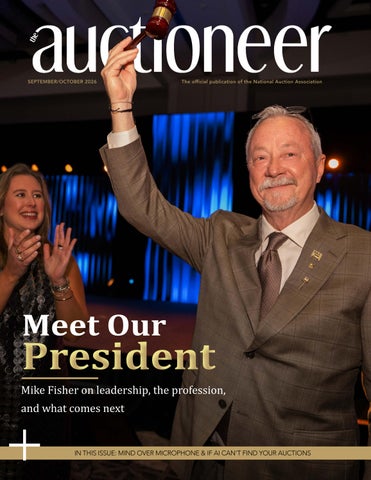
SEPTEMBER/OCTOBER 2026
The official publication of the National Auction Association
Meet Our
President Mike Fisher on leadership, the profession, and what comes next
+
IN THIS ISSUE: MIND OVER MICROPHONE & IF AI CAN'T FIND YOUR AUCTIONS
FROM THE PRESIDENT
Progress Powered by People The first few months of my presidency have reinforced something I have believed for years: The strength of the NAA comes from its people.
Strategic planning gives us an opportunity to step back from the immediate work in front of us and look at the larger picture.
Since Conference & Show, I have had the opportunity to spend time with members, volunteer leaders, and staff in several different settings. Each conversation has offered a new perspective on what our association does well, where our greatest opportunities lie, and how we can continue delivering meaningful value to auction professionals.
We considered what progress looks like, where we need to adjust, and how we can translate our priorities into work that members can see and feel. There was no shortage of thoughtful conversation or ambitious ideas.
In August, I visited NAA headquarters in Lenexa and joined Allison and the staff for several meetings. I left with an even greater appreciation for the work happening behind the scenes. This staff genuinely cares about our members and the future of this association. It shows in the questions they ask, the ideas they bring forward, and the care they put into their work.
There is something energizing about being in a room with passionate, driven members who share one goal: making the NAA stronger. That same energy has followed me through each of these experiences, whether I was meeting with staff, watching members learn from one another, or listening to our leadership discuss the future.
My first official NAA event as president following Conference & Show was the Benefit Auction Summit in Napa Valley. More than 140 benefit auction professionals gathered to invest in their businesses, strengthen the programs they provide nonprofit clients, and learn from some of the brightest minds in the fundraising space. Just as importantly, they were building something money cannot buy: their networks. I call it “relationship capital.”
Now comes the most important part: turning those ideas into action.
As I said when I accepted this responsibility, every decision should answer one question: Does this make the NAA stronger? I am encouraged by the progress already underway, excited by what lies ahead, and grateful to every member, volunteer, leader, and staff member helping us build the future together.
Mike Fisher, CAI, AARE, AMM, BAS, CES, GPPA NAA President Mike Fisher, CAI, AARE, AMM, BAS, CES, GPPA, is an accomplished auctioneer and real estate professional with 24 years of experience in the real estate auction industry. Throughout his career, he has participated in auctions across more than 40 states, Mexico, and the Bahamas. Fisher is a past president of the Alabama Auctioneers Association, chair of the Alabama State Board of Auctioneers, and a member of the Alabama Auctioneers Hall of Fame.
We have important work in front of us, and I am honored to serve alongside you as we do it.
When members plug in, share their experiences, and form genuine connections, opportunities begin to grow. Those relationships can lead to new ideas, trusted advice, business partnerships, and friendships that last far beyond a single event. Most recently, NAA leadership gathered for Strategic Planning. We reflected on the progress made during the first year of our current plan, reviewed our four strategic initiatives, and began shaping the work ahead for Year 2.
switch signature SEPTEMBER/OCTOBER 2026
3
auctioneer
OFFICIAL PUBLICATION
SEPTEMBER/OCTOBER 2026 VOLUME 78 ISSUE 5
26
Outgoing President Morgan Hopson presents incoming President Mike Fisher with the president's gavel at Conference & Show
INSIGHTS 8
FEATURES
Mind Over Microphone
20
10 Selling Certainty
22
Member Spotlight
12 If AI Can't Find Your Auctions, Neither Can the Buyers
24
What We Wish IAC Competitors Knew
14 Business Practices 16 Artificial Intelligence and The Appraiser 18 I Have Their Credit Card, So I'm Protected... Right?
26 34
The Work After the Handshake
Steady By Nature, Built to Serve Our Community of Support
“
Technology has never replaced great professionals, and it never will. It has simply raised the standard. NAA President, Mike Fisher
4
AUCTIONEERS.ORG
”
SECTIONS 03 President’s Column 07 NAA Planner 38 State Watch 42 New Members 44 Association Updates 46 Board 48 Obituaries 49 Ad Index 50 50 Years Later
The National Auction Foundation uses BetterUnite. You should too. Built for the nonprofits that can't afford to get fundraising wrong. One platform for event registration, ticketing, live and silent auctions, mobile bidding, table & team management and donation processing.
As trusted by
+ thousdands more
See why the biggest names
in nonprofit fundraising run
on BetterUnite.
Get a free demo at betterunite.com
m
auctioneer
the
ONLINE at auctioneers.org
SEPTEMBER/OCTOBER 2026
The official publication of the National Auction Association
Published by the
JOIN THE COMMUNITY facebook.com/natauctionassn instagram.com/natauctionassn x.com/natauctionassn youtube.com/natauctionassn National Auction Association
Meet Our
President Mike Fisher on leadership, the profession, and what comes next
+
DIGITAL EDITION AVAILABLE!
IN THIS ISSUE: MIND OVER MICROPHONE & IF AI CAN'T FIND YOUR AUCTIONS
11900 W 87th St. Suite 120 Lenexa, Kansas 66215 P: (913) 541-8084 | F: (913) 894-5281 Chief Executive Officer Allison Mazzei | amazzei@auctioneers.org (913) 563-5423 Chief Operating Officer Kristina Franz, CAE | kfranz@auctioneers.org (913) 563-5426 Director of Finance & Administrative Services Jordan Crupper | jcrupper@auctioneers.org Director of Communications Joelle Jamvold | jjamvold@auctioneers.org Accounting & Finance Manager Genny O’Niones | goniones@auctioneers.org Education Manager Hope Aspenleiter | haspenleiter@auctioneers.org Events Manager Jennifer Vossman, CMP | jvossman@auctioneers.org Marketing & Digital Media Manager Taven Wohlford | twohlford@auctioneers.org Partner Manager Shelly Urish | surish@auctioneers.org Program Manager Chelsea Pointer | cpointer@auctioneers.org
Apply for NAA education scholarships all year long! Your generous donations allow the National Auction Foundation to fund scholarships for NAA educational events. We’ve simplified the process: there is now a single, year-round application form for all scholarships. Just be sure to apply for the event you want to attend at least 45 days before by visiting auctioneersfoundation.org/scholarships.
The Auctioneer (ISSN 1070-0137), Copyright © 2026 by the National Auction Association is published Bi-monthly Jan/Feb, Mar/Apr, May/Jun, Jul/Aug, Sept/Oct, Nov/Dec by the National Auction Association, 11900 W 87th St. Ste. 120, Lenexa, KS 66215. Periodicals postage paid at Kansas City, MO, and additional mailing offices. POSTMASTER: Send address changes to The Auctioneer Magazine (NAA), 11900 W 87th St. Ste. 120, Lenexa, KS 66215. Materials may not be reproduced without permission.
6
AUCTIONEERS.ORG
A Message from Your CEO
There is a lot happening at NAA right now.
We recently wrapped up a sold-out Benefit Auction Summit in Napa Valley. Thank you to everyone who joined us and to our incredible Task Force that helped make the event such a success. Just as important, thank you to those who shared feedback afterward. We really do read it, and it helps shape what we do next. But lately I have been thinking less about how much NAA is doing and more about a different question: Are we doing the things that matter most to you? That question is driving a lot of our work as we look toward 2027. For me, that means helping you grow your business, protecting the auction industry, creating opportunities to learn and connect, and making it easier to take advantage of everything NAA offers. We are already putting some of that into action. We recently added a new partnership with BILL.com designed to provide practical value to your business. In 2027, we are bringing back the Real Estate Summit, creating another opportunity for auction professionals working in real estate to learn from and connect with each other. We are also bringing back NAA Day on the Hill, giving members the opportunity to take the auction industry's story directly to Washington. And sometimes improving the member experience is simply about making NAA easier to navigate. You have probably noticed auctioneers.org received a major makeover. We wanted a website that better reflects the auction industry today and makes it easier to find what you need. And don't worry—your Member Portal has not changed. As we plan for 2027, I don't think success means simply doing more.
2026 - 27
NAA Planner December 7 - 9, 2026
Auction Marketing Management (AMM), Benefit Auction Specialist (BAS), Certified Estate Specialist (CES)
December 10 - 12, 2026
Accredited Auctioneer Real Estate (AARE), Professional Valuation Specialist (PVS) Interpersonal Communications for Auction Professionals (ICAP) is offered Dec. 10-11 Las Vegas, Nevada
February 12 - 14, 2027
Auction Marketing Management (AMM) Pre-Summit Designation Class
February 14 - 16, 2027
Advanced Marketing Summit Overland Park, Kansas
March 1 - 3 2027* Day on the Hill
Details coming soon *Subject to change
March 22 - 26, 2027
Certified Auctioneers Institute Class 1 - 3 CAI Class 1 Applications Open Now Apply via the QR Code
It means doing more of what matters. Helping you grow your business. Protecting this industry. Creating meaningful opportunities to learn and connect. And making NAA an organization that is genuinely useful to you. That is the work ahead; and I am excited about where we are going.
Washington, D.C.
Bloomington, Indiana
July 13 - 16, 2027
Conference & Show Details coming soon Orlando, Flordia
August 27 - 29, 2027
Benefit Auction Specialist (BAS) Pre-Summit Designation Class
Allison Mazzei, CEO National Auction Association
August 29 - 31, 2027
Benefit Auction Summit Details coming soon *Subject to change
Nashville, Tennessee*
SEPTEMBER/OCTOBER 2026
7
INSIGHTS
Presented by Shane McCarrell, CAI, AARE, BAS, CES
MIND over MICROPHONE
The Benefit Auction Professional of 2035
The benefit auction professional of the future will bring more than stage presence. Here's how strategy, technology, and changing donor expectations are redefining the value of a fundraising professional.answer the seller's actual question, and it lands too late to try.
I
magine it's 2035.
Technology has automated much of event planning. Artificial intelligence can write a compelling fundraising appeal in seconds. Predictive analytics can help identify which donors have the capacity to give more. Even calling bids may no longer be something only a person can do. A nonprofit is preparing for its biggest fundraising event of the year.
Why should they hire you? That was the question Shane McCarrell, CAI, AARE, BAS, CES posed to benefit auction professionals during a recent NAA mastermind. The answers came quickly: human connection, community, the ability to read a room, react when something goes wrong, and change course in real time. Together, they pointed toward a larger answer. The benefit auction professional of the future may still hold a microphone, but the value they bring to the nonprofit will extend far beyond it.
The Donor Is Changing As wealth moves from one generation to the next, fundraising professionals are encountering donors with different expectations about how and why they give. Mission-driven storytelling remains one of the most powerful tools available during a fundraising event.
8
AUCTIONEERS.ORG
The challenge is pairing the emotional power of the mission with the information donors increasingly want. Impact information can take many forms. Return on investment can help demonstrate the value of a gift, while pre-event slideshows, infographics, or table materials can communicate data without overloading the live appeal with statistics. The goal isn't to choose between data or emotion. It's to understand where each belongs. Before the event, give donors information that builds confidence. During the live appeal, connect them to the people and mission behind it. Afterward, show them what their generosity accomplished. That continuum can turn a single gift into something much more valuable: trust.
Understand How the Money Moves The changing donor landscape also requires benefit auction professionals to understand more about how people give. That philanthropic literacy increasingly includes understanding donor-advised funds, appreciated stock, qualified charitable distributions, planned giving, and legacy gifts. The lesson is that greater philanthropic literacy can lead to better questions and better strategy. A donoradvised fund, for example, cannot simply be treated like another source of money for every component
“
The
question
isn’t whether technology
will change the job.
It’s where you will
create value when it does.
of a fundraising event. Because donor-advised fund gifts cannot provide benefits in exchange for the donation, understanding where those funds fit into the broader fundraising strategy becomes important. That may mean thinking beyond the live auction when determining how philanthropic funds can support an organization's goals.
Technology may identify patterns in donor data. It can't look across a ballroom and recognize that a major donor is hesitating.
Those conversations often need to happen long before event night, and that is precisely where the opportunity lies.
It can automate a workflow. It can't calmly navigate the last-minute change that threatens to derail an event.
Move Upstream For years, the microphone has represented the benefit auction professional's most visible contribution. The future may require shifting some of that value upstream. McCarrell contrasted the traditional event emcee with what he called the "2035 BAS Advisor." Instead of entering primarily on event day, the strategic adviser may work with a nonprofit six to nine months before, during, and after its event. The primary tools expand from the microphone to data, strategy, and facilitation. The goal expands from hitting an event-night target to maximizing lifetime donor value. That changes the questions a professional asks. Instead of only asking when the dinner starts, ask about donor retention. Instead of only requesting the run of show, ask about the organization's long-term campaign strategy. Who is in the room? How long have they supported the organization? Is the organization cultivating the next generation? What happens after the event to keep the people who raised their paddles connected to the mission?
It can help draft a mission appeal. It can't manufacture the trust required for someone to make a transformational gift.
The opportunity isn't to compete with technology at the things technology does best. It's to use it while becoming exceptional at the things it can't do.
Build What Can't Be Automated McCarrell identified six areas that could become increasingly important for benefit auction professionals: leadership and strategy, executive presence, tech literacy, consulting and negotiation, storytelling and mission communication, and emotional intelligence and trust.
Those questions move the benefit auction professional from event vendor to fundraising partner.
Together, they describe a professional whose expertise doesn't begin when the lights go down or end with the final bid.
Starting earlier may mean conducting discovery calls, establishing onboarding processes and deadlines, reviewing historical fundraising data, and scheduling consultations well before the final weeks leading into an event.
It's someone who understands the mission well enough to communicate it authentically. Someone who can interpret information and turn it into strategy. Someone who understands technology without surrendering the human connection that makes philanthropy personal.
The earlier a professional understands the organization, its donors, and its goals, the greater opportunity there is to influence the outcome.
And someone a nonprofit wants at the table months before anyone picks up a microphone.
Use the Machine. Don't Become One. Then there's artificial intelligence. McCarrell's argument wasn't that AI will replace auction professionals. Instead, professionals who learn to use it may have an advantage over those who don't. AI can help research a prospective nonprofit before a discovery call. It can analyze information, improve workflows, automate pieces of client onboarding, support marketing, and help professionals ask better questions of the data their clients already collect. Those capabilities can make the work faster, but efficiency isn't the same thing as expertise.
The transition doesn't need to happen all at once. Start by identifying the skill you want to strengthen the most and commit to developing it over the next 12 months.
The Microphone Isn't Going Away. What you bring to it, and everything you bring before and after it, may matter more than ever.
GO DEEPER: This article was adapted from Shane McCarrel's Mastermind Discussion webinar, “The BAS of 2035” Access the full session recording and presentation slides in The Auction Institute. SEPTEMBER/OCTOBER 2026
9
INSIGHTS
Selling Certainty What sellers are really buying isn't an auction. It's confidence in the person who knows what comes next. Presented by Jay Cash, BAS, CES
I
magine sitting in a hospital with a loved one who has just been diagnosed with cancer.
The doctor walks into the room, sits down and starts weighing the options aloud. There are several treatments. You could try this. You could try that. What do you want to do?
Confidence Has to Be Earned A second-generation auctioneer, Jay Cash, BAS, CES grew up watching his father, James R. Cash, build a reputation as “The Selling Machine.” People knew his father's name. Some clients even wrote into their wills that they wanted James R. Cash to conduct their auction. What Cash didn't see growing up was all the years of work it took to reach that point. When he left auction school in 2005, Cash had his license and plenty of confidence. He considered himself a good bid caller and felt ready to be an auctioneer. Then came the reality.
That isn't the doctor you want in the room.
“I couldn't book an auction to save my life,” he recalled.
You want the doctor who can say, “Here's where we are. Here's what we're going to do. Here's what you can expect.”
Sitting face-to-face with a seller required more than confidence. Sellers asked about marketing, strategy, expectations, and why they should trust the process. Cash hadn't accumulated enough experience yet to answer every challenge.
The same principle applies when an auctioneer sits across the table from a seller. They want you to come into the room with answers, confidence, and the ability to solve their problem. That doesn't mean guaranteeing an outcome. An auctioneer can't promise a price, perfect weather, or a certain number of bidders. What they can promise is preparation, marketing, communication, exposure, honesty, and execution. Confidence isn't pretending you know the outcome. Confidence is knowing the process.
The experience taught him an important distinction: “Confidence without skill is arrogance.” The auctioneers who make the business look easy have often accumulated something less visible: repetitions. They've sat through more appointments, experienced more rejection, made more mistakes, and navigated more uncomfortable conversations. For auctioneers still building those skills, the answer isn't to “fake it until you make it.” Instead, borrow confidence. Work alongside experienced auctioneers. Partner with someone who understands a process you haven't mastered yet. Travel. Volunteer. Watch how other professionals handle sellers, buyers, and difficult situations. “Success leaves clues.” Eventually, borrowed confidence becomes earned confidence.
Sell Certainty, Not Complexity Experience also changed the way Cash talks to sellers. People aren't calling because they want to have an auction. They're calling because they have a problem. It might be an estate, divorce, retirement, farm transition, inherited property, or business liquidation. The seller doesn't necessarily need to understand every term, fee structure, or method available to them.
10
AUCTIONEERS.ORG
They need someone who can make a complicated situation feel manageable. For Cash, the auctioneer's role is much simpler: “We're in the problemsolving business.” That means resisting the temptation to overwhelm sellers with industry terminology or present so many options that the auctioneer begins to sound uncertain. Instead, walk into the appointment with a recommendation and the experience to explain why you believe in it. One belief anchors Cash's conversations: Sellers win when buyers compete. He doesn't spend much of a listing appointment trying to predict what a property will bring. Appraisers, brokers, and sellers may all arrive at different numbers. Ultimately, none of them determine the result. “It doesn't matter what I think. It matters what the market says.” The auctioneer's responsibility is to expose the asset to the market as effectively as possible, create competition, and communicate what the market is saying along the way. That communication becomes particularly important when the answer isn't what the seller hoped to hear. Auctioneers can control their preparation, marketing, communication, follow-up, attitude, and integrity. They can't control interest rates, weather, buyers getting cold feet, a seller changing their mind, or what someone is ultimately willing to pay. The answer is to leave no stone unturned. Return the call. Launch the campaign on time. Follow through. Share the data. Prepare sellers for what the market is communicating before auction day.
“ The experience taught him an important distinction: Confidence without skill is arrogance.
”
auctioneer people think of first and, with that opportunity, become selective about where your expertise can provide the most value. What auctioneers do is simple. We help people.
Confidence is action.
Tomorrow, someone will need an auctioneer.
The Question Before Every Appointment
The question is why they should choose you.
As Cash's business has grown, another part of his approach has changed. Rather than walking into an appointment asking, “Can I get this listing?” he tries to ask a different question: “Can I help this person?”
Every conversation, listing appointment, and auction gives them an answer. Not because you can guarantee what happens next, but because you've developed the skill, judgment, and experience to confidently guide them through whatever does. ____________
Sometimes the answer is yes. Sometimes it isn't. With success comes the ability to recognize the difference. The goal isn't simply to become the busiest auctioneer. It's to become the
EXPLORE MORE: This article was adapted from Jay Cash’s 2026 Conference & Show session, “Confidence, Credibility, and Closing the Deal.” Access the full session recording and presentation slides in The Auction Institute.
SEPTEMBER/OCTOBER 2026
11
INSIGHTS
If AI Can't Find Your Auctions, Neither Can the Buyers By John Schultz, CAI, AMM John Schultz, CAI, AMM brings over 25 years of experience to his role as Partner and Chief Marketing and Technology Officer at Grafe Auction Company. He is a previous NAA President and is a leading instructor for the Auction Marketing Management (AMM) designation. John has also served as the Minnesota State Auctioneers Association President and was the first President of the Minnesota State Auctioneers Foundation. John was recognized with the NAA President's Award of Distinction in 2022.
The web went majority-machine in 2026, and the auction industry's squeezed middle won't be consolidated so much as made invisible, non-findable by the AI agents that now do the discovering.
O
n June 3, Matthew Prince, the CEO of Cloudflare, posted a number from his own network’s live data. For the first time in the history of the internet, more than half of all web traffic was not human. Bots, crawlers, and AI agents made up about 57% of the requests. Prince said he’d figured the crossover would come at the end of 2027. Agentic traffic got there a year and a half early. Sit with that. The web you’ve spent twenty years learning to win is now, by volume, mostly machines. And the machines aren’t browsing. They’re fetching. An agent doesn’t scroll your listings and admire your photography. It queries your inventory the way you’d query a database, takes what it can read, and moves on. Which leaves one plain question to decide the next few years. When the machine comes looking, can it read you?
The Deal Changed Prince has been putting out a second number for a while, and it’s the one that should bother every operator. Ten years ago, Google crawled about two of your pages for every visitor it sent back. Fair trade: you let them index you, they sent you traffic. The AI crawlers don’t trade like that. The pure-LLM bots pull thousands of pages for every click they send back.
AUCTIONEERS.ORG
The other end is new. The tooling that used to take real money and a couple of years to build, a bidder portal, a catalog system, a marketing engine, can now be stood up by one sharp operator with AI for a fraction of last year’s cost. The small end of the bar gets stronger, not weaker. What gets crushed is the middle. The mid-sized firm with neither the scale of the big house nor the software self-sufficiency of the nimble solo. Everybody’s been telling that as a money story, an M&A story. It’s bigger than that. The thing that actually springs the trap on the middle is whether anyone, or anything, can find them.
What the Last Twelve Months Did Here’s what moved, and it moved fast. Zero-click searches, the ones that end without anyone clicking through to a website, hit 68% of Google searches this year. Where Google now shows an AI Overview, organic click-through falls by nearly 60% The front door you optimized for two decades is quietly swinging shut.
The Barbell
The new door is wide open and busy. AI-referred traffic tripled year over year. Shopify reported that orders coming in from AI grew roughly thirteenfold in a single year, and that those AI-referred shoppers convert about 50% better than the ones who arrive from a normal search. Adobe measured the same pattern across a trillion retail visits and found the thing I can’t stop turning over. A year ago, traffic that arrived by AI converted worse than human traffic. This year it converts 42% better.
I’ve written before that this industry isn’t heading toward a clean roll-up. It’s heading toward a barbell.
The buyers the machines bring aren’t the bottom of the funnel. They’re the top. They show up already
It isn’t a smaller version of search. It’s a different arrangement. Search reads you to send you people. The agent reads you to answer someone else, somewhere else, on a question you never even saw. You can be the best fit for what a buyer needs and never surface, because the machine couldn’t make sense of what you had.
12
One end is consolidation, the ordinary kind: aging owners with no successor, fragmented ownership, and capital ready to buy on cash flow. Ritchie Bros bought BigIron. That end of the bar keeps getting heavier.
knowing what they want, because the agent did the sorting before they ever appeared. So, if your data isn’t readable by the machine, you don’t lose a little traffic at the edges. You lose your best buyers first, to whoever the agent could actually understand. That’s what “underwater” really looks like. The middle doesn’t bleed out slowly. It gets skimmed of its best demand, then repriced.
The Call So here’s the call, with a date on it, so you can hold me to it. Inside the next 24 to 36 months, a meaningful share of auction companies will find themselves underwater, and the cause won’t be a soft economy or a deal they didn’t chase. It’ll be that they went non-findable. The agents doing the discovering won’t be able to parse what they have, so they’ll route the buyers elsewhere. The firm will still have good inventory, good people, and a name people trust in the room. It just won’t exist to the machine doing the looking. If three years from now AI-mediated discovery is a rounding error and the firms that ignored it are doing fine, I was wrong.
Three Chairs
to a machine: ten broad categories, three-word lot titles, photos with no real description underneath. Structured data, clean categories, descriptions specific enough that a machine scanning for “commercial kitchen equipment under five thousand dollars within two hundred miles” turns up yours. That stopped being a marketing nicety. It’s whether you’re in the market at all. And you sort what you own from what you rent. The bidder list you built over twenty years, you own. The brand, the contractor network, the reputation, you own. The platform you lease, the ad traffic you buy, the borrowed reach, you rent. The operators who come through this in good shape will be the ones who owned their data and made it legible to the machines on purpose, before they had to. There’s an old line around farms and sale barns. If you want everything fed, put it down where the goats can get it. Don’t hang it up high where only the tall ones reach.
Inside the next 24 to 36 months, a meaningful share of auction companies will find themselves underwater, and the cause won’t be a soft economy or a deal they didn’t chase.
I’ll tell you why I’m willing to say it that flat. I’m sitting in three chairs on this one, and they all show the same picture. I run an auction company close enough to the wave to feel the pull of it. I served as board chair of the national association, which means I watched the whole field and not just my own corner. And I’ve been writing this argument down for months. When the operator’s seat, the industry’s seat, and the writer’s notebook all point the same direction, I quit calling it a hunch. I’m telling you what the data says is coming while there’s still room to do something about it. That’s about the only useful thing a person in these chairs can do with a view like this.
Put It Down Where the Goats Can Get It So what do you do?
Set it at ground level, plain, where anything that’s hungry can find it. For a hundred years that meant talk straight and price it clear, so the buyer in the back row understood you as well as the one up front. It still means that. But the hungry thing in the room now isn’t only the buyer. It’s the machine doing the buyer’s looking. And it’s standing right down at ground level, reading, waiting to see whose feed it can actually reach. Put it down where the goats can get it. ____________ This article was originally published by John Schultz, CAI, AMM on johndschultz.com as an essay and was adapted for The Auctioneer.
You make yourself readable. Not pretty. Readable. We’ve built sites that look sharp to a person and say nothing
SEPTEMBER/OCTOBER 2026
13
INSIGHTS Business Practices
Do auctioneers have any ethical duties to the bidding public, as opposed to the duties owed to the seller? If so, what ethical duties do auctioneers owe to the bidding public? KURT BACHMAN Attorney and licensed auctioneer from LaGrange, IN.
KEY TAKEAWAY Auctioneers’ responsibilities extend beyond the seller to the bidding public. Truthful advertising, accurate representation, disclosure of material facts, and professional conduct are both ethical expectations and important legal safeguards. When an ethical breach also violates a law, contract, or duty of care, it can lead to discipline, litigation, and civil liability.
14
AUCTIONEERS.ORG
Answer: Auctioneers generally recognize that they owe legal and ethical duties to the seller. This makes perfect sense since auctioneers are the agents for the seller and must act in a fiduciary capacity with respect to their seller. However, when it comes to the bidding public, some auctioneers may be surprised to discover that they do also have legal and ethical duties which are owed to the bidding public, even though the auctioneer typically avoids becoming the agent for any bidder.
T
he primary legal duties owed to the bidding public include, but are not limited to, the following: 1. the duty to comply with applicable state and federal law; 2. the duty of being truthful in business dealings; 3. the duty of representing the auction industry professionally and with dignity and integrity; and 4. the duty to be accurate in all advertisements or statements made before, during, and after the auction. Each State’s law, administrative regulations, and association rules may provide additional applicable ethical standards. By way of example of such additional standards, the Indiana Administrative Code can provide some illustrative scenarios to be considered. 812 IAC 1-1-24 states as follows: “A licensee shall conduct professional activities in a professional manner that will reflect credit upon the licensee, the auction profession, and auctioneers. Unprofessional conduct includes, but is not limited to, a licensee's payment of compensation in money or other valuable thing to any person other than a licensee for the rendering of any service or the doing of any of the acts by this act forbidden to be rendered or performed by other than licensees.” This code section is written very broadly and can encompass a lot of inappropriate behavior. Another rule at 812 IAC 1-1-23 requires auctioneers “keep informed on current market conditions of real and personal property at all times in order to be in a position to advise and perform services for his clients to the best of his ability.” There is also a regulation
which prohibits self-dealing—e.g., buying or selling at his own auction for personal gain, unless disclosed to the seller. Auctioneer associations also have ethical rules to protect the bidding public. For example, the Indiana Auctioneers Association has several such rules which include the following: •“Members shall not misrepresent or conceal material facts.” Article 9. •“Members shall not knowingly or recklessly share confidential information about colleagues or their business practices.” Article 10. •“Members should never criticize a competitor using false or deceptive information.” Article 11, •“Members shall report violations of the Code of Ethics and participate in all investigations and disciplinary proceedings when requested by the IAA.” Article 15.
The National Auction Association’s Code of Ethics has similar duties in a section relating to responsibilities to the public. Article IX states, in part, the following: “Members shall protect the public against fraud, misrepresentation, concealment of material facts, or unethical practices in connection with the auction profession or related business. There is an affirmative obligation to disclose adverse factors of which they have personal knowledge. The ethical rules also state: “Members should be careful at all times to present a true picture in their advertising and representations to the public.” What is the legal import of such rules of ethics and standards? What are the consequences of an ethical violation? Generally, these ethical rules can be presented as evidence to a court or administrative disciplinary board / commission / regulatory agency of what constitutes a minimum standard of care required to be exercised by an auctioneer relative to the bidding public. Failure to adhere to these minimum standards of care may result in disciplinary action and / or civil liability for breach thereof. The ultimate consequences of an ethical violation depend on the type and severity of the ethical breach. A violation of ethical conduct most often results in discipline; but, there are situations where an ethical violation can invite litigation and lead to civil liability to the bidding public. These situations generally include, but are not limited to, the following: (1) when the breach also constitutes a breach of contract or statutory duty; (2) when the breach involved fraud, misconduct, or a conflict of interest; or (3) when the auctioneer fails to act with ordinary care and skill.
Conclusion In conclusion, an ethical violation may get an auctioneer disciplined; but, it is not by itself grounds for holding an auctioneer civilly liable to the bidding public. However, when an ethical breach rises to the level of a breach of a legal duty, statutory requirement, or contract, then an auctioneer may be held civilly liable for damages resulting therefrom to the bidding public. Auctioneers should ensure that their conduct relative to not only their sellers but also to the bidding public meets both ethical and legal standards to avoid inviting costly litigation.
Kurt R. Bachman and Beers Mallers Backs & Salin, LLP appreciate the opportunity to review and answer legal questions that will be of interest to auctioneers. The answers to these questions are designed to provide information of general interest to the public and are not intended to offer legal advice about specific situations or problems. Kurt R. Bachman and Beers Mallers Backs & Salin, LLP do not intend to create an attorney-client relationship by offering this information, and anyone’s review of the information shall not be deemed to create such a relationship. You should consult a lawyer if you have a legal matter requiring attention. Kurt R. Bachman and Beers Mallers Backs & Salin, LLP also advise that any information you send to Auctioneer shall not be deemed secure or confidential. Please visit one of our offices to ensure complete confidentiality.
SEPTEMBER/OCTOBER 2026
15
INSIGHTS
Artificial Intelligence and The Appraiser
F
By Rich Schur, CAI, AMM, BAS, MPPA, PVS With more than 20 years of auction and asset appraisal experience, Rich is considered both an industry and community leader. He has vast experience selling and appraising a wide variety of assets and boasts that he has sold or appraised assets from A-Z, art to Zamboni's. Rich runs the company with his wife, Shannon, a 2nd generation auctioneer and a Colorado Hall of Fame Auctioneer. The couple and their team focus on estate, collectable and liquidation auctions in both the Denver and Colorado Springs markets. Rich is a staff instructor for the NAA and for several auction academies. He is considered the "go to" expert in the NAA for asset valuation.
or those of us in the valuation and appraisal profession, Artificial Intelligence has become an invaluable tool. It allows us to search faster and more thoroughly than ever before. AI can help organize information, draft reports and correspondence, proofread documents, identify errors, and improve the overall quality of our written work.
The appraiser—not the software—is responsible for the conclusions contained within the appraisal report.
Used properly, AI can make us more efficient, more productive, and ultimately better able to serve our clients. Like any powerful technology, however, it also presents challenges that appraisers must carefully consider.
Many appraisers use AI to proofread reports, improve writing, summarize information, or review documents. Before uploading appraisal reports, inventories, photographs, client correspondence, or other assignment-related materials, appraisers should understand how the AI provider stores, processes, and uses submitted information.
Accuracy and Reliability The first consideration is ensuring that our research is thorough, accurate, and credible. Did the AI search the right sources? Did it search broadly enough? Did we provide clear instructions to obtain meaningful results? Perhaps most importantly, is the information correct? While AI systems are remarkably capable, they can occasionally generate inaccurate information, fabricate citations, or present unsupported conclusions with apparent confidence. Appraisers should never rely solely on AI-generated information without verification. Fortunately, these risks can be managed. Request citations whenever possible, review original sources, refine prompts when results appear incomplete, and verify critical information through independent research. Independence and Value Conclusions A second consideration is determining who is actually developing the opinion of value.
16
AUCTIONEERS.ORG
Confidentiality and Ethics Perhaps the most significant concern involves confidentiality.
Depending on the platform and settings being used, information provided to an AI system may be retained or used to improve future models. Failure to safeguard confidential information may create concerns under USPAP’s Ethics Rule and Confidentiality requirements. Several safeguards are available: • Remove or redact confidential information before uploading documents. • Use privacy or incognito settings when available. • Review platform settings to determine whether information is stored or used for training purposes. • Obtain client authorization when appropriate. • Consider enterprise or business versions of AI platforms that offer enhanced privacy protections. Ultimately, the appraiser remains responsible for protecting confidential client information and complying with applicable ethical requirements. Conclusion
When completing a USPAP-compliant appraisal assignment, the appraiser must remain independent, impartial, and objective. AI may assist with research, organization, and analysis, but the final opinion of value must be developed and reconciled by the appraiser.
Artificial Intelligence is rapidly becoming a standard business tool, much like spreadsheets, online databases, and digital photography once did. Used properly, it can improve efficiency, organization, research capabilities, and the quality of written reports.
Using AI as a research assistant is very different from allowing AI to determine value conclusions. Appraisers should be cautious when relying on AI-generated pricing information, market analysis, or value estimates without performing their own independent review and analysis.
However, AI does not replace professional judgment. The appraiser remains responsible for the analysis, conclusions, ethics, and confidentiality requirements associated with every assignment.
switch signature
AI may assist the process, but accountability remains with the appraiser.
A NATIONAL NETWORK.
NOT A COLLECTION OF COMPETITORS. Tranzon companies work together to deliver better outcomes and better opportunities. Our structure allows affiliates to collaborate across markets, combine expertise, and serve high-quality clients nationwide. It’s a model built on professionalism, trust, and shared success. Explore affiliation opportunities joinus@tranzon.com 886.872.6966 tranzon.com/joinus Proud sponsor of the NAA Conference and Show
SEPTEMBER/OCTOBER 2026
17
INSIGHTS
I Have Their Credit Card, So I’m Protected… Right? Provided by NAA Partner, Electronic Data Payment Systems (EDPS)
I
t’s a common assumption in the auction business. A bidder registers, puts a credit card on file and agrees to the terms. If they buy something, you have their card. You can charge it.
That’s certainly better than having no payment information at all. But it doesn’t mean you have guaranteed funds. On a $300 purchase, that distinction may not keep anyone up at night. On a $30,000 truck, a $75,000 excavator or a six-figure collectible, it should at least be part of the conversation.
What Does Having the Card Really Mean?
A $500 Purchase and a $50,000 Purchase Take two bidders. One buys $500 of household goods. Another buys a $50,000 piece of construction equipment. Both have cards on file. Would you necessarily want to handle those payments the same way?
Let’s say a new online bidder registers for an equipment auction. The card checks out, the bidder is approved and ends up buying several lots totaling $18,500. The natural reaction is: “We have their card. Run it.” That may work perfectly. Most of the time it probably does. But the card being valid at registration doesn’t mean there will be $18,500 of available credit when the auction ends. The transaction can be declined. And even after an approved card transaction is funded, the cardholder may still have the ability to dispute it. That’s the part that can get overlooked. Having a card on file, getting an authorization, processing the charge and seeing the money deposited are separate events. They don’t all provide the same level of certainty. This isn’t an argument against accepting cards. Cards are fast, convenient and make sense for a lot of auction transactions. The issue is knowing when the size of the transaction changes the risk.
18
AUCTIONEERS.ORG
Probably not. If something goes wrong with the $500 payment, it’s aggravating. If the $50,000 machine is already on a truck headed out of state when a payment problem surfaces, you have a very different problem. The amount matters, but so does the buyer. A local bidder who has done business with you for ten years is different from a first-time online bidder 700 miles away. That doesn’t mean there is anything wrong with the new bidder. You simply don’t have a history with them. That’s why the better question isn’t always, “What payment methods do we accept?” It may be, “What payment method makes sense for this buyer, this asset and this amount?”
When a Wire Makes Sense This is where a wire transfer can be worth considering. Suppose a first-time online bidder buys a $75,000 excavator and immediately schedules a transporter. You have a valid card on file, but you have never done business with the buyer and the machine could be hundreds of miles away by the end of the day. Requiring a domestic wire before releasing the equipment may make more sense than putting $75,000 on a card. Once a Fedwire transfer is completed through the banking system, settlement is final and irrevocable. For a high-dollar transaction where payment certainty matters, that is a meaningful difference. That doesn’t mean every $25,000, $50,000 or $75,000 purchase needs to be wired. Auction companies know their customers and their businesses. A repeat buyer with a long, clean history may warrant a different approach than someone buying for the first time. The important thing is to have a policy before you need it. Maybe the dollar amount triggers a wire requirement. Maybe it’s a combination of the amount, the asset and whether the buyer is known. The exact rule will be different from one auction company to another. There is one rule I would make pretty simple: don’t release an asset because someone says the wire has been sent. A screenshot of a wire confirmation, an email from the buyer or a receipt on a phone isn’t the same as seeing the funds in your account. Confirm the wire with your bank or through your own banking system before the asset leaves. If a transporter has to wait, the transporter waits.
The Point Where the Risk Changes The moment merchandise leaves your control is where all of this becomes real. Imagine a $25,000 vehicle is paid by card on Monday. The invoice shows paid. A transporter picks it up Tuesday morning. By Tuesday afternoon the vehicle is three states away. Then the transaction is disputed. Now you don’t just have a payment issue. You may have a vehiclerecovery issue. If the consignor has already been paid, you may have a cash-flow issue too. Auction companies sell assets that can move quickly—vehicles, equipment, jewelry, firearms, collectibles and plenty of other highvalue items. Once they leave, getting them back may not be simple.
Paperwork Matters More Than You Think Good terms and conditions matter, but so does the trail behind the transaction. If a payment is challenged, can you show who registered? What terms did they accept? What did they buy? Who picked it up? Was identification checked? Do you have a signed pickup document, shipping record, emails or text messages? None of that is very exciting when an auction is running smoothly. It becomes much more interesting the day a $50,000 transaction is disputed. The best systems create that documentation as part of the normal process instead of trying to reconstruct it after something goes wrong.
Make the Decision Before Auction Day The worst time to decide how you want to be paid for a $75,000 purchase is when the auction is over and the buyer’s transporter is sitting in the parking lot. Set the rules ahead of time. Decide when the dollar amount requires another level of payment verification. Decide whether first-time or remote buyers are handled differently on high-value purchases. Decide when a wire is required and who, if anyone, can make an exception. There isn’t one policy that fits every auction company. But there should be a policy. Keeping a credit card on file is a useful tool. Just don’t let the presence of that card create more confidence than it should. Before a high-value asset leaves, ask a simple question: “Are we comfortable letting this leave based on the payment we have?” For a $500 purchase, that may be an easy call. For a $50,000 or $100,000 purchase from someone you’ve never met, it deserves a little more thought.
The NAA has partnered with Electronic Data Payment Systems to provide our members with exclusive, low-cost merchant processing. By leveraging our collective membership, we can offer you significant savings on bankcard fees.
If you have specific questions regarding the NAA Merchant services program, please contact EDPS at 866.578.9740 SEPTEMBER/OCTOBER 2026
19
FEATURES
The Work After the
Handshake
National Auction Advocacy Week brought auction professionals and policymakers together across the country. The relationships formed in those meetings could shape conversations long after the week itself. “What do auctions have to do with federal issues?” The question reached NAA member Matthew Sandmann before his meeting with a field representative for U.S. Senator James Lankford. By the end of their conversation, the answer had become clear.
In Indiana, Sherry Love emphasized the need to protect consumers, particularly older adults, from online sellers and platforms that are not held accountable. At the same time, she explained why legitimate auction businesses should not be inadvertently captured by regulations intended for much larger online marketplaces.
Sandmann discussed digital marketplaces, artificial intelligence, data privacy, and the NAA’s work with the Bureau of Alcohol, Tobacco, Firearms and Explosives. The breadth of the industry’s connection to the national economy surprised the representative.
The conversation gave the issues a human dimension. Indiana Senator Randy Maxwell asked Love to keep him informed and contact him when there are specific actions he can take or information he can pass along to Congress.
He left the meeting with a different response: “Wow, I have some homework today.”
In Tennessee, Addison Russell’s discussion with congressional candidate Johnny Garrett demonstrated how quickly an emerging issue can become personal. Garrett had recently experienced the effects of artificial intelligence when deepfake imagery was used against him during a primary campaign. That experience created an opening for a larger conversation about regulating AI without placing unnecessary burdens on small businesses.
That exchange captured both the challenge and the opportunity behind the inaugural National Auction Advocacy Week, held August 10-14. Policymakers cannot account for the auction industry’s perspective if they do not understand its reach, and they cannot call upon auction professionals for insight if those relationships do not yet exist. Across the country, NAA members began changing that. They entered congressional offices, welcomed legislative staff into their businesses, and connected national policy discussions to the realities of auction professionals, their clients, and their communities. The conversations centered primarily on artificial intelligence and data privacy, digital marketplace fairness, and protections for small businesses. The member reports that followed tell a story larger than a collection of individual meetings. They show the beginning of an advocacy network. From Industry Issues to Real-world Impact Members brought more than policy materials into the room. They brought examples of how broadly written legislation, emerging technology, and inconsistent marketplace standards can affect real people. 20
AUCTIONEERS.ORG
These interactions are where advocacy moves beyond talking points. Members can show policymakers how a proposal that appears reasonable on paper may create unintended consequences when applied to an auction business. Becoming a Trusted Resource The most promising result of National Auction Advocacy Week was not a single commitment or immediate policy victory. It was the number of offices that invited the conversation to continue. In Kansas, staff for U.S. Representative Tracey Mann agreed to monitor H.R. 8413, remain in contact, and identify future opportunities for the NAA to participate in conversations in Washington. In Virginia, U.S. Representative Ben Cline offered to provide Will Farmer with updates as AI legislation moves forward. In Colorado, Rich Schur left his meeting with an open invitation to share additional information and future concerns.
THANK YOU, NAAW VOLUNTEERS
Your Work Is Important.
National Auction Advocacy Week was made possible by NAA members who volunteered their time, prepared for important conversations, and met with policymakers on behalf of the auction industry. Other members established direct lines of communication, received invitations to meet again, or committed to keeping offices informed as issues develop. Those outcomes matter because effective advocacy rarely begins when a vote is already scheduled. Relationships must be built while policymakers are still learning about an industry, exploring an issue, and identifying people they can trust for practical insight. Sometimes, that education happens best inside the auction business itself. In Alaska, legislative staff representing U.S. Senators Lisa Murkowski and Dan Sullivan toured Dan Newman’s auction facility. The visits allowed them to see the operation firsthand before taking briefs back to their respective teams. A policymaker may not remember every page of an issue brief. They are more likely to remember the auction professional who showed them what the issue means in practice.
You gave our profession a face, a voice, and a seat in conversations that affect auction businesses across the country. More policymakers understand our industry today because you were willing to make the introduction. Wade Baer, CAI, AMM Jay Cash, BAS, CES Will Farmer, CAI George Franco, CAI, AMM, BAS Melissa Giorgi Alec Horton Rob Knight, CAI, AARE, CES, GPPA Sherry Love, CAI Daniel Newman, CAI, AMM, BAS, CES, PVS Daniel Pruitt, CAI
Phillip Traylor Joshua Rush, CAI, BAS Addison Russell Matt Russell, AMM Matthew Sandmann, CAI, AMM, CES Rich Schur, CAI, AMM, BAS, MPPA, PVS Suzannah Underwood, BAS Lance Walker Drew Williams
A Week on the Calendar, a Year-round Commitment Although National Auction Advocacy Week provided a shared moment of action, members did not limit their efforts to five days. Member-submitted reports document meetings beginning weeks before the official initiative and continuing after it concluded. On August 28, Joshua Rush met with Texas Senator Lois Kolkhorst and her chief of staff to discuss the auction industry’s economic impact, digital marketplace fairness, and current Texas law. That continued activity may be one of the clearest measures of success. The purpose of National Auction Advocacy Week was not to create a brief surge of attention. It was to begin relationships that members and the NAA can strengthen throughout the year. Every follow-up message, facility tour, shared update, and future meeting helps make the auction industry more visible to the people whose decisions affect it. The first conversation makes the introduction. The work after the handshake builds influence.
Contributions to the NAA PAC are voluntary and not tax-deductible. Visit www.naa-pac.com to contribute.
THANK YOU, NAA PAC DONORS
Strengthening the Auction Industry’s Voice The NAA Political Action Committee helps ensure the auction industry has a voice in the conversations and relationships shaping federal policy. This work is possible because of the NAA members who choose to invest in it. Thank you to our PAC donors for helping strengthen the auction industry’s presence in Washington and supporting continued engagement with federal policymakers. We gratefully recognize our donors: Wade Baer, CAI, AMM Leigh Brown Sara Rose Bytnar, CAI, AARE, AMM, BAS Ailie Byers, CAI, AARE, AMM, BAS Jay Cash, BAS, CES Brian Davis, AMM Mike Fisher, CAI, AARE, AMM, BAS, CES, GPPA Morgan Hopson, CAI, BAS Isaac Klingman, CAI Tim Mast, CAI, AARE
Craig Meier Jennifer Mensler, CAI, ATS Scott Mihalic, CAI Addison Russell, Isaac Schultz John Schultz, CAI, AMM Bradley Stoecker, CAI, AARE, AMM, CES, PVS Isaac Stoller, CAI, BAS T. Kyle Swicegood, CAI, AARE, GPPA
SEPTEMBER/OCTOBER 2026
21
FEATURES
Q&A MEMBER SPOTLIGHT
with Lynne
Zink
CAI, CES, CAGA Lynne Zink is celebrating 20 years selling Real Estate & Personal Property and conducting Estate Appraisals. She is a past President for the Auctioneers Association of Maryland (AAM) and has twice been named AAM Auctioneer of the Year. She is also an active member of the National Auction Association (NAA) currently serving on the Board of Trustees for the Education Institute. Zink was awarded the title of International Auctioneer Champion in 2012 and has also achieved industry designations of CAI, CES, CAGA.
How did you first find your way into the auction industry? My husband had been going to auctions his entire life, and when he met me, he said I should be an auctioneer because I could talk fast. It took me nearly 20 years to listen! Then, while I was teaching, Maryland’s Tomorrow program was losing its state funding. My husband said, “Perfect timing. Go to auction school.” He was right. I went, and there was no turning back.
You were a teacher before becoming an auctioneer. How has that background influenced your career? Teaching taught me that people learn in different ways, so understanding how to reach them is important. Getting to know my client, understanding their needs and goals, and asking the right questions helps me figure out how I can best help them.
22
AUCTIONEERS.ORG
What do you remember most about your first experiences working auctions? “You learn under fire.” That is something I learned very quickly as an auctioneer. There are things the classroom simply cannot teach you. Those early years came with plenty of butterflies and sleepless nights before a big gig. The excitement was there, but so was the feeling of being inexperienced and outside of my comfort zone. I am incredibly grateful to the auctioneers who gave me a chance, encouraged me, trusted me, and allowed me to learn by doing.
What part of the auction profession are you most drawn to today, and why? Benefit Auctions are my favorite. I love the emotion in the room when everyone comes together for a cause that matters. The energy, generosity, and shared purpose make it incredibly rewarding.
You won the IAC in 2012 after competing several times. What kept bringing you back? The magic happens when we step outside our comfort zone, and getting on the IAC stage was scary. But I knew the more I competed, the more I would learn to control the nerves and involuntary bodily reactions, like shaking and dry mouth. If I could stand on that stage in front of my peers, even when I felt most vulnerable, I knew I would become a better auctioneer. I kept coming back because I wanted to learn how to feel the fear and do it anyway.
How did becoming an IAC Champion affect the direction of your career?
Lynne was inducted into the Hall of Fame at the 2026 Auctioneers Association of Maryland Conference. Lynne with her husband Billy and their 2 children, Anna and Jake.
Becoming an IAC Champion led me back to teaching in a different way. During my IAC year, serving as an ambassador and presenting at state conventions, I realized my love for teaching was still there, but in a more freespirited way. Since then, I’ve had opportunities to speak to students, Realtors, and community groups on a variety of topics, allowing me to continue teaching, build meaningful relationships, and grow my business.
You have attended more than 20 NAA conferences. What is one takeaway that has stayed with you?” I walked away from recent NAA events with a deeper sense of connection. This year, I intentionally made more time for one-on-one conversations instead of staying with the usual surface conversations. I heard stories, saw genuine emotion, and made connections that stayed with me. It reminded me how much I value those deeper conversations and the relationships that come from them.
Who has had the greatest influence on your auction career, and why? Sometimes, it’s not one person who influences your journey, but the many people you meet along the way. It would be difficult to name one person who has had the greatest influence on my auction career. So many people have taught me, encouraged me, challenged me, or opened my eyes to new possibilities. Some may not even realize the impact they had on me, but they each made a difference in my journey. If you’ve crossed paths with me throughout my career, there’s a good chance you made a difference, too. I’m grateful for every one of those influences. If you’re reading this and we’ve been part of each other’s journey, reach out. I’d love to reconnect.
Lynne’s first benefit auction mentor, Kathy Kingston
After 25 years in the profession, what are you still working toward? I’ll continue doing Benefit Auctions because I love them, but I’m most focused on becoming a professional keynote speaker. Teaching has always been a part of who I am, and speaking feels like a natural next step, giving me the opportunity to share what I’ve learned, connect with people, and inspire others.
Gracious mother/daughter auction team SEPTEMBER/OCTOBER 2026
23
FEATURES
What We Wish Every IAC Competitor Knew Carrie Hessney-Doran: The Stage Needs You The first time I stepped onto the International Auctioneer Championship stage was in 2016 and I drew contestant number one. I was scared beyond belief. Like many first-time competitors, I had no idea what the experience would feel like once I was standing under those lights. I walked onto the stage, my hand was shaking so badly that I was sure everyone could see it on the big screen. When I walked off, the whole thing almost felt like a dream. It happened so quickly. But I had done it. I had walked onto the IAC stage, faced that fear and finished. Then something unexpected happened: as soon as I stepped off, I wanted to do it again. There was something addicting about it. I wanted another chance to improve, another opportunity to feel that energy, and another moment on that stage. Every time I returned, six more times to be exact, it became a little easier. The nerves never completely disappeared, but I learned how to use them instead of letting them control me. 24
AUCTIONEERS.ORG
There is value in studying your craft. There is value in practicing, preparing, and learning from auctioneers you admire. But somewhere along the way, I became so focused on what everyone else was doing and what I thought the judges wanted that I sometimes forgot to make room for myself. What I finally learned is that the judges do not want to see your best version of someone else. They want to see the best version of you. This year, I knew I could not be anyone else. I could only be Carrie. I decided to leave everything I had on that stage, enjoy the moment, connect with the audience, and let people see me in my element. I stopped trying to manufacture what I thought a champion should look like. Instead, I trusted the auctioneer I had become. I believed in myself more than ever before, and I did it for me. That freedom changed everything. When you stop trying to control how every second might be judged, you can finally be present. You can let your personality come through instead of hiding it behind a performance you think you are supposed to give.
There is something else I wish every competitor understood. That room that feels so intimidating, it is filled with people who are incredibly proud to watch you compete. There are champions, judges, industry leaders, friends, and auctioneers you have admired for years. That can make the stage feel even scarier. But those people are not sitting there waiting for you to fail. They understand the courage it takes to walk across that stage because many of them have stood exactly where you are standing. They are cheering for you. They want to see the person behind the contestant number. Every competitor who steps onto that stage gives the audience a reason to feel proud of our profession. So, if you are thinking about competing, do it scared. Let your hand shake. Let your heart race. Walk onto that stage anyway. If you have competed before but did not place, come back. If you reached the finals but did not win, come back. If you are comparing your journey to someone else’s, remember that you do not know how many
years, disappointments, life changes, or moments of self-doubt came before their success. Your journey is allowed to take time. Practice your chant. Study your craft. Ask for advice. Learn from the people around you. But do not spend so much time trying to become someone else that you forget what makes you special. Your job is not to show the judges what you think they want to see. Your job is to show them who you are when you are confident, prepared, connected, and completely in your element. The stage does not need another version of someone who has already stood on it. It needs you.
Cody Shelley: The Preparation is the Win I stood on the IAC stage in 2026 and won a championship I had been chasing since 2019. Seven years. If you had told me at the start, it would take that long I'm not sure I would have believed it or maybe I just wouldn't have wanted to continue to pursue this goal. I wish someone had told me back then that the seven years weren't a delay. They were the whole point. I used to think about this competition the way most people do, as a single event you either win or lose. You show up, you compete, the scores come in, and that's the story. I don't see it that way anymore. The true win in any contest isn't the trophy. It's everything that happens on the way to earning the right to compete in the first place. The self-reflection, the preparation, the version of yourself you must become just to stand on that stage with something honest to say. If you're a future competitor reading this, here's what I wish I'd understood sooner. The preparation is the win. Every year I didn't win, I told myself the loss was the whole story, but it wasn't. Some of the most important growth in my life has happened in the months leading up to the contest. I committed to becoming better each time I came back. If you're only measuring yourself by placement and the final scores you are going to miss most of what the process is trying reveal to you. Find your own voice before you borrow someone else's. Trey Morris — who I believe is the greatest ambassador the NAA has ever had told me something that changed how I competed. He told me, “Peel the layers back and allow yourself to go to a place that shows the real you”. For years I tried to tell a story or answer the interview questions with something I thought the judges wanted to hear. When in all reality I possessed the answers I needed to share the whole time. I was just unwilling to allow myself to commit to sharing them. It's tempting, especially early on, to study past champions and try to sound like them and mimic their interview answers. I did some of that too, but this year I developed a belief system that I was proud to share. I stopped sharing a version of myself and revealed who I truly am. I lived
by a motto and had the quote as the background on my phone for a month before this year’s IAC. “Contestants answer questions, champions reveal who they are”! Identify what's actually working against you. For a long time, my biggest obstacle wasn't skill. It was comparison. I would watch someone else's run and immediately measure my whole journey against their one moment. That's a losing battle, because you're comparing your rough draft to someone else's highlight reel. What helped me was identifying it plainly. Comparison was my greatest weakness. Once I could say that out loud, I could work on minimizing my weakness and embracing my strengths. If you have competed for any length of time, you have something you lean on, and something quietly working against you. Find what that is, say it out loud, even if it's just to yourself. It's a lot harder to fix a thing you won't name. The losses are doing something the wins can't. I don't think I would have valued winning the way I do if I hadn't spent years not winning. Every year I came back with more self-awareness, more discipline, and a clearer sense of why I wanted this win in the first place. That only happens because I kept showing up to be evaluated, kept receiving feedback that stung, and kept choosing to prepare again instead of deciding I'd already given it my best shot. If you're in year two, five or possibly in year ten and beyond of chasing something and it hasn't happened yet, I'd ask you to consider that you're exactly where you are supposed to be. You're in the part of the story that builds the person who's ready to win. So when asked what I'd tell a younger version of myself, and what I hope sticks with you: Compete for the reflection, not just the result. Let the preparation do its quiet work on you, year after year, even the years nobody's watching. Tell your own story, not a borrowed one. And when you finally do stand on the competition stage, whichever one it is for you, just know the win started long before the scores have ever been read.
SEPTEMBER/OCTOBER 2026
25
FEATURES
MIKE FISHER Steady by Nature, Built to Serve
Long before Mike Fisher, CAI, AARE, AMM, BAS, CES, GPPA became the 78th president of the National Auction Association, he was the person others trusted to remain calm, step forward, and give everything he had. Now, he brings a lifetime of building businesses, relationships, and a family legacy to his year of service.
The airport had closed. Outdoor furniture had been carried inside. Food and supplies were running low. A hurricane was moving toward La Paz, Mexico, and Mike and Cindy Fisher were stranded at Costa Baja Resort following an auction held by their company, Redfield Group Auctions, Inc. Cindy was anxious.
All In, From the Beginning Cindy was 19 when she met 23-year-old Mike through mutual friends. Her roommate was dating his roommate, and the four began spending time together. Once Mike and Cindy met, she said, they rarely left each other’s side.
Mike suggested they play cards. “He’s always calm in the most difficult times,” Cindy said. “You would never know something was wrong. He was just so relaxed.”
The Calm in the Storm
26
AUCTIONEERS.ORG
The couple remained at the resort for three additional days as the hurricane passed in 2016. During this scary time, Mike offered the same steady reassurance he had brought to countless difficult moments throughout their life together: They would be fine. They would handle what came next. It was not the first time Cindy had watched her husband remain grounded when circumstances became uncertain. It would not be the last. Now, as Mike begins his term as the 78th president of the National Auction Association, that steadiness has taken on a new purpose. He is leading an organization and profession navigating rapid changes in technology, business, and public expectations. But to understand the president Mike intends to be, it helps to understand the person he has always been.
“I guess you could say it was love at first sight,” she reminisced.
Whatever it is that he gets involved with, it’s 100%. He’ll never halfway do it. He was that way at 23. He’s that way at 61.
Even at 23, Mike was already an entrepreneur. He owned Fisher Industrial Services and was managing employees, clients, and accounts. Cindy remembers someone mature beyond his years, caring, and deeply attentive to the people around him.
“They taught me hard work, entrepreneurship, and that your word is your bond,” Mike said during his presidential address at the 2026 Conference & Show. “Most importantly, to treat people the way you want to be treated and to lead with empathy.”
“He was kind of the grandpa of the group,” she giggled. “He took care of everybody and made sure everybody was taken care of.”
Those values, he said, have shaped his life, his business, and the way he hopes to serve the NAA.
Nearly four decades later, she still recognizes those qualities.
Building Something of Their Own
Mike remains devoted to his family, his work, and the people who rely on him. When he commits to something, he commits completely. “Whatever it is that he gets involved with, it’s 100%,” she said. “He’ll never halfway do it. He was that way at 23. He’s that way at 61.” Mike credits much of that foundation to his parents, affectionately known to their friends as Dink and Sarge Fisher.
In 2001, Mike approached Cindy with a decision. He was ready to leave the company where he was working and establish an auction business of his own, one built around the standards by which he wanted to operate. Cindy’s response was simple: “OK, let’s do it.”
SEPTEMBER/OCTOBER 2026
27
We were a family traveling together and working together. We weren't missing out on those family moments because we were together.
28
AUCTIONEERS.ORG
Mike began putting the business plan on paper. Cindy went to work preparing the office.
The company may have begun with Mike’s vision, but it became a Fisher family endeavor.
She was painting its walls when the terrorist attacks of September 11, 2001, unfolded. Redfield Group Auctions was scheduled to open that week.
Previously a stay-at-home mother, Cindy earned her real estate license and later her broker’s license. She handled accounting, bidder registration, contracts, and Mike’s licenses in multiple states. On Monday mornings, she drove to Birmingham to collect newspapers so the staff could identify properties listed for sale by owner and make calls.
Then, for nearly a year, the company did not conduct an auction. Mike had already hired staff. The bills continued. The Fishers continued working. “It was a struggle,” Cindy recalled. “But we persevered, worked hard, and continued to march on. Then things started happening.” Redfield’s first auction was in Mississippi. From the beginning, its work stretched beyond Alabama, with an early focus on high-end real estate nationwide. The company’s name carried a piece of family history. Mike wanted the new name to mean something more than his last name. He chose Redfield in honor of Redfield, South Dakota, where his father was raised.
“I did whatever had to be done,” she said with a laugh. Their son, Justin, grew up doing the same. As a child, he carried items through auction crowds and ran tickets. Some weeks, the family worked in the office Monday through Friday, flew to an auction on Friday, worked the sale Saturday, returned home Sunday, and started again Monday. There were stretches when they went two months without a day off. “But we were a family traveling together and working together,” said Cindy as she joyfully reminisced. “We weren’t missing out on those family moments because we were together.”
People still need trusted professionals. Learning to Change Redfield began almost exclusively in high-end real estate, including luxury properties and second homes. When the real estate market collapsed in 2008, the Fishers recognized that the business had to evolve. They opened an auction gallery and expanded into personal property. Over time, the company added business liquidations, industrial assets, equipment, firearms, estates, and appraisal work. Justin found his place in those new areas of the company. After college, he took responsibility for staging and lotting personal property auctions. Today, as Redfield’s vice president, he oversees much of the company’s personal property, equipment, business liquidation, and firearms work. Mike remains closely focused on real estate.
Mike approaches each new development in much the same way. He jumps in, learns it, and figures out how it can strengthen the business. That same commitment to learning extends throughout Mike’s career. He holds six NAA designations: CAI, AARE, AMM, BAS, CES, and GPPA. He has also served as chair of the NAA Education Institute and the Certified Auctioneers Institute Committee. For Mike, education is not simply a benefit the NAA provides. It is how auction professionals prepare themselves for what comes next. “I’ve been in the auction business a long time,” Mike said. “Long enough to remember newspaper ads and yard signs. Long enough to watch this profession reinvent itself again and again.”
Watching Justin build that part of the company is one of Mike’s greatest sources of joy.
Through every reinvention, he believes one thing has remained constant.
“He starts talking about it, and he will light up a room,” Cindy said. “It thrills him to death to see the things Justin is doing and that he loves it.”
“People still need trusted professionals,” he explained. “The auction method has never been more relevant than it is right now. Every generation earns it again. And now it’s our turn.”
Technology brought another transformation. Redfield moved into online auctions shortly before the COVID-19 pandemic and discovered access to buyers far beyond the immediate market. Today, most of its auctions are conducted online.
The auction method has never been more relevant than it is right now. Every generation earns it again. And now it’s our turn. SEPTEMBER/OCTOBER 2026
29
Making Time for People For all the hours Mike has devoted to the profession, the moments that reveal him most clearly are not necessarily the ones commemorated by awards.
Cindy is proud of the business they built and deeply proud that his peers elected him to NAA leadership. Still, that image of Mike in an Easter Bunny costume remains one of the moments that best captures who he is. “Seeing him do something with our community, that means so much more to me,” she said. The same instinct appears in smaller moments.
30
AUCTIONEERS.ORG
Years ago, Cindy volunteered with a local organization that hosted activities for adults with intellectual and developmental disabilities. When she needed someone to dress as the Easter Bunny for a community celebration, Mike stepped in. He returned for multiple events, wearing the costume, handing out candy, hunting Easter eggs, and giving each person his attention. The memory still brings Cindy to tears. “He would show up for every one of them,” she said. “Whatever I needed him to dress up and do, he did.” She is proud of the business they built and deeply proud that his peers elected him to NAA leadership. Still, that image of Mike in an Easter Bunny costume remains one of the moments that best captures who he is. “Seeing him do something with our community, that means so much more to me,” she said proudly. The same instinct appears in smaller moments. Mike loves working on his tractor and spending time on the water. After a long day, he and Cindy sometimes pick up dinner, take the boat out, and watch the sunset over the river.
He owns an ever-growing collection of hats from auction companies across the country. When he wears one on the boat, he often takes a selfie and sends it to the person who gave it to him. For those who know Mike, they know he enjoys a good selfie moment. He also has a tell. When the glasses go on top of his head and his fingers begin moving across his mustache, those around him know the wheels are turning. More importantly, no matter how crowded his schedule becomes, Mike makes time for family. To his grandson, Tristan, Mike is “Pop Pop.” Tristan began coming to the Redfield office at seven weeks old. A nursery was set up for him, and when he became old enough for school, he returned to the office in the afternoons to do homework. There, Pop Pop helped teach him to count in auction increments: five, 10, 15, 20. Cindy has watched Mike move through days filled with NAA meetings and company calls, then stop for five or 10 minutes to see what Tristan learned or teach him something new. SEPTEMBER/OCTOBER 2026
31
The
Another Great Responsibility Mike approached the NAA presidency as he has approached the other consequential decisions in his life: as a responsibility shared with the people closest to him.
“Education makes people smarter and better at what they do,” Mike said. “Relationships keep them coming back.”
Before running for the Board of Directors, he sat down with Cindy and Justin. The path would require a threeyear commitment, time away from home, and additional responsibility for the family business.
During his term, he has promised to listen, lead transparently, respect the traditions that built the association, and embrace the innovation necessary to move it forward.
He wanted it to be a family decision. They said yes. Mike had already spent years serving the association through various committees. Cindy knew how much the NAA and its people meant to him. “He believes in giving everything he’s got to our trade,” she said. “It takes somebody who loves it like that in order to serve.” As Mike’s three-year term as director was approaching, he knew he wanted to evolve to the Executive Committee. Surrounded by his family and friends in Schaumburg, Illinois, in 2025, he was elected Vice President of the National Auction Association. When Mike officially became president on July 16, 2026, he framed the role not as the culmination of his service, but as another obligation to carry forward. “The presidency has never been built around one person,” Mike stated. “It’s always been about stewardship. It’s about accepting the responsibility to serve and protect what generations before us have built while preparing this association for generations we may never meet.” His vision centers on five commitments: education, advocacy, innovation, the next generation, and stronger relationships among members. Each is rooted in what Mike has experienced himself. Education helped him become a better auction professional and business owner. Advocacy protects the trust on which the profession depends. Innovation allowed Redfield to adapt and reach new markets. The next generation is represented by professionals like Justin and perhaps, someday, Tristan. Relationships have given Mike colleagues, partners, mentors, and friends across the country.
32
AUCTIONEERS.ORG
He has also established a test for every decision: “Does this make the NAA stronger?” For Mike, that question is not only about what can be accomplished in one presidential term. It is about stewardship. It is about leaving an association capable of serving auction professionals he may never meet. It is about building something that lasts. Cindy has watched him do that for nearly four decades of marriage. Her message to the members who chose him to lead is simple. “You’re in good hands,” she declared. “He’s going to give it everything he’s got. He will give it 100% and then some.”
presidency has never been built around one person. It’s always been about stewardship.
Now let's build the future. Together. About President Mike Fisher Mike Fisher, CAI, AARE, AMM, BAS, CES, GPPA, is the 78th president of the National Auction Association and founder and president of Redfield Group Auctions in Rainbow City, Alabama. Since founding Redfield in 2001, Mike has helped grow the family business from a high-end real estate auction company into a full-service firm handling real estate, business liquidations, industrial assets, equipment, firearms, estates, and appraisals. Redfield has conducted auctions in more than 40 states, Mexico, and the Bahamas.
An NAA member since 2001, Mike has served as vice president, chair of the Education Institute, and chair of the Certified Auctioneers Institute Committee. He received the NAA Volunteer of the Year Award in 2020. He is also chair of the Alabama State Board of Auctioneers and an Alabama Auctioneers Association Hall of Fame inductee.
Mike enjoys working on his tractor, spending time on the river, discovering what artificial intelligence can do next, and taking selfies while wearing hats from auction companies across the country.
Away from his presidential and professional responsibilities, Mike is a husband, father, and proud “Pop Pop.” He and his wife, Cindy, have been together for nearly four decades. Their son, Justin, serves as Redfield’s vice president.
SEPTEMBER/OCTOBER 2026
33
FEATURES
Our Community of Support Thank You Every fundraiser, donation, auction item, volunteer hour, sponsorship, and gift reflects a shared belief in the power of education, opportunity, and community. The National Auction Foundation is grateful to every individual, family, business, and organization who contributed during this summer's activities. Your generosity supports not only today's programs, but the people and possibilities that will shape the future of the auction profession. Together, we continue to invest in one another—and in what's next.
A Summer of Investing in People Summer is one of the most meaningful seasons for the National Auction Foundation. As auction professionals gather to learn, connect, and grow, they also demonstrate one of the defining characteristics of this profession: a willingness to invest in the success of others. Through fundraising events, charitable activities, educational initiatives, and individual gifts, members of the auction community came together over the past several months to create opportunities that will continue to impact students, auction professionals, and future industry leaders for years to come. This year's Conference & Show and Benefit Auction Summit demonstrated once again that when auctioneers come together in support of a common purpose, remarkable things happen.
Legacy Youth Scholarship Fundraiser The Legacy Youth Scholarship Fundraiser continues to provide educational opportunities for students pursuing higher education and future careers. This year's event generated
$16,072 for youth scholarships.
The Foundation extends sincere gratitude to everyone who donated items, made purchases, volunteered their time, and supported the event.
Don Shearer Children's Auction generously sponsored by Tranzon
One of Conference & Show's most beloved traditions continues to demonstrate the generosity of the auction community. This year's Children's Auction raised:
$6,135 for Foundation-supported programs and opportunities. 34
AUCTIONEERS.ORG
Pass It Forward Pass It Forward represents something uniquely special about the auction profession: professionals investing directly in the success of their peers and the future of the industry.
$219,508
This year's initiative generated through the collective generosity of individuals who chose to make a difference through their support of the Foundation's mission.
Kathy Kingston Benefit Auction Education Fund As professionals gathered at the Benefit Auction Summit, many chose to honor Kathy Kingston's enduring commitment to education and mentorship through gifts supporting the Kathy Kingston Benefit Auction Education Fund. Because of your generosity:
$42,915 was raised and future educational opportunities will be available to benefit auction professionals seeking to continue growing their skills and expertise
What's New at the Foundation This summer marked an exciting milestone as the National Auction Foundation launched its new website, creating a central hub for scholarship information, giving opportunities, Foundation news, and resources for members. The enhanced site reflects the Foundation's commitment to improving communication, member engagement, and access to opportunities that support the auction profession. Members will now find: • Updated information about Foundation programs and impact • Easier access to scholarship opportunities • Expanded resources for donors and supporters • New planned giving resources designed to simplify legacy giving conversations • Information about the Foundation's work to preserve and share auction history through the Legacy & History Museum initiative and future digital access efforts Whether you're applying for a scholarship, exploring ways to give, or simply learning more about the Foundation's mission, the new website is designed to make engagement easier than ever.
Make a gift today: auctioneersfoundation.org
Why I Give
John Schultz, CAI, AMM I started giving to the Foundation long before I joined the board, and the reason hasn't changed. The auction profession gave me a career, a community, and honestly, a way of seeing the world. It's also where I met my wife, which led to our greatest blessing, our daughter, Anna Claire. Giving back to the Foundation is how I make sure that opportunity stays open for the people coming up behind us. What keeps me writing the check is watching it work. I've seen auctioneers get access to CAI and other designation programs they couldn't have afforded on their own. That's not just education. That's someone's trajectory changing. But it goes deeper than curriculum. Most auctioneers I know learned the hardest lessons on their own, through long days, tough deals, and years of figuring it out. Education through the Foundation gives them language for what that experience already taught them and connects them to people who reflect it back. That's when the growth really clicks. I also think about what we're building for the long run. The moments pass. The conference ends, the scholarship check clears, the class wraps up. But what lasts is what gets built during those moments: relationships between auctioneers who push each other, knowledge that gets embedded in how someone runs their business, a sense of identity in a profession worth taking seriously. That's what compounds. This profession has a history worth preserving and a future worth investing in, and the Foundation sits right at that intersection. If you've been thinking about giving, just do it. You don't have to start big. You just have to start.
Every effort has been made to ensure the accuracy of the information presented. If a correction is needed, please contact the National Auction Foundation at foundation@auctioneers.org. SEPTEMBER/OCTOBER 2026
35
Thank You
to Our Pass It Forward Donors
The Foundation extends deep gratitude to this year's donors to the Pass It Forward
campaign. Your generosity helped raise $220,000 to educate auction professionals today and for future generations.
Sanford Alderfer Spanky Assiter Traci Ayers-Dower Wade Baer Dana Balsamo Brett Baugh John Beechy Loren Beachy Linford Berry Barbara Bonnette Merle Booker Joseph Burns Ray Caruso Jay Cash Brian Davis Chris Davis Jason Deel Tim Dudley Addison Dower Russell Randy Ehli Bronson Gangwer John John Genovese Matthew Godbehere
36
AUCTIONEERS.ORG
Ben Grafe Judd Grafe Martin Griepentrog David Hart Susan Johnson TiWanna Kenney Christie King Savannah Kruse Rusty Lane Bill Londrey Laura Mantle Adam Marshall Damien Massart Tim Mast Robert Mayo Braden McCurdy Jacob McGennis David McLaughlin Jennifer Mensler Carol Miller William Milliken Mark Motley Scott Musser
Daniel Newman Andrew Pearce Nichole Pirro Jeff Pittman Aaron Pitts Daniel Pruitt Richard Ranft Beth Rose Sara Rose Bytnar John Rowell Thomas Rowell Thomas Saturley John Schultz Loren Spann Scott Steffes Bradley Stoecker Isaac Stoller Suzannah Underwood Dave Webb Seth Weiner Jason Winter Dalton Woolsey William Yokel
List updated as of September 8, 2026
JULY/AUGUST 2026
37
State Watch Alabama Auctioneers Association The Alabama Auction Association gathered auction professionals from across the state August 1-4 in Orange Beach, Alabama, for its annual convention and contests. The event offered a great combination of education, networking, competition, and plenty of opportunities to connect with fellow members of the auction community. The educational program featured engaging sessions from industry leaders Michael Grimm and Daniel Pruitt. The evening contests brought plenty of energy and excitement as talented auction professionals put their skills to the test. With strong participation and lots of friendly competition, the contests were a highlight of the convention.
Tiffany Works, Wesley Tucker, Bryson Sawyers
Election Results
Chairman of the Board: David Vess; President: Scott Barnes; Vice President: Justin Wall; Treasurer: Nathaniel Frederick; and Directors Brooks Brewer, Trey Perman, and William Gray Competition Results
Chandler Floyd, Dustin Mallory, Justin Godwin
Dustin Mallory receiving his Champion Ringman Plaque from Wayne Thorn
38
AUCTIONEERS.ORG
Rookie Division Champion: Wesley Tucker; Reserve Champion: Tiffany Works; 3rd Place: Bryson Sawyers Grand Champion Division Champion: Brandon DuBois; Reserve Champion: Kyle Beard; 3rd Place: Jason Sasser Inaugural Wayne Thorn Alabama Hammer Ringman Champion: Dustin Mallory; Reserve Champion: Chandler Floyd; 3rd Place: Justin Godwin
Kyle Beard, Brandon DuBois, Jason Sasser
Arkansas Auctioneers Association
The Arkansas Auctioneers Association hosted its annual Summer Conference June 12-13 in Tull, Arkansas, bringing members together for an evening of competition, fellowship, and continuing education. The conference kicked off Friday evening with a series of contests, giving auctioneers the opportunity to showcase their skills, personality, and professionalism in a friendly and competitive setting. The evening provided plenty of excitement and camaraderie among association members. On Saturday, attendees gathered for continuing education featuring guest speaker John Schultz, providing valuable information and insights that auctioneers could take back to their businesses. The Summer Conference was a great opportunity for members to connect with fellow auctioneers, sharpen their skills, and continue growing both personally and professionally. Competition Results
Team Champions Lincoln Sanger & Hunter Sims receiving their plaque from President Mark Hobb
Intermediate Champion Edward Maynee receiving his plaque from President Mark Hobby
2026 Champion Junior Auctioneer: Brey Hansen 2026 Champion Intermediate Auctioneer: Edward Maybee 2026 Champion Team: Hunter Sims & Lincoln Sanger
Jr. Champion Brey Hansen receiving his plaque from President Mark Hobby
SEPTEMBER/OCTOBER 2026
39
State Watch Kentucky Auctioneers Association The Kentucky Auctioneers Association hosted its annual Battle of the Bluegrass competition on August 22 at the Kentucky State Fair in Louisville, Kentucky. The event brought together talented auctioneers from across the region for an exciting day of competition and camaraderie. The competition showcased an impressive group of contestants, with each competitor bringing their unique style, skill, and experience to the stage. The energy and enthusiasm throughout the event made for an exciting competition and a great celebration of the auction profession. Events like the Battle of the Bluegrass not only highlight the incredible talent within the industry but also provide an opportunity for auctioneers to grow, learn, and encourage one another. Congratulations to all of the competitors for making this year’s Battle of the Bluegrass a memorable event!
Trevor Hooley, John Beechy, Jake Yoder, Shane McCarrell, and Matt Sandmann
Competition Results Youth Auctioneer Division Champion: Jake Gilbreath; Reserve Champion: Logan Snider; 3rd Place: Leo Enlow
Ringman Division Champion: Kyle Beard; Reserve Champion: Dillon Bowen; 3rd Place: Jake Gilbreath
Logan Snider, Jake Gilbreath, and Leo Enlow Battle
40
AUCTIONEERS.ORG
Open Auctioneer Division Champion: Jake Yoder; Reserve Champion: John Beechy; 3rd Place: Shane McCarrell; 4th Place: Trevor Hooley; 5th Place: Matthew Sandmann
Dillon Bowen, Kyle Beard, and Jake Gilbreath
Missouri Professional Auctioneers Association The Missouri Professional Auctioneers Association (MPAA) proudly hosted the 2026 Bid Calling Finals for both professional auctioneers and FFA students on August 13, at the Missouri State Fair in Sedalia, Missouri. Finalists earned their place in the event by competing at the MPAA Winter Conference in January, where preliminary rounds determined the Top Ten competitors in each division. At the State Fair, contestants sold real items before a live audience and were evaluated on interview performance, auction chant quality, audience engagement, and overall stage presence. The Missouri Professional Auctioneers Association is dedicated to promoting the auction method of marketing through professional, ethical, and high-quality auctioneering practices.
Caleb Marquette, Cody Noel, and Bill Nance
Competition Results FFA Division Grand Champion: Daniel Kuntz; Reserve Champion: Lane Carter, 1st Runner Up Reed Miller Professional Auctioneer Division Grand Champion: Cody Noel; Reserve Champion: Caleb Marquette; 1st Runner Up: Bill Nance
Daniel Kuntz, Lane Carter, Reed Miller
Auctioneers Association of North Carolina The Auctioneers Association of North Carolina 2026 Summer Summit was held in Angier, North Carolina, where attendees had a full day of hands on training with Shawn Hagler & Monica Higdon on how to Build Your Dream Team. Followed by the annual Carolina Clash competition, which is an open competition to all auctioneers held at our Summer Summit each year. Competition Results
Wendy Grimm, Landen Morris, Michael Smith
Shawn Hagler and Monica Higdon
Carolina Clash winners Champion: Landen Morris; Reserve Champion: Wendy Grimm; 1st Runner Up: Michael Smith
SEPTEMBER/OCTOBER 2026
41
New Members
New members that joined between July 13 through September 14, 2026
Vallye Adams Lutz, FL
Ireland Ellison Mint Hill, NC
Deborah Paulk Cleveland, OH
Jordan Agolli Norcross, GA
Mason Holvoet Steffes Group, Inc. Mount Pleasant, IA
Emily Quinn Oakland, CA
Travis Ballenger Impact Bidding, LLC Bozeman, MT
Caleb Kelley Savannah, TN
Gustavo Reis Public Asset Integrity Group, LLC Kissimmee, FL
Kelly Barnhart Diamond Palm Auctions Dade City, FL
Todd Manke Valiant Auction Services, LLC Libertyville, IL
Kevin Rutter Charity Auctioneering Northglenn, CO
Deanna Blake Gregg Auctions Mapleton, ME
Katie Martell Newton, MA
Mallory Sabo South Bend, IN
Brent McCall McCall Auctions Onawa, IA
Kristen Salter Newberry, MI
Jessica Cannon Cannons Online Auctions Henrico, VA Paul Cohen CREXI Miami, FL Ben Crawford Southaven, MS Sam Dolcini Petaluma, CA Richard Dotta Dotta Auction Company, Inc. Stockertown, PA Marco Elizondo San Antonio, TX
42
AUCTIONEERS.ORG
Clay McGuire M&M Auction Services Goodyear, AZ Jamie McKnight-Pipkins Giving Gavel Cincinnati, OH Amos Mendez Musser Bros, Inc. Pasco, WA Todd Nichols Honor Bids Franklin, TN
Joshua Scarlett Scarlett Auctions Bronx County, NY Amanda Utter Austin, TX Erin Ward Star Benefit Auctions East Islip, NY Liz Weatherhead Virtue Fundraising Champlin, MN
SEPTEMBER/OCTOBER 2026
43
Your Cornerstones at Work The Community Cornerstone started its new year with fresh leadership, new voices, and a clear set of strategic priorities built over the summer. Stepping into this new chapter, the committee convened in August and September under the guidance of Chair John Beechy and Vice Chair Justin Kennedy to transform these goals into immediate action.
The group reviewed a growing content strategy that includes member spotlights, auction stories, IAC Champion content, and increased video assets featuring the professionals who make auctions happen beyond the bid call. Through 2026-2027 Chair Daniel Pruitt, CAI and Vice Chair Jean Roberts, AMM, the group remains focused on creating content members want to share, reaching audiences beyond NAA membership, and strengthening NAA’s position as the voice of the auction profession.
COMMUNITY
PROMOTIONS
The Promotions Cornerstone kicked off its new year with a focus on expanding NAA’s reach and giving members more tools to tell the auction story.
A major highlight of these sessions was adding the St. Jude Fundraising Initiative directly to the Community Cornerstone's workload. Leadership roles were also established to drive member engagement. Shannon Eason was appointed to head the revitalized Ambassador Task Force. Simultaneously, Wayne Yoder and John Beechy teamed up to launch the New Professionals Task Force, while Justin Kennedy took the reins of the NextGen Task Force.
The Education Cornerstone continues to focus on creating meaningful learning opportunities that help members grow throughout their careers. The committee's pilot partnership with Indiana University's Kelley School of Business Executive Education Program remains a valuable next-step pathway for members seeking executive-level education from a nationally recognized business school. Current NAA members can take advantage of a 50% discount on executive education registration fees by accessing the member-exclusive code available on the NAA website. The committee also celebrates the success of the 2026 Conference & Show education program, which earned strong satisfaction ratings and positive feedback from attendees. Looking ahead, registration remains open for Designation Academy, returning to Las Vegas December 7-12. Attendees will have the opportunity to pursue AARE, AMM, BAS, CES, PVS, and ICAP designations, with the AARE curriculum receiving a significant content refresh for this year's program. The newly renamed Advanced Marketing Summit committee has already begun planning for an engaging program February 14-16 in the Kansas City metro area.
44
AUCTIONEERS.ORG
The Advocacy Cornerstone has had a busy summer, with a major focus on growing NAA’s advocacy reach and strengthening the NAA PAC. The PAC’s August donor list includes 19 contributors who have given a combined $6,775, and the PAC had $21,930 on hand at the committee’s August meeting.
ADVOCACY
EDUCATION
Under this NextGen umbrella, the committee advanced a dynamic mentorship program known as the Legends Draft and locked in strategic youth outreach plans for the upcoming 4-H and FFA national events.
NAA has also made it easier for members to support the PAC: when joining NAA or renewing their membership, members can now choose to add a PAC contribution directly to their membership transaction. If you haven’t contributed yet this year, consider making a gift and helping strengthen the auction industry’s voice with policymakers. Beyond the PAC, the Cornerstone finalized NAA’s comments on the ATF rulemaking, focusing on protections and clarity for auction professionals, estate-type auctions and one-owner collections. National Auction Advocacy Week also brought participation from 32 states, helping expand NAA’s grassroots advocacy presence across the country. Looking ahead, the Cornerstone is developing a more intentional year-round advocacy program, including stronger communication around state legislative activity, additional member education and resources, and the return of NAA Day on the Hill in Washington, D.C., March 1-3, 2027.
Your Association at Work A More Connected Approach 2027 NAA Designation Education If you have earned an NAA designation, think for a moment about the letters after your name. They tell a client, colleague or fellow auction professional something about you before you ever explain what they stand for. They say: This person invested in becoming better at what they do. That commitment is why NAA is strengthening not only how members earn designations, but also how designation education supports continued professional growth.
A More Connected Model Begins in 2027 Beginning in 2027, designation education will be integrated throughout the year alongside specialty-focused events and communities. This connected approach will bring learning and networking closer together, helping members apply what they learn, build relationships and continue growing within their areas of practice.
Learn Alongside Your Professional Community Most designation courses will be paired with the NAA event that most closely matches the specialty. AMM will lead into Advanced Marketing Summit (previously called Digital Marketing Summit) in February, BAS into Benefit Auction Summit in August, AARE into Real Estate Summit in October, and ICAP will be offered before Conference & Show. CES and PVS will be offered virtually as pilot programs, creating additional opportunities for participation and greater flexibility for members pursuing designation education. As part of this transition, this December will be the final Designation Academy in its current Las Vegas format. Designations are not going away; the experience is being enhanced to provide more connected learning opportunities throughout the year. More Flexibility. More Opportunities to Participate. The new model expands access. Because NAA Summits move around the country, the designation courses paired with them will move too, giving members in different regions more opportunities to participate over time. The CES and PVS virtual
pilots will also help NAA learn how added flexibility can make designation education more accessible for members balancing travel, time and scheduling considerations.
Take Your Learning Beyond the Classroom The model also creates a stronger learning experience. Earning a designation should be more than completing a class. A member who has just invested in becoming a stronger benefit auction professional, marketer or real estate auction professional can move directly from the classroom into a community of people working in that same specialty—people to learn from, exchange ideas with and call long after the event ends. In other words, members can learn with the people who do what they do. Pairing designation coursework with a related event also allows members to gain more value from a single trip by combining focused instruction, specialty education, professional networking and event participation in one experience. NAA will evaluate these pilots, listen to members and refine the model as needed. Member participation and experience will help shape what comes next.
Protecting the Value of Your Designation But there is a bigger issue here than where or how a course is offered: a designation has value only as long as those letters mean something. Earning one shows you met a professional standard. Maintaining one shows you remain committed to it. Our profession keeps moving. Technology changes. Clients expect more. Regulations shift. Better practices emerge. The knowledge that made someone excellent ten years ago cannot simply be put on a shelf. When designation holders stay current, they protect more than their own credibility. They protect the value of the credential for everyone who carries those same letters. That is the standard worth building around—and worth maintaining.
SEPTEMBER/OCTOBER 2026 45
NAA BOARD OF DIRECTORS
FOUNDATION BOARD OF TRUSTEES
OFFICERS
OFFICERS
President Mike Fisher, CAI, AARE, AMM, BAS, CES, GPPA (256) 413-0555
mikefisher@redfieldgroup.com
Vice President T. Kyle Swicegood, CAI, AARE, GPPA (336) 751-4444 tkyleswicegood@gmail.com Treasurer Jennifer Mensler, CAI, ATS (845) 635-3169 x102 jennifer@aarauctions.com Board Chair Morgan Hopson, CAI, BAS (903) 271-9933
mhopson@bufordresources.com
Chief Executive Officer Allison Mazzei (913) 563-5423 amazzei@auctioneers.org Foundation Representative Jason Winter, CAI, AARE, AMM (816) 884-1987 jason.winter@ westcentralauctionco.com
DIRECTORS
Term expiring 2027 John John Genovese, CAI, AMM, BAS (808) 634-2300 col.johnjohn@ malamaauctions.com Erik Rasmus, CAI, AMM (703) 768-9000 erikrasmus@rasmus.com 46
AUCTIONEERS.ORG
Term expiring 2028 Scott Mihalic, CAI (440) 796-4739 scottmihalic@gmail.com Sara Rose Bytnar, CAI, AARE, AMM, BAS (239) 213-8685 sara@bethroseauction.com Term expiring 2029 Braden McCurdy, CAI, AARE, AMM (316) 867-3600
bmccurdy@mccurdyauction.com
JT Rowell, CAI, AARE, ATS, GPPA (229) 985-8388 jrowell@rowellauctions.com
Chair of Promotions Committee Daniel Pruitt, CAI (615) 301-1600
daniel@tristarauction.com
Chair of Advocacy Committee Jay Cash, BAS, CES (615) 785-8982 jaycash@me.com Chair of Community Committee John Beechy, CAI, CAS (574) 575-2364 john89beechy@gmail.com Chair of Education Committee Billie Jo Schultz, CAI, AMM (863) 701-6498
billiejo@ AuctionMarketingPartners.com
President Tim Mast, CAI, AARE (731) 610-5436 tmast@tranzon.com Vice President Jason Winter, CAI, AARE, AMM (816) 884-1987 jason.winter@ westcentralauctionco.com Immediate Past President Judd Grafe (800) 328-5920 judd@grafeauction.com Treasurer David Hart, CAI, AARE (229) 985-8388 dhart@rowellauctions.com NAA Past President Morgan Hopson, CAI, BAS (903) 271-9933
mhopson@bufordresources.com
TRUSTEES
Terms expiring 2027 Jason Deel, CAI, AARE, CES, GPPA, PVS (865) 441-8181 info@jdsauctions.com Cammy Theurer McComb, CAI, AMM (620) 399-3364 cmccomb@theurer.net Michael Upp, BAS (866) 540-4993 mupp@mitchstuart.com Terms expiring 2028 Ray Caruso (612) 749-4853 ray.caruso@k-bidmail.com Carol Miller, CAI, BAS (262) 569-8687 carol@baileyshonor.com Terri Walker, CAI, BAS, CES (901) 322-2139 terri@walkerauctions.com
Executive Director Kristina Franz, CAE (913) 563-5426 kfranz@auctioneers.org
Terms expiring 2029 Tim Dudley, CAI, AARE (804) 709-1954 tdudley@ dudleyresources.com
Legacy Youth Chair Tim Keller, CAI, AARE, AMM, BAS, CES (717) 879-0110 tim@hkkeller.com
Robert Mayo, CAI, AARE, AMM, GPPA (816) 361-2600 robert@auctionbymayo.com Scott Shuman, CAI (970) 716-2120 scott@hallandhall.com
NAA CORNERSTONES COMMITTEES PROMOTIONS COMMITTEE
ADVOCACY COMMITTEE
COMMUNITY COMMITTEE
EDUCATION COMMITTEE
Chair Daniel Pruitt, CAI (615) 301-1600
daniel@tristarauction.com
Chair Jay Cash, BAS, CES (615) 785-8982 jaycash@me.com
Chair John Beechy, CAI, CAS (574) 575-2364 john89beechy@gmail.com
Chair Billie Jo Schultz, CAI, AMM (863) 701-6498
Vice Chair Jean Roberts, AMM (330) 234-2236 jean@mastauctioneers.com
Vice Chair Brian Davis, AMM (614) 499-3340 brian@auctionohio.com
Vice Chair Justin Kennedy, BAS (918) 470-9350 justin@okauctionschool.com
EC Liaison Mike Fisher, CAI, AARE, AMM, BAS, CES, GPPA (256) 413-0555
EC Liaison T. Kyle Swicegood, CAI, AARE, GPPA (336) 751-4444 tkyleswicegood@gmail.com
EC Liaison Jennifer Mensler, CAI, ATS (845) 635-3169 x102 jennifer@aarauctions.com
EC Liaison Morgan Hopson, CAI, BAS (903) 271-9933
Term expiring 2027 Shannon Eason, CAI, AARE, BAS (417) 876-2900 shannon@everythinggala.com
Term expiring 2027 Ethan Vick, CAI, AMM (229) 225-8660 ethan@BidWiregrass.com
mikefisher@redfieldgroup.com
Term expiring 2027 Brooke Gillespie, AMM (320) 287-2890
brookegillespie123@gmail.com
Randall Moyer (716) 937-7493 randy@moyerauction.com Term expiring 2028 Suzannah Underwood, BAS (805) 236-4769 suzannah@sassydiva.com Term expiring 2029 Jeree Ball Milligan (405) 258-8217 auctions@jeree.me Nicole Pruitt (615) 301-1600 nicole@tristarauction.com
Term expiring 2027 Bryce Elemond, CAI, BAS (720) 229-5832 affordableauctioneering@ gmail.com Term expiring 2028 Wendy Grimm, CAI, AARE, AMM, BAS, PVS (434) 594-4396 wendy@danielauction.com
Wayne Yoder, CAI (304) 931-1285
wayne.yoder@ kaufmanrealty.com
billiejo@ AuctionMarketingPartners.com
Vice Chair Seth Weiner, CAI, AMM, BAS (850) 264-7561 seth@yourrocktioneer.com
mhopson@bufordresources.com
Term expiring 2028 Shane McCarrell, CAI, AARE, BAS, CES, PVS (931) 302-4717 shane.mccarrell@gmail.com
Brad McGovern, CAI (330) 651-2703 bradmcgovern98@gmail.com
Term expiring 2028 Rob Knight, CAI, AARE, CES, GPPA (864) 708-1466 rknight@knight-auction.com
Term expiring 2029 Wade Baer, CAI, AMM (330) 424-2705 wade@baerauctions.com
Term expiring 2029 Cotton Booker (509) 288-9140 crbauctioneer@gmail.com
Term expiring 2028 Alex Bourland, CAI, GPPA (843) 860-7141 alexpbourland@gmail.com
Addison Dower Russell (615) 828-8839 addison.d.russell@gmail.com
Abagail Schmid, CAI (217) 871-5583 abbeyschmid@gmail.com
Trae Dudley, CAI, AARE (804)543-0027 traedudley@ dudleyresources.com
Bradley Stoecker, CAI, AARE, AMM, CES, PVS (517) 927-5028 brad@epicauctions.com
SEPTEMBER/OCTOBER 2026
47
In Memory WILLIAM "BILL" WILSON William “Bill” Wilson, age 77, of New Harmony, IN, passed away peacefully July 23, 2026, at his home. In 1972, he was employed in the family business, Wilson Furniture in New Harmony until 1979, when he became a licensed auctioneer and real estate broker for Curran Miller Auction & Realty of Evansville. In 1985, Bill started William Wilson Auction and Realty in New Harmony and through the years conducted business across the state and region. In 1988, he built "The Auction Center" in New Harmony, a full service auction facility which he expanded in 2001. The business he started continues today in its second generation.
Bill served two terms as director of the Indiana Auctioneers Association and attended many state and national conventions. He was a 40-year member of the National AuctionAssociation, Indiana Auctioneers Association and the Certified Auctioneers Institute. In 2005, he was inducted into the Indiana Auctioneers Hall of Fame. Bill served as auctioneer for Ducks Unlimited for over 20 years. Over the years, Bill donated his services as auctioneer to area fundraisers, including over 30 years with the University of Southern Indiana (USI) Varsity Club Steak Fry & Auction as well as many others. In 2025, Bill was inducted into the USI Athletics Hall of Distinction, recognizing his many years of service to the college.
Obituaries for members of the National Auction Association may be submitted to communications@auctioneers.org. Submissions may be edited for length and clarity. High-resolution photos, along with information regarding NAA and auction industry involvement, are appreciated. If a photo is not provided, editors will make every effort to locate one for publication.
48
AUCTIONEERS.ORG
ADVERTISER INDEX 1-800-The-Sign ..........................................................................................................................37 BetterUnite...................................................................................................................................5 E.R. Munro and Company..........................................................................................................15 Imprint Items..............................................................................................................................37 Kiefer .........................................................................................................................................15 Lampi .........................................................................................................................................37 National Auction Supply House...................................................................................................2 Pearce Bespoke.........................................................................................................................37 Tranzon.......................................................................................................................................17 United Country Auction Services..............................................................................................BC
SEPTEMBER/OCTOBER 2026
49
NAA HISTORY
50 years later
Meet the President: Lyle Erickson
COVER, September 1976 Fifty years ago, the September 1976 issue of The Auctioneer introduced members to their newly elected NAA President, Lyle Erickson of Decorah, Iowa. The cover put Erickson right where you might expect an auctioneer to be: microphone in hand and calling bids from the auction block. Inside, members learned more about the man taking the gavel. Erickson had been an auctioneer since 1943, later entering the real estate and automobile businesses, and had already spent years serving both the Iowa Auctioneers Association and NAA before becoming President. Now, 50 years later, another issue of The Auctioneer introduces another NAA President. The faces, challenges, and profession have changed plenty since 1976, but the tradition of members stepping forward to lead their association continues.
50
AUCTIONEERS.ORG
SEPTEMBER/OCTOBER 2026
51
Learn How
TODAY
KEEP HERE