Nazareth College is a Catholic Co-educational Regional Secondary College
“And He returned to Nazareth, and became strong, filled with wisdom; and the favour of God was upon Him.”
Luke 2:40
Nazareth College is a learning community centred on the person of Jesus Christ.
Through learning and teaching in the Catholic tradition we foster a culture of faith, wisdom and knowledge.
VOCATIONAL EDUCATION AND TRAINING (VET)
ADDITIONAL COSTS FOR VET COURSES
Fees for VET in VCE, and VET in VCE VM and LEAP courses are paid directly by the College to the provider, who bill the school based on the total number of students we have enrolled in their courses. Nazareth-run VET courses do not incur additional tuition fees for parents.
VET (Vocational Education and Training ) provides students with flexible pathways towards their education and career goals, with VET subjects offering a valuable pathway into university, TAFE, or employment.
Benefits to completing a VET course include:
• Broadens VCE/VCE VM options
• VET increases students learning potential
• Matches student interest and career directions through the provision of strong pathways
• Allows student to develop strong links with industry and local community employers
VET certificates contribute towards the VCE or VCE VM with units 3 & 4 contributing towards the VCE study score. Non scored courses can act as a 5th or 6th subject for a 10% weighting towards an ATAR score. They also provide nationally recognised qualifications and skills that prepare students for further study and/or the workforce.
Nazareth College offers VET certificates to selected Year 10 and Year 11-12 students who know what they wish to pursue as a career and have shown the motivation and organisational skills to study in a more adult environment where initiative and independence are crucial to success.
Note that the fees associated with all external Years 11 and 12 VCE VET courses, are calculated at 50% of the Tuition Fees invoiced by the VET provider (generally this cost to parents ranges from between $500 - $1000 per year but is course dependent).
Parents are also responsible for reimbursing Nazareth Accounts the total Material Costs charged to the College by the VET providers. Materials Costs are course dependent, with some courses requiring expensive kits containing tools of the trade. An estimate of Material Costs will be invoiced in November each year. This fee component must be received by the College by the end of 2026 to secure the student’s place in the VET course.
VCE VM Students’ VET Tuition Fees form part of their general VCE VM School Fees. Materials costs, however, must be paid by parents via the Accounts Office by the end of November 2026.
The remainder of the tuition fees for the VCE and VCE VM programs will be invoiced in February 2027. Normal payment arrangements will apply.
VET SUBJECT LIST 2027
The table below provides a comprehensive list of VET Subjects available to study as part of an Academic (VCE) or Applied Learning (VCE VM) Pathway in the senior years.
Key to VET Assessment as VCE
All VET courses offered count as VCE units either as Units 1 & 2 or as a Unit 3 & 4 sequence. This can be used to attain the required number of 16 units to complete a VCE or VCE VM program. The contribution to an ATAR is dependent on the structure of the course and can be identified below.
Scored VCE VET Program where a Study Score is achieved from completion of the ongoing Assessment Tasks and the End of Year Examination. This contributes to the ATAR. Note that if students choose to NOT sit the exam, then no score is given.
Non-scored
Non-scored VCE VET program where studies are VCE VET unit 3 and 4 sequence with no scored assessment available. Since there are no scores available for non-scored sequences, VTAC may include the sequence as an increment (the fifth and/or sixth study). The amount of an increment is determined by calculating 10 per cent of the fourth study score of your primary four.
The Increment bonus or Block credit are VET courses that are not part of the VCE VET program but have been approved for block credit at unit 3 and 4 level. These may count towards your ATAR as an increment (the 5th and/or 6th study). The amount of the increment is determined by calculating 10 per cent of the fourth study score of your primary four.
BLOCK CREDIT VCE VET
VET COURSES OFFERED AT NAZARETH COLLEGE
Certificate III VET Beauty Services
The VCE VET Hair and Beauty program provides students with the knowledge and skills to enhance their employment prospects in the Hair and Beauty Services Industry. The beauty services sector of the industry is characterised by a substantial number of small businesses providing unique and complex beauty services to clients on a one-to-one basis.
Students learn the role of retail sales personnel involved in tasks to sell and demonstrate beauty or cosmetic products. They follow known routines and procedures and work under direct supervision.
This VET qualification also reflects the role of individuals employed as beauticians to provide a range of beauty services including nails, waxing, lash and brow and basic makeup services.
In Year 1, this course runs for a half day a week.
In Year 2 it runs for a full day each week.
Completion of this two-year course is rewarded with a Certificate III in Beauty Services.
Core: Units of Competency
Year 1 (Unit 1 & 2)
• Apply safe hygiene, health and work practices
• Maintain infection control standards
• Research and apply beauty industry information
• Design and apply make-up
• Comply with organisational requirements within a personal services environment
• Design and apply make-up for photography
• Advise on beauty products and services
• Conduct salon financial transactions
• Provide lash and brow services
Year 2 (Unit 3 & 4)
• Provide waxing services
• Sell to the retail customer
• Use electric file equipment for nail services
• Provide salon services to clients
• Provide manicure and pedicure services
• Apply eyelash extensions
• Provide head, neck and shoulder massage for relaxation
• Apply cosmetic tanning products
• Maintain ethical and professional standards when using social media and online platforms
Assessment
Units are assessed in three ways
• Online written assessments
• Portfolio Assignments
• Practical demonstration of skills and knowledge combined
This course contributes to the ATAR as a 5th or 6th subject as a 10% increment
Career Progression Opportunities
• Beauty Therapist
• Dermal Therapist or Clinician
• Salon Manager
Further Study Pathways
• Certificate IV Beauty Therapy
• Diploma of Beauty Therapy
• Progress to Bachelor of Health Science or Bachelor of Dermal Science
VET Certificate
II Salon Assistant (Barbering or Hairdressing)
The VCE VET Hair and Beauty program provides students with the knowledge and skills to enhance their employment prospects in the Hair and Beauty Services Industry.
The hairdressing sector is predominantly comprised of small businesses, with many salons operated by self-employed hairdressers. Salons may also be part of larger chains, often operating as franchises.
This VET subject is an exciting program for students thinking of a career in hairdressing or barbering. The course teaches students essential skills in customer service, salon safety, barbering and hairdressing tasks such as shampooing, applying treatments, drying hair, head, neck and shoulder massages, producing visual merchandise displays, and maintaining salon cleanliness. This VET is a half-day program, with barbering on Wednesday mornings and Hairdressing on Wednesday afternoons in the Joseph Centre Salon at Nazareth.
This is a one year program only and does not contribute to the ATAR.
Core Units
• Contribute to health and safety of self and others
• Communicate as part of a salon team
• Comply with organisational requirements within a personal services environmen
• Greet and prepare clients for salon services
• Provide shampoo and basin services
• Maintain and organise tools, equipment and work areas
• Dry hair to shape
• Sell to the retail customer
• Conduct salon financial transactions
• Provide head, neck and shoulder massages for relaxation
• Braid hair
• Produce visual merchandise displays
Career Progression Opportunities
• Hairdresser
• Barber
• Salon Assistant
• Salon Manager
Further Study Pathways
• Certificate III Hairdressing
• Certificate IV Hairdressing
• Diploma of Salon Management
VCE VET Business
This Certificate III qualification reflects the varied roles of individuals across different industry sectors who apply a broad range of competencies using discretion, judgement, and relevant theoretical knowledge. It creates opportunities for employment in office administration or small business operations. Students develop and build teamwork, interpersonal skills, and organisational capabilities, which strengthen their employability skills post-secondary schooling. The course also addresses the importance of digital literacy in the workplace, helping students gain a deeper understanding of its relevance to their future careers.
VET Business contributes to VCE studies as a scored ATAR subject (including examinations and SACs). The course runs for half a day each week.
Learning areas include: Planning and preparation; prioritisation and time management; teamwork and workplace etiquette; effective and inclusive work habits; common digital technologies; common business software applications; presentation skills; safe and sustainable work practices; communication skills; critical thinking and basic problem solving; stress management and personal wellbeing.
Core and Elective* Units 1 & 2
• Support personal wellbeing in the workplace
• Participate in sustainable work practices
• Use inclusive work practices
• Assist with maintaining workplace safety
• Apply critical thinking skills in a team environment
• Design and produce spreadsheets*
• Create electronic presentations*
• Use digital technologies to communicate in a work environment*
Core & Elective* Units 3 & 4
• Engage in workplace communication
• Design and produce business documents*
• Organise personal work priorities*
• Deliver and monitor a service to customers*
• Organise workplace information*
Career Progression Opportunities
• Accounts Clerk
• Accounts Payable Clerk
• General Clerk
• Junior Personal Assistant
• Office Assistant
• Receptionist
• Word Processor
• Customer Service Officer
• Information Officer
Further Study Pathways
• Certificate IV Tertiary Preparation
• Certificate IV Business Administration
• Diploma of Business
Certificate II Financial Services
The Financial Services course is a 1 year nationally recognised qualification designed to provide students with foundational knowledge and practical skills for the financial services and business industries.
Students develop valuable skills in financial literacy, budgeting, savings plans, workplace communication, customer service and digital technologies while gaining an understanding of how the Australian financial system operates.
This course provides students with a strong foundation for future pathways in banking, accounting, business, financial planning and other finance-related industries, while building transferable skills that are highly valued across a range of workplaces.
Core and Elective* Units
• Apply communication skills
• Contribute to health and safety of self and others
• Work together in the financial services industry
• Use business software applications
• Develop and use personal budgets*
• Develop and use savings plans*
• Develop knowledge and debt of consumer credit*
• Develop knowledge of taxation*
Career Progression Opportunities
• Retail Banking Assistant
• Junior Accounts Clerk
• Finance Assistant
• Bank Customer Service Officer
Further Study Pathways
• Certificate III in Financial Services
• Certificate IV in Financial Services
• Certificate III in Accounts Administration
• Certificate IV in Accounting and Bookkeeping
VET Certificate II
Active Volunteering
In a world increasingly focused on community support and social responsibility, the Certificate II in Active Volunteering empowers students with the essential skills, knowledge, and practical experience to become effective, empathetic contributors to their communities. This nationally recognised one-year qualification is ideal for students interested in personcentred careers and meaningful engagement with their local and wider community.
The course provides hands-on learning in real-world volunteer settings under direct supervision. Students explore key dimensions of volunteer work, including basic emergency life-support skills, communication, and organisational capabilities. These experiences help build confidence, enhance personal development, and foster civic engagement.
Whether students are looking to give back, gain real-world experience, or strengthen their employability, this program serves as a valuable stepping stone into further education or employment pathways within the community services sector. It also supports schools in strengthening existing community partnerships.
This course does not contribute to the ATAR.
Core and Elective* Units 1 & 2
• Participate in workplace health and safety
• Communicate in the workplace
• Work with diverse people
• Be an effective volunteer
• Communicate and work in health or community services*
• Provide first aid*
• Provide first point of contact*
Career Opportunities
• Entry-level community volunteer positions
• Community support roles
• Community and Personal Service Worker
Foundational preparation for careers in:
• Community services
• Health and social support sectors
• Not-for-profit organisations
This course can help you progress to:
• Community Case Worker
• Community Development Worker
• Corrections Officer
• Outreach Worker
VET Certificate III in Community Services (Dual Qualification)
The Community Services course is a nationally recognised qualification that provides students with the skills and knowledge to support individuals and communities in a variety of care and support settings. Students learn about communication, advocacy, diversity, mental health awareness, and person-centred support, while developing strong interpersonal and practical skills valued across the community services sector.
Through hands-on learning experiences, students build confidence working with people from diverse backgrounds and gain insight into the important role community services professionals play in supporting wellbeing and improving quality of life.
Importantly, this qualification provides access to multiple education and employment pathways. It also includes a scored assessment component in Year 2, which can contribute to a student’s VCE ATAR, offering an additional opportunity to strengthen tertiary entrance outcomes for university study.
After Year 1, students attain Certificate II in Community Services.
Core and Elective* Units (Year 1)
• Participate in workplace health and safety
• Work with diverse people
• Communicate and work in health or community services
• Provide first aid
• Interact effectively with others at work*
• Be an effective volunteer*
• Organise and complete daily work activities
• Manage personal stressors in the work environment
• Follow safe work practices for direct client care
Core and Elective* Units (Year 2)
• Respond to client needs
• Work within a community development framework*
• Implement participation and engagement strategies*
Career Progression Opportunities
• Community Support Worker
• Youth Support Worker
• Disability Support Worker
• Mental Health Support Worker
Further Study Pathways
• Diploma of Community Services
• Diploma of Mental Health
• Certificate IV or Diploma in Youth Work
• Certificate IV in Disability Support
• Certificate IV in Alcohol and Other Drugs
• Diploma of Counselling
With growing demand for skilled professionals in the sector, Community Services is a highly valued, indemand qualification that opens doors to meaningful employment and further study across a wide range of human services fields.
VCE VET Laboratory Skills
Nazareth’s Certificate III in Laboratory Skills offers a practical and engaging alternative or complement to VCE Science subjects. Designed for students in Years 10–12 who are passionate about science, this rigorous two-year program provides hands-on experience with real-world laboratory equipment and techniques, helping students build the confidence and skills needed for a career in science.
Throughout the course, students will master essential lab procedures such as preparing cultures, maintaining sterile conditions, assisting with fieldwork, and using advanced equipment. The curriculum covers a broad range of scientific areas including biological testing, environmental monitoring, and chemical analysis, expanding students’ knowledge and preparing them for future study or employment.
With small class sizes and a highly supportive learning environment, students receive individual attention from experienced teachers every step of the way. The course contributes to VCE as a scored subject and counts toward the ATAR, making it an excellent choice for those looking to pursue science at university or enter the workforce as a laboratory assistant. The program runs for half a day each week over two years to complete the full qualification.
Career Progression Opportunities
• Entry-level positions in aboratory operations
• Laboratory Technicians
• Instrument Operators
Pathway to further studies
• Certificate IV in Laboratory Techniques
Units 1 & 2
• Participate in laboratory or field workplace safety
• Plan and conduct laboratory/field work
• Apply communication skills
Units 3 & 4
• Perform techniques that prevent cross-contamination
• Prepare culture media
• Maintain the laboratory/field workplace fit for purpose
• Perform microscopic examination
• Prepare working solutions
• Perform basic tests
• Receive and prepare samples for testing
• Collect routine site samples
Assessment
Assessments are designed to provide learners with opportunities to demonstrate they have attained the required skills and knowledge using a range of practically based activities and tasks, as required by recognised standards.
Career Progression Opportunities
• Laboratory Attendant
• Clinical process operator
• Scientific glass blower
• Technical assistant
Further Study Pathways
• Certificate IV Laboratory Techniques
• Diploma of Laboratory Technology
• Bachelor of Science
VET Certificate III in Health Services Assistance
The Certificate III in Health Services Assistance course provides students with the practical skills and industry knowledge required to work in a range of healthcare settings, including hospitals, aged care facilities and community health environments. Throughout the course, students develop skills in infection control, communication, patient support, workplace safety and assisting healthcare professionals in delivering quality care.
This hands-on qualification gives students valuable real-world experience and prepares them for employment in the growing health industry, while also creating pathways into further study such as nursing, allied health and aged care qualifications. Students gain confidence working in professional healthcare environments and learn the importance of teamwork, empathy and patient-centred care.
With Australia’s healthcare sector continuing to expand, Health Services Assistance is an in-demand course that equips students with highly sought-after skills and strong employment opportunities in one of the country’s fastest-growing industries.
Core and Elective* Units (Year 1)
• Organise personal work priorities and development
• Participate in workplace health and safety
• Communicate and work in health or community services
• Work with diverse people
• Maintain a high standard of service*
• Respond effectively to behaviours of concern*
• Provide first aid*
• Use business software applications
• Perform general cleaning tasks in a clinical setting*
• Apply basic principles and practices of infection prevention and control
• Assist with movement*
Core and Elective* Units (Year 2)
• Engage with health professionals and the health system*
• Facilitate responsible behaviour*
• Recognise healthy body systems
• Interpret and apply medical terminology appropriately
Career Progression Opportunities
• Health or Patient Services Assistant
• Allied Health Assistant
• Aged Care Worker
• Enrolled Nurse (with further study)
Further Study Pathways
• Certificate IV in Allied Health Assistance
• Diploma of Nursing
• Bachelor of Nursing
• Certificate IV in Ageing Support
• Certificate IV in Disability Support
VCE VET Music Industry (Performance)
VET Certificate III Music Industry (Performance) offers students talented in music (voice or instrument) the opportunity to develop their musicianship and stagecraft skills in a dedicated performance auditorium and professional studio. Students hone their performance skills and stage presence to deliver effective and exciting musical presentations.
The VCE VET Music Industry course is designed for students to learn about and develop skills used in the music industry world. The program is drawn from a national training package and offers portable qualifications that are recognised throughout Australia. These qualifications provide students with a broad range of skills and knowledge to pursue a career or further training within the music industry. The course allows students to focus on developing their practical skills and understanding of genre in both group and solo music performance. Students are also able to explore their own creative ideas through wide-ranging composition and improvisation tasks. They will learn how to establish and manage a career in the music industry and develop the skills to organise performances and manage communications with performance venues and industry management. Students electing to study this unit are required to have their own musical instrument for private practice and it is expected that they are undertaking private music lessons. If there are any doubts, students can seek clarification from the subject teacher to ascertain their suitability.
• Music Performances are a compulsory component of this course and involve evening concerts.
• A certificate III can be completed across Year 11 and Year 12. Assessments can contribute towards a student’s ATAR score at this level and a study sore is available for those who sit the external examination.
• The VET Certificate III subject runs at Nazareth College from 1:30pm-5:30pm every Wednesday during the school year.
• This is primarily a practical-based course for students wishing to develop their understanding of the creative performance industry.
Unit 1
• Contribute to health and safety and safety of others
• Work effectively in the music industry
• Apply knowledge of style and genre to music industry practice.
Unit 2
• Develop ensemble skills for playing or singing music
• Implement copyright arrangements
• Compose simple songs or musical pieces.
Unit 3
• Prepare for performances
• Develop improvisational skills
• Develop and maintain stagecraft skills.
Unit 4
• Develop technical skills in performance
• Perform music as a soloist/as part of a group.
Assessment
Assessment for VCE VET Music Industry includes a variety of learning activities and assessment tasks that provide a range of opportunities for students to demonstrate the key knowledge and key skills in the outcomes.
• Units 3 and 4 School-assessed Coursework: 50 per cent
• End-of-year performance examination: 50 per cent
VCE VET Dance
Students electing to study Certificate II in Dance must possess a passion for dance and a strong dancing capacity. It is recommended that students have at least 3-4 years of formal dance training before studying this subject. They must be prepared to undertake regular individual practice. Group and solo performances are compulsory components of this course and include evening concerts.
Certificate II in Dance is a two-year program that will provide students with the technical and performance skills to establish a career in the entertainment industry. Students will learn the necessary knowledge and skills to participate in a variety of dance routines.
This course is a two-year program with Units 1 and 2 being completed in the first year and Units 3 and 4 being completed in the second year. By the end of the course, students will have completed Certificate II in Dance and have obtained a partial completion of Certificate III with selected units of competencies. Certificate II/III (partial) in Dance will provide students with the technical and performance skills to begin the process of establishing a career in the entertainment industry. Students will learn the necessary knowledge and skills to be able to participate in a variety of dance routines. Units 1 and 2 of the program include developing basic levels of physical condition for dance performance and basic dance techniques, sourcing information on the history and theory of dance and applying it to an area of work. Units 3 and 4 offer a scored assessment and incorporate units such as sourcing and applying entertainment industry knowledge, preparing for a dance performance, refining basic dance techniques, and applying basic dance techniques for performances.
A Certificate II and partial completion of Certificate III can be completed across Year 11 and Year 12. Assessments can contribute towards a student’s ATAR score at this level and a study score is available for those who sit the external examination.
• Dance Performances are a compulsory component of this course and involve evening concerts.
The VET Certificate II subject will runs at Nazareth College from 1:30pm-5:30pm every Wednesday during the school year.
• This is primarily a practical-based course.
• There is a minimum course hour duration of 395 hours.
• It is not possible to select Units 3 and 4 without having completed Units 1 and 2.
Unit
1
• Working effectively with others
• Developing basic dance techniques
• Following basic safety procedures and practices. Unit 2
• Developing a basic level of physical fitness for a dance performance
• Perform basic Jazz Dance Technique
• Perform basic Contemporary Dance Technique.
Unit 3
• Preparing for performance
• Incorporating artistic expression into basic dance performance
• Developing and applying creative arts industry knowledge.
Unit 4
• Developing audition techniques
• Increase Depth in Jazz Dance technique
• Increase Depth in Contemporary Dance technique. Assessment
Assessment for VCE VET Certificate II in Dance includes a variety of learning activities and assessment tasks that provide a range of opportunities for students to demonstrate the key knowledge and key skills in the outcomes.
• Units 3 and 4 School-assessed Coursework: 50 per cent
• End-of-year performance examination: 50 per cent
VCE VET Sport, Aquatics and Recreation
The Certificate III in Sport, Aquatics and Recreation transforms students’ passion for physical activity into meaningful career opportunities in a rapidly growing industry. This comprehensive program equips students with versatile skills and knowledge across coaching, officiating, leadership, recreation session delivery, technology, and working with diverse people. Students develop practical expertise that is immediately applicable in the workplace, while also building essential transferrable skills such as communication, teamwork, and problem-solving. The program prepares students to work independently in the sport and recreation industry with confidence and sound judgment.
Schools offering this qualification provide a clear connection between students’ sporting interests and career outcomes, enriching the curriculum with valuable vocational pathways. The skills gained create multiple employment opportunities and a strong foundation for further study in the sector.
Students who complete Year 2 of the program have the opportunity to achieve a study score that contributes to their ATAR. The course runs for half a day each week and is well suited to senior students seeking practical, industry-relevant learning.
Learning areas include: sport-specific coaching; leadership, communication and group facilitation; activity session delivery; conditioning for sport; officiating; WHS and emergency response.
Core and Elective* Units 1 & 2
• Participate in workplace health and safety
• Respond to emergency situations
• Provide quality service
• Maintain activity equipment
• Maintain sport, fitness and recreation industry knowledge
• Provide first aid*
• Participate in conditioning for sport*
• Organise personal work priorities*
• Continuously improve officiating skills and knowledge*
• Respond to interpersonal conflict*
• Assist in conducting recreation sessions*
Core and Elective* Units 3 & 4 (Year 2)
• Participate in WHS hazard identification, risk assessment and risk control processes
• Facilitate groups*
• Conduct sport coaching sessions with foundation level participants*
• Deliver recreation sessions*
Career Progression Opportunities
• Recreation officer
• Activity operation officer
• Sport and recreation attendant
• Community activities officer
• Leisure services officer
• Coach
• Personal Trainer
• Sports Manager
• Sportsperson
Further Study Pathways
• Certificate IV in Fitness
• Certificate II and IV in Outdoor Recreation
• Certificate IV in Sport and Recreation
• Various Diplomas and Advanced Diplomas
• Various University Degrees
Certificate II in Outdoor Recreation
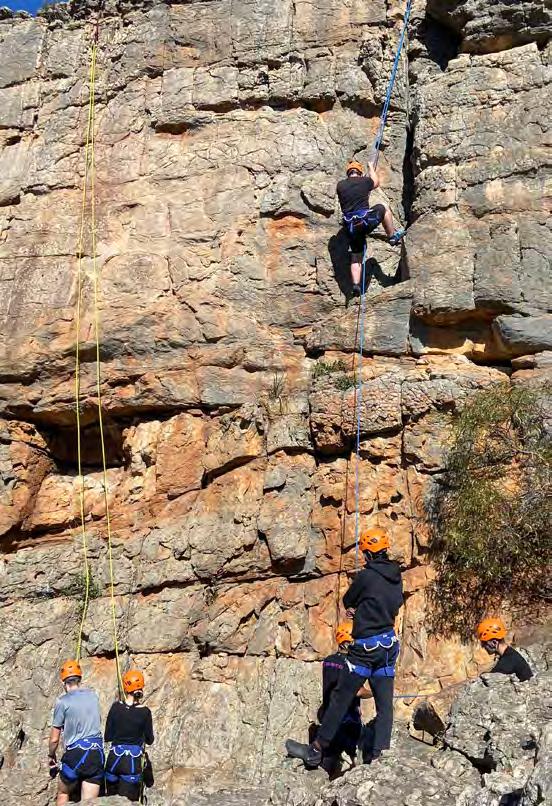
This exciting and practical course is designed for students who enjoy adventure, physical activity, teamwork and the outdoors. Students will develop practical skills and knowledge through participation in a range of outdoor and recreational activities while building confidence, leadership and communication skills.
Throughout the course, students gain experience in planning and participating in outdoor activities while learning important areas such as safety and risk management, teamwork, navigation skills, environmental awareness and leadership in outdoor settings.
This course provides students with valuable realworld experiences and can create pathways into further education and employment within the sport, recreation and outdoor industries.
Students can benefit from hands on and active learning experiences that build real world capability, alongside the development of teamwork and leadership skills that strengthen how they work with others. These opportunities help grow confidence, resilience and communication skills, while also building important knowledge of outdoor safety and risk management practices. Learners gain valuable exposure to the recreation and outdoor industry, supported by nationally recognised vocational learning that enhances future study options and employment pathways.
Core and Elective* Units:
• Participate in workplace health and safety
• Assist in conducting recreation sessions
• Minimise environmental impact
• Maintain sport, fitness and recreation industry knowledge
• Respond to emergency situations*
• Provide first aid*
• Navigate in tracked environments*
• Bushwalk in tracked environments*
• Maintain activity equipment*
• Ride off road bicycles on easy trails*
Career Progression Opportunities
• Outdoor Recreation Assistant
• Outdoor Education Assistant
• Adventure Camp Assistant
• Leisure and Recreation Assistant
• Ski Resort or Adventure Park Assistant Further Study Pathways
• Certificate III in Outdoor Leadership
• Certificate III in Sport, Aquatics and Recreation
• Certificate IV in Outdoor Leadership
VCE VET Information Technology
The Certificate III in Information Technology is a future-focused qualification designed to address the critical shortage of skilled IT professionals in Australia, with over 60,000 roles unfilled annually. This program equips students with the practical technical competencies most valued in today’s AIinfluenced workplace, including hands-on experience with hardware, networking equipment, and system administration tools.
Students gain foundational ICT knowledge alongside specialised skills in areas such as programming techniques, IP ethics and privacy, diagnostic testing, client services, and digital media. The course also explores animation, cloud computing, cyber awareness, generalist IT support, systems, and web development—depending on unit selection.
Delivered through authentic scenarios that mirror real workplace challenges, students are prepared for high-demand roles such as technical support specialist, network administrator, and help desk technician—positions that offer starting salaries significantly higher than those requiring only basic digital literacy.
This nationally recognised qualification creates multiple pathways: direct workforce entry, articulation to higher-level IT studies, or credit toward state-specific senior secondary certification. It is a scored VCE subject and contributes to the ATAR. The course runs for half a day per week over two years and is best suited to students with strong Year 10-level IT skills.
Core & Elective* Units 1 & 2
• Work in a team
• Securely manage personally identifiable information and workplace information
• Develop and extend critical and creative thinking skills
• Apply introductory programming techniques
• Use computer operating systems and hardware*
• Maintain computer hardware*
• Run standard diagnostic tests*
Core & Elective* Units 3 & 4
• Provide ICT advice to clients
• Identify IP, ethics and privacy policies in ICT environments
• Install configure and secure a small office or home office network*
• Maintain and repair ICT equipment and software*
• Provide basic system administration*
• IT Operations Specialist
• Desktop Support Team Leader
• Network Security Specialist
• IT Service Manager
• IT Infrastructure Specialist
• Cloud Support Technician
• IT Project Coordinator
Job Opportunities
These roles exist across virtually all industry sectors, including education, healthcare, finance, government, manufacturing, and professional services. According to the National Skills Commission, technical support and system administration positions consistently appear on skills shortage lists and offer strong employment prospects with above-average salary growth.
Entry Level Positions
• Help Desk Support Officer
• IT Support Technician
• Network Support Officer
• Computer Technician
• Technical Support Representative
• Junior Systems Administrator
• ICT Client Support Officer
• Computer Hardware Technician
• Service Desk Analyst
Career Progression Opportunities
• Network Administrator
• Systems Administrator
• IT Operations Specialist
• Desktop Support Team Leader
• Network Security Specialist
• IT Service Manager
• IT Infrastructure Specialist
• Cloud Support Technician
• IT Project Coordinator
Further Study Pathways
• Diploma of IT
• Can progress to Bachelor of IT or Bachelor of Business Administration
Certificate II in Electrotechnology
This hands-on qualification aims to provide participants with the knowledge and skills to achieve units of competence It can provide a strong pathway into apprenticeships and further study opportunities within the electrical and electrotechnology industries. Students can benefit from practical, hands on learning experiences that build real confidence and capability, while also supporting the development of workplace and employability skills essential for future success. These opportunities give learners exposure to industry standard tools and practices, helping them understand what real work in the field looks like and offering a clear pathway towards electrical apprenticeships. They also gain an increased understanding of career opportunities within the trade sector, supported by nationally recognised vocational learning that strengthens both future study options and employment pathways.
Core and Elective* Units:
• Prepare to work safely in the construction industry
• Apply work health and safety regulations, codes and practices in the workplace
• Provide basic sustainable energy solutions for energy reduction in residential premises
• Carry out routine work activities in an energy sector environment
• Use routine equipment/plant/technologies in an energy sector environment
• Provide solutions and report on routine electrotechnology problems
• Solve problems in single path circuits
• Identify and select components, accessories and materials for energy sector work activities
• Fabricate, assemble and dismantle utilities industry components*
• Fix and secure electrotechnology equipment*
• Deliver a service to customers*
Career Progression Opportunities
• Apprentice Electrician
• Apprentice Air Conditioning & Refrigeration Mechanic
• Apprentice Electrical Fitter
• Apprentice Electronics & Communications Technician Further Study Pathways
• Certificate III in Electrotechnology Electrician
• Certificate III in Air Conditioning and Refrigeration
• Certificate III in Electrical Fitting (UEE33020)
• Certificate III in ESI - Power Systems
VCE VET Cookery
The Certificate II in Cookery is ideal for students who love cooking or want a practical complement to VCE Food Technology. This two-year VET subject provides hands-on culinary training and prepares students for immediate employment, further study, or apprenticeships in the hospitality industry.
Students learn to emulate the role of a cook working in a commercial kitchen under the supervision of a chef, focusing on back-of-house skills typically used in restaurants and food outlets. Units include preparing appetisers and salads, stocks, soups and sauces, vegetable, fruit and farinaceous dishes, and working effectively in a commercial kitchen.
The course also teaches hygienic food preparation practices and the skills to prepare and present simple dishes. Alongside technical cookery skills, students develop interpersonal, organisational, and basic financial skills essential for success in hospitality venues.
This nationally recognised qualification contributes to the ATAR as a scored subject, with an end-of-year examination. It runs for half a day each week over two years.
Key Benefits for Students
• Delivers practical cooking skills directly applicable in kitchens across restaurants, hotels, catering companies, cafés, and more
• Supports the development of key employability and soft skills including communication, teamwork, and problem-solving
• Leads to a nationally recognised qualification that enhances student pathways
• Opens doors to further study, including Certificate III and Diploma-level hospitality or cookery qualifications.
• Learning areas include: Customer service; communications; organisational skills; management and culinary.
Core and Extra* Units 1 & 2
• Use hygienic practices for food safety
• Participate in safe work practice
• Clean kitchen premises and equipment
• Use food preparation equipment
• Receive, store and maintain stock
• Prepare dishes using basic methods of cookery
• Prepare and present simple dishes*
• Prepare and present sandwiches*
Core and Extra* Units 3 & 4
• Work effectively in a commercial kitchen
• Prepare appetisers and salads*
• Prepare stocks, sauces and soups*
• Prepare vegetable, fruit, eggs and farinaceous dishes*
Learning Areas
• Work health and safety
• Hygiene practices
• Food preparation
• Basic cookery skills
• Teamwork
• Customer Service
• Communications
• Management
• Culinary
Career Progression Opportunities
• Catering assistant
• Sandwich hand
• Breakfast cook
• Fast food cook
• Kitchen hand
Further Study Pathways
• Certificate II, III, IV or Diploma Hospitality
• Certificate III Commercial Cookery
• Certificate IV Kitchen Management
• Various Degrees and progressing onto Bachelor Degrees
VET ART & DESIGN COURSES
THIS PATHWAY CAN LEAD TO:
TAFE studies such as: Diplomas and Certificates in Applied Design, Graphic Arts, Visual Arts and Fashion.
And a possibility in the future:
University studies such as: Fine Arts (painting, printmaking, ceramics, sculpture, gold and silver smithing), Visual Communication (Graphic Design, Visual Communication), Textiles Design (Industrial Design, Fashion, Interior Design) and Architecture.
Employment in areas such as: Teacher, Designer (fashion, industrial, interior), Architect, Painter, Potter, Illustrator, Arts Administrator, Graphic Artist, Jeweller.
VET BUSINESS & RETAIL COURSES
THIS PATHWAY CAN LEAD TO:
TAFE studies such as: Associate Diploma, Advanced Certificates in Business, Computing, Accounting, Marketing, Finance. And a possibilty in the future:
University studies such as: Bachelor Degrees in Economics, Accounting/ Computing, Business, Banking and Finance, Commerce, Marketing, Management, Information Technology, Arts/Commerce, Business Systems, International Trade.
Employment in areas such as: Banking, Marketing, Insurance, Finance, International Trade, Travel and Tourism, Clerical Work, Public Administration, Local Government, Real Estate, Sales and Retailing.
VET ENGINEERING COURSES
THIS PATHWAY CAN LEAD TO:
TAFE studies such as: Diplomas and Advanced Certificates in Engineering
And a possibilty in the future:
University studies such as: Electrical Engineering, Mechanical Engineering, Computer Engineering, Civil Engineering, Telecommunications Engineering, Aerospace Engineering, Chemical Engineering.
Employment in areas such as: Engineer, Engineering Associate, Project Manager.
VET INFORMATION TECHNOLOGY COURSES
THIS PATHWAY CAN LEAD TO:
TAFE studies such as: Associate Diplomas, Certificate Courses and Traineeships in Computer Science, Cyber SecurityComputer Systems and Information Technology. And a possibilty in the future:
University studies such as: Bachelor Degrees in Computer Science, Cyber Security, Software Engineering, Information Systems and Information Technology.
Employment in areas such as: Programming, Network Manager, Systems Analyst and Software Engineer.
University studies such as: Hospitality, Food Technology, Food Science, Catering and Hotel Management, Tourism.
Employment in areas such as: Chef, Maitre, Hotel Management, Food Service, Food Technologist, Food Scientist, Catering, Tourism Management, Travel Agent, VET Teacher.
VET SPORT, AQUATICS & RECREATION COURSES
THIS PATHWAY CAN LEAD TO: TAFE studies such as: Diplomas and Advanced Certificates in Fitness, Sport and Recreation, Outdoor Education.
And a possibilty in the future:
University studies such as: Degrees in Exercise Science, Human Movement, Sports Management, Physical Education, Outdoor Education, Teaching.
Employment in areas such as: Personal Trainer, Coach, Sports Club Manager, Exercise Physiologist, Sports Development Officer, Recreation Officer, Swimming Instructor, Life Saver, School Camps Manager, VET Teacher.
VET SCREEN & MEDIA COURSES
THIS PATHWAY CAN LEAD TO:
TAFE studies such as: Diplomas in Professional Writing, Screen Production, Public Relations, Advertising.
And a possibilty in the future:
University studies such as: Degrees in Journalism, Media and Communications, Professional Writing, Public Relations, Media Arts and Media Studies.
Employment in areas such as: Public Relations Officer, Journalist, Media Liaison Officer, Writer, Copywriter, Film Director, Wedding Photographer, VET Teacher.
VET ACTING, MUSIC & DANCE COURSES
THIS PATHWAY CAN LEAD TO: TAFE studies such as: Diplomas in Performing Arts, Video Production, Music Production, Audio Production
And a possibilty in the future:
University studies such as: Degrees in Performing Arts, Film and Television, Teaching, Music.
Employment in areas such as: Actor, Photographer, Lighting Operator, Musician, Dance Teacher , Lighting Technician, Audio Technician, Primary and Secondary Performing Arts Programs, VET Teacher.
VET BUILDING & CONSTRUCTION / LABOURER COURSES
THIS PATHWAY CAN LEAD TO:
TAFE studies such as: Building Design, Airconditioning, Solar, Bricklaying, Paving, Painting, Tiling and Electrical, Shopfitting.
And a possibilty in the future:
University studies such as: Project Management, Business and Design
Employment in areas such as: Carpentry, Electrician, Plumber, Appliance Technician, Bricklayer, General Labourer, Shop Fitter and Project Manager, VET Teacher.
VET ANIMALS, PLANTS & SCIENCES COURSES
THIS PATHWAY CAN LEAD TO:
TAFE studies such as: Veterinary Nursing, Dog Grooming, Captive Animal Care, Floristry, Conservation & Land Management, Landscape Construction, Animal Shelter Management.
And a possibilty in the future:
University studies such as: Conservation and Land Management, Architectural Garden Design.
Employment in areas such as: Veterinary Nursing, Dog Groomer, Pet Shop Manager, Retail, Sales, Farm Hand, Animal Breeder, Nursery Sales,Landscape Gardener, Horticulturalist, Florist, VET Teacher.
VET COMMUNITY & HEALTH SERVICES COURSES
THIS PATHWAY CAN LEAD TO:
TAFE studies such as: Diplomas, Associate Diplomas, Advanced Certificates in Nursing, Youth Work, Welfare Studies, Community Work, Children’s Services, Social Work, Drug and Alcohol Counsellor.
And a possibilty in the future:
University studies such as: Bachelor Degree in Teaching, Nursing, Paramedics, Social Work, Psychology.
Employment in areas such as: Nurse, Childcare Worker, Youth Worker, Teacher, Paramedic, Social Worker, Counsellor, Clinical Psychologist, Volunteer Management, VET Teacher.
VET MAKEUP, SALON ASSISTANT AND BEAUTY VET MAKEUP, SALON ASSISTANT AND BEAUTY
VET HAIR & BEAUTY COURSES
THIS PATHWAY CAN LEAD TO:
TAFE studies such as: Diplomas and Advanced Certificates in Beauty, Cosmetic Nursing, Stage Makeup.
And a possibilty in the future:
University studies such as: Nursing, Dermal Studies.
Employment in areas such as: Barbering, Hairstylist, Beautician, Makeup Artist, Stage Makeup Artist, Retail, Specialist Makeup Artist, Nail Technician, Spa Therapist, Day Spa Management, VET Trainer.
VET AUTOMOTIVE COURSES
THIS PATHWAY CAN LEAD TO:
TAFE studies such as: Apprenticeship courses in Automotive Mechanical, Panel Beating, Spray Painting.
Employment in areas such as: Mechanics, Panel Beater, Automotive Electrician, Service Manager, VET Auto Teacher.