SUMMER 2026, Vol. 40, Issue 2
SUMMER 2026
1
MISSION NAWJ’s NAWJ’s mission mission isis to to promote promote the the judicial judicial role role of of protecting protecting the the rights rights of of individuals individuals under under the the rule rule of of law law through through strong, strong, committed, committed, diverse diverse judicial judicial leadership; leadership; fairness fairness and and equality equality inin the the courts; courts; and and equal equal access access to to justice. justice.
PRESIDENT BOARD OF DIRECTORS
Hon. Pamela Washington EXECUTIVE COMMITTEE Anchorage District Court (Ret.)
PRESIDENT-ELECT
Hon. Heather Welch
Marion Superior Court (Ret.)
IMMEDIATE PAST PRESIDENT
Hon. Michelle M. Rick Michigan Court of Appeals
VICE-PRESIDENT DISTRICTS
Hon. Amy Blake
Massachusetts Appeals Court
TREASURER
2 President's Message 3 Vice President of Publications Message 4 Executive Director’s Message
39 Board of Directors The Gift of Time: Judicial Service after 40 District Directors Retirement 41 Landmark Partners & Contributors Bench 11 What State Court Judges Need to Know About How Their Rulings Impact Military 42 Resource Board Service Members 42 New Members 17 Alaska Midyear 2026: Building Bridges, Strengthening Ties
FINANCE COMMITTEE CHAIR
24 Virginia 250 27 America 250: Pennsylvania Courts
Hon. Mary Margaret Rowlands Summit County Common Pleas Court
SECRETARY
NAWJ Hold Inaugural Regional Conference
5 Promoting Judicial Independence 8 After the Bench
Hon. Karen Donohue
King County Superior Court
31 Massachusetts at 250 34 Strenthening Your Judicial Core:
Connecting Communities Through Civic Education and Public Engagement
Hon. Leslie A. Stroth
Bronx County Hall of Justice
INTERNATIONAL DIRECTOR
Hon. Bernadette D’Souza
Civil District Court in New Orleans
ABA DELEGATE
Hon. Marcella Holland
Circuit Court for Baltimore City
PROJECTS COMMITTEE CHAIR
Hon. Carmen Velasquez Supreme Court of New York
COUNTERBALANCE is published by: National Association of Women Judges
RESOURCE BOARD LIAISON
David Horrigan
1725 Eye St. NW, Suite 300, Washington, DC 20006 Phone: 202 393 0222 Fax: 202 393 0125
Relativity
STAFF EXECUTIVE DIRECTOR Laurie Hein Denham, CAE DIRECTOR OF DEVELOPMENT Francie Teer, CFRE OPERATIONS Brian Gorg MEMBERSHIP COORDINATOR Janelle Mihoc FINANCE Megan Collie
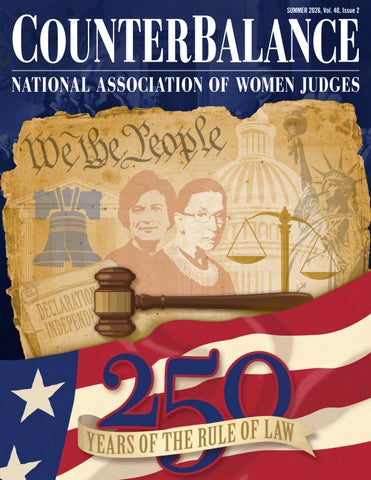
ON THE COVER: The double bust is Supreme Court Judge Hon. Ruth Bader Ginsberg and Hon. Constance Baker Motley, the first female African American lawyer to argue a case before the Supreme Court, where she laid the legal groundwork for Brown v. Board of Education. She later made history again as the first Black woman to be appointed to the federal judiciary, serving as a U.S. District Judge in New York. ©2026 National Association of Women Judges. All rights reserved. Views and opinions expressed are solely those of the authors and contributors, and do not necessarily represent those of the NAWJ.
nawj@nawj.org Web: www.nawj.org
E-mail:
SUMMER 2026
s I am nearing the end of my year as President of the National Association of Women Judges, I find myself reflecting on what an incredible honor it has been to serve this organization and its members.
always been realized equally or easily, but generation after generation has worked to move our nation closer to its promise.
Serving as your President has deepened my appreciation for the role judges play in shaping not only our courts, but our communities and our nation. We are called to lead with wisdom, to serve with humility, and to uphold the rule of law even in the most challenging of times.
Every opinion we write, every litigant we treat with dignity, every young person we inspire through Color of Justice, and every bridge we build with one another becomes part of our nation’s story. The work we do today will influence generations to come.
NAWJ has been part of that work.
For more than forty years, our members have broken barriers and opened doors. This year has exceeded every expectation We have championed equal justice I could have imagined. I have traveled across the country and beyond, met judges under law, promoted diversity on the bench, mentored future leaders, and at every stage of their careers, and forged stood steadfast in support of judicial friendships I know will last a lifetime. I independence. We have helped shape a have listened to stories of perseverance, judiciary that is stronger, more inclusive, celebrated remarkable accomplishments, and witnessed extraordinary acts of courage and more reflective of the communities we and compassion. Everywhere I have gone, serve. I have been reminded that NAWJ is more For more than than an association. We are a community As judges, we understand that history forty years, our members united by a shared commitment to justice is not simply something we study. It is have broken barriers and and to one another. something we make.
opened doors. We have championed equal justice under law, promoted diversity on the bench, mentored future leaders, and stood steadfast in support of judicial independence.
This year, as America celebrates its 250th anniversary, I have thought often about our nation’s journey and NAWJ’s place within it. The story of the United States is one of aspiration and progress—a continual striving toward the ideals of liberty, equality, and justice. Those ideals have not
That is why I am especially excited about what lies ahead. I invite you to join me this October in New Orleans for our Annual Conference. Together, we will celebrate our achievements, engage in meaningful education, and strengthen the ties that
2
SUMMER 2026
bind us as colleagues and friends. We will honor our past, embrace our present, and boldly envision our future. As America marks 250 years, let us recommit ourselves to the enduring
ideals that unite us. Let us continue to build bridges where others see division, strengthen ties where others see differences, and ensure that justice remains not merely an aspiration, but a lived reality for all. The next chapter of NAWJ’s story is
his year we celebrate the 250th anniversary of the United States of America. Although there are some that have expressed a reluctance to do so in light of current political unrest, we would be remiss if we did not consider our history. During the formation of our country, individuals sought to pursue a government unlike any other. They pursued an ideal – and in so doing, created a nation that has endured for 250 years. That alone is worthy of recognition.
During the formation of our country, individuals sought to pursue a government unlike any other. They pursued an ideal – and in so doing, created a nation that has endured for 250 years. That alone is worthy of recognition.
The articles featured in this issue of Counterbalance outline a variety of events designed to celebrate that accomplishment and the role of the judiciary. As judges we should be proud of these events, and of our fellow judges that each day strive to deliver justice and forge a better nation for all. Judge Amy Blake’s article exemplifies this best in that it honors the revolutionary legacy while renewing our commitment to justice! The article by Judge Annette Pitts of the Judicial Independence Committee
waiting to be written. I cannot wait to write it with you. Hon. Pamela Washington President
highlights the importance of community outreach in efforts to restore public confidence in our courts. California and Washington have a Judges in the Classroom initiative for K-12. The Chief Justice of California has established a Power of Democracy program with a focus on the judiciary role as the third branch of the government. Included in the issue is the statement from the Conference of Chief Justices Chief Justice Cleo E. Powell’s words that this is an opportunity for all of us to “strengthen public confidence in our courts and foster meaningful engagement with the communities we serve.” Featured in this issue is the Inaugural Regional Conference held in Eagan, Minnesota. Thanks to the sponsorship of Thomson Reuters this event was not only well attended but impressively informative. We are fortunate to have President Retired Judge Washington’s message which gives a great overview of the
3
SUMMER 2026
wonderful Alaska meeting as well activities of NAWJ. Judge Taylor’s article Ensuring Racial Equity provides thoughtful insight for all
population. And no issue would judges. We are so appreciative of the Military and Veteran Committee be complete without Life After the article describing the impact Hon. Victoria A.B. Willis rulings have on this segment of our Vice-President Publications
he first half of the year has passed quickly. I first want to thank our team, Brian Gorg and Janelle Mihoc, who work diligently behind the scenes serving all of us. We welcome Emma Armstrong who is supporting marketing and meeting planning.
Much has already been said about our Midyear and Regional Meetings, but what stood out most to me was the energy new members—some fairly new to the bench— brought to the room, and the warmth with which our longtime members welcomed them.
Our Districts held four Color of Justice programs and one Women in Prison program, impacting the lives of over 500 people within the first six months of the year. Several members have also been recognized by local and national organizations for their contributions and leadership within the judiciary, a testament to the caliber of NAWJ.
this year are running at twice the rate of new memberships. The encouraging news is that most lapses stem from simple oversight, retirement from the legal community, or outdated contact information rather than a loss of interest. On this point, I ask that you please update your profile in the database whenever your email or business address changes; this may be done through the following link. We have also introduced new fields to allow for organization by bench, and I would encourage each of you to review and update your profile accordingly. Finally, I am pleased to share our current Word Cloud with our most recent membership survey. It reflects what I consistently hear from you about the value of your membership.
Much has already been said about our Midyear and Regional Meetings, but what stood out most to me was the energy new members—some fairly new to the bench— brought to the room, and the warmth with which our longtime members welcomed them. Both meetings included dedicated time for social connection. Based on survey responses, this was among the highlights for attendees. I look forward to seeing each of you in New Orleans! Your Executive Committee and District Directors have been actively reaching Laurie Hein Denham, CAE out to lapsed members, as non-renewals Executive Director
4
SUMMER 2026
5
NAWJ Judicial Independence Committee Informed Voters Project (IVP)
onstitution Day (celebrated Committee and its Informed Voters Project (IVP), an Emmy-awardannually the week of winning civic education program, September 17) offers provides abundant resources for local critical opportunities for judges and retired judges to engage with the public, improve public understanding of the judicial branch, and explore the value of a fair and impartial judiciary. The NAWJ Judicial Independence By Annette Pitts, Judicial Independence Committee
SUMMER 2026
use in Constitution Day festivities. With declining public confidence in our courts and the judiciary, direct engagement with the community at large makes this Constitution Day more important than ever. The Committee recently hosted a national webinar to address recent research findings and collaborative resources targeting public perceptions of the judicial branch and trust issues. Research has identified multiple factors contributing to the decline in public trust in the courts and the judiciary. (Patterson, 2024) One significant finding is that many Americans believe that the courts favor the wealthy and that judges’ political beliefs influence their rulings. Other issues identified as impacting trust and confidence in judges include judicial behavior, perceptions of partisanship, and judicial bias. However, interactions with judges, experience or knowledge of court processes, and other experiences may counter these outcomes. Recent findings also demonstrate that state courts have higher trust indicators than federal courts. The Judicial Independence Committee of the National Association of Women Judges is chaired by The Honorable Robin
Hudson (Retired, North Carolina Supreme Court) and Chief Justice Debra Stephens, Washington Supreme Court. Annette Pitts serves as the National Education Chair. The Committee offers a variety of videos, animations, PowerPoint presentations, social media posts, and handouts for use with community outreach and education initiatives. To see a sampling of these resources, see the links below.
6
Constitution Day and Citizenship Day | U.S. Department of Education USCODE-2006-title36-subtitleIpartA-chap1-sec108.pdf
The Judicial Independence Committee offers a variety of ideas and resources for Constitution Day festivities. When considering the types of activities your jurisdiction is interested in employing during Constitution Day, please keep your target audience in mind. Different https://www.nawj.org/catalog/ strategies may be needed for distinct community-outreach-programs/ informed-voters-fair-judges-project audiences. There is a wealth of civic learning resources for K-12 While most of the Judicial classrooms. You may also wish to Independence Committee’s target post-secondary institutions resources have focused on adult or universities, civic groups and audiences, many of these materials organizations, public libraries, and may also apply to school settings. other adult education programs. Several members of the Judicial Independence Committee also California and Washington use the participate actively in K-12 school Judges in the Classroom program programs. Federal law requires for K-12 civics lessons, resources, Constitution Day educational and school visits. Other states programs on or about September provide their own specific materials. 17 annually. Here are the associated In Florida, the Justice Teaching articles and requirements. Program at Florida Southern
SUMMER 2026
College provides materials aligned with the K-12 state standards in civics and government for school partnerships with lawyers and judges. Here are links to several state-level K-12 programs.
Judges in the Classroom | Power of Democracy
Washington State Courts Educational Resources
For Educators | Massachusetts Judges Conference
Justice Teaching Center - Florida Southern College In California, NAWJ member Justice Judith McConnell reports that the Chief Justice has established the Power of Democracy (POD) civic learning initiative. Part of its mission is to improve understanding of the three branches of government, with a focus on the judicial branch and the importance of a fair and impartial judiciary. The programs include civic learning awards given each year to K-12 schools that offer innovative, replicable programs that aid in teaching about the courts. POD also hosts a court outreach program called Judges in the Classroom that supports judges’ presentations to K-12 students with a prepared curriculum vetted by educators. The presentation is selected by the teacher, and the judges use the materials to engage with the students. Some programs are provided in Spanish and Mandarin Chinese. POD also provides materials to help celebrate Constitution Day and Constitution Month, as well as other significant
7
holidays. State and federal judges participate. POD also hosts regional meetings throughout the state to encourage and support trial and appellate court efforts to engage with youth in their community. The Justice Teaching Center in Florida incorporates school partnerships with attorneys and judges collaborating with K-12 schools statewide. Volunteers collaborate with teachers to enhance civics, government, and law content with simulations, interactive exercises, and primary source documents. For additional details or resources, contact Annette Pitts, Director, Justice Teaching Center for Civic Learning, Florida Southern College at apitts@flsouthern.edu.
SUMMER 2026
etirement from the bench comes with a treasure -- the gift of time -- time that is finally ours to allocate. We are no longer dictated by a rigid calendar, motion calls, or emergency hearings. When I first retired, I did what many of you may By Hon. Elaine Andrews secretly long to do: I said “no” to Presiding Judge, Anchorage Superior everything. For several months, I Court, Ret. declined invitations to join boards,
8
task forces, and committees, both worthy and unworthy. For those of us who are natural problem-solvers, declining to participate is difficult, but I think a bit of respite is a necessary piece of the transition to retirement. But eventually you realize that retirement is not a retreat; it is a reassignment. It is impossible to
SUMMER 2026
ignore the following question: “What should I do with this gift of time”? My own answer was to turn back toward the institution that had given me a deeply rewarding career, and to use my new freedom to help protect the judiciary and the bright, dedicated judges coming behind me.
fairly. Over my two decades of service, I made several controversial decisions. But when it came to retention time, there was not a rabid political attack against me. At that time, aggressive partisan opposition was not part of the landscape in retention elections.
A Career Made Possible by Merit and Independence
How things have changed. Across the country, I was privileged to serve as a trial judges now face politicized court judge in Alaska, a state with a merit-based judicial selection system campaigns, organized and retention elections grounded in misinformation, and even objective performance evaluations. threats for simply doing their In 1981, when I applied for the district court, and again in 1991, jobs—trends that NAWJ and when I applied for the superior many other judicial groups court, my applications were reviewed by our non-partisan Alaska have had to confront directly in recent years. Judicial Council. My name was forwarded to governors who did not know me personally, who had never counted me as a donor or political ally, but who trusted the merit system to supply the most qualified nominees. I was chosen from among many capable candidates, and politics was not a significant part of the process. My retention elections were uneventful. I was recommended for retention by the same Judicial Council that had a hand in my selection, and the voters retained me. I was privileged to serve in an independent judiciary and I was expected — by the public, the bar, and my colleagues — to judge
9
I chose to invest that “gift” in protecting the system that had allowed me to serve for over 21 years as an independent judge. I began by chairing the Alaska Bar Association’s Committee on Fair and Impartial Courts, which built a speakers bureau and partnered with the Bar’s Committee on Law and Education to engage civic groups across the state. I learned two lessons: • First, such civic organizations as Rotary clubs and Chambers of Commerce are not nearly as well-versed in the structure and needs of the judiciary as many of us assume. But they are eager to learn. • Second, the public wants to hear about the courts from a judge, retired or not. We may leave the bench, but in the public mind we remain judges, and our voices retain credibility.
How things have changed. Across the country, judges now face politicized campaigns, organized misinformation, and even threats for simply doing their jobs—trends that NAWJ and many other judicial groups have had to confront directly in recent years.
Because this work took place in a state with a mandatory bar, our advocacy had to be carefully calibrated to stay within permissible non-partisan limits.
Rediscovering Service After Retirement
Building Institutions that Defend the Courts
As politics crept further into judicial retention, and as misinformation about courts spread more quickly and more widely, it became clear to me that my retirement’s “gift of time” carried with it an obligation.
Recognizing that the threats to judicial independence were becoming more organized and partisan, a retired Chief Justice of the Alaska Supreme Court, Bud Carpeneti, led the creation of Justice
SUMMER 2026
Not Politics Alaska, a group focused voters why judicial independence on defending our merit selection and matters in their daily lives. Although retention system against legislative I have stepped down as co-chair, I attacks. Because the organization was continue this outreach on my own, formed outside the Bar Association, recognizing that retirement did not the organization could lobby and end my privilege: it expanded my testify against bills that would have responsibility. weakened the constitutional framework protecting our courts. I Retired judges can also serve in contributed testimony and written quieter but still powerful ways: submissions to support that mission. signing on to amicus briefs, lending their names and experience to public When partisan attacks intensified— statements, mentoring new judges, particularly against judges who had and joining organizations that speak been recommended for retention clearly about the role of courts in our based on objective performance democracy. These contributions evaluations but targeted for a single may not make headlines, but they unpopular decision—it became shape the narrative around courts in obvious that we needed an even profound ways. more focused response. That is how Alaskans for Fair Courts was born, NAWJ and The Continuing
an effort I agreed to co-chair. Its work both in civic education and in retention campaigns has helped blunt unfair attacks and explain to
stature as judges, even in retirement, is one of the most effective tools we have to explain why courts must remain impartial and insulated from partisan retaliation. Panels like NAWJ’s, along with NAWJ’s broader educational work and joint statements in defense of judicial independence, provide retired judges with a ready-made platform and community in which to continue their service. NAWJ provides language, resources, and strategies that individual judges can take back to their own states, whether by speaking to civic groups, responding to misinformation, or supporting institutional reforms that preserve fair selection and retention systems.
In these fraught times, retirement is not a retreat; it is a reassignment. The National Association of Women We, who were privileged to serve in Judges has long been a national voice independent courts, now have the for an independent judiciary and time, freedom, and experience that our for public education about the rule sitting colleagues often do not. The of law. Recently, NAWJ hosted a question for each of us is how we will wonderful panel at its Alaska miduse that gift—whether by joining efforts year cruise conference, focused on like NAWJ’s, signing on to amicus supporting and protecting judicial briefs, speaking in our communities, independence. This meaningful or helping to build organizations conversation, led by Judge Maria that defend the judiciary, all in an Salas Mendoza and Judge Selena effort to ensure that the judges who Solis, squarely addressed the come after us can serve with the same politicization of judicial selection, independence and support that we the erosion of public trust, and the were privileged to enjoy. concrete steps judges -- including retired judges-- can take to push Retired Superior Court Judge Elaine back. The discussion echoed a Andrews served as trial judge in theme I have seen throughout my Alaska from 1981 to 2002. She served own post-retirement service: our as Presiding Judge from 1996-2002.
Call to Serve
Retired judges can also serve in quieter but still powerful ways: signing on to amicus briefs, lending their names and experience to public statements, mentoring new judges, and joining organizations that speak clearly about the role of courts in our democracy.
10
SUMMER 2026
What State Court Judges Need to Know About How Their Rulings Impact Military Service Members
By Hon. Renee Stackhouse San Diego Superior Court
By Hon. Linda Murnane United States Air Force, Ret.
small claims, and probate matters, he modern judiciary increasingly encounters cases these cases often have unique involving active-duty service implications for military personnel. members as well as members who serve in the National Guard or Service members are simultaneously the Reserve of the military. While subject to State and Federal Codes, including the provisions state courts routinely adjudicate family law disputes, criminal cases, found in 10 United States Code,
11
SUMMER 2026
better known as the Uniform Code of Military Justice (UCMJ). This simultaneous application of various code provisions often has an impact on state court orders of which some may be unaware. The lack of awareness about these considerations can unintentionally compromise service members’ legal rights and military duties, or both, as well as have unintended consequences for family members, including those for whom the court order in intended to benefit or protect. This article aims to provide state court judges with practical guidance on the intersection of state court rulings and military law obligations.
Family Law Considerations Family law cases—divorce, child custody, visitation, and spousal support—are some of the most common ways service members appear before state courts. Military status introduces several layers of complexity.
Servicemembers Civil Relief Act (SCRA) The SCRA (50 U.S.C. §§ 3901– 4043) provides protections for active-duty members, including: Stay of proceedings: Service members may request a delay in civil or family law proceedings if military duties materially affect their ability to appear.
Modification of orders: Judges may need to adjust custody, support, or visitation orders to accommodate deployment or relocation. Protection against default judgments: Courts should ensure a service member is adequately represented before entering default judgments in divorce, custody, or debt cases. Military statutes can be checked through the SCRA website, found here: https://scra.dmdc.osd.mil/ scra/#/home Consider whether this may constitute an ex parte input to the proceedings when assessing use of the website.
PRACTICAL TIP: Always ask whether a party is on active duty, and if so, whether SCRA protections apply. Consider granting stays or temporary modifications when deployment or military duties interfere with compliance.
12
PRACTICAL TIP: Military commands can also issue Military Protective Orders. The Court should ask whether any are in place.
Custody and Visitation Military service often requires frequent relocations, deployments, or extended absences. State courts must balance the best interests of the child with a service member’s obligations. Flexibility is key. Courts may need to allow electronic visitation (video calls) when physical presence is impossible. Deployment alone should not automatically diminish custody rights. Courts can craft orders that account for temporary absences without penalizing the service member.
If the Court intends for both parents to continue to make meaningful contribution to the decisions made for the benefit of the couple’s minor children, the custody and visitation orders should be carefully crafted Domestic Violence Restraining considering that a military parent Orders will very likely be required to serve A Domestic Violence Restraining outside the state in which the decree Order can bar a service member is issued. Overseas visitation can from certain duty stations, be a particularly challenging issue deployments, impact promotion for military couples, as there may be eligibility, and cause the loss of concerns about a failure to return the security clearance. children from a period of visitation
SUMMER 2026
outside the U.S., as well as costs associated with travel for the minor children. Parenting plans, if those are part of the court practice, should account for these considerations, and if court mediation is required prior to issuance of a court order granting the termination of the marriage, the mediators involved in the case should be certain these issues are addressed. Where the mediators are restricted from addressing costs of visitation or guarantees related to return of the children from visitations, the Court should consider whether they need to address these on the record at any hearing related to visitation. Spousal Support and Military Pay Spousal support orders must account for the unique nature of military compensation, which includes base pay, allowances (housing (BAH), subsistence (BAS)), and potential tax implications. Keep in mind that BAH and BAS is non-taxable income.
Practical Tip: The military can issue their own support orders (child and spousal). Make sure to ask if there is an already existing order in place. The military command may also be able to assist in enforcing a support order where non-compliance is reported.
Practical Tip:
Practical Tip:
Service members can easily access their Leave and Earnings Statement (LES) which is the document that details their wages on the internet, or on their telephone. If unable to do so, military pay information by military grade and length of time in service is available online at
Garnishment or income withholding rules may differ from civilian wages. Make sure any garnishments are compliant with federal law before issuance.
https://www.dfas.mil/MilitaryMembers/payentitlements/ Pay-Tables/ Information found on the pay tables does not necessarily reflect the specific pay of the military member appearing in your proceeding, as many military families use direct withdrawals from the service member’s military pay to cover living expenses such as car payments, insurance payments or house or rental payments. A military member whose family resides in military housing may or may not be receiving the full BAH or full BAS listed on the Pay Tables website.
There are also military members who may retire from active duty, and be further employed as Department of War/Defense/Service Branch (Army, Navy, Air Force, Space Force, Marine Corps) employees. These individuals’ pay will be a matter that needs to be sorted in discovery as they may have deferred military retirement pay to allow it to accrue against a civil service retirement pay opportunity.
13
Medical Care The issue of who provides medical insurance for military family members is one that needs careful consideration in crafting a decree ending the marriage where one or both spouses are military members. A non-military spouse may become ineligible for health care under their military spouse’s health program once the decree is final. The children of military members will, ordinarily, remain eligible for health care through the military health care system. However, some military spouses become eligible for some medical benefits, if the marriage meets length of time requirements.
Post High School Education Military members may now allow their children to benefit from unused education benefits that are available under the Veterans Administration GI Bill benefit program. If there are minor children involved in the issuance of a decree ending a marriage, the obligation to preserve unused GI Bill benefits for the couple’s children may be a matter that should be addressed in any decree. This
SUMMER 2026
becomes an issue long after the decree has been issued, in many cases, and often arises when the military member remarries and has step-children with their new spouse, or has children born of a subsequent marriage.
Division of Military Retirement Benefits Unless you are yourself an expert on military retirement benefits this may be an area in which you would benefit from appointing a Court Appointed Neutral or a Mediator to investigate the appropriate provisions before issuing a decree. The military retirement benefits of a particular party before you may differ based on a number of factors, including length of marriage, length of time married during military service, and which of several retirement plans the service member may be under (Final Pay, Top 3, Blended Retirement). There may be a mandatory contribution being made into a Thrift Savings Plan (TSP – a 401(k) equivalent) or an existing Survivor Benefit Plan (SBP) as well as eligibility for Servicemen’s Group Life Insurance or Veterans Group Lift Insurance that should be considered. If you aren’t an expert, getting an expert to inform the Court will save time and money in the long-term.
Criminal Law Considerations State criminal proceedings intersect with military law in nuanced ways. Active-duty members are subject to state and federal criminal statutes, including both 18 U.S.C. and 10 U.S.C. where the UCMJ is found. These multiple code provisions create potential duplicative consequences.
Concurrent Jurisdiction Service members can be prosecuted by both the state and the military for the same offense at the same time. For example: • An assault committed off-base may trigger both state assault charges and UCMJ Article 128 (10 U.S.C. 928) prosecution. • Drug offenses or DUIs may result in parallel proceedings in both courts (10 U.S.C. 912, 10 U.S.C. 912a). Additionally if there is a death associated with a driving offense, the military member may face other criminal or administrative sanctions found in other provisions of the UCMJ. • Military members involved with the use of marijuana in states in which recreational marijuana is legal are still subject to criminal sanction for use and possession in any amount under 10 U.S.C. 912(a).
14
Practical Tip: State court judges should be aware that military administrative or disciplinary actions (such as non-judicial punishment or Article 15 (found at 10 U.S.C. 815) proceedings) can occur regardless of the state court outcome. A state court plea is tantamount to a conviction in the military, regardless of diversionary, mitigating, or downgrading actions by the Court. Expungements do not matter to the military.
Practical Tip: Some charges may require mandatory administrative processing in the military (nonjudicial punishment, often referred to as Article 15). These include sexual misconduct, sexual harassment, violent misconduct, drug abuse/possession of drug paraphernalia, supremacist or extremist conduct, Family Advocacy Program failure, alcohol rehabilitation failure, Physical Fitness Assessment failure, and nonconsensual distribution of an intimate image.
Miranda and Article 31 Warnings Service members have rights under both Miranda (state/federal) and UCMJ Article 31. State court
SUMMER 2026
proceedings must respect these rights, especially if statements were obtained while the individual was in military custody or questioned under military authority. Under UCMJ Article 31 (10 U.S.C. 831), a military member is entitled to military counsel at no charge, regardless of income level.
Separation from the military impacts ability to pay fines, fees, restitution and other portions of an order issued by the court. It may also result in less than an honorable discharge, which may also impact future employability of the service member.
Impact of Deployment or Orders
The Court may want to ask routinely if the individual appearing before them is in the National Guard, State Guard or Reserve before deciding on an order. Not all military members, including active duty, Guard or Reserve members, volunteer their military status upon arrest, apprehension or in civil matters.
Active-duty obligations may interfere with court appearances. Courts should: • Consider stays or continuances if military duties materially affect a service member’s ability to appear.
Practical Tip:
15
https://scra.dmdc.osd.mil/scra/#/home Consider whether this may constitute an ex parte input to the proceedings when assessing use of the website. Example: A landlord seeking eviction must obtain military status information to ensure the action does not violate SCRA protections. Courts often need to delay or modify proceedings until the service member can respond or appointed an SCRA voluntary attorney if their local bar association has such volunteers available.
Garnishment and Wage Withholding
Garnishment of military pay is limited to 25% of disposable earnings for • Avoid issuing warrants that could commercial debts like small claims. conflict with military duties unless Priority is given to child support and coordination with the commanding Small Claims and Civil Proceedings alimony garnishments. If these already officer ensures compliance. exceed 25% of the member’s pay, the Oftentimes, military service members While small claims may seem lowstakes, they can have disproportionate commercial allotment may be rejected will be accompanied to court by a or delayed. Staff Non-Commissioned Officer or effects on service members: Officer who may be able to ensure It may, however, be of benefit to see if SCRA Protections compliance. compliance can be obtained for court • The SCRA applies to civil ordered support through a phone Probation and Military Service judgments, including: call to the command of the service State-imposed probation must account for service requirements. Probation conditions that interfere with deployment, relocation, or military duties may be unenforceable or require modification. Placing a military member on mandatory reporting probation may result in action by the military to separate the member as it may render them ineligible for deployment.
member before the last resort to garnishment. Additionally, requiring payment of alimony, family or child support through military allotment Judges must verify whether the service member’s military obligations may also alleviate future litigation resulting in garnishment orders. materially affect their ability to participate in the proceeding. If so, Probate and Estate Matters a stay or adjustment of deadlines Probate cases involving service is required. Military status can be checked through the SCRA website, members raise special considerations due to: found here: • Evictions or property disputes • Debt collection • Contract enforcement
SUMMER 2026
Survivor Benefits
are respected in probate or guardianship proceedings. Military retirement pay, Survivor Deployment or absence may require Benefit Plans (SBP), and life insurance may be governed by federal temporary guardianship law, which can override state probate arrangements. distributions. Judges must distinguish Debt and Estate Claims between probate assets under state Creditors cannot enforce certain law and federally protected military claims against a service member’s benefits. estate without considering SCRA protections and federal priority Thrift Savings Plan Benefits rules. State court orders reducing or Military members have been required collecting against military benefits to enroll in the Department of War/ may be unenforceable. Defense Thrift Savings Plan – a 401(k) equivalent – since January 1, Best Practices for State Court 2018.
SGLI/VGLI
Judges
State court judges can adopt several Military members who die while strategies to minimize conflicts and serving on active duty will, ordinarily, protect service members’ rights: have a Servicemembers Group Life Insurance policy in some amount. 1. Identify Military Status Early Additionally, upon separation, and in • Always ask parties whether particular for those military members any litigant is on active duty. who have been determined eligible • Require proof of military for disability benefits through the service (military ID, orders) when Veterans Administration due to necessary. service-connected injuries or • Check the SCRA website to verify illnesses, may have a Veterans Group whether a party is entitled to SCRA Life Insurance policy. These are protections. often overlooked particularly with https://scra.dmdc.osd.mil/scra/#/ older veterans, when dealing with the home estate of a service member. • Consider whether this may constitute an ex parte input to the Guardianship and Power of proceedings when assessing use of Attorney the website. Active-duty service members often grant powers of attorney for financial 2. Consider Stays and Continuances or medical decisions. Courts should Under SCRA and general equity ensure these documents comply with principles, courts should stay military and federal requirements and
16
proceedings when military duties materially affect a party’s ability to participate. 3. Understand Federal Overrides • Federal law may preempt state authority regarding certain benefits, pay, or administrative actions. • Be cautious when issuing judgments that could interfere with military compensation, retirement, or survivor benefits. 4. Draft Orders Flexibly • In family law, include provisions for electronic visitation, temporary modifications, or deployment contingencies. • In civil or probate cases, consider how enforcement can accommodate military obligations.
Conclusion By integrating awareness of military status and obligations into judicial processes, state courts can uphold justice while respecting the unique legal context of military service. This approach not only protects service members but also enhances the legitimacy and fairness of state court proceedings. Ultimately, a collaborative mindset— coordinating with military authorities, applying flexible procedural options, and drafting thoughtful, contextsensitive orders—ensures that state court judgments serve justice without unintended consequences for those serving our nation.
SUMMER 2026
17
Alaska Midyear 2026:
Building Bridges, Strengthening ome journeys change your perspective. Others deepen your relationships. And then there are those rare experiences that do both. Our 2026 NAWJ Midyear Conference aboard Holland America’s Nieuw Amsterdam through Alaska’s breathtaking Inside Passage was that kind of journey.
Hon. Pamela Washington President
Seventy-two NAWJ members and their guests embarked on an unforgettable voyage together. We represented nearly every NAWJ district across the country, bringing together judges from every stage of their careers and from every corner of the judiciary. Our
largest delegation hailed from Texas, whose judges brought their trademark warmth, energy, and enthusiasm to every activity. Remarkably, nine of NAWJ’s Past Presidents were also on board, representing decades of leadership, wisdom, and institutional memory. The sight of those leaders gathered together was powerful. They are the women who built NAWJ into the thriving organization it is today. Their presence reminded us that our organization is strengthened not only by new ideas and emerging leaders, but also by honoring those who came before us. Past, present, and future sailed together. This was more than a conference. It was a reunion, a retreat, and a reminder of why NAWJ matters.
SUMMER 2026
Ties Our adventure began in Vancouver, British Columbia, where excitement buzzed through the hotel lobby and cruise terminal as old friends reunited and first-time attendees quickly became part of the family. As the Nieuw Amsterdam departed, many of us gathered on deck, bundled against the cool evening air, watching the city skyline fade into the distance. Conversations flowed easily. New friendships began. Anticipation filled the air. None of us yet knew just how special this week would become. The Inside Passage is one of the world’s most spectacular waterways. Every morning seemed to reveal a new masterpiece. Jagged peaks
emerged from the mist. Bald eagles perched atop towering spruce trees. Sea otters floated lazily in kelp beds while humpback whales surfaced unexpectedly beside the ship. Alaska has a way of making you feel small in the best possible sense. Its vastness inspires humility. Its beauty invites reflection. And perhaps that is why it proved to be the perfect backdrop for our presidential theme: Building Bridges, Strengthening Ties. Our first educational session, ThriveHero for the Judiciary: Reconnecting to Purpose, Strengthening Community, and Leading with Integrity, invited us to
18
SUMMER 2026
engage in honest reflection.
She was fair.
Michelle Silverthorn asked us two deceptively simple questions:
She was a trailblazer.
What do you think others perceive about you? And, What do you want people to perceive about you? The room grew quiet. Judges spend their careers assessing others, but rarely do we pause to consider how we ourselves are seen. Then came a moment of courage and vulnerability. The Honorable Jaclanel McFarland (Ret.) of the 133rd Judicial District Court of Texas stood and made a bold request. She turned to the younger Texas judges in the room—many of whom had appeared before her as attorneys—and asked: “Tell me honestly. What did you think of me when you appeared in my courtroom?” The room erupted with responses. She was respected.
19
deepened and new connections were forged.
Having spouses, family members, and friends join us added a special She opened doors and created dimension to the experience. It was pathways for others to follow. a joy getting to know the people who support our members behind the Then Judge Tanya Garrison of the 157th scenes. They quickly became part of Judicial District Court of Texas spoke the NAWJ family, joining excursions, words that seemed to capture the sharing meals, and adding laughter sentiment of the entire room. and warmth to every gathering. Judge McFarland, she said, was tough, Our traveling companions contributed but kind and approachable—even greatly to the fun, fellowship, and when she ruled against you. sense of community that made this What greater compliment could there voyage so memorable. be for a judge? Our first port of call was Ketchikan, That exchange reminded all of us often called Alaska’s “First City.” that our legacy is not built in grand Nestled between mountains and the moments alone. Tongass National Forest, Ketchikan It is built every day—in how we greeted us with colorful buildings treat people, how we carry ourselves, perched along the waterfront and and how we make others feel in our an unmistakable maritime charm. courtrooms and in our communities. Members wandered historic Creek Street, explored Native Alaskan art And reconnect we did. and totem poles, shopped for local Whether gathered over coffee treasures, and sampled fresh seafood. on deck, sharing stories over dinner, The pace was relaxed. Conversations or standing shoulder to shoulder continued. Judges who had only watching glaciers drift by, friendships recently met exchanged stories as if She set a standard.
SUMMER 2026
they had known one another for years. From Ketchikan we sailed north to Juneau, Alaska’s capital city and one of the few state capitals inaccessible by road. Rainfall met us in Juneau, but it didn’t matter. We bundled up, pulled on our rain jackets, and splashed about Alaska’s capital city with the enthusiasm of children on a field trip. The misty skies only added to the charm. Mountains disappeared and reappeared through the clouds, and the harbor shimmered under the soft rain. While many members ventured out on planned excursions—whale watching, glacier tours, and hiking adventures—a small group of us took an unexpected detour to the Juneau Courthouse. There, we were graciously welcomed by Justice Jude Pate of the Alaska Supreme Court. Justice Pate hosted us in his chambers, where a wall-length window framed breathtaking views of the mountains and harbor below. The scene was
postcard perfect.
Yet one of my favorite memories from
that visit was much simpler: Justice Pate proudly sharing the colorful cherry tomatoes he was growing along the window ledge. There was something wonderfully human and grounding about a Supreme Court Justice tending a small garden high above the city. It was one of those moments you cannot schedule and never forget. We are deeply grateful to Judge Marianna Carpeneti, the Juneau
20
Association of Women Lawyers, and the Juneau Bar Association for hosting a warm and welcoming networking reception. The evening was filled with laughter, conversation, and camaraderie—a perfect reflection of the hospitality for which Alaska is known. Our discussions aboard ship continued with Building Bridges; Forging Pathways; Effective Leadership During Challenging Times. The distinguished panel —
SUMMER 2026
Amy Blake, Judge Marcella Holland, Judge Miriam Perry, Judge Karen Sage, Judge Vanessa Ruiz, and moderator Judge Lisa Walsh—offered wisdom earned through decades of leadership.
dreamers and adventurers who braved unimaginable hardships in search of opportunity.
Many members rode the historic White Pass & Yukon Route Railroad, climbing high into the mountains while taking Their message was clear: in breathtaking views of waterfalls, Leadership is not defined by title alone. gorges, and snow-covered peaks. It requires resilience. Back on the ship, we heard the excited It requires adaptability. rumblings of how the train suddenly was having brake problems on the way It requires mentorship. down. And it requires the courage to move “We inched our way down the forward even in uncertain times. mountain!” Their stories reminded us that “It took forever!” the bridges we build today create pathways for the leaders who will “I thought we might spend the night on follow tomorrow. the ridge!”
21
Our exploration of the future continued with Research Data and Legal Developments in Artificial Intelligence, presented by NAWJ member David Horrigan. David’s thoughtful and engaging presentation examined research on AI’s expanding role in the judiciary. As judges, we are increasingly asked to navigate emerging technologies while safeguarding fairness, accuracy, and public confidence. David challenged us to think critically about how AI is shaping our courts and our profession. We understand AI is here to stay and we need to be equipped to lead responsibly in a rapidly evolving landscape.
The ship then sailed to Skagway, the historic gateway to the Klondike Gold Rush.
The details may grow more dramatic with each retelling—and perhaps that’s exactly as it should be.
The Alaska Midyear Conference also looked beyond active judicial service to future opportunities.
Walking Skagway is like stepping back in time. Its wooden boardwalks and preserved storefronts tell the story of
Every great adventure deserves a good story, and this one is already becoming NAWJ folklore.
In Bench to the Mediation Table: Practical Strategies for Effective Dispute Resolution, retired judges Elaine Andrews and Dana Fabe, joined by Merril Hirsh, shared their expertise
SUMMER 2026
on mediation and court-appointed neutral work. Their interactive presentation demonstrated that judicial service does not end at retirement; rather, it evolves.
Perhaps most importantly, it became a safe space.
Judges spoke freely about the challenges they face in their districts— the pressures, the public scrutiny, the threats to judicial independence, Later in the week, we celebrated the and the delicate balance of remaining birthday of Judge Selena Solis, whose impartial while serving increasingly warmth and infectious spirit brought joy polarized communities. to our gathering. There was honesty. Like so many moments aboard the Nieuw Amsterdam, it was a simple celebration There was vulnerability. that became a treasured memory—a And there was solidarity. reminder that behind the robes and titles are friendships that sustain us. The session reminded us that judicial independence is not an abstract Judge Selena Solis later joined Chief principle reserved for constitutional Justice Maria Salas Mendoza in leading scholars. It is lived every day in one of the week’s most timely and courtrooms across America by judges important sessions: who faithfully uphold the rule of law, Judicial Independence: What Does It often under difficult circumstances. Mean? Why Is It Important? How Can We As I listened to my colleagues share Protect It? their experiences, I was reminded once The discussion was lively, candid, and again why NAWJ matters. deeply meaningful. We are not alone.
22
SUMMER 2026
We are stronger together.
Then something happened that I did not expect.
And the bridges we build with one another become lifelines when the work Justice Robin K. Sheares of the New York of judging feels especially heavy. State Supreme Court stood and shared that she considers herself part of my Our final educational session brought legacy. us full circle. She spoke generously of my leadership In From Lifeline to Legacy: and credited me with inspiring her Stewardship, Mentorship, and Growing to remain active in NAWJ. She said the NAWJ Community, Michelle my leadership has been “upfront and Silverthorn challenged members to personal”—grounded in authentic think differently about legacy. relationships, accessibility, and a Legacy is not what we leave behind. sincere commitment to the women who make this organization extraordinary. Legacy is what we are building. I was humbled beyond words. I had the privilege of adding to the discussion and it quickly became one Fifteen years ago, NAWJ embarked on its of the most meaningful moments of first Alaska cruise. the week. At the helm was then-NAWJ President, Members began sharing whose legacy Chief Justice Dana Fabe of Alaska. they are a part of. It seems only fitting that fifteen years Some spoke of mentors who opened later, I—NAWJ’s second President doors. from Alaska—would have the honor of bringing our members back to the Others honored judges who modeled Last Frontier for another unforgettable courage and integrity. adventure. Many reflected on the women who fought for opportunities that did not I am Dana Fabe’s legacy. exist when they began their careers.
23
Justice Robin K. Sheares considers herself part of mine. And together, we are building NAWJ’s legacy. We are all legacy builders. And what a privilege it is to build it together. Our journey concluded in Anchorage with an extraordinary closing reception hosted by Retired Chief Justice Dana Fabe, the Anchorage Association of Women Lawyers, and Stoel Rives. Surrounded by friends old and new, we laughed, reflected, and gave thanks for a week that had strengthened our organization in ways both profound and lasting. Throughout the week, we laughed together, learned together, explored together, and strengthened relationships old and new. We built bridges, traveled across some, and strengthened our core. And I cannot wait to see where our next journey takes us.
SUMMER 2026
24
Conference of Chief Justices and the Conference of State Court Administrator commemorate the 250th Anniversary of the Declaration of Independence The Conferences encourage state and territorial courts to mark this historic occasion through initiatives that promote civic education, expand public engagement, and foster partnerships with schools, colleges and universities, libraries, museums, bar associations, and civic organizations. s the United States commemorates the 250th anniversary of the Declaration of Independence, the Conference of Chief Justices and the Conference of State Court Administrators join in recognizing the enduring principles of liberty, equality, self-government,
and the rule of law that have shaped our Nation since 1776. For 250 years, state courts have played a central role in giving life to those principles by resolving disputes peacefully, protecting individual rights, ensuring equal justice under law, and serving
as an independent and impartial branch of government. Every day, courts demonstrate that the rule of law depends not only on the laws themselves, but on institutions that apply them fairly, impartially, and independently. This anniversary also reminds
SUMMER 2026
and territorial courts to mark this historic occasion through initiatives that promote civic education, expand public engagement, and foster partnerships with schools, colleges and universities, libraries, museums, bar associations, and civic organizations. They also encourage courts to share educational resources, innovative outreach The semiquincentennial presents an strategies, and promising practices extraordinary opportunity for courts that strengthen public trust and confidence in the judiciary. across the country to celebrate our constitutional heritage while helping the public better understand The Conferences further support the work of the CCJ/COSCA Public the vital role of the judicial branch Engagement, Trust, and Confidence in preserving the rule of law and Committee, with assistance from ensuring equal justice for all. the National Center for State Courts, to identify, collect, and The Conferences encourage state us that public confidence in the judiciary depends upon public understanding of its role. Courts strengthen trust not only through the fair administration of justice, but also through transparency, accessibility, civic education, and meaningful engagement with the communities they serve.
share exemplary court-based civic education and public engagement efforts developed in connection with the Nation’s 250th anniversary. The 250th anniversary of the Declaration of Independence is more than a commemoration of our past. It is an opportunity to reaffirm our shared commitment to the principles that have guided our Nation for two and a half centuries and to strengthen public understanding of the judiciary’s essential role in preserving those principles for generations to come.
well Chief Justice Cleo E. Po ia Supreme Court of Virgin Richmond, VA lleagues,
Dear Judicial Branch Co
25
e n of Independence, we ar tio ra la ec D e th of y ar rs ates the 250th annive les that have guided our cip in pr g rin As our nation commemor du en e th on portunity to reflect r courts play in preserving ou le ro l ta vi e presented with a unique op th of g in nd ning public understa democracy while strengthe those principles. nference of Chief Justices Co e th by d ue iss t en em e attached Joint Stat is historic milestone. The th g in at or I encourage you to read th em m m co rs to ber e Court Administra an opportunity to remem y pl sim t no is and the Conference of Stat al ni ten en and America’s semiquinc confidence in our courts, ic bl pu n he gt statement reminds us that en str g, in e work epen civic understand goals closely align with th e es Th e. rv our history, but also to de se e w es iti un ment with the comm foster meaningful engage
SUMMER 2026
already underway throughout Virginia’s judicial branch. Over the past year, we have begun laying the foundation for a long-term commitment to enhanced civic education through our In Open Court initiative. Supported by the State Justice Institute, this project is developing engaging educational resources for students, educators, and adult learners that will help Virginians better understand our judicial system, the administration of justice, and the responsibilities we all share in preserving our constitutional form of government. These resources are intended not simply as educational materials, but as invitations for meaningful conversations between our courts and the communities we serve. This fall, we will build upon those efforts by launching Virginia Judicial Civics Week during the first full week of November. Throughout the Commonwealth, courts will be encouraged to engage in opportunities to partner with schools, libraries, museums, bar associations, civic organizations, and community groups to showcase the work of the judiciary through courthouse tours, educational presentations, mock trials, historical exhibits, classroom visits, and other community events. We invite every court to find a way to participate in a manner that reflects the unique character of its community. Judicial Civics Week is only the beginning. In the months and years ahead, we will continue expanding In Open Court with new curriculum modules, podcasts, videos, graphic novels, children’s resources, adult learning opportunities, and additional partnerships designed to make civic learning more accessible to Virginians of all ages. It is our hope that these efforts will help establish civic education and public engagement as an enduring part of how Virginia’s judiciary serves the Commonwealth. Every day, through your professionalism, fairness, impartial administration of justice, and dedication to public service, you strengthen confidence in our courts. By opening our courthouse doors, sharing our knowledge, and transparently engaging with our communities, we have an opportunity to further strengthen that confidence by helping Virginians better understand the work of the judicial branch and its essential role in our constitutional system of government. Thank you for your continued service to the people of Virginia and for your willingness to help inspire a greater understanding of our courts during this historic anniversary year and in years to come. I look forward to sharing additional opportunities for participation in the months ahead. Sincerely,
Chief Justice Cleo E. Powell Supreme Court of Virginia
26
SUMMER 2026
27
America 250:
Courts Connecting Communities Through Civic Education and Public Engagement In 2026, communities across the nation are commemorating a historic milestone: the 250th anniversary of the signing of the Declaration of Independence and the birth of the United States. Commonly referred to as the Semiquincentennial, or “America 250,” this anniversary provides an opportunity not only to celebrate our nation’s history, but also to reflect upon the institutions that have sustained constitutional democracy for two and a half centuries.
remain meaningful for each generation. Among those institutions, the judiciary As courts throughout the country occupies a unique and indispensable participate in America 250 initiatives, role. Courts safeguard the rule of law, judges, lawyers, educators, and civic leaders are finding innovative ways to By Judge Nicola Henry Taylor protect individual rights, provide engage the public in conversations about Court of Common Pleas of Allegheny County, peaceful resolution of disputes, and the importance of an independent Fifth Judicial District of Pennsylvania ensure that constitutional principles
SUMMER 2026
programs, historical exhibits, and community engagement initiatives. Federal and state courts alike have embraced the anniversary as a chance to connect the founding ideals of 1776 with the continued evolution of the American legal system.
Pennsylvania’s Judicial Community Embraces America 250 Pennsylvania’s connection to the nation’s founding makes the Commonwealth uniquely positioned to participate in America 250 commemorations. From Philadelphia, where the Declaration of Independence was adopted, to communities throughout the Commonwealth, courts and legal organizations have developed programs designed to educate citizens about the history and role of the judiciary.
28
Pennsylvania courts have also invested heavily in civic education. Through initiatives sponsored by the Supreme Court of Pennsylvania Historical Commission, students across the Commonwealth have been invited to participate in essay and coloring contests exploring the role of courts in American democracy. These programs encourage young people to engage with concepts such as constitutional governance, judicial independence, and the rule of law while fostering a greater understanding of how courts affect their daily lives.
Philadelphia has likewise become a focal point for judicial and constitutional reflection during the Semiquincentennial. Programs such as Constitution and the Courts at the 250th, hosted by the National Constitution Center, have brought together scholars, judges, and legal One notable example comes from professionals to examine the Franklin County, where local officials development of the American judiciary incorporated the judiciary into and the continuing relevance of community wide America250PA constitutional principles in celebrations. President Judge Shawn D. contemporary society. Meyers and members of the Franklin County Court of Common Pleas Allegheny County’s Celebration judiciary and informed citizenship. participated in public events, including of America 250 the EPIC Franklin County The National Center for State Courts America250PA Parade. The judiciary’s In Western Pennsylvania, the Fifth (NCSC) has encouraged courts nationwide visible participation underscored an Judicial District, where I serve, and the to use the Semiquincentennial as an important message: courts are not Allegheny County Bar Association have opportunity to strengthen public trust isolated institutions, but an integral embraced America 250 as an through courthouse tours, civic education part of the communities they serve. opportunity to connect the public with
SUMMER 2026
the courts and the legal profession. The Allegheny County Bar Association (ACBA) has hosted numerous programs focused on constitutional history, judicial independence, and civic engagement. Among the most significant was a Continuing Legal Education program examining the lasting impact of Pennsylvania’s 1776 Constitution. The distinguished panel included Pennsylvania Supreme Court Justices Christine L. Donohue and David N. Wecht, Chief Justice Emeritus Thomas G. Saylor, ACBA President, Amy Coco and University of Pittsburgh School of Law Dean Jerry Dickinson. The discussion explored the constitutional foundations that continue to shape Pennsylvania law and government. Under the leadership of ACBA
President Amy J. Coco, the ACBA has also emphasized the role of lawyers in preserving democratic institutions and maintaining public confidence in the legal system. These efforts reflect a broader understanding that the anniversary is not simply a historical observance; it is an invitation to consider how legal professionals continue to advance the principles embodied in our founding documents. The ACBA’s Law Day Committee has similarly expanded opportunities for civic education. Local high school students have been invited to the courthouse to learn about the Constitution, observe court proceedings, and participate in interactive educational programming designed to bring the justice system to life. Such programs provide valuable opportunities for young people to see firsthand how courts function and how the rule of law operates in practice. The ACBA has also convened committees dedicated to judicial
29
independence and the rule of law, reinforcing the legal community’s commitment to protecting institutions that are essential to constitutional governance. As a member of the Rule of Law Committee, I have had the privilege of participating in ongoing discussions about civic education, public trust, and the judiciary’s role in maintaining democratic principles.
Opening the Courthouse Doors Perhaps one of the most meaningful aspects of Allegheny County’s America 250 celebration has been the effort to make the courthouse more accessible to the public. The Civil Division of the Court of Common Pleas, in collaboration with the ACBA Civil Litigation Section, recently hosted a “Summer Celebrate 250” event designed to welcome families, students, and community members into the courthouse. Visitors were invited to observe court proceedings, participate in a mock trial presentation, and learn about the
SUMMER 2026
30
trust, and encourage meaningful civic judges across the country play an participation. Whether through student important role in fostering public contests, courthouse tours, educational understanding of the courts and programs, historical exhibits, or public The program culminated with a public promoting confidence in the administration of justice. America 250 discussions, courts across reading of the Declaration of Pennsylvania are helping citizens better provides an opportunity not only to Independence in the historic reflect on our nation’s history, but also understand the judicial branch and its Pennsylvania Supreme Court indispensable role in our constitutional courtroom located within Pittsburgh’s to engage future generations in system. City County Building. Participants also conversations about constitutional had the opportunity to learn about the governance, civic responsibility, and the enduring importance of an history of the courtroom, its artwork, As we celebrate 250 years of American independent judiciary. and the significance of the judiciary independence, we are reminded that within our constitutional framework. the strength of our democracy depends Events such as these remind us that not only upon the institutions Through outreach, education, and courts belong to the public. For many community engagement, courts can help established by our founders, but also citizens, entering a courthouse can be ensure that the principles that have upon the willingness of each intimidating or unfamiliar. guided our nation for 250 years remain generation to learn about, support, vibrant for the next 250 years. Programs and participate in those institutions. By creating opportunities for that invite citizens into courthouses, community members to engage with encourage student participation in The courts of Pennsylvania, and judges, observe proceedings, and learn civics education, and highlight the particularly those of the Fifth Judicial about the judicial system in an judiciary’s role in protecting the rule of District, are proud to be part of that informal setting, courts help demystify law are investments in the future of our effort. the legal process and build public democracy. understanding. The next 250 years will depend, in large part, on how effectively we Looking Forward These efforts are particularly continue to educate, engage, and The America 250 celebration is important at a time when civic literacy inspire the citizens we serve. ultimately about more than cannot be taken for granted. commemorating the past. It is an Author’s Note Understanding how courts function, opportunity to examine how our why judicial independence matters, Judge Nicola Henry Taylor serves on institutions have evolved, to educate the Court of Common Pleas of and how constitutional rights are future generations, and to reaffirm our Allegheny County, Pennsylvania, and protected are essential components of collective commitment to the rule of law. is a member of the National Association an informed citizenry. history of the courthouse and the judicial process.
The Role of Women Judges in Civic Engagement As members of the judiciary, women
of Women Judges. She also serves on the Allegheny County Bar Association For judges, lawyers, and court professionals, the Semiquincentennial Rule of Law Committee and remains offers a unique platform to engage with committed to civic education, judicial independence, and strengthening public our communities, strengthen public trust in the courts.
SUMMER 2026
s the United States commemorates the 250th anniversary of its founding, Massachusetts stands at the center of the national celebration. As the birthplace of the American Revolution, the Commonwealth is uniquely positioned to reflect on the events that transformed thirteen colonies into a nation founded on the ideals of liberty, representative government, and the rule of law. Massachusetts 250 (MA250) commemorates this historic milestone through educational programs, community events, historical reenactments, exhibitions, and civic engagement activities that invite all to explore the Commonwealth's remarkable role Hon. Amy Blake in shaping our nation's history. Chief Justice Amy Lyn Blake MA250 encourages thoughtful Massachusetts Appeals Court reflection on the enduring Vice-President Districts
31
SUMMER 2026
principles that continue to guide our democracy and the institutions entrusted with preserving it.
lectures, exhibitions, walking tours, reenactments, performances, and educational programming.
For members of the judiciary, these commemorations have special significance. Although courts are not the focus of the Revolutionary story, the ideals that emerged from that era—justice, equality before the law, an independent judiciary, and public confidence in governmental institutions—remain central to the work performed every day in Massachusetts courthouses.
Boston's own Boston 250 initiative complements these efforts by highlighting the city's revolutionary heritage while also recognizing the people and movements that have shaped Boston over the past two and a half centuries. New historical markers, public art, and community programs broaden the traditional narrative by recognizing the contributions of women, Black Americans, Indigenous peoples, immigrants, and civic leaders whose stories deserve greater public recognition.
The theme of the Commonwealth's commemoration, "Our First 250 Was Revolutionary. Come See What's Next," recognizes that history is not simply something to be remembered; it is something that continues to shape our present and future. That message resonates strongly with the judicial branch, whose mission is grounded in the Constitution and the rule of law established during the nation's earliest years. MA250 embraces a statewide approach. Communities across Massachusetts have developed programs that celebrate their own contributions to the American Revolution and the nation's development. Historic sites in Lexington, Concord, Boston, Salem, Plymouth, New Bedford, Springfield, and countless other communities have welcomed visitors through
32
the administration of justice. Their service reflects the continuing evolution of the ideals first articulated 250 years ago and reminds us that the promise of equal justice has expanded steadily over time through constitutional development, legislation, and judicial interpretation.
For judges, civic education has long been an important component of public service. Courthouse tours, Law Day programs, student visits, community outreach, and educational partnerships all help strengthen public understanding of the judicial system. Although these activities occur throughout the year, the nation's 250th anniversary That expanded historical perspective provides an opportunity to reaffirm the importance of an informed is especially meaningful. The story of America's founding is richer and citizenry and an independent more complete when it includes the judiciary. voices of those whose contributions Massachusetts has also used the were long overlooked. Women's leadership during the Revolutionary semiquincentennial to invest era—whether through political advocacy, economic sacrifice, management of households and businesses, or support of the Patriot cause—helped sustain the movement for independence even though many women would wait generations before enjoying the full rights of citizenship. Today, women serve throughout every level of the Massachusetts judiciary, bringing diverse experiences and perspectives to
in historical preservation and heritage tourism. Through grants,
SUMMER 2026
33
enriches, rather than diminishes, our under law. The Commonwealth's understanding of American history. celebration invites all of us to reflect on where we have been, appreciate For women judges, this perspective how far we have come, and consider our collective responsibility for the is particularly meaningful. The future. history of women in the legal profession and on the bench For members of the judiciary—and illustrates the nation's continuing particularly for the women who progress toward greater inclusion and equal opportunity. Generations have helped transform the legal profession through generations of women lawyers, advocates, and of dedicated service—the nation's judges have expanded access to semiquincentennial offers both an justice and strengthened public occasion for celebration and an confidence in our courts through opportunity for renewal. It reminds their leadership, scholarship, and One of the most anticipated events us that the pursuit of justice is an of the commemoration is Sail Boston service. ongoing endeavor, one that requires 2026, when tall ships from around integrity, independence, courage, The Commonwealth's the world will gather in Boston semiquincentennial reminds us that and an unwavering commitment to Harbor to celebrate America's the rule of law is not self-executing. the constitutional principles that 250th anniversary. Combined with have guided our nation for 250 It depends upon institutions Independence Day festivities and years. that are independent, fair, and numerous local celebrations across trusted by the public, as well as the Commonwealth, these events underscore Massachusetts' enduring individuals committed to preserving As we honor Massachusetts' extraordinary contributions to constitutional principles. Every place in the national story. the founding of the United States, day, judges across Massachusetts work to resolve disputes impartially, we also celebrate the continuing Importantly, MA250 has sought to work of those who uphold the rule balance celebration with reflection. safeguard individual rights, and of law today. In that sense, the ensure equal access to justice. In Organizers have encouraged Commonwealth's 250th anniversary doing so, they help sustain the conversations about both the is not simply a remembrance of democratic system envisioned by achievements and the complexities the nation's founders and refined by the past; it is a reaffirmation of our of the nation's founding. Programs shared responsibility to preserve succeeding generations. acknowledge that while the justice, strengthen public trust, and Declaration of Independence ensure that the promise of equal As Massachusetts commemorates proclaimed universal ideals, many justice under law continues for America's 250th anniversary, Americans—including women, generations to come. we are reminded that our history enslaved people, Indigenous is not confined to museums or communities, and others—were monuments. It lives in our civic excluded from the full promise institutions, our communities, and of liberty at the nation's birth. our continued commitment to justice Recognizing those realities partnerships, and statewide promotion, communities have restored historic sites, expanded exhibits, and developed new opportunities for visitors to engage with the Commonwealth's revolutionary history. These investments not only preserve significant landmarks but also strengthen local economies and encourage future generations to appreciate the Commonwealth's extraordinary historical legacy.
SUMMER 2026
34
NAWJ Holds Inaugural Regional Conference
Indiana, Kentucky), and District 9 (Iowa, Missouri, Wisconsin). We are excited to share that Districts 7-10 were all represented at the conference. The conference’s theme was District 10 “Strengthening Your Judicial Core,” (Kansas, Minnesota, Nebraska, which closely aligned with the North Dakota, and South Dakota) program’s educational focus on coordinated the conference and enhancing judges’ essential skill sets. invited all NAWJ members to attend, Through engaging speakers and with specific emphasis placed on presentations, the program was surrounding NAWJ districts, designed to share ideas about success . District 7 (Michigan, Ohio, West in a judge’s central or “core” duties. Virginia), District 8 (Illinois, Those of us traveling out of town
SUMMER 2026
stayed at the convenient Omni Viking Lakes Hotel, which offered a relaxing, spa-like setting. Situated next to the Minnesota Vikings Training Facility and less than a mile from the Thomson Reuters campus, the hotel provided shuttle service to and from the conference.
NAWJ’s ongoing support for the judiciary.
After dinner, we received a pleasant surprise: a tour of the nearby Minnesota Vikings Training facility. One of the Friday luncheon speakers, Lara Juras, Minnesota Vikings EVP, Chief People & Culture Officer, graciously invited us to explore the Thursday, June 4th Vikings athletic complex. Tour A speakers’ dinner was held the evening before the conference began. highlights included team practice fields, the press room, and portraits of The dinner was designed to thank presenters for their time and travel to Minnesota Vikings football legends. The over 90-minute visit left all who the Twin Cities. It also provided an participated inspired. It offered an opportunity for participants to become acquainted with one another intimate look at the many ways that a before the conference presentations. sports team builds camaraderie and fellowship both on and off the field. NAWJ President Hon. Pam Washington welcomed everyone to Friday, June 5th the dinner and thanked them for participating in the inaugural NAWJ On Friday morning we gathered at the regional conference and for their Thomson Reuters campus for commitment to NAWJ. That breakfast before beginning a full day evening’s sponsor, Nicole Revenaugh of events, which included a luncheon of Irigonegaray and Revenaugh, also roundtable discussion and an evening welcomed the speakers and praised Welcome reception. Both Hon. Pam
35
Washington and Bob Smits of Thomson Reuters warmly welcomed all to the conference. Here is a summary of the Friday and Saturday events:
Friday morning sessions The conference began with an outstanding presentation, U.S. Supreme Court 2025 Midterm Review, by Ian Gershengorn. A former Acting Solicitor General and legal authority, Mr. Gershengorn shared insights on decisions from the current, U.S. Supreme Court term. Mr. Gershengorn highlighted noteworthy opinions, discussed the term’s important developments, including the emergency docket, and previewed several high-profile cases still pending before the U.S. Supreme Court. Next was a memorable panel presentation, A Modern Take on the Media and the Court. Joining our own NAWJ President-elect Hon. Heather Welch, was Tom Hauser (moderator), chief political reporter for KSTP-TV in
SUMMER 2026
the Twin Cities, Hon Peter Cahill, who presided over the Derek Chauvin murder trial, and Prof. David Schultz, distinguished scholar at Hamline University. The participants shared well-informed perspectives on media coverage of the courts. We all learned from their experiences of either presiding over or covering highprofile cases. Importantly, the presentations illustrated ways to navigate media coverage of intense cases while simultaneously upholding the integrity of our justice system.
Friday luncheon focused on leadership The Friday lunch roundtable discussion, Shared Leadership Skills in the Courts and in Sports, featured Minnesota Supreme Court Chief Justice Natalie Hudson, Chief Judge Sarah Warner of Kansas Court of Appeals, and Lara Juras, Minnesota Vikings EVP & Chief People & Culture Officer. Moderated by Laurel Klein Searles, the panel explored
essential leadership skills, different management and leadership styles, and lessons each panelist learned from their various leadership positions. A memorable moment came when Klein Searles asked each panelist to name their favorite sports coach or trailblazer. Chief Justice Hudson spoke fondly of the leadership lessons she had learned from her father, a college football coach. Chief Judge Warner spoke about Kansas City Chiefs Coach Andy Reid and the pivotal role he has played in the transformation of the Chiefs. Finally, EVP & Chief People & Culture Office Juras gave an answer that moved the audience. She recalled how inspiring it was to work with the inimitable Hank Aaron when he was an official in the Atlanta Braves front office.
Friday afternoon sessions We began Friday afternoon with a lively, interactive presentation, Writing Like the Best Judges and
36
Attorneys, by the well-known author, founder and CEO of BriefCatch, Ross Guberman. Mr. Guberman discussed different ways to write with confidence. We reviewed judicial writing excerpts - including those from sitting U.S. Supreme Court justices - for examples of clear and concise judicial writing. Mr. Guberman also lead us through small group discussions on differing writing styles and techniques. AI as Applied in Today’s Judicial Landscape was one of the timeliest presentations. Sharing their expertise in this area were Madeline Bowie, Thomson Reuters Director, Product Marketing and Kaitlyn Frank, Senior Product Marketing. They reviewed how artificial intelligence is being explored and used by judges, lawyers, pro se litigants, and courts in general. We also learned about ongoing efforts to reduce AI-generated hallucinations. The audience was also given live demonstration by Hon. Jennifer Mabey, who showed us how she uses AI tools to
SUMMER 2026
Whitten, general counsel to Kansas Governor Laura Kelly. Rounding out Friday afternoon’s last program was the panel and serving as moderator From Bar to Bench: Sharing Unique was Hon. Kellie Hogan, who spoke about judicial elections. Given Perspectives. NAWJ has a strong differences and changes in judicial commitment to mentorship, selection across states, this was an including assisting attorneys who have an interest in becoming judges. excellent overview of candidate selection processes, variation in state To serve as better mentors, the conference presented a program that judicial commissions, and different types of judicial elections. allowed judges to hear from those who are involved with the judicial selection or elections process. The Welcome Reception panelists were Nicole Revenaugh, Friday ended with a Welcome who has advised numerous attorneys Reception hosted by Thomson interested in judicial positions; Erin Reuters. The reception was a great Sindberg Porter, the chairperson for chance to connect with one another, the Minnesota Commission of meet new members and first-time Judicial Selection; and Justin NAWJ attendees, and greet old assist in drafting judicial orders.
37
friends. In fact, one attorney remarked how welcomed she felt attending our conference – just one example of the collegiality that has long been a hallmark of NAWJ events.
Saturday, June 6th Saturday morning began with breakfast at the Thomson Reuters campus, which allowed discussion among NAWJ colleagues and attendees. The first presentation, Ethics in the Courtroom, was a talk I gave with suggestions provided by Hon. Miriam Perry. (I greatly appreciate her thoughts and additions in preparing this presentation.) With a lively audience, we discussed ten standard courtroom
SUMMER 2026
38
upcoming NAWJ conferences and Thank you projects. Judge Julie A. Gafkay gave a A special thank you is extended to preview of her NAWJ 250 Thomson Reuters, particularly Tom Anniversary Presentation. On Leighton, Robert Smits, and Rachel Saturday, Judge Karen Gage Baumer. They were instrumental in discussed NAWJ’s new committee the planning and coordinating of this geared towards supporting and The mid-morning presentation, inaugural conference. To say that we educating new judges. Finally, Judge Emerging Trends of State greatly appreciate all that they did to Jennifer Mabey invited all to join her Constitutional Challenges, was an make this inaugural regional and her fellow District 12 judges at engrossing discussion with Hon. conference a success is an Karl Procaccini, Minnesota Supreme the upcoming 2027 annual understatement. conference in Salt Lake City. Court, Hon. Elizabeth Bentley, Minnesota Court of Appeals, and Takeaways Hon. Angela Coble, Kansas Court of Saturday Excursions Overall, there are two key takeaways Appeals (moderator). The three Many choose to attend the Minnesota from the inaugural regional meeting. judges looked at examples of state Twin Saturday afternoon game The first is that participants clearly constitutional challenges and the against the Kansas City Royals. enjoyed and benefited from strong effects that they are having on the Attendees were welcomed at the programming. The regional meeting legal landscape. This panel was a Thomson Reuters suite at Target provided the same high caliber great way to learn firsthand about Field and they enjoyed a Twins win! training that NAWJ always provides, this emerging body of law and the Others enjoyed visiting in a more relaxed and (as always) many nuances associated with state Minneapolis’s Mall of Americas or collegial setting. Second, it quickly constitutional challenges. attending the Prince Celebration became apparent that a regional 2026’s Saturday downtown block conference has a lot to offer to NAWJ We ended the Saturday programs party, which was part of the festival with Advancements in E-Discovery. commemorating Prince. Again, these members, with one of the many benefits being an accessible location. The panel consisted of two were all great ways for attendees to Many participants were, for example, practitioners, Jeannine Kenney and get to know one another and to Laura Matson, joined by moderator, continue to discuss the many insights able to drive to the conference. Hon. Lori Dougherty-Bichsel. This shared at the regional meeting. panel offered a comprehensive overview of the topic. The engaging speakers reviewed the many All in all, the regional meeting was clearly advancements in e-discovery, beneficial to many and a great way to including recent cases and proposed refresh and update essential skills. We hope rule changes related to AI that attendees departed feeling both e-discovery. invigorated and recharged! proceedings, e.g., voir dire, and how each of the proceedings are fraught with ethical hurdles. We ended with a discussion of various ways to maintain a calm judicial demeanor.
NAWJ Events and Projects Throughout the meeting, information was shared about
Hon. Rachel Pickering,
Kansas Court of Appeals See everyone in New Orleans! Dist. 10 chair, Regional conference chair
SUMMER 2026
BOARD OF DIRECTORS
PRESIDENT
TREASURER
PROJECTS COMMITTEE CHAIR
PRESIDENT-ELECT
FINANCE COMMITTEE CHAIR
RESOURCE BOARD LIAISON
IMMEDIATE PAST PRESIDENT
SECRETARY
VICE-PRESIDENT DISTRICTS
INTERNATIONAL DIRECTOR
Hon. Pamela Washington Anchorage District Court (Ret.)
Hon. Heather Welch Marion Superior Court (Ret.)
Hon. Michelle M. Rick Michigan Court of Appeals
Hon. Amy Blake Massachusetts Appeals Court
Hon. Karen Donohue King County Superior Court
Hon. Mary Margaret Rowlands Summit County Common Pleas Court
Hon. Leslie A. Stroth Bronx County Hall of Justice
Hon. Bernadette D’Souza Civil District Court in New Orleans
INTERNATIONAL DIRECTOR Hon. Bernadette D’Souza Orleans Parish Civil District Court VICE-PRESIDENT PUBLICATIONS Hon. Victoria Willis 15th Judicial Circuit
ABA DELEGATE
Hon. Marcella Holland Circuit Court for Baltimore City
Hon. Carmen Velasquez Supreme Court of New York
David Horrigan Relativity
39
SUMMER 2026
DISTRICT DIRECTORS
DISTRICT 1 CO-DIRECTOR (ME, MA, NH, PR, RI)
DISTRICT 1 CO-DIRECTOR (ME, MA, NH, PR, RI)
DISTRICT 2 (CT, NY, VT)
Hon. Lee Peterson Norfolk County Probate and Family Court
Hon. Debra Squires-Lee Massachusetts Superior Court
Hon. Yadhira Gonzalez-Taylor Bronx Criminal Court
DISTRICT 3 DIRECTOR (DE, NJ, PA, VI)
DISTRICT 4 DIRECTOR (DC, MD, VA)
DISTRICT 5 DIRECTOR (FL, GA, NC, SC)
Hon. Lisa James-Beavers New Jersey Superior Court
Hon. Francine L. Applewhite U.S. Dept. of Labor, Office of Administrative Judges (Ret.)
Hon. Tonia Cutchin North Carolina Judicial Branch
DISTRICT 6 DIRECTOR (AL, LA, MS, TN)
DISTRICT 7 CO-DIRECTOR (MI, OH, WV)
DISTRICT 7 CO-DIRECTOR (MI, OH, WV)
Hon. Sandra C. Jenkins Louisiana Court of Appeal, Fourth Circuit
Hon. Miriam Perry 15th District Court, Michigan
Hon. Linda Murnane United States Air Force, Retired
DISTRICT 8 DIRECTOR (IL, IN, KY)
DISTRICT 9 DIRECTOR (IA, MO, WI)
DISTRICT 10 DIRECTOR (KS, MN, NE, ND, SD)
Hon. Pamela Saindon Circuit Court of Cook County
Judge Shayla Lewis Kansas City Municipal Court
Hon. Rachel Pickering Kansas Court of Appeals
40
SUMMER 2026
41
DISTRICT DIRECTORS
DISTRICT 11 DIRECTOR (AR, OK, TX)
DISTRICT 12 DIRECTOR (AZ, CO, NM, UT, WY)
DISTRICT 13 DIRECTOR (AK, AS, GU, HI, ID, MT, OR, WA)
DISTRICT 14 DIRECTOR (CA, NV)
Hon. Susan Criss District Court, Bell County
Hon. Jennifer Mabey Utah District Court
Hon. Bride Seifert Homer Superior Court
Hon. Renee Stackhouse San Diego Superior Court
NAWJ LANDMARK SPONSORS
LANDMARK SPONSORS The Honorable Mary Becnel Cummins-Levenstein Family Foundation
Ironwall by Incogni JAMS LexisNexis
Lieff, Cabraser, Heimann & Bernstein, LLP Relativity Thomson Reuters White & Case LLP
CONTRIBUTING BENCH Helen Adams Francine Applewhite Cynthia Baldwin Bobbe Bridge Joan Churchill Kim Clark Toni Clarke Laurie Denham Victoria Ghartey Mary Henry Debra A. James Tanya Jones Bosier Cindy Lederman
Linda Murnane Heidi Pasichow Lee Peterson Peggy Quince Michelle Rick Caridad Rigo Mary Margaret Rowlands Karen Sage Maria Salas Mendoza Kitty Schild SECUMD Foundation Bride Seifert Selena Solis
Renee Stackhouse Wanda Stokes Leslie Stroth Theresa Timlin Lisa Walsh Pamela Washington Heather Welch Judith Wheat Elizabeth White Cathy Winter-Palmer Nina Wright Padilla Marjorie Yasueda
SUMMER 2026
42
RESOURCE BOARD Nicole Erb, Esq. (Co-Chair), White & Case Sarah London, Esq. (Co-Chair), Lieff Cabraser Heimann & Bernstein Rachel Baumer, Thomson Reuters Hon. Mary Becnel, Retired Bridget DiRico, Ironwall by Incogni David Horrigan, Esq., Relativity Ericka Lehman, LexisNexis Thomas Leighton, Thomson Reuters
Richard Levenstein, Cummins-Levenstein Charitable Foundation, Inc. Kelly McNabb, Lieff Cabraser Heimann & Bernstein Elaine Metlin, Esq., Retired Renee Spertzel, JAMS Cathy Winter-Palmer, Retired Ron Zayas, Ironwall by Incogni
NAWJ NEW MEMBERS SINCE JANUARY 1, 2026 We welcome the following new members of NAWJ:
Shekera Algarin, Civil Court Of The City Beverly J. Cannone, Superior Court, Boston, MA Of New York, Bronx County, Bronx, NY
Elle Elliott, Homer Court, Anchor Point, AK
Regina Crump, University of Detroit Mercy School of Law, Southgate, MI
Ailett Garcia Cayetano, Poder Judicial Del Estado De Veracruz, XalapaEnríquez, Mexico
Mary M. Ferriter, Massachusetts Alexis Alyssa Arteaga, O’Hagan Meyer Nicole Leighanne Castka, 3rd Judicial Probate and Family Court Department, Circuit Court, Detroit, MI Boston, MA LLP, Whittier, CA Katherine T. Barkowski, Somerville District Court/Trial Court Of Massachusetts, Somerville, MA RuthAnne Beach, Alaska Court Of Appeals, Anchorage, AK
Jill Cummins, Circuit Court For Montgomery County, Maryland, Rockville, MD
Karin M. Bell, Massachusetts Trial Court, Acton, MA
Tonia Cutchin, North Carolina Judicial Branch, Greensboro, NC
Caroline Gentry, U.S. District Court For The Southern District Of Ohio, Dayton, OH
Manisha H. Bhatt, Commonwealth Of Massachusetts Probate and Family Court, Lowell, MA
Susan A. Dabaja, Third Circuit Court, Detroit, MI
Valerie Gotch Garrett, 15th Judicial District Court, Division B, Lafayette, LA
Lisa A. Daley, Unified Court System, Bronx, NY
Veldore Young Graham, Lauderdale County Court, Meridian, MS
Frances Butcher Dallmeyer, Massachusetts Trial Court District Court Division, Chelmsford, MA
Lavonda Graham-Williams, Portsmouth Circuit Court, Portsmouth, VA
Simquita R. Bridges, Court Of Common Pleas, Allegheny County, Pittsburgh, PA Colleen M. Brierley, Norfolk Probate and Family Court, Canton, MA Regina D. Cannon, United States Courts/ Northern District Of Georgia, Atlanta, GA
Teri Lynn Dennings, Macomb County Circuit Court, Mt. Clemens, MI Hon. Kimberly Donoghue, Travis County District Courts, Austin, TX
Pamela Gauvin-Fernandes, Massachusetts Trial Court, Freetown, MA
Tanya A. Grillo, 16th Circuit Court, Mt Clemens, MI Deborah K. Hernandez Mitchell, Sedgwick County Kansas District Court, Wichita, KS
SUMMER 2026
Kellie E. Hogan, 18th Judicial District, Wichita, KS Kimberly K. Holmes, Office Of Administrative Law, Newark, NJ Lisa Howell, Lauderdale County Court, Meridian, MS Ledricka Johnson Thierry, Louisiana Court of Appeal Third Circuit, Lake Charles, LA
Administrative Hearings, St. Paul, MN Lauvienska E. Polanco, Bronx Criminal Court, Bronx, NY Andrea King Robertson, King County Superior Court, Seattle, WA Fiordaliza A. Rodriguez, Bronx Family Court, Bronx, NY Jennifer Thomas Rymell, Tarrant County Court At Law #2, Ft. Worth, TX
Tamika D. Jones, Fairfax County General District Court, Fairfax, VA
Ami S. Sagel, Orange County Superior Court, Santa Ana, CA
Jillian Jones, Detroit Mercy School of Law, Farmington, MI
Edit Shkreli, Bronx Supreme Court Civil Term, Bronx, NY
Ardak Kokeman, Specialized Interdistrict Economic Court of Kostanay Region, Kostanay, Kazakhstan
Alison F. Silber, Probate and Family Court, Longmeadow, MA
Terri F. Lamarre, Massachusetts Trial Court, Dartmouth, MA Sandra A. Lanni, Rhode Island Family Court, Providence, RI Michelle D. Licciardi, Boston Municipal Court, Boston, MA Crystal Wise Martin, Hinds County Chancery Court, Jackson, MS Catherine H. McQueen, Circuit Court For Montgomery County, Rockville, MD
Elizabeth T. Trosch, District Court, Charlotte, NC Elena Tsizer, Middlesex Probate and Family Court, Lowell, MA Crystal R. Villasenor, Manhattan Family Court, New York, NY Kelly A. Waters, New Jersey Superior Court, Elizabeth, NJ Annalisa S. Williams, Akron Municipal Court, Akron, OH Nina Wright Padilla, Philadelphia Court Of Common Pleas, Philadelphia, PA Ava Zehnder, St. Mary's College, Saint Joseph, MI
Lisa J. Soto, Court Of Appeals, 8th District Of Texas, El Paso, TX Toiya L. Taylor, Massachusetts Probate and Family Court, Boston, MA Caroline T. Tomlinson-Pemberton, District Court, Summerfield, NC
Have you taken the NAWJ Rural Courts Online Course?
Sarah Moore, 512th Judicial District Court, Georgetown, TX
Civil Justice in Rural Communities: The Role of Courts in Reducing the Justice Gap
Shilpa Naik, Rhode Island Family Court, Providence, RI
With funding from the State Justice Institute, NAWJ developed a course to enhance judges’ and other court staff’s awareness of the issues affecting rural civil courts and the Americans seeking justice within them. This online, self-paced course is 14 chapters and available here. Each chapter takes approximately 5-10 minutes on average. Enrollment is enabled through self-service and requires signing up with a login.
Michael Jude Pate, Alaska Supreme Court, Juneau, AK Nicole Perdue, 133rd Civil District Court, Harris County, Texas, Houston, TX N. Amee Pham, Minnesota Court Of
43
SUMMER 2026
Join us in New Orleans for the NAWJ 2026 Annual Conference Register here
SAVE THESE DATES 2027 Regional Meeting San Diego, CA March 19-20
2027 Annual Conference
JUSTICE AT THE SUMMIT, Rise Stand Reach Salt Lake City, UT October 7-9
44