Pëtschent
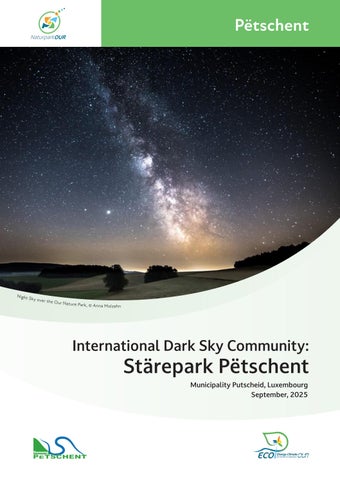
N i g ht
S k y ove
r th e O ur
N a t u r e Pa r k , ©
A n n a M o lz a h n
International Dark Sky Community:
Stärepark Pëtschent Municipality Putscheid, Luxembourg September, 2025
Executive Summary The municipality of Putscheid, nestled in the northern region of Luxembourg within the Our Nature Park, is applying for recognition as a Dark Sky International Community under the designation «Stärepark Pëtschent» (Star Park Putscheid). With its rural charm, minimal light pollution, and a strong commitment to sustainable practices, Putscheid offers an exemplary model for preserving the natural night sky. Putscheid, covering approximately 27.1 km² and home to 1,176 residents, is part of the Our Nature Park, a nature park dedicated to environmental conservation and sustainable tourism. The municipality, which has already made significant strides in light pollution reduction, has implemented a series of lighting management policies to minimize artificial light impacts. These include retrofitting streetlights to shielded LEDs, utilizing dimming capabilities for public lighting, and advocating for responsible private lighting among its residents. As part of its commitment to reducing light pollution, Putscheid has carried out various initiatives, such as a light pollution reduction study, with the help of drone technology and luminance mapping, and the establishment of permanent sky quality measurement tools. The Our Nature Park has also supported these efforts, creating a model for other regions to follow in combating light pollution.
The community is supported by various national and local authorities, including the Mayor of Putscheid, the Minister for Energy, and the Minister for Tourism, all of whom endorse the application. These efforts reflect Putscheid’s ongoing dedication to preserving the natural beauty of its landscapes and protecting its unique night sky, with the broader goal of becoming Luxembourg’s first Star Park. By achieving IDSC certification, Putscheid aims to enhance local biodiversity, reduce energy consumption, and serve as a model for sustainable development and environmental stewardship in the region. The present application is formally submitted based on the International Dark Sky Community (IDSC) Guidelines 2018, which provide the established framework and criteria for recognition, ensuring that the municipality’s measures are aligned with internationally acknowledged standards of night sky protection and sustainable lighting practices. This application was authored by the ECO department of the Syndicate for Development and Management of the Our Nature Park (Syndicat pour l‘Aménagement et la Gestion du Parc Naturel de l‘Our).
Additionally, the municipality has made strides in public outreach through educational programs, events, and a concerted effort to engage the community with campaigns on reducing light pollution. Putscheid also envisions the future development of «Light on Demand» systems to ensure energy-efficient, demand-responsive street lighting, which further aligns with DarkSky International principles.
For more information about the different projects and this application feel free to contact: Mr. GLIEDNER, Daniel Light consultant daniel.gliedner@naturpark-our.lu +352 621 575 263
Mr. HEINZIUS, Fabian Energy and climate consultant fabian.heinzius@naturpark-our.lu +352 621 966 036
We hope that this nomination application meets the requirements of the reader while providing enjoyable and informative read.
2
Adress Number, Street 12, am Parc Municipality Hosingen Postal Code L-9836 Country Luxemburg
LIGHTS OUT! International Dark Sky Community: Stärepark Pëtschent
Table of Contents 1
Scope and Motivation 1.1 Proposal 1.2 Motivation
4 5 6
2 Letter of nomination and letters of support 2.1 Nomination 2.2 Support 2.2.1 2.2.2 2.2.3 2.2.4 2.2.5 2.2.6
Fabienne Sinnes-Huberty, Mayor of Putscheid 7 Emile Eicher, Chairman of the Our Nature Park 9 Lex Delles, Minister for Small and Medium-Sized Enterprises, Minister for Tourism 10 Claude Turmes, Minister for Energy ; Minister for Spatial Planning 11 Fernand Zanter, President of the Syndicat d ’Initiatives Stolzembourg 12 Partnership agreement between SEO and Our Nature Park 13
3 The Our Nature Park and the municipality of Putscheid 3.1 The Grand-Duchy of Luxembourg: A Land of Rich Heritage and Modern Marvels 3.2 The Our Nature Park 3.3 The municipality of Putscheid (Pëtschent) 3.3.1 3.3.2
General description Tourism & Industry
National Street lighting Municipal Street Lighting A video of the adaptive lighting in action can be found here. Private Lighting
5 Measurements of the night sky quality 5.1 Satellite Measurements 5.2 Permanent measure instrument: All Sky Camera 5.2.1
5.3
14 17 21
Telescope Encoder and Sky Sensor
30 30 30 31 38 39
43 43 43 45
Sky quality measurements
46
5.3.1
46
Professional SQM Measurement
6 Education, research and public outreach 6.1 Events 6.1.1
6.2 6.3
14
21 25
4 Community commitment 4.1 Examples of the Application of Lighting Management Policy 4.1.1 4.1.2 1.1.1 4.1.3
6 6 7
49 49
Other Conferences and Events
51
Brochures Articles and other publications
54 56
7 Appendix: A) Lighting Management Policy : original Lighting Management Policy : Translated version B) Lighting Inventory
3
57 57 72 88
International Dark Sky Community: Stärepark Pëtschent
1
Scope and Motivation
1.1 Proposal With the present application, the municipality of Putscheid, is applying for a certification as “INTERNATIONAL DARK SKY COMMUNITY” within the municipal boundaries of Putscheid. Putscheid is a rather small municipality located in between majorly light polluted regions of Europe, within the beautiful country of Luxemburg. A map of central Europe and Luxembourg’s location can be found in the chapter 3.1.
Light pollution map of central Europe with Putscheid int its centre (red pin) Source : Lightpollutionmap
4
International Dark Sky Community: Stärepark Pëtschent
In the event of a successful application, the municipality would like to call itself in Luxembourgish “Stärepark Pëtschent” (English: “Star Park Putscheid”). The municipality covers a territory of approximately 27,1 km² (approx. 10,47 sq mi).
Clervaux
Planned DarkSky Community
Wiltz Vianden Esch/s/Sûre
Diekirch
Echternach
Mersch
Luxembourg
Esch/s/Alzette
Map of Luxemburg showing its legal boundaries with the municipality of Putscheid highlighted. Source: geoportail.lu
5
International Dark Sky Community: Stärepark Pëtschent
1.2 Motivation Due to its countryside location and the relatively low level of light pollution, Putscheid offers great potential for stargazing and observing the night sky. The remote region‘s efforts to minimize artificial lighting also aid in conserving natural darkness, providing glimpses of celestial marvels on clear nights. The letter of support from the municipality’s mayor sums up the motivation of the municipality. Here is an extract from the letter: “Putscheid Commune is blessed with breathtaking natural beauty and a commitment to sustainable development. The commune’s remote location, limited light pollution, and responsible outdoor lighting policies have already made it an appealing destination for nature lovers. By becoming an International Dark Sky Community, Putscheid can take a definitive step towards safeguarding its nocturnal environment and
showcasing its dedication to preserving the night sky. The advantages of being recognized as an International Dark Sky Community are numerous and far-reaching. Preserving dark skies benefits the entire ecosystem, as it reduces the disruption of nocturnal wildlife and protects migratory bird patterns. Moreover, it fosters a sense of wonder and inspiration among residents and visitors, leading to a greater appreciation of nature and the cosmos. The Commune of Putscheid already exhibits a strong commitment to environmental conservation and sustainability. This designation will further enhance the commune‘s reputation as a responsible and forward-thinking community. It will also encourage other neighbouring areas to follow Putscheid‘s lead, thereby creating a ripple effect of dark sky preservation efforts across the region.”
Symposium “Gutes Licht” (English: good light) as part of the NIGHT, Light & more festival program. Text on Screen: Let's switch the night back on!
6
International Dark Sky Community: Stärepark Pëtschent
2
Letter of nomination and letters of support
2.1 Nomination
Dr. Andreas Hänel
7
International Dark Sky Community: Stärepark Pëtschent
2.2 Support 2.2.1 Fabienne Sinnes-Huberty, Mayor of Putscheid
8
International Dark Sky Community: Stärepark Pëtschent
2.2.2 Emile Eicher, Chairman of the Our Nature Park
9
International Dark Sky Community: Stärepark Pëtschent
2.2.3 Lex Delles, Minister for Small and Medium-Sized Enterprises, Minister for Tourism
10
International Dark Sky Community: Stärepark Pëtschent
2.2.4
Claude Turmes, Minister for Energy ; Minister for Spatial Planning
11
International Dark Sky Community: Stärepark Pëtschent
2.2.5
Fernand Zanter, President of the Syndicat d ’Initiatives Stolzembourg
12
International Dark Sky Community: Stärepark Pëtschent
2.2.6
Partnership agreement between SEO and Our Nature Park
The partnership agreement below states: This award confirms that the partner demonstrates a strong commitment to sustainable regional development and is committed to protecting and enhancing the natural, cultural and intangible heritage of the region.
13
International Dark Sky Community: Stärepark Pëtschent
3
The Our Nature Park and the municipality of Putscheid
3.1 The Grand-Duchy of Luxembourg: A Land of Rich Heritage and Modern Marvels Nestled in the heart of Europe, the Grand Duchy of Luxembourg is a small yet captivating country that embodies the spirit of timeless charm and contemporary progress. With a history stretching back centuries, Luxembourg is a testament to resilience and cultural diversity. Its picturesque landscapes, stunning architecture and thriving economy make it a truly unique destination worth exploring. Luxembourg‘s history is a complex tapestry of conquests, alliances, and territorial shifts. Beginning
as a medieval fortress and emerging as a prominent European power in the 17th century, the country has witnessed the rise and fall of empires. It was once the centre of the powerful House of Luxembourg, which produced notable figures such as Holy Roman Emperor Charles IV. Throughout the centuries, various European powers have governed Luxembourg, resulting in an inheritance of castles, fortified walls, and historic monuments. The UNESCO World Heritage site, iconic Luxembourg
Map of Central Europe, Luxembourg encircled Source: Google Maps
14
International Dark Sky Community: Stärepark Pëtschent
City, is a living proof of its affluent history. Its striking fortifications, elegant bridges, and picturesque casemates recount tales of a long-gone era. Despite its small size, Luxembourg is a melting pot of cultures and languages. It embraces three official languages: Luxembourgish, French, and German. This linguistic diversity reflects the country‘s cosmopolitan character and fosters a sense of openness and inclusiveness.
Luxembourg boasts a thriving and multifarious cultural scene featuring a vast selection of museums, art galleries, and theatres. The renowned Philharmonie Luxembourg draws music enthusiasts worldwide to its exceptional performances. The cultural calendar showcases festivals celebrating music, film, and the culinary arts, affording visitors the opportunity to indulge in the country‘s cultural richness. Luxembourg possesses not only an abundance of historical and cultural riches but also breathtaking natural beauty. Its rolling hills, dense forests and meandering rivers create a picturesque landscape that attracts outdoor enthusiasts. The Mullerthal Region, aptly nicknamed „Luxembourg’s Little Switzerland,“
Panoramic view of Luxembourg city‘s Grund and its fortifications (UNESCO world heritage), at dusk, in Luxembourg. © Joshua Schoos / Ville de Luxembourg
15
International Dark Sky Community: Stärepark Pëtschent
amazes visitors with its stunning rock formations, richly mossed woodlands, and scenic trails leading to unparalleled vistas. The Moselle Valley, famous for its vineyards, offers visitors an opportunity to indulge in the finest wines while admiring the picturesque countryside. The country has an intricate network of hiking and cycling trails, allowing explorers to enjoy its scenic beauty at a relaxed pace. Luxembourg is not only known for its history and scenic beauty, but also for its remarkable global economic influence. The country‘s strategic positioning and business-friendly climate have propelled it to become a financial hub and international trade centre. With a steady economy and low taxation, the nation has allured multiple multinationals and institutions, thus substantiating its prosperity.
As a founding member of the European Union, Luxembourg has a crucial role in shaping Europe‘s affairs. It hosts various significant EU institutions, including the European Court of Justice and the European Investment Bank, ensuring its continued influence in the continent‘s political landscape. In conclusion, Luxembourg blends its rich historical heritage with modern advancements. The country boasts picturesque villages, magnificent castles, and lush landscapes that exude a fairy-tale charm. Additionally, the thriving economy and global significance of Luxembourg showcase its progress and standing on the international stage, making it a country of contrasts and harmonies. Visitors are invited to explore the diverse offerings and experience the timeless allure of this unique country.
Geosite Huel Lee in Berdorf, © Raymond Clement
16
International Dark Sky Community: Stärepark Pëtschent
3.2
The Our Nature Park
The Our Nature Park is a designated area located in northern Luxembourg. It is one of the three nature parks in the country, alongside the Upper Sûre Nature Parc and the Natur- & Geopark Mëllerdall. Established in 2005, its goal is to preserve and promote the region‘s cultural and natural heritage.
The Our Nature Park is situated in the northernmost part of Luxembourg, bordering Belgium and Germany. It covers an area of approximately 491 square kilometers, encompassing a diverse range of landscapes, including forests, meadows, rivers, and quaint villages.
Map of the Our Nature Park member municipalities, colored in green. Source: Our Nature Park
17
International Dark Sky Community: Stärepark Pëtschent
Lycaena phlaeas, spotted in the Our Nature Parc, © Raymond Clement
The park‘s diverse habitats sustain a thriving range of plant and animal life. Its woodlands house an assortment of arboreal species, including beech, oaks, and pine. The River Our and its tributaries furnish crucial aquatic habitats and act as a vital passageway for migratory species. The meadows and grasslands in the nature park accommodate a diverse range of floral and plant varieties, drawing in pollinators such as bees, butterflies, and other species. Additionally, the varied habitats offer nourishment and refuge for multiple animal species, including deer, foxes, wild boar, and various bird species.
The Our Nature Park is esteemed not only for its scenic splendour but also for its cultural significance. The area features charming villages, historical sites, and classic farm steads that offer insight into the countryside‘s traditions and history. Numerous locales have been diligently preserved as a reminder of the region‘s cultural legacy. The Our Nature Park provides visitors with an array of outdoor pursuits to appreciate and experience the region‘s natural splendour. The park has extensive hiking and cycling paths that traverse its scenic landscapes and picturesque towns. Additionally, guided nature excursions and educational programs are offered to raise awareness about the park‘s distinct ecosystems and conservation initiatives.
18
International Dark Sky Community: Stärepark Pëtschent
The Our Nature Park is dedicated to fostering sustainable tourism and safeguarding its natural resources. To this end, the park works closely with local communities, stakeholders, and environmental organizations to execute conservation measures and promote the responsible utilization of its natural assets. In line with this mission, the park maintains an intercommunal approach based on solidarity and cooperation, engaging actively with local partners and stakeholders. Over recent years, the Our Nature Park has grown to employ 29 staff members and now operates in dedicated departments, including the ECO Unit.
The ECO department (Energy Climate Our), established in 2021, is committed to climate protection by standardizing regional measures and acting as a local contact point for climate-related inquiries. Among other responsibilities, the ECO department supports the processes of the Climate Pact, engages in interregional and national dialogue, and serves as an advisory centre for municipalities on climate projects. By aligning with the Climate Pact, the Our Nature Park and its member municipalities aim to achieve both EU and Luxembourg national climate protection targets at a regional level. The ECO department also prioritizes reducing light pollution, a key aspect of its climate strategy.
“Ourtalschleife” in Bivels, © Raymond Clement
19
International Dark Sky Community: Stärepark Pëtschent
In combining efforts to combat light pollution with climate change mitigation, the ECO team was formed in 2021, supporting these objectives within the nature park’s framework.
For more information about the Our Nature Park, visit the following website: www.naturpark-our.lu .
ECO-Team of the Our Nature Park. © Patricia Lefèber
20
International Dark Sky Community: Stärepark Pëtschent
3.3 The municipality of Putscheid (Pëtschent) 3.3.1
General description
Key Data :
Putscheid is a small locality in the north of Luxembourg which is one of the municipalities within the Diekirch district and comes under the jurisdiction of the Canton of Vianden. The settlement sits amidst charming landscapes of the Ardennes region, enveloped by lush woodlands, undulating hills, and winding waterways. Putscheid covers an area of approximately 27 square kilometers and boasts a tranquil natural landscape. The municipality is near the borders of Germany and Belgium, allowing for convenient exploration of crossborder regions and attractions.
Number of Inhabitants
1.176
Area
27,1 km² (Approx. 10,47 sq mi)
Population density
43 inhabitants / km²
Altitude
220 – 550 metres above sea level
Total installed power for public lighting
4.334 W
Satellite picture (© geoportail.lu) of Putscheid
21
International Dark Sky Community: Stärepark Pëtschent
Within the district of Putscheid, seven attractive villages can be found throughout the landscape. These quaint villages retain their rural character and traditional architecture, offering visitors an authentic glimpse into the rural life of the region. The villages are immaculately maintained, with several showcasing historic buildings, village squares, and tranquil streets.
The villages of Putscheid and Stolzembourg are described below as examples to give the reader a better impression of the municipality of Putscheid.
7 villages
MERSCHEID Mierschent BIVELS NACHTMANDERID E H C S G R U O B M E STOSLtZolzebuerg GRALINGEN Groljen PUTSCHEID WEILER Pëtschent Weller 2 „Lieu-dit“
Poul
G ro e s t a e n
22
International Dark Sky Community: Stärepark Pëtschent
The Village Putscheid Putscheid first appears in official records in 1502 under the name „Putscheyt“. The name Putscheid describes a place in a clearing near a spring or well. During the feudal period, Putscheid, together with Stolzembourg, was subordinate to the lords of Stolzembourg, Clervaux, Brandenbourg and Bourscheid. For some years now, Putscheid, the municipality‘s administrative centre, has been the smallest village in the municipality of Putscheid and the smallest administrative centre in the Grand Duchy of Luxembourg.
In the 1980s, Putscheid was home to around twenty people, with an average age of 55. Today, 130 people live here, with an average age of 22. This change is mainly due to the completion of the „Neit Wunnen“ ecological housing estate.
P U T S C H E ID Pëtschent
The village of Putscheid. ©municipality of Putscheid
23
International Dark Sky Community: Stärepark Pëtschent
The Village Stolzembourg This old postcard gives the reader a good impression of what Stolzembourg looks like. Stolzembourg is located in the charming valley of the Our, 6 km upstream from the tourist town of Vianden. The varied landscape invites all nature lovers to walk through vast forests and narrow valleys. In the village, the bell tower was built before 1585 and the church bear witness to the long history of the village and its parish. The castle itself lies on a rise in the village centre. For the first time, the castle was destroyed by the governor Antoine Croy in 1454, and in 1679, a second
time, by the troops of Louis XIV. It was rebuilt in 1898 in the Scottish style. Today, the castle is privately owned. Description of Stolzembourg as described on the website of the “Syndicat d’ Initiative Stolzembourg”: https://www.stolzembourg.lu/stolzembourg-tourism/
STOLZEMBOgURG Stolzebuer
Old postcard showing the village of Stolzembourg Source: https://www.stolzembourg.lu/stolzembourg-tourism/
24
International Dark Sky Community: Stärepark Pëtschent
3.3.2
Tourism & Industry
Putscheid is a delightful municipality in Luxembourg, where the beauty of nature intertwines with a rich cultural heritage. With its charming villages, diverse outdoor activities, and serene landscapes, Putscheid beckons travellers seeking an authentic and tranquil escape in the heart of the Ardennes. Whether exploring the wooded trails, embracing local traditions, or simply soaking in the peaceful ambiance, Putscheid offers a unique and refreshing experience in this beautiful corner of Luxembourg.
Putscheid‘s picturesque situation renders it an ideal spot for those keen on outdoor pursuits. The encompassing forests and rural landscapes present a plethora of chances for trekking, cycling, and nature strolls. Four official hiking paths (up to 15 km) invite to discover nature. The adequately demarcated paths facilitate visitors to discover the scenic allure of the Ardennes, and the innate serenity of the region makes it a flawless haven for those in pursuit of leisure.
The OURDALL Promenade / Map of the 35 km long cycling path in and around Putscheid
25
International Dark Sky Community: Stärepark Pëtschent
The Copper Mine 1.5 km away from Stolzembourg are the remains of the former copper mine. For more than 500 years, the copper-bearing veins of the „Klangbaach“ have attracted several investors to Stolzembourg, although it is far from any industrial district. The geological path permits the evaluation of the remains by putting back the mining site in its historical, geological and environmental state. In recent years, a part of the underground galleries has been made accessible to the public. 50 meters below ground, the visitors learn about the difficult degradation of the copper ore. Today, the copper mine is open for guided tours from Easter to the end of October. The visit includes access to a museum, which provides information about the region‘s geology, the mine‘s history, and the various mining periods. Between the museum and the copper mine is a geological trail which was recently renovated.
Map and picture of the copper mine © Syndicat d‘Initiative Stolzembourg
26
International Dark Sky Community: Stärepark Pëtschent
The entrance and the inside of the copper mine. © Syndicat d ‘Initiative Stolzembourg
27
International Dark Sky Community: Stärepark Pëtschent
Pumped-storage power plant The natural conditions offered by the Our valley enabled the construction of a pumped-storage power plant capable of storing excess energy and generating the energy that is lacking. On 29th May 1951, the Société Electrique de l‘Our S.A. (SEO), was formed upon the initiative of the government of Luxembourg. At times when consumption is low, e.g. at night, with the surplus energy of the base-load power plant, water is pumped from the lower basin to the upper reservoir. At times when demand increases, the stored water is drained via turbines.
With a total output of 1.300 MW in turbine mode and 1.040 MW in pump mode, the Vianden pumped storage power plant is the second largest in Europe, stabilizing the european interconnected power grid, trough the quick reactivity Even though the production headquarters are in the neighbouring municipality (Vianden), the visitor centre is in the municipality of Putscheid. The visitors‘ gallery and underground power station can be visited on demand.
Pumped-storage power plant now and then Power Station © SEO
28
International Dark Sky Community: Stärepark Pëtschent
Wind Park Pëtschent – Housen Not only hydropower but also wind power is used in the region of the Our Nature Park and therefore also in the municipality of Putscheid. The company SOLER operates a wind farm with a total production capacity of 16,7 MW on the territory of the municipality of Putscheid and the neighbouring municipality of Parc Hosingen.
Wind Park Housen-Pëtschent S.A. 4x Enercon E115 High of 135 meters Rotor diameter 115 meters Power 3 MW 2x Enercon E 92 High of 138 meters Rotor diameter 92 meters Power ,35 MW Total power of 16,7 MW producing 35,9 Milliounen kWh ~ 8000 households Which leads to a CO2 savings of 23.500 tons per year
www.soler.lu
Wind turbine in the municipality of Putscheid © SOLER
29
International Dark Sky Community: Stärepark Pëtschent
4
Community commitment
4.1 Examples of the Application of Lighting Management Policy 4.1.1
be in 2.200 K, to reduce light pollution, protecting wildlife, supporting human health, accepting a higher energy consumption of approximately 15% compared to 3.000 K LED.
National Street lighting
For the purposes of clarity and comprehension, it is essential to understand that in Luxembourg, the responsibility for public street lighting is divided between two principal entities: The lighting of roads of national importance is the responsibility of Ponts et Chaussées, while the lighting of municipal roads is the responsibility of each municipality. As Ponts et Chaussées is a national institution, the country-wide standards established by this entity are applied to all national roads. This results in the use of 3.000 K LED lighting. However, with the support of the former Minister for Energy and Spatial Planning, the municipality of Putscheid was able to negotiate with Ponts et Chaussées that all future new or retrofit lighting would
2025
SON-T* 70W
SON-T 100W
Corr. Color Temperature
20002200K
20002200K
Power in W
88
120
3
31
LED 30W
To avoid conferring an advantage on any particular municipality, the national lighting of one municipality is not replaced in its entirety at one time, but rather in discrete blocks, with each municipality receiving replacement lighting in a staggered fashion. In accordance with this approach, Ponts et Chaussées initiated the replacement of public lighting in 2019, which has resulted in the current situation outlined in the table below. From 2019 to the end of 2022, Ponts et Chaussées replaced 93 streetlights with fully shielded LEDs (3.000 K), representing 34% of the municipal street lighting owned by Ponts et Chaussées. In July 2023, Ponts et Chaussées presented an update on the ongoing replacement program:
LED 30W
730/3000K 830/3000K 33
33
LED 40W
LED 40W LED 40W
730/3000K 830/3000K 44
44
Total
2200K 44
Quantity: Bivels
6
5
Gralingen
36
Merscheid (Putscheid)
20
Nachtmanderscheid
7
8
Poul
21
Putscheid
18
Stolzembourg
8
23 30
Stolzembourg Centrale SEO
39
Weiler (Putscheid)
14
Total Amount (pcs)
29
61
8
6
79
7
58 21
275
Total Power (W)
2.552
7.320
264
198
3.476
308
2.552 924
17.594
*SON-T: Tubular High Pressure Sodium Discharge Lamp
30
International Dark Sky Community: Stärepark Pëtschent
Ponts et Chaussées has indicated its intention to replace the old SON-T lamps with 2.200 K LEDs commencing in 2026. As evidenced in the table, all lighting owned by Ponts et Chaussées is already within the 3.000 K range or below.
4.1.2
Municipal Street Lighting
To comply with the lighting management plan, multiple upgrading projects have been executed in the municipality over the past few years. Further projects are currently in the planning stages. The following two examples illustrate the completed relamping/ upgrading projects. Relamping Projects: Gralingen The first village to benefit from the changeover to LEDs was Gralingen. This campaign was launched by the state authority Ponts et Chaussées, which, as described above, is responsible for the national roads (e.g. „Rue Principale“). The municipality has joined the campaign and at the same time refurbished the lighting on the municipal roads. The recently installed municipal road lighting is equipped with automatic dimming functionality. This dimming capability was pre-programmed at the factory.
The village of Gralingen Source: Google Maps
Up to +- 2019
From +- 2020 National Road
SHP-T* 100 W
Thorn Isaro Pro
115 W
40 W
2.000 K
3.000 K
10.700 lm
4.639 lm
16.000 h of usage
> 100.000 h of usage Municipal Road
SHP-T* 70 W
Thorn Isaro Pro -
85 W
19 W
2.000 K
2.700 K
6.500 lm
2.770 lm
16.000 h of usage
> 100.000 h of usage
*SHP-T : Tubular High Pressure Sodium Tubular Lamps
31
International Dark Sky Community: Stärepark Pëtschent
Profil de dimming programmé suivent demande client : Allumage - 20h00 :
100%
20h00 - 23h00:
70 %
23h00 - 06h00:
35 %
06h00 - 07h00:
70 %
07h00 - extinction:
100%
Dimming profile of municipal lighting in Gralingen Source: Invoice from Kaufmann & Bissen
By the conclusion of 2022, the municipality of Putscheid, in collaboration with Ponts et Chaussées, had resolved to extinguish all illumination between the hours of 1 a.m. and 4:30 a.m. Consequently, the previously described dimming profile is no longer wholly accurate with respect to the specified time frame.
landscapes by identifying and mitigating excessive artificial light sources.
Aerial Night Flights for Light Pollution Assessment: Methodology and Purpose To evaluate the impact of lighting infrastructure upgrades on light pollution, the company xirrus GmbH was commissioned to conduct measurements in the villages of Nachtmanderscheid and Gralingen. This initiative was part of the Naturpark Our‘s broader engagement in the European INTERREG project Night Light, which aims to preserve the integrity of nocturnal
Comparative measurements were carried out before and after the lighting upgrade using a commercially available drone (DJI Phantom 4), equipped with a precalibrated luminance camera. Calibration was achieved through reference to known light sources previously measured with a professional luminance meter (Gossen Mavospot-2). A Lambertian light panel (Dörr LT-6060) served as a ground-based calibration reference during each flight and was included in every captured image to ensure measurement accuracy. Images taken during the flights were analysed by identifying the top 95% of the brightest pixels and calculating their average luminance, resulting in absolute brightness values. These values enabled a direct comparison of the lighting conditions before
Retrofitted fixtures in Nachtmanderscheid Source: Google Maps
32
International Dark Sky Community: Stärepark Pëtschent
Retrofitting an existing lighting fixture with a downwards inclined metal bracket to achieve ULR = 0% © Daniel Gliedner
and after the intervention. From the aerial images, semi-automated light emission maps were produced, including High Dynamic Range (HDR) representations that accurately depict luminance gradients. Additionally, false-colour RGB visualizations were used to facilitate the interpretation of spatial light distribution. The comparison revealed a significant reduction in light pollution following the lighting upgrade in Gralingen, with emissions decreasing by approximately 40%. This measurable improvement highlights the effectiveness of targeted lighting interventions in minimizing artificial skyglow. In addition to drone-based measurements, satellite data from the Suomi NPP were used to identify areas that appeared anomalously bright during new moon Up to 2019
phases—specifically, those exceeding three-quarters the brightness of a full moon. While some bright spots could be directly linked to known sources, others required on-site inspections to determine their origin. Based on these findings, the report outlines recommendations for further mitigation efforts and provides a foundation for discussions with stakeholders responsible for excessive illumination. In order to select an energy-efficient LED that remains within the low blue-light „warm white“ spectrum of light colours, an LED with a colour temperature of 3.000 K was chosen. The following table provides a comparative overview of the characteristics of the existing and the new lighting system.
From 2020
SHP-T 70 W
Lightronics MAK LEDWELL2
85 W
11,7 W
2.000 K
3.000 K
6.500 lm
1.800 lm
16.000 h of usage
> 100.000 h of usage
Dimming profile of municipal lighting in Gralingen Source: Invoice from Kaufmann & Bissen
33
International Dark Sky Community: Stärepark Pëtschent
It is crucial to note that the existing light pole is not compatible with the objective of reaching ULR = 0%, as the lighting fixture has a 15°upwards tilt which is non adaptable. This particular type of street lighting is unfortunately quite specific and prevalent in Luxembourg, particularly in rural areas. The municipality of Putscheid still has approximately 70 poles in use. Considering the adverse environmental impact of these poles during their production and the high value placed on them by the inhabitants the municipality of Putscheid, the decision was taken not to replace them, even though they do not reach the desired ULR = 0%. To achieve this objective, the lighting fixture was modified. A “minus” 15-degree metal bracket was incorporated into the fixture to offset the 15-degree tilt of the lampshade.
Retrofitting an existing lighting fixture with a downwards inclined metal bracket to achieve ULR = 0% © Daniel Gliedner
34
International Dark Sky Community: Stärepark Pëtschent
Re-lamping Projects: Area - wide upgrading of the municipal lighting system In the period after the two retrofit projects previously described, the initial discussions commenced regarding the comprehensive upgrading of the municipality‘s lighting to achieve Dark-Sky conformity. The definitive decision was taken in 2022. The tender documents explicitly delineated the following criteria: Criteria
Functional lighting
Decorative lighting
ULR
< 0,5 %
< 0,5 %
CCT
2.200 K
2.200 K
Ra(CRI)
Minimum 70
Minimum 70
Efficiency
>100 lm/W
>100 lm/W
Off-peak adaptation
between 0% and 100%.
between 0% and 100%.
In the event of failure, the LED module is easily accessible and interchangeable
In the event of failure, the LED module is easily accessible and interchangeable
2W maximum
2W maximum
Service life
L80B10 after 90,000h
L80B10 after 100,000 h
Interface
2 Zhaga connectors Dali driver
2 Zhaga connectors Dali driver
LED module
Stand-by power
The following luminaire was installed for the functional lighting:
Installed functional lighting in the municipality with corresponding polar distribution curve
35
International Dark Sky Community: Stärepark Pëtschent
The following luminaire was installed for the decorative lighting:
Installed decorative lighting in the municipality with corresponding polar distribution curve
The municipal-wide re-lamping project is now in its final stages, with most luminaires already installed and operational. The luminaires were equipped with Zhaga connectors and DALI drivers, thus most of the hardware for the forthcoming „light on demand“ project is already in place. Adaptive Lighting
Pilot project Light on Demand (Outlook)
Two significant alterations to the municipal approach to street lighting have been introduced following the completion of the upgrading projects in Gralingen and Nachtmanderscheid.
In Luxembourg, the duration of darkness is approximately 4,200 hours per year, during which the street lighting infrastructure is operational. This is regardless of whether light is actually required. In some municipalities, the street lighting infrastructure has been switched off between 1 a.m. and 4:30 a.m. at the end of 2022 until today.
•
•
Dimming: The state-owned street lighting is dimmed by 30% (emitting only 70% of its initial value) between the hours of 10 p.m. and 5 a.m. The municipality-owned street lighting is dimmed in accordance with the above-described regimes. Night Shut-Off: The municipality of Putscheid was among the first to adopt the Ministry of Energy‘s night-time switch-off of street lighting, which was implemented at the end of 2022. Since then, all street lighting has been shut off between 1 a.m. and 4:30 a.m.
The project involves the conceptualization of a sustainable transformation of street lighting in the municipality of Putscheid, with the objective of implementing demand-responsive lighting systems. This approach guarantees that illumination is only provided when required, thereby optimizing energy consumption. A comprehensive analysis will be undertaken to ascertain the optimal times and conditions for street lighting, integrating technologies such as motion sensors and smart control systems. Test installations in the Our Nature Park area have demonstrated the potential for significant energy savings through demand-based lighting over the past
36
International Dark Sky Community: Stärepark Pëtschent
three years. These installations have shown that with an optimal design, approximately 70 to 90% of the burning hours can be saved if the lighting is demandbased.
comprehensive community engagement activities to gather feedback from residents, address their concerns, and ensure their support. This will involve public consultations, surveys, and information campaigns to educate the inhabitants about the benefits of demand-responsive lighting and how it contributes to sustainability goals.
This initiative will consider several key factors, including public acceptance, nature conservation, energy efficiency, and the reduction of light pollution. Public acceptance is a crucial factor in the success of this project. To conclude, the project will include
The following budget table provides an overview of the upcoming tasks.
Description / €
Phase 1 20232024
Phase 2 20242025
Phase 3 End of 2025
Total
Infrastructure Technical upgrade of municipal streetlights with communication and sensor modules in the seven villages of the municipality of Putscheid (196 light points)
60.000
-
-
60.000
Installation of municipal control cabinets equipped with a gateway for autonomous demand control of lighting (1 per village)
40.000
-
-
40.000
15.000
-
-
15.000
Training for operators
-
5.000
-
5.000
Monitoring and optimization of the system during operation
-
5.000
-
5.000
Monitoring the impact of optimization measures with regard to light pollution
-
-
5.000
5.000
Municipal, regional, and national communication of actions and results (editing, layout, printing costs, presentations, visits, etc.)
-
-
5.000
5.000
Activities to raise public awareness
-
-
2.000
2.000
100.000
25.000
12.000
137.000
External Consulting and Experts Professional planning network design engineering costs project setup
Communication
Total
37
International Dark Sky Community: Stärepark Pëtschent
The project benefits from 50% co-funding from the Luxemburgish Ministry of the Environment, Climate and Biodiversity By the end of 2024, 40% of the existing lighting has been upgraded to the Light on Demand system, and it is expected that the upgrade will be completed by mid-2025. Some villages have already been completed,
and the first conclusions can be drawn: for example, in the village of Weiler, it can be shown that in the first 30 days, 85% of the energy was saved, which means that only 15% of the working hours the lights were switched on. This is shown in this extract from the lighting management tool.
Extract from the light on demand management tool
Figure Legend: The blue bars represent the current energy consumption, while the green bars indicate the corresponding energy savings. The black curve illustrates the percentage savings relative to the total energy usage which are constantly above 80%. A video of the adaptive lighting in action can be found here.
38
International Dark Sky Community: Stärepark Pëtschent
4.1.3
Further information and a brochure on the topic can be found at: https://www.liichtberodung.lu/de/documents
Private Lighting
Inhabitants – new buildings The requirements for the private lighting systems of Putscheid’s residents are listed in the Lighting Policies. In principle, every private developer receives an explanation of these requirements when collecting a building permit and is verbally reminded of the most important requirements for residents: •
•
•
Demand control should be implemented via motion sensors or timers and operating times should be restricted. Uplights must be avoided as they contribute directly to brightening the sky and disturb the night-time rest of flora and fauna in green areas. The light colour of each light source must be equal or below 3.000 K.
Thank you for your help and we look forward to a clear starry sky! With kind regards Your municipal administration Industry : SEO There is currently only one company in Putscheid that operates outdoor lighting: SEO is the operator of the pumped-storage power plant. The employee and visitor car park, as well as the outdoor facilities are illuminated.
Inhabitants – existing buildings Now that the municipality has implemented the projects described above and can set a good example, the involvement of private individuals should be increased. Several articles and events are planned specifically for the municipality of Putscheid. With the upcoming campaigns tailored to the inhabitants of the municipality of Putscheid, we hope to be able to report on upgrading successes in lighting of private households in the activity report. Here is an example of an appeal that was recently sent to all households (translated into English): Dear fellow citizens, Our municipality is planning to apply to become Luxembourg‘s 1st star park in order to protect the night sky and preserve the natural light conditions. A star park is an area where the night sky is particularly dark and therefore ideal for observing the stars. This park will not only be a place of peace and wonder but will also contribute to the preservation of biodiversity and natural biorhythms. We are asking for your support so that we can successfully realize this project. Please only install star park-friendly outdoor lighting in the future. This is characterized by warm, downward-directed light and causes little or no light pollution. In this way, together we can help to preserve the starry sky above our municipality and enjoy the beauty of the night.
Aerial view of the SEO production site at day and night ©: Google Maps / xirrus GmbH
39
International Dark Sky Community: Stärepark Pëtschent
In 2020, SEO undertook a project to replace its outdoor lighting with LED technology in collaboration with the national lighting consultant Daniel Gliedner.
At this juncture in the project, procuring new luminaires would have been an inefficient use of resources.
A comprehensive lighting master plan was developed for the site in this regard.
To reduce the impact of the incorrect coloured LEDs, the decision was taken to dim the light as much as possible outside the working hours.
It is regrettable that the SEO had already purchased 4.000 K LEDs prior to consulting with the Our Nature Park.
All luminaires are dimmed to a minimum of 10% of their nominal output during nocturnal hours (22:30–5:00), with some reaching as low as 5%.
The following table provides an overview. Placement
Count Mounting
Type
Dimming %
Off-Peak hours
Feuerwehrgebäude
5
Wandmontage
Philips Decoflood
BVP636 64LED-HB/ NW DW AL 4000K
10
22:30h - 5h
Einfahrt zum Zufahrtsstollen 1
2
Wandmontage
Philips Speedstar
BGP322 T35 GRN881740 DW
10
22:30h - 5h
Parkplatz Nähe Zufahrt
6
Mastmontage Ansatz Philips
20
22:30h - 5h
Parkplatz hinter Verwaltungsgebäude
2
Mastmontage Ansatz Philips Speedstar
BGP322 T35 GRN881740 A
5
22:30h - 5h
Parkplatz hinter Verwaltungsgebäude
1
Wandmontage
Philips Speedstar
BGP322 T35 GRN881740 A
5
22:30h - 5h
Belüftungsstollen
2
Wandmontage
Philips Speedstar
BGP321/BGP322GRN88-2S740
10
22:30h - 5h
Trafostollen
2
Wandmontage
Philips Speedstar
BGP321/BGP322GRN88-2S740
10
22:30h - 5h
Auslaufbauwerk M11
5
Mastmontage Ansatz Philips Speedstar
BGP323 GRN1852S740 159W 4000K
10
22:30h - 5h
Eingang M11
2
Mastmontage Ansatz Philips Speedstar
BGP323 GRN1852S740 159W 4000K
10
22:30h - 5h
Zufahrtsstollen 2
2
Wandmontage
Philips
10
22:30h - 5h
Gebäude Baukolonne
3
Wandmontage
Philips
10
22:30h - 5h
Gebäude Baukolonne
2
Mastmontage Ansatz Philips
10
22:30h - 5h
Gebäude Baukolonne Treppe Bergseite
1
Wandmontage
Philips
10
22:30h - 5h
Zufahrtsweg Baukolonne zur Garage
2
Mastmontage
Philips
10
22:30h - 5h
Abfahrtsweg Baukolonne Ecke M-Werkstatt
2
Mastmontage
Philips
10
22:30h - 5h
Abfahrtsweg Baukolonne Weg mitte
1
Mastmontage
Philips
10
22:30h - 5h
Abfahrtsweg Baukolonne Weg unten
1
Mastmontage
Philips
10
22:30h - 5h
Parkplatz gegenüber Verwaltungsgebäude
3
Mastmontage Ansatz Philips
10
22:30h - 5h
Speedstar
40
International Dark Sky Community: Stärepark Pëtschent
In addition to the primary site, SEO has a second outdoor area where an additional turbine is operational.
Although the site in question is already situated within the boundaries of the neighbouring municipality, it is nevertheless pertinent to provide a concise description of the measures implemented therein, as they serve to illustrate the commitment of the company based in Putscheid. To reduce the effects of light pollution, SEO has decided to renovate the street lighting on the access road to Machine 11 on its own initiative. The recently installed LED luminaires were equipped with Zhaga communication modules and two motion detectors, one situated at the commencement of the street and the other at its conclusion. The installation of a central control system at the light points was financed entirely by SEO with the objective of protecting the surrounding natural environment. There was no standard or national requirement that necessitated this action; the initiative was inspired by the Our Nature Park. It is estimated that the lighting system is operational for less than 365 hours per year due to the motion detectors.
Picture: Map of SEO locations Source : https://www.seo.lu/Kontakt/Kontakt
Access road to machine 11. © Daniel Gliedner
41
International Dark Sky Community: Stärepark Pëtschent
Outlook for SEO: The efficacy of this solution is currently being evaluated, as illustrated in the photograph below. The filters were affixed to the interior surface of the cover glass. The light colour was thus reduced to 2.000 K.
As previously stated, the CCT of the luminaires utilized by SEO does not align with the DarkSky International guidelines. To comply with those, the SEO company and the Our Nature Park are currently looking into retrofitting the existing light fixtures with coloured filters from the entertainment industry, or coloured lenses.
Together with SEO, we aim to convert all luminaires to be Dark Sky compliant within the next five years, that is, by 2030 — either through the complete replacement of fixtures purchased over the past ten years or, in extreme cases, by using color filter film.
Colour Adaptation of an existing LED – Lamp © Daniel Gliedner
This solution hasn’t been employed yet on a large scale, we are working on it!
42
International Dark Sky Community: Stärepark Pëtschent
5
Measurements of the night sky quality
5.1 Satellite Measurements The „Radiance Light Trends“ application provides a convenient platform for users to select a region or site and analyze trends in light emissions detected by satellites since 1992. The web application was developed under the guidance of Dr. Christopher Kyba of the German Research Centre for Geosciences (GFZ)
in Potsdam, Germany. The app was developed as part of the GEOEssential project, which is funded by the European Union‘s Horizon 2020 program. The trend line indicates a reduction in radiant flux of between six and nine percent per annum.
Light trends chart for the area of the municipality of Putscheid. Source: Lighttrends
5.2 Permanent measure instrument: All Sky Camera On Monday 25 September, the Our Nature Park inaugurated Luxembourg‘s first ‚All Sky‘ camera. This innovative technology offers a fascinating insight into the night sky and promises to enhance our comprehension of the universe. In addition to the customary meteorological observations, the camera also furnishes clear, highresolution images of the entire night sky above the Nature Park. In conditions of optimal transparency, the camera can discern a multitude of astronomical phenomena, including the configuration of the
constellations, the trajectory of the Milky Way, and the positions of the planets. The system is employed for the purpose of monitoring the brightness of the sky, thereby facilitating longterm observation of the extent of light pollution. Concurrently, the system enables more precise identification of artificial light sources through photographic means. Furthermore, the images can be utilized to identify transient phenomena such as satellites and meteors.
43
International Dark Sky Community: Stärepark Pëtschent
Daniel Gliedner and Claude Turmes, former Minister for Energy and Spatial Planning © Liz Hacken September 25, 2023
The All Sky camera made it possible to capture the rare occurring event of an aurora borealis. The project is funded in equal parts by the Ministry of the Environment, Climate and Biodiversity and the Our Nature Park.
Aurora Borealis captured by the All-Sky Camera Putscheid on Mai 10, 2024
44
International Dark Sky Community: Stärepark Pëtschent
5.2.1
Telescope Encoder and Sky Sensor
The data was downloaded and imported into Excel for more detailed analysis. Completely or partially clear nights around the new moon were selected to derive the zenith brightness. Clear nights can be selected by the uniform trend of sky brightness, see figure below.
In conjunction with the All Sky camera, a TESS (Telescope Encoder and Sky Sensor) was installed, which is designed to continuously monitor sky brightness, ambient conditions, and sky temperature. The data can be consulted here. After a full year of measurement, an assessment was written by Doctor Andreas Haenel.
As can be seen in the figure above, the sky brightness decreases during the night by about 0.2 - 0.3 mag/ arcsec² due to the shutdown, with the darkest values measured after midnight.
The data of the TESS-W Stars938 for the year 2024 till mid Dec 2024 from the https://tess.dashboards.stars4all.eu
The values for clear moonless nights in 2024 are shown in the table below. The darkest nights have been observed in spring when the Milky Way is low in the sky. date 2024
Zenith sky brightness between 8 – 14 May, 2024 (new moon was on 8th May), the time scale is Central European Summer Time (CEST). The uniform trend of the nights 8/9, 9/10 and 11/12 indicate clear nights, while the night 10/11 was cloudy. Zenith sky brightness (in mag/arcsec²) of clear partial or total dark nights in 2024 as measured with the TESS-W Stars938, time is given in Ventral European Time (CET).
45
time [CET]
mag
10.1
03:50
20.98
11.1
04:20
20.90
7.3
02:40
21.22
8.3
02:55
21.23
10.4
00:50
21.28
11.4
01:30
21.30
9.5
01:30
21.38
10.5
01:30
21.38
8.6
00:00
21.07
9.6
01:00
21.07
3.9
02:28
21.00
5.10
01:40
21.00
6.10
02:00
20.92
International Dark Sky Community: Stärepark Pëtschent
5.3 Sky quality measurements 5.3.1
Professional SQM Measurement
The following measurement report was prepared by Doctor Andreas Haenel.
Sky brightness measurements in Luxemburg Measurements Jan 22, 2020, 00:16 CET First measurements of the sky brightness could be taken during the conference “Gutes Licht” in Vianden in January 2020. Observing point was Niklosbierg at the upper barrage (long. 6.17389E. lat 49.93669N) just 1.5 km southeast of Putscheid.
Left: the RGB image, right the derived distribution of the sky brightness (in mag/arcsec²)
Observations were taken with a SQM-L (#2536) and a calibrated Canon 6 D with fisheye lens and evaluated with Sky Quality Camera (SQC) software. The same data in a horizon projection showing the light dome from Luxembourg city clearly in the south. Zenith brightness: SQM-L: 21.20, SQC: 21.10, darkest spot (SQC): 21.21 mag/arscec²
Left: the RGB image, right the derived distribution of the sky brightness (in mag/arcsec²)
46
International Dark Sky Community: Stärepark Pëtschent
Brightest emission on the horizon is towards the South the capital Luxembourg, whose light dome extends high in the sky. Therefore, the darkest spot in the sky is shifted towards the northeast, indicating that towards this direction the sky will get darker. Measurements July 23, 2023, 0.07 CET Further measurements could be taken on July 22/23, 2023 in Parc Hosingen just north of Putscheid after a public event about reducing light and astronomy of the Nature Park. These measurements have been taken with a Canon M100 with fisheye and evaluated with the DicaLum software. Evaluation results from DicaLum Zenith brightness: SQM-L: 21.20, DicaLum: 20.95, darkest spot (DiCalum): 21.03 mag/arscec² Both observations show that the sky brightness is about 21.2 mag/arcsec² in Putscheid. Andreas Hänel, 02/2024
47
International Dark Sky Community: Stärepark Pëtschent
Location Parc Hosingen just north of Putscheid
Location TESS & ASC
Location Niklosbierg
48
International Dark Sky Community: Stärepark Pëtschent
6
Education, research and public outreach
In 2017, the Our Nature Park, in collaboration with eight European regions from seven partner countries, participated in the INTERREG Europe NIGHT LIGHT project. This initiative aimed to address the shared objective of actively combating light pollution and enhancing the value of a naturally dark night sky. The project was conducted until 2021. An internationally coordinated exchange was conducted about light pollution management, resulting in the decision to enhance the regional strategies of the partner regions regarding the prevention of light pollution and the sustainable protection of the natural darkness of the night sky. The project partners were encouraged to engage in a direct exchange of experience through the utilization of professional methods, such as peer reviews. Ongoing benchmarking has enabled the regions, together with all their stakeholders, to individually
define a strategic integration of selected action steps, irrespective of the different starting situations and their level of knowledge of light pollution.
6.1 Events To sum up, Our Nature Parc has consistently organized 2 Dark Sky Awareness events per year, with a focus on the municipality of Putscheid in 2024. Future Dark Sky Awareness events will also take place in the municipality of Putscheid. NIGHT Light & More festival The involvement of the local authority in the INTERREG Europe NIGHT LIGHT project resulted in the organisation of the NIGHT, Light & More festival. The objective of this festival was to enhance visitors‘ comprehension of the particular issue of
Minister Claude Turmes opening the event ©NIGHT, Light & more: Liz Hacken
49
International Dark Sky Community: Stärepark Pëtschent
light pollution. A plethora of events and activities in the Our and the Upper Sûre Nature Parks served to highlight the aesthetic appeal of the celestial firmament and the nocturnal landscape, while also elucidating the concepts of luminosity and obscurity. The big opener of this event and mini event-series was the “Fachtagung gutes Licht” (Symposium on good lighting). International experts from fields such as lighting technology, urban planning, medicine, environmental protection, and nature conservation gave presentations on the benefits, risks, and approaches to managing artificial outdoor lighting. A highlight was the lecture „Light and Humans – Update 2020“ by Dr. Alexander Wunsch, which explored the impact of light on human health. NIGHT, Light & more brought together a multitude of different types of events, including exhibitions,
Various program highlights from the night light project
7 m wide moon displayed in the church of the municipality Clervaux ©NIGHT, Light & more: Liz Hacken
50
International Dark Sky Community: Stärepark Pëtschent
concerts, performances, conferences, workshops and night-time walks in the municipalities of the nature park. A festival for young and old.
6.1.1
The NIGHT Light & More festival was supposed to end with the „Cliärref am neie Liicht“ festival from 27 to 29 August 2021. Information’s about the event can be found here. Due to the COVID-19 pandemic, attendance was limited to 500 people, but since there was a regular coming and going, we can say that at least 500 people were present. Due to the COVID-19 pandemic the “Vianden Delighted” event had to be postponed to 2023. More impressions about the INTERREG Project can be found here.
51
Other Conferences and Events
Following the conclusion of the NIGHT LIGHT Project, the municipalities within the Our Nature Park demonstrated a commitment to maintaining the initiative‘s legacy, with the municipality of Putscheid continuing to play an active role. A few night hikes have already been scheduled within the municipality, with the objective of organizing two per year. It is unfortunate that the local weather conditions can make planning quite challenging. The hikes take place in the forest. To avoid disturbing the wildlife, the National Forestry Administration has limited the number of participants to 20. As a descendant of the NIGHT, Light & more festival the Our Nature Park organized in 2023 a follow up Event, the Night Light Experience. This event was covered by the media; impressions can be found here.
International Dark Sky Community: Stärepark Pëtschent
Respect the Night Event At the end of 2024, an event took place in the heart of the municipality of Putscheid: the „Respect the night“ symposium. Prominent „Night Protection Officers“ from Luxembourg, Germany and even Spain were invited to speak about their work in the field of light pollution. The audience included people from the lighting industry, experts on light pollution, local political decision-makers, municipal employees and technicians from various neighbouring communities and, of course, residents of the municipality of Putscheid. A total of 121 dark sky enthusiasts found their way to the small community of Putscheid. As the event was fully booked, it was even streamed live. The whole symposium can be found here. The symposium brought together a diverse group of participants, including policymakers, municipal staff, subject-matter experts, engaged citizens, and members of the press. While the majority of attendees were from national institutions and organizations, a portion also represented cross-border interests, contributing to a broader, transnational exchange of ideas and perspectives.
Respect the Night Symposium © Laura Londono
52
International Dark Sky Community: Stärepark Pëtschent
Astronomy Days The Luxembourg Astronomy Days are organized and hosted by the Luxembourg Science Centre, a center for interactive science education and innovation. This annual event aims to inspire curiosity and wonder about the universe through a series of engaging activities, workshops and demonstrations. As a familyoriented event, its primary audience are children and young learners, encouraging an early interest in astronomy and science. The Our Nature Park plays an active and significant role in the Astronomy Days, in line with the event‘s focus on education and outreach. The park has its own stand to showcase its initiatives, particularly those related to environmental sustainability and light pollution. In addition, the park‘s lighting consultant will hold an annual referendum during the event to gather public input on light pollution and raise awareness of its impact on the environment, wildlife and the night sky. Both Astronomy Days and the Our Nature Park share a mission to engage young audiences and to foster curiosity and awareness of the natural world and the cosmos.
53
International Dark Sky Community: Stärepark Pëtschent
6.2 Brochures Everyone can actively contribute to preserving the naturally dark night sky. The Our Nature Park has produced brochures containing practical checklists for individuals, businesses and communities. These are available for download in German and French and can also be ordered in printed version free of charge. The Our Nature Park has also contributed to the creation of a national brochure to raise public awareness of light pollution. The brochure was published by the National Forestry Administration and can be found here.
Extract from the light pollution brochure produced by the National Forestry Administration
Night Guide With its compilation of nocturnal animal and plant species, the Night Guide serves as a valuable resource for nature enthusiasts. Designed as a pocket-sized guide, it is convenient to carry and suitable for use in the field. Through detailed illustrations and species profiles, the guide presents 68 animal species and 10 plant species in an accessible and informative manner. The Night Guide is available for purchase at the Our Nature Park for a price of €2.50.
An impression of the brochures available at the Our Nature Park
Extract from the light pollution brochure produced by the National Forestry Administration
54
International Dark Sky Community: Stärepark Pëtschent
Websites The Our Nature Park operates a website that is constantly updated with new content. The content is available in German and French. The Liichtberodung.lu website aims to educate people about light pollution and is THE address for information on good lighting and recommendations for action throughout the country. The content is available in German, French and English. The images from the All-Sky Camera are also available on this website.
Extract from the website Liichtberodung.lu
55
International Dark Sky Community: Stärepark Pëtschent
6.3 Articles and other publications As the list of publications is quite long, the table below provides a non-exhaustive overview. Type
Source
Titel
Titel-English translation
Date
Printed Article
Luxemburger Wort
Der Helle Wahnsinn
The bright madness
14/05/2018
Printed Article
Tageblatt Lëtzebuerg
Die dunkle Seite der Nacht
The dark site of the Night
13/07/2018
In House Journal
Naturparkzeitung
Ein Lichtberater für den Naturpark Our S.19 / Night, Light and More S.6
A lighting consultant for the Our Nature Park p.19 / Night, Light and More p.6
15/12/2019
Printed Article
Luxemburger Wort
Gralingen bei Nacht
Gralingen at Night
30/01/2020
Radio Interview
RTL Lëtzebuerg - Radio
Am Gespréch mam Daniel Gliedner
A conversation with Daniel Gliedner
10/02/2020
Online Article
RTL Lëtzebuerg - Radio
Wat kann den Eenzele géint Liichtverschmotzung ënnerhuelen?
What can one do against Light Pollution
15/10/2020
Printed Article
Tageblatt Lëtzebuerg
Lichtberater plädiert für Weihnachsbeleuchtung in Maßen
Lighting consultant pleads for Christmas lighting in moderation
10/12/2020
Video
Youtube Channel Naturparke Luxemburg
Fledermausluuchten?
Batlights ?
19/03/2021
Video
Youtube Channel Naturparke Luxemburg
Stäre kucken, mee wéi?
Starwatching - But How ?
19/03/2021
Video
Youtube Channel Naturparke Luxemburg
Earth Hour - Luucht aus, Stären un!
Earth Hour – Lights out Stars on!
27/03/2022
Printed Article
Luxemburger Wort
Warum weniger Licht von Vorteil ist
Why less light has advantages
30/03/2022
Television interview
RTL Lëtzebuerg - Televesion
Stroossebeliichtung ausschalten
Switching off street lighting
10/11/2022
Online Article
Radio 100,7
Sécherheet an der Däischtert
Safety in the darkness
25/12/2022
Podcast
Greng op den Oueren
Liichtverschmotzung
Light polution
01/02/2023
Printed Article
Luxemburger Wort
Wie das nächtliche Licht Mensch, Tier und Umwelt schadet
How night-time light harms humans, animals and the environment
20/04/2023
Printed Article
Luxemburger Wort
Nach Einbruch der Dunkelheit ungeahnte Welten entdecken
Discover unexpected worlds after dark
23/07/2023
Printed Article
Land
Luucht aus
Lights off
01/09/2023
Online Article
Le Quotidien
Une première caméra «All-Sky» au Parc Naturel de l’Our pour observer les étoiles
The first „All-Sky“ camera for stargazing in the Parc Naturel de l‘Our
25/09/2023
Radio Interview
Radio 100,7
Chrëschtdagsbeliichtung: D‘Dosis mécht d‘Gëft
Decorative christmas lighting : the dose makes the poison
20/11/2023
Radio Interview
RTL Lëtzebuerg - Radio
Light on demand – (Minute 9)
Coverage of the light on demand pilote project
10/11/2024
Online Article
Le Quotidien
Et si l’on préservait la nuit ?
And if we preserved the night ?
25/11/2024
More press information can be found in our own light consulting website.
56
International Dark Sky Community: Stärepark Pëtschent
7
Appendix:
Appendix A: Lighting Management Policy
57
ORIGINAL
International Dark Sky Community: Stärepark Pëtschent
Appendix A : Lighting Management Policy
ORIGINAL
58
International Dark Sky Community: Stärepark Pëtschent
Appendix A : Lighting Management Policy
ORIGINAL
59
International Dark Sky Community: Stärepark Pëtschent
Appendix A : Lighting Management Policy
ORIGINAL
60
International Dark Sky Community: Stärepark Pëtschent
Appendix A : Lighting Management Policy
ORIGINAL
61
International Dark Sky Community: Stärepark Pëtschent
Appendix A : Lighting Management Policy
ORIGINAL
62
International Dark Sky Community: Stärepark Pëtschent
Appendix A : Lighting Management Policy
ORIGINAL
63
International Dark Sky Community: Stärepark Pëtschent
Appendix A : Lighting Management Policy
ORIGINAL
64
International Dark Sky Community: Stärepark Pëtschent
Appendix A : Lighting Management Policy
ORIGINAL
65
International Dark Sky Community: Stärepark Pëtschent
Appendix A : Lighting Management Policy
ORIGINAL
66
International Dark Sky Community: Stärepark Pëtschent
Appendix A : Lighting Management Policy
ORIGINAL
67
International Dark Sky Community: Stärepark Pëtschent
Appendix A : Lighting Management Policy
ORIGINAL
68
International Dark Sky Community: Stärepark Pëtschent
Appendix A : Lighting Management Policy
ORIGINAL
69
International Dark Sky Community: Stärepark Pëtschent
Appendix A : Lighting Management Policy
ORIGINAL
70
International Dark Sky Community: Stärepark Pëtschent
Appendix A : Lighting Management Policy
ORIGINAL
71
International Dark Sky Community: Stärepark Pëtschent
Appendix A : Lighting Management Policy
TRANSLATED VERSION
Requirements for the use of artificial lighting in outdoor areas in the municipality of Putscheid
"Light on demand" - lighting that can be switched on at the touch of a button on the „ Eng Plaz fir All “ Picture: Fabian Heinzius
72
International Dark Sky Community: Stärepark Pëtschent
Appendix A : Lighting Management Policy
TRANSLATED VERSION
Preface The present requirements for artificial lighting in the outdoor areas of the municipality of Putscheid were derived from the guideline “good lighting” for outdoor areas (Leitfaden „Gutes Licht“ im Außenraum) in the Grand Duchy of Luxembourg. The guideline mentioned above was commissioned by the Luxembourg Ministry for Sustainable Development and Infrastructure - Department of the Environment - and developed by the lighting design office Licht│raum│stadt planung GmbH in cooperation with the relevant players in Luxembourg (e.g. Naturpark Our, Police Grand-Ducale, Astronomes amateurs du Luxembourg, Ordre des Architectes et Ingénieurs-Conseils, ...). The guideline “good lighting” is not mandatory in Luxembourg. In order to meet the requirements of the Dark Sky International Association, which are in line with the "Good Lighting" guidelines, it has been decided to summarize the requirements of the "Good Lighting" guidelines in this document and declare them binding for the municipality of Putscheid. These requirements are mandatory for the public facilities of the municipal administration (street lighting, municipal buildings). For residents of the municipality, the requirements are only mandatory for buildings which were built after the come into force date of the present document. In the north of Luxembourg in particular, the municipalities are closely interconnected. Binding requirements for the residents of a municipality (in existing buildings) regarding light pollution are only successful if the same requirements are also implemented in neighboring municipalities. In general, the 'promote and raise awareness' approach is preferred for existing buildings and the mandatory approach for new buildings.
The "Good Lighting" guideline is directly quoted in the present requirements. The author of this document refers to the authors of the "Good Lighting" guideline for the copyrights of the following chapters. Individual references have been omitted due to the large number of references and citations.
73
International Dark Sky Community: Stärepark Pëtschent
Appendix A : Lighting Management Policy
TRANSLATED VERSION
Preface The present requirements for artificial lighting in the outdoor areas of the municipality of Putscheid were derived from the guideline “good lighting” for outdoor areas (Leitfaden „Gutes Licht“ im Außenraum) in the Grand Duchy of Luxembourg. The guideline mentioned above was commissioned by the Luxembourg Ministry for Sustainable Development and Infrastructure - Department of the Environment - and developed by the lighting design office Licht│raum│stadt planung GmbH in cooperation with the relevant players in Luxembourg (e.g. Naturpark Our, Police Grand-Ducale, Astronomes amateurs du Luxembourg, Ordre des Architectes et Ingénieurs-Conseils, ...). The guideline “good lighting” is not mandatory in Luxembourg. In order to meet the requirements of the Dark Sky International Association, which are in line with the "Good Lighting" guidelines, it has been decided to summarize the requirements of the "Good Lighting" guidelines in this document and declare them binding for the municipality of Putscheid. These requirements are mandatory for the public facilities of the municipal administration (street lighting, municipal buildings). For residents of the municipality, the requirements are only mandatory for buildings which were built after the come into force date of the present document. In the north of Luxembourg in particular, the municipalities are closely interconnected. Binding requirements for the residents of a municipality (in existing buildings) regarding light pollution are only successful if the same requirements are also implemented in neighboring municipalities. In general, the 'promote and raise awareness' approach is preferred for existing buildings and the mandatory approach for new buildings.
The "Good Lighting" guideline is directly quoted in the present requirements. The author of this document refers to the authors of the "Good Lighting" guideline for the copyrights of the following chapters. Individual references have been omitted due to the large number of references and citations.
74
International Dark Sky Community: Stärepark Pëtschent
Appendix A : Lighting Management Policy
TRANSLATED VERSION
1 General requirements for public and non-public lighting The following requirements apply to all outdoor artificial lighting installed after the date of adoption of this document. The municipality of Putscheid pledges to retrofit all municipality – owned existing systems within a maximum of 5 years after these requirements come into force. Existing systems in non-public ownership should be replaced at the end of their service life in accordance with the present requirements. It should be noted that state lighting installations, i.e. installations under the responsibility of the ponts et chaussées Administration (National Roads Administration), are not covered by these requirements. The ponts et chaussées works with nationally harmonized standards for masts and luminaires, and for reasons of fairness the ponts et chaussées cannot privilege one municipality, for example, when converting to LED.
1.1 Targeted use of artificial lighting Artificial lighting should only be used if it is absolutely necessary, and its utility has been proven. The usefulness of the deployment of artificial lighting must always be ensured, irrespective of other criteria. Here are some examples where the use of artificial light is not considered appropriate: • • •
Forest roads Farmland In the immediate proximity as well as in green zones, nature reserves or Natura 2000 areas
If the benefits of artificial lighting have been proven, it should only be switched on during actual usage times.
For public owned lighting it is mandatory to use "light on demand" systems (for new installations) as seen in chapter 2.1 .
For private owned lighting it is advisable to use "light on demand" systems, such as artificial lighting systems controlled by motion detectors, systems with integrated timers (switch operated systems with automatic switch-off) or pre-programmed systems with limited usage times.
75
International Dark Sky Community: Stärepark Pëtschent
Appendix A : Lighting Management Policy
TRANSLATED VERSION
As a general rule, lighting should not be used between 1:00 a.m. and 4:30 a.m. unless it can be demonstrated that it fulfils a benefit at these times.
76
International Dark Sky Community: Stärepark Pëtschent
Appendix A : Lighting Management Policy
TRANSLATED VERSION
1.2 Requirements regarding the nature of artificial light The following criteria must be considered when planning artificial lighting: •
The 'Upper Light Ratio' (ULR) describes the proportion of light that is emitted by the installed luminaire into the upper half-space. The luminous flux must never be directed skywards, “uplights” are strictly prohibited. If necessary, a cut-off at the rear must be provided to avoid disturbing light on facades or in green areas. All luminaires shall be shielded, those with a luminous flux of more than 1.000 lm must be fully shielded, i.e. ULR = 0% If an existing lighting fixture is designed in such a way that the value ULR = 0% cannot be achieved and retrofitting is not possible for environmental reasons (i.e. the lighting fixture is new, shows no signs of wear and tear and it can be argued that the environmental impact of producing a new lighting fixture is greater than the environmental benefit of the replacement) following measures must be taken: o The luminaire must be switched off during 1h – 4h30 at night o The luminaire must be upgraded with an “light on demand” system, significantly minimizing the working hours o The correlated color temperature must be equal or below 2.700 K o The luminous flux must be dimmed under 1.000 lm
•
If norms are available as a basis for lighting design, the amount of light used may only slightly exceed the required amount (maximum 10%, maintenance factor not included). In general, the following maximum values for luminous flux apply, unless the norms on which the planning is based require higher values: ➢ For fully shielded luminaires (ULR 0 %): 25 lm / m2 ➢ For unshielded luminaires (only possible if under 1.000 lm) : 2 lm/m2
•
The correlated color temperature of the artificial light should not exceed 3.000 K, preferably 2.700 K. (Exception: sports and leisure facilities see 2.4) If the need to illuminate paths near green spaces, rivers, forests, etc. can be demonstrated, the color temperature should not exceed 2.200 K. In this case, "light on demand" systems are mandatory.
77
International Dark Sky Community: Stärepark Pëtschent
Appendix A : Lighting Management Policy
TRANSLATED VERSION
•
When illuminating buildings and façades, care must be taken to ensure that all the light falls on the surface to be illuminated. Above all, care must be taken to ensure that no light shines past the surface to be illuminated, uplights are prohibited.
• The lighting of facades and buildings must be switched off between 10 p.m. and 6 a.m. unless it can be proven that it fulfils an acceptable purpose at these times. Commercial or esthetic reasons are not acceptable during this time frame, safety reasons are. The following limit values apply to illuminated or self-luminous surfaces. Surface < 10 m2 10 – 18 m2 > 18 m2
Luminance [cd/m2] 100 50 No illumination allowed
78
International Dark Sky Community: Stärepark Pëtschent
Appendix A : Lighting Management Policy
TRANSLATED VERSION
2 Specific requirements for public lighting In addition to the requirements listed in Chapter 1, the following specific requirements apply to public areas. The following chapters summarize the "Good Lighting" guidelines for outdoor spaces in the Grand Duchy of Luxembourg mentioned in the preface; chapter recommendations for action and best practice by application. The guide is quoted in some cases directly. Practical examples and recommendations can be found in the guide. The main areas of application for public lighting, where the usefulness of the lighting can be demonstrated, are as follows: • • • • •
Lighting of roads, paths and squares Lighting of city centre parks Architectural and object lighting Lighting for sports and leisure facilities Temporary lighting such as decorative Christmas lighting
Guidelines for these areas of application are defined in the following chapters.
79
International Dark Sky Community: Stärepark Pëtschent
Appendix A : Lighting Management Policy
TRANSLATED VERSION
2.1 Functional lighting of roads, paths and squares In principle, there is no general lighting obligation. Lighting should be provided only where and when it is necessary. Lighting is recommended within built-up areas; no lighting is recommended outside built-up areas. Exceptions are especially dangerous spots, for example on highways and freeways. The following criteria must also be taken into consideration: •
•
•
•
•
•
When planning, constructing and operating lighting systems, the European standard EN 13201 Parts 1 to 5 must be adopted, as this standard has been ratified in Luxembourg. To avoid unnecessary light pollution, the requirements of the lighting classes must not be significantly exceeded (maximum 10%, maintenance factor not included). Lighting installations installed after the enter into the force of the present document must have adaptive controls "light on demand" systems, such as artificial lighting systems controlled by motion detectors, systems with integrated timers (Switch operated systems with automatic shut-off) or pre-programmed systems with limited hours of use. Publicly owned lighting should generally be turned off between 1:00 a.m. and 4:30 a.m., unless it can be demonstrated that it provides a benefit during these hours (e.g., national holiday) or the lighting can be controlled by motion sensors. The lighting level must be lowered during Off-Peak hours (e.g. for Putscheid 22:00 – 6:00 o clock) based on the changing parameters in accordance with EN 13201 via a control system in combination with sensors or a timer. Essentially, EN 13201 states that during off-peak hours, the lighting level can be significantly reduced compared to the initial lighting level. Here is an example: During "main usage hours” a local road needs to be illuminated at 5 lux. During "off-peak" hours, when there is significantly less traffic on the street, the standard requires only 2 lux. This 60% reduction in luminance translates directly into a reduction in the luminous flux used: if the street was lit with a 1.800 lm per light source the light source can be dimmed down to 720 lm during off-peak hours. Details are to be taken from the norm. Fully shielded luminaires must be used for a luminous flux of more than 1.000 lm. This means that the luminaire must be shielded and mounted in such a way that no light is emitted in or above the horizontal (Upward Light Ratio ULR = 0%). Better glare control is achieved with luminaires of light intensity class G6 (in accordance with EN 13201). Stray light on house facades or green areas should be avoided.
80
International Dark Sky Community: Stärepark Pëtschent
Appendix A : Lighting Management Policy
TRANSLATED VERSION
2.2 Lighting of inner-city parks Lighting in parks should generally be avoided. If there is an urgent reason to illuminate a park, the lighting must be demand-oriented, limited in time and aimed precisely at the areas to be illuminated and not upward. Luminaires should be mounted as low as possible. A larger number of low-mounted luminaires with lower luminous intensity is preferable to high-intensity luminaires on high masts.
81
International Dark Sky Community: Stärepark Pëtschent
Appendix A : Lighting Management Policy
TRANSLATED VERSION
2.3 Architectural and object lighting The aesthetic and cultural benefits of lighting must be weighed against the conservation objectives of the immediate surroundings. Light on demand is the basic principle. Lighting should be contextual, i.e. in keeping with the significance of the ensemble and its surroundings. The use of upwards oriented lighting is not allowed for the illumination of buildings, illumination must always be oriented downwards. It is important to ensure that only the object to be staged is illuminated and that as little light as possible passes by the object. In compliance with the Austrian guidelines for outdoor lighting, the maximum permissible luminance for architectural and object lighting is broken down into zones. Zone
Description
Maximum permitted luminance Zone I Legally designated areas for No architectural or object the preservation of nature lighting permitted Zone II Areas not designated for 5 cd/m² building development Zone III Settlement edge, rural and 10 cd/m² green areas Assessment areas and maximum average luminance, according to the Austrian guidelines for outdoor lighting. (Table 8)
2.4 Lighting of sports and leisure facilities For the lighting of sports and leisure facilities, the European Norm EN 12193 "Lighting of sports facilities" must be applied, whereby the calculated illuminance levels may only be exceeded slightly (maximum 10%, maintenance factor not included). When lighting sports facilities, the color temperature must not exceed 4.000 K. For all other lighting systems, it must not exceed 3.000 K. The lighting systems of sports facilities must be fully shielded, i.e. ULR =0; or maximum 1%. The luminaires must be fitted with cut-offs at the rear so that only the sports facility and the spectator area are illuminated. The sports facility’s lighting must be reduced to operating times and switched off at latest one hour after the end of the event. Timers must be installed to prevent unintentional switching on at night.
82
International Dark Sky Community: Stärepark Pëtschent
Appendix A : Lighting Management Policy
TRANSLATED VERSION
If sports areas are regularly used not only for high-performance sports and international or national competitions (lighting class I according to EN 12193), but also for medium-level competitions and demanding training (class II) or for school sports and simple training (class III), the lighting must also only be switched on at the corresponding level.
2.5 Temporary lighting Temporary lighting, if used appropriately and in the right context, can provide a stimulus in combination with appropriate information on the subject of light. The following recommendations apply to temporary lighting: • •
Restrict operating times, e.g. Christmas lighting from 24th November to 15th of January Avoid brightening the sky, e.g. by avoiding sky beamers and uplights
When selecting the light color, the surroundings and the context must be considered. The light color should correspond with the urban space or the architecture to be illuminated. Colored light should be used sparingly for reasons of insect protection and distraction. In green zones and nature conservation areas, event lighting is only permitted for culturally and historically significant occasions. Colored light and high luminance levels should be avoided.
83
International Dark Sky Community: Stärepark Pëtschent
Appendix A : Lighting Management Policy
TRANSLATED VERSION
3 Guidelines for non-public lighting The municipality of Putscheid is committed to making its citizens aware of the benefits of appropriate, flora- and fauna-friendly lighting and to reducing light pollution caused by private individuals by raising awareness. In addition to the educational work, the municipality wants to make the requirements for public lighting listed in Chapter 1 mandatory for new construction projects and stipulate them in the building regulations. Below is a list of the points that are to be included in the building regulations: Targeted use of artificial lighting: ➢ It must always be possible to demonstrate the appropriateness of lighting ➢ "Light on demand" systems are strongly recommended, i.e. motion detectors, timers, etc. Specifications regarding the nature of artificial light: ➢ The light color of each light source must be equal or below 3.000 K ➢ The amount of artificial light should be limited to what is absolutely necessary ➢ If the need for luminaires with a luminous flux of over 1.000 lm can be demonstrated, they must be fully shielded ULR = 0 %
3.1 Lighting of commercial / industrial areas The exterior lighting of commercial and industrial facilities should be limited to work and operational necessities. The planning of a lighting system for commercial and industrial areas should be preceded by the question of whether there is an obligation to provide lighting for work and operational purposes. It is recommended that lighting plans are drawn up in commercial and industrial areas that consider the use and structure of the space.
84
International Dark Sky Community: Stärepark Pëtschent
Appendix A : Lighting Management Policy
TRANSLATED VERSION
Furthermore, the following guidelines can be applied: Commercial and industrial areas are workplaces and are therefore subject to the lighting requirements according to DIN EN 12464-2:2014-05 for outdoor workplaces. During operating hours, the average illuminance levels specified in this standard and the required limit values for uniformity and glare assessment must be complied with. The requirements for the lighting classes should not be significantly exceeded • The lighting should be limited to the area to be illuminated by cut-offs at the rear • Safety lighting should be regulated according to operating times and controlled in conjunction with motion detectors • Luminaires should be positioned as low as possible
•
85
International Dark Sky Community: Stärepark Pëtschent
Appendix A : Lighting Management Policy
TRANSLATED VERSION
3.2 Advertising and display window lighting Advertising and shop window lighting should be demand-oriented, i.e. the light should be reduced to the areas or objects to be displayed. Traffic safety, emission control and nature conservation must be considered. To limit light emissions from advertising installations (billboards / illuminated advertising spaces), the following limit values must be considered: • • • •
Billboards / illuminated advertising spaces must be switched off between 22:00 and 06:00. The luminance of billboards / illuminated advertising spaces under 10 m 2 must not exceed 100 cd/m2. The luminance of billboards / illuminated advertising spaces between 10 m2 and 18 m2 must not exceed 50 cd/m2. Self-luminous billboards and illuminated advertising spaces with a surface area of more than 18 m2 are prohibited.
To limit light emissions from shop windows, the maximum permissible average vertical illuminance, expressed in lux, at the window level of the room to be assessed, must be complied with. These are regulated depending on the protection value of the area in terms of residential use. Assessment area
Illuminance EF in lx 6 am to 8 8pm to 10pm to pm 10pm 6am
Area A Residential area with special protection requirements, 1 lx 1 lx 1 lx e.g. hospitals, care facilities Area B Residential areas, areas predominantly used for residential 5 lx 3 lx 1 lx purposes, only a few commercial premises, small residential areas Area C Mixed-use area, commercial premises and apartments, 10 lx 5 lx 1 lx shopping streets of local importance Emission control according to the type of use of the area, maximum tolerable illuminance levels at window level, from the Austrian guidelines for outdoor lighting.
86
International Dark Sky Community: Stärepark Pëtschent
Appendix A : Lighting Management Policy
TRANSLATED VERSION
3.3 Lighting of private house facades and gardens in residential areas When planning the lighting of a private home and garden, it is essential to first ask whether the lighting is necessary and useful. Demand control should be implemented via motion sensors or timers and operating times should be restricted. Uplights must be avoided as they contribute directly to brightening the sky and disturb the night-time rest of flora and fauna in green areas. The correlated light color of each light source must be equal or below 3.000 K.
Approved by the municipal council on 16th January 2025.
87
International Dark Sky Community: Stärepark Pëtschent
Owner
88
Thorn Isaro Pro Thorn Isaro Pro Thorn Isaro Pro Not defined Not defined Not defined Not defined Not defined Not defined Not defined Not defined Not defined Not defined Not defined
Manufacturer
Lightronics GAM Lightronics GAM Lightronics GAM Thorn Isaro Pro Thorn Isaro Pro Thorn Isaro Pro Thorn Isaro Pro Philips-Signify Luma Philips-Signify Luma Lightronics MAK Lightronics MAK Lightronics MAK Lightronics MAK Not defined Not defined Not defined Not defined
High-Pressure Sodium LED LED High-Pressure Sodium High-Pressure Sodium LED High-Pressure Sodium High-Pressure Sodium Low-Pressure Sodium Tubular fluorescent High-Pressure Sodium High-Pressure Sodium High-Pressure Sodium High-Pressure Sodium
Lamp Type
LED LED LED LED LED LED LED LED LED LED LED LED LED High-Pressure Sodium High-Pressure Sodium High-Pressure Sodium Low-Pressure Sodium
Power
100 52 55 70 100 55 70 70 55 72 70 100 200 300
15 18 36 14 19 26 52 14 65 13 15 18 20 70 150 400 150
Quantity
6 Dusk / Dawn 2 Dusk / Dawn 15 Dusk / Dawn 64 Dusk / Dawn 99 Dusk / Dawn 21 Dusk / Dawn 1 Dusk / Dawn 1 Dusk / Dawn 12 Dusk / Dawn 4 Dusk / Dawn 4 Dusk / Dawn 2 Dusk / Dawn 3 Dusk / Dawn 1 Dusk / Dawn 235
1 Motion sensor 38 Motion sensor 1 Motion sensor 2 Motion sensor 17 Motion sensor 40 Motion sensor 5 Motion sensor 1 Motion sensor 1 Motion sensor 21 Motion sensor 1 Motion sensor 17 Motion sensor 15 Motion sensor 2 Dusk / Dawn 5 Dusk / Dawn 3 Dusk / Dawn 1 Dusk / Dawn 171 nightly switch-off 1.00 am to 4.30 am nightly switch-off 1.00 am to 4.30 am nightly switch-off 1.00 am to 4.30 am nightly switch-off 1.00 am to 4.30 am nightly switch-off 1.00 am to 4.30 am nightly switch-off 1.00 am to 4.30 am nightly switch-off 1.00 am to 4.30 am nightly switch-off 1.00 am to 4.30 am nightly switch-off 1.00 am to 4.30 am nightly switch-off 1.00 am to 4.30 am nightly switch-off 1.00 am to 4.30 am nightly switch-off 1.00 am to 4.30 am nightly switch-off 1.00 am to 4.30 am nightly switch-off 1.00 am to 4.30 am
Duty Cyle
suppl. nightly switch-off 1.00 am to 4.30 am suppl. nightly switch-off 1.00 am to 4.30 am suppl. nightly switch-off 1.00 am to 4.30 am suppl. nightly switch-off 1.00 am to 4.30 am suppl. nightly switch-off 1.00 am to 4.30 am suppl. nightly switch-off 1.00 am to 4.30 am suppl. nightly switch-off 1.00 am to 4.30 am suppl. nightly switch-off 1.00 am to 4.30 am suppl. nightly switch-off 1.00 am to 4.30 am suppl. nightly switch-off 1.00 am to 4.30 am suppl. nightly switch-off 1.00 am to 4.30 am suppl. nightly switch-off 1.00 am to 4.30 am suppl. nightly switch-off 1.00 am to 4.30 am nightly switch-off 1.00 am to 4.30 am nightly switch-off 1.00 am to 4.30 am nightly switch-off 1.00 am to 4.30 am nightly switch-off 1.00 am to 4.30 am
For the luminaires owned by the municipality, we expect to have all of them converted to LED by 2027. This conversion will include the widespread implementation of 2,200 K color temperature and motion sensor technology. The situation is somewhat different for the national road administration(State): although we have received confirmation that, since 2025, only luminaires with 2,200 K are being installed, they will only be technically upgraded from 2028 onwards to allow the lighting level to be reduced to 10% during the core night hours.
State State State State State State State State State State State State State State
Municipality Municipality Municipality Municipality Municipality Municipality Municipality Municipality Municipality Municipality Municipality Municipality Municipality Municipality Municipality Municipality Municipality
Lighting inventory
Appendix B: Lighting Inventory
International Dark Sky Community: Stärepark Pëtschent
Appendix B : Lighting Inventory
89
International Dark Sky Community: Stärepark Pëtschent
Philips-Signify Luma
Appendix B : Lighting Inventory
90
International Dark Sky Community: Stärepark Pëtschent
All LED-type lighting fixtures of the municipality are connected to a TVILIGHT Light Management System and switched via motion sensor Between 01.00 am and 4.30 the is no light at all.
Appendix B : Lighting Inventory
91
International Dark Sky Community: Stärepark Pëtschent
Naturpark Our 12, Am Parc L-9836 Hosingen T: 90 81 88 - 1 Email: info@naturpark-our.lu Web: naturpark-our.lu