ENTOLOMA s. l.
Flora agaricina neerlandica, vol. 1, supplement 2
subgenera Entoloma, Alboleptonia,Omphaliopsis, Claudopus, Pouzarella,section Erophila and remaining clades.
Machiel E. Noordeloos, Olga Morozova, Bálint Dima, Kai Reschke, Tor Erik Brandrud, John Bjarne Jordal, Egil Bendiksen, Gerrit Jansen
538 colour photos and 50 drawings of microscopical elements
538 fotografie a colori e 50 tavole di microscopia
Candusso Editrice 2026
Author’s address:
Machiel E. Noordeloos, Naturalis Biodiversity Center, P.O. Box 9517, 2300 RA, Leiden, The Netherlands. E-mail: machielnoordeloos@gmail.com (corresponding author)
Olga Morozova, Komarov Botanical Institute of the Russian Academy of Sciences, 197022, 2 Prof. Popov Str., Saint Petersburg, Russia.
Bálint Dima, Department of Plant Anatomy, Institute of Biology, Eötvös Loránd University, Pázmány Péter sétány 1/C, H–1117, Budapest, Hungary.
Kai Reschke, Mycology Research Group, Faculty of Biological Sciences, Goethe University Frankfurt am Main, Max-von-Laue-Str. 13, 60438 Frankfurt am Main, Germany.
Tor Erik Brandrud, Norwegian Institute for Nature Research, Sognsveien 68, NO–0855 Oslo, Norway.
John Bjarne Jordal, Miljøfaglig Utredning, Gunnars veg 10, NO–6630 Tingvoll, Norway.
Egil Bendiksen, Norwegian Institute for Nature Research, Sognsveien 68, NO–0855 Oslo, Norway.
Gerrit Jansen, Ben Sikkenlaan 9 6703 JC Wageningen, The Netherlands.
Front cover: Entoloma inopiliforme, photo M. Carbone
Back cover: Machiel E. Noordeloos, Olga Morozova, Bálint Dima, Kai Reschke, Tor Erik Brandrud, John Bjarne Jordal, Egil Bendiksen, Gerrit Jansen.
Data di pubblicazione: 30 agosto 2026 - Publication date: August 30, 2026.
Candusso Editrice, Via Saronnino 41-47 I - 21040– Origgio - VA
E-mail: lidiacandusso@libero.it www.candussoeditrice.com
Grafica, composizione e impaginazione: Lidia Carla Candusso ISBN 978-88-943710-9-3
© - Candusso Editrice 2026 - Italia
Tutti i diritti riservati
All rights reserved
2.5.
2.6.
2.6.1. Habitat preference ..........................................................................................
2.7. Flora agaricina neerlandica vol. 1, supplement 2 .............................................. 11
2.7.1. Beknopte Nederlandse samenvatting van de inleidend hoofdstukken 11
2.7.2. Geannoteerde lijst van de behandelde soorten uit Nederland en Vlaanderen . 12
2.8. Riassunto in italiano dei capitoli introduttivi .................................................... 19
3. Synopsis of the European species of Entoloma treated in this volume 20
4. Keys to the species / species groups ......................................................................... 27
4.1. Keys in English 27
4.2. Sleutels in het Nederlands
4.3. Chiave in Italiano ............................................................................................. 63
5. Presentation of data in the taxonomic part 91
Taxonomic part
6. Subgenus Entoloma ................................................................................................
7. Subgenus Alboleptonia ...........................................................................................
8. Subgenus Omphaliopsis
9. Subgenus Claudopus ..............................................................................................
10. Section Erophila
11. Basal clades
12. Subgenus Pouzarella .............................................................................................. 596
13. Remaining clades 649
14. Supplement to Fungi Europei 5b 702
14.1. New species described after Fungi Europei 5b was published. ..................... 702
14.2. Nomenclatural and taxonomic notes concerning Fungi Europei 5b 713
14.3. New species in subgenus Cyanula in press 717
14.4. New species and notes on subgenus Nolanea .............................................. 720
14.5. Errata 721
15. Excluded and insufficiently known species ........................................................... 722
16. List of taxonomic novelties in this book 729
17. Acknowledgements 729
18. References ..............................................................................................................
19. Index 739
Chapter 1. Foreword by the senior author
It is a great pleasure and also a relief that we are able to present now the second volume of the revised European monograph of the genus Entoloma. It is the result of a very successful cooperation of several authors and contributors, each with their own input and experience. This volume has the same group of authors, apart from Jordi Vila, who unfortunately died in January 2025. We remember him as an excellent and ambitious mycologist. For the history of Entoloma research in Europe, and the way this production came into existence, is referred to in the foreword and introduction in the first part of this monograph (Noordeloos et al., 2022b).
I am fully aware that this monograph does not represent the final word on the genus Entoloma in Europe, but rather a solid and up-to-date overview of the state of knowledge up to the end of 2025, and for me personally, the conclusion of fifty year research in the genus. Additional species will undoubtedly be discovered, particularly in still underexplored regions and habitats. Our recent work (Noordeloos et al. 2026) already indicates that many lineages remain undescribed, mainly due to a lack of morphological and ecological data. At the time of writing, several new papers are already in preparation, addressing new species and providing additional data on groups treated in Fungi Europaei 5b. The number of sequenced collections is rapidly increasing in both Europe and North America, generating large datasets that still require analysis. Ongoing efforts to sequence type material – especially from North America – are likely to reveal that some taxa correspond to later-described European species, and vice versa. Such developments are a natural and expected part of taxonomic progress and will provide a valuable foundation for future research.
Chapter 2. Introductory chapters
2.1. Scope
This volume completes the Fungi Europei series 5b and 5c on Entoloma sensu lato. Volume 5b was published in 2022, and this book continues the work. The species discussed here have been included in a phylogenetic study using ITS and LSU markers. Wherever possible, type collections have been sequenced; where original type material was missing or unsuitable for molecular work, we have selected neo- or epitypes. Species concepts in this volume are based on a combination of morphological, ecological, and molecular evidence. As a result, many concepts have been revised – in some cases only slightly, in others quite substantially. Several species previously considered distinct turned out to be synonyms, mostly thanks to a better understanding of morphological variation. At the same time, dozens of new species have been described – not simply by splitting existing species, but largely through exploring new habitats, particularly in northern Europe and the Mediterranean. Special attention has been given to describing habitats, as this can help separate species that are morphologically similar. All descriptions and photographs are linked to sequenced collections deposited in GenBank, and reference ITS sequences are cited for every species. Identification keys are provided, and most species are illustrated with multiple photographs to show their natural variation.
2.2. Entoloma as a single, inclusive genus
Traditionally, the entolomatoid agarics have been classified either as a single genus, Entoloma (Romagnesi, 1978; Noordeloos, 1981, 1992, 2004; Noordeloos et al., 2022b), or divided into a series of smaller genera that roughly corresponded to the subgeneric categories within the sensu lato genus concept (Orton, 1960, 1991; Largent & Benedict, 1971; Horak, 1973, 1980; Largent, 1977, 1994). Based solely on morphological criteria, this division appeared to be more a matter of taxonomic preference than a decision supported by robust evidence.
So far, phylogenetic studies have not provided conclusive support for either approach. Current phylogenies remain limited in terms of both taxon and gene sampling, and the deeper nodes are often only weakly supported (Baroni et al., 2011; Co-David et al., 2009; He et al., 2019; Morgado et al., 2013). The need to explore additional regions and habitats is evident, even in relatively well-studied areas such as Europe and the United States, where recent barcoding initiatives have revealed a substantial number of potential new species. In contrast, large parts of Africa, South America, India, China, and the Far East remain seriously underexplored. Constructing a robust multi-gene phylogeny that captures the full range of variation within the genus will not be possible without targeted sampling in these regions to ensure a truly representative dataset.
Although several well-supported monophyletic groups can be recognised, elevating them to the rank of genera would inevitably create paraphyletic groupings elsewhere — as seen when the genus Entocybe was proposed for one of the basal clades (Baroni et al., 2011). Broader sampling and the inclusion of additional loci will no doubt improve the resolution of future phylogenies. However, the fundamental question remains: what is actually gained by fragmenting Entoloma into a series of smaller genera? Such an approach would not necessarily clarify relationships among the groups, nor would it shed much light on their evolutionary history. Arguments in favour of splitting — such as the suggestion that smaller genera are “easier to handle” — are, in our view, unscientific and insufficient to justify such disruptive changes (compare the Cortinarius case, in particular the papers of Liimatainen et al., 2022, and the response to them by Gallone, Kuyper & Nuytinck, 2024).
One of the most significant outcomes of recent molecular research concerns the position of the sequestrate genera Richoniella and Rhodogaster. Genetic data have demonstrated unequivocally that these genera do not form independent, monophyletic lineages. Instead, they are phylogenetically nested within Entoloma. Moreover, additional sequestrate species have been discovered that are only distantly related to Richoniella and Rhodogaster and occupy other positions within the phylogenies (Elliot et al., 2018; Kinoshita et al., 2012; Vidal et al., 2016). This represents a major shift in our understanding: it shows that the sequestrate (enclosed) fruiting-body form is not an ancestral or defining characteristic of a separate genus, but rather a derived evolutionary trait that has arisen independently from agaricoid ancestors within the Entoloma clade. Today, the genus is considered Entoloma sensu lato, encompassing all species with the characteristic angular spores, whether they produce agaricoid or sequestrate fruiting bodies. Maintaining Entoloma as a single, inclusive genus offers clear and practical advantages. In nearly all cases (≈99%), the genus is readily recognisable by its distinctive spore morphology, making it a robust and reliable taxonomic unit. Just as importantly, this approach preserves nomenclatural stability — a critical factor for researchers, field mycologists, and citizen scientists alike.
The constant creation of new genera and the resulting cascade of name changes risk alienating the very people who collect, document, and study these fungi. By keeping Entoloma together, we promote clarity, accessibility, and continuity for the scientific community and the wider public. As molecular methods continue to improve and phylogenies become more robust, this unified framework will remain a solid foundation on which future research can build, rather than a moving target for taxonomic redefinition.
The infrageneric classification of Entoloma presented here is far from settled and should be regarded as preliminary. While the major clades are often well supported, they are largely congruent with results from earlier multi-gene studies, which recover comparable relationships — for example, the close relationship between subg. Cyanula and subg. Inocephalus (Karstedt & Kapelari, 2013), the positions of the basal grade and subg. Entoloma (Morgado et al., 2013), and the relationships among the subgenera Claudopus, Leptonia, and Nolanea (Reschke et al., 2022a).
2.3. Barcode species
Barcode species, often referred to as cryptic species, are defined here as taxa that can only be recognised through their DNA barcode, as they are morphologically indistinguishable (e.g. Crespo & Lumbsch, 2010; Merényi et al., 2017; Kuyper et al., 2024). Although the term “cryptic species” is widely used, we avoid it here because it is ambiguous and is also applied to taxa that cannot be separated morphologically but are reproductively isolated (Kuyper et al., 2024). Because barcode species cannot be keyed out using traditional dichotomous keys based solely on morphology, they present a particular challenge. In some cases, ecological or distributional information can help distinguish them, but ITS barcoding is often the most reliable method for accurate identification. We have kept this in mind when designing the identification keys, treating barcode species complexes as morphospecies (in a broad, sensu lato sense). A good example of this approach is sect. Entoloma (/Rhodopolia clade) within subgenus Entoloma. ITS barcodes are also particularly valuable for identifying material in poor condition, where decisive morphological characters are no longer visible.
2.4. Specific variability
For this study we have examined a large amount of material, which has often led to a better understanding of morphological variation and clearer species delimitations. As noted in the first part of this monograph (Noordeloos et al., 2022b), colour variation can be so extensive that species concepts had to be revised. For example, in Cyanula pink forms appeared scattered throughout the phylogenetic trees, and a similar pattern was seen with frequent white forms of species in subgenus Entoloma that are normally distinctly pigmented. Nevertheless, several species remain poorly known, either because they are genuinely rare or simply overlooked and seldom collected. Continued research will therefore be essential to build a fuller picture of these taxa. It is likely that in the coming years, a new generation of researchers armed with improved molecular tools will shed further light on Entoloma. Advances in molecular methods will help to clarify the still partly hidden relationships between species and species groups, and provide new insights into the evolution and biogeographic history of this major agaric genus, which includes at least 3,000–4,000 species worldwide. We hope this work provides a solid foundation for those future studies.
associations with Salix spp. are remarkably frequent (Brandrud et al., 2018). These ecological and distributional characters may also help in delimiting and distinguishing species. The result of recent studies using molecular markers (Kokkonen, 2015, 2021, 2024; Brandrud et al., 2018) increased the number of species, and made it clear that many older collections had been misidentified, also by renowned specialists. For that reason one should take care in interpreting earlier literature, as well as sequences deposited on GenBank. Reference descriptions and herbarium material can easily be based on a mixture of species, and make it sometimes hard to select material for lecto- of neotypification.
Remarks on the morphological characters
As was already stated by Jakob Lange (1936) on the genus Entoloma in his monumental `Flora agaricina danica (1936–1940), which long has been the standard for modern taxonomy of Agarics, we quote: `The rather numerous species are almost too intimately related to deserve specific rank. This is especially true of the species of the Nolanidei-tribe of Entoloma. From E. clypeatum through E. rhodopolium, nidorosum etc. to E. speculum all the species form a chain of almost imperceptible links. But also in Leptonia and Nolanea some of the “species” might just as well be regarded as forms or varieties, their only notable differences being shades of colour or shape of gills. These words ninety years later, still have some meaningfulness to date. Kühner and Romagnesi (1953, 1954) introduced several new characters for delimiting species within subgenus Entoloma, and particularly Romagnesi (1937, 1978) employed these features to propose new infrageneric classifications. Noordeloos (1980, 1981) refined this system and developed identification keys primarily based on microscopic characters, such as spore size and shape, the structure of the pileus covering and trama, and the pigmentation of the pileus surface. This approach was subsequently adopted by American authors, including Largent (1994). However, field mycologists attempting to identify species were often faced with the need for considerable microscopic expertise, and skills, especially in interpreting some of the more subtle diagnostic characters, such as pileipellis pigmentation. With the advent of molecular phylogenetic methods, we gained the opportunity to test these morphology-based species concepts. This has led to a re-evaluation of several traditional characters, particularly pigmentation types. The newly discovered phylogenetic relationships between species have also compelled a reorganisation of the infrageneric taxonomy – a process that will likely continue in the years to come.
The discovery of phylogenetic (i.e., barcode) species that are morphologically almost indistinguishable but genetically distinct has made it increasingly difficult to construct practical dichotomous keys. On the other hand, greater insight into ecology, host relationships among the ectomycorrhizal species, habitat preferences, and geographic distribution may contribute valuable complementary tools for identifying and classifying specimens. In the present key, we therefore often apply sensu lato morphological concepts to those barcode species that can only be reliably distinguished by their ITS sequence. A similar, though even more comprehensive, approach has been adopted in the recent Flora Agaricina Neerlandica volume on Cortinarius (Kuyper et al., 2024).
Given the current species concepts within section Entoloma, one might be tempted to incorporate ecological or host-preference data directly into the keys. However, as noted by Kuyper et al. (2024), “there are risks in doing so. A major argument against this practice is that it potentially allows circular reasoning, where host tree choice is used as a character for identification and the subsequent identification is then used to make claims about host selectivity. A further risk lies in our limited knowledge of the factors determining host range…”
Ecological spectrum and distribution in Europe
Many of the species of the Rhodopolia group are specialized ecologically and can be regarded as rather habitat-specific, more or less restricted to certain forest types or more open shrubland. The species can be sorted into several ecological elements. There are gradual transitions between these, but most taxa can be assigned to the following categories:
I – Arctic-alpine species, mostly associated with dwarf shrubs (Salix, Dryas)
II – Boreal and temperate swamp forest species (Salix, Alnus, Populus)
III – Boreal forest species (Betula, Salix, Alnus, Populus)
IV – Montane C European species (Abies, Fagus, Picea)
V – Temperate Tilia, Quercus, Carpinus, Fagus forest species, often calciphilous
VI – Mediterranean Cistus vegetation and evergreen Quercus woodland species
I. Arctic-alpine species, mainly with dwarf Salix
Altogether five species can be regarded as preferentially arctic-alpine, and three of them seem to be restricted to the arctic-alpine zones; E. atrosericeum, E. pusillulum and E. svalbardense. These are really specialized, and mainly confined to snow-beds with dwarf-shrubs such as Salix herbacea, S. retusa and (mainly in the arctic) S. polaris (Brandrud et al., 2018). Then comes a few species that thrive in the arctic-alpine, but also occur in subalpine-montane forests. Entoloma aurorae-borealis is so far in Europe only known from the type locality in Nordland, which is an alpine site, but almost in transition to subalpine. Entoloma nitriolens (=E. alpicola s. Bjorbaekmo) seems to have its major populations in calcareous arctic-alpine regions, with dwarf Salix, and furthermore, an ectomycorrhizal association with Dryas octopetala on Svalbard has been documented for this one (Bjorbaekmo et al., 2010). However, it also occurs along lowland rivers and in calcareous fens (Kokkonen, 2024). Others have their major habitat in swamp forests-riparian forests with Salix or Alnus (such as E. borgenii, E. bisporigerum and E. palustre), and these are treated under the Boreal swamp forest element. Entoloma majaloides is also rather frequent in the arctic-alpine, but this has a nearly ubiquitous distribution in boreal(-temperate) forests. Whereas other groups of Entoloma with many alpine species (such as subgenus Cyanula) have a very low frequency in true arctic regions, the rhodopolia species are well represented. For instance, both E. atrosericeum, E. nitriolens, E. pusillulum, and E. svalbardense have rich populations at Svalbard.
II. Swamp forest species, mainly with Salix
A number of species seem to have their major populations in swamp forests, especially along flooded river or lake banks in Salix thickets. This riparian element was especially well studied and documented by Kokkonen (2015) from Finland. This element comprises seven, mainly Salix associated species, and five of these are known to occur also in the alpine zone; E. bisporigerum, E. borgenii, E. paludicola, E. palustre and E. politum (Kokkonen, 2015; Brandrud et al., 2018; present study). Entoloma politum and E. paludicola are among the most frequent ones in swamp forests. Among the riparian Salix element, only E. paludicola and E. palustre seem to occur also in transitions to rich fens/mires with Sphagnum Entoloma bisporigerum also occurs in stands with green alder Alnus alno-betulae (= A. viridis) in the Alps (sub nomen E. alnobetulae). According to Kokkonen (2015), the following additional species are also found in wet riparian or lake-shore forests in Finland; E. griseorugulosum and E. rivulare
III. Boreal and temperate Betula-Salix (Alnus) forest species
Boreal deciduous forests, especially slightly moister ones with tall herbs can also be rich in Rhodopolia species. These are often culturally influenced sites, often being secondary forests or young successional stages dominated by boreal deciduous trees in spruce (-pine) forests after logging. At least eleven species can be placed here, including E. boreale, E. majaloides, E. nidorosum (=E. melenosmum), E. rhodopolium, E. rubrobasis, E. sericatum, E. serpens and E. uvidicola (cfr. Brandrud et al., 2018). Furthermore, three apparently very rare species, so far only recorded from Finland, should be included; E. lupinum (also recorded in Sweden), E. paragaudatum and E. radicipes (Kokkonen, 2015). The ectomycorrhizal associations in these often mixed forests are often difficult to assess, but it seems that many of these species can go with both Salix spp. (like Salix caprea), Betula spp. and probably Alnus incana, some probably also with Populus tremula (Kokkonen, 2015; Brandrud et al., 2018). Entoloma sericatum is the most frequent within this element, typically growing in tall-herb, somewhat nitrophilous forests including secondary woodlands with Salix, Alnus and Betula. This has a wide habitat range, and can also occur e.g. in swamp forests and in coastal sand-dunes with Salix repens (Noordeloos, 1981; E. sericatum forma saliciphilum). Entoloma rubrobasis is typical of Betula forests (incl. moister ones), and E. majaloides also frequently occur with Betula Entoloma nidorosum is characteristic of acid-oligotrophic, moist Betula stands, often in Sphagnum, whereas its sister E. rhodopolium prefers rich woodlands with Betula, Corylus and in northern temperate also with Fagus Entoloma rhodopolium is, contrary to what has been formerly assumed, rare or absent from many temperate Quercus-Fagus regions, and seems to belong mainly to boreonemoralsouthern boreal regions of N Europe. The closely related E. uvidicola is more southern and less boreal, but yet associated mainly with Populus, Salix and Betula. Remarkably few species are recorded from pure Picea abies or Pinus sylvestris forests. Only E. boreale (Brandrud et al., 2018) and E. borgenii are with certainty found with Picea without any adjacent tree or shrub in Norway. Possibly this association also applies to E. lupinum from Finland (Kokkonen, 2015). In montane Central Europe, some species occur in rich Abies alba forests.
IV. Montane Central European forest species (Abies, Fagus, Picea)
Rather few Rhodopolia species are so far recorded from the montane-subalpine Abies-FagusPicea forest of Central- and Southeastern Europe. However, at least three species seem to have their optimum in these regions; E. griseopruinatum, E. monticola and E. venosum. Since lacking from other regions with Picea and without Abies/Fagus, and since many finds are from Abies/Fagus without Picea, these are probably primarily associated with Abies alba and Fagus sylvatica, which have a long history in forming mixed forests in Europe. Picea abies could here be a more secondary associate. Entoloma monticola is recorded in montane forests with Fagus, Abies and Picea both in the Alps-Prealps (Germany, Austria, Italy), Balkan mountains (Slovenia) and in Caucasus (Russia). Entoloma venosum shows a similar distribution, being sequence-verified from the Alp region (Bavaria, Austria, E France), from Russian Caucasus and the mountains of N Turkey. Entoloma griseopruinatum seems to be associated mainly with Fagus, and is so far verified mainly from the Prealp region and from Russia.
Chapter 4. Keys to the species.
Main key to the species
1a. Cheilocystidia lacking, or, if present, then basidiole-like or clavate, and about as long as the other hymenial elements ............................................................................................... 2.
1b. Cheilocystidia present, usually long and protruding from the hymenium, clavate, sphaeropedunculate, fusiform, lageniform or lecithiform 18.
2a. Basidiocarps white or pale pink to ochre ......................................................................... 3.
2b. Basidiocarps clearly coloured 5.
3a. Basidiocarps collybioid or tricholomatoid ........................................................................ 4.
3b. Basidiocarps pleurotoid or omphaloid ....................................Key 1 Claudopus (plate 1)
4a. Basidiocarps collybioid; pileipellis is usually distinguished in a cutis with transitions to a trichoderm ........................................................... Key 2. Subgenus Alboleptonia (plate 2)
4b. Basidiocarps tricholomatoid or collybioid, rarely mycenoid or omphaloid; pileipellis a cutis or an ixocutis of narrow hyphae ................................. white forms of species in subgenus Entoloma and E. moserianum
5a. Basidiocarps with blue or violet hues ............................................................................... .. 6.
5b. Basidiocarps without blue or violet hues 10.
6a. Basidiocarps more or less tricholomatoid or resembling a Russula; cap surface fine pruinose; pileipellis a calliderm 347. Entoloma indigoferum
6b. Basidiocarps tricholomatoid or collybioid; cap surface smooth or wrinkled; pileipellis a cutis ................................................................................................................................... 7.
7a. Basidiocarps tricholomatoid, often robust species; surface of the cap is often (slightly) viscid when damp, dry, smooth or ingrown fibrous or glimmery; pileipellis bilayered: suprapellis an (ixo-)cutis; subpellis of inflated elements Key 3. /Prunuloides (plate 3)
7b. Basidiocarps collybioid or omphaloid, thin-fleshed species 8.
8a. Spores clearly angular, slightly thick-walled .......................................................................... ......... /Caeruleopolitum incl. 349. Entoloma caeruleopolitum, 350. E. reae, and 351. E. juniperinum
8b. Spores very small, 6–8 μm, thin-walled, hardly angular ..................................................... 9.
9a. On the ground in poor, acidic soil 361. Entoloma vinaceum
9b. On dead, rotten wood, sometimes with sclerotia 362. Entoloma zuccherellii
10a. Basidiocarps tricholomatoid, occasionally collybioid or omphaloid, but then with shortcelled hymenophoral trama and smooth pileus; pileipellis an (ixo-) cutis 11.
10b. Basidiocarps mycenoid, omphaloid or collybioid, usually with a differentiated cutis, frequently with transitions to a trichoderm ...................................................................... 14.
11a. Spores isodiametric, small, often no longer than 8, or rarely up to 10 um; pileipellis bilayered, consisting of the thin ixocutis of narrow hyphae and a subpellis of relatively short, swollen elements; pigment intracellular ................................................................ 12.
11b. Spores iso- or heterodiametrical, usually averaging between 8 and 11 μm; subpellis is not really well developed, but gradually turns into pileitrama; pigment intracellular or encrusted or a combination of both 13
12a. Spores clearly angular with normal thick wall Key 3. /Prunuloides (plate 3)
12b. Spores thin-walled and reminiscent of a Rhodocybe species....... Key 4. /Turfosa (plate 4)
13a. Appearing in winter and spring, often associated with Rosaceae or Ulmaceae .................................................................................................... Key 5. /Nolanidea (pl. 5).
13b. Appearing in summer and autumn; not associated with Rosaceae or Ulmaceae ................
Key 6. /Rhodopolia (plate 6)
14a. Spores often irregularly bumpy-angular in circumference; ............................................. 15.
14b. Spores isodiametric to heterodiametric, not nodulose-angular in circumference................ 17.
15a. Basidiocarps omphaloid; spores very large, 9.0–13.5(–18) × 6.0–9.0 µm, on average 9.6–11.5 × 7.0–7.4 µm, Q = 1.25–2.1, Qav = 1.5 ................................. 320. Entoloma sarcitum
15b. Basidiocarps different, and, if omphaloid, then spores smaller and not nodulose-angled16.
16a. Species strictly bound to Sphagnum-bogs; mycenoid or tricholomatoid; pileipellis a simple cutis of cylindrical hyphae; spores 10–14 µm long ..............................................................
Key 4. /Turfosa/Sphagneti (plate 4)
16b. Species from other habitats; variable in habit; pileipellis often cutis with transitions to a trichoderm with intracellular pigment.......................... Key 7. /Undulatosporum (plate 7) (if pileus with septate, encrusted hairs, compare Entoloma passerinum in subgenus Pouzarella)
17a. Habit omphaloid or collybioid; pigment intracellular ...........................................................
Key 8. /Omphaliopsis (plate 8)
............................................................................................
17b. Habit omphaloid or pleurotoid; pigment or combinations of intracellular and incrusted ................................................................................
18a. Basidiocarps white or pale pink to ochre
Key 1. Subgenus Claudopus, (plate 1)
Key 2 Alboleptonia
18b. Basidiocarps distinctly pigmented 19.
19a. Habit mycenoid; surface of pileus and often also stipe with long septate, encrusted or setiform hairs
Key 9 subgenus Pouzarella (plate 9)
Key 10. Other cystidiate species (plate 9)
19b. Habit mycenoid, collyboid, tricholomatoid or omphaloid; stipe without such hairs or setae ..........................................................................
Key 1. Claudopus
1a. Basidiocarps omphaloid or collybioid 2.
1b. Basidiocarps pleurotoid ...................................................................................................... 11.
2a. Pileus deeply translucently striate, practically glabrous 3.
2b. Pileus not translucently striate or weakly so, at margin only 4.
3a. Basidiocarps tiny, pileus 12–18 mm, deeply translucently striate, dark brown with blackish centre; spores 9.5–13 × 6.5–8.5 μm, on average 11.3–11.5 × 7.6–8.2 μm, Q = 1.2–1.7, Qav = 1.4–1.5, heterodiametrical, rather regularly 5–7-angled; in marshy grassland ................. .......................................................................................................... 307. Entoloma pudens
3b. Basidiocarps somewhat larger, up to 25 mm wide, reddish brown, uniformly coloured; spores 8.5–10.0 × 6.0–7.0 μm, on average 6.4 × 7.3 μm, Q = 1.3–1.6, Qav = 1.4–1.45, 6–7-angled with rather blunt angles; in calcareous grassland............................................... 306. Entoloma assimile
4a. Pileus pure white to beige or very pale cream-colour; pigment, if present, intracellular, and sometimes in addition very slightly incrusting .................................................................. 5.
4b. Pileus distinctly pigmented and pigment encrusting, sometimes also intracellular 6.
5a. Spores (8.5–)9.0–11.0(–11.5) × 7.0–9.0 µm, 6–9-angled with weak angles, almost nodulose; clamp-connections absent 319. Entoloma pallens
5b. Spores 12.0–17.0(–18.5) × 7.5–10.0 µm, 6–9-angled with weak angles (two-spored) or 9.0–13 × 6.0–10 µm, more regularly angled in four-spore forms, clamp-connections present ... 314-315. Entoloma neglectum and Entoloma cettoi
6a. Spores very small, thin-walled, isodiametrical and only slightly angled with 4–5 rounded
angles; 6.6–7.2(–8) × 5–6.4(–6.8) μm, Q = 1.15–1.35, mean 1.23 ...................................... 352. Entoloma chelone
6b. Spores larger, more think-walled and pronouncedly angled ................................................ 7.
7a. Pileus dark sepia brown or almost black, slightly translucently striate at margin or not translucently striate, covered with scattered pale fibrillose patches; stipe glabrous or with scattered fibrils; pigment intracellular and in addition minutely incrusting; spores large, 8.0–12.5 × 6.0–7.5 μm, many-angled, almost nodulose ............................................................................................ 308. Entoloma pseudonigellum
7b. Pileus paler brown or grey, not translucently striate; stipe usually (densely) covered with fibrils or tomentose; pigment incrusting; spores smaller and more regularly 6–7-angled in sideview ............................................................................................................................ 8.
8a. Pileus usually deeply umbilicate to infundibuliform, often distinctly zonated and stipe glabrous, or at most with a few silvery fibrils lengthwise ....................................................................................................... 300. Entoloma undatum
8b. Pileus shallowly depressed, rounded convex, or with small umbo and stipe not glabrous but covered with fibrils or woolly all over 9.
9a. Pileus mouse grey later dark brown and densely covered with a pale, pruinose -fibrillose covering; sometimes reminiscent the cap surface of Clitocybe rivularis, smell weak, indistinct; mostly alpine ........................................................ 301. Entoloma muscialpinum
9b. Pileus pale to moderately dark brown, with different covering; smell farinaceous, in lower altitudes, not alpine 10.
10a. Pileus brown, densely felted to minutely squamulose; in grasslands at lower altitude, also found in dune grassland .............................................................. 305. Entoloma aemulans
10b. Pileus and stipe pale brown, pinkish brown, ochre or middle brown; woolly to micaceousfelted with loose, but densely packed fibrils; on naked soil or on rotten wood, in grassland and in forests ................................................................................... 309. Entoloma lanicum
11a. Parasites on other mushrooms, such as Cantharellus spp., Polypores, etc. 12 11b. On other substrates ........................................................................................................... 13.
12a. Spores 8.0–10.4 × 5.5–7.0 µm, heterodiametrical, Q = 1.2–1.6 302. Entoloma pseudoparasiticum
12b. Spores 9.5-12.5 × 8.0-10.5(-11).0 µm, subisodiametrical to heterodiametrical, Q = 1.1–1.4 317. Entoloma parasiticum
13a. Smell strong, of onions or garlic ................................................ 310. Entoloma alliodorum
13b. Smell different or indistinct ............................................................................................. 14.
14a. Basidiocarps purely white or pale cream-colour 15. 14b. Basidiocarps grey or brown ............................................................................................. 21.
15a. Spores (9–)10–14(–15) × 7.5–11(–11.5) µm, pileus with capitate hairs ............................... 311. Entoloma jahnii
15b. Spores smaller and capitate hairs usually absent ............................................................. 16. 16a. Basidiocarps minute, up to max 7 mm; lamella distant often reduced to veins or anastomosing 17.
16b. Basidiocarps usually larger, and lamellae well-developed .............................................. 18.
17a. Spores 7.5–10 × 5.8–7.9 μm; on vegetal debris 313. Entoloma nanoalbum
17b. Spores (8–)9–11(–12) × 7–8 (–8.5) μm; on dung ........................... 318. Entoloma fimicola
18a. Clamp-connections absent ............................................................................................... 19. 18b. Clamp- connections present 20.
19a. Basidiocarps purely white, almost transparent and very thin-fleshed, more or less glabrous;
Hoofdsleutel
1a. Cheilocystiden ontbrekend, of, indien aanwezig, dan cilindrisch of clavaat en ongeveer net zo lang als de andere hymeniale elementen zoals basidia en basidiolen 2.
1b. Cheilocystiden aanwezig, meestal lang en uitstekend uit hymenium, knotsvormig, sphaeropedunculaat, fusiform, lageniform of lecithiform 18.
2a. Vruchtlichamen wit of lichtroze tot oker 3.
2b. Vruchtlichamen duidelijk gekleurd ...................................................................................... 5.
3a. Vruchtlichamen collybioid of ridderzwam-achtig 4.
3b. Vruchtlichamen crepidotus- of trechterzwam-achtig ................ Sleutel 1 Claudopus (pl. 1).
4a. Vruchtlichamen collybioid; hoedhuid wordt meestal gekenmerkt door een cutis met overgangen naar een trichoderm; gespen zijn meestal aanwezig ............................................................................. Sleutel 2. Subgenus Alboleptonia (pl. 2)
4b. Vruchtlichamen ridderzwam of collybia-achtig , zelden trechterzwam-achtig; hoedhuid een (ixocutis) van smalle hyfen ................... witte vormen van soorten in subgenus Entoloma, inclusief E. moserianum
5a. Vruchtlichamen met blauwe of violette tinten ..................................................................... 6.
5b. Vruchtlichamen zonder blauwe of violette tinten 10.
6a. Vruchtlichaam min of meer ridderzwam-achtig of Russula-achtig; hoedoppervlakfijn pruineus; hoedhuid een pallissadetrichoderm 347. Entoloma indigoferum
6b. Vruchtlichaam ridderzwam- of collybia-achtig; hoedoppervlak glad of gerimpeld; hoedhuid een cutis ............................................................................................................................ 7.
7a. Vruchtlichaam ridderzwam-achtig, vaak robuuste soorten; oppervlak van de hoed is vaak (licht) klevering bij vocht, droog glad of ingegroeid vezelig of glimmerig; pileiplelis tweelagig: suprapellis een (ixo-)cutis; subpellis bestaat uit opgeblazen elementen; steel vaak aande voet toegespitst Sleutel 3. /Prunuloides (pl. 3)
7b. Vruchtlichaam collybia-of trechterzwam-achtig, dunvlezige soorten ................................. 8.
8a. Sporen duidelijk hoekig, licht dikwandig ............................................................................... /Caeruleopolitum incl. 349. Entoloma caeruleopolitum, 350. E. reae, and 351. E. juniperinum
8b. Sporen zeer klein, dunwandig, nauwelijks hoekig 9. 9a. Op de grond op arme, zure bodem 361. Entoloma vinaceum 9b. Op dood, rot hout, soms met sclerotia. ....................................... 362. Entoloma zuccherellii 10a. Vruchtlichamen ridderzwam-achtig, zelden collybia- of trechterzwam-achtig; hoed en lameltrama opgebouwd uit korte, worst-vormige elementen; hoedhuid een (ixo-)cutis .. 11. 10b. Vruchtlichamen mycena-, collybia-, of trechterzwam-achtig, gewoonlijk met een gedifferentieerde cutis, vaak (deels) met overgangen naar een trichoderm 14. 11a. Sporen isodiametrisch, klein, vaak niet langer dan 8, of zelden tot 10 um; hoedhuid tweelagig, bestaande uit de dunne ixocutis van smalle hyfen en een subpellis van relatief korte, gezwollen elementen; pigment intracellulair 12. 11b. Sporen iso- of heterodiametrisch, meestal gemiddeld tussen 8 en 11 μm; subpellis is niet echt goed ontwikkeld, maar gaat geleidelijk over in het hoedtrama; pigment intracellulair of geïncrusteerd of een combinatie van beide 13. 12a. Sporen duidelijk hoekig met normaal dikke wand ............... Sleutel 3. /Prunuloides (pl. 3) 12b. Sporen zeer dunwandig en doen denken aan een Rhodocybe-soort ......................................................................................................
Sleutel 4. /Turfosa (pl. 4)
13a. Verschijnend in de winter en lente, vaak geassocieerd met Rosaceae of Ulmaceae ............. Sleutel 5. /Nolanidea (pl. 5)
13b. Verschijnend in de zomer en herfst; niet geassocieerd met Rosaceae of Ulmaceae ............. ................................................................................................ Sleutel 6 /Rhodopolia (pl. 6)
14a. Sporen vaak onregelmatig knobbelig-hoekig in omtrek en dunwandig 15. 14b. Spores iso- tot heterodiametrisch, hoekig, niet knobbelig in omtrek .............................. 17.
15a. Vruchtlichamen trechterzwam-achtig; spores groot, 9.0–13.5(–18) × 6.0–9.0 µm, gemiddeld 9.6–11.5 × 7.0–7.4 µm, Q = 1.25–2.1, Qav = 1.5 .......................... 320. Entoloma sarcitum
15b. Vruchtlichamen anders, of wanneer trechterzwam-achtig, dan sporen kleiner en niet knobbelig hoekig 16.
16a. Strikt gebonden aan hoogveen met Sphagnum; mycena- of ridderzwam-achtig; hoedhuid een cutis; sporen 10-14 μm lang ........................ Sleutel 4 /Turfosa / Sphagnetii (plate 4)
16b. Soorten uit andere habitats met variabele vruchtlichaam vorm; hoedhuid vaak een cutis met overgangen naar een trichoderm ................................. Sleutel 7. /Undulatosporum (pl. 7) (indien hoed en steel met lange, gesepteerde, geincrustreerde haren, vgl. Entoloma passerinum in subgenus Pouzarella) 17.
17a. Vruchtlichaam trechterzwam-of collybia-achtig; pigment intracellulair .............................
Sleutel 8. /Omphaliopsis (pl. 8)
17b. Vruchtlichaam trechterzwam-achtig of schelpvormmig (crepidotoid, pleurotoïd); pigment geïncrusteerd of combinaties van intracellulair en geïncrusteerd .........................................
Sleutel 1. Subgenus Claudopus (pl. 1)
18a. Vruchtlichamen wit, crème-kleurig of roze...................................... Sleutel 2. Alboleptonia 18b. Vruchtlichamen anders van leur ....................................................................................... 19. 19a. Vruchtlichaam mycena-achtig, oppervlak van hoed en vaak ook van steel fijn behaard met ofwel gesepteerde, geïncrusteerde haren of met stijve, dikwandige setae ........................... ...................................................................................................
Sleutel 9 Pouzarella (pl. 9)
19b. Vruchtlichamen mycena-, collybia-, trechterzwam- of ridderzwam-achtig; zonder haren, pigment vaak uitsluitend intracellulair..................................................................................
Sleutel 10. Andere soorten met cystiden (pl. 10)
Sleutel 1. Subgenus Claudopus (pl. 1)
1a. Vruchtlichamen trechterzwam-of collybia-achtig ............................................................... 2. 1b. Vruchtlichamen met het uiterlijk van een oorzwammetje (crepidotus) .............................. 11.
2a. Hoed diep doorschijnend gestreept, praktisch glad 3. 2b. Hoed niet doorschijnend gestreept of zwak, alleen aan de rand .......................................... 4.
3a. Vruchtlichamen klein; hoed 12-18 mm, diep doorschijnend gestreept, donker bruin met bijna zwart centrum; sporen 9.5–13 × 6.5–8.5 μm, gemiddeld 11.3–11.5 × 7.6–8.2 μm, Q = 1.2–1.7, Qav = 1.4–1.5, heterodiametrisch, regelmatig 5–7-hoekig; in moerassige vegetaties ..........................................................................................................
307. Entoloma pudens
3b. Vruchtlichamen groter; hoed tot 25 mm, roodbruin, min of meer gelijk gekleurd, roodachtig bruin; sporen 8.5–10.0 × 6.0–7.0 μm, gemiddeld 6.4 × 7.3 μm, Q = 1.30–1.60, Qav = 1.40–1.45, 6–7-hoekig met stompe hoeken; in kalkgrasland en duinen.
306. Entoloma assimile
4a. Hoed zuiver wit of tot beige of zeer lichte crème; pigment, indien aanwezig, intracellulair, en soms daarnaast heel licht geïncrusteerd 5. 4b. Hoed duidelijk gepigmenteerd en pigment geïncrusteerd, soms ook intracellulair ............. 6.
5a. Sporen (8,5-)9,0-11,0(-11,5) × 7,0-9,0 μm, 6-9 hoekig met zwakke hoeken, bijna knobbelig; gespen afwezig 319. Entoloma pallens
5b. Sporen 12,0–17,0(–18,5) × 7,5–10,0 μm, 6-9 met zwakke hoeken (2-sporige vorm) of 9,0-13 × 6,0-10 μm, regelmatiger hoekig in 4-sporige vormen, gespen aanwezig .......................... 314-315. Entoloma neglectum incl. E. cettoi
6a. Sporen zeer klein, isodiametrisch, dunwandig en slechts licht hoekig met 4–5 afgeronde hoeken; 6,6–7,2(–8) × 5–6,4(–6,8) μm, Q = 1,15–1,35, gemiddelde 1,23 ......................................................................................................... 352. Entoloma chelone
6b. Sporen groter en uitgesproken hoekig ................................................................................. 7.
7a. Hoed donker sepiabruin of bijna zwart, licht doorschijnend gestreept aan de rand of niet doorschijnend gestreept, bedekt met verspreide bleke vezelige vlekken; de steel kaal of met verspreide vezels; pigment intracellulair en daarnaast fijn geïncrusteerd; sporen groot, 8,0-12,5 × 6,0-7,5 μm, veelhoekig, bijna knobbelig 308. Entoloma pseudonigellum
7b. Hoed lichter bruin of grijs, niet doorschijnend gestreept; steel meestal (dicht) bedekt met vezels of wollig; pigment duidelijk geïncrusteerd; sporen kleiner en regelmatiger 6-7 hoekig 8.
8a. Hoed is meestal diep navelvormig tot trechtervormig, vaak duidelijk gezoneerd en steel glad of hooguit met enkele zilverkleurige lengtevezels 300. Entoloma undatum
8b. Hoed is halfbolvormig, iets ingedeukt in het midden of met een kleine umbo en steel bedekt met vezels of wollig over de hele lengte ............................................................................ 9.
9a. Hoed muisgrijs, later donkerbruin en dicht bedekt met een bleke, poederig-vezelige laag; soms lijkend op de giftige weidetrechterzwam (Clitocybe rivulosa), geur zwak, onduidelijk; alpien .................................................................................. 301. Entoloma muscoialpinum
9b. Hoed licht tot matig donkerbruin, met een andere bedekking; geur melig-ranzig, op lagere hoogten, niet strikt alpien ................................................................................................. 10.
10a. Hoed bruin, dicht viltig tot fijn schubbig; in graslanden, liefst op kalkhoudende bodem 305. Entoloma aemulans
10b. Hoed en steel lichtbruin, rozebruin, oker of middelbruin; wollig tot glimmerig met losse, maar dicht opeengepakte vezels; op kale grond of op rot hout, in graslanden en in bossen 309. Entoloma lanicum
11a. Parasieten op andere paddenstoelen, zoals Cantharellus spp, houtzwammen, enzovoort. 12.
11b. Op andere substraten ........................................................................................................ 13.
12a. Sporen 8,0–10,4 × 5,5–7,0 μm, heterodiametrisch, Q = 1,2–1,6 ......................................... 302. Entoloma pseudoparasiticum
12b. Sporen 9,5-12,5 × 8,0-10,5(-11,0) μm, subisodiametrisch tot heterodiametrisch, Q = 1,11,4.............................................................................................. 317. Entoloma parasiticum
13a. Sterk geurend naar uien of knoflook 310. Entoloma alliodorum
13b. Geur anders of onduidelijk............................................................................................... 14.
14a. Vruchtlichamen volledig wit of licht crèmekleurig ......................................................... 15.
14b. Vruchtlichamen grijs of bruin 21.
15a. Sporen (9–)10–14(–15) × 7,5–11(–11,5) μm, hoedhuid met capitate cystiden .................... 311. Entoloma jahnii
15b. Sporen kleiner en cystiden meestal afwezig ................................................................... 16.
16a. Vruchtlichamen minuscuul maximaal 7 mm; lamellen wijd uiteen, vaak gereduceerd tot aderen of onderling aderig verbonden 17.
16b. Vruchtlichamen zijn meestal groter en lamellen goed ontwikkeld ................................ 18.
Taxonomic part
Entoloma subgenus Entoloma
MycoBank no.: MB#54887
= Entoloma subgenus Rhodopolia (Fr.) Kokkonen (as “Noordeloos ex Kokkonen”) – superfluous.
Type species: Entoloma sinuatum (Bull.) P. Kumm.
Entoloma
section Entoloma
Type species: Entoloma sinuatum (Bull.) P. Kumm.
= Entoloma section Rhodopolia (Fr.) Noordel., Persoonia 11: 137 (1981)
Type species: Entoloma rhodopolium (Fr.) P. Kumm.
= Entoloma section Polita Romagn. ex Noordel., Persoonia 11: 138 (1981)
Type species: Entoloma politum (Pers.) Donk
= Entoloma section Pseudonolanea Largent, D.L., Entolomatoid Fungi Pacific NorthWest: 280 (1994)
Type species: Entoloma atrosericeum (Kühner) Noordel.
= Rhodophyllus section Specularii Romagn., Rhodophylles Madagascar: 43 (1941)
Type species: Entoloma speculum (Fr.) Quél.
Characteristics: Basidiocarps tricholomatoid, collybioid or omphalioid. Pileus usually distinctly hygrophanous, translucently striate or not; glabrous or occasionally finely pruinose, venose or fibrillose. The colour of the pileus appears to be very variable, and most species pale or almost white forms may occur beside brown or dark brown forms. Lamellae emarginate to adnate, sometimes decurrent. Stipe central, fibrous or cartilaginous, polished or longitudinally fibrillose or fibrous, often with a pruinose apex and with basal mycelium. Smell and taste are often farinaceous-rancid or somewhat fruity. Basidiospores are pronouncedly angled and more or less thick-walled. Basidia 4-, rarely 2-spored. Lamella edge fertile or rarely heterogeneous with cylindrical to clavate or flexuous cheilocystidia. Pileipellis a cutis or ixocutis of narrow hyphae, subpellis frequently well developed and made up of short, inflated elements, that abruptly or gradually pass into the pileitrama. Pilei- and hymenophoral trama regular, made up of subcylindrical, inflated or sausage-shaped elements, ranging in average from 60–150 × 5–20 μm. Stipitipellis a cutis of cylindrical hyphae, sometimes with free terminal elements (“caulocystidia”). Clamp-connections usually present and abundant in the whole basidiocarp. Habitat: Ectomycorrhizal, associated with a wide range of deciduous and coniferous trees.
Distribution: Widely distributed all over the Northern Hemisphere from the arctic to the Mediterranean.
Notes — Section Entoloma includes the type species of the genus, which automatically establishes Entoloma as the autonym for the subgenus containing it. Kokkonen (2015) introduced the name Entoloma subgenus Rhodopolia, but this is superfluous. Subgenus Entoloma forms a well-supported clade, whose species share a symbiotic lifestyle. Within section Entoloma this takes the form of ectomycorrhiza, while in section Nolanidea the association is more specialised and includes parasitic aspects (Antibus et al., 1981; Agerer & Waller, 1993; Agerer, 1997; Kobayashi & Hatano, 2001; Montecchio et al., 2006). To our current knowledge, mycorrhizal associations are absent from the other subgenera of Entoloma, where species appear to be
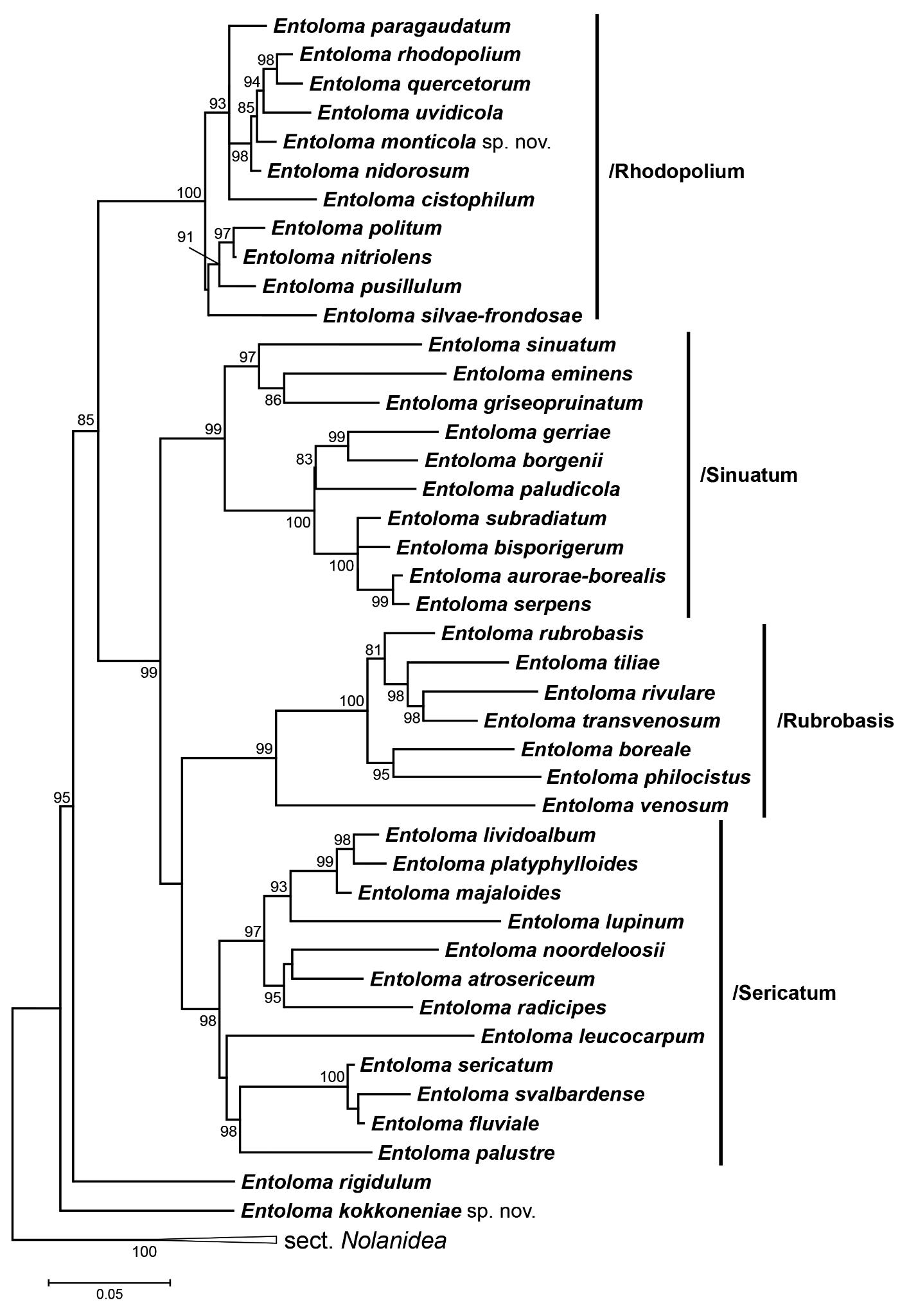
Maximum Likelihood (PhyML) overview phylogenetic tree based on nrDNA ITS sequences of section Entoloma. ML bootstrap support values (> 50 %) are shown at the branches.
saprotrophic, parasitic, or possibly employ a still-uncertain trophic strategy, as suggested for many grassland taxa (Noordeloos et al., 2022b). However, documentation of ectomycorrhiza in E. nitidum (Montecchio et al., 2006) suggests that section Turfosa (part of the basal clades, see Chapter 14) may represent another lineage of mycorrhizal species.
Further research into the mycorrhizal associations of Entoloma species should be a high priority. Clarifying trophic modes within the genus will not only yield deeper insights into its evolutionary history, but will also sharpen its ecological circumscription and provide a stronger basis for the evidence-based conservation of its often highly specialized habitats.
Karakteristiek: Vruchtlichamen tricholomatoïd, collybioïd of omphalinoïd. Hoed meestal duidelijk hygrofaan, doorschijnend gestreept of niet; kaal of soms fijnvezelig, bepoederd of gerimpeld. De kleur van de hoed is bij veel soorten zeer variabel en de meeste soorten hebben naast bruine of donkerbruine ook lichte of (bijna) kleurloze vormen. Lamellen meestal uitgebocht aangehecht, soms duidelijk aflopend of smal aangehecht, nooit vrij. Steel centraal, vezelig of kraakbeenachtig, gepolijst of met fijne tot grove lengtevezels, vaak bepoederd aan de top, vaak met duidelijk basaal mycelium. Geur en smaak vaak meelachtig-ranzig of enigszins fruitig-fris, soms duidelijk naar chloor (“nitreus”}. Basidiosporen uitgesproken hoekig, vaak min of meer dikwandig. Basidia 4-, zelden 2-sporig. Lamelsnede fertiel, zelden heterogeen met cilindrische tot knotsvormige of bochtige cheilocystiden, zelden geheel steriel met cystiden. Hoedhuid een cutis, vaak verslijmd en dan een ixocutis, zelfden met overgangen naar een trichoderm, samengesteld uit dunne, cilindrische hyfen; subpellis al dan niet goed ontwikkeld, opgebouwd uit opgezwollen elementen (saucijsjes), die abrupt of geleidelijk overgaat in de pileitrama. Hoeden lameltrama regulair, bestaande uit subcilindrische, opgeblazen of worstvormige elementen, de gemiddelde grootte varieert van 60–150 × 5–20 μm. Steelhuid een cutis van cilindrische hyfen, soms met vrije terminale elementen (“caulocystidia”). Gespen zijn meestal aanwezig en in het hele basidiocarp.
Habitat en verspreiding: Ectomycorrhiza, geassocieerd met een breed scala aan loof- en naaldbomen. Wijd verspreid over het noordelijk halfrond, van het noordpoolgebied tot de Middellandse Zee.
Descrizione: Portamento tricolomatoide, collibioide o onfalinoide. Cappello di solito indistintamente igrofano, striato traslucido o no; glabro o occasionalmente finemente pruinoso, venoso o fibrilloso. Il colore del cappello sembra essere molto variabile e la maggior parte delle specie possono presentarsi accanto a forme brune o bruno scuro. Lamelle da smarginate ad adnate, a volte decorrenti. Gambo centrale, fibroso o cartilagineo, lucido o fibrilloso o fibroso longitudinalmente, spesso con apice pruinoso e con micelio basale. Odore e sapore spesso farinaceo-rancido o leggermente fruttato. Basidiospore pronunciatamente angolate e con pareti più o meno spesse. Basidi 4-, raramente 2-spore. Bordo lamellare fertile o raramente eterogeneo con cheilocistidi da cilindrici a clavati o flessuosi. Pileipellis una cutis o ixocutis di ife strette, subpellis spesso ben sviluppate e costituite da elementi corti e gonfiati, che passano bruscamente o gradualmente nella pileitrama. Trama regolare del cappello e dell’imenoforo, costituita da elementi subcilindrici, rigonfi, che variano in media da 60–150 × 5–20 μm. Stipitipellis è una cute di ife cilindriche, a volte con elementi terminali liberi (“caulocistidi”). Giunti a fibbia solitamente presenti e abbondanti in tutto il basidiocarpo. Habitat e distribuzione. Ectomicorrizico, associato a una vasta gamma di latifoglie e conifere. Ampiamente distribuito in tutto l’emisfero settentrionale, dall’Artico al Mediterraneo.
Karakteristiek: De clade van de Grauwe bossatijnzwam omvat in Europa meerdere soorten die morfologisch sterk op elkaar lijken en derhalve nauwelijks betrouwbaar van elkaar te onderscheiden zijn. De recente revisies van deze groep door Kokkonen (2015, 2021) hebben de taxonomische interpretatie niet vereenvoudigd. Door het aanwijzen van neotypen beoogde zij meer duidelijkheid te scheppen; echter, voor E. nidorosum werd een collectie geselecteerd die overeenkomt met de noordelijke soort E. melenosmum (bekend uit Groenland en NoordScandinavië). Dit heeft tot gevolg dat de soort die traditioneel als E. nidorosum werd aangeduid nu E. uvidicola moet heten, terwijl E. nidorosum sensu stricto niet in Nederland en Vlaanderen voorkomt.
Aanvullend onderzoek is noodzakelijk om deze interpretatie te bevestigen, in het bijzonder door middel van barcodering van materiaal uit Nederland en Vlaanderen. Habitat- en waardboomvoorkeuren kunnen enige aanwijzing bieden, maar ook deze gegevens behoeven nadere verificatie door middel van een groter aantal gedocumenteerde waarnemingen. Voorlopig wordt dit complex pragmatisch als een sensu lato-taxon behandeld, ook in de determinatiesleutel.
Caratteristiche: Il clade Rhodopolia include diverse specie in Europa che sono morfologicamente molto simili e quindi difficilmente possono essere distinte in modo affidabile tra loro. Le recenti revisioni di questo gruppo da parte di Kokkonen (2015, 2021) non hanno semplificato l’interpretazione tassonomica. Designando i neotipi, mirava a creare maggiore chiarezza; tuttavia, per E. nidorosum è stata selezionata una collezione corrispondente alla specie settentrionale E. melenosmum (nota in Groenlandia e nella Scandinavia settentrionale). Di conseguenza, la specie tradizionalmente chiamata E. nidorosum deve ora essere chiamata E. uvidicola. Le preferenze di habitat e degli alberi ospiti possono fornire alcuni indizi, ma questi dati richiedono anche ulteriori verifiche attraverso un numero maggiore di osservazioni documentate. Per il momento, questo complesso è trattato pragmaticamente come Entoloma rhodopolium sensu lato.
212. Entoloma rhodopolium (Fr.) P. Kumm., Der Führer in die Pilzkunde: 98 (1871)
MycoBank no.: MB#196225
Neotype (designated in Kokkonen, 2015): Sweden, Skåne, Kristianstad Municipality, southeast of Degeberga, margin of Dunderbäcken nature reserve, beside the parking place, margin of forest with Corylus avellana, Fagus sylvatica, and Acer platanoides, under a large Fagus, near seedlings of Corylus, Fagus, and Acer, rich undergrowth, 23 Oct. 2014, K. Kokkonen, 213/14 (TUR; isoneotype UPS).
GenBank: LN850494 (ITS), LN850669 (RPB2) (both from neotype).
Etymology: From “ρόδο/rhodo-” (Greek) meaning rose, and “polius” (Latin) meaning grey, grey-haired.
Original diagnosis: Agaricus rhodopolius, pileo carnoso planiusculo laevi isabellino-livido, lamellis adnatis incarnatis, stipite cavo aequali glabro albo. Descr. Stipes cavus, 2–4 unc. longus. 2–5 lin. crassus, aequalis teres glaber totus albus sericeo-striatulus. Pileus leviter carnosus, junior convexus obtusus, dein planiusculus umbonatus, fragilis laevis, exsiccatus subsericeus, 1–5 unc. latus, isabellino-lividus 1 alutaceo-canus, saepe humidus, non tamen vere viscosus, margine subregulari et in luxuriantibus tantum repando. Caro nivea immutabilis. Lamellae totae adnatae, 2–4 lin. latae; distinctae fragiles 4–8 natae albidae, dein incarnato-roseae. Magnitudo variabilis! – Non multum differt A. adstringens Alb. & Schwein., quem ad Ysberg legi. Diversissimus ab A.
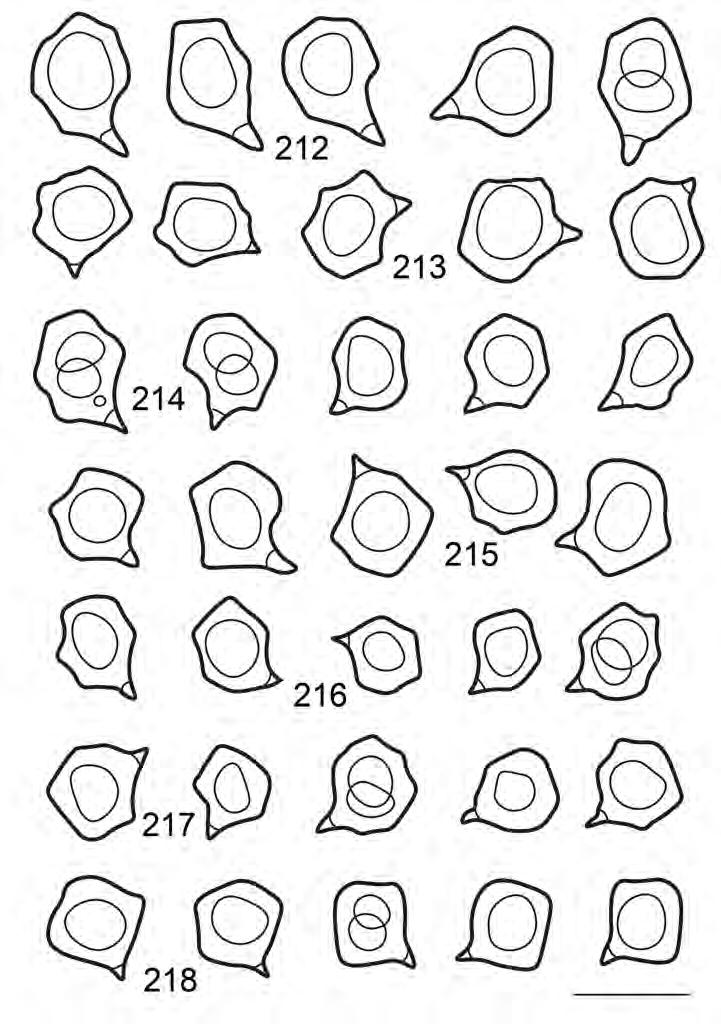
Entoloma 212–218: 212. E. rhodopolium, spores. 213. E. quercetorum, spores. 214. E. uvidicola, spores. 215. E. monticola, spores. 216. E. nidorosum, spores. 217. E. paragaudatum, spores. 218. E. cistophilum, spores. Bar = 10 μm.
pluteo, lamellis adnatis. Hujus iconem optimam Ag. latam Sowerb. t. 108, nullibi citatam vidi.
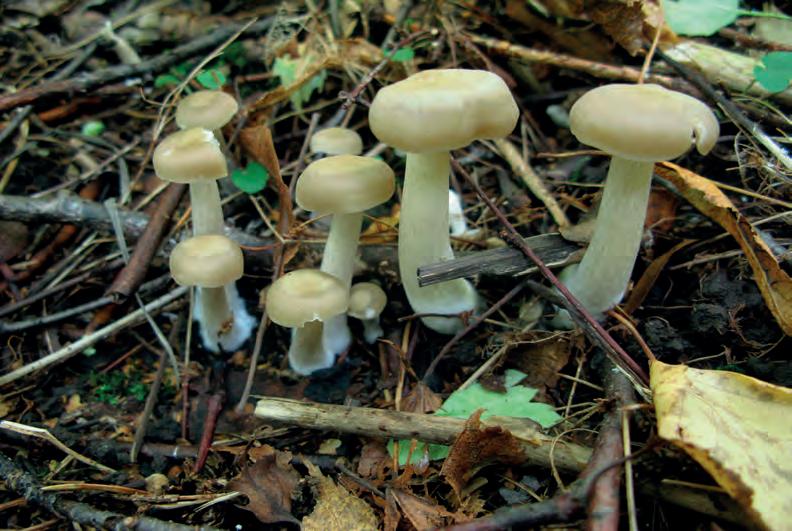
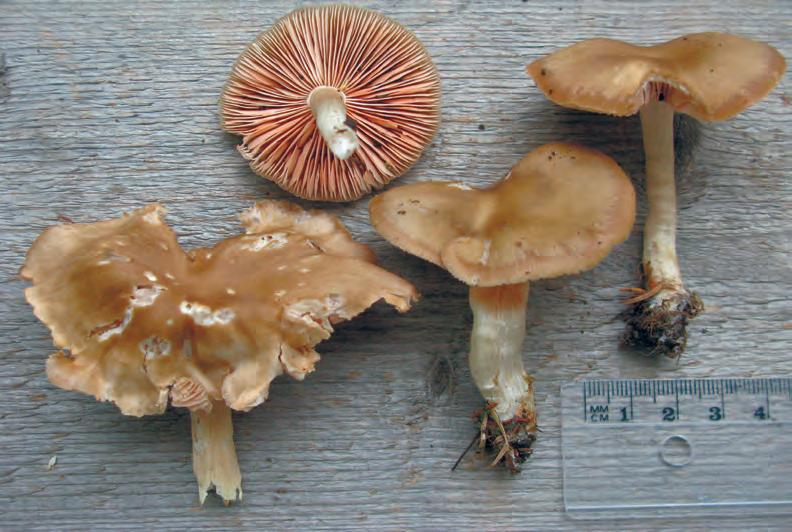
212 E. rhodopolium O-F-252027(EB202-15).
Photo E. Bendiksen
212 E. rhodopolium OF-253844 (EB 165-16).
Photo E. Bendiksen
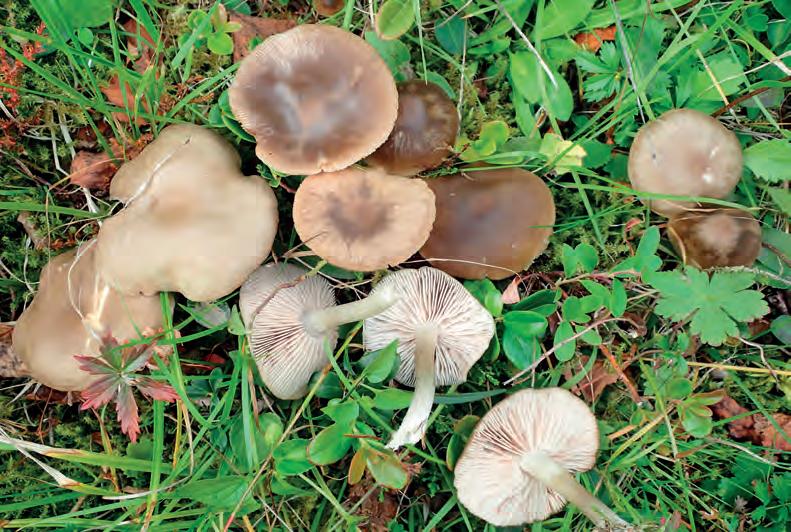
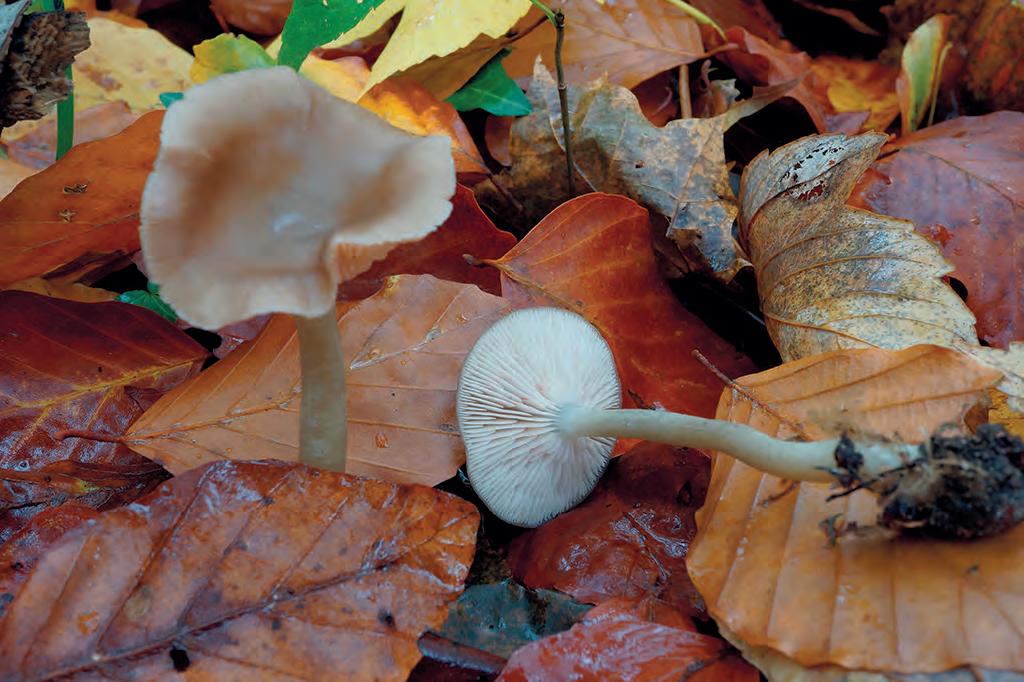
212 E. rhodopolium O-F-256750 (JBJ18-023). Photo J.B. Jordal
212. E. rhodopolium KaiR1824.
Photo K. Reschke
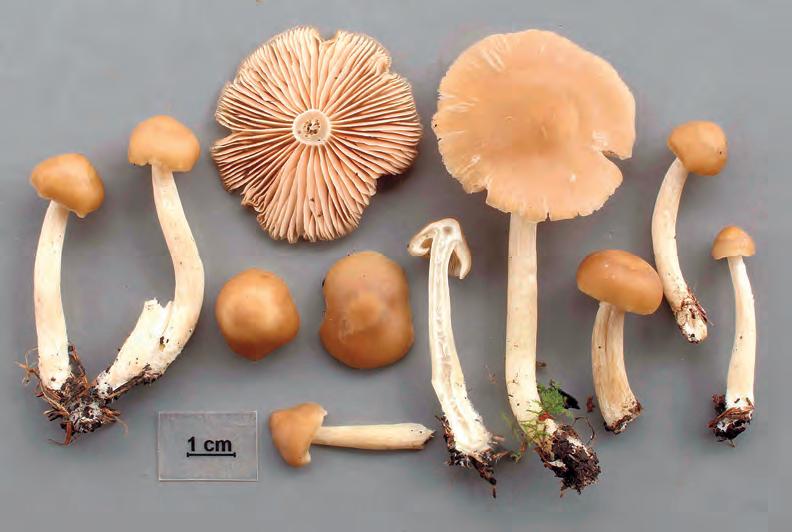
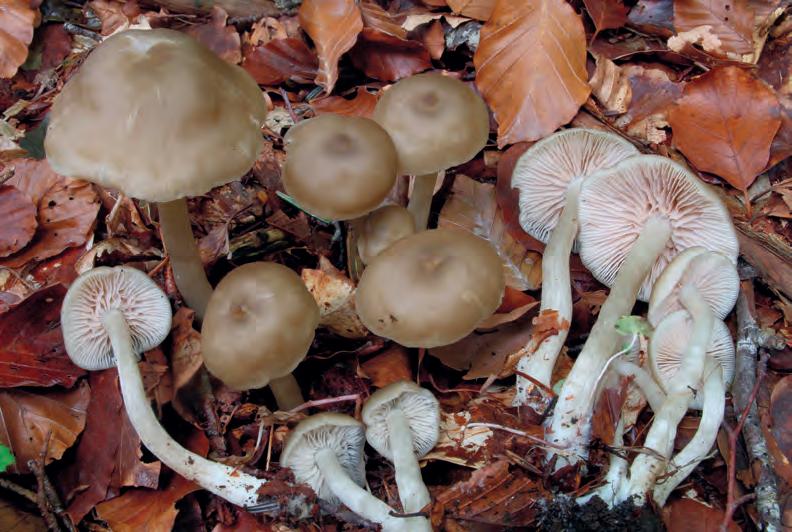
212. E. rhodopolium TEB461-15/DB5826.
Photo B. Dima
212. E. rhodopolium 24.015.
Photo G. Eyssartier O-F-251968
Karakteristiek: Grauwe bossatijnzwam. Vruchtlichamen slank, tricholomatoid. Hoed 30–110(–120) mm; aanvankelijk gewelfd, later min of meer vlak met golvende rand, soms iets ingedrukt of met zwakke umbo. Sterk hygrofaan; aan de rand doorschijnend gestreept tot ⅓ van de straal. Kleur bleek geelbruin, bruin tot licht grijsbruin, soms bijna wit; verbleekt sterk bij uitdroging. Oppervlak glad, bij vocht iets vettig aanvoelend, bij droogte satijnglanzend. Plaatjes uitgebocht aangehecht; bij sterk uitgespreide exemplaren soms schijnbaar aflopend. Smal, vuilwit, later grijs roze, met onregelmatige, gelijk gekleurde snede. Steel 40–120 × 5–20 mm; cilindrisch, vaak bochtig; wit met grijsbruine tint, vooral in het midden. Oppervlak aangedrukt vezelig in de lengte, top bepoederd. Basis met wit mycelium. Geur zwak of ondefinieerbaar; soms fruitig, zwak nitreus of licht melig. Smaak ranzig en onaangenaam. Groeit in groepen in gemengd bos en naaldbos, vaak bij berk (Betula) of populier (Populus), soms bij beuk (Fagus), voornamelijk op kalkhoudende grond. Ecologie en verspreiding in Nederland en Vlaanderen zijn slecht bekend door verwarring met nauw verwante taxa. Tot nu toe gebarcodeerde collecties wijzen op voorkeur voor kalkrijke bodem; voorkomen in Nederland of Vlaanderen is daarom onzeker. Het huidige fylogenetische concept van E. rhodopolium is nog niet bevestigd door barcoding van materiaal uit Nederland en Vlaanderen.
Descrizione: Portamento tricolomatoide slanciato. Cappello di 30–110(–120) mm di diametro, convesso quando giovane, poi appiattito, spesso depresso o piano-convesso, talvolta con un debole umbone arrotondato, che spesso si trova nella lieve depressione del cappello, con margine deflesso, spesso ondulato; fortemente igrofano, di colore giallo-bruno moderatamente scuro o grigio-bruno, bruno chiaro, ma spesso anche bruno-giallastro chiaro o quasi bianco, liscio, leggermente untuoso al tatto quando umido, glabro, traslucido striato fino a un terzo del raggio. Lamelle adnate-smarginate, nei cappelli espansi appaiono talvolta subdecorrenti, moderatamente fitte, da segmentiformi a ventricose, bianche o con sfumature grigie quando giovani, poi grigio-bruno chiaro con sfumature rosa, raramente con alcune venature laterali, con filo eroso e concolore. Gambo 40–120 × 5–20 mm, a sezione costante, oppure affusolato o allargato verso la base, talvolta appiattito nella parte inferiore; inizialmente pieno, poi fistuloso, bianco o con sfumature grigio-bruno, all’apice spesso leggermente pruinoso, con micelio basale bianco. La carne nel cappello è grigio o grigio-bruna, nel gambo è concolore alla superficie. Odore debole, nitroso con una componente di sapone aromatico o di frutta.
Description: Basidiocarps slenderly tricholomatoid. Pileus 30–110(–120) mm in diam., convex when young, then applanate, often becoming depressed, or plano-convex, sometimes with weak rounded umbo, which often is located in the shallow depression of the pileus, with deflexed, often undulating margin; strongly hygrophanous, moderately dark yellow-brown or grey-brown, pale brown, but frequently also pale yellowish brown or almost white, smooth, slightly greasy to touch when moist, glabrous, translucently striate up to one third of the radius. Lamellae adnate-emarginate, in expanded pilei appearing sometimes subdecurrent, moderately crowded, segmentiform to ventricose, white or tinged grey when young then pale grey-brown with pink tinge, rarely with some veins on the side, with eroded, concolorous edge. Stipe 40–120 × 5–20 mm, equal, or, tapering or broadening towards base, at times flattened below; stuffed then fistulose, white or with grey-brown tinge, at apex often somewhat pruinose, based with white mycelium. Context in pileus gray or gray brown, in stipe concolorous with the surface. Smell weak, nitrous with a component of aromatic soap or fruit. Basidiospores 7.0–10.0 × 6.0–8.0(–8.5) μm, on average 7.5–8.5 × 6.5–7 μm, Q = 1.1–1.3, Qav = 1.15, subisodiametrical, 5–6-angled, thin-walled. Basidia 24–50 × 8–15 μm, 4-spored, clamped. Lamell edge fertile. Cheilocystidia
absent. Hymenoohoral trama regular, made up of short, sausage-shaped elements, 60–140 × 5–22 μm. Pileipellis a thin ixocutis of narrow, cylindrical hyphae, 2–5 μm wide, sometimes with slightly broader terminal elements, 4–10 μm wide; subpellis poorly differentiated and gradually passing into pileitrama of rather short, sausage-shaped elements, 50–170 × 7–22 μm, mixed with narrow, cylindrical 2–4 μm wide connective hyphae. Olieferous hyphae not observed. Pigment pallid, diffusely intracellular mainly in subpellis, some minute encrustations may be found in the suprapellis and in the connective hyphae of the trama. Stipitipellis a cutis of cylindrical hyphae 5–17 μm wide; terminal elements particularly at apex, subcylindrical to clavate, 20–60 × 4–16 μm. Clamp-connections abundant in all tissues.
Habitat: In deciduous or mixed deciduous-coniferous forest on nutrient rich or calcareous soil, such as Picea/Pinus forests with Betula and/or Corylus avellana and in northern temperate regions also pure Fagus sylvatica stands, also found in central European montane Fagus/Picea forest.
Distribution: In the restricted, phylogenetic concept, the European distribution of E. rhodopolium is not very well known. ITS confirmed collections are known mainly from Southern Scandinavia and Finland, Belgium, Germany, France, Croatia, and European Russia. The species is locally frequent in herb rich forests with Betula in southern boreal-boreonemoral regions in S/C Scandinavia, apparently much rarer in temperate regions of C Europe.
Notes — Entoloma rhodopolium is a classical, Friesian species, and has been neotypified by Kokkonen (2015) on material from a Fagus forest in southern Sweden. It is characterized by the relatively pale, thin-fleshed pileus, and white stipe. In this sense, it apparently is a southern species in Scandinavia, and, according to our own data, mainly a Fagus/Corylus/Betula associated species, found almost exclusively in rich soil forests, including calcareous/herb rich Pinus–Picea forests with Corylus or Betula. Since belonging to a critical morphological complex, E. rhodopolium s. str. is hard to identify without an ITS barcode. The sometimes cooccurring E. silvae-frondosae has on the average smaller, more tiny basidiocarps, but these will often be hard to separate in the field. The distinction between E. rhodopolium and E. nidorosum sensu auct. (E. uvidicola) was considered too minor to justify recognition at species level and was therefore reduced to forma by Noordeloos (1989) and to variety by Krieglsteiner (1991).
Taxa (varieties of Entoloma rhodopolium) of uncertain status
Entoloma rhodopolium var. pseudopolitum Noordel., Fungi Europaei 5a: 855 (2004)
MycoBank no.: MB#500394
Holotype: Belgium, prov. Namur, Ave-et-Auffe, Fond d’Ave, 15 Sep. 2003, M.E. Noordeloos 2003-12 (L).
Etymology: Referring to the similarity to E. politum.
Original diagnosis: A varietate typica basidiocarpis minutis collybioideis ad omphalioideis odore valide nitrico differt.
Karakteristiek: Vruchtlichamen omphalioid tot collybioid. Hoed 20–40 mm; convex, later ingedrukt tot umbilicaat; sterk hygrofaan; diep doorschijnend gestreept; middelbruin, grijsbruin of geelbruin; sterk verblekend bij uitdroging; oppervlak glad. Plaatjes matig wijd uiteen; uitgebocht aangehecht, vaak met opvallend aflopend tandje tot aflopend; boogvormig tot segmentvormig; aanvankelijk wit, later roze. Steel 20–70 × 1–5 mm; cilindrisch; wit; oppervlak
Chapter 16. List of taxonomic novelties in this book
Entoloma monticola Dondl, Dima & Noordel., spec. nov., .................................................... 121
Entoloma kokkoneniae Noordel. & Dima, spec. nov., 280
Entoloma aemulans (P. Karst.) Noordel. & Dima, comb. nov., .............................................. 434
Typifications:
E. excentricum, lectotype, 689
E. lividoalbum, neotype, ......................................................................................................... 227
E. platyphylloides, epitype, ..................................................................................................... 232
E. prunuloides, neotype, 524
E. sarcitum, neotype,............................................................................................................... 476
E. sericatum, epitype and lectotype, ....................................................................................... 263
E. sinuatum, epitype, 149
E. turbidum, neotype, .............................................................................................................. 578
E. venosum, lectotype ............................................................................................................. 222
Chapter 17. Acknowledgements
The Kits van Waveren Foundation (Naturalis, Leiden, The Netherlands) provided funding for part of the sequencing travelling expenses for M.E. Noordeloos, and subsidized the printing of this book. The Norwegian Entoloma project was funded 2015–2017 by the Norwegian Biodiversity Information Centre(NBIC). Most of the Norwegian material was sequenced through NorBOL, and we thank G. Marthinsen and K. Bendiksen, NHM, University of Oslo for performing the barcoding work. The work of B. Dima was supported by the National Research, Development and Innovation Office of Hungary (OTKA FK-143061), the János Bolyai Research Scholarship of the Hungarian Academy of Sciences and the ELTE Institutional Excellence Program 2020 (TKP2020- IKA-05). K. Reschke thanks M. Piepenbring for support. The FunDive project funded by Biodiversa+, the European Biodiversity Partnership, under the “FunDive: Monitoring and mapping fungal diversity for nature conservation” project, part of the 2022–2023 BioDivMon joint call, supported the Illumina sequencing of several type specimens previously unsuccessful with Sanger method. This work was cofunded by the European Commission (grant agreement No. 2128-00020A – Biodiversa2022-640) and, in relation to this book, by the National Research, Development and Innovation Office (Hungary), by the Innovation Fund Denmark (Denmark), and by the Dutch Research Council (The Netherlands). The work of O. Morozova was provided in the framework of an institutional research project of the Komarov Botanical Institute RAS (12401310-0829-3) using equipment of the Core Facility Centre ‘Cell and Molecular Technologies in Plant Science’ of the Komarov Botanical Institute RAS. The work of J.B. Jordal, also including much sequencing, was supported by Miljøfaglig Utredning, Norway. The DNA databases of the Danish Mushroom Atlas (Jacob Heilmann-Clausen; Thomas Kehlet, Thomas Læssøe, Tobias Frøslev), University of Vienna (ABoL, Irmgard Krisai-Greilhuber; Anton Hausknecht), and University of Oslo (NorBOL, Katriina Bendiksen, Gunnhild Marthinsen) generously put at our disposition, added substantially to the material for this publication. Ellen Larsson, Department of Biological and Environmental Sciences, Gothenburg, Sweden actively participated in several precursory publications, and kindly made avail-