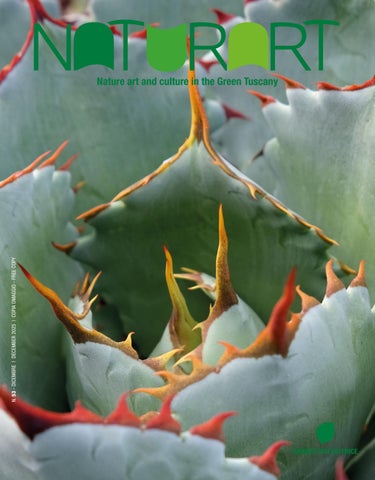
N. 53 - DICEMBRE | DECEMBER 2025 | COPIA OMAGGIO - FREE COPY
Nature art and culture in the Green Tuscany
GIORGIO TESI EDITRICE
giorgiotesigroup.com
UN IMPEGNO CONCRETO VERSO UN FUTURO RESPONSABILE
Progetto Giorgio Tesi eARTh | opera di Jonathan Calugi
Giorgio Tesi Vivai, leader in Europa per produzione di piante ornamentali, dimensione e superficie coltivata, ha completato il suo primo Bilancio di Sostenibilità, un documento che rappresenta un importante traguardo e che sottolinea il suo grande impegno verso pratiche aziendali responsabili e sostenibili. In un mondo sempre più attento alle tematiche ambientali e sociali, Giorgio Tesi Vivai ha intrapreso un percorso che integra i fattori della sostenibilità all’interno delle strategie aziendali, ponendo grande attenzione al rispetto dell’ambiente, alle persone e all’etica nella conduzione del business.
EDITORIALE
Giovanni Capecchi Direttore Editoriale di NATURART Managing Editor of NATURART — g.capecchi@discoverpistoia.it
Pinocchio che guarda il Micco Pinocchio looking at the Micco
NATURART | DECEMBER 2025 | 5
Y
ou may expect something special from the issue of a magazine that marks the beginning of the new year, and the same goes for the editorial introducing it. As a matter of fact, the magazine published in early 2026 doesn’t show any special effects: the goal – which may also not be achieved and on which, however, our readers shall express their opinion – is that of always maintaining a high level and narrating, in a careful and educational manner, the territory in which we live, its wealth, excellences and stories. Somehow, each issue represents a new history, each number would like to represent an opportunity to celebrate. Subsequently, the editorial doesn’t want to have, and cannot have, a “Christmas” spirit. However, two events will mark the year 2026 and we will talk about them. 2026 will be the year in which Pistoia will be the Italian Capital of Books, and the twohundredth anniversary of the birth of Carlo Lorenzini, known as Collodi. Two facts representing an opportunity, and a wealth. The opportunity consists in the possibility to consolidate the centrality of books and reading in the whole Pistoiese area, starting from a long history (even longer than the history of Italian literature, which actually starts with Cino, Dante’s friend, who actually came from Pistoia), and carrying forward an important commitment by the public administration (which – just to mention a fact –, in 2007, opened the San Giorgio Library), but also by associations, schools, foundations and bookstores. The wealth consists in the work by Carlo Lorenzini: a wealth for Italy and Tuscany, without any doubt, but also for our province, which is lucky enough to have a place that was used by Lorenzini to choose his pseudonym: Collodi. If there’s a story which travelled and continues to travel around the world, that’s the story of Pinocchio. And not by chance the logo of Pistoia, the Italian capital of books, reminds us of him: in front of the Micco, the symbol of our province’s capital city, the profile of the wooden puppet – with its strength and the ability to spark emotions and memories – stands out immediately.
www.discoverpistoia.it
D
al numero di una rivista che apre l’anno nuovo ci si aspetta forse qualcosa di particolare. E così pure dall’editoriale che lo introduce. In realtà, la rivista che viene pubblicata all’inizio del 2026 non presenta effetti speciali: l’obiettivo – che non è detto si riesca a raggiungere e sul quale, comunque, devono esprimersi i lettori – è quello di mantenere sempre un livello elevato e di raccontare, in maniera attenta e divulgativa, il territorio nel quale viviamo, il suo patrimonio, le sue eccellenze, le sue storie. In qualche modo, ogni numero è una storia nuova, ogni numero vorrebbe portare con sé un’occasione di festeggiamento. Neppure l’editoriale, di conseguenza, può e vuole avere un carattere ‘natalizio’. Due avvenimenti, però, accompagneranno l’anno 2026 e su questi spenderemo alcune parole. Il 2026 è l’anno di Pistoia capitale italiana del libro ed è il bicentenario della nascita di Carlo Lorenzini, in arte Collodi. Due fatti che rappresentano un’occasione e un patrimonio. L’occasione riguarda la possibilità di consolidare la centralità del libro e della lettura nell’intero territorio pistoiese, partendo da una storia lunga (anche più lunga della storia della letteratura italiana, che pure si apre con Cino, l’amico di Dante, che è, appunto, “da Pistoia”) e proseguendo un impegno importante da parte della pubblica amministrazione (che – solo per citare un fatto – nel 2007 inaugurava la Biblioteca San Giorgio), ma anche da parte di associazioni, scuole, fondazioni, librerie. Il patrimonio è rappresentato dall’opera di Carlo Lorenzini: un patrimonio per l’Italia e per la Toscana, senza dubbio; ma anche per la nostra provincia, che ha la fortuna di avere il luogo che è servito a Lorenzini per scegliere il suo pseudonimo: Collodi. Se c’è una storia che ha fatto e continua a fare il giro del mondo, questa è la storia di Pinocchio. E non a caso il logo di Pistoia capitale del libro lo ricorda: di fronte al Micco, simbolo della città capoluogo, colpisce subito – con la sua forza e con la capacità di suscitare emozioni e ricordi – il profilo del burattino di legno.
P
escia preserves an extraordinary artistic wealth, which is still quite unknown. The two main museum sites – one opposite the other, i.e., the Galeotti Palace Museum and the Libero Andreotti Museum, narrate the history of a city which was capable of collecting very valuable works and memories. Today, the challenge consists in making all of this truly accessible, with adequate spaces, renewed visitor routes and a cultural offer that is capable of involving the community: from laboratories with local schools to Friday meetings, which take place from January to April, with experts and researchers who investigate the two museums’ collections. After being closed for several years, the Galeotti Palace Museum is reopening its historical rooms with new installations and exhibition projects: instead, the Plaster Cast Gallery, which was born in 1992, renovated part of its spaces and expanded its archival and library heritage. Thanks to the cooperation between the Municipality, Superintendence, Cassa di Risparmio di Pistoia e Pescia Foundation, Banca di Pescia e Cascina, Tuscany Region, Amici dei Musei e dei Monumenti di Pescia Association and Pistoia Museum System, the city now aims at finding again the central key role it deserves: a widespread museum, open to experts, citizens and visitors. We are happy to have Libero Andreotti as our “guest” in this magazine; in 1930, he chose to build his summer retreat in San Pellegrino al Cassero, in the municipality of Sambuca Pistoiese: a seclude place, immersed into a pristine landscape, where he could nurture his art, inspiration and relations with his family and fellow artists from Pistoia.
NATURART | DECEMBER 2025 | 7
P
escia custodisce un patrimonio artistico straordinario, ancora poco conosciuto. Le due sedi museali principali – una di fronte all’altra – il Museo Palazzo Galeotti e il Museo Libero Andreotti, raccontano la storia di una città che ha saputo raccogliere opere e memorie di grande valore. Oggi la sfida è rendere tutto questo realmente fruibile, con spazi adeguati, percorsi di visita rinnovati e un’offerta culturale capace di coinvolgere la comunità: dai laboratori con le scuole del territorio agli incontri del venerdì che si svolgono da gennaio ad aprile con esperti e studiosi che approfondiscono le collezioni dei due musei. Il Museo Palazzo Galeotti, dopo anni di chiusura, sta riaprendo le sue sale storiche con nuovi allestimenti e progetti espositivi; la Gipsoteca, nata nel 1992, ha invece rinnovato parte dei suoi spazi e ampliato il patrimonio archivistico e bibliotecario. Grazie alla collaborazione tra Comune, Soprintendenza, Fondazione Cassa di Risparmio di Pistoia e Pescia, Banca di Pescia e Cascina, Regione Toscana, Associazione Amici dei Musei e dei Monumenti di Pescia e Sistema Museale Pistoiese, la città punta ora a ritrovare la centralità culturale che le spetta: un museo diffuso, aperto agli studiosi, ai cittadini e ai visitatori. Siamo lieti che questa rivista ospiti Libero Andreotti, che nel 1930 scelse di costruire il suo eremo estivo a San Pellegrino al Cassero, nel comune di Sambuca Pistoiese: un luogo appartato e immerso in un paesaggio incontaminato, dove coltivare arte, ispirazione e relazioni con famiglia e amici artisti pistoiesi.
Pescia, the art citadel
www.discoverpistoia.it
Pescia, la cittadella d’arte da riscoprire
EDITORIALE
Claudia Massi Responsabile scientifico musei civici di Pescia Scientific Director of the Civic Museums of Pescia
Registrazione Tribunale di Pistoia – N°2/2010 del 28-05-2010
ISSN 2421-2849
9 772421
284000
Direttore Editoriale Giovanni Capecchi g.capecchi@discoverpistoia.it Direttore Responsabile Emanuele Begliomini e.begliomini@giorgiotesigroup.it Art Director Carolina Begliomini c.begliomini@giorgiotesigroup.it
____
____
Agave potatorum
Agave potatorum
‘Kissho-kan’ Variegata
‘Kissho-kan’ Variegata
Foto - Carolina
Photo - Carolina
Begliomini
Begliomini
Coordinamento Redazionale Lorenzo Baldi redazione@discoverpistoia.it Segreteria Irene Cinelli, Maria Grazia Taddeo contatti@giorgiotesigroup.it Comitato di redazione Nicoletta Boccardi, Lorenzo Cipriani, Chiara Caselli, Simone Martini, Cristiana Petrucci, Giacomo Galanda, Jonathan Calugi Hanno collaborato a questo numero Giovanni Capecchi, Lorenzo Baldi, Alessandro Gnesini, Claudia Massi, Claudio Pizzorusso, Anna Agostini, Maurizio Tempestini, Eleonora Angelini, Cristiana Petrucci, Pietro Giannini, Luca Magni, Clarissa Tonarelli, Sara Tesi, Francesca Tesi, Valerio Deho
N. 53 - DICEMBRE | DECEMBER 2025 Pistoia nel Mondo, il Mondo a Pistoia Pistoia in the World, the World in Pistoia
Traduzioni Studio Blitz – Pistoia Fotografie Archivio Giorgio Tesi Editrice, Lorenzo Marianeschi, Brooks Walker, Archivio Premio Vallecorsi, Chiara Alibrandi, Giovanni Becattini, Archivio Nick Becattini, Carolina Begliomini, Sara Bonelli, Wema Supernova
Giorgio Tesi Group The Future is Green
Giorgio Tesi Editrice srl Via di Badia, 14 – 51100 Bottegone – Pistoia – Italy Tel. +39 0573 530051 – Fax +39 0573 530486 www.discoverpistoia.it
Illustrazioni Jonathan Calugi Per le immagini pubblicate restiamo a disposizione degli aventi diritto che non si siano potuti reperire Impaginazione Giorgio Tesi Editrice Stampa Industrie Grafiche Pacini- Ospedaletto (Pisa)
Iscrizione al ROC (Registro Operatori della Comunicazione) n° 30847 del 15 Gennaio 2018
Per la tua pubblicità sulla rivista contatta la Giorgio Tesi Editrice o invia una e-mail a marketing@giorgiotesigroup.it
www.discoverpistoia.it
Sommario Summary 8
18
Arte
Libero Andreotti a Stoccolma nel 1920: sculture e arredi Libero Andreotti in Stockholm, in 1920: sculptures and furniture Il premio Vallecorsi The Prophet of Blues I progetti di Fondazione Caript
46
Montagna Pistoiese
56
La tradizione incontra la trasparenza
64
Sport
70
Sport
80
Montagna Pistoiese
Un impegno concreto per l’ambiente A concrete commitment to the environment
40 anni di passione e ricerca
100
Premio di Poesia ‘Giorgio Tesi’ (XI edizione)
104
Arte & cultura
Viaggiando nel territorio Travelling through the territory Dall’acqua al filo From water to thread
Drovandi Paolo
L’Eccellenza nata tra le spine The excellence born among the thorns
Eccellenze
38
88
94
Radici preziose: amore e memoria tra le righe Precious roots: love and memory through the lines Eidos dialogo tra forma e materia Eidos A dialogue between form and matter
Tre giorni a canestro con… Andrea Trinchieri Three days of basketball with… Andrea Trinchieri Pistoia, città di scherma Pistoia, the city of fencing L’Eterno Sogno Bianco The eternal white dream Vivaismo
La sostenibilità Sustainability
opera di Jonathan Calugi
Arte
Libero Andreotti a Stoccolma nel 1920: sculture e arredi — La mostra allestita al Museo Libero Andreotti di Pescia (19 settembre 2025 – 7 gennaio 2026), ha ricostruito e interpretato uno dei momenti più significativi della vicenda artistica e culturale dello scultore: la partecipazione all’Esposizione di Arti Decorative Italiane aperta dal 13 novembre al 31 dicembre 1920 alla Liljevalchs Konsthall di Stoccolma.
10 | NATURART | DICEMBRE 2025
Testo di Claudia Massi e Claudio Pizzorusso
Foto di Brooks Walker
NATURART | DECEMBER 2025 | 11
____ Un’ immagine dell’allestimento della mostra Libero Andreotti a Stoccolma 1920. Esposizione d’Arte Decorativa Italiana allestita al Museo Libero Andreotti di Pescia a cura di Claudia Massi e Claudio Pizzorusso. ____ An image of the setup of the exhibition Libero Andreotti in Stockholm, 1920. Italian Decorative Art Exhibition, staged at the Libero Andreotti 12 | NATURART | DICEMBRE 2025
Museum in Pescia and curated by Claudia Massi and Claudio Pizzorusso.
Q
uesto evento – la prima grande rassegna italiana all’estero dopo la Grande Guerra – segnò una tappa decisiva nei rapporti culturali tra Italia e Svezia e, al tempo stesso, un punto di svolta nella definizione dell’arte decorativa moderna, radicata nella tradizione ma capace di dialogare con la contemporaneità. Promossa da un Comitato svedese e da uno italiano, presieduto da Arduino Colasanti, Direttore generale per le Belle Arti al Ministero della pubblica istruzione, l’esposizione nacque per iniziativa di due artisti, Guido Balsamo Stella e sua moglie, la svedese Anna Åkerdahl. Il loro obiettivo era quello di presentare al pubblico scandinavo un’Italia nuova, libera dall’accademismo e da una stanca ripetizione di modelli rinascimentali
e barocchi, e legata invece al sapere artigianale e alla concretezza del mestiere. L’operazione si inseriva nel clima europeo di rinnovamento che, nel primo dopoguerra, mirava a ridefinire il rapporto tra arte, artigianato e industria. In Svezia, il movimento del “vackrare vardagsvara” – “la bellezza nella vita quotidiana” – stava promuovendo un ideale di armonia domestica e sobrietà formale, che in Italia trovava una certa eco. La mostra di Stoccolma intese dunque porre in dialogo queste due visioni: da una parte, la tradizione artigiana italiana come radice viva; dall’altra, la modernità nordica come modello di sintesi tra etica e bellezza. La Commissione italo-svedese percorse la penisola selezionando opere e manufatti rappresentativi delle diverse identità regionali. Nelle tredici sale della Liljevalchs Konsthall
ne risultò un ritratto corale e inedito dell’Italia, intesa come mosaico di espressioni artistiche unite da una comune idea di “bellezza utile”. Accanto a “grandi firme” già celebri a livello internazionale, quali Cantagalli e Chini per le ceramiche, Barovier e Toso per i vetri muranesi, Jesurum per i merletti veneziani, Bevilacqua per broccati e damaschi, furono scoperti e presentati i più vari prodotti di artigianato locale, allora definito “domestico” o “paesano”. In questo quadro emerse il ruolo decisivo delle donne nel dopoguerra, molte delle quali, rimaste sole, erano diventate protagoniste, come lavoranti, ma anche come imprenditrici, del rilancio economico della Nazione. La ricerca di Elisa Ricci fu emblematica: studiosa dei mestieri femminili, nel 1913 aveva pubblicato sulla rivista inglese “The
____
opere e definita in un primo momento “toscana” per la sobrietà dell’impianto e la misura dell’insieme. Sostenuto da Ugo Ojetti, Andreotti appariva agli organizzatori come l’interprete ideale di una scultura capace di coniugare classicità e modernità, rigore e sentimento popolare. La sua presenza costituì un riconoscimento del ruolo che, in quegli anni, la scultura italiana andava assumendo nel contesto europeo, tra introspezione e ritorno all’ordine formale. Le opere presentate costituivano una sorta di autobiografia poetica: il Gruppo drammatico, allegoria del dolore materno per la guerra, era affiancato da una serie di figure femminili – Donna che si asciuga le spalle, l’ascella, il piede, Donna che si intreccia i capelli – in cui l’intimità del gesto quotidiano si trasfigurava in equilibrio plastico e silenziosa dignità. La Bambina che gioca a sassetto introduceva un tono infantile e popolare, mentre la Donna sul sacco e la Ciliegiara offrivano due volti complementari della ruralità toscana: la prima austera e raccolta, la seconda luminosa e sensuale. A chiudere il percorso, la Danzatrice con maschera di Medusa evocava, al tempo stesso, la memoria di un’antichità mediterranea e di una modernità audace e “à la page”, entrambe vissute da Andreotti, in gioventù a Palermo, poi a Parigi prima della Guerra. Ma la vera novità della Sala 8 risiedeva nella sua concezione unitaria: l’artista non si limitò a presentare sculture, ma allestì l’intero ambiente, dai mobili agli arredi, in un dialogo coerente tra le arti. Affidò al falegname fiorentino Leone Franchi l’esecuzione di mobili in noce da lui progettati – un tavolo fratino, credenze, stipi, sedie impagliate –, dalle linee sobrie, ornati solo da discrete lumeggiature dorate e da una lieve decorazione a margherita. Alcuni tessuti umbri e un tappeto di Angelo Peyron disegnato da Gino Carlo Sensani completavano un insieme improntato a semplicità, equilibrio e misura. Quell’ambiente evocava la spiritualità francescana e la cultura delle botteghe toscane, tradotta però in un linguaggio
La mostra si concentra sul progetto della Sala 8 dell’esposizione originale, dove furono presentate le sue sculture e arredi, raccontando un momento cruciale del dialogo tra Italia e Svezia nel campo delle arti decorative e una tappa fondamentale del percorso artistico di Andreotti. In basso riproduzione del poster dedicato all’iniziativa del 1920 in Svezia. ____ The exhibition focuses on the project of Room 8 of the original exhibition, where Andreotti’s sculptures and furniture were presented, and narrates an essential moment of the dialogue between Italy and Sweden in the field of decorative arts, and a key milestone of Andreotti’s artistic path. Below, a reproduction of the poster dedicated to the 1920 initiative in Sweden.
NATURART | DECEMBER 2025 | 13
L’esposizione rievoca e approfondisce la partecipazione dello scultore Libero Andreotti alla prima esposizione d’arte decorativa italiana tenutasi a Stoccolma nel 1920.
Studio” l’articolo Women’s crafts, in cui descriveva come l’attività delle donne – tessitrici, ricamatrici, filatrici – derivasse da amore e dedizione più che dal bisogno materiale. I manufatti femminili, autentici e legati alla vita quotidiana, esprimevano un gusto raffinato e spontaneo: dai tessuti umbri ai tappeti e ai merletti abruzzesi e sardi, fino alla decorazione dei carri siciliani. Tra gli artisti invitati a Stoccolma, Libero Andreotti occupò una posizione centrale. A lui fu riservata la Sala 8, interamente dedicata alle sue
14 | NATURART | DICEMBRE 2025
moderno e funzionale. La critica svedese accolse la sala con grande favore, sottolineando la compostezza e la purezza formale delle sculture e riconoscendo in Andreotti un esempio autentico di “arte toscana”. La rassegna si concluse con un bilancio ampiamente positivo. Gli acquisti del Museo Nazionale di Stoccolma e del Röhsska Museet di Göteborg testimoniarono l’interesse nordico per la rinascita dell’artigianato italiano. La rievocazione odierna alla gipsoteca di Pescia riporta idealmente Andreotti
“a casa”, invitando il pubblico a riflettere sulla continuità tra arte, mestiere e vita quotidiana. La ricostruzione della Sala 8, con le sculture, i mobili, le lampade e i tessuti che ne evocano l’allestimento originario, non è solo un esercizio filologico, ma un’occasione per approfondire tutta l’opera e il pensiero dell’artista. Vi si percepisce come ogni cosa rimandi a un’idea di bellezza che non è lusso ma armonia. Visitare la mostra “Libero Andreotti a Stoccolma 1920” significa compiere un viaggio doppio: nel tempo,
percorrendo un momento fondativo dell’arte italiana del Novecento; e nello spazio, scoprendo un laboratorio in cui l’artista di Pescia elaborò la sua poetica della semplicità e della misura. È un invito a riscoprire, attraverso le opere e gli arredi, il senso di una modernità che nasce dal passato, e di un’arte che parla ancora al presente. Nella Gipsoteca di Pescia non si entra solo in un museo: si entra in una stanza dell’anima, dove la scultura diventa vita e la vita – come nella sala 8 di Stoccolma del 1920 – si fa arte.
Arte
Libero Andreotti in Stockholm, in 1920: sculptures and furniture
— ____
The exhibition Libero Andreotti in Stockholm, 1920. Italian Decorative Art Exhibition. Room 8, staged at the Libero Andreotti Museum in Pescia (19 September 2025 – 7 January 2026), reconstructs and interprets one of the most significant moments of the sculptor’s artistic and cultural events: the participation in the Italian Decorative Art Exhibition, which was opened from 13 November to 31 December 1920 at the Liljevalchs Konsthall in Stockholm.
Accanto, da sinistra a destra: Donna che si fa la treccia, Donna che si asciuga le spalle e Donna che si asciuga l’ascella, gessi di Libero Andreotti datati 1919. ____ Next, from left to right: Woman braiding her hair, Woman drying her shoulders and Woman drying her armpit, 1919 chalks by Libero
T
his event – the first large Italian exhibition abroad after the Great War – marked a decisive stage in the cultural relationships between Italy and Sweden and, at the same time, a turning point in the definition of modern decorative art, rooted in the tradition but capable of establishing a dialogue with contemporary age. Promoted by a Swedish committee and an Italian committee, and chaired by Arduino Colasanti (General Director for Fine Arts at the Ministry of Public Education), the exhibition was born out of the initiative of two artists, Guido Balsamo Stella and his wife Anna Åkerdahl. They aimed at
introducing to the Swedish audience a new Italy, free from academicism and a tired repetition of Renaissance and Baroque patterns, and rather linked to the wisdom of craftsmen and the hands-on aspect of their job. The operation fitted into the European climate of renovation which, in the postWorld War I period, aimed at redefining the relationship between art, craftsmanship and industry. In Sweden, the movement of “vackrare vardagsvara” – “the beauty of daily life” – was promoting an ideal of domestic harmony and formal simplicity, which would find some resonance in Italy. Therefore, the exhibition in Stockholm aimed
The exhibition evokes and further investigates the participation of the writer Libero Andreotti in the first Italian decorative art exhibition, held in Stockholm in 1920.
NATURART | DECEMBER 2025 | 15
Andreotti.
____ Sculture, mobili e tessuti ricostruiscono la storica Sala 8 (Stoccolma 1920), offrendo una chiave per comprendere a fondo l’opera e il pensiero dell’artista Libero Andreotti. La mostra offre un “doppio viaggio” nel tempo, permettendo di percorrere e riscoprire un momento fondativo dell’arte italiana del Novecento.
16 | NATURART | DICEMBRE 2025
at establishing a dialogue between these two visions: on the one hand, the Italian artisanal tradition as a true root; on the other hand, the Northern modernity as a model of synthesis between ethics and beauty. The Italian-Swedish committee crossed the Italian peninsula and selected works and artifacts which represented the different regional identities. In the thirteen rooms of the Liljevalchs Konsthall, the result was a choral and unprecedented portrait of Italy, intended as a mosaic of artistic expressions brought together by a shared idea of “useful beauty”. Next to “big names” who were already famous at the international level, such as Cantagalli and Chini for ceramics, Barovier and Toso for Murano glasses, Jesurum for Venetian laces, Bevilacqua for brocades and damasks, the most various local handicraft products, which back then were defined as “domestic” or “peasant”, were discovered or presented. In this framework, the decisive role of women would emerge in the post-war period: many of them, who had remained alone, had become protagonists, as workers but also as entrepreneurs, of the nation’s economic revival. Elisa Ricci’s research
was emblematic: she studied feminine crafts and, in 1913, she published in the English magazine “The Studio” the article Women’s crafts, where she described how the activity of women - weavers, embroiderers, spinners – derived from love and devotion, rather than material needs. Feminine artifacts, which were authentic and linked to daily life, expressed a refined and spontaneous taste: from fabrics from Umbria to carpets and laces from Abruzzo and Sardinia and the decorations of Sicilian carts. Among the artists who had been invited to Stockholm, Libero Andreotti played a key role. Room 8 was reserved to him, fully dedicated to his works and initially defined as “Tuscan”, due to the simplicity of the structure and the sense of the whole. Supported by Ugo Ojetti, Andreotti appeared to the organizers as the ideal interpreter of a sculpture which was capable of combining classicism and modernity, rigidity and popular feelings. His presence represented the recognition of the role that, in those years, Italy was starting to play in the European context, between introspection and the return to formal order. The presented works were, somehow, a sort of poetic autobiography: the Dramatic
Group, an allegory of maternal pain due to the war, was accompanied by a few feminine figures - Woman drying her shoulders, armpit, and foot; Woman braiding her hair – where the intimacy of daily gestures would turn into plastic balance and silent dignity. The Little girl playing five stones would introduce a childish and popular tone, whereas the Woman with a sack and the Woman with cherries would offer two complementary faces of Tuscan rural life: the first one is serious and absorbed, the second one is bright and sensual. At the end of the itinerary, the Dancer with Medusa mask would evoke, at the same time, would evoke a Mediterranean antiquity and a bold and “à la page” modernity, both evoked by Andreotti during his youth: first in Palermo, then in Paris, before the war. But the actual innovation of Room 8 consisted of its unitary conception: the artist did not limit himself to presenting sculptures; he staged the whole environment, from furniture to decorations, in a consistent dialogue between art. He entrusted the Florentine carpenter Leone Franchi with the task of making walnut furniture that had been designed by him: a Fratino table, sideboards, cupboards, and straw-seated
____ Sculptures, furniture and fabrics reconstruct the historical Room 8 (Stockholm 1920), offering a key to deeply understand the work and thoughts of the artist Libero Andreotti. The exhibition offers a “double journey” through time, allowing to cross and rediscover a foundational moment of the XX century Italian art.
chairs – with simple lines, decorated only with subtle gilding and a light daisy motif. Some fabrics from Umbria and a carpet by Angelo Peyron, drawn by Gino Carlo Sensani, would complete an overall structure characterized by simplicity, balance and measure. That environment would evoke the Franciscan spirituality and culture of Tuscan workshops which, however, was translated into a modern and functional language. The Swedish critics welcomed the room very favourably, underlined the formal composure and purity of sculptures and recognized Andreotti as a true example of “Tuscan art”. The exhibition ended with an overall positive outcome. The purchases made by the National Museum of Stockholm and the Röhsska Museet of Goteborg testified to the Northern interest in the rebirth of Italian craftmanship. Today’s commemoration at the Plaster Cast Gallery ideally brings Andreotti back “home”, by inviting the audience to reflect on the continuity between art, work and
daily life. The reconstruction of Room 8, with the sculptures, furniture, lamps and fabrics that evoke its original staging, isn’t just a philological exercise, but rather an opportunity to explore in depth all the works and thoughts by the artist. You can perceive how everything conveys an idea of beauty that is not luxury, but rather harmony. Visiting the exhibition “Libero Andreotti in Pescia” means to experience a double journey: in time, by crossing a foundational moment of the Italians XXcentury art; and in time, by discovering a laboratory where the artist from Pescia worked on his poetics of simplicity and measure. It’s an invitation to rediscover, through works and furniture, the sense of a modernity which comes from the past and an art that continues to speak to the present. At the Plaster Cast Gallery in Pescia, you don’t just enter a museum: you enter a room of soul, where sculpture becomes life and life – like in Room 8 in Stockholm, in 1920 – becomes art.
The Pistoia Wine
IL VINSANTO
Prodotto da uve tenute ad appassire in fruttaio per alcuni mesi. L’uva viene poi spremuta ed il mosto così ottenuto elabora ed invecchia in caratelli di castagno e rovere per almeno tre anni come da secolare tradizione toscana. Produced from grapes held to fade in a particular room for some months. The grapes are squeezed and the must elaborated and grows old in kegs of chestnut and oak for three years according to the secular Tuscan tradition.
Via Tacinaia 75 - 51039 Quarrata (PT)
www.tacinaia.it
PubbliNATURART
Studio Sì, dal 2007 il cuore dell’immobiliare in Toscana
18 | NATURART | DICEMBRE 2025
www.studioimmobiliaresi.it
C’è chi vende case e c’è chi costruisce valore. Dal 2007, Studio Immobiliare Sì, fondata dalla visione imprenditoriale di Mattia Fabbri, si dedica a trasformare il modo di vivere e investire nel mercato immobiliare locale non limitandosi a mettere in contatto domanda e offerta; ma costruendo relazioni basate su passione, visione e un impegno costante verso l’eccellenza. Mattia, qual è la visione che vi ha portato ad aprire una nuova sede proprio a Firenze, e in che modo la città si inserisce nella vostra strategia nel segmento luxury? L’apertura della nuova sede di Studio Immobiliare Sì a Firenze è una decisione strategica a lungo termine. Firenze rappresenta una città con un patrimonio storico-artistico unico, un’immagine internazionale di eccellenza culturale e un mercato immobiliare nel segmento prestige che mostra segnali di crescita e forte attrattiva per la clientela nazionale e internazionale. Aprire a Firenze è la naturale evoluzione di un percorso di crescita dello Studio, fondato su professionalità e conoscenza del mercato toscano. Firenze è un simbolo universale di arte, cultura e bellezza; questi valori si riflettono nella nostra idea di “lusso” come equilibrio tra esclusività, armonia e qualità della vita, non ostentazione. La decisione nasce dalla volontà di presidiare uno dei mercati più interessanti d’Italia, capace di attrarre clientela internazionale esigente e desiderosa di investire in immobili che incarnino il vero luxury lifestyle italiano. La sede fisica nel cuore della città consente di presidiare al meglio il territorio chiave e di proporre un servizio altamente specializzato nel segmento luxury, con un approccio tailor-made per clienti che cercano un bene unico e un’esperienza di vita. La nostra visione è costruire a Firenze un punto di riferimento nel real estate di fascia alta, offrendo consulenza personalizzata, trasparenza e un accompagnamento completo, fino alla gestione post-vendita. Ci puoi fare una panoramica su come sta evolvendo la domanda di immobili di prestigio nel centro storico e nelle colline fiorentine? E quali sono le caratteristiche più richieste dai vostri clienti internazionali Il mercato del prestigio a Firenze sta vivendo una fase di rinnovato dinamismo. Nel centro storico, le richieste si concentrano su proprietà di pregio con
caratteristiche architettoniche originali — affreschi, soffitti a cassettoni, logge, terrazze con vista — ma completamente ristrutturate secondo standard moderni. La clientela cerca il fascino dell’autenticità fiorentina, ma con il comfort del contemporaneo. Nelle colline circostanti, invece, prevale la ricerca di ville, casali e dimore con spazi esterni, privacy e panorami suggestivi: luoghi che raccontano la Toscana più autentica e offrono uno stile di vita rilassato, ma con servizi di alto livello. Tra i nostri clienti internazionali — provenienti da Europa, Stati Uniti e Medio Oriente — si riscontra una crescente attenzione verso immobili “chiavi in mano”, sostenibili, tecnologicamente avanzati e inseriti in contesti paesaggistici unici. Il concetto di lusso oggi è evoluto: non è solo una questione di metri quadrati, ma di esperienza, benessere e identità. E Firenze, con la sua storia e la sua eleganza senza tempo, rappresenta una destinazione perfetta per questo tipo di clientela.
Siete aperti a collaborazioni con professionisti o realtà locali (architetti, interior designer, property manager) per potenziare la vostra presenza sul territorio? Assolutamente sì. Crediamo fortemente nelle sinergie con professionisti e realtà locali che condividano la nostra stessa visione di qualità e attenzione al dettaglio. Collaborare con architetti, interior designer e property manager significa poter offrire ai nostri clienti un servizio completo e su misura, capace di valorizzare al massimo ogni immobile e di accompagnarli anche dopo l’acquisto. Nel segmento luxury la collaborazione è un valore: permette di creare esperienze personalizzate, di costruire relazioni solide e di garantire uno standard elevato sotto ogni aspetto — estetico, tecnico e gestionale. Il nostro obiettivo è quello di costruire, a Firenze e in Toscana, un ecosistema di eccellenze che renda Studio Immobiliare Si un punto di riferimento per chi cerca non solo una casa, ma un progetto di vita.
PubbliNATURART
Mattia, what is the vision that drove you to open a new branch in Florence and how does the city fit in your luxury segment strategy? The opening of Studio Immobiliare Sì’s new headquarters in Florence is a strategic, long-term decision. Florence is a city with a unique historical-artistic heritage, an international image of cultural excellence, and a prestige real estate market showing signs of growth and strong appeal to both national and international clients. Establishing a base in Florence is the natural evolution of the Studio’s growth path, founded on professionalism and a deep understanding of the Tuscan market. Florence is a universal symbol of art, culture, and beauty; these values are perfectly reflected in our idea of “luxury” as a balance of exclusivity, harmony, and quality of life, not ostentation. The decision stems from the desire to oversee one of Italy’s most interesting markets, capable of attracting demanding international clientele eager to invest in properties that embody the true Italian luxury lifestyle. The physical presence of a headquarters in the heart of the city allows us to best cover the key territory and offer a highly specialized service in the luxury segment, with a tailor-
made approach for clients seeking a unique asset and life experience. Our vision is to build a benchmark in highend real estate in Florence, providing personalized consulting, transparency, and comprehensive support, right through to post-sale management. Can you give us an overview of how the demand of luxury properties in the old town and Florentine hills is evolving? What are the most soughtafter features by your international customers? The luxury market in Florence is experiencing a phase of renewed dynamism. In the old town, requests are focused on high-end properties with original architectonic features – frescoes, coffered ceilings, lodges, terraces with a view – which, however, were fully refurbished according to modern standards. Customers are searching for the charm of Florentine authenticity, but with the comfort of contemporary style. In the surrounding hills, instead, what prevails is the search for villas, farmhouses and dwellings with external spaces, privacy and suggestive landscapes: places that narrate the most authentic Tuscany and offer a relaxed lifestyle, but with high-level services. Among our
Are you open to partnerships with local professionals or realities (architects, interior designers, property managers) to increase your presence in the area? Yes, absolutely. We strongly believe in synergies with local professionals and realities, who share our vision of quality and attention to details. Working with architects, interior designers and property managers means being able to offer to our customers an exhaustive and customized service, which is capable of maximising the value of each property, and support them also after the purchase. In the luxury segment, partnerships represent a value: they allow to create customized experiences, build solid relationships and ensure a high standard in all respects – aesthetic, technical and administrative. Our goal is to build, in Florence and in Tuscany, an ecosystem of excellences thanks to which Studio Immobiliare Sì can become a point of reference for those who are not only looking for a house, but also for a life project. Studio Immobiliare Sì FIRENZE – Via del Moro, 6 – 50123 Firenze +39 055 09 34 335 PISTOIA – Viale Attilio Frosini, 70 – 51100 Pistoia +39 0573 36 57 68 AGLIANA – Via Roma, 93 – 51031 Agliana +39 0573 36 86 81 info@studioimmobiliaresi.com studioimmobiliaresi@legalmail.it
NATURART | DECEMBER 2025 | 19
There are those who sell houses and those who build value. Since 2007, Studio Immobiliare Sì, founded by the entrepreneurial vision of Mattia Fabbri, has been working to change our way of living and invest in the local real estate market, without limiting itself to establishing a point of contact between demand and offer, but rather building relationships based on passion, vision and constant commitment to excellence.
international customers – coming from Europe, United States and the Middle East – we notice an increasing attention towards “ready-to-use”, sustainable and technologically-advanced properties, which fit into unique landscapes. Today, the concept of luxury has evolved: it’s not only a matter of square meters, but also of experience, wellbeing and identity. And Florence, with its history and timeless elegance, represents a perfect destination for this type of customers.
www.studioimmobiliaresi.it
Studio Sì: since 2007, the heart of real estate in Tuscany
Eccellenze
Il premio Vallecorsi — Dalla fabbrica alla scena. Una storia per immagini di una manifestazione che ha segnato la storia della nostra città.
20 | NATURART | DICEMBRE 2025
Testo di Anna Agostini
Foto di Archivio Premio Vallecorsi
____
Il luogo di produzione diviene per un giorno teatro: ci sono sul palco i premiati, i critici, la giuria e in sala, nelle prime file, gli ospiti d’onore, gli attori famosi, le autorità e a seguire nel pubblico, sempre assai numeroso, ci sono gli operai e le loro famiglie e tanti cittadini pistoiesi e non solo. Anche l’esterno della fabbrica, ben documentato dalle immagini, era un luogo iconico, un luogo dove la folla aspettava l’arrivo delle celebrità. Le premiazioni oltre ad essere un vanto per la città, che riusciva a far partecipare ogni anno personalità di spicco nella scena culturale,
politica ed istituzionale italiana, assumevano anche una valenza sociale: la premiazione era una festa ‘popolare’ dove si potevano vedere i più importanti attori del momento, chiedere loro un autografo, sentirsi per un giorno ‘famosi’ perché quelle celebrità avevano calcato quel palcoscenico che ogni giorno era il luogo di lavoro. Il merito del Premio Vallecorsi è soprattutto questo, essere stato un esempio culturale inserito nel mondo della fabbrica nell’Italia del dopoguerra e di aver avvicinato un pubblico vasto al teatro di prosa.
Fondato nel 1949 in memoria di Francesco Vallecorsi, animatore di una filodrammatica presso le Officine San Giorgio di Pistoia il premio ha contribuito a lanciare o celebrare figure di spicco del teatro italiano come Eduardo De Filippo, Giuseppe Patroni Griffi, Glauco Mauri, Valeria Moriconi e molti altri. In alto un momento della premiazione dell’edizione del 1960. ____ The award, born in 1949 to commemorate Francesco Vallecorsi, promoter of a company amateur theatre group at Officine San Giorgio in Pistoia, contributed to launch or celebrate prominent figures of the Italian theatre, such as Eduardo De Filippo, Giuseppe Patroni Griffi, Glauco Mauri, Valeria Moriconi and many others. Above, a moment of the 1960 award ceremony.
NATURART | DECEMBER 2025 | 21
U
na foto d’archivio degli anni Sessanta del Novecento è emblematica per spiegare cosa è stato il Premio Vallecorsi. L’immagine mostra un capannone di produzione della fabbrica S. Giorgio allestito per la premiazione annuale. Un giorno all’anno anche nello stabilimento di produzione, tra le locomotive, i carri ferroviari e gli operai in tuta da lavoro, le macchine si fermavano e il capannone diveniva il teatro della premiazione. La scena era allestita su un palco costruito per l’occasione in mezzo al capannone, sopra il palco l’intestazione del premio con l’indicazione dell’edizione, ai lati e dietro vagoni ferroviari in costruzione e macchinari da lavoro costituivano le quinte teatrali. Questa foto e tante altri documenti preziosamente conservati nel Fondo Archivio Vallecorsi, conservato presso la Biblioteca Forteguerriana e oggetto di un lavoro di riordino da parte di chi scrive, raccontano bene queste cerimonie di premiazione all’interno della fabbrica che all’inizio era lo stabilimento San Giorgio divenuto poi OMFP, Ferroviaria Breda Pistoiese, Breda Costruzioni Ferroviarie e Ansaldo Breda.
____ Il Premio Teatrale Nazionale Vallecorsi è uno dei più antichi e prestigiosi riconoscimenti italiani nel campo della drammaturgia. Cresciuto anno dopo anno è riuscito a coinvolgere autori da ogni parte d’Italia. ____ The Vallecorsi National Theatre Award is one of the oldest and most prestigious Italian awards in the field of drama. It 22 | NATURART | DICEMBRE 2025
has been growing year after year, involving authors from all over Italy, and it could boast high-level judging panels on the national scene.
Tutto questo grazie all’opera costante e continuativa nel tempo di due dipendenti: Renzo Lulli e Nilo Negri, affiancati da Giorgio Fiorini. Il premio, che divenne nazionale nel 1957, nacque nel 1949 sulla scia di una filodrammatica aziendale alla quale un impiegato delle Officine Meccaniche pistoiesi San Giorgio, Francesco Vallecorsi (Pistoia 1895-1947), dedicava con entusiasmo il tempo libero lasciatogli dal lavoro. E proprio per ricordare Francesco Vallecorsi e il suo impegno, dopo la sua improvvisa scomparsa, un gruppo di amici pensò di dare vita ad un concorso che potesse divenire un momento di incontro tra la vita operaia e le cultura. Un concorso che dopo alcuni anni di rodaggio varcò i confini cittadini e divenne regionale e poi nazionale in meno di
un decennio. Il Vallecorsi è cresciuto anno dopo anno coinvolgendo autori da ogni parte d’Italia e vantando commissioni giudicatrici di alto livello nel panorama nazionale. Ma il Vallecorsi ha fatto di più. Nella sua lunga storia non solo ha premiato testi che sono divenuti famosi ma ha fatto sì che questi lavori potessero essere rappresentati. Esempio emblematico è l’opera vincitrice dell’anno 1957 dal titolo Un levriero pieno di pulci che venne trasmesso sulla Rai con la partecipazione di Elsa Merlini ed Ernesto Calindri e la regia di Umberto Benedetto. Per documentare la storia del premio Vallecorsi, uno dei più importanti e longevi concorsi teatrali di drammaturgia, l’Associazione Amici del Vallecorsi ha ideato in concomitanza della 61° edizione
del Premio di drammaturgia una mostra allestita a Pistoia nel cortile dell’edificio monumentale di Palazzo Pretorio (Sede del Tribunale), in Piazza Duomo, e presso l’atrio di entrata della sede della Coop in viale Adua. In entrambe le sedi sono proposte immagini storiche che documentano non solo la giornata della premiazione del concorso teatrale ma danno memoria di alcuni degli esponenti legati al Premio Vallecorsi, primo fra tutti Francesco Vallecorsi, e dei numerosi personaggi celebri legati alle svariate edizioni. La mostra e il catalogo dedicato, hanno voluto essere un momento di approfondimento sulla storia del Premio Vallecorsi attraverso una sequenza fotografica. Nelle immagini sono riconoscibili personalità illustri arrivate a Pistoia come ospiti d’onore
____
____
Accanto Stefano de
Next, Stefano de Sando,
Sando, presentatore
host of the 61st edition
della sessantunesima
of the award (2025)
edizione del premio
on the stage of the
(2025) sul palco del
Manzoni Theatre. Below,
Teatro Manzoni. Sotto
an historical image of
un’immagine storica
the eighteenth edition,
della diciottesima
again in the warehouses
edizione, ancora una
of Officine Meccaniche
volta nei capannoni delle
San Giorgio in Pistoia.
officine meccaniche San Giorgio di Pistoia.
dal Gruppo amici del Vallecorsi a partire dagli anni Sessanta del Novecento, l’organizzazione di treni speciali per portare gli studenti delle scuole secondarie pistoiesi ad assistere a spettacoli teatrali pomeridiani al teatro Metastasio di Prato. Questa meritoria iniziativa consentì per alcuni anni a centinaia di ragazzi frequentanti gli istituti d’istruzione pistoiese – dal liceo classico alle scuole professionali – di conoscere opere di Shakespeare, Pirandello, Brecht, assistendo alle rappresentazioni delle più importanti compagnie italiane. Un virtuoso esempio di didattica di alto livello con almeno un effetto sicuro, l’ arricchimento dello spirito. La storia recente del Vallecorsi vanta l’evento della 61° edizione organizzato presso il Teatro Manzoni di Pistoia
il 10 maggio 2025. Una serata, magistralmente condotta da Stefano De Sando, che ha proposto, oltre alla premiazione dei tre finalisti da una giuria professionale formata da Neri Marcorè, Giuseppe Manfridi e Tiberia De Matteis, uno spettacolo ideato da Nicoletta Negri, direttrice artistica dell’Associazione Amici del Vallecorsi. Associazione Amici del Vallecorsi Composizione del Consiglio Direttivo in carica fino al 31 dicembre 2027: Presidente: Luciano Bertini Vice Presidente: Elisabetta Pastacaldi Segretaria: Anna Agostini Tesoriere: Gabriella Lucarelli Direttrice artistica: Nicoletta Negri Consigliere rappresentanza UILT: Stella Paci Consigliere: Sabina Perri
NATURART | DECEMBER 2025 | 23
per le premiazioni. Tutti gli attori più famosi sono passati dal Vallecorsi: le foto mostrano Paolo Stoppa, Giorgio Albertazzi, Rossella Falk e ancora Alberto Lupo, Antonella Masiero. È documentata anche la presenza di un giovanissimo Gianni Morandi, dell’eclettico Vittorio Gasman e dei celebri concittadini Ugo Pagliai e Mauro Bolognini, accanto a tanti altri volti assai noti. Le persone più anziane potranno sicuramente individuare artisti forse oggi meno ricordati come Tino Buazzelli, Turi Ferro, Sergio Fantoni, Arnoldo Foà, Alberto Lionello e potranno vedere nel pubblico i dipendenti della fabbrica e magari anche riconoscersi nella folla. Un gruppo di immagini è stato dedicato inoltre a raccontare una delle attività parallele organizzate
2424 | NATURART | NATURART | DICEMBRE | MAGGIO 2025
Excellencies
The Vallecorsi award
____ A sinistra Vittorio Gassmann in attesa di essere premiato nel 1960, durante l’undicesima edizione del Premio. Accanto, la cerimonia di premiazione del 1964 e un’immagine della platea, come sempre ricca di grandi nomi della drammaturgia italiana. ____ On the left, Vittorio Gassman waiting to receive his award in 1960, during the eleventh edition of the event. Next, the 1964 award ceremony, and an image of the audience, as usual full of big names of the Italian drama.
From factory to the scene. A reportage story of an event which marked the history of the city.
A
1960s archive photograph is emblematic to explain what the Vallecorsi Award was. The image shows an industrial production warehouse of S. Giorgio factory, staged for the yearly award ceremony. Once a year, also in the manufacturing plant, among locomotives, railway wagons and workers in their work coveralls, machine would stop and the warehouse would become the stage of the award ceremony. The scene was staged on a stage built for the occasion, in the middle of the warehouse; above the stage, there was the award heading, with an indication of the edition on the sides; behind it, railway wagons under construction and work machinery would serve as the stage wings. This photograph, and several other documents which are preciously preserved at the Vallecorsi Archive Fund, kept at the Forteguerriana Library and the object of a reorganization effort by the author of this article, narrate well these award ceremonies within the plant that, originally, was known as S. Giorgio factory and, later on, would take the name of OMFP, Ferroviaria Breda Pistoiese, Breda Costruzioni Ferroviarie e
Ansaldo Breda. For one day, the production site would become a theatre: on the stage, there were the awardees, the critics, the jury and in the room, in the first rows, the guests of honor, famous actors and authorities, followed by the audience, which was always quite large and included the workers, their families and several citizens, from Pistoia and beyond. Also the outside of the factory, well documented by the images, was an iconic place, where the crowd would wait for the arrival of celebrities. The award ceremony, as well as being a source of pride for the city (which, every year, managed to involve several prominent personalities from the Italian cultural, political and institutional scene), also had a social value: it was a “popular” celebration, where you could see the most important actors of the time, ask them an autograph and feel “famous” for one day, because those celebrities had stepped onto a stage that, every day, was your workplace. This, above all, is the achievement of the Vallecorsi Award: it was a cultural example which was added in the world of factories of post-war Italy, and it brought a wide audience closer to prose theatre. All of this happened thanks to the constant
work, which continued over time, by two employees: Renzo Lulli and Nilo Negri, along with the poet Giorgio Fiorini. The award, which became a national one in 1957, was born in 1949 and drew inspiration from a company amateur theatre group, to which an employee of Officine Meccaniche Pistoiesi San Giorgio, Francesco Vallecorsi (Pistoia 1895-1947), would enthusiastically dedicate his free time from work. It’s actually to commemorate Francesco Vallecorsi and his commitment that, following his sudden death, a group of friends thought to create a competition aimed at becoming a meeting point between workers’ life and culture. After a few years of break-in, the competition would cross the city borders and, in less than a decade, it became a regional, and then national, event. The Vallecorsi Award has been growing year after year, involving authors from all over Italy, and it could boast high-level judging panels on the national scene. But the Vallecorsi Award did something more. Throughout its long history, it did not only award texts which, later on, would become famous; it actually ensured that these texts could be represented. An emblematic example is the winning work
NATURART | DECEMBER 2025 | 25
—
____ In alto ancora una delle tante cerimonie di premiazione che si sono svolte nei capannoni della San Giorgio di Pistoia. Nella pagina accanto una bella immagine di Carlo Giuffrè e Romolo Valli ____ Above, again, one of the several award ceremonies that took place at San Giorgio warehouses in Pistoia. On the next page, a beautiful image of the actor Carlo Giuffrè e Romolo Valli
26 | NATURART | DICEMBRE 2025
of the 1957 edition, whose title was Un levriero pieno di pulci (A greyhound full of fleas); it was broadcasted by RAI, with the participation of Elsa Merlini and Ernesto Calandri and the direction of Umberto Benedetto. To document the history of the Vallecorsi Award, one of the most important and longrunning playwriting competition, the Amici del Vallecorsi Association, in concomitance with the 61° edition of this award, organized an exhibition staged in Pistoia, in the courtyard of the monumental building of Palazzo Pretorio (the courthouse), in Piazza del Duomo, and at the entrance hall of Coop headquarters in Viale Adua. Both venues present historical images that document not only the day of the playwriting competition awards ceremony, but also commemorate some of the leading figures related to the Vallecorsi Award, first of all Francesco Vallecorsi, and the several famous characters related to the different editions. The exhibition and the dedicated catalogue were conceived as a moment of reflection about the history of the Vallecorsi Award, through a photographic sequence. In the images, you can recognize famous personalities who arrived to Pistoia for the award ceremonies, as guests of honor. All the
most famous actors attended the Vallecorsi Award: the pictures show Paolo Stoppa, Giorgio Albertazzi and Rossella Falk, as well as Alberto Lupo and Antonella Masiero. Also the presence of a very young Gianni Morandi, of the eclectic Vittorio Gassman and the famous fellow citizens Ugo Pagliai and Mauro Bolognini is documented, along with that of many other quite well-known faces. The oldest people will surely recognize artists who are perhaps less remembered today, such as Tino Buazzelli, Turi Ferro, Sergio Fantoni, Arnoldo Foà, Alberto Lionello; they will also see the factory employees among the audience and, perhaps, they may even recognize themselves through the crowd. Furthermore, a group of images was also dedicated to the narration of one of the parallel activities hosted by the Amici del Vallecorsi Association starting from the 1960s; for example, the organization of special trains to take students from secondary schools in Pistoia to attend afternoon theatre performances at the Metastasio Theatre in Prato. For several year, this praiseworthy initiative allowed hundreds of kids who attended the schools of Pistoia – from the classical high school to professional schools – to familiarize
with works by Shakespear, Pirandello and Brecht and participate in the theatrical performances by the most important Italian companies. A virtuous example of high-level didactics, with at least one sure effect, the enrichment of spirit. The recent history of the Vallecorsi Award can boast the 61° edition event, organized at the Manzoni Theatre in Pistoia on 10 May 2025. As well as the awards ceremony for the finalists, selected by professional jury that included Neri Marcorè, Giuseppe Manfridi and Tiberia De Matteis, the evening, expertly hosted by Stefano De Sando, included a show created by Nicoletta Negri, art director of the Amici del Vallecorsi Association. Amici del Vallecorsi Association Structure of the executive board, in charge until 31 December 2027: President: Luciano Bertini Vice-president: Elisabetta Pastacaldi Secretary: Anna Agostini Treasurer: Gabriella Lucarelli Art director: Nicoletta Negri Advisor – UILT (Unione Italiana Libero Teatro) representative: Stella Paci Advisor: Sabina Perri
NATURART | DECEMBER 2025 | 27
PubbliNATURART ____ “Terre d’Acqua” invita a guardare le zone umide oltre i confini locali, riconoscendole come nodi vitali di una rete ecologica globale. La tutela di uno stagno o una torbiera garantisce la sopravvivenza delle rotte migratorie degli uccelli, proteggendo la natura su scala
28 | NATURART | DICEMBRE 2025
Eleonora Angelini Responsabile della didattica e comunicazione Giardino Zoologico di Pistoia
mondiale.
Terre d’Acqua: ecosistemi fragili da proteggere Un progetto educativo per raccontare alle nuove generazioni il valore delle zone umide e la necessità di proteggerle, a partire dal territorio. C’è un mondo sospeso tra cielo e acqua, fatto di riflessi, silenzi e movimenti leggeri. Lo si incontra tra i canneti di uno stagno, nella quiete di una palude o sulle rive di una laguna. Sono le zone umide, ecosistemi tra i più antichi e vitali del Pianeta, ma anche tra i più fragili e trascurati. Al Giardino Zoologico di Pistoia abbiamo appena dato il via a “Terre d’Acqua”, un nuovo progetto educativo rivolto alle scuole, legato alla campagna europea Wetlands for Life, promossa da EAZA (Associazione Europea degli Zoo e degli Acquari). L’obiettivo è semplice quanto urgente: riportare l’attenzione su ambienti che regolano il ciclo dell’acqua, ospitano una biodiversità straordinaria e ci proteggono da siccità e alluvioni. Ambienti che stiamo perdendo, spesso senza accorgercene. Solo negli ultimi cinquant’anni è scomparso oltre un quinto delle zone umide mondiali. Quelle rimaste continuano a ridursi sotto la pressione di bonifiche, inquinamento, cambiamenti
climatici e consumo del suolo. Eppure, in appena quattro ettari una zona umida può trattenere milioni di litri d’acqua dolce, filtrare inquinanti, immagazzinare CO2 e offrire rifugio a centinaia di specie. È da questi dati che nasce il nostro impegno: un percorso che non si limita alla divulgazione, ma costruisce alleanze. Il primo passo è stato un workshop formativo dedicato agli insegnanti, pensato per offrire strumenti, materiali e spunti utili a sviluppare in classe un percorso di scoperta e meraviglia. Nei prossimi mesi la sezione didattica del Parco arriverà nelle scuole con le attività per portare gli alunni e le alunne nel mondo tra “Terra e Acqua”: scoprire dalle tracce quali animali si rifugiano o si innamorano tra i canneti, imparare a leggere le sottili differenze tra un’impronta e l’altra, riconoscere i suoni e stupirsi dei colori. Protagonista del progetto è il fenicottero rosa, che con il suo piumaggio elegante e le abitudini migratorie è un’ambasciatore perfetto per le Terre
d’Acqua. Per nutrirsi, ha bisogno di piccoli crostacei ricchi di carotenoidi, da cui deriva il suo colore caratteristico: un dettaglio che racconta quanto la salute dell’ambiente sia intrecciata alla sopravvivenza delle specie che lo abitano. “Terre d’Acqua” è anche un invito a guardare oltre i confini locali. Le zone umide, infatti, sono nodi di una rete ecologica globale che segue le rotte migratorie degli uccelli acquatici. Proteggere uno stagno, una torbiera o un delta significa tutelare anche ciò che si trova a migliaia di chilometri di distanza. È un gesto che richiede visione e responsabilità, ma che può partire da piccoli cambiamenti quotidiani: ridurre l’uso della plastica, risparmiare acqua, partecipare ad attività di sensibilizzazione. In un tempo in cui la crisi ambientale può sembrare troppo vasta per essere affrontata, Terre d’Acqua ci ricorda che ogni gesto conta. Tutti insieme possiamo fare davvero la differenza!
PubbliNATURART
« Lands of water »: fragile ecosystems to be protected An educational project to explain to new generations the value of wetlands and the need to protect them, starting from the territory.. of Water” project. To feed itself, this animal needs small crustaceans rich in carotenoids, which give it its characteristic color: a detail that narrates how the health of the environment is intertwined with the survival of the species that inhabit it. The “Lands of Water” project is also an invitation to look beyond our local boundaries. In fact, wetlands are the nodes of a global ecological network that follows the migratory routes of waterbirds. Protecting a pond, a peat bog or a river delta means protecting also what is located thousands of kilometres away. It’s a gesture that requires vision and responsibility; however, it can start from small daily changes, such as reducing the use of plastic, saving water, taking part in awareness-raising activities. In a time where environmental crisis may seem too wide to be addressed, “Lands of Water” reminds us of the fact that each gesture matters. Together, we can really make a difference!
____ “Lands of water” invites us to look at wetlands beyond our local borders, recognizing them as key nodes of a global ecological network. Protecting a pond or a peat bog ensures the survival of birds’ migratory routes and the global protection of nature.
NATURART | DECEMBER 2025 | 29
pollution, climate changes and soil consumption. Yet, in just four hectares, a wetland can keep million of litres of freshwater, filter pollutants, store CO2 and offer shelter to hundreds of species. Our commitment is the result of these data: our path goes beyond dissemination, and it builds alliances. The first step was a training workshop dedicated to teachers and designed to offer useful tools, materials and insights to develop a journey of discovery and wonder in the classroom. In the last few months, the Park’s educational section will visit schools with useful activities to take students into the world between “Land and Water”: discovering, based on their tracks, which animals find shelter or fall in love among the reeds, learning to read the subtle differences between one footprint and the other, recognizing sounds and being amazed by colours. The protagonist of the project is the pink flamingo which, with its elegant plumage and migrating habits, is a perfect ambassador for the “Lands
www.zoodipistoia.it
There’s a world suspended between sky and water, made of reflections, silences and light movements. You can find it among the reeds of a pond, the calm of a marsh or the shores of a lagoon. These are wetlands, which are among the oldest and most vital ecosystems in our Planet, yet also among the most fragile and neglected. At the Pistoia Zoological Garden, we just started “Lands of Water”, a new educational project targeted at schools and linked to the European Wetlands for Life, promoted by EAZA (European Association of Zoos and Aquaria). The goal is simple, yet urgent: bringing back the attention to the environments which regulate water cycle, host an extraordinary biodiversity and protect us from drought and floods. We are losing these environments, and often we don’t realize it. Only in the last fifty years, over a fifth of global wetlands disappeared. The remaining ones continue to decrease, under the pressure of reclamations,
Personaggi
Il Profeta del Blues — La storia di Nick Becattini, il musicista pistoiese che è vissuto tra due mondi. Dal Pistoia Blues del 1980 ai fumosi club di Chicago e ritorno, trasformando la SLA in una vera e propria preghiera musicale…
30 | NATURART | DICEMBRE 2025
Testo di Maurizio Tempestini
____
a lui, di casa nella piccola Pistoia, e la tendenza mai sopita e sempre più forte negli ultimi anni al misticismo. Non è un caso che il 12 settembre del 2024, nella chiesa di San Paolo, stracolma, accanto alla bara di Nick, vicino all’altare, alle parole del diacono Franco Nocchi si siano unite l’armonica di Mimmo Mollica e la chitarra di Michele Beneforti, in un ultimo blues di addio per l’amico scomparso a 62 anni. Ma nella storia di Nick Becattini, di cui si è raccontato l’epilogo, c’è una specie di big bang iniziale: tutto accade in tre giorni del luglio 1980
a Pistoia, in piazza del Duomo. Renato Nicolini ha da poco ideato l’Estate Romana tra lo scandalo degli intellettuali di area, ma nella Toscana rossa c’è chi vuole imitarlo; gli anni ’70 sono finiti e presto i sociologi conieranno il termine “riflusso” per definire il ritorno al privato e il nuovo desiderio di evasione. Così qualcuno decide di organizzare in quella piazza un festival blues ambiziosissimo – in fondo solo undici anni sono passati dai tre giorni di pace amore e musica di Woodstock. Sul palco si succedono i maestri di quel genere, già forse un po’ démodé di fronte al punk e alla
Dopo gli inizi in Italia prima con i Tobia Blues Band e poi con i Model T. Boogie, Nick si è trasferito a Chicago, dove ha collaborato con alcune leggende del Blues. Tornato in Italia, ha continuato la sua carriera discografica e live, affermandosi come uno dei maggiori interpreti europei della “musica del diavolo”. ____ After starting in Italy, with the Tobia Blues Band first and then with the Model T. Boogie, Nick relocated to Chicago, where he collaborated with some legends of blues. Upon his return to Italy, he continued his recording and live career, and established himself as one of the most important European interpreters of the “devil’s music”.
NATURART | DECEMBER 2025 | 31
C’
era una volta il blues. In origine era il canto di lavoro dei neri nelle piantagioni del sud degli Usa, poi, negli anni della grande depressione, si spostò verso nord, seguendo il Mississippi, nelle metropoli industriali come Chicago o Detroit. Lì le chitarre si elettrificarono e il blues, ibridandosi col folk e col country, diede vita al rock, per poi diffondersi, grazie ai dischi, anche in Europa. E se in Italia c’è una città che ha legato il suo nome al blues, questa è senz’altro Pistoia, per un festival e per aver dato i natali a uno dei suoi più illustri interpreti, Nick Becattini. Quando, dopo quindici mesi di lavoro (dal febbraio ’23 al maggio ’24), Nick Becattini ha messo la parola fine alla sua autobiografia, io, che insieme a Chiara Alibrandi avevo ascoltato il suo racconto per poi aiutarlo nella scrittura, ho pensato ad Alce Nero parla, libro di culto degli anni ’70, dove uno sciamano Oglala narra la sua vita avventurosa tra due culture, quella dei nativi americani e quella dei bianchi, e la sua profonda spiritualità nutrita di visioni profetiche. Anche Catartico blues, fin dal titolo, esprime le due vocazioni dell’autore: il blues, musica estranea alla nostra tradizione che è diventata, grazie soprattutto
____ Nick Becattini, musicista eclettico e talentuoso, nel corso della sua vita dedicata alla musica, ha scritto con le sue note la storia del blues italiano imponendosi come uno dei più grandi protagonisti di questo genere musicale. ____ Nick Becattini, an eclectic and talented musician, throughout his life dedicated to music, he has written the history of Italian blues with his notes, establishing 32 | NATURART | DICEMBRE 2025
himself as one of the greatest protagonists of this musical genre.
new wave che imperversano tra gli adolescenti. B.B. King, Muddy Waters, Alexis Korner, Fats Domino. Un vero paradiso della musica del diavolo! Tra i ragazzi che si agitano vicino alle transenne del palco c’è anche un diciottenne Nicola Becattini, liceale segaligno e tutto riccioli, con una disordinata passione per la chitarra. Quelle serate sono un appuntamento col destino, lo segnano e tracciano la via della sua vita futura: scelgono per lui. Dopo la maturità dice basta con lo studio e si vota alla sei corde. Intanto ha messo insieme con un gruppo di coetanei una band dal nome strampalato, i Tobia. Suonano in feste private e festival dell’Unità (mitici i toga-party di belushiana memoria alla casa del popolo di Bottegone!). Ci si diverte come è lecito a vent’anni, ma Nicola è inquieto, cerca collaborazioni, suona con altri gruppi, e intanto divora dischi e cassette
di blues e riproduce ogni stile, ogni riff chitarristico con un’applicazione da certosino. Capita che Giancarlo Crea, un cantante armonicista milanese tra i migliori sulla piazza, si accorga di lui. Così nasce, nel 1986, il primo supergruppo blues italiano, la Model-T Boogie (oltre a Crea, Dario Lombardo, e la sezione ritmica di Massimo Pavin e Massimo Bertagna). È l’occasione per il gran salto. Il gruppo viene selezionato a rappresentare l’Italia nel Chicago Blues Festival del 1987. Che emozione la città ventosa! Maxwell street e il south-side fantasticati durante concerti in paesini della Maremma o della Lucchesia diventano realtà. E al ritorno da quella settimana, Chicago diviene un’ossessione per Nicola. Il luogo dove il blues si respira per le strade, dove è a casa sua. E viene davvero il giorno di partire per un’avventura temeraria: trapiantarsi
da pistoiese nei quartieri neri della windy city ed entrare nella comunità ristretta, a forte connotazione etnica, dei locali musicisti blues. È dura ma il ragazzino ha grinta e ce la fa. Nicola diventa Nick, migliora il suo look, e riceve ingaggi in band di peso come quelle di Phil Guy e Son Seals. Tante serate e varie tournée in giro per gli Usa. Ora Nick conosce i segreti, i riti, le regole del blues. Ma resta un bianco, uno straniero per giunta, e la vita nella metropoli si fa improvvisamente pesante, e la piccola Pistoia a ripensarci fa venire le lacrime agli occhi di nostalgia. Dopo tre anni è tempo di tornare: back home. Nel 1992 comincia il secondo tempo della vita artistica di Nick. C’è da reinventarsi in una città che adesso sembra ancora più angusta. Tante idee gli frullano per la testa, vorrebbe provare a ‘italianizzare’ l’idioma delle dodici battute, restituire
Catartico Blues, scritto da Nick in collaborazione con Chiara Alibrandi e Maurizio Tempestini è un libro assolutamente da leggere dove l’amore viscerale per la musica si fonde all’unisono con un profondo misticismo. ____ Catartico Blues, written by Nick in collaboration with Chiara Alibrandi and Maurizio Tempestini, is an absolute must-read where a visceral love for music merges in unison with profound mysticism.
nella sua lingua quella genuinità che ha visto sprigionarsi nei fumosi club di Chicago. Ci prova, scrive dei testi, ma poi entra in una crisi che non è solo creativa ma anche personale, fatta di stravizi e sregolatezze. Ma il blues, come dirà poi, è “catartico”, e dunque è ancora il blues a salvarlo. Riprende a suonare da turnista di lusso con star della musica nera di passaggio in Italia, finché, per caso, come sempre succede, è lui a vestire i panni di band leader, i Serious Fun sono una travolgente macchina musicale che riempie i locali di mezza Europa con il suo groove, spaziando con disinvoltura tra tutte le varietà della black music. Il nuovo secolo coglie Nick indaffarato tra concerti, incisioni e l’insegnamento, che man mano lo assorbe sempre di più. Vengono su nuovi eredi, conquistati dalle sue lezioni e dai suoi dischi. Come Alessandro Gonfiantini,
forse tra i suoi allievi quello che gli somiglia di più per immedesimazione e magnetismo sul palco. Per lui Pistoia blues è stato la rivelazione di Nick, il disco ascoltato e riascoltato in loop da ragazzino delle medie, e poi Unleaded, a suo dire il miglior disco di blues mai inciso in Italia. Sono gli anni della maturità, e dell’equilibrio che porta in dote la famiglia, la stabilità degli affetti, grazie alla seconda moglie Luisa e agli amatissimi figli Bambi e Marco. Ma il destino di Nick non sarà quello di una placida vecchiaia da venerato Maestro. La SLA, la più spietata delle malattie, lo costringe alla sfida più difficile. Lentamente si impossessa del suo corpo e lo annienta. Le sue mani che infiammavano la chitarra perdono forza, ogni nota diventa ora una preghiera. Fa in tempo però a incidere i due memorabili dischi del crepuscolo: Lifetime Blues, album
riepilogativo, direi didattico, ma di un didatta di genio, al livello di If You Love These Blues, Play ‘Em as You Please di Michael Bloomfield, e il vero e proprio testamento di Crazy Legs. Il 26 settembre scorso, allo spazio Puccini-Gatteschi si è riunita, a quasi quarant’anni dall’ultimo concerto, la Tobia blues band: attempati padri di famiglia, maturi professionisti con già un occhio alla quiescenza hanno ripreso i loro strumenti nel nome di Nicola. In quello stesso giorno, circa 300 km più a nord, a Nerviano nel Milanese, la Nick Becattini Legacy si è esibita con un set di brani originali tratti dal repertorio di Nick. Per dire come l’uomo e l’opera continuino a vivere, saldi nella memoria, tra coloro che hanno avuto la fortuna di conoscerli.
NATURART | DECEMBER 2025 | 33
____
34 | NATURART | DICEMBRE 2025
Characters
The Prophet of Blues
—
The story of Nick Becattini, the musician from Pistoia who lived between two worlds. From the 1980 edition of “Pistoia Blues” to the smoky clubs of Chicago and back, turning ALS into an actual musical prayer…
____ A Chicago, con grande caparbietà e grinta, Nicola diventa Nick, migliora il suo look, e riceve ingaggi in band di peso come quelle di Phil Guy e Son Seals e comincia a girare l’America per serate e tournée. ____ In Chicago, Nicola becomes Nick; he improves his appearance, is hired by important bands such as those led by Phil Guy and Son Seals and starts to travel across United and concert tours.
O
nce upon a time, there was blues. Originally, it was the work song of black people in the plantations of Southern United States; then, in the years of the Great Depression, it moved to the north, to industrial metropolises such as Chicago or Detroit. There, guitars would become electric and blues, merging with folk and country, eventually gave birth to rock; later on, also thanks to records, it spread to Europe. And if there’s a city, in Italy, which linked its name to blues, it’s definitely Pistoia, due to its festival and having been the birthplace of one of the most well-known interpreters of this music genre, Nick Becattini. When, after fifteen months of work (from February 2023 to May 2024), Nick Becattini completed his autobiography, I (who, along with Chiara Alibrandi, had listened to his narration to then help him with writing) thought of Black Elk speaks, a cult book from the 1970s, where an Oglala Shaman narrates his adventurous life between two cultures, that of Native Americans and that of white people, and his deep spirituality fed by prophetic visions. Also Catartico blues, right from the title, expresses the two vocations of the author: for blues, a music which wasn’t part of our tradition and, mostly thank to him, became a familiar presence in the small Pistoia, and a tendency
toward mysticism that had never waned and had become increasingly stronger in the last few years. Not by chance, on 12 September 2024, in a packed Church of San Paolo, next to Nick’s coffin and the alter, the words by the deacon Franco Nocchi were accompanied by Mimmo Mollica’s harmonica and Michele Beneforti’s guitar, in a last, goodbye blues for their friend who passed away at 62. We narrated the end of Nick Becattini’s story which, however, is characterized by a sort of initial big-bang: it all happened in three days, in July 1980, in Pistoia (Piazza del Duomo). Renato Nicolini had recently created the “Roman Summer”, much to the scandal of the local intellectuals, but in the “red” Tuscany somebody wants to imitate him; the 1970s are over, and sociologists would soon coin the term ‘reflux’ to describe the return to private life and the renewed desire for escape. So, somebody decided to organize, in that square, a very ambitious blues festival – after all, only eleven years had passed from the three days of peace, love and music in Woodstock. On stage, the masters of that genre took turns, even if they were perhaps already a bit outdated in the face of punk and new wave, which were sweeping through teenagers: B.B. King, Muddy Waters, Alexis Korner, Fats Domino. An actual paradise of devil’s music! Among the kids who trash around,
near the stage barricades, there’s an 18-yearold Nick Becattini: a wiry high-school student, full of locks, with an unorganized passion for guitar. Those nights are his appointment with destiny; they mark him and show him the way of his future life: they choose for him. Following his high-school diploma, he stops studying and dedicates his life to the six chords. Meanwhile, he had created with a group of peers a band with an odd name, the Tobia. They play at private parties and at the Festa dell’Unità (with mythical Belushi-inspired toga parties, at the People’s House in Bottegone!). Nicola is having fun, as you may expect from a 20-year-old guy, but is restless; he searches for collaborations, plays with other bands and, meanwhile, avidly listens to blues records and cassettes and reproduces each style, each guitar riff with meticulous dedication. The Milanese Giancarlo Crea, one of the best singers and harmonica players, happens to notice him. That’s how the first Italian blues supergroup, Model-T Boogie, was born in 1986 (in addition to Crea, it also included Dario Lombardo and the rhythmic section by Massimo Pavin and Massimo Bertagna). That’s the opportunity for the big leap. The group is chosen to represent Italy at the 1987 Chicago Blues Festival. The Windy City, what an emotion! Maxwell Street and the SouthSide, about which Nicola had dreamt during his
NATURART | DECEMBER 2025 | 35
States for several nights
____ Una intensa immagine di spalle di Nick che suona davanti ad un folto pubblico. Lo vogliamo ricordare così, con la sua chitarra e la sua musica che ha condiviso con successo tra due mondi. ____ An intense image from behind of Nick, playing before a wide audience. That’s the way we want to remember him, with his guitar and his music, that he successfully shared between two worlds.
36 | NATURART | DICEMBRE 2025
concerts in the small villages of Maremma and Lucchesia, are now reality. And upon returning from that week, Chicago becomes an obsession for Nicola; it’s the place where you can feel blues in the streets, and where he feels at home. And the day arrives, when Nicola is ready to leave for a daring adventure: moving from Pistoia to the black neighbourhoods of the Windy City and becoming part of the small community, with a strong ethnic connotation, of local blues musicians. It’s hard, but the kid is determined and he makes it, eventually. Nicola becomes Nick, he improves his appearance and is hired by important bands such as those led by Phil Guy and Son Seals. After several nights and concert tours through the United States, Nick now knows the secrets, rituals and rules of blues. Nevertheless, he remains a white guy, a foreign one moreover, and life in the metropolis suddenly becomes heavy. When he thinks about the small Pistoia, he cries with nostalgia. Three years later, it’s time to go back home. 1992 marks the start of the second half of Nick’s artistic life. He needs to reinvent himself in a city which, now, seems even more cramped. He has several ideas, and would like to try and “italianise” the twelve-bar idiom, to convey in his own language the authenticity that once erupted in the smoky
clubs of Chicago. He tries to do so, writes lyrics, but then ends up in a creative and personal crisis, which is made up of excesses and reckless behaviour. But as he would say later on, blues is “cathartic”, and blues would actually save him once again. He starts playing again, as a top-notch session musician, with black music stars visiting Italy until by chance, as always happens, he eventually plays the role of band leader. The Serious Fun are an overwhelming music machine, which fills venues across half of Europe with its groove, offhandedly encompassing all black music varieties. As the new century arrives, Nick is busy with concerts, recordings and teaching, which takes up more and more of his time. New heirs emerged, conquered by his lessons and records: one of them is Alessandro Gonfiantini, perhaps the student who most reminds us of Nick, due to his empathy and magnetism on stage. For him, Pistoia Blues was the revelation of Nick, a record he would listen to and replay on loop when he was at secondary school, and then Unleaded which, in Alessandro’s opinion, is the best blues record ever recorded in Italy. These are the years of maturity and stability, brought by his family and loved ones: Nick’s second wife, Luisa, and his beloved sons
Bambi and Marco. But his destiny will not be that of a peaceful old age, as a venerated Master. ALS, the cruellest of all diseases, forces him to the most difficult challenge; it slowly takes hold of his body and annihilates him. His hands, which would set guitar on fire, lose strength; every note becomes a prayer. However, he still has time to record the two, unforgettable albums of his twilight period: Lifetime Blues, a summary album, an educational one I would say, but by a teacher of genius (on par with di If You Love These Blues, Play ‘Em as You Please by Michael Bloomfield), and Crazy Legs, his actual last will and testament. On 26 September, almost 40 years after their last concert, the Tobia Blues Band gathered once again at the Puccini-Gatteschi space: elderly parents, mature professionals who, already looking toward retirement, picked up their instruments again in the name of Nicola. On the same day, nearly 300 km more to the north, in Nerviano (metropolitan city of Milan), the Nick Becattini Legacy performed a few original songs taken from Nick’s repertoire. This is to explain how this man and his works continue to live, well firm in their memory, among those who were lucky enough to get to know them.
CONAD
PubbliNATURART 38 | NATURART | DICEMBRE 2025
www.gmgspa.com
GRUPPO GMG SPA Oltre trent’anni di leadership e visione nel settore automotive. Dalle radici toscane all’avanguardia del mercato, il Gruppo GMG SPA incarna una storia di eccellenza, radicamento territoriale ed una inesauribile spinta all’innovazione, culminata con l’introduzione di nuovi brand d’eccellenza che definiscono il futuro della mobilità. La storia del Gruppo GMG SPAinizia nel 1990 per iniziativa di Giovanni Birindelli, stabilendo la GMG SRL come Concessionaria Ufficiale Mercedes-Benz a Vinci-Sovigliana. Fin dalle origini, la missione è stata chiara: combinare competenza, professionalità e passione per garantire un servizio impareggiabile. Questa filosofia ha alimentato una crescita esponenziale, culminata nel 2007 con la trasformazione in GMG SPA e l’espansione a Firenze,
e successivamente a Prato nel 2014, consolidando la concessionaria come punto di riferimento esclusivo Mercedes-Benz tra i due capoluoghi toscani. L’impegno per l’eccellenza si è ulteriormente distinto nel 2015 con il riconoscimento di AMG PERFORMANCE CENTER, unico in Toscana. DIVERSIFICAZIONE E RADICAMENTO STRATEGICO La visione del Gruppo si è ampliata per rispondere alle dinamiche
del mercato. Il 2014 ha visto la fondazione di Birindelli & Co. (Volkswagen a Prato), seguita, nel 2020, dall’inizio formale del GRUPPO GMG SPA con l’acquisizione strategica di Quattrocar Srl (Audi) e l’ulteriore espansione di Birindelli & Co. nel territorio pistoiese. Questa diversificazione, rafforzata dall’apertura di nuove sedi e servizi dedicati (come il raddoppio delle strutture Usato e l’apertura del nuovo Service Mercedes-Benz 360° a Prato
NATURART | DECEMBER 2025 | 39
Giulio Birindelli - Ceo Gruppo GMG SPA
www.gmgspa.com
PubbliNATURART
nel 2024), ha proiettato il Gruppo tra i leader indiscussi del mercato automobilistico italiano. IL FUTURO È ELETTRICO, IL FUTURO È GMG Il 2025 inaugura un capitolo cruciale per la strategia di crescita dell’azienda, segnando l’ingresso di due marchi che simboleggiano l’avanguardia automobilistica: KGM, storica realtà di robustezza e affidabilità e XPENG, leader nell’innovazione della mobilità elettrica e intelligente. Un traguardo quest’ultimo, che riflette la capacità del gruppo di anticipare i cambiamenti e di guidare l’evoluzione del settore. IL CAPITALE UMANO COME VALORE AGGIUNTO Con il passare del tempo, le sedi sono diventate 13, ma il cuore pulsante del Gruppo GMG SPAresta la sua squadra. L’impegno e la passione di oltre 200 collaboratori altamente specializzati sono il vero capitale che ha reso possibile ogni successo, confermando che dietro ogni traguardo c’è un eccellente lavoro di squadra.
40 | NATURART | DICEMBRE 2025
Foto di Wema & Supernova
Foto drone Lorenzo Marianeschi
I progetti di Fondazione Caript
Viaggiando nel territorio — Testo di Giovanni Capecchi
Foto Archivio Giorgio Tesi Editrice
NATURART | DECEMBER 2025 | 41
NATURART ha incontrato Luca Gori, presidente di Fondazione Caript, per parlare dei programmi previsti per il 2026
____ Sopra, una scultura di Pinocchio e in basso una bella foto area di un borgo della Valleriana. Nell’altra pagina, in alto una foto di una iniziativa dedicata ai giovani e in basso il Prof. Luca Gori, Presidente della Fondazione Caript ____ Above, a sculpture of Pinocchio, and below, a beautiful aerial photograph of a village in the Valleriana area. On the facing page, at the top, a photo of an initiative dedicated to young people, and below, Professor Luca Gori, President of the Fondazione Caript.
A
42 | NATURART | DICEMBRE 2025
d un certo punto delle Avventure di Pinocchio, il burattino di legno vuole arrivare al mare per raggiungere Geppetto, che lo sta cercando disperatamente. Per percorrere una distanza considerevole, trova un aiuto inatteso: quello di un colombo, che gli propone di salire sulla sua schiena e di sfruttare le sue ali per arrivare a destinazione. Pinocchio inizia così il suo volo. Questo episodio del capolavoro di Carlo Lorenzini, in arte Collodi, è divenuto celebre soprattutto per due motivi: perché Pinocchio che vola è un’icona della storia del burattino, che ha volato e continua a volare in tutto il mondo, superando confini geografici e temporali; e perché in alcune traduzioni del romanzo di Collodi l’episodio del colombo che trasporta Pinocchio ha permesso di aggiungere una digressione: è il caso, ad esempio, dell’edizione di Pinocchio in francese uscita in Svizzera nel 1936, nella quale viene inserito un capitolo (che non esiste nell’originale) in cui il burattino, prima di raggiungere il mare, sorvola la Svizzera, guarda le Alpi, si stupisce dei ghiacciai che non aveva mai avuto modo di osservare. Ci è venuto in mente questo episodio pensando ai progetti della Fondazione Caript: abbiamo cioè immaginato di fare anche noi un volo, questa volta non in Svizzera ma sulla provincia di Pistoia. E, con uno sguardo di sintesi dall’alto, che abbracci la Valdinievole
e la città capoluogo, la montagna e la piana, ci è venuto da guardare in basso pensando ai progetti della Fondazione Caript e (perché non dirlo?) a quanto mancherebbe al nostro territorio se non ci fossero stati in passato e non fossero previsti per il futuro gli interventi calendarizzati e programmati da una istituzione non solo importante ma necessaria. Incontrare Luca Gori, docente di Diritto costituzionale al Sant’Anna di Pisa e da
quasi un anno e mezzo presidente di Fondazione Caript, significa anche fare un viaggio nel territorio pistoiese. Da poco è stato approvato il Documento programmatico 2026 di Fondazione Caript, che contiene numeri e proposte di grande rilevanza. I numeri possono essere ridotti, in questo articolo, ad una sola cifra: è di 14,5 milioni di euro l’ammontare complessivo delle risorse che Fondazione Caript erogherà nel 2026. Le proposte risultano assai
i più giovani. L’elemento chiave del programma approvato per il 2026, ma che guarda oltre l’anno appena iniziato, sta nello sforzo di aver individuato alcuni interventi di grande impatto sulle diverse parti del nostro territorio, che saranno realizzati attraverso la collaborazione tra pubblico e privato”. Facciamolo, allora, questo rapido volo, lasciando da una parte i tanti interventi che possono essere definiti “minori” solo dal punto di visto dei costi previsti:
sono infatti interventi che restano vitali per il tessuto territoriale, che danno risposte a molte e svariate esigenze, che riescono a mobilitare risorse ulteriori rispetto a quelle di Fondazione Caript. L’impegno per l’insediamento a Pistoia di un polo universitario per la ricerca, l’alta formazione e il trasferimento tecnologico, che si aggiunga e rafforzi in maniera significativa quanto ad oggi è presente in termini di corsi universitari, rappresenta, in
NATURART | DECEMBER 2025 | 43
variegate, tra iniziative direttamente promosse, iniziative sostenute in partenariato con enti pubblici e soggetti privati, progetti cofinanziati attraverso specifici bandi. “È vero – spiega Luca Gori – il programma prevede molte tipologie di interventi, ma tutti si collocano all’interno di una visione comune: contribuire a uno sviluppo locale complessivo, che tenga insieme crescita economica, coesione sociale e opportunità per
____ Sarà di 14,5 milioni di euro l’ammontare complessivo delle risorse che Fondazione Caript erogherà nel 2026 per supportare iniziative di vario genere sul nostro territorio. Sopra, una bella immagine del Teatro Manzoni, al cui recupero partecipa anche la Fondazione Caript con un significativo intervento. ____ The total amount of resources that Fondazione Caript will allocate in 2026 to support various initiatives in our region 44 | NATURART | DICEMBRE 2025
will be €14.5 million. Above, a beautiful image of the Teatro Manzoni, whose restoration Fondazione Caript is significantly contributing to.
prospettiva, una delle scelte strategiche più forti e lungimiranti. L’Università a Pistoia significa infatti tante cose: un arricchimento culturale e sociale, con giovani che potranno venire a studiare nel nostro territorio; ma anche una opportunità economica. Si potrebbe dire, in estrema sintesi, una vera e propria trasfusione di energie. Con lo sguardo puntato sulla città capoluogo, difficile non soffermarsi a guardare il Teatro Manzoni: uno spazio culturale storico e di grande rilievo, che sarà al centro di un profondo intervento di restauro, grazie al contributo, oltre che di Fondazione Caript, di Ministero della Cultura, Regione Toscana e Comune di Pistoia. Pistoia, del resto, potrà anche nel 2026 continuare ad essere lo scenario di due attività portate avanti da Fondazione Caript: quella museale ed espositiva (“Stiamo lavorando – spiega Luca Gori – anche ad un grande evento espositivo legato all’arte del territorio”) e i “Dialoghi di Pistoia”, il festival di antropologia che giungerà
alla XVII edizione e che ha dimostrato, negli anni, di saper unire – secondo il modello dei festival di approfondimento culturale – impatto culturale, sociale ed economico (“Il tema dell’edizione 2026 dei Dialoghi – aggiunge Gori – sarà quello del corpo: abbiamo deciso di occuparci di una questione che è al centro del dibattito pubblico”). Se il colombo sul quale abbiamo immaginato di viaggiare si sposta verso la montagna, ecco che il progetto sul quale Fondazione Caript (in questo caso insieme al GAL) metterà l’attenzione – e le risorse – è quello del recupero della stazione FAP (Ferrovia Alto Pistoiese) che si trova a Pracchia, che è stata chiusa nel 1965 e che attende da anni un intervento. La nostra memoria ci riporta tra l’altro alla presentazione di un numero di NATURART organizzata proprio davanti all’edificio della FAP: era il 2017, forse il 2018, e già auspicavamo un intervento di ristrutturazione per dotare questa parte di montagna di un nuovo spazio “vivo”.
In direzione mare (coerentemente con il viaggio di Pinocchio) ci spostiamo verso la Valdinievole. “Sono due gli impegni che la Fondazione Caript ha preso per questa parte di territorio – spiega Luca Gori –: finanzieremo il progetto esecutivo per il Masterplan della Valdinievole, che prevede la realizzazione di un grande anello ciclopedonale, e ci impegneremo, insieme a soggetti pubblici e privati, per recuperare e valorizzare le Terme di Montecatini”. La conversazione con il Presidente di Fondazione Caript prosegue, tocca altri interventi e altre idee. E non esclude una conclusiva riflessione personale. La domanda è: “Come sta andando questa nuova esperienza alla guida di Fondazione Caript?”. E la risposta di Gori, accompagnata da un sorriso, non si lascia attendere. È sintetica, ma dice tutto: “È un’esperienza bella, affascinante e molto impegnativa”
Fondazione Caript projects
Travelling through the territory “Dialoghi di Pistoia” è il festival di antropologia a cura di Giulia Cogoli che giungerà alla XVII edizione e che ha dimostrato, negli anni, di saper unire – secondo il modello dei festival di approfondimento culturale – impatto culturale, sociale ed economico ____ “Dialoghi di Pistoia” is the anthropology festival curated by Giulia Cogoli, which will reach its 17th edition and has demonstrated over the years its ability to combine – following the model of in-depth cultural festivals – cultural, social, and economic impact.
NATURART met Luca Gori, president of Fondazione Caript, to talk about the programs scheduled for 2026
A
t some point, in The Adventures of Pinocchio, the wooden puppet wants to reach the sea to meet Geppetto, who is desperately searching for him. To cover a considerable distance, he finds unexpected help: that of a dove, which offers him to climb onto its back and take advantage of its wings to reach the destination. That’s how Pinocchio starts his flight. This episode of the masterpiece by Carlo Lorenzini, known as Collodi, became famous mostly for two reasons: because Pinocchio’s flight is an icon of the puppet’s story, which flew and continues to fly across the world, exceeding geographical and temporal borders, and because, in some translations of Collodi’s novel, the episode of the dove carrying Pinocchio allowed to add a digression. This is the case, for example, of the edition of Pinocchio in French, released in Switzerland in 1936, in which a chapter was added (it doesn’t exist in the original version), where the puppet, before reaching the sea, flies over Switzerland, looks at the Alps, and is amazed by glaciers, that he had never seen before. We thought of this episode as we reflected on Fondazione Caript projects: in fact, we also imagined flying, not over Switzerland this time, but over the province of Pistoia. And, with an overview from above, we felt like looking down, thinking of Fondazione Caript projects and (why shouldn’t we say it?) how many things would be missing in our territory if such an institution, that is not only important but also necessary, hadn’t scheduled and planned a few past and future interventions. Meeting Luca Gori, professor of Constitutional Law at the Sant’Anna School in Pisa, who’s been president of Fondazione Caript for nearly one year and half, also means to travel through the Pistoiese territory. Fondazione Caript’ 2026 Policy Document was recently approved; it includes very relevant figures and proposals.
In this article, figures can be reduced to one digit: the overall amount of resources, that Fondazione Caript will supply in 2026, is equal to 14.5 million euros. Proposals are extremely varied: they include directlypromoted initiatives, initiatives supported in partnership with public bodies and private subjects, projects co-funded through specific tenders. “It’s true – explains Luca Gori -, the program involves several types of interventions, but all of them fit within a shared vision: contributing to an overall local development, which holds together economic growth, social cohesion and opportunities for young people. The key element of the program approved for 2026,
which, however, looks beyond the year that has just started, lies in the effort we made to identify some highly impactful interventions on different parts of our territory, which will be completed also through a collaboration between public and private bodies.” So, let’s take this quick flight, and let’s leave behind the several interventions which may be defined as “minor”, but also in terms of their expected costs: in fact, these are interventions that remain essential for the local network, meet several and different needs, and manage to mobilise further resources compared to those of Fondazione Caript. The commitment to
NATURART | DECEMBER 2025 | 45
____
—
____ Per la montagna, il progetto sul quale Fondazione Caript insieme al GAL metterà l’attenzione e le risorse è quello del recupero della stazione FAP (Ferrovia Alto Pistoiese) che si trova a Pracchia, che è stata chiusa nel 1965 ____ For the mountain area, the project on which Fondazione Caript together with the GAL will focus its attention and resources is the restoration of the FAP 46 | NATURART | DICEMBRE 2025
(Ferrovia Alto Pistoiese) station located in Pracchia. This station was closed in 1965
establishing a university hub in Pistoia, for research, advanced education and technological transfer, represents, in the long term, one of the strongest and most forward-looking strategic choices. In fact, the presence of an university hub in Pistoia means several things: a cultural and social enrichment, as young people would be able to come and study in our territory, but also an economic opportunity. We may define it, in a nutshell, as an actual transfusion of energies. As we look at the capital city of our province, it’s hard not to stop and look at Manzoni Theatre: a historical and highly relevant cultural space, which will be at the centre of an extensive restoration work, thanks to the contribution of the Ministry of Culture, Tuscany Region and Municipality of Pistoia, as well as Fondazione Caript. Also in 2026, Pistoia will continue to be the stage of two activities carried out by Fondazione Caript: the museal and exhibition activity (“We are working – explains Luca Gori – also
on a large exhibition related to art in our territory”) and “Dialoghi di Pistoia”, the anthropology festival that will reach its XVII edition and proved, over the years, to be able to combine a cultural, social and economic impact, based on the model of cultural understanding festivals. (“The topic of the 2026 edition of “Dialoghi” – adds Gori – will be that of human body: we decided to address a topic which is at the center of public debate”). The dove on which we imagined travelling moves towards the mountains, and the project on which Fondazione Caript (in this case, along with the GAL) will focus its attention – and resources – is that for the recovery of the FAP (Alto Pistoiese Railway) station, located in Pracchia, which was closed in 1965 and has been waiting for an intervention for several years. Among other things, our memory brings us back to the presentation of an issue of NATURART, that had been organized just before the FAP building: it was 2017, maybe 2018, and
we were already hoping for a renovation, so that this part of the mountain could be equipped with a new and “alive” space. As we head to the sea (consistently with Pinocchio’s journey), we move towards the Valdinievole. “Fondazione Caript made two different commitments for this part of our territory – explains Luca Gori: we will fund an executive project for the masterplan of Valdinievole, which involves the completion of a large cycle-pedestrian ring, and we will commit, along with public and private bodies, to recovering and enhancing the Thermal Baths in Montecatini”. The conversation with the president of Fondazione Caript continues, and it covers other interventions and ideas, without excluding a final, personal reflection. The question is: “How is this new experience, at the helm of Caript Foundation, going for you?” And Gori’s answer, accompanied by a smile, comes promptly. It’s short, but it says it all: “It’s a beautiful, fascinating and very challenging experience”.
Scopri l’unicità dei bonsai della collezione FRANCHI BONSAI al NATURART VILLAGE: un luogo dove tradizione, arte e natura si incontrano. Qui troverai una vasta gamma di prodotti in vendita, adatti a ogni fascia di prezzo. Oltre allo shop, potrai immergerti ne Il Giardino dei Bonsai, un’area dedicata in cui ammirare una selezione esclusiva di esemplari, frutto di anni di esperienza, passione e maestria. Lasciati incantare dalla perfezione di ogni Bonsai, ti aspettiamo.
FRANCHI BONSAI
Produttori d’Arte
seguici su
| franchibonsai.it
48 | NATURART | DICEMBRE 2025
Montagna Pistoiese
Dall’acqua al filo —
Testo di Cristiana Petrucci e Pietro Giannini
Foto di Lorenzo Marianeschi e Archivio Filanda Giannini
NATURART | DECEMBER 2025 | 49
Dalle Arcate del ponte Ximeniano all’Alta Moda: Il percorso di una fibra che nasce e si trasforma sulla Montagna Pistoiese. La storia di un mulino diventato lanificio e del coraggio di (ri)nascere in montagna.
____ Un viaggio nella lavorazione della lana: la Filanda Giannini, gestita da Silio, è l’unica rimasta nel Pistoiese e si occupa dell’intero ciclo produttivo. Qui le carde districano le fibre e le trasformano da fiocco in stoppino, base per il futuro filo. ____ A journey through wool processing: Filanda Giannini, managed by Silio, is the only one left in the Pistoiese area and is in charge of the whole manufacturing process. Here, carding machines disentangle fibres and turn them from flocks into roving, the basis for the future thread.
S
50 | NATURART | DICEMBRE 2025
ulla Montagna Pistoiese, a Ponte Sestaione, poco distante dalle arcate del ponte ximeniano sul fiume che dà il nome alla borgata, si trova un antico edificio che racchiude in sé artigianato, tradizione e storia locale. Da novanta anni ospita la Filanda Giannini, un’azienda in cui da tre generazioni il fiocco di lana tosata viene lavorato fino a diventare filo e poi intrecciato al telaio per trasformarsi in tessuti tradizionali e manufatti moderni. L’ edificio ha più volte cambiato identità nel corso dei secoli, sempre accogliendo attività legate all’acqua, grazie alla sua vicinanza al torrente Sestaione. Utilizzato fin dalla seconda metà del 1500 come Molino (un documento del 1576 lo riporta come “mulini di Meo di Biagio”), nel 1793 il locale viene trasformato in ferriera dalla Magona Granducale, la compagnia che controllava la produzione del ferro nello Stato Mediceo e che scelse questo luogo appunto per sfruttare la forza del fiume. Senza mai perdere le caratteristiche strutturali dell’epoca, nel tempo l’edificio viene utilizzato come segheria e cartiera. Nel 1900 diventa definitivamente un lanificio che verrà acquistato nel 1935 dai cugini Francesco e Silio Giannini e rimarrà della famiglia fino ai giorni nostri. Oggi la filanda è gestita da Silio Giannini che ha iniziato a lavorare nell’azienda di famiglia fondata
dall’omonimo nonno subito dopo aver completato la scuola superiore. Rimasta un unicum nel suo genere nella provincia di Pistoia, la Filanda Giannini si occupa della lavorazione della lana in tutte le sue fasi. Il primo passaggio è la trasformazione da fiocco in stoppino di lana attraverso l’utilizzo di carde che districano le fibre e le dispongono in modo parallelo fino ad ottenere un velo poi suddiviso in stoppini che serviranno a
realizzare il filo. Il filatoio, o filanda, completerà la realizzazione del filo ritorcendo lo stoppino su se stesso per conferirgli resistenza ed ottenere un filato omogeneo pronto per la tessitura o le macchine da maglieria. Per decenni la Filanda Giannini ha dato lavoro a numerosi operai anche facendo lavorazioni per aziende esterne, soprattutto nell’area pratese. Con il cambiamento del
NATURART | DECEMBER 2025 | 51
mercato in questo settore si è resa necessaria una piccola rivoluzione nell’organizzazione dell’azienda. Oggi Silio è rimasto l’ultimo artigiano in tutta la provincia di Pistoia ad occuparsi dell’intera filiera della lana, compresa la tessitura, adeguandosi al mercato ma con la forte volontà di mantenere viva la tradizione. Per usare le parole dell’antropologo Vito Teti, si tratta di una storia di “restanza”: “se stare in un luogo vuol dire prendersene cura nelle sue dimensioni memoriali, culturali e sociali, restare vuol dire sentirsi ancorati ad un luogo da proteggere e nel contempo rigenerare completamente”. Silio ha deciso di fare questo, restare e rigenerare, divenendo un perfetto esempio di “restante”. Infatti, dopo essersi allontanato da ragazzo per formarsi all’Istituto Buzzi di Prato come perito tessile, decide di tornare sulla sua montagna. La sua missione è portare la tradizione nel futuro, trasformando l’azienda di famiglia, che aveva una vocazione più industriale, in un’impresa artigiana che punta sulla qualità, la sostenibilità e l’innovazione. La sua è una passione che nasce da lontano, quando, studente appena diplomato, decide di comprare un telaio tutto suo e metterlo nel corridoio di casa, utilizzandolo per sperimentare la tessitura dei materiali più disparati, come lo spago o la iuta, e tecniche particolari come la lavorazione sarda. Con questa
52 | NATURART | DICEMBRE 2025
Dal 1990 a Pistoia A sinistra la lana utilizzata per la lavorazione e nella foto d’epoca, Renzo Giannini (socio e cugino del padre di Silio) al lavoro in filanda negli anni ’60. ____ On the left, wool used for processing and, in the vintage photograph, Renzo Giannini (partner and cousin of Silio’s father) working at the spinning mill in the 1960s.
attitudine e nell’ottica di innovare rimanendo fedele alle lavorazioni del passato, Silio ha fatto la scelta di lavorare principalmente la pura lana nei suoi colori naturali e di avvicinarsi al mondo del biologico. Non utilizza più solo la lana locale, detta massese, tipica della Montagna Pistoiese, che in passato serviva a soddisfare le esigenze delle famiglie sia per l’abbigliamento che per l’arredamento, sotto forma di maglioni, calze, coperte e tappeti, ma che è ruvida al tatto. Oggi il mercato richiede fibre che conferiscono una maggiore morbidezza, più adatta ai prodotti di abbigliamento che Silio confeziona utilizzando sia il telaio a mano che il telaio meccanico a navetta. Molto apprezzati sono i suoi tappeti e le sue coperte che ricordano le stanze dei nonni, intrecciati riproducendo i disegni classici della tradizione locale. Pur cercando di tenere la filiera corta e quindi di reperire localmente la materia prima, nella sua produzione di tessitura artigianale Silio ha sperimentato la combinazione di filati diversi come seta, cachemire, mohair e alpaca, realizzando prodotti raffinati come sciarpe e stole che vende direttamente nel suo laboratorio o propone al mercato del biologico (solo per fare un esempio alla Fierucola a Firenze). Per soddisfare questo settore si richiedono filati con colori naturali (il grigio, il moro e il bianco) o tinti
bimbe
bimbe
bimbe
con pigmenti ottenuti da vegetali come mallo e foglia di noce, cardo di castagno e iperico. La piccola dimensione dell’ impresa e la sua posizione lontana dai centri abitati non sono stati un impedimento per la diffusione del suo lavoro e del suo messaggio, ma al contrario sono stati motivo d’interesse e di ricerca. Numerose sono state le sue collaborazioni con firme dell’alta moda italiana che hanno portato i suoi filati fino agli Stati Uniti e al Giappone. Silio Giannini è diventato una sorta di testimonial dell’artigianato della lana ed è stato invitato a prestigiose trasmissioni televisive su canali nazionali e ad importanti fiere e mostre del settore dove porta non solo la sua competenza di artigiano ma anche la sua testimonianza di “restanza”, di uomo che senza clamore ma con un impegno che diventa sociale, contribuisce alla ricchezza immateriale della sua terra presidiandola con passione. È innegabile che attività artigianali particolari come quella della Filanda Giannini corrono il rischio di non avere un seguito e rimanere esempi isolati. Per questo Silio si impegna costantemente nella divulgazione del suo sapere attraverso dimostrazioni e anche corsi di tessitura organizzati in collaborazione con associazioni locali che si occupano di valorizzazione del territorio.
NATURART | DECEMBER 2025 | 53
imbe
____
ZOOM 54 | NATURART | DICEMBRE 2025
Info
Info
Gli Alpaca di Gran Burrone
“Gran Burrone”’s alpacas
Nell’ottica di mantenere la filiera corta, la Filanda Giannini lavora in sinergia con una piccolissima azienda agricola in cui si allevano alpaca per ricavarne lana e si trasformano erbe officinali spontanee in oli e unguenti. “Gran Burrone”, questo è il nome dell’azienda, è il progetto con cui Niccolò Rossi esprime la sua “restanza”: rimanere nell’alta Valle del Sestaione valorizzando il territorio e scegliendo di vivere e lavorare in maniera sostenibile per l’ambiente. Ha scelto di allevare gli alpaca perché sono animali che non incidono negativamente sull’ecosistema e la biodiversità del luogo in cui si trovano. Infatti sono camelidi che non impattano sul terreno con il loro morso perché con i denti tagliano l’erba e non la strappano, inoltre non devastano il pascolo con il loro incedere perché non hanno zoccoli ma polpastrelli. Oltre a questo forniscono concime ricco di azoto utile per le erbe officinali che crescono spontaneamente nei prati del pascolo, chiudendo un ciclo virtuoso. Niccolò ha scelto di non far filare la lana dei suoi animali in purezza, perché questo vorrebbe dire portarla a filande specializzate fuori regione e quindi contribuire all’inquinamento derivante dal trasporto su gomma. Ha deciso quindi di far rimanere la produzione in valle affidandosi a Silio Giannini, che fila la sua lana di alpaca mescolandola ad una piccola percentuale di lana di pecora. Gli animali dell’allevamento sono solo cinque e tutti di colore diverso, quindi lavorarne la lana vuol dire dare un nome al suo “proprietario” e sapere esattamente chi ci ha fatto dono del suo prezioso mantello.
With a view to maintaining a short supply chain, “Filanda Giannini” works in synergy with a very small agricultural company where alpacas are raised and turn spontaneous medicinal herbs in oils and ointments. “Gran Burrone” is the name of the company, and is the project through which Niccolò Rossi expresses his “remanence”: remaining in the high Sestaione Valley to enhance the area, and choosing to live and work in a sustainable way for the environment. He chose to raise alpacas because these animals do not have a negative impact on the ecosystem and biodiversity of the place where they are located. In fact, they are camelids that do not have an impact on the soil with their bite, because they cut grass with their teeth, rather than tearing it; furthermore, they devastate the pasture as they walk because they don’t have hooves, but pads. In addition, they provide fertilizer which is full of nitrogen and is useful for the medicinal herbs that spontaneously grow in the pasture meadows, closing a virtuous cycle. Niccolò chose not to spin the wool from his animals in pure form, because this would mean taking it to specialized spinning mills outside the region and, therefore, contributing to the environment deriving from road transport. Therefore, he decided to keep the manufacturing process in the valley and rely on Silio Giannini, who spins his alpaca wool by mixing it with a small percentage of sheep wool. There are only five animals in the farm, all of them with a different colour; working on their wool means giving a name to its “owner” and knowing exactly who gifted us its precious cloak,
Pistoiese Mountains
From water to thread ____
—
Il titolare dell’azienda agricola “Gran Burrone”, Niccolò Rossi, ha scelto di mantenere la filatura della sua lana di alpaca in Val Sestaione per minimizzare l’inquinamento da trasporto. Questa viene lavorata in valle da Silio Giannini che la mescola a una piccola percentuale di lana di pecora. A destra un’immagine storica della filanda negli anni ’40. ____
From the arches of the Ximeniano bridge to haute couture: the itinerary of a fiber that was born and is changing in the Pistoiese Mountains. The history of a mill that turned into a woollen mill and the courage of being (re)born in the mountains
O
n the Pistoiese Mountains, in Ponte Sestaione, not too far away from the arches of the Ximeniano bridge on the river which gives its name to the village, there’s an old building that holds craftsmanship, tradition and local history. For ninety years, it has been hosting the company Filanda Giannini where, for three generations, sheared wool has been processed into yarn and then woven on the loom to become traditional fabrics and modern handcrafted products. The building changed its identity several times throughout the centuries, and always welcomed activities linked to water, thanks to its closeness to the Sestaione stream. The premises had already been used since the
second half of the XVI century as a mill (a 1576 document refers to them as “Meo di Biagio’s mill”) and, in 1793, they were converted in an ironworks by Magona Granducale, the company that supervised iron production in the Medicean State and chose this place to take advantage of the river’s strength. Without ever losing the structural characteristics of the time, over time the building was used as sawmill and paper mill. In 1900, it finally turned into a woollen mill which, in 1935, was purchased by the cousins Francesco and Silio Giannini and would remain familyowned until today. Today, the woollen mill is managed by Silio Giannini, who started to work at his family’s company, founded by his
namesake grandfather, after completing high school. Filanda Giannini is still a one-of-a-kind company in the province of Pistoia, and is in charge of working on wool in all stages. The first step consists in turning the wool fleece into wool roving through the use of carding machines that disentangle the fibres and align them in parallel until a thin web is obtained, which is then divided into roving that will be used to make yarn. The spinning wheel will complete the manufacturing of the yarn by retwisting the roving on itself to give it resistance and obtain a homogeneous spun that is ready for weaving or knitting machines. For decades, Filanda Giannini has been employing several workers who
The owner of the farm “Gran Burrone”, Niccolò Rossi, chose to maintain the spinning of its alpaca wool in the Sestaione Valley, to minimize transport pollution. This type of wool is processed downhill by Silio Giannini, who combines it with a small percentage of sheep wool. On the right, an historical image of the spinning mill in the
NATURART | DECEMBER MAY 2025 | 2025 55 | 55
1940s.
____ Tornato sulla sua montagna dopo la formazione tessile a Prato, Silio Giannini è un esempio di “restante” che ha scelto di rigenerare l’azienda di famiglia con la missione di portare la tradizione nel futuro, trasformando l’impresa da industriale ad artigiana, nel segno di qualità e sostenibilità. ____ After textile training in Prato, Silio Giannini returned to his mountain home to renew the family business, transforming it from industrial to artisanal with a focus on quality 56 | NATURART | DICEMBRE 2025
and sustainability.
also worked for external companies, particularly in the Prato area. Due to the change of market in this industry, a small revolution in the company structure became necessary. Today, Silio remained the last artisan throughout the province of Pistoia to work on the whole wool supply chain, including weaving: he adapted to the market, but is very willing to keep this tradition alive. To use the words by the anthropologist Vito Teti, it’s a story of “remanence”: “if staying in a place means taking care of its memorial, cultural and social dimensions, remaining in such place means feeling anchored to a place which should be protected and, at the same time, fully regenerated”. In fact, after leaving when he was young to study at the Buzzi Institute in Prato, as textile technician, he decided to go back to his mountains. His mission was to bring tradition forward, by turning his family’s business, which had a more industrial vocation, into a craft business aiming at quality, sustainability and innovation. His passion comes from afar: Silio had just got his high school diploma when he decided to buy his own
loom, place it in the hallway of his house and use it to test the weaving of the most different materials, such as twine or jute, and specific techniques such as Sardinian processing. With this attitude, and with a view to innovating while staying loyal to the traditions of the past, Silio chose to mainly work on pure wool and approach the world of organic. He does no longer use just the local wool which is typical of Pistoiese Mountains, known as massese; in the past, it was used to meet families’ needs in terms of both clothing and furniture, in the form of sweaters, socks, blankets and carpets, but it’s rough to the touch. Today, the market requires fibres that confer more softness and are more suitable for the clothing products that Silio manufactures by using both handloom and shuttle-powered mechanical loom. His carpets and blankets, which remind us of our grandparent’s rooms, are much appreciated; they’re intertwined by reproducing the classic drawings of local tradition. While trying to keep the supply chain short and, therefore, locally source raw materials, in
his manufacturing of artisanal weaving Silio tried to combine different types of yarn, such as silk, cashmere, mohair and alpaca, creating refined products, such as scarfs and stoles, that he directly sells at his laboratory or proposes to the organic market ( just by way of example, at the Fierucola in Florence). To meet the requirements of this industry, yarns are required in natural colors (gray, brown, and white) or dyed with pigments derived from plants such as walnut husk and leaves, chestnut thistle, and St. John’s wort. The small size of the company and its location, far away from inhabited centers, did not hinder the dissemination of Silio’s work and message; on the contrary, they sparked interest and inquiry. He worked with several Italian haute couture companies, which brought his yarns to United States or Japan. Silio Giannini became a sort of poster person of wool craftsmanship and was invited to prestigious TV shows, broadcast by national channels, and important industry trade fairs and exhibitions, where he does not only bring his expertise as an artisan, but also his testimony of “remanence”: a man who, without clamor but with a type of commitment that becomes social, contributes to the immaterial wealth of his land, by treating it with passion. It’s undeniable that specific craft activities, such as Filanda Giannini, risk having no following and remaining isolated examples. This is why Silio is constantly committed to spreading his knowledge, through demonstrations and also weaving courses, organized in partnership with local associations in charge of enhancing the area.
58 | NATURART | DICEMBRE 2025
La tradizione incontra la trasparenza
Un impegno concreto per l’ambiente —
Testo di Lorenzo Baldi
Fotografie di Carolina Begliomini - Lorenzo Marianeschi
NATURART | DECEMBER 2025 | 59
Giorgio Tesi Vivai ha presentato il suo secondo Bilancio di sostenibilità – Report ESG 2024, uno strumento che conferma e rafforza l’impegno aziendale nel promuovere uno sviluppo che coniuga il rispetto per l’ambiente, l’attenzione alla comunità e alla cultura del lavoro etico e trasparente
____ Negli anni, l’azienda ha intrapreso un percorso di innovazione agronomica, riscoprendo pratiche tradizionali e adattandole all’agricoltura moderna. ____ Over the years, the company started an agronomic innovation path, rediscovering traditional practices and adapting them to modern agriculture.
P
er Giorgio Tesi Vivai la sostenibilità ambientale è al centro della propria strategia aziendale, tanto da impegnarsi a ridurre l’impatto climatico, migliorare l’efficienza energetica, diminuire le emissioni di carbonio, valorizzare il territorio e adottare un modello di economia circolare in ogni fase della propria attività. Seguendo questa strada Giorgio Tesi Vivai ha intrapreso un percorso virtuoso che integra i fattori della sostenibilità all’interno delle strategie aziendali, attribuendo grande importanza all’ambiente, alle persone e all’etica nella conduzione del business, redigendo il suo secondo Bilancio
di Sostenibilità – Report ESG, uno strumento essenziale per affrontare le sfide e per cogliere le opportunità che si presenteranno in futuro, mantenendo sempre vivi e attuali i valori dei fondatori che hanno lasciato un segno indelebile nella cultura aziendale. Crediamo che il rispetto per l’ambiente e per le persone siano i pilastri del nostro successo – queste le parole del Direttore Generale di Giorgio Tesi Group Marco Cappellini – e tutto questo si traduce in azioni concrete. Ricerca e sviluppo costituiscono due punti cardine per l’azienda che, attraverso collaborazioni e un dialogo costante con università ed enti di ricerca, sostiene progetti mirati a individuare soluzioni all’avanguardia per il settore vivaistico. Quest’anno inoltre
Un percorso virtuoso di integrazione dei fattori ESG (Ambientali, Sociali e di Governance) nelle strategie aziendali. Si pone l’accento su ambiente, persone ed etica come pilastri della conduzione del business sostenibile.
60 | NATURART | DICEMBRE 2025
____ A sinistra una panoramica dall’alto dell’unità di produzione “Il Terzo” situata a Roselle, nelle immediate vicinanze di Grosseto. Sotto, lotta biotecnica con
responsabilità i suoi tratti distintivi. Negli anni, Giorgio Tesi Vivai ha intrapreso un percorso di innovazione agronomica, riscoprendo pratiche tradizionali e adattandole all’agricoltura moderna. Un esempio concreto è la pacciamatura in vaso con legname cippato, che ha eliminato l’uso di anti germinanti, valorizzando, allo stesso tempo, le risorse locali dell’Appennino Pistoiese, promuovendo un’economia territoriale sostenibile e circolare. La difesa fitosanitaria, competenza di personale qualificato, si basa sulla prevenzione e sull’impiego di prodotti alternativi agli agrofarmaci, biostimolanti, elicitori e lotta biotecnica con insetti utili. La nutrizione delle
piante, infine, è stata rinnovata, privilegiando fertilizzanti organici per ottenere piante più equilibrate e resistenti ai cambiamenti climatici. Queste azioni hanno portato alla riduzione del 70% degli agrofarmaci di sintesi negli ultimi 10 anni e la loro sostituzione con prodotti di origine naturale, la riduzione del 99% di erbicidi sopra il vaso sostituiti da pacciamatura, la riduzione di più del 70% di fertirriganti minerali, sostituiti da stimolanti organici, il totale abbattimento dell’utilizzo della torba e l’aumento progressivo di terreno in pieno campo pacciamato con corteccia di castagno o inerbiti, per ridurre l’utilizzo di diserbanti.
insetti utili e a destra, dipendenti al lavoro nei vivai della filiale di San Benedetto del Tronto (AP) ____ On the left, an aerial view of the production unit “Il Terzo”, located in Roselle, in the immediate surroundings of Grosseto. Below, biotechnical pest control with beneficial insects and, on the right, employees working in the nurseries of the branch in San Benedetto del Tronto (AP).
NATURART | DECEMBER MAY 2025 | 2025 61 | 61
abbiamo stretto un importante accordo triennale con Federparchi per sostenere la riforestazione e la conservazione ambientale e in collaborazione con l’Università di Firenze abbiamo condotto uno studio del bilancio del carbonio, individuando con la metodologia LCA (Life Cycle Assessment) le emissioni legate ai processi produttivi e tramite stima lo stoccaggio di carbonio delle piante coltivate. I risultati ottenuti hanno fornito una prova ulteriore di come le piante rappresentino un tassello essenziale per le strategie di mitigazione dei cambiamenti climatici. Un progetto che certamente ci consente di rafforzare la consapevolezza e il valore di quanto prodotto, così da orientare le scelte produttive future, rafforzando al contempo la missione di un’azienda che fa di innovazione e
Tradition meets transparency
A concrete commitment to the environment
— ____ Attraverso la ricerca e lo sviluppo e la
collaborazione con enti esterni e università, l’azienda persegue l’innovazione nel settore vivaistico, ponendo il rispetto per l’ambiente e per le persone al cuore di ogni soluzione all’avanguardia. ____ Through research, development and partnership with external bodies and universities, the company pursues innovation in the nurserystock industry, placing respect for the environment and the people at the core of each cutting-edge solution.
Giorgio Tesi presented its second Sustainability Report – ESG Report 2024, a tool that confirms and strengthens the company’s commitment to promoting a development that combines respect for the environment, attention to community and the culture of ethical and transparent work
F
62 | NATURART | DICEMBRE 2025
or Giorgio Tesi Vivai, sustainability is at the centre of the business strategy, so much so that the company commits to reducing climate impact, improving energy efficiency, reducing carbon emissions, enhancing the territory and adopting a circular economy in each stage of its activity. By following this road, Giorgio Tesi Vivai embarked on a virtuous path, which integrates sustainability factors within the company strategies and places great importance on environment, people and ethics when managing a business. The company drafted its second Sustainability Report – ESG Report 2024, an essential tool to face challenges and catch future opportunities, while still keeping alive and current the values of its founders, who left an indelible mark on the company culture. “We believe that the respect for the environment and people is the pillar of our success – these are the words of the General Director of Giorgio Tesi Group, Marco Cappellini – and all of this translates into concrete initiatives. Research and development represent two key points for the company which, through partnerships and a continuous interaction with universities and research bodies, supports projects which are targeted at identifying cutting-edge solutions for the nurserystock industry. Furthermore, we closed an important three-year agreement with Federparchi, to support reforestation and environmental preservation, and in partnership with the University of Florence we carried out a study on carbon balance and we identified, through the LCA (Life Cycle Assessment) methodology, the emissions related to production processes and, through an estimate, carbon storage in cultivated plants. The obtained results served as further proof of how plants represent a key element for climate change mitigation strategies. A project which definitely allows us to strengthen our awareness and the value of our products, with a view to guiding our future production choices and, at the same time, strengthening the mission of a company whose distinctive traits
are innovation and responsibility. Over the years, Giorgio Tesi Group started an agronomic innovation path, rediscovering traditional practices and adapting them to modern agriculture. A concrete example is pot mulching with woodchip, thanks to which the company stopped using anti-germinating agents and, at the same time, enhanced the local resources of the Pistoiese Apennines, fostering a sustainable and circular territorial economy. Plant health protection, which is carried out by competent and qualified staff members, is based on the prevention and use of alternative products to agrochemicals, biostimulants, elicitors, and biotechnical pest control with beneficial insects. Finally, plant nutrition methods were renewed by privileging organic fertilizers, to obtain more balanced plants which are resistant to climate changes. These actions led to a 70% reduction of synthetic agrochemicals in the last 10 years and their replacement with natural products, a 99% reduction of herbicides applied on top of the pot, a over 70% reduction of mineral fertilizers for fertigation (replaced by organic stimulants),
the total discontinuation of the use of peat and the progressive increase of open-field soil mulched with chestnut bark or grassed over, to reduce the use of herbicides.
A virtuous path to integrate the ESG (environmental, social and governance) factors within the company strategies. Great importance is placed on environment, people and ethics as pillars of the management of a sustainable business
INQUADRA IL QR E SCARICA SCARICA IL BILANCIO DI SOSTENIBILITA’2024 SCAN THE QR CODE AND DOWNLOAD THE 2024 SUSTAINABILITY REPORT
ZOOM
Un’azione concreta: 20 alberi per Vicenza Le piante dell’allestimento a verde firmato Giorgio Tesi Group nella Basilica Palladiana di Vicenza sono state piantumate nella città veneta per lasciare un segno concreto di sostenibilità e bellezza. Domenica due novembre nella splendida cornice della Basilica Palladiana nel centro storico di Vicenza si è svolto il convegno “UN’AZIONE CONCRETA: 20 Alberi per Vicenza”, evento conclusivo della Mostra e del Forum Dedalo Minosse 2025, un’occasione per riflettere sull’importanza degli alberi e sul valore di una piantumazione diffusa per migliorare il territorio, mitigare gli effetti dei cambiamenti climatici e contribuire alla riduzione delle emissioni di CO2. Per la prima volta nella storia della Basilica Palladiana, il celebre monumento vicentino ha ospitato un’installazione a verde di grande impatto scenografico, composta da 20 alberi alti cinque metri – Canfore, Ginkgo biloba e Aceri – in un suggestivo intreccio di foglie perenni e cangianti, simbolo delle stagioni e dei continui mutamenti della natura. Questo “piccolo bosco urbano”, parte integrante dell’allestimento curato da ALA – Assoarchitetti con la collaborazione di Fondazione Gabaldo, è stato donato alla città di Vicenza grazie alla generosità di Giorgio Tesi Group e alla volontà del Comune di Vicenza. Le piante hanno trovato nuova vita in un contesto cittadino, contribuendo ad un progetto più ampio di rigenerazione urbana, agendo concretamente al riequilibrio del bilancio di carbonio e al miglioramento della qualità ambientale e paesaggistica urbana.
A concrete initiative: 20 trees for Vicenza
On Sunday, November 2, the conference “A concrete initiative: 20 trees for Vicenza” took place in the beautiful framework of the Basilica Palladiana in the old town of Vicenza. It was the final event of the exhibition and forum Dedalo Minosse 2025, an opportunity to reflect on the importance of trees and the value of widespread planting to improve the territory, mitigate the effects of climate changes and contribute to the reduction of CO2 emissions. For the first time in the history of the Basilica Palladiana, the famous monument in Vicenza hosted a green installation with a high scenographic impact, made up of 20, 5-meter-tall trees - camphor trees, ginkgo biloba trees, and maples – in a suggestive combination of evergreen and colorchanging leaves, a symbol of season and the continuous changes of nature. This “small urban fortes”, an integrating part of the staging curated by ALA – Assoarchitetti with the collaboration of Fondazione Gabaldo, was donated to the city of Vicenza thanks to the generosity of Giorgio Tesi Group and by will of the Municipality of Vicenza. Plants found a new life within an urban setting, contributing to a broader urban regeneration project, concretely rebalancing carbon balance and improving the urban environmental and landscape quality.
NATURART | DECEMBER 2025 | 63
INQUADRA IL QR E SCARICA The plants of theSCARICA green staging by Giorgio Tesi Group IL BILANCIO DI of Vicenza were planted in the Basilica Palladiana SOSTENIBILITA’2024 in the Venetian city to leave a concrete mark of sustainability and beauty.
PubbliNATURART
PRENDERSI CURA DELLE PROPRIE RADICI:
L’IMPEGNO DI GI.METAL SUL TERRITORIO PISTOIESE
64 | NATURART | DICEMBRE 2025
www.gimetal.it
Ogni cosa ha un punto di partenza, il posto in cui tutto diventa possibile. Per Gi.Metal, questo luogo è Pistoia, la città che ha visto nascere e crescere l’azienda. Qui, Gi.Metal ha tuttora la sua sede principale, dove ogni prodotto è pensato, creato e poi spedito in ogni parte del mondo. Ma Pistoia non è solo un luogo, è anche un valore. Ci sono realtà che, crescendo, finiscono per staccarsi in qualche misura dalle proprie radici: per Gi.Metal non è così. Sebbene nel tempo l’azienda abbia aperto sedi in USA e Brasile, le sue radici rimangono salde nel territorio pistoiese. Non solo per la presenza della sede aziendale, ma anche per l’impegno nel supportare eventi e cause benefiche a Pistoia e provincia. Dall’impasto per la pizza, dunque,
a un impasto di valori: da tempo Gi.Metal è al fianco di Dynamo Camp, un’isola di felicità sulla montagna pistoiese dove minori affetti da patologie gravi o croniche possono partecipare gratuitamente insieme alle loro famiglie a programmi di Terapia Ricreativa dove le parole d’ordine sono divertimento, bellezza e inclusione. Come nel 2024, anche questo ottobre Gi.Metal ha partecipato all’Open Day Dynamo fornendo le attrezzature per sfornare pizze per i numerosi visitatori, volontari e sostenitori. Inoltre, è attualmente coinvolta con il Camp in ulteriori progetti in fase di sviluppo, che presto vedranno la luce. Inoltre, spicca la collaborazione con UAPC - Un Altro Parco in Città. Una delle iniziative più recenti a cui Gi.Metal ha preso parte è
stata proprio l’edizione 2025 della manifestazione, che ha visto Pistoia tingersi di verde e trasformarsi per tre giorni in un parco erboso con tante iniziative come workshop, animazione ed eventi. Dopo il successo dell’edizione precedente, Gi.Metal ha messo in campo un workshop gratuito per piccoli pizzaioli provetti dai 4 agli 8 anni in collaborazione con l’Osteria I Fratelli presso il loro bellissimo spazio in piazzetta Santo Spirito. Per finire, non manca il sostegno che Gi.Metal ha dato negli anni ad altre realtà impegnate nel comparto della salute, come la collaborazione con AVIS e le donazioni per il sistema territoriale delle autoambulanze. Restare fedeli alle proprie radici significa anche prendersene cura. L’impegno di Gi.Metal verso il territorio che l’ha vista nascere si traduce quindi in una responsabilità: contribuire a rendere la comunità più viva, solidale e attenta alle necessità di tutti. Un modo per restituire qualcosa a Pistoia e al suo territorio, continuando a crescere insieme, con lo stesso spirito di condivisione che da sempre accompagna l’azienda.
PubbliNATURART
TAKING CARE OF ONE’S ROOTS: GI.METAL’S COMMITMENT TO THE PISTOIA AREA Spirito. Finally, Gi.Metal’s support over the years has also extended to other organizations dedicated to health initiatives, such as collaborations with AVIS (the blood donors association) and donations to the local ambulance network. Remaining faithful to one’s roots also means taking care of them. Gi.Metal’s commitment to the area where it all began translates into a sense of responsibility: contributing to a more vibrant, supportive, and inclusive community. It represents a way of giving back to Pistoia and its surrounding area — continuing to grow together with the same spirit of sharing that has always guided the company.
NATURART | DECEMBER 2025 | 65
From pizza dough to a blend of values: for some time now, Gi.Metal has been supporting Dynamo Camp, a heaven of happiness in the Pistoia mountains where children affected by serious or
chronic illnesses can participate for free, together with their families, in Recreational Therapy programs where the key-words are fun, beauty, and inclusion. Then in 2024, Gi.Metal also took part in Dynamo Open Day this October, providing the equipment needed to bake pizzas for the many visitors, volunteers, and supporters. Moreover, the company is currently working with the Camp on additional projects that are in development and will soon come to life. Another notable partnership is with UAPC – Un Altro Parco in Città (“Another Park in the City”). One of the most recent initiatives Gi.Metal joined was the 2025 edition of the event, which saw Pistoia turning green and transforming for three days into a grassy park filled with workshops, activities, and events. Following the success of the previous edition, Gi.Metal organized a free workshop for young aspiring pizza makers aged 4 to 8, in collaboration with Osteria I Fratelli, hosted in their beautiful space in Piazzetta Santo
www.gimetal.it
Everything has a starting point — the place where everything becomes possible. For Gi.Metal, that place is Pistoia, the city where the company was born and grew. Here, Gi.Metal still has its main headquarters, where every product is conceived, created, and then shipped all over the world. But Pistoia is not just a place — it is also a value. There are companies that, as they grow, end up detaching themselves to some extent from their roots — but that’s not the case for Gi.Metal. Although the company has since opened branches in the USA and Brazil, its roots remain firmly anchored in the Pistoia area. This is not only due to the presence of its headquarters, but also to its ongoing commitment to supporting events and charitable causes in Pistoia and the surrounding province.
Sport
Tre giorni a canestro con… Andrea Trinchieri — 66 | NATURART | DICEMBRE 2025
Al NATURART Village, coach Trinchieri ha tenuto un intervento intitolato “L’arte di evolversi: navigare il cambiamento sul campo e in azienda” innescando un dibattito sulla leadership e sulla capacità di migliorare dagli errori e dalle crisi sviluppando strategia e tattica per raggiungere l’obiettivo. Testo di Lorenzo Baldi
Foto di Sara Bonelli
____
Trinchieri dal sapore particolare. Al termine della serata, abbiamo avuto il piacere di incontrarlo e scambiare due chiacchiere su questa sua esperienza a Pistoia. Benvenuto al Naturart Village Andrea. Che ne pensi di questo luogo? Semplicemente straordinario! Ieri sera mi sono trovato a cena tra cactus e bonsai e la prima parola che mi è venuta in mente è stata Pace…Si respira davvero un’aria diversa e non solo per una reazione chimica.
Nell’interessante e coinvolgente incontro Trinchieri ha messo in evidenza temi come la leadership, l’adattamento e il lavoro di squadra…
Sopra, Giacomo Galanda, Andrea Di Nino, Coach Trinchieri, Fabrizio Tesi e Alberto Martelossi al termine dell’intervento al NATURART Village. In basso un momento della serata. ____ Above, Giacomo Galanda, Andrea Di Nino, coach Trinchieri, Fabrizio Tesi and Alberto Martelossi at the end of the speech at the NATURART Village. Below, a moment of the evening.
NATURART | DECEMBER 2025 | 67
D
avanti ad una platea di partner e sponsor del Pistoia Basket 2000, l’Auditorium del Naturart Village di Giorgio Tesi Group ha ospitato l’ultimo appuntamento in città dell’evento “Tre giorni a canestro con Andrea Trinchieri”, l’iniziativa creata dal club biancorosso su impulso del Direttore tecnico dei biancorossi Alberto Martelossi, che sarà una costante per la stagione 2025/26 e che vedrà, nei prossimi mesi, l’arrivo in città di altri coach e personaggi di spessore del mondo della pallacanestro e non solo. Dopo le attività con settore giovanile, prima squadra e coach toscani legati al Pistoia Basket Project e non solo, coach Andrea Trinchieri ha concluso la sua tre giorni a Pistoia con l’incontro “L’arte di evolversi: navigare il cambiamento sul campo e in azienda” mettendo in evidenza temi come la leadership, l’adattamento e il lavoro di squadra. Al termine dell’evento il Direttore Tecnico e il Direttore Generale di Estra Pistoia Basket, Alberto Martelossi e Andrea Di Nino, insieme allo Special Project Manager ed il Legale rappresentante della Giorgio Tesi Group Giacomo Galanda e Fabrizio Tesi, hanno consegnato una maglia della squadra ad Andrea
____ All’incontro, programmato nel tardo pomeriggio, hanno partecipato numerosi sponsor e partner del Pistoia Basket 2000 e diversi giornalisti sia televisivi che della carta stampata che hanno approfittato, prima e dopo l’evento, della possibilità di intervistare Trinchieri, peraltro gentilissimo e molto disponibile con tutti. ____ The session, scheduled for late afternoon, was attended by several sponsors and partners of Pistoia Basket 200 and many TV and print journalists who, before and after the event, took advantage of the opportunity to interview Trinchieri. Moreover, the latter was extremely kind and very helpful to everyone.
68 | NATURART | DICEMBRE 2025
E’ un luogo che trovo davvero bellissimo e davvero geniale. Complimenti! Poi c’è da dire che Pistoia non è certo una metropoli e trovare qualcosa del genere è incredibile. Questa città è anche la capitale europea del verde e del vivaismo e certamente una struttura come questa è perfetta per avvicinare la comunità e i turisti ad una importante realtà come il vivaismo. Siete riusciti a creare un bel ponte tra tutte queste cose: arrivando, l’impatto visivo è minimo, il verde è l’assoluto protagonista e questo credo proprio sia quello che volevate. Lo trovo un ambiente molto fine e raffinato, quindi un’idea bellissima. Sarebbe bello che ce ne fossero di più perché dopo una giornata di lavoro, arrivi qui, ti siedi, prodotti gastronomici di alto livello, tavoli nel mezzo al verde, ti fai un giro tra cactus, bonsai e alberi vari. E’ un posto speciale e ha del magico.
Prima di lasciarti andare è d’obbligo una domanda sul Pistoia Basket. Come vedi il futuro del basket pistoiese? Prima di tutto penso che Pistoia sia davvero una città di basket. Ho giocato qui e questa cosa l’ho percepita: è una città “fertile” per il basket e naturalmente quello che è successo lo scorso anno meriterebbe una serie su Netflix: siamo al di là della più fervida immaginazione…Quindi quest’anno ho percepito nell’ambiente molto imbarazzo per quello che è successo ma ho notato che comunque riconoscono per questa nuova proprietà stabilità e grande rispetto. Naturalmente ricostruire dopo lo scorso anno non è facile però certamente la società si è mossa nella giusta direzione.
Sport
Three days of basketball with… Andrea Trinchieri At the NATURART Village, coach Trinchieri gave a speech with the title “The art of evolving: navigating change on the court and in the company”, triggering a debate on leadership and the ability to learn from errors and crises, by developing strategies and tactics to reach the target.
B
efore an audience of partners and sponsors of Pistoia Basket 2000, the Auditorium of Giorgio Tesi Group’s Naturart Village hosted the last appointment in the city of the event “Three days of basketball with… Andrea Trinchieri”, the initiative organized by the white and red club on the initiative of its Technical Director Alberto Martelossi, which will continue throughout the 2025-26 season. In the next few months, other coaches and prominent figures in the world of basketball, and beyond, will arrive to the city. Following his activities with the academy, first team and Tuscan coaches linked to Pistoia Basket Project, and not only, the
coach Andrea Trinchieri ended his three days in Pistoia with the meeting “The Art of Evolving: Navigating Change on the Court and in the Company”, where he highlighted topics such as leadership, adaptation and teamwork. At the end of the event, the Technical Director and General Director of Estra Pistoia Basket, Alberto Martelossi and Andrea Di Nino, along with the Special Project Manager and Legal Representative of Giorgio Tesi Group, Giacomo Galanda and Fabrizio Tesi, delivered to Andrea Trinchieri a jersey of the team with a special taste. At the end of the evening, we had the pleasure of meeting him and talking about his experience in Pistoia.
During this interesting and engaging session, Trinchieri highlighted topics such as leadership, adaptation and teamwork…
NATURART | DECEMBER 2025 | 69
—
____ La splendida e unica cornice rappresentata dalla sala convegni del NATURART Village ha ospitato questo interessante incontro con Trinchieri. In basso il coach impegnato in una delle numerose interviste che ha concesso alla stampa prima e dopo l’evento. ____ The splendid and unique setting provided by the NATURART Village conference hall hosted this interesting meeting with Trinchieri. Below, the coach is engaged in one of the numerous interviews he granted to the press before and after the event.
Welcome to Naturart Village, Andrea. What do you think about this place? It’s simply amazing! Yesterday I had dinner among cactuses and bonsai trees and the first word which came to my mind was Peace… You really breathe a different air, and it isn’t just a matter of a chemical reaction. It’s a beautiful and absolutely brilliant place. Congratulations! We should also add that Pistoia isn’t exactly a metropolis, so it’s unbelievable to find a place like this. This city is also the European green capital, and a facility like this is definitely perfect to bring the community and tourists closer to an important reality such as the nurserystock industry. You
were able to create a beautiful bridge between all these aspects: when you arrive here, the visual impact is minimal, green is the absolute protagonist and I think this is what you wanted to obtain. It’s a very refined environment, so the idea is beautiful. It would be beautiful if there were more places like this, because after a day at work you arrive here, you sit down, you can enjoy high-level gastronomic products and tables in the middle of the green and you can walk through cactuses, bonsai trees and different trees. It’s a special, magical place. Before you leave, we should ask you a question about Pistoia
Basket. How do you see the future of basketball in Pistoia? First of all, I really think Pistoia is a city of basketball. I played here and I perceived this: it’s a “fertile” city for basketball, and what happened last year would obviously deserve a series on Netflix, because we are beyond the wildest imagination… Therefore, I perceived a lot of embarrassment in the environment this year, because of what happened, but I noticed that people recognize that the new ownership brought stability and they respect it for this. Obviously, rebuilding isn’t easy after what happened last year, but the club is definitely moving in the right direction.
70 | NATURART | DICEMBRE 2025
72 | NATURART | DICEMBRE 2025
Sport
Pistoia, città di scherma —
Testo di Luca Magni
Fotografie di Lorenzo Marianeschi
NATURART | DECEMBER 2025 | 73
Pistoia e la scherma, una questione di chimica e di cuore. Tantissimi anni di pedane e passione raccontano una bella storia d’amore tra una piccola città e questa nobile arte, che ha portato una medaglia olimpica e tante altre prestigiose vittorie….
____ Pistoia scoprì la scherma alla luce dei sontuosi lampadari de “Le Stanze”, il salotto buono della città, grazie a un manipolo di appassionati, quasi tutti facenti capo alla Cassa di Risparmio. In apertura l’azzurra Nicol Foietta in allenamento nella palestra della storica società sportiva pistoiese. ____ Pistoia discovered fencing under the light of the lavish chandeliers of “Le Stanze,” the city’s main social hub, thanks to a handful of enthusiasts, most of whom worked 74 | NATURART | DICEMBRE 2025
at the central branch of the Cassa di Risparmio. Opening photo: National team athlete Nicol Foietta training in the gym of the historic Pistoia sports club.
T
alvolta, per spiegare il legame che si forma fra una città, specie se piccola, e una disciplina sportiva, specie se annoverata fra quelle definite “minori”, non importa ricorrere agli albi d’oro e alle statistiche. Basta la chimica. Oppure chiamatela come volete, tanto il senso non cambia. È quel qualcosa che rende una singola attività e il tessuto in cui si radica come un tutt’uno, quasi come se le cose fossero sempre state così e così dovessero rimanere negli anni. A Pistoia, con la scherma, è successo proprio così. Non tanto a fine ‘800, quando il “tirar di scherma” era una sorta di titolo di merito, a cui ambiva persino Geppetto quando fantasticava sulle doti che avrebbe dovuto avere il suo burattino, e allorchè anche Pistoia non si sottrasse al fascino del duello sportivo. E nemmeno negli anni ’20, quando pure personaggi di grande spicco come
Beppe Nadi (nativo proprio di Pistoia, fondatore della gloriosa Fides Livorno e padre del pluricampione olimpico Nedi Nadi) tennero a battesimo qualche piccola scuola. L’amore, quello vero e viscerale, è scoppiato all’alba degli anni ’60. Un nome anonimo, “Accademia”, che presto divenne intitolazione ad un giovane e sfortunato schermitore, Vincenzo Chiti. Un manipolo di appassionati, quasi tutti facenti capo alla sede centrale della Cassa di Risparmio (la “Cassa”, a proposito di tradizioni). E, soprattutto, la voglia di farsi conoscere. Sì perché, a parte i risultati sportivi, e che risultati, la scherma è diventata una “cifra” della città di Pistoia perché fino dal primo momento in cui in città è sorto un circolo ufficialmente affiliato alla Federazione nazionale, le dirigenze che si sono succedute negli anni hanno sempre desiderato con forza di dare visibilità ad una disciplina, ad un mondo che diventava noto ai più ogni quattro anni, ma che
nei periodi lontani dai fasti olimpici tornava ad essere poco più che un oggetto misterioso. E per cominciare, non fu scelta una sede a caso, perché, quando i Beatles erano ancora nel pieno della loro carriera, Pistoia scoprì la scherma alla luce dei sontuosi lampadari de “Le Stanze”, il salotto buono della città. Da allora, non c’è stato spazio aperto che non sia stato sperimentato per stendere le pedane, sia in città che in provincia. Non ci credete? Beh, allora a questo punto, anche se le statistiche non ci piacciono un granchè, un bell’elenco ci vuole. In ordine sparso e non cronologico: la palestra “Fedi”, l’Auditorium, il liceo scientifico di Pistoia, ma anche quello di Montecatini, la Sala Maggiore del Palazzo di Giano e il palazzo dei congressi di Montecatini, la palestra della scuola “Anna Frank”, la Cattedrale, il PalaVinci e il PalaTerme di Montecatini, i palazzetti di Borgo a Buggiano e di Casalguidi, un padiglione dell’ex Breda, il
Millwork Shop a Santonuovo
pattinodromo delle Fornaci, la palestra dell’istituto Capitini, lo spazio di Pistoia Fiere, il palazzo Buontalenti e, dulcis in fundo, la biblioteca San Giorgio. Ecco perché a Pistoia, da sempre, si respira scherma e perché in città c’è veramente tanta gente che, anche se per pochi mesi, ha messo piede nella sala di scherma cittadina. Ovvio che tanti anni di fermento organizzativo e di lavoro sulle pedane hanno prodotto anche risultati e soddisfazioni. L’attività organizzativa ha portato in città eventi di grande spessore, primo fra tutti, e per un ventennio, la coppa del mondo under 20 di fioretto femminile, che ha consentito al pubblico pistoiese di vedere all’opera tante ragazzine di talento che sarebbero poi diventate vere e proprie icone dello sport italiano, come Dorina Vaccaroni, Giovanna Trillini o Valentina Vezzali. E poi lo storico trofeo “Cassa di Risparmio di Pistoia e Pescia”, per oltre trent’anni uno dei più importanti appuntamenti nazionali per gli under 14, i campionati italiani assoluti a squadre, i campionati italiani veterani e l’affascinante e curiosa semifinale della coppa Italia che le formazioni di Pistoia (poi vincitrice del trofeo) e Formia si giocarono nel salone della biblioteca San Giorgio. Si può dire che tutti i più grandi talenti della scherma italiana dagli anni ’70 ad oggi sono almeno una volta transitati sulle pedane che, qua e là, la dinamica società cittadina riusciva a stendere. E molti dei bambini che, anche solo per curiosità, si sono
PRODUZIONE E VENDITA ARTICOLI IN LEGNO PER VIVAISTI BOX ESPOSITORI, VASI IN LEGNO, SPALLIERE PER ALBERATURE E VASETTERIA IMBALLAGGI SU MISURA
Qualità al servizio del cliente
Via Pontassio, 67 51030 Santonuovo - Quarrata - PT
Contattaci per un preventivo
Tel. +39 0573 734029 Cell. 348 3369886 italfustsrl@virgilio.it
____ La consacrazione più grande è stata la medaglia olimpica di Gabriele Magni a Sydney. Recentemente i titoli mondiali giovanili di Fabio Mastromarino e Nicol Foietta, veterani di Luca Magni e la vittoria della coppa Italia da parte della squadra di spada maschile. ____ The greatest milestone was Gabriele Magni’s Olympic medal in Sydney. More recently came the junior world titles won by Fabio 76 | NATURART | DICEMBRE 2025
Mastromarino and Nicol Foietta, the veteranship of Luca Magni, and the Italian Cup victory by the men’s épée team.
affacciati in questi luoghi, sono stati quelli che, anno dopo anno, sono stati la linfa della scherma pistoiese. Chi per gioco, chi per passione, chi conservandone poi un bel ricordo, chi rimanendoci “imprigionato” per sempre, perché la scherma, è strano ma è così, è una malattia da cui si guarisce difficilmente. E che regala gioie inaspettate che si trasformano in risultati, medaglie, successi che negli anni sono andati anche al di là della dimensione di una piccola società. Tutto è iniziato nel 1973, quando un ragazzino, che si chiama Massimo Taddei, diventò campione italiano della categoria “allievi”. Quattro anni dopo si mise al collo una medaglia alle Universiadi e, negli anni successivi, di quei titoli tricolori fra gli under 14 ne arrivarono altri, con altri ragazzini animati dalla stessa voglia e dotati del necessario talento. Cominciarono ad arrivare
maglie azzurre, partecipazioni ai circuiti della coppa del mondo e, all’alba del nuovo secolo, la consacrazione più grande, la medaglia olimpica che Gabriele Magni si mise al collo a Sydney. In anni recenti, ancora affermazioni internazionali con i titoli mondiali giovanili di Fabio Mastromarino e Nicol Foietta, e veterani di Luca Magni, la vittoria della coppa Italia da parte della squadra di spada maschile, titolo che la consacrò miglior formazione italiana non militare e l’approdo delle squadre di spada maschile e femminile nel massimo campionato. Alla fine, a voler fare i conti, siamo a 6 titoli mondiali, una decina di titoli europei e circa 50 titoli italiani. Una crescita che ha consentito alla società, oggi sostenuta con convinzione e passione da Chianti Banca, di aprire i propri orizzonti, dedicandosi, ad esempio, all’attività
paralimpica dove ha colto grandi successi e grazie alla quale ha ottenuto dalla Regione Toscana la certificazione della propria palestra, ove sono state abbattute le barriere architettoniche, all’interno del progetto SportHabile. Recentemente, la società è stata ammessa anche al progetto “Nastro Rosa” grazie al quale, con l’attività schermistica, viene agevolata la riabilitazione neuromuscolare delle donne operate di tumore al seno. Insomma, il piccolo circolo “Vincenzo Chiti” ne ha fatta di strada. Oggi si chiama “Scherma Pistoia 1894”, con l’anno che ricorda quanto a fondo nel tempo siano radicate le tradizioni schermistiche cittadine, ed un nome più…ecumenico dopo che nel 2018 la “Chiti” e lo “Sporting Prato” si sono unite in un unico progetto. Quello di uno sport che è diventato parte integrante della realtà che lo circonda.
Tra vigne, olivi e storia, la tua oasi di pace in Toscana a 30 minuti da Firenze Among vineyards, olive groves and history, your oasis of peace in Tuscany just 30 minutes from Florence Immerso nel paesaggio incantevole del Montalbano, il Casale Naturart ti aspetta per una vacanza che unisce relax, natura e cultura.
Set in the enchanting Montalbano’s landscape, Casale Naturart awaits you for a holiday that blends relax, nature, and culture.
A pochi minuti dalla magnifica Villa Medicea La Magia, Patrimonio UNESCO, potrai respirare secoli di storia toscana.
Just a few minutes from the magnificent Villa Medicea La Magia, a UNESCO World Heritage Site, you can breathe in centuries of Tuscan history.
Lasciati coccolare dalla tranquillità delle nostre colline, scopri i sapori della nostra terra e vivi la vera essenza toscana, senza rinunciare alla vicinanza alle grandi attrazioni.
Let yourself be pampered by the tranquility of our hills, discover the flavors of our land, and experience the true essence of Tuscany, without giving up proximity to the major attractions.
Sports
Pistoia, the city of fencing
—
____ La società pistoiese si dedica anche all’attività paralimpica dove ha colto grandi successi e grazie alla quale ha ottenuto dalla Regione Toscana la certificazione della propria palestra, ove sono state abbattute le barriere architettoniche all’interno del progetto SportHabile.
Pistoia and Fencing: A matter of chemistry and heart. Many years spent on the strip and fueled by passion tell a beautiful love story between a small city and this noble art, which has yielded an Olympic medal and many other prestigious victories...
S
ometimes, you don’t need to use rolls of honor or statistics to explain the bond that forms between a city, especially if it’s a small one, and a sports discipline, especially if it’s regarded as “minor”. Chemistry is enough. Or you may call it as you wish, because the meaning doesn’t change. It’s something thanks to which a single activity and the region in which the latter is rooted become one, almost as if things had always been like this and were meant to stay that way over the years. That’s exactly what happened with fencing, in Pistoia,
even though it didn’t happen in the late XIX century, when “fencing” was somehow a title of merit, to which even Geppetto aspired to when he fantasized about the qualities his puppet should have, and when even Pistoia did not shy away from the allure of the sporting duel… And it didn’t happen in the 1920s either, even if some very prominent figures such as Beppe Nadi (who was born in Pistoia, and was the founder of the glorious Fides Livorno and the father of the Olympic champion Nedo Nadi) inaugurated some small schools. The true and visceral love erupted in the early 1960s. An anonymous name, “Academy”,
for a place which would be soon named after a young and unfortunate fencer, Vincenzo Chiti. A handpiece of enthusiasts, who nearly all belonged to the Cassa di Risparmio’s head office (the “Cassa”, talking about traditions). And, above all, the desire to make themselves known. Yes, because apart from the (excellent) sport results, fencing has become a hallmark of the city of Pistoia. In fact, since the very first moment when, in the city, a club officially affiliated with the National Federation was established, the managers that have followed over the years were always strongly driven by the desire to give visibility to a discipline and
____ The Pistoia club also dedicates itself to paralympic activities, where it has achieved great success. Thanks to this commitment, the club obtained certification from the Tuscany Region for its gymnasium, where architectural barriers were removed as part of the “SportHabile” project.
a world which became well-known to most every four years but, in the periods far from the Olympic glory, returned to be little more than a mysterious object. And the venue in which to start was not randomly chosen: in fact, when The Beatles were still at the height of their career, Pistoia would discover “fencing” in the light of the sumptuous chandeliers of “Le Stanze”, the city’s good parlour. Since then, there’s no open space which wasn’t tried to lay out the fencing strips, both in the city and in its province. Don’t you believe it? Well, at this point, even if we don’t really like statistics, we need a good list. In random, not chronological order: the “Fedi” gym, the Auditorium, the scientific high schools in Pistoia and Montecatini, Palazzo di Giano’s main all and the Palace of Congresses in Montecatini, the “Anna Frank” school’s gym, the “Cattedrale”, the PalaVinci and Palaterme in Montecatini, the sports arenas in Borgo a Buggiano and Casalguidi, a pavilion of the former Breda, the Fornaci skating rink, the Buontalenti palace and, last but not least, the San Giorgio library. This is why, in Pistoia, you’ve always felt the presence of fencing and in the city there’s really many people who, even if for just a few months, set foot in the city’s fencing hall. Obviously, so many years of organizational excitement and work on the fencing strips also led to satisfying results. The organizational activity brought high-profile events to the city, first and foremost, and for twenty years, the Under-20 Women’s Foil World Cup, which allowed the Pistoiese audience to witness the performance of several talented girls who would become actual icons of the Italian sport, such as Dorina Vaccaroni, Giovanna Trillini or Valentina Vezzali. And then, the historical “Cassa di Risparmio di Pistoia and Pescia” trophy which, for over thirty years, has been one of the most important national events for Under-14 fencers, the Italian absolute team championships, the Italian veteran championships and the fascinating, and curious, Italian Cup semifinal in the hall of the San Giorgio library. We can say that, since the 1970s, all the biggest talents of Italian fencing have at least once stepped onto the fencing strips that the dynamic local club was able to lay out. And many of the kids who, even just out of curiosity, appeared in these places, are those who, year after year, became the nourishment of Pistoiese fencing. Some of them did it for fun, some of them out of passion, some of them keep a fond memory of it, and some others remained captivated by it forever. It’s strange, but that’s how it is: fencing is a disease that can hardly be cured and donates unexpected joys, which turn into results, medals and successes which, over the years, went beyond the limits of a small club. Everything started in 1973 when a kid, whose name was Massimo Taddei, became the Italian champion in the “Allievi” category. Four years later, he won a medal at the World University Games; in the following years, he won a few other Italian Under 14 championships, and other kids were driven by the same desire and endowed with the necessary talent. Fencers started to be selected for the national team and to participate in World Cup circuits and, at the dawn of the new century, there was the greatest recognition: the Olympic medal won by Gabriele Magni in Sydney. In recent years, there were further international successes, such as the youth world championship titles won by Fabio Mastromarino and Nicol Foietta and the veteran world championship title won by Luca Magny, the Italian Cup won by the men’s épée team (which, thanks to this title, became the best non-military Italian team), and the promotion to the top league of the men’s and women’s épée teams. In the end, if we do the math, it’s 6 world titles, a dozen of European titles and nearly 50 Italian titles. A growth that allowed the club, currently supported with belief and passion by Chianti Banca, to open up its horizons and dedicate itself, for example, to the paralympic activity, where it obtained significant successes and thanks to which its gym was certified by the Tuscany Region following the removal of architectural barriers, within the context of the SportHabile project. Recently, the company was also admitted to the “Nastro Rosa” project, where fencing activity facilitates the neuromuscular rehabilitation of women who underwent breast surgery. So, the small “Vincenzo Chiti” club has come a long way. Today, its name is “Scherma Pistoia 1894”; the year reminds us of how the city’s fencing tradition is deeply rooted in time, and the name is more… ecumenical, after the “Chiti” and “Sporting Prato” clubs, in 2018, became part of the same project, that of a sport which has become an integral part of its surrounding reality.
SOLUZIONI DI STAMPA PER L’UFFICIO Tel. +39 055 308109 assistenza.clienti@giraldimarcello.it
www.giraldimarcello.it
PubbliNATURART
Innovare rispettando l’ambiente
80 | NATURART | DICEMBRE 2025
www.diddidino.com
Diddi Dino & Figli celebra 60 anni di eccellenza green Sessant’anni di impegno, innovazione e sostenibilità. È il traguardo raggiunto da Diddi Dino & Figli, storica azienda pistoiese che da oltre mezzo secolo opera nell’efficientamento energetico. Fondata negli anni Sessanta da nonno Dino, la realtà familiare è oggi alla terza generazione e rappresenta un punto di riferimento nel panorama toscano dell’energia e dell’ambiente. L’azienda ad oggi conta oltre cinquanta addetti, con 103 clienti attivi tra enti pubblici e privati in tutta la Toscana. Tra i servizi che offre, rientrano: efficientamento energetico, climatizzazione, riscaldamento, antincendio, illuminazione pubblica ed energie rinnovabili. Punti di forza sono il pronto intervento e il monitoraggio costante della soddisfazione dei clienti, strumenti che garantiscono qualità e miglioramento continuo. Diddi Dino &
Figli è inoltre certificata ESCO (Energy Service Company), riconoscimento che attesta la capacità di offrire soluzioni energetiche integrate
e garantite, dalla progettazione alla realizzazione e gestione degli impianti, con l’obiettivo di ottimizzare consumi e ridurre l’impatto
PubbliNATURART
dal fotografo pistoiese in vari angoli del mondo. Il libro racconta, attraverso oltre 120 scatti, l’impatto dell’uomo e le ferite dell’inquinamento insieme alla straordinaria capacità della natura di rigenerarsi e resistere. A testimoniare un percorso concreto verso la sostenibilità, Diddi Dino & Figli ha redatto il proprio Bilancio di Sostenibilità, e ha ottenuto la certificazione ESG, ancora rara nel panorama italiano: un riconoscimento che conferma la leadership dell’azienda nel settore green, capace di integrare criteri ambientali, sociali e di governance in ogni fase del lavoro. Il legame con il territorio si rinnova attraverso la Corporate Membership di Pistoia Musei, a sostegno dell’arte e dell’educazione, e con progetti solidali come “Salute in Comune”, dedicato alla prevenzione del tumore al seno, che ha permesso di offrire gratuitamente centinaia di visite e screening. Nel 2024 l’azienda ha inoltre redatto il Manifesto Gender Equity e ottenuto la certificazione UNI/PdR 125:2022 sulla parità di genere. Un percorso che promuove inclusione, linguaggio equo e un ambiente di lavoro libero da discriminazioni. Con sessant’anni di storia alle spalle e lo sguardo rivolto al futuro, Diddi Dino & Figli continua a investire in persone, qualità e responsabilità ambientale, consapevole che l’energia più potente è quella che nasce dai valori, dalle idee e dal lavoro di chi ogni giorno costruisce un domani più efficiente, etico e green. Testo di Ludovica Chirico
NATURART | DECEMBER 2025 | 81
ambientale. Il 60° anniversario è stato celebrato il 12 settembre a Palazzo dei Vescovi di Pistoia con la presentazione del volume fotografico “Aria, acqua, terra, fuoco. Storie di natura e resilienza” di Gregorio Turini (metilene edizioni, 2025) che raccoglie alcuni tra gli scatti più significativi e poetici catturati
www.diddidino.com
Francesco Calabria - Responsabile gestione sistemi integrati e Elena Calabria - Energy Manager
Montagna Pistoiese
L’Eterno Sogno Bianco —
Non solo sci, ma emozioni pure. Al Museo dello Sci di Abetone, dove Zeno Colò e Celina Seghi scendono ancora in pista per un viaggio nella storia e nel cuore dei suoi campioni leggendari.
82 | NATURART | DICEMBRE 2025
Testo di Clarissa Tonarelli
Fotografie di Lorenzo Marianeschi
NATURART | DECEMBER 2025 | 83
____ Nel Museo abetonese, e non poteva essere altrimenti, grande spazio ai due campionissimi Zeno Colò e Celina Seghi ai quali sono state dedicate due ampie sale ricche di cimeli, foto e premi. Nella pagina a destra in basso, la medaglia d’oro olimpica di discesa libera conquistata in Svezia nel 1952 dal “Falco di Oslo” e una foto autografata dal “Topolino delle nevi”. ____ At the museum in Abetone, and it couldn’t have been otherwise, plenty of space is given to the two great champions Zeno Colò and Celina Seghi, to whom two wide rooms, full of relics, photographs and trophies, are dedicated. On the bottom page, on the right, the Olympic gold medal in downhill skiing won in 1952, in 84 | NATURART | DICEMBRE 2025
Sweden, by the “Hawk of Oslo” and a photograph, autographed by the “Little snow mouse”.
Q
uando si accenna ad un museo, di solito il pensiero corre a qualcosa di vecchio, a volte anche noioso. Non è così per il Museo dello Sci di Abetone. È infatti un luogo “moderno” che suscita, al primo sguardo, curiosità, ma soprattutto si ha la sensazione che i vari campioni dello sci ricordati siano ancora “presenti”. Entrando al museo, la prima sala che si incontra è quella dedicata a Zeno Colo’, la stanza “principe”, armoniosa, calda e ben illuminata, dove su vari pannelli appesi alle pareti si impara a conoscere Zeno, sia nella sua vita privata che in quella da atleta. Appare come un luogo prezioso, unico e fragile; dai testi e dalle fotografie che narrano la sua vita, iniziata prestissimo con l’uso di strumenti pesanti e freddi, quelli del boscaiolo, ai pannelli in cui, sempre con aneddoti e immagini, si percepisce la trasformazione dell’uomo in atleta vero e proprio, con quegli oggetti che porteranno Zeno ad una ferrea volontà di riscatto: gli sci. Qui troviamo quelli originali, in legno hickory con i quali stravinse in tutto il mondo; “strumenti” che hanno espresso eccellenti melodie quando Zeno li faceva scorrere sulla neve: curva dopo curva, un salto, un dosso, un pendio, la frenata… Non si può amare lo sci e non visitare il Museo dello Sci di Abetone! Al centro della prima sala che si incontra vediamo delle teche su totem in legno, che racchiudono monete d’oro, ossia le sue medaglie,
frutto di tenacia e passione, vinte nelle più prestigiose manifestazioni sportive, dalle Olimpiadi ai Campionati Mondiali. SALA CELINA Proseguendo, a destra, si trova la stanza del nostro “topolino delle nevi”, dedicata a Celina Seghi; qui i suoi numerosi trofei esposti infondono una energia ed una voglia di riscatto irresistibili. Il nostro “topolino” (soprannominata così sia per la velocità nello scendere sulle
piste che per la sua piccola statura) era straordinariamente tenace e sicuramente è stata una pioniera del femminismo, in un periodo storico in cui le donne rappresentavano la parte “debole” della società: a loro erano demandati i lavori casalinghi e la custodia di bambini e anziani, soprattutto in un piccolissimo borgo montano come era all’epoca Abetone. Leziosa, raffinata, ricca di dettagli è la sala dedicata a Celina; entrando, sulla parete sinistra ricorrono spesso fotografie di un uomo, sconosciuto a
all’epoca una splendida squadra a livello nazionale. SALA SCI CLUB ABETONE Uscendo dalla sala dedicata a Celina (all’età di 100 anni ha presenziato alla inaugurazione della stessa) un ulteriore spazio è dedicato allo Sci Club Abetone (uno dei primi nella storia dello sci italiano) che, probabilmente, senza il contributo dei tanti campioni locali e la volontà di alcuni abetonesi, non sarebbe mai nato. Qui viene raccontata la storia di sei Campioni che non possiamo definire “minori” perché
Curiosità e memoria si fondono al Museo dello Sci di Abetone, uno spazio moderno che tra cimeli e racconti regala l’emozione di sentire i campioni di ieri ancora “presenti” tra noi…
NATURART | DECEMBER 2025 | 85
molti, ma fondamentale per la vita e la carriera della nostra atleta, suo fratello Gino. Suo il merito di aver individuato, con eccellente lungimiranza, nella sorella Celina, doti straordinarie per l’attività sciistica. I suoi trofei, piccoli, grandi, belli e preziosi sono esposti alla base dei tanti pannelli che descrivono i vari incontri avuti da Celina con personalità dello sport e dello spettacolo. Un pannello è dedicato anche alle numerose coetanee abetonesi che, con lo sci nel sangue, cercarono di imitarla, formando
____ Il museo espone un mosaico di attrezzature da sci e l’evoluzione degli scarponi nel tempo. Un’area speciale è dedicata al laboratorio dei fratelli Seghi, i calzolai che crearono lo scarpone per Zeno Colò, caratterizzato dalla doppia allacciatura. Qui è narrata anche la storia del primo paio di sci realizzato all’Abetone. ____ The museum exhibits a mosaic of ski equipment and the evolution of boots over time. A special area is dedicated to the laboratory run by the two Seghi siblings, the shoemakers who created the boot for Zeno Colò, characterized by a double lace. An area in this space also narrates the history of the first pair of skis, made in Abetone.
spesso è la vita stessa che determina occasioni più o meno fortunate: Vittorio Chierroni, Gualtiero Petrucci, Rolando Zanni, Gaetano Coppi, Luciano Seghi e Paride Milianti. Un paio di sci in legno massello ed un paio di racchette in nocciolo, altissimi entrambi, datati primi anni del novecento, fanno bella e preziosa mostra di sé. SALA CENTRALE Questa sala, centrale, è un mosaico di sci, scarponi ed attrezzature (donate da vari appassionati dello sci) che oggi definiremmo “antiche”, è incredibile per noi odierni sciatori guardare, osservare e non stupirsi di tanta ingegnosità. Qui si possono vedere i pellami, gli attacchi e le forme dei vari scarponi che si sono modificati nel corso degli anni. Un patrimonio da non sottovalutare, è molto interessante capire come lo scarpone, negli anni, abbia garantito sicurezza, tenuta, calore in chi li ha calzati. LABORATORIO 1 Ma che cosa sarebbe un museo se non parlasse anche dei “terzisti”, cioè di coloro che hanno provveduto a vestire e calzare i nostri campioni? Così ci dirigiamo verso il piccolo
laboratorio, il primo, quello dei calzolai, pieno di oggetti autentici con i quali i due fratelli Seghi, Dante e Beppe, fabbricavano gli scarponi di Zeno e degli altri campioni. Nella loro bottega, su suggerimenti dello stesso Zeno, nacque lo scarpone modello “Zeno Colo’” con la doppia allacciatura per garantire la massima sicurezza. Resistenti ed indistruttibili, fatti con materiale di primissima qualità. In questo piccolo spazio su di un pannello viene raccontata anche la storia del primo paio di sci nato all’Abetone. LABORATORIO 2 A sinistra della stanza video, c’è la stanza di “Rosina”, sarta locale abilissima soprattutto nel saper cucire pantaloni da sci, tanto brava da essere notata da un famoso villeggiante fiorentino, lo stilista Emilio Pucci. Dalla loro collaborazione nacquero i primi pantaloni da sci con le ghette; di questi ultimi si possono ammirare alcuni esempi, i pantaloni originali utilizzati da Celina Seghi. Messo sotto protezione è possibile contemplare un bellissimo foulard di seta firmato dal nobile fiorentino e dedicato ad un suo grande amico: Vittorio Chierroni, il Campione sfortunato al quale, nonostante avesse vinto un
campionato mondiale nel 1941, non fu omologata la vittoria per motivi bellici. SALA DEGLI IMPIANTI DI RISALITA Opposta alla sala del Laboratorio 2 troviamo alcuni vecchi e vecchissimi impianti di risalita: skilift artigianali e la prima ovovia; sui primi skilift era possibile appoggiarsi ad una barra di ferro per essere trasportati in alto, quelli più moderni avevano un piattello di plastica. Seguendo quel fil rouge che unisce un po’ tutte le sale del museo, vale a dire i pannelli descrittivi, anche qui è possibile conoscere tutta la storia degli impianti di risalita, dal primo, lo slittone presente all’esterno del museo, fino all’ultimo, l’“ovetto”. Immagini e testi suscitano in tanti visitatori bellissimi ricordi. Vengono ripercorse varie tappe, comprendendo anche località non situate ad Abetone, ma nelle sue vicinanze e dove si poteva andare a sciare: la Doganaccia (unica ancora attiva), Pian di Novello, Pratorsi e Dogana Nuova (unica località sul versante modenese). ≤È un piacere entrare dentro il Museo dello Sci perché al termine della visita ti senti orgoglioso di aver vissuto qualche ora in “compagnia” di tanti personaggi che hanno arricchito la montagna pistoiese e l’Abetone.
86 | NATURART | DICEMBRE 2025
Pistoia Mountains
The eternal white dream Not only skiing, but also pure emotions at the Ski Museum in Abetone, where Zeno Colò and Celina Seghi are still getting on the track for a journey through the history of skiing and its legendary champions.
W
hen you mention a museum, you usually think of something old, sometimes also boring. This is not the case for the Ski Museum in Abetone. In fact, it’s a “modern” place which, at first sight, arouses curiosity but, above all, you have the impression that the various, commemorated ski champions are still “present”. As we enter the museum, the first room we encounter is that dedicated to Zeno Colò: it’s the main room, and it’s harmonious, warm and well-balanced. Through the different panels hanging on the walls, we start to familiarize with Zeno’s private life and his life as an athlete. It looks like
a precious, unique and fragile place: from the texts and photographs narrating his life, which started very early by using heavy and cold tools, those of woodsmen, to panels where, always with the help of anecdotes and images, you perceive the transformation of this man into an actual athlete, with those objects that will lead Zeno to a strong desire for redemption: skis. Here we find his original, hickory wood skis, with which he won all over the world: “tools” that expressed excellent melodies when Zeno glided over the snow: curve after curve, a jump, a bump, a slope, a brake… If you love skiing, it’s impossible not to visit the Ski Museum in Abetone! In the middle of the first room we encounter,
we can see display case on wooden signage towers: they contain gold coins, that is, Zeno’s medals. They are the result of tenacity and passion, and were won during the most prestigious sport competitions, from the Olympic Games to the World Championships. CELINA ROOM Continuing to the right, we find the room of our “Little snow mouse”, dedicated to Celina Seghi; here, the different exhibited trophies convey irresistible energy and desire for redemption. Our “little mouse” (this was her nickname due to both her speed when going down the slopes and her small height) was extraordinarily tenacious and was definitely a pioneer of feminism,
NATURART | DECEMBER MAY 2025 | 2025 87 | 87
—
____ In alto gli sci con i quali Zeno Colò ha vinto le olimpiadi svedesi. Nella sala dedicata agli impianti si passa dagli skilift artigianali con barra di ferro alla prima ovovia e grazie a pannelli descrittivi dettagliati è possibile ripercorrere l’intera storia, partendo dallo “slittone” fino ad arrivare all’ultimo “ovetto”.
in an historical period where women would represent the “weak” part of society. They were tasked with domestic work and caring for children and the elderly, particularly in small mountain village like Abetone used to be at the time. The room dedicated to Celina is coy, refined, full of details: as we enter it, on the left wall we can often observe photographs of a man who’s unknown to many, but actually played a key role in our athlete’s career: her brother Gino. He had the merit of recognizing an extraordinary talent for skiing activity in his sister Celina, with excellent farsightedness. Her small, large, beautiful and precious trophies are exhibited at the bottom of the different panels describing her several meetings with sport and show business personalities. A panel is also dedicated to her several peers from Abetone who, with skiing in their
blood, tried to imitate her and, at the time, became part of an amazing national team.
tall and dating back to the early 1900s, are on beautiful and prominent display.
ABETONE SKI CLUB ROOM As we leave the room dedicated to Celina (who attended its inauguration when she was 100 years old), an additional space is dedicated to Abetone Ski Club (one of the first in the history of Italian skiing) which, most likely, would not have been born without the help of the several local champions and the will of a few people from Abetone. The room narrates the history of six champions who can’t be regarded as “minor”, because often it’s life itself which creates more or less fortunate opportunities: Vittorio Chierroni, Gualtiero Petrucci, Rolando Zanni, Gaetano Coppi, Luciano Seghi and Paride Milianti. A pair of solid wood skis and a pair of hazelwood poles, both very
CENTRAL ROOM This central room is a mosaic of skis, boots and equipment (donated by several ski enthusiasts) that, today, we would define as “old”: for current skiers like us, it’s impossible to look, observe and not to remain astonished by such ingenuity. Here we can observe the hides, attachments and shapes of the different boots, which changed throughout the years. A wealth which shouldn’t be underestimated: in fact, it’s very interesting to understand how boots, over the years, ensured safety, endurance and warmth for those who wore them. LABORATORY 1 But what would a museum be if we didn’t
88 | NATURART | DICEMBRE 2025
____ On the top, the skis with which Zeno Colò won the Olympic Games in Sweden. The room dedicated to facilities ranges from artisanal ski lifts, with an iron bar, to the first gondola lifts. Thanks to the descriptive panels, we can retrace the entire history, starting from the big sleigh up to the last one, the “little egg”.
talk also about the “contractors”, i.e., those who worked on our champions’ clothes and boots? So, we head towards the small laboratory, the first one. It’s the shoemakers’ laboratory, and it’s full of authentic objects, with which the two Seghi siblings, Dante and Beppe, manufactured Zeno’s and the other champions’ boots. The “Zeno Colò” boot was born at their workshop, at the suggestion of Zeno himself, and had a double lace to ensure maximum safety. They were resistant and unbreakable, made with materials of the highest quality. A panel in this small space also narrates the history of the first pair of skis, which was born in Abetone. LABORATORY 2 On the left of the “video” room, we find “Rosina” room: she was a local tailor, who was especially good at sewing ski pants. She was so skilled that she was noticed by a famous vacationer from Florence, the stylist Emilio Pucci. The first ski pants with gaiters were born from their collaboration; we can observe a few examples of the latter, such as the original pants used by Celina Seghi. We can also observe a beautiful silk foulard, which is now placed under protection, is signed by the Florentine nobleman and is dedicated to his dear friend Vittorio Chierroni, the unlucky champion whose victory at the 1941 World Championship was not officially recognized due to war reasons. SKI LIFT ROOM On the opposite side of the Laboratory 2, we can find some old and very old ski lifts: artisanal ski lifts and the first gondola lifts. On the first ski lifts, you can hold onto an iron bar to be carried uphill; the more modern ones had a plastic disc. If we follow that fil rouge that combines nearly all the rooms of the museum, that is, the descriptive panels, also here we can discover all the history of ski lifts: from the first one, the big sleigh outside the museum, to the last one, the “little egg”. These are images and texts which evoke beautiful memories in many visitors. Several stages are retraced, including also places which aren’t located in Abetone, but are not distant from it, where you could go skiing: Doganaccia (the only one which is still active), Pian di Novello, Pratorsi, Dogana Nuova, on the Modenese slope. Entering the Ski Museum is a pleasure, because at the end of the visit you feel proud after spending a few hours in the “company” of several characters who enriched the Pistoiese mountains and Abetone.
90 | NATURART | DICEMBRE 2025
Vivaismo
La sostenibilità —
Testo e foto di Alessandro Gnesini
Fotografie di Carolina Begliomini - Lorenzo Marianeschi
NATURART | DECEMBER 2025 | 91
Se ne parla molto e non sempre in modo corretto. Il termine “sostenibilità” esprime concetti positivi legati principalmente al rispetto dell’ambiente e alla sua visione futura. Ecco che, allora, questa parola assume una funzione strategica: non solo come requisito di conformità normativa o marketing, ma come principale driver di competitività.
____ In alto una bella immagine di piante all’interno di una delle innovative serre realizzate da Giorgio Tesi Vivai a Pistoia. ____ Above, a beautiful image of plants inside one of the innovative greenhouses built by Giorgio Tesi Vivai in Pistoia.
I
92 | NATURART | DICEMBRE 2025
l settore vivaistico pistoiese presenta peculiarità che lo differenziano dalle coltivazioni agricole tradizionali. La molteplicità delle specie, la richiesta di qualità estetica elevata, nonché l’orientamento verso piante “pronto effetto” per giardini e parchi, impongono un elevato livello di controllo fitosanitario. Come si lega tale argomento al concetto più ampio di / della sostenibilità? La risposta merita un’analisi approfondita. L’uso degli agrofarmaci — ovvero dei prodotti fitosanitari utilizzati per combattere parassiti, malattie e infestanti — assume, per esempio, un’importanza centrale nella produzione vivaistica. Tuttavia, da un punto di vista della sostenibilità, questo uso solleva numerose questioni: dalla selezione delle sostanze attive alla tempistica e modalità di applicazione, dalla necessità di limitare la deriva e l’impatto ambientale fino al tema della resistenza e della qualità dei prodotti finali. Un approccio sempre più condiviso è quello della lotta integrata o della difesa fitosanitaria guidata da indicatori (monitoraggio, soglia d’intervento, trappole, controllo biologico) anziché da calendari rigidi. Questo consente di ridurre il numero di interventi, le dosi
utilizzate e quindi l’impatto dell’attività stessa. Le aziende vivaistiche stanno sempre più adottando protocolli che prevedono l’uso di agrofarmaci con basso impatto ecologico, tra i quali anche l’adozione di programmi di difesa biotecnica con insetti antagonisti. Non va inoltre sottovalutato l’effetto collaterale positivo: la riduzione degli agrofarmaci contribuisce al miglioramento dell’immagine dell’impresa, alla mitigazione dei rischi fitosanitari e alla facilitazione di accesso a certificazioni ambientali o a mercati sensibili al tema “verde sostenibile”. È dunque un’opportunità che consente di coniugare ambiente, qualità e competitività. Altro tema di cruciale importanza nella produzione di piante ornamentali da esterno riguarda l’uso della plastica, in particolare nei vasi e nei contenitori. Il vivaismo pistoiese, infatti, si caratterizza per una produzione che utilizza in modo massiccio contenitori plastici (vasi, alveoli, film, teli pacciamanti). Una recente indagine ha evidenziato che, nei vivai esaminati in provincia di Pistoia, la plastica utilizzata nei vasi rappresenta tra il 70% e il 93% del totale del peso delle plastiche rivolte all’attività produttiva. Sebbene la quantità di rifiuti plastici derivanti dallo smaltimento sia
relativamente contenuta rispetto al totale delle plastiche impiegate, il dato mette in evidenza quanto l’uso delle plastiche costituisca una componente strutturale del sistema produttivo. La sfida della sostenibilità in questo ambito si declina in più direzioni: dalla scelta di materiali riciclabili o già riciclati per i vasi all’adozione di pratiche di raccolta differenziata e
____
un modello di produzione che consideri non solo il ciclo biologico della pianta, ma anche quello dei materiali che la contengono e la accompagnano fino all’acquisto da parte del cliente. Per una realtà produttiva che guarda alla sostenibilità con serietà, la semplice riduzione degli input e l’ottimizzazione dei processi non bastano: è necessario conoscere in modo sistematico
Oggi, nel vivaismo moderno, assume grande importanza la difesa fitosanitaria guidata da indicatori (monitoraggio, soglia d’intervento, trappole, controllo biologico), pratica che consente di ridurre il numero di interventi, le dosi utilizzate e quindi l’impatto dell’attività stessa. ____ Today, in modern nursery production, phytosanitary defense guided by indicators (monitoring, intervention threshold, traps, biological control) assumes great importance. This practice allows for a reduction in the number of interventions, the doses used, and therefore the impact of the activity itself.
NATURART | DECEMBER 2025 | 93
circuiti di riciclo interno o integrato con filiere esterne. Nel concreto, alcune imprese vivaistiche hanno già intrapreso progetti rivolti all’economia circolare degli imballaggi e dei contenitori plastici: un segnale concreto che la transizione è in atto. L’obiettivo strategico è ridurre l’impronta ambientale legata ai materiali di uso quotidiano e favorire
l’impronta ambientale complessiva. In questo senso, l’adozione della metodologia Life Cycle Assessment (LCA) rappresenta una scelta avanzata: consente di analizzare il ciclo di vita del prodotto e di quantificare emissioni di gas serra, consumo di risorse (acqua, energia, materia prima), scarti e rifiuti generati. Nel caso del distretto pistoiese, l’uso dell’LCA permette di mettere ordine all’apparato complesso delle attività vivaistiche: numerose specie, diverse modalità di coltivazione (in pieno campo, in contenitore), cicli di produzione di lunga durata (anche 10-20 anni per alberi di “pronto effetto”) richiedono strumenti di analisi adeguati. Adottare un approccio LCA, inoltre, rafforza la cultura interna: ciascuna funzione aziendale — produzione, logistica, acquisti, vendita — può riconoscersi come parte attiva del percorso di sostenibilità. La consapevolezza che ogni scelta (dal vaso, al fertilizzante, al metodo di irrigazione) ha un peso nel bilancio ambientale cambia lo sguardo sul lavoro quotidiano. Se è vero che il settore del vivaismo ornamentale pistoiese è già oggi una realtà di eccellenza per varietà, qualità e internazionalizzazione, è altrettanto vero che la sostenibilità ambientale rappresenta una frontiera da consolidare. Non si tratta soltanto di contenere costi o rispondere a normative: si tratta di costruire un sistema produttivo virtuoso che valorizzi le risorse, riduca gli impatti e rafforzi la competitività nel lungo termine. Le imprese che sapranno integrare questi temi nella strategia aziendale saranno quelle in grado di distinguersi in un mercato sempre più attento alla sostenibilità. Inoltre, l’adozione di strumenti come l’LCA e la comunicazione dei risultati ambientali diventano leve di fiducia nei confronti di clienti e stakeholder: il verde non è più solo estetica, ma responsabilità ambientale e valore tangibile. Infine, per il distretto pistoiese ciò significa avere la possibilità di trasformare un modello produttivo tradizionalmente forte in un modello leader anche sotto il profilo ambientale: un vivaismo che produce bellezza, che tutela l’ambiente e che si proietta con consapevolezza verso il futuro.
Nursery
Sustainability
—
It is widely discussed, and not always in a correct way. The term “sustainability” expresses positive concepts mainly linked to respect for the environment and its future vision. This is why the term then takes on a strategic function: not just as a regulatory compliance or marketing requirement, but as the main driver of competitiveness.
____ Le imprese vivaistiche che sapranno integrare tutti i temi trattati in questo articolo nella propria strategia aziendale saranno quelle in grado di distinguersi in un mercato sempre più attento alla sostenibilità. ____ The nursery companies that successfully integrate all the topics covered in this article into their business strategy will be the ones capable of distinguishing themselves in a market increasingly attentive to sustainability.
W 94 | NATURART | DICEMBRE 2025
e often talk about it, and not always in a proper way. The terms “sustainability” expresses positive concepts that are mainly related to respect for the environment and its future vision. Therefore, this term assumes a strategic function: not only as a regulatory compliance or marketing requirement, but rather as a main competitivity driver. The nurserystock industry in Pistoia presents a few peculiarities that differentiate it from the traditional agricultural crops. The variety of species, the demand for high aesthetic quality, as well as the trend towards “readyto-use” plants for gardens and parks, require a high level of phytosanitary control. How does this topic relate to the wider concept of
sustainability? The answer deserves an indepth analysis. For example, the use of crop protection products – that is, the phytosanitary products used to fight against pests, diseases and weeds – plays a key role in nurserystock production. However, from a sustainability perspective, this use raises several issues: from the choice of active ingredients to the timings and methods of application, from the need to limit the environmental drift and impact to the topic of resistance and quality of final products. An increasingly shared approach is that of integrated pest management or plant health protection guided by indicators (monitoring, intervention threshold, traps, biological control) rather than strict schedules. This
allows to reduce the number of interventions, doses used and the impact of the activity itself. Nurserystock companies are increasingly using protocols which provide for the use of crop protection products with a low environmental impact, including the adoption of biotechnical defense programs with antagonist insects. Furthermore, the positive side effect shouldn’t be underestimated: the reduction of crop protection products contributes to improving the image of the company, mitigating phytosanitary risks and simplifying the access to environmental certifications or markets that are sensitive to the “green sustainable” topic. Therefore, it’s an opportunity that allows to combine environment, quality and competitivity. Another key topic in the production of
outdoor ornamental plants concerns the use of plastic, particularly in pots and containers. In fact, the nurserystock industry in Pistoia is characterized by a production process with a massive use of plastic containers (pots, seedling trays, films and mulching sheets). A recent survey highlighted that, in the examined nurseries in the province of Pistoia, the plastic used in pots accounts for 70%-93% of the total weight of plastic materials used for production activities. Even though the amount of plastic materials deriving from disposal is relatively low compared to the total of plastic materials used, the data highlights how the use of plastics represents a structural component of the production system. In this context, the sustainability challenge unfolds in several directions: from the choice of recyclable or already recycled materials for pots to the adoption of separate collection practices, as well as internal recycling circuits or ones integrated with external supply chains. In practice, some nurseries already started projects aimed at circular economy of packaging and plastic containers: it’s a concrete sign that this transition is in process. The strategic goal is that of reducing the environmental footprint linked to daily-use materials and promote a production model that considers not only the plant’s biological cycle, but also that of the materials that contain it and accompany it along the way, until customers purchase it. For a production reality that seriously looks at sustainability, the simple reduction of inputs and optimization of processes are not enough: it’s necessary to systematically know the overall environmental footprint. In this regard, the adoption of the Life Cycle Assessment (LCA) methodology represents an advanced choice: it allows to analyze the product’s lifecycle and quantify greenhouse gas emissions, resource consumption (water, energy, raw materials) and the generated waste. In the case of the Pistoiese district, the use of the LCA methodology allows to bring order to the complex system of nurserystock activities: several species, different farming methods (in open field, in containers), long-lasting production cycles (which can even last 10-20 years for “ready-to-use” trees) require adequate analysis tools. Furthermore, the adoption of a LCA approach strengthens the internal culture: each company function – production, logistics, purchases, sales – can recognize itself as an active part of the sustainability pathway. The awareness of the fact that each choice (from pots to fertilizing systems and irrigation methods) weighs on the environmental balance changes the way we look at our daily work. While it’s true that the ornamental nurserystock industry in Pistoia is already an excellence in terms of variety, quality and internationalization, it’s also true that environmental sustainability represents a frontier to be consolidated. It’s not only about containing costs or meeting regulations: it’s about building a virtuous production systems that enhances resources, reduces impacts and strengthens long-term competitivity. The companies that will be able to integrate these topics into their business strategy will also be capable of distinguishing themselves in a market which pays more and more attention to sustainability. Furthermore, the adoption of tools such as the LCA methodology and the communication of environmental results become levers of trust towards customers and stakeholders: green can no longer be regarded just as aesthetics, but also as environmental responsibility and a tangible value. Finally, for the Pistoiese district, this means being able of turning a traditionally strong production model into a leading model, also from an environmental perspective: a nurserystock industry that produces beauty, protects the environment and consciously projects itself towards the future.
Drovandi Paolo - 40 anni di passione e ricerca
L’Eccellenza nata tra le spine —
La scorsa primavera l’azienda Drovandi Paolo - importante punto di riferimento a livello nazionale nella produzione e nella commercializzazione di cactus e piante grasse - è entrata a far parte della grande famiglia Giorgio Tesi.
96 | NATURART | DICEMBRE 2025
Testo di Lorenzo Baldi
Foto di Carolina Begliomini
Le acquisizioni di Franchi Bonsai nel 2023 e di Drovandi questa primavera, rappresentano per l’azienda pistoiese due passi fondamentali nella direzione sia di ampliare l’offerta merceologica in maniera da rispondere in modo sempre più completo alle esigenze dei clienti consolidando allo stesso tempo la propria posizione sul mercato, che di integrare competenze, know-how e assortimenti complementari ai propri, ampliando così la gamma di prodotti e servizi rafforzando la capacità di offrire soluzioni diversificate e di qualità. Sicuramente un aspetto molto importante è anche la forte identità territoriale di queste aziende, che affondano le proprie radici in contesti
____
produttivi di eccellenza e custodiscono una storia fatta di passione, esperienza e artigianalità. Valorizzare queste realtà significa preservare e rilanciare un patrimonio di competenze che rappresenta un punto di riferimento nei rispettivi settori, mantenendo viva l’autenticità e la qualità che da sempre contraddistinguono il modo di fare impresa di Giorgio Tesi Group. Per oltre 40 anni Paolo Drovandi ha dedicato la sua vita alla scoperta e alla coltivazione di specie rare e affascinanti, portando avanti un lavoro fatto di
ricerca, sperimentazione e di autentica passione per le piante grasse, che coltiva con tecniche esclusive in un substrato frutto di anni di studio. Oggi, la sua preziosa collezione - che si distingue per qualità, originalità e bellezza - e la sua esperienza si uniscono alle eccellenze di Giorgio Tesi Group, arricchendo l’offerta del gruppo con una linea di cactus e succulente unica nel panorama italiano e internazionale, che arricchiscono anche lo shop e il parco del Naturart Village: Un viaggio tra specie rare e angoli di natura inaspettata, assolutamente da non perdere, con una vasta collezione
In alto a sinistra Fabrizio Tesi e Paolo Drovandi. Sopra una panoramica di un’aiuola esterna e sotto alcuni cactus e succulente in vendita allo shop del NATURART Village. ____ On the top left, Fabrizio Tesi and Paolo Drovandi. Above, overview of an outdoor flowerbed and, below, a few cactuses and succulents on sale at the NATURART Village store.
NATURART | DECEMBER DICEMBRE 2025 2024 || 97 97
L
a scorsa primavera Giorgio Tesi Group, azienda vivaistica leader in Europa per produzione di piante ornamentali, dimensioni e superficie coltivata, con sede a Pistoia e 4 filiali situate a Grosseto, Orbetello (Gr), Piadena (Cr) e San Benedetto del Tronto (AP ) ha portato a termine l’acquisizione dell’azienda Drovandi Paolo, attiva dal 1980 e specializzata nella coltivazione di cactus e piante succulente che in breve tempo è diventata un importante punto di riferimento per appassionati e collezionisti da tutta Italia.
____ La collezione di cactus e succulente di Drovandi si distingue come un’eccellenza unica a livello italiano e internazionale. Questa linea arricchisce lo shop e il parco del NATURART Village, offrendo ai visitatori un’esperienza imperdibile: un vero e proprio viaggio attraverso specie rare e sorprendenti angoli di natura inattesa. ____ Drovandi’s collection of cactuses and succulents distinguishes itself as a unique excellence at the Italian and international level. This line enriches NATURART Village’s park and store and offers a 98 | NATURART | DICEMBRE 2025
must-see experience to visitors: an actual journey through rare species and surprising corners of unexpected nature.
di Epiphyllum – conosciuti anche come “lingua della suocera” – con oltre 7.000 ibridi in una gamma di colori straordinari e fioriture spettacolari che possono raggiungere anche i 30 cm di diametro. Un mix perfetto che dimostra la capacità di interpretare e modellare la natura in modi diversi, guardando con grande attenzione ai dettagli e alla sostenibilità. Siamo molto felici– ha detto Fabrizio Tesi, legale rappresentante di Giorgio Tesi Group – per l’ingresso nella nostra grande famiglia di un’azienda storica e molto conosciuta tra gli appassionati di piante grasse e cactus, che rappresenta un’altra delle eccellenze vivaistiche espresse dal nostro territorio. Il terribile evento che ha colpito questa azienda mettendola letteralmente in ginocchio ci ha permesso di conoscerci per far fronte alle prime necessità e in seguito, reciprocamente, abbiamo trovato questa soluzione che permette a Paolo e Sandra di continuare con grande passione e competenza il lavoro di una vita e a noi di arricchire l’offerta del gruppo con una nuova linea di prodotti di alto livello rafforzando il nostro ruolo sul mercato italiano e internazionale.
Ringrazio sentitamente Fabrizio e tutta l’azienda – queste le parole di Paolo Drovandi – per aver dato a me e Sandra la possibilità di portare avanti il lavoro di una vita. Porto con me un’eredità fatta di esperienza, competenza e cura artigianale che
continuerà a crescere con la stessa passione di sempre al servizio di Giorgio Tesi Group. Ci tengo anche a ringraziare Coldiretti Pistoia per il sostegno e l’indispensabile aiuto che ci ha fornito nei terribili momenti che hanno seguito la frana che ha distrutto l’azienda.
Drovandi Paolo - 40 years of passion and research
The excellence born among the thorns Con questa acquisizione, preceduta da quella di Franchi Bonsai nel 2023, Giorgio Tesi Group rafforza la sua posizione sul mercato e amplia l’offerta merceologica, offrendo così ai clienti soluzioni sempre più complete e diversificate. ____ With this acquisition, preceded by that of Franchi Bonsai in 2023, Giorgio Tesi Group strengthens its position on the market and expands its offer of goods, thus offering increasingly exhaustive and diversified solutions to its customers.
Last spring, the company Drovandi Paolo – an important national point of reference for the production and marketing of cactuses and succulents – became part of the big Giorgio Tesi family.
L
ast spring Giorgio Tesi Group, a European leading nursery in terms of production of ornamental plants, size and area under cultivation, with headquarters in Pistoia and 4 branches located in Grosseto, Orbetello (Gr), Piadena (Cr) and San Benedetto del Tronto (AP), completed the acquisition of the company Drovandi Paolo, which has been active since 1980, specializes in the cultivation of cactuses and succulents and, in a short period of time, became an important point of reference for enthusiasts and collectors from all over Italy. The acquisitions of Franchi Bonsai in 2023, and Drovandi this spring, are two key steps for the Pistoiese company, with a view to both expanding the offer of goods, in order to respond more and more fully to customers’ needs and, at the same time, consolidate its position on the market, and integrating complementary skills, know-how and product ranges, thereby expanding the offering of products and
services and strengthening the ability to offer diversified, high-quality solutions. Definitely, a very important aspect is the territorial identity of these brands, which are rooted in high-quality production contexts and preserve a history of passion, experience and craftsmanship. Valuing these realities means preserving and revitalizing a wealth of skills which represents a point of reference in the respective industries and allows to keep alive the authenticity and quality that have always distinguished Giorgio Tesi Group’s way of doing business. For over 40 years, Paolo Drovandi has been dedicating his life to the discovery and cultivation of rare and fascinating species, and has been carrying out a work of research, experimentation and true passion for succulents. He grows these plants with exclusive techniques, in a substratum which is the result of years of study. Today, his precious collection – which distinguishes itself for its quality, originality and beauty – and his
experience combine with the excellence of Giorgio Tesi Group, enhancing the company offering with a unique line of cactuses and succulents in the Italian and international landscape, which enrich also the Naturart Village’s park and store. A must-see journey among rare species and corners of unexpected nature, with a wide collection of Epiphyllum – also known as “mother-in-law’s tongue” – with over 7,000 hybrids, in a range of extraordinary colours and stunning flowerings, which can reach up to 30 cm diameter. A perfect mix, which shows the ability to interpret and model nature in different ways, by carefully looking at details and sustainability. “We are very happy – said Fabrizio Tesi, legal representative of Giorgio Tesi Group – as a historical, very well-known company among succulent and cactus enthusiasts joins our big family. This company is another excellence expressed by our region in the nurserystock industry. The dreadful event that hit this company, and literally brought it to its knees, allowed us to get to know each other and address the most immediate needs. Later one, we mutually found this solution, which allows Paolo and Sandra to continue a lifetime’s work with great passion and expertise, but also enables us to enhance our company offering with a new line of high-quality products and strengthen our role in the Italian and international market. I sincerely thank Fabrizio and the whole company – these are the words of Paolo Drovandi – for giving me and Sandra the opportunity to continue a lifetime’s work. I carry with me a legacy made of experience, expertise and craftsmanship, which will continue to grow with the same passion as always, at the service of Giorgio Tesi Group. I also want to thank Coldiretti Pistoia for their essential support and help in the dreadful moments following the landslide which destroyed our company.
NATURART | DECEMBER 2025 | 99
____
—
PubbliNATURART
BONGIN L’eleganza botanica del “Gin di Famiglia”
100 | NATURART | DICEMBRE 2025
www.bongin.it
Nel cuore della Toscana nasce BONGIN, un Gin che unisce artigianalità, territorio e gusto contemporaneo. Creato da Martina Bongi e suo marito Gianni Petrella, è un omaggio alla convivialità e al piacere della condivisione. In degustazione il ginepro domina con la sua nota resinoso-balsamica, avvolta dall’eleganza dell’eucalipto, la freschezza del cardamomo e la vivacità del pepe e del cubebe. L’arancia amara dona profondità, mentre il cedro chiude con un tocco agrumato e delicatamente acidulo. Al palato è morbido, vellutato, con un finale pulito e persistente. Versatile e raffinato, BONGIN è perfetto da gustare liscio, in un gin tonic rinfrescante o come base per cocktail ricercati, capace di accompagnare piatti tradizionali o contemporanei. L’etichetta, curata nei colori e nei dettagli, richiama i paesaggi verdi della campagna pistoiese, terra d’origine di Martina, e la casa padronale che ospita
i vivai di famiglia fondati nel 1973, dove cresce anche l’eucalipto, simbolo di forza e rinascita. Dal cognome Bongi nasce naturalmente il nome BONGIN e il suo claim: “Un Gin di Famiglia”. Più che un distillato, è un’esperienza da vivere e condividere. Con la sua bottiglia da 500 ml, il design elegante e la personalità autentica, BONGIN è un regalo ideale per le occasioni speciali. Martina e Gianni, Sommelier AIS, organizzano eventi e degustazioni dove propongono cocktail a base di BONGIN in abbinamento a piatti selezionati, per esaltare il legame tra gusto, territorio e convivialità: lo spirito autentico del “Gin di Famiglia”.
Se volete acquistarlo, trovate in questa mappa https://www.bongin. it/dove-trovare-gin-bongin tutti i rivenditori, altrimenti è attivo lo shop on line https://shop.thespiritualmachine. it/products/gin-bongin
PubbliNATURART
BONGIN The botanical elegance of “family-made gin” BONGIN was born in the heart of Tuscany; this gin combines craftsmanship, territory and contemporary taste. Created by Martina Bongi and her husband Gianni Petrella, it’s a tribute to conviviality and the pleasure of sharing. If you want to purchase it, you will find in this map: https://www.bongin.it/dovetrovare-gin-bongin all the resellers; alternatively, the online shop is active at the following address: https://shop. thespiritualmachine.it/products/ginbongin
NATURART | DECEMBER 2025 | 101
eucalyptus, a symbol of strength and rebirth, also grows there. The name BONGIN, and its claim “Family-made gin”, obviously come from the surname Bongi. This isn’t just a distillate; it’s an experience that should be lived and shared. With its 500-ml bottle, the elegant design and true personality, BONGIN is an ideal present for special occasions. Martina and Gianni, who are AIS sommeliers, organize events and tastings where they propose BONGINbased cocktails in combination with selected dishes, to enhance the bond between taste, territory and conviviality: the authentic spirit of a “family-made gin”.
www.bongin.it
When tasting it, juniper prevails with its resinous-balsamic note, wrapped by the elegance of eucalyptus, the freshness of cardamom and the vivacity of pepper and cubeb. Bitter orange confers depth, whereas cedar finishes with a citrusy and gently tart touch. Versatile and refined, BONGIN is perfect when tasted smooth, in a refreshing gin tonic, or as a base for sought-after cocktails, which can accompany traditional or contemporary dishes. The label, carefully designed in both colours and details, reminds us of the green landscapes of the Pistoiese countryside, where Martina was born, and the farmhouse hosting the familyrun nurseries founded in 1973: the
Premio di Poesia ‘Giorgio Tesi’ (XI edizione)
Radici preziose: amore e memoria tra le righe —
Giorgio Tesi Foundation celebrates grandparents through the words of young students from Pistoia
102 | NATURART | DICEMBRE 2025
Testo di Sara e Francesca Tesi
Foto di Wema&Supernova
.ETS
____ Il premio di poesia Giorgio Tesi taglia il prestigioso traguardo delle 11 edizioni. Quest’anno il tema scelto – ‘Radici, amore, memoria: i nonni’ – rappresenta un invito a guardare dentro la propria storia, in particolare verso quella fonte discreta di affetto e saggezza che i nonni incarnano. ____ The Giorgio Tesi Poetry Award achieves the prestigious milestone of 11 editions. This year,
amore, memoria: i nonni’ – rappresenta un invito a guardare dentro la propria storia, in particolare verso quella fonte discreta di affetto e saggezza che i nonni incarnano. In un periodo in cui tutto corre veloce e appare frammentato, i ragazzi sono chiamati alla lentezza, all’ascolto, alla riconoscenza mediante il racconto in versi della bellezza del legame unico e inestimabile con le figure dei nonni, custodi straordinari di ricordi
e princìpi che formano l’identità di ciascuno. Il concorso vuole così fornire ai giovani un’occasione di memoria e gratitudine, oltre che di riscoperta e celebrazione della forza dei legami familiari, dando loro la possibilità di esplorare sentimenti profondi e di soffermarsi sulle proprie radici per spingerli a credere e a impegnarsi a creare un domani migliore.
love, memory: our grandparents” - is an invitation to look into our own story and, in particular, that discreet source of affection and wisdom embodied by our grandparents.
NATURART | DECEMBER DICEMBRE 2025 2024 || 103 103
I
l Premio di Poesia ‘Giorgio Tesi’, promosso dalla Fondazione ‘Giorgio Tesi’ E.T.S., è ormai un appuntamento annuale atteso nella città di Pistoia. Nato per avvicinare i giovani alla bellezza della parola poetica, il concorso, che quest’anno giunge alla sua XI edizione, è rivolto agli studenti degli istituti della provincia che frequentano l’ultimo anno della Scuola Primaria e la Scuola Secondaria di I grado e offre loro l’opportunità di esprimersi, trasformando in versi emozioni e pensieri riguardo a un tema sempre diverso ma comunque legato a ciò che quotidianamente li circonda. L’ultima edizione ha offerto ai ragazzi la possibilità di riflettere su un valore quanto mai attuale e necessario: la pace. Attraverso le parole semplici ma autentiche e consapevoli dei loro testi, i partecipanti si sono fatti portatori di sensibilità e speranza, restituendo la voce di una generazione desiderosa di costruire un mondo più umano e capace di comprendere il peso del silenzio, la forza del dialogo e il bisogno universale di armonia. Quest’anno il tema scelto – ‘Radici,
the chosen topic – “Roots,
104 | NATURART | DICEMBRE 2025
“Giorgio Tesi” Poetry Award (XI edition)
Precious roots: love and memory through the lines ____
—
.ETS
Giorgio Tesi Foundation celebrates grandparents through the words of young students from Pistoia
Il concorso si propone di offrire ai giovani l’opportunità di coltivare la memoria e la gratitudine, unitamente alla riscoperta e celebrazione del valore dei legami familiari invitandoli a esplorare i sentimenti più profondi e a riflettere sulle proprie radici. ____ The competition wants to provide young people with an occasion for remembrance and gratitude, as well as for rediscovery and celebration of the strength of family bonds, and give them the opportunity to explore deep feelings and reflect
T
he “Giorgio Tesi” Poetry Award, promoted by “Giorgio Tesi” E.T.S. Foundation, has now become an annual, eagerly-awaited event in the city of Pistoia. This competition, which was born with the aim of bringing young people closer to the beauty of poetic words, reaches its XI edition this year, and is targeted at students from schools throughout the province, attending their last year of primary school and first-grade secondary school, to whom it offers the opportunity to express themselves by turning their emotions and thoughts about an everchanging topic (which, however, is linked to what surrounds them
every day) into verses. In the last edition, kids had the opportunity to reflect on a very relevant and critical value: peace. Through simple but authentic words, and with full awareness of the texts they had written, participants became the bearers of sensitivity and hope, giving back a voice to a generation which is eager to build a more human world, capable of understanding the weight of silence, the strength of dialogue and the universal need for harmony. The topic chosen for this year - “Roots, love, memory: our grandparents” – is an invitation to look into our own story and, in particular, that discreet source of affection
and wisdom embodied by our grandparents. In a time where everything goes fast and looks fragmented, kids are invited to slowness, listening and gratitude, by narrating in verses the beauty of the unique and priceless bond with their grandparents, the amazing keepers of memories and principles which shape our identities. Therefore, this competition wants to provide young people with an occasion for remembrance and gratitude, as well as for rediscovery and celebration of the strength of family bonds, and give them the opportunity to explore deep feelings and reflect on their own roots, driving them to believe in a better tomorrow and commit to creating it.
NATURART | DECEMBER 2025 | 105
on their own roots.
Arte & cultura
Eidos - dialogo tra forma e materia —
L’ampia e selezionata mostra antologica di Marzio Cialdi, artista ecclettico, istintivo e colto, è un punto di arrivo dell’artista pistoiese. L’esposizione sarà visitabile al Naturart Village fino al 20 marzo 2026.
106 | NATURART | DICEMBRE 2025
Testo di Valerio Dehò
Foto di Wema&Supernova
____
questa fase della Storia sembra che sia richiesta agli esseri umani una rapida metamorfosi radicale, non compatibile con i tempi biologici. L’uomo fatica e si sente perduto in una società in cui tutto è contemporaneo, veloce, immediato, in cui non vi è tempo per la riflessione e per la spiritualità. Adeguarsi ad una società all’interno di una rete di informazioni sempre connessa provoca panico, la stessa competizione con l’AI diventa fonte di ulteriore frustrazione. Quindi il tema e la figura dell’uomo e degli uomini moltiplicati, compare
spesso nel lavoro di Cialdi. Anche in tempi recentissimi non a caso ha ripreso il tema della figura umana attingendo direttamente alle prime rappresentazioni realizzate dall’homo erectus, forme ancestrali, che ricordano però il senso dell’origine e della storia. Come a dire che la Storia inizia e finirà con l’Uomo. Ma la sua poetica non ha mai avuto dei confini stabiliti e definiti in modo rigido. Il suo percorso si è lentamente allontanato dalla figurazione per spostarsi in un territorio più astratto, meno legato alla riconoscibilità
In apertura una delle tante opere in mostra nella meravigliosa cornice del NATURART Village. In alto a sinistra l’artista Marzio Cialdi al microfono di TVL nel giorno del vernissage. La mostra è stata realizzata in collaborazione con la Galleria d’Arte Die Mauer di Prato. ____ On the opening page, one of the several works exhibited in the wonderful framework of the NATURART Village. On the top left, the artist Marzio Cialdi speaking to TVL on the day of the vernissage. The exhibition was organized in partnership with the “Die Mauer” Art Gallery in Prato.
NATURART | DECEMBER 2025 | 107
D
opo una giovinezza interamente dedicata alla musica come cantante e organizzatore di eventi, dagli anni 2000 si è dedicato in prevalenza alla scultura, portando avanti un progetto molto personale e assolutamente non main stream. Le oltre 20 sculture presentate sono il racconto visivo del suo pensiero attorno alla forma, ma soprattutto rappresentano un dialogo ininterrotto tra la ricerca di forme sempre nuove e i materiali che le esprimono. Lo scultore ha intrapreso un lavoro di ricerca che lo ha portato a confrontarsi con materiali diversi e a elaborare un proprio stile, lavorando però su alcuni temi che in qualche modo lo interessano da sempre come il destino dell’umanità, l’uomo e la tecnologia, il global warming, la guerra. Il percorso espositivo tra le straordinarie piante del vivaio ripercorre non in senso cronologico, ma per consonanze ed empatia con gli ambienti, la sua ricerca in un piccolo ma intenso viaggio emozionale. Fin dagli esordi Cialdi è sempre stato affascinato dalla figura umana. La sua poetica artistica parte dalla riflessione sul ruolo dell’uomo nel mondo contemporaneo, sul contrasto tra la velocità della comunicazione e i tempi dello spirito e della cultura. In
____ Con questa esposizione, la prima di una lunga serie, l’arte approda finalmente al Naturart Village e lo fa sposandosi con successo con il verde delle piante di Giorgio Tesi Group, una delle molte eccellenze espresse dal nostro territorio. ____ With this exhibition, the first of a long series, art finally arrives at the Naturart Village and does it by successfully merging with the green of Giorgio Tesi Group’s 108 | NATURART | DICEMBRE 2025
plants, one of the several excellences expressed by our region.
delle forme. Si è spostato verso un valore concettuale che entra in modo determinante nel significato delle opere. La sua è la ricerca dell’Eidos, di quella forma o figura che Platone poneva alla base della conoscenza sensibile, di quell’immutabilità che dava origine a tutte le immagini dell’universo. Noi la chiameremmo Idea, legame profondo tra la forma e la materia. Però non ha mai rinunciato del tutto a immettere nelle sue opere dei riferimenti alla concretezza del mondo reale, l’elemento simbolico ricorre spesso anche se in sottotraccia, mai reso manifesto e ideologico. L’evoluzione del dialogo formamateria tende costantemente ad una dimensione sempre più icastica. In questo cambiamento è stato decisivo l’uso dell’acciaio cortèn, materiale che sviluppa un’espressività materica che si collega alla ruggine, al tempo che scorre, alla vita che, come sabbia, scorre tra le dita. Le fasce flesse di
questo materiale costituiscono gran parte della sua ultima produzione, la compressione dei materiali carica le opere di un’energia potenziale. Ma in Cialdi è importante anche l’uso della ceramica, materiale antico e primario, che è sempre stata adoperata dallo scultore, e che sta diventando una pratica sempre più ambientale e installativa. È interessante nel suo lavoro il contrasto tra i materiali, tra la ruvidezza della ceramica, per esempio, e le opere in fasci di alluminio che danno il senso aggressivo di un mondo meccanico enigmatico e silenzioso come il futuro che attende l’umanità. Ma tra i suoi lavori recenti vi é anche una serie di ceramiche in cui forme e figura sembrano convivere nel limite della percezione. Opere che sono legate al fuoco e alla terra e che l’artista realizza interamente da solo controllandone tutte le fasi di realizzazione. Molto importante è anche il ciclo
denominato “Global warming” che espose a Pavia nel 2022 in vari spazi cittadini di cui in mostra sono esposte diverse opere. Ma tra i suoi lavori recenti vi è anche una serie di ceramiche in cui forme e figura sembrano convivere nel limite della percezione. Opere misteriche, che aprono all’indefinito la ricerca di Cialdi, i cui lavori in ceramica accompagnano e punteggiano l’intera sua ricerca estetica. Marzio Cialdi è scultore che non si preclude alcuna possibilità di sviluppare la sua ricerca verso forme ed emozioni sempre nuove. né linee di ricerca. Vuole essere libero di raccontare quello che sente e che pensa sul mondo contemporaneo avendo sempre come baricentro l’uomo, fulcro di ogni metamorfosi, misura di tutte le cose.
NATURART | DECEMBER 2025 | 109
L’opera “Sguardi”, che è possibile ammirare nell’area sotto i buble tree.
The work “Sguardi”, that can be admired in the area below the bubble trees.
110 | NATURART | DICEMBRE 2025
Arts & culture
Eidos – A dialogue between form and matter ____
—
The wide and carefully-selected anthological exhibition by Marzio Cialdi, an eclectic, instinctive and cultured artist, represents an arrival point for the Pistoiese artist. The exhibition can be visited at Naturart Village until 20 March 2026.
La mostra è stata curata da Valerio Deho e durante il vernissage, oltre a giornalisti, fotografi e tv locali, ha presenziato anche un numeroso pubblico interessato alle tante opere di Cialdi esposte sia nello show room che nel grande parco che circonda le due serre. L’esposizione sarà visitabile tutti i giorni fino al 20 marzo negli orari di apertura dello show room. ____ The exhibition was curated by Valerio Deho; in addition to journalists, photographers and local TV stations, the vernissage was attended also by a large audience, works by Cialdi exhibited both in the showroom and in the large park surrounding the two greenhouses. The exhibition can be visited everyday until 20 March, during the showroom opening hours.
A
fter dedicating his whole youth to music, as singer and event organizer, since the 2000s Marzio Cialdi has been mainly working on sculpture, carrying out a very personal, absolutely non-mainstream project. The over 20 exhibited sculptures are the visual narration of his thoughts about form and, above all, they represent an uninterrupted dialogue between the search for ever-new forms and the materials which express them. The sculptor started a research work which led him to use different materials and create his own style; nevertheless, he focused on some topics in which he has always been somewhat interested, such as the destiny of humanity, human beings and technology, global warming and war. The exhibition itinerary, among the amazing plants of the nursery, retraces his work not in a chronological order, but through resonances and an empathetic connection with spaces,
unfolding as a small yet intense emotional journey. From the outset, Cialdi has always been fascinated by human figure. His artistic poetics starts with the reflection on the role of human beings in the contemporary world and the contrast between the speed of communication and the timings of spirit and culture. In this phase of history, it looks like human beings are asked to undergo a deep, radical change, which isn’t compatible with their biological timings. Human beings struggle and feel lost in a society where everything is contemporary, fast, immediate, where there’s no time for reflection and spirituality. Adapting to a society within an ever-connected information network causes panic, and the competition with AI becomes a source of additional frustration. Therefore, the theme and figure of man and multiplied human beings is very often present in Cialdi’s work. Even in very recent times, and not
by chance, the artist revisited the theme of human figure by making direct reference to the first representations of the Homo erectus: ancestral forms which, however, evoke the very cradle of origin and history. It’s like saying that History will start and finish with Man. However, his poetics never had stable and strictly-defined boundaries. In his path, Cialdi slowly distanced himself from figuration and moved towards a more abstract territory, which is less linked to the recognizability of forms. He shifted towards a conceptual value, which plays a key role in defining the meaning of his works. He’s searching for the Eidos, that form or figure that, according to Plato, was at the basis of sensitive knowledge and unchangeability, from which all images of the universe originated. We would call it Idea, a deep bond between form and matter. However, he never really completely refrained from incorporating references to concrete
NATURART | DECEMBER 2025 | 111
interested in the several
____ Questa bella esposizione di arte moderna sarà visitabile tutti i giorni fino al 20 marzo negli orari di apertura dello show room. ____ This beautiful exhibition of modern art will be open daily until March 20th during the showroom’s opening 112 | NATURART | DICEMBRE 2025
hours.
reality in his works: symbolic elements are often present, even if they’re undercurrent and are never expressed or ideological. The evolution of the dialogue between form and matter constantly tends towards an increasingly representative dimension. In this change, the use of weathering steel was decisive: it’s a material which develops a material expressivity that has a connection with rust, with the flow of time and life which, like sand, flows across our fingers. The bent strips of this material represent the majority of Cialdi’s recent production; thanks to the compression of materials, his works are full of potential energy. However, also the use of an ancient and primary material like ceramic was important for Cialdi: the sculptor has always used it, and it’s increasingly becoming an environmentally-friendly and
installation-based practice. For example, an interesting aspect of his work is the contrast between the different materials, between the roughness of ceramic, for example, and the works made of bundles of aluminium, which give an aggressive sense of an enigmatic, and silent, mechanical world, similar to the future awaiting humanity. But among Cialdi’s most recent works, there are also a few ceramics where forms and figures seem to coexist within the limits of perception. Mystical works, thanks to which Cialdi’s research opens to the indefinite: his ceramic pieces accompany and punctuate his whole aesthetic exploration. Such works have a bound with fire and land, and the artist creates them entirely on his own, checking all stages of completion. The cycle named “Global warming” is also
very important: it was exhibited in Pavia in 2022, in various urban spaces. Several works of this cycle are included in this exhibition. But among Cialdi’s most recent works, there are also a few ceramics where forms and figures seem to coexist within the limits of perception. Mystical works, thanks to which Cialdi’s research opens to the indefinite: his ceramic pieces accompany and punctuate his whole aesthetic exploration. Marzio Cialdi is a sculptor who doesn’t rule out any possibility of developing his research towards everchanging forms, feelings and research lines. He wants to be free to narrate what he feels and thinks about contemporary world, while always keeping humanity at the center, as the fulcrum of every metamorphosis, the measure of all things.
NATURART | DECEMBER 2025 | 113
La Cassaforte Digitale di NATURART Village
follow us
reevo.it
ReeVo è service provider europeo di Cloud e Cybersecurity
UN LUOGO PER TUTTI, DA VIVERE SEMPRE