


DIAMOND HOUSE OF LOS ANGELES
SINCE 1982
JESSICA ALBA for Gabriel & Co.
DIAMOND HOUSE OF LOS ANGELES
SINCE 1982


AMBER PEPPER
CEO
KRISTINA BUCKLEY KAYEL
Managing Director
SAM BROEKEMA
Editor-In-Chief
SHANNON LYNCH
Editorial Lead
GRANT MOBLEY
Jewelry & Watch Editor
JANE ASHER
Social Media
NANCY GIAMBONA
VP, Marketing & Digital
SHELLEY BROWN
Digital Content
HANNAH MILITANO
Web Editor
DELPHINE DAUMONT
Brand Marketing
GRACE ISLEY
Retail & Trade Partnerships
JULIA KNOX
Media & Performance Marketing
GLYNIS COSTIN
Entertainment Editor At Large
LIZZY OPPENHEIMER
Creative Director At Large
CONTRIBUTORS
Raluca Anghel, Brandon Borror-Chappell, Vincenzo Dimino, Mina El Hadraoui, Marion Fasel, Anthony Federici, Lucy Fox, Nathan Linkous, Lisa Levinson, Jill Newman, Lynn Yaeger.
24 A WAVE OF COLOR
Welcome to the new maximalism
26 CIRCLING IN ON THE ‘90S
And the most popular silhouettes of the era
28 THE MIDAS TOUCH
Bold gold and diamond engagement rings
30 DIAMONDS ARE A MAN’S BEST FRIEND
Bigger stones, bolder colors, and delicate motifs are all up for grabs
34 EVERY SHADE OF EXTRAORDINARY
A complete guide to fancy color diamonds
40 COLORFUL CHARACTERS
And their diamonds
46 DIAMOND DREAMS
At the Cullinan Mine, history runs as deep as the orebody
52 MAJESTICALLY COLORED DIAMONDS
Regal, rare, revered
58 MINE TO MADISON AVE
How the Kwiat family is rewriting the diamond story
62 FROM BOTSWANA TO THE RED CARPET. FROM SIERRA LEONE TO PLACE VENDÔME. Today’s diamonds come with more than sparkle. They come with a backstory
66 TOI ET MOI, IN PARIS
A bright moment in the City of Lights: see how this match made in heaven came to be—the couple and the diamond ring
68 WARM WAYS
Valuing the authenticity of imperfection
72 TASTE THE RAINBOW
The most delicious eye candy to ever exist
78 EGYPTOMANIA
Van Cleef & Arpels new collection goes to Egypt
82 THE HISTORY AND MYSTERIES OF ELIZABETH TAYLOR’S TAJ
MAHAL DIAMOND
The legendary love story has a few chapters
86 THE QUIET REVOLUTION OF HEMMERLE
A singular aesthetic rooted in restraint, innovation, and craft
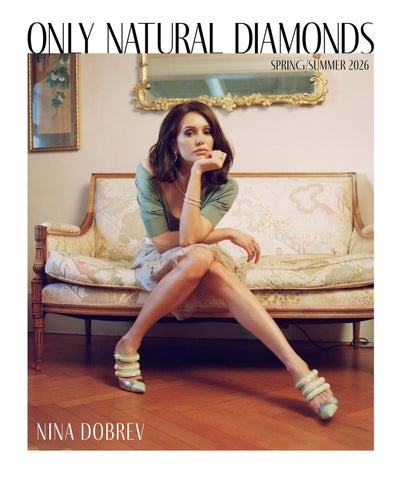
96 FINDING NINA
Nina Dobrev is finding herself all over the world
112 ON POINT
Russell Westbrook o the court
124 HOMECOMING QUEEN
Jessica McCormack is serving up diamonds with a side of verve
134 INSPIRING JOY
How natural diamonds have shaped the life of Minister Kenewendo
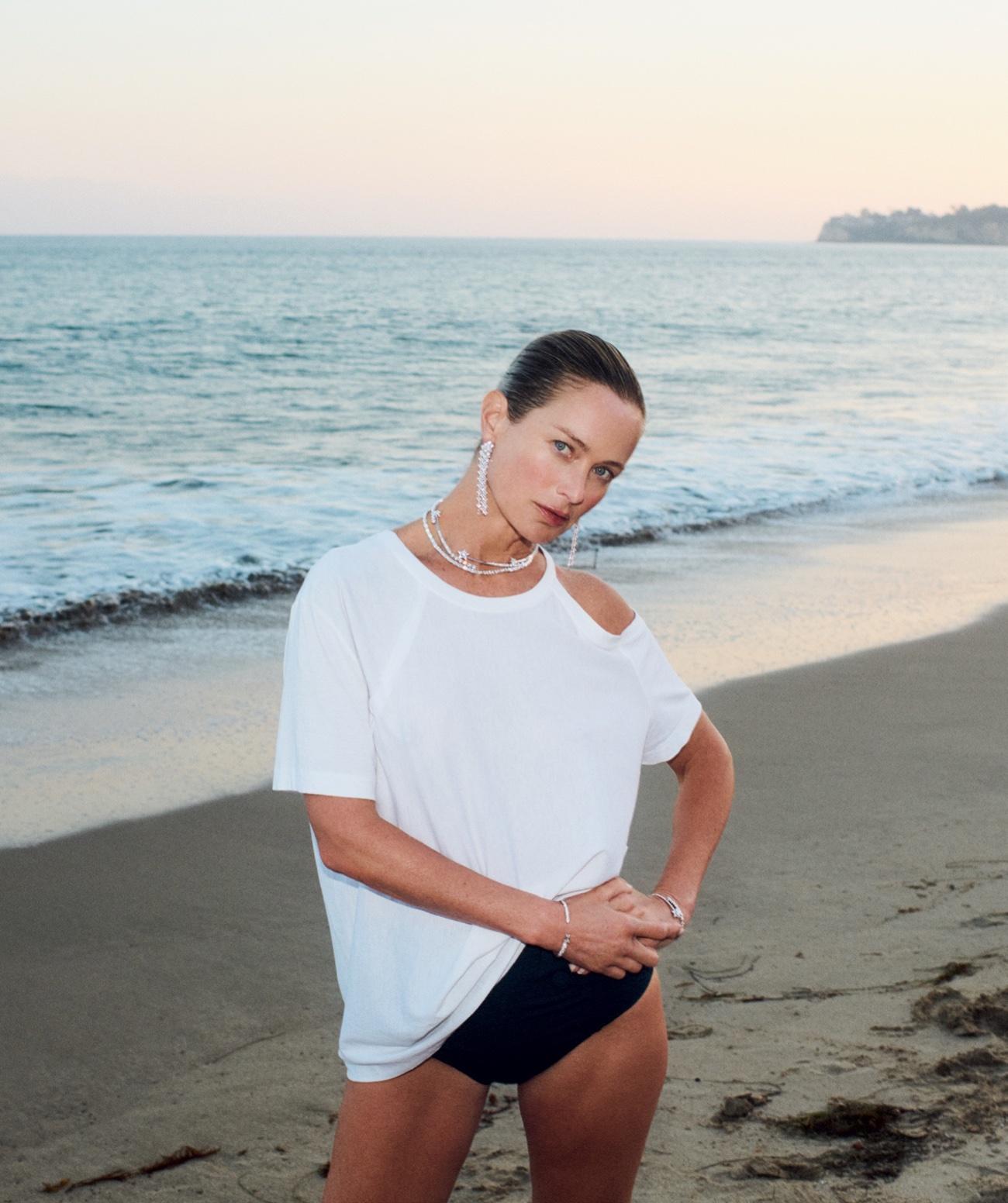
142 CAROLYN MURPHY
On building a lasting career by staying true to herself
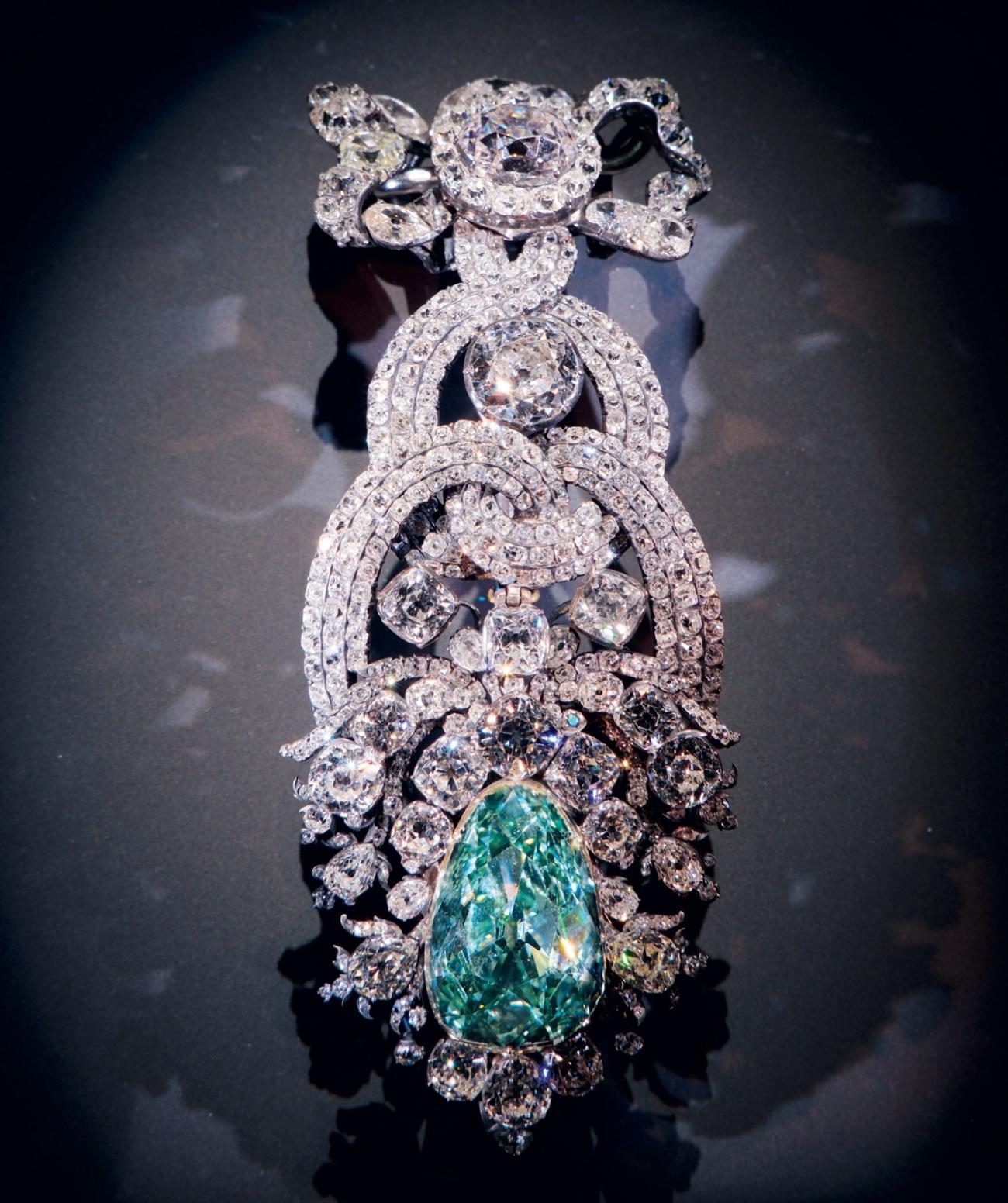
158 DRESDEN GREEN
A private visit to the Green Vault
168 FROM THE DESK OF Christopher Young, Kate Young, and Kindred Lubeck
I’m not sure why the 1980s fad Color Me Beautiful (which forever decided who could be a “Summer”) still resonates, both as a guidepost and a punchline. I suspect it’s because we, as humans, are drawn to color to energize and to inspire. Some might say that taking color as the theme of a spring issue is no more groundbreaking than florals. But with natural diamonds, color captures more than just the rainbow that follows the deluge.
For example, warm white as a shade is a major talking point for those hoping to put a ring on a certain finger. Not only do you know it’s natural, but it leans right into the bold, chunky gold engagement ring trend—and it’s even easier on the wallet. On the other side of the, er, spectrum, the vivid, fancy-colored engagement rings of celebrities from Blake Lively to Scarlett Johansson embody the rarest of the rare.
And while Elizabeth Taylor’s engagement rings still trend highly in search, her collection encapsulated far more than rings alone. Marion Fasel has the scoop on the history of Ms. Taylor’s Taj Mahal diamond, which is now writing a new chapter following its appearance on Margot Robbie’s press tour for Wuthering Heights. Speaking of Taylor, her role in Cleopatra heralded her romance with Richard Burton, but the romance of ancient Egypt held sway for nearly a century before. A new collection of High Jewelry from Van Cleef & Arpels delineates the themes that have held collective imagination in thrall throughout the maison’s history.
History is also not without its colorful characters, and Lynn Yaeger meditates on the vanguards whose dance with diamonds was more than a little o kilter. Josie Goodbody dives into the colored diamond collections of royal families. Dresden Castle welcomed us into the Green Vault to view the world-renowned Dresden Green diamond, whose colorful history continues to inspire.
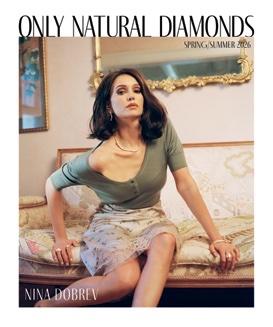
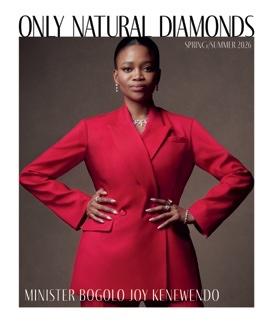
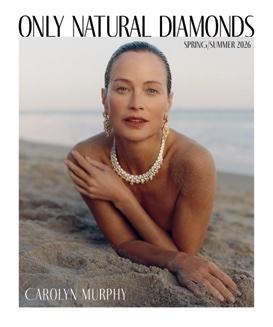
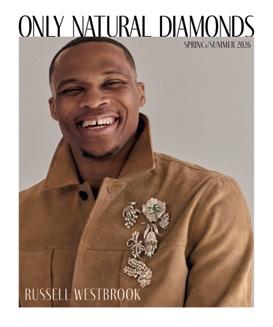
Actress and producer Nina Dobrev captures the mood, showcasing white, yellow, and pink diamonds alongside her playful nature. Nature blessed supermodel Carolyn Murphy, but it’s her insistence on staying true blue that has ensured her staying power. Russell Westbrook’s career highs have shattered anyone’s highest expectations, but his focus on family and entrepreneurship is his true legacy. Botswana’s Minister of Minerals, Bogolo Joy Kenewendo, embodies the opportunities diamonds provide for the country. She terms herself a “diamond baby” to describe the education, resources, and now career that diamonds have enabled in her life.
This range of profiles showcases the breadth of stories that diamonds carry—stories that truly represent every color of the rainbow.



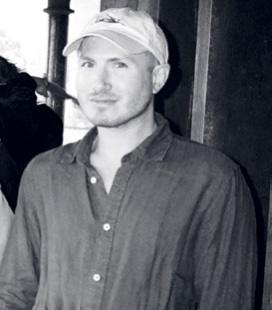

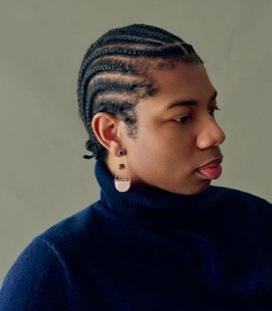
Micaiah Carter is a photographer and director based in Los Angeles known for his elevated eye and distinct visual language. Rooted in family, his work carries a deep sense of memory and emotion, approaching portraiture with a soulful intimacy while thoughtfully looking toward the future.
British photographer and director Felix Cooper is renowned for bringing a refined energy to his work. Known for his ability to showcase the strength and personality of his subjects, he collaborates with talents such as Adwoa Aboah, Edie Campbell, Hailey Bieber and Lila Moss, creating captivating stories with a fresh perspective. With a reputation for establishing an empowering environment on set, he skillfully captures the true essence of his subjects, allowing them to shine with confidence.
Marion Fasel, author of The Adventurine on Substack, is an esteemed jewelry expert, curator, trend forecaster, and historian who has written several books, including the newly released The History of Diamond Engagement Rings: A True Romance.
Jalil Johnson is a New York–based freelance writer. He is the creator of the Substack Consider Yourself Cultured and has been featured in Harper’s Bazaar, Vogue, The Financial Times, Town & Country, The New York Times, and Esquire for his expertise in style and culture. His work can also be found at Who What Wear, Refinery29, Grazia, and Only Natural Diamonds. Previously, he worked in the Fashion O ce at Saks Fifth Avenue as Fashion O ce Coordinator. You can find him on Instagram at @jalil_johnson_ and on Substack.
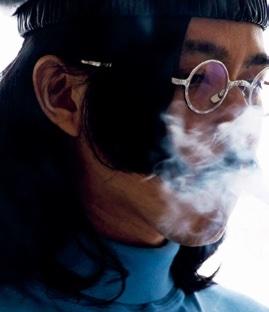

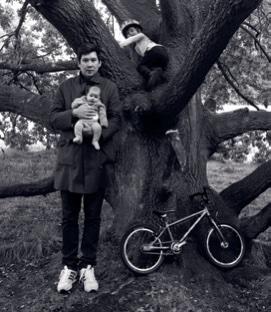
Mark Lim is a photographer and director based in Brooklyn, New York. Having graduated from Parsons School of Design, he often takes a conceptual approach, whether in fashion, still life, or his own personal projects. With his partner, he founded Nicotine Magazine, an internationally distributed fashion and art magazine, where he is co-editor-in-chief and creative director.
Jill is an award-winning journalist and storyteller. Her assignments have taken her to diamond mines across Africa, cutting workshops in India and Belgium, and jewelry ateliers around the world. Jill is the Natural Diamond Council’s Editor at Large, and her work also appears regularly in leading media outlets, including The New York Times, Robb Report, and Galerie Magazine.
Tung Walsh is a London-born photographer of Chinese and Irish descent whose work has been featured in Vogue, Arena Homme+, Self Service, and i-D Magazine. His subjects include Tim Burton, Taylor Swift, Matthew McConaughey, Dua Lipa, and Riz Ahmed.
Lynn Yaeger has been writing about fashion, jewelry, and culture for over two decades. She began her career at the Village Voice. Now a contributing editor at Vogue, Yaeger has written for many publications, including The New York Times, WSJ Magazine, and more. In 2019, Yaeger won the coveted CFDA Media Award. In her o hours, she can be found haunting the world’s flea markets, searching for antique toys and vintage jewelry.
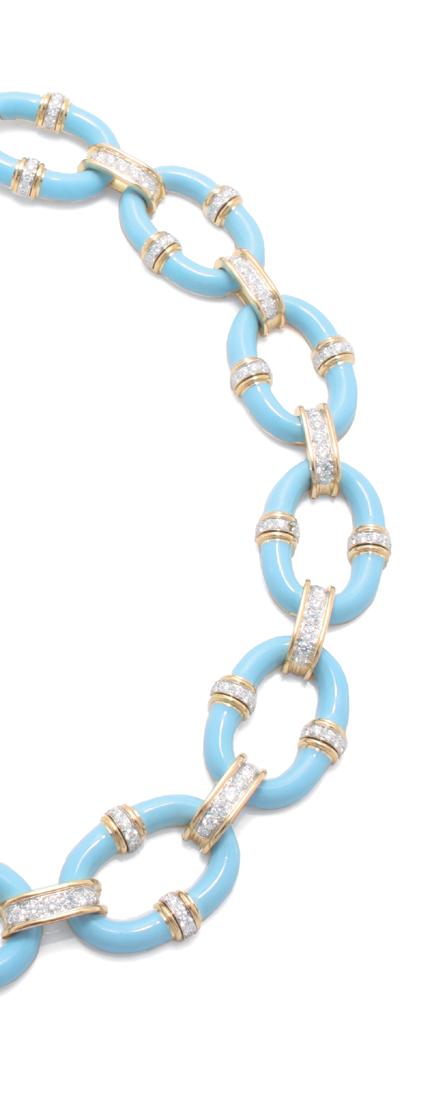
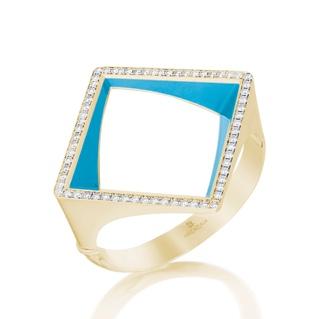
to the new maximalism, where jewelry is colorful and bold, and joy is the point.
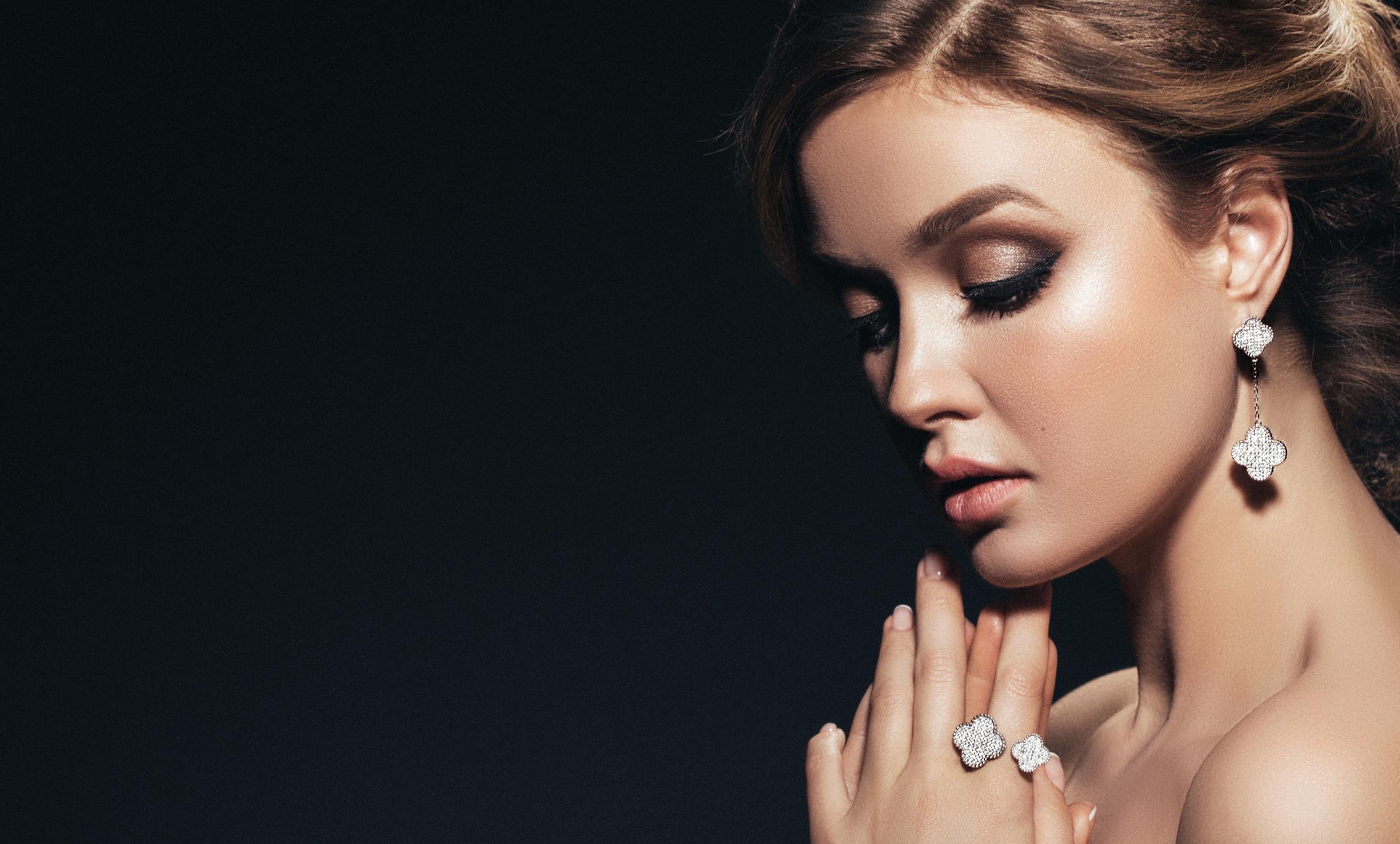
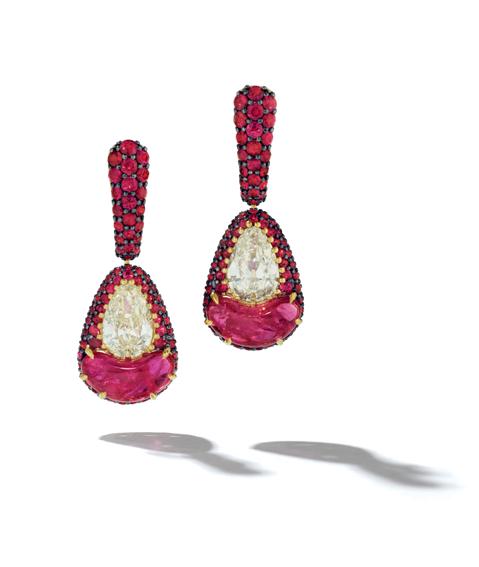
After years of restraint—minimalism, neutral palettes, quiet luxury—color has returned to fine jewelry with conviction. Not as an accent, but as a statement. Saturated gemstones, vivid enamels, lively ceramics, and tinted metals are surging back into focus, always punctuated with a spark of diamonds.
Across jewelry, designers are leaning into vibrancy: mouthwatering rubies, dreamy turquoise blues, bright green enamel. And diamonds remain the architecture—providing light, contrast, and the unmistakable signal of fine jewelry. Color may draw you in—but diamonds make it endure.
The shift feels both fresh and cyclical. Fashion and jewelry have always responded to the cultural mood. The bold, gem-heavy glamour of the 1960s and ’70s gave way to the minimalism of the ’90s, then the easy layering of the 2010s. Today’s return to exuberance reads as a reaction to years of uncertainty. When the world feels heavy, people gravitate toward pieces that feel joyful, optimistic, and expressive.
“In times of darkness, people look for things that spark joy and lightness,” says longtime fashion editor and stylist Elizabeth Saltzman, whose clients include Gwyneth Paltrow, Jodie Comer, and Saoirse Ronan. “Color hasn’t been around like this in decades.”
The longing for optimism has been building on the runways. Designers have moved beyond overly casual and rigid designs toward clothes that feel lighter, prettier, and emotionally resonant. One of the season’s most talked about shows was Matthieu Blazy’s first collection for Chanel, praised for its romantic spirit, lightness and ease—and joyful energy on the runway.
“Coming o several seasons of modern art-inspired primary shades and bold color blocking on the runway, it feels like fashion has fallen back in love with color,” says Nina Garcia, editor in chief of Elle
Jewelry is following suit with a range of colorful jewels manifested in countless ways.
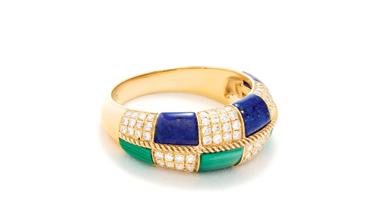
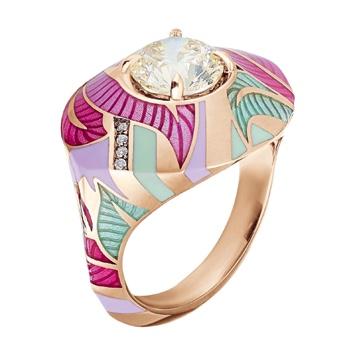
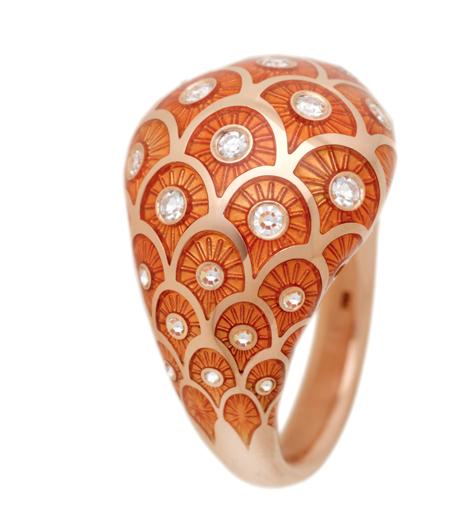
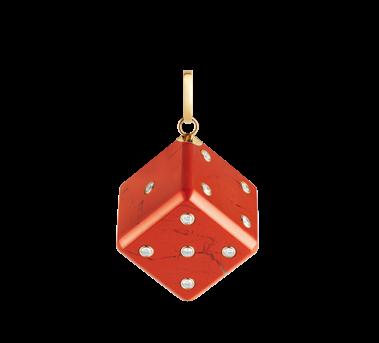
Color alone isn’t the story. The most sophisticated pieces rely on diamonds to amplify saturation and deliver brilliance. The interplay between stone and sparkle is what elevates bright jewels from playful to precious.
Few understand that balance better than James de Givenchy for Ta n, whose playful striped ceramic rings and pendants feature serious diamonds. Selim Mouzannar’s pieces are drenched in vivid enamel—pink, lime, sunflower—with a diamond center.
At David Webb, saturated enamel and carved gemstones appear in expressive animal cu s, cocktail rings, and statement necklaces. Hemmerle sets dreamy diamonds and rare stones into color-tinted aluminum, creating unexpected tension between precious and industrial. Brent Neale mixes gemstones and diamonds in substantial gold pieces meant for everyday wear rather than special occasions.
The message is clear: diamonds are not competing with color—they’re activating it.
“Color is also having a moment because people are more willing to take risks in their style,” Saltzman says. “It’s about individuality.”
Her own touchstones include Ta n by James de Givenchy, Glenn Spiro, Belperron, and JAR. Among her most treasured pieces
BY JILL NEWMAN
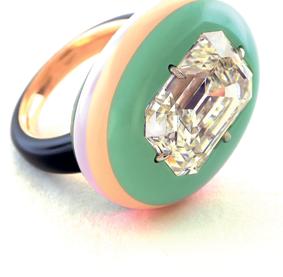
is a gem-laden vintage Verdura Maltese cross pendant passed down through three generations. “It elevates everything from a T-shirt to a slip dress,” she says. “A unique piece can complete a look—or distract from something. That’s a styling trick.”
Garcia shares a similar philosophy. “I’m always looking to accentuate diamonds with something colorful,” she says, noting emeralds as a favorite pairing. Brooches, prominently featured on the recent runways at Ralph Lauren and Khaite, o er an easy entry point. “I love wearing them in a unique way,” says Garcia. “I recently accessorized with a Briony Raymond brooch pinned at my waist for a friend’s wedding.”
Fine jewelry is embracing maximalism—bigger color, bigger presence, bigger personality—with diamonds providing the polish and permanence. The result feels optimistic, expressive, and unapologetically luxurious.
BY MARION FASEL
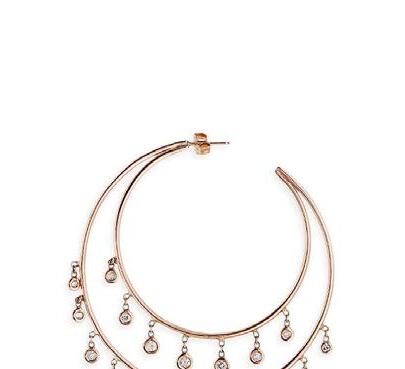
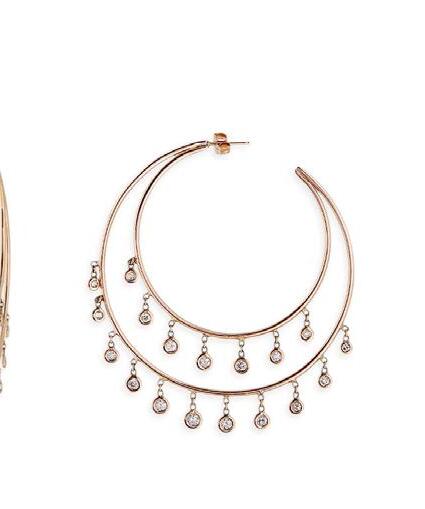
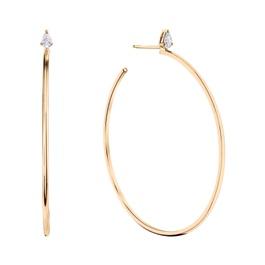
The‘90s are famous for having a strong minimalist streak. Back then, round diamond studs were considered enough sparkle on their own, even for the Oscars. In 1996, for example, when Patricia Arquette attended with her then-husband, Nicolas Cage, she borrowed diamond studs from Harry Winston. That’s it. They were her only jewels. The twinklers made news because they became hers by the end of the night. Cage bought them for her to commemorate his Best Actor win. Two years later, Helen Hunt wore studs and the slenderest diamond bracelet when she won the prize for Best Actress. It was considered the epitome of chic.
While minimalist diamond earrings are emblematic of one type of ‘90s style, the decade also had a playful side. With all the midri tops and low-rise pants, little belly rings became popular. Madonna had a diamond horseshoe charm attached to her navel ring. Supermodel Naomi Campbell asked Ti any & Co. to extend the chain of her Elsa Peretti Diamonds-by-the-Yard necklace so she could wear it looped around her waist and through her navel ring.
These types of diamond piercings and body jewelry inspired renowned fashion critic Suzy Menkes to write the provocative piece “Fetish or Fashion? ” published in The New York Times on November 21, 1993. Christy Turlington then answered the question in a way that only a supermodel could. For the April 1994 issue of Vogue, she sported a substantially sized cushion-cut canary diamond navel ring by M + J Savitt in an unforgettable image taken by Irving Penn that focused solely on her midri which was decorated with a temporary tattoo.
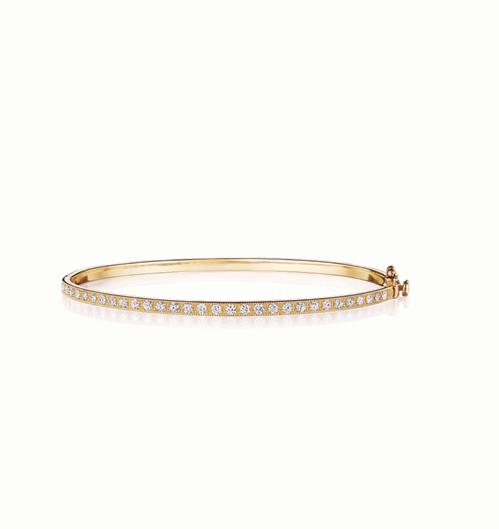
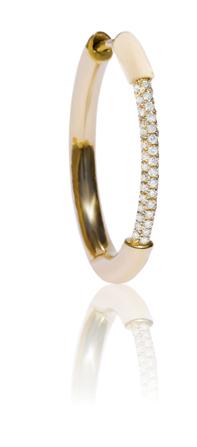
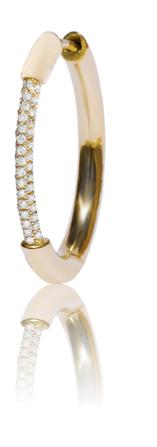
Somewhere between the simple sparkle of studs and the flirtatious belly rings there were perhaps the most popular jewelry silhouettes of the period: hoops and bangles set with a few twinkling diamonds. The styles genre hopped from bohemian jewels to minimalist and edgy designs.
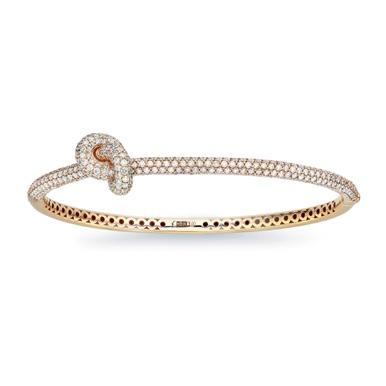
One leader in the category was Me&Ro. The label’s co-founders, Robin Renzi and Michelle Quan, met while working as waitresses at Indochine, a beloved downtown New York City restaurant frequented by scenesters in the ‘90s, including John F. Kennedy Jr. and Carolyn Bessette. Creative visionaries, the design duo teamed up and launched their boho jewelry line in the early years of the decade. Then, Julia Roberts, the biggest actress of the time, popularized the indie design house’s hoop bangles and, essentially, the entire collection with a wide audience. She wore the pieces on-screen in
Notting Hill (1999) and o -screen just about everywhere.
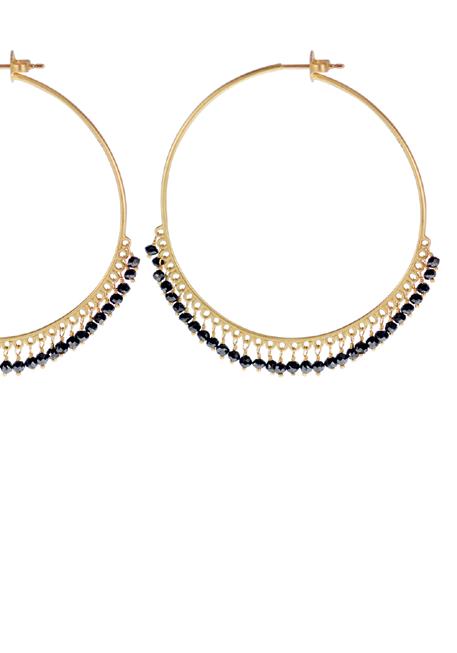
Me&Ro still makes amazing diamond bangles and hoops in the same laid-back glam mode. Some of the bangles have marquise diamonds set east-west, while others have a dusting of round diamonds. Giant hoops feature briolette-shaped brown or black diamonds.
Penny Preville is another designer whose collection dates back to the ‘90s when A-listers Sandra Bullock and Nicole Kidman wore her work. Preville’s modernist bangles with diamond accents and full pavé pieces still perfectly capture the understated elegance of that era.
Many designers continue the legacy of the hoops and bangles from 30 years ago. Anita Ko exemplifies minimalist restraint with her slender gold wire hoops that end in a single diamond. Kat Kim ever so gently adds diamonds to the artistic circles in her bangles and hoops. Engelbert puts a small stylish knot at the front of its slender bangles and varies the diamond treatment from a full pavé in white or black diamonds to strategically placed diamonds on their design motif.
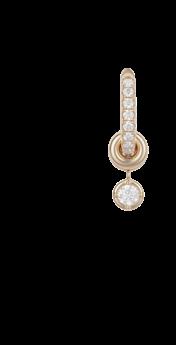
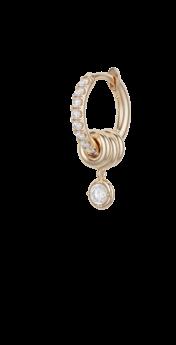
The bohemian spirit lives on in hoop and bangle designs, too. Free-spirited designer Jacquie Aiche specializes in hoops with dangling diamonds. Spinelli Kilcollin makes mini huggie diamond hoops, a silhouette that was as popular with the Y2K generation as larger styles. The label also has a trio of bangles attached to one another with little rings, making it easy to wear a stylish stack.
To capture the ‘90s spirit when you wear the pieces, the rules are simple. You can toss hoops on with your hair up to be polished or down for an e ortless look and wear them day or night. Bangles, on the other hand, have a bit of superstitious lore attached to them.
If you believe in such things, the big bangle theory is easy to follow. The thinking is that wearing an even number of bracelets brings bad luck, while wearing an odd number works like a lucky charm. In other words, one bangle is great. Don’t forget simple studs were enough in the ‘90s. But three or five or any other odd number conjures up the fun of the period without the fetish that once concerned fashion critics.
in 2024, Dua Lipa posted her first selfie wear ing a ring on the third finger of her left hand in one of her famous Instagram photo dumps. While the image should’ve been an obvious statement that the pop singer was engaged to her actor boyfriend, Callum Turner, the press and fans weren’t sure. The jewel was di to see in the photo because it was taken from a distance.
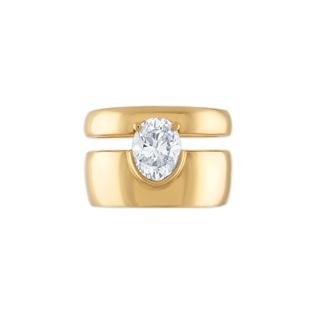
As the days, weeks, and months went by, Lipa showed clear, close-up shots of the ring in radiant selfies. By social media standards, she was screaming, “I’m engaged!” Still, there was hesitation. Since the singer hadn’t o cially confirmed the news, some thought perhaps the wide gold band centering on a round diamond was a friendship ring, some thing akin to a placeholder. It just didn’t look like an engagement ring.
Ever since 1886, when the six-prong Ti Setting launched, and even before that time, diamonds have been the star of engagement rings while the gold or platinum mounting played a supporting role. Dua Lipa’s ring was di erent. The gold was a co-star.
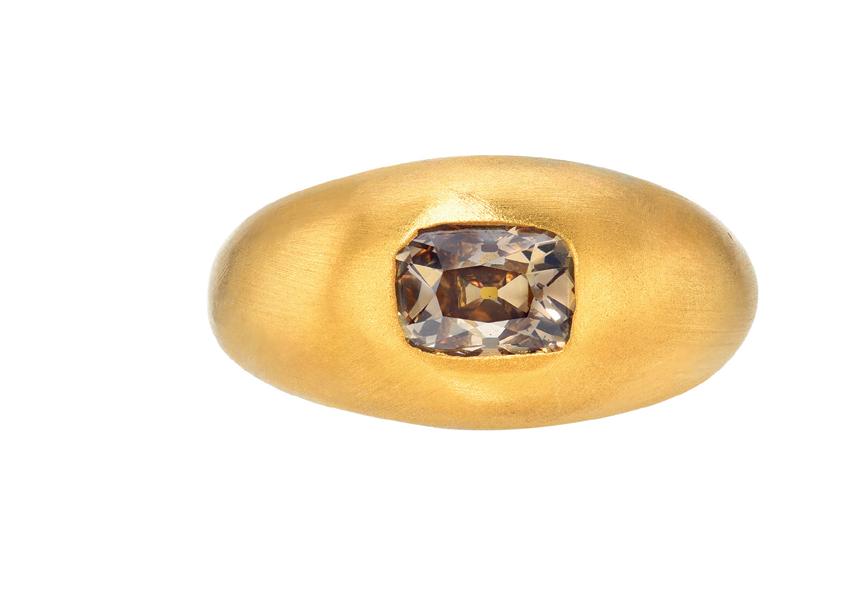
In June 2025, the singer finally confirmed to British Vogue that the ring was, in fact, an engagement ring and her fiancé had designed it. “I’m obsessed with it. It’s so me,” she said. “It’s nice to know the person that you’re going to spend the rest of your life with knows you very well.”
While the news reverberated through the press, there were still remarks about how unusual the design was for an engagement ring. People magazine called the jewel, “unconventional.” Teen Vogue took it a step further, saying how the unique ring had helped Lipa “fly under the radar” with her engagement news.
Well, it didn’t take long for “unconventional” styles to become a hot choice for brides. The most high-profile being the engagement ring Miley Cyrus received from musician Maxx Morandor early last December. The custom jewel designed by celebrity favorite Jacquie Aiche features an east-west set cushion cut diamond weighing around 4.5-carats, plunged in a gold ring with
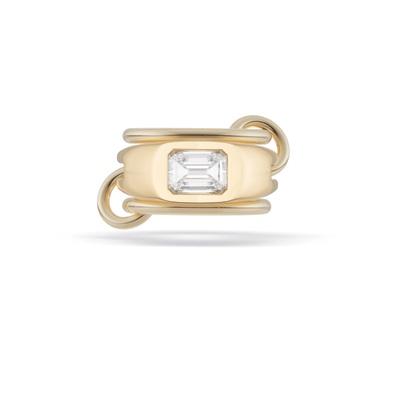
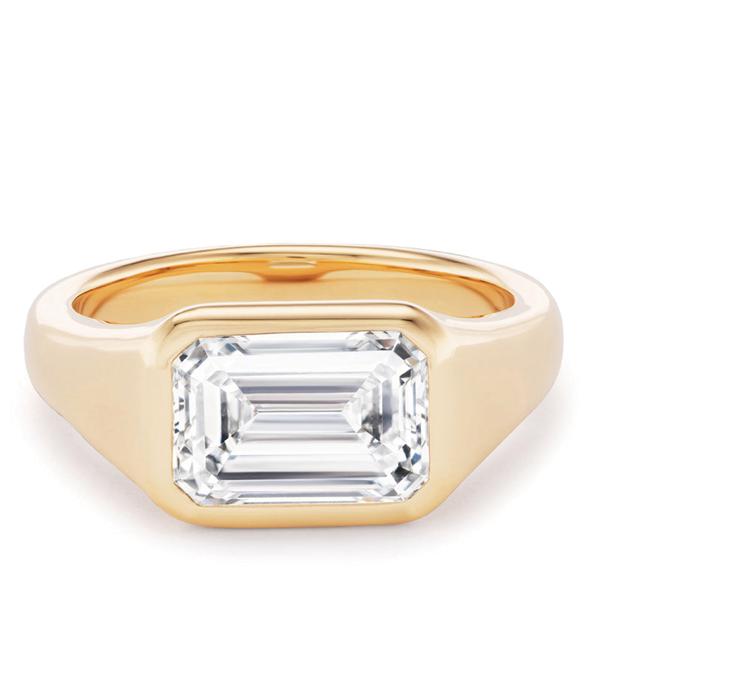
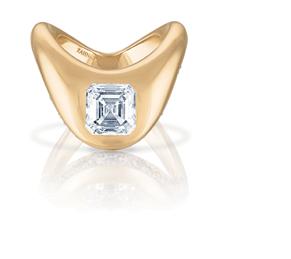
a wide bezel and thick band. Miley’s jewel conjures up the look of a diamond signet ring more than an engagement ring. In the distant past, the style might have been categorized as a men’s ring.
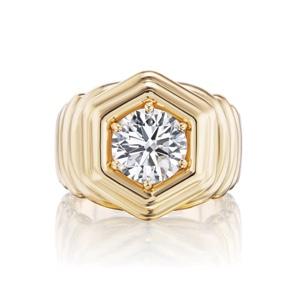
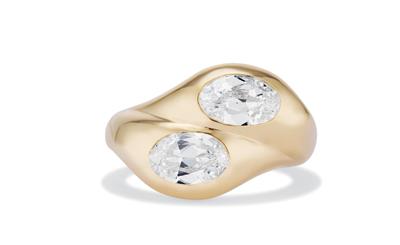
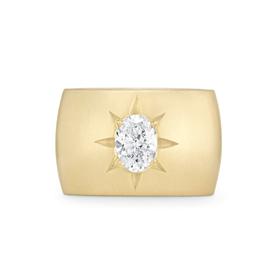
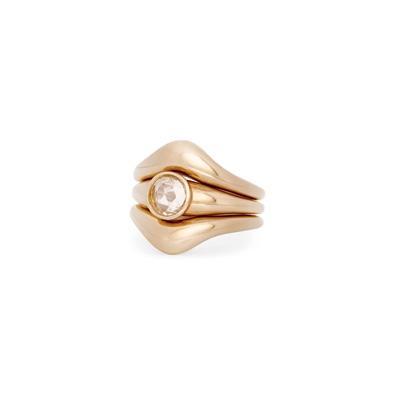
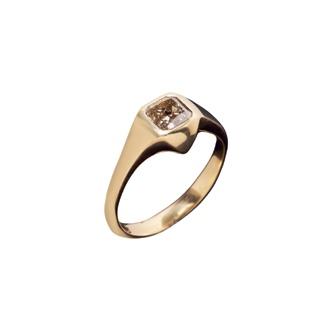
While the bold gold diamond rings are new to the celebrity landscape there are lots of innovative designers who have been making rings in the mode. These iconoclasts focus on gold jewelry in their collections and design engagement rings from their own perspective, rather than adhering to traditional ideas about what engagement rings should look like.
Designers Harwell Godfrey, Spinelli Kilcollin and Zahn Z incorporate signature elements into their rings like ziggurat shapes, stacked rings and architectural swoops. The work of designers Cece Jewellery, Jade Ruzzo, Jacquie Aiche, and Ashley Zhang features geometric and organic forms. Brent Neale, Darius and Ten Thousand Things ri on deeply historic styles.
Why, you may be wondering, haven’t these wearable styles been part of the engagement ring conversation sooner? Well, conventional
BY MARION FASEL
wisdom, mainly spouted by gemologists, was that yellow gold could cast a yellow light across white diamonds. Platinum, on the other hand, was believed to enhance the brilliance and fire of white gems in engagement rings.
Designers today have a di erent outlook that is easy to understand. “I think the contrast of a white diamond against the yellow metal makes it appear whiter,” explains Brent Neale. “When I’ve seen lower quality white diamonds set in platinum, I notice the yellow in the gem. Having the white metal next to the white diamond makes the yellow stand out.”
On the flip side of the diamond color spectrum, the earthy colors of golden and brown hues, now often referred to as desert diamonds, sparkle plenty in yellow gold settings. “I’m often shocked at just how much a big juicy gold curve around a diamond enhances it,” says David Rees, co-designer of Ten Thousand Things. “The frame of gold feels eternal, like something made by the ancients.”
Darya Khonsary, the founder and designer of Darius, also considers the classical world and beyond when designing her gold and diamond rings. “Gold is as old as the celestial bodies, born of ancient stars, carried in the deep veins of the Earth, and entrusted to our hands.” It’s a romantic view that’s just right for someone designing engagement rings.
One thing is certain with celebrities like Dua Lipa and Miley Cyrus choosing bold gold diamond engagement rings and designers like the ones featured on these pages making such stunning work, no one will ever again confuse the style when worn on the third finger of the left hand as anything other than a strong symbol of a couple’s union.
My earliest memory with jewelry is one that only came back to me fairly recently. I couldn’t have been more than four or five years old, in my mother’s bedroom, going through her things and becoming completely taken by the sparkle of pieces spilling out of her jewelry case, which looked like a miniature grandfather clock. I remember slipping on a few of her rings and bracelets, lingering over her earrings–there wasn’t much else I could do with them as my ears weren’t pierced–and then finishing with a spritz of her perfume, something I had seen her do just before leaving the house.
Perhaps she had a kind of sixth sense, because just as the scent began to settle, she walked in. I remember time feeling like it froze as she took in the scene, while I tried to concoct a story about what I was doing. My story couldn’t hold water, which led to me being reprimanded and reminded that as a boy, there were certain things I could and could not do, and certain things I could and could not wear. Even if I didn’t say it aloud, I know the question, “But why not?” was already percolating. It didn’t make sense to me then that self-expression had such clearly defined gender lines, and to this day, it still doesn’t. Thankfully, I don’t feel as alone in that sentiment as I did as a child.
Over the past few years, men’s fashion has undergone something of a peacock revolution, and suddenly it was no longer taboo for men not just to care about their appearance, but to actually prioritize it. I remember working at Saks Fifth Avenue as the world was reopening after the pandemic, when spending was through the roof. At a number of town hall meetings, a phrase tossed around in jest was,
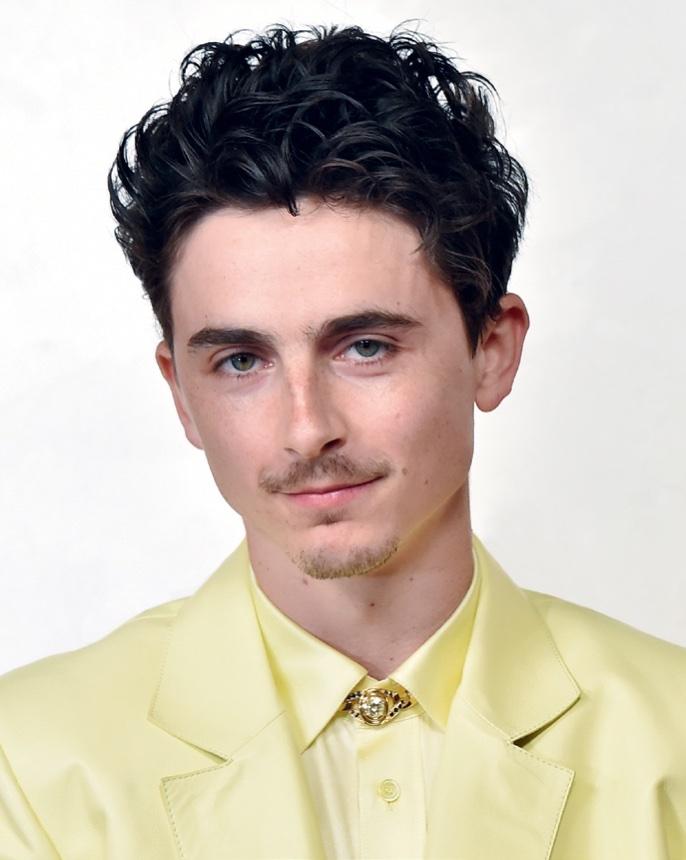
ON AND OFF THE CARPET, MEN ARE TAKING A MORE ADVENTUROUS APPROACH TO JEWELRY. BIGGER STONES, BOLDER COLORS, AND DELICATE MOTIFS ARE ALL UP FOR GRABS.
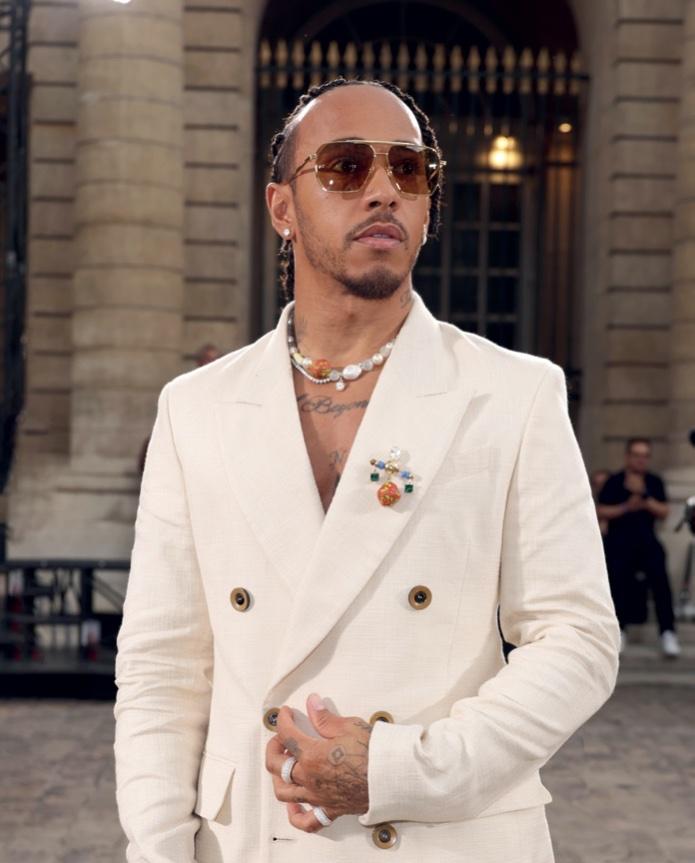
“the man had become the new woman”. Week after week, men were outspending women, not only in apparel, but in jewelry as well. And though spending isn’t at the same level as it was post-lockdown, the sentiment that men are choosing to invest in their appearance hasn’t changed.
When I spoke with Jennifer Shanker, founder and CEO of MUSE, she corroborated this rise of the male shopper: “Absolutely. We’ve seen a meaningful increase in male clients over the past few years, and what’s most exciting is how adventurous they’ve become in their purchases. Men are no longer limiting themselves to signet rings or simple chains. They’re exploring color, diamonds, and more expressive designs in a way that feels personal.”
Across my conversations, one idea kept emerging: this shift isn’t a trend, but a natural evolution of how men approach style.
Fashion editor and a bona fide jewelry lover Yashua Simmons told me, “I think it’s only a natural progression that we got there [here],” he said. “I think we tend to borrow from people that we might live with or cohabitate with. It’s like how a woman borrows her boyfriend’s blazer, I’ve always kind of had this idea about the guy borrowing a ring or a bracelet–just borrowing from a jewel box.”
When I spoke with Simmons, he was in Los Angeles, waiting for a few vintage Piagets to arrive for his client Usher, whom he was dressing for the Vanity Fair Oscars Party – speaking to the importance of the red carpet when it comes to men’s fashion. Of course, there has always been a cohort of men who rival women on the red carpet, not only in terms of fashion but also jewelry, but this particular moment feels di erent.
BY JALIL JOHNSON
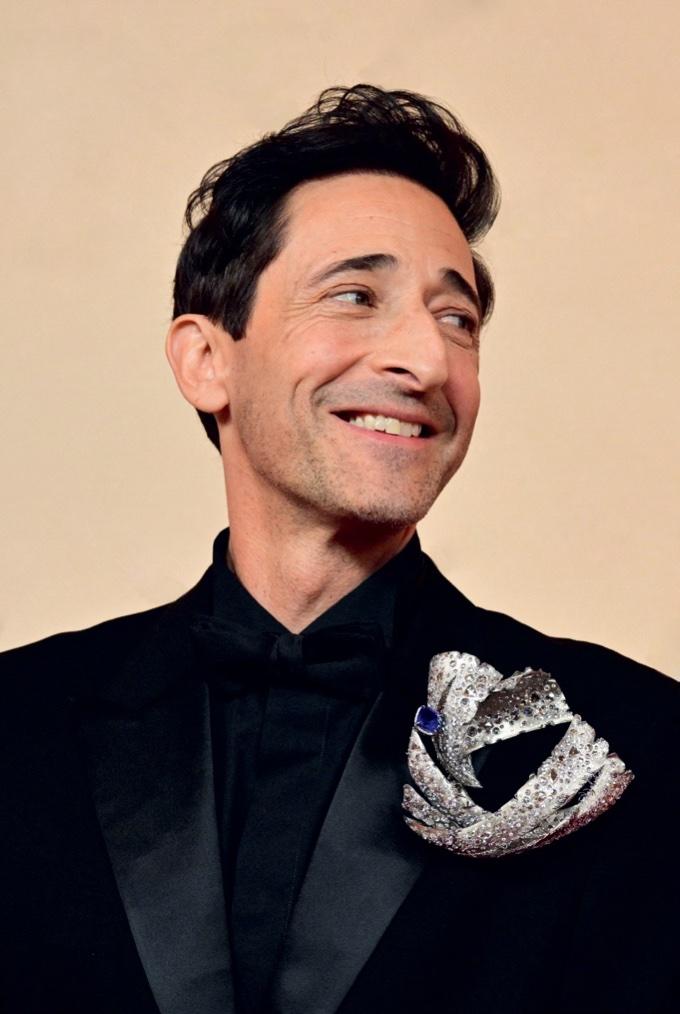
Actors like Colman Domingo have turned the red carpet into something closer to a catwalk with his daring choices. Then there are younger stars like Timothée Chalamet and Jeremy Allen White, whose jewelry choices are perhaps more subtle, but no less impactful. And then there are those you might not expect to be as experimental, like Oscar winner Adrien Brody, who stepped out on the carpet this year wearing a sculptural creation by Elsa Jin, celestial in shape and set with diamonds and sapphires.
For designers, that kind of visibility has a real impact. While in Paris, I had the chance to peruse and try on a few pieces by jewelry designer Selim Mouzannar, whose work reflects his dual worlds of Beirut and Paris. His pieces have also been worn by some
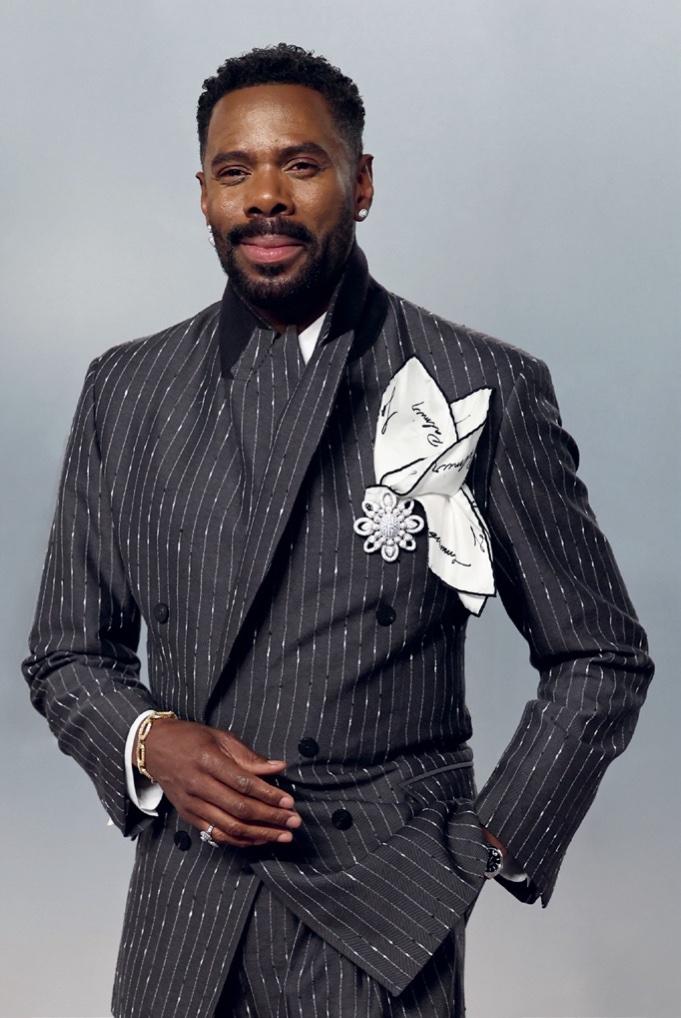
of Simmons’s clients, including Usher and Giveon. When I sat down with him to talk about this cultural shift and the role of the red carpet, he said, “It’s a social phenomenon.” He went on to say, “Some influential men were courageous to wear some of these jewelry [pieces], and people saw it, and they discovered it. Now, on the red carpet you can see men wearing brooches. Three years ago, it was not really common.” When I asked Shanker what she believes is driving this shift, and how much of it can be attributed to the red carpet, she responded, “The red carpet certainly helped normalize it, but what we’re seeing now goes far beyond that.”
Though it is certainly becoming more normal for some, this phenomenon is not entirely new. Jewelry designer Renato Cipullo, who has been in the industry since the ‘60s and started his own line in the ‘70s, told me, “For me, this moment actually feels very familiar. When I began designing in the 1970s, there was an incredible sense of freedom in fashion and jewelry.” He continued, “A piece wasn’t confined by gender in the way it sometimes became later. People were inspired by art, travel, music, and the spirit of individuality that defined that decade. What I see today reminds me of that energy. Men are rediscovering the pleasure of wearing jewelry that feels expressive with larger stones, color, or motifs that once might have been considered unconventional. It isn’t really something new; it’s more like a return to a broader idea of personal style.”
This notion is echoed by Claire Choisne, the creative director for Boucheron: “Historically, many aesthetic codes were strictly divided: certain stones, colors, or motifs were considered ‘feminine,’ while men were expected to remain discreet. But when society begins to question rigid gender roles, those stylistic borders start to dissolve as well. Men today feel less constrained by those old expectations, and that opens the door to a much richer form of self-expression.”
This moment is in part about gender, but more broadly, it reflects a sentiment of self-allowance among men to engage with jewelry in a more expansive way. The entire jewelry box, so to speak, is no longer o limits.
Prior to my trip to Paris, I was in London, and I knew I wanted to buy a piece of antique jewelry as a sort of homage to Jacqueline Onassis. I had just written about her jewelry collection, including a piece she purchased in Wiltshire.
Instead of going to Wiltshire, I popped into Gray’s Antique Market, a two-story building on Davies Street that houses what feels like miles of booths selling jewelry, watches, and antiques. I had very little time to truly peruse, so when I walked in, I turned right and went straight to the first booth I saw. I looked at a few things, and the shop owner told me to take pictures and think about the piece I wanted. I chalk this up, perhaps, to being an American, or just downright impulsive, but I made a quick decision and settled on a tie bar from the 1910s in gold and platinum with a row of sapphires and diamonds.
For the entirety of the trip, I wore the tie bar day and night. At first, it was practical; I had limited options because I only traveled with a carry-on and needed something to add a bit of presence to my outfits. But it also felt right to wear it every day. It became an extension of me, and perhaps a subconscious way of answering a question that I posed at a young age: yes, a man can dare to wear a piece like this, because everyone has the right to a diamond.
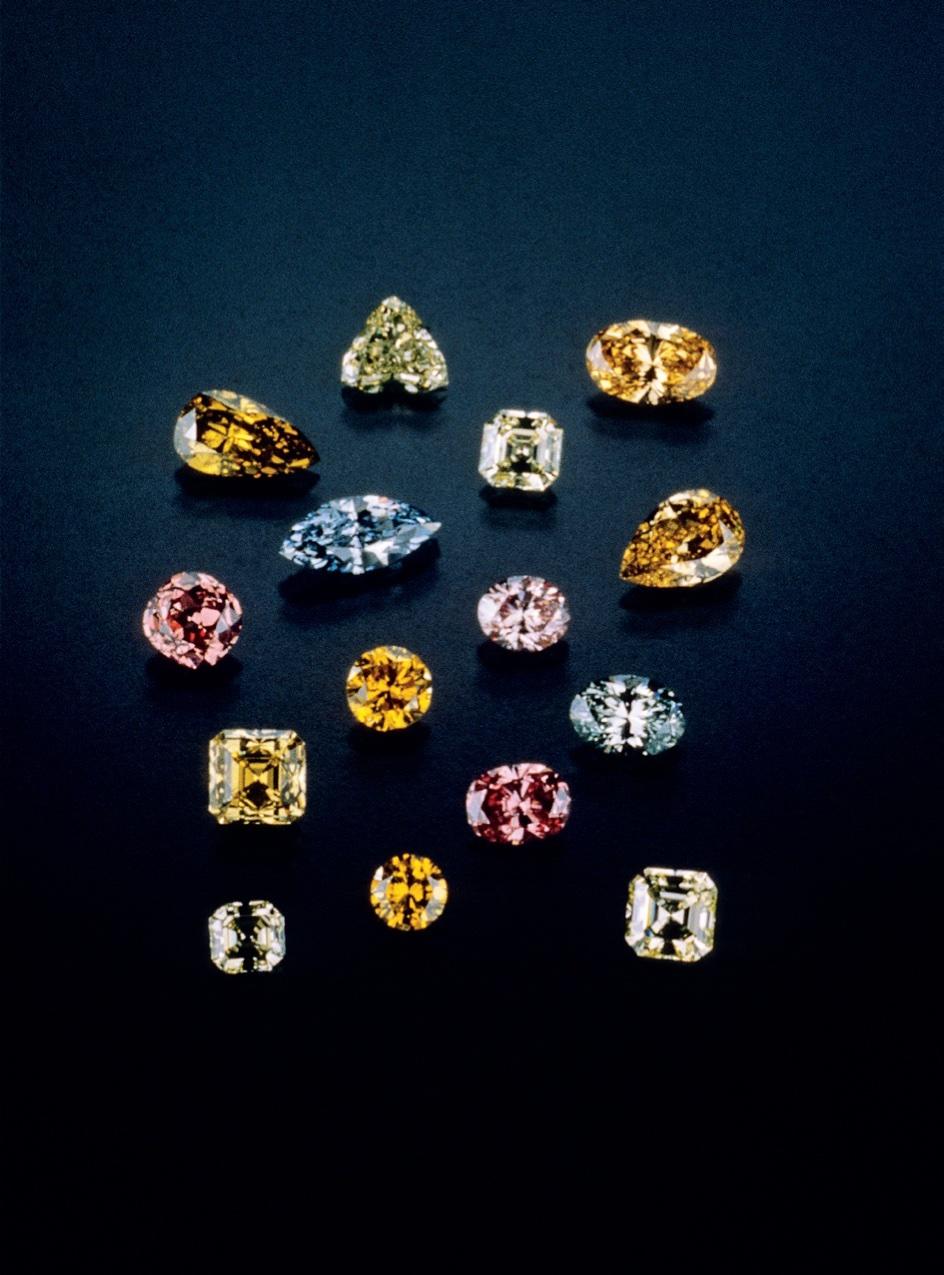
Naturalfancy color diamonds are among the rarest and most extraordinary things the Earth creates. While colorless, near-colorless, and brown diamonds are more common by comparison, fancy color diamonds in most other hues are exceptionally rare, making up only 0.01% of all diamonds discovered. Most people think of diamonds as colorless, but nature can produce them in nearly every color of the rainbow. What makes fancy color diamonds so fascinating is not only their beauty but also the fact that each color forms in a different way, and some of the causes are yet to be fully understood and determined, primarily through visible spectroscopy. Some owe their color to trace elements like nitrogen or boron. Others owe it to natural radiation exposure or pressure-induced distortion in the crystal lattice. Together, they show just how varied nature’s processes can be, producing diamonds in colors that range from warm yellow and brown to electric blue, soft
pink, vivid green, and the nearly mythic red. This guide was created with the Gemological Institute of America (GIA), the world’s leading authority on gemology. The images for each color are intended to represent pure, unmodified examples of each hue using GIA color master stones. When GIA determines the color of a fancy color diamond, the stone is examined face-up under controlled lighting and viewing conditions and compared against appropriate master stones. While hue, tone, and saturation are fundamental to color description, the face-up appearance of a diamond is also greatly influenced by its cutting style and facet placement.
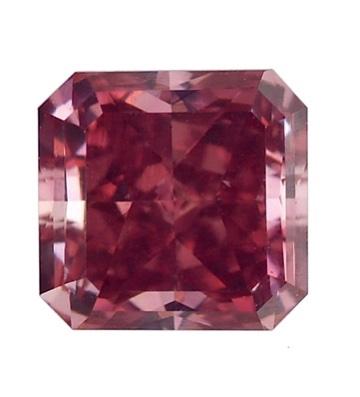
Among all fancy color diamonds, red stands above. The GIA has examined more than a million colored diamonds, and only a few dozen qualified as red, making red the rarest color category of all. Scientists believe natural red diamonds get their color from the same broad structural phenomenon that produces pink diamonds: an intense distortion of the crystal lattice, often described as plastic deformation. In red diamonds, that distortion appears in its most extreme form, producing a saturated red body color without the help of trace elements. That rarity explains why fewer than a few dozen true natural red diamonds are generally known to exist. Red diamonds are also unusual in grading. Unlike most other fancy color diamonds, which can appear as Fancy Light, Fancy Intense, or Fancy Vivid, pure red diamonds are simply graded Fancy Red. They may appear with modifying hues, such as purplish red or brownish red, but red itself cannot sit in the secondary position. The
BY GRANT MOBLEY
most famous example is the Moussaie Red, a 5.11-carat Fancy Red that remains the largest known red diamond in the world.
ORANGE DIAMONDS
Pure orange diamonds are among the rarest diamonds on Earth, and they remain especially prized when they show no modifying hue. Most orange diamonds owe their color to nitrogen-related lattice defects, particularly features associated with isolated nitrogen or absorption centered near 480 nm in the visible spectrum. However, GIA research has shown that orange can arise through more than one mechanism. Unlike yellow diamonds, which appear relatively often in the fancy color world, pure orange
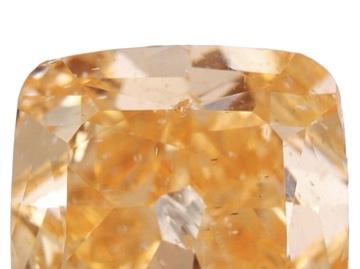
diamonds are very scarce. Many stones described in the trade as orange actually carry modifying colors such as yellowish orange, brownish orange, orangy yellow, or pinkish orange. That is one reason truly unmodified orange diamonds draw so much attention. In grading, orange diamonds can fall across the usual fancy color spectrum, from Fancy Light to Fancy Vivid and Fancy Deep, with saturation playing an enormous role in value. Collectors especially prize stones that show vivid, unmodified orange. A famous example is The Orange, the 14.82carat Fancy Vivid Orange diamond that sold at Christie’s Geneva and still stands as one of the most important orange diamonds ever o ered publicly. Orange diamonds feel almost improbable in nature, and that rarity gives them a special place among connoisseurs of fancy color.
Yellow diamonds occupy a unique place in the world of fancy color because they are both familiar and extraordinary. Their color comes
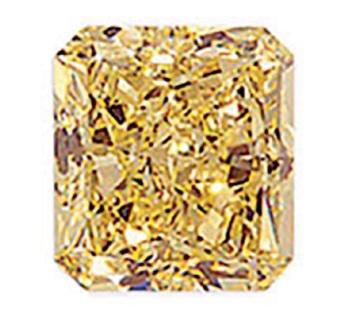
from nitrogen, but the relationship is more nuanced than it might seem. A nitrogen-related structural defect causes the diamond to selectively absorb light toward the blue end of the spectrum. At the same time, the remaining wavelengths pass through, and we see them as yellow. However, the presence of nitrogen alone doesn’t tell the whole story. Type Ia diamonds, for example, can contain high concentrations of nitrogen and yet appear near-colorless to light yellow, while in other structural arrangements, stronger color can result. And because yellow diamonds span such a broad range of hues and color modifiers, the causes of their color are more varied than any single explanation can capture. This makes yellow the most common of the major fancy diamond colors, but “common” is relative. Fancy yellows still represent a tiny fraction of all diamonds mined worldwide. They appear across a broad range of grades, including Fancy Light Yellow, Fancy Yellow, Fancy Intense Yellow, Fancy Vivid Yellow, and
Fancy Deep Yellow. Modifying hues also matter, so that stones may read as greenish yellow, orangy yellow, or brownish yellow. Perhaps no stone has done more to put yellow diamonds on the public map than the Ti any Yellow Diamond. This 128.54-carat gem remains one of the largest and most celebrated yellow diamonds in history. Yellow diamonds may be more plentiful than red or blue, but the finest examples are still miraculous.
Green diamonds form in one of the most fascinating ways in all of gemology. Rather than taking their color from trace elements, they typically owe it to natural radiation exposure. This process likely occurs when the diamond rests in a radioactive environment near the Earth’s surface. As radioactive materials decay, they can displace carbon atoms in the diamond’s crystal structure, creating vacant carbon-atom positions known as the GR1 defect. This causes the stone to selectively transmit light toward the green-to-blue part of the spectrum, which the eye perceives as green. In most cases, this type of radiation exposure a ects only the outer layer of the rough crystal, meaning that polishing often strips away the color layer when the cutter facets the stone. That is part of what makes fully green polished natural diamonds so exceptionally rare. In rare cases, however, diamonds are exposed to more penetrating types of radiation that produce green color throughout a greater portion of the stone, resulting in a finished gem that retains its color throughout. Green diamonds can appear with many modifiers, including grayish green, yellowish green, blue-green, and greenish yellow, and the most desirable stones often show an even, pure face-up green. They can also fall across several grading levels, from Faint and Light
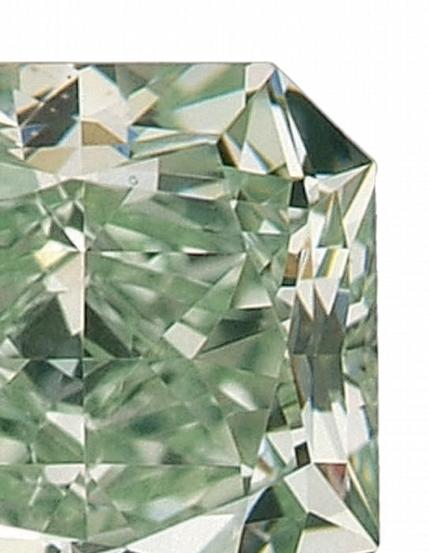
to Fancy, Intense, Vivid, and Deep, depending on tone and saturation. The most famous example remains the Dresden Green, a historic 40.70-carat natural green diamond whose apple-green color has made it one of the world’s most legendary gems.
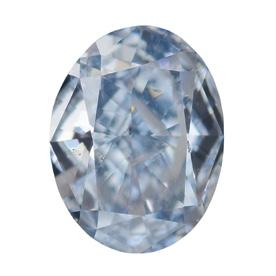
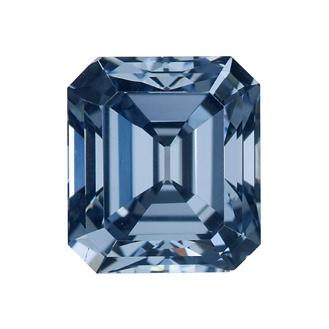
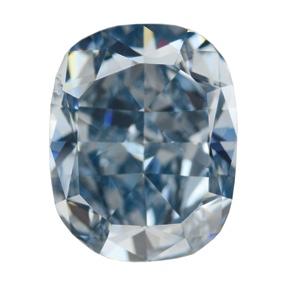
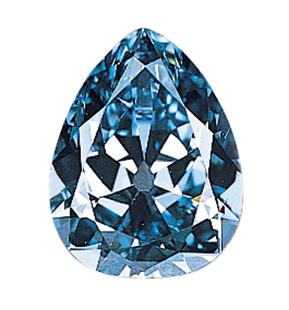
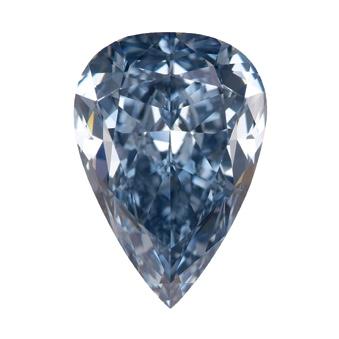
Blue diamonds rank among the most prized diamonds on Earth, and science explains why. Most blue diamonds owe their color to boron, a trace element that occasionally enters the crystal structure during formation. Boron causes the diamond to selectively absorb light toward the red, orange, and yellow end of the spectrum, allowing blue wavelengths to dominate what the eye perceives. Many diamonds with enough boron to show blue belong to the rare Type IIb category, which accounts for less than 0.1% of natural diamonds. Because boron typically occurs near Earth’s surface, crustal subduction can carry it into the mantle, where a growing diamond crystal occasionally incorporates it. Geologists believe this process accounts for some blue diamonds known as superdeep diamonds. The boron impurity is also responsible for another unusual property: electrical conductivity, which makes Type IIb diamonds behave unlike almost any other gem material. However, boron is not the only path to blue. Some low-nitrogen diamonds can take on a blue appearance through natural radiation exposure, like the process that colors green diamonds. These stones show a distinctly di erent visible spectrum and do not conduct electricity. Greenish-blue diamonds are also likely the result of radiation exposure rather than boron, which means the modifier in a blue diamond’s grade can signal something meaningful about its underlying chemistry. Blue diamonds can range from pale and steely to deeply saturated, and grades include Fancy Light, Fancy, Fancy Intense, Fancy Vivid, Fancy Deep, and Fancy Dark. The Hope Diamond remains the most famous example. Still, headline auction results, such as the Blue Moon of Josephine and the De Beers Cullinan Blue, confirm that collector demand for exceptional blues has never been stronger.
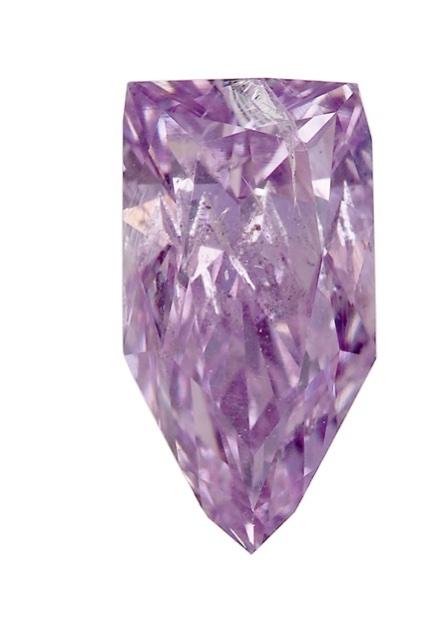
Purple diamonds are mysterious even by fancy color standards. They are incredibly rare, and scientists still debate some of the finer points of how the best examples develop their hue. GIA research links many purple diamonds to the same 550 nm absorption band associated with pink and red diamonds, suggesting that structural distortion in the crystal likely plays a role. However, the cause of the absorption band is not fully understood. Some purple diamonds also show hydrogen-related defects or other complex interactions that shift the final hue. What makes purple especially fascinating is that truly purple diamonds often appear in nuanced tones rather than bold, straightforward color. Many carry modifiers such as brown purple, pinkish purple, or grey purple, and the market di erentiates sharply between a diamond that reads more purple and one that leans strongly into gray or pink. Like other fancy colors, purple diamonds can occur in lighter and deeper intensities, but highly saturated stones remain exceptionally uncommon. A famous example is the Royal Purple Heart, a magnificent 7.34-carat Fancy Vivid Purple diamond cut into a heart shape. Purple diamonds appeal to people who want one of the rarest and least conventional expressions of natural color.
PINK DIAMONDS
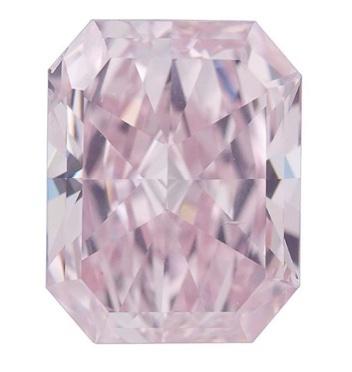
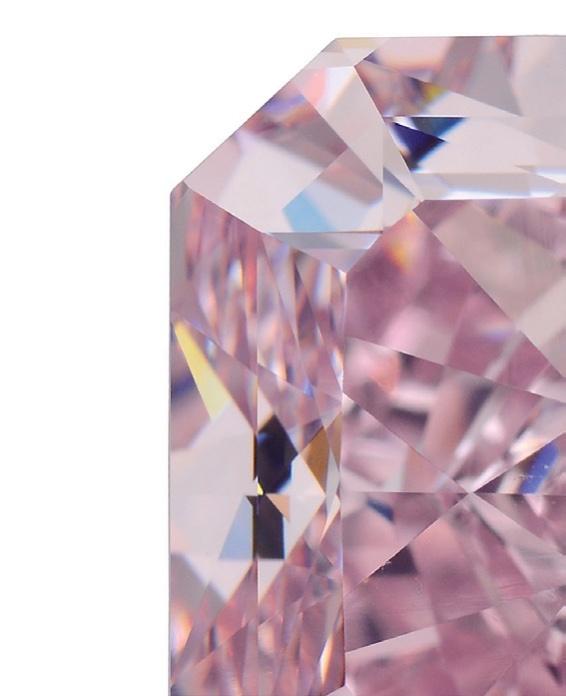
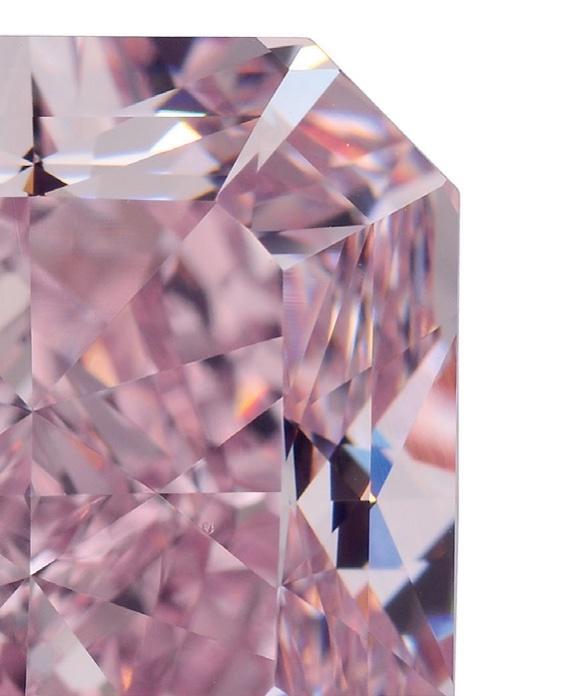
Pink diamonds occupy a special place in the imagination, and for good reason. Almost all natural pink diamonds get their color from distortion in the crystal structure, not from trace elements. The narrow parallel color bands that concentrate the pink hue make this evident. Only a small percentage shows a more uniform pink color distribution. GIA research shows that most pink diamonds owe their hue to this internal deformation, often associated with the 550 nm absorption band. The majority of pink diamonds are type Ia; however, larger pink diamonds are often type IIa, meaning they contain nearly no impurities. Pink diamonds appear across a wide range of grades, from Faint Pink and Very Light Pink to Fancy Light Pink, Fancy Pink, Fancy Intense Pink, and Fancy Vivid Pink. Many also show modifying hues such as purplish pink, orangy pink, or brownish pink. Historically, the Argyle mine in Western Australia supplied most of the world’s pink diamonds, which makes their scarcity even more acute after Argyle’s closure. Famous examples include the Williamson Pink Star and the CTF Pink Star, which remains the most valuable jewel ever sold at auction. Pink diamonds combine rarity, beauty, and intensity in a way almost nothing else in nature can match.
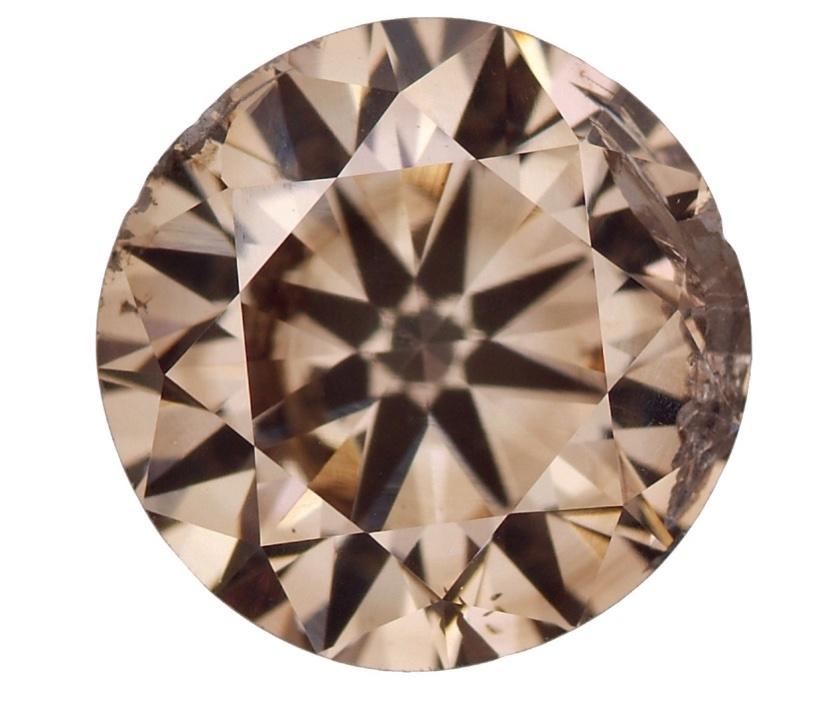
Brown diamonds prove that rarity does not always need to shout. Many natural brown diamonds get their color from distortion in the crystal lattice, much like pink and red diamonds, though the visual e ect produces warm tones rather than rosy ones. GIA has described the color in natural brown diamonds as arising from internal grain lines linked to this structural distortion. Brown diamonds occur in a wider range than most people realize. The category includes everything from soft champagne and honey tones to deeper cognac, whiskey, bronze, and chocolate hues. None of those romantic names are o cial GIA grades, but the trade uses them constantly to help describe the color more precisely. Brown diamonds may also carry modifiers such as orangy brown, pinkish brown, or yellowish brown. Compared with red, green, or blue diamonds, brown diamonds appear more often in nature, which has historically made them more a ordable. But the finest examples still carry real gravitas. Two famous examples prove the point: the Golden Jubilee, the world’s largest faceted diamond, and the Incomparable, later recut as the Golden Canary. Brown diamonds o er warmth, individuality, and one of the broadest natural color palettes in the diamond world.
BY LYNN YAEGER
Talk about colorful characters! It’s not surprising that some of the most renowned jewelry collectors are, well, what you might call just slightly out of the ordinary? A bit eccentric? I know whereof I speak—though modesty forbids me including myself in the roster we cite here—plus my diamonds, though wonderful and beloved by me, are hardly what you would call earth-shattering—I like to think that my unbridled enthusiasm makes me particularly suited to telling these stories of obsessed diamond lovers.
These five—a pair of heiresses, a nutty British aristocrat, a wacky Italian bohemian, and an Indian Maharaja with 10 wives—could have had everything and anything they wanted, and they set their sights
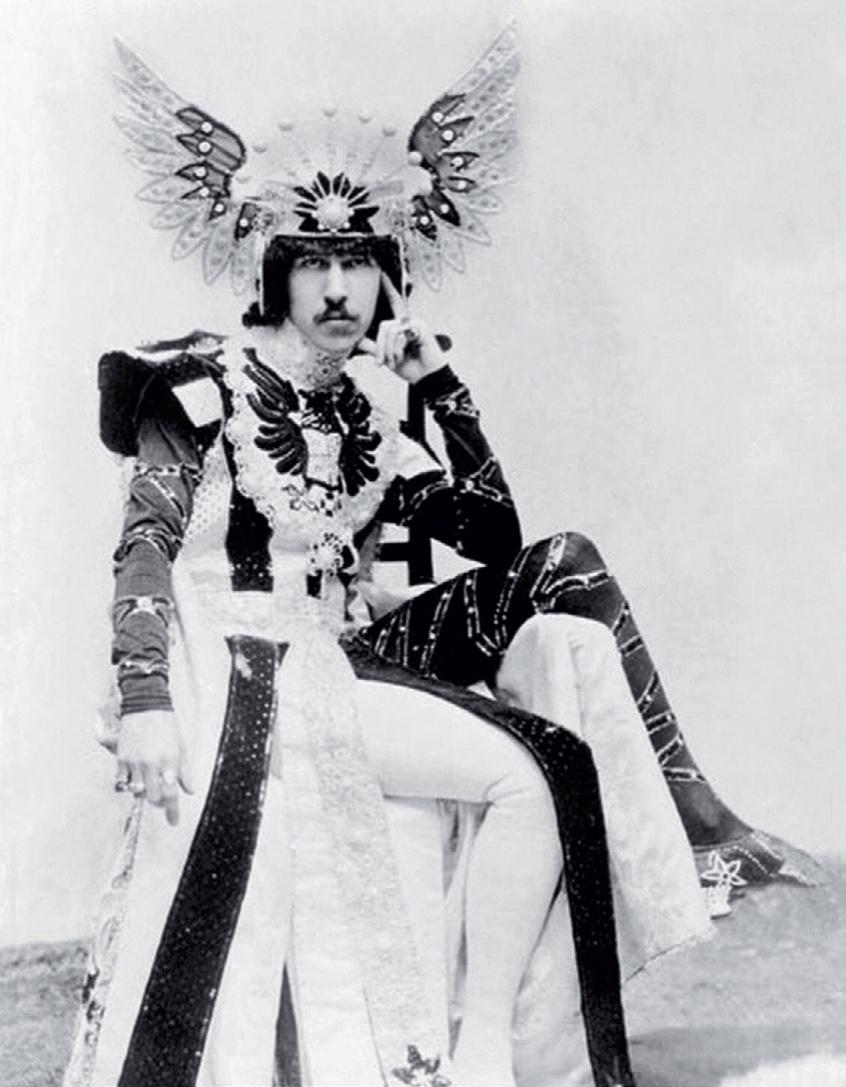
on the rarest, most spectacular jewels. And maybe it’s not so mysterious—what other symbols of status can you show o on a night out on the town? You can’t bring your Maybach to your table at the Savoy in London, or your Rembrandt to the Ritz, but if you are a wildly madcap viscount you can dance the night away in a priceless tiara! Who says you can’t retire to the American Southwest dripping in turquoise and diamonds? Or stroll around Venice with your pet cheetah, secured with a diamond-studded leash?
The quintessential dollar princess, Millicent Rogers was born in 1901 to great wealth— she was the granddaughter of Standard Oil
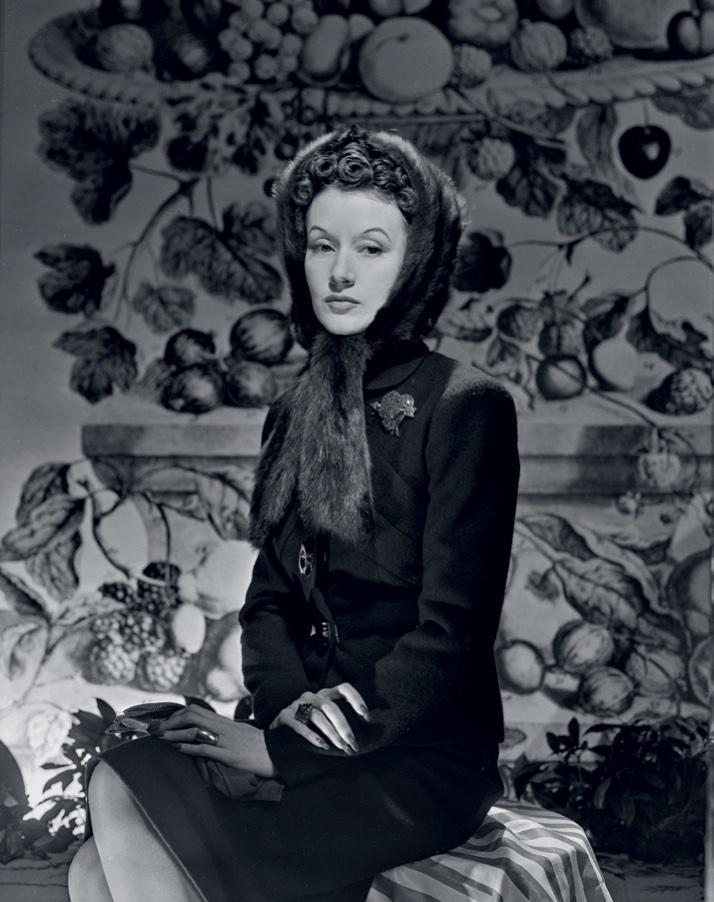
tycoon Henry Huttleston Rogers. Renowned for her beauty, she floated around Europe, having romances and a series of marriages with gold-digging Austrian counts and other sketchy aristocrats. (There was even a rumored a air with Clark Gable.)
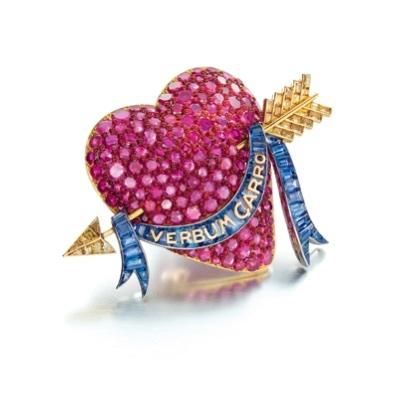
Perhaps tiring of all this drama, Millicent retreated to the o -the-grid paradise that was Taos, New Mexico. She fell in love with Native American culture—and jewelry—and decades before anyone started arguing for mixing high and low, she brazenly sported her turquoise and silver pieces with the most rarefied twentieth century jewels. Consider for example her 1930s ruby, sapphire, and yellow diamond brooch, designed by Fulco di Verdura for the renowned jeweler Paul Flato, and bearing the Latin inscription, “Verbum Carro” which translates as “a word to the wise is enough.” Or her René Boivin ruby and diamond floral pin, with rubies making up the petals and highlighting the diamonds. Their sparkle would rival the southwestern sunshine, and they would be totally at home on the range.
Ok, there are freaks out there, and militant nonconformists—and–I say this with love—then there is the likes of Henry Cyril Paget, the 5th Marquess of Anglesey. This one-in-a-million gentleman was born to great wealth in 1875. In his short life—he died at 29—he managed to squander most of his inherited fortune. He was hopelessly bankrupt when he passed away—and what did he spend the money on? Well, he
converted the chapel on the family’s country seat into a theater, where he starred himself in performances that included Oscar Wilde plays and song and dance numbers. His nickname, to give you some idea, was “the Dancing Marquess” –he did something called Butterfly Dancing, while accoutered in a robe of transparent white silk.
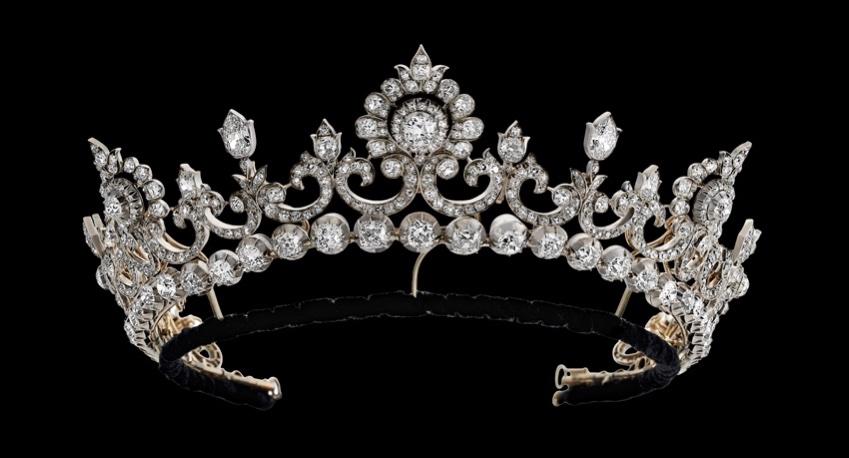
And of course, he was also a legendary consumer of diamonds. Most notably, he commissioned the famous Anglesey Tiara. When it came up for sale in 2024, Sotheby’s described this gossamer behemoth as featuring a graduated row of old European- and old mine-cut diamonds that detached to form a rivière necklace, surmounted by scroll and cluster motifs, set in silver on gold and in its original fitted case. (Oh good! Bid on this and you get the box too!) Altogether, this symphony of European-cut, mine-cut, pearshaped and rose-cut diamonds weighed in at a staggering 106.8cts.
Believe it or not, in 1898 Henry married his first cousin, though according to the author Christopher Sykes, “The closest the marriage ever came to consummation was that he would make her pose naked covered top to bottom in jewels and she had to sleep wearing the jewels.” Night-night!
LUISA CASATI
“I want to be a living work of art,” Luisa, Marchesa Casati Stampa di Soncino once proclaimed, and she pretty much got her wish. Born in 1881 to aristocratic Milanese parents, orphaned as a teenager, she was famous for a sartorial style that was eccentric, to put it mildly. She was six feet tall in her stocking feet and she favored Goth gowns that were made for her by the leading
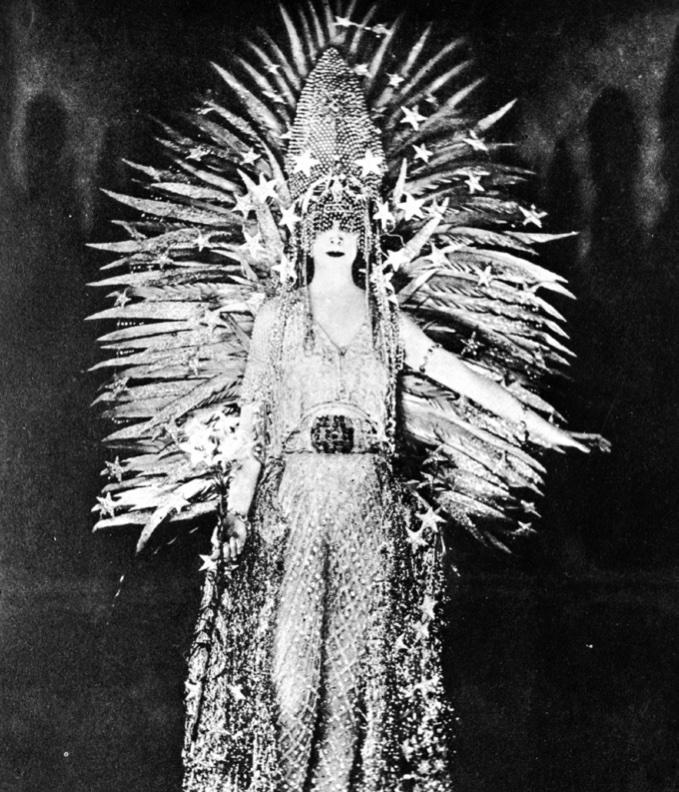
couturiers of the day—Jean Patou and Paul Poiret among them. Her face was deathly pale, made even whiter by the doses of belladonna she self-administered, to make her pupils dark and dilated. She added black kohl around her eyes and false eyelashes a xed with strips of black velvet.
At one of her famous dinner parties, she allegedly drugged a snake, painted it gold and wore it as a necklace. But her pets had far superior jewelry. Luisa was legendary for wandering around Venice in nothing but a fur coat, accompanied by the pet cheetahs that she walked on gem-studded diamond leashes. (So renowned was this behavior that it is said that Cartier was inspired to make the panther their symbol.)
Casati loved her jewelry so much and spent so lavishly that she racked up a debt of $25 million. (How much did the jewel-encrusted gown and headdress that Léon Bakst designed for her set her back?) No surprise that she faced bankruptcy–her villa and its contents were liquidated, and she spent her last days in London, in a bed-sit close to Harrods. Her possessions were eventually auctioned o , and Madame Chanel was reportedly one of the bidders—did Coco end up with one of those diamond leashes?
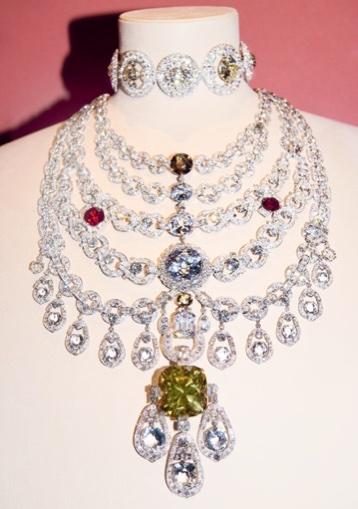
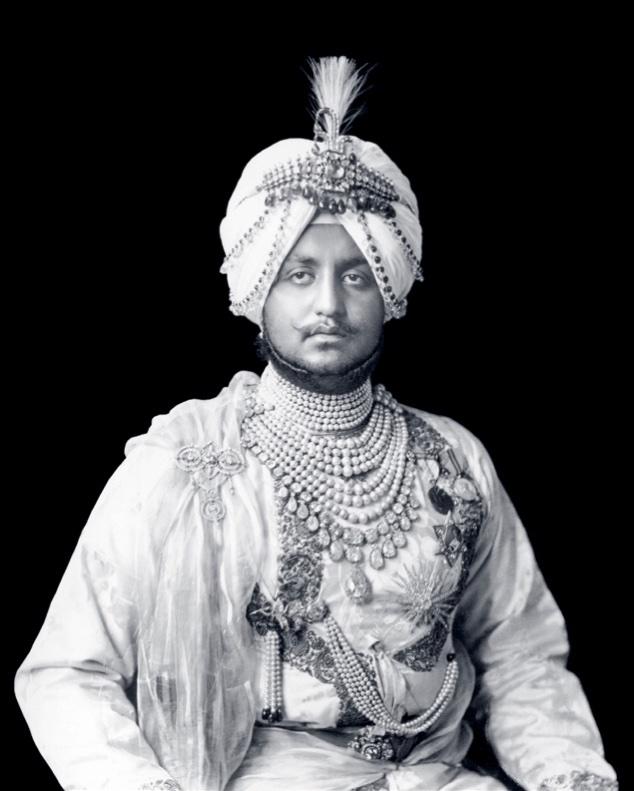
Born in 1891, Sir Bhupinder Singh, the Maharaja of Patiala was a famous cricket player, a friend of the British Raj, and a voracious collector of everything from art to cars to wines to wives—he was married ten times and had 88 children, not to mention a harem of 350 concubines. And then there were his jewels. In 1925, the Maharaja packed his bags and headed to Paris, his trunks bursting with diamonds, emeralds,
sapphires, pearls and rubies of the highest quality set in antique Indian settings that he wanted to have reset at Maison Cartier. The resultant Cartier commission came to be known as the Patiala Necklace—it featured 2,930 diamonds, including the 428-carat “De Beers” diamond, the largest cushion-cut yellow diamond and the second largest yellow faceted diamond in the world. (It was worth an estimated US$2.5 billion in 2023.)
The whole necklace disappeared from the Royal Treasury of Patiala around 1948, but some of its diamonds were later recovered at a second-hand jewelry shop in London in 1998. So the lesson here is—keep your eyes peeled at those vintage haunts, you never know what will turn up!
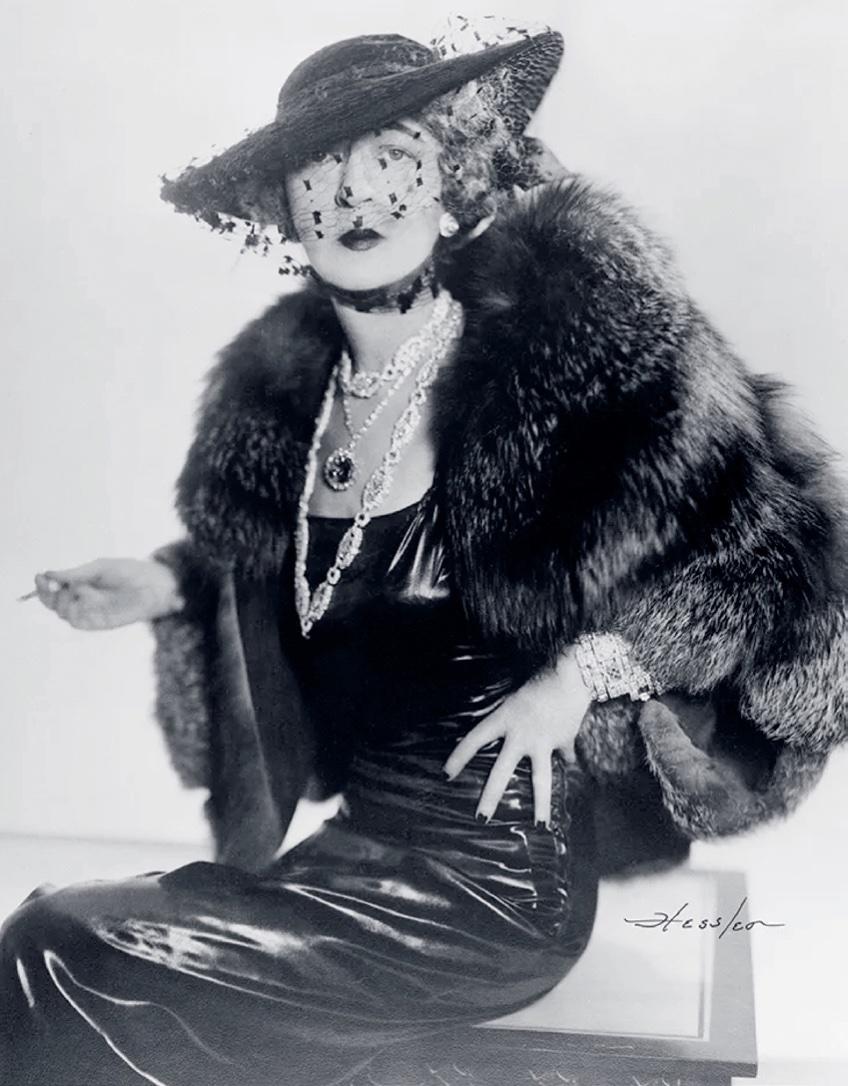
EVALYN WALSH MCLEAN
In 1898, when Evalyn Walsh McLean was 12 years old, her father uncovered gold in Colorado and struck it rich. The family moved to a mansion, and Evalyn was sent to Paris to study singing, but she preferred to busy herself by rouging her cheeks, dyeing her hair, and drinking. In 1908, she married Edward “Ned” Beale McLean, the heir to The Washington Post and The Cincinnati Enquirer publishing fortune.
They were certainly a power couple: when they took a trip to Russia, it was immortalized by Cole Porter in a verse from Anything Goes: “When Missus Ned McLean (God bless her) / Can get Russian reds to “yes” her, / Then I suppose / Anything goes.”
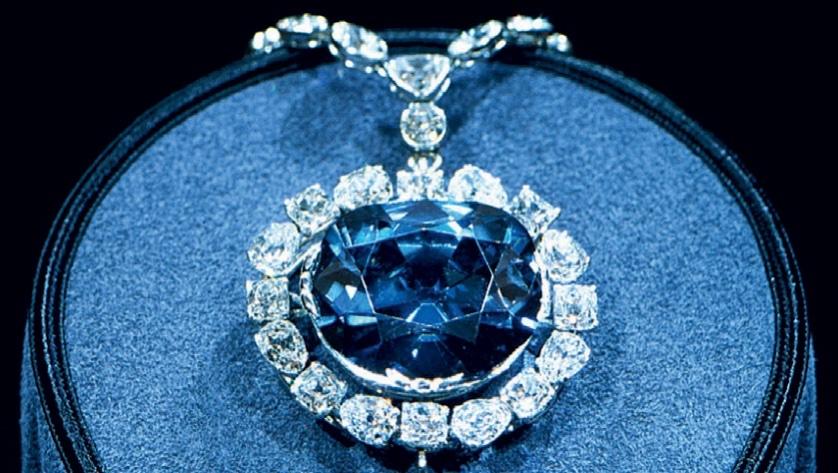
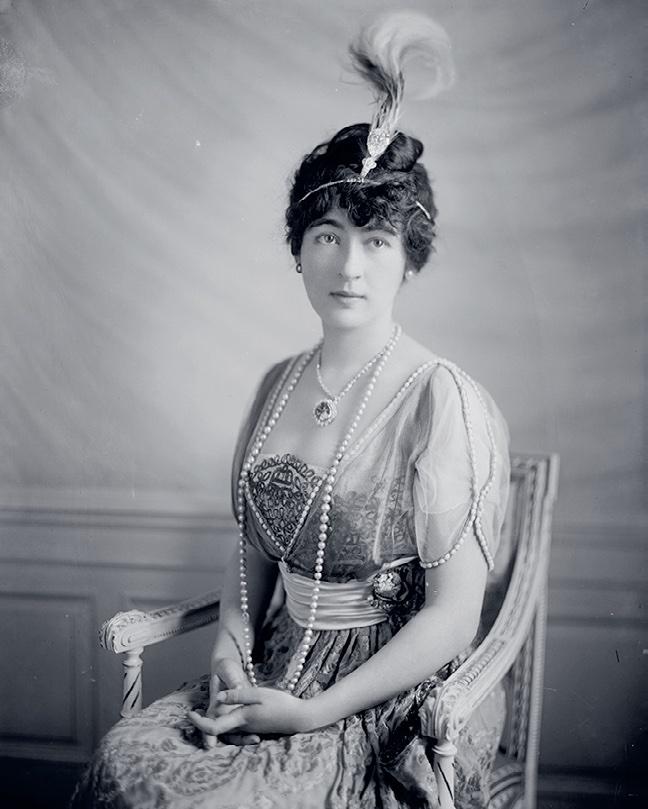
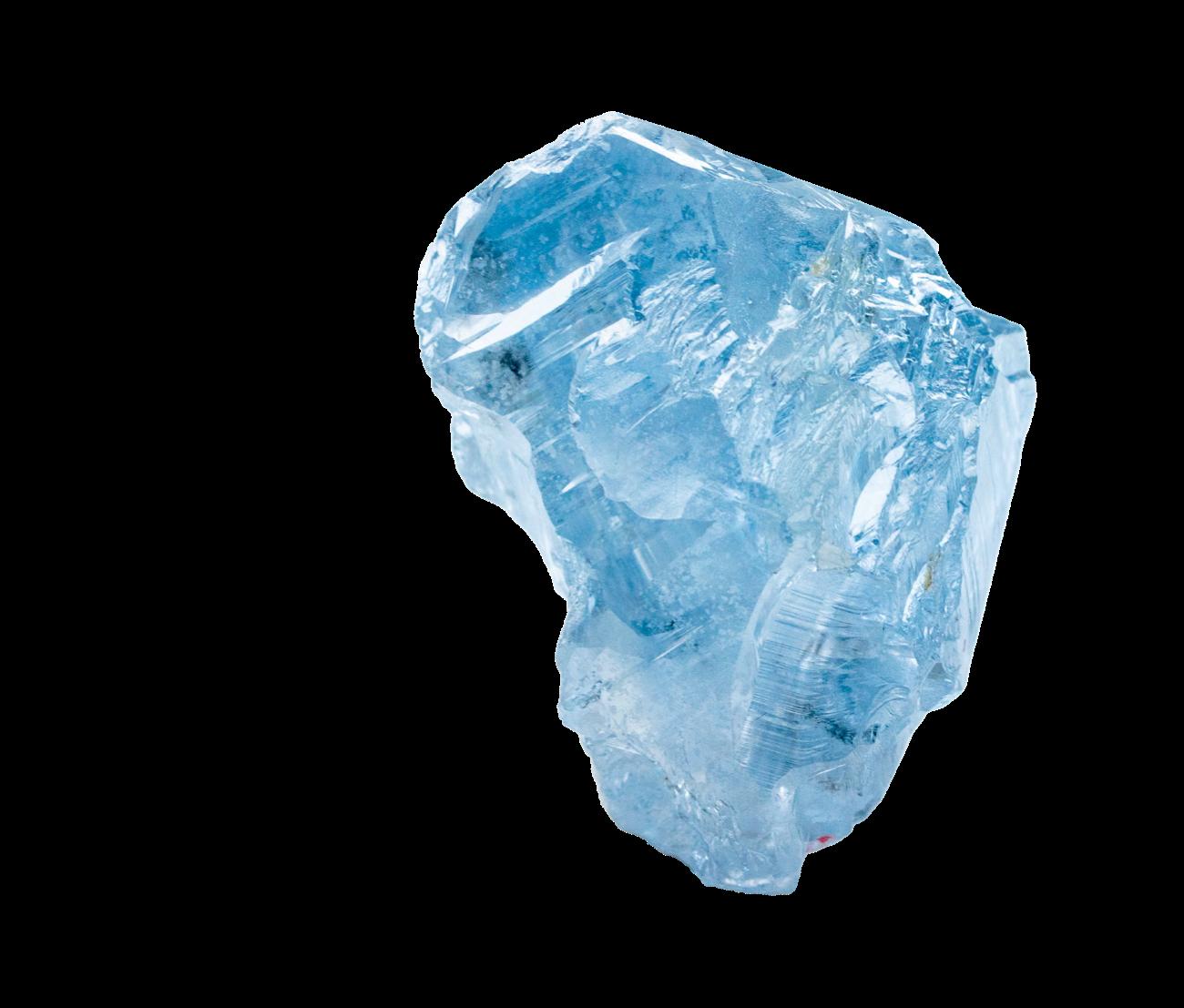
So perhaps it is not surprising that Ned wanted to buy his bride a really spectacular present. But when Pierre Cartier showed the legendary Hope Diamond to Evalyn in 1910, she wasn’t thrilled with the setting. No problem. Cartier had it reset—the stone was now mounted as a headpiece on a threetiered circlet of large white diamonds, and suddenly there was yes-yes in Evalyn’s eyes. On January 28, 1911, in an o ce at The Washington Post, McLean’s husband bought her the Hope Diamond for $180,000 –the rough equivalent of $6,220,000 today. Evalyn passed away with her massive rock still twinkling on her finger. But unlike heiresses, diamonds never die. In 1949, Harry Winston purchased her entire jewelry collection, including the Hope Diamond. Ten years later, it was donated to the Smithsonian Institution in Washington D.C., where it remains on dazzling display, the star of the show.
BY JILL NEWMAN
Late one afternoon in 1905, Frederick Wells, a surface manager at what was then called the Premier Mine, noticed a glint of light embedded in the rock wall. It was too large to be a diamond, he assumed—more likely a piece of glass. Still, curiosity got the better of him. He pried it loose with a pocketknife.
What he held in his hand would prove to be anything but ordinary: a 3,106-carat rough diamond, the largest rough diamond ever discovered. That single moment set o a chain reaction of politics, diplomacy, and legend. The mega stone would be cut into historic diamonds celebrated as part of British royal regalia and immortalized simply as the Cullinan.

More than a century later, the renamed Cullinan Mine, northeast of Pretoria, still yields extraordinary stones. But today its global importance isn’t defined by sheer size. Instead, it rests on something far rarer and more elusive: blue diamonds.
Cullinan Mine is the world’s primary source of ultra-rare blue diamonds—stones so scarce that their prices rival that of an original Rembrandt painting. For collectors, investors, and historians alike, the mine represents both a geological marvel and a human story: generations of families, a community, and legacy, rather than an anonymous hole in the ground.
Cullinan Mine’s riches begin deep in prehistory. Roughly 1.2 billion years ago, a violent volcanic eruption blasted a kimberlite pipe upward from the Earth’s mantle, carrying diamonds formed under extreme pressure. That ancient conduit is unusually fruitful, known for producing large, chemically pure stones, many classified as Type II, the most coveted category for their exceptional transparency.
Occasionally, the pipe also delivers something even rarer. When trace amounts of boron replace carbon atoms in the crystal lattice, the diamond absorbs red and yellow light and appears blue, from shades of pale sky blue to deep, saturated ocean blue.
“A blue diamond of the right color and clarity is probably one of the densest forms of value that you can physically hold in your hand,” said Vivek Gadodia, co-CEO of Petra Diamonds, which owns and operates the mine today. “Blue diamonds are just 0.1% of all natural diamonds mined, so their scarcity and rarity are unparalleled.”
Statistics suggest something even more remarkable: an overwhelming majority of notable Type IIb blue diamonds (estimated between 90 and 95 percent) originate from the Cullinan Mine.
In other words, when the world thinks of truly exceptional blues, it is almost always thinking of this one source.
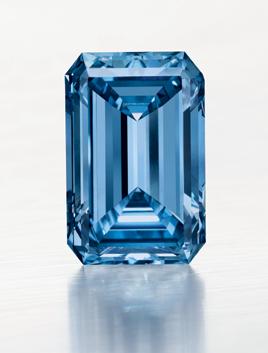
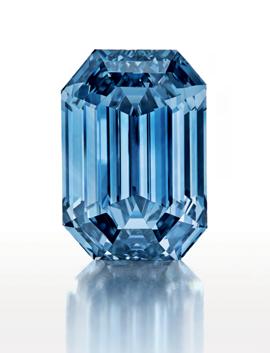
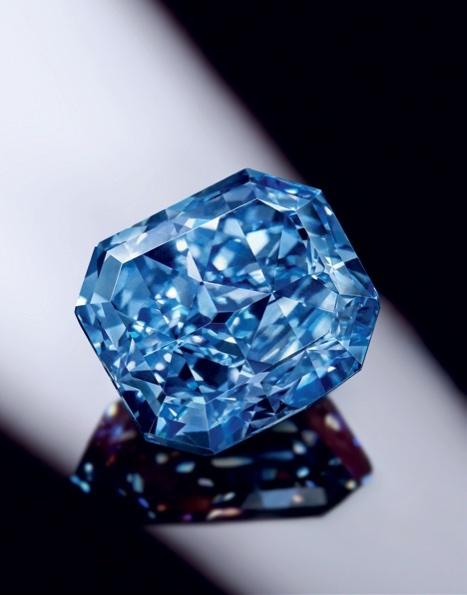
Over the past few decades, the price of blue diamonds has not merely appreciated; it has exploded. Take the market’s watershed moment: in 2014, the Oppenheimer Blue, a 14.62-carat fancy vivid blue diamond, sold at Christie’s for $57.5 million, then a record for any jewel at auction. That result sent shockwaves through the collector world, signaling that blue diamonds were no longer niche curiosities but global blue-chip assets.
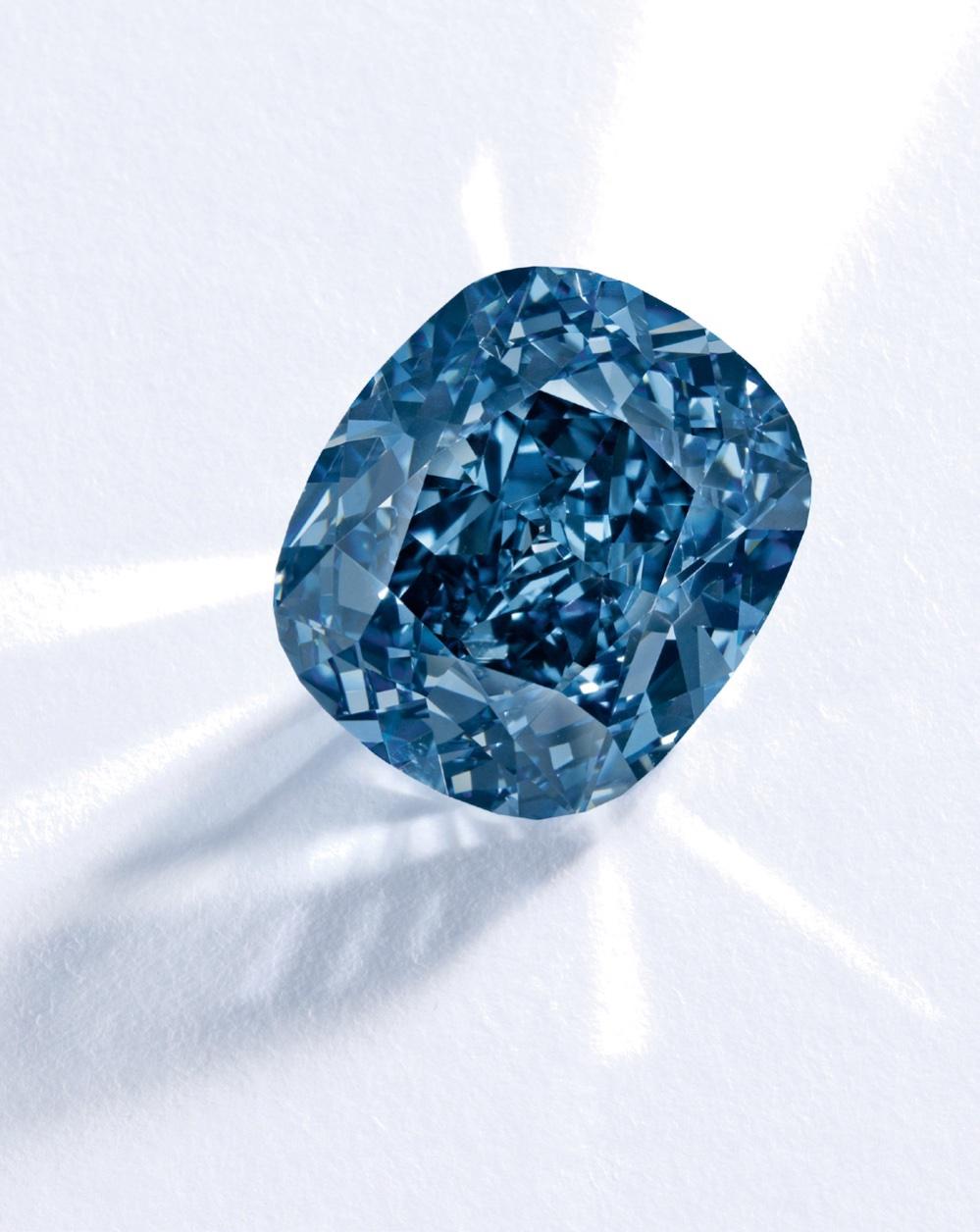
Two years later, the Blue Moon of Josephine, a 12.03-carat vivid blue diamond,
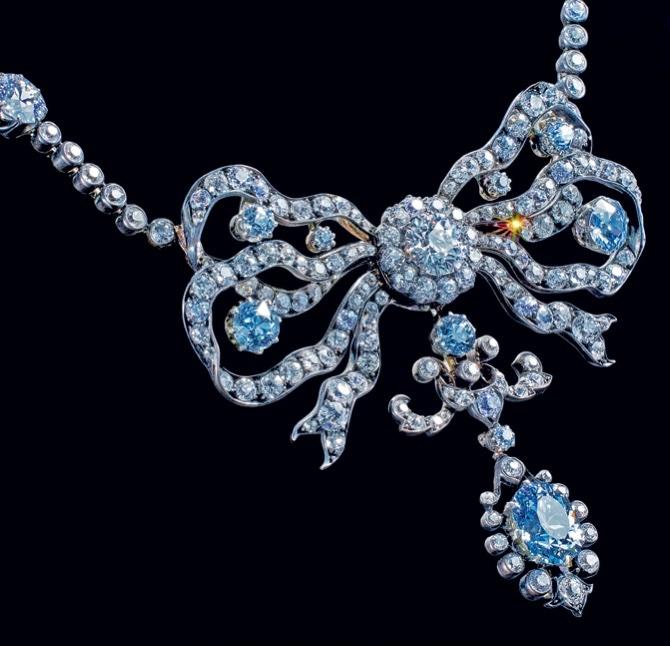
made $48.4 million at auction. In 2022, the De Beers Cullinan Blue, a 15.10-carat vivid blue stone, sold for $57.5 million, further confirming that the appetite for these stones is not a short-term investment but a longterm asset class.
At the same time, smaller blue diamonds have seen sharp gains. Gem dealer networks report that 1–2 carat vivid blues, which might have sold for $100,000 to $200,000 in the 1990s, now trade at $500,000 to $1.5 million or more depending on color saturation and clarity.
And there’s no end in sight. In uncertain times such as these, more investors consider
rare diamonds a viable portable asset and currency. Unlike art or real estate, diamonds are global currency.
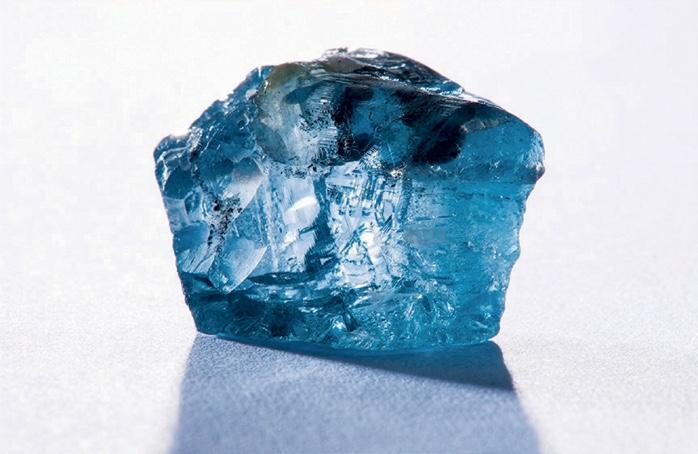
Even newly unearthed rough diamonds spark global attention. When a 41.82-carat blue diamond surfaced at the Cullinan Mine
Opposite page: The 41.82-carat blue diamond
South
from the
a in early
in late December 2025, shaped uncannily like the silhouette of the African continent, Gadodia had calls from collectors and dealers around the world immediately.
In 2021, a similar size Cullinan Mine Type IIb blue diamond sold for $40.2 million, which yielded the famous De Beers Cullinan Blue.
For decades the mine was operated by De Beers until Petra acquired it in 2008 and began a new chapter focused on modernization, sustainability, and longevity.
For Gadodia, the economics are straightforward. “We choose value over volume,” he said. “Our plant configuration was designed in such a way that we can maximize recovery of high-value stones.”
Instead of chasing sheer output, Petra redesigned its processing systems to protect larger diamonds and preserve fragile Type II rough. It’s a strategy aligned with today’s realities: fewer new tier-one mine discoveries worldwide and growing demand for singular, traceable stones.
THE LEGACY LIVES ON Cullinan Mine’s past reads like historical fiction.
The original 3,106-carat diamond was presented as a diplomatic gesture to Edward VII, an attempt to help heal tensions following the Boer War. The king reportedly hesitated to accept such an extravagant gift until persuaded by Winston Churchill, then a young colonial o cial, who believed it would help establish political allegiances.
King Edward VII entrusted the cutting to the brothers Joseph and Abraham Asscher, who over eight months cut it into nine major
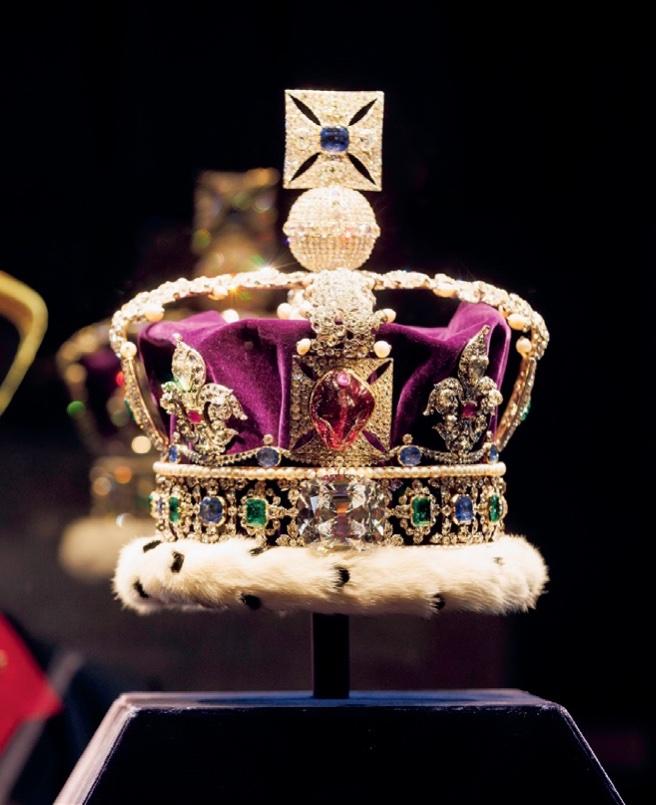
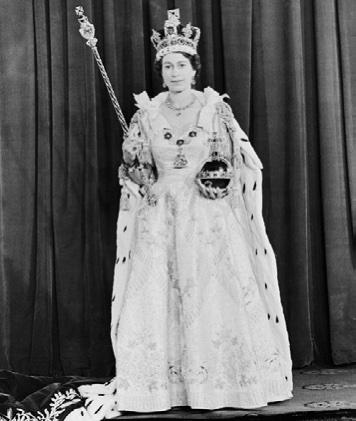
stones. Not just any diamonds, the massive size and exceptional quality underscored the magnitude of the royal family’s riches. Today, the massive 530.2 carat Cullinan I, also known as the Great Star of Africa, anchors the Sovereign’s Scepter, while the 317.4 carat Cullinan II sits in the Imperial State Crown.
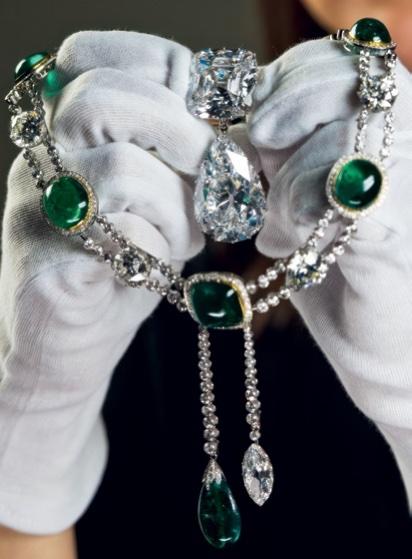
The 94.4-carat pear-shaped Cullinan III and the 63.6-carat square-cut Cullinan IV were set into Queen Mary’s coronation crown. Later, Queen Elizabeth wore them in a brooch famously known as “Granny’s Chips.” Millions of visitors see the Crown Jewels each year at the Tower of London.
Yet for all its royal associations, Cullinan Mine’s identity is deeply local.
“The Cullinan name is magical when it comes to diamonds,” said Helen Molesworth, senior jewelry curator at the Victoria and Albert Museum and author of a book on the history of gems. “There is no better name in the industry today with a provenance of quality and history than the name Cullinan.”
On a visit to the mine, she expected heavy industry. Instead, she found something more: jacaranda trees in bloom, a working village,
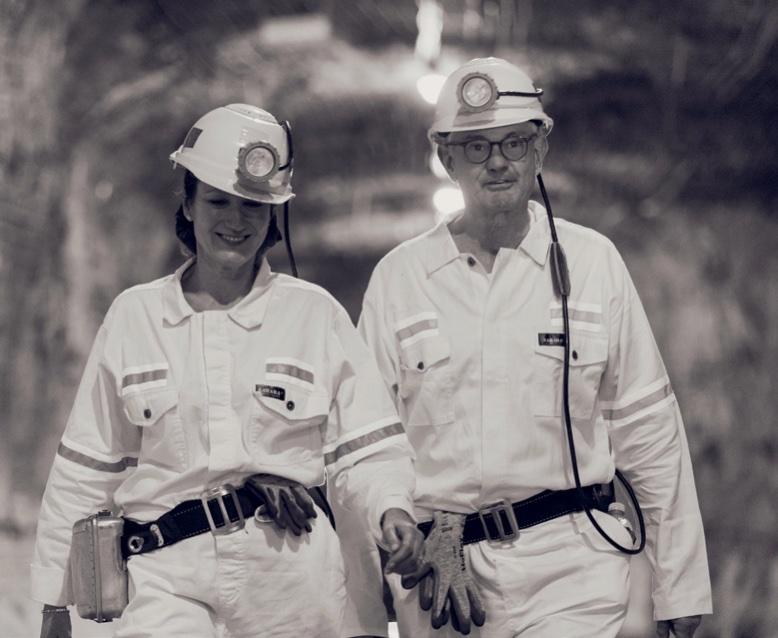
and a surprisingly modern, mechanized operation humming beneath the surface.
“It isn’t a faceless mine,” she said. “We know the name of the person who discovered the original Cullinan Diamond, Frederick Wells, and it’s a community of people who produce the diamonds.”
That distinction matters in an era when consumers ask harder questions about where luxury goods come from. Provenance has become emotional currency. Buyers want to know the story behind a stone as much as its cut or clarity.
“I believe in a combination of science and history,” Molesworth said. “The science identifies the stone, and the history of its origin is the emotional value. That is more and more important to us on a human scale.”
That sense of continuity—the idea that diamonds connect generations—helps explain the mine’s enduring mystique.
The Cullinan Mine story increasingly resonates with younger buyers who demand transparency.
Jody Wainwright, joint managing director of the British jeweler Boodles, began emphasizing Cullinan Mine-sourced stones several
Michael Wainwright, Chairman of Boodles, with his wife Annie, visiting the Cullinan Mine, courtesy of Boodles.
Opposite page: Queen Elizabeth II holding the Sovereign’s Scepter and Cross which holds the 540-carat pear-shaped Cullinan I diamond. The 317-carat cushion-cut Cullinan II diamond sits at the center of the Imperial State Cown, Royal Collection Trust / His Majesty King Charles III. The Cullinan III and IV Brooch and the Cullinan VII Delhi Durbar Necklace and Cullinan Pendant.
From record-smashing auctions to museum treasures, the Cullinan Mine continues to yield the world’s most coveted blue diamonds—stones that rewrite the value of rarity.
The Oppenheimer Blue, a 14.62-carat fancy vivid blue diamond, stunned the market at Christie’s in 2016, selling for $57.5 million. Once owned by Philip Oppenheimer, a scion of the De Beers dynasty, at the time, it was the most expensive jewel ever sold at auction.
In 2022, the De Beers Cullinan Blue, a 15.10-carat vivid blue stone, fetched $57 million at Sotheby’s, rea rming the mine’s dominance as the premier source for exceptional blues.
Hong Kong billionaire Joseph Lau paid $48.4 million for the Blue Moon of Josephine, a 12.03-carat vivid blue diamond, in 2015—naming the gem for his young daughter.
Two Cullinan legends reside at the Smithsonian Institution: The Blue Heart (30.62 carats) and the Heart of Eternity (27.64 carats), both benchmarks of rarity and color.
In 1910, mine founder Thomas Cullinan gifted his wife a necklace with nine Cullinan blue diamonds. A century later, his great granddaughter sold the necklace to the jeweler Stephen Silver, who donated it to the Smithsonian, cementing its place in history.
Even uncut, Cullinan blues command stratospheric prices: a 39.34-carat Type IIb surpassed $40 million in 2021, the highest per-carat price ever achieved for a rough stone.
This year, the mine unveiled a 41.82-carat rough blue naturally shaped like the African continent. Experts expect the polished gem could rival or eclipse previous records.
years ago after recognizing the potential of connecting the diamonds to the mine’s story.
“If there were two diamonds with the same qualities but one was from the Cullinan Mine, even if the customer wasn’t aware of the mine, the story would perhaps help to sell that diamond,” he said.
When it comes to blues, the distinction is even sharper.
“A Cullinan Mine blue today carries a premium over a non-Cullinan Mine blue,” he added. “Blue is more of an investment or collector’s item of a minimum one carat.”
In a market saturated with anonymity, origin has become di erentiation.
That demand for traceability mirrors a broader transformation across the diamond industry. Shoppers want provenance: natural origin, ethical sourcing, environmental responsibility.
Cullinan Mine is leaning into that shift. Stones can be o ered with digital traceability data through platforms that track origin and custody. Petra’s long-term goal is to follow each significant diamond from recovery to sale.
“At the moment, we’re not tracing every stone, but the intention is to get there,” Gadodia said. “There are more requests for traceability every year.”
Sustainability e orts extend underground as well. The mine recycles the vast majority of its water, as much as 97 percent, and is transitioning toward renewable energy. It sources procurement locally to support surrounding businesses. Training programs help young people develop practical trades and it opened a community wellness and health clinic. Also, it hosts above ground mine tours for the community and visitors to experience the mine firsthand.
It’s a deliberate attempt to replace the old image of mining as remote and extractive with something more accountable and community driven.
Despite more than a century of production, Cullinan Mine’s future may be as compelling as its past.
The orebody still holds significant quality diamonds, says Gadodia, including the same geology that produces Type IIb blues. Petra
expects to mine the current areas for years to come, with further investment potentially extending its life for another 20 to 25 years. Meanwhile, global supply of high-quality natural diamonds is tightening. Few new discoveries are coming online. Many historic mines are nearing depletion. Wealth, however, continues to expand, particularly in emerging markets like India where diamonds carry cultural meaning as well as financial value.
“Generally, the world is getting richer, and the aspirational class is getting larger,” said Gadodia. “High-quality diamonds should get more and more rare, and there’s not a lot of tier-one mines left in the world that have long lives.”
Which makes Cullinan Mine something unusual: not just a relic of history, but an active source of the rarest stones on Earth.
More than a century after Frederick Wells spotted that improbable flash of light, the ground here still surprises, still producing diamonds older than continents and rarer than masterpieces.
And now, more than ever, those diamonds come with a story of people, place, and legacy that buyers can make part of their story.§
Opposite page: The
BY JOSIE GOODBODY
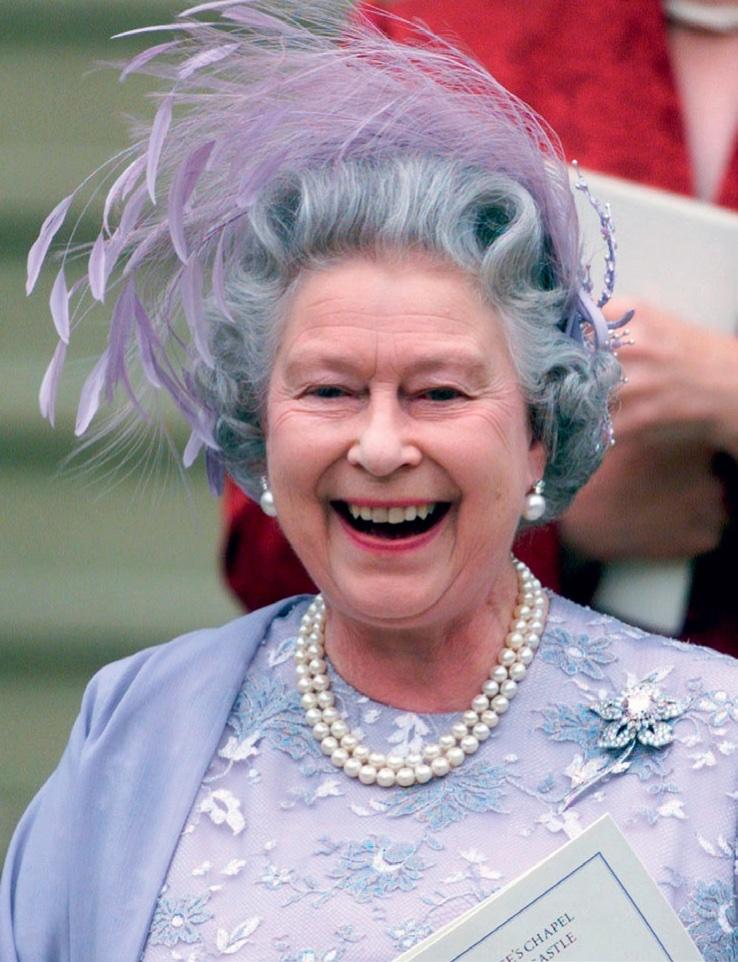
Nothingsignaled color quite like Her late Majesty’s wardrobe and her magnificent jewels, along with the equally vibrant treasures of her ancestors. Among the rainbow of white diamonds, rubies, sapphires, emeralds, aquamarines, and amethysts are several exceptionally rare colored diamonds.
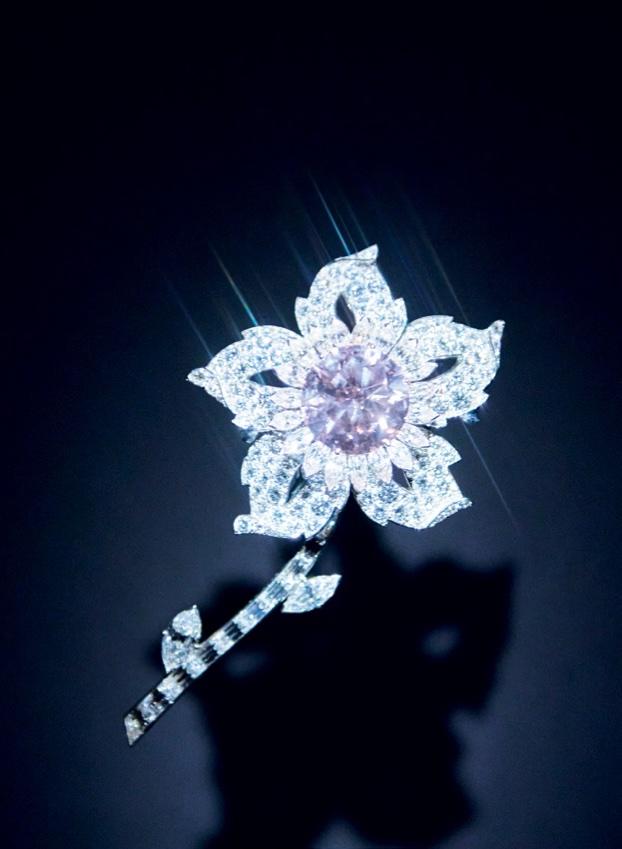
Set in a jonquil-designed brooch by Cartier, the Williamson Pink Diamond Brooch is undoubtedly one of the most beautiful among the many millions of diamonds that belong to the British Royal Family. The brooch was presented to Her late Majesty by the ardent monarchist Dr. John Williamson to celebrate her 1947 engagement to Lieutenant Philip Mountbatten, RN.
In the mid 1930s, Canadian geologist John Thorburn Williamson traveled to Northern Rhodesia (now Zambia) to assess land for a De Beers subsidiary before transferring to the Mabuki diamond mine in Tanganyika (now Tanzania), about 100 miles south of Lake Victoria. Although diamonds had been discovered there before the First World War, production was modest compared to the vast South African operations. By 1939, Williamson had sublet the Mabuki mine and began prospecting for additional deposits. He became convinced that a major diamond-bearing pipe lay about fifty miles south at Mwadui. After failing to secure sponsorship from De Beers—whose interests were focused in South Africa—he partnered with Mwanza-based Indian barrister Iqbal Chopra, who believed the dashing Clark Gable doppelgänger and agreed to help fund his “pipe dreams”.
At first, prospecting e orts were unsuccessful. Before long, however, his dreams became reality when, on March 6, 1940, one of Williamson’s two young assistants reported seeing a diamond earlier that day and led him to the spot. Knowing he had struck gold—or rather diamonds—the geologist set up a field camp by a baobab tree while the boys set about panning gravel. Within days, he had discovered a huge diamondiferous pipe. He secretly staked his claim and established operations, with the ongoing Second World War inadvertently protecting the area from a rush of fortune seekers and allowing him to gradually expand the mine.
At the time, Tanganyika was a British colony, and despite the war, Williamson’s manpower grew from two to several hundred men. He invested in the welfare of his workforce, building a town complete with homes, a school, and a hospital, enabling his men to live with their families. By the end of the war, the mine and its surrounding settlement covered approximately f ive square miles and supported thousands of residents.
In October 1947, ten-year-old Jimmy Sudra, the son of a mine carpenter, found what he initially thought was a piece of glass while playing with his friends. He took it to Williamson, who immediately recognized it as a remarkable rough pink diamond, weighing 54.5 carats—one of the largest and finest ever discovered, even to this day. Extraordinarily, a 175-carat
blue-white diamond was also said to be unearthed on the exact same day.
Shortly before, Princess Elizabeth’s engagement to Lieutenant Philip Mountbatten–formerly Prince Philip of Greece and Denmark–had been announced. A keen monarchist, Williamson decided to present one of the exceptional diamonds to the future bride. After consulting Iqbal Chopra and his wife Thelma at their home in Mwanza, it was agreed that the pink diamond would be the perfect choice for a princess and future queen. Williamson then arranged for the gem to be sent to London.
Before its royal presentation, the gemstone was to be cut and polished, as Williamson believed the princess should receive a finished diamond rather than a rough one. It was sent to Briefel and Lemer in Clerkenwell, where Sydney Briefel decided that a brilliant cut would best enhance the stone’s exceptional clarity and vibrant pink hue.
By early 1948, the diamond had reached the cross-work stage and was nearing its final polish. That March, the newly married Princess Elizabeth was invited to the firm’s o ces, accompanied by her grandmother, Queen Mary, renowned for her love of jewels. Dressed in his finest suit, Chopra presented the pink diamond to Her Royal Highness, who examined it with a huge smile. However, it would be another four years until the diamond was set into the brooch we know today, with white diamonds sent by Williamson from his mine.
By then, the princess had succeeded her father as Her Majesty the Queen, and the royal favorite Cartier London was commissioned to design a jewel worthy of the stone. Frederick Mew, the house’s head designer, created several proposals before the final design was selected.
As Francesca Cartier writes in The Cartiers, her best-selling biography of the family firm: “As with all commissions, multiple pencil sketch options were narrowed down to three or four final designs that would be painted in
gouache, to scale, and presented to the client [the Queen] in order that she might select her favorite.”
The Queen chose a brooch in the shape of a jonquil, reflecting her fondness for flowers. The central 23.6-carat pink diamond is surrounded by 170 brilliant-cut white diamonds, 12 baguette-cut diamonds, and 21 marquise-cut diamonds, including two set as buds on the stem.
The Williamson Brooch, about 4.5 inches in length, became one of her favorite pieces, worn on many important occasions, including family weddings, and seen in several famous portraits, including a 1954 photograph with Prince Charles and Princess Anne as small children.
John Thorburn Williamson died in 1958 at his mine from lung cancer. Yet his legacy endures. The Mwadui mine, often called the Williamson Mine, became one of the most significant diamond sources of the twentieth century, and he is remembered as one of the most successful prospectors of his era.
The path of the Williamson Pink—from a playground in East Africa to one of the most important jewelry collections in the world—is one of the most remarkable stories in natural diamond history.
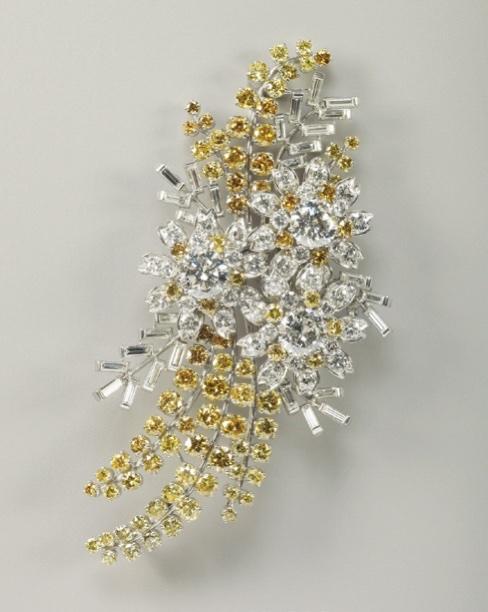
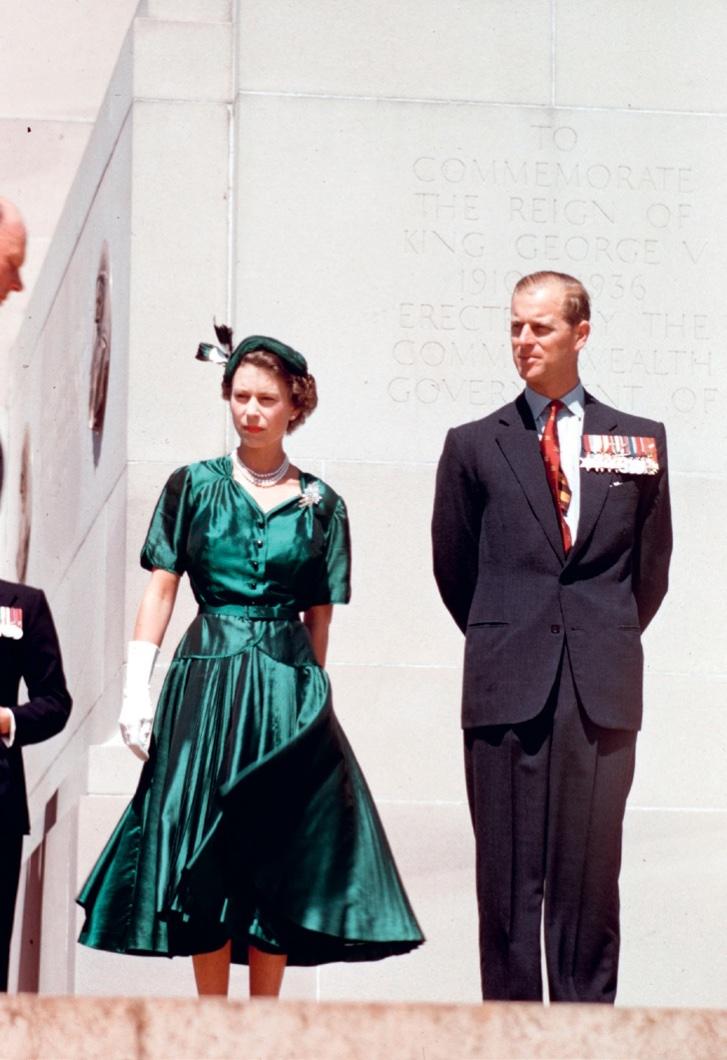
A year after Her late Majesty received the Williamson jewel, during her first tour to Australia in 1954, she was given another floral brooch; this time set with yellow and white diamonds, designed as a spray of Australia’s national flower, the golden wattle, together with tea tree blossoms.
Meticulously set in platinum, yellow brilliant diamonds epitomize the wattle’s golden blooms, while white brilliant diamonds symbolize the wattle’s leaves, and marquise- and round-brilliant white diamonds the tea tree flowers. This beautiful brooch was commissioned by the jewelers William Drummond & Co. of Melbourne.
It is another of the most distinctive pieces of jewelry associated with Elizabeth II and was presented by the Australian people to
reflect the enduring relationship between Britain and Australia. The Queen wore the brooch on several visits to Australia and throughout her reign, showing a deep understanding of diplomatic gestures.
One of the most recognizable jewels in the world is the Diamond Diadem, famously worn by Her late Majesty. At the front of this splendid diadem sits a striking yellow diamond.
Upon the death of George III on January 29, 1820, his son–who had served as regent for nine years and liked to credit himself, rather than the Duke of Wellington, with Britain’s victory at the Battle of Waterloo–decided that his coronation would be a magnificent a air. In today’s terms, the ceremony would cost £23,500,000.
In 1820, Philip Liebart of Rundell, Bridge & Co. created what we now call the Diamond Diadem for the coronation of George IV. This highly recognizable and ornate ornament is set with 1,333 diamonds and 169 pearls. The narrow band is edged on both sides with pearls and surmounted by four crosses pattée; the front cross is set with a 4-carat pale yellow brilliant diamond, apparently from
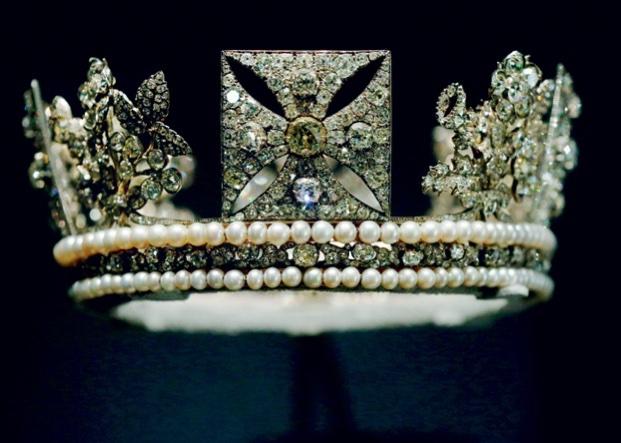
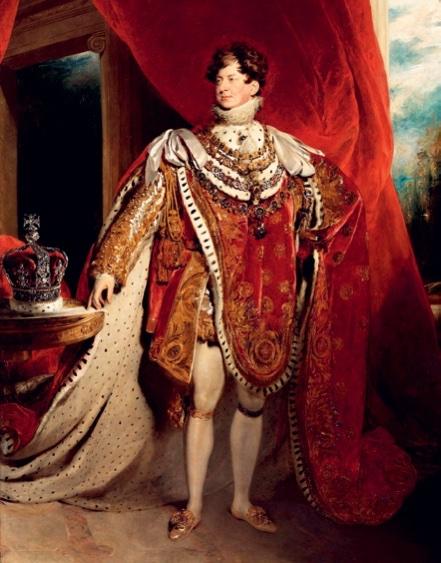
The Diamond Diadem, commissioned by George IV for his coronation. King George IV’s Coronation Portrait, 1821, Painting by Sir Thomas Lawrence.
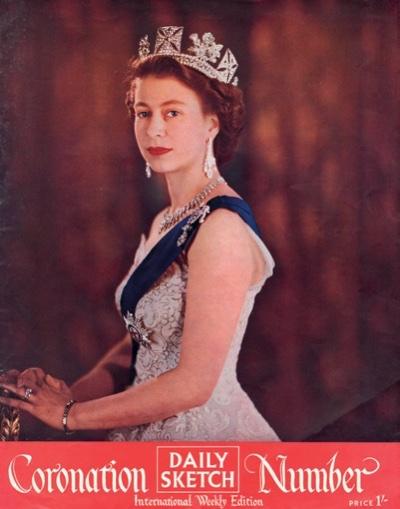
Front cover of The Daily Sketch Coronation Number featuring a portrait of the then new monarch, Queen Elizabeth II wearing the Diamond Diadem.
Brazil. Between each cross are the national emblems of England, Ireland, and Scotland— roses, shamrocks, and thistles—all created in diamonds.
Although the bill for crafting the diadem and setting the gems came to £290, the cost for hiring them was £800. This was increased when the 1820 coronation had to be delayed by a year, due to the trial of Queen Caroline, at which the king sought to strip his estranged wife of her title of queen. This was refused, and when the coronation did take place in mid 1821, the Queen was locked out of Westminster Abbey, banging on the door to be allowed in. She fell ill later that day and died less than a month later.
Nevertheless, on July 19, 1821, George IV left the Houses of Parliament wearing his dazzling diadem, though it was impossible to see. He had also decided to have an enormous Cap of State extravagantly made in black velvet, with a diamond-encrusted hat loop from which copious ostrich plumes rose, completely camouflaging the diamonds and pearls of the diadem. After the coronation,
the gemstones remained intact, and a bill for £8,216 was later settled.
The diadem was later worn by William IV’s consort, Queen Adelaide, and then Queen Victoria, who was depicted wearing it on the Penny Black stamps. It passed on to Queen Alexandra, Queen Mary, Queen Elizabeth the Queen Mother, and finally to Her Majesty Queen Elizabeth II, who wore it on the journey to her own coronation in 1953. She was also famously depicted wearing it on coinage, banknotes, and stamps, and wore it at each State Opening of Parliament.
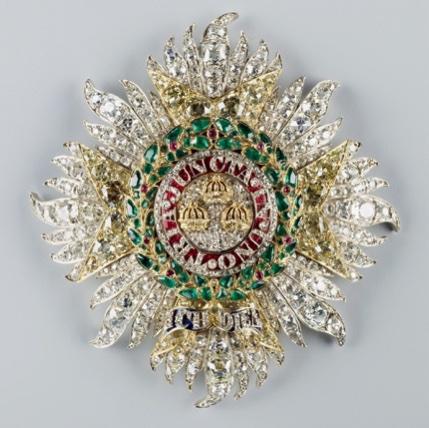
Yet more yellow brilliant diamonds are to be found in Queen Victoria’s Order of the Bath Star, a military star made for her by Rundell, Bridge & Co. in 1838. The insignia was set with gemstones from one of the Royal Guelphic Order, which had been founded during the reign of George III as King of Hanover—but as Queen Victoria could not inherit Hanover under Salic Law, its insignia became unnecessary.
This Bath Star is an extraordinary eightpointed silver star set with 373 white brilliant-cut diamonds in flaming rays, overlaid with an eight-pointed cross of 31 yellow brilliant-cut diamonds set in gold. At the center are three gold crowns on a plaque of tiny rose-cut diamonds, encircled by the words TRIA JUNCTA IN UNO (the Order’s motto meaning “three joined in one”) in diamonds set on red enamel, and surrounded by an emerald, ruby, and gold laurel wreath. Not long after their marriage, Queen Victoria appointed her husband, Prince Albert, to the Order—he held the highest rank of Knight Grand Cross—and in 1841, Rundell made a similar, though slightly larger version to accompany his wife’s earlier one. These extraordinary stars are especially poignant to me, as my grandfather, General Sir Richard Goodbody GCB, KBE, DSO (1903 – 1981), was also a Knight Grand Cross of the Order of the Bath, appointed by Her Late Majesty Queen Elizabeth II in 1963, having served as her ADC for the two previous years. He would occasionally sit just below Her Majesty in Westminster Abbey, which enabled my parents to be married in what is known as the Bath Chapel in the Abbey, and my brother and I to be baptized there. Unfortunately, however, his Order of the Bath Star was not set with white and yellow diamonds; rather, the star’s rays and body are made of silver, with the cross in gold and the mottoes and emblem in gold and enameled in color, another thread in the rich and colorful tapestry of jewels associated with the British crown.
IN AN INDUSTRY LONG DEFINED BY CARATS AND COST, A FOURTHGENERATION JEWELER BRINGS ROMANCE, PROVENANCE, AND DEEPLY PERSONAL STORYTELLING BACK TO THE FOREFRONT— RESHAPING HOW LUXURY CLIENTS CONNECT WITH THEIR DIAMONDS.
BY JILL NEWMAN
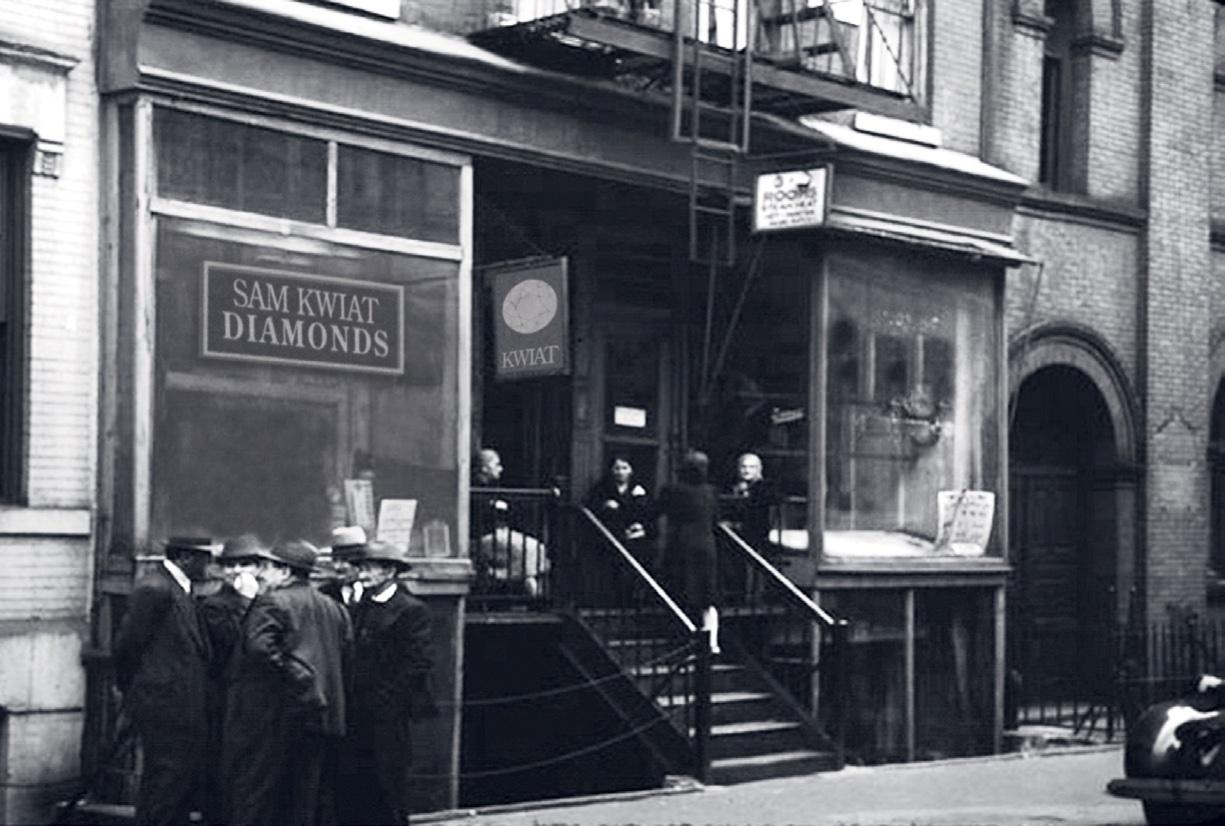
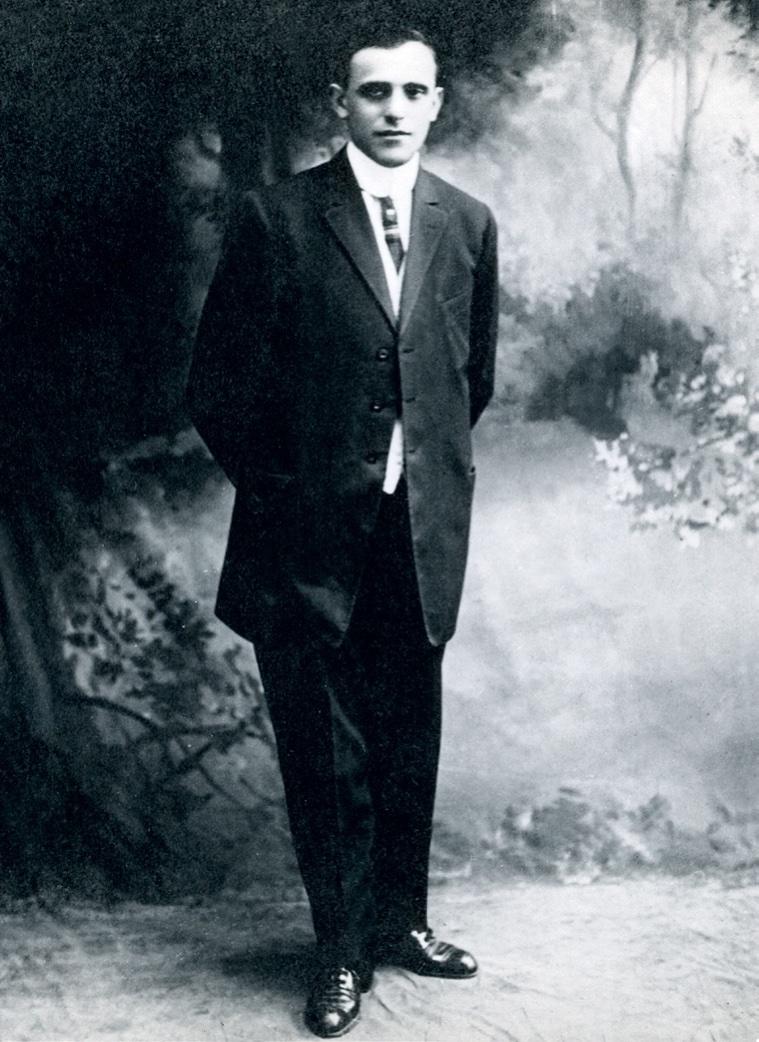
When Sam Kwiat arrived on Manhattan’s Lower East Side in 1907, diamonds changed hands with little more than a handshake and a discerning eye. There were no grading systems, no universal language of the four C’s, only instinct, reputation, and trust. It was a world of whispered deals and close-knit relationships, where beauty and sparkle were coveted, not quantified.
For much of the century that followed, the diamond trade evolved into something more transactional—defined by carat weight, clarity, and price calculations. Stones became comparable, sometimes interchangeable, and valued for their metrics on a certificate. Today, however, the luxury client is more discerning, informed, and emotionally driven, seeking not merely acquisition but connection. They want to be romanced not by rarity alone but by meaning, provenance, and story.
This shift underpins Kwiat’s evolution. Now in its fourth generation, the Kwiat family has reimagined not just how diamonds are sold, but how they are understood. At their newly unveiled Kwiat | Fred Leighton townhouse on Madison Avenue, the diamond is no longer simply an object of brilliance—it is a narrative, unfolding across time, geography, and human touch.
Inside the seven-story townhouse, elegantly designed by architect Ana Maria Torres, luxury retail takes on the intimacy of a private residence. One moves through salons, sitting areas, terraces,
and private rooms, as though a guest in a cultivated home. Above the retail space, workshops hum quietly, a chef’s kitchen awaits, and o ces are occupied by the family whose name is on the door. It is, as Russell Kwiat, chief operating o cer, puts it, “the dream to have everything under one roof.”
That dream is not merely architectural— it is philosophical. “It’s all about telling the story,” Russell explains, “from the natural diamond’s journey to our family brand, because today luxury consumers want to understand the DNA of a product.” For the Kwiats, that DNA is literal as much as metaphorical. Their father, patriarch Lowell, is
chairman; brothers Greg and Corey serve as chief executive and chief digital o cer respectively.
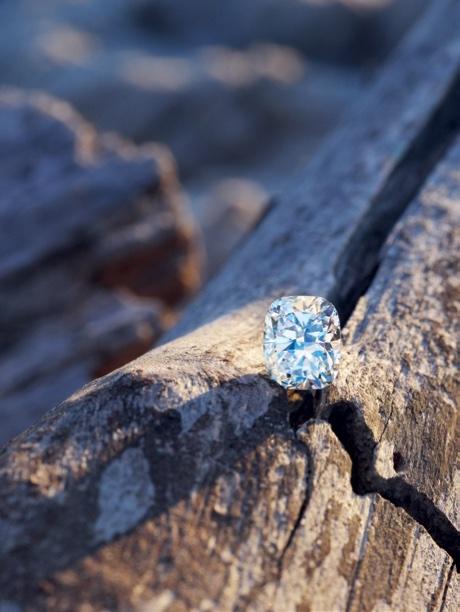
This philosophy finds its fullest expression in Mine to Shine, the company’s quietly revolutionary program introduced in 2023. Where the diamond industry has long been opaque, Mine to Shine o ers transparency— tracking a stone’s journey from its geological origins to its final setting. It is provenance made personal.
On the townhouse’s second floor, clients are invited to become part of that story. Through Mine to Market experience, they
may begin with a rough stone sourced from Botswana, South Africa, or Canada, and follow its transformation through cutting, polishing, and setting. Each stage is documented with imagery and customized videos, revealing not only the mines but the hands behind the craft —the cutter, the setter, the designer—each adding a chapter to the diamond’s life. The process is securely traced through advanced platforms such as Tracr.
For Paul Kazarian, what began as a straightforward search for an engagement ring became something far more resonant. Drawn initially to the quiet beauty of a sixcarat oval diamond, he soon discovered it was part of the Mine to Shine program. The stone arrived not only in a velvet box, but with a 3D replica of its rough form and a digital portal revealing its journey from a mine in Botswana to the hands that shaped it and Kwiat’s own New York atelier.
“My wife is sentimental,” Kazarian reflects. “She feels a connection to the story—she sees this as an heirloom that will stay in our family. It was a super special experience.”
It is precisely this sense of continuity the Kwiats are cultivating. “It’s for the couple,” Russell notes, “but imagine in 60 years, if someone inherits their grandmother’s ring and they can see where it originated, the craftsman who set it. That’s a story.”
The program extends across the collection. Diamond studs, rivière necklaces, even multi-stone creations come with individual origin stories, o ering a level of transparency—and intimacy—rare in fine jewelry. Each piece is accompanied not only by a
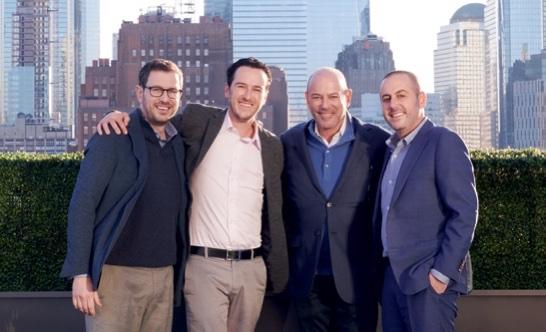
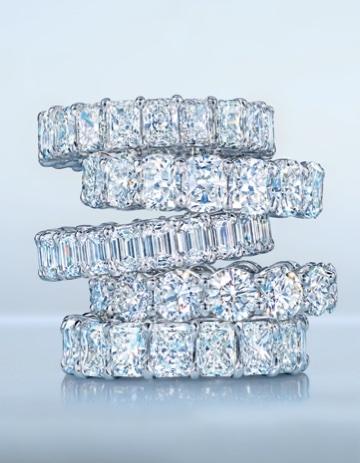
GIA grading report, but also by Kwiat’s own certificate, incorporating advanced light-performance metrics that underscore their commitment to precision.
That precision is evident in the stones themselves. Over recent years, the family has quietly refined its core diamond cuts—cushion, oval, pear, marquise, emerald—minimizing optical imperfections such as the bow-tie e ect and achieving exacting proportions that have become something of a house signature.
The interest in proprietary cuts began with Ashoka diamond, an exclusive William Goldberg cut o ered at Kwiat. “The Ashoka is consistent, beautiful, and a di erentiator,” says Russell. “It’s powerful when you have something that’s truly unique.” It also sparked the house’s broader commitment to refining diamond cutting to its own exacting standards.
The pursuit began with the Fred Leighton round about 15 years ago, a diamond that marries the romance of antique stones with modern symmetry. “They have more light performance but still have the charm of an old stone and are easily matched for earrings or a rivière necklace.”
“There’s a real desire for high-end independent luxury to di erentiate itself,” Russell observes. “Otherwise, it’s a sea of sameness.” In a market often driven by certificates and commoditized pricing, Kwiat o ers something distinctly human: a story that cannot be replicated online.
That distinction is perhaps most palpable in the townhouse itself. The Kwiat spaces are light-filled and contemporary, while the Fred Leighton salons are enveloped in burnished bronze and dark wood, evoking the patina of history. A double-height vaulted library anchors the experience, its shelves lined with archival books and the stories of collectors and icons who have worn these pieces across decades.
“We have a space now where clients can truly linger,” says Rebecca Selva, Fred Leighton’s longtime creative director. “Whether they are searching for an engagement ring or simply exploring jewelry, it
is about taking time.” The townhouse is designed to deepen that engagement through lunches, talks, and private events.
At its core, the house is a living expression of vertical integration—every stage of the diamond’s journey, from ethically sourced rough to finished jewel, brought into view. What was once hidden behind industry doors is now deliberately, elegantly revealed. And yet, for all its innovation, the spirit remains unchanged from Sam Kwiat’s earliest days: that trust, beauty, and human connection are true measures of value. Only now, they are illuminated—cut, polished, and set into a story designed to endure.
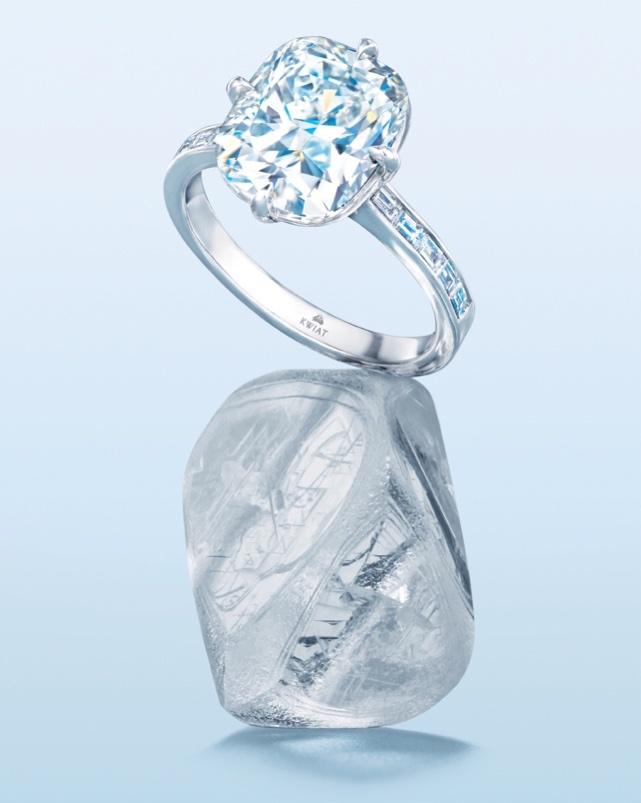
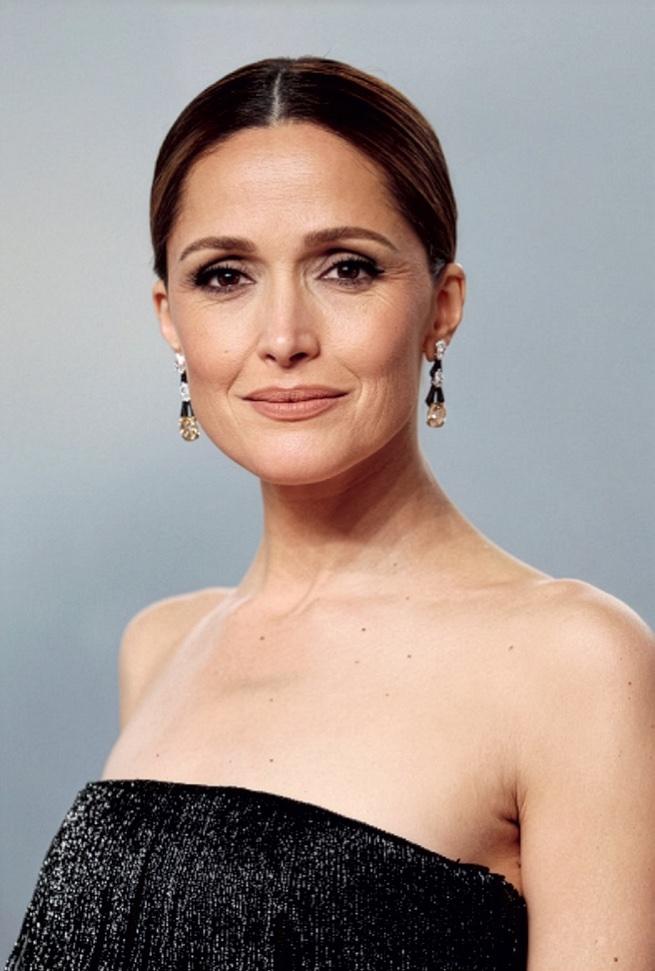
BY JILL NEWMAN
TODAY’S DIAMONDS COME WITH MORE THAN SPARKLE. THEY COME WITH A BACKSTORY.
Rose Byrne wearing Nikos Koulis ME earrings to the 2026 Vanity Fair Ocars Party.
Opposite page: Nikos Koulis ME earrings set with 16.18 carats oval-cut fancy brown-yellow diamonds and 5.07 carats pear-shape white diamonds, in rhodiumnished 18K white gold. Courtesy of Nikos Koulis. Sun setting over the Okavango Delta in Botswana.
stepped onto the Vanity Fair Oscars party red carpet, she brought a bit of Botswana with her—literally. She wore stunning earrings by designer Nikos Koulis, featuring two honey-hued desert diamonds with a total of 16 carats sourced from the country.
Koulis, known for working with a closeknit group of suppliers and, where possible, reclaimed stones, often speaks of craftsmanship and proportion. Yet there is also an acknowledgment that beauty alone is no longer enough. The modern client is attuned to origin, process and impact, even if those details remain largely behind the scenes.
That journey—from remote mine in Botswana to the red carpet—once unfolded largely out of sight. Increasingly, however, it is being brought into focus. Traceability has become something of a quiet luxury in itself: an added layer of storytelling and meaning for clients who want to know not just what they are wearing, but where it has been.
Now, thanks to innovations like Tracr, you can follow a diamond’s path from mine to market. Think of it as a digital passport, verifying that every step—from sourcing to cutting to setting—meets responsible standards and has a positive impact on the communities that touched it.
That was the case with a newly unveiled De Beers London ring, whose roots originate in the remote Kono district of Sierra Leone,
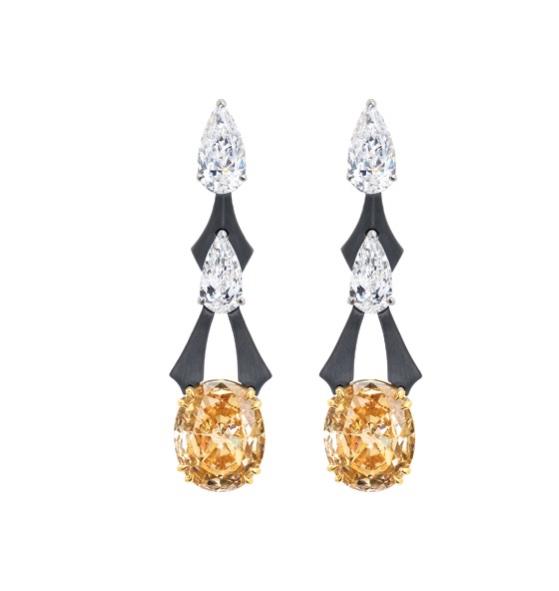

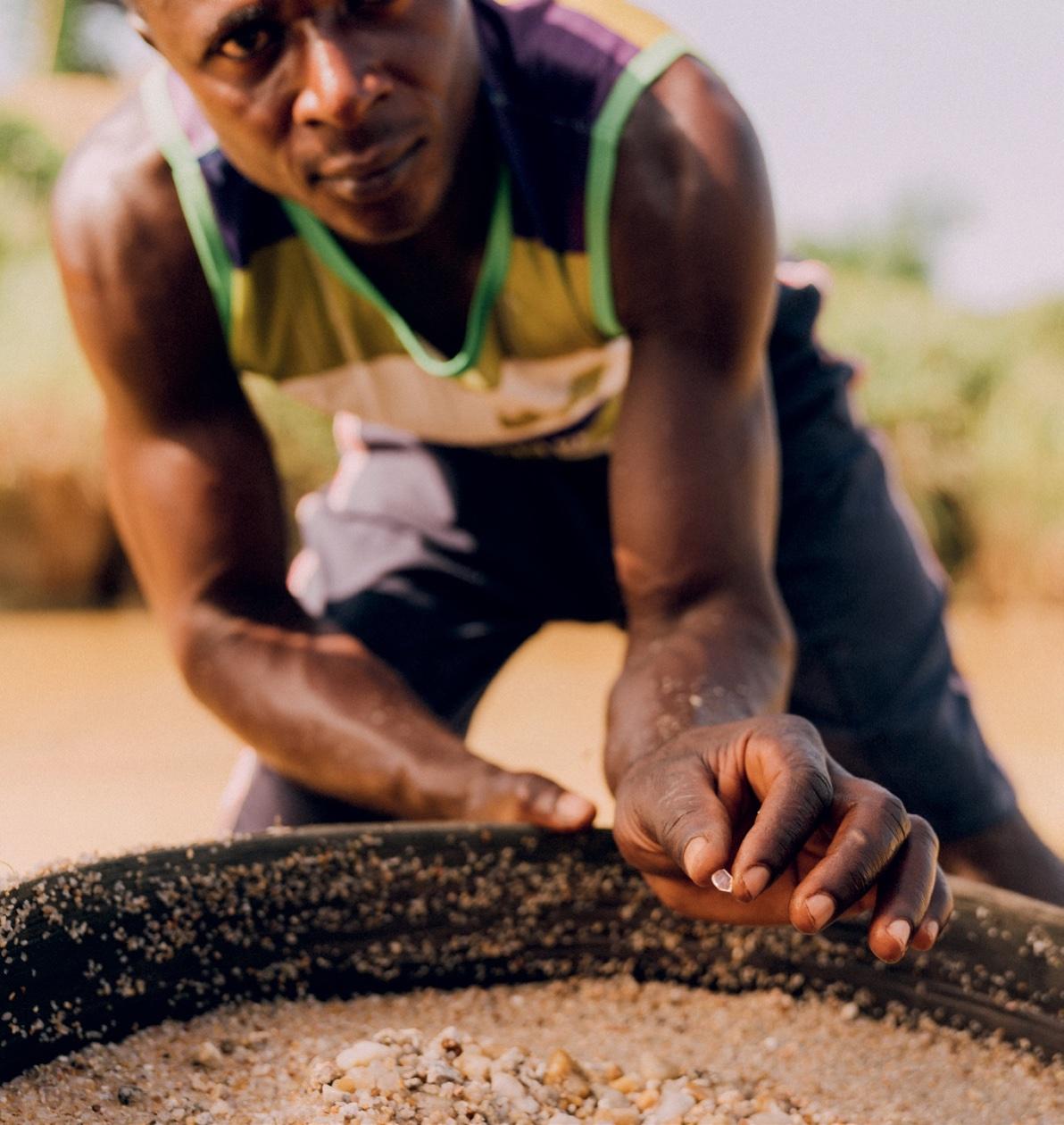
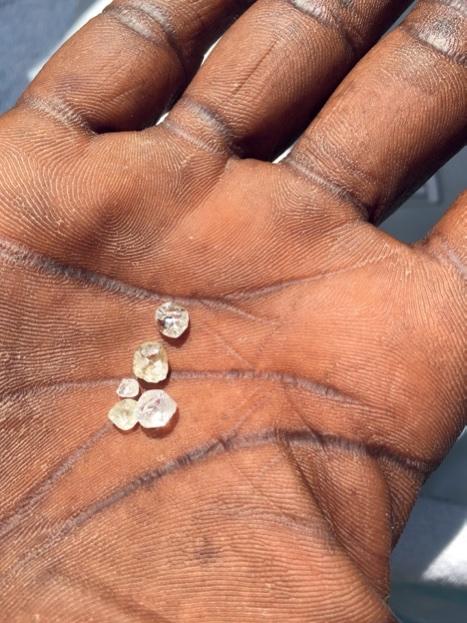
where a miner working the land that his family has known for generations uncovered an exceptional 5.65-carat rough diamond. At the time, it was just a beautiful discovery all in a day’s work. Fast forward, and that very stone ends up cut, polished, and mounted in a ring by De Beers London, and presented in the brand’s glamorous Paris flagship.
The Sierra Leone diamond is especially significant because it’s part of the GemFair program, powered by the De Beers Group to support artisanal miners with training, equipment and a fair and transparent pathway to bring the stones to the international market. Unveiled in 2018 as a pilot program, GemFair has grown to include around 7,000 miners— and counting. The emphasis is not only on improving standards, but on ensuring that value flows more equitably back to the communities where these stones originate.
“Being able to see diamonds from Sierra Leone on a platform like ours and talk about the positive impact they have in the countries they come from, gives consumers a real appreciation for the value of natural diamonds,” said Mahiar Borhanjoo, chief commercial o cer, De Beers Group.
That stone traveled to Botswana, where it was cut into two stones—a 2.02-carat polished diamond and a 2.048-carat rough. They were later paired in a chic Toi & Moi ring for the De Beers London’s Riverborn capsule collection. And its journey was traced through Tracr’s blockchain ensuring it was responsibly managed.
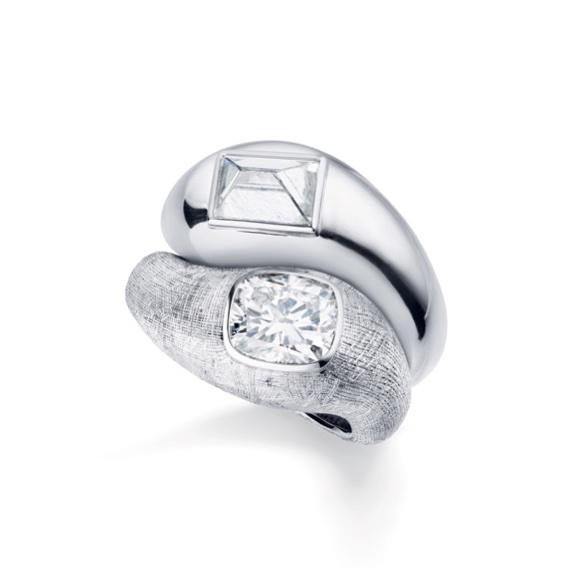
“Beyond their beauty, these diamonds carry the human stories behind them,” said Emmanuelle Nodale, CEO, De Beers London, “connecting each piece to the journey and impact of artisanal mining communities.”
Because in today’s world, a diamond’s brilliance isn’t just about how it catches the light—it’s about everything it carries with it. The people, the places, the journey.
BY JANE ASHER
Newly engaged couple Sydney Brams and David Ri in feel like they’ve known each other forever—which makes sense because they practically have. “He is my older cousin’s best friend,” explains Sydney, who then turns to David to let him know, “You can tell her I was just so gorgelicious that you just couldn’t not talk to me.” He smiles and doesn’t correct her, the joke clearly ringing true. Their engagement, however, was not as straightforward as their meet-cute.
Sydney, a Miami-based influencer with a dedicated fanbase, has been keeping the story close to her chest because of all the moving pieces involved. “This has been such a hard story for me to tell for my followers,” she shares. “I’m like, ‘Do you have twenty minutes?’”
David shares that he was originally planning on proposing during a trip to New York City. “I was going to propose to her in Central Park. Her best friend lives in New York, and we were setting this whole thing up,” he says. Unfortunately, the entire trip got canceled after Sydney herniated a disc in her back from—no joke—sleeping on too many pillows. “I am Princess and the Pea,” she smiles.
Not only was the trip and proposal canceled, but Sydney found out about the proposal-that-never-was when she accidentally overheard a phone conversation about the plan gone awry. “It would have been magical, according to David, and I was really devastated.” Luckily, David had an even more magical plan up his sleeve.
Sydney had a trip planned to Paris with her mom, and David sneakily coordinated with her parents to surprise her in the City of Love. After a bout of weather delays, missed connections, and rebooked flights, the plan almost didn’t come to fruition—again. At one
point, while stuck in South Carolina, Sydney was ready to pack it up and head back home.
“I was sitting in Miami, and then Sydney was trying to call me, complaining about how awful the time she was having, and I had to pretend I wasn’t sitting at an airport trying to meet her there,” recalls David. Sydney’s mom was aware of the plan and made sure the two of them made it to Paris—all in the name of love.
With so many road bumps, it would have been easy for this plan to be spoiled for Sydney as well, but luckily, when David finally showed up in Paris, it was a total surprise—even after Sydney overslept and missed the meeting time with David, unbeknownst to her. “I sat underneath a bridge with a stranger for two and a half hours,” says David. “I also got a little bit sunburned in the process. It was very funny.” You know a man is head over heels when he can find humor in a stressful situation!
When Sydney finally showed up at the picturesque location by the Seine, she was in total shock to see David down on one knee. “I went non-verbal for four hours,” she jokes. “And I got very flustered because all of a sudden people started cheering.”
David recalls, “I got down on one knee, and I started to give her the speech she had told me she wanted, and she’s just like, ‘Stop it, stop it! No!’” The couple laughs as they recall the comedy of errors. “I was like, ‘Don’t do it, don’t do it. Everything that I told you? Don’t do any of it,’” Sydney adds.
Because she was so flustered during the actual proposal, throughout their time in Paris, Sydney wanted to recreate the moment, to make sure she got the perfect photo. “We got engaged seventeen times because I just
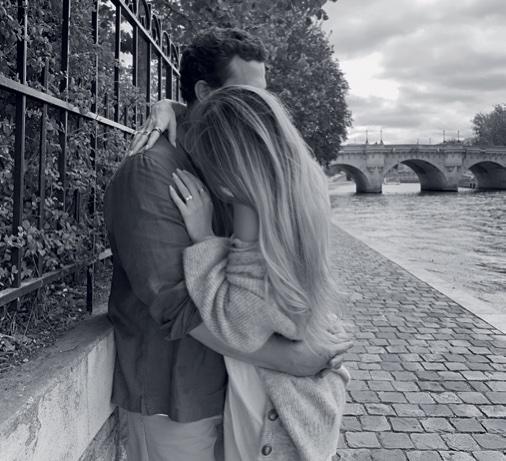
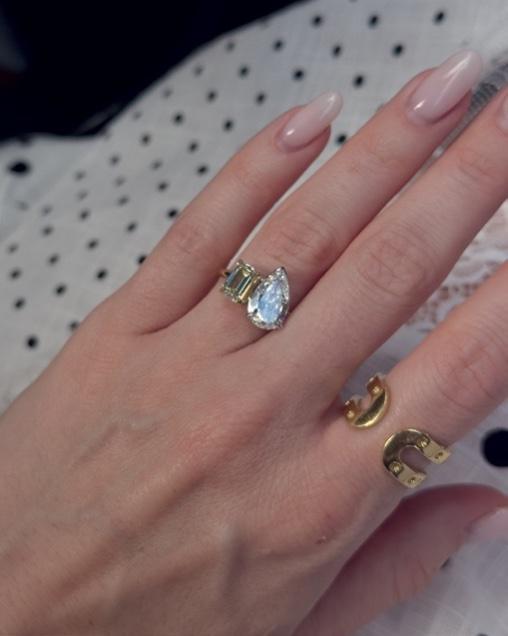
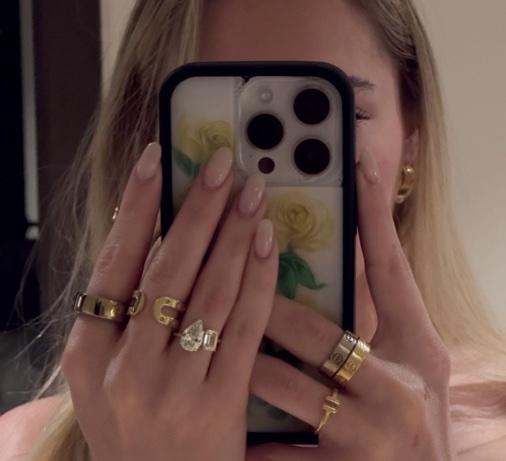
had him keep reenacting it. I was like, ‘This is a cute spot, get down.’”
“I was jet lagged, and it wasn’t an easy road to get to Paris,” she adds. “So, it was a very strange feeling. I was so overjoyed, but my brain couldn’t make sense of it. But it was the happiest week of my life, it was so fun.”
One thing that stayed on course the entire time, however, was the stunning natural diamond engagement ring from Hamilton Jewelers, a toi et moi featuring a pear-shaped white diamond and an emerald cut yellow diamond. “I’m very, very picky and David felt that, up until this point in his life, this would be his biggest purchase, so he wanted me to get exactly what I wanted.” Sydney was involved in the design process in the beginning, but once it came to finalizing details, David took over, so the final product could be a surprise.
“We had a previous relationship with Hamilton, and I knew that I wanted a custom style, the toi et moi, and I knew that I wanted a colored stone,” says Sydney. Ending up with a yellow diamond felt like a matter of fate. “You always hear, ‘oh you’ll know when you see it,’” she says, a sentiment that rang true for the diamond sourcing process with Hamilton.
Working closely with Ted at Hamilton’s Palm Beach Gardens store was important to Sydney. “It was very di cult finding somebody willing to take on the task of creating a custom ring,” she says, and was elated when the jeweler was up to the task. “I have a slight individuality complex,” she laughs.
“I love the color yellow, and I really wanted a specific shade of yellow.” Something that evoked sunshine and rainbows, according to her mood board. “We had to go through so many shades of yellow to find the right shade. And when we found both stones, I just knew those were the stones that I wanted for my ring,” she says. “I love the fact that everywhere I go, and no matter what I do, I have a little pop of yellow.”
Choosing a natural diamond was very important to David. “I don’t want to start a marriage on the foundation of something that’s considered to be fabricated or not legitimate,” he explains of his choice. “I mean, it’s a sign—the symbolism of a diamond that shows somebody how much you love and care about them.”
“The nature of the ring, the name of the ring, the more feminine pear shape paired with the masculine step cut shape, I really liked that balance,” adds Sydney. “I try to find meaning in everything, I’m one of those people.” The most meaningful thing of all, perhaps, is the billions of years the diamonds spent forming, to end up on her finger, representative of a love to last a lifetime and more. “Now we have an heirloom,” she says, with David agreeing beside her.
BY BRANDON BORROR-CHAPPELL
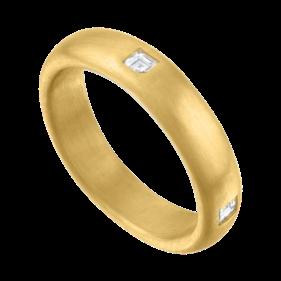
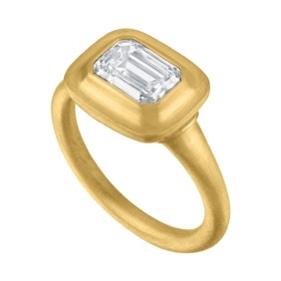
I wonder if you’ve seen this video: a man marches a cat up a hallway, hoists her aloft, and sings about the entire operation in improvised lyrics to the melody of The Lion King. “I will fetch her from the other room and walk her toward you on her hind legs, lift her up now see her belly…”
That man was me. If you’re among the five million people who saw this, you may recall that my voice cracks toward the end of the video. I was on a roll before it happened–the lyrics were flowing, my timbre felt comfortable–and then, in a nanosecond of weakness, I’d ruined the whole vocal take. But then I remembered the way things work.
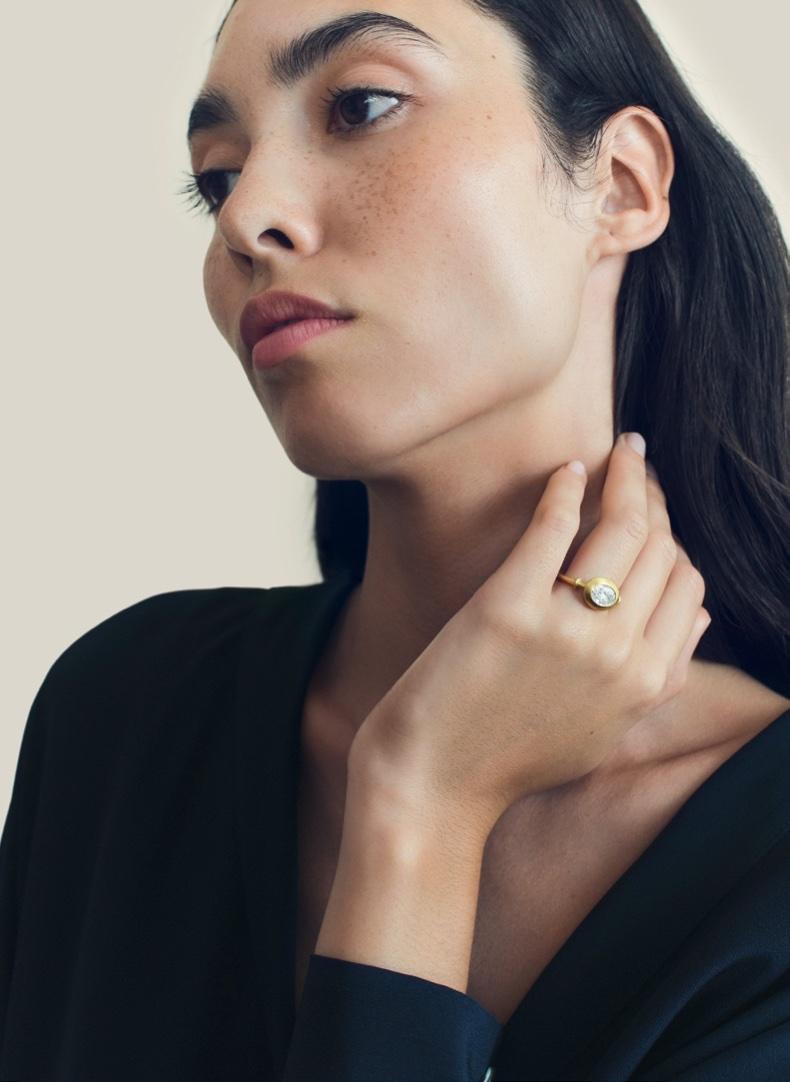
I’ve posted enough duds online to know that a lot has to go right for something to enter the algorithm superhighway. And sometimes it helps when the right thing goes wrong. The crack made the video — short artisanal film, if you will — feel like an authentic artifact. It’s how viewers knew they weren’t just beholding another web gem, but a natural diamond. They rewatched to laugh again at my foible and poke fun in the comments, propelling me to viral glory.
Consumers on the hunt for statement pieces and future family heirlooms are shifting toward natural diamonds that, like my beautiful cat song, have some version of a voice crack. I am not here to besmirch colorless, flawless diamonds with breathtaking scintillation. But in a market that is increasingly diluted by flawless stones of uncertain provenance, natural diamonds imbued with visible evidence of their deep Earth formation have seen their valuation go up.
I learned a lot about what’s happening, and why, from the Co-Founder and President of Gemological Science International, Debbie Azar. I always enjoy hearing from someone who really knows what they’re talking about.
Debbie told me: “The industry has historically rewarded visual beauty based on absence; absence of color, absence of internal features. What we call a ‘lower grade’ is really a reflection of how the grading system is structured, especially when those features relate to natural diamond inclusions or the causes of color.
I was hungry for science, and Debbie delivered: “Many lower color diamonds contain higher concentrations of nitrogen, often in aggregated forms, which absorb blue light and create a yellow to brown appearance. Particular nitrogen aggregates can tell us a lot about the diamond, including its relative age or growth origin. Inclusions form during crystal growth or from later geological
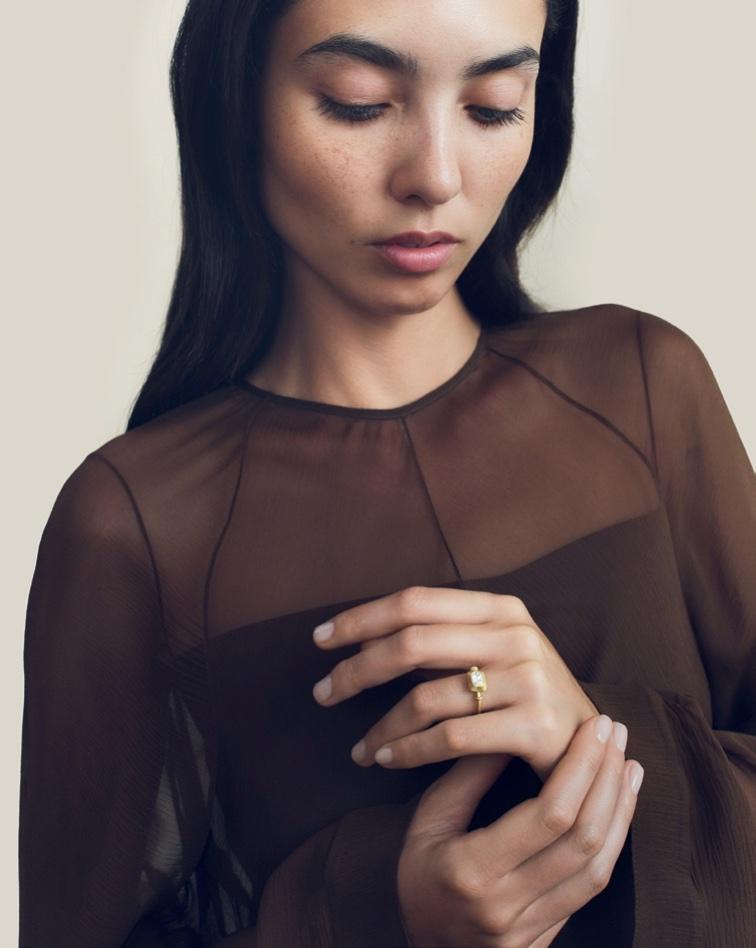
processes. While they impact clarity grading, they are also direct evidence of natural growth conditions.
“Clarity characteristics can indicate how long a diamond has been forming and evolving over billions of years. Certain inclusions provide direct information about the environment in which the diamond formed, o ering insight into the composition and structure of our planet. Growth features and internal structures reflect changes in pressure, temperature, and chemistry over time, allowing scientists to reconstruct aspects of the diamond’s formation history.”
Imagine a cluster of ambitious nitrogen atoms, arranged in monogamous pairs sharing a trio of electrons each. Clinging to each other, they pass unbothered by the frenzy of atoms whizzing around them. They burst out across the newly formed cosmos 13.4 billion
years ago, wound up in the outer rim of a spiral galaxy, and began orbiting a growing mass in the center of a spinning cloud. They banded together deep in a condensing spheroid of matter and had the foresight, as that clump became Earth, to lodge themselves in the carbon clutches of a natural diamond.
Snug in their beds, they were blasted up toward the surface by a prehistoric volcano, rumbling and jostling beneath the footsteps of dinosaurs. And then, once the apes climbed down from the trees and began growing their own food, that diamond was found and cherished, cut and polished. And those nitrogen molecules absorbed some of the blue light from the Sun it had never seen before, making the stone they called home appear a bit more yellow, maybe even brownish.
An appraiser examines the stone and says, “I’m sorry, pal. You’re beautiful in your own
way but because you have so much to say about the conditions of the 3-billion-yearold upper mantle of our home planet, you aren’t quite as valuable as your quieter, shinier friends. I am assigning you a lower grade.”
Of course, this grading system isn’t necessarily a declaration of one stone being superior to another, though the market has historically interpreted it that way. But consumer tastes are noticeably shifting. These lower-grade diamonds, because of the geological story they so proudly tell, are easier to identify as naturally formed stones. Yesterday’s pollutants are today’s badges of authenticity. And discerning consumers want to own something that’s the only version of itself.
I also asked Debbie if warmer stones o er di erent design opportunities than their D color counterparts. She told me, “Diamonds with more color, often due to nitrogen-related defects, introduce yellow to brown tones that can be matched or contrasted with colored gemstones. Warmer diamonds tend to work more naturally with yellow or rose gold and with stones in similar color ranges, rather than contrasting sharply the way very colorless diamonds can. Di erences in color between diamonds can also be used intentionally within a piece to create contrast or a gradual shift in tone, instead of a completely uniform look.”
I believed Debbie but I wanted to verify her claims, so I spoke with a couple of warmer-stone-loving jewelers. The first to corroborate was Anne Russell, Executive Vice President of Hamilton Jewelers. Interestingly, Hamilton Jewelers are reprising their original 1912 collection (the year the atelier was founded) and modernizing the designs with warmer stones.
Anne told me, “We feel that natural diamonds with their imperfections are part of the diamond’s journey. The warmer tones and imperfections are part of the stone’s makeup, just like the owner’s journey. We recently
Images courtesy of Prounis.
started a partnership with ORIGIN De Beers Group, which enriches the traceability of each stone and allows us to tell deeper stories about a natural stone’s provenance.
“We present our clients with options in natural colors of all ranges, from colorless to warmer tones. Many gravitate to the warmer stones, which mount beautifully in yellow and rose gold. The vintage or halo styles, especially with cushion cuts, feel fresh in today’s market.”
Next, I was lucky enough to visit Jean Prounis in her eponymous New York atelier.
Prounis is a teller and appreciator of stories. The first thing I noticed when I walked into her showroom and beheld the array of jewelry laid out was that her pieces looked ancient, and that my wife would love her designs (I was right). “My heritage is Greek, and a lot of my designs are references to Ancient Greek and Roman designs. It’s serious because it’s fine jewelry, but it really lets me play. I get to have playful conversations with my own heritage,” she told me.
We got a little o track discussing the Hollow Earth theory depicted most recently in Godzilla vs Kong, the inhabitants of which might view our diamonds as their stars. I then successfully diverted our conversation to The Lord of the Rings, and Jean speculated that Elijah Wood had perhaps kept the One Ring from the films, as it grants its bearer an unnaturally long life (he looks the same as he did twenty years ago).
Thankfully, she pulled us back from the brink. “We work with 22 karat gold, which has a really high gold content and is a really warm yellow. You wouldn’t put a D color diamond in a setting like that. We work mostly with L, M, and N stones.” They’re currently at work designing a new art deco collection inspired by 1930’s New York and The Versailles, a club her great grandparents owned back then. Again with the stories!
Prounis works exclusively with natural diamonds, even down to the melee parcels she purchases exclusively from a dealer who sifts through the smaller rounds and ensures that only natural diamonds sift through. The jewelry she designs is meant to tell a story, and that story is a lot more compelling when its brightest points are billions of years old.
Jean said, “I love antique stones, old mine cut diamonds, stones that have wide facets and are a little wonky. They’ve lived a little more, they’ve been prized by di erent people over hundreds of years. And right now, people are flocking to antiques, so the values have gone up.”
Prounis does a lot of resetting and bespoke custom designs for people who want a new presentation of an old family heirloom. “It’s
a fun challenge when someone brings in an heirloom natural diamond, it could be an old mine cut with big facets, a rose cut with lots of inclusions, and I get to figure out what kind of design pairs well with the stone. I like to find something that celebrates the imperfections. Perfect is boring. A lot of the Prounis world is bringing new life to old stones.”
“Sometimes someone will bring in an heirloom and say, ‘I saw this ring in the Met, I want something like that.’ We don’t just copy it, but it is fun to create some version of a historical reproduction.”
A couple of recent customers lost their homes in the Palisades fires. They dug through the ashes and found their jewelry. The platinum settings were charred and ruined, but the diamond was completely unphased, and Prounis reset them. “I know it’s kind of a cliche or a slogan or whatever, but I thought, wow, diamonds really are forever,” Jean said.
Of course, this doesn’t apply to everyone. A diamond is a diamond, and a beautiful, colorless, faultless laser-cut rock is not a hideous thing. But these days, there is more to consider than the four C’s. In a world where so much is changing so quickly, I am heartened by the stalwart persistence of naturally made things. There is always room for genuine artifacts. They make their own space.
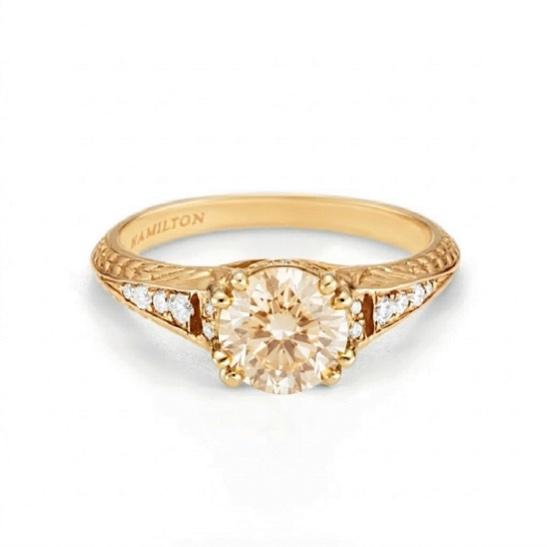
BY HANNAH MILITANO
I have a vivid memory as a young girl, walking through the checkout at the grocery store with my mother, admiring the covers of fashion magazines and tabloids, when I set my eyes upon a picture of Jennifer Lopez, eagerly showing o her new pink diamond engagement ring to the press. I had no idea diamonds could possibly come in colors. While we often associate diamonds with colorless gems, science is a magical thing. Natural diamonds form deep within the Earth under extreme heat and pressure, developing when carbon atoms bond in a crystal lattice structure. But when certain variables are introduced, the color of these sparkling stones can span the entirety of the rainbow. If the internal trapping of non-carbon atoms enters the scenario, structural distortions or even changes in pressure can alter the stone during the formation process, resulting in a technicolor dream in a stunning range of hues.
Only making up 0.01% of all natural diamonds, a colored diamond’s scarcity and striking beauty make them all the more exceptional and as individual as your love story. With their extreme rarity and exquisite saturation, these natural phenomena have found their way onto the special left ring finger of many A-listers. Celebrity engagement rings have always garnered immeasurable
attention, setting trends and influencing our style choices. And when a colored diamond is involved, these megawatt sparkles tend to go down in pop culture history.
While J.Lo is far from the only star with a colored diamond engagement ring, she may have the largest variety of hues in her collection. The multi-hyphenate superstar has had a swath of suitors get down on one knee asking for her hand in marriage. Lopez has been engaged six times, and three of those diamond rings have glistened in captivating colors.
In 2002, the original “Bennifer” era launched into the stratosphere when Ben A eck and Jennifer Lopez began their romance after meeting on the set of their film, Gigli. Taking note of Lopez’s a ection for the color pink, A eck proposed with a custom 6.1-carat radiant-cut fancy intense pink diamond ring from Harry Winston, flanked by two white diamond baguette accents.. Lopez later revealed that A eck even had the word “sing” engraved on her ring. Though the pair called o their engagement in 2004, the ring ignited a frenzy for pink diamonds.
Shortly after Ben and Jen broke things o , Lopez reconnected with an old flame –singer Marc Anthony. He got down on one knee in 2004, proposing with an 8.5-carat radiant-cut blue diamond engagement ring
Jennifer Lopez shows o her 6.1-carat Harry Winston pink diamond engagement ring from Ben A leck in 2003.
Lopez’s 8.5-carat cushioncut green diamond Rahaminov engagement ring from Ben A leck, 2022.
LIVELY HAVE DEVELOPED A TASTE FOR THE MOST DELICIOUS EYE CANDY TO EVER EXIST – COLORED DIAMOND ENGAGEMENT RINGS.
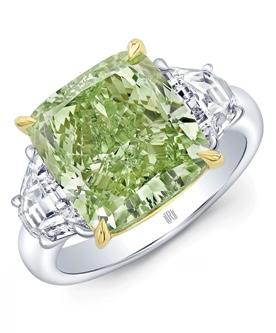
with baguette-cut accents from Harry Winston. After tying the knot in a private ceremony at Lopez’s home in Beverly Hills, the couple remained married for 10 years, welcoming twins Max and Emme together before finalizing their divorce in June 2014. Even as recently as 2021, Lopez revealed that her blue diamond is still her most treasured piece of jewelry.
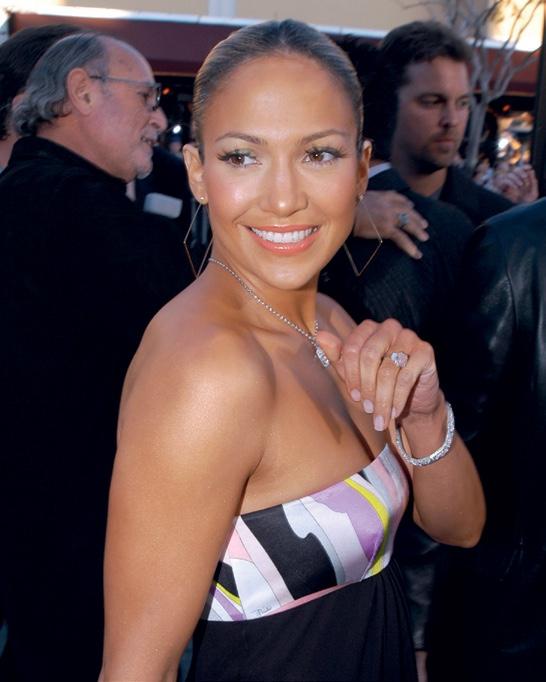
Twenty years after her first engagement to Ben A eck, the couple rekindled their romance in 2021. After proposing with the beguiling pink diamond, A eck popped the question again in 2022, with yet another colorful diamond. This time around, A eck presented Lopez with an 8.5-carat cushion-cut green diamond set on a platinum band– a diamond with an even rarer color than the first, its hue symbolizing luck for the couple.
The central green diamond was sourced by Ilan Portugali, while Tamara Rahaminov and her daughter, Nicol Goldfiner Barlev of Rahaminov Diamonds, were responsible for the design of the ring. The mother-daughter duo tells Only Natural Diamonds, “Colored diamonds are extraordinary because no two are ever truly alike. Each stone carries its own personality, tone, and intensity, which makes every piece inherently one-of-one. For an engagement ring, that individuality becomes deeply meaningful. It reflects a personal story rather than a trend.”
The Rahaminovs explain, “We are always drawn to diamonds with the strongest, most vivid color presence. Saturation and intensity make a colored diamond truly captivating.” They say, “The process is always guided by the individual couple. The right diamond ultimately reflects their personality and the emotion they want the ring to carry.
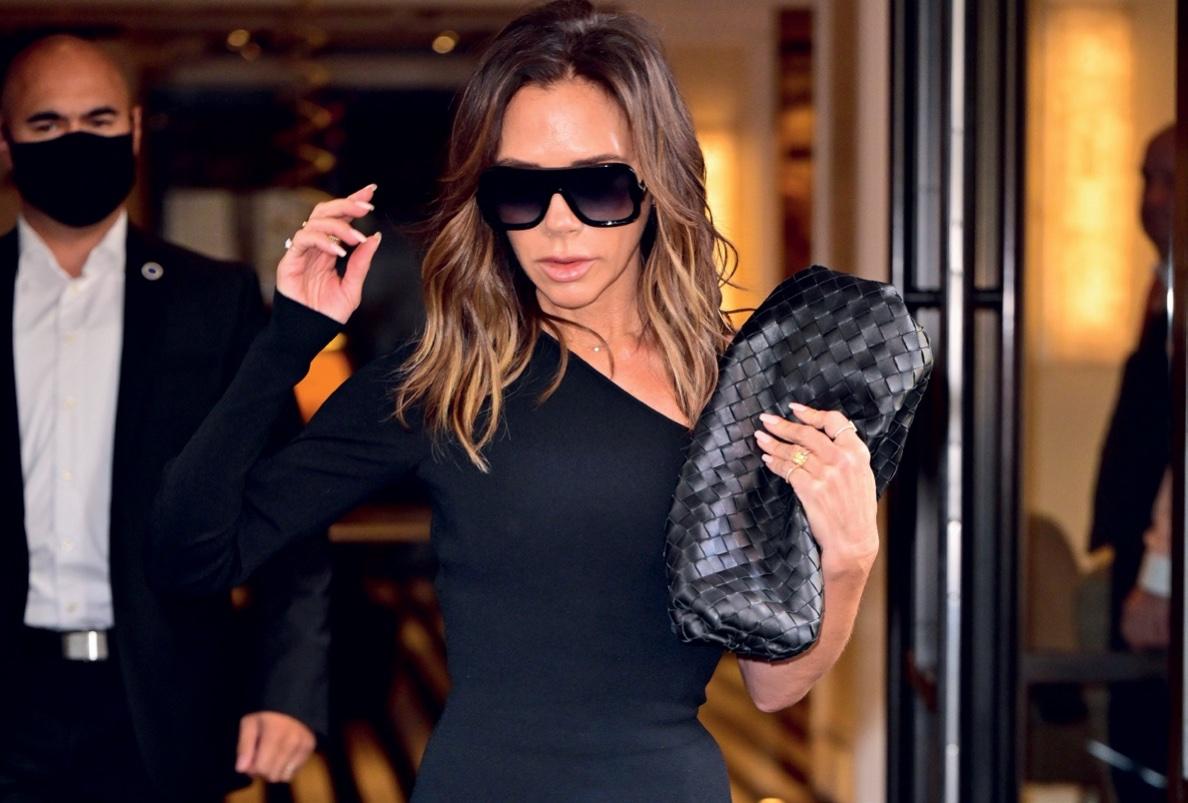
We particularly love working with blues, pinks, and greens because each of those colors expresses something di erent while still feeling timeless.”
After tying the knot in 2022, the couple went their separate ways and finalized their divorce in 2025. Per court documents, Lopez was permitted to keep the exceptional green diamond engagement ring.
Victoria Beckham also has a colorful assortment of natural diamonds, racking up an impressive collection of 15 di erent engagement rings throughout her 26-yearlong marriage to legendary footballer David Beckham. Showing o some staggeringly beautiful jewels on her left ring finger, the Spice Girls veteran has accumulated at least two pink diamond rings and two yellow diamond rings.
In 2004, the fashion icon debuted an oval-shaped pink diamond ring with a white diamond halo, reportedly purchased by David for her 30th birthday. Two years later, Victoria was seen with an emerald-cut yellow diamond on that finger. By 2010, she was
sporting a new oval-shaped pink diamond in a di erent, daintier setting than the first. These days, Beckham has been wearing a fancy intense natural yellow diamond, set on a yellow gold pavé band. First spotted in 2018, she’s kept this jewel in her rotation for quite a few years now.
Joining the exclusive yellow diamond engagement ring club, Beckham is in good company. Supermodel Iman wore her yellow diamond engagement ring at the 1995 VH1 Fashion and Music Awards. According to The History of Diamond Engagement Rings: A True Romance, music legend David Bowie proposed to the supermodel in 1992 with an approximately 10-carat radiant-cut yellow diamond by Lorraine Schwartz, kicking o the trend.
British musician Seal proposed to German supermodel Heidi Klum in an igloo at a ski resort in Canada over the holidays in December 2004. Now, one of the most memorable celebrity engagement rings, he popped the question with a gigantic 10-carat oval-shaped canary yellow diamond
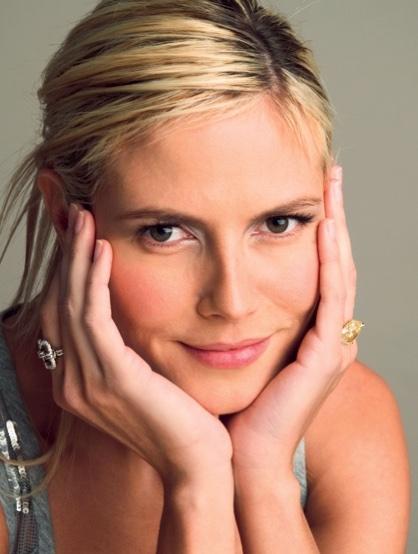
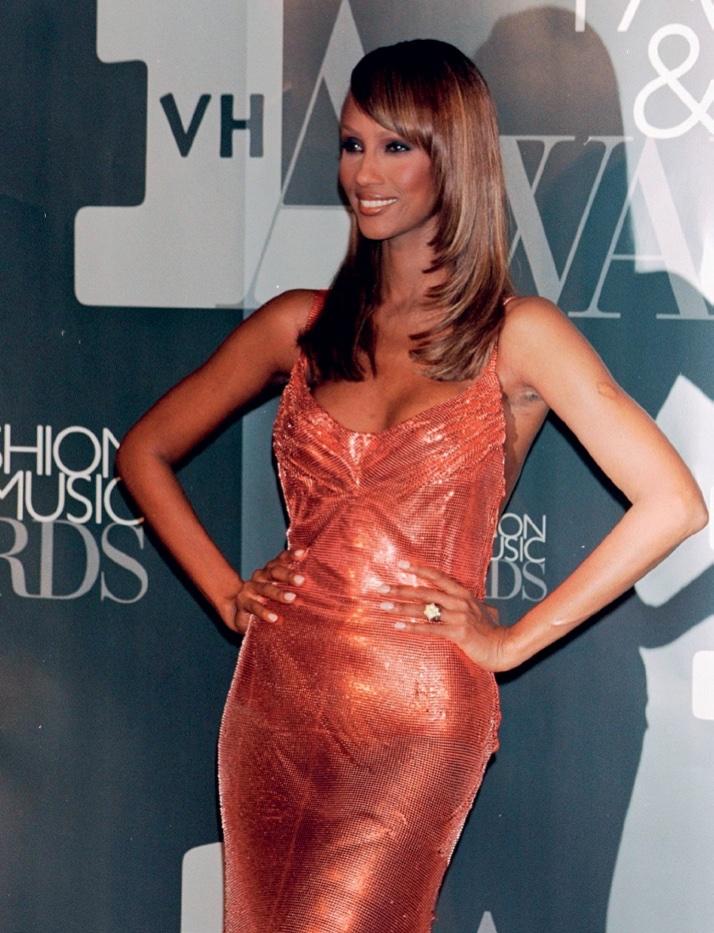
engagement ring, set with a thin pavé-set yellow diamond band. The sparkler came courtesy of renowned celebrity jeweler Lorraine Schwartz. One year later, the couple married in Mexico in May 2005, before parting ways in October 2014.
Russian-American tennis star Anna Kournikova met Spanish musician Enrique Iglesias on the set of his “Escape” music video in 2001. With two fantastically colored diamond engagement rings and four children later, the pair have been together ever since. Often seen on the tennis court with her dazzling diamonds, Kournikova must have blinded the crowd at the 2010 Wimbledon Lawn Tennis Championships, flashing her radiant-cut yellow diamond ring, flanked by trillion-cut diamonds.
Before that, Kournikova debuted another colored diamond ring from Iglesias, this time featuring a gigantic pink diamond. She wore it during the 2004 World Team Tennis Smash Hits game, stirring engagement rumors. Though the long-time couple never confirmed or denied the news, the 11-carat pear-shaped Argyle pink diamond ring, anchored by two trillion-cut white diamonds, could not be ignored.
The early aughts saw a pink diamond engagement ring fever that had never been seen before, and it kept its momentum through the 2010s. Nick Cannon proposed to Mariah Carey in 2008 with an emerald-cut fancy light pink diamond engagement ring, surrounded by 58 intense pink diamonds and flanked by two half-moon diamonds from Jacob & Co. jewelers.
Heidi Klum wears her 10-carat canary yellow diamond engagement ring from Seal.
Supermodel Iman wore her 10-carat radiant-cut yellow diamond Lorraine Schwartz engagement ring from David Bowie at the 1995 VH1 Fashion and Music Awards.
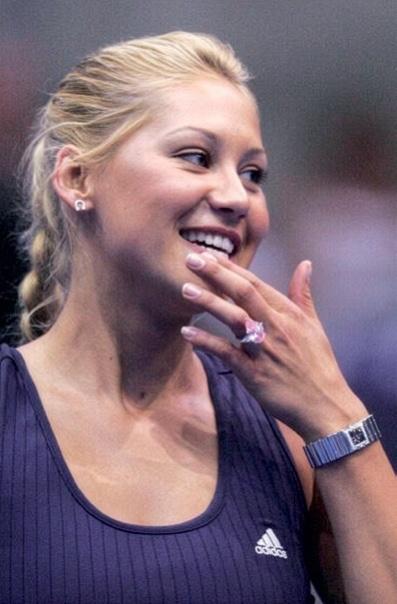
Just a few years later, in 2011, Ryan Reynolds proposed to Blake Lively with an oval-shaped pink diamond ring by Lorraine Schwartz. Featuring a 12-carat pink oval-cut diamond on a custom pavé diamond band, the jewel was estimated to be worth about $2 million at the time. The couple met on the set of the 2011 film Green Lantern and married in a private ceremony in 2012.
Proving pink diamonds are still in high demand, billionaire Amazon founder Je Bezos popped the question to Lauren Sánchez with a massive cushion-cut pink diamond ring by Lorraine Schwartz in May 2023 on his three-masted superyacht, Koru.
While desert diamonds have been all the rage as of late, stars like Kate Hudson and Scarlett Johansson were ahead of the curve. Earthy, organic hues like celebratory champagne, golden honey, and rich cognac colors are the toast of diamond trends these days.
In 2019, actress Scarlett Johansson debuted her rare 11-carat elongated oval type IIA light brown diamond engagement ring, mounted on a slim black ceramic curved band from her now-husband, Saturday Night Live comedian Colin Jost. The outstanding sparkler was created by Ta n jewelry designer James de Givenchy.
Jost recently shared a hysterical story about the engagement ring while hosting an episode of Pop Culture Jeopardy! in February 2025. He explained that Johansson once lost her engagement ring – when she told him she feared she may have “accidentally” thrown the ring in the garbage, Jost “looked through 12 dumpsters of trash,” he said on the game show. With no luck in finding the ring, he went back inside. “She said, ‘Oops! It was in my pocket,” he said, “It was a great day for me.” Romantically linked since 2017, the couple married in October 2020.
Similar in hue, actress Kate Hudson confirmed her engagement to musician Danny Fujikawa at the 2021 Met Gala red carpet, where she debuted her elongated cushion-cut light brown diamond set east-west-style on a rose gold band.
According to Tamara Rahaminov and Nicol Goldfiner Barlev of Rahaminov Diamonds, the incredible rarity of a colored natural diamond adds to the allure. “A colored diamond can feel quietly luxurious. Someone may wear one every day without drawing obvious attention, yet those who understand diamonds immediately recognize its significance. A colored diamond has an ‘if you know, you know’ quality that makes it feel intimate and personal.”
Victoria Beckham also has a colorful assortment of natural diamonds, racking up an impressive collection of 15 di erent engagement rings throughout her 26-yearlong marriage to legendary footballer David Beckham. Showing o some staggeringly beautiful jewels on her left ring finger, the Spice Girls veteran has accumulated at least two pink diamond rings and two yellow diamond rings.
In 2004, the fashion icon debuted an oval-shaped pink diamond ring with a white diamond halo, reportedly purchased by David for her 30th birthday. Two years later, Victoria was seen with an emerald-cut yellow diamond on that finger. By 2010, she was sporting a new oval-shaped pink diamond in a di erent, daintier setting than the first. These days, Beckham has been wearing a fancy intense natural yellow diamond, set on a yellow gold pavé band. First spotted in 2018, she’s kept this jewel in her rotation for quite a few years now.
Joining the exclusive yellow diamond engagement ring club, Beckham is in good company. Supermodel Iman wore her yellow diamond engagement ring at the 1995 VH1 Fashion and Music Awards. According to The History of Diamond Engagement Rings: A True Romance, music legend David Bowie proposed to the supermodel in 1992 with an approximately 10-carat radiant-cut yellow diamond by Lorraine Schwartz, kicking o the trend.
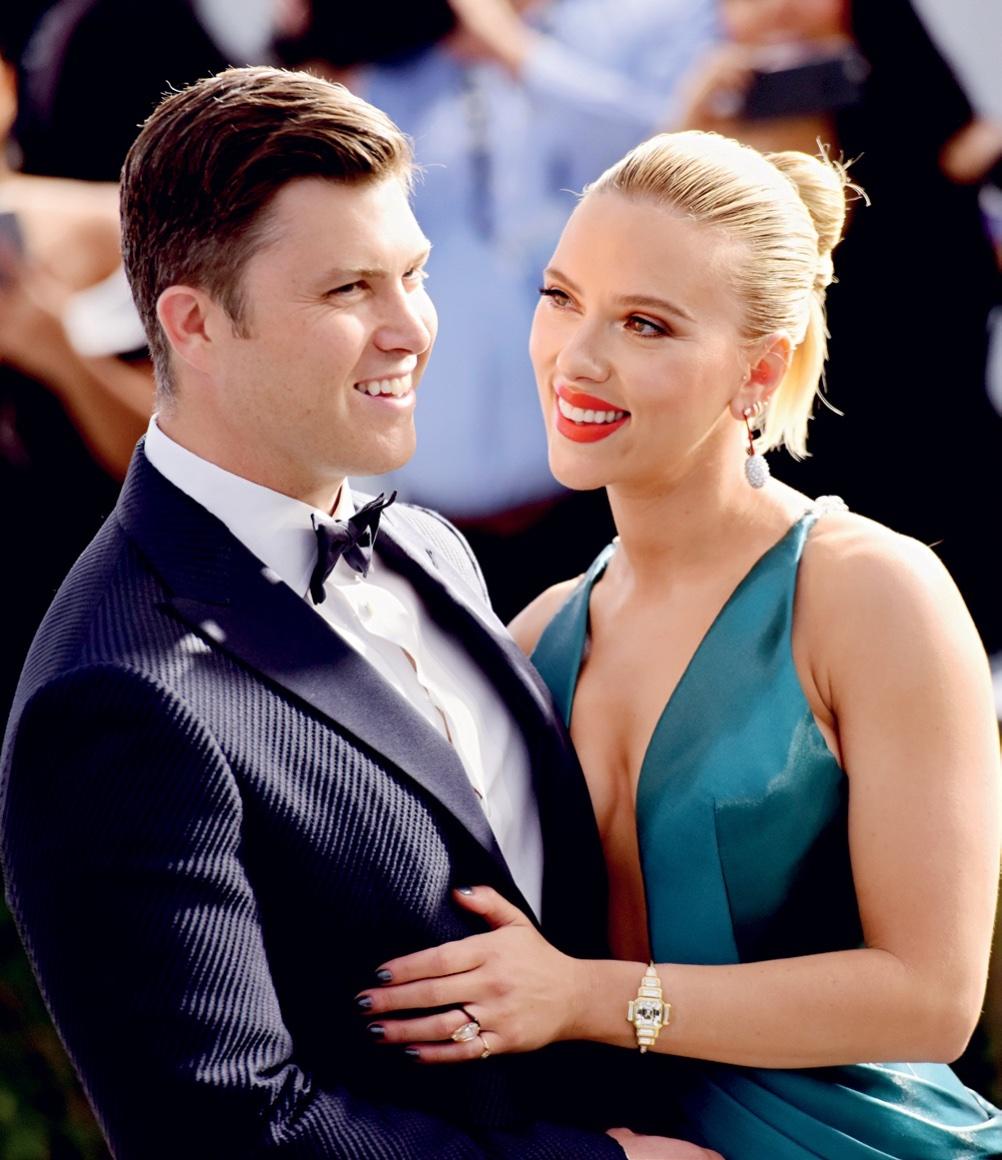
BY SAM BROEKEMA
PHOTOGRAPHED BY BENJAMIN BOUCHET
. Egyptophilia. Egypt obsession! Ancient Egypt has long stoked the fires of creative minds, manifest in the number of legitimate (and fanciful) terms used to describe its study and fandom. Since the preeminence of ancient Rome, a passion for Egyptian art has influenced varied movements.
The beginning of the 20th century saw these themes permeate culture through neoclassical architecture, operas, ballets, decorative objects, and even film. Perhaps no city displays the sheer amount of evidence as Paris: most notably the installation of the Luxor Obelisk on Place de la Concorde in 1836, the decorative arts of the 1920s, and the past century of jewelry masterpieces created in and around Place Vendôme.
Fascinating Egypt, a stunning array of 180 pieces of High Jewelry by Van Cleef & Arpels draws upon the rich materials in their own archives but with an eye to the contemporary. The storied Maison caught the bug early. A long pendant necklace from 1923 features a winged scarab, lotus blossoms, and a serene, seated figure in profile, all fashioned in diamonds, emeralds, rubies, and onyx set in platinum. The patrimonial collection of Van Cleef & Arpels holds ten such extraordinary pieces. The preview book includes an image from a 1922 catalogue of a necklace with a brooch pendant adorned with lotus motifs.
According to Catherine Renier, President and CEO of Van Cleef & Arpels, “The lotus flower is part of the creative repertoire of the Maison since the 1910s. When the Maison was founded in Paris in 1906, the artistic landscape was marked by a renewed attraction to Egyptian heritage.” Ms. Renier also notes that 1909 marked the debut of Cleopatra by Serge de Diaghilev’s Ballet Russes.
Howard Carter discovered the tomb of Tutankhamun on November 26, 1922, and the unveiling of an invaluable treasure of statues, jewelry, and household objects sparked a frenzy for the Egypt of the Pharaohs. Returning to the catalog image, Ms. Renier goes on to say, “This creation features Egyptian motifs but also falls within the Art Deco movement due to its geometric shapes, perfect symmetry and color contrast.”
A harmony between modernity and classicism is a fitting description for how the Maison approached Fascinating Egypt. The jewelry does not simply cite design clichés; rather, it references the entire gamut of Egyptomania across varied media. Ms. Renier expounds upon the theme: “Of course, we drew inspiration from powerful literary references, such as the Egyptian Pantheon illustrated by Léon-Jean-Joseph Dubois, but we also drew from more subtly influenced works and artistic movements, such as the Memphis Group, and from art forms we seldom represent, like cinema and theater. Our aim with this High Jewelry collection is also to o er a contemporary perspective on these influences, to celebrate the various forms of Egyptomania in all their artistic expressions. Thus, we have envisioned a jewelry panorama that tells the story of an Egypt reinterpreted through the centuries.”
“Beauté légendaire” necklace featuring a cushion-cut Fancy Vivid Yellow diamond of 10.02 carats, sapphires, and diamonds, set in white gold and yellow gold.
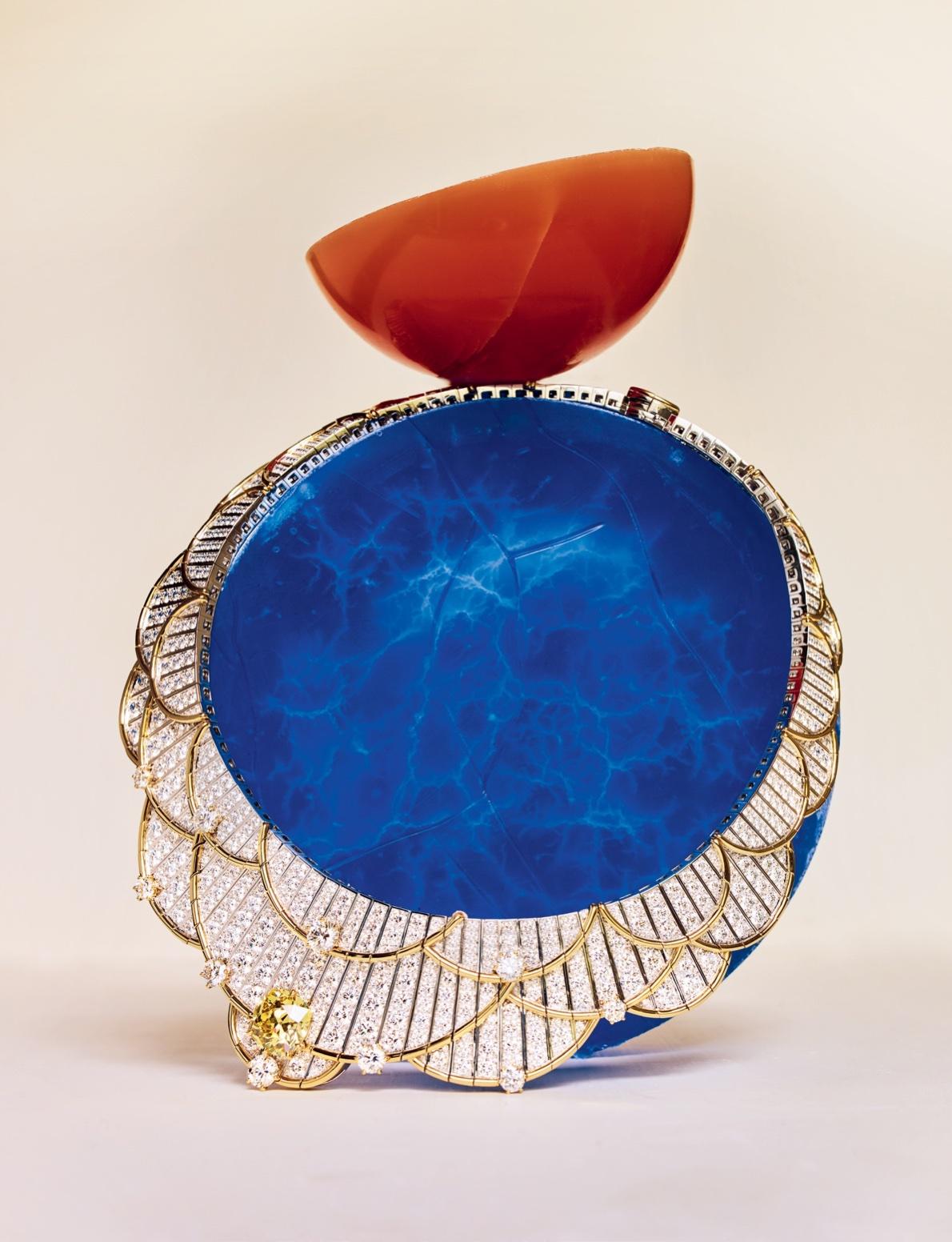
Being Van Cleef & Arpels, the Maison hews strongly to their own identity throughout. Constant obsessions such as craftsmanship, movement, and lightness dominate. Ms. Renier explains: “There is also a deeper continuity rooted in the Maison’s heritage. The spirit of innovation, the importance of craftsmanship, and a poetic approach to design come together to create a thread that links past, present, and future. So, while each collection has its own identity and emotional tone, they all contribute to a larger story—one that is constantly unfolding, yet always recognizably Van Cleef & Arpels.”
One of the standouts is the Beauté légendaire necklace, a collar centered on yellow diamonds that gleam like the sun o the Nile. The piece echoes the breastplates worn by the royalty of ancient Egypt. At the center of the collar sparkles a 10.02-carat cushion-cut Fancy Vivid
Yellow diamond–an antique stone that has been left in its original cut. A rare find, Ms. Renier shares, about the choice, saying, “At Van Cleef & Arpels, we are committed to preserving the stone’s authentic color, without concealing it or trying to artificially enhance its brilliance. This is also what makes the colored diamonds we work with so exceptional. They are considered in the same way as other colored stones, for their unique characteristics, for the intensity and beauty of their nuances, as if there were no classification system.”
The necklace’s pattern mimics the folds of linen worn by the pharaohs in swooping lines of yellow gold spangled with round diamonds of increasing size. The clasp hides beneath a lotus flower crafted in white gold, yellow gold, and sapphires.
The stones are an apt entry point into understanding a core philosophy. The Stone Department at Van Cleef & Arpels is free to explore not only precious stones but also hard stones such as lapis lazuli and onyx, creating dichotomies that suit the theme. Ms. Renier describes the process: “Immersing themselves in iconography, the idea of vibrant combinations came quite naturally: the imagery associated with ancient Egypt is made up of striking contrasts and bold blocks of color.”
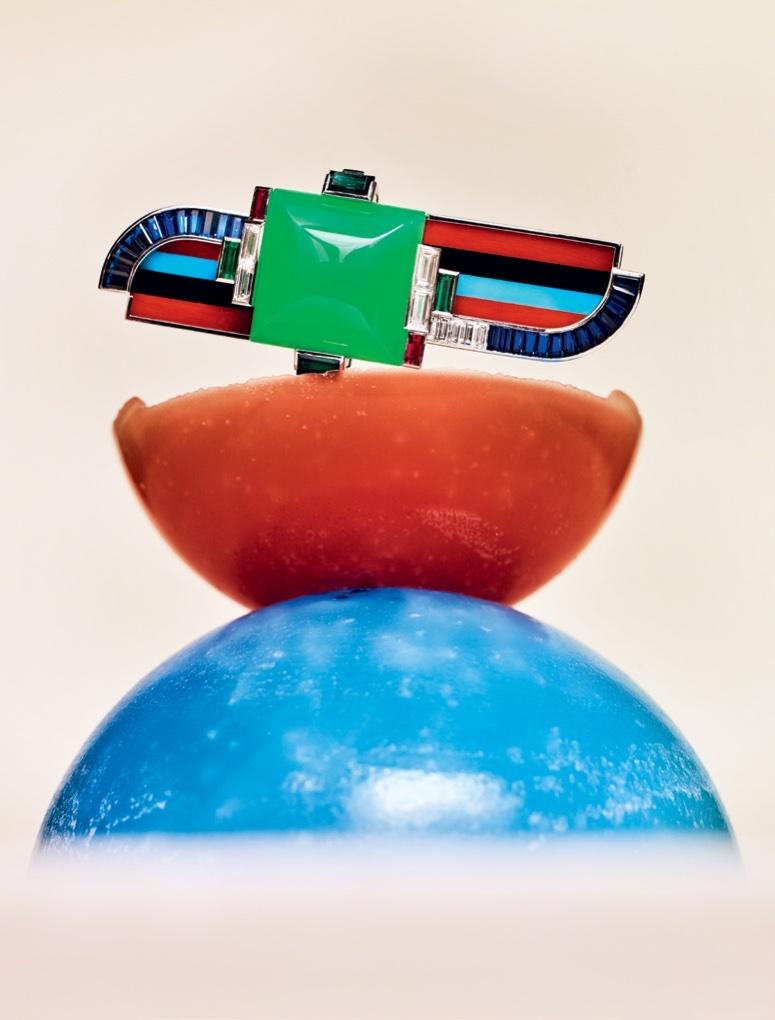
Bold contrasting colors and what Ms. Renier calls “polychromy” reflect the style of ancient jewelry. The Maison highlights traditional materials while combining fine and precious stones with a modern e ect. These remain hallmarks of the Van Cleef & Arpels style.
“This is something we have been doing for a long time, but it is true that this collection lent itself particularly well to it,” she adds. “Sculpted or inlaid, these stones engage in a dialogue with remarkable center stones. Sometimes atypical, these gems testify to Van Cleef & Arpels’ sensitivity to gems that evoke surprise and emotion–a sensitivity passed down through di erent generations of gemologists.”
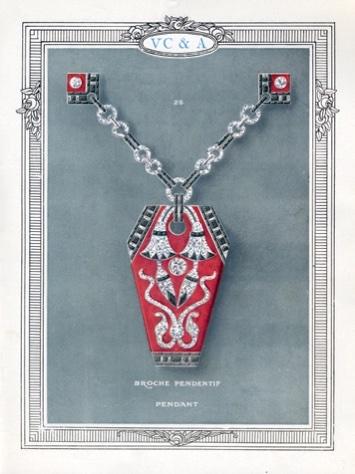
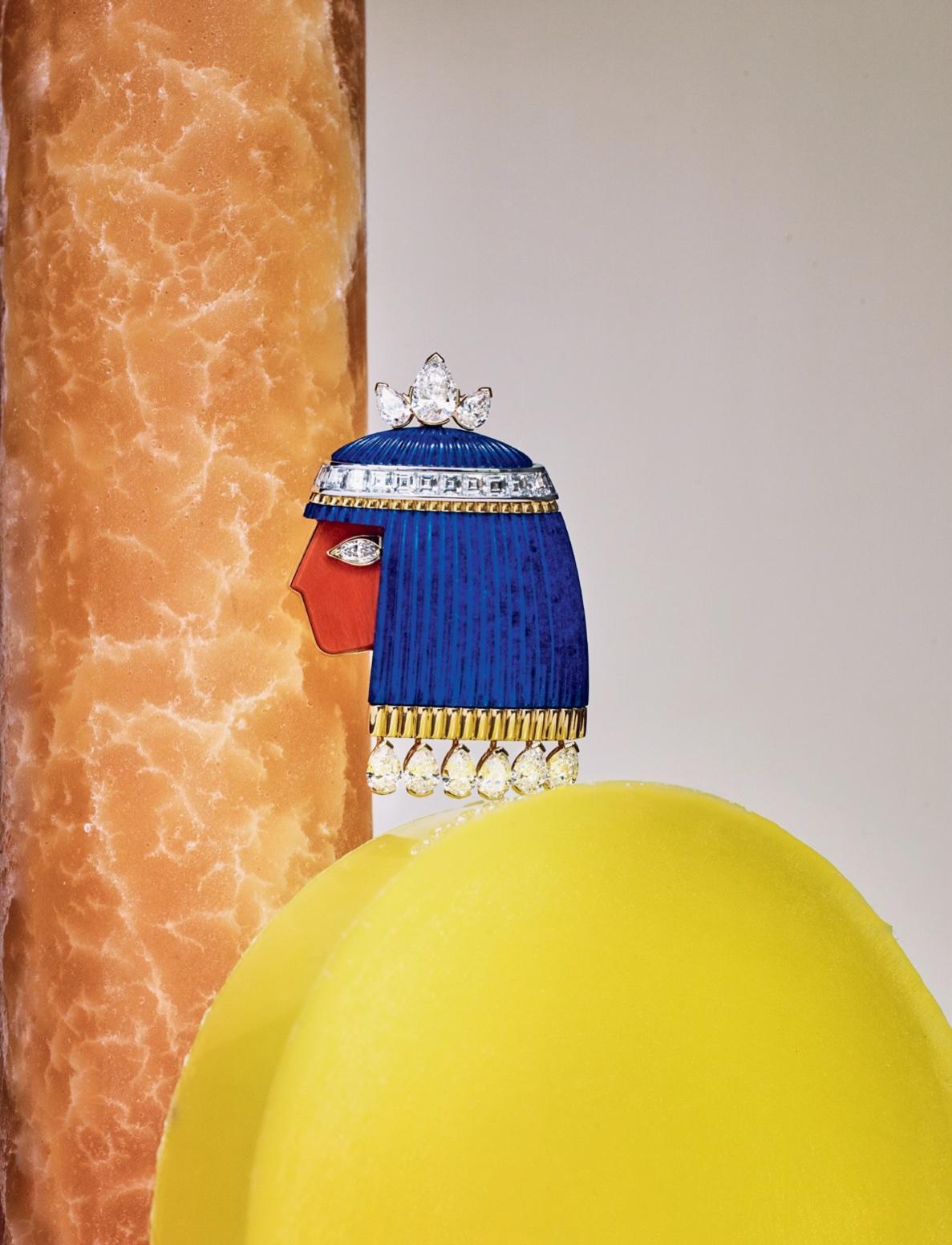
“Silhouette précieuse” clip and pendant set with coral, lapis lazuli, and diamonds, set in yellow gold and white gold.
Opposite page: “Plume de Vie” clip set with emeralds, rubies, sapphires, coral, chrysoprase, turquoise, onyx, and diamonds, in white, rose, and yellow gold. Van Cleef & Arpels catalogue, 1922, Van Cleef & Arpels Archives.
BY MARION FASEL
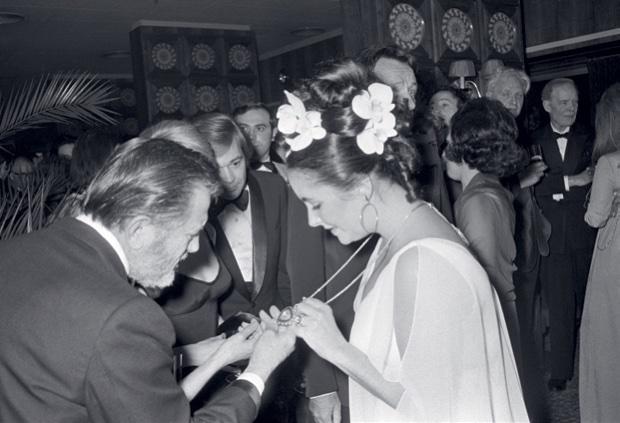
Margot Robbie ignited worldwide interest in the Taj Mahal Diamond when she wore the famous gem from Elizabeth Taylor’s collection on the red carpet at the world premiere of “Wuthering Heights” in Los Angeles on January 28. The star shared a few tantalizing sound bites about the gem with journalists on the press line, but people wanted to know more. This essentially reopened what had been a cold case of the diamond’s history.
Part of the Taj Mahal Diamond’s known narrative is legend. In other words, there are clues that point in certain directions and match an oral history, but no smoking gun of proof. This kind of theory is not unusual in the worlds of art and jewelry. Take, for instance, the speculation surrounding several paintings by the Dutch master Johannes Vermeer. In recent years, a number of jewels have been linked to Marie Antoinette. Experts theorize about origins and owners based on tangible details. These ideas are then presented with qualifiers such as “research indicates,” “by tradition,” or simply “believed to be.”
What is known absolutely about the Taj Mahal Diamond is that it was available on the open market in 1970. That year, the Indian government invited the costume jewelry designer Kenneth Jay Lane to visit the nation as a consultant for its handcraft industry. He asked his friend Rosemarie Kenmore to join him. A gemologist who worked at Cartier,
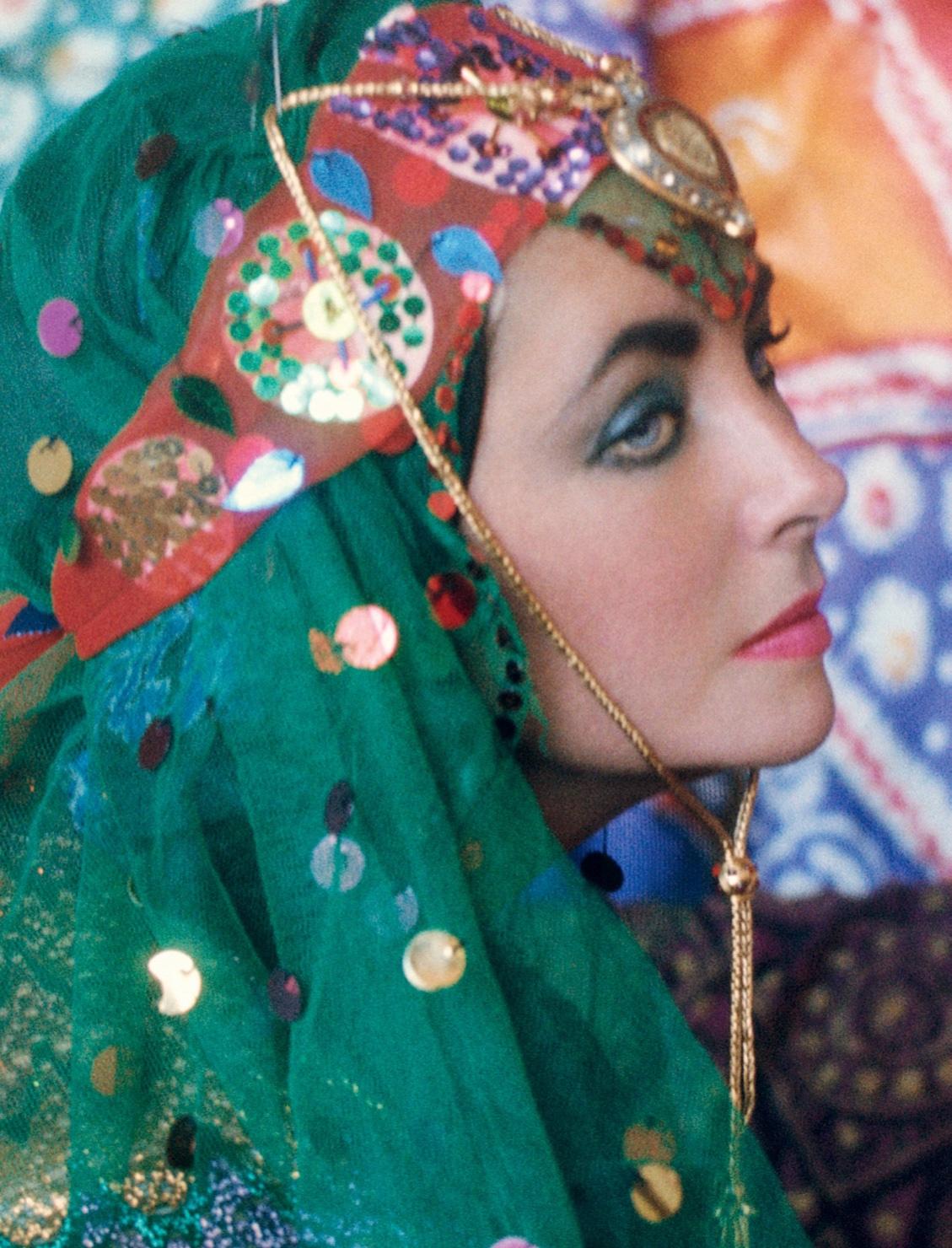
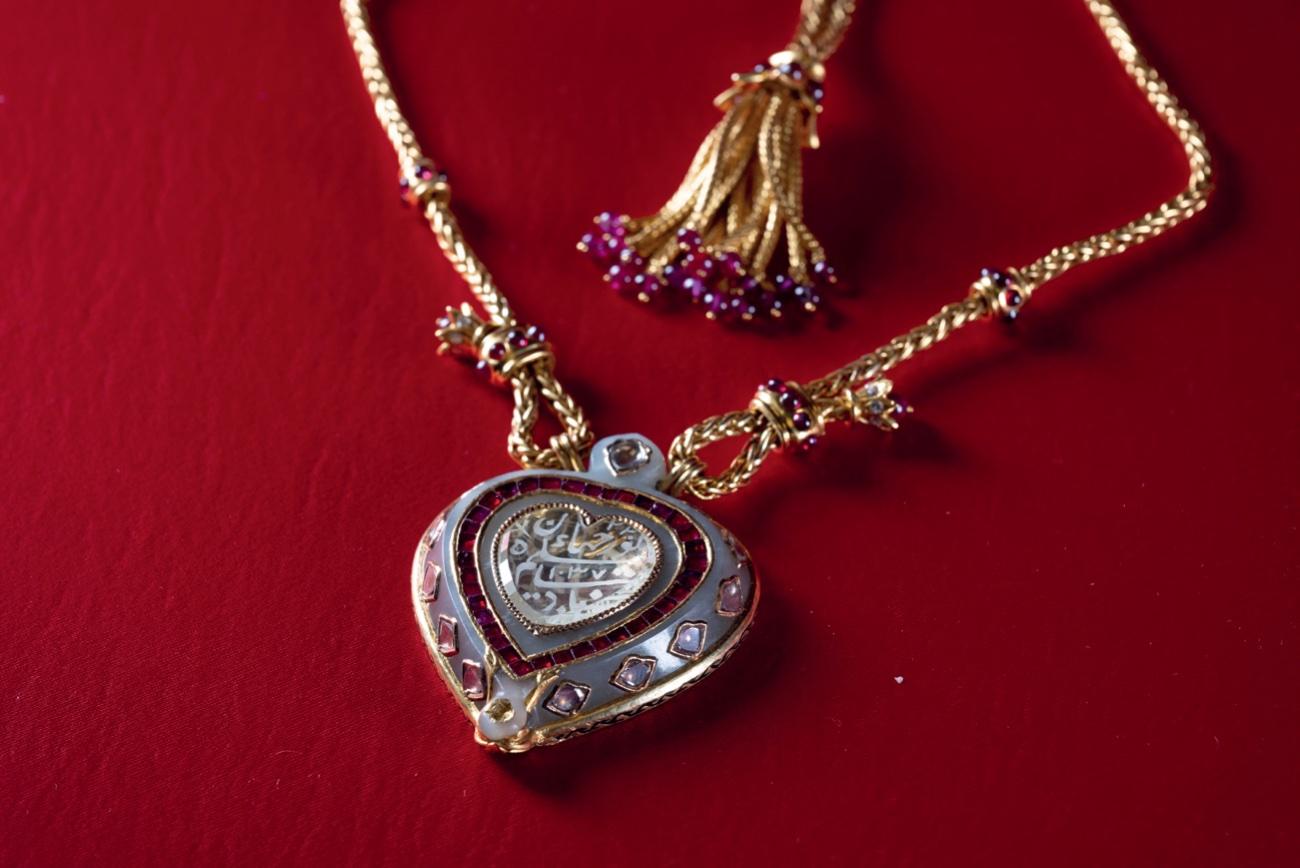
Mrs. Kenmore was also the wife of Robert Kenmore of the Kenmore Corporation, which counted Cartier New York and Mr. Lane’s company among its holdings.
According to a January 7, 1971 story in The New York Times, Kenmore acquired 90 antique Indian jewels during the trip. The most valuable piece in the collection was the heart-shaped tablecut diamond, which the article incorrectly states was engraved with Queen Mumtaz Mahal’s name. A picture of Kenmore holding the Taj Mahal Diamond in The Times shows the gem set in the jade mounting accented with table-cut diamonds and red gems. It was suspended from a traditional Indian silk cord necklace with a slide for adjusting the length and a tassel at the back.
At some point in 1971, Cartier’s renowned designer, Alfred Durante, came up with a woven gold necklace for the Taj Mahal Diamond that echoed the original cord necklace silhouette. Rubies accent the rondelles, punctuating the chain, adjustable slide, and tassel hanging o the back. Cartier priced the piece at $50,000, which is approximately the equivalent of $392,000 today.
In January 1972, Richard Burton entered the story. He asked Cartier to show him some things that would be appropriate for Valentine’s Day or Taylor’s 40th birthday on February 27th. Cartier’s president, Michael Thomas, brought the jet-setting couple an array of jewelry to review during a layover at the International Hotel at Kennedy Airport
in New York. “I love this. Tell me about it,” Thomas recalled Taylor saying when he showed them the Taj Mahal Diamond. Burton registered her interest in the piece. He gave it to her as one of her 40th birthday presents during a weekend of festivities in Budapest, where they were living while Burton filmed Bluebeard. In Hungary, the actor showed it to the press and even modeled it around his head, a move that displayed his signature wit. On a more serious note, Burton announced that he was donating an amount equal to the jewel’s price to a British charity. It was an underreported custom of the couple to make charitable donations when they acquired a significant jewel.
A long list of luminaries flew into Budapest to attend Taylor’s birthday party, including Princess Grace, Ringo Starr of The Beatles, and Academy Award-winning actor Michael Caine. In the press coverage, there are countless pictures of guests looking at the jewel around Taylor’s neck, which she obligingly held up to show them.
Although The New York Times misreported the details of the jewel’s Farsi inscription, Taylor knew it was engraved with “Nur Jahan,” the chief consort of the Mughal emperor Jahangir. There are also numbers on the gem. Some experts think the number “23” refers to the regnal year. The number “1037” is thought to be a Mughal date from the Fasli calendar. It corresponds to the Western year 1627, the year of Jahangir’s death.
In all likelihood, the legendary backstory about the diamond was shared with Rosemarie Kenmore when she purchased the jewel in India. The story goes that Emperor Jahangir gave the engraved gem to Nur Jahan. The diamond was then passed down to their son, Mughal Emperor Shah Jahan, who gave it to his true love Mumtaz Mahal. When Mumtaz died during childbirth in 1631, the emperor had the Taj Mahal built as a memorial to her.
There’s no doubt that the “Taj Mahal Diamond” name was added much later. It doesn’t align with the origin story. The moniker feels like a Western shorthand nod to the history. It is not mentioned in the primary press coverage from the 1970s.
Currently, there is no trace of the Taj Mahal Diamond’s story in historical records before it emerged on the open market in 1970. When I spoke with Courtney Stewart, an Islamic art and jewelry historian and gemologist, about it, she pointed out details that either add to the legend or draw the background into question. She said, “There are no other diamonds in existence, or even from what I know in textual references in the Mughal period, that have a woman’s name inscribed on them.”
The scholar made another interesting observation relating to the jade setting. “I believe the diamond was inscribed first. Then, at a later date, it was cut to fit into the heart-shaped opening in the jade setting,” Stewart explains. “The numbers are cut o , like falling o the edge of the diamond at the upper right.”
While the early chapters of the Taj Mahal Diamond are not certain, there is no question that Elizabeth Taylor’s acquisition of the jewel added immeasurably to its history. She was photographed wearing the Taj Mahal Diamond at many high-profile events throughout her life. The most striking images were taken during a
1976 trip to Iran with her friend Firooz Zahedi, a budding photographer in his twenties.
“She was in a relationship with my cousin, Ardeshir Zahedi, who was the Iranian ambassador to Washington,” explains Zahedi. “He asked me to escort her around. It was a very good time to be there before the Islamic Revolution.”
Taylor and Zahedi visited historical sites and shopping destinations. At one of the bazaars, she bought many “colorful fabrics and clothing that women from various tribes would’ve worn,” recalled Zahedi. Back in her hotel suite, Taylor asked Zahedi and her assistant, Arthur Bruckel, who also doubled as her hairdresser, to arrange the fabrics across the couch for a picture.
“She came out of the bedroom wearing one of the outfits with the Taj Mahal Diamond hanging from her forehead,” remembers
Zahedi. “As an actress, she liked to put on costumes. She created a look somewhat out of the Arabian Nights that you would see in a Hollywood production. The full image I took shows her torso, but I told the guy doing the prints for me to zoom in on her face because it was so powerful.”
Taylor told Zahedi the story of the Taj Mahal Diamond. “It was among all the jewels she brought on the trip,” he recalled. “She had them laid out in boxes from Van Cleef & Arpels, Bulgari, Cartier, and more all over her hotel room. She traveled with so much jewelry, because she didn’t have a home in the States at the time, just her chalet in Gstaad.” It’s an extraordinary memory that might sound like a legend if Zahedi had not been there to witness it and add to it with his photographs.
Margot Robbie at the Wuthering Heights World Premiere wearing Elizabeth Taylor’s Taj Mahal Diamond necklace, styled by Andrew Mukumal.
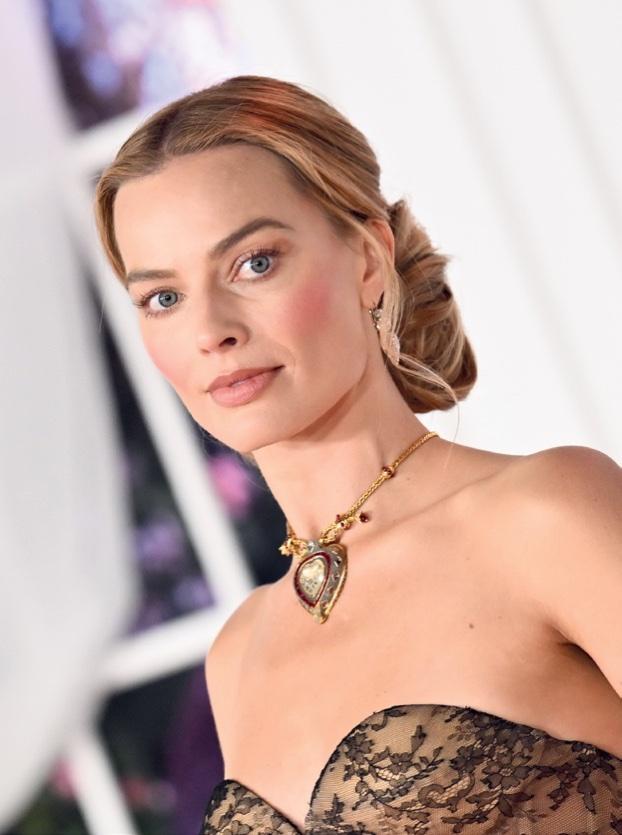
BY JILL NEWMAN
DECADES BEFORE THE MARKET CAUGHT ON, THE HEMMERLE’S HAVE BUILT A SINGULAR AESTHETIC—ONE ROOTED IN RESTRAINT, INNOVATION AND CRAFT.
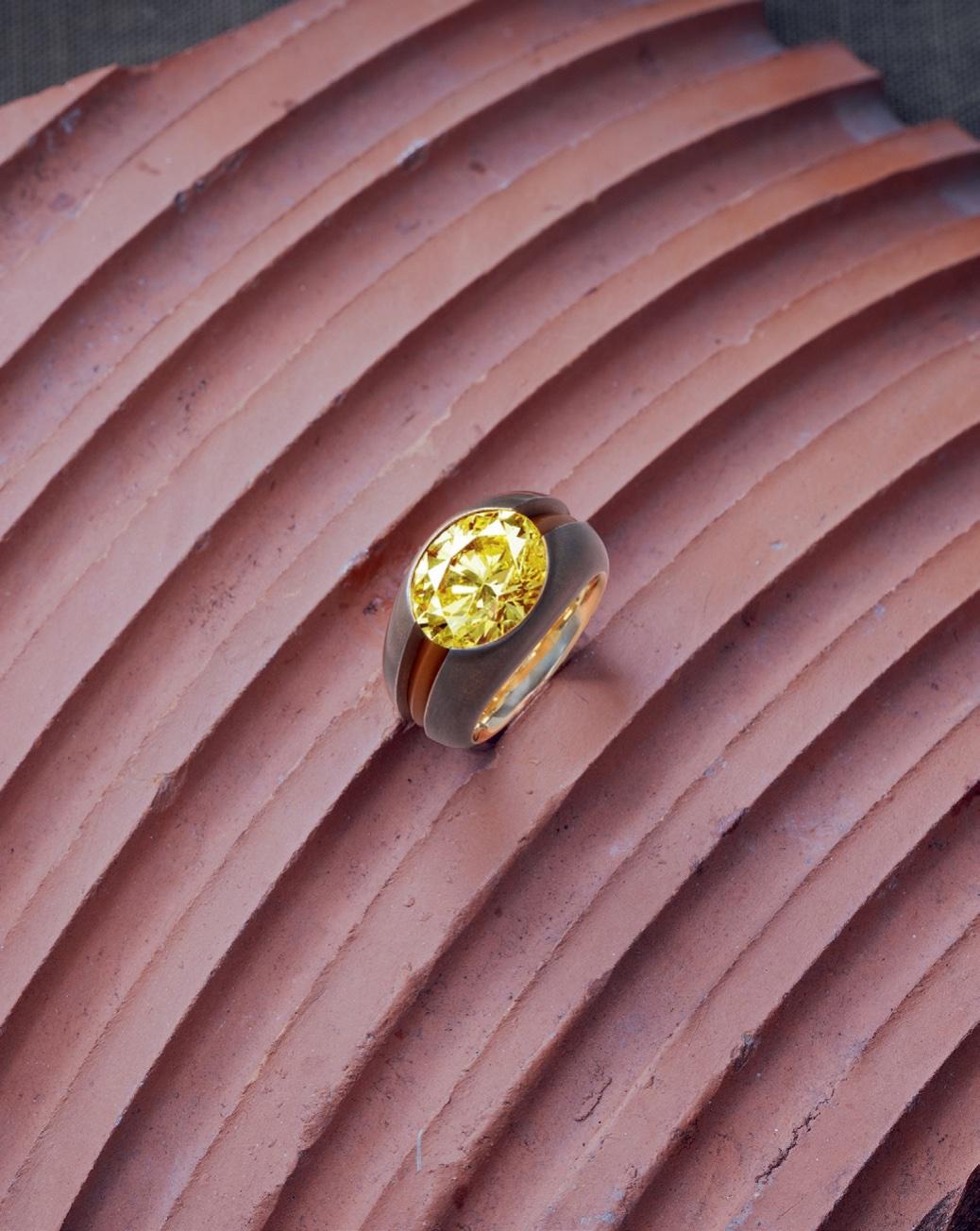
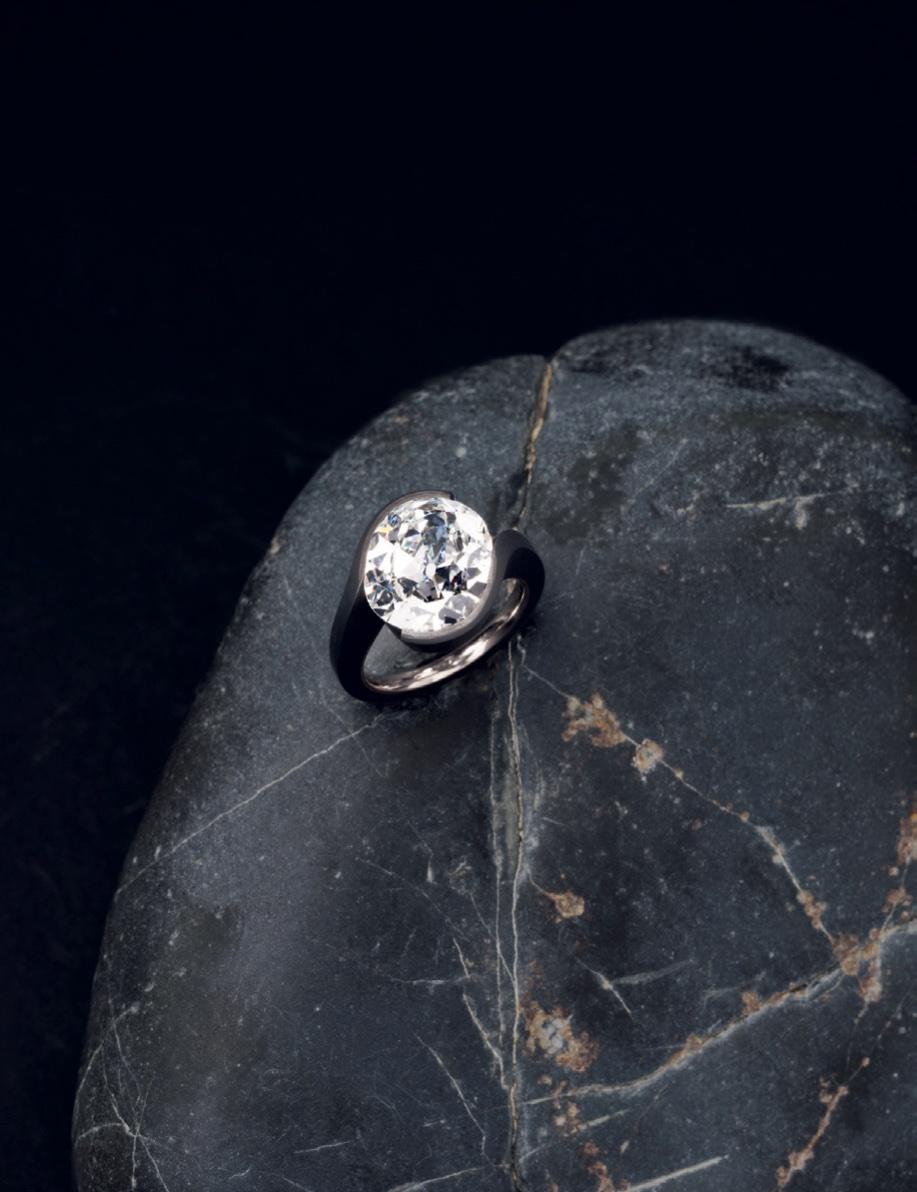
Opposite page: Hemmerle ring, diamond weighing over 5.7 ct., set in iron and an inner band of white gold.
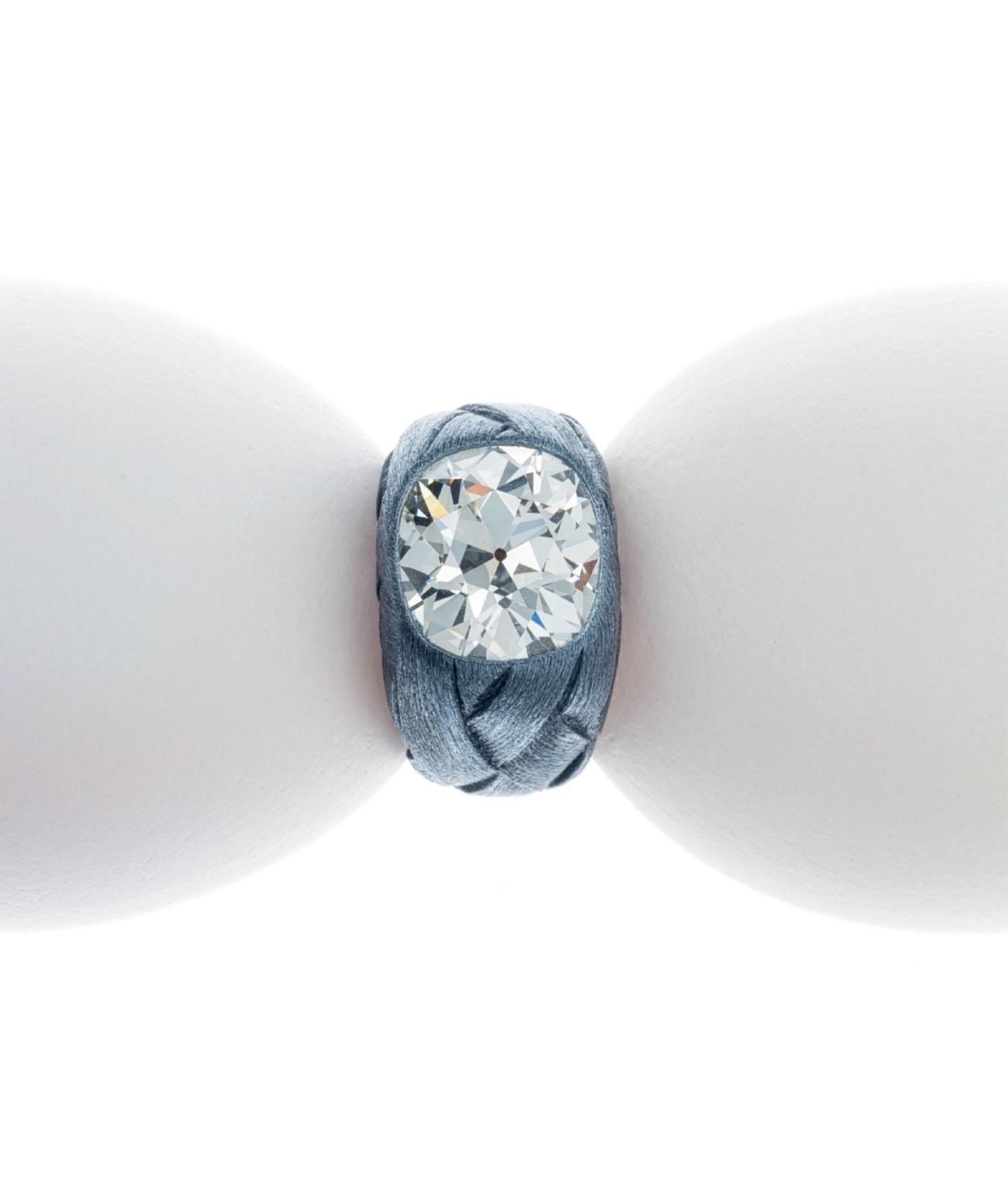
“The space is our universe, it’s the language that we speak and live.”
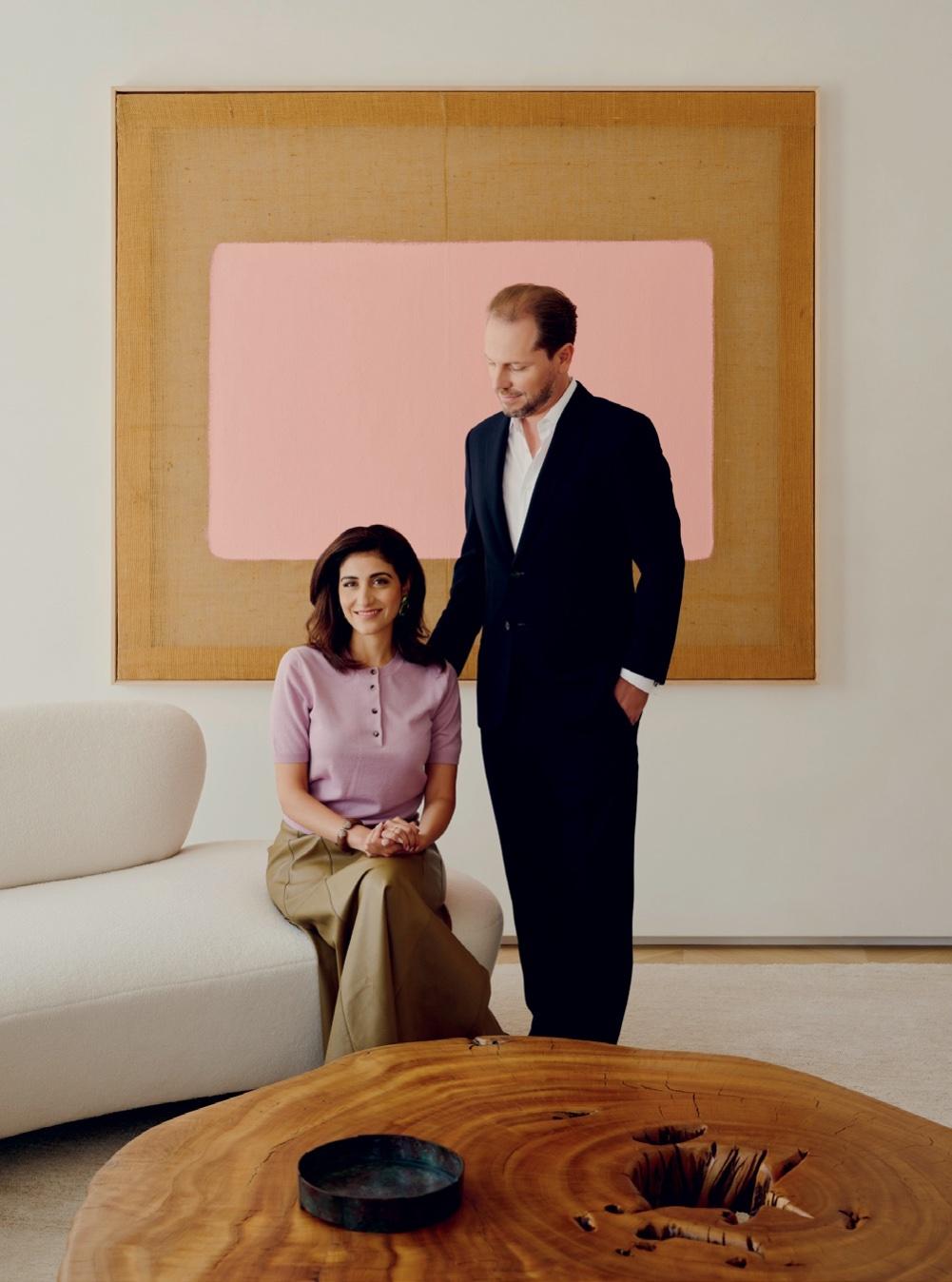
Walking into Hemmerle’s sunlit Munich gallery, with soaring windows and a balcony overlooking Maximilianstrasse, the atmosphere feels less like a boutique than a private residence. Sculptural furnishings sit alongside contemporary art and natural materials—oak herringbone floors, a travertine fireplace—each element composed to create a sense of calm.
“The space is our universe,” says Yasmin Hemmerle. “It’s the language that we speak and live.”
After more than a century in a street-level storefront on the same street, the fourth-generation jewelers moved last year to this more intimate upstairs setting. Yasmin and her husband Christian selected every detail themselves, though the brand’s heritage remains quietly embedded throughout. Even the concealed bar carries a piece of the house’s history: its structure is built from the doors of Hemmerle’s original safe, installed in 1915.
Here, the couple hosts leisurely visits with clients. Jewels are displayed sparingly; the intention is first to immerse visitors in Hemmerle’s aesthetic world, before introducing the jewels themselves. The experience feels personal—more conversation than commerce.
For Yasmin and Christian, who took over leadership of the family firm in 2021, the gallery marks their chapter in the brand’s evolution. Yet its restrained elegance remains closely aligned with the minimalist sensibility established by Christian’s father, Stefan Hemmerle.
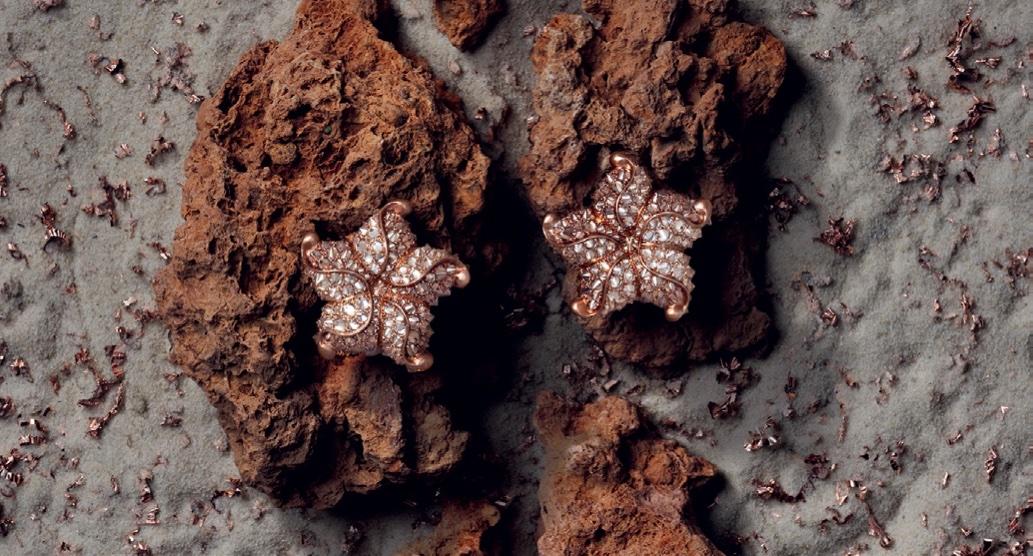
Hemmerle earrings, diamonds weighing a total of over 14 ct., set in bronze and white gold on the reverse. Opposite page: Hemmerle earrings with sapphires and bronze being crafted in the Hemmerle atelier in Munich by a master goldsmith.
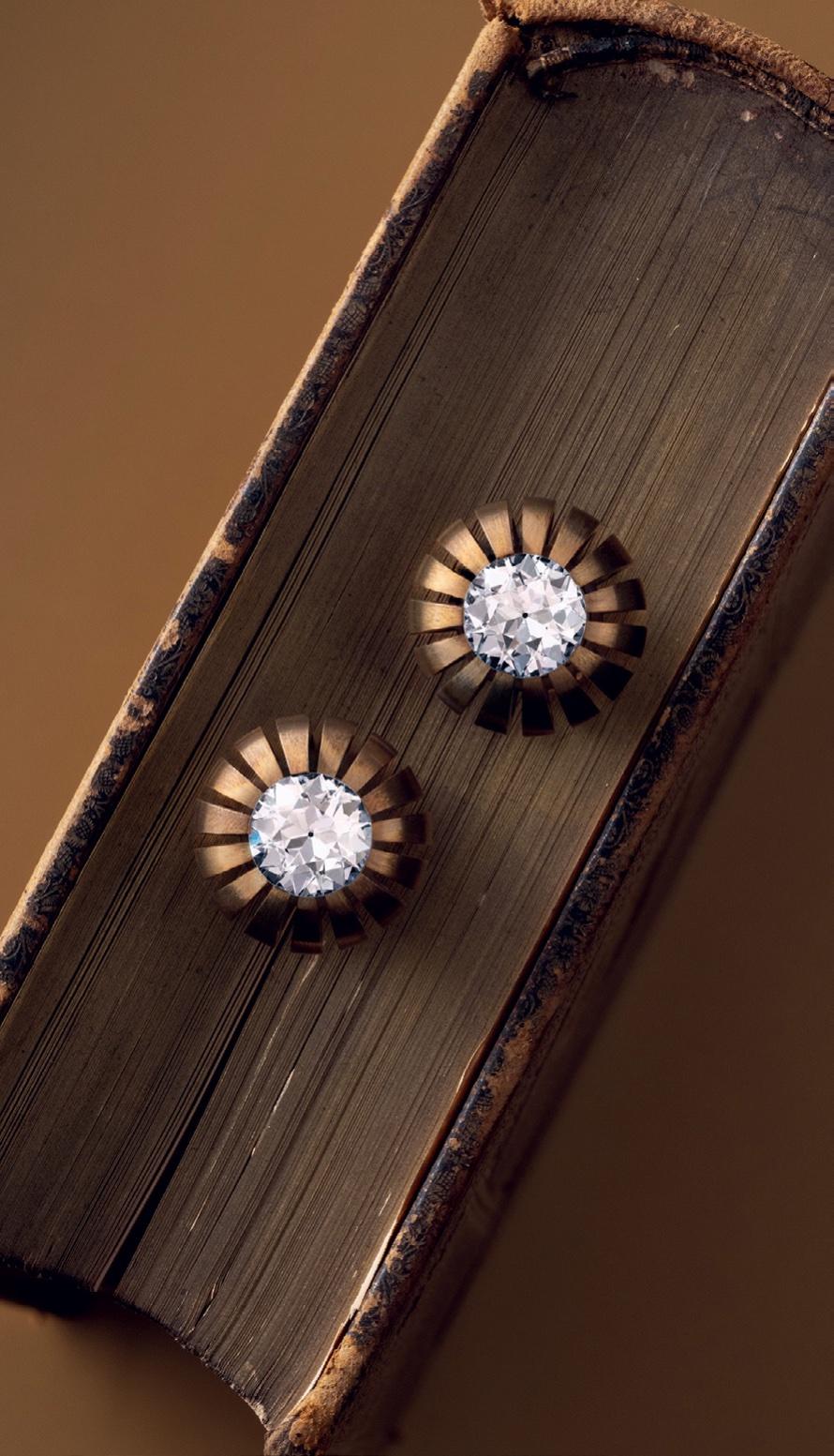
It was Stefan who boldly moved the business in a new direction in the 1990s. Faced with a client who preferred a discreet diamond ring rather than a traditional gold setting, he mounted the stone in iron.
“That was the icebreaker,” Christian recalls. “It took away every inhibition, every fear. Suddenly we felt free to do things we thought you couldn’t do before.”
The moment proved transformative. Hemmerle began to explore unconventional materials—aluminum, copper, bronze, iron and wood—paired with exceptional gemstones and diamonds. Scale became bolder, forms more sculptural, yet the overall e ect remained understated.
Long before “quiet luxury” became a marketing phrase, Hemmerle had already mastered it.
Today the house is instantly recognizable for its alchemy of materials: humble metals finished to a velvety softness, ancient artifacts transformed into contemporary jewels, and unusual stones chosen for nuance rather than spectacle.
“One of our greatest achievements as a company,” says Christian, “is that our pieces are recognizable as Hemmerle.”
Among the most enduring designs is the Harmony bangle, an open-ended bracelet with a twist clasp devised by Stefan in 1991 and reinterpreted in countless variations since. Yasmin has worn her own version—olive wood with brown diamonds—for two decades.
“It gives me the same joy today as the day I received it,” she says.
The design process is collaborative, involving the couple and a close-knit group of master craftsmen, some of whom have worked with the family for decades. Often the starting point is a stone, with metals selected almost instinctively—whether a gem might glow best against green gold or tinted aluminum.
The result is a balance of bold geometry softened through color, finish and texture. A warm 10-carat brown-yellow diamond is set in a sculpted bronze ring; a pair of dreamy aquamarines totaling nearly 50 carats are cradled in vivid blue aluminum earrings; pear-shaped diamond earrings, over 18 carats combined, wrapped in lines of bronze crisscrossing the stones.
Despite its defining aesthetic, the Hemmerles avoid repeating a single motif. Inspiration comes from the natural world—acorn-like forms surrounding natural pearls, or aluminum flowers set with vibrant tanzanite or diamonds—as well as from art, architecture and graphic forms.
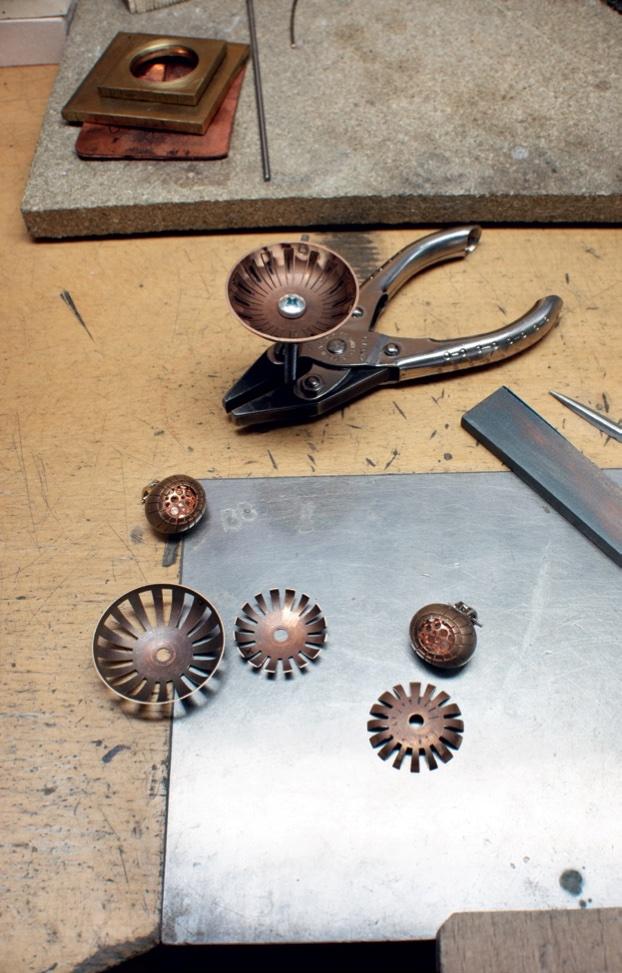
“Don’t look left, don’t look right.
Just do what feels right.”
Stefan Hemmerle embraced brown and subtly tinted diamonds decades earlier when most collectors overlooked them. Today such stones are widely appreciated for their warmth and individuality.
“He wanted jewelry that wasn’t flashy,” says Christian. “In many ways he was ahead of his time.”
For Stefan, brown diamonds o ered something quieter and more versatile.
“Brown is simply a beautiful complementary color,” Christian explains. “It’s neutral. It goes with everything and doesn’t scream.”
The house has also long favored antique stones, particularly old-cut diamonds with irregular proportions and softer brilliance.
“They have an energy,” Christian says. “I buy stones for the quality of the material, not because they’re fashionable. I want our clients to wear them today—and in 10, 20, 30 years’ time.”
Even large diamonds appear restrained when framed in Hemmerle’s darkened metals, like an old cushion-cut diamond set flush within blackened aluminum with a discreet gold inner band.
Christian still recalls the most important advice his father gave him: “Don’t look left, don’t look right. Just do what feels right.”
It’s a weighty responsibility, taking charge of the family business, founded in 1893 by brothers Anton and Joseph Hemmerle, who were making iron jewelry and adornments for the Bavarian court. Christian and Yasmin joined the business in 2006 eventually taking over from his parents Stefan and Sylveli in 2021.
The previous generation had already built a strong international following, particularly in the United States, where they began exhibiting more than three decades ago in Palm Beach and New York. Today the brand maintains a by-appointment showroom in New York, a seasonal boutique in Palm Beach, and presents collections in Aspen, Hong Kong and beyond. Hemmerle is also a longtime exhibitor at leading art and design fairs, including TEFAF and PAD.
Yet Munich remains at the heart of the business, a place they can share their story and vision with clients. In the first year since opening the gallery, collectors from around the world have visited. For Christian, the space allows the family to focus on what matters most: time, conversation and discovery.
“We are distinguishing ourselves in our new space,” explains Christian. “The space allows us to focus on our collectors and to give them the time to discover our world. Jewelry is deeply personal, so we wanted an intimate experience.”
A short walk away is the workshop, where the Hemmerles are frequently found collaborating with their craftsmen.
“We don’t dictate how things should be done,” Christian says. “Ideas are shared. There is time to experiment.” A single jewel can take months or even near a year to complete. But they are never in a rush, because as Christian says, the process is part of the journey of discovery.
That long-term mindset reflects the family’s perspective on the business itself. After more than 130 years, every jewel is still made by hand, and every decision is taken with the future in mind.
“We’re doing this because this is our life,” Yasmin says. “And we’re very lucky that we get to do it together.”
BY MARSHALL HEYMAN
PHOTOGRAPHED BY MARK LIM
ACTRESS AND PRODUCER, NINA DOBREV IS FINDING HERSELF—ALL OVER THE WORLD.
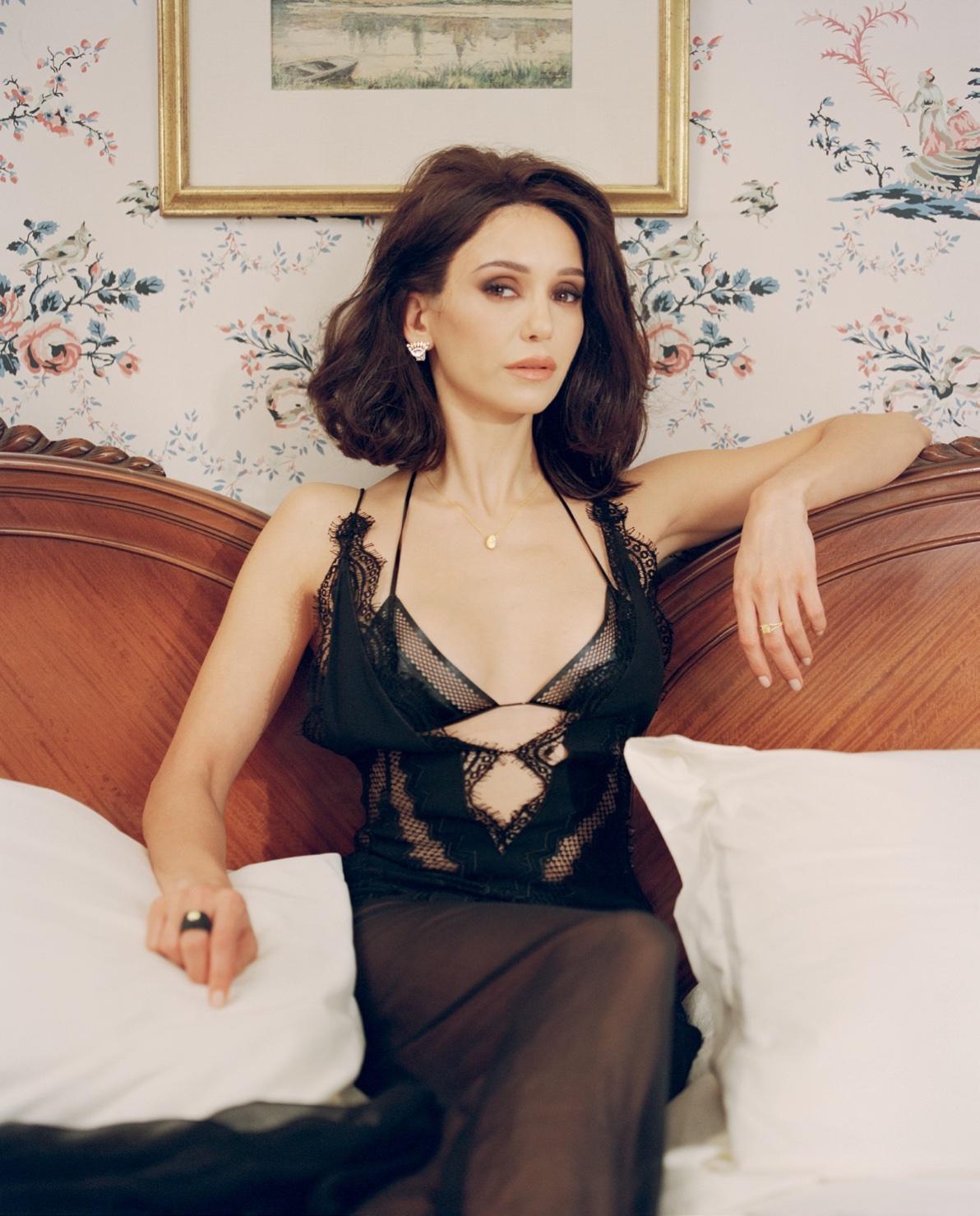
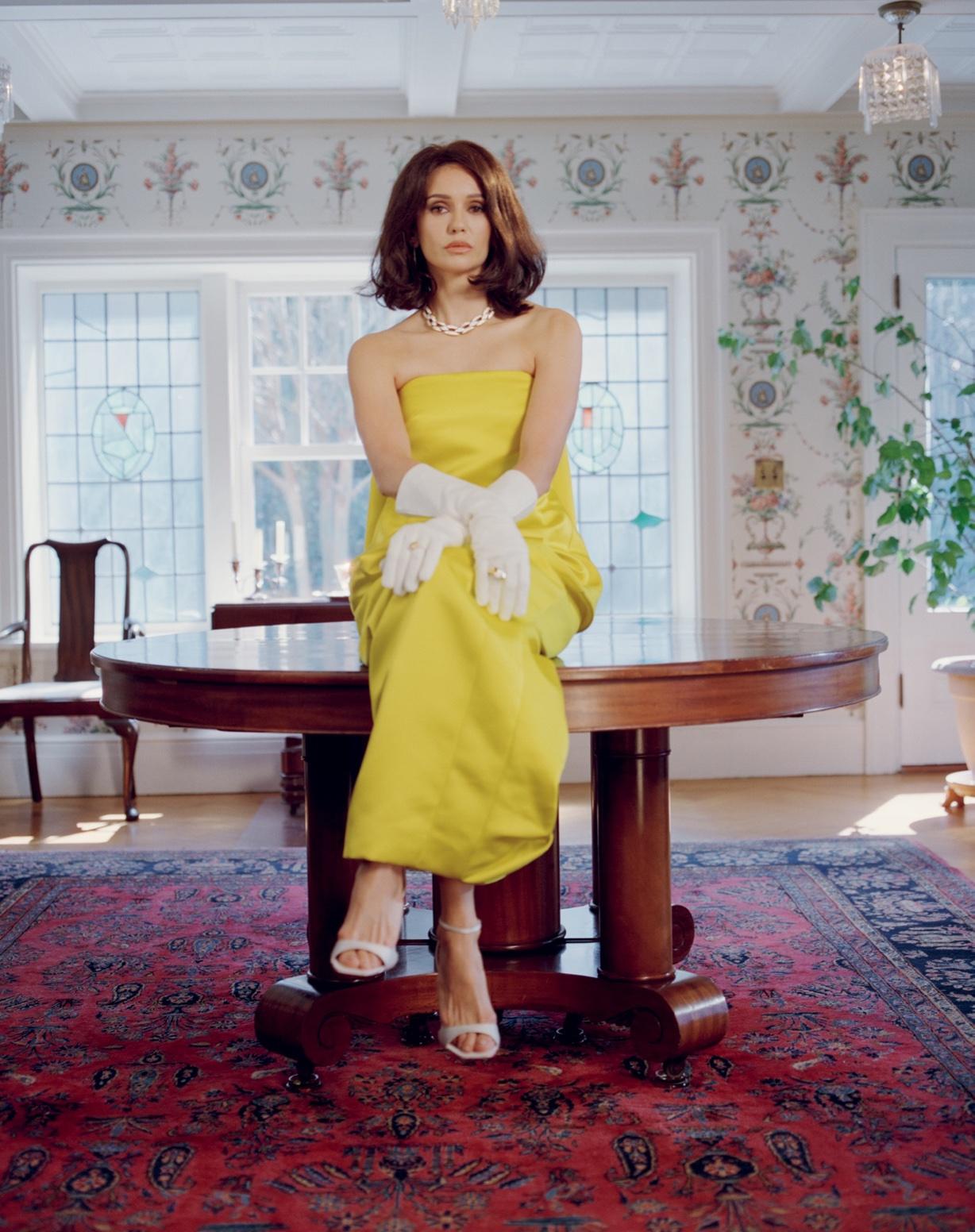
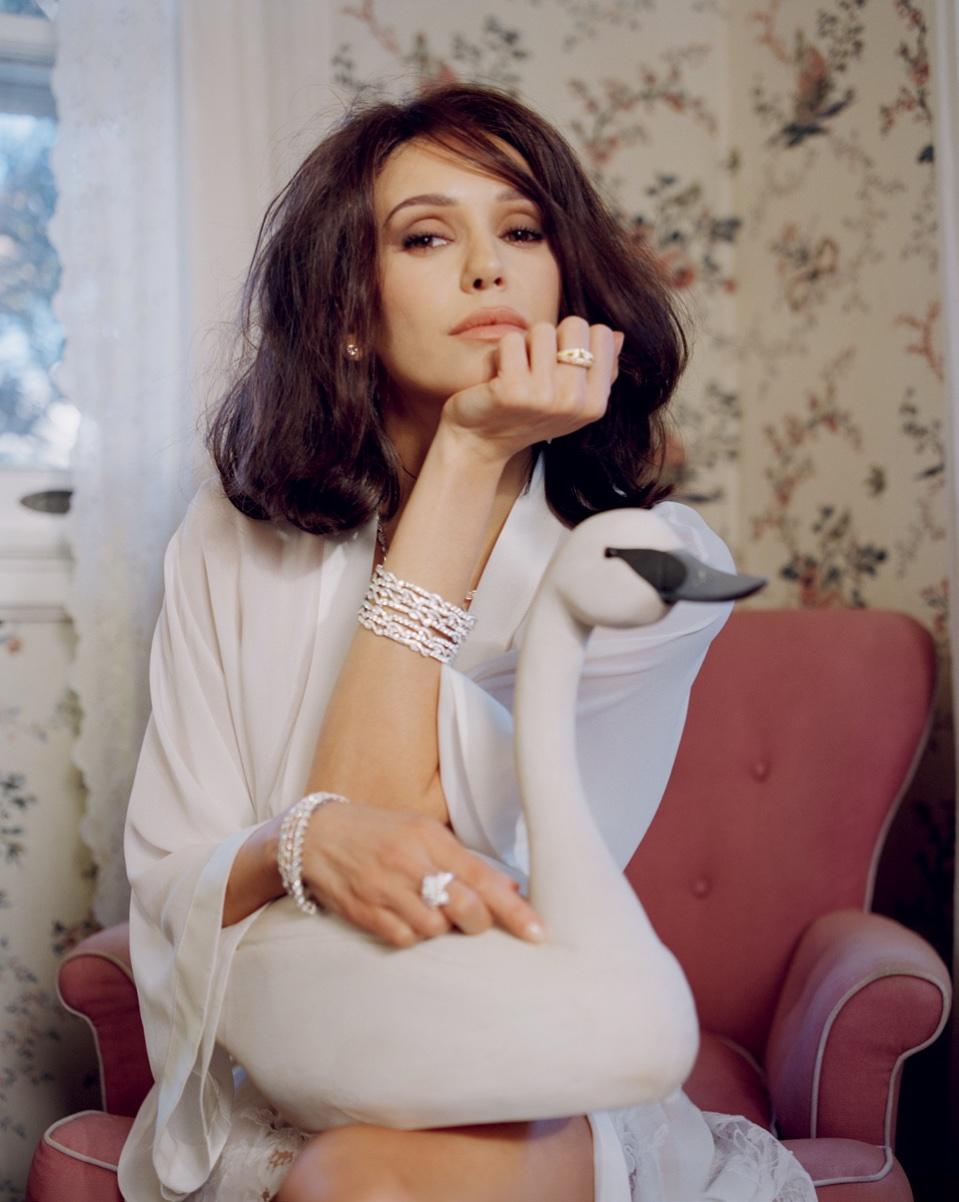
“Of course I do,” she says. “But we all do. Sometimes the jewelry is the outfit.”
It makes it easy to fall in love with a gemstone, Dobrev says, when you get to be around some “really special pieces” as she gets to, on the occasional red carpet and photo shoot.
Like, for instance, the 4.1-carat pear-shaped Fancy Light Yellow Kwiat diamond she wears with a black lace Tom Ford dress for this magazine story.
“It was so gorgeous and simple. It was on this delicate chain. It looked like it was floating below my neck,” Dobrev says over her first cup of morning tea. “I wanted to take it home. I kept imagining them gifting it to me.”
If that dream became reality, Dobrev winks, “I’d only wear it out on special occasions, but in my house, I’d never take it o .”
For all her jokes about getting to take home expensive bijoux and treasures on a whim because of her fame and beauty, “I actually buy myself a lot of jewelry,” Dobrev explains. “I like to celebrate milestones and things I’m proud of.”
Growing up between Bulgaria and Canada, Dobrev had a modest upbringing. Buying an expensive watch, even after being on a long-running series like The Vampire Diaries, for instance, “felt irresponsible for a long time,” she says.
For years she told herself she’d buy herself one when, maybe, she scored a big role in an action movie. “And then I was in xXx,” with Vin Diesel, almost a decade ago, in 2017. “But I wasn’t the lead, so I didn’t think I deserved it. I just kept pushing it o , chickening out.”
While traveling in Europe, she told a friend that she’d always wanted a Rolex Day-Date. And then they saw an even pricier, more glamorous version in a window display, “one that I definitely couldn’t justify spending money on.”
“I asked myself, ‘Why don’t I feel like I deserve this? I should be proud of what I’ve done’,” Dobrev recalls. She walked right into Rolex. “They gave me a glass of Champagne, and it was over. I bought the watch.”
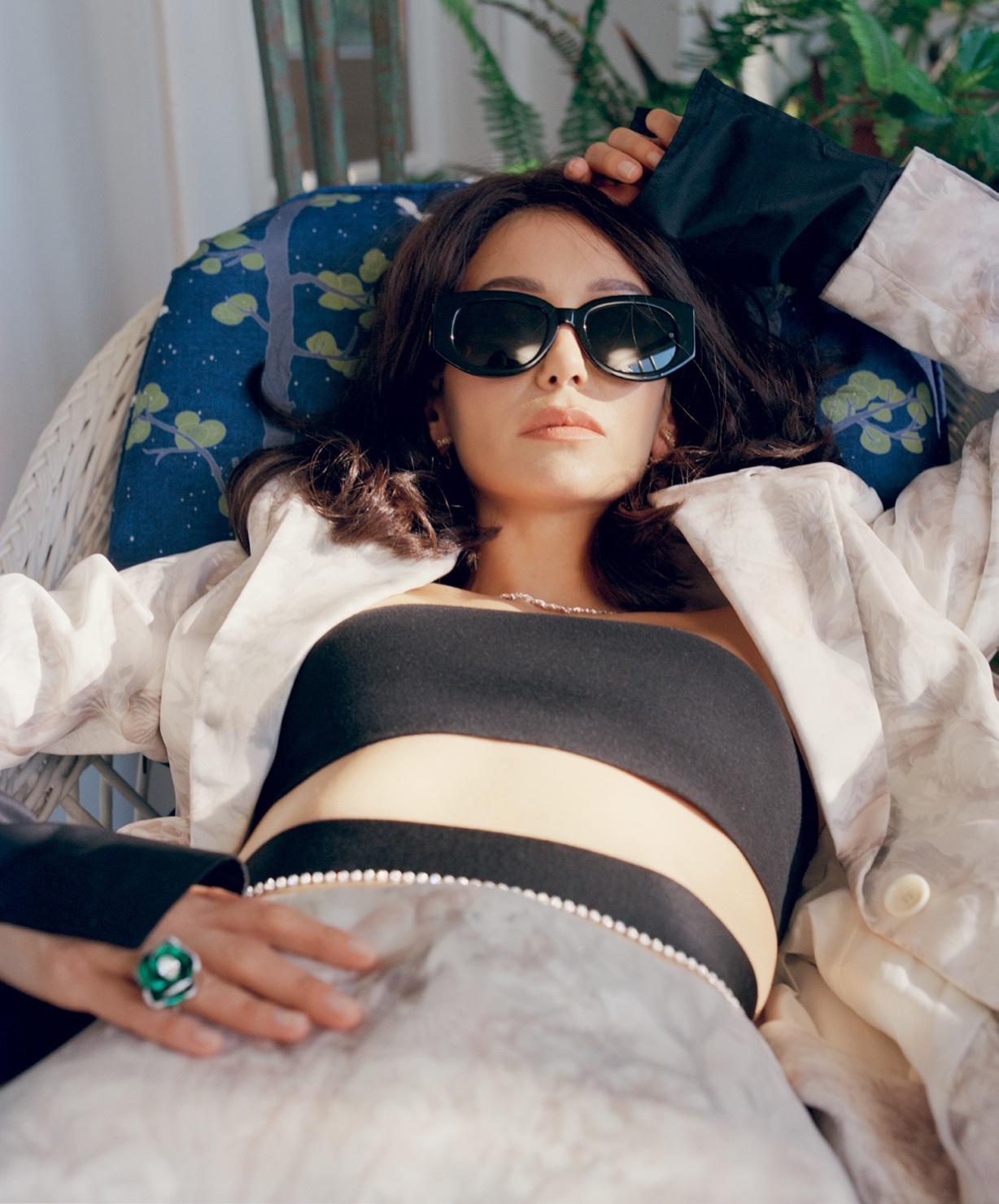
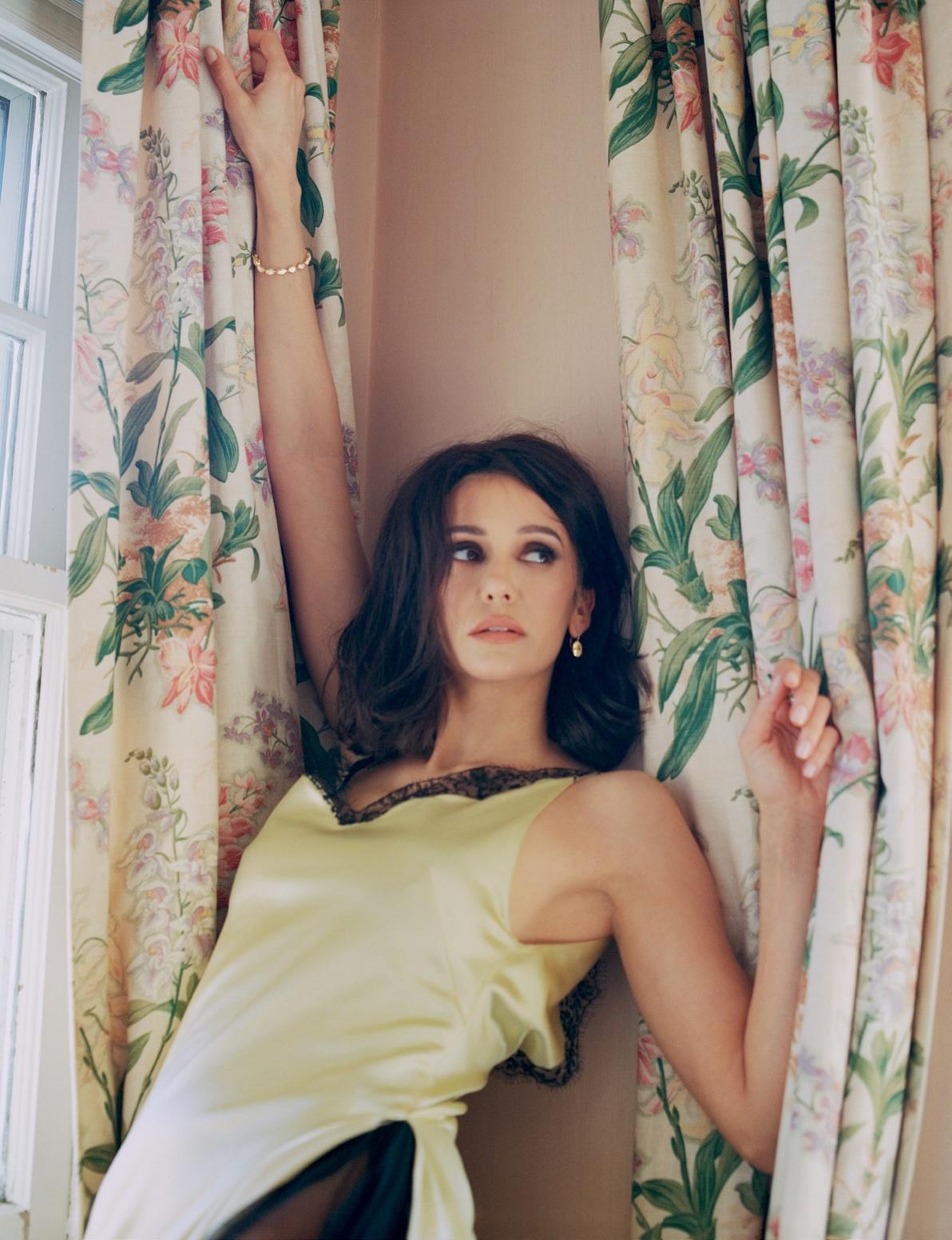
Opposite
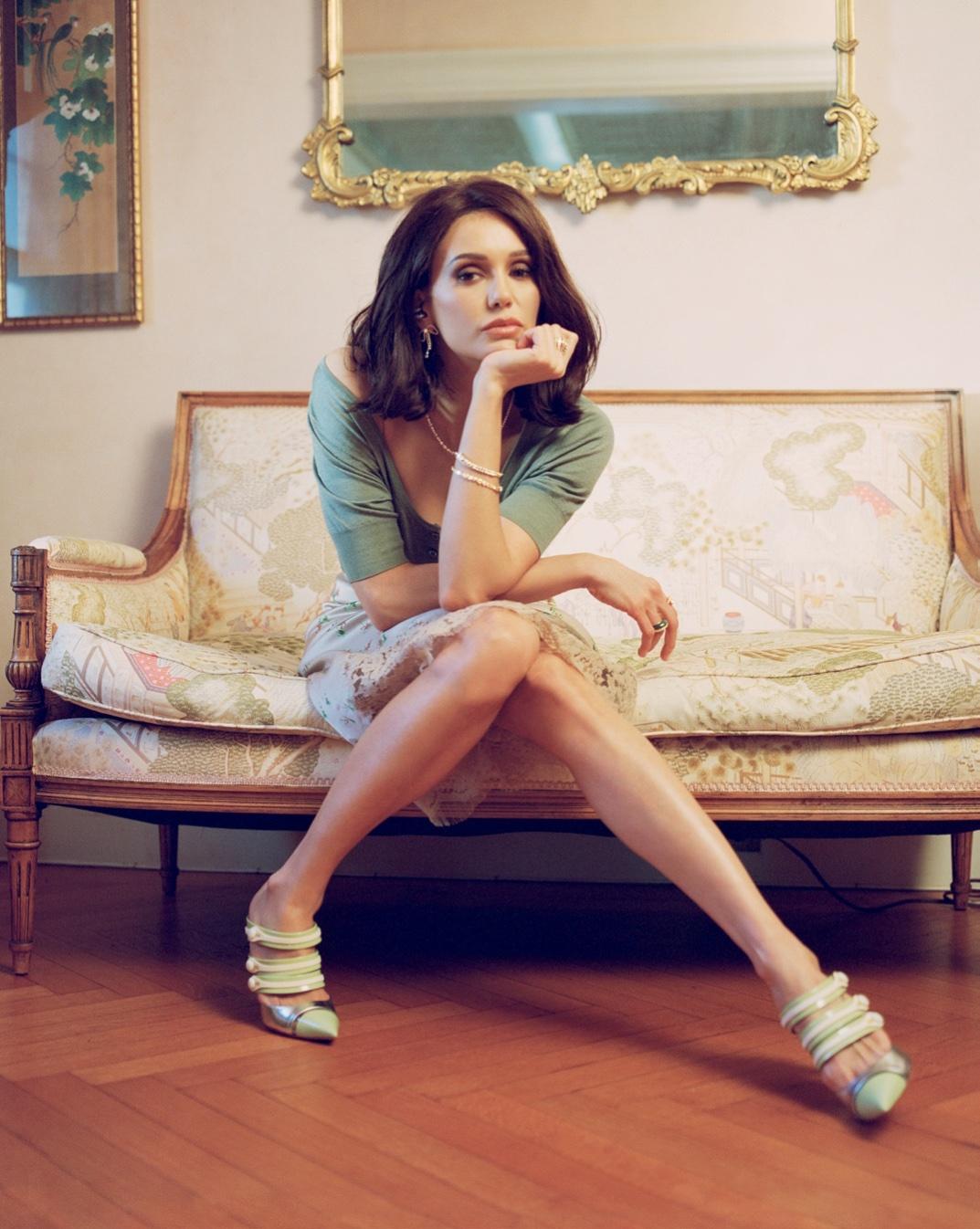
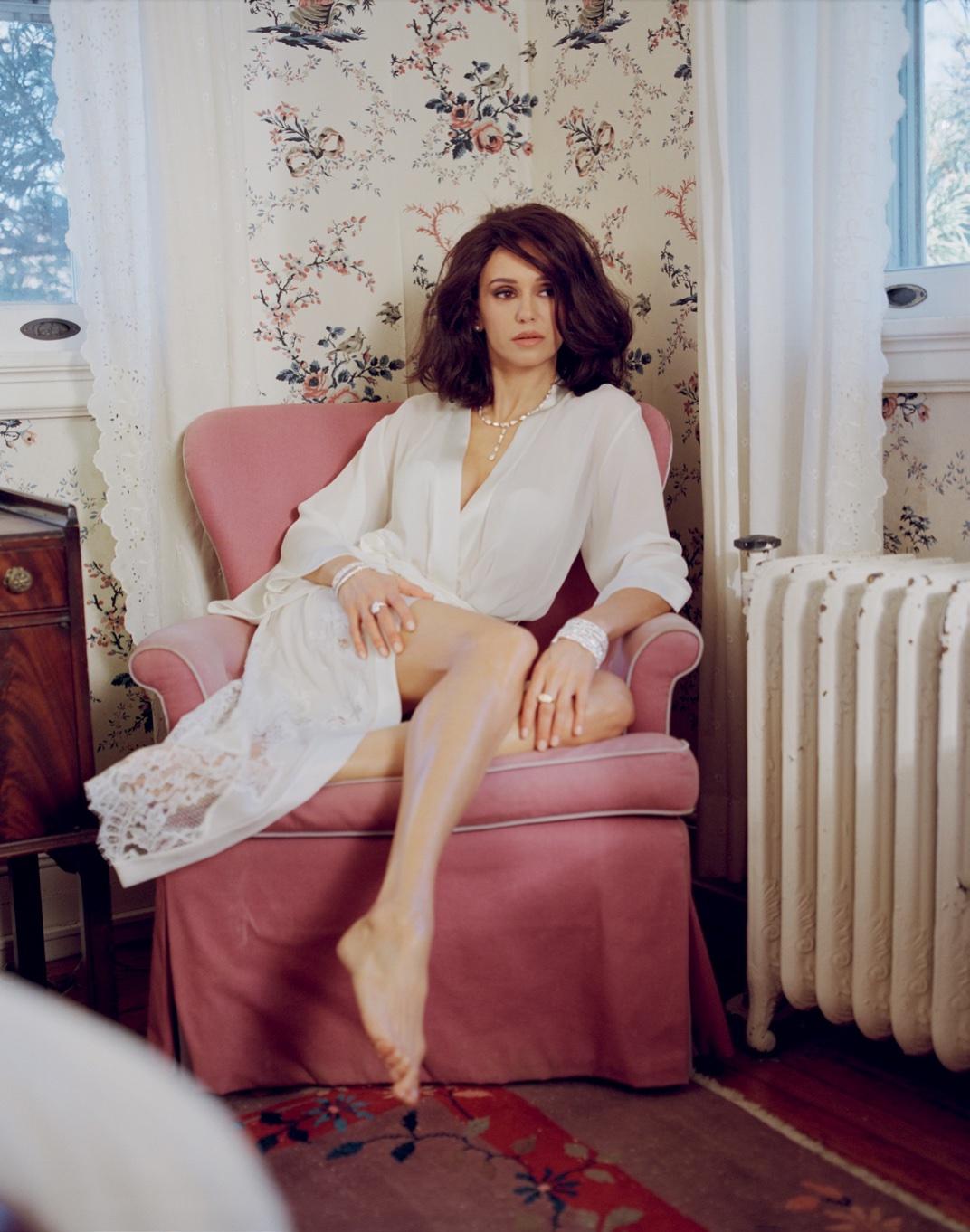
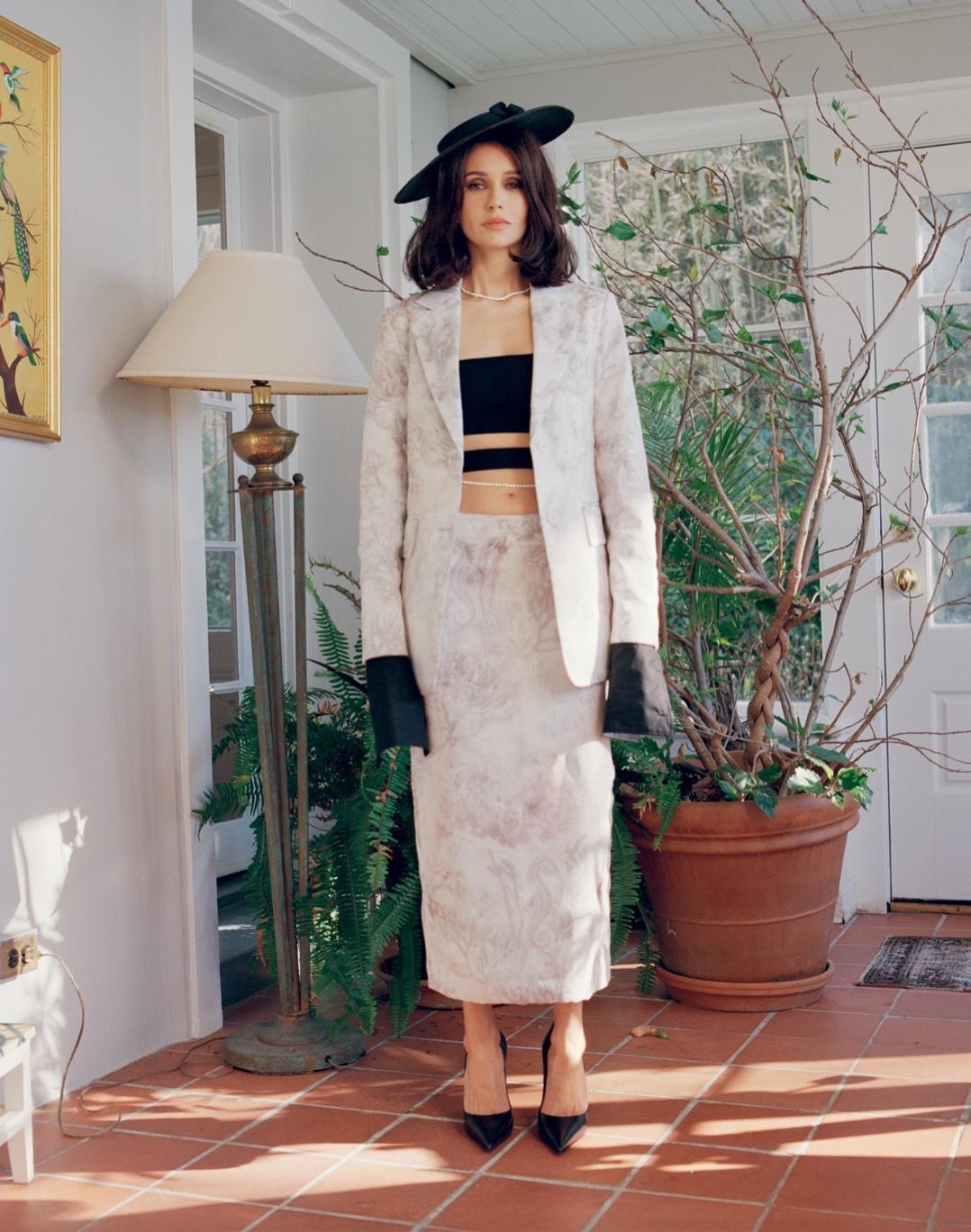
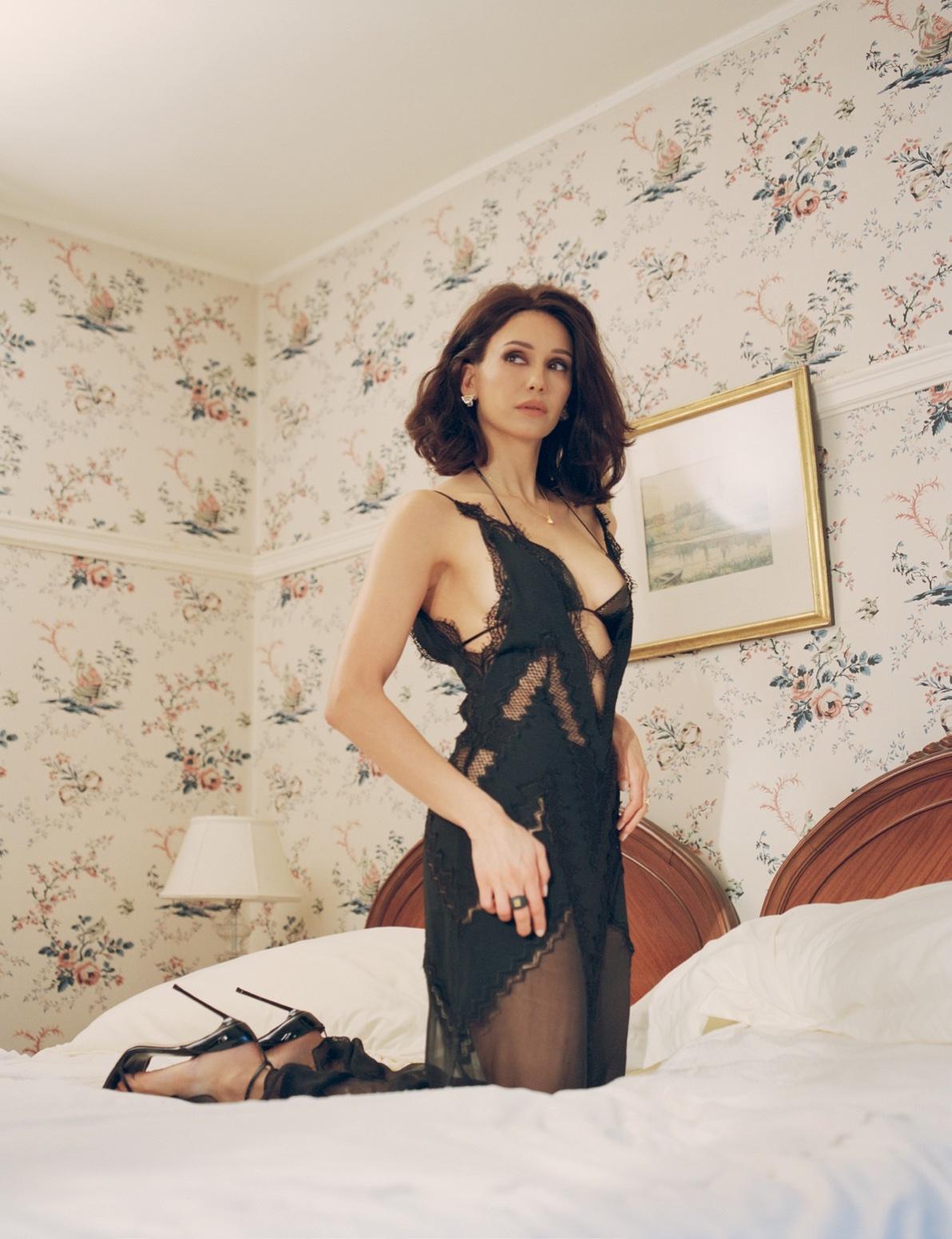
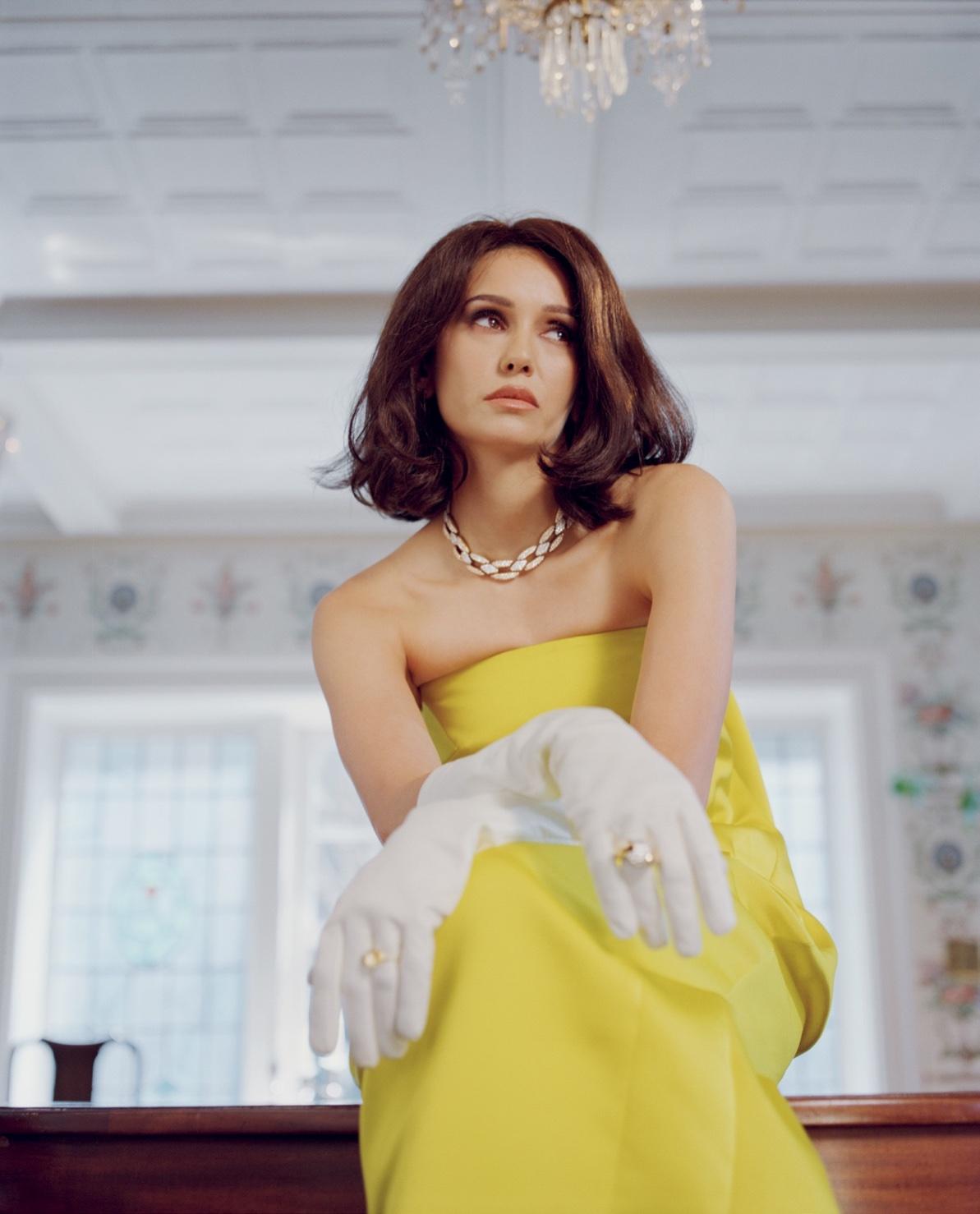
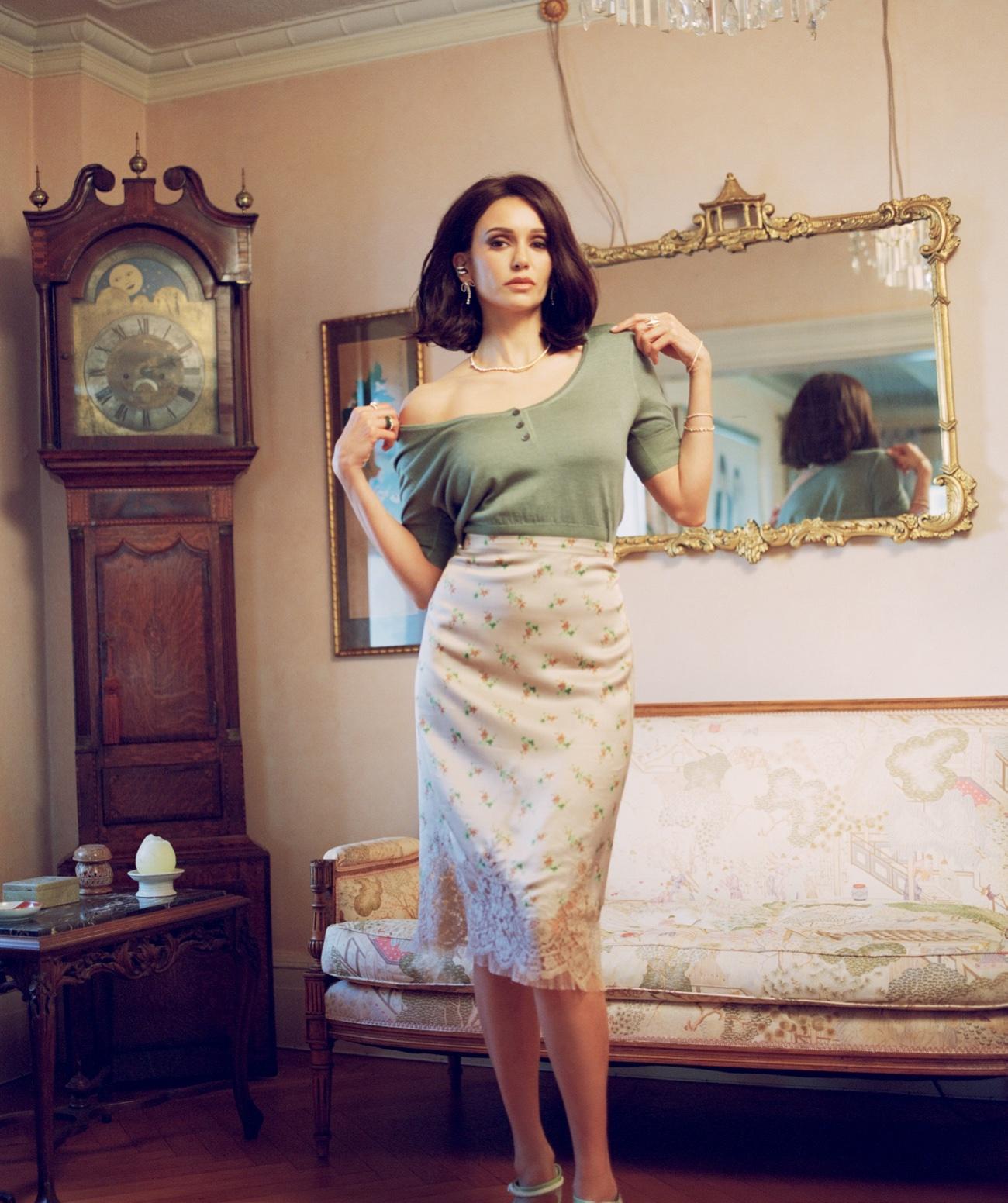
Now she has five luxury time pieces, including a second Rolex Day-Date and a vintage diamond encrusted Cartier from the 1970s. “Watches are like tattoos. It’s an addiction,” she says.
Dobrev tends to wear a lot of everyday jewelry. She rarely removes her small diamond stud earrings with a twist backing, in part because she loves them, in part because they’re not so easy to take o . “I’m terrified of losing them,” she says.
And then she has some stackable rings. There’s a Cartier Love ring that she and four of her Hollywood girlfriends all wear to commemorate their closeness, including Dobrev’s hairstylist, Riawna Capri, and their good friend Julianne Hough. And then there’s the Ecksand ring she and a few of her non-scene friends share, too.
“We’re saying that we’ll love each other forever,” Dobrev says.
If it all sounds a little bit twee from the outside, like Sisterhood of the Traveling Friendship Ring or like Carrie Bradshaw marrying herself on Sex and the City, it’s actually “a beautiful thing,” insists Dobrev. “I love everyone I surround myself with. We’re all likeminded people.”
Even if they don’t share a gold band, the truth is Dobrev insists her “best friend” is her dog, Maverick, a mutt of 15 or so canine varieties she rescued from the Van Nuys shelter. Dobrev was at Coachella, “scrolling through my feed, not sober,” and she saw Maverick and “I called the Uber immediately and drove back.”
“It was love at first sight,” Dobrev says. Still, she couldn’t decide if she wanted to take Maverick home or Maverick’s brother, Goose. (Dobrev named them after characters in Top Gun, but “the sequel hadn’t come out yet,” she notes.)
“I was with them alone for 45 minutes, and I heard the doorbell ring and I said I’d take them both,” Dobrev recalls.
Goose lasted a week at her home: “It was too much energy, too much poop, too many accidents.” Her friend Chace Crawford (Gossip Girl) wound up taking him and renamed him Shiner.
“I told him I really wanted him to keep the name Goose, but Goose really is very much a sweet little Shiner and still in our lives,” Dobrev says, laughing.
Maverick, now nine years old, is “very much like me in a lot of ways,” says Dobrev. “She’s super intense and very talkative. She barks a lot. But she loves her alone time. We’re together all day and every day, but at night, she’d rather sleep on the floor than in the bed, which is my nightmare. She’s very protective and attached, though. I bring her everywhere, but we do have an unhealthy codependent dynamic.”
Dobrev travels with Maverick all over the world. “I’m constantly living out of a suitcase,” she says. After a trip to New York for this shoot, she was o to France and Italy to unplug with family and friends. Though she has a house in Nevada and her family lives in Europe, when asked where she considers home, i.e. where’s the bed she most feels comfortable in, Dobrev responds, cannily: “Delta One.”
“It does not matter where I am, as long as I’m horizontal,” Nina Dobrev says. “But I’m ready to slow down. I’ve been ready to slow down for a while, but it’s hard to say no when the jobs are wonderful and exciting.” Up next: General Admission, premiering in June. She’s recently shot films in Canada and Australia, the latter a movie called The Get Out opposite Russell Crowe, Teresa Palmer, and Aaron Paul (Breaking Bad), who is married to one of Dobrev’s longtime friends, Lauren Parsekian. Awkward alert: She and Paul had to kiss onscreen. “We laughed a lot about it, we thought it was so funny,” Dobrev says. “It’s hilarious. It’s like kissing your brother.”
As she spends more time in Hollywood, Dobrev has realized that it’s important to develop her own projects. “It feels good and fulfilling,” she explains, of diving more into writing and producing, especially female driven projects. “I want to feel like I have some control over my career instead of waiting for the phone to ring.”
That, and she enjoys working with her friends. She’s currently writing an action buddy comedy with her writing partner she’s hoping another pal will direct. “It’s the life hack I imagine Seth Rogen has figured out,” she says. “He’s a fellow Canadian, and I’m loosely trying to follow in his footsteps. I just want to work with good people.”
To this day, Dobrev is perhaps still most recognized for her many seasons on the breakout hit The Vampire Diaries. She played Elena, caught in a love triangle with two vampire brothers (Paul Wesley and Ian Somerhalder). The show ended in 2017, around the same time as that Vin Diesel action movie, but it is being rediscovered by new audiences “all the time,” Dobrev says. Some of those audiences weren’t even born when the series first debuted. “It’s a fresh show to them,” she continued. “It was on Netflix, and then it switched over to HBO Max. It might be on Peacock now. “It doesn’t make any sense, but I’m not complaining.”
“It’s always surprising, but it’s really sweet when people appreciate your work,” Dobrev says. “That’s why we do what we do.”
Boucheron High Jewelry. Altuzarra dress.
Photographer, Mark Lim; Stylist, Bailey Moon; Creative Director, Lizzy Oppenheimer; Hair Stylist, Shinya Nakagawa; Makeup Artist, Kale Teter; Manicurist, Yukie Miyakawa; Entertainment Director At Large, Glynis Costin; Creative Production, Petty Cash Production; Lighting Director, Butch Hogan; Lighting Director, Erik Snyder; Digital Tech, Pierce Harrison; Swing, Chris Harth; Styling Assistant, Laura Spriet.
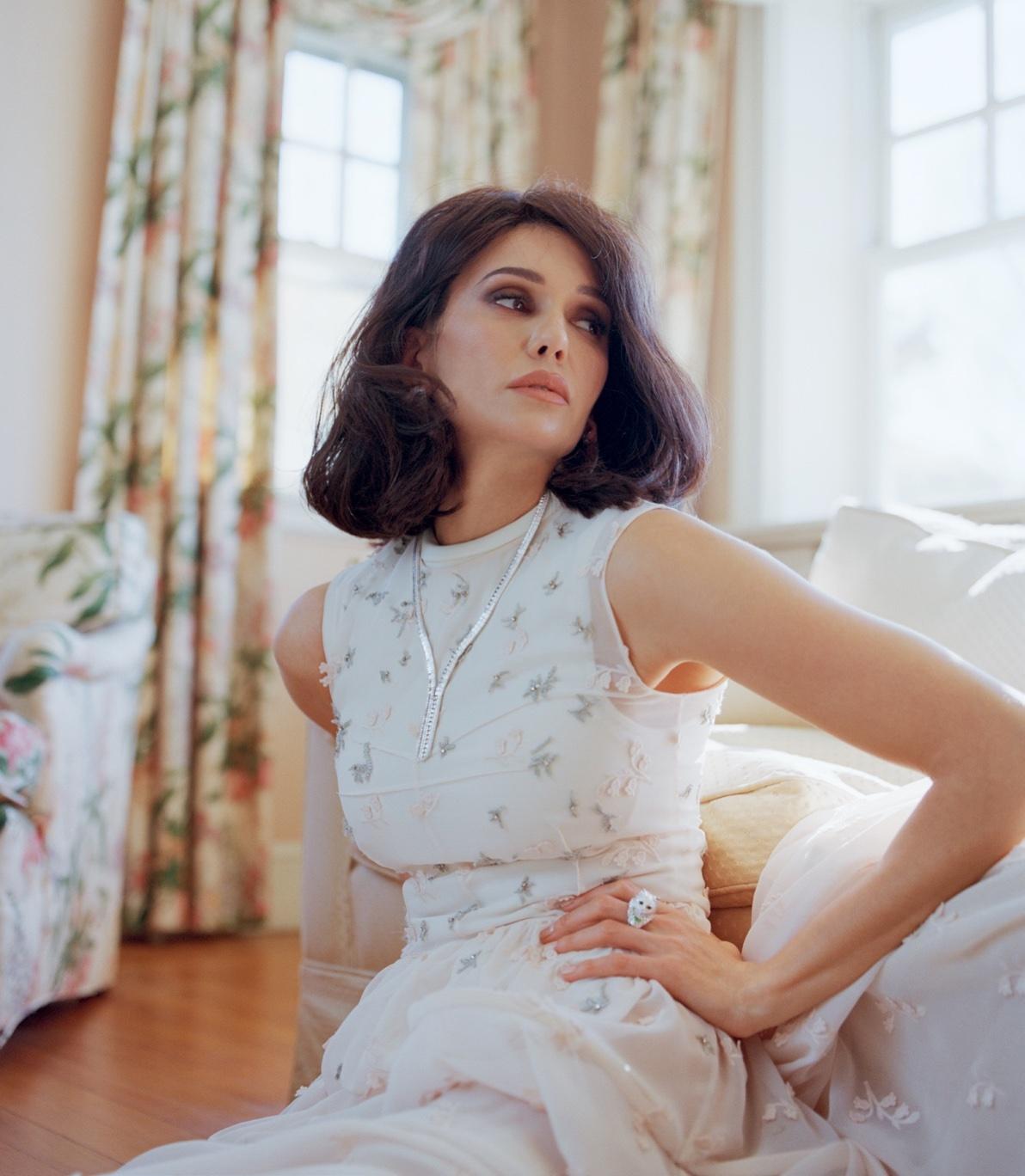
BY LEAH FAYE COOPER
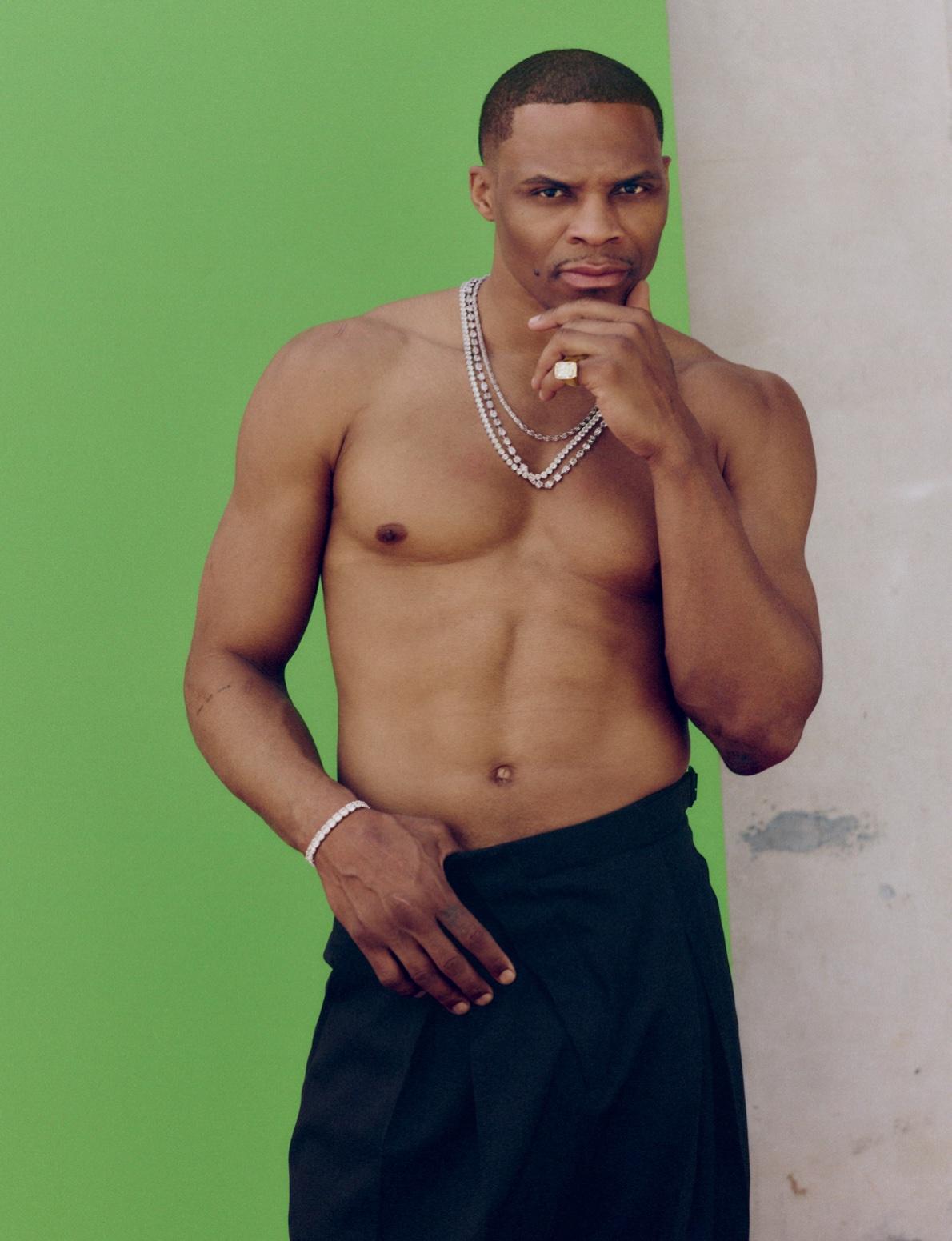
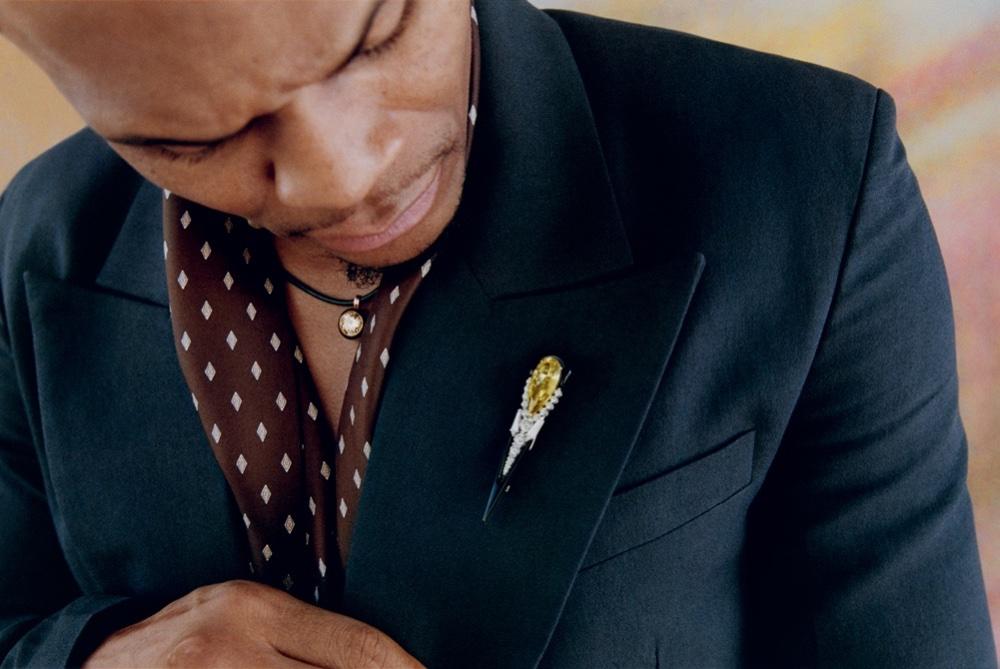
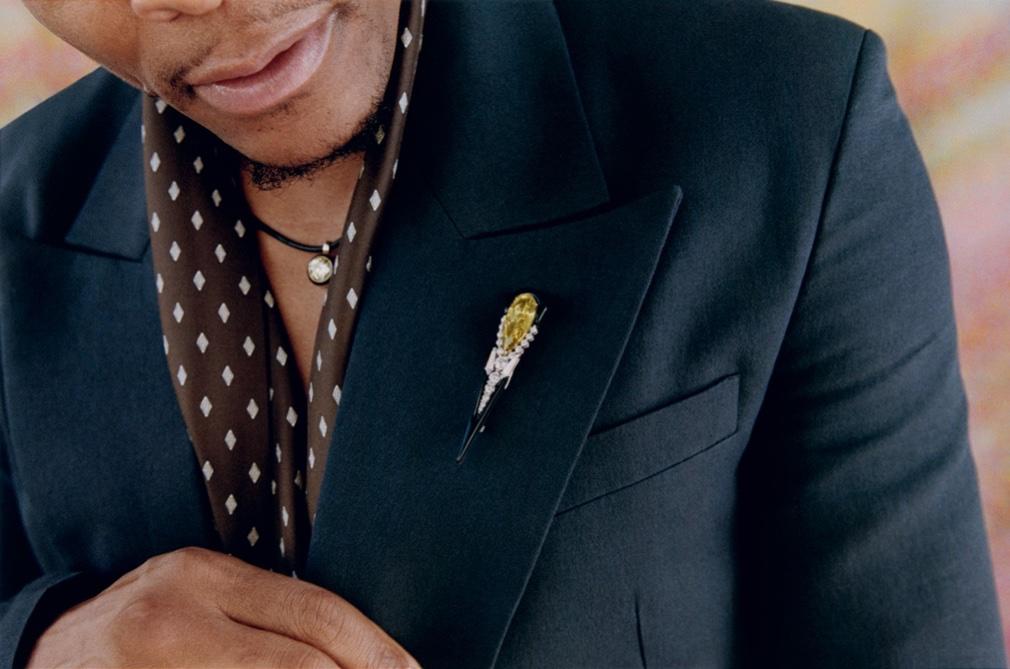
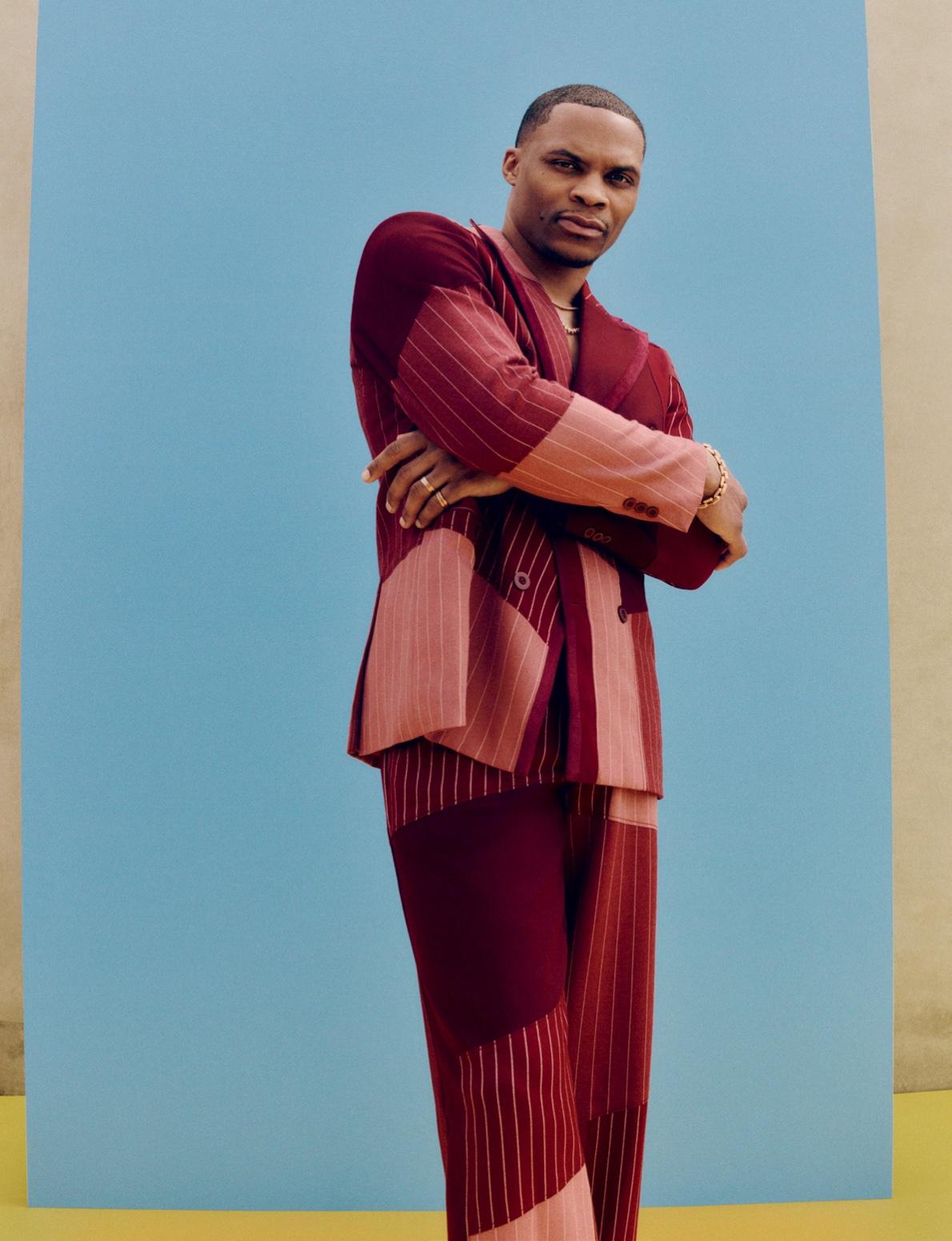
Notevery first-round NBA draft pick lives up to the league’s staggering expectations—or those of diehard fans yearning to see their team excel. Some are plagued by injury; others simply never adjust the pace of professional basketball. But Russell Westbrook can’t relate to either scenario.
Drafted in 2008 to the Seattle Supersonics—which soon relocated to Oklahoma City and became the Thunder—Westbrook was an AllRookie First Team selection and led the Thunder to the NBA Finals alongside Kevin Durant and James Harden in 2012. The L.A.-born point guard and former UCLA standout recorded two seasons as the league’s leading scorer, three as the assist leader, and nine as an AllStar. He won MVP in 2017, holds the record for career triple-doubles, and is a member of the NBA 75th Anniversary team—a roster of the 75 best players in league history. And that just brings us to 2021.
The average NBA career lasts roughly five seasons; Westbrook just wrapped season eighteen. When late NBA commissioner David Stern called his name as pick number four all those years ago, did Westbrook think he’d still be playing basketball today?
“I did not,” he says, matter-of-factly. Speaking over Zoom from Sacramento, where he’s nearing the end of his first season with the Kings, Westbrook rattles o the many sources of his longevity. “It’s a combination of a lot of things. I think being given the opportunity and loving to play, the competition, the platform it gives me, the people I’m able to inspire while just being on the floor, my kids are old enough now to see me play, so that’s also very inspiring. But never did I think I’d be playing this long. I don’t take it for granted. God blessed me to be able to wake up and play—I’m going to play as long as I can.”
Westbrook added to his accolades during the 2025–2026 season, logging the most career rebounds by an NBA guard in history and joining LeBron James as one of two players with 25,000 career points and 10,000 career assists.
Westbrook’s dominance on the court is matched with an equally legendary sartorial prowess. He is largely responsible for popularizing one of today’s most highly anticipated and fervently documented runways: the NBA tunnel walk, i.e., the players’ walk from their arena arrival to the locker room. Kilts with cardigans, leather pants with graphic tees, tie-dye tees, and ripped jeans, and a sweatshirt so distressed it revealed both of his pecs, are just a few of the looks cementing Westbrook’s best-dressed status. “Obviously, I take it seriously,” he says of his passion for style.
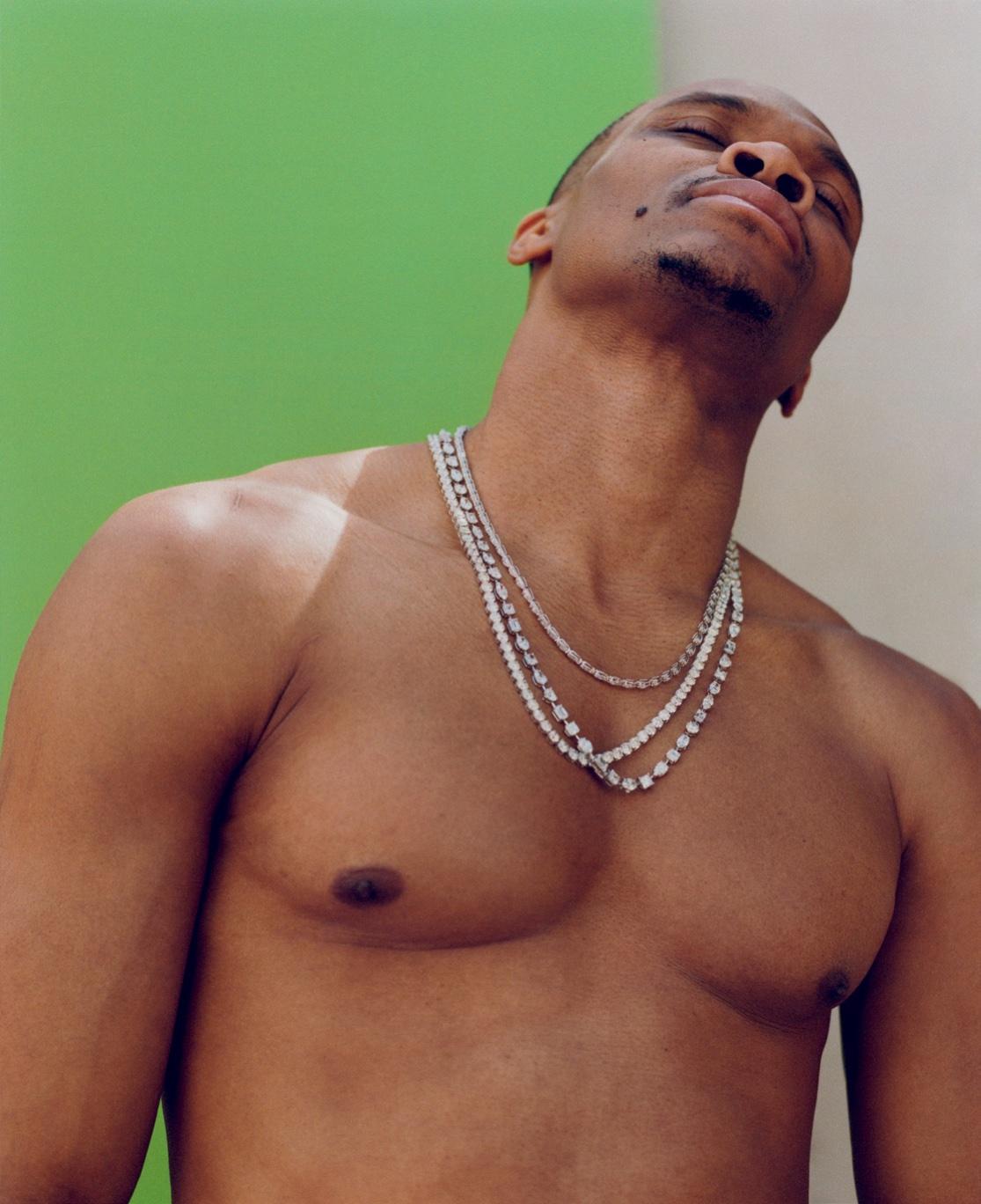
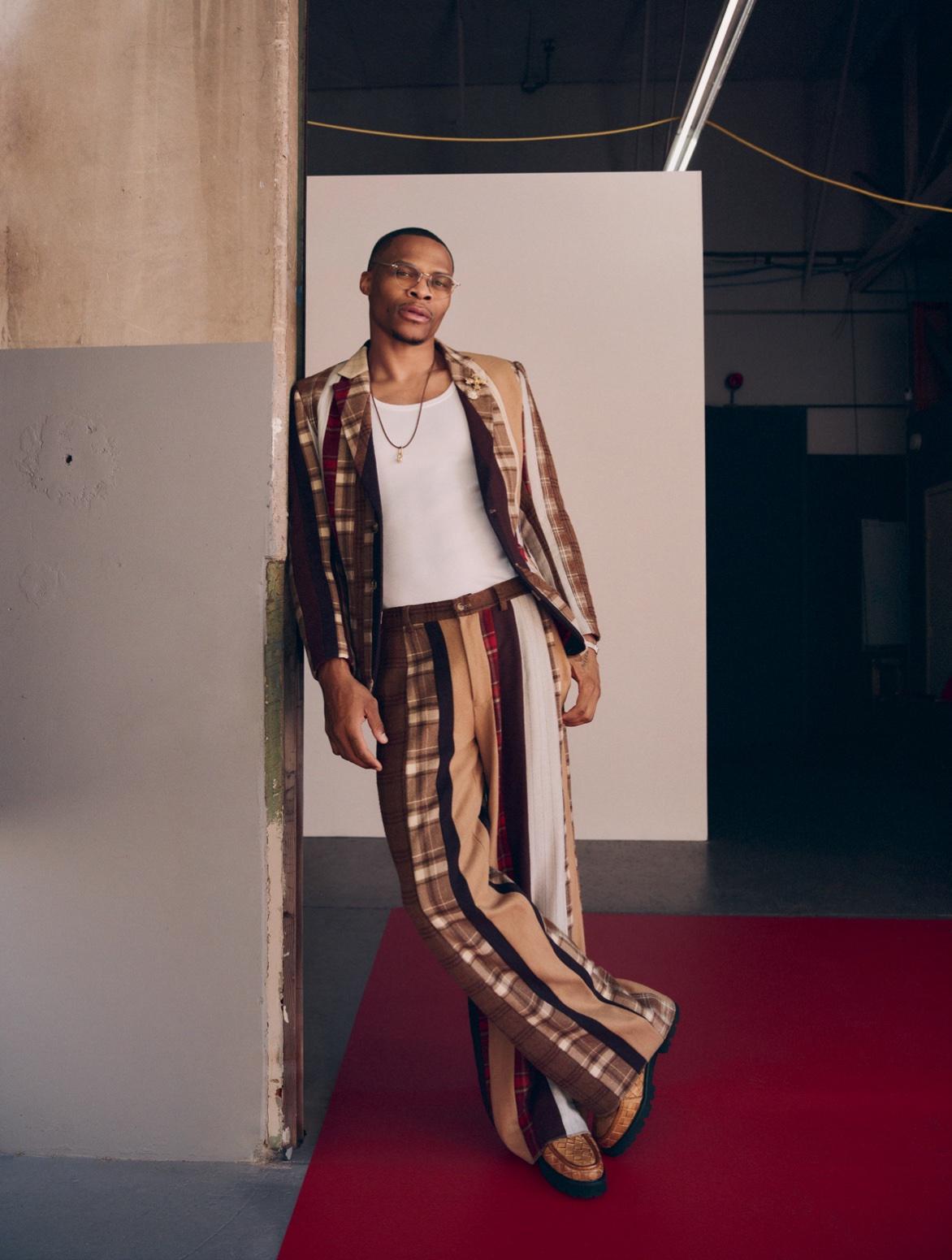
Though that interest extends to jewelry to some degree, his outfits feel complete without tennis necklaces, diamond studs, and glimmering Cuban links. “I grew up in the hood—jewelry wasn’t something I was running to get,” Westbrook says, adding that flashiness was an invitation to get robbed. Instead of spending his early NBA checks on precious gems, “I didn’t get any jewelry until probably my second or third year in the league,” he says. “I got a watch and one pendant—my logo—that was it.”
His first major diamond purchase was the custom, elongated cushion-cut ring he proposed to his wife with in 2014. A process that some find daunting—picking or designing a ring for their future spouse— didn’t faze Westbrook, “because I have good taste [and] I knew what she wanted,” he says. A milestone recently prompted the two to go back to the drawing board. “We just celebrated our tenth-year wedding anniversary, so things have changed with the ring situation,” he says. The watch situation changed, too, with Westbrook accumulating an impressive collection of Audemars Piguet, Richard Mille, and Rolex timepieces. As for where he stands on the diamonds-or-no-diamonds-on-a-watch debate, if they’re factory-set, yes. “If [they’re] not from the brand, no; I’m good.”
In 2016, Westbrook materialized his penchant for fashion by launching apparel brand Honor the Gift. Inspired by his California upbringing and innate creativity, the range includes graphic tees, crochet separates, boxy button-downs, and a variety of knits. It’s one of several businesses under the NBA star and entrepreneur’s holding firm and investment company, Russell Westbrook Enterprises. Another one is RW Digital, a programmatic digital marketing company. “I love—I call it in my o ce—[a] non-sexy business,” Westbrook says, explaining that he’s just as drawn to under-theradar ventures less likely to be impacted by global a airs and shifts in the economy as he is to more publicly revered ones. Brands that
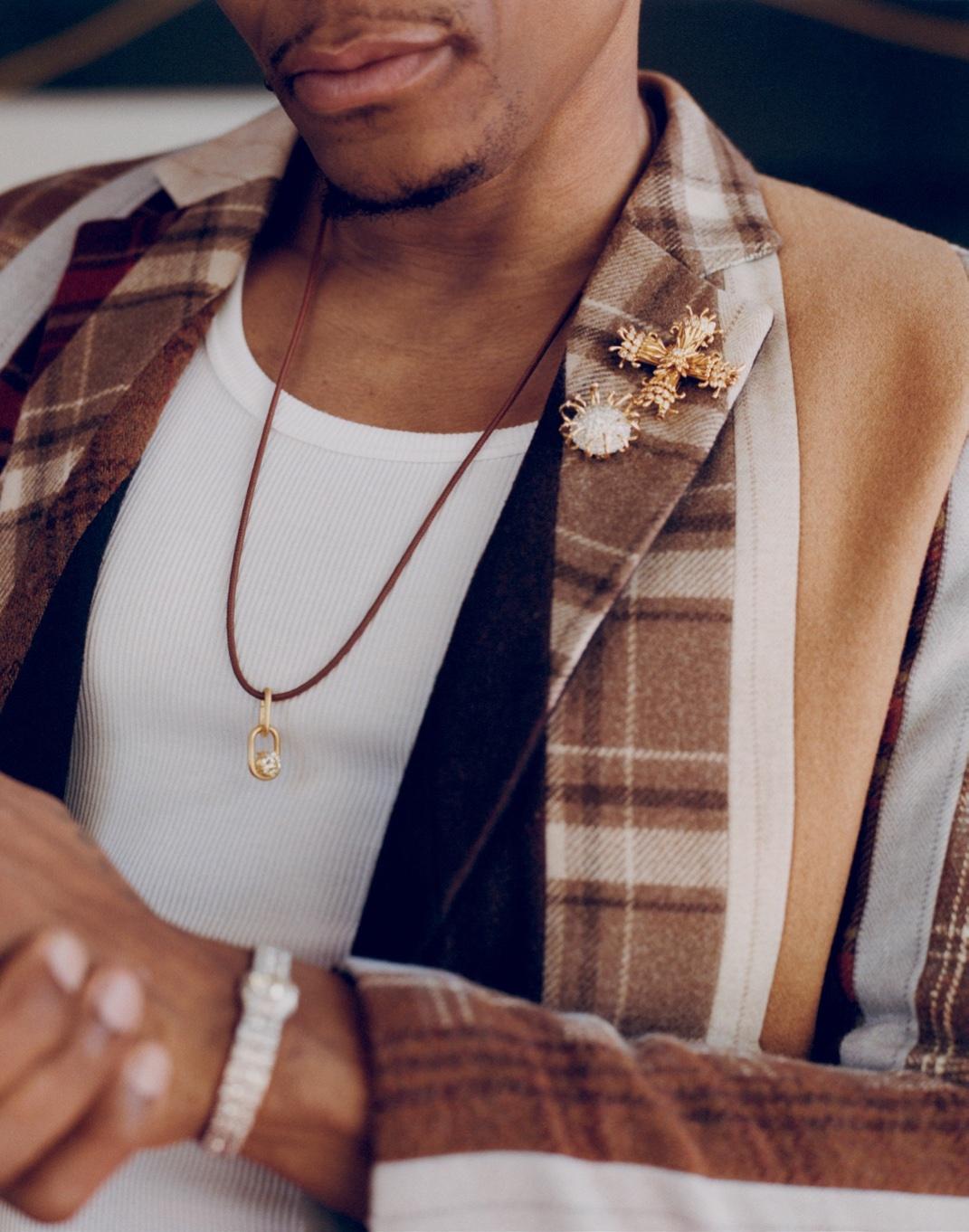
David Yurman rings. Ferragamo jacket and scarf, Linda Farrow glasses.
Opposite page: Ti any & Co. brooches, Jade Ruzzo necklace, Briony Raymond bracelet. Kid Super jacket, Uniqlo tank.
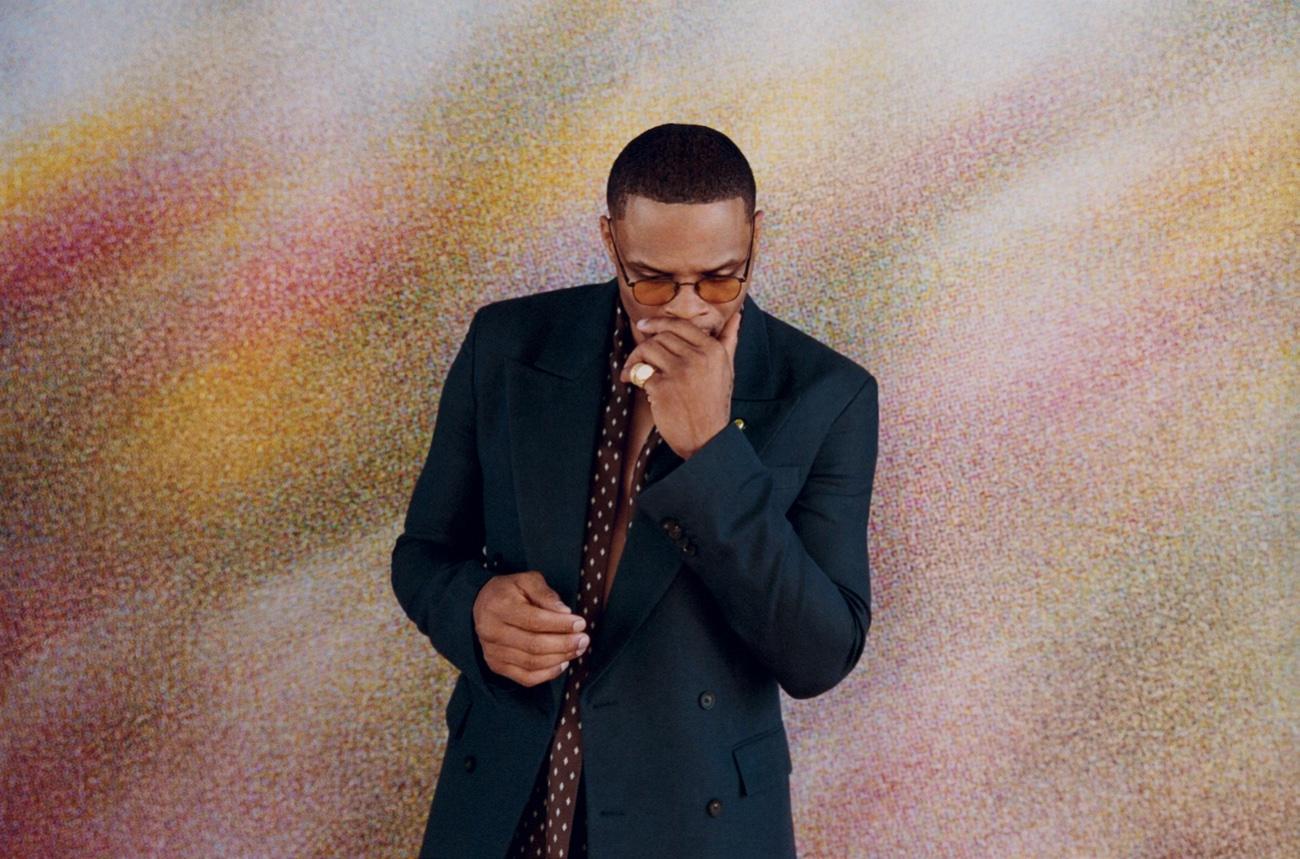
champion diversity and community impact, he adds, are also essential to his portfolio.
Of course, Westbrook doesn’t need another job—let alone multiple other jobs. But he’s keenly aware of the platform and opportunities his NBA career a ords him and wants to do more with that than make explosive plays. “Not just for me, but for my kids and the people around me,” he says of his commitment to establishing, modeling, and maintaining a strong business acumen. “I feel like it’s my duty.”
Westbrook is most enthusiastic when he talks about his family, and he talks about them a lot. He and Nina share an eight-yearold son, Noah, and seven-year-old twin daughters Jordan and Skye. When I mention how busy he must be with basketball, family, and business, he quickly points out the obligations should be listed in a di erent order: “Family first.”
Over the season, Westbrook was in Sacramento while Nina and the kids were at the family home in L.A. He was up at 6 a.m. to speak to them before school, on a call or FaceTime with the family in the afternoon after his workouts, and again before bedtime. The only piece of jewelry he’s adamant about wearing every day is a simple necklace with his wife and kids’ first initials dangling from it. “N-N-J-S,” he says, “Nina and Noah, Jordan and Skye.” Westbrook has the bespoke necklace in three metals—silver, rose gold, and yellow gold.
So, no matter what he’s wearing, he’ll have a necklace to match, I ask?
“Exactly.”
Hamilton Jewelers necklace, David Yurman necklace, Westbrook’s own watch and ring, Hamilton Jewelers ring.
Photographer, Micaiah Carter; Stylist, Courtney Mays; Creative Director, Lizzy Oppenheimer; Entertainment Director At Large, Glynis Costin; Creative Production, Petty Cash Production; Lighting Director, Sebastian Johnson; Digital Tech, Blake Mohr; Production Designer, James Lear.
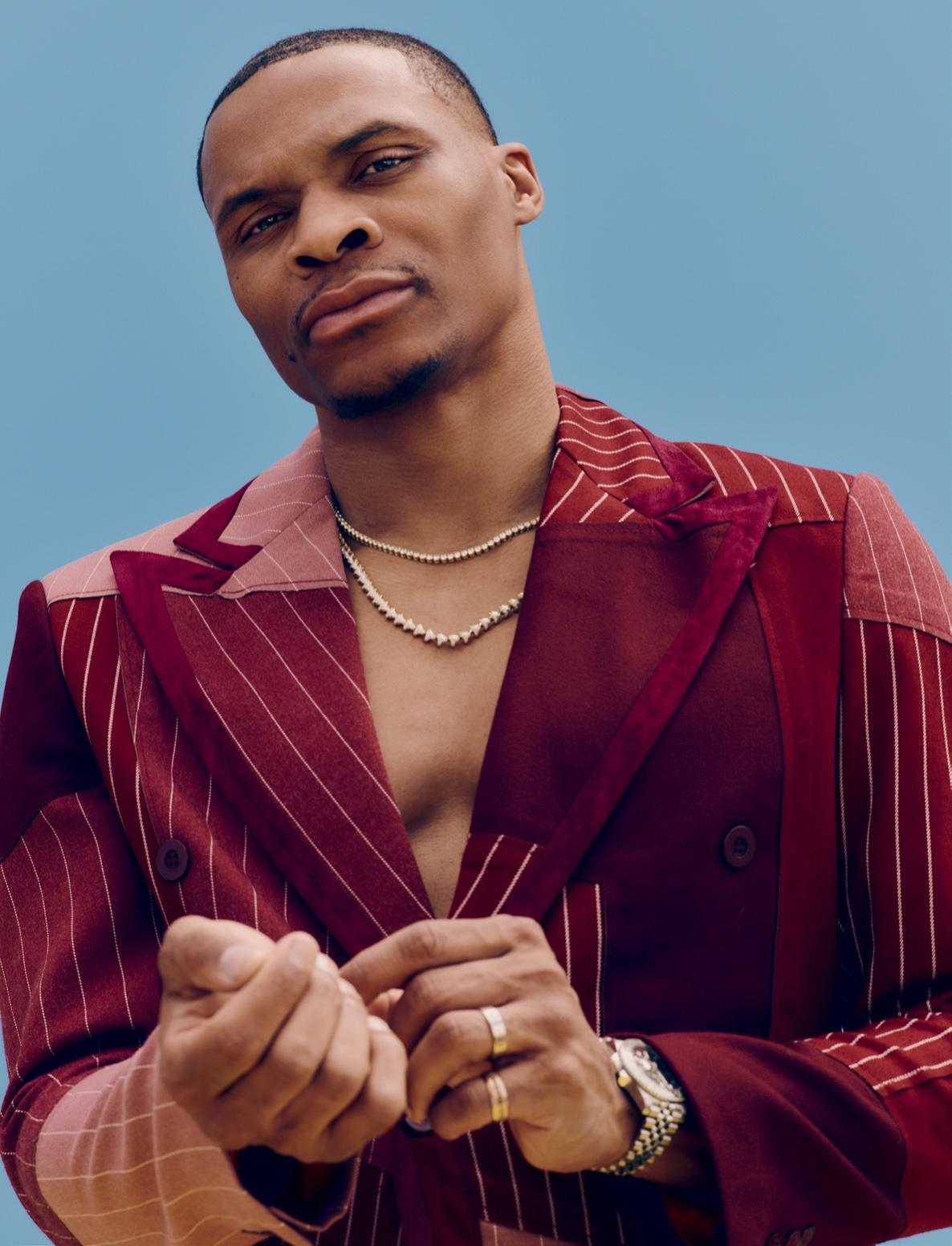
BY SAM BROEKEMA
PHOTOGRAPHED BY TUNG WALSH
Somepeople are the life of the party. Some live to party. But for a select few, the art of throwing a great party is innate. The 2026 GEM Award for Retail Excellence winner, Jessica McCormack, knows a thing or two about hosting. Her New York store opening party at the recently and gorgeously renovated Frick Collection was not only hugely photogenic–with ambassador Zoë Kravitz and friends of the house Laura Dern and Shailene Woodley, alongside the ton of New York– but also cozy and fun, with a focus on comfort food and great tunes. On the day that I interview her, Ms. McCormack is fresh from her shoot for this profile, wearing an oversized lilac blouse, fabulous eye makeup, and her signature bold diamonds.
“I’m actually going for some drinks after this, and I’m going to be turning up looking quite like a drag queen,” McCormack laughs. Noting that this is quintessential “day diamonds”, it feels appropriate for her role as
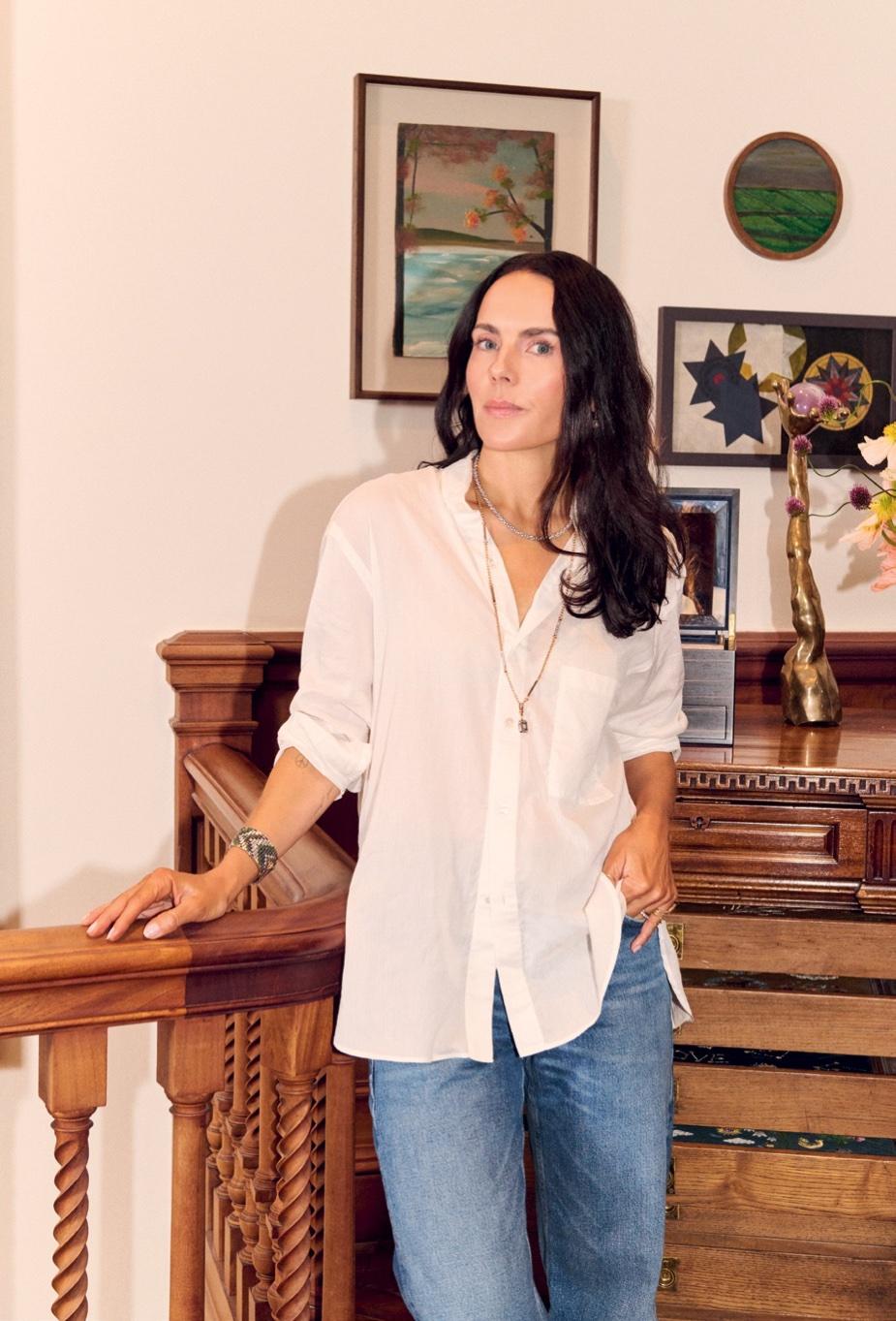
doyenne of o and diamond glamour. For those who haven’t been inculcated into this way of dressing, the designer encourages us to wear our jewelry from “school gates to dinner dates and everywhere in between,” the rhyme emblematic of McCormack’s playful sensibility. “There are twenty-four hours in the day, and now I’ve got a whole extra twelve hours to wear my diamonds, versus just the twelve hours at night.”
A hallmark of Jessica McCormack’s style, beyond her approachable take on luxury, is
her sense of scale. Most stores pride themselves on their Lilliputian scale as literal jewel boxes, which serves the scale of the product. But not McCormack.
“When I first took Carlos Place on, everyone was like, ‘Why do you need this giant store when you sell tiny things. You don’t need five floors!”, she recalls. “But we’ve managed to grow into it.”
The townhouse, open since 2013, feels like the home of your most elegant friend whose taste one could never replicate. The New York store is no di erent, though with
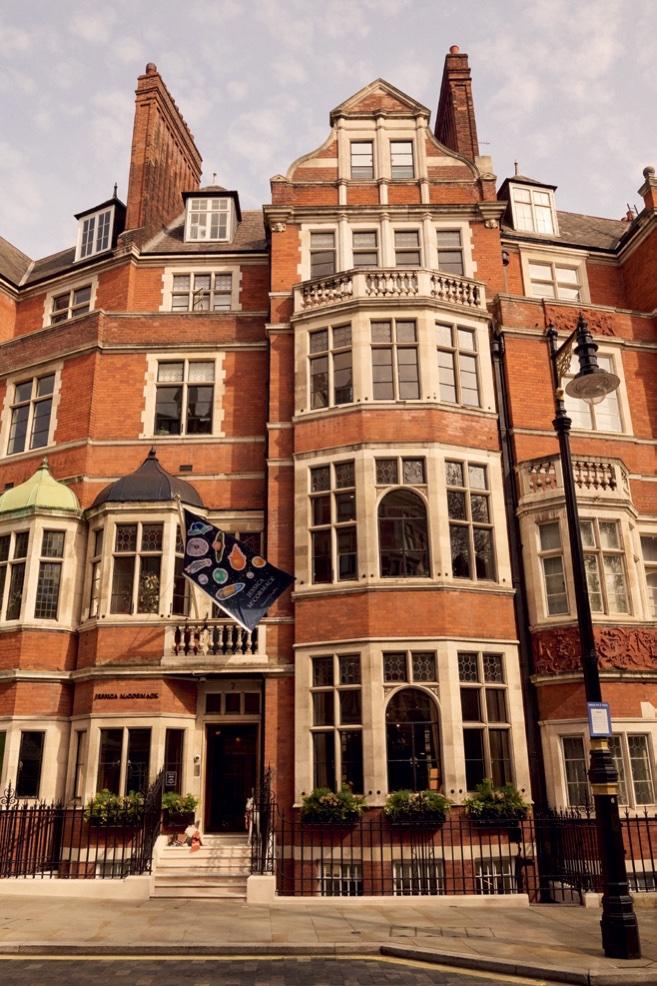
the added pressure of its prime location on Madison Avenue: the current Mecca for jewelry aficionados in the U.S., if not the world.
Jessica describes the process, saying, “It took a long time of refining, working out the customer journey, how much space do you need. I’ve obviously learned a lot of lessons, so my thing was to find a space that felt like the townhouse, where you can experience the same things: you can sit in the library, or you can be in a little hidden room where we have all the art and antiques. You can discover something new, and it’s like being welcomed into a home. It still has its own personality, but it feels connected to the mother ship.”
This warmth does not necessarily jive with the established jewelry store stereotype of frosty salons filled with unapproachable gems. When discussing the customer experience, Jessica McCormack stresses, “There was a stage when I was young when I was just too intimidated to go into a jewelry shop. I don’t know if I still feel so confident about just bowling into one. I want to be able to come in and feel it’s discoverable and fun, and you can find something, and it doesn’t have to be just dropping a hundred grand.”
This approach is clearly working as the store’s already a destination for clients new and already fervent. However, nothing has been left to chance in the formula. “We did a lot of homework, a lot of market testing. It takes 20 years to become an overnight success. But I feel it’s going well because we’ve put the work in. We’ve got a great team,” McCormack o ers humbly.
For Jessica McCormack, relationships must always be genuine, a philosophy that extends to the brand’s ambassador, Zoë Kravitz. “First, she was a client, then she was a friend, and now we work together. The trajectory of it was so natural.” And in the panoply of stars, there truly is no one who wears jewelry of Jessica’s magnitude with such ease.
“Recently, Zoë wore this 20-carat, D-flawless oval, on a ‘90s leather cord, which I thought created a vibe. Then other people were doing it, and it was a thing. Another time, she was asked, ‘Can you make me an arm band?’ And then that becomes a thing. She’s very thoughtful and detailed. She really cares. It’s a real relationship, it’s not transactional.”
The frenzy around 1990s style seems in no danger of waning, and Jessica McCormack is here for it. “I mean, I love it. I’m a child of the ‘90s, so I feel it’s very cool.”
The chokers, the chandeliers, the bangles: no film in 2026 has captured the mood quite
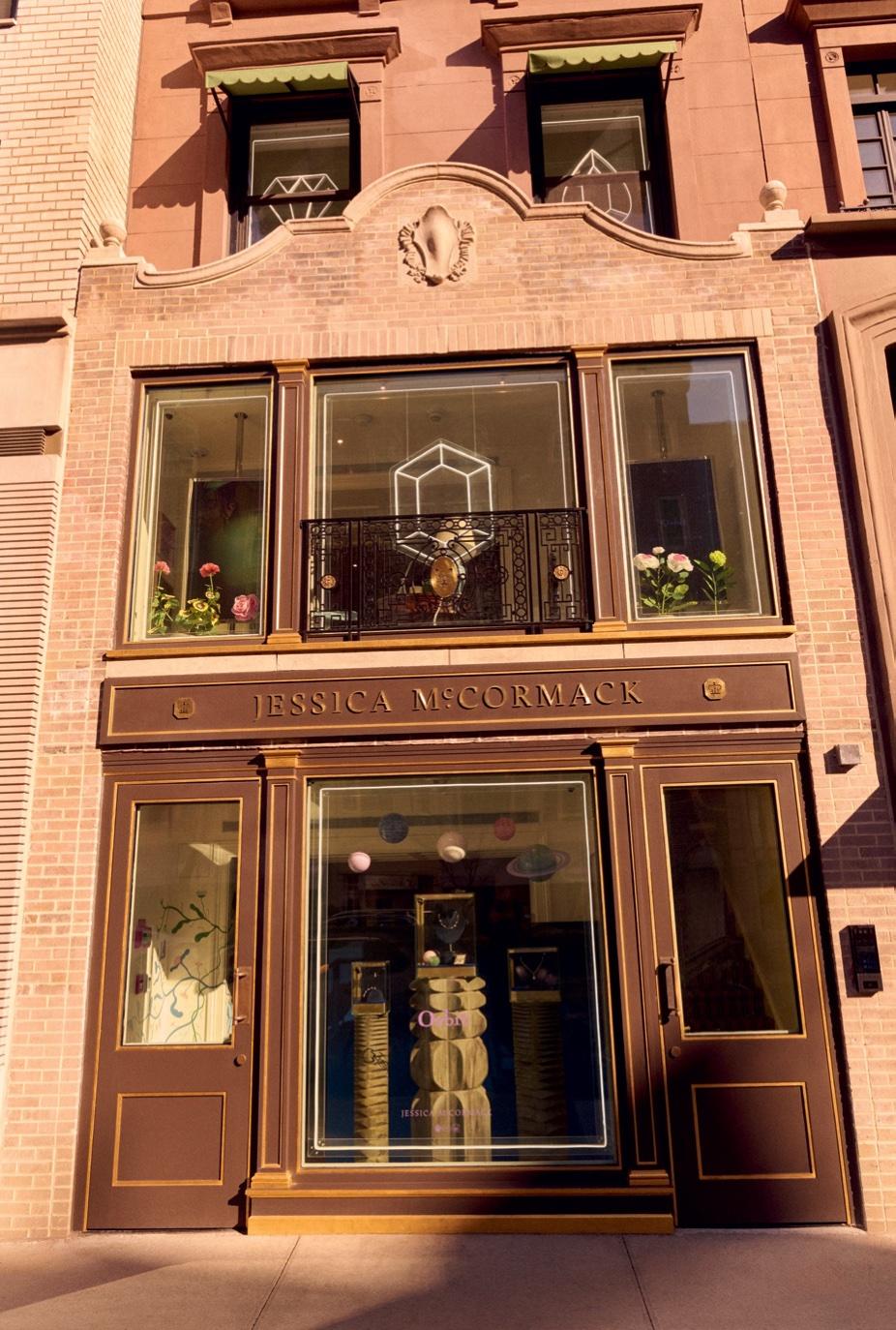
like Emerald Fennell’s Wuthering Heights, particularly the viral press tour, where Margot Robbie wore everything from Elizabeth Taylor’s Taj Mahal Diamond to custom pieces by McCormack. Much like working with her ambassador, the designer found a kindred spirit in Robbie’s stylist, Andrew Mukamal.
“We’ve worked with him for years, and when he floated the idea about doing something for Wuthering Heights, it felt so easy. Well, nothing is easy, but it felt natural because of my antique background and love of Victorian, Georgian, and kind of deco everything. He said, ‘This is what we are thinking: this bracelet from the Brontë sisters.’ With that as a reference, it’s easy to design.”
Asked whether Mukamal had a clear point of view, she confirms, “He’s like, ‘this is what we want to do, this is what I need.’ There’s not a lot of backwards and forwards. He’s done a lot of the thinking, and he trusts in the design, even if it’s just a sketch. Because, you know, you can’t just whip it up. Also, if I’m going to invest in making things, I want to be able to sell them. The daisy that we made for Margot, that sold straight away!”
NOTHING IS JUST FOR SHOW
Salability and showstopping don’t often land in the same sentence. But in the house of McCormack, it’s de rigeur. “I’m not in the business of making jewelry just for fun. I remember, many years ago, a former CEO said to me, ‘It’s a very expensive prop if it’s not for sale, Jessica.’ I’ve always remembered that. It’s all very well seeing something on a beautiful, incredible, famous star, but then, can I wear this? Is that for the normal people?”
LIFE LESSONS IN ANTIQUE
Jewelry, and the stories connected to those who possess the pieces, have long drawn in Jessica McCormack. Her childhood was an education in vintage. “My dad was an antiques and art dealer, so I just love old things. I love Victorian jewelry because, obviously, when I was in my twenties, I had an inner goth. The memento mori jewelry I
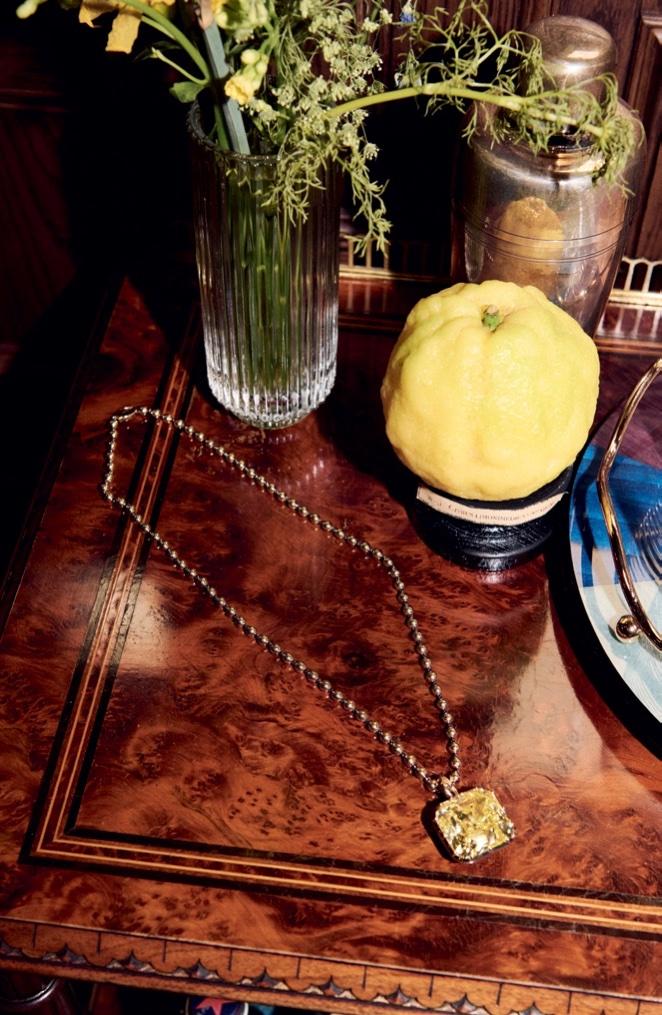
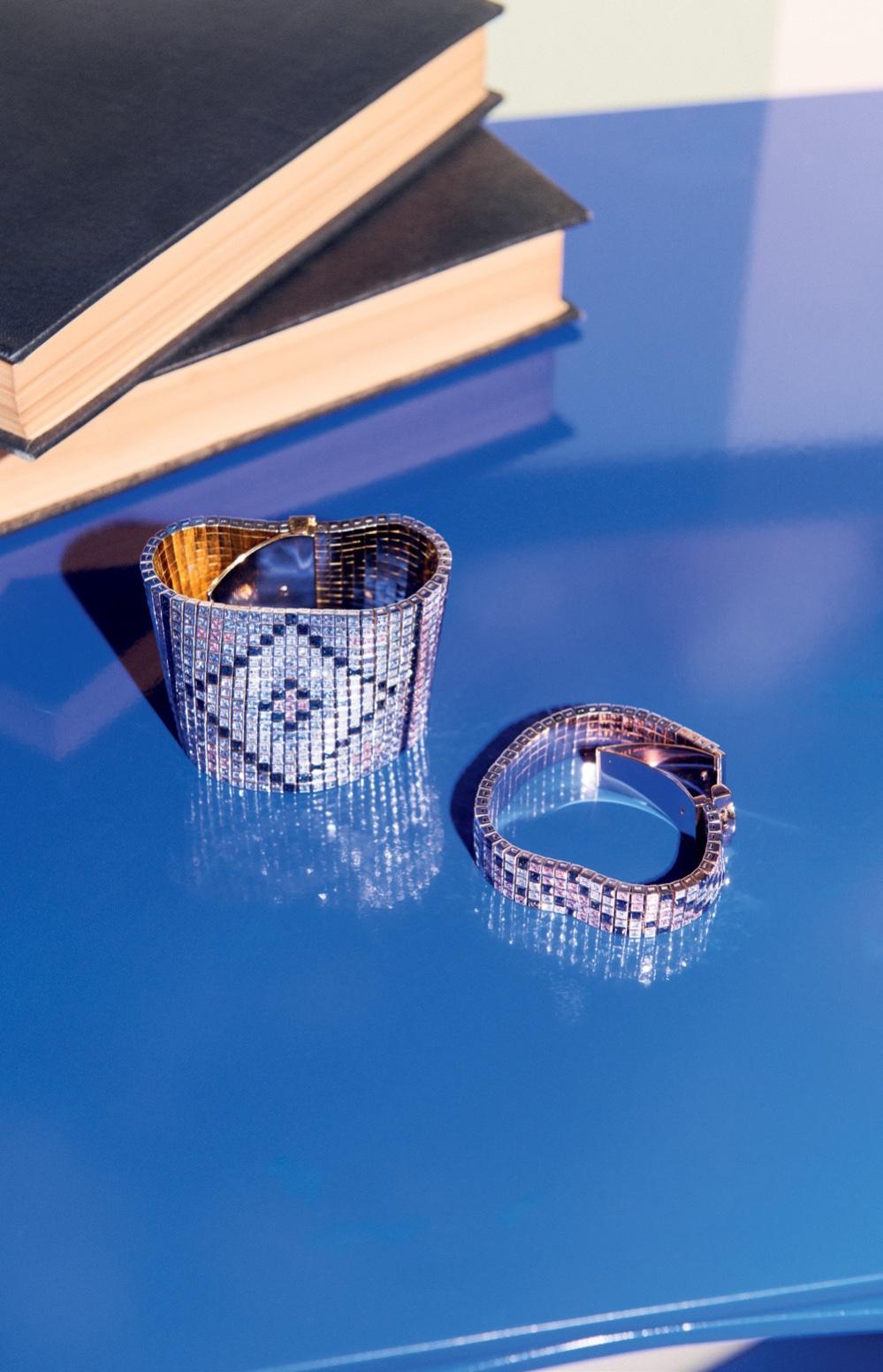
Jessica McCormack’s Tapestry Woven Diamond & Sapphire Bracelets, each with a set of Carrè cut diamonds, dark blue sapphires, light blue sapphires & pink sapphires, all in a channel setting, handcrafted in 18K blackened white gold and yellow gold.
Opposite page: Jessica McCormack Orbit Brooch featuring a 7.01-carat cushion-cut diamond, set in a Georgian style cut-down setting in 18K blackened white gold and yellow gold.
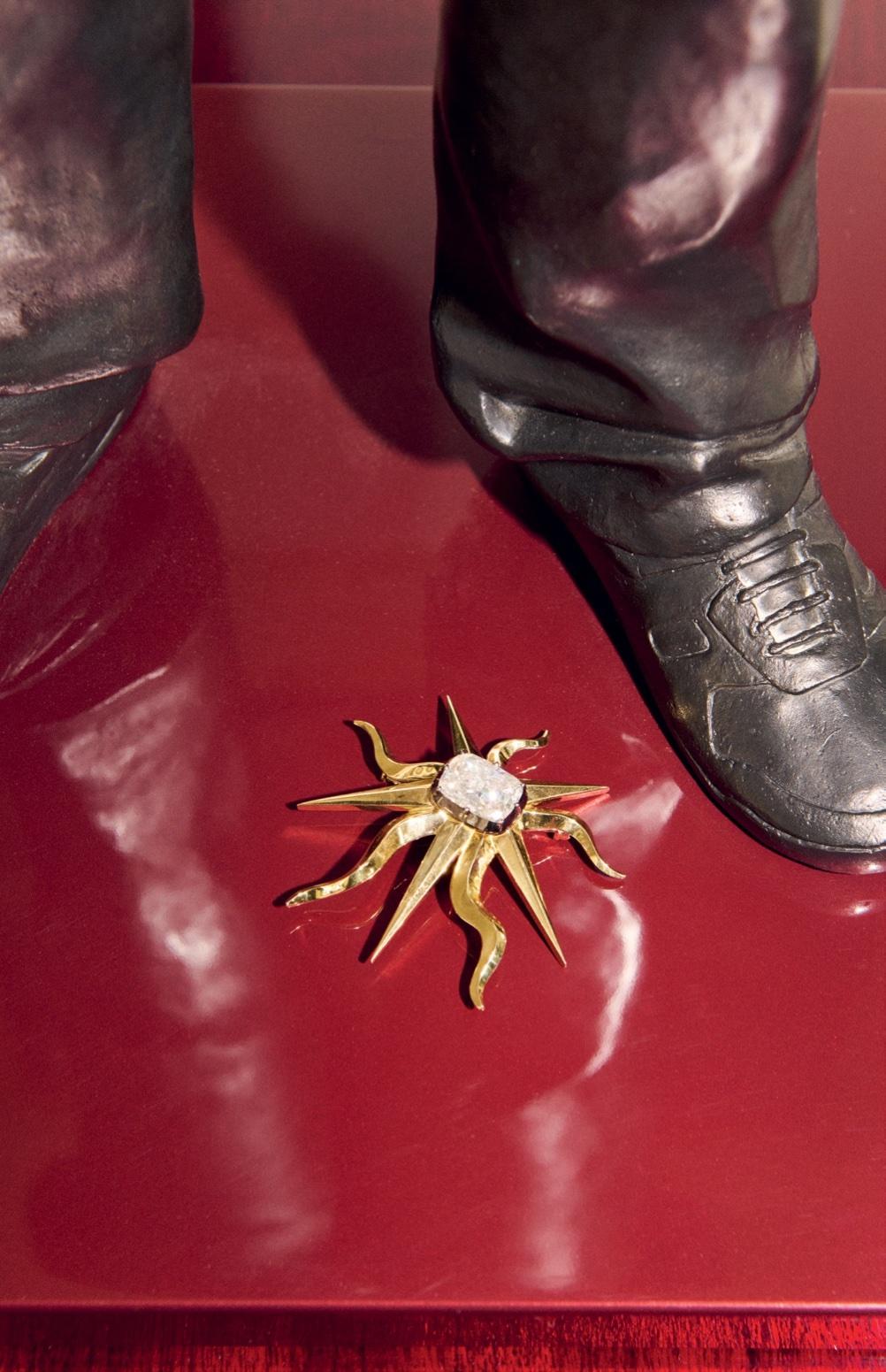
loved, this was what drew the Brontë sisters, with the hair, the skulls, the enamel, the poesy rings, the secret messages. That was definitely my first love.”
When she began her career, many labeled her as an “edgy” designer. “And I was like, hmm, I have to drop the edgy for a bit. If I want to create a legacy brand, I can’t really be the edgy, gothy one–or I don’t want to be that forever. So, I decided the goth must go to sleep for a while.”
This desire to develop her aesthetic yielded an embrace of another love: Georgian jewelry. “From Victorian, I went in reverse to the Georgian period. There is something much softer about that era, which really resonated with me.”
As a typical magpie, McCormack is also drawn to Art Deco–the geometry and the references to towering skylines. Her instantly recognizable friendship bracelets, shimmering with emerald, sapphire, and diamond beads, embody all the hallmarks and are a personal totem. “It’s my favorite thing ever, I just wear it all day, every day.”
The designer’s style signatures remain constant whether she is in London, New York, Los Angeles, or anywhere really. “I design for the woman, and I hope that she can be living anywhere. And that’s the thing. You know how they always say, famously, you can’t be everything for everybody – you just have your people. But I have a granddaughter, a mother, and a grandmother, all wearing the same pair of earrings. There is something for everybody, essentially.”
Asked what’s next, the designer is ebullient. “One of the things that I really love, and I feel is a niche of ours, is summer jewelry, summer diamonds. The new summer collection, which comprises 5 medallions, is so cool. I go around asking everyone which one you would choose if you had to choose one. And we’re putting money on what people will be drawn to! I love that everyone has a mix, everyone chooses something different. Which one speaks to you?” McCormack clearly specializes in the jewelry that speaks to us, like a friend.
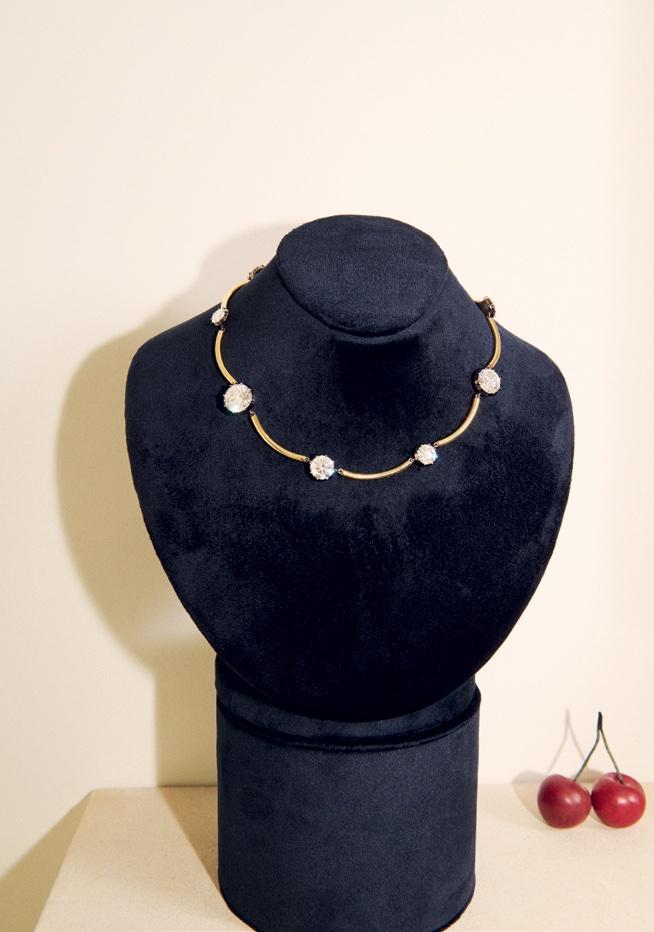
Interior of Jessica McCormack’s Madison Ave townhouse in NYC. Jessica McCormack Orbit Diamond Stargazer Necklace, with eight round brilliant cut diamonds totalling 30.36 carats. Interior of Jessica McCormack’s Madison Ave townhouse in NYC. A one-of-a-kind pendant showcases the singular Blush Diamond, a Fancy Pink, Internally Flawless, Type IIa, Marquise-Cut Diamond totalling 10.38cts, on the Tempest Diamond Necklace, which is set with 70 carats of round brilliant cut diamonds.
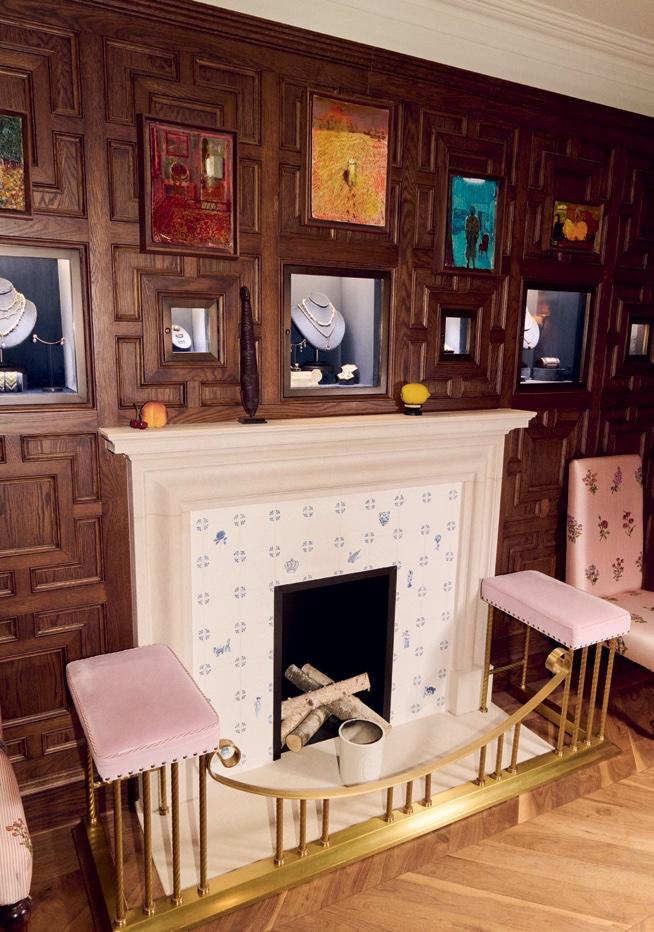
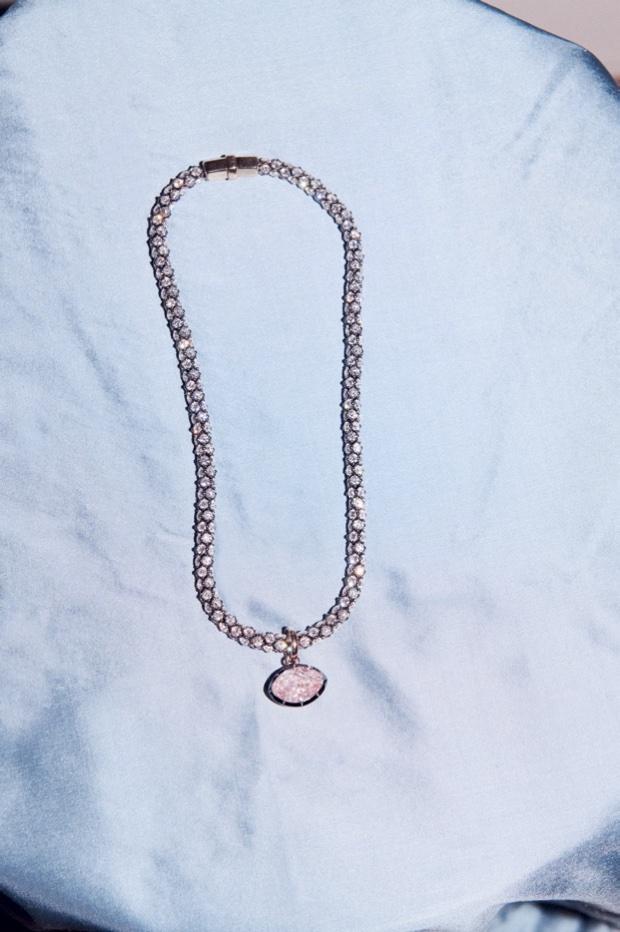
of Minerals and Energy, Bogolo Joy Kenewendo, sees more than sparkle when she looks into a diamond; she sees the potential to transform the lives of millions in her country. She knows this firsthand, having witnessed Botswana develop into one of the fastest-growing economies in the world. Her mentors were the architects of the plan that harnessed the power of natural diamonds for the benefit of her people. Educated all over the world through the largesse of Botswana’s support, she returned home to pay it forward for the next generation. Famously, the youngest Minister in the African government under the previous administration, Minister Kenewendo, has now taken on an even larger role and greater responsibility under President Boko. She shares with Only Natural Diamonds what drives her forward, and why this moment for natural diamonds is both so important and so hopeful for Botswana.
BY SAM BROEKEMA
PHOTOGRAPHED BY MARK SELIGER
HOW
HOLD FOR BOTSWANA’S FUTURE.
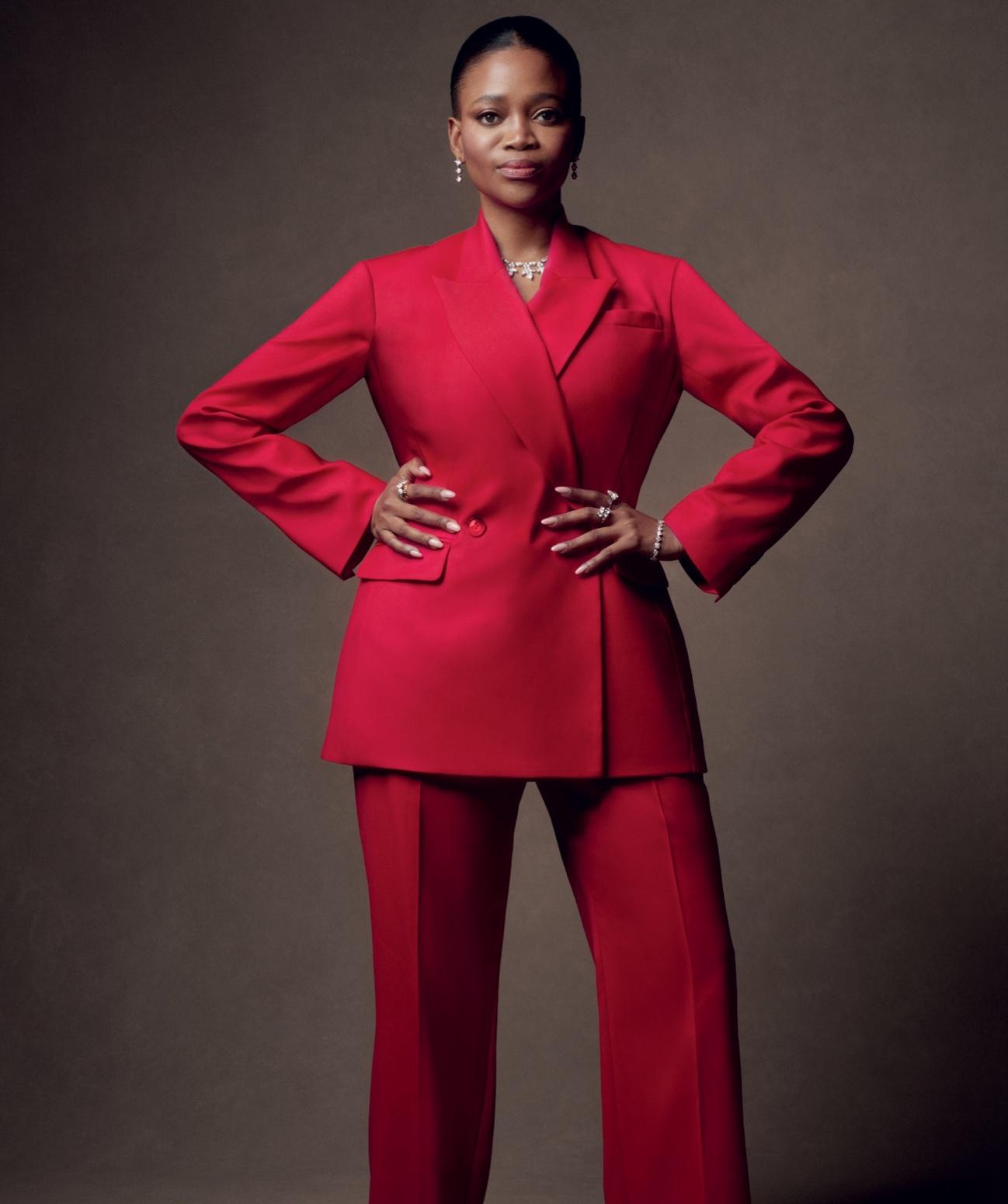
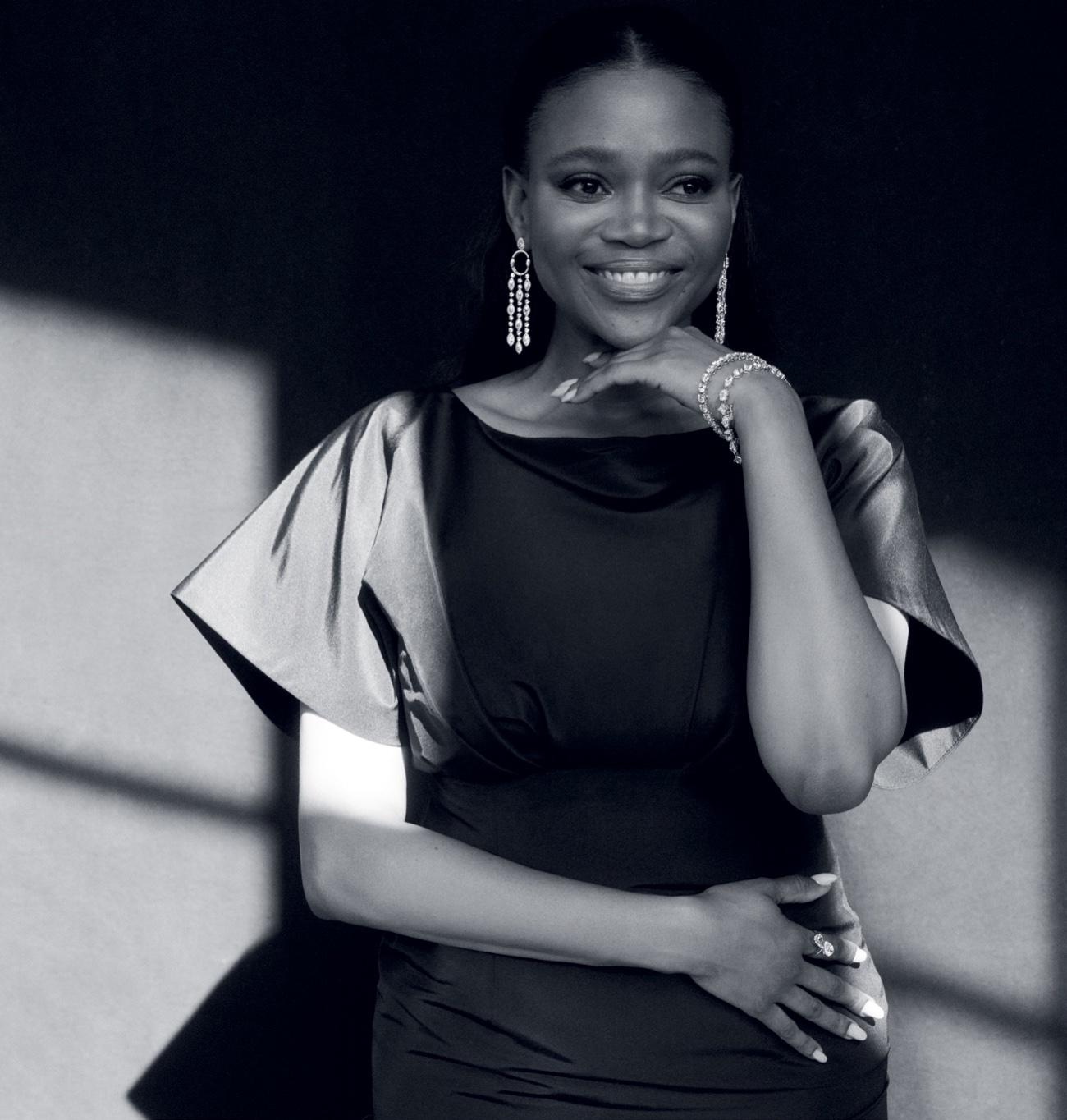

Only Natural Diamonds: To start, could you explain what natural diamonds mean to you?
Minister Kenewendo: Life. By that, I mean that diamonds have given life to me as a Motswana and to many other Batswana. Diamonds mean the opportunity to explore the fullness of my potential. Earlier this month, when we were visiting one of our cutting and polishing factories in Botswana, I realized that every time I look into a diamond, it’s like experiencing many other universes. It’s so incredible: when you look through a diamond, you can imagine the many lives it has lived and the many years it has existed. So, it’s not just ‘life’ insofar as the opportunities diamonds have created for me, but also how they capture and store life over many centuries. It’s brilliant. It’s wonderful. I truly just love diamonds. [laughter]
When you research various cultures, every one of them has a story associated with diamonds. Jewish women used diamonds as a means of passage when they were running away from the Holocaust. Indian women have used diamonds as protection should their husbands pass away, or their family faces hardship. In all these cases, diamonds have provided a way forward for families. We’ve seen this in many countries: when a husband passed away or lost their retirement packages, their jewelry became a means of sustaining their livelihoods. Every nation, every culture has a story about holding onto or trading a diamond at the right time to sustain itself. If this has been true for so many centuries and generations, why would that change now?
OND: How have natural diamonds shaped your life specifically?
Minister Kenewendo: Well, I first termed myself a diamond baby in 2019.
OND: Did you coin that?
Minister Kenewendo: I did. I first said this during a TED Talk in 2019. I’m a diamond baby because of the first woman minister in Botswana, Gaositwe Chiepe. She managed the negotiation with De Beers that created Debswana, which enabled us to have free health care, free education, and lives beyond our wildest dreams. It is because of her negotiation that diamonds have been able to transform our lives. I was born in a government hospital, and I went to government schools. I tried a private school, but I didn’t like it so much, so I went back to the government school.
OND: What didn’t you like about the private school versus the government school?
Minister Kenewendo: I just couldn’t relate. I don’t come from an extremely privileged background. It’s not that my parents couldn’t a ord a private school, but it just
wasn’t the absolute best. I found more of a challenge in the government school. You were expected to study by yourself and to do things on your own. There was a level of independence that came with being in a government school, versus the two weeks I spent in a private school. Afterward, I attended the University of Botswana, and later I studied at Pitzer College in California, all of which was made possible by government scholarships. I completed several summer programs at Harvard, in Italy, and around the world.
All of these programs were sponsored by the Government of Botswana. Eventually, I went for my master’s degree in the UK. It was because I was working in Botswana and serving as an economic advisor to a Cabinet department that the British government saw potential and decided to sponsor me, but so did the Botswana government. Going on to work for the Botswana government has been one of the most fulfilling experiences of my life. It feels truly full circle to give back to the same institutions that gave me opportunities.
Regardless of your background, diamond revenues have given us all a pathway to live the wildest possible lives that we can imagine. Some of my former classmates went on to be traders in London, and one is a famous filmmaker who made a documentary for National Geographic.
OND: Did he work on the Okavango Delta project as well?
Minister Kenewendo: Yes. We’ve all gone through government schools and had similar backgrounds, and I don’t think any of us could have dreamt of the lives we’re living now. It’s all thanks to diamond revenues and how they were reinvested in our communities.
OND: Is this what drew you to government service, to give back, or was there something else about service and economics that drew you in?
Minister Kenewendo: I wanted to be in the policy space. My village is very, very poor, and it used to be termed extremely remote. No roads led there, and there was no electricity when I was growing up. I wanted to be part of policymaking so I could improve the livelihoods of people from similar places. I wanted to make children aware that, regardless of where you come from, you can have a di erent life. Our generation is critical to Botswana’s development. We’ve benefited the most, and so it should be our responsibility to change what it means to be economically independent.
OND: What do natural diamonds mean to Botswana as a country?
Minister Kenewendo: Transformation, resilience, development, and real-life value. There’s an article that we all like to cite in Botswana. In 1965, when we were seeking our independence [from the UK], a Canadian reporter said, “Oh, yet another basket case coming onto the world stage, crying for independence, and yet they can barely feed themselves. It’s going to be another one of those, where the whole international community is going to need to take care of them,” or something to that e ect. It was a really harsh review of Botswana seeking independence because, at the time, we were the third poorest country in the world.
My mentor, Gaositwe Chiepe, the minister who negotiated the first diamond deal, used to say that the government then had only 24 pounds to its name. Why would anyone be crazy enough to leave the United Kingdom when there were only 24 pounds to pay civil servants? What were you going to do for all the teachers, nurses, and everyone else working for the government? But, as she said, it all worked out: a year later, diamonds were discovered, and three years after that, we began mining them.
OND: I never realized that was the timeline, that they were found after independence.
Minister Kenewendo: Well, [laughter] it’s debatable when they were found. I met the gentlemen who discovered our diamonds. They knew for sure that we had diamonds in 1963, but they needed to do more exploration. So, in 1965, they actually looked and discovered that there was a sizable deposit. But in 1967, one year after independence, they said, “Well, we think there’s a lot more here.”
OND: Excellent timing, timing is everything.
Minister Kenewendo: Perfect timing. It could’ve completely changed the trajectory of Botswana. We know what happened in Sierra Leone and many other countries that had minerals. Zimbabwe and Rhodesia struggled to gain independence, had bloodshed. We got our independence because we were a barren land. It was just the Kalahari Desert and 5 cows. [laughter] Not literally, but only a few cows and 12 kilometers of paved road. Now, almost all the major roads in Botswana are paved. Over 80% of the country is electrified, and the literacy rate now exceeds 90%.
OND: The United States has a roughly 79% literary rate.
Minister Kenewendo: Well, the government has paid for free education in Botswana all the way through university, and now, some people will even be sponsored for postgraduate programs and PhDs, depending on what their career requires.
OND: Are there specific industries that you’re planning to support, such as engineering?
Minister Kenewendo: Yes. As Minister of Minerals and Energy, I am really big on STEM programs. I consider economics, which I studied, a science. I’m supporting STEM fields more because we need more creatives, doers, makers, and innovators. What we will do with the Diamonds for Development Fund is ensure we promote businesses and innovators in that space.
I believe that next year we’ll start rolling out education for artisan-centered and jewelry designers, and we’ll start to build the downstream in Botswana. While we already have the cutting and polishing facilities, we don’t yet have the jewelry industry. I think that’s where the value lies, and the talent in Botswana needs to be harnessed.
OND: It is very powerful to capture the entire journey of a diamond from the earth through the finished piece of jewelry.
Minister Kenewendo: I want to give a special shout-out to the President of the Republic of Botswana. He has been a true champion of natural diamonds. The World Federation of Diamond Bourses recently awarded him as Guardian of the Diamond Industry. He is truly deserving, as we have worked so well together in trying to f ind different strategies to resuscitate the diamond market and to lobby for
the zero-rating of diamonds in the United States, among others.
We are pulling together to ensure that Botswana regains its sparkle as a diamond-producing country and beyond. They say that challenges determine what true leadership is. Together with the vice president, we are going to use the challenges facing the diamond industry. We are going to bring back the strength of our economy with our partners. I’m really thankful to have this support.
OND: How have you seen Botswana develop firsthand because of natural diamonds?
Minister Kenewendo: Until roughly three years ago, Botswana had no debt. We had never asked for a loan from the World Bank; we powered our development through diamond revenues. We were so spoiled. Now, we’re having to manage a government without these revenues. It’s very new to us because, in our experience, it’s cyclical: you sell diamonds, you power the government, and everything runs in abundance. For many years, we’ve run budget deficits, yet diamond revenues have always come through, ensuring that we have a development budget to build schools, dams, and pipelines, to electrify villages, and to send kids to school.
I keep seeing articles about how synthetics are challenging Botswana’s development. Yes, but we are all very much aware that this is a downturn in the market. Markets go up, they go down. It’s what we do when they are down, and how we prepare for the uptick [that’s important].
Even when diamond prices are in a funk, they still outperform other gemstones on the market. Synthetics, for example, have lost 90% of their value over the last 5 years. I’ve read that diamonds are losing their value; that they’ve lost 30% in 10 years. In 10 years, they will still be a better store of value you can bequeath to the next generation.
What we want to ensure is that consumers are fully aware of what they are buying. There is a place for synthetic, but they are not on par with natural diamonds, which took billions of years to form and were crafted by Mother Nature herself. The store of value that a natural diamond brings is unparalleled when compared to a synthetic.
The way synthetics flooded the market, we’re now beyond saying that they’ve lost 90% of their value. Now, we can basically
give them away for free. If you want to go swimming with a little sparkle on your hand, you can have a replica of your diamond ring so that if you lose it, you won’t cry. You can still take nice pictures in the ocean.
We are starting to see markets coming back for natural diamonds. Numbers are rising in the Middle East, and even more so in Europe. We are also seeing encouraging numbers in the U.S.
OND: Taylor Swift helped a little bit.
Minister Kenewendo: Listen, [Cristiano] Ronaldo, Taylor Swift, the biggest stars in the world have really done a number for natural diamonds. What’s important to note is the sustainability of natural diamonds. I read an article recently that asked, “But doesn’t Taylor Swift care that synthetics are a lot greener?” But that is not true. We have to debunk [the myth] that synthetics are greener–they’re not. With our renewable energy push, diamonds from Botswana are moving closer to carbon neutrality.
We have game reserves in our diamond mines that foster nature preservation and conservation. We have some of the rarest animals in our parks because of the symbiotic relationship that we have with the earth. We take some of the diamonds, but we make sure that we care for those who work in conservancy. We ensure rehabilitation as we mine. You will not find the same thing with a synthetic factory. You will not find rhinos in a synthetic factory. But you will find rhinos near Botswana’s mines.
We can protect these animals because our mines are highly protected environments. Wildebeests! I was just at one of our mines, and the wildebeest there are running around so freely because there are no natural predators. [laughter] Because they are protected. And zebras. And it’s a sight to behold.
OND: Very well said. What makes diamonds from Botswana so special?
Minister Kenewendo: Firstly, the people who have cared for nature so well. We’ve cared for nature, and nature has chosen to gift us these precious stones. Diamonds are a natural commodity that needs to be well-protected and distributed across the country. That is something that has made the people, and the people have made it. It’s so unique.
We have also invested in the right innovations that bring out the best stones and retain the value of the diamonds. We’re continuously evolving to ensure our investments support conservancy and our progress toward carbon neutrality. We also make sure that we can trace our diamonds and tell the story behind each diamond’s provenance. There hasn’t been a single drop of blood associated with Botswana’s diamonds.
We are so proud to be the longest-running democracy on the continent since 1966. No civil war, no war with any other nation, only complete peace and a democracy that carries the story of our diamonds. And our economy is growing fast. But it’s fast-growing because of diamonds.
OND: Can you share some stories about some of the impressive diamond discoveries in Botswana? As many people know, Botswana is the world’s largest producer of diamonds by carat weight.
Minister Kenewendo: Yes. In the world by value. I think the most special diamond in the world is the Okavango Blue. It’s like looking into the deep blue sea. Stunning. Then, of course, the 1,098-carat diamond we share with De Beers, and then there’s the 2,488carat diamond, and most recently, another impressive find of 2,492 carats. I mean, big stones. These stones rival the Cullinan, one of the world’s largest diamond discoveries that sits in the Tower of London. But these stones are sitting in our safes in Botswana. You can’t even enter, just in case somebody gets carried away with an idea.
OND: Do you ever let yourself in, just to spend time alone with them?
Minister Kenewendo: I wish I could say that. But I do visit. I visit the Diamond Trading Company of Botswana often; I like taking visitors there so they can experience it firsthand. Just about two weeks ago, we hosted the Minister of Mining from South Africa, and he couldn’t believe the variety of diamonds we had. We wrote his name in diamonds. It was just spectacular.
OND: Obviously, you’ve already done so much previously as Trade Minister. What are your goals in this administration as Minister of Minerals?
Minister Kenewendo: Since I hold two plus portfolios in minerals and energy, I want Botswana to use one to catalyze another. In the same way that we’re saying the renewable projects are going to bring our diamond production to carbon neutrality, I want our diamonds to bring electricity to those who haven’t had it all these years. I want our diamonds to catalyze more development, particularly in the hardest-to-reach places. We are asking our partners seeking
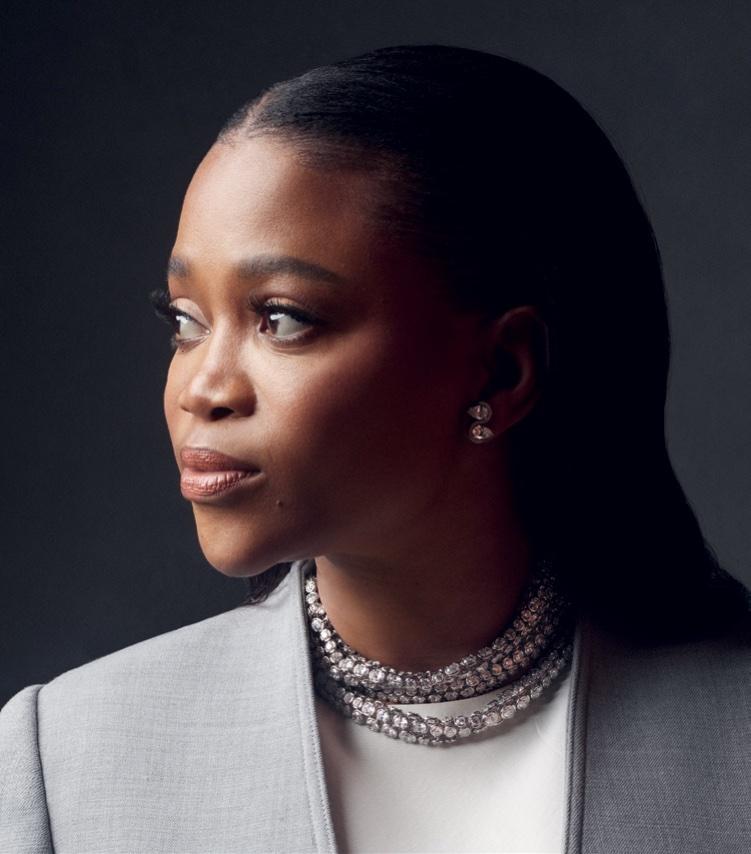
contracts with the Okavango Delta Company to commit to adopting a village and bringing o -grid and DSE solutions to those communities. Our goal is not only to grow the diamond industry but also the broader mineral economy and its contribution to GDP and to employment.
Most importantly, we’ve been saying that we’ve been mining for over 58 years, but we don’t have a mining industry, one that supplies the lubricants, flocculants, and machinery that go into mining. Now we are going to be so deliberate about using the mines as anchors for industrial development. The President recently approved it and will share it with the wider public. It’s about value chain and supply chain development, supply chains that ensure we bring jobs and industries into Botswana and export them. We can’t boast about being one of the largest and best mining jurisdictions in the world if we do not have an industry that supports us. It only makes sense that we champion mining industrialization, and that’s something I am working on around the clock. Just 24 hours ago, we reopened a mine. I was in Botswana, wearing PPE and steel-toed shoes. I was talking about nickel, cobalt, and downstream processing, and how we want to create a metallurgical hub there. Then, 24 hours later, I was wearing diamonds and decked out in a gown and heels for the Jared film premiere. It’s the juxtapositions in this role that keep it interesting but also remind me of the breadth of the role and how it plays in the economy. I hope we can strengthen the role mining plays in Botswana’s economy. While some argue we should diversify, I think there’s still potential for diversification within mining itself that we can make to catalyze the rest of the economy.
OND: How do you see sustainability playing a role in the future of Botswana’s diamonds and also Botswana’s mining industry as a whole?
Minister Kenewendo: Sustainability starts with the people. We must amplify the voices of women, children, and young people. We must create a space that nurtures dreams and creates opportunities for development and innovation.
From an environmental perspective, we are already there. A third of our land mass is reserved for conservation, a third! We have the largest herd of African elephants in the world. We have the largest inland delta in the world. These are things we usually don’t talk about, but we should be bragging about, because you will not experience a better safari than in Botswana. So, what could be better than to buy a Botswana diamond, then go on honeymoon in Botswana? It is an organic luxury.
From an environmental perspective, we are already there. A third of our land mass is reserved for conservation – a third.
OND: Full circle.
Minister Kenewendo: That’s what the House of Botswana is about, sharing how organically we have kept and produced our diamonds and our tourism. We ethically source and are responsible miners, and we are committed to being sustainable traders of our diamonds.
OND: What do you want people to know about diamond mining that is often misunderstood?
Minister Kenewendo: First, that diamond mining is methodological. For those who have been to museums, a diamond mine looks like the Guggenheim. It is so well curated and methodologically built. There is no child holding a pick and going into a hole somewhere. No. Everything is done with enormous machinery. It’s not even underground; it’s all open air, as is the case for the majority of mines in Botswana. You can look down from any point and see the entire mine. We’ve had women who were once cleaners in the mine who now drive heavy-duty Kimberlite trucks. They joke that now they work in an o ce because the truck is filled with light. They are built by Mercedes Benz and have air conditioning. I know that people imagine manual labor when they think about a mine. These are hardworking, decent people in the mines who simply want to provide for their families in a structured and safe manner. That’s what diamond mines o er. We o er natural diamonds to the world for all those who want to share in the promise of love and the promise of a future with collective prosperity.
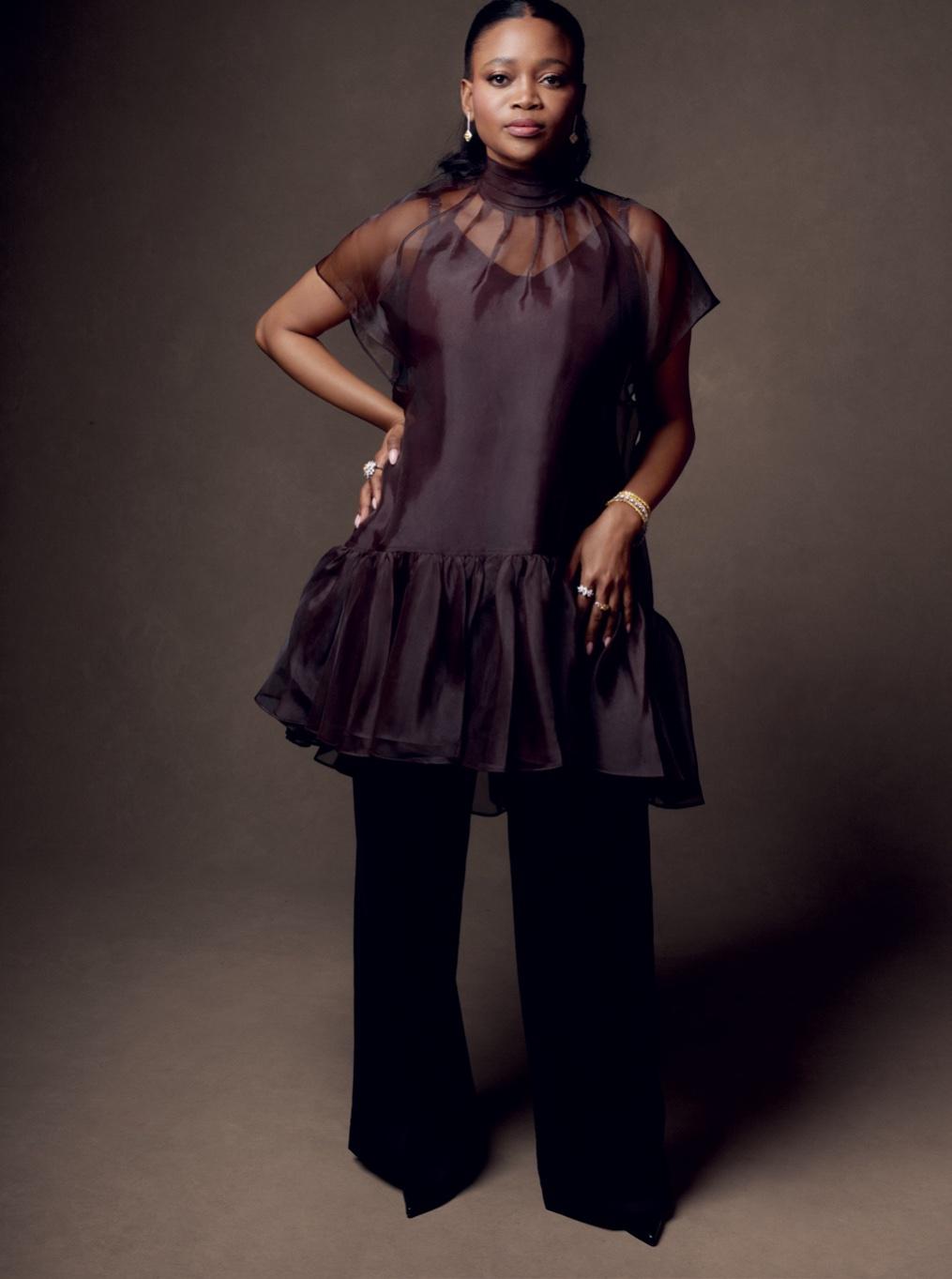
MURPHY HAS BEEN THE DEFINING FACE OF ESTÉE LAUDER FOR 25 YEARS, A RARITY IN AN INDUSTRY BUILT ON CONSTANT TURNOVER. HER ROLE WITH THE BRAND HAS TRACED BEAUTY ACROSS ITS EXTREMES: FROM THE STRIPPEDBACK MINIMALISM OF THE 1990S TO TODAY, WHEN SKINCARE HAS BECOME A CENTRAL FOCUS OF BEAUTY.
BY MAGGIE MORRIS
PHOTOGRAPHED BY
FELIX COOPER
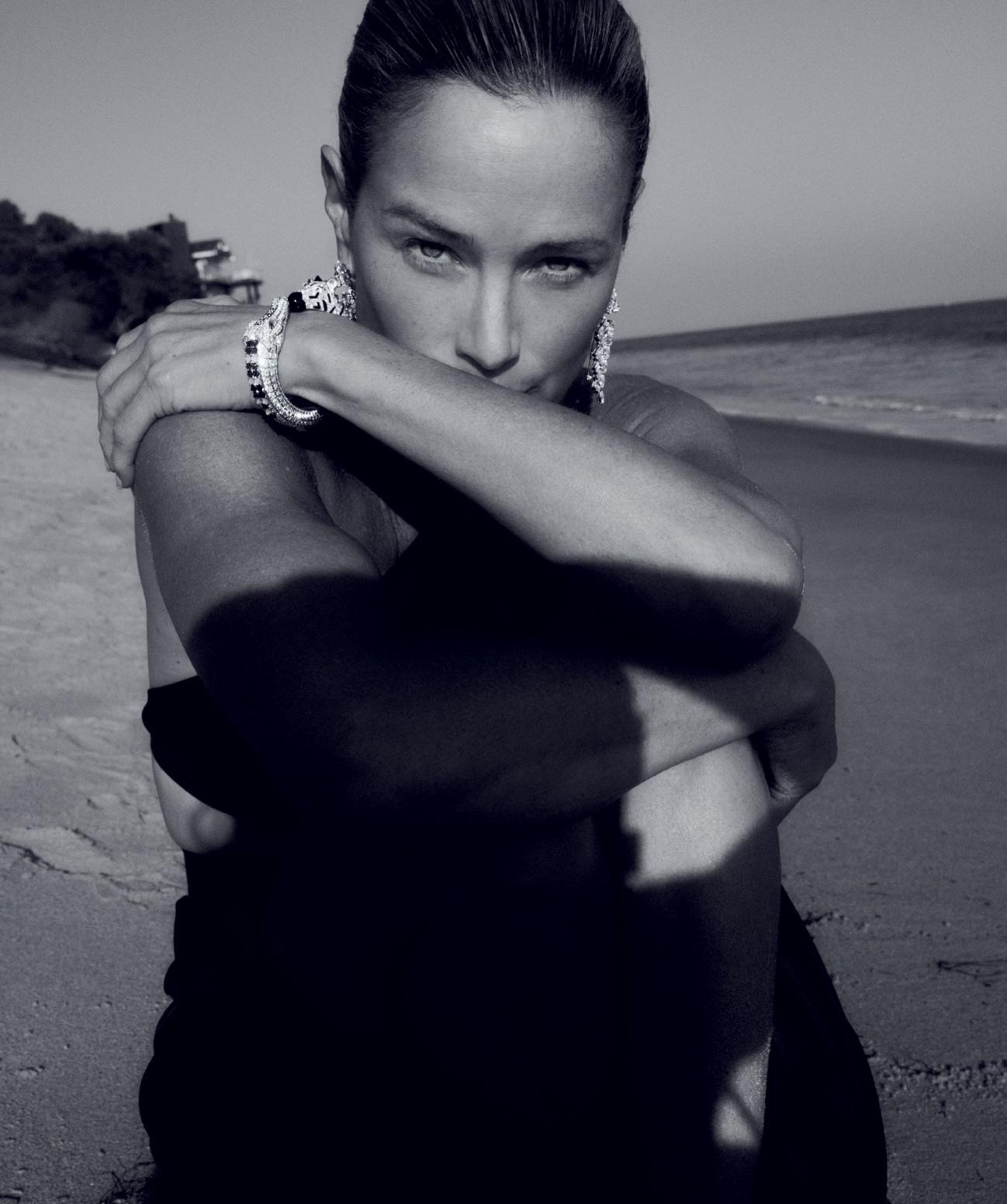
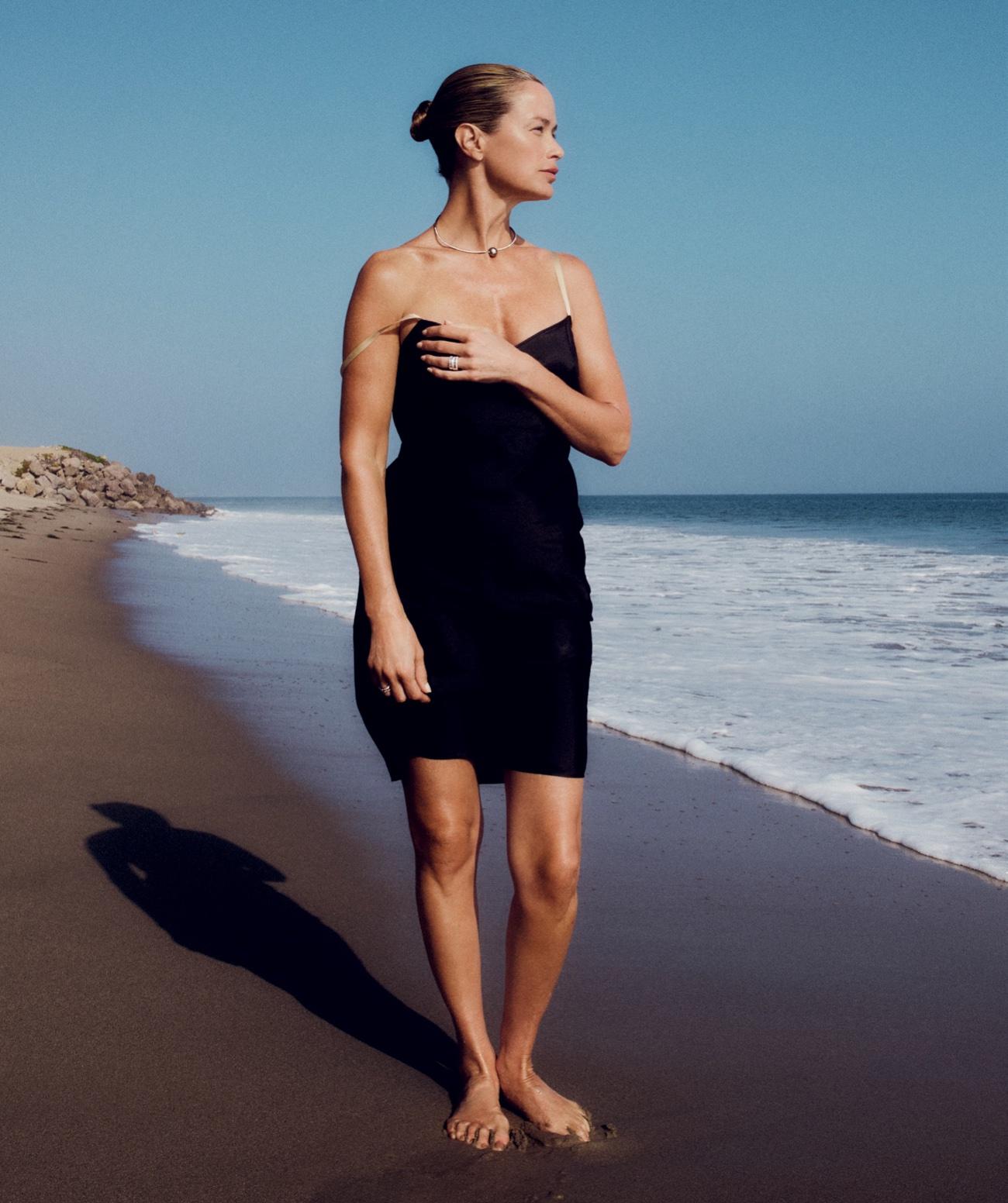
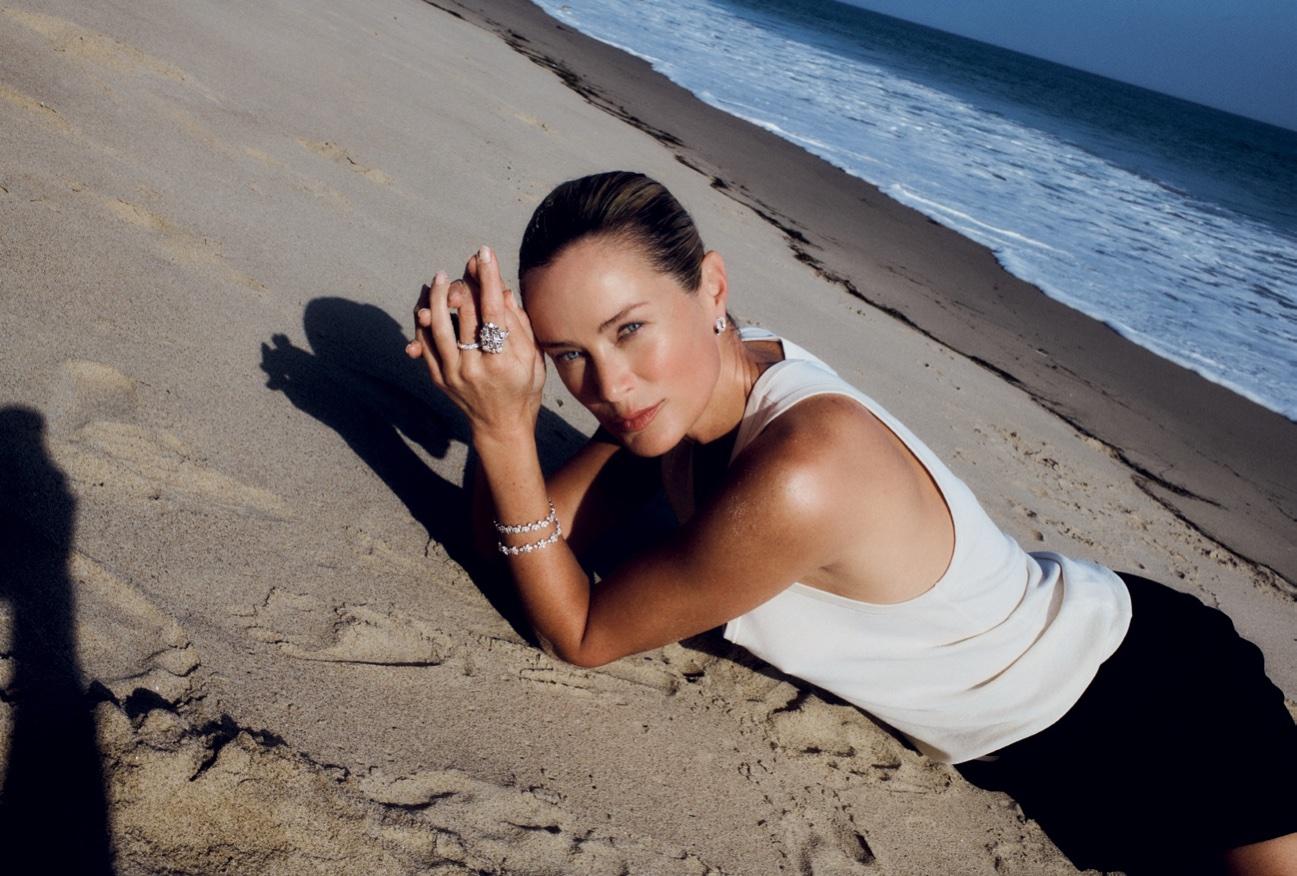
Opposite page: TENTHOUSANDTHINGS
Carolyn Murphy arrived in New York in the early 1990s, she was told she was “too pretty” to model. She didn’t feel like she fit in. The industry was undergoing its own kind of reduction: the excess of the ‘80s Naomi, Cindy, Linda, Christy glamazon era had receded, replaced by an edgier, minimalist style.
“It didn’t feel like an aesthetic at the time,” she says. “It felt more like a shift in attitude. Less performance, less decoration. You could just be.”
That sensibility came rushing back during our shoot, when the stylist handed her a vintage Helmut Lang black slip dress. Murphy paused. “I had this dress,” she said. “This could actually be my dress. I sold mine a while back. Whoa, if that’s not some crazy sign.”
Stepping into it again, this time in Malibu, brought back visceral memories. Paired with a diamond choker from downtown darlings Ten Thousand Things, the look echoed the kind of understated, quietly iconic jewelry that defined the 90s. “I wore that dress to death, walking around New York in the ’90s in my Chinese slippers from Pearl River,” she says. “That minimalism—it’s just so easy. I thought I was so cool then.”
Early on, working closely with designers like Calvin Klein and Miuccia Prada, she found herself inside what she describes as a shared language of restraint. Minimal, but not empty. There was also, she notes, a sense of mystery that’s harder to access now. “You weren’t constantly visible the way you are now with social media,” she says. “That gave everything a kind of depth.”
At a time often mythologized for its edge, Murphy’s experience was more complicated. She has spoken openly about the anxiety she felt early in her career, and the ways she sought stability outside of the industry and the grunge culture of that era. Her agent, Ivan Bart, recognized something in her that she couldn’t yet see in herself. “I realized I could go one of two ways,” she says. “I could jump on the bandwagon with everybody else…Or I could go this other way.”
The path she chose was quieter and, at the time, unconventional. She worked with a nutritionist, a Reiki practitioner, and a life coach long before those choices were widely embraced. For her, it wasn’t about image. It was, as she puts it, survival. Her decision to orient inward rather than outward became a kind of compass. “From there, my world
Van Cleef & Arpels High Jewelry necklace and earrings, Chanel High Jewelry bracelet. Helmut Lang vintage t-shirt, Yana the Archive, Eres swimsuit.
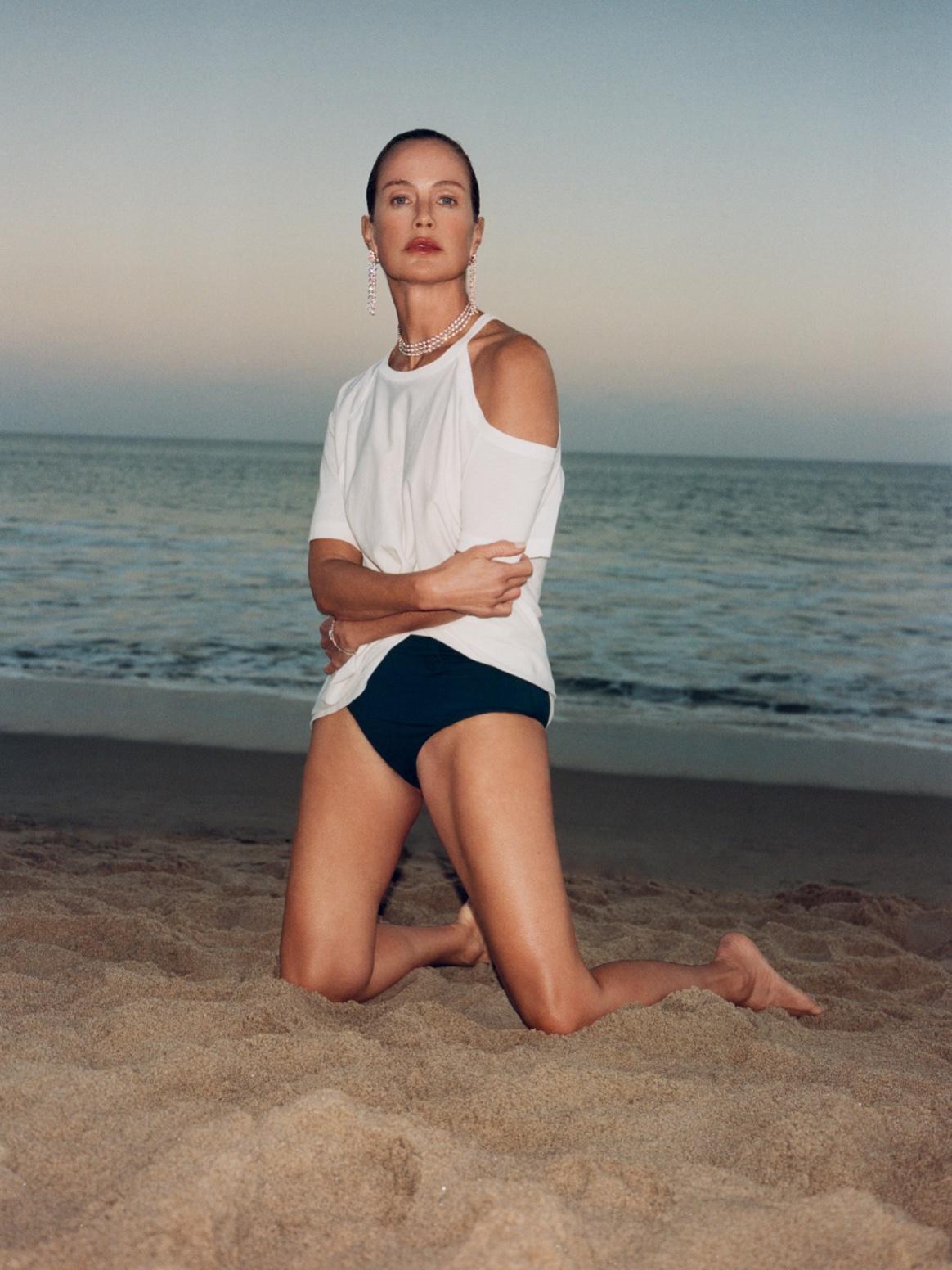
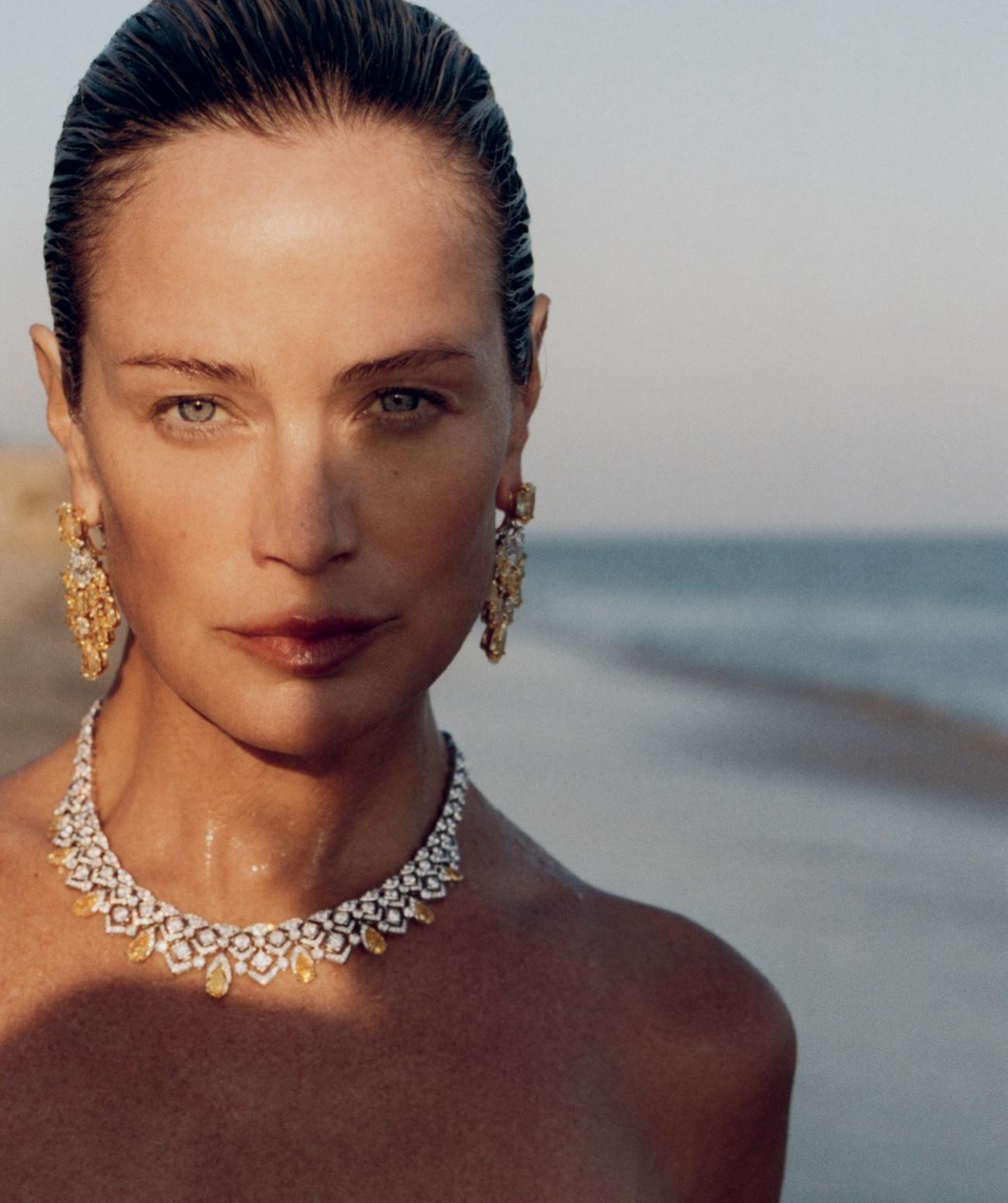
High Jewelry.
Opposite page: Gra High Jewelry.
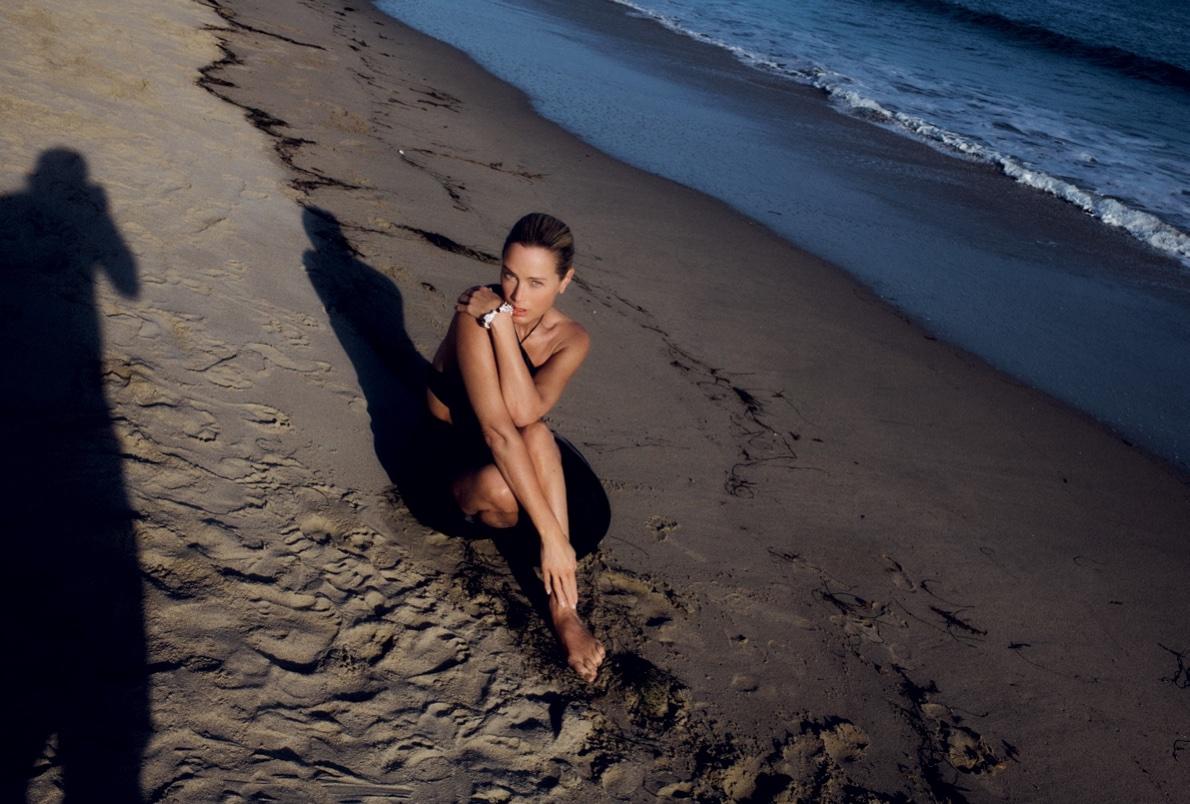
started to open. I booked more jobs,” she says, “because your internal reflects your external.”
The work followed, but it never felt disconnected from that foundation. She collaborated with Narciso Rodriguez and was photographed by Helmut Newton, Irving Penn, and Steven Meisel. She became the first model to appear in a campaign for Harry Winston, marking a shift for the house, which had previously focused solely on the jewelry. Still, success did not immediately translate into self-assurance.
“I was not aware of my capabilities then,” she says. “When things were going well, I’d think, ‘Oh my God, this is too good to be true. Is the other shoe going to drop?’ When I did a film with Barry Levinson, they said, ‘She’s the new Grace Kelly.’ It was too much. I ran from Hollywood. I wanted to be normal. I wanted to get married and have babies. I didn’t want to be famous.”
Her Estée Lauder contract arrived during one of the most dicult periods of her life. “I’d just had a baby. I was going through a divorce,” she says. “It felt like an angel was looking over me, giving me this opportunity that allowed me to spend more time with my daughter. I was a real single mom. The mother, father, breadwinner. I was totally alone.”
Looking back, she describes the ’90s as a time of rawness and purity in beauty—minimal, stripped back, with space for individuality. Today, beauty moves across di erent expressions. In fine jewelry, it’s about light, craftsmanship, and adornment. Skincare brings it inward. What reveals itself isn’t transformation so much as integrity—something that isn’t forced but revealed gradually.
Murphy speaks candidly about how her understanding of herself has shifted over time, including her relationship with confidence and self-worth. External success did not automatically translate into internal certainty. More recently, she recalls a message from Diane von Furstenberg that stayed with her: You don’t realize how incredible you are. I wish you could see that.
“I was like, whoa,” Murphy says.
The moment didn’t resolve anything definitively, but it marked a recognition of how long it can take to fully inhabit the life you’ve built. That process has been shaped, in part, by loss. Murphy’s home in the Pacific Palisades was destroyed in the California wildfires, along with decades of belongings. “Luckily, we got our jewelry out,” she says, then goes on to describe the pieces that mean the most to her.
Her first diamond pendant, given to her at sixteen by her parents, felt like a rite of passage. “I felt so grown up,” she says of that first necklace. Later, a pair of diamond studs at twenty-one and her great-grandmother’s treasured pearls were worn in a graduation portrait. She has continued these rituals with her own daughter as she has reached those same milestones.
That language—of meaning, of memory—extends into her professional life as well. She recalls the experience of being entrusted with significant pieces, of wearing them not just as adornment but as something with symbolic weight: among them, a one-of-a-kind choker and a princess ring gifted to her by Harry Winston.
As she’s telling me about this, she jumps up, disappears, and returns to show me a vintage gold bracelet covered in diamonds. Her face lights
Gra High Jewelry.
Vivienne Westwood
vintage jumper, Yana the Archive.
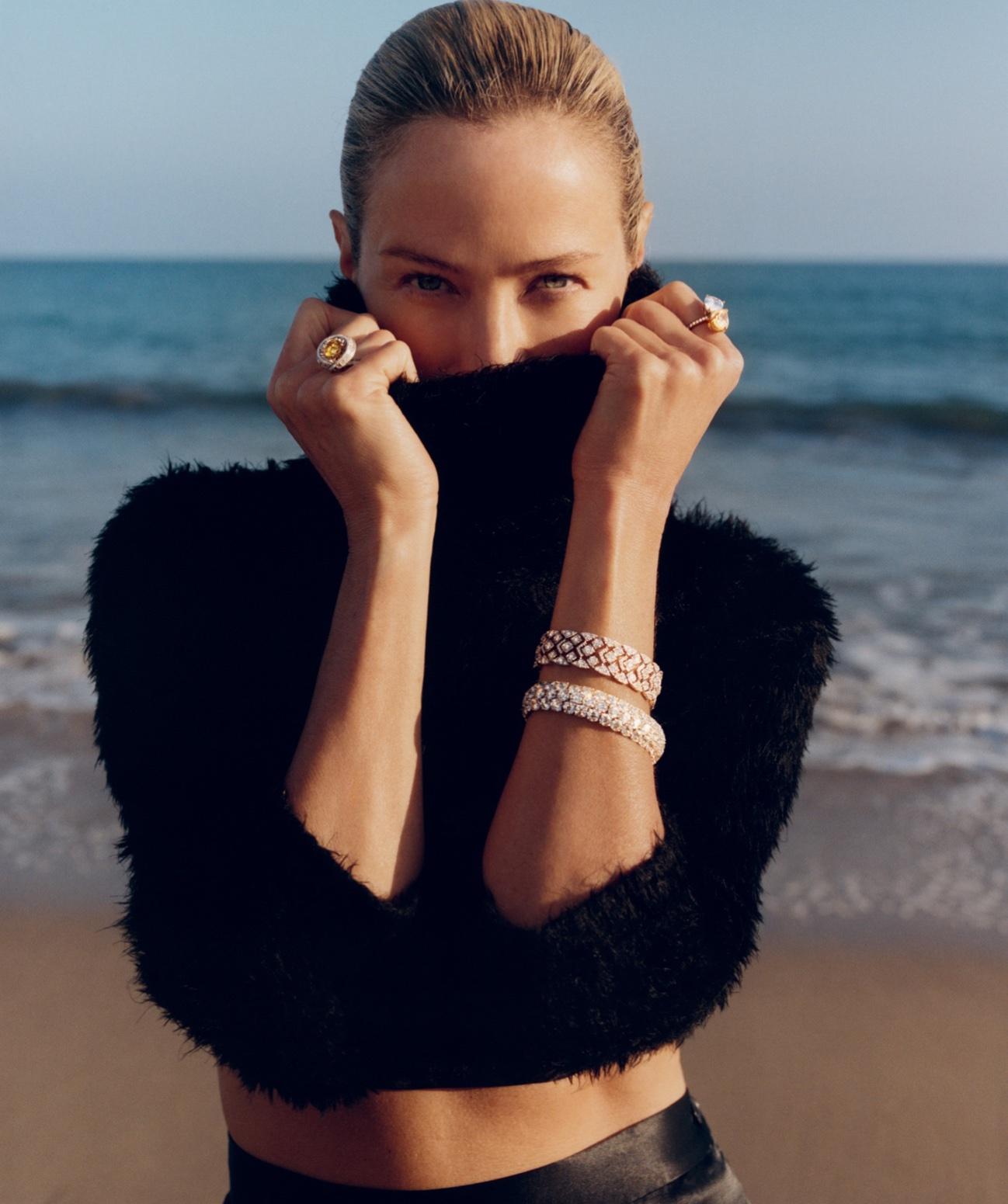
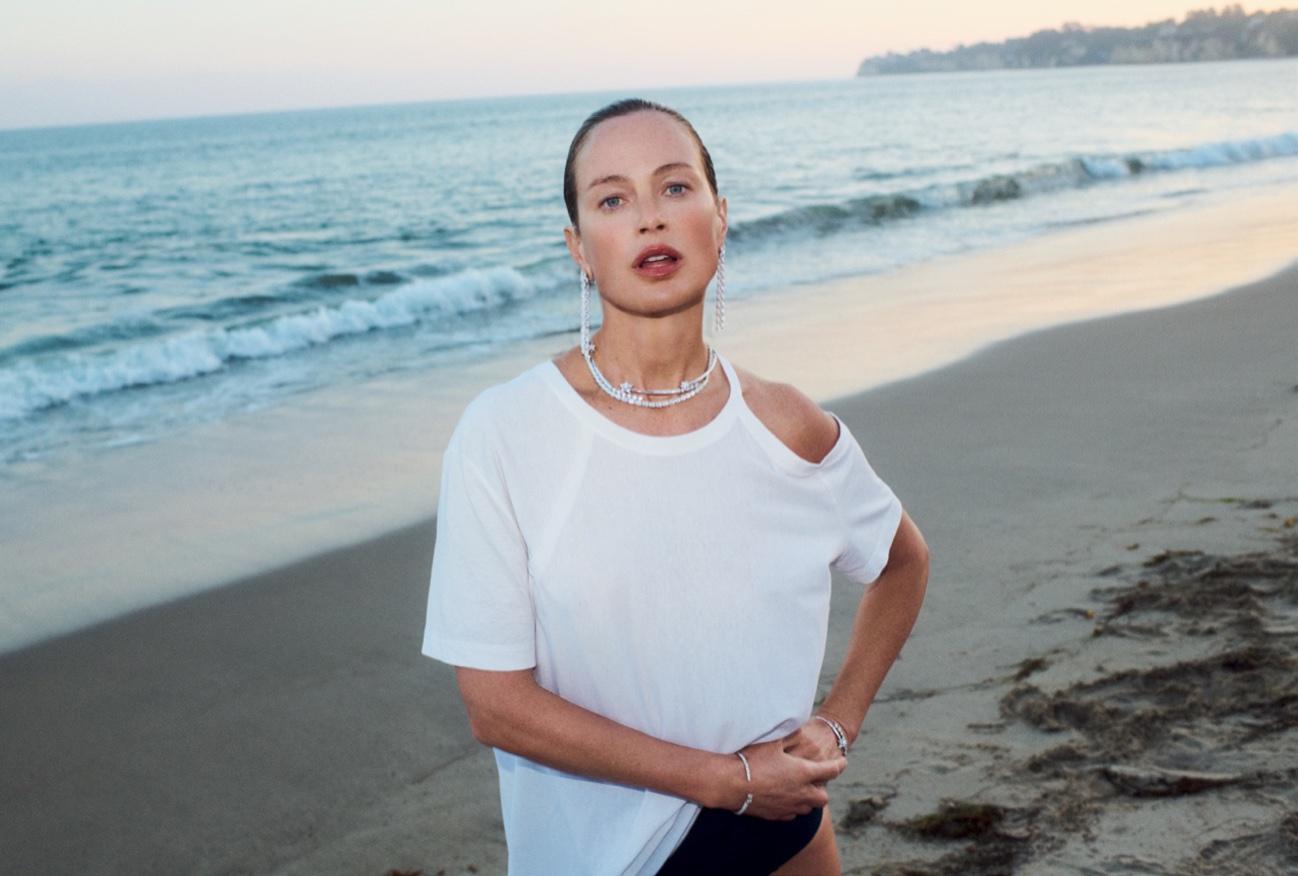
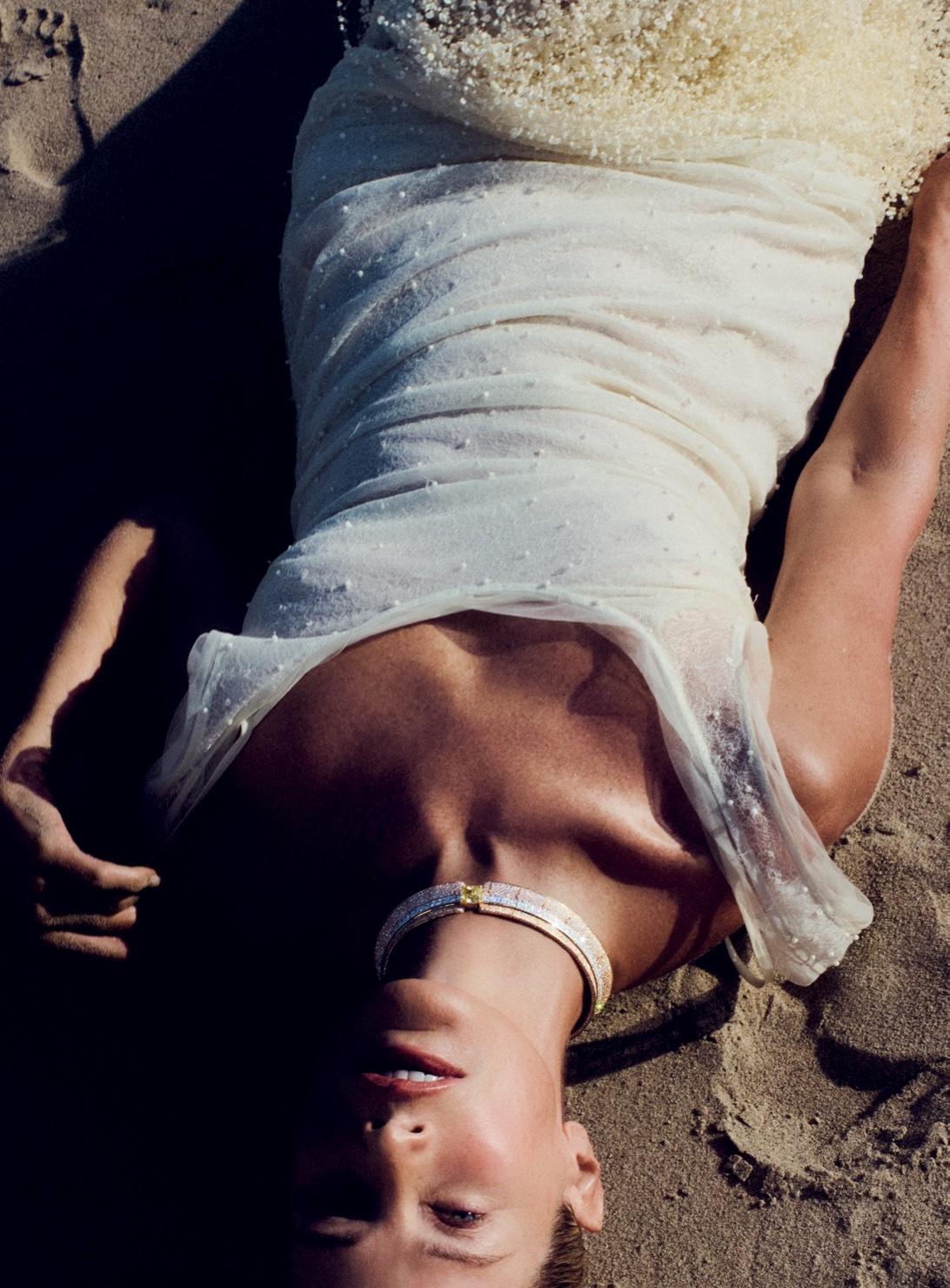
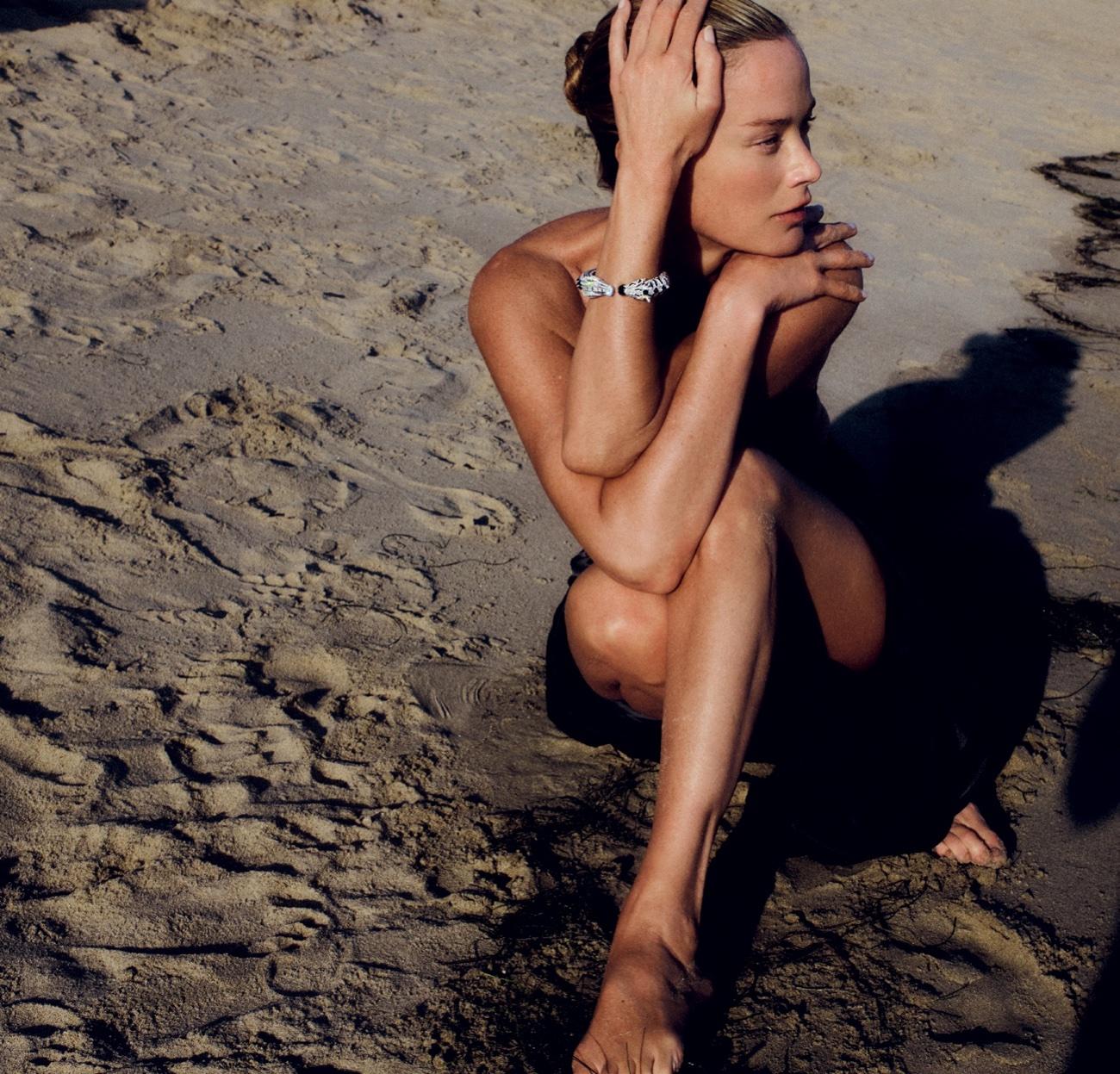
up when she tells me the story of Leonard and Evelyn Lauder giving it to her following a personal appearance tied to her family’s military history. What stayed with her was not the value of the piece, but the gesture behind it. “It’s a symbol of our relationship. With the Lauders, there’s a reciprocal loyalty. This gift was such a beautiful gesture. It always makes me feel cherished.” With that word, cherish, there’s trust, something more enduring. It’s di erent from adoration. For Carolyn, feeling seen and held in that way matters far more than the jewels themselves.
The fires forced a shift in her perspective. A narrowing of focus, a clearer sense of what actually matters. Something reflected in the jewelry still with her, and something embodied in the way she cares for herself and her skin. That idea—of evolution rather than preservation—feels especially resonant now.
Recently, Murphy has been part of a longevity panel assembled by Estée Lauder. Sitting at Stanford alongside top doctors from around the world has ignited a personal integration of modern science with self-care and beauty practices from the ‘70s wise woman practices taught to her by her mother.
Her posture changes when she talks about this – she sits up taller, talks faster. “I geeked out learning about the science behind the molecular structure of the skin and the Re-Nutritive (Ultra Diamond Collection) creams and serums,” she explains. “It’s much more than creating products. Our skin is our largest organ, and it’s a reflection of us. And rather than seeing it as anti-aging, it’s embracing aging. You’re not going to change it. It’s going to happen. So how do you choose to experience that along the way, how do you choose to embrace the inevitable?”
Murphy’s perspective feels almost countercultural. In an industry defined by what’s next, she isn’t trying to hold time still, but to move with it—to understand what deepens rather than what disappears. Skin, like a diamond, is not defined by its surface alone, but by its history and what lies beneath it—its structure, its composition, the way it holds light. Beauty with that kind of luminosity isn’t instant. It’s cumulative. And like her career, it endures not because it resists change, but because it allows it.
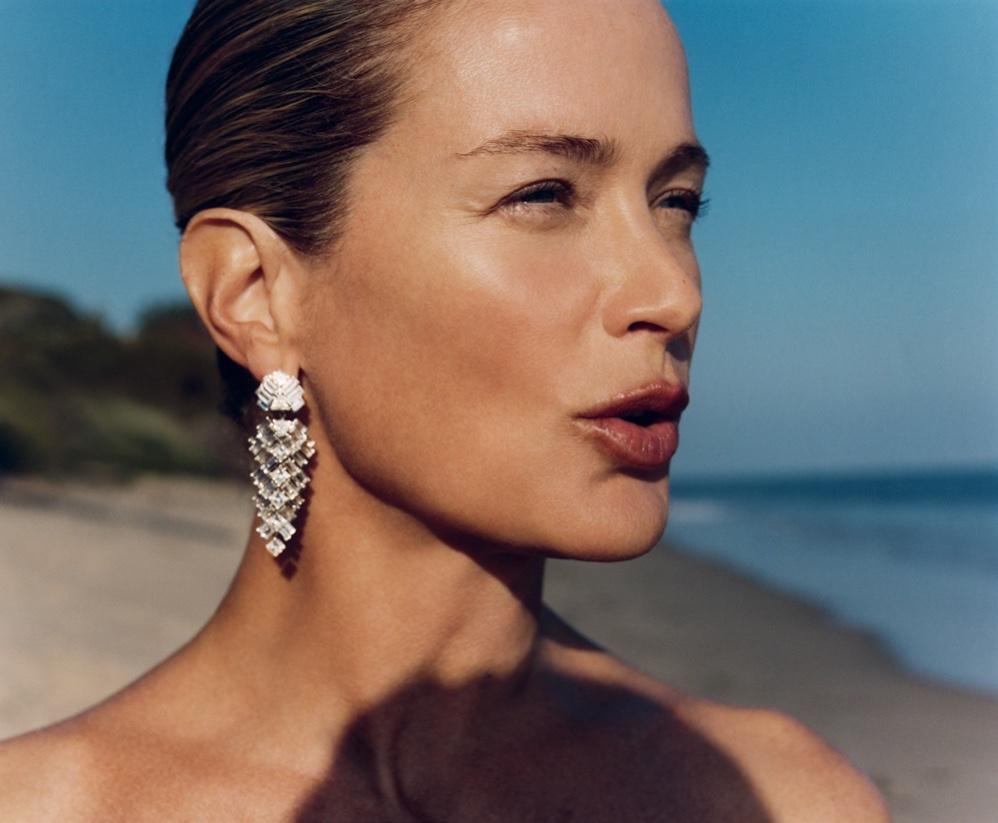
Cartier High Jewelry. Calvin Klein top.
Opposite page: De Beers High Jewelry. Jonathan Simkhai dress.
Photographer, Felix Cooper; Stylist, Michelle Cameron; Creative Director, Lizzy Oppenheimer; Hair Stylist, Ramsell Martinez; Makeup Artist, Francelle Daly; Manicurist, Alexandra Jachno; Creative Production, Petty Cash Production; First Assistant, Steve Yang; Second Assistant, Victor Prieto; Digital Tech, Jimmy Fikes; Styling Assistants, Andrii Panasiukk, Hannah Loewen; Makeup Assistant, Madrona Redhawk; Tailor, Neli Abrahamyan.
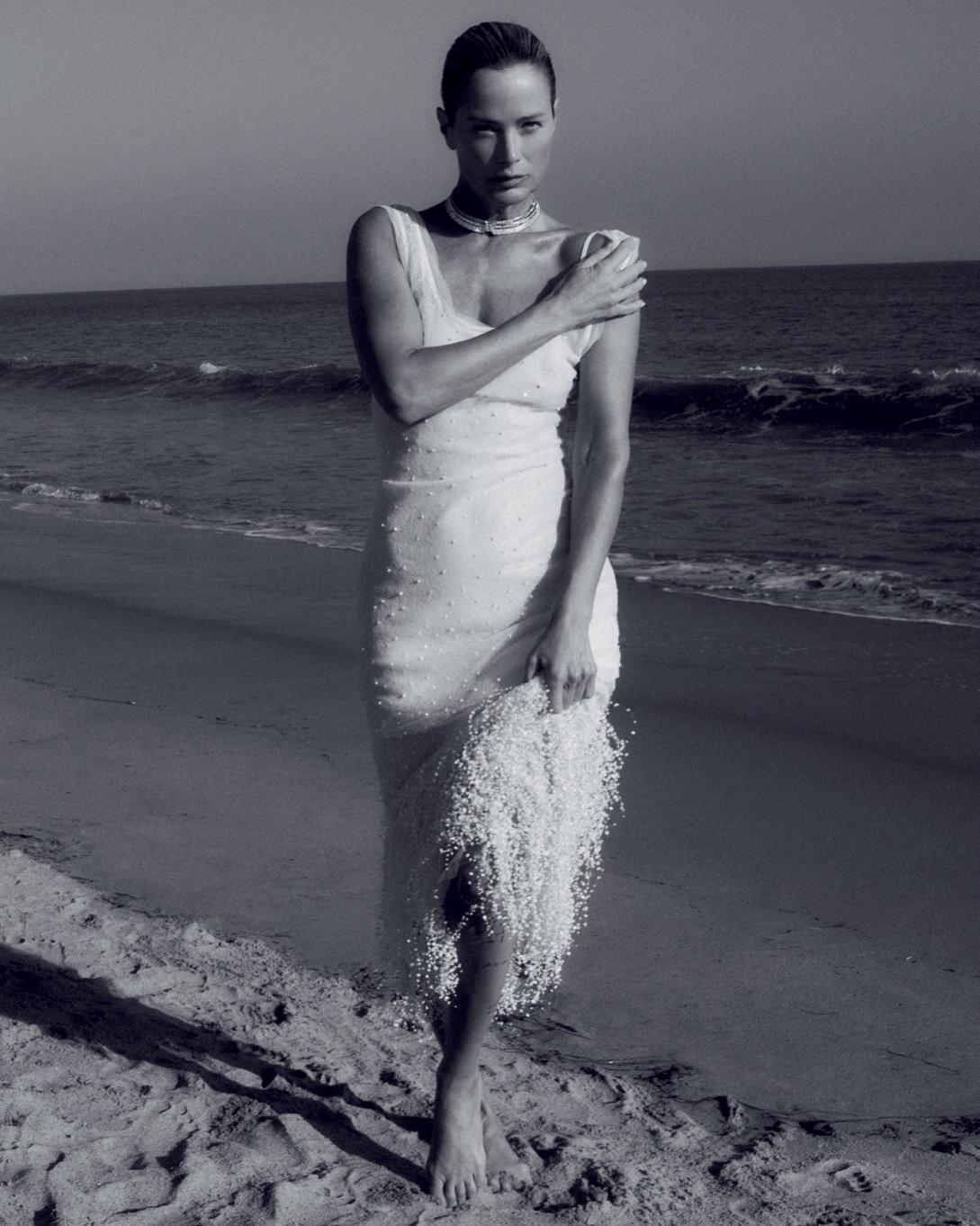
A PRIVATE VISIT TO DRESDEN CASTLE OFFERED A RARE CHANCE TO SEE THE LEGENDARY DRESDEN GREEN DIAMOND UP CLOSE, WALK THROUGH THE GREEN VAULT WITH ITS CURATOR, AND HEAR FIRSTHAND HOW ONE OF THE MOST AUDACIOUS JEWEL ROBBERIES IN MODERN HISTORY UNFOLDED
BY BENJAMIN BOUCHET
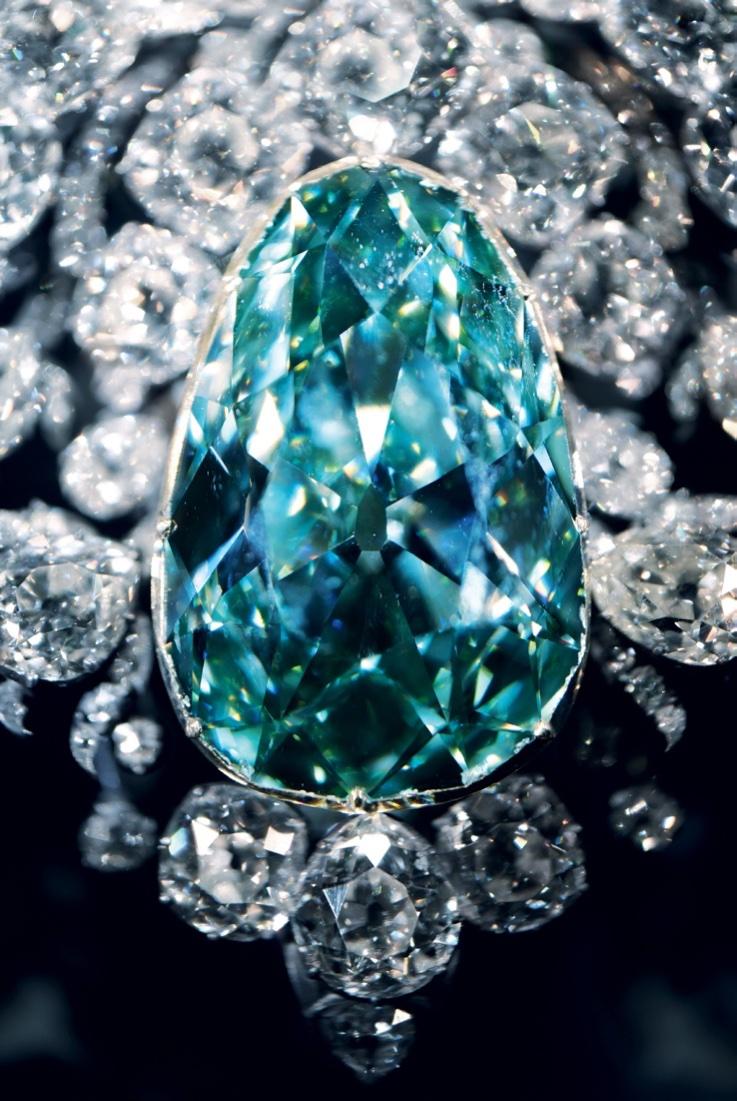
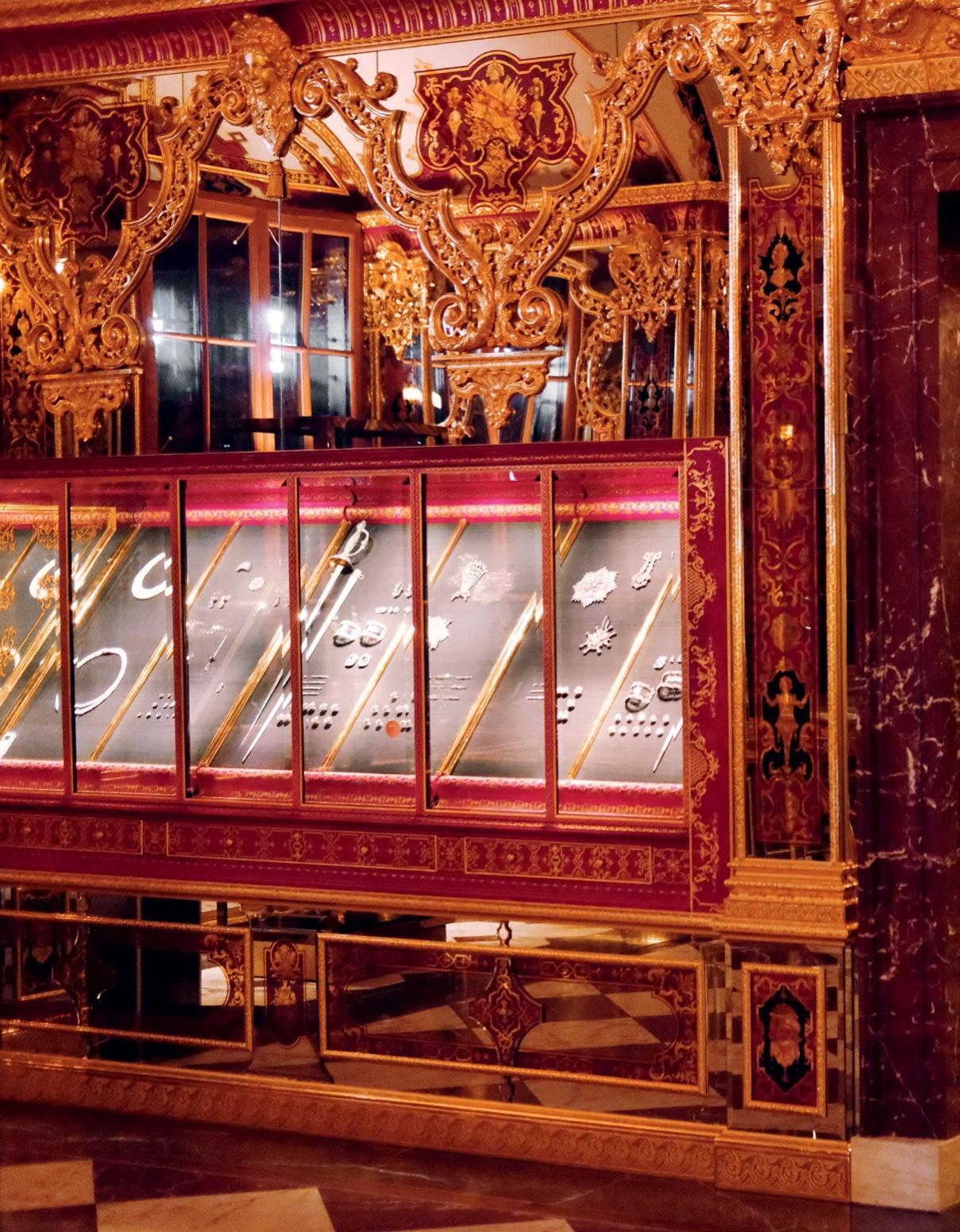
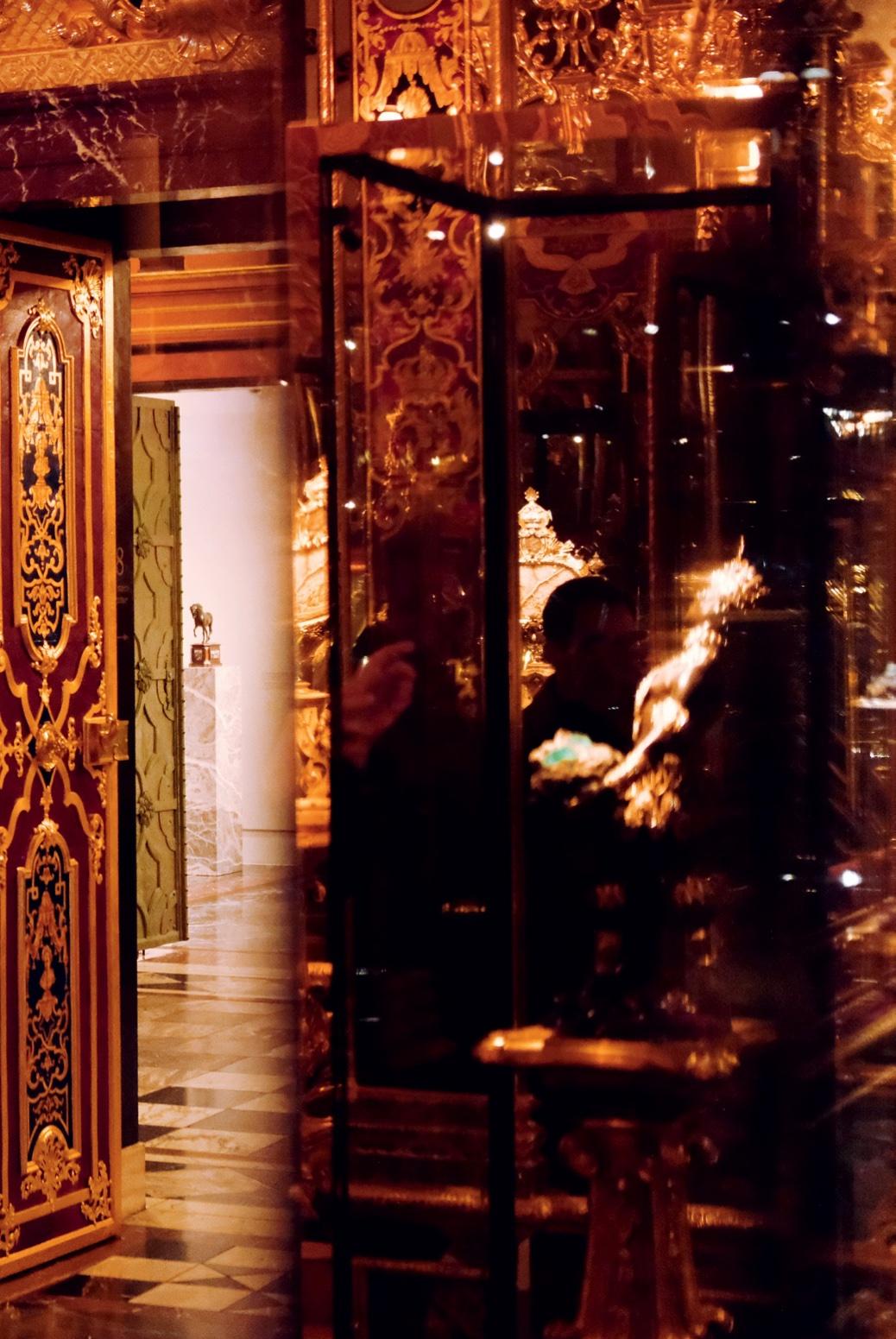
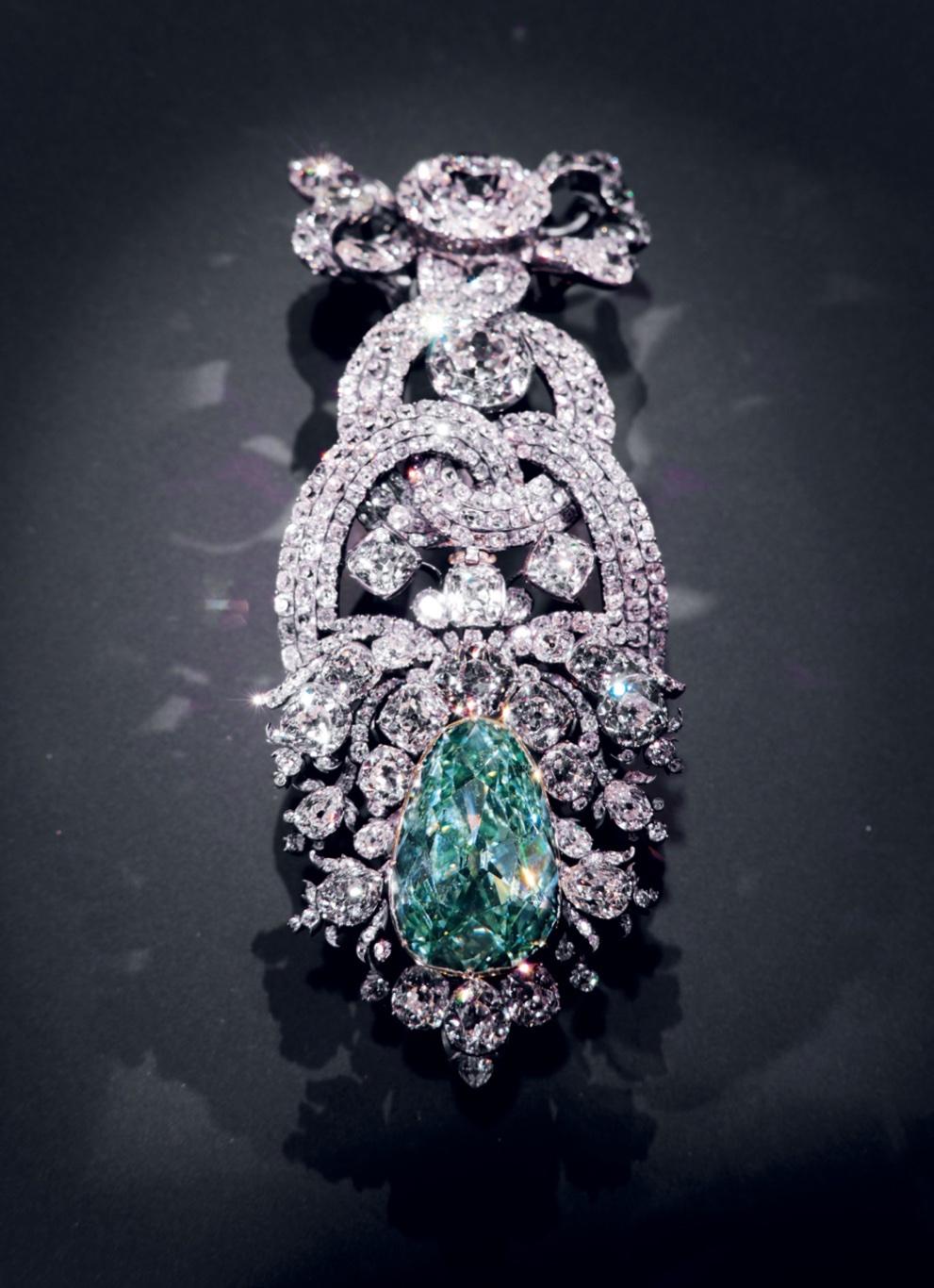
There are a handful of diamonds that move beyond gemology and into mythology. For me, the Dresden Green Diamond has always belonged at the very top of that list. So when the museum invited Only Natural Diamonds to visit Dresden Castle on a day the Green Vault was closed to the public, to see the diamond privately and speak directly with curator Dirk Weber, I did not need a second invitation.
Photographer Benjamin Bouchet and I met Weber on a quiet Tuesday morning. Instead of entering through the grand public entrance, we slipped in through a secure door tucked discreetly along the side of the castle. That small detail immediately changed the experience. This was not going to be a normal museum visit. We were going behind the scenes at one of Europe’s great treasure houses, and the first stop was the one I had waited years to see properly.
The Dresden Green Diamond now lives in a dedicated room on the second floor of Dresden Castle, in the section known as the New Green Vault. That distinction matters. The original Green Vault, the historic treasury for which the diamond is famous, sits on the first floor of the castle. The diamond itself, however, occupies its own space upstairs. You enter the room, and the ceiling glows faintly green. Ahead, an illuminated square seems to have been cut directly into the wall. And there it is: the Dresden Green. Even after all these years of reading about it, seeing it in person still feels unreal. The diamond’s natural green color has a very different e ect from what most people expect. It has an almost eerie calm, an apple-green tone created not by trace elements like boron or nitrogen, but by natural radiation exposure over immense stretches of geological time.
One of the first things I noticed was how impossible it is to understand the mechanics of the display case. In most museum cases, you can at least guess where the seams are, how the case opens, or from where one can access it. With the Dresden Green, there is no obvious answer. Out of curiosity, I asked Weber whether it drops into the floor, opens from behind, or perhaps connects to another hidden room behind. This, finally, was the one subject on which he smiled and declined to elaborate. Those, he told me, are secrets he cannot discuss.
That sense of mystery suits the diamond perfectly, because the Dresden Green has one of the greatest histories in the world of gems.
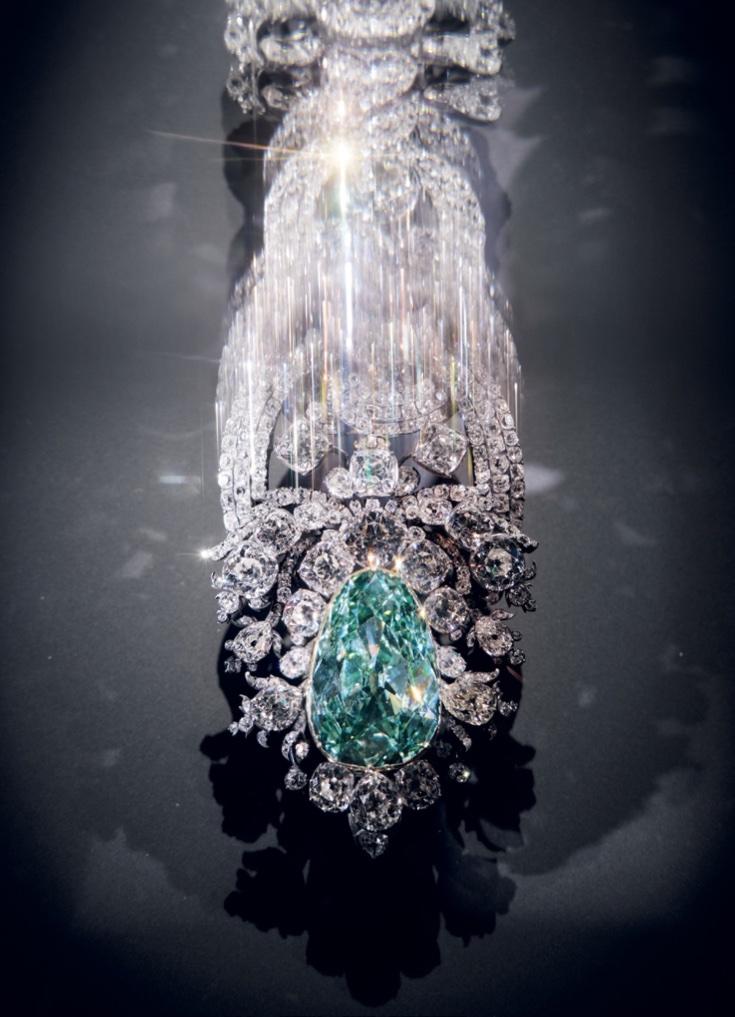
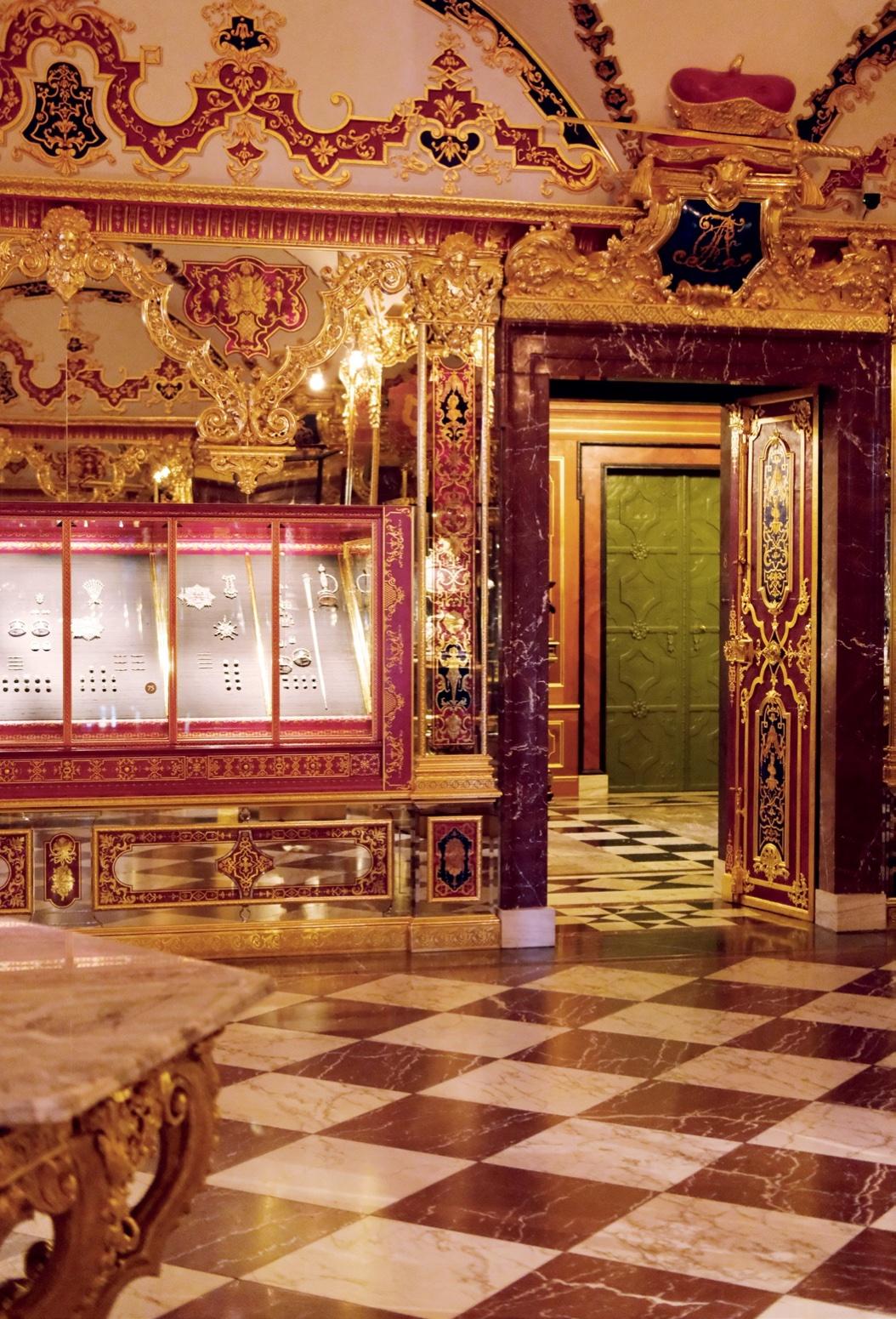
The diamond weighs roughly 41 carats and came from India’s Golconda region, the legendary source of some of history’s most famous diamonds. Its documented story begins in the early 18th century, when merchants o ered the stone to Augustus II the Strong, Elector of Saxony. In the end, his son and successor, Augustus III, secured the diamond in 1742 from a Dutch merchant. Weber told me that accounts from the time said he paid 400,000 thalers, roughly twice the cost of building Dresden’s famed Church of Our Lady in that same era.
By the mid-18th century, Dresden court jeweler Diespach mounted the diamond in the magnificent ornament it remains in today, surrounded by colorless diamonds in a setting that beautifully complements its green color.
Over the centuries, the Dresden Green survived political upheaval, war, and shifting empires. O cials removed it during the Seven Years’ War, evacuated the jewels again before the bombing of Dresden in World War II, and Soviet forces eventually returned the treasures in 1958 after taking them to Moscow.
Like so many people in the jewelry world, I followed the 2019 Dresden Green Vault heist obsessively. It was one of the most audacious jewel robberies in modern history. Thieves broke into the Green Vault in the early morning darkness, smashed display cases, and fled with an extraordinary group of 18th-century diamond jewels.
One widely repeated detail is that the Dresden Green escaped the robbery because it was on loan to the Metropolitan Museum of Art in New York. That is true in part, but speaking with Weber clarified something crucial that retellers often get wrong.
thick enough to truly safeguard the jewels would have made them nearly impossible to see clearly. As 2019 proved, that balance was wrong. Today, the museum uses replacement glass that provides dramatically higher security while still allowing visitors to see the jewels clearly.
Another detail that struck me came from Weber’s assessment of the thieves themselves. He said it was obvious that they were not diamond experts. Among the numerous groups of diamond-button ornaments, they took some of the less important examples rather than the most valuable ones, which a trained eye would have recognized immediately.
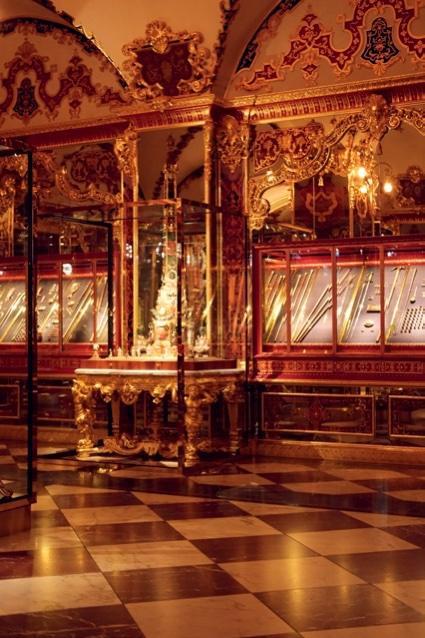
Even if the Dresden Green had been in Dresden that morning, he told me, the thieves never would have reached it.
The robbery took place on the first floor, in the Historic Green Vault. The Dresden Green sits on the second floor, in the New Green Vault. According to Weber, the criminals had only one path to the first-floor collections. So while fate certainly helped by placing the diamond in New York at the time, it was not actually the only reason the stone survived.
Still, the first floor proved far more vulnerable than people had assumed.
Weber explained that when the museum installed the original armored glass, technology forced a compromise between protection and visibility. Glass
In the days after the robbery, Weber and the museum team faced the painstaking work of inventorying what was missing. That meant going back through photographs and historical records, counting and measuring individual diamonds in jewels that sometimes contained more than a thousand stones.
Once Benjamin finished photographing the Dresden Green, Weber led us downstairs into the Historic Green Vault, the original treasury that had once housed the diamond itself for centuries. If you have never seen the Green Vault, it is di cult to convey just how beautiful it is. The rooms are lavish, theatrical, and unlike almost anything else. Artisans reconstructed them after wartime destruction, and walking through them makes it clear why Augustus the Strong created this place not simply as a vault but as a display of power, artistry, and wonder.
In the 18th century, it really did function much as it does today. While the rulers of Saxony lived upstairs, visitors could pay for entry downstairs and view the treasures. Standing there with Weber, looking at the same rooms and many of the same jewels, I kept thinking how extraordinary it is that people in the 1700s made essentially the same pilgrimage I was making now.
The museum has reopened since the heist, and curators have returned most of the recovered jewels to display. Yet you can still see damage in certain pieces, and you can feel the absence of those that never came back. Weber walked us through what thieves stole, what the museum recovered, what su ered damage, and what remains missing. Among the most painful losses are an extraordinary diamond bow brooch c.1782, stretching more than eight inches across and set with 662 diamonds; a magnificent diamond shoulder-knot ornament c.1728 featuring the famed 49-carat Dresden White Diamond, alongside a 39-carat diamond, a 21-carat diamond, and numerous smaller stones; and a grand double-layer diamond necklace set with 37 large
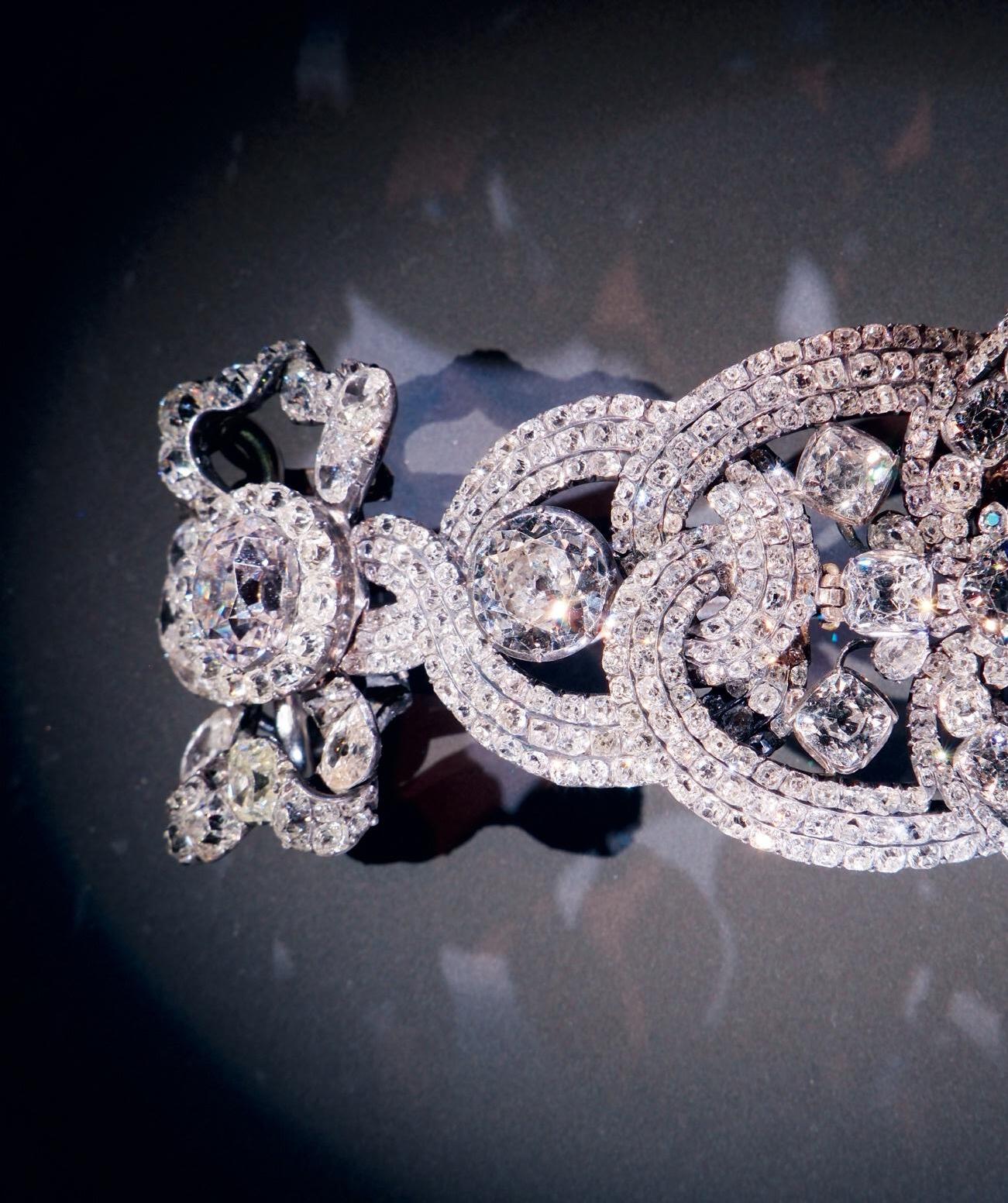
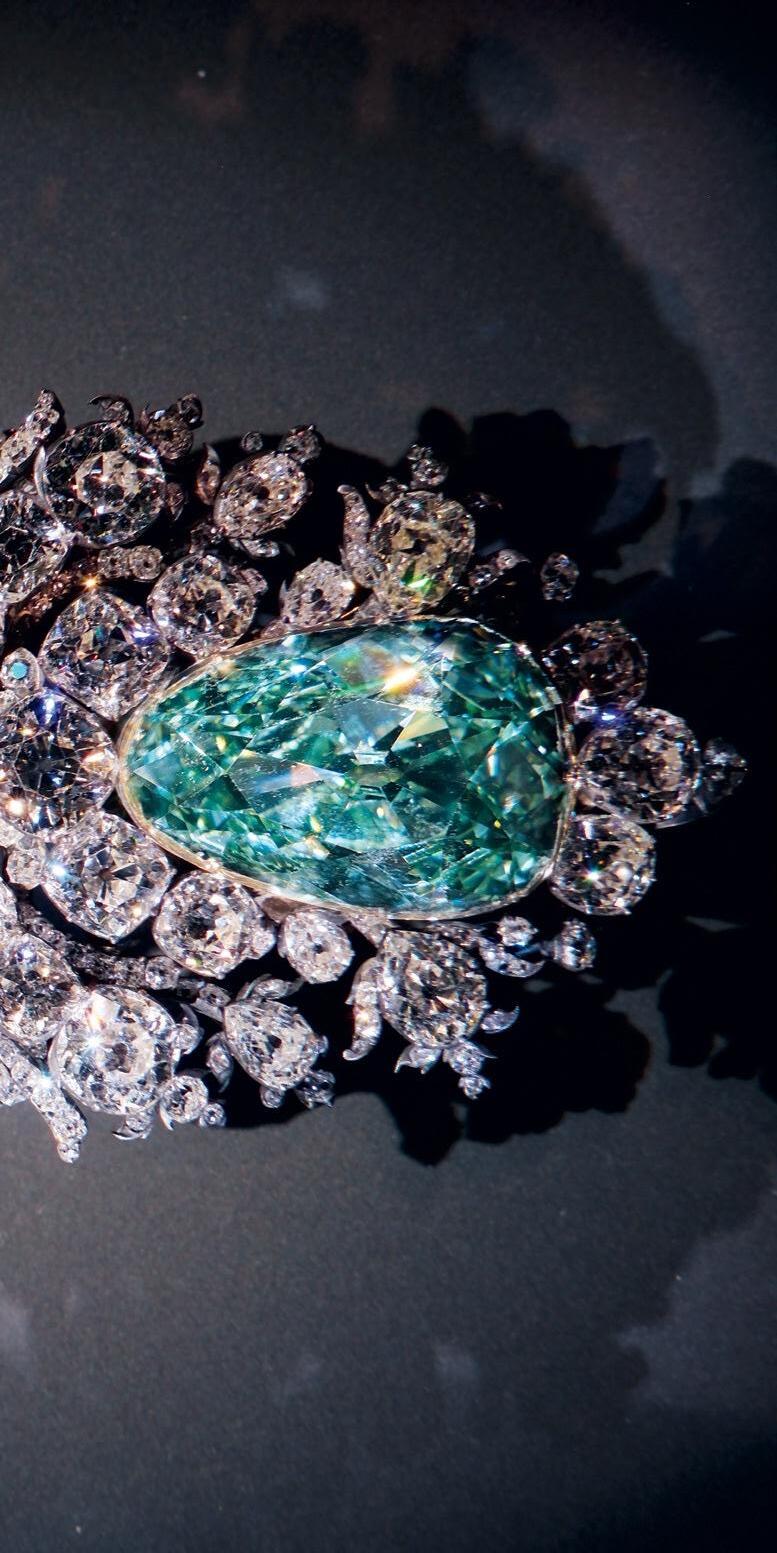
colorless diamonds, including one weighing more than 30 carats.
We spoke hopefully about the possibility that some of these works may one day resurface intact. But the brutal reality is that thieves often dismantle jewels, sell the stones individually, melt the metal, and sometimes even recut major diamonds to erase their identity.
And that is the great tragedy of crimes like this. These objects are not important simply because they contain natural diamonds. They matter because they carry the artistry, identity, and history of a culture.
By the time I left Dresden Castle that day, I felt even more strongly about the Dresden Green Diamond than I had before arriving. It remains, to my eye, one of the most extraordinary natural diamonds in the world. Not just because of its color, though that is astonishing. Not just because of its provenance, though that is nearly unmatched. But because it has survived. It has outlasted war, empire, theft, exile, and human error. It has returned, again and again, to the place where generations have admired it.
Having stood in front of it privately and heard its story from one of the very few people who has actually held it, I can say with even more conviction: the Dresden Green Diamond is not only one of history’s great diamonds. It is one of history’s great survivors.
TIFFANY & CO.’S CHRISTOPHER YOUNG, STYLIST KATE YOUNG AND DESIGNER KINDRED LUBECK, TELL US ALL ABOUT THE SPECIAL THINGS IN THEIR WORKSPACES
Christopher Young’s role at Ti any & Co. has a dual character, reflected in his epically long title: the Vice President Creative Director for Creative Visual Merchandising, Events and the Ti any Archives. In short, he is equal parts artist and scholar.
Unpacked, Young’s work involves overseeing The Archives and sharing his institutional knowledge through books, exhibitions and various special projects. The visual merchandising piece revolves around conceiving ideas for the famous windows at the Ti any Landmark in New York City and for displays in the network of stores. “I think that when my worlds collide is when I’m happiest,” explains Young. “It’s like that sense of creation and creativity, brainstorming and artwork, mixed with heritage and research and storytelling.”
1. The Little Chandelier
This is a very important object from The Archives that really does illustrate the crossroads of my two roles. It is one of the original chandeliers made by Gene Moore that is featured in the beginning of Breakfast at Ti any’s when Audrey Hepburn gazes into the windows.
2. “Double Poinsettia” Table Lamp and the “Jack-in-the-Pulpit” Vase
Part of what we do is to closely study the work of Louis Comfort Ti any, our founder, Charles
Lewis Ti any’s son. The “Jack-in-the-Pulpit” vase is similar to pieces that I have dotted throughout Ti any’s network from Ginza to Monte Napoleone, where we tell our heritage story through the installation of objects.
When the “Double Poinsettia” table lamp is not in use in a Blue Book installation or exhibition, I do like it in my o ce as a talisman of creativity. It has these glowing jewel tones of the poinsettia leaves, which I particularly love.
3. The Watercolor Set
I am a watercolor artist. I always have my
watercolor set open and ready for action at any point. The very New York painting on the floor, of a person having a reflective, introspective moment, is one of my personal pieces.
4. Blue and White Porcelain Bowl
When I was at the Wanglong studio in Jingdezhen, China, which has been a center of porcelain production for about 1,000 years, a master artist invited me to make a painting. In exchange for the artwork, he gave me the hand-painted blue and white porcelain dish for cleaning brushes. I treasure it.
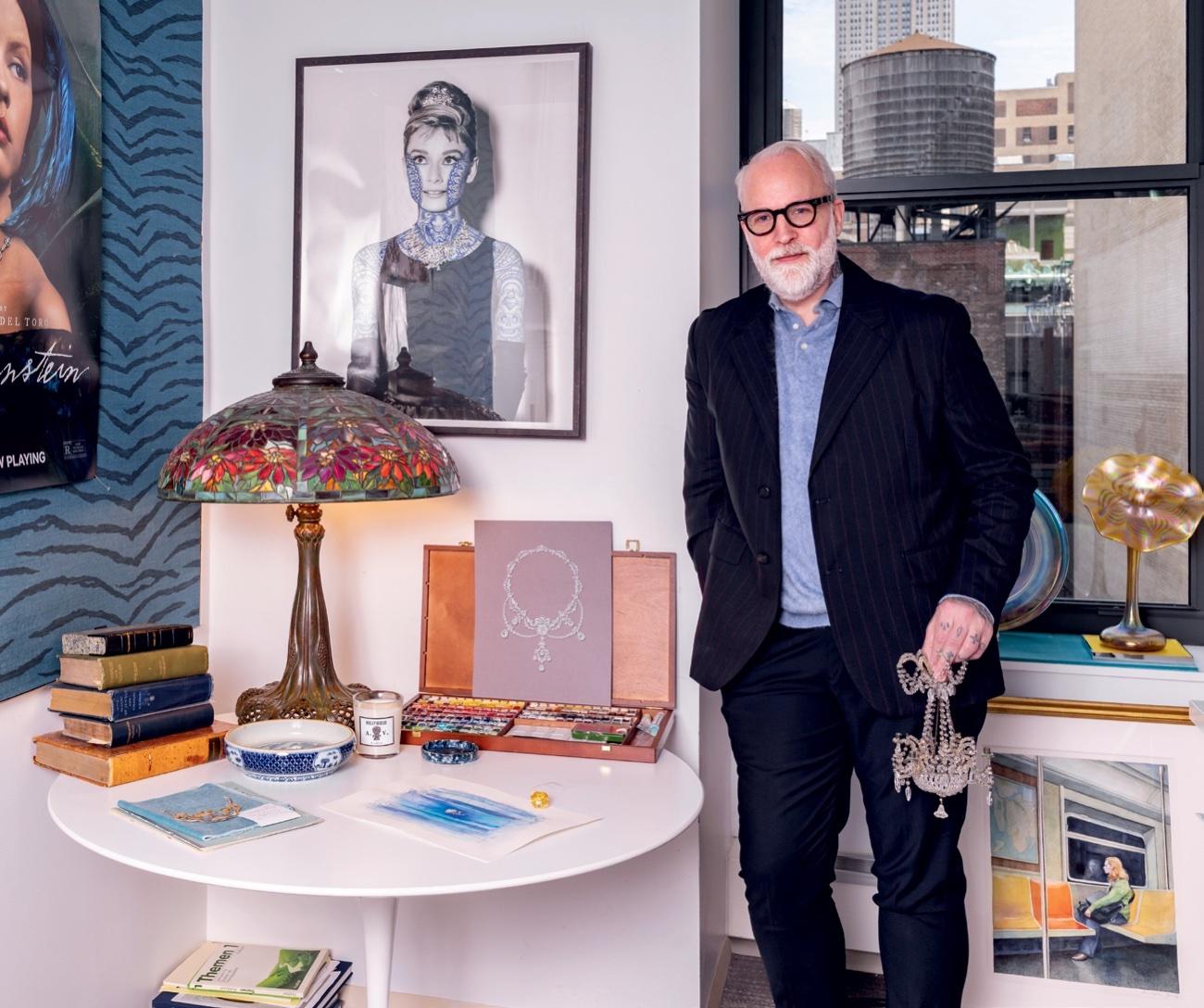
5. Vintage Books
Three of the antique books about nature come from the collection of Jean Schlumberger. He used them for inspiration and as visual reference material when designing jewelry at Ti any. The other book is The Magic of Jewels and Charms by Ti any’s first chief gemologist, George Frederick Kunz.
6. Replica of the Tiffany Diamond
Working with replicas and prototypes is a safe way to imagine photography and presentations. The Ti any Diamond is a facet for
facet CZ replica made by diamond expert Scott Sucher. Gal Gadot wore it set in a necklace in Death on the Nile
7. Art Image of Audrey Hepburn in her costume for Breakfast at Tiffany’s Ramon Maiden, an artist who translates photographs from the past with tattoo art, went to town with his little blue pencil on the Audrey Hepburn image. To me, it sheds light on a sense of innovation and surprise with tradition at Ti any’s.
8. The Frankenstein Movie Poster
I wanted the Frankenstein poster with Mia Goth wearing the Ti any Wade Necklace from The Archives in my o ce as a kind of symbol of the accomplishment that came with the collaboration with director Guillermo del Toro and costume designer Kate Hawley on Frankenstein. It lasted about two and a half years, ending with Kate winning the Oscar for costume design.
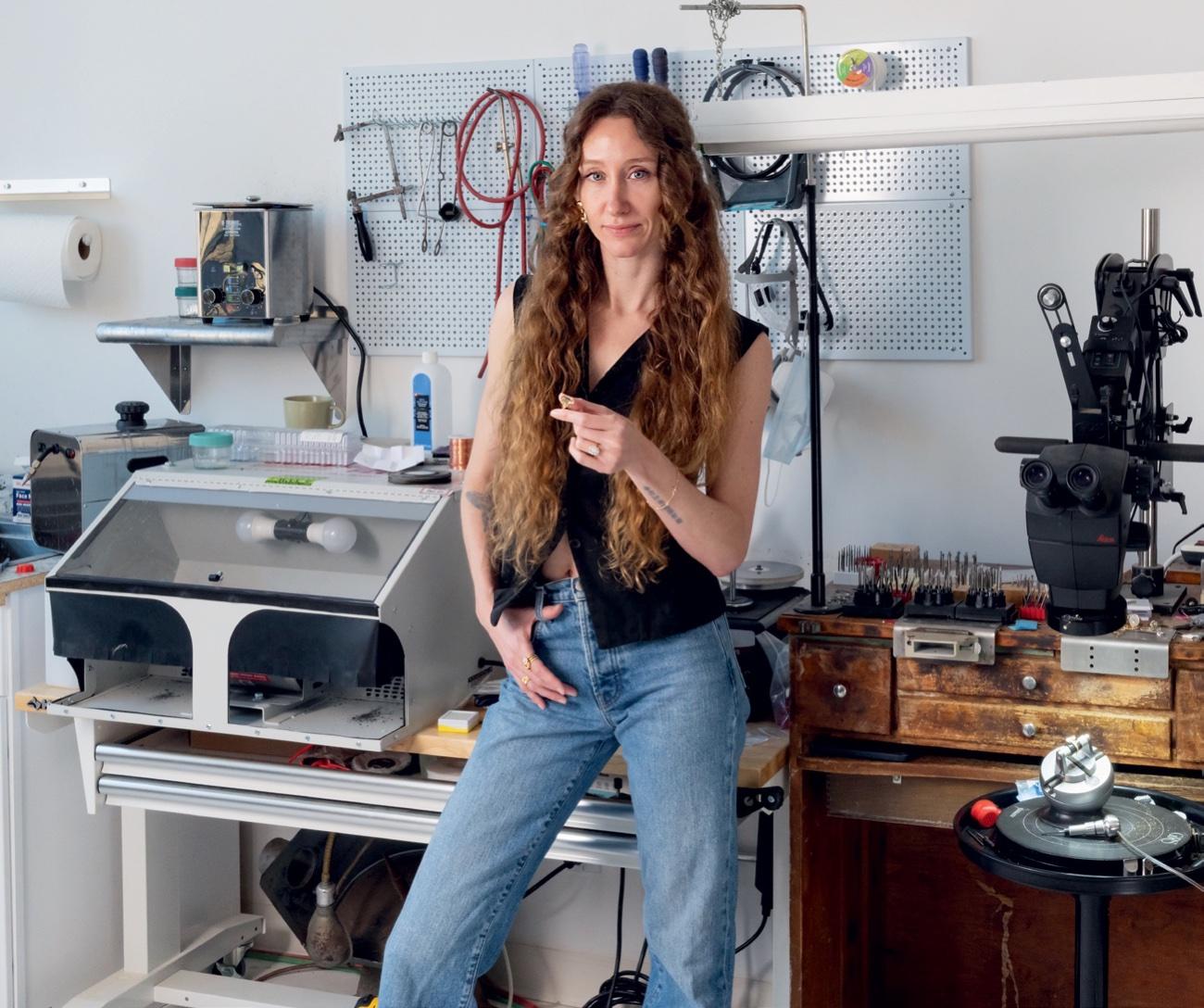
1. Diamond Ring
It is a one-of-a-kind diamond ring and represents the kind of work that I do in the studio. Sometimes the one-of-a-kind pieces are custom work for a speci f ic client. I have also been selling one-of-a-kind jewels at auction through Sotheby’s. These jewels are very labor-intensive and take a lot of time to make. In April, I launched Artifex Bride with seven engagement rings and f ive bridal styles, working with other craftsmen in order to meet the huge sweeping demand.
2. Watchmakers Wood Bench
The bench is where I started and so my dad passed it down to me. My boyfriend and I drove it from Florida up to New York in a U-Haul. I was very worried about it because it’s like a little bit rickety. So, it was ratcheted down and surrounded by boxes. But she made it in one piece. It was the first thing in the studio. I posted a picture of it on Instagram in June 2024 with the caption “Dream realized.”
3. Satellite Turntable
My satellite turntable is for my engraving.
So, that’s my vice that holds my pieces while I engrave. And you see right above it is the microscope.
4. Microscope
The microscope goes in very close. I would say it goes up to 30x magnification. But I try to work at around 16x magnification. Otherwise, it gets hard on the eyes to be so close.
5. Gravers and Beading Tools
An engraver is the person, and a graver is the tool they use. I probably don’t need as many as I
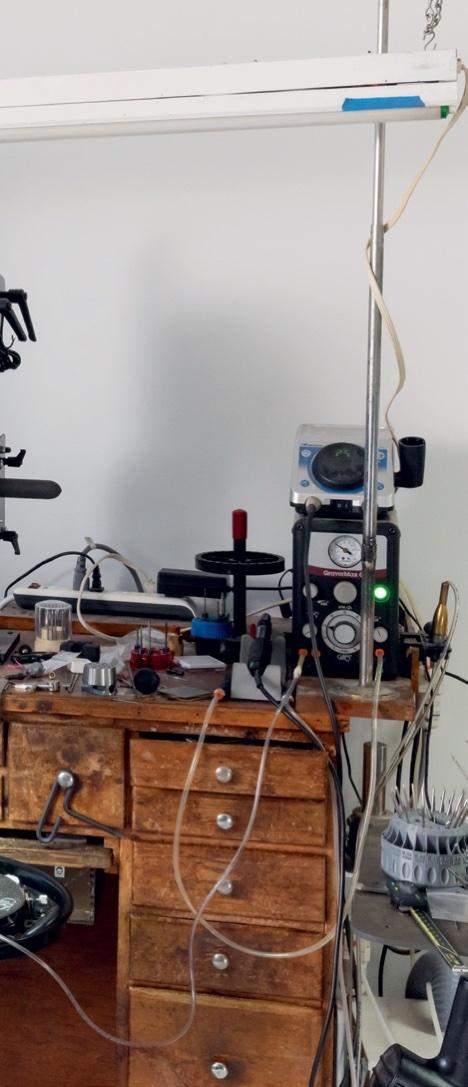
have. There are also beading tools, which come in various shapes. I have burs for stone setting. They grind away the metal into a ball using a sphere, and that’s where you set a diamond.
6. Compressor
The compressor is a pneumatic tool, kind of like a tattoo gun for high-precision engraving. It sends pulses of air, and I can control how fast those pulses go. That’s typically all I’m really tuning, but there is also a port for a rotary tool that uses air for power drilling.
7. Polishing Unit
When the world learned Kindred Lubeck was the jewelry designer responsible for Taylor Swift’s engagement ring, she became famous fast. Not surprisingly, she can say little about her interaction with the couple and the process of making the ring. The trajectory of Lubeck’s career is remarkable, considering she only decided to follow in her father’s footsteps and began learning how to be a goldsmith and engraver during the pandemic.
After a couple of years of intensive study with her dad and at an engraving school in Emporia, Kansas, Lubeck launched her company. She named it Artifex, which is the Latin word for craftsman, as a tribute to her father. In 2024, she moved from her home in Florida to New York City and set up the studio photographed here. To publicize her handcrafted, custom work that focused on engagement rings, she made TikToks of herself creating jewels at the bench. They went viral. It seems that is how a certain pop star noticed the independent designer and shared her enthusiasm for the rings with her football player boyfriend.
I put my arms and hands in there, and there are polishing wheels on either side. They’re very powerful. It’s an industrial-grade polisher for ring shanks and stu like that. Typically, I’ll hand-polish first and then do a final polish with that machine, just because it’s so strong.
8. Mouth-Blown Blowpipe Torch Tube
I don’t use it a lot, but it is for granulation, an ancient goldsmithing technique that essentially involves forming tiny balls on the surface of a
gold jewel. I used it when I learned the technique from Kent Raible, a master goldsmith and educator. In July, I am taking another course with Kent, and then I will bring granulation to my studio o cially.
1
2
In a red carpet environment filled with method and stunt dressing, veteran stylist Kate Young has remained a fashion purist. She is laser-focused on sourcing stunning clothes and jewelry that elevate every occasion for her clients. Her work has resulted in some of the most memorable moments in red carpet history, many of which include diamonds.
Twenty years ago, Young dressed Michelle Williams in a sa ron-yellow Vera Wang dress and a vintage Fred Leighton diamond sunburst necklace, which is consistently ranked among the best Oscar looks of all time. This year, she was responsible for Rose Byrne’s exquisite Dior gown and Ta n by James de Givenchy necklace set with desert diamonds, which is destined to go down in history as one of the greats. “Diamonds bring sparkle and power and fun,” explains Young. “There’s that thing, a gravitas when a big diamond enters a room and people pay attention.”
1. Desk
It is Donald Judd, but not minimal, not used as he intended it to be used. At the Judd Foundation in Marfa, Texas, there are similar desks with like one notebook on them and four pens. That’s what I aspire to. I’m an aspirational minimalist. But, in truth, I’m messy and love stu
2. Tiger’s Eye
I really was hellbent on using tiger’s eye in my jewelry collaboration with Monica Viander. She
6
5
said, “It doesn’t sell.” Then we finally decided to do a sample just to see and test it. Monica loved it and said, “Let’s do it.” It sold so well. And now, they’re doing more of it. So, I think she gave me the tiger’s eye as a bit of a joke.
3. Moleskin Notebooks
I can’t remember stu unless I write it down, and I usually use one of these notebooks. I like to print everything too, and I know it’s not good for the environment, but that’s how I think. I need to spread things out and look at them.
4. Cartier Notecards
I was Anna Wintour’s assistant at the beginning of my career and one of the things I learned was everybody sent her thank you cards. I wish I wrote them right away, but often I do them on airplanes.
5. Prada Bucket Bag
It fits one million things in it, and that’s what I like about it.
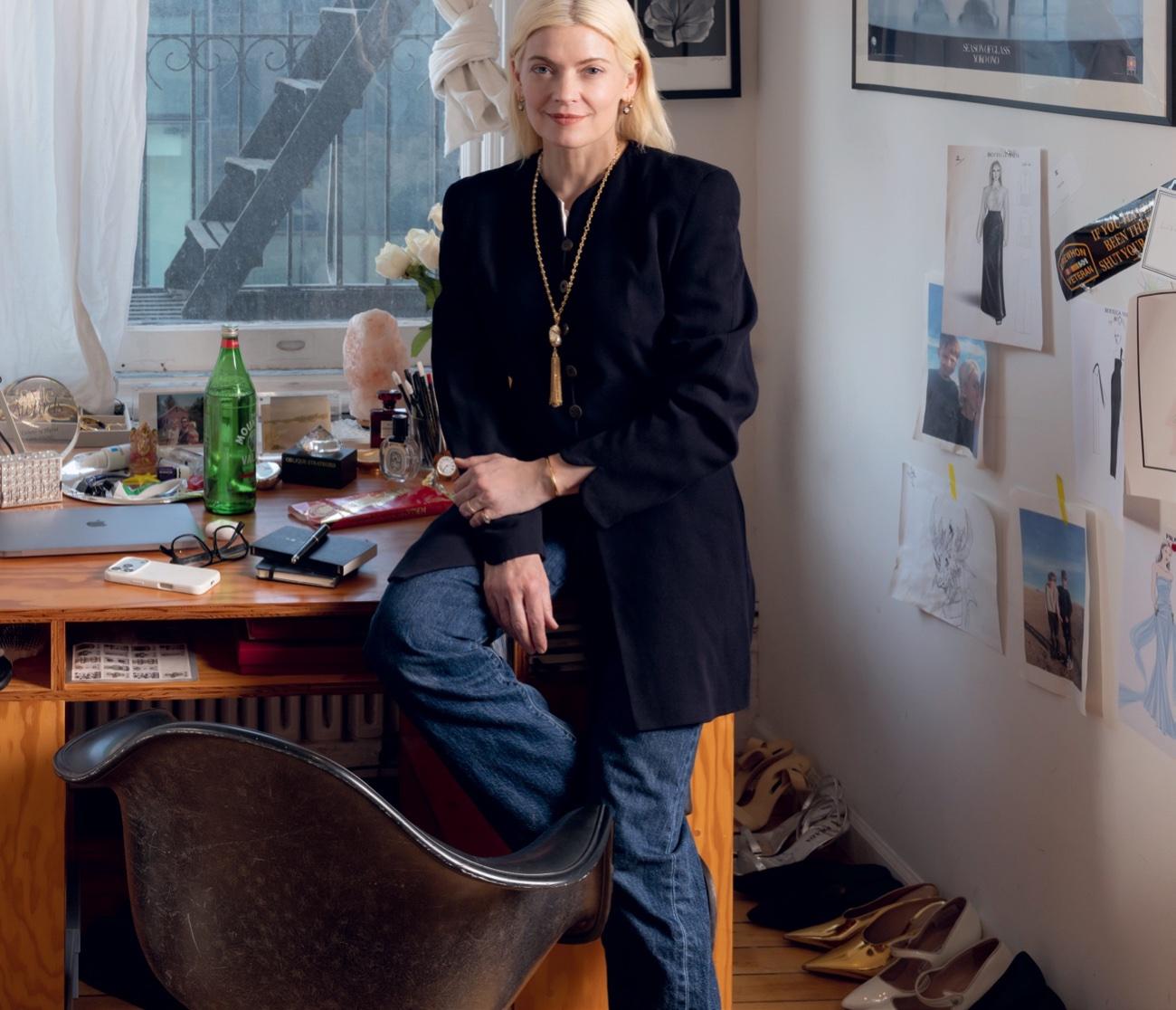
6. The Book Empress of Seventh Avenue
Reading is my escape. I feel about reading a book sort of the way other people feel about reality shows or something. I like to be in a di erent place in my head. And I feel I need to exercise that muscle.
7. Poster of Yoko Ono’s album cover Season of Glass
I’m a huge, obsessive Yoko Ono fan. She took so many risks. I really like her art. She
was such a cool minimalist, way ahead of her time, doing really weird stu . I like her music. I think she had incredible style. I love looking at pictures of the Dakota apartment. Yet, she will never be known as anything other than John Lennon’s wife and the woman who broke up The Beatles. I find that really heartbreaking and romantic.
8. Pictures Taped on the Wall Things kind of go up there and then I forget about them, so some of them are kind of old.
I work out ideas on white foam board. I had to take them into the other room because I couldn’t have them photographed.
VISIT ONE OF NATURAL DIAMOND COUNCIL’S OFFICIAL RETAIL PARTNERS, OFFERING A BROAD SELECTION OF HIGH QUALITY, ETHICALLY-SOURCED NATURAL DIAMOND JEWELRY.
Date & Time, MA
Day’s Jewelers, ME/NH
Guy Edward Family Jewelers, PA
Hamilton Jewelers, NJ
Henne Jewelers, PA
Henry Wilson Jewelers, NY
London Jewelers, NJ/NY
Lux Bond & Green, CT/MA
Mountz Jewelers, PA
Aucoin Hart Jewelers, LA
Bailey’s Fine Jewelry, NC
Bromberg’s, AL
Brown & Co. Jewelers, GA
Hamilton Jewelers, FL
Lee Michael’s Fine Jewelry, LA/MS
Loring & Co. Fine Jewelers, AL
Marquirette’s Exquisite Jewelry, AL
Markman’s Diamonds, TN
Shane Co., GA/KY/TN
Underwood Jewelers, FL
Mervis Diamond Importers, D.C./MD/VA
Radcli e Jewelers | The 1916 Company, DE/MD
Sanders Diamond Jewelers, MD
Smyth Jewelers, MD
Zachary’s Jewelers, MD
Alson Jewelers, OH
Brinker’s Jewelers, IN
Charles Ganske Personal Jeweler, IA
James Free Jewelers, OH
R.F. Moeller Jeweler, MN
Riddle’s Jewelry, IA/KS/MN/MO/ NE/ND/SD
Shane Co., IN/KS/MN/MO
Bachendorf’s, TX
Ben Bridge, AZ/CO/NV/TX
BC Clark, OK
David Gardner’s Jewelers, TX
Hyde Park Jewelers | The 1916 Company, AZ/CO
Lee Michael’s Fine Jewelry, TX/NM
Riddle’s Jewelry, CO
Shane Co., AZ/CO
Susan Eisen Fine Jewelry, TX
Walters & Hogsett Jewelers, CO
Ben Bridge, AK/CA/HI/OR/WA
Heller Jewelers, CA
Hyde Park Jewelers | The 1916 Company, CA
Lee Read Diamonds, ID
Plateau Jewelers, WA
Polacheck’s Jewelers, CA
Riddle’s Jewelry, MT/WY
Shane Co., CA/OR/UT/WA
Bijouterie Italienne, Québec
Diamond Gallery, Manitoba
La Maison d’Or Jewellers, Ontario
L’ORO, Ontario
Lugaro Jewellers, British Columbia
For more information, visit www.naturaldiamonds.com/ o cial-retail-partner-locations