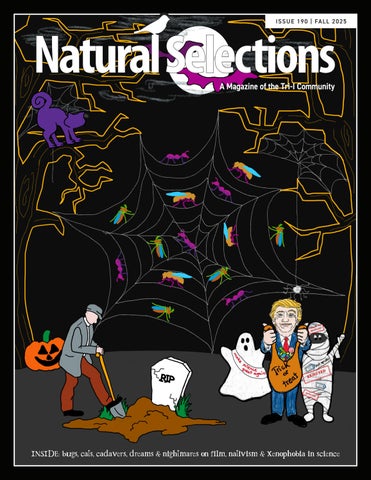
ISSUE 190 | FALL 2025
A Magazine of the Tri-I Community
INSIDE: bugs, cats, cadavers, dreams & nightmares on film, nativism & xenophobia in science
TEAM
CONTENTS
Editor-in-Chief Mia Haraguchi
04
You Can’t Have Science Without Migration Valerie Gallegos
Senior Editor Eeshaan Rehani
08
The Three Ages of Klimt, Part 1 Juan Sebastián Andrade-Martínez
Associate Editors Colin Burdette Lola Neal Eeshaan Rehani
12
The Evolution of Insect Research Lola Neal & Michelle Yu
17
Unearthing Knowledge Dhyey Gandhi
20
Public Research Funding: Insights From the Lab Bench Michelle Yu & Sarthak Tiwari
24
Meditation’s Kin Engin Ozertugrul
27
HRGD Journal Club Interviews Svetlana Mojsov Charles Xu
30
Mechanisms of Translation: How Discoveries Become Medicine Sofia Moraes
34
What Can (Neuro)scientists Learn From David Lynch’s Films? James Siho Lee
38
The Tell-Tale Buzz Sofia Avritzer
40
RU’s (Un)official Cat Rescuer, Kristen Cullen Yuko Tonohira
Copy Editors Juan Sebastián Andrade-Martínez Charlotte Bell Cecilia Cuddy Libby Tseng Michelle Yu Layout Designers Sarah Foust Mia Haraguchi Nicholas Ruiz-Huidobro Magdits Yuko Tonohira James Wang Cover art by Marina Schernthanner
Natural Selections is not an official publication of The Rockefeller University. University administration does not produce this newsletter. The views expressed by the contributors to this publication may not necessarily reflect the views or policies of the University. Original contents copyright © 2025 by Natural Selections. All rights reserved. Reproduction either in whole or in part without written permission of the editors is prohibited.
Background photo by Soubhagya Satpathy on Unsplash
FEATURE
You Can’t Have Science Without Migration
The Rise of Anti-Immigrant Sentiment is Hurting the Scientific Community By Valerie Gallegos
M
igration is woven into the fabric of the scientific community. Many scientists move across regions or continents to pursue opportunities for training, education, and collaboration. These journeys affect both an individual’s life and the trajectory of scientific innovation, fostering diversity of thought and new discoveries. However, as anti-immigrant sentiment increases in the United States and around the world, many scientists now face additional barriers that threaten this essential flow of knowledge and talent.
Life as a Regional Migrant Pursuing a Career in Science
G
rowing up on the U.S.-Mexico border in El Paso, TX meant that migration—a staple of the city’s vibrant Mexican culture—was second nature to me. Like many cities distant from major research hubs, El Paso offered limited scientific opportunities; therefore, I ultimately moved across the country to New York City. Adjusting to a more rigorous and competitive research environment was challenging, and life beyond the bench brought its own hur4
Fall 2025
Natural Selections
dles. Despite having lived in the United States my whole life, adapting to the East Coast’s social and cultural norms while maintaining close ties with family and friends back home proved difficult. Dr. Yazmin Carrasco, Assistant Dean of Access, Belonging, and Student Success at Weill Cornell, had similar experiences throughout her scientific career. Like me, she grew up in the Paso Del Norte region, but on the other side of the bridge, in Ciudad Juárez. While attending The University of Texas at El Paso (UTEP), Dr. Carrasco’s commute required crossing an international checkpoint—a daily occurrence for many residents of this region. One of her first cultural hurdles was the language barrier. “The first semester of college, [it] was hard to switch to 100% English,” she recalled. Fortunately, the large Hispanic population at UTEP allowed her to find community in an unfamiliar social space. Dr. Carrasco’s transition to UT Southwestern for graduate school sparked a different kind of challenge. She faced social and professional barriers exacerbated by the lack of diversity among her peers and advisors. Professors commented on her English and writing, at one point telling her she should “go back to elemen-
tary school to figure out sentence structure.” “I became a chameleon, trying to fit in by shifting parts of my personality,” she explained. Faculty members doubted her ability to graduate, but Dr. Carrasco turned their condescension into motivation to persevere and excel in her career. Our stories overlap with common themes of adaptation and resilience, yet underscore the privileges we were afforded as U.S. citizens. Dr. Carrasco and I could move freely within the country and work without fear of visa restrictions. For many international scientists, those basic freedoms are not guaranteed. Their journeys are marked not only by cultural and linguistic adjustments but also by the heavy weight of shifting immigration laws, financial burdens, and constant uncertainty about their future in the countries where they contribute so much.
Scientists Face Additional Burdens Coming to the United States
A
cross the United States, foreign-born researchers often face legal, financial, and discriminatory barriers that can negatively impact their career. A 2024 survey commissioned by the layout design by yuko tonohira
U.S. National Academies’ Board on International Scientific Organizations reported that 40% of surveyed international scientists experienced visa issues that prevented them from participating in professional activities in the U.S. The negative impact of the United States’ current visa process has also trickled down to international collaborative opportunities: the same report found that 27% of respondents have stopped or avoided collaborating with U.S. scientists due to visa challenges. In addition to dealing with bureaucratic complications, non-U.S. citizen scientists often find that the funding sources available to them are limited. One of the largest pools of funding for scientific research in the United States has historically come from the federal government. However, there are often eligibility restrictions against non-citizens. Recent changes in federal funding are also affecting international collaborations. The NIH has announced that foreign subawards
illustration by sarah foust
for international collaborations will not be issued moving forward until there are changes in the grant subaward structure. Despite these challenges, it is undeniable that migrant workers are the backbone of STEM occupations in the United States. Recent reports indicate that immigrants comprise up to 26% of the total STEM workforce and 43% of scientists and engineers with a doctorate. Additionally, 73% of international students who obtained a Ph.D. in science and engineering fields between 2017 and 2019 stayed in the United States for 4–6 years after degree completion. Our own Tri-Institutional community is a blend of international and regional migrants: over half of respondents surveyed for this article reported that they relocated from abroad or outside of the Tri-State area for their current position. The diversity of thought that many international scientists bring to the United States is not a new phenomenon. Half of
the 2025 Nobel Prize winners and 40% of American Nobel Prize winners since 2000 in science categories immigrated to the United States. All evidence highlights the necessity of migration for a robust and innovative science community in the United States—in stark contrast to the Trump administration’s anti-immigrant rhetoric.
Changes in U.S. Immigration Policies Could Be the Catalyst for American Brain Drain
P
resident Trump has repeatedly tried to convince Americans that “illegal aliens” are “taking [their] jobs.” These unfounded claims shift the blame for job loss and worsening economic conditions to the broader migrant community. In reality, there are no major industries where immigrants outnumber U.S.-born citizens. The focus should instead be on decades-long state and federal policies
Natural Selections
Fall 2025
5
that transformed the American economy from a primarily skills and manufacturing market to one centered on technology and services, without sustained efforts to help Americans make the transition as well. Labor sectors with higher proportions of authorized immigrant workers, including science, often require specialized training and skills that are a barrier for many Americans. For example, the average cost of college in the United States is currently over $38,000 per year. Many undergraduate research training grants that helped alleviate this large financial burden, including the NIH-funded Maximizing Access to Research Careers (MARC) program, were recently terminated due to federal cuts. Earlier this year, the Federation of American Scientists held a bipartisan House Research and Development Caucus Briefing to discuss how current political actions, such as withholding NIH grants and increasing visa restrictions, have been negatively affecting the American scientific community. In addition to increased federal investment in scientific research, the panel noted that there is a need to reform current STEM immigration policies. “A lack of sustained federal funding, deteriorating research infrastructure and networks, restrictive immigration policies, and waning international collaboration are driving this erosion into a full-scale ‘American Brain Drain.’” —Congressman Bill Foster (IL) during the July 22, 2025 R&D Caucus Briefing However, recent proposals to change U.S. visa programs for international scientists and scholars might be the final push that topples the United States’ STEM workforce. The H-1B visa program was created under the Immigration Act of 1990 to help temporarily fill employment gaps in highly skilled labor sectors, including technology and medical sciences. Currently, there is an annual cap of 65,000 visas, with an additional 20,000 visas reserved for applicants who graduated with a master’s degree or doctorate from a U.S. institution. In September, the Trump administration 6
Fall 2025
Natural Selections
“Immigrant Rights are Human Rights” by Maren Muñoz. Source: Justseeds. Used under CC BY-NC 4.0.
announced changes to the H-1B visa program that would add more restrictions for applicants and include a $100,000 fee for new H-1B petitions, to be paid by the applicant’s employer. (For context, the previous fee was $2,000 to $5,000.) The increased fee alone could restrict universities from sponsoring international talent, especially against the backdrop of federal funding cuts. Additionally, the U.S. Department of Homeland Security (DHS) is proposing changing the current lottery system to a weighted selection process where higher wage levels would result in more lottery entries for companies. DHS has also suggested implementing a 4-year maximum timeframe for F and J student visas.
“My significant other, who I live with, is an immigrant, and the current immigration policies, like the changes for H-1B visas, have made our situation stressful.” —Anonymous respondent
Anti-Immigrant Aggression Is Adding Stress to Scientists’ Lives
I
ncreased restrictions on visas have been coupled with DHS becoming more aggressive. Many foreign-born scientists and academics became fear-
ful as reports of scientists being detained made the headlines. Russian-born scientist Kseniia Petrova was detained in February by immigration agents at a Boston airport after a trip to France. After she failed to declare frog embryos that she was using for ongoing research, federal agents took the Harvard scientist into custody, canceled her visa, and transferred her to a Louisiana detention facility. In addition to the changing legal landscape of international migration, growing anti-foreigner sentiment across the globe has undoubtedly added stress to the lives of many scientists. From ICE raids on predominantly Hispanic cities in the United States to religious restrictions in India’s naturalization policies, anti-immigrant policies often impact other individuals who come from similar racial, ethnic, or religious backgrounds, regardless of their citizenship status. When I asked Dr. Carrasco whether she has seen changes in students over the past six months, she noted that “there is an increase in anxiety and stress due to immigration policies.” Some students have expressed fear of what these policies and their aggressive enforcement could mean for them as international scholars or having come from similar backgrounds as de-
tainees. Dr. Carrasco’s observations were echoed in our survey of Tri-I scientists: over 90% of respondents reported that recent actions by the U.S. government and federal agents towards migrants have significantly increased stress in their lives. This increased stress is urging many scientists to look for opportunities in other countries. Nearly a third of survey respondents reported that they will more than likely look, or are currently looking, for jobs outside of the United States. They cited the current political climate, changes in funding, and a poor job market as major factors in this decision. “It is an extra level of stress, that everything can change from one day to the next and setting up your life here but knowing that maybe it will all be taken away. Living with such uncertainty of whether you can establish your life or not remains a low level of constant daily stress.” —Anonymous respondent I met with Yanira Guerra, a fifth-year Ph.D. student at Weill Cornell, to discuss her experience as an internal migrant. Yanira was raised in the DMV (D.C./Maryland/Virginia area) outside of Washington, D.C., a region with many pockets of diverse communities. Like most Americans, she first left home to attend college out of state in search of the best academic opportunities. One of the struggles she remembers during this transition period was adjusting to the homogeneous culture of her small college town. “There are small things that you would be unaware of, like where to get Peruvian food and cultural differences due to the upbringing of peers,” she explained.
tific institutions bend the knee to Trump’s demands.” She noted that on the individual level, she is very proud of the scientists who have stood up and fought for the right to do science. Growing up in the DMV exposed her to many protests and political movements at a young age, but she has become more active in the past year due to changes impacting the immigrant and science communities. “There have always been divisive sentiments [towards immigrants], but this administration has been particularly . . . destructive on the implementation of immigration policies.” Migration has always been the lifeline of science, driving discovery through the exchange of ideas, cultures, and perspectives. From border cities like El Paso and Ciudad Juárez to global research hubs like New York, scientists move not out of comfort, but often out of necessity and in search of more opportunities. Science transcends regional and international borders, but scientists increasingly cannot. Each policy that adds more restrictions to visas sows fear and devalues foreign-born labor. These systemic limitations don’t just harm individuals— they erode the collaborative foundation of scientific innovation. Science thrives where curiosity is allowed to move. ■
“America can’t run without immigrants, regardless of documentation status.” —Yanira Guerra
Results from a survey of Tri-I scientists on U.S. science and migration policies, conducted for this article.
When asked how her confidence in the science community has changed since the beginning of this year, Yanira said that she has mixed feelings. “It’s hard to see scien-
“NY Loves Immigrants” by Josh MacPhee. Source: Justseeds. Used under CC BY-SA 4.0.
Natural Selections
Fall 2025
7
CULT
The Three Ag
Part 1: The T
By Juan Sebastián A
of his paintings in the late 1890s and the 1900s—sometimes as a sea interrupted by islands of female bodies, mythological creatures, or skulls; sometimes as archipelagos dotting the background of rose bushes. However, it would be a double disservice to reduce the painter to his golden phase. This ignores not only the evolution of his style and subject over the years, but also the universe of influences which ultimately led to his most widely known works.
ustav Klimt was revealed to me, as to many others, in the midst of a morbid orgy of blood. For those of us who watched anime in the 2000s, the title Elfen Lied is synonymous with the melange of an innocent art style and a story overflowing with violence and gore, frequently seen in “top most violent anime scenes” compilations on early YouTube. I watched the thirteen-episode series in 2014. While not my favorite, I was taken aback by its fantastic opening sequence, an homage to the Austrian painter’s golden phase.
The mélange of styles that comes together to shape Klimt’s paintings couldn’t be born anywhere else but in Vienna, where he resided for most of his life. In The Crossroads of Civilization: A History of Vienna, former journalist and UK member of Parliament Angus Robertson writes: “Vienna has been a key European and global crossroads for centuries and successfully reinvented itself as times changed, while retaining its essential charm and flair.” The same convergence of initially disparate currents can be seen in Klimt’s style and its changes as he developed as an artist. This is perhaps best shown by comparing his two depictions of Athena, corresponding to two different eras of his career: one from 1891 (above left), and one from 1898 (center).
Indeed, Klimt is best known for his lavish use of gold leaf, which adorned some
In my eyes, the first Athena represents what Klimt’s life was supposed to be.
G
8
Fall 2025
Natural Selections
The son of a Moravian engraver, he and his brother Ernst received technical education at the Vienna School of Applied Arts before forming their own art company, along with their friend Franz Matsch. In 1890, the three were commissioned to
layout design by mia haraguchi
TURE
ges of Klimt
Two Athenas
Andrade-Martínez
paint the murals of the walls and staircase of Vienna’s Imperial Art History Museum. The first Athena is part of a piece from this commission depicting ancient Egyptian and Greek art (above), and part of a bigger ensemble of works showcas-
ing art throughout the ages. This, along with their previous work in the Imperial Court Theater between 1886 and 1887— of which Klimt’s Death of Romeo and Juliet stands out for its accuracy in showcasing the theatre in Elizabethan times—earned the three men the Golden Service Cross from Emperor Franz Joseph I. This first Athena can be seen as one hallmark of an aspiring young artist in the service of the traditional Austrian nobility: while exquisitely made, it is inoffensive, even pedestrian in light of what would come. Unfortunately for Klimt, the painter’s life would change drastically with the death of his brother and father in 1892, and with his estrangement from Matsch over the commission that produced his controversial yet exquisite University of Vienna paintings. In these works, Klimt makes scandalous allegories of the arts of Philosophy, Medicine (next page, bottom left), and Jurisprudence. His pessimistic and grim outlook on humanity’s ability to engage with these fields of knowledge enraged the members of the university. These were the product of a new Klimt, an eclectic Klimt, the secession era Klimt. In 1897, he co-created and became the first president of the Vienna Secession, established by a group of forty Austrian artists looking to break with the canon of Western painting. The name of
the Secession’s magazine, Ver Sacrum— meaning sacred spring and referring to an old Italic custom related to the migration of the youth in times of strife—is telling of this. Athena, as patron of the arts and crafts, figured on the first cover of the journal, and was one year later depicted by Klimt in his characteristic golden style (center). The Klimt we all know was born. While not currently on display, one version of the cover can be found at the MoMA. The artist’s involvement in the Secession movement and later paintings can be explained as a consolidation of a mixture of influences from styles dispersed in distance and in time. A fragment of Klimt’s obituNatural Selections
Fall 2025
9
ary (reprinted in Gustav Klimt: The Complete Paintings, edited by Tobias Natter) reads: “What initially struck the viewer as being Klimt was not him, but something with which he was connected. Japan, China, Byzantium and the ancient and modern Orient. Italian and modern English Pre-Raphaelitism, French decorative and magical painting of the Moreau kind, Low Countries Mysticism from the region of Khnopff, with colonial goods and gods in between. But if he took something from everything, it was because he was nothing less than an eclectic. He simply used this as nourishment and transformed it into Gustav Klimt.” In one of his most famous paintings, The Kiss (bottom right), one can distinguish the gold-laden style of the Byzantine mosaics and Egyptian mummies; the disposition of the characters close to
10
Fall 2025
Natural Selections
“Art is a bridge between the soul and the world.” —Gustav Klimt the borders of the canvas, seen in Japanese art; and the art-noveau-based clothes laden with rectangular and circular shapes commonly associated with male and female genitalia. Moreover, it has been suggested that the picture is Klimt’s rendition of the ancient Greek story of Apollo and Daphne. In principle, most of the works mentioned so far cannot be seen here in New York, but that doesn’t mean one cannot enjoy them in person. Located next to City Hall, Hall des Lumières has a recurring exhibi-
tion on Klimt. Using a 360° arrangement of projectors, one can appreciate the beauty and detail of all of his works, including those mentioned so far, projected on big screens as if murals. In particular, I must highlight from the show the magnificent interplay of the sound of Beethoven’s Symphony No. 9 and the Klimt work it inspired, his Beethoven Frieze (partially reproduced above), which symbolizes in a spectacular manner how science and music aid humanity in the fulfilment of its destiny (Gustav Klimt: The Complete Paintings, edited by Tobias Natter). It is also one of the early expressions of the Secession’s concept of Gesamtkuntswerk, or total work of art, which involved the collaboration of different artists for the development of a single, grand montage—here involving the participation of architect Josef Hoffman, who created the space in which
the frieze would be displayed during the fourteenth Secession Exhibition in 1902. The culmination of the concept of Gesamtkuntswerk—and my personal favorite piece by Klimt, the portrait of a certain Adele Bloch-Bauer—and his work during his third era will be the subject of the next part of this story. ■
“To every age its art. To art its freedom.” —Inscription at the entrance of the Vienna Secession Building
Natural Selections
Fall 2025
11
Fra g the ments boo k D of a w ell’ o his odcut tor ia n of the atu Wu rale n (15 derka 99) m by F mer erra room , nte Im f rom per ato .
FEATURE
The Evolution of Insect Research From Curiosity Cabinets to Tri-I Labs By Lola Neal & Michelle Yu
W
hen thinking of the most popular animals used in scientific research, most people would not imagine an insect. Yet these underappreciated creatures are an integral part of many modern scientific discoveries. Research on insects has established foundational tenets of genetics, insight into the ways vectors efficiently spread diseases worldwide, and recognition of the complex social behaviors exhibited by groups of insects. Modern insects first emerged during the Jurassic and Cretaceous periods and now comprise around 80% of animal species. These multifaceted and multi-legged creatures are crucial components of our ecosystem and have become important models in biomedical research. Here in the Tri-I, researchers have embraced insects in unique and exciting ways to build upon a rich history of interest in the world’s most abundant animals.
The Insect Boom Collection and Display of Insects in the Renaissance Era
I
n the Renaissance era, an intellectual “insect boom” began as human creativity and inquiry proliferated throughout Europe. Naturalists began developing 12
Fall 2025
Natural Selections
cabinets of curiosity, or Wunderkammer, which allowed for curated collections of preserved plants, artifacts, and animals— including insects—to be displayed. These mostly private collections served as precursors to museums and reflected an increasing desire to probe and understand the natural world and its inhabitants.
Post-Renaissance Scientific advancements in the seventeenth and eighteenth centuries enhanced efforts to understand insects. Marcello Malpighi (1628–1694) established microscopic anatomy, or histology, as a fundamental component of physiological research through his work documenting the existence of blood capillaries, the structure of human organs, and the lack of lungs in insects. In his 1735 Systema Naturae, Swedish biologist Carl Linnaeus (1707–1778) established Linnaean taxonomy, or binomial nomenclature, as the standard naming system for plants and animals. Over 4,000 animals, including insects, were recorded in this publication, allowing scientists to begin categorizing different organisms based on their unique features. Previous studies of insects had given minimal consideration to establishing standards of classification for these creatures. Linnaeus’s new system enabled other entomologists to build
upon his findings, introducing new orders, families, and genera to further classify the many insects that had been identified.
Evolution of Insects and Beyond Inquiries about evolution, an idea pioneered by naturalists Charles Darwin (1809–1882) and Alfred Russel Wallace (1823–1913), dominated the scientific landscape in the nineteenth century. Entomologists began examining adaptations that insects utilize to promote survival in many environments. This information helped expand and fine-tune the insect classification system and opened a new branch of exciting scientific inquiry. Scientific knowledge about insects rose exponentially during this period as physical observation of these organisms encouraged exploration of the evolutionary reasons for insects’ vast morphological diversity. These historical scientific milestones paved the way for modern entomological and biological research. Genetic research has fine-tuned insect classification and provided new avenues for discoveries in the basic sciences, ecology, and medical research. The Tri-I research landscape speaks to continued interest in insects as subjects of scientific inquiry, with labs studying both the established model insect, Dro-
layout design by nicholas a. ruiz-huidobro magdits
sophila melanogaster (the fruit fly), and less common but influential arthropods like Aedes aegypti (the yellow fever mosquito) and Ooceraea biroi (the clonal raider ant). These labs have contributed novel information about development, ecology, genetics, and behavior to the greater scientific community, and their research encourages creative approaches to understanding our natural world.
The Fly Drosophila Genetics Take Flight
T
he early use of Drosophila melanogaster stemmed from the rediscovery of Mendelian genetics in the early 1900s. Several decades earlier, Gregor Mendel had postulated the existence of “hereditary factors” after examining patterns of trait inheritance in the pea plant. The physical basis and mechanism of those hereditary factors remained to be elucidated, spurring Thomas Hunt Morgan’s journey into genetic work. Morgan’s first forays into insect research (namely, phylloxerans and aphids) led him to conclude that the genetic determination of sex was a “cytoplasmic phenomenon”—that is, sex was determined by the contents of the cytoplasm. However, these parthenogenetic insects were soon overshadowed by another star that would change Morgan’s mind: Drosophila melanogaster, which had already proved useful in other genetic studies. Morgan was drawn to Drosophila because of its short life cycle, ease of rearing, and high numbers of progeny. Along with students Alfred Henry Sturtevant, Calvin Blackman Bridges, and Hermann Joseph Muller, Morgan established the “Fly Room” at Columbia University. Morgan began breeding flies exposed to mutagens, hoping to find a heritable mutation. In 1910, after two un-
successful years, Morgan finally discovered a single white-eyed male among the red-eyed stock. By breeding this fly to red-eyed females and recording the eye color of different generations of offspring, he concluded that the white gene was carried by a sex-linked “factor.” In 1913, Sturtevant created the first genetic map, mapping several other genes to the X chromosome of Drosophila. Bridges followed suit with cytogenetic studies of the white gene, demonstrating that its inheritance patterns in rare cases of nondisjunction could only be explained by an X chromosome locus. These observations provided important evidence for the burgeoning chromosomal theory of inheritance. Together, Morgan’s, Sturtevant’s, and Bridges’ work laid the foundation for classical Mendelian genetic studies in animals.
Beyond Classical Genetics: The Tri-I’s Novel Approaches to the Fly Because of its high reproductive rate and ease of culturing, the fruit fly is a particularly suitable model for the study of genetics. A fly’s lifespan is roughly two months, and a female may lay up to 2,000 eggs in her lifetime, allowing researchers to quickly obtain many progeny. Gene heredity can be tracked across several generations, and aging phenomena can be studied within a short timeframe. Moreover, fruit flies’ genetics are simple: they possess only four pairs of chromosomes, and males do not exhibit meiotic recombination. Muller’s invention of the first balancer chromosome, ClB, made Drosophila research even more promising, as researchers could now stably maintain lethal mutations in heterozygote form across generations. Genes involved in diverse pathways such as cell growth and differentiation, insulin signaling, membrane excitability, and neuronal function are conserved between Drosophila and other species, so the fly’s use quickly expanded beyond genetic studies. Along with Jeffrey Hall and Michael Rosbash, Michael Young of Rockefeller Univer-
sity characterized the interaction of proteins Period, Timeless, and Double-Time in clock neurons, providing a molecular mechanism for the circadian rhythm. This work is ongoing, with recent efforts centered around the lifespan-extending effects of time-restricted feeding. Preliminary data found that these effects were independent of brain activity, prompting exploration of potential peripheral clocks. A current graduate student in the Young lab, Martina, notes that these findings could “shift the current clock hierarchy paradigm in chronobiology.” Current research in the Tri-I uses Drosophila for a variety of purposes, from studying how behavioral responses to olfactory stimuli are neurally encoded and modulated (Vanessa Ruta, Rockefeller University) to investigating the origin and function of de novo genes in Drosophila (Li Zhao, Rockefeller University). Gaby Maimon examines how Drosophila perform complex computations, like the encoding of spatial memories and event prediction, and how these computations guide behavior. Drosophila research has not only advanced our understanding of physiology and pathology—it has also served as a site for the development of techniques that expand the boundaries of scientific inquiry. Martina notes that a benefit to using Drosophila is the GAL4/UAS system, which enables expression of one or more transgenes in a genetically defined population of cells. Transgenic flies expressing the transcriptional activator GAL4 in a particular cell type and/or at a particular developmental stage are crossed with flies that carry the target gene under the control of an upstream activating sequence (UAS). In the resulting progeny, GAL4 binds to the UAS, activating the gene of interest only in target cells. In a similar vein, Drosophila were pivotal in the invention of optogenetics, a technique widely used in neuroscience research and pioneered by Gero Miesenböck, then at Memorial Sloan-Kettering. Miesenböck and colleagues used Drosophila phototransduction machinery, which is simpler than its vertebrate counterpart, for an early version of optogenetics, allowing for selective excitation of neurons with light. Natural Selections
Fall 2025
13
The Mosquito Infection and Disease Inspire a New Field of Biological Research
T
he female mosquito is a highly effective vector of disease, causing over 700,000 deaths each year—a number that makes it the deadliest creature on the planet. A commonplace nuisance to many, the mosquito serves as a major target for public health efforts intending to control mosquito populations, reduce disease spread, and educate the public on this tiny threat.
vations, taken together, spurred the establishment of modern vector biology. Mosquitoes quickly became a focus for public health officials after several vector-borne epidemics. The twentieth century saw the rise of mosquito control programs in tropical regions most affected by disease. These early programs sought to understand breeding behaviors, areas of habitation, and the epidemiology of diseases transmitted by mosquitoes. In the mid-1900s, during World War II, the United States established its first mosquito research laboratory, named the Insects Affecting Man and Animals Research
Early mosquito research was motivated by rising numbers of malaria cases in the Northwestern Atlantic in the seventeenth century. Malaria’s vector, the Anopheles gambiae mosquito, has origins in subsaharan Africa and southeastern Asia. Though some species of Anopheles are indigenous to North America, the arrival of the malaria parasite and other invasive mosquitoes due to colonization and the Atlantic slave trade changed the relationship between humans and mosquitoes in this region forever. Disease scourges affecting both the Global North and Global South during this period sparked widespread scientific interest in identifying their modes of transmission. Mosquitoes were not established as carriers of deadly diseases until the late 1800s, with the work of Sir Patrick Manson and Dr. Carlos Finlay. In 1877, Manson observed that mosquitoes can consume the parasitic larvae that cause lymphatic filariasis through his extensive clinical work in China. In 1881, Finlay, a Cuban physician, made the groundbreaking claim that yellow fever is transmitted via an intermediary. This claim garnered extreme ridicule, and the medical community labeled Finlay a “quack.” He was proven correct in the 1900s, however, by U.S. Surgeon General Walter Reed and his controversial and potentially unethical military experiments. These obser14
Fall 2025
Natural Selections
Laboratory (IAMARL) Mosquito Research Unit, to develop defenses against insect vectors for military personnel. Mosquito research programs across the world today span many approaches and focuses, from military protection and bioweapon capabilities, to the development of effective and safe mosquito control, to the most basic research investigating the mosquito as an organism.
A Holistic Approach to the Mosquito in the Tri-I Research with mosquitoes has yielded many important discoveries related to climate change, disease prevention and treat-
ment, insect behavior, and more. Mosquito-borne illness rates have been used as climate change markers: warmer temperatures associated with climate change may allow mosquitoes to occupy new geographic areas, increasing the risk of exposure to the diseases they carry. Early research by the U.S. Army in the 1940s led to the development of DEET, the most effective and widely used insect repellant compound today. Various modern studies have provided insights into the mosquito’s host preferences, activity patterns, and more. In the Tri-I, the lab of Dr. Leslie Vosshall has been studying the invasive Aedes aegypti mosquito since 2014. The Vosshall lab seeks to understand the mosquito’s unique and unbreakable ability to locate a suitable host for a blood meal—the point at which disease transmission occurs— and has broadened its focus to address a variety of mosquito-centric questions. Ongoing work in the Vosshall lab explores the function of the ionotropic, odorant, and gustatory receptor families in the context of mosquito host-seeking and biting/ feeding behaviors. Orco, a protein-coding gene that is required for the function of all ligand-binding odorant receptors, was identified in fruit flies as a “central olfactory switch common to all insects” by Vosshall and colleagues and has been probed further in the mosquito. The lab’s work on orco mutants showed that, without the protein, mosquitoes exhibit a reduced attraction to humans and a loss of DEET repellence. This major finding has spurred the lab’s continued interest in exploring the mechanisms underlying mosquito attraction to host cues and the effect of repellants on particular sensory tissues. Maria Elena De Obaldia, a former Vosshall lab postdoc, tackled the near-universal question: what makes a person more or less attractive to mosquitoes? Through a series of March Madness-esque tests where mosquitoes chose between nylons worn by thirty-three different individuals, De Obaldia
identified increased carboxylic acid levels in the skin as a “magnet” for the mosquito. Her work also highlights how orco and notable ionotropic receptors contribute to mosquitoes’ attraction to and preference for hosts, probing the unique code of sensory perception in these deadly creatures.
the 1800s, when Victorian naturalists conducted the first observational studies of ants, documenting nest building, division of labor, and cooperative foraging behavior. William Morton Wheeler proposed that the ant colony functions as a kind of organism, with each ant performing specialized roles that nourish and protect the system as a whole.
Mosquitoes provide a vast landscape for potential scientific inquiry, with many ecological, biological, and medical questions yet to be probed. Allie DeFoe, a research assistant in the Vosshall lab, notes the In the 1950s, Edward Osborne Wilson be“many uncharacterized molecular mechgan analyzing ant behavior and migration anisms underlying [mosquitoes’] sexually from an evolutionary perspective—though dimorphic behaviors” as a driver for their his studies were overshadowed by other decision to work in these insects. Many scientific breakthroughs of the decade like mosquito-related questions currently rethe successful initiation of the first hydromain unanswerable due to a lack of genetic gen bomb in 1952 or the determination tools and a need for knowledge about the of the structure of DNA in 1953. Wilson, mosquito genome. At times, researchers meanwhile, conducted field studies on the turn to Drosophila genomes to gain insight biogeography of ants and the evolution of into what the mosquito genome could be their behavior. He was fascinated by their doing; however, any proposed function will self-sacrificial and cooperative nature, still need to be which seemed experimento contradict tally validated theories that Ants’ self-sacrificial and cooperative and contextuindividual fitnature seemed to contradict theories that alized in the ness drives individual fitness drives all behavior. mosquito. A all behavior. recent push by Wilson argued the Vosshall that upholding lab to provide colony social genetic resources to the vector biology hierarchies increases a species’ overall fitcommunity is the generation of the Mosness. His theory of sociobiology sought quito Cell Atlas, which DeFoe defines as to explain social behavior as a result of the “first large-scale single-nucleus analyevolution, a concept that sparked consis of the Aedes aegypti mosquito, encomtroversy when extrapolated to humans. passing 367,745 nuclei across 19 tissues.” With this data set, mosquito researchers This early work documenting the remarkworldwide will have access to untapped able social dynamics of the ant colony laid genetic information that can fuel new the groundwork for the later usage of ants endeavors and support established ones. as proper model organisms. Unlike Drosophila or mosquitoes, ants are eusocial and provide unique insight into cooperative behavior. The members of an ant colThe Ant ony are closely related, yet an individual’s Ants March into the Minds of Biologists caste, determined embryonically, denotes its morphology, physiology, behavior, and umans have coexisted with ants even lifespan. These characteristics are not for millennia, first recognizing irreversible: Jürgen Liebig demonstrated their utility as a form of natuin the jumping ant that previously non-reral pest management. Weaver ants, for productive worker females can take on instance, were used as biological control a reproductive role in the absence of the agents in African and Asian countries as far queen. Danny Reinberg and Shelley Bergback as the third century ce. Yet scientific er hypothesized that the polyethism and curiosity about ants did not emerge until behavioral plasticity observed in ants are
H
“Engraving of an ant in Micrographia, 1665” by Robert Hooke. Source: Wellcome Collection. Used under CC BY-NC 4.0. Cropped from original.
due to epigenetic regulation, a process that is more difficult to investigate in mammalian and yeast models. Liebig, Reinberg, and Berger collaborated on the first genome and transcriptome sequencing of two divergent ant species, which uncovered caste- and species-specific expression of epigenetic regulatory enzymes correlating with DNA methylation levels. Unlike Drosophila and mammalian models, ants have a complete set of DNA methylation enzymes, and methylation primarily occurs in non-coding regions of DNA. Berger’s early studies found that pharmacological manipulation of histone acetylation can stably induce or reverse caste-specific behaviors and identified a developmental window during which this is possible. These findings established ants as a useful model to examine epigenetic mechanisms of aging and behavior.
Complex Investigation of MiniSocieties in the Tri-I Dr. Daniel Kronauer heads Rockefeller’s Laboratory of Social Evolution and Behavior, which studies the complex social hierarchies of the clonal raider ant, Ooceraea biroi. These blind ants naturally fall into “castes,” forming small societies wherein each role fulfills a crucial function for the overall operation of the colony—a phenomenon that characterizes them as eusocial insects. O. biroi are able to maintain their social hierarchy through chemosensory communication via pheromones and other odors. The Kronauer lab explores the intersection of olfaction and caste from a variety of angles, including neural circuitry, genetics, development, and caste behavior. A fascinating example of a mechanism that enforces specific roles within the colony is the lab’s finding that O. biroi pupae secrete a molting fluid that activates parental behavior and supplies nutrients to larvae. The latter function frames the fluid Natural Selections
Fall 2025
15
as “analogous to mammalian milk,” with larval survival put at risk if access to this fluid is hindered. This mechanism of pupal secretions activating behavior is also present in other ant species, suggesting that it is central to the social regulation of many ant colonies. Additionally, O. biroi have been used to study aging-related behavior and role changes within a colony. Taylor Hart and colleagues found that in older clonal raider ants, individual odor processing units (glomeruli) have altered sensitivities to particular pheromones. Interestingly, older ants have increased responses to “alarm pheromones,” which are released to communicate danger and can stimulate aggression. Their overall sensitivity to other odorants is decreased, in contrast to the strong odor perception in younger ants of particular castes. Studying the clonal raider ant at the behavioral level has unique benefits when probing questions regarding sociality. “Many of the standard model systems examine oneon-one social interactions or interactions with at most three individuals,” says Yukina Chiba, a graduate student in the Kronauer lab. “We can study group-level social behaviors in the clonal raider ants and how emergent properties [arise].” This model system offers insights into the inner workings of ordered communities—societies, in a sense. As deeper inquiry into the ant increases, challenges arise. For example, genetic access to the ant is limited, with fragmented genomes hindering the development of specific biological and functional tools. These roadblocks are actively being addressed by determined scientists who have been able to successfully use CRISPR technology to genetically modify ants for a deeper look into the mechanisms underlying castes in O. biroi colonies.
Conclusion Insects in Modern Medicine
T
he history of insect research revolves around a general understanding of insects as animals, with relatively little emphasis placed on translation to human or mammalian biology. As the breadth of insect research expands and scientists develop a clearer understand16
Fall 2025
Natural Selections
ing of what behaviors and physiological functions look like in different organisms, the opportunity for useful information exchange between insect researchers and the biomedical community increases. Drosophila melanogaster has been used in the lab as a model for cancer, diabetes, and heart disease. Over 500 genes in D. melanogaster are related to human disease genes, allowing for in-depth mechanistic studies of the underlying causes and processes of disease. The ease of genetic manipulation in the fly has also made it a useful model for personalized medicine for rare diseases and drug testing. In the future, the replication of exact, patient-specific mutations in Drosophila could provide highly accurate models in which to test therapeutics. Research on mosquitoes—and their viral or parasitic counterparts—is a staple in public health efforts. In addition to its contributions to disease biology, the mosquito has also influenced medical technology. To reduce discomfort, maintain tissue morphology, and reduce undersampling during diagnostic biopsies, there have been efforts to generate needles that mimic the precise and almost undetectable biting mouthparts of the mosquito. Mosquito anatomy has also inspired the design of instruments created to accurately handle nanoliter volumes for drug discovery efforts. Research on ants has yielded unique insights into the neurobiology of social behaviors, unveiling chemical signaling pathways that underlie goal-seeking and teamwork and that are similar to those of humans. In the medical context, Formica fusca ants exhibit sufficient olfactory power to detect mice with tumors, suggesting a role for them as “efficient and inexpensive cancer bio-detectors.” Additionally, research in domestic ants (Technomyrmex and Solenopsis) has shown that ants can act as vectors for foodborne pathogens like yeasts and molds—important findings in light of the close ant-human interactions that many of us are familiar with.
Must Insect Research Be Translatable? There are certain expectations of the research done in canonical model organisms like Drosophila. The contributions
of over 100 years of scientific research on the fly have spanned a broad spectrum of topics and approaches, many of which have increased knowledge about human health and physiology, with practical applications in clinical work. On the other hand, Drosophila research in and of itself is, frankly, fascinating. Work done in model organisms often strengthens our knowledge of other organisms’ physiology and serves to increase our understanding of the natural world in general. Mosquitoes have a more direct connection to human health due to their disease-spreading behavior. Many of the broader impacts of mosquito work center around mosquito control, disease prevention, and treatment; however, basic research is mainly focused on understanding the mosquito as an individual organism. Basic research in the mosquito is not always directly translatable, and the insect itself is not often used as a model for— well—anything. The translation, if it can be called that, lies in the mosquito’s impact on humans, rather than what the animal’s own biology teaches us about humans. Ants, like mosquitoes and fruit flies, are a commonplace creature for many, and their social structures provide a near-microscopic view into the commonalities of societal living seen in other animals, even us. Though not always focused on directly comparing the physiological underpinnings of these microsocieties to those of our human societies, this work provides an alternative perspective on—and appreciation for—the complexities of social living. Research on insects can always be directly or creatively interpreted in a way that speaks to human health; however, it does not necessarily need to do so to be interesting. Insects make up a substantial portion of life on this planet, with their own motivations, structures, and survival tactics that have allowed them to thrive and evolve for over 400 million years. We may have a lot that we can learn about ourselves through insects, but there is also plenty that insects can teach us about themselves. ■
FEATURE
Unearthing Knowledge
The Macabre Roots of Medical Discovery By Dhyey Gandhi
An illustration depicting a human figure with skin removed to show musculature, from Andreas Vesalius’s De humani corporis fabrica (1543).
E
ver since humans first walked the earth, we’ve been curious—not just about the world around us, but also the world within. What happens to the food we eat? Why do we need air to survive? How does the leg move? The questions were endless. Today, we take for granted that we know what’s inside this intricate sack of organs and tissues we call the human body. But our current understanding was not easily achieved—it was built slowly, over centuries, through the study of anatomy, one of the oldest and most fundamental branches of medical science. Early physicians painstakingly mapped out every artery, every muscle, and every
nerve inside the body, with the curiosity of cartographers charting a new land. In the pre-physiology and pre-molecular biology era, armed with this growing corpus of knowledge, surgeons attempted to treat diseases through direct intervention. They excised early-stage cancers, amputated the infected limbs of soldiers to halt the spread of infection, and performed delicate and precise incisions in front of crowded galleries. In these first “operating theaters,” surgery was both a science and a spectacle.1 Unfortunately, without anesthesia, sterile tools, or a true grasp of the causes of infections, many of these bold operations did more harm than good. Yet each incision and observa-
layout design by nicholas a. ruiz-huidobro magdits
tion built a foundation—a slowly expanding map of the human body that would guide generations of doctors to come. These anatomical discoveries, however, required bodies—plenty of bodies. Dissecting a living person was, of course, out of the question (barring a few truly horrific instances in which prisoners or enslaved people were subjected to such experiments2). This meant that most specimens had to come from the recently deceased, whose bodies became an invaluable resource for advancing medical knowledge. During the early modern period (1500s–1800s), when many major anatomical discoveries were being made, religious Natural Selections
Fall 2025
17
beliefs and social taboos heavily restricted the handling of human bodies after death.3 One of the sources of this resistance can be found in Christian-influenced teachings, which regarded the body as sacred and required it to remain intact in anticipation of a potential resurrection. In fact, dissection itself was often reserved as an additional punishment for the most serious crimes—those considered to deserve worse than mere death. This “double sentence” of execution followed by dissection provided one of the only legal sources of cadavers for doctors and medical students of the period to study.3 As the demand and enthusiasm for anatomical study surged in the eighteenth and nineteenth centuries, this severe shortage of legal cadavers drove medicine into a darker era—one marked by grave robbing and a thriving underground trade in stolen bodies.
Before the Early Modern Period
T
he practice of dissecting human cadavers to uncover anatomical secrets dates back to around 335 bce, when Herophilus of Alexandria was among the first to study the human body systematically.4 His work ended when such practices were outlawed in third-century bce Greece. Later physicians, like Galen of Pergamon in the first century ce, were forced to rely instead on animal dissections and observations from injuries of Roman gladiators to draw conclusions about human anatomy.4 Over the following millennia, the study of anatomy stagnated under religious and cultural prohibitions s u r ro u n ding dissec18
tions, and the influence of Galenic teachings held strong. The devastation of the Black Death in the fourteenth century rekindled Europeans’ desire to understand the human body, sparking a revival of medical study that found new energy in Renaissance thought—for example, through the exquisite anatomical sketches of thinkers like Leonardo da Vinci.5 The field leapt forward with Andreas Vesalius’s De humani corporis fabrica (1543), a masterpiece of observational science that peeled back the mysteries of human anatomy and corrected centuries of misconceptions, firmly establishing anatomy as the foundation of modern medicine.6
eral months’ wages for a laborer at the time), while rarer finds—pregnant women, amputees, or individuals with unusual deformities—commanded far higher prices for the unique anatomical insights they offered.3 The practitioners of this grim trade, known euphemistically as “resurrectionists” or “sack-’em-up men,” became a shadowy yet indispensable part of the medical world.
The Rise of Grave-Robbing
These “sack-’em-up men” were professionals, carrying out their work with remarkable organization and precision.3 They employed clever tactics like sending female spies to follow the family or friends of a sick or soon-to-die person, as women drew far less suspicion. They often struck graveyards the very night of a burial, completing their work with such meticulousness that it was sometimes impossible to tell whether a grave had been disturbed. Many times, a gang of body-snatchers
A
s a result of these developments, institutions dedicated to uncovering the secrets of the human body began to flourish across the prominent medical centers of eighteenth- and nineteenth-century Europe and North America. Cities such as London and Edinburgh in the United Kingdom and, later, Boston and Philadelphia in the United States became thriving hubs of medical discovery and learning.4 However, the grave shortage of legally available bodies for dissection and instruction persisted, conflicting with exponentially increasing demand. In their desperate attempts to cope with this severe undersupply, surgeons and medical students of the eighteenth and early nineteenth centuries turned to increasingly shadowy methods to meet the need for bodies. The macabre trade of body snatching—the illicit exhumation and sale of freshly buried corpses to medical schools—soon took hold to satisfy the insatiable hunger of anatomists for bodies to study.3 The act of grave robbing was not new. For centuries, thieves had plundered burial sites in search of jewelry or precious heirlooms, which were often buried alongside a corpse. But for the first time, the body itself became the treasure. A well-preserved corpse could fetch anywhere from two to ten guineas (the equivalent of sev-
Governments chose not to intervene—especially because the targeted graves belonged mostly to people from marginalized communities. would open a grave only to find it empty—the work of a more punctual rival. Vulnerable communities were frequent targets because their graves were less guarded, as were public cemeteries where unclaimed bodies were buried en masse.3 Yet there was some degree of a moral quandary here. Many of the individuals involved in body snatching were themselves poor, relying on grave-robbing as a means of survival. Their justification was pragmatic: “The dead are already gone, but the living are still suffering. Who is truly harmed if we get money to fill our stomachs, and doctors learn more to save lives?” Physicians, for their part, viewed the practice as part of their noble mission to advance medical science. They considered
it essential, if unsavory, and occasionally even participated directly, sometimes employing students in the task. Students’ tuition payments could be made in corpses rather than cash. The government, meanwhile, maintained a policy of deliberate inattention. Aware of the practice’s necessity for furthering medical science, they chose not to intervene—especially because the targeted graves also belonged mostly to people from marginalized communities.3
Community Backlash and the Legalization of Cadaver Supply
P
erhaps nowhere was grave-robbing more rampant than in the thriving medical hub of Edinburgh, Scotland, where the shadows of this dark history still linger among streets and old cemeteries. One of the grimmest chapters of this era unfolded here with the infamous case of Burke and Hare, who took the trade in bodies for medical study a step too far. Between 1827 and 1828, William Burke and William Hare, driven by profit, systematically murdered at least sixteen people to sell their corpses to the anatomist Robert Knox for dissection. Unlike ordinary body snatchers, who exhumed the dead from graves, Burke and Hare created a steady supply of “fresh” cadavers through murder, preying upon society’s most vulnerable. The brutality of their crimes, coupled with the Knox’s complicity, shocked Edinburgh and the wider public, laying bare the horrifying extremes to which the pursuit of medical knowledge, or the lure of profit, could lead.3,7
was the 1832 Anatomy Act, which legalized the use of unclaimed bodies from hospitals and workhouses for medical study, providing a legal and more ethical supply of cadavers for education.7,8 It also imposed stricter regulations on how bodies could be obtained and handled and marked the beginning of a shift in societal attitudes toward dissection. Yet even after the act, it would take decades for voluntary donations to increase and for public perception of dissection to soften, allowing this grim chapter of medical history to recede into the shadows. From the depths of graveyards to the lecture halls of modern medical schools, the story of how we came to understand the human body is as eerie as it is fascinating. Grave-robbing leaves a complicated legacy. On one hand, much of early medical science—our knowledge of anatomy, surgical techniques, and physiology—was built on work done with these illicit corpses. On the other hand, the practice was clearly unethical, violating basic principles of consent and preying on society’s most vulnerable. Today, medical schools obtain their bodies legally (or at least they claim to), primarily through voluntary donations from individuals who choose to give their mortal remains to science, or, in some cases, from unclaimed bodies under strict ethical and legal oversight. Yet, this Halloween, as we revel in all things spooky and macabre, it’s worth remembering the darker history behind our understanding of the human body—and the extraordinary, sometimes unsettling lengths to which early scientists went to unlock its secrets. ■
Notes 1 Enfield, Lizzie. “The Original Drama of Operating Theatres.” Wellcome Collection, January
25, 2022. https://wellcomecollection.org/stories/ the-original-drama-of-operating-theatres.
2 Washington, Harriet A. Medical Apartheid: The Dark History of Medical Experimentation on Black
Americans from Colonial Times to the Present. New York: Doubleday, 2006.
3 Roach, Mary. Stiff: The Curious Lives of Human
Cadavers. New York: W. W. Norton & Company, 2003.
4 Porter, Roy. The Greatest Benefit to Mankind: A
Medical History of Humanity. New York: W.W. Norton & Company, 1998
5 Kemp, Martin. Leonardo Da Vinci : The Marvellous Works of Nature and Man. Oxford: Oxford University Press, 2007.
6 Mukherjee, Siddhartha. The Emperor of All Mal-
adies: A Biography of Cancer. New York: Scribner,
2010.
7 Rosner, Lisa. The Anatomy Murders Being the True
and Spectacular History of Edinburgh’s Notorious Burke and Hare and of the Man of Science Who Abet-
ted Them in the Commission of Their Most Heinous Crimes. Philadelphia: University of Pennsylvania Press, 2011.
8 Richardson, Ruth. Death, Dissection and the Desti-
tute. 2nd edition. Chicago: University of Chicago Press, 2001.
As occurrences of bodysnatching became more rampant, with news of cases such as that of Burke and Hare adding fuel to the fire, communities started fighting back: graves were booby-trapped, night watchmen were hired, and public outrage grew. Protests erupted across Britain, where public fears about bodysnatching and dissection triggered violent demonstrations. Similar unrest was seen overseas, as in the 1788 doctors’ riot at Columbia University in New York. The Burke and Hare scandal, alongside the general climate of fear about illicit grave-robbing, finally forced the British Parliament to act. The result illustration by rebecca su
Natural Selections
Fall 2025
19
TRI-I NEWS
Public Research Funding: Insights From the Lab Bench By Michelle Yu & Sarthak Tiwari
T
he National Institutes of Health (NIH) has long been an institution respected and funded by both the Democratic and Republican parties. While it’s common to see some layoffs and shifts in funding priorities across administrations, the concept of public research funding has historically remained stable. However, the Trump administration eschewed precedent early this year when it suddenly froze and cut hundreds of millions of dollars in federal grants. In just a short time frame, the NIH saw large changes to their administrative policies and grant disbursement. Should science be free from political influence? While it is tempting to imagine science as an objective, nonpartisan pursuit, in reality it is never divorced from politics. The two have always been deeply intertwined, 20
Fall 2025
Natural Selections
with political and military motivations shaping the type of research that is conducted and the populations that it benefits.
A History of Public Research Funding in the U.S.
H
istorically, federal funding was concentrated almost solely on the government’s own internal laboratories at the NIH. Most medical research relied on private funding sources, such as pharmaceutical companies and philanthropic foundations. As World War II erupted in Europe in 1939, efforts to bolster military preparedness spurred President Franklin Roosevelt to create the National Defense Research Committee
(NDRC), which doled out contracts for extramural scientific research. Among its notable projects was the Uranium Committee; being affiliated with the NDRC gave the Committee direct access to non-military funds, accelerating its progress and leading to the eventual creation of the atomic bomb. The NDRC was also responsible for the “Rad Lab” at MIT, which developed over 100 radar systems over the course of five years that aided in aircraft and naval detection, helping turn the tide of the war in favor of the Allies. The success of this research, along with the successes of the National Cancer Institute (NCI), convinced Roosevelt to sign the Public Health Service Act of 1944, granting the U.S. Public Health Service the authority to issue “grants-in-aid to research institutions for study of any layout design & graphics by sarah foust
disease.” Recognizing the need for greater investigator flexibility, contracts were converted to grants, with Dr. Cassius J. Van Slyke heading the new Division of Research Grants. The procedures and administrative structure that Van Slyke established are still largely in place today. Under this grant structure, an investigator may either independently conceive and submit a funding application for a project or respond to a specific call for research announced by an NIH institute; most applications fall into the former category.
funding disruptions, the administration has replaced dozens of grant reviewers to “better align with Trump administration priorities.” Harold Varmus, former president of MSKCC and NCI director, called this move “unprecedented . . . no one has ever seen a [presidential] transition in which one of the most valuable parts of our government enterprise is being taken apart.” The NIH was just one of the scientific institutions that faced massive changes and cuts. Many of the same cuts and reprioritization took place at the National
The current administration is not only retrenching funding but also reorienting what is considered legitimate research.
Applications undergo a two-tiered review process conducted by experts outside of the government. First, scientific review groups appraise and rank applications with a numerical score. Some months later, the appropriate institute’s advisory council reviews these applications to make a final decision. Research Project (R01) grants typically have a three- to five-year duration. In 2023, the NIH disbursed nearly $34.9 billion to support over 2,700 institutions across the country, amounting to almost 59,000 grants. This reflected a budgetary increase of about $20 billion since 1998.
Recent Actions Taken by the Current Administration
T
he Trump administration’s approach to the NIH reflected a broader push to shrink federal spending on science and healthcare. Policy proposals included capping indirect costs at 15%, canceling existing grants, and delaying peer-review meetings. These moves were justified publicly as efforts to reduce waste and focus resources, but they disrupted a funding ecosystem that had been remarkably consistent for decades. On top of
Science Foundation, the Department of Defense (now Department of War), and almost every government institution that provides significant scientific grant money. Though the exact reasoning for canceling certain projects is still unclear, many cuts have been specifically targeted to “radical and wasteful” diversity, equity, and inclusion (DEI) programs. The Trump administration worked to cancel over 1,000 grants, especially related to HIV/AIDS, trans health, COVID, and climate change. Additional cuts were made to grants covering health disparities related to race, infectious diseases, and LGBTQ+ health. The Tri-I first felt the impact of these changes in February 2025, when stop-work orders from the Department of Defense flooded into Cornell University, halting projects that spanned topics from cancer to infectious disease. For researchers whose work intersects with DEI principles, these freezes felt especially ominous. Dr. Marla Lujan at Cornell University, whose clinical research focuses on nutrition metabolism and reproductive potential in women, found that the greatest effects of the freezes in her lab were on personnel. Many were forced to go on unpaid leave, cutting recruitment of research subjects by about 40%. As a result, she can’t address
all of the health outcomes she had planned to study and is now restricting herself to just one. Her focus on women’s health has raised additional concerns, prompting her to question whether her research has elements of DEI and whether her aims are in line with current funding priorities. Other Tri-I researchers have similarly had to curb their ambition, reining in the scope of existing projects or shifting focus to more palatable ones. An investigator at Weill Cornell who wished to remain anonymous asserted that because it has become more difficult to get funding for basic science, she has begun to focus more on translational research. Though her computational resources have been unaffected by funding cuts, the growth of her research program has nevertheless slowed. Cuts to federal research funding align with much of Trump’s rhetoric in his second-term campaign, which emphasized “America First,” reducing what he framed as “wasteful” spending, and reasserting control over research agendas. This messaging was reinforced with scientifically inaccurate claims and public undermining of trusted health institutions, which complicated federal research efforts. Trump has often claimed that science is politically driven by the “left” and that “ideological” or “activist” science must be curtailed. The administration is not only retrenching funding but also reorienting what is considered legitimate research. Presidential administrations have long allowed political currents to dictate federal research funding priorities, such as Bush’s PEPFAR scale-up on HIV/AIDS and Biden’s Cancer Moonshot. What is unusual here is the use of a political agenda to withhold or pare back support. These earlier initiatives expanded targeted portfolios; they did not broadly de-prioritize other research areas. Furthermore, the Trump administration’s large cuts were not based on feedback from the scientific community, but on political priorities. In addition to targeting scientific agendas, the administration has turned its fire toward top research universities, accusing them of antisemitism and using this as a lever to cancel or pause almost all funding. Natural Selections
Fall 2025
21
In March 2025, the federal government revoked $400 million in grants and contracts from Columbia University, citing what it characterized as a failure to address antisemitic harassment on campus. Harvard saw almost $2 billion frozen, and the administration has been pursuing efforts to revoke the university’s nonprofit status and even stop it from accepting international students. Because universities rely on federal funds to support operations that extend far beyond research, funding suspensions—actual or threatened—have caused many to significantly reevaluate their future education and research approaches, under explicit pressure to do so from the Trump administration. Perhaps what has enabled some researchers to soldier on in the face of cuts is having diversity in the types of projects and grants pursued. One researcher in the Department of Systems and Computational Biomedicine at Weill Cornell noted that although she has largely been unaffected because her work is not solely reliant on federal funding, her strategy going forward is to shift funding sources by applying for more private grants. Despite limited availability of federal grants and rising research costs, however, the size of private grants is not increasing. These grants may also become more competitive in the next few cycles as more researchers seek private funding. An approach that Dr. Lujan has adopted is submitting grants with collaborators so that Cornell-Ithaca is no longer listed as the lead institution, increasing the chances of securing funding. Her secondary projects have been able to continue despite uncertainty in the funding landscape—more analytical than experimental in nature, they were historically difficult to get funded and were consequently “always kind of pro bono.” Driven almost entirely by volunteer efforts, these cheaper projects are less impacted. The spirit of research is also at risk here, and especially so for early-career scientists. Some Tri-I graduate students have had to take on teaching assistant positions to compensate for the sudden lack of funding. One student even defended their thesis earlier than planned due to uncertainties about continued financial support for their work. Even labs that have not yet 22
Fall 2025
Natural Selections
had to terminate anyone are finding that it is unsustainable to take on new students.
tional massive cuts to both the NIH and the NSF of roughly 40% and 60%, respectively. Even within the government, these changes are controversial, and disagreement among Congress over a funding bill sparked a federal shutdown—the longest in U.S. history. These are unprec-
Beyond pressing concerns of obtaining funding or finding a job in science post-graduation, the smaller sacrifices of cutting extraneous expenses—such as food at meetings and seminars—have hurt the crucial social component The Trump administration’s of research. The co-direcapproach to scientific funding is a tor of a Ph.D. program fundamental change to how research at Weill Cornell obin the United States is governed. served heavy reductions in attendance at events with no food. Travel is another expense that institutional spending committees have edented times for federal science funding, grown more cautious of, though netand many people worry about the future working is vital to the emergence of new of American science. In light of these ideas and collaboration across disciplines. changes, many scientists are reconsidering their future in research and in the U.S. Time has brought greater clarity to some of these policy changes. Dr. Lujan reDespite all of this, researchers are detercently received notices of the execution mined to keep science alive. Grants have of some grants submitted in 2024 and always been incredibly competitive, and subsequently was able to reinstate some funding has been cut before. Several reresearch specialists (though not all). search areas—like women’s health or geriatric health—have traditionally struggled The scope of these actions makes clear to find grants because the issues are less that the Trump administration’s appopular. Scientists like Dr. Lujan are doing proach to scientific funding is not just their best to continue their research and about the budget—it is a fundamental find funding for projects and ideas they change to how research in the United are passionate about. The researchers we States is governed. Cuts are politicalspoke to for this article expressed faith in ly motivated, universities are singled out, their institutions’ ability to come to a fair and longstanding norms of insulating sciresolution—there will no doubt be conence from partisan influence have been cessions, but science has always persevered cast aside. These changes have destabiand adapted to challenges. Perhaps it is lized scientific institutions in the United best to trust scientists to find and secure States and have immediate consequences funding in the ways they can, and to conon the lives and progress of researchers. tinue important research where possible.
I
Future Directions
f one theme defines the future of science funding, it is uncertainty. Researchers, universities, and policymakers alike are struggling to adapt to a new normal where long-standing assumptions—about stability, priorities, and even the independence of science—can no longer be taken for granted. Trump’s administration recently proposed addi-
Despite broader budget cuts, the Autism Data Science Initiative, a new NIH effort, issued a $5.1 million grant to Cornell University on October 6. Though this comes as the result of dubious claims the president has made that autism is linked to acetaminophen use during pregnancy or vaccines, the grant can nevertheless be used to further scientific understanding of autism. Many of the initial cuts and freezes have been undone as institutions come to agreements with the federal government. Negotiations between Cornell University and
the Department of Justice finally reached a resolution on November 7. In exchange for the government restoring almost $250 million in research funds and affirming the importance of academic freedom, Cornell agreed to pay a $30 million fine and invest an additional $30 million into agricultural research to “promote America’s hardworking farming and rural communities.” The university also promised to share anonymized admissions data with the federal government to demonstrate compliance with anti-affirmative action policies. Such settlements have restored frozen funds to universities across the nation and allowed them to begin receiving grants again—in exchange for accepting the Trump administration’s proposed changes to academic programs, hiring, campus DEI initiatives, and more. On top of that, the Republican-controlled Senate has signaled that it intends to defend science funding, with both the Senate and House budget proposals keeping science funding the same or even increasing it. Despite the latest federal government shutdown, it seems that Congress is trying its best to restore and maintain federal science funding. While the future of science may be unsteady and uncertain, one thing is clear: people from across the political spectrum are striving to maintain and defend our scientific institutions. Researchers are doing their best to adapt to a changing environment, and people who are passionate about science will continue to fight for it. The future of science and federal funding may transform, but the determination to protect and advance research is unlikely to fade. ■
Natural Selections
Fall 2025
23
PERSPECTIVE
Meditation’s Kin By Engin Ozertugrul
M
ost people are familiar with Cartesian dualism, separating mind and understood without invoking mysticism. the health benefits of meditabody and often excluding subjective or They liken the meditative state to tuning tion. But the more elusive dispiritual phenomena from scientific inquiinto a different frequency—one that remensions of the practice—its relationship ry (Christopoulou & Pavlopoulos, 2025; veals additional layers of information and to concepts such as intuition, creativity, Palitsky et al., 2023). As a result, mediperception, much like adjusting a radio time, aging, and consciousness—are untation was often relegated to the realm dial to access a clearer signal. Although the derexplored in academic literature, perof personal belief or esoteric tradition, authors do not specify the type of inforhaps because of meditation’s association rather than being recognized as a legitmation that emerges during meditation, with Eastern traditions. Meditation also imate subject of scientific investigation. they state that “these experiences are real finds expression in Western thought, howand can be described in an observable and ever; for instance, the Stoic reflections of Thus, meditation has long been regardmeasurable way.” They further elaborate Marcus Aurelius in Meditations exemplied—at best—as a mystical or esoteric that such experiences “are simply exterfy contemplative practices aimed at cultipractice, often viewed as incompatible nal information waves now experienced vating inner clarity, resilience, within the operational boundand ethical living. Why, then, aries of the human being.” Meditation was often relegated to the realm of personal has Western science taken so belief or esoteric tradition, rather than being recognized as a long to rigorously investigate To clarify this concept, I might legitimate subject of scientific investigation. the mechanisms and broadoffer a crude analogy. Imagine er implications of meditation, going back 100 years with a including its effects on overall health with empirical investigation. However, smartphone. It would be useless—not beand the nature of consciousness itself ? contemporary scientific inquiry has incause the device lacks functionality, but becreasingly moved away from this percepcause there would be no external signal for This delay appears to stem not merely tion, seeking instead to demystify medit to connect to. The authors suggest that from a dismissal of Eastern traditions— itation and explore its physiological, the reverse is also true: the meditative state although cultural biases may have played psychological, and cognitive dimensions. acts as a kind of portal, allowing access to a role—but more fundamentally from the an external signal—or information dataperception of meditation as a mystical or base—that has always existed. According religious practice. Historically, meditation to their argument, one must enter this Meditation and Creativity has been closely associated with spiritumeditative state to receive such knowledge. al and religious systems, making it seem incompatible with the empirical and man their book The Theory of ConsciousVarious paradigms refer to this meditative terialist framework of Western science. ness: It’s About Time, Joseph et al. state using different terminology, reflectSuch science has long operated under (2017) argue that meditation can be ing diverse conceptual frameworks. Joseph 24
Fall 2025
Natural Selections
I
layout design by mia haraguchi
“Thinking together. Neurons” by Odra Noel. Source: Wellcome Collection. Used under CC BYNC 4.0. Cropped from original.
et al. describe it as a “state of over-consciousness,” while also acknowledging the concept of “collective consciousness.” In Transcendental Meditation (TM), it is called “higher states of consciousness” (Mason et al., 1997). In Jungian psychology, it is referred to as the “collective unconscious” (note: Jung used “unconscious,” not “consciousness”) ( Jung, 1991), and in general psychology, it is often described as the “unconscious mind” (Welwood, 1977). Despite this disagreement in nomenclature, there seems to be a general agreement on what meditation does, if not on how and why it does. At this point, I want to remind the reader that I am discussing meditation in its broadest context and will give examples from specific meditation techniques only to support this general context. In The Supreme Awakening, Pearson (2014) examines extraordinary experiences reported across cultures and historical periods—from Black Elk to Einstein—interpreting them as manifestations of elevated states of consciousness. Pearson argues that meditation can significantly enhance intuitive and creative capacities. He notes that within the first sixty seconds of TM practice, the brain exhibits a dramatic increase in coherence, producing rhythmic, stable EEG patterns rarely seen even in wakeful states.
This coherence reflects the integration of right-hemisphere spatial and intuitive functions with left-hemisphere analytical and verbal capacities. Of particular significance is the synchronization observed in the frontal lobes—regions responsible for higher-order cognitive functions such as empathy, moral reasoning, attention, decision-making, creativity, and intelligence.
consciousness (Sedlmeier, 2018). Studies have shown that meditation can enhance cognitive flexibility and promote neuroplasticity, both of which support the emergence of intuitive and creative thought (Ben-Soussan et al., 2015). In this light, Pearson’s examples may reflect naturally occurring instances of what structured meditation seeks to cultivate deliberately.
Pearson concludes that individuals who have reported extraordinary experiences and demonstrated exceptional creative and intuitive abilities may have accessed higher states of consciousness—states similar to those observed in TM research. It is important to note, however, that the individuals Pearson references, drawn from diverse cultures and historical periods, did not engage in structured meditative techniques as we know today, such as TM, yoga, or mindfulness. Rather, these individuals experienced spontaneous revelations of creativity and insight that appear to mirror the core features commonly associated with meditative states.
Einstein’s thought experiments—like envisioning himself riding a beam of light— mirror contemporary guided imagery meditation and exemplify core meditative attributes such as focused attention, mental clarity, and present-moment awareness. It also seems that what Joseph et al. describe as the mystical experiences of those “who are capable of ascertaining information without realizing where it came from” resonates with Einstein’s own testimonies regarding inner knowing (“I believe in intuitions and inspirations . . . I sometimes feel that I am right. I do not know that I am.”) and intuition (“The intellect has little to do on the road to discovery. There comes a leap in consciousness, call it Intuition or what you will, the solution comes to you and you don’t know how or why.”) (Einstein, 1931). Perhaps Tesla, whose work contributed to the discovery of AC motors and wireless transmission, used similar practices: “My method is
These features include heightened present-moment awareness, mental clarity, focused attention, emotional resilience, and a sense of inner stillness—all of which are frequently documented in meditation research as correlates of altered states of
Natural Selections
Fall 2025
25
different. I do not rush into actual work. When I get an idea, I start at once building it up in my imagination.” (Tesla, 1919)
port that summers feel endless. In contrast, adults—experiencing slower metabolic activity—tend to perceive the same span of time as fleeting. These observations suggest that our experience of time may be closely linked to internal physiological processes, rather than external temporal mechanics.
Perception and Time
O
ther emerging theories concern the conceptualization of time and its relationship to meditation. For this, I return to the work of Joseph et al. The authors reinterpret Einstein’s twin paradox, which traditionally suggests that an astronaut traveling at high speed ages more slowly than her twin, who remains on Earth due to time dilation. Joseph et al. present an alternative interpretation, arguing instead that time remains constant throughout the universe. They propose that it is the molecular interactions—specifically those regulated by metabolic processes—that change, not time itself. In their view, the astronaut’s slower aging results from a deceleration in molecular activity caused by motion, rather than a distortion of time. (This argument has yet to receive mainstream scientific support, and there are currently no peer-reviewed publications supporting the authors’ claims.) Building on this framework, Joseph et al. further theorize that one’s perception of time is influenced by heart rate and metabolic activity. According to their model, species with faster heart rates experience time more slowly—not because time itself changes, but because molecular interactions accelerate. This concept has intriguing implications for meditation
26
Fall 2025
Natural Selections
practices, which are widely known to reduce metabolic rate. As the authors point out, individuals in deep meditative states often report that an hour feels like only ten minutes. They explain this phenomenon by suggesting that slower metabolic activity leads to a slower experience of time. This theory also provides a compelling lens through which to view age-related changes in time perception. Children, whose metabolic rates are typically higher, often re-
Another dimension of the theory introduces paradoxical implications, raising more questions than it resolves. For instance, slower metabolic activity in meditation practices is often associated with longevity; however, slower metabolism is a characteristic of aging. At first glance, this seems irreconcilable. However, research shows that the metabolic slowdowns in aging and in meditation may have contrasting outcomes. While a slowing metabolism can result from the physical breakdown of cellular functions, which has negative health implications (as in aging), it can also indicate stress reduction (as in meditation). Research by Alexander et al. (1989) shows that metabolic slowdown is associated with reduced blood pressure, increased cognitive function, and longevity among those who practice TM regularly. Other research (Epel et al., 2009; Buric et al., 2017) reports a link between meditation and cellular repair, through “preserving telomere length and reducing stress-related gene expression.” Future research may illuminate the biological mechanisms of meditation, offering insights into concepts such as time, aging, intuition, and creativity—and potentially reshaping our understanding of consciousness and scientific progress. ■
PERSPECTIVE
HRGD Journal Club Interviews Svetlana Mojsov By Charles Xu & Svetlana Mojsov
Svetlana Mojsov with HRGD organizers. Left to right: Keith Hamilton, Kimberly Elicker, Yoonji Kim, Yixin Hu, Svetlana Mojsov, Charles Xu, Dhyey Gandhi.
I
n recent years, Svetlana Mojsov has been the most frequently mentioned name in Rockefeller-related news. During her introductory talk at the Historical Reading of Great Discoveries (HRGD) journal club lunch, Dr. Mojsov walked through key data from her landmark papers (Mojsov et al., J Biol Chem. 1986; Mojsov et al., J Clin Invest. 1987) detailing the discovery of GLP-1 as the incretin. We had the privilege of speaking with Dr. Mojsov in two settings: an interactive interview at the lunch event and an in-depth private conversation in preparation for her presentation. Following is the summary of a few key takeaways. —Charles Xu photo provided by charles xu
Why did you come to Rockefeller for graduate school? How did your training with Bruce Merrifield impact how you approach science? After completing my undergraduate studies, a faculty member at the University of Belgrade recommended the institution. I applied and was accepted. Dr. Merrifield influenced me in many ways. He demonstrated remarkable resilience, enduring years of skepticism and resistance from the scientific community after introducing solid-phase peptide synthesis in the early 1960s. He was also highly focused, kept track of everything happening in the lab, and resisted numerous temptations that could have spread his attention too thin.
You studied glucagon for your Ph.D. and started the pursuit of incretin afterwards. What was the landscape of diabetes research and why was there an urge to explore players other than insulin? I developed an efficient strategy to obtain glucagon by the solid phase method, aiming to develop a competitive inhibitor that could be used together with insulin as treatment for diabetes. Insulin was the only available treatment for diabetes. But insulin was derived from animal pancreases, and it was clear in the 1970s that supplies would not be adequate. Moreover, too much insulin can cause life-threatening conditions of hypoglycemia. A more effective approach would be to stimulate Natural Selections
Fall 2025
27
Why was it difficult to identify incretin? What were the key inspirations leading to your discovery of GLP-1(7-37) as the incretin? Isolating low-abundance proteins from intestinal lysates posed a significant challenge because the analytical methods, like mass spectrometry for protein sequencing, were still in their infancy and offered limited capabilities in the early 1980s. Later work from Brian Chait at Rockefeller had significantly advanced mass spectrometry techniques and helped shape proteomics into what it is today. The sequencing of the human preproglucagon gene by Graeme Bell and colleagues in 1983 was instrumental. They reported that the gene encodes not only glucagon, but also two related peptides, which they named glucagon-like peptides GLP-1 and GLP-2. These three peptides are flanked by typical cleavage sites involved in the post-translational processing of prohormones. Bell’s paper suggested that GLP-1 and GLP-2 might be new biologically active peptides.
dicted that the single arginine at position 6 serves as a noncanonical cleavage site in the GLP-1 prohormone, enabling the release of its active form, GLP-1(7-37). What elements of your scientific approach or reasoning do you think were the most important in leading you to the discovery?
My Ph.D. and postdoctoral studies with glucagon set the stage for my discovery of the biologically active sequence of GLP1. I could recall the glucagon sequences forward and backward, and I knew which amino acids in the glucagon sequence were critical for its biological activity. Identical amino acids are present in the same positions in the sequence of GLP-1(7-37).
“
Before your work was published, had anyone else investigated the function of GLP-1? And how did you realize there was a hidden cleavage site and predict peptide 7-37 to be the biologically active form of GLP-1?
Indeed, early studies found no biological activity of full-length GLP-1. The publication of these findings led researchers to question why GLP-1 was considered “glucagon-like” at all. When I was examining peptide sequences in preproglucagon, it struck me that the GLP-1 peptide sequence would be very similar to glucagon if it began with the histidine at position 7. Based on my understanding of glucagon’s biochemical properties, I knew that the histidine at the N-terminus is essential for the hormone’s activity. Therefore, I pre28
Fall 2025
Natural Selections
a bit more on the experimental system of pancreatic perfusion in the second paper? I thought it would be easier if we could test GLP-1(7-37) activity in an insulin-producing pancreatic cell line. The pancreatic perfusion system, which requires a delicate surgical procedure, is an animal model that most closely replicates physiological conditions. It was known that many peptides stimulate insulin release in cell lines at very high and non-physiological concentrations. The choice of perfused rat pancreas system was thus essential for the validation of GLP1(7-37)’s insulinotropic activity. As you can see in Figure 1 [of Mojsov et al., J Clin Invest. 1987], GLP-1(7-37) stimulated insulin release when perfused at concentrations of 50 picomolar, which is the physiological level in the bloodstream. In contrast, GLP-1(1-37) failed to trigger any insulin release when perfused at concentrations up to 500 nanomolar. The experiment demonstrated the physiological effects of GLP-1(7-37) on insulin release. Later that year, Daniel Drucker from the Habener lab published results testing the GLP-1(7-37) I synthesized in a pancreatic cell line, exactly as you mentioned. The effect was modest, even when GLP-1(737) was applied at a dose 50,000 times higher than the physiological concentration we tested in the perfused rat pancreas. Therefore, the evidence for insulinotropic effects in the cell line was not compelling.
“
endogenous insulin production only when blood glucose levels are elevated. Incretin—the hypothesized gut-derived hormone that promotes insulin secretion in response to food intake—is well-suited for achieving this targeted therapeutic effect.
The quality of the work, which was my primary focus, should be more important than where it appears.
That was the rationale for my hypothesis that GLP-1(7-37) is the biologically active sequence. Obtaining GLP-1 peptides and GLP-1(7-37) by the solid phase method was also critical. It allowed me to quickly synthesize them and to obtain large amounts of GLP-1(7-37). I had an unlimited supply of GLP-1(7-37) and used it to raise specific antibodies and develop radioimmunoassays and chromatographic methods that allowed me to detect GLP-1(7-37) in the intestine. And I then used GLP-1(7-37) in follow-up experiments in the perfused rat pancreas animal model and clinical studies. I find it remarkable how a deep familiarity with your research subject fostered scientific intuition. Could you elaborate
Identification of incretin seemed like a big deal. What was the publication process like? Did you pitch your work to high-profile journals such as Nature and Science? Have your mentor and your colleagues ever judged your success by where your paper ends up published? The quality of the work, which was my primary focus, should be more important than where it appears. I felt the work was fairly complete and extensive, but I didn’t think it was suitable for publication in Nature or Science, where articles typically had limited space at the time. I was very pleased with the publication process. The layout design by james wang
editors recognized the significance of our work, and the manuscripts were accepted promptly, with minimal revisions.
ly. I called Dr. Merrifield and asked him if he could send me one from his laboratory. Within a few days, it arrived in the mail.
After publishing these landmark studies, you came back to Rockefeller, spending most of your career as a research associate professor in Ralph Steinman’s lab. Have you thought about running a typical academic lab?
He could have competed with you, but he did not. Was it the general culture? Why do we not hear such stories often nowadays? I was fortunate to have supportive mentors. Although I cannot comment on the general culture, it was not too difficult for me to get funded. I’m concerned that when funding becomes overly competitive, it can create a scarcity mindset rather than one of generosity. Although originally proposed as a therapy for diabetes, GLP-1(7-37) turned
“
Your work was distinct from Dr. Steinman’s research. His generous support reminds me of how Thomas Morgan backed George Beadle—sending him to France to learn how to work with the bread mold, using a grant Morgan invented out of his own pocket. Their remarkable mentorship was evident in their sharp ability to identify important questions, and in how far they would go to support their trainees in pursuing them. I love the story you shared about Morgan and Beadle. It also reminded me of the generosity of Dr. Merrifield. For the syntheses of the GLP-1 peptides at the Endocrine Unit at the Massachusetts General Hospital in Boston, I decided to use a manual shaker that was not available commercial-
This was bigger than whether my contribution was recognized. It is a question of how we disseminate knowledge. Progress in science should build on the foundation of solid evidence. When certain awards did not include my name, what bothered me was that my papers were not quoted. Instead, manuscripts that did not show GLP-1(7-37) as an incretin or that presented inconclusive data were cited. My classmates also shared these concerns and urged me to speak up.
“
I relocated to New York as my spouse Michel Nussenzweig finished his residency training in Boston and got a faculty position at Rockefeller. At first, I saw it as a temporary arrangement and planned to pursue an independent position later on. I had hoped to lead a small team of my own, since I enjoy working with people, especially mentoring trainees. But soon I realized that the Steinman lab was the best place to continue my studies with GLP-1. It operated like a department where I had independence. I was able to continue my collaborative work on clinical studies demonstrating the efficacy of GLP-1(7-37) in patients with type 2 diabetes. Dr. Steinman was one of the very few scientists in the 1990s who recognized that GLP-1(7-37) would become a new treatment for diabetes. He would discuss with me the progress of the experiments and read my grant applications. He supported me at every step.
I also want to ask about the reception of your work. Your pivotal contributions were not acknowledged in the beginning. What inspired you to speak up?
Progress in science should build on the foundation of solid evidence.
out to be a drug that revolutionized the treatment of obesity. Was that totally unexpected?
In the beginning, we didn’t consider GLP1(7-37) hormonal intervention a viable strategy for treating obesity. It wasn’t recognized that obesity was hormonally regulated until Jeffrey Friedman’s discovery of leptin in the early 1990s. But as the clinical trials of GLP-1(7-37)-based drugs were carried out, its effects on satiety and weight loss became apparent. With my Rockefeller colleague Yang Wei, we showed that GLP-1 receptors are expressed not only in the pancreas, but also in the brain, heart, and kidneys. These results indicated that GLP-1 coordinates biological functions across several other organs.
Do you think you were treated unfairly because you are a woman? We weren’t taught to think in terms of gender differences in Yugoslavia, where I grew up. I never attributed any setbacks to my gender.
I guess not being part of the traditional academic circles has likely put you at a disadvantage. I’m glad those barriers are finally broken, and your work is now receiving the recognition it deserves. Your experience is what we want to highlight with our journal club. It should be the data that matters the most, and history will be the better judge. Being prosperous in academia and being a good scientist are not always the same goal and might take different skill sets and mentalities. Would you share some advice for young people whose primary ambition is to be a good scientist? The most important lesson I learned from my mentor Bruce Merrifield and working with Ralph Steinman was to have integrity and be honest. Thank you! May time be fair to those who are honest. Thank you for the opportunity to speak. ■ We acknowledge Kimberly Elicker for assisting the interview. Natural Selections
Fall 2025
29
PERSPECTIVE
Mechanisms of Translation: How Discoveries Become Medicine By Sofia Moraes
Photo by Kobe Tang on Unsplash
I
n 1978, a small team working between a San Francisco startup and a Los Angeles research hospital did something that once sounded like science fiction: they engineered bacteria to produce human insulin. The startup was Genentech, founded just two years earlier by UCSF scientist Herb Boyer to commercialize recombinant DNA techniques emerging from university labs. A few years later, Eli Lilly licensed the technology, scaled it, and launched Humulin, the world’s first major biotech drug. What made this achievement possible was the alignment of an entire system rather than a single discovery—universities uncovered the science, patents and licenses gave it legal footing, a startup took the risk, and pharma carried it across the finish line. For the first time, the whole chain held together, with knowledge born in academia crossing California’s Central Valley to reemerge in patients’ hands as medicine. Many young scientists have since imagined making that leap. A curious phenotype, a novel mechanism, or a molecule behaving in a way nobody expected can all lead to the question: is this just another figure for my next paper, or the first step towards a new therapy? What looks like a straight line in hindsight, however, is in 30
Fall 2025
Natural Selections
practice a tangle of detours, dead ends, and competing priorities. Jeanne Farrell from Rockefeller’s Office of Technology Transfer puts it bluntly: “Academia will never be the group that ultimately puts a product on the market. There is an absolute need for academia and industry to work together.”
The Contrasting Priorities of Academia and Biotech
F
arrell’s reminder points to a deeper truth: academia and industry operate on different logics. In universities, the currency is knowledge. Curiosity drives the work, and reputation is built on high-impact publications, citations, and grants. In biotech, the currency is risk and return. Rather than being measured by discoveries, success is quantified through milestones achieved—moving a molecule from preclinical studies to Phase I, from Phase I to Phase II, and ultimately towards regulatory approval and market launch. These different logics clash perhaps most visibly at the earliest stages following a promising discovery. In academia, scientists are encouraged to present work in progress and publish findings quickly, but
in the eyes of a university’s tech transfer office, this same instinct can kill a future product. “A public talk, a job interview, even the discussion section of a paper—all of these can count as disclosures,” explains Farrell. “Once you’ve made something public, you’ve donated it to the world, and you can’t patent it.” What academia celebrates as openness, industry sees as lost value. Once a discovery leaves the university, the pressures shift. In contrast to academic labs, which depend on NIH grants and other funding mechanisms that reward novelty and exploration, early-stage biotech companies rely on venture capital or pharma partnerships that demand a business plan and a plausible market. Here, failure is seen not as a necessary part of the scientific process, but as a direct threat to “burn rate”—the pace at which a startup spends its limited capital. As Shardule Shah, co-founder and CEO of Lime Therapeutics—a startup housed at Rockefeller’s Ford Center Incubator—puts it: “Every early-stage life sciences company will face pivots from the very get-go, and the ones that survive will make the pivots at the right time. We don’t have unlimited time. We don’t have unlimited money. Whatever shots on goal we take, they layout design by yuko tonohira
have to be really darn good.” This is why the “valley of death”—the treacherous gap between a promising discovery and a market-ready product—looms so large. Much
pose tools that can be used to generate multiple products from the same core principle. Their evolution exemplifies the most classic kind of lab-to-market journey: academic discovery, proof of concept, technology transfer and patenting, platform development, and eventually clinical translation.
mRNA: The Decades-Long Underdog
Photo by Hakan Nural on Unsplash
like the Central Valley, it is a wide crossing, and few companies are as fortunate as Genentech in making it to the other side. For academic scientists who dream of translation, there are a few familiar ways across. Some discoveries are licensed to an established company, handing off development risk in exchange for royalties or milestones. Others are spun out into startups, where the academic becomes an entrepreneur, trading security for the chance to build something new. And increasingly, partnerships blur the boundary, with pharma often funding basic research in exchange for early access to novel ideas. Each of these paths carries science forward differently. Some discoveries evolve into broad platforms that gain traction until they become indispensable. Others move step by step, building trust trial by trial. Still others ignite gold rushes when biology and markets snap into alignment. And many stall entirely, not because the science is wrong, but because the incentives are missing.
Platforms: Curiosity That Becomes Indispensable
S
ome of the most transformative biomedical technologies did not begin as therapies but as curiosities. They were pursued because they were interesting or elegant and only later evolved into platform technologies—that is, general-pur-
Messenger RNA (mRNA) was discovered in the 1960s as an intermediary between DNA and protein. It was not until 2020 that the COVID-19 pandemic turned it into the most sought-after platform in the world in the form of mRNA vaccines. What makes mRNA a platform is its repeatable core: a synthetically produced RNA molecule is packaged inside a lipid nanoparticle, with only the antigen-coding sequence needing to change to target new pathogens. This feature allowed Moderna and Pfizer/BioNTech to move from sequence to vaccine within months. The manufacturing process is also high-
What academia celebrates as openness, industry sees as lost value. ly standardized, cell-free, scalable, and adaptable across different products. What began as a basic biology discovery became indispensable global infrastructure.
CRISPR: From Bacterial Oddity to Universal Tool CRISPR followed a similar arc. For years, the repeating sequences in bacterial genomes puzzled microbiologists. Eventually, they were found to be part of an adaptive immune system. By the early 2010s, Cas9 had been re-engineered into a programmable gene editor, unleashing CRISPR’s power as a platform in which swapping out the guide RNA sequence redirects the whole machinery to target nearly any gene. CRISPR’s flexibility has led to diverse applications, including correcting mutations, altering gene regulation, developing diagnostics, and more. Its first commercial uses, however, were not therapeutic. Companies like Editas, Intellia, and CRISPR Therapeutics licensed the technology broadly,
sold research tools, and partnered with pharma. Only a decade later did the first CRISPR therapy—exa-cel (Casgevy) for sickle cell disease—reach approval, marking the transition from tool to treatment.
Incremental Physiology: The Slow Burn of Validation
N
ot every breakthrough arrives with the sweeping versatility of a platform. Some technologies move forward in a slower, steadier manner: trial by trial, year by year, accumulating evidence and stripping away risk. Their strength lies in durability rather than speed.
GLP-1: From Gut Hormones to Cultural Phenomenon In the 1980s, physiologists studying gut hormones discovered glucagon-like peptide-1 (GLP-1). Subsequent work showed that GLP-1 stimulates glucose-dependent insulin secretion and suppresses glucagon release, a fundamental biological discovery but not an obvious therapeutic path given GLP-1’s rapid degradation. With the development of more stable synthetic mimetics, the first GLP-1 receptor agonist, exenatide (Byetta), was approved in 2005 for type 2 diabetes. Then came liraglutide, semaglutide, and others. Each clinical trial added another layer of proof: first better glucose control, then weight loss, then car-
Photo by Haberdoedas on Unsplash
diovascular benefit. Step by step, GLP-1 agonists moved from interesting biology to a class of drugs with overwhelming clinical validation. By the 2020s, semaglutide, Natural Selections
Fall 2025
31
marketed as Ozempic and Wegovy, had spilled out of medical journals and into popular culture. What began as a discovery in the field of gut-hormone physiology had become a widespread phenomenon and a franchise generating tens of billions in annual sales. GLP-1’s decades-long path from lab bench to product is fairly typical. Shah notes that it’s “rare” for there to be “a brilliant idea right out of academics that is ready for commercialization on day one . . . most of the time it is something that sparks in the academic world and really needs to be vetted outside of academia.”
Gold Rushes: When Science and Markets Snap Together
S
ometimes the opposite of a slow burn occurs. A single paper lands, the biology is clean, the patient population is well-defined, and the commercial market is attractive. When science and markets snap neatly into place, the response is immediate. Companies rush in, capital floods, and an academic discovery sparks an industry feeding frenzy.
WRN Helicase: DNA Repair Enzyme Turned Cancer’s Achilles Heel In 2019, three independent papers reported a synthetic lethal relationship between tumors with microsatellite instability (MSI) and the Werner syndrome helicase (WRN), meaning that inhibiting WRN selectively killed MSI tumors while sparing normal cells. The ingredients were all there: a clear mechanism, a biomarker-defined patient population,
and oncology’s endless appetite for capital. Within months, multiple companies quietly began working on WRN programs. In the following years, several big pharma players like GlaxoSmithKline (GSK) and Bayer had already moved WRN inhibitors into clinical trials.
KRAS G12C: The Undruggable Becomes Druggable For decades, KRAS was the archetypal “undruggable” oncogene, encoding a protein with no obvious binding pocket. Then came covalent inhibitors designed specifically against the G12C mutation, and the landscape shifted overnight. In 2021, Amgen’s sotorasib (Lumakras) became the first KRAS G12C inhibitor approved by the FDA. The race did not stop there, with Mirati’s adagrasib (Krazati) following with accelerated approval for lung cancer in 2022 and, more recently, for colorectal cancer in 2024. The rapid cascade from long-standing “undruggable” target to multiple marketed therapies shows how quickly industry can mobilize once a door is cracked open by academic research.
Stalled Domains: Transformative Science, Broken Incentives
N
ot every discovery follows the pattern of a platform, slow burn, or gold rush. Many compelling findings stall simply because commercial incentives are missing. Few areas illustrate the gap between science and translation more clearly than antibiotics. The biology is rich and the need is urgent—antimicrobial resistance is among the world’s greatest public health threats. Yet the pipeline has withered not because the science has stopped, but because discovery has grown harder just as the economics have collapsed. Developing a new antibiotic can
“Structure of the DNA binding domain of WRN protein” by Emw. Source: Wikimedia Commons. Used under CC BY-SA 3.0.
32
Fall 2025
Natural Selections
take more than a decade and cost over a billion dollars. Yet, unlike drugs for cancer or diabetes, antibiotics are short-course treatments prescribed for days or weeks. Stewardship programs, essential for preserving antibiotic effectiveness by preventing overuse, restrict the use of new drugs to last-resort, multidrug-resistant infections. Hospitals, the primary setting for antibiotic use, face further disincentives: bundled payment systems, used by
KRAS protein structure by National Cancer Institue on Unsplash
Medicare and most commercial insurers, typically reimburse them based on the expected cost of cheap generics. This means that prescribing new, expensive antibiotics often results in a financial loss for the hospital. Together, these structural features suppress both sales volumes and prices. The result is a broken market. Most large pharmaceutical companies have exited the antibiotics field, leaving small biotechs to carry the majority of the pipeline. Unfortunately, many have failed even when the science is successful, with the recent collapse of Achaogen as an emblematic case. After years of development, Achaogen won FDA approval in 2018 for plazomicin, a novel aminoglycoside. But approval came with a narrow label limited to complicated urinary tract infections, while its broader use in bloodstream infections was rejected. In its first year on the market, plazomicin earned less than $1 million. By April 2019, Achaogen had filed for bankruptcy. Other antibiotic-focused biotech companies like Tetraphase, Aradigm, and Melinta have all met similar fates. Public health officials and industry experts argue that restoring interest in antibiotic R&D
will require new “pull” incentives, such as market entry awards that decouple revenue from sales, subscription-style contracts, or guaranteed purchasing schemes that reward innovation even when use is constrained. Until then, antibiotics remain the starkest proof that scientific innovation alone cannot bring a new drug to patients without aligned incentives.
Translation in the Age of Uncertainty
A
never automatic; it depends on the scaffolding around science, which includes the capital, expertise, and regulatory pathways that carry ideas beyond the lab. In 2025, the biotech sector faces deep challenges. Instabilities surrounding NIH budgets have created unease in the research community, FDA approval uncertainties have slowed the regulatory pathway for new medicines, venture investment has become highly selective, and the biotech Initial Public Offering (IPO) market has slowed down. For young scientists, the gap between discovery and application can feel wider than ever. Yet the Tri-I ecosystem is better positioned than most to weather this turbulence. As Loren Busby, Director of the BioVenture eLab at Weill Cornell Med-
ntibiotics illustrate how even life-saving discoveries can stall when incentives fail, but they also underscore why building the right infrastructure matters. At the other extreme, abundant incentives fueled by public interest or investor hype can create distortions of their own. Early excitement around tools like CRISPR attracted talent and capital at unprecedented speed, accelerating development but also crowding the field with premature ventures and unrealistic expectations. The truth is that translation is Photo by Etatics Inc on Unsplash graphic by sarah foust
icine, observes: “With three tech transfer offices within a ten-block radius, you can’t exist here without running into the kinetics of commercialization.” Even in a down cycle, that density of support creates a platform for translation. Busby also reminded me that “this is not the first time we have lived through these downturns . . . you are one or two blockbuster drugs away from a turnaround in this industry.” There is no single path from discovery to therapy, and successful commercialization depends on both scientific achievement and the broader systems that determine whether discoveries can cross into the clinic. In 2025, those systems are under strain, but that makes understanding them all the more important. For scientists with entrepreneurial aspirations, the challenge is to recognize the logics of commercialization early—not to blunt curiosity, but to give discoveries their best chance of reaching patients. Somewhere in the Tri-I ecosystem right now, in a freezer or a notebook, sits the next breakthrough. The question is whether we are capable of building the bridges it needs to reach the world. ■ Natural Selections
Fall 2025
33
Lost Highw ay ember things m
“I like to rem
y own way.”
Dune g is a very de
“A beginnin
licate time.”
Eraserhead “In Heaven, ever ything is fin
e.”
CULTURE
What Can (Neuro)scientists Learn From David Lynch’s Films? By James Siho Lee
H
ow often have you woken up from a dream you wished had lasted longer—and then found you couldn’t quite describe that dream upon waking? Unless you’re the rare 0.38% of the population that reports as non-dreaming, you’ve probably experienced this before. I experience this all the time. That might be why David Lynch is my favorite director, as his films let me stay inside these ephemeral dream worlds. His works pull off the impressive feat of looking and feeling like dreams while telling stories that are moving and enigmatic. Centered around themes of identity, violence, and hope, Lynch’s films explore the complex lives of people through their subconscious. As a filmography, his work paints a portrait of the U.S. subconscious through the decades. It’s impressive how well Lynch’s films capture dreams and their logic given how little we understand of dreaming in the first place. We know that some regions of the brain, like the prefrontal cortex, are important for creating and recalling dreams. We also know that neural activity during 34
Fall 2025
Natural Selections
conscious thought and dreaming share intriguing overlaps, suggesting they may not be so different. But we’re not really sure why we dream to begin with. Some theories say that dreams help consolidate memories during sleep, while others suggest they’re simply a byproduct of random neuronal activity, which the brain constrains into a narrative. My favorite theory is that dreams allow us to play-test scenarios that, for one reason or another, our subconscious is concerned about. While we wait for a better understanding of dreaming, there are takeaways from Lynch’s films that I think will interest anyone who is curious about the subject. His films might not have any scientific answers, but they use their dreamlike narratives to convey meaningful messages or raise insightful questions into the nature of dreaming itself.
deeply accessible—at least on an emotional level. Lynch believed that “when things get abstract, there’s room for many interpretations and each person should be able to make up his or her mind to feel what the things mean.” Feeling his films out, and deciding what they mean for you, is something that I think everyone should experience. So grab a coffee and lots of donuts, and join me as I rank and review all of Lynch’s works based on how much they convey using the language of dreams. For anyone new who might be interested in Lynch, read on for my recommendations on where you might want to start. Cue the Man from Another Place: “Let’s rock.”
“Good art asks questions,” says actor Kyle MacLachlan of Lynch. As anyone familiar with the term “Lynchian” can tell you, the word is synonymous with enigmatic, question-filled films. But Lynch’s work is also layout design by mia haraguchi
The Elephan t Man “Am I a good man, or am I a bad man?”
Blue Velvet “W hy are th ere people lik e
Frank?”
Wild at Hea rt “Don’t turn away from lo
ve, Sailor.”
No. 11: Lost Highway (1997) A husband and wife receive videotapes of themselves sleeping inside their Los Angeles home, filmed by a mysterious intruder. So begins one of Lynch’s darkest films—a noir draped in Francis Bacon imagery and the sounds of David Bowie. Released in 1997, Lost Highway features a lot of the narrative techniques that Lynch would hone in subsequent films (e.g., cryptic characters act as stand-ins for subconscious messages, alerting our main character to dangers they are only peripherally aware of ). As a result, Lost Highway serves as a codex for the storytelling vocabulary of Lynch. My recommendation is to watch this after Mulholland Drive, as it will help to peel back the mysterious layers of that other film. No. 10: Dune (1984) The 1984 is there to let you know that this is not the Dennis Villeneuve (good) adaptation. Lynch describes the film as “a huge gigantic sadness”—one which he did not have full creative control making. The film was edited together without his involvement and, as a result, it does not feel like a Lynch film (i.e., inventive, stylish, or cerebral), except in its visuals. But, wow, those visuals. This is an incredible film to play in the background of parties. The less you watch it with full attention, the better.
No. 9: Eraserhead (1977) Before Lynch was a filmmaker, he was a painter, and he got into films as a way to see his paintings move. As his first feature, Eraserhead fits this bill and is his most painterly film. Every shot is fascinating to look at, and Eraserhead somehow ties the cosmos, steel factories, and a truly bizarre baby into a visually stunning nightmare. And whose nightmare? One clear reading is that it is Lynch’s, who struggled to balance his career and his discomforts with fatherhood at the time of filming. Here we see, not for the last time, the idea that dreams are a place where we can play out our subconscious fears. No. 8: The Elephant Man (1980) Following Eraserhead is another stylish black and white film in The Elephant Man. The churning sounds of Victorian-era industry provide the soundtrack to this waking nightmare of isolation. By focusing on the true life of Joseph Merrick—so-called “The Elephant Man” in nineteenth-century London due to growths covering his body—the film shows that empathy, care, and grace are limited by the extent to which a society can imagine them. Watching The Elephant Man, it’s hard not to think: where do our fears, dreams, and imaginations leave us today, then?
No. 7: Blue Velvet (1986) Blue Velvet is what you would get if an Archie comic tripped on its shoelaces and fell face-first into Silence of the Lambs. In the film, a young college student begins poking into strange events in his hometown, imagining himself a Hardy Boy. But soon, he finds himself a kilometer over his head because those mystery novels never covered what to do about . . . well, I won’t spoil it. Suffice it to say that Blue Velvet explores the darkness swept under the rug of the “model American town.” And like in Lost Highway, dreamlike sequences function as subconscious alarm bells: Shots of white picket fences and Rockwell-style Americana are presented with unease, before panning out to the violence that lives next door. No. 6: Wild at Heart (1990) Wild at Heart feels like the 50s, rock ‘n’ roll, and a love story all put their hands on a live car battery. It is also Lynch’s retelling of one of his favorite films, The Wizard of Oz. Laura Dern is Dorothy, and Nic Cage is a Lion who needs to make peace with his “wild heart.” These two navigate a difficult world, but I think Wild at Heart conveys Lynch’s deep optimism the most directly of all his films, with its full-throated embrace of love and respect. Natural Selections
Fall 2025
35
No. 5: The Straight Story (1999)
No. 3: Mulholland Drive (2001)
As the title suggests, this is Lynch’s most straightforward film. Based on a real-life event, The Straight Story centers around an elderly man’s journey across the U.S. in a lawnmower. The reason for his trip—a 370-mile trek from Laurens, Iowa to Mount Zion, Wisconsin—reveals itself in a slow and mesmerizing way in a story about ingenuity, empathy, and the cruel passage of time. The Straight Story is Lynch’s most heartwarming film, and it is the one that I can recommend to anyone.1 No. 4: Twin Peaks & Twin Peaks: Fire Walk With Me (1990–1992) Twin Peaks is a small-town murder mystery that drifts into a dream-noir. This dream weaves together the Pacific Northwest, the occult, and the then-burgeoning Gen X cool. David Lynch and co-writer Mark Frost use these tones to present their story, which is the most concerned of Lynch’s filmography with the themes of good and evil, light and dark. In Twin Peaks, characters protect, misuse, lose, and regain the light, in ways that say a lot about the difficulty and violence of our real world. It should also be noted that this show was prestige, auteur television at a time when such projects were rare. The show is, say it with me, “damn fine coffee!”
and self/others quickly begin to blur. Even the way that Inland Empire is shot keeps changing. Keeping track of the film’s plot is tricky, but its central theme is clear: identity is porous, constantly changing as we grow, learn, and forget.
Here we are. This is the one. The film that comes up the most in conversations about David Lynch. In Mulholland Drive, among the scents of night-blooming jasmine, a young woman arrives in LA to try her luck in Hollywood. But this California dream is The film makes this literal, as sometimes not as it appears, and something is off from multiple actors play the same character, the beginning. Like Twin Peaks, Mulholand other times a single actor plays sevland Drive is a eral characters. When dream-noir. It’s characters asalso an all-time sume the form Inland Empire shows how film about Los of others, they nightmarish things can get Angeles, and seem guided when you can no longer find the mysteries by intuition—a yourself and your intuition can’t get you back home. of Mulholland deep inner Drive’s LA will sense of the life stay with you they’ve slipped long after the movie’s end. If into. This hapyou’re new to Lynch, start with this one— pens in dreams, too: within them, especially to see how Lynch uses dreamwe can take the shape of others. like narratives to visualize the mind’s Inland Empire suggests this is because our desires, obsessions, and apprehensions. identities are permeable, and our intuition lets us imagine and occupy another’s exNo. 2: Inland Empire (2006) perience. But Inland Empire is a horror film, and it shows how nightmarish things If Mulholland Drive is mysterious, Incan get when they get too porous—when land Empire is a fifth-dimensional ridyou can no longer find yourself, and dle. In the film, a Hollywood star lands your intuition can’t get you back home. a role in a troubled project. Soon, the lines between scene/reality, past/future,
1 I think I can further convince some people to watch this film by describing it as “what if David Lynch directed Paris, Texas?”
ive . and Dr Mulholl ut this place . . o b a .” m drea ll you “I had a d like I can’t te I’m scare
ry ight Sto The Stra f being old is o rst part young.” “ The wo when you was g n eri rememb
“ This is
, excu
e.” eaks of coffe Twin P ne cup fi n m a d se me, a
No. 1: Twin Peaks: The Return (2017) “I’ll see you again in twenty-five years.” When audiences first heard this line in Twin Peaks, the show was nearing its cancellation in 1991. Twin Peaks: The Return, released in 2017, pays this line off by reprising Twin Peaks’ original cast and continuing its story after twenty-five real-life and in-universe years. That is nuts to me. The Return is Twin Peaks’ third season and ostensibly acts as an eighteen-hour film. This duration feels appropriate since time is a central theme in The Return. Over the season’s eighteen hours, Lynch looks back on his decades-long career in painting, filmmaking, music, and design. What does a dream of lifelong artmaking look like? I’m sure it looks a lot like The Return, which makes references to all of Lynch’s prior works. Here, his past films communicate with themselves. Beautiful abstract ideas collide with each other, causing chain reactions of dreams and nightmares. After spending eighteen hours in The Return, one feels like they’ve gotten to know quite a bit about dream space.
mpire Inland E me. And re.” ook at “Hey! L known me befo e ’v u o y ll me if
In The Return, beautiful abstract ideas collide with each other, causing chain reactions of dreams and nightmares.
“We Live Inside a Dream”
W
hat do dreams look like? What logic do dreams follow? You know these things when you experience them, but they’re often hard to describe. Even in the scientific language of neuroscience papers, dreams are described as bizarre hallucinations. But watching all of David Lynch’s films gives you a pretty good idea of what goes on in dreams. Films like Inland Empire show dreams as places where we can test the boundaries of our identities and intuitively slip into
n e Retur eaks: Th w.” o n d Twin P id alou sa e b n a “It c
the experiences of others. Lost Highway and Blue Velvet treat dreams as subconscious alarm bells of darkness and danger. Twin Peaks, Mulholland Drive, and Eraserhead show how we populate our dream spaces with our obsessions and fixations, our great puzzles and attempts to solve them.2 And Elephant Man and Wild at Heart suggest our dreams represent the extent of our imagination—and, as a result, the extent to which we can see the lives that we can lead.
One Last Thing
M
uch has been said about the nightmarish aspects of David Lynch’s work. His films often deal with dark themes and topics. These aren’t exactly family films. But I have always been drawn to the deep love that can be felt throughout all of his films. Lynch is a self-described optimist, and as much as his films are about the dark, they are also about the people who preserve the light. The world is a difficult and violent place, and it is easy to feel dimmed by it. Yet, Lynch pays close attention to those who do not turn away from love, despite overwhelming violence. Is this realistic or is it a fantasy? Maybe it’s just a nice dream. But Lynch’s films argue that our dreams matter—what we dream of, and how we dream it. Through his films and illusions, Lynch suggests a meaningful way to dream. ■ 2 It is fun to think about how Paul McCartney, Srinivasa Ramanujan, and August Kekulé came up with “Let it Be,” complex mathematical functions, and the chemical structure of benzene in their dreams, respectively.
te
Natural Selections
Fall 2025
37
HUMOR
The Tell-Tale Buzz By Sofia Avritzer
T
rue—anxious—very, very dreadfully anxious I had been and am. Perhaps even insecure, one would accuse me of being. But not mad. Never mad will you deem me once you have heard my tale. For the sharpest has my intuition always been. I see all: those who envy me, those who pity me, but, above all, those who mock me. And mock me this pipette did, as you will see in the telling of my story. And so acute will you judge my observational prowess that you would never proclaim me mad. It is impossible to say how the idea first entered my brain; for at first this pipette was my closest, dearest friend. An intimate partner in my experiments—a co-conspirator, I even dare say. How glorious were the 96well plates we filled together; how majestic was the lightning-fast speed with which we topped off well after well, its multiple channels filling and emptying in a continuous cycle, no less beautiful than the quiet back and forth of the waves on a tranquil
sea. The steady, soft buzzing of its motor was almost like the coo of a loving parent. It was the display that did it, I tell you! That dreadful, hateful electronic display, always showing me that one word every time I filled a well. “Empty!” it would proclaim, almost joyously. But what was empty, I ask you? My brain of ideas? My soul of inspiration? My experiments of results? My research of meaning? Empty, empty, empty, empty! It almost cackled in joy every time that message appeared, that hateful, vicious instrument did. I swear to you! So I came up with a plan. It wasn’t a crude plan, devised haphazardly and in a rush by a soul moved by passion. No, I tell you. It was calculated and plotted in cold blood. Such a beautifully orchestrated plan I hatched; such a plan that could only have been the product
of a mind sharpened by years of logical thinking. Would a madman be capable of such dissimulation? Could such a cleverly designed scheme be the result of pure lunacy? For let me tell you of my plot. At first, I bided my time as I set the intricate, winding threads of my trap, like an orb-weaving spider awaiting its prey. For seven days, I diligently worked in the lab, side by side with my treacherous companion, filling well after well, plate after plate, running PCR after PCR. Slowly, I lured my multichannel, slippery foe into a false sense of safety. But every night, as the lab emptied out, I lay in wait. As the other researchers left and turned off the lights, I hid in the dark, completely motionless, cunningly watching my unfaithful companion from afar. I did this for seven long nights. But never did I catch sight of that mocking word. That evil display remained dark, as the villainous object hid itself inside the skin of my most trusted companion. So I let my slippery foe rest on its stand throughout the night—that sneering word never once revealing itself to me, its evil masked by the form of a helpful implement. And every morning, as the lab awoke once more, I returned to my bench and boldly unholstered the pipette as if nothing had passed. You should have seen how clever I was! It would have taken a very profound mind indeed to have suspected me of anything. But upon the eighth night, the perfect chance unfolded before me. As I waited in my hiding spot to be once again alone with my unsuspecting target, luck shone upon my scheme. For the last person left in the lab held in their hands my unfaithful companion. They employed the pipette, blissfully unaware of the malice contained inside its repeating channels; and when they were done, they rested the pernicious instrument in its holder and left. And there it was— that sneering message, gleefully displayed across that evil screen. “Empty,” it said, as if even from a distance it could sense my presence and could not help but taunt me. But the humor was all mine this time, for my trap had finally snapped. In one
38
Fall 2025
Natural Selections
layout design & illustration by sarah foust
swift motion, I jumped from my place of hiding, seized the scornful object, and—in one swift motion—hurled it toward the floor. And how glorious it was, I tell you! For I stomped and trampled the jeering pipette until I had destroyed
But what was empty, I ask you? My brain of ideas? My soul of inspiration? My experiments of results? My research of meaning? every trace of its derision. I kicked and thrashed until every last bit of the fury that had built up inside me was released. And then it was done. I stood there—in the wreckage of my crime—triumphant. I was filled with such a thrill as I had never felt before, I tell you. The treacherous pipette lay on the floor, shattered into a million tiny pieces. Its evil screen would taunt me no more. Now, if still you question my lucidity, I assure you that you will not once I describe the painstaking measures I took to conceal the carcass. First, I gathered all the large pieces I could see strewn across the floor. Then, with a broom, I carefully swept up all the smaller parts. I gathered all of this inside a trash bag. But I did not just place the bag on top of the garbage right next to my bench. No! That would have been foolish—to leave the evidence there, lying at the very surface of my trash for anyone to see. Instead, I dug through the refuse and placed the bag deep inside, buried underneath countless layers of paper towels and discarded tips—so deep no one would ever find it. Would an “empty” mind be able to engineer such concealment, I ask you? When I was finally done with all this, it was still night. So confident did I feel in my dissimulation that I calmly headed out of the lab and went home. I even
slept soundly—a smile plastered across my face—lulled by the certainty of my victory.
committed. As if they were not accusing me of it in their mind at that very moment!
A smile still graced my face when I walked into the lab the next day. I watched, unfazed, as my colleagues searched benches and drawers for the unholy implement. I even helped them look and suggested possible hiding places—for what did I have to fear? I joined in the search and made sure the whole lab was inspected well—thoroughly. But so brilliant had been my concealment that soon the quest for the missing pipette was abandoned, the instrument deemed to have simply vanished. As if an object so evil could simply pop out of existence without a great act of will—without my incredible determination to make it disappear.
Oh, but they knew. They heard. I could see it in their beady eyes as they looked at me. And still the sound grew louder— louder—louder! I could take it no more! “Villains!” I shouted. “Mock me no more! For in this trash right here lies the evidence! Spill it out, and you shall find the guts of the wretched pipette you seek! It is right there—where its buzzing corpse lies!” ■
We all went back to work, my colleagues satisfied. But soon, I started to feel an unease—a sort of headache that manifested as a ringing in my ears. No. Not a ringing—a buzz. And not just any buzz. That buzz. That characteristic whirring and buzzing that evil instrument made every time it pulled liquid up and then ejected it down. That horrible mechanical whirl that preceded the wicked jeers it threw my way. The buzzing grew louder and louder. I looked about me wildly, certain my colleagues could hear it too. But they simply went about their tasks, unbothered. How could that be? For the buzz was ear-splittingly loud. It rang above the humming of the -80°C freezer, the spinning of the centrifuge, the mindless chatter. Oh, it was more an alarm than a buzzing at this point! And yet they all acted unbothered. Surely this was a ploy—a strategy to make me confess my sins. I had thought my colleagues fooled, but they had suspected me all along! They were pretending not to hear this deafening sound in the hopes of extracting a confession from me. But I was far too clever for that! And yet, that infernal sound was still there, drilling into my brain. God! What could I do? I screamed and raved. I pulled at my hair and swung my chair, daring them to come near. I paced the floor, to and fro. I swore and vowed never to confess. And yet all they did was look at me—stare blankly, as if they did not know the crime I had illustration by marina schernthanner
Natural Selections
Fall 2025
39
PETS OF TRI-I
RU’s (Un)official Cat Rescuer, Kristen Cullen
Rosemary
By Yuko Tonohira
“T
here’s a ‘cat condo’ on campus!” a coworker told me a few weeks after our office moved to the Rockefeller campus this summer. I had to go and see it for myself. Inside a safety net, I found a few cat shelters with straw beds and plates for food, all underneath a staircase. I was overjoyed. Who was living here? And who was the wonderful human taking care of them? Could this be the same person who sends campus-wide emails about cats in need of adoption? Confirmed: Her name is Kristen Cullen, and she rescues cats, fosters them, and sends those emails. Kristen has worked in the Rockefeller University Dean’s Office for thirty-one years. Her desk is decorated with cute costumed teddy bears and photographs of her loved ones—kitties included. When I stepped into her office to interview her about cat rescue, she exclaimed, “My favorite subject!” Kristen kindly sat down with me to share stories about her cats and how she’s turning her love into action. Our conversation has been lightly edited for clarity. Yuko Tonohira: How did you begin your cat rescue? Kristen Cullen: I started “trap, neuter, return (TNR)” in fall 2006. Under ex-
40
Fall 2025
Natural Selections
pert guidance, I helped my parents with a TNR project in their backyard. We spayed, neutered, and returned a total of eight cats to the yard. Some left the backyard, but those who stayed were adopted and cared for by us until my parents passed away. When my dad died, I took Finnegan, Petunia, and Midnight. Finnegan was king. He was the strongest argument ever that cats have a little soul in them. He communicated with his eyes and always posed for the camera. There are really three aspects to what I do: rescue, which means getting adoptable or socializable cats off the street into homes; TNR; and feral feeding. YT: Is the campus cat one of the ferals you are feeding? KC: Yes, I feed Maeve, the campus cat, every weekday, and students feed her on the weekends and holidays. I bought three shelter boxes over the years, hoping she would use them, but she sits on top of them instead. She used to scout around to hunt mice and
Maeve
Penny & Ollie
Sushi
Slinky-Bear
birds. Now she just snoozes during the day and waits for you to feed her and rolls around on the ground happily. She’s feral and not adoptable, but she looks happy and that’s probably because of the human contact. You just have to have patience and give it a shot. I suspect that someone dumped her here, but whoever did that had the good sense to spay her first. She loves Landmark Chicken Filets and Fancy Feast.
She has the most beautiful eyes and is a love bug. She was adopted by two RU students.
YT: Those are nice treats! Can you tell us about cats who were adopted by the RU community? KC: I think there are a total of twelve of my rescue cats who live in campus housing. Rosemary, Penny, and Ollie were all adopted by students on campus, and they are my happiest adoption stories. Rosemary came to us bullied and full of bite marks and sores. And we didn’t realize how sick she was at first—a botched spay operation caused a massive infection and she almost died. But we took her to an emergency clinic, and after three weeks, she was all healed and super friendly.
Penny and Ollie were the last two kittens to be rescued from my parents’ yard before the house came down. They are the most gorgeous bonded pair I have ever seen. I can’t imagine their lives without each other. Rescue has consequences for these cats. You have to make the right decisions for them. Oh, we have to talk about Molly. Her previous owner fell down and couldn’t care for her anymore. They were going to have to bring her to a shelter if I didn’t find a home. But a wonderful person in the Rice lab adopted her at age eleven. That’s a really exceptional person. She hadn’t even met Molly and she’s like, “I’ll take her.” Molly had a wonderful last three years of her life in a big home with a loving family. Molly passed away of cancer this past summer. Makes me tear up to think about her. I will always be grateful for this adoption. YT: Who are the cats that are waiting for adoption? KC: When we caught Slinky-Bear, he had a lacerated eyelid, likely from a fight, and a massive infection, but he has since healed and is gorgeous now. He’s a little too skittish, but there’s hope of adoption. Some
Center: Kristen at her desk. Top left: Happy and healthy Rosemary today. She reminds Kristen our actions can mean life or death for a cat. Above: Penny and Ollie were happily adopted together. What would their lives have been without each other? Above: Rocky (a.k.a. Sushi) was adopted by a lovely RU family. Above: Slinky-Bear was found in Queens and has since transformed beautifully after treatment. He’s about five years old and has black and brown fur. Bottom left: You might spot Maeve the tabby cat hanging around on campus. Bottom right: Molly, who had squamous cell carcinoma, spent her final years at a loving home.
Molly
Natural Selections
Fall 2025
41
cats don’t easily fit into a home environment but can thrive together in a safe place if there is shelter and a human caretaker. Holly is a tiger tabby who was abandoned at a deli in Queens. She’s about a year old. Holly is such a sweet cat. She loves when I pick her up and hug her. She’s ready for adoption if anyone wants to give her a loving forever home. YT: Any advice to people who are thinking about becoming a cat parent? KC: If you’re considering adopting a cat, try fostering first to see what it takes. You might want to get a sense of the cat’s personality—cats definitely have personalities that are very strong. If your friends have cats, visit them and hang out with them. Are you a cat person? I definitely was born a cat person. But if you love animals, you could be a cat person. It’s worth trying if you feel like you want one. Shelters are the best place to get cats from, like the Animal Care Center (ACC). More than one is great because they keep each other company. People think two cats require much more responsibility than one cat, but I don’t really think so. You should definitely try to foster since it’s not a longterm commitment. And if you can get involved with taking care of ferals and TNR, that’s also very helpful to create good colony communities for cats. TNR is essential. We need more colony caretakers. YT: Finally, can you tell us about lucky cats who live (and have lived) at your home? KC: The last year has been an extremely tough time for me. I lost three senior cats in seven months (Finnegan, 18; Petunia, 15; and Midnight, 12). I knew it was coming with Finnegan and Petunia, but not Midnight. An upper respiratory infection turned out to be a nasal/brain
Gracie and Sheba are eleven-year-old sisters who live with Kristen. Gracie was bullied by Midnight, so she stays on the counter.
Holly is super affectionate and loves to be held. She has been tested and spayed and is ready to be adopted.
pted by an RU postdoc.
Carrot and Simba were ado
Finnegan the great poser with Kristen, displayed in Kristen’s office.
Topio now lives in Boston with two RU graduates.
42
Fall 2025
Natural Selections
layout design by james wang & mia haraguchi
tumor. I was devastated and am still not over it. You don’t know how long they will be with you or what you will encounter with them along the way. It is really, really hard to say goodbye, especially to so many at once. I’m just lucky Finnegan lived to be 18. He just had the best little soul ever, the sweetest little heart that could communicate with you. I miss him so much.
Goofball little Sally is also
a great poser.
Little Lottie, the latest addition to Kristen’s family. Lottie is absolutely all love and purring.
A week after Midnight died, my friend rescued a three-month-old tortie trapped alone in St. Michael’s Cemetery in Queens. She had nowhere to go, so I took her. I named her Sally, and she is the most energetic goofball that I’ve seen in a long time. I needed the spontaneous joy again that a kitten who suddenly attacks a shower curtain can bring. Then, on the first Saturday in October, my friend and I rescued a six-week-old black kitten from the Home Depot lot. I named her Lottie. She really looks like Midnight and acts so much like Finnegan. I’d like to think that my parents sent her to me. Now, I have two elevenyear-old sisters and two kittens. All girls. YT: Any thoughts you’d like to leave us with? KC: Thinking about Rosemary, who was beaten up and very sick before she was adopted by RU students. Now she gets dressed up for Halloween and Lunar New Year. It’s just very moving. You see so much sadness in rescue operations, but the happy stories just keep going, too. ■
Sheba’s hair grows as thick as a goat’s, so Kristen has a groomer shave her down.
Rosemary again.
If you are interested in adopting a cat (or two), or want to help as a caretaker, contact Kristen at cullenk@rockefeller.edu for more information! A postdoc adopted Cloudy
and Patchy.
photos provided by kristen cullen
Natural Selections
Fall 2025
43