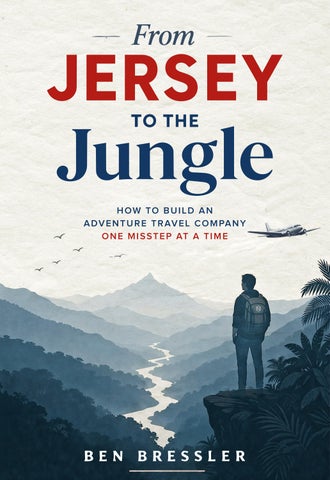
H O W TO B U I L D A N A D V E N T U R E T R AV E L C O M PA N Y O N E M I S S T E P AT A T I M E
If you’ve ever struggled in school, stumbled in your career, made dumbass blunders, or found yourself lost—either in the woods or in life—and wondered if your passion could make a difference, then this is the book for you. Four decades ago, Ben Bressler’s qualifications for launching an adventure travel company were, frankly, limited to playing outside as a kid and a brief, unsuccessful stint as a prep school teacher. He was also a garbage truck driver. Yet, from those scrappy beginnings and $600 in seed money, Bressler built a multimilliondollar enterprise that has become a pioneer in conservation-focused travel. From Jersey to the Jungle, the story of the founding and enduring of Natural Habitat Adventures (Nat Hab), is not one of linear success. The incredible saga within these pages—consisting of travel anecdotes, personal missteps, hard lessons, wild animals and wilder investors—told with Bressler’s signature humor and honesty, proves that succeeding is about having conviction in one’s purpose. And that sometimes the best qualification for building something meaningful is refusing to give up. Despite astronomical odds stacked against its survival—political unrest, terrorism, global recessions, pandemics, and most perilously, Bressler’s own long list of mistakes—Nat Hab not only survived, but is thriving. As the world’s first 100% carbon-neutral travel company, it operates in nearly fifty countries across all seven continents and consistently ranks among the top adventure travel companies worldwide. Nat Hab and its subsidiaries have grown to employ nearly a thousand people and host 15,000 travelers each year. Company revenue has increased dramatically, but this growth is not about the bottom line. It is about stewardship. Nearly $125 million flows into local economies annually, and millions more are donated to philanthropic causes around the world.
From Jersey to the Jungle: How to Build an Adventure Travel Company One Misstep at a Time Copyright © 2026 by Ben Bressler. All rights reserved. No part of this book may be reproduced in any form or by any electronic or mechanical means, including information storage and retrieval systems, without permission in writing from the publisher, except by a reviewer who may quote brief passages in a review. Published by Nat Hab Press, Boulder, Colorado Soft cover ISBN: 979-8-31784-868-2 Hard cover ISBN: 979-8-31783-566-8 Printed in the United States of America
Disclaimer This book is a memoir reflecting the author’s personal recollections and experiences over forty years in the travel and conservation industry. While every effort has been made to ensure the accuracy of the information presented—including financial figures, company milestones, and historical events—some details may have changed over time. The author and publisher assume no responsibility for errors or omissions or for changes that may have occurred since the time of writing. The anecdotes in this book involve real people and events; however, some names and identifying characteristics have been changed to protect the privacy of individuals. The views expressed are those of the author and do not necessarily reflect the official policies or positions of any organizations, partners, or subsidiaries mentioned in the text.
For Mom and Dad. When I wonder how the hell any of this happened, it all comes back to you.
This book was not written as a money-making venture. It’s a labor of love and an opportunity to help preserve our planet and its inhabitants. If you enjoy reading it and would like to support Nat Hab Philanthropy, please visit www.nathab.com/donate to make a donation. Your generosity helps fund meaningful conservation and community initiatives around the world, such as building schools in Ecuador, supporting an all-female anti-poaching unit in South Africa, and providing scholarships that enable educators to experience the monarch butterfly migration firsthand, along with many other conservation and community projects. Thank you so much for your generous support!
The two most important days of your life are the day you were born, and the day you find out why. —Never actually said or written by Mark Twain, but a damn good quote attributed to him nonetheless.
TABLE OF CONTENTS
Prologue
xi
Introduction
xiii
SECTION 1: FINDING DIRECTION 1. Growing Up Jersey
3
2. The Fruit and the Tree
8
3. Where Justice Met Journey
11
4. Hang In There, Baby
16
5. Four Boys & a River
21
6. The World’s Game
31
7. Love and Misadventure
37
8. The Bad Teacher’s Society
43
9. The Cocktail-Napkin Business Plan
51
10. An Entrepreneurial Life
56
11. The Phone Call
67
12. What Could Go Wrong?
75
13. The Tour and the Tears
84
14. Colder Than a Witch’s Teat
89
15. The Longest Night
95
SECTION 2: GROWING, FOR BETTER & WORSE 16. The Allure of Adventure
109
17. The Polar Bear Capital of the World
118
18. Face to Face with the King of the Arctic
126
19. Heartbreak Hotel
136
20. The Risk, the Ring, & the Reward
142
21. From Jersey to the Jungle
148
22. Go West, Young Company
161
23. Lessons from the Long Road East
167
24. The Big Spill
172
SECTION 3: THE NEW NAT HAB 25. The Turnaround
199
26. Clarity at 30,000 Feet
206
27. The Cigar That Saved Me
212
28. The Billionaire Yogi
218
29. Terror
224
30. Aim for Greatness and Profits Will Follow
228
31. Raising the Bar on Conservation
236
32. Murphy’s Law and the Thin Line Between Adventure and Disaster
243
33. Pissing on Hitler, Building in Greenland
250
34. Adventure Meets Ownership
265
35. Reptile Aliens, Misguided Investors, & True Believers
274
36. The World Changed and So Did Our Business
282
37. Purpose in the Search
289
Epilogue
300
Acknowledgments
303
FROM JERSEY TO THE JUNGLE
Prologue The icy trail crunched beneath my boots as darkness settled in and the temperature dipped below freezing. It was an irresponsible move, leading 111 travelers through the snowy, wooded trails of a remote island in Atlantic Canada as a lone guide, especially since I didn’t know the route. On top of that, I wasn’t even a professional guide. I was just a twenty-seven-year-old guy trying to make his dream of running his own adventure company a reality. A seasoned leader would have turned back at the first whisper of doubt at a fork in the trail. Or the second, or the third, or the fourth. Instead, I trudged ahead, each time choosing the uphill option. My mission was to get to the butte, where a pleasant surprise awaited our guests, and I marched on, head down, step after step, the sound of my feet hitting the snow setting the rhythm of a relentless pace. When I caught a glimpse of a flickering light that indicated that our destination was near, I turned to share the good news, anticipating smiles of relief from the crowd behind me. Instead, I found only four panting faces, struggling to keep up. The others—107 of them—were nowhere in sight. I was stunned. How could I have lost that many people in the gnarled and windswept northern forest in the middle of winter? Where could they xi
BEN BRESSLER
be? Did they give up and make their way out of the reserve? Were they dispersed along the endless web of trails? Or worse? I had no map, no plan, no idea which way to turn. My shouts into the frozen night went unanswered. It was 9:00 p.m. when I realized they were missing, and the temperature was still falling—it had reached single digits. If I didn’t find them soon and get them to warmth, the elements would claim them. That’s when it hit me like a snowball to the face: I was in no way ready to run an adventure travel company, especially one that ventured into the world’s wildest realms. I drew in a deep, cold breath of Arctic air and took stock of my industry experience, which was pretty much zero, and my natural abilities, which were, at best, seriously lacking. It was an odd time to ask myself, “What the hell am I doing?” A bit late, I’d say. I knew I wasn’t built for the organization, management, and attention to detail required to pull this off. Yet there I stood, with four breathless travelers beside me and more than a hundred more lost in the frozen woods. Raising my head to the sky in the clear, crisp night, the stars were infinite—and so, too, were the ways that I was screwing this all up.
xii
FROM JERSEY TO THE JUNGLE
Introduction In November 1985, just three months into my employment as a history teacher at a New England boarding school, I received a terse, two-sentence letter from the school’s headmaster. The first sentence offered a polite greeting. The second informed me that I was fired. I couldn’t blame him. My performance had been dreadful. But this failure stung more than any before, because I had desperately wanted to succeed as a teacher. And now, at twenty-two years old, I found myself jobless, broke, sleeping on the floor of my brother’s New York City apartment, and living off his leftover Chinese takeout. Lacking direction and with a track record of floundering in serious pursuits, I had landed exactly where my own teachers had predicted: nowhere. With no marketable skills to speak of, my job prospects seemed limited to donning a hairnet and asking, “Would you like to supersize that?” Respectable work, sure, but not exactly the future my well-educated Jewish parents had in mind. They expected more. What I really wanted was to see the world—a passion I inherited from my mother—and to lose myself in the outdoors, just as I had growing up in the 1970s, when playing outside was simply what we did. I knew full well that “explorer” wasn’t a realistic job title, but fate has a funny way of stepping in. Somewhere at the intersection of a wandering xiii
BEN BRESSLER
canoe trip down the Delaware and the opportunity to chaperone a couple of dozen teenage boys on a Rocky Mountain ski trip, I stumbled upon an idea that might allow me to earn a paycheck while satisfying my wanderlust: I would start my own adventure travel company. As expected, the obstacles were many. The total capital I was able to raise was $600, which I saved by driving a garbage truck at an amusement park in New Jersey. I also didn’t have a proper business plan or any experience in the travel industry. And if no money, no plan, and no proficiency sound like a prescription for failure, I was saddled with another, even bigger hurdle: my undiagnosed “learning challenges,” which had contributed to a lifetime of academic failure. (See short-lived teaching career above.) By every conceivable measure, this venture was destined to crash and burn. And it nearly did, more than once. But somehow, over many years, it managed to endure. Now, remarkably, four decades after its launch, the company I started—Natural Habitat Adventures, or Nat Hab—along with our subsidiaries, hosts 15,000 travelers annually and generates hundreds of millions of dollars in revenue. Including both administrative and field staff, we employ nearly a thousand people across our offices, lodges, camps, and regional hubs, and support thousands more in local communities. Most importantly for all of us who work here—and critical to this story—we’ve contributed millions of dollars to conservation efforts and to supporting vulnerable local communities. As unlikely as it seemed at the time, my adventure venture worked. But how did it all come to be? How and why did we make it when my qualifications for starting and running an international adventure company were limited to playing outside as a child and driving a garbage truck? I regularly pinch myself in wonder at my good fortune. People are often surprised when I recount the inept beginnings of my company and the astronomical odds stacked against its survival. They think I’m being self-effacing when I reveal my own foibles and share the xiv
FROM JERSEY TO THE JUNGLE
screw-ups I made over the years. But those who knew me back then understand that success was far from preordained. You are about to read an unlikely story about the transformational powers of finding purpose. But it’s more than just a yarn about a personal makeover. It’s also an unusual business story, in which a struggling company, messing up at every turn, redeems itself by virtue of its unyielding pursuit of a mission. The journey begins with the joy one boy felt wandering the wild corridors of the East Coast, and includes a telephone, a borrowed desk, and a stolen book of client prospects. It winds its way along a precarious path, with naivete, hubris, and moronic personal blunders as constant companions. The mercurial, drama-filled route includes lifelong friendships made, dishonorable shysters encountered, amazing adventures taken, and plenty of beer. Along the way, I lost 107 travelers in the subarctic woods on a zero-degree winter night, got punched in the face by a drunk seal hunter, and sucked down vodka with the Russian military. I bicycled fourteen miles down a South African mountainside chased by a herd of thundering wildebeest and casually backstroked from Namibia to Angola across the crocodile-filled Kunene River. I dressed as a girl while hitchhiking from Edinburgh to London, only to be picked up by a carload of drunken Scottish football hooligans. I was nearly shot off a New Jersey rooftop by a dozen cops who thought I was a serial killer. Unbelievably, I spent a full day visiting schools with Jane Goodall—a highlight of my career—and was then tricked out of half my company by a billionaire yogi. You can’t make this stuff up. Along with travel stories, personal missteps, and a number of business lessons and entrepreneurial rites of passage, you’ll see that I write quite a bit about the environment. I’m not one to point to a single unseasonably warm winter as definitive proof of climate change, but the science is clear: Over the past handful of decades, the earth has been warming at a pace unseen in sixty-five million years. And remember, the last major change xv
BEN BRESSLER
in temperature didn’t go terribly well for the planet’s inhabitants, especially the dinosaurs. One of my hopes in writing this book is to inspire people to step up and make a meaningful impact. We really have no other choice. All that is part of the story, but the central theme of this book is simple. If I can succeed, so can you. All you must do is find your purpose. I wrote this book for my sons, but it is meant as encouragement for people who, like me, struggled within the United States’ rigid, one-size-fits-all school system. In education and even in the workplace, many of us are left behind. I believe that does not need to be the case; people can achieve success outside a straight line. My company and I got to where we are in a highly circuitous fashion. That’s okay. In fact, that’s the point. There are countless routes to success. Given the precarious state of our planet and the fractured nature of our society today, I suspect that there are multitudes of people—young and old, employed and unemployed, successful and not yet successful—who feel a deep desire to find greater importance in what they do and to seek their own route, however indirect. If you are one of those people, you are in good company. The road rarely runs straight—and many of the useful parts seem to happen after you’ve missed a turn . . . or three.
xvi
FROM JERSEY TO THE JUNGLE
SECTION 1: FINDING DIRECTION
FROM JERSEY TO THE JUNGLE
1
Growing Up Jersey 1960s & ’70s
When you picture an individual who built an international adventure travel company, one that takes people to the planet’s wildest corners to track gorillas and photograph polar bears, a guy from New Jersey probably isn’t what comes to mind. Jersey is better known for Bruce Springsteen and shopping malls than for global exploration and wildlife encounters. But here I am, living proof that a kid from the land of boardwalks, diners, and endless highway exits can grow up to chase adventure. And it didn’t happen in spite of New Jersey. It happened because of it. In 1964, I was only two years old when my parents packed up our two-bedroom apartment in Manhattan, loaded my older brother Ken and me into the Plymouth Valiant, and drove through the Holland Tunnel to Maplewood, New Jersey. I didn’t exactly get a vote on where we were headed, yet somehow that move—and that moment in time—turned out to be the perfect launchpad for a future life in a purpose-driven adventure company. 3
BEN BRESSLER
New Jersey in the 1960s and ’70s offered a kid like me a kind of raw and scrappy freedom. When I tell my wife about the autonomy my parents afforded Ken and me during our childhood, she envisions the Artful Dodger, with soot on his face and running with abandon. She’s not entirely off base, although I like to think of my childhood as more “independent” than “raised like feral cats.” For us—and for most kids in the suburbs—freedom meant time outdoors. We’d leave the house in the morning, often shooed out the door by Mom with a cheerful “Go outside and play,” and, unless one of us took a stick or a rock to the eye, we’d scarcely return before dinnertime. Some kids followed the streetlight rule, sprinting home when the lamps flickered on. Others responded to a family whistle that echoed through the neighborhood air. At our house, it was simpler. “Be home at 6:00 p.m.,” Mom would say sweetly. We’d nod and run off, neither of us wearing a watch. In between, we practiced our freedom playing ball in neighbors’ yards, throwing rocks into the creek by the school, or exploring the sprawling gulley behind Jay Cowan’s house. I spent countless hours in that gulley and, although today I’m sure I’d find it barely a dozen feet wide, to my young self it was as vast as the Grand Canyon. Entire days were passed there, building forts and collecting salamanders, which I proudly brought home like wriggling trophies. My mother, smiling tightly, would gently insist I return them to the exact stone I’d found them under. At the time, I thought that she was displaying motherly care for tiny helpless creatures, but now I realize she just didn’t want the slimy things in her home. In the fall, kids gathered at our house to play football on the side lawn; in winter, we sledded at Cameron Field, played hockey at the duck pond, and built snowmen; and in spring, as the gray cold lifted and the air filled with the scent of blooming flowers, we played baseball. The smell of a worn leather baseball glove still takes me straight back to springtime in New Jersey.
4
FROM JERSEY TO THE JUNGLE
Of course, the long summer days were the peak of our time outside, bringing endless exploration near and far, my buddies and I riding two boys to a banana seat on our Sting-Ray bikes. A good day included Wiffle Ball on the library lawn, fishing in the South Mountain Reservation, and a stop at Baskin-Robbins. Summer nights brought their own adventures, as backyard sleepouts were a regular occurrence. Lacking a real tent, we draped Army-Navy store wool blankets over our rusty jungle gym and hid underneath with military-style flashlights and bags of potato chips. We’d sleep in the dirt, delighting in full-moon visits from curious raccoons, blissfully unaware of the risks of rabies. While most of our outdoor exploration was done on our own, Dad would sometimes take us for hikes in the reservation, where we carried long sticks and pretended to be soldiers marching. Mom rarely joined our mini treks, joking that we Jews had already spent forty years wandering in the desert. And even then, she added, if given the choice, Moses and his followers would likely have swapped their tents for a room at the King David Hotel, especially if there was an all-you-can-eat Sunday brunch buffet. No doubt I chased adventure because the outdoors filled me with joy, but my wanderlust was also fed by the one thing I dreaded the most— school. Along with the liberty of roaming outside came what felt like an allergy to being indoors, especially under fluorescent lights, facing a blackboard, and listening to a teacher drone on. Looking back, I see it was undiagnosed learning difficulties—ADD, ADHD, or some cousin—that made every minute at my desk feel like a slow boil, each lesson winding a spring of restlessness tighter and tighter until I thought I might burst or fling myself out the nearest window. It wasn’t just boredom; it was a gnawing sense that something in me was off, that my brain simply worked differently. At the time, all I knew was that sitting still and learning like everyone else felt impossible. It left me feeling broken. To escape, I adopted a keen wisecrackery, a tactic that often got me kicked out of class, which allowed me to go outside for a short time to 5
BEN BRESSLER
throw a ball or just sit under a tree. The approach was effective until I discovered I could just skip school entirely and have the whole day to myself. My parents, desperate to set me straight, grounded me again and again. Sometimes, I deserved it, like after the time I took their car to the Jersey Shore at age fourteen. But getting locked inside all weekend for doing Rodney Dangerfield impressions in class? That felt less like discipline and more like cruel and unusual punishment. If my behavior in regular school was poor, I was a full-blown menace twice a week in Hebrew school. My friend Rob Saffer and I spent our time stoking the rabbi’s ire until one day he finally snapped and chased us into the stairwell, where he fastened his hands around our throats and tried to strangle us. We broke free and ran away laughing. I don’t remember what our transgression was that time, but it must’ve been impressive to drive an otherwise peaceful rabbi to physical violence. My struggles worried my parents enough that they bounced me from school to school, hoping something would finally stick. Between sixth and twelfth grade, I attended four different schools—one of them twice. The first switch came when they pulled me out of public school and enrolled me at Newark Academy in Livingston, a twenty-minute drive from home. It wasn’t just the tougher academics that threw me, it was also the dress code, which required slacks, non-sneaker footwear, collared shirts, and belts. I didn’t own any of those things and, aside from at my bar mitzvah, I don’t think I’d ever worn a belt in my life. Mom hustled me into corduroys, a knockoff Izod shirt, a synthetic leather belt, and Wallabees—those floppy-soled suede shoes that were technically not sneakers—and drove me off to my new school. I hated all of it. My first class was math, and my teacher, Mrs. Lynham, was a ghostly Irishwoman who seemed at least a hundred years old. She wore a long tartan skirt and a frilly blouse with a collar so high it looked like something out of an Elizabethan painting. Her skin, pale as parchment, matched, and her voice had the flat, droning tone of the adults in Charlie Brown cartoons 6
FROM JERSEY TO THE JUNGLE
but with an Irish brogue. She started every class by reciting a math problem: “Two plus four, times eleven, to the square root of four, minus seven.” She lost me at “square root”—I didn’t know what that was—so by the end I couldn’t even figure out what the question had been, let alone answer it. If growing up outside was common for kids in New Jersey in the 1960s and ’70s, the misery of school gave me an even fiercer drive to escape into the open air. That mix of freedom and frustration became the spark that shaped my working life. The world beyond the classroom walls called to me, louder than any teacher’s voice, promising space to move, to breathe, to discover. I didn’t realize it then, but that conflict—between those long afternoons in the woods and the restless hours in class—pointed me toward the same truth: I was never built to sit indoors.
7
BEN BRESSLER
2
The Fruit and the Tree 1960s & ’70s
In hindsight, my parents should not have been surprised by my struggles. My mother had entered Smith College at sixteen, and she cruised through the functions of life. My father, on the other hand, while brilliant, was a disorganized mess, battling the same issues I did. He made it through college, the military, and, eventually, law school. But he was no academic, and he claims he only graduated because his brother was at the top of his class. As an adult, he was a lovable disaster. He lost everything, broke things constantly, and once walked through a screen door while reading the newspaper. His clothes were permanently mustard-stained; peanut butter occasionally ended up on the wall. Picture Oscar Madison from The Odd Couple, though prone to arguing the merits of George McGovern over Hubert Humphrey instead of the pitching prowess of Sandy Koufax versus Bob Gibson. (If he were arguing baseball, he’d have selected Koufax, if 8
FROM JERSEY TO THE JUNGLE
for no other reason than he declined to pitch in the World Series on Yom Kippur.) He was also relentlessly optimistic. He believed anything could be accomplished. This was partly due to his willingness to awaken early and get to work, and partly because he simply did not register obstacles. That optimism was not always rewarded. In the early 1970s, he helped start a free legal and dental clinic in Newark and was directly responsible for serving hundreds of the city’s most underserved people. But he forgot to withhold payroll taxes in the employees’ paychecks, and when the government came calling, my parents had to pay everything back personally, wiping out what little savings they had. As a result of this oversight and other mistakes, he put himself into substantial debt. After going bankrupt, he was forced to sell our home and move into a small apartment in a declining neighborhood of Orange, near the White Castle hamburger joint . Frighteningly, Dad had one debt that couldn’t be settled by the courts, and one day a “gentleman” showed up with a gun and demanded payment within forty-eight hours. With no other way to raise funds, my mother sold her jewelry to cover it, keeping only her engagement ring. When it came to organization, my paternal grandfather also had two very different sides. A Ukrainian immigrant who escaped Eastern Europe just after the Russian Revolution, he spoke seven languages, earned multiple degrees, and taught math at the prestigious Lawrenceville Academy. He was a folk singer who performed with Pete Seeger and was an unofficial rabbi. As a kid, I spent weeks at a time at my grandparents’ house, likely sent there by my mother so she could enjoy a little peace during the summer. When he wasn’t making me work through math problems in his 19th-century arithmetic books, my grandfather and I listened to folk records while he told stories that never got old. Some were funny, like the time in 1917 when his brother fell asleep on guard duty in the Russian army and my 9
BEN BRESSLER
grandfather woke him by threatening to tell their mother. Others were horrifying. As a ten-year-old in Ukraine, he watched Cossack-backed thugs ride up on horseback and shoot his uncle dead just for being a Jew. Seventy years later, he still teared up telling that story. For all his brilliance and warmth, my grandfather struggled with everyday life. He drifted through it, often wearing one shoe or a misbuttoned shirt, his clothes marked by whatever meal he had just eaten. He frequently forgot to zip his pants, a trait common in old age but, as I understood, a signature feature of his even in youth. From him and my father, I inherited a mix of curiosity and chaos. In them, it led to bold ideas and both minor and serious consequences. In me, it started with academic failure and would later show up in a string of questionable—and occasionally dangerous—decisions.
10
FROM JERSEY TO THE JUNGLE
3
Where Justice Met Journey 1960s & ’70s
If my learning struggles and the free-range lifestyle of my childhood years conspired to nudge me toward a career outdoors, then my mother’s passion for exploration pushed me toward the travel industry. When she wasn’t breaking up shenanigans caused by her two unruly young boys, Mom was often scheming for ways to escape the chaos, tucking herself away in the back room to read travel essays by Steinbeck, Hemingway, and Orwell, or to plan her next journey through guidebooks like Europe on $5 a Day. When we were small, before the money ran out, she left us with her mother and traveled with Dad to places like Japan, Mexico, Spain, and Italy. They rented cars and set off on their own, wandering lantern-lit streets in Tokyo, savoring the chaos of Mexican markets, standing awestruck before Gaudí’s surreal cathedrals in Barcelona. Museums were a must for Mom and, though Dad protested, begging for just a half an hour to rest his feet and read The New York Times at a café, she insisted they not slow down: 11
BEN BRESSLER
“Marty, we’re spending the next seven hours in the Louvre and that is that.” And it was. My own earliest memories—probably from age four or so—are all travel-related, mostly of road trips to regional attractions where I’d poke Ken until he smacked me in the back seat of our Vista Cruiser station wagon. I’d scramble to the third row, still taunting. Or crying. Dad would reach back to grab us with one hand while holding a cigarette in the other. I’m pretty sure he was steering with his knees. We’d travel to Pennsylvania Dutch Country, where Ken and I mischievously chuckled at the bearded men driving horse-drawn buggies; to Valley Forge, where we heckled the patient reenactors demonstrating 18th-century glassblowing; and to Niagara Falls, where Mom kept us well back from the railings, though I suspect our behavior sometimes tempted her to give us a nudge. Eventually, our family trips expanded to include international destinations like England, where we ran through Hyde Park and playfully harassed the palace guards. And Israel, where I thrilled at riding a camel through the desert and sitting in the back of our rental car beside machine gun–toting military hitchhikers. I learned one word of Hebrew on that trip: glidah—ice cream. On those trips, Mom led with her map and guidebook in hand, checking off experiences that she had filed away from her readings. We punted on the Thames, hiked to the fortress of Masada, and walked across low tide to Mont-Saint-Michel. These were experiences Mrs. Lynham could never have given me. No teacher could, and that was Mom’s point: travel was a way of learning that went deeper than classrooms or books. What she gave us on those journeys wasn’t knowledge so much as a hunger for experience, discovery, and adventure that would shape the rest of our lives.
* * *
12
FROM JERSEY TO THE JUNGLE
My mother’s thirst for exploration may have charted my course in adventure travel, but it was my parents’ unbending pursuit of justice that planted the philanthropic roots that would one day anchor the company I would build. By day, Mom and Dad wore suits and practiced law but, in their hearts, they were more Berkeley than boardroom. Civil rights, women’s rights, and the battle against the Vietnam War were the great causes of the day, and they embraced them all, always ready to protest for the little guy as if it were their true calling. When they weren’t taking the train to Washington, D.C., to march, they were holding candlelight vigils in the local park. As one older cousin liked to joke, Roz and Marty Bressler’s politics landed them somewhere to the left of Lenin. Like much of the country, Maplewood in the turbulent 1960s and uncertain 1970s was a town torn by contradictions. It embodied the American dream, steeped in promises of education, success, and upward mobility, yet lay just beyond Newark, where racial strife and economic hardship simmered dangerously close by. The Vietnam War raged on, dividing neighborhoods, while the surge of the women’s rights movement challenged long-held norms. What seemed an idyllic village revealed a split personality—both a nurturing haven and a vivid reflection of the nation’s deepest fractures. My parents, unwavering in their beliefs and fueled by my father’s bold nature, stood firmly at the heart of this divide, and our home became a hub for weekly anti-war and civil rights meetings. Ken and I would peer through the upstairs banister as a dozen adults debated; planned protests; and filled the house with coffee, Scotch, and cigarette smoke. As the night wore on, the arguments gave way to laughter and my dad’s harmonica, usually starting with a sing-along of “Give Peace a Chance” and ending with a tearful, somehow Jewish rendition of “Danny Boy,” poorly crooned by Dad’s buddy Wally. Ken and I especially loved the League of Women Voters meetings—less yelling, more baked goods. 13
BEN BRESSLER
For my parents, fighting for justice wasn’t all cookies and kumbaya; there were sometimes absurdly serious moments. One Friday night in 1968, after seeing the musical Hair on Broadway, they stepped outside to find a drunken Black man slumped by the theater doorway, loudly singing “Age of Aquarius,” the production’s hit song. Two police officers, apparently not fans of peace, love, or show tunes, started harassing—and then beating—him. Dad, built like a fridge with fists, jumped in. My pacifist mother could only watch, horrified, as he took on two New York City cops. He held his own until they cuffed him and hauled him off in a cruiser. I remember Mom returning home late that night. “Mommy, where’s Daddy?” I asked. She calmly replied: “He’ll be home Monday.” The physical risks of being an anti-war protester and civil rights activist weren’t limited to my father alone. During the 1967 Newark riots, Mom stepped up for action. When at least twenty-six people died, hundreds more were injured, and untold property damage occurred citywide, the police and National Guard encircled the entire metropolis with tanks and armed vehicles, forging a four-day siege that left citizens without supplies or food. Perhaps Dad was traveling—I don’t know—but Mom took it upon herself to breach the barrier and drive her station wagon filled with crates of milk and bread to feed the hungry citizens. This willingness to put herself in danger spoke to her sense of justice, or perhaps it’s just a testament to her steadfast belief in the power of a glass of milk. Moms are like that. And us kids weren’t immune to danger. When the ’67 riots sped up the ongoing migration of upwardly mobile Black families from Newark to the predominantly white neighboring suburbs of Maplewood and South Orange, my parents and their friends made an effort to welcome these newcomers. But some established residents resisted integration and resorted to intimidation, pressuring homeowners to decline offers from Black buyers. This infuriated my father and his circle of friends, prompting him to pursue legal action under the Fair Housing Act. Naturally, this stance put a target on his back, and some in the old guard took aim. Our 14
FROM JERSEY TO THE JUNGLE
phone rang in the middle of the night, and a voice on the other end gruffly told my mother that there was a bomb planted in the house. This was not a prank call; it was a credible threat that shattered the sense of safety my suburbanite parents had taken for granted. I remember my mother waking and quickly bundling me into the station wagon to stay at a friend’s house for the night. We returned the next day as if nothing had happened, with my mother steering clear of any explanation for why I was still wearing my Speed Racer pajamas at 3:00 in the afternoon. At the time, the incident didn’t feel particularly frightening; my parents managed it with such calm. Yet, when I recently came across a newspaper account of the event, I realized it was likely more threatening than they had let on. With bomb scares, clashes with police, expeditions into virtual war zones, and smoky meetings shaping my childhood, it’s no surprise that championing a cause became second nature. For me, that cause is conservation, but the passion behind it was sparked by an upbringing deeply rooted in the pursuit of social justice.
15
BEN BRESSLER
4
Hang In There, Baby 1980
As I neared the end of high school, my parents had their sights set on me getting a college education. But I wasn’t convinced. As expected, given my lack of effort and the number of school days I missed, my grades were poor, and my SAT scores were abysmal. It snowed the night before the test, so I showed up in ski gear, wrote my name, and spent about thirty minutes randomly filling in bubbles on the multiple-choice section. I skipped the essay entirely and bolted for the slopes at Vernon Valley. When my scores came in, my parents were beside themselves. I floated an alternative plan by them: “Maybe instead of going to college,” I suggested, “I could become a police officer.” I figured that would keep me outdoors, and it’s certainly an honorable living. I’d never fired a gun—I’d barely even seen one, aside from the historical models at Valley Forge—and I had no particular interest in law enforcement, but the thought of avoiding sitting in a classroom outweighed all that. Mom and Dad responded in their own unique ways. Mom patiently offered an 16
FROM JERSEY TO THE JUNGLE
extensive explanation of how a college degree would positively impact my future; Dad was more direct: “Are you fuckin’ crazy?” They both made it clear they wouldn’t be thrilled if I skipped college; they just had different ways of saying it. When I persisted, my mother took charge. Not prone to hyperbole, she sat me down and told me, “Benjamin, you can skip college if you want to. I’ll always love you and I’ll never judge you. But if you don’t go to college, I will literally kill you.” I suspected that was one of her jokes to defuse the situation, but I couldn’t be one hundred percent certain. Despite my poor academic performance and low test scores, in the spring of 1980 I managed to be accepted into several colleges, one because I played soccer, and the school was recruiting my friend Eric Brief, an allstate goalie. They figured they’d take me if it meant getting him. We visited the school on December 7, attended a fraternity toga party where I learned what a kamikaze shot was, and then stayed out all night. In the morning, looking and feeling our “best,” we showed up for our admissions interview . . . with the soccer coach. We were in. On the advice of my guidance counselor, I applied to other schools, too, though I never visited them. I was wait-listed at Skidmore College, a well-regarded, historically women’s school in Saratoga, New York that had only recently gone coed. By 1980, the ratio of women to men was still three to one and, to even things out, they admitted less-qualified guys who played sports. Even with that edge, I didn’t get in until late spring, when an administrator called and gave me forty-eight hours to claim my spot. I had to decide quickly. Saratoga was three and a half hours away by car or nine by bus and, since Mom had no interest in driving me there to check out the campus, she handed me $25 and dropped me off at the Irvington bus station. I was seventeen and, according to her, old enough to travel alone. When I protested, she made her position clear: “Kids your age invaded Normandy. You’ll be fine.” 17
BEN BRESSLER
From Irvington, the bus took me to Port Authority in New York City, then on to Albany. During the layover, sitting on a wooden bench in the grimy depot, I was struck by the reality of homelessness in a way I hadn’t ever been before. I’d seen homeless people in New York and Newark, but always with my parents at my side, never alone. Now, wearing relatively clean clothes and with a few bucks in my pocket, I sat beside people who had nothing: hungry, unwashed, and living in the station’s hallways or in cardboard boxes just outside. Some of them looked like drifters, riding Greyhounds from city to city, spending each night in a different station. But this wasn’t some romantic, Woody Guthrie–style journey. It seemed to me that most were battling addiction or mental illness, and often both. One man with no shoes asked me for money, and I gave him a few dollars. At the time, it made me feel generous. Looking back, I see how little that gesture really meant. People in his position need far more than a few bucks from a naive, college-bound kid passing through. My bus pulled into a diner on the edge of Saratoga at 9:00 p.m., and I hitchhiked the five miles to campus to save the last ten bucks crumpled in my jeans pocket. Arriving late on a weeknight, I wandered the darkened grounds, the silhouettes of three-story brick dorms surrounding a giant grassy field I later learned was called a quad. A cool breeze kicked up, and it hit me—I hadn’t planned a place to sleep. I had no change of clothes, just the jeans, button-down shirt, and jean jacket I was wearing. The damp chill of the upstate New York night made sleeping under a tree less than attractive. I was completely unprepared, a pattern that would mark much of my independent travel—an ironic tendency, given the career path I’d later choose. With few options, I awkwardly entered a brightly lit dorm and found a wooden bench much like the one in the bus depot. With nowhere else to go, I read the school newspaper cover to cover, paying extra attention to the sports section. I came across updates on the men’s and women’s 18
FROM JERSEY TO THE JUNGLE
lacrosse teams and even an article about the school’s polo team. A polo team? I thought, incredulous. I knew polo involved guys with long sticks riding horses—Prince Charles played it—but a college-sponsored polo team seemed unreal, a strange contrast to the bus station I’d left just hours earlier. Feeling increasingly out of place, I jumped when a female student approached. I braced myself, sure I’d done something wrong. She asked what I was doing in her dorm, and I fumbled for an answer. If it had been a guy, I probably would’ve played it cooler. But talking to girls wasn’t my strength, and my explanation came out awkward and disjointed. I told her I was checking out the college and had until tomorrow to decide if I’d attend. She listened without reacting, so I kept rambling about the bus ride, the shoeless guy in Albany, and how beautiful I thought the campus was. She raised an eyebrow. “At night?” Flustered, I backtracked. “I mean, I assume it must be beautiful.” She studied me for a moment, clearly sizing me up as a harmless, clueless high school kid. Then, to my amazement, she offered me her dorm room for the night, saying she’d stay with her boyfriend. When I think back on the absurdity of a seventeen-year-old on a college visit traveling for nine hours by bus and hitchhiking at night without much money or any plans for a place to sleep, the part that I remember clearest—what obviously made the biggest impression on my teenage self—was that girls were allowed to stay in boys’ rooms. If this was what college was like, I was warming to the benefits of getting a higher education. I accepted her offer, and got a good night’s sleep tucked under a down comforter with a poster on the wall of a cat clinging to a tree branch with the encouraging line, “Hang in there, baby.” In the morning, I hurried across the tree-lined campus, passing the glass-walled library and the college’s private theater, then followed a wooded trail to the main road, where I hitchhiked back to the diner to catch a bus back to New Jersey. In Albany, I looked around for my friend 19
BEN BRESSLER
from the night before but didn’t see him. Maybe he took the money I gave him and traveled home to his family. That would be nice, though I doubted that was the case. The last twenty-four hours had been a whirlwind of new experiences—real travel experiences, on my own—leaving my head spinning. That evening, as I walked into our home, I announced to my parents that I’d made an important decision about my future: I was going to Skidmore College. When they asked me how I came to that decision, I told them the truth—because a girl had talked to me.
20
FROM JERSEY TO THE JUNGLE
5
Four Boys & a River 1980
Though I had my college plans in hand, I still had to complete high school. Remarkably, I passed all my spring classes, perhaps because I did just enough to get by or maybe because my teachers just wanted to see the back of me. In any case, I was done with the academic part. But there was one more task to complete and, as it turned out, one that was a prelude to my future life in exploration. At Newark Academy, every senior had to complete a monthlong project, the school’s earnest attempt to keep us “productive” and “engaged with the world.” The choices ran the gamut: some kids volunteered at animal shelters; others interned at an uncle’s dental practice; and the more spiritually inclined buried themselves in scripture with a priest, rabbi, or imam. In 1980, a sizable number of students opted for Wall Street internships—a bit of a stretch in terms of serving the greater good, but a project enthusiastically approved in the spirit of the power tie.
21
BEN BRESSLER
Lacking an uncle in dentistry and having zero interest in finance or religion, I chose something different. I was going canoeing. My senior project would take me, along with fellow seniors Sam Giberga, Dave Ellis, and Greg Tomano, down the 330-mile Delaware River. While nowhere near as substantial as many other rivers in America, it’s still impressive, beginning in upstate New York, winding through Pennsylvania and New Jersey, and emptying into the vast Delaware Bay before it spills into the Atlantic. At its headwaters in the quiet village of Hancock, the river is homey and familiar, a place for fishing and weekend play, the heart of a small community. By the time it reaches its terminus, it becomes something else entirely, an industrial artery and a symbol of American economic power. It even holds a defining moment in our nation’s story: George Washington crossed the Delaware on Christmas night in 1776 to surprise the Hessian forces in Trenton. I remember my mother dragging me there as a child, determined to inject history into our family outings. Much like America itself, the Delaware shifts character from end to end. For four restless teenage boys, part of the allure was diving into those shifting landscapes on our own, no parents to guide us, free to discover whatever the river had in store. Unlike the other boys, I’d had some experience on the river. For several weeks every summer as a kid, I attended a YMCA sleepaway camp on Kittatinny Lake, in western Jersey. We swam, played sports, generally messed about, and—my favorite—took counselor-led overnight canoe trips on the Delaware. I’d probably completed six or eight of these adventures, each trip along a different segment of the river. On various journeys, I had tipped my canoe in the rapids, losing my tent and sleeping bag; contracted strep throat and, with a fever of 105 degrees, had to be evacuated from a remote campsite; and got poison ivy so bad that I had to spend ten days in the hospital. As a boy, my adventures on the Delaware beat me
22
FROM JERSEY TO THE JUNGLE
down, but the freedom and the wilderness also provided me with the highest of highlights of my adolescence. On those counselor-led trips, the canoeing part was fun enough, and we had a great time navigating the rapids and swimming in the gentle sections, all highlighted by epic water fights using our wooden paddles. But the camping part—sleeping on the soft pine needles in hidden nooks at the top of the rocky walls—was the reason I cherished the river. We’d tell ghost stories that scared the crap out of me, and we’d laugh for hours before drifting off to sleep. We’d often wake to a damp mist that had descended overnight, at once chilling us to the bone and producing a great sense of comfort as we tucked ourselves into our oversize hooded sweatshirts. For breakfast, we’d drink hot chocolate and cook up scrambled eggs dotted with tree bark and ash, then gather our camp gear in the kind of awkward tumult that can only be created by boys camping. We’d climb into our canoes and push off, back onto the river, the early morning waters as smooth as glass. With little else to concern our younger selves, this was true living. It was with those memories firmly in mind that I proposed this senior project adventure. I’m not sure how canoeing the full length of the Delaware River, from its folksy tip all the way to Delaware Bay, was of any greater value to society than spending a month on Wall Street, but to me and the others, it sure sounded like fun. Once approved, we prepared for the trip with the same attention to detail that I had for my college visit. We gathered whatever Korean War– era camping gear our families collectively owned and stuffed it into giant Hefty garbage bags—our version of dry bags. We had no cold-weather gear, or even rain jackets, just a couple of T-shirts, sweatshirts, and spare shorts. One of us brought a sharp hunting knife, and that would be our primary tool, though we didn’t know what we’d need a tool for. Mostly, we just thought it was cool to have a hunting knife with us. Emergency gear and a first-aid kit were afterthoughts.
23
BEN BRESSLER
Our meals were handled in a manner uniquely satisfying for seventeen-year-old boys: we purchased a hundred boxes of generic brand macaroni and cheese. At nineteen cents each, we couldn’t go wrong. Sam also brought a bag of trail mix. We rented canoes and paddles from a company we found in the yellow pages, and that was it for our preparation. It may have been hubris or ignorance that caused us to forgo serious planning—or maybe it was laziness—but it all seems on-brand for teenage boys. Greg’s father, who was a gym teacher at Newark Academy, borrowed the school van, and he and my dad drove us north toward Hancock, where we figured we might find a spot to launch our canoes. We weren’t exactly sure where a put-in would be, so we circled for more than an hour; our only navigation tool was a street map we found in the glove box, and it didn’t even show the river. The adventure hadn’t officially begun yet, and while we weren’t exactly lost—the river was somewhere off to our left—we also didn’t know where we were. Not that it mattered—we rolled down the windows and let the wind blow back our hair while we listened to the AM radio and my father played folk tunes on his harmonica. We tore through the bag of trail mix. When we reached a stretch of road where the shoulder disappeared into a muddy trail, we were convinced the river had to be close. Seventeenyear-old boy logic: there’s water in mud . . . the river is made of water . . . therefore, when we see mud, the river must be nearby. I’m sure the dads were thinking that if Lewis and Clark had followed this kind of reasoning, they’d still be wandering around St. Louis. But they let us have our moment of discovery, and down the trail we went, canoes and Hefty bags hoisted over our heads, ready to prove ourselves right. It seems odd, so many years later, that these two responsible adults would leave their children on the side of a remote country road in such an unprepared condition, offering nothing more than a pat on the back and a casual, “See you when we see you.” But they did, and to us at that time it seemed normal. It wasn’t like we were searching for the source of the Nile.
24
FROM JERSEY TO THE JUNGLE
We just had to find the river and float down it, overloaded with an absurd amount of macaroni and cheese. Once we were deep in the woods, we heard the van peel away on the gravel. That’s when it hit us: the defining feature of our river adventure— the river itself—might still be quite a way off. For the next thirty minutes we hauled our sixteen-foot canoes through dense trees in the shadowy forest before we finally found a small watery opening with just enough flow to trickle over our Chuck Taylor shoelaces. It was far too shallow to paddle through, but we could at least drag the canoes, giving our tired arms a break and sparing us from carrying the boats all the way to the Atlantic. Gradually, the trickle became an ankle-deep stream and, within another mile, the dense forest opened to reveal the full breadth of the river, stretching a hundred yards wide. We high-fived and laughed like little kids. Then we paused to take in the liquid highway that we’d ride to the end of our school days. For the next ten days, that water would be our lives. No more schoolwork, no more nagging from parents, and—best of all—no more sitting in classrooms.
* * * The navigation would be straightforward enough—even four wildly underprepared boys could manage pointing their canoes downstream. But we did have a self-induced problem with our itinerary: we didn’t have one. We had no planned camping spots, nor did we even have a map to tell us where they might be. More concerning, reprovisioning would be dependent on my recollection of the pull-out points from my camp trips. I didn’t quite know where those points were or what they were called, but I assured the others that I’d remember them when I saw them. They were as unconvinced as I was. Regardless of the lack of details, with sleeping bags, tents, and $25 per man stuffed inside our jean shorts, I was confident we’d find a place to sleep and some other food to go with our mac and cheese. For
25
BEN BRESSLER
something to drink, we figured we had a river. And it went without saying that we had to find beer. Back then, the upper Delaware was not a crowded stretch of water and, for the first hour we were on our own, joyfully taking in the riverside sights and generally patting ourselves on our backs for our choice of senior project. That is, until we came upon our first set of other boaters, an unkempt assembly of blasé, flannel-clad twentysomethings lollygagging on the far bank under the shadows of a shoreline canopy. The scene was creepy—the movie Deliverance came to mind—and my inclination was to skedaddle. But Sam had other ideas, and he paddled us over, offered a jolly teenage “Hello.” He followed that with, “Do ya’ have any weed?” The shabby group of gentlemen perked up and assured him they could help. It would cost him just $25. The rest of us didn’t smoke, and we assumed that, given our limited funds, a deal of this kind was out of the question, but before we could maneuver ourselves back to the safety of the river’s sunny center, Sam handed over a crumpled fistful of cash in exchange for a melon-size baggie of dope. I’d never before been near a drug deal, so with an urgent “Let’s get the fuck out of here!” we paddled away rapidly. All except Sam, that is, who settled in at the back of my canoe, his nose firmly buried in the bag of leafy loot. We were in the infancy of our journey, and twenty-five percent of our funds had been allocated to a resource that three quarters of the group wanted no part of. For the next hour, we let Sam know of our displeasure, and he took it all in with a sheepish silence. That is, until we came across our next assembly of boaters, where he was determined to make amends. Friendly fellow that Sam is, he once again greeted the strangers and, this time, asked if they had any beer. If the weed purchase was a misguided, unilateral determination, his next move was conciliatory and brilliant. They didn’t have beer, it turned out, but they did have a mostly full plastic gallon-size jug of Canadian whiskey, and he offered them half a bag of weed for the entire booty. They agreed and, though I’d never drunk 26
FROM JERSEY TO THE JUNGLE
whiskey before, we celebrated Sam’s bartering skills and spent the remainder of the day paddling and swigging, all while laughing heartily at the turn of events that had left three of us well stocked with whiskey and Sam in possession of a haul of marijuana. That afternoon, we pitched our tents on a shaded hillside overlooking a bend in the river and, that night, we finished off the whiskey by the campfire, swapping stories and setting each other’s shoelaces on fire in the spirit of reckless fun. Eventually, I dozed off in my half-pitched tent, warm and content, thinking it had been a damn good day, full of freedom in the wild outdoors. The following morning wasn’t nearly as much fun, and we packed up and shoved off with barely a word spoken. I had an idea that the expedition’s first provision stop would be on day three, seventy miles south of our embarkation point, in the village of Port Jervis, an old coal-shipping town at the convergence of New York, Pennsylvania, and New Jersey. I told the others, less than confidently, that when we reached the Mid-Delaware Bridge, there might be a pullout where we could stow the canoes and find a market toward the end of town. Instead of drinking river water, we could refill our water jugs and buy some food there. I believed that was the case, anyway. But before that, I pointed out that we had to navigate our first true technical section of the river—the Barryville rapids, the same slightly threatening stretch of river where, as a camper, I had capsized and lost my sleeping gear half a dozen years earlier. This time we negotiated the whitewater without incident, emerging on the shoreline beneath the bridge wet with splash and spray but exhilarated by the ride. This was the spot I remembered, and I smiled to myself, knowing I had gotten that right. Heaving our canoes onto the muddy shoreline, we climbed the short, steep riverbank, adding fresh soil to our already mucky appearance. Once at the top, high above the river’s flow, we found ourselves standing on a quiet country road, a single unsteady tar-paper shack on the far side. A neon Schlitz sign buzzed on and off in the lone cracked window. 27
BEN BRESSLER
Our supposed mission was to track down the market buried somewhere in my memory, but the locals-only bar we stumbled upon inspired a unanimous thought: Forget food, this place has beer! With the whiskey hangover two days in our past, we crossed the road without hesitation. As I approached, a flicker of recognition hit me—I’d been here before. Back in my camp days, one of our canoe-trip counselors had me wait outside while he ducked in to grab beer for himself and the other trip leaders. At the time, it seemed perfectly normal. But now, as I casually strolled across the same empty road on my own beer run, it struck me that maybe drinking while leading eleven-year-olds through river rapids wasn’t the most responsible choice. Any reflection on safety was fleeting, though, as we were almost adults now, and we didn’t have campers in our charge. Plus, we really wanted beer, and nothing was going to get in the way of quenching our youthful thirst. We entered the weakly lit shack to find two old-timers, a foosball table and a jukebox with Bruce heavily represented. Eight-ounce beers in frosted mugs cost thirty-five cents each, so we drank as many as we could, and we played foosball for hours. We ate beer nuts for lunch and, on our way out, we ordered ten six-packs of generic beer at ninety-nine cents each. We couldn’t believe our luck. After a couple more dollars spent on bread and peanut butter at the market down the road, we strutted back to the river fully provisioned, all for under $35. As four dirty and drunk teenagers pushed off the mud banks onto the Delaware in overloaded canoes, we glanced at each other knowingly: this was indeed the trip of our lives. Against all odds, the remainder of the expedition passed uneventfully, with long, lazy days floating, swimming, and joking around, all interrupted by short periods of frantic focus on surviving rapids that, though not normally overly dangerous, posed at least a fair amount of risk for inexperienced teenage canoers whose abilities were slightly, if not substantially, impaired by beer. Our nights were filled with independence as we built fires of varying degrees of irresponsibility, told stories bursting with
28
FROM JERSEY TO THE JUNGLE
lies, and slept in nature, far away from the New Jersey suburbs where we were raised. At the time, our epic river adventure didn’t seem to serve any greater purpose. It was just a group of guys messing around and having a blast. In hindsight, traveling the length of the Delaware with three buddies was my giant, mossy stepping stone from the gulley behind my house toward a life of adventure travel. But it wasn’t just an initiation into planning a trip; it was also my first real taste of why exploration matters. We drifted past steep granite walls and forested sloping shoreline, where ospreys wheeled silently overhead. Deer delicately stepped out from the trees to drink, then vanished back into the shelter of the woods. At night, the sounds of owls and the unknown echoed through the valley, at once thrilling and spooking us as we drifted in and out of exhausted slumber. Our time in nature was significant. And, whether I realized it then or not, those ten days shaped my understanding of the importance of protecting the natural world, rivers included. In the United States, we have a serious problem with our rivers, and the damage extends far beyond the shoreline. The main culprit? Dams. Over the past hundred-plus years, approximately 100,000 dams have been constructed on American waterways, a number that boggles the mind. Most of us can think of the big names, like the Hoover Dam on the Colorado River, which provides electricity to the city of Los Angeles. But throughout the country, there are thousands of smaller rivers where dams produce hydroelectric power, control floods, and act in conjunction with irrigation systems. For a time, these dams proved important, harnessing the flow of water to advance our economy and enhance American lives. Dams helped build our country. But now, with newer technology available, many of these dams—the vast majority, in fact—have outlived their useful lifespans, yet the problems associated with them persist.
29
BEN BRESSLER
Among the most prominent issues is the impact dams have on fisheries, particularly on salmon and steelhead, which travel the rivers and ultimately feed umbrella species such as orcas and brown bears. When the river system is functioning freely, the process of fish supporting the ecosystem repeats itself, resulting in the greatest transfer of nutrients from marine to terrestrial ecosystems on earth. But dams, for all their good, have changed all that, as they prevent fish from swimming upstream. It is estimated that there are currently only one to three percent of the numbers of salmon and steelhead that existed when the rivers were in a natural state, in the late 1700s. And those few salmon that do make it often carry toxins they have picked up along the way, underscoring the interconnectedness of our planet. Oil leaked from a car in Seattle just might end up in what appears to be a pristine salmon stream in the backwaters of Bristol Bay, Alaska. Back then, paddling along with my buddies, I didn’t know any of this. But now, the question of how we balance our need to exist and grow with the reality that many of our advancements are damaging the planet feels urgent. For me, and for countless others, travel and exploration have shed some light. Spend time watching bears on the Alaska Peninsula—or orangutans in the jungles of Borneo, or gorillas in the rainforests of Africa— and you may just experience a shift in the balance of what you believe is important. It is said that you only protect what you love, and you only love what you know. As a seventeen-year-old boy in 1980, on the Delaware River—the longest free-flowing waterway east of the Mississippi—I got to know and love rivers.
30
FROM JERSEY TO THE JUNGLE
6
The World’s Game Early 1980s
While my canoe expedition introduced me to conservation and the thrill of remote North American nature adventures, it was the sport of soccer that introduced me to cultures and characters from far beyond home, awakening a curiosity that would, in time, lead me toward a life of international travel. And it was in the middle of the night on the first day of college that an apparition in black set this journey in motion. As a youngster, soccer held an unusual interest for me, and it still does. I am a rare American fanatic. I played the game until just a few years ago, and I follow Manchester United way too faithfully. A United loss to, say, Liverpool would ruin my day. My love of soccer is a result of the sport’s inherent beauty and athleticism, as well as the international culture surrounding the game. As a kid, I watched Mexican Primera División matches on Spanish-language television, learning more Spanish from watching fútbol on “canal cuarenta y uno” than I did in four years of high-school Spanish class. 31
BEN BRESSLER
But the game’s international influence wasn’t limited to broadcast entertainment, it was prevalent in our youth leagues, too, as back then, soccer teams were often organized by heritage: Newark had the Ukrainians and the Portuguese; Kearney had the Scots; Paterson had the Puerto Ricans; and, in Maplewood and South Orange, we had a mix of Jews, Irish, and Italians. The kids I played with weren’t foreign, but many of their parents or grandparents were, and they faithfully showed up to our games. The roundish Italian grandfathers were particularly expressive as they patrolled the sidelines, gesturing madly with their hands, yelling phrases like, “Mootzerel! Mootzerel!” It wasn’t until twenty years later that I learned that “mootzerel” meant we were playing like cheese, slow, and soft. It seems a harsh thing to shout at a twelve-year-old, but their assessment wasn’t totally unfair. The summer following high school passed quickly, as I spent my days playing soccer in the park and heading “down the shore” with friends. I also spent too much time worrying about how I would handle the academic requirements of college. I had barely made it through high school, and I was certain that I would flounder in a more competitive environment. Overwhelmed or not, come mid-August of 1980, I packed my giant Hefty garbage bag, this time with jeans, a couple of T-shirts, and a gathering of dirty soccer gear, and traveled to Saratoga, New York, arriving two weeks before classes started, to try out for the Skidmore College soccer team. With only sports teams and student government on campus, the dorm was eerily quiet. The only instructions I had in hand were to be at the soccer field at 9:00 the next morning. Feeling alone and out of place, I lay in my dorm room imagining all the ways I could screw up this college experience. Given my academic track record so far, I had good reason to worry. I finally drifted off around midnight, but at 2:00 a.m. I was jolted awake by accented singing in the hallway outside my room, followed by a loud thud that sounded like a body slamming against the outside of my Sheetrock wall. When I opened my door to investigate, I found a 32
FROM JERSEY TO THE JUNGLE
long-limbed, grizzled man pulling himself off the floor. A shadowy stubble covered his face. With a key in his hand, he attempted to get into the door next to mine while announcing that his name was Fidel. He was Moroccan, and he believed we were now neighbors. Dressed head to toe in black— shirt, slacks, shoes, socks, leather jacket—he looked like an underweight Middle Eastern Johnny Cash. He told me he was my student dorm manager and, with a wave of the back of his hand, like a sultan dismissing his servants, he instructed me to go back to sleep. I quickly shut my door and climbed back into bed, where I lay wide-eyed until sunrise, mystified by the dark, drunk foreign man next door. I stepped out of my room just before 7:00 a.m., eager to reach the cafeteria as soon as it opened. Running on only two hours of sleep, I was exhausted and, though I’d never tried coffee before, today I was determined to give it a shot. Without caffeine, there was no way I’d make it through the first day of tryouts. As I fumbled with my door lock, Fidel emerged from his room just two feet away, lit a cigarette, and introduced himself, apparently forgetting we’d met only hours earlier. Once again, he mentioned where he was from, this time adding that he was the son of a police chief and a junior at Skidmore. He still wore his leather jacket, but now he paired it with soccer shorts and Adidas shower sandals. Fully alert and unfazed by his previous night’s drinking, he proudly declared he was also on the soccer team. In just five hours, his stubble had already thickened. That worried me. I’d sprouted my first chin hairs only a few weeks earlier, and now I was about to play soccer with guys who seemed older and far more experienced. Meeting Fidel made me realize that others trying out might also be from overseas, and thus far more seasoned than I was. I tried not to dwell on it as he led me to the dining hall. After breakfast, while Fidel moved through the cafeteria crowd with effortless charm, hugging the guys and kissing the girls, I walked alone to the field. Arriving half an hour early, I sat in the damp grass and nervously 33
BEN BRESSLER
adjusted my cleats as I pictured myself returning home to tell my parents I was done with college. I rehearsed a speech that would start with, “I tried my hardest,” and end with, “Maybe we should revisit the police academy idea?” Realizing that conversation was sure to go poorly, I laced up my shoes and got myself mentally ready. At least with soccer I had a chance. Just before 9:00 a.m., other players started to show up and, at 9:03, Fidel appeared, strolling casually and once again smoking a cigarette. He highfived some of the upperclassmen and kissed them on both cheeks, then introduced me to his teammates, many of whom were indeed from other countries. It appeared to me that Fidel was the ringleader of a foreign contingent of the team, which seemed to comprise half the guys. There was Assad, from Egypt; Farhad, from Iran; and others from Kuwait, South Africa, Hong Kong, and Taiwan. Most imposing of the group were the three Ibru brothers from Nigeria, all over six feet tall, ranging from Oscar, the oldest, and Peter, a junior, to Emmanuel, the youngest, a skinny incoming freshman who just didn’t seem nearly as scared as I felt. As they moved the ball about in warmups with speed and grace, I wondered how these brothers from a developing country landed in what can only be described as a preppy Northeastern college. I assumed they must have grown up in poverty and were attending the school on a scholarship. I realized then that I had never met anyone from Africa before—my perception was shaped entirely by National Geographic articles and television shows like Roots. Midway through the season, I was to find out how wrong I was. Their father was one of the most successful businessmen and philanthropists in Nigeria, having built a multibillion-dollar empire in shipping, real estate, aviation, banking, and oil and gas, all started by selling fish out of the back of a truck in the 1950s. In their own way, they were like royalty. Now, so many years later, when I ask Nigerians whom I meet in random circumstances if they know the Ibru brothers, they reply that of course they do, 34
FROM JERSEY TO THE JUNGLE
and they will go on to mention that Oscar and Peter are directors at their father’s empire and that Emmanuel now owns the local professional soccer club, Sporting Lagos. By trying out for the Skidmore soccer team, I unwittingly joined a global ritual that showed me that soccer, like travel, is a powerful global unifier. The wealthy prove their devotion by flying across continents to watch matches from luxury boxes or even by buying teams outright. But the passion burns just as brightly among the poor. You don’t need equipment beyond footwear—in many places, kids play barefoot—and the “field” can be anything from grass or dirt to cement or sand. All you truly need is a ball, and, in some less privileged areas, a string wrapped around plastic bags will do just fine. Soccer may be just a game, but the passion it ignites can drive people to extremes, and some of the strangest moments of my travels have come because of it. I learned that firsthand in 1982 while hitchhiking from Edinburgh to London with my childhood friend Rob. We left the Old Town at noon, but by 10:00 p.m. we had barely made it out of the city. Cars sped past without slowing, and as dusk fell, things started to feel uneasy. We had just seen An American Werewolf in London, in which two American students are mauled on the moors, so the idea of sleeping outside was not exactly appealing. I came up with a plan. Two guys thumbing rides on a highway entry clearly wasn’t working, so I stuffed a couple of T-shirts under my sweatshirt, tied my shoulder-length hair into pigtails, and told Rob to hide behind a grassy mound. My disguise didn’t exactly scream “Miss Scotland,” but in the fading light, it might just work. I stuck out my thumb, and the very first car pulled over. As I slid into the back seat, Rob popped up and jumped in after me. Inside were three Glaswegians, cigarettes dangling and a twelve-pack on their knees. The driver, the “sober” one, had only a six-pack. Through slurred jokes and thick accents, we learned they were headed to London 35
BEN BRESSLER
for the England versus Scotland match at Wembley. They found my costume hilarious and offered us an overnight ride all the way if we sang the Scottish football anthem “Bonnie Scotland, we’ll support ye ever more.” So we cracked a warm beer and sang our asses off. The seven-hour trip became a twelve-hour odyssey. Every few miles, they stopped to visit cousins in northern villages, banging on doors in row houses until groggy relatives appeared in bathrobes with whiskey and hot gas station meat pies. We learned right then that the Scottish and the northern English were very welcoming people. Trying to keep up, Rob and I eventually passed out in the back seat until we were jolted awake to chase cows at dawn, which they considered perfectly normal entertainment. Near London, the driver stopped to make a phone call back to Edinburgh, and his friends told us his wife was in labor with twins. He hung up, got back in, and kept driving. I asked if he was really skipping the birth of his child for a soccer match, and he looked at me like I was the crazy one. “It’s Scotland versus England, man.” His friends nodded in full agreement. Moments like that stuck with me. Over the past forty years, soccer kept opening doors I never would have found on my own. At times, it gave me a reason to travel, but more than that, it gave me a way in. I toured England with a club team, played rough hockey-like soccer on a concrete “field” in Russia, and found myself in far-flung places like Chile, Israel, and Australia playing in the Maccabiah Games. The matches were fun, but what mattered were the people. Teammates, strangers, characters like those Glaswegians, all connected by the same simple game. Soccer wasn’t just something we played. It became a passport into other cultures, and a big part of why I fell in love with exploring the wider world.
36
FROM JERSEY TO THE JUNGLE
7
Love and Misadventure Early 1980s
Making the soccer team gave me a good start to college, but the best thing to come out of that first year at Skidmore went far beyond the field. It was there that I met Laura Moliterno—a Jersey girl with rosy cheeks and a wide, radiant smile. When the rest of the students arrived on campus on September 1, my dorm floor hosted a school-sponsored party. It didn’t take long for what I already knew to become glaringly obvious—Skidmore’s student body was overwhelmingly female. I couldn’t help but silently applaud my college choice during that very first gathering. In high school, I would’ve never had the confidence to approach a girl at a party, but that night, a tall girl with green eyes and chestnut-brown hair neatly parted in the middle caught my eye. Dressed in denim overalls, an Icelandic sweater, and Frye cowboy boots, she embodied 1980s style. We exchanged a few words before going our separate ways and, though I can’t remember exactly what I said, I must have made a decent 37
BEN BRESSLER
impression. The very next evening at the student center, Laura came over to say hello. That conversation also must have gone well because, in the weeks that followed, she started showing up at our soccer games. Afterward, I’d spot her walking slowly along the pathway back to the dorms, pretending to stop to tie her shoes, waiting for me to catch up. I’m so glad she did. I’d had my first girlfriend during my senior year of high school, though I am fairly sure she never liked me all that much. Laura was different. All through college, she became my steady hand, not just a partner but the one person I could rely on to guide me through what turned into a real academic struggle. We spent time together on campus during the school years and summers either in North Jersey or down the shore. We each had our own routines: she with classes, work, and friends; me with soccer and the same knuckleheads I had always hung around with. But when we were together, there was an effortless fit, like two mismatched puzzle pieces that somehow lock into place. My time with Laura wasn’t always constructive, however. In fact, one particular incident from college stands out as a horror show, an early example of some truly poor decision-making. It was the summer between my sophomore and junior years, and a group of high school friends and I went to a club in Morristown, about a half hour from my house in Maplewood and fifteen minutes away from Laura’s parents’ home in Mendham, New Jersey. We arrived around midnight, and my friends immediately dispersed to chat up girls. I sat at the bar drinking gin and tonics until my money ran out. By 1:45 a.m., the bar lights flickered for last call, and I suddenly realized I had no idea where my friends had gone. I circled the place, but they were nowhere in sight. With driving clearly out of the question, I landed on what struck me at the time as a stroke of genius: I’d hitchhike down Route 24, a dark, empty country road, and make my way to Laura’s house. At that moment, it felt like a perfectly sound plan.
38
FROM JERSEY TO THE JUNGLE
What I didn’t fully appreciate in my gin-soaked haze was that the town of Mendham was in the grip of panic. A serial killer pretending to be a cop had been pulling over young women, and Laura’s parents, like everyone else in town, were terrified. Mendham, a place where the biggest crimes usually involved stolen shopping carts, had suddenly become the focus of a countywide manhunt. Police checkpoints had popped up everywhere. I left the bar and stumbled a long mile through the chill summer night to the outskirts of Morristown, where Route 24 disappeared into the shadowy forest, perching myself at the corner of the famed “Green,” where George Washington and the Revolutionary Army overwintered. I stuck my thumb out and, after a short time wondering if I’d have to sleep on the green, a battered Honda Accord pulled over. I hopped in and told the driver where I was headed. He silently nodded. As we drove into the woods, I made clumsy small talk, which clearly irritated him. When the flashing lights of a police roadblock appeared, he snapped at me to shut up. I assumed he was worried about getting a DUI, but when the officer’s flashlight stayed on us just a little too long, and the driver responded to queries with clipped, evasive answers, a chilling thought crept into my mind: I know I’m not the killer . . . but what about this guy? When the officer finally waved us through, I sat up straight, bracing myself with one hand on the seat and the other on the door handle. My head faced forward, but my eyes stayed fixed on the driver’s hands gripping the wheel. After a few long miles of silence, he jerked the car to the side of the road, turned sharply toward me, and ordered me to get out. I prayed I’d only been annoying, and that this wasn’t the prelude to him dragging me into the woods to “take care of business.” Either way, I didn’t argue. I slammed the door and hurried up the road, relieved when his car passed me a minute later. Only then did it hit me: I still had a long walk to Laura’s house.
39
BEN BRESSLER
By the time I arrived, the chill had deepened—it was past 3:00 a.m.— and I realized I had no plan for getting inside. Laura’s mom already disliked me, which was fair enough: in her eyes, I was just the guy with long hair and the Ted Nugent concert T-shirt who picked up her daughter sometimes way too late. Knocking on the front door was out of the question. So I did what any desperate, drunk nineteen-year-old would do: I threw pebbles at my girlfriend’s window. No response. I graduated to dirt bombs, then rocks. Still nothing. After half an hour spent tossing everything short of her dad’s garden gnome, I gave up and wandered around to the back of the house seeking a solution. There, I spotted a patio table and chairs. And, because I was operating under the logic of someone who has consumed way too many gin and tonics, I stacked the furniture to climb onto the roof and knock on her window. Kicking off my loafers for a better grip, I scaled the teetering pile. As I planted my second bare foot on the shingled roof, my makeshift structure collapsed behind me with an almighty crash, and I froze, certain the household would come to life. Nothing. Flush with a sense of valor, I crept upwards over the roof, past her parents’ window to the front, where I shimmied along Laura’s ledge to perch myself at her window fifteen feet off the ground. I knocked softly at first, then harder. Finally, I was pounding—still, no response. Eventually, I gave up and sat on the roof, cold and defeated, wondering, How hard does this girl sleep? What I didn’t know was that Laura had woken up. Hearing the frantic knocking and spotting a shadowy figure flailing at her window, she assumed the Mendham Murderer had come for her. Terrified, she ran crying to her parents’ room. Her father assured her it was only a dream—until he went to check and saw, sure enough, the silhouette of a man pounding on her window.
40
FROM JERSEY TO THE JUNGLE
Naturally, he immediately called the police. They told him to get his gun. Thankfully, he didn’t have one, but he did grab a baseball bat and prepared to defend his family. Meanwhile, oblivious to the drama unfolding inside, I sat on the roof, drunk and confused, with one thing in mind: finding a warm place to sleep. It was 4:00 a.m. and, just as I began to realize that I was out of options, I saw a white light moving through the woods to the right of the house. Initially, I assumed it was an effect of the gin, but as the one light resolved into two, moving with purpose through the trees, I determined that they were flashlights. Ah, someone must have lost a cat. Then I saw two more flashlights in the woods to the left, and it dawned on me: this must be a very important cat! As I sat there pondering that ridiculous thought, the night erupted. Six police cruisers screeched in from every direction, red and blue lights cutting across the dark. Tires leaped the curb and skidded onto the lawn. In an instant, the doors flew open, and cops poured out, guns drawn, flashing searing lights into my eyes. I was surrounded. “Hands in the air!” I blinked. “Who, me?” Click. Click. Click. I thrust my arms as high as I could. “Jump down!” “It’s like fifteen feet!” I protested. Click. Click. Click. I jumped. Miraculously, I rolled perfectly and stuck the landing. But I barely had time to pat myself on the back before I was tackled, dragged across the lawn, and slammed onto the hood of a cruiser, whose engine, I noted with pleasure, was still warm. “What were you doing on that roof?” the chief officer demanded. 41
BEN BRESSLER
Trying to sound confident, I told him I was a family friend. Even as the words left my mouth, I was not sure I believed them myself, but my story seemed to hold enough truth for them to raise my face a few inches from the hood while keeping my arms pinned firmly behind my back. The chief relayed my name to a cop in the cruiser, who called it in to the dispatcher who was on the phone with Laura’s dad. Thanks to my slurred speech, he heard it as “Dan Dressler.” After some back and forth with the station, the cop in the car shouted the verdict to the gang who had me in their clutches: “The homeowner said he never heard of this guy.” Back onto the hood I went. Inside, Laura heard her dad say my butchered name and suddenly yelled, “Wait, Dan Dressler? That’s Ben!” She ran outside in a panic, explained everything to the officers, and then punched me in the chest. I didn’t bother asking why. Once her father confirmed that they knew me and that I wasn’t the killer, the police holstered their weapons with visible disappointment and began to pack up. He agreed to let me crash in the den rather than let the officers haul me to the station, and I was grateful not to end the night in a jail cell. I woke up the next morning on the couch, hungover and mortified. I had no idea what I was going to say to Laura’s parents. And then, like some mythical savior, Laura’s dad walked in . . . with bagels and cream cheese. He had driven thirty minutes to get me breakfast, knowing I’d be hurting. Aside from the well-deserved punch in the chest, Laura and her family stood by me that night. Several months later, the killer was caught. He was an ex-con who had already spent time in a Florida jail for murder. I have no idea if he drove an old Honda Accord.
42
FROM JERSEY TO THE JUNGLE
8
The Bad Teacher’s Society 1984
Back in the college classroom, my performance was about what I’d expected—a complete disaster. By the end of my first semester, I had two C’s, a D, and an incomplete to show for it. Spring was no better, and summer school became unavoidable. At that point, I was almost certain I’d never survive another three and a half years—or more—to graduation. I tried to weasel my way out of continuing, but my parents were having none of it. And so onward my college career went, earning C-minuses and a few incompletes, then heading to summer school to catch up. It was a frenzied and uncertain way to get through school but, by my final semester of senior year, I’d pieced together enough credits through no-show lectures, summer school, and physical education classes (at Skidmore back then, students received credit for classes in basketball, swimming, racquetball, and soccer!) to remain on track for graduation. In the rare instance when a real class presented a challenge, Laura helped me through.
43
BEN BRESSLER
I didn’t get much out of college academically, but my campus job provided valuable experience for a career in adventure travel. Since I spent most of my time loitering around the sports center, a phys-ed professor offered me a gig running intramural sports. I got paid to hang out at the ballfields, play games every day, and call it work. My duties included making schedules and assigning referees, tasks I dutifully tackled at night instead of studying. Even when I did make it to class, while others were filling their notebooks with insights on Renaissance art or Plato’s Republic, I was secretly sketching out softball and flag football brackets. In the spring of 1984, after four years of learning almost nothing in the classroom, and with Laura helping me through my courses, I walked off the stage with a college degree in hand. It felt like a minor miracle. Laura graduated that day too, and when we approached my parents in our caps and gowns, expecting congratulations and a hug, my mother snatched the diploma from me and handed it to Laura. “You don’t deserve this,” she said. “Laura deserves both of them.” It was a bit harsh, particularly from my sweet mother. But it wasn’t unfair. Like most of my graduating classmates at Skidmore, I had no idea what to do with the rest of my life. I did know two things, though: I wanted no part of a nine-to-five desk job, and I wanted to be outdoors as much as possible. During graduation week, when all the seniors partied and shared their sense of confusion about their futures, I hatched a plan out of left field, one that would let me ski, play soccer, hike, and generally be outside at least enough to satisfy my need. I’d become a boarding school history teacher. “What the hell?” my father responded when I shared my idea. Honestly, he probably dropped the f-bomb instead. “You’re the last guy that should be a teacher.” To sell it, I countered, “Grandpa was a beloved prepschool teacher; I’m going to follow in his footsteps.” I couldn’t imagine Dad was buying this, but he loved and respected his father, so I had to give that
44
FROM JERSEY TO THE JUNGLE
tack a shot. He shook his head in dismay and returned his attention to his New York Times. On the surface, a career in education didn’t appear to suit me. But there was a certain logic to my otherwise absurd idea. As a teacher at a boarding school, I could coach sports fall, winter, and spring, and though I’d still be stuck in a classroom part of the day, I’d be the adult talking at the front of the room, not the kid nodding off in back. Naturally, Dad knew all too well that academia was the last place I belonged. Mom, always supportive, assured me I’d make a wonderful teacher, though what she was really thinking is anyone’s guess. The minor detail that I had no idea how to teach didn’t dawn on me, and while I neglected to consider whether I’d be any good at it, plenty of others besides my father seemed to do the considering for me. “You’ll suck at teaching” was a common response when I shared my plan—and that was from friends. Still, I was undeterred. While I told myself that teaching was something I could succeed at, I still faced the bigger problem of actually landing a job. A teaching degree wasn’t required for employment in private schools, so that wasn’t a barrier. But would a school hire me? On paper, I didn’t look half bad. I had graduated from a respected college, served as captain of the soccer team, and held an on-campus job, which I made sound far more important than just hanging around the gym. I figured that with a haircut and a decent outfit— so long as they didn’t look at my grades—I could make a convincing case. So, in the spring of 1984, I sent out dozens of letters to private schools across the Northeast, even throwing in a few applications to schools in Colorado because, well, the skiing was better there. Then I spent the summer driving an ice-cream truck, waiting for responses. As the weeks dragged on in silence, my parents grew increasingly anxious, pressing me about how long I planned to stay at home. It wasn’t that they wanted to get rid of me—Jewish mothers adore having their little
45
BEN BRESSLER
boys close by—but they worried I’d never launch. My brother and my friends shared their concern. Then, one evening in late July, I came home and spotted a small, square envelope on the kitchen counter. It bore the embossed green crest of Cardigan Mountain School, a prestigious pre-prep boarding school in Canaan, New Hampshire. The letter was from the dean of faculty, addressed to me. Having heard nothing from any other school, I assumed this was my first formal rejection. But to my surprise, the brief note acknowledged my application and offered me a position as a seventh-grade history teacher, a ski instructor, and a soccer coach. I was floored. I kept reading and saw I’d also be coaching the cycling team, a detail that gave me pause until I realized that riding a bike was likely not going to be the challenging part of the job. Oh, right, I’d also be teaching history. The letter gave me one week to accept, with staff training beginning August 20, which was just a month away. It felt surreal, almost overwhelming. Years of academic stumbles flickered through my mind, and I couldn’t help but wonder why I had ever thought I could become a teacher. Then I took a deep breath and latched onto one comforting thought: surely, I knew more about American history than a bunch of thirteen-year-olds. When late August rolled around, I raided my brother’s closet for his old, way-too-large sport coats and his shrunken button-down shirts. He had become an attorney, and he had dress clothes to spare. I tossed my belongings into a trusty Hefty bag, borrowed my mother’s Volkswagen, and set off for my new life up north . . . as a teacher.
* * * In New Hampshire, I found peace in the fading northern summer. As I wandered the campus pathways past the school’s weathered brick buildings, I felt a sense of relief. After years of my own misfiring education, here I was, a professional educator. As unlikely as it seemed, might teaching be my calling? Could I become a sort of American, soccer-loving version of 46
FROM JERSEY TO THE JUNGLE
Peter O’Toole from Goodbye Mr. Chips? The concept of guiding youth felt like a worthy purpose, and just being on campus gave me a feeling of tranquility and fulfillment, like I was finally about to do something meaningful. After a week of teacher training, the campus sprang to life with the youthful vigor of teenage boys—nervous about leaving home yet bursting with the boundless, rowdy energy only kids their age can muster. Classes commenced, and I confidently showed up for my first day in front of the students in my brother’s hand-me-down attire. It was long in the sleeves and tight around the neck, but overall, it made me look clean and smart, quite the departure from my previous twenty-one years of fashion choices. To my delight, the first couple of days went smoothly, as the students and I joked around and got to know each other. Messing about without achieving much was in my wheelhouse. Then, on day three, when it was time to start teaching the material and collecting homework, the cracks in my academic plan—or lack thereof—began to show. The history chair asked for my semester syllabus, which didn’t exist. Neither did any written exam questions nor even a single lesson. He seemed surprised, disappointed even. At first, I thought he was overreacting, as I figured I could just follow the textbook and read the appropriate chapter each morning before class. But as I stammered my way through Plymouth Rock and Captain John Smith, my disorganization and my own learning challenges turned a hormone-filled classroom into a playground for wisenheimers. By the second week, my lack of aptitude for the job was obvious, and I had become vulnerable to my youthful but aggressive audience. Thirteen-year-old boys, it turns out, embody the worst of human nature. The other teachers seemed to possess a mysterious competence, a way of keeping the animals in their zoo under control. In my classroom, however, mayhem reigned. The boys’ priorities were whispering about girls, farting, and throwing objects at me whenever my back was turned. Little Chris Schneithorst would angle his watch, which looked the size of a dinner plate on his tiny wrist, to reflect a beam of sunlight from the window 47
BEN BRESSLER
onto my backside as I wrote on the blackboard. Others used it as a beacon and took aim with erasers, Nerf footballs, and occasionally even a shoe. As I struggled to correctly spell the thirteen colonies—Massachusetts was particularly challenging—they hurled whatever they could get their hands on. Individually, they were manageable; as a group, they were degenerates. Given that it had not been long since I myself had belonged to that same mischief-making tribe, I should not have been surprised by their antics. Still, I was blindsided. In the fall of 1984, I received the payback I so richly deserved for all the grief I once inflicted on my own teachers. The students weren’t my only problem. It also didn’t take long before I found myself in a unique brand of conflict with the school administration. My jokey, rebellious New Jersey attitude stood out in this buttoned-up, puritanical environment, and the senior staff didn’t know quite what to do with me. My struggles with focus—either zoning out during tedious staff meetings or forgetting to attend entirely—didn’t help my cause. About three weeks into the semester, I stopped by a local country store to pick up a case of Budweiser. I was carrying it back to my on-campus apartment when I strolled past the basement windows of the school chapel. Inside, the pastor was delivering a fiery lecture to the entire school faculty, arms flailing and finger jabbing at the air. One by one, the teachers turned their heads to watch me walk by—me and my case of beer. I thought it strange that there was a staff meeting in the chapel that I hadn’t been invited to, though I didn’t exactly mind missing out. My relationship with organized religion was shaky at best, and I was relieved to skip what I assumed was a sermon. That is, until the pastor came charging out the back door to confront me. Apparently, the meeting I’d missed was a mandatory session on the evils of alcohol and how to identify students who might be drinking. As he launched into me, finger wagging furiously in my face, the beer grew heavy in my arms. I stared at my feet, mumbled an apology, and 48
FROM JERSEY TO THE JUNGLE
promised to join the meeting . . . just as soon as I put the beer in my fridge. Afterward, the administration gave me an earful, but I suspect some of the teachers found the irony of missing a meeting on alcohol abuse because I was picking up beer hilarious. If nothing else, they appreciated that my antics made the rest of them look like model employees. With a growing list of foolish missteps, it was inevitable, then, that in November 1984—just three months into my teaching career—I returned to my dorm room to find an envelope with my name on it taped to my door. It bore the familiar green school crest, and inside was a typed letter from the headmaster with two sentences that changed my trajectory. Mr. Ben Bressler, I trust you are well. This letter is meant to inform you that you will not be invited to return as a member of the Cardigan Mountain School staff for the 1985–86 school year. I stood in the doorway holding the letter for what felt like an eternity, as the meaning slowly sank in: I was fired. I hadn’t even secured a toehold on my career when the route to my future as an educator had disappeared. I didn’t blame the headmaster for firing me; my performance was fundamentally lacking. But even if I had begun to realize that I wasn’t terribly adept at teaching, being let go was a kick to the gut. There it was in writing: I wasn’t wanted. This wasn’t a parttime or short-term job like all the others I had held at restaurants or golf courses. It was something that, for a short time, anyway, I believed was my future. At that moment, I promised myself I’d avoid that feeling of rejection ever again. My next position, I vowed, would be something that I loved to do and that I was good at. Meanwhile, I had five more months on the job. Week after week through the winter and early spring, my mind spun as I wrestled with what to do next. No matter how hard I tried, I couldn’t picture a career that both excited me and where I could succeed. I had a college degree, but I 49
BEN BRESSLER
didn’t have any real skills. I flirted with the idea of graduate school, but after twelve years of butting heads with education—first as a student, then as a teacher—I quickly ruled that option out. That dark, icy New England winter, as I trudged through the tatters of my single year as a “professional” educator, my vision of the road ahead appeared like it would go right off a cliff.
50
FROM JERSEY TO THE JUNGLE
9
The Cocktail-Napkin Business Plan 1985
Skiing is important to me. Beyond the rush of speed, the sport offers rare moments surrounded by alpine beauty I would otherwise miss. Days on the mountain have become essential, something I look forward to with genuine anticipation. But in 1985, skiing gave me more than just meaningful time outdoors. Quite literally, skiing changed my life. One of the few responsibilities I performed with adequacy during my time at Cardigan Mountain School was teaching skiing several days a week for the school’s ski club. That winter, after I’d been told I wouldn’t be invited back the following year, the agony of wading through the American Revolution by day was at least tempered by afternoons and weekends skiing with the kids in the mountains. We even managed to venture beyond the familiar slopes of New England on a school-sponsored trip to Colorado.
51
BEN BRESSLER
During spring break at Cardigan, while other teachers led students on language-immersion trips to Mexico or historical tours of Washington, D.C., another young teacher and I were assigned to lead a group of students on a ski trip to Vail, one of the largest ski resorts in the world. Surrounded by the crisp air and vast slopes of the Rockies, we left behind the classroom, the paperwork, and the daily grind of administrative oversight. Out in the Western mountains, we would be free from rules and bureaucracy, just two young men acting as the sole authorities over thirteen rowdy teenage boys. For accommodation, we piled four kids to a room at the highly rustic Roost Lodge on the I-70 freeway, with two kids in each queen-size bed and two more sleeping on the brown 1970s shag carpet. The parents paid $800 for airfare, hotel, meals, and the week of skiing, and the kids didn’t care where they slept. Mornings began with shuttle rides to the resort, and dinners were simple affairs of McDonald’s burgers and milkshakes. In between, we raced each other down the slopes, launched snowball fights in the parking lot, and braved the motel’s indoor pool of suspect hygiene. At night, my co-chaperone and I went out on our own and gave the boys plenty of freedom. We set a loose curfew of 9:00 p.m., but we never actually enforced it. While our supervision was totally reckless—a reasonable exemplification of the reason I was fired—all of us had a hell of a lot of fun, and I suspect the kids returned home with a sense of independence that served them well. To me, it was the 1970s all over again. At the end of this magnificent week spent in nature, after paying all the hotel and meal expenses, we had $1,000 of the parents’ money left over. We called them to return it, but they unanimously insisted that we split the surplus as a token of appreciation for our efforts. I was floored. Earning more in one week of skiing and outdoor adventure than I did in a month of teaching felt surreal. For a couple of cash-strapped teachers, it felt like we had won the lottery.
52
FROM JERSEY TO THE JUNGLE
On the airplane flying back to school, relishing the rare feeling of a wallet stuffed with bills, I ordered a $7 drink—something I’d normally never do—and thumbed through the Continental Airlines magazine. An ad caught my eye: a ski-tour company showcased beaming, red-jacketed skiers gliding down pristine slopes beneath an impossibly blue sky. The scene radiated joy, and it struck me that someone out there was making a living taking people skiing. The ad promoted all-inclusive ski packages: flights, hotels, transfers, lift tickets, and ski rentals. With the looming question of what to do at the end of my one and only year as a teacher weighing on me, I wondered if perhaps this was my opportunity. For a fleeting moment, I considered applying for a job at a company like the one in the ad, but my brief stint in post-college jobs had taught me that I really wasn’t great at working for someone else. I shifted my thinking, and an idea began to bubble in my head: I could start my own outdoor travel business. It occurred to me at that moment that I had always been entrepreneurial. Of course, I had run plenty of lemonade stands, but I also vividly remembered at ten years old going door to door with handwritten “business cards” scrawled on scraps of paper, offering to do odd jobs—raking leaves, washing windows, cutting lawns—where I could earn a few bucks in the outdoors. In my youthful naivete, sitting on that airplane as we soared over the snow peaks, I thought, “How different could starting a travel company be from selling lemonade or raking leaves?” My head spun with possibility. Why wouldn’t I do this? I saw no barriers, no reasons to hold back. I had pulled off this ski trip with ease, and now I had $500 in my pocket to prove it. The seed of a plan in my head was modest, as I didn’t need to earn much, just enough to turn my passion into a paycheck. But as I wrote it out on airplane cocktail napkins, the proposition grew until I had a structure for a one-man company that would take students on ski and adventure trips worldwide. By the time we cleared the Rocky Mountains, I had the 53
BEN BRESSLER
offer all worked out: for every six students who signed up for a trip, one teacher could join free of charge. If the teacher brought six students, they would travel free; if they brought twelve students, then two teachers would travel free. And so on. In my middle seat on a crowded airplane, inspired by nothing more than an ad in a magazine and the thrill of a profitable week on the slopes, I made the decision: with no seed money, no experience, and no market research in hand, I would launch my own adventure travel company. I had four more hours of flying time to work out the rest of the details.
* * * To launch this venture, I needed two essentials: a lineup of trips that would spark excitement in both teachers and students, and money to print a brochure to promote the concept. I figured I’d solve the money problem later—if it came down to it, I joked to myself, I could always revive my old lemonade stand—and I got to work on the trips. Since my travel knowledge was limited to the destinations my parents had taken me to as a child—none of which I figured would be terribly attractive for student groups—I turned to the school library, poring over travel magazines for inspiration. After a couple of weeks reading Travel + Leisure, National Geographic Magazine, and of course Ski and Skiing Magazine, I settled on a twelve-trip lineup that included Rocky Mountain ski trips to Steamboat, Colorado, and Park City, Utah, and an Alps trip to Kitzbuhel, Austria, as well as rafting on the Salmon River in Idaho and a hiking trip in Maine. Never mind that I’d never been to any of those places; they sounded cool, so they were in. I even tipped my hat to my love of soccer by adding an option for coaches to take their teams to Europe for training. I wrote up descriptions of the trips and figured that if anyone bought one, I’d worry about the logistics later. For the brochure, I drafted the text by hand on a legal pad, rewriting it over and over again during evening study hall until it became what I 54
FROM JERSEY TO THE JUNGLE
deemed good enough. My copy overflowed with clichés: snow was “champagne powder,” remote spots were “on the road less traveled,” and anywhere I’d never heard of was a “hidden gem.” Eventually, I typed it all up in the school’s typing room, and the result was rough, more a draft than a finished product. But it was mine, and that mattered. I promised myself that, as soon as the school year ended, I’d get some money to print it into a brochure. Along with making a product line and brochure, another task loomed over me: I needed a name for my company. After weeks of consideration, I landed on something simple: Teachers’ Tours. Not exactly groundbreaking, but who doesn’t appreciate alliteration? At the closest print shop—twenty miles away in Hanover—while ordering cheap business cards, a sample piece of stationery hanging on the wall caught my eye, an embossed green logo I instantly recognized. It was the same one that had accompanied the offer of a teaching job the previous summer . . . and my termination letter in November. That coincidence didn’t feel accidental; it felt like the first clue that this venture was leading somewhere bigger than I could yet see.
55
BEN BRESSLER
10
An Entrepreneurial Life 1985–1987
For most people, the first logical step to starting a business would be to learn something about the industry they were entering. But for me, a twenty-two-year-old “entrepreneur” who believed he was on the road to success because he had earned five hundred dollars skiing with a bunch of kids, this logic didn’t seem to apply. I’d already sketched out my business plan on cocktail napkins, selected my product line from magazine articles, and had black-and-white business cards in hand. Adding a second color was out of the question, as it would have cost me an additional fifty bucks. It seemed that the concept I had hatched at 30,000 feet was falling into place. In my calculations, all I needed now was a bit of cash—$1,000 by September to print brochures in time to sell trips for the coming school year. To get the money, I teamed up to paint a house with my childhood friend Brian Kerrigan, the speedy kid who never got caught when we lit firecrackers or threw snowballs at cars. That bolstered my account somewhat, 56
FROM JERSEY TO THE JUNGLE
and I picked up $10 here and $20 there hustling odd jobs around the neighborhood. But by the end of June, after paying for some car repairs, I had barely saved $200. I was still fully committed to building my business, but I was at a total loss about where I’d get the money I needed. If I didn’t get a thousand bucks soon, my idea would be dead in the water. Then, of all things, the “world’s most dangerous amusement park” rescued my business concept. One of my closest friends from high school—and still today—is Andy Mulvihill, a burly soccer and hockey player whose family owned Action Park, the infamous amusement park known for its wild thrills and even wilder stories. Andy was a year behind me in school, and the summer I wrapped up my brief teaching career coincided with his graduation from Stanford. He and his younger brother Jimmy had built such a reputation for mischief there that fraternity and sorority parties often featured signs on the door with the name “Mulvihill” in a circle with a line through it—“No Mulvihills Allowed!” Troublemakers or not, they were my friends. Plus, I wasn’t much better. After graduation, Andy joined the family business, managing the amusement park. Since I wasn’t earning what I needed to start my company, he offered me a job driving a garbage truck. Action Park wasn’t your typical amusement park with roller coasters, spinning teacups, cotton candy, and popcorn. Visitors directed their own action, racing miniature Formula 1 cars around a scaled-down Monaco racetrack, steering their own souped-up speedboats through a muddy swamp, bungee jumping off a hundred-foot tower, or swimming in a massive mechanical wave pool that tossed them around like corks in a raging sea. Thanks to its self-operated rides and the often distracted (and sometimes stoned) teenage ride attendants, the park quickly earned its infamous reputation for danger. The Alpine Slide was one of Action Park’s most popular—and most dangerous—attractions. Drunk young men and fearless teens often flew 57
BEN BRESSLER
off the cement track or skidded along its sandpaper-like curves, scraping off swaths of skin. Signs warned riders to control their speed or risk injury, but ultimately, the choice was theirs. Go fast, and you might have the time of your life—or wind up in the ER. Go slow, and the thrill might be less intense, but you’d likely make it home with all your limbs intact. Ask any middle-aged man from New Jersey, New York, or Connecticut about their memories of Action Park, and you’ll probably hear a story involving blood, a broken bone, or a near-drowning. And then, almost without fail, they’ll smile and say, “Action Park was the greatest time of my life!” The park was developed by Andy’s and Jimmy’s father, Gene, but it couldn’t have exemplified the concept of responsibility and reward any better if Ayn Rand had designed the place herself. I am far from an objectivist, but I appreciated Gene’s philosophy regarding opportunity and, as I started my business, he offered me sage advice, often culminating in the message that success was in my own hands. He emphasized two specific business tidbits. First, he implored me to do one thing and do it well. That’s how you become great at something. Got it, Mr. Mulvihill; makes sense. And second, he looked me in the eye and solemnly insisted, “Benjie, make sure you earn a good margin so you can fuck things up and still stay in business.” Sir, you have a way with words. At $5 per hour, plus all the beer I could drink at the park’s own German brewery, I was able to save $600 by the end of the summer. While that amount was the most money I’d ever had in my personal bank account, it fell short of what I needed to print a brochure. That was the bad news. The good news was that I discovered another option for printing right under my nose: Dad’s old mimeograph machine, which he used in the sixties and seventies to print protest leaflets. When I realized that I could cut my printing costs by fifty percent, all I could think was, Thank goodness my parents were activists!
58
FROM JERSEY TO THE JUNGLE
I retyped my brochure onto a mimeograph stencil, fired up the machine, and got to work. After several hours of splashing blue ink all over my parents’ basement, I had produced a couple of thousand 11 by 17 one-color sheets filled with clunky marketing copy promoting nature adventures for students and teachers. I folded them by hand, and just like that, I was in business. Slashing the brochure-printing costs helped, but when I took several thousand of them to the post office, I found that I couldn’t afford the postage. Who knew that stamps cost twenty-two cents each! With no way to mail them, I determined that the only way to promote my company would be to deliver the brochures to the schools by hand. So I borrowed my mother’s Volkswagen and my father’s Mobil gas card and hit the road across the Northeast. I couch-surfed when I could and, when I needed a hotel, I used a Super 8 Motel VIP card, which got me rooms for just $19 a night. Meals came courtesy of Dad’s gas card: Hostess cupcakes, Gatorade, and plenty of crappy coffee. My target audience was prep schools, since I figured the parents could more easily afford the kind of adventures I was offering. Each morning, I threw on my old teaching blazer and tie, pulled into a school’s horseshoe-shaped driveway, and approached the front desk with an uneasy smile. My mission was simple: persuade the receptionist to slip my brochures into the faculty mailboxes. Some dismissed me on the spot and ordered me to get off the campus. Others smiled and accepted a stack. A few struck up a conversation, either out of genuine interest or sheer politeness. I truly had no idea if any of the brochures ended up in teachers’ hands or if they all landed in the trash bin. In any case, after a week of zigzagging through New York, New Jersey, and New England, I finally handed out the last of my hand-printed, ink-splattered masterpieces.
* * *
59
BEN BRESSLER
To run my business, I also needed a place to work. My parents offered their kitchen, but I declined, knowing my Jewish mom would likely rush over to plant a kiss on my cheek every time I made a sale. Plus, I needed more than just a workspace. To build complete tour packages for teachers and students, I had to book airline tickets, which meant partnering with a licensed travel agency. So, before heading out on my Northeast brochure-delivery road trip, I took the train from South Orange to Hoboken and the PATH train to Penn Station, in Manhattan, where I walked the bustling streets of Midtown in search of a storefront agency willing to partner with a guy selling student adventure tours. It seemed like every block was home to several travel agencies, and I passed at least half a dozen before finally building the courage to walk into one. And then, improbable as it sounds, I struck gold on my very first try. As I turned to close the agency’s door behind me, I was greeted by a friendly, middle-aged man in slacks, a button-down shirt, and a tie. He introduced himself as the co-owner of the agency, along with his wife. After listening to my amateurish pitch, he smiled, walked me to the back of the shop, and pointed to an empty gray metal desk with a beige multiline telephone on top. With a nod, he told me that this would be my spot. He extended his hand to seal the deal and rolled over a wobbly green faux leather office chair as consummation. I sat down and leaned back. In my first try, I had an office. On Monday morning, after my weeklong prep-school road trip, I walked in full of anticipation. I had handed out thousands of brochures and, while I knew they weren’t the most professional marketing pieces, I was ready—or at least hoping—for them to generate some action. I settled into my secondhand chair at my secondhand desk and stared at my secondhand telephone, waiting for it to ring. But nothing happened. Every once in a while, I checked for a dial tone, half-convinced the device was broken, but it worked just fine. For weeks, I sat in that office, poring over glossy travel magazines, planning itineraries in my head, and reading about the travel industry. I even practiced my signature for the day I’d sign my 60
FROM JERSEY TO THE JUNGLE
first contract. Mostly, I read Yankees and Mets box scores and waited for the phone to ring. The only calls I got were from my mom. When it became clear that distributing smudged, poorly written brochures wasn’t going to jump-start my business, I was disappointed but not deterred. I felt confident that I had a good offer—what teacher didn’t want to go on a free trip? I simply needed a new strategy to get my message across. Since teachers weren’t calling me, I determined that I would have to call them. I had a telephone at my fingertips, and I had plenty of time on my hands. I was just missing one thing: a list of teachers with their phone numbers. Unlike today, when nearly anything can be found with a few clicks, back in the mid-1980s, it took work to get this kind of information. The agency owner suggested that I buy a list, but I didn’t have the money to do that. With my limited capital, I needed to get the information cheaply—or preferably for free. Then it occurred to me that just two blocks from the agency stood one of the world’s great repositories of information: the New York Public Library. I had been there before as a teenager, and I recalled its immensity. I was certain that somewhere inside I could uncover a list of teachers to call. On a cold, rainy autumn day, wearing my father’s stained hand-me-down raincoat that gave me a distinct Detective Columbo look, I left the silence of my desk and threaded through the bustle of Fifth Avenue, past luxury stores that meant nothing to me. Soon, I reached the wide steps guarded by the library’s stone lions, Patience and Fortitude, and walked through the grand Beaux-Arts columns. The building was impressive, but I hardly noticed. I was intent on finding the list of teachers that I was sure was waiting for me inside those towering walls. After settling my things on a wooden chair, I set out to find my prize, spending hours combing through the card catalogs without any real idea of what kind of publication I was even looking for. Eventually I enlisted the help of a librarian, who guided me through several sections before finally 61
BEN BRESSLER
unearthing a massive red leather-bound volume listing every private school teacher in the country. It was 1,500 pages and, to my astonishment, it included not only their names but also their addresses and, miraculously, their phone numbers. It was a simple, if enormous, book, but to me it was a gold mine. To test it, I looked up Cardigan Mountain School and found the teachers’ details accurate, confirming the book’s reliability. Ironically, my own name was missing—I hadn’t lasted long enough as a teacher to make the list. After leafing through it, I realized I had a problem. Because the book was classified as a periodical, I couldn’t check it out, and at ten cents per page, photocopying was out of the question. Transcribing it would take days. So, I made a questionable ethical decision: I slipped the book under my father’s still soggy raincoat and walked out. On the corner of Fifth and 42nd, I used the last couple of bucks in my pocket to buy a pretzel and a Coke and toasted my stolen treasure. With my list of teachers in hand, I finally had a way to connect directly with my target audience. Determined to make the most of it, I arrived at my desk early the next morning, focused and ready, and made a bold commitment: I wouldn’t leave the office until I called one hundred teachers. It didn’t matter if I got a live person on the line, an answering machine, or even a wrong number; I was committed to hitting my quota that day and every day. To stay motivated, I turned my task into a game, setting mini challenges like making five calls in ten minutes or twenty-five calls within an hour. Though I hated every minute of this tedious undertaking, I didn’t see any other way. My friends were all advancing in their careers or settling into graduate school to become lawyers, doctors, and filmmakers. I even had a friend flying an A-6 attack aircraft in the Navy. I wasn’t envious of my buddies; I was happy for them. Plus, none of those things held any interest for me whatsoever. The travel industry was where I believed I’d live my best life. But for me to move forward like they were, the only pathway I saw was through relentless cold-calling.
62
FROM JERSEY TO THE JUNGLE
In the beginning, those calls were painfully awkward, as I fumbled with a few poorly practiced sales techniques in a desperate attempt to spark interest. To make matters worse, I knew very little about the trips I was selling. I often mispronounced well-known locations, and I couldn’t answer questions beyond the basics. I had a French teacher ask me about setting up a custom trip to France, and my butchering of “Champs-Élysées” made me sound like I’d just fallen off a turnip truck. I was completely clueless and, for the first month, nearly every call was a series of cringeworthy moments. But little by little, I started to improve and, after several months of making a hundred cold calls a day, I finally broke through. During one golden week in November of 1985, I had two teachers agree to take student groups on trips with my company, one for a ski trip in Utah, the other for a rafting adventure in Colorado. They each sent me hundred-dollar deposit checks—I had made my first sales! Yet as exciting as those bookings were, those sales weren’t indicative of financial gain; my approach to packaging and pricing tours was embarrassingly amateurish. I estimated the costs for airfare, hotels, meals, and activities, then added a ten percent markup to determine the selling price. With no computer, I jotted down all anticipated costs on a legal pad and calculated final prices using the Texas Instruments calculator I had been given for my bar mitzvah. I had no one to guide me in negotiating volume discounts with hotels or in securing bulk deals for lift tickets, rafting spots, and activities. Instead, I simply bought whatever I could find, often paying full price. In my naivete, I also overlooked hidden expenses, like local taxes and $5 hotel porterage fees for each piece of luggage. As I organized those first trips, I quickly learned that the small, unexpected expenses I hadn’t accounted for would eat up whatever profits I hoped to earn. Running a travel business, it turned out, involved far more than just making thousands of phone calls and writing down calculations on a legal pad. It was much more complex than that. All these mistakes 63
BEN BRESSLER
would ultimately take a toll but, at the time, none of my missteps really bothered me. Two teachers had trusted me enough to buy what I was selling, and I was elated. With a bit of success under my belt, my motivation surged. Making my phone calls was still monotonous and draining, but I was enthused because it seemed that my strategy was paying off. My success was contagious, and by the end of December, I had booked half a dozen groups, each with six to twelve paying students.
* * * Along with my outlook, my cash flow also turned positive. With each participant sending a $100 deposit for their adventure, I had accumulated $4,500 in the bank. I was still living hand to mouth—the money wasn’t mine to use personally—but seeing my account balloon beyond anything I could have imagined just months earlier was encouraging. To deposit the checks, instead of opening a business account, which would cost me $25, I opened a personal account, which cost me nothing and even came with a free toaster oven as a gift from the bank. All this coincided with my move from my parents’ house in New Jersey to my brother’s apartment on the Upper East Side of Manhattan, and I handed him the toaster oven as my contribution to the household. I had nothing else to offer. One thing I quickly learned during that time was that being broke in New York City is no picnic. At Ken’s apartment, I slept on the dinette floor, my old camp sleeping bag spread across the hard parquet behind the kitchen table. It was far from cozy but, at twenty-two, I could sleep just about anywhere. What worried me more than my own comfort was what Laura would think. She was working full-time while attending graduate school in Boston—a high-achiever through and through—and I feared she might look down on my makeshift lifestyle. To my relief, when she visited, she accepted my living conditions without judgment, seeing it as just part of the deal when dating a guy trying to start his own business. 64
FROM JERSEY TO THE JUNGLE
My austerity extended beyond my sleeping arrangements. While I didn’t have any real income, Ken also supported me by keeping me afloat with everyday expenses. He shared his leftover Chinese takeout, let me drink his beer from the fridge, and looked the other way when I pilfered money from his change dish for subway fare, though quarters were off limits, as they were reserved for his laundry. That rule had its consequences— nowadays, when people ask about the most dangerous moments of my career in adventure travel, I tell them it wasn’t in the wilds of Africa or the Arctic, it was in 1985, facing down my fellow New Yorkers as I slowly counted out nickels and dimes for a subway token during rush hour. During these early years, my unfailingly encouraging parents continued to be supportive, but they were also concerned about me. So, too, were my friends. Most of them had already foreseen the trainwreck that was to be my teaching career, and starting my own travel company with $600 in capital sounded like I’d be pushing a giant rock up a mountain. To them, it was highly likely that I’d end up at the bottom of that mountain, either living under the rock or, worse, making my home in one of their basements. Even casual acquaintances were skeptical of my venture. Around the time I was launching my business, I attended my five-year high school reunion, where I ran into my junior year humanities teacher, a brooding, dark-humored poet who fancied himself a Beat writer but had instead ended up teaching seventeen-year-old misfits like me. I was excited to share my story, as I figured that he, of all people, would appreciate that I was finally doing something productive. In my head, I envisioned that he’d slap me on the back and compliment me on my bravado. But when I’d finished explaining my business, he gave me a once-over, shook his head, and said with complete seriousness, “Bressler, I’d sooner stick a red-hot poker in my eye than buy anything from you. You belong in prison.” High school reunions, it turns out, are a tough crowd. I couldn’t entirely blame him. I had either skipped his class or gotten kicked out for wisecracking nearly every day. Still, his brutal honesty stung, and it fueled my determination to prove him and everyone else wrong. 65
BEN BRESSLER
I kept at it and, in December, after nine months of researching trips, writing itineraries, and working the phone day after day, my bookings had climbed to nearly $50,000 in sales, all for trips scheduled to depart the following spring and summer. I started to think that, with a little more momentum, I might even land a few additional groups and edge into profitability the next year. Maybe I could finally get off my brother’s floor—or at least be able to afford a mattress. As the year drew to a close, I began to believe I might actually survive my first year in business. Then disaster struck. In the final days of 1985, coordinated terrorist attacks tore through the airports in Rome and Vienna. Nineteen people were killed, and more than a hundred more were injured. Beyond the horror itself, the wave of fear that followed shook the travel industry to its core, with student travel hit especially hard. Parents and school administrators wanted no part of sending kids through airports, no matter where the trip was headed. During the first week of January, every one of my hard-earned student groups canceled. I was crushed. Refunding all the payments wiped out any chance of making money, but I could live with that—I was already a pro at being broke. What hit harder was having no work at all for the following months, as teachers were too skittish to book new groups, even for trips that would depart far down the road. They wouldn’t even take my calls. For a time, I continued to show up at my desk but, instead of doing telephone work, I reverted to my days of reading travel magazines and brainstorming ideas for new adventures, clinging to the fading hope that one day I’d get the chance to sell them. For a while, I just stopped showing up, figuring every effort was futile until things settled down.
66
FROM JERSEY TO THE JUNGLE
11
The Phone Call 1987
An entire season passed before I was able to get back to my budding venture but, when I finally returned to my office and started making cold calls again in the late summer, I sensed something had changed. Months of phoning thousands of teachers had refined my pitch and given me a confidence I had never felt before. Teachers began staying on the line and engaging in real conversations and, by the end of the year, I had sold twelve groups, each averaging about ten paying students. The trips generated nearly $100,000 in revenue, and after covering costs and trimming expenses, I cleared about $5,000. It wasn’t a fortune, but in my mind, it was tangible proof that my business in the outdoor travel space could work. As a small reward, I splurged on a $90 futon. Finally, no more sleeping on the floor. But as I began to find a glimmer of “success,” I also recognized an existential problem with my company: I wasn’t getting outside. I started my business specifically with the idea to spend time outdoors, but since I 67
BEN BRESSLER
wasn’t leading the students on their adventures—the teachers were—the more trips I sold, the more time I spent glued to my desk, talking to teachers or suppliers on the phone. My role had become purely logistical. I continued to work the phones, but day by day, I increasingly questioned my direction. Around this time, I moved to Boston to be closer to Laura and, once there, my personal quagmire became more obvious. She was working as an assistant to the twentysomething founder of a small computer company. This tech genius had created Ms. Pac-Man with a friend while at MIT, then sold it and dropped out of school. With the proceeds, he launched a computer hardware company that had already grown to a hundred employees. He and I were roughly the same age, but our lives couldn’t have been more different. He lived in a multimillion-dollar townhome on Boston’s Beacon Hill and drove a BMW, while I was crashing on Laura’s couch and getting around in a battered 1967 Plymouth that my brother had purchased for me for $900. I had no issue with the stark difference in our socioeconomic positions or our lifestyles, as he’d built something substantial and deserved his success. When we met, what stood out to me was his passion; he spoke with real fervor about his work designing and building computers. It was something he genuinely loved. Meanwhile, I was spending my days making endless cold calls, trying to sell a product I didn’t even get to experience firsthand. His work appeared meaningful, at least to him, while mine felt purely transactional. In Boston, I struck a similar deal with another travel agency: a desk and a phone in exchange for a cut of my revenue. I entered year three of the business and immediately jumped back into making cold calls, knowing that, whether I sold something or not, I wouldn’t be stepping outside that day. I often joked that I might as well have been selling carpets, toaster ovens, or shoes; it didn’t matter. I sold whatever I could to make it to the next day. 68
FROM JERSEY TO THE JUNGLE
Figuring I might find greater satisfaction—and fewer cancellations—outside the student-travel segment, I also began reaching out to museums, universities, and corporations to sell trips. A few small successes brought a modest amount of additional revenue, but the routine remained unchanged—get in early, sit at my desk and talk on the phone all day. The work felt increasingly hollow. Whatever spark had once driven me to pursue a career in travel was fading fast, and I grew increasingly disillusioned. And then the phone on my desk rang. A single call that changed everything.
* * * The unfamiliar voice on the line introduced himself as the development director of the International Fund for Animal Welfare, or IFAW. Without pausing for breath, the man explained that, with more than a million members and offices in a dozen countries, IFAW was the world’s largest animal-welfare organization. His tone made it clear he assumed I knew who they were, but I had never heard of them. His name was Gene, and he launched into a passionate account of the Canadian baby harp seal hunt, a controversy that he said had sparked outrage across North America and Europe over the years. I had a vague awareness of the issue from my childhood, but the call felt as unexpected as if he had told me he was Ed McMahon and that I had won the American Family Publishers sweepstakes. It all seemed absurd, as I didn’t see any connection to me and my company, but there was no time to dwell on the illogic of it all, because he kept going. Every March, he explained, 300,000 harp seal mothers give birth on the ice floes in eastern Canada’s Gulf of St. Lawrence. The pups, born tiny and helpless, grow rapidly on their mother’s fat-rich milk, gaining ten pounds a day to become fluffy, snow-white furballs with enormous, tearfilled eyes. “During this stage,” Gene said with conviction, “they are the most beautiful creatures on the planet.” 69
BEN BRESSLER
All that took him fifteen minutes to communicate, and that was just the prelude. He went on to trace the seal hunt’s history, from the subsistence practices of early Atlantic Canadians who took only what they needed for food and clothing, to the rise of industrial-scale hunting by massive Scandinavian ships that harvested up to half a million seals annually. It was big business, he said, but in the 1960s, just as the commercial hunt was peaking, a powerful backlash began. The brutal imagery of hunters crushing baby seals’ skulls with clubs, staining the ice red with blood, shocked the public. As the images spread, so did the outrage. By the 1970s, the hunt had become a global flashpoint for animal rights activism. By the time Gene reached his crescendo, I was completely riveted. Just weeks earlier, he stated triumphantly, the Canadian government voted to ban the commercial hunting of baby harp seals. It was a landmark victory for IFAW, and I could feel him smiling on the other end of the line. Then he became somber and acknowledged that there was another side to the story: ending the hunt had also dealt a serious blow to fishing communities that depended on the sealing industry for winter income. At first, it struck me as odd that an animal welfare organization would be concerned about the economic well-being of communities that were hunting the very animals it sought to protect. But he explained that IFAW had a solution in mind: replacing the economics of the seal hunt with a seal-watching tourism industry. “If we can make seals more valuable alive than dead,” he said, “we can change the way locals think about the animals.” His voice surged with excitement as he described the vision of flying travelers by helicopter to the frozen north, where they could witness great herds of harp seals basking in their snowy habitat. “It’s one of nature’s greatest travel experiences,” he assured me. “People will pay good money to do it!” He emphasized the plan by adding a tagline: “Travelers carrying cameras will replace hunters wielding clubs.” I liked it. 70
FROM JERSEY TO THE JUNGLE
Finally, he paused. “Are you following all this?” I told him I was, but I still didn’t get why he was talking to me. Then he shared: “Ben, would you be interested in running these seal-watching trips?” I was gobsmacked. One moment I was moping through hopelessness, feeling stuck making mindless phone calls to sell products that felt pointless; the next, I was being asked to arrange for adventurers to fly across the subarctic ice by helicopter to help protect baby seals. Gene explained that I’d have to submit a bid and that a few other companies were in the mix, but I was so surprised by this phone call that I pushed that aside. Though I didn’t yet realize it, the project Gene was describing was the core principle of ecotourism, in which healthy wildlife populations and intact natural environments hold greater economic value when protected than they do when exploited. It is a concept that has become vital to the preservation of many of earth’s natural areas. But at the time, I couldn’t even conceive of such a thing. I was still trying to figure out why he called me. When I finally put my surprise aside, I turned my focus toward understanding the logistics of the harp seal trip he was describing to me. The plan was for the first season to be operated out of Prince Edward Island, just north of Nova Scotia. But after that, he told me, it would move to the location where most of the seal hunters lived—the French-speaking Magdalen Islands, a small archipelago about a hundred miles farther north. When he asked if I’d heard of these places, I lied: “Yeah, yeah, I know the place,” but I had no idea. In truth, I had scrambled for a map and mentally traced the coast from Maine northward. When I finally reached the tiny Magdalen Islands, it was so far from any place I’d imagined that it might as well have been on another planet. As he delved deeper into the details, describing the small hotel in the islands, the aircraft company I’d charter helicopters from, and the other potential suppliers, reality struck me: I was nowhere near qualified to be managing a trip this complex. The main travel skill I’d picked up over the 71
BEN BRESSLER
past two years was making cold calls, and I also learned a bit about booking hotel rooms and buying lift tickets at ski resorts. But organizing an adventure with so many moving parts, some of which stretched my risk-management expertise by a wide margin, was an entirely different ball game. As he continued, I couldn’t help but think of the countless ways I could mess this up. When I calmed myself enough to consider the bigger picture, the concept of helicopter-supported seal-watching trips for animal lovers electrified me. I couldn’t imagine a more exciting shift in my business. My enthusiasm must have come through loud and clear, because Gene ended the conversation by asking me to meet their executive director—who was visiting from England—at their Cape Cod headquarters in three days’ time. Sitting at my desk in Brookline, Massachusetts, engaged in a surprise telephone conversation with a man I’d never met, who worked for an organization I’d never heard of, I was introduced to a travel concept that I had no idea would become my life’s mission. I may not have known much about it, but I was in. “Absolutely, I’ll see you then!” I replied.
* * * I slipped into my only pair of slacks and, once again, my brother’s old suit jacket. A glance in the mirror confirmed what I already knew: maybe this passed among prep school kids, but in a business meeting, I looked like I was drowning in an oversized outfit that screamed “amateur.” To make matters worse, my trusty Plymouth had been stolen, and my replacement was a $300 1963 Volkswagen Beetle with rust holes in the floorboards that splashed water onto me every time I hit a puddle. The starter didn’t work either, so I had to get the car rolling and then pop the clutch to ignite the engine. In Boston, I could park on a hill and gravity gave me a bit of speed, but Cape Cod was flat as a pancake and the thought of leaving
72
FROM JERSEY TO THE JUNGLE
my meeting only to push my car around IFAW’s parking lot wasn’t exactly confidence-inspiring. So, I borrowed my buddy Steve “Seldo” Seldon’s 1967 Buick Electra. Seldo, a former college soccer teammate who lived down the road in Boston, was happy to lend it. Like my Volkswagen, the Buick had its quirks: the dashboard was cluttered with his odd collection of rocks, feathers, and driftwood from the beach, and the brakes, which were serviced by an auto repair school to save money, were so sensitive that a light tap sent the car screeching to a halt. When that happened, the airborne dashboard debris could just about take out an eye. I made the hour-and-a-half drive to IFAW’s office relatively incident-free, and I was greeted warmly by a stocky, five-foot-tall man—Gene, the voice from the phone call. His friendly welcome helped calm my nerves. Then came an unexpected request: could I give him a ride to IFAW’s executive director’s office, half a mile down the road? Uh oh. I couldn’t say no. Gene slid into the passenger seat and sat sideways, without a seatbelt. Uh oh, times two. As we pulled out of the parking lot, I silently prayed we wouldn’t have to stop until we got there. But not a hundred yards later, a traffic light turned yellow. Running it wasn’t an option, so I tapped the brakes as lightly as possible, hoping to softly glide to a halt. No luck: the Buick jolted to a stop. Gene didn’t. He slammed into the dashboard and crumpled to the dirty floor mat as feathers, shells, and driftwood erupted around us. He pulled himself up, dusted off his slacks and suit jacket, and, to my amazement, kept talking as if nothing had happened. As we turned into the executive office parking lot, he carefully reached out a hand to brace himself. After the perilous drive, I barely had time to collect myself before meeting Richard Moore, IFAW’s Executive Director. Tall and thin, and impeccably dressed in a classic pinstriped suit, he radiated authority. He was very British—not unfriendly, but his presence intimidated me. At age twenty-five, this was my first real business meeting, and I was about to 73
BEN BRESSLER
spend half a day with the highly driven head of a major global nonprofit. His polished demeanor and crisp English accent only added to the weight of the moment. That, and the fact that I had just nearly killed their development director. Richard began by revisiting the seal-hunt saga, then dove into IFAW’s vision for developing a sustainable tourism industry to replace seal hunting. Over the next few hours, we had what I thought was a pleasant conversation, though I was fully aware that I lacked the travel-industry credentials to truly impress him. I was certain that the other companies in the running had far more experience, especially in areas crucial to the operation, like chartering helicopters and fixed-wing aircraft. But I had one advantage: I was determined to outmatch everyone in enthusiasm. Toward the end of the meeting, I assured him that if they chose me for this important project, I would never let him or IFAW down. I left feeling hopeful but also realistic that my chances were slim. Back at my office, I waited anxiously by the phone until, a few days later, Gene called. His usual animated tone didn’t give anything away; he seemed to always sound excited. But after a few minutes of pleasantries, he dropped the big news: my company had been chosen to run IFAW’s harp seal adventures. I was shocked. I was thrilled. But more than anything, I was bewildered as to why they had chosen me. More than twenty years later, while in England on a personal trip, I arranged to meet Richard at a 12th-century pub in Tunbridge Wells, toward the south coast. By then, I finally felt comfortable enough to ask why they had selected me over more seasoned competitors. He smiled and said, “We wanted a hungry American to make it happen, and that’s exactly what I saw in you.” Then, with a chuckle, he added, “And I don’t just mean hungry for success. Your suit was hanging off you like you hadn’t eaten in days—you literally looked starving!”
74
FROM JERSEY TO THE JUNGLE
12
What Could Go Wrong? 1988
Gene outlined the deal with what he referred to as “Seal Watch”: IFAW would promote the tours to its global membership, and I would handle everything else, starting with selling the trips and eventually managing all the logistics on site. That meant arranging flights to the islands (Prince Edward Island the first year, then the Magdalen Islands after that), along with hotels, meals, and helicopter charters to the ice floes. I’d also need to hire guides from the very communities that once hunted seals, ensuring the money flowed locally. The goal for year one was ambitious: sell the trip to at least 200 travelers. I’d never set foot in Atlantic Canada. And I’d never been in a helicopter. And if that wasn’t inexperience enough, in the Magdalen Islands, they only spoke French; all I knew was “oui” and the very French-sounding names of some of the players on the Montreal Canadiens hockey team. Still, despite the daunting scope of the endeavor and my total rawness in the adventure field, there was no way I was backing out. I’d just have to 75
BEN BRESSLER
figure it out. When the contract arrived, I skimmed it, signed it, and took the plunge. I then turned my attention to the area I figured would be the most challenging: selling trips to remote, windswept subarctic islands in the dead of winter. To me, it felt like a tall order to persuade people to pay money to head north during the coldest season. IFAW, on the other hand, seemed unconcerned; with over a million dedicated members, they were confident they could find the travelers. It was reassuring to have this nonprofit behemoth behind me, but they hadn’t always been such a powerhouse. Their origin story was something else entirely. In 1965, Brian Davies, a young and, to that point, relatively unremarkable Welshman living in New Brunswick on Canada’s East Coast, worked for the Royal Society for the Prevention of Cruelty to Animals (RSPCA). While he cared about animals, he didn’t initially see the job as a lifelong calling. Then an unusual assignment set him on a fateful path. Several hundred miles north of his home lay the Gulf of St. Lawrence, one of the primary sites of Canada’s sealing industry. With public pressure to end the hunt growing in the 1960s, the Canadian government asked the RSPCA to observe and endorse the practice, basically rubber-stamping the industry. With no intention of causing a stir, the RSPCA sent Davies—a minor official—on what was meant to be an easy, leisurely delegation. But there’s nothing easy or leisurely about seal hunting. It’s a rugged, perilous job, carried out by hardened cod and lobster fishermen during their winter off-season—Atlantic Canada’s harshest and most unforgiving time of year. The ever-shifting ice and bitter cold create a dangerous environment, forcing hunters to leap from one ice floe to another in pursuit of their prey. Stories abound of men falling victim to unstable ice, frigid subarctic waters, and sudden, violent weather changes. In 1914, a brutal blizzard stranded seventy-eight sealers on the ice for two harrowing nights and capsized another ship carrying hundreds of hunters. In total, 252 76
FROM JERSEY TO THE JUNGLE
men perished in what became known as the “1914 Newfoundland Sealing Disaster.” Though safety systems and equipment had improved by the 1960s, the act of harvesting seals remained gruesome and overwhelming. When Davies flew out to the ice floes, he held no strong opinions about the hunt, but what he encountered left him shaken. From above, the landscape stretched out in a mesmerizing patchwork of white ice and open-water leads, a stunning natural spectacle. But as the helicopter flew farther out, the beauty gave way to horror. The blood of seal pups stained the once pristine white surface. Hunters dragged the lifeless bodies of baby seals across the floes, hooking them by their heads to haul them back to their ships. When he landed, the scene became even more gut-wrenching. The ice was a gory battlefield, filled with the haunting cries of mothers and pups—a cacophony of human-like yelps and screeches, the unmistakable sounds of a massacre. On his way back, horrified by what he had witnessed, Davies discovered two live seal pups abandoned on the shore. Likely left there by pilots as playthings for local children, the pups had little chance of survival without their mothers. Determined to save them, Davies loaded the pups—whom he later named Jack and Jill—into the back of his pickup truck and drove eight hours south to his home. There, he tried to sustain them with a mixture of fatty cream and cod-liver oil. Within a day, word of the seal rescue spread, and a local newspaper story quickly grew into national coverage across Canada. With adorable photos of the pups in the news, tens of thousands of dollars in donations soon arrived at Davies’s door. Despite his best efforts, Jack and Jill didn’t survive, leaving him with nothing but a shoebox full of checks. So he opened a bank account under the name “Save the Seals.” What began as a small, localized effort to save two baby harp seals became an organization dedicated to ending the seal hunt entirely. As his group expanded its mission to protect other species beyond harp seals, 77
BEN BRESSLER
Davies renamed the organization the International Fund for Animal Welfare, transforming a grassroots campaign designed to save a couple of cute pups into a global force for animal protection. By the time IFAW began promoting Seal Watch in 1987, it held great credibility with the exact target audience we hoped would go on the baby seal trips: animal lovers. Now, it was my job to sell those people on the adventure. When it came to pricing, we settled on $895 for a five-day trip, which would include hotel accommodation, meals, and one helicopter flight to the ice floes, plus all necessary permits and gear. Helicopters don’t come cheap, so as far as I could tell, that would leave me with razor-thin margins. But I wasn’t thinking much about profits at that moment; I was focused on getting bookings. If we could fill enough spots this first Seal Watch season, my business could survive another year and have a platform to build on. I would worry about profits later. To promote the trips, IFAW sent hundreds of thousands of notices and reply cards to its dedicated members around the world. Once they went out, I once again sat in my office and waited for the phone to ring. This time, it rang nearly nonstop. In that moment, I realized something that has stayed with me ever since: when you offer people a product or experience that connects with what they believe in, you don’t have to push hard to sell it. They want to be part of it. Over the next several months, my days changed dramatically. Instead of calling teachers or businesses who most commonly hung up on me, I spent my time talking with people from around the globe about baby harp seals, helicopters, and ice floes. I had zero experience with any of those things, but I learned enough to have a conversation, and the more I knew the more I couldn’t help but embrace the mission. By late February, just prior to our first departures, I had 335 travelers booked and ready to go.
78
FROM JERSEY TO THE JUNGLE
Everything on the outside was going just as I hoped but, on the inside, I couldn’t shake a deep sense of doubt. I had signed the contract, and I was committed to seeing it through, but this kind of operation would be serious, high-stakes work even for a seasoned adventure operator. For someone like me, in his twenties with only a couple of seasons of low-risk student tours behind him, it felt daunting and potentially dangerous. It seemed clear to me that I couldn’t do this alone. The expert help I needed came from the last place I thought to look—my mom. Growing up, my mother wasn’t the homemaker type. She cared deeply for her family, but she rejected the traditional role; cooking, cleaning, and keeping house simply didn’t interest her. Instead, she was worldly, curious, and engaged, always seeking knowledge, often through her travels. She was also tired of chasing Ken and me around, trying to keep us out of trouble, so, when I was in second grade, she decided that, like my father, she too would become a lawyer. After law school, she joined the city of Newark and eventually rose to become corporation counsel, proud to serve as the chief attorney for one of the largest cities in the country. Then, just before I started my company, her health began to fail. In her late forties, she developed worrying symptoms—dizziness, partial facial paralysis, and vision loss. She hid most of it from Ken and me, but an MRI revealed a tumor pressing on her brain stem. After a complex, tenhour surgery, the tumor was mostly removed, but her balance and eyesight never fully returned. She remained mobile and able to drive, but her life changed. One casualty of her illness was her job as corporation counsel. Leaving that position was a personal loss for her, but a pivotal moment for me; I needed help, and she stepped in at exactly the right time. That first year at Seal Watch, my mother joined me in Canada in a role handling organizational tasks: registering travelers, handing out helicopter boarding passes, and keeping the books. More importantly, she 79
BEN BRESSLER
brought a level of professionalism that a young man with my limited experience couldn’t provide. We arrived on Prince Edward Island a few days before the first departure, set up an office in a hotel room, and anxiously revised helicopter schedules while waiting for our travelers. When they finally stepped off their flights, I greeted them like old friends—I’d spoken with many of them by phone—and it wasn’t hard to spot them in the terminal. Their “Southern” attire gave them away: thin sweaters, golf windbreakers, and driving gloves that might have been fine in Boca Raton but were no match for a Maritime Canadian winter. Despite their inadequate clothing, they radiated anticipation. Many had long supported protecting baby harp seals, and now they were about to see them in person. Still, as we waited for luggage, their nervousness showed. Some remarked on my youth with comments like, “You’re younger than I expected,” or, “How long have you been doing this?” They were polite but uncertain. Then I introduced them to my mother. Her calm authority and professional presence instantly reassured them in a way I never could. Whatever doubts they had about me seemed to vanish. Not many entrepreneurs can say their company wouldn’t exist without their mother. I can. Without her support, my company simply wouldn’t have made it through those initial years.
* * * When it comes to Northern aviation, weather is king, especially in March, when late-winter air meets open-ocean water in Canada’s Maritime Provinces. When the first day of the Seal Watch season arrived, I had a meticulous plan in hand, every flight and activity timed to the minute. But as the boxer Mike Tyson famously said, “Everyone has a plan until they get punched in the face.” The weather landed that punch fast.
80
FROM JERSEY TO THE JUNGLE
The three-week season was divided into four trips, each with four flying days to host seventy to ninety travelers. With three chartered helicopters, we could get everyone out to the ice in a day and a half, leaving a buffer for weather delays. At least, that’s the case under normal conditions. Unfortunately, week one of my first Seal Watch season was anything but normal. Southern winds had pushed the ice far north, and shifting air temperatures collided with the cold ocean, creating a dense fog that blanketed the Gulf. With near-zero visibility, we could barely drive to town, let alone launch helicopters. So, we waited. For three days, travelers lingered at the hotel, ready to go at a moment’s notice. They told stories, played backgammon, drank endless coffee, and listened to lectures on seals, while I checked the weather every fifteen minutes and darted around like a nervous party host, silently begging the weather gods for mercy. As the fog remained impenetrable through the second-to-last day, I feared my foray into the world of adventure travel would be grounded before it began. My first trip, and every single traveler would have returned home disappointed. I played out future options for my life, and none of them included me being in the adventure industry. Then, that evening, the temperature suddenly plunged to below zero. Normally, this would be brutal weather for vacationers, but the deep freeze swept the clouds away, revealing clear, cold skies—perfect for flying. Mother Nature had granted me a reprieve. While I was grateful for the sudden freeze, the clear skies revealed a harsh reality: we didn’t have enough helicopter capacity to get everyone to the ice in a single day. I faced an agonizing choice—who would fulfill their dream of seeing baby harp seals, and who, after traveling from far corners of the world for this once-in-a-lifetime experience, would be left behind. It was an impossible situation, with no solution that felt fair. That night, I lay awake, my mind spiraling into dark corners, wondering if I should have stayed at my desk making cold calls to teachers. Every few hours, 81
BEN BRESSLER
thoughts of my future returned, and I thought about walking away from the travel industry. By 5:00 a.m., exhausted and jittery, I headed to the lobby for what would become the first of at least a dozen cups of coffee that day. Already there, wide awake and exuding calm, was Annemieke Roell, an IFAW employee and seasoned expert in seal-watching operations. Dressed in her well-worn survival suit unzipped to the waist, she greeted me with a smile, clearly buoyed by the good weather. Annemieke, a Dutch national based on Cape Cod, oversaw IFAW’s own seal-watching operations, where they took media and government officials to witness the beauty of the creatures. Their strategy was simple: show the world how stunningly adorable harp seals are, and people would fall in love with them. Once they fell in love with them, they’d fight to protect them. Annemieke was also the liaison between IFAW and the tourism initiative I was spearheading. In the months leading up to the trip, she had mentored me in every detail of running this operation. That morning, as I entered the lobby with no workable solution, she immediately read the turmoil on my face. I confessed my dilemma: no matter how I sliced it, a number of travelers would be deeply saddened. Should I draw straws to pick who would go? Should I prioritize by booking date and adopt a firstcome, first-served policy? I rambled through the options, and she listened intently, her calm nods a stark contrast to my frenzied state. Then, with a reassuring smile, she told me to hold tight; she might have a solution. With that, she walked to the far corner of the lobby, pulled out her radio, and began making calls to pilots and IFAW staff, occasionally glancing back at me with a wink. After a few agonizing minutes, she returned, tucked her radio into her pocket, and gave me a triumphant thumbs-up. She’d arranged for IFAW to loan us their helicopters, ensuring that every single traveler could get to the ice that day. With just a few radio calls, Annemieke had rescued the entire Seal Watch operation. For her, this wasn’t just about salvaging the trip; it was 82
FROM JERSEY TO THE JUNGLE
about saving the seals. She firmly believed that the future protection of harp seals hinged on the success of seal-watching tourism. If even a portion of this first group of travelers departed for home disappointed, the entire concept of replacing hunting with tourism would collapse. For Annemieke, the seals’ fate depended on getting our travelers to the ice, and she was determined to make it happen. With good news, I headed to the briefing room at 6:00 a.m. with a bounce in my step. I found dozens of would-be seal watchers already gathered, nervously milling about. As I entered the room, I was met with an immediate hush among the sea of expectant faces. When I shared the news that everyone would get to the ice, the reaction was raucous, and the gathered crowd fell about hugging each other, shaking heads in disbelief. Their hard-traveled expedition would end in success, and they believed that I had magically made it happen. It felt good to know the crisis had been solved, but the truth was I hadn’t fixed it. Without Annemieke and IFAW, I would have disappointed our guests beyond what I could have endured. That day taught me a lesson I’ve never forgotten: in adventure travel, the weather will inevitably screw you, and the only defense is to have backup plans, and lots of them. That moment didn’t just resolve a crisis; it became a cornerstone for how I thought about our operations going forward.
83
BEN BRESSLER
13
The Tour and the Tears 1988
With six helicopters ready to go, the timetable for that crisp, sunny late winter day was set. The first group would depart at 7:00 a.m., flying roughly a hundred miles north to the seals’ last known location. After spending a little less than two hours on the ice, the choppers would return to the hotel sometime before noon, refuel, and load up the next group. The process would repeat in the afternoon for the third and final group. I distributed the helicopter assignments, got the first group suited up, and watched with appreciation as they lifted off into the clear blue sky. A few hours later, the radio on my hip crackled to life, and the pilots reported that all was well. The fleet was on its way back, carrying a thrilled group of seal-watchers. At last, I could exhale. When the travelers entered the hotel, their faces told the story. They had just experienced something extraordinary—a profound and meaningful encounter with an animal they cared about intensely. Their joy was unlike anything I’d seen before, and it filled me with immense pride. 84
FROM JERSEY TO THE JUNGLE
Once the next group was in the air, the final seal watchers of our first trip gathered to prepare. I would be joining them, flying in a Bell 206 LongRanger with five others, feeling equal parts nervous anticipation and pure exhilaration. Though I’d spent plenty of time in nature, this was my first real venture into a truly wild, remote realm, and I had no idea what to expect. After spending nearly a year working on the expedition, I was eager to finally experience it myself. Among the group in my helicopter were three solo travelers from the U.S. and two Japanese sisters who were well into their seventies. Throughout the previous days, they kept mostly to themselves, whispering to each other as only sisters do. After helping the guests get situated and buckled in, I clambered over the siblings and into my seat facing backward, awkwardly adjusting my legs until we all fit together like a human puzzle. As we lifted from the snow-covered helipad, we swung north, passing over the striking red cliffs emblematic of the Maritimes, eventually soaring high over the open ocean. The helicopter thumped and buzzed, and with no way to communicate with the others besides offering a smile, I settled in and calmed my brain for the first time in months. Since that first bizarre phone call with Gene, I had thrown myself into researching, planning, and preparing for this trip. I spent countless hours speaking with travelers, booking them, and helping them prepare for their adventure. Once the trip began, just four days earlier, I ran from task to task, reacting to problem after problem as new situations arose, mostly due to the inclement weather but also because of my inexperience. Sleep was sparse and restless, and every free moment was consumed by worry about how the travelers were feeling. That, and what might go wrong next. But now, tightly buckled into my seat, I was free from all that. For the next sixty minutes or so, there were no tasks left within my control, as it was all in the pilot’s hands. I had a choice to allow my brain to analyze the operation and ruminate on my mistakes, or to release myself and spend a relative instant of time appreciating the moment. I committed myself to 85
BEN BRESSLER
the latter and commenced the overwhelming challenge of quieting my thoughts and appreciating nature. From the vantage of a helicopter, the seascape is easily observed. Within minutes, the whipping Northern ocean turned to ice, and all I could see was white all the way to the horizon. Sea ice, I realized then, isn’t a single unbroken pan. Instead, it’s a chaotic assembly of thousands of round plates, crushed together by relentless winds, their edges jagged and upturned like the crimped crust of a pie. The intricate patterns mesmerized me, providing an extraordinary scene to quietly focus on. After an untold amount of time, my trance was broken by a gentle nudge from a traveler, who gestured excitedly out of her window. Below us, scattered across the ice, were a handful of tiny black dots barely visible against the brilliant white expanse. As we flew on, more dots appeared, then even more, until they became too numerous to count. When the helicopter began a slow, arching descent, the dots came into focus—mother seals. As we drew closer, we spotted the fluffy, snow-white seal pups nestled beside them. The sisters wedged across from me embraced, and the rest of us exchanged smiles and knowing nods; we were about to land on the ice, finally among the animals we had traveled so far to see. The pilot picked out a suitable spot based on his estimation of ice thickness, and with a soft touchdown, we arrived at the whelping grounds of 300,000 harp seals. We fist-bumped through thick down mittens and, once the rotors slowly spun to a stop, we wrestled the doors open against a fierce gale. Adjusting our hats and goggles in defense, we exchanged glances that indicated that we were ready to go, unwilling to allow the bite of a Northern winter to derail our time in one of nature’s most impressive environments. I breathed the air in deeply. At that moment, in the middle of a frozen Gulf of St. Lawrence, with joyful travelers at my side, there was no place else on the planet I would have rather been. During the first season of Seal Watch, our safety protocols on the ice were dangerously thin. I didn’t know what I didn’t know. Each pilot 86
FROM JERSEY TO THE JUNGLE
provided their own version of a safety lecture, and ours—Jean Guy— handed out ski poles with a simple warning, presented in uniquely FrenchCanadian phrasing: “Poke the pole in the snow. If it go through, don’t step there.” It was basic advice, but it stuck. He then set us free to roam among the seals. My main job was to keep an eye on the travelers to ensure they didn’t disappear through a blowhole or over a pressure ridge—the pie crust of the ice. With barely ninety seconds of ice floe experience, I had no expertise, but I was young and fit, and figured I could haul someone out of the frigid water if things went wrong. At least, I hoped so. With six helicopters flying, we had thirty guests spread across the pan, so I positioned myself in the middle, trying to watch everyone at once. Swinging my arms and shifting in place to fight the cold, I scanned furiously. Jean Guy, accustomed to far harsher climates, stood nearby smoking a cigarette with bare hands. He was entirely unconcerned. I wondered why he wasn’t worried, and for a moment, I considered that maybe the cold had numbed his brain. But I knew better—his job was to get us to the ice, and at the end of the day, once out here, the travelers’ safety was my responsibility. The setting was extraordinary—vast, white, and scattered with seals—but my nerves were so raw that I was in no state to enjoy it. The groans and creaks of shifting ice pans reminded me that we were standing on a dangerous, ever-changing sea, and when a few travelers wandered too close to the edge, panic surged through me. If one of them fell in, it might take me a full minute to reach them, and a minute could be too long. In that moment, the weight of my inexperience hit hard. Blind optimism had carried me this far, but this wasn’t a lemonade stand or a student ski trip. This was serious adventure, with real stakes. I couldn’t stand by and watch disaster unfold. Tightening my grip on my ski pole, I strode toward the guests farthest out, the crunch of snow beneath my boots keeping pace with my rising anxiety.
87
BEN BRESSLER
When I reached the group, my panic gave way to amazement. They sat peacefully beside seal pups, completely captivated. Cameras rose and fell. Their faces reflected quiet wonder. In that moment, as I witnessed the travelers’ awe, the ice, the seals, and the silence became something magical. I placed a hand on a few shoulders and asked how they were doing. They were more than fine—they were euphoric. A few days earlier, they’d been in Denver, London, or Sydney, and just this morning, they were tucked into their cozy hotel beds. Now, they were on floating ice in the Canadian subarctic, sitting beside one of nature’s most gentle creatures. Satisfaction enveloped me. When Jean Guy’s whistle signaled the end of our visit, the travelers lingered, reluctant to go. Back at the helicopter, I helped them in, buckled their seatbelts, and climbed aboard for the final leg of our journey. As we lifted off, the sisters held each other, tears streaming down their cheeks. For them, this had been more than a trip; it was a moment they would carry for life. The experience was profound for me, too, but in a different way. While I marveled at the astonishing natural setting, it was my co-travelers who inspired me. Their passion for the seals and for nature itself was powerful, and their commitment to the protection of wildlife was unwavering. They may have had plenty of money or very little at all, yet they paid their fee, traveled all the way out here, and hoped that in some small way their participation in a seal-watching adventure would contribute to the animals’ protection. That impacted me. Sitting in the back of that helicopter, witnessing for myself the deep emotion my travelers felt as a result of an experience I provided for them, my purpose became clear. This is what I wanted to do for the remainder of my life.
88
FROM JERSEY TO THE JUNGLE
14
Colder Than a Witch’s Teat 1989
With the inaugural helicopter flight to the seal herds behind me, breathing came a bit easier. We ran three more departures that first year without much drama. The weather ebbed and flowed but all the travelers got to the ice floes, witnessed the magic of the harp seals, and returned home inspired. Baby seals can do that. One couple from Holland announced that they would like to get married on the ice, so he brought a black one-piece ski suit and she a white one. The next morning, the local Prince Edward Island newspaper ran the headline: “Bridegroom Gets Cold Feet.” Once back home, I sat down with my mother to do the accounting for the season: revenues totaled over $300,000, but the profit was only $21,000, about seven percent, laying bare my limited grasp of the financial side of the business and my broader struggles with money. Before starting the company, I had never even owned a credit card, and whatever cash I had usually disappeared quickly. So I was satisfied with these results; given my lack of financial savvy, it was a miracle we didn’t lose money. In any 89
BEN BRESSLER
case, as little as the profit was, it was enough to meet my big picture goal of getting me through the next year. With the accounts settled, I turned my attention to what might come next. I knew I wanted to eventually branch into other types of adventures, but more immediately, I was focused on growing the next year’s Seal Watch. I was committed to doing that, not only as it related to my commitment to IFAW, but also to eventually generate the profits that would allow me to expand elsewhere. Growing Seal Watch wasn’t as simple as just selling the trip to more travelers. For the second season, we’d be moving from English-speaking Prince Edward Island to the French-speaking Magdalen Islands, an isolated archipelago a hundred miles farther north in the middle of the harsh, windswept gulf. Known affectionately as “the Maggies,” these islands were home to the former seal hunters who would become our guides. In the first season, operating out of Prince Edward Island, the pilots and I had watched over travelers on the ice, but the next step in the mission was to hire the hunters themselves. To me, the idea of replacing seal hunting income with seal watching was brilliant. If we gave jobs to locals, everybody would win. But not everyone in the islands agreed. Deep-seated animosity and skepticism made a handful of residents reluctant. To them, seal hunting was more than economics; it was a centuries-old way of life, and not everybody warmed up to the idea of replacing that tradition with international tourists carrying cameras. The bitterness stemmed from more than just a loss of lifestyle. Since the early 1970s, IFAW and other organizations had used powerful imagery to draw global attention to the brutality of the hunt. When journalists, photographers, and activists arrived to document the slaughter, confrontations sometimes turned physical. In one incident, Greenpeace protestors surrounded a lone hunter on a small ice pan, taunting him to lash out while 90
FROM JERSEY TO THE JUNGLE
cameras rolled. In another, a clash left a photographer roughed up and camera equipment destroyed. Those were the lighter skirmishes. Rumors circulated of darker incidents, including claims that a hunter drowned after a protest ship rammed his ice pan, though no definitive evidence ever surfaced. Tensions, fueled by both violence and misinformation, ran deep. As images of bludgeoned pups appeared worldwide, locals bristled at being portrayed as barbarians. This representation wasn’t fair, and IFAW knew a backlash was inevitable. As we prepared to bring guests to the islands for the first time, they urged me to stay vigilant about the safety of both staff and travelers. To help in our protection, they connected me with a gentleman who had once saved them. In the early 1980s, when Brian Davies landed his helicopter in the Maggies to refuel, hunters attacked and overturned the aircraft. They might have gotten to him if not for a local resident, Robert Goudet, who drove a bulldozer at the attackers and scattered them. Robert became our main point of contact in the Magdalen Islands, a role he filled with unwavering support. As we prepared for season two in the northern archipelago, his warm welcome reassured me that we had some allies. While Robert and most locals supported us and embraced the ecotourism concept, there were others who provided a less warm welcome, treating us with open hostility. During our early days, several hunters challenged me and our staff in our hotel lobby, while others made pointed comments to guests about the fun to be had in clubbing baby seals. Alcohol often drove these confrontations. At a government reception following a meeting on seal tourism in Prince Edward Island, a man claiming to be a seal hunter punched me in the chin. Later, he admitted he wasn’t a hunter himself, but his cousin was. Regardless, he clearly had too many Molson beers. I laughed it off and walked away, but the encounter underscored the intense emotions the seal hunt evoked among the local people. It also
91
BEN BRESSLER
taught me a practical lesson for travel: always tread carefully around local drunks. Alcohol created other challenges in those early years, even when it didn’t turn into outright antagonism. At times, we caught local drivers starting their mornings with Canadian whiskey hidden in coffee mugs. Lacking the confidence to fire locals in a community where we had little standing, I spent my days quietly scurrying around the hotel to monitor drivers, discreetly checking mugs to be sure they weren’t shuttling travelers along icy roads while intoxicated. And it wasn’t only drivers we had problems with—at times it was the pilots, too. None drank on the job, but after long, grueling winters flying oil and hydro crews in the Arctic, the late-winter assignment of ferrying seal watchers felt like a vacation. Once their daytime flights were done, many spent their evenings in bars, drinking heavily and chasing female companionship, sometimes rolling out of bed the next morning still visibly wobbly. If intoxicated bus drivers were a safety risk, drunk helicopter pilots were a catastrophe waiting to happen. We tackled the issue by bringing in a second set of pilots and rotating shifts so half stayed sober each night. After several seasons of this nerve-racking supervision, we realized there was a simpler solution: hire pilots who didn’t drink. Problem solved. We may have found a solution for Seal Watch, but I later learned that excessive drinking wasn’t unusual among Northern bush pilots. Maybe it was the long, isolating winter nights, but regardless of the reasons, alcohol was a big part of the job for many. Stories even circulated of aviators resorting to drinking de-icing fluid when the booze supply ran dry. In the mid1990s, during a short-lived seal-watching trip we ran to Russia’s White Sea, we hired a Mi-8 pilot who, midway through the week, refused to fly our group until our guide bought him a case of beer. With the group stranded on an island with no services, the guide reluctantly agreed, assuming the 92
FROM JERSEY TO THE JUNGLE
beer would sit untouched until after the flight. Halfway through the aerial journey, thousands of feet above the frozen North, he looked over to see the pilot with an open bottle in hand and the rest of the case balanced on his lap. At that point, there was nothing to do but sit back and pray. Although the long winter nights and isolation created an atmosphere for drinking, during heavy years of the seal hunt, the hunters didn’t drink when out on the sealing ships—it was too dangerous out on the ice floes to be impaired. Instead, they’d save their money and spend a large chunk of it in Halifax when the ships docked at the end of the season. All too many hunters returned home to their families after an arduous monthlong harvesting season with not much more in their pockets than they had before they left. Many hunters quickly realized that leading tourists across the floes was not only safer and easier than seal hunting, but far more enjoyable. One of the first guides we hired, Ward Dixon, was a barrel-chested man with a gap-toothed grin, topped off by a black wool captain’s cap. Years of hauling lobster pots had given him Popeye-like forearms and a rugged resilience, and he strutted around in a T-shirt on the ice, adding only a threadbare flannel when it got “colder than a witch’s teat.” Ward’s personality was as colorful as his appearance. Mischievous and often in harmless trouble, the locals made him mayor of Entry Island just to keep an eye on him. On his first day guiding, he scooped up a baby seal and carried it to one of our guests who had mobility issues. When I confronted him about moving the animals, he shrugged and said, “Ben, you told me my job was to make sure these people had the time of their lives. If she wanted to see a seal up close, then by God I was going to get one for her!” Then, with a toothless grin, he added, “Besides, it’s a helluva lot better than what I used to do to them!” Point taken. As time went on, the residents of the Maggies became our friends, and we grew to understand their perspective. And while we supported the cessation of the hunt, we also noticed some ironic contradictions among 93
BEN BRESSLER
our own seal-loving guests. One eighty-year-old German woman arrived dressed head to toe in mink—coat, hat, mittens, and even fur boots. She waddled into the tiny airport, spotted sealskin keychains in the small gift shop, and barked, “Nicht gut!” while waving her finger in the face of the shop owner. The locals and our staff burst out laughing. After that, we made a simple rule: no fur on our seal trips.
94
FROM JERSEY TO THE JUNGLE
15
The Longest Night 1989
To get season two of Seal Watch off the ground, I worked eleven months promoting, selling, and preparing, and the results were beyond what I hoped. We hosted more than 400 guests and earned almost $50,000 in profits. The weather cooperated too, with cold, clear days that made helicopter operations smooth and seal watchers delighted. Everything ran so efficiently that we began adding activities to turn the trip into a fuller exploratory adventure, a travel experience about more than just seals. The Maggies, a crescent-shaped chain of red sandstone cliffs, rolling forested hills, and long windswept beaches, offered no shortage of possibilities. In addition to a relaxed bus tour around the islands, we introduced cross-country skiing and snowshoeing, and each group enjoyed a night hike, a chance to wander snowy northern woods in a way most “Southerners” had never experienced.
95
BEN BRESSLER
For the first several departures, the nighttime experience went like this: travelers of all ages would bundle up in their warmest gear, climb into three old school buses, and our drivers would take them to a wooded, hilly reserve. My old college soccer buddies, Seldo—who loaned me his car to drive to Cape Cod for my initial IFAW meeting—and Russ, would guide them to a scenic spot where they’d share stories and point out constellations glittering in the northern sky. The guys joined me that season in the islands as our snowshoe and cross-country skiing guides, so they were in the reserve every day and knew the area well. The walk itself was peaceful and unhurried, following flat snowmobile trails for about an hour. Afterward, the group would return to the hotel for steaming cups of tea or hot chocolate and reflect on the quiet magic of the Canadian North at night. For a while, the “Night Hike,” as we called it, was a nice, uneventful addition to our island experience. But on our fourth departure, that would change. That afternoon, I learned there would be a full moon, and I grabbed Seldo and Russ and proposed that we surprise the guests with a pop-up wine-and-cheese party in the woods, complete with folding tables and oil lamps for ambience. They loved the idea and suggested we go deeper into the reserve—about two miles round-trip—to a butte with sweeping views of the frozen Gulf of St. Lawrence. From there, under a full moon and clear skies, guests could see Arctic pack ice to the north and open gulf waters to the south—a perfect microcosm of the harp seal ecosystem. They assured me it would be magical. The plan was for Seldo and Russ to set everything up on the hill, then return to the trailhead to meet me and the 111 travelers at 7:00 p.m. They’d escort us to the hidden spot, where the surprise would be waiting. That was the plan in my head, anyway. But I’d overlooked one crucial detail: I never made it clear to Seldo and Russ that I didn’t know the way to the butte, and they had to meet us at the trailhead to lead us. That was a key mistake. 96
FROM JERSEY TO THE JUNGLE
I arrived at the trailhead right on time with three busloads of eager travelers, but the parking lot was empty. A couple of ravens hopped about in the beams of the headlights, but neither Seldo nor Russ was anywhere in sight. I figured they’d be along soon, but, as the minutes ticked by, the temperature, which was already below freezing, dropped further, leaving guests shivering in their faux-leather seats. I tried to entertain with corny jokes and Roger Miller sing-alongs, but the response was icicle-like stares. My frustration with the guys grew by the minute. “Where the hell are they?!” I muttered into the icy air. Lost? Hurt? Mugged by a rogue FrenchCanadian snowmobiler? Though the mess was entirely my fault—a truth I’d admit years later—I blamed them. At that moment, weaving along the bus aisle through a horde of angry guests, I thought, They’d better be injured or dead. After about an hour, when condensation from snowflakes began to drift down from the bus’s metal roof, I realized I had to either abandon the expedition and admit defeat or forge ahead and take the group to the butte on my own. Admitting defeat wasn’t in my nature, but a single guide leading over a hundred people through unfamiliar trails at night, in subzero temperatures, without a map or flashlight? It didn’t take a genius to see how that could go horribly wrong. Yet stubborn determination and a hefty dose of sheer stupidity got the better of me. If my friends aren’t going to guide us, I determined, I’ll find the way myself! I zipped my jacket against the wind, pulled my cap low over my ears and moved from bus to bus, whipping my raised finger in the universal signal to move out. Taking action felt bold, like a cavalry colonel rallying the troops for a charge. But the truth was that this move had shifted the situation from a short, ill-advised evening walking tour along flat open ground to a full-blown Arctic expedition. And not in a good way. Expecting the crowd of travelers to fall in step, I set off at a brisk pace. I assumed they’d keep up. But many were bundled like oversized 97
BEN BRESSLER
marshmallows and, even within the parking lot they struggled to move across the slick, icy surface. At that glacial pace, I should have realized then we were in trouble. A seasoned guide would have turned everyone around at the trailhead and made a beeline straight back to the buses. But I was neither seasoned nor ready to give up. I pressed on, finger still circling. Within a hundred yards, the trail forked, and I made an educated guess, choosing the direction that seemed to lead uphill. A butte must be up, right? Seemed logical enough. Another 200 yards in, the trail split again, and I followed the higher path once again. With every turn in the trail, I hoped to find Seldo and Russ hosting a two-person wine and cheese party. But each curve brought only more snowy trees, more darkness, and more disappointment. Finally, after a half hour of winding switchbacks, I rounded a bend and spotted a flickering lantern through the snow-laden branches. Relief washed over me; we had reached the summit. Feeling triumphant, I turned to share the good news with what I assumed was the full group behind me. Surely, they would be thrilled. Maybe they would even clap their mittens together in applause. But to my horror, when I turned around, the crowd was gone. Instead of a line of smiling night hikers, only four panting guests trailed behind me: three beleaguered paying travelers and my father, who joined this trip to see what this whole seal watching thing was about. My stomach dropped. Where the hell was everyone else? I froze. Had I really lost 107 travelers in less than a mile? That seemed impossible. Maybe they had taken a shortcut and were already at the butte. Or perhaps they had turned back to the buses. I silently prayed for one of those to be true. I rushed to the summit, where I found Seldo and Russ lounging in the snow, grinning and sipping Chardonnay from plastic cups. They were alone, their windburned faces radiating smug satisfaction. I lost it on them in a string of expletives. 98
FROM JERSEY TO THE JUNGLE
When the other four arrived, I swallowed my rage and forced a shaky smile. With my voice trembling, I announced I would head back down the trail to help the others to the top. I had no idea where they were, but I clung to the fragile hope that I would find them huddled somewhere along the path or back at the buses, cold and irritated but otherwise unharmed. But my descent turned up nothing. Each hairpin turn in the trail delivered another empty stretch, and by the time I reached the parking lot and found only three sleepy bus drivers dozing in their vacant vehicles, my dread had turned into full-blown terror. I couldn’t wrap my head around the reality: I had lost my guests in the frozen woods of a remote, French-speaking island, surrounded by 100,000 square miles of northern ocean. I had made mistakes before, but this was no longer just a logistical blunder—it was an all-out crisis. With temperatures just north of zero and dense forest in every direction, I had put real lives at risk. The weight of the situation crushed me. Oh shit! At a total loss regarding what to do next, I sprinted back to the top of the hill, likely setting a record for the fastest snow-boot-mile run. My heart raced as I arrived to find my friends—whom I mentally dubbed my soon-to-be-former guides—cheerfully laughing with the four others. My father, ever the showman, was playing his harmonica. Under different circumstances, I might have appreciated his efforts, but there was no time for even a moment of levity. My focus was singular: I needed to find the rest of our lost travelers, and I needed to do it fast. Where could they be if they were not on the buses at the trailhead and not at the butte? They couldn’t have walked back to the hotel, which was ten miles away. The only logical conclusion was that they were still somewhere along the maze of dark, frozen trails. Some of them were in no condition for that kind of physical strain, and the thought of what they might be enduring sent a chill through me that cut deeper than the Northern air. 99
BEN BRESSLER
I huddled with Seldo and Russ, and we hurriedly devised a plan. Russ would remain on the butte in case any stragglers arrived, while Seldo would check the side trails branching off the route I had just taken. I would try a new path that skirted the front of the hill, hoping it might connect with the main trail. I had no idea if it actually did, but at that point, we’d been out in the cold for nearly an hour and a half, and anything was worth a try. Just as I was setting out, my father insisted on joining me. The other guests asked to come along as well—the wind had picked up on the top of the hill, and the cold cut sharper. Dragging a group of seniors with me wasn’t ideal, but it was hard to argue with their motivation to get warm. I pushed over the edge of the butte and entered the trail as fast as the group could manage, shouting out into the still night and hoping our voices would carry through the dense, snow-covered pines. No response. The path seemed endless, longer than the route that led to the parking lot, and after forty-five minutes of steady downhill, it came to a sudden stop at a six-foot barrier of plowed snow. Beyond it lay a remote, empty road. The reserve ended here. I stood staring at the wall of ice, then looked at my watch. It was 10:30 p.m. I had run out of trail, and I was running out of time. And with each passing second, I was losing hope. At a literal crossroads, I realized there was no way I could find the 107 missing guests on my own. They could be scattered anywhere along the eighty-five miles of trails in the network. Or, if they had made it out of the reserve, they could be wandering the island’s backroads. What I needed was local help—four-wheel-drive trucks or snowmobiles. That meant getting back to town. If I could reach the main road, I might flag down a passing car for a lift to the hotel and rally reinforcements. But in the dead of night on a remote island, there was no guarantee anyone would be out there.
100
FROM JERSEY TO THE JUNGLE
Needing to move fast, I persuaded the others to stay behind, huddled against a small locked shed at the trail’s end. Its corrugated walls offered scant shelter from the rising wind. Urgency clawing at me, I set off at a run down an unlit, snow-packed road, guided by the sound of my father softly murmuring on his harmonica. He was playing Danny Boy, a poignant and ironic send-off, a wartime farewell from parent to child bound for an uncertain fate. Thanks for the confidence boost, Dad. After fifteen minutes of lumbering in full ski gear and snow boots, just as I began to tire, I came upon a single house set a hundred yards off the road. Typical of a home in the Magdalen Islands, it was purple in color and Victorian in construction, with spooky gables that you’d find in horror movies. I slid to a stop and caught my icy breath. Recognizing it was late in the evening and that the residents likely owned a shotgun (and recalling my last late-night incident at Laura’s parents’ house), my approach was cautious. Knocking on the doorframe, I hoped my knuckles sounded friendly. An older woman cracked the door open slightly, just wide enough for her nose to poke through. “Oui?” she said groggily. Oh, shit, French. By that time, I picked up a few words, but my knowledge of the language was limited to ordering a beer and finding the toilet. I had no idea how to ask for directions to town. I tried English, and through numb cheeks, I shared my unlikely story. She responded with words I recognized: “Je ne comprends pas”—I do not understand. Sensing that the uninvited Gore-Tex-wearing middle-of-the-night guest might be threatening, she moved to press the door closed. Desperate, I reached deep into my French vocabulary and spat out: “Où est l’hôtel?” Where’s the hotel? Her expression softened. In those few words, she understood that I was one of those foreign seal watchers the islanders had been talking about, that I was senseless enough to get lost in the reserve hiking at night, and that I wanted to know how to get back to safety. She stepped onto the porch in her nightgown and pointed down the road in the direction from 101
BEN BRESSLER
which I had just come. Then she slipped inside with a crisp “Bonne nuit,” and slammed the door shut. I turned back to the road, wondering if I’d ever escape this nightmare. Not only would I have to retrace my steps and continue even farther to reach town, but I’d also have to pass my dad and the small group I had left huddled by the shed. I had promised them I’d return with help, yet thirty minutes later, I would be running past in the opposite direction. They would likely be upset or angry, but the truth was they were the lucky ones. The real problem was the 107 others still lost in the woods. I filled my lungs with frigid air and crossed to the other side of the street, hoping the shed group wouldn’t see me when I passed. But as I shuffled along the road opposite them, the full moon easily gave me away, and the four of them called out desperately through the biting wind. I had no intention of stopping, so I smiled, waved, and returned their call with a promise that I’d be right back with help. I hoped that was true. A few miles down the road, I reached the island’s main thoroughfare and finally caught my first stroke of luck that night. Under the glow of the streetlights sat a Dodge police cruiser, a Royal Canadian Mounted Police officer inside. He was casually sipping coffee. What were the odds? Dudley freakin’ Do-Right, sitting there at the corner. Exhausted relief washed over me as I gathered the last of my energy and approached carefully, the way you would when walking up to a police cruiser late at night. He looked understandably baffled by the sight of an American man dressed like a downhill skier, running wild through the night. To my immense relief, he spoke perfect English, and I spilled out my frantic story. When I explained that more than a hundred tourists had gone missing in the woods, his expression shifted instantly. He didn’t hesitate. With a quick radio call, he alerted the island’s two other officers, issuing rapid instructions in French. I couldn’t make out the words, but I imagined he was directing them to comb trailheads and scour backroads for a 102
FROM JERSEY TO THE JUNGLE
shivering horde of baby seal lovers. I couldn’t help but think it might have been the strangest dispatch call he ever made. He told me to jump in, and soon the cruiser’s flashing lights cut through the night as we sped back to rescue my father and the three travelers at the shed. When we arrived, they cheered and hurried into the warmth of the Dodge, their joy so palpable it nearly brought me to tears. I was relieved they were safe, yet at the same time, I was sick with worry for the others still missing. When we pulled up to the hotel, I found Russ and Seldo diligently counting travelers who were trickling in by ones and twos. By their tally, about fifty had made it back, some riding on our school buses and others thanks to generous locals in four-wheel-drive trucks who had picked them up wandering the streets near the reserve. Having half the group safely back in their rooms was a relief, but where were the others? For all I knew, they were still wandering the trails, freezing, cursing my name, or plotting my murder. I buried my head in my hands and thought cynically that maybe my novice company’s slogan should be: Come visit baby seals with us—half our travelers survive! Unwilling to sit and wait, Seldo and I took the company van to join the search, while Russ remained at the hotel to keep track of the returnees. With little knowledge of the local roads, we circled aimlessly and eventually returned empty-handed, hoping the other searchers had better luck. Over the next several hours, shivering seal watchers filed into the lobby. We handed them hot tea and coffee, but most marched straight past us to their rooms without a word. By 3:00 a.m. we believed everyone was accounted for, though short of knocking on every door to count—which we were definitely not going to do—we wouldn’t know for sure until roll call the next morning. Russ and Seldo went off to sleep while I waited in the lobby, pouring coffee for a few local heroes who continued to patrol the roads. 103
BEN BRESSLER
A winter’s dawn at Motel Bellevue lives up to its name. From the glass-enclosed lobby, visitors see a golden vista of the harbor’s colorful ships and, beyond the breakwater, the frozen Gulf of St. Lawrence stretching south toward Prince Edward Island. On the clearest, coldest mornings, the ice and sight line can even reach Nova Scotia. I had admired that view many times since arriving three weeks earlier, but at 6:15 a.m. after the ill-fated night hike, its beauty fell on blind, bloodshot eyes. I’d been awake all night, first scouring the trails, then driving backroads, and finally waiting in the lobby for what I referred to in my head as “survivors.” In half an hour, when we loaded the helicopters, I would finally know if everyone had made it back. As the sun rose in breathtaking tranquility, all I could do was stand there, exhausted, silently questioning whether I was capable of running a company at all. When I walked into the helicopter room, several dozen early arrivals sipped coffee and laughed, swapping stories of how they’d made it out of the woods. They hadn’t slept either, but they looked more rested than I felt. I forced a smile, pretending the fiasco was no big deal, and received ironic pats on the back along with sardonic remarks like, “You dodged a bullet last night, young man!” As more guests filtered in, I noticed a new energy: excited relief, even pride at having endured the ordeal. A survivor’s bond formed among strangers, their delight palpable. My emotions were distinctly different as I continued to count heads. When I finally reached number 111, relief hit me so hard I had to sit down. Adrenaline had carried me through the night, but now I had a moment to reflect. I had screwed up spectacularly, yet somehow everyone was safe. Watching the grins around me, it dawned on me that adventure travel isn’t only about destinations; it’s about the stories people collect. They can be inspiring, like tracking tigers in India or walking among 100,000 penguins in South Georgia, or harrowing, like getting lost in the woods of a 104
FROM JERSEY TO THE JUNGLE
remote Canadian island in midwinter. Travelers cherish these stories as collectors do paintings, retelling them at cocktail parties and family dinners, proud that they experienced something extraordinary, or at least survived it. I walked away with a different kind of story: a cautionary tale. In those early years, my youth, naivete, and inexperience led to more than a few blunders, though none as legendary as the lost seal watchers debacle. Harrowing as they were, those moments served an important purpose. Each one taught me what not to do, lessons that collectively boiled down to a simple rule that I share to this day: don’t do dumbass stuff!
105
SECTION 2:
GROWING, FOR BETTER & WORSE
FROM JERSEY TO THE JUNGLE
16
The Allure of Adventure 1989
In the summer of 1989, three months after my second Seal Watch season ended, I turned twenty-seven. The previous four years had been a chaotic mix of challenge and exhilaration. I had clawed my way through two years of student travel, followed by two more seasons of seat-of-thepants helicopter trips to subarctic ice floes so guests could see harp seals. Now, with exciting work filling my days and the unfamiliar feeling of being able to cover basic expenses, it finally felt like the business was moving in the right direction. But with only one destination on offer, my wanderlust soon began to stir again, and the pull of the wider adventure travel world became impossible to ignore. Even without having perfected what I was doing, I felt ready to expand the business. The only remaining question was where to go next. Up north, I had spent countless hours listening to travelers tell stories filled with the romance of their adventures, each one fueling my longing to travel and my desire to grow my business. Back in my barely livable 109
BEN BRESSLER
Boston apartment, I stacked adventure travel catalogs on the back of the toilet and on the milk crates my roommates and I used as a coffee table. I pored over glossy brochures from Mountain Travel Sobek, Wilderness Travel, Earthwatch, and Society Expeditions, mesmerized by their vivid photos and tales of far-off places. There were hiking circuits around Mont Blanc, jungle treks through Borneo, and sweeping safaris across Africa. Each destination lit up my imagination, and I wanted to see them all. More than that, though, I felt a growing fire to build my own company, one that might one day stand shoulder to shoulder with those greats. The adventure sector is a curious corner of the travel industry, I have come to learn, shaped by eccentric personalities and unconventional values. Company founders are often quirky and unpredictable—weird might be a good description—and employees tend to prize benefits that might seem unusual to outsiders. Free beer or powder days off to ski can feel more valuable than a robust 401(k) or a dental plan. At the heart of the nontraditional culture so common in the adventure travel industry is the fact that most companies weren’t founded to secure riches. They were born from passion and curiosity. I found joy in being outdoors and was curious about my surroundings, so I started a nature travel company. The idea of making a decent living was, at best, a footnote in the plan. In many ways, the curiosity and enthusiasm that fuel adventure travel are nothing new; they might even be woven into the fabric of what it means to be human. Prehistoric people roamed vast distances in search of food and shelter, journeys born of necessity, driven by survival. But as they wandered, could they also have begun to wonder? Could these early adventurers have developed a sense of inquisitiveness or a capacity to appreciate beauty beyond the question, “Can I eat that?” It’s easy to imagine a group of hunter-gatherers tracking a woolly mammoth pausing atop a hill blanketed in wildflowers, taking in the sweeping view and expressing their
110
FROM JERSEY TO THE JUNGLE
awe in the earliest form of language—grunts, hoots, and gasps that roughly translated to, “Oh, how beautiful!” At some point, people began traveling for reasons that extended far beyond the basic needs of food and shelter. From forging trade routes to pursuing scientific discovery, humans have long refined the art of travel and, in doing so, exchanged not just goods but ideas. As far back as 130 B.C., the Silk Road connected East and West, carrying more than silk and spices. It became a highway of ideas, flavors, and traditions, igniting one of history’s greatest cultural exchanges. Even Italy’s beloved pasta can trace its roots to China. By the 8th century, Vikings were pushing their longships across vast oceans, driven not only by conquest but also by a restless hunger for the thrill of the unknown. In the mid-1800s, the search for the Nile’s source ignited a new age of exploration, driven by trade ambitions and a hunger to understand the world’s mysteries. Although commercial routes on the river never materialized, British adventurers such as Burton, Speke, Livingstone, and Stanley became household names. Their dramatic tales captured the imagination of readers and fed a growing Western obsession with distant lands. As transportation advanced, explorers reached ever more remote regions. Robert Peary and Matthew Henson pushed toward the North Pole, Roald Amundsen raced to the South, and the public was riveted. Ernest Shackleton’s ill-fated but heroic 1914 Antarctic expedition cemented the romantic allure of endurance and survival. Personality played a role in travel’s popularity, too. Edward Whymper’s 1865 ascent of the Matterhorn and John Wesley Powell’s 1869 descent of the Colorado River—with only one arm—captivated the public with their harrowing tales. Women, too, were breaking barriers: Nellie Bly stunned the world in 1890 by circling the globe in just seventy-two days, proving that adventure was not only for men. And Amelia Earhart became an international sensation in 1932 with her solo transatlantic
111
BEN BRESSLER
flight, becoming only the second individual to accomplish that feat. Both women became celebrated icons in their own right. Scientists like Charles Darwin and academic explorers like Hiram Bingham broadened the public’s worldview, while fictional adventurers like Jules Verne’s Phileas Fogg inspired imaginations. Such stories helped create the foundation for modern adventure travel. Few expeditions shaped the industry more than Edmund Hillary and Tenzing Norgay’s 1953 summit of Mount Everest. Ironically, Hillary believed that once the mountain was “conquered,” no one else would—or should—attempt it. But their success sparked a boom in outdoor gear sales and inspired everyday people to pursue active adventures. Since then, over 5,000 have reached the summit of Everest, and more than 300 have died trying. All of this laid the foundation for the modern commercial adventure travel industry, built on a single premise: that novice travelers would pay to experience a safer, more comfortable version of the journeys once reserved for true explorers. And clearly, they would. As early as the mid-1800s, a cabinetmaker and Baptist preacher, Thomas Cook, formed the U.K.-based travel company Thomas Cook & Son, pioneering the concept of international escorted packaged tours for regular English folk. They began with domestic and mainland Europe trips, later expanding to the United States and eventually to Egypt and Palestine. Within a few decades, the company introduced nearly 12,000 Brits and Europeans to the Middle East, including notable clients like German Emperor Wilhelm II and King Edward VII. Other sectors soon grew, and some in elaborate fashion. During the late 1800s and early 1900s, safaris became increasingly popular as local outfitters organized expeditions for trophy hunters to explore the wilds of sub-Saharan Africa, often as lavish affairs. In 1892, Lord Randolph Churchill, Winston’s father, traveled to East Africa on safari with twenty tons of luggage, including hundreds of bottles of champagne and his own
112
FROM JERSEY TO THE JUNGLE
piano. Similarly, in 1909, Teddy Roosevelt undertook a hunting safari supported by 500 African porters. Back then, international adventure was still limited to the haves, but advances in aviation technology in the 1950s and ’60s shifted the stage, making global exploration more accessible to the common individual. You no longer had to be a president or a lord to explore, as destinations that once required weeks to access could now be reached in just a few days. As a result, new companies emerged, offering guided journeys to enticing locales such as Everest Base Camp, Machu Picchu, the Serengeti, Bali, and America’s newest state, Alaska, at prices people of relatively normal means could afford. But the trips were not always so easy. While these adventures were leisurely compared to the arduous expeditions of the early part of the century, they remained largely rustic and physically taxing, often requiring a fair amount of self-powered travel on foot, by kayak, or by raft. When motorized conveyance was provided, it was not uncommon to bump along long, dusty roads in barely operational trucks or buses. Imagine long journeys across the backroads of South America, crammed into the bed of a rusty pick-up with local livestock, or sitting on the side of an African savanna for hours in a broken-down Land Rover. In those early days, guides were survival-minded, not service-oriented. Guests could count on a helping hand thrust their way should they slip toward the abyss off the side of a mountain, but they shouldn’t hold their breath waiting for an end-of-day hot-stone massage. That was acceptable to many travelers, as the rawness of the experience was the point. But the intensity limited the market. In the years since, the adventure business evolved, refining itself to offer an easier style of travel, one that some traditionalists might not have put into the category of “adventure” at all. These softer journeys targeted similar alluring destinations, but rather than roughing it, guests enjoyed a substantially higher level of accommodation and service. In many areas, luxury hotels replaced pup tents and guesthouses, motorcoaches took 113
BEN BRESSLER
the place of riding the back of a yak, and guides and hosts began to focus on customer service, offering such niceties as cocktail hours and guided sushi tasting. The cushiness expanded the market, but these meticulously planned journeys often removed the genuine cultural connections and natural experiences that had made earlier exploration meaningful. Self-styled adventurers waking up just in time for brunch at the Tokyo Four Seasons would miss the quiet beauty of a one-on-one sunrise encounter with a traditional cormorant fisherman; travelers rolling along Alaska’s highways in a forty-eight-passenger luxury motorcoach were likely to blow past a bull moose in a bog or bears fishing for salmon. It would be a stretch to say that these semi-mass tourism journeys were no more authentic than a visit to a theme park or a zoo, but not by much. The 1980s brought a bridge to the divide between the old-school rugged-yet-genuine adventures and the more recent luxurious-yet-detached soft tours. And they came in a variety of travel styles. Small-ship expedition cruises grew in popularity, offering cozy cabins for exploring remote coastlines and allowing travelers to enjoy authentic nature experiences while maintaining a measure of comfort. On land, a number of companies gained traction, particularly in the stylish African safari segment, which blended deluxe or even luxury accommodation with authenticity. Guests on these trips could savor surprisingly delightful cuisine and decent wines before retreating to spacious walk-in tents, where they’d fall asleep to the primal roar of lions echoing through the starlit African night. The market for these genuine and gentle experiences grew, and companies were formed to fill the void. The timing couldn’t have been better. I’d like to claim that I had the foresight to intentionally position my company at this emergent confluence of experience and comfort, but the truth is that, like so much else, we just stumbled upon it. Seal Watch embodied authenticity in every sense, as wandering the ice floes among hundreds of thousands of mother and 114
FROM JERSEY TO THE JUNGLE
baby seals is as bona fide a nature travel experience as one could imagine. At the same time, our accommodations, while simple, were a hell of a lot warmer and more comfortable than pup tents and mountain bunkroom guesthouses. Meals were hot and tasty and, importantly, we took immense pride in our service, as lending a helping hand was inherent in exploring among seal herds on floating ice. With Seal Watch, my nascent company had hit the mark in an important emerging segment of the industry—travel that was both forgiving and authentic. To grow, I needed to find another trip just like it.
* * * To take the next step, a second destination wasn’t the only thing I needed; I also needed a new company name. I had been operating under “Teachers’ Tours” for student trips and simply as “Seal Watch” for harp seal adventures. My company was incorporated as Promotional Tours Travel Marketing, Inc.—a cumbersome title deliberately chosen because I couldn’t afford the $300 for a proper trademark search. That name was so absurd that I was certain no one else was using it. In search of a new title, I spent weeks brainstorming names that might capture my commitment to travel centered on preserving nature. Every day seemed to bring a new frontrunner. At one point, I considered HMS Beagle Expeditions, a nod to Charles Darwin’s ship in the Galápagos Islands, but when I floated it to my friends, they dismissed it as stupid. Then again, they were a bunch of twenty-five-year-old knuckleheads who had never even heard of the Galápagos. Another idea came to me while sipping a beer at the Black Dog Tavern in Martha’s Vineyard: Black Dog Expeditions. It wasn’t especially conservation-themed, but it did include an animal. Plus, Led Zeppelin’s “Black Dog” was one of my favorite tracks on my one mixtape. My friends shot that one down, too. “What’s with all the dog references?” they asked.
115
BEN BRESSLER
The breakthrough came when I ran into an old buddy from New Jersey, Jim Bineau, whose sharp wit and quick thinking made him a perfect sounding board. When he asked me what I’d been up to, I explained that I was running adventures to see harp seals, and I went on to tell him of my intent to expand to other destinations. When I added that I was looking for a new company name, Jim didn’t miss a beat. “What about Natural Habitat Wildlife Adventures?” he suggested, as if he’d been pondering the name for weeks. There was no focus group, no survey, not even much deliberation. It was simply the first thing that popped into his head. “I love it!” I replied instantly. Though we eventually dropped the word “wildlife,” Jim had done it—Natural Habitat Adventures was born. The next day, I had business cards printed, and my fledgling company finally had a name that reflected our mission. With a new company name in hand, I returned to my search for a second destination. In today’s world of instant information, it’s easy to forget how difficult research was before the internet. I pored over catalogs and magazines and gathered dozens of ideas, but with little industry experience and no online resources, I struggled to find the details I needed. The new trip had to meet several key criteria. It needed to be accessible to travelers of all abilities, since many in my core group were retirees. It also had to be built around a strong conservation story, which was a mission that mattered deeply to our Seal Watch guests. Just as importantly, the trip had to be financially viable. IFAW had marketed Seal Watch, but this time I would be spending every penny I had left to promote the new venture. If it lost money, I would be finished. I could have chosen a well-established destination like Kenya or the Galápagos, which we added later, but for my second trip, I wanted something innovative and lesser-known. Like Seal Watch, it needed to be highly unique and free of heavy competition, a destination where my novice company could stand out rather than blend into a sea of sameness.
116
FROM JERSEY TO THE JUNGLE
One nature adventure that guests mentioned was the migration of polar bears through the small town of Churchill, Manitoba, in central Canada. It wasn’t a popular destination, but a handful of visitors from around the world would journey to this northern outpost and head out onto the tundra in specialized buslike vehicles with massive tires. Once out in the wild north, they’d find polar bears roaming freely in their own natural habitat. Several guests described the experience as an Arctic safari. The trip struck me as easy for guests, with travelers riding in tundra trucks, and genuinely unique, since there was nothing else like it. When a guest later sent me an old National Geographic VHS tape highlighting the uneasy human-bear relationship in Churchill, with footage of polar bears raiding the garbage dump; breaking into homes; and, on rare occasions, attacking residents, I realized the trip also carried a clear local conservation message. There was also a larger, global issue: climate change was melting the pack ice polar bears rely on to hunt seals, threatening their survival. Tourism, I realized, could help address both the local and global challenges. For townspeople, tourist revenue was beginning to shift the relationship from adversarial to mutually beneficial, encouraging the preservation of bears as a renewable resource. Globally, visitors who had the good fortune to observe polar bears on the tundra returned home inspired to fight for their protection. The video captivated me with its story and the potential of the destination. By the time the credits rolled, I had made a commitment: my company’s second trip would be an adventure to view the polar bears of Churchill.
117
BEN BRESSLER
17
The Polar Bear Capital of the World 1989
Churchill, Manitoba, a tiny port town that clings to the western shore of Hudson Bay, sits nearly a thousand miles north of the closest real city, Winnipeg. Along with its great white bears, Churchill is defined by its weather. Fall, winter, and spring sweep in with icy winds off the bay, and the short warm season can be deceiving—one day bright and gentle, the next suddenly whipped by wind, snow, and biting cold. The residents endure it all with dry humor; ask them what they do in summertime, and you might hear, “If it lands on a weekend, we have a barbecue.” Though small and walkable, Churchill carries a long story. Today it is home to Métis, Cree, Dene, and Inuit peoples, along with a few hardy “newcomers” drawn to its remoteness. But the town’s roots stretch back more than a thousand years to the Thule, who followed caribou herds where the Churchill River meets Hudson Bay. The surrounding tundra still bears traces of their lives in the form of ancient tent rings. 118
FROM JERSEY TO THE JUNGLE
European contact with the area came much later, most often for economic purposes, but the results were usually grim. In 1619, Danish explorer Jens Munk sailed into Hudson Bay with sixty-four men in search of the Northwest Passage trade route; only three survived the winter. More than a century later, James Knight, a senior Hudson’s Bay Company official convinced he could find a rich source of copper and possibly a passage to the Pacific, led an expedition into the same waters. Two ships and roughly forty men sailed north from Churchill and were never seen again. Several hundred miles north, Sir John Franklin’s 1845 expedition ended in catastrophe, with both ships lost and all 129 crew perishing in the Arctic ice. Even large companies were challenged in their quest to monetize the area. The Hudson’s Bay Company established a permanent post at Churchill in the early 1700s, trading European goods for animal furs with the Chipewyan (Dene). For the next century, the French and English fought for control, sometimes coveting Churchill’s furs, sometimes abandoning the post to the unforgiving winters. When the fur trade collapsed in the late 19th and early 20th centuries, Churchill’s population thinned to a whisper. Its revival came in 1929, when wheat from the southern prairies began moving through Hudson Bay to Europe. To make that possible, a rail line was driven north, linking the port to the rest of Canada. No road ever followed. Even today, the only way in is by train or by air, and often the train is out due to unstable rail lines. Against this backdrop of challenges, failure, and tragedy, I began exploring the idea of running trips to Churchill for my own business interests. I scoured old travel magazines at the library, and I was relieved to find a budding tourism industry with local operators already in place, a perfect situation for someone with my limited experience. When I called one of the companies, they explained that the ideal visitation season was October and November, which perfectly complemented the March Seal Watch season. They also walked me through the logistics of transport, accommodations, and the tundra vehicles used for bear viewing. I had only ever seen 119
BEN BRESSLER
a live polar bear at the Bronx Zoo, but the idea of watching these massive animals freely roam their natural habitat was irresistible. It all sounded exciting. Best of all, no deposit was needed until just before departure, which meant I could invest everything I had into marketing. Feeling bold, I committed to chartering three trips with twenty spaces each. When I hung up the phone, exhilaration surged, but so did anxiety: I’d just taken on a $60,000 obligation, most of which I didn’t have.
* * * In the late eighties, polar bear tourism was in its infancy. That was one of the reasons I selected the destination. But today, tourism is a vital and sustainable industry, generating more than fifty million Canadian dollars annually for Manitoba, much of it centered in Churchill. The industry has not only reshaped the economy but also transformed human–bear relations. In the 1950s and 1960s, conservation officers killed as many as twenty-five polar bears a year in an effort to protect residents. As bears became an important source of livelihood through tourism, the community shifted to protecting them instead. When a polar bear wanders into town today, an alert system dispatches officers with large traps to capture and safely relocate it to a temporary holding facility known locally as “polar bear jail.” In late fall, when the bay freezes, the animals are taken by helicopter far from town and released onto the sea ice, where they can resume hunting for seals. It’s a win-win situation for the people and the bears. Yet even as tourism has brought new protections, the future of the Hudson Bay polar bear population grows more precarious. Their numbers are declining largely because the sea ice that sustains them is disappearing. The bears’ natural rhythm is cyclical. In winter, they roam the frozen bay hunting seals, their broad paws spreading their weight like snowshoes as they wait for hours at breathing holes before striking. In summer, as the ice melts, they come ashore and fast for several months, often losing hundreds of pounds before the bay freezes again. By October, they gather once 120
FROM JERSEY TO THE JUNGLE
more along the coast, waiting for the ice to form. But as temperatures rise, the ice melts earlier and forms later, shortening the bears’ feeding season. Each year, their hunger deepens and their survival grows more uncertain. Without ice, their ancient strategy fails. When I first arrived, the Hudson Bay polar bear population numbered around 900 to 1,000 animals. Today, it is estimated at only 600 to 700, diminished by shrinking ice as well as pollutants like polychlorinated biphenyls (PCBs). Regardless of declining numbers, Churchill’s bears remain a remarkable sight. Their annual migration offers a rare window into the wild: mothers tending cubs, juveniles sparring, dominant males patrolling the tundra. For the local community, polar bear tourism has created a strong economic incentive to protect the animals, turning them into a renewable resource worth far more alive than dead. For visitors, the impact is just as profound. Over the years, tens of thousands have returned home inspired by what they witnessed, becoming advocates for polar bears and even for broader efforts to fight climate change. For forty years, these trips have been proof that conservation travel can both sustain communities and rally the world to defend a species on the edge. In the spring of 1989, when I set my sights on polar bear trips, I knew little of the animal’s plight or the broader power of tourism. What I did know was that I had just staked a significant amount of money on the venture—all my reserves and more. If I couldn’t sell those spaces within six months, my fragile business would go extinct.
* * * Running polar bear adventures in Churchill presented a challenge unlike anything I had encountered with Seal Watch. Launching the harp seal trips had been backed by IFAW, which poured hundreds of thousands of dollars into marketing to its million-strong membership. But IFAW’s mission was to fight animal cruelty, not to sound the alarm on climate
121
BEN BRESSLER
change or protect threatened species like polar bears, so this time I was entirely on my own. My best chance at success lay with my Seal Watch audience: 700 past travelers and 20,000 prospects I had gathered over two years. I wanted to reach them all, but my shoestring budget allowed me to print only 4,000 brochures. Then I sat down with the numbers. If my return rate matched IFAW’s return rate on their Seal Watch mailings—700 bookings out of a million mailings, or less than a tenth of a percent—my 4,000 brochures might yield … two travelers. Two! A cold weight settled in my stomach as I grasped the scale of my mistake. In a classic case of backwards planning, I had done the math only after committing to paying $60,000! Hoping for the best but terrified of coming up empty, I cranked out four pages of copy and had the brochure printed at a local quick-print shop. For the cover, I borrowed Laura’s camera, went to the Central Park Zoo, and snapped a couple of shots of a polar bear. That became my first— and last—cover photo for the company. After a week of hand-addressing brochures, I dropped them in the mail and braced myself for the outcome. I was nervous, but I didn’t have to wait long. Within days, the phone began to ring, just as it had when IFAW promoted Seal Watch. I stumbled through that first call with only a vague grasp of the trip details, yet the couple booked anyway. The next callers did the same, and soon a steady stream followed. People were eager for such an unusual wildlife adventure. For weeks, I averaged at least one booking a day and, within a month, all sixty spots were sold, with a small waiting list to spare. What had started as a leap of faith was turning into a defining moment, the beginning of something far larger than I had dared to imagine. While selling the adventures was the most uncertain part of this endeavor, it was only half the battle. I still had to operate the trips. With local companies handling the tundra excursions and transportation
122
FROM JERSEY TO THE JUNGLE
around town, my main responsibilities were arranging the guiding and the accommodations. In Churchill, hotel options were limited, so booking rooms was straightforward. I took what I could get from a local woman named Katie De Muelles, a Red River Métis whose family has deep roots in the region. Winnipeg was a different story. With dozens of choices, I called them one by one to gather rates. In the future, I’d come to understand that the quality, character, and cleanliness of arrival city hotels are essential, since they set the tone for the entire trip. But in 1989, I was focused on one thing: cheap. I eventually landed on the Best Western near the airport, as it offered the lowest price and a free airport shuttle, which saved me from having to rent a van. While the hotel met my budget requirement, it missed the mark in just about every other category. Guests were welcomed by stained brown carpets and dimly lit hallways that led to rooms with peeling wallpaper and questionable hygiene. Sliding between the polyester sheets often resulted in a static shock, and the air conditioning units rattled like Zambonis. At our welcome dinner, the restaurant served chicken so overcooked it could have doubled as a hockey puck. The hotel wasn’t officially a brothel, but I had a strong suspicion that hourly rates might have been negotiable. The sleazy gentlemen’s club across the parking lot didn’t help. More than one guest walked in, looked around, and muttered, “Best Western? I’d hate to see the Worst Western.” On the evening of the first group’s arrival, I hosted an awkward orientation dinner to ready guests for the adventure ahead. The irony was that I had never been to Churchill myself, so the travelers had as much firsthand experience as I did. Before dawn the next morning, we piled into the hotel’s rusty Ford van, fueled up on Tim Hortons doughnuts and coffee, and boarded a three-hour flight north, bound for an adventure none of us yet understood.
123
BEN BRESSLER
Waiting for us in Churchill was Nat Hab’s first professional guide, Steve Morello, who had given naturalist talks during Seal Watch. He’d arrived in Churchill a full day before our group, which meant he had twenty-four hours more experience than I did—he was practically a grizzled veteran compared to me. I was depending on him. A few years later, we started calling our guides “Expedition Leaders,” a term I borrowed from the expedition cruise industry, where the leader oversees all landings and takes full responsibility for safety and overall trip success. I adopted it partly because the wild places we traveled through demanded that the guides have autonomy to make decisions on the spot, and partly because my own trip preparation was often lacking. When a trip was ready to depart, I’d hand the Expedition Leader an airline ticket or a van key, a thin typewritten itinerary, and an envelope stuffed with cash. Then I’d shake their hand and offer the directive of, “Make great shit happen.” When Steve joined the company, during the second Seal Watch season, he came with at least some guiding experience—he’d led whale-watching trips off Cape Cod and hosted young birders at Audubon camps. Hardly an old hand, but compared to me, he might as well have been. What he lacked in professional polish, he made up for with quick wit, a knack for inventing nature facts on the fly, and an endless supply of pranks for coworkers and guests. One snowy day at Seal Watch, while waiting out a weather-related helicopter delay, Steve presented a lecture on rare bird species. Before starting his slideshow, he carefully removed tissue paper from his pocket, dramatically unfolding it to reveal three small, speckled bird eggs. He explained that he’d found the eggs while snowshoeing in the forest that morning. These weren’t just any eggs, he claimed; they belonged to a migratory bird blown off course from Africa. This, he declared, was the first documented appearance of the species in North America. As the captivated audience passed the tissue paper around, inspecting this ornithological marvel, I watched in silent curiosity. If the bird is so rare, I thought to myself, then why has Steve taken the eggs from the nest? 124
FROM JERSEY TO THE JUNGLE
When the tissue paper finally made its way back to him, Steve delivered his coup de grâce: “And the best part about these rare eggs is . . . they taste just like chocolate!” With that, he popped them into his mouth. The room fell silent as jaws dropped in shock, disbelief etched on every face. One elderly woman finally broke the silence with a shout of, “What the fuck?” It didn’t take long for me to realize that the “rare bird eggs” were actually Cadbury Easter Eggs—the same ones I had seen on Steve’s hotel room dresser. Most of the guests found the prank hilarious. A few were less amused. Steve and I got on well—we were both from New Jersey, and we shared a wiseass nature. But by the fall of 1989, we had spent only one Seal Watch season working together, so we hardly knew each other. It was with this mix of unfamiliarity, inexperience, irreverence, and sheer determination that my fledgling company, Natural Habitat Adventures, set out to run its very first polar bear season in Churchill. It was a leap that would test us, shape us, and mark the beginning of an entirely new chapter.
125
BEN BRESSLER
18
Face to Face with the King of the Arctic 1989
The pilot of our turboprop announced in English and French that we’d soon be landing in Churchill. Eager for my first glimpse of the northland that I had read about and staked so much on, I pressed my nose to the window. Below lay an unbroken sweep of white, punctuated by reddish willows and countless frozen lakes, remnants of Ice Age glaciers. Somewhere down there were nearly a thousand polar bears. Stepping out of the shed that passed for Churchill’s airport, we boarded a green 1960s-era school bus with holes in its corrugated metal siding—not exactly reassuring, but perfectly in line with my vision of the North. Our driver, a man in his forties, greeted us in knee-length breeches, long stockings, a waistcoat, and a tricorn hat. At first, I thought he was dressed as a pirate or maybe a Revolutionary War reenactor, but that didn’t quite track. This was Mark Ingebrigtson, a local bus operator, paying tribute to Samuel Hearne, another English explorer who came to Churchill 126
FROM JERSEY TO THE JUNGLE
in the late 1700s in search of copper. From that moment on, it was clear: Churchill wasn’t just a place to see polar bears, it was a town where history still walked the streets. If Mark’s quirky outfit made me stop and reflect on my unique environs, the bus ride jolted me awake. My torn seat wobbled on missing screws, sending me sliding as we rattled down the gravel road into town. The shocks were shot, launching anyone in the back seat airborne with every frost heave. As for brakes, I wasn’t convinced there were any—we mostly just coasted to a stop. Good thing Manitoba is flat as a board. Despite the rough ride, Mark made the short trip from the airport captivating, weaving Churchill’s history into his calm Canadian delivery, his knowledge and enthusiasm lending the journey a unique charm I would come to see as quintessentially Churchill. Just outside town, along a gravel straightaway, he suddenly pointed ahead and eased the bus to a halt. Stepping down through the accordion doors, unfazed by the cold in his 18th-century attire, he lifted antique binoculars and scanned the tundra like a ship’s captain searching for land. After a long pause, he climbed back aboard and, as casually as if noting a squirrel in a tree, announced that a polar bear was napping behind a cluster of pale granite rocks about a hundred yards away. We could hardly believe our luck—barely ten minutes in Churchill and we were about to see a polar bear in the wild. The bus buzzed with energy as twenty eager travelers bundled in puffy coats leapt to their feet, shuffling toward the door, oversized cameras swinging as excitement spilled into the cold air. Once on the ground, we spread out along the length of the vehicle, craning our necks and pointing in every direction. Mark calmly guided our eyes to a gray-white rock, noting that if we looked closely, we’d see a graywhite polar bear behind it. It wasn’t a close encounter, but we were thrilled. When the bear lifted its head, cheers rang out and camera shutters fired in
127
BEN BRESSLER
rapid bursts. For the group, it was a powerful start to the trip; for me, it was an encouraging introduction to the operation of my second destination. Stepping to the side of the bus to admire the scene, I was inspired by the lineup of enthusiastic travelers squinting into the tundra. Once again, the travelers’ thrill shaped my own, and I couldn’t help but think how lucky I was that this was my job. The gamble of adding this tour to my offerings had worked; somehow, sixty travelers had put their trust in me for the chance to safely visit the realm of the polar bear. If they hadn’t, my company would be out of business, and I’d be unemployed. Again. The gratitude I felt at that moment was immense. Then, just as my warm-and-fuzzies reached a crescendo, I had a chilling thought: if these travelers trusted me to safely take them to see polar bears, what on earth was I doing allowing them to roam the tundra with a bear just a hundred yards away? I wasn’t a naturalist, but in that instant, I remembered a tidbit I’d read: polar bears can reach speeds of twenty-five miles per hour. My brain spun into calculation mode. The bear we were watching was a hundred yards away, so at twenty-five miles per hour . . . that’s around ten seconds before it would be on us. Call it fifteen if the bear was sleepy. Oh shit! Mark had left the bus running, and the door was open, but there was no way that twenty over-bundled polar bear watchers could scramble inside a rickety school bus in less than ten or fifteen seconds. A knot of fear tightened in my chest, the same dread I’d felt during Seal Watch when I imagined guests plunging through the ice. But this was worse. I figured I could yank a seal watcher out of the freezing water, but I doubted I’d be able to pull a parka-clad traveler out of the mouth of a thousand-pound polar bear. My guests’ first encounter with one of nature’s most magnificent creatures, and my brain could only think: Oh God, I’m going to get them all killed! Like so much else in that first polar bear season, I was clueless about bear behavior, and my instincts tended to push my mind towards blowing 128
FROM JERSEY TO THE JUNGLE
things out of proportion. In this instance, the bear stayed put behind the rock, and the guests reboarded the vehicle safely and with broad smiles. Still, my overreaction wasn’t entirely misplaced. Today, we don’t set foot on the ground in Churchill with polar bears nearby. There are differing perspectives on this, but in our view, not only is it risky for guests, but it’s also dangerous for the bears—once the animals grow accustomed to people on foot, they may start wandering into northern villages, and that often ends badly. Sometimes a person gets hurt, but more often it’s the bear that’s killed. While it was my fears that had gotten the better of me that day, later in the week, a lapse in judgment brought me uncomfortably close to a bear’s snout. One afternoon, we stopped for our midday meal at a quiet overlook on the frozen bay. Back then, one of our vehicles was a short school bus-style truck that rode lower than the big buggies. I sat on the front stoop, just inside the open accordion door, with my lunch—an egg salad sandwich—in hand, the only barrier between me and the tundra, a tic-tac-toe–shaped welded steel rebar frame. There had been no sign of wildlife when we parked, so I was surprised when a polar bear suddenly appeared at the doorway, telescoping its long muzzle into the center of the steel frame. At first, I thought it was just curious, but as its massive head pressed closer, it became clear it was after one of two things: my sandwich or me. Its moist nose, crisscrossed with battle scars, stopped barely a foot from my face, and in that split second, I came about as close to a wild polar bear as one can and still live to tell about it. The truth was that the bear couldn’t have gotten to me; the rebar would have stopped him. But instinct took over and I bolted down the aisle, clutching my sandwich, as the guests erupted in laughter. Steve spent the rest of the day ribbing me as “the fastest thing on the tundra.” At least I kept my lunch, and I learned a valuable lesson: polar bears have very long necks. 129
BEN BRESSLER
While viewing and photographing bears on the tundra is generally very safe, unexpected encounters along town roads and alleys are possible. These instances can be frightening and, in some cases, perilous. In Churchill, where night falls early in late fall and winter, polar bears sometimes appear without warning, stepping out from alleyways or behind snowmobile sheds, blending into the shadows until they are suddenly much too close. While attacks are rare, they do occasionally occur. The last known fatal attacks occurred in 1969 and 1983, and there have been a handful of nonfatal clashes, the latest on Halloween night in 2013. Late that evening, Erin Greene, a young Montreal woman who worked at the town’s bakery, returned home from a party when she and two friends suddenly encountered a bear running at them down a dark, snowy side street. Just seconds before the charging bear reached them, they scattered, which gave the bear options. Her friends escaped, but the bear caught Erin by the back of her head and shoulders, whipping her around the icy road. As she felt blood pour down her face, she let out a scream of someone convinced she was about to die. Luckily, sixty-nine-year-old resident Bill Ayotte heard her cries. He rushed out his front door in pajamas, shovel in hand, and launched a oneman rescue. The blow to the bear’s head startled it, but instead of fleeing, the animal turned from Erin to Bill. Erin managed to escape, while the bear mauled Bill, tearing apart his ear and badly injuring one of his legs. Other townspeople heard the commotion and burst from their homes, firing cracker shells and driving at the bear with their trucks, eventually scaring him off. Erin and Bill were airlifted to a hospital in Winnipeg, where they eventually recovered from an incident that has become part of Churchill lore. Rather than returning to Montreal, Erin remained in Churchill after the attack, teaching yoga classes that sometimes include Nat Hab guests. On a calm summer afternoon a few years later, I happened upon her while 130
FROM JERSEY TO THE JUNGLE
kayaking on the Churchill River, surrounded by hundreds of ghost-white beluga whales gliding beneath us. Expecting her to reflect on the polar bear attack as a traumatic event, I was astonished when she shared that she views it not as a terrible misfortune but an integral part of her life’s journey. The experience, she said, was transformative, more an important part of life than a near-death experience. Her outlook amazed and inspired me, reminding me once again of the profound impact our natural world can have on us. Animals, even in conflict, can change our perspective. In the early days of our polar bear tours—well before Erin’s incident—I had my own close encounter in town. Unlike the egg salad sandwich episode, this one was genuinely dangerous, a harrowing moment born of the cavalier spirit of the young adventure travel industry, and, frankly, my own stupidity. Back then, our unwritten nighttime rule among the Churchill guiding team was simple: no drinking and driving. When heading out to the bars we walked the dark streets rather than driving the company van. The logic seemed sound; if the locals could navigate the town on foot at night, surely we could, too. The bars were only a short five-block walk from our staff housing, and it usually wasn’t a big deal, until one night when it very much was. Around 11:00 p.m., I made a hasty exit from a local hotel bar where I had a meeting with the Czech-born proprietor. He cornered me into sampling his homemade slivovitz, a potent Czech brandy with the flavor profile of industrial-strength paint thinner. Determined to escape the next round, I slipped toward a rarely used, poorly lit side door. Though my head was already pounding with regret for the past hour spent at the bar, I maintained enough presence of mind to check my surroundings before stepping outside. I glanced left, right, and left again, much like I would when crossing a busy street in London, though in this case, the threat of being crunched by a Mini Cooper seemed preferable to being munched by
131
BEN BRESSLER
a polar bear. Satisfied the coast was clear, I stepped into the crisp Canadian night. In hindsight, what I did next likely saved my life: instead of shutting the door firmly behind me, like I might normally have done to keep the severe cold air out of the building, I allowed the door to close softly and slowly on its own. I don’t know why I forgot to actively close it—I suspect the slivovitz played a role—but that one act spared me from a certain and very gruesome doom. As I took a couple of steps to my left toward the guide house, out of an abundance of caution, I glanced one last time to my right. Then I froze. Rounding the corner of the property, directly beneath an outdoor dangling lightbulb, was the largest male polar bear I had ever seen. His black eyes were fixed on me from just twenty yards away. After a moment’s hesitation, I spun on the icy walkway and lunged for the door, catching it just before it snapped shut. My boots skidded beneath me as I bolted inside and tugged the door behind me with a resounding thud. Once inside, I gripped the handle tight, half-expecting the bear to twist the outside knob and force its way in. Through the glass pane, I watched, mesmerized, as the bear ambled past and fixed me with a hostile stare that carried a chilling message: Next time, you won’t get away so easily. Shaken but happy to be in one piece, I stumbled back into the bar and accepted another round from my bemused Czech host. Then I called for a ride back to the guide house. The next morning, we changed our policy—no more walking around town at night. When it comes to peril in Churchill, some of the legendary tales point to more human hazards than animal ones. Late one night near the end of a polar bear season, a bus driver for another company left a party and set out alone in a van for what should have been a straightforward fiveblock drive back to his room. As a professional driver, you’d expect him to manage such a short trip, but he was far too drunk to keep his vehicle on the road. Instead, he plowed it straight through the wall of the Polar 132
FROM JERSEY TO THE JUNGLE
Motel, owned by Dwight and Louise, two of the first locals I’d met during our inaugural season in town. The van, moving at a high speed, smashed through the building’s wooden siding and insulation, barreling halfway into a room occupied by two older Nat Hab guests enjoying a night of rest after a long day on the tundra. Sound asleep, the women were jolted awake by what they later described as a noise like a freight train running through their bedroom. The impact sent their beds flying across the room as the van’s bumper came to rest just feet away from their heads. Incredibly, the driver, in a stroke of drunken brilliance, reversed the van out of the wreckage and sped off into the night, apparently hoping no one would notice. If a van smashing through their wall didn’t fully wake the travelers, the zero-degree temperatures blasting through the gaping ten-foot hole in their room certainly did. Shivering and screaming in their pajamas, they fled into the hallway, unharmed but thoroughly rattled. The next day, they traveled home from their polar bear expedition with a story so wild that it might sound unbelievable, but it is every bit the truth. That same day, the driver was arrested. Some of the stories from Churchill grew out of the best of intentions. After a few seasons of operating polar bear tours, we expanded our trips to offer more options. Along with our original seven-day journeys, we added six- and eight-day versions, and we offered new activities, including nighttime excursions to the tundra to view the northern lights, helicopter flights to the bears’ denning areas, where guests could climb inside unoccupied polar bear dens, and stays at the now-renowned Tundra Lodge, a rolling, trainlike “hotel” positioned in an area of the highest bear density. The facility, built by our longtime local partners Don and Marilyn Walkoski, offers a remarkable experience, and we sell it out several years in advance. In fact, most of our new trips were hits, but one nearly backfired in spectacular fashion. In 1992, we partnered with Dr. Malcolm Ramsay, a polar bear scientist, to run research-focused adventures. Guests still observed bears on the tundra as usual, but they also joined in tracking and 133
BEN BRESSLER
data collection, with the big finale coming when Dr. Ramsay tranquilized a bear so guests could see the weighing and tagging process up close. It was a thrilling event, and the tourist dollars funded the research, so it was a win-win. At least it was for us and the scientists. For travelers in nearby vehicles, the scene looked very different. The evening of the first darting and tagging, I got a panicked phone call from the buggy company owner: a group of tourists had rushed into her office in tears, claiming they’d traveled all the way to Churchill to view beautiful polar bears in their natural environment only to witness a man wearing a Nat Hab parka step out onto the back platform of a tundra vehicle and shoot a bear dead. I quickly explained the situation, and though she understood that we meant no harm, she made me promise never to dart a bear with other vehicles around. Lesson learned: don’t shoot animals (even with tranquilizers) when the neighbors are watching. These events in Churchill taught me something I had not fully grasped before. Wild places and animals carry obvious risks, but people introduce an entirely different kind of unpredictability. In this tiny northern town, it became clear to me that guiding in remote reaches was not only about keeping people safe from the wilderness; it was also just as often about keeping the wilderness safe from people and people safe from themselves—me included. Each close call, whether with bears or with fellow humans, underscored a simple truth—risk in wild places does not come from one source; it comes from every direction at once. Going forward, as I endeavored to build my business, it would be my responsibility to be prepared for it all. Admittedly, throughout that first polar bear season, Steve and I were making it up as we went, taking cues from the locals and just hoping our guests stayed happy. The transportation was rugged, the lunches were dustdry cheese-and-egg sandwiches, and we had no idea what we didn’t know.
134
FROM JERSEY TO THE JUNGLE
But somehow, that initial season in Churchill worked. Every guest saw bears, had a great time, and made it home safely with stories to tell. For me, it marked the next step in nudging my little nature travel outfit beyond the IFAW-backed Seal Watch trip. We were hardly a professional operation, but we’d managed—much to my own surprise—to pull it off. After covering expenses in Churchill, along with flights and hotels for Steve and me, we still cleared about $25,000. For a guy who’d scraped by on pocket change, it felt like I’d just struck gold. The final day of that first polar bear season happened to fall on the five-year anniversary of the day I was fired by the headmaster at Cardigan Mountain School—a painful and humbling moment, made worse by the knowledge that the failure was entirely my own. Yet that setback unknowingly sent me on a path I never could have imagined.
135
BEN BRESSLER
19
Heartbreak Hotel 1989 & 1990
By any measure, it had been an unusual and unexpectedly thrilling half a decade for a shoestring start-up. At first, I sold whatever I could to teachers and anybody else, scraping together any revenue I could along the way. But it wasn’t until I started running trips that truly mattered to me—trips with a deeper purpose—that I began to see my first real signs of business success. With the seal and polar bear trips, my work was no longer just about filling seats; it was about creating experiences that resonated with travelers, supported local communities, and, in small but meaningful ways, helped the environment. My first polar bear season left me energized, determined to push further, and ready to build whatever came next. With $25,000 in profits sitting in my account, I was eager to expand the company. But once I put together a budget, reality set in. A few thousand had to go toward office expenses, and another $7,000 for rent and food in my shared apartment. That left me with about $15,000 to grow the polar bear trip to 120 travelers. I’d sold sixty polar bear spots on just $4,000 136
FROM JERSEY TO THE JUNGLE
in marketing, but I knew that kind of return was a fluke. Lightning rarely strikes twice. Staffing posed another challenge. With two distinct adventures in opposite seasons, the steady stream of phone calls became too much for me alone. My mother helped during our trips by managing accounts payable and receivable, but I was still the only one answering sales calls. Desperate for support, I convinced my roommate’s girlfriend, Monica, to work part time. I went for it, but between marketing costs and her hourly pay, I was convinced that my bank account would soon be empty. But then something unexpected happened, a result of the way the adventure travel industry was structured at the time. Travelers booked many months in advance, putting down deposits of $100 to $250, and they paid their balances well before departure. On the other side, I didn’t have to cover hotels, transportation, meals, or guide pay until just before the trip, and in some cases, not until after it ended. Most start-ups suffocate from cash flow problems, forced to pay for inventory long before revenue arrives. In adventure travel, it worked in reverse. I had stumbled into an industry with remarkably favorable conditions for growth. Each month, even after paying Monica and investing in marketing, my bank account kept growing.
* * * While the business was moving forward, not everything in my life was keeping pace. My relationship with Laura had hit a wall. I was grinding away at my start-up and surviving on $7,000 a year, a financial plan best described as optimistic, living like a man-child in what felt like a condemned frat house with two equally adrift buddies. My days were consumed by work, my evenings by pickup soccer, and my nights by cheap beer with my roommates. I was playing the role of college jock far more convincingly than that of a mature adult. Laura, on the other hand, was working full-time while earning her graduate degree at night, steadily
137
BEN BRESSLER
advancing in her career. She was growing up. We had been together for eight years, and understandably, she was ready for the next step—marriage. Her patience had carried me through my leanest years; she coached me through college and stood by me even when I was sleeping on my brother’s apartment floor. What she could not accept, though, was my inability to commit. She raised the question of marriage more than once, and each time my answer was the same. I wanted to marry her, but I was not ready. It was the truth. She could see for herself that my life was anything but settled. Still, that answer never sat well with her, and eventually she made the painful decision to step away. I called, I visited, I tried to win her back, but she would not budge. Laura didn’t curse often, but her reply was that I had to “shit or get off the pot.” Despite all my pleas for more time, she held her ground. She had been my partner, my anchor, my closest friend. And then she was gone. I was devastated. With nothing keeping me in Boston, I retreated to familiar ground in New Jersey, settling about an hour west of my boyhood home, in rural Sussex County, near Action Park, the infamous amusement park where I had earned my seed money five years earlier. I had friends living there, and I needed them more than ever. Without Monica kicking in, I also needed help at work. My first move was to bring Mom in more often to take over all accounting and supplier contracts, which were unusually delicate given our nominal budget. For my mother, this was light work. As the lead attorney for Newark, one of the most notoriously corrupt cities in America, she had honed her skills negotiating with the scandalous union leaders of the police and fire departments. Compared to that, arranging a hotel or airplane contract was a breeze. When I’d return from a meeting with a supplier, she’d ask me what the agreement terms were. I’d rifle through my pockets for scraps of paper or cocktail napkins with illegible scribbles and sheepishly hand them to her. She’d shake her head in feigned disappointment, then turn it into a contract. I believe she enjoyed the work, but sometimes I wonder if she joined the company because she knew how to clean up my messes.
138
FROM JERSEY TO THE JUNGLE
Along with general business help, I also needed someone full-time to help me with sales and operations. My first interview was with a twenty-two-year-old local woman sporting a classic nineties poofy hairstyle and an irrepressibly upbeat demeanor. She smiled through the entire conversation, radiating enthusiasm I hadn’t seen in a work environment before. I hired her on the spot: Christine Dooley, Nat Hab’s first permanent full-time employee. A certified travel agent, she brought the industry knowledge I lacked, along with energy, humor, and a genuine passion for adventure travel. Christine quickly became indispensable, shaping Nat Hab’s early direction and contributing enormously to our success. Sadly, she wasn’t with us long enough. After marrying her high school sweetheart and starting a family, she tragically passed away from a rare disease. More than a decade after her passing, her legacy lives on—her daughter, Katrina, now works at Nat Hab and shines just as brightly as her mom once did. Not long after bringing on Christine, I hired another full-time employee, then a third. With our head count slowly growing, we needed a dedicated workspace. I had operated from borrowed desks at several travel agencies and then from a shared office park, but now we would need to establish a space of our own. It was time to plant a flag for Nat Hab. Even though cash flow was pretty good, I had to be careful with our budget, and expensive office space was the last thing I wanted to splurge on. Without any inexpensive options, Gene Mulvihill, the founder of Action Park and father of my old friends Andy and Jimmy, came to my rescue with one of the strangest offers I’d ever received—a storefront office in an abandoned Playboy Club. In 1972, Hugh Hefner built an extravagant hotel and resort in Vernon, New Jersey, imagining it as a glamorous retreat for the elite. At its peak, the property thrived, drawing legendary performers like Frank Sinatra, Tony Bennett, Johnny Cash, Sammy Davis Jr., and Dean Martin.
139
BEN BRESSLER
For a time, Great Gorge, just an hour west of New York City, was the ultimate hot spot, a place to see and be seen. By the time I arrived, in late 1988, the once iconic edifice was boarded up and forgotten, a faded relic stripped of its former splendor. After passing through a series of owners, including the family of railroad tycoon E. H. Harriman, the 700-room complex eventually landed in Gene’s hands. Though the building was entirely empty, he saw potential, envisioning transforming it into a modern condo-resort. Like most resort hotels, there were storefronts off the lobby, and Gene offered me a dusty, glassed-in shop that, judging by its contents, once sold bikinis and furs. The space was filled with neglected mannequins, most missing limbs or heads, that stood as ghostly reminders of the resort’s glamorous—or seedy—past. He even threw in a hotel room for me to live in, complete with orange shag carpeting and a distinctly seventies aesthetic. I moved in and became the sole resident of a derelict mega resort straight out of The Shining; eerie, to be sure, but for a total of $150 per month for my room and the office, I was willing to embrace my role in this otherworldly remnant. By the time we had crammed our secondhand computers into the hotel shop and borrowed a couple of desks from the shuttered hotel offices, we had five employees, including Mom. Within a year, we’d outgrown that space too, and I found a cheap office a few miles away in the basement of a long-defunct creamery owned by my high school girlfriend’s younger brother, Tommy. The place flooded often, had little heat, no air conditioning, stained carpet, mold, and windows painted shut. In winter, we worked in parkas; in summer, we were barefoot and in shorts. Most of us sat at folding card tables, and I hand-built wooden desk dividers for privacy and sound control. They didn’t work. The whole setup wasn’t pretty, but it was ours—“Natural Habitat Adventures’ World Headquarters”—and as a team we were strangely proud of it.
140
FROM JERSEY TO THE JUNGLE
As the business began to feel less like a makeshift experiment and more like a company with momentum and direction, a deeper truth became impossible to ignore. Beneath all this change, the biggest shift I needed would not come from the business at all. It had to come from me, and it meant taking a step forward I had been avoiding for far too long.
141
BEN BRESSLER
20
The Risk, the Ring, & the Reward 1989 & 1990
The company’s move to New Jersey came when we had just two trips in our portfolio: Seal Watch and the polar bears of Churchill. With rising expenses, I knew we had to expand the product line to keep up. Among the first additions were trips to see brown bears fishing at Alaska’s Brooks Falls, a small-yacht voyage in the Galápagos, and a whale-watching adventure in Baja. Each new booking brought cheers and high-fives that echoed through our moldy cellar office. By the end of 1989, we had six trips on the calendar and momentum on our side. Still, sales came in unpredictable waves. Some days, the phones rang nonstop; other days, silence stretched on without a single inquiry. Busy weeks were thrilling, but a slow week would gnaw at me. With costs mounting, I’d become convinced the company was on the brink of collapse. In my darker moments, I imagined myself back at a desk cold-calling teachers about trips no one wanted. 142
FROM JERSEY TO THE JUNGLE
Looking back, I can see that fear of imminent failure is a rite of passage for entrepreneurs. But after multiple false starts and close calls, I refused to simply ride out the slow times and wait for stability to appear. I needed a plan to break free from the feast or famine cycle. The solution I found seemed simple enough: add more trips. If half a dozen offerings brought in ten to fifteen bookings a week, then surely a dozen trips would double that. My high school math may have been shaky, but with this equation, we got to work expanding our product line, adding destinations through what we thought was a logical process. If a trip looked cool, we scouted it, wrote an itinerary, mailed out cheap black-and-white postcards, and waited for the phone to ring. If it sold, we repeated the cycle. Ideas for new destinations came from anywhere. One sleepless winter night, I stumbled onto a NOVA television program on PBS showing Arctic skuas attacking puffins in the Shetland Islands, Scotland’s northernmost outpost. The spectacle was so riveting that I booked a flight. On June 21, the longest day of the year, I sat atop a 1,000-foot sea cliff outside Lerwick, watching midnight twilight stretch across the sky. Just as in the film, skuas wheeled and dove, hammering puffins midair in violent bursts of feathers. Most puffins escaped, ragged but alive. Others were dragged into the North Atlantic where they were drowned, their chicks left stranded on the cliffs. Brutal as it was, the scene was mesmerizing—my first close-up view of the raw circle of life. Thrilled, I knew Shetland would be our next trip. Back home, we promoted the adventure and sold out two departures for the following summer. Late-night nature programs, discovered during bouts of insomnia, often sparked ideas for new trips, but inspiration did not come from documentaries alone. The spark for my first safari came from the sweeping imagery of a Hollywood film. And it took a major life change to get there.
* * *
143
BEN BRESSLER
By the summer of 1989, Laura and I had been apart for nine months, but I still loved her and couldn’t picture a future without her. I kept in touch, scheming to arrange well-timed meetings at IFAW’s Cape Cod office on the days she was working at Bank of Boston’s branch just down the road. We’d have coffee or grab lunch, and though she was kind enough to meet, she made it clear she was moving on. Unwilling to let go, I organized one last shot at getting together: a weekend in Vermont, during which I fully expected her to tell me we were done for good. A couple of days before heading to Boston to pick her up, I called her father, Tom Moliterno, and asked if I could meet up with him; I had a question I wanted to ask him in person. I had hoped to catch him alone as he was easy to talk to, and I recalled his kindness the morning after I got arrested on his roof. Laura’s mother, Ursula, a formidable German woman, was, understandably, far tougher on me. I swallowed hard when he invited me to come by their house for dinner with both of them. When I walked into their home, they welcomed me cordially, and conversation was safe until dessert, when Ursula fixed me with a steely stare and asked, “So, why did you come here?” Her accent made it sound like a summons from a judge. I gulped my beer and managed, “Um . . . I wanted to ask if, uh, it would be okay for me to marry Laura.” I held my breath. Tom turned to Ursula, deferring to her as he did on most decisions. She leaned forward and pressed the same point Laura had used when she left me—that I couldn’t commit. “When? Now, or ten years from now?” To my own surprise, I had an answer ready. “Well, I’ve already been looking at rings.” That was technically true. On the way to their home, I had stopped outside a jeweler in Morristown, peeked at the display, and fled when I saw that the smallest diamonds started at five thousand dollars. I didn’t have five hundred to my name. Still, I said it, and to my shock, Ursula’s face lit up. She hugged me. 144
FROM JERSEY TO THE JUNGLE
“We’d love for you to marry Laura,” she said warmly. Her sudden shift from stern interrogator to beaming mother nearly knocked me off balance. The tension in the room lifted, and I let myself breathe again. Tom added, deadpan, “She’ll have to say yes, of course.” I left the Moliterno house practically floating. But Tom was right. Laura had been casually dating someone in Boston; for all I knew, he was a responsible adult who had indicated intent of a future with her. My odds of a “yes” felt fifty-fifty at best. Even with the weekend arranged and Laura’s parents on board, I still had a big problem: I didn’t have a ring. If I wanted her to accept my proposal, I needed to drop to one knee and present something proper and, hopefully, beautiful. At that moment, I had nothing. So, I turned to the one person I could always count on—Mom. Before I could even finish explaining, she slipped her engagement ring off her finger and pressed it into my palm. She knew I couldn’t afford one anytime soon, and this was her quiet but unmistakable way of saying she cared for Laura and trusted her. She wanted us to be together. Then, she lovingly added, “Take it, give it to Laura. Let’s hope she says yes because no one else would put up with you.” I didn’t know whether to argue or laugh. I left my parents’ apartment with the ring stuffed tightly in my front pocket—this was one item I wasn’t about to lose. On the four-hour drive to Boston, I rehearsed my speech. In my head, I was smooth and romantic, and she jumped for joy when I popped the question. But somewhere around Poughkeepsie, I remembered that this could just as easily be a complete disaster, ending with me limping my way home to New Jersey and handing the ring back to my mother. What followed was anything but graceful. On our drive from Boston to Vermont, my nerves got the better of me, and I made awkward conversation. When we arrived, I suggested a hike up a mountain, figuring a proposal at the summit would be romantic. But the biting flies were relentless, so I kept the ring tucked in my pocket and decided to wait until dinner. 145
BEN BRESSLER
The restaurant I had planned on taking Laura to was under construction, so we tried three other places before I finally found one that would do. I was searching for a setting that gave me the best chance of success, but my indecisiveness made me seem even stranger. Once we were seated, the ambience of a mid-19th-century New England inn felt just right. It was perfect for a proposal. I reached into the pocket of my sport coat to grasp the ring, but as soon as I got it between my fingers, I froze, overwhelmed by the fear that I’d hand it to her and the words wouldn’t come out. I worried that instead of “Will you marry me?” I’d grunt out something like “Hmm, grr, humf, ugh?” So, I pulled my hand back and took a sip of water to stop myself from giggling—I laugh peculiarly when nervous. I repeated this odd motion four or five times, each attempt ratcheting up my anxiety and ending with my water glass at my mouth. Laura looked at me like I was losing my mind, and I realized that if my odds had been somewhere around even when I picked her up in Boston that morning, they were plummeting fast. When the waiter came with the bill, I knew I was running out of time. I scolded myself: the setting was perfect, and up until that point, all I’d accomplished was acting weird and staying hydrated. But I caught a break when Laura went to the restroom. Resigned to the fact that I couldn’t get the words out, and knowing this was my last chance, I slipped the ring box onto her plate and waited. When she returned and her eyes locked onto the small velvet container, she stopped dead in her tracks. Without picking it up, she yelped, “No way! No fucking way!” For a moment I wasn’t sure if she was rejecting me or just astonished that after all these years I had finally come to my senses. I quickly took my position on one knee and choked out, “Will you marry me?” She jumped into my arms and said yes, she’d spend her life with me.
146
FROM JERSEY TO THE JUNGLE
I spent the remainder of the weekend thrilled, proud of myself for my bold, if somewhat risky, move. In May 1990, Laura and I were married at a gorgeous golf club in New Jersey. My dumbass buddies stole a cart and drove it into the reception and then, mixing up a handful of cultural traditions, they ordered tequila shots and threw the glasses against the wall, yelling, “It’s a mitzvah!” My mother gave a simple one-sentence toast, directed to my new wife: “He’s your problem now.”
147
BEN BRESSLER
21
From Jersey to the Jungle 1990
While Laura had made all the arrangements for the wedding, the responsibility for planning our honeymoon fell to me, which made sense given my profession. I jumped at the opportunity. My initial vision was a rugged, thrill-packed journey like trekking to Everest Base Camp or cycling across the Andes. But Laura had other, more luxurious, ideas in mind, and she made her feelings clear. While she shared my passion for travel, convincing her to spend our honeymoon sleeping in a pup tent on a mountainside and dining on boiled yak was a battle I knew I couldn’t win. But I was still hungry for a real expedition, and this is where the feature film came into play. I’d recently read Woman in the Mists, by Farley Mowat, which chronicled Dian Fossey’s work with Rwanda’s mountain gorillas. The thought of trekking through Central Africa’s cloud forests to encounter a family of gorillas in the wild felt like the kind of life-changing adventure I was craving, and an experience Laura might consider.
148
FROM JERSEY TO THE JUNGLE
To help win her over, I rented Gorillas in the Mist from Blockbuster and popped it into the VCR, hoping the visuals would do the convincing. One minute into the first gorilla scene, she turned to me and exclaimed, “We’re going to Rwanda!” Maybe it was the gorillas, or perhaps it was Sigourney Weaver’s performance, but regardless of why she bought into it, Laura and I were setting off on an adventure: together in life, and to a continent that would later shape my business.
* * * Though I had logged a handful of solid nature adventures prior to our honeymoon, I’d never been to Africa—the crown jewel of wildlife travel. In the planning, the continent felt like another world entirely, more distant and adventurous than anywhere I’d ever been. I was excited to finally get there, but this specific trip to Rwanda held an even deeper meaning for me: the mountain gorilla’s survival represented the ultimate conservation travel success story. Our honeymoon was a chance to witness firsthand how tourism played a vital role in preserving this extraordinary species. As our 747 lifted from the runway at JFK International Airport, my anticipation was sky-high. To make an epic trip like this happen, I had convinced Sabena Airlines to provide me with discounted tickets, and at the gate, they even upgraded us to first class, a common perk in the travel industry back then. We may have had only a few hundred dollars in traveler’s checks and Laura’s maxed-out credit cards in our goofy money belts, but sitting in the front of the airplane, we were traveling like royalty. Ben: “You didn’t know that you married a big shot, did you?” Laura: “Whatever. Pass the champagne.” Compelled to take full advantage of the luxuries provided, we thoroughly enjoyed the selection of fine wines and had fun playing with the hot towels and seat buttons. We laughed and told—and retold—stories from the wedding weekend, and together we wondered with eagerness what 149
BEN BRESSLER
Africa would be like. In total, we got perhaps forty-five minutes of sleep, so by the time we arrived in Kigali, Rwanda, after seventeen hours of flight time, we were shattered. Laura: “These gorillas better be pretty special!” In the capital city, we found a bustling center where a careless pedestrian could easily have his legs sawed off by a motor scooter buzzing by. We checked into what I was led to believe would be two nights of deluxe accommodations before heading into the wilder areas of the country, only to find that the cracked cement floors and putrid toilet were far from honeymoon-level amenities. We peed in the bathtub, and Laura drifted into a long slumber to the sounds of my sincere apologies. The next morning, feeling somewhat fresher, we showered in the sink, then donned our brand-new, wedding-gift REI zip-off pants and wrinkle-free travel shirts—the ultimate uniform of enthusiastic nature travelers. We then headed to the lobby, brimming with excitement for our first adventure as a married couple. Waiting for us was our guide, Arthur, an Indigenous Rwandan wearing a floppy green safari hat pinned up on both sides. At first sight, I felt a rush of exhilaration, as Arthur appeared every bit authentic, the kind of safari guide I’d read about in countless Outside Magazine stories. I nudged Laura: “We’re exploring with a real pro!” But as he approached, it became clear that he didn’t share our excitement. He snickered at the sight of our crisp safari kits, and when I made the introductions, he shook his head ever so slightly and exhaled through his teeth—pshhh—a patronizing gesture that deflated my enthusiasm. Arthur’s welcome speech was brief, spoken to nobody in particular as he looked over our shoulders. It was laced with indifference. He had little patience for questions, dismissively presenting us with his most important rule in traveling with him: “I will tell you what you need to know when you need to know it.” When he launched into a rehearsed, detailed account of his country, its history and its wildlife, the content was impressive, but his expertise was lost in his glaring lack of warmth. In those few moments, he 150
FROM JERSEY TO THE JUNGLE
taught me a valuable lesson that I’d carry forward for the rest of my career: a guide’s knowledge, however profound, is not enough. Guides should demonstrate their good nature as well as their good grades. But at that moment, I wasn’t thinking about my business; I was frustrated by Arthur’s attitude and worried that it might ruin our highly anticipated honeymoon with the gorillas. Only after we got home did I realize there was more to his story than I understood at the time. The first morning, Arthur was supposed to take us on a guided tour of Kigali, but with one flick of her eyes Laura let me know she wasn’t up for a day in traffic with a guide who clearly didn’t want to be with us. I nodded, claimed I was tired, and promised Arthur we’d be ready to go the next morning for our journey west toward the volcanic range where the gorillas lived. He gave a sarcastic nod and walked off, leaving us to exhale in relief. When he was out of sight, we crossed the street to a small park, where I was delighted to find a basketball court alive with teenagers playing barefoot with a battered ball, half of them in knockoff Michael Jordan T-shirts. It was my first glimpse of Rwanda straddling tradition and the modern world. They waved me into the game, and soon I was sprinting up and down the dusty court, grinning at my luck. Just forty-eight hours earlier, I’d been in a tuxedo at a golf club in New Jersey. Now, I was trading high-fives with barefoot kids in Central Africa as they shouted, “Be like Mike!” every time I sank a shot. The next day, Laura and I woke at sunrise and met Arthur in the hotel lobby. He grabbed our backpacks, rolled his eyes at their weight, and loaded them into the back of his duct-taped Kombi van. He drove silently up front, while the two newlyweds bounced around in back. Motorcycles zipped past us, and diesel fumes from overloaded fruit trucks poured into the van. It wasn’t quite the luxury Laura had requested, but we were overjoyed to finally be on the road to our big adventure. After hours bumping along potholed dirt roads, we entered a twolane highway that slowly climbed into deep forest. Now and then, vervet 151
BEN BRESSLER
monkeys peered down at us from the canopy, and I’d wave at Arthur to pull over for a photo. He usually did, though his expression made it clear that these creatures were about as common as chipmunks back home. As the lowland forest gave way to mountains, the landscape shifted. Rolling hills turned into steep, terraced farms planted with tea, coffee, bananas, plantains, potatoes, and maize. Even the most precarious slopes were cultivated. Our time with Arthur was awkward, but after five days exploring the country, including two safari days in Akagera National Park where we saw hippos, lions, and thousands of impala, all that was forgotten when we finally arrived at the gorilla permit station on our long-anticipated trekking day. This was the big moment we’d been waiting for. Expecting an official and bureaucratic permit process, one consistent with the coveted activity we were about to experience, I was surprised that our tickets were handed out in a simple cement hut, where barefoot porters in mismatched Western clothes lingered nearby, hoping to be hired. The scene felt less like a world-class tourism gateway than a group of caddies waiting for a loop at a public golf course. It was incongruous, but also authentic, with real people. I didn’t know what to make of it, but we went along with the process. We didn’t really need porters to carry our daypacks, as we’d only brought rain jackets and an extra bottle of water. But we hired them anyway, so as to leave a few extra dollars in the community. We were told that that was the custom, and we gladly obliged. We were paired with others in a trekking group—a young German couple and several individuals from Belgium and France. None of them spoke English beyond “please” and “thank you,” and my French was limited to the few words I had learned in the Maggies at Seal Watch. My German consisted of only “Ein Bier bitte” and “Ich muss mich übergeben,”—“I have to throw up.” None of that was helpful in any way, but our new companions seemed friendly and we all
152
FROM JERSEY TO THE JUNGLE
shared an excitement about this extraordinary event we were about to embark on together. Arthur, true to form, retreated to the van for a nap, while our three trackers—dressed in fatigues and carrying machetes and battered, single-shot rifles—motioned for us to line up and face them. It isn’t every day you step into a Central African forest under the watch of armed paramilitary, yet as we took our places, the trackers greeted us with warm smiles that quickly eased our nerves. Their ease with us made sense; they’d spent years sharing long hikes, laughter, and the quiet intensity of the forest with people from faraway places. In doing so, they’d come to see us not just as foreigners, but as fellow humans whose interest in the gorillas was similar to theirs. Mark Twain once said, “Travel is fatal to prejudice, bigotry, and narrow-mindedness,” and this moment felt like living proof—strangers from distant worlds brought together by shared purpose. That thought increased my anticipation, if that was possible. Nowadays, the rules for gorilla trekking are quite detailed, but back then, the trackers kept the instructions simple and presented them with good humor: “Stay safely behind us, walk slowly, and when you see the gorillas, be quiet.” Then they gave us one final instruction with an air of seriousness, and they positioned their guns high for emphasis: “Most importantly, if gorillas approach you, do . . . not . . . touch them!” I didn’t say a word, but in my head, I was thinking, No need to worry about that, sir. With these simple rules in mind, we set off on our trek, zigzagging uphill through terraced fields of crops rooted in rich black volcanic soil. Along the way, small, beautiful children darted from their mothers’ arms at mud-and-thatch huts, waving, smiling, and eagerly high-fiving us. They, too, were welcoming. Noticeably absent from the scene, though, were adult males. Family dynamics have evolved since then, but at the time, I was told that communities of mothers collectively raised the children while the fathers primarily socialized and drank beer. I couldn’t help but think that
153
BEN BRESSLER
this wouldn’t fly in my house growing up. My mom would’ve put a stop to that real quick. After climbing high enough to take in sweeping views of the fertile, treeless valley below, we arrived at the bamboo zone—a towering forest that acted as a natural barrier between the human settlements and the gorillas’ territory. Passing through this dense wall of tropical wood meant access to the gorilla habitat, an entryway into their world. For the next hour, I kept my eyes fixed on the trail, determined to avoid the sticky mudholes that dotted the path. Inevitably, I made a misstep and, as I pulled my foot free from one particularly deep pit, my sneaker stayed behind, stuck fast in the muck. Laughter eased the moment, and after wrestling my shoe free, we carried on. Then, one of the trackers paused, crouching down to examine a flattened bed of bamboo shoots. Tangled in the foliage were tufts of coarse black hair—gorilla hair. I picked up a bamboo stick with fur still clinging to it, marveling at the discovery. This was the spot where the family we were tracking—about twenty individuals—had nested the previous night. While we hadn’t found the gorillas themselves, we had firm evidence that we were on their trail. Ben: “Holy crap, Laura, I’m holding wild gorilla hair!” Laura smiled. The trackers guessed the gorillas were about an hour away, which made the journey sound simple enough. But as I lifted my head to scan the vast, verdant mountains that spanned three Central African nations, I knew that nothing about this search would be simple. That sat well with me, as I wanted this experience to last. I was having the time of my life just looking for the gorillas. From the dense bamboo forest, we wound our way single file into the Hagenia-Hypericum zone, where towering trees formed a patchwork canopy and moss and ferns blanketed the forest floor. This was the Africa I recognized from the movies, the lush, mythical land of Tarzan. As a 154
FROM JERSEY TO THE JUNGLE
child, I spent countless afternoons feigning illnesses to stay home from school, watching our black-and-white Panasonic TV, captivated by Johnny Weissmuller leaping, sprinting, and swimming through terrain just like this. Now here I was, in color, slashing my way through the jungle alongside my own Jane. As we pressed on, the brush grew so thick that the trackers had to carve narrow pathways with their machetes, just wide enough for us tourists to squeeze through. At times, we crawled on our bellies over dense mounds of vegetation or pulled ourselves up steep embankments, clutching branches and tree roots for support. When we encountered the infamous stinging nettles that Dian Fossey had written about, we broke out our leather gardening gloves for protection. Still, the barbs pierced through our long sleeves and pants, leaving us wincing with each sting, but still thrilled to be there. Suddenly, one of the trackers stopped and gestured back to the group, demanding silence. He let out a deep grunt followed by a guttural cough—a gorilla-language signal of reassurance that the approaching humans meant no harm. He repeated the call several times, his voice reverberating through the trees. I had no idea why a grunt translated to, “We come in peace,” but I hoped the gorillas were getting the message. Moments later, the grunter turned to me and pointed upward. The thick canopy made it hard to see anything clearly, but then, without warning, a ball of jet-black fur came crashing through the branches and landed right at my feet. It was a baby gorilla, less than a year old, with leathery black skin and wide, curious brown eyes that peered right into mine. I stood there, mesmerized, as he held my gaze for several seconds. Determining I wasn’t a threat, he broke the stare and scampered down the trail, brushing against my leg along the way. When I looked at Laura, her face was lit with a joy I had never seen before, and in that instant, every bump in the road felt justified; not only the grueling miles it took to reach
155
BEN BRESSLER
this place but, moreover, the uphill climb of building a fledgling company. In that single moment, it all felt worth it. The tracker patted me on my back, and we pressed ahead in the baby’s wake, our faces stretched with unstoppable, ear-to-ear grins. Soon, the trail opened into a small gorge the size of a football field, and our leaders gestured for us to sit on a log and peer over the edge. Below us, a group of a dozen gorillas—mothers and their babies, including my “friend”—lounged in the underbrush, peacefully going about their lives with little concern for our presence. For several minutes, we sat in silence, awestruck by our luck. An entire gorilla family was right there in the open, simply being. Then the calm shattered; deep, drumlike beats echoed from the ridge above. At first, I thought it might be villagers in a distant settlement, the percussion bouncing off the mountainsides. But before that idea settled, a massive silverback erupted from the tree line, crashing into the valley. He did not look pleased. Seeing us across the valley, he rose on his powerful legs and pounded his chest. This was the source of the drumbeats. The sound rippled through the undergrowth and into our bodies, rattling us to the core. Where the mothers and young had made us feel welcome, the silverback’s message was unmistakable. He was the protector, and we were intruding. The mothers understood, too. They quickly gathered the babies and retreated behind the silverback, one by one slipping into the forest behind him while he stood watch, his eyes fixed on us. He held his ground for a few tense moments, arms folded across his chest, until he was certain his family was safe. Only then did he turn and disappear into the trees. While I assumed our time with the gorillas had been cut short by the silverback’s displeasure, our trackers gave a slight nod, letting us know he was now satisfied, and it was safe for us to follow. We found the group just a short distance into the forest, the silverback calmly positioned between
156
FROM JERSEY TO THE JUNGLE
us and his family. His demeanor had softened, and we stood quietly, awed by his silent authority. After an hour with these magnificent creatures—visitors are allowed just sixty minutes with the gorillas—we began our retreat down the mountain. Smiles, hand gestures, and snippets of Laura’s high school French were enough for our group to share the joy of what we had witnessed. Once back at our guesthouse, Laura and I toasted with a beer as local children came by to slap me five. We spent the afternoon replaying every detail, and the next morning we set off on a second trek. Though the experience was completely different with a new gorilla group and somewhat diverse terrain, the magic of the Central African highlands worked on us all over again.
* * * On our lengthy ride back to Kigali, Arthur shared interesting details about his homeland—with an average of nine children for every mother, Rwanda was Africa’s most densely populated country. The resulting demand for food required that farmers plant every inch of usable soil. What captivated me most was how the need for land affected the critically endangered mountain gorillas, the reason we came to Africa. I pressed Arthur for more information, and he explained that starting in the 1960s and ’70s, land wasn’t just taken over by locals for growing food but was also seized by European corporations to grow pyrethrum, a natural insecticide in high demand for export. This widespread deforestation reduced the gorillas’ habitat and fragmented their ranges, isolating family groups from one another. Such isolation, Arthur noted, could reduce genetic diversity, a critical factor for a species’ survival. “Without new blood in the population, it’s hard for any species to thrive,” he said. The loss of habitat had another unintended consequence—it forced the gorillas to higher altitudes than they would naturally choose to live at. In planting crops, humans had taken over the more temperate lower slopes 157
BEN BRESSLER
first, leaving the gorillas to retreat into the cold, wet mountain rainforests at elevations of up to 14,000 feet. While mountain gorillas appear almost invincible, with their thick fur, tough skin, and immense strength, they are surprisingly vulnerable to diseases like pneumonia. The relentless damp and frigid conditions of these high altitudes posed significant health risks, creating an obvious challenge for their survival. As Arthur spoke, he turned to face us. The mountain gorillas, he said, also faced a more sinister threat: poaching. In the 1970s and ’80s, poachers armed with old rifles and rusted machetes entered the mountains with brutal intent: killing gorillas to sell their heads as trophies and their hands as ashtrays. Shockingly, there was real demand among Asian, American, and European collectors for these macabre souvenirs. But it wasn’t just dead gorillas they were after. Zoos from abroad often paid for live infants, which led to even greater tragedy. To capture a single baby, poachers would need to slaughter the entire family, as adult gorillas fight to the death to protect their young. The cost was horrifying: ten or more adults killed for one infant that, heartbreakingly, would not survive long in captivity. By the time we visited Rwanda, in 1990, the mountain gorilla population had dwindled to perhaps five or six hundred individuals, split between Uganda’s Bwindi Impenetrable National Park and the volcanic mountain range spanning Rwanda, Uganda, and Zaire (now the Democratic Republic of Congo). Yet, glimmers of hope were emerging. Thanks largely to tourist dollars from travelers willing to pay significant sums for the privilege of spending time with the gorillas, the population had begun to stabilize and even show signs of growth. Arthur’s speech gave me food for thought. I began to imagine how my small company could be a part of the ecotourism effort; how we could go beyond offering travel experiences to be part of a larger movement and make a real difference. As Laura dozed beside me, I watched the forest race
158
FROM JERSEY TO THE JUNGLE
past the window and sensed the future of my company taking shape before my eyes. During our journey through the countryside, I also came to see that mountain gorillas weren’t the only ones facing challenges in Rwanda. The people were also struggling in an unusual way. Passing through small cities and villages, we saw signs of rural Africa we’d seen in shows and magazines—dirt-floored shops, cyclists pedaling single-gear bikes stacked impossibly high with produce, and crowds of people everywhere. What stood out, though, was the way the locals looked at us. The stares were long, often cold, and sometimes openly contemptuous. It wasn’t just Arthur who seemed to look down on us. At the time, Rwanda was an emerging tourist destination, and we assumed the people had seen American visitors before. But, besides the trackers and the porters, most looked at us as though we had just landed from Mars. I recognize that our safari clothes were goofy, but something else was at play. In October of 1990, just five months after our return, I read about rising tensions in Rwanda, where violence between Tutsis and Hutus was escalating. There were claims that somewhere between several hundred and several thousand people were killed. Four years later, the world would witness one of the most horrific genocides in history, claiming over a million lives. The conflict also spilled into the country’s protected areas, pushing internally displaced people and armed groups into gorilla habitat. As conservation protections collapsed, poaching increased, and forests were damaged, leaving both human and gorilla populations dangerously exposed, with little to shield either from the violence. Only later did I learn about Rwanda’s long and violent history, how colonial powers, first Germany and then Belgium, exploited ethnic divisions, and how Western influence, from the International Monetary Fund to the World Bank, deepened mistrust and instability. All of this, compounded by economic hardship, ultimately led to the genocide. 159
BEN BRESSLER
Today, Rwanda is almost unrecognizable compared with the time of our honeymoon visit. Rebuilt from its darkest days, its cities are orderly and sparkling clean, education is improving, and tourism is thriving. The mountain gorilla population has more than doubled, thanks mainly to conservation efforts and carefully managed wildlife viewing. Looking back, I began to reconsider Arthur’s aloofness and the wary glances from locals. The unease we felt wasn’t about our safari clothes or outsider status. It was about a nation on edge, struggling with forces we couldn’t begin to comprehend. As young travelers, we didn’t know it then, but not everything was about us. Once home, we carried the story of an extraordinary honeymoon, an adventure far from the norm for a young couple from New Jersey. We had seen one of the world’s most awe-inspiring creatures in its natural habitat, and I returned not just with memories, but with one more important seed for a lifelong commitment to conservation.
160
FROM JERSEY TO THE JUNGLE
22
Go West, Young Company 1993 & 1994
Eight years after starting the company, we still had only six employees, but we were operating a dozen trips worldwide—including three in Africa—and hosting 800 guests annually. We were doing nearly $2 million in business. The company was also becoming more predictable, with bookings coming in more steadily and operations running relatively smoothly. Though we were still a tiny enterprise, I began to loosen my grip on my constant fear of collapse. For the first time, it almost felt as if Laura and I were on a typical American path. I earned about $20,000 a year, and Laura’s corporate job covered most of our expenses. Life was strangely normal. By day, I focused on booking and running trips; in our free time, we hiked, biked, and savored the outdoors of rural western New Jersey. But, as satisfying as our routine was, and as deeply as the state was tied to my heritage, I could not shake the feeling that it was not where I was meant to be. That feeling was personal, but it was also professional. The business was getting by, but it was not growing the way I knew it could. 161
BEN BRESSLER
There was little in the surrounding atmosphere to encourage ambition in our field. We were the only travel company around, with no peers to challenge us or pull us forward. Without that pressure or inspiration, we had settled into a comfortable routine. We were no longer pushing ourselves, and the business had grown stagnant. One day, I asked Laura why we lived in New Jersey, and she couldn’t come up with an answer. Family and friends were close by, and that mattered to us, but we figured that if we lived somewhere else, we could always visit. That settled it. After about ninety seconds of deliberation, we decided to pick up everything we had, including the business, and move. Recalling my Rocky Mountain ski trip with the students, we decided we might as well aim high in every sense—we flew to Salt Lake City, rented a cheap car, and set off to tour the Rockies. Every place we visited was beautiful, but we ran into roadblocks—Utah didn’t seem to fit into our personalities, Montana was too cold, and New Mexico . . . well, I’m not even sure we knew there was a “new” Mexico. After a week and a half of driving and singing along to “Me and Bobby McGee” (Laura insists that she nails that song), we found ourselves in Boulder, Colorado, where Laura’s high-school friend Sandy and her husband, Mike, lived. With the majestic Flatirons rising from the plains, easy access to ski mountains, countless hiking and biking trails, and an international airport close by, this university town in the foothills was the clear choice on a personal level. It was also already an adventure hub, with several outfitters and travel companies embedded in the community. It was the ideal incubator in which to grow an adventure travel business. After determining that Boulder was our spot, we quickly found a small office to rent and celebrated at a brewpub, only to get food poisoning that kept us in bed for four days. Once back in New Jersey, Laura gave notice to her employer, and we sold our condo, packed a twenty-six-foot truck with everything we owned, then set out on a three-day drive across the country. Along the way, we talked ceaselessly about how excited we 162
FROM JERSEY TO THE JUNGLE
were to live in Boulder—the hiking, the restaurants, the coffee shops; we promised ourselves that we’d do it all, though we agreed to never again visit that brewpub. In Boulder, we found a simpatico crowd. With half a dozen specialty travel companies, outdoor gear and ski manufacturers, and endless nearby trails, Boulder had become a magnet for people pursuing purpose-driven careers in the outdoors. In a way, adventure travel in Boulder was like the tech industry in Silicon Valley, only with a lot less money and more trail dust. When we arrived in Colorado, Laura took over the finances from my mother, and a few others stuck with us and moved west. Filling other positions was surprisingly easy. In Boulder, even entry-level job postings in an adventure company drew floods of applications from outdoorsy grads of top colleges, many with master’s degrees or Ph.Ds. The town was perfect for staffing up for expansion. Boulder felt like home almost immediately, but I still sensed that I was a bit of an outsider. Although I am passionate about wild places and the outdoors, I am in no way an outdoorsman; those are folks who climb big mountains, hunt elk, and hike the length of the Pacific Crest Trail, living off berries and filtering stream water. While I’ve done those things— well, the hiking, anyway—my connection to nature is different. I go outside not to hunt it, catch it, or conquer it, but just to appreciate what’s around me. Some people climb Mt. Kilimanjaro to bag Africa’s highest peak; I did it just to take in the view. As much as I appreciate nature, the outdoors isn’t always serene for me. When I got to Boulder, I often found myself in trouble on rarely trafficked remote hiking or mountain bike trails far outside of town. I’d come to offshoots of a trail—and offshoots from those offshoots—and nearly always head down them seeking a vista I hadn’t seen. Since I pretty well always forgot my map, I’d frequently wander for hours, completely turned around. This happens to many curious people, but getting lost like this is 163
BEN BRESSLER
particularly troubling given my chosen profession. The same thing happened to me in the forests of New Jersey too, but Colorado had way more space to get lost. Sometimes I’d find the trailhead and drive home, wondering how I made it out; other times I’d exit onto remote roads and pedal or hitchhike home, often in the dark or rain or snow. In those instances, I’d be cold, wet, and slightly annoyed with myself for losing my way, but mostly I was exhilarated by the discovery of a hidden creek, a secluded valley, or a view more breathtaking than I could have imagined. J.R.R. Tolkien wrote, “Not all those who wander are lost,” and those early days in Boulder gave me plenty of chances to prove it. That first summer out west, I started exploring by road bike as well, usually stopping to eat a sandwich on a rock and stare up into a sky so deep it felt endless. One day, I went riding with Sandy’s husband, Mike, and during a break in Eldorado Canyon, I told him that one of my dreams was to bike from London to Moscow, hoping to see Europe at eye level and finish by visiting some of my relatives who still lived in Russia. I wasn’t quite sure why this fantasy trip embarked from London, but it felt like a good place to kick off a trans-European bike tour. Mike didn’t hesitate. “You’re crazy,” he said. “Start in Dublin. The beer’s better.” I nodded, as though the beer alone settled the matter. The rest of that afternoon, I couldn’t shake the idea of this epic trip, and the more I thought about it, the more irresistible it became. Once home, still wearing my bike kit, I called my brother-in-law Thomas and asked him if he was interested in joining me on a crazy bike journey: “You want to ride bikes from Dublin to Moscow?” He liked cycling, and he loved beer, so before I could even share any details, he enthusiastically responded with two words: “I’m in!” At the time, Thomas was working for the International Fund for Animal Welfare (IFAW), our baby seal partners, but before that I had hired him to move to England and open a one-man office to sell harp seal and polar bear trips to British and European travelers. After eighteen months 164
FROM JERSEY TO THE JUNGLE
in the U.K., his main accomplishment was joining the local football (soccer) club and learning drinking songs at the Crowborough Cross pub. Singing “American Pie” with English Sunday league soccer players was surely entertaining, but it didn’t sell trips, so I brought him back. He soon shifted to join IFAW on the nonprofit side. Now, with animal welfare on his mind, he shared an idea during our phone call: why not align our bike trip across Europe with the International Whaling Commission meeting in Dublin the following summer? The ride could be a way to raise awareness that whaling was still happening. Most people believed it had ended with the days of wooden ships sailing out of Nantucket, but in reality, countries like Japan, Norway, and Iceland continued the practice, often under the guise of scientific research. When Thomas described the scale and cruelty of the hunts, our cycling trip suddenly carried a much deeper purpose. Whales had become important to me, and whale watching was a significant part of our business by then. I felt a deep connection to these incredible animals. My first encounter came a decade earlier, just after college, when Laura and I spent our last $20 on a half-day whale watching trip out of Gloucester, Massachusetts. From the crowded upper deck of a 150-passenger ship, we stood in awe as humpbacks breached, their massive bodies launched skyward by a flick of the tail. The event inspired me so deeply that I read Steinbeck’s The Log from the Sea of Cortez and, several years later, once the company was on its feet, I added Baja whale watching to our offerings. I chartered three ship-based departures, which was a substantial financial risk, since the company was barely getting by. If I didn’t fill the trips, I would lose tens of thousands of dollars—as usual, money I didn’t really have. But our simple black-andwhite postcard mailers sold out every spot. I joined the first departure and, one calm afternoon, I climbed to the top of the ship’s crow’s nest, only to freeze when a wave of vertigo hit. For nearly an hour, I stayed locked in place forty feet above the deck, afraid to 165
BEN BRESSLER
move my body and worried that I’d be stuck there for the remainder of the week. That is until a massive hundred-foot blue whale passed slowly just beneath the boat. From my high perch, I had a rare and breathtaking view of the largest creature ever to live on earth. The experience lifted my fear, and I finally climbed down, radiant with exhilaration. The whale had saved me. Since then, I’ve kissed gray whales in San Ignacio Lagoon, watched orcas hunt off Vancouver Island, and kayaked with belugas in the Churchill River that rubbed against my hull like curious dogs. These encounters moved me deeply and left me determined to help protect these extraordinary cetaceans. On the telephone that day, Thomas and I decided that meant climbing onto bicycles in Dublin and pedaling across Europe to raise awareness of their plight. We called the expedition Wheels for Whales. Over the next few months, we threw ourselves into planning, poring over old Outside Magazine articles and mapping out adventure cycling routes that would take us through cool and unusual places. We secured sponsors for gear, financial backing from small companies and friends, and even convinced IFAW to send a film crew to document our journey. Everything was falling into place. That’s when a life event interceded.
166
FROM JERSEY TO THE JUNGLE
23
Lessons from the Long Road East 1994 & 1995
“You may want to reconsider the timing of your bike trip,” Laura said to me, carefully enunciating her words as she emerged from the bathroom, concealing a small object in her hand. It was a Sunday in late October, and we had awakened early to drive to Vail to seek advice from an old college friend who had adopted two Russian children. By 1994, Laura and I had been married for four years and were trying to have a baby. But what we had assumed would be a natural process, leading to little ones whom we could take on hikes and bike rides, turned into month after month of disappointment as she didn’t become pregnant. We tried everything, including in vitro fertilization, but nothing worked. After several years of heartache, we decided to pursue international adoption and began the research process for adopting a baby. We were told that, if we applied right away, we might be able to welcome our
167
BEN BRESSLER
child by early the following fall—perfect timing to line up just after the June Wheels for Whales bike trip. But now she was questioning the bike trip. Confused, I shot back, “The plan is finally coming together, so why should I delay it?” I then launched into a full explanation of all the work we had done. I was defensive. She patiently repeated that I might want to be home next summer. I still didn’t get it. Finally, with an exasperated eye roll, she asked, “Would you like to be around for the birth of our child in mid-June?” I stared at her, still not connecting the dots. She sighed. “I’m pregnant.” A shock of wonder and joy swept through me, and suddenly the bike trip was the furthest thing from my mind. We spent the next few days beaming, laughing, and dreaming about our baby, imagining a budding soccer star or an adventurer, or, as Laura insisted, simply a kind person. But soon, I had a decision to make regarding the bike trip. I couldn’t be away while Laura was due to give birth, that much was clear. But the trip involved others who were counting on me for the monthlong ride, and after all their effort, I didn’t want to cancel on them. I suggested to Laura that we delay the trip a few weeks so I would be there when the baby was born and then depart. She listened patiently, then pointed out that leaving her alone with a newborn for a month wasn’t exactly a brilliant idea. What I heard wasn’t a hard no, so over the next few weeks, I floated different versions of the plan. No matter how I framed it, she wasn’t thrilled, but in the end, ever supportive of my schemes, she made plans with her parents and mine to take turns visiting while I would be gone. The trip was on. Our son Cole was born on June 30, 1995, and as I flew to Dublin in mid-July to start the ride, I couldn’t stop thinking about him and Laura. I missed them terribly and, when I arrived, I taped a picture of Cole onto my handlebars so I could see him while I was riding. But my absence was even harder for Laura, as she was managing all the demands of a newborn while 168
FROM JERSEY TO THE JUNGLE
keeping an eye on our business. Though all four grandparents staggered their visits to help out, I felt a heavy sense of guilt. Laura was right: riding a bike across Europe for a month just after my son was born was a dumb idea. But at that point, I had no choice but to see the journey through.
* * * From the outset, the ride felt improvised. Tom and I, along with a mix of IFAW–affiliated riders and crew, spent a few days in Dublin doing small press interviews and breaking in our bikes, though we devoted just as much time to the city’s famous pubs. In one of them, we spotted ourselves in a local paper, in a full spread about Americans riding across Europe to save whales. The locals bought us Guinness and told us we were mad. They weren’t wrong. Our “first day” was a three-mile ride to the ferry. After an overnight crossing filled with lost cash at the casino and little sleep on the ferry’s wooden benches, we landed in Wales exhausted, only to immediately set off on what was supposed to be a manageable, two-day ride across Britain. With bad maps and worse planning, it turned into nearly forty-eight hours of cycling through rain, over mountains, along motorways, and often in the dark. I had forgotten the headlamps. By the time we reached Hull, at midnight of the second day, we were wrecked, only to catch another ferry to Rotterdam five hours later. On the continent, the route was at least clearer, a long, flat push through Amsterdam, Berlin, and Warsaw toward Belarus and Russia. Midway, I flew home briefly to see Laura and our newborn son before rejoining the team in Minsk, where things quickly got strange in what I found out was a typical Communist way. At baggage claim, anything seemed up for grabs, yet my shorts and underwear bag was thoroughly searched while my large box of metal tubing—it was my bike, but it might as well have been a cache of firearms—went unchecked. The city itself was
169
BEN BRESSLER
a sea of concrete, and my hotel room was barely more than a closet with a shower that sprayed onto the bed. The next morning, we pedaled out along the old German invasion route from World War II, passing villagers selling plums by the roadside. In Smolensk, an elderly woman rented us a room for a dollar each, and our cameraman fixed her toilet in return. Crossing into Russia was surprisingly easy. We simply rode in behind a donkey cart and were waved through. Not long after, the trip took a darker turn when our crew came upon a violent assault just off the road and intervened. It was a sobering reminder that we were far from the comfortable world we knew. Still, most encounters were marked by generosity. In one village, when we mimed an inquiry regarding finding food, locals gathered within minutes with pasta, potatoes, music, and, of course, vodka. They got themselves dressed up in velvet Communist-era tuxedos. Another night, we stayed in a crumbling government building, the only occupants were three drunken soldiers who shared a single uniform between them. They pulled me into their room, fed me boiled potatoes and a tomato, and we bonded over the few words we could exchange—vodka (that’s obvious), kartoshka (potato), and spasibo (thank you). The next morning, after almost no sleep, our final ninety-mile push into Moscow began at 2:00 a.m. At one point, I fell asleep while riding and had to nap on the hood of our support car. Somehow, we made it to the city with time to spare. After nearly two thousand miles, the final leg was exhilarating, turning the corner to view the iconic onion domes of St. Basil’s Cathedral and Red Square, where a small cluster of second-tier journalists awaited our arrival. As much fun as we had, the finish felt anticlimactic. A handful of journalists asked a few halting questions, but that was it. After they packed up and left, sitting there alone and consumed on the cobbled street of Red Square, I realized that while the ride had been an incredible adventure, it had done little to move the needle on behalf of whales. 170
FROM JERSEY TO THE JUNGLE
That night, as the team scattered, I stayed behind to visit relatives I had never met, my grandmother’s sister who lived with her husband and their twentysomething son in a modest apartment on the outskirts of Moscow. We shared photos, stories, and vodka, connecting across decades and distance. Hours later, I returned to the grandeur of the Hotel Metropol, struck by the contrast and by how fortunate I was to be there at all. On the flight home, the lessons of the trip settled in. I had a habit of chasing big ideas without fully thinking them through. I had left Laura alone with a newborn for a cause that barely registered. And while passion had carried my business until now, it was clear that improvisation and luck were not enough to build something lasting. If I wanted my company to grow, I needed to change. I needed structure, better planning, and people who could execute where I could not. Somewhere over the Atlantic, I made a decision. I would focus on vision and direction and bring in others to handle the details. What I didn’t yet realize was that the direction I would choose that night at 35,000 feet would lead us straight toward disaster.
171
BEN BRESSLER
24
The Big Spill 1995–1998
When we moved to Boulder, we were still operating the same dozen trips we had while in New Jersey. Our traveler numbers were just under 1,000, and revenues had just clipped the $2 million mark. As we set up our new offices out west, I aimed to double our offerings by adding twelve new trips in a single year. Until I returned from Russia, that felt like a huge leap. After the bike trip, however, I thought about our product line differently. I was so charged with ambition that even twenty-four trips no longer seemed enough. To meet the lofty growth goals I now had in mind, I set my sights on building as many new adventures as we could. More meant better. Just as I began implementing my new, more aggressive strategy, Wendy Klausner, a Wharton MBA from Long Island, walked into my office after a cross-country drive. Within five minutes, she rattled off the thirty or forty countries she’d visited, then told me I was going to hire her. She was brilliant, bold, and a little intimidating. I signed her up on the spot to
172
FROM JERSEY TO THE JUNGLE
develop trips and write up the itineraries. For $6 an hour, she executed our aggressive product expansion with far more skill than I ever could have. Though she warned me we were moving too fast, within a month, our additional products—Papua New Guinea, Borneo, the Seychelles, Ethiopia, and more—began rolling out. It seemed like we launched at least one new trip every week, developing new products faster than we could even promote them. Eventually, some—but not all—of the trips got bookings, and when they came in, we slapped each other on the back and celebrated what we thought was “success.” Within one year of my return, we added twenty-five new adventures, bringing the total number of trips we offered close to fifty. The next year, we added thirty more, and we kept it up until, in 1998, we had 119 trips. Each year, revenues jumped forty percent, which was a lot compared to the ten percent annual growth we had seen in New Jersey. The view of our top-line growth was astronomical. We felt like a start-up tech company. The team grew, too, from six employees to more than twenty in the first year, and we added five to ten more each of the next three years. We first broke through the office wall to add more space, then we moved our entire operation into a larger office. We developed a “work hard, play hard” culture that balanced business tenacity with fun—long days working in the office were followed by post-work hikes or bike rides, company ski days, and visits to the local brewpub just around the corner (a different brewpub from the one Laura and I had still never revisited). We pushed the business forward forcefully and lived the adventurous life we were promoting. The revenue and guest numbers—and the story—were all very impressive, the kind you’d share with friends, or the teachers who once told you that you’d end up in jail. So, it came as a shock to realize that, behind the glossy figures and the feel-good story, the entire enterprise was little more than a house of cards, and it was already beginning to collapse.
173
BEN BRESSLER
* * * The first indication that there was a problem was a sudden decline in guest satisfaction that came out of nowhere. Complaints became daily— and eventually even hourly—occurrences. Our original dozen trips still ran great because we knew them inside and out. In those destinations, we were true experts. But as our small team strayed from our core strengths in small group nature tours, launching wine and walking tours in France, hiking trips in Spain, and even a space trip through an early space-tourism start-up that, unsurprisingly, never took off, quality plummeted. While these were all exciting travel ideas, as an early-stage growth company we were way too inexperienced to expand our offerings that quickly. The results were predictable. On one Canadian High Arctic trip, clients paid $10,000 expecting to see beluga whales, muskoxen, and polar bears. It was a remote and potentially dangerous experience that required serious expertise. We outsourced the trip to a local lodge, which was nicely done, but when guests arrived, they were told the usual guide was unavailable. Instead, they’d be led by the lodge’s visiting bookkeeper from Calgary. He showed up in brand-new Sorel boots and looked as green as our guests. He had never been to the Arctic and never seen a polar bear or any of the other animals. He carried a borrowed shotgun slung over his shoulder like a golf bag. After the first excursion, our guests lost all confidence and spent the remainder of the week hidden safely indoors, playing backgammon, and stewing over how badly we’d let them down. This type of situation happened worldwide, and as problems arose, we hustled to fix them. But every time we solved one issue, like Whac-AMole, another popped up. One guest called from Belize to report that her hotel room smelled of sewage, the paint was peeling, and the floors were rotting. She tolerated it all until, on the third morning, she woke up to a donkey eating garbage through the broken window. We apologized and gave her a refund, likely one of many we offered that same day. 174
FROM JERSEY TO THE JUNGLE
Some problems went beyond bad aesthetics and became truly dangerous. In Botswana, a group flew into a remote airstrip in the Kalahari only to find no one there to meet them. A communication breakdown had sent the transfer guide to the wrong airstrip, fifty miles away. The pilot departed, leaving travelers huddled under an acacia tree sheltering from the desert heat for five hours until a passing safari truck picked them up. Needless to say, the group was livid. The chaos impacted more than just our guests; it was crushing our team, too. With so many new trips to manage and without the time to truly learn the product, the start-up felt like a disorganized mess. Pre-trip materials were unclear, and panicked guests called with last-minute questions about packing, meeting points, and arrival times. Our overwhelmed team shouted to one another across the office, searching for answers while travelers waited on hold. Workloads required that we arrive hours before opening to fix problems left over from the day before, then power through on coffee and Red Bull, only to stay late into the evening dealing with the next wave of crises. The tight-knit, joyful culture we had worked so hard to build was starting to fall apart. If the nonstop barrage of pre-trip and on-trip issues left our staff shell-shocked, the scramble to pay our bills was even more harrowing. At first, we were fine, as cash flow in the travel industry still brought in deposits prior to making trip payments. But eventually we were spending multiples more on marketing, staffing, and overhead, and within a year our losses mounted. Each week, we strained to piece together payments from a bank account that seemed to shrink by the hour. Our accounting at the time was poor, but a later audit revealed the ugly truth. In 1995, our first year of major expansion, we lost $200,000. In 1996, it was $250,000. By 1997, the loss had climbed to $350,000. Then came the real blow: in 1998—the year we ballooned to over a hundred trips—we lost a staggering $1.1 million.
175
BEN BRESSLER
The big-picture problem was our unbridled expansion, but we also had very few financial controls. One day in 1998, I ran into our office landlord at a coffee shop, and he informed me that our controller was consistently late in making rent payments. As a result, we were paying several hundred dollars in late fees each month. When I confronted her, she flatly denied it. But after digging deeper, I discovered she had indeed been late, not just with rent but with other regular payments as well. Our penalties were in the thousands every month. When I presented the evidence, she continued to deny everything and refused to implement a more effective process. Faced with no other choice, I let her go. But her story continued. While lying in the face of irrefutable evidence may be an odd response, what happened next was truly bizarre. After being tasked with cleaning up her chaotic accounts payable system, the controller’s young assistant returned a few days later and timidly knocked on my office door. He was clearly uncomfortable with the news he had to deliver. When I asked for his findings, he revealed that the controller—his former boss— had used the company credit card for personal purchases. Pressed for details, he hesitantly admitted she had spent nearly $2,000 on sex toys. I was stunned. “What kind of sex toys cost two thousand dollars? Was she opening a gold-plated adult novelty store of her own?” I snapped. But the sheer absurdity soon became impossible to ignore, and together we burst into laughter. While this—and I’m sure other pilfering—contributed to our losses, I couldn’t pin our dire situation on theft or on poor financial controls alone. The company was in trouble because we had expanded too fast. I had started the business with just $600, and we clawed our way through ten years of slow growth. Then, in under five years, by adding too many trips that we didn’t know well and growing the organization beyond our skills, I managed to lose a total of $1.9 million.
* * * 176
FROM JERSEY TO THE JUNGLE
Running a failing business while caring for a baby wasn’t even the toughest test that Laura and I would face during those early years in Boulder. Life dealt us an even greater challenge—a spinal infection that nearly cost me my life. Years of playing sports had left my back vulnerable and, though I continued to be active, I battled persistent pain that drained me both physically and mentally. One day, during a casual game of pickup basketball, I twisted awkwardly and collapsed to the floor, unable to move at all. Despite my best efforts, I couldn’t get off the floor, and I had to be carefully extracted from the gym by emergency medics who took me home in an ambulance. After two weeks bedridden, I recovered enough to move around, but doctors still recommended surgery. I was determined to avoid the knife, so I put it off for months, but eventually, I had little choice but to give in. Within days after the operation, I felt real relief, but just a week later, my back pain was increasing again, and then one day, my legs gave out, and I landed on the floor of my office, unable to stand. Laura managed to get me home and into bed, where I settled with my legs propped on a pillow, hoping the episode would pass. But over the next week, the pain just escalated, and one day, with Laura at the office and a babysitter downstairs caring for Cole, my entire body seized into violent spasms. I was completely immobile. The only thing I could move were my eyes. I tried calling for help, but my voice was too faint for the babysitter to hear me. For hours, I lay paralyzed, alone, and helpless. When she eventually came upstairs to bring me lunch, she found me lying motionless, tears streaming down my face. She called 911. The paramedics couldn’t get me down the narrow staircase in our 1920s home, so they called the fire department, who briefly considered lowering me out of the top-floor window and onto an engine ladder, before opting to carry me vertically through the hallway on a flat board, every step 177
BEN BRESSLER
sending agonizing contortions through my body. At the hospital, to stop the spasms, the emergency medical staff pumped me full of morphine and then fentanyl, stopping only when they warned Laura that administering more could kill me. In the days that followed, as I lay motionless on a gurney, doctors struggled to determine what was wrong. After dozens of scans and tests, the medical team finally identified a spinal infection, a rare complication from the surgery. Several days later, once the exact strain of bacteria was pinpointed, they decided on a course of treatment: intravenous antibiotics administered over three months. During that time, I would remain largely immobile, confined to a hospital bed. As someone who never sat still easily, lying in bed staring at the ceiling amounted to torture. Doctors also told me bluntly that my active life was over—no more skiing, mountain biking, running, or sports—which exacerbated my anxiety. I refused to believe them, but with the delivery of that news, depression set in. I was in my early thirties, with so much of my life still ahead of me, and it was crushing to think this incident would change everything from here on. But in that darkness, there were sporadic moments of light. Cole learned to walk by clinging to the rails of my hospital bed, an event that brought a rare smile to my face. I also got outside for a few minutes every week. At Boulder Community Hospital, the MRI machine was housed in a building across the street, and each time the orderlies transported me there, I begged them to wheel me across the parking lot rather than taking me in an ambulance. It was only a few hundred yards, but feeling the late spring sunshine on my skin and catching a glimpse of the Rocky Mountain foothills brought a fleeting sense of joy, a flicker of hope that I would one day be out of bed and back out of doors. As the doctors warned, recovery took several years, but they were wrong about one thing—I returned to most of my pre-infection outdoor 178
FROM JERSEY TO THE JUNGLE
activities. If anything, all that time indoors only deepened my appreciation for being active in nature. But as I fought to recover, my own time outdoors had to take a back seat. I had a mountain to climb, and this one wasn’t on a trail. It was the fight to save the company.
179
BEN BRESSLER
Mom was a traveler through and through. Riding a donkey in Santorini in the early 1960s.
Ben riding a tricycle in New York before moving to New Jersey. 180
FROM JERSEY TO THE JUNGLE
Ben and Ken on a family beach trip at ages three and five.
Ben and Ken at Arlington on a regular family road trip. 181
BEN BRESSLER
High school picture taken just before the Delaware canoe trip.
Ben, sporting his mullet, with his soccer teammates at Skidmore College.
182
FROM JERSEY TO THE JUNGLE
The original hand printed “brochures” were mostly tossed in the garbage can.
Laura and Ben in Gloucester, MA, about to go on their first-ever whale-watching trip. 183
BEN BRESSLER
Ben and Mom at the Seal Watch office in Prince Edward Island.
Happy seal watchers return to the helicopter on the first Seal Watch adventure. 184
FROM JERSEY TO THE JUNGLE
The Seal Watch crew in the Magdalen Islands, including Seldo and Russ (left) and Mom, Christine, and Steve Morello (right).
Ben running through the frozen Canadian woods after losing 107 Seal Watch travelers.
185
BEN BRESSLER
Steve “Seldo” Selden and Ward Dixon, our ex-seal hunter Seal Watch guide.
Steve Morello, Nat Hab’s first naturalist guide. 186
FROM JERSEY TO THE JUNGLE
Laura and Ben on their honeymoon mountain gorilla trek.
Ben’s 30th birthday celebration at the basement office in New Jersey. Left to right: Christine Dooley, Mom, Laura, and Ben.
187
BEN BRESSLER
Paul Siegel from the International Fund for Animal Welfare (IFAW) and Ben finishing up the Dublin to Moscow Wheels for Whales bike ride.
Biking to Hitler’s Eagle’s Nest in Bavaria.
188
FROM JERSEY TO THE JUNGLE
Ken, Dad, and Ben in Bastogne, Belgium on Ben’s 40th birthday 101st Airborne bike ride.
Ben pretending to be Ernest Hemingway at a Mombo Camp in Botswana. 189
BEN BRESSLER
Ben with the world’s first hybrid safari truck.
Ben, Laura, Finlay, and Cole scouting the Galápagos.
190
FROM JERSEY TO THE JUNGLE
Ben and Dad kayaking in search of Spirit Bears in British Columbia.
Olaf Malver, the “Most Interesting Man in the World” and the inspiration for building Base Camp Greenland.
191
BEN BRESSLER
Finlay and Ben searching for a spot for Nat Hab’s camp in Greenland.
Remote Base Camp Greenland, nearly two years in construction and one million dollars over budget.
192
FROM JERSEY TO THE JUNGLE
Ben and Cole tracking mountain gorillas in Uganda.
Ben and Finlay atop Kilimanjaro enjoying the view. 193
BEN BRESSLER
The Bear Mobile at Alaska Bear Camp.
Ken, Ben, old buddy Eric Brief, and Nat Hab Art Director Mark Hickey in Rwanda for Ben’s “Big Birthday” trip.
194
FROM JERSEY TO THE JUNGLE
Ben with Sven, Cory, Andy, Deena, Edward, Susie, and various members of the Nat Hab, Lindblad, Off the Beaten Path, DuVine, and Classic Journeys teams at a Montana “meeting.”
Ben with Judi Wineland and Rick Thomson of Thomson Safaris, two legends of adventure travel. 195
BEN BRESSLER
In 2026, Nat Hab purchased Earthwatch Expeditions in a conservation travel partnership with Earthwatch Institute.
Ben writing this memoir from his dream van in the Utah desert. 196
SECTION 3: THE NEW NAT HAB
FROM JERSEY TO THE JUNGLE
25
The Turnaround 1998 & 1999
There’s a story of an old bull and a young bull standing on a hill overlooking a field full of cows. The young bull says to the old bull, “How ’bout we run down the hill and have our way with one of them cows?” And the old bull, calm and wise, responds, “How about we walk down the hill and have our way with all of them?” In the mid- to late-1990s, I was undoubtedly a young bull. For nearly five years, I had pursued growth with impatience and restless urgency, adding every new product I could find, regardless of whether it aligned with our mission, whether we were any good at it, or even if it was profitable. As might be expected, trip quality suffered, and we lost a ton of money. When I emerged from my convalescence, I was aware we were facing trouble, and I was determined to do whatever I could to change our trajectory. At first, I was convinced we could sell our way out of our troubles, so I cut costs elsewhere and put all our efforts into sales and marketing. My mantra was, “Sell more trips and we’ll be fine.” But by 1998, the real 199
BEN BRESSLER
problem became impossible to ignore—we had taken on too many trips where we lacked true expertise. This led not only to chaos in the office and guest dissatisfaction but also to way too many departures that lost money. When I came to that realization, it was clear that drastic changes were needed, and quick. Otherwise, we’d be out of business. I had to pause, become an “old bull,” and think hard about our next move. I soon concluded that the company needed a complete overhaul, starting with an urgent culling of our bloated product line. But patience was no longer an option. We had to act immediately. And there was an even more pressing issue: we needed cash in the door. Without an infusion of money, we would be forced to close within months. To tackle the product line, I turned to the management team for help. I called a 7:00 a.m. meeting on a Tuesday and laid it out plainly: the root of our problem was that our portfolio contained far too many trips. I admitted the fault was mine alone and joked that, through our reckless expansion, I’d earned a master’s degree in screwing up an adventure travel company. Now I was determined to earn a Ph.D. in fixing it. I laid down a challenge: “Before we leave today, we must cut our trip offerings from 119 down to just nineteen.” I chose to eliminate one hundred not simply because it was a round number, but because it sent a strong message inside the company that discipline—long absent—would now guide our future. And as I gave that mandate, I knew the message was aimed more at myself than at anyone else. When it came to cutting trips, there were some standout losers and, over coffee and bagels, those were easy to axe. Trips to obscure destinations in West Africa or Eastern Europe that rarely sold were in that group, as were trips that included a high level of physical activity just for exercise’s sake. Heavy-duty trekking trips to Nepal and the Alps fell into that category, and we all agreed that dropping them made sense since our guests
200
FROM JERSEY TO THE JUNGLE
weren’t interested. And of course, the space trip was easy to eliminate. Space? What the hell were we thinking? By lunchtime, our slashing exercise had become more difficult. We struggled to make decisions as we debated, argued, and negotiated over trips that were doing just “all right” but seemed to hold potential, like Japan and Argentina. We agonized over dozens of destinations and, by midafternoon, had cut only about twenty. I shared with the team the cold truth: at this pace, it would take months to complete our task, and by then, none of us would have jobs. We set clear rules: For a trip to stay in our lineup, it had to meet three criteria: it had to run seamlessly and leave guests ecstatic; it had to be profitable; and, most importantly, it had to align with our mission of meaningful nature adventures. Any trip that didn’t fall into those categories would be cut. These rules helped us focus, and soon the fate of many trips became clear. We still debated, but we had a road map to guide us. By late evening, hoarse and exhausted, we left the room having cut more than eighty percent of our offerings. We were down to twenty destinations—our original twelve plus eight more. It would have been gratifying to make a clean cut of one hundred, but even so, our work that day was courageous. Betting that “less is more” was a bold gamble, yet after years of unchecked, unhealthy growth, the shift away from mayhem felt liberating. That night, for the first time since returning from Russia, I slept well.
* * * With a streamlined product line in hand, half the job was done. Unfortunately, as difficult as it was, it was the half that came more easily to me. The immediate challenge of finding cash was further outside my sphere . . . and it was more urgent. Laura and I had little in the way of personal savings to contribute. But to keep the business alive, I knew I had to put my own future on the 201
BEN BRESSLER
line. With a family at home, I wouldn’t have blamed Laura if she had said enough was enough. Instead, she remained unwaveringly committed and set her mind to pulling together every dollar we could. We juggled bills, sold my car, liquidated our modest 401(k), and mortgaged the small amount of equity in our home. We even had one unexpected asset: years earlier, my brother had invested $1,500 on my behalf in a fledgling tech company called Cisco. That small stake had grown into $70,000, and without hesitation, Laura sold the shares to buy us another month of payroll. It was only a short-term solution—we still needed an investor—but that infusion bought us precious time to fight for a sustainable path forward. Cutting costs to the bone was also necessary, and with fewer products to promote, we were able to reduce our marketing budget substantially. The biggest cost reduction was in payroll—Laura and I stopped taking salaries, and we downsized by letting go of staff who managed trips and services we no longer offered. Saying goodbye to friends was incredibly difficult. This was the first time I had to do anything like this, and it was crushing. But it was a necessary step for survival. We made every change we could to save money, and then we hoped for the best. In the following months, the first thing we noticed was somewhat surprising: even with fewer trips on offer, sales held strong and deposits kept coming in. Accounts payable also slowed, since we sent fewer deposits to suppliers for future trips, and refunds virtually disappeared because our trips were running well. We discovered that we were far better at marketing, selling, and operating the experiences we truly knew. We were still nearly $2 million in the hole, and the relentless calls from creditors wore me down, but our austerity measures improved cash flow enough to make daily life more manageable. Our runway stretched to nine months, although that was the ceiling, because the next summer’s tour payments would soon come due. Knowing that we needed outside funding to survive, I set out to find someone willing to take a chance by investing in us. I called some friends 202
FROM JERSEY TO THE JUNGLE
and asked around, but the truth was, I couldn’t imagine who would be interested.
* * * In many industries, a few dominant companies control the market. Apple and Samsung account for roughly fifty percent of all cell phone sales, and Nike and Adidas capture more than ninety percent of the basketball footwear market. A few smaller brands exist in those sectors, but the big players run the show. The travel industry is different, as the lineup of players is as vast as the planet itself, ranging from a handful of large hotel chains and airlines all the way to one- and two-person canoe outfitters in Michigan’s Upper Peninsula. With companies of varying sizes, shapes, and ambitions, it is one of the most fragmented industries on the planet—a mosaic of ventures bound together only by the human desire to explore. When an industry is crowded with small players, bankers often see an opportunity to consolidate. They buy up a handful—or sometimes dozens—of businesses, merge them into a larger entity, and then resell at a profit or take it public. This “roll-up” strategy had been famously applied across sectors such as oil, telecommunications, tobacco, and airlines. By early 1998, three separate investment groups had turned their attention to adventure travel, launching aggressive efforts to acquire small and midsize companies. It was quite serendipitous, then, that just as I was anxiously and cluelessly turning my attention to figuring out how to raise capital, a representative from one of the roll-up entities found Nat Hab on a list and called me. Remarkably, a few days later, a second group reached out. In just a few days, I went from having zero investor leads to two real possibilities. Emboldened, I decided to track down the third company myself. Over the following two months, I met with at least ten different delegates from these roll-ups. They traveled from cities across the country 203
BEN BRESSLER
to Boulder to meet me, tour our offices, speak with our staff, and assess whether we were a good fit for their consolidation plans. While our history of losses and current financial position were working against us, they all seemed to fall in love with Boulder, enchanted by its breathtaking mountain views, charming historic streets, and restaurant and bar scene. I took some solace in the fact that if our finances weren’t good enough to make the cut, at least our hometown might give our chances a boost. They also recognized the unique culture of our company. Since we adopted a “less is more” approach to our trips, our alignment had returned in full, and we were a team on a mission. Between our attractive group of bright employees and a streamlined product line that was primed for the right kind of growth, we were not altogether an unattractive acquisition target. Two of the three roll-up companies made offers and, though the terms differed, each included an employment contract for me and a much-needed cash infusion to keep us afloat until our focused business plan could shore up our cash flow. I was also offered compensation for my ownership in the form of shares in their emerging ventures plus a small amount of cash, just enough to cover what Laura and I had invested to keep the company alive. The packages were modest, but given the precarious position I had put us in, they felt fair. All that was positive. But there was one majorly troubling component with these offers: they required the sale of a hundred percent of the business, and they made it clear that that was not negotiable. If I accepted one of these deals in the interest of survival, I would no longer own any part of the company I had founded.
* * * Throughout the negotiation process, I kept my eyes open for other investment possibilities that would allow me to maintain some ownership. I called old friends I hadn’t spoken to in years for advice, and I met with our banker repeatedly in a futile attempt to raise more cash. We even tried 204
FROM JERSEY TO THE JUNGLE
to sell our home, but the market wasn’t cooperating. No matter where I turned, it seemed the doors were sealed shut. These two offers were all I had, and I needed to choose one of them. When the deadline came, I went with the company I believed had the best chance of not only surviving, since many roll-ups ultimately fail, but also of preserving our culture. Keeping ahold of that mattered to me. We worked hard, sometimes barefoot with dogs at our heels, and we held on to a playfulness that made our office feel less like Wall Street and more like Boulder. Just as vital was protecting our mission, which extended beyond profit. By then, no one understood better than I did the need for a company to make money—five years of losses had nearly sunk us. But Nat Hab wasn’t just a business. From the day we launched our first Seal Watch trip, our aim was to create a positive, lasting impact on the planet and its inhabitants. If I couldn’t own any of the company, I was determined to at least keep that purpose intact. With no other path forward, I chose a partner that I thought gave us the best chance. What followed were frantic weeks of contract work, the buyers pressing hard to wrap things up before I headed out on a twoweek trip to Africa. They knew that once I boarded that plane, I’d vanish completely off the grid, and they were determined to have the deal locked before I disappeared.
205
BEN BRESSLER
26
Clarity at 30,000 Feet 1999
By the time Cole was born, my focus was locked on work, and I assumed our family was complete. So when Laura sat me down one evening in October 1997, took my hand, and told me she had something important to share, I wasn’t prepared for what came next: she was pregnant again. For a split second, I was stunned. My life already felt like mayhem. Then the shock evaporated almost as quickly as it arrived. We welcomed our son Finlay in June of 1998, and I was thrilled. At the same time, another child dialed up the pressure on the deal I was about to make with a new partner in my company. With all of this as a backdrop, it was hard to justify spending precious cash—or my time—on a leisure trip to Africa. After all, the business and my household needed every penny we could find and every ounce of my attention. Still, I wasn’t going to miss this trip. It carried a deeper meaning, one that would stay with me long after the journey was over.
206
FROM JERSEY TO THE JUNGLE
It had been fifteen years since my mother was diagnosed with an inoperable brain tumor. Now it was stealing her sight and other abilities, and her decline was accelerating. Travel had always been her passion, and she’d long dreamed of a family safari. I knew this was her last chance. With some credit card magic, I arranged a Botswana safari for Mom and Dad, for Ken and his family, and for Cole and me. Laura and our baby, Finlay, would stay home. Though the investors wanted to close the deal before I left the country, I had hoped we could wait until I returned. I’d kept most of the company’s struggles from my parents, and I needed to tell them the truth before the sale became official. In my mind, there was no better place to admit I’d screwed it all up than around a campfire in the Kalahari—where, surrounded by wild open space, it might not feel quite so devastating. But on the morning of our departure, our receptionist walked into my office and dropped a white FedEx box onto my particleboard desk. It landed with a thud, and my heart sank. In it were two copies of a 400-page contract and a cover letter instructing me to sign the final pages and return one copy using the enclosed prepaid envelope. Damn, I thought, they are making this too easy. With just minutes to go before I had to leave for the airport, I paused with pen in hand to reflect on the years of struggle I faced to build the business; the highs of hugging ecstatic seal and polar bear watchers and the lows of dodging creditor phone calls. I thought about my father and his own failed business dealings, and I wondered if I was destined to repeat history. Would that be so bad? He may have his foibles, I thought, but he was also one of the most caring and principled men I knew. Plus, I knew he was proud of what I had accomplished, regardless of my financial failings. I also thought of my mother, my greatest supporter. Through all my screw-ups in high school and college, while my father would cringe or lose his temper, my mother would giggle and claim, “Oh, that’s just Benjamin. He’ll be okay.” When I was in danger of being expelled from college for 207
BEN BRESSLER
some late-night shenanigans, instead of berating me for my irresponsible behavior, she complimented me on the grammar and syntax of my apology letter to the school president. To her, I could do no wrong. If I sold the company, I couldn’t help but think about how disappointed she would be—not in me, but for me. As I read the instructions in the FedEx box, I realized that signing might save the company for the time being, but it would also mark the end of Nat Hab as I knew it. The spirit, the culture, the sense of purpose we had built as a team would be handed over and likely reshaped into something else. The papers would be in the mail, and by the time I returned from Africa, my company and everything it stood for would be gone. I stopped and asked myself, What would Mom and Dad do? I didn’t know the answer, and I wanted to ask them. Putting my pen aside, I tossed the contract in my broken desk drawer and rushed home to get Cole before heading to the airport. For the moment, I pushed the sale of the company out of my mind; I would spend two weeks in the desert with the people I trusted and loved on what might be our last trip together. I would seek their guidance.
* * * After meeting the others in Johannesburg, we traveled on to Maun, Botswana, the rugged safari hub of the Okavango Delta. From there, all nine of us squeezed into a small aircraft and flew to our camp. Watching my mother, I could see the glee on her face. Her eyesight was poor—even with a herd of elephants standing before us, she struggled to make them out—but she was radiant just being in Africa, surrounded by her children and grandchildren. To avoid sapping her joy, I decided to wait before raising the subject of my business troubles. But the euphoria we experienced as a group was interrupted. A few days in, Cole awakened looking pasty white and told me he wasn’t feeling well. On our game drive, without warning, he leaned over the side of the 208
FROM JERSEY TO THE JUNGLE
Land Rover and threw up right next to a cheetah lounging beside our vehicle. We all had a quick laugh, realizing that not many people can say they puked on a cheetah, and we agreed it was just a case of bad food. Though I quietly worried it could be something more serious, my parents reassured me that sometimes four-year-olds just throw up—it’s nothing unusual. But Cole continued to be ill throughout the afternoon and into the evening, and by nightfall, he had developed a fever. By morning, his condition had worsened enough that I decided to take him back to Maun to see a doctor. If he didn’t respond to immediate care, we’d need to continue on to a hospital in Johannesburg, or possibly even fly all the way home. Within a few hours, a small plane arrived at the sandy runway with four other passengers on board. We bid our goodbyes to my family, and as we took off, I couldn’t shake the feeling that we might not return to rejoin the group. I still hadn’t mentioned the sale, and I knew this was likely Mom’s final adventure. Disappointed, I climbed with Cole into the back, grabbed the nausea bag from the seat pocket, and as we lifted off, the pilot casually mentioned we’d be making one more stop to pick up two more travelers along the way. The Okavango Delta is an odd geological phenomenon, made up of myriad lakes and riverways that snake through a tropical desert, creating an otherworldly environment that combines land and water. As we approached the airstrip to pick up the final travelers, the landscape shifted from the dusty, gritty terrain that supported megafauna to lush green marsh interspersed with pools of flowing water. Flying low over tall reeds, we made a squishy landing on a grass strip, and muddy splash smacked the windows. Taxiing toward a small shack, the pilot muttered under his breath, clearly not pleased with the spongelike surface. He kicked his door open and allowed the final two passengers to board, then he started up the engine and turned the plane perpendicular to the midpoint of the “runway” to wait and watch as another small plane took off. Cole and I had a clear view, 209
BEN BRESSLER
and we observed from the back seat, grateful for a brief distraction from his nausea. At the far end of the strip, the other aircraft revved its engines and began speeding towards us, the intention being to lift off just beyond our waiting point. But as the plane passed, it began kicking up water, and instead of fully taking off, it lifted just one wing. As it barreled towards the marshy reeds, Cole and I instinctively squeezed each other’s hands—the aircraft was struggling to get into the air. Just fifty yards from the marsh, with very little margin remaining, the one wing settled back but then dipped so low that it clipped the soggy ground. What happened next was unimaginable. Moving at a hundred miles per hour, the 5,000-pound aircraft was thrown into an impossible cartwheel, the momentum carrying it into a series of somersaults with a mass of metal, passengers, and fuel tumbling through the air. It finally came to a stop, upside down in the murky waters of the Okavango Delta, the cabin submerged, only wheels poking upward through the reeds. Cole, the other passengers, and I were frozen in shock, but our pilot leaped into action. Springing from his seat, he sprinted toward the wreckage, stripping clothes along the way. He dove into the Delta wearing just his shorts and suede desert boots. For close to a minute, we saw no more movement but then, one by one, half a dozen dazed and soaking safari-goers crawled out of the inverted crashed plane and waded frantically to safety. We watched from afar as our pilot’s boots periodically breached the surface in his repeated descents to make sure all had evacuated. Once all the passengers had made it ashore, he forcefully waded out of the swamp, scooped his shirt from the ground, and stormed back towards our airplane, pausing only long enough to point his finger and scream in Afrikaans at a man holding a clipboard standing by the “airport” hut. Clearly, he laid blame on the manager for allowing the airstrip to open in such wet, dangerous conditions. When he reached us, he flung open the door and ordered the two new passengers to disembark. They protested, 210
FROM JERSEY TO THE JUNGLE
but he was resolute. Ignoring further objections, he yanked their bags from the luggage compartment and tossed them to the mucky ground. He fired up the engine and roared, “Buckle in!” On the same heavy runway, our takeoff was lumbered, but with a lighter load, we made it skyward with room to spare. Cole fell asleep with his head in my lap while I replayed the crash in my mind, relieved that our pilot was a heroic—and insistent—fellow. When we finally landed in Maun, a doctor was waiting for us in the one-room terminal, and he checked Cole over in a quick, no-nonsense manner. He glanced at his tongue, eyes, and ears, then gave him a playful slap on the back, declaring that he’d be fine, it was likely just a case of strep throat. All Cole needed was antibiotics, though he confessed he didn’t have any on him and suggested we head to Johannesburg for treatment. Our safari was officially over. After a brief phone consultation with Laura and our pediatrician back in Boulder, we flew to Johannesburg and began the long trip home. We had left so abruptly that I was returning with zero advice regarding selling the company. Instead, with eighteen hours in the air and no email access, I was left alone with my thoughts, not only about turning over Nat Hab, but also about the trip and all the drama that had just unfolded. Sharing nature with my family, surrounded by elephants, lions, leopards, and cheetahs, had been profoundly moving. Just as powerful, though, was the helplessness of sitting beside my sick son while, front and center, an airplane full of travelers like us somersaulted into the Okavango Delta. That crash, coupled with my mother’s illness, brought a sobering clarity for me: our moment on this planet is all too brief. It was with that thought in mind that, somewhere over the Atlantic, my decision crystallized. For whatever time I had, I wanted to keep my company.
211
BEN BRESSLER
27
The Cigar That Saved Me 1999
Once back in Boulder, I had a difficult phone call to make. While I had my problems with doing a deal with corporate folks who thought of adventure travel as a commodity rather than as a movement, the planned purchasers did nothing wrong. They made me an offer for my struggling enterprise, and I accepted. Now I had to call them and tell them that, after all their work to get a deal crafted, I was backing out. I felt bad, but I had no time to worry about them, as I still had a cash-flow canyon to crawl out of. My time in Africa made me more determined than ever to pound the pavement and find a way while retaining ownership. One call I made was to a safari operator friend of mine, who suggested that I speak with a family-owned holding company that had invested in his own business. They were a billion-dollar company with a giant bustour operation and several other travel brands. Their portfolio ranged from
212
FROM JERSEY TO THE JUNGLE
youth and young adult adventures to senior tours, and he believed they might be interested in a specialized nature travel company like Nat Hab. I contacted them, and the gentleman I spoke to suggested that they would indeed be interested in expanding into the nature niche. After a few more calls, he arranged to visit us in Boulder. When he arrived wearing neat slacks, a button-down Oxford, and loafers, he stood out against Boulder’s backdrop of jeans, sandals, and Patagonia shirts. Yet after Laura and I spent a full day with him and enjoyed a nice dinner, I determined that he came across as authentic and easy to trust. Having walked away from what felt like our only lifeline, I was relieved when Laura agreed the meetings had gone well. Soon after, he floated an offer to acquire seventy-five percent of the business, which was already better than the previous deal. Emboldened, I countered by asking for a true fifty-fifty partnership. He kept me waiting a few days, but then the call came: they’d take half the company if I stayed on as managing director. They also agreed to give me full control of daily operations. I was ecstatic. The deal offered not only the financial lifeline we desperately needed, but also a clear vote of confidence in our culture and long-term vision. After members of their finance team visited our office, we discussed a preliminary valuation, and I felt satisfied. The final step was to meet the head of the family at his home in Connecticut to finalize the numbers, since the ultimate decision rested with him. With Thanksgiving bringing me to my brother’s house in Westchester, New York, I arranged to visit the patriarch.
* * * The Friday after Thanksgiving dawned crisp and cold. At Ken’s house, Laura, Cole, and Finlay were still asleep as I slid behind the wheel of my brother’s Volvo for the hourlong drive north. The gray sky and damp chill of late fall reaffirmed that leaving the East Coast for sunny Boulder 213
BEN BRESSLER
had been the right move. As I drove, I felt a deep gratitude for my life, and I knew that if I could close the deal today, it might be as close to perfect as things could get. I pulled up to the address and passed through a grand stone entrance topped with an ornate iron gate. I’d researched the man I was about to meet, but his wealth was even greater than I’d imagined. The entrance confirmed it. As I continued down the drive, my excitement gave way to nerves. The future of my company now depended on me connecting with someone whose life was worlds apart from mine. He ran a billion-dollar enterprise; I owned a decent mountain bike. Rolling past ancient oaks, I braced for a mansion. Instead, an almost understated house came into view. I admired that. If I had that kind of money, I thought, I’d want a big property with a small house, too. Maybe the gap between us wasn’t as wide as I’d feared. My nerves began to ease. I knocked on the door, and a woman in a maid’s uniform answered. Okay, well, a lot of people have maids answering their doors. When I told her I had a meeting scheduled with the patriarch, she politely informed me that this was not his home; it was the staff quarters. The main house was much farther up the winding driveway. Nerves, reignite. I retreated to the car and, after rolling through another half mile of manicured fields, I arrived at a stately home, easily the most opulent private residence I had ever seen. My palms began to sweat. I had no resentment toward people of such wealth; in fact, I admired their accomplishments, even if their definition of success didn’t mirror mine. Still, I felt like an outsider. I sat in the car for a moment, summoning the courage to approach. When I finally reached the front door, yet another uniform awaited me, a butler who looked me over suspiciously. I explained I was there for a business meeting, and he disappeared inside, shutting the door in my face. I shuffled my feet to relieve my tension and to keep warm. He returned after a few minutes, apparently convinced I wasn’t a thief disguised as 214
FROM JERSEY TO THE JUNGLE
an adventure travel guy out to swipe their collection of Lladró figurines. But instead of letting me in the front, he led me on a long walk around the side of the house to a rear entrance and into a classic New England oak-paneled den. A fire roared in the hearth, and a large television on the far wall scrolled live stock tickers. It felt odd to be ushered into a mansion through the back door, but on that crisp November morning, the warmth of the room was a welcome contrast to both the chilly butler and the biting air outside. Inside, I was greeted by a young man in a tweed jacket and tie—the patriarch’s son, whom I had briefly met during a visit to our Boulder office. He welcomed me politely and handed me a gold-rimmed glass of lemon water before introducing me to his father, who was seated in a leather wingback chair, eyes fixed on the television. Like his son, he wore a tweed jacket and a tie. I couldn’t help but think they were dressed rather formally for lounging around at home, but who was I to judge style—once again I had borrowed my brother’s way-too-big sport coat. Upon introduction, without looking my way, the older man offered a brief nod and a gruff, “Pleased to meet you,” his voice muffled by the smoke of a long cigar. I recognized the leaf immediately. It was a Cohiba Espléndidos, a rare Cuban brand originally designed for Fidel Castro and widely considered the finest cigar in the world. Although Americans couldn’t legally buy Cuban cigars in the U.S., my travels abroad had taught me to appreciate their quality, and I became a bit of an aficionado. On adventures around the world, I’d romanticize the great explorers, lighting a cigar outside my safari tent and imagining I was Hemingway, Churchill, or Theodore Roosevelt. I didn’t smoke every day, but in my travels, I made the most of the ritual. The patriarch motioned with his smoky hand for me to sit on the couch, but that was the extent of his engagement—silence stretched between us, and I began to wonder if he thought I was there simply to watch the stock ticker with him. If the Manchester United versus Liverpool 215
BEN BRESSLER
game was on, I’d have gladly obliged but, given my financial portfolio—or lack of one—I wasn’t terribly interested in the current programming. Finally, I broke the ice by complimenting his cigar. “Ah, Cohiba Espléndidos,” I remarked. No response. “The finest cigar in the world,” I added, hoping to impress him with my cigar knowledge. I envisioned us bonding over these hand-rolled works of art, leading to a partnership where he’d write a check for half the company, and we’d become two cigar-loving adventurers conquering the travel industry. Ernest and Winston, perhaps? His reply was underwhelming: “Uh, yes, yes, Cohiba.” After another long pause, he added, “This entire humidor is filled with them.” With that, he leaned from his chair to lift the lid on a carved wooden box about the size of a small washing machine. Inside were hundreds of beautifully wrapped, caramel-colored Espléndidos, each one half a foot long. As he waved his arm over them, he didn’t take his eyes off the screen. Although our conversation was going nowhere, I had to admire his collection—hundreds of cigars, neatly stacked, each worth about $75. I was looking forward to the implementation of the unwritten sharing rule of cigar enthusiasts. Every cigar guy lives by that rule. My senses were already primed; the rich aroma of sweet cedar was practically within reach. But then he snapped the wooden lid shut, a harsh reminder that our deal was nowhere near complete. I’d never before experienced a fellow enthusiast refuse the time-honored sharing custom, and I couldn’t decide if it was a power play or if maybe he was just an asshole. I turned my eyes to the stock ticker. With cigars now out of the negotiation, it was the patriarch’s opportunity to hold court. For half an hour, he launched into a monologue on his company’s virtues, rattling off the travel brands he had acquired, how they had been faltering before he invested, and how he alone had rescued them. Without his intervention, he claimed, they’d have gone under. His arrogance was palpable, and he was obviously attempting to drive down my company’s valuation. All of that was okay—that’s what business guys 216
FROM JERSEY TO THE JUNGLE
do—but with $20,000 worth of the world’s finest stogies sitting just out of reach, all I could think was: How can I partner with a man who won’t even offer me a cigar? Asshole or not, when it came to saving Nat Hab, he wasn’t wrong. Without a partner like him there was a very real chance we wouldn’t survive. I needed the investment. After his long, self-serving speech, he said he’d get back to me with a number. I said goodbye to the father-and-son team and drove back to my brother’s house, deeply disappointed. I didn’t know what the purchase price would be, but either way, the deal didn’t feel right. I called my friend in Africa and told him the cigar story. He said simply, “If it didn’t feel right, don’t do it.” On Monday, the company’s business manager called to ask how the meeting went. I didn’t mention the cigar. But then he made an offer that instantly clarified everything: they could pay my salary through a Bahamian bank account so I could avoid income tax. I knew what the answer had to be, but I called my father anyway. He didn’t hesitate. “Don’t walk away,” he said. “Run!” I called them back and declined the deal. Years later, I learned the patriarch had pleaded guilty to tax fraud, paid more than a hundred million dollars in fines, and fled to his native country, leaving his son and several associates to serve prison time. I never got the financing from him, but I dodged a bullet. Who would have thought that not being offered a cigar in that Connecticut mansion on the Friday after Thanksgiving would turn out to be the best thing that ever happened to me?
217
BEN BRESSLER
28
The Billionaire Yogi 1999
Once again, I had come teasingly close to securing a deal to save my company, and once again, it had unraveled at the last moment. Whether it was a roll-up firm demanding full control or a stock-ticker–obsessed, cigar-smoking travel mogul who wouldn’t look me in the eye, the underlying message was always the same: any interest in Nat Hab was purely financial. I had already learned the hard way that a small business couldn’t survive while losing money, and I had already taken corrective actions, so I felt confident assuring a partner that we would operate profitably. In just a few months, we had already begun to turn the tide. But through these failed deals, my idea of the “right” partner was shifting from one who saw earning money as the goal to one who saw it as the outcome of a bigger purpose or action. With that in mind, I had an idea just where to look for financing: right in my own backyard, Boulder,
218
FROM JERSEY TO THE JUNGLE
Colorado. In well-to-do “Hippie Central,” I hoped to find an investor who believed that purpose mattered every bit as much as profit. Boulder is home to many interesting and forward-thinking people and, through a friend in the travel industry, I got to know John Mackey, one of the founders of Whole Foods Market. We played basketball together a few times, and I knew him to be highly driven, as you’d expect from a man who built an influential multibillion-dollar company. But what is most striking about him is not his competitiveness; it is his unique perspective on business. In his book Conscious Capitalism: Liberating the Heroic Spirit of Business, he compares profits for businesses to red blood cells for human beings. Our purpose in life isn’t to produce red blood cells, he says, but without them, we’d die. The same principle applies to a business: while earning money may not be a company’s purpose, it wouldn’t be able to keep its doors open without profits. This idea resonated with me. At Nat Hab, our purpose was to use travel as a force for good, and I began to see profit not as the goal, but as the fuel to power that mission. Through John, I was introduced to a publicly traded Boulder-based lifestyle company that had an interest in travel. At first, I wasn’t sure what a “lifestyle” company even meant, until I learned they sold yoga products and videos alongside more unconventional items like crystals, desktop waterfalls, and bronze pyramids. It seemed unlikely to me that such things could sustain a public company, but when I mentioned the company to Laura, she admitted she had quietly collected some of those odd products in a box in our basement. Maybe there was something to it after all. I’d heard from John and others that the founder was brilliant but eccentric and that meeting him would be an experience. A former elite international athlete with a long, wiry frame, he arrived in the United States in the mid-1980s after his competitive career was cut short. He gravitated to Boulder’s free-spirited scene and ended up taking over a modest, environmentally minded supply business. Over the next decade, through a
219
BEN BRESSLER
series of bold acquisitions, he transformed it into a major wholesale company that was eventually sold to a competitor for several billion dollars. He went on to build a lifestyle brand aimed at what he called “cultural creatives”—people who prioritize personal growth, social justice, and holistic living. His story of coming to America and making it big was fascinating and inspiring, even if the company’s metaphysical product line was far outside anything I understood. And if the products felt unfamiliar, the founder felt even more so. Known for his signature uniform—hip-hugging bell-bottom jeans and a purple sweatshirt, worn almost daily—he was sharp, and in an initial phone call, immediately understood more about the numbers behind my business than I did. If the cigar guy in the Connecticut mansion demonstrated a lack of interest and condescension, this man zeroed in with great intellect and intention. We agreed to meet for dinner at a health food spot in downtown Boulder. I doubted much would come of it, but I was desperate, and genuinely curious—after all, how often do you get to dine with an athletic yogi in bell-bottoms? He ordered herbal tea; I went with an organic beer that tasted like wet dirt. Sitting there, aware that my options were running out, I couldn’t help but dwell on our differences—he was intelligent and accomplished and had built a multibillion-dollar corporation; I was a fired history teacher running an adventure company with one foot in the grave and the other on a banana peel. I immediately steered the conversation to profits, as that had been the sticking point in previous negotiations. I wanted to make sure we were on the same page. Surprisingly, on this we found common ground. He agreed they were essential for survival, but not the reason a company should exist. His focus on spirituality might have differed from my dedication to conservation but, over black bean patties and alfalfa, he convinced me that his company was also driven by a higher purpose.
220
FROM JERSEY TO THE JUNGLE
By the end of the evening, we agreed to talk again. At home, I shared my enthusiasm with Laura but tempered it with warnings that the guy was “different.” She kindly pointed out that being a little odd wasn’t unique to him, implying I was a bit weird myself. I understood. The next day, I laid out our unflattering numbers to him over the phone—our past failures, our dire but improving finances, and the changes we’d made to turn things around. To my delight, he wasn’t fazed by the losses. As long as we shared the same intentions going forward, he told me, the past didn’t matter. At our next meeting, with our views aligned, he made an offer. He would purchase 50.1 percent of the company, giving him control, while I retained a substantial stake and full authority to run the business. Given the urgency to secure funding, he proposed that instead of spending months performing financial due diligence, he would sign the agreement and immediately invest $700,000 in the business. Over the following twelve months or so, his accountants would complete their review of our finances, and he would pay me individually based on the company’s final-year-end results. The deal checked all my boxes: it delivered the company the cash it urgently needed and gave me a path to cover the personal debt I had taken on to keep the business alive. All I had to do was continue the resurgence that was already in motion. We shook hands, and the lawyers drew up the contract. In an unexpected twist, a side partnership gave Whole Foods Market a 4.9 percent stake in our business. Having them on board felt like a bonus, and our staff especially appreciated the Whole Foods employee discount cards that came with the arrangement. When the year was over, the results were positive: our trip quality and service numbers had skyrocketed, and we had earned a fair profit. Plus, we grew our top line as well. The growth was nowhere near as dramatic as we had experienced when we were offering more than a hundred trips, but it was healthy growth, driven by products that reflected our expertise.
221
BEN BRESSLER
The turnaround was working, and I was thrilled. Then, the story took a turn I never expected.
* * * In January, to celebrate the company’s first healthy year in ages, Laura and I escaped to the desert in Arizona. The plan was to unwind with hikes and a little sunshine. For three days, I had only one work obligation scheduled—a telephone call with my new business partner. I rang him and when he picked up the phone, he was curt. He had never been especially warm, but this time he was ice cold. After a few awkward pleasantries, he told me that he had completed the due diligence accounting, and the past losses—the money we had burned over the previous four years or so—were greater than he had anticipated. Because of that, he said matter-of-factly, he would not be making the agreed-upon second half of the payment to me. I would not be receiving the money that would get me personally out of debt. I was stunned. I sat there, staring at the phone, waiting for my brain to catch up to what I’d just heard. Laura and I had spent every penny we had, and plenty we didn’t, maxing out credit cards, selling everything we owned, and borrowing wherever we could just to keep the company alive. When I finally gathered myself, all I could do was repeat back what I’d heard: “So, wait, you will not be paying me what I am owed?” I was incredulous. I reminded him that I had been up-front about our losses over the previous five years, even if I hadn’t known the exact number. He didn’t budge. The conversation then grew heated and, after a few frustrated words, we hung up on each other. The next day, I called him back, only to have the same argument all over again. For weeks, we battled, locked in a bitter stalemate. While accumulating wealth had never been my motivation for starting the company, I had taken a second mortgage on my home, sold everything I owned and put myself in debt. I then surrendered control of the 222
FROM JERSEY TO THE JUNGLE
company I’d built from nothing, knowing that doing so was the only way to save the business. For months, I was furious, the anger consuming my daily life. I periodically looked into legal options, but mostly, I just stayed angry. Eventually, for my own health and for my family, I had no choice but to let it go and pour my energy into building the company into something great. That was all I had. Over time, I managed to set aside most of my resentment toward him. To his credit, he kept his distance, appointing two supportive executives from his company to the Nat Hab board. They gave me the freedom to grow the business on my own terms—deliberately, with an emphasis on quality, meaning, and conservation. For the next fifteen years, I never had another business meeting with him, and we never shared tea or a beer again. Looking back now, I feel acceptance. It was a hard-earned lesson, as painful as it was valuable. I walked away knowing that the business struggles were on me and only me. That and, yogi or not, nobody gets to a billion dollars without sharp elbows.
223
BEN BRESSLER
29
Terror 2001
As the new millennium began, the business had taken a remarkably positive turn. Streamlining our product line had changed everything and, for the first time in a long while, I could see the possibility of a steadier path ahead, one built on sustainable growth, solid operations, and a renewed sense of purpose. My strained partnership aside, we were breathing easier and enjoying the fruits of our bold changes. Then an event occurred that changed the world, and perhaps more than any other, the travel industry changed with it. September mornings in Colorado carry a crispness in the air, and as we rolled into the fall, I was feeling uplifted and relaxed. On Tuesday the 11th, I started the day by pushing out five sit-ups before throwing in the towel. I showered and dressed quickly, eager to get to work. At 7:00 a.m., as I slipped quietly out the back door to avoid waking my family, a cool autumn breeze brushed my face.
224
FROM JERSEY TO THE JUNGLE
I wheeled my round-town bike out of the garage, ready for the twomile ride to the office—a twenty-minute highlight of my day—when Laura’s voice called from our bedroom window. She asked me to come back inside. So much for not waking her. When I walked in, I found her sitting in front of the television, her eyes fixed on the screen. “Have you seen what’s happening in New York?” she asked. I hadn’t. I had no idea what she was talking about. She patted the end of the bed, her signal to sit down, and together we watched CNN in silence. We were numb. When the World Trade Center collapsed into clouds of dust, it felt like watching history itself disappear. For anyone who grew up in the tri-state area, the towers were more than landmarks; they were the landscape of our lives. My father worked on the fourteenth floor of the second tower in the 1970s, and I often visited him there. The soaring lobby, the rocket elevators, and the extended windows were all etched into my memory. I put my bike back in the garage and drove my battered Jeep to work, frantically flipping between radio stations for updates. At the office, dozens of us huddled around a computer, speechless, as the news unfolded. Throughout the entire morning, the phones stayed silent, but I doubt we could have found the words to answer even if they had rung. Eventually, we shut them off and closed the office, giving everyone time to process what was happening to the world. In the days that followed, our immediate task was getting our travelers in the field back home. A few, like those in the wilds of Central Africa, didn’t hear the news for days; others learned right away but were delayed by the multiday shutdown of the airline industry. Once everyone was back on home soil, about a week later, the quiet days in the office gave us time to absorb the scale of the tragedy. What all this meant to the travel industry felt secondary, but eventually, we had to consider business. What did this mean to those of us who depended on travel for their livelihoods? We didn’t know, and the waiting 225
BEN BRESSLER
and wondering lasted far longer than we had feared. Between September 11 and the end of December, we made only three new bookings. We showed up at the office each day, but there was little to do. The phones stayed quiet, and when we made outgoing calls, people seemed reluctant to even talk about travel. It was 1986 all over again, but instead of losing a few student groups, our entire established business came to a standstill. Some of the team played Tetris on their computers; others staged office-chair roller races in the storage room. I spent my days turning over contingency plans in my head, the unpleasant options circling endlessly. With the trauma of narrowly missing insolvency just three years behind us, I stepped into the New Year fearful that the business might never recover. I arrived at the office early on January 2 to find others already at their desks. The place was buzzing—all six phone lines were already flashing, and the answering machine overflowed with messages from eager travelers ready to make their plans. Guests who gave us the cold shoulder just days earlier were now calling with urgency: “Where can I travel ASAP?!” Adventure-seekers kept us on our phones until late that evening, and for the rest of the month, bookings continued to skyrocket. January 2002 became our biggest sales month ever. That is, until February surpassed it, and then March topped them both. While nearly all travel sectors recovered, a particular enthusiasm was reserved for exotic adventures that offered life-enhancing experiences— trips that meant something to travelers beyond just another daiquiri on the beach. In the aftermath of September 11, Americans gained a desire to use travel as a mechanism for finding meaning. In addition to sparking a shift toward more purposeful journeys, the terrorist attacks transformed Americans from typically cautious travelers into intrepid explorers. Before September 11, many in the U.S. reacted nervously to exaggerated travel warnings about political unrest—a shooting in Sierra Leone, for example, might prompt travelers to cancel a trip to Kenya, despite the 3,200-mile gap between them, roughly the same distance as 226
FROM JERSEY TO THE JUNGLE
New York to Los Angeles. But as the new year arrived, attitudes hardened. People grew defiant, almost as if thumbing their collective noses at the bad guys. My own father chose that moment to take an international trip, and when I asked if he was worried about terrorism, he shot back, “If those bastards want me, let them try to come and get me!” In that fight, I knew exactly where I’d place my bet, and it wasn’t on the terrorists.
227
BEN BRESSLER
30
Aim for Greatness and Profits Will Follow 2002–2005
With post–September 11 pent-up demand pushing us forward, by 2002, we were hosting 2,500 guests a year and generating $10 million in revenue. Our trips were better than ever, our staff had settled into manageable roles, and it felt as though the wind was at our backs, carrying us in the right direction. But I’d felt that way before, only to be knocked back by crazy world events or by my own stupid mistakes. I came to accept that outside forces were unavoidable—some things were simply beyond my control—but as the company grew, a new reality set in: we were no longer a scrappy little outfit operating by the seat of our pants. With a company this size, I had to take managing the business more seriously, more professionally. The problem was, I had almost no idea how to manage a real business. Years earlier, when my spine infection sidelined me, I’d promoted several employees to management roles. They rose to the challenge and 228
FROM JERSEY TO THE JUNGLE
kept the company afloat, but, like me, most had never led before. We had all come up within the same small ecosystem, shaped by the same values and instincts. We were passionate and committed, but when it came to management and corporate strategy, we were mostly winging it—a ragtag crew of would-be businesspeople in jeans and T-shirts. Since I had neither the budget nor the appetite to hire an experienced general manager or consultant, and I didn’t have the academic concentration to pursue an executive MBA, I decided to audit business classes at the University of Colorado at night, starting with basic accounting. At $1,000 per class, this was a degree I could afford. On the first evening of class, I came home from work, grabbed my bike, and threw on my new black-and-gold CU hat. I was forty years old, and I wore it backward like the students did. As I headed out, Laura jokingly asked if I was planning on joining a fraternity. Rolling through campus gave me a buzz. The grass fields, the energy, the clusters of students drifting between buildings—I felt like a kid again. I locked my bike outside a big stone building and slipped into the classroom, taking a seat in the back, ready for two and a half hours of accounting. Fifteen minutes in, an open window pulled in fresh spring air, along with the sounds of campus life: laughter, distant music, skateboards rolling by. Inside, the professor launched into debits and credits, and I tried to focus. I really did. I took notes. I underlined things. I nodded like I understood. But my brain had already spent a full day in survival mode—putting out fires at work and juggling a thousand moving pieces around the globe. Now it was being asked to calmly absorb accounting theory at 7:00 at night, in a room full of twentysomethings who had spent their day playing Frisbee. About forty-five minutes in, I told myself I just needed a bathroom break and some cold water on my face. That would reset me. On my way out, without even thinking about it, I grabbed my daypack. I already knew 229
BEN BRESSLER
I wasn’t coming back. My higher education—and my thousand bucks— down the drain. Clearly, I still had no aptitude for formal education. But what I did have was an appetite for business books—not textbooks, but the kind that lined the shelves at Barnes & Noble. Because adventure travel was still a nascent, fragmented industry, there wasn’t a single trusted playbook to follow. So, I devoured general business memoirs, corporate strategy manuals, and corporate manifestos, hunting for guidance that applied to any small business. I was looking for inspiration, but more than anything, I was looking for instructions from someone who had experience. One book that left a significant mark was Purple Cow: Transform Your Business by Being Remarkable by entrepreneur and marketing expert Seth Godin. His message was simple: stop spending heavily on marketing generic products; instead, create exceptional products that people can’t ignore. The metaphor stuck: a purple cow pops out in a field of brown ones, just like a truly unique trip stands out in a crowded market of travel companies. We quickly applied that thinking to our adventures. If a trip of ours was too similar to a competitor’s, we changed it to be different in a way that our guests appreciated—closer to nature, away from the crowds. In the Galápagos, for example, we worked with a local galapagueño in building an exclusive safari camp on a tortoise reserve. Guests disembark our ship and sleep one night in deluxe safari tents or treehouses and awaken to giant tortoises ambling by. This not only gives us an exciting product that is different than those offered by competitors, but it also helps fund tortoise preservation. Our head of sales, Rick Guthke, a hard-driven athlete who shares an interest in leadership, suggested another book that shaped our team: Extreme Ownership, by two ex-Navy SEALs. Though I’m about as far from military as it gets, their lessons regarding clear communication resonated, as they illuminated the fact that, ninety-five percent of the time an 230
FROM JERSEY TO THE JUNGLE
employee misses the mark, it is because I haven’t set clear expectations. The message is that managers need to look within at their own communications before casting blame. We made Extreme Ownership required reading for our leadership team. Outside of business books, I looked for lessons anywhere I could find them. My regular visits to Boulder’s Whole Foods Market were one source of ideas. I admired their commitment to social justice and conservation, to start. But I also appreciated how they turned the chore of grocery shopping into a positive experience. When I asked a clerk where an item was, they didn’t just give me an aisle number; they walked me over, handed me the item I was looking for and often provided some background information about it. I find that kind of genuine engagement inspiring and much more fun than just hawking products. Whole Foods made me realize that if supermarket customers and clerks can bond over a jar of organic salad dressing, then surely our sales team can connect with guests on a personal level over an African safari or a journey to the Arctic. Lessons on going above and beyond came from mom-and-pop establishments, too. Mountain Sun Brew Pub is a hippie spot on Boulder’s Pearl Street where waitresses in Indian print dresses and waiters wearing well-worn Carhartts serve thick beers to climbers still crusted in dirt. Their more popular brews have names like Dark Harvest Pumpkin Stout, White Fawn American Wheat, and Planet Lovetron—beers that make your tongue feel like it was dragged on a barn floor. At first glance, it doesn’t seem like the kind of place for a business lesson. But one evening, sitting in a booth with my family, I asked the server to recommend a lighter beer with fewer hops. He returned with a sample of his suggestion, plus three others he thought I might enjoy. He had listened to my preferences, anticipated my needs, and offered more than I expected. To me, that was the heart of relationship selling: understanding the customer, then providing what’s best for them rather than just pushing a product. For a guy who doesn’t like fancy beer, this effort resonated with me. 231
BEN BRESSLER
As I sought any guidance I could find, one day an unexpected encounter on my bike left a lasting, formative impression on me. While grinding up a fifteen-mile climb from Boulder to the mining town of Ward, I found myself alongside an old-timer on a beat-up mountain bike. Even on my much faster road bike, I had struggled to catch him, so, instead of passing, I struck up a conversation. I learned I was riding beside Bud Sorenson, a former Harvard Business School professor. When I mentioned my work, he revealed that he had authored the Harvard Business School case study on one of our competitors, Overseas Adventure Travel. Naturally, I was intrigued. For the next three hours, as we steadily climbed into the Rocky Mountains, Bud generously shared a crash course in the cash flow and management challenges of running an adventure travel company. I got a master class on two wheels! In part a result of my patchwork business education, by 2005, we welcomed more than 3,500 guests and brought in $17 million in revenue. Things were going well. Meanwhile, I kept seeking advice anywhere I could find it. And I kept reading. The business author who influenced me most was Jim Collins, the Stanford professor behind Good to Great and Built to Last. Unlike flashy CEO memoirs, his work is grounded in rigorous research on companies like Hewlett-Packard, Sony, and American Express. His core message is that focus and simplification are the keys to enduring success. That hit a chord with me, because I’d grown Nat Hab in the second half of the 1990s on the exact opposite instincts: more, more, more. That philosophy nearly sank us. Collins argues that the only way a company thrives long-term is by aligning what it’s passionate about, what it can be best at, and what drives its economic engine—the same criteria we’d unknowingly applied when we finally cut our product line from 119 trips to just twenty. He calls this the “Hedgehog Concept,” claiming that early-stage companies often behave like foxes, clever but scattered, darting all over the place to find a rodent, rabbit, or frog. In contrast, great companies act like hedgehogs, which are masters of a single, well-honed defensive action 232
FROM JERSEY TO THE JUNGLE
of rolling into a spiky ball. They succeed by staying focused, steady, and deeply committed to doing one thing exceptionally well. Our focus story is an example of turnaround success at a small company, but Apple faced a similar reckoning on a much larger stage. After Steve Jobs was stripped of his managerial responsibilities in 1985, the company ballooned its product line, churning out dozens of indistinguishable devices. Eventually they had hundreds of products, most of which weren’t great. By 1997, they were nearly bankrupt. When Jobs returned, he slashed the product line by seventy percent. Many predicted that revenue would fall off a cliff and the company would collapse. Instead, it sparked one of the most remarkable turnarounds in business history—their focus on quality rather than quantity produced iconic products, beginning with the iMac and followed by the iPod, iPhone, and MacBook. With fewer but better products, Apple didn’t just recover, it became the most valuable company in the world. All of this is rooted in a deeper truth: if you aim for greatness, profits will follow. I was guilty of breaching this concept when I grew the company with too many trips. Then I saw it again when negotiating with private equity firms that only wanted to cut costs to boost profits for the short term. It was reinforced by my dealings with the cigar guy, who was intent on adding as many brands to his holding company as possible. He was all about growing as cheaply as he could. In all these instances, the long-term health of the company and the idea of pursuing “greatness” were pushed aside for immediate gains. Instantaneous transactions took precedence over building something that endures. While my partner and I never saw eye to eye, he was wise enough to give me the freedom to build Nat Hab based on longer-term goals and our ultimate purpose—that travel, when done right, can help protect wild things, wild places, and vulnerable communities. That belief became the foundation of our mission statement, which is: Conservation through exploration—protecting our planet and its inhabitants by inspiring 233
BEN BRESSLER
travelers, supporting local communities, and boldly influencing the entire travel industry. Understanding its purpose provides companies with a beacon to follow, and that is essential. But Collins believes that having that mission front and center isn’t enough. Hand in hand with a company’s purpose are its clearly defined core values. These values aren’t about what a company sells or the services it provides; they define how it operates and how employees and owners behave toward the clients, toward one another, and within themselves. After reading Built to Last, I was eager to put our own core values in writing, so I gathered the leadership team to draft them. I thought it might take a full day, so I ordered sandwiches delivered to the office. I miscalculated by a mile—a week later, we walked out with our written document. Twenty years after that, we’ve tweaked a few words, but the essence remains. In no particular order, they are: 1. Continually improve as a company and as individuals. 2. A remarkable guest experience will drive every aspect of our business. 3. Consistently raise the bar on conservation. 4. Respect and appreciate your colleagues. 5. Empowerment, initiative, and meritocracy shall be our modus operandi. 6. Have fun, take your work very seriously, and yourself not too seriously. When purpose and values drive a company’s culture from top to bottom, it has the power to inspire owners, employees, and customers alike, unifying them around a shared commitment to making a meaningful impact. Too often, companies write down mission statements or values and put them in a forgotten desk drawer, or they print them on a piece of paper 234
FROM JERSEY TO THE JUNGLE
hung by the water cooler. At Nat Hab, our mission statement appears on a ten-foot wall in the center of the office, embossed on a life-size image of a mother polar bear and her cub. Similarly, our core values appear on the conference room wall, in passport-size booklets on every desk, and with our field team in wallet cards. I keep my copy clipped to my computer screen and reference it almost daily. I still make mistakes—“always improve” is in there for a reason—but the purpose and values guide me. There are countless instances of our values guiding daily decisions. One good example is when I came across an email thread where one of our top salespeople repeatedly disrespected a colleague. This was a clear violation of our core value of mutual respect. Letting her go was difficult— she was talented, and she was liked by many—but the decision sent a clear message: no matter your performance, the core value of respect is more important. Without our written values to anchor me, I’m not sure I would have had the clarity or the courage to act. In the early 2000s, by differentiating our trips, relentlessly focusing on our strong products, and staying true to our mission and our Core Ideologies, Nat Hab evolved from a scattershot outfit chasing good ideas to a focused company striving for greatness. We had a long way to go, but those strategies gave us a North Star to follow.
235
BEN BRESSLER
31
Raising the Bar on Conservation 2003–Today
Twenty-five years after the rabbi chased my friend Rob and me through the temple stairwell to wring our necks, my old partner in crime showed up in Colorado for a visit. We were middle-aged now and Rob had traded mischief for Madison Avenue, building a career in brand marketing in New York. When he came out west to ski, I hit him up for advice. I set up lunch at a diner with Rob and Nat Hab’s marketing manager, Matt Kareus, thinking we could gain a few sharp ideas for promoting our one-of-a-kind, nature-focused adventures. We were crammed into a corner booth, menus barely open, when Rob cut straight to it: “What’s your company’s purpose?” No warm-up, no small talk. The only thing I had at the ready was our mission statement, explaining how we use the power of travel to change the way people think about protecting the planet. “We’re a green company,” I finished, feeling pretty proud of myself. Earlier at the office, I had given Rob a Nat Hab T-shirt, and when I made my bold proclamation, he pulled it from his backpack and ran his 236
FROM JERSEY TO THE JUNGLE
fingers over the fabric. “Is this organic cotton?” he asked. I conceded that it wasn’t. Then he took his brand-new Nat Hab hat off and asked whether it was made from any sustainable materials. A bit embarrassed, I admitted it wasn’t either. “Then you’re not green,” he said. “You ain’t shit.” Ouch. If friends felt this way, I wondered, what would my enemies think? As a company, we had promoted that we did things sustainably, and we talked about influencing others to do the same. On trips, we were careful to tread lightly and “leave only footprints,” and we made sure that most of the money we spent on operations was left with local communities. Those things made me feel good, but now one of my oldest buddies was calling me out with the truth—we weren’t fully walking the walk. Rob’s comments hurt, but he had a point. He went on to explain that being halfway committed to something—whatever it is—was going to result in my company being irrelevant. If something is important to us, he said, we must be authentic about it all the way. He used Ben & Jerry’s innovative social justice initiatives and Patagonia’s unyielding pursuit of conservation as examples. He knew I admired those companies because they stood for something, and he positioned them as examples for me to aspire to. I returned to the office a bit dejected but also motivated to make a change. I walked straight to our storage room and checked the tags on the gear we had stacked to the ceiling. A few of the items were made sustainably—from organic cotton, recycled-plastic water bottles or the like—but many were not. Since that first baby harp seal trip, I had been determined to make sustainability and conservation a guiding force. Yet, sitting there on a dusty box in the storage room, I realized how immensely we had missed. Rob was right: we were pretenders. I vowed that we’d take action, and over the following three months, we transitioned ninety percent of our gear to sustainable alternatives— the other ten percent didn’t have sustainable options—and we shifted our 237
BEN BRESSLER
printed brochures to a hundred percent recycled paper, most of it made from post-consumer waste. The images didn’t pop as they had on glossy stock, and each catalog cost more to produce, but Rob’s challenge made me see it as a tradeoff well worth making. These moves made a difference in the way we approached things. But, more important to the business, my old friend’s advice sparked a partnership that would ultimately reshape our future.
* * * One contributing factor to our $1.9 million in losses in the 1990s was our pursuit of the niche segment of affinity travel, where travel companies arrange trips for organizations or universities such as the Smithsonian Institution, the Philadelphia Zoo, or Harvard Museum. On the surface, the model looks like good business: organizations tap into large lists of members or alumni, and travel companies fill entire departures in a single stroke. It’s a win-win. Or at least I thought that would be the case at the time. In 1994, we entered the affinity segment with zeal and at our peak, in 1998, we ran eighty affinity group trips. The initiative brought in millions of dollars but, like much of our expansion at that time, the allure of the top line created a business illusion. Each group required us to pay as much as $10,000 in marketing costs and, despite the promise of full trips, many departures failed to book enough travelers to be profitable—in fact, most lost money. Over five years, affinity travel cost us half a million dollars in losses. But there was a silver lining to this financial rain cloud. After 9/11, when many organizations pared back their travel programs, World Wildlife Fund (WWF), one of the world’s largest and most well-known conservation organizations, elected to change its program from a model where it worked with several dozen travel companies to a more streamlined structure, working with just a single like-minded company. With our shared 238
FROM JERSEY TO THE JUNGLE
mission to protect the planet and its inhabitants, WWF and Nat Hab were a natural fit, and we entered a long-term, symbiotic relationship. With this new model, we co-branded every Nat Hab departure worldwide, weaving WWF’s conservation message directly into the traveler experience. Our naturalist guides wore both the Nat Hab logo and the WWF panda on their gear, delivering WWF’s science with authenticity and passion. It wasn’t just marketing; it was a shared voice for protecting the places that inspired us. For the first time, our trips became a true platform for advocacy and positive change. The 2003 partnership not only spread the message but also pushed us to go deeper with our own sustainability efforts. We set ourselves the challenge of adopting one major initiative each year—a “Big Hairy Audacious Goal” (BHAG) aligned with our Core Ideology of raising the bar on conservation. In 2007, Matt came to me with an idea he called a “game changer.” As an individual and as a marketing director, Matt is brilliant, but he’s also the kind of guy who can dream up an ingenious idea and then walk off without his keys, wallet, or shoes. With our shared executive function challenges, we often discussed these big ideas only to misplace the scrap paper or cocktail napkin we scribbled them on. Traveling together was always an escapade, usually because of what we lost rather than what we saw. It was one of these misadventures that spurred his innovative idea. After a travel convention in London, Matt, a few coworkers, and I headed north to the Lake District to go hiking for a few days. True to form, Matt managed to leave his $350 return ticket on the train, gone forever. I teased him relentlessly until I discovered I’d done something even dumber: I’d left my passport on the same train. After three days of hiking and laughing off our carelessness, Matt bought a new ticket and, on the long ride back to London, he began sharing an idea sparked by the Europeans he’d met at the conference, people who, he noticed, were far ahead of Americans in thinking about the climate. He had five hours to explain it. 239
BEN BRESSLER
He started by pointing out a problem I knew well: travel is a double-edged sword. Thoughtful tourism can support conservation and prop up local communities, but the act of traveling inevitably emits greenhouse gases. To address this, Matt proposed that Nat Hab become the world’s first one-hundred-percent carbon-neutral travel company. His plan was to use a third-party organization to measure our emissions and offset them by investing in renewable energy and conservation projects. He didn’t know what it would cost, but the brilliance of the idea made the risk irrelevant. I immediately told him I was in. When we returned to London, the rest of the group flew home, but I had to visit the consulate the following morning to get a new passport. Making the best of my travel mishap, I joined a walking tour of Chelsea. The tour happened to end at a local pub where soccer legend Georgie Best drank. Best, then in the hospital recovering from a liver transplant, was as famous for boozing as he was for his soccer skills, and his rowdy, mostly toothless mates, excited to meet an American fan, welcomed me like one of their own. They bought me beers and allowed me the rare honor of sitting on Georgie’s barstool, while sharing stories no outsider was meant to hear. It was a night to remember—so much so that I stayed out too late and slept straight through my passport appointment. My London layover had just been extended yet another day. Once I finally made it back to Colorado, Matt and I agreed we probably shouldn’t travel together again—our combined knack for losing things was simply too hazardous. But out of that comedy of errors came a serious breakthrough as to the way Nat Hab approached its role in communicating the crises of a changing climate. His idea set us on a course that would change our company forever and nudge the travel industry in a new direction at the same time. Proof, I suppose, that sometimes the best ideas aren’t born in meeting rooms, but on trains where your passport is halfway to Scotland.
240
FROM JERSEY TO THE JUNGLE
On January 1, 2007, we implemented our carbon neutrality plan and, since then, Nat Hab has offset about 200 million pounds of CO₂, the equivalent of burning more than 100 million pounds of coal. But, while offsetting our carbon releases was a positive contribution, we realized that it wasn’t enough. True impact requires reducing emissions at the source. So, in 2009, we built the world’s first hybrid safari truck—an expensive piece of experiment with plenty of kinks, but one that earned a full-page story in The New York Times. It also acted as a stepping stone for further initiatives. Next came biodiesel “veggie vans,” which ran on recycled restaurant oil. Guests loved these trucks, even if the faint smell of burgers and French fries attracted the wrong kind of wildlife. Most recently, we’ve doubled down on electric vehicles, launching the first fully electric, remote solar-charging safari truck in Botswana, the first electric touring bus in Peru, and electric support vehicles in U.S. national parks. We’ve added electric safari trucks in Tanzania and Kenya, and next up is a planned electric bus in Scotland. Going forward, with WWF’s help, we’ve committed to the Science Based Targets initiative (SBTi), with a commitment to cutting emissions by forty-two percent by 2030. SBTi is a global organization that provides a science-backed framework and helps companies set greenhouse gas (GHG) emission reduction targets in line with the latest climate science. We’re only the second tour operator in the world to take this step. All this may be small in the scheme of things, but we hope to help set the tone so that, eventually, the entire industry changes its way of thinking. Beyond carbon emissions, our team has come up with some other creative ways to reduce waste. In 2019, we created the world’s first zerowaste adventure, an experiment running an eight-day Yellowstone trip for ten guests while producing minimal landfill waste. Typically, such a group would generate around 350 pounds of trash, but by the end of this adventure, every bit of nonreusable, nonrecyclable, and non-compostable waste
241
BEN BRESSLER
fit into a single Mason jar. It was a logistical triumph that inspired us and our suppliers to rethink operational practices. Another fun initiative at Nat Hab has been our “Patagonia Points” program, which rewards staff with free Patagonia gear for carpooling or using public transit. It cuts emissions and keeps us warm in high-quality clothing, but it also sparked another idea. One holiday season, I figured if our employees liked free sustainable gear, they’d love a free electric bike. So, on a whim, I bought ninety-four of them. Since I’m mechanically inept, my assistant Kendra’s husband spent an entire weekend assembling the bikes, which we placed by each employee’s desk with a red bow. The next morning, watching the team hug, cry, laugh, and wheel out into the snowy parking lot was one of the most encouraging moments of my career. Turns out, Mom was right—giving really is the best feeling in the world. Over time, I realized that these conservation projects didn’t just align our ethos with our guests; they knit us together as a team. It’s no accident that Nat Hab has been named “World’s Number One Green Travel Company” by Condé Nast Traveler and one of Outside Magazine’s “Best Places to Work” five years in a row. Sure, the perks and benefits we offer, like free trips and health care, matter, but I believe what truly binds our team is a shared sense of purpose. We come to work every day driven by something bigger than ourselves.
242
FROM JERSEY TO THE JUNGLE
32
Murphy’s Law and the Thin Line Between Adventure and Disaster 2000s
After nearly a decade of struggling on the East Coast, five years of white-knuckle, disastrous growth once we moved to Colorado, and a world-changing event in 2001, the rest of the 2000s felt almost eerily calm, like stepping off a storm-tossed ship onto dry land. But the adventure travel business is nothing if not fickle, and running a company that takes people to the ends of the earth is never smooth sailing. In the adventure travel industry, Murphy’s Law reigns: what can go wrong, usually does. Beyond the handful of global events in the late 2000s that shook nearly every industry, like the dot-com collapse and the 2008 financial crisis, adventure travel had challenges all its own. Outbreaks of SARS, Ebola, and Zika frightened travelers away from wild places, and political upheavals—from coups in Central Africa to separatist bombings in South Asia—shut down destinations overnight. When it wasn’t disease or politics 243
BEN BRESSLER
testing us, nature took its turn. Volcanoes in Iceland grounded flights across Europe and into Africa; mudslides wiped out trails in Peru; wildfires swept through North America’s wild places—the list went on. Maybe climate change played a role in some of these disasters, maybe not. Either way, there was always something out there ready to bite us in the butt. In the adventure field, we also faced operational crises that demanded split-second, high-stakes decision-making. This is when our Expedition Leaders and field team shine brightest. One night in the Galápagos, a guest fell overboard from our ship, likely after mixing alcohol with sleeping medication. His partner had left him on their balcony around 11:00, only to return minutes later and find the deck chair empty. Our head guide and captain immediately took charge, ordering the crew to throw life jackets and anything else that floated into the dark sea, then led a search that lasted through the night and into the following day. Every ship in the area joined in. Late the next evening, they spotted him clinging to a life ring, sunburned, exhausted, but still alive. In Antarctica, we had another ship-based near catastrophe. On the way back across the Drake Passage aboard a seven-passenger sailing yacht, our Expedition Leader, Annie van Dinther, slipped and broke her rib just as the anchor snapped, leaving the vessel adrift. Annie radioed the Argentine navy for help and held everything together until rescue arrived. Some incidents can happen anywhere, but they take on more serious consequences in wild areas. In Churchill, three of our groups—forty-five guests in all—were jolted awake in the middle of the night when their hotel caught fire. Our Expedition Leaders hurried them out into the zero-degree night in their pajamas and found them refuge in the town center, where they slept on the floor under blankets borrowed from townspeople. By morning, the hotel was gone, reduced to ashes. There is an additional specific layer of danger for wildlife-focused adventure travel companies like Nat Hab: encounters with wild animals. 244
FROM JERSEY TO THE JUNGLE
My own startling run-in with a polar bear outside a Churchill bar was unsettling, but some of my colleagues have had encounters that have come much closer. On an excursion we’d never take our guests on, Wendy Klausner, our Long Island MBA turned sales powerhouse, embarked on an ill-advised canoe trip on a lake in Arusha National Park, Tanzania, when a massive hippo surged from below, instantly tipping her boat. She and our head of operations, Jacquie Prescott, were tossed into murky, crocodile-infested waters. With no other option, they swam frantically for shore, but not before Wendy dove back down to retrieve her wallet and passport that were sinking to the bottom. Against the odds, both made it safely to land, clinging to each other and to the fragile miracle of survival. There have been closer calls than that, reminders that while incidents can happen to anyone, there’s a reason we travel with experienced professional leaders at the helm. On safari, a young Australian-born safari guide for another company stepped out of his truck in Botswana to relieve himself behind a bush, only to be ambushed by a massive male lion. The animal leaped on him, pinning him to the ground by the back of his neck. A quick-thinking traveler jumped into the driver’s seat and gunned the truck toward the attack, slamming the horn in desperation. The lion let go and trotted off into the bush. The guide escaped with only a small indentation at the base of his skull, a subtle reminder of the encounter that’s only visible when he lifts his hair off his neck. As rugged and unyielding as nature can be, so too are the individuals who live in some of the wild regions we visit. One such character is Chris Bakkes, a towering Namibian safari guide with a long red beard who led trips for Nat Hab in Southern and Central Africa. His harrowing story is every bit as compelling as any adventurer’s I’ve ever heard; he shared it with me and my family by the fire after a full day of rhino tracking on foot. After serving in the South African military during the Angolan wars of the 1980s, long before he became a guide, Chris took a job as a game warden in Kruger National Park, one of Africa’s largest and most wildlife-rich 245
BEN BRESSLER
reserves. One day, while passing an unfamiliar waterhole, Chris made the rare mistake of laying aside his safari boots, firearm, and khaki shirt to take a quick swim to get a reprieve from the scorching African heat. In the darkened water, a crocodile lurked in silence, then struck with lightning speed, sinking its jaws into Chris’s muscular right shoulder. With astonishing force, he wrenched himself free, hurling the predator aside. Staggering from the pond, wounded but victorious, he had no time to react as a second crocodile lunged from the depths, snapping off his left arm in a single, violent motion. Despite the brutal attack, Chris survived. While one arm was lost, the incident left him with a safari story few can match. That, and a practical lesson for guiding guests in his future career. Losing an arm to a crocodile after an ill-advised swim is certainly a grim outcome, but there are stories of unguided human recklessness in the wild that end even more tragically. As professionals, our Expedition Leaders draw on their skill and judgment to avoid such moments, but not all nature enthusiasts have such experience. There’s the incident in Alaska in 2003, when Timothy Treadwell, the self-proclaimed “Grizzly Man,” and his girlfriend were killed by a brown bear. I didn’t know Treadwell, but our guides who had seen him in action weren’t especially surprised by what happened. In Katmai National Park, he was known for camping among the bears and had been cited for improper food storage. He often pitched his tent near salmon streams, stayed too late in the season when bears grew restless, and treated the animals as if they were tame—it was said he even tried to pet them. His passion was genuine, but his judgment was dubious. In Africa, while hippos are responsible for the most animal-related human deaths, elephants, under the wrong circumstances, can be just as dangerous. In Namibia’s Damaraland, a trained local safari guide stopped under a lone tree to take guests for a short, safe walk. Two guests opted to stay behind, and the guide warned them repeatedly that under no circumstances should they leave the vehicle, as desert-adapted elephants roam freely through the area. While these elephants are no more dangerous than their savanna counterparts, encountering them on foot can be disastrous 246
FROM JERSEY TO THE JUNGLE
for inexperienced visitors. After some time alone, the two photographer tourists decided to take a quick stroll up a nearby sand dune. Inevitably, once they were far from the vehicle, a large male elephant appeared, displayed his attack position, and trampled one photographer to death. The other was seriously injured by the elephant’s tusk. While these fatalities didn’t occur on Nat Hab trips, they affected the entire adventure travel community and remind us that nature, for all its beauty, remains untamed.
* * * At times, a guide’s resourcefulness serves a greater purpose beyond emergencies, revealing itself to turn what might have been uneventful days on tour into the kind of stories guests never forget. Nowadays, all of our guides go through intensive annual training so they can present nature experiences in the safest of manners. But when we first started, the industry was much more laissez-faire. One of the most interesting examples of creative solution-finding unfolded in Central Africa, during a gorilla-tracking departure in Uganda in the mid-1990s. On the first day of that trip, the bus scheduled to take our group around Entebbe never showed, which was not an uncommon occurrence back then. With nine impatient guests waiting, our Expedition Leader, Chris Greathead, improvised. He pulled out his wallet, handed $20 each to nine Ugandans on passing motorcycles, and hired them to ferry our guests around the city. Chris hopped on a tenth bike, shouting historical narration as they slowed at points of interest. Most of the group were senior citizens who had never been on a motorcycle, let alone one weaving through chaotic city traffic. When I heard about it, I had my concerns. But no one fell off, and they all rated the excursion as a highlight of the trip. Later, I suggested to Chris that next time he might want to just flag down a cab. Creative opportunity taking is another way guides display their value. On that same trip, during one free day in the Ugandan village of Bwindi, 247
BEN BRESSLER
Chris dragged his group into a remote area of the Congo Basin because he’d heard rumors of a “lost” tribe of Batwa people, formerly known as pygmies. I’d usually not recommend taking guests into an unmapped woodland— especially one that’s called “The Impenetrable Forest”—as a venture like that seems destined for failure. With no real information to go on, they’d likely spend hours digging themselves out of the woods only to come home exhausted and empty-handed. It all seemed too reminiscent of my ill-fated snowy forest night hike in Canada many years before. Except for the fact that after a few hours of wandering, he found the lost tribe! Because of Chris’s willingness to seize an opportunity and take a risk, our group of lucky travelers spent an indelible afternoon in the bamboo forest with a welcoming primitive community that had rarely seen outsiders. Along with resourceful improvisation, there are also truly bizarre guiding incidents that get passed down in lore. Take, for example, a kayaking trip in Madagascar with Explorers’ Corner, a company we later purchased. Founder and guide Olaf Malver was about to embark from a remote village on the river when the gendarmerie nationale—the national police—approached him with a shackled prisoner in tow. They ordered Olaf to transport the man a hundred miles downriver and deliver him to the nearest police station. The officers then handcuffed the man to Olaf ’s kayak and promptly walked away, leaving one guide to manage both the guests and the unexpected captive passenger for an entire week. How he explained this to the group is beyond me, but it’s a classic example of the unpredictable forces that can arise in guiding in far-off lands. Then there are the adorable moments that come out of nowhere. On one of our Seal Watch trips, we hosted a 102-year-old Austrian woman who had served as a navigator in World War I. While we were hesitant to take her at her advanced age, she was physically strong, a true adventurer with a sharp wit. One afternoon, around 3:00, a guide asked what her plans were for dinner. She glanced at her watch and said, perfectly deadpan, “I don’t like to make long-term plans.”
248
FROM JERSEY TO THE JUNGLE
In the adventure industry, along with the exciting, bizarre, and charming tales come others that are heartbreaking. One such sad moment occurred at our tundra lodge in Churchill, when, close to midnight, a guest quietly slipped outside into the sub-zero cold, removed her clothes, and attempted to take her own life by climbing the railing and dropping into the jaws of a polar bear waiting below. Thankfully, one of our guides saw her just in time and intervened, tackling her back to safety. With the help of our local partners, Don and Marilyn, we quickly transported her to town and into the care of the hospital. It was one of the most sobering moments in our company’s history, a reminder that while we are devoted to the wild places and creatures we so deeply love, our field team’s first responsibility is always to the welfare and humanity of our guests.
249
BEN BRESSLER
33
Pissing on Hitler, Building in Greenland 2000s
By the late 2000s, after nearly a decade of profitability, we had paid off our debts and built up a cushion of savings. For the first time, there was real money sitting in the company bank account, a concept that felt almost foreign to me. But instead of handing out profits at the end of each year, we kept the cash where it was, a quiet safety net for whatever storms might come. In our business, the future was never certain. We had already learned how easily things could unravel, so we adopted a simple philosophy: as long as there was money in the bank, we couldn’t go out of business. When we did spend cash, we did so cautiously and specifically allocated it toward growing the company. Every year, we’d increase the size of our team a bit, develop some new trips, and expand our marketing budget, much of which was used to spread the message about conservation. All that kept us growing at a steady pace. But one thing nagged at me: our growth was mainly within one demographic—nature enthusiasts 250
FROM JERSEY TO THE JUNGLE
approaching retirement age. If we wanted to keep expanding and to share our message with a broader audience, we’d need to reach beyond that group. So, we added a new strategy for growth: acquiring other like-minded companies with slightly different markets. In 2008, we began exploring investments in small companies offering different yet complementary styles of adventure travel. As long as it didn’t cost too much or distract us from our core mission, we figured that bringing up-and-coming companies under our umbrella could be a smart way forward. Beyond the business opportunity, I had another motivation for investing in companies that ran different kinds of trips—I personally wanted to go on more active adventures. While Nat Hab trips took me to some of the most extraordinary places on earth, they weren’t particularly physically demanding. It made sense: if you go out hiking, kayaking, or biking among polar bears, jaguars, or lions, there’s a good chance you’ll end up as dinner. I loved our wildlife-viewing adventures, but I also appreciated trips that let me experience the planet’s most fascinating places under my own power. Among my many personal adventures, I had skied all over the world, traversed the Chilean Andes on foot, biked across the Pyrenees with my brother, and hiked Colorado’s hut system countless times. One of my more unusual trips was a mountain bike adventure through South Africa into Botswana with a few friends from work. As we dropped down a long slope one day, a herd of wildebeest swept in beside us. For fifteen miles they ran alongside—nearly a hundred ungainly, long-legged animals pounding the earth in a wild, unforgettable rhythm. I couldn’t get enough of it. Serendipitous, eye-level experiences like that can’t be experienced when riding in a bus, a car, or a train; they are often only found when exploring under your own power. And they’re not limited to wildlife encounters. For my fortieth birthday, I bicycled the World War II route of the 101st Airborne, from the landing beaches in Normandy to Hitler’s 251
BEN BRESSLER
Eagle’s Nest headquarters high in the Bavarian Alps. Exhausted after pedaling my bike up to the mountain compound, an eighty-five-year-old World War II veteran invited me to rest at his table on the building’s deck. We got to talking over a beer and decided to explore. Together, we walked down the hill to the remains of the dictator’s residence, an experience that felt overwhelmingly eerie. Though the house had been destroyed by Allied forces, its stone-and-cement foundation still remained. Standing there on the ground once occupied by one of history’s most vile figures, I felt both captivated and enraged. As a local guide offered historical context, I could barely focus, as I was struggling with my own swirl of emotions. My trance broke when I noticed my octogenarian friend shifting uncomfortably from foot to foot. That’s when it hit me—we both needed to “return” that beer. Then serendipity struck. While the guide led his group to another part of the site, the old vet and I quietly wandered over to Hitler’s retaining wall and took care of business. With a satisfied sigh, he turned to me and said, “At my age, peeing usually feels pretty good. But taking a leak on Hitler’s house? That’s the best piss I’ve taken in years!” This isn’t the sort of experience you can put in a brochure, but it was an unexpected and indelible travel moment that only happened because I was traveling by bike. These stories strengthened my resolve to come up with new ideas to create more unique moments in exploration. For me, seeking out interesting companies to invest in started with identifying interesting people, and in Olaf Malver—the guide who handled the prisoner handcuffed to his kayak—I found exactly that. I met the square-jawed Dane through a casual friend in the industry. His company, Explorers’ Corner, was a small kayaking and hiking specialist out of Berkeley, California. Where Nat Hab operated soft adventures to view and photograph nature and wildlife, Explorers’ Corner operated point-to-point journeys that were the closest thing in our industry to old-time, authentic expeditions. 252
FROM JERSEY TO THE JUNGLE
Like most companies, Explorers’ Corner’s trips reflected the founder’s personality. Olaf, a map enthusiast, is a highly accomplished explorer, speaks seven languages, and has a Ph.D. in chemistry and an international law degree. He’s climbed a ton of first ascents of unnamed peaks, and he was the first person to lead a commercial kayak expedition around South Georgia Island in the subantarctic South Atlantic. When the local authorities issued the permit, they figured nobody would be crazy enough to show up and do this trip, but when he and his group of paying clients appeared, paddles in hand, they had to let them go. The trip was so perilous that they never issued another permit again. I enjoyed several captivating phone conversations with Olaf, and it struck me that, with all the crazy stuff he’d done around the globe, he was, quite literally, the most interesting man in the world, just like the character in the Dos Equis beer commercials. If I wanted more active adventures that would appeal to a wider audience, this was precisely the person I had been searching for. I shared my vision for a joint venture with him, and he offered me the chance to become a fifty-fifty partner in his company. With a single draft of a contract drawn up by an attorney, we shook hands, and that was that. We never looked at the contract again, which is my kind of dealmaking. With our investment in Explorers’ Corner, we opened the door to a different kind of adventure. No longer were we limited to softer, wildlife-focused journeys. Suddenly, we had a product line that took us kayaking along Greenland’s remote east coast, slicing across the Drake Passage to Antarctica aboard a small sailing ship, and trekking through the rugged Caucasus Mountains at the crossroads of Europe and Asia. With Olaf at the helm of our sister company, we expanded the physical boundaries of what we offered. For the first time, it felt like we were real adventurers. Initially, we promoted Explorers’ Corner trips to Nat Hab past guests, allowing travelers to choose the style of adventure that best suited them. At first, it seemed to work, and they booked with regularity. But we soon hit a 253
BEN BRESSLER
problem. While our guests appreciated spying a leopard from the comfort of a safari truck or searching for a resplendent quetzal along a flat rainforest trail, a good portion of them weren’t physically ready to kayak across the Arctic or climb a 14,000-foot peak. Many Nat Hab travelers arrived at the start of Explorers’ Corner’s rugged expeditions completely unprepared. They often sported a quality pair of binoculars and a great attitude, but lacked the appropriate clothing and, more importantly, the physical fitness that the journey demanded. When rarely active travelers from Miami arrive for a two-week Arctic kayaking expedition wearing light windbreakers and nylon driving gloves, trouble is inevitable. The difference in guiding philosophies between our companies also created major problems for our guests. Olaf is a hardy man, and his concept of travel embraces self-sufficiency. Rather than “sell” his trips, he preferred that his guests apply to join. He showed me an ad that Ernest Shackleton placed when recruiting crew for his legendary South Pole expedition: “Men wanted for hazardous journey. Low wages, bitter cold, long hours of complete darkness. Safe return doubtful. Honour and recognition in event of success.” That was the kind of traveler Olaf wanted on his trips, and the way he and his guides operated reflected that same rugged resilience. In a remote locale like, say, the European Arctic, he’d greet arrivals with a several-day stubble, then tell them to jump in a kayak and follow him. An hour or two later, he’d turn around to check on them, only to find half the group missing. He’d curse under his breath, then paddle off in search of the lost kayakers, eventually finding them drifting in circles in a remote frigid cove or standing ashore, anxiously scanning the horizon for hungry polar bears. At night, he’d serve them raw caribou leg and casually inform them that if they needed to poop, they should jump in the ocean. That might work for a Viking like Olaf, but it was a far cry from what a seventy-five-year-old couple from Short Hills, New Jersey, had in mind for their vacation.
254
FROM JERSEY TO THE JUNGLE
After one season, we realized that we had to make a change before one of our guests got killed. So, at first, we stopped promoting Explorers’ Corner trips to Nat Hab travelers. Then we phased out the Explorers’ Corner brand altogether and selected the best—and softest—half-dozen trips from their offerings, folding them into Nat Hab. These included an exclusive point-to-point Galápagos kayaking adventure, the Antarctic sailing expedition, and a kayak trip on Portugal’s Douro River, where we paddled down a slow-moving waterway drinking port wine. Olaf called that trip his “float and bloat” expedition, but for me and for our guests, it was indeed quite adventurous. One grand Explorers’ Corner destination we didn’t bring over when we merged our operations was East Greenland. The trip was too rugged, so I determined that it shouldn’t be in Nat Hab’s portfolio. That is, until one evening in 2014—six years after we became partners—when Olaf showed up on my porch with a bottle of Scotch and a serious look on his face. “Why isn’t Nat Hab selling Greenland trips?” (After a couple of drinks, his Scandinavian accent deepens.) Olaf had done twenty-five expeditions all over and around Greenland, and as a serious explorer, he was enamored with the place. He didn’t understand why our nature-loving guests weren’t buying into traveling there in large numbers. I figured this was a good time to tell him the truth. “Well, Olaf,” I replied, “You march our guests up a glacier in the fog, disappear for three hours, then reappear holding a frozen fish and tell them it’s lunch. Then you instruct them to set up their pup tents on the tundra and hand out soggy sleeping bags. That’s not exactly the premium experience Nat Hab guests sign up for.” Olaf paused, and we sat in silence for a moment. Then, an idea struck us at once: what if we could build the kind of comfortable adventure experience in Greenland that we have in Africa, with luxury safari tents, cozy beds, and gourmet meals? Then would we be able to bring travelers there? 255
BEN BRESSLER
We quickly realized there was no real reason why a full-service safari camp couldn’t exist in the Arctic. Olaf knew Greenland better than any non-local alive, and Nat Hab had the know-how to deliver exceptional service at a remote camp—we’d been guiding and preparing fine cuisine at the Tundra Lodge outside of Churchill for years. So, why not repeat this in Greenland? For the next hour, we were giddy with excitement, laughing like school children as we sketched out our vision of an African-style safari camp on the Arctic Circle. Olaf had some requirements: the camp had to be built on the eastern side of Greenland, he insisted, as that is the island’s most remote region. While Greenland has a population of about 50,000 in an area roughly onethird the size of the contiguous United States, only around 1,500 people live on the east side. He also declared that the camp needed on-site Zodiacs for exploration and whale watching. I added some requirements of my own: it should have roomy cabin-sized tents, heaters, and proper beds. And also, a fully equipped kitchen, hot showers, and working toilets. Getting Olaf to agree to real toilets was an unusual concession for him. We continued our idea-sharing banter late into the evening, then crawled off to bed, buzzing with excitement at the idea of building Greenland’s first “luxury” safari camp. Maybe even the first in the entire European Arctic! We agreed to finalize the details in the morning, knowing full well that the Scotch might have made this crazy idea sound more attractive than it actually was. But when we woke up and looked at the dozens of sketches we’d drawn, that’s when we knew: We’re all in on a Greenland camp! Before giving the project the green light, though, we figured it might be wise to find out whether anyone would actually pay to go to a deluxe camp in Greenland. After all, this was going to be an expensive investment, and it wasn’t exactly an “if you build it, they will come” kind of place. I had an idea how to find out. While we didn’t know where in East Greenland the camp would be located, Olaf had an old photo of a flat, 256
FROM JERSEY TO THE JUNGLE
rocky stretch at the base of a mountain that he thought might work. I handed the image to Mark Hickey, our brilliant art director, and asked him to Photoshop a camp into the landscape. He told me, not so gently, that it would look stupid. Instead, he added a bright red arrow pointing to the spot with the words “Nat Hab’s Base Camp Greenland Here.” It was simple, funny, and got the point across perfectly. I wrote an email to 10,000 of our past guests promoting four departures for the following summer. I candidly admitted that we didn’t yet know what the camp would look like or exactly where it would be located, but I promised that if they joined us in Greenland, they would experience an adventure like no other. The price was $12,000 for the nine days—a steep fare for a trip that stayed at a tented camp pitched on mossy granite—so I worried nobody would respond. I needn’t have been concerned. The email went out on Tuesday, just five days after our late-night porch conversation, and by Friday, all fifty spots were gone. When an experience is genuinely authentic yet still offers a touch of comfort, our guests don’t hesitate. They’re all in. That was remarkably good news. But it turned out that selling the trips was the easy part. When it came time to build the camp, Olaf created a spreadsheet and set a budget of $500,000. We had never before invested that much in lodging, since we had always leased accommodations. But with a full season of trips already sold, we quickly approved the plan and got to work. A year and a half is not much time to build a camp on an ice-covered island with only a short window of workable weather. Olaf drew up the site plan and placed orders for everything we would need: framed tents, furnishings, Zodiacs, kayaks, and a full industrial kitchen. Everything had to be imported, from furniture and flotation devices to cheese graters and toilet paper. Shipments traveled from Canada, the United States, and Europe to a port in Denmark, then continued on to East Greenland once the ice cleared. There, the gear was stored in a
257
BEN BRESSLER
warehouse Olaf had rented, where it sat for a year waiting for the following summer’s thaw before we could move it to the building site. With our gear positioned, the next challenge was finding the perfect locale to construct our camp. Our scouting team included Olaf, my fourteen-year-old son Finlay, Sara Higgins, a former Nat Hab receptionist who had become our Europe manager, Rick Guthke, our sales manager, Jacquie Prescott, our head of operations, and Don Martinson, our endlessly talkative, larger-than-life head of industry sales. In 1991, I met Don at a wedding in Milwaukee, and he mentioned he was looking for a job. I asked him one question—“What’s the capital of Botswana?”—and when he immediately answered “Gaborone,” I decided that was good enough for me and hired him on the spot. In those days, our interview process was limited. The six of us flew through Iceland to Kulusuk, in East Greenland, then continued by helicopter to the village of Tasiilaq, where bright little houses clung to steep slopes beneath snow-dusted peaks. When our group set down in the village, we were filled with excitement for what promised to be an exhilarating and positive adventure week—the most thrilling kind of “work” trip. But on our first night, when a local restaurant served us polar bear meat, the mood shifted. The reality hit me hard: tourism in remote communities like this wasn’t always harmless. These bears weren’t being hunted by Indigenous communities for survival, but rather to entertain visitors like us. I felt sick. I’d spent my career working to protect threatened wild animals, and now I was being offered one as dinner. I’m sure the disgust showed plainly on my face, but I tried to stay composed, quietly pushing the plate away so as not to cause too much of a scene. Finlay, ever gracious, handled it better than I did. He took a polite bite, then subtly pushed the meat around his plate. Though this incident lingered in my head, we had a job to do, and the next morning, as we cut through the cold, glassy water by boat, Olaf laid out his three requirements for the campsite: breathtaking views, solid rock 258
FROM JERSEY TO THE JUNGLE
to anchor tent platforms, and a freshwater stream. The last proved hardest. Most of the streams we found ran thick with glacial silt, which made them beautiful to look at, but dangerous to drink as they caused diarrhea—bad news on an Arctic expedition. Our plan was to establish a base of operations on day one, then spend the next six days scouring the fjord for suitable building sites. When we arrived at our staging ground, I recognized the location—the broad rock from our promotional photo. We set our pup-tent camp up at the base of twin thousand-foot peaks bifurcated by a freshwater stream. Humpback whales frolicked in the bay just in front, and in the distance, across the fjord, was the famed Greenland Ice Sheet—snow and ice covering an area two and a half times the size of Texas. As the midnight sun hovered low, we toasted with whiskey and swatted mosquitoes with cigars. The scene—and sharing it with friends—was humbling. After a year of planning, a long journey to get there, and a major financial investment hanging in the balance, Greenland already felt special. Each day, we boarded our kayaks or a small local outboard motorboat and scouted new sites, some promising, some deeply flawed. All had spectacular views, but most lacked solid ground or safe drinking water. With thousands of square miles to explore, the search felt endless. Eventually, we realized the perfect site had been under our feet all along. We returned to the original rock. Olaf, of course, had known it from the start. But adventure travel is a process, and he let us discover the fate of our camp for ourselves. Once we’d chosen the right land for our camp, the next step was to claim it, and in Greenland at the time, that turned out to be surprisingly simple. All you had to do was submit GPS coordinates to the government, and the land was yours. The only catch was that you had to visit at least once every two years; skip a visit, and someone else could simply walk up and take it. Olaf filed the paperwork, and just like that, Nat Hab owned a deluxe camp in Greenland. 259
BEN BRESSLER
Through the rest of that summer, and during the entire winter and spring, more and more gear arrived as the camp requirements expanded. Additional water pumps and pipes, propane canisters, an enhanced sanitation system, communications and safety equipment, and so on. The following July, six weeks before our first guests were scheduled to show up, a Nat Hab team arrived to bring the camp to life. They loaded two tons of gear and building materials on dozens of pallets and packed them onto medium-sized boats for the full-day journey up the Sermilik Fjord. At the hundred-person village of Tinit, about five miles across the bay from our land, they transferred the equipment to many smaller boats, and then to even smaller Zodiacs that could pull up on shore. Finally, the last stretch was the most treacherous, as the crew hauled everything up ten feet of slick, coastal rocks by hand to the ledge where the camp would be constructed. After seventeen months of planning and a military-style operation to finally get all the materials to the site, we had just four weeks remaining before our first guests arrived. But when the team set foot on the rock, they got the surprise of their lives—ten feet of ice, the result of the snowiest winter in a hundred years. Nine-tenths of the job was complete, but standing in our way was 150,000 pounds of snow and ice that had to be moved by hand. This was truly an “Oh shit!” adventure travel moment, one that could easily have shuttered the entire project if it weren’t for the relationships built through years of on-site experience. In Greenland, Olaf had a handful of local friends—and those friends had friends—so he called in all hands on deck to clear the land. Shoveling all this snow was back-breaking work for half a dozen workers, and it cost us a full week. But thanks to these locals, it got done, at least enough to begin construction. We started with drilling holes in the granite for multiple platforms to support our structures, a task reserved for a skilled stonemason whom we flew in from Canada. On top of that 260
FROM JERSEY TO THE JUNGLE
specialty work, we had to build a permanent thousand-square-foot wooden storage shed, a kitchen, a dining area, and a bathhouse equipped with a pump and an exceptionally long hose to draw water from the stream two hundred yards away. And only then could we erect the platforms and the metal-framed tented cabins. Finally, the all-important toilets. With just a day to go before guests arrived, we had one final task, and it was an unusual one—we had to move the industrial oven up to the site from a spot by the bay that was still buried in snow. There was no time to shovel, and it was too heavy for humans to push. So Olaf arranged for a friend to show up with a team of dogs and a sled, and together they efficiently hauled the oven from the coast, gliding over the snow all the way to the kitchen. With just hours to spare, we were fully operational. Sled dogs had saved the day! While the camp construction was ultimately a success by the skin of our teeth, the $500,000 budget didn’t stand a chance. The final cost of Base Camp Greenland came in at $1.5 million, triple that original estimate. Our first foray into building our own accommodation was one more reminder that adventure travel was primed to crush us at any time. The cash hit wasn’t enough to send us back into financial purgatory, but it was a hard-earned lesson in the true cost of operating at the ends of the earth. If nothing else, Olaf and I learned to avoid creating budgets with a bottle of Scotch in my hand.
* * * Through hard work and the help of locals, the Base Camp Greenland operation got off the ground, and our guests loved it. Yet the success wasn’t only reflected in the faces of travelers taking in Greenland’s wild riches. For Nat Hab, Base Camp Greenland became something bigger: a symbol—and a road map—for what conservation travel can look like. When we first showed up with plans to build a camp in East Greenland, a few residents were intrigued, but many were baffled. The 261
BEN BRESSLER
prevailing attitude seemed to be: “Why would anyone go to so much trouble to construct a camp here?” In some ways, they had a point. To them, the towering granite peaks, drifting icebergs, and vast white sweep of the ice cap were simply part of the backdrop. It was the scenery of daily life. But for our staff and our guests, it was something else entirely. It was wild, breathtaking, and unforgettable. By the second year, though, things began to change with the locals. More residents got involved, driving Zodiacs, assisting with kayaking, and providing fresh Arctic char and other supplies. Over time, we’ve built a growing relationship with them, showcasing their stunning natural environment to visitors from around the world. This is conservation travel at its core—integrating local communities into sustainable, low-impact tourism that benefits both the environment and the people who call it home. But there’s a less encouraging reality beyond the benefits of local tourism in Greenland: the ice is melting. When we embarked on our scouting trip in 2015, we were especially interested in seeing firsthand how the Arctic was changing. We had read plenty of articles and research papers about the loss of sea ice and receding glaciers, but seeing the Greenland Ice Sheet for oneself provides a stark, visual representation of climate change. During our trip, we sought anecdotal evidence from those who lived in the area. On one excursion during our camp-finding mission, Olaf and some of his local friends took us to the spot where the ice had terminated when he first visited in 1985; when we walked the shoreline decades later, the ice was nowhere to be seen. We had to trek a full mile over rock and gravel before encountering any sign of it. To be sure, this wasn’t a scientific survey; it was a gut check. But as we shuffled our boots along the dry stony shore, Olaf laid out the facts: Greenland’s ice was melting four times faster than just fifteen years ago. Between 2003 and 2015 alone, 3.5 trillion tons disappeared.
262
FROM JERSEY TO THE JUNGLE
While the scale of loss is staggering and almost impossible to grasp, understanding why the numbers matter is essential. The ice in Greenland isn’t just another glacier that feels distant from the world’s population centers; its condition has global consequences. Most obviously, and extremely alarming, if the Greenland ice cap were to completely melt, sea levels could rise by a staggering twenty-four feet. That may seem unrealistic, so imagine if twenty-five percent of the ice sheet melted—that would result in a rise of six feet, which would devastate coastal cities. Miami and New York can construct lifesaving levees to protect against rising seas, but an increase of only a fraction of that height would crush poorer communities, particularly in developing countries. And there are other consequences of Greenland’s melting ice beyond higher water levels; the Greenland Ice Sheet plays a critical role in regulating the earth’s temperature. Its brilliant white surface acts like a giant mirror, reflecting a significant portion of the sun’s energy back into space. This natural cooling, known as the albedo effect, helps stabilize global climate systems. That is how it is supposed to work, anyway. But as the ice melts and recedes, that reflective surface shrinks. Darker land and ocean are exposed, absorbing more of the sun’s heat instead of deflecting it. This, in turn, accelerates warming, which causes even more melting. This is a classic negative cycle: the more ice that disappears, the faster the planet heats up. We recognize that tourism is a double-edged sword, and that even though we are taking positive steps, tourism won’t solve global challenges, even when it supports traditional communities. But controlled, smallgroup travel can play a powerful role in education. That’s why we bring guests to witness the retreat of the ice firsthand. No book or video can match the impact of seeing the ice sheet shrinking on the horizon. I felt that power myself. With Base Camp Greenland, our hope is that travelers return home not only moved, but motivated to change their habits, support climate 263
BEN BRESSLER
action, and influence their friends, their companies and their organizations. In that way, what started off as a Scotch-inspired expeditionary challenge on my porch turned into a platform for conservation and a barometer of planetary health. For me and for those who experience Greenland, it is a reminder that we all must do better. For many years after our acquisition of Explorers’ Corner, Olaf remained involved with our Greenland operation and with some of our other more adventurous trips, before moving to the Republic of Georgia, where he leaned into his Ph.D. in chemistry to open a vineyard and winery. He remains the most interesting man in the world.
264
FROM JERSEY TO THE JUNGLE
34
Adventure Meets Ownership 2013–2015
Beyond the thrill of partnering with a true swashbuckling adventurer, acquiring Explorers’ Corner in 2008 added about $1 million in sales to our existing $25 million business. After we folded a portion of their trips into Nat Hab’s portfolio, that number climbed to $3 million, proving that even though the Explorers’ Corner brand couldn’t endure, the partnership was well worth the investment. With that experience in hand, in the mid-2010s, we began looking for new ways to grow thoughtfully, which led us to embrace a strategy of vertical integration. In North America, we already managed nearly every aspect of our trips ourselves. While we didn’t own the lodges and many of the elements, like our Polar Rovers in Churchill, were handled by trusted local specialists, everything else was in our hands. We designed the itineraries, booked the hotels and restaurants, often leased or operated the vehicles, and trained every guide and staff member. From the first airport welcome to the final 265
BEN BRESSLER
goodbye, we ran the show. That hands-on approach began years earlier on my inaugural Seal Watch trip, when I stood nervously in the Prince Edward Island airport waiting for our first guests to arrive, and it’s been our model in North America ever since. Outside of North America, however, things worked differently. In Africa, Asia, South America, and beyond, we still designed the itineraries, chose the lodgings, and trained the guides, but we relied on professional local partners to handle much of the day-to-day logistics. It was a system that maintained quality while also keeping money in the communities we visited, something that matters to us as a company. As those relationships grew stronger and our finances solidified, our partners sometimes came to us for help, often in the form of economic support. We offered small loans for new vehicles or equipment, and occasionally prepaid hotel stays or other services years in advance so they could expand their properties or make improvements to their operation. Over time, we helped locals with everything from building remote lodges to purchasing new dogsleds that carried our guests across the tundra. Each investment helped locals build their businesses while making our trips richer, more distinctive, and more connected to the people and places that made them possible. Up to this point, what we hadn’t sought to do was own any of the local companies, lodges, or camps that we worked with. That is, except for Base Camp Greenland, which we only owned because no local was crazy enough to build it. In an industry as expansive as global adventure travel, though, that was bound to change. Opportunities, after all, have a way of landing in your lap when you least expect them. In 2014, Joe Charleson, owner of our Kenya partner East Africa Safari Ventures, came to Boulder for our annual meetings. An Englishborn Kenyan with flowing chestnut hair and the quiet confidence of a seasoned guide, Joe carried an easy expertise. He’d been leading guests in the wilds of Africa for years, and he knew his stuff. Over dinner, he revealed 266
FROM JERSEY TO THE JUNGLE
that he and his wife, Gillian, were looking for a partner in their safari business, an enterprise that included four-wheel-drive safari trucks, a collection of mobile camps they set up deep in the bush, and a permanent camp on a private conservancy. It didn’t take long for Joe to convince me. They ran an excellent operation and shared our passion for nature and conservation. Partnering would allow them to upgrade camps and operations, hire more local staff, and support their conservancy, all goals we wholeheartedly backed. Plus, I love Africa, so why wouldn’t I want to be a part of an on-the-ground safari company? We shook hands and, over the following months, rebranded their company as Natural Habitat Safaris, marking our first true vertical integration by investment. Soon after we made the deal, a group of us from the U.S. traveled to Kenya to spend time in our new Maasai Mara camps and explore a lesser-seen side of the country. The group included our former marketing director, Matt Kareus; our art director, Mark Hickey (who had inserted the red arrow on the Greenland photo); our head of sales, Rick Guthke; and my old buddy Eric from New Jersey, one of the several candidates for providing me with basement sleeping quarters, had my company failed to launch. Officially, we were in Kenya to get to know the country better, though we also planned on having some fun. When we landed in Nairobi, Joe picked us up in one of his older safari trucks, complete with worn tires and the rattles that come from years of crossing the savanna. Our timing for an investment seemed fitting. Our team often travels during the rainy season when it is quieter, locals have more time to connect, and rooms and services are easier to secure. Of course, the rain brings its own kind of adventure. On this eightday trip, we planned a three-day mule-supported trek into the Loita Hills, a remote area east of traditional safari country. As luck would have it, the rain came down in sheets, turning trails into knee-deep rivers. The only creatures that seemed to thrive were the red ants, which launched surprise 267
BEN BRESSLER
attacks from every bush and branch, burying themselves in our necks and exposed legs. At camp, during rare breaks in the downpour, we huddled by the fire, trying to dry our clothes, only to scorch our pants and melt our sneakers. Those first three days with our new partners were classic Typetwo fun, far more enjoyable to laugh about later than to endure at the time. Once out of the hills and in the Maasai Mara, we visited our new properties, met with local communities, and even spent an afternoon learning how to throw a spear. We also went on safari drives surrounded by wildebeest, zebra, buffalo, lions, elephants, leopards, and cheetahs, all roaming near our very own tented camp. It was hard for me to wrap my head around the fact that I now owned a piece of these beautifully crafted, luxury accommodations that offered such intimate encounters with this incredible wildlife. Yet there I was, taking it all in, continually amazed that it was real. Also continuous were the rains, which did not let up. Even out on safari across the immense plains, the skies opened daily, and the slick tires of our old Land Cruiser often got stuck in the deep black cotton mud. Again and again, with nothing in sight but endless grasslands, our American crew climbed out to push while Joe or Gillian steered. We were usually able to re-engage the truck in a couple of minutes, but, in one instance, since the sludge was so deep, it took us half an hour of steady effort to finally free it. Covered in mud but grinning, we highfived each other in the afternoon rain, convinced we had won a small battle with Mother Nature. As we started back toward the truck, Joe leaned out the window and, with the casual calm of a fellow who was safely inside a truck, told us we might want to look to our left. Not thirty yards away, three hyenas were making their way toward us, their powerful front legs driving them forward in that unmistakable, slightly off-kilter gait. From afar, hyenas can seem almost charming, or at least intriguing. On foot and at eye level from close range, they were anything but.
268
FROM JERSEY TO THE JUNGLE
With the truck now some ways off, five of us slipped and slid through the slick earth as quickly as we could, scrambling back in through doors, windows, and even the roof hatch. Drenched by the African downpour, we laughed hard in relief once we were safely on board. There, catching our breath, we celebrated the close call and the shared adventure of being on safari together. Then I made one immediate request of my new partners: upgrade the tires on the company trucks. Owning our own operation in Kenya marked a turning point for our company. It drew us deeper into Africa, where our Boulder team spent more time exploring, learning, and building relationships that went far beyond business. With the investment, Africa began to feel less like a destination or product and more like a part of us—a real chance to deepen our expertise and support local economies firsthand. And as in so much of our business, connection drove growth. Over the following decade, our Africa business didn’t just grow, it exploded tenfold to become the largest part of our business.
* * * When it came to acquisitions, I had to be careful not to let my enthusiasm take over. I’d already learned that my passion for adventure travel could sometimes steer us into risky territory, and ignoring that tendency would have been a mistake. Still, growth was essential. Without it, we could never achieve the impact we envisioned. Each opportunity required a clear-eyed evaluation, and I had to be ready to pivot when things didn’t go as planned. Some opportunities were easy to get behind, like purchasing the assets from a bankrupt Society Expeditions. They were a company I admired during the early days of my start-up. I would flip through their beautifully designed catalog regularly, dreaming that someday we might grow to their size and make a similar impact. But their own dream company wouldn’t last. When their ship ran aground in the South Pacific in 2002, customer 269
BEN BRESSLER
confidence instantly eroded, and cancellations and scarce new bookings put them in financial dire straits. When federal marshals dramatically seized their new ship in Nome, Alaska, in 2004 over a defaulted bank loan, their assets were later auctioned off. We were on hand to purchase their mailing list. It was an easy, risk-free decision. But not every opportunity was as straightforward. For example, we took a hearty swing at expanding our presence in Asia, and we missed big time. For a nature travel company, Africa, North America, and South America were natural destinations, but our presence in Asia was limited. It wasn’t surprising, as wildlife viewing there is challenging. Habitat loss from population growth, farming, and logging has stripped much of the continent of its biodiversity. Beyond tiger tracking in India, orangutan trips in Borneo, and our panda journeys in China, we struggled to gain traction. In 2014, I set out to change that. Rather than build new trips from scratch, we began looking for a partner who truly knew Asia. After looking around for some time, we began negotiations with a small company based in Salt Lake City. Within a few weeks, we reached an agreement to take an equity stake, with the idea being that they would continue operating under their own brand from Utah, but we would collaborate, sharing best practices and marketing appropriate trips to each other’s customer lists. It would be much like the initial Explorers’ Corner concept, but in this instance, our travelers had similar profiles. Along with the business opportunity, I was excited about their trip offerings, particularly their Himalayan and Central Asia adventures, which included some light trekking. I was also intrigued by the founder’s claim that he had a friendly relationship with the fourteenth Dalai Lama, though I feared that if I ever had the incredible fortune to meet His Holiness myself, I wouldn’t be able to help but offer up a cheerful greeting of, “Hello, Dalai!” That would be embarrassing. 270
FROM JERSEY TO THE JUNGLE
On the cusp of signing an agreement, our financial due diligence revealed that the company was in a precarious economic position, one that could put their survival in jeopardy. I did not want to inherit that kind of mess, as it was only fifteen years earlier that I had gotten my own company out of such a predicament. Disappointed, we pulled out of the deal and, within just a few months, the company declared bankruptcy. I felt bad for the owner, as he was a hard-working fellow who was passionate about Asia exploration. But by declining, we dodged a bullet. As it turned out, though, the deal wasn’t entirely dead. When the company’s assets were put up for sale in bankruptcy court, we were able to purchase their intellectual property. We got their list of travelers, their thousands of images, and the shells of their written itineraries. With those tools in hand, I figured that might be enough to make a go of building our own Asia brand. To add institutional knowledge, we hired one of their key former employees. We named the new venture Asia360 Travel Co., and tasked Nat Hab’s Asia manager, Sandy Shannon, with trimming the company’s fifty itineraries to a manageable number. With an aim to position Asia360 as the Asian cultural counterpart to Nat Hab’s nature-focused adventures, we settled on around twenty-five culturally immersive, small-group tours. Whenever we had rolled out new trips in the past, they had done well, as our dedicated guests seemed to look forward to innovative offerings. So I anticipated a strong response. But as we launched the website and introduced the concept to our past traveler list, the results fell flat. We sent out professionally designed emails and brochures and told everybody we could about our new product line. But traction was elusive, and all our work barely registered. At first, I chalked it up to brand unfamiliarity, believing people just needed time to recognize our Asia marketing materials. Yet even after a whole year, the company’s contribution was negligible—fewer than one hundred guests and only half a million dollars in business. We
271
BEN BRESSLER
hadn’t invested an enormous amount of cash, but with numbers that low, we were still losing money. I was perplexed by the slow uptake; after all, the concept of marketing a new product to an existing list of trusting customers was sound. But by the eighteen-month mark, with bookings still minimal, it dawned on me that the problem wasn’t the marketing or the selling, it was the product line itself. Taking a more aerial view, I reflected on our recovery in the late 1990s, when we learned that we needed to apply rigorous criteria to our trip offerings. For a product to succeed, it had to have three elements: it had to be something we were passionate about, something we were great at, and something that contributed financially to the company. That is the Hedgehog Concept that helped us cut our product line down from 119 trips in 1998 to just twenty in 1999. But when it came to our new Asia360 trips, we hit none of those three marks. First, the products didn’t inspire us. Unlike our wildlife adventures, which actively supported conservation and local communities, these tours didn’t help protect a fragile habitat or contribute meaningfully to a community or a cause. They were standard Asia travel packages that failed to ignite a passion in our employees or guests. When it came to quality, the old company that we meant to acquire had a team of Asia specialists who knew what they were doing, and even though a fair number of Nat Hab staff had visited the region, we had only two employees who were true Asia experts. We didn’t have the connections to curate the kind of enriching journeys our guests had come to expect from us. Lastly, the trips weren’t even profitable. In fact, many lost money. Adding twenty-five new trips at once made it impossible to refine each itinerary into something differentiated, so our journeys were just like those offered by others in the area. The result was that we were forced to compete on price. That’s a problem, as our guests weren’t looking for cheap—they 272
FROM JERSEY TO THE JUNGLE
were far more interested in extraordinary experiences than in pinching pennies. In the end, Asia360 Travel Co. wasn’t much different from my original idea of selling tours to teachers and students: it was a bundle of features lumped together to make trips. It lacked a clear identity, and if it disappeared, nobody would really notice. And that’s exactly what happened. Within two years of opening, we tucked our tails between our legs and closed the doors. It was a misstep, but an inexpensive one. We recovered quickly, and it reinforced a lesson we’d keep coming back to: if we couldn’t explain why a trip mattered in a single sentence, we had no business selling it.
273
BEN BRESSLER
35
Reptile Aliens, Misguided Investors, & True Believers 2015
By 2015, we were handling nearly 5,000 guests a year, and revenue had grown to $40 million. More importantly for our longevity, we’d been at least modestly profitable every year since the turnaround in 1999. The earnings weren’t always huge, but we saved for a rainy day, reinvested in our future, and steadily injected growing amounts of revenue into the local economies that made our trips—and conservation—possible. The recovery was anything but a one-man effort. Our team’s resilience and commitment—to the company, to one another, and to our mission—kept us going. Some days I’d wander through the office, watching our team work, feeling a deep mix of awe and gratitude that these remarkable people had chosen to pour their energy, talent, and hearts into something I had dreamed up. Without their dedication, I knew, the company wouldn’t have lasted. 274
FROM JERSEY TO THE JUNGLE
One group notably absent from our revitalization was our corporate parent company. Absentee partners have their perks, as they tend to stay out of your way. But in our case, there was also no synergy between the two companies—they knew very little about our trips, or even our mission. When the founder decided to take a hands-off approach, he put two of the company’s executives on the Nat Hab board—their president, a seasoned businesswoman who had spent years leading in the garment industry, and their head of business development, a former attorney whose insight and steady support I came to value. They offered useful financial guidance and sage general business advice. But with only a few meetings each year, they weren’t involved in Nat Hab’s daily challenges or triumphs. In reality, my company was being run much like a sole proprietorship. One day, out of the blue, they called and asked if I’d join them for dinner. Up to that point, our relationship had been mostly formal, and we’d never shared a meal together, so I figured something big was brewing. At a Johnny Cash–themed pub in town, we enjoyed some beer and burgers at an outside picnic table and talked about our personal lives—my kids, his work on the volunteer fire department, and her recent safari to Botswana. Then the president asked for the check and said her goodbyes, but, before leaving, she suggested that the head of business development and I stay to finish the conversation. I had no idea which conversation she meant, but he ordered a couple more beers, so I sat and waited. After the waiter set the beers on the table, the head of business development leaned in and dropped a bombshell. He began by explaining that their company was pivoting, transforming from a seller of yoga mats and New Age products into a streaming platform for mystical video content. I didn’t see what that had to do with me or Nat Hab until he said it plainly: to raise money to buy content for the new platform, the owner planned to sell off his remaining assets, including his controlling stake in Nat Hab. 275
BEN BRESSLER
To make sure I’d heard him correctly, I asked, “You’re selling your shares in Nat Hab?” He nodded. That was exactly what he meant. Then he added what he called “the weird part.” “The content the company would be streaming is way out there, mind-bending,” he said. “It ranges from shows about ancient alien civilizations to documentaries on secret societies living inside a hollow Earth.” “It’ll be like Netflix,” he added, “but wackier.” I nearly choked on my beer. A streaming service devoted to personal growth seemed admirable enough, but this veered into the bizarre. Later, I’d find some disturbing content on the site, like a video series by a former professional English soccer player who, according to the BBC, claimed that the world is secretly run by shape-shifting reptilian aliens from the Draco constellation. The reptiles, he said, are disguised as royals, presidents, and bankers, surviving by feeding on human misery. As outrageous as this all sounded, I had more important things to consider than the oddity of my partner company’s new direction. I had to figure out my next move. Questions swirled: Did my contract permit my partner to sell his stake without my approval? If it did, then was I required to sell my shares as well? It had been years since I looked at our agreement, and I didn’t know what it included. Without counsel, I didn’t know which way to turn next. The head of business development explained what he understood about my deal. According to him, my partner was free to sell his shares, but it was unlikely I’d be forced to sell mine. Then he added that several buyers were already waiting in the wings, all private equity firms. His tone shifted as he cautioned me: whatever flaws existed in our current partnership, at least they had left me alone to run the business. 276
FROM JERSEY TO THE JUNGLE
That would end the moment private equity took over. They wouldn’t be hands-off. They’d strip the company down, reshape it, and squeeze every ounce of value out of it for immediate returns. I’d encountered investors like this before—bankers lured by the glamour of adventure travel—and their obsession with short-term gains had always clashed with my belief that profits are the byproduct of a long, methodical pursuit of purpose. None of this sounded good. After that warning, he offered a measure of encouragement. Even as a minority shareholder, he said, the deal wasn’t entirely out of my hands. I had leverage. Having navigated transactions like this before, he assured me that no firm would take on a company as complex as Nat Hab unless the founder or top manager agreed to stay involved. “While it’s a foregone conclusion that you will have new partners,” he said, “if you play your cards right, you can influence who those partners are.” With that bit of comfort, I waited for the call to meet the first prospective buyers. Within a week of our dinner, the first private equity group arrived from Chicago. When they showed up in our Boulder office—a highly informal space where dogs scurry through hallways and adventure gear is scattered about—I met them in my jeans, hiking shoes, and a Patagonia button-down shirt. It wasn’t like I’d just gotten off a three-day camping trip, but I was dressed in “Boulder business attire”—clean, comfortable, and casual, ready for anything. Apparently, someone had advised them to dress down to fit in, and their awkward outfits showed the effort. Pressed Oxford shirts and pleated suit slacks were paired with spotless white sneakers, clearly purchased at a sporting goods store on their way from the airport. I suspected their Italian suit jackets and Bally loafers were stashed in the rental car. If their faux adventure look chipped away at my trust, their line of questions finished the job: Could we cut staff? Push harder on suppliers 277
BEN BRESSLER
for lower costs? Reduce overhead? I have no problem with prudent spending—it’s essential to staying in business—but their plan was too obvious: boost profits fast, then sell the company for a gain. The final straw came when they tried to assure me they were in it for the “long haul,” which they defined as three or four years. After more than three decades running Nat Hab, that didn’t sound like the long haul; it sounded like tomorrow. Two more firms came through in the following weeks, each with the same agenda. They liked the idea of adventure travel, but only if it came with a quick financial return. All through the proceedings, I kept in mind that I could influence who the purchaser would be, but so far, I had seen no acceptable options. I was convinced that if any of them took control, our mission would vanish, and Nat Hab would become just another company chasing a dollar. The impatient pursuit of profit would kill us. With the threat of losing the business weighing heavily, I broke more than a decade of silence between us and called my old partner directly. My voice was steady, though my heart and mind were racing. My request was simple: would he consider a buyer that I brought to the table? He agreed, though I suspect he had doubts that I had anyone in mind. Within minutes, I was on the phone with Sven Lindblad.
* * * By this time, I had known Sven for many years through our shared membership in the Adventure Collection, a consortium of ten adventure travel companies that exchanged ideas and best practices. The group also included Micato Safaris, Backroads, the National Outdoor Leadership School, Off the Beaten Path, Canadian Mountain Heli-Skiing, Bushtracks Safaris, and Geographic Expeditions. If cutting our product line and refocusing on what we did best had turned Nat Hab around in the late 1990s, joining this remarkable group in the 2000s was instrumental in our continued growth. 278
FROM JERSEY TO THE JUNGLE
Sven’s company, Lindblad Expeditions, pioneered expedition cruising, and he and I shared a parallel philosophy regarding conservation. The son of an explorer, entrepreneur, and environmentalist, Sven was born in Europe but raised in the United States. With his father often away on expeditions around the globe, adventure was part of his DNA. A decade older than me, Sven had already lived through countless experiences in the world of adventure travel, and his natural optimism made him open to new possibilities—or at least I hoped so. Just a year earlier, he had taken his company public to raise capital for expanding their fleet of small expedition ships and, with nowhere else to turn, I pinned my hopes on the idea that adding a land-based travel segment to their portfolio might fit their strategy. In making the call, my biggest concern was holding his attention, as Sven has a tendency to drift mid-conversation, lost in thoughts about new expeditions or futuristic submarines. Within moments of picking up the phone, though, he was engaged and enthusiastic. We were nowhere near agreeing on the deal structure, but my proposal had piqued his interest, and he asked me to fly east to meet at their New York offices. That night, I caught a red-eye and the next morning, running on zero sleep and still in my Boulder business-casual clothes, I laid out a highlevel overview of Nat Hab for Sven and his finance team. I can’t say I nailed it—finance has never been my strong suit—but in the taxi traveling to LaGuardia Airport that afternoon, I felt quietly satisfied knowing I’d done everything possible to avoid being swallowed by private equity. A few days later, we hosted more Lindblad employees in our Boulder office, led by Dyson Dryden, a Lindblad board member. The connection was immediate. They were supportive of the commitment we had made to conservation, and they encouraged me to keep that message front and center. And I took it as a good sign that they hadn’t stopped at a sporting goods store to purchase “authentic” sneakers. 279
BEN BRESSLER
That evening, after the team had departed, no sooner had I finished telling Laura how the meetings had gone than my phone rang. It was Sven and Dyson on the line. There was no small talk, and they got straight to the point. They liked what they saw, and they were in: they wanted to invest in Nat Hab. The tension that had been coiled inside me for weeks finally released, like a knot coming undone. But even in that moment of relief, I knew Lindblad Expeditions’ interest was only half the battle. They still had to reach an agreement with my former partner, and given our history, I had a feeling that part wouldn’t be easy. Ideally, I would have stayed out of the negotiations, but that wasn’t realistic. If I wanted to avoid becoming partners with sneaker-wearing bankers, I had to find a way to get a newly public company with a seasoned finance team to strike a deal with an eccentric billionaire yogi. In the early stages, two of the three private equity firms were still in the running, and I found myself in a careful balancing act. With Lindblad, I painted an honest, optimistic picture of our future. With the PE firms, my tone was far less rosy—not out of strategy, but out of sincerity. I truly believed the company would flourish with Sven as my partner and falter under the meddling control of private equity. Within a month, I was relieved when the PE firms backed out and, another month later, Lindblad and my former partner reached a high-level financial agreement. All looked good, though the road to completion was long. What followed was three more grueling months of negotiations, with armies of lawyers on both sides dissecting every clause as if this were the Exxon-Mobil merger. At one point, I found myself on a phone call with eleven attorneys, all arguing over my company’s future. I hit mute, carried my phone into the bathroom, and unleashed a stream of obscenities that echoed off the tiles. Finally, in May 2016, all the parties came to an agreement. The relief I felt at the signing was overwhelming. After fifteen years, I was free of 280
FROM JERSEY TO THE JUNGLE
oddball investors and bankers and far away from shape-shifting reptilian aliens. I had a new partner in my adventure venture, one who shared my ideals and actively supported my vision for the company’s future. At that moment, I could not imagine feeling more optimistic about what lay ahead.
281
BEN BRESSLER
36
The World Changed and So Did Our Business 2020
By the end of 2019, just four and a half years into our partnership with Lindblad, we had almost doubled our guest count to more than 8,000 and lifted annual revenue past $80 million. The nearly twenty years of investment in people, training, and technology put the current in our favor in a big way. Our long-held belief that if we aimed for greatness, commercial success would follow wasn’t just a theory anymore; it was reality. But business, like life, has its ebbs and flows, and just as we began to enjoy our ride on the rising tide, a wave of unimaginable force crashed straight into us. In early January of 2020, Laura and I found ourselves at a sunlit café in Montecito, California. We were visiting Cole, then 25, living in Los Angeles, and had tacked on a couple of extra days to celebrate a strong year by renting a small bungalow in the posh seaside town that Oprah and Prince Harry call home. 282
FROM JERSEY TO THE JUNGLE
Laura handed me her phone with a CNN article pulled up. “What do you think?” Without my glasses, I couldn’t read much of the text, but I got the gist of it from the headline. I handed her the phone back and lifted my oat latte to my lips. I didn’t respond to her question, but I made a comment about how I liked oat milk, which was my way of asking her if she was okay if we stocked some at home. “Did you even read the article?” she asked, puzzled by my reply. “Which article?” “The one I just handed you, dummy!” She snapped. “Uh, yeah, there’s some virus in Asia.”
* * * Three months later, I sat at my home office desk at 4:00 a.m., freezing my ass off—the heat downstairs wouldn’t kick in for another couple of hours. A small floor heater kept my feet from going numb, but the rest of me shivered as I tapped out emails with two fingers at a surprisingly fast pace. Outside, the sky was still black. Eventually, the first pale light would creep through the frosted window and spill across the bookshelves, a quiet signal that the rest of my family would soon stir. But that would be hours away. For the past thirty days, this had been my rhythm: at my desk well before dawn and still working just shy of midnight. Rest wasn’t an option; there was too much to do. And it was impossible to sleep when we were losing a million dollars a week. I stood to shake off the cold and thought about how quickly things had unraveled since Laura mentioned the virus at the café. At first, it barely registered. Then, a couple of days later, someone else brought it up. Over the following weeks, emails started arriving from colleagues around the 283
BEN BRESSLER
world, full of questions, but no answers. By mid-February, the warnings were getting harder to ignore. A doctor friend told me not to worry, that these outbreaks usually passed once people built up resistance. But this one didn’t fade. Not even close. By late February, instead of making bookings and preparing eager travelers for adventures, we were fielding angry calls. Half our guests were furious that we were still running trips; the other half threatened us if we canceled. Everyone had a different view of Covid; I couldn’t blame them, as my own opinion seemed to shift by the hour. On March 1, our management team made what felt like a bold move: we canceled all March departures. I called Laura with the news, expecting sympathy. She just laughed. “March? You’ve got to take your head out of the sand and read the news. You’ll be lucky to run trips by the fall. Or next spring.” The previous Christmas, my mother-in-law had given me a coffee mug that read, Who Needs Google? My Wife Knows Everything. The mug wasn’t far off. Just a few days after we called off our March trips, we canceled April departures too, and before long, the entire summer was gone. I had no idea when we were going to get back out there. The only thing I knew was that with money flying out the door and workloads crushing our team, my company was dying. Friday, March 13, 2020, was the hardest day of my career: I had to let go of a third of our staff. We then closed our offices and told the remaining team to work safely from home. I suggested we’d be back in the office “soon,” but in truth, I had no idea when that would be. That night, I sat down to dinner with Laura, my younger son, Finlay, and his girlfriend, who had moved in after their senior spring semester of college was abruptly shut down. I opened a bottle of wine and tried to keep up a brave front, but partway through the meal, I broke down crying. I had just laid off my close friends, and I didn’t know if the company I’d spent
284
FROM JERSEY TO THE JUNGLE
thirty-five years building would survive. I was embarrassed, but I think they understood. During the first six months of Covid, we held all-company virtual meetings every couple of days. With all of us confined to our homes, it was a joy just to see familiar faces. Employees logged in from kitchens and spare bedrooms, dogs barking in the background, cats strolling across keyboards. Even though we weren’t together in person, the connection felt grounding. But those meetings were also some of the hardest moments. Alongside the nervous laughter and small talk, I could see the signs of exhaustion and despair that spread through the entire travel industry. During one emotional Q&A, someone asked a question I wasn’t ready for: “When do you think it’ll be time to throw in the towel?” I took a moment for the question to register. I thought of my father’s favorite story about General McAuliffe at the Battle of the Bulge. When the Germans demanded surrender, McAuliffe famously replied with a single word: “Nuts!” It was pure American defiance distilled into one syllable. Protecting Nat Hab wasn’t saving the free world from a fascist dictator, but I wanted to make it clear I had the same resolve. So, I answered: “When hell freezes over.” It wasn’t as succinct or iconic as McAuliffe’s famous oneworder, but the sentiment was the same. With that response, it dawned on me that my role in the company had changed in an essential way. Faced with an overwhelming external challenge, I was no longer tasked with executing the many components of a complicated business. That day-to-day stuff was crucial, but that wasn’t my main function any longer. Mine was to lead with a level of inspiration and integrity I hadn’t previously tapped into, and I wasn’t even sure I possessed. Throughout the years of running the company, I had never seen myself as an exceptional leader, nor did I aspire to be one. My drive came from a deep passion for our work and commitment to my colleagues, our guests, and the environment. Those who shared that hunger naturally followed, while those who didn’t eventually moved on. 285
BEN BRESSLER
But now, to get through this darkest time, I had to shift to a more proactive style. My General McAuliffe moment had gone over well enough, so I stuck with that tone, leaning into bold determination, often quoting Winston Churchill with lines like, “When you’re going through hell, keep going,” and “Never give in, never, never, never, never.” With those sound bites, I was putting on a brave face, implying that I wasn’t too worried. But those one-liners didn’t carry much weight. What mattered most to people, I discovered, was honesty. When the team asked hard-hitting questions about the progression of Covid, the state of the travel industry, or our company’s finances, I responded as truthfully as I could. I didn’t always have the answers, but I learned to speak from the heart. On those remote virtual meetings, I tried to be a courageous leader; I only hoped they couldn’t see my eyes welling up through their computer screens. Then, about four months into the pandemic, something shifted. The crisis was still raging, but my perspective began to change. Up to that point, our focus at Nat Hab had been pure survival. Covid had hit us with an existential threat, and every ounce of my energy went into keeping the company alive. One day, in the middle of the summer, a friend who ran a safari company told me about guides and camp staff in Africa who had lost their health care and could no longer afford to send their children to school. Some local people I knew personally had even died for lack of medical treatment. I was shaken as he shared the hardships. While I had been triaging to save our business, I hadn’t stopped to consider the people in the places we travel to. Compared with them, we were the lucky ones. Our workdays were brutal, and the pressure was immense, but in Boulder, we still had homes, food, and access to health care. That wasn’t the reality for many of our colleagues abroad. Across developing countries, guides, drivers, and laborers who depended on nature tourism had lost everything. Many supported
286
FROM JERSEY TO THE JUNGLE
extended families or entire villages, and with tourism gone, they faced not just uncertainty, but life-or-death circumstances. It hit me that my obsession with my business’s survival had blinded me to theirs. And in that moment, I realized even in the middle of all that darkness, we had an opportunity to bring a little light. I called our head of marketing, Ted Martens, and shared with him my thoughts about the situation. Then he and I made a decision that was equal parts heart and hubris: we would pull $50,000 from our own dwindling accounts to launch the Nat Hab Community Relief Fund. To many, it probably seemed reckless. Writing checks to help others while our own company risked collapse was certainly unusual. Suspecting I might have lost my mind, I called Sven for his thoughts, and he supported the idea without hesitation. He understood that the local communities we work with aren’t just partners or service providers, they are the heart and soul of everything we do. Helping them wasn’t just an act of generosity, it was an act of purpose. To magnify the impact, we invited guests to join us: anyone who donated $500 would receive $500 in future trip credit. I realized that this would cost us in the future, but that was tomorrow’s problem. I hoped we’d generate $50,000 more, or maybe $100,000 if we were lucky. We sent a single email, and the response floored me. Within hours, donations poured in: most at $500, many at $1,000, and some at $5,000. My buddies back East donated, and one generous colleague gave $10,000. Within weeks, we had raised nearly $400,000. The money provided food, shelter, and health care to the most vulnerable local communities. We even had some funds left over to support rangers in remote parks where, even though tourism had stopped, wildlife still needed protection. In time, we transitioned our fund to what we call “Nat Hab Philanthropy,” a process of helping locals in a variety of ways, but in the summer of 2020, during a time when there wasn’t a lot to feel good about, 287
BEN BRESSLER
the Nat Hab Community Relief Fund lifted us. And the generosity of others served as a reminder that our guests trusted us, that we weren’t just a travel company, but a community built on shared values. By the end of the summer of 2020, business hadn’t improved—Covid was still crushing us—but emotionally we began to adapt. Part of that was the satisfaction we gained from helping others, but also, for me, the peace of working from home had its benefits. My office windows were propped open, and the garden air drifted in with the morning breeze. Magpies hopped along the porch rail, songbirds provided a soothing soundtrack, and an old gray cat prowled the balusters. It wasn’t Africa’s savanna, but it was the only safari possible at that time. I still woke up before dawn and worked until late, but to gain small moments of joy, I forced myself to get outside every day. At times, I could fit in an hourlong hike in the foothills, and other times just a five-minute walk around the block. On the hardest days, I’d take sixty seconds in the garden and breathe deeply, allowing the flowers and birds to erase, if just for a moment, the fact that we were still losing $200,000 a day. As summer turned to fall and fall to winter, all of us at Nat Hab held onto hope that the pandemic would ease. By late spring 2021, with vaccines widely available, travelers began thinking seriously about getting back on the road. A little more than a year after we’d closed our office, signs of recovery finally emerged. Operating was still incredibly difficult—testing requirements and on-trip illness created endless complications—but for the first time, I began to think the business might actually survive.
288
FROM JERSEY TO THE JUNGLE
37
Purpose in the Search 2021–2025
It wasn’t until the end of 2021 that a fuller picture of the impact of the crisis on Nat Hab emerged: we’d survived the disaster of 2020, but we had taken a major financial hit. And while 2021 wasn’t much better, the bookings for 2022 were strong. In fact, demand for travel became so robust that the industry coined a name for it—“revenge travel.” Travelers desperate to reclaim what Covid had stolen from them scooped up departures as soon as we announced them. For us, it felt like a resurrection. After nearly two years of mayhem, we became a sharper, leaner, and more focused team. At the height of the crisis, even as we reacted to daily calamities, our systems team rebuilt our technology, and our operations team streamlined our trips and our processes. Across the company, we improved by focusing on what was important and shedding what didn’t move our dial. We were going through a dark tunnel, all the while preparing to emerge as a better train. During the worst of it, I used that analogy often with the team, hoping it would inspire. It 289
BEN BRESSLER
didn’t. People eventually jokingly asked whether there was a mechanic in the tunnel or if the train just got better by magic. Fair point. More than anything, the pandemic helped us take on a higher level of determination. Early in, an employee gave me a candle in a wooden box that said, “The Comeback Will Be Bigger Than the Setback.” With enthusiastic bookings coming in strong, I was finally seeing that in action.
* * * Over several years following Covid, we pursued focused growth aggressively. We had learned all too well that stormy conditions could roll in with little warning, so we were determined to make as much hay as we could while the sun was shining. And our efforts paid off: after dropping to negligible revenue and major losses, we built back up to $90 million in 2022 and over $110 million in 2023. We also rehired employees both in the office and in the field, reigniting the engine that fuels conservation travel— leaving funds in local communities. Not for the first time, we were back from the brink—this time, in a big, sustainable way. It certainly helped that I hired a company president, Heidi Anderson, who brought experience as both a CFO and COO. Just as important, she came with a genuine enthusiasm for conservation and travel and a natural ability to connect with and inspire our hard-working, delightfully quirky staff. Her skills complemented mine perfectly. As our success continued, our partners at Lindblad wanted to repeat the move of acquiring land companies; it worked well with Nat Hab, so why not do more? The first opportunity was Off the Beaten Path, a small Bozemanbased company focused on the American West and unusual international trips. It was run by my close friend Cory Lawrence, a six-foot-five, 250pound Western presence. I call him Cowboy. He calls me Rabbi.
290
FROM JERSEY TO THE JUNGLE
The nicknames have stuck for years as they capture the nature of our friendship—sort of like teenage boys poking fun at each other. We came from very different worlds, but we trusted each other completely. Cory and I first floated the idea of Lindblad investing in Off the Beaten Path over a game of pool in a San Francisco dive bar in the fall of 2019. Over the next few months, we worked through the details, and by late February 2020, the deal was ready to sign. Then, on Friday, February 28, Cory, a former accountant, called with one last technical concern regarding the written agreement. Tiny details mattered to him. I did not have a clear answer, but I shared my growing unease about the epidemic spreading out of Asia and suggested he let it go and just sign the damned contract. He never got the chance. Early Monday morning, Sven called to say the deal was off. Lindblad Expeditions needed to conserve cash for what he expected would be a brutal stretch for ship-based companies. It was the prudent move, but deeply disappointing, especially since Cory was a close friend. About a year later, after Lindblad secured new funding, they reopened acquisition talks. Off the Beaten Path was first on the list, and Cory and I finally got to work together, proof that patience is a virtue—and that some of the best deals are made in barrooms, not boardrooms. Next came DuVine Cycling Adventures, based in Boston, and Classic Journeys, a walking tour company out of La Jolla, California. These two deals brought more active trips into Lindblad’s fold, which thrilled me. I also became good buddies with the founders, Andy, Deena, Edward, and Susie, which makes any work we do with them a hell of a lot of fun. Those acquisitions were made by Lindblad, but Nat Hab also made investments in companies that fit right into our ethos, starting in Tanzania with the purchase of Thomson Safaris, which had six safari camps, a Kilimanjaro climbing outfit, and Gibb’s Farm, one of Africa’s
291
BEN BRESSLER
most remarkable lodges. Laura claimed that I obtained the company just so I could say, “I have a farm in Africa.” She might have been right, but it worked out. Nat Hab purchased the company from Judi Wineland and Rick Thomson, legends in the adventure field. I can’t help but think that they could have sold their company for more money elsewhere, but their conservation and community ethos mirrored ours, and I like to think that they chose us as much as we chose them. We made several other acquisitions in the years following the pandemic. One was actually a “reacquisition” of Natural Habitat Safaris, the Kenya safari company founded by Joe and Gillian Charleson, the same outfit with the slick tires and the hyenas circling as we pushed the safari truck out of the Maasai Mara mud. Back in 2013, we had invested half a million dollars for a fifty percent stake. But just two years later, when we made the Lindblad deal, we sold that stake back to Joe and Gillian for one dollar. We did not want to do it, but we had to divest our shares of any international holdings to seal the Lindblad agreement. I didn’t have to go to business school to know that buying a company for half a million dollars and selling it for one dollar is not the textbook move. It was the opposite of buy low and sell high. But at the time, it was necessary. Fast-forward ten years, and we returned to buy a controlling interest in the company once again. By then, Joe and Gillian had significantly evolved the operation. They had built a small portfolio of private camps in Kenya and Tanzania, deepened their on-the-ground presence in East Africa, and strengthened the conservation focus and guest experience that had drawn us to them in the first place. And, after losing $499,999 the first time around, they gave us a good deal. The deals we made weren’t only acquisitions in the traditional sense. They were also about stewardship. In early 2026, we signed a long-term 292
FROM JERSEY TO THE JUNGLE
licensing agreement with Earthwatch Institute, under which Natural Habitat Adventures would operate its trips as Earthwatch Expeditions by Nat Hab. For more than fifty years, Earthwatch has connected everyday people with working scientists in the field, supporting research in conservation, ecology, climate science, and archaeology. Travelers participate in real field science, help fund critical research, and return home both enriched and exhilarated. Earthwatch is an inspiring travel organization, but coming out of Covid, they faced serious headwinds. Once engaging about two thousand participants a year, that number fell to closer to five hundred. By the time they approached us, their survival was in jeopardy. To me, this was more than a business opportunity. It was a chance to pay back my debt. When I was starting Nat Hab, forty years earlier, the Earthwatch catalog was one of those that sat on my coffee table made of stolen milk crates. I pored over it, captivated not just by the adventures but inspired by the idea that travel could be a force for good. From the moment I first stepped onto the ice floes of Canada with travelers eager to see baby harp seals, I believed travel could protect what it celebrates. The partnership with Earthwatch was not merely growth. It was a continuation of that conviction. There was another deal we made post-Covid that carried special meaning for me in a different way: our purchase of Terra & Tu Cultural Journeys, a boutique outfitter that designs immersive cultural trips. Like Nat Hab, Terra & Tu is mission-driven, focused on small group travel that helps vulnerable communities sustain what makes them unique. The journeys are thoughtful, intentional, and deeply experiential. I am, by nature, a wildlife and wilderness guy, not someone naturally drawn to deep cultural immersion. But having the chance to travel to rarely visited places like southern Tuscany, the mountains of central Portugal, 293
BEN BRESSLER
and tiny Andean villages genuinely moved me. Baking traditional rye bread with a ninety-five-year-old woman in a 500-year-old stone oven in a remote Portuguese mountain town is not something that happens to guys from New Jersey every day. Experiences like that revealed a different kind of adventure, one rooted not in landscapes or animals, but in human connection. I loved it. And what made this acquisition especially meaningful for me was that Terra & Tu, then just a five-year-old company, was founded by my son Finlay. Having the opportunity to work alongside him and support something he built on his own has been one of the true joys of this later chapter of my work life. Altogether, Nat Hab’s internal investments, acquisitions, and partnerships have enabled us to create a network of lodges, camps, and ships— some fully owned, some partially owned, and others that operated under long-term leases—around the globe. These accommodations include a dozen safari camps in Africa, a luxury camp in Greenland, a lodge in the Galápagos where guests wake to giant tortoises ambling past their safari tents, and a brown bear camp inside a national park in Alaska, which came to me through a friendship. The owner, Kent John, and I grew close over years of adventure travel trade shows and conferences in places like Chicago, Anchorage, and the Scottish Highlands, where we would inevitably slip out to bike, hike, or find a pub rather than sit through industry lectures. He eventually sold me his land—fifteen private acres in the Aleutian Range, set between snow-peaked volcanoes and tidal flats where bears peacefully dig for clams—because he believed Nat Hab would be good stewards and protect the bears he cared so deeply about. We have tried to do exactly that. Brown bears still wander close enough that you can hear them breathing, their presence felt just beyond the cabins. An electric fence circles the property, not to keep the bears out of sight, but to give both them and our guests space. The camp has become 294
FROM JERSEY TO THE JUNGLE
one of the most extraordinary small group travel experiences in Alaska. It turns out that playing hooky with buddies has its rewards.
* * * All these investments and partnerships are gratifying and reflect the company’s growth, long-term health, and prospects. The financial numbers are another thing. I confess that, in the early days, I did not think about success in terms of those metrics. In fact, I barely looked at them, and that neglect was part of what got us into trouble and forced me to sell part of the company in 1999. When I finally learned to pay close attention, it was not because I had fallen in love with revenue and profit for its own sake, but because I understood that profitability and growth were essential to survival and, moreover, to investing in our mission. Through our journeys, we have inspired tens of thousands of travelers to care more deeply about the planet. No one walks away unchanged after standing amid three hundred million monarch butterflies, catching a glimpse of a Bengal tiger in the wild, or walking among herds of baby seals. Moments like these linger in the soul, reshaping how a person sees the world and inspiring them to bring more compassion and care to how their actions might have an influence. And the traveler side of the story may be the smallest part of the impact. Across Boulder, Boston, Alaska, Canada, the Galápagos, Peru, Greenland, Tanzania, Kenya, and many other seasonal bases, Nat Hab and our subsidiaries employ close to a thousand staff, guides, and field team members, some full-time, some part-time. These people, and their many dependents, form the backbone of ecotourism, as most are locals working in camps, lodges, and field offices in remote places. They earn
295
BEN BRESSLER
their livelihoods by protecting the very natural resources that make this work possible. Here’s a number that speaks directly to our purpose: In a single year, we inject roughly $125 million into local economies, helping ensure that nature is worth more protected than destroyed. That’s the kind of impact that makes the long nights, painful mistakes, and close calls worthwhile. There’s a third component that also makes me smile—our growth has allowed us to provide meaningful conservation funding. Through our long-standing partnership with WWF, Nat Hab and our guests have donated more than $50 million to date. Plus, we pursue grassroots initiatives through our own Nat Hab Philanthropy arm. Among dozens of projects, we’re promoting reforestation in Madagascar; building schools in Uganda, Tanzania, and Ecuador; and supporting a women’s center in Botswana. We’re also funding an all-female anti-poaching unit in South Africa, helping to protect jaguars in the Pantanal, advancing scientific research in Mexico’s gray whale lagoons, and donating bikes so that students in Africa can get to school. An exciting new project is our Elephant Conservation Camp near the Reteti Elephant Sanctuary, located within Namunyak Wildlife Conservancy, Kenya’s first Indigenous-owned and -managed conservancy. Guests who visit will help support the rescue and rehabilitation of orphaned elephants. I can’t wait to see it come to life. What makes me proudest? It’s not the facilities we’ve built, the revenue attained, or even the enterprise itself, but the fact that our growth has allowed us to live our purpose. Between inspiring travelers, dedicating funds to protecting the earth, and helping to build a sustainable industry for the custodians of wild places, this is conservation travel in action. Encouragingly, we are not alone, as other adventure companies are doing similar work. Sometimes it hits me that this is actually my life—I get to be in an industry where businesses build schools, protect jaguars, support women rangers, and help orphaned elephants. Then I remember 296
FROM JERSEY TO THE JUNGLE
where it all began, back when I needed to steal a book of prospects from the library (I eventually returned it), and my only sustenance was my brother’s leftover Chinese food. When I speak to people about my business, that’s what they ask me most: How did we start with just $600 and endure political unrest, global recessions, pandemics, wild animals, and—most perilously—my own long list of mistakes, and end up not only surviving but doing all this cool stuff? The truth is, the company should have crashed and burned before it ever got off the ground, and if not then, at any one of the hundred disasters that followed. Who builds a company that takes travelers to see polar bears, penguins, and mountain gorillas in the wild, then screws up spectacularly, only to re-emerge as a leader in the field? Somehow, I did. But how? Looking back, I’ve come to realize that the answer to Nat Hab’s success does not lie in some special skill or business savvy. It resides in our unwavering commitment to pursuing our deeper purpose of conservation and preservation. (That, and after being fired as a teacher, I didn’t have a ton of options.) When I started the company, my only real aim was to spend more time outdoors. But as the business grew, my understanding of our mission evolved, and when challenges inevitably arose, that mission gave me something worth fighting for. I wanted it—or needed it—badly enough. As an adult, I’ve often reflected back on that canoe trip with my buddies in our senior year of high school. Throughout my life, nature has sustained me both in body and mind. And I was lucky to be endlessly immersed as a kid. Sure, we had Rock ’Em Sock ’Em Robots and EtchA-Sketch, but our indoor distractions were minimal. We had no Xbox, no YouTube, no social media to keep us from getting outside. And there were only three television channels, plus PBS, which was reserved for when my mother made us watch Upstairs, Downstairs or Tom Brown’s School Days on Masterpiece Theatre. Days of dirt and grass and rocks and mud 297
BEN BRESSLER
were complemented by evenings of British period-drama series. (That is, except for Sunday evenings, when the whole family watched Bonanza and Monday evenings, when we watched Laugh-In. Outside and in, we were a very eclectic family.) Nowadays, I fear that young people have only the indoors, and that nature has faded from their lives. Do kids today ever just lie in the grass, watching clouds drift by? Do they walk home from school and dive into neighbors’ leaf piles? Of all the things we suffered from during the era of my childhood—relative neglect (or, as I call it, “freedom”), bullying, poison ivy, and the occasional errant rock thrown at our heads—a lack of nature wasn’t one of them. Spending entire days—and many nights—outdoors without adults around may not have been the safest childhood, but it taught us independence and the value of connecting with the natural world. With Nat Hab, my hope is to keep people curious about and committed to the land, the waters, the wildlife, and the communities rooted in the places we visit. A spirit of adventure and a love of the outdoors do not belong to youth alone. They mature and they enrich us at any age, offering meaning at every stage of life. And if future generations are to be nourished by the natural world as fully as we have been, we must move beyond admiration to responsibility, becoming stewards of the landscapes that have so generously shaped us. That is our purpose. It takes work for a company to keep its responsibility front and center. But, for us, it is the foundation of our success. It’s what gets us through. Taped to my computer screen, I keep a quote from the British explorer David Livingstone, which I look at whenever I face a major challenge. Livingstone spent seven grueling years in Africa searching for the source of the Nile. He wrote, “I determined never to stop until I had come to the end and achieved my purpose.” His words inspire me partly because he spent so much time lost—something I can relate to both figuratively and literally—but mostly because of his grit, his unwavering determination. 298
FROM JERSEY TO THE JUNGLE
Even though the source of the Nile ultimately eluded him, Livingstone discovered his purpose. That was the point. In time, I came to understand that truth, and in doing so, found mine as well.
299
BEN BRESSLER
Epilogue I never set out to write a book. This project started as a few notes for a webinar on my company’s history, planned for the summer of 2020— during the pandemic—when running an international adventure travel company was nearly crushing me. On top of that, one of my sons was battling a life-threatening illness (from which he has now recovered). I was emotionally underwater. I know Nat Hab’s history like the back of my hand. I’ve told it countless times, especially to new employees. Ordinarily, I can riff for hours, weaving in key moments and favorite stories. But that summer, for the first time, I hesitated. I wasn’t sure I could find the words—or even the voice— to tell our story to hundreds of online listeners. So I read my handwritten notes. Unsurprisingly, the webinar bombed. Nobody wants to hear a guy read twenty pages of text. Normally, I’d have been embarrassed. But between trying to save my company and worrying about my son, the failure barely registered. At 4:00 a.m. the next day, once again at my desk, instead of diving into the flood of problem emails that had become my early-morning ritual, I started writing down the stories I’d left out. The following day, I wrote a few more. By the end of the week, my notes had grown from twenty pages 300
FROM JERSEY TO THE JUNGLE
to thirty, then forty, then fifty. Writing became a quiet refuge, an hour every morning that helped me face each new day. A year and a half later, I had a rambling story, something resembling a narrative. Even then, I didn’t see it as a real book. It was simply a message for my sons, so they’d know what it took to chase a dream. That, and maybe a way to tell them why I wasn’t always as present as I should’ve been. The writing was therapeutic. Since then, I’ve edited and reshaped this manuscript at least ten times. Partly because the business keeps evolving and partly because I needed something to do in the early mornings. Whenever I was running out of steam, Wendy Redal, our head writer, encouraged me to keep going. When I had something workable, I got an editor from an online source, a guy named Ed in England. I chose him from the website because he liked soccer. Why not? And when I finally thought I was done, another one of our writers, Lavanya Sunkara, nudged me: “You’ve invested so much in this already, so don’t you want to spend a little more time polishing it up?” Ugh. I went back at it, mostly cutting entire passages that strayed from the business and wandered into irrelevant childhood memories and shenanigans with my high school and college buddies, events that are fun to yap about but not very interesting for a reader. Finally, though I still wasn’t certain I wanted to print it, I got a professional editor and a proofreader who tweaked it to become something readable, a real book. Through all of this, I realized that there’s plenty to write about with this business; with forty years of history, the company has a lot of stories to tell. The year I launched Natural Habitat Adventures—1985—Mikhail Gorbachev took over the Soviet Union, “We Are the World” played nonstop on MTV, and Back to the Future ruled the box office. I proudly sported my mullet—though I thought it was a Paul McCartney haircut—and Members Only jackets were all the rage at Studio 54. They weren’t particularly pricey, but even so, I couldn’t afford one. At the beginning, I wore every hat at the company. I stuffed envelopes, made sales calls, hauled luggage, and drove our vans. My favorite 301
BEN BRESSLER
tasks over the first ten years were helping guests on and off buses and holding motel doors against fierce Northern gales. I loved the feeling of being needed, and those were things I knew I could do without screwing up. Twenty-five years after my five-year high school reunion, when my old humanities teacher told me I belonged in prison, I ran into him at our thirty-year reunion. We ended up at the Dublin Pub in Morristown, New Jersey, and I jokingly reminded him about his cutting remarks from years earlier. This time, he patted me on the back, and we had a good laugh about it. I bought the beers.
302
FROM JERSEY TO THE JUNGLE
Acknowledgments Writing a book is never easy, especially for a guy who never thought of himself as a writer. Plenty of people could have justifiably doubted I’d ever read a book, let alone write one. Just ask the headmaster at the school where I once taught. But when it came to starting my company, there is no end to the number of people who supported me, and in fact helped make this dream happen. First among them were Mom and Dad, who, even though concerned about my waywardness, never wavered in their support. I thank them for their patience with me all these years. I honestly cannot imagine what it must have been like to watch the circus that was my childhood, young adulthood, college years, and early years of my business without completely losing their minds. I owe even more to Mom for stepping in to help my fledgling company survive when it was barely crawling. The business never would have made it to year three without her steady hand and stubborn belief in me. I am also deeply grateful to my brother, who let me sleep on the floor of his apartment when I had nowhere else to go and kept me alive on his leftover Chinese food. I stayed there rent-free for two years. His generosity
303
BEN BRESSLER
gave me a lifeline when I was stumbling forward, which almost makes me feel bad about all the times I poked and prodded him in the back seat of our Vista Cruiser station wagon. Almost. I still pull the little brother card, harassing him when we are together and by text and email from afar. That will never change. To my sons, whom I once thought I wanted to have mostly so there would be someone around to fetch me a beer from the fridge when I got older. They turned out to be so much more than couriers; they have become my inspirations and, truly, my friends, even if they steal my clothes and smoke my cigars. It’s also important that I point out that whatever success I’ve managed as a business owner rests on the fortitude, humor, insight, passion, and sheer savvy of every employee, guide and field team member who has carried Nat Hab with me over the years. I may have scribbled the idea onto a cocktail napkin, but the wisdom and skill that brought success belongs to the whole team. They poured so much of themselves into this company and stuck by it through some serious hell, including—and maybe especially—the hard-headed moments when I was sure I knew best, even when I didn’t. They rolled with it all, often with a good laugh and always with more grace than I deserved. Nat Hab would not be what it is without them, and I could not be more grateful. Above all, I want to thank Laura for the love, patience, and strength she has given me over nearly a full lifetime. She has been my closest friend, the mother of our children, a co-traveler, at times a partner in work, and always my most trusted guide and confidante. I have demonstrated plenty of lapses in judgment over the years. Nearly getting shot off her parents’ roof after being mistaken for a serial killer comes to mind. But asking her to marry me was the wisest thing I ever did. A stroke of brilliance, really, one driven by the heart. Through
304
FROM JERSEY TO THE JUNGLE
every turn of the road, every public challenge and private misstep, Laura has remained steady beside me. She helped anchor the company, but more importantly, she helped shape the life we made together. None of this exists without her. We have been married for thirty-five years; she could have been out by now.
305
About the Author Ben Bressler was born in New York City and raised in New Jersey. He is the founder and CEO of Natural Habitat Adventures, based in the foothills of the Rocky Mountains in Boulder, Colorado. His lifelong passion for the outdoors has inspired countless individuals to become better environmental stewards. For more than forty years, he has demonstrated that passion and perseverance can transform a small, unconventional start-up into a global leader in conservation travel.
Jacket design by Mark Hickey Author photograph © 2022 Mark Hickey
www.nathab.com
“The two most important days of your life are the day you were born, and the day you find out why.” — Never actually said or written by Mark Twain, but a damn good quote attributed to him nonetheless
U.S. U.S. $29.95 $29.95