NATIONAL ASSOCIATION of TEACHERS of SINGING
inter nos VOL. 59, NO. 2 • Fall 2026
“Between Us”
A Season of Transition and Continuity
NATS.ORG
Now Accepting Auditions
MidAmerica Productions Inaugural Masterclass and Panel Two Performance Opportunities
MASTERCLASS
ONE-HOUR PANEL A question and answer session with masterclass professionals along with NYC-based arts management agencies
Six vocalists will be selected to perform and work with NYC-based music professionals.
Sydney Outlaw
Professional Singer and Professor, Manhattan School of Music
Tami Petty
Professional Singer and Professor, Manhattan School of Music
Daniel Weber
Pianist and Vocal Coach, The Juilliard School
CONCERT: MAY 9, 2027
Join the chorus in a performance of Beethoven’s Symphony No. 9 and Choral Fantasy at Stern Auditorium / Perelman Stage at Carnegie Hall led by Marios Papadopoulos and the Oxford Philharmonic Orchestra featuring guest artist Sir Bryn Terfel
All participants will take part in the masterclass, panel, and concert Residency Dates: Thursday, May 6 - Monday, May 10, 2027
Audition Deadline: October 31, 2026 For audition, registration information, and to sign-up visit www.midamerica-music.com/masterclass-2027 or scan the QR code
Contents VOL. 59, NO. 2 • FALL 2026
18
COLUMNS
4 6 8
10
Building What Comes Next: Lead Times, Timelines, Through-Lines, and Deadlines A New Season of Leadership at NATS From the Editor
DEVELOPMENT NOTES
10 11 30
38
NATS Day of Giving Is Integral to Our Association’s Growth Fundraising Support Directly Impacts the 2026 National Student Auditions
NATS PROGRAMS
15 18
NATS Community Highlights
36 38
Looking Ahead at NATS
39
NSA Generations Class Notes
The 59th NATS National Conference — Our Mosaic of Music NATS Celebrates the 2026 National Student Auditions Finalists
INDEPENDENT VOICES
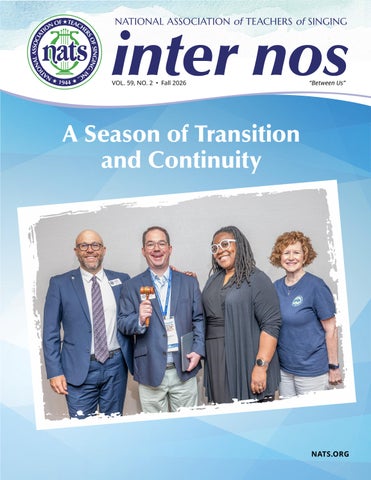
Cover: Just after the passing of the gavel on July 7, 2026, in San Antonio, four NATS presidents gathered together during this leadership transition: Diana Allan, completing her term as Past President and rotating off the Board; Alexis DavisHazell, becoming Past President; Randall Umstead, beginning his term as President; and Nicholas Perna, becoming President-Elect. Photo by Robert Levy
13 22 26
Teaching with D.E.P.T.H.
30 34
Yoga in the Voice Studio: A Practical Guide
Carrying Joan’s Song Forward Beyond Referral: The Voice Teacher as an Essential Partner in Singer Care Dear Past Me
A S S O C I AT I O N N O T E S
Building What Comes Next: Lead Times, Timelines, Through-Lines, and Deadlines By Melissa Greenblatt, NATS Executive Director
T
he end of August invokes a melancholy feeling for me as the summer season comes to a close and K-12 schools begin to open their doors, at least here in Maryland where I live. Teachers gear up to welcome students. And parents breathe a sigh of relief as schedules get more predictable. I am now past that phase in my own life, but this time of the year still brings a bit of that melancholy, along with a strong sense of transition for me.
Melissa Greenblatt NATS Executive Director
It is a transition for NATS as well. While the work of our association is year-round, the fall season kicks off the academic year with auditions, chapter and regional activity, professional development opportunities, and the membership renewal cycle. In many ways, this is our own “back-to-school” season.
As Executive Director, part of my responsibility is leading the organization’s day-to-day operations, strengthening the infrastructure that supports our work, and ensuring the staff can effectively support the programs and services NATS provides to its members and the field at large. And so, as I sit here writing this article for my second Inter Nos column, I am pondering lead times, timelines, through-lines, and deadlines. These are a few key concepts that help me organize the work that we do here in the proverbial national office, albeit one that is 100% virtual! • Lead times….. By the time you read this article, it will be October. It takes a village to produce the Inter Nos newsletter and it is only offered twice a year, but requires all who contribute to it, to do so way in advance of the actual publish date so that there is time for developing themes, curating content, obtaining guest author articles,
inter nos VOL. 59, NO. 2
PUBLISHER Melissa Greenblatt, Executive Director, melissa@nats.org EDITOR Rachel Keller, Marketing and Communications Coordinator rachel@nats.org
4
INTER NOS | FALL 2026
designing the layout, editing copy, selecting photos and advertisements, proofreading, and much more. For example, themes and content need to be considered at least 12 weeks in advance. Each step in the process needs enough time to be done well, because the next step depends on the work that came before it. Truly, a team effort. • Timelines….. Something NATS must get better at in the months and years to comes is mapping out what has to happen (steps in a process or decision points along a continuum) and when things need to happen so that we can provide programs and services in a timely manner with good customer service. It is hard to rush something without appropriate research, vetting, analysis, and collective input. Timelines need someone to envision and build them, and technology to make them come alive. Timelines may be detailed, with many interim steps and due dates, or they may simply mark a few major milestones. Either way, the important thing is that they are thoughtfully built, clearly communicated, and shared among everyone responsible for moving the work forward. • Through-lines….. I see them when reading survey results, long email chains, and board reports. I see them when reviewing files and folders of organization records. I hear them in virtual meetings and phone calls. I like to review different situations, data, and records to see what patterns and through-lines emerge. Collectively, these help us see what is happening, why it matters, and where NATS may need to focus next. • Deadlines….. July 3 was a hard deadline – the official start of our National Student Auditions and National Conference in San Antonio, although some of us were already onsite by June 30! We had to be ready to put on the performance of a lifetime with over 1,000 folks expected to be in attendance.
INDEPENDENT VOICES ASSOCIATE EDITOR Deborah Conquest, internos@nats.org, ADVERTISING TEAM advertising@nats.org
DESIGN Regina Troyer, Carter Publishing Studio inter nos is the official newsletter of the National Association of Teachers of Singing. It is published two times per year (spring and fall) for all NATS members.
A S S O C I AT I O N N O T E S There were many moving parts and pieces, last-minute decisions, actions, and tasks. But as I have learned, organizations reveal themselves when things don’t go exactly according to plan. With July 3 looming on the horizon, the months of May and June had some surprises for us – the resignation of two staff members and a key volunteer just before our big debut. The workload before us was enormous as we absorbed the loss of institutional knowledge and people to do the work. Before experiencing my first NATS National Student Auditions and National Conference, I understood intellectually that NATS had an incredibly strong volunteer ethos, but seeing it firsthand was a different matter – people responded by coming together quickly and with elevated levels of collaboration and camaraderie. I saw people step into conference logistics and selflessly volunteer their expertise, time, and energy. When the deadline arrived, so did the village, and that may be one of NATS’ greatest strengths. As I look ahead, I know there will always be another lead time, timeline, through-line, or deadline waiting for me and the organization. But with so much focus on what comes next at work, I am grateful that my two golden retrievers, Nash and Bode, keep me grounded in the here and now. Recently, Nash sat with me completely transfixed watching
the show Sealook on Netflix, apparently finding a group of animated seals incredibly compelling (me too!). It was such a simple moment, but also a good reminder that sometimes being present means enjoying something that has absolutely nothing to do with a deadline. I look forward to building the systems, relationships, and shared commitment that will carry NATS toward what comes next. Have a thought you want to share or a desire to donate to support the NATS organizational infrastructure as we move into what is next, please drop me a line at melissa@nats.org.
HAVE YOU MOVED, CHANGED YOUR CONTACT INFORMATION, OR YOUR EMAIL? Members: Keeping your contact information up-to-date ensures that you won’t miss any of our member benefits or upcoming events. To make updates, log on to your Member Home Page (your email address for NATS correspondence is your Login). Then, click the “My Profile” link on the right. You also can call the NATS National Office at 904-992-9101 for assistance.
nats.org
INTER NOS | FALL 2026
5
A S S O C I AT I O N N O T E S
A New Season of Leadership at NATS By Randy Umstead
A
t roughly 10:00 am CDT, in San Antonio, TX, I was handed a gavel and told I was now in charge of the business
entirely different landscape that, while familiar, has shifted significantly. Our membership continues to evolve, and it now
meeting. If anyone was wondering how someone becomes
includes more independent than university teachers. The
president of NATS, that is it. Of course, the reality is far
way members engage with in-person events has shifted, and
more nuanced. One spends two years as president-elect, and I have previously served on the board for two terms as a region governor and one term as secretary-treasurer of the association. With a new president every two years, the seeds one leader plants may not be seen for several years. In a season where we have recently welcomed a new executive director, it might be helpful to hear from the new president about how these roles function together. The NATS President is elected by the membership, into a volunteer role. Randy Umstead NATS President
In this capacity, I serve as the public face of the membership and as chair of the NATS Board of Directors. That
body, comprising all the officers and regional governors, is tasked with setting the strategic direction for NATS. We have a fiduciary duty to the association, ensuring that every decision aligns with our mission to advance excellence in singing through teaching, performance, scholarship,
we have expanded our reach by adding commercial music and children’s categories to our student auditions. Those innovations would have been unthinkable back when I first became a member. In this new season, my primary goal is to ensure that NATS provides value across the lifetime of a member. We want NATS to be a professional home that supports you from your days as a student, through the development of a studio or academic career, and into your emeritus years. To achieve this goal, we must be willing to ask hard questions: “Is this program or service serving our members?” Building this value requires a commitment to sustainability. NATS must deepen its investment in programs and resources that make a tangible difference to members, but we will need to be brave enough to let go of programs that no longer do. The most effective tool we have for this assessment is member engagement. When you receive a survey from NATS, please take the time to complete it. Please also communicate with your chapter and region leaders. Region leaders are your direct line to the board, and they can provide context
and research.
that helps frame your feedback in powerful ways.
In contrast, the Executive Director is a professional staff
All of our decisions require an open and trusted partnership
position selected by the Board. While I, as President, focus on the “what” and the “why” of our strategic vision, Melissa Greenblatt, our Executive Director, manages the “how.” She manages the day-to-day operations, our dedicated staff, and our organizational infrastructure. The association functions best when President and Executive Director work as true partners. One might wonder why a NATS member would volunteer so much time and energy to this role. For me, the answer is simple: I have been a NATS member since 2006. NATS has been an important part of my professional and personal life for all of those years, and service is part of my family tradition. I also believe that NATS is at an inflection point.
between the Board and Executive Director. In the previous Inter Nos, you heard from Melissa Greenblatt about her vision for NATS. Working with Melissa has been a joy. Each week, I learn more about NATS as she shares insights from fresh eyes and an association management background. Melissa and I share a fundamental belief that our vision of transforming lives through the power of singing requires NATS to place the highest importance on serving you, the members. As a fellow voice teacher, I encourage you to lean into the word association in our name. An association is an organization of persons having a common interest. Because we share this interest, you should know that I am not a remote figurehead. My email address is available on our
During the pandemic, NATS was at its finest. We were
website. You are welcome to use it, and I look forward to
an exceptional resource and a visible (albeit not always
hearing from members! While I cannot promise a personal
popular) voice of prudence and advocacy. We built valuable
reply to every message if all 6500 of you email me at
partnerships and proved that we are indispensable when
once, I can promise that your message will be read and
the stakes are highest. We now find ourselves in an
taken to heart.
6
INTER NOS | FALL 2026
Lizard/stock.adobe.com
A S S O C I AT I O N N O T E S
As I noted in my initial column for the Journal of Singing, as much as life changes quickly, much remains the same. In 1946, NATS President-elect Ben Caron said in his acceptance speech: “The teacher of singing — both private and institutional — has been given the opportunity of becoming a part of a truly national organization devoted to his or
her interests…one of the big problems facing us is that of increasing this consciousness of NATS’ present and future actual and potential values to the individual.” Ben’s vision in 1946 is my vision today. Let’s work together to make that a reality for every member.
YOUR STAGE AWAITS
Competitions
2026–2027 MTNA VOICE COMPETITION
The prestigious MTNA voice competition recognizes exceptionally talented young artists and their teachers in their pursuit of musical excellence. Finalists compete at the MTNA National Conference in St. Louis, MO, April 2–6, 2027. Registration opens: November 1 Deadline: December 2, 3:00 p.m. Eastern Time
Register and learn more at mtna.org nats.org
INTER NOS | FALL 2026
7
F R O M T H E D E S K O F D E B O R A H CO N Q U E S T
From the Editor By Deborah Conquest
I
still remember walking into my very first voice lesson with the late, great Barbara Honn at the Cincinnati College-
I don’t know exactly when it happened. Last week? Last year? Was it when I noticed that widening ribbon of silver peeking
Conservatory of Music a million years ago. The door opened,
through my hair?
and there she was: high heels, higher hair, and an even
Maybe that’s simply the arc of a life
higher-pitched voice. To my barely-five-foot-tall self, Barbara appeared like an Amazonian warrior goddess. She terrified me in all the best ways. I remember thinking, “This woman knows what’s what.” She will be my guide for the foreseeable future. She has the goods.
in teaching. We begin by searching for mentors. We spend years trying to absorb everything they have to offer. Then one day, almost without noticing, we find ourselves stepping into that role for someone else, all while realizing we still have so much
As I was putting this issue together, I found myself thinking
to learn ourselves.
about Barbara and the other mentors who shaped my
It made me wonder: Where are you
career. For years, I assumed I’d always be the one looking up to them. Instead, I realized that somewhere along the way, people
on that journey? Perhaps you’re just beginning your teaching career, looking
Deborah Conquest Associate Editor for Inter Nos internos@nats.org
had begun turning to me the way I once turned to my
to experienced colleagues for
own teachers.
guidance. Perhaps you’re in the middle, balancing your own
“We begin by searching for mentors. We
growth with the responsibility of shaping young singers. Or perhaps you’ve had your own “gulp” moment and realized that you’re becoming the mentor you once admired.
spend years trying to absorb everything they
That question echoes throughout this issue of Inter Nos.
have to offer. Then one day, almost without
Lori Sonnenberg reminds us that one of the marks of an
noticing, we find ourselves stepping into that role for someone else, all while realizing we still have so much to learn ourselves.”
excellent teacher is recognizing when collaboration serves a singer best, exploring the voice teacher’s essential role within an interdisciplinary care team. Thomas Erik Angerhofer offers his D.E.P.T.H. framework, challenging us to think intentionally about how we teach, not just what we teach.
Today, singers come to me to become better artists. Parents ask whether their young singer has potential. Colleagues reach out to talk through career decisions. Students trust me to tell them the truth about auditions, repertoire, vocal health, and sometimes even life beyond the studio. When we wander into territory outside my expertise, I know it’s time to pick up the phone and connect them with someone who can better help. Knowing when to refer is just as important as knowing what to teach. And then I had this strange thought: How or when did I become the teacher? The so-called “expert” I used to look up to? Gulp.
8
INTER NOS | FALL 2026
Anna Diemer reflects on the wisdom she wishes she could share with her younger self, a reminder that experience has a way of changing our perspective. Brandon Marcus pays tribute to the enduring legacy of Joan Frey Boytim, whose generosity, mentorship, and unwavering belief in teachers continue to ripple throughout our profession. Mollie McReynolds encourages us to remain curious, to question our assumptions, and to keep growing as educators. Looking back, I still think of Barbara Honn with enormous gratitude. I hope the singers, teachers, and families who place their trust in me feel even a fraction of what I felt walking into her studio all those years ago: that they are in the hands of someone who cares deeply, tells the truth, and is committed to helping them become the best version of themselves.
FROM THE DESK OF DEBOR A H CONQUES T she trains singing actors worldwide. She also serves on the vocal jazz faculty at Eastman School of Music. She is a longtime NATS member, recipient of a Joan Boytim Independent Teacher Award, and proud alumnus of the Cincinnati CollegeConservatory of Music and SUNY Fredonia. She loves hiking, rockabilly tunes, competitive powerlifting, house plants, and chocolate cake — not necessarily in that order. She also enjoys exploring the visual arts — mostly pretending she can paint — and aspires to write her memoirs entirely in haiku. Conquest shares insights and inspiration on her blog at conquestvoicestudio.com. Fun fact: she started her career as the “Ivory Snow Baby” and became a SAG-AFTRA union member at the age of 6 months.
After all, none of us arrives here alone. We are all part of a long line of teachers who learned from someone before us and who, in turn, have the privilege of lighting the way for those who come next. I hope you enjoy this issue. Deborah Conquest is an accomplished voice teacher, performer, and writer based in Rochester, New York. She runs an independent voice studio — Conquest Voice Studio — where
Your Voice Matters! Guidelines for submitting articles for Independent Voices Spring deadline: January 15 Fall deadline: July 15 • Current independent member of NATS (not teaching primarily at a university): Professional/Emerging Professional/Pre-Professional, Emeritus • 1,000 to 2,500 words • Preferably written in “first person” • Any topic that is relevant to independent voice studio teachers, collaborative pianists, choral directors • Attach as Word doc or Mac Pages, standard font (Times New Roman, Arial, Helvetica) • Include 100-word or less author bio at the bottom of the document. (See bio examples in past articles.) • Photos: required high resolution headshot (jpg) and optional additional photos (jpg) related to the article. Important: Do not embed photos into the document. Send as separate attachments. Email to Independent Voices Associate Editor Deborah Conquest at internos@nats.org
nats.org
INTER NOS | FALL 2026
9
DE VELOPMENT NOTES
NATS Day of Giving Is Integral to Our Association’s Growth By Jen Jimenez, Development Director
O
n Tuesday, November 17, 2026, NATS will hold of Giving webpage! On this site, you will not only its annual Lift Your Voices Day of Giving. We have the opportunity to easily make your gift, but invite you to show your support for the programs, share a call-to-action across your social media scholarships, events, and opportunities that NATS channels, issue giving challenges to colleagues, affords its members and their students by making students, family, and friends, participate in region/ a gift on this important day. All money raised chapter competitions to win NATS merchandise, during this 24-hour giving campaign will support and create video testimonials – all in real time NATS’ annual budget, program expenses, member while viewing our live goal meter! Jen Jimenez awards and scholarships, and event operations. Please check your inboxes over the next few We have chosen a stand-alone date, rather than weeks for additional information from your Advancement the National Day of Giving date, in the hopes of providing Committee Chair, Felicia Betts, and me regarding the 2026 an optimal opportunity for NATS members, students, family, Lift Your Voices Day of Giving. If you have questions or friends, and patrons of vocal music to participate. would like more information on how you can become an Our exciting Day of Giving will begin at midnight on advocate for our Lift Your Voices Day of Giving, please November 17 with the launch of the NATS interactive Day contact me at jen@nats.org or (904) 586–3395.
Attendees of the 59th NATS National Conference stand and clap
10
INTER NOS | FALL 2026
DE VELOPMENT NOTES
Fundraising Support Directly Impacts the 2026 National Student Auditions By Jen Jimenez, Development Director
S
ince 2014, NATS National Student Auditions has provided performance opportunities for students from across the world. The program’s unique combination of not only competition, but also coveted feedback has created a positive educational environment where students can learn, grow, and flourish in their voice study.
This year’s program not only included AuditionCon . . . but also awarded three named prizes thanks to the generous support of individual donors and foundations.
The 2026 NSA program proved to be just as exceptional as previous years’ events. After 16,862 students participated in Chapter and Region Auditions, from September 2025 – March 2026, 982 students submitted their video auditions for the NSA Preliminary Rounds. From those rounds, NATS was thrilled to welcome 403 students and their families to San Antonio for the National Student Auditions Semi-Finals and Finals competitions in July of 2026. This year’s program not only included AuditionCon — where students met with representatives from renowned music programs at colleges/universities — but also awarded three named prizes thanks to the generous support of individual donors and foundations.
Students at the 2026 National Student Auditions pose with their certificates of achievement
In honor of the late composer Gerald Ginsburg, a prolific composer who set hundreds of poems to music in his 50 years of artistic output, The Ginsburg Repertoire Prize was awarded to 21-year-old soprano, Tiana Oberoi, from Bangalore, India. This inaugural prize of $1,000 is awarded to a student in the Post High School Classical categories who performs at least one of Ginsburg’s compositions in the video preliminary, semifinal or final rounds, and is made possible through a $25,000 contribution from the Ginsburg Foundation to endow the prize, ensuring its continuation for years to come. The 1st Place Prize in the Upper High School Musical Theatre TBB category was newly
nats.org
Students at the 2026 National Student Auditions pose with their certificates of achievement
INTER NOS | FALL 2026
11
DE VELOPMENT NOTES named the Rick Walters Award in honor of the late Rick Walters, a cherished friend of NATS, whose profound contributions to the world of vocal music publishing continue to resonate within our community. Thanks to a generous donor, this newly endowed fund will award $1,200 annually to the 1st Place winner. The third named award is in honor of Karen Brunssen, a steadfast volunteer, loyal supporter, and 2024 NATS Impact Award winner. Brunssen has selflessly served NATS in several capacities over the past A student sings on stage at the 2026 National Student Auditions with piano accompaniment. 35 years. Because of Brunssen’s and many donors’ steadfast support, the new Karen Brunssen Endowment in attendance, the 2026 National Student Auditions was supported an annual cash award of $1,600 to the first-place an experience filled with connection, volunteerism, and winner in Category 7 Upper Classical Treble. philanthropy. With the launch of these three named awards plus a robust NSA Generations Breakfast, with over 250 people
If you are interested in supporting the 2027 NSA program, please click here to make a gift to the NSA Fund.
Intermezzo is a weekly compilation of news clips about the singing profession, in addition to NATS news, that is delivered to each member’s inbox. Intermezzo tackles today’s most relevant issues, gathered from sources like the Associated Press, the New York Times, Playbill, and the leading industry publications. It is delivered to the inboxes of teachers of singing in the United States, Canada and more than 35 other countries. B R OU G H T TO YO U B Y TH E N ATI O NA L A SSO CI ATI O N O F TEACH ERS O F SI NGI NG
12
INTER NOS | FALL 2026
INDEPENDENT VOICES
Teaching with D.E.P.T.H. by Thomas Erik Angerhofer
F
or over four decades, I have been training and teaching martial arts alongside my
then remove them so that the student can move on to the “H” phase to Hone their
musical practice. In a previous article, I
developing skill.
mentioned a few of the lessons I learned in
Demonstrate, Explain, Perfect, Train, Hone.
the dojo that share relevance with the work
Sounds good, but now let’s go from the
we do in the music studio. This time around,
abstract to the concrete to see how it might
instead of sharing “ancient wisdom” from
work with an actual vocal exercise. To keep
another discipline, I’d like to introduce you to
things simple, I’ll present it in the form of a
the teaching methodology we used to break
monologue; in practice, guided inquiry and
down and scaffold instruction. Not only is
a heutagogical framework are encouraged.
it easy to remember (which is particularly
Let’s pretend the teacher and the student
helpful to me), but it also helps guide your teaching in a way that is focused and disciplined while allowing for creativity and
have reviewed a recording together, and the Thomas Erik Angerhofer
variation. Most of all, it encourages the type of deep practice that helps learners grow. Are you ready for the name of the system? It’s called D.E.P.T.H. As far as acronyms go, this one is pretty much on the nose. “D” is for Demonstrate. When introducing something new, it is important for the learner to “begin with the end in mind,” as Stephen R. Covey says. Provide a model example of the end product: what the student should do and how they should do it. “E” is for Explain. When I was much younger, my mom worked in a retirement community. One day, a 97-year-old retired teacher approached me after learning that I was training to become a teacher. She asked, “Do you know why people become teachers? They fall in love with the sound of their own voice!” With this in mind, I strive to keep explanations as short as possible, describing the steps and actions in language that is relevant to the student
student has noticed that their timbre seems to change with nearly every vowel and that
they are experiencing difficulty moving into the upper part of their range on certain vowels. “That’s great that you are able to pinpoint those challenges! Let’s learn a drill that will help you maintain a more uniform timbre across all your vowels while helping you move more easily into that upper range. Here’s how it goes.” (Teacher sings /aeiouoaei/ on the notes 123454321.) “Notice how I keep the jaw in the ‘sweet spot’ (not too open, not too closed), how the lips neither protrude nor pull the corners back, and how the tongue articulates up toward the roof of the mouth, where it is housed when the mouth is closed, rather than flattening, articulating forward, or pulling back? Let’s begin by finding the ‘home base’ (basis of articulation) for the tongue when singing. First, breathe in with a snore, then slide 1-3-1 on /ŋ/. Excellent! Let’s do a few more reps.
while outlining the order of operations in a way that is easy
“Do you notice anything changing in your timbre when you
to follow.
do this? Let’s try pretending you’re drinking a glass of water
“P” is for Perfect (verb). Now the student is doing, and we want to get to this phase as quickly as possible. Here is where we break down the action into its individual parts, much like painting by numbers. Some actions might require drilling each step separately before adding the next. Others might require creating smaller exercises to train parts of a longer action. When you do it right, you disguise repetition to build skill in manageable chunks. “T” is for Train. We’ve built the exercise, and now we’re moving it through the range. You might have tools (one of my teachers called them “training
as you ascend. Does that seem to help? Great! Let’s now find the ‘home base’ vowel, /a/. Let’s do the same exercise, adding 12321 on /a/ at the end. Rather than moving down, let’s try to raise the soft palate away from the tongue, keeping the outside edges of the tongue in contact with the upper molars as we move to /a/. (After some reps.) What are you noticing about the soft palate? Is it sealing the opening to the nose when you move to /a/? Let’s add a ‘double g’ (/g:g/) between the /ŋ/ and the /a/. (A few reps later.) Are you noticing how that ‘double g’ closes that opening? Great!
wheels”) that the student can use for feedback or add-ins
“You’re keeping the lips neutral, which seems to be working
to mitigate challenges that present themselves along the
well. Do you notice the jaw moving when you change pitch?
way. Little by little, we start raising the training wheels and
Let’s find that Goldilocks place for it by massaging the
nats.org
INTER NOS | FALL 2026
13
INDEPENDENT VOICES masseter muscles with your index and middle fingers as you do the exercise. How is that working? Great. Let’s add the first of the lip vowels. This means you’ll only have to move the lips, mostly the upper one, creating a slightly smaller opening without puckering while maintaining that loose jaw and the /a/ shape of the tongue as you move to /o/. We’ll simply add another 12321 on /o/ to the end of the exercise. (After reps, using feedback tools, etc.) I think we’re ready to add /u/ into the mix. Let’s change the /ŋ/ slide to 1-5-1, followed by the ‘double g,’ and then 123454321 on /a-o-u-o-a/. Notice that I keep doing the same thing with my jaw and tongue throughout the whole exercise, but the opening gets even smaller for the /u/, maybe not quite as small as when you blow out a candle, but moving in that direction. Now you try…”
Thomas Erik Angerhofer instructing a group of students.
Depending on the student’s current skill level, this might be as far as you get with the exercise. If so, take it to one of the songs you’re currently working on. Do it on the melody in some of the easier sections, then move to more challenging ones. Then, using some of the tools you used during the “Train” phase, such as placing your fingers on the masseter, apply it to the vowels in the words. As you get farther into the initial exercise, you will introduce many other helpful tools. One I use frequently is the “inward sigh” to help find that Goldilocks pharyngeal space. Once students have the vowel shapes, they can “inward sigh” through them as they inhale, like when you hear juicy gossip or like the Tenacious D track “Inward Singing.” It can be pitched lower in the range, at the sung pitch, or an octave below the sung pitch. If they’re having trouble pitching it, they can do it on an inward “Darth Vader whisper,” akin to what Ken Bozeman calls the “Chiaroscuro Whisper.” In any event, once the initial demonstration is performed, most of the action is done by the student. As much as possible, solicit feedback from the student on their own performance using appropriate tools for observation while developing a toolbox that helps the student guide themselves toward the desired learning outcomes. Using a system to organize your instruction, like D.E.P.T.H., can encourage deep
14
INTER NOS | FALL 2026
practice by having the student identify a spark that ignites their desire to grow, focus attention on fundamental actions, make adjustments that streamline related neural pathways, disguise repetition to strengthen those pathways, and come full circle through application. Add in the personalities of the teacher and student, and you also have a recipe for serious fun! Thomas Erik Angerhofer is a teacher and singer based in Morgantown, West Virginia, and the greater Pittsburgh area. Originally from Rochester, New York, he has taught and performed throughout the United States, Europe, North Africa, and the Levant. He started voice lessons and martial arts training around the same time (for no particular reason) and has been doing both for more than forty years. His business, Zen Arts, provides voice, martial arts, and health and well-being instruction, combining classical wisdom with contemporary insight. In addition to his private studio, Erik teaches at WVU and has taught at UNA, Xavier University, CSU, Ithaca College, MSU Denver, and the Denver School of the Arts. His students have gone on to professional careers in Musical Theatre, Opera, Contemporary/Commercial Music, and Education. Erik holds degrees from CU Boulder (DMA, MM) and SUNY Fredonia (BA). When he’s not doing music or ninja stuff, you can find him at the local skatepark carving up a bowl.
N AT S P R O G R A M S
NATS Community Highlights NATS for a Lifetime Honorees Celebrated in San Antonio
Closing Banquet at the 59th NATS National Conference in San Antonio. The awards recognize their extraordinary and longstanding contributions to the voice community through teaching, mentorship, research, leadership, and service. Their work has influenced generations of singers, teachers, and voice professionals and helped shape the field in lasting ways. READ MORE
Pass the Gavel: NATS Welcomes New Presidential Leadership
At the opening ceremony of the 59th NATS National Conference in San Antonio, Judith B. Boyter of the Greater Houston Chapter and Cynthia Linton of the Mississippi Chapter were recognized as the 2026 NATS for a Lifetime honorees. The recognition celebrates members who have dedicated at least 25 years of active service to NATS at the local and regional levels. Boyter and Linton join a special group of members whose leadership, mentorship, and volunteer service have strengthened NATS across generations. VIEW MORE
On July 7, 2026, during the NATS business meeting in San Antonio, Randall Umstead officially became president of NATS and Alexis Davis-Hazell transitioned to immediate past president. The passing of the gavel marked the beginning of the association’s 2026–2028 leadership term. Umstead and Davis-Hazell continue to serve together on the NATS Board of Directors and Executive Committee as the association moves into its next chapter. LEARN MORE
Two New Staff Members Join the NATS Team
Lifetime Achievement Awardees Honored in San Antonio Rachel Keller
Alexis Davis-Hazell presents awards to Barbara Hill Moore and Robert T. Sataloff
NATS honored Barbara Hill Moore and Robert T. Sataloff with its 2026 Lifetime Achievement Award during the Grand
nats.org
Sara Ulliman
NATS welcomed two new staff members in 2026: Rachel Keller, who joined June 1 as Marketing and Communications Coordinator, and Sara Ulliman, who joined September 14 as Events and Auditions Manager. Keller supports NATS marketing, digital communications, social media, and visual storytelling across the association. Ulliman brings extensive experience in event planning, systems and process development, and project management to her new role overseeing NATS events and auditions. MEET THE NATS STAFF
INTER NOS | FALL 2026
15
N AT S P R O G R A M S Courtney Fletcher Wins Inaugural Barbara Hill Moore Award
NSA experience from chapter and regional auditions through the national semifinals and finals. LEARN MORE
Richard Sjoerdsma Award for Excellence in Writing Winner Announced
Courtney Fletcher
Mezzo-soprano and voice teacher Courtney Fletcher was named the inaugural recipient of the Barbara Hill Moore Emerging Teaching Artist Award after competing as one of three national finalists at the NATS National Conference in San Antonio. The biennial award supports an emerging NATS teacher who is simultaneously pursuing an active performance career. Fletcher received a $3,000 award to support her continued professional development as both a singing teacher and performing artist. READ MORE
Journal of Singing Welcomes Two Editorial Board Members Journal of Singing Editor in Chief Matthew Hoch recently announced the appointments of Anna Hersey and Kourtney Austin to the journal’s editorial board. Hersey has been appointed associate editor of the long-running “Recent Research in Singing” column and will work alongside founding associate editor Donald Simonson before assuming leadership of the column in 2027. Austin joins the Editorial Review Board, bringing expertise in performing arts health and voice pedagogy to the journal’s peer-review process. READ MORE
Meet the New National Student Auditions (NSA) Team A new national leadership team is helping guide the NATS National Student Auditions, led by Casey Carter, Vice President for Auditions, NSA Coordinator, and NATS Board Member, along with Emily Sinclair, Classical/Spirituals Coordinator; Autumn West, Musical Theatre Coordinator; and Ellie Seligmann, Commercial Music Coordinator. Together, the team provides leadership across the major NSA genres while supporting audition chairs, adjudicators, teachers, and students throughout the audition process. Their work will help shape a more consistent and connected
16
INTER NOS | FALL 2026
Bonnie Cutsforth-Huber, professor of music at Penn State Altoona, was named the 2026 recipient of the Journal of Singing Richard Sjoerdsma Excellence in Writing Award. The biennial award recognizes the best feature article published in Journal of Singing during the most recent two-year cycle. Cutsforth-Huber was honored for her article, “Bel Canto des Wortes—The Pedagogy of Cornelia (Cornelie) van Zanten.” READ MORE
Clifton Ware Group-Voice Pedagogy Award Winner Announced NATS named Sean Stanton the recipient of the 2026 Clifton Ware Group-Voice Pedagogy Award. The annual award recognizes NATS members advancing group-voice instruction, or “class voice,” through innovative teaching, research, resources, workshops, and other professional development. Stanton was selected from a record number of applicants for his experience in group-voice teaching, student-centered research, and commitment to expanding group voice within higher education. READ MORE
Canadian Voice Pedagogy Award Winner Announced Nova Scotia-based soprano and voice teacher Jennifer Farrell was named the recipient of the 2026 NATS Canadian Voice Pedagogy Award. The annual award provides up to $1,000 CAD to support professional development for Canadian educators pursuing further study in voice pedagogy or voice science. Farrell used the award to attend the 2026 NATS Science-Informed Voice Pedagogy Institute in Savannah, Georgia. READ MORE
Three Singers Named 2026 Dillard Scholars NATS awarded 2026 Dillard Scholar Awards to Lana Dyer, Anna Bomar, and Faylee Crawford, recognizing their accomplishments through the NATS Summer Program Auditions. Each singer received a $500 scholarship to help support participation in a summer or young artist program: Dyer at SongFest, Bomar at Taos Opera Institute, and Crawford at the Musica Proibita Summer Opera Program. Named in honor of late NATS President Jane Dillard, the awards help promising young singers continue their artistic and professional development. READ MORE
N AT S P R O G R A M S
•
In Memoriam March 2026 – August 2026 Richard Hartzell Jan McDaniel Julia Graddy John Byun Brian Ponser Mariann Sewell Dr. Kendra Preston Leonard
•
nats.org
INTER NOS | FALL 2026
17
N AT S P R O G R A M S
~ IN REVIEW ~
The 59th NATS National Conference — Our Mosaic of Music
T
he 59th NATS National Conference convened July 3–7, 2026, at the San Antonio Marriott Rivercenter in San
Antonio, Texas, in conjunction with the National Student Auditions Semifinals and Finals. The conference welcomed 488 voice teachers and other singing professionals, along with approximately 75
week, with professional learning, performances, competition, recognition, and connection taking place simultaneously under the conference theme, “Our Mosaic of Music.”
A Grand Opening in San Antonio Performance was at the heart of the conference from the
additional participants whose roles included NATS staff,
very beginning.
conference volunteers, award recipients, plenary speakers,
The Grand Opening Ceremony brought “Our Mosaic of
and exhibitors. The gathering grew even larger when performers, National Student Auditions participants, teachers, and families were added to the mix. More than 100 performers alone took part in the Grand Opening Ceremony, representing choirs, performance groups, and individual
Music” vividly to life. The program celebrated the rich musical traditions and communities of San Antonio and featured tenor Rafael Moras, the Children’s Chorus of San Antonio, Wonder Theatre, Mariachi Las Alteñas, singers from the San Antonio Chamber Choir and Alamo City Street Singers, along
artists from across the San Antonio community.
with additional artists and ensembles.
Together, these overlapping events brought an extraordinary
The scale and variety of the performance set the tone for
level of activity to the Marriott Rivercenter throughout the
the days ahead. Singers of different ages, musical traditions,
18
INTER NOS | FALL 2026
N AT S P R O G R A M S
The 59th NATS National Conference welcomed over 500 attendees from across the globe and kicked off with a variety of performances at the Grand Opening Ceremony.
styles, and backgrounds came together in one program — a fitting expression of a conference designed to celebrate the breadth of the singing profession and the many communities that make up NATS.
Learning Across the Profession Throughout the conference, attendees could choose from more than 75 breakout sessions, plenary presentations, lecture-recitals, poster sessions, mini-recitals, and other professional development opportunities. The educational program reflected the extraordinary range of the field. Sessions explored voice science and vocal health, repertoire, studio teaching, musical theatre, commercial music, classical music, spirituals, historical pedagogy, cultural traditions, business practices, research, community building, and emerging approaches to teaching singers. One plenary highlight, “Bridging Bel Canto and Billboard: Integrating Classical Craft and Popular Music Practice,” featured Lyndia “MzLyndia” Johnson. Drawing from her experience in both conservatory training and the commercial music industry, Johnson examined the expanding skills required of contemporary singers and the teachers who work with them, including stylistic, physiological, cultural, technological, and studio-based approaches to popular music. The breakout sessions provided an equally broad range of perspectives and genres.
nats.org
For classical music, “Reimagining Classical Music: Interdisciplinary Programs that Engage Communities and Social Issues,” presented by Nicole Asel and John Lindsey, explored ways classical music programming can connect with contemporary communities through interdisciplinary work and partnerships. In “The Art of the American Negro Spiritual: A Performance Workshop,” Marcía Porter, Alexis Davis-Hazell, Rosalyn Wright Floyd, and Barbara Hill Moore offered deeper insight into the repertoire and performance practices of the American Negro Spiritual. Musical theatre was represented through sessions such as “Beyond the Standards, Part 1 — Identifying Progressive Repertoire for Musical Theatre Singers,” presented by Craig Allen and Carrie Greer, as well as “Preparing for Pop/Rock Musical Theatre Auditions,” presented by Matt Edwards and Jackie Edwards. Together, these sessions offered just a sampling of the range represented in San Antonio — from classical and spirituals to musical theatre and commercial music, alongside voice science, pedagogy, repertoire, research, studio practice, and more.
INTER NOS | FALL 2026
19
N AT S P R O G R A M S “Networking and reconnecting with old acquaintances, along with the breakout sessions, mini-recitals, lecture presentations, and demonstrations. I was very pleased with all aspects of the conference.”
Performance Throughout the Week Music continued well beyond the Opening Ceremony. The Art Song Composition Award Winners in Concert featured Raphael Fusco’s 2025 winning work, Love Songs from a Third Floor Walk-Up, with texts by Caitlin Vincent, as well as James Hurley’s 2026 winning composition, Confession and Other Lyrics, with texts by Michael Crummey. Sunday evening brought one of the featured entertainment highlights of the conference when Broadway performers and husband-and-wife duo Caroline Bowman and Austin Colby took the stage for The Great American Songbook, with Benjamin Rauhala serving as music director. Bowman and Colby brought extensive Broadway and touring experience to the program and offered conference attendees an evening centered on performance, storytelling, and entertainment. Throughout the conference, mini-recitals, lecture-recitals, student performances, and other musical offerings added to an environment where attendees were not only talking about singing — they were surrounded by it.
National Student Auditions Alongside the Conference The National Student Auditions Semifinals and Finals also took place during the conference, bringing hundreds of student singers, teachers, collaborative pianists, adjudicators, and families into the Marriott Rivercenter. The presence of NSA added another level of energy throughout the week as student performances took place alongside conference sessions, plenaries, performances, and exhibits. The full 2025–2026 National Student Auditions season — including participation numbers and highlights from the students, teachers, adjudicators, pianists, and volunteers who made it possible — is featured separately in this issue of Inter Nos.
Celebrating Achievement and Service The conference also provided an opportunity to recognize individuals whose contributions have had a lasting impact on NATS and the broader singing profession.
20
INTER NOS | FALL 2026
At the National Conference Banquet, NATS presented its Lifetime Achievement Awards to Barbara Hill Moore and Robert T. Sataloff. Hill Moore was honored for a teaching and performance career spanning more than six decades, as well as her extraordinary influence as a master teacher, mentor, and advocate for generations of singers. Sataloff was recognized for his pioneering contributions to voice medicine, research, pedagogy, and the care of the professional voice. His interdisciplinary work as a physician, researcher, author, singer, and teacher has helped shape contemporary understanding of vocal health.
N AT S P R O G R A M S Songfest provided a fitting conclusion to a conference centered on the idea of a musical mosaic. The closing performance brought the conference full circle — from the more than 100 performers who opened the gathering to another collaborative musical experience celebrating individual voices coming together.
More Than a Schedule As with every national gathering, some of the most meaningful moments happened outside the formal program. Teachers reconnected with longtime colleagues. New relationships formed between sessions. First-time attendees met members who have participated in NATS for decades. Presenters continued conversations in hallways and over meals. Attendees explored the Exhibit Hall, discovered new resources and repertoire, and exchanged ideas they could carry back to their studios, classrooms, campuses, and communities. “Making connections with so many people. I connected with so many old friends and met so many new people. I felt validated by so many people for the work I have done as a teacher and performer.” Behind the scenes, conference volunteers, presenters, performers, committee members, exhibitors, sponsors, The conference offered a broad range of professional learning opportunities, musical performances, and moments for connection.
collaborative pianists, adjudicators, and NATS staff worked together to keep the many moving parts of the conference and National Student Auditions running throughout the week. “It’s hard to pick just one thing that was most valuable, but having colleagues — old and new — to discuss all of
Other awards and recognitions throughout the conference celebrated teaching, scholarship, service, artistic achievement, and leadership across the association.
the things we were learning and experiencing in real time
A Musical Mosaic to the Finish
learning how they approach similar circumstances and
The Closing Ceremony returned to the conference theme with “A Musical Mosaic.” The program featured 2026 NATS Artist Award winner Josefina Maldonado and 2026 National Musical Theatre Competition winner Olivia Hellman, followed by a collaborative performance by NATS members of Leonard Bernstein’s Songfest. With its use of poetry by a wide range of American writers and its exploration of multiple perspectives and experiences,
nats.org
was incredibly meaningful. I always find value in being immersed with individuals who have common goals and challenges.” That sentiment captured much of what unfolded over five days in San Antonio. The 59th NATS National Conference brought together the many dimensions of the singing profession — learning and performance, tradition and innovation, students and teachers, scholarship and artistry, individual voices and shared purpose. It was, in every sense, Our Mosaic of Music.
INTER NOS | FALL 2026
21
INDEPENDENT VOICES
Carrying Joan’s Song Forward By Brandon Marcus
A
s my flight lifted off from San Antonio following the 59th NATS National
Returning to the conference this year, I had the privilege of watching a new class of Joan
Conference, I found myself looking out
Frey Boytim Fellows experience many of
the airplane window longer than usual.
those same moments for the very first time.
The excitement of an incredible week was
I watched them eagerly fill notebooks during
beginning to settle into reflection. My
sessions, introduce themselves to leaders
suitcase was filled with conference notes, new
they had only read about, and engage in
teaching ideas, and a few books. My phone
conversations that will undoubtedly shape
held dozens of new contacts and countless
their careers for years to come. As I watched
photos. But what occupied my thoughts most
them, I couldn’t help but smile.
wasn’t a lecture, a performance, or even a
I recognized that excitement because I had
particular conversation. It was a person.
once been in their shoes.
Brandon Marcus
Joan Frey Boytim. This year’s conference carried a different feeling, knowing that Joan was no longer with us. Her absence was deeply felt throughout the week, yet, in many ways, her presence seemed stronger than ever. As I reflected on my own experience as a 2022 Joan Frey Boytim Fellow, I realized that her influence continues to echo through every new recipient who walks through the conference doors because of her extraordinary generosity and unwavering commitment to independent voice teachers.
The fellowship is much more than financial assistance. It is an invitation into the larger NATS community. It is a statement that independent teachers matter. It is an investment in educators who, in turn, will invest in thousands of singers throughout their careers. That is Joan’s legacy. One of the most remarkable aspects of the fellowship is the way it continues to sustain itself. Joan did not simply establish an award and hope it would continue. Instead, she created a lasting model of generosity through her life’s work. The fellowship is funded through royalties from her publications,
I remember what it meant to receive the fellowship in 2022.
including the beloved “The First Book of Soprano Solos,” “The
Like many independent teachers, professional development
First Book of Mezzo-Soprano/Alto Solos,” “The First Book of
is both essential and expensive. Unlike many colleagues in
Tenor Solos,” “The First Book of Baritone/Bass Solos,” “The
higher education, independent teachers often do not have
First Book of Broadway Solos,” and the many companion
institutional funding to support conference attendance.
volumes, collections, and recordings that have become
Every registration fee, hotel reservation, and airline ticket
staples in voice studios around the world.
comes directly from our own pockets. The Joan Frey Boytim Fellowship changes that reality. It opens doors that might otherwise remain closed and allows independent teachers to learn, connect, and grow alongside some of the finest educators in our profession. That opportunity changed me. The conference expanded my understanding of voice science, pedagogy, artistry, and business. It challenged my assumptions and introduced me to colleagues who have since become mentors, collaborators, and friends. It reminded me that independent teachers are not isolated
If you’ve taught singers for any length of time, chances are you’ve reached for one of Joan’s books countless times. We introduce beginning students to classical literature through them. We prepare auditions with them. We assign repertoire from them every semester. They sit on our studio shelves, worn from years of use and filled with penciled markings and dog-eared pages. For many of us, these books were simply trusted teaching resources. Now I find myself seeing them differently.
professionals working alone in our studios. We are part
Every time one of those books is purchased, another
of something much larger, a community committed to
independent teacher moves one step closer to attending a
excellence in teaching and lifelong learning.
future NATS National Conference. Every royalty generated
22
INTER NOS | FALL 2026
INDEPENDENT VOICES helps provide an opportunity for someone to learn, grow, and return home a better teacher than when they arrived. What an extraordinary legacy. Joan’s influence extends far beyond the repertoire she thoughtfully curated. She invested in people she would never meet. She believed in future generations of teachers she would never teach personally. Through remarkable foresight, she transformed decades of scholarship and publishing into a perpetual investment in our profession. As I reflected on this during my flight home, I realized that this is perhaps the most beautiful definition of legacy: creating opportunities that continue long after you’re gone.
If you’ve already received the fellowship, consider how you can continue Joan’s legacy in your own community. Mentor a younger teacher. Share what you’ve learned. Volunteer your time. Present a session. Serve your chapter or region. Encourage another independent teacher to apply. Legacy grows when it is shared. As my plane descended toward home, I realized that while conferences eventually end, their impact never truly does. We return to our studios carrying fresh ideas, renewed purpose, and deeper connections. Our students benefit from everything we’ve learned, even though they may never know where those ideas originated.
This year’s fellows are evidence that her vision is still alive. Years from now, they will likely mentor young teachers, present conference sessions, serve in NATS leadership, publish research, adjudicate auditions, and inspire countless singers. The ripple effect has already begun. And those ripples continue because Joan chose generosity. As independent teachers, we often spend our days pouring into others. We encourage students through difficult auditions, celebrate breakthroughs, navigate vocal challenges, and witness incredible artistic growth. We devote ourselves to helping singers find their voices. Professional development allows us to continue finding our own. Attending the NATS conference reminds us why we entered this profession in the first place. It renews our curiosity. It strengthens our teaching. It reconnects us with colleagues who understand both the joys and challenges of independent
Joan Frey Boytim may no longer be with us, but her song continues.
studio life. That is exactly why the Joan Frey Boytim Fellowship remains so important. If you are an independent teacher who has considered attending the NATS National Conference but wondered whether it was financially possible, I hope you’ll consider applying. Don’t assume someone else is more deserving. Don’t convince yourself that you’ll apply “next time.” Joan created this opportunity for teachers like you. Take advantage of it. If you are selected, arrive with an open notebook and an open mind. Attend sessions outside your comfort zone. Introduce yourself to someone you’ve admired from afar. Ask questions. Share ideas. Build relationships. You’ll leave with far more than handouts and conference materials. You’ll leave transformed.
nats.org
Many of those ideas exist because one remarkable teacher believed independent voice teachers deserved every opportunity to thrive. Joan Frey Boytim may no longer be with us, but her song continues. It continues in every well-loved repertoire collection sitting on our piano benches. It continues in every fellowship recipient taking their first steps into a national conference. It continues in every independent teacher who returns home inspired to serve students with renewed excellence. And it continues every time one of us chooses to invest in another teacher, just as Joan invested in us. As I unpacked my suitcase after returning home, I placed my conference materials on the shelf beside several familiar
INTER NOS | FALL 2026
23
INDEPENDENT VOICES books whose spines have become faded from years of use. I smiled as I noticed whose name appeared on each cover. Those books had already shaped my students. Now I know they helped shape me, too. Thank you, Joan, for believing in independent teachers, for believing in the future of our profession, and for creating a legacy that continues to lift others long after your own voice has fallen silent. May we honor that legacy by continuing the work, supporting one another, and encouraging every eligible independent teacher to apply for the Joan Frey Boytim Fellowship. It is more than an award. It is an invitation to become part of a legacy that is still being written. Brandon Marcus (he/him) is the owner and director of The
Studio in Daphne, Alabama, where he has spent the past decade helping young artists build confidence, develop technical excellence, and discover their unique voices through music, theatre, and performance. Brandon serves as audition coordinator for the Alabama Chapter of NATS and is a member of the NATS Southeastern Region Executive Board. He is also the founder and executive director of Arts Access Alabama, a nonprofit organization committed to removing financial barriers to arts education through scholarships, educational programs, and community partnerships. His leadership and service have earned him recognition as a 2026 NATS Emerging Leader Award recipient, a 2022 Joan Frey Boytim Fellow, and a recipient of the 2024 President’s Volunteer Service Lifetime Achievement Award, presented by President Joe Biden. Brandon earned degrees from Spring Hill College and the University of South Alabama. He is an MTNA Nationally Certified Teacher of Music in Voice, a PAVA Recognized Vocologist, and holds numerous certificates in vocal health, voice science, and youth vocal pedagogy.
Aspire to Inspire The Life & Legacy of Joan Frey Boytim Written by Craig Jurgensen
“She was, quite simply, a gift to NATS, to the voice profession, and to generations of singers and teachers.”
“Joan emerges not only as an extraordinary teacher, but as a creative, generous, and deeply human presence whose life continues to inspire.” Keep Joan's story and legacy close. Add Aspire to Inspire to your library. Available for purchase on barnesandnoble.com
24
INTER NOS | FALL 2026
CALLING ALL COMPOSERS!
Share your music with the NATS community Open to any composer whose work meets the requirements.
APPLICATIONS NOW OPEN!
Deadline: st December 1 , 2026 Visit nats.org/artsong-composition to learn more and apply!
INDEPENDENT VOICES
Beyond Referral: The Voice Teacher as an Essential Partner in Singer Care
Shared Expertise, Empathy, and Communication in Collaborative Voice Care Lori L. Sonnenberg, MM, MA, CCC-SLP
A
local voice teacher recently reached out regarding one of her students
and technical demands. You recognize
who was being referred to the voice clinic
registration, expressive freedom, and
for evaluation. She recognized that the
recovery over weeks, months, and often years
observations she’d gathered over weeks of
of study. You understand not only how a
lessons could help inform the singer’s care,
singer sounds on any given day, but how that
before the appointment. She wrote, “I’d like to tell you what I’ve been noticing over the last few weeks before my student
JaNae-Contag-Photography
and she wanted to share them with me
patterns in their stamina, consistency,
comes to see you. I’ve had conversations with her parents, and they’ve agreed to
singer’s voice has developed over time. Those observations matter. While medicine often relies on examinations, imaging, and instrumentation, singer care also depends on functional observations gathered over time. Voice teachers observe things that are
Lori L. Sonnenberg
schedule an appointment.” Most recovery stories for singers begin not in the clinic, but in the voice studio. When a singer experiences significant vocal change, they rarely begin by making an appointment with a laryngologist. More often, they bring it up in their voice lessons. They may say things like, “My voice just feels tired,” or “I can’t access my upper register the way I normally do.” Sometimes the changes are obvious; more often, they emerge gradually through increased effort, vocal fatigue, or slower recovery after rehearsals. For the singer, this conversation often marks the beginning of a recovery journey. Not because a diagnosis has been made or because they’ve seen a physician yet, but because they’ve shared their concern with the person who knows their voice best. For many singers, that person is their voice teacher. The trust that develops within the teaching relationship creates a safe space where singers feel comfortable asking questions, expressing uncertainty, and seeking guidance long before they schedule an appointment with a voice-specialized physician or speech-language pathologist.
The Value of Knowing a Singer’s Baseline
difficult to appreciate during a single clinical visit. They hear how the voice responds across styles, dynamics, rehearsal schedules, and performance demands. They recognize subtle changes in consistency, endurance, ease of registration, or recovery that may unfold gradually over weeks or months. Those observations don’t replace medical evaluation, but they often provide valuable context that helps the care team better understand how the singer is functioning in the real world.
Looking Beyond the Referral For many years, conversations about collaboration in singer care have understandably emphasized one important idea: knowing when to refer. Appropriate referral remains essential, but I think it’s easy to allow the referral itself to become the finish line. What if, instead, we viewed referral as the beginning of a new phase of collaboration? Once a singer enters the medical system, the voice teacher’s role does not disappear. In many ways, it becomes even more important. Teachers continue to provide consistency during what can be an uncertain period. They observe how the voice responds in real singing, help singers navigate repertoire and performance demands, and remain a trusted
One of the greatest strengths voice teachers bring to
source of support as evaluations, therapy, and medical
collaborative care for singers is something that cannot be
recommendations unfold. Rather than stepping away, they
replicated during a single clinical evaluation: context. As
have an opportunity to remain thoughtfully engaged—not
voice teachers, you know what a typical voice day is for your
by practicing outside their scope, but by contributing the
students. You know how the voice responds across repertoire
expertise only they possess.
26
INTER NOS | FALL 2026
INDEPENDENT VOICES A Perspective on Shared Expertise As I’ve reflected on these experiences over the years, I find myself returning to the idea of shared expertise. Every professional who works with singers contributes expertise shaped by different training and experience. The laryngologist provides medical diagnosis, the speechlanguage pathologist focuses on vocal function and rehabilitation, the singing voice rehabilitation specialist bridges rehabilitation and performance, and the voice teacher offers an ongoing understanding of the singer’s functional voice within artistic demands. These perspectives are not interchangeable, nor should they be. The goal of collaboration is not to blur professional boundaries. It is to recognize how distinct areas of expertise become more powerful when intentionally connected. Perhaps one of the greatest opportunities before us is not to redefine our individual roles, but to deepen our understanding of how those roles intersect in service of the singer. That requires respect, intentional connection, and conversation.
Collaboration Is Built Through Relationships No single professional sees every aspect of the singer’s experience. It is only when our perspectives are thoughtfully combined that we begin to appreciate the fuller picture. Although each profession receives extensive training within its own discipline, relatively few educational experiences prepare us to collaborate across disciplines. As a result, many of us work in parallel rather than in partnerships. Sometimes teachers aren’t sure what information would be helpful to share with a clinician. Sometimes clinicians don’t fully appreciate the richness of the teacher’s long-term
thoughtful questions all have value. What matters is that those conversations remain grounded in mutual respect and a shared commitment to supporting the singer.
is communicating. These aren’t failures of intention- they’re
Communication Doesn’t Have to Be Complicated
opportunities to become more intentional.
One question I hear often is, “What do I actually say to the
Some of the most meaningful learning in my own career
laryngologist or speech-language pathologist?” The good
observations. Sometimes everyone assumes someone else
has happened not through formal coursework, but through ongoing conversations and shared experiences with colleagues from different disciplines. Observing lessons. Inviting teachers into therapy. Asking questions and being
news is that meaningful collaboration rarely depends on lengthy reports or complex medical language. More often, it begins with a thoughtful introduction. Imagine the speech pathologist receiving an email from Emily’s voice teacher
curious about what’s happening outside of therapy for the
that says:
singer. Over time, those relationships build something much
“I’ve been working with Emily for the past three years and
more valuable than efficiency; they build trust. And trust changes the experience of care—not only for the professionals involved, but for the singer who suddenly
wanted to introduce myself. Over the last several weeks I’ve consistently noticed increased vocal fatigue during higher-demand repertoire and more effort through her
realizes their care team is working together. Collaboration
upper middle register. She also shared that recovery after
doesn’t mean every professional approaches the voice in the
rehearsals has been taking longer than usual. As we continue
same way. Healthy discussion, different perspectives, and
lessons, I’d love to support the work you’re doing. If there are
nats.org
INTER NOS | FALL 2026
27
INDEPENDENT VOICES priorities or considerations you’d recommend I keep in mind
that sometimes shows up during the process. That is why
during singing, I’d be grateful for your guidance.”
empathy belongs alongside expertise. Technical excellence
Notice what the teacher has done: shared observations rather than interpretations and opened the door to collaboration rather than directing care. As the treating clinician, I hope that teacher knows how much I value those observations and the perspective they bring to the singer’s care. Sometimes a single email interaction like this can
matters, but so does helping singers feel understood.
Looking Forward I don’t believe the future of quality singer care belongs to any one profession. It belongs to professionals who are willing to learn from one another, communicate thoughtfully, and
transform how connected a singer feels throughout recovery.
recognize the value of shared expertise. When collaboration
Supporting the Whole Singer
meaningful than coordinated care—they experience a
Perhaps the most important lesson collaborative care has taught me is that singers rarely experience recovery the way professionals do. While we think about diagnosis and treatment, the singer is often carrying very different questions: “Will I be able to perform?” “Can I trust my voice anymore?” “Did I do something to cause this?”
is intentional, singers experience something far more connected team united by a common purpose: supporting their health, artistry, and long-term success. As a speech-language pathologist and singing voice rehabilitation specialist, it is a privilege to walk alongside singers during some of their most vulnerable moments and to collaborate with dedicated voice teachers who continue that work every day in the studio. The strongest care for singers rarely comes from one profession having the right answer. Rather, it grows from professionals who remain curious, generously share their expertise, and continue
“What if I lose this opportunity—or the income that
building relationships that allow every singer to feel
comes with it?”
supported by one connected team.
“Will my voice ever feel like mine again?”
My hope is that this article encourages more of those
One of the greatest challenges for singers is that recovery often involves periods of uncertainty. There may not be immediate answers. Healing isn’t always linear, and progress rarely follows a predictable timeline. During these moments, the consistency provided by a trusted team can become just as important as the specific interventions themselves. When singers know their teacher, clinician, and physician are communicating and working toward shared goals, uncertainty often becomes a little less overwhelming. Recovery is not simply about restoring vocal function. For many singers, recovery is also about rebuilding trust in their instrument. We are helping them return to artistry, confidence, identity, and the joy of singing. We are supporting them as they work through the grief and shame
28
INTER NOS | FALL 2026
conversations—and that together we continue building a culture of collaboration that allows every singer to feel supported by one connected team. Lori Sonnenberg, MM, MA, CCC-SLP, is a voice-specialized speech-language pathologist, Singing Voice Rehabilitation Specialist, and founder of Sonnenberg Voice, a private practice in the Chicago area dedicated exclusively to voice, singing, and upper airway disorders. With more than 27 years of experience, her work focuses on helping singers navigate vocal injury, muscle tension dysphonia, post-operative recovery, and complex singing voice concerns. Lori is passionate about strengthening collaboration between voice teachers and voice care professionals while equipping singers with the knowledge and skills for lasting vocal health. She holds ASHA’s Certificate of Clinical Competency and is an active member of NATS.
WINTER WORKSHOP
POHSKROW RETNIW
THE INTERSECTION OF JAZZ AND OPERA Loyola University, New Orleans
JANUARY 7-9, 2027
REGISTER
TODAY Visit HERE to learn more about the 2027 Winter Workshop
INDEPENDENT VOICES
Yoga in the Voice Studio: A Practical Guide By Mollie Solow McReynolds
I
took my first yoga class when I was in graduate school. Moving to North Carolina
engineers at Google. I often taught at studios the size of a small closet where it seemed
was a huge culture shock after spending my
crazy to ask the students to try yoga. The
undergraduate career in San Francisco and
students were often less advanced than the
I was lonely and overwhelmed. I went to my
university students I was used to working
first yoga class just to get some exercise,
with and it seemed like I should focus on
but on that mat I found that I was more
music fundamentals instead of introducing
grounded, peaceful, and it lasted for hours
new techniques. The practical limitations of
afterwards. I kept going back and within a
a real-world private studio slowly stopped
few months the anxiety I often struggled with
me from continuing what I had started in
started to diminish and I could feel some of
graduate school—I taught voice and I taught
the hard edges of tension soften. In moments
yoga, but they existed in separate lanes. I
of intense stress, I found myself turning to simple yoga poses to calm my nerves.
Mollie Solow McReynolds
After one semester of practicing yoga, both my mental and physical health had noticeably improved. In addition to a heightened sense of clarity, I had more strength and stamina and could now balance on my hands in crow pose. I also noticed the effects in my singing–my breathing improved and it was easier to check in with what was going on in my body. Instead of marinating in anxiety before a performance, I grounded myself backstage in a deep squat, breathing deeply and slowly. The longer I practiced yoga and felt its benefits both on my body and my singing, the more interested I became in how useful it could be for not just me, but for my students. I knew that I wanted to start teaching after graduation and wanted to find a way to share what I was experiencing with my students. The summer after my first year of graduate school, I took a 200-hour yoga teacher training at YogaWorks in San Francisco and immersed myself in yoga and anatomy. When I returned to school, I started work on my graduate thesis, a study of yoga in the voice studio, and I offered a weekly class to other voice students. I also taught non-voice majors and aspiring voice majors who were not able to come to my weekly classes. It was here that I realized that the best way to teach yoga to singers was to bring it to them, not ask them to bring themselves to yoga. I began to experiment with incorporating some simple yoga poses into their lessons.
still taught singers yoga, but in the context of workshops–not inside the voice studio.
My lightbulb moment didn’t come until I joined an opera chorus. The director asked if there was anyone who could lead the singers through a quick stretch and I volunteered. It was a small company where choristers ranged in age from people in their 20s to older adults who had mobility challenges, so I created yoga sequences so every person in the room could easily manage and find benefits. I started teaching a warm-up at the beginning of every rehearsal and the chorus was really enthusiastic. This experience helped me understand that I had been making my incorporation of yoga to singers too complicated. I didn’t need a larger space or more time— I didn’t even need a yoga mat—I needed to adjust to the student, to their needs, and to the space. In sum, if you have enough room to stand or sit, then you have enough room to offer your students yoga.
What Are the Benefits of Yoga? The word yoga comes from the Sanskrit word yuj, meaning to yoke, join, or unite, and is an apt way to describe how I use yoga in my voice studio. By joining the functionality of yoga with the practice of singing, it becomes easier for students to connect their mind, body, and breath, and build awareness of how their bodies can work with and for them as singers Yoga combines physical poses (asanas) with breathing
Teaching fellow students at a university was the perfect place
(pranayama) and meditation to build strength, enhance
to build the theory of mixing yoga into a singing regimen. I
flexibility, increase cardiovascular health and endurance, and
had the support of the faculty and the other students were
enhance the connection between the mind and the body.
open and excited to try new techniques. Upon graduation,
The physical practice of yoga can also lower cortisol, the
I moved back to the west coast and started teaching on my
stress hormone, and “shifts the body from a ‘flight-or-fight’
own, at a community music school, and even to software
30
INTER NOS | FALL 2026
response to a ‘rest and digest’ state.”1 As all singers know, our
INDEPENDENT VOICES mental and physical health has a profound impact on vocal production and performance. It is impossible for a singer to effectively use their instrument without using both their mind and their body. The physical demands on singers are also incredibly high–we are expected to be vocal athletes. Even young and less experienced singers can benefit from learning how to care for their whole instrument. Yoga addresses the mind and the body as a whole, making it the perfect practice
• You can deepen the stretch in your hamstrings by lessening the bend in your legs. • Press your hands firmly down into the piano and draw your tailbone towards the back of the room to feel the stretch down your side body. • To come out, slowly walk your feet back towards your hands and return to standing.
for singers at any level.
Mollie’s Top 3 Poses for the Studio: TIp: As I’ve taught yoga to more students, I’ve noticed that it feels a lot more natural to teach them the pose by doing it alongside the student. By doing the poses together with your student, you can demonstrate how to do the movement
As all singers know, our mental and physical health has a profound impact on vocal production and performance. It is impossible for a singer to effectively use their instrument without using both their mind and their body.
safely and effectively and make them feel less awkward, especially if they are new to singing or yoga. As I started to incorporate more yoga, I noticed that my students quickly
2. Cat/Cow (traditional and modified)
became more comfortable and confident doing it on
Cat/cow is a great tool to use for teaching breath awareness,
their own.
1. Modified Downward-Facing Dog Modified downward-facing dog is an accessible and safe pose that strengthens and brings awareness to the core, stretches the muscles in the chest and front-body, and engages and strengthens key postural muscles. For singers who struggle with tension, this pose is an easy way to help them stretch and relax their muscles. Modified downward dog utilizes the piano, back of a chair, or other stable surface, takes up only a small amount of space, is easier to fit into a short lesson, is accessible for most students regardless of ability, and avoids risk of injury. How to cue modified downward-facing dog: • Place your hands flat on the piano or other stable surface, shoulder-width apart or slightly wider. • Leave your hands where they are and slowly walk your feet back with a flat back until your torso is about parallel to the floor and your hips are above your ankles. • Step your feet hip-width apart and bend your knees slightly. • Pull your navel up and in to engage your core. • Relax the back of your neck and let your head hang toward the ground. • Draw your shoulder blades down your back and spin your upper inner arms toward the ceiling, so the inside of your elbows point up. • Keep engaging your core, and press your chest down
how to take a low breath, and gently stretch tight hips and the front and back body. By linking them together with intentional inhales and exhales, they also help calm the nervous system and strengthen the mind-body connection. Cat/cow is great to do on the floor if you have the space and your student can put pressure on their knees, and get on and off the floor with ease, but it can also be done standing or seated in a chair. How to cue cat-cow pose: • Come onto all fours in a table-top position. Align your knees directly underneath your hips and your hands underneath your shoulders. Untuck your toes. (Note: it may be uncomfortable to do this pose on a hard floor. If you don’t have a yoga mat, consider placing a pillow or folded towel under your knees.) • Cow: Inhale and draw your tailbone up towards the ceiling, drop your belly, and open your chest forward as you draw your shoulder blades down your back. Slightly lengthen the front of your neck by moving your gaze up to where the wall meets the ceiling. • Cat: Exhale and tuck your tailbone towards the floor. Press your spine up towards the ceiling and shift your gaze to your knees. • Continue to move through three to four more cycles of catcow. Inhale for cow, exhale for cat. • When you’ve finished, press back into child’s pose. Shift your hips back over your heels, and walk your hands
towards the floor to safely increase the stretch in the front
forward until your arms are straight. Press your hands
of your body.
firmly into the floor and pull back, like you are trying to pull
nats.org
INTER NOS | FALL 2026
31
INDEPENDENT VOICES the floor away from the wall. Relax your neck and let your forehead rest on the floor. How to cue standing cat/cow: • Stand with your feet hip distance apart. Bend your knees slightly and rest your hands on your thighs, just above your knees. If this is challenging, you can also place your hands on the piano or other stable surface. • Cow: Inhale and draw your tailbone towards the ceiling. Drop your belly towards your thighs, spread through your Becris/stock.adobe.com
collarbones and draw your shoulder blades down. Lift your gaze towards the ceiling as much as is comfortable for your neck. • Cat: Exhale and tuck your tailbone towards the floor. Draw your navel towards your spine and round your back. Relax the back of your neck and let your head hang. • Continue to cycle through the two poses, moving with your
Modified Goddess Pose
breath, for three or four rounds of breath. • When you are finished, slowly move back into a standing position. • This same sequence can also be done seated in a chair, with your feet planted on the floor.
3. Modified Goddess Pose New-to-me students are often nervous during their first lesson, or even first several lessons. I like to introduce a
• Place your hands in a prayer position at your chest and press your palms firmly together. • Tuck your tailbone slightly to lengthen your spine and draw your shoulder blades down and away from your ears. • Take your gaze in front of you so your chin is parallel to the floor. • If you would like to add a stretch for your upper body, you can place your hands on your thighs and as you exhale,
modified goddess pose as a grounding posture and tool that
drop your right shoulder toward your left knee. Keep your
they can use if they experience performance anxiety, or have
spine straight, inhale and come back to center, and exhale
other anxiety around singing. This pose slightly elevates
to repeat on the other side.
the heart rate, which stimulates mood-boosting endorphins and neurotransmitters such as dopamine and serotonin. It is a balancing posture, which forces the student to focus on staying upright, deep core activation, and breathing rather than their nerves. Additionally, because this pose is practiced with a slight tuck to the pelvis, it strengthens and lengthens the muscles along the spine and is a great tool for postural correction in students with an exaggerated forward tilt in their pelvis. If you are teaching a student who is not comfortable balancing, they can practice this posture with one or both hands on the piano or other stable surface.
Want to learn more? Mollie’s YouTube Channel: www.youtube.com/@ TheNightingaleCollective Finding a yoga studio near you: If you are interested in practicing at a studio, many studios offer their first several classes free and have yoga mats to rent. Try as many classes and teachers as you can to make sure it is a good fit! There are dozens of styles of yoga and many studios will blend one style with another. Here is a basic guide to some
This posture can be practiced alone, but also pairs well after
common styles:
warming up the pelvis and spine with cat/cow pose.
Vinyasa classes link “breath to movement,” meaning that you
How to cue a modified goddess pose: • Step your feet shoulder distance apart or wider (about three to four feet) with your toes pointed out at a 45-degree angle. • With your exhale, bend your knees and drop your pelvis
will move through the series of poses quickly and vigorously. Many studios will offer leveled classes, with beginner levels that move more slowly to allow students to build strength, stamina, and learn the poses that they will find in upper level classes.
toward the floor. Press your knees toward the outside of
Hatha classes will usually hold poses for several breaths
the room.
instead of moving quickly from one movement to the next.
32
INTER NOS | FALL 2026
INDEPENDENT VOICES Bikram, Barkan, Hot Power and more! These classes are typically practiced in a heated room (80°-100°) and follow a set sequence of postures that remains the same from one
com/yoga-poses/goddess-pose/ (accessed June 27, 2026). Leslie Kaminoff and Amy Matthews, Yoga Anatomy, 2nd ed. (Champaign, IL: Human Kinetics, 2011), 166–67, 224–25.
class to the next.
Blandine Calais-Germain, Anatomy of Movement, rev. ed.
Restorative or Yin classes are a slow style of yoga that focuses
Andrew Biel, Trail Guide to the Body (Boulder, CO: Andrew
on long holds to target building flexibility, regulating the nervous system, and releasing tension.
(Seattle: Eastland Press, 2007), 48–49. Biel, 1997), 134–35. “Downward-Facing Dog (Adho Mukha Svanasana),” Yoga Journal, August 28, 2007, https://www.yogajournal.com/
Endnotes 1. Cynthia Weiss, “Mayo Clinic Q and A: What’s the Benefit of
poses/downward-facing-dog/ (accessed June 27, 2026).
Yoga?,” Mayo Clinic News Network, September 11, 2022, https://newsnetwork.mayoclinic.org/discussion/mayoclinic-q-and-a-whats-the-benefit-of-yoga/ (accessed July 7, 2026).
References “The Truth Behind ‘Runner’s High’ and Other Mental Benefits of Running,” Johns Hopkins Medicine, Wellness and Prevention, https://www.hopkinsmedicine.org/health/wellness-and-prevention/the-truth-behind-runners-high-andother-mental-benefits-of-running (accessed June 27, 2026). “Goddess Pose (Utkata Konasana),” YogaRenew Teacher Training, Yoga Poses, https://www.yogarenewteachertraining.
Mollie Solow McReynolds is a professional soprano and voice teacher based in Lake Oswego, Oregon where she founded The Nightingale Collective, a private voice studio. She is the soprano section leader for the Portland Symphonic Choir and was honored to receive the 2026 Joan Boytim Award for Independent Teachers. A certified yoga teacher (E-RYT 200), Mollie specializes in integrating functional movement and anatomy into vocal pedagogy. Her diverse performance career spans the United States and Europe, including a featured appearance on Vince Neil’s solo album, Tattoos & Tequila. She lives with her husband, two daughters, and a lively assortment of animals.
Let’s get social! Join and follow NATS on social media for the latest updates, videos, and engaging discussions with your fellow members.
@OfficialNATS
nats.org
INTER NOS | FALL 2026
33
INDEPENDENT VOICES
Dear Past Me By Anna Diemer
H
unprofessional, that this part of our identity
i. It’s me. Or, well, it’s you from the future, in 2026. I wanted to write to you to give
is something to hide in the workplace. But
you some reassurance about what’s to come
a local mom decides her nonbinary sixteen-
over the next six years. I know it’s 2020 right
year-old needs a queer mentor, and the entire
now, in the throes of a quarantine that feels
way you see your studio is turned on its head.
like it’s never going to end. You just quit your
Less than a year later, you’ll tell your branding
adjunct job and officially decided not to go
photographer, “I want potential clients to go
back to school for your DMA, giving up on
to my website and think, ‘Wow, that person
your dream of becoming a college professor,
looks extremely queer, and I want to take
at least for now, or maybe forever. It’s just
voice lessons with them.’“ Even today, I’m
you, your online clients, and a MacBook Air
still a little in awe that queerness is one of
that sounds like it’s launching into space every time you plug in your audio interface. We might not be 100% thriving right now,
Anna Diemer
but we’ve made it through these six long years, and we did manage to upgrade to a MacBook Pro. Don’t worry. We’re still teaching voice, and a lot of things are the same, like cooking elaborate dinners, lifting weights, and nerding out about vocal pedagogy. A few of the changes might surprise you, like moving to Asheville a few decades earlier than planned and getting really into video games. Oh, and we’re trans now. …Perhaps I should’ve led with that. It truly did seem like it came out of nowhere at first. One day, you’ll be scrolling TikTok as a proud ally, watching so many lovely trans people on your feed, and suddenly you’ll see a video about gender that makes you stop and say, “Oh. Ohhhh.” How did we get from that video to where we are today, you ask? Honestly, it involved a lot of feeling uncomfortable and journaling about it. Surreptitiously changing your pronouns
the things that draws in clients, colleagues, and friends. If coming out in your branding wasn’t a big enough step, you’re going to expand your studio to include genderaffirming speaking voice. You’ll be excited for another way to help your newfound community and grateful for the free and sliding-scale trainings available to voice teachers who are themselves trans. I know it’s hard to be a beginner, especially when you’re no longer a beginner in your career, but this is worth it, I promise. You’ll become even better at modeling exercises and manipulating the shape of your vocal tract. Before long, you’ll even be teaching other teachers how to do it. Just wait until you’re leading a vocal exploration for a room full of speechlanguage pathologists at the ASHA Convention, making weird sounds together. I wish I could tell you that everything has been trans flags and rainbows, but do you remember how it’s always felt hard to fit in, like the world wasn’t quite built for us? Well, it turns out we’re autistic and ADHD.
in your email signature. Buying a new pronoun pin at the
I have an update about our physical health, too. We have
Meow Wolf gift shop during your vacation to Santa Fe. Did I
Mast Cell Activation Syndrome, which makes all those strange
mention a lot of journaling? But in 2026, we’re out and proud,
food allergies, fragrance sensitivities, and years of sinus
and we’re finally out as bisexual, too. You’ve spent fifteen
infections make sense. Accepting that you’re chronically
years hiding that part of yourself, and one day you’ll decide
ill and neurodivergent is going to be even tougher than
that you want to show up in all your spaces as exactly who
reckoning with your gender identity.
you are. The people who are truly your people will either support you or find you. I’m so proud of you for that.
You’ll have to relearn how to run your business when your brain works differently, from organizing daily routines to
Soon after your email signature goes down the she/her-
navigating the stress of conference travel. You’re going to
to-she/they-to-they/them pipeline, you’ll get your first
figure it out, but you’re also going to spend a lot of time,
client because you are nonbinary. I know that’s a shock
nearly two years, sitting on your couch doing very little
because we’ve internalized the idea that being queer is
while you recover from burnout, from all those years of
34
INTER NOS | FALL 2026
INDEPENDENT VOICES commuting two hours a day and working in environments
finding yourself so late, mourning all those years spent living
that demanded constant masking.
as a puzzle piece that never quite fit.
Even now, we still have days when we lie in bed until it’s
But that’s exactly why you’ll keep doing this work. If you can
time to teach, but we’re taking better care of our body and
ease this journey of self-discovery and confidence-building
brain than we ever have before. Like the trans community, the chronic illness and neurodivergent communities are full of wonderful people who want to connect, share their experiences, offer solidarity, and imagine a more accessible world for everyone. You’ll decide to help create a tiny corner of that accessible world by making your studio as inclusive as possible. Just as they have for your queerness, clients will seek you out because you are not only neuro-affirming but neurodivergent yourself. They’ll be searching for a mirror, for someone who understands. This probably sounds like a life you never imagined you could have.
for just one person, it will all have been worth it. Even though you didn’t become a college professor, you’re still making an impact on voices and on the whole, messy, beautiful humans who use them. You’ll help high school girls stop being bullied because their voices don’t match others’ expectations of how they should sound. You’ll help transmasculine people relieve the tension and strain that comes from forcing their voices lower. You’ll explain how the voice works to singers who thought they’d never find a teacher who understood the way they think. Most importantly, you’ll show up as your true self in your business, your relationships, and your performance spaces every single day.
So what’s the catch?
You’re going to be great.
It’s not going to be easy. At times, it won’t feel safe to travel within your own country. Your professional organizations will continue to
Love, Me
hold conferences in states that are actively attacking your community. Your physical needs and dietary restrictions will be ignored at best. Voices preaching discrimination and hate will grow louder and louder. (Please, I beg of you, stay out of the comment sections.) Sometimes, in the quiet hours before dawn or in the glare of the afternoon sun, you’ll be overwhelmed with grief at
Anna Diemer (they/them) is the owner of Diemer Voice Studio in Asheville, North Carolina, and teaches online. They specialize in helping voice users through times of transition, from perimenopause to gender-affirming voice work. When they’re not in the studio, they can be found writing along the French Broad River or performing opera as their alter ego, drag king Milo Mawile.
NATS Job Center For Job Seekers: Discover opportunities specifically for voice professionals – completely free of charge. For Employers: Reach more than 7,000 NATS members and other voice professionals through our targeted job postings. Listings are also featured in our weekly member email, Intermezzo. Posting Fee: $325 per listing. Questions? Contact the NATS office at 904-992-9101 or info@nats.org.
nats.org
INTER NOS | FALL 2026
35
N AT S P R O G R A M S
Looking Ahead at NATS NSA 2026-2027 Season Is Underway The 2026–2027 National Student Auditions season is underway, with chapter and region auditions taking place across the country throughout the fall and spring seasons. The National Student Auditions exist first and foremost as an educational experience for the student singer, supported by the guidance of their voice teacher. Together, singer and teacher engage in intentional repertoire selection, artistic discovery, and the development of efficient, versatile, and expressive singing. Check the NATS Events Calendar for chapter and region audition dates near you. LEARN MORE
NATS Membership Renewal Opens in October The annual NATS membership renewal cycle opens in October with our member year running from January 1 to December 31. We hope you will continue to make NATS your professional home in 2027. For 2027, annual dues for U.S.-based Professional and Affiliate members will increase from $129 to $140, reflecting the direction established in the NATS Strategic Plan to implement modest membership fee increases at regular intervals to adjust for inflation while minimizing the financial impact on members. This more deliberate approach allows NATS to respond to increasing costs while continuing to preserve and strengthen the programs, resources, and opportunities our members value. RENEW
Head to New Orleans for the 2027 Winter Workshop – Register by October 28 Join us January 7–9, 2027, at Loyola University New Orleans for the NATS Winter Workshop, The Intersection of Jazz and Opera. The three-day workshop will explore the connections between jazz and opera through performances, masterclasses, pedagogy sessions, and opportunities to learn and connect with colleagues. Early Bird discounted registration is open through October 28, 2026. LEARN MORE
36
INTER NOS | FALL 2026
Join Us for the Next NATS Chat on November 8 The next NATS Chat takes place November 8, 2026, with Adam Lloyd, SLP-D, CCC-SLP, MM, PAVA-RV, presenting Vocal Health the Musical: What a Decade of Singer Data Means for Your Studio. Drawing on a decade of research with undergraduate voice majors, the session will explore vocal health across genres and offer practical, evidence-based strategies teachers can use to support healthy and resilient singers. NATS Chat is free and open to all. LEARN MORE
Van L. Lawrence Fellowship Applications Due November 15 Applications for the 2027 Van L. Lawrence Fellowship are due November 15, 2026. Awarded jointly by The Voice Foundation and NATS, the fellowship supports a singing teacher who has demonstrated excellence in teaching and an interest in voice science, providing opportunities to engage with leading professionals and research in voice care and science. LEARN MORE
Lift Your Voices on NATS Day of Giving on November 17 Mark your calendar for the annual NATS Lift Your Voices Day of Giving on November 17, 2026. During this 24-hour campaign, our NATS community will come together in support of the Circle of Friends Annual Fund, helping fund scholarships, awards, educational programs, events, and other opportunities that benefit NATS members and their students. Our goal this year is to raise $15,000 in just 24 hours. NATS is seeking a donor who will MATCH the funds raised. Will it be YOU? LEARN MORE / GIVE
N AT S P R O G R A M S December 1, 2026, continuing NATS’ longstanding commitment to encouraging the creation of quality new vocal literature. The winning composer receives a $2,000 cash award and the opportunity to have the winning work performed at the 60th NATS National Conference in 2028. LEARN MORE
Apply for the 2027 NATS Intern Program – Applications Due December 15
Art Song Composition Award — Applications Due December 1 Calling all composers! Applications for the 2027 NATS Art Song Composition Award are open through
The next NATS Intern Program will take place May 18–28, 2027, at Oklahoma City University in Oklahoma City, Oklahoma. This immersive professional development experience is designed for early-career voice teachers and collaborative pianists, offering 10 days of intensive work with accomplished master teachers and colleagues. Applications open October 15 and close December 15, 2026. LEARN MORE
2027 Van L. Lawrence Fellowship Application Deadline: Nov. 15, 2026
The Van L. Lawrence Fellowship was created to honor Van L. Lawrence, M.D. for his outstanding contribution to voice, and particularly to recognize the importance of the interdisciplinary education he fostered among laryngologists and singing teachers. The Fellowship is a joint award from the Voice Foundation and the Foundation Heritage Fund of the NATS Endowment. Candidates for the Van L. Lawrence Fellowship shall be:
1. A member of the National Association of Teachers of Singing who is actively engaged in teaching. 2. The Fellowship shall be awarded to candidates who have demonstrated excellence in their professions as singing teachers, and who have shown interest in and knowledge of voice science.
Foundation Heritage Fund of the NATS Endowment
Members of NATS wishing to apply for the fellowship should write a letter of intent to The Voice Foundation along with your CV — combined into one PDF. Include the area and methods of your proposed study plan. E-mail: office@voicefoundation.org a. Current application of scientific knowledge in the studio; b. The area of intended study and/or research project and the study plan and methods; c. How the Fellowship and research project will benefit your teaching; d. NATS Chapter to which you belong; e. A detailed curriculum vita.
The fellowship will be awarded at the next Symposium: Care of the Professional Voice.
For more information, contact The Voice Foundation at 215-735-7999 or email office@voicefoundation.org. Visit nats.org for complete application instructions.
nats.org
INTER NOS | FALL 2026
37
N AT S P R O G R A M S
NATS Celebrates the 2026 National Student Auditions Finalists
T
he 2025–2026 NATS National Student Auditions season concluded on July 5 in San Antonio, Texas, along the way engaging thousands of young singers at every level of the NATS audition process. This year’s participation included: • 16,862 students participating in Chapter and Regional auditions from September 2025 through March 2026 • 982 students participating in the National Preliminary YouTube Auditions in April 2026 • 403 students participating in the National Semifinals in San Antonio in July 2026 • 96 students declared as Finalists - earning first-, second-, or third-place recognition across 34 categories in the National Student Auditions Six of this year’s Finalists placed in two different categories. The final rounds were held in conjunction with the 59th NATS National Conference in San Antonio. The San Antonio experience extended beyond the auditions themselves. Many students and families attended the NSA Generations Breakfast, celebrating the growing community of current and former NSA participants and creating connections that can continue long after the auditions conclude. Students also had the opportunity to meet
38
INTER NOS | FALL 2026
representatives from colleges and universities participating in AuditionCon, explore educational opportunities, and learn more about potential next steps in their vocal journeys. NATS congratulates all of this year’s Finalists and participants and extends its appreciation to the more than 200 adjudicators who served during the National Preliminary YouTube and in-person Semifinal and Final rounds, along with the 16 collaborative pianists who supported singers onsite in San Antonio. We also thank the parents, teachers, volunteers, and supporters whose encouragement, time, and commitment helped make the 2025–26 National Student Auditions possible. View the list of 2026 NSA Finalists. View the 2026 NSA Semifinalists program.
N AT S P R O G R A M S
N
NSA Generations Class Notes
SA Generations Class Notes celebrates the accomplishments and milestones of current and former National Student Auditions participants as they continue their journeys in singing, education, performance, and beyond. Updates submitted throughout the year are featured in issues of Inter Nos, helping us stay connected to the growing community of artists who are part of NSA Generations.
Jude Salten
Agneya Roy
Performed patriotic pieces with the Brucemore Orchestra in Cedar Rapids under the direction of Timothy Hankewhich. This November, Jude singing for the 3rd Midwest Voice Symposium for the University of Iowa School of Music. Jude will be singing a world premier with the Iowa City Community Strings Orchestra in spring 2027, as well as for the Childserve Bubble Ball Gala.
Since placing at the NATS National Student Auditions, Agneya has continued to grow as a vocalist. Agneya has performed in community events, cultural performances, and other regional and national opportunities further strengthening his technique, confidence, and passion for singing.
Ava Baker Since NATS 2026, Ava was accepted into JJ Niemann’s inaugural class of StageArts Intensive participants in NYC. She will be applying to colleges this fall to obtain a BFA in Musical Theater.
Mathew Molina After earning 3rd place in the Commercial Music category at the 2026 NATS National Student Auditions, Mathew was selected to attend Interlochen Arts Camp in Interlochen, Michigan, for their 6-week musical theater program. At Interlochen, Mathew was cast as Chino in West Side Story and was also honored to receive the Joseph Maddy summer Artist award, the highest honor the camp confers.
nats.org
Moriah Bone Since joining NATS, Moriah signed her first contract at a regional theatre, where she performed in 15 musicals. More recently, her fiancé and I had the incredible opportunity to play Cathy and Jamie in a production of The Last Five Years. Beyond the stage, Moriah has founded an independent voice studio, teaching over 40 students to sing, nurturing their passion for music and helping them grow as artists.
Ruby Hoffman Ruby has had a busy year while participating in NATS! Ruby played the lead role of Nemo in “Finding Nemo Jr” at the Ruth and Nathan Hale Theater. This fall she will play “Little Red” in a local production of “Into the Woods” and she will be singing with Rise Up Children’s Choir.
Rachel Augustine Rachel has performed in Shrek the Musical (Gingy/Sugarplum Fairy) at Ascension Community Theatre, and Dear Evan Hansen (Ensemble/Zoe u/s) at Mid-City Civic Theatre.
INTER NOS | FALL 2026
39
N AT S P R O G R A M S Kennedy Swartz
Vinny Fortunato
Since participating in the NATS National Student Auditions, Kennedy has continued to grow as a young performer through several exciting opportunities. She made her professional national tour debut as Annie Who in Dr. Seuss’ How the Grinch Stole Christmas! The Musical, performing in cities across the U.S. and Canada. She also made her NYC cabaret debut with Broadway Artists Alliance’s Broadway’s Next Generation at Don’t Tell Mama, performing “On My Own” from Les Misérables. Most recently, she completed a summer residency at Alhambra Theatre & Dining in Shrek the Musical, performing as Young Fiona, Young Shrek, Little Bear, and Dwarf. Kennedy continues to train in voice and musical theatre and is grateful for the opportunities NATS has provided to grow as a vocalist, performer, and young artist.
Since participating in NATS NSA, Vinny been cast as Jared in All About Theatre’s upcoming Santa Cruz debut of Dear Evan Hansen. As he enters his fourth year as an undergraduate at the University of California, Santa Cruz, Vinny has spent his summer composing music and making new SATB arrangements for UCSC’s oldest a cappella group, Cloud 9.
Dominic Montufar Dominic is currently performing in a professional regional production of Les Miserables as Gavroche at the Phoenix Theatre Company. It has been amazing to work with so many talented artists and so much fun to be on stage with this phenomenal cast.
LIZA (Liam) Klein I wanted to share our heartfelt thanks for the extraordinary opportunity NATS provides young singers. Liam competed in San Antonio and won First Place in the National Classical Voice Competition for his age group. At just 11 years old and attending for the first time, the experience was transformative— building confidence, motivation, and a deep love for performing. Liam is profoundly grateful for the structure, professionalism, and inspiration NATS brings to young artists.
40
INTER NOS | FALL 2026
Matthew Johnson Matthew recently starred as the lead Shrek in the musical Shrek at Conway High School. He also recently attended a week-long, invite-only camp at Anderson University. He had a wonderful time working with the professors.
Maira Srivastava Since Nationals, Maira has continued to grow as both a musician and a mentor. This summer, she has been teaching and mentoring middle school-aged students in a summer music program, helping them build a strong foundation in music through music theory, sight-singing, and vocal instruction. She was also honored to be selected for the Grammy Camp Vocal Performance program, one of the nation’s most selective summer music programs. Working alongside industry professionals gave Maira invaluable experience in songwriting, collaboration, recording, and the music business.
2026/27 SEASON SUNDAYS 7-8 P.M. ET* 6-7 P.M CT; 5-6P.M. MT; 4-5 P.M. PT *Unless otherwise noted
NATS Chat invites guests to discuss various topics in an online webinar. Sessions are often held the second Sunday of each month of the academic year. The host and coordinator for NATS Chat is Kari Ragan.
NOVEMBER 8, 2026 JANUARY 17, 2027 Vocal Health the Musical: What a Decade of Singer Data Means for Your Studio
Independent, Academic, Hybrid: The Evolving Landscape of Voice Teaching
Featuring Adam Lloyd, SLP-D, CCC-SLP, MM, PAVA-RV Host: Kari Ragan
Featuring Randall Umstead, Lily Guerrero, Jerry Elsbernd Host: Kari Ragan
DECEMBER 13, 2026
A Decade of Change: The Evolution of Acoustic Voice Pedagogy Featuring Ken Bozeman, Chadley Ballantyne, Ian Howell Host: Kari Ragan
Want to Learn More? Scan the QR code to read full descriptions of each NATS Chat and find the sessions that interest you most.