How DESNZ and MHCLG can support the delivery of place-based retrofit
Authors: Talisa Denny and Rachael Owens (National Retrofit Hub); and Madeleine Pauker (Energy Demand Research Centre).
Contributors and Reviewers: Donal Brown and Victoria Kasprowicz (Energy Demand Research Centre); Anna Hollyman and Jo Wheeler (UK Green Building Council); and Alastair Mumford (MCS Foundation).
Summary for Policymakers
This briefing explores the support required from national government to enable place-based approaches to deliver home upgrades at scale. It sets out recommendations for the Department of Energy Security and Net Zero (DESNZ) and the Ministry of Housing, Communities and Local Government (MHCLG).
Background
In 2026 the government committed £15 billion in investment to upgrade homes with the publication of the Warm Homes Plan1 The plan confirmed an intention to take a place-based approach through support for local partnerships and area-based coordination, with local and combined authorities playing a key role as delivery partners.
Previous national schemes have struggled to achieve high levels of uptake, meaning that unspent government funding is often returned to Treasury2 Some of these schemes have also eroded consumer confidence due to poor quality installations3 and a lack of meaningful engagement with households and communities.
Support for Place-Based Retrofit
DESNZ has recognised that “the scale and pace of change required now needs a more coordinated and effective delivery model”4 Place-based approaches have been shown to increase uptake, improve delivery and unlock wider social, economic and health benefits by building on the trust, relationships and local knowledge held within communities 5
What’s holding the sector back?
Evidence gathered through our project work suggests that many place-based organisations still lack the enabling infrastructure needed to coordinate delivery effectively at a local level. This includes challenges around scheme design, funding, governance structures, partnerships, procurement capacity and delivery mechanisms:
In a workshop with local authorities, community organisations, and SMEs, 73% of participants felt they did not have sufficient enabling infrastructure to engage in a comprehensive placebased approach6
“We understand retrofit funding is going to be devolved down to us, but we have such little clarity about what this will look like in practice.7” — A Combined Authority
Recommendations
To support the implementation of the Warm Homes Plan, government should strengthen the enabling conditions for place-based delivery by building public and community capacity at local and regional level.
Further details about how this will be developed during the implementation of the Warm Homes Plan are yet to be provided. In collaboration with our network, we have developed the following recommendations to support DESNZ and MHCLG:
1. DESNZ should co-design funding and finance programmes with local delivery partners of the Warm Homes Plan.
2. DESNZ and MHCLG should incentivise and resource partnerships between the full range of local delivery partners, including local authorities, the supply chain, and community organisations.
3. DESNZ should design the Warm Homes Agency to provide consistent national messaging while actively supporting and platforming local advice and support services.
4. DESNZ and MHCLG should use the opportunity created by MEES implementation to support public and cooperative acquisition of housing.
5. DESNZ and MHCLG should build institutional capacity within local authorities to develop procurement practice which supports Community Wealth Building (CWB) and bring labour in house where appropriate.
Why Strengthen Support for Place-Based Retrofit?
Place-based approaches have demonstrated an ability to deliver home energy upgrades more effectively, ensuring that investment is well spent and provides value for money.
By building on existing local relationships, knowledge and trusted networks, place-based approaches can accelerate uptake and strengthen local retrofit systems through better coordination between local actors and delivery tailored to local contexts.8
While a place-based approach supports local delivery by responding to the distinct relationships within a retrofit system at a local, municipal, or regional level; area-based schemes (ABS) or neighbourhood-based approaches aggregate delivery for multiple nearby homes, often on a street-by-street basis.
Our report, ‘Understanding PlaceBased Retrofit,’ explored what is meant by a place-based approach and was informed by consensus across the sector developed through engagement with our network.
We subsequently published guidance with case studies for those delivering
place-based retrofit at a local level in a second resource, titled ‘Place-Based Retrofit in Practice.’
Without stronger support for a place-based approach, the government risks funding returned to Treasury and a failure to meet headline commitments. A comprehensive plan to enable place-based approaches will de-risk government investment and enable investment from private and patient finance, in line with the ambitions of the Warm Homes Fund9
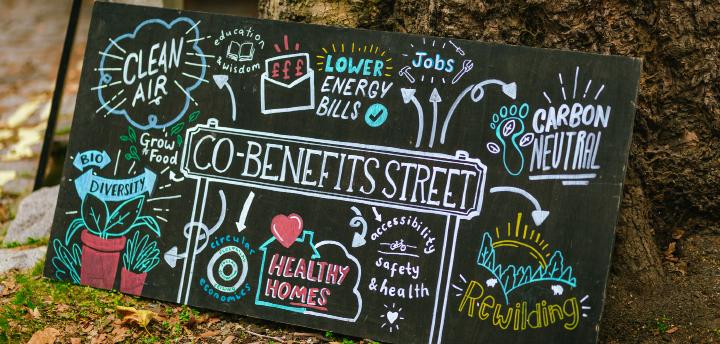
Place-based approaches also tailor retrofit to local needs and deliver co-benefits across public health, climate resilience, the cost of living, economic growth, and employment. MHCLG has recognised that “the measures of success cannot just be shifts in national statistics,” and that investment must result in “change that people see and feel in their local community”10
Credit: Angela Grabowska
Key Facts
Evidence shows that actions taken by national government to support the delivery of place-based retrofit will also strengthen progress towards key targets across DESNZ and MHCLG, with further cross-departmental benefits:
• Increase uptake and scale deployment of insulation and low-carbon technologies, supporting progress toward Net Zero 2050 and EPC C fuel poverty targets. Partnering with trusted community organisations and local SMEs raises uptake11; social marketing creates efficiencies in delivery by working through existing networks12; and direct citizen engagement surfaces and addresses place-specific barriers13
• Provide value for money and derisk investment. Place-based delivery can require only 25% of the investment of a place-agnostic approach while generating approximately twice the energy cost savings and social benefits14; directly supporting energy affordability goals under the fuel poverty framework and the Clean Energy Superpower mission.
• Create equitable economic growth and strengthen workforce development, advancing the Kickstarting Economic Growth mission. Place-based procurement in retrofit could generate £16.8–22bn in UK economic output and support up to 135,000 FTE jobs in the West Midlands alone15, while collaborative approaches have improved access for new entrants, skilled worker retention, and workforce diversity16.
• Unlock local expertise and co-benefits that place-agnostic approaches would miss. Collaborative workshops during the Local Area Retrofit Accelerator Pilot identified leverage points within local retrofit systems17, and regional supply chain mapping (as demonstrated by CIVIC SQUARE) has enabled simultaneous support for local suppliers and reductions in embodied carbon18.
• Shift from reactive treatment to prevention of health harms caused by poor housing, directly supporting the 10 Year Health Plan’s commitment to address damp and mould (in coordination with DESNZ) and its broader prevention agenda. Place-based coordination allows interventions to be targeted to context-specific health and vulnerability determinants, enabling more proactive support before issues escalate19.
Credit: Angela Grabowska
Background & Policy Landscape
Place-based retrofit sits across several significant policy developments within DESNZ and MHCLG:
The Warm Homes Plan
The Warm Homes Plan (DESNZ, January 2026) confirmed £15 billion to lower bills, address fuel poverty, deliver clean heat, and support employment and growth; with a target of upgrading up to 5 million homes by 2030. It centres three pillars: direct support for low-income households; a universal offer for homeowners; and new minimum energy efficiency standards for renters.
The Warm Homes Plan confirmed DESNZ’s intention to work closely with local government and strategic authorities, housing associations, and other key stakeholders to deliver place-based retrofit20. The Plan also signals a move toward cross-tenure and area-based delivery. The Warm Homes Agency is expected to support regional coordination, build local government capacity and collaborate with Great British Energy on placebased solutions.
The Pride in Place Strategy
The Pride in Place Strategy (MHCLG) requires local authorities receiving the fund to establish neighbourhood governance structures, with indicative interventions including support for healthy and climate-resilient homes, community energy and retrofit advice, local business support, and skills development21. Monitored outputs include green retrofits to residential, public and commercial buildings, FTE job creation, and improved community spaces22.
These are accompanied by further relevant developments:
• The English Devolution and Community Empowerment Act has extended the requirement for neighbourhood governance structures to all areas in England. The English Devolution White Paper set out the next steps for Combined Authorities to become Mayoral Strategic Authorities, and to publish their own Local Growth Plans (LGPs). These plans are regional frameworks for growth within a strategic authority setting23.
• The Local Power Plan supports community ownership of clean energy through capacity development, local authority partnerships, regulatory reform, and improved access to finance. The plan will be backed by Great British Energy (GBE), who will provide up to £1 billion of funding24. Following the 2026 King’s Speech, an Energy Independence Bill is expected to support the expansion of homegrown renewable energy and protect living standards25.
Our Recommendations
To accompany these promising policy developments, more details are needed about how government will provide ‘support for local partnerships,’ and how the barriers faced by key delivery partners will be addressed when delivering place-based retrofit.
Over the past two decades, austerity has weakened the ability of local government to deliver public services, with many departments already strained. However, research by the EDRC highlights several historical examples where local government capacity for delivering place-based retrofit was stronger, and builds recommendations based on learnings from the place-based programmes that upgraded the nation’s housing stock over the twentieth century26
With significant responsibility devolved to local government within the Warm Homes Plan, government must ensure that those identified as key delivery partners are wellresourced and supported to have the right institutional capacity strengthened / create in-house services and partnerships which strengthen delivery.
For DESNZ and MHCLG to unlock the benefits of place-based retrofit, we recommend:
1. DESNZ should co-design funding and finance programmes with local delivery partners of the Warm Homes Plan.
2. DESNZ and MHCLG should incentivise and resource partnerships between the full range of local delivery partners, including local authorities, the supply chain, and community organisations.
3. DESNZ should design the Warm Homes Agency to provide consistent national messaging while actively supporting and platforming local advice and support services.
4. DESNZ and MHCLG should should use the opportunity created by MEES implementation to support public and cooperative acquisition of housing.
5. DESNZ and MHCLG should build institutional capacity within local authorities to develop procurement practice which supports Community Wealth Building (CWB) and bring labour in house where appropriate.
1 Co-design funding and finance programmes with local delivery partners of the Warm Homes Plan
From 2027/2028, DESNZ intends to combine the Warm Homes: Local Grant and Warm Homes: Social Housing Fund as a single cross-tenure place-based scheme. Additionally, The Warm Homes Agency is expected to play a role in building capacity within local government, to enable delivery to be successfully led and coordinated at a local level.
To ensure that local delivery partners can successfully take ownership of scheme delivery and respond to local needs27, we recommend:
• DESNZ and the Warm Homes Agency should set out a structured co-design process for engaging and building capacity across local delivery partners. This should involve those likely to be responsible for coordinating place-based retrofit, such as local government and strategic authorities, housing associations, community organisations and Retrofit Facilitation Providers (RFPs) in the design of funding allocation frameworks, governance arrangements, and delivery timescales for the 2027/28 scheme. This process should include opportunities to identify how local delivery partners can be empowered to act on retrofit once capacity is built.
• DESNZ should provide flexibility to meet local needs and support local delivery partners in developing retrofit strategies with measurable outcomes tailored to local priorities. Local delivery partners should also be encouraged to engage with the wider community and the supply chain to develop these strategies and target outcomes. Neighbourhood governance structures28 established under the Pride in Place Strategy and English Devolution and Community Empowerment Act should be recognised as mechanisms to facilitate this collaboration.
71% of local councils felt they did not have the right enabling infrastructure to enagage in a placebased approach.
Credit: Angela Grabowska
2
Incentivise and resource partnerships between the full range of local delivery partners, including local authorities, SMEs and community organisations
Government has recognised that partnerships with place-based organisations are key in delivering more equitable outcomes and unlocking demand for low carbon heating, insulation, and rooftop solar29. However, the Warm Homes Plan focuses largely on partnerships between local authorities and DNOs, with less attention given to the wider organisations needed for effective local delivery. Local authorities also continue to face significant capacity constraints in building and sustaining partnerships with community groups and SMEs.
How to Support Local Partnerships for Warm, Healthy and Resilient Homes
The Local Power Plan provides a useful model for this collaboration; it includes mechanisms to incentivise cooperation between local government, citizens, and place-based organisations, with a clear role for community organisations in capacity building and delivery. Equivalent provisions are needed within the Warm Homes Plan to support and de-risk local partnerships30
Scheme design and the co-design process should incorporate insights from the Local Area Retrofit Accelerator (LARA) pilots, delivered by the MCS Foundation and supported by UKGBC and NRH, which developed retrofit strategies through collaborative workshops with stakeholders across local, municipal and regional settings31. The co-design and partnership process was found to be critical in building buy-in and consensus among key stakeholders.
What’s missing?
The Warm Home Agency is already expected to collaborate with Great British Energy and local government to deliver place-based solutions. However, its current remit does not adequately resource or incentivise partnerships with the full range of local actors whose involvement is needed to reach households in the greatest need and achieve co-benefits including those associated with public health.
78%of community organisations and Retrofit Facilitation Providers (RFPs) felt they did not have the right enabling infrastructure to enagage in a place-based approach.
2
To support this approach, several enabling measures should also be considered:
• DESNZ should extend the scope of the Local Power Plan to include retrofit and grid capacity management alongside energy generation. Alternatively, the Warm Homes Agency could create a Warm Homes Local programme in parallel to Great British Energy (GBE) Local. The former would enable community partnerships operating under the Plan to support warmer homes outcomes. The use of Partnership and Community Retrofit Funds could incentivise further partnerships. This would create a coherent framework for communityled clean energy and retrofit delivery, reducing duplication and maximising the value of investment in capacitybuilding.
• DESNZ and MHCLG should jointly issue guidance requiring local authorities to integrate neighbourhood governance structures into Warm Homes Plan delivery. The integration of forums established under the Pride in Place strategy and the English Devolution and Community Empowerment Act into the implementation of the Warm Homes Plan would ensure local expertise informs crucial decisions and that delivery contributes to fuel poverty and public health objectives.
• The Warm Homes Agency should provide standardised partnership agreements and legal support to local delivery partners, allowing local authorities, SMEs, and community organisations to formalise partnerships more easily.
• Provide grant funding and equity investment alongside communitybased organisations and local government to de-risk projects and existing models. Patient capital can allow new business models, such as public-commons and communitybased retrofit models, to emerge and become viable. By stepping in early and funding innovative new models for place-based and community retrofit, government can de-risk uncertainty. This could involve innovation grants, long maturity concessional loans, and direct public co-investment32 (such as through the Local Power Plan).
The Scottish National Investment Bank (SNIB) is one example which has provided funding for place-based innovation33. This could help models proposed by organisations such as Retrofit Balsall Heath to be replicated across the UK where constraints have stifled development.
Credit: Angela Grabowska
3Design the Warm Homes Agency to provide consistent national messaging, while actively platforming and supporting local advice and support services.
The creation of the Warm Homes Agency has been widely welcomed as an opportunity to strengthen how retrofit is coordinated and communicated at a national level. Across our network, there is strong support for a central body that provides clarity, coordination, and a consistent message to the public. Evidence from our engagement also identified a clear demand for impartial advice to rebuild public trust and demystify the retrofit process for households.
At the same time, there was consensus that the Agency must not displace or duplicate the trusted local knowledge and existing provision that are vital for effective delivery. The Warm Homes Agency should be designed to platform and strengthen this existing capacity.
To achieve this, we recommend that the Warm Homes Agency:
• Platforms and connects, rather than replaces, existing local advice services. The Agency should act as a national gateway, directing citizens to local advice providers and facilitation services, while maintaining a national repository of best-practice information34. This could include a national baseline advice framework that can be taken and adapted by regional groups to meet the bespoke needs of different regions and places35
• Works to build local advice capacity where gaps exist. Where local energy advice services are absent or underdeveloped, the Agency should
work with MHCLG to use Pride in Place funding to support the development of new local energy advice hubs.
• Establishes a simple, trusted national public offer, drawing on proven models. National messaging should give citizens a clear understanding of what retrofit involves, what support is available, and where to go for impartial guidance. The Agency should draw on the experience and evaluate the learnings of established models including Warmer Homes Scotland in designing a communications approach that builds long-term public confidence.
Credit: Angela Grabowska
4
Continue to support place-based land and housing stewardship by enabling public and cooperative acquisition of housing
Government projections suggest that the introduction of MEES could lead between 3-6% of private landlords to leave the sector and sell up36. Rather than allowing this stock to be absorbed by remaining private landlords or left vacant, DESNZ and MHCLG should treat this as a strategic opportunity to support public and thirdsector acquisition of housing, building on the track record of these organisations in improving homes and managing properties responsibly37.
Expanded public and cooperative ownership would also address a structural barrier facing social housing providers delivering areabased retrofit in mixed-tenure estates: the difficulty of achieving whole-street or whole-block interventions when properties are dispersed across different ownership. Enabling providers to consolidate ownership of ex-council properties within their portfolios could unlock the economies of scale needed for cost-effective retrofit at neighbourhood level.
Support for public and cooperative ownership of assets is already part of the Local Power Plan, the Pride in Place Strategy, and the English Devolution and Community Empowerment Act. DESNZ and MHCLG should build on this momentum.
We recommend:
• Re-establish a funded programme for public and cooperative acquisition of empty and substandard homes. The Empty Homes Programme, which ran in the early 2010s, provided grants and loans to local authorities and community groups to renovate derelict properties and return them to use. Since its closure, councils have been left to act without national support. A successor programme should be introduced as part of the Warm Homes Plan. Working with MHCLG, The WHP could build upon momentum for cooperative and public ownership as per recommendation 2, to create a pipeline of popular assets for retrofit. See Leeds Council and Canopy Housing38.
• Extend and streamline Compulsory Purchase Order (CPO) powers for empty and non-decent homes. CPO processes should be reformed to make them faster, lower-cost, and more accessible for local authorities and community organisations seeking to acquire long-term empty or substandard private rented properties.
• Reduce the regulatory barriers that prevent community organisations from becoming ethical social landlords. Currently, only a small number of well-resourced community organisations successfully navigate the regulatory requirements to take on a landlord role. MHCLG should review regulatory and administrative barriers to enable more organisations to operate as social landlords at neighbourhood scale.
SHELTER have published a more comprehensive set of recommendations on how government can enable the public and co-operative acquisition of empty homes39
5
Build
institutional capacity within local authorities to develop procurement practice which supports CWB and bring labour in house where appropriate.
Members of our network have highlighted that “procurement practice often works against developing local supply chains, as a focus on low price, high volume, turnkey solutions lead to larger out-of-area contractors being selected as the main delivery partners.40” Problems with low-quality installations have highlighted the need to provide further support for local supply chains and the wider retrofit system. Local authorities delivering national retrofit programmes often have limited capacity and resource, meaning they may struggle to contract directly with local businesses and social enterprises. Instead, they often rely on large consultants and contractors, who then subcontract work.
To address these issues, we would encourage government to move away from the assumption that procurement must always be outsourced and ensure all procurement processes embed social value and community wealth building. National government can support this change by building capacity, resource and capability within local authorities, through funding, support for capability building (such as the IUK Net Zero Living programme), and engagement through the Warm Homes Agency.
To support local and combined authorities to develop local supply chains, build confidence among contractors and SMEs, and retain the benefits of retrofit within local economies, we recommend:
• National schemes should be designed to enable SME involvement and upskilling during delivery. Outcomes of national schemes need to include more than improvements to energy efficiency within their scope to support this. MHCLG should support local government to include locally set targets associated with employment, skills and wider forms of environmental and social value within procurement frameworks41. Case studies such as Carbon Coop and B4Box in Manchester and the Treneere Estate project in Penzance have illustrated
that collaboration with SMEs provides opportunities for new entrants and on-site learning. Other organisations such as CIVIC SQUARE and Wessex Community Assets are demonstrating the value of uplifting local suppliers and manufacturers while reducing embodied carbon. To make this work, government should ensure the longevity of capital funding, to give SMEs confidence to invest in skills42 Government could also mirror the Scottish Community Wealth Building Act.
• DESNZ and MHCLG should implement policy recommendations from the NRH’s National Retrofit Workforce Strategy Policy Recommendations. These recommendations outlined key steps which could be taken to build the capacity, competence, and clarity needed to scale up retrofit delivery; creating good jobs and supporting businesses. It highlighted a need for coordinated action at national, regional, and local levels with regional and local delivery bodies to build supply chains, strengthen procurement, and monitor skills needs on the ground.
• The Warm Homes Agency should evaluate the benefits of trusted supply chain schemes that can be engaged with by local and combined authorities. This should aim to understand how those delivering, procuring or purchasing retrofit can be supported to know who to trust.
Credit: Angela Grabowska
• DESNZ and MHCLG should build internal delivery capacity and capability within local and municipal governments. Local authorities should be supported to build internal capacity and capability to lead retrofit programmes effectively, through dedicated funding, workforce development and skills pathways. This could include Direct Labour Organisations (DLOs), which are workforces employed directly by local governments. They can enable local authorities to build a permanent workforce of retrofit installers, coordinators, assessors and architects, supported by the private sector and co-operatives. This would encourage sustained engagement with local housing stock and community needs, and promote secure employment. To learn more about the role and benefit of DLOs in the coordination of retrofit at a local level, see A Plan for Places43
Summary
The recommendations set out in this report are intended to help ensure the Warm Homes Plan supports not only the delivery of retrofit at scale, but also the development of long-term local capacity, trusted partnerships and more equitable outcomes for communities across the UK. Place-based approaches provide an opportunity to align retrofit delivery with wider objectives around public health, fuel poverty, resilience, local economic development and community wealth building. Realising these benefits will require government to resource and enable collaboration across the full range of local delivery partners.
Key Actions
For DESNZ
Actions from Recommendation 1.
• Set out a structured co-design process for engaging and building capacity across local delivery partners through the WHA.
• Provide scheme flexibility to meet local needs and support local delivery partners in developing retrofit strategies with measurable outcomes tailored to local priorities.
Actions from Recommendation 2.
• Extend the scope of the Local Power Plan to include retrofit alongside energy generation. Alternatively, the Warm Homes Agency could create a Warm Homes Local programme in parallel to Great British Energy (GBE) Local.
• Use the WHA to provide standardised partnership agreements and legal support to local delivery partners.
• Provide equity investment alongside communitybased organisations and local government to derisk projects and existing models.
Actions from Recommendation 3.
• Use the WHA to platform and connect, rather than replace, existing local advice services; build local advice capacity where gaps exist; and establish a simple, trusted national public offer.
Actions from Recommendation 5.
• Design national schemes to enable SME involvement and up-skilling during delivery, including intended outcomes which go beyond improvements to energy efficiency.
• Evaluate the benefits of trusted supply chain schemes that can be engaged with by local and combined authorities.
For MHCLG
Actions from Recommendation 4.
• Extend and streamline Compulsory Purchase Order powers for empty and non-decent homes.
• Reduce the regulatory barriers that prevent community organisations from becoming ethical social landlords.
Cross-Departmental Opportunities
Actions from Recommendation 2.
• Jointly issue guidance requiring local authorities to integrate neighbourhood governance structures into Warm Homes Plan delivery.
Actions from Recommendation 4.
• Re-establish a funded programme for public and cooperative acquisition, and retrofit of empty and substandard homes.
Actions from Recommendation 5.
• Implement policy recommendations from the NRH’s National Retrofit Workforce Strategy Policy Recommendations.
• Build internal delivery capacity and capability within local and municipal governments, through support for creating Direct Labour Organisations, for example.
About the Project
The National Retrofit Hub (NRH) collaborated with the UK Green Building Council (UKGBC) and Energy Demand Research Centre (EDRC) to investigate effective place-based approaches to retrofit. Supported and funded by The MCS Foundation, the project aimed to build a replicable, scalable framework that engages and empowers actors at all scales, including national and local governments, community groups, built environment service providers, and citizens. The project developed outputs to reflect the diversity of contexts and approaches to place-based retrofit. These resources enable practitioners to design retrofit strategies which meet the needs of their communities.
Throughout the course of the project, we engaged with over 300 representatives from the sector during workshops, webinars and surveys. We listened and built their insights into the project and our recommendations. As part of the project, we developed several resources:
‘Understanding Place-Based Retrofit: Key Definitions, Principles and Approaches’ which set out our understanding of place-based retrofit. Our definition was informed by consensus built within the sector and engagement with our network.
‘Place-Based Retrofit in Practice” Guidance for Developing a Place-Based Retrofit Strategy’ provided guidance for local delivery actors such as local authorities, community organisations, and SMEs in delivering place-based retrofit. It built upon learnings from over 20 successful case studies of place-based retrofit across the UK.
Methodology
In addition to the learnings developed throughout the project, this briefing was shaped by a workshop titled ‘Enabling Place-Based Retrofit through Governance and Policy Change.’
In April 2026, we hosted a workshop which was attended by local authorities, community organisations, and SMEs, in addition to other representatives within the sector such as think-tanks and charities. The purpose of this workshop was to identify what support local delivery actors would like to see from government in order to enable them to deliver placebased retrofit. The workshop focused on specific
themes, such as funding and finance; local authority and local organisation involvement; and the provision of advice.
Acknowledgements
We thank everyone who participated in the workshop and are deeply grateful for their contributions which were incredibly valuable in shaping these recommendations. We also thank those who participated during earlier stages of the project:
1 Department for Energy Security and Net Zero. Warm Homes Plan. January 2026.
2 Government grant funded schemes dependent upon market demand have seen underspend due to a lack of uptake:
2.1 House of Commons Committee of Public Accounts. Green Homes Grant Voucher Scheme. November 2021. The House of Commons Committee of Public Accounts inquiry into the £1.5 billion Green Homes Grant found that the scheme achieved only 10% of its target uptake, with only a smaller proportion of the money being rolled over remainder returned to treasury.
2.2 UK Energy Research Council. Accelerating Energy Efficiency Retrofits in Owner-occupied Homes. September 2025. Research by the UK Energy Research Council found that, over the past decade, there has been a failure to continue the upward trend in uptake achieved during the early 2000s and 2010s.
3 National Audit Office. Energy efficiency installations under the Energy Company Obligation. October 2025. The National Audit Office published a report about the failures with quality of installations of external and internal wall insulations associated with the Energy Company Obligation. The report, titled ‘Energy efficiency installations under the Energy Company Obligation,’ found that 98% of homes with external insulation and 29% of homes with internal insulation require remediation.
4 Department for Energy Security and Net Zero. Warm Homes Plan. January 2026.
5 National Retrofit Hub. Place-Based Retrofit in Practice: Guidance for Developing a Place-Based Retrofit Strategy. May 2026.
6 National Retrofit Hub. Workshop: ‘Enabling Place-Based Retrofit through Governance & Policy Change.’ April 2026. In April, the NRH facilitated a workshop attended by local authorities, community organisations, industry bodies, and SMEs.
7 National Retrofit Hub. Webinar: ‘Understanding PlaceBased Retrofit.’ March 2026.
8 Retrofit Balsall Heath. How we Sparked a Retrofit Revolution. December 2023. Given its success, Retrofit Balsall Heath is now named as a co-client alongside Birmingham City Council, and a key delivery partner.
9 Department for Energy Security and Net Zero. Warm Homes Fund Consultation. April 2026. The draft aims of the Warm Homes Fund included in the consultation were “To reduce consumer energy bills and accelerate decarbonisation, by supporting the building upgrade supply chain with loans and equity investments to bring down costs and scale up the deployment of low carbon technologies.”
10 Ministry of Housing, Communities and Local Government. Pride in Place Strategy. September 2025.
11 There is a substantial body of academic literature which highlights the need to integrate relational and sociological insights into retrofit policy and scheme design.
12.1 Davis, M., Middlemiss, L., Hall, S., Brown, D., Bookbinder, R., Owen, A., Brisbois, M.C., Mininni, G.M., Cairns, I. and Hannon, M., 2025. Towards a relational sociology of retrofit. Sociology, 59(3), pp.466-484.
12.2 Brown, D., Middlemiss, L., Davis, M., Bookbinder, R., Cairns, I., Hannon, M., Mininni, G., Brisbois, M.C., Owen, A. and Hall, S., 2025. Rethinking retrofit: Relational insights for the design of residential energy efficiency policy. Energy Research & Social Science, 120, p.103863.
12.3 Cairns, I., Hannon, M., Owen, A., Bookbinder, R., Brisbois, M.C., Brown, D., Davis, M., Middlemiss, L., Mininni, G.M. and Combe, M., 2024. Under one roof: The social relations and relational work of energy retrofit for the occupants of multi-owned properties. Energy Policy, 190, p.114166.
12.4 Bolton, E., Bookbinder, R., Middlemiss, L., Hall, S., Davis, M. and Owen, A., 2023. The relational dimensions of renovation: Implications for retrofit policy. Energy Research & Social Science, 96, p.102916.
12 Local Government Association. Technical Briefing 3: Developing Effective Partnerships and Engagement with Residents and Community Groups. In Balsall Heath, Birmingham City Council partnered with a community organisation, Retrofit Balsall Heath, to engage with local residents and drive uptake. Retrofit Balsall Heath took a whole-street approach leading community engagement through communications and events. On the target street 95% of residents signed up for LADS3.
13 Local Government Association. Developing a PlaceBased Approach to Retrofit in Coventry. February 2023.
14 UK Research & Innovation (UKRI). Accelerating Net Zero Delivery. March 2022. Cited through New Economics Foundation. A Blueprint for Warmer Homes. January 2025. Research by the UKRI, which included an “appraisal of the economic costs of net zero across six city regions, found that place-based delivery requires only 25% of the investment of a place-agnostic approach and creates about twice the level of energy cost savings and social benefits.”
15 Innovation Procurement Empowerment Centre and Connected Places Catapult. Place-based Public Procurement for a Low-Carbon Future: Regional Economic Impacts of Retrofitting. March 2026. It has been projected that “place-based public procurement in regional retrofit in the West Midlands could generate £16.8–£22bn in UK economic output and support 102,000–135,000 FTE jobs. Additionally, if delivery prioritises local supply chains, the West Midlands’ economic benefit could rise from £3.3bn to £14.5bn in output and 99,000 jobs would be created, with 87,000 (88%) retained within the region.”
16 MCS Foundation. Retrofit Supply Chain Pilot Study. The MCS Foundation’s Retrofit Supply Chain Pilot demonstrated the impact of place-based and collaborative approaches: “the pilot supported two new entrant employees, previously unemployed, into full-time roles; the retention of existing jobs within B4Box, increased diversity in the workforce, including supporting women into construction roles.The project strengthened B4Box’s capacity to deliver retrofit at scale, with trained operatives applying their skills across other projects and sharing learning within the sector.”
Constructing Excellence Transforming the Treneere Estate: Social Value and Retrofit in the South West. August 2025. The Treneere Estate project also supported an apprentice hired directly from the estate following community engagement. The apprentice went on to pursue further training and qualifications in retrofit.
17 The MCS Foundation. Local Area Retrofit Accelerator (LARA).
18 CIVIC SQUARE and Material Cultures. Building Skills: A Material Strategy for Birmingham and the West Midlands. December 2024.
19 Local Government Association. Achieving Integrated Care.
20.2 National Retrofit Hub and Centric Lab. The Role of Community Health Impact Assessments (CHIAs) in Retrofit. March 2026. Community participation in setting aspirations and targets for health outcomes have illustrated value in selecting the most appropriate interventions. This includes case studies such as the Portland Inn Project, and WeCanMake.
20.3 Lee C, Buswell M, Coker J, Buckner S, Cowan A, Lhussier M. Addressing health inequalities in times of austerity: implementation of a place-based approach in multitiered local government. Perspectives in Public Health. 2024;144(3):153-161.
20 Department for Energy Security and Net Zero. Warm Homes Plan. January 2026. The Warm Homes Plan recognises that “Local authorities and mayoral strategic authorities, with their understanding of their housing stock, communities and local supply chains, will be the critical actors in planning a transition that delivers for their local areas... Local government is also well placed to attract private sector investment that might not otherwise be obtained, thanks to their ability to coordinate public and private stakeholders, use local project and infrastructure knowledge, and support the development of local supply chains with new and upskilled jobs.” Additionaly, that “beyond strategic authorities, local authorities, and D N O s, energy suppliers, housing associations, gas distribution network operators, community energy groups, and other local stakeholders will play an important role.”
21 Ministry of Housing, Communities and Local Government. Pride in Place Programme: List of Indicative Interventions. March 2026.
22 Ministry of Housing, Communities and Local Government. Pride in Place Programme: Monitoring Guidance. March 2026.
23 English Devolution and Community Empowerment Act. April 2026.
24 Great British Energy and Department for Energy Security and Net Zero. Local Power Plan. February 2026.
25 The Kings Speech. May 2026.
26 Common Wealth and Energy Demand Research Centre. A Plan for Places: Transforming Housing and Lowering the Cost of Living Through Home Improvement Corporations. April 2026.
27 Energy Systems Catapult. Heating Up: Towards a new generation of warm home schemes. November 2025. Energy Systems Catapult, suggest that “national retrofit policy should be locally delivered through area-based partnerships, with places able to decide the form of strategic relationships most suitable for them.”
28 Ministry of Housing, Communities and Local Government. Pride in Place Programme: Governance and Boundary Guidance. March 2026.
29 Local Government Association. Technical Briefing 3: Developing Effective Partnerships and Engagement with Residents and Community Groups. In Balsall Heath, Birmingham City Council partnered with a community organisation, Retrofit Balsall Heath, to engage with local residents and drive uptake. Retrofit Balsall Heath took a whole-street approach leading community engagement through communications and events. On the target street 95% of residents signed up for LADS3
30 Energy Systems Catapult. Heating Up: Towards a new generation of warm home schemes. November 2025. ESC have suggested that “funding should enable local authorities to build local delivery partnerships, to share data and direct investment in alignment with local priorities and strategies and should provide a transparent governance structure.”
32.2 Carbon Coop. Building Community Power. March 2026. In a report by Carbon Coop, it is suggested that we need increased support for Public-Commons Partnerships to develop collaborative relationships, developing new Community Energy infrastructure to quickly scale the sector.
31 The MCS Foundation. Local Area Retrofit Accelerator (LARA).
32 Dweck, E. and Mazzucato, M., 2025. State Capacity and Capabilities for a Just Green World. UCL Institute for Innovation
and Public Purpose. IIPP Policy Report 2025/07.
33 Scottish Government. Green Heat Finance Taskforce Reoport. April 2025
34 Institute for Public Policy Research. More than money: Moving towards a relational approach to retrofitting. September 2023. In a report published by the Institute for Public Policy Research, it is argued that while coordination of UK-wide advice is needed, “a national one size fits all advice service may not reflect how people actually engage with retrofitting schemes anyway, as it is less likely to be aware of the local nuances and relations that exist within a community and influence decision-making for undertaking home retrofitting. Indeed, while common national messaging and awareness raising is important, as IPPR has previously recommended more effective policy design could look to introduce one-stop shops that are embedded in local communities and high streets.”
35 National Retrofit Hub. South West Net Zero Hub and South West Region Energy Advice Providers Forum. May 2026
36 National Retrofit Hub. Improving Health and Housing Outcomes in the Private Rental Sector: Minimum Energy Efficiency Standards and a Pathway to Affordable, Healthy and Robust Homes. October 2025.
37 Ministry of Housing, Communities and Local Government. English Housing Survey 2022 to 2023: rented sectors. July 2025. According to the English Housing Survey 2022–23, 21% of private rented homes failed the Decent Homes Standard compared with only 10% of social rented homes, indicating substantially poorer housing conditions in the private rented sector.
38 Leeds City Council. Leeds Affordable Housing Growth Partnership Action Plan 2022 to 2025
39 SHELTER. Home Again: A 10-City Plan to rapidly convert empty homes into social rent homes. April 2024.
40 National Retrofit Hub. Webinar: ‘Understanding PlaceBased Retrofit.’ March 2026.
41 Communities that Work. Delivering for our Communities: Green Jobs and Skills in Social Housing. March 2026. In a report published by Communities that Work, the authors call for Stronger coordination between Government departments, the Warm Homes Agency, and Mayoral Strategic Authorities and to “ensure that social value is embedded in procurement frameworks such that it supports SMEs and the local supply chain as well as delivering improved outcomes for communities.”
42 Energy Systems Catapult. Heating Up: Towards a new generation of warm home schemes. November 2025. ESC suggest that “the replacement for ECO needs to be a long-term, 10-year programme to build local supply chains, partnerships, and training pathways. SMEs need to have the confidence that schemes are stable to invest in training and recruitment.”
43 Common Wealth and Energy Demand Research Centre. A Plan for Places: Transforming Housing and Lowering the Cost of Living Through Home Improvement Corporations. April 2026. In A Plan for Places, the EDRC outlined a role for government to support local government and strategic authorities to create Home Improvement Corporations as statutory arms length bodies responsible for home repairs and upgrades. These would be accountable to the relevant local, combined or strategic authority.