www.nativetitlesa.org
6
10
Voice to Parliament
New First Peoples Ranger Team for the Riverland and Mallee
7
11
0 ion 10,0 Circulat
Western Kaurna remains laid to rest at award-winning memorial park
Tjindu Foundation: helping young people shine
A publication by South Australian Native Title Services
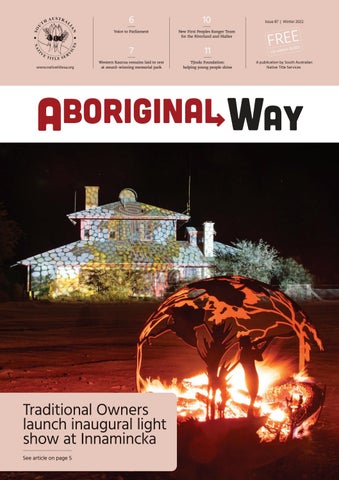
Traditional Owners launch inaugural light show at Innamincka See article on page 5
Issue 87 | Winter 2022
0
2
Aboriginal Way | A publication by South Australian Native Title Services
First Nations perspective on the State Landscape Strategy
Landscape SA has released its ten-year State Landscape Strategy. South Australia’s landscape boards, local and state government agencies, and other landscape stakeholders have worked together to develop the strategy. The document outlines seven priorities for the state’s landscape boards and their communities to consider in their land management practices. The Co-Chair of First Nations of South Australia Aboriginal Corporation, Travis Thomas, provided input to the strategy and says it recognises Aboriginal people’s role in caring for Country. First Nations of SA is the peak body for Aboriginal groups across South Australia and a united voice on cultural heritage. Aboriginal Way asked Mr Thomas to explain each priority from a First Nations perspective. The State Landscape Strategy is available to read online at www.landscape. sa.gov.au/state-landscape-strategy.
Top left: Nukunu man Travis Thomas (left) with Dhilba Guuranda-Innes National Park Ranger and Narungga, Nukunu man Dion Bromley. Photo by Matt Turner, Northern and Yorke Landscape Board. Top right: State Landscape Strategy document. Above right: Buffel grass increases the frequency and intensity of fires, and displaces native plants and the animals that depend on them. Photo by PIRSA. Opposite page, from top: Kangaroo spotted in the Flinders Rangers on Adnyamathanha Country. Photo by Megan Clark; Lake Hart on Kokatha Country.
1. Sustainable primary production It’s about encouraging landholders in a non-traditional sense to look at the use of their land and look at how the land may have been prior to their occupation of that land. Looking at what type of things may have been growing there and looking at what is being grown or implemented in that space currently. From a sustainability point of view, it’s asking, “how can we use the knowledge of what was here previously to choose our appropriate cropping? And what may be a better choice in that space if it’s appearing to be unsustainable?”. Also looking at emerging technologies that can assist them to make that land more sustainable because it hurts any Aboriginal group to see their land become degraded. That’s not beneficial to the primary producer or to the wishes of the First Nations people.
2. Soils Soil obviously is very important, and it links into the other aspects. If you don’t have soil, you can’t grow much, and we’ve seen that linking in with drought. Soil is being blown away when areas aren’t managed correctly. When we’re looking at erosion, we’re looking at the introduction of things into soils. Whatever’s being put into cropping ends up in the soil, which probably then ends up in our nearby water sources. It’s about encouraging minimal harm to areas by using responsible materials. And there are many of those products on the market now. We encourage all producers to do that and it’s in their interest.
3. Water From a cultural point of view, every nation holds water in high regard and has a lot of spirituality connected with water. There are important stories and traditions in all aspects of life that carry over through people’s actual sense of identity. In Nukunu, it’s extremely important, we see water in a lot of our creation beings and they can take the form of water and transition between the sky, into the earth and into the creeks. The issue with water is that there has been a lack of rights and access to water for First Nations and that’s prevented us from having a say around water. One positive about the State Landscape Strategy is that it emphasises the cultural considerations for First Nations in water, which hasn’t been significantly mentioned previously in other publications. The document can be used as a reference in all landscape management going forward. Any First Nation who has things happening in their space can go and cite that example to whoever they’re dealing with and draw the attention that it needs to be a consideration.
Issue 87 | Winter 2022
4. Pest plant and animal management We’ve seen a number of pest species, for instance, weed plants and goats, get out of control within SA and as a result, it’s become a high priority within this plan. If there’s a First Nations person or group with capabilities to undertake contracts within their land, they should be used as a first option prior to other agencies or resources being brought in to fulfil that need. This then gives First Nations more agency over their land and the management of it, which is helping them to meet their cultural obligations. It’s also providing a potential income stream so they’re not missing out financially.
5. Impact-causing native species Native species have always been interacted with by our peoples and now that system has been interfered with. When you interfere with the system, you then must take action because it’s creating a negative outcome and imbalance through the overpopulation of species like kangaroos. Where we see a particular species is causing an adversely negative impact on the surrounding species and ecosystems that may need to be addressed, it should be addressed in consultation with the relevant First Nation.
6. Nature conservation and biodiversity
7. Fire, flood and drought recovery Recovery from fire only needs to happen when you’ve had a bad or inappropriate fire that’s destroyed everything. When a fire that belongs there, that’s burnt at the right temperature comes in, then it doesn’t destroy things. You don’t need recovery because it’s healthy and everything’s responding to it as it’s evolved. When you’re trying to manage things by creating less fuel loading landscapes and lower intensity fire regimes, there is less need for it. Then you could be putting the money into prevention which is better than the cure. So, in a traditional sense, you wouldn’t let too many of the one species establish in a space and you’d be keeping it as open as possible and having a mosaic burn pattern where you’re having different stages of growth and you’re enabling different species to have a home. The land was managed in the past, it wasn’t devoid of human interaction, which is why much of it is a lot thicker today than our stories have indicated from traditional knowledge and first settler accounts and forestry records. The First Nations of SA Aboriginal Corporation (FNSAAC) is the peak body for First Nations across South Australia made up of representatives of Prescribed Bodies Corporate (PBCs). To sign up as a PBC or find out more, please contact melissam@nativetitlesa.org
South Australian Native Title Services Level 4 345 King William Street Adelaide SA 5000 Editor Keith Thomas Communications Officers Caleb Sweeting Joy Lothian Designer Alison Fort Advertising Enquiries (08) 8110 2800 Circulation 10,000 If you have any stories of interest to our readers, please address any correspondence to: aboriginalway@nativetitlesa.org
Aboriginal Way South Australian Native Title Services Level 4 345 King William Street Adelaide SA 5000 Ph: (08) 8110 2800 Fax: (08) 8110 2811 FREECALL: 1800 010 360 The Editor has the final decision on all stories and advertising that appear in this publication.
In a Western way, things are looked at in categories. The traditional way is like a circle where everything interacts, there’s no clear boundary and biodiversity can take care of itself. Rather than just looking at one problem through a grant to fix one weed or one part of the creek, we need to look at the bigger picture. And that’s one of the spaces where there’s always been issues between the scientific Western approach of land management versus the First Nations approach. This strategy is about helping to bridge that gap and through consultation with First Nations for a holistic approach.
www.nativetitlesa.org
Cover image: Audio stories and music by YY Elders Benjamin Kerwin and Willy Harris played during the show.
WARNING: Aboriginal and Torres Strait Islander readers are warned that the following publication may contain images, names, and stories of deceased persons.
3
4
Aboriginal Way | A publication by South Australian Native Title Services
Letter from the Editor We visited a particular site recently, and an old man told us the dreaming story from there which centred on a kangaroo, then he turned to us and said, “I am the kangaroo”. It can make your hair stand up on end. There is a whole Aboriginal landscape out there which envelopes every part of the landscape you see; it brings it to life. It has names and associations for sites right across the country which have now been superseded, of course, by colonisation and the Western namings of sites.
Australia is home to the oldest living culture on earth. Aboriginal and Torres Strait Islander people are the custodians of that culture, which includes natural and man-made heritage sites of great significance to our people. So why is it that we still do not have the right to adequately protect these heritage sites? One reason, I believe, is that we need to educate the wider public about Aboriginal heritage and the circular connection between the land, the people and the spiritual realm. It’s more than: “That’s just a rock”. Many times, a historical dreaming story is associated with a place or an object. Sometimes important cultural songs or dances are also associated with a site. Sometimes the individuals who oversee a place are an embodiment of the actual story there. If the story is, say the Seven Sisters and Wati Nyiru is an important component of that, someone from within the group of people from there may actually say, “I’m Wati Nyiru”. That means they have certain notable responsibilities, too.
Update Native title claims update Active claims Walka Wani Oodnadatta No.1 and No.2 and Arabana No.2 Judgment 21 December 2021 is the subject of Appeals. Wirangu No.2, Wirangu No.3 and Wirangu No.4 Sea claim
Some of that intrinsic value to our people has not been shared with the wider public and can therefore become lost.
Timetable for determination by second quarter of 2022/2023.
But it’s a sorry state of affairs when we foster the destruction of some of these places without fully realising the impact it has on our country, our history and our culture.
Timetable for determination by second quarter of 2022/2023.
It has become all too easy for sites to be destroyed. It’s such a minimal cost, financially, to mining companies and developers – up to $50,000 in SA which is small change to such companies – for them to destroy sites of cultural significance, so they are prepared to wear that cost to achieve their outcomes.
Mediation successful. Trial vacated.
It was reported last year that mining giant BHP asked the SA Parliament to increase penalties to companies that illegally damage Aboriginal heritage sites from that maximum of $50,000 to $10 million. In their submission to the state heritage inquiry, they wrote that the current penalties “are not proportionate to the potential harm that could be suffered as a consequence of breaches of the legislation, are not substantial by modern legislative standards, and do not reflect community expectations in relation to the protection of cultural heritage”.
Responding to State assessment of native title report.
If one of the largest mining companies in the country can see that, and if monetary cost is the only way the western world sees value, then this cost needs to be raised. This is a consideration raised by the heritage publication Dhawura Ngilan (Remembering Country) to the Winanggaay Ngunnawal Language Group, which was put together by heritage experts from both Australia and New Zealand to provide a vision for the management of Aboriginal heritage in both countries. In it are a number of excellent recommendations about how cultural heritage could be better managed, such as traditional owners having the final say about what happens on country. I encourage you to have a read of how this best practice standard could come into place within the statutory framework here in South Australia. Country is vitally important to Aboriginal people in terms of our futures and the management of our cultural heritage and other matters that are linked to that - land, waters, everything. It becomes a holistic package, entwined with us as a people.
It is time we ask ourselves; how much do we value the oldest living culture on earth? Read the Dhawura Ngilan publication at culturalheritage.org.au
Nauo/Nauo No.2/Nauo No.3 /Nauo No.4
Malyankapa
Far West Coast (FWC) Sea claim Trial completed and judgment is reserved. First Peoples of the River Murray and Mallee
Yandruwandha Yawarrawarrka Trial is part heard.
Other claims Ngadjuri No.2 SAD84/2022 and Wilyakali SAD89/2022 Ngadjuri and Wilyakali have now been offered consent determinations. Position paper and draft CD circulated to respondents. First Nations of the South East No.1 and No.2 and Ngarrindjeri Mediation outcome waiting to be ratified by communities. Narungga Nation SAD88/2022 Compensation matters continue to be negotiated.
Issue 87 | Winter 2022
Traditional Owners launch inaugural light show at Innamincka They didn’t understand Country. They tried to cross the desert at Tingatingana (Strzelecki Creek) but failed and returned to this place – Kinipapa. Yandruwandha people saw that the explorers were starving and exhausted. We brought them fish, Nardoo and Kangaroo. We were generous and caring but frightened off by the bullets.
Yandruwandha Yawarrawarrka Traditional Land Owners Aboriginal Corporation and South Australian Native Title Services have worked in partnership to deliver the initiative, ‘Padla Ngalungga Kinipapa’ (Cooper Creek, Our Country).
The inaugural light and sound installation took place during the July school holidays in Innamincka, where the group created an immersive cultural experience that celebrated the traditional lands of the Yandruwandha Yawarrawarrka people across south-west Queensland and north-east South Australia. Artworks by Traditional Owners Aaron Paterson, Leslie Harris Snr, Lionel Kerwin, Patrick Ferguson and Sharon Guttie were projected onto the AIM Building, where the National Parks and Wildlife Service (NPWS) Innamincka Regional Reserve Visitor Centre is based. During the projections, voice-overs by Leslie Harris Jnr, Cindy Schaffer and Aaron Paterson spoke of Kinipapa, the traditional name for Cooper Creek. They shared Traditional Owner perspectives associated with the Burke, Wills, King and Yandruwandha National Heritage Places and stories of the expedition and interactions.
“We the Yandruwandra Yarrawarraka people are very respectful of our land and waterholes and welcome all to our homelands. We hope everyone enjoyed the Padla Ngalungga Kinipapa experience and took away how important our Country and connection is to our people and lives,” said Teresa Gallo, the Chairperson of Yandruwandha Yawarrawarrka Traditional Land Owners AC. “Yandruwandra Yarrawarraka people are embracing new technology to showcase their history and culture on a large scale. I recommend anyone who missed out to attend Padla Ngalungga Kinipapa’s next installation to learn more about the Traditional Owners of the area,” said Keith Thomas, the CEO of SA Native Title Services. The project received funding from the Australian Government’s Heritage Grants program, which aims to improve recognition, conservation, preservation and access to the heritage values of national heritage-listed places. Padla Ngalungga Kinipapa are planning their next light and sound installation later this year. Follow SA Native Title Services on Facebook for more information.
Left, from top: (L–R) Padla Ngalungga Kinipapa working group members: Cindy Schaffer, Teresa Gallo, Leslie Harris Jr, and Rob Singleton (not pictured); Artworks by YY Traditional Owners were projected onto the AIM Building at Innamincka during the July school holidays.
5
6
Aboriginal Way | A publication by South Australian Native Title Services
Voice to Parliament
South Australia is leading the way for a Voice to Parliament by appointing Kaurna, Narungga, Ngadjuri and Ngarrindjeri person Dale Agius as our inaugural Commissioner for First Nations’ Voice. Beginning in late July, Mr Agius will help lead the Government’s consultation with Aboriginal groups, laying the groundwork for a state-based implementation of the Uluru Statement from the Heart. “This voice allows Aboriginal people to have a direct link to Parliament, something we have wanted for some time,” said Mr Agius. “This is an exciting time where the political space has responded to the Uluru Statement from the Heart with this appointment.
Above: Dale Agius addresses the crowd at the NAIDOC march in July 2022.
It’s important that a voice to parliament considers the day-to-day issues faced by our Aboriginal communities here in South Australia and does not get lost with good intentions and overstated commitments, or where important matters become swallowed up in the bureaucratic system and responses don’t hit the ground.” Mr Agius will be working closely with the Honourable Linda Burney, Minister for Indigenous Australians, and will also liaise with the Federal Government on the national model. From Prime Minister Anthony Albanese’s acceptance speech when he first stepped into power in May, he has made it clear that a First Nations’ Voice to Federal Parliament, a major component of the Uluru Statement from the Heart, would be a key priority nationally. The two other crucial components of the Statement, treaty (sovereignty) and truth (the Makarrata Commission), are also on the agenda, but an Indigenous Voice enshrined in the constitution to provide advice about decisions affecting the lives of First Nations people is the first step, with Prime Minister Albanese committing to holding a referendum in his first term of government. Mr Agius has held senior positions across both Government and non-Government sectors, such as Director of Aboriginal Practice and Partnerships at the Department of Human Services (DHS), Manager of DHS’ Metropolitan Aboriginal Youth and Family Services, and as Executive Officer in the Office of the Commissioner for Aboriginal Engagement.
He has also been heavily involved in Aboriginal community services and events. The appointment of senior Kokatha Elder Dr Roger Thomas as Commissioner for Aboriginal Engagement has also been extended for a further six months. Dr Thomas held the role of Commissioner for Treaty before his current position. He was also the inaugural Professor of Indigenous Engagement and Adjunct Professor of Education at the University of Adelaide, and the Dean of the Centre for Australian Indigenous Research and Studies, Wilto Yerlo. “He brings invaluable knowledge in conducting public consultations and negotiations with the Aboriginal community and his long career offers valuable skills for our state,” said Attorney-General and Minister for Aboriginal Affairs, Kyam Maher about Dr Thomas. “I look forward to working with both Commissioners on our bold agenda to deliver on the Uluru Statement from the Heart in South Australia and undertake meaningful engagement with Aboriginal people across the state.” Mr Maher has also said that his government would be restarting the treaty process they began before losing government to the Liberal Party in 2018.
Issue 87 | Winter 2022
Western Kaurna remains laid to rest at award-winning memorial park In June, the Kaurna community conducted their second reburial of 220 ancestral remains at Wangayarta Memorial Park. The two-hectare site, donated by Adelaide Cemeteries, is a final resting place for Kaurna ancestors who are being returned from museums and universities. At the first reburial in December 2021, Kaurna Elder Uncle Jeffrey Newchurch said, “Our ancestors laid in a dark room, boxed, and it is only now that we begin to understand and address yesterday. As Smithfield becomes a reality, we can begin to re-land and rest those of our old peoples; so, we can heal together.” The healing process continued at the second reburial, where Kaurna remains disturbed from the western suburbs of Adelaide were repatriated from a South Australian Museum storage facility. Before their return to Country, the Old People’s bones were carefully wrapped in brown paper by Kaurna Elders Aunty Madge Wanganeen and Uncle Moogy Sumner. “It’s another chapter for our people, in doing the right thing with our ancestors, I’m so blessed to be a Kaurna Elder woman to be put in this position and to help other communities in getting ready for their reburials,” Aunty Madge said. “If you rebury our ancestors into the place where they came from, someone is going to come and dig them up again because they want to put something else there – another building, another railway track, another road. But at Wangayarta, no one is going to go there and disturb them Old People, they’re here to rest now,” Uncle Moogy said. At the memorial site, Uncle Moogy spread soils from all over Kaurna Country so the Old People could be buried with the land they once walked on. Days after the second reburial, Wangayarta was recognised at the AILA Landscape Architecture Awards, winning the ‘Cultural Heritage’ and ‘Healthy Parks, Healthy People’ categories. Wangayarta’s co-designers, Kaurna Yerta Aboriginal Corporation, the Kaurna community and Oxigen
Landscape Architects were commended by AILA SA’s judging panel, who said: “Through successful community partnership and elevation of cultural authority in the design process, an exemplary outcome has been achieved which stands as a benchmark for other First Nations’ communities around Australia.” While the previous Marshall Government contributed $300,000 towards the Wangayarta co-design process, the Malinauskas Government is yet to commit funding to support future Aboriginal reburials. The South Australian Museum will continue to work with Kaurna and more Aboriginal communities to return over 4,000 Aboriginal ancestral remains still in their custody. The SA Musuem said in a statement, “Wangayarta memorialises the challenge, fortitude, and generosity of Kaurna People in sharing this repatriation with everyone, so that together we learn our history and share the truth.” Listen to our in-depth podcast episode with Madge and Moogy about the Wangayarta Repatriation at www.nativetitlesa.org/aboriginalway-news/
Kaurna and Narungga remains returned from the US In July, eight Aboriginal ancestors were repatriated from the Smithsonian National Museum of Natural History in Washington DC to South Australia. Two of the ancestors are from the Narungga and Kaurna nations. Representatives from these South Australian communities including Kaurna Elder Moogy Sumner, Kaurna man Allan Sumner, and Narungga men Doug Milera and Cyril Kartinyeri, travelled to the United States to receive and accompany their ancestors’ home. “It’s not the most pleasant thing to do, but it’s the right thing to do for us,” Allan Sumner told the ABC from Washington. “This is about healing for ourselves; healing for our country and our people.” After touching down at Adelaide Airport, the ancestors travelled by police escort to the South Australian Museum’s ‘Keeping Place’ where they will rest until they are ready to be buried back on their Country.
Above, from top: In June, 220 Kaurna remains disturbed from the western suburbs of Adelaide were returned to Country at Wangayarta. In Kaurna language ‘wanga’ means ‘grave’ and ‘yarta’ means ‘land, earth, ground, soil, country’; (L–R) Kaurna Yerta Aboriginal Corporation Chairperson Les Wanganeen, Attorney General Kyam Maher, Governor of South Australia Frances Adamson, Rod Bunten, SA Musuem chair Kim Cheater, Aunty Madge Wanganeen, Allan Sumner, Uncle Moogy; Wangayarta is shaped like a Kaurna shield as a symbol of protection and surrounded by four reburial mounds facing north, south, east and west. ( This photo by Haidarr Jones); The ancestors will be held at the South Australian Museum’s ‘Keeping Place’ until they are ready to be buried back on their Country.
7
8
Aboriginal Way | A publication by South Australian Native Title Services
Get up! Stand up! Show up! Plenty of people in Adelaide did just that on Friday 10 July by gathering in Tadanyanya (Victoria Square) for the NAIDOC March, which took them to the steps of Parliament. Here are some photos from the day.
Issue 87 | Winter 2022
Cashless Debit Card to be terminated, dividing Indigenous leaders The cashless welfare card program, which targets areas with high Indigenous populations, is set to be scrapped, following a report finding that it has not met its intended objectives of ‘supporting recipients to better manage their finances and encourage socially responsible behaviour’, but prominent First Nations leaders are divided in opinion about its end. Federal Minister for Social Services Amanda Rishworth said the report from the Australian National Audit Office highlighted a lack of evidence to demonstrate the effectiveness of the card, which welfare payments are paid into. “I will be working with local communities on better solutions,” she said. “The former Coalition Government spent more than $170 million on the privatised Cashless Debit Card – money that could have been spent on services locals need.” The Cashless Debit Card looks and operates as a normal debit bank card does, but it cannot be used to purchase alcohol, gamble, or withdraw money. The program is reported to have
cost $36m in 2020-21 and had almost 17,000 participants in February this year. Both Indigenous leader Warren Mundine and Country Liberal Party Senator Jacinta Nampijinpa Price suggest the decision may lead to a rise in violence and substance abuse, especially given alcohol will be allowed back into NT communities from July. “I see two dreadful things coming together at the moment, in allowing alcohol back into communities and scrapping the cashless card,” Mr Mundine, who was Indigenous Advisory Council chair when the card was first introduced, told The Australian. “Any plan to remove the cashless debit card needs to be ruled out, especially given that the NT Labor government are about to unleash floods of alcohol back out into remote Aboriginal communities,” agreed Senator Price. “It’s not good enough to claim there is little evidence the cashless debit card is effective in order to end it and then claim a voice to parliament, which has not been tried or tested, will somehow fix all our problems.” However, Pat Turner AM, CEO of National Aboriginal Community Controlled Health
Organisation, told The Australian the scheme had caused “unnecessary embarrassment” for Indigenous Australians. “I certainly welcome the scrapping of the cashless debit card,” she said. “The Auditor-General’s report confirms what we already knew and why we were so opposed to the scheme. It’s simply poor public policy to run trials as the former government did for five years.” The card was implemented as a trial in 2016 under the Abbott Government in Ceduna alongside the Goldfields in Western Australia and in the Northern Territory. Auditor-General Grant Hehir said that the Department of Social Services had largely been effective in overseeing the program since then, but that there had been a lack of internal performance monitoring under the Morrison Government. His office had made six recommendations to the Department of Social Services to improve the program’s effectiveness after a 2018 audit found that monitoring and evaluation was inadequate. The recent audit found that some proposed changes around evaluating the card and undertaking a costbenefit analysis had not been made, which led to the decision to terminate the program.
9
10
Aboriginal Way | A publication by South Australian Native Title Services
New First Peoples Ranger Team for the Riverland and Mallee A new First Peoples’ ranger team is helping manage and protect the rich cultural and environmental heritage of the South Australian Riverland and Mallee and recently took out the Caring for Country Award in their local Riverland community NAIDOC awards. The new team, which is employed by the River Murray and Mallee Aboriginal Corporation (RMMAC), started in March 2022. RMMAC Chair Julie Cook said the establishment of the ranger team was an important milestone for the First Peoples of the River Murray and Mallee community. “The ranger program is helping us to protect and restore our important cultural heritage sites and take a lead role in the management of our precious lands and waters,” Ms Cook said. “The program is also creating important social benefits by providing employment, giving people skills and qualifications and supporting both young people and elders to get involved and share knowledge.” The rangers will be involved in a wide range of activities across the Riverland and Mallee region including heritage site protection, threatened species conservation, wetland management, revegetation, the control of invasive pest plants and animals, research projects and cultural awareness sessions with local schools. The team were recently invited to a round table with the Minister for Environment and Water, the Hon Tanya Plibersek MP, who was impressed with the work they are doing. According to Ms Cook, one of the most exciting aspects of the program is the partnerships being developed with local Riverland schools. “The team has already supported the Renmark High school and is in discussions with the Berri Regional Secondary College about setting up a work experience and school-based apprenticeship program. Getting our young people involved and supporting them with pathways into meaningful and rewarding careers is an important aim of the program.” The RMMAC Ranger Program is supported by SA Native Titles Services, the National Indigenous Australians Agency and the Murraylands and Riverland Landscape Board.
Above, from top: The RMMAC Ranger team William Cook, Lucy Morgan Sumner, Fiona Giles, Chloe Zielkie and Anton Motto; The RMMAC Rangers Anton Motto, Chloe Zielkie, Fiona Giles, Lucy Morgan Sumner and Julie Cook with the Minister for Environment and Water the Hon Tanya Plibersek MP; The Caring for Country 2022 NAIDOC Award.
In Focus
Issue 87 | Winter 2022
Tjindu Foundation: helping young people shine
For many Aboriginal language groups across South Australia, the word ‘tjindu’ translates to sun or sunshine, so it was the perfect choice to name a foundation thats purpose is to help Aboriginal children and young people shine their brightest. The Tjindu Foundation aims to build resilience, school retention and employment prospects for the Aboriginal students who participate in their engagement and cultural education programs. When April Lawrie and Pauly Vandenbergh established the Aboriginal communitycontrolled organisation at the end of 2019/ early 2020, they had no idea that activities would quickly come to a grinding halt, given a certain global pandemic – before they’d really even got started.
Above: Tjindu Board Directors Pauly Vandenbergh and April Lawrie with AFL Academy students Kiesha Bilney and Raymond Sumner.
But as their roles as South Australia’s Commissioner for Aboriginal Children and Young People (and Chair of SA Native Title Service’s Board of Directors), and the National Diversity Talent Manager at the AFL respectively would suggest, this did not stop April and Pauly. “That’s basically the bottom, isn’t it? If you can get through that, you should be all good going up from there!” laughed Pauly about the difficult beginning. Now, two and a half years later, Tjindu Foundation, which is funded by a mixture of federal, state and corporate support, employs four Aboriginal staff members (three full-time). Five of their eight board members are Aboriginal, and they have successfully negotiated three teachers from the Department of Education to write their curriculum two days a week. “All our programs are linked back to curriculum, so negotiating with the Education Department became really critical,” said Pauly. “We’re not teachers. We like to think we’re teachers in another way, but we were really keen to get real teachers to write the content we’re delivering for the whole year so that students can get credits towards their SACE. We’ve got some amazing curriculum now that talks about our culture and identity, our history, understanding other people’s history, languages.
“You can see this pride in the students, learning about their own culture and their own history. Some of the reports they’re writing and handing up to us are really inspiring. “That’s what we’ve always wanted to do in this space; have Aboriginal people writing our curriculum, delivering it to Aboriginal students; empowering them.” And Tjindu’s programs are empowering students to shine. There’s the Aboriginal AFL Academy, which, in partnership with the SANFL and the Department for Education provides the opportunity for 70 male and female students to come together each week to complete a unit in Aboriginal Studies (Stage 1 or 2) or an Integrated Learning Subject (Stage 1) as part of their SACE. Every Tuesday the Year 10, 11 and 12 students travel from wherever they are based around Australia (many from remote communities are boarding in Adelaide), to a room overlooking Adelaide Oval where they learn about Aboriginal culture and history, followed by football training. “We’ve targeted students from South Australia, but we still have others coming down from places like Alice Springs, Darwin and Halls Creek (WA). We even have students who drive down from Port Augusta every Monday night to attend on a Tuesday.
11
12
Aboriginal Way | A publication by South Australian Native Title Services
“There’s a huge amount of commitment, so it’s important that our program is highly engaging. We can’t have down days – ever – because we have students travelling really long distances to attend.” The Foundation hosted tryouts for 120 students from around the country in November 2021, and they had to choose 70 students to make up both male and female teams from there. “It was a real challenge to choose the students from that trial!” said Pauly. “We targeted the older students first, then filtered back from there. We have had a few drop out as they’ve transitioned into employment, but if the option to continue while working is there, then we will support that, too. Overall, it’s going really well.” It certainly seems to be, as eight AFL Aboriginal Academy graduates have now been recruited to elite clubs. “They’ve come through the SANFL and other programs, not just ours, but it’s great for other kids that come through the AFL Academy to see them as role models.” Up to 30 more spots will open up for Year 10 and 11 students to transition into the Academy come November.
“We have a legitimate challenge in that our kids are coming to us and not to school. We can smile for a second and think ‘that’s kinda cool’, but that’s not what we want; we want our kids to be attending school! But that does say something about the safety we’re creating at the Foundation. “We’re still working through that part, but for now, at least they’re coming to something with a learning environment.” Tjindu Foundation’s second main program, Tjindu Strong, used to be referred to as ‘willpower’. The sole focus of Tjindu Strong is to improve school attendance in the 11 schools involved, which are all based in remote communities across the APY and Maralinga Lands. It’s been a real challenge to get into those communities over the past couple of years due to biosecurity measures in place from Covid. Pauly says they have managed to create a balance between travelling to communities and engaging in-person and using online platforms to connect with the students and work through an interactive booklet together. “It’s not the same as face to face, as they want to kick a footy around with us, but it’s still really engaging and is well received.
STOP THE SPREAD STAY STRONG TIPS TO STAY POSITIVE
• Keep to a daily routine • Stay in touch with friends and family • Practice your culture and traditions from home if you can. For example, sharing stories and family history • Get your news about coronavirus (COVID-19) from reliable sources • Exercise and eat well
• Get a good sleep, aim for 8 hours per night • Avoid using tobacco, drugs or alcohol to deal with stress and worry • Be patient and kind to others, it’s a challenging time for everyone • Get some fresh air • Your moods may change and you could experience sadness, anxiety, frustration, and fear. Get help if you can’t shake these feelings or they worsen. Contact your local clinic or one of the services below
SUPPORT SERVICES • SA COVID-19 Mental Health Support Line (8am to 8pm, 7 days): 1800 632 753 • Lifeline Australia: 13 11 14 • Alcohol & Drug Information Service (ADIS): 1300 13 1340
SLEEP WELL
EAT WELL
KEEP CULTURE STRONG
GET ACTIVE
FURTHER INFORMATION SA Government COVID-19 website www.covid-19.sa.gov.au AHCSA COVID-19 website www.ahcsa.org.au
“We incentivise it too; if they complete their booklet, they might get a footy or some shirts or something,” said Pauly. “That’s the program that, for all of us I think, April included, just fills our cup. Trying to help remote kids navigate their way through this world and through the western world.” Various corporate organisations have partnered with Tjindu to deliver content through this program, such as a workshop about quitting smoking through Quitskills, and a cyber safety course through NBN. They’re currently working with the Adelaide Crows Foundation to deliver a STEM program, which aims to steer students towards STEM-oriented career paths. The Foundation also offers cultural awareness training and assists organisations with their Reconciliation Action Plans (RAPs) through their consultancy arm, which is quickly growing. They’ve had a contract in place with SA Water for some time around this, and now BHP has signed a major contract for cultural awareness training. “We think that’s really important work, but our focus is still on the young people,” said Pauly. “We feel like there are a lot of kids missing out. I think there’s a real gap for students in Years 7 to 9 for instance, so we’ve started work on a program that will focus on culture, identity and history for that age group, which could help shape their thinking, particularly around things like their subject selections. Hopefully, some of them can then transition into the Academy later – not the end goal, but still a possibility.” Tjindu Foundation hopes to get more corporate Australian companies on board to support programs such as this, which are focused on creating a safe space for Aboriginal students to learn about their culture and, ultimately, prepare them for life beyond school. “Learning about their culture and heritage can be quite new for some of the students we work with, but it varies a lot. But that’s the great thing about having a whole bunch of Aboriginal kids come together – they can all learn off each other. They all come with different experiences and knowledge; we just help massage that. “We don’t give them the answers; this is about them researching and going back to their families and communities and asking questions,” said Pauly. “But it’s incredibly empowering for them to start working out who their mob are, where they come from, what their stories are, what their totems are, what their language is and if they have any dreaming stories attached to their people. I guess we want them to believe that anything’s possible, but sometimes you just have to show them.” Find out more about their work or get in touch at tjindufoundation.org.au
Issue 87 | Winter 2022
SAFC launches First Nations Cultural Protocols to guide screen production in SA The SAFC’s First Nations Cultural Protocols is a practical and informative handbook to help guide culturally appropriate practices for screen productions working with South Australian First Nations communities. It outlines cultural protocols including Welcome to and Acknowledgement of Country, how to identify whose country you’re filming on and advice on obtaining filming permits, alongside an overview of other potential considerations.
SOUTH AUSTRALIAN FILM CORPORATION
First Nations Cultural Protocols
Minister for the Arts the Hon. Andrea Michaels MP congratulated the SAFC on the creation of this important resource.
The South Australian Film Corporation (SAFC) has launched an essential new digital resource for screen production in South Australia.
- make a difference -
COUNCIL ELECTIONS 2022
“South Australia is a fantastic place to create screen content and the First Nations Cultural Protocols will ensure that cultural respect, liaison and collaboration with
our First Nations communities is strengthened. I congratulate the SAFC for their leadership in the industry to build a more respectful and inclusive screen sector,” Minister Michaels said. The new protocols have been developed by leading figures in the SA film industry; SAFC First Nations Screen Strategy Executive Pauline Clague and First Nations Industry Development Executive Nara Wilson and former SAFC First Nations Screen Strategy Executive Lee-Ann Buckskin with input from SA Native Title Services and Reconciliation South Australia. “Cultural Protocols are designed to protect First Nations cultural and intellectual property rights through guiding ethical behaviour and by identifying core values important to First Nations peoples such as spirit and integrity, cultural
continuity, equity, reciprocity, respect and responsibility,” said CEO of SA Native Titles Services Keith Thomas. “Understanding these core values demonstrates a respect for First Nations peoples and provides a foundation for ethical conduct in any situation. We welcome the SAFC supporting and promoting Cultural Protocols within South Australia’s screen industry.” The resource adds to the SAFC’s established suite of First Nations resources and policies already in place such as the First Nations Screen Strategy 2020– 2025, the Reconciliation Action Plan and supports the aims of the Diversity and Inclusion Strategy 2022–2032. Find the digital guide at safilm.com.au
NOMINATE VOTE Opens Tue 23 Aug 2022 - Closes 12noon Tue 6 Sep
Authorised by Clinton Jury • 148 Frome Street, Adelaide SA 5000
Before 5pm on Thurs 10 Nov
councilelections.sa.gov.au
13
14
Aboriginal Way | A publication by South Australian Native Title Services
Capturing Narungga cultural wisdom and scientific knowledge of iconic Gynburra fish
A project is underway to capture cultural and scientific knowledge about Gynburra, the iconic fish species of the Narungga people, the traditional owners of Guuranda, South Australia’s Yorke Peninsula. The venture is aimed at maintaining cultural practices associated with the Gynburra, also known as the dusty Morwong or butterfish, and building knowledge and capacity to support sustainable fishing of the species on Nurungga Sea Country. Led by Garry Goldsmith with his community on Guuranda and Dr Paul Rogers from Southern Fishery and Ecosystem Solutions, the work is funded by Fisheries Research and Development Corporation, which is guided by an Indigenous Reference Group (IRG) to invest in research and development to help achieve the aspirations of First Nations Australians.
Top: Taking part in a workshop on making harpoons to hunt Gynburra in the traditional way are, from left, at rear: Paul Stockley, Ian Harradine Snr, Brenton Wangaeen, Jayden Stockley, Anthony Newchurch Jnr, Klynton Wanganeen, Liam Branson and Nolan Martin Jnr. In front are: Neil Buckskin, Garry Goldsmith Jnr and Rex Angie. Photo: Garry Goldsmith. Right: Gynburra fish image. Artwork by Garry Goldsmith.
The IRG Executive Officer Dr Chris Calogeras says the Gynburra project addresses the IRG’s priorities, including primacy for Indigenous people, acknowledgement of Indigenous cultural practices, self-determination of Indigenous rights to use and manage cultural assets and resources, and capacity-building opportunities. “The extension of the project’s findings to the broader community will also demonstrate and strengthen cultural ownership of the Narungga Sea Country,” Chris said. “There is increasing interest amongst Aboriginal and Torres Strait Islander communities in strengthening their connections to Sea Country. They are keen to build on their cultural knowledge through contemporary science for sustainable fisheries management.” Garry explains that the Gynburra provides food security, communal and medicinal health, wellbeing and cultural identity for the Narungga. “Narungga people have a strong relationship with Sea Country. Narungga totem species include sea and land animals that are centrally important to our cultural values, connection to Country and dreamings,” Garry said. “This project will help to enhance traditional knowledge and practices to support Narungga to preserve and sustain the Gynburra as a species of cultural and ecological importance. “We’re aiming to build foundational knowledge and capacity in fisheries science and ecological techniques to support sustainable fishing of the Gynburra.
“We want to pass down specific traditional and scientific knowledge to our younger generations to ensure the Gynburra is sustainable into the future and to highlight the species’ cultural and social value.” Garry says the Narungga people used to catch Gynburra as big as 1.5 m long which could feed a whole community, making them an important part of the culture’s tradition of sharing. He says there is anecdotal evidence that stocks of the species are declining. “Over the last 10 years, we have seen a drastic reduction in the numbers of fish and the size of them,” he said. “There are a number of possible reasons behind it, which includes climate change heating up the water and land-based runoff could be affecting the food source and environment.” The project encompasses techniques to locate nurseries, biological sampling and examination of speared fish during the annual cultural season and Gynburra Festival. Gynburra were traditionally hunted with spears on reefs with the incoming tide. Men would wade in the water and often make slight movements with their feet to stir sand which would attract the inquisitive and somewhat docile fish. As the fish circled and ventured closer, the men would harpoon them with their spears. The tradition of hunting Gynburra continues and has been celebrated for the past 50 years by the Clem Graham Senior Memorial Butterfish Competition for Narungga men and boys, which recently opened to the broader community. The tradition is also celebrated by the Gynburra Festival at Port Victoria which offers activities for all and will be a drawcard on 27–28 January 2023, when interim results from the project will be presented. Educational materials will be developed for the SA School Curriculum via the Department of Education’s South Australian Aboriginal Context in Science Initiative. “We want to find out as much as we can to preserve this species and its environment and to ensure future generations maintain connections to Sea Country as our ancestors have for thousands of years,” Garry said. “The success of this fish will be the success of our community.”
Reconciliation SA
Issue 87 | Winter 2022
15
Introducing the Reconciliation SA column
Reconciliation SA is really excited to connect in with Aboriginal Way, our hope is that we will be able to share with readers some of the work we do and learn what is happening across South Australia in communities in regional, remote and metropolitan areas.
All photos by Patrick Ikaringanyi Ferguson.
Reconciliation SA turned 20 this year and we are bringing awareness and knowledge of the reconciliation movement and highlighting the efforts needed in the wider South Australian community to ensure First Nation voice and inclusivity in all aspects of society. Reconciliation SA’s CEO, Shona Reid says, “Reconciliation means different things to different people, for some it has been an opportunity to engage with the important topic of First Nation rights, for others it has been hard because often the term reconciliation has meant a lot of promises and not much action. I agree with both, for me it’s not the word reconciliation I focus on, it’s what’s behind it, for me it’s the fundamental importance of righting relationships and ensuring we can meaningfully and purposefully tackling power imbalance, racism and ensuring respect for First Peoples and our culture. Reconciliation SA is a very small not-forprofit organisation, with just a few staff. Despite being so small, we have certainly proven we are able to engage large audiences and partners in our work.
Above, from top left: Shona Reid presenting at 20th birthday event; Tjarutja Dance Collective at Reconciliation Week Breakfast; Guests at 20th birthday event; J-MILLA at Nguyanguya muri wamangka – Reconciliation in the Park; Glenn Skuthorpe at Nguyanguya muri wamangka – Reconciliation in the Park.
Aboriginal Way | A publication by South Australian Native Title Services
Since 2019, our memberships have grown considerably and in the last 12 months, we have: • Over 430 memberships • Run over 100 Reconciliation Action Plan activities • Engaged with more than 80 volunteers • Amassed over 9,900 social media followers • Amassed over 4,500 electronic newsletter subscribers • Run 27 workshop and engagement events in the corporate and education sectors, which has included speaking to over 800 schools and teachers • Run 5 premier events that attracted over 5000 attendees. Running these events not only helps Reconciliation SA, a not-for-profit organisation, to function and promote the reconciliation movement. It ensures we undertake our advocacy for First Nation peoples right on a large scale.
This year’s National Reconciliation Week had an important theme: Be Brave. Make Change. For us, it began with our annual Reconciliation Week breakfast, which had 1432 attendees and was emceed by actor Luke Carroll and featured performances by ARIA-Award winning Anangu/Torres Strait Islander singer songwriter Miiesha and the incredible Tjarutja Dance Collective. Reconciliation SA also attended many community and corporate events to help promote reconciliation that week, while CEO Shona Reid took part in several panels and Q&As. The week ended with Reconciliation SA’s embodiment of the theme Be Brave. Make Change; a free community concert called Nguyanguya muri wamangka: Reconciliation in the Park.
Above, left to right: Luke Carroll at Reconciliation Week Breakfast; Miiesha at Reconciliation Week Breakfast; Baker Boy at Nguyanguya muri wamangka – Reconciliation in the Park.
All photos by Patrick Ikaringanyi Ferguson.
16
It was a great event that saw a large crowd gathering, despite the rain, to watch Karl Telfer perform a Greeting of Spirit to Place, and performances by Glenn Skuthorpe, Eddie Peters, Tilly Tjala Thomas, J-MILLA and the headline act – Baker Boy. All these acts performed in-between sets from DJ SVVLO on a night emceed by Kevin Kropinyeri. This year, Eastern Arrernte woman Shona Reid is stepping down from her role as CEO of Reconciliation SA, a position she has held for three and a half years. We will miss her leadership and wish her all the best in her new role as Guardian for Children and Young People, as appointed by the Governor of South Australia. This will be first time a First Nation woman is in such an office. To get become a member, sign up to our newsletter or learn more, please visit our website at www.reconciliationsa.org.au. We look forward to bringing you an update of what we’ve been doing in the next edition of Aboriginal Way.
New Closing the Gap data shows that most targets are not being met New data from the Productivity Commission has been released in their annual report and indicates that Australia is still failing to hit more than half of the 17 Closing the Gap socioeconomic targets. The latest numbers show that the following five targets are not on track: children being developmentally ready when starting school (34.3%), children in out-of-home care rates (57.6 per 1000), adult imprisonment (2222.7 per 100,000), deaths by suicide (27.9 per 100,000) and sea country rights and interests. There have however, been modest improvements in four targets relating to life outcomes for children; better early childhood development with healthier birth
weights; higher rates of school attendance and lower youth detention rates. “There are some disappointing results in the latest figures – it’s clear that more work needs to be done. The Closing the Gap architecture can only work when all parties are invested and there is a coordinated effort from all jurisdictions in partnership with First Nations peoples,” said Minister for Indigenous Australians, Linda Burney. “This report from the Productivity Commission provides consistent and transparent reporting to keep governments informed and accountable. For too many years, First Nations data collection has been hard to come by and as we build these repositories, we capture the past and set the future.” This is the second report to be released after the brokering of a
new Closing the Gap agreement which included new targets, set by the Morrison Government in negotiation with peak Aboriginal bodies in 2020, after a decade of many failed targets. The Commissioner of the Productivity Commission, Romlie Mokak said the data should be treated with caution, given this report is the result of only two years’ worth of collected data, and that more would be needed to get an accurate picture. “While progress has been made toward developing the data, we need to see if these actions are happening, we don’t yet have the data,” said Romlie Mokak, Commissioner. “Developing these data remains an important priority.” Closely and regularly monitoring the progress towards agreed objectives
and outcomes is a key part of the National Agreement on Closing the Gap and the Government has committed to making data publicly available so that parties can make informed decisions about what is and isn’t working. The Commonwealth has been working with parties to the National Agreement, on the development of the first Commonwealth Closing the Gap Annual Report to be released later this year. “I am keen to understand more about how the Priority Reforms are being implemented across the country,” said Ms Burney. “I look forward to driving progress with our Partners, including the Coalition of Peaks and state and territory Ministerial colleagues, at my first Joint Council meeting for Closing the Gap in late August in Adelaide.”
In Review
Issue 87 | Winter 2022
My Spare Heart By Jared Thomas Published 31 May 2022 by Allen & Unwin. Young Adult Fiction.
Seventeen-year-old Phoebe’s life is turned upside down when she moves from Adelaide to a small country town to live with her Aboriginal dad in this powerful and uplifting story about family breakdowns, facing truths and finding balance. Phoebe’s non-Indigenous mother, a busy event manager in Adelaide, and her father, an Aboriginal man and uni lecturer, have split up and she’s moved to sleepy Willunga with him and his new health-obsessed girlfriend. It’s only a few kilometres from Phoebe’s old friends and the city, but it feels like another world. Her new school is, at first glance, full of hippies, but as she gets to know them and joins the local basketball team, Phoebe begins to find her place. But her mum becomes increasingly unreliable, Phoebe’s grades begin to suffer, her place on the basketball team is under threat and her worries spiral out of control.
Stereotypes about both Indigenous people and problem drinkers are turned upside down in this new novel that has been written for young adults but would be enjoyed by people of all ages. South Australian Nukunu author and academic Dr Jared Thomas has won awards for his earlier books including Calypso Summer and the Game Day series co-written with Australian MBA basketballer and Olympian Patty Mills. “A story with grit, authenticity of voice and characters who show strength in identity and culture.” Anita Heiss, award-winning author of Bila Yarrudhanggalangdhuray “This book will move you. It navigates the mess, chaos and complexities of life with grace.” Rebecca Lim, award-winning author of Tiger Daughter “Honest, raw and full of heart.” Tobias Madden, author of Anything But Fine
About the author Dr Jared Thomas is a Nukunu person of the Southern Flinders Ranges, William and Margaret Geary Research Fellow, Aboriginal and Torres Strait Islander Material Culture and Art at the South Australian Museum and the University of South Australia, and an Indigenous Literacy Foundation ambassador. He is the highly regarded author of critically acclaimed books for young adults including
Sweet Guy, which was short-listed for both the Victorian Premier’s Literary Awards and the Adelaide Festival Awards for Literature, and Calypso Summer, for which Jared was awarded the Kuril Dhagun Indigenous Writing Fellowship, and which was selected by the International Youth Library as a White Raven Book and short-listed for the Victorian Premier’s Literary Award for Indigenous Writing. Jared is also the author of the YA novel Songs that Sound Like Blood, and the co-author of the Patty Mills series Game Day.
South Australian Native Title Services (SANTS) for your organisation
SANTS is an independent Aboriginal organisation with proven experience and expertise in providing a wide range of professional services to South Australian Aboriginal Nations.
We are responsive to the needs and priorities of Aboriginal Corporations and can bring a unique understanding of and respect for culture and communities in our provision of services. We offer services in: • Corporate Governance • Corporate Administration
• Community Development • Native Title Legal Services
• Financial Management • Human Resources Management
SANTS offers a very competitive fee structure to Aboriginal Corporations to suit their financial circumstances. Contact our Manager of Corporate and Community Development for a confidential discussion and further information: (08) 8110 2800 | info@nativetitlesa.org | www.nativetitlesa.org
17
18
Aboriginal Way | A publication by South Australian Native Title Services
The Shop Train By Josie Wowlla Boyle Illustrated by Paul Seden
“I illustrated in pencil to capture her words and a time Josie so easily told. I hope I did all justice, in memory.”
Magabala Books to posthumously publish picture book by beloved Wonghi Children’s author Josie Wowolla Boyle. The Shop Train is a delightful children’s picture book by Wonghi storyteller Josie Wowolla Boyle who sadly passed away in 2021 before the book could be published. Magabala is honoured to be releasing this title in July 2022. Illustrated by Paul Seden (Crabbing with Dad), The Shop Train is a nostalgic story inspired by the Tea and Sugar train that serviced remote workers and communities between Port Augusta and Kalgoorlie from 1917. The book follows Rosie and her mum’s rickety journey through Wonghi Country in their old car to pick up supplies from the shop train. The book is inspired by similar journeys author Josie Wowolla Boyle took as a young girl. Josie’s family grew up with these stories and are very excited to see them brought to life: “We’re very proud of Josie, that she put this in the works before she passed,” said Shelley Martin, a proud family member.
“Magabala is honoured to publish Josie’s book posthumously. She was an incredibly talented writer, musician and artist. Coupled with Paul Seden’s sublime artwork, Josie’s words have come to life. Before Josie passed away, she read the final pages, and loved everything about The Shop Train. We give thanks to Nicki-Rose, Shelley and all Josie’s family, for entrusting us with her story.” Rachel Bin Salleh, Magabala Publisher
About the author
“The book is more than we could have imagined. She would tell us these stories from her childhood about the Tea and Sugar train and we could never really picture it as well as the book shows. This was our favourite story growing up. It’s amazing seeing it come to life.” Paul Seden’s evocative illustrations effortlessly capture a bygone era, rendering the past with a deep sense of nostalgia, whilst capturing its uncluttered beauty. “Josie’s story gives us a look at a life easily portraited as simple or laid back, yet it was as hard and beautiful as the people and the road they travelled,” said Paul when asked about capturing her story.
Josie Wowolla Boyle was a Wonghi Elder from the Goldfields region of Western Australia. An acclaimed storyteller, author, painter and musician, Josie captivated audiences in schools and festivals across the country. The Shop Train was inspired by a journey she took on the Tea and Sugar train when she was a young girl. Josie peacefully passed away in 2020. This story is her gift to everyone.
About the illustrator Paul Seden is descended from the Wuthathi and Muralag people of North Queensland. He grew up in Darwin and lives there with his family. Paul loves to draw and create stories about real and imaginary characters. He is a born storyteller and performs in local festivals. Paul has written and illustrated several children’s picture books.
2021 State of the Environment Report findings The State of the Environment Report 2021 has been released, showing that the destruction of Indigenous heritage is occurring at an unacceptable rate against the wishes of the Traditional Custodians. “The State of the Environment Report is a shocking document – it tells a story of crisis and decline in Australia’s environment,” said Minister for Environment and Water, Tanya Plibersek, vowing that now is the time to take action. The Environment Protection and Biodiversity Conservation Act 1999 (Act) requires a report on the state of the environment to be tabled in Parliament every 5 years. It is a comprehensive
assessment of the state of the Australian environment, analysing environmental pressures, state and trends and management effectiveness, without addressing policy responses. It aims to shape policy and action; influence behaviour and assist in assessing our interventions as stewards for the Australian environment. An Indigenous co-author model was in place for the first time, ensuring Indigenous knowledge is used to inform decision making in caring for Country. The report states that the overall poor state of Country and connection to Country has a negative effect on Indigenous peoples’ wellbeing, and that the environment is poorer because of
the lack of Indigenous leadership, knowledge and management.
cultural connections to Country and Indigenous wellbeing.
The report states that access to clean healthy drinking water for Indigenous communities remains below standard and is seen as poor.
Indigenous people are rich in land assets, for example, Indigenous Protected Areas make up almost half of the National Reserve System, but they are poor in terms of access to finance and other critical support to manage their Country.
Environmental changes are affecting the abundance and distribution of culturally significant native plants and animals and threatening the persistence and application of cultural knowledge and people’s
The report was completed in late 2021 but held back by the previous federal government until after the election.
Issue 87 | Winter 2022
Rule book changes for Registered Native Title Bodies Corporate
Department for Child Protection
Aboriginal Child and Youth Worker, Pool Are you interested in working with children, young people and families in South Australia who need it most, in a role that is both challenging yet highly rewarding? Then consider applying for the Child and Youth Worker role. As part of this role, you will receive: • •
The Native Title Act 1993 (NTA) and the Corporations (Aboriginal and Torres Strait Islander) Act 2006 (CATSI Act) were changed in February 2021.
Rules about disputes
This means there are new laws for Registered Native Title Bodies Corporate (RNTBCs). Under the new laws:
Rule books must include a rule stating how disputes will be resolved between RNTBCs and people who are, or claim to be, common law holders. The rule must cover disputes about:
• Existing RNTBCs (registered before 25 March 2021) have until 24 March 2023 to make changes to their rule books. • New RNTBCs (registered on or after 25 March 2021) must make sure their rule book complies with the changed CATSI Act when they incorporate under it.
What changes do existing RNTBCs need to make to their rule books?
RNTBCs must have a process in their rule book to deal with disputes between the RNTBC and people who are, or claim to be, common law holders.
• whether or not a person is a common law holder, and • the RNTBC’s performance of its native title functions.
What is the process for making these changes?
Rules about membership RNTBCs must allow all common law holders to be represented.
RNTBCs can also use this money to do training on the new requirements.
The membership criteria in rule books must allow all common law holders to be represented in the RNTBC’s membership, either by having their name on the membership register or the name of someone from a family who represents all family members.
Information about the funding can be found on the NIAA website: www. niaa.gov.au/indigenousaffairs/grantsand-funding/capacitybuildingnative-title-corporations
There are new laws about when an RNTBC member can be removed from the member register. RNTBCs can’t make their own rules anymore. The RNTBC must follow the process set out in the CATSI Act for cancelling a person’s membership. Any other process for cancelling membership must be removed.
•
As a Child and Youth Worker, you will be part of a team contributing to improving the social and living skills of children and young people in residential care (both Aboriginal and non-Aboriginal), and assist in their effective transition into the community and/or reunification/ reconnection with their families, family-based care providers or other suitable care options
Supporting our Aboriginal children and families in DCP Department for Child Protection (DCP) is committed to ensuring that Aboriginal children in our care have the opportunity to have connection, culture, community, spiritual identity and that we support traditional ownership of the land through respect and celebration by the people around them and those who care for them. For further information about the role and enquiries relating to the pool, please contact the DCP Recruitment Team at DCPRecruitment@sa.gov.au.
To submit your application please visit iworkfor.sa.gov.au and search for reference number 490893.
Funding to support these changes $7.1 million in Government funding is available until June 2024 to help make these changes.
RNTBC directors must accept an application for membership if the person meets the membership criteria and applies for membership in the proper way. Any rules that say otherwise must be removed.
•
A competitive salary ($64,636 – $68,886 per annum) plus superannuation and relevant penalties Be paid to complete a Certificate IV nationally accredited qualification Be allocated a mentor and undertake shadow shifts to build your confidence and develop your skills Receive ongoing learning and development
For information about applying for this funding, contact your local NIAA Regional Office on 1800 079 098.
Advertise in the quarterly
Or search for a NIAA Regional Office: www.niaa.gov.au/contact-us/ regional-networkaddresses
Where to go for help? You can talk to your Native Title Representative Body or Service Provider or the Office of the Registrar of Indigenous Corporations (ORIC) about help. More information can be found on the ORIC website: www.oric.gov.au/run-corporation/ native-title-changes-rntbcs
10,000 copies sent to SA & NT Contact: aboriginalway@nativetitlesa.org
19
20 Aboriginal Way | A publication by South Australian Native Title Services
Get Individuals or organisations can request free copies of this publication. Complete the form below and mail to 4/345 King William Street, Adelaide 5000 or email details to aboriginalway@nativetitlesa.org
ISSUE 87
Native title areas in South Australia
Radio & Podcast Listen:
Name:_______________________________________________________ Address:_____________________________________________________ ________________________________________ Postcode:___________ Phone:_______________________________________________________ Email: _______________________________________________________ No. of copies:_________________________________________________
nativetitlesa.org/aboriginal-way-news