Aboriginal Way www.nativetitlesa.org
Issue 70, Autumn 2018
A publication of South Australian Native Title Services
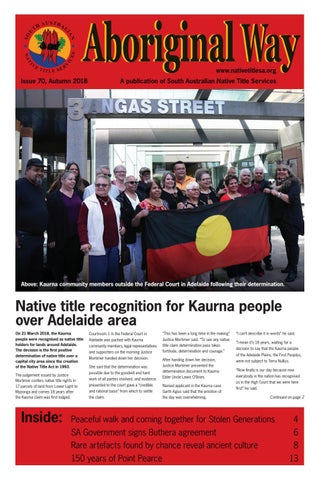
Above: Kaurna community members outside the Federal Court in Adelaide following their determination.
Native title recognition for Kaurna people over Adelaide area On 21 March 2018, the Kaurna people were recognised as native title holders for lands around Adelaide. The decision is the first positive determination of native title over a capital city area since the creation of the Native Title Act in 1993. The judgement issued by Justice Mortimer confers native title rights in 17 parcels of land from Lower Light to Myponga and comes 18 years after the Kaurna claim was first lodged.
Inside:
Courtroom 1 in the Federal Court in Adelaide was packed with Kaurna community members, legal representatives and supporters on the morning Justice Mortimer handed down her decision. She said that the determination was possible due to the goodwill and hard work of all parties involved, and evidence presented to the court gave a “credible and rational basis” from which to settle the claim.
“This has been a long time in the making” Justice Mortimer said. “To see any native title claim determination pass takes fortitude, determination and courage.”
“I can’t describe it in words” he said.
After handing down her decision, Justice Mortimer presented the determination document to Kaurna Elder Uncle Lewis O’Brien.
were not subject to Terra Nullius.
Named applicant in the Kaurna case Garth Agius said that the emotion of the day was overwhelming.
“I mean it’s 18 years, waiting for a decision to say that the Kaurna people of the Adelaide Plains, the First Peoples,
“Now finally is our day because now everybody in the nation has recognised us in the High Court that we were here first” he said. Continued on page 2
Peaceful walk and coming together for Stolen Generations
4
SA Government signs Buthera agreement
6
Rare artefacts found by chance reveal ancient culture
8
150 years of Point Pearce
13
Native title recognition for Kaurna people over Adelaide area Continued from page 1 Kaurna representative Suzanne Russell said that it was significant day for the Kaurna people.
that she was proud of Kaurna people and South Australia. “An absolutely proud moment, not just for Kaurna but for Australia, this is huge.
“To have this recognition, that we are the native title holders in this country here is just so important to us” she said.
“A lot of Kaurna people haven’t been here to witness this, but we’ve carried the baton and it’s been worth it.
“Always has been, always will be Kaurna land, we’ve always known that.
“Now that we’re owning up to our history and deciding that we’re going to share this land, we can work magic for all our children.
“But now we have that legal recognition to go with it” she said. She addressed the court during the proceedings and spoke of the emotion after such a long claim, particularly when many family members have passed away during the process. “Many people started this fight for us and we remember them today” she said. She placed photos of ancestors who have passed away on the Court bench during her speech. She also presented the Court and Kaurna legal representative Tim Campbell with an urn containing materials gathered from across Kaurna land. Katrina Karlapina Power also addressed the court and said to reporters gathered outside the court after the judgment
“South Australia has really positioned itself on the national map in terms of history and significance – it’s a celebration for us all” she said. The CEO of SA Native Title Services Keith Thomas has congratulated the Kaurna people for their determination of native title.
“I acknowledge the efforts of many Kaurna people over the years to gain this recognition” he said. According to Mr Thomas, the Kaurna determination confirms the importance of a collaborative approach in native title negotiations. “In South Australia we are well advanced in terms of the portion of land with native title determined.
“This is largely due to the cooperative approach that the many stakeholders involved in a native title agreement take in our state. “This recognition for Kaurna people has come about because the State, local councils, landholders and Aboriginal nations are prepared to negotiate to come to a resolution” he said. Present in the court for the determination was South Australia’s new Attorney General Vickie Chapman who congratulated the Kaurna people and committed the government to the work necessary to finalise the necessary associated Indigenous Land Use Agreement (ILUA). You can see the full Consent Determination judgment, including maps, on the Federal Court’s website.
“This judgment confirms the status of the Kaurna people as the traditional owners of lands around what is now Adelaide” Mr Thomas said.
For full details of the Kaurna claim process, Agius v State of South Australia – search for case SAD6001/2000 via a Federal law search.
“It’s a decision that means that the respect and recognition that Kaurna people hold as traditional custodians of this land is now formalised under Federal law.
You can see native title maps of South Australia (and all of Australia) via Native Title Vision – a service of the National Native Title Tribunal.
This page, left to right, from top: Garth Agius; Katrina Kalapina Power and Jeffrey Newchurch; Court Room 1 ahead of the determination; Audrey Dix, Stephanie Gollan, Lenard Gollan, Barbara McGuire, John Packham, Tracy Jenkins, Vera Raymond and Janet Davidson in the Federal Court.
2
Aboriginal Way, Autumn 2018
Remembering those who came before It was a proud moment for Suzanne Russell to speak to the Federal Court on the day the Kaurna People had their native title over the Adelaide area recognised. She explained to Aboriginal Way why it was so important to her to have those who worked on the claim and have now passed on also recognised in the determination. “It was a reminder, a testament to their tenacity and being in the trenches and just being unstoppable and just really gutsy. “It also was a reminder of our loved ones, there’s some pretty powerful photos of people that were there. Ms Russell was particularly proud to have her mother’s diaries in the Court. “These two books are my mother’s diaries and they’re very significant, because there is an ongoing dialogue
of what she was doing each day, where she was going, who she was meeting with, phone numbers. “These diaries have been a wonderful attribute our native title journey. “I can see in them where she was very heavily involved in engaging herself within the community, she was really engaged at the grassroots local level and that’s where courageous power comes - from the ground up, involving and engaging the community. So they’re very, very precious to me” she explained. Ms Russell also spoke about the glass urns she presented in the Court. “I had collected from right across, walking for six months on country, there was stones, pebbles, feathers, crab claws, from right across all of our Kaurna country, because we needed to physically have our country in court as well” she said.
Kaurna peoples determination area.
This land belongs to all of us. But it first belongs to the Kaurna people. We thank the Kaurna people. And we will take care of this land together. Marni. Nighchullyah. Today is a new beginning. Justice Mortimer hands decision to Uncle Lewis O’Brien.
I acknowledge not only my Mother’s hard work more than 17 years ago. But also the hard work of many other Kaurna people of which they too are our ancestors like Mum – Marjorie Angie Beare. Of which today I carry her diaries of the countless meetings that she had of which she can now see and feel our sense of achievement and hopefully new beginnings.
Kaurna applicant Suzanne Russell’s speech to Federal Court following the Kaurna Native Title determination.
On this table are the remembrances of some of our loved ones. Whilst we are in the physical world. Here are some of the brave, courageous champions. They too, are always present with us in their spiritual world. We are never separated. Their presence is constant. And our challenge is to continue. So that the next generations will look back at our leadership and value our contributions. Growing, nurturing and some healing and the development of new skills and knowledges for the next generations of Kaurna to come. Ngichullaya – Thank You Yertibulka – Suzanne Russell Katrina Karalpina Power addresses the Federal Court.
Aboriginal Way, Autumn 2018
3
Peaceful walk and coming together for Stolen Generations A unique community event in Adelaide on 13 February 2018 commemorated 10 years since the National Apology to the Survivors of the Stolen Generations. That morning, members of the Stolen Generations and their supporters held a Peaceful Walk from Victoria Square, along King William Street to Veale Gardens. On arrival at the Gardens, a Smoking Ceremony took place to symbolise a coming together of Aboriginal nations from the North South, East and West. This coming together acknowledged that Stolen Generations were removed from so many different places around the state. Organiser Ivan Tiwu-Copley called the Elders from every direction to perform the Cleansing Ceremony. The South
was represented by Ngarrindjeri man Major Sumner, the North by Ngadjuri man Quenten Agius, the West by Kaurna man Jack Buckskin and the East by Permanank men Ivan Tiwu-Copley and Micheal Hunter-Coughlan. The Elders took turns in walking around the Stolen Generations members gathered, smoking them and calling their ancestors to join them in the ceremony. The Elders carried the smoking healing Coolamon to the stage where Frank Wanganeen performed the Welcome to Country. The Coolamon used at the event was made by Ivan Tiwu-Copley from a 400-year-old (dead) gum tree in the Campbelltown City Council area. It represents the cradle and so many mother’s arms that were left empty after their children were removed.
This page, left to right, from top right: Ngarrindjeri performers; Peaceful Walk on King Williams Street; Stolen Generations Survivor at smoking ceremony; Sue Kelly and Ann Betersen; Quenten Agius; Jack Buckskin; Anthony Hughes and Ken Tilbrook; The Governor, Lord Mayor and all involved in smoking ceremony around the healing coolamon; the Sumner family; Quenten Agius and grandsons. Opposite page, left to right: Stolen Generations members lead walkers into Veale Gardens; Geraldine, Lorraine and Coral Wilson at Sorry Day 2018.
4
Aboriginal Way, Autumn 2018
Saying Sorry and acting on words “We apologise for the laws and policies of successive Parliaments and governments that have inflicted profound grief, suffering and loss on these our fellow Australians. We apologise especially for the removal of Aboriginal and Torres Strait Islander children from their families, their communities and their country…
history where we as a nation experienced an outpouring of support for our first nation which drove a collective determination for a renewed spirit of national healing and recognition” she said.
“We today take this first step by acknowledging the past and laying claim to a future that embraces all Australians…
The report found that from 1910 to 1970 between one in ten and one in three Aboriginal and Torres Strait Islander children were forcibly removed from their families.
“A future where we harness the determination of all Australians, Indigenous and non-Indigenous, to close the gap that lies between us in life expectancy, educational achievement and economic opportunity.” Prime Minister Kevin Rudd 13 February 2008 On the eve of the 10th anniversary of the national apology to the Stolen Generations, the Aboriginal and Torres Strait Islander Social Justice Commissioner called on the Federal Government to implement a national reparations scheme to fulfil the promise of that historic moment. June Oscar AO addressed the Reconciliation SA Apology Breakfast at the Convention Centre in Adelaide on February 12, telling the large audience present that there is more work to be done to support the healing of Stolen Generations survivors and their communities. “We don’t make amends simply by saying sorry; we must act on words. Achieving justice when grave injustice has been done is complex, challenging and hard work that can’t be left partly completed” she said. A decade after Prime Minister Kevin Rudd stood in Federal Parliament, Ms Oscar reflected on the significance of the national apology. “It is both a sombre and enlivening reflection. A moment in our Australian
The apology was the first recommendation of the Bringing Them Home Report, a national enquiry into the forced removal of Aboriginal and Torres Strait Islander children.
The sheer scale of these numbers is hard to comprehend, Ms Oscar told those present at the Apology anniversary event. “What they made clear was that all Aboriginal and Torres Strait Islander families had been affected by this period of Australia’s history. Where a child was directly taken from the arms of a family, or not. “Entire communities connected through blood, skin, kinship, intimate relationships with place, country language and spirituality felt every single removal” she said. Ms Oscar told Aboriginal Way after her address that the impact of that removal was profound and complex, and remains with communities today. “I’ve listened to families through their challenges in dealing with layers and layers of issues in their everyday life. This is the reality of the impact of what happened in the history of this country. When people say get over it and move on, well it is not that simple. Trauma that has impacted the very core of people’s being is something that individuals and families are continuing to confront and grapple with” she said. Ms Oscar acknowledged the work that had been done since the Bringing Them Home report, including the national apology, but said that there remains work to be done. “The sad thing though is that twenty years on, many of the recommendations in the Bringing Them Home Report have been left unimplemented and not responded to.
June Oscar addresses Reconciliation SA Breakfast 2018.
“There was a Royal Commission, there was a report tabled in Parliament in the Bringing Them Home Report and an apology followed, a process of reconciliation was funded over a 10-year period. “But we don’t stop there, we need to continue to find ways of working together to build on those strong achievements of our past” she said. “As Aboriginal and Torres Strait Islander Social Justice Commissioner I feel a responsibility …to consider where we are at as a nation in delivering the reparations that were recommended in the Bringing Them Home Report” Ms Oscar told the Reconciliation SA event on Monday. “These suggested reparations are complete in nature. They recommend monetary compensation but they move beyond that” she explained. Ms Oscar believes that it is crucial that stolen generations survivors are consulted in the development of any such scheme. “It may not be monetary compensation, it might also mean access to services to support people’s wellbeing – their spiritual emotional and mental wellbeing that so many other Australians take for granted.
“So many of these services are nonexistent in communities where members of the stolen generations and their families live. And they continue to carry the scars and are responding to their own issues of need but also compounded are the issues that they are confronting today in their families and communities. “While many people who come from the stolen generation families have such great resilience and strength, there are times when people need to have access to support, to respite, to care, so that they can continue to live their lives fully. Ms Oscar also emphasised the importance of the Federal Government listening to Indigenous Voices on national representation and recognition. “We’ve heard through the recent constitutional reform process about the idea of a Makarrata Commission – a Commission that would enable truth telling and agreement making, that would be representative of the voices of Indigenous people” she said. “It requires the will of political leaders to truly listen to what Indigenous Australia is saying. “The issue is not going to go away. The strong voices of Indigenous peoples have been very clear in recent years around representation on the issues that matter for Indigenous peoples.”
Aboriginal Way, Autumn 2018
5
SA Government signs Buthera agreement with Narungga Nation In the final days in power, the ALP South Australian Government signed a formal agreement with an Aboriginal nation which they said was the first significant step in establishing a state based treaty. Representatives of the Narungga Nation, who are the First Peoples of the Yorke Peninsula and the then SA Minister for Aboriginal Affairs Kyam Maher, signed the Buthera Agreement in SA Parliament on Friday 16 February. The agreement committed both parties to negotiate for treaty over the next three years and included a commitment from the government to provide support to Narungga in economic and community development work. It was the culmination of a year-long process which began with Treaty Commissioner, Dr Roger Thomas seeking the views of Aboriginal South Australians, before the government entered into discussions with three Aboriginal nations on treaty. Garry Goldsmith, Chair of the Narungga Nation Aboriginal Corporation (NNAC) told the crowd assembled at Parliament House in Adelaide that the Buthera Agreement was more than a simple agreement. He said that it was symbolic and of significance not just to Narungga, but also to the state of South Australia, Aboriginal nations in general and to nonAboriginal Australians. “It sets the parameters for an equal and equitable relationship, to work towards positive change for our people” “It acknowledges our ownership and rich relationship with our country, our language to be revived our songs and dance to be enjoyed and to increase our longevity and to have a better quality of life for current and future generations” Mr Goldsmith said. Minister Maher said that “the signing of this historic agreement is first and significant step towards treaty in this state”.
“It’s a combination of the South Australian Government’s work with the Narungga nation and a reflection of our commitment to Aboriginal governance and leadership in this state. We can and should all be extraordinarily proud of this milestone in this process in this state” he said. Minister Maher explained why treaty had been so strongly on his government’s agenda.
Mr Linde congratulated Narungga people on making the most of the opportunities that were presented by the talks with the Government. “The Agreement provides some muchneeded resources to develop NNACs capacity to fully realise the benefits of the agreement, including the establishment
of fishing and aquaculture businesses and co management agreements on national parks within their territories” he said. “It’s notable that the Government was willing to commit to working with Narungga towards legislative change that could see them realise a treaty in what will hopefully be the near future” he said.
“Treaty remains the most important unfinished business in Australia today. Australia is the only nation of those we compare ourselves to without a treaty with the first peoples of the land. It was not a peaceful settlement 230 years ago, it was not even close to fair or just.” he said. “As a nation we can not properly stand up while we refuse to acknowledge and recognise our past. “Until you take steps to right the wrongs of what happened, only then can you work to a more positive future. “Treaty is an important next step. Treaty could go a long way towards helping Aboriginal people get on an equal footing.” Minister Maher noted in his speech that a state based treaty process did not remove the need for treaty at a national level. “A state government treaty can not address all the consequences of European settlement and its legacy of injustice. A Federal treaty process is I think inevitably necessary, as a crucial next step in our journey as a nation” he said. The Narungga nation were represented in the negotiations with the SA Government by Anthony McAvoy SC, along with SA Native Title Services (SANTS) Lawyers Andrew Beckworth, Olivia Brownsey and Osker Linde. Support for the community meetings was provided by SANTS administrative and legal support staff.
This page, left to right, from top right: Garry Goldsmith, Osker Linde and Tauto Sansbury at Buthera signing; Nerida Saunders addresses audience present at Parliament House for Buthera signing; Shirley Peisley and Lynette Croker; Ann Newchurch, Dough Milera, Garry Goldsmith, Kyam Maher and Lynette Newchurch. Opposite page, top to bottom: Farren Wanganeen, Christinke Stockey, Osker Linde, Rex Angie, Edward Newchurch, Peter Buckskin, Ann Newchurch, Patrick Dodson, John Buckskin, Ian Haseldine, Dough Milera, Kaylene O’Loughlin, Kyam Maher, Lynette Newchurch, Garry Goldsmith, Tauto Sansbury, Jeffrey Newchurch, Naomi Hicks, Tony McAvoy and Roger Thomas; Garry Goldsmith, Kyam Maher, Tauto Sansbury and Peter Goldsmith.
6
Aboriginal Way, Autumn 2018
The negotiations towards the Buthera Agreement took only twelve weeks, in face of opposition from some members of the Narungga community. On 18 January, three Narungga women won an extension of time in the Supreme Court for people to consider the next step in treaty negotiations with the State Government. The agreement was then accepted by the community at a meeting on 3 February. The signing came the day before the SA Government goes into caretaker mode, the period in which the government must avoid making major decisions that would limit the freedom of action of an incoming government. The then Opposition Leader, now Premier, Steven Marshall has previously said that plans for treaty are unworkable and not a priority for Aboriginal communities in South Australia. Mr Goldsmith explained that the name of the Buthera Agreement has cultural significance to Narungga people.
“The Buthera Agreement represents our Narungga dreaming, the foundation of our creation. Dreaming of Buthera, a giant man demonstrating his strength, resilience and passion towards his people. This emanates into who we are
today as Narungga descendants, and a nation rich in passion, pride, culture and traditions” he said. Mr Goldsmith noted that the signing ceremony marked the beginning of an important new process.
“One man said to me today ‘the hard work starts now’” he said. “So let’s make sure from here on in and what we do to commemorate Buthera we too can stand tall” Mr Goldsmith said.
Update on Treaty process The new Premier and Minister for Aboriginal Affairs, Mr Steven Marshall has told the ABC that his new government will “press the pause button” on the state treaty process. He has asked the Treaty Commissioner Dr Roger Thomas to prepare a report about the lessons learned from the work undertaken by the previous ALP government. He said that negotiations
currently underway between the government and the Narungga, Adnyamathanha and Ngarrindjeri people would be put on hold. “We just don’t have it as a priority for the government…but I don’t want to waste the work that’s already been done by the Commissioner, funded by the taxpayers of South Australia” Mr Marshall told the ABC on Monday 30 April.
Leading Through Collaboration South Australia’s new Commissioner for Aboriginal Engagement believes that collaboration is the way forward and says he wants to use networks and relationships developed across his long career to influence government for the benefit of Aboriginal people. Mr Harry Miller (pictured right) has been appointed for a three-year term as South Australia’s Commissioner for Aboriginal Engagement. The Commissioner advises the South Australian Government on systemic barriers to Aboriginal people’s access and full participation in government, non-government and private services. “I’m not a single voice person. I believe in the fact that unity is a major contribution towards change” Mr Miller told Aboriginal Way recently. “I don’t see this office working in isolation. People who know me will understand, I’d rather sit in groups and have conversations about change” he said. Mr Miller is from Port Lincoln and is well known in that community.
“My head is in South Australia, my heart is on the West Coast with Aboriginal people, and my soul’s in Port Lincoln where I’ve lived most of my life, worked most of my life and brought my family up in Port Lincoln, along with my wife, Roxanne” he said.
worker, through to a senior Aboriginal worker, taking on vast areas across the West Coast, and the northern areas. “Then, I went into the Commonwealth and worked on a number of positions before I left the Commonwealth to become an ATSIC chairperson.
The new Commissioner’s family has moved to Adelaide for the duration of his time in the role.
Education is key to personal and community development, according to Mr Miller.
“With connections to most of the government departments here, and senior bureaucrats, and with politicians, it was obvious that it would be a better move to place myself here in Adelaide for that short period of time” Mr Miller said.
“Education is the foundation of, I think, anybody’s growth. It gives you comradeship, it gives you the fundamental literacy and numeracy. It supports community capacity building and personal pathways leading into tertiary and higher education.
Mr Miller has worked in a wide range of services across his career, he explained to Aboriginal Way. He was most recently Chief Executive Officer at Port Lincoln Aboriginal Health Service but has worked in other sectors.
“We have a multitude of academics that have come out of the educational system, and working in high-profile positions, providing evidence-based information to our communities. I think that’s a gracious gift.
“I’ve worked across most of the social areas with social security as a starting point. Education, I firmly love my roles in education, starting as an Aboriginal education
He also has an interest in economic development, for individuals and communities, as well as the state as a whole.
“I have a vast interest in the economics of the state. And I think it’s time now to …give Aboriginal South Australians the opportunity to create and be part of building their own wealth as individuals, as families, or as communities” Mr Miller said. On appointing Mr Miller, the Minister thanked outgoing co-Commissioners, Mr Frank Lampard OAM and Ms Inawantji Scales.
Aboriginal Way, Autumn 2018
7
Rare artefacts found by chance reveal ancient culture
us, are the ones to care for the country now and into the future.
Traditional tools used by ancestors of the Yandruwandha Yawarrawarrka traditional owners have been found by chance near Innamincka, in the far north of the South Australian outback. The chance discovery represents a rare archaeological find and offers an insight into the lives of South Australia’s original inhabitants. The news that three ancient boomerangs, as well as a digging stick and stone tools have been found by Park Rangers in the Innamincka Regional Reserve is important news for the Yandruwandha Yawarrawarrka Traditional Land Owners Corporation (YYTLOAC). They have been recognised as traditional owners and hold Native Title over the area in the north east of South Australia. “We’re very excited about this unexpected find,” Chairperson of the YYTLOAC, Joshua Haynes said. “These objects give us a glimpse of the lives of our ancestors and reminds us how much this country is tied up with our continuing culture.”
“As traditional owners we have learnt about this country from our families and these items have a very significant cultural significance” he said. Unprecedented low water levels in the Innamincka Regional Reserve led to the discovery by National Park Rangers Katheryn and Jason Litherland while they were clearing rubbish left by visitors in a now dry creek bed.
Mr Haynes said the relationship the YYTLOAC has with the State Government Department of Environment, Water and Natural Resources (DEWNR) through comanagement of the Innamincka Regional Reserve means that the Traditional Owners were the first to be notified of the find and consulted about the objects. It also means once the items have been assessed and possibly dated, DEWNR will return the items to the traditional owners.
“For the Yandruwandha Yawarrawarrka people, the discovery of these precious items reinforces the importance of careful cultural management of the area,” Mr Haynes said. “This country holds our ancestor’s stories but more importantly still holds the physical connection to our ancestry. It’s important that we, the traditional owners, or those who are working with
Tony Magor, Manager Parks and Comanagement with DEWNR in the SA Arid Lands Region said the discovery was significant for everyone who works and lives in the area and has generated lots of discussion about the possible uses and ages of the artefacts. “Our staff work closely with the Yandruwandha Yawarrawarrka people in caring for this country so when the work reveals treasures like this we all share in the excitement of the find and have a deeper appreciation of what this means,” Mr Magor said.
This page, top to bottom: Katheryn Litherland with one of the finds; The wooden artefacts. Opposite page, top to bottom: One of the boomerangs; Jason Litherland with one of the artefacts; One of the artefacts on country; Josh Haynes.
8
Aboriginal Way, Autumn 2018
“With the limited preservation of wooden items, particularly in an arid environment, it’s highly unusual to have articles like this that survive,” Mr Freeman said. While there is evidence that cultures around the world have used throwing sticks, there is no doubt that Indigenous Australian people can claim the longest continuous association with the boomerang, according to work by Anthropologist Philip Jones. Boomerangs often play a part in creation stories and those stories are re-enacted in song and ceremony, as well as being represented in rock art, painting and carvings. The age of the artefacts is yet to be determined – they could be as young as 100 years old or as much as 10,000 years old. The artefacts need to be managed carefully to maintain their condition and are being stored in controlled conditions pending permanent storage.
wood including the species of tree that they are made from.
Methods of dating to determine their age could include x-ray testing to search for tree rings to use in dendrochronology and radiocarbon dating using accelerated mass spectrometry so that only a very small sample of the artefact would be needed. Other assessments could include studying the method of manufacture of the objects and determining the type of
There are quite a number of examples of wooden artefacts in museums that have been collected over the last 200 years but there are very few examples that have survived on-country. Many items that were used by the first Australians were made of wood and other organic materials and few have survived, even those of relatively recent age.
Sean Freeman from Australian Heritage Services (AHA), Consulting Archaeologist for YYTLOAC says that artefacts such as these are significant for the understanding of the culture of Australia’s First Peoples.
While the objects are incredibly valuable to all those interested in Australia’s ancient history, they are of no commercial value Mr Magor explained. “Aboriginal artefacts are protected in South Australia and cannot be removed without proper permission. While objects like this are priceless, there can be no commercial market for their sale as they can’t be sold legally in SA.” AHS, DEWNR and the YYTLOAC are now looking to bring a world expert on boomerangs and throwing sticks, Mr Luc Bordes from the University of Wollongong to South Australia to study these items and gain a greater understanding of them.
Dreamtime Bags helping families in need The Adelaide charity Dreamtime bags is making a small contribution to helping Aboriginal children in foster care and is asking for your help. The charity puts together overnight bags for Indigenous children placed into emergency foster care through Aboriginal Family Support Services (AFSS). The bags support the families and foster carers when children are removed suddenly. If there is no time to pack it means that the children have items to get them through until carers can get to the shops.
The charity has been funded by Oxfam, but unfortunately that funding has ceased. This has left a a number of incomplete bags and some stock with no bags to pack it. You can help families in need by making a small donation of baby goods. Ms Brownsey says that Dreamtime Bags are seeking new baby bottles, baby toiletry packs, baby blankets and wraps, dummies, baby wipes and small backpacks.
“It’s a pretty small operation” says organiser Olivia Brownsey
All items received will be packed up and passed onto AFSS for distribution.
“I do everything myself with some help from family and friends and run operations out of the spare room at a family member’s place” she says.
For more information, contact dreamtimebags.com or check them out on Facebook https:// www.facebook.com/dreamtimebags
Oliva Brownsey and Peter Shattock, Senior Manager Corporate Services at AFSS.
Aboriginal Way, Autumn 2018
9
Survival Day at Tandanya thriving indoors 26 January 2018 saw the Adelaide community gather to celebrate the resilience of Aboriginal and Torres Strait Islander peoples. Each year Tandanya National Aboriginal Cultural Institute hosts an event to acknowledge and reinforce the present and the future of our cultures. Marking the day in a positive way remains important, according to Tandanya. “Survival Day embodies the reality that Indigenous cultures are strong, with much to be positive about despite the negative effects of colonisation.” As in recent years, Tandanya’s event was planned for Semaphore Foreshore with free entertainment, stalls, information, workshop and more.
Unfortunately, due to very high temperatures forecast for Semaphore on 26 January, the team had to move the event from Semaphore and relocate it to the Tandanya building in the city. This was done for the wellbeing of all involved, including artists, stallholders, elders appearing at the event. The Survival Day events continued as planned and a large crowd visited, with MC Jack Ansell kicking of proceedings at 11am and a full day of activities going ahead until 6pm. Performers on the day included Tal-kin-jeri dance group, Nathan May, Eddie Peters and the Twang Bangers.
Above, left to right, from top right: Tal-kin-jeri Dancers; Jack Ansell, MC; The ‘Survival Day’ crowd; Russell Carbine; Bianca Leicester & Lachy Smith; Tal-kin-jeri Dancers; Eddie Peters.
10 Aboriginal Way, Autumn 2018
Update on Native Title claims in South Australia April 2018 SA Native Title Services (SANTS) continues to work with native title holders and claimants, their representatives and other stakeholders to resolve native title claims currently before the Courts. There are currently twenty native title applications being dealt with in South Australia.
The Adnyamathanha Peoples (Area C & F), Wilyakali No.2 and Ngadjuri Nation A potential settlement for these overlapping claims in the north east of the state around the Bimbowrie Conservation Park is currently in mediation and community meetings will be held in May 2018.
Wirangu No.2 This claim over an area at the top of the Eyre Peninsula across onto the West Coast is in Case Management with the
Federal Court. A Native Title report is being assessed by the State.
Nauo/Nauo No.2/Nauo No.3 These three claims cover an area along the western side of the Eyre Peninsula from the tip at Lincoln National Park up to a line near Smokey Bay. Anthropologists are completing a Native Title Report for consideration by the State and Courts, due by 30 June 2018.
Narungga Nation The State is now considering supplementary evidence in this claim over the Yorke Peninsula.
Malyankapa Work continues on the Native Title Report for this claim, which is located in the far east of the State, with the top of the claim in line with the NSW border.
Walka Wani Oodnadatta and Arabana No.2 Mediation for these overlapping claims around Oodnadatta in the north of the
state has been scheduled for September, with both parties required to provide the Court with mediation anthropological reports to the Court by the end of August.
Far West Coast Sea claim
Ngadjuri No.2 and Wilyakali These two claims in the north east of South Australia from the Flinders Ranges to the Barrier highway, and including an area of overlap, are not currently priority
This claim is for an area of sea along the coast from Streaky Bay to the Western Australian border. A strike out Application against the applicant has been lodged and is awaiting judgment.
matters in the Federal Court.
First Nations of the South East No.1 and No.2 and Ngarrindjeri
The City of Port Augusta is located in the
Overlapping claims over an area covering the south of the Coorong is currently in mediation. Each applicant group is considering a possible joint consent determination approach.
but will move up the list as other claims
Lake Torrens litigation
areas in South Australia, see the
An appeal against the decision in this case was not allowed by the Full Federal Court. Native Title parties have now make special leave applications to the High Court.
Port Augusta overlaps (Kokatha No.3, Barngarla and Nukunu) centre of these three overlapping claims. They are not currently priority matters are finalised. For a map of current native title Application and Determination back page of Aboriginal Way. For an interactive online map of Native Title areas – see Native Title Vision www.ntv.nntt.gov.au
Compensation for Tjayiwara Unmuru Peoples Late in 2017 the Federal Court awarded compensation to the Tjayiwara Unmuru Peoples for the extinguishment of native title over a small area of land around the Stuart Highway in the far north of South Australia. The Tjayiwara Unmuru Peoples’ ownership over the land surrounding that area was first recognised in a determination by the Court in July 2013. That determination granted recognition of non-exclusive native title rights and interests over approximately 4500 square kilometres of pastoral land in the central northern part of the state. In the case, the Tjayiwara Unmuru Peoples have been compensated for the loss of a small parcel of land which was excluded from their 2013 native title determination due to government development on the land. The compensation was for a relatively small portion of the Stuart Highway corridor, which crosses through the Tjayuwara Unmuru determination area and also land where a Digital Radio Concentrator (DRC) Tower now sits. Deputy Principal Legal Officer Osker Linde, who represented the Tjayuwara Unmuru people in the application said that it was a complex negotiation for all involved. “The compensation case was a complicated one, because the evidence was largely restricted men’s evidence. It had never been written down by anyone, and no ethnographic information was available to substantiate the evidence prior to conducting field work with the compensation claim group in 2013.
“For this reason, we commissioned an independent anthropological report, undertaken by Associate Professor Jon Willis, who himself has been through western desert law ceremonies. The State got their own anthropologist to test the veracity of the claimant evidence” he said. During the negotiations over the claim, the Nguraritja (traditional owners) provided the State with testimony about the impact of the extinguishment. The Tjyiwara Unmuru People said that the Stuart Highway has cut their tjukurpa (creation stories and laws) in three different places, causing irreversible damage to the cultural landscape and to practices, laws and customs. They also said that the Digital Radio Concentrator tower was built in a sacred area and is an impediment to the tjukurpa track, as it travels from one site in the determination area to another. The Tjyiwara Unmuru people said that the road and tower have interfered with the pathway of a particular highly restricted men’s tjukurpa. There is a ceremony associated with this tjukurpa which is of the highest importance which only men of high seniority can participate. The details of the tjukurpa and its association with the determination area have never been recorded publicly. Mr Linde says that the State accepted the evidence of the traditional owners and both sides worked to resolve the claim through agreement. “In the end, the State did not challenge the evidence of the claim group that the relevant act being compensated did relate to the law that the men were describing” he said.
SANTS Lawyer Osker Linde (centre) with Tjayiwara Unmuru Claimants outside Federal Court.
“The claimant group and the State both made significant compromises to reach a mutually agreeable settlement of the issue.
of SANTS in the Full Court of the Federal
The amount of compensation paid remains confidential. Both the State and the Tjayiwara Unmuru People asked the Court for this information to be suppressed. This request was made to the Court partly because of the complexity of the negotiations and partly because of the applicant’s desire to avoid further disclosure of the highly secret men’s law.
all-male bench hear any appeal, even
“No doubt front and centre in the minds of the claim group was the desire to not put their senior men through what could potentially be an open hearing in relation to their restricted men’s evidence” Mr Linde said. “Even if the Court was closed under orders for gender restrictions, the experience
Court in a different matter, was that there could be no guarantee that the Federal Court will agree for example, to have an where men’s restricted evidence would be read out and considered by the Full Court.” Justice White told the Court that the order for suppression was appropriate given the policy of the Native Title Act to encourage the resolution of matters by agreement, and that this being an early compensation case, the parties had conducted their negotiations on the basis of an expectation of confidentiality. According to Mr Linde, he also made it clear that in future, when principles of native title compensation become more settled, the Court may not consider it appropriate to supress compensation settlement amounts.
Aboriginal Way, Autumn 2018 11
Gynburra is king on the long weekend South Australia’s Yorke Peninsula was a place of celebration of Narungga culture on the January long weekend, with Gynburra 2018. It’s a festival that draws on the traditions of the First People of the Guuranda, the Narungga name for the Yorke Peninsula, to create a fun, inclusive family weekend. The Director of Gynburra 2018 Garry Goldsmith, says it’s an important event for Narungga people.
that traditional fishing practice, to provide a feed, and also to win the accolade of the Butterfish King, the person that catches the biggest fish on the day” he explained. It’s a competition that draws on older traditions of the Narungga community, Mr Goldsmith explains.
“Gynburra is an event that celebrates our connection to Guurunda, both our spiritual and cultural connection to that country” he said.
“Our people used to use harpoons to hunt this fish. So, there is that cultural connection from passing on knowledge from men to young boys, to continue to get a feed and bring it to your families, and to your community, to celebrate” he said.
At the core of the festival is a fishing competition that that has been taking place in the waters off Port Victoria each year for around 50 years.
In the past few years, the event has broadened beyond the fishing competition to include activities for the families waiting back on shore.
“We’ve been having an event called the Clem Graham Memorial Butterfish competition, which allows men and boys from Narungga to compete in a spearfishing competition to hunt Gynburra, which is butterfish or otherwise known as a Dusky Morwong” Mr Goldsmith said.
“From then, it’s just grown in stature and also in attendance with not only the Narungga nation, local people, and the greater Yorke Peninsula community” said Mr Goldsmith.
“So, this competition was mainly for the men and the boys to continue
From having 15 entrants in the competition some years back, the Butterfish King competition has grown and over 100 fishermen were involved this year. The growth is a result of
12 Aboriginal Way, Autumn 2018
more people visiting for the wider festival says Mr Goldsmith. “People from across South Australia are now coming back to country to celebrate Gynburra because it accommodates everyone, from young and old, to men and women, to Aboriginal, non-Aboriginal” Mr Goldsmith said. Activities over the weekend included a lunch for elders and a family fun day, which include live music, a jumping castle and waterslide as well as a movie on the beach. For Mr Goldsmith Gynburra is an event that supports the recognition of the Narungga as traditional owners of the area. “You know, for too long on Yorke Peninsula, the recognition and acknowledgement of the Narungga people as traditional owners, has been somewhat lost. Including within our own community, you know, most of us are around central Yorke Peninsula. But we have a beautiful country over here, right down from the bottom end at Marion Bay, right up to the top, towards Port Broughton, and, you know, from east and west” he said.
“We can’t, obviously, get any land back, but what we can claim is that connection to country and have an acknowledgement internally, and also with the wider community. “So we’re saying: look, come and celebrate with the Narungga nations, learn a bit more about the history of Narungga and our people” said Mr Goldsmith. The Gynburra 2018 festival took place at Point Pearce and Port Victoria from Thursday 25 January until Saturday 27 January 2018. More details at www.gynburra.com
The 2018 Clem Graham Memorial Butterfish Competition winners Clem Graham Snr Butterfish King Phillip Dudley Wayne Newchurch Snr Most Butterfish Kevin Newchurch Geoffrey ‘Scooby’ Webb Butterfish Prince Fahl Wanganeen Neville O’Loughlin Most Butterfish – Joint winner Tyson Baker
150 years of Point Pearce Narungga people want to welcome visitors to their country in a range of events to mark 150 years of the Point Pearce community this year, says the community’s Chairperson John Buckskin. Events planned over the year include special ANZAC Memorial and Easter church services, a Debutante Ball, an Open Day, football and netball matches between fierce competitors Point Pearce and Koonibba and a Reconciliation Ball. In 1868, the Yorke Peninsula Aboriginal Mission was created to house Aboriginal people who were displaced by growing towns and the booming copper mining industry in that part of South Australia. The decision had a devastating impact on Narungga and other Aboriginal people from the region says Mr Buckskin. “We were more or less quarantined in a small eight square miles of our own country, where we lost our language, our identity as Aboriginal people. “We were not allowed to speak our language, we were not allowed to practice our culture and we were more or less ‘assimilated’” he said. The Mission has been through significant change since its creation, with the 1967 Referendum creating changes to Government policy and the lives of people living there. “Prior to the 1967 referendum, Aboriginal and Torres Strait Islander people were not included as human beings, we were part of flora and fauna. “Thanks to the white Australian vote, that gave us status as being recognised as human beings and changed the way things were run” he said.
their land back to them free of any government control” he said. Kaylene O’Loughlin, Community Coordinator at Point Pearce says that the community is hoping to host a range of events to celebrate the anniversary. “We’d like to celebrate the endurance of the community” she told Aboriginal Way. Ms O’Loughlin grew up at Point Pearce and has recently returned. “Everybody who grew up here enjoyed their life here” she said. “The love for this mission in my heart is still strong, that’s why I’m back here trying to beautify it again, with the support of all the other community members” she said. The community in partnership with TAFE SA is working on a project to improve the main street, the “plantation” with new gardens, pathways and a shelter. Among other initiatives, a newly formed men’s group aims to connect residents and give them skills that can be used in the community into the future. The 150th anniversary provides an opportunity for Narungga people to showcase their history and culture says Mr Buckskin. “We are now, we’re capturing our Narungga identity, our culture, and we want to share that with our non-Aboriginal people on the York Peninsula, Australia and even internationally” he said.
150th Anniversary events planned are: Aboriginal Veterans Commemorative Service
The Mission became a community and is now managed under the Aboriginal Lands Trust Act. It’s a situation that Mr Buckskin believes should change.
NAIDOC Week Celebrations
“Point Pearce land is the Aboriginal people’s land, but it’s still under the jurisdiction of the government under the Aboriginal Land Trust, so it is ours, but it’s not ours so to speak.
Football & Netball Carnivals
“We want the Point Pearce community, and all the other Aboriginal communities in South Australia, are aspiring to have
For more information email: pointpearce@internode.on.net
Debutant Ball Official Open Day
Reconciliation Ball Children’s Christmas Tree Community Christmas Lunch
Opposite page, left to right, from top: Clem Graham Senior Butterfish Competition winners; Gynburra event team members; Haircuts at Gynburra; Ian Hasseldine; Janette Milera; Garry Goldsmith on stage at Gynburra; Gynburra 2018; Harry Miller, John Buckskin and Peter Buckskin at Gynburra. This page, left to right, from top: Point Pearce Hall; John Buckskin, Garry Goldsmith and Allan Sumner at Gynburra Elders lunch; Rock climbing wall at Gynburra; Point Pearce Soldiers Memorial; Jack Bucksin and performers at Gynburra; Lakkari Newchurch and Kyeesha Angie; Nail painting at Gynburra; Doug Milera and Kyam Maher; Jody Reid and Devina Binell at Gynburra 2018; Point Pearce entry.
Aboriginal Way, Autumn 2018 13
Our column in review features reviews and stories on Aboriginal writers, artists and musicians. We welcome your feedback and suggestions. So if you know of a new work about to published or an artist or musician please contact us on (08) 8110 2800.
Indigenous sounds shake WOMADelaide 2018
The event included performances by young rapper Baker Boy, inspiring songwriter and guitarist Yirrmal, rocker Dan Sultan and Indigenous music revival group Mission Songs Project. Ahead of their performance in Adelaide, Mission Songs founder Jesse Lloyd told Aboriginal Way about her project. “For the last couple of years, I’ve been travelling Australia, researching all old songs from mission days, the contemporary songs that our people were singing after church” she explained “We do a show that tries to showcase a broad selection of these songs from across the country” Ms Lloyd said.
The missionaries had a strong influence on the music that Aboriginal people created, Ms Lloyd said. “A lot of the musical influences I came across was from the missionaries, learning Western instruments and singing songs in English, usually the hymns. “The other thing which has been an influence from the mission era is the harmony style from the missionaries and singing hymns and church chorales. Aboriginal people have an amazing way of unique harmonising style that can vary between states and communities. “You’ll hear that an Aboriginal choir singing from north Queensland will sound very different to a Fijian choir or Cook Islander choir or Papua New Guinean choir. Everybody takes on their own unique way of vocal arranging. The music was influenced by the harsh realities of mission life, Ms Lloyd says, however it was not protest music.
in review
“I think what has influenced it, when our people were sent to the mission, they were restricted from practising culture or talking language. “I don’t think our people living during the mission era had the capacity to or were in a position to write a protest song. We see protest songs coming later in the 70s and the 80s.
Mission Songs Project.
winner of the Triple J Unearthed National Indigenous Music Awards in 2017 and has supported high profile international hip hop acts. The former Djuki Mala dancer is related to musicians Gawurra and Yirrmal and sings in Yolngu Matha language, representing his culture and East Arnhem Land families. He told Aboriginal Way that music and dancing were inevitable parts of his life.
“But I would say they’re songs of longing and resilience and trying to be optimistic and looking toward to the future rather than protesting” she said.
“In my language, Marryuna means “dancing”. Everyone loves dancing, you know. Music has its own world and we can all go into that world when we listen. That’s something we can celebrate with singing and dancing.”
Yolngu artist Baker Boy is enjoying great success at age just 20, he was
Singer songwriter Yirrmal was mentored by Shane Howard and Neil Murray, and
inspired by his father and grandfather, who both performed with Yothu Yindi. He is an inspiring songwriter and guitarist with a powerful voice, singing songs about life and culture in both his first language of Yolngu Matha and English. At WOMAD, Yirrmal performed with his three-piece ‘Yirrmal and the Miliyawutj’, giving a rocking edge to his songs. ‘Miliyawutj’ is a Yolngu word that refers to fertile waters where the fresh and salt meet, inferring a balance between two entities. Yirrmal also features on Baker Boy’s second single ‘Marryuna’ which reached #17 in Triple J’s Hottest 100. So it wasn’t surprising when they joined each other on stage at WOMADelaide 2018.
Photos by Michelle Cioffi.
Over 96,000 people filled Adelaide’s Botanic Park for the latest festival of music and dance, WOMADelaide over the March long weekend, with Australian Indigenous performers taking centre stage at the popular festival.
Baker Boy and Yirrmal on state together.
14 Aboriginal Way, Autumn 2018
SANTS: Working to achieve sustainable Aboriginal nations SA Native Title Services (SANTS) is the Native Title Service Provider (NTSP) for South Australian under the Native Title Act 1993 (Cth). As NTSP, SANTS provides legal representation and guidance, anthropological research and community liaison to support traditional owners with native title applications, negotiations and determinations. SANTS also provides a wide range of services to South Australia’s Aboriginal Nations who hold or may hold native title and works with Aboriginal Nations to realise their aspirations, which are often broader than the recognition of native title. There are currently fifteen Prescribed Bodies Corporate (PBCs) established in South Australia to manage determined
native title areas. SANTS works with many of these groups to support them in their native title outcomes, comply with legislative responsibilities and develop and grow to achieve their goals. SANTS activity in supporting PBCs includes; developing and strengthening governance practices, facilitating community-based planning to develop strategies, implementing agreements and managing native title benefits, accessing business development services, providing business services such as finance, human resources and secretarial support, delivering community development projects including for cultural heritage and country and engaging in policy and legislative reform and implementation.
SANTS has a new Board Member broad strategic, managerial and operational responsibilities. As well as providing advice to South Australian councils and the Local Government Association Mutual Liability Scheme in risk management, civil liability and insurance for much of her career, Ms Burton brings governance experience from the not-for-profit sector to the SANTS’ board table. “We welcome Melanie to SANTS” CEO Keith Thomas said. Experienced lawyer Melanie Burton has joined the SA Native Title Board of Directors. A senior litigation lawyer who was admitted in 1996, Ms Burton has practiced in all areas of civil disputes, risk and advisory for over 20 years, including as a partner of an Adelaide commercial firm with a range of
SOUTH AUSTRALIAN NATIVE TITLE SERVICES
Above: Keith Thomas and Karina Lester.
SANTS always welcomes Aboriginal Nations and native title groups who would like to work more with us. We receive funding from the Commonwealth and South Australian Governments.
SANTS working with respect South Australian Native Title Services (SANTS) staff work in a variety of ways to achieve sustainable Aboriginal nations in partnership with members of native title groups.
“Her experience and expertise in helping clients identify and achieve positive outcomes in often difficult circumstances will be of benefit to our organisation and Aboriginal nations” he said.
We strive to adhere to a Code of Conduct in all our activities, including demonstrating high standards of ethical behaviour and responsiveness to the needs of our clients.
“I look forward to the opportunity to contribute to an organisation which continues to successfully support Aboriginal nations in achieving excellent native title outcomes” Ms Burton said
We seek to treat all people we deal with, including staff, clients and others, with respect and courtesy and without any form of harassment, discrimination or intolerance. SANTS staff deserve the same respect and courtesy. This means that we expect our staff will be spoken to in a reasonable and courteous manner at all times. Verbal abuse, threats of physical abuse and actual physical abuse in any form towards SANTS staff is not acceptable and will result in a withdrawal of SANTS services.
Aboriginal Way radio program
…airs each week on Wednesday at 3.30pm on 101.5FM in Adelaide. If you have an interesting story or event that you would like to share on radio, please contact Lucy Kingston on (08) 8110 2800 or email aboriginalmessage@nativetitlesa.org
Should you have any concerns about the professional behaviour of a SANTS staff member that can not be resolved through reasonable discussion, you can submit a formal complaint and expect it to be dealt with fairly and efficiently. You can find out further details of SANTS’ complaint policy on our website – www.nativetitlesa.org
Listen online at http://radioadelaide.org.au/program/aboriginal-way/
Level 4 345 King William Street ADELAIDE SA 5000
Editor Keith Thomas
Communications Officers Lucy Kingston Kaliah Alice
Designer Alison Fort
Advertising Enquiries (08) 8110 2800
Circulation 10,000
If you have any stories of interest to our readers, please address any correspondence to: editor@nativetitlesa.org
Aboriginal Way South Australian Native Title Services Level 4 345 King William Street ADELAIDE SA 5000 Ph: 8110 2800 Fax: 8110 2811 FREECALL: 1800 010 360
The Editor has the final decision on all stories and advertising that appear in this publication.
www.nativetitlesa.org
Keith Thomas, CEO SANTS
Aboriginal Way, Autumn 2018 15
Native Title Areas in South Australia N o r t h e r n
Irrwanyere Mt Dare Native Title Determination
T e r r i t o r y
Eringa
De Rose Hill
Yandruwandha/Yawarrawarrka Native Title Claim
Eringa No. 2 and Wangkangurru/ Yarluyandi
De Rose Hill Compensation Application
A u s t r a l i a
Wangkangurru/Yarluyandi Part A Proceeding
Eringa Part A Proceeding
( ! MI N TA B I E
The Wangkangurru/Yarluyandi Native Title Claim
Yankunytjatjara/Antakirinja
SC2013/001 Arabana No 2 SC2013/003 Walka Wani Oodnadatta
Dieri No. 3
Dieri
Q u e e n s l a n d
Tjayiwara Unmuru Native Title Claim
Tjayuwara Unmuru Compensation Application
Arabana People
Antakirinja Matu-Yankunytjatjara
Adnyamathanha No 1 - Stage 3
Dieri No.2 Native Title Claim
SC2013/001 Arabana No 2
Adnyamathanha People No. 1 (Angepena Pastoral Lease)
RO X B Y D O W N S ( !
SC2015/002 Malyankapa Peoples Adnyamathanha No. 1
LEI GH C R EE K ( !
S o u t h
Adnyamathanha People No. 1 (Stage 1)
Kokatha People (Part A) W OO M ER A ! (
Adnyamathanha People No. 2
Far West Coast
Adnyamathanha No 1 - Stage 2 Adnyamathanha People Native Title Claim No. 3
Gawler Ranges People
! ( QU OR N P O R T A U G U S TA
SC2016/002 Kokatha No. 3
S T RE A K Y B A Y ! (
WH Y A L L A
SC1997/006 Wirangu No. 2 Native Title Claim
0
100
SC1999/001 Adnyamathanha No. 1 SC2010/002 Ngadjuri Nation Native Title Claim
CE D U N A
SC2016/001 Far West Coast Sea Claim
SC2018/001 Nauo #3
200
( !
( !
( ! ( !
P O R T P IR I E
JA M E S T O W N ! (
SC1996/004 Barngarla Native Title Claim Barngarla Native Title Claim
SC2011/002 Ngadjuri Nation #2
CL A R E ! (
First Peoples of the River Murray & Mallee Region
SC2013/002 Narungga Nation
Geocentric Datum of Australia 1994 Prepared by: Geospatial Services, National Native Title Tribunal 26/04/2018
SC2012/001 Wilyakali
SC1996/005 Nukunu Native Title Claim P E T E R B O R O U G H
SC1997/008 Nauo Native Title Claim
Kilometres
SC2015/003 Wilyakali #2
( BER R I !
( P O R T L IN C O L N !
ADE LA ID E
Kaurna Peoples Native Title Claim
! (
SN2016/001 Minister for Environment, Sustainability and Conservation (Rockleigh)
Ngarrindjeri and Other Native Title Claim
SC2017/001 First Nations of the South East #2 SN2017/001 Minister for Environment, Sustainability and Conservation for and on behalf of the Crown in right of the State of South Australia (Mount Magnificent Conservation Park)
B O R D E RT O W N
( !
SC1998/004 Ngarrindjeri and Others Native Title Claim
South Australia
! ( K IN G S T O N S . E .
SC2017/002 First Nations of the South East #1
Native Title Applications and Determination Areas As per the Federal Court (31 March 2018)
ISSUE 70
M OU N T ( G A M B IE R !
Individuals or organisations can request free copies of this publication. Complete the form below and mail to 4/345 King William Street, Adelaide 5000 or email details to editor@nativetitlesa.org Name: __________________________________________________ Address: ________________________________________________ _________________________________ Postcode: _____________ Phone: __________________________________________________ Email: __________________________________________________ No. of copies: ____________________________________________
www.nativetitlesa.org 16 Aboriginal Way, Autumn 2018
V i c t o r i a
( MU R R A Y B R ID G E !
SC2016/003 Nauo No. 2 Native Title Claim
Get Aboriginal Way
W a l e s
( !
N e w
W e s t e r n
CO O B E R P E D Y ( !
SANTS Services on offer SANTS can offer a range of services to your organisation. We have experience and expertise in: • Providing financial, payroll and secretarial support • Developing governance policies and practices • Facilitating community based planning • Negotiating and implementing agreements • Managing native title benefits • Accessing business development services • Planning for economic development • Completing grant funding applications • Implementing community development projects We work in partnership with your members and organisation to achieve your goals. Contact SANTS on (08) 8110 2800 or Freecall 1800 010 360 For more information – contact Tom Jenkin tomj@nativetitlesa.org