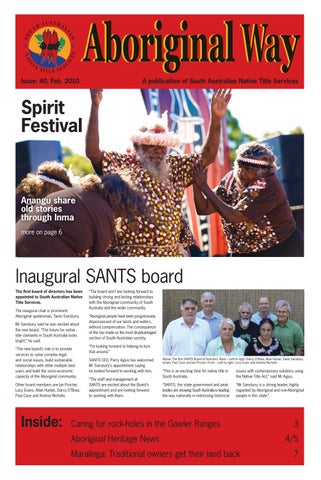
Aboriginal Way Issue: 40, Feb. 2010
A publication of South Australian Native Title Services
Spirit Festival
Anangu share old stories through Inma more on page 6
Inaugural SANTS board The first board of directors has been appointed to South Australian Native Title Services. The inaugural chair is prominent Aboriginal spokesman, Tauto Sansbury. Mr Sansbury said he was excited about the new board. “The future for native title claimants in South Australia looks bright,” he said. “The new board’s role is to provide services to solve complex legal and social issues, build sustainable relationships with other multiple land users and build the socio-economic capacity of the Aboriginal community. Other board members are Ian Procter, Lucy Evans, Allan Hunter, Darcy O’Shea, Paul Case and Andrea Nicholls.
Inside:
“The board and I are looking forward to building strong and lasting relationships with the Aboriginal community of South Australia and the wider community. “Aboriginal people have been progressively dispossessed of our lands and waters, without compensation. The consequence of this has made us the most disadvantaged section of South Australian society. “I’m looking forward to helping to turn that around.” SANTS CEO, Parry Agius has welcomed Mr Sansbury’s appointment saying he looked forward to working with him. “The staff and management at SANTS are excited about the Board’s appointment and are looking forward to working with them.
Above: The first SANTS Board of Directors. Back – Left to right: Darcy O’Shea, Allan Hunter, Tauto Sansbury (chair), Paul Case and Ian Procter. Front – Left to right: Lucy Evans and Andrea Nicholls.
“This is an exciting time for native title in South Australia.
issues with contemporary solutions using the Native Title Act,” said Mr Agius.
“SANTS, the state government and peak bodies are showing South Australia is leading the way nationally in redressing historical
“Mr Sansbury is a strong leader, highly regarded by Aboriginal and non-Aboriginal people in this state.”
Caring for rock-holes in the Gawler Ranges Aboriginal Heritage News Maralinga: Traditional owners get their land back
3 4/5 7
Parry’s view The South Australian election is fast approaching and with it comes an opportunity for all Aboriginal people of voting age to have a say in the running of our state.
Adnyamathanha SAD 6001/98 Flinders Ranges Part settled through approved determination (March 09) Balance of claim in mediation: Federal Court/National Native Title Tribunal.
I believe it’s important to vote. It gives us the power to make change. We may not always get the result we want, but voting gives us power.
Antakirinja Matu-Yankunytjatjara SAD6007/98 Coober Pedy area In mediation: Federal Court/ National Native Title Tribunal.
If we want change – if we want to fully participate in all that this land has to offer, we must engage. I congratulate Tauto Sansbury on his preselection for the seat of Flinders and I wish him well. He sets a fine example to other Aboriginal people. He’s trying to make a difference – by being a member of a political party, of making his voice, his opinion be heard. If we want change – if we want to fully participate in all that this land has to offer, we must engage. Aboriginal people, I believe, must get involved – not just in politics, but in all kinds of activities in the wider community. Even small acts like getting involved in your local community through the child care group, the library, school committees, and local councils. These small acts can lead to better recognition and understanding of Aboriginal issues.
Arabunna SAD6025/98 Central SA including Lake Eyre In mediation: Federal Court/ National Native Title Tribunal. Barngarla SAD6011/98 Eyre Peninsula In mediation: Federal Court. Above: SANTS CEO, Mr Parry Agius.
2010 is set to be an exciting year for Native Title in South Australia. We will continue working for recognition of native title rights for all native title claimant groups. This year SANTS plans to start working on some new claims. Those claim groups were very patient while we worked on establishing some precedents and now it’s their turn. I look forward to sharing some South Australian native title success stories with you during the year.
Interested in becoming a doctor? Students living in rural and
by competing only against other rural
remote areas are being targeted
students for a place in the university
in a campaign aimed at addressing
medical program, instead of the
the shortage of doctors in
total application pool which is usually
South Australia.
around 2000 each year.
A range of incentives will ensure that
“There is strong evidence that
from next year up to 25 students with
shows students who have spent time
a rural background will enter the School
living and studying in the country or
of Medicine.
a regional area are twice as likely to
The program has been developed by the University of Adelaide, the Department of Health and Ageing, the Spencer Gulf Rural Health School and the Rural Doctors Workforce Agency. Students will be encouraged to consider medicine as a career option and increase their chances of selection into university. School leavers from across Australia, who have lived for five years or more in a rural location, will be eligible to study medicine at the University of Adelaide.
practise in a rural location when they graduate,” said the Executive Dean of the Faculty of Health Sciences at the University of Adelaide, Professor Justin Beilby. Professor Beilby says he hopes to correct the inaccurate perceptions of the entry criteria required for Medicine and help overcome existing barriers for rural students, including financial costs and relocation. The program was officially launched by the Federal Minister for Indigenous
From next year, prospective medical
Health, Rural and Regional Health &
students who fall into this category
Regional Services Delivery, the Hon.
will increase their chances of selection
Warren Snowdon.
2
South Australian native title claims update
Aboriginal Way, February 2010
Dieri SAD6017/98 Central SA east of Lake Eyre In mediation: Federal Court/ National Native Title Tribunal. Dieri 2 SAD163/08 Eastern SA north of Lake Frome In mediation: National Native Title Tribunal. Eringa SAD6010/98 Far north SA including portion Witjira National Park Area over Witjira National Park settled through approved determination (September 2008) In mediation: Federal Court/ National Native Title Tribunal. Eringa 2 SAD6022/98 Far north SA including portion Witjira National Park Area over Witjira National Park settled through approved determination (September 2008) In mediation: Federal Court/ National Native Title Tribunal. Far West Coast SAD6008/98 Far West Coast SA In mediation: National Native Title Tribunal.
First Peoples of the River Murray & Mallee Region SAD6026/98 Riverland and Murray Mallee Region In mediation: Federal Court. Gawler Ranges SAD6020/98 North of Eyre Peninsula In mediation: National Native Title Tribunal. Kaurna SAD6001/00 Fleurieu Peninsula north to Port Broughton In mediation: National Native Title Tribunal. Kokatha Uwankara SAD90/09 Lake Torrens Region Not in mediation. Nauo-Barngarla SAD6021/98 Eyre Peninsula In mediation: National Native Title Tribunal. Ngarrindjeri SAD6027/98 River Murray, Lakes and Coorong Region In mediation: National Native Title Tribunal. Nukunu SAD6012/98 Spencer Gulf Region In mediation: Federal Court. Wangkangurru/Yarluyandi SAD6016/98 Simpson Desert Region and extending into QLD In mediation: Federal Court/ National Native Title Tribunal. Wirangu 2 SAD6019/98 Eyre Peninsula and West Coast In mediation: National Native Title Tribunal. Yandruwandha/Yawarrawarrka SAD6024/98 Innamincka area Not in mediation. Information provided by the National Native Title Tribunal – visit www.nntt.gov.au for more about native title. References given for each claim are Federal Court file numbers. For information on claim activity (other than mediation) contact the South Australian Native Title Services.
New Social Justice Commissioner Former ATSIC chief executive Mick Gooda is the new the Aboriginal and Torres Strait Islander Social Justice Commissioner. Mr Gooda replaces Tom Calma who had held the position since 2004. The five-year appointment will begin in February 2010. Attorney General Robert McClelland said Mr Gooda has demonstrated a strong commitment to improving the lives of Indigenous Australians and will make a valuable contribution to the work of the
commission in protecting and promoting human rights, particularly with respect to Indigenous issues. Mr Gooda is a descendent of the Gangulu people of central Queensland. Among the positions he has held are chief executive of the Cooperative Research Centre for Aboriginal Health, membership of the Western Australian Premier’s Advisory Council on Racial Discrimination, and member of the Australian Indigenous HealthInfoNet Advisory Board.
Caring for rock-holes in the Gawler Ranges Over the last 18 months, SANTS has been working on a project with the Gawler Ranges native title group to visit, assess and look after rock-holes. Rock-holes have cultural value for the Gawler Ranges claim group and getting back on country and caring for these important places is one of the aspirations of the group. The native title group enjoyed and cared for rock-holes in collaboration with local pastoralists, building on the relationships and protocols established through the negotiation of pastoral Indigenous Land Use Agreements. Ecologists from State Government were also involved in the project, bringing together traditional and western science. The SA Arid Lands Natural Resources Management Board is a key project partner.
Above: Field work team in the Gawler Ranges.
Documentary on Aboriginal land rights Aboriginal people are being invited to participate in a new documentary aimed at telling the story of Aboriginal land rights in South Australia.
“We will endeavour to capture stories
Documentary-makers Quenten Agius and Kim Mavromatis have started researching their latest project, “Breach of Trust”.
of Aboriginal land rights in South Australia
The pair previously made “Sacred Ground”, a documentary about Adjahdura Land, on South Australia’s Yorke Peninsula.
document that established the State of
from every Aboriginal Nation in SA and bring these stories together in the film and web site that will help tell the story and the consequences of not abiding by the Letters Patent (the proclamation South Australia that included a significant guarantee to protect the rights of
Aboriginal people and their descendants to lands they occupied and enjoyed),” said Quenten Agius. “We have received development funding from the South Australian Film Corporation to develop a story and film treatment. “We are currently filming major events as they occur but intend to spend 2010 consulting with Aboriginal people.
“Our aim is to start filming the individual stories in 2011, the 175th Anniversary of the Establishment and Proclamation of SA and the Letters Patent,” he said. Anyone interested in working on the film or telling their story is asked to contact either Quenten Agius on mobile 0429 367 121 or Kim Mavromatis on 0417 838 785.
Above: Natasha Wanganeen (Story-Teller, Narrator) and Quenten Agius (Co-Producer) “Breach of Trust”.
Aboriginal Way, February 2010
3
Aboriginal Heritage News To recognise the importance of Heritage and Native Title being considered together, the Aboriginal Heritage Branch (AHB) of the Aboriginal Affairs and Reconciliation Division (AARD) will have a small section in this newspaper to address what we are doing about important issues. The State Aboriginal Heritage Committee (SAHC) and the AHB are working closely with the Congress Heritage Sub-Committee and the South Australia Native Title Services (SANTS).
State Aboriginal Heritage Committee In the last edition you were encouraged to apply for six upcoming vacancies on the State Aboriginal Heritage Committee (SAHC). Thank you to everyone who showed an interest and made enquiries for an information pack. With the current Review of the Aboriginal Heritage Act 1988, it is particularly important that there be stability of membership within the SAHC and full retention of corporate and specialist heritage knowledge. The Minister for Aboriginal Affairs and Reconciliation, Hon Jay Weatherill MP has agreed to extend the appointment of half the existing members by one year. All memberships will now continue until 31 January 2011. The Committee consists of twelve members, including the Chairperson. Each member is responsible for communicating between the Aboriginal communities and groups in their region and the SAHC about the protection and preservation of Aboriginal heritage.
Membership
Tribe/Language Group
Mr Syd Sparrow, Chairperson
Ngarrindjeri
Mrs Marilyn Ah Chee
Lower South Arrernte, Yankuntjara, Arabunna
Mr Aaron Stuart
Arabunna
Mr Andrew Starkey
Kokatha
Mr Murray George
Anangu Pitjantjatjara
Mrs Claudia Smith
Narungga
Mrs Dawn Likouresis
Adnyamathanha, Arabunna, Luritja
Mrs Gwenda Owen JP, Deputy Chairperson
Ngarrindjeri
Mrs Lynn (Helen) Smith
Barngarla
Mrs Loralee Wright
Adnyamathanha
Mrs Sharon Meagher
Adnyamathanha
Mrs Yvonne Agius
Narungga, Kaurna
Site Conservation Project – DPC-AARD and Flinders University Site Recording Workshops The last three months have capped a busy and successful 2009 for the workshops, with our third for the year being held at Kingston SE in September and the fourth at Raukkan in November. We thank the Murrapeena Heritage Association, the Raukkan Community Council and all of the participants for their welcome and enthusiasm. Since 2006 we have developed the workshop content to incorporate our experience and comments from participants. The original aim is the same -- to provide Aboriginal people, both heritage veteran and novice, with an understanding of archaeology and cultural heritage management. We will continue in 2010 to explore ways in which to improve the current workshop format. We would like to invite all past participants, from 2006 until now, to let us know how they are going and if you would like further information or are interested in hosting a workshop in 2010. Please call Peter Birt (see Aboriginal Heritage Branch contact details) or email him at birt.peter@dpc.sa.gov.au
Above: Having a go – filling out site cards at Kungari, Kingston SE.
This page sponsored by the State Government of South Australia 4
Aboriginal Way, February 2010
From the Chairperson I am thankful for the opportunity to be able to speak with the community in South Australia following a hectic round of consultations with many of you in the Review of the Aboriginal Heritage Act 1988 (the Act).
We have had some major changes within the Heritage Information Team in the last few months!
This experience has been at times frustrating, enlightening and a source of great pride as I travelled to a number of our communities on behalf of the Joint Working Party. I am proud of how much our people know about the law in this area and the positives and negatives of it, this leads to feelings of frustration as there is a strong feeling amongst many of our people that the Act has failed us and has not protected our cultural heritage. One of the most important things to emerge so far is that the review and the consultative process attached to the review has created a greater awareness amongst our people as to what the real issues might be. It has again been a source of pride to me to see the way our young people have begun to be involved and wanting to learn from our older people. We must train them and then trust them to take over the responsibility of protecting our heritage in the future. I would like to congratulate the staff of AARD and SANTS for the hard work they have put into the consultations and their organisation, this is largely a thankless task and I want them to know that I appreciate their efforts in trying to make this a success. The Joint Working Party has also impressed me with their commitment and leadership in this area and I am proud to have been associated with them throughout this process.
Justin Wearne has been moved into the role of Senior Heritage Officer whilst Erin Walker is on extended leave and Tim Rogers has been moved to the role of GIS (Geographic Information Systems) Registrar. His role as a Heritage GIS Officer will be filled early next year. Above: Syd Sparrow, Chairperson.
There is still a lot that needs to be done however if we want to finish this properly. I have also appreciated the good will and common sense that has been shown by the industry groups we have been working with lately in coming up with a positive and powerful Joint Submission to the Legislative Review Team this gives cause for optimism in the future that we can work together. Last, but not least, I thank the State Aboriginal Heritage Committee for the faith, trust and support they put in me as their Chairperson as it makes this job much easier knowing that we share similar views on most things. Finally I wish all readers a happy and safe holiday period and hope next year is better than this year.
Syd Sparrow Chairperson
Review of the Aboriginal Heritage Act 1988 This time last year, the Minister for Aboriginal Affairs and Reconciliation, the Hon Jay Wetherill MP released the Scoping Paper that commenced the long anticipated review of the Aboriginal Heritage Act 1988. Although we still have a long way to go, the Review process ends 2009 on a high note. Information sessions and consultations have been conducted in 25 regional, remote and metropolitan centres across South Australia, including in the APY Lands. In addition, over 1,500 information kits have been distributed and twenty-one submissions have been received. A highlight of the year was the co-operation between the Legislative Review Team and the Joint Working Party. The Government and Aboriginal leaders worked together to present their
Heritage Information Management
respective ideas in the consultations. Not only did this approach minimise the administrative burden on Aboriginal communities and organisations, but it has created a strong base of mutual respect for the more detailed debate and discussion that will occur in the months ahead. The ideas and views from consultations and submissions are both creative and diverse and have provided much food for thought. The submissions and consultations summaries have been posted on the website www. aboriginalaffairs.sa.gov.au In the early months of 2010, the Legislative Review team will be analysing the material from the consultations and submissions, with a view to releasing a further public consultations document in mid-2010.
To speed up searches and give far better efficiency when responding to heritage queries we have a new email address through which people can request a search of the register; heritagesites.aard@dpc.sa.gov.au GIS allows Heritage sites to be visualised on a map. Using our heritage sites and information (such as roads, mining areas, creeks and rivers etc), we can determine whether Aboriginal sites within the archive are likely to be affected by development activities or which Native Title claim an Aboriginal heritage site is in. We then produce electronic or hardcopy maps for planning purposes. Over the past 12 months our team has made significant changes in the use and management of GIS. Many innovations such as GPS cameras, aerial photography and Google Earth all add to our stable of tools and ensure that the maps we produce not only look professional, but the information is easily understood. GPS cameras allow staff to take photos of Heritage sites that include a GPS reference. Everyone has taken photos at some time where the location has been lost and it is questionable as to where it was taken. GPS cameras alleviate this problem by attaching GPS coordinates to the photo data.
Aboriginal Heritage Branch Got a Heritage question? Want to be on our distribution mailing list? If you answered yes, please contact us by writing, emailing or phoning via the contact details listed below. Manager Ms Anne Stimson Stimson.anne@dpc.sa.gov.au Ph: (08) 8226 8902 or 0401 124 391 Heritage Conservation Heidi Crow crow.heidi@dpc.sa.gov.au Ph: (08) 8226 8917 Community and Industry Relations Ms Meredyth Taylor Taylor.meredyth@dpc.sa.gov.au Ph: (08) 8226 8951 Heritage Information Management Justin Wearne Wearne.justin@dpc.sa.gov.au Ph: (08) 8226 8860 State Aboriginal Heritage Committee Leata Clarke clarke.leata@dpc.sa.gov.au Ph: (08) 8226 6200
Above: Using ESRI software, the GIS system allows integration of data from different sources to be visualised together.
AARD has a strict Access Policy in place to ensure that all information is protected and can only be released under certain conditions, including community permission. Please feel free to contact us at the Heritage Information Team if you have any questions or would like to know more about GIS, see Aboriginal Heritage Branch contact details. If you have a request to search the Register email heritagesites.aard@dpc.sa.gov.au
Fax number (08) 8226 0390 Location State Administration Building, Level 13 200 Victoria Square/ Tarndanyangga ADELAIDE SA 5000 Postal address GPO Box 2343 ADELAIDE SA 5001
This page sponsored by the State Government of South Australia Aboriginal Way, February 2010
5
Spirit Festival More than 15,000 people attended the two-day Spirit Festival held at Elder Park in December. Organised by Tandanya, the festival featured a line-up of local, national and internationally acclaimed Aboriginal and Torres Strait Islander artists, including Jessica Mauboy, Archie Roach, Ruby Hunter, Jimmy Little and Christine Anu. Among the local artists were Sonny Keeler, Warren Milera and Kineman Karma. Elder Park was filled with the spirit of the old voices of the Anangu people from the APY Lands sharing some of their historic dreaming stories on the red earth dance ground. The Torrens Parade Ground opposite Elder Park was again transformed into a Basketball Stadium, proving popular with teenagers. The aroma of bush-tucker filled the air around Elder Park and led audiences to the Santos marquee where internationally
acclaimed Aboriginal Chef, Mark Olive (the “Black Olive”) assisted by Aboriginal Catering Students from Tauondi College, demonstrated the art of preparing a smorgasbord of mouth-watering bushtucker cuisine. The Bank SA marquee was a hive of activity with some 48 local and regional visual arts stallholders displaying, discussing, creating and selling their products. Some of the states best Aboriginal artwork was on sale direct from the artists. This Visual Arts Marketplace was modelled on the highly successful Arts Fair hosted by Tandanya in October as part of its 20th Birthday Celebrations and proved again to be extremely popular with people purchasing themselves some jewellery, pottery, beads, scarves, hand-woven baskets through to sculptures and canvasses. Tandanya is hoping to again host the event in 2010.
Above: Jessica Mauboy struts her stuff before the Adelaide Spirit Festival audience. Top right: Singer Christine Anu was a crowd favourite at the Spirit Festival. Centre right: Tania Sansbury and family. Bottom right: Simone Love and family.
6
Aboriginal Way, February 2010
Maralinga: Traditional owners get their land back The Maralinga Tjarutja community has had the last of their lands returned to them.
“Most were moved to coastal grey-sand country at Yalata, a place with which they had no connection.
Maralinga was the site in 1956 of British nuclear tests. Ever since then the Maralinga Tjarutja people have fought to get their land back.
Maralinga Tjarutja chairman, Mr Keith Peters said having the land returned will help the community heal.
Most of the land had previously been returned to the Maralinga people, but 3,000 square kilometres, known as Section 400 had been cordoned off as it was considered dangerous due to heavy contamination. On December 18, South Australian Governor Rear Admiral Kevin Scarce handed over the deed to the land, saying the day closed a sorry chapter in Australia’s history. Hundreds of people witnessed the ceremony in Maralinga Village. “In Britain’s race to develop a nuclear weapon capability this area was declared off limits to the traditional owners and they were forced to leave,” said Governor Scarce.
“Our people fought…so bad to get the land back….they’ve finally made it, to get the land back,” said Mr Peters. South Australia’s Aboriginal Affairs Minister, Jay Weatherill said he hoped the remaining buildings and land at Maralinga can be used by the Aboriginal people for community and tourism facilities. “I’d like to acknowledge the patience and co-operation of the Maralinga Tjarutja people in working through this process,” Mr Weatherill said. He also acknowledged the contribution that many traditional owners made in finalising the handback, including the late Kunmanara Queama, Pitjtantjatjara elder, Chair of Maralinga Tjarutja Council, and trustee of the Pilings Trust who passed away recently and the late Dr Archie Barton.
AEMEE Conference held in Adelaide Aboriginal Enterprises in Mining, Exploration and Energy Ltd (AEMEE) held its 2009 annual Conference in Adelaide in October. The Conference theme was Out of the Shadows – Aboriginal Business in the Spotlight and featured sessions on: • Business ideas and support • Getting it right • Building successful businesses Above: Left to right: South Australian Governor, Rear Admiral Kevin Scarce and Keith Peters unveil a plaque commemorating the Maralinga hand-back. Top right: The Commemoration Plaque recognises the community members who helped make the hand-back possible.
• Q&A with ABC’s Tony Jones and a panel of experts.
New legislation to stop drugs and alcohol trafficking
Among the delegates were members of the SA Aboriginal Congress, SANTS staff, mining companies and government departments.
The APY Land Rights Act has been amended to prevent the trafficking of drugs and alcohol into the Lands.
“It offered the opportunity for those already in the mining sector to interact with Aboriginal people wanting to participate in the industry,” said Mr Agius.
The amendments will support a new lease for the Mintabie opal-mining town, based on the Lands. The changes include confining alcohol consumption to the Mintabie Hotel or specially licensed events, requiring people living in Mintabie to undergo a police check and reinforcing existing requirements for visitors to the town to obtain a permit to access the Lands.
“A key concern of APY communities during negotiations for a new lease has been alcohol and drugs coming onto the Lands through Mintabie,” Aboriginal Affairs and Reconciliation Minister, Jay Weatherill said. “This is a concern that is shared by the SA Police, Nganampa Health, the NPY Women’s Council and was highlighted in Ted Mullighan QC’s evidence to a Parliamentary committee. “Anyone who has witnessed the scourge of alcohol getting into remote communities would see this as a sensible step.”
APY Executive chairman, Mr Bernard Singer said it was a great step forward for the APY Lands. “This is a sign of our strong partnership with Government and the ability to get good outcomes by working together,” said Mr Singer. Another agreement has been made which guarantees access to the Lands for all Government service deliverers and journalists. Under this agreement, APY will pass a by-law guaranteeing access.
AEMEE Chairperson, Parry Agius said the conference was a great success.
SA’s Minister for Minerals Resources Development, Paul Holloway told the conference that the government can confidently say that through the collaborative efforts of the government, resources industry and educational institutes business, training and employment opportunities for South Australian Aboriginal people and their communities are now being realised.
Aboriginal Way, February 2010
7
Native title facts Since 1994 there have been 1813 applications made under the Native Title Act. Of those, 1335 claims have been resolved, approximately 85 per cent by administrative means including the withdrawal and the amalgamation of claims.
SOUTH AUSTRALIAN NATIVE TITLE SERVICES
Level 4 345 King William Street ADELAIDE SA 5000
Editor Parry Agius
Journalist Lesley Johns
Advertising Enquiries Tenile Elliott SANTS (08) 8110 2800
There are 128 court determinations of native title – 91 that native title exists and 37 that native title does not exist. Determinations cover about nine per cent of the land mass of Australia. There are 390 registered Indigenous Land Use Agreements which together cover about 13.1 per cent of the land mass.
Ph: 8110 2800 Fax: 8110 2811 FREECALL: 1800 010 360
The Editor has the final decision on all stories and advertising that appear in this publication.
8
An Indigenous Land Use Agreement is an agreement about native title and the use and management of land and waters made between one or more native title groups and other people. An ILUA can be a most practical way to resolve native title issues. It allows people to make agreements about how land and waters are used without necessarily entering into the usual native title process.
The National Native Title Council met in Adelaide in February to review its strategic plan. Chair of the NNTC, Brian Wyatt told Aboriginal Message that the meeting allowed Native Title Representative Bodies from around the country to develop and adopt a work plan. “We now have a full-time office in Melbourne and it was important to set out a work plan,” said Mr Wyatt. The National Native Title Council is made up of all the native title Representative Bodies from across Australian and the Torres Strait.
The ALP has announced that Tauto Sansbury (pictured above) will contest the seat of Flinders in the South Australian election.
Aboriginal Way South Australian Native Title Services Level 4 345 King William Street ADELAIDE SA 5000
Indigenous Land Use Agreements (ILUAs)
Native Title Determination A Native Title determination is a decision by the Federal or High Courts, or recognised state or territory bodies, that native title does or does not exist in relation to a particular area of land or waters. Future Act Agreements Future Act Agreements let claimants and project proponents negotiate while native title applications are being still resolved.
Information provided by the National Native Title Tribunal.
Tauto National native title to stand body meets in Adelaide for SA Parliament
Circulation 15,000
If you have any stories of interest to our readers, please address any correspondence to:
Many of the ILUAs are stand alone agreements negotiated before any determination of native title.
Mr Sansbury is a long-time campaigner for Aboriginal rights but says he will contest the election on issues that affect all people who live in the area.
Mr Wyatt said the Council was the voice of Australia’s native title representative bodies and service providers.
“Our goal is to promote the rights and interests of native title holders and to promote our identity and connection to land,” he said. “We have a single body driving the native title agenda on the national scene but we also have a role to play internationally.
“We participate in and inform Human Rights forums on what is happening in Australia.
Stay in touch Name: __________________________________________________ Address: ________________________________________________ ________________________________________________________
He said he would be proud and honoured to represent the people of Flinders.
________________________________________________________
“I’m proud that an Aboriginal person has been selected, but there’s more to me than just Aboriginal issues,” Mr Sansbury told Aboriginal Way.
_________________________________ Postcode: _____________
“I’ve spent a lot of time in that district and I know there are a lot of issues that are important, such as education and water.
Phone: __________________________________________________ Email: __________________________________________________ DX no: __________________________________________________
The seat of Flinders is centred on the Eyre Peninsula in the far west of the state.
No of copies: ____________________________________________
Mr Sansbury urged all Aboriginal people in South Australia to take an interest in the March election.
Is this an alteration to our current records?
Yes
No
Would you like to be added to the mailing list?
Yes
No
Would you like to be sent regular information about SANTS?
Yes
No
“Aboriginal people can make their votes count – we can make a difference. The current member for Flinders Liz Penfold is retiring at this election. The Liberal Party has preselected local farmer Peter Treloar to contest the seat.
Aboriginal Way, February 2010
ISSUE 40