Issue 102 Winter 2026
1 Issue 102
Winter 2026
A publication by South Australian Native Title Services
www.nativetitlesa.org
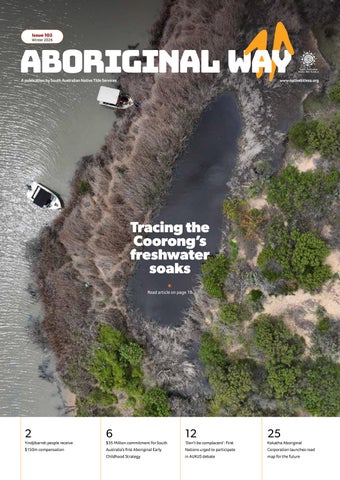
Tracing the Coorong’s freshwater soaks Read article on page 16
2
6
12
25
Yindjibarndi people receive
$35 Million commitment for South
‘Don’t be complacent’: First
Kokatha Aboriginal
$150m compensation
Australia’s first Aboriginal Early
Nations urged to participate
Corporation launches road
Childhood Strategy
in AUKUS debate
map for the future
Aboriginal Way South Australian Native Title Services
2
Yindjibarndi people receive $150m compensation for mines built without permission The Yindjibarndi people have welcomed a Federal Court determination ordering Fortescue to pay $150.1 million in compensation for cultural and economic losses caused by mining on traditional lands in Western Australia’s Pilbara region. The ruling, handed down in May, follows a legal battle that has stretched for more than 15 years between the mining giant and Yindjibarndi traditional owners. Yindjibarndi Group chief executive Michael Woodley said the outcome recognised the resilience of Elders and community members who had fought for acknowledgement of the damage caused on country. The Federal Court found Fortescue liable for cultural harm linked to the Solomon mining hub, including damage to songlines, waterways and heritage sites on Yindjibarndi country. The judgement acknowledged the destruction of 124 cultural sites, as well as impacts on ground and surface water systems. Mr Woodley said the Court had demonstrated an understanding of the spiritual and emotional impact mining had on the community. “First, I want to recognise the enormous courage and strength of the Yindjibarndi people,” Mr Woodley said. “In the summary determination, the Court demonstrated understanding of Yindjibarndi cultural losses,” he said. “The determination acknowledged significant damage has been done to Yindjibarndi songlines and other areas of cultural heritage. “The Court accepted evidence about our deep spiritual connection to Country and the physical and emotional impact of the mine suffered by Yindjibarndi witnesses.” The Court awarded approximately $150 million for cultural loss, describing the amount as appropriate compensation from the perspective of the broader Australian community. However, the ruling awarded only $100,000 for economic loss, rejecting arguments from the Yindjibarndi people that compensation should reflect mining royalty rates commonly negotiated across the Pilbara. The community had argued compensation should be assessed using royalty benchmarks of around 0.5 per cent of free-on-board revenue generated by the mine. Instead, the Court followed the approach established in
the 2018 Timber Creek High Court decision, where economic loss was assessed according to freehold land value. Mr Woodley said the result was disappointing in the context of what had been lost. “Regarding the $100,000 for economic losses, the Court did not accept our argument that the economic losses should be assessed based on the usual royalty rate paid by miners in the Pilbara,” he said. “Instead, in its judgement, the Court followed the precedent set by the 2018 High Court case at Timber Creek in the Northern Territory. “Given this, the headline amount that the Court arrived at is unsatisfactory in context of what has been lost.” Despite concerns about the economic compensation, Mr Woodley said the determination represented an important step toward accountability and selfdetermination for the Yindjibarndi people. “We welcome the Court’s decision that determined that FMG is now liable,” he said. “Self-determination for Yindjibarndi people means being able to determine and dictate how we continue to live our lives. “And how we grow our own nation through those opportunities that are being created and developed from our Ngurra.” Mr Woodley also criticised the Western Australian Government’s role during the proceedings, saying the State had argued against the Yindjibarndi position rather than remaining neutral. “We also want to note the fact that the State Government could have adopted a neutral position on the amount of compensation in this case,” he said. “But instead it argued against the Yindjibarndi. “We take this opportunity to encourage the State Government to readjust their priorities, and work on behalf of all Western Australians equally and consistently.” Mr Woodley said the Yindjibarndi people were not opposed to mining development, but wanted Traditional Owners to share more fairly in the benefits generated from projects on their land.
Issue 102 Winter 2026
3
Ngarluma Mayaga looking over Yindjibarndi Country.
Aboriginal Way Editor: Keith Thomas Journalists: Isaac Selby Communications Officer: Caleb Sweeting Design and Printing: We Create Print Deliver Advertising Enquiries: aboriginalway@nativetitlesa.org
THE ELDERS WHO ARE WITH US TODAY, AND THE ELDERS WHO LEFT US, THROUGH THIS WHOLE JOURNEY OF 15 YEARS OR MORE. THEY STOOD WITH INTEGRITY, AND THEY STOOD FIRM ON THEIR PRINCIPLES.” - MICHAEL WOODLEY
Aboriginal Way is a publication of South Australian Native Title Services Level 6 27 Currie St Adelaide SA 5000 www.nativetitlesa.org
“We also want to say that we are not the enemy of the State when it comes to mining,” he said. “This includes allowing Traditional Owners to achieve prosperity and good life from mining on our own Ngurra (Country).” He pointed to a number of economic and community development projects already underway within the Yindjibarndi community, including renewable energy, contracting businesses and ranger programs. “We are just about to start our first project with renewable energy, the Jinbi solar project,” Mr Woodley said. “We have grown a civil contracting company, Yurra, that started 15 years ago with two people and now employs 450. “We have other economic development projects and community development aspirations.” Mr Woodley said the community would continue examining the Court’s findings and considering its next legal steps. “We have asked our lawyers to examine the details of this determination,” he said. “The next steps for Yindjibarndi are to continue to support our self-determination aspirations.” He also thanked supporters and members of the public who had followed the case over many years. “We appreciate the media and broader community’s interest in this case, around Australia and overseas,” Mr Woodley said. “And thank everyone for their interest and support.”
Ph: (08) 8110 2800 Fax: (08) 8110 2811 FREECALL: 1800 010 360 If you have any stories of interest to our readers, please address correspondence to: aboriginalway@nativetitlesa.org The Editor has the final decision on all stories and advertising that appear in this publication.
WARNING: Aboriginal and Torres Strait Islander readers are warned that the following publication may contain images, names, and stories of deceased persons.
Aboriginal Way South Australian Native Title Services
4
Letter from the Editor
Build it, and they will come: Tarrkarri and the opportunity ahead SANTS remains committed to seeing Tarrkarri become a reality in response to Premier Peter Malinauskas’ recent comments questioning whether the centre would attract enough visitors to justify its cost. Evidence shows there is growing demand for First Nations cultural experiences across Australia. Tourism Research Australia reported a record 3 million trips incorporating a First Nations activity in 2023–24, including 1.1 million international visitors. The national report also found that experiencing Aboriginal art, craft and cultural displays was the most popular First Nations activity among international visitors, demonstrating the strong and growing appeal of authentic Aboriginal cultural experiences as part of Australia’s tourism offering. This is part of a broader shift in visitor expectations, with more Australians and international travellers seeking meaningful cultural engagement, storytelling and opportunities to connect with First Nations knowledge and history. Tarrkarri is far more than a tourism attraction. It is an investment in Australia’s cultural future – an opportunity to create a nationally significant institution that celebrates the world’s oldest continuing cultures, supports truthtelling, creates opportunities for Aboriginal communities, and delivers lasting cultural, social and economic benefits for South Australia. Importantly, an independent review found there is currently no comparable project anywhere in the world that combines First Nations storytelling and cultural leadership with immersive digital experiences and large-scale cultural, scientific and creative programming. South Australia is uniquely positioned to deliver this vision, as the custodian of the world’s largest collection of Australian First Nations cultural material and home to a cultural precinct capable of supporting a destination of international significance. SANTS encourages the State Government, the Commonwealth, philanthropic organisations and the corporate sector to work together to deliver this oncein-a-generation project. By sharing the investment and responsibility, these sectors can help bring to life a cultural institution that will benefit Aboriginal communities, enrich South Australia’s cultural landscape, strengthen North Terrace’s cultural precinct, and leave a lasting legacy for future generations. Keith Thomas SANTS CEO
Federal Court orders rehearing in Far West Coast sea claim The Full Court of the Federal Court has ordered a rehearing on a key issue in the Far West Coast (FWC) people’s sea claim, following an appeal by the Applicant represented by South Australian Native Title Services (SANTS). The Full Court’s decision, delivered on 29 July 2026, concerns native title over Sea Country adjoining the FWC’s peoples determined land in South Australia. The appeal challenged aspects of the trial judge’s decision in 2025 about native title rights and interests in the claim area. While the Full Court dismissed parts of the Applicant’s appeal, it agreed with the Applicant that the trial judge had erred in determining who holds native title in the sea claim area. The Full Court held that the 2013 FWC Consent Determination recognised a single communal native title held by the Far West Coast People, including descendants of Kokatha, Mirning and Wirangu ancestors. The Full Court found that the trial judge’s decision to limit the native title in the sea claim area to descendants of certain ‘coastal’ ancestors, was inconsistent with the FWC Consent Determination. As a result, the Full Court set aside that part of the trial judges’ decision and ordered the question of who holds native title in the sea claim area to be reheard. The FWC people were recognised as native title holders over approximately 78,000 square kilometres of land in 2013. Because the Consent Determination extended to the low water mark, a separate application was lodged in 2016 seeking recognition of native title over adjoining Sea Country. The sea claim area was later refined to a strip of coastal waters extending between 30 and 300 metres offshore and surrounding St Peter and Eyre Islands in the Nuyts Archipelago. The Full Court upheld the trial judge’s finding that native title in the sea claim area did not extend to the waters adjacent to the Bunda Cliffs. The Full Court held that ‘general’ claims of spiritual connection to sea areas are not enough to establish native title over sea areas that were not physically accessible at sovereignty. The Court also upheld the trial judge’s finding that the right to take resources in the sea claim area is limited to domestic consumption and sustenance of family members. It concluded there was insufficient evidence to support rights to take resources for trade or ceremonial use. The appeal was therefore allowed in part. The Full Court held that the question of who holds native title in the sea claim area will return to a single judge of the Federal Court for further consideration in accordance with the evidence and a ‘correct understanding’ of the FWC Consent Determination. SANTS will continue to support the Applicant and advocate for recognition of the native title rights of the FWC people, including in relation to their Sea Country.
RECRUITMENT POOL
Native Title and compensation claims update
Issue 102 Winter 2026
5
Update
There are currently 8 active matters in South Australia. Noting that Ngadjuri Nation 2 is determined but is contingent on the registration of the Settlement ILUA. There have now been 44 determinations of native title since 2005 and 130 ILUA’s registered. SANTS are funding all remaining matters and acting for 5 applicant groups.
Your skills. n. Our missio One goal.
Aboriginal Child and Youth Worker Residential Care – Pool
Arabana 2 - High Court appeal was successful - remitted to the Full Federal Court.
Multiple roles available in metro and regional South Australia – ongoing recruitment
Far West Coast Sea Claim – waiting for judgment from Full Federal Court appeal.
Pay: $71,589 – $77,075 per year + 12% super Shift penalties can increase your pay by up to $15,000 per year Full-time, part-time and casual positions available
First Nations of the South East 1 compensation negotiations are continuing. First Peoples of the River Murray and Mallee 2 - consent determination negotiations ongoing, including in relation to compensation. Malyangapa - consent determination negotiations ongoing with a supplementary report recently provided to the State of South Australia and New South Wales. Antakirinja Matu – Yankunytjatjara (AMYAC) Compensation – negotiations are ongoing with the Commonwealth with an authorisation meeting successfully approving the State’s proposed package. Yandruwandha Yawarrawarrka Part C – collecting evidence and awaiting first mention.
Help our kids grow up strong, safe and proud. This role is about looking after our kids and helping them stay connected to culture, community and identity. If you care about young people, have strong — this job is for you. You don’t need qualifications to start. If you bring lived experience, cultural knowledge and a willingness to learn, you’ll be supported every step of the way.
What you’ll be doing You’ll work with children and young people in residential care, creating safe spaces for yarns, learning and healing, while supporting daily life — meals, school, sport and community activities.
Why mob choose this role Advertise in the quarterly
+10,000 copies sent to SA & NT
Contact: aboriginalway@nativetitlesa.org
We know people stay in roles where they feel supported, respected and valued. You’ll get purposeful work, paid training, job security, cultural support and career pathways. If you’ve ever thought “I want to give back” or “I want to help our kids” — this is your chance. Find out more about the role and apply online at bit.ly/DCP-Careers-Portal. We want this process to feel welcoming so chat to us if you need support: DCPRecruitment@sa.gov.au
Aboriginal Way South Australian Native Title Services
6
$35 Million commitment for South Australia’s first Aboriginal Early Childhood Strategy South Australia has taken a significant step towards reshaping early childhood education with the launch of the state’s first Aboriginal Early Childhood Strategy, a landmark initiative backed by a $35 million investment over the next four years. The strategy, announced on 20 July, has been developed through a partnership between the Office for Early Childhood Development (OECD) and the South Australian Aboriginal Community Controlled Organisation Network (SAACCON), with Aboriginal leaders, Elders, families and organisations playing a central role in its design. Rather than imposing solutions, the strategy has been built through an Aboriginal-led co-design process. Independent consultations, led by MTL Consulting Services in partnership with Kimberley Wanganeen Consultancy, gathered the experiences, aspirations and
priorities of Aboriginal families, educators, Elders and Communities across South Australia. More than 5,700 Aboriginal children aged 0-4 live in South Australia. The strategy recognises that the early years are critical in shaping children’s lifelong learning, health and wellbeing, and that Aboriginal families, Elders and communities are children’s first teachers. Minister for Education, Training and Skills Lucy Hood said every child deserved the best possible start in life. “The South Australian Aboriginal Early Childhood Strategy sets out a clear vision: Aboriginal children in South Australia thrive,” she said. Minister Hood said achieving that vision requires culturally responsive preschools, meaningful partnerships with Aboriginal Communities and government systems that listen, learn and transform. The strategy responds to recommendations from the Royal Commission into Early Childhood Education and Care while supporting the goals of the National Agreement on Closing the Gap.
$12.8 million annually committed from 2030-31, with an additional $5.8 million to grow the Aboriginal early childhood workforce.
Issue 102 Winter 2026
7
SAACCON lead convenor Scott Wilson making an address.
The State Government has committed to ongoing funding of $12.8 million annually from 2030-31, alongside a further $5.8 million through the South Australian Aboriginal Early Childhood Workforce Strategy to strengthen and grow the Aboriginal early childhood workforce. Community feedback consistently highlighted the importance of Aboriginalled services, trusted relationships and strong connections to Culture, identity and belonging. Families also called for clearer, culturally responsive information to help parents and carers make informed decisions about their children’s development and education. Those priorities are reflected in a range of practical initiatives that will begin rolling out over the coming years. These include establishing an Elders in Residence program, providing preschool fee relief for Aboriginal families, creating a network of Community Liaison Officers, developing an Aboriginal-specific playgroup strategy, strengthening funding and infrastructure for
Attendee reads through the 2026 guide.
Aboriginal Community Controlled early childhood services, and addressing barriers that prevent families from fully participating in programs. Office for Early Childhood Development Chief Executive Kim Little described the strategy as the result of two years of collaboration. “We believe it will make a significant difference to the early childhood outcomes of Aboriginal children,” Ms Little said. For SAACCON Co-Convenor and South Australian Aboriginal Education and Training Consultative Council CEO Christine Thyer, the strategy represents an important milestone in ensuring Aboriginal children and families are supported through services designed with Aboriginal people, rather than for them. She said success would not simply be measured by attendance figures but by working together to remove barriers that prevent families from fully participating in early childhood education and applying Aboriginal-led solutions. Ms Thyer said Aboriginal Community Controlled Organisations had been calling for this kind of investment for many years. “What makes this strategy significant is that it was developed with Aboriginal communities, not for them,” she said. “We know when governments partner with community in the design of reforms, they deliver better outcomes at pace.”
Aboriginal Way South Australian Native Title Services
8
A street full of stories: Logan St brings forgotten Adelaide history to the stage Nestled in Adelaide’s south-west corner, Logan Street is an ordinary thoroughfare lined with homes, traffic and the rhythms of everyday life. However, along the bitumen and brickwork lies a slice of neighbourhood layered with stories that have almost disappeared from public memory. For Narungga and Kaurna theatre maker Jacob Boehme, those stories have been part of his family for generations. As a young person growing up, he and his siblings heard their father, aunties and uncles speak fondly about a house on Logan Street where family members lived after leaving Point Pearce Mission. The stories became family folklore, passed from one generation to the next. One figure appeared again and again. “They always referred to this old fellow called Goolie with the gold tooth who used to make them curries,” Mr Boehme said. “They all spoke about him with so much love. I just kept wondering, who was this man?” That question eventually became Logan St, an original production for State Theatre Company South Australia. The play premiered at Adelaide Festival Centre’s Space Theatre from 24 July to 8 August and draws together Aboriginal history, Afghan migration and the lives of people who built communities on the margins of Adelaide during the mid twentieth century. Rather than telling a single historical account, Logan Street asks audiences to consider whose stories are remembered and whose are allowed to disappear.
Family history becomes theatre The play began with Boehme’s own family history. His grandmother left Point Pearce Mission after her parents obtained exemption certificates in the early 1940s. The family moved into a house on Logan Street, where she later raised four of her seven children, including Mr Boehme’s father. Like many Aboriginal families, the move came with difficult compromises. Exemption certificates allowed some Aboriginal people to leave missions and reserves, but they also required them to surrender many aspects of their Aboriginal identity in exchange for limited freedoms under government control. “It was almost like making a deal with the devil,” Mr Boehme says. “You got out from under one form of surveillance, but you had to hand in your identity. It was incredibly cruel.” Researching that history led Jacob into archives filled with government records documenting almost every movement made by his grandparents and great grandparents. “I could go into State Records and pull out files on my grandmother, my great grandparents, the Protector Board documents and mission records. They’d written down almost every move they made.” Those records revealed the extent of official surveillance experienced by Aboriginal families throughout much of the twentieth century. But the documents could only tell part of the story. “So much isn’t written down,” he says.
Logan Street takes centre stage. Photos: Matt Bryne
connection between Gul Muhammad and Boehme’s grandmother. One was an Aboriginal woman whose identity had been stripped away by government policy. The other was a migrant who helped build colonial Australia but struggled to find belonging in the country he had helped develop.
Food, memory and belonging A forgotten neighbourhood As Jacob dug deeper, he realised his family’s story was connected to a much broader history. The southwest corner of Adelaide was once known by some residents as ‘Little Beirut.’ It became home to Aboriginal families leaving missions alongside Afghan, Indian, Pakistani, Greek, Maltese and other migrant communities. Many had been pushed to the edges of Adelaide society, but together they built neighbourhoods grounded in mutual support. “There was this really strong network of women who looked after children, worked together and supported one another,” Boehme says. “They created community.” Much of that history has faded from Adelaide’s public memory. Yet Mr Boehme believes almost every street across the city contains stories that have simply been built over. “You walk down Logan Street now and it just looks like an ordinary street,” he says. “But once you start looking through the archives you realise there were real people there, with incredible lives.” The production also acknowledges the much older history of Kaurna Country, weaving in references to significant cultural sites that were destroyed following colonisation. The more Boehme researched, the clearer the identity of “Goolie” became. The man his family remembered was Gul Muhammad, a real historical figure who served as caretaker of the Adelaide Mosque. His house backed onto the mosque and became a place where cultures met through conversation and food. Gul Muhammad was one of many cameleers who travelled to Australia during the nineteenth century to support exploration and industries including wool, wheat, mining and transport. Although many are remembered simply as “Afghans”, the men came from diverse regions across Afghanistan, Pakistan and India. “They were all labelled Afghan,” Mr Boehme says. “But once their work was done, they were largely discarded.” That experience created an unexpected
The friendship between the two main characters develops while they cook together, inspired by Boehme’s family’s memories of Gul Muhammad making curries for neighbourhood children. Rather than preparing food on stage, the production uses scent to immerse audiences in those shared kitchen moments. Rosewater, spices and traditional Afghan sweets became part of the storytelling, with these scents being used within the play’s production.
YOU HAVE TO IMAGINE THE CONVERSATIONS, THE RELATIONSHIPS AND THE ORDINARY MOMENTS THAT MADE UP PEOPLE’S LIVES.”
Issue 102 Winter 2026
9
Aboriginal Way South Australian Native Title Services
10
6
Walking Tour Map
4
3
2 1
5
Logan St Walking Tour Map.
“Smell is so connected to memory,” Boehme says. “There are moments where rosewater sparks memories of people, places and times.” The production has also partnered with Adelaide restaurant Parwana, with recipes connected to the play shared through State Theatre Company’s online platforms. Kaurna Elder Aunty Lynette Crocker and Narungga Elder Uncle Lewis O’Brien worked alongside Boehme throughout the creative process, sharing family knowledge and cultural guidance. Afghan community members also contributed to ensure their histories were represented respectfully. “I’ve worked with Afghan cultural consultants and Muslim community members right through the process,” Mr Boehme said. Kaurna language plays an important role in the production, with language specialist Jack Buckskin assisting with translations and the development of contemporary songlines connected to Kaurna creation stories. For Mr Boehme, incorporating language, song and ceremony reflects storytelling traditions that long predate Western theatre. “We’ve been telling stories for more than 60,000 years through song, dance and visual art,” he says. “It was important that those traditions sat alongside contemporary theatre.” He says Afghan storytelling traditions similarly rely on poetry, music and oral histories, creating another point of connection between the cultures represented in the work.
A career built on collaboration Although Boehme is widely recognised as an actor, choreographer and theatre maker, much of his career has centred on visual theatre, puppetry and movement. More recently he has combined those disciplines with writing, including collaborations with his cousin Sonya Rankine that reinterpret Kaurna and Narungga creation stories through contemporary song.
He says each project has added another layer to his creative practice. “It feels like an evolution of skills,” he says. “You’re always learning something new.” That commitment to creating opportunities for First Nations artists also extends beyond his own productions. Boehme is helping lead Blak State, an initiative with State Theatre Company South Australia designed to support Aboriginal theatre makers across the state. The program aims to create pathways into writing, directing and theatre production while encouraging First Nations artists to develop storytelling on their own terms. “We’re asking how we tell our stories our way,” he says. “It isn’t just about fitting into existing theatre models. It’s about building opportunities that come from our own storytelling traditions.”
Looking ahead Like any theatre production, Logan Street represents years of work with no guarantee of what comes next. Boehme hopes audiences embrace the production and that it enjoys a life beyond its Adelaide season. “You pour your heart into it,” he says. “You hope the story lands with community.” Regardless of where the production travels, Boehme hopes audiences leave with a greater appreciation of the histories that surround them every day. The streets people pass without a second thought often carry memories of families, cultures and communities that shaped the city long before today’s buildings stood. For Boehme, Logan Street is more than one family’s story. It is a reminder that Aboriginal histories, migrant histories and community histories have always intersected, even if they have rarely been told together. Sometimes all it takes is one family memory, an old photograph or a man remembered simply as “Goolie with the gold tooth” to uncover a much larger story waiting to be heard.
“It’s important we’re here a long time for our children.” Aunty Sharon Karpany Test for bowel cancer indigenousbowelscreen.com.au
Aboriginal Way South Australian Native Title Services
12
‘Don’t be complacent’: First Nations urged to participate in AUKUS debate
On Friday the 17th of July, a First Nations Hearing for the crowd funded public inquiry into AUKUS was held at the Event Theatre in Tarntanya/Adelaide. This hearing was a dedicated First Nations hearing accompanying a nation-wide AUKUS public inquiry, with the intention of hearing first-hand what AUKUS and the development of nuclear submarines near Port Adelaide means for the land, sea, sovereignty and future for Aboriginal and Torres Strait Islander people. The commissioners leading this inquiry included Yankunytjatjara woman Karina Lester, alongside former Chief of the Australian Defence Force Admiral Chris Barrie, former Western Australian Premier Carmen Lawrence, Midnight Oil frontman and former federal minister Peter Garrett, and Australia Institute co-chief executive Leanne Minshull. AUKUS was officially announced on September 15, 2021, in a joint address by former PM Scott Morrison, former US President Joe Biden and former UK Prime Minister Boris Johnson. Since then, it has been the subject of scrutiny over how it will protect Australians, how much it will cost, whether the agreement will be held by Australia’s international counterparts and how the resulting nuclear waste will be stored. As Australia commits hundreds of billions of dollars to the AUKUS defence pact and prepares for the construction of nuclear-powered submarines in South Australia,
FOR US AS FIRST NATIONS PEOPLE, NUCLEAR WASTE IS NOT A NEW CONVERSATION, IT’S SOMETHING WE’VE BEEN FIGHTING AGAINST FOR DECADES.” KARINA LESTER. Yankunytjatjara and Arabana woman Karina Lester says Aboriginal communities cannot afford to remain silent. Speaking ahead of the First Nations hearing of the crowdfunded public inquiry into AUKUS, Lester urged Aboriginal people to engage with the process, warning that decades of painful experience with nuclear testing and waste proposals have left South Australia carrying a unique burden. The inquiry examined issues ranging from national security and defence spending to environmental impacts, nuclear waste and Indigenous rights.
A history that cannot be ignored For Lester, the debate around AUKUS is deeply personal. She is the daughter of the late Yami Lester, one of Australia’s most prominent anti-nuclear campaigners, whose family was directly affected by British nuclear weapons testing in South Australia during the 1950s. On 15 October 1953, radioactive fallout from the British Totem I nuclear test drifted across her family’s
AUKUS First Nations inquiry in session.
“We as a second generation, and the generations coming after us, need to speak up strongly because our lived experience and our stories are so important.”
Country in the state’s far north. “My late father witnessed this cloud that fell over his community and over his people,” Lester said. “My grandmother was there. My grandfathers were there. Dad’s brothers were there. This is a really personal family story.” Four years later, Yami Lester lost his eyesight, an event widely linked to his exposure to radioactive fallout. He spent the rest of his life campaigning for recognition of Aboriginal people affected by the British nuclear testing program and advocating against further nuclear developments in Australia. Lester said those lived experiences remain central to current debates.
Where will the waste be stored? While public attention has focused on the submarines themselves, Lester believes one of the biggest unanswered questions is what happens to the radioactive waste they will eventually produce. “There are lots of question marks around AUKUS as a whole,” she said. “But AUKUS will be producing nuclear waste, and we have not, as a nation, really addressed the issue around nuclear waste.” She pointed to South Australia’s long history of resisting proposals to store radioactive waste, including campaigns against federal plans during the Howard Government and opposition to recommendations emerging from the state’s Nuclear Fuel Cycle Royal Commission. “We’ve had these battles before,” she said. “It constantly comes back to South Australia, and that’s a worry for all of us.” Lester said Aboriginal communities have repeatedly found themselves at the centre of nuclear debates without receiving adequate information or genuine consultation. She argued that governments must uphold the principle of free, prior and informed consent, recognised under the United Nations Declaration on the Rights of Indigenous Peoples (UNDRIP). “We need to be provided with the right information,” she said. “Companies often come in, dangle carrots in front of everybody, and it causes big divisions within our mobs. We’ve seen that happen before.” Her message on nuclear technology itself was unequivocal. “Nuclear is not safe. That’s it. That’s the message.”
Transparency under scrutiny A recurring concern raised by Lester is what she describes as a lack of transparency surrounding the AUKUS agreement. Although the pact was announced in 2021, she believes Australians still know too little about its long-term consequences. “Many of us are in the dark,” she said. “Our Australian Government has not been transparent around the AUKUS agreement and this waste issue.” Among the questions she wants answered is whether Australia’s partnership with the United States and the United Kingdom could eventually see Australia asked to manage nuclear waste generated overseas. “With the two countries having no real plan around managing their own nuclear waste, does the
Issue 102 Winter 2026
13
Aboriginal Way South Australian Native Title Services
14
The commissioners heard submissions, asked questions and compiled evidence into a final report examining the strategic, economic, environmental and social implications of the agreement.
Sovereignty and future generations
AUKUS First Nations inquiry in session.
AUKUS agreement open up our country to bring in their nuclear waste?” she asked. “They are questions that I’m asking now.”
The cost of defence The financial scale of AUKUS is another issue Ms Lester believes deserves far greater public scrutiny. The Australian Government has estimated the program will cost up to $368 billion over coming decades, an investment which raises difficult questions about national priorities. “When you look at that figure, there are really huge questions,” she said. “That’s a huge investment into defence when we’ve got cost-of-living issues, housing issues and strains on our health system.”
Public lead inquiry Unlike parliamentary inquiries conducted by governments, the Public Inquiry into AUKUS has been established independently and funded largely through public donations and support from community organisations. Lester said commissioners had hoped the Federal Government would undertake its own comprehensive review but, when that didn’t happen, they decided an independent inquiry was necessary. “It should have been a parliamentary inquiry,” she said. “But it’s not.” Instead, the inquiry aims to create a public forum where Australians from all backgrounds can present evidence and express their views. “We want all Australians to have a say and put their concerns on the table,” Ms Lester said. Importantly, she stressed that the inquiry is open to supporters and opponents of AUKUS alike. “The call is out for everybody - pro-AUKUS and antiAUKUS - to come in and voice their concerns.”
Beyond defence policy, Ms Lester believes AUKUS raises broader questions about Australia’s sovereignty and its relationship with global powers. She expressed concern that Australia risks becoming increasingly entangled in geopolitical tensions involving the United States. “We see the geopolitical playground that’s being played out in front of us,” she said. “Will it keep us safe? And at what cost?” She questioned whether deeper military integration ultimately strengthens Australia’s security or instead draws the country into conflicts beyond its own interests. “If anything, it seems to be drawing us into a battle that really doesn’t concern us,” she said. For Aboriginal communities, however, sovereignty also has another meaning. Ms Lester said Traditional Owners have enduring cultural responsibilities to protect Country and must understand what future developments could mean for Native Title lands. “I think we mustn’t, as a state of South Australia, be complacent,” she said. “This will impact the next generation and future generations to come.” She encouraged Aboriginal organisations to seek legal advice, educate themselves about the implications of nuclear waste storage, and ensure communities understand their rights before decisions are made. “What does it mean if a waste dump comes into my determined area?” she asked. “What can I do to help protect my Traditional Lands and my people?”
A call for Aboriginal voices As the inquiry continues, Ms Lester hopes Aboriginal people across South Australia will participate and ensure their perspectives are recorded. She believes First Nations experiences, particularly those of communities already affected by nuclear testing, must inform decisions about Australia’s future. “We have the right to be informed,” she said. “We have the right to free, prior and informed consent.” For Lester, the inquiry is about more than submarines or defence policy. It is about ensuring the mistakes of the past are not repeated. “Our lived experience matters,” she said. “We need to understand what this really means, ask the hard questions and stand strong.” For communities that continue to live with the legacy of Australia’s nuclear past, she says remaining silent is simply not an option. “Don’t be complacent,” Lester said. “Be informed. Ask questions. Talk about your concerns.”
Issue 102 Winter 2026
15
Aboriginal stockman returned to Country for long-awaited burial For almost six decades, the remains of an Aboriginal stockman were held by the South Australian Museum. The Lower Southern Arrernte (Irrwanyere) man, Thomas Cowell, was droving cattle in South Australia’s far north when he was found dead from natural causes in his swag at Kopperamanna Bore on 27 March 1959. Marree Police were called, documented his death and buried him at a nearby dam. In 1966, local flooding disturbed his gravesite and police returned to recover his remains. Unable to locate any family, officers transferred the remains to the South Australian Museum. In May 2026, the South Australian Museum assisted with Mr Cowell’s repatriation to a reburial site in Witjira National Park, where family, community, police and museum representatives gathered for his final burial on Country. Mr Cowell’s remains were collected in Adelaide by community members on Monday 25 May and driven to the reburial site, where mourners camped overnight ahead of the burial during National Reconciliation Week on Thursday 28 May. References held in State Records and a PhD thesis on the people of the western Simpson Desert indicated that Mr Cowell was most likely a Southern Arrernte man with links to the Mt Dare and Macumba area. The documents, which included a 1997 interview with the late Elder Bingey Lowe, indicated that Mr Cowell had worked at Mt Dare Station and was the uncle of the late Brownie Doolan. This oral history, together with the knowledge of Elders, helped identify Mr Cowell’s extended family, who were notified and requested he be returned to Country for burial in Witjira National Park near Mt Dare.
Attorney-General and Minister for Aboriginal Affairs Kyam Maher granted an exemption under the Burial and Cremation Act to allow the reburial ceremony. Minister Maher said, “Thomas Cowell’s burial back on Country at Witjira ends a long journey for the old stockman – a journey that began well before he died at Kopperamanna Bore. “He worked hard droving cattle and has been lost to his community for a long time. “It means a great deal that the South Australian Museum has consulted his family and worked hard to return him to Country.” South Australian Museum Aboriginal Heritage and Repatriation Manager Anna Russo said people travelled from across South Australia and the Northern Territory for Mr Cowell’s long-overdue funeral. “Tom was about 65 and it seems he may have been a bit of a loner when he died almost sixty years ago. “But that doesn’t mean he’s been forgotten, and the Museum has worked very hard over the past few years to find his family and community and ensure he is returned home to Country. “We at the South Australian Museum are grateful that his community has a chance to say a proper goodbye after all these years. “The Museum has repatriated hundreds of Aboriginal remains in its care in recent times and will continue to work very hard at returning people in its care to Community and Country. Irrwanyere Aboriginal Corporation Chair Jean Ah Chee said, “The family appreciates the fact that they are able to lay their grandfather to rest on Country and thanks the South Australian Museum for this opportunity.”
Aboriginal Way South Australian Native Title Services
16
Tracing the Coorong’s freshwater soaks
A collaborative team of modern scientists and Ngarrindjeri people with traditional knowledge have been working together on the Younghusband Peninsula soaks, which have sustained human and animal life for generations.
Some of these soaks remain today, although many have disappeared, prompting the research project to better understand what has changed across the landscape. Led by the Coorong Lower Lakes Murray Mouth Research (CLLMM) Centre, the project has focused on identifying freshwater soaks across Australia’s longest coastal dune system, while also working closely with Ngarrindjeri Elders and Indigenous rangers, whose understanding of the Country stretches back long before modern mapping and satellite technology. For Ngarrindjeri Elder Uncle Derek Gollan, the work is deeply connected to his own life and history in the region. Born at Point McLeay, now known as Raukkan, and raised around the Coorong, Uncle Derek spent decades working as a National Parks ranger, travelling up and down the peninsula and learning the waterways, dunes and ecosystems through lived experience. Standing near Long Point overlooking the Coorong, he describes the landscape not as an empty stretch of sand, but as a living and interconnected system shaped by water, wildlife and generations of cultural knowledge. The research project began after scientists noticed that many freshwater soaks identified on maps from more than a century ago no longer appeared visible in the modern landscape, despite historical records showing they were once widespread throughout the dune system. Associate Professor Margaret Shanafield from Flinders University says the disappearance of the soaks points to just how dynamic and constantly shifting the dune environment really is. “Pretty much all the soaks that were identified on South Australian maps from about 100 years ago are no longer apparent in the modern landscape,” she says. “That suggests the dunes are really dynamic.” Researchers combined satellite imagery, field surveys and environmental monitoring with extensive consultation alongside Ngarrindjeri Elders and rangers, travelling together on Country to visit sites and compare scientific observations with cultural knowledge passed down through generations. For Uncle Derek, many of the signs that point to freshwater are visible if people understand how to read the landscape properly, particularly through the movements of animals and birdlife. “You’ve only got to look across there on this side along the Coorong and you see all the birds in there. That’s where the freshwater is,” Uncle Derek said. “When we see these kangaroos and emus coming down the sand from over the ocean side, that’s where the freshwater soaks are.” The fieldwork confirmed that many remaining soaks are now brackish rather than fresh, suggesting significant environmental changes
Issue 102 Winter 2026
17
THE YOUNGHUSBAND PENINSULA OVER THERE IS VERY IMPORTANT TO THE PEOPLE BECAUSE THEY HAD A LOT OF FRESHWATER SOAKS ACROSS THERE” - UNCLE DEREK across the region over time. The visits onto Country also created opportunities to share stories about cultural heritage, burial grounds and important historical sites spread throughout the dunes. According to Uncle Derek, the Younghusband Peninsula carries generations of Ngarrindjeri history beneath the sand, much of which is vulnerable as erosion and shifting dunes continue exposing cultural material and ancestral remains. “You got sand dunes and there’s a lot of burial grounds there,” he said. “When I worked at the National Parks Ranger, I used to come across these burial grounds and I’d peg them out.” He says the movement of the dunes has created ongoing concerns about visitors disturbing culturally significant sites, with some people continuing to remove remains and artefacts they encounter while exploring the area. “People are still doing it,” he said. “They’re picking up the remains and taking them and
Aboriginal Way South Australian Native Title Services
18
saying, ‘Look what we found.’” Uncle Derek has worked with National Parks and Wildlife Services SA staff to install signs near vulnerable dunes where erosion regularly exposes ancestral remains, asking visitors to stay away from sensitive areas and avoid crossing unstable dunes. “The sand dune is moving so much down there,” he said. “We’re trying to put a stop to people going over the sand dunes.” Those concerns form part of broader environmental changes, which Uncle Derek says he has witnessed during decades working on Country, particularly the erosion of dunes caused by vehicle access and increasing pressure on fragile ecosystems. “There’s not enough effort trying to stop the erosion of the sand dunes,” he said. “If you put the dead branches along there, the sand will do the rest.”
Meningie pre planning.
A BETTER UNDERSTANDING OF WHERE THERE ARE SOAKS IN THE MODERN LANDSCAPE WILL HELP LAND MANAGERS AND INDIGENOUS RANGERS TO KEEP AN EYE ON THEM AND PROTECT THEM INTO THE FUTURE,” - MARGARET SHANAFIELD
Long Point on the Coorong. Lawrie and Eddie.
Looking across sections of naturally recovering vegetation, he contrasts those areas with dunes damaged by four-wheel drives travelling across the beaches and soft sand. “This is where National Parks should ban four-wheel drives along the beach because of the damage they do,” he says. “They chop the sand up and when you get the ocean coming in, what it does is tunnel and wash it all away.” The environmental impacts are also visible in the changing birdlife throughout the Coorong, with Uncle Derek recalling a time when black swans, pelicans and fairy terns gathered in much greater numbers along the waterways and lagoons. “There’s not as much birdlife around here now as what there used to be,” he says. “You’d see them all lined up along here all the way down to the Murray Mouth.” Researchers believe the freshwater soaks continue to play a critical role in supporting native species, particularly during dry periods, and that better understanding their location and function will help Indigenous rangers and land managers protect the ecosystem into the future. Associate Professor Shanafield says preserving the soaks
is essential not only for wildlife, but also for maintaining the broader environmental health of the Coorong region. “If we value the raw beauty and possibilities that this landscape offers, from fishing to showing our children native wildlife, then we need to also safeguard the resources that the ecosystem relies on.” For Uncle Derek, the project demonstrates how scientific research and traditional knowledge can complement one another, particularly when researchers are willing to listen to people who have spent their lives understanding the rhythms of the landscape. “They were more scientific. They had all these little things they were writing down,” he says. “But we told them what we know – we told them the history.” “All we could do is just say, ‘Well, this is how we grew up with it and this is how everything all worked together, the environment, the animals, birdlife and animals.’” His understanding of the waterways was developed over many years spent fishing, travelling with local fishermen and working throughout the National Parks system, where knowledge of channels, tides and shifting ground could mean the difference between safety and danger. “The thing we learned growing up around here was to know all about the waters,” he says. “If you didn’t know the channels out there, you wouldn’t survive.” Although now retired, Uncle Derek continues sharing that knowledge with younger generations through cultural and environmental programs on Country, where he works with younger Ngarrindjeri people to pass on stories, environmental knowledge and cultural responsibilities connected to the Coorong and Lower Lakes. “I do go out with the young fellas and I’m telling them about their culture,” he says. As the freshwater soaks project continues, the collaboration between researchers and Ngarrindjeri knowledge holders is revealing not only how the landscape has changed, but also how deeply culture, ecology and history remain intertwined throughout the Coorong. For Uncle Derek, protecting the region ultimately depends on whether people are willing to understand the deeper stories held within the dunes, waterways and shifting sands that many visitors simply pass through without recognising. “A lot of people just come and see the Coorong, beautiful place,” he said. “But they need to know the history.”
TELLING THEM ABOUT THE COORONG, THE LAKES, HOW IMPORTANT IT IS TO LOOK AFTER THESE THINGS, THE ENVIRONMENT AND THE ANIMALS.” - UNCLE DEREK
Issue 102 Winter 2026
19
Aboriginal Way South Australian Native Title Services
20
SA First Nations leaders share lived experiences for anti-racism hearing A public hearing in Tarntanya / Adelaide examining racism, hate and violence directed at Aboriginal and Torres Strait Islander people has heard South Australia’s justice, housing, child protection and education systems are continuing to fail First Nations communities, with witnesses describing racism as “constant”, “systemic” and deeply damaging to mental health and wellbeing.
SAACCON staff Keenan Smith, Christine Brown, Scott Wilson and Sage Young with Senator Lidia Thorpe.
The hearing was held at the Hotel Grand Chancellor on May 8, and was followed by later hearings in Canberra, Perth, Darwin, Alice Springs, Melbourne, Brisbane, Cairns, Torres Strait and Hobart. The federal parliamentary inquiry, chaired by members of a federal and state senate committee, heard evidence from Aboriginal legal advocates, peak community organisations and youth representatives who warned that despite years of reviews and policy reforms, many Aboriginal people continued to experience discrimination at every stage of life. Senators Ellie Whiteaker, Jana Stewart, Kerrynne Liddle and Lidia Thorpe attended the hearing, alongside Queensland MP Kara Cook, who joined remotely. Aboriginal Legal Rights Movement (ALRM) CEO Klynton Wanganeen said Aboriginal people continued to be jailed at disproportionately high rates and were overrepresented in remand populations across the state’s prisons. “We still have situations where Aboriginal people are jailed
at a higher rate than the rest of the population,” he said. “We have high levels in remand, Yatala, every prison in South Australia we have high numbers. “It shows a systematic failure in all attempts to keep Aboriginal people out of the justice system.” He said previous prison education systems that allowed Aboriginal inmates to undertake studies and improve employment prospects after release had effectively disappeared after corrective services reforms. Mr Wanganeen said ALRM was struggling to meet demand, servicing around two-thirds of South Australia because of limited resources. The hearing also heard concerns about policing and the treatment of Aboriginal children in custody and child protection systems. ALRM Deputy CEO Khatija Thomas sees legal advocates increasingly dealing with children being interviewed by police without proper support, including some under state guardianship.
“We know there are so many people that need a person in the room with them to assist with communication,” she said. “There is no information between DCP and the police if a child is under guardianship of the state.” Ms Thomas said the organisation was also deeply concerned about children being held in adult police watch houses. “The strain on children being kept in adult facilities at police watch-houses - it just keeps getting more intense with more demand every year, every month.” She said ALRM often became the first point of contact for Aboriginal people trying to navigate systems they did not trust. “ALRM is the place you come if you’re not sure,” she said. “If it doesn’t feel right, it’s probably not.” Ms Thomas said racism was not confined to isolated incidents but embedded throughout institutions and daily interactions. The hearing repeatedly returned to questions about whether governments were genuinely listening to Aboriginal communities. Senator Thorpe questioned whether the South Australian Voice to Parliament has enough power to create meaningful change, asking witnesses whether the scenario of a department ignoring advice from Aboriginal representatives amounted to systemic racism. Ngaanyatjarra Pitjantjatjara Yankuntjatjara Women’s Council (NPYWC) acting CEO and former SA Voice secretariat, Andrea Mason, responded to these questions saying that Aboriginal communities still lacked meaningful mechanisms to implement their own solutions. “It (SA Voice) does fall short because there is no mandatory requirement for the inclusion of advice from Aboriginal people who have lived experience. It’s purely advisory,” Ms Mason said. “We’ve also seen a growth in not-for-profits coming
Hearing at the Hotel Grand Chancellor.
into our community and not being delivered by Aboriginalcontrolled organisations.” Fellow NPYWC spokesperson Jessica Baker also raised concerns about media reporting and the role it played in amplifying racism. She said the coverage surrounding the death of Kumanjayi Little Baby had fuelled hostility and suspicion toward communities already experiencing trauma. Ms Baker called out the Australian press for working the narrative to lean towards alarmism instead of just understanding the trauma of what occurred, flagging these stories as ammunition for harm back to community. The hearing later turned to online racism and social media regulation, with South Australian Aboriginal Community Controlled Organisation Network (SAACCON) representatives calling for stronger accountability mechanisms. SAACCON chair Scott Wilson said racism had increasingly flourished online, while public institutions had struggled to respond. He called for stronger powers for regulators and a dedicated Indigenous anti-racism strategy for South Australia. “One of the things that struck us is that SA doesn’t have an Indigenous anti-racism strategy – we just have a mainstream strategy,” he said. “We need to mandate and develop these strategies, put something in there that’s going to be meaningful and not just another document that sits on the table.” SAACCON told the hearing that racism should be treated as a public health emergency, pointing to recent declarations by public health bodies and warning the impacts extended far beyond individual acts of discrimination. The organisation’s submission identified what it described as a “critical lack of accountability” across systems Aboriginal people interacted with every day,
Issue 102 Winter 2026
21
Aboriginal Way South Australian Native Title Services
22
Scott Wilson (SAACCON) with Khatija Thomas and Klynton Wanganeen (ALRM).
ONE OF THE WORDS I PREFER IS HOW WE COMBAT, PREPARE OURSELVES AND SHIELD OURSELVES FROM THE CONSTANT DISCRIMINATION THAT PERVADES OUR PEOPLE EVERY DAY” - KHATIJA THOMAS. including health, housing and justice. “Without these foundations racism will continue to be reintroduced,” Mr Wilson said. Senator Lidia Thorpe facilitated the hearing and said Aboriginal community-controlled organisations were being left to manage the consequences without sufficient support. She linked racism to rising rates of mental distress, selfharm and suicide among Aboriginal people, particularly following the failed Voice referendum. “It’s us that have to deal with the harm that racists create,” she said. “You’re not resourced to deal with the influx of mob coming in the door and people are self-harming as a coping mechanism. “We saw a rise in suicides during the referendum and after the referendum.” SA Commissioner for Aboriginal Children and Young People Dale Agius also spoke at the hearing and commented that feedback from the Aboriginal Youth Summit in March revealed many young Aboriginal people felt disengaged from education systems that were failing to support them. Mr Agius told the hearing youth delegates had described feeling isolated and disconnected at school, where racism frequently manifested through bullying, slurs and exclusion. Young people at the summit reported being followed
by security guards in shops, subjected to racist abuse and targeted online. He said others felt ashamed because they could not afford uniforms, sports gear or technology required for school participation and were often disconnecting as a result. Mr Agius also noted how mental health and suicide were recurring concerns raised by young people at the summit The inquiry also heard examples of progress in some areas. Mr Wilson pointed to reductions in juvenile justice detention in South Australia and the growth of Aboriginalcontrolled housing services as evidence that communityled solutions could succeed. “Juvenile justice has been reduced by 35 per cent,” he said. “We now have peak Aboriginal-controlled housing.” But he warned public debate often overlooked frontline organisations and focused instead on political rhetoric. “When the media picks up on a report they don’t talk to the people who are actually there on the ground,” he said. “What annoys me really here in SA and Victoria is you have political parties that say when they get into power they’re going to bring in practical solutions when this is already happening.” Several witnesses said genuine reform required governments to review policies that excluded Aboriginal people from economic and social opportunities. Several of the speakers at the hearing urged the inquiry not to produce another report that failed to deliver structural change, asking the senate board to highlight the need for strong government accountability. For many who appeared before the committee, the hearing represented another attempt to make governments confront what they described as the cumulative impact of racism across generations.
Issue 102 Winter 2026
23
On the Right Track: A decade of remote driving assistance For many Australians getting a driver’s licence is often seen as a rite of passage - a first taste of independence and adulthood. But in some of South Australia’s most isolated Aboriginal communities, it has historically been far more complicated than simply booking a test and taking driving lessons. For years, barriers including distance, language, access to identification documents, limited internet and the absence of local driving instructors meant many Aboriginal people living in the Anangu Pitjantjatjara Yankunytjatjara (APY) Lands and surrounding regions were effectively locked out of the licensing system. When South Australia’s On the Right Track program first began operating in the APY Lands in 2015, fewer than one in five people over the age of 16 held a learner’s permit or driver’s licence. Today, that figure has climbed to around 60 per cent across remote communities stretching from the APY and Maralinga Tjarutja Lands to Ceduna, Coober Pedy, Oodnadatta and parts of the Flinders Ranges. Behind those numbers is a decade-long effort that Department for Infrastructure and Transport (DIT) Deputy Director for Aboriginal Strategy Jade Wilson said has become about more than just teaching people to drive. “It is so much bigger than a driver’s licence because once you have some form of ID, you’re not limited,” Ms Wilson said. “The doors start opening and we can be that gateway to becoming an adult.” The origins of the program date back to earlier health and wellbeing reviews conducted in remote South Australian communities. Ms Wilson said the department identified a lack of driver licensing as a major barrier preventing people from accessing healthcare, employment and other essential services. “One of the barriers in the APY Lands in particular was obviously getting a driver’s licence,” she said. “Getting a licence is the thing that can help you get to your medical appointment.” Before the first official trip north in 2015, staff spent time consulting directly with communities about what they needed from the program. “The short-term goal was getting a driver’s licence and the long-term goal was keeping it and progressing through the licensing program,” Ms Wilson said.
What emerged was a mobile licensing and road safety initiative designed specifically for remote Aboriginal communities - one that adapted the state’s licensing requirements to local realities rather than expecting communities to navigate systems designed for metropolitan South Australia. The first visits focused on communities including Indulkana, Mimili and Pukatja (Ernabella), with a small team travelling thousands of kilometres carrying training materials, learner permit tests and driving equipment. “The communities were initially anxious and kept us at arm’s length, but now we are fully embraced by the whole community,” Ms Wilson said. “We are fully embedded. There is that level of trust.”
More than driving lessons For (On the Right Track) Acting Coordinator Amy Reid, who has worked with the program for six years, the strongest memories are often the reactions from people receiving their first licence or learner’s permit. “The most enjoyable part of the job for me is seeing the smiles from our clients and the community members when they get their learners or pass their test to get their Ps,” she said. “From when I started six years ago, the biggest change I have seen is the next generation coming through who are excited to be a part of the program - they want to learn to drive and drive safely.” The program now has five staff members and eight contracted driving instructors who travel on a rotating sixmonth schedule through remote communities. But staff say many participants initially need help with much more than simply driving. For some, it is obtaining proof of identity documents for the first time, others require assistance managing unpaid fines or understanding the licensing process. “We kind of do like at times a one-stop shop for everything,” Ms Wilson said. “If our mob have a fine, we want to help them lift that fine or go into a payment arrangement so they can get their licence back.” The travelling service often includes collaboration with organisations such as Services Australia, Centrelink and Medicare, allowing residents to access multiple services during a single visit.
Aboriginal Way South Australian Native Title Services
24
The program has also evolved to include broader road safety initiatives, including child restraint education and distributing baby seats, booster seats and tow straps to remote communities. “We provide child seats, baby seats and booster seats to community so they can travel safely between communities like Port Augusta and Alice Springs,” Ms Reid said.
Adapting the system One of many initiatives for the program has been adapting mainstream licensing systems to communities where English may not be the first language and where local driving conditions differ dramatically from urban South Australia. Rather than relying solely on online learner tests, staff often work through questions face-to-face, reframing road rule terminology into more familiar language and scenarios. “Rather than saying pedestrian crossing words, we say, ‘You see your auntie across the road, what do you do?’,” Ms Wilson said. “We just put the questions into words that they understand.” Where needed, family members, carers and interpreters also assist participants during the learning process. In many remote communities there are no traffic lights, multi-lane roads or large roundabouts - standard features of metropolitan driving tests. “We take up poles to simulate reverse parallel parking if there’s no two cars parked in the distance,” Ms Wilson said. “If there’s roadworks and temporary traffic lights, we take full advantage of that.” These lessons also focus heavily on hazards more common in remote areas, including wildlife, long-distance travel and unsealed roads. “In remote and country areas, you’ve obviously got different wildlife on the road,” Ms Reid said. “It’s completely different driving out in those areas as opposed to even driving regionally or metro areas.”
Changing lives Over the past decade, more than 3,500 people have accessed the program, with more than 1,400 learner’s permits and 700 provisional licences issued. In some APY communities, Ms Wilson said participation rates among eligible young people are now nearing universal. “As soon as someone turns 16, it’s guaranteed their mum, dad or grandparents are bringing them in to sign up for the program,” she said. For community constable Troy Hughes in Amata, getting his licence through the program became a turning point. “It’s changed my life,” he said. “Learned to drive, learned to look after myself on the highway.” Mr Hughes now works with South Australia Police, mentoring young people and promoting road safety in his community. Community leader Anita Amos also said the impact of licensing extended far beyond transport. “When they do have their licence, I see big change in our people,” she said.
“They are cruising around; they’ve got positive posture. “There are not enough opportunities out there without a licence so there has been a big change.” She said having a licence often created pathways into employment and greater financial stability for families. “That means that when people have really good jobs, that they can fend for their family,” Ms Amos said. “They feel proud of themselves for what they have achieved.” In Ceduna, participant Shantaria Fielding said the support of instructors helped her overcome anxiety after initially failing her learner’s permit test. “I thought it was going to be hard, but it was actually pretty easy because of their help,” she said. “At first it was a bit scary because it was in a police station - I did fail the first one but with On the Right Track it was much better.”
Expansion beyond light vehicles In 2023, heavy vehicle licensing was introduced in some communities, allowing participants to qualify to drive trucks and buses. At the time of publication, seven people have completed the training. Ms Wilson said the expanded licensing options could create employment opportunities in local councils, schools and community services. “People can drive school buses and be more employable for the local council to be driving the rubbish trucks as well,” she said. Staff also hope to eventually expand the service into additional Aboriginal communities across regional South Australia where there are still no Service SA centres or local driving instructors. The team would also like to recruit and train more Aboriginal driving instructors from within the communities themselves. At present, the service operates with a relatively small workforce considering the geographic distances involved, completing about 36 remote trips each year. For Ms Wilson, the long-term vision remains clear. “We want every Aboriginal person living in regional or remote South Australia to have the same access to services that we take for granted living in Adelaide, Port Augusta and Port Lincoln,” she said. The broader goal, she said, is ultimately about safety, opportunity and reducing disadvantage. “The long-term goal is fewer lives lost on the road, fewer people incarcerated for driving offences and more people driving safely, confidently and legally in their own country.” After ten years on the road, staff say the program’s success has come from recognising that a driver’s licence is rarely just a licence. For many participants, it represents identification, independence, employment, confidence and connection - all accessed through a service that meets communities where they are, rather than expecting them to navigate the system alone.
Kokatha Aboriginal Corporation launches road map for the future This year marked an important milestone for Kokatha Aboriginal Corporation (KAC) with the official launch of the KAC Strategic Plan 2026 – 2035 at the Press Road Community Space in Port Augusta. The launch brought together Kokatha community members, Directors, staff and special guests, including BHP Copper SA Asset President Anna Wiley, to celebrate how far the Corporation has come, and where it hopes to go next. The day kicked off with a community barbecue, fire and roo tail cooking, giving people the chance to come together, catch up and reflect on the journey that has led to this point. KAC Chairperson Nyani Thomas said the launch was a significant chapter in the Corporation’s story. “When you think about where we were 12 years ago and where we are now, it’s something to be really proud of,” Mr Thomas said. “Native Title recognition was a huge achievement for our people. To now be in a position where we can look ahead 10 years and map out the future we want for our community is another important step forward.” Mr Thomas said the Strategic Plan was shaped by the voices of Kokatha people and reflects what the community wants to see for future generations. Community workshops, surveys and meetings were held throughout the planning process to ensure the final document reflected the priorities of the Kokatha community. The plan focuses on areas that matter most to Kokatha people, including culture, community wellbeing, employment, education, housing, economic development, caring for Country and creating opportunities for future generations. Mr Thomas said than more anything, the plan provides a shared vision for where the community wants to be in the years ahead. “The launch is an important milestone, but it’s just the beginning. The next step is putting the plan into action and that’s the exciting part. We now have a clear direction and a road map for the future. We’re looking forward to working together to turn these ideas into real outcomes for our community.’ Mr Thomas hopes KAC’s journey can also inspire other native title organisations around Australia. “Our story shows what’s possible when people work together, listen to their Elders and stay focused on the future.” The launch was also an opportunity to welcome
KAC Chair Nyani Thomas and Deputy Chair Glen Wingfield presenting the Strategic Plan to community. The launch was held at Press Road Community Space in Port Augusta.
THIS PLAN WASN’T WRITTEN BEHIND A DESK, IT WAS BUILT THROUGH CONVERSATIONS WITH COMMUNITY MEMBERS, ELDERS, YOUNG PEOPLE, STAFF AND DIRECTORS. WE SPENT A LOT OF TIME LISTENING TO PEOPLE ABOUT THEIR HOPES FOR THE FUTURE AND WHAT THEY WANT KAC TO FOCUS ON.” - NYANI THOMAS. KAC’s new CEO Jason Davison, who recently joined the Corporation after serving as CEO of Winun Ngari Aboriginal Corporation in Derby, Western Australia. Mr Davison said he was looking forward to working alongside the Kokatha community as the Strategic Plan is brought to life. “It’s an honour to step into this role at such an important time for the organisation. I’m looking forward to getting to know the community, learning from Elders and working alongside Kokatha people as we begin delivering on the vision set out in the Strategic Plan.”
Issue 102 Winter 2026
25
Aboriginal Way South Australian Native Title Services
26
Traditional Owners raise concerns over South East fracking plans
The state government hopes gas can be extracted from the Otway Basin, under the Limestone Coast. (Supplied- Beach Energy).
Traditional Owners in South Australia’s South East have raised concerns that proposed changes to fracking laws could threaten fragile water systems, cultural values and Country. Hydraulic fracture stimulation, commonly known as fracking, is a process used to extract underground oil and natural gas. Fracking is currently permitted across most of South Australia but has been prohibited in the South East since 2018, when the former Liberal Government introduced a 10-year moratorium following community concerns about the risks of fracking in the area. In May 2026, the Malinauskas Government introduced legislation to repeal the moratorium, arguing more gas supply is needed to support manufacturing and energy security across southern Australia. The legislation did not pass Parliament, with the Liberals, Greens and One Nation voting against lifting the ban. Southern Tanganekald and Eastern Arrernte man, Bruce Hammond, said Traditional Owners have a responsibility to protect the South East’s water systems and cultural values. “Our family are the traditional custodians around the Kingston and Rosetown area,” he said. “Experiences around the world have taught us that the fracking process once completed is irreversible and destructive to natural water flows.” Water management has long been a significant issue in
the South East, where the landscape was altered to create a drainage system for agriculture. Mr Hammond believes introducing fracking into the region could undermine efforts to restore natural ecosystems. Mr Hammond said water is central to cultural practices, biodiversity and the survival of native species. “It’s everything,” he said. “It’s about the native species. It’s about the plant life. It’s about having water flows on top of the land. The fragile ecosystems down there rely on it.” The South East was historically a vast wetland system that supported Aboriginal communities through cultural practices and access to food. “People were on water courses, and they have disappeared because of an invasive land management system.” Mr Hammond said any future decisions about fracking should include a proper assessment of the region’s water values and greater consultation with Traditional Owners. “There should be a proper assessment of the values of these water systems – currently the values are being under assessed,” he said.
Mr Hammond is a member of the First Nations of the South East claim group that seeks recognition of their native title rights and interests over the area. He says the group has not been adequately involved in discussions about the future of the region’s water systems. “The State Government has misinterpreted their obligation to the legal right of native title,” he said. “We’re native title holders. We are applicants. We have native title determination application progressing, yet we were not even engaged in a conversation around the values of the water systems down there.” “I think the whole fracking process should be reassessed as a practical solution. I don’t agree with it anywhere, but I am absolutely opposed to it in areas that are already demonstrating very fragile rock faces and underground water systems.” In a media release, the South Australian Government said removing the moratorium would not automatically approve fracking but would allow future proposals to be assessed under existing regulatory processes. The State said any activity would still be subject to environmental approvals and would need to demonstrate that risks to groundwater could be appropriately avoided or managed. The South East fracking moratorium is due to expire in November 2028.
THE FRACKING PROCESS IS EXTREMELY DESTRUCTIVE, PROVEN WORLDWIDE TO BE QUITE HIGH RISK AND IN SOME PARTS OF THE WORLD THE GAS HAS SEEPED OUT INTO RIVER SYSTEMS. IT’S JUST NOT CONSISTENT WITH GOOD MANAGEMENT OF COUNTRY.” - BRUCE HAMMOND
Issue 102 Winter 2026
27
Request for
Individuals and organisations can request free copies of this publication. Email details to aboriginalway@nativetitlesa.org or complete the form below and mail to Level 6, 27 Currie St, Adelaide SA 5000.
Radio & Podcast Listen:
Name: Email address: Permission to email (tick box) Electronic copy: YES
NO
Address: No. of physical copies: If you need to update your address or number of copies at any time, please email aboriginalway@nativetitlesa.org
Issue 102 Winter 2026
nativetitlesa.org/aboriginal-way-news