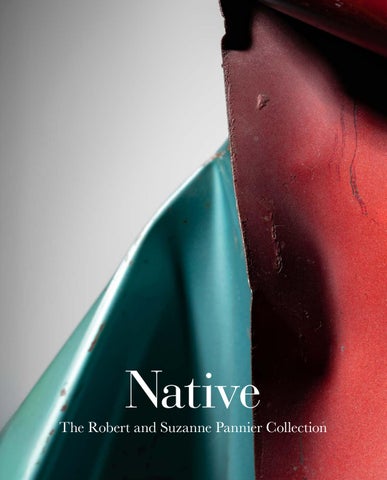
Native
The Robert and Suzanne Pannier Collection
Native 15th anniversary
The Robert and Suzanne Pannier guestbook Excerpts
Manette Repriels, owner of Galerie Vega, Liège
Jan Hoet, Founder and curator of the Stedelijk Museum voor Actuele Kunst, SMAK, Curator of Documenta IX, Kassel
David Nash, sketch for Three Chestnut Boats, lot 058
Sol LeWitt, Bruges 1990
Christo and Jeanne-Claude, Bruges 1987
Native Auctions Preview & Auction Rue Américaine 26 - 28 1060 Brussels Office Galerie de Ruysbroeck 5 1000 Brussels
info@native-auctions.com T +32 (0) 2 514 04 42 Nicolas Paszukiewicz n.paszukiewicz@native-auctions.com Sébastien Hauwaert s.hauwaert@native-auctions.com Emmanuel Van de Putte e.vandeputte@native-auctions.com Gilles Marquenie g.marquenie@native-auctions.com Sophie Van Loock s.vanloock@native-auctions.com
The Robert and Suzanne Pannier Collection 27 October 2026 - Brussels Auction 27 October 2026 18.00
Preview 8 October - 26 October 2026 Wednesday - Saturday 10.00 - 18.00
Between Object and Idea And Some Kind of Order Chris Dercon
The story of the Bob and Suzanne Pannier Collection takes me back to yesterday. But also reflects a distinctly present-day perspective. Yesterday, between 1981 and 1983, I worked at the Baronian-Lambert Gallery in Ghent. We inaugurated the new gallery with an exhibition of small-scale works by Richard Tuttle. During those first weeks, the gallery's founders, Albert Baronian and Yvon Lambert, asked me to keep an eye out for distinguished visitors. I got asked, "Has Bob Pannier been in yet?" The meaning of the selection of works from the Pannier Collection presented here, however, should also be considered in view of today. Viewing a collection assembled over the course of some thirty years through the lens of the present is a fascinating exercise. The fascination lies not only in the fact that many of the same artists continue to command sustained, and in some cases renewed, attention but also in the contemporary relevance of specific works of art. "A private collection is generally built up over a period of no more than twenty to thirty years," collectors Annick and Anton Herbert wrote, as early as 1989, of their own collecting practice, "after which it either disappears or is preserved as a permanent collection’1
Tapta, Untitled, lot 040
Like several other Belgian private collections assembled during the same period, the Pannier Collection contains a striking number of American works, with a marked preference for Minimal and Conceptual art. Collectors Hubert Peeters, Hilda Colle and Roger Matthys, as well as Bob Pannier, all received training in the medical sciences. The radiologist Herman Daled repeatedly remarked that his daily engagement with medical imaging had led him to develop a profound interest in works of art as objects of knowledge. Peeters, for his part, often spoke of his particular interest in what he called "future-oriented art." At a certain point, many collectors feel the urge to impose some form of order or classification upon their collections, even if the acquisitions themselves were made in a degree of apparent disorder. In the case of the Pannier Collection, it is worthwhile - particularly in view of a public auction, and thus yet another form of future - to establish once again a certain order. The pioneering Belgian sculptor Tapta, whose work fell into relative obscurity following her death in 1997, entered the Pannier family circle when their daughter Charlotte interned in her studio in 1972, where Tapta was then creating monumental three-dimensional textile sculptures. Beginning in the early 1980s, however, she turned to producing numerous small-scale sculptural models in new industrial materials. Thanks to the tireless efforts of the Belgian art expert Maurice Verbaet, together with major retrospective exhibitions at WIELS in 2023 and Muzeum Susch in 2024, Tapta's pioneering work has once again received the recognition it deserves. The Pannier Collection, however, has included one of her sculptural models from 1984 for decades - a work that, now that sculpture itself is once again being critically reassessed and increasingly appreciated, reveals just how prescient the collectors' eye truly was.
In 1995, Annick and Anton Herbert observed that "giving a collection a future across generations is undoubtedly its greatest challenge. Such an undertaking inevitably calls for a public presentation of the collection. The chances of success are utopian and exceedingly slim."2 The same holds for the Bob and Suzanne Pannier Collection. Cady Noland's and Matt Mullican's graphic works, both dating from 1991 and acquired by the Panniers the following year, were included in the widely discussed exhibition Unexchangeable at WIELS in 2018. Bringing together a rigorously selected group of major works from Belgian private collections, the exhibition exposed the significant gaps in the holdings of Belgium's public museums. Indeed, Belgian collections of contemporary art largely remained in private hands and never found a permanent public home, despite ideas to that effect by several collectors - including Bob Pannier himself. The Pannier Collection is distinguished not only by its "future-oriented" works of art, but also by its deeply personal character. It is, as their daughter Anne Adriaens-Pannier - herself a distinguished art historian - describes it, a collection that mirrors a life. The acquisitions form a portrait not only of Bob and Suzanne Pannier, but also of a family of six daughters, each of whom developed an interest in art from an early age. The collection also tells the story of a close circle of friends: trusted advisors, fellow collectors, and, time and again, the same gallerists and artists who shaped many of Belgium's leading private collections. Artists such as Carl Andre, Mel Bochner, Bernd and Hilla Becher, Gilbert & George, Dan Graham, and Sol LeWitt recur throughout Belgian private collections; acquisitions from Art & Project in Amsterdam and John Weber in New York appear just as consistently. Was this what the legendary New York dealer John Gibson - who cultivated so many Belgian collectors, among them Nicole and Herman Daled, whose collection included an extraordinary group of works by Dan Graham acquired through Gibson - had in mind when he brought Ed Ruscha's 1989 pastel G GOSH ITS A SM SMALL W WORLD to the Panniers' home in Bruges in 1992? It was, indeed, a small world. As one authority on Carl Andre recently observed, whose work figures in several Belgian collections: "That's why the Belgian collectors are the best." From the 1970s onward, Andre himself found New York increasingly uninteresting, preferring to work with European galleries and collectors. In letters to Galerie Vega in Liège, he wrote of his admiration for the history of Walloon metalworking. Edward Ruscha, G GOSH ITS A SM SMALL W WORLD, lot 046
For Bob and Suzanne Pannier, Galerie Vega occupied a central place, offering important examples of Minimal and Conceptual art, including Gilbert & George's early photographic work Rotten Bar (1972). Earlier still, Galerie Veranneman had introduced them to artists such as Georges Mathieu and Victor Vasarely. Many important Belgian collectors, including the Panniers, never really embraced the growing mythology surrounding contemporary Belgian art in the 1980s.3 Yet Belgian artists do belong to their collection.
Luc Peire, whose work Bob Pannier continued to support until he died in 2016, Jo Delahaut, and Panamarenko all occupy an important place. Panamarenko's General Spinaxis (1968), in particular, stands as one of the key works in the artist's oeuvre. Bob Pannier perhaps found his closest kindred spirit in the collector Roger Matthys. Like Anton Herbert and Herman Daled, Matthys was more than a collector; he was an active participant in the avantgarde. Works by Karel Appel and Lucio Fontana from his collection eventually found their way into the Pannier Collection. Matthys regularly sold works to finance the acquisition of others he regarded as even more radical. The older Liège collector Fernand Graindorge parted with works once they became too ‘clear’. This is how Pannier acquired his "Boîte-en-valise" by Marcel Duchamp: a collection of reproductions enclosed in a "suitcase," miniature versions of his works. It was an idea and an object that occupied Duchamp for three decades. Had Graindorge, like Joseph Beuys famously proclaimed in 1964, come to believe that "the silence of Marcel Duchamp" had been overestimated? Dan Graham, Three Linked Cubes/ Interior Design for Space Showing Videos, ©Scala Archives
Duchamp's Boîte-en-valise in the Pannier Collection, from the Series F and dated 1966, was first conceived between 1938 and 1941. He subsequently produced a succession of series, from A to G, continuing until the end of the 1960s. His "museum in a suitcase" reflects Duchamp's continuous investigation into the notion of the "original." Allan McCollum's Surrogate Paintings of 1987 clearly engage with Duchamp's conceptual framework. Did Bob Pannier acquire McCollum because of Duchamp? Although the Panniers did not assemble works according to a deliberate connecting principle, the collection nevertheless creates unexpected proximities, like a library, allowing for new readings. One such dialogue emerges between Arnaldo Pomodoro's Sfera (1965) and Lucio Fontana's Concetto Spaziale, Teatrino (1965–66), created by his mentor. Both artists were interested in new technological applications and in the aesthetics of destruction. In 1985, with the technical support of the glass manufacturer Glaverbel, I produced an exhibition architecture and optical object: Dan Graham's mirrored pavilion Three Linked Cubes / Interior Design for Space Showing Videotapes. It was presented at several venues, including the Musée d'Art Moderne de la Ville de Paris in 1987. A small-scale model is held in the Pannier Collection. Dan Graham began to create pavillons in 1978. In accompanying texts, Graham referred often to the work of John Chamberlain, his sources of inspiration in the Baroque, and Chamberlain's use of standardized industrial materials. Those characteristics are particularly evident in Chamberlain's sculpture Madison (1965), owned by the Panniers. Chamberlain himself stated in an interview in 1991: "Art is the only place left where a person can go discover something and not have to be told by somebody else whether they discovered it or not." Such discoveries can also be made in the Pannier Collection. As with Dan Graham, there has long been a profound admiration for Carl Andre and Mel Bochner in Belgium. In 1966, Bochner already presented working drawings and notes by Carl Andre in an exhibition in New York. In his work, Andre applied a clear personal synthesis of the development of sculpture throughout human civilization: from sculpture as form, to sculpture as structure, and ultimately – most importantly – to sculpture as place. His Dipoles of 1973, in the Pannier Collection, clearly embody these concerns. Mel Bochner's drawing Triangular Square Number (Hinged) (1990) reflects his search for ways to escape the monumentality of traditional sculpture: not only through simple arrangements and humble materials, but also through alternative ways of experiencing and reading sculpture. As with Carl Andre, Bochner allows the viewer to move through space; the work may even exist beneath the viewer's feet. Sol LeWitt, too, forged a relationship between object and idea. His rigorous geometric wall drawings reinforce the vertical abstractions of Luc Peire, while also sharing a language with the drawn processes
of Robert Mangold. The works of LeWitt and Mangold embody the transition from Minimal to Conceptual art. It is worth noting that LeWitt and Mangold already knew one another when, in 1960, they were both working as museum guards and receptionists at the Museum of Modern Art in New York. In 1969, Sol LeWitt stated: "Conceptual artists are mystics rather than rationalists. They leap to conclusions that logic cannot reach." As seen in temporary exhibitions and permanent collections, LeWitt’s oeuvre sits perfectly alongside the enigmatic, meditative sculptures - or are they three-dimensional, chromatic paintings? – of the spiritual artist Ettore Spalletti, whose work is also represented in the Pannier Collection. A unique exhibition organized by the artist Olivier Mosset in Neuchâtel in 2001 demonstrated the richness of another dialogue, namely the connection between sculptures by Carl Andre and paintings by Niele Toroni, and Alan Charlton. When, at the beginning of this essay, we introduced the term "objects of knowledge", we might have added that for Niele Toroni and Alan Charlton, and for their Belgian collectors, painting is not a matter of pleasure. Their work poses above all a question that is both simple and profound: "When does painting become art?" The works of Toroni and Charlton are among the largest in the Pannier Collection. Yet, as Richard Tuttle told me at the Baronian-Lambert Gallery in Ghent, back in 1981, there is an absolute distinction between size and scale: scale is what one makes of it. The Pannier Collection is a collection on a human scale. "Everything begins with the human being who chooses; only then = art = life," Jan Hoet wrote in the Pannier family guestbook in 1991. A few weeks into his show, I received a postcard from Richard Tuttle saying: "Now the order of the works has been found, everything can be mixed around". I cannot think of a better motto to read the collection of Bob and Suzanne Pannier anew. Chris Dercon, Penmarch, Summer 2026
1 2 3
Annick and Anton Herbert, De Witte Raaf, no. 58, November - December 1995. Ibid. Koen Brams and Dirk Pültau, "De mythologisering van de Belgische kunst of hoe de Vlaamse kunst Belgisch werd," De Witte Raaf, special supplement, no. 113, January February 2005.
Chris Dercon is Director of the Fondation Cartier pour l’Art Contemporain. Between 1981 and 1983, he worked at the Baronian-Lambert Gallery in Ghent, where he became acquainted with the Belgian collecting world. In 1986, Dercon contributed to a live television program produced by Flemish television on the exhibition Chambre d’Amis, also held in Ghent. In the early 1990s, he organized exhibitions in Rotterdam dedicated to and involving Dan Graham and Carl Andre. During this period, he developed close contacts with Hubert Peeters. In 2010, he initiated the exhibition Weniger ist mehr on the collection of Nicole and Herman Daled at the Haus der Kunst in Munich. The Haus der Kunst has also presented exhibitions devoted to Bernd and Hilla Becher, Gilbert & George, Ed Ruscha, and Mel Bochner. More recently, Dercon has developed a particular interest in textile-based objects.
Remembering the Bob and Suzon Pannier Collection, Bruges
©Nic Nicosia, Bruges, 29 March 1994
Nothing hinted at the presence of a post-war art collection such as that of Robert and Suzanne Pannier - “Bob” and “Suzon” to their friends behind the façade of a stately neoclassical townhouse overlooking the canals of Bruges. The townhouse on the Augustijnenrei accommodated Robert Pannier's medical practice, while its many rooms provided space for no fewer than six daughters: Martine, Nicole, Anne, Charlotte, MariePascale, and Sophie. As soon as they came of age and left the family home, this also meant that plenty of room became available to build an art collection without being hindered by a lack of space! The collection that Native has the privilege of presenting here is one of remarkable coherence, shaped over nearly half a century by the curiosity and passion of its owners, as well as by enduring friendships with artists, dealers, and fellow collectors. It can be read as a survey of the major currents of the post-war avant-garde, ranging from CoBrA and geometric abstraction to conceptual art, land art, and minimalism.
Robert Pannier was born in Bruges in 1919, the same year as Hilda Colle (1919-2004), the future wife of Roger Matthys (1920-2016), and Hubert Peeters (1919-2015), two of the most prominent collectors of post-war art in Belgium. They met while studying medicine at the University of Ghent, and Roger Matthys in particular would remain a lifelong friend. Suzanne (“Suzon”) Pannier-Peemans was born in Bruges in 1924 and grew up in a family that ran an interior decoration business. As newlyweds, Robert and Suzanne travelled through France, where, on the recommendation of their friend, the architect Arthur Degeyter, they discovered modern architecture, and in particular the work of Le Corbusier. Together with Roger and Hilda Matthys, they visited exhibitions and galleries in Ghent through the Friends of the Museum of Contemporary Art. It was there that they developed a taste for non-figurative art and made their first acquisitions.
A Generation of Collectors
The decades between the 1950s and the 1970s saw the emergence of many of Belgium’s most distinguished private collections. Among the Panniers’ circle of collector friends were Roger and Josette Vanthournout of Izegem, whose interests centred on modern art and Surrealism in particular, and Hubert and Simone Peeters, who assembled an impressive collection of American Pop Art alongside a remarkable group of works by Marcel Broodthaers. Other figures who would shape the Belgian art scene in the 1970s were Karel Geirlandt and Yves Gevaert. At the Palais des Beaux-Arts in Brussels, they opened the door to a new generation of artists: Marcel Broodthaers, Gilbert & George, Richard Long, Morris Louis, Carl Andre, Joel Fisher, Dennis Oppenheim, Lucio Fontana, Christo, and many others. The list of exhibitions now reads like a history of post-war art, though at the time they attracted little public attention beyond the opening nights. During the same period, the Vereniging voor het Museum van Hedendaagse Kunst (V.M.H.K.) organised numerous exhibitions of young Belgian and international artists in the basement galleries of the Mu-
Fernand Graindorge, Jan Hoet and Bob Pannier, Liège, 1975
Robert and Suzanne Pannier, Berlin, 1995
seum of Fine Arts in Ghent. As chairman of the association, Roger Matthys acquired works both on behalf of the organisation – with the future S.M.A.K. in mind – and for his own collection. Among the artists he collected were Francis Bacon, Lucio Fontana, Dan Flavin, Carl Andre, Tom Wesselmann, Sol LeWitt and Andy Warhol. Matthys occasionally bought two works by the same artist, later selling one to finance a new acquisition. This is how Fontana’s Concetto Spaziale, Teatrino (1965–66) found its way from the Matthys collection into that of the Panniers. In post-war abstraction, Bob and Suzon were drawn above all to its more spiritual and geometric manifestations. In Belgium, this meant artists such as Luc Peire – a lifelong friend of the family – Dan Van Severen and Marthe Wéry. Yet they also looked beyond Belgium’s borders. Works by Victor Vasarely, Jean Dewasne and even the lyrical abstraction of Georges Mathieu gradually found their place within the growing collection.
Pioneering Galleries
These were years in which the Belgian art market held more than its own on the international stage. In Brussels, the galleries of Marcel Stal, Charles Kriwin and Emiel Veranneman were among those the Panniers visited most frequently. The Dewasne entered the collection through Kriwin, while Veranneman introduced them to artists such as Emilio Gilioli, Arnaldo Pomodoro, Alik Cavaliere, Victor Vasarely, Georges Mathieu and Vic Gentils.
On the recommendation of Phil Mertens, curator of modern art at the Royal Museums of Fine Arts of Belgium, Bob and Suzon met Gust Hoviele, the discreet yet persuasive gallery owner from Aalst. Since the mid-1970s, Hoviele had championed British contemporary art through his Gallery S65 and worked closely with Annely Juda in London. Through him, works by Nicholas Pope, David Nash, Alan Charlton and Alan Green entered the collection. Antwerp soon established itself as another centre for contemporary art, and the Panniers became regular visitors to the galleries of Micheline Szwajcer and Ronny Van de Velde. It was through Micheline Szwajcer that they discovered Dan Graham, while a large Bic drawing by Jan Fabre was acquired from Ronny Van de Velde. No account of the collection would be complete without mentioning the colourful figure of Manette Repriels. Her Liège gallery, Galerie Vega, played a decisive role in introducing many international avantgarde artists to Belgium. As the driving force behind the association Art Promotion, she heard of the Pannier collection and did not hesitate to introduce herself. What began as a bold first approach soon developed into a friendship that would last for many years, with Repriels often acting as an informal adviser. Her enthusiasm for emerging artists was matched by an acute sensitivity and a keen eye for opportunity. Openings at Galerie Vega, frequently attended by artists themselves, became some of the most soughtafter gatherings on the Belgian art scene. There Bob and Suzon met Panamarenko – “Pana” to his friends – along with Bernd and Hilla Becher, Dan Graham, Sol LeWitt, Carl Andre, Jo Delahaut, and many others. Through Manette Repriels, Bob and Suzon were able to acquire a number of exceptional works. In 1974 they purchased Panamarenko’s historic maquette for General Spinaxis (1968). In 1979–80 came two series by Bernd and Hilla Becher. Between 1975 and 1982 they acquired three works by Gilbert & George, including the early Rotten Bar (1972). Between 1973 and 1975 a series of drawings by Sol LeWitt entered the collection, alongside two major sculptures, among them Incomplete Open Cube 6/16. Two works by Carl Andre followed in 1982. The list continues: Robert Smithson, A.R. Penck, Bruce McLean, and, finally, a more classical acquisition - the red Boîte-en-valise by Marcel Duchamp, formerly in the collection of Fernand Graindorge. Over the years, Bob and Suzon built up an extensive network of close friends among collectors and gallery owners. Within this circle, discoveries and recommendations were shared with genuine enthusiasm, and it was through it that they also came into contact with the private art dealer Serge De Bloe in Brussels. In his parallel role as steward for the then national airline Sabena, he travelled regularly to New York, which allowed him to bring American art back to Belgium. De Bloe proved to be a key figure in the development of numerous private and museum collections, although - owing to the lack of serious studies of his activity - he remains something of an elusive presence. In his house in the rue Faider he showed works by Lucio Fontana, Yves Klein, Kenneth Snelson, Frank Stella, Larry Bell, Christo, among others. It was there that works by Larry Bell and Wall of Drums by Christo and
©Anne Pannier, Bruges, 2019
Jeanne-Claude were acquired. A few years later, Bob and Suzon purchased from the same artists a major polyptych for the Running Fence (1973–1976) project in California. Christo and Jeanne-Claude became close friends, frequently visiting the house in Bruges, and the Panniers, in turn, never missed an opportunity to follow their new projects. Contact with fellow collectors also opened their eyes to the emerging international avant-garde, where minimalism, conceptual art, land art, and monochrome painting resonated most closely with their own, more spiritual sensibility. One of their daughters, Anne, was at the time working part-time at the Royal Museums of Fine Arts of Belgium and at the Palais des Beaux-Arts (Bozar). Through her connections, several American artists and dealers found their way to Bruges. Among them was the New York gallerist John Gibson, who combined business with pleasure and would arrive with a folder under his arm containing works by artists such as Jean Le Gac, Peter Hutchinson, or a striking drawing by Ed Ruscha, G GOSH ITS A SM SMALL W WORLD (1979). During his two visits to Bruges, Dennis Oppenheim adopted a similar approach, resulting in no fewer than five of his original collages entering the collection. The New York–based dealer Armand Bartos was another regular visitor to Bruges. When Bob and Suzon travelled to New York, he introduced them to the local art scene, and it was through him that they acquired two series of Plaster Surrogates by Allan McCollum.
Beyond Borders
Travel and holidays were consistently combined with visits to galleries and museums. In Paris, the galleries Maeght and Yvon Lambert were always on the itinerary. It was at the latter, during the FIAC fair in 1988, that Chalk Circle (1982) by Richard Long was acquired. In order to stay closely attuned to new and emerging developments in the art world, Bob and Suzon had become regular visitors to the major European art fairs from 1975 onwards – Paris, Düsseldorf, Cologne, Basel… Among the notable acquisitions made in this context were Project Frauenbath Zürich by Tadashi Kawamata at Annely Juda, Empreinte pinceau n° 50 by Niele Toroni at Galerie Pietro Spartà in Chagny, and Square within a Square by Robert Mangold at Galerie John Weber. Works associated with the Arte Povera movement were acquired mainly in Basel: Stella (1982) by Gilberto Zorio at Galerie Christian Stein in Milan, and two works by Ettore Spalletti at Galerie Peter Pakesch in Vienna. The last work acquired at an art fair was Giuseppe Penone’s Hommage to Vladimir Maiakovski (1994), purchased in 2000 from Galerie Pauli in Lausanne during Art Basel. However, it was not only at fairs that Bob and Suzon sought to expand their collection. From their travels to the United States, they brought back a small sculpture by George Rickey and, of a more substantial scale, the striking Madison Compression by John Chamberlain. For Bob and Suzon Pannier, their art collection was never an exclusively
private affair. A glance through their guestbook is enough to be struck by the generosity with which they welcomed artists, collectors, gallery owners, and museum professionals alike. They were fully aware of the responsibility that comes with collecting – namely the care and eventual sharing of works held in private hands. Bob passed away in March 2016. Today, the collection in the house on the quay no longer comprises all of the works once brought together. The sale of certain pieces - particularly works by Belgian artists acquired in the early years of the collection – has in recent years helped provide for Suzon's comfort and care, who remains as lively as ever. And although memories of the collection are gradually fading from her mind, her desire to return home remains vivid, though now unfortunately out of reach: on 2 February 2026, she celebrated her 102nd birthday. Anne Adriaens-Pannier
©Robert Pannier, 1961
The Robert and Suzanne Pannier Collection
001. Hans Hartung
(German-French, 1904-1989) Untitled - 1958 Black crayon on paper, 48,5 x 63 cm Signed and dated lower right Provenance: Gruenebaum Galler y, New York (label on verso) Galerie Fay t, Knokke The Rober t and Suzanne Pannier Collec tion, Bruges
€ 30 000 - 40 000
002. Vic Gentils
(Belgian, 1919-1997) Composition - 1962 Assemblage of felt piano hammers, 20 x 16,5 cm Signed, countersigned, and dated on verso Provenance: Galerie Carrefour, Brussels (1966) The Rober t and Suzanne Pannier Collec tion, Bruges Published: Annie Gentils, K.J. Geirlandt, and Jan Foncé, Vic Gentils [catalogue raisonné], Lannoo, Tielt, 1994, cat.405 (ill.) Exhibited: Galerie Margaretha De Bouvé, Assenede, Vic Gentils, 1962
€ 800 - 1200
003. Karel Appel
(Dutch, 1921-2006) Composition - 1963 Acr ylic and collage on paper, 67 x 103 cm Signed and dated lower right Provenance: Acquired direc tly from the ar tist through Roger Matthys (c.1966) The Rober t and Suzanne Pannier Collec tion, Bruges
€ 15 000 - 20 000 Executed in 1963, Composition dates from a period in which colour and gesture had become the principal vehicles of Karel Appel's pic torial language. Broad passages of saturated blue and red are animated by vivid yellow accents and black contours. The composition derives its coherence from the dynamic interplay of these elements rather than from recognisable imager y. Beneath its apparent spontaneity lies a carefully sustained pic torial balance in which gesture and colour remain closely interdependent. Rather than opposing expressive freedom to compositional order, Appel allows the two to develop simultaneously, giving the work its charac teristic vitality. Acquired direc tly from the ar tist around 1966, the work entered the collec tion of Rober t and Suzanne Pannier through their longstanding friendship with Roger Matthys. Having met while studying medicine at the University of Ghent, the two collec tors remained close throughout their lives, united by a shared commitment to contemporar y ar t. As a co-founder of the Friends of the Museum for Contemporar y Ar t in Ghent, Matthys maintained close ties with many of the leading ar tists of his generation, and it was through him that the Panniers acquired the present work direc tly from the ar tist.
"Sculpture is about form and space. Color and texture are also important, but the essence of sculpture is how it occupies space and interacts with the viewer."
John Chamberlain
004. John Chamberlain
(American, 1927-2011) Madison - 1965 Welded painted steel 51 x 66 x 40,5 cm Provenance: M. & Mrs. Abe Adler, Los Angeles, CA (1978) The Rober t and Suzanne Pannier Collec tion, Bruges Published: André Gordts, Beelden voor heden [exhibition catalog], De Ronde Tafel, Kor trijk, 1985, pp.17, 20 (ill.) Julie Sylvester, John Chamberlain: a catalogue raisonné of the Sculpture 1954-1985, Hudson Hills Press, New York, cat.210 (ill.) Exhibited: Bank Brussel Lamber t, Kor trijk, Beelden voor heden, 26 May - 15 June 1985, p.20 (ill.)
€ 250 000 - 350 000 The New York ar t world of the 1960s was defined by the simultaneous presence of Abstrac t Expressionism, Pop Ar t and the emerging language of Minimalism. Chamberlain's sculptures, assembled from crushed automobile body par ts, introduced a sculptural language unlike any thing that had preceded it, yet one that resonated closely with the ar tistic preoccupations of its time. The choice of salvaged automotive steel immediately established an af finity with Pop Ar t, recasting one of the defining symbols of post-war American consumer culture as abstrac t sculpture. At the same time, his disciplined restric tion to a limited range of industrial materials recalls the economy that became central to Minimalism. Its compressed energy, gestural movement and vivid colour have of ten prompted descriptions of Chamberlain's work as Abstrac t Expressionism in three dimensions.
Despite their apparent spontaneity, Chamberlain's sculptures are never accidental accumulations of found objec ts. He repeatedly insisted that ever y fragment was deliberately selec ted, and that the success of a work depended upon what he called "the fit": the intuitive yet highly considered process through which each element found its precise place. The crushed steel retains traces of its previous existence, yet these fragments are transformed into carefully balanced assemblages in which propor tion, tension and rhy thm assume primar y impor tance. The resulting compositions possess an internal coherence that recalls principles more readily associated with classical sculpture than with industrial debris. A resemblance has occasionally been noted between the folded surfaces of Chamberlain's compressed steel and the elaborate draper y we find in Gothic and Renaissance ar t. It is unlikely that such echoes were intentional, yet the comparison reveals an intriguing layer within his visual language. The cascading folds so familiar from the draper y of saints in Gothic and Renaissance ar t seem to migrate in Chamberlain's sculptures towards a ver y dif ferent icon of post-war America: the automobile. Without implying deliberate symbolism, this unexpec ted continuity invites the thought that formal archetypes can sur vive profound shif ts in cultural meaning, carr ying with them a lingering sense of familiarity even as they come to inhabit an entirely dif ferent world. Created in 1965, Madison belongs to the period in which Chamberlain's mature sculptural language found its fullest ar ticulation. The composition is construc ted from two pieces of salvaged automobile steel, one in a pale metallic green, the other in a vibrant burgundy red. The opposing masses appear to pivot around one another with an unexpec ted lightness, lending the composition an almost airborne quality. It is precisely in this orchestration of colour, volume and balance, achieved through Chamberlain's intuitive understanding of "the fit", that the distinc tive charac ter of his work becomes most fully apparent. Madison exemplifies the ar tist's mature vocabular y during one of the defining moments in the development of post-war American sculpture.
005. Arnaldo Pomodoro (Italian, 1926-2025)
Sfera, studio - 1965 Gilded bronze, 25 x 25 cm Edition of 1 + 1 ar tist proof Provenance: Paule d'Arquian, Brussels (1976) The Rober t and Suzanne Pannier Collec tion, Bruges Published: Flaminio Gualdoni, Arnaldo Pomodoro. Catalogo ragionato della scultura, Skira editore, Milan, 20 07, cat.367, ill. p.512
€ 60 000 - 100 000 With a certificate of authenticity by Paule d'Arquian, dated 10 December 1976 Published in the ar tist's online catalogue raisonné under number 367.
"I do not want to make a painting; I want to open up space, create a new dimension, tie in the cosmos, as it endlessly expands beyond the confining plane of the picture."
Lucio Fontana
006. Lucio Fontana
(Italian, 1899-1968) Concetto spaziale, Teatrino - 1965- 66 Lacquered wood, acr ylic on canvas 110 x 110 cm Signed and titled on verso Provenance: Galeria del Leone, Venice Roger Matthys, Belgium The Rober t and Suzanne Pannier Collec tion, Bruges Published: Enrico Crispolti, Lucio Fontana, La Connaissance, Brussels, 1974, vol.II, p.174 Enrico Crispolti, Fonana. Catalogo Generale, Elec ta, Milan, 1986, p.615, cat.65- 66 TE12 (ill.)
€ 200 000 - 300 000 The Teatrini, created between 1964 and 1966, occupy a distinc tive place within Lucio Fontana's late œuvre. Emerging af ter the Buchi, the Tagli and alongside works such as La Fine di Dio, they represent neither a depar ture from Spatialism nor a return to figuration, but an expansion of its possibilities. Their appearance coincided with a moment of profound change in the international ar t world. The 1964 Venice Biennale introduced American Pop Ar t to a broad European audience through ar tists such as Rober t Rauschenberg, Jasper Johns and Claes Oldenburg. Fontana, always attentive to the most recent ar tistic developments, responded not by adopting Pop Ar t's vocabular y wholesale, but by absorbing cer tain of its concerns into his own. As he remarked, "The Teatrini were a type of 'realistic Spatialism.' A little bit in the fashion of Pop Ar t things too... but still in my way. They were forms that man imagines in space."
Lucio Fontana photographed with Concetto Spaziale, Teatrini and La Fine di Dio in his studio, Milan circa 1965. Photo ©Lothar Wolleh Estate Art © 2026 Artists Right Society, New York / SIAE, Rome
This dialogue with Pop Ar t is evident in the Teatrini. The shaped lacquered wooden frames, produced in collaboration with Dino Gavina, possess the precision and finish of manufac tured objec ts, while their bold silhouettes introduce recognisable forms into a body of work that had long resisted figuration. Yet these elements remain entirely at the ser vice of Spatialism. Rather than abandoning the infinite space explored in the Buchi and Tagli, the Teatrini give it a stage. The lacquered frame projec ts before the pierced monochrome canvas, establishing a measured distance between objec t and background in which light, shadow and space become ac tive components of the composition. As Enrico Crispolti obser ved, "The shaped lacquer frames and the clean grounds of the sk y traversed by ordered constellations of holes indicate a new desire to create an objec tified configuration of a kind of spatial 'spec tacle', which Fontana presents with an almost classical imaginative composure." The theatrical quality suggested by the title is more than a formal device. Throughout his career, Fontana maintained a sustained interest in theatre and stage design, producing scenographic projec ts alongside his ar tistic prac tice. The Teatrini translate this experience into sculptural terms. Their shaped frames func tion like a proscenium, while the pierced monochrome sur face behind becomes an imagined stage on which space itself is per formed. In the present Teatrino, the black lacquered frame evokes a cloud suspended above a gently undulating horizon, equally suggestive of sea and landscape. These recognisable motifs introduce a subtle degree of figuration without ever resolving into a fixed image. Behind them, the ordered constellation of perforations opens the surface towards an immeasurable space beyond, preserving the essential concerns of Spatialism while situating them within a carefully orchestrated visual setting.
007. Marcel Duchamp
(French-American, 1887-1968) De ou par Marcel Duchamp ou Rrose Sélav y - 1966 (La Boîte-en-valise) from the F Series Red leather box, lining in red linen Mixed media, 41,5 x 38,5 x 9,9 cm Signed inside the box Provenance: Fernand Graindorge Collec tion, Liège Galerie Vega, Liège The Rober t and Suzanne Pannier Collec tion, Bruges Literature: Ecke Bonk, Marcel Duchamp. The Por table Museum. The Making of the Boîte-en-valise. Inventor y of an edition, Thames and Hudson, London, 1989, p.301 Ar turo Schwar tz, The Complete Works of Marcel Duchamp. Third Revised and Expanded Edition, Volume Two, Delano Greenidge Editions, New York, 1997, cat.484, pp.762-764 Exhibited: Louisiana Museum of Modern Ar t, Humlebæk; Lyngby Rådhus, Lyngby, Collec tion Fernand Graindorge, 29 Oc tober - 28 November 1965 (not in catalog, with exhibition label)
€ 120 000 - 180 000
Marcel Duchamp began work on the first Boîte-en-valise in 1935, conceiving what he described as "a portable museum." Over the following three decades, the project evolved through several series, each varying in materials, presentation and contents, while preserving the fundamental idea of a retrospective condensed into the scale of a small suitcase. Rather than producing new works, Duchamp set himself the task of reproducing, in miniature, the paintings, readymades and constructions that had shaped his artistic career. "Instead of painting something," he later explained, "the idea was to reproduce the paintings that I loved so much in miniature." Rejecting the format of the book, he devised a small valise whose carefully arranged contents transformed the retrospective into an object in its own right. Conceived on the eve of the Second World War, the first Boîtes-en-valise were assembled under increasingly precarious circumstances. As Robert Lebel perceptively observed, "one year before the war, Duchamp foresaw that he must pack his bags in as small a space as possible." Far from being a simple portfolio of reproductions, the Boîte-en-valise is a carefully orchestrated construction. Miniature replicas of key readymades, colored reproductions and transparent renderings of works such as The Large Glass are arranged according to a precise internal order. Each element occupies a deliberate position, allowing the relationships between the works to be reconsidered within the confined space of the box. The museum is reduced to the scale of the hand, yet the intellectual architecture of Duchamp's œuvre remains intact. Long before artists began to question the conventions of exhibition, reproduction and authorship, the Boîte-en-valise had already dissolved the distinction between original and copy, artwork and archive, collection and exhibition. The present example belongs to the F series, produced in Milan under the supervision of Arturo Schwarz and assembled in Paris by Jacqueline Matisse Monnier. It contains the complete ensemble of sixty-eight original elements together with the twelve additional reproductions introduced in the later editions. Formerly in the collection of Fernand Graindorge, it retains the collector's ownership label, designed by Henri Laurens. Acquired by Galerie Vega, it subsequently entered the collection of Robert and Suzanne Pannier. Through her gallery, Manette Repriels introduced the Panniers to many of the artists who would shape their collection. The inclusion of Duchamp's Boîte-en-valise reflects the broader perspective with which she approached modern and contemporary art, placing the origins of many post-war developments alongside the works they would later inspire.
008. Victor Vasarely
(Hungarian-French, 1906-1977) Forint 0757 - 1967 Oil on panel, 42,5 x 42,5 cm Numbered, titled, dated, and signed on verso Provenance: Galerie Veranneman, Brussels The Rober t and Suzanne Pannier Collec tion, Bruges
€ 25 000 - 35 000 With a photo-cer tificate by Pierre Vasarely, dated 4 July 2026.
009. Panamarenko
(Belgian, 1940-2019) General Spinaxis - 1968 Balsa wood, plastic, 18 x 93 x 54 cm Provenance: Helmut Klinker Collec tion, Bochum Galerie Vega, Liège The Rober t and Suzanne Pannier Collec tion, Bruges Published: Inter funk tionen, vol.4, 1970, p.7 (ill.) Jürgen Harten, Panamarenko, in Das Kunstwerk, 24, 1971, il.4, p.26 Irmeline Lebeer, Les machines volantes de Panamarenko, in Chroniques de l'ar t vivant, n°27, Februar y 1972, p.20 (ill.) Marc Callewaer t, Icarus in ar tisanaal stadium, in Gazet van Antwerpen, 27 Februar y 1973 Mizue ( Tok yo), n°817, 1973, p.81 (ill.) Rolf Diekhof, Panamarenko in Zeit Magazin, n°20, 15 May 1973 Panamarenko, Der Mechanismus der Schwerkraf t, geschlossene Systeme der Geschwindigkeitsveränderung, Marzona, Bielefeld, 1975, pp.32-33 (ill.) Jo F. Du Bois, Panamarenko of de droom van een self-made ingenieur, in Streven, 29, 1976, p.915 Werner von Mutzenbecher, Margrit Suter, Panamarenko. Flugobjek te und Zeichnungen, Kunstverein, Basel, 1977 (ill.) Lucius Grisebach, Paul Hef ting, Panamarenko [exhibition catalog Nationalgalerie], Berlin, 1978, pp. 54, 87, 113, 224 (ill.) Catherine Strasser, Panamarenko. La fonction et la contemplation, in Art Press 66, January 1983, p.30 (ill.) Panamarenko. Een overzicht 1965-1985 [exhibition catalog], MuKHA, Antwerp, 1989, p.22 (the ar tist with General Spinaxis at the Prospec t 68 exhibition in Düsseldor f ) Nicolas Bourriaud, Keiji Nakamura, Hans Theys, Panamarenko [exhibition catalog], The Tok yo Shimbun, 1992, pp.47, 108 (ill.) Anny De Decker, Bernd Lohaus, Wide White Space: Hinter dem Museum 1966 -1976 [exhibition catalog], Düsseldor f: Richter Verlag, 1995, p.171 (ill.) Michel Baudson, Panamarenko, Flammarion, Paris, 1996, p.124 (ill.)
€ 60 000 - 90 000 With a handwritten cer tificate by the ar tist, including a sketch of the work, dated 1976. 60
Literature: Paul Morrens, Hans Willemse, Copyright Panamarenko: Verklarende woordenlijst, Ludion, Ghent, 20 05, pp.72-73 Exhibited: Städtische Kunsthalle, Düsseldor f, Prospec t 68, 20 - 29 September 1968, pp.14-15 (ill.) Wide White Space, Antwerp, 1969 (ill. invitation card) Kunstmuseum, Luzern; Städtische Kunsthalle Düsseldor f; Wür ttembergischer Kunstverein, Stuttgar t, Panamarenko. Automobile und Flugmaschinen, 1972-1973, cat.8 (ill.) Musée d'Ar t Moderne de la Ville de Paris, Paris, Panamarenko, 8 May - 1 June 1973, cat.7 Kunsthalle, Basel, Panamarenko. Flugobjek te und Zeichnungen, 11 June - 11 September 1977, cat.3 (ill.) Musée d'art et d'industrie, Saint-Étienne, Panamarenko, General Spinaxis, dessins et maquettes, November - December 1977 Nationalgalerie Berlin, Staatliche Museen Preussischer Kulturbesitz (18 May - 30 July); Rijksmuseum Kröller-Müller, Otterlo (27 August - 15 October); Palais des Beaux-Arts, Brussels (15 November - 27 December), Panamarenko, cat.16 (ill.) Bunkamura Museum, Tok yo, Panamarenko, 19 July - 16 August 1992, cat.16 (ill.) Bozar, Brussels, Wide White Space, 27 Oc tober - 31 December 1994
Panamarenko's earliest works emerged from the experimental ar tistic milieu that developed around Antwerp during the 1960s. Closely associated with the ac tivities of the Wide White Space Galler y and the city's happenings, he construc ted poetic objec ts from humble materials such as cardboard, felt and found elements, works that retained cer tain affinities with Pop Ar t while already revealing a fascination with invention and transformation. Executed in 1968, General Spinaxis marks a decisive moment in this development. Here, many of the themes that would come to define Panamarenko's oeuvre come together: an enduring fascination with flight, a poetic engagement with science and engineering, and the inventive use of simple, ever yday materials. General Spinaxis reflec ts a moment when the international imagination was captivated by new possibilities of flight and exploration. Conceived a year before the Apollo 11 mission transformed the dream of reaching the moon into reality, the work inevitably belongs to that wider climate of technological optimism. Yet Panamarenko's response could hardly be more dif ferent. While increasingly complex aerospace engineering sought to overcome the limits of nature, he construc ted his own flying machine from fragile balsa wood and plastic. The modesty of these materials is essential to the work. The fragile construc tion does not diminish the ambition of the projec t; on the contrar y, it restores something of the wonder that has always accompanied humanity's dream of flight. The historical importance of General Spinaxis was recognised almost immediately through its inclusion in Prospect 68 at the Städtische Kunsthalle Düsseldor f. Organised by Konrad Fischer, the exhibition established a new format in which leading avant-garde galleries presented their ar tists direc tly, circumventing the traditional struc tures of the museum. Through Antwerp's Wide White Space Galler y, Panamarenko's model was shown alongside works by ar tists including Joseph Beuys, Christo and Marcel Broodthaers. Although meticulously calculated, sketched and engineered, General Spinaxis ultimately belongs less to the realm of aeronautics than to that of the imagination. Ar t historians have frequently described this tension between technical precision and unattainable ambition as Panamarenko's "Icarus Complex". The machine remains permanently ear thbound, yet its inability to fly never appears as failure. Instead, the work transforms the dream of flight into a poetic proposition, suggesting that the freedom of imagination may ultimately transcend the laws that govern the physical world. General Spinaxis occupied an impor tant place within Panamarenko's œuvre, as reflec ted in the many retrospec tive exhibitions in which it was included and in the realisation of a monumental version for Bremen Airpor t in 1978.
Panamarenko, Düsseldorf 1968 ©Angelika Platen
010. Christo
(Bulgarian, 1935-2020) Wall of Oil Drums - 1968 Projec t for the Museum of Modern Ar t, New York Collage, gouache, grease pencil, pencil, and photograph on paper 71 x 56 cm Signed and dated lower lef t Provenance: Serge De Bloe, Belgium The Rober t and Suzanne Pannier Collec tion, Bruges Published: Matthias Koddenberg, Laure Mar tin-Poulet, Christo and Jeanne-Claude. Urban Projec ts, ING, Brussels, 2017, p.75, cat.19 (ill.) Exhibited: Ludwig Museum, Cologne, Christo, 25 September - 15 November 1981 Städelsches Kunstinstitut, Frankfur t am Main, Christo - Projek te in der Stadt, 4 Februar y - 12 April 1982 Künstlerhaus Bethanien, Berlin, Christo - Projek te in der Stadt 1961-1981, 5 May - 30 May 1982 Mar tin-Gropius-Bau, Berlin, Christo and Jeanne-Claude. Early Works 1958- 69, 8 September - 4 November 20 01 ING Ar t Center, Brussels, Christo and Jeanne-Claude. Urban Projec ts, 25 Oc tober 2017 - 25 Februar y 2018, p.75, cat.19 (ill.) Serpentine Galleries, London, Christo and Jeanne-Claude, 18 June - 23 September 2018
€ 30 000 - 40 000 Executed in 1968, Wall of Oil Drums - Projec t for the Museum of Modern Ar t, New York belongs to a group of preparator y works conceived for one of Christo and Jeanne-Claude's most ambitious early proposals. Rather than envisioning a single inter vention, the ar tists developed a comprehensive transformation of the Museum of Modern Ar t. The museum building, several trees in the Abby Aldrich Rockefeller Sculpture Garden, and an inflated air package were all to be wrapped, while a monumental wall of stacked oil drums would close West 53rd Street to both traf fic and pedestrians. In the museum's main hall, a mastaba construc ted from oil drums would bring the inter vention inside. Like many of Christo and Jeanne-Claude's projec ts, these proposals existed first through drawings, collages, scale models and photomontages, works that were not merely preparator y documents but fully resolved ar tistic statements. Combining photograph, collage, gouache and pencil, the present work visualises the proposed barricade of stacked oil drums across West 53rd Street. The Museum of Modern Ar t would have become the first public building to be wrapped. William S. Rubin, the museum's Chief Curator, actively sought permission to realise the projec t, but the proposal could not proceed once the museum was informed that its insurance coverage would cease as soon as the wrapping commenced. Rather than realising the inter ventions, the museum presented an exhibition of preparator y drawings, collages, photomontages and scale models under the title Christo Wraps the Museum: Scale Models, Photomontages, and Drawings for a Non-Event (5 - 25 June 1968).
011. Georges Mathieu (French, 1921-2012)
Digression - 1970 Oil on canvas, 195 x 97 cm Signed and dated lower right Titled on the stretcher Provenance: Galerie Veranneman, Brussels (1971) The Rober t and Suzanne Pannier Collec tion, Bruges Published: Henri Van Lier, Mathieu [exhibition catalog], Galerie Veranneman, Brussels, 1971, cat.5 Exhibited: Galerie Veranneman, Brussels, Georges Mathieu, 14 Januar y - 6 Februar y 1971, cat.5
€ 50 000 - 70 000 With a photocer tificate by the ar tist, dated 3 Januar y 1987. An attestation of the "Archives by Jean-Marie Cusinberche on Georges Mathieu" will be provided to the buyer. Georges Mathieu transformed the ac t of painting into an event. Dispensing with preparator y drawing, he worked direc tly from the tube onto the canvas, allowing rapid, instinc tive gestures to unfold in a single sustained sequence. This emphasis on spontaneity did not imply the absence of control; rather, it reflec ted a deeply cultivated command of rhy thm, movement and balance through which the compositional order emerged in the ver y ac t of painting. Painted in 1970, Digression belongs to a moment in which Mathieu increasingly concentrated his compositions around a central struc ture set against expansive monochrome grounds. Here, a luminous white field provides neither backdrop nor emptiness, but a space in which the painted gesture acquires its full presence. A strongly ar ticulated black framework anchors the composition. Vivid passages of red and white break away from this central struc ture, while restrained accents of gold introduce moments of chromatic intensity. The painting retains the immediacy that defines Mathieu, where instinc tive execution and compositional equilibrium coexist within a single gesture. Digression and the following lot were exhibited at Galerie Veranneman in Brussels on the occasion of Georges Mathieu’s solo exhibition, inaugurated on 14 Januar y 1971. This event took place within a par ticularly rich cultural context: two days earlier, on 12 Januar y, at the invitation of Baron Van Ypersele, Mathieu delivered an impor tant lec ture at the Cercle des Nations entitled La Renaissance de demain, devoted to the role and mission of the ar tist in society. Broadcast by Belgian RadioTelevision and published in the weekly L’Éventail, the lec ture attrac ted a prestigious audience of princes, ministers, ambassadors and ar tists, testif ying to the intellec tual and cultural prominence surrounding the opening of his Brussels exhibition.
012. Georges Mathieu (French, 1921-2012)
Fraguier - 1970 Collage and paint, and gold paint on black paper, 65 x 50 cm Signed and dated lower right Titled on verso Provenance: Galerie Veranneman, Brussels (1971) The Rober t and Suzanne Pannier Collec tion, Bruges Published: Henri Van Lier, Mathieu [exhibition catalog], Galerie Veranneman, Brussels, 1971, cat.29 Exhibited: Galerie Veranneman, Brussels, Georges Mathieu, 14 Januar y - 6 Februar y 1971, cat.29
€ 8000 - 12 000 This artwork is referenced among the authentic artworks of the "Archives by Jean-Marie Cusinberche on Georges Mathieu".
013. Karel Appel
(Dutch, 1921-2006) Personnage - 1970s Acr ylic on paper, 73 x 47 cm Signed lower right Provenance: Galerie Bernard Blondeel, Antwerp The Rober t and Suzanne Pannier Collec tion, Bruges
€ 7000 - 10 000
014. César
(French, 1921-1998) Metal Compression - c.1970 Aluminum, 28,5 x 28,5 x 6,5 cm Signed top right Provenance: Galerie Henri Creuzevault, Paris (December 1971) The Rober t and Suzanne Pannier Collec tion, Bruges
€ 6000 - 8000
015. Sol LeWitt
(American, 1928-2007) Circles, Arcs from Adjacent Circles, and Arcs from Adjacent Corners, Adjacent - 1971 India ink and pencil on paper, 27,7 x 27,7 cm Titled, signed, and dated along the lower edge: December 8, 1971 Provenance: John Weber Galler y, New York via Galerie Charles Kriwin, Brussels The Rober t and Suzanne Pannier Collec tion, Bruges
€ 12 000 - 15 000
016. Emile Gilioli
(French, 1911-1977) Soleil sur la colline - c.1972 Polished bronze, 60 x 47 x 18 cm Provenance: Galerie Veranneman, Belgium The Rober t and Suzanne Pannier Collec tion, Bruges
€ 3000 - 5000 Soleil sur la colline belongs to a motif to which Émile Gilioli returned repeatedly throughout his career, first developed in Soleil sur la montagne (1964), his monument to the Resistance at the Plateau des Glières in the Vercors. Gilioli continued to revisit the form in variations of propor tion, scale and material, gradually developing it into one of the most recognisable motifs of his sculptural language.
017. Luc Peire
(Belgian, 1916-1994) 193B, 194B, 195B, 196B, 197B - 1971 Pencil on paper, 34 x 27 cm (each) Three drawings signed lower lef t, two signed lower right Titled, dated, and signed on verso (each) Provenance: Galerie Dobbelhoef, Kessel The Rober t and Suzanne Pannier Collec tion, Bruges
€ 3000 - 4000
018. Dennis Oppenheim (American, 1938-2011)
Protec tion - 1971 Photograph and collage on paper, 70,5 x 55,5 cm Signed alongside the right edge Provenance: The Rober t and Suzanne Pannier Collec tion, Bruges (acquired direc tly from the ar tist)
€ 6000 - 8000 This collage relates to Dennis Oppenheim’s 1971 per formance Protection. A description of the per formance appears in the catalogue Dennis Oppenheim: And the Mind Grew Fingers, published in conjunc tion with the exhibition at P.S.1, New York, in 1991-1992: “The complementar y themes of self-endangerment-as-ar t and of galler y critique mingled in Protec tion, 1971. An area of land was marked of f and protec ted from incursion by human bodies as if it were a sacred or hellish place; whether the space was being protec ted from the humans or the humans from the space was debatable. Twelve trained German shepherd attack dogs were tethered to stakes around a rec tangle of ground near, but outside of, the Museum of Fine Ar ts in Boston. The dogs, if they were all lunging at the ends of their tethers, could not quite manage to bite a person walking in and out of the protec ted space with an exac t knowledge of the dimensions involved. (During the realized piece, the dogs mostly slept.) The elaborate security system was in place to protec t an inner space that held nothing, that had no reason to be protec ted, in parody of the nearby museum, with its elaborate protec tion system for ar tworks. It was a condemnation of the museum as a place dedicated to an incorrec t view of ar t as an eternal commodity to be sheltered from change and incursion.”
019. Robert Smithson
(American, 1938-1973) Forking Island - 1971 Pencil and felt-tip pen on paper, 22 x 29 cm Signed and dated top right Provenance: John Weber Galler y, Estate of Rober t Smithson, New York Galerie Vega, Plainevaux (1991) The Rober t and Suzanne Pannier Collec tion, Bruges Published: Rober t Smithson. Drawings from the Estate [exhibition catalog] Munster, Sorø, Munich, 1989, p.119 (ill.) Exhibited: Westfälisches Landesmuseum für Kunst und Kulturgeschichte, Münster (25 June - 27 August 1989); Vestsjællands Kunstmuseum, Sorø (16 September - 15 Oc tober 1989); Kunstraum, Munich (28 November 1989 - 3 Februar y 1990), Rober t Smithson. Drawings from the Estate, cat.120 (ill.)
€ 7000 - 10 000
020. Sol LeWitt
(American, 1928-2007) Grid and Circles - 1972 Indian ink and pencil on paper, 32 x 32 cm Titled, signed, and dated lower lef t: March 23, 1972 Provenance: John Weber Galler y, New York via Galerie Charles Kriwin, Brussels (1974) The Rober t and Suzanne Pannier Collec tion, Bruges
€ 12 000 - 15 000
Gilbert & George with Manette Repriels, 1974, MRBAB/AACB/Galerie Vega
021. Gilbert & George
(British, 1943 and 1942) Rotten Bar - 1972 11 Photographs, 11,9 x 16,2 cm (each) Ar tist's label with title and date on verso With original backboards (separate) bearing title, number, date, and signature Provenance: Galerie Vega, Liège (1973) The Rober t and Suzanne Pannier Collec tion, Bruges Published: Car ter Ratclif f, Gilber t and George. Complete Pic tures 1971-1985, Rizzoli, New York, 1986, p.45 Georges Vercheval, Marc Vausor t, Emmanuel d'Autreppe, Dérision & Raison [exhibition catalog], Charleroi, 1997, pp.66 - 67 (ill.) Exhibited: Galerie Sonnabend, Paris, Gilber t & George. Any Por t in a Storm, 9 Januar y 1973 Musée des Beaux-Ar ts, Le Havre; École d'architec ture de Normandie, Rouen; Musée d'Évreux, Britannica: Trente ans de sculpture, 15 Oc tober - 12 December 1988 Museulm voor Hedendaagse kunst, Antwerpen; Centre d'Ar t contemporain Midi-Pyrénées, Brittanica: Trente ans de sculpture, 25 March - 8 May 1989 Musée de la Photographie, Charleroi, Dérision & Raison, 26 April - 31 August 1997, pp.66 - 67 (ill.)
€ 80 000 - 120 000
Letter from Gilbert & George to Manette Repriels, MRBAB/AACB/Galerie Vega
Rotten Bar, executed in 1972, belongs to the eleven Drinking Pieces that were brought together the following year in the exhibition Any Por t in a Storm at the Galerie Sonnabend in Paris. The title itself plays on the familiar expression "any por t in a storm", replacing the place of refuge with the for tified wine and turning the local public house into a haven from the pressures of ever yday existence. Throughout the series, Gilber t & George photograph themselves in ordinar y London pubs, drinking gin and tonics in an atmosphere that is at once mundane, ritualised and quietly theatrical. Gilber t & George's early work consistently sought to dissolve the distinc tion between ar t and ever yday life. Declaring themselves "Living Sculptures", they made their own appearance, behaviour and daily routines the material of their prac tice. Per formance, photography and film were never separate disciplines, but complementar y means through which an "ar t-life" could be construc ted. The photographic ensembles of the early 1970s emerged direc tly from this ambition, preser ving actions that had first existed as lived events while transforming them into autonomous works. The same year, Gilber t & George made the film Gordon's Makes Us Drunk, in which they repeatedly pour gin, drink and intone the phrase "Gordon's makes us ver y drunk" with unwavering composure while Edward Elgar’s Pomp and Circumstance No.1, in D, Op.39 music accompanies the opening scene. Both the film and the Drinking Pieces transform intoxication into a carefully staged ritual, governed by repetition and restraint. The choice of motifs is equally significant. The pub, the gin and tonic, the impeccably dressed figures and Elgar's Pomp and Circumstance all belong to a distinc tly British idiom. Rather than celebrating these conventions or parodying them from a critical distance, Gilber t & George inhabited them so completely that they acquired an unexpec ted theatricality. Ever yday rituals become subtly estranged through repetition and understatement, revealing the peculiar tension between decorum and absurdity that would remain a defining charac teristic of the ar tists' prac tice. The eleven black-and-white photographs from Rotten Bar are deliberately blurred, distor ted, and printed to appear crumpled. Rather than recording intoxication, these distor tions evoke shif ting perceptions of intoxication while simultaneously asser ting the photograph as a construc ted image. The work therefore occupies an intermediate position between per formance and objec t: the ac tions took place before the camera, yet their ar tistic form emerged only through the subsequent manipulation of the photographic prints. As such, the Drinking Pieces occupy a pivotal position within Gilber t & George's early prac tice. They mark the point at which the photograph ceased merely to document per formance and became the work itself.
022. Sol LeWitt
(American, 1928-2007) Lines from the Center of Random Length - Lef t: Not-Straight Lines, Right: Broken Lines - 1972 India ink on paper, 35,5 x 35,5 cm Titled, signed, and dated on verso: Nov. 18 - 1972 Provenance: John Weber Galler y, New York The Rober t and Suzanne Pannier Collec tion, Bruges
€ 8000 - 12 000
"The art of tomorrow will be a collective treasure, or it will not be art at all." Victor Vasarely
023. Victor Vasarely
(Hungarian-French, 1906-1997) Vega-Tuz III - 1972-73 Oil on canvas, 120 x 120 cm Signed lower center Signed, titled, and dated on verso, with dimensions Provenance: Galerie Veranneman, Brussels The Rober t and Suzanne Pannier Collec tion, Bruges
€ 80 000 - 120 000 With a photo-certificate by Pierre Vasarely, dated 4 July 2026. Executed in 1972-73, Vega-Tuz III belongs to the Vega series. Over the following decades, the swelling, distorted grids characteristic of these paintings would become one of the most recognisable features of Vasarely's œuvre. During the 1960s and 1970s, fascinated by contemporary discoveries in astronomy and reports of mysterious signals originating from distant galaxies, Vasarely increasingly turned to astronomical titles. "Vega" refers to one of the brightest stars visible in the northern sky, while "Tuz", the Hungarian word for fire, evokes the energetic forces at work within the composition. The swelling, convex and concave distortions that animate the Vega paintings serve as visual analogies for pulsating stars, condensing galaxies and an expanding universe. In the present work, a rigorous network of black and white grid lines expands and contrac ts with mathematical precision. What begins as a per fec tly ordered struc ture gradually bends around an invisible centre, transforming the regular or thogonal matrix into the illusion of a sphere projec ting beyond the pic ture plane. No ac tual movement occurs, yet the eye continually oscillates between convexity and concavity, between the sur face of the canvas and the fic tive space it appears to generate. The dating of the work reflec ts Vasarely's own method of recording the development of his compositions. The first date refers to the initial conception of the image, while the second indicates the execution of the present painting. This prac tice is par ticularly revealing in the case of the Vega series, to which Vasarely returned repeatedly over the following two decades. Vega-Tuz III, however, was executed at an early stage in the development of what would become one of Vasarely's most enduring motifs. Restrained to the stark opposition of black and white, the composition reduces the optical ef fec t to its essential elements, allowing the deformation of the grid itself to generate the sensation of movement, depth and light.
024. Jean Dewasne
(French, 1921-1999) Soleil Cou Coupé - c.1972 Enamel on masonite, 97 x 130 cm Signed and titled on verso Provenance: Galerie Kriwin, Brussels The Rober t and Suzanne Pannier Collec tion, Bruges
€ 8000 - 12 000
Carl André with Manette Repriels, 1984, MRBAB/AACB/Galerie Vega
025. Carl Andre
(American, 1935-2024) Al - Fe Dipole - 1973 Cor ten steel, aluminium, 5 mm x 50 cm x 10 0 cm (2#, each) Provenance: Galerie Vega, Liège (1982) The Rober t and Suzanne Pannier Collec tion, Bruges Published: André Gordts, Beelden voor heden [exhibition catalog], De Ronde Tafel, Kor trijk, 1985, pp.12-14 (ill.) Rita Sar torius, Carl Andre [exhibition catalog, Den Haag, Gemeentemuseum, Eindhoven, Stedelijk Van Abbemuseum], 1987, cat.1973-38, pp.70 -71 (ill.) Exhibited: Bank Brussel Lamber t, Kor trijk, Beelden voor heden, 26 May - 15 June 1985, pp.12-14 (ill.) Haags Gemeentemuseum, Den Haag; Eindhoven, Stedelijk Van Abbemuseum, Carl Andre, Januar y - March 1987, cat.1973-38, pp.70 -71 (ill.)
€ 80 000 - 120 000
Certificate of Al-Fe Dipole of Carl Andre
With a handwritten cer tificate by the ar tist, 1973 One aluminum plate Nor th, one steel plate South. Throughout the 1960s and 1970s, Carl André radically redefined the language of sculpture by abandoning the traditional notion of the autonomous objec t in favour of works that establish a direc t relationship with their surroundings. Construc ted from standard industrial materials and placed direc tly on the floor, his sculptures invite the viewer to experience space through movement rather than representation. Their meaning resides not in composition or modelling, but in the physical presence of matter organised according to simple arrangements. The Dipoles, conceived in 1973, belong to a body of work in which Andre explored the relationship between different metals through the juxtaposition of two equal plates. Rather than concealing the identity of the materials, these works emphasise their intrinsic characteristics: the cool reflectivity of stainless steel, the warm tonality of copper, the muted surface of aluminium or the weathering qualities of Corten steel. Material is not employed symbolically, but allowed to assert its own physical presence.
Postcard from Carl André to Manette Repriels, 1976, MRBAB/AACB/Galerie Vega
026. Sol LeWitt
(American, 1928-2007) Cube Struc ture Based on Five Modules - 1973 Painted wood, 62 x 62 x 62 cm Provenance: Galerie Charles Kriwin, Brussels (1973) The Rober t and Suzanne Pannier Collec tion, Bruges Published: André Gordts, Beelden voor heden [exhibition catalog], De Ronde Tafel, Kor trijk, 1985, pp.50 -51 (ill.) Exhibited: Bank Brussel Lamber t, Kor trijk, Beelden voor heden, 26 May - 15 June 1985, p.51 (ill.)
€ 80 000 - 120 000 With a photocer tificate by the ar tist. Executed in 1973, Cube Struc ture Based on Five Modules belongs to the body of struc tures through which Sol LeWitt made the open cube a fundamental element of his sculptural vocabular y. Reduced to its essential framework of edges, each module encloses space rather than mass. The present struc ture is built from five superimposed layers whose arrangement follows a simple governing principle: each successive level contains fewer modules than the one beneath it, generating a form whose complexity arises entirely from the repetition and distribution of these elements. The sculpture possesses no single privileged viewpoint. As the work is viewed from dif ferent angles, its transparent struc ture continually shif ts between density and openness, allowing the mind to perceive larger cubic volumes that are defined as much by absence as by the struc ture itself. "The most interesting charac teristic of the cube," LeWitt obser ved, "is that it is relatively uninteresting." Cube Struc ture Based on Five Modules demonstrates the insight behind that seemingly paradoxical remark. Through the repetition of a single, elementar y unit, the work transforms the simplest of geometric forms into an endlessly changing experience of propor tion, rhy thm, and space.
"What you call size is probably the number of miles or kilometers. That is not the real size of the running fence. The real dimensions of the running fence are political, social and economic, and that's a very large dimension indeed!" Christo
027. Christo
(Bulgarian, 1935-2020) Running Fence - 1973-76 Projec t for Sonoma County and Marin County, State of California Par t 1: Black and white photocopy on paper, 30 x 62 cm Par t 2: Black and white photograph (glossy), 26,5 x 35,6 cm Par t 3: Black and white photograph (matte), 40 x 61 cm Par t 4: Black and white photocopy on paper, 26,5 x 40,5 cm Par t 5: Black and white photocopy on paper, 26,5 x 40,5 cm Par t 6: N ylon fabric and black crayon on cut-out paper, 46 x 71 cm, signed and dated lower right Provenance: Serge De Bloe, Brussels The Rober t and Suzanne Pannier Collec tion, Bruges Literature: Werner Spies, Christo. The Running Fence, Editions du Chêne, Paris, 1977
€ 40 000 - 60 000
View of Running Fences in Sonoma County, California, 1976. Photo by Christopher Coughlin, Photo Pilot: Jim Coughlin
Running Fence: 5,5 meters high, 39,4 kilometers long, extending eastwest near Freeway 101, nor th of San Francisco, on the private properties of 59 ranchers, following the rolling hills and dropping down to the Pacific Ocean at Bodega Bay. The Running Fence was completed on September 10, 1976. The art project consisted of 42 months of collaborative efforts, the ranchers’participation, eighteen public hearings, three sessions at the Superior Courts of California, the drafting of a 450-page Environmental Impact Report and the temporary use of the hills, the sky and the ocean. All expenses for the temporar y work of ar t were paid by Christo and Jeanne-Claude through the sale of studies, preparator y drawings and collages, scale models and original lithographs. The ar tists did not accept sponsorship of any kind. Running Fence was made of 20 0,0 0 0 square meters of heav y woven white nylon fabric, hung from a steel cable strung between 2,050 steel poles embedded 91 centimeters into the ground, using no concrete and braced laterally with guy wires (145 kilometers miles of steel cable) and 14,0 0 0 ear th anchors. The top and bottom edges of the 2,050 fabric panels were secured to the upper and lower cables by 350,0 0 0 hooks. All par ts of Running Fence's struc ture were designed for complete removal, and no visible evidence of Running Fence remains on the hills of Sonoma and Marin Counties. As it had been agreed with the ranchers and with county, state, and federal agencies, the removal of Running Fence star ted 14 days af ter its completion, and all materials were given to the ranchers. Running Fence crossed four teen roads and the town of Valley Ford, leaving passage for cars, cattle, and wildlife. It was designed to be viewed by following 64 kilometers (40 miles) of public roads, in Sonoma and Marin Counties. (w w w.christojeanneclaude.net)
Certificate of Cu-Al Dipole of Carl Andre
028. Carl Andre
(American, 1935-2024) Cu-AI Dipole - 1973 Copper and aluminum, 5 mm x 50 cm x 10 0 cm (2#, each) Provenance: Galerie Vega, Liège (1982) The Rober t and Suzanne Pannier Collec tion, Bruges Published: André Gordts, Beelden voor heden [exhibition catalog], De Ronde Tafel, Kor trijk, 1985, pp.12-14 (ill.) Rita Sar torius, Carl Andre [exhibition catalog, Den Haag, Gemeentemuseum, Eindhoven, Stedelijk Van Abbemuseum], 1987, cat.1973-37, pp.70 -71 (ill.) Exhibited: Bank Brussel Lamber t, Kor trijk, Beelden voor heden, 26 May - 15 June 1985, pp.12-14 (ill.)
Haags Gemeentemuseum, Den Haag; Stedelijk Van Abbemuseum, Eindhoven, Carl Andre, Januar y - March 1987, cat.1973-37, pp.70 -71 (ill.)
€ 60 000 - 80 000 With a handwritten cer tificate by the ar tist, 1973. One copper plate West, one aluminum plate East.
029. Panamarenko
(Belgian, 1940-2019) Meganeudon - 1973 Iron, PVC, wood, and motor, 15,3 x 36 x 12,5 cm Signed, dated, and numbered on the base In an edition of 50, this sculpture bears number 7/50 Edited by Galerie Marzona, Bielefeld Provenance: Galerie Vega, Liège The Rober t and Suzanne Pannier Collec tion, Bruges Literature: Hans Theys, Panamarenko - Multiples 1966 -1988, Franck Van Haecke and Isy Brachot, Antwerp, 1992, p.209, cat.12 (ill.) Frederik Leen, Francisca Vandepitte, Panamarenko: The Retrospec tive! [exhibition catalog, Museum of Fine Ar ts, Brussels], Ludion, Ghent, 20 05, p.220 (ill.)
€ 7000 - 10 000
030. Dennis Oppenheim (American, 1938-2011)
Recall - 1973 Photograph, coloured pencil and collage on paper 80 x 10 0,5 cm Signed and dated lower right on the top right paper Provenance: The Rober t and Suzanne Pannier Collec tion, Bruges (acquired direc tly from the ar tist)
€ 6000 - 8000 This mixed-media collage refers to Dennis Oppenheim’s 1973 –1974 per formance installation, Recall. In the original live iteration of the work, the ar tist positioned a video monitor displaying a looping, closeup monologue of his own mouth at the terminal edge of a long metal pan filled with black-tinted turpentine. The sensor y aroma of the chemical agent func tioned as a physical catalyst, prompting Oppenheim's stream-of-consciousness vocal reflec tion on his early ar tistic development and education in California during the 1950s. This collage struc turally itemizes that per formance, combining photographic documentation of the live installation with technical layout diagrams and textual transcripts of the spoken monologue. Executed as a combination of photographs, typewritten text, and ink diagrams on paper, the work utilizes Oppenheim's charac teristic strategy of juxtaposing image and language to anchor an ephemeral, timebased event into a permanent graphic format. Rather than func tioning merely as secondar y documentation, the collage exists as an integral extension of the per formance itself, mapping the intersec tion of sensor y triggers, autobiography, and video per formance.
031. Sol LeWitt
(American, 1928-2007) Incomplete Open Cube 6/14 - 1974 Aluminum and enamel painting, 105 x 105 x 105 cm In an edition of 16, this one is 6/16 Provenance: Galerie Vega, Liège (1974) The Rober t and Suzanne Pannier Collec tion, Bruges Published: Katrien Blanchaer t, Louis De Mey, Laura Hanssens, Time Extended / 1964-1978: Works and Documents from the Herber t Foundation. Par t III, Ghent, 2018 (ill.) Literature: Sol LeWitt. Incomplete Open Cubes, ar t & projec t, Bulletin 88, Amsterdam, 1975 Exhibited: Galerie Vega, Liège, Sol Lewitt, 1974 Herber t Foundation, Ghent, Time Extended III, 30 September 2018 - 2 June 2019 (ill.)
€ 120 000 - 180 000 With a photocer tificate of authenticity by the ar tist, dated May 17, 1974. The Incomplete Open Cubes occupy a central position within Sol LeWitt’s exploration of the cube as a primar y unit of sculptural thought. Developed from 1974 onwards, the series extends his systematic investigation into permutation struc tures, in which a simple geometric form is subjec ted to logically determined variations. The cube is not treated as a fixed volume, but as a field of potential configurations governed by predetermined rules, in which form is not composed but derived. The possible variations are organised according to the number of edges retained from the twelve edges of a complete cube. Beginning with the minimum number of elements required to suggest a three-dimensional struc ture and progressing towards the complete cube minus one edge, each subset generates a dif ferent number of possible configurations. The present Incomplete Open Cube 6/14 is the four teenth variation within the group of struc tures composed of six elements. Fabricated in aluminium and painted in enamel, the work presents an open linear struc ture in which absence is as significant as presence. Rather than defining a solid volume, LeWitt’s sculpture ac tivates the surrounding space through edge, inter val and direc tion. The geometr y remains immediately legible, yet its incompleteness introduces a perceptual tension: the viewer instinc tively reconstruc ts the absent cube while simultaneously confronting the limits of that reconstruc tion.
View of Repriels's house by architect Charles Vandenhove with Incomplete Open Cube 6/14 of Sol Lewitt, 1974, MRBAB/AACB/Galerie Vega
032. Raimund Girke
(German, 1930-2002) Changing White - 1974 Oil and tempera on canvas, 20 0 x 180 cm Signed, titled, and dated on the stretcher (verso) Provenance: Galerie de Gestlo, Hamburg The Rober t and Suzanne Pannier Collec tion, Bruges Exhibited: Stedelijk Museum, Amsterdam, Fundamentele schilderkunst, 25 April - 22 June 1975, cat.6 ("Untitled")
€ 20 000 - 30 000 A certificate of authenticity by Madeleine Girke will be delivered to the buyer.
033. Richard Long (British, 1945)
Chalk Circle – 1982 Limestone (+/- 170 #), c. 30 0 cm Ø Provenance: Galerie Yvon Lamber t, Paris (1982) The Rober t and Suzanne Pannier Collec tion, Bruges Published: Sculptures [exhibition catalog], Fondation Car tier pour l'ar t contemporain, Jouy-en-Josas, 1985, p.38 (ill.)
€ 60 000 - 80 000
With a cer tificate by the ar tist dated 1982, with an extensive description of installation instruc tions. Richard Long's Chalk Circle (1982) occupies a position at the intersection of Land Ar t, Minimalism and Conceptual Ar t, bringing together several of the central concerns that have defined his prac tice since the late 1960s. Composed of approximately 170 pieces of limestone arranged direc tly on the floor, the work transforms a natural material into a geometric struc ture through deliberate arrangement. Unlike the large-scale inter ventions associated with some American Land Ar tists, Long's works do not seek to permanently transform the landscape. Instead, he brings elements of the natural world into the exhibition space, creating a dialogue between geological material and the ordered environment of the galler y. In Chalk Circle, this tension is embodied in the contrast between the absolute clarity of the circle and the irregularity of the individual stones. The overall form follows a precise set of parameters, a diameter of approximately three metres and a predetermined quantity of limestone, yet the placement of each fragment remains open, ensuring that ever y installation assumes a slightly dif ferent appearance. The work introduces a sense of order and balance, while the individual stones retain the traces of their natural origin. Removed from the landscape yet never fully separated from it, the limestone carries the presence of a much older geological histor y into the modern exhibition space. The circle has occupied a recurring place within Long's prac tice since early works such as Tur f Circle (1966). It belongs to a universal visual language, appearing throughout human histor y as a representation of cycles, continuity and spatial order. In the British landscape, where Long has of ten worked, circular arrangements of stone also evoke ancient struc tures such as Neolithic stone circles, connec ting the simplicity of the form to a much deeper cultural memor y.
Certificate of Chalk Circle by Richard Long, 1982
034. Alan Charlton (British, 1948)
Seven Par t Painting - 1983 Acr ylic on canvas, 180 x 36 x 4,5 cm, 4,5 cm in between Provenance: Galerij S65, Aalst, Belgium The Rober t and Suzanne Pannier Collec tion, Bruges
€ 15 000 - 20 000 With a cer tificate by the ar tist, dated 1983
"I am attracted to generic or "industrial" colours; paper bag brown, file cabinet gray, industrial green, that kind of thing." Robert Mangold
035. Robert Mangold (American, 1937)
Square within a Square #3 (Sandy-brown) - 1974 Acr ylic and pencil on canvas, 168 x 168 cm Signed, titled, and dated on the stretcher Provenance: John Weber Galler y, New York (1975) The Rober t and Suzanne Pannier Collec tion, Bruges Published: Rober t Mangold, Paintings 1964-1982 [catalogue raisonné], Stedelijk Museum, Amsterdam, 1982, cat.212 Exhibited: Amsterdam, Stedelijk Museum, Fundamentele Schilderkunst, 25 April - 22 June 1975, cat.8.
€ 200 000 - 300 000 At first glance, Rober t Mangold's paintings appear governed by the cer tainty of geometr y. Prolonged attention, however, reveals a quieter ambition: not the pursuit of mathematical order, but the subtle negotiation between line, colour and the shape of the suppor t itself. It is in these measured deviations that Mangold's distinc tly personal response to Minimalism emerges. Rather than pursuing the impersonal precision often associated with Minimalism, he retained the presence of the artist's hand through subtly drawn pencil lines and carefully modulated fields of colour. His paintings are neither exercises in geometry nor optical illusion, but sustained investigations into the relationship between shape, surface and perception.
Executed in 1974, Square within a Square #3 (Sandy Brown) belongs to the series of geometric paintings through which Mangold established the pic torial language that would define his mature oeuvre. Working on his charac teristic 72-inch square format, whose near-human propor tions establish an immediate dialogue with the viewer, Mangold explored the relationship between the shape of the suppor t and the geometr y inscribed upon it. Here, a second square, rotated onto its tip, occupies the centre of the composition. Drawn in pencil, its outline appears both exac t and tentative, reinforcing Mangold's convic tion that geometr y should remain a lived and perceptual experience rather than a fixed system. As the ar tist remarked, "I think all of my works are about things fitting or not really fitting together, with the struc tural shape either dic tating the terms of the interior struc ture or setting up a framework the interior struc ture plays of f." This subtle negotiation between the outer suppor t and the inner form lies at the hear t of the painting. Applied evenly with a roller, the acr ylic sur face suppresses expressive gesture, allowing colour to func tion as atmosphere rather than emotion. Against this restrained ground, the pencil line assumes remarkable presence. Far from describing a mathematically closed figure, it introduces slight irregularities that gently unsettle the apparent cer tainty of the composition. The painting's equilibrium therefore arises not from per fec t symmetr y, but from the delicate tension between measured struc ture and the inevitable variability of the hand. Acquired from the John Weber Galler y, New York, in 1975, it was included that same year in the ar tist's exhibition at the Stedelijk Museum, Amsterdam. In Square within a Square #3 (Sandy Brown), objec thood, propor tion, line and colour remain in quiet equilibrium.
036. Sol Lewitt
(American, 1928 - 2007) From the Midpoint of the Lef t and Right Sides Toward the Center of the Page. R329 – 1975 Pencil on orange paper with tear, 50 x 50 cm Description, number, signature, and date alongside the lower edge (rec to and verso) Provenance: ar t and projec t, Amsterdam (1975) The Rober t and Suzanne Pannier Collec tion, Bruges Published: Dieter Schwar tz, Sol Lewitt. Folds & Rips 1966 -1980, Walther König, Cologne, R329
€ 6000 - 8000 138
037. Sol Lewitt
(American, 1928-2007) From the Midpoint of the Lef t and a Point Half way Between the Mid Point of the Lef t Side and Upper Lef t Corner Towards the Center of the Page. R327 – 1975 Pencil on orange paper with tear, 50 x 50 cm Titled, signed, numbered, and dated along the lower edge Provenance: ar t and projec t, Amsterdam (1975) The Rober t and Suzanne Pannier Collec tion, Bruges Published: Dieter Schwar tz, Sol Lewitt. Folds & Rips 1966 -1980, Walther König, Cologne, R327
€ 6000 - 8000
038. Sol Lewitt
(American, 1928-2007) From the Upper Lef t and Right Corners Toward the Center of the Page. R 324 – 1975 Pencil on orange paper with tear, 50 x 50 cm Description, number, signature, and date along the lower edge (rec to and verso) Provenance: ar t and projec t, Amsterdam (1975) The Rober t and Suzanne Pannier Collec tion, Bruges Published: Dieter Schwar tz, Sol Lewitt. Folds & Rips 1966 -1980, Walther König, Cologne, R324
€ 6000 - 8000
039. Robert Mangold (American, 1937)
Rec tangle Not Totally Within a Triangle - 1975 Lead pencil and gouache on paper, 57 x 78 cm Titled, signed, and dated upper lef t Provenance: Daniel Weinberg Galler y, San Francisco (1979) The Rober t and Suzanne Pannier Collec tion, Bruges
€ 15 000 - 20 000
040. Tapta
(Belgian, 1926-1997) Untitled - c.1984 Vulcanised rubber and bolts 11,5 x 42 x 15 cm, 10 x 42 x 15 cm Provenance: Acquired direc tly from the ar tist The Rober t and Suzanne Pannier Collec tion, Bruges
€ 1500 - 2000
041. Joseph Beuys
(German, 1921–1986) Bruno Corà-Tee - 1975 Coca-Cola bottle filled with herbal tea in a wooden box 28,5 x 11 x 10,5 cm label with signature attached to the bottle; hot-branded on the right side of the box: BEUYS 1975 EDIZIONE LUCIO AMELIO NAPOLI In an edition of 40 + 5 ar tist proofs, this work bears number 21/40 Provenance: Galerie Vega, Liège (c.1980) The Rober t and Suzanne Pannier Collec tion, Bruges Literature: Jörg Schellmann, Joseph Beuys. Multiples. Catalogue raisonné of Multiples and Prints 1965-1985, Edition Schellmann, Munich - New York, 1985, cat.150 (ill.)
€ 6000 - 8000
042. Lynn Chadwick
(British, 1914-2003) Two Winged Figures II - 1976 Bronze and iron, 52 x 43 x 14 cm Monogrammed, dated, and numbered on verso: 4/8 Provenance: Galerie de Gr yse, Tielt The Rober t and Suzanne Pannier Collec tion, Bruges Published: Dennis Farr & Éva Chadwick, Lynn Chadwick, Sculptor, With a Complete Illustrated Catalogue 1947-1996, Lypiatt Studio, Stroud, 1997, p.304, cat.no.735 (ill.b&w, another cast) Dennis Farr & Éva Chadwick, Lynn Chadwick, Sculptor, With a Complete Illustrated Catalogue 1947-20 05, Lund Humphries, Aldershot, 20 06, p.312, cat.no.735 (ill.b&w, another cast) Dennis Farr & Éva Chadwick, Lynn Chadwick, Sculptor, With a Complete Illustrated Catalogue 1947-20 03, Lund Humphries, Farnham, 2014, p.320, cat.no.735 (ill.b&w, another cast)
€ 60 000 - 80 000 With a cer tificate of authenticity by the ar tist, dated 26 April 1980.
"When most people see our pictures they think the images are talking about themselves.." Gilbert & George about Mental Pictures
043. Gilbert & George
(British, 1943 and 1942) Mental N° 9 - 1976 Nine hand-tinted silver gelatin photographs 187 x 157 cm Signed, titled, and dated on the central photograph Provenance: Galerie Vega, Liège The Rober t and Suzanne Pannier Collec tion, Bruges Published: Car ter Ratclif f, Gilber t and George. Complete Pic tures 1971-1985, Rizzoli, New York, 1986, p.10 0 Wolf Jahn, The Ar t of Gilber t & George or an Aesthetic of Existence, Thames and Hudson, London, 1989, p.214 (ill.) Exhibited: Rober t Self Galler y, London, Gilber t & George. Mental, 1976 Eindhoven, Stedelijk van Abbemuseum, Gilbert and George: Photo-Pieces 1968-1980, 1980-1981 (illustrated in colour, p. 262). This exhibition later travelled to Dusseldorf, Kunsthalle Dusseldorf; Bern, Kunsthalle Bern; Paris, Centre national d'art et de culture Georges Pompidou and London, Whitechapel Gallery.
€ 150 000 - 250 000
Gilbert & George with Manette Repriels, MRBAB/AACB/Galerie Vega
The Mental series was first exhibited in 1976 at the Rober t Self Galler y, London. Continuing the pic torial language first established in the Cherr y Blossom series of 1974, the works combine hand-tinted silver gelatin photographs mounted flush within narrow frames to form a rigorous or thogonal grid. Individual photographs are thus transformed into unified pic torial construc tions in which colour, repetition and seriality become compositional principles in their own right. Mental No. 9 is composed of nine photographs arranged around a central panel bearing both the title and the ar tists' signatures. Four monochrome por traits depic t Gilber t and George standing expressionless against a plain white background, while the four corner panels, handcoloured in vivid red and black, present deser ted London streets at night. At the centre, a flowering cherr y tree introduces the only over tly natural motif within the composition. The stric t geometr y of the grid establishes a visual order that binds these disparate images together. The appearance of the cherr y blossom is telling. It inevitably recalls the Cherr y Blossom series realised two years earlier, despite the curious fac t that no flowering trees appear any where in that earlier body of work. Here the blossom finally materialises, bringing with it associations of renewal and the fleeting nature of life. Yet, surrounded by deser ted streets and the ar tists' impassive self-portraits, its delicate beauty of fers little reassurance. Instead, it acquires an unsettling ambiguity, poised between hope and foreboding, serenity and latent violence. The juxtaposition of these seemingly unrelated subjec ts charges the composition with an indefinable tension. Here, the flowering branches, the blood-red streets and the ar tists' impassive presence become inseparable elements of a single mental landscape.
Gilbert & George exhibition showing Mental N° 9, MRBAB/AACB/Galerie Vega
044. Larry Bell
(American, 1939) Vapor Drawing MS 28 – 1978 Nickel-chrome alloy on rag paper, 178 x 108 cm Signed and dated lower center Signed, numbered, and dated on verso Provenance: Serge De Bloe, Belgium The Rober t and Suzanne Pannier Collec tion, Bruges
€ 800 - 1200
045. George Rickey
(American, 1907-2002) Delta Theme with Two Lines II - 1978 Steel, 61 x 28 x 6 cm Numbered, signed, and dated on the base: 2/3 Titled with black marker on one of the arms Provenance: Berggruen Galler y San Francisco, 1979 The Rober t and Suzanne Pannier Collec tion, Bruges Published: George Rickey [exhibition catalog], Galler y Kasahara, Osaka, Japan, 1978, p. 19 Exhibited: Galerie Kasahara, Osaka, George Rickey, September 1978
€ 10 000 - 15 000 This sculpture is listed in the George Rickey Foundation database and will be included in the catalogue raisonné.
"When I drive, I check out everything I see, and just taking in all those observations helps me think. So I draw and write a lot as I drive, and I know that's dangerous, but I manage to do it off to the side, with my notes on the seat."
Edward Ruscha
046. Edward Ruscha (American, 1937)
G GOSH ITS A SM SMALL W WORLD - 1979 Pastel on paper 64 x 77 cm Signed and dated lower right Provenance: Leo Castelli Galler y, New York John Gibson Galler y, New York (1982) The Rober t and Suzanne Pannier Collec tion, Bruges Published: Edward Ruscha, "Stutterings," in Sondern 4, Jahrbuch für Texte und Bilder, Seedorn Verlag, Zurich, 1979), n.p. (ill.) Barbara DeZonia, Ed Ruscha on V-Various S-Subjec ts, Stuf f, Los Angeles, no.24, June 1980, n.p. (ill.) Ed Ruscha, They Called Her Styrene, Phaidon, London, 20 0 0, n.p. (ill.) Lisa Tur vey, Gwen L. Allen, Edward Ruscha: Catalogue Raisonné of the Works on Paper, Volume Two: 1977-1997, Gagosian, New York, 2014, no. D.1979.15 (ill.) Exhibitions: Marianna Deson Galler y, Chicago, Edward Ruscha: Drawings, 19 May - 12 June 1979 Leo Castelli Galler y, New York, Edward Ruscha: D-Drawings, 14 - 28 Februar y 1981 Aldrich Museum of Contemporary Art, Ridgefield, Connecticut, New Dimensions in Drawing, 1950-1980, 2 May - 6 September 1981, n.p. (ill.)
€ 150 000 - 250 000 Words occupy a central place in Ed Ruscha's work and have appeared as subjec ts in their own right since the late 1950s. During the 1970s, he developed his "catch-phrase" works, pastel drawings in which shor t phrases are suspended against sof tly blended fields of colour. Removed from their ever yday context, these familiar expressions become visual images whose meaning remains deliberately open. Executed in 1979, G GOSH ITS A SM SMALL W WORLD belongs to this group of drawings. The text echoes the well-known phrase popularised by Disney's It's a Small World attrac tion, a familiar expression of cheer ful optimism that had become deeply embedded in American popular culture. Ruscha interrupts its ef for tless rhy thm through repeated letters and broken words that mimic a hesitant stutter. The commonplace phrase is suddenly stripped of its automatic familiarity, while the star tled exclamation "G Gosh" introduces a note of uncer tainty that quietly unsettles its reassuring message. The words float across a sof tly blended monochrome field, their crisp lettering suspended against an atmospheric ground that recalls the luminous haze of Los Angeles. Deprived of narrative or illustration, language itself becomes the image. Ruscha's inter vention is deliberately slight, yet it alters the way the familiar phrase is read, transforming an ever yday cliché into something at once humorous, disconcer ting and unexpec tedly enigmatic.
047. Kenneth Noland
(American, 1924-2010) Untitled PK0 089 - 1979 Collage of handmade paper, 60 x 49 cm Label on verso with number Pk 0 089 Provenance: Galerie Wenzel, Hamburg The Rober t and Suzanne Pannier Collec tion, Bruges Exhibited: Leopold-Hoesch-Museum, Düren, Paper Ar t - 5. Internationale Biennale der Papierkunst, 12 June - 25 September 1994
€ 2000 - 3000
048. Larry Bell
(American, 1939) Vapor Drawing NVF4 - 1979 Nickel-chrome alloy on rag paper, 119 x 97 cm Signed and dated lower to the right Titled and dated on the backboard: NVF 4 7.13.79 Provenance: Serge De Bloe, Belgium The Rober t and Suzanne Pannier Collec tion, Bruges
€ 1000 - 1500
049. Mario Merz
(Italian, 1925-2003) Untitled - 1973 Airbrush on paper, 77 x 104 cm Signed and dated lower lef t Provenance: Christie’s, London, Post-War and Contemporar y Ar t, 28 March 20 01, lot 82 The Rober t and Suzanne Collec tion, Bruges
€ 8000 - 12 000
050. Bernd & Hilla Becher
(German, 1931-2007 and 1934-2015) Hochöfen [Blast Furnaces]- 1968 / 1979 Six gelatin silver prints, 40,2 x 30,6 cm (each) Provenance: Galerie Vega, Liège The Rober t and Suzanne Pannier Collec tion, Bruges Exhibited: Galerie Vega, Liège, Bernd & Hilla Becher, December 1980 Literature: Armin Zweite, Bernd & Hilla Becher, Typologies, The MIT Press, Cambridge, Massachusetts / London, 20 04, plates 94.2, 94.6, 95.8, 96.7 (ill.) a) Hagen-Haspe, Germany - 1968 b) Zweite 94.2 Pittsburgh, Pennsylvania - 1979 c) Zweite 94.6 Esch-Alzette, Terre Rouge, Luxemburg - 1979 d) Zweite 95.8 Hagen-Haspe, Germany - 1968 e) Zweite 96.7 Pittsburgh, Pennsylvania - 1979 f ) Esch-Alzette, Terre Rouge, Luxemburg - 1979
€ 20 000 - 30 000 With a photocer tificate signed by the ar tists
051. Bernd & Hilla Becher
(German, 1931-2007 and 1934-2015) Förder türme [Winding Towers] - 1980 Charbonnage Saint-Nicolas, Liège Five gelatin silver prints 40,3 x 30,5 cm (x 3), 30 x 40,4 cm (x 2) All signed on the mount, verso, except one One is numbered "1" Provenance: Galerie Vega, Liège The Rober t and Suzanne Pannier Collec tion, Bruges (acquired in 1980) Exhibited: Ancienne Église Saint-André, Liège, Patrimoine industriel, 9 June - 9 July 1981 Maison de la Culture, Namur, 11 June - 25 June 1982
€ 10 000 - 15 000 With a photocer tificate signed by the ar tists.
052. Bernar Venet (French, 1941)
Position of Two Angles of 167° and 180° - 1979 Acr ylic on canvas, 120 x 120 cm (in two pieces) Titled, signed, and dated on verso Provenance: Galerie Denise René Hans Mayer, Düsseldor f (1980) The Rober t and Suzanne Pannier Collec tion, Bruges
€ 20 000 - 30 000 Position of Two Angles of 167° and 180° is a two-piece acr ylic on canvas painting that exemplifies Bernar Venet's conceptual application of mathematical data to visual ar t. The work belongs to a specific series from the late 1970s in which he focused on elementar y geometric figures -specifically lines, arcs, and angles -as his primar y subjec ts. Divided across two distinc t canvas panels, the painting maps out the exac t angular trajec tories specified in the title. Rather than utilizing the canvas for painterly gesture or symbolic representation, Venet presents the angles as literal, self-referential objec ts, rendering a purely rational mathematical proposition in physical space.
053. Jo Delahaut
(Belgian, 1911-1992) Poteaux [Poles] n°36 and n°44 - 1981 Enamel paint on steel, 20 0 x 10 x 5 cm x 2 Signed, numbered, and dated underneath each Provenance: Galerie Vega, Liège (1984) The Rober t and Suzanne Pannier Collec tion, Bruges Published: André Gordts, Beelden voor heden [exhibition catalog], De Ronde Tafel, Kor trijk, 1985, pp.33, 37 (ill.) Exhibited: Galerie Vega, Liège, Jo. Delahaut. Peintures récentes, 24 March - 19 April 1984 Bank Brussel Lamber t, Kor trijk, Beelden voor heden, 26 May - 15 June 1985, p.37 (ill.)
€ 4000 - 6000
054. Gilberto Zorio (Italian, 1944)
Stella - 1982 Mixed technique, phosphorescent paint, 145 x 148 cm Provenance: Galleria Christian Stein, Milan The Rober t and Suzanne Pannier Collec tion, Bruges
€ 6000 - 10 000 With a photocer tificate by the Christian Stein Galler y.
055. Gilbert & George
(British, 1943 and 1942) River of Life - 1982 16 hand-colored photographs 242 x 202 cm (total) - 59 x 49 cm (each) Provenance: Galerie Vega, Liège The Rober t and Suzanne Pannier Collec tion, Bruges Published: Car ter Ratclif f, Gilber t and George. Complete Pic tures 1971-1985, Rizzoli, New York, 1986, p.183 Exhibited: Gewad, Ghent, Gilber t & George. New Photo Pieces, 1982 Galerie Vega, Liège, Bruce McLean - Gilber t & George, 30 March - 30 April 1985
€ 60 000 - 80 000
Cover of Gewad magazine, Ghent, 1982
River of Life, executed in 1982, belongs to a group of eighty-two works whose number deliberately corresponds to the year of their creation. During the preceding years, Gilber t & George expanded their photographic language through bold hand-coloured images, typically in vivid reds, greens, yellows and blues. These photographs were assembled into monumental grids whose heav y black frames became an integral par t of the composition, dividing the image much like the lead cames of a stained-glass window. Composed of sixteen panels, River of Life exemplifies this ambitious format and should be understood within the broader context of The 1982 Pic tures, in which Gilber t & George confronted themes of love, sexuality, violence and religion with an unprecedented direc tness. Seen in profile, the ar tists appear as car toon-like figures, their open mouths framing a winding central form that rises towards a radiant blue disc set against a luminous yellow ground. The title evokes the biblical River of Life, traditionally associated with paradise and spiritual renewal, yet Gilber t & George deliberately detach the motif from its religious setting. Sacred symbolism gives way to a deeply personal iconography in which the ar tists themselves assume an iconic presence. Rather than illustrating a religious promise of redemption, River of Life presents existence as a continuous flow in which the elevated and the abjec t, the beautiful and the grotesque, remain inseparably inter twined.
Exhibition of Gilbert & George in Gewad, Ghent, December 1982, ©P. Ysabie
056. Alan Charlton (British, 1948)
N°3. Series of Five - 1974 Acr ylic on canvas Inner piece: 151,5 x 156 cm Outer piece: 169 x 173,5 x 4,5 cm Provenance: ar t & projec t, Amsterdam (Cologne Ar t Fair 1975) The Rober t and Suzanne Pannier Collec tion, Bruges
€ 25 000 - 35 000 With a cer tificate by the ar tist, dated Summer 1974
057. Niki de Saint Phalle (French, 1930-2002)
Bull and Woman with mirror - c.1975 Painted polyester and mirror Bull: 31 x 56 x 31 cm; nana: 14 x 25 x 10 cm Ar tist's signature incised, with the foundr y mark, Résines R. Haligon d'Ar t [Paris] on both pieces Provenance: Galerie Luce Por ta, Knokke The Rober t and Suzanne Pannier Collec tion, Bruges
€ 8000 - 12 000 This or a variant of this work was included in the exhibition Niki de Saint Phalle that took place in the Museum Boymans-van Beuningen, Rotterdam from 22 July to 5 September 1976 (cat.26). The exhibited sculpture belonged to the collec tion of Roger Nellens.
058. David Nash
(British, 1945) Three Chestnut Boats - 1985 Charcoal on paper; wood 55 x 75 cm x 3 38 x 176 x 15 cm; 36 x 250 x 18 cm; 55 x 175 x 17 cm Provenance: Juda Rowan Galler y, London (1986) The Rober t and Suzanne Pannier Collec tion, Bruges Published: Tree to Vessel. David Nash Sculpture [exhibition catalog], London, 1986 (ill.) Exhibited: Juda Rowan Galler y, London, Tree to Vessel. David Nash Sculpture, 17 April - 24 May 1986 (ill.)
€ 8000 - 12 000 With a cer tificate of authenticity by the ar tist. Built at Allt Goch during Spring 1985.
059. Fred Sandback
(American, 1943-2003) Untitled - 1985 Coloured pencil and lead pencil on verso of tracing paper, 44 x 58 cm Provenance: Annemarie Verna Galler y, Zurich (Basel Ar t Fair, 1993) The Rober t and Suzanne Pannier Collec tion, Bruges
€ 3000 - 5000
060. Dan Graham
(American, 1942-2022) Three Linked Cubes - 1986 Interior Design for Space Showing Videos Aluminum, glass, and 2-way mirror glass, 66 x 193 x 46 cm Edition of three Provenance: Galerie Vega, Liège The Rober t and Suzanne Pannier Collec tion, Bruges Literature: Markus Müller, Thierr y de Duve, Benjamin H.D. Buchloh, Brian Hatton, Eric De Bruyn and John Miller, Dan Graham: Œuvres 1965-20 0 0 [exhibition catalog], Paris-Musées, 20 01, p.221, cat.93.1 1986
€ 15 000 - 20 000 With a photograph signed and dated by the ar tist as a cer tificate of authenticity. Three Linked Cubes is a tabletop scale model for Interior Design for Space Showing Videos (1986), produced in an edition of three. In its reduced form, the alternating transparent and mirrored planes ar ticulate the essential spatial and optical logic of the pavilion, translating the architec tural struc ture into a sculptural objec t that can itself be obser ved. The model relates direc tly to Graham’s investigation of pavilions as struc tures in which architec ture, perception and the social relations of viewing converge. The full-scale Interior Design for Space Showing Videos consists of a series of rec tangular bays enclosed by alternating transparent and twoway mirror glass panels. Designed to accommodate video monitors and spec tators, the installation func tions simultaneously as an exhibition architec ture and an optical environment: viewers encounter the images on the screens alongside reflec tions of other spec tators and of themselves. The work was exhibited in several European venues in 1986 – 87, and a version of the work subsequently entered the collec tion of the Whitney Museum of American Ar t, New York, where it is held today. The present work was acquired from Galerie Vega, Liège, around 1987; the collec tor’s archives include a letter dated 10 April 1987 from Manette Repriels, direc tor of the galler y, of fering the work for sale. Galerie Vega had presented Dan Graham in a solo exhibition in April 1976 and continued its collaboration with the ar tist in the following years.
061. Allan McCollum (American, 1944)
Surrogate paintings #8726c - 1987 Enamel on hydrostone, 41 cm to 51 cm high; 25 cm to 41 cm wide; 4,5 cm deep Numbered, signed, and dated on verso (each) Provenance: Cash/Newhouse, New York Armand Bar tos, Jr. Fine Ar t, New York (1990) The Rober t and Suzanne Pannier Collec tion, Bruges
€ 10 000 - 15 000 With handwritten installation instruc tions by the ar tist Wedgewood Blue - Lime - Nutmeg Brown - Chif fon Pink - Silver
062. Niele Toroni (Swiss, 1937)
Imprints of Paintbrush #50 at Regular Inter vals of 30 cm - 1987 Acr ylic on Japanese paper, 30 0 x 50 cm (x 4, each) Provenance: Galerie Yvon Lamber t, Paris (1989) The Rober t and Suzanne Pannier Collec tion, Bruges Published: Swiss Ar tists in Residence in Japan, 1987 Niele Toroni. Empreintes de pinceau n°50 répétées à inter valles régulières de 30 cm, Meguro Museum of Ar t, Tok yo, 1987 (ill.) René Denizot, Niele Toroni. Suite n°1 catalogue raisonnable [exhibition catalog, Ecole Régionale Supérieure d'Expression Plastique], Tourcoing, 1989, p.19 (ill.) Exhibited: Tok yo, Meguro Museum, Swiss Ar tists in Residence in Japan, 1987
€ 25 000 - 35 000
063. Allan McCollum (American, 1944)
Surrogate Paintings #8740 - 1987 Enamel on hydrostone, 40,5 cm to 51 cm high; 26 cm to 41 cm wide; 4,5 cm deep Numbered, signed, and dated on verso (each) Provenance: John Weber Galler y, New York Private collec tion, New York Armand Bar tos, Jr. Fine Ar t, New York (1990) The Rober t and Suzanne Pannier Collec tion, Bruges
€ 10 000 - 15 000
064. Ettore Spalletti
(Italian, 1940-2019) I colori - Rosa Incarnata - 1988 Tempera and plaster on wood, 50 x 56 cm (3 par ts) Provenance: Galerie Peter Pakesch, Vienna (1992) The Rober t and Suzanne Pannier Collec tion, Bruges Published: Günther Förg, Christina Iglesias, Ettore Spalletti, Jan Vercruysse, Franz West, Christopher Wool [exhibition catalog], Graz, 1989 (ill.) Exhibited: Galerie Peter Pakesch, Graz, Summer 1989 [Six simultaneous shows], (ill.)
€ 60 000 - 80 000 With a photocer tificate by the ar tist, dated 1993. Executed in 1988, I colori – Rosa Incarnata is an example of Ettore Spalletti’s sustained exploration of colour as a physical and spatial presence. Throughout his career, Spalletti developed a highly personal language in which monochrome sur faces, subtle tonal variations and carefully balanced forms investigate the relationship between colour, light and perception. His works occupy a space between painting and sculpture, where colour is not applied to an objec t but seems to emerge from its ver y material struc ture. Composed of three elements, the present work consists of sof tly coloured squares in a delicate shade of pink. Their sur faces possess a quiet luminosity, while the carefully shaped volumes give the colour a physical presence beyond that of a painted image. Along the edges, exceptionally fine ceramic strips follow the contours of each element with slight irregularities, creating a delicate border that appears to loosen itself from the solid forms it surrounds. This apparent fragility is central to the work ’s poetr y. The edges suggest something temporar y and vulnerable, yet they are made from a hard and enduring material requiring extraordinar y precision. Through this tension between solidity and delicacy, Spalletti transforms a simple geometric form into an objec t suspended between painting and sculpture, where the precision of its construc tion is counterbalanced by the fragile appearance of its edges.
065. Jan Fabre
(Belgian, 1958) Untitled - 1989 Ballpoint pen and maple samara on paper, 207 x 150 cm Signed and dated along the lower edge Provenance: Galerie Ronny Van de Velde, Antwerp (1989) The Rober t and Suzanne Pannier Collec tion, Bruges
€ 20 000 - 25 000
066. Ettore Spalletti
(Italian, 1940-2019) Coppa - 1994 Painted alabaster, 15,5 x 50 Ø cm Provenance: Galleria Massimo Minini, Brescia The Rober t and Suzanne Pannier Collec tion, Bruges
€ 10 000 - 15 000
This work is registered in the archives of the Fondazione Ettore Spalletti under n° ES O 94024. With a photocertificate by Patrizia Leonelli Spalletti, dated 11 December 2025. In Coppa, Spalletti explores the subtle interac tion between colour and material through the contrast between the painted sur face and the sof tly translucent body of the alabaster. Applied to the exterior of the solid volume, the pale blue pigment appears to seep inward along the upper edges, creating the impression that the colour has slowly entered the stone itself.
067. Mel Bochner
(American, 1940-2025) Triangular + Square Number (Hinged) - 1990 Pastel, gouache, and lead pencil on paper, 55 x 76 cm Titled, located, dated, and signed lower right: Poggiolo, August 1990 Provenance: Galerie Vega, Liège (April 1992) The Rober t and Suzanne Pannier Collec tion, Bruges Exhibited: Galerie Vega, Liège, Mel Bochner, Dessins - Pastels, 14 March - 30 April 1992
€ 8000 - 12 000
068. Matt Mullican (American, 1951)
Untitled - Volume I Color Diptych - 1991 Acr ylic and oil stick on canvas, 230 x 125 cm x 2 Provenance: Brooke Alexander, New York (1992) The Rober t and Suzanne Pannier Collec tion, Bruges Exhibited: Wiels, Brussels, Unexchangeable, 19 April 2018 - 12 August 2018
€ 8000 - 12 000
069. Cady Noland
(American, 1956) Patty Hearst – 1991 Silkscreen on paper, 101,6 x 45,7 cm Provenance: Paula Cooper Galler y, New York (FIAC, Paris 1992) The Rober t and Suzanne Pannier Collec tion, Bruges Exhibited: Wiels, Brussels, Unexchangeable, 19 April 2018 - 12 August 2018
€ 10 000 - 15 000 This work features appropriated media imager y documenting Patricia Hearst, the publishing heiress who was kidnapped in 1974 by the Symbionese Liberation Army (SL A) and subsequently integrated into their militant ac tivities. Utilizing the mechanical silkscreen method, Noland replicates newsprint documentation to explore the boundaries between criminality, celebrity, and public consumption. Rather than offering a traditional por trait, the composition treats Hearst as a highly charged cultural ar tifac t, isolating the media’s own language to expose the psychological alienation and systemic violence underlying modern American histor y.
070. Tatsuo Miyajima (Japanese, 1957)
Model (36) N°10 - 1993 Light emitting diode, elec tric wire, aluminum panel, red LED, 46 x 46 x 26,5 cm Provenance: Buchmann Galerie, Basel (1994; Cologne Ar t Fair) The Rober t and Suzanne Pannier Collec tion, Bruges
€ 10 000 - 15 000 With a cer tificate of authenticity by the ar tist.
071. Tadashi Kawamata (Japanese, 1953)
Projec t Frauenbad, Zurich no. 3 – 1993 Ply wood, balsa wood, pencil, glue, 85 x 135 x 22 cm Provenance: Annely Juda Fine Ar t, London The Rober t and Suzanne Pannier Collec tion, Bruges Literature: Marie-Louise Lienhard, Kawamata in Zurich. Projek te. Realisationen, Helmhaus, 1993
€ 8000 - 12 000
072. Pedro Cabrita-Reis (Portuguese, 1956)
Untitled - 1993 Plaster and wood, 135 x 106 x 27 cm Signed on verso, on the right edge Provenance: Galerie Ludwig, Krefeld The Rober t and Suzanne Pannier Collec tion, Bruges Published: Pedro Cabrita Reis [exhibition catalog], Krefeld, 1993, cat.7 (ill.) Exhibited: Galerie Ludwig, Krefeld, N7 Ausstellung. Pedro Cabrita Reis, 3 April - 15 May 1993, cat.7 (ill.)
€ 20 000 - 30 000
073. Tony Oursler
(American, 1957) Full Moon - 1994 Video projec tor, doll, tripod Doll: 20 x 7 x 7 cm Provenance: Lisson Galler y, London The Rober t and Suzanne Pannier Collec tion, Bruges Published: Friedemann Malsch, Tony Oursler, Dummies, Clouds, Organs, Flowers, Watercolors, Videotapes, Alters, Per formances and Dolls [exhibition catalog], Por tikus, Frankfur t am Main, 1995, p.27 (ill.) Exhibited: Frankfur t am Main, Por tikus, 27 August - 2 Oc tober 1994, Geneva, Centre d'Ar t Contemporain, 26 Januar y - 21 May 1995, Strasbourg, Musées de la Ville de Strasbourg, [Musée d'Ar t Moderne et Contemporain], 17 Februar y - 2 April 1995, Eindhoven, Stedelijk Van Abbe Museum, 14 April - 11 June 1995, Tony Oursler
€ 8000 - 12 000 With a cer tificate of authenticity by the ar tist, dated 13 Oc tober 1995.
074. Giuseppe Penone (Italian, 1947)
Vladimir Majakowskij - Oblako v stanach -1994 Tree sap on cotton with embroider y, rock cr ystal 33 x 18 x 18 cm Provenance: Galerie Alice Pauli, Lausanne (Basel Ar t Fair, 20 01) The Rober t and Suzanne Pannier Collec tion, Bruges
€ 25 000 - 35 000 With a photocer tificate by the ar tist, dated 12 July 20 01. Giuseppe Penone's works from the 1990s frequently explore the relationship between natural processes and forms of human expression. In this group of works, the ar tist created casts of tree trunks split lengthwise, drawing attention to the unexpec ted af finity between wood and books: the layered fibres of a tree recalling the stacked pages of a volume, while both can be understood as forms of accumulated time and memor y. The original idea for these works involved placing ac tual books between the two halves of the cast trunk, but this proved technically unsatisfac tor y. Penone chose to replace the book with a folded piece of white cloth, arranged so that its edge evokes the spine of a book. Along this edge, the title of a literar y work, of ten a poem, is embroidered in white thread, transforming the book no longer physically present, into a subtle presence within the sculpture. In Vladimir Majakovskij - Oblako v stanach (1994), Penone refers to Vladimir Mayakovsk y's celebrated poem A Cloud in Trousers, written in 1914 –15 and regarded as one of the key works of Russian Futurist poetr y. The title, embroidered on the folded cloth, recalls the poem's striking juxtaposition of opposing states: the immaterial and the physical, the monumental and the personal.
CONDITIONS OF SALE - NATIVE SPRL
Taking part in auctions constitutes unconditional acceptance of these Conditions of Sale. 1. Auctions and state of the objects a) The objects at auction are put up for auction by Native on behalf and in the name of the person who has consigned them ("Vendor"). Adjudication is made in favor of the highest bidder in Euros acknowledged by Native at the time of the auction ("Buyer") and the Sales Contract between the Vendor and the Buyer is concluded by this adjudication. The object being sold is released to the Buyer only against cash or bank transfer payment. b) Objects are put in the auction in the state in which they are found at the time of the auction. Subject to point 1c. below, any guarantee for material damage or legal damages is excluded. The objects are on display during the event. The descriptions shown in catalogs, advertisements, brochures, internet site or any other article or document issued by Native are given purely by way of illustration. They in no way commit the liability of Native. Consequently, Native guarantees neither the accuracy of the explanatory notes contained in the catalog, nor the origin, date, age, cultural background or provenance of the objects put up for auction. It is the Vendor who is solely liable for the explanatory notes in the catalog. Native agrees to reproduce them in the catalog only in its capacity as an agent for the Vendor. c) Native freely states that it is prepared to cancel the auction on behalf of the Vendor and refund only the hammer price, commission and VAT if an object sold should prove, within 1 year from the date of the auction, to be a modern intentional fake. By modern intentional fake is to be understood a reproduction which it can be proved has been made with the intention of deceiving others whether in respect of origin, date, age, cultural background or source, without this having been shown in the catalog. The condition for this refund is that the Buyer sends an immediate claim by registered letter to Native as soon as the defect has come to light and at the latest by 1 year from the date of the auction and that he immediately return the fake object in the same state as on the day of the auction and exempt of any third-party claim. The Buyer must provide proof that the object auctioned is a fake compared with the description in the catalog and that the object is identical to the item auctioned. Any other claim by the Buyer is excluded. d) Buyers must, at their own expense, come and collect the objects auctioned within 10 working days from the end of the auction during opening times at Native, namely from Monday to Friday 10:00 to 16:30. If sufficient time is available, objects will be released after each session. In accordance with point 1, handover will be against payment in cash for lots up to € 2 999. During the abovementioned period, Native is liable for the loss, theft, damage or destruction of the objects auctioned and paid for, although only up to the amount of the price of the auction, commission and VAT. Upon the expiration of this period Native’s liability will cease. If the objects auctioned are not withdrawn within 10 working days, they will be stored at the expense and risk of the Buyer. e) Each Buyer is personally responsible for the item awarded to him at auction. Proof of powers of attorney may be required from persons acting as third-party representatives or as an organ of a corporate body. The representative is jointly and severally liable to the person represented for meeting all commitments. 2. Hammer price, premium, risk transfer, ownership transfer, payment, invoicing, VAT, importing and exporting a) In addition to the hammer price, the Buyer owes a supplement ("premium") on the hammer price. Premium is 27% of the hammer price and includes all taxes. In case of bidding through an internet platform, an extra premium will be added by those. Premium for drouot.com is 1,8% on the hammer price, for liveauctioneers.com 5%. For lots where the Vendor is a non-resident of the EU (lots indicated by ‡), the Buyer will pay an import tax of 6% in addition to the bid price plus legal costs. The amount of this tax will be reimbursed on presentation of proof of export outside the E.U. b) Ownership of the auctioned item passes to the Buyer once the hammer has come down. Until full payment of the hammer price, premium and VAT, Native reserves a right of retention and lien on all objects in its keeping. The release of the auctioned object to the Buyer is not made until after full payment of the hammer price, premium and VAT. c) An auctioned object must be paid for within 7 days after the auction. If the Buyer remains in default on payment 30 days after the auction, any sum due at that time will, as of right and without any formal notification being necessary, be subject to interest on arrears of 10% per annum. Moreover, in the event of non-payment by the final deadline, any sum due will be increased as of right by a flat-rate indemnity of 15%, without prejudice to Native’s right to seek full reparation of the damage suffered.
In addition, if the payment due by the Buyer does not take place or is not made in time, Native can, as it chooses and in the name of the Vendor, either continue to demand that the sales contract be executed or, without being bound to set a fixed time, waive the right to require execution of the sales contract and claim damages for non-execution or even renounce the contract. The Buyer is liable in respect of Native and the Vendor for all damages resulting from non-payment or late payment. d) According to the law of 30 June 1994 on authors’ rights, the Buyer shall pay in addition to the hammer price an Artist Resale Right (droit de suite) of 4% on the part of the hammer price from 0 € to 50,000 €, of 3% on the part of the hammer price from 50,001 € to 200,000 €, of 1% on the part of the hammer price from 200,001 € to 350,000 €, of 0.5% on the part of the hammer price form 350,001 € to 500,000 € and of 0.25% for the last part of the hammer price above 500,001 €. The resale right ceases when the artist has been deceased for more than 70 years. e) The exporting of any object from Belgium and the importing into a third country may be subject to particular authorisations. The Buyer is responsible for obtaining all necessary export or import licenses. Refusal of these authorisations or any delays after they have been obtained will in no case be grounds for a cancellation of the sale or a delay in payment. 3. Registration and attendance at the Sale a) The submission of a bid or an absentee bid unconditionally and irrevocably binds the bidder. The bidder remains bound to his offer until this becomes the subject of a higher bid or is rejected by Native. Double bids become the subject of an immediate new call to bid; in cases where there is doubt, the auction management decides by drawing lots. b) Bidders who are not personally known to Native are bound to give legitimate proof of identity before the beginning of the auction. Native reserves the right to request proof of the bidder’s solvency. If this latter document is not available, Native is authorised to demand the immediate payment of a cash deposit equal to 10% of the auction price or the lodging of a guarantee. If this deposit is not paid or guarantee lodged, Native is authorised on behalf of the Vendor to cancel the auction. c) Native is entitled to reject any bid without having to to give any explanation. Similarly, it is entitled to adjudicate without a sale or to withdraw items from the auction. Native reserves the right to refuse any person access to its commercial premises or forbid any person from taking part in one of its auctions. d) Bids from interested parties who do not wish to attend the auction personally will be taken into consideration if they communicate such a wish in writing 24 hours before the start of the auction. Interested persons can bid by telephone if they have not announced their wishes in writing at least 24 hours before the start of the auction. Native accepts bids by telephone for lots whose lowest estimate reaches at least € 1,000. Native disclaims all responsibility for offers that have not been taken into account as well as for bids made by telephone which may not have been taken into account. The rules set down in point 3b with respect to providing proof of identity and solvency also apply to persons bidding by telephone or in writing. For bidders who place their offer via the Internet, in other words an absentee bid, point 3b applies only in respect of solvency. In order to comply with the ML/TF law of Sept. 18, 2017, any buyer who has purchased for an amount from €10,000 must submit a photo of the identity card (recto and verso) or passport. Native cannot be held responsible in the event of dysfunction of the platforms used to bid online. The user must read and accept, without reservation, the conditions of use of this platform. 4. Miscellaneous The auction is held under the joint authority of a huissier de justice (Court bailiff). Any liability on the part of Native arising from acts attributable to the huissier involved is excluded. b) The foregoing stipulations are an integral part of each individual sales contract concluded at sales by auction. Amendments to them are in no way binding unless Native has given its agreement to them in writing. c) Any dispute on the validity, interpretation and execution of these Conditions of Sale and any dispute on the conducting of the auctions will be subject to Belgian law, with the exception of (a) the stipulations of the Vienna Convention on international sales contracts and (b) the rules of referral to Belgian international private law. d) Only the courts and tribunals of Brussels are competent to rule on any disputes.
CONDITIONS DE VENTE - NATIVE SPRL
La participation aux enchères emporte l’acceptation inconditionnelle aux présentes conditions de vente. 1. Enchères et état des objets a) Les objets d’enchères sont mis aux enchères par Native pour le compte et au nom de celui qui les a déposés ("vendeur"). L’adjudication a lieu au plus offrant en Euros reconnu par Native lors de la vente aux enchères ("Acheteur") ; le contrat de vente entre le déposant et l’Acheteur est conclu par cette adjudication. L’objet de la vente n’est remis à l’Acheteur que contre un paiement en espèces ou transfert bancaire. b) Les objets sont mis aux enchères dans l’état dans lequel ils se trouvent au moment de l’adjudication. Sous réserve du point 1c. ci-dessous, toute garantie pour dommages matériels ou juridiques est exclue. Les objets sont visibles pendant l’exposition. Les descriptions figurant dans les catalogues, site internet, annonces, brochures ou tout autre écrit émanant de Native ne sont données qu’à titre purement indicatif. Elles n’engagent en aucun cas la responsabilité de Native. Par conséquent, cette dernière ne garantit ni l’exactitude des notices explicatives reprises dans le catalogue, ni l’origine, la date, l’âge, le cercle de culture ni la provenance des objets mis aux enchères. Les notices explicatives reprises dans le catalogue relèvent de la seule responsabilité du déposant. Native n’accepte de les reproduire dans le catalogue qu’en tant qu’intermédiaire de ce dernier. c) Native se déclare librement disposée à annuler l’adjudication au nom du déposant et à rembourser uniquement le prix de l’adjudication, la commission et la TVA, si un objet vendu devait s’avérer, dans un délai de 1 an à compter de la date de l’adjudication, être le résultat d’un faux intentionnel moderne. Il faut entendre par faux intentionnel moderne une reproduction dont il est prouvable qu’elle a été faite dans l’intention de tromper fallacieusement autrui, que ce soit en ce qui concerne l’origine, la date, l’âge, le cercle de culture ou la source, sans que cela ressorte du catalogue. La condition de ce remboursement est que l’Acheteur adresse une réclamation immédiate, sous pli recommandé adressé à Native, dès la découverte du vice et au plus tard dans un délai de 1 an à compter de la date de l’adjudication, et qu’il restitue immédiatement l’objet falsifié à Native dans le même état que le jour de l’adjudication et exempt de toute prétention de tiers. L’Acheteur doit fournir la preuve que l’objet adjugé est un faux par rapport à la description du catalogue et que l’objet est identique à la chose adjugée. Toute autre prétention de l’Acheteur est exclue. d) Les Acheteurs doivent venir chercher, à leurs propres frais, les objets adjugés dans les 10 jours ouvrables qui suivent la clôture de la vente aux enchères, pendant l’horaire d’ouverture de Native, soit du lundi au vendredi de 10:00 à 16:30. Si le temps à disposition est suffisant, les objets seront délivrés après chaque séance. Conformément au point 1., la remise a lieu contre paiement. Pendant le délai précité, Native est responsable de la perte, du vol, de l’endommagement ou de la destruction des objets adjugés et payés, à concurrence toutefois du montant du prix de l’adjudication, de la commission et de la TVA. À l’expiration de ce délai, la responsabilité de Native cesse. Si les objets adjugés ne sont pas retirés dans les 10 jours ouvrables, ils seront entreposés aux frais et aux risques de l’Acheteur. e) Chaque Acheteur répond personnellement de l’adjudication qui lui a été faite. La preuve de pouvoirs de représentation peut être exigée de personnes qui agissent comme représentants pour le compte de tiers ou comme organe d’une personne morale. Le représentant répond solidairement avec le représenté de l’accomplissement de tous les engagements. 2. Prix de l’adjudication, commission, transfert des risques, transfert de la propriété, paiement, facturation, TVA, importation et exportation a) Outre le prix d’adjudication, l’Acheteur est débiteur d’un supplément ("commission") sur le prix d’adjudication. La commission est de 27% du prix d’adjudication et inclut toutes les taxes. En cas d'enchère via une plateforme internet, une commission supplémentaire sera ajoutée par celle-ci. Pour drouot.com cette commission s'élève à 1,8% sur le prix marteau, pour liveauctioneers.com à 5% sur le prix marteau. Pour les lots dont le vendeur est non-résident de l’ E.U (lots signalés par ‡) l’adjudicataire paiera une taxe importation de 6% en sus de l’adjudication, plus les frais légaux. Le montant de cette taxe sera remboursé sur présentation de la preuve d’exportation hors E.U. b) La propriété de l’objet adjugé passe à l’Acheteur dès l’adjudication. Jusqu’au complet paiement du prix de l’adjudication, de la commission et de la TVA, Native se réserve un droit de rétention et de gage sur tous les objets sous sa garde. La délivrance de l’objet adjugé à l’Acheteur n’intervient qu’après complet paiement du prix de l’adjudication, de la commission et de la TVA. c) Un objet adjugé doit être payé dans les 7 jours dès la clôture de la vente aux enchères. Si l’Acheteur est resté en défaut de paiement 30 jours après l’adjudication, toute somme due à ce moment portera, de plein droit et sans mise en demeure préalable, un intérêt moratoire de 10% par an. En outre, en cas de non paiement à l’échéance, toute somme due sera majorée de plein droit d’une indemnité forfaitaire de 15%, sans préjudice du droit de Native de postuler la réparation intégrale du dommage subi.
En outre, si le paiement dû par l’Acheteur n’a pas lieu ou n’intervient pas à temps, Native peut, à son choix et au nom du déposant, soit continuer à exiger l’exécution du contrat de vente, soit sans être tenu d’impartir un délai renoncer au droit de demander l’exécution du contrat et réclamer des dommages et intérêts pour cause d’inexécution ou encore se départir du contrat. L’Acheteur est responsable vis-à-vis de Native et du déposant de tous les dommages découlant du non-paiement ou du paiement tardif. d) Conformément à la loi du 30 juin 1994 sur les droits d'auteur, x doit payer en plus du prix d'adjudication un droit de suite de 4 % sur la partie du prix d'adjudication comprise entre 0 € et 50 000 €, de 3 % sur la partie du prix d'adjudication comprise entre 50 001 € et 200 000 €, de 1 % sur la partie du prix d'adjudication comprise entre 200 001 € et 350 000 €, de 0,5 % sur la partie du prix d'adjudication comprise entre 350 001 € et 500 000 € et de 0,25 % sur la dernière partie du prix d'appel au-delà de 500.001 €. Le droit de suite s’éteint lorsque l’artiste est décédé depuis plus de 70 ans. e) L’exportation de tout objet hors de la Belgique et l’importation dans un pays tiers peuvent être sujetties à des autorisations particulières. L’Acheteur est responsable de l’obtention de toutes les autorisations requises à l’exportation ou à l’importation. Le refus de ces autorisations, ou tous retards consécutifs à leur obtention, ne justifiera en aucun cas l’annulation de la vente ni un retard de paiement. 3. Enregistrement et participation à la vente a) La remise d’une enchère ou d’un ordre d’achat " absentee bid ’ lie inconditionnellement et irrévocablement l’enchérisseur. L’enchérisseur demeure lié à son offre jusqu’à ce que celle-ci fasse l’objet d’une surenchère ou qu’elle soit écartée par Native. Les enchères doubles font l’objet d’un nouvel appel immédiat ; dans les cas douteux, la direction des enchères tranche par tirage au sort. b) Les enchérisseurs qui ne sont pas personnellement connus de Native sont tenus de se légitimer avant le début de la vente aux enchères. Native se réserve le droit d’exiger une preuve de la solvabilité de l’enchérisseur. Si ce dernier document fait défaut, Native est habilitée à exiger le paiement immédiat d’un acompte en espèces équivalent à 10% de l’adjudication ou le dépôt d’une garantie. À défaut du versement de cet acompte ou du dépôt de cette garantie, Native est autorisée au nom du déposant à annuler l’adjudication. c) Native est libre d’écarter une enchère sans indication des motifs. De même, elle est en droit d’adjuger sans vente ou de retirer des objets de la vente aux enchères. Native se réserve le droit de refuser à toute personne l’accès à ses locaux commerciaux ou d’interdire à toute personne de participer à l’une de ses ventes aux enchères. d) Les offres d’enchères émanant d’intéressés qui ne souhaitent pas assister personnellement à la vente aux enchères seront prises en considération par écrit jusqu’à 24 heures avant le début de la vente aux enchères. Les personnes intéressées peuvent enchérir par téléphone si elles se sont annoncées par écrit au minimum 24 heures avant le début des enchères. Native accepte les enchères par téléphone pour des lots dont l’estimation basse atteint au moins 1000 €. Native décline toute responsabilité pour les offres n’ayant pas été prises en considération ainsi que pour les enchères téléphoniques qui n’auraient pas été prises en compte. Les normes prévues au point 3b. concernant la légitimation et la preuve de la solvabilité s’appliquent également aux enchérisseurs par téléphone et par écrit. Pour les enchérisseurs, qui donnent leur offre via Internet dans le cadre d’un ordre d’achat (absentee bid), le point 3b. ne s’applique qu’en ce qui concerne la solvabilité. Afin de se conformer à la loi ML/TF du 18 septembre 2017, tout acheteur ayant acquis pour un montant supérieur ou égal à 10 000 € doit soumettre une photo de carte d'identité (recto et verso) ou de passeport. Native ne peut être responsable en cas de dysfonctionnement des plateformes utilisées pour enchérir en ligne. L’utilisateur doit prendre connaissance et accepter, sans réserve, les conditions d’utilisation de cette plateforme. 4. Divers a) La vente aux enchères se déroule sous l’autorité conjointe d’un huissier de justice. Toute responsabilité de Native du fait d’actes imputables à l’huissier instrumentant est exclue. b) Les dispositions qui précèdent font intégralement partie de chaque contrat individuel de vente conclu à l’occasion des ventes aux enchères. Leurs modifications n’ont de portée obligatoire que si Native leur a donné son accord écrit. c) Tout litige relatif à la validité, l’interprétation et l’exécution des présentes conditions de vente et tout litige relatif au déroulement des enchères sera soumis au droit belge, à l’exception (a) des dispositions de la Convention de Vienne concernant les contrats de vente internationale et (b) des règles de renvoi du droit international privé belge. d) Seuls les cours et tribunaux de Bruxelles sont compétents pour connaître d’éventuels litiges.
VERKOOPVOORWAARDEN - NATIVE BVBA
Deelname aan de veiling veronderstelt de onvoorwaardelijke aanvaarding van onderhavige voorwaarden.
verhoogd met een vaste vergoeding van 15 %, ongeacht het recht van Native om de volledige vergoeding van de geleden schade te eisen.
1. Veiling en staat van de kavels
Indien de door de koper verschuldigde betaling niet of niet tijdig plaatsvindt, kan Native bovendien naar eigen keuze en in naam van de verkoper hetzij de uitvoering van de verkoopovereenkomst eisen, hetzij - zonder daarom gehouden te zijn tot het toekennen van een termijn - afstand doen van het recht om uitvoering van de verkoopovereenkomst te eisen en schadevergoeding vragen voor niet-naleving van het contract, hetzij afzien van het contract. De koper is aansprakelijk ten opzichte van Native en de verkoper voor alle schade ingevolge niet-betaling of laattijdige betaling.
a) De ter veiling aangeboden kavels worden door Native geveild voor rekening en in naam van de persoon die ze hiervoor heeft afgeleverd ("verkoper’). De toewijzing gebeurt aan diegene die tijdens de veiling door Native als hoogste bieder in euro wordt erkend ("koper’) en geldt als verkoopovereenkomst tussen de verkoper en de koper. Het verkochte lot wordt alleen aan de koper geleverd tegen contante betaling of betaling per bankoverschrijving. b) De kavels worden geveild in de staat waarin zij zich op het moment van de veiling bevinden. Onder voorbehoud van hierna vermeld punt 1c. is elke garantie voor materiële of juridische schade uitgesloten. De kavels kunnen worden bezichtigd tijdens de tentoonstelling. De beschrijvingen in de catalogi, advertenties, brochures en op de website van Native hebben een louter indicatieve waarde en stellen Native geenszins aansprakelijk. Native biedt dus geen garantie met betrekking tot de juistheid van de beschrijvingen in de catalogus, de oorsprong, de datum, de leeftijd, de cultuur of de afkomst van de geveilde kavels. Alleen de verkoper is aansprakelijk voor de in de catalogus opgenomen beschrijvingen. Native neemt deze beschrijvingen alleen in zijn catalogus op als tussenpersoon van de verkoper. c) Native verklaart vrijelijk bereid te zijn de veiling namens de inbrenger te annuleren en alleen de hamerprijs, commissie en BTW terug te betalen indien binnen 1 jaar na de datum van de veiling blijkt dat een verkocht object een moderne opzettelijke vervalsing is. Onder moderne opzettelijke vervalsing wordt verstaan een reproductie waarvan kan worden aangetoond dat deze is gemaakt met de bedoeling anderen te misleiden met betrekking tot herkomst, datering, ouderdom, culturele achtergrond of bron, zonder dat dit uit de catalogus blijkt. Voorwaarde voor deze terugbetaling is dat de koper onmiddellijk na de ontdekking van het gebrek en uiterlijk binnen een termijn van 1 jaar te rekenen vanaf de datum van de verkoop aangetekend klacht bij Native indient, en dat hij het vervalste kavel onmiddellijk aan Native terugbezorgt in de staat waarin het zich op de dag van de verkoop bevond en vrij van elke aanspraak van derden. De koper moet het bewijs leveren dat het verkochte kavel een vervalsing is ten opzichte van de beschrijving in de catalogus en dat het kavel wel degelijk het verkochte kavel is. Elke andere vordering van de koper is uitgesloten. d) De koper dient op eigen kosten en binnen een termijn van 10 werkdagen na het afsluiten van de veiling de gekochte stukken af te halen. Dit kan tijdens de openingsuren van Native: van maandag t/m vrijdag van 10:00 tot 16:30. Indien er voldoende tijd is kunnen de aangekochte loten na de veiling overhandigd worden mits contante betaling en indien de prijs lager is dan € 3 000. Tijdens de hierboven vermelde termijn is Native aansprakelijk voor verlies, diefstal, beschadiging of vernieling van de verkochte en betaalde goederen. Deze aansprakelijkheid beperkt zich tot maximaal het bedrag van de verkoop, de commissie en de btw. Na deze termijn eindigt de aansprakelijkheid van Native. Indien de verkochte kavels niet zijn afgehaald binnen een termijn van 10 werkdagen, worden zij bewaard op kosten en voor risico van de koper. e) Elke koper is persoonlijk verantwoordelijk voor het hem in de veiling toegewezen voorwerp. Van personen die optreden als vertegenwoordiger van een derde of van een rechtspersoon kan een bewijs van volmacht worden vereist. De vertegenwoordiger is samen met de vertegenwoordigde persoon hoofdelijk aansprakelijk voor het nakomen van alle verplichtingen. 2. Hamerprijs, commissie, risico-overdracht, eigendomsoverdracht, betaling, facturatie, btw, import en export a) Naast de prijs van de verkoop is de koper ook een toeslag ("commissie’) op de hamerprijs verschuldigd. De commissie bedraagt 27 % van de hamerprijs en alle belastingen inbegrepen. Indien geboden wordt via een internet platform zal een extra commissie aangerekend worden door deze. Voor drouot.com bedraagt deze commissie 1,8 % op de hamerprijs, voor liveauctioneers.com 5%. Voor kavels waarvan de verkoper niet-inwoner is van de E.U. (kavels aangeduid met ‡) betaalt de koper een invoertaks van 6 % op de hamerprijs, plus de wettelijke kosten. Het bedrag van deze taks wordt terugbetaald op vertoon van het bewijs van export buiten de E.U. b) De eigendom van het verkochte kavel gaat over op de koper vanaf het ogenblik van de verkoop. Tot op het ogenblik van de volledige betaling van de hamerprijs, de commissie en de btw, kan Native pandrecht en retentierecht inroepen voor de stukken die het in bewaring heeft. Het overhandigen van het aan de koper verkochte kavel vindt pas plaats na volledige betaling van de hamerprijs, de commissie en de btw. c) Een verkocht kavel moet binnen de 7 dagen na sluiting van de veiling betaald zijn. Indien de koper 30 dagen na de verkoop nalaat te betalen, worden alle bedragen die op dat ogenblik verschuldigd zijn van rechtswege en zonder voorafgaande ingebrekestelling verhoogd met een verwijlinterest van 10 % per jaar. Bij niet-betaling op de vervaldag wordt elk verschuldigd bedrag bovendien van rechtswege
d) Overeenkomstig de wet van 30 juni 1994 betreffende het auteursrecht betaalt de koper bovenop de hamerprijs een volgrecht (droit de suite) van 4% over het gedeelte van de hamerprijs van 0 € tot 50.000 €, van 3% over het gedeelte van de hamerprijs van 50.001 € tot 200.000 €, van 1% over het gedeelte van de hamerprijs van 200.001 € tot 350.000 €, van 0,5% over het gedeelte van de hamerprijs van 350.001 € tot 500.000 € en van 0,25% voor het laatste gedeelte van de hamerprijs boven 500.001 €. Het volgrecht dooft uit wanneer de artiest sedert meer dan 70 jaar is overleden. e) Voor export van een kavel buiten België en import in een ander land kunnen bijzondere vergunningen vereist zijn. De koper is verantwoordelijk voor het verkrijgen van alle vereiste export- of importvergunningen. Niet-toekenning of vertraging door de laattijdige toekenning van de nodige vergunning vormt geen geldige reden voor annulatie van de verkoop of uitstel van betaling. 3. Inschrijving en deelname aan de verkoop a) Het uitbrengen van een bod of het doorgeven van een aankooporder "absentee bid" is onvoorwaardelijk en onherroepelijk bindend voor de bieder. De bieder blijft gebonden door zijn bod tot er een hoger bod gedaan wordt of het bod door Native verworpen wordt. In geval van een dubbel bod wordt onmiddellijk opnieuw afgeroepen; bij twijfel beslist de directie van de veiling door loting. b) Bieders die niet persoonlijk bij Native bekend zijn, dienen zich bij aanvang van de veiling te legitimeren. Native behoudt zich het recht voor een bewijs van kredietwaardigheid van de bieder te vragen. Indien dit document niet kan worden voorgelegd, is Native gemachtigd onmiddellijk betaling van een contant voorschot van 10 % van de toewijzing of een borg te eisen. Bij afwezigheid van voorschot of borg is Native gemachtigd om de verkoop in naam van de verkoper te annuleren. c) Native mag naar eigen inzicht een bod verwerpen zonder verklaring van zijn beslissing. Het staat Native vrij om een bod zonder opgave van redenen te weigeren. Evenzo heeft zij het recht om een toewijzing te doen zonder verkoop of om kavels uit de veiling terug te trekken. Native behoudt zich het recht voor aan personen toegang tot de handelslokalen of deelname aan de veiling te weigeren. d) Personen die niet persoonlijk aan de veiling wensen deel te nemen, kunnen hun bod schriftelijk uitbrengen tot 24 uur voor de aanvang van de veiling. Ook Telefonisch bieden is mogelijk, indien de telefonische bieder zich ten minste 24 uur voor de aanvang van de veiling schriftelijk heeft aangemeld. Native aanvaardt telefonische biedingen voor kavels waarvan de waarde op minstens 1000 euro is geschat. Native weigert elke aansprakelijkheid voor biedingen die niet in aanmerking zijn genomen of indien geen rekening werd gehouden met een telefonisch bod. De criteria vermeld in punt 3b met betrekking tot de legitimatie en het bewijs van kredietwaardigheid zijn ook van toepassing voor personen die hun bod per telefoon of schriftelijk uitbrengen. Voor bieders die hun bod via de website uitbrengen in het kader van een aankooporder (absentee bid), geldt alleen de vermelding in punt 3b met betrekking tot de kredietwaardigheid. Teneinde te voldoen aan de ML/TF wet van 18 september 2017 moet elke koper die voor een bedrag vanaf € 10 000 aangekocht heeft een foto van de identiteitskaart (recto en verso) of paspoort laten geworden. Native kan niet aansprakelijk worden gesteld voor eventuele storingen van de platforms die worden gebruikt om online te bieden. De gebruiker moet de gebruiksvoorwaarden van dit platform lezen en zonder voorbehoud aanvaarden. 4. Varia a) De veiling vindt plaats onder medetoezicht van een deurwaarder. Native weigert elke aansprakelijkheid met betrekking tot daden die toe te schrijven zijn aan de instrumenterende deurwaarder. b) Voormelde bepalingen maken integraal deel uit van elk individueel verkoopcontract dat ter gelegenheid van een veiling gesloten wordt. Wijzigingen aan deze voorwaarden zijn slechts bindend indien Native zich hiermee schriftelijk akkoord heeft verklaard. c) Voor geschillen over de geldigheid, interpretatie en uitvoering van onderhavige verkoopvoorwaarden en het verloop van de veiling, is het Belgische recht van toepassing, met uitzondering van (a) de bepalingen van de Conventie van Wenen met betrekking tot internationale verkoopovereenkomsten en (b) de regels die verwijzen naar het Belgische Internationale Privaatrecht. d) In geval van geschil zijn alleen de rechtbanken van Brussel bevoegd.
CATALOG EDITORS Nicolas Paszukiewicz Sébastien Hauwaert Emmanuel Van de Putte Gilles Marquenie Sophie Van Loock
PHOTOGRAPHY BY Nicolas Paszukiewicz Sébastien Hauwaert Brice Vandermeeren Frédéric Dehaen - Studio Asselberghs Printed by Snel Grafics
Native auctions Telephone bid Absentee bid Auction 32 27 October 2026 - Brussels Amerikaansestraat, 26-28 Rue Américaine, 26-28 Brussel 1060 Bruxelles T +32(0)2 514 04 42 info@native-auctions.com
NAME ADDRESS
ADDRESS FOR INVOICING
VAT BE0835 325 693 EMAIL I have read and accept the conditions of sale of Native. Please bid on my behalf for the following lots up to the hammer price mentioned on this form. These bids are to be executed as cheaply as is permitted by other bids. If any bid is successful, I agree to pay in addition to the hammer price the buyer’s premium and the VAT mentioned in the conditions of sale. Please attach a copy of the identity card or passport to this form.
TEL BANK IBAN BIC/SWIFT VAT NUMBER DATE
Lot number
SIGNATURE
Title Hammer price (excluding buyer’s premium and VAT)
Native 15th anniversary