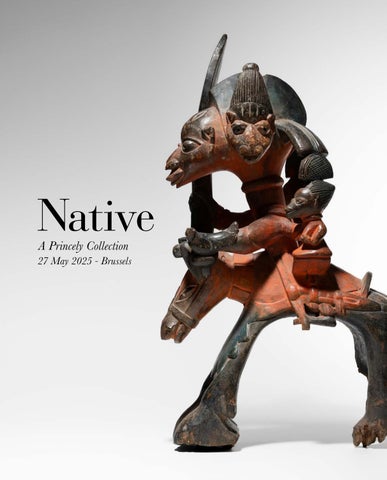
Native A Pr incely Col lect ion - 27 May 2025 - Br ussels
www.native-auctions.com
Native A Princely Collection
27 May 2025 - Brussels
Native Auctions Preview & Auction Rue Américaine, 26 - 28 1060 Brussels Office Ruisbroeck Galerij 5 Galerie de Ruysbroeck 5 1000 Brussels
info@native-auctions.com T +32 (0) 2 514 04 42 Nicolas Paszukiewicz n.paszukiewicz@native-auctions.com Sébastien Hauwaert s.hauwaert@native-auctions.com Gilles Marquenie g.marquenie@native-auctions.com
A Princely Collection 27 May 2025 - Brussels Auction 27 May 2025 19.00
Preview 22 - 26 May 2025 10.00 - 18.00 27 May 2025 10.00 - 16.00
01.
A Ceremonial Paddle Austral Islands, French Polynesia Raivavae Island Wood, 138 cm Provenance: Sotheby's, London, Tribal Ar t, 24 June 1985, lot 3 Wayne Heathcote, Brussels / New York / London Sotheby's, New York, African and Oceanic Ar t, 15 November 20 02, lot 177 Proper ty from a Princely Collec tion
€ 10 000 - 15 000 This exceptional wooden ceremonial paddle hails from the small island of Raivavae. Its sur face is densely covered in a pattern of intricate car vings with geometric motifs and and a series of tiki figures on the central ridge of the blade. While the precise cultural role of such paddles in the society of the 180 0s remains uncer tain, they probably ser ved as ceremonial wands used during ceremonial dances. Most paddles from the Austral Islands date back to the period between 1820 and 1840. By 1842, the population of Raivavae had plummeted to a mere 360 people, a devastating loss that drastically reduced the number of skilled woodcar vers.
02.
Fish Hook Marquesas Islands Wood and coconut fiber string, 30 cm Provenance: Acquired between 1882 and 1891 by Doc tor Alphonse Long (1852-1923) Christie's, Paris, Ar t africain et Océanien, 11 June 2012, lot 122 Proper ty from a Princely Collec tion
€ 5000 - 7000
03.
Yaqona Bowl Fiji Islands Wood, 10 x 25 cm Ø Provenance: Daniel Blau Collec tion, Munich Christie’s, Paris, Ar t Océanien: Objets de Curiosité provenant de la collec tion Daniel Blau, 13 December 2011, lot 20 Proper ty from a Princely Collec tion
€ 10 000 - 15 000 This elegant dish is remarkable for the finesse of its engraved decoration. A rare feature, this decoration is also applied to the underside of the dish. Dishes of this type were used on impor tant religious occasions, such as the invocation of a god, or any attempt to interac t with him. Priests and chiefs would gather in the temple dedicated to that god and star ting the day with the of fering of yaqona, a moment during which silence must reign before prayers are recited. Yaqona is an infusion prepared from the narcotic roots of the Piper methysticum plant and ser ved in an ornate dish car ved from the sacred wood of the vesi. The god then takes possession of one of the priests and uses him to address the tribe.
04.
Santa Cruz Islands Male Figure Solomon Islands Wood, 31 cm Provenance: Acquired by Roger Lefevre in 1986 Wayne Heathcote, London Christie's, London, Tribal Ar t, 28 June 1988, lot 144 Private collec tion Sotheby's, Paris, Ar ts d'Afrique et d'Océanie, 14 December 2011, lot 82 Proper ty from a Princely Collec tion Published: ‘L’oeil’ Une illustre collec tion, Galerie Jean-Baptiste Bacquar t, Paris, Parcours des mondes, 2018, cat.26, pp.75-77 (ill.) Exhibited: Paris, Galerie Jean-Baptiste Bacquar t, The Eye: an Illustrious Collec tion, 11 - 16 September 2018, cat.26 (ill.)
€ 10 000 - 15 000 The statuar y of the Santa Cruz Islands constitutes one of the rarest and most distinc t bodies of ar t in Melanesia. This corpus, studied by William H. Davenpor t (Santa Cruz Island Figure Sculpture, 20 05), consists of a mere 55 early specimens - including this one. They were mainly collec ted on the nor thern coast of Nendö Island in the late 1920s by Reverend West, a member of the Melanesian Mission. The statuette presented here is the last to have been collec ted in 1986, by Roger Lefevre. Called munge-dunka (divine ef figy) by the inhabitants of Santa Cruz, these statuettes, ranging in size from 25 to 50 cm, represent guardian deities. Honored on domestic altars, they were the objec t of an impor tant cult. They are most of ten charac terized by an impressive conical headdress stretching horizontally across the back, reminiscent of the wicker and bark cloth headdress worn by notables at festivals. The small holes, drilled here along the length of the headdress and in the nose, were used to attach ornaments. The notch around the waist and the shade of the patina indicate that this statuette was originally dressed. The deep, shaded, slightly grainy brown patina attests to its great age and prolonged ritual use. Most of these sculptures now belong to museum collec tions: the British Museum, London; Museum der Kulturen, Basel; Barbier-Mueller Museum, Geneva; Bishop Museum, Honolulu.
05.
Large Model of a Maori War Canoe - Waka Taua New Zealand Wood, 177,8 cm Provenance: Sotheby's London, 8 July 1974, lot 60 Georges Plouvier, Brussels / Paris Loudmer & Poulain, Paris, Ar ts Primitifs - Collec tions De Deschiron, Pinto, Rasmussen, Arman, De Bailliencour t et Divers Amateurs, 8 June, 1978, lot 269 Sotheby's, New York, African, Oceanic and Pre-Columbian Ar t, 15 May 20 09, lot 195 Proper ty from a Princely Collec tion Published: Charles W. Mack, Polynesian Ar t at Auc tion, Mack-Nasser Publishing, Inc., Nor thboro, 1982, pp.116 -117, n°3 (ill.)
€ 10 000 - 15 000 This finely craf ted scale model represents a waka taua, the grand war canoes of the Maori people of New Zealand. The full-sized canoes were the largest and most prestigious of their kind, reaching up to 30 meters in length. Car ved from the massive, straight trunks of Nor th Island pines, their hulls were hollowed with great skill and reverence. These vessels were used to carr y warriors and were considered tapu—sacred —meaning they were stric tly reser ved for men and could not transpor t women or common goods such as food. This par ticular model stands out for its exceptional level of craf tsmanship and preser vation. The prow, or tauihu, is richly ornamented with openwork takarangi spiral motifs and features a prominent figure with tongue extended in a bold gesture of defiance, arms swept back in dramatic motion. Just behind, facing into the hull, is a second figure identified as the storm god Paikea, believed to control the winds and ensure the vessel’s safe passage. All original thwar ts (taumanu) are preser ved, each delicately car ved, with the central one featuring a stylized tiki figure. This model waka taua stands out for both its superb craf tsmanship and remarkable preser vation.
06.
Important Umeke la'au Hawaiian Islands Kou Wood, 56 cm Ø, 33 cm high Provenance: Mme Kealoha Wright (mother of William B. Wright), Hawaii Noble family (ali'i) of Prendergast, Hawaii Sotheby's, Paris, African & Oceanic Ar t, 4 December 20 08, lot 56 Proper ty from a Princely Collec tion
€ 20 000 - 30 000 As well for its beautiful volume as its natural patina, this bowl is distinguished by its name: “Punapuna”. The tradition of naming impor tant objec ts, especially precious poi bowls, dates back to ancient Hawaiian times, and most have been lost or forgotten. Here, it refers to the ideal consistency of the best quality poi (a starchy dish lef t to ferment for one or two days). It comes from an impor tant aristocratic ali'i family - the Prendergast - whose origins date back to the first period of the monarchy (around 1860), and in par ticular to Mrs. Keoloha Wright, mother of William B. Wright. A 19th-centur y album preser ved by the family shows - linked by annotations in pen - photographs of Mr. and Mrs. Wright, and the name of the bowl. On Oc tober 22, 1953, the Honolulu Star Bulletin, in an ar ticle entitled: “Mainly about people: Prendergast Collec tion Includes Priceless Hawaiian Treasures”, published a photograph of Mar y Prendergast in her Honolulu home, leaning over this family album that opened with a photograph of her grandmother Keoloha Wright, posing in front of a superb collec tion of antique Hawaiian objec ts, including the Punapuna bowl.
07.
Hawaiian Spear - Ihe Laumeki Hawaii, c.180 0 Wood, 177 cm Provenance: Michael Graham Stewar t Collec tion, London / Auckland Sotheby's, New York, African, Oceanic and Pre-Columbian Ar t, 14 May 2010, lot 70 Proper ty from a Princely Collec tion
€ 20 000 - 30 000 This barbed fighting spear, or ihe laumeki, is a fine example of this rare type of Hawaiian weapon. Ihe laumeki are well documented in sources from the late 18th and early 19th centuries. Captain James King described them in his account, writing, “Their instruments of war are spears […] the spears are of two sor ts, and made of a hard solid wood, which has much the appearance of mahogany. One sor t is from six to eight feet in length, finely polished, and gradually increasing in thickness from the extremity till within about half a foot of the point, which tapers suddenly, and is furnished with four or six rows of barbs. It is not improbable that these might be used in the way of dar ts.” (James Cook and James King, A Voyage to the Pacific Ocean […] 1776 -1780, London, 1784, vol. III, pp. 151-152). Steven Hooper adds that “traditional weapons continued in use in Hawaii into the first decade of the nineteenth centur y, but by 1810 Kamehameha, a power ful chief from Hawai’i Island, had managed to achieve ascendancy in all the islands through a combination of diplomacy, intimidation and conquest […]” (Steven Hooper, Power and Prestige: The Ar t of Clubs in Oceania, Milan, 2021, p. 127). As a result, and with “no ongoing wars among Hawaiians” (ibid., p. 128), the once-ubiquitous arsenal of spears, daggers, shark-tooth clubs, and stones gradually faded from use by the early 19th centur y.
08.
Hawaiian Food Bowl - Ipukai Hawaii Kou wood, 22 x 41 cm Ø Provenance: Everett Rassiga, Budapest and New York Sotheby's, New York, African, Oceanic and Pre-Columbian Ar t, 16 May 20 08, lot 36 Proper ty from a Princely Collec tion
€ 10 000 - 15 000 Calabashes Are Hawaii's Treasure. Wooden Bowls, Especially if Old and Patched, Are Ver y Highly Prised... ‘They are the gold and diamonds of the Hawaiian people’, an old Hawaiian told the Fire Commissioners who are fixing the value of proper ty destroyed in the Great Fire of 190 0. The woman was referring only to the calabashes which she had lost in the fire, and not to any precious jewelr y or metals, for there are no minerals to be found in the islands. Newspaper clipping from the turn of the 19th C. [1] These few lines summarize beautifully the impor tance of the Hawaiian umeke or wooden bowls. Mainly used as recipients for poi - the main food staple in the islands - and a diversity of other foods, Hawaiian bowls, especially those made of kou wood, were reser ved for the ali’i (royalty). Umeke come in a wide variety of shapes and sizes, but most of ten their shape is similar to that of the hollowed-out gourd or coconut containers used by the maka’ainana (commoners). By the end of the 19th centur y, the kou tree was almost extinc t due to a plague of the so-called kou leaf worm (Ethmia nigroapicella), and ended what William Brigham described as Hawaii's "Age of Wood”. Nowadays, the kou tree has made a comeback, but its size never reaches that of the old kou trees that allowed for the highly valued bigger vessels. [1] Ir ving Jenkins, The Hawaiian Calabash, Editions Limited, Honolulu, 1989, p.23
09.
Maori Hand Club - Kotiate Maori, New Zealand Whalebone, 34 cm Inscribed on verso: New Zealand / Hooper Coll. N°57S Provenance: James T. Hooper Collec tion, London / Arundel (acquired in Crediton in 1929) Christie’s, London, Hawaiian and Maori Ar t from the James Hooper Collec tion, 26 June 1977, lot 85 Barbara and Joe Abensur Collec tion, London Galerie J-B Bacquar t, Paris (2012) Proper ty from a Princely Collec tion Published: Charles W. Mack, Polynesian Ar t at Auc tion, Mack-Nasser Publishing, Inc., Nor thboro, 1982, pp.154-155 Steven Phelps, Ar t and Ar tifac ts of the Pacific, Africa and the Americas, The James Hooper Collec tion, Hutchinson [for Christie, Manson & Woods], London, 1976, p.55, cat.213 ‘L’oeil’ Une illustre collec tion, Galerie Jean-Baptiste Bacquar t, Paris, Parcours des mondes, 2018, cat.66, pp.179-181 (ill.) Exhibited: Paris, Galerie Jean-Baptiste Bacquar t, The Eye: an Illustrious Collec tion, 11 - 16 September 2018, cat.66 (ill.)
€ 10 000 - 15 000
10.
Tongan Comb Tonga Islands Vegetal fibers, 27 cm Provenance: Daniel Blau Collec tion, Munich Christie’s, Paris, Ar t Océanien: Objets de Curiosité provenant de la collec tion Daniel Blau, 13 December 2011, lot 37 Proper ty from a Princely Collec tion
€ 1000 - 1500
11.
Upper Sepik War Shield Upper Sepik River (Eastern Sepik), Papua New Guinea Polychromed wood, 198 cm Provenance: Ingeborg de Beausacq Collec tion, New York Julius Carlebach Collec tion, New York Josefa Carlebach Collec tion, New York Christopher and Anna Thorpe Collec tion, Sydney Sotheby's, Paris, Ar ts d'Afrique et d'Océanie, 12 July 2012, lot 115 Proper ty from a Princely Collec tion
€ 4000 - 6000 German-born American photographer and explorer Countess Ingeborg de Beausacq (1910 -20 03) lef t Europe in 1939 for Brazil, then settled in New York in 1948. On the advice of Julius Carlebach, she lef t for New Guinea in 1957, where she spent a year and a half sharing the life of the natives, photographing their initiation rites and writing their histor y. She collec ted numerous works of ar t and shipped them to New York, many of which are now housed in American museums. A 1959 photograph shows the Countess surrounded by the objec ts collec ted during her expedition, with our shield in the background. Two other shields show clear stylistic similarities, one in the Volkerkunde Museum, Berlin (c f. Heinz Kelm, Kunst vom Sepik, 1966, Vol.2, pl.188) and the other in the Museum fur Volkerkunde, Frankfur t am Main (c f. Sepik, Kunst aus New Guinea, Museum fur Volkerkunde Frankfur t am Main, 1964, p.107).
12.
Flywhisk, Fue'afa Samoa Islands Wood and coconut fibers, 66 cm (handle: 26,5 cm) Provenance: Ursula Voorhuis, Berg & Dal Nijmeegs Volkenkundig Museum (inv.1494, acquired 29 September 1976) Michel Thieme, Amsterdam Daniel Blau Collec tion, Munich Christie’s, Paris, Ar t Océanien: Objets de Curiosité provenant de la collec tion Daniel Blau, 13 December 2011, lot 36 Proper ty from a Princely Collec tion
€ 10 000 - 15 000 The fly whisk from the former Daniel Blau collec tion is remarkable for the imposing size of its handle and the length of its par tially braided coconut fibers. It is unusual to find a Fue'afa in private hands in near-per fec t condition.
13.
Ula Throwing Club Fiji Islands Wood, 45 cm Provenance: Daniel Blau Collec tion, Munich Christie’s, Paris, Ar t Océanien: Objets de Curiosité provenant de la collec tion Daniel Blau, 13 December 2011, lot 31 Proper ty from a Princely Collec tion
€ 6000 - 8000 A warrior people at their core, the Fijians had a wide range of weapons at their disposal. Among these, the ula club held a special place. Fiji's principal and most formidable weapon, these skilfully-wielded projec tiles were used to breach opposing ranks, catch escapees, and engage in hand-to-hand combat. To prepare for any emergency, ever y warrior carried at least one ula on his belt at all times, even in his village. Of extraordinar y craf tsmanship, this club is notable for the incised decoration under the mace of the weapon.
14.
Nguni Pipe Bowl Southern Nguni peoples, East Cape Province, South Africa Possibly 180 0s Nephrite, 6 cm Provenance: Lance Entwistle, London (20 09) Proper ty from a Princely Collec tion
€ 8000 - 12 000 This exquisite and rare pipe bowl, craf ted from translucent green nephrite and polished to a high sheen, hails from South Africa's Eastern Cape Province, home to the Nguni peoples. Originally, it would have had a stem made of wood, reed, or another perishable material. Likely inspired by stone pipes introduced by Dutch settlers in the 17th centur y, these nephrite pipe bowls were symbols of status and prestige. Beyond their prac tical use, pipes made from rare, refined materials like this one also ser ved as markers of rank and wealth. A similar pipe bowl belongs to the collec tion of the Cleveland Museum of Ar t (inv.2012.42)
15.
Maori Paddle Club - Pouwhenua New Zealand Wood, 187 cm Provenance: Wayne Heathcote, Brussels / New York / London Sotheby's, New York, African and Oceanic Ar t, 15 November 20 02, lot 191 Proper ty from a Princely Collec tion
€ 10 000 - 15 000 The elegantly shaped pouwhenua is a highly ef fec tive weapon in the hands of a skilled user. Its rau (blade) is larger and heavier than that of a taiaha, and the opposite end tapers to a stabbing point. This gorgeous 19th-centur y example is embellished by two car ved tiki figures beneath the rau, and a decorative band toward the lower par t.
16.
Vanikau Club With Inlays Fiji Islands Wood and ivor y, 109 cm Provenance: Daniel Blau Collec tion, Munich Christie’s, Paris, Ar t Océanien: Objets de Curiosité provenant de la collec tion Daniel Blau, 13 December 2011, lot 27 Proper ty from a Princely Collec tion
€ 8000 - 12 000
17.
Vanuatu Hat Vanuatu, New Hebrides Wicker work, bark, and pigments H: 25 cm, L: 27 cm Provenance: Antony Innocent "Père" Moris (1866 -1951) Collec tion, Paris Bernard and Ber trand Bottet Collec tion, Nice Christie's, Paris, Ar t Océanien, Africain et d'Amérique du Nord: Collec tion Bottet et à divers amateurs, 14 June 2011, lot 70 Proper ty from a Princely Collec tion Literature: Raoul Lehuard, La collec tion du Père Moris, in Ar ts d'Afrique Noire, No. 46, Summer 1983, p.36 (Photograph taken by Charles Ratton in the apar tment of Père Moris where we can see the headdress on top of a Yoruba post)
€ 4000 - 6000 Made from fibers, wood, beaten bark, and natural pigments, this headdress was worn during rituals organized by a secret society. Once disguised, the wearer represented a spirit. Hats of this type are extremely rare: a similar hat belongs to the British Museum's collec tion (inv. Oc,+.1305), and another one to the Grassi Museum für Völkerkunde in Leipzig (inv. Me 05314).
18.
Bamana Mask - Kono Society Mali, 19th c Wood, 97 cm Provenance: Acquired during François Di Dio's “Mission ethnographique en pays Dogon”, commissioned by Pierre Loeb and René Rasmussen in 1956 Pierre Loeb Collec tion, Paris Sotheby's, Paris, Collec tion Florence Loeb - Sources et Af finités, 5 April 2012, lot 27 Proper ty from a Princely Collec tion Published: ‘L’oeil’ Une illustre collec tion, Galerie Jean-Baptiste Bacquar t, Paris, Parcours des mondes, 2018, cat.34, pp.98-99 (ill.) Exhibited: Paris, Galerie Jean-Baptiste Bacquar t, The Eye: an Illustrious Collec tion, 11 - 16 September 2018, cat.34 (ill.)
€ 6000 - 7000 Kono masks are typically polymorphic, combining the features of various power ful spirits or forces of nature. In the case of the mask in this lot, it likely merges the traits of the hyena (symbolizing wildness, with long ears) and the elephant (symbolizing wisdom and intelligence). The priests must influence these spirits favorably. In Bamana. The Ar t Of Existence in Mali (Ghent, Snoeck-Ducaju & Zoon, 20 02, p.186) Jean-Paul Colleyn writes "For the Bamana, the Kono is a 'devouring wild beast,' but they also understand that its ver y power lies in its ability to take on multiple forms and endlessly reshape itself."
19.
Senufo Bird - Sejen Ivor y Coast Wood, 38 cm Provenance: Jacques Kerchache Collec tion, Paris Michel Propper Collec tion, Paris Christie’s, Paris, Ar t africain et océanien, 13 December 2011, lot 266 Proper ty from a Princely Collec tion Published: Jacques Kerchache, Jean-Louis Paudrat, Lucien Stéphan, L'ar t africain, Mazenod, Paris, 1988, fig.331
€ 10 000 - 15 000
20.
Senufo Ceremonial Staff Ivor y Coast Wood, 142 cm Provenance: Sotheby’s, Paris, Ar ts d'Afrique et d'Océanie, 15 June 2011, lot 65 Proper ty from a Princely Collec tion
€ 20 000 - 30 000 Most ceremonial canes have had their shaf ts sawn of f, leaving only the top statuette. However, this par ticular cane has been preser ved in its entirety, allowing us to fully appreciate the elegant balance of forms as originally intended by its sculptor. The figure represents an unmarried woman at the peak of her beauty. She is positioned asymmetrically, with one hand resting on her knee and the other holding a bowl on her head. The overall composition contrasts dynamic upward and downward movements, rhythmically marked by the interplay of round and angular shapes, solid forms, and open spaces. The ceremonial tefalipitya cane was awarded to crop champions in each new generation of Poro initiates. It promises the winner not only a beautiful bride but also abundant har vests. The closed receptacle, ver y rare and topped with a bird, dominates the composition as a symbol of these rewards.
21.
Guro Ram Mask Ivor y Coast Wood and pigment, 24 cm Provenance: Private collec tion, Olten, Switzerland Galerie Patrik Frölich, Zürich Proper ty from a Princely Collec tion Published: ‘L’oeil’ Une illustre collec tion, Galerie Jean-Baptiste Bacquar t, Paris, Parcours des mondes, 2018, cat.42, pp.118-119 (ill.) Exhibited: Paris, Galerie Jean-Baptiste Bacquar t, The Eye: an Illustrious Collec tion, 11 - 16 September 2018, cat.42 (ill.)
€ 6000 - 8000
22.
Baule Monkey Cup-Bearer Ivor y Coast Wood, 34 cm Provenance: Sotheby's, Paris, Ar ts d'Afrique et d'Océanie, 14 December 2011, lot 25 Proper ty from a Princely Collec tion
€ 10 000 - 15 000 Among the corpus of Baule bowl-bearing monkey figures, the one presented here stands out by its relatively small size, and even more for the quality of its sculpture. The thick, crusty patina, with remnants of sacrificial material (down), reflec ts the numerous of ferings and potency of this amwin, an “objec t of power” belonging to the initiator y society whose authority it reflec ted.
23.
Guro Heddle Pulley Ivor y Coast Wood, 18 cm Provenance: Christie’s, Paris, Ar t Africain et Océanien, 13 December 2011, lot 255 Proper ty from a Princely Collec tion Published: ‘L’oeil’ Une illustre collec tion, Galerie Jean-Baptiste Bacquar t, Paris, Parcours des mondes, 2018, cat.49, pp.138-139 (ill.) Exhibited: Paris, Galerie Jean-Baptiste Bacquar t, The Eye: an Illustrious Collec tion, 11 - 16 September 2018, cat.49 (ill.)
€ 2000 - 3000
24.
Dan/Mano Miniature Mask Liberia Wood, 13,5 cm Provenance: Collec ted in 1952-1954 in Eastern Liberia by Hayden (1916 -1981) and Odette (1921-2010) Walling Thence by descent Sotheby's, Paris, Ar t d'Afrique et d'Océanie, 14 December 2011, lot 3 Proper ty from a Princely Collec tion
€ 7000 - 10 000
25.
Senufo Headress - Kwonro Ivor y Coast Wood, raf fia, and pigments, 120 cm Provenance: Private collec tion (acquired in Paris in 1985) Sotheby's, Paris, Ar ts d'Afrique et d'Océanie, 14 December 2011, lot 14 Proper ty from a Princely Collec tion
€ 10 000 - 15 000 As par t of the Poro institution - a pillar of Sénufo community life – the rare k wonro masks are ritually linked to the eponymous initiation grade, marking the passage from the class of adolescents to that of adults. Their iconography evokes elements of Senufo my thology - in this case, a crocodile and a male figure in the center, and a frieze of chameleons at the top. It is distinguished by the representation - unique to our knowledge - of a female figure dominating the composition, probably evoking Katiéléo, “mother of the village”.
26.
Nuna Spoon with Antelope Head Burkina Faso Wood, 22 cm Provenance: Collec tion Thomas G.B. Wheelock, New York Sotheby’s, Paris, Ar ts d'Afrique et d'Océanie, 15 June 2011, lot 49 Proper ty from a Princely Collec tion Published: Ir win Hersey, Ar t from the Sahel: an exhibition of traditional ar t and craf ts from the Sahelian states of Chad, Mali, Mauritania, Niger, Senegal and Upper Volta, New York, African-American Institute, 1974, p.4, n° F- 60 T. Grace and Thomas Wheelock, Ar t from Upper Volta, For t Collins, 1975, p.7, n° 48 Norman Skougstad, Traditional Sculpture from Upper Volta, New York, The African-American Institute, 1978, p.37, cat. 35 Warren M. Robbins, Traditional Sculpture from Upper Volta, 1979, p.10, n° 84 Barna, "Collec ting: Gathering Force" in House and Garden, vol. 158, n°4, April 1986, p.104 Christopher Roy, Ar t of the Upper Volta Rivers, Alain et Françoise Chaf fin, éditeurs, Meudon, 1987, p. 67, cat.35 Christopher Roy and Thomas Wheelock, Land of Flying Masks: Ar t & Culture in Burkina Faso, the Thomas G. B. Wheellock Collec tion, Prestel Verlag, Munich – Berlin – London – New York, 20 07, cat.464 (ill.) Exhibited: New York, The African-American Institute, Ar t from the Sahel: an exhibition of traditional ar t and craf ts from the Sahelian states of Chad, Mali, Mauritania, Niger, Senegal and Upper Volta, Februar y - April 1974, For t Collins, Colorado State University, Ar t from Upper Volta, 1975 New York, The African-American Institute, Traditional Sculpture from Upper Volta, 24 Oc tober 1978 - 24 March 1979 Washington D.C., The Museum of African Ar t, Traditional Sculpture from Upper Volta, Summer 1979
€ 10 000 - 15 000
27.
Bwa Butterfly Mask Burkina Faso Wood and pigment, 246 cm Provenance: Acquired in Dossi by Marie-Ange Ciolkowska, late 1950s René Rasmussen, Paris Loudmer et Poulain, Paris, Succession René Rasmussen, 14 December 1979, lot 9 John and Marcia Friede Collec tion, Rye Thomas G.B. Wheelock Collec tion, New York Sotheby's, Paris, 12 June 2012, lot 57 Proper ty from a Princely Collec tion Published: Jürgen Zwernemann, “Masken der Bobo-Ule und Nun am Hamburgishen Museum für Völkerkunde”, in Mitteilungen aus dem Museum für Völkerkunde Hamburg, n°8, 1978, p.55, fig.6 Tom Phillips, Africa, the Ar t of a Continent, 10 0 Works of Power and Beauty, Prestel, Munich/New York, 1996, pp.160 -161, cat.83 Alisa LaGamma, Genesis. Ideas of Origin in African Sculpture, New York /New Haven, The Metropolitan Museum of Ar t / Yale University Press, 20 02, p.62, cat.25 John III Pember ton, Genesis, “Ideas of Origin in African Sculpture”, in African Ar ts, vol. X X X VI, Spring 20 03, p.84 Christopher Roy & Thomas G.B. Wheelock, Land of Flying Masks: Ar t & Culture in Burkina Faso, the Thomas G. B. Wheelock Collec tion, Prestel, 20 07, p. 231, cat.175 Exhibited: New York, Guggenheim Museum Africa: The Ar t of a Continent, 10 0 Works of Power and Beauty, 7 June - 29 September 1996, cat.83 New York, Metropolitan Museum of Ar t, Genesis: Ideas of Origin in African Sculpture, 19 November 20 02 - 6 July 20 03, cat.25
€ 200 000 - 300 000
Bwa masks of ten represent animals integral to the stories of the clan's founding ancestors. Among these, the "butter fly" (yehoti) stands out as the most spec tacular type of mask, especially in clans situated around Dossi and Boni. This mask was acquired in situ by Marie-Ange Ciolkowska in the 1950s and found its way to some of the most prestigious collec tions in its histor y: from René Rasmussen over John and Marcia Friede, to Thomas Wheelock, and to its last owner. It exemplifies the pinnacle of aesthetic abstrac tion, blending formal beauty with an intricate, multicolored design. The impressive, gracefully cur ved wings – the mask is one of the largest known - are paired with elaborate detailing that showcases remarkable craf tsmanship. The design's visual intensity is heightened by a continuous flow of ten concentric circles, which merge seamlessly with one another, extending beyond the mask ’s boundaries. The central face of the butter fly commands attention, projec ting outward, framed by three pairs of eyes. On the back side of the mask, a checkerboard motif is present. This pattern draws from the tradition where young initiates are given a new white goatskin to sit on during ceremonies af ter completing their rites. Over time, as they transition into elder roles, the goatskin darkens with use, symbolizing the bond between the community's youth and its elders.
28.
Kassena Flute Burkina Faso Wood and vegetal fibers, 38 x 11,5 cm Provenance: William Wright, New York Collec tion Thomas G.B. Wheelock, New York Sotheby’s, Paris, Ar ts d'Afrique et d'Océanie, 15 June 2011, lot 48 Proper ty from a Princely Collec tion Published: Mar tha G. Anderson & Christine Mullen Kreamer, Wild Spirits, Strong Medicine: African Ar t and the Wilderness [Exhibition catalog], University of Washington Press, 1989, p.118, cat.74 Christopher Roy & Thomas G.B. Wheelock, Land of Flying Masks: Ar t & Culture in Burkina Faso, the Thomas G. B. Wheelock Collec tion, Prestel, 20 07, cat. 430 Exhibited: New York, Center for African Ar t, Wild Spirits, Strong Medicine: African Ar t and the Wilderness, 10 May - 20 August 1989 [Travelling exhibition continued to Evanston, Illinois, Block Ar t Galler y, Nor thwestern University, 21 September 22 November 1989; Coral Gables, Florida, Lowe Ar t Museum, The University of Miami, 14 December 1989 - 28 Januar y 1990; Columbus, Ohio: The Columbus Museum of Ar t, 18 Februar y - 30 April 1990; Worcester, Massachusetts: The Worcester Ar t Museum, 15 September - 1 December 1990], cat.74
€ 10 000 - 15 000 Rare Kassena flute of the archaic type. The incised linear and dotted decorations are smoothed down by layers of sur face encrustation, testif ying to its age and use. Flutes like these were known to be used during fer tility rites.
29.
Yoruba Horse Rider Nago, Benin Wood, 47,5 cm Provenance: Private collec tion, Brussels Sotheby's, Paris, 14 December 2011, lot 35 Proper ty from a Princely Collec tion Published: Lumière noire, Ar ts traditionnels [exhibition catalog], Yonne, Chateau de Tanlay-Centre d'Ar t Contemporain, 1997, cat.39 La Caixa, Africà: Magia y Poder, 250 0 años de ar te en Nigeria, 1998, p.142, cat.127 George Chemeche, The Horse Rider in African Ar t, Antique Collec tors' Club/George Chemeche, Woodbridge, 2011, p.137 Exhibited: Yonne, Centre d'art de Tanlay, Lumière noire, Arts traditionnels, 7 June - 5 September 1997, cat.39 Barcelona, Fundación "La Caixa", Africà: Magia y Poder, 250 0 años de ar te en Nigeria, 23 August - 13 December 1998, cat.127 C14 tested and dated late 18th, early 19th c (CIRAM, Oc tober 2011)
€ 200 000 - 300 000
This extraordinar y Yoruba/Nago equestrian altar statue stands out both for its ar tistic excellence and for its rarity. Aside from the well-known Gelede crests and Ibeji twins, ver y few altar statues from the southwestern Oyo Empire are known, making this piece even more remarkable. The theme of the equestrian warrior in Yoruba culture dates back to the latter half of the 18th centur y, a time when the palace of the Alaafin—the king of Oyo-Ile —was at the hear t of a vast empire. This empire stretched from the borders of the Nupe people to the kingdom of Benin in the east, the Ijebu and Ketu kingdoms along the southern coast, and all the way southwest, where Oyo forces clashed with the armies of the Dahomey chiefdoms. While Oyo soldiers predominantly traveled on foot, they also attempted to use horses, inspired by the ef fec tiveness of the Fulani cavalr y in nor thern battles. However, the Oyo cavalr y faced a significant challenge in the form of the tsetse fly, which decimated horses in the forests and plains of the central and southwestern regions. Despite this, the symbolism of equestrian power remained a power ful image for Yoruba sculptors. The Oyo Empire's militar y campaigns in the southwest were largely driven by the need to secure vital trade routes, par ticularly one leading from Oyo-Ile to the coast, with Por to Novo being a key por t where European ships frequently docked. The patron deity of Oyo was Shango, the god of thunder, who was believed to be the four th deified king of Oyo-Ile. Priests of Shango, along with their followers, accompanied the Alaafin’s armies and established altars to honor the god during their conquests. This equestrian statue likely represents a follower of Shango. The central figure, with its commanding face and prominent head, is flanked by two additional heads that project to the left and right. This design mirrors the oshe shango, a dancing stick carried by Shango devotees during rituals and festivals, where the two prominent "lightning bolt" symbols at the top of the staff represent Shango’s power to strike with thunderbolts at those who defy him. Beyond its connec tion to Shango, the statue also suggests a link to Ogun, the orisha of iron and war. The spiral of hair connec ting the central figure to the two smaller female figures on the horse evokes the image of the hunter, a common theme in warrior sculptures. The rider holds a spear in his lef t hand, and the horse is elegantly adorned with a finely craf ted leather blanket. Stylistically, the statue’s facial features recall those of the Ango Gelede crest: elongated, narrow faces with almond-shaped eyes and sharply angled ears, adding a distinc t and striking charac ter to the piece. This masterpiece is the work of an exceptionally skilled sculptor, whose remarkable ar tistic vision brings both power and grace to life in a single striking figure.
30.
Yoruba Ibeji Figure Nigeria Wood, beads, and metal, 23,5 cm Provenance: Yann Ferrandin, Paris Xavier Richer Collec tion, Paris (acquired c.1995) Sotheby's, Paris, Ar ts d'Afrique, d'Océanie, 18 June 2013, lot 89 Proper ty from a Princely Collec tion Published: Galerie Flak, Ibeji, Le Culte des Jumeaux, Paris, 20 01, p.45
€ 4000 - 6000
31.
Zoomorphic Fon Recade Benin, Abomey Wood and metal, 49 cm Provenance: Acquired by Mr. Gouiche in Dahomey, c.1894 Thence by descent Sotheby's, Paris, Ar ts d'Afrique et d'Océanie, 11 December 2013, lot 17 Proper ty from a Princely Collec tion
€ 4000 - 6000 This royal scepter (known among the Fon peoples as makpo, or staf f of fur y) ser ved as an objec t of power and prestige to rulers of the Kingdom of Danhomè. Personalized by the symbolic motif of the blade, they recall sentences pronounced by the ancient kings of Abomey. In the one presented here, the motif of the shark alludes to King Béhanzin (1889-1894) words "Gbohwélé fan adan bo agbédji gnonion": when the shark is angr y, the ocean is calm. Makpo from Béhanzin are relatively rare, but the elegant shape and decoration with metal rings and silver highlights that enhance the reddish-brown patina of the shaf t make this makpo truly outstanding.
32.
Akan Royal Seat Ghana Wood and brass, 31 x 46 cm Provenance: Collec tion Léonce & Pierre Guerre, Marseille Collec tion Alain et Christine Vidal-Naquet, Marseille Sotheby’s, Paris, Ar ts d'Afrique et d'Océanie, 15 June 2011, lot 8 Proper ty from a Princely Collec tion Published: André Blandin, Afrique de l’ouest. Bronzes et autre alliages, André Blandin, Marignane, 1988, p.176 Pierre Guerre. Un érudit en son temps [exhibition catalog], Musée d'Ar ts Africains, Océaniens, Amérindiens, Marseille, 1992, p.87, cat.26 Marguerite de Sabran, Yves-Jacques Cabasso, Ar t Africain dans la collec tion Pierre Guerre, A.F.A.A., South African National Galler y, Cape Town, 1997, p.92, cat.32 Exhibited: Musée d'Ar ts Africains, Océaniens, Amérindiens, Centre de la vieille Charité, Marseille, Pierre Guerre, un érudit en son temps, 20 March - 31 May 1992, cat.26 South African National Galler y, Cape Town, Ar t Africain dans la collec tion Pierre Guerre, 1997, cat.32
€ 8000 - 12 000
33.
Yoruba Opon Offering Vessel in the Shape of a Hare Nigeria Wood, 50 x 26 cm Provenance: Walter Kaiser Collec tion, Stuttgar t (c.1980) Private collec tion Sotheby's, Paris, Ar ts d'Afrique et d'Océanie, 14 December 2011, lot 34 Proper ty from a Princely Collec tion
€ 20 000 - 30 000 In Yoruba tradition, the hare is a nocturnal animal, linked to the spirit world. Similar boxes are sometimes divided by a partition, suggesting their use for divination, but here the absence of such an internal partition and the theme of maternity, expressed by the leveret on the back, indicate its use for presentation purposes: as a jewelry box or a display case filled with kola nuts for guests - a custom often associated with wedding ceremonies and the concept of fertility. The sculptor has def tly avoided focusing on the objec t's sheer func tionality and instead focused on the animal's lively expression. A similar receptacle in the shape of a hare is to be found in the Munich Museum für Völkerkunde (inv. n° 80 -301 255).
34.
Yoruba Standing Female Figure Offering a Ram Nigeria Wood, 90 cm Provenance: Said to have been one of three sculptures (the others representing horsemen) formerly kept in the shrine of Shango at Koso Parke-Bernet Galleries, New York, April 22, 1965, lot 82 Harold Kaye, Great Neck Mer ton D. Simpson, New York Nancy and Richard Bloch, Rancho Santa Fe, acquired from the above in 1976 Sotheby's, New York, African Oceanic and Pre-Columbian Ar t including proper ty from the Pierre and Tana Matisse Foundation, 13 May 2011, lot 250 Proper ty from a Princely Collec tion Exhibited: Museum for African Ar t, New York, Animals in African Ar t: from the Familiar to the Mar velous, March 31, 1995 - December 31, 1995 [travelling exhibition continuing to Montgomer y Museum of Fine Ar ts, Montgomer y, Februar y 2 - April 1996; Joslyn Ar t Museum, Omaha, May 18 - July 14, 1996; The Mint Museum, Charlotte, September - December, 1996; Dallas Museum of Ar t, Dallas, Februar y 2 - April 27, 1997; Dallas Museum of Ar t, Dallas, permanent exhibition, April 28 - September 30, 1997 Published: Rober t Farris Thompson, Flash of the Spirit. African and Afro-American Ar t and Philosophy, New York, 1984, p.10, pl.6 Allen Rober ts, Animals in African Ar t: from the Familiar to the Mar velous, New York, 1995, p. 106, cat.2
€ 200 000 - 300 000
THE OYO SHANGO FEMALE SHRINE SCULPTURE FROM THE BLOCH COLLECTION In the Sotheby’s sales catalog of 2011, John Pemberton III (1928-2016), Crosby Professor of Religion, Emeritus, wrote the following on this statue: This splendid Yoruba sculpture is said to have been on the shrine for orisha Shango in Koso, a suburban hamlet to the west of the crowned town of Oyo. Koso is where the royal shrine for Shango is located, where the priests of Shango are initiated who in the past oversaw the organization of the Shango cult in the provincial towns, thereby providing the religious basis for the Alafin's authority during the period of the Oyo Empire (ca.1790 - ca.1836). The facial markings on the sculpture are of a type called abaja, which, as the Yoruba historian Samuel Johnson obser ves, "are those of the Royal Family of Oyo" (1969: 106). Fur thermore, her hair is styled in the five-cone pattern worn by queens and other women of royal stature. In the pantheon of Yoruba gods, Shango is of ten referred to as the god of thunder and lightning. His attributive names, oriki, by which he is addressed in praise songs, disclose his essential nature. Shango
is the one who has fire in his mouth and his eyes and scorches the metal roof tops; who does not answer when he is greeted; who is as tough as a dried yam; who strikes indiscriminately with his thunderbolts; who shatters trees and uproots the great iroko tree; who plunges a hot iron into his own eyes; who over turns the table of traders; who adds stones to the light load of a person; who tosses the stubborn into boiling water; who pursues kings and commoners. However, Shango has the oogun, "medicine," for remedying the suffering of women whose infant children repeatedly die, who are abiku, "children born to die." He is also the one who gives his beauty, the power to conceive, to the woman with whom he sleeps. And he is said to be the "father" and protector of twins. To be a follower of Shango is to suf fer the power of an unpredic table deity. It is to bear the burden of the ancient cults of the god, who hurls them with crackling lightning in the midst of thunderstorms. As lightning is said to be drawn to an objec t, yet strikes with apparent caprice, so Shango descends upon the world of humankind. His followers never theless praise him with the song: The dog stays in the house of its master But does not know his intentions. The sheep does not know the intentions Of the man who feeds it. We ourselves follow Shango, Although we do not know his intentions. It is not easy to live in Shango's company... I will pay homage to you, my father. Acting without paying homage ruins one's efforts. Acting, after paying due homage, brings one success. We see the marks on our palms, but we do not know who made them there.
In an oriki chanted by Ade Aniku in Olorionishango's compound in Ila-Orangun there is a play on the Yoruba term ori, the word for "head." There is an initial reference to her physical head, ori ode, and subsequently to her inner head or personal destiny, ori inu, as a devotee of Shango. The head that is eating eba, The head that is eating fish, The head that is eating snails, Shango, to you I return The head that is eating ram. Olodumari mi! (My Almighty One!) Shrine sculptures and ritual artifacts must be seen in the context of hearing the chants, prayers, and praise songs uttered by devotees and in witnessing acts of worship. The excellence of this shrine sculpture is that it is a superb expression of what it means to be a devotee of orisha Shango. The Yoruba would say that the artist who created it possessed an "inner eye,"oju inu, that is, insight into his subject matter. The devotee stands poised before her lord. Her physical beauty, ewa, is manifest in her coiffure, her erect body, composed face, and the fullness of her breasts. She has no need for external adornments beyond a single strand of coral beads around her neck and the wrapper around her waist. Her long arms and strong hands hold a ram with ease and grace. It is her offering to her lord, her act of homage. She possesses and is possessed by the ashe, the authority and strength of Shango.
In the pantheon of the Yoruba orisha each deity has his or her appropriate of fering or sacrifice. There are the orisha funfun, the gods of "whiteness," such as Obatala and Oshun, who receive, white pigeons, food made of grain or yam flour, the clear liquid of snails, water drawn from sacred rivers and pools, whose followers wear white cloth, brass bracelets and light colored beads. In contrast, Ogun, god of iron, the orisha of war and the hunt, feasts on the blood and flesh of the dog. It is a beligerent and carnivorous animal. His devotees wear red tunics and praise their god as one who can become intoxicated on the blood of the enemy and even turn in his frenzy upon his own followers. The ram of Shango also fights, but is a herbivorous animal. He prefers the foods of the orisha funfun, but is capable of killing. Hence, Shango's followers also eat the flesh of the sacrificed ram. His worshipers wear necklaces, bracelets, and tunics covered with red beads and cloth and white cowrie shells. There are times when blood must be shed in the defense of one's town or in establishing one's authority over the lives of others, or in giving bir th to a new life. The quality of this car ving of a Shango devotee is not only to be discerned in the ar tist's insight into his subjec t matter but also in his "eye for design,"oju-ona. The sculptural program is organized around the prominence of the long, ver tical line that moves from the five-cone coif fure to her neck and down her lean body to her strong, straight legs. It is echoed in the length of her arms which reach down to the ram, and in the grouping and exaggerated length of the legs of the ram. The prominence of the ver tical line is balanced by the diagonal line in the thrust of the woman's jaw and in the projec ting breasts, and is repeated again in her lower arms. The ver tical is also broken by the simple horizontal line of the beads around her neck, the fold of her belt beneath her breasts, and the horizontal pattern on the border of her skir t. The delicate geometric pattern on her skir t repeats a similar pattern which the ar tist uses in his image of the ram's coat. It is said that this sculpture was one of three on the Koso shrine. The other two were equestrian figures. We could not verif y the source of this
claim. However, the presence of two or more figures on a Shango shrine would not be unusual. Leo Frobenius' well-known photograph, taken in 1910 of the Agbeni Shango shrine in Ibadan shows numerous sculptures. There were eighteen on the palace Shango shrine of the Timi of Ede which Ulli Beier photographed in 1957 and Eliot Elisofon in 1970. Other shrines photographed by Beier in the town of Ilobu had two or more sculptures, usually of male equestrian figures and standing or seated female figures. When I photographed the Koso shrine in 1972 there were no sculptures on the shrine. I was told by an elder of the compound that there had once been sculptures, but they were no longer on the premises. Whether they were hidden away for safekeeping or had been sold or stolen, I did not learn. My initial response to identif ying the car ver or the workshop in which the sculpture was created was to study Beier's and Elisofon's photographs. The checking around the almond-shaped eyes and the definition of the ear would surely provide clues to an answer. The facial marks and the coif fure clearly suggested the Oyo region, but this is not always a valid approach. The facial marks may refer to where the person being memorialized (if such were the case, which is doubtful), may be those appropriate to a region other than Oyo from which the person came, and were the marks and style requested by the person who commissioned the car ving. The hatched marks and shape of the eyes were used by many car vers in the Oyo, Oshun and Igbomina areas. The design of the ear could reflec t the work of some car vers to the southwest of Oyo, such as in the Ibarapa region. One must never forget that objec ts and ideas travel, and so, too, do car vers who move from one town to another as they gain fame and are called upon, or from the necessity of needing to find employment of their skills other than in the workshop of their masters. Whatever the answer to the questions of car ver and workshop, it is surely the case that in this sculpture we have the work of a highly skilled car ver who was a master of his tools, ifarabale, and who was endowed with ar tistic imagination and sensitivity,imoju-more.
35.
Sango Reliquary Figure Gabon Wood, copper, and buttons, 17,8 cm Provenance: Christie's, New York, Impor tant Tribal Ar t, 20 November 1997, lot 53 Private collec tion, France (1997) Private collec tion, US Sotheby's, New York, African, Oceanic & Pre-Columbian Ar t, 14 May 2010, lot 134 Proper ty from a Princely Collec tion
€ 10 000 - 15 000
36. Bembe Cloth Reliquary Figure - Muzidi D.R. Congo Wood and cloth, 53,5 cm Provenance: Bernard de Grunne, Brussels Adam Lindemann, New York Sotheby's, New York, African & Oceanic, 16 May 2014, lot 376 Proper ty from a Princely Collec tion
€ 10 000 - 15 000
37.
Bembe Figure D.R. Congo Wood, ceramic, and textile, 14 cm Provenance: Acquired in situ by Alain Lagarde between 1930 and 1934 By descent Sotheby’s, Paris, Ar ts d'Afrique et d'Océanie, 15 June 2011, lot 92 Proper ty from a Princely Collec tion Published: ‘L’oeil’ Une illustre collec tion, Galerie Jean-Baptiste Bacquar t, Paris, Parcours des mondes, 2018, cat.7, pp.26-27 (ill.) Exhibited: Paris, Galerie Jean-Baptiste Bacquar t, The Eye: an Illustrious Collec tion, 11 - 16 September 2018, cat.7 (ill.)
€ 6000 - 8000 Notwithstanding its small size, this Bembe sculpture expresses the full force of the ancestor depic ted. The power ful pose and muscular body are counterbalanced by the delicacy of the features, anatomical details, and scarifications covering the abdomen. Superb reddish-brown and brown patina. It has preser ved - ver y rare - the loincloth with which Bembé statuet tes were traditionally adorned.
38. Bembe Cloth Reliquary Figure - Muzidi D.R. Congo Cloth and wood, 75 cm Provenance: Bernard de Grunne, Brussels Adam Lindemann, New York, acquired from the above Sotheby's, New York, African & Oceanic, 16 May 2014, lot 377 Proper ty from a Princely Collec tion
€ 10 000 - 15 000
39.
Yombe Chief Effigy D.R. Congo Wood and mirror, 29 cm Provenance: Acquired in Brussels before 1920 By descent Sotheby's, Paris, Ar ts d'Afrique et d'Océanie, 14 December 2011, lot 61 Proper ty from a Princely Collec tion Published: Bernard Dulon, Kongo, Paris, 1991, pp.26 -27 Exhibited: Paris, Galerie Bernard Dulon, Kongo, 27 June - 27 July 1991
€ 60 000 - 80 000 Commemorative ef figies of Yombe chiefs are exceedingly rare, to be found in prestigious institutions such as the Metropolitan Museum of Ar t in New York and the Ter vuren Museum. Though the identities of the chiefs they honor are lost to time, these statues - like the remarkable example presented here - were originally sculpted to preser ve their legacy. They were venerated for their enduring presence and symbolic significance as par t of a ritual tradition centered on continuity and lineage.
This ef figy’s imposing stature, elaborate scarification, and finely woven mpu cap - reser ved exclusively for chiefs - af firm its subjec t’s high status. Adorned with distinc tive arm ornaments and charac terized by a poised stance, it embodies the moral, political, and spiritual codes of the Kongo civilization. Yombe statuar y employs gesture and posture as a language of authority: the cross-legged funda nkata position signifies respec t (Raoul Lehuard, Ar t Bakongo. Les centres de style, Sarcelles, 1989, p.108), while the head resting on the hand is a symbol of prudence. This gesture reflec ts the wisdom of a leader who deliberates carefully before speaking, an ideal ruler who weighs ever y matter before making a decision. The statue’s remarkable scale and dynamic posture convey both vitality and presence. Unlike the expressionist stylization seen in other large Yombe commemorative statues (e.g., Ter vuren, inv. nos. 24660 and 24659), this figure stands out for its naturalistic musculature and refined anatomical precision. The subtle cur vature of the back enhances the sense of movement, while the intricate craf tsmanship elevates its regal aura. Another feature sets this ef figy apar t from other Yombe chief sculptures: the abdominal cavity indicates its impor tant magicoreligious significance. While such statues ser ved as focal points of ancestral altars, the presence of this nkisi charge suggests an individual of exceptional impor tance, endowed with profound spiritual and protec tive powers. A comparable Yombe chief effigy, displaying a similar contemplative stance, was acquired by the Metropolitan Museum of Art in 1996 (inv. no. 1996.281).
40.
Vili Whistle D.R. Congo Wood, 11 cm Provenance: Collec tion Léonce & Pierre Guerre, Marseille Collec tion Alain et Christine Vidal-Naquet, Marseille Sotheby’s, Paris, Ar ts d'Afrique et d'Océanie, 15 June 2011, lot 1 Proper ty from a Princely Collec tion Published: Jacques Latour, Alber t Sarraut, Ar ts Afrique Noire: Ar ts et Civilisations [exhibition catalog], Musée Réattu, Arles, 1954, p.43, cat.140 Pierre-S. Vérité e.a., Les ar ts africains [exhibition catalog], Cercle Volney, Paris, 1955, p.66, cat.270 Hélène Kamer and Henri Kamer, Première exposition rétrospec tive internationale des ar ts d'Afrique et d'Océanie [exhibition catalog], Palais Miramar, Cannes, 1957, cat.226 L'Ar t Nègre, Sources, Evolution Expansion [exhibition catalog], Paris/Dakar, 1966, cat.274 Pierre Guerre and Jacqueline Delange, Ar ts Africains [exhibition catalog], Musée Cantini, Marseille, 1970, cat.130 Ber til Söderberg, "Les sif flets sculptés du Bas-Congo" in Ar ts d'Afrique Noire, n°9, Spring 1974, p.41, fig. 13 Pierre Guerre. Un érudit en son temps [exhibition catalog], Musée d'Ar ts Africains, Océaniens, Amérindiens, Marseille, 1992, p.108, cat.46 Marguerite de Sabran, Yves-Jacques Cabasso, Ar t Africain dans la collec tion Pierre Guerre, A.F.A.A., South African National Galler y, Cape Town, 1997, p.132, cat.60 ‘L’oeil’ Une illustre collec tion, Galerie Jean-Baptiste Bacquar t, Paris, Parcours des mondes, 2018, pp.226 -227, cat.88 (ill.) Exhibited: Musée Réattu, Arles, Ar ts Afrique Noire, 10 April - 30 September 1954, cat.140 Cercle Volney, Paris, Les ar ts africains, June - July 1955, cat.270 Palais Miramar, Cannes, Première exposition rétrospec tive internationale des ar ts d'Afrique et d'Océanie, 6 July - 29 September 1957, cat.226 Musée Dynamique, Dakar / Galeries Nationales du Grand Palais, Paris, L'ar t Nègre, Sources, Evolution Expansion, dans le cadre du Premier Festival Mondial des Ar ts Nègres, 1966, cat.274 Musée Cantini, Marseille, Ar ts Africains, March - May 1970, cat.130 Musée d'Ar ts Africains, Océaniens, Amérindiens, Centre de la Vieille Charité, Marseille, Pierre Guerre. Un érudit en son temps, 20 March - 31 May 1992, cat.46 South African National Galler y, Cape Town, Ar t Africain dans la collec tion Pierre Guerre, 1997, cat.60 ‘L’oeil’ Une illustre collec tion, Galerie Jean-Baptiste Bacquar t, Paris, Parcours des mondes, 2018, cat.88 Paris Tribal, Galerie Jean-Baptiste Bacquar t, Paris, Provenance - Beauté – Exception, 10 – 14 April 2019
€ 10 000 - 15 000
41.
Suku Cup with Couple in Relief D.R. Congo Wood, 8 x 12,5 x 6,5 cm Provenance: Daniel Altman Collec tion, Great Neck By descent Sotheby's, New York, African Oceanic and Pre-Columbian Ar t, 13 May 2011, lot 272 Proper ty from a Princely Collec tion
€ 2000 - 3000
42.
Teke Figure D.R. Congo Wood, 29 cm Provenance: Abla-Volta and Alain Lecomte, Paris Sotheby’s, Paris, Ar ts d'Afrique et d'Océanie, 12 June 2012, lot 76 Proper ty from a Princely Collec tion Published: Alain Lecomte and Raoul Lehuard, Ar t, Magie et Médecine en Afrique Noire, Galerie Alain Lecomte, 20 08, p.59 Alain Lecomte and Raoul Lehuard, Batéké, les fétiches, Paris, Galerie Lecomte, 2014, p.138 ‘L’oeil’ Une illustre collec tion, Galerie Jean-Baptiste Bacquart, Paris, Parcours des mondes, 2018, cat.32, pp.90-91 (ill.) Exhibited: Paris, Galerie Jean-Baptiste Bacquar t, The Eye: an Illustrious Collec tion, 11 - 16 September 2018, cat.32 (ill.)
€ 4000 - 6000 According to Raoul Lehuard (Statuaire du Stanley Pool, 1972, p.28), when a matompa statue for therapeutic use proved par ticularly ef fec tive, its owner would grind the bilongo (magico-religious charge) into powder and sell it as a remedy. When the bilongo was entirely removed, the statue itself was worn out. This sculpture stands out for the moving contrast between the ethereal allure of the figure and the strength of the face, whose geometric stylization is accentuated by the tight rhy thm of the ver tical scarification marks.
43.
Teke Figure D.R. Congo Wood, textile, organic and inorganic materials, 30 cm Provenance: Michael Rhodes Collec tion, New York Abla-Volta and Alain Lecomte, Paris Sotheby's, Ar ts d'Afrique et d'Océanie, Paris, 12 June 2012, lot 80 Proper ty from a Princely Collec tion Published: Alain Lecomte and Raoul Lehuard, Ar t, Magie et Médecine en Afrique noire, Galerie Alain Lecomte, 20 08, p.53 Alain Lecomte and Raoul Lehuard, Batéké, les fétiches, Paris, Galerie Lecomte, 2014, p.163 Exhibited: Paris, Galerie Alain Lecomte, Parcours des Mondes, 10 -14 September 20 08
€ 8000 - 12 000 From the right bank of the Congo River, reliquar y sculptures with magic charges made of clay and conically shaped constitute a rare type within the large corpus of Téké statuar y. The visual power of the imposing bilongo magic charge wrapped in a cloth and the deep patina of use is matched by the strength of the broad face invaded by fine linear scarification marks, highlighting the geometric rigor of the features and the complex hairstyle. According to Raoul Lehuard (1972, p.143), these iteo statues embody the spirit of for tune and happiness, and sometimes the spirit of the deceased.
44.
Teke Figure - Iteo D.R. Congo Wood, organic and inorganic materials, 35 cm Provenance: Private collec tion, acquired in Brazzaville in 1978 Sotheby's, Paris, Ar ts d'Afrique et d'Océanie, 14 December 2011, lot 73 Proper ty from a Princely Collec tion
€ 8000 - 12 000 An iteo (provider of good for tune) with a similar conical magical charge with white clay belongs to the collec tion of the Musée Quai Branly in Paris (71.1966.74.2).
45.
Chokwe Chief's Ceremonial Adze Angola Wood and metal, 37 cm Provenance: Emile Deletaille, Brussels Private collec tion, acquired in 1973/1974 Sotheby's, Paris, Ar ts d'Afrique et d'Océanie, 14 December 2011, lot 50 Proper ty from a Princely Collec tion
€ 4000 - 6000 This ver y rare adze was reser ved for the exclusive use of chiefs. Brandished during ceremonies in a gesture symbolizing the extent of their territor y, it is an elaborate version of the traditional Tshok we battle axe (Jordan, 1998: nos. 41 and 42). While the back is car ved with a full-length figure, the rec tangular end, usually adorned with engraved motifs, is fashioned here in the shape of a human head, which the majestic headdress identifies as a chief, the elegantly engraved blade protruding from the mouth.
46.
Luena Figure Angola Wood, metal and beads, 6,4 cm Provenance: Hélène and Philippe Leloup, Paris and New York Rober t Rubin, New York, acquired from the above on Oc tober 6, 1987 Sotheby's, New York, The Rober t Rubin Collec tion of African Ar t, 13 May 2011, lot 21 Proper ty from a Princely Collec tion Published: ‘L’oeil’ Une illustre collec tion, Galerie Jean-Baptiste Bacquar t, Paris, Parcours des mondes, 2018, cat.20, pp.60 - 61 (ill.) Exhibited: Paris, Galerie Jean-Baptiste Bacquar t, The Eye: an Illustrious Collec tion, 11 - 16 September 2018, cat.20 (ill.)
€ 2000 - 3000
47.
Chokwe Chair Angola Wood, brass tacks, and leather, 41 cm Provenance: Sotheby’s, Paris, Ar ts d'Afrique et d'Océanie, 15 June 2011, lot 109 Proper ty from a Princely Collec tion
€ 4000 - 6000 Among the smaller Tshok we thrones, ver y few feature a skin seat instead of a massive sculpture, as is the case with the larger chairs, according to the oldest tradition. Inspired by a 17th-centur y Por tuguese model, this chief 's furniture, called "chitwamo cha ngundja", or "stool covered with a skin that catches whoever sits down", i.e. is ver y comfor table ( Wastiau, 20 06: 37), owed its solidity to the skin, reinforcing the simple mor tise-andtenon assembly. Symbolizing royal power, the Cihongo masks dominating the openwork back panel and adorning the front crosspiece signif y the ver y high rank of its holder. The density of the engraved and studded decoration, and the depth of the brown patina accentuate the visual impac t of this ancient and precious small throne. A throne of comparable propor tions, also with skin seat, can be found in the collec tion of the Barbier-Mueller Museum (BMG 1028-35).
48.
Ovimbundu Figurative Pipe Angola Wood, metal, and glass beads, 27,3 cm Provenance: Lee Lorenz, New York, by 1989 Michael Oliver, New York Lyne and Rober t Rubin Collec tion, New York, acquired from the above on March 17, 1999 Sotheby's, New York, The Rober t Rubin Collec tion Of African Ar t, 13 May 2011, lot 34 Proper ty from a Princely Collec tion Exhibited: New York, Heller Ehrman, African Ar t at Heller Ehrman, April - November 20 05 Paris, Galerie Jean-Baptiste Bacquar t, The Eye: an Illustrious Collection, 11 - 16 September 2018, cat.76 (ill.) Published: Warren M. Robbins and Nancy I. Nooter, African Ar t in American Collec tions, New York, 1989, p. 385, fig. 985 ‘L’oeil’ Une illustre collec tion, Galerie Jean-Baptiste Bacquar t, Paris, Parcours des mondes, 2018, cat.76, pp.202-203 (ill.)
€ 10 000 - 15 000
49.
Kuba Pipe D.R. Congo Wood and metal, 10,5 cm Provenance: Collec tion Raoul Blondiau, Brussels Jean H.W. Verschure (1899-1977), Heer sur Meuse Private collec tion Sotheby's, Paris, Ar ts d'Afrique et d'Océanie, 11 December 2013, lot 83 Proper ty from a Princely Collec tion Published: Frans M. Olbrechts, Tentoonstelling van KongoKunst [Exhibition catalog], Antwerp, Antwerpsche Propagandaweken, 1937, n°354 (not illustrated) Frans M. Olbrechts, Plastiek van Kongo, Standaard, Antwerp, 1946, p. 122, fig. 35 (line drawing) ‘L’oeil’ Une illustre collec tion, Galerie Jean-Baptiste Bacquar t, Paris, Parcours des mondes, 2018, cat.84, pp.218-219 (ill.) Exhibited: Antwerp, Stadsfeestzaal, Tentoonstelling van Kongo-Kunst, 24 December 1937 - 16 Januar y 1938 Paris, Galerie Jean-Baptiste Bacquar t, The Eye: an Illustrious Collec tion, 11 - 16 September 2018, cat.84 (ill.)
€ 4000 - 6000
50.
Songye Figure D.R. Congo Wood and metal, 19 cm Provenance: Pierre Dar tevelle, Brussels Pace Primitive, New York Proper ty from a Princely Collec tion Published: ‘L’oeil’ Une illustre collec tion, Galerie Jean-Baptiste Bacquar t, Paris, Parcours des mondes, 2018, cat.29, pp.84-85 (ill.) Valérie Dar tevelle and Valentine Plisnier, Pierre Dar tevelle et les Ar ts Premiers. Mémoire et Continuité, Vol.II., 5 Continents, Milan, 2021, p.450, fig.573 (listed provenance: Georges Van Halle) Exhibited: Paris, K AOS-Parcours des Mondes, 12 - 16 September 20 07 Paris, Pace Galler y, Parcours des Mondes, 10 - 14 September 20 08 Paris, Galerie Jean-Baptiste Bacquar t, The Eye: an Illustrious Collec tion, 11 - 16 September 2018, cat.29 (ill.)
€ 10 000 - 15 000
51.
Songye-Sanga Ceremonial Axe D.R. Congo Metal and wood, 43 x 58 cm Provenance: Acquired in Congo between 1905 and 1925 By descent Private collec tion, Por tugal Private collec tion, Belgium Sotheby's, Paris, Ar ts d'Afrique et d'Océanie, 12 June 2012, lot 97 Proper ty from a Princely Collec tion
€ 20 000 - 30 000 This exceptional ceremonial axe, known as a malléla, is an extraordinar y example of craf tsmanship, both in its impressive size and remarkable quality. The striking quar ter-circle blade seamlessly flows into the sculpted female head, with the hair elegantly extending back ward at a right angle, creating a harmonious and power ful design. Originating from Bassanga, among the Songye-Sanga people to the nor th of the Songye-Kalebwe, this axe showcases a unique style. The intricately car ved head shares similarities with the ar tistic traditions of the neighboring Luba-Kalanga. While such axes are rare, those that are known -like the one in the Musée Royal de l'Afrique Centrale in Ter vuren (inv. no. 56.11.1) or the one previously owned by Jean Paul Barbier-Mueller - do not match the level of refinement found in both the metalwork of the blade and the sculpture of the handle as the in the one presented here.
52.
Mangbetu Honey box D.R. Congo Wood and bark, 27 cm Provenance: Baron Lamber t Collec tion, Brussels Sotheby's, New York, Impor tant Tribal Ar t, 10 May 1988, lot 109 Pierre Dar tevelle, Brussels Proper ty from a Princely Collec tion Published: Joseph Maes and Henri A. Lavacher y, L'Ar t Nègre à l'exposition du Palais des Beaux-Ar ts, Librairie nationale d'ar t et d'histoire, Brussels/Paris, 1930 Ar t Traditionnel, Exposition Universelle et Internationale de Bruxelles, Sec tion du Congo Belge et du Ruanda-Urundi, Groupe 2/3: Les Ar ts et leurs moyens d'expression [exhibition catalog], Brussels, 1958, cat.385 Joseph-Aurélien Cornet, Zaïre, Peuples-Ar t-Culture = Zaire, Volken-Kunst-Cultuur, Antwerp, Editions Fonds Mercator, 1989, p.159 Mangbetu. Afrikaanse Hofkunst uit Belgische prive-verzamelingen [exhibition catalog], Brussels, KB, 1992, cat. X XIX. The Africa albums, no.II, "Mangbetu. barkboxes-pipes-figures", Belgium, May, 1996 Anne-Marie Bouttiaux & Koyo Kouoh (éd.), David Adjaye's GEO-Graphics: a Map of Ar t Prac tices in Africa Past and Present [exhibition catalog], Milan, Silvana Editoriale Spa Cinisello Balsamo, 2010, p.306 Valentine Plisnier and Valérie Dar tevelle, Pierre Dar tevelle et les Ar ts Africains, 5 Continents Editions, Milan, 2019, cat.63 Valérie Dar tevelle and Valentine Plisnier, Pierre Dar tevelle et les Ar ts Premiers. Mémoire et Continuité, Vol.I. 5 Continents Editions, Milan, 2021, p.427, fig.226 Exhibited: Brussels, Palais des Beaux-Ar ts, L'Ar t Nègre, 15 November - 31 December 1930 Brussels, Palais du Heysel, L'Ar t au Congo, Exposition Universelle et Internationale de Bruxelles, Belgian Congo and Ruanda-Urundi Sec tion, 17 April - 19 Oc tober 1958 Brussels, Kredietbank, Mangbetu. Afrikaanse Hofkunst uit Belgische priveverzamelingen, 22 Oc tober - 20 December, 1992 Brussels, BOZ AR Centre for Fine Ar ts, David Adjaye's GEO-Graphics: a Map of Ar t Prac tices in Africa Past and Present, 9 June - 26 September 2010
€ 60 000 - 80 000 The Mangbetu originally used bark boxes to store honey, but also valued items such as jewelr y, hairpins, and protec tive charms. Aside from its size, this box closely resembles one held in the Smithsonian National Museum of African Ar t (inv. 81-1- 4). Like the museum’s example, it features an upward-tilted head – charac teristic of this type of container – with scarification marks extending from the eyes to the cheeks, and a base shaped like a woman’s stool. However, the coif fure on this par ticular container is intricately detailed, conveying a level of refinement that surpasses that of the Smithsonian's piece.
53.
Mangbetu Jar - Nombomdo D.R. Congo Terracotta, 26,5 cm Provenance: Max Willborg (1933-20 01), Stockholm Private collec tion (acquired from the above in the late 1970s) Sotheby’s, Paris, Ar ts d'Afrique et d'Océanie, 15 June 2011, lot 108 Proper ty from a Princely Collec tion
€ 8000 - 12 000 During the 19th centur y, the Mangbetu aristocracy was at the height of its power, which was reflec ted in the quality of their utilitarian objec ts, ranging from potter y, furniture, and instruments to weapons. This anthropomorphic jar is an exceptional and brilliant illustration of the unseen heights in skill that Mangbetu potters achieved during this period. The jar's rounded volume flows seamlessly into a graceful woman's head in a smooth undulating motion. The superbly rendered noble features of the woman’s head, with a typically elongated skull and sophisticated hairdo, bear witness to the Mangbetu ideal of beauty.
54.
Mangbetu Pipe-bowl D.R. Congo Wood and beads, 9,5 cm Provenance: Acquired by Charles Smets between 1910 and 1914 By descent Sotheby's, Paris, Ar ts d'Afrique et d'Océanie, 12 June 2012, lot 88 Proper ty from a Princely Collec tion
€ 6000 - 8000 Collec ted between 1910 and 1914 by Charles Smets at the time of the American Museum of Natural Histor y Congo Expedition, this anthropomorphic pipe bowl illustrates the refinement of cour t ar t, expressing the Mangbetu criteria of beauty in the complexity of body ornaments and hairstyles. Similar pipe bowls can be found in the Royal Museum for Central Africa (inv. EO.0.0.35949, EO.1980.2.62, EO.1955.35.4 a.o.).
55.
Mangbetu Knife - Namambele D.R. Congo Metal, wood, 22 cm Provenance: Private Belgian Collec tion Patrick Dierick x Collec tion, Brussels Michael Oliver Collec tion, New York Mar tin Lerner Collec tion, New York Sotheby's, New York, African / Oceanic, 11 May 2012, lot 151 Proper ty from a Princely Collec tion Published: ‘L’oeil’ Une illustre collec tion, Galerie Jean-Baptiste Bacquar t, Paris, Parcours des mondes, 2018, cat.61, pp.175-77 (ill.) Exhibited: Paris, Galerie Jean-Baptiste Bacquar t, The Eye: an Illustrious Collec tion, 11 - 16 September 2018, cat.61 (ill.)
€ 8000 - 12 000
56.
Makonde Stopper Tanzania Wood and (goat)hide, 10,2 cm Provenance: S. Thomas Alexander III, Saint Louis Sotheby's, New York, November 14, 1995, lot 4 Lyne and Rober t Rubin Collec tion, New York Sotheby's, New York, The Rober t Rubin Collec tion Of African Ar t, 13 May 2011, lot 36 Proper ty from a Princely Collec tion Exhibited: Museum for African Ar t, New York, To Cure and Protec t: Sickness and Health in African Ar t, Februar y 7 - August 31, 1997 [Traveling exhibition: National Museum of Health and Medicine, Washington, D.C., Februar y 18 - August 23, 1999] Sean Kelly Galler y, New York, Primitivism Revisited: Af ter the End of an Idea, December 15, 20 06 - Januar y 27, 20 06 Published: Frank Herreman, To Cure and Protec t: Sickness and Health in African Ar t, New York, 1999, p. 19, cat. 7
€ 20 000 - 30 000
57.
Kamba Stool Kenya Wood, copper, and metal, 9 x 23,8 cm Ø Provenance: Galerie Yann Ferrandin, Paris Proper ty from a Princely Collec tion Published: Yann Ferrandin, Black Seat - Sièges d'exception d'Afrique noire, Yann Ferrandin, Paris, 2010, cat.45 L’oeil’ Une illustre collec tion, Galerie Jean-Baptiste Bacquar t, Paris, Parcours des mondes, 2018, cat.53, pp.148-149 (ill.) Exhibited: Yann Ferrandin, Paris, Black Seat - Sièges d'exception d'Afrique noire, 8 September - 8 Oc tober 2010, cat.45 Paris, Galerie Jean-Baptiste Bacquar t, The Eye: an Illustrious Collec tion, 11 - 16 September 2018, cat.53 (ill.)
€ 6000 - 8000
58.
Toposa Shield Sudan Hide and feathers, 45,5 cm (57 cm incl. feathers) Provenance: Trotsk y & Sanders Galler y, New York, 20 08 Marc and Denyse Ginzberg Collec tion, U.S.A. Jacaranda Tribal Ar t, New York (6 November 20 09) Proper ty from a Princely Collec tion Published Marc Ginzberg, African Forms, Skira, Milan, 20 0 0, p.175 ‘L’oeil’ Une illustre collec tion, Galerie Jean-Baptiste Bacquar t, Paris, Parcours des mondes, 2018, cat.85, pp.220 -221 (ill.) Exhibited: African Forms, Museum for African Ar t, New York, 2 Februar y - 19 August 20 01; Davenpor t Museum of Ar t, Davenpor t, 8 September - 11 November 20 01; Mingei International Museum, San Diego, 10 Februar y - 15 September 20 02; Mount Holyoke College Ar t Museum, Massachusetts, 30 Januar y - 14 March 20 03; The Herber t F. Johnson Museum of Ar t, Cornell, 9 September - 3 Oc tober 20 04 Paris, Galerie Jean-Baptiste Bacquar t, The Eye: an Illustrious Collec tion, 11 - 16 September 2018, cat.85 (ill.)
€ 2000 - 3000
59.
Makonde Stopper Tanzania Wood and (goat)hide, 9 cm Provenance: S. Thomas Alexander III, Saint Louis Sotheby's New York, November 14, 1995, lot 4 Lyne and Rober t Rubin Collec tion, New York By descent Sotheby's, New York, The Rober t Rubin Collec tion Of African Ar t, 13 May 2011, lot 35 Proper ty from a Princely Collec tion Exhibited: Museum for African Ar t, New York, To Cure and Protec t: Sickness and Health in African Ar t, Februar y 7 - August 31, 1997 [Traveling exhibition: National Museum of Health and Medicine, Washington, D.C., Februar y 18 - August 23, 1999] Sean Kelly Galler y, New York, Primitivism Revisited: Af ter the End of an Idea, December 15, 20 06 - Januar y 27, 20 06 Published: Frank Herreman, To Cure and Protec t: Sickness and Health in African Ar t, New York, 1999, p. 19, cat.8
€ 10 000 - 15 000
ANCESTRAL SPIRITS: HOPI KACHINA DOLLS
Hopi Kachina dolls, or Katsina tithu, are sacred representations of the spirit beings central to Hopi cosmology. Car ved from light wood or cottonwood root, these dolls have long been used within Hopi communities to teach children about the Kachinas—spiritual beings who ac t as intermediaries between the physical and spiritual worlds. Each doll represents a specific deity tied to natural forces, agriculture, weather, or moral lessons. Their stylized forms, costumes, and colors reflec t both spiritual symbolism and the cultural identity of the Hopi people.
One of the most notable collec tions of historic Hopi Kachina dolls is that of Enrico Donati, the Italian-American surrealist ar tist and collec tor. Donati, who was deeply drawn to indigenous symbolism, amassed a significant group of Kachina dolls during the mid-20th centur y. His collec tion, primarily from the 1880s to the 1920s, is widely regarded as one of the most impor tant examples of authentic Hopi car ving. The dolls in this sale are from the 2010 Sotheby’s auc tion of Donati’s collec tion.
The creation and use of Kachina dolls dates back at least to the 18th centur y, though oral traditions suggest an even earlier origin. Dolls from the late 19th and early 20th centuries, like those featured in this sale, are especially rare today. Unlike modern decorative versions, these older dolls were deeply connec ted to ritual and ceremonial life, of ten featuring matte ear th tones and car ved details that emphasized their spiritual func tion over aesthetics.
What makes the dolls in Donati’s collection stand out is their raw, almost haunting presence. Unlike later tourist versions, these dolls exude a stripped-down spirituality, with signs of wear that enhance their authenticity. Their weathered surfaces, faded pigments, and hand-carved forms tell stories not only of the spirits they represent but of the hands that crafted them and the generations that learned from them.
60. A Hopi Kachina Doll Probably Depicting Lenya Southwest U.S.A. Polychrome wood, horsehair, and fabric, 33 cm Provenance: Acquired Hopi Reser vation, Third Mesa, Arizona Fred Har vey Collec tion Acquired in 1919, Museum of the American Indian, Heye Foundation, Smithsonian Institution, 9/0979 Deaccessioned via exchange with Julius Carlebach April 24, 1946 Enrico Donati Collec tion, New York Sotheby's, New York, Impor tant American Indian, African, Oceanic and Other Works of Ar t from the Studio of Enrico Donati, 14 May 2010, lot 1 Proper ty from a Princely Collec tion
€ 10 000 - 15 000
61. A Hopi Kachina Doll Probably Depicting Tukwunag Southwestern U.S.A. Polychrome wood, 21 cm Provenance: Enrico Donati Collec tion, New York Sotheby's, New York, African, Oceanic and Pre-Columbian Ar t, 14 May 2010, lot 15 Proper ty from a Princely Collec tion
€ 4000 - 6000
62. A Hopi Kachina Doll Attributed to Wilson Tawaquaptewa (1871-1960) Polychrome wood and fabric, 32,5 cm Provenance: Enrico Donati Collec tion, New York Sotheby's, New York, African, Oceanic and Pre-Columbian Ar t, 14 May 2010, lot 3 Proper ty from a Princely Collec tion
€ 8000 - 12 000
63. An Unusual Southwestern Kachina Doll Southwest U.S.A. Polychrome wood, feathers, and fur, 40,5 cm Provenance: Enrico Donati Collec tion, New York Sotheby's, New York, African, Oceanic and Pre-Columbian Ar t, 14 May 2010, lot 14 Proper ty from a Princely Collec tion
€ 4000 - 6000
64. A Hopi Kachina Doll Attributed to Wilson Tawaquaptewa (1871-1960) Southwestern U.S.A. Polychrome wood, 27,5 cm Provenance: Enrico Donati Collec tion, New York Sotheby's, New York, African, Oceanic and Pre-Columbian Ar t, 14 May 2010, lot 4 Proper ty from a Princely Collec tion
€ 8000 - 12 000
65. A Large Hopi Kachina Doll Representing Umtoinaqa Southwestern U.S.A. Polychrome wood, 47,5 cm Provenance: Enrico Donati Collec tion, New York Sotheby's, New York, African, Oceanic and Pre-Columbian Ar t, 14 May 2010, lot 6 Proper ty from a Princely Collec tion
€ 6000 - 8000
66. A Hopi Kachina Doll Representing Honan Southwestern U.S.A. Polychrome wood and feathers 21,5 cm (27 cm incl. feathers) Provenance: Enrico Donati Collec tion, New York Sotheby's, New York, African, Oceanic and Pre-Columbian Ar t, 14 May 2010, lot 9 Proper ty from a Princely Collec tion
€ 4000 - 6000
67. A Large Hopi Kachina Doll Representing Hemis Southwestern U.S.A. Polychrome wood, 51 cm Provenance: Enrico Donati Collec tion, New York Sotheby's, New York, African, Oceanic and Pre-Columbian Ar t, 14 May 2010, lot 7 Proper ty from a Princely Collec tion
€ 10 000 - 15 000
68. A Hopi Kachina Doll Representing Kahaila Southwestern U.S.A. Polychrome wood and feather, 23,5 cm (32 cm incl. feather) Provenance: Enrico Donati Collec tion, New York Sotheby's, New York, African, Oceanic and Pre-Columbian Ar t, 14 May 2010, lot 8 Proper ty from a Princely Collec tion
€ 2000 - 3000
69. A Hopi Kachina Doll Representing Ahote Southwestern U.S.A. Polychrome wood and feathers, 33 cm Provenance: Enrico Donati Collec tion, New York Sotheby's, New York, African, Oceanic and Pre-Columbian Ar t, 14 May 2010, lot 10 Proper ty from a Princely Collec tion
€ 8000 - 12 000
70.
A Hopi Kachina Doll Southwestern U.S.A. Polychrome wood, 15,5 cm Provenance: Enrico Donati Collec tion, New York Sotheby’s, New York, Impor tant American Indian, African, Oceanic and Other Works of Ar t from the Studio of Enrico Donati, 14 May 2010, lot 11 Proper ty from a Princely Collec tion
€ 10 000 - 15 000
71. A Hopi Kachina Doll Representing Malo Southwestern U.S.A. Polychrome wood and feathers, 41 cm Provenance: Enrico Donati Collec tion, New York Sotheby's, New York, African, Oceanic and Pre-Columbian Ar t, 14 May 2010, lot 11 Proper ty from a Princely Collec tion
€ 4000 - 6000
72. Attributed to Wilson Tawaquaptewa (1871-1960)
A Hopi Kachina Doll Southwestern U.S.A. Polychrome wood, 29 cm Provenance: Enrico Donati Collec tion, New York Sotheby’s, New York, Impor tant American Indian, African, Oceanic and Other Works of Ar t from the Studio of Enrico Donati, 14 May 2010, lot 5 Proper ty from a Princely Collec tion
€ 6000 - 8000
73.
A Hopi Dance Headdress Southwestern U.S.A. Polychrome wood, 43,5 cm Provenance: Enrico Donati Collec tion, New York Sotheby's, New York, African, Oceanic and Pre-Columbian Ar t, 14 May 2010, lot 18 Proper ty from a Princely Collec tion
€ 4000 - 6000
CONDITIONS OF SALE - NATIVE SPRL Taking part in auctions constitutes unconditional acceptance of these Conditions of Sale. 1. Auctions and state of the objects a) The objects at auction are put up for auction by Native on behalf and in the name of the person who has consigned them ("Vendor"). Adjudication is made in favor of the highest bidder in Euros acknowledged by Native at the time of the auction ("Buyer") and the Sales Contract between the Vendor and the Buyer is concluded by this adjudication. The object being sold is released to the Buyer only against cash or bank transfer payment. b) Objects are put in the auction in the state in which they are found at the time of the auction. Subject to point 1c. below, any guarantee for material damage or legal damages is excluded. The objects are on display during the event. The descriptions shown in catalogs, advertisements, brochures, internet site or any other article or document issued by Native are given purely by way of illustration. They in no way commit the liability of Native. Consequently, Native guarantees neither the accuracy of the explanatory notes contained in the catalog, nor the origin, date, age, cultural background or provenance of the objects put up for auction. It is the Vendor who is solely liable for the explanatory notes in the catalog. Native agrees to reproduce them in the catalog only in its capacity as an agent for the Vendor. c) Native freely states that it is prepared to cancel the auction on behalf of the Vendor and refund only the hammer price, commission and VAT if an object sold should prove, within 1 year from the date of the auction, to be a modern intentional fake. By modern intentional fake is to be understood a reproduction which it can be proved has been made with the intention of deceiving others whether in respect of origin, date, age, cultural background or source, without this having been shown in the catalog. The condition for this refund is that the Buyer sends an immediate claim by registered letter to Native as soon as the defect has come to light and at the latest by 1 year from the date of the auction and that he immediately return the fake object in the same state as on the day of the auction and exempt of any third-party claim. The Buyer must provide proof that the object auctioned is a fake compared with the description in the catalog and that the object is identical to the item auctioned. Any other claim by the Buyer is excluded. d) Buyers must, at their own expense, come and collect the objects auctioned within 10 working days from the end of the auction during opening times at Native, namely from Monday to Friday 10:00 to 16:30. If sufficient time is available, objects will be released after each session. In accordance with point 1, handover will be against payment in cash for lots up to € 2 999. During the abovementioned period, Native is liable for the loss, theft, damage or destruction of the objects auctioned and paid for, although only up to the amount of the price of the auction, commission and VAT. Upon the expiration of this period Native’s liability will cease. If the objects auctioned are not withdrawn within 10 working days, they will be stored at the expense and risk of the Buyer. e) Each Buyer is personally responsible for the item awarded to him at auction. Proof of powers of attorney may be required from persons acting as third-party representatives or as an organ of a corporate body. The representative is jointly and severally liable to the person represented for meeting all commitments. 2. Hammer price, premium, risk transfer, ownership transfer, payment, invoicing, VAT, importing and exporting a) In addition to the hammer price, the Buyer owes a supplement ("premium") on the hammer price. Premium is 30% of the hammer price and includes all taxes. In case of bidding through an internet platform, an extra premium will be added by those. Premium for drouot.com is 1,8% on the hammer price, for liveauctioneers.com 5%. For lots where the Vendor is a non-resident of the EU (lots indicated by ‡), the Buyer will pay an import tax of 6% in addition to the bid price plus legal costs. The amount of this tax will be reimbursed on presentation of proof of export outside the E.U. b) Ownership of the auctioned item passes to the Buyer once the hammer has come down. Until full payment of the hammer price, premium and VAT, Native reserves a right of retention and lien on all objects in its keeping. The release of the auctioned object to the Buyer is not made until after full payment of the hammer price, premium and VAT. c) An auctioned object must be paid for within 7 days after the auction. If the Buyer remains in default on payment 30 days after the auction, any sum due at that time will, as of right and without any formal notification being necessary, be subject to interest on arrears of 10% per annum. Moreover, in the event of non-payment by the final deadline, any sum due will be increased as of right by a flat-rate indemnity of 15%, without prejudice to Native’s right to seek full reparation of the damage suffered.
In addition, if the payment due by the Buyer does not take place or is not made in time, Native can, as it chooses and in the name of the Vendor, either continue to demand that the sales contract be executed or, without being bound to set a fixed time, waive the right to require execution of the sales contract and claim damages for non-execution or even renounce the contract. The Buyer is liable in respect of Native and the Vendor for all damages resulting from non-payment or late payment. d) According to the law of 30 June 1994 on authors’ rights, the Buyer shall pay in addition to the hammer price an Artist Resale Right (droit de suite) of 4% on the part of the hammer price from 0 € to 50,000 €, of 3% on the part of the hammer price from 50,001 € to 200,000 €, of 1% on the part of the hammer price from 200,001 € to 350,000 €, of 0.5% on the part of the hammer price form 350,001 € to 500,000 € and of 0.25% for the last part of the hammer price above 500,001 €. The resale right ceases when the artist has been deceased for more than 70 years. e) The exporting of any object from Belgium and the importing into a third country may be subject to particular authorisations. The Buyer is responsible for obtaining all necessary export or import licenses. Refusal of these authorisations or any delays after they have been obtained will in no case be grounds for a cancellation of the sale or a delay in payment. 3. Registration and attendance at the Sale a) The submission of a bid or an absentee bid unconditionally and irrevocably binds the bidder. The bidder remains bound to his offer until this becomes the subject of a higher bid or is rejected by Native. Double bids become the subject of an immediate new call to bid; in cases where there is doubt, the auction management decides by drawing lots. b) Bidders who are not personally known to Native are bound to give legitimate proof of identity before the beginning of the auction. Native reserves the right to request proof of the bidder’s solvency. If this latter document is not available, Native is authorised to demand the immediate payment of a cash deposit equal to 10% of the auction price or the lodging of a guarantee. If this deposit is not paid or guarantee lodged, Native is authorised on behalf of the Vendor to cancel the auction. c) Native is entitled to reject any bid without having to to give any explanation. Similarly, it is entitled to adjudicate without a sale or to withdraw items from the auction. Native reserves the right to refuse any person access to its commercial premises or forbid any person from taking part in one of its auctions. d) Bids from interested parties who do not wish to attend the auction personally will be taken into consideration if they communicate such a wish in writing 24 hours before the start of the auction. Interested persons can bid by telephone if they have not announced their wishes in writing at least 24 hours before the start of the auction. Native accepts bids by telephone for lots whose lowest estimate reaches at least € 1,000. Native disclaims all responsibility for offers that have not been taken into account as well as for bids made by telephone which may not have been taken into account. The rules set down in point 3b with respect to providing proof of identity and solvency also apply to persons bidding by telephone or in writing. For bidders who place their offer via the Internet, in other words an absentee bid, point 3b applies only in respect of solvency. In order to comply with the ML/TF law of Sept. 18, 2017, any buyer who has purchased for an amount from €10,000 must submit a photo of the identity card (recto and verso) or passport. Native cannot be held responsible in the event of dysfunction of the platforms used to bid online. The user must read and accept, without reservation, the conditions of use of this platform. 4. Miscellaneous The auction is held under the joint authority of a huissier de justice (Court bailiff). Any liability on the part of Native arising from acts attributable to the huissier involved is excluded. b) The foregoing stipulations are an integral part of each individual sales contract concluded at sales by auction. Amendments to them are in no way binding unless Native has given its agreement to them in writing. c) Any dispute on the validity, interpretation and execution of these Conditions of Sale and any dispute on the conducting of the auctions will be subject to Belgian law, with the exception of (a) the stipulations of the Vienna Convention on international sales contracts and (b) the rules of referral to Belgian international private law. d) Only the courts and tribunals of Brussels are competent to rule on any disputes.
CONDITIONS DE VENTE - NATIVE SPRL La participation aux enchères emporte l’acceptation inconditionnelle aux présentes conditions de vente. 1. Enchères et état des objets a) Les objets d’enchères sont mis aux enchères par Native pour le compte et au nom de celui qui les a déposés ("vendeur"). L’adjudication a lieu au plus offrant en Euros reconnu par Native lors de la vente aux enchères ("Acheteur") ; le contrat de vente entre le déposant et l’Acheteur est conclu par cette adjudication. L’objet de la vente n’est remis à l’Acheteur que contre un paiement en espèces ou transfert bancaire. b) Les objets sont mis aux enchères dans l’état dans lequel ils se trouvent au moment de l’adjudication. Sous réserve du point 1c. ci-dessous, toute garantie pour dommages matériels ou juridiques est exclue. Les objets sont visibles pendant l’exposition. Les descriptions figurant dans les catalogues, site internet, annonces, brochures ou tout autre écrit émanant de Native ne sont données qu’à titre purement indicatif. Elles n’engagent en aucun cas la responsabilité de Native. Par conséquent, cette dernière ne garantit ni l’exactitude des notices explicatives reprises dans le catalogue, ni l’origine, la date, l’âge, le cercle de culture ni la provenance des objets mis aux enchères. Les notices explicatives reprises dans le catalogue relèvent de la seule responsabilité du déposant. Native n’accepte de les reproduire dans le catalogue qu’en tant qu’intermédiaire de ce dernier. c) Native se déclare librement disposée à annuler l’adjudication au nom du déposant et à rembourser uniquement le prix de l’adjudication, la commission et la TVA, si un objet vendu devait s’avérer, dans un délai de 1 an à compter de la date de l’adjudication, être le résultat d’un faux intentionnel moderne. Il faut entendre par faux intentionnel moderne une reproduction dont il est prouvable qu’elle a été faite dans l’intention de tromper fallacieusement autrui, que ce soit en ce qui concerne l’origine, la date, l’âge, le cercle de culture ou la source, sans que cela ressorte du catalogue. La condition de ce remboursement est que l’Acheteur adresse une réclamation immédiate, sous pli recommandé adressé à Native, dès la découverte du vice et au plus tard dans un délai de 1 an à compter de la date de l’adjudication, et qu’il restitue immédiatement l’objet falsifié à Native dans le même état que le jour de l’adjudication et exempt de toute prétention de tiers. L’Acheteur doit fournir la preuve que l’objet adjugé est un faux par rapport à la description du catalogue et que l’objet est identique à la chose adjugée. Toute autre prétention de l’Acheteur est exclue. d) Les Acheteurs doivent venir chercher, à leurs propres frais, les objets adjugés dans les 10 jours ouvrables qui suivent la clôture de la vente aux enchères, pendant l’horaire d’ouverture de Native, soit du lundi au vendredi de 10:00 à 16:30. Si le temps à disposition est suffisant, les objets seront délivrés après chaque séance. Conformément au point 1., la remise a lieu contre paiement. Pendant le délai précité, Native est responsable de la perte, du vol, de l’endommagement ou de la destruction des objets adjugés et payés, à concurrence toutefois du montant du prix de l’adjudication, de la commission et de la TVA. À l’expiration de ce délai, la responsabilité de Native cesse. Si les objets adjugés ne sont pas retirés dans les 10 jours ouvrables, ils seront entreposés aux frais et aux risques de l’Acheteur.
En outre, si le paiement dû par l’Acheteur n’a pas lieu ou n’intervient pas à temps, Native peut, à son choix et au nom du déposant, soit continuer à exiger l’exécution du contrat de vente, soit sans être tenu d’impartir un délai renoncer au droit de demander l’exécution du contrat et réclamer des dommages et intérêts pour cause d’inexécution ou encore se départir du contrat. L’Acheteur est responsable vis-à-vis de Native et du déposant de tous les dommages découlant du non-paiement ou du paiement tardif. d) Conformément à la loi du 30 juin 1994 sur les droits d'auteur, x doit payer en plus du prix d'adjudication un droit de suite de 4 % sur la partie du prix d'adjudication comprise entre 0 € et 50 000 €, de 3 % sur la partie du prix d'adjudication comprise entre 50 001 € et 200 000 €, de 1 % sur la partie du prix d'adjudication comprise entre 200 001 € et 350 000 €, de 0,5 % sur la partie du prix d'adjudication comprise entre 350 001 € et 500 000 € et de 0,25 % sur la dernière partie du prix d'appel au-delà de 500.001 €. Le droit de suite s’éteint lorsque l’artiste est décédé depuis plus de 70 ans. e) L’exportation de tout objet hors de la Belgique et l’importation dans un pays tiers peuvent être sujetties à des autorisations particulières. L’Acheteur est responsable de l’obtention de toutes les autorisations requises à l’exportation ou à l’importation. Le refus de ces autorisations, ou tous retards consécutifs à leur obtention, ne justifiera en aucun cas l’annulation de la vente ni un retard de paiement. 3. Enregistrement et participation à la vente a) La remise d’une enchère ou d’un ordre d’achat " absentee bid ’ lie inconditionnellement et irrévocablement l’enchérisseur. L’enchérisseur demeure lié à son offre jusqu’à ce que celle-ci fasse l’objet d’une surenchère ou qu’elle soit écartée par Native. Les enchères doubles font l’objet d’un nouvel appel immédiat ; dans les cas douteux, la direction des enchères tranche par tirage au sort. b) Les enchérisseurs qui ne sont pas personnellement connus de Native sont tenus de se légitimer avant le début de la vente aux enchères. Native se réserve le droit d’exiger une preuve de la solvabilité de l’enchérisseur. Si ce dernier document fait défaut, Native est habilitée à exiger le paiement immédiat d’un acompte en espèces équivalent à 10% de l’adjudication ou le dépôt d’une garantie. À défaut du versement de cet acompte ou du dépôt de cette garantie, Native est autorisée au nom du déposant à annuler l’adjudication. c) Native est libre d’écarter une enchère sans indication des motifs. De même, elle est en droit d’adjuger sans vente ou de retirer des objets de la vente aux enchères. Native se réserve le droit de refuser à toute personne l’accès à ses locaux commerciaux ou d’interdire à toute personne de participer à l’une de ses ventes aux enchères. d) Les offres d’enchères émanant d’intéressés qui ne souhaitent pas assister personnellement à la vente aux enchères seront prises en considération par écrit jusqu’à 24 heures avant le début de la vente aux enchères. Les personnes intéressées peuvent enchérir par téléphone si elles se sont annoncées par écrit au minimum 24 heures avant le début des enchères. Native accepte les enchères par téléphone pour des lots dont l’estimation basse atteint au moins 1000 €. Native décline toute responsabilité pour les offres n’ayant pas été prises en considération ainsi que pour les enchères téléphoniques qui n’auraient pas été prises en compte.
e) Chaque Acheteur répond personnellement de l’adjudication qui lui a été faite. La preuve de pouvoirs de représentation peut être exigée de personnes qui agissent comme représentants pour le compte de tiers ou comme organe d’une personne morale. Le représentant répond solidairement avec le représenté de l’accomplissement de tous les engagements.
Les normes prévues au point 3b. concernant la légitimation et la preuve de la solvabilité s’appliquent également aux enchérisseurs par téléphone et par écrit. Pour les enchérisseurs, qui donnent leur offre via Internet dans le cadre d’un ordre d’achat (absentee bid), le point 3b. ne s’applique qu’en ce qui concerne la solvabilité.
2. Prix de l’adjudication, commission, transfert des risques, transfert de la propriété, paiement, facturation, TVA, importation et exportation
Afin de se conformer à la loi ML/TF du 18 septembre 2017, tout acheteur ayant acquis pour un montant supérieur ou égal à 10 000 € doit soumettre une photo de carte d'identité (recto et verso) ou de passeport.
a) Outre le prix d’adjudication, l’Acheteur est débiteur d’un supplément ("commission") sur le prix d’adjudication. La commission est de 30% du prix d’adjudication et inclut toutes les taxes. En cas d'enchère via une plateforme internet, une commission supplémentaire sera ajoutée par celle-ci. Pour drouot.com cette commission s'élève à 1,8% sur le prix marteau, pour liveauctioneers.com à 5% sur le prix marteau. Pour les lots dont le vendeur est non-résident de l’ E.U (lots signalés par ‡) l’adjudicataire paiera une taxe importation de 6% en sus de l’adjudication, plus les frais légaux. Le montant de cette taxe sera remboursé sur présentation de la preuve d’exportation hors E.U. b) La propriété de l’objet adjugé passe à l’Acheteur dès l’adjudication. Jusqu’au complet paiement du prix de l’adjudication, de la commission et de la TVA, Native se réserve un droit de rétention et de gage sur tous les objets sous sa garde. La délivrance de l’objet adjugé à l’Acheteur n’intervient qu’après complet paiement du prix de l’adjudication, de la commission et de la TVA. c) Un objet adjugé doit être payé dans les 7 jours dès la clôture de la vente aux enchères. Si l’Acheteur est resté en défaut de paiement 30 jours après l’adjudication, toute somme due à ce moment portera, de plein droit et sans mise en demeure préalable, un intérêt moratoire de 10% par an. En outre, en cas de non paiement à l’échéance, toute somme due sera majorée de plein droit d’une indemnité forfaitaire de 15%, sans préjudice du droit de Native de postuler la réparation intégrale du dommage subi.
Native ne peut être responsable en cas de dysfonctionnement des plateformes utilisées pour enchérir en ligne. L’utilisateur doit prendre connaissance et accepter, sans réserve, les conditions d’utilisation de cette plateforme. 4. Divers a) La vente aux enchères se déroule sous l’autorité conjointe d’un huissier de justice. Toute responsabilité de Native du fait d’actes imputables à l’huissier instrumentant est exclue. b) Les dispositions qui précèdent font intégralement partie de chaque contrat individuel de vente conclu à l’occasion des ventes aux enchères. Leurs modifications n’ont de portée obligatoire que si Native leur a donné son accord écrit. c) Tout litige relatif à la validité, l’interprétation et l’exécution des présentes conditions de vente et tout litige relatif au déroulement des enchères sera soumis au droit belge, à l’exception (a) des dispositions de la Convention de Vienne concernant les contrats de vente internationale et (b) des règles de renvoi du droit international privé belge. d) Seuls les cours et tribunaux de Bruxelles sont compétents pour connaître d’éventuels litiges.
VERKOOPVOORWAARDEN - NATIVE BVBA Deelname aan de veiling veronderstelt de onvoorwaardelijke aanvaarding van onderhavige voorwaarden. 1. Veiling en staat van de kavels a) De ter veiling aangeboden kavels worden door Native geveild voor rekening en in naam van de persoon die ze hiervoor heeft afgeleverd ("verkoper’). De toewijzing gebeurt aan diegene die tijdens de veiling door Native als hoogste bieder in euro wordt erkend ("koper’) en geldt als verkoopovereenkomst tussen de verkoper en de koper. Het verkochte lot wordt alleen aan de koper geleverd tegen contante betaling of betaling per bankoverschrijving. b) De kavels worden geveild in de staat waarin zij zich op het moment van de veiling bevinden. Onder voorbehoud van hierna vermeld punt 1c. is elke garantie voor materiële of juridische schade uitgesloten. De kavels kunnen worden bezichtigd tijdens de tentoonstelling. De beschrijvingen in de catalogi, advertenties, brochures en op de website van Native hebben een louter indicatieve waarde en stellen Native geenszins aansprakelijk. Native biedt dus geen garantie met betrekking tot de juistheid van de beschrijvingen in de catalogus, de oorsprong, de datum, de leeftijd, de cultuur of de afkomst van de geveilde kavels. Alleen de verkoper is aansprakelijk voor de in de catalogus opgenomen beschrijvingen. Native neemt deze beschrijvingen alleen in zijn catalogus op als tussenpersoon van de verkoper. c) Native verklaart vrijelijk bereid te zijn de veiling namens de inbrenger te annuleren en alleen de hamerprijs, commissie en BTW terug te betalen indien binnen 1 jaar na de datum van de veiling blijkt dat een verkocht object een moderne opzettelijke vervalsing is. Onder moderne opzettelijke vervalsing wordt verstaan een reproductie waarvan kan worden aangetoond dat deze is gemaakt met de bedoeling anderen te misleiden met betrekking tot herkomst, datering, ouderdom, culturele achtergrond of bron, zonder dat dit uit de catalogus blijkt. Voorwaarde voor deze terugbetaling is dat de koper onmiddellijk na de ontdekking van het gebrek en uiterlijk binnen een termijn van 1 jaar te rekenen vanaf de datum van de verkoop aangetekend klacht bij Native indient, en dat hij het vervalste kavel onmiddellijk aan Native terugbezorgt in de staat waarin het zich op de dag van de verkoop bevond en vrij van elke aanspraak van derden. De koper moet het bewijs leveren dat het verkochte kavel een vervalsing is ten opzichte van de beschrijving in de catalogus en dat het kavel wel degelijk het verkochte kavel is. Elke andere vordering van de koper is uitgesloten. d) De koper dient op eigen kosten en binnen een termijn van 10 werkdagen na het afsluiten van de veiling de gekochte stukken af te halen. Dit kan tijdens de openingsuren van Native: van maandag t/m vrijdag van 10:00 tot 16:30. Indien er voldoende tijd is kunnen de aangekochte loten na de veiling overhandigd worden mits contante betaling en indien de prijs lager is dan € 3 000. Tijdens de hierboven vermelde termijn is Native aansprakelijk voor verlies, diefstal, beschadiging of vernieling van de verkochte en betaalde goederen. Deze aansprakelijkheid beperkt zich tot maximaal het bedrag van de verkoop, de commissie en de btw. Na deze termijn eindigt de aansprakelijkheid van Native. Indien de verkochte kavels niet zijn afgehaald binnen een termijn van 10 werkdagen, worden zij bewaard op kosten en voor risico van de koper. e) Elke koper is persoonlijk verantwoordelijk voor het hem in de veiling toegewezen voorwerp. Van personen die optreden als vertegenwoordiger van een derde of van een rechtspersoon kan een bewijs van volmacht worden vereist. De vertegenwoordiger is samen met de vertegenwoordigde persoon hoofdelijk aansprakelijk voor het nakomen van alle verplichtingen. 2. Hamerprijs, commissie, risico-overdracht, eigendomsoverdracht, betaling, facturatie, btw, import en export a) Naast de prijs van de verkoop is de koper ook een toeslag ("commissie’) op de hamerprijs verschuldigd. De commissie bedraagt 30 % van de hamerprijs en alle belastingen inbegrepen. Indien geboden wordt via een internet platform zal een extra commissie aangerekend worden door deze. Voor drouot.com bedraagt deze commissie 1,8 % op de hamerprijs, voor liveauctioneers.com 5%. Voor kavels waarvan de verkoper niet-inwoner is van de E.U. (kavels aangeduid met ‡) betaalt de koper een invoertaks van 6 % op de hamerprijs, plus de wettelijke kosten. Het bedrag van deze taks wordt terugbetaald op vertoon van het bewijs van export buiten de E.U. b) De eigendom van het verkochte kavel gaat over op de koper vanaf het ogenblik van de verkoop. Tot op het ogenblik van de volledige betaling van de hamerprijs, de commissie en de btw, kan Native pandrecht en retentierecht inroepen voor de stukken die het in bewaring heeft. Het overhandigen van het aan de koper verkochte kavel vindt pas plaats na volledige betaling van de hamerprijs, de commissie en de btw. c) Een verkocht kavel moet binnen de 7 dagen na sluiting van de veiling betaald zijn. Indien de koper 30 dagen na de verkoop nalaat te betalen, worden alle bedragen die op dat ogenblik verschuldigd zijn van rechtswege en zonder voorafgaande ingebrekestelling verhoogd met een verwijlinterest van 10 % per jaar. Bij niet-betaling op de vervaldag wordt elk verschuldigd bedrag bovendien van rechtswege verhoogd met een vaste vergoeding van 15 %, ongeacht het recht van Native om de volledige vergoeding van de geleden schade te eisen.
Indien de door de koper verschuldigde betaling niet of niet tijdig plaatsvindt, kan Native bovendien naar eigen keuze en in naam van de verkoper hetzij de uitvoering van de verkoopovereenkomst eisen, hetzij - zonder daarom gehouden te zijn tot het toekennen van een termijn - afstand doen van het recht om uitvoering van de verkoopovereenkomst te eisen en schadevergoeding vragen voor niet-naleving van het contract, hetzij afzien van het contract. De koper is aansprakelijk ten opzichte van Native en de verkoper voor alle schade ingevolge nietbetaling of laattijdige betaling. d) Overeenkomstig de wet van 30 juni 1994 betreffende het auteursrecht betaalt de koper bovenop de hamerprijs een volgrecht (droit de suite) van 4% over het gedeelte van de hamerprijs van 0 € tot 50.000 €, van 3% over het gedeelte van de hamerprijs van 50.001 € tot 200.000 €, van 1% over het gedeelte van de hamerprijs van 200.001 € tot 350.000 €, van 0,5% over het gedeelte van de hamerprijs van 350.001 € tot 500.000 € en van 0,25% voor het laatste gedeelte van de hamerprijs boven 500.001 €. Het volgrecht dooft uit wanneer de artiest sedert meer dan 70 jaar is overleden. e) Voor export van een kavel buiten België en import in een ander land kunnen bijzondere vergunningen vereist zijn. De koper is verantwoordelijk voor het verkrijgen van alle vereiste export- of importvergunningen. Niet-toekenning of vertraging door de laattijdige toekenning van de nodige vergunning vormt geen geldige reden voor annulatie van de verkoop of uitstel van betaling. 3. Inschrijving en deelname aan de verkoop a) Het uitbrengen van een bod of het doorgeven van een aankooporder "absentee bid" is onvoorwaardelijk en onherroepelijk bindend voor de bieder. De bieder blijft gebonden door zijn bod tot er een hoger bod gedaan wordt of het bod door Native verworpen wordt. In geval van een dubbel bod wordt onmiddellijk opnieuw afgeroepen; bij twijfel beslist de directie van de veiling door loting. b) Bieders die niet persoonlijk bij Native bekend zijn, dienen zich bij aanvang van de veiling te legitimeren. Native behoudt zich het recht voor een bewijs van kredietwaardigheid van de bieder te vragen. Indien dit document niet kan worden voorgelegd, is Native gemachtigd onmiddellijk betaling van een contant voorschot van 10 % van de toewijzing of een borg te eisen. Bij afwezigheid van voorschot of borg is Native gemachtigd om de verkoop in naam van de verkoper te annuleren. c) Native mag naar eigen inzicht een bod verwerpen zonder verklaring van zijn beslissing. Het staat Native vrij om een bod zonder opgave van redenen te weigeren. Evenzo heeft zij het recht om een toewijzing te doen zonder verkoop of om kavels uit de veiling terug te trekken. Native behoudt zich het recht voor aan personen toegang tot de handelslokalen of deelname aan de veiling te weigeren. d) Personen die niet persoonlijk aan de veiling wensen deel te nemen, kunnen hun bod schriftelijk uitbrengen tot 24 uur voor de aanvang van de veiling. Ook Telefonisch bieden is mogelijk, indien de telefonische bieder zich ten minste 24 uur voor de aanvang van de veiling schriftelijk heeft aangemeld. Native aanvaardt telefonische biedingen voor kavels waarvan de waarde op minstens 1000 euro is geschat. Native weigert elke aansprakelijkheid voor biedingen die niet in aanmerking zijn genomen of indien geen rekening werd gehouden met een telefonisch bod. De criteria vermeld in punt 3b met betrekking tot de legitimatie en het bewijs van kredietwaardigheid zijn ook van toepassing voor personen die hun bod per telefoon of schriftelijk uitbrengen. Voor bieders die hun bod via de website uitbrengen in het kader van een aankooporder (absentee bid), geldt alleen de vermelding in punt 3b met betrekking tot de kredietwaardigheid. Teneinde te voldoen aan de ML/TF wet van 18 september 2017 moet elke koper die voor een bedrag vanaf € 10 000 aangekocht heeft een foto van de identiteitskaart (recto en verso) of paspoort laten geworden. Native kan niet aansprakelijk worden gesteld voor eventuele storingen van de platforms die worden gebruikt om online te bieden. De gebruiker moet de gebruiksvoorwaarden van dit platform lezen en zonder voorbehoud aanvaarden. 4. Varia a) De veiling vindt plaats onder medetoezicht van een deurwaarder. Native weigert elke aansprakelijkheid met betrekking tot daden die toe te schrijven zijn aan de instrumenterende deurwaarder. b) Voormelde bepalingen maken integraal deel uit van elk individueel verkoopcontract dat ter gelegenheid van een veiling gesloten wordt. Wijzigingen aan deze voorwaarden zijn slechts bindend indien Native zich hiermee schriftelijk akkoord heeft verklaard. c) Voor geschillen over de geldigheid, interpretatie en uitvoering van onderhavige verkoopvoorwaarden en het verloop van de veiling, is het Belgische recht van toepassing, met uitzondering van (a) de bepalingen van de Conventie van Wenen met betrekking tot internationale verkoopovereenkomsten en (b) de regels die verwijzen naar het Belgische Internationale Privaatrecht. d) In geval van geschil zijn alleen de rechtbanken van Brussel bevoegd.
CATALOG EDITORS Nicolas Paszukiewicz Sébastien Hauwaert Gilles Marquenie
PHOTOGRAPHY BY Nicolas Paszukiewicz Sébastien Hauwaert Printed by Snel Grafics
Native auctions Telephone bid Absentee bid Auction 28 27 May 2025 - Brussels Amerikaanse Straat, 26-28 Rue Américaine, 26-28 Brussel 1060 Bruxelles T +32(0)2 514 04 42 info@native-auctions.com
NAME ADRESS
ADRESS FOR INVOICING
VAT BE0835 325 693 EMAIL I have read and accept the conditions of sale of Native. Please bid on my behalf for the following lots up to the hammer price mentionned on this form. These bids are to be executed as cheaply as is permitted by other bids. If any bid is successfull, I agree to pay in addition to the hammer price the buyer’s premium and the VAT mentionned in the conditions of sale. Please attached a copy of the identity card or passport to this form.
TEL BANK IBAN BIC/SWIFT VAT NUMBER DATE
Lot number
SIGNATURE
Title Hammer price (excluding buyer’s premium and VAT)
Native A Pr incely Col lect ion - 27 May 2025 - Br ussels
www.native-auctions.com
Native A Princely Collection
27 May 2025 - Brussels