NOVEMBER 8, 2015
SUNDAY SUN SPECIAL. 9
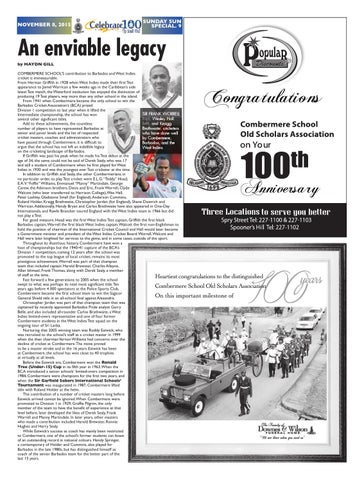
by HAYDN GILL COMBERMERE SCHOOL’S contribution to Barbados and West Indies cricket is immeasurable. From Herman Griffith in 1928 when West Indies made their first Test appearance to Jomel Warrican a few weeks ago in the Caribbean’s side latest Test match, the Waterford institution has enjoyed the distinction of producing 19 Test players, way more than any other school in the island. From 1941 when Combermere became the only school to win the Barbados Cricket Association’s (BCA) prized Division 1 competition to last year when it lifted the SIR FRANK WORRELL Intermediate championship, the school has won (top), Wesley Hall several other significant titles. (left), and Kraigg Add to these achievements, the countless Brathwaite: cricketers number of players to have represented Barbados at senior and junior levels and the list of respected who have done well cricket masters, coaches and administrators who by Combermere, have passed through Combermere, it is difficult to Barbados, and the argue that the school has not left an indelible legacy West Indies. on the cricketing landscape of Barbados. If Griffith was past his peak when he made his Test debut at the age of 34, the same could not be said of Derek Sealy, who was 17 and still a student of Combermere when he first played for West Indies in 1930 and was the youngest ever Test cricketer at the time. In addition to Griffith and Sealy, the other Combermerians, in no particular order, to play Test cricket were E.L.G. “Teddy” Hoad, E.A.V. “Foffie” Williams, Emmanuel “Manny” Martindale, George Carew, the Atkinson brothers, Denis and Eric, Frank Worrell, Clyde Walcott (who later transferred to Harrison College), Wes Hall, Peter Lashley, Gladstone Small (for England), Anderson Cummins, Roland Holder, Kraigg Brathwaite, Christopher Jordan (for England), Shane Dowrich and Warrican. Additionally, Hendy Bryan and Carlos Brathwaite have also appeared in One-Day Internationals, and Rawle Brancker toured England with the West Indies team in 1966 but did not play a Test. For good measure, Hoad was the first West Indies Test captain, Griffith the first black Barbados captain, Worrell the first black West Indies captain, Walcott the first non-Englishman to hold the position of chairman of the International Cricket Council and Hall would later become a Government minister and president of the West Indies Cricket Board. Worrell, Walcott and Hall were later knighted for services to the game, and in some cases, outside of the sport. Throughout its illustrious history, Combermere have won a host of championships but the 1940-41 capture of the BCA’s Division 1 competition, coming 12 years after the school was promoted to the top league of local cricket, remains its most prestigious achievement. Worrell was part of that champion team that included captain Harold Brewster, Charles Alleyne, Allan Ishmael, Frank Thomas, along with Derek Sealy, a member of staff at the time. Fast forward a few generations to 2005 when the school swept to what was perhaps its next most significant title. Ten years ago, before 4 000 spectators at the Police Sports Club, Combermere became the first school team to win the Sagicor General Shield title in an all-school final against Alexandra. Christopher Jordan was part of that champion team that was captained by recently appointed Barbados Pride analyst Garry Belle, and also included all-rounder Carlos Brathwaite, a West Indies limited-overs representative and one of four former Combermere students in the West Indies Test squad on the ongoing tour of Sri Lanka. Nurturing that 2005 winning team was Roddy Estwick, who was recruited to the school’s staff as a cricket master in 1999 when the then chairman Vernon Williams had concerns over the decline of cricket at Combermere. The move proved to be a master stroke and in the 16 years Estwick has been at Combermere, the school has won close to 40 trophies at virtually at all levels. Before the Estwick era, Combermere won the Ronald Tree (Under-15) Cup in its fifth year in 1963. When the BCA introduced a senior schools’ limited-overs competition in 1984, Combermere were champions for the first two years, and when the Sir Garfield Sobers International Schools’ Tournament was inaugurated in 1987, Combermere lifted title with Roland Holder at the helm. The contribution of a number of cricket masters long before Estwick arrived cannot be ignored. When Combermere were promoted to Division 1 in 1929, Graffie Pilgrim, the only member of the team to have the benefit of experience at that level before, later developed the likes of Derek Sealy, Frank Worrell and Manny Martindale. In later years, other masters who made a contribution included Harold Brewster, Ronnie Hughes and Harry Sealy. While Estwick’s success as coach has mainly been restricted to Combermere, one of the school’s former students can boast of an outstanding record in national colours. Hendy Springer, a contemporary of Holder and Cummins, also played for Barbados in the late 1980s, but has distinguished himself as coach of the senior Barbados team for the better part of the last 15 years.