A
But at the NAN meeting Moose Cree Chief Peter Wesley said that MoCreebec was not a First Nation but in fact came into being as a housing Association. He further said it is not Federally recognized and is landless. Even with what Wesley is proposing he says he doesn’t want the MoCreebec Cree to stop working or leave Moose factory or Moosonee. “MoCreebec people are still welcome to continue to live here,” he said. A far cry from when a previous chief told them to “Go home.” Back then as now is that the Moose Cree don’t like the fact that MoCreebec are seeking to be Federally recognized. “They should not be given a land base in our territory,” Wesley said. He also feels that NAN should not have them as a member as they aren’t Treaty 9 or 5 signatories and it would be best if they just voluntarily withdrew their membership in NAN. Yes, MoCreebec is part of NAN and say they respect everyone and have always done so. Wesley said this membership bolstered MoCreebec’s court case.
re there problems that were sidestepped when the James Bay and Northern Quebec Agreement (JBNQA) was signed. In A word- yes. These issues dealt with land and territorial definitions. The basic being that Quebec is part of the title of the JBNQA. It meant unresolved issues concerning Ontario and other First Nations. A recent NAN meeting from September 22-24 saw MoCreebec under fire. MoCreebec are composed of Cree who traveled to Moose Factory from other coastal communities (mainly eastern James Bay) when the beaver populations were decimated by non-natives over trapping them in Eeyou Istchee. Survival meant going to there to find work so they could feed their families. This in the mid twentieth century some families have been there for 100 years. Other Cree are from traplines that overlapped the Quebec/Ontario borders. MoCreebec boasts a population of 1500 members that have seen hard times. They used to live in tents year-round or what could at best be called shacks. Because of their situation they are often seen as outsiders by both the Moose Cree First Nation and to an extent by the Eastern James Bay Cree. Even regular government funding for Canada’s Indigenous peoples was either denied or scanty at best for MoCreebec members. That continues to this day.
Wesley said, “We believe these issues should not be resolved through a court process. We believe we should talk together and resolve them.” He added that the best move would be to drop the lawsuit and negotiate face to face. Moose Cree wouldn’t be asking for a NAN amendment to remove MoCreebec but will do so at the assembly Wesley said. While MoCreebec Chief Micheal Jolly asked Wesley if he would be willing to meet with only the both of them to “discuss the challenges we both face,” it will hopefully make progress in resolving this issue. Perhaps the Honourable Mandy Gull-Masty, Ontario Premier Doug Ford and whoever heads up Quebec’s new provincial government could sit down and deal with this issue the should have been dealt with decades ago. For Cree never had provincial borders in the past and as Jolly said, “I am a James Bay Cree (adding he had relatives from both sides of James Bay). I am not a status number.”
the Nation is published every two weeks by Beesum Communications // EDITORIAL BOARD L. Stewart, W. Nicholls, M. Siberok, Mr. N. Diamond, E. Webb // EDITOR IN CHIEF Will Nicholls // DIRECTOR OF FINANCES Linda Ludwick // EDITORS Lyle Stewart, Martin Siberok // STORY COORDINATOR Patrick Quinn // CONTRIBUTING WRITERS X. Kataquapit, P. Quinn, N. Fedosieieva // DESIGN Matthew Dessner // SALES AND ADVERTISING Donna Malthouse // THANKS TO: Air Creebec // CONTACT US: The Nation News, 918-4200 St. Laurent, Montreal, QC., H2W 2R2 // EDITORIAL & ADS: 514-272-3077 / ads@nationnews.ca / 514-943-6191 // HEAD OFFICE: P.O. Box 151, Chisasibi, QC. J0M 1E0 www.nationnews.ca // EDITORIAL: will@nationnews.ca news@nationnews.ca // ADS: Donna Malthouse: donna@beesum.com // SUBSCRIPTIONS: $90 plus taxes, US: $90, Abroad: $110, Payable to beesum communications, all rights reserved, publication mail #40015005, issn #1206-2642 // the Nation is a member of: The James Bay Cree Communications Society, Circle Of Aboriginal Controlled Publishers, Magazines Canada Quebec Community Newspaper Assn. Canadian Newspapers Assn. Les Hebdos Sélect Du Québec. Funded [in part] by the Government of Canada.
the Nation
3
T
he difficult subject of domestic and sexual violence in Eeyou Istchee was discussed in Mistissini September 14-17 at the Yaayitinh Saachihiiwaawin (Holding Love Safely) Regional Gathering. Described as “a long time coming,” the event allowed over 300 frontline workers, survivors and advocates to have meaningful conversations about the realities in Cree communities. “Every person in Eeyou Istchee has the right to feel safe in their home, in their relationships and in their community,” stated Grand Chief Paul John Murdoch. “Domestic and sexual violence cannot be met with silence, and the responsibility for change cannot rest only with survivors or frontline workers – it requires all of us to stand together.” Organized by the CNG Department of Social and Cultural Development, the gathering’s name and logo was created by Raven Happyjack. The name Yaayitinh Saachihiiwewin represents the initiative’s vision: “a community where love is safe, healing is possible, and respect is the foundation of every relationship.” A 2023 Cree Health Board report documented the troubling scale of sex-
the Nation
ual violence in the region. The gathering was an opportunity to turn its recommendations into action. Kayla Moore, CNG coordinator of domestic violence awareness initiatives, collaborated with several entities to develop the event. “We’ve been discussing what pathways look like for community members reporting incidents and what safe spaces in communities look like,” said Moore. “Ultimately, we’re looking to gather recommendations about developing a domestic violence resource centre.” Eeyou Eenou Police Force (EEPF) members in the working group emphasized the issue’s prevalence, sharing that incidents of domestic and sexual violence are the highest reported crimes in Eeyou Istchee with numbers that continue to increase. CNG Justice Director Donald Nicholls highlighted his department’s programs on healthy relationships, anger management, domestic violence and substance use. He noted that Cree CAVAC officers can confidentially guide individuals through the court process while providing referrals to post-trauma counselling or other specialists.
Featuring guest speakers, discussion panels and testimonials, the event’s presentations were organized according to each day’s theme: children, youth, adults and Elders. Considering the sensitive subject matter, participants were invited to seek support from traditional healers, pastoral care or psycho-social workers. “It takes a lot of courage to even show up to an event like this and share,” asserted Moore. “Despite the heaviness of the conversations, it felt like people are ready to stand together and find solutions. There’s a long road ahead of us but I’m feeling optimistic.” Moore said that Dr. James Makokis’ keynote address was a highlight, discussing gender-based violence as a two-spirit physician from Saddle Lake Cree Nation. Jo-Marie Einish expanded upon this theme the following day, speaking about two-spirit realities in Eeyou Istchee in both the historical and modern context. The health board’s Nishiiyuu department coordinated self-care activities in the evenings and made traditional healing and medicine a central component. Elders provided a calming presence throughout the gathering, sometimes
giving warm hugs to speakers who had shared personal stories. Sacred fires, cedar baths and a sweat lodge were available on-site. “We came together so nobody feels alone,” explained traditional healer Harry Snowboy. “It’s encouraging when the leadership isn’t scared to talk about it. It is such a complex issue that needs to be addressed.” Snowboy spoke about the respect for women at the root of ancestral teachings and the colonizing forces that created intergenerational trauma and a more misogynistic society. In Cree communities where “everybody knows everybody,” he said that perpetrators are often protected while survivors face a backlash for speaking out. “There’s a lot of grooming involved before the actual assault happens,” Snowboy said. “Not only the victim but the people around the victim, so people have a tendency not to believe because the persona out there is almost covering his tracks.” On the final day, Snowboy participated in a knowledge transfer panel with Deputy Youth Grand Chief Darius Neacappo-Pelchat. Earlier, Youth Grand
Chief Jade Mukash shared her personal journey as a survivor to address toxic masculinity and advocate for youth resources. The gathering’s participants included women’s organizations such as “Les Elles du Nord” and various support resources. Kerrie Coon from local addictions program Kapataakan emphasized the importance of “meeting people where they’re at in their recovery journey” and demonstrated single-use breathalyzers that can test drinks for date-rape drugs. Moore was pleased that high school groups were in attendance and underscored challenges faced by youth, such as digital violence and revenge porn. Kristin Quinn, who holds the title of Miss Mistissini, said that social media plays a significant role in silencing victims. “Somebody could post something about you and everyone can see it,” said Quinn. “Maybe it’s somebody in their family and they will shame the person into silence on social media. It has a big effect on why youth don’t talk about it these days.” As a police technology graduate, Quinn staffed the EEPF booth during the gathering and participated in a youth
panel, sharing the story of her own sexual assault. This was her first time speaking so publicly about the incident, which occurred two years ago while at police school in Montreal. “I did it for people who don’t have a voice,” Quinn said. “I found it healing to be with a lot of survivors. You go through this and it’s not talked about. It’s very taboo but it has to be talked about for change to be made.”= Quinn found solidarity in a similar experience shared by Isabelle Natawapineskum and was comforted by the compassion of Elders. She believed the event drew attention to the deficiencies in supporting survivors who come forward and would like to see a youth conference that talks about sexual consent and what healthy relationships look like. “I feel there’s a lack of resources,” asserted Quinn. “Sometimes survivors don’t go to the police because they don’t want to talk to a male. The trauma doesn’t stop right after police officers respond to the call. What else are we going to give them? Change begins when we are willing to speak about the things that are often left unspoken.” the Nation
CHISASIB TERM ABOUT
you will assist customers with a variety of financial able to help them identify some of their financial needs and provide full-time term opportunity. ABOUT YOU
• • time • •
preferred
• If you do not currently meet all of the above qualifications, we will provide training, on-site mentorship, and ongoing learning and development opportunities for candidates who demonstrate a strong willingness to learn. We thank all candidates for their interest, however, only those selected for an interview will be contacted.
Please visit our website at www.fnbc.ca to apply online OR drop off your resume in person at First Nations Bank of Canada, Chisasibi branch OR send your resume and cover letter by email to lisa.anderson@fnbc.ca
ouwahstore@gmail.com (514) 588-3162 www.ouwahstore.com 18 Fort-George Road
Chisasibi’s 19th annual Musuutaau Blueberry Festival September 19 and 20 was a delicious success. The community celebrates its bountiful harvest each year with berry picking and recipe contests in various categories alongside family-friendly activities. Pickers collected an impressive 304.3 lbs of blueberries while an additional 46.3 lbs in donations were received, which will be shared with hospital patients and the local MSDC. A blueberry auction raised $275 for the community’s food pantry. “Every year, we usually hold our Blueberry Festival after the first frost, around the beginning or middle of September,” explained Reggie David. “It is a special time of year when we come together to enjoy the blueberries, the land, good food, laughter, and each other’s company.” Organized by Nellie Bobbish and Reggie Tomatuk with support from Brighter Futures, the festival is a tradition practiced for thousands of years, to “fill in our souls with good nutritional foods from our own making.” In the couples category, Helen and Allan Sam won the Chishaayiyuu category with an amazing 74.3 pounds. Samantha Minchella and Ooshita Gobin took the open category while Naomie Roy and Simon won the Uschiniichisuu/Chishaayiyuu division. Delilah and Billie were the Awash winners and Marguerite Daigneault & Felix Gauthier took the Uschiniichisuu win. Among the children winners were Abigail Lane, Levi Foucault, Louis Gautier and Loann Foucault. Other singles winners were Arianne Lebel and Ruby Menarick.
Naomie Roy was awarded best blueberry jam and variety food. Margaret Orr won best traditional food in two categories. Marja Augot had the best cake and Arianne Lebel the best pie. “The baking entries were delicious, and everyone had the opportunity to taste and enjoy the wonderful food that was shared,” said David. “What a wonderful weekend of gathering, sharing, picking, baking and celebrating our community!”
Youth Grand Chief Jade Mukash advocated for essential resource increases for the Cree Nation Youth Council in a presentation to the Cree Nation Government on September 23. Highlighting that youth are calling for larger programming and impactful flagship projects across Eeyou Istchee, Mukash asserted that structural investments are needed to sustain the CNYC’s youth participation, delivery, representation and accountability mechanisms. “CNYC has grown,” said Mukash. “Now our structure needs to grow with it. This request is not only for more activities – it is for the capacity to properly support the work already underway.” While there had been a budget surplus due to postponed activities during the pandemic and forest fire disruptions, Mukash said the expanded roles and expectations of staff are now causing
delays. She called for dedicated policy analyst, multimedia technician and full-time Deputy Youth Grand Chief positions to build capacity. With gaps in media communication and meeting budgets, Mukash said there’s a need to improve the functionality of youth governance. One of the CNYC’s recent initiatives is the EeYouth Magazine, an online publication designed to highlight youth voices, build journalism and media skills, and share regional achievements. Adrian Gunner was named as the magazine’s journalist and Tyra Moses the designer. “The challenge is no longer creating momentum – it is sustaining it responsibly,” stated Mukash. “If youth are expected to participate seriously, the support structure must reflect the real cost of participation.”
The documentary film James Bay 1975: The Shock of Two Nations took home two Prix Gémeaux awards at the annual ceremony on September 11 which honours the best in French-language television and film. It won for best documentary and directing in the history, politics and society category. The documentary had previously been nominated for Best Feature Length Documentary at this year’s Canadian Screen Awards. As a political thriller, it highlights the revolutionary movement
of the Cree and Inuit to protect their homelands from flooding by Hydro-Quebec’s so-called “project of the century”. The Cree Nation of Chisasibi recognized the contributions of community members Ernest Webb as co-producer with Rezolution Pictures and Melanie Lameboy as co-director. Produced in collaboration with Picbois Productions, the film marked the development of the James Bay Northern Quebec Agreement on its 50th anniversary. “This powerful documentary revisits a defining moment in our history, highlighting the rapid development of the James Bay hydroelectric project and the mobilization of Cree and Inuit Nations to defend their land, culture and future,” stated Chisasibi Council. “It’s nomination among Canada’s top documentaries is a testament to the importance and continued relevance of these stories.” The community said that awards recognition reflects the strength of Cree storytelling and the significance of sharing Cree history with future generations. “It’s very important to pass on Cree history and what can be accomplished through unity and dialogue and the lessons from making tough and realistic decisions and avoiding simplistic positions,” commented former CNG executive director Bill Namagoose.
the Nation
A
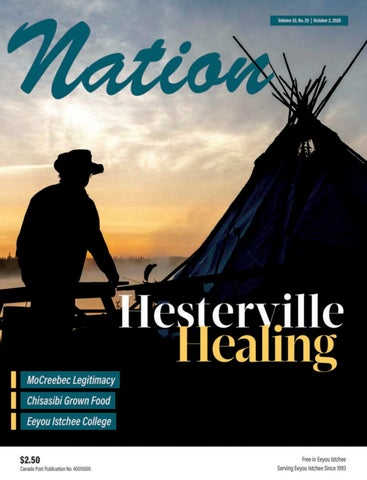
residential school gathering held in Waskaganish September 8-10 marked a significant shift in how Cree survivors and their families are overcoming intergenerational trauma. Almost 200 participants gathered at Charles Hester’s family fishing camp known as Hesterville. “We wanted to do something different than previous residential school gatherings,” explained Hester. “If there were skills the survivors never got the chance to learn from their grandparents or parents, we tried to work with them to restore what was lost.” Afternoon workshops included harvesting techniques, wood carving, decoy making and cooking bannock on a stick as many survivors shared their residential school experiences. As Hesterville is famous for its smoked fish and shashdutshaan (caviar), teachings about fish preparation were especially popular. Established 10 years ago by Hester’s father, the camp he runs with his siblings is popular with tourists and employee outings organized by Cree entities. “It was a lot of work, but people are already talking about next year,” said Hester. “People loved the smoked fish and caviar – we could fill their cravings.” As most recent gatherings were in Chisasibi, this event was able to highlight Waskaganish’s unique history with residential schools. Hester got involved because his wife sits on the local wellness board, which coordinated the event. Elder Joe Weistche spoke about his experience while recalling that his father was one of 12 boys who were the first community members to be taken by boat to residential school. The gathering also focused on the parents and children of those removed from their communities. An emotional moment came during a blanket ceremony to honour Elders whose children were abducted. As they had been prevented from putting their children to bed, they were now wrapped in a blanket, symbolizing protection, community connection and their children coming home for good. “We talk a lot about the children’s experiences, but I didn’t forget about the parents,” said local survivor Susan Esau. “I’m a mother and grandmother and know what they must have felt when they were left alone all of a sudden. I was raised by my grandparents and three of us went at one time.” Esau was sent to one of Fort George Island’s two residential schools at age 8, her first time away from her family, encountering “these strange people dressed in black robes.” She knows others who were taken as young as three. “Residential schools tried to take away our identities, culture and language,” Esau asserted. “I became very angry when I left residential school and felt like I didn’t belong with my family because I didn’t know the culture. I didn’t know that identifying your culture, spirit and language as being part of you is what makes you stronger.” Esau turned to drugs and alcohol to escape her painful memories. Her healing journey began in 1989 when taking her son to an addiction-treatment program in Alberta. Listening to an Elder,
the Nation
Restoring Hope
the Nation
Esau realized that “spirituality is our personal connection to a higher being and not these rituals in church.” As Esau got sober and devoted herself to helping others, she coordinated one of the region’s first residential school gatherings in Waskaganish in the early 1990s. With many community members having never spoken previously about their experiences, a flood of emotional testimonies came one after the other. “Boy, did we open a can of worms,” she remarked. “Our counselling service was going 24 hours a day because people had not dealt with these issues. I got a call at 3am because there was a woman who didn’t speak English or Cree.” Esau loved this recent gathering and its emphasis on traditional teachings, which long faced stifling opposition from Waskaganish’s five churches. Her attempts at co-organizing the community’s first traditional powwow in 2018 were so controversial that a referendum was called. “In the 1970s, Waskaganish had this influx of the Pentecostal religion, telling us the same thing we were told in residential school,” Esau recalled. “They’d never experienced traditional ceremonies and they already said it was evil.” Witnessing her first walking out ceremony 20 years ago, Esau is happy these rites of passage are now common, “reinforcing the roots of our culture.” She enjoyed the workshops, noting that a capsule of skunk oil taken in a traditional medicine demonstration cured her cold almost instantly. On the gathering’s last day, Esau delivered a presentation called “Restoring Hope”, following James Bobbish’s speech about caring for the living Cree language and Cree singing by Victoria Hester and Mary Bear. The research group Know History is working with the community to design a memorial monument to recognize the impacts of residential, day and boarding schools. An accompanying book recording stories of survivors and their families is also in the works, with both targeted for completion by September 2027. “All Cree communities should have their own monument,” suggested Hester. “We want to see actions coming out from this conference. It was talked about maybe doing a second conference geared towards the children of survivors to stop the cycle from being passed on.”
the Nation
ᐊᐧᐁᓐ ᒉ ᐃᐦᑖᔨᓐ ᒌ? o
WHO WILL YOU BE?
r
is si i
#f7f0e6
ro your r r – meet employers and learn a out opportunities in your community. ry ou di r o s – en oy hands on e hi its, immersi e presentations, and demonstrations. Build your skills – take workshops on resume writing, goal setting, workplace cultural safety, and more.
site.pheedloop.com e ent asdcareerfair
site.pheedloop.com e ent asdcareerfair
The Apatisiiwin Skills Development Career Fair is sponsored by
the Nation
WORK ON A PROJECT THAT’S SHAPING OUR REGION ᐋ ᐋᐱᑎᓰᔅᑖᑭᓂᐧᐎᒡ ᐋ ᐱᒥᐱᐦᑖᑭᓂᐎᒡ ᐋ ᐆᐙᑎᔅᑖᑭᓂᐎᒡ ᐊᓂᑎᐦ ᐋ ᐅᐦᒋᔨᐦᒄ EXPLORE CAREERS WITH TROILUS ᓂ ᒋᔅ ᔨᐦᑎᒥᒄ
ᐦ
ᑖᐱᑎ
ᒄ ᐊᓂᑎᐦ
ᔅ
Opportunities here. For today and the future.
reat entrepreneurs are often
support supported r ed rt y others r rs
troilustogether.com
Experience E Ex xperi xp r ence to share? ri Looking Looki k ng for ki f r support on your fo y ur entrepreneurial yo entrepre r neuri re r al journey? ri Join the Niimuudaan mentorship mentors r hip rs i network. ip network r . rk
Become a Mentee
Make mentorship part of your journey Join Niimuudaan Learn more: (819) 824-9888 ext:1
the Nation Become a Mentor
Growing Movement
a
F
rom exploring James Bay’s aquatic habitat with an underwater drone to mapping and testing the region’s natural springs, the Chisasibi Eeyou Resource and Research Institute (CERRI) is steadily expanding community-driven projects while propelling youth into science-based careers. Since 2016, the non-profit organization has developed innovative solutions to local issues by emphasizing Eeyou knowledge, lived experience and respect for the land. Food sovereignty became a priority in recent years, with Chisasibi-grown cucumbers
the Nation
and tomatoes sold for the first time this summer. “We’re figuring out what people want to eat and the best way to grow it,” said sustainability specialist Jason Stevens. “The ultimate goal is to scale up to produce more fully what Chisasibi actually needs. In the process, we’re encouraging people to grow more.” After constructing a geodesic agriculture research dome behind the community’s central Mitchuap complex in 2023, this year saw the completion of an accompanying greenhouse and the preparation of an acre of farmland for future seeding. As little organic matter remained at the formerly contaminated 4-acre site at KM 0, CERRI’s agriculture team tilled the acidic soil last October. This summer, nearly an entire transport truck’s worth of compost and dolomite was mixed into the sandy earth. To ready the land for pea or bean crops next year, autumn rye was added as a cover crop to improve biomass, root structures and nitrogen. The insulated dome provides warmer temperatures for growing vegetables like sunchokes. It also hosted CERRI’s “agriculture club” members Saturday mornings throughout the summer to maintain its grow beds while learning gardening skills. The greenhouse expanded crop capacity, including transplants from Big River High School’s greenhouse. Last year, CERRI’s Preston Sam and Collin Snowboy launched soil preparation and seeding activities in classrooms. “There’s something deeply fulfilling about knowing the food on your plate was nurtured and grown right here, in the heart of our community,” Sam wrote on CERRI’s blog. “For us, this work is more than just about growing food – it’s about growing a movement.” Stevens said that Malabar spinach grown at the school was so popular with the younger children that some were asking for seconds – which he provided as long as they informed their parents that they now like spinach.
New grow beds installed outdoors make community agriculture even more accessible while enabling a greater diversity of crops, such as snow peas or radishes. As they learn which foods grow better indoors or outdoors, CERRI is involving community members in every step of the process. This summer’s staff included four local students and two others hired through government grants. Peter House, who has worked in waterfowl research and video demonstrations of Eeyou Ituun traditional knowledge since 2023, was joined at CERRI this year by his wife and two children. A hydroponics container farm will be installed in October. Three utility containers will initially support lettuce and strawberry crops, but the project could eventually host 10 growing containers. “There’s a good chance that one container farm might be able to produce all the lettuce this community needs,” said Stevens. “You can grow year-round with a container farm but are more limited in what you can do. Strawberries, lettuce and herbs grow well with hydroponics so we’re starting with that.” While these systems are typically enhanced by pumping in carbon dioxide, Stevens suggested the CO2 released by oyster mushrooms could provide a natural alternative. Foraging expeditions will better identify and quantify the region’s wild mushrooms. CERRI recently held workshops to help people recognize edible varieties. CERRI is pursuing food safety certification through MAPAQ so it can sell produce at the local co-op and Cree Mart. There are early conversations about sharing some production tasks with Wemindji to reduce reliance on CERRI as a sole supplier. “To be sustainable with commercial production for the cucumbers and tomatoes, we’ve matched the lowest price in town,” Stevens explained. “We feel that’s a fair value and the taste is much better. We did a test for sugar quantity, and the sweetness was 2.5 compared to
about 1.8 for an English cucumber at the store.” A marine biology field trip led by Dante Torio in August explored the region’s shoreline and aquatic vegetation, even using drones to document underwater habitats. Preston Bobbish is leading studies of the territory’s freshwater sources to assess impacts of industrialization and climate change. Interviewing land users and analyzing natural springs, Bobbish tests samples for contamination from bacteria, dissolved metals and chemical runoff. “There are some concerns about people’s teas changing different colours,” said Bobbish. “Some rivers are starting to turn brown. If a camp is upstream, eventually the spring will go bad. We collect samples and try to mitigate impacts on the land.” Bobbish highlighted mining operations, dumpsites, construction zones and firefighting training areas as threats to water quality. The isostatic rebound that causes Chisasibi’s land to rise at one of the fastest rates in the world can also alter groundwater chemistry. Sampling is a delicate procedure, sometimes involving ground-penetrating radar or hydrogeology tools like the Guelph permeameter. Emphasizing the need for a local laboratory, Bobbish noted at a summit last September that shipping samples to Montreal within the required 24-hour window is a major challenge. Working with CERRI for over five years, Bobbish is improving his skills by taking a hydrogeology program at the Université du Québec en Abitibi-Témiscamingue. He says inspiring youth to become community researchers is central to the organization’s vision. “More young people should get into this because the world is continually evolving,” said Bobbish. “It’s an eye-opener. It’s important to know where to get water in case there’s an emergency. Water is such a necessity.”
the Nation
ᐃᔨᔨᐤ CAVAC ᐋ ᐱᒥᐱᔨᐦᑖᑭᓂᐧᐃᒡ
Are you a victim or witness of a criminal act? We are here to provide support. Our services are offered throughout Eeyou Istchee and are strictly confidential.
CALL US
1-877-342-2822 A program offered by:
the Nation
ᔨ
ᐧ ᔫ
ᐄᔨᔨᐅᔨᒧᐧᐃᓐ ᕢ
ᐃ
ᑳ
ᐎ
ᐄ
ᑭᓂᐧᐋᐱᒫᑭᓐ ᐱ
ᒫ
ᕌ
ᐅ
ᑎ
ᑭ
ᒋ
ᐧ
ᐋ
ᐄᔨᔨᐅᔨᒧᐎᓐ ᑳᒋᔥᑎᐱᔥᑎᑭᓂᐎᒡ welcomes ᒫᕢᔫ ᐋᐃᓯᐧᕌᕝ ᓂ day as the new on his first Commissioner of Cree ᒧLanguage.
ᐧ
ᐃ
ᑳ
ᓯ
ᐎ
ᐄ
ᐱ
ᒫ
ᔨ
MATTHEW A. ISERHOFF
ᐧ
ᐋ
ᑎ
ᑭ
ᒋ
ᔫ ᕢ
ᓂ
ᐎ
ᒧ
ᕌ
ᐃ
ᓯ
ᐄ ᐅ
ᔨ
ᐧ ᐧ ᐋ
ᔫ ᕢ
ᒫ
A
s it enters its second year, enrolment at the Eeyou Istchee College of Science and Technology (EICST) has grown to 104 students while offering new courses and more professional training. According to director general Carmen Sicilia, EICST’s programs respond to community and employer demand for staff training in northern Quebec. The college offered professional education with Cree language courses in its first year, Sicilia noted. “We’re offering it again this year. And because the demand was so high, we opened up two groups of Cree language,” she said. “There are non-Indigenous individuals who are working in the region, and they want to be able to communicate with the residents,” she added. “It’s amazing how many students want to improve their Cree and be part of the revitalization momentum of preserving the language.” French-language courses are available online, while many professional development courses are offered in person, she explained. A new addition is the Essential Skills course, a three-day retreat designed for managers working in the region. To help organizations identify funding opportunities and navigate the application process, the college introduced grant-writing training. EICST combines Indigenous knowledge with Western practices, which Sicilia describes as “two-eyed seeing” approach. “That’s our philosophy,” Sicilia said. “There are two programs that are extremely important because businesses have told us there is such a need for training in Indigenous business administration, digital technology information systems and artificial intelligence.”
the Nation
Sicilia pointed out that all students from last year’s Indigenous Business Administration program have found jobs. A second group with 20 available spots is expected to start in January. “We incorporated the internship in their full-time jobs,” she explained. “We want to make sure that individuals know there is a space for them to learn, and there are definitely employment opportunities for them.” Financial support is key to making higher education accessible, Silicia said. “Financial barriers are the number-one reason why Indigenous students don’t continue their education.” The college currently employs 30 instructors, comprised of Indigenous and non-Indigenous professionals. “They all go through training on how to teach in the northern Quebec with an Indigenous audience and what is Cree culture,” she said. EICST is developing a “train the trainer” initiative that prepare Cree instructors, “to make sure that we close that gap and we prepare more Indigenous individuals to teach,” Sicilia added. As a non-Indigenous educator, Sicilia said her work with the Chisasibi community is grounded in a commitment to equal access to education. “For me, it’s important that everyone has equal rights,” she said. “The community wanted the college, and I have the knowledge and experience, so we’re building it together.” For English language instructor Anne Roop, teaching at EICST is about giving students practical writing skills they can use in their workplaces. Her students practice writing, including formatting, tone, greetings and closings,
while learning to distinguish facts and opinions, she said. Roop likes her small classes as they allow her to work closely with students, who she says are “very receptive to learning and attentive.” The community college makes post-secondary education accessible for residents who would otherwise have to leave their families or jobs. “It gives them a whole new world of freedom to be able to study,” Roop said. Seeing students apply their knowledge in the workplace is one of the most rewarding parts of teaching, said Roop. Chisasibi resident William Chakapash completed the college’s Indigenous Business Management program. Returning to school helped build skills he now uses in his professional life, and it landed him a job at EICST. “It helped me improve my writing and Excel skills, as well as my understanding of technology,” he said. Chakapash says having a college in the community will give more young people a chance to continue their studies. “It would be good for them to start off here if they want to keep pursuing their education,” he said. “Then, once they’re ready, they can make the jump and go to college down south.” Studying in the community meant Chakapash could continue participating in traditional activities. “It’s important to keep your roots, so you don’t forget where you come from,” he said. “I was studying, but I was still able to go fishing and hunting and enjoy all the cultural activities that we usually do.”
The Cree IELCC Fund is designed to fund projects/activities that foster TheThe Cree IELCC Fund is is the education, Cree culture Cree IELCC Fund The Cree IELCC Fund The Cree IELCC Fund is is designed fund designed to fund and language, asto well as designed to fund designed to fund projects/activities that foster projects/activities that foster health and wellbeing of that projects/activities that foster projects/activities foster education, Cree culture thethe education, Cree culture children and 0the to 6 and their the education, Cree culture education, Cree culture and language, well language, asas well asas and language, as well as and language, as well as families.health health and wellbeing and wellbeing ofof
r
health health and ofof children 0wellbeing to 6 and their children 0and to 6wellbeing and their children 0 to 6 and their children 0 to 6 and their families. families. All projects and activities
families. families. must also ensure that noactivities projects and All All projects and activities projects and activities AllAll projects and activities must also ensure that no children must are left behind: also ensure that no must also ensure that no must also ensure that no children are left behind: activitieschildren must be accessible are left behind: children are left behind: children are left activities mustbehind: be accessible activities must be accessible to all children, no matter activities must be accessible activities must be accessible to all children, no matter to all children, matter their level ability orno special to children, no matter toof allall children, no matter their level of ability or special their level of ability or special their level of ability or special their level of ability or special need. need. need. need. need.
al
Deadline Deadline Deadline Applications accepted monthly. Deadline
Due on theaccepted last day monthly. of monthly. each month Applications accepted Applications Applications accepted monthly. Due on the last day of each month Due on the last day of each month cepted monthly. Due on the last day of each month
e
day of each month
Scan to Scan Scan to totoOnline Apply Scan to ApplyOnline Online Apply Apply Online
Apply Online
C
M
Y
CM
MY
CY
CMY
K
For women and children of Eeyou Istchee suffering from domestic violence
CRISIS LINE
HEL
P
Toll Free | Open 24/7
1 855 753-2094 creehealth.org/services/womens-shelters-robins-net
Pîpîchâu Uchishtûn | Robin’s Nest | Women’s Shelter
If you are an Indigenous woman of Eeyou Istchee and you are seeking safety and support, we are here to help you!
If you need emotional support or to learn about all the services available to you, please contact us:
ᐐᒋᐦᐄᐙᐅᐎᓐ WÎCHIHÎWÂUWIN HELPLINE 1 833 632-HELP (4357)
creehealth.org
Under the Northern Sky
T
his is the time of the year when Canada commemorates the Truth and Reconciliation (TRC) process which was meant to address the dark period of cultural genocide created by the Indian Residential School system. The government of Canada established a network of church-run institutions to assimilate Indigenous children into European culture. It lasted well over 100 years in Canada. In 2008, the TRC led by the late Justice Murray Sinclair spent six years gathering testimony about this terrible period from survivors across the country. This process directly impacted my family and every family along the James Bay coast. My parents, Marius and Susan Kataquapit, were residential school survivors, and it was a deeply emotional period for our family to know that our parents had to share their experiences. They never spoke about what happened because it was all buried behind a veil of shame, anger and fear. They had been victims as children in the 1940s and 1950s and spent most of their lives believing that their traumatic experiences never mattered. The TRC released its final report in 2015. It stated that the residential school era constituted “cultural genocide” through an intentional attempt to destroy Indigenous language, culture and familial ties. As part of the report, 94 Calls to Action were presented to deal with the ongoing legacy of the residential school era and how it affected and continues to affect Indigenous communities.
The Nation is looking for
Cree Freelance Writers
Please send your resume to willnationnews@gmail.com
the Nation
The first 42 Calls to Action address critical social systems, including child welfare, education, language and culture, health, and justice. The remaining 52 focus on transforming broader Canadian institutions to work towards long-term equality and respect. Over the past decade, one of the most important developments for Indigenous communities in the North is in their ability to regain control of the lands and territories they call home. This is in part due to the TRC, which gave Indigenous people more confidence to speak out against past injustices. Indigenous groups, especially a new generation of young leaders and advocates, are now stepping up to fight against future injustices that might happen on traditional lands. The 92nd Call to Action states: “We call upon the corporate sector in Canada to adopt the United Nations Declaration on the Rights of Indigenous Peoples as a reconciliation framework and to apply its principles, norms, and standards to corporate policy and core operational activities involving Indigenous peoples and their lands and resources. This would include, but not be limited to, the following: Commit to meaningful consultation, building respectful relationships, and obtaining the free, prior, and informed consent of Indigenous peoples before proceeding with economic development projects.” I’m proud that young Indigenous leaders, like Jeronimo Kataquapit of the Here We Stand movement and Ramon Kataquapit, co-founder of the Okiniwak group, are leading the charge in north-
ern Ontario to uphold this vital Call to Action. They are fighting both the Ontario and Canadian governments, which want to develop the Ring of Fire mining region in northwestern Ontario. The Carney government adopted Bill C-39, which builds on the foundations of Bill C-5, to exempt projects from assessment, permitting and protection measures. Jeronimo and Ramon recently took part in the Together for Nature Tour tour through southern Ontario September 15-18, which brought together Indigenous and non-Indigenous people to raise their voices for nature and all our relations through story and song. Hosted by Ontario Nature and Legal Advocates for Nature’s Defence (LAND), the event brought together Jeronimo, Ramon, the Friends of the Attawapiskat River and award-winning Inuk singer Susan Aglukark to talk about protecting the land and respecting Indigenous rights. In the spirit of reconciliation, government, together with industry, has to take into account the active concerns and participation of Indigenous people regarding any major development on traditional lands. After a century of injustices inflicted on Indigenous people, the Canadian government should do its best to pave the way to a more economically equitable and respectful future with Indigenous people that respects First Nation rights and protects the land for generations to come. Respecting the land that Indigenous people call home is one of the most important aspects of reconciliation.
who are passionate about writing!
Or leave a message at (514) 272-3077 ext. 103
WORKING TOGETHER FOR SAFER AND ENGAGED COMMUNITITES Have a project in mind that will benefit your community? The Cree Nation Government Department of Justice and Correctional Services (DOJCS) will work with you! If you have a project that could make a difference in your community, you may receive funding from one of our funds CRIME PREVENTION FUND Prevent crime and support the creation of safer communities YOUTH ENGAGEMENT FUND Empower the Cree youth while promoting their general welfare *Note: All projects must incorporate Cree culture, values and traditions.*
Be engaged. Make a difference. For more information, please contact: Celina Jimikin Support Program Officer 418-923-2661 ext: 8006 celina.jimikin@cngov.ca
www.creejusticefunds.ca Deadline to submit application:
August 28 2026 | November 2, 2026
|
February 26, 2027