Ofsted still a major risk Inquiry says radical action needed. See pages 6-7.
Cleaner classroom air London head discusses the benefits. See pages 10-13.
The magazine for NEU Leadership members
AI and leadership Tips on making it work for you. See pages 18-21.
Summer 2026
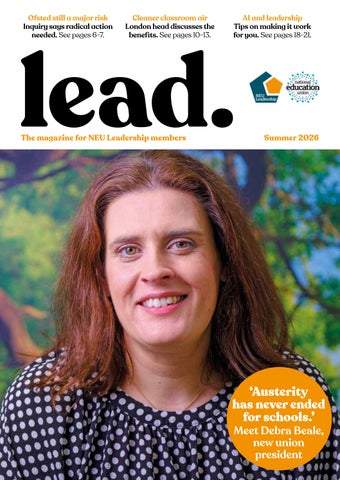
‘Austerity has never ended for schools.’ Meet Debra Beale, new union president
GOT THE CALL?
DON’T PANIC!
NEU4460/0626
Use the Ofsted risk assessment to protect yourself and your colleagues from the inspectorate’s harmful fallout – before, during and after inspection.
Scan here to find out more!
Welcome Cleaner classroom air London head discusses the benefits. See pages 10-13.
AI and leadership Tips on making it work for you. See pages 18-21.
The magazine for NEU Leadership members
Summer 2026
‘Austerity has never ended for schools.’ Meet Debra Beale, new union president
Lead.
Summer 2026
Debra Beale (see page 14) Photo: Jess Hurd
NEU president: Ed Harlow NEU general secretary: Daniel Kebede Editor: Sally Gillen Production editor/designer: Amanda Ellis
IT should be over for Ofsted. Nobody, after reading the findings of the independent inquiry into the toxic inspectorate, could conclude otherwise (see page 6). Alarmingly, 70 per cent of heads surveyed said Ofsted still negatively impacts their wellbeing. No surprise. Unions warned repeatedly that the ‘school report card’ inspection framework, brought in at the end of last year, would do nothing to create the fair, effective and supportive system urgently needed. So here we are, a few months on, with some heads saying they will retire early to avoid another “brutal” or “gruelling” Ofsted inspection. In Finland, schools aren’t inspected (see page 4). Yet its education system is celebrated as one of the best in the world. That said, a decade of austerity has contributed to a decline in learning outcomes, with Finnish schools now finding it harder to close the attainment gap between poorer and more well-off children. A reminder, if one were needed, that no education system – no matter how world class in other respects – can escape the damage done by underfunding. And for school leaders in the UK, cuts have, of course, been more savage. It would be inaccurate to say this government has done nothing for our poorest children, but it has done precious little for educators. As Lead went to press, the education secretary finally decided to publish the School Teachers’ Review Body report, which had been on her desk since February (see page 5). Creating such uncertainty for school leaders was bad enough, but on top of that you have now been told you must find £460 million for the pay award because the government won’t fully fund it. That’s more than unfair, it’s contemptible. We need to make the government listen, and your voice counts, so please vote early in the ballot on pay, funding and workload (see pages 5 and 22). Saving education will be our job, because nobody else is taking it on. Enjoy your well-earned summer break. Daniel Kebede General secretary National Education Union
9
Sub-editor/designer: Melissa Harteam Moore To advertise contact: t: 020 7880 7614 e: lead-magazine@ redactive.co.uk
neu.org.uk
linktr.ee/shareneu Except where the NEU has formally negotiated agreements with companies as part of its services to members, inclusion of an advertisement in Lead does not imply any form of recommendation. While every effort is made to ensure the reliability of advertisers, the NEU cannot accept any liability for the quality of goods or services offered. Lead is printed by Warners Midlands plc.
Contents
PHOTO by Jess Hurd PHOTO by Jess Hurd
Ad artwork co-ordinator: Aysha Miah-Edwards aysha.miah@redactive.co.uk
10 Regulars 4 Update 14
Social media win; Save Education; focus on Ofsted; the National Leadership Council and more
22 Final word
18
Daniel Kebede on the government’s failure to correct the legacy of austerity
Features 10 How I…
Jared Brading on improving the air quality at his London school
14 Interview
Debra Beale, the NEU’s soon-to-be president, on funding, strikes and more
16 Campaigns
Poverty is shaping school life, but it should not and must not be inevitable
18 Masterclass
Which AI tools are useful, and how should they be safely rolled out?
lead. The magazine for NEU Leadership members
3
PHOTO by Jess Hurd
Ofsted still a major risk Inquiry says radical action needed. See pages 6-7.
Update
Union hosts Finnish former minister A DECADE of funding cuts has contributed to reduced learning outcomes in Finland, a former education minister told the union during a visit to the UK in June. Li Andersson, who held the brief from 2019-2023, said austerity “unsurprisingly had a negative effect”. She added that, combined with an increase in the number of pupils with support needs, “from the point of view of teachers working in classrooms, it has been very detrimental because of course it also changes their working conditions”. But she also highlighted Finland’s
progressive approach, including no testing in primary schools, play-focused early years and no inspections of schools. Teaching as a profession is “highly respected” and teachers are trusted to evaluate students’ progress, she said. However, Finland’s scores on the Programme for International Student Assessment (PISA), a global study comparing 15-year-olds’ reading, maths and science skills in more than 80 countries, have dropped. “You can see really clearly see the gap is growing between the students coming in from different socio-economic backgrounds,” said Li.
Former education minister of Finland Li Andersson with NEU president Ed Harlow at the union’s headquarters in London
‘Use fall in pupil numbers to boost staffing and reduce class sizes’ WORKFORCE statistics showing there
profession was at its lowest since
improve children’s opportunities by
are 1,900 fewer teachers than last
records began 30 years ago, and the
increasing staffing levels and reducing
year make a “mockery” of the
government needed to address
class sizes – the highest in Europe – as
government’s pledge to recruit 6,500
workload and pay to tackle this.
the previous Labour government did
new teachers, said NEU general
Figures released by the
secretary Daniel Kebede.
government in June also show pupil
He said the number of newly
numbers have fallen by 112,200.
qualified teachers entering the
“There’s opportunity to drastically
25 years ago,” added Daniel. “The government can begin to undo the harm caused by a decade and a half of neglect.”
Campaign win as social media ban announced A BAN on social media for
countries including Australia, and
under-16s will be introduced
have backed the union’s Big
next year.
Tech’s Little Victims campaign.
NEU general secretary
A report released in
Daniel Kebede said it was “a
February showed 13-year-olds
turning point” in the fight to
were served content featuring
protect children online after
guns, self-harm, sexualised
tireless campaigning and
material and misogynistic
pressure from parents, teachers
narratives within three minutes
and health professionals.
of logging onto some platforms.
The government announced the ban last month following a consultation
“School staff see every day
Leading the call for action: head teacher of John Wallis Academy, how social media is harming in Kent, Damian McBeath, parent Kelly Carolan and NEU general children – disrupting their learning, secretary Daniel Kebede outside the Houses of Parliament
isolating them and exposing them
that received more than 116,000 responses, with 90 per cent of parents
4
School leaders have been among
to content they are simply not ready
calling for under-16s to be prevented
those campaigning for the change,
for,” said Daniel.
from accessing social media.
which has already been introduced in
n Visit bigtechlittlevictims.org
lead. The magazine for NEU Leadership members
Update
VOTE TO
Endometriosis advice for leaders to help staff A CHECKLIST to help leaders provide a supportive workplaces for staff who have endometriosis, adenomyosis or uterine fibroids has been produced by the union. Training for staff, protocols for women who need toilet breaks during lessons, or discreet places to change clothes, and time off to attend medical appointments are among the issues covered. Experiences of the conditions are individual, and while some women experience mild or intermittent symptoms, others have daily debilitating pain and fatigue. Many reasonable adjustments for staff are low or no cost. n Visit neu.org.uk/endometriosis
Product recall after asbestos found in toys ASBESTOS has been found in imported
Teachers and support staff in England. Online indicative ballot on pay, funding and workload.
AN England-wide ballot for strike action over pay, funding and workload will be launched on 3 October, as part of the union’s three-year Save Education campaign. It follows the announcement of a partially funded pay award for teachers of just 3.5 per cent for 2026-2027 and three per cent the year after. Schools, whose budgets are already at breaking point, will be forced to make Ballot opens up a shortfall of one per cent of staff pay each year. This amounts to £460 million in 2026-27. NEU general secretary Daniel Kebede said: “Pressure from the NEU has forced the government beyond its original pay and funding offer of 6.5 per cent split over three years, but a partially funded settlement still means cuts to education, and the NEU will never accept that. “Ministers claim to want more teachers, while at the same time forcing
#SaveEducation
NEU4225 SE26 A5 leaflet v2.indd 1
Forof more schools to make up a shortfall hundreds of millions of pounds for information the pay award, which could otherwise pay for 3,900 teachers and 4,400 support staff.” He added that with inflation set to rise, members knew this offer was not the decisive shift needed to reverse realterms pay cuts since 2010 or restore the competitiveness of teacher pay. Education secretary Bridget Phillipson had pay recommendations from the School Teachers’ Review Body (STRB) since February but waited five months to publish them. The STRB report was released on 1 July, leaving school leaders no time to plan next year’s budget. Daniel said: “No member wants to be taking strike action. To avoid this collision course, the government needs to step up and deliver the properly funded education system our children and young people deserve. It is time to save education.”
toys, including play sand. The union is urging leaders to check that none of the products have found their way into their school or setting. n Check the list at tinyurl.com/ asbestos-recalls n Find further information at neu.org.uk/ asbestos-schools
Join school climate study THE National Centre for Social Research (NATCEN) is inviting secondary schools across England to take part in a climate study exploring how behaviour approaches are used in today’s secondary classrooms. Participating schools sharing on-the-ground insight will receive a tailored summary of their results and a £100 thank you payment. One head teacher said: “Taking part in the survey was straightforward and gave us a useful opportunity to reflect on
30/01/2026 16:42behaviour across the school. We’re keen
Workload ballot in Northern Ireland PRINCIPALS and teachers in Northern Ireland are being balloted for industrial action over the Department of Education NI’s failure to make progress in implementing the recommendations of an independent review of workload The ballot, which was launched on 10 June and runs until 1 September, follows unions’ concerns over delays to act on the November 2025 report. Members are being asked if they would be prepared to strike, or take action short of striking, which for principals and vice-principals could include capping their working hours at 37 a week and refusing to facilitate any board of governors meetings after 5pm.
to see what the wider findings show.” n Sign up at survey.natcen.ac.uk/ SCSOpt-inForm n Find out more at natcen.ac.uk/ SchoolClimateStudy n Contact the research team at SchoolClimate@natcen.ac.uk or on 0808 168 2790.
lead. The magazine for NEU Leadership members
5
Ofsted special focus
Heads say new Ofsted is ‘relentless, Daniel Kebede. “Ofsted has failed to reform an inherently toxic system.” The report authors, two of them former schools inspectors, carried out a post-inspection survey of 100 heads whose schools have been inspected under the new framework. Heads described the ‘school report card’ system as “brutal”, “harsh”, “relentless and gruelling”. The findings, say the authors, make the case for “immediate, radical action by the inspectorate”. Daniel added: “Ofsted’s claim that inspection should not add to leaders’
URGENT action is needed to introduce a “fundamentally different system” of inspection, says a report that has found 70 per cent of heads believe Ofsted negatively impacts their wellbeing. The first independent investigation into the inspectorate’s ‘school report’ model, introduced just six months ago, concludes it is “not delivering what was promised”. What heads really think about Ofsted, published in June, adds to the “deluge of evidence that the profession’s trust in Ofsted is lost”, said NEU general secretary
workload has been proven as farcical. It is no surprise that the poorly thought-out new inspection framework has lumped even more burden upon an already overstretched workforce. “These findings fly in the face of Ofsted’s claim that schools’ context will be considered during inspection under the new framework. As we’ve seen in Ofsted’s own data release, inspectors’ rigid focus on attainment data is resulting in unfair and disproportionate impacts upon those schools serving our most disadvantaged communities.”
London primary head teacher and NEU Leadership member John Hayes says the inspection of his school, which he has led for 14 years, was “harrowing”, and his detailed feedback was ignored by Ofsted. students, but said the higher-than-average pupil absence figures did not meet the Strong standard. Behaviour and attendance could, therefore, only be graded as Expected. The next day, John was told that attendance and behaviour could be categorised as Needs attention, and warned that leadership and governance may be downgraded as a result. He broke down in tears, along with another senior leader in his team, prompting the deputy head, and later a school governor, to call Ofsted’s helpline. It was introduced to support teacher wellbeing during inspections, following
“I’m not antiaccountability. This is a vital job, and we must be held to account, but not like this.” 6
lead. The magazine for NEU Leadership members
Photo: Sarah Turton
THE inspection was unsupportive from the start; three members of staff complained about the manner of one of the team and John says he was given just a few minutes to discuss key issues, such as funding, special educational needs and disabilities (SEND), resources and staffing. “These things are stressing head teachers out daily. When you add this impossible Ofsted approach, it’s going to push people over the edge,” he says. “It’s dangerous.” The key issue arose over behaviour and attendance, which are now inspected as one category. On the first day, inspectors commented on the excellent behaviour of
John Hayes
Ruth Perry’s suicide and a coroner’s verdict that Ofsted contributed to her death. But the only option given was to pause the inspection. “This just makes you suffer for a few more days. It’s worse,” says John. “The whole staff were on edge, and I couldn’t put myself and them through it again.” Inspectors have also received training designed to help them identify and respond to signs of distress. “They endlessly ask how you are,” says John. But when he admitted: “Right now, I’m terrified,” there was no response. “It’s like they’ve missed the second part of the training.” When he received the final report, which listed behaviour and attendance as Expected, but all other areas as Strong, John completed Ofsted’s feedback survey, writing in depth about the inadequacies of the process. “The report doesn’t describe behaviour at my school,” says John. “Behaviour here is remarkable, and we work incredibly hard to achieve that.” But despite his feedback, and two phone calls to the helpline, six months on nobody from Ofsted has contacted him. “I’m not anti-accountability. I spend millions of pounds every year on educating hundreds of children. This is a vital job, and we must be held to account, but not like this.” John has decided to take early retirement at the end of the summer term.
Ofsted special focus
brutal and gruelling’ Two of the report’s four authors, Frank Coffield, emeritus professor at UCL, and emeritus professor Peter Tymms of Durham University, said it was “deeply disturbing” that eight heads
SIX AREAS REQUIRING URGENT ATTENTION
1 2
surveyed felt they would quit rather than face another inspection. For advice on the new inspection framework, go to neu.org.uk/ofsted
3
At a glance: key findings in the report n 70 per cent of heads expressed negative views on the impact of the inspection on their wellbeing. n Two-thirds did not see the new framework as an improvement on the previous one. n Just 42 per cent agreed that the inspection process was supportive. n 82 per cent disagreed that “I spent just a little time preparing for the inspection”.
n Strong criticism of the decision to combine attendance and behaviour into one category and award a single grade, with heads saying it can lead to schools being unfairly downgraded over areas where they have limited, or very limited, control. n The “significant shift” from a best fit to secure fit approach unduly constrains inspectors’ flexibility to use their professional judgement.
4 5 6
The wellbeing of heads and staff remains at risk. The inspection framework is deficient in a number of respects and is not considered an improvement on its criticised predecessor. A fully independent complaints system needs to be introduced as a matter of urgency. The quality of inspection is not always good enough. The quality of advice offered is too variable. Independent evidence is required on the impact of the framework.
Primary head Kate Elliott’s school, East Peckham Primary, in Kent, was inspected in December. The anticipation of an inspection triggered a stress response that has led to complete hearing loss in one ear. differing contexts will just set up those serving the most vulnerable in society to fail. “No one sees Ofsted as a means to drive improvement. How can they when it provides generic ‘next steps’? Just comparing a few recent reports shows the ‘cut and paste’ approach to writing them.
“Ofsted is a stick to beat schools with, not a carrot to lead. Its lumbering clumsiness and selective observation skills, married with the Department for Education’s teacher-blaming techniques, will just result in further losses of great education practitioners. ”
“Heads are disproportionately accountable when there are many factors outside of their control.”
Kate Elliott
Photo: Jess Hurd
“THE independent investigation findings are no surprise to anyone who has gone through an inspection under the new framework. The message from us all is consistent: the wellbeing of heads is still at risk. Asking if we are OK is not a significant acknowledgment of the stress that the process puts on us. “Heads are disproportionately accountable when there are many factors outside of their control – the most important being the lack of funding. We do our best with the resources we have. We would love to improve our offer but are restricted by resources. “Perhaps education secretary Bridget Phillipson’s name should be attached to schools labelled requiring Urgent improvement, rather than those of head teachers doing their best? “The secure fit model is also inadequate because it doesn’t recognise school context, something Ofsted said it would address, but has failed to. Schools are not on a level playing field, so expecting comparable achievement and attendance across
lead. The magazine for NEU Leadership members
7
D P C
U E N e h with t
Professional development The NEU is here to support you at every stage of your career - whether you’re a teacher, support staff member, post-16 lecturer or in a leadership role. As an NEU member, you have access to free and substantially discounted professional development opportunities throughout the year.
8
Scan the QR code to find out more and to book webinars neu.org.uk/courses/national-cpd
lead. The magazine for NEU Leadership members
NEU4444/0626
Can’t make a live webinar? Don’t worry – register for the session to receive a recording for you to view in your own time.
Update
Strength in numbers: join us on the NLC Chris Dutton explains the vital role of the National Leadership Council in shaping union policy and education outcomes. ONE of the NEU’s strengths is the breadth of our membership. People in every phase and in every kind of role working towards the same goal: better outcomes for children and young people. Within that, the National Leadership Council (NLC) brings together members in leadership positions to focus on issues facing leaders, while keeping that crucial connection to the wider work of the union. I’ve had the privilege of chairing the NLC since 2018, alongside my role as a deputy head in a secondary school in the south west of England. National councils advise the union’s executive on areas that need more detailed consideration, often digging deeper into policy issues than is possible in broader strategy discussions. Alongside this, there’s a strong organising focus: supporting member engagement, building local networks, identifying effective practice, and helping develop members into reps to build a stronger, more active union from the ground up. What makes the NLC particularly effective is its mix of voices. We have experienced leaders, who’ve been involved for years, alongside colleagues who are newer to leadership or to the council itself. That balance keeps discussions both grounded and forward looking. We’re also well supported by NEU policy and organising staff, who help turn ideas into action and make sure our work connects to the union’s wider priorities. One of the highlights of our year is the NEU Leadership convention, held each March. It’s a one-day event bringing together expert speakers, workshops on key issues for leaders, and plenty of opportunities to network. It’s also a chance for leaders to support one another, which feels more important than ever.
NLC members are also active at annual conference, speaking on and submitting motions. We aim to grow the NEU Leadership section so we can have a stronger voice within the union. We believe that when leaders, teachers and support staff work together on workplace issues, it leads to a better education system for all. For me, chairing the NLC is incredibly worthwhile. It’s about bringing together like-minded school and college leaders who want to raise the profile of leadership within the union and contribute to national campaigns such as Abolish Ofsted, No Child Left Behind, and Stop School Cuts. We’re always keen to welcome new voices, and there are NLC vacancies in several regions. If you’re interested, you’ll need to:
n be part of the NEU Leadership section n be willing to commit to termly meetings (held on Saturday mornings in London, with a hybrid option available) n be enthusiastic about promoting NEU leadership membership in your networks n support NEU national campaigns to improve education n not already be a member of another national council or organising forum. NLC members are elected through regional councils, so it’s worth finding out when your next regional meeting is, as that’s where elections take place. If you’re passionate about leadership and want to help shape and grow the Leadership section of the union, we’d love to have you involved.
Why I joined the National Leadership Council By Scott Roberts When I became a deputy head, the standard route was to move to a leadership-only union. I decided to stay with the NEU. Partly, I didn’t want to lose touch with what our staff NEU general secretary Daniel Kebede and NLC chair Chris Dutton, pictured with leaders at the union’s annual leadership convention on the ground are navigating every supports us, while ensuring the day. But, honestly, it’s mostly because leadership perspective feeds directly of the NEU’s sheer impact. When it into the union’s wider campaigns. comes to holding the government’s There is a real power in having feet to the fire, and forcing real leaders deeply involved in the union improvements for our pupils, no union that is doing the heavy lifting to shape pushes harder or more effectively. the future of our schools. You don’t The NLC is a brilliant space where have to separate yourself from the I can bring the unvarnished reality wider profession to lead well. Staying of running a school straight to the connected through the NLC is one of table. We use the daily pressures of the best ways to amplify our voice and leadership to shape how the union push for the changes our schools need.
lead. The magazine for NEU Leadership members
9
PHOTO by Jess Hurd
A breath of fresh air for schools A head whose school is in a heavily polluted area of London talks to Lead about the benefits of installing air filters in classrooms.
A breath of fresh air for schools A head whose school is in a heavily polluted area of London talks to Lead about the benefits of air filters in classrooms Photos by Jess Hurd 10
lead. The magazine for NEU Leadership members
How I…
WITH construction work on the redevelopment of London’s Battersea Power Station and the surrounding area progressing near St Mary’s RC Primary School, air pollution levels in the area were soaring. So when mayor of London Sadiq Khan carried out an air quality audit of the capital’s schools in 2017, it was no surprise to executive head teacher Jared Brading (pictured, with pupils) to find St Mary’s on the list of the worst 50. “That isn’t one of the league tables you want to be top of,” he tells Lead. Studies have shown that children living in areas with high levels of air pollution are more likely to develop smaller lung capacity than those in cleaner areas. Air pollution has also been linked to the incidence of asthma and premature births, and can lead to lung problems in adulthood. Since the audit, Jared and his staff have been working with various organisations on initiatives to lower air pollution levels in and around the school to protect their pupils’ health. “We did a lot of work from
with a large pedestrianised area, placing the
“Working with entrance further away from the road. Sustrans, a sustainable travel charity an air quality now called Walk Wheel Cycle Trust, worked with staff and pupils to map safe monitor has walking routes to school, encouraging families to reduce car journeys. given the They also helped devise an anti-idling campaign and pupils still regularly give children agency.” out leaflets to motorists sitting in their 2018 onwards working with Wandsworth council’s air quality department and with organisations such as Sustrans,” he explains. “When they got in touch after the audit, it was just a question of saying yes and joining with local partnerships working in the sphere and making sure we took advantage of their expertise.” Steps to improve air quality The first step was to put up a ‘green screen’ of ivy around the playground to help absorb some of the pollutants in the air and provide some protection from traffic noise. St Mary’s was rebuilt around this time
cars outside the school with the engines running, and explain why this behaviour is bad for children’s health. Scientists from Imperial College London put up an air quality monitor on a lamppost outside the school. This gives readings that the children can work with and understand real-time data. “It’s been a really good opportunity for the children to understand the issues; it’s given them agency,” Jared says. He was further spurred on in 2020 when a coroner’s court listed air pollution as a cause of nine-year-old Ella AdooKissi-Debrah’s death in 2013 following continued on page 13
‘The NEU would like to see air filters in schools nationally’ HIGH-efficiency particulate air (HEPA) filters collect harmful micro-particles such as dust, smoke and pollen, and are recommended by the NEU for use in the classroom. The union’s health and safety policy officer Patrick Bennett says: “The NEU would like to see the mayor of London’s school filters programme (see above) replicated nationally. “The issue of air quality has been climbing up the agenda.” The union says that schools should get proper advice from reputable dealers on the best sort of air filters to purchase, make sure they are appropriate for the sizes of classrooms, check what filters they take, and how often they need to be cleaned. “We would expect the company
schools buy from to set filters up initially and give proper training on how to use them,” Patrick adds.
Corsi-Rosenthal air filtration boxes, which are affordable and pupils can get involved in building them.
“The union believes it’s important that education staff are fully involved in this process as otherwise HEPA filters can be left in boxes or not switched on or even (in one case) thrown on a skip because of a lack of understanding of how incredibly useful they can be for reducing respiratory diseases, filtering out pollution, contaminants and allergens and actually improving pupils’ cognitive function.”
“They are a great project as they teach a lot of skills to students, who end up with something practical they can use,” says Patrick.
Day-to-day running of the air filters would normally be expected to be the responsibility of a school’s maintenance staff, or support staff in some instances. For schools that don’t have the funds for factory-made air filters, the NEU suggests the do-it-yourself
n N EU guidance about ventilation in schools and HEPA filters is available at neu.org.uk/ventilation and neu.org.uk/ improving-ventilation
nA s well as instructions on building air filtration boxes, the Corsi-Rosenthal Foundation UK website has resources, lesson plans and activity sheets on the importance of clean air in the classroom. corsirosenthalfoundation.org.uk
lead. The magazine for NEU Leadership members
11
Clean air for every classroom 68%
reduction in ne particles (Greater London Authortty pilot study)
Î
Î
As part of the Mayor’s School Filters Programme, more than 80,000 children across London are breathing cleaner air in classrooms tted with Smart Air puriers. Your school could be next.
47%
fewer illness absences (Dover College)
Î
HEPA ltration trusted by the Mayor of London. Find out what clean air could do for your school.
15%
boost in concentration SAMHE study)
Clean air for your whole school from -4p* per pupil/day Buy outright or lease, get in touch to get a tailored quote for your school. *Based on 15 classrooms and 450 pupils on a 2-year lease
sales@airbon.co.uk I www.smartair.uk Airbon resized to HPH LEADSummer26.indd 1
Get noticed with your advert here
22/06/2026 16:13
The magazine for NEU Leadership members
For more information, contact: ntact: T: 0207 880 7614 e.co.uk E: lead-magazine@redactive.co.uk 12
NEW HPH FILLER June26.indd 1 lead. The magazine for NEU Leadership members
22/06/2026 15:42
How I…
“HEPA filters are improving the working environment for staff.”
(Above) An air quality monitor has been installed on a lamppost outside the school
continued from page 11 an asthma attack. Ella lived in Lewisham, in south London, near a busy road and had been exposed to “excessive levels of pollution”, according to the coroner. Jared says he had heard Ella’s mother Rosamund speaking movingly on the radio several times and her story gave the school’s work a new urgency. “We have children here with asthma, who come to school in one of the most polluted areas in the country. Our playground was backing on to a really busy road, and at that time the air quality was appalling. That was why I wanted to make sure I took full advantage of opportunities.” One of those opportunities was the mayor of London’s £2.7 million initiative to install high-efficiency particulate air (HEPA) filters in more than 200 schools across the capital. Thanks to that scheme, there is now an air filter in every classroom at St Mary’s, which Jared says benefits not only pupils but staff as well.
“We talk about staff wellbeing and staff absence rates, and the HEPA filters are making a real contribution to clean air for staff, improving their working environment,” he says. “It’s also reminding them that we’re trying to keep their classrooms clean.” A constant reminder Jared adds: “We are looking at data around whether or not we have fewer colds, less flu and certainly less Covid, because of these air filters.” While the filters are designed for clean air, “hopefully they’re filtering out some of the viruses that our children are coughing into the school environment”. The filters sit in the classrooms and
Useful resources n The Department for Education (DfE) has a downloadable guide on ventilation, thermal comfort and indoor air quality in schools. tinyurl.com/DfE-ventilation
n Action for Clean Air offers resources for schools. actionforcleanair.org.uk/schools
n A useful video by CoSchools on the use of HEPA filters, plus other information and resources, is available at coschools.org.uk
n Mums for Lungs raises awareness of the health impacts of air pollution on children. mumsforlungs.org
Jared says the children know why they are there and that they are making the air better. “That big device in the corner of the room is a constant reminder of trying to keep their air clean.” He says there has been increasing interest from groups of parents and teachers in other parts of the country wanting to replicate the mayor of London’s school filters programme, and he would urge head teachers to invest in the filters if they can. “Investigate whether the budgets can support getting some air filters or whether parents can fundraise towards them, particularly if there is a parent teacher association (PTA) interested in the air their children are breathing.’’ Recently, St Mary’s efforts in improving air quality were recognised with Wandsworth council’s Clean Air Schools gold level accreditation, and last year Sadiq Khan visited to mark the successful rollout of his air filters programme. “We started with the ivy, we finished with Sadiq’s visit to install HEPA filters, and we’ll continue to keep it on the agenda, monitoring the data and using it as a tool for children to see real-life maps and reallife data for science,” says Jared. “Ella’s story in Lewisham remains a tragic reminder of what is at stake.” lead. The magazine for NEU Leadership members
13
Interview
PHOTO by Jess Hurd
‘If you don’t stand up for something, you won’t win’ In September, Debra Beale will become joint NEU president. She talks to Laraine Clay about funding and the power of strike action. THE empty stationery cupboard in her school is emblematic to the union’s new president of the funding crisis leaders across the country are facing. Debra Beale, who takes office in September, says she doesn’t even bother looking in the cupboard any more as there’s nothing in it. “We’re not properly funding our schools. We haven’t been for a long time and it’s impacting on everything,” she tells Lead. “It’s become normalised, it’s expected, that we’ll just step in and pick up the pieces, and it’s 100 times worse for school leaders because ultimately the buck stops with them.” 14
lead. The magazine for NEU Leadership members
She did a straw poll of teachers in her WhatsApp group, asking: “Do you have glue, do you have paper?” “The answer came back ‘no’,” she says, “whereas ten years ago I could give out paper quite willy-nilly. It just doesn’t happen anymore.” She adds: “A lot of people don’t realise how underfunded schools are. I’ve heard of head teachers mowing the lawn and mucking in with the painting.” Making the government sit up Debra is a history and politics teacher and head of humanities at a girls’ school in south-west London, where she also used to be a pupil. She says the “great
teachers” there inspired her to go into the profession. She joined the National Union of Teachers (NUT) while doing her PGCE at university in 2007 where they encouraged students to join a union. “I did a history degree and I understood that if you don’t stand up for something, you’re not going to win.” And as the NEU prepares for a formal ballot on pay, funding and workload in October, Debra says it is important that members vote. “Industrial action is the only thing that moves governments. Even if we don’t get everything we want, I think we can definitely point and say we’ve had a lot
Interview
more success where we’ve taken industrial action than if we hadn’t. “With the threat of strike action on the table, I hope we’re going to make the government sit up.” Two years into a Labour government, she can’t see that anything has changed, she adds. “I’ve been teaching since 2007, and it certainly wasn’t a golden time, but we entered the age of austerity in 2010, and the reality is: that has never ended for schools. We’ve been in a funding crisis since 2010.” ‘Women’s rights are fragile’ For the first three months, Debra will share the presidential role with current president Ed Harlow, who took office in January this year following the election of his predecessor Sarah Kilpatrick as a deputy general secretary. The presidential job share is a first for the union, and Debra says she and Ed work well together. “It will be a heavy workload in the autumn term; we’re going to all the political conferences, which I’m very excited about,” she says. “He’s a good mentor, I’ll be pleased to have him there.” Debra is proud of her British, Ukrainian and Indian heritage, and says her family history shapes her politics. “Their experiences remind me that no one is ‘illegal’ and I’m proud to represent the NEU, an explicitly anti-racist, social justice union,” she says. An important issue for her year in office will be defending trade union rights, particularly for women. “I think women need to realise that our rights are fragile. We got the right to vote on equal terms in 1928 and I tell the girls in my class: ‘You haven’t even had your rights for 100 years.’ “We’re a profession of 60-70 per cent women, and I don’t think you can have a family and be a full-time teacher. I see a lot of women in my workplace, women who have children – they come back to work part-time because that’s the only way they can do the role. “That then affects their ability to
“The reality is: the age of austerity has never ended for schools.” progress their career, which in turn impacts their pension.” “Women’s rights, trade union rights, and particularly working-class rights will be my focus,” Debra says. “The union is running the Save Education campaign and, realistically, that’s the point we’re at: saving education.” She says the government’s schools white paper ignores the need for proper funding, and without it “we can’t carry out our jobs properly”. “There’s this narrative that there isn’t the money, but I think that’s where we
have to do that interface role with local communities, with local people, to explain what the reality is in a school. “Head teachers don’t want to say how underfunded their school is to parents because if you tell them the school lacks money, then they will send their child elsewhere. “Schools are trying their best, they really are, and teachers are doing their best. The problem comes down to government funding now.” She feels the white paper also creates further tensions for school leaders. “I think leaders are worried in that you’ve got that tension between being inclusive and then, if you are inclusive and you have students who achieve lower grades, you get penalised by the league tables.” She adds: “This is the issue for leaders: it’s not their fault but a lot of what they deliver is through the prism of Ofsted. “We’re very clear: Ofsted needs abolishing, not reforming.”
Debra took the chair at this year’s annual conference in Brighton, while Ed Harlow had a break PHOTO by Kois Miah
lead. The magazine for NEU Leadership members
15
Campaigns
Poverty is a political choice. Schools cannot tackle it alone SCHOOL leaders do not need to be told that poverty is shaping school life. They see it every day in hungry pupils, uniform worries and increasing levels of anxiety among children and families. Across the UK, 4.5 million children – the highest number on record – are now living in poverty, with the effects being felt in classrooms in every part of the country. The government has made some positive steps and published its child poverty strategy, but there is a lot left to do, and still much for schools to do too. Since 2010, schools have increasingly become emergency support services as well as places of learning. The union’s members are feeding children, washing uniforms, sourcing winter coats and supporting families facing insecure housing and debt. While this work is carried out with extraordinary care and commitment, it is not sustainable for schools to continue plugging gaps created by political choices. Poverty is not inevitable The government’s child poverty strategy is therefore a welcome acknowledgement that poverty is not inevitable. The decision to remove the two-child limit on benefits, alongside commitments such as expanding free school meals to all families receiving universal credit, will make a meaningful difference to many children’s lives. These two changes are expected to lift around half a million children out of poverty by the end of this parliament. While these steps are welcome, ambition without investment will not be enough. And an ambition that comes without accountability will remain just that. Warm words will not fill teaching posts, fund specialist services or ensure children arrive at school ready to learn. Without binding targets, the government will be marking its own homework. The 16
lead. The magazine for NEU Leadership members
Helpful resources for schools THE NEU’s Turning the Page on
The union’s Local Matters
Poverty guide encourages
programme focuses on tackling
leaders to look at the hidden
disadvantage and promoting a
costs of the school day.
more inclusive classroom through
neu.org.uk/turning-page-poverty
local knowledge, collaboration
Language matters too. Poverty
and community empowerment.
Proofing the School Day, from
It is about shaping policy locally
Children North East, highlights the
from the ground up, rather than
importance of reducing stigma.
through diktats from Whitehall.
tinyurl.com/CNE-PPSD
neu.org.uk/local-matters
NEU continues to call for free school meals for all, for adequacy to be restored to our welfare system, and for properly funded public services that do not leave educators to pick up the slack. All of this must be underpinned by significant investment, and secured by clear, binding targets. For school leaders, the challenge is balancing immediate support for pupils with the recognition that schools alone cannot solve poverty. There is a danger that educators become expected to compensate indefinitely for wider societal failings. That is neither fair nor effective. At the same time, there are practical steps schools can take to mitigate the impact of poverty on children and families (see box, above). Crucially, the Local Matters programme challenges deficit thinking. Children experiencing poverty do not need lower expectations; what they need are schools that understand the
realities of their lives while maintaining ambition, inclusion and belonging. School leaders cannot end child poverty. That requires political action and sustained investment. But leaders play an important role in understanding that schools should be places where children and families are treated with dignity, where barriers are reduced rather than reinforced, and where inclusion is understood as central to educational success. The most effective anti-poverty strategy will always be one that guarantees children’s basic needs are met before they walk through the school gates. It is a strategy that is developed from lived experience, brings generous funding, and commits to ensuring all children can thrive. Until then, creating schools rooted in dignity, inclusion and community solidarity remains one of the most powerful things leaders do.
Leading question
Feeling unsupported as head increasingly works from home Callum Wetherill from the NEU’s AdviceLine advises a deputy head on how to approach their head in a positive way. I’VE worked with the head for ten years. We have always had a good professional working relationship. However, post-pandemic she increasingly works from home. It began as one day a week but has crept up. I feel I’m taking on too much, and while the head says she’s ‘just at the end of the phone’ if I need her, I do feel less supported, a bit resentful, and like I have too much on. I don’t know how to raise this but feel I must. Can you help? Working from home can be a major advantage for many educators, from a wellbeing and workload perspective. It is even promoted as good practice by the Department for Education in its guidance, Flexible working in schools. However, the working conditions of colleagues shouldn’t suffer as a result – an increase in workload elsewhere is not going to improve staff recruitment and retention across the workplace. In 2023, the NEU commissioned research looking at the experiences and perspectives of school leaders in the UK. At a time when multiple socio-economic, financial, staffing and policy pressures are combining to make their work more challenging, 80 per cent of school leaders think their workload is unacceptable. What is required of a deputy? If you work in a school that follows the School Teachers’ Pay and Conditions Document (STPCD), the requirements of a deputy head teacher are defined as “formulating the aims and objectives of the school… establishing the policies through which they
are to be achieved… managing staff and resources to that end… monitoring progress towards their achievement… undertaking any professional duties of the head teacher reasonably delegated by the head teacher”. Although there will be times when you are expected to be the most senior staff member on site, the employer cannot expect you to be a de facto head teacher on a deputy head teacher contract. When any of the head teacher’s responsibilities are delegated to a colleague, they must be “in a manner consistent with their conditions of employment”. If you are being asked to deputise while they are offsite, it should be on the basis that you only go beyond the remit of your deputy role where essential – that is, if something must be resolved immediately and the head teacher is unable to be onsite. Job creep – where staff are expected to take on tasks or responsibilities beyond their job descriptions – is widespread across all levels of the education system. These duties often exceed an employee’s pay grade, or create unsustainable workloads that require staff to work beyond their contracted hours. Although a deputy head contract does not have the directed time protection of teachers not on the leadership pay scale, the NEU believes you should also have a directed time calendar to ensure all staff have a reasonable work-life balance and manageable workload. This can mirror the STPCD or be mutually agreed and you can use the NEU directed time calculator as a starting point. Open-to-learning conversation You should feel able to raise concerns with your head teacher about the impact of your
workload in regular meetings or request a separate discussion. Think about using the open-to-learning conversation approach, developed by Professor Viviane Robinson, which can help you prepare for the discussions and outline what you want to say and share. There are no rules about how you might have an open-to-learning conversation; it is entirely dependent on context. However, the following steps can help you put these values into practice.
OPEN-TO-LEARNING CONVERSATION n describe your concern as your point of view n describe what your concern is based on n invite the other person’s point of view n paraphrase their point of view and check n detect and check important assumptions n establish common ground n make a plan to get what you both want to achieve. (Code of Ethical Practice in Leadership, 2021)
A positive result of an open-to-learning conversation would be that your head teacher feels a sense of challenge, but also respect from your conversation. There may not be any simple solutions at this stage, but you should feel encouraged that your head teacher is going to explore avenues that lead to a better, more sustainable work environment. lead. The magazine for NEU Leadership members
17
Masterclass
AI and school leadership: what actually helps Advances in AI continue at a dizzying pace, but how can leaders decide which tools are useful and which aren’t? NEU Leadership member John Broadbent offers some pointers. I’VE been teaching for 20 years, a deputy head teacher for the last ten. Throughout that time, I’ve been interested in how technology can help – not as a replacement for good teaching, but as a tool to free up time for what matters. Over the last few years, I’ve started using artificial intelligence (AI) tools seriously. What I’ve discovered is that AI works best when you’re clear about what it’s for. Not as a solution to workload – as a practical tool for handling admin so you can focus on judgement and decision making. There’s an assumption lurking in a lot of education debate: that AI, deployed widely enough, can solve the workload problem. But workload isn’t one problem. Understanding where AI genuinely helps – and where it doesn’t – is how leaders avoid disappointment and implement it without demoralising their staff.
1. What workload actually is When we talk about workload in schools, we often lump everything together. But there’s a crucial distinction: the admin burden (gathering data, synthesising research, drafting versions) and judgement work (deciding what it means, implementing it, building strategy). AI genuinely helps with the first. It doesn’t touch the second. I use Google’s NotebookLM 18
lead. The magazine for NEU Leadership members
John presented at the NEU’s AI workshop in February this year
Masterclass
regularly. I gather lesson observations, pupil voice, assessment data and research. NotebookLM synthesises it into a coherent picture in minutes. Then I do the thinking: evaluating it against our context, deciding what works, building the plan. The AI compressed the admin. I did the judgement.
2. Where it goes wrong
Teachers will use AI. That’s not a question anymore. The question is whether leadership gives them safe tools and clear guidance – or leaves them to figure it out themselves. I’ve seen schools where no one knows what AI tools staff are actually using. Teachers reach for whatever’s easiest: free ChatGPT, tools they’ve found online. They’re doing this with good intentions. But leadership has created a compliance and safeguarding minefield without realising it. Staff upload student data to platforms they don’t understand. They
“What’s missing is practical scaffolding for how schools actually build safe AI practice.” share information into systems that aren’t GDPR compliant. Without training, teachers may make their own judgements about what’s safe, when most don’t have the knowledge to do so.
3. How I got here Two years ago, I started using Microsoft Copilot – not out of any grand vision, but out of practicality. Admin was eating time
I needed for actual leadership thinking. It worked. Then I got curious. I started genuinely understanding what these tools could and couldn’t do. That’s when I discovered NotebookLM and later built a broader approach around it. The more I used these tools thoughtfully, the more I noticed something missing: there was no framework. The Department for Education has published guidance on generative AI, but what’s missing is practical scaffolding for how schools actually build safe AI practice. Teachers were already using AI – but there was no structure to help them do it safely or well. So I built one. Not because I’m a tech expert – because this was a leadership responsibility.
4. What AI can help with vs what it can’t The distinction matters because it answers the fear that AI will de-skill teachers. continued on page 21
Members get to grips with AI at NEU workshop
lead. The magazine for NEU Leadership members
19
Donate to the NEU’s Emergency Fund appeal for Save the Children
Amira*, with her twin cousins Aba* and Nura* and her little sister Tasha*, are living in a refugee camp after they fled the war in Sudan. At a Save the Children safe space, they get the chance to play, make friends and learn.
Photo: Ezibon Saadalla / Save the Children.
NEU4461/0626
(* names changed)
Masterclass
continued from page 19 I don’t use AI to plan my lessons. I have the pedagogy, the curriculum knowledge, the experience to do that. What I use AI for is adaptation and differentiation – the time-consuming labour of creating multiple versions for different learners. AI compresses that. Then I review, adjust and own it. Same with pupil reports. The professional reflection on what a child has achieved and where they need to develop – that’s mine. But the prose synthesis is overhead. I feed a Gemini Gem [a custom version of Google’s Gemini tool] my observations. It generates the paragraph. I read it, adjust it, personalise it. Thinking is mine. The synthesis is the AI’s. Teachers who say lesson planning is core teaching work are right. Use AI for the admin burden. Keep teaching with the teacher.
“I don’t use AI to plan lessons. I have curriculum knowledge, the pedagogy, the experience.” 5. Data safety and guardrails None of this works without proper guardrails. And guardrails aren’t about restriction – they’re about making safe use the easy default. At my school, only enterprise tools are used, which come with data handling agreements, admin controls and
compliance built in. Teachers use Copilot through our Microsoft 365 tenant, or Gemini through our Google Education account. No free ChatGPT. No opensource models staff have found online. Every tool has been through a data protection impact assessment. And we’ve been explicit about what’s off-limits: no identifying pupil information, no health details, no safeguarding data. This isn’t a suggestion – it’s a red line. If staff know where the boundary is, they can stay on the safe side of it. The irony is that guardrails make AI easier, not harder. No ambiguity. No quiet worry. Staff use the approved tools, follow the boundaries and know leadership has thought it through. To find out more about John’s approach or to share ideas, contact him at johnbroadbent34@gmail.com
What leaders should do to implement AI successfully n Start with an audit (see email
n Consult your staff
template, below) What are staff
before you decide
actually using right now? You might
anything Not a
be surprised. I sent a simple email
token gesture but
asking staff which AI tools they were
a genuine
using. I found ChatGPT, Claude, and
conversation about
some staff paying for subscription-
why this matters and
based AI tools. That’s when the GDPR
what concerns they
concerns surfaced. An audit shows
have. I shared our
you where you actually are, not
audit findings and
where you think you are.
ran multiple training sessions covering
Email subject: AI tools audit
safeguarding, tools
Dear staff,
By the time the
We are conducting an audit into which AI tools you are currently using. This will help us develop a framework for AI use in school going forward. : Please reply to this email with 1. Which AI tools are you using? 2. What are you using them for? 3. Are you using your school account or a personal account?
and practical skills. framework arrived, staff understood why it existed. If you don’t consult, staff stay uninformed and keep using
n Have a governance process
unsafe tools. If you do, they become
Review it termly. Own the fact that
your allies.
this is a leadership responsibility. AI in
n Train Not once. Multiple sessions, over
schools is here. Teachers will use it. The
time. Explain why, not just what is
question is whether you guide that
permitted. Stay informed.
use or leave it to chance.
lead. The magazine for NEU Leadership members
21
Final word
Labour has failed to keep its promise to the profession
Daniel Kebede General secretary, National Education Union neu.org.uk facebook.com/ national education union
SCHOOL leaders have had to become masters of managing uncertainty. Yet even by recent standards, the current landscape presents a particularly challenging mix of workforce pressures, political turmoil and the all-toofamiliar fallout caused by underfunding. When this government came to power, it promised a reset with the profession. After more than a decade of austerity politics, trust had been broken, morale had hit rock bottom and the system was stretched to breaking point. Two years later, and what has changed? The government pledged to recruit 6,500 additional teachers in its manifesto – but last month, the Department for Education (DfE) announced that overall teacher numbers were down by 1,900, while the number of newly qualified teachers remains at one of its lowest levels since records began. These workforce statistics came coated with a heavy layer of gloss. Improvements in early-career retention were highlighted, as was a reduction in the number of teachers leaving the profession. But a closer examination of the data reveals little evidence of progress. While retention may have moderately improved in the last 12 months, this change reflects a collapse in retirement rates, rather than a workforce satisfied with pay and conditions. The DfE would do well not to confuse this bump in retention figures as evidence of green shoots. An opportunity squandered School leaders know the reality because you live it every day. You carry the weight of rising workloads and the pressure of constantly trying to do more with less. You see the increasing levels of pupil need in your classrooms. And you watch experienced colleagues leave the profession because the demands of the job have become too great. At the same time the DfE was trumpeting its tiny wins, a parallel announcement about falling pupil rolls was released. As the Labour government of 25 years ago knew, declining birth rates present No 10 with a golden opportunity to reduce class sizes and improve educational provision by retaining current funding levels. But this government appears content to allow England to retain some of the largest class sizes in Europe. By cutting its teacher recruitment targets for 2026-7 by 22.7 per cent, ministers are showing how
22
lead. The magazine for NEU Leadership members
detached they are from the reality on the ground. Put simply, the aspirations expressed in the schools white paper for greater inclusivity for pupils with special educational needs and disabilities (SEND) amount to little if schools can’t recruit the staff to stand those ambitions up. Education issues not treated with urgency As Lead went to press, just a couple of weeks before the end of the academic year, education secretary Bridget Phillipson decided to publish the School Teachers’ Review Body report. It had been on her desk since February. This lengthy and unnecessary delay goes beyond bureaucratic difficulties. Rather, it amplifies a growing signal from government that education workforce issues are not being treated with the urgency they deserve, or with the priority status that was promised. If government is serious about a reset with the profession, it must address the underlying factors driving good teachers out of it. That means fully funded pay awards, meaningful action on workload, and an economic mindset that views education in terms of an investment rather than a cost. This government’s failure to correct the legacy of past governments when it comes to education has left the system teetering on the edge of collapse. It’s why the NEU executive has taken the decision to open a formal national ballot on 3 October. Industrial action is never the first choice for educators. Teachers and school leaders enter the profession because they care about young people’s outcomes. And they stick with the job through thick and thin because they know the difference that it makes to children’s lives. But inaction isn’t a choice, because the damage that austerity economics will have on another generation is not something any of us can permit. Final warning to government The latest workforce statistics should serve as a final warning to government. There is still time for it to change course – and we hope it will. But the window for action is narrowing, and there’s no sign of the cavalry coming over the hill. When our ballot opens in October, it’s the future of the education system that is on the line. That is why members will be asked to vote. Because if the government refuses to save education, then we must.
MISSING
-£4.2 BILLION FROM SCHOOLS IN ENGLAND Government cuts mean 74% of schools in England have less funding in real terms since 2010
The worst-affected local authorities in England: Essex Birmingham Kent Hampshire Hertfordshire Bradford Tower Hamlets Lancashire Newham Nottinghamshire Surrey Staffordshire
-£164.4m -£163.5m -£126.1m -£85.4m -£76.8m -£74.0m -£73.8m -£69.4m -£69.0m -£67.9m -£63.7m -£57.0m
Manchester Southwark Sandwell Nottingham Leeds Lambeth Hackney Liverpool Coventry Barnet Waltham Forest Kirklees
-£57.0m -£55.5m -£54.4m -£53.9m -£53.0m -£52.9m -£52.7m -£52.3m -£51.3m -£50.6m -£48.9m -£48.2m
See how much your school has lost:
Haringey West Sussex Wakefield Brent Slough Oxfordshire Harrow Lewisham Hounslow Greenwich Enfield Hillingdon
-£47.3m -£47.2m -£46.3m -£45.5m -£45.1m -£43.8m -£43.5m -£42.5m -£42.2m -£41.7m -£41.3m -£41.1m
schoolcuts.org.uk