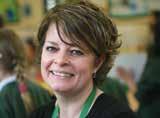
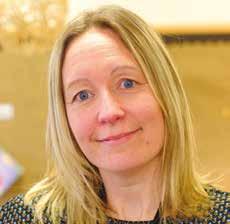
A head’s experience of the new framework. See page 12.
White paper woes
High on ambition, short on funding. See page 22.
The magazine for NEU Leadership members Spring 2026
Lead. Spring 2026
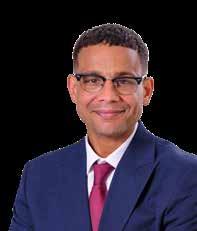
Assistant principal Akeim Mundell (see page 8)
Photo: Kois Miah
NEU president: Ed Harlow
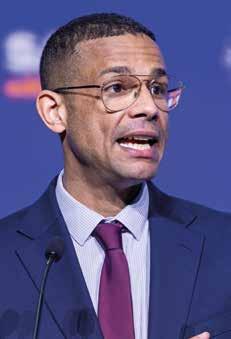
NEU general secretary: Daniel Kebede
Editor: Sally Gillen
Editorial assistant: Frankie Faccion
Production editor/design: Amanda Ellis
Design & subbing: Melissa Harteam Moore
To advertise contact: t: 020 7880 7614 e: lead-magazine@ redactive.co.uk
Ad artwork co-ordinator: Aysha Miah-Edwards aysha.miah@redactive.co.uk
Except where the
IT’S been five months since Ofsted launched its new inspection framework. So, what’s changed? Single-word judgements went, smiling inspectors arrived. But – and we should all feel angry about this – the most dangerous aspect of the inspectorate remains: its highstakes nature and the linked stress and anxiety for school leaders and staff.
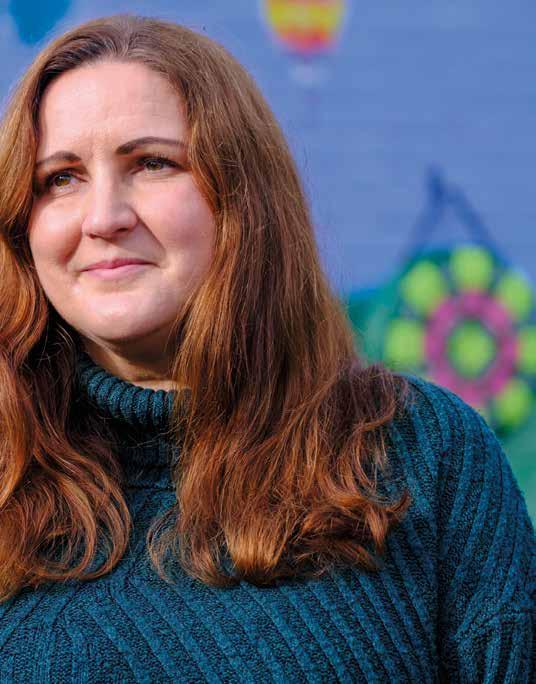
In this Ofsted-themed issue, we hear from one of our primary head members whose school was inspected in December. Just the anticipation of inspection has had a terrible impact on her health, which is at once shocking and unsurprising. Generously, she has taken the time to give others a sense of what’s in store when they get ‘the call’ (see page 12).
In a similar vein, the NEU commissioned Professor Tony Breslin to highlight five key areas to help you navigate the latest framework (page 20). In reality, though, any pointers will only ever be limited to helping you reduce the effects of a still-harmful system.
It wasn’t just the single-word judgement Inadequate and the brutal conduct of inspectors that led to such tragic consequences for NEU leadership member and primary head Ruth Perry: it was that inspection itself is so high-stakes. In this issue of Lead, we have a tribute to Ruth, written by former primary head and retired member David Scott, one of very many people who wanted to see a fitting testament to her remarkable contribution to education. It’s also a reminder of why the NEU will not stop campaigning for a fair, effective and supportive accountability system: because, whatever changes have been made, we still don’t have one.
Daniel
Kebede
General secretary National Education Union
by Warners Midlands plc.
4 Update New Ofsted inspections; agency fees capped; Lead reports on annual conference; and more
22 Final word
Daniel Kebede on the schools white paper’s shortfalls
8 Interviews
Akeim Mundell on diversity; Kate Elliott on the new framework
15 Leadership convention
All the key updates from the London event
18 Ruth Perry tribute
Remembering the ‘outstanding, dedicated, kind’ head teacher
20 In depth
Professor Tony Breslin details what the new inspections mean for you
NEU annual conference
Ofsted reform: more ways for schools to fail
OFSTED’s new inspection framework creates more stress for educators and ways for schools to fail, delegates at this year’s annual conference heard.
Speakers during a debate on the toxic inspectorate described the newstyle school report card inspection model, introduced in December, as worse than what existed before. It increases the risk of harm to leaders and all education staff.
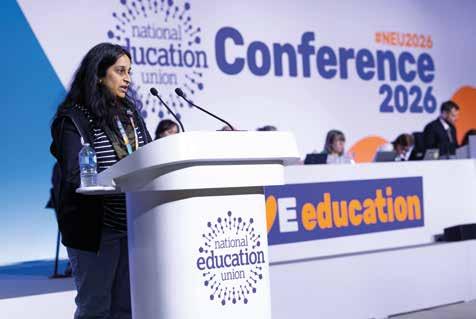
Urging members to vote to “reject the rebrand” and continue campaigning for Ofsted to be abolished, Vina Vekria, of Brent NEU, said: “This new framework is nothing but cheap perfume, and it doesn’t matter how they try to cover it up, it can’t remove the stench of Ofsted’s rotten core.”
She added: “Ofsted kills. It contributed to Ruth Perry’s death and has caused harms to the mental health of educators. Yet it remains in place, judging us and how we do our jobs.”
Seconding the motion, Ian Walters, a member of the NEU’s national executive,
was applauded as he said Ofsted had, remarkably, made an “appalling inspection system even worse”. Analysis of the first inspection reports showed schools with the highest proportions of pupils receiving free school meals were three times more likely to be graded below Expected standard for achievement, he said, compared to schools with the lowest numbers.
The new framework is “simply disgraceful,” he added: “Heads in
deprived areas have described the grades as demoralising, arguing the framework judges attainment rather than genuine achievement in its context. We’re back to evaluating poverty, not education.”
Another speaker, Patrick Martin from Brent NEU, was applauded and cheered as he said: “Deprivation causes educational disadvantage. That is what leads to poorer educational outcomes, not poor teaching.”
The motion was passed unanimously.
‘Terrifying’ lack of funding for white paper SEND reforms
DELEGATES passed an urgent motion to lobby for more funding, after hearing that much-needed special educational needs and disabilities (SEND) reforms – a major part of the white paper published in February – would fail without a huge funding boost.
Proposer Chris Denson, a member of the NEU national executive, said education was already “creaking” because of chronic underfunding.
Chris said after 16 years of Tory austerity the education system was now unrecognisable: teacher pay is down 20 per cent, recruitment figures have been missed year on year, and retention figures this year were as bad as they have ever been.
He said the SEND reforms, which have a focus on inclusion and early intervention, were “lofty ambitions”. But in the context of funding cuts and the loss of support staff, the reforms would mean exclusion within mainstream schools for many children with SEND, including his own.
He added that proposals to restrict education, health and care plans, when added to the lack of funding for the reforms, was “terrifying”. Members are truly in a fight for the
soul of our education system, which is “a fight that we cannot and will not shy away from”, he said.
Sophie Houghton, also an executive member, seconded the motion, telling delegates: “The title of the white paper is Every child achieving and thriving. Yet it’s clear the government’s plan has not factored in that for every child to thrive we must have the staff and education system to be thriving too.”
She added that the paper’s wide range of reforms was spare on detail, and without sufficient funding to implement them overstretched schools would be “completely destitute”.
Sabrina Greenall, from Torfaen, in Wales, said schools had been placed under intense pressure as they tried to implement reforms for pupils with additional learning needs (ALN).
“For 15 years, funding in Wales has not grown but costs have: energy bills, post-Covid recovery and, most significantly, the costs of ALN reform have been rolled out without the funding needed to make it work.”
She added that 90 per cent of school leaders had said ALN funding was insufficient.
Vina Vekria of Brent NEU: ‘Ofsted kills. Yet it remains in place, judging us and how we do our jobs’
Photo: Kois Miah
‘Government plans do not deliver’
‘We
THE government is failing to deliver on is promises for education, NEU general secretary Daniel Kebede told delegates.
Addressing members at the annual conference in Brighton, he said policy detail on the new Ofsted framework, curriculum and assessment review, the children’s wellbeing and schools bill and white paper “just does not deliver”.
He went on to say: “The government invites us to believe this white paper marks a turning point. We have heard that invitation before. We have watched “turning points” arrive on paper and leave, quietly, without ever reaching the children who were promised the future.”
Daniel said the union did not want the government to fail, but to listen and understand what has gone wrong. However, 65 per cent of NEU members who voted Labour in 2024 had told the
deserve working dignity’
FUNDING education is not a bureaucratic issue; it is a moral one. That was the message to government from NEU president Ed Harlow, as he took to the stage at conference.
He described the creative freedom and healthier funding for schools before the financial crisis hit in 2010 and former education ministers Michael Gove and Nick Gibb joined the Department for Education: “We entered an era of austerity. Austerity not just of spending, but austerity of imagination, of creativity, of pedagogy, of ambition, of joy.”
“Politicians like to speak of ‘standards’ in education but rarely do they bother to define this term. It has become a lazy, catch-all euphemism to justify a rigid, narrow, regressive and unimaginative curriculum designed to be easily tested.”
Schools in England had the highest class sizes in Europe, with more than a million children now taught in classes of 31 or more. And the partially funded 6.5 per cent pay rise for teachers over three years recommended by the government would do nothing to deal with schools’ recruitment and retention issues.
Applause rang out in the auditorium as he said: “Nobody goes into education for the money. But working dignity is the least we deserve. For too long educators have had to make do and mend in a broken system.
“We must be clear: fund our schools, invest in educators, invest in our children, invest in our communities. If we are to save education, austerity must end. Not in words, but in deeds.”
NEU they would not do so again.
Teachers and support staff had been asked to compensate for the failures of policy with their own resilience. Responsibility for overcrowded classrooms, rising need and shrinking specialist support had been pushed downwards on to schools.
Families were being forced to fight for what should be guaranteed, added Daniel. “Hunger walks in with the children. Anxiety takes a seat at the back of room. Unmet special educational needs raise their hands every morning and are told, again, to wait.”
The union would not wait for permission to save education, for another crisis to prove what we already know, but would campaign for the right of every child to be taught in a properly staffed, properly supported school.
n A motion calling on the union to publicly oppose the statutory year 8 reading test and campaign for investment in early intervention and targeted literacy support was passed. Holly Williams from east Kent said: “Literacy inequality begins in underfunding early years provision. It grows with cuts to SEND and deepens with school libraries closing.”
n Delegates passed a motion calling for the union to campaign for schools to be awarded additional funding to remove all asbestos
Proposer Sarah Vaughan, of the NEU’s executive, said: “Slammed doors, crowded corridors and constant movement are the worst possible environment for a material that can be released by something as small as a pin tack from a display.”
n A motion on stopping school closures was passed, with speakers from London describing the impact of a lack of affordable housing on school rolls. Carly Slingsby, whose school St Dominic’s was one of eight in Hackney forced to close in the last two years, said emergency funding was needed to keep schools open.
Photo: Kois Miah NEU general secretary Daniel Kebede
NEU president Ed Harlow
Photo: Kois Miah
Update
NEU guide to navigating Ofsted inspection
NEW-style Ofsted inspections that result in a report card for schools have been taking place since December. The union has produced advice and guidance on navigating the new framework, along with a jargon buster to help members understand the changing language of Ofsted.
The NEU believes the new school report on six to eight areas – including curriculum and teaching; attendance and behaviour; achievement; personal development and wellbeing; inclusion; and leadership and governance – will cause more harm than good.
Our national campaign for urgent and fundamental reform of a system that does not effectively protect the wellbeing and
safety of school staff continues. Meanwhile, school staff can protect themselves against the damaging impact of
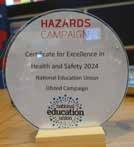
Ofsted inspections by using our risk assessment, which won an award (above) at the annual Hazards conference in 2024.
The NEU believes high-stakes inspections create a level of anxiety, stress and unsustainable workload for staff that mean Ofsted should be assessed in the same way as any other workplace hazard.
Photo: Jess Hurd
The union’s five-step risk assessment –identify the hazards, assess the risk, control the risk, record the findings and review the controls – is based on the approach recommended by the Health and Safety Executive.
Don’t wait until your school is ‘in the window’ – the risk assessment is designed to protect staff from excessive workload and unnecessary pressure driven by Ofsted before, during and after inspection.
neu.org.uk/ofsted-risk-assessment-guide
See interview on page 12 and advice on the new framework on page 20
Together against fascism
FIFTEEN thousand NEU members joined a unity march in London against the rise of the far right.
The event, organised by the Together alliance on 28 March, attracted hundreds of thousands of people and was supported by scores of high-profile names including comedian and actor Sir Lenny Henry, former Doctor Who actor Christopher Eccleston and singers Billy Bragg and Paloma Faith.
Trade union members, charity workers and MPs from across the political spectrum also marched from Hyde Park to Whitehall, demonstrating against growing hate and division.
NEU general secretary Daniel Kebede was among the speakers. At the NEU’s annual conference in Brighton a few days later, Daniel told delegates he had been proud to stand with members for the Together march.
“We marched to say that hate dressed up as common sense is still hate. That division, however loudly shouted, does not become truth. That racism and fascism do not gain legitimacy simply because they are repeated,” he said.
Leaders urged to support supply staff under new agency rules
CAPS on the fees agencies can charge schools – to be introduced in June –will support schools to “save millions”, the Department for Education has claimed.
Under the new framework, schools will also be expected to use ‘approved’ agency providers unless they can achieve better value for money elsewhere.
The NEU’s Stop the Agency Rip-Off campaign has exposed the huge profits made by supply agencies. Schools spent
£1.4 billion on supply teaching in the financial year 2023-24, more than 80 per cent of which went to agencies.
Fee negotiations will be unique to the individual employer, which could see larger multi-academy trusts (MATs) reducing costs, but smaller schools or MATs unable to, creating huge variability for schools and supply workers.
A positive development is that schools will no longer pay agencies a fee if they make a staff member permanent after 12 weeks.
The union believes that while there are issues with the new framework, leadership
members can support supply staff by employing them directly, where possible, to stop the squeeze on the school budget and ensure fair pay for these members.
The NEU is also reminding leaders that even when agencies are used, the school or MAT has the power to guarantee payment to national pay scales for every supply worker. Leaders should also work with reps to ensure their school follows the NEU cover model policy to hire in supply staff when colleagues are absent.
neu.org.uk/cover-model-policy
Photo: Hollin Jones
NEU4157/0126
Staff take second jobs to pay bills
TENS of thousands of members had voted in the NEU’s England-wide pay and funding ballot, as Lead went to press.
An online indicative ballot of leaders and teachers at state-maintained schools was launched on 28 February after the government recommended a paltry 6.5 per cent pay rise split over three years and refused to boost school funding.
A separate ballot of support staff on pay and job losses is also underway.
The union recommended members vote YES to strike action if the government
refused to increase the unfunded, belowinflation award and increase school funding.
NEU4157/0126
Leaders leaving has quadrupled since 2010
RECORD numbers of school leaders are leaving the profession, and at quadruple the rate in 2010, NEU general secretary Daniel Kebede told the education select committee.
Daniel has said there was a “real issue” in retaining head teachers.
Nicci Burton
Executive head teacher Nicci Burton, who voted to strike if necessary, said the pay offer was “awful”. Nicci (pictured), who leads two maintained nursery schools (MNS) in Warwickshire, said staff had to take second jobs to pay their bills. She criticised the government for failing to fund the pay award and said having to find the money would “push us further into deficit”.
Hints that directed time may be removed would be a loss for leaders, added Nicci, because the 1,265 cap on hours helped leaders who may need to “push back” on wider initiatives that require more from teachers. Education secretary Bridget Phillipson told the School Teachers’ Review Body directed time was an “unusual” contractual arrangement that may constrain schools.
Kathryn Morgan, leadership and workforce specialist at sister union ASCL, said there was a “huge pay disparity” between male and female school leaders, and while teaching is a female-dominated profession there are more men than women in chief executive and head teacher roles.
“It strikes me that women have to make a choice: am I going to continue to focus on my career or on having a family? The third option is: am I going to try to do both and just become incredibly frazzled?”
“Funding the pay award would push us further into deficit.”
But Nicci said directed time “helps leaders protect staff”, adding that staff were being expected to do “more and more for being paid less and less, which isn’t fair”.
Nicci and a group of MNS leaders and teachers have met Helen Hayes, chair of the education select committee and MP for Dulwich and West Norwood, to highlight the chronic underfunding.
She went on to say school leaders were not spending their time and effort on teaching, learning and the professional development of staff but on dealing with “societal challenges”, such as the impact of poverty.
“There is a question around whether we should be supporting leaders with supervision, because they are dealing with some unimaginable things.”
‘Food isn’t separate from learning – it enables learning’
NEU members, parents, councillors and community groups gathered at a school in Birmingham, in March, to discuss how to push forward the campaign for universal free school meals in the city.
Tania Yasmin (right), executive head at Create Partnership Trust, which runs Greet Primary School, said the effects of hunger on children were stark: low energy, small frustrations and inability to focus. “As educators we spend a lot of time discussing ways we can help children learn, but food isn’t separate
from learning – it enables learning,” she said. “No child can concentrate if their basic needs haven’t been met.”
Tania talked about the shame of parents, many of whom work two or three jobs, but are unable to afford school meals. Unpaid dinner debt in her school of £12,600 was growing, she said, “but we’re never going to not feed a child”.
Clare Thornton-Wood, spokesperson for the British Dietetic Association, said the charity is seeing increasing numbers of children with nutritional deficiencies: “The poorest families would need to spend 70 per cent of their disposable income on food to meet the cost of the government’s recommended healthy diet.”
The meeting was one of a series planned across the UK as part of the NEU’s Free School Meals for All campaign. tinyurl.com/whatsapp-NCLB
Photo: Jess Hurd
Inclusion in action
For Akeim Mundell, education and community activism go hand in hand. He talks to Emily Jenkins about the power of student voice, diversity in school leadership and being in a union that unites all.
BY the time Akeim Mundell became one of the country’s youngest assistant principals in 2023, aged 28, he had worked in education for almost half his life.
Starting out as a teaching assistant aged 16, he spent his days in school and evenings working towards a diploma in education and childcare. Foundation, bachelor’s and master’s degrees followed – as well as an honorary doctorate – then a postgraduate certificate in education. He was recently awarded the national professional qualification for senior leadership.
It’s been 15 years of hard work.
But even before that first job, Akeim had spent his teenage years trying to improve life for young people after a close friend was shot and killed, aged 15, while cycling in Moss Side, Manchester.
A huge loss, it instilled a drive to make the local area safer and create opportunities for young people like him, says Akeim, and was the start of his community activism.
Confidence and competence
He became involved with the Reclaim Project – a charity that works with disadvantaged young people across the North West to help them make positive changes in their communities – which supported him through his bereavement.
“Reclaim and its founder Ruth Ibegbuna gave me the opportunity to go to parliament, speak to councillors and give talks about the way councils should invest in young people. It was a fantastic way to get my voice out there as a young person,” Akeim explains.
He went on to become a mentor with the project. Then, a couple of years later, he was encouraged to apply for the TA job by Jenny McGarry, his former teacher at St Mary’s CE Primary School.
It had always “felt like home” and he had regularly returned to update staff on his community work, so applying felt like a natural progression.
“Jenny said to me, ‘if you’re successful, we promise to support you, and you will be educated on the job’. At the time, I just thought, ‘a job, brilliant, I’m going to get paid,”’ he laughs.
He admits there were moments of self-doubt, particularly around feeling ready at 16 for the level of accountability that came with the job. “But colleagues invested in my development; they
PHOTOS by Kois Miah
challenged, guided and trusted me and my confidence developed alongside my competence. They kept their promise and helped build me to what I am today.”
Which is an assistant principal at William Hulme’s Grammar School in Whalley Range. He’s also a staff governor and head of personal, social, health and economic (PSHE) education, a subject chosen because it can be “transformative” for young people, “not simply a lesson on a timetable but preparation for life”.
A diverse, culturally rich area of Manchester, Whalley Range is also home to many families experiencing economic hardship and social inequality, Akeim says. He’s worked there since 2023, joining from a school in nearby Chorlton, where he managed the heads of year and pastoral care team, a job he “absolutely loved”.
It was his line manager who encouraged him to think about leadership.
“It wasn’t the type of conversation I was expecting to have at that time, but once again, someone really invested in and encouraged me. Becoming an assistant principal at a young age was an amazing achievement for me, which shows other diverse educators that leadership is possible if you’re determined.”
Championing diverse leadership
In three years, he has made a huge impact. His first two initiatives were a school uniform swap shop and a school pantry, both driven by his belief that schools should connect with and support the local community.
Families don’t need to register or give their name to use these resources, and there’s no obligation to donate anything. Anyone who needs uniform receives it.
The school pantry accepts items and fortnightly food donations from local charities. Groceries are available for any family in need, irrespective of income or employment status, and students take responsibility for preparing the pantry.
Pupils have also suggested many events, which Akeim has helped to introduce. Wow days – when lessons are suspended and an occasion or theme, such as World Afro Day, is explored – are among them.
“Student voice is powerful,” he stresses. “We must make sure we are working on and implementing in our school what our students actually want, and what our community needs.”
“Leadership doesn’t mean distancing yourself from colleagues.”
He regularly takes off his “teacher hat” to talk to young people about what’s important to them and his community work, for which he has won numerous awards, and was recognised in 2017 with a British Empire Medal.
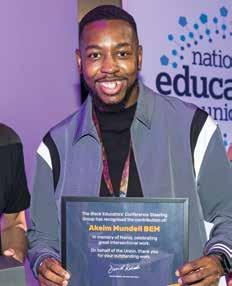
At last year’s NEU Black educators’ conference (BEC), Akeim was presented with the Manoj Natha-Hansen award (pictured above), which celebrates great intersectional work. There was, he says, “something deeply powerful” about receiving the award in a room full of inspirational Black educators.
An NEU member since 2023, when he became a leader, Akeim soon joined the North West’s Black organising forum. “I’ve never really had a network of teacher friends I could relate to, but the second I joined the NEU that changed,” he says.
“The NEU is a special union. What stood out for me is that it’s inclusive; it doesn’t separate classroom teachers from leaders in terms of professional voice or development. The annual leadership convention and the range of CPD makes it clear leaders aren’t only supported but actively encouraged to remain connected to the profession at every level. For me, being
in leadership doesn’t mean distancing yourself from colleagues.”
Akeim ran workshops at BEC 2025 and regularly gives talks encouraging Black educators into leadership. The lack of diversity in some management positions –a long-standing problem – impacts young people in many ways, he believes.
“It’s important that, as diverse educators, we challenge and ask questions. If we don’t, it will be assumed that the structures in educational establishments are OK,” he says. For example, it might be assumed that a safeguarding team made up of staff of just one ethnicity is fine, but there will be some pupils who don’t feel comfortable disclosing difficulties to educators they may feel unable to relate to.
‘Schools must be anchors’ Such issues can be addressed by implementing the NEU’s anti-racist framework, which Akeim has done at William Hulme’s.
In his time there, he has also helped raise £20,000 for local charities chosen by students, parents and carers, and is now building an onsite community hub – again, bringing together the school and local community. It’s a huge piece of work and a very exciting time at the school, he says.
“Things like the community hub are about creating belonging. Schools in communities like ours cannot afford to be isolated institutions. They must be anchors.”
The hub will house the swap shop, pantry and a community café, which students will run. It will host free courses for parents, and organisations will be able to use it for out-of-school hours and holiday activities for young people. It will also be a place to host community days for groups including asylum seekers, homeless and elderly people.
Welcoming in marginalised groups models “inclusion in action, rather than simply teaching it as a concept,” Akeim argues, and helps build pupils’ empathy, compassion and social responsibility.
It is vital young people grow up not only celebrating difference but understanding the realities people face, he believes. “Education shouldn’t happen in a vacuum. When pupils see their school engaging with the wider community, they learn that success is not only about personal achievement but about lifting others with you.”
Empowering school leaders with financial confidence
Your pension. Your future. Your peace of mind .
As a school leader, you know that staff wellbeing is fundamental to a thriving learning environment. Quilter Financial Advisers in conjunction with NEU partners with schools across the UK to deliver free financial education events, helping your team understand their Teachers’ Pension Scheme and Local Government Pension Scheme.
We are proud to support the wellbeing of school staff by providing a follow up initial consultation to each attendee – because financial confidence should be accessible to everyone.
Our sessions are designed to demystify pensions, answer common questions, and empower your staff to make informed decisions about their financial future. Whether your team is early in their careers or planning retirement, our expert advisers are here to help.
Why these events matter
Understanding your pension shouldn’t be complicated. Our free financial education events are designed to help school staff gain clarity and confidence about their future.
What’s included
Free school-based events on Teachers’ and Local Gov Pension Schemes with tailored presentation with practical insights into: how your pension works what your options are how to plan effectively for the future presentations on the Teachers’ and Local Government Pension Schemes time for Q&A with a qualified financial adviser initial follow-up consultation for staff with Nationwide availability.
More than pensions
Not just pensions: in addition to pension guidance, our financial education events cover a range of important topics, including savings strategies, retirement planning, budgeting, and more. We’re committed to supporting your staff’s overall financial wellbeing, no matter where they are on their financial journey.
Subject areas
The following are the key subject areas we offer. Each of these areas is subsequently broken down showing the events we offer and what each one covers.
Mortgages
Cost of living
Inheritance tax
Pensions
Financial planning
We can, if required, offer tailored events (e.g. for employer pension schemes). If this is of interest, please get in touch.
Becauseevery educatordeserves
Support that goes beyond the classroom
By inviting our advisers to your school, you’re investing in your staff’s financial confidence and wellbeing – key drivers of retention and morale. Our sessions are trusted by hundreds of schools and unions, and every event is tailored to meet the needs of your team.
Let’s help your team take control of their financial future.
Or if you have any questions or if you’re ready to book a date and time for your event, in person or online –then please contact your local representative using the following details:
Contact me if you’re in: London, the South East, East Anglia, the East and West Midlands and parts of the North West including Manchester, Liverpool and Blackpool.
Contact me if you’re in: Yorkshire & Humber, the North East, the South West, Scotland, Northern Ireland, Wales and parts of the North West including Lancashire & Cumbria.
Interested in understanding your own pension options and financial plans?
As a member of NEU initial consultation is free. You can book a confidential session at any time.
Book your confidential one-to-one free initial consultation with a Quilter Financial Adviser today.
Interview
WHATEVER claims Ofsted makes about its new approach – and many leaders feel it’s just old wine in a new bottle – there’s no denying the anxiety and fear such a high-stakes system still invokes.
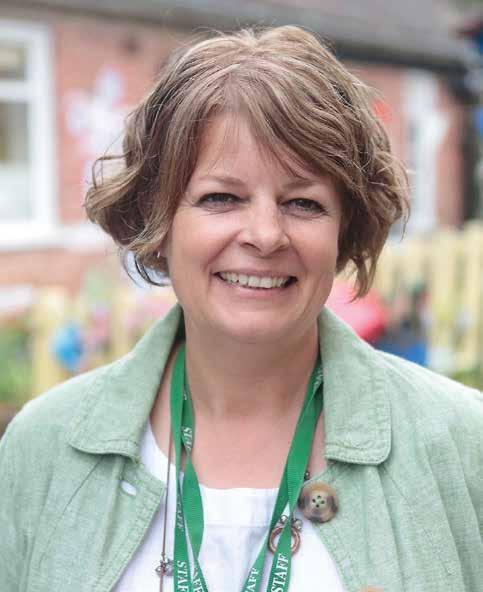
Ask primary head Kate Elliott. She lost the hearing in her left ear last December, which coincided with the anticipation of receiving ‘the call’ from Ofsted. “I got the Sunday night ‘fear’ and developed tinnitus, on Monday I got the notification that Ofsted inspectors were coming, and during the call with the inspector the hearing in my left ear went,” she explains.
Fit and healthy previously, Kate now has what a specialist called a dead ear.
Stress reaction caused deafness “I’ve never had any problems with my hearing and the only thing it has been attributed to is my body’s stress reaction, which caused my inner ear to fail. I’m now waiting for a hearing aid, which may or may not work due to the profound level of loss,” she says.
Despite having suddenly lost her hearing, Kate decided she would still press ahead with the inspection of her school, East Peckham Primary, in Kent. She even put back an emergency audiology appointment so it would fit in with the inspection timetable, something she now finds difficult to comprehend.
“It’s ridiculous that I put inspection over my own health,” she says. “I still can’t quite figure out why I didn’t insist on not continuing. But I’d already told staff, we were ready, and having more notice just gives you more time to be stressed about it.”
Kate had every reason to fear the worst. The previous inspection of her school in 2023 was a bruising experience. It was carried out during her first year as head, following a period of turbulence, and inspectors were heavy on judgement. One in particular, a “terse secondary school PE teacher”, Kate remembers well.
Despite being good in most areas, the quality of education was deemed to require improvement, resulting in an overall Requires improvement grading for
“Ofsted still isn’t really any more conscious of leadership wellbeing, or the time it takes to manage and prepare for an inspection.”
‘Ofsted stakes higher
Primary head Kate Elliott was so stressed when ear. She tells Sally Gillen if the reality was as bad and exactly what leaders can expect from the new
PHOTO by Jess Hurd
than ever for leaders’
she received ‘the call’ that she went deaf in one as the anticipation, how inspection has changed, Ofsted regime.
the school. At the time, the inspectors had waved it away as “only two words”, even though Kate stressed that for a school they carried so much weight.
While she’s happy that one-word judgements have now gone, she says Ofsted still hasn’t got it right.
“It isn’t easier or better, and Ofsted still isn’t really any more conscious of leadership wellbeing, or the time it takes to manage and prepare for an inspection,” she stresses.
“The inspectors this time were kind and more supportive than before. That said, they weren’t able to adjust the timetable to allow me to attend the emergency audiology appointment, which meant I attended during their lunch break and was given feedback on the morning session while driving back from hospital. Was that really supporting my wellbeing?”
New toolkit a major focus
The inspection itself was a mixed experience. It began with a two-hour Zoom and, unlike last time when inspectors appeared to be following a script and regularly cut her off mid-sentence, this time Kate was able to say everything she wanted to about her school.
The meeting covered each part of the new toolkit, with a significant focus on inclusion and where she had evaluated the school on each of the seven areas.
The three inspectors were, says Kate, all primary school practitioners, very supportive and positive, and, importantly, they understood her school’s context.
Less positive was the amount of input required from school leaders, which in a small primary with 210 pupils placed a lot on Kate’s shoulders, as well as her deputy’s. They are the senior leadership team (SLT), with additional, specialist support from the special educational needs co-ordinator and school business manager.
“The previous inspection was all about deep dives and inspectors spoke to teachers more, whereas this time the stakes were higher for the SLT,” Kate explains. “One of my most experienced teachers said afterwards that it was the most pleasant Ofsted inspection she had been through because she hadn’t been involved very much.
Interview
“The process overall was fair, but there is a lot put on school leaders, with an expectation we will know our school inside out, and less on other members of staff. If you are a leader who likes disseminated leadership, the previous model was probably better, because there are other people to share accountability. I felt I had to be there for every part of the inspection, so the new framework hasn’t helped ease stress.”
She adds that inspectors met with some teachers at the end of the first day, but with a specific focus on their wellbeing, workload and whether they liked working at the school. So, again, they were measuring the impact of the SLT.
Inspectors spoke to a lot of pupils
Mostly inspectors spoke to senior leaders, observed and spoke to a lot of children, particularly to assess the impact of the curriculum, basing many of their judgements on what pupils had to say.
Giving such weight to what pupils can recall feels “unnerving”. Frustratingly, it meant that on personal development and wellbeing – which she feels is a particular strength at East Peckham – the school was given an Expected rather than a Strong standard, because the inspectors couldn’t evidence just one word of one objective.
“It didn’t matter that we could show what we had taught,” says Kate. “Under the previous model, there was more of a focus on what was a good fit; this time Ofsted requires what it calls a secure fit, whereby each criteria is met. This does not feel it fairly reflects practice.”
“This inspection was better, the inspectors more compassionate.”
Although her school came out as strong in attendance and behaviour, she feels judging the two things together is unfair because some schools may have brilliant behaviour but poor attendance, despite doing all they can to improve it.
Other elements of the new school report card are also unhelpful, Kate feels, pointing to the colour-coding: “Despite inspection trainers saying that schools should see Needs attention as within the old range of Good, and just in need of what they have described as an MOT,
the RAG (red, amber, green) rating of amber contradicts this. The colour-coding is unhelpful.”
‘Golden thread’ of inclusion
Kate is also not convinced that tracking a small group of disadvantaged children throughout the school day is the best way to judge if there is what Ofsted calls a ‘golden thread’ of inclusion running through a school.
Many children aren’t considered disadvantaged, but are given support when it’s needed, she says, so they also benefit hugely from the school’s offer.
Overall, she’s happy with the inspection outcome – a mixture of the Strong and Expected standard grades –though the unfairness of missing out on a Strong grade for pastoral care because one word of an objective couldn’t be evidenced still rankles.
She wonders whether this inspection was better because the inspectors seemed more compassionate and there was a lot of smiling, indicating some shift to support head teacher wellbeing, but feels there is still much more to do.
In the end, inspection – at least by Ofsted – is inspection. “The process was very much the same level of scrutiny,” she concludes. “In a follow-up medical appointment, the doctor said to me: ‘Nobody goes into teaching because they don’t want the best for the children, so why is Ofsted so high-pressured that it’s breaking really good practitioners?’ And what could I say? I don’t know.”
At a glance Kate shares five things to expect from inspection
n The toolkit is the most important document – go through it with a fine-tooth comb so you know where you are and what things may be missing. Self-evaluate yourself against it, as it is now secure fit, and no longer good fit.
n There is a much heavier focus on senior leaders, more so than in the last framework, with an expectation that you will know your school inside out.
n A sample of the school’s most disadvantaged children are tracked throughout the school day. This is done
compassionately and inspectors observe them to understand how they access the day, but they do not necessarily speak with them directly.
n With an additional inspector(s) on the first day, they cover more ground and speak to a lot of children, basing many of their judgements on pupils’ remarks.
n Be aware that Inclusion covers all disadvantaged children, not just those with special educational needs, and sets the standard for this framework.
Moving forward together NEU Leadership convention
NEU Leadership members gathered in London on 7 March to discuss key issues, take part in workshops and network with colleagues from across the country. Sally Gillen went along.
Photos: Rehan Jamil and Jess Hurd
CITIZENSHIP education has been marginalised since 2010, creating a “political literacy gap” among young people at a time when far-right narratives are circulating on social media, an expert told leaders.
In a thought-provoking keynote speech, education lecturer Qasir Shah, who leads the citizenship master’s degree course at the Institute of Education at University College London, urged school leaders to integrate citizenship education across the curriculum.
“If schools do not explicitly teach how politics works, young people will learn from algorithms,” he said. “Citizenship is designed to ensure young people understand the political world they already inhabit rather than being shaped by it uncritically.”
In 2010, there were 243 citizenship trainee teachers, which fell to only 40 in 2018, he added.
School leaders are trying to manage a “set of pressures” including the Prevent duties and fears about teaching political impartiality, when many young people are encountering anti-migrant narratives and gender hostility every day.
He argued that fundamental British values had replaced citizenship, but that had meant a shift from “systems knowledge to behavioural affirmation”, and what constituted Britishness was highly contested. Its ambiguity was being exploited by the far right. “British values don’t teach how parliament functions, how power is contested, judicial independence and how
“Ensure young people understand the political world they already inhabit.”
Qasir Shah (above)
to evaluate ideological claims,” argued Qasir. “They assert principles, but do not teach political reasoning, which is what protects democratic life.”
He went on to argue that citizenship was about understanding power, rights, law and participation. “I’m fully aware citizenship education is highly unlikely to gain any real traction in schools, despite the fact it will become statutory in primary schools in 2028, so it must be integrated into the curriculum, across different subjects, and not become isolated,” he said.
Leaders should ask departments to make citizenship visible in schemes of work and pupils should learn about the subject through three lenses: power, rights and participation, which would teach them political literacy and understanding of how society and government works.
“Students should leave school politically literate. If a student encounters extremist content, can they recognise propaganda, interpret data critically, understand the history of migration? Can they distinguish dissent from hate? If yes, your curriculum is building democratic resilience.”
He added that the task for schools was not to promote fixed Britishness because that “is a fiction”. Citizenship teaches pupils to disagree without dehumanising, how to argue without scapegoating and how to participate without fear. “It is how we teach young people to build harmony deliberately, confidently and together,” he concluded. continued on page 16
continued from page 15
£20bn short each year but educators still deliver
NEU national president and middle leader Ed Harlow told leaders the schools white paper, published in February, feels like “an unrealistic list for Santa”.
Ed, who is head of music at a London secondary school, said while the union welcomed many of the paper’s proposals to reform special educational needs and disabilities (SEND) education, measures were hugely underfunded.
The £200 million allocated for teaching and support staff training, which covers early years, schools and colleges, was “clearly not enough”.
The main thrust of the planned change is to increase inclusion, with as many children who have SEND in mainstream schools as possible.
He added that the NEU was concerned about the workload implications
for school leaders and had been clear SEND training for staff should take place within directed time.
He urged leadership members to vote in the indicative online funding and pay ballot (28 February-17 April), part of the union’s three-year Save Education campaign. Ed said support for the campaign is “vital”.
“In 2007-08, 12 per cent of public funding in England was spent on education, but last year it was 9.1 per cent. The NEU believes education is underfunded by £20 billion a year,” said Ed. “For too long we, as educators, have continued to deliver time after time when funding has been cut.”
Find out more about the Save Education campaign at neu.org.uk/save-education
“£200m for SEND training is clearly not enough.”
Ed Harlow (above)
’Social media, podcasts and influencers have become de facto educators’
MAINTAINED nursery school executive head teacher
Nicci Burton (right) chaired an interesting panel discussion on social media harms, saying her staff were supporting three-year-olds on how to stay safe online.
“Social media, podcasts and influencers have become de facto educators,” she said. “They shape how young people understand gender, power, relationships
“The whole event was perfect.”
and sex, long before the education sector has an opportunity to intervene. It’s clear social media is fuelling the sexist hatred many of you will have seen within your school settings.”
Speaker Connie Muttock (left) head of policy at independent think tank the Centre for Young Lives, said a study by the University of Kent had found the TikTok algorithm gives teenage boys four times more misogynistic content than other users, receiving extreme misogynistic content within an hour.
Lauren Bull (right), a sexual health doctor in west London and member of campaigning group Health Professionals for Safer Screens, said young people’s exposure to harmful content online was insidious and pervasive. “This is a public health issue, and we should be working on the precautionary principle that social media should be taken away until it has been proved to be safe,” she said.
NEU Leadership convention
‘Ofsted straitjacket is problematic’
THE move away from a best fit to what Ofsted calls a secure fit grading framework for schools was one of the issues discussed by members during a session on new-style inspections.
Under the school report card model, introduced in December despite opposition from educators, six to eight areas of school life are inspected and given one of five gradings. In order to be given a specific grade, for example Expected standard, schools must demonstrate how they have met all criteria for that grade.
Professor Tony Breslin, who helps schools prepare for inspections and led the session, said the change to secure fit was designed to diminish the likelihood of “rogue inspectors”.
He explained: “With the best fit model previously, schools only needed to have done most of the things to reach that grade. It did not have to be absolute and nailed down, but now they must meet every criterion. Inspector autonomy and flexibility has been somewhat sacrificed for consistency, which is generally good, but when it becomes a straitjacket, it is problematic.”
One member, who leads two schools in Yorkshire that are due to be inspected, said school leaders had not been given enough information by Ofsted on key issues such as what will happen if an area is graded Needs attention. “This feels very much like we are being asked to play a game without being
“Current issues and supportive content. A great use of a Saturday.”
told the rules beforehand,” she said. “These things should have been decided before this was all rolled out.”
She added that Ofsted had not thought through the practicalities of returning to potentially large numbers of schools that had received a Needs attention grade a short time after they had been inspected.
Professor Breslin agreed: “There is an inbuilt incentive in the system for inspectors not to give too many Needs attention grades because of the weight that will place on the process, but those revisits won’t necessarily be in person.”
He added: “Ofsted should have taken longer to pilot the framework, but the good news is if an area does need attention, and that’s addressed quickly, the school’s report card will be updated online, whereas before you would have had to wait four years until the next inspection.”
Read more from Prof Breslin on pages 20-21
“Positive dialogue between members and a great opportunity to connect with other leaders from all around the country.”
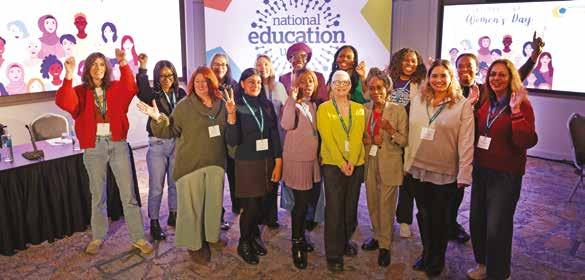
The convention took place the day before International Women’s Day, which was celebrated by leadership members
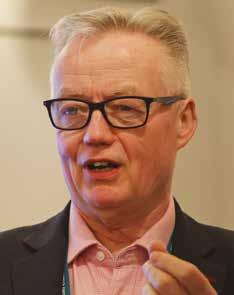
Professor Tony Breslin
Unwavering dedication: a tribute to Ruth Perry
The death of Ruth Perry prompted a public debate about Ofsted’s role and hopes of reform. But, says retired head David Scott, while the grave injustice to Ruth will never be forgotten, we should also celebrate her exceptional contribution to the profession she loved.
ANYONE proud to be in the teaching profession was emotionally affected by colleague and fellow NEU member Ruth Perry’s death on 8 January 2023. It followed her school being rated as Inadequate in an Ofsted inspection that, according to the coroner’s report into Ruth’s death published in December 2023, “lacked fairness, respect and sensitivity”. It gave impetus to the nationwide call for major inspection reform.
As a former head teacher, I understand the work Ruth would have put into reaching the pinnacle of her career. What happened to this popular and successful leader was a grave injustice. I didn’t know her but felt her remarkable life and achievements should be remembered.
I spent a few months researching her, and her sister Julia put me in touch with some of Ruth’s former colleagues. I also spoke to parents and a former pupil. She was one of our very best head teachers.
Knowing that inspections have started again with a ‘new’ system that carries so many of the same risks for school leaders is deeply worrying and depressing. Inspections must be more honest, professional, humane, accurate and respectful to prevent further deaths and harm. Ofsted must prioritise the safety of school staff, as well as of children. The world is watching.
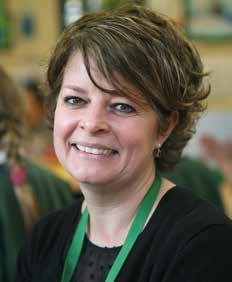
Ruth Perry died in January 2023
This dedication is based on interviews with Ruth’s colleagues, friends and students, and on research into her lifetime achievements.
THE outpouring of grief when Ruth died was followed by a multitude of accolades from her colleagues, pupils past and present, and parents. They described her as an outstanding and passionate educator, inspiring, dedicated, kind, humane and truly wonderful.
Ruth was appointed deputy head teacher at Caversham Primary School in 2006, having been a pupil there herself between 1973 and 1980. She became head teacher in 2010.
Under Ruth’s leadership, Caversham Primary remained one of the most popular, over-subscribed schools in the south of England, maintaining consistently high standards with pupils making rapid progress in the annual national tests and assessments.
Teaching at Caversham extended well beyond the national curriculum. The school promoted cultural awareness, acceptance of diversity, global citizenship, health and fitness.
Ruth’s innovations included pursuit of Arts Council England’s Artsmark Gold accreditation. She fostered a love for learning by introducing diverse opportunities including Latin and Spanish language clubs and an eco council that promoted awareness of environmental issues such as recycling and fair trade.
Through the school’s international links, pupils learned about global goals for sustainable development and how to take action on local and global issues.
The most mathematically gifted children were able to take GCSE examinations in year 6, taught by Ruth herself, a rare opportunity at primary school level and consistent with the school’s highest aspirations.
“Ruth was outstanding, inspiring, dedicated.”
There were numerous extracurricular sports, art, theatre and music activities. Ruth also encouraged school accountability, with the older pupils conducting regular reviews of Caversham, gathering and presenting evidence with enthusiasm and rigour.
One of the school’s most significant achievements was winning Unicef’s prestigious Rights Respecting Schools Award in 2020 at the highest accreditation level of Gold. The professional assessors concluded: “Pupils reported feeling safe in school and could list a wide range of ways that staff kept them safe, including online.”
All three schools where Ruth taught before Caversham were in disadvantaged areas, a challenge she relished. She had also worked as a
local authority maths adviser for two years before devoting the rest of her career to Caversham.
Ruth was seconded to support a struggling local school and over ten years represented Reading primary schools on the regional children’s safeguarding board. She undoubtedly had a profound impact on the lives of those she encountered both personally and professionally.
Ruth’s passion for education was evident throughout her career and her legacy lies in her transformative leadership and commitment to providing a holistic and enriching educational experience for all pupils. She conducted her life and work with humility, humanity and integrity. Her legacy is one of unwavering dedication to education and communities.
I offer a final, poignant tribute from a parent: “On the day it was announced that Mrs Perry had died, the children wandered slowly out into the playground, shock and incomprehension written on their faces. My child was confused. Ruth Perry was once just like her, a little girl in that same school playground, learning how to navigate the world. We are all heartbroken.”
Above all, Ruth Perry was a beloved wife, mother, daughter, sister and friend to many. She will be forever in their thoughts and hearts.
n If you are affected by the issues in this article or wish to speak to someone, phone Samaritans on 116 123 or Education Support on 08000 562 561.
n If you are a teacher or school leader who has experienced a traumatic Ofsted inspection, you can get confidential support and advice from HeadsUp4HTs: headsup4hts.co.uk
In depth
Navigating inspection: 5 key issues for school leaders
Education consultant Professor Tony Breslin details some of the recent changes to Ofsted’s inspection framework and explores the implications for school leaders.
I AM going to focus on five issues: the emergence of ‘spiky’ profiles; the publication of toolkits and operating guides; the need to achieve a secure fit with the grading criteria; the centrality accorded to inclusion; and, lastly, the role of the nominee.
1. ‘Spiky’ profiles
Single-word judgements disappeared at the start of the 2024-25 academic year. However, the shift from four to five grades – Exceptional, Strong standard, Expected standard, Needs attention and Urgent improvement – means the likelihood that a school will receive the same grade in each area of activity is greatly reduced. Post-inspection, most schools will develop what assessment experts call a ‘spiky’ profile, stronger in some areas than others.
For leaders, this means that pursuing an overall Outstanding or Good judgement, as some might have done under the previous framework, is no longer an option.
School leaders might want to consider whether their school ought to pursue greater recognition in certain areas of activity, those that might help to articulate their ethos or sit in unison with specific long-held traditions in the school community. This could be around a commitment to personal development, academic success, curriculum innovation or to what I have elsewhere referred to as inclusion-first strategies – those
“Expecting a head to be across the toolkits for each evaluation area is neither practical nor reasonable.”
for which inclusion is seen as the foundation for achievement rather than its poor relation.
2. Toolkits and operating guides
A series of toolkits for schools, and operating guides for inspectors, is intended to bring greater clarity and transparency to the inspection process. But the detail these documents go into and the number of pages they run to reveals just how demanding the new framework is. Think of the toolkits as akin to an examination marking scheme and the operating guides as the examination rubric – effectively the rules of engagement for inspectors.
Given the day-to-day demands on school leaders, expecting a head or principal to be fully across the toolkit for each of the evaluation areas is neither practical nor reasonable. One strategy might be to distribute the reading of the toolkits across the leadership team, with every leader and governor reading the toolkit for leadership and governance and one other allocated area – but, of course, this presumes a relatively large leadership team and a fully recruited and engaged governing board, something that smaller schools, in particular, are less likely to be able to draw on.
3. Secure fit
The expectation that underpins the new framework is that what is now referred to as the Expected standard is attainable
by any school in each evaluation area. However, to achieve a particular grade (any grade) in a given evaluation area (any area), the school has to satisfy all criteria in that area, as set out in the relevant section of the toolkit. In short, it must achieve what Ofsted calls a secure fit.
Should, in the eyes of the inspector, performance in a particular evaluation area not reach the Expected standard grade according to each of the criteria, a Needs attention grade will be awarded. The bad news is that this will generate a monitoring inspection the following term targeted on that area alone; the good news is that should the issue of concern have been addressed, the school’s inspection report card will be automatically updated. Thus, schools – and school leaders – will not have to wait a full inspection cycle to address what they may have felt to have been an erroneous judgement.
That the same inspector is likely to be carrying out the monitoring inspection will, of course, be seen by some school leaders as a double-edged sword – but Ofsted contends that, on balance, it ought to mean that monitoring is targeted and that there is a prior relationship and prior knowledge to build on. Monitoring inspections will continue until the Expected standard is attained in that area.
4. Inclusion and context
The new importance afforded to inclusion and to school context ought to result in an inspection system that better acknowledges the efforts of leaders and teachers in schools in disadvantaged settings or in settings where there are high numbers of otherwise vulnerable learners.
It will be cautiously welcomed by those school leaders for whom –in an age of tests, targets and tables –inclusion has always been a priority, not least because inclusion offers the potential, negatively or positively, of a ‘double hit’ under the new framework. Why? Because it is assessed both as a distinct evaluation area and also as an
“Schools will not have to wait a full inspection cycle to address what they may feel is an erroneous judgement.”
5. The nominee
The option for schools to designate a staff member as a nominee to work alongside the head or principal during the inspection, so the inspection does not sit solely on the shoulders of the school leader, is part of a broader range of changes designed to address concerns about staff and leader wellbeing during inspections.
element within each of the other evaluation areas.
On one hand, inspectors will be expected to demonstrate a sensitivity to the likely impact of a school’s context and the challenges that this gives rise to; on the other, schools will be expected to demonstrate that they are adept at identifying and addressing the needs of children and young people who might, for whatever reason, be identified as ‘vulnerable’, and they will need to evidence the impact of their interventions.
Collating – and giving new status to – this evidence will be a priority for many school leaders, an exercise in which special educational needs and disability co-ordinators (SENDCos) are likely to be prominently involved and the efficacy of SEND processes and practice placed under significant scrutiny.
This claimed change in focus will be the acid test of the new framework. Heads or principals leading schools that serve highly disadvantaged communities, that have high numbers of otherwise vulnerable children and that are at the nub of the SEND crisis ought to be able to look forward to inspection safe in the knowledge that their work is likely to draw credit, not castigation. Those who have considered inclusion as an afterthought, once success has been delivered for most learners, might have cause for concern.
However, my own work with school leaders and governing boards – including some who have been inspected during the opening months of the new framework (many with much larger teams of inspectors than had previously been the case) –reveals that there is much to do to explain exactly what the role of those designated as nominee is during inspection.
For now, it would be wise for school leaders to think about those individuals who might serve effectively as a nominee and those who might benefit from the professional development opportunity that it affords.
Towards a new language for school improvement
Inspection, alongside so much of the broader paraphernalia of school improvement, continues to be rooted in a deficit language that presumes underperformance and sets about fixing it. Is it not time for a new language of school improvement, one that supplants the focus on control, compliance, monitoring and inspection with a new one that takes support, creativity, development and quality assurance as its starting points?
Find out more
n Professor Tony Breslin is holding a free-to-attend briefing on the new inspection framework on Wednesday 29 April, from 5-6.30pm in room 739 at UCL Institute of Education, 20 Bedford Way, London WC1H 0AL. To book, visit tinyurl.com/Ofsted-briefing
Government has an ambitious vision for our schools – but where is the money?
Daniel Kebede General secretary, National Education Union
neu.org.uk
facebook.com/ national education union
THE government announced its flagship schools white paper in February, covering areas including reforms for young people with special educational needs and disabilities (SEND).
Ministers’ ambition is impressive and the desire to “give every child the education they deserve” is one every educator can get behind.
For too long, the SEND system has been in crisis as needs increase and resources dwindle. Leaders, teachers and support staff have been crying out for better support for children with SEND.
The NEU welcomes the government’s ambition to reshape the SEND landscape.
Students must have ready access to support from school without a long, bureaucratic process; “experts at hand” will mean mainstream schools have more access to specialist services.
Placing a cap on independent special school fees will return hundreds of millions of pounds to the state sector, and plans to give local authorities greater control over SEND school places will bring much-needed coherence.
Robbing Peter to pay Paul
So, there is much in the proposed SEND reforms to welcome. However, the clear and obvious question is: where is the money?
Schools are running on empty, with 15 years of funding cuts, declining educator pay and rising workload leaving staff on their knees.
The inclusion grant announced is far too small – equating only to a part-time teaching assistant (TA) for the average primary school and two TAs for the average secondary. This is not enough to make schools more inclusive.
The £200 million pledged for teacher and support staff training is meant to cover early years, schools and colleges; it’s clearly not enough.
And we cannot tolerate a position in which we rob Peter to pay Paul – whereby the core school budget is cut to pay for SEND.
The only way the government’s aims will be achieved is if we have sufficient staff to deliver them. Funding schools properly and ensuring workloads don’t rise further is the only way to achieve that.
Elsewhere in the white paper, there is crucial recognition that accountability has become too narrow and that it is collaboration, not competition, that fuels school improvement.
There is also a commitment to broaden the curriculum in secondary by removing the EBacc and revising the Progress 8 measure.
High-stakes testing remains
But there are also glaring omissions and contradictions. The new year 8 reading test doubles down on highstakes testing, and a potential new target for high attainers at GCSE in English and maths will lead to yet more comparison between schools. Ofsted is to be given a new remit to inspect inclusion – effectively handing them another stick to beat leaders with.
Better recognition of the progress made by students with low prior attainment is a step forward, but not if this is published as a further accountability indicator.
And proposals for all schools to join or form “school trusts”, and to enable local authorities to establish trusts, present academisation as the primary and ideal mechanism to drive system-wide collaboration and school improvement in a way that is not evidence-based. There is mixed and often flaky evidence on multi-academy trust performance. What makes the difference is excellent teaching, an engaging curriculum, services around the school and funding to meet need.
The bottom line is: the government’s bold vision to enable every student to thrive will not be realised if schools continue to be forced to comply with a high-pressure regime of standardised tests and punitive inspections. And, fundamentally, it will be hugely hampered due to lack of funding.
The NEU will be working at national level to lobby the government and to make improvements to the white paper before it becomes law.
We encourage all NEU members to contact their MP and make their views on the white paper clear.
Together, we can pressure the government to truly deliver on its mission and transform our education system so it works for all educators and young people.
Take action
n To find out more about the NEU’s response to the SEND reforms consultation, visit neu.org.uk/send
n You can respond to the government’s SEND consultation here: tinyurl.com/SEND-consultation