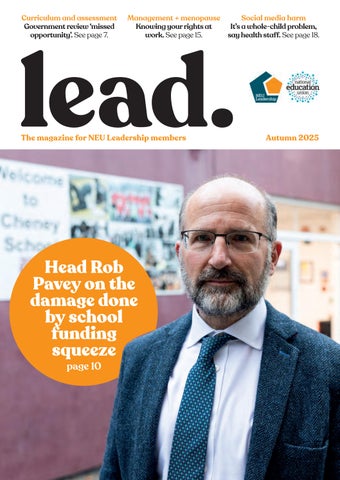
Curriculum and assessment Government review ‘missed opportunity’. See page 7.
Management + menopause Knowing your rights at work. See page 15.
The magazine for NEU Leadership members
Head Rob Pavey on the damage done by school funding squeeze page 10
Social media harm It’s a whole-child problem, say health staff. See page 18.
Autumn 2025
Welcome
Lead.
Autumn 2025
Head teacher Rob Pavey (see page 10) Photo: Kois Miah NEU president: Ed Harlow NEU general secretary: Daniel Kebede Editor: Sally Gillen Editorial assistant: Frankie Faccion
neu.org.uk
linktr.ee/shareneu
Published on behalf of NEU by James Pembroke Media, Ground Floor, Riverside North, Walcot Yard, Bath BA1 5BG jamespembrokemedia.co.uk
IN October, I spoke at a Stop School Cuts public meeting organised by one of the NEU’s huge number of fantastic workplace reps at his school in Oxford (see page 10). As general secretary, I speak about many issues plaguing our profession, but as I sat alongside two head teachers, waiting to address parents and educators in the draughty hall, I was reminded that there really is no better place to spread the message about the urgent need for more education funding than from a school. And no one is better positioned to help spread that message than head teachers, such trusted and respected figures within their communities. I’d love to see more of these meetings. Individually, school leaders can do so much locally to drive the campaign for more funding, but acting collectively they can also bring the scandal of 15 years of underfunding to national attention. Primary head Catharine Darnton, another speaker at the meeting, recalled marching on Downing Street with 1,000 school leaders to demand more money for schools. That march was organised by highly respected former secondary head Robin Bevan, a past national president of the NEU (2019-2020). Catharine wondered if that could be done again, and the answer is, why not? Working together is the way to make an impact. The NEU and our sister union the National Association of Head Teachers are working closely to support senior leaders as Ofsted’s new inspection framework, which we all agree will generate as much stress and workload as the last, is rolled out (see page 5). Daniel Kebede General secretary National Education Union
4
10
Contents
Senior editor: Lizzie Hufton e: lizzie.hufton@james pembrokemedia.co.uk
Features
Design manager: Christina Richmond
10 Stop School Cuts
To advertise contact: t: 020 7880 7614 e: lead-magazine@ redactive.co.uk
Regulars 4 Update
Ad artwork co-ordinator: Aysha Miah-Edwards aysha.miah@redactive.co.uk Except where the NEU has formally negotiated agreements with companies as part of its services to members, inclusion of an advertisement in Lead does not imply any form of recommendation. While every effort is made to ensure the reliability of advertisers, the NEU cannot accept any liability for the quality of goods or services offered. Lead is printed by Warners Midlands plc.
Leaders in Oxfordshire gather to raise awareness of the funding shortfall
18
Curriculum review final report published; unions write to government over proposed pay offer; and more
22 Final word 20
Daniel Kebede on big tech, social media and stolen childhoods
15 Leading question
Can I take time off for menopause symptoms?
18 Campaigns
Hidden harm: the risks of social media to children’s physical health
20 Q&A
New NEU president and deputy general secretary share their hopes for future of education
lead. The magazine for NEU Leadership members
3
Update
NEU funds places for members at leadership development event A HUNDRED Black members were sponsored by the NEU to attend the Aspiring Heads summit 2025. Speakers at the annual event, themed Empowered leadership, strengthening
voices and driving change, included NEU Leadership member Dwain Brandy, an assistant principal in Manchester, and vicechair of the NEU’s Black educators’ network Carol Jumpp-Graham.
Shaniqua Edwards-Hayde, a former president of Haringey NEU and co-chair of the London new and young educators’ network, was among the delegates at the event, held on 4 October at London Screen Academy. “It was powerful to see the NEU and Aspiring Heads connected in one space, two organisations committed to developing leaders, promoting equity and supporting educators to grow,” she said. “The atmosphere was electric with inspiring speakers, honest conversations and so many Black educators and NEU members in the room celebrating leadership that is about lifting others as we rise.” She added that she left “feeling energised, inspired and proud to be part of both communities” and would love to see more collaboration between the NEU and Aspiring Heads.
Pay proposal is a ‘double whammy’ for schools UNIONS have warned the government that its proposed part-funded 6.5 per cent pay award for teachers in England – spread over three years – will damage morale and exacerbate the recruitment and retention crisis. The government submitted evidence to the School Teachers’ Review Body (STRB) – after the deadline – saying the increase should be over 2026-27, 2027-28 and 2028-29. In a joint letter sent to education secretary Bridget Phillipson, the NEU, NASUWT, NAHT and ASCL say the expectation that schools will need to fund part of
4
the increase risks locking in low-level increases in teachers’ pay. “Schools are already under significant strain,” it adds. “Any award that is not fully funded will inevitably result in further cuts to staffing and essential provision, undermining the ability of schools to deliver high-quality education for all pupils.” NEU general secretary Daniel Kebede said: “Yet again the government has created anxiety among the profession by putting forward evidence that suggests a below-inflation pay award that is to be funded out of existing
lead. The magazine for NEU Leadership members
budgets. We expected better from Labour.” He added: “The years of pay cuts since 2010 have already caused severe recruitment and retention problems and hit teacher living standards hard. “Further pay cuts will make things even worse. Fully funded, significantly above inflation pay rises are essential to properly value, recruit and retain the teachers we need.” Paul Whiteman, general secretary of the NAHT, described the failure to fully fund the “disappointing” increase as a “double whammy for schools, many of which are already struggling
to make budgets add up”. School leaders have suffered huge damage to the real value of their pay since 2010. The NEU pay claim calls for urgent, significant and fully funded movement towards complete reversal of the real-terms pay cuts. School leaders also deserve a fair pay structure and effective action to tackle sky-high workload. The NEU pay claim is also calling for a fair national pay structure with appropriate levels of pay and progression and no element of performance-related pay, as well as effective and fully funded action to tackle excessive workloads.
Update
Unions working to support heads as Ofsted framework launches THE NEU and sister union the National Association of Head Teachers (NAHT) are continuing to work closely to support school leaders following the introduction of Ofsted’s new framework on 10 November. The union is urging members to use its award-winning risk assessment as the framework, which has been widely criticised by the profession, is rolled out across England. Both unions are assessing how the new framework is working on the ground and are considering legal options against Ofsted.
“We must see fundamental change that is supportive, effective and fair.”
Daniel Kebede
NEU general secretary Daniel Kebede said the union had deep concerns about the harmful impact of the new framework on leaders, teachers and support staff, and the new grading system will only make things worse, not better. He added: “We must see fundamental change that is supportive, effective and fair.” The inspectorate’s new ‘report card’ means that although schools will no longer receive a one-word overall judgement, the system remains high-stakes because they will be graded in six areas. Education unions have warned repeatedly that it will cause high levels of stress and workload for leaders and staff. Inspectors now look at inclusion, curriculum and teaching, achievement, attendance and behaviour, personal development and wellbeing, and leadership and governance. Each will be graded according to a five-point, colour-coded scale, ranging from Urgent improvement to Exceptional. London primary head teacher and NEU Leadership member John Hayes said the framework was a “profound disappointment” and that its numerous grading areas reinforced “the very highstakes, stressful system”. “It is not the radical reform that was needed, but a surface-level adjustment that misses the opportunity to fundamentally rethink how Ofsted works and how it can truly serve the interests of children by supporting, rather than simply judging, the professionals who educate them,” he added
NEU’s Ofsted advice for leaders THE union has published guidance to help leaders navigate the new framework, including how to prepare for the pre-inspection planning call, which is now likely to be a video, rather than a phone, call. Go to neu.org.uk/advice/your-rights-work/school-inspection-england/ navigating-new-ofsted-framework
Most members against new framework, poll finds A SNAP survey of more than 1,500 NEU leaders and teachers carried out before the new Ofsted framework was introduced on 10 November found 88 per cent did not believe it addressed the impact of inspections on mental health. And 94 per cent did not believe inspectors would be able to reliably assess six areas of school life through a single inspection. Nine in ten said giving schools just nine weeks to roll out the new framework would mean many would not be ready. One head teacher said: “Change was brought about because a head teacher died by suicide. This inspection framework has added to the workload and stress of heads.” Ofsted’s chief inspector Martyn Oliver, who was appointed in January 2024, had “spectacularly failed” in his mission to reform the inspectorate, said NEU general secretary Daniel Kebede. “Teachers and school leaders are trapped in a rehashed version of a punitive, high-stakes system that has been proven to pose a risk to life,” he said. “These reforms are not the positive change we needed – they will be bad for our schools, bad for the workforce but also bad for parents and pupils.”
lead. The magazine for NEU Leadership members
5
Update Kevin Courtney
Campaign to save children Government criticised from social media harm for Covid-19
6
‘betrayal’
Photo: PA Media
THE union’s hard-hitting campaign against social media use by children, Big Tech’s Little Victims, is calling on the government to raise the age of social media access from 13 to 16. A survey carried out for the union shows more than 70 per cent of the public support the call, believing social media steals childhoods. A separate survey of parents found that 77 per cent of them believe platforms such as TikTok, Instagram and Snapchat have played a significant role in the mental health crisis among young people. Toxic content on social media is harming children, impacting their developing brains, says an NEU-commissioned report, Robbed: how big tech is stealing childhoods. NEU general secretary Daniel Kebede said: “Every day, teachers see the damage big tech is doing to children and young people. Children are arriving at school exhausted, anxious and already overwhelmed by what they have seen on social media. “Teachers are uniting with parents to say enough is enough, because we see the harm and we know it can be stopped. The NEU is proud to lead this campaign and call for the digital age of consent to be raised to 16.” The campaign also urges the government to make space on the curriculum to teach digital literacy (see
Leading the call for action: head teacher of John Wallis Academy, in Kent, Damian McBeath, parent Kelly Carolan and NEU general secretary Daniel Kebede outside the Houses of Parliament.
box, The five aims of the Big Tech’s Little Victims campaign, below). In an open letter to prime minister Keir Starmer, which the union is encouraging leaders to sign, the union and a coalition of organisations supporting the campaign say the UK should be following the example of other countries including Norway, Spain and France. “It is important that schools have robust policies on smartphones, but social media will continue to rob
children of their wellbeing and socialisation outside of the school gates,” said Daniel. “We will not stand by while social media executives rake in billions from stealing childhoods.” For more information, visit bigtechlittlevictims.org and turn to pages 18 and 19 to read more about the campaign. Add your voice to the campaign by signing the letter at bigtechlittle victims.org/open-letter
The five aims of the Big Tech’s Little Victims campaign • The government to raise the age of social media access from 13 to 16.
• Guaranteed space on the school curriculum to teach digital literacy.
• The government to introduce guidance on the health impacts of social media on children.
• A windfall tax should be introduced on social media companies to pay for mental health services.
• The government to introduce a watermark for ethical advertising on social media platforms.
lead. The magazine for NEU Leadership members
FORMER joint general secretary of the NEU Kevin Courtney told the public inquiry into the Covid-19 pandemic that the government had “betrayed” children by failing to invest £15 billion into education recovery. Giving evidence on behalf of education unions in October, he criticised former prime minister Boris Johnson’s decision to invest only £1.4bn, ignoring recommendations from the government-appointed education recovery tsar Sir Kevan Collins. Kevin told the inquiry: “The government offered much less and that has been a betrayal of the children of this country.” Post-pandemic pupil absence, challenging behaviour and levels of mental illness among children and young people – the latter already at crisis point when Covid hit in 2020 – had all been impacted, he added. Kevin led the NEU through the pandemic, alongside Mary Bousted, before they retired in 2023. Kevin said the impact on education was made worse because of a delay in closing schools, resulting in longer closures; and that to do better in the event of a future pandemic, the government should invest in measures including improved ventilation and indoor air monitors, and reduce class sizes.
Update
Curriculum and assessment review THE union has given a mixed response to recommendations in the curriculum and assessment review, which was published this November. NEU general secretary Daniel Kebede said it was a “relief ” that the panel had listened to teachers, parents and campaigners and abolished the EBacc, which had narrowed the secondary curriculum and squeezed out arts. Other positives were the focus on preparing young people for their futures, especially oracy, critical thinking and digital literacy, as well as recommending there needs to be better representation in the curriculum. But recommendations on assessment were “very disappointing”, said Daniel, with statutory tests in primary staying and no proposed alternatives to end-of-course exams at secondary level. A government decision to introduce a new statutory reading test in year 8 – exceeding the review’s recommendation for informal, diagnostic testing – was also criticised, with the union saying such a test would not support learning. The England-wide review looked at curriculum and assessment, including qualifications in primary, secondary and
Photo: Jess Hurd
THE NEU made the case for investment in education and children at this year’s party political conferences. The union had stalls and hosted fringe meetings at the Liberal Democrats’
A FREE educational programme has been launched by The Natasha Allergy Research Foundation. For nurseries, primary schools and groups looking after children aged three to 11, the suite of resources aims to transform understanding of food allergies in schools so that children feel empowered, included and protected. First aid advice, engaging lesson plans and assembly packs for key stages 1 and 2 are included. allergyschool.org.uk
Opportunity ‘squandered’ AN opportunity to broaden the curriculum and reduce the amount of high stakes testing has been squandered, say teachers. In a snap poll following the publication of the review, teachers said the government’s insistence on pursuing a rigid assessment system undermined the review’s call for a broad and balanced curriculum. In the survey of 1,136 teachers conducted by the NEU, 75 per cent of primary school respondents said they believed keeping statutory assessments in primary schools will worsen pupils’ engagement and wellbeing. Fifty-six per cent said primary assessments narrow the curriculum. One teacher said: “Again, an opportunity to make the curriculum less onerous on children and more engaging is squandered.”
Revised advice on the Israel/ Palestine conflict
16-19 phases, and makes overarching as well as subject-specific recommendations. A new revised curriculum will be published in spring 2027 and taught from September 2028.
NEU in talks at party conferences event in Bournemouth, Labour’s in Liverpool, the Green Party’s also in Bournemouth and the Conservatives’ event in Manchester. We highlighted how after over a decade of
From left: education secretary Bridget Phillipson, incoming NEU deputy general secretary Sarah Kilpatrick and Teacher Tapp founder Laura McInerney
under-investment, threequarters of schools in England have less funding in real terms than in 2010. At a joint meeting at Labour with NASUWT, NAHT and the Child Poverty Action Group charity, we acknowledged to the education secretary Bridget Phillipson that the government had taken some important first steps but there was much more that needed to be done. We also stressed that removing policies such as the two-child limit and benefit cap would be the single most cost-effective way to lift children out of poverty.
Allergy support
THE NEU offers guidance to support members to deal with the reactions of pupils and the wider community to the Israel/Palestine conflict. Updated advice was reissued in October. neu.org.uk/ israelpalestine
Post-16 pay offer SIXTH form college members have voted by 93.9 per cent to accept a four per cent pay offer from the Sixth Form Colleges Association (SFCA). More than 4,300 members across 72 colleges were consulted on the offer for 2025/26. However, 86.6 per cent rejected SFCA proposals on workload, which fall short of what was asked for in the pay claim. Members want more flexibilities including extra PPA time and limits on class sizes.
lead. The magazine for NEU Leadership members
7
Photo: Kois Miah
Interview
Rob Pavey has worked hard to improve sustainability at his school
‘The funding squeeze is likely to break things really soon’ School leader Rob Pavey talks to Sally Gillen about school cuts. In October, he hosted a public meeting at his school to raise awareness of the impact of underfunding (pages 12-13). IT’S partly down to “good luck” that he isn’t grappling with a funding crisis at his school, says head teacher and NEU Leadership member Rob Pavey. That’s not to say its finances are in great shape, just that he hasn’t been forced into impossible choices like so many thousands of school leaders across the country. Yet. “Things are OK at the moment. We are in the most fortunate 20 per cent in the country,” he says, although some tough decisions may soon be unavoidable. 10
lead. The magazine for NEU Leadership members
In the summer, he invited local MP Anneliese Dodds into the school to talk about its finances. She spoke to education secretary Bridget Phillipson who sent Rob a letter saying schools would be expected to meet the first one per cent of increased costs. “In other words, it was another funding squeeze,” he says. “Maybe it doesn’t sound much but, cumulatively, even with a big school with stable circumstances that still has some reserves, we are going to be losing things that make a big difference.”
In the five years he has led Cheney School, a 1,700-pupil secondary in Oxford, Rob has worked hard to make the school more sustainable. It was named the most sustainable secondary in Oxfordshire last year. “We have been able to stay afloat because we have cut our carbon footprint by half and costs by a third, which is good for the environment but also our bottom line,” he explains. The school receives an extra £250,000 annually from letting out buildings, which
Interview
pays for things such as upgrades to the computer suites. But if the school’s huge 40-year-old boiler stops working tomorrow, replacing it would cost £500,000 and swallow up all the school’s reserves. “School reserves are supposed to be there to deal with one disaster, never two, so things need to go reasonably right for us to be OK,” says Rob. “I spend a lot of time looking at three-year forecasts and making plans for what will have to go if funding doesn’t keep pace with costs.” That will mean losing pastoral support, which will have a knock-on effect on pupil behaviour. It will also mean reducing the inclusion team and cutting the number of subjects offered in sixth form. Cheney’s intake is the very definition of comprehensive, according to Rob, with some children arriving in year 7 with the reading age of a six-year-old, others who get straight 9s at GCSE and move on to Oxbridge, and everything in between. It does, however, have double the national average of children with an education, health and care plan. Children with special educational needs and disabilities (SEND) do well at the school but they will be worst hit if Rob is forced to cut the pastoral assistants who staff the medical room and calm space where pupils go to re-regulate. The four deputy SEND co-ordinators may soon be reduced to three. “What we have is a bit of a luxury, but if we don’t have it, we have dysregulated kids who are having a tough time and that comes out in the corridors, in the playground and in class,” explains Rob. “That’s one of the reasons we invest in it so heavily. Firstly, it benefits the kids and secondly it benefits the wider school community.” He may also have to consider losing the family liaison officer, who helps improve attendance, historically a problem at Cheney. Pre-pandemic it was in the bottom 20 per cent of schools in the country for attendance. “Our school has such a diverse community that there aren’t just one or two answers to solving the attendance issue. Year-onyear, our attendance is 0.3 per cent better. We’re engaged with national initiatives and networks, and we’re not missing anything, we just haven’t had the impact we want.”
“We have been able to stay afloat because we have cut our carbon footprint.” Some cost-cutting measures have already been introduced. Class sizes have increased, up from a nine-form entry with ten teaching classes to a nine-form entry with nine classes.
Still, Rob recognises that he is incredibly fortunate to have a full staff and every subject taught by a specialist. Last year was his best ever for recruitment. Even so, Cheney is in dire need of repair. The “mix of disparate, fairly battered buildings” are functional but not brilliant, says Rob. They include blocks built in the 1950s, 70s and 80s, and another which only went up 15 years ago but has leaked from day one. A promised rebuild in 2008, as part of the Building schools for the future programme, was scrapped because of the financial crisis. Capital investment is, undoubtedly, the most pressing need. “The funding squeeze is likely to break things really soon,” he says.
NEU general secretary Daniel Kebede (addressing parents at a public meeting) and head Rob Pavey (below)
lead. The magazine for NEU Leadership members
11
Campaigns
‘There is no magic wand to fix our schools’
Photo: Kois Miah
IN affluent Oxfordshire, 79 per cent of schools have less funding in real terms than they did 15 years ago, a reminder that the funding crisis impacts every area of the country. NEU Leadership member Rob Pavey hosted a public meeting at Cheney School, where he has been head for five years, and speakers from the NEU and sister education unions the NAHT and NASUWT described the damage being done to schools. Lead went along to hear what they had to say... CATHARINE DARNTON has been head at Gillotts School, a secondary in Henley-on-Thames, for 19 years. “I’m not in any way party political,” said Catharine. “I just want schools to be properly funded and they haven’t been under a number of governments.” Her school is poorly funded because it is in an area of low deprivation, and pupils have high prior attainment, she said, but it has a significant capital backlog and is in a rural area cut off from support services. Misleading Department for Education figures made her school’s finances look far healthier than they are, with the high needs block included in the school’s core budget. “Every year, the total looks good but then it’s then siphoned off into the high needs block, and the schools block budget gets left with very little,” she said. “In reality, I’m 1.5 per cent short. One per cent of my budget is about £60,000. That’s the whole of my gas and electricity bill or it’s a class without a teacher.” She added: “I have reduced the number of learning support assistants this year. I could put more admin on teachers, 12
lead. The magazine for NEU Leadership members
but why would I want to do that when I can’t recruit and I need to retain the teachers I have? I can’t save any money, so the only thing I can do to increase the funding is to increase the number of children in my classrooms from 31 or 32. However, primary rolls have been falling for the past five years in south Oxfordshire so where am I going to get those students? “The government funding just does not cover the costs anymore. I really don’t know what to do.” NATALIE PETTIFER, a former teacher, mum of three and regional organiser for the NAHT, works with leaders across the south-east. “Despite the unwavering dedication of school leaders, teachers and all school staff, the impact of these cuts is undeniable: overcrowded classrooms, deteriorating school infrastructure and mounting Union representatives set out the impact of the funding crisis
obstacles to delivering the high-quality education every child deserves,” said Natalie. Schools continue to face significant difficulty in recruiting and retaining teachers. There is a diminishing number of new entrants to the profession, and a concerning trend of experienced leaders and teachers leaving. School funding is not at the level of inflation, meeting rising costs, or the growing needs of our school communities, she said, with spending on education as a portion of GDP now at its lowest level for 25 years. “I’m regularly hearing from head teachers who are heartbroken about the impossible choices they are having to make. It’s not sustainable and it’s not fair,” said Natalie, adding that all future pay offers needed to be fully funded. She urged those at the meeting to take action by visiting the Stop School Cuts website and contacting their MP (see box, below right). “Share your stories, get involved with local campaigning, and make this issue impossible to ignore,” she said.
Campaigns
Attendees heard evidence of the SEND funding crisis in schools
NEU general secretary DANIEL KEBEDE described the appalling, in many cases dangerous, state of the country’s schools. Asbestos lurks in almost 80 per cent of school buildings, rainwater – even sewage – leaks into almost a third of schools, and thousands more built with reinforced autoclaved aerated concrete (RAAC) are now crumbling. “The National Audit Office tells us there is a £13.8 billion backlog in school maintenance. That’s not a number. It’s a crisis,” said Daniel. He added that since former education secretary Michael Gove had scrapped the Building schools for the future programme in 2010 “the decline has been relentless”. He went on to say school budgets had gone through the floor. Per-pupil funding had plummeted from £7,462 in 2010 to £6,904 in 2025. “The government has a choice: reverse these cuts or fail another generation of children. There is no magic wand to fix our schools, only funding can rebuild our education system,” he added. “My appeal to you is to help us build the Stop School Cuts campaign. That message needs to be driven out into every community. Our children deserve better.”
SEND funding needs a radical rethink... FUNDING for special educational
places next year.
needs and disabilities (SEND) was a
One reason it’s in crisis is that
hot topic during the Q&A session.
the local authority isn’t allowed
Host head Rob Pavey said 4.5 per
to build special schools, he said.
cent of pupils at his school had
Average spend on a special school
SEND. “Almost all of them do really
place is £24,000 but he had heard
well,” he said. “We have wonderful
of an independent special school charging £160,000
staff, but it does require investment, training and thought. If we get a one per cent cut each year, we will have to cut rather than invest.” Primary head Catharine Darnton agreed, arguing that SEND provision needed a radical
SEND provision across the country is in “absolute crisis”.
“If you hear of a school going on strike because of redundancies, please realise it’s because we are fighting to give children an education and we can’t continue with the cuts we are facing.”
rethink, given that an estimated 40 per cent of pupils
a year. He added:
NEU general secretary Daniel
are now deemed to have SEN at
Kebede said: “Everyone here
some point in their educational
recognises that children with
career. “Diversity is now just the
different needs learning together
norm,” she said.
is good for children with SEND
Stuart Robinson, a special
and those without. I support the
needs teacher and joint branch
secretary of state’s aspiration for
secretary of Oxfordshire NEU,
a more inclusive system, but my
said SEN provision in the county
advice is to not change the system
was in “absolute crisis”. His school
of EHCPs until the inclusive system
had 140 applications for just 30
has been built.”
Take action: The NEU is urging leaders to visit schoolcuts.org and share the information with parents and the local MP. Write to your local MP or invite them in to your school.
lead. The magazine for NEU Leadership members
13
Leading question
Can I request time off for menopause symptoms? Callum Wetherill from the NEU’s AdviceLine explains the help schools can offer to menopausal employees. I’M a deputy head struggling with menopause symptoms, including fatigue, and finding my hours and responsibility exhausting. I feel I can’t take time off because I am not ill. What are my options? The idea that you can’t take time off because you are not ill is misplaced. The symptoms of menopause can affect your ability to work, and you should not be afraid to take sick leave during these times. There is no requirement to be specific in declaring menopause-related symptoms, either on a doctor’s note or when self-certificating. Furthermore, if you feel that some form of temporary or permanent reduction in your hours would assist, it is worth putting in a flexible working request. In a female-dominated profession such as education, supporting women who are experiencing symptoms of the perimenopause and menopause (the term ‘menopause’ is used in this piece to refer to both conditions) should feature high on any employer’s agenda. The government has announced that, from 2027, menopause action plans will be mandatory for organisations with 250 or more employees. The NEU’s own research has revealed mixed experiences. The symptoms of the menopause are variable, wide-ranging and can impact both physical and mental health. Each woman’s experience is unique and the adjustments will be too, but there are shared experiences that we can use as a starting point. The NEU has a model policy (neu.org.uk/menopause) to provide a framework that employers can adopt and
Callum Wetherill advises members to read the NEU’s model policy
is based on a belief that all women should be able to: ● work through the menopause in an environment that is supportive ● control room temperature in their classrooms (and, through negotiation, the staffroom as well) ● access a toilet during break times – and expect systems to be in place that ensure that, if a member of staff wishes to use the toilet during lesson time, they are able to do so ● expect understanding from managers and colleagues regarding any condition that may require reasonable adjustments ● work in an environment where reasonable adjustments are made to achieve a comfortable working environment for all. You don’t have to disclose your menopause status to your line manager, if you don’t feel comfortable doing so. However, if you wish your employer to make a reasonable adjustment to reduce the impact
of your working conditions, you will need to provide them – or someone acting on their behalf, for example, occupational health – with sufficient information to carry out that adjustment. In line with the employer’s duties under the Health and Safety at Work Act 1974, they should look to work with you to undertake a risk assessment, which is menopause-sensitive. Laws your employers should be aware of that protect you from being treated less favourably by your employer because of the menopause include: ● Health and Safety at Work Act 1974 requires employers to ensure the health, safety and welfare of all workers. Under the Management of Health and Safety at Work Regulations 1999, employers are required to undertake general risk assessments which should include specific risks to menopausal women. ● Equality Act 2010 prohibits discrimination against people on the grounds of ‘protected characteristics’ including sex, age and disability. The menopause does not itself amount to a disability, but conditions linked to it may meet the definition of an ‘impairment’. One way of avoiding the need for specific disclosure is to collectivise the issue. Discussing the issues with colleagues can help to make the menopause a mainstream issue. Many of the workplace changes that can make life more bearable for menopausal women will also benefit others. Equally, although the menopause will only be experienced by those who have a menstrual cycle, including all staff in those conversations will improve knowledge and support for all. lead. The magazine for NEU Leadership members
15
Campaigns
Hidden harms of social media Short-sightedness and musculoskeletal problems are just two of the health problems linked to excessive screen time Arabella Skinner tells Sally Gillen.
“We are up against very clever people creating these addictive devices.” 18
lead. The magazine for NEU Leadership members
Photo: PA Media
A STACK of research – and it’s growing – shows the harm social media is doing to young people’s mental health. But while damaging, often dangerous, content harms heads, excessive use of screens damages children’s bodies, according to Arabella Skinner, a psychologist and campaigner with Health Professionals for Safer Screens. “Social media use isn’t just a mental health issue, although that is obviously massive,” she says. “We see it as a wholechild problem.” Excessive screen time on smart devices is linked to a 30 per cent higher risk of developing short-sightedness. Children who use screens for more than an hour daily are more likely to develop problems including text neck from straining muscles to look down for an extended period, as well as wrist and back problems. It is the sheer scale of social media’s damage that led to the founding of Health Professionals for Safer Screens 18 months ago. The group is made up of concerned professionals from every health discipline, and is calling for a public health campaign funded by the Department of Health on
Arabella Skinner at the launch of the NEU’s Big Tech’s Little Victims campaign
Campaigns
the harms of screens and social media. It also wants training for health professionals to be introduced. “We need to support parents – many of us are parents – but this is almost impossible to manage on our own,” argues Arabella. “We are up against very clever people creating these addictive devices. “Why are we expecting children to safeguard themselves in environments that are designed to make them addicts? We don’t expect children to do that in any other environment.” In A&E departments across the country, doctors and nurses are dealing with an increasing number of incidents they believe are related to social media: self-harm, dangerous pranks, non-fatal strangulation and knife crimes among them, she adds. Arabella shares a story involving a boy in his early teens who arrived in A&E with swollen legs typically seen in elderly, sedentary people. The doctor was perplexed. After talking to the boy, it emerged that he had spent the summer holidays gaming for 15-16 hours a day, not moving, with his legs up. It’s an example of why training for health professionals is badly needed. “Many of the health impacts of screens and social media are simply not obvious,” says Arabella, who believes health professionals need to be trained to ask questions about social media use, much in the same way as they ask about home life when a child is self-harming or having nightmares. She also believes schools could help promote awareness of social media’s impact on children’s physical health, especially among parents. Many are aware of the dangers it poses to their children’s mental health, but not the harm to eyesight, for example. Dermatologists are reporting a big rise in skin conditions such as acne, Arabella adds, with girls as young as seven regularly watching videos of 12-step beauty routines. Beauty influencers often promote products that contain anti-ageing ingredients such as retinol, which is very damaging to young skin. Eating disorders have “gone through
“Why are we expecting children to safeguard themselves?” the roof ”, with a significant increase in the number of boys diagnosed with body dysmorphia. Arabella, who was at the launch of the union’s Big Tech’s Little Victims campaign in September, says Health Professionals for Safer Screens supports the NEU’s call for the age of access to social media to be raised from 13 to 16. “At 13 there is so much going on in terms of puberty and hormones, and particularly around comparisons and identity: understanding who you are, how you present yourself and how you compare. You’re moving from family being your most important social circle to your peers. Whereas 20 years ago kids were comparing themselves to others at school, now they are comparing themselves to millions of people on social media.” By age 16, young people have more confidence in who they are, she adds, which makes them less susceptible to social media. “I know the NEU is worried about algorithms, and with good reason,” says Arabella. “If you are someone with an eating disorder, the evidence is you are 4,000 per cent more likely to get toxic eating videos in your social media stream. “That’s what we need to remember – most kids don’t start by trying to find this stuff. It ends up in their feed, and within hours they are taken down a rabbit hole.” Arabella cites research by the Global Mind Project, which shows that receiving a smartphone before the age of 13 is associated with poorer health outcomes in young adulthood. Another study shows that in girls, social media use between the ages of 11 and 13 is linked to a decrease in life satisfaction a year later. This research,
together with raising awareness about the physical harms caused by repetitively bending heads over tiny screens for hours, developing problems such as text neck, can help schools educate parents – and pupils – about the dangers of social media, Arabella suggests. Head teachers who are banning phones in schools help children hugely, she says, because if none of the children have access to a phone, none of them will fear they are missing out. And while there may be some pushback from parents, many also report that the strict rules around phones in schools help them reinforce their own restrictions on phone and social media use at home. “One piece of advice we give parents is that if they can only do one thing, don’t let your child have any devices in the bedroom. Hyperstimulation in the brain before bed, worrying about notifications, really interferes with sleep. “Health professionals are hugely worried about disruption to sleep, and I imagine teachers will be as well. Lots of studies show higher social media usage is directly linked to lower sleep duration. Sleep is vital for healthy adolescent development.”
To find out more, go to: healthprofessionalsfor saferscreens.org
lead. The magazine for NEU Leadership members
19
Interview
Future in focus Two campaigning teachers who have fought for Ofsted to be abolished, more funding, and a more broad and balanced curriculum, have taken up leadership positions within the NEU. Lead asked Sarah Kilpatrick and Ed Harlow a few questions… thousands of pounds from every school and think that’s somehow justifiable, but nobody is facing up to or addressing it. Millions of pounds that should be for education is being used to line the pockets of people who are already extraordinarily wealthy, and who have absolutely no business telling people how to teach.
SARAH KILPATRICK, an art teacher from the north-east of England, was announced as a new deputy general secretary of the NEU after winning 88 per cent of the votes in an election during the summer. She takes up her five-year post in January.
Q A
What would you like to focus on over the next five years?
The exam factory system that means many disadvantaged children are not getting access to a full and creative-rich curriculum. There has been a purposeful undereducation of huge numbers of children in this country, which has given rise to the far right. Things are very dangerous at the moment, but I believe we can turn the tide. As educators, we can address this, but we need to be respected as professionals to do that. I’d like to see professional autonomy restored.
Q Sarah Kilpatrick
“You can’t cream A
off hundreds of thousands of Q What are the big issues for leaders? pounds from schools and think There are many, but the huge problem of underfunding is a A that’s somehow national scandal. Academies are draining so much money that should be for justifiable.” children. Every penny from the system given to academies should be being spent on children, not on an inflated chief executive’s salary, a fleet of Teslas or chefs for the academy’s central office staff. When my school was taken over by a new trust, money was misspent on extremely questionable things. 20
lead. The magazine for NEU Leadership members
Despite being a mum of two and a busy teacher, you have still managed to take an active role in the union, as an executive member, past president and now an elected deputy general secretary. How can we get more women involved in our predominantly female union?
There was money for furniture for the chief executive’s office, while I was in my room ripping up key stage 3 sketchbooks from the previous year so my GCSE kids could have cartridge paper. You can’t cream off hundreds of
The onus is on our districts to make their meetings accessible. They must be at a time and place everyone can attend. If people say they have caring responsibilities and that’s a barrier to them attending, that needs to be addressed. It’s not fair to say to people, well maybe you can do a separate thing. I hear so many stories of women getting to a point where they feel brave enough to say ‘that doesn’t work for me’ and then being told ‘sorry we’ve always done 4.30pm at the Swan and Anchor’. When almost 80 per cent of our union are women, a large proportion with caring responsibilities, we need to create the opportunities for them to get involved, and this work is happening. There are fantastic local officers all over the country working their socks off to try and get people involved.
Interview
Ed campaigning for a replacement to Ofsted
London music teacher and head of department ED HARLOW has become the new national president of the NEU.
Q A
What would you like to focus on in your year as president?
Ed Harlow portrait: Jess Hurd; Ofsted petition: Rehan Jamil
Curriculum reform. We need a more balanced curriculum, and to get away from a very narrow focus on accountability and league tables. I’d like to see a focus on the Arts and Minds campaign, which Sarah and I have been very involved with, and we need a curriculum fit for the 21st century. At the moment, it’s pretty Victorian.
Q A
Nick Gibb culture war road. That’s how far things have shifted.
Q A
What do you see as the main issues for leaders?
Funding is an enormous issue. Schools are now, more than ever, a sticking plaster over so many societal issues. There are more informal food banks for struggling families, and mental health services for kids have been decimated. After-school clubs and wraparound care have been scrapped. More and more children are hungry because of increasing poverty
Can you tell us more about your work on curriculum?
Last year, I was involved in all-party parliamentary groups, one on arts education and another on the case for a broader curriculum and changes in assessment, reform and the potential for scrapping GCSEs. Lord Baker, Margaret Thatcher’s education secretary and the minister who introduced GCSEs, said he agreed with me they could be abolished. What became really clear to me was that he is miles to the left of the Labour government on education policy. It was an alarming indicator of how far we have gone down the Michael Gove/
Ed Harlow
“Schools are now, more than ever, a sticking plaster over so many societal issues.” and families turn to schools, which are having to help more – social services support for families has been hugely reduced – and are doing it with less and less.
Q A
What do you think of the new Ofsted framework?
It’s no better than what we had before. Ofsted carried out its Big Listen exercise, but it hasn’t listened to what the profession has to say. Getting rid of one-word judgements was a significant win. I used to say to parents, you’re looking at an Ofsted grade and none of the children who were in that school when that grade was given are still there, half the teachers will be different and there is a new head. Whenever the political establishment talks about Ofsted, the argument is that parents need to know what’s going on and, yes, parents need to know what’s going on in schools, but you do that by making them part of the school community, and through good school leadership. I recently heard from heads about their experiences of their school being downgraded and the anger from the parents was about the value of their houses. That’s just absurd. Heads are having to say we are still the same school we were last week. Was your child happy last week and are they happy this week? Are they thriving? Are they doing well? lead. The magazine for NEU Leadership members
21
Final word
‘Our children deserve a childhood that reclaims the wonder of being young’
Daniel Kebede General secretary, National Education Union neu.org.uk facebook.com/ national education union NEUnion
OUR children are being robbed. Robbed of their childhood, robbed of their happiness, robbed of their security. Social media companies are targeting the nation’s children with algorithms, taking away what it really means to be young. Childhood, a time of safety, curiosity and connection, is being hijacked by Big Tech firms looking to exploit young people. Children are trapped for hours a day in an environment that feeds insecurity, drives the youth mental health crisis, and shortens their attention spans. Nearly 40 per cent of under-13s have social media accounts and young people spend, on average, 35 hours a week on screens. And the screen time is not spent learning or playing. It’s monetising our youngsters, fleecing them through targeted advertising – in 2022, social media companies made more than $11 billion in ad revenue from children and teenagers. As educators, the fallout manifests in our schools every single day: the online radicalisation by racists and misogynists that jumps from the screen to our classrooms. A YouGov poll last month found that three-quarters of teachers see misogyny as a big problem in our schools, with 54 per cent saying the problem is getting worse. Sixty-seven per cent of secondary teachers reported that misogyny was a big problem in their school, with abusive comments directed at female pupils and teachers alike. A wave of incels and online influencers – like Andrew Tate – are coming after our young people with their deepfake news, presenting harmful and misogynistic behaviour as normal practice. And research by Goldsmiths, University of London found that 95 per cent of young people from Black and racially minoritised groups had
“Childhood is being hijacked by Big Tech firms looking to exploit young people.” 22
lead. The magazine for NEU Leadership members
seen violent and abusive racist content online – 30 per cent of which took the form of private messages sent directly to them. A staggering 75 per cent of participants had encountered violent racist images or videos, with 38 per cent seeing racist content at least once a week. The rise of racism in society has a direct correlation with this kind of content – and it is spilling over into our school communities. School leaders have been at the forefront of calls for systemic change. Our members, in their droves, are signing up to our campaign to raise the minimum age for social media to 16, and to force the Big Tech companies to repair the damage they are causing by paying a tax to fund mental health services. These measures aren’t a pipe dream or pie in the sky. Other countries are taking action – France, Norway, Spain and Australia are raising the age of social media access and enforcing age verification. The NEU’s Big Tech’s Little Victims campaign is calling for: ● the government to raise the age of social media access from 13 to 16 ● guaranteed space on the curriculum to teach digital literacy ● a windfall tax on social media companies to pay for mental health services ● guidance on the health impacts of social media on our children ● the government to introduce a watermark for ethical advertising on social media platforms. The union has produced the Robbed report, which outlines all the data behind our arguments and gives plenty of detail to share with parents on what we can all do to shape the digital future for our children. You can download a copy, and sign up to the campaign, at bigtechlittlevictims.org. Our children deserve a more enriching childhood, one that reclaims the wonder of being young, the simple pleasures of play, of discovery and building relationships – all without Big Tech sucking the joy out of life. As leaders, you have a real role to play in setting the tone in debates on social media and young people, and you can bring about real and lasting change on its use in your school.