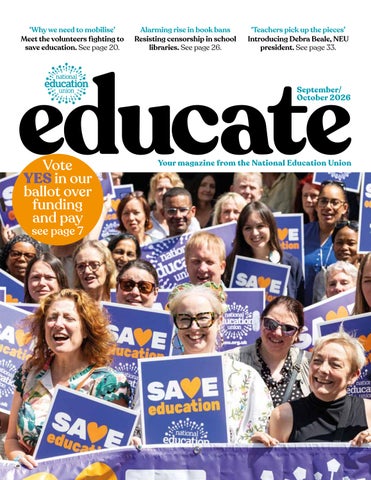
‘Why we need to mobilise’ Meet the volunteers fighting to save education. See page 20.
Alarming rise in book bans Resisting censorship in school libraries. See page 26.
‘Teachers pick up the pieces’ Introducing Debra Beale, NEU president. See page 33.
September/ October 2026
Vote YES in our ballot over funding and pay see page 7
Your magazine from the National Education Union
BRAND NEW EDUCATIONAL RESOURCES NOW AVAILABLE
THE MUSICAL MUSICAL THE
BOOK
DENNIS KELLY MUSIC & LYRICS TIM MINCHIN
Celebrating
ears on Stage
SCHOOL RATES FROM £17.50 CAMBRIDGE THEATRE LONDON
Educate
September/October 2026 The NEU executive outside the union’s headquarters in London ahead of the Save education ballot launch. Photo by Kois Miah koismiah
‘Why we need to mobilise’ Meet the volunteers fighting to save education. See page 20.
Alarming rise in book bans Resisting censorship in school libraries. See page 26.
‘Teachers pick up the pieces’ Introducing Debra Beale, NEU president. See page 33.
September/ October 2026
Vote YES in our ballot over funding and pay
Your magazine from the National Education Union
see page 7
p1 cover.indd 1
NEU joint presidents
21/08/2026 12:11 pm
Ed Harlow & Debra Beale
NEU general secretary Daniel Kebede
Editor Max Watson Journalists
Frankie Faccion, Sally Gillen & Sarah Thompson
Newsdesk t: 020 7380 4768 e: educate@neu.org.uk Production editor/designer Amanda Ellis Sub-editor/designer Melissa Harteam Moore neu.org.uk
linktr.ee/shareneu
TO ADVERTISE IN EDUCATE Display adverts t: 020 7880 7614 e: educate-magazine@redactive.co.uk Recruitment adverts t: 020 7880 8542 e: educate-jobs@redactive.co.uk Except where the NEU has formally negotiated agreements with companies as part of its services to members, inclusion of an advertisement in Educate does not imply any form of recommendation. While every effort is made to ensure the reliability of advertisers, the NEU cannot accept any liability for the quality of goods or services offered. Educate is printed by Warners Midlands Plc. Inside pages are printed on paper comprised of 100% recycled, post-consumer waste.
Welcome
A NEW academic year – and a new issue of Educate for you. Hope you stayed cool during the hottest summer on record. The headline news is our strike ballot over funding and pay. It opens on 3 October (by email, not post, as the law has changed) and closes on 15 December. Teachers in maintained schools in England are being asked to vote Yes to save education. Why? Because the government has said schools must find “efficiency” savings to the tune of £460 million this year to pay for a 6.5 per cent pay rise over two years (see page 7). Crucial to this campaign are the Save education volunteers, whose job it is to help get the vote out. We explore their role and what motivates them on pages 20-25. Many of the stories told by the four volunteers we spoke to will be sadly familiar. No money for basics like exercise books or for targeted special educational needs and disabilities (SEND) support. School trips cancelled. Teaching assistants being let go and not replaced. Schools unable to recruit new staff or retain their current workforce. Teachers covering subjects that aren’t their own, buying necessities out of their own pockets, and working second jobs to make ends meet. As volunteer Elizabeth Oram says: “Our only weapon is to vote Yes, and to take strike action, if needed. If we don’t, nothing will change.” Elsewhere, we speak to four school librarians about fighting a no less insidious threat: censorship in school libraries. A “shocking” case this year, whereby a librarian was reported to safeguarding after books she stocked were deemed inappropriate, has had a “chilling effect” on the community (see pages 26-31). And we meet the new NEU president Debra Beale, who is sharing the role with Ed Harlow until December. She talks to Educate about job creep, the cost-of-living crisis and the de-skilling of young teachers – as well as the benefits of a game of Scrabble (page 33). All your favourites are here too, of course: the ever-popular Teacher’s pet, puzzles and a Michael Rosen poem. There’s also a beautiful photo of a luscious landscape in rural Wales – which seems a distant memory after the drought conditions we suffered this summer. Hope you enjoy the issue. Max Watson Editor, Educate
educate Your magazine from the National Education Union (NEU)
3
The rest is history
Contents
2 September 1976
Workers at the Grunwick film-processing laboratories in Willesden, north London, protest poor pay, long hours and management refusal to recognise their union, APEX. Led by Jayaben Desai, the workforce is largely female and South Asian, and while the two-year strike ends in defeat, it strengthens solidarity between anti-racism and trade unionism in the UK. See page 50
Regulars
Features
19 Michael Rosen & Dan Berry
20
35 Tim Sanders & Warwick Mansell 36 Ask the union 37 A class act 38 International 40 Jon Biddle & reviews
PHOTOS by Kois Miah & Brian Aldrich
42 Teacher’s pet & letters 45 Noticeboard 47 Photo opportunity 48 Crosswords & sudoku
News 20 Save education volunteers
Hear from activists on the front line against cuts (above).
26 The alarming rise in book bans
School librarians speak out against creeping censorship (below right).
33 Meet the president
Debra Beale outlines her priorities for the year ahead (below left).
7
‘I want every child to receive a high-quality education.’
Strike for the future
Ballot launches in October to save education.
9 More Than A Score
Disadvantaged pupils punished by SATs.
13 Arts and Minds
‘Joyous’ art connects us, broadens horizons.
p20-25
15 Bigger picture
Preparing for votes at 16.
16 Jamaican barbecue
33
26
PHOTO by Rehan Jamil
PHOTO by Jess Hurd
Overseas-trained teachers unite with shared vision.
17 Union people
‘I like that all of us in school are doing a job that counts.’
50 Final word
Celebrating the ‘lions’ of the historic Grunwick strike.
educate Your magazine from the National Education Union (NEU)
5
News
GOSH school rep reinstated but further action planned A LONDON teacher and NEU rep was reinstated in July after a judge considered she was likely to win her case for trade union victimisation. Kate Williams was dismissed in March by Great Ormond Street Hospital (GOSH) School in Camden, after she raised concerns about chaotic management, unsafe practices and bullying management. Kate worked at GOSH School, part of University College London Hospitals NHS Foundation Trust, for almost 15 years until her dismissal for gross misconduct following an eight-month suspension. Kate said: “I’m still in shock. But I feel
Kate Williams
such a weight has been lifted. For the judge to read about my experiences and find in my favour feels like my life has completely changed for the better.”
Megan Quinn, Camden NEU branch secretary, said: “The NEU has consistently raised concerns about baseless allegations, and the targeted and disproportionate use of internal disciplinary processes against Kate, who was trying to raise concerns on behalf of members.” Kate is one of four union members at the centre of a long-running dispute at the hospital school. The other three – a deputy and two assistant heads – have been suspended since 24 October 2025, the day after Camden NEU submitted a collective grievance on behalf of 15 members, which at the end of summer term remained unresolved. Members have taken 40 days of strike action over a “culture of fear”. A further two weeks of strikes are planned from 7 September. Megan said: “This is an unprecedented level of trade union victimisation in a Camden school.” NEU general secretary Daniel Kebede, pledged to defend NEU reps “to the end”. Kate’s full case will be heard by an employment tribunal in September 2027.
NI teachers balloted over workload
‘Child poverty leads to waste of creativity’
TEACHERS in Northern Ireland (NI) have been balloted over strike action by the NEU in a workload dispute. The ballot opened on 10 June and closed on 1 September (after Educate went to press). The dispute is with the Department of Education (DoE) over delays to the implementation of recommendations by an independent review of teacher workload in 2025. Tanya Wakeley, NEU Northern Ireland president, said: “Exhausted teachers can no longer be expected to hold our schools together.” The review made 27 recommendations aimed at tackling excessive workload across schools, but the union says progress has been too slow. Members were balloted over taking action short of strike as well as strike action.
EDUCATORS, trade unionists and health experts gathered at NEU headquarters in London on 26 June for a conference dedicated to tackling childhood poverty. Addressing the No Child Left Behind: Foundations for a Nation conference, NEU general secretary Daniel Kebede said: “Child poverty leads to an entire wastage of human creativity. Because of child poverty we lose doctors, we lose architects, we lose nurses. It’s completely destructive.” TUC general secretary Paul Nowak praised the “collective action and solidarity” of the No Child Left Behind coalition. This had led directly to the government’s decision to extend free school meals to all children in families on universal credit and a commitment to scrap the two-child benefit cap. Ivana Dobrotic, professor at the University of Zagreb, spoke about the free school meal scheme introduced by the Croatian government in 2020 following a three-year campaign. Breakout sessions included tackling the digital divide, and campaigning to ensure all children have access to affordable enrichment opportunities, including music lessons, school trips, sports clubs and science, technology, engineering and maths (STEM) clubs. Around 4.5 million children continue to live in poverty in the UK. Millions more children miss out on a school meal; many of them are ineligible because they are in working families earning over the £7,400 threshold. PHOTO by Ollie Rudkin
6
educate Your magazine from the National Education Union (NEU)
New education secretary
Lucy Powell MP has been appointed as the secretary of state for education (the seventh since 2022).
Vote Yes to Save education TEACHERS in England will be balloted for strike action over pay and funding between 3 October and 15 December, as part of the union’s Save education campaign. The union’s executive took the decision after the government told heads of statemaintained schools they must contribute £460 million from their existing budgets towards the 2026-27 pay award. The sum is equivalent to the salaries of 8,300 school staff: 3,900 teachers and 4,400 support staff. “We are at a crunch point,” said NEU general secretary Daniel Kebede. “For well over a decade, schools have been asked to do more with less. The NEU has argued for and won more pay and funding, but it is not enough. Nothing short of a fully funded pay award and substantial progress towards pay restoration is needed, and our members agree.” A snap poll of members found 97 per cent say it is unacceptable their school
Be ballot ready n The NEU is balloting all teachers in maintained schools in England over funding and pay n Make sure your details are correct and include a personal email address at my.neu.org.uk n Your ballot email will be sent by Civica Election Services n The ballot runs from 3 October until 15 December
n Vote Yes to Save education
THE NEU’s new professionals and young workers’ (NPYW) national summer school took place in London from 28-30 July. Packed with interactive sessions, group work, speakers and time for reflection, the event saw members from schools and colleges debate the key
should fund part of the pay rise, with 89 per cent prepared to strike for a fully funded award. More than three-quarters – 76 per cent – said they would take action to push for a better offer, which would be a first step towards addressing years of real-terms pay cuts. The long-delayed pay announcement in July of a partly funded 6.5 per cent award split over two years – originally it was three – is another blow to schools, which the NEU warns are on the point of collapse. Daniel said the government is “well aware schools do not have the money to fund pay awards”. “If ministers insist that any pay rise must be carved out of already decimated school budgets, then it is a wilful rejection of reality,” he said. “It completely fails to understand what our schools are having to cope with.” The Stop School Cuts campaign says many schools are crumbling because essential repairs haven’t been carried out, pupils are in 30-plus classes, and leaders have been forced to reduce staff. n Visit neu.org.uk/campaigns/save-education n Turn to pages 20-25
issues and challenges facing young and new educators. Two of last year’s attendees, members Robin Noah-Finch and Jack Collins, returned to facilitate a session on getting ballot-ready and preparing for strike action. PHOTO by Frances Freeman educate Your magazine from the National Education Union (NEU)
7
News MPs fail to address reading issues TPS cut is ‘good news’ for members AN influential group of MPs that investigated the drop in pupils’ reading for pleasure has failed to connect it with statutory testing, warns the union. The education select committee’s report, published in July, concludes “joy must lead the way” with reading and should no longer be driven primarily by assessment. However, at the same time it says the new year 8 reading test – widely opposed by NEU members – may be “a useful tool for teachers”. In April, members voted at annual conference in Brighton to campaign against the test, which will be introduced in 2028-29. NEU general secretary Daniel Kebede said: “The current focus on reading proficiency over pleasure, combined with an overloaded curriculum and heavy focus on assessment, crowds out opportunities to show children the joy of reading.” The union is also concerned that the cross-party committee has ignored the impact primary testing, including SATs and phonics, has on children’s enjoyment of reading. The committee launched its inquiry in November 2025, after research by the National Literacy Trust showed a 36 per cent drop over 20 years in the numbers of pupils reading in their spare time.
AN 11 per cent cut to employers’ pensions contributions from 1 April 2027 has been welcomed as “good news” for independent sector members. Following the latest government valuation of public sector pensions, employer contributions to the Teachers’ Pension Scheme (TPS) will be reduced from 28.6 per cent to 17.6 per cent. Teachers’ contributions and the value of their pension pot will not be affected. Ian McCann, NEU national officer for the independent sector, said: “It’s good news for independent sector members and should stem the flow of independent schools leaving the TPS or taking phased withdrawal.” The jump in employer rates from 16.5 per cent in 2019 to 28.6 per cent in 2025 led to an increase in the number of independent schools claiming the scheme was unaffordable. Ian is urging independent sector members to collectively push for a full return to the TPS if their school has begun a withdrawal and to submit pay claims so that members benefit from the windfall that employers will receive as a result of the reduction. n Email any questions to independent@neu.org.uk
Support staff strike over 30-minute lunch break
Supporters joined members on the picket line at Chiltern Wood School in High Wycombe
SUPPORT staff members at a Buckinghamshire school took four days of strike action in July over cuts to their lunch break. Teachers and support staff at Chiltern Wood School have historically had a 45-minute lunch break, but in 2022, under a new head teacher, this was cut to 30 minutes for new support staff. In 2025, the shorter lunch was introduced for all support staff. 8
“It barely gives you time to go to the bathroom, get in the queue for the microwave and wolf down your food,” said NEU rep Lucille Brion. “And people with medical conditions, like high blood pressure and diabetes, have said this will impact their ability to manage them.” Teachers have been threatened with disciplinary action if they allow support staff a longer break. Management argue that standardising lunch
educate Your magazine from the National Education Union (NEU)
breaks was done to create a fairer workplace, but Lucille said levelling should be upwards, not down: “They want a race to the bottom.” The school caters for children and young people aged four to 19 years old with severe and complex special needs. Support staff, who outnumber teachers around three to one, play a crucial role in supporting students. Lucille said the mood on the picket lines was “jubilant”, with supporters from the local community, including family members.
PHOTO by Simon Jacobs/ PinPep Tobi, aged 11, from Athelney Primary School in Lewisham, London, outside the Houses of Parliament
‘SATs work against disadvantaged pupils’ HEAD TEACHERS, pupils and parents from across the country headed to Westminster in July to ask MPs and peers “where is the equity?” in the primary exam system. On the day that year 6 pupils were supposed to receive their delayed SATs results, pupils oversaw parliamentarians sitting SATs questions in maths and English. Over a dozen MPs and peers attended, including Sian Berry and Olivia Blake. The event, organised by campaign group More Than A Score, marked the release of the report, Primary is what comes first:
how end of key stage 2 exams impact disadvantaged children, by the Institute for Public Policy Research. Emma Gale, a head teacher in Brighton, said: “The one-size-fits-all system is working against us, and especially against children from disadvantaged backgrounds. When ten- and 11-year-olds are made to sit high-pressure exams and schools are judged on the results, the negative consequences are inevitable.” Emma added: “We are calling for a fairer, more accurate way to assess children and measure school performance.” The new research reveals that more than four in five (82 per cent) school leaders believe
SATs have a disproportionate negative impact on pupils from disadvantaged backgrounds. More than nine in ten (92 per cent) say SATs should be scrapped or reformed. The report also highlights how SATs worsen the recruitment and retention crisis in schools, with 52 per cent of school leaders saying the tests play a significant role in influencing teachers’ decision to quit. NEU general secretary Daniel Kebede said: “This report is yet another reminder that the curriculum and assessment review was a missed opportunity. It’s time to scrap SATs and end all statutory primary assessment.”
n Visit morethanascore.org.uk
Teaching assistant wins payout over disability sacking A TEACHING assistant who was unfairly dismissed and discriminated against on the grounds of her disability has been paid a fivefigure sum in compensation. Joanna Boswell, supported by the NEU’s legal team, won her employment tribunal case against Beacon multi-academy trust, in north east London. Joanna, who was treated for thyroid
cancer in 2013 and therefore disabled under the Equality Act 2010, was dismissed following an emergency operation linked to her former cancer diagnosis. The judgment said: “Surprisingly, the claimant’s ongoing absence did not prompt any welfare checks or pastoral support from her employer despite being aware, at the very least, that she was recovering from an
emergency operation.” Senior leaders were criticised for failing to “show any concern” for Joanna’s welfare. The tribunal panel found the trust had failed to follow its sickness absence and equality and diversity polices when it sacked her in March 2022. The judgment adds senior staff were “indifferent” to Joanna’s circumstances, while others saw her as “an inconvenience”.
educate Your magazine from the National Education Union (NEU)
9
DISCOVER FILMMAKING MAGIC Inspire the next generation of filmmakers through spellbinding curriculum-linked lessons, delivered by qualified teachers.
Scan for more information and to book your visit wbstudiotour.co.uk/schools
All characters and elements © & ™ Warner Bros. Entertainment Inc. WB SHIELD: © & ™ WBEI. Publishing Rights © JKR.
2026_Education_Ad_Final.indd 1
10
educate Your magazine from the National Education Union (NEU)
04/08/2026 11:20
Opinion
Act now. Vote Yes. Save education NEU general secretary Daniel Kebede urges member to vote Yes to strike action in our ballot in October, to protect jobs and our pupils’ education.
WITH a new prime minister installed in Downing Street, and a new education secretary steering the ship at the Department for Education, the last school year ended with a changing of the guard. Whether a change in personnel equates to a change in education funding is yet to be seen. Certainly, the mood music coming from the Burnham camp has been positive. In the last few weeks, we’ve heard renewed promises about opportunity, aspiration and hope for young people. As educators, we all want to believe those promises. When it comes to young people’s outcomes and the future of the education system itself, every one of us wants those ambitions to succeed. At the start of this new school year – as always – teachers and support staff work to give their students the best possible start in life. But warm words alone will not repair an education system that has endured more than a decade of chronic underfunding. Sentiment alone does not fix systemic flaws. While the political landscape may have changed, the challenges facing education have not. That is why we remain clear about what must happen next. Schools to find £460m of ‘efficiencies’ When this year’s teacher pay award was finally announced, it was clear that NEU pressure had made a difference. The original proposal had been improved to a 6.5 per cent increase over two years, rather than three, and with additional funding attached. But the central problem remained unresolved: the award was not fully funded. Instead, schools were asked to absorb 1.1 per cent of the cost of the pay award from budgets that have already been cut to the bone. Bridget Phillipson’s last hurrah as education secretary was to effectively hand schools a £460 million bill for 2026-27; the
The NEU executive outside the union’s HQ, Hamilton House in London
equivalent of 8,300 school staff: 3,900 teachers and 4,400 support staff. To add insult to injury, she called for school leaders to find “efficiencies” to cover the additional costs. But those efficiencies aren’t just numbers on a spreadsheet. They add up to fewer staff and larger classes, to reduced support for children with additional needs, to narrowed curriculum choices and bigger workloads. With no fat left to trim, every so-called efficiency comes at the expense of pupils’ education and educators’ wellbeing. We can’t allow the situation to continue. Nor can we kick the can down the road. The time to act is now. 97% say no to schools finding funds In the snap poll we ran in July about the pay award, 97 per cent of respondents rejected the idea that schools should find the funding to cover the government’s shortfall, while three quarters said they would take action to improve this year’s pay offer. The NEU executive heard your message loud and clear. It confirmed that our formal ballot for industrial action will open on 3 October. New leadership creates an opportunity for a genuine reset. We want to work constructively with prime minister Andy
PHOTO by Kois Miah
Burnham and education secretary Lucy Powell to secure the investment our schools desperately need. But a reset must bring a change of direction. While we welcome the government’s announcements on technical education and opportunity, we also know that every new initiative will need investment to succeed. Hope cannot be built on austerity. Progress can’t be made with constant cuts. Our Save education campaign is about the future of education. At the same time, we need to see the government make significant steps towards pay restoration – since 2010, teachers’ pay has declined by 20 per cent in real terms against retail prices index (RPI) inflation. The window remains open for government to change direction, but until that happens our campaign continues. When the ballot opens on 3 October, we need the strongest possible turnout. So vote early and encourage your colleagues to do the same. Every vote counts and every member must vote. We have shown before that our collective action can shift the debate. Now we must be ready to use our collective strength again to win the investment that education so urgently needs.
educate Your magazine from the National Education Union (NEU)
11
News Six days of strikes over workload and bullying SIX days of strike action were taken in June and July at Rushey Green Primary School in Lewisham, south London. Workload, trade union victimisation and bullying are part of the dispute, with members fearful of attending union meetings. Lewisham NEU joint district and branch secretary Karina Maloney told Educate early career teachers were being placed on support plans at the school, where there are unacceptable management practices.
Inquiry into death of sevenyear-old Zane Gbangola AN independent inquiry into the death of Zane Gbangbola will begin in the autumn after a decade-long fight. Zane died in 2014 aged seven when floodwater that his parents believe was contaminated by hydrogen cyanide from a nearby landfill site entered the family home in Surrey. A 2016 inquest concluded that Zane died from carbon monoxide poisoning, but this has always been disputed by his parents Nicole Lawler and Kye Gbangbola, who maintain he was instead killed by the deadly nerve agent. They said: “We pray that this is a step closer to exposing the lies that dishonour our precious son, securing the truth and preventing further deaths.”
Members on the picket line at Mangotsfield School
Members protest ‘teaching by PowerPoint’ STAFF at four secondary schools in a south Gloucestershire trust are striking in September in an ongoing dispute over workload, pay and a new curriculum. Members at The Castle School, Downend School, Mangotsfield School and Marlwood School, part of Pathway Trust – formerly Castle School Education Trust (CSET) – have repeatedly raised concerns about issues including excessive workload. They took four days of action in July after rejecting the trust’s offer to reduce teaching load by just 30 minutes a week from September 2027 – on condition there was no strike action across the trust for a year. “Once that was off the table, there was no willingness to negotiate,” said Elly Owen, South Gloucestershire NEU branch secretary.
None of the other issues raised by members had been addressed, Elly added. Those issues include the trust bringing in a new United Learning curriculum. Elly described the curriculum as “teaching by PowerPoint”, adding that it was “unilaterally imposed under the guise of workload reduction”. Other issues include “bare minimum” planning, preparation and assessment (PPA) time of just ten per cent and inconsistency over teaching and learning responsibility (TLR) payments. Members say understaffing has partly ramped up workload – with teachers having to take on extra tasks, including admin – and argue the trust could release £2 million of its reserves to recruit.
‘Having queer educators visible means so much’ THE TUC LGBT+ workers’ conference took place from 25-26 June in Brighton – not a bad place to be during a heatwave. We debated motions on fighting the far right, the reform of the Equality and Human Rights Commission and LGBT+ rights in the workplace. The NEU’s motion, Safe to be ourselves: ending LGBTQ+ workplace bullying and harassment, was moved by Kathryn Barnes, NEU executive LGBT+ members’ seat holder. Kathryn discussed LGBT+ educators’ and students’ experiences in schools, including feelings of insecurity, being unsafe and isolation. “It means so much to us to have queer educators visible,” she said. First-time speaker Lee Whitham, LGBT+ organising forum member for Yorkshire and the Humber, highlighted the importance of LGBT+ representation: “If we want our unions to reflect the members we represent, we must remove the barriers preventing LGBT+ members from becoming workplace reps and leaders.” By Graham Ward-Tipping, vice-chair, NEU LGBT+ organising forum and NEU delegation to the TUC LGBT+ conference
12
PHOTO by Jess Hurd
educate Your magazine from the National Education Union (NEU)
Jas Jacques-Butterworth, NEU Cymru LGBT+ organising forum
National Foundation for Educational Research
Study finds deteriorating pupil wellbeing likely a major factor influencing school attendance. tinyurl.com/nefr-wellbeing
Dr Debbie Yeboah
PHOTOS by Kois Miah
Lucy Jordan
‘It was joyous. Art can bring us together’ A CONFERENCE was held at Bath Spa University this summer to explore and develop empowering practices for arts teachers and students. Imagine! was organised by Arts and Minds, a coalition of organisations led by the NEU calling for the restoration of arts and creative subjects as a crucial part of the curriculum, and International Arts and Imagination Network, a global advocacy group championing the transformative power of the arts in education. Speakers included Dr Natasha Kidd, director of creative engagement at Bath Spa University, who welcomed 100 attendees, and
Anthony Barrett
artist, researcher and educator Dr Debbie Yeboah, who spoke about imagination, the arts and how coloniality can impact on our perceptions of what is beautiful and true art. ‘Joy is intrinsically connected to art’ Ayaz Sheikh, a supply teacher from Leicester NEU, said: “The arts give children the chance to broaden their horizons and explore new avenues. Education without the arts would be a disaster.” Lucy Jordan, from West Kent NEU district, an alternative provision English tutor, said: “The joy, the motivation, the reasons to stay alive are intrinsically connected to art.” Workshops took place in the nearby Forest of the Imagination and included sessions on photography, immersive storytelling and music, and finished with a keynote speech from artist Bob and Roberta Smith. Lucy added: “The workshops and speeches have all been very nourishing. But more than that, it was the one-to-one connection with people who feel passionately about these same things – trying to bring the arts back into the curriculum.
“It’s very easy to feel like it’s just not possible, and it’s pointless to even try. But there’s always something we can do.” Anthony Barrett is a school counsellor in Bristol. He studied as a drama therapist and uses creativity in his practice. Students often won’t talk about their trauma, he said, but “will draw a picture or tell you a story that incorporates their trauma”. Anthony said he loved the conference: “It was joyous. Art can bring us together, connect us, which is what we’re losing, and there are factions within the world who want to divide us. ”
n Visit theartsandmindscampaign.org.uk
Ayaz Sheikh
educate Your magazine from the National Education Union (NEU)
13
News
First ever NEU national women’s conference THE first ever NEU national women’s conference is happening in October.
Krystal Murrell-Bourke at NEU annual conference 2025
PHOTO by Kois Miah
It feels incredible to say those words, because there were those who thought a dedicated annual women’s conference in our union would never happen. If this journey proves anything, it is this: if you feel strongly enough about something, you can achieve anything. Frustration that we didn’t have what others in the union did fuelled me. I turned to two wonderful women, Rosie Kelly-Smith and Charlotte Ovey, and we decided to take a motion to NEU annual conference in 2025. It involved endless back-and-forth drafting, editing and reaching out to other women in our networks. A WhatsApp group chat became a lifeline of unity and strength. It reminded me that wonderful things rarely happen if left to just one person.
Working in education can be isolating for women at times. Our lived realities are too often sidelined. So when a vital motion on male violence against women and girls fell off the agenda that same year due to a lack of time, it fuelled that fire into a furnace of determination. When I took to the podium in 2025 as a first-time speaker, I felt the collective power of our network behind me. When the motion passed almost unanimously, the room erupted. It showed that women are at their absolute best when we come together to inspire, collectivise and build solidarity. The doubters were wrong. We now have a brand-new future for our union: the first NEU national women’s conference is happening on 17-18 October in Birmingham. By Krystal Murrell-Bourke, rep,
women’s district officer for Torbay and member of the South West women’s organising forum
AN UPDATED edition of Birth to 5 Birth to 5 Matters: Matters, the Non-statutory guidance for the Early Years Foundation Stage widely used non-statutory guidance supporting the early years foundation stage (EYFS), was launched www.birthto5matters.org.uk this summer. First published in 2021 by the Early Years Coalition, the guidance has become a key resource across the sector. As an affiliated member of the coalition, the NEU helped fund the revised edition, which introduces sections on digital pedagogy, sustainability education, birth to age two, and reception and beyond. n Visit birthto5matters.org.uk From the Early Years Coalition
14
PHOTO by Rehan Jamil
Early Years Coalition releases updated Birth to 5 Matters
2nd Edition 2026
MEMBERS at St Paul’s Way Trust School took six days of strike action in June and July over restructuring plans they say will increase workload. The east London school’s proposals include cutting planning, preparation and assessment (PPA) time from 14 per cent to ten per cent, reducing pastoral support, increasing class sizes and reducing teaching and learning responsibility (TLR) payments. Frank Jacobs, joint NEU school rep, said the proposed plans would remove staff with a combined 97 years of pastoral experience. “Those staff members really understand the students. They’re part of the community and they want the best for the young people in this school.” More strike dates will be announced in September if significant progress isn’t made.
educate Your magazine from the National Education Union (NEU)
Bigger picture
THE legal age to vote will be lowered to 16 at the next general election. In preparation for this, government should strengthen student voice, support teachers and embed citizenship and democratic education across the curriculum, says a new report. The all-party parliamentary group (APPG) for schools, learning and assessment launched the report, authored by Dr Freya Aquarone (pictured), in parliament in July. Drawing on evidence from more than 60 organisations and individuals, including young people, teachers, academics and civil society groups, the report sets out practical recommendations for government. PHOTO by Kois Miah
News MEMBERS at an east London school have taken 17 days of strike action over pay, sick leave and lack of union recognition. Brick Lane School, run by Outcomes First Group (OFG), has continually failed to pay staff to School Teachers’ Pay and Conditions Document scales. Sick pay is just five days, with staff made to make up any extra time taken off. Ian McCann, NEU national officer for the independent sector, said: “Staff are committed to obtaining a fair deal and will continue their strike action until OFG makes an offer that is acceptable to them.” OFG, which is owned by private investment firms, has put several offers to members but these have “fallen short” of members’ reasonable demands, Ian said. Staff will be reballoted in September.
Barbecue unites overseas-trained teachers MORE than 300 teachers gathered at E-ACT Crest Academy in London for the second annual Jamaican teachers’ barbecue. The event was led by Tafar-I Williams, West Kent NEU Black officer, and delivered by a team of more than 35 volunteers, advocates and community leaders. It brought together teachers from not just Jamaica but Zimbabwe, Ghana, St Lucia, Trinidad and Tobago, Barbados, India and beyond. The barbecue offers overseas-trained teachers a space to share experiences and exchange advice. Tafar-I said: “People are most likely to become active
Allergy guidance for schools SCHOOLS in England must have an allergy safety policy overseen by a named senior leader, under statutory guidance that came into effect on 1 September. The Department for Education guidance introduces changes commonly known as Benedict’s law, named after Benedict Blythe, who died in 2021 aged five having accidentally 16
participants in collective movements when they first feel seen, valued and connected. “When communities come together with a shared vision, they can strengthen the foundations upon which strong unions are built.” Homemade Caribbean food, including jerk chicken, was served throughout the day, while sport, games and family activities also took place. The event provided a valuable organising space, Tafar-I added. Conversations focused on reducing isolation, supporting career progression and strengthening networks for overseas-trained teachers. ingested cow’s milk at school. It says staff must be trained in emergency response procedures and the safe handling of adrenaline auto-injectors (AAIs), and that pupils with allergies should have individual healthcare plans (IHCPs). It also states pupils should not be penalised for non-attendance if their absence is related to their allergy. Clean air is recognised as part of
educate Your magazine from the National Education Union (NEU)
a school’s basic duty of care as a core control measure for asthma. Free resources to help schools meet the new requirements are available from the Natasha’s Foundation Allergy School. Members and reps are advised to check school leaders have implemented the new guidance. n Visit tinyurl.com/allergy-safety-schools n Visit allergyschool.org.uk
Union people
‘All of us in school are doing a job that counts’ Alex Voelcker is an NEU rep and works as a special educational needs and disabilities co-ordinator (SENDCo) at Carterhatch Junior School in Enfield, north London. I like that my job matters, that all of us in school are doing a job that counts – we’re not just making money for someone. It’s lovely when a child gets excited about something they’ve achieved and you can see them feeling really good about themselves. Working with parents is a part of my job that I enjoy and try really hard to get right. I like to use parents’ first names rather than calling them “mum” or “dad”. I know how I’d like someone to talk to me about my child and I try to get the right balance of being gentle but honest.
What do you love about being in the union?
The union has been a big part of my life since I joined as a postgraduate certificate in education (PGCE) student. I was recruited by Kevin Courtney, who later became NEU joint general secretary, at UCL Institute of Education in 1998 – his enthusiasm and experience had a big impact on me. When I became a rep, some colleagues were new to union politics but they have all been totally up for taking action. Explaining to new members what solidarity means always gets me a bit emotional because it can feel like it’s missing in many parts of life but it’s what being in a union is all about.
What have you been up to recently? We’ve got a great campaign in Enfield at the moment over a new punitive sickness absence policy the borough introduced. Our excellent branch secretary Claire Docherty worked really hard behind the scenes to try to get them to listen to our concerns but the borough wouldn’t budge, so we took action. We’ve had two days of strike action so far, which have brought the local authority to arbitration service Acas’ table. I think
PHOTO by George Baisley
What do you love about your job?
(Above) Alex, right, and other members took strike action against Enfield council in March
Finding ways to beat the negativity is also
“Solidarity is what important to me when the whole world feels a bit insane right now – the rise of the far right, being in a union the genocide in Gaza and further aggressions by Israel and the US making the world a more is all about.” dangerous place. The Together Alliance demo that us sitting outside the council HQ in open-topped buses, blaring music and waving placards might have helped – plus it was fun (see picture, above right). There’s still lots to do to win, but more head teachers and chief executives are changing their position, so we’re optimistic and standing strong.
What’s important to you right now?
Special educational needs and disabilities (SEND) is all I live and breathe at work. I’m on a hamster wheel of assessment, intervention, reviews and referrals – sometimes it just feels insane. There aren’t enough hours in the day and there are more and more children who need extra help.
against the far right was an optimistic moment to remind me that there are good people in the world speaking up.
What do you do on your day off?
I really love gardening. My greenhouse is my happy place, and I’m addicted to sowing seeds and propagating plants. I make far too many for my small garden so end up giving lots away but I love that bit almost as much.
Tell us something we don’t know.
I’ve been learning Turkish for a while because lots of our families are Turkish-speaking. I’ve only got the basics but enough to say a few friendly words to parents at the gate. I used it a bit on our travels in Turkey last year with my family. It was exciting being in a place where not many people spoke English.
educate Your magazine from the National Education Union (NEU)
17
Opinion
How the DfE’s curriculum and assessment review missed the mark Mental health and wellbeing The review does not go far enough in addressing wellbeing. There is little focus on destigmatising mental health issues, providing learners with coping strategies, or training teachers to identify and support pupils at risk of poor mental health.
Ian Duckett is a consultant and researcher at UCL Institute of Education. He is an NEU activist and member of Norfolk NEU’s executive committee. Ian co-edited After the Review: Reimagining Curriculum and Assessment. NOW is the time to push for radical change while the revised national curriculum is being considered. After the Review: Reimagining Curriculum and Assessment contains both thematic and subject-specific articles covering the whole five to 18 curriculum from a range of educationalists. We are delighted to have received an endorsement from the NEU as well as academics and politicians. The government’s curriculum and assessment review 2025, led by Professor Becky Francis, has been widely discussed among educators and parents. While the final report, Building a world-class curriculum for all, sets out to modernise and streamline the educational experience, there remain notable omissions that, if addressed, could significantly enhance the effectiveness and inclusivity of the curriculum. Digital and media literacy In a world increasingly shaped by technology, digital and media literacy are essential functional skills. The Francis review only touches on the use of technology in the classroom and fails to set clear, comprehensive standards for teaching learners how to critically evaluate online information, understand algorithms and protect their digital privacy. Climate change While climate change is occasionally referenced in science modules, the review does not mandate a cross-curricular approach to environmental education. There are missed 18
Critical thinking, equality, careers
n Traditional assessment methods still
“The Francis review lays insufficient groundwork for any meaningful educational reform.” opportunities to integrate sustainability, climate action and environmental stewardship across all subjects, from geography to economics to the arts. Life skills and financial literacy The 2025 review prioritises academic achievement over practical life skills. Essential competencies such as budgeting, understanding credit, managing debt, tax and basic household management remain on the periphery.
educate Your magazine from the National Education Union (NEU)
dominate the review. The development of critical thinking, creativity and problemsolving skills is not sufficiently prioritised. n The review is severely limited in terms of decolonising the curriculum. n The review lacks detail on practical work experience and meaningful engagement with employers. n Although there are references to inclusion, the review does not provide an actionable framework for supporting learners with special educational needs and disabilities. n The review’s assessment proposals remain unchanged, with a continued emphasis on high-stakes exams. A missed opportunity The Francis review lays insufficient groundwork for any meaningful educational reform and stops alarmingly short of delivering a truly modern, inclusive and future-proof curriculum. Addressing these missing elements – from digital literacy and climate education to diversity, mental health, and alternative assessments – would ensure that all learners are equipped with the knowledge, skills and values necessary for success in the 21st century. As society continues to evolve, so too must our approach to education, demanding continual reflection and bold action from policymakers, educators and communities alike. In the end, the review does not endorse curriculum and assessment reform that starts from below – and has breadth, inclusivity and humanity at its core.
n After the Review: Reimagining Curriculum and Assessment is available from Manifest Press for £8.95 (or £76.18 for ten copies to NEU branches – a 15 per cent discount)
Michael Rosen
The sink Dear minister, do you remember a game? (I’m sorry but I’ve forgotten its name.) This is how it used to go, I think: all you need is a person and a sink.
It’s a truth, with no shadow of a doubt: if water flows in more slowly than out you always find that the sink never fills. A truth that applies to education’s ills.
Oh yes, and some stuff that I nearly forgot: a plughole, some water - cold, not hot. And one more thing, I must tell you about: in this game, you must keep the plug out.
If more teachers leave than you recruit, education will take a downward route.
Now I promise you there’s no trap, what you do next is turn on the tap. Then what happens always follows a rule. (Did you learn this when you were at school?)
Words by Michael Rosen Illustration by Dan Berry
Interview “I want every child to receive the well-funded, high-quality education they deserve.”
Sidra Shakir
Portrait by Brian Aldrich 20
educate Your magazine from the National Education Union (NEU)
The NEU is balloting all teachers in maintained schools in England over funding and pay. The government has revised its pay offer for 2026-27 to 3.5 per cent, with three per cent the following year. However, because it’s only partially funded, the government expects schools to find “efficiencies” within their already stretched budgets to the tune of £460 million. Yet chronic underfunding has already led to schools falling into disrepair. There is a recruitment and retention crisis; staff are leaving and not being replaced, leaving others to pick up their work. The list goes on. So the NEU launched its Save education campaign and needs all members to help do just that. Frankie Faccion and Sarah Thompson talk to four inspiring NEU members who have signed up to be Save education volunteers, to hear about the challenges they face and why they took the role on.
Sidra Shakir physics teacher Wildern School Southampton “I GOT involved with the Save education campaign when I attended this year’s NEU new professionals and young workers’ (NPYW) conference in Leeds. Being surrounded by so many passionate educators, all sharing their realworld experiences and challenges, was inspiring. Hearing about the campaign showed me a clear pathway to turn my passion for teaching into active support for the wider education system.
“One of the major issues discussed at the NPYW conference was the experience of migrant teachers. As a trainee, I was the only Asian teacher in my school. My mentor wasn’t really aware of the cultural differences or the language issues I faced. Attending the conference, surrounded by educators from different countries, made me feel connected. I wanted to be part of that community and part of the wider Save education campaign. “My two teaching placements also showed me how unequal the education system can be. One school was in a very affluent area and the other had a high proportion of pupils eligible for pupil premium. Coming from Pakistan, I expected the UK education system to be brilliant, so seeing such a drastic difference between schools was a shock.
“Seeing the pressures on schools, from tight budgets to teacher retention challenges, made me feel a strong responsibility not just to teach inside my classroom but to advocate for better conditions outside it. I want every child to receive the well-funded, high-quality education they deserve. As a Save education volunteer, my role involves raising awareness about the critical issues facing schools today and helping bridge the gap between classroom reality and campaign advocacy by sharing the perspective of an early career teacher. “Even in my placement school in an affluent area there were financial challenges. We weren’t allowed to photocopy worksheets, and there were no science trips due to lack of funds. “Education is at a critical turning point. Schools are facing unprecedented budget pressures, larger class sizes and resource shortages while trying to support students with increasingly complex needs. During my teacher training, many trainees left the programme because they weren’t supported by their placement schools. “We need a fully funded, equitable education system where every school has the resources it needs to thrive, with well-equipped classrooms, manageable workloads and fair pay that keeps skilled teachers in the profession. That’s why I became a Save education volunteer. I want to be part of a community that speaks up for educators and helps secure the investment every child deserves.” continued on page 23 educate Your magazine from the National Education Union (NEU)
21
TAKE YOUR PUPILS ON A JOURNEY
LYCEUM THEATRE, LONDON
© Disney
THEY’LL NEVER FORGET...
“I know a lot of people who tutor outside of school, work in a pub, do cleaning.”
Portrait by Kois Miah
Elizabeth Oram English teacher Gildredge House School Eastbourne “THE Save education volunteer role is all about having conversations with people in your school to ensure that they use their ballot vote. It’s difficult because we are very busy, under a lot of pressure, and very tired at the end of the day. But that’s exactly why we need to mobilise.
“I see first hand, every day, the issues we’re struggling with due to lack of funding. Our only weapon is to vote Yes in the NEU ballot in October and to take strike action, if needed. If we don’t vote, if we don’t do something, nothing will change. If the government really values education, it should fund it properly. “I’m an English teacher and in April our main source of exercise books had completely run out. Our head of facilities said they couldn’t order more. And in June, the executive head announced an ordering freeze. School leaders are trying to cut costs everywhere, and the pressure on them filters down to us. “For the last few weeks of term my students were using loose sheets of paper rather than notebooks. This affects the learning experience of the student – they have no record of when they’ve gone
through an assessment and what they’ve done previously. And where do you keep all those pieces of paper? “Last year I had to scrap a scheme of work on Gothic literature because we didn’t have the funding for the materials. This year, we’ve settled on ordering six copies of a book – one for each teacher – who will show it under a visualiser. Is that really where we’re at in education? We’re trying to deliver something that is new, exciting and engaging, and students can’t have a physical copy of the book to read. And I can’t wander around the classroom and see how students are getting on. It impacts on the teaching and learning culture in the classroom. “I tutor four nights a week, and I examine and mark for an exam board. My husband works full time as well – slightly fewer hours than me to fit around our kids’ school time. I tried to save money from tutoring, but we were dipping into it. Our wages only cover the basics. If we want to do extra things – birthdays, holidays – I need to earn more. “I’ve worked in education for 18 years and I’m a comparative expert in my field. But it doesn’t feel like it, the way I’m being paid. “I know a lot of people who tutor outside of school, teachers who do marking, support staff who have second jobs, working in a pub in the evenings, odd jobs, cleaning. It’s much more common than you think.” continued on page 24 educate Your magazine from the National Education Union (NEU)
23
Portrait by Kois Miah
Ingrid Spencer deputy head special school Leicester “I BELIEVE in the power of striking. I think it’s vital, and as a senior leader, I’ve encouraged all our staff to join a union. With a new Labour prime minister, there’s potentially more traction and more willingness to change, but it’s important the government understands that the system is at breaking point, and without significant investment we simply can’t continue.
“I signed up to be a Save education volunteer because I think it’s really important that senior leadership teams (SLTs) get involved. A lot of heads and SLTs are now being very honest with staff about the financial pressures their schools are under, rather than trying to carry that burden on their own. “As a senior leader, I have the information about what we’re spending against our budget, and every day I’m conscious of the compromises we have to make; not because there’s not enough money in the country, but because there’s not enough in the system. The choices that have been made for us by our 24
funding system are just invidious. I can’t think of a week that goes by where somebody doesn’t ask for something and is told, ‘we can’t’. “Leicester is a global majority city, with a young, changing population. Some people have a difficult immigration status or language barriers. Lots of our parents are working poor while many are on zero-hours contracts and it’s hard to pinpoint how much they actually earn. These are challenges when signing up for pupil premium. Forty-seven per cent of our children qualify for pupil premium funding, but we believe it should be closer to 70 per cent. “We twist ourselves into knots to keep staff because they are so valuable. It’s a real tightrope. We’ve tried hard not to reduce teaching assistant (TA) posts, but if level 3 TAs leave we’ll recruit level 2 TAs to replace them. We’re in effect having to
de-professionalise because the money saved could be used to pay for other things. “We’d love to be able to employ a speech and language therapist one day a week to do one-to-one work with children, but we can’t afford that. And we’d love to do more to support parents, including more home visits. A lot of children with special needs around speech, language and communication really thrive with speech-generating technology devices, but they’re so expensive. “This is the first special school I’ve worked in, but I’ve been in education since 1992. I’ve been a senior leader for 26 years and have worked in universities and schools, right across the sector. “When I started here eight years ago, we had 102 children, now we’ve got 139. We are at maximum capacity.”
Become a school rep Reps are the face of the NEU in the workplace and take a lead in representing members’ collective concerns to management, building the union and supporting individual members with employment-related issues. Find out more at neu.org.uk/get-involved/reps
educate Your magazine from the National Education Union (NEU)
Oluwatosin Ajisafe science teacher The Cowplain School Waterlooville
Portrait by Kois Miah
“WE need to save education for future generations. If we cannot save education now, then what legacy are we leaving? When I heard about the Save education campaign at the union’s Black educators’ conference, I thought, ‘I have to get on board’.
“As volunteers, the first thing we do is create awareness. We feed back what’s happening in schools to the NEU and campaign on the issues affecting education every day: reduced funding, schools that are short staffed and can’t recruit staff. “How can the country sustain itself if the people who will build its future aren’t being educated well enough? If the quality of education becomes substandard, then whatever the government is trying to build will eventually collapse. It’s better to invest in education now so future generations can do even more than those who came before them.
“That’s why we attend conferences, workshops and events. We encourage more people to get involved because every hand needs to be on deck. We don’t want to wait until everything collapses before acting. We need to start now. “I’ve seen these problems in my own school. I’m a science teacher, but I’ve had to teach geography because there wasn’t a geography teacher. I’ve also taught psychology. Many teachers are covering subjects outside their specialism because schools can’t recruit the staff they need. It’s unfair on the children. “Many teachers are also paying for things themselves. I’ve had to buy resources for my students out of my own pocket – pens, markers and practical equipment that should be provided by the school. We do it because we care about our pupils, but it shouldn’t have to be that way. “For me, a successful campaign starts with the government listening. Even getting the government to come to the table is progress. Education must be saved at all costs. Whatever it takes, we’re not going to back down. We have the backing of the union, and educators are determined people.”
We need Save education volunteers in every school and every workplace to help us turn out the vote and send a message to government that educators are prepared to fight for better pay and funding. Your role will be to speak to colleagues about the campaign, distribute materials, and hold meetings in your workplace.
Find out more about the role and sign up at neuactivate.com
Feature When a school in Greater Manchester suspended a librarian on safeguarding grounds and temporarily removed 200 books from its shelves this year, it sent shockwaves through the school librarian community. Max Watson talks to four librarians.
KRISTABELLE Williams, librarian at Addey and Stanhope School in Lewisham, south London, says when news of the case in Manchester broke in March in an article on the Index on Censorship website: “It was just very shocking.” A librarian had been reported for safeguarding concerns after books were deemed inappropriate by the senior leadership team (SLT) of an academy school. The librarian, who resigned (and was not a member of the NEU), wishes to remain anonymous, so we’re not naming the school. Several elements of the story raised alarm bells. First, the scale: up to 200 books had initially been removed from shelves (although many were reshelved in different sections afterwards). Second, the books on the list were very familiar. The initial text that triggered the SLT investigation was Men Who Hate Women, by Laura Bates – a groundbreaking exposé of the digital manosphere, shining a light on the concerning rise of online misogyny. Almost all of the librarians who spoke to Educate had this book in their collection. “This was immediately very worrying,” says Kristabelle. Another shocking element to the story for Kristabelle was the fact the book collection was audited by an artificial intelligence (AI) tool: “It pulled out books including
Michelle Obama’s autobiography [Becoming], and the list of reasons for its removal included racism. While this book talks about racism, it doesn’t espouse or condone it.” Laura Butterworth, librarian at Oldham College, also in Greater Manchester, says the fact the AI results were accepted without scrutiny is “absolutely insane”. “Librarians are always teaching kids AI literacy. You can’t trust everything that AI produces – you need to scrutinise it to make sure it is accurate.” Fear factor leading to self-censorship The danger is this pivotal case will lead to self-censorship by librarians, through fear. It’s had a “chilling effect”, Laura says. Kristabelle agrees: “I wouldn’t be surprised if some librarians turned around and thought, ‘Oh, I’m going to re-examine my collection’. “All it takes is someone coming into the library, deciding that a book is inappropriate, and then you’re reported to safeguarding. Your very job is curating collections of literature, and literature contains controversial, sad, joyful and shocking things. In the range of human experience, literature contains all of it. “You feel you’re doing your job by stocking these books, and then you suddenly feel very vulnerable. It just blows my mind.” continued on page 28
Film: The Librarians
Book: Fahrenheit 451
A must-watch film to understand the extent to which the US right wing is targeting librarians and their book collections. “Facing harassment, threats and laws aimed at criminalising their work, the librarians’ rallying cry for freedom to read is a chilling, cautionary tale.” thelibrariansfilm.com
Ray Bradbury’s 1953 dystopia, in which all books are banned and it is the job of firemen to burn any books found in homes, was partly inspired by book burnings in Nazi Germany. The protagonist discovers an underground community who have memorised books for the preservation of human knowledge.
26
educate Your magazine from the National Education Union (NEU)
Portraits by Matt Wilkinson, Kois Miah & Rehan Jamil
Feature
: D E R CENSO the alarming rise in book bans
Alice Leggatt educate Your magazine from the National Education Union (NEU)
27
Feature Interview
continued from page 27
The case in Manchester sent shock waves through the librarian community, but there have been warning signs in recent years. LGBT+ author’s school talk cancelled In 2022, a prominent LGBT+ children’s author, Simon James Green, was invited to do a book talk at a Catholic school in Purley, south London. But the event at John Fisher School was cancelled by the diocese following pressure from religious groups. Governors were removed, protests held and strike action was taken by the NEU as a result. The national press covered the issue, and comparisons were made with the era of Section 28, when books that were deemed to be ‘promoting homosexuality’ were banned from schools and public libraries after the Thatcher government introduced the law in 1988 (it was repealed in 2003 in England and Wales).
The librarian in the eye of that storm was Alice Leggatt, who is now librarian at Oaks Park High School in Sutton, south London. Alice says: “At the time, we felt like it was a bit of an anomaly, and then we realised that actually this was going to keep cropping up.” Alice says they became aware of book bans in the US, especially with LGBT+ themes: “There were a lot of similar concerns where the reasons for the cancellation were changed. Originally it was because he was gay, then it changed to his texts being ‘blasphemous’.” Alarming rise of book removal requests In 2024, the Index on Censorship reported high levels of requests for book removals. It found 28 out of 53 librarians polled had been asked to remove books, many with LGBT+ themes. The following year, Dr Alison Hicks,
Kristabelle Williams
28
educate Your magazine from the National Education Union (NEU)
associate professor in library and information studies at UCL, wrote about the growing concern of censorship in the School Librarian Association’s (SLA) journal. She interviewed ten school librarians and found that most requests to remove books had come from parents. Almost all of them related to books with LGBT+ themes. Censorship most important concern These emerging trends and the Greater Manchester case led SLA chief executive Victoria Dilly to state in 2026: “Censorship is one of the most important issues facing school librarians right now, and is a significant focus of our work at the SLA.” Alice agrees with this assessment: “It’s definitely one of the most talked-about issues.” Laura also concurs: “Every librarian network I’m in, and I’m in quite a few, that
Laura Butterworth was all we were all talking about for weeks. It’s a much bigger topic of conversation than it ever used to be.” Literacy instead of reading for pleasure A major concern arising from the removal of books targeting Black, female and LGBT+ authors is the detrimental impact on reading for pleasure. “Young people aren’t reading enough,” says Laura. “But in the National Year of Reading, we’ve seen the first instance of a librarian being driven out of her job because she was trying to provide texts that would support tackling challenging questions for her students.” Nicola Semple, librarian at Sale High School in Greater Manchester, adds there’s a misunderstanding that librarians want to “indoctrinate” children, but really their focus is on promoting reading for pleasure. “We want children to be curious and
go to a library and read whatever they want, to read anything. We know that literacy is terrible at the moment; reading for pleasure is even worse. And then we’re restricting access to books. I just find it really odd.” The National Literacy Trust (NLT) annually tracks reading for pleasure levels in the UK. In June 2026, it reported just over a third (36.1 per cent) of those aged eight to 18 say they enjoy reading in their free time. In 2016 the percentage of children in this age group who said they enjoyed reading either very much or quite a lot was 58.6 per cent. Nicola explains that it’s already difficult to focus on reading for pleasure, before you consider the additional barrier of censorship: “Schools, and especially trusts, are entirely focused on literacy, so reading for pleasure is always secondary to literacy. But we’ve seen that reading for pleasure has a positive impact on a child’s future success generally.”
America – direction of travel How much is there a fear that what’s happening in the US could happen over here? Laura says there is a genuine danger that with the rise of the far right we are at real risk of seeing US-style book bans come into force. She points to Suella Braverman, Reform UK’s spokesperson for education, skills and equalities, promising to make the curriculum “more patriotic”. “That’s going to affect libraries in schools,” says Laura. “They don’t want certain messages being promoted to children.” Nicola says she has seen lots of comments online about librarians ‘indoctrinating’ children, mirroring the religious right in the US. “If that narrative continues, I think it will snowball and things will get worse.” Kristabelle says librarians keep a close eye on developments in the US. She reads articles continued on page 31
educate Your magazine from the National Education Union (NEU)
29
Your NEU Trust Fund Through us... you help members who are on long-term sick leave, who have lost their job or home for any reason.
Please make sure you’ve ticked the box on MyNEU to make the once a year contribution of £5. You can also make a one-off donation of any amount by emailing trustfund@neu.org.uk Encourage your district to make an annual donation.
We are looking for people with financial/fundraising skills to become trustees. If you are interested contact trustfund@neu.org.uk and we will send you an information pack. Registered Charity No 1123305
NEU4519/0826
Through us... you help members and their families in times of hardship.
“It’s never good to fight anything alone. It’s better to fight it collectively.” Nicola Semple
continued from page 29 on a website called Book Riot (bookriot.com), which documents the continuing book bans and criminalisation of librarians in the US. “I read it because I’m worried about the tactics being used there.” What can be done? Laura says the union needs to take “the strongest stance possible”. At NEU annual conference, librarian delegates successfully proposed an urgent motion on the issue of library censorship. It called for joint work with organisations such as the SLA and the Chartered Institute of Library and Information Professionals (CILIP). CILIP says: “We would urge all school leadership teams to work with their librarians to create a policy covering book stock, including a robust process for how to deal with book removal requests when they occur.” The NEU is also developing a model acquisition policy to ensure librarians have robust systems in place. Schools should be mandated to have librarians, and they should be trusted and legally protected, Laura adds. “Every school and every college should have a library and a librarian. It’s not a library without a librarian. It’s just a room full of books.” She points to Sweden, where a new law mandates every school to have a library staffed by a librarian. Nicola urges support from the rest of the union, especially as librarians can be isolated. “It’s never good to fight anything alone. It’s better to fight it collectively.” Alice encourages all school librarians to join a union as her experience of being in a union group was empowering: “I was really vulnerable and wasn’t allowed to speak on anything, but around 70 staff came out on strike over an issue in a school library. “We want our union to be aware that this can happen to us, and to be ready to defend us when it does.”
n Email aisling.murray@neu.org.uk to join the NEU librarians’ network
Nicola Semple educate Your magazine from the National Education Union (NEU)
31
TWO SUMMITS. ONE MISSION.
STOP THE FAR RIGHT
24 OCT SAVE THE DATES This year, half a million people came together to march against the far right. Those who push a message of racism and hate are getting more confident, seeking to divide our classrooms and communities. We will not stand back and let it happen. In October, the Together Alliance is hosting two Summits – to plan, organise and build together to stop the far right.
Scan here to book your place. Building, collaborating, sharing. This is how we drive out hate. Let’s get to work. Get involved
togetheralliance.org.uk
Feature
Meet the president Teacher and subject head Debra Beale became joint NEU president in September. She talks to Laraine Clay about funding cuts and the issues she’ll focus on during her term in office. THE NEU ballot for strike action in October is a crucial vote, says the union’s new president, and one that will send an important message to the government that it’s time to support education.
says she is aware of the fragility of female and working-class rights, and the power of the collective in defending them. These issues will be her focus as president, along with what she describes as the “de-skilling” of young teachers, many of whom are now trained within the schools where they work rather than through a PGCE course at university.
Debra Beale believes the Labour government has done little to recognise the desperate need for extra funding for schools after two years in office. “Schools have become so underfunded, and we just accept it,” says Debra, a history and politics teacher, and head of humanities, at Ursuline High School in Merton, south London. “It’s acknowledged that the role of any teacher now is not just as teacher. We’ve got a lot of job creep, schools won’t replace support staff and then the burden starts to fall on the teacher. It’s becoming normalised that we’ll just pick up the pieces. “I haven’t had a teaching assistant (TA) in my class for I can’t remember how long; they’re being directed towards the core subjects. Younger teachers now are not learning how to have support staff in the classroom, to direct a TA how to help a child with additional needs.”
“It’s become normalised that teachers will just pick up the pieces.”
A union first As well as the funding cuts in their schools, teachers are impacted by the rising cost of living, Debra says, with many of the youngest staff in her school sharing accommodation because of the “immoral” rents charged in the capital: “The rise in salaries is not enough to meet the cost-of-living crisis.” Debra started her role as president in September, sharing the job – a first for the union – with outgoing president Ed Harlow until December. He has the rest of his term in office to complete after taking over in January this year following the election of
then president Sarah Kilpatrick as a deputy general secretary. Debra joined the former National Union of Teachers (NUT) in 2007 while on a postgraduate certificate in education (PGCE) teacher training course, and became increasingly active over the years. She became experienced in organising in the workplace, and won on a number of workload and professional issues as a school rep. She was elected to the NEU executive in 2019. As a history and politics teacher at a girls’ comprehensive secondary school, she
PHOTO by Jess Hurd
School funding eroded The government’s failure to recognise the need for extra funding for schools, she says, is disappointing: “The union is running the Save education campaign and, realistically, that’s the point we’re at: saving education. “Without funding, we can’t do our jobs properly. Schools are trying their best and teachers are doing their best but there’s been this gradual erosion.” Debra’s family history and mixed Ukrainian, Indian and British heritage has shaped her politics, she says. Her Ukrainian grandfather came to Britain as a refugee in 1946 after the death of his wife and child. He re-married but Debra’s mother said he never spoke much about his past when she was growing up. Debra’s paternal grandparents and father moved to Britain from India in 1965, and she remembers large family parties with delicious homemade food. “No one likes coming to Indian restaurants with me as I’m extremely critical of the quality of the food,” she laughs. Her favourite place to eat makes her special offmenu meals. She relaxes by playing “very competitive” Scrabble with her partner, playing chess, reading historical novels and taking part in pub quizzes with colleagues. But she says she does enjoy being busy too: “Teachers are great at being busy.”
educate Your magazine from the National Education Union (NEU)
33
£7500
l oo ch s w e N
£7000
2014-15
Core
upil am schools per p re st n ai m r fo g in fund
Per-pupil spending in England’s schools has fallen significantly since 2015. In a class of 30 pupils that’s £15K less in real terms than a decade ago. Educators are tired of having to do more with less. That’s why the NEU will ballot members on strike action from 3 OCTOBER.
2025-26
Get ballot ready: 1. Save the date: 3 October. 2. Check your details are correct at: my.neu.org.uk/login 3. Contact your local NEU office to find out how you can help to
#SaveEducation.
Opinion
Cartoon by Tim Sanders
Predictable outrage over chief exec pay cap Warwick Mansell
is a freelance education journalist and founder/writer of educationuncovered. co.uk
AS a response, from a sector organisation whose members would be impacted by what seemed a modest government proposal, it was staggering. The Confederation of School Trusts (CST), an employer body whose website says its roles include “advocating for… executive and governance leaders in school trusts”, appeared to be frothing with indignation at the idea of a salary cap for those leaders. The Department for Education (DfE) proposed capping academy staff pay at £174,000 – in line with that of the prime minister – for new appointments. Executive pay increases would also be limited to the annual teacher pay award. That was it, in what was the first serious attempt by any government to intervene in
senior pay remuneration decisions within the academies sector. But the CST was furious. In a member briefing, as reported by Tes, the organisation appeared to say to the DfE that, legally: “You can’t do this.” It said: “As independent legal entities, we do not accept it is for a secretary of state to take a decision on individual salaries.” And yet academies are taxpayerfunded bodies. Of course elected politicians overseeing public spending should have a right to intervene. The second argument? The move was impractical. Senior recruitment would be brought “to a standstill” as the DfE struggled to process “hundreds of pay decisions each year”. This implied that the sector would ignore the sentiment behind the limit, and plough on with offering £174,000-plus salaries, presumably on the argument that recruitment would be impossible without it. What a commentary on public service, that people would not work for less. Third, the CST complained: “It’s just not fair.” The sector had noted that such a cap had not been introduced for local authority (LA) schools, and spotted that it was technically
possible for governing bodies in inner London to pay up to £198,000. But this overlooked the fact that the pay cap had been targeted at academy trusts precisely because so many of them have been paying what, by the standards of the LA sector, are sky-high salaries: council accounts show that few LA heads are paid beyond £160,000. Finally, the CST argued that not being allowed to pay what they choose would hinder recruitment efforts. In a suggestion from the £320,000-a-year leader of the biggest trust, “top people” might not lead schools otherwise. But the lack of a pay structure for executives has surely helped fuel a race to the top on senior staffing, at a time when classrooms are desperately stretched. More broadly, is ‘greed is good’ – which is effectively the message behind the CST’s stance – really an appropriate philosophy to embed in education? The endless stories coming my way, many of which suggest academy structures can open the way to morally questionable practice, caution against this. But if you want an organisation to consider that objectively, the CST, with its vested interests, might not be the place to start.
educate Your magazine from the National Education Union (NEU)
35
Ask the union Sports day in a heatwave
This is an extremely reckless position to adopt. The whole point of such a risk assessment is to help decide whether a particular activity can be undertaken safely, with mitigations if necessary. If the risk assessment has shown that there is no way that the sports day can be undertaken safely, it needs to be postponed. Heat isn’t just an inconvenience – it can be extremely dangerous. A red heat alert means a danger to life. Heatstroke is a lifethreatening condition that can cause organ damage, brain dysfunction and death, if not treated immediately. Children are more at risk, along with older adults. You could share these facts with your head and ask other members of the senior leadership team to do the same, emphasising the fact that should any child come to harm, the head will likely be held to account. Longer term, NEU members could seek to persuade their heads to adopt the heatwave protocol, which was agreed by all the education unions. This includes practical steps to help schools adapt to hotter weather. If you find your head teacher refuses to take concerns on board, contact your local branch secretary for further advice. n Read the joint union heatwave protocol at neu.org.uk/heatwave-protocol
n Visit neu.org.uk/hot-weather
IMAGE by farmama/Pixabay
I’M a rep in a secondary school and even though the temperature is forecast to reach 30 degrees, our head has decided to go ahead with sports day, despite a risk assessment by other senior leaders showing it’s unsafe. Is there something I can do?
UPR pay rise blocked
I’VE been on the first point of the upper pay range (UPR) for three years. Each time I apply to go up a point, I’m told there are financial constraints. Is there any way I can make my case? Yes, you’ll be able to present a strong case, and it is essential to do so in writing. Progression on the UPR must be addressed through the school’s pay policy and the annual pay determination process. Schools are required to evaluate eligible teachers against the published criteria in the pay policy, apply these criteria consistently, and provide explicit written reasons when progression is denied. The use of ‘financial constraints’ to deny progression is completely unacceptable and inappropriate. The school’s funding position is outside of a teacher’s control and the school should have budgeted for pay progression. Blocks to pay progression onto and up the
UPR are particularly common, as recent independent research for the NEU has shown. The union’s view is that pay progression should be automatic and annual. Our pay advice, produced jointly with leaders’ unions ASCL and NAHT, also underlines that pay progression should be the norm. n Read the joint union advice on pay at neu.org.uk/pay_advice_25_26
n For specific advice on UPR progression, visit neu.org.uk/annual-progression
Contact us… n Please email your questions to educate@neu.org.uk n If your question is urgent, please call the AdviceLine on 0345 811 8111
Free CPD webinars for all NEU members NEU members have exclusive access to our continuing professional development (CPD) webinars. Here are some of the courses coming up.
Explore how schools and communities can become places of welcome and compassion for people seeking sanctuary. 28 September 2-3pm
stage 1 and one for key stage 2, to plan a sequence of work that enables rich classroom discussion. 7 October 4-5pm
Promoting positive friendships: strategies for support staff Explore strategies to promote positive friendships for neurodivergent children and young people, including how to make break and lunchtime more inclusive. 22 September 10-11am
Girls and autism Gain a deeper understanding of how autism presents in girls and explore approaches to better support autistic learners. 30 September 11am-12pm
Leadership masterclass: strategic thinking Explore strategic thinking in educational leadership and learn how to identify opportunities, address challenges and develop your strategic thinking skills. 14 October 10–11am
Building welcome for people seeking sanctuary 36
Planning rich learning through books Join Educate columnist Jon Biddle (see page 41) to explore practical ways to use two carefully chosen books, one for key
educate Your magazine from the National Education Union (NEU)
n Webinars are available for 14 days. n Visit neu.org.uk/national-cpd
A class act
‘I will bend over backwards for my students’ Shirley Searchwell (pictured) teaches intervention, GCSE and functional skills maths at Walsall College in the West Midlands. Zofia Niemtus finds out what makes her a class act. AFTER nearly three decades working in some of the most challenging educational settings in the Midlands, Shirley Searchwell remains guided by a simple principle: an unwavering commitment to making sure that every student has the opportunity to succeed. Over her 28-year career, Shirley has taught maths in secondary schools, pupil referral units (PRUs) and even prisons – and she has built a reputation for persistence, compassion and a rock-solid belief in her learners’ potential. “I will bend over backwards for my students to be successful,” she says. Building confidence Now, Shirley works predominantly with students who have experienced significant setbacks in their education. Many arrive having failed maths many times, with battered confidence and diminished perceptions of their ability. Those challenges do not always correspond with students’ academic ability, she says; instead, their struggles frequently derive from feeling overlooked in large classroom environments. “It’s often a case of being surrounded by too many people, in classes that just feel too overwhelming,” she explains. She believes that timely intervention is critical for students at risk of falling behind, particularly before they reach the point of resitting exams. “No matter what age you are or what level you are at, you need intervention when you’re struggling,” she adds. “You need to be able to ask the right questions. But many students don’t want to be seen asking questions in a classroom – they stay silent, and that’s where the problem begins.” This belief shapes Shirley’s teaching practice, and her commitment to creating the right environment for her students to succeed. She reflects on a recent example, when she secured additional support
“You’ve got to make students understand that you care.” sessions for two young women who had been unable to pass a single maths exam. With the backing of college management, she was allocated an additional 90 minutes of targeted intervention for two afternoons each week. During these sessions, she focused on identifying specific gaps in knowledge, revisiting fundamental concepts, providing personalised explanations and building the students’ confidence through focused, one-to-one support. The results were significant. In the space of around three months, they had progressed
from struggling at entry level 3 (a pre-GCSE qualification for basic maths) to developing the skills expected at level 2 (the equivalent of a GCSE pass). “That’s because I took the time to build their confidence through individual support and teaching modularly. You’ve got to adapt the sequence of learning to suit students’ ability to grasp the concepts,” Shirley says. At the heart of her approach is genuine care. “It doesn’t matter whether they’re school pupils, resit or prison students: you’ve got to build a really good relationship,” she says. “You’ve got to make them understand that you care and that you want them to be successful.” That doesn’t mean the work is always positive in the moment. She looks back on a time teaching in a young offenders’ institution, where she encountered a class that was initially determined to force her out. “For two days they refused to engage,” she recalls. “On the second day, I told them: ‘This can’t continue. Shall we do some work?’ They agreed, and from that point we moved forward.” Far from discouraging her, the experience reinforced Shirley’s belief in the transformative power of education, even in tough settings. “If you can teach them and get them on board, you can teach anyone,” she laughs. Perseverance is key She also gives the example of a current student: a teenage boy with autism who struggles with confidence and compares himself to his high-achieving older brother, who is training to become a doctor. Since they began working together in January, Shirley says, he has made remarkable progress. “With time and support, he’s come on leaps and bounds,” she says. “His confidence and self-esteem have really grown.” And Shirley is now preparing for her own next chapter: completing a master’s degree in leadership. Despite the challenges facing educators working with reluctant resit students, her message remains one of determination and optimism. “Don’t give up on them,” she says. “You’re going to face a lot of issues but you’ve just got to persevere.”
Do you know a class act? Email educate@neu.org.uk
educate Your magazine from the National Education Union (NEU)
37
International
Workers’ rights deteriorate worldwide “WE are witnessing a global erosion of democratic principles… funded by the rich and delivered by far-right and authoritarian leaders,” warns the International Trade Union Confederation (ITUC) 2026 Global Rights Index. The annual report surveys 150 countries on workers’ rights, including the right to organise, bargain, strike and speak freely. The 2026 index records the worst results since its inception in 2014, with half of countries arresting workers for union activity and restricting free speech and assembly. Nearly nine in ten countries blocked the right to strike. Violence against workers also increased, with incidents reported in 32 per cent of countries, including the killing of trade unionists in Angola, Colombia, Indonesia and Mexico. Educators facing repression The report, pictured below, highlights rights violations experienced by education trade unionists and sister unions of the NEU. In recent months, Iranian authorities have intensified their persecution of leaders and members of the Coordinating Council of Iranian Teachers’ Trade Associations (CCITTA) for 2026 ITUC their legitimate and GLOBAL RIGHTS peaceful activities in INDEX defence of decent working conditions, quality public education and trade union rights. In September 2025, security forces arrested 18 CCITTA representatives during a meeting in Isfahan province. Arrests, prison sentences and other repressive measures against teacher union activists have since continued across the country. The report also highlights the detention of trade unionists and attacks on democracy in Türkiye. In March 2025, Eğitim Sen, the NEU’s sister education union, organised a solidarity strike in response to the politically motivated arrest of Istanbul mayor Ekrem İmamoğlu. Authorities placed that union’s executive T HE W OR L D ’ S W OR S T COUN T R IE S F OR W OR K E R S
38
Union members in Los Angeles US protest the actions of Immigration and Customs Enforcement (ICE) in August 2025. The 2026 Global Rights Index says ICE “has been implicated in serious violations of fundamental rights, including… the targeting of workers and union representatives” PHOTO courtesy of UTLA
committee under house arrest. This prevented committee representatives from attending the NEU’s annual conference in Harrogate. Bucking the global trend There are, however, some grounds for hope. Uruguay was one of the few countries highlighted for progress following the election of President Yamandú Orsi, a history teacher and former member of the National Federation of Secondary School Teachers (FENAPES). His government has committed to respecting labour rights, including the right to strike, and to prioritising social dialogue and bargaining. In August 2025, FENAPES secured a significant victory, ending a long campaign against trade union persecution under the previous government. UK workers’ rights improved despite Europe recording its worst average ratings since the index began. The UK’s rating improved from four (systematic violations of rights) to three (regular violation of rights), following the introduction of the Employment Rights Act and the repeal of restrictive measures on industrial action introduced under the Conservative government’s 2016 Trade Union Act. However, the UK remains below the European average, highlighting that further reforms are needed to strengthen workers’ and trade union rights.
educate Your magazine from the National Education Union (NEU)
The Global Rights Index underscores the mounting challenges facing the global trade union movement. The repression of strikes, the erosion of legal protections and the criminalisation of union activity are not isolated incidents – they form part of a broader pattern of democratic decline through attacks on workers, unions and collective bargaining. That’s why the NEU is proud to be part of a global movement of education trade unions, working together to defend and advance the rights of every educator, and to ensure that those unions are sustainable, independent and able to operate free from oppression. As attacks on workers’ rights and trade unions become increasingly globalised and co-ordinated, so too must our response. International solidarity is essential to defending democracy, public education and the rights of working people worldwide.
“International solidarity is essential to defending democracy.”
Raising Hope for Children in Crisis
Thank you to all who supported this fundraising appeal. Together, we raised almost £35,000.
Exhibition of artworks by Iranian child labourers goes on UK tour FOLLOWING an exhibition of Iranian children’s artwork (pictured) at the NEU annual conference in Brighton, I am grateful to the NEU international solidarity conference for hosting the exhibition in London on 4 July. There are estimated to be more than two million child labourers in Iran, and this number has risen sharply in the aftermath of the recent war involving the US-Israel and Iran. Behind every figure is a stolen childhood. Many of these children are denied their basic right to education because their families are trapped in poverty, while others have no family protection at all. They are forced to work simply to survive and to avoid hunger. It is the direct result of a regime that has failed its children. The Islamic Republic has spent decades prioritising repression, militarisation, ideological control and regional conflict over welfare, education, social justice and the protection of children. In a country with vast natural resources, no child should be forced onto the streets, or into unsafe labour.
“No child should be forced into unsafe labour.”
Many non-governmental organisations (NGOs) inside Iran are trying to provide basic education, though generally for just one day a week, and to cover the living costs that allow a child to attend school. We began this project for two reasons: first, to support children financially to continue their education, by auctioning the exhibition paintings to raise funds for charity The Voice of Woman Life Freedom; and second, to raise awareness of the reality faced by children in Iran under a system that continues to deny them safety, opportunity and dignity. The NEU has always been an advocate for equality and justice, and has shown true solidarity with Iranian children by financially supporting this project. So far, the exhibition has travelled to Brighton, London and Oxford, and our journey will continue to Leeds and Manchester. Children are the future of every society and we have a duty to protect them. By Behnoosh Sabah, a British-Iranian teacher,
women’s rights activist and founder of The Voice of Woman Life Freedom
n Visit thevoiceofwomanlifefreedom.org
educate Your magazine from the National Education Union (NEU)
39
Reviews Be Brilliant at Behaviour Management A PRACTICAL guide to managing classroom behaviour with confidence. BentleyDavies provides clear strategies for establishing routines, responding to disruption and creating positive learning environments. Drawing on real classroom examples and reflective prompts, she encourages teachers to develop consistent expectations and strengthen their classroom presence. Case studies bring common behavioural challenges to life and offer realistic solutions. Accessible and reassuring, this is a useful resource for early career teachers or anyone looking to build confidence in behaviour management. Silvia Cardoso Be Brilliant at Behaviour Management by Caroline Bentley-Davies. Bloomsbury Education. £18.99.
The Wild Life of Dinosaurs and Other Prehistoric Animals IT is easy to see why Mike Barfield’s book won the Royal Society Young People’s Book Prize 2025. As readers journey through the Paleozoic, Mesozoic and Cenozoic eras, colourful illustrations bring prehistoric creatures to life. Highlights include the Living Legends section, which reveals that silverfish have existed for 390 million years and may even be living in your house. Informative, accessible and great fun, this is a book every primary school library should have.
Meet the Invisibles THIS book explores the unseen worlds that shape everyday life, from microbes and atoms to gravity, sound and light. Using comic-strip illustrations and a cast of unusual narrators, Barfield and Bradley make complex scientific ideas both accessible and entertaining. Readers learn how we see and hear, why magnetic fields matter and how animals experience forms of light invisible to humans. Humorous and informative, it is an excellent introduction to the hidden forces and organisms all around us. Mike Follows
Meet the Invisibles by Mike Barfield, illustrated by Jess Bradley. Buster Books. £10.99.
Of Boys and Men A CLEAR, data-driven account of the gender gaps affecting boys and men in education, wellbeing and social mobility. Reeves argues that structural expectations disadvantage boys, highlighting developmental differences that schools often ignore. He examines how poverty, family instability and post-pandemic learning losses disproportionately affect boys, while also recognising the continued inequalities faced by girls and women. Thoughtful and pragmatic, this book calls for evidencebased reforms that support both sexes. Jas Jacques-Butterworth
Of Boys and Men by Richard V Reeves. Swift Press. £12.99.
The Animal Detectives: Solve Nature’s Wildest Mysteries
Mike Follows The Wild Life of Dinosaurs and Other Prehistoric
THIS engaging book combines wildlife facts with detective storytelling to introduce young readers to some of nature’s most surprising mysteries. Aimed at seven- to nine-year-olds, it follows investigators Harriet Whiskerton and Vince Van Shell as they solve curious cases using witness statements, suspect line-ups and collections of clues. Along the way, readers discover fascinating facts about animals and their habitats, including the behaviour of honeybee colonies in the memorable Bee-Mageddon case. Engaging, colourful and packed with interesting facts, it is sure to appeal to curious young naturalists. Mike Follows
Animals by Mike Barfield, illustrated by Paula
The Animal Detectives: Solve Nature’s Wildest Mysteries by
Bossio. Buster Books. £10.99.
Moira Butterfield, illustrated by Merle Goll. Buster Books. £10.99.
Read a book that other educators might find useful? Send your 100-word review to educate@neu.org.uk with a link to the book, plus your membership number, and your review could be published. 40
educate Your magazine from the National Education Union (NEU)
Reading for pleasure
Reading as a place of comfort Jon Biddle, English lead and NEU rep at Moorlands Primary in Norfolk, shares ideas and tips for fostering a love of reading for pleasure. OVER the past few years, our thinking around what counts as reading in the classroom has shifted significantly. Books remain key, but other reading experiences are increasingly valued too. Research from charities the National Literacy Trust (NLT) and BookTrust suggests that magazines, comics, newspapers and digital texts all help build stamina and create positive reading identities, especially with more vulnerable pupils. A balanced reading diet gives children greater ownership over their choices, increasing engagement and enjoyment. I spoke to my class last week about what they enjoy reading beyond traditional books. There was lots of discussion about song lyrics, reading related to video games and online manga sites, the joys of fan fiction featuring popular characters, and online news stories about football teams and darts players. Although podcasts and audiobooks are not technically reading, they are still teaching children about narrative structure, widening their vocabulary and showing that stories are enjoyable. There is also growing evidence that listening to stories through audiobooks activates many of the same brain regions as reading the text, with comprehension levels remaining similar. Podcasts are increasingly provided with a printed transcript, allowing children to read along, and these have been very popular in
Read more ideas from Jon next issue
One of the most popular books in my class this year has been a collection of favourite song lyrics that the pupils themselves have created during lunch breaks. Songs by Harry Styles (right) and BTS are the current top choices (with Radiohead being disappointingly rare). my class. There are also charities that provide access to audiobooks, including Calibre Audio and Listening Books. Several schools have embraced audiobooks as part of their reading culture. Marie Zarro, a teacher at St Joseph’s Catholic Primary School in Droitwich Spa, Worcestershire, recently introduced Our Tree of Comfort (right). Pupils share QR codes that link to audiobooks, then listen to their choices. Marie explains: “Audiobooks are a wonderful way to help remove anxiety
A couple of years ago we introduced Magazine Monday, when everyone spends ten minutes reading magazines, comics or children’s newspapers. This allows children to feel successful as a reader. They can finish an article that interests them in a few minutes and then discuss it with a friend. They are ideal to dip in and out of. Subscription costs can be a barrier, so we often buy copies from websites such as Vinted, where you can get hold of reasonably priced magazines.
around reading. Our Tree of Comfort is designed to appeal to pupils with special educational needs, and children with English as an additional language, as well as more vulnerable readers. It actively positions reading as something the children turn to, rather than something that’s enforced. They came up with the name themselves, which beautifully illustrates what reading means to them. It’s a comfort, a place of safety and security.” Reading, but not as we may know it A lot of children’s volitional reading these days is based around narrative-driven video games, such as Stray and Spiritfarer. A recent NLT study showed that almost 80 per cent of children who play video games read related materials at least once a month, including instruction manuals, character backstories and walkthroughs. Recently, a group of my pupils put together a selection of books, which included Minecraft graphic novels and several texts about survival and exploration. Giving them responsibility for the shelves helps validate their reading choices and gives the classroom reading culture genuine authenticity. If we only celebrate and champion books, we are going to miss countless opportunities to create readers. jonnybid.bsky.social
educate Your magazine from the National Education Union (NEU)
41
Letters The recipe for an excellent school I WOULD like to sing the praises of an excellent school in Leicestershire, Ellistown Community Primary School. It remains a local authority school, having stayed that way by joining with other schools in a Leicestershire group. The school has continued as normal during this summer’s heatwave because, more than 12 years ago, it invested in air conditioning and solar panels. Despite operating from an old Victorian building, the school planned for the future. The school has an excellent head teacher, strong governors and dedicated staff who are respected and valued. It also has a well-established behaviour policy that staff and pupils understand and follow. Inclusion works because everyone is aware of and respects the needs of others. Like many schools, however, its budget is under pressure. Support staff contracts are not being renewed, which will inevitably place additional strain on the remaining staff. I am now retired, but when I became the NEU rep at the
school, I was confident that any issues could be resolved. Not because there were never any problems, but because staff were treated as sensible professionals and knew the appropriate routes to raise concerns, whether they involved adults or children. I simply wanted to blow the trumpet for head teacher Simone Fellows and everyone at Ellistown Community Primary School. Jan Abbott, Leicestershire
Strikes in ancient Sumer WITH all this talk of ballots and strike action, I am reminded of what is often described as the first recorded strike. We travel back to ancient Sumer in Mesopotamia, in modern-day Iraq, long before the Egyptians or Babylonians. The Sumerians recorded their history, myths and knowledge by pressing wedge-shaped marks into wet clay tablets, creating cuneiform writing. Thousands of these tablets survive in museums and universities around the world. According to Sumerian mythology, before humans existed, gods came to Earth to establish settlements and mine for minerals. Lesser gods, called the
Igigi, carried out the hard labour of digging canals, building towns and working the mines. The work became unbearable, so the Igigi marched and burned their tools in protest. Faced with this rebellion, the gods agreed to create a new workforce, shaping humans from clay mixed with the blood of a sacrificed Igigi. It is a reminder that disputes over workload may be almost as old as civilisation itself. Stuart Bartlett former treasurer, Leicestershire NEU
Student teachers used as free labour
I AM an undergraduate student entering the third and final year of a BA (Hons) degree in primary education with qualified teacher status this September. Our preliminary timetable for the 2026-27 academic year has just been shared, revealing a total of 14 weeks of on-campus teaching, with an average of no more than 15 contact hours a week. My tuition fees are 5.8 per cent higher than they were in my first year, when I received more than double the contact hours.
The recent increase in tuition fees impacts severely on students who spend much of the year on unpaid placements. I am aware that part of the £9,790 I will be paying next year goes towards supporting mentor teachers and placement schools. However, schools also benefit significantly from student teachers, often using them in the same way as paid professionals. I know countless student teachers on my course, myself included, who have covered staff absences instead of a supply teacher being employed. Alongside the financial cost, many student teachers, including me, struggle to balance the demands of teaching, completing assignments and, for many of us, working part-time jobs. I am still expected to complete assignments alongside what is effectively a full-time teaching role. With little free time, I was forced to leave my part-time job and hope my savings would last until the end of my nine-week placement last year. If the education sector wants to tackle the recruitment crisis, it must stop treating student
Teacher’s pet Chyna Chyna is the beautiful dog of Lynne Saladin, a modern foreign languages teacher in the Wirral. Lynne says: “Chyna is my watchdog, regularly keeping an eye on the neighbourhood. She is my doorbell, always excited by visitors. “She is my footrest while I lesson plan or mark. She is my supermodel when my students learn about pets in Spanish. She is my best pet friend.” If you have a treasured pet you’d like to show off, email a high-resolution photo with 50 words about what makes them so special to educate@neu.org.uk
42
educate Your magazine from the National Education Union (NEU)
Please write The editor welcomes your letters but reserves the right to edit them. Write to Letters, Educate, NEU, Hamilton House, Mabledon Place, London WC1H 9BD or email educate@neu.org.uk Please note we cannot print letters sent in without a name and postal address (or NEU membership number), although we can withhold details from publication if you wish. teachers as free, exploitable labour to fill gaps in underfunded schools while charging them premium tuition fees for the privilege. Erin Cross, Devon
A game changer
AS a teacher of 36 years and a teacher trainer for ten years, I would like to congratulate former football player and England manager Gareth Southgate on his recent television programme about the education of boys (Gareth Southgate: Changing the Game for Young Men, BBC). He made his points forcefully and eloquently. In fact, I believe the programme stands very well alongside Cathy Come Home, Mr Bates vs the Post Office, and Adolescence. It should be compulsory viewing in every school. Politicians will say there is no money for the urgently required reforms to our education system. There would be more than enough if we were to scrap our ludicrous participation in the arms race. I am absolutely convinced that the comprehensive system is the right one, but we have been left with a spurious one-sizefits-all shambles in which exam results so misguidedly determine success or failure. This makes me wonder why Gareth’s assertions were not recognised and acted upon by Ofsted, that useless generator of fear and loathing. If those with the power were to follow up on Gareth’s opening salvo, our young men would stand a chance of fulfilling the potential they so obviously possess. Keith Hamnett, Lancashire
Star letter ‘Our values extend beyond school walls’ A SMALL group of Surrey and Kent NEU members spent a recent weekend volunteering in a displacement camp near Dunkirk, in northern France. Travelling to support the humanitarian work of charity Roots, we joined an international network of volunteers in GrandeSynthe, where hundreds of displaced people live in informal camps as they attempt to continue their journeys. Roots provides clean water, hygiene facilities, phone charging and wifi. Roots has delivered five million litres of water since 2021 and continues to provide daily sanitation and waste management. This work is fundamental to preserving dignity and preventing the spread of illness. Our focus was supporting Roots’ water, sanitation and hygiene (WASH) programme by maintaining makeshift shower blocks and water points. With
Sarah Warrington from Surrey NEU encouraging children to be creative in the hub
limited infrastructure, each person has just ten minutes to wash, while facilities must also be cleaned. These basic services require sustained collective effort in challenging conditions. Alongside these tasks were moments that reflected the community’s resilience. A spontaneous volleyball game
brought laughter across language barriers, while a temporary children’s hub offered a safe, creative space. There was also a noticeable increase in the number of women and children in the camp, reinforcing the need for safe, supportive spaces for families. The experience was a powerful reminder that our values as educators extend beyond school walls. The principles we uphold – inclusion, solidarity and social justice – were visible throughout the camp. Supporting people on the move is part of our broader commitment to building a more just and humane society. The tasks we carried out were simple, but their impact was immediate. In an environment where so much is uncertain, even small actions help restore dignity and stability. At a time when migration is often debated in political terms, experiences like this bring us back to what matters. Roots relies entirely on volunteers and donations. Individuals, branches and districts can donate, or – most importantly – help organise volunteers. n Visit rootsdk.fr
Henry cleaning the washing facilities at Grande-Synthe camp near Dunkirk
Henry Emoni, Surrey
educate Your magazine from the National Education Union (NEU)
43
RECRUITMENT
Host and Teach International Students English, ages 10-100! Flexible work, good rates and support. Summer camp roles also available Info@livingenglish.com
WE NEED YOU LIVE IN OR AROUND NORTH LONDON?
HOLIDAYS ABROAD
Quali¿ed teachers needed to teach motivated pupils on weekday evenings and/or Saturdays
Orlando, Florida Luxury 4 bed, 3 bath villa. Own secluded pool. 15 mins from DisneyWorld Go to www.sgbvillas.co.uk or Ring 01992 610003 or 07941 661796
WE OFFER GREAT RATES O O O O
BALTIC STATES, SCANDINAVIA & EASTERN EUROPE Specialists in tailor-made private tours & small group tours www.balticholidays.com 0161 818 7140
Primary Years 1 - 6 Secondary Maths Secondary Science Secondary English
Please email CV to: info@afterschoollearning.com 020 8440 8586 | www.afterschoollearning.com
LIFESTYLE & LEARNING
The Queen·s Handbag
A charming short story for 4-8 year old children about a special person called Elizabeth and her adventures with her humble handbag. It will engage young children and get them thinking and guessing and asking questions about our late beloved Queen. The book is a gift to treasure and remember, in a light-hearted way, our gracious Queen who lived and reigned for many years. I have also added, after the story, my observation poem about school children, during the Covid 19 period. It·s a testament to how our children and d schools navigated an unprecedented time. Some of the proceeds from the sale will be donated to children·s charities. The book can be bought on Amazon, Waterstones and other online retailers or email: sjb3star@gmail.com
UK HOLIDAYS Saeeda Benson 8th EDUSO26 V3.indd 1
09/07/2026 15:33
GLORIOUS WYE VALLEY
Rhydd Barn near Malvern Spacious, three storey, sleeps 2 Wonderful views of the hills, 4 star Gold Award Visit England ROSE 2025 Award Walkers and Cyclists Welcome. www.rhyddbarn.co.uk Email: info@rhyddbarn.co.uk 01643 224766
Pattard Cottages
Located N Devon coast in an area of outstanding natural beauty. Well equipped holiday cottages sleeping 2-8. Pets welcome.
01237441311 www.pattard.co.uk
44
Immaculate cottage. Sleeps 2. Lovely southerly views. www.wyegardencottage.co.uk 01989 740720 / 07876 796255
GLORIOUS NORTH DEVON Only 9 cosy caravans on peaceful farm. Wonderful walks in woods & meadows. Close sea, moors & lovely days out. £125-395pw. Pets welcome. 01769 540366 www.snapdown.co.uk
educate Your magazine from the National Education Union (NEU)
Want to promote a service or product to over 500,000 educators? Contact us for more information : E: educate-class@redactive.co.uk T: +44 (0)20 7324 2758
Noticeboard
Tackling racism through football
A NEW digital resource produced by Manchester Libraries and the Withington Walls street art project encourages discussion about empathy, racism and collectively standing against injustices in the classroom. The resource uses the UEFA Euro 2020 final – when Marcus Rashford, Jadon Sancho and
Bukayo Saka faced racist abuse after missing penalties – as a springboard to explore these themes. Students will consider the community support and solidarity that followed the abuse. Suitable for key stages 2 and 3, the resource includes films, oral histories and activity sheets, as well as a selection of 100 items from the Marcus Rashford Mural Tributes archive.
South Asian women’s stories
THE struggles of South Asian women workers in the UK are explored in a new resource, Striking Women, developed by Professor Sundari Anitha and Professor Ruth Pearson. The resource investigates four areas: women and work, migration, rights and responsibilities at work, and the Grunwick and Gate Gourmet industrial disputes. Schools can access a comic, videos, photos, discussion points and activity ideas, as well as ideas for further reading. The resource is suitable for key stages 3 and 4, and links to geography, history and citizenship education. n Visit striking-women.org n See Final word, page 50
Historical writing competition
n Visit marcusrashfordmural.co.uk
Oracy resources developed by barristers SUPPORT pupils aged 7-11 to develop essential oracy skills with free teaching resources from the Bar Council. Speak for Success has been designed by teachers and barristers. It includes activities considering effective use of the voice, including tone, emphasis and language; the importance of questions; and how to disagree respectfully. Pupils can also learn more about being a barrister and the importance of oracy in that role.
n Visit tinyurl.com/speak-success
THE Young Walter Scott Prize challenges writers aged 11-19 to write a story set in a time before they were born. Stories must be historically accurate, but can take any form – including prose, poetry, letters or drama. Entries should be 800-2,000 words and the closing date is 31 October. Winners will receive £500 as a travel grant, an invitation to the Borders Book Festival in Scotland, and the chance to see their work in print in a special anthology. n Visit walterscottprize.co.uk educate Your magazine from the National Education Union (NEU)
45
NEW YEAR NEW JOB?
Are you ballot ready? Have your membership details changed? Have you moved house since you joined the NEU? Or perhaps you have a new job at the same workplace? Or moved to a completely new workplace? Have you previously opted out of receiving communications from us and want to opt back in? Or are you about to go on maternity leave?
It’s important that your union has the correct details for you, including a personal email address. If your details are out of date, you could find that you’re:
Excluded from the upcoming ballot to ‘Save Education’ Missing out on important mailings Unable to have your say on pay, funding and workload Not receiving important information on union campaigns Checking and updating your membership details is easy at my.neu.org.uk
Please note: changes to subscriptions, including fee holidays during maternity, shared parental and adoption leave, can only be processed in the current subscription year (1 September 2026 to 31 August 2027). We are unable to backdate requests for previous subscription years.
NEU4497/0726
If you have difficulty accessing myNEU or you have a more complex query, email the membership team at membership@neu.org.uk
Photo opportunity
WIN!
Send us your photo to win a £20 book token
THIS photograph was captured by Glyn Morgan, a retired member from Newham, London.
Glyn says: “I took this photograph in Wales on the steam train from Blaenau Ffestiniog to Porthmadog. In the distance is the magnificent peak of
Yr Wyddfa. On the estuary of the Afon Glaslyn, the cattle swim across the river to graze on greener pastures.” Why not send a picture to us at educate@neu.org.uk? It should be large and high resolution, accompanied by 50 words about its subject. We send a £20 book token to each featured so don’t forget to include your address in the email too.
Update your membership details – visit my.neu.org.uk IT’S vital that the NEU has up-to-date details for all its members. You may be eligible for reduced subscriptions – for example, if you work part-time, are about to take maternity leave or retire. It’s important that we have the correct address for you for balloting purposes so, if you have moved, make sure you tell us your new home or workplace address. The easiest way to update your details is by logging on to myNEU. Go to my.neu.org.uk to manage
n or write to Membership & Subscriptions, NEU, Hamilton House, Mabledon Place, London WC1H 9BD.
your membership, including updating your address, workplace and equality information. Alternatively: n call us on 0345 811 8111 (Monday to Friday, 9am-5pm) n email membership@neu.org.uk
Access myRewards today myNEU is also a portal to accessing hundreds of exclusive discounts available to members through myRewards. From savings on your weekly shop to holidays and special treats, you could save up to £1,000 a year. Visit neu.org.uk/neu-rewards educate Your magazine from the National Education Union (NEU)
47
Answers at bottom of page 49
Quick crossword Across 1 The Great ___: World
War II film (6) 7 Biting insect (8) 8 A liturgical vestment (3) 9 Tristan und ___: opera by Wagner (6) 10 ___ Martin: a member of the Rat Pack (4) 11 Lac ___: local name for Lake Geneva (5) 13 James Joyce novel (7) 15 Charles ___: English writer (7) 17 Place where kings of medieval Scotland were crowned (5) 21 Sean ___: actor in Mystic River (4) 22 Deposit held as a security (6) 23 River in south-west England (3) 24 ___ Bonaparte: French military leader (8)
25 ___ Staunton: played Dolores Umbridge in the Harry Potter films (6)
1
2
3
4
Down 1 Hard substance that
8 9
covers teeth (6) 2 Early 20th-century art movement (6) 3 ___ Zola: French writer (5) 4 British singer of hit American Boy (7) 5 A street that is closed at one end (3-2-3) 6 Flammable gas, part of the alkane series (6) 12 Rowan ___: Blackadder co-creator and star (8) 14 Los ___, California (7) 16 The ___ Cometh: play by Eugene O’Neill (6) 18 George ___: Animal Farm author (6) 19 Archimedes’ cry (6) 20 Boudicca’s tribe (5)
10
11
12
13 14
15
16
17
21
22 23
24 25
Across
Down
1 - Hard substance that covers teeth (6)
7 - Biting insect (8)
2 - Early 20th-century art movement (6)
Sudoku solutions will feature - ___ Zola: French writer (5) on3this page next issue.
8 - A liturgical vestment (3)
6 5
8 1 2
Easy
(from left: Easy, Medium and Difficult)
5 - A street that is closed at one end (3-2-3)
1 4 2 6 96 - Flammable 4 11 - Lac ___ : local name for Lake Geneva (5) gas and member of the alkane ser 13 - Novel by James 2 3Joyce (7) 7 8 2 112 - Rowan ___ : Blackadder 5 star (8) 15 - Charles ___ : English writer (7) 14 - Los ___ : city in California (7) 3 5 1 3 17 - Place where kings of medieval Scotland were 16 - The ___ Cometh: play by Eugene O'Neill (6) crowned 6(5) 1 7 4 2 Farm author (6) 18 - George ___ : Animal 21 - Sean ___ : actor in Mystic River (4) 19 - The cry of Archimedes 5 2 8 5 6 (6) 22 - Deposit held as a security (6) 20 - The tribe to which Boudicca belonged (5) 4 3 in SW England (3) 2 3 7 23 - River 247- ___ Bonaparte: French military leader (8) 1 5 6 25 - ___ Staunton: Dolores Umbridge in Harry Potter 6 5 (6) 3 1 2 8 3 7 5 6 2 4 7 9
3 7 8 5 5 4 2 3 2 1 7 3 2 7 4 9 5 8 7 9 1 2
Last issue’s (July/August 2026) sudoku solution
4 - British singer who topped the charts with Ame
10 - ___ Martin: A member of the Rat Pack (4)
8
19
20
9 - Tristan und ___: opera by Wagner (6)
48
18
1 - The Great ___: WWII film (6)
8 2
6
7
Sudoku 7 5 9
5
Medium 3 1 5 9 8 6 2 4 7
7 4 8 2 3 1 6 9 5
educate Your magazine from the National Education Union (NEU)
9 6 2 5 4 7 8 1 3
2 7 3 6 1 9 5 8 4
6 5 4 3 2 8 9 7 1
8 9 1 7 5 4 3 6 2
1 2 7 8 9 5 4 3 6
5 8 6 4 7 3 1 2 9
4 3 9 1 6 2 7 5 8
Difficult 6 4 8 9 5 2 3 1 7
2 9 5 1 3 7 8 6 4
3 7 1 8 4 6 9 2 5
5 3 4 2 8 1 6 7 9
1 6 7 3 9 4 5 8 2
8 2 9 7 6 5 4 3 1
9 5 2 6 7 8 1 4 3
7 8 3 4 1 9 2 5 6
4 1 6 5 2 3 7 9 8
9 5 3 6 7 2 4 1 8
8 4 7 5 1 9 3 6 2
2 6 1 8 3 4 9 7 5
1 3 9 4 8 7 5 2 6
7 8 4 2 5 6 1 3 9
6 2 5 1 9 3 8 4 7
5 7 2 3 4 8 6 9 1
4 1 6 9 2 5 7 8 3
3 9 8 7 6 1 2 5 4
Prize crossword
WIN!
Across 1 and 8 down These might
be canned and baked, so A £50 Marks teach Brian new recipe (7,5) 5 Nail the French with & Spencer soccer challenge (6) voucher 9 Tries an alternative, but it’s more unpleasant (7) 10 Can Rome possibly produce a love affair? (7) 11 Finally submitting entry form for fitness centre (3) 12 Crooked deals with School of Fine Art (5) 13 Language that’s a sort of AI Latin? (7) 14 Little drink starts term off terribly! (3) 15 Chris tangles with PM over fictional schoolmaster (2,5) 17 Where pupils are found in Fowey Estuary (4) 21 Illustration reveals return of creative subjects (4) 24 I stared awkwardly, with a leg on each side (7) 27 See 18 down 28 Tendency to do nothing, i.e. in Art, maybe (7) 29 See 23 down 30 Draw item of school uniform? (3) 31 Nurse is on the move at dawn (7) 32 Set is no different, being most inquisitive (7) 33 Going thus suggests intimacy finally after dates arranged (6) 34 Lines on a cricket pitch forming a recess, perhaps (7)
1
2 1
3 1
4 1
1 1
9
1 1
1
1
12 1
1
15
1
1
1
1
17
1
1
1
1
1
22
23
1
24
1
1
1
21
25
1
26
1
1
27
28
1 1
1
1
30
31
1 1
1
1
1
1
1
1
1
1
1
1
1
1
1
1
8
18
1
1
1
19
1
20
1
1
1
1
1
1
1
29
1
1
1
1
1
1
32
1
33
7
13
14
16
6
10
11
1 1
5
34
The winner and solution of this prize crossword will feature on this page next issue.
Down 1 Good-looking don has me replaced (8) 2 Scare her badly with investigative university work? (8) 3 Rebuke for dirt-cheap design – part missing (5) 4 After 1st in Theology, Greats possibly are something to
be aimed at (7) 5 Ant, for part of school year, gets new tie (7) 6 Colleague is reformed Democrat, if Trump’s first to go! (7) 7 Pulse contributes to violent illness (6) 8 See 1 across 16 Teacher’s favourite, oddly pretty (3)
18 and 27 across Silly story about Head of English and Dartmoor peak (3,3)
19 Miss felt out of place where movies are shot (4,4) 20 Could be wise engaging with best internet locations (7) 22 Greek wine served up in the Aegean is terrible! (7) 23 and 29 across Large country houses converted from steamy hotels (7,5)
24 Poison in unusual containers not taken away (7) 25 Endless strife might produce top grade (5) 26 Extract of grape, a nutritious snack food? (6) 29 Some crash as teams show excessive speed (5)
Send your completed crossword, with your contact details, to: September/October crossword, Educate, NEU, Hamilton House, Mabledon Place, London WC1H 9BD, or email a photographed copy to crossword@neu.org.uk. Closing date: 30 September.
Last issue’s (July/August 2026) prize crossword solution
Across 4 SAD 8 JUVENILE 9 ORATOR 10 WADHAM 11 TONE-DEAF 13 REMAIN 14 RESTRAIN 15 DRAY 16 TOWELS 18 LETHAL 21 MITE 22 DISLIKED 24 NIMROD 26 RINGSIDE 29 THESIS 30 CAROLE 31 SHRIEKED 32 ANY Down 1 CURATE 2 REPHRASE 3 DIAMONDS 4 SENT 5 DOWN 6 WANDER 7 MONA LISA 12 OBEY 13 ROT 14 RAPID 17 ORIGINAL 18 LENT TERM 19 TAMPERED 20 LAD 21 MEND 23 LEGION 25 OLIVER 27 IDEA 28 EASY
Congratulations to last issue’s winner – Barbara Coe-Colley from Rotherham
This issue’s quick crossword solution (p48)
Across 1 ESCAPE 7 MOSQUITO 8 ALB 9 ISOLDE 10 DEAN 11 LEMAN 13 ULYSSES 15 DICKENS 17 SCONE 21 PENN 22 ESCROW 23 EXE 24 NAPOLEON 25 IMELDA Down 1 ENAMEL 2 CUBISM 3 EMILE 4 ESTELLE 5 CUL-DE-SAC 6 ETHANE 12 ATKINSON 14 ANGELES 16 ICEMAN 18 ORWELL 19 EUREKA 20 ICENI educate Your magazine from the National Education Union (NEU)
49
Final word
‘We are the lions, Mr Manager. I want my freedom’
Fact file
Fact file
Professor Sundari Anitha is chair in sociological studies, University of Sheffield.
Professor Ruth Pearson is emeritus professor of development studies, University of Leeds. Jayaben Desai on strike at Grunwick in 1977
THE Grunwick strike is an important landmark in the history of the trade union movement in Britain, and an example of the important role South Asian women played in that history. On a hot summer day in 1976, Jayaben Desai walked out of her job at Grunwick film processing factory in Willesden, north London. The workforce was mostly migrants of South Asian origin. Jayaben came to the UK in 1968. Despite holding British, rather than Indian, citizenship, she and other South Asian people faced discrimination in the UK’s racist housing and labour markets. Many women from middle-class backgrounds accepted low-paid factory and manual work. By the time she walked out, Jayaben had been working at the Grunwick factory for several years. The pay was lower than in other similar factories. But a key issue was disrespect by managers, the arbitrary demands for overtime and restrictions on using the toilets. Gender and race intersected to shape the ways in which the management mistreated these workers. When she walked out, Jayaben told her manager: “What you run here is not a factory, it is a zoo. There are monkeys here who dance to your tune, but there are also lions here who 50
PHOTO by David Mansell/reportdigital.co.uk
can bite your head off. And we are the lions, Mr Manager. I want my freedom.” Exploitation and resistance Jayaben described a culture of control and fear at Grunwick: “The managers were in a glass cabin. They could see us, and if they called us into their office [to reprimand us], the rest of the workers could see them, but could not hear what was going on. Such was their gameplan. We used to work out of fear.” One hundred and thirty-seven of Jayaben’s colleagues walked out with her. They joined the Association of Professional, Executive, Clerical and Computer Staff (APEX). Despite the 1970 Equal Pay Act, women workers were still paid less than men, a situation that was also common for Black workers. Before Grunwick, trade unions were not always willing to fight for equal rights for all. But this was about to change. Jayaben travelled across the country, addressing workers about their fight, and persuaded other trade unionists to come to their aid. In the summer of 1977, mass pickets of some 20,000 people packed into the narrow lanes around the main Grunwick operations. As the pickets grew, the Labour government put pressure on the trade union leadership to rein back the strike. The owner of Grunwick, supported by right-wing organisations, refused to accept mediation or
educate Your magazine from the National Education Union (NEU)
the recommendations of the governmentappointed Scarman inquiry, which found in favour of the workers. Bowing to pressure, the union leadership withdrew its support. Undeterred, Jayaben and her colleagues mounted a hunger strike outside the TUC headquarters in November 1977. But even this did not convince union leaders to support them, and eventually, after 670 days, they called off their strike. Although it did not end in success, the Grunwick strike is celebrated for the way in which thousands of workers united to defend the rights of migrant women workers. It also challenged the stereotype of South Asian women as passive. The issues raised by Grunwick remain relevant. Despite trade union initiatives addressing women and Black workers, the failure to represent workers located at the intersections of gender, race and migration is still a feature of the industrial relations landscape. Workers face new forms of exploitation and insecure work in the gig economy and the widespread use of zero-hours contracts. In a context where migrant workers are often perceived as a threat to the rights of British workers, and migrants and refugees live in an increasingly hostile environment, Grunwick reminds us how migrant workers have frequently fought to improve the rights of all. n Visit striking-women.org
We promise we’ll never put down a healthy dog.
Please promise to help us with a gift in your Will.
Every year, Dogs Trust cares for around 14,000 dogs in our 22 rehoming centres, located all across the UK. We never put down a healthy dog. By leaving a gift in your Will, your love of dogs can live on and help us make the world a better place for them.
For more information E: infopack@dogstrust.org.uk or T: 020 7837 0006 Please quote “1058668”, or complete the coupon below.
Please send me my free legacy information pack (Please fill out in block capitals)
Title
First Name
Surname
Postcode
1058668
From time to time we would like to send you exciting updates about our work, products, services and how you can support us, including fundraising activities and research by post. If you’d rather not receive these mailings, please tick here
A dog is for life® dogstrust.org.uk
© Dogs Trust 2026
Address
We treat your personal information with care and respect your privacy. We do share your information with Dogs Trust and its subsidiaries. Your personal information is never shared with third parties for their own marketing purposes. It may be processed on our behalf by carefully selected partners. For more information about how we look after and analyse your data, please visit our privacy policy: dogstrust.org.uk/privacy. Registered Charity Numbers 1167663 & SC053144 Co. Ltd 09365971 Please send this coupon to: FREEPOST DOGSTRUSTL (No stamp required.)
Money needs a plan
Get the support you need from Quilter Invest
Quilter Invest brings your savings and investments together in one secure app, helping you take control of your financial future. Not sure where to begin? Our Targeted Support journey helps make investing simpler. Answer a few questions to receive investment guidance.
Choose Quilter’s MyGoal Funds, combining expert management and diversification in a simple portfolio.
Use promocode: INVEST26 to access our app for FREE - no platform fee, no subscription fee. T&Cs apply.
Fund charges apply. Investment values can rise and fall, so you may get back less than you invest. Other fees apply. Targeted Support is not personalised financial advice, and you remain in control of your investment decisions.
Scan to learn more
Reviews 511 Excellent 4.1 VERIFIED COMPANY Rated Excellent as at 30 July 2026
See full terms at quilterinvest.com/offer-terms-and-conditions/invest26-discount-code Approved by Quilter Invest (FRN 955775) 07/08/2026
‘Trafferthion anodd eu dirnad’ Gwirfoddoli gyda’r elusen Care4Calais.
Syniad gwych Grace Disgybl o Gaerffili yn ennill cystadleuaeth gwrth-hiliaeth.
Y nod yw arwain Cynhadledd ysbrydoledig i addysgwyr Du.
addysgu yng nghymru Rhifyn 83 Tymor yr hydref 2026
Cynnig cyflog y llywodraeth yn is na’r argymhelliad annibynnol YN ôl NEU Cymru, mae dyfarniad cyflog llywodraeth newydd Cymru, sef 3.5 y cant ar gyfer 2026/27, a gyhoeddwyd ddiwrnodau cyn diwedd tymor yr haf, yn annigonol iawn. Mae’r ffigwr yn llai na’r 4.25 y cant a argymhellwyd gan Gorff Adolygu Cyflogau Annibynnol Cymru. Yn ôl Anna Brychan, gweinidog cabinet Plaid Cymru dros addysg, nid oedd y codiad hwnnw’n fforddiadwy gyda’r cyllidebau presennol.
CYNHALIODD NEU Cymru bleidlais ddangosol ymhlith ei aelodau ym mis Gorffennaf. Dywedodd mwyafrif llethol y rheini a bleidleisiodd y bydden nhw’n barod i weithredu’n ddiwydiannol i adfer lefelau cyflog a sicrhau digon o gyllid i ysgolion er mwyn osgoi colli swyddi a mwy o gynnydd anghynaliadwy mewn llwyth gwaith. Bydd gweithrediaeth yr NEU yn penderfynu ym mis Medi a ddylid cynnal pleidlais ffurfiol yng Nghymru.
Dywedodd Nicola Fitzpatrick, ysgrifennydd NEU Cymru, mai dyma’r ail flwyddyn o’r bron i’r llywodraeth ddewis anwybyddu argymhelliad y Corff Adolygu Cyflogau. “Y realiti yw bod y cyhoeddiad hwn yn annigonol iawn,” meddai Nicola. Mae’r undeb ar hyn o bryd yn holi barn yr aelodau am y cynnig (gweler y blwch ar y chwith). Cyllid ychwanegol ar gael Mewn datganiad ysgrifenedig ar 13 Gorffennaf, dywedodd Ms Brychan y byddai llywodraeth Cymru yn rhoi cyllid ychwanegol i awdurdodau lleol ac ysgolion ar gyfer y dyfarniad cyflog o 3.5 y cant. “Rwy’n ymwybodol o’r amgylchiadau ariannol anodd sy’n effeithio ar ysgolion a cholegau, a goblygiadau dyfarniadau cyflog heb eu hariannu i gyllidebau a niferoedd staff,” meddai. Ychwanegodd Nicola fod yr undeb wedi rhybuddio llywodraeth Cymru yn gyson ers nifer o flynyddoedd y byddai’n argyfwng mewn nifer o ysgolion heb ddyrannu cyllid sylweddol uwch a chyson iddyn nhw. Pleidleisio yn erbyn rhagor o gyllid i ADY Mae llywodraeth Plaid Cymru wedi datgan y bydd yn rhoi cyllid ychwanegol ar gyfer anghenion dysgu ychwanegol (ADY). Serch hynny, aflwyddiannus fu’r ymgais i wneud hyn yn ei chyllideb atodol ym mis Gorffennaf pan bleidleisiwyd yn erbyn y gyllideb honno. Dywedodd Nicola: “Mae barn ein haelodau’n glir, sef bod y system ADY bresennol yn fethiant, bod angen ei diwygio’n arw, a bod angen buddsoddiad sylweddol a chyson arni.
“Rwy’n ymwybodol o oblygiadau dyfarniadau cyflog heb eu hariannu i gyllidebau a niferoedd staff.” Anna Brychan (uchod) “Mae ein haelodau ar hyn o bryd yn wynebu llwyth gwaith anghynaliadwy wrth geisio dygymod â chynnydd yn anghenion cymhleth y dysgwyr y maen nhw’n eu haddysgu. Rydyn ni felly o blaid y galwadau am gynnydd yn y cyllid sy’n cael ei roi ar gyfer ADY, a byddwn ni’n parhau i sefyll ysgwydd yn ysgwydd â’r undebau llafur addysg eraill i gyflawni hyn.”
addysgu yng nghymru Eich cylchgrawn gan yr Undeb Addysg Cenedlaethol
1
Newyddion
‘Yn gwisgo’i ddillad i gyd i’w cadw nhw’n saff’ MAE hi’n anodd dod o hyd i’r ansoddeiriau i ddisgrifio ein deuddydd yn gwirfoddoli i’r elusen ffoaduriaid, Care4Calais. Mewn sawl ffordd, roedd yn brofiad gwych – roeddwn i yng nghwmni criw ardderchog o fenywod: pobl garedig, frwd a hwyliog. Ond roedd yn brofiad torcalonnus hefyd. Gwelson ni wynebau pobl sy’n profi trafferthion na allwn ni eu dirnad. Trafferthion, gobeithio, na fydd yn rhaid i ni fyth eu profi ein hunain. Dechreuodd y diwrnod cyntaf yn warws Care4Calais yn Calais, gogledd Ffrainc, lle neilltuwyd gwahanol dasgau i ni. Es i ati i gael trefn ar ddillad. Roeddwn i wir yn gwerthfawrogi eu bod nhw wedi dweud wrthyn ni am wneud ein gwaith gyda gofal. Os na fyddech chi’ch hun yn barod i wisgo rhywbeth, pam fyddai’r ffoaduriaid?
Liz McLean, trydydd o’r chwith, gyda gwirfoddolwyr eraill
Treulion ni’r bore wedyn yn dadbacio’r cyfraniadau hael o’n hardaloedd – pebyll, cadeiriau, a gasebo mawr i’r tîm meddygol sy’n gweithio gyda Care4Calais. Roedd gwirfoddolwyr eraill yn rhoi cymorth meddygol mwy sylfaenol a bwyd. Gan ei bod hi’n gyfnod Eid, rhoeson ni siocled a diodydd i bobl. Pan gyrhaeddon ni, dim ond rhyw hanner cant o bobl oedd yn loetran yno, ond wrth i ni osod
ein pethau, dechreuodd mwy ymddangos. Daeth cannoedd o bobl o’r tir diffaith, a dechrau crwydro at y 250 o wefrwyr ffonau. Bechgyn a dynion oedd y mwyafrif, rhwng tua 14 a 22 oed. Roedd y rhan fwyaf ohonyn nhw o Sudan – mae pobl wedi bod yn ffoi o’u cartrefi yno oherwydd y rhyfel cartref. Yn ddiweddarach, fe godon ^ rhoi peli i bobl ni orsafoedd dwr, gael chwarae pêl-droed, a gosod
cadeiriau barbwyr, ardaloedd gemau, byrddau gwnïo a man poblogaidd i drwsio beics. Mae nifer o bobl yn credu bod pawb yn Calais â’u bryd ar groesi i Brydain, ond mae mwyafrif y ceiswyr lloches yn dewis aros ac ailadeiladu eu bywydau ar gyfandir Ewrop. Does neb yn dewis treulio amser yn y gwersylloedd hyn oni bai nad oes ganddyn nhw ddewis arall. Un cof clir sydd gen i yw dyn ifanc yn gwisgo tri chrys-T, dwy siwmper a’i gôt – yr unig ffordd y gallai eu cadw nhw’n saff oedd eu gwisgo nhw drwy’r amser. Daethon ni adre wedi llwyr ymlâdd, gorff ac enaid. Os cewch chi gyfle i wirfoddoli i Care4Calais neu i un o’r sefydliadau gwych eraill sy’n gwneud y gwaith pwysig hwn, byddwn i’n argymell hynny’n fawr. n Ewch i care4calais.org
Gan Liz McLean, aelod gweithredol, NEU Cymru
Dyddiadau dysgu i’ch dyddiadur MAE dysgu’n ganolog i NEU Cymru, ac mae’r undeb yn ymfalchïo yn yr hyfforddiant rydyn ni’n ei roi i weithwyr addysg proffesiynol, swyddogion lleol a chynrychiolwyr y gweithle.
HYFFORDDIANT I GYNRYCHIOLWYR
Mae cyrsiau sylfaen ac uwch bellach ar gael i gynrychiolwyr eu mynychu am dri diwrnod mewn un bloc. Mae’r cyrsiau wedi’u trefnu, yn amodol ar y niferoedd, ar y dyddiadau canlynol: Cyrsiau sylfaen 12-14 Hydref – Mercure Hotel, Casnewydd tinyurl.com/Oct-26Newport 10-12 Tachwedd – Canolfan Fusnes Conwy, Llandudno tinyurl.com/ Nov-26-Llandudno Cwrs uwch 24-26 Tachwedd – Village Hotel,
Abertawe tinyurl.com/Nov-26Swansea Cynrychioli aelodau yn y gweithle 21-22 Hydref – Village Hotel, Abertawe tinyurl.com/Oct-26-Swansea Cyflwyniad i gyfraith cyflogaeth 19 Tachwedd – Future Inn, Caerdydd tinyurl.com/Nov-26-Cardiff Creu gweithle gwrth-hiliol 8 Rhagfyr – Future Inn, Caerdydd tinyurl.com/Dec-26-Cardiff-2 Os oes gennych chi ddiddordeb mewn dod yn gynrychiolydd ysgol a mynd ar un o’r cyrsiau, anfonwch e-bost i cymru.wales@neu.org.uk.
Cofiwch fod gan gynrychiolwyr hawl gyfreithiol i gael yr hyfforddiant hwn. Bydd yr NEU yn cefnogi unrhyw gynrychiolydd sy’n wynebu anawsterau wrth geisio cael amser i ffwrdd o’r gwaith i fod yn bresennol.
RHAGOR O GYRSIAU DRWY WULF
MAE cyrsiau ar gael hefyd drwy brosiect Cronfa Ddysgu Undebau Cymru (WULF). Ewch i tinyurl.com/ wulf-courses i weld rhestr o bynciau sy’n cael ei diweddaru’n rheolaidd. Os hoffech chi i’r undeb ystyried trefnu cwrs penodol, anfonwch e-bost naill ai at Lisa Williams, lisa.williams@ neu.org.uk neu at Beth Roberts, beth. roberts@neu.org.uk
Ewch i fewnflwch eich e-bost, hoffwch ni ar facebook.com/neucymrutraining, dilynwch ni ar @neucymru.bsky.social, ar X yn @neucymrutrain ac ewch i neu.org.uk/courses 2
addysgu yng nghymru Eich cylchgrawn gan yr Undeb Addysg Cenedlaethol
Wedi colli rhywbeth?
Darllenwch hen rifynnau Addysgu yng Nghymru, yn Gymraeg ac yn Saesneg, yn neu.org.uk/educate-wales
Ffordd ‘ysbrydoledig, hygyrch’ Grace o drechu hiliaeth
MAE mainc sy’n adrodd stori, a honno wedi’i dylunio gan ddisgybl blwyddyn 7 o Gaerffili, wedi ennill gwobr genedlaethol sy’n hybu gwrth-hiliaeth. Grace Dudley, disgybl yn Ysgol Uwchradd Bedwas, oedd prif enillydd y gystadleuaeth greadigol flynyddol i ysgolion Cymru sy’n cael ei chynnal gan yr elusen addysg, Dangos y Cerdyn Coch i Hiliaeth. Dywedodd y beirniaid fod syniad Grace yn ffordd ysbrydoledig a hygyrch o herio hiliaeth, a’i fod yn dangos sut gall adrodd straeon helpu pobl i
ddysgu gan ei gilydd a chodi llais yn erbyn gwahaniaethu. Enillodd yr ymgais hefyd yn y categori Gwyddoniaeth a Thechnoleg: Adeiladwyr y Genhedlaeth Nesaf, a oedd yn herio disgyblion i feddwl yn wreiddiol ac i ddychmygu sut gallai gwyddoniaeth, technoleg ac arloesi helpu i greu Cymru wrthhiliol erbyn 2030.
Stuart Williams, cadeirydd cynghorol Dangos y Cerdyn Coch i Hiliaeth, gyda’r enillydd Grace Dudley
Cafodd Grace iPad gan Stuart Williams o NEU Cymru, a oedd wedi cyfrannu’r wobr fel rhan o waith cyson yr undeb i gefnogi Dangos y Cerdyn Coch i Hiliaeth. Yn rhyfeddol, rhoddodd 52,000 o bobl ifanc o dros 270 o ysgolion gynnig ar y
gystadleuaeth eleni, a honno’n gwahodd disgyblion Cymru i wrthsefyll hiliaeth mewn ffordd greadigol.
n Bydd cystadleuaeth y flwyddyn nesaf yn lansio ym mis Tachwedd. Dylid anfon cynigion i events@ theredcardwales.org
Buddugoliaeth yn Llanilltud Fawr CAFODD aelodau gryn fuddugoliaeth mewn anghydfod yn Ysgol Llanilltud Fawr ym Mro Morgannwg. Ar ôl sawl diwrnod o streicio, a thrafodaethau hirfaith â’r cyflogwr drwy’r gwasanaeth cyflafareddu, Acas, mae’r ysgol wedi cytuno i ailgyflwyno’r awr o amser cynllunio, paratoi ac asesu (CPA) y cafodd wared arni. Yn wreiddiol, cynigiodd yr ysgol gwtogi amser CPA yr adeg hon y llynedd, ond yn y pen draw, cytunodd na fyddai pethau’n newid yn 2025/26. Ond fis Medi y llynedd, dychwelodd y staff i’r ysgol i ganfod fod yr amser wedi’i gwtogi beth bynnag. Ar ôl trafodaethau aflwyddiannus â’r arweinwyr, pleidleisiodd 94 y cant o aelodau NEU Cymru dros streicio. Ymunodd aelodau o’r corff llywodraethu, rhieni a disgyblion â nhw ar y llinell biced
Aelodau NEU Cymru ar y llinell biced yn Ysgol Llanilltud Fawr ym Mro Morgannwg
sawl gwaith yn ystod tymhorau’r gwanwyn a’r haf, ac felly hefyd aelodau o’r undeb addysg NASUWT. Dywedodd Daniel Maney, uwch drefnydd NEU Cymru, fod nifer o broblemau eraill i’w datrys yn yr ysgol o hyd, er enghraifft yn ymwneud ag ymddygiad a chyfathrebu.
Ychwanegodd: “Nid oes rhagor o ddiwrnodau streic wedi’u cynllunio, ond mae ail bleidlais yn cael ei chynnig i warchod opsiynau ein haelodau. Os na wneir digon o gynnydd yn y meysydd eraill, yna rydyn ni’n cadw’r hawl i alw am ragor o ddiwrnodau streic os bydd canlyniad yr ail bleidlais yn llwyddiannus.”
addysgu yng nghymru Eich cylchgrawn gan yr Undeb Addysg Cenedlaethol
3
Newyddion
Yma i helpu FEL yr undeb addysg mwyaf, gall NEU Cymru roi gwasanaeth heb ei ail i’w aelodau. Mae ein tîm proffesiynol yma i ddefnyddio’u harbenigedd er mwyn helpu ein rhwydwaith o gynrychiolwyr gweithle ac ysgrifenyddion rhanbarthau a changhennau. Os oes gennych chi broblem yn y gwaith neu i gael rhagor o wybodaeth am ein gwasanaethau i aelodau, cysylltwch â’r canlynol: n cynrychiolydd eich gweithle n ysgrifennydd eich cangen n AdviceLine n Swyddfa NEU Cymru.
NEU Cymru
Ty Sinnott, 18 Neptune Court, Vanguard Way, Caerdydd CF24 5PJ Ffôn: 029 2049 1818 E-bost: cymru.wales@neu.org.uk Ysgrifennydd Cymru: Nicola Fitzpatrick Uwch swyddogion Cymru: Debbie Scott, Daniel Maney Uwch swyddog polisi Cymru: Mary van den Heuvel Trefnydd y gogledd: Cai Jones Trefnydd y de: Robert Goddard Cyfreithiwr Cymru: Angharad Booker Aelodau gweithredol: Elizabeth McLean, Hannah O’Neill, Claire Rickard
Prif swyddfa
CAFODD cynrychiolwyr yng nghynhadledd addysgwyr Du NEU Cymru gyfle i fwynhau rhaglen o drafodaethau a siaradwyr ysbrydoledig. Nod y digwyddiad, a gynhaliwyd yng Nghaerdydd ym mis Gorffennaf, oedd dathlu cyfraniadau addysgwyr Du. Dywedwyd wrthyn nhw eu bod nhw’n bobl sy’n “creu newid” ac y dylen nhw ddal ati i fynd am swyddi arwain. Yr Athro Uzo Iwobi, sylfaenydd a phrif weithredwr Race Council Cymru, a agorodd y diwrnod drwy sôn am drechu’r grymoedd sy’n eu dal yn ôl er mwyn arwain yn anhunanol. Dilynwyd hyn gan weithdy am y rhwystrau i arwain gydag Adam Alarakhia, cadeirydd cangen yr Undeb Gweithwyr Cyfathrebu. A’r neges oedd na ddylai neb roi’r ffidil yn y to. Ymhlith y siaradwyr eraill roedd Courtney Orange, y pencampwr gymnasteg cenedlaethol a’r cymhellwr lles; a Hassan Khan, hyfforddwr gwyddor perfformio, a soniodd am sut i gyflawni’r amhosibl. Cyn cinio, cafwyd trafodaeth gan banel a oedd yn fenywod i gyd. Yn eu plith roedd aelodau fforwm drefnu/cyngor cenedlaethol Cymru, Shahzia Salim, Bernice Reynolds a Lucretia Fields; swyddog cydraddoldeb ac aelodaeth newydd yr NEU, Louise Lewis; ac aelod gweithredol yr NEU dros aelodau Du, Denise Henry. Daeth y diwrnod i ben gyda sesiwn gomedi yng nghwmni Leroy Brito a ‘bath sain’ gyda Hannah O’Neill, aelod o weithrediaeth NEU Cymru. Yn y llun uchod: Adam Alarakhia (ar y chwith) a Bernice Reynolds, darlithydd yng Ngholeg Gŵyr
Wythnos brysur yn Eisteddfod yr Urdd
Yr Undeb Addysg Cenedlaethol, Hamilton House, Mabledon Place, Llundain WC1H 9BD Ffôn: 020 7388 6191 Gwefan: neu.org.uk Llywyddion: Ed Harlow, Debra Beale Ysgrifennydd cyffredinol: Daniel Kebede Cyfieithiad gan Rhys Iorwerth Cyf rhysiorwerth@ hotmail.com 4
Anna Brychan, y gweinidog addysg, yn sgwrsio â Daniel Maney, uwch drefnydd NEU Cymru
addysgu yng nghymru Eich cylchgrawn gan yr Undeb Addysg Cenedlaethol
GOLYGODD y torfeydd mawr a’r haul tanbaid fod swyddogion NEU Cymru wedi cael wythnos brysur dros ben yn Eisteddfod yr Urdd ar Ynys Môn. Dyma’r tro cyntaf i’r ŵyl bara saith niwrnod. Roedd yr undeb yno am yr wythnos lawn yn cwrdd ag athrawon, disgyblion a gwleidyddion, ac yn sgwrsio ag aelodau a’r cyhoedd. Roedd Anna Brychan, y gweinidog newydd dros addysg a’r Gymraeg, ymhlith yr ymwelwyr â stondin yr NEU. Dywedodd ei bod yn awyddus i gael sgwrs agored am y ffordd ymlaen i addysg yng Nghymru ac i gydweithio â’r undebau.
‘Unimaginable difficulties’ Volunteering with refugee charity Care4Calais.
Grace’s great idea Caerphilly pupil wins anti-racism competition.
Strive for leadership Delegates inspired at Black educators’ conference.
inwales
Issue 83 Autumn term 2026
Government award falls short of independent pay recommendation THE new Welsh government’s (WG) pay award of 3.5 per cent for 2026/27, announced just days before the end of the summer term, “falls way short of the mark”, says NEU Cymru. The figure is less than the 4.25 per cent recommended by the Independent Welsh Pay Review Body (IWPRB), which Plaid Cymru’s education cabinet minister Anna Brychan said was not affordable within existing budgets. NEU Wales secretary Nicola Fitzpatrick said this was the second year running that the government had chosen to ignore the recommendation of the IWPRB.
NEU Cymru conducted an indicative ballot of its members in July. An overwhelming majority of those who voted indicated that they would be willing to take industrial action to secure pay restoration and sufficient funding in schools to avoid redundancies and more unsustainable rises in workload. The NEU executive will decide in September whether to hold a formal ballot in Wales.
“The reality is this announcement falls way short of the mark,” Nicola said. The union is currently seeking members’ views on the pay offer (see box, left). Additional funding for pay award In a written statement on 13 July, Ms Brychan said the WG would provide additional funding to local authorities and schools for the 3.5 per cent pay award. “I am mindful of the difficult financial circumstances affecting schools and colleges and the implications that unfunded pay awards would have on budgets and staff numbers,” she said. Nicola added that the union had warned the WG consistently for several years that unless significantly increased and sustained funding was allocated to schools, many would reach crisis point. Plaid’s extra ALN funding voted down The Plaid Cymru government has stated that it will allocate extra funding for additional learning needs (ALN), but a move to include this in its supplementary budget in July failed when the budget was voted down. Nicola said: “Our members are clear that the current ALN system is broken, it requires serious reform and significant and sustained investment. “At a time when our members are struggling with unsustainable levels of workload in an attempt to support a rise in the complex needs of learners they teach, we back calls for an increase in the allocated funds for ALN and will continue to stand with other education trade unions to fight to achieve this.”
“I am mindful of the implications an unfunded pay award would have on budgets and staff numbers.” Anna Brychan (above)
educate in Wales Your magazine from the National Education Union (NEU)
1
News
‘Wearing all his clothes to keep them safe’ IT IS hard to find the adjectives to describe our two days of volunteering for refugee charity Care4Calais. In many ways, it was great – I was with an awesome bunch of women, kind, driven and fun, but it was also heartbreaking. We saw the faces of people experiencing such unimaginable difficulties which, hopefully, we will never truly know. The first day started at the Care4Calais warehouse in Calais, northern France, where we were assigned various roles and I set to work sorting clothes. What I really appreciated was the care we were told to put into our jobs. If you wouldn’t be proud to wear it, why would the refugees? We spent the next morning unpacking the kind donations of much-needed tents and chairs from our districts, along with a large gazebo for the medical team that works alongside Care4Calais.
Liz McLean, third from left, with other volunteers
Other volunteers provided light medical aid and food, and as it was Eid, we gave out chocolate and drinks. When we arrived there were only about 50 people milling around but as we started setting up more appeared. Hundreds of people began to come out of the
scrubland and wandered towards the 250 telephone chargers. They were mainly boys and men, aged between about 14 and 22, mostly from Sudan where people have been fleeing their homes in the continuing civil war. Later, we put up water stations, handed out footballs and
set up barbers’ chairs, games areas and sewing tables as well as the popular bike repair area. Many believe that everyone in Calais is intent on crossing to the UK, but the majority of asylum seekers choose to remain and rebuild their lives in continental Europe. Nobody chooses to spend time in these camps unless they have no other choice. One memory that will stay with me was of a young man wearing three T-shirts, two jumpers and his coat – the only way he could keep them safe was by wearing them at all times. We returned home tired beyond belief and physically and emotionally drained. If you are ever able to go and volunteer for Care4Calais or any of the other great organisations that do this much-needed work, I thoroughly recommend it. n Visit care4calais.org
By Liz McLean, executive member, NEU Cymru
Learning dates for your diary LEARNING is at the heart of NEU Cymru and we take pride in the local training that we provide for education professionals, local officers and workplace representatives.
TRAINING FOR REPS
Swansea tinyurl.com/Nov-26-Swansea
Foundation and advanced reps courses are now available for reps to attend for three days in one block. Courses have been arranged, subject to numbers, on the following dates:
Representing members in the workplace 21-22 October – Village Hotel, Swansea tinyurl.com/Oct-26-Swansea
Foundation courses 12-14 October – Mercure Hotel, Newport tinyurl.com/Oct-26-Newport
Introduction to employment law 19 November – Future Inn, Cardiff tinyurl.com/Nov-26-Cardiff
10-12 November – Conwy Business Centre, Llandudno tinyurl.com/Nov-26-Llandudno
Building an anti-racist workplace 8 December – Future Inn, Cardiff tinyurl.com/Dec-26-Cardiff-2
Advanced course 24-26 November – Village Hotel,
If you’re interested in becoming a school rep and attending one of the
courses, email cymru.wales@neu. org.uk – and remember, reps are legally entitled to attend this training. The NEU will support any rep who has difficulty getting time off work to attend.
MORE COURSES THROUGH WULF
COURSES are also available through the Wales Union Learning Fund (WULF). Visit tinyurl.com/wulf-courses for a regularly updated list of topics. If you would like the union to consider organising a particular course, email either Lisa Williams lisa.williams@neu.org.uk or Beth Roberts beth.roberts@neu.org.uk
Check your email inbox, like us on Facebook at facebook.com/neucymrutraining, follow us on Bluesky at @neucymru.bsky.social, on X at @neucymrutrain and visit neu.org.uk/courses 2
educate in Wales Your magazine from the National Education Union (NEU)
Missed something?
Read back issues of Educate in Wales, in English and in Welsh, at neu.org.uk/educate-wales
Grace’s ‘inspiring, accessible’ way to tackle racism
A STORYTELLING bench designed by a year 7 pupil from Caerphilly has won a national anti-racism prize. Grace Dudley, a student at Bedwas High School, was the overall winner of the annual creative competition for schools in Wales run by anti-racism educational charity Show Racism the Red Card. Judges praised the idea as an inspiring and accessible way to challenge racism, showing how storytelling can help people learn
from one another and speak out against discrimination. The entry also won the Science and Technology: Next Gen Builders category, which challenged pupils to think big and imagine how science, technology and innovation could help build an anti-racist Wales by 2030. Grace was presented with an
Stuart Williams, SRtRC advisory chair, with winner Grace Dudley
iPad by Stuart Williams of NEU Cymru, which donated the prize as part of its continued support for Show Racism the Red Card. An incredible 52,000 young people from more than 270 schools entered this year’s
competition, which invited pupils across Wales to use their creativity to stand against racism.
n Next year’s competition will launch in November. Entries should be sent to events@ theredcardwales.org
Llantwit members win back PPA time MEMBERS achieved a substantial win in their dispute with Llantwit Major School in the Vale of Glamorgan. After multiple strike dates and long negotiations with the employer through arbitration service Acas, the school has agreed to reinstate the one hour of planning, preparation and assessment (PPA) time that had been removed. The school initially proposed to reduce PPA time last year, but eventually agreed for it to remain unchanged for 2025/26. But last September staff returned to school to find the cut had been made and, after negotiations with the leadership failed, 94 per cent of NEU Cymru members voted for strike action. They were joined on the picket line on several dates in the spring and summer terms by members of the governing body, parents
NEU Cymru members on the picket line at Llantwit Major School in the Vale of Glamorgan
and pupils, and by members of fellow teaching union, the NASUWT. NEU Cymru senior organiser Daniel Maney said there are still multiple other issues at the school to be resolved, for example around behaviour and communication.
He added: “No further strike dates are currently planned, but a re-ballot is taking place to protect our members’ options. If further sufficient progress isn’t achieved in the other areas then we reserve the right to call new strike dates if the re-ballot outcome is successful.”
educate in Wales Your magazine from the National Education Union (NEU)
3
News
Here to help AS part of the largest education union in Europe, NEU Cymru can offer members an unrivalled service. Our professional team is here to provide expertise to our network of workplace representatives and district and branch secretaries. If you have a problem at work or want to know more about member services, contact: n your workplace representative n your branch secretary n AdviceLine on 0345 811 8111 n the NEU Cymru office.
NEU Cymru
Ty Sinnott, 18 Neptune Court, Vanguard Way, Cardiff CF24 5PJ Tel: 029 2049 1818 Email: cymru.wales@neu.org.uk Wales secretary: Nicola Fitzpatrick Senior organiser – policy and industrial: Daniel Maney Senior Wales representation officer: Stuart Williams Senior support officer: Joanne Downes Industrial organisers: Cai Jones, Robert Goddard, Beth Roberts Wales solicitor: Angharad Booker Executive members: Elizabeth McLean, Hannah O’Neill, Claire Rickard
DELEGATES to NEU Cymru’s Black educators’ conference enjoyed a programme of inspiring speakers and discussion. The event, held in Cardiff in July, was designed to celebrate the contributions of Black educators – who were told they were “change agents” and not to give up in striving for positions of leadership. Professor Uzo Iwobi, the founder and chief executive of the Race Council Cymru, opened the day, speaking about breaking glass ceilings to achieve altruistic leadership. A workshop on barriers to leadership, led by Communication Workers Union branch chair Adam Alarakhia, followed with his message: “Don’t give up.” Other speakers included national gymnastics champion and wellbeing motivator Courtney Orange, and performance scientist coach Hassan Khan who described “how to do the impossible”. A discussion led by an all-women panel was held before lunch with organising forum/ national council members for Wales, Shahzia Salim, Bernice Reynolds and Lucretia Fields, incoming NEU equalities and membership officer Louise Lewis and NEU executive member for Black members, Denise Henry. The day ended with a comedy session with Leroy Brito and a ‘sound bath’ with NEU Cymru executive member Hannah O’Neill. Pictured above: Adam Alarakhia (left) and Bernice Reynolds, lecturer at Gower College
A busy week at Eisteddfod in Anglesey
Head office
National Education Union, Hamilton House, Mabledon Place, London WC1H 9BD Tel: 020 7388 6191 Website: neu.org.uk Presidents: Ed Harlow, Debra Beale General secretary: Daniel Kebede Translation by Rhys Iorwerth Cyf rhysiorwerth@ hotmail.com 4
Education minister Anna Brychan chats with NEU Cymru senior organiser Daniel Maney
educate in Wales Your magazine from the National Education Union (NEU)
BUSTLING crowds and sunny days made for a busy week for NEU Cymru officers at the Urdd Eisteddfod in Anglesey. The annual youth festival celebrating Welsh language and culture was extended to seven days for the first time this year and the union was there for the full week meeting teachers, pupils and politicians, and speaking to members and the general public. The new minister for education and the Welsh language, Anna Brychan, was among visitors to the NEU stall and said she was keen to have an open dialogue on the way forward in education in Wales and to work in collaboration with unions.