Battle of Cable Street The day the fascists were stopped. See page 17.
Meet Nora Gee, aged 106 Some incredible tales to share. See page 22.
New Ofsted regime As ‘utterly appalling’ as it ever was. See page 26.
November/ December 2026
Your magazine from the National Education Union
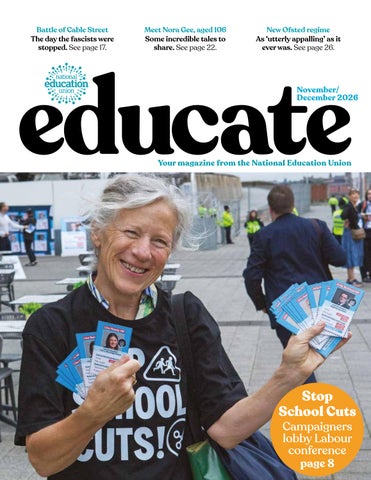
Stop School Cuts Campaigners lobby Labour conference page 8
Educate
November/December 2026 Retired member Janet Kirby from Liverpool, handing out Stop School Cuts leaflets at the Labour party conference in September. Photo by Jane MacNeil janemacneil.co.uk
Battle of Cable Street The day the fascists were stopped. See page 17.
Meet Nora Gee, aged 106 Some incredible tales to share. See page 22.
New Ofsted regime As ‘utterly appalling’ as it ever was. See page 26.
November/ December 2026
Your magazine from the National Education Union
Stop School Cuts Campaigners lobby Labour conference page 8
NEU joint presidents
Ed Harlow & Debra Beale
NEU general secretary Daniel Kebede
Editor Max Watson Journalists
Frankie Faccion, Sally Gillen & Sarah Thompson
Newsdesk t: 020 7380 4768 e: educate@neu.org.uk Production editor/designer Amanda Ellis Sub-editor/designer Melissa Harteam Moore neu.org.uk
linktr.ee/shareneu
TO ADVERTISE IN EDUCATE Display adverts t: 020 7880 7614 e: educate-magazine@redactive.co.uk Recruitment adverts t: 020 7880 8542 e: educate-jobs@redactive.co.uk Except where the NEU has formally negotiated agreements with companies as part of its services to members, inclusion of an advertisement in Educate does not imply any form of recommendation. While every effort is made to ensure the reliability of advertisers, the NEU cannot accept any liability for the quality of goods or services offered. Educate is printed by Warners Midlands Plc. Inside pages are printed on paper comprised of 100% recycled, post-consumer waste.
Welcome
WELCOME to the last issue of Educate for 2026. What a year it’s been. In this issue, on pages 6 and 7, we celebrate some significant wins. It’s important we reflect on what we’ve achieved, the impact of our successes, and how we’ve won them. First, we secured an extra £500 million of funding from the government to cover at a national level the 3.5 per cent pay rise for maintained-school teachers in England this year. This followed an indicative ballot showing members were willing to strike over the threatened shortfall in funding. Your determination to act saved thousands of jobs. Earlier this year we won another significant demand – to increase the legal age for accessing social media from 13 to 16. At our annual conference in April we published a survey that showed social media causes loss of concentration, sleep deprivation and impacts mental health among pupils. Thanks to your campaigning alongside parents, we pushed the government to make significant changes that should help address these issues. Meanwhile, the No Child Left Behind campaign has taken huge strides forward. This year, any child whose parent is on universal credit, regardless of income, is now eligible for free school meals. That’s an estimated half a million more children getting a free, hot meal every day – again, thanks to you supporting your union’s campaign. Ofsted will be reviewed again too, due to pressure from the NEU launching a report (see page 6) into the persistent failings of the new regime. Days after the report was launched, education secretary Lucy Powell committed to another overhaul of the inspectorate. And let’s not forget the local disputes. On our news pages we sing the praises of members standing up for support staff contracts, teachers’ pensions, against unacceptable management practices and more (pages 6-16). Educate salutes everyone who has voted for action, taken to picket lines or signed a petition for any of these campaigns. We’ve plenty of interesting features: an interview with 106-year-old Nora Gee (pages 22-23), anti-racist initiatives in Wales (pages 24-25), a dissection of the new Ofsted regime (page 26-29), and an anti-racist educational trip to Poland about the Holocaust (pages 30-33). Please email us with your news and views at educate@neu.org.uk Max Watson Editor, Educate educate Your magazine from the National Education Union (NEU)
3
BRAND NEW EDUCATIONAL RESOURCES NOW AVAILABLE
THE MUSICAL MUSICAL THE
BOOK
DENNIS KELLY MUSIC & LYRICS TIM MINCHIN
Celebrating
ears on Stage
SCHOOL RATES FROM £17.50 CAMBRIDGE THEATRE LONDON
The rest is history
Contents
24 December 1964
Trinidad-born journalist and activist Claudia Jones dies in London on Christmas eve, aged 49. She founded what is widely considered Britain’s first major Black newspaper, the West Indian Gazette, in 1958. After the Notting Hill race riots, she organised the indoor Caribbean carnivals in 1959, which would influence the Notting Hill Carnival.
Regulars
Features
26 26
15 Bigger picture 19 Union people
PHOTOS by Matt Wilkinson and Kois Miah
21 Michael Rosen & Dan Berry 35 Tim Sanders & Warwick Mansell 36 Ask the union 37 A class act 38 International
26 Ofsted: needs improvement Staff experience ‘gruelling, significantly worse’ new inspection regime (above).
‘It felt like a power play from the start’ p26-29
40 Jon Biddle & reviews 42 Teacher’s pet & letters 45 Noticeboard 47 Photo opportunity 48 Quick & prize crosswords
22 Nora Gee
‘A model for us all’ at the age of 106 (below left).
24 Tackling racism
News
Inclusive, interactive approaches being used in Wales (below).
30 Poland anti-racism trip
Stories of despair, hope and resistance to the far right (left).
6
Ofsted to be reviewed again
7
Pay rise fully funded
As NEU publishes report finding problems still persist. Government finds £500 million after NEU campaign.
8 Stop School Cuts campaign
PHOTO by Matt Wilkinson
Labour conference bombarded with leaflets showing depth of cuts.
13 Northern Ireland news
Action short of strike against excessive workload.
22
24 24
50 Final word
Embedding joyful, arts-based learning is a win-win.
educate Your magazine from the National Education Union (NEU)
5
News
Kate Williams (centre) and colleagues on the GOSH picket line
PHOTO by Jess Hurd
TEACHERS have taken 60 days of strike action over unsafe practices and bullying at a children’s hospital in London, and are demanding the local authority intervenes. Members at Great Ormond Street and UCL Hospital School rallied outside Camden Town Hall on 14 October (left). Megan Quinn, Camden NEU branch secretary, told Educate: “The lack of urgency with which the school governors and Camden council continue to approach this is disappointing and worrying.” Staff first raised concerns in October 2024 when a new head implemented “chaotic, bullying and unacceptable management practices”. Three leaders and an NEU rep, teacher Kate Williams, raised concerns and were suspended. Two of the leaders had their suspensions lifted but all still face disciplinary proceedings. In March 2026, Kate was dismissed. She was due to return to work at the start of this academic year, after an employment tribunal ruled she be reinstated until her full hearing in September 2027. But the school has appealed the decision. n See Educate, Sept/Oct 2026, page 6
Government admits need for more Ofsted reforms EDUCATION secretary Lucy Powell has committed to reforming Ofsted again, following pressure from education unions and mounting evidence from teachers that it continues to cause harm. At a packed fringe session during Labour party conference in September, Powell agreed there needed to be another overhaul. Inspections should be “supportive, not punishing”, focused on improvement, and have a “stronger emphasis” on school context, she told the meeting. Accountability shouldn’t be a “box-ticking exercise”. NEU general secretary Daniel Kebede, on the panel with Powell and other union
leaders, spoke about the intense pressure Ofsted places on teachers and leaders. He said there needed to be “significant change”, citing findings from NEU research into members’ experiences of the inspection framework, which was introduced in November 2025. The NEU’s research into Ofsted’s new inspection framework reveals “chilling levels of stress and anxiety among school staff, particularly school leaders”, Daniel said. Findings from the survey of more than 1,500 members who have been through inspection under the framework are “distressing”, he added.
2026… what a year we had! 6
educate Your magazine from the National Education Union (NEU)
It found 85 per cent of members had increased workload related to inspection. Higher stress levels were experienced by 86 per cent and 87 per cent suffered exhaustion. The survey results are included in a report by the union, Circle of stress and fear. It makes six recommendations, which include replacing the five-point grading system with a narrative-style report and removing the requirement for inspectors to compare a school’s attendance and achievement figures to the national average. n See Ofsted feature on page 26 n Read the Circle of stress and fear report at neu.org.uk/ofsted-report
Significant wins have been achieved by NEU members standing together on issues, proving that there is power in the union and that taking action works. Our campaign to raise the NEU digitial campaign age of leads to consent social media from
ban for under-16s
Campaigning by members has persuaded the government to nationally fund this year’s 3.5 per cent pay rise for teachers in England. Education secretary Lucy Powell announced £500 million more for the pay award in September, weeks before the union was to launch a strike ballot over what had originally been a part-funded offer.
Together, we made this happen
‘Putting its money where its mouth is’ Daniel said it was members’ “willingness to take a stand” that had led to full funding of the award at a national level, which signalled a “new administration willing to put its money where its mouth is”. He added: “We now have an opportunity to build on this victory, leverage our success, and make austerity in the classroom a thing of the past.”
13 to 16 led the government to announce a social media ban for under16s from 2027. It followed nine months of campaigning by the Big Tech’s Little Victims coalition, led by the NEU, which launched in September
“An opportunity to build on this victory and make austerity in the classroom a thing of the past.” Daniel Kebede Funding cuts over the last 16 years have left schools crumbling, without enough staff, and, in many cases, even basic resources. £3.3bn TPS savings needed by schools Following a revaluation of the Teachers’ Pension Scheme (TPS) in 2024, the employer contribution rate will drop from 28.6 per cent to 17.6 per cent from April 2027. This would equate to an estimated saving of £3.3 billion a year.
Daniel wrote to the chancellor John Healey, ahead of the autumn budget, urging the Treasury not to claw back the £3.3bn and put it instead into school budgets. The money is “urgently needed” by schools, which have lost around £4.5bn in real terms since 2010, writes Daniel, and almost three-quarters (74 per cent) now have less funding. “Repeated cuts to school budgets have had a devastating impact on schools. Class sizes in the UK are among the highest in Europe. School staff are being driven to burnout by relentless stress and sky-high workloads.” Time for decisive action Daniel concludes: “Now is the time for decisive action. A generation of students has known nothing but funding cuts. We cannot afford to fail another generation of children.”
n Visit neu.org.uk/save-education
Our schools are in crisis, our children deserve better. An unfunded teacher pay 2025. Children inaward will make things worse.
families that receive universal credit are In 2026, NEU members in this school now eligible for free will save education Get ready to vote to save education school meals (FSM), following extensive #SaveEducation campaigning by the NEU-led No Child Left Behind coalition. Free We continue School to fight for Meals for All universal FSM. Pupils take the For more information
NEU4156/0126
In July, school leaders had been told by Powell’s predecessor Bridget Phillipson to find £460 million for teacher pay rises by identifying “efficiencies” in their budgets. NEU general secretary Daniel Kebede said: “A pay deal without full funding was never realistic or viable.” Angry head teachers, who have been struggling to run their schools on dwindling budgets for 16 years, warned they would have no choice but to make cuts. The NEU’s executive decided to pause the ballot, following the pay announcement, which will be funded by savings from the Local Government Pension Scheme (without detriment to members).
message to Downing St
educate Your magazine from the National Education Union (NEU)
7
News
(From left) Some of the activists who took part in the stunt; NEU general secretary Daniel Kebede also attended
PHOTOS by Jane MacNeil
Stop School Cuts stunt surprises Labour conference ACTIVISTS from the Stop School Cuts campaign group staged a stunt outside the Labour party conference in Liverpool on 29 September. They handed out trading cards showing that the former schools of home secretary Shabana Mahmood and defence secretary Wes Streeting have each lost £1.1 million in real terms since 2010. NEU general secretary Daniel Kebede said: “This cabinet had the opportunity of a state education that set them up for success,
but an entire generation of pupils today has known nothing but cuts from reception to secondary school.” Analysis by social mobility charity the Sutton Trust found 75 per cent of ministers in the cabinet were state educated. £4.5 billion lost As party members walked past Liverpool Lime Street station, the city’s media wall showed that England’s schools have lost £4.5 billion in funding.
The campaign group said every school in Liverpool Riverside, the constituency hosting the conference, has lost funding in real terms since 2010. Across Liverpool, nine in ten schools face deficit pressures, a £56m shortfall over the same period. Nationally, 1,323 schools have each lost more than £1m. Daniel added: “The prime minister and chancellor must use the autumn budget to properly restore funding for schools and protect opportunity for every child in England.”
Campaign bolstered by strong union presence at party conferences THE NEU made the case to save education at the Liberal Democrat, Labour, Green and Conservative party conferences this autumn. We spoke to thousands of politicians, party members and activists about the pressures in the system and the investment needed to get education off its knees. Lucy Powell, the secretary of state for education, spoke at our fringe meeting at Labour conference. On accountability, she said inspection would play a role but in a supportive and not punishing way. She also said she would be looking again at the curriculum and assessment review. NEU general secretary Daniel Kebede welcomed the government’s significant move to fully fund the pay award nationally. Daniel called on the minister to make sure that the 8
Lucy Powell addressed the NEU’s Labour fringe event
educate Your magazine from the National Education Union (NEU)
PHOTO by Bob Fallon
£3.3 billion in savings from reduced employer contributions to the Teachers’ Pension Scheme remain in education (see page 7). At the Green party conference, our fringe meeting was on rebuilding education after decades of underfunding, and featured contributions from NEU deputy general secretary David Wilson and mayor of Hackney Zoë Garbett. NEU joint president Debra Beale spoke at our fringe discussion at the Conservatives’ conference. Debra said the government was right to aim to halve the disadvantage gap, broaden the curriculum and make mainstream schools more inclusive, but it was questionable whether schools have the money and the staff to deliver them. By Chris Brown, NEU senior political officer
No confidence in Ofsted leadership
NEU survey found 98 per cent of members have no confidence in Ofsted leadership and 96 per cent want inspections to pause.
Arts and Minds day ‘made kids smile’ THE Arts and Minds coalition, led by the NEU, brought a record-breaking rapper and a leading sculptor to Heycroft Primary School in Southend-on-Sea on 13 October. Arts and Minds funded the day, allowing the school to give over an entire day of its usual timetable. The team used the main hall, library and classrooms to deliver workshops and activities. “Art has been pushed out of the curriculum during my lifetime,” said NEU member and year 3 teacher Lauren Ekins, when asked why she organised the day alongside Arts and Minds. She added: “Today, I’ve seen confidence in certain kids. They’ve smiled during parts of the day where they usually wouldn’t.” Nurturing future talent Year 6 pupils made music with hip-hop MC Harry Shotta, a Guinness World Record holder for most words in a rap single, while year 5 created artworks from clay and sea materials with sculptor Julian Wild. Artis Foundation, Care to Dance and One Dance UK ran dance and performance workshops for years 1 to 4.
Harry Shotta with pupils at Heycroft’s Arts and Minds day
The day was organised amid growing concerns about access to arts education. Research published by the Cultural Learning Alliance in May 2026 found 43 per cent of primary teachers hadn’t worked with external cultural partners to deliver their school’s arts curriculum. Meanwhile, 28 per cent of primary teachers said the number of hours devoted to
NEU general secretary Daniel Kebede with striking Forest Fields staff
PHOTO by Kois Miah
arts had fallen at their school over the previous two years. Arts and Minds is urging the government to boost arts funding, train more arts teachers and make space in the curriculum. Lauren said: “The kids now are the society of the future. If they don’t have these opportunities, we might be missing out on incredible future talent.”
PHOTO by Neil Terry Photography
NEU general secretary Daniel Kebede joined striking teachers and support staff on 13 October, in the longest-running dispute at a Nottingham school. Members have taken 30 days of action at Forest Fields Primary and Nursery School over workload, unreasonable management practices and a failure to maintain good industrial relations. Sheena Wheatley, assistant branch secretary, Nottingham City NEU, said: “Our members are fighting for nothing more than a happy school for staff and pupils alike.” Members had paused their dispute after talks in September, but said management had broken commitments, including putting more support staff in classrooms.
educate Your magazine from the National Education Union (NEU)
9
10
TheSchoolTripAlice EDU ND26 HPH CMYK V2.indd 1 educate Your magazine from the National Education Union (NEU)
16/10/2026 15:58
Opinion
A huge win, but our work is far from over NEU general secretary Daniel Kebede reflects on the union’s success in securing a nationally fully funded teacher pay rise in England and looks ahead to next year.
THE government’s decision to fully fund the 2026-27 teacher pay award at a national level marked a significant step in our campaign to save education. The announcement followed weeks of dialogue over the summer with education secretary Lucy Powell, but the ground was laid in the preceding months. Pressure from NEU members, who were willing to stand up and be counted, brought the secretary of state to the negotiation table. Your actions moved the government from its original proposal of a 6.5 per cent pay award over three years, with no extra funding for schools to cover it, to the same rise over two years partially funded. Then finally to an extra £500 million, which means schools will no longer be expected to find “efficiencies” in their budgets to make up a £460m Department for Education (DfE) shortfall. Be in no doubt that this additional money benefits the sector as a whole. The efficiencies that the DfE advised schools to make to cover the awards would have led to further job cuts – 8,300 of them, by our calculation; most of those support staff. In recognition of this progress, the NEU executive paused the ballot on industrial action that was due to open in October. On the road to recovery? Not yet For a sector that has spent more than a decade being asked to do more with less, the £500m cash injection is welcome, but it does not put the system on a sustainable financial footing. New analysis from the Stop School Cuts coalition, which includes the NEU, lays the facts bare: 74 per cent of schools have less money in real terms than they did in 2010, with education spending down from five per cent of gross domestic product (GDP) to 4.1 per cent. In the same period, educators have suffered real-terms pay cuts of around one-fifth.
Daniel outside the Labour party conference in September
The ballot may be on hold, but the Save education campaign continues. It’s why we’ve been clear to ministers about our next steps. If an inflationary rise in the coming months triggers a further cost-of-living increase – and therefore a further erosion of educators’ salaries – then the DfE must commit to a review of next year’s pay award for teachers and support staff. And while the £500m sends a positive signal, one that has the potential to reset relationships with the profession, the money itself represents only a stay of execution for the sector. This money has come from savings from employer contributions to the Local Government Pension Scheme. Normally the Treasury would ‘claw back’ the savings, but ministers have decided to keep the money within the school system itself, with no detriment to support staff pensions. However, a saving of £3.3 billion due to a reduction in schools’ contributions to the Teachers’ Pension Scheme (TPS) is due in April next year (see page 7). It’s an amount significant enough to put schools back on the road to financial recovery, but is earmarked for the usual Treasury clawback.
PHOTO by Jane MacNeil
We will campaign to ensure that the TPS money, which comes from education, stays in education. Fighting for our vision for education In his Labour party conference speech, prime minister Andy Burnham called for a new economy and politics for the country, as well as parity between academic and technical education pathways. A highly skilled workforce requires high levels of investment in the education system that fosters those skills. It also requires a new assessment and accountability system, democratic oversight of academies and an end to excessive chief executive pay. It means bringing class sizes down and giving children more individual support, investing in the school estate, strengthening provision for pupils with additional needs, and tackling the high levels of poverty that hamper so many children’s life chances. It also means a better work-life balance for educators. These things aren’t separate from the skills strategy; they are essential to delivering it. It’s a vision for education that we’ll keep fighting for until it’s won.
educate Your magazine from the National Education Union (NEU)
11
News Sixth form indicative pay ballot and call for classroom limits SIXTH form college members are voting in the NEU’s indicative ballot over a 3.5 per cent pay offer this year. The NEU believes a more generous increase is affordable, given the extra £485 million funding for pay from the Department for Education to cover 2026-2028. The union is calling for an aboveretail prices index (RPI) increase that is a step towards restoring pay to 2010 levels. It also wants to see a 20-hour cap on class contact introduced, and a limit of 25 students per class, 20 in practical classes.
Asbestos taskforce sends stark warning to prime minster “MANY thousands will die” if the government delays action on tackling asbestos, a coalition has said in a letter to the prime minister. The NEU is part of the new National Asbestos Taskforce calling for the government to urgently remove asbestos from schools and other UK buildings. The taskforce wrote to Andy Burnham on 28 July calling for action on what it described as the UK’s “number one occupational killer”. The taskforce is a coalition bringing together trade unions, charities, industry bodies and campaign groups. The Health and Safety Executive estimates that around 5,000 people die from asbestos-related disease each year, but that figure could be as high as 20,000, according to the taskforce. Asbestos remains a serious risk in schools, hospitals and homes, and the taskforce warned against treating asbestos-related deaths as simply a legacy of the UK’s industrial past. The coalition is calling on the prime minister to meet to discuss the issue. n Visit neu.org.uk/asbestos-schools
12
March to keep abortion legal WOMEN, allies and the NEU took to the streets of London in September to march and rally in support of keeping abortion legal in the UK. Hundreds gathered at the statue of women’s suffrage activist and writer Millicent Fawcett in Parliament Square in a counter to the March for Life, organised by groups who believe women should be forced to give birth whatever the circumstances. The message from the stage was clear: the right to abortion access is under attack and it is imperative to fight back. Abortion has been legal in England, Wales and Scotland since 1967, but speakers warned of increasing
rhetoric in the right-wing press and from far-right politicians targeting women’s right to choose. Nigel Farage has said he believes the legal term for abortion should be rolled back from 24 to 22 weeks. Rally speakers included Bell RibeiroAddy, MP for Clapham and Brixton Hill, Sophia Beach of Women Against the Far Right, and myself, speaking on behalf of the NEU. Several other trade unions also joined. The NEU and Abortion Rights UK are urging people to stand up, fight back and join them in London next September to defend a woman’s right to choose.
By Rosie Kelly-Smith, Sutton district branch
secretary and London women’s organising forum
Disabled educators including DMOF members Matthew Fricker (second from left) and Lorraine Walsh (centre)
Disabled members: from AI to PIP on the agenda AROUND 30 educators attended a disabled members’ event at NEU head office in London on 19 September. Organised by the London disabled members’ organising forum (DMOF), the event brought like-minded people together to discuss issues facing disabled members in the workplace. Following coffee and introductions, DMOF member Colleen Johnson and I spoke in a presentation about the disability equality toolkit, which can be used in our workplaces to improve our working lives. Lisa Freeman, vice-chair of the DMOF, spoke about the personal independence payment and access to work scheme. Many attendees agreed the application
educate Your magazine from the National Education Union (NEU)
processes for both are tedious and drawn out, requiring improvement. In the afternoon, Laura Beckham, Durham district special educational needs and disabilities officer, presented on artificial intelligence (AI). The session highlighted the opportunities AI may provide for creating personalised learning for our students, alongside the dangers it poses to all. There were so many valuable contributions from members that some issues could not be discussed properly because of time constraints, indicating a need for future events for disabled members where these important conversations can continue.
By Lorraine Walsh, London disabled members’ organising forum
Children are not ‘snowflakes’
Fonagy Report reveals greater educational pressures, social media and loneliness are behind a steep increase in youth mental health conditions.
NI educators take action over workload TEACHERS across Northern Ireland have been refusing to attend meetings, cover outside directed hours or carry out administrative tasks, as part of a workload dispute. Members of five teaching unions, including the NEU, have been taking action short of strike (ASOS) since 28 September. NEU NI president Charlotte Carson said: “Teachers cannot be expected to quietly wait for meaningful action on workload.” Dublin City University research this year found 46 per cent of NI teachers are likely to leave the profession because of burnout. Directed time limitations The Department of Education NI published its workload action plan in April in response to last year’s independent review of teacher and principal workload, which made 27 recommendations. The unions raised concerns
Year 8 reading test ‘nail in the coffin’ ONE in five members surveyed by the union believe a year 8 reading test would have a “very negative” impact on reading for pleasure. Findings show the test, which is due to be introduced in 2028, is “not wanted or needed”, said NEU general secretary Daniel Kebede. One respondent said: “Reading for pleasure drops off significantly at this age. Adding yet another statutory test at this time in a child’s life will probably be the final nail in the coffin for reading for some children.” The NEU is urging the government to drop its plans and instead invest in early intervention and targeted literacy programmes. Teachers already identify pupils who need additional support with reading; however, just under half of teachers reported that resources for that support were no longer available. The test would make reading “a chore rather than a point of enjoyment”, said Daniel, adding that the government was “undermining its own reading for pleasure agenda”. The education select committee published a report in July that concluded “joy must lead the way” with reading. As Educate went to press, the government had not published a response, which was due by 17 September.
“Teachers cannot be expected to quietly wait for action.” Charlotte Carson (right, in 2023) about 11 of the plan’s actions. After negotiations, including conciliation through the Labour Relations Agency, they reached agreement in principle on eight. But NEU executive member and former NI president Edel McInerney said that did not mean implementation, enforceability or practical arrangements were settled.
Directed time budgets, she said, do not realistically cover assessment, parental contact, planning, meetings, administration and additional responsibilities. She added: “If a meeting is part of a teacher’s directed duties, it should be accommodated within directed time.” Under ASOS, members are also refusing to agree to new policies and initiatives unless their workload impact has been assessed, agreed with unions and allocated enough directed time. The NEU remains committed to negotiations and wants all 27 of the review’s recommendations implemented in full.
‘Essential’ catering staff ‘deserve to be valued’
CATERING assistants at Altrincham College in Greater Manchester took six strike days in September over plans to reduce the team by a fifth. The secondary wants to cut the number of catering assistants from five to four and increase hours for the remaining staff. NEU rep Malvika Acharya said: “This is about more than one catering post. It’s about the growing pressure facing support staff across education. Every time a role is cut, someone else is expected to pick up the workload. “Support staff are essential to keeping schools running and deserve to be valued, not treated as an easy target for savings.”
The NEU is concerned about the impact on staff wellbeing, health and safety, and the quality of service provided for pupils. NEU joint president Debra Beale and NEU national executive member for support staff Rachel Ferraby joined the picket on the sixth day of action. Debra said: “Catering staff also provide a soft pastoral role, noticing if a student isn’t themselves, if they aren’t eating properly and have changes in mood and behaviour. “Cutting a member of staff will give them less time to notice and interact with students, which will have a detrimental impact.”
educate Your magazine from the National Education Union (NEU)
13
News
Parents, teachers and support staff travelled from Derbyshire to London in June to hand in their letter to the Department for Education
PHOTO by Kois Miah
Union win brings all change to MAT leadership NEU members have won a complete replacement of their board at St Ralph Sherwin Catholic MultiAcademy Trust in Derbyshire, following 16 days of strike action.
TLR payments, contracts, re-banding The union also won the scrapping of a restructure of teaching and learning responsibility (TLR) payments at the trust’s largest school, St Benedict’s, which would have cost 15 teachers their allowances.
Plans to move support staff to term-time contracts and re-band their roles were also dropped. The threat of further strikes helped save one rep from redundancy. New chief executive Lisa Walton has committed to regular meetings with reps and a joint consultative committee every half term. And while the trust forecasts a small operating surplus this year, David said it “will take many years to make a significant impression on the deficit”. He added: “There is still more work to do, the NEU is in a stronger position, with more reps and better communication with the trust.”
‘Unreasonable UL management’
NEU condemns French violence
Support staff earnings repaid
NEU members at Fir Vale Academy, in Sheffield, took six days of strike action in October over unreasonable management practices. In 2025, the school was taken over by England’s largest multi-academy trust, United Learning. This year, a separate unit was created within the school for up to 20 per cent of students without consultation, and staff have faced capability proceedings without clear rationale. Duncan Blackie, NEU Sheffield joint branch secretary, said: “This ill-considered and unilateral experiment has caused immense distress to staff and students and needs to be addressed rapidly to stabilise the situation.”
THE NEU has joined French education unions in condemning the violence against student protesters. Hundreds of thousands of students have taken to the streets across France since late September to demand more education funding, amid teacher shortages, dilapidated school buildings, unmanageable timetables, and barriers to education for those in low socioeconomic areas. The protests have seen police firing tear gas grenades and water cannons. Young people have suffered lifechanging injuries, including a 15-yearold boy in Lens, northern France, whose hand was blown off by a stun grenade.
SUPPORT staff at five-school Alpha Trust in Essex will be repaid lost earnings dating back to April 2020. Under their local authority terms and conditions, they should receive an annual pay rise in April, but Alpha has been paying it in September. Their pay has consequently fallen behind that of staff at nearby maintained schools. The trust agreed to address what the NEU says was a “historic injustice” after 92 per cent of members voted for strike action. Alpha has also agreed to end performance-related pay for teachers and enter into a trade union recognition agreement.
In June, members hand-delivered a letter to the Department for Education (DfE) calling for action over the trust’s £9.5 million deficit, the largest in England. NEU regional officer Nick Raine said there had been a “catastrophic failure of oversight and governance”. Members demanded an independent inquiry into the trust’s finances. The union
received no response from then education secretary Bridget Phillipson or the DfE. After 16 days of strike action by members at nine of the trust’s 25 schools, the board had gone and the trust appointed a new chief financial officer. Lead NEU rep David Boulter said: “It was clear the NEU wasn’t going to back down.”
News in brief
14
educate Your magazine from the National Education Union (NEU)
Bigger picture
NEU member and former English and drama teacher Nicole Abraham performs in her one-woman play Punch Me Then at John Lyon’s Theatre, London. Set in a secondary school classroom, it follows English teacher Lila’s attempts to challenge misogynistic language and ideas in the classroom, while becoming increasingly tormented by her past. punchmethen.com PHOTO by ChamaraSKG Photography
News
Pay win boosts TreeHouse membership A DISPUTE at a special school for young people with autism was resolved after two days of strike action in June. Support staff and teachers at TreeHouse School, in north London, have won better pay and conditions after taking action, which saw membership soar from 30 to more than 100. “All credit goes to members at the school,” said Haringey NEU district secretary Efe Kurtluoglu. “I am so happy to stand shoulder to shoulder with them.” The school – run by charity Ambitious about Autism – agreed to a 2.5 per cent pay increase for support staff, rising to 3.5 for those on the lowest grades. Term-time-only contracts have also been scrapped, so all support staff will now be paid for 52 weeks. Work-related injuries will no longer count towards absence triggers, and staff will be paid during time off, with up to four weeks phased return on full pay.
Staff also received written commitments on heatwave protections, including the closure of classrooms that cannot be maintained at less than 30 degrees, and
half-day closures for red weather warnings. The governing body has also agreed to support formal union recognition for teachers and support staff.
Strike threat brings pensions progress
NEU members at Rushey Green Primary School, in south-east London, have paused their strike action following positive talks with arbitration service Acas. Staff took three days of strike action in October in response to unacceptable management practices, which fostered a culture of fear and bullying. “Members felt unsafe in the workplace. They were scared to talk to their rep or attend union meetings,” said Karina Maloney, Lewisham NEU joint district secretary. Further strike days are planned for November if talks don’t lead to changes. 16
educate Your magazine from the National Education Union (NEU)
NEU members at Burgess Hill Girls in West Sussex called off strike action after progress was made on pension contributions. The dispute centred on a proposed increase in teachers’ pension contributions, following a merger with St Bede’s School Trust in June. Teachers were told they would need to pay six per cent; previously, contributions were voluntary. The proposed fixed-sum payment to pensions was shelved for 12 months after a strong vote (85 per cent) for strike action brought management to the negotiating table. Yasmine Talebian, NEU south-east region officer, praised rep Beatriz Pereira, who took on the role just weeks before the dispute began: “Beatriz attended consultation meetings, with no training, but an excellent sense of justice and a desire to represent her colleagues.” The trust has also agreed to reform the joint consultation committee under a potential new trade union recognition agreement.
Academy chief executive pay
Campaign for State Education report exposes how public money is diverted from the classroom to a layer of highly paid MAT bureaucrats.
‘Be alert to the dangers to society as a whole from the far right’ The front of the 2026 march commemorating the 90th anniversary of the Battle of Cable Street
“Cable Street should be taught in all our schools. It reminds us that the answer to racism isn’t silence, but solidarity. You don’t answer the far right with neutrality, you answer it with collective power and communities standing together.” These powerful words were spoken by NEU general secretary Daniel Kebede, at a rally in St George’s Gardens in Shadwell, London, to mark the 90th anniversary of the Battle of Cable Street, which took place on 4 October 1936. On that day, Oswald Mosley’s antisemitic British Union of Fascists were stopped in their tracks. They had wanted to march through the most heavily Jewish-populated areas of London’s East End but were met by tens of thousands of people blockading the streets. When police tried later to clear a path for the fascists further south, through the narrow artery of Cable Street, they failed, because anti-fascists had erected several sets of barricades. The population of the first threequarters of Cable Street was almost entirely Jewish, the last quarter almost entirely Irish. Oswald Mosley sought Catholic Irish support using antisemitism as a weapon, but anti-fascists were simultaneously working to unite these two impoverished communities on class lines. On the day, many Irish people came from their end of Cable Street to the Jewish end to help build and defend those barricades. The commemorations of this successful mass resistance take place every five years. It
had a special resonance this year because of the alarming growth of racist far-right movements and the urgent demands from minority communities for action to keep them safe. Multicultural and multi-generational The 2026 commemoration was multicultural and multi-generational. It was months in the planning – as links between local trade unions, community organisations and the local council were built. Alongside this work was an imaginative cultural programme of talks, walks, films, plays, music and poetry that opened in May this year with the film From Cable Street to Brick Lane. It interspersed struggles of Jews in the 1930s East End with those of Bengalis in the 1970s against violence and abuse from fascists, and daily racism. The 2026 march, starting in Whitechapel, was a spectacle. Behind the banner of the Cable Street 90 Committee were musicians of the Great Yiddish Parade marching band, playing Yiddish tunes written in late 19th and early 20th century London. Behind them, the Jewish bloc comprised several radical Jewish organisations, then a bloc of London-based Irish organisations.
A large trade union bloc, which included several NEU banners, was led by the RMT’s impressive brass band. The march stopped to hold a minute’s silence at Altab Ali Park, renamed to mark the murder of a young Bengali immigrant worker in May 1978 by racists. In Leman Street we passed the police station where many of those arrested in 1936 suffered assaults by police before being charged. Of 84 arrested that day, 79 were anti-fascists. Some received custodial sentences of up to four months for defending their community. Powerful speeches at the final rally showed great respect for the past but brought matters right into the present. Speakers urged people to be active in whichever arenas they could to alert others to the dangers to society as a whole from the far right today, and to give solidarity to those suffering racial harassment, abuse and violence right here, right now. As educators we have a great responsibility to do that too.
n See page 30 n Visit tinyurl.com/cable-street-to-brick-lane By David Rosenberg, international solidarity officer, Islington NEU
educate Your magazine from the National Education Union (NEU)
17
250+ HEAD TEACHERS SAY STOP SCHOOL CUTS “I am at a loss as to where to turn next.” Joanne, head teacher, Wirral
“We are being asked to do more and more and more with less money than ever.” Andy, head teacher, Gloucestershire
“The education system we are currently operating is failing children miserably.” Debbie, head teacher, Leicestershire
What do you see in your school?
Share your story.
Union people
‘When we stand together, we win’
Maria on the picket line, including (below) with NEU general secretary Daniel Kebede
Maria Nicolo is an NEU rep and works as a special educational needs teaching assistant at Brick Lane School in east London. What do you love about your job?
Working as a special educational needs teaching assistant (TA) means no two days are ever the same. The real joy comes from the little steps and achievement moments – when a pupil who has been struggling finally feels safe, understood and able to succeed. Support staff are the backbone of inclusive education, and being able to make a tangible difference in a child’s life every day is what keeps me passionate.
What do you love about being in the union?
It gives all school staff a collective voice that cannot be ignored. Since stepping up as a workplace rep, I have learned an immense amount about collective bargaining, employment rights and organising strategy. That growth continued as I took on roles in my district and branch, and over the summer, becoming a support staff national councillor for the NEU London region. What I love most is using that knowledge
to empower others and prove that when teachers and support staff stand together, we win.
What have you been up to lately?
My focus has been leading our workplace dispute at Brick Lane School alongside our teacher colleagues. Over the past year, I took our union membership from just seven members to 53 by actively listening to staff and showing what collective action can achieve. We’ve been out on the picket line together fighting for three core demands: fair pay for teachers and support staff, a complete review of our rigid sick pay policy (which currently stands at just five days), and the formal signing of a trade union recognition agreement (TURA).
What’s important to you right now?
Winning our dispute and securing full union recognition. For too long, independent school employers have expected support staff and teachers to absorb high workloads and poor conditions without proper consultation. Winning
fair pay, improved sick pay, and a signed TURA at our school will set a vital precedent across the sector and demonstrate the power of joint teacher and support staff organising.
What do you do on your day off?
I love spending quality time with my two children – especially going camping – and planning youth activities as a local scout leader. I also enjoy relaxing with a good playlist and catching up on my favourite Korean dramas.
Tell us something we don’t know.
My spare time has always been limited because I’m a single mum of two. But with my children growing up, I’ve decided to pursue my dream of becoming a primary school teacher. I began studying for a degree in applied education with inclusive practice this September. I’m also a volunteer with the Beavers and Scouts – 32 kids between the ages of six and eight – and I’m supposed to go to the gym sometimes too, but it’s rare I get there because I have run out of time.
educate Your magazine from the National Education Union (NEU)
19
GOT THE CALL?
DON’T PANIC! Scan here to find out more!
NEU4226/0126
Use the Ofsted risk assessment to protect yourself and your colleagues from the inspectorate’s harmful fallout – before, during and after inspection.
Michael Rosen
The leaning tower of PISA tables
Words by Michael Rosen Illustration by Dan Berry
What is that sound we hear coming to these shores? It’s the alarms and hosannas of the PISA scores. Every year, it’s just the same old tara-diddle: Are we up? Are we down? Or are we in the middle? The press rush to award prizes and labels But forget the workings of league tables: Being up or down a position or two Is not a measure of how well you do. They celebrate or bewail this or that example But don’t question the reliability of the sample And as no country ever wants to be shamed Is it possible the system is sometimes gamed? So should we believe these tables are the best tools For judging where to find the best kinds of schools?
Interview
Nora Gee Portrait by Matt Wilkinson
22
educate Your magazine from the National Education Union (NEU)
From fleeing World War II fighter planes to campaigning for equal pay, Nora Gee has seen and done it all. Frankie Faccion meets the centenarian and hears her fascinating stories of a life well lived. AT 106, Nora Gee is one of the NEU’s oldest members. “People always ask me what my secret is,” she says. “I just keep on living, and everything else is incidental.” Nora taught through the Manchester Blitz and served as president of the National Union of Teachers’ (NUT) Warminster branch in Wiltshire in the 1950s. She even remembers dancing at an annual conference with a young Fred Jarvis, who went on to become NUT general secretary in 1975. “He was quite a good dancer,” she laughs. Nora’s teaching career spanned 38 years, and teaching runs through four generations of her family: her grandmother, mother, aunt and granddaughter. Teaching during the Blitz She took her first post in wartime England, 1940. She was just 20 years old, earning £10 16s 8d (£10.83) a month in Gorton, Manchester. The school eventually lost the equivalent of a whole classroom of children to the Blitz. Staff would take it in turns to cover playground duty after nights of bad bombing and little sleep. One day, on her way into school, she saw fighter planes overhead. Soon after, a bomb hit the street next to her. “I began to run, because I knew the kids would be watching the planes instead of sheltering,” she recalls. Her case of marking flew open as she ran, books scattering around her as she scrambled to pick them up. She arrived to find the children as expected: in the playground, watching the planes above. Teachers were a reserved occupation at the time, exempt from conscription. But Nora volunteered with the fire service in the evenings, while continuing to teach by day.
After marrying her first husband in 1944, Nora moved to Glasgow, teaching first on the edge of the Gorbals, one of Europe’s worst slum areas.“I’d seen poverty before, but never like that,” she remembers. One boy came to school drenched in rain, cardboard tied to his feet instead of shoes. “It was still wartime, so there wasn’t much you could do besides try to make the children happy,” she says. It was after Nora returned to England to take up a headship in the Wiltshire village of Longbridge Deverill that she became president of the NUT’s Warminster branch.
salary points were still only given to men”, Nora says. She moved to Bath in 1966 after separating from her husband. There, she taught at Southdown Junior School in a slum clearance area on the edge of the city. It was one of several jobs in which Nora found herself drawn to the children who needed the most. She moved to the school psychological service, working with struggling readers from difficult homes, nearly all of them boys. “They became almost like sons,” she says. She later set up the city’s reading centre, while working for the remedial service as a peripatetic teacher. By the time she retired in 1978, the service supported 95 schools. Nora remembers bumping into a struggling pupil she had taught years before. He told her he’d “never forgotten all I’d done for him”. He later secured a stable job at Westminster council.
“The NAS came and barricaded our union meeting. The men hated the A lifetime of giving back These days, Nora is still doing all she can to idea of equal pay.” support those around her. And it doesn’t go In the village “essentially owned by Lord Bath”, Nora found a stark contrast from the Gorbals. On her first day, the girls curtsied and the boys bowed. Unqualified staff had stayed for decades, and Nora had to fend off unwanted advances from the chair of the school managers. “I mean, talk about feudal,” she says. “It was a relief to go into Warminster for the union meetings.” Around this time, Nora was involved in the NUT campaign for equal pay for women. “The National Association of Schoolmasters (NAS) came and barricaded our union meeting over it,” she remembers, wide eyed. “The men hated it.” And even after the phase-in of equal pay in 1955, “bonus
unnoticed. In her Scarborough care home, where she has lived for less than a year, the room is filled with birthday wishes and letters – she celebrated her 106th birthday in July. Among the well-wishers is poet, children’s author and Educate contributor Michael Rosen (see page 21). “You’re a model for us all,” he writes. Nora writes poetry, too, and loves watching the cricket. She even knits under her own label, Granny Knits, producing hats and gloves for refugees in Scarborough, and blankets for friends and family. “Do your best, no matter the circumstances,” she says to today’s NEU members. “Governments and policies change, so stay involved. And keep thinking about the children.”
‘A model for us all’ educate Your magazine from the National Education Union (NEU)
23
Interview Feature
Fostering a sense of Challenging racism doesn’t just happen on our streets, but in our schools and communities. Sally Gillen talks to two Welsh educators about their inclusive, interactive approaches. WHEN teacher Lisa McCracken moved to the Welsh Valleys eight years ago, she faced “significant” racism from some peers.
“The racism was relentless… I wanted to do something to make sure others didn’t feel the same way, especially in the current socio-political climate.”
She was told by colleagues that people like her were making white people feel they are a minority in their own country; that they didn’t agree with the Black Lives Matter movement; that it was “outrageous” a Black actor had been cast as the lead in the Little Mermaid film. “It was relentless and very isolating,” she says. “As is the case for many Black educators, I find there’s an assumption that I have the answers to anything that isn’t white Welsh. It can be incredibly draining.” Her own experiences, and those of some Black pupils, ignited Lisa’s anti-racist work. “I wanted to do something to make sure others didn’t feel the same way, especially in the current socio-political climate.” A safe space First, she wanted to create a supportive network for educators, so put together a termly racial equalities newsletter, which provides links to courses, events, research and resources. That led to running free training for staff on areas such as racial literacy and celebrating diversity in schools. Sessions are interactive, not preachy, and trauma isn’t relived, explains Lisa. “What I’ve found when I go into schools is that staff want to do right by the children, but confidence and knowledge can be quite low,” she says. “Staff can be so worried about doing the wrong thing that it can sometimes lead to doing nothing. “I stress that racism exists wherever you go; it’s how they respond to it that is crucial.” 24
Lisa McCracken (left)
The racial literacy training is popular; it has been taken up by seven schools so far. It’s a safe space to discuss appropriate ways to celebrate diversity and what is offensive, Lisa says, as well as the differences between cultural appropriation and appreciation. Also equalities officer for NEU Torfaen, Lisa runs wellness sessions for educators involved in equalities work. Among the recent attendees was Antonia Lane, an art practitioner-researcher and leader of inclusion initiatives at Ebbw Fawr Learning Community, a school for three- to 16-yearolds that is also in the Valleys.
educate Your magazine from the National Education Union (NEU)
Antonia has been involved in anti-racist education – which she says has evolved into what could be more accurately described as inclusion – for six years. It began as sessions for pupils who had experienced racism in school and in the wider community, but has grown both within the school and beyond it. She set up a cultural diversity group for students. Anyone can join, she says, not just those who are minoritised; compassion and tolerance are the only entry requirements. “Rather than operating from a reactive or grievance-led framework, our group
Feature
belonging embraces a universalist, art-based pedagogy,” says Antonia. “We focus on expressing local identity through shared cultural heritage and collective identity so all students feel a sense of belonging.” Finding common ground She leads the sessions using gentle, somatic crafting exercises, such as needle felting, while discussing themes of movement and migration. These discussions examine how Welsh identity and culture are co-created, not just by people but by animals, land and materials. “It is an approach called the Common Third: a relationship-building model whereby educators and students engage side by side in tactile activities such as arts and crafts and cooking,” she explains. “We sit down together – everyone is on the same level, so there is no hierarchy – and establish a neutral ‘third place’ where peer relationships are rewired and pupils find common ground.” Antonia’s school is in Blaenau Gwent, a post-industrial area, and works with universities on social pedagogy, looking at approaches to building understanding between groups. It recently collaborated with the University of Worcester on the Cynefin project, using the Welsh word that means ‘belonging’ and ‘place’ to help year 7s connect
with their environment. At a workshop, pupils considered humans’ movement across the world, explains Antonia, as well as that of animals and in the natural world through weather patterns, waterways and the seasons. “This encouraged them to reflect on migration and movement as natural processes that shape relationships between place, identity and community,” she says. “The landscape becomes a source of inspiration and a way of exploring belonging and interconnectedness.” They chose to work with year 7 because these pupils are at an important point of transition and are navigating changes in place, identity and belonging, she adds. When time and funding allow, the cultural diversity group takes its anti-racist and inclusion work out into the community. This summer it hosted a marketplace stall as part of Windrush celebrations (see below left), where pupils engaged the public in crafting, such as bracelet making, while discussing themes of movement and ecology. In September, pupils presented a workshop at the Social Pedagogy Professional Association conference in Oxfordshire (see below right). “The method we’re trialling is very new,” says Antonia. “It’s successful because it integrates everybody.”
“We sit down together – everyone is on the same level, there is no hierarchy.” Antonia Lane (above)
(From left) Pupils from Ebbw Fawr Learning Community host a market stall; Antonia and some pupils present at the Social Pedagogy Professional Association conference in September educate Your magazine from the National Education Union (NEU)
25
Feature Since the new Ofsted inspection regime was introduced, NEU members some ways, they are worse than before. Sally Gillen reports. THIS November, it will be a year since Ofsted introduced a new inspection framework. A “new chapter” was what chief inspector Martyn Oliver promised, but NEU research has found inspections are as unfair, stressful and exhausting as ever. Worse still, many leaders feel the pressure on them is now even more intense. The weight of evidence that Ofsted is continuing to harm educators is such that education secretary Lucy Powell has given assurances inspection will be changed again (see page 6). She has taken into account evidence including an NEU survey of more than 1,500 teachers and leaders who have been through a new-style inspection that shows the stress and workload generated remains dangerously high. Workload went up ahead of inspection, said 85 per cent of members, significantly for half of them. A negative impact on health and wellbeing was felt by 87 per cent, while 86 per cent said inspection had impacted stress levels. “It was gruelling; significantly worse,” says primary deputy head Jenny Carson, whose school was inspected in February. “It felt like a power play from the start. The head teacher and I butted heads with the lead inspector, and were fighting our corner for two full days, but she had made up her mind and there was no changing it.” Empathy, respect, minimise stress? So much for Martyn Oliver’s commitment to minimising stress and anxiety, introducing a more collaborative process, and ensuring inspectors build positive relationships with staff characterised by professionalism, courtesy, empathy and respect. But such epic failure is what educators have come to expect from Ofsted. It has cast a shadow over teaching for more than three decades, reforming regularly yet never managing to achieve a fair, supportive or effective inspection regime. Unquestionably, its 2025 rebrand was the most important in Ofsted’s 34-year history, a vital response to the suicide of primary head Ruth Perry in 2023, in which it played a part, according to a coroner’s report. 26
Jenny Carson
Portrait by Matt Wilkinson Anger, rather than disappointment, is captured in the union’s survey (see What members said, page 29). Even those who report a better experience in terms of inspector conduct say inspection itself remains critically flawed. Mental health awareness training David Poad leads Chalford Hill Primary in the Cotswolds, one of the first schools in the country to be inspected under the new framework. Staff were wary, he says, because
educate Your magazine from the National Education Union (NEU)
two years earlier the school received a Requires improvement grade, an experience so terrible David considered resigning. Ahead of Ofsted’s next visit in November 2025, he explained to inspectors during the pre-inspection call that staff were feeling apprehensive, and he was pleased that message hit home. He found the “humanness of the inspectors helped enormously” during their two days at his school. That’s not, of course, a universal experience. The variability of inspector
Feature have found many of the problems of the old regime still exist, and in
equally reductive labels are now the basis of the inspection framework. Exceptional, Strong, Expected, Needs attention and Urgent improvement, used to assess six areas of school life, feel like tick boxes. And some schools, particularly those in areas of high deprivation, feel they have little chance of ever achieving anything other than the Expected standard. That is “grossly unfair”, says David. He acknowledges that as the leader of a school in an area of low deprivation (pupil premium is way below average at just ten per cent), with above-average attendance, it is easier for his school to get a good inspection result.
‘I felt sick, ready to hand my notice in’ conduct, which has always been a problem, remains. Ofsted’s investment in mental health awareness training is not always translating into a genuinely empathetic approach in practice and has resulted in what some members describe as performative enquiries about their wellbeing during the inspection. Questions such as ‘how are you?’ feel scripted, even patronising, they say. “Whether the inspectors are nice people or not, the amount of stress and worry is unbelievable,” says David. “It’s totally bonkers
to have four people descend upon your school with 24 hours’ notice, and the claim you don’t have to do any preparation is total nonsense.” ‘Grossly unfair’ in deprived areas It’s also “utter nonsense” that the new gradings shouldn’t be seen as judgements. “Ofsted says we shouldn’t use the word, but of course we’re being judged,” David adds. The removal of single-word overall judgements, although much celebrated at the time, feels less of a win when a batch of
‘Feel defeated after appalling process’ In comparison, a school like Jenny’s struggles. Despite being in a leafy suburb it has a disadvantaged intake. Attendance is “really poor” and attainment “not ideal”, she explains, but at Ofsted briefings on the new framework there had been assurances that as long as schools could evidence what they were putting in place to tackle those things, there was no reason they couldn’t reach the Expected standard. In practice, however, inspectors were only interested in its attainment and attendance data, Jenny adds, arriving with a preconceived idea of the school and unwilling to consider any evidence that didn’t fit with their narrative. “When we had our attendance meeting, we said we have had so many comments during the inspection that behaviour is great. It was a calm and orderly environment, and the children were engaged and polite. The inspectors acknowledged all that but said because our attendance is below the national average we couldn’t get more than Needs attention in this area, but that their comments on behaviour would read really strong in the report. They don’t.” The inspection has left staff feeling defeated and the process itself was “utterly appalling”, she sighs. Jenny’s fitness tracker showed her heart rate leapt from 74 to 148 during the two-day inspection. Frustration built as she and senior leadership colleagues tried, unsuccessfully, to present evidence of the school’s impact. continued on page 28
educate Your magazine from the National Education Union (NEU)
27
Feature Interview continued from page 27 Inexplicably, the lead inspector only left the office for an hour on the first day of the inspection and not at all on the second, she says. Another inspector spent a minute in one classroom, there was minimal interaction with the children, and inspectors didn’t visit years 5 or 6, yet concluded pupils were not secondary-ready. Handwriting was a fixation yet no mention of it was made in Ofsted’s final report. Jenny despaired when an inspector picked up a book belonging to a child with a complex history and special educational needs and disabilities (SEND) and barely glanced at the half page written before concluding the pupil wasn’t making enough progress. “His handwriting was awful,” Jenny admits. “But he had written half a page – the inspector didn’t read it – and I explained the child hadn’t attended year 2, has suffered a lot of traumatic events, and didn’t want to come to school, so for him to write half a page, well, he was so proud. The inspectors just wouldn’t get past the poor presentation and said he needed to write one sentence really well. That’s it. But how is that having high expectations?” ‘Ready to hand my notice in’ At the end of the first day of inspection, senior leaders were dealt a blow when they were told inclusion, for which the school had been awarded the Inclusion Quality Mark months earlier, had been provisionally graded as Urgent improvement. “I felt sick,” says Jenny, who is also the SEND co-ordinator. “I thought, am I deluded if I think our inclusion is strong, but they say it needs urgent improvement? “The head and I stayed until 9pm and then I drove home and cried all the way. I didn’t sleep that night, and driving in the following day I was ready to hand my notice in. I was questioning everything about my practice and professional beliefs.” The rollercoaster continued the next day when the lead inspector told the senior leadership team she was glad to tell them the school was no longer graded as Urgent improvement for all areas. It was very confusing, says Jenny. The school had evaluated itself as meeting the Expected or Strong standard for many of areas, because it felt it was a true reflection, she adds, but then got Needs attention in all areas, apart from personal development and wellbeing. That was at the Expected level. 28
“Our attainment isn’t the best, but it correlates to the level of SEND and pupil premium and our children make excellent progress. It’s not appropriate to compare us to a national average. Our school has 35 per cent SEND, much higher than the national average, and higher numbers of pupil premium, so it already isn’t average in many respects and yet is being judged against schools that are. “I challenged them to show us the school they’re comparing us to. But they couldn’t. We’ve said this time and time again – they are comparing apples with bananas.” At the end of two exhausting days, she told the inspection team: “I’ve been in education 15 years and this is by far the worst experience I’ve ever had.” A 48-page complaint was submitted by the school (supporting evidence included readings from Jenny’s tracker). It wasn’t upheld. “The inspection has consumed our year, and it shouldn’t be that way. All the extra work we’ve had to do, including putting together our complaint, has impacted the day-to-day running of the school and we haven’t been able to focus as much on aspects of school improvement,” says Jenny. Her school, like any that receives Needs attention gradings, is supposed to receive help from a supportive Ofsted inspector. It was seven months before one got in touch. “If Ofsted is the expert, it could share its knowledge with us,” suggests Jenny. “That would be much more helpful than just tearing our school apart and making us feel we aren’t doing a good job. “When you read the report it’s not our school. I’ve read other schools’ reports and thought ‘wow, I’d hate to work there’ and people will read ours and feel the same.” The report has had consequences for the school. Parents have withdrawn their children and others are choosing not to send their child’s siblings. Jenny knows of three schools that have put in complaints about their inspection, and two school leaders who have resigned. ‘Our hard work not recognised’ The head at teacher Amy Lee’s school, an all-through school for ages four to 16, left following an awful inspection last November. The school had volunteered to be among the first to be assessed under the new framework. Huge improvements had been made, explains Amy, and senior leaders felt confident the school would do well.
educate Your magazine from the National Education Union (NEU)
David Poad
Portrait by Kois Miah
Feature The outcome was devastating. Four areas – achievement, curriculum and learning, inclusion, and leadership and governance – were graded as Needs attention. Attendance and behaviour, early years, and personal development and wellbeing met the Expected standard. “On paper, it looks like the school has gone backwards. All the work we have done has not been recognised at all,” she says. Intake fell, funding cut, redundancies Again, the report has had consequences. The school’s intake fell, funding was cut and there were teacher redundancies. Staff feel burnt out, Amy adds, and the monitoring that has followed, including practice Ofsted inspections, will continue for the foreseeable future. “One of my lessons was recently observed for 20 minutes and I didn’t get any sleep the night before. You know it’s just a job, but you cannot stop yourself from feeling the pressure and anxiety around this, which is just constant.” She also believes the framework is unfair and penalises schools, like hers, in areas of high deprivation. “Comparing every school to the national average just isn’t right. The framework doesn’t measure progress at all. A lot of our children when they start don’t have gross motor skills, let alone fine motor skills. If Ofsted measured schools through progress, rather than comparisons to the national average, we’d be way up there. Many schools would be.” Not only was the outcome unfair, but the atmosphere during the inspection was “horrific”. Inspectors wouldn’t make eye contact, and one remarked disapprovingly “do they usually behave like this?” when observing children running in the playground.
“There was absolutely no emphasis on being supportive or caring about wellbeing. Leaders just looked ill, like the life had been drained out of them by the end. They are under too much pressure. I know they get paid to do the job, but it felt like an inspection of leaders, not the school.” Surprisingly, given that she is English lead, Amy was not asked anything by the inspectors. She says they only wanted to speak to senior leaders. “Before the inspection I’d wanted to speak to them. Afterwards I just felt huge relief I hadn’t,” she says. Inspectors spent just 20 minutes in classrooms throughout the entire inspection, she adds, and the framework itself is too restrictive, with schools expected to meet very specific criteria to the letter. That rigidity means many schools will only be able to be downgraded. As for single-word overall judgements, she says: “OK, we don’t have them, but we just have a new set of words now, don’t we?” ‘Not learned from Ruth Perry’s death’ Her former head teacher, depressed and demoralised post-inspection, wrote to then education secretary Bridget Phillipson warning that another school leader would die if the framework wasn’t changed, says Amy. Jenny’s school and staff are still impacted many months after inspectors visited and she agrees the inspectorate remains, among other things, a health threat: “Ofsted has not learned from the death of Ruth Perry and something will happen like that again. “My heart breaks for anyone really struggling with it all. This is just not good enough. Things really must change.” n Read the NEU’s report on the new Ofsted
inspection regime at neu.org.uk/ofsted-report
What members said in the survey n “I watched the mental health of colleagues plummet during and after the inspection. During the reading of the report at the end a deputy head was sobbing, but the inspector didn’t pause or acknowledge the distress she was in.” n “The pressure is even higher. In a one-form entry school we had three
“A circle of ” stress and fear The New Ofsted k Framewor teachers Feedback from year on and leaders one
inspectors. Many of us are leaders of multiple subjects and we were involved in discussions and judged on our teaching within the same hour numerous times.” n “The prelude to Ofsted was way worse than the actual event. The
senior leadership team was very single-minded for about six months. It did make us prepared, but this is where Ofsted is harmful. It puts too much pressure on leaders to squeeze.”
educate Your magazine from the National Education Union (NEU)
29
Many voices, one journey Members who attended the NEU’s anti-racism educational study tour to Poland reflect on what they learned about fighting fascism. The group visited Auschwitz-Birkenau, a memorial and museum housed in a former Nazi concentration camp
DURING the May half term, the NEU ran its second anti-racism educational study tour to Poland, giving members the opportunity to examine one of the darkest chapters in history. The purpose was to better understand what led to the development and spread of fascism during the 1930s, and learn some of the organising lessons from the socialists and trade unionists who fought back. What follows is a set of reflections by some of the attendees.
Jewish life before the Holocaust
The Monument to the Women of the Warsaw Uprising
30
When the Nazis exterminated millions of Jews, they sought to erase centuries of traditions and innovations – a vibrant world of languages, cultures, schools, media, political organisations, and religious and communal institutions. We wanted the delegates to relate to the human beings who made up this diverse, conflicted and fast-changing society. Jews have lived in Poland for 1,000 years. There were times of hardship and discrimination but also long periods when they lived fruitfully among non-Jewish Poles. We focused on the 1920s and 1930s, when Jews constituted around one-third of those living in Poland’s cities. They were mainly workers in manual trades and many were active trade unionists, though some were wealthy, and there was a small professional class.
educate Your magazine from the National Education Union (NEU)
Most Jewish children attended Polish state schools but there was also a growing network of progressive, secular, Jewish schools as well as religious schools that taught in Yiddish, most students’ mother tongue. In the interwar years, Jews suffered economically, but this went alongside a flowering of Yiddish cultural creativity in Warsaw. There were literacy circles, drama groups, theatres, libraries, sports clubs and youth groups, as well as five Yiddish daily newspapers. Jews from all classes enjoyed these cultural riches. We hope we enabled delegates to glimpse that lost world. Julia Bard, National Union of Journalists, and David Rosenberg, Islington NEU international solidarity officer
Feature ‘Janusz Korczak’s work inspired me’ Learning about progressive education in Poland, I found Janusz Korczak’s work inspiring. He created a children’s parliament and court, demonstrating an incredible level of trust in young people and offering a powerful example of genuine democratic participation. I keep returning to Korczak’s belief that every child deserves the chance to be heard. How can we create an education system that works for children rather than one that is simply done to them?
I was also inspired by the Medem Sanatorium, which operated from 1926 to 1942, where learning happened through nature, creativity and exploration. It reinforced the idea that education is about more than academic achievement and should support the whole child. As an educator working in a school that gives our key stage 1 children opportunities to play and learn actively, this was particularly affirming. Katy Roberts, North East Essex NEU workplace rep and joint women’s officer
The importance of preserving truth The criticality of the preservation of Jewish history for Jewish people in the ghetto in Warsaw really challenged my thinking. With violence, chaos and desperation ensuing in Warsaw from the autumn of 1940, one would guess survival would be at the forefront of Jewish people’s minds. However, the wealth and diversity of artefacts in the Ringelblum Archive suggests it was Jewish culture, memory and history at the forefront for many.
The preservation of the archive was surprising to me. Despite bombing, flooding and extensive destruction in Warsaw, many historical artefacts survived intact. The resilience, organisational diligence and rigorous determination of the Oyneg Shabes (the clandestine organisation that collected the artefacts) to preserve Jewish history stayed with me. It matters because it encapsulates the absolute criticality of
historical accuracy, historical memory and preserving an authentic record of Jews’ daily life and resistance to the Holocaust. The preservation of the Ringelblum Archive has reiterated the importance of educating students about what history is, the construction of history and how historical truth is contested. Josh Knight, Surrey/Croydon NEU workplace co-rep
‘As trade unionists, we can shape history’
Part of the Umschlagplatz Monument in Warsaw
The purpose of the study tour was to recognise that as trade unionists, we can play an active role in shaping history. And so we began by unlearning some of the misconceptions that have shaped the narrative of the Holocaust, namely that Jews played no active part in the resistance against the Nazis. One of the most famous acts of Jewish resistance took place in 1943 when the Warsaw Ghetto’s inhabitants learned of the Nazis’ intention to transport them to the gas chambers. This heroic stand
was the first armed resistance in occupied Poland. It took the Nazis six weeks to regain control, and fighting only ended after the ghetto was burned to the ground. All that remains are the plaques and memorials that stand testament to the bravery of those who lost their lives defending their people (see photo, left). However, they also left behind the history of their grassroots organising and showed the power of collective struggle. Havelok Symes, Camden NEU workplace co-rep
Auschwitz: like stepping into hell on Earth Visiting Auschwitz really was like stepping into hell on Earth; the most immoral act possible took place here. Teaching about the Holocaust year after year but not visiting always allowed a personal distance from the reality – even as a knowledgeable, proud descendant of both Jewish and non-Jewish servicewomen and -men.
Whether you are religious or not, the Holocaust is the sheer definition of evil. From walking through the infamous gates (see photo, page 30) to realising it looked like a pig farm, the dehumanisation and the vastness of it all were overwhelming. Walking along the dead-end track, knowing what happened there, was too much for me. I gravitated to another delegate and we
held each other as we walked, needing to feel someone, to not feel alone, empty. Knowing you were in the same spot as the people, the children, whose lived experience it was sits with me still. It is a feeling I can’t explain in words. Kelly Shakesby, East Riding NEU workplace rep continued on page 33
educate Your magazine from the National Education Union (NEU)
31
Feature
continued from page 31
‘Remembrance is not passive’ Before attending Dr Zuzanna Hertzberg’s session, I hadn’t fully considered how easily marginalised voices can be erased from history. A contemporary Polish-Jewish artist, researcher and activist, Zuzanna draws on her own experience as the descendant of Holocaust survivors to explore memory, identity and stories that have too often been overlooked, including those of Jewish women and anti-fascist resistance fighters. Her session highlighted how marginalised voices are frequently absent from mainstream historical narratives and why we all have a responsibility to ensure their stories
are recognised. Through her artistic practice, she has demonstrated that remembrance is not passive; it requires us to actively recover, preserve and amplify the voices that might otherwise be forgotten. Her work reminded us that history should never be viewed through a single lens. Instead, we should encourage our pupils to think critically, explore different perspectives and consider whose stories have been included, whose have been excluded, and why. Saba Maqbool, support staff national council and Nottingham NEU workplace rep
A 14-year-old Auschwitz prisoner
Stories of solidarity and hope for schools In Poland, we heard of the best and worst of humanity. After getting home, I struggled to stop thinking about some of the atrocities we had learned about. Soldiers throwing sick children from a hospital roof, then taking the ones who survived up to throw them off again, was the one that haunted me. I found it hard to comprehend how anyone could have
descended to that point of depravity. But the stories of solidarity and hope have remained with me and are some of the most important lessons we can pass on in schools: Tadeusz Pankiewicz, the pharmacist who voluntarily went into the Kraków ghetto every day; the secret school plays in the Warsaw ghetto; and Witold Pilecki, the hero who deliberately
got captured to report back on Auschwitz. We need to equip students with the tools to dismantle far-right intolerance. Our curriculum should teach about genocides past and present; however, I think just as important is the need to model empathy, kindness and love. Kathryn Barnes, Birmingham NEU vice-president and equality officer
‘Silence allows prejudice to grow. Education can prevent it’ Atrocities such as the Holocaust do not begin with violence; they begin with the slow acceptance of prejudice, exclusion and the dehumanisation of others. Jewish communities had lived across Europe for centuries, yet they were still often viewed as outsiders and treated differently. It left me reflecting: if a community can be present for centuries and still not be fully accepted, how long does it take for people to truly belong? It also made me think about
contemporary debates around migration, identity and belonging, and challenging narratives that divide people into ‘us’ and ‘them’. Visiting the former Warsaw ghetto demonstrated how rights can be removed gradually until injustice becomes accepted as normal. By the time we reached Auschwitz, the consequences of this process were devastating. Looking at the prisoners’ photographs (see photo, above) and reading their names reminded me that every victim
Collective reflection We each returned from Poland with a
Members of the delegation
shared understanding of – and renewed commitment to – the words “never again”. The Holocaust was not inevitable; it developed through human choices: the normalisation of prejudice, the spread of fascist ideas, the weakening of opposition and the failure of too many institutions and individuals to resist. At a time when racism, antisemitism, Islamophobia and other forms of
was an individual with a family, ambitions and a future that was stolen. It reminded me that the conversations I have with children every day about kindness, fairness and belonging really do matter. They may seem small, but they are one of the ways we prevent prejudice from becoming normal. Silence allows prejudice to grow, while education has the power to prevent it. Lisa McDermott, Medway NEU disability officer and workplace rep
prejudice continue to divide our society, solidarity could not be more important. As educators and trade unionists, we share a collective responsibility to challenge discrimination; equip young people with critical thinking, empathy and courage; and ensure that their dignity, equality and belonging are protected. Remembering the past is not enough. We must ensure its lessons continue to inform the future.
educate Your magazine from the National Education Union (NEU)
33
HELP US TO END THE EXAM FACTORY IN PRIMARY SCHOOLS The government must… STOP pretending primary testing is OK LISTEN to teachers, heads and parents LOOK AGAIN at the system and scrap SATs
SIGN THE PETITION NOW
Opinion
Cartoon by Tim Sanders
Dioceses’ determined drive to academise Warwick Mansell
is a freelance education journalist and founder/writer of educationuncovered. co.uk
IT is reaching the point at which I need to start telling myself that, in investigative reporting, subjects other than goings-on in and around the Catholic multi-academy trust sector need coverage. For this is a field that is creating multifaceted issues of contention, as drives by dioceses to move schools into the academy sector provoke intense debate. Currently, six of England’s 19 Catholic dioceses are generating controversies that have come my way. In Westminster, Lancaster and Liverpool, proposals from the bishop to academise all schools these dioceses currently oversee have provoked resistance, including from NEU members. Westminster, whose archbishop leads the Catholic church in England and Wales, has been seeking an all-academy future for its 182
schools for nearly a decade. This drive has met with limited success, however, with half of its schools still not academies. In the diocese of Lancaster, which oversees 80 schools in Lancashire, Blackpool and Cumbria, NEU members at two high schools have been on strike at the time of writing, with plans for ballots at more, over proposals to – in the words of one source – “force academisation” on governing bodies. There are claims that both of these dioceses, which have the right to appoint the majority on Catholic schools’ governing bodies, have been using that power by not renewing the appointments of governors in schools resistant to the academisation drive. The archdiocese of Liverpool, which is planning to academise nearly 200 schools, produced a document for governing bodies stating that they should consult their communities on the change of status, and then go ahead and academise whatever people think. These developments seem to get to the heart of the debate about the absence of local democracy from the government’s favoured multi-academy trust structure. That is: is it too top-down, with the views of parents, pupils and staff seeming to count for little?
Controversies within several Catholic multi-academy trusts themselves may not inspire huge confidence. The sector currently has England’s most indebted academy chain, in the diocese of Nottingham’s St Ralph Sherwin Catholic Multi Academy Trust, which was almost £10 million in arrears as of 2024-25 (see page 14). Meanwhile, the Nicholas Postgate Catholic Academy Trust, under the diocese of Middlesbrough, saw the pay of one of its leaders – their identity has not been disclosed – soar by more than £100,000 to £320k+ in 2024-25, without public explanation. And the diocese of Arundel and Brighton’s Bosco Catholic Education Trust saw controversy over the leadership of one of its schools feature in The Times, with the NEU calling for an external inquiry. Such developments can provoke deep questioning among people of faith within these communities. Top-down decision making and a lack of transparency are core issues. Will decision makers change tack, and might the government – now led by a Catholic said to be committed to devolving power – look closely at democratic decision-making structures in relation to our schools?
educate Your magazine from the National Education Union (NEU)
35
Ask the union I HAVE been told that from January, half of the lessons of the subject that I lead (design technology) will be taught by teaching assistants (TAs) due to financial difficulties. Is there anything I can do to stop this? This is very concerning. Your school cannot simply decide that TAs will teach half of design technology (DT) lessons because of financial difficulties. TAs and higher learning teacher assistants (HLTAs) can support teaching and may carry out some “specified work” within proper limits, supervision and accountability arrangements. NEU guidance is clear that HLTAs or cover supervisors should not be timetabled to take lessons on a medium- or long-term basis where active teaching is expected. The timetabled core and foundation subjects should have a qualified teacher assigned to teach them. There is also an employment issue. If the school says it no longer needs a qualified DT teacher for half the timetable, that is effectively a staffing change driven by financial pressures. Redundancy/restructuring principles may be engaged when an employer changes the types or numbers of roles required to perform certain work, and affected staff should be consulted before decisions are finalised. You are entitled to challenge this. Ask for the proposal and rationale in writing. If the response is unsatisfactory, or if the school proceeds without proper consultation, contact your NEU workplace rep, branch secretary or
regional office urgently so the union can raise this as a collective issue of staffing, workload, support staff and pupil provision.
ADHD reasonable adjustments
I HAVE been diagnosed with ADHD, which was a shock. What support can I expect to receive at work? Being diagnosed with ADHD can feel like a lot to process, especially when you are in a demanding profession. The good news is that ADHD is recognised as a disability under the Equality Act 2010 when it has a substantial and long-term impact on day-to-day activities. This means your employer has a legal duty to provide reasonable adjustments to help you perform your role and reduce disadvantage. This might include reasonable adjustments to your workload and duties. These could include: n written, instead of verbal-only, instructions n extra time for administrative tasks n clearer job expectations n a quieter workspace for planning/marking n access to organisation tools, such as
Contact us… n Please email your questions to educate@neu.org.uk n If your question is urgent, please call the AdviceLine on 0345 811 8111
IMAGE by HalynaRom/Shutterstock
Half of lessons taught by a TA
visual planners, timetabling apps and digital reminders. None of this is ‘special treatment’ – it’s about enabling you to perform your job to the best of your ability. You can ask your school to refer you to occupational health, who can provide a formal report explaining how ADHD affects your work, recommend specific adjustments that the employer must consider, and suggest whether temporary changes or phased adjustments are appropriate. If you feel you are being unfairly treated, contact the union’s AdviceLine for support. n For more information about reasonable adjustments, visit neu.org.uk/disability-toolkit
Free CPD webinars for all NEU members NEU members have exclusive access to our continuing professional development (CPD) webinars. Here are some of the courses coming up.
associated with dyslexic learners, and explore strategies for creating a supportive and inclusive learning environment. 24 November 11am-12pm
them make informed decisions about the use of resources, digital content and emerging technologies. 30 November 10-11am
Child poverty – a festive season for all Exploring what schools can do during the festive season to increase participation and inclusion for children from lowerincome households. 9 November 3.30-4.15pm
Behaviour – building a consistent approach Explore how stability, predictability and consistency can support positive behaviour for all learners while maintaining high expectations and inclusion. 25 November 2-3pm
The neurodivergent-friendly classroom – 12 simple shifts Evidence-based, low-cost strategies to create more inclusive classrooms and better support neurodivergent learners. 2 December 3.30-4.30pm
Understanding primary dyslexia – recognising strengths and supporting learners This session will help you understand dyslexia, recognise the strengths often 36
What school librarians need to know about copyright A practical introduction to copyright and licensing for school librarians, helping
educate Your magazine from the National Education Union (NEU)
n Our leadership programmes, Developing middle leaders and Developing senior leaders, are also now live on our website. n Webinars are available for 14 days. n Visit neu.org.uk/national-cpd
A class act
‘Music builds confidence and compassion’ Kate Hands (pictured) teaches music at Beecroft Garden Primary School in Brockley, south London. Sarah Thompson visits the school and finds out what makes her a class act. MUSIC is a big part of life at Beecroft and when Kate walks through the playground the children’s enthusiasm for the subject – and for their music teacher – is unmistakeable. “I have a stream of children shouting, ‘Miss Hands’ in a very excited way,” she laughs. “I think they find music very exciting and seem to be genuinely pleased when they see me.” Kate’s music room is, she says, ‘a safe space’, where children feel free to experiment musically, sharing ideas and feelings. “There’s a vulnerability to playing with other people and being creative. The music room is somewhere we can try ideas and where mistakes are OK. We don’t judge each other or mention things that may have gone wrong.” The benefits of music education are myriad, says Kate. “It teaches life skills – compassion, being able to listen to each other, confidence. The children get so much from it.” When she asks the children what they enjoy about music, the most common answer is: “It helps me to express myself.” “That’s so important. There are many children who find school difficult, who have dysregulated moments, but if you can engage with your emotions through music, you’re less likely to express them in more negative ways.”
Kate’s first lesson today is with a reception class. “We’ve been exploring the musical concept of timbre and selecting an instrument based on how it sounds.” Taking inspiration from storybook scenes, children discuss what sounds they might hear. “Last week we did a pirate island scene. We talked about the sounds of the trees, sand and sea. There were insects buzzing, a monkey climbing a tree, and a magical cave, where they decided a dragon lived.” The children have opportunities to perform throughout the year – a great way of building motivation and confidence, says Kate. “We have a little audience in the room, so when we’re polishing a piece we perform to them,” Kate says. Having an audience reminds the children to look forward, lift their faces, start at the same time and pause when the piece has ended. The audience she is referring to is a group of cuddly toys, who have found their way into Kate’s classroom over time and sit above the whiteboard (see photo above). Touring Europe as a folk band violinist Before turning to teaching, Kate was a professional musician, playing the violin in folk band Mukka, and touring Europe. Part-time work as a peripatetic teacher slotted perfectly around her lifestyle, but gradually she took on more teaching work and chose to do a postgraduate certificate in education. Beecroft already had a strong musical culture when Kate joined the school, but over
her 11-year career she has built this up further, eager to increase the opportunities for children to play and perform. This year, Beecroft is the lead primary school for the south-east London music hub (one of 43 hubs that deliver and support music education across England) and will be hosting CPD sessions, organising network events, and sharing resources and good practice. It’s a brilliant way to meet other teachers in the borough, Kate says, but she has had some concerning conversations about the state of music education. “I’m hearing that many schools are so stripped back that it’s become challenging to have any music at all, which is so sad. There is often one person trying to do more, but it is so hard for them to get time with children beyond their own class, so pupils’ access to music becomes very patchy.” She feels very lucky that music is a high priority at Beecroft, and loves to see the positive impact on children’s self-esteem. “I’ve had children with very low confidence, who didn’t want to perform or play, or even touch an instrument to begin with, and with gentle encouragement I’ve seen their confidence growing. “Last week a previously really shy child sang in a year 5 band assembly, where groups have composed their own music. I was overjoyed to see her with the confidence to perform in front of everyone.” n Visit theartsandmindscampaign.org.uk
educate Your magazine from the National Education Union (NEU)
37
International
£36bn to be diverted to military spend each year AT the annual international solidarity conference in October, the NEU launched a new report examining the impact of growing military spending.
NEU deputy general secretary Sarah Kilpatrick launching the NEU report, The security we choose, at the international solidarity conference at County Hall, London, in October PHOTO by Kois Miah
Alongside other NATO members, the UK has committed over the next decade to increasing its spending on defence, which will see the UK’s military spending rise from 2.3 per cent of GDP to 3.5 per cent. The report calls into focus the trade-offs our country is facing to meet this target at a time when public services and education in the UK and around the world are increasingly stretched. It argues that a broader approach to security is necessary to achieve peace.
Public education in Nicaragua: a tool to expand IN August 2026, eight NEU members who are modern foreign language teachers travelled to Nicaragua as part of a teacher learning exchange programme. The exchange, which has been running since 2017, is a joint project between the NEU, the Nicaraguan teachers’ union ANDEN and the UKbased Nicaragua Solidarity Campaign Action Group (NSCAG). For many of us, it was our first experience of participating in an international delegation and observing first hand how English language teaching is delivered in Nicaragua’s public schools. Nicaragua’s primary school bilingualism project is about widening horizons for young people who see language as a pathway to employment, mobility and cultural exchange. Education is not simply a public service: it is a political project rooted in dignity, sovereignty and collective struggle. Nicaragua treats education
38
as a cornerstone of nation building and a tool to expand opportunity and reduce inequality.
Learning from the programme
We visited preschools full of energy; primary classrooms buzzing with songs and games; secondary schools tackling ambitious content; the Escuela Normal, where future teachers are trained; and even a Saturday countryside school serving rural communities. Each had its own challenges, but one thing was constant: students’ enthusiasm for learning English. A lot of that motivation comes from their teachers, who, despite limited resources, showed incredible commitment and creativity. They welcomed us warmly, asked thoughtful questions and were eager to share their practice. Many told us how much they value continuous professional development (CPD), and we could see how hard they work to make lessons meaningful
educate Your magazine from the National Education Union (NEU)
Joana Pujol (second from left) and fellow NEU member Mel Jones from
and engaging. Teachers’ pride in their role was unmistakable.
The impact of free school meals
Every child, in every stage of education, receives a daily portion of nutritious food from the government. Watching
International Major strain on UK public finances The Institute for Fiscal Studies has estimated that meeting the UK’s defence spending target by 2035 will require an additional £36 billion per year, with the vast majority of this due to come from cuts to other government budgets. While prime minister Andy Burnham has pledged to protect public services from cuts, the commitment still presents a threat to the investment needed to reverse the impacts of 16 years of austerity. A reflection of our values The urgency that politicians across the political spectrum have given to increasing the defence budget reveals a profound tension in our debates about public spending. For years, politicians have insisted that the investment needed to rebuild public services cannot be afforded. Yet, when it comes to ever-increasing military spending, public spending constraints become a secondary issue. As the fifth largest global economy, it is possible to balance national security with investments in education, international development and domestic public services.
Were education to receive an additional £36bn, in a single year it could: n reverse real-terms losses to school spending power in England since 2010 n eliminate the 2026-27 special educational needs and disabilities (SEND) funding gap for local authorities n clear the maintenance backlog for all schools in England n fund universal free school meals through to year 11 n fill the funding shortfall for music education n restore overseas aid to education to peak levels n raise pay and fund other needs with the £10bn left over. Missed opportunities globally The UK is part of a trend of growing global military expenditure, which has risen for 11 consecutive years. A record US$2.89 trillion was spent in 2025. Meanwhile, funding for social investments, like the UN Sustainable Development Goals (SDGs), has fallen far short. Just ten per cent of what the world spent on its militaries in 2024 could eliminate the extreme poverty gap worldwide. The increase
alone in global military spending between 2023 and 2024 could fill the global education funding gap more than twice over. Rethinking security The report recognises there are valid concerns to be had about the state of the world’s security, particularly as Russia and other countries escalate threats. However, security is about more than just defence. True security is achieved through safe and thriving communities, good jobs, strong public institutions, and healthy democracies. It also depends on access to quality, inclusive, and equitable education for all. Defence spending alone cannot achieve these outcomes and military activity often exacerbates existing inequalities and insecurities. A never-ending race between countries to outspend one another on militaries erodes international cooperation and puts human rights at grave risk. We must balance the need to respond to genuine threats with the responsibility to invest in the conditions for people to live secure lives. n Read the report at neu.org.uk/international
opportunity and reduce social inequality Solidarity across borders
Camden (fourth from left) with Nicaraguan teachers
students line up for their meal with such normality made it clear how central this programme is to educational access, equality and wellbeing. At its core, the programme is a poverty-reduction strategy, removing one of the most persistent barriers to educational access.
Our visit offered Nicaraguan teachers pedagogical support, professional affirmation and strong international solidarity. We validated their creativity, commitment and the strong cultural grounding present in their classrooms. Teachers understood that, despite the often challenging conditions, their work is valued internationally and they are part of a wider collective struggle for public education, dignity and social justice. ANDEN’s leadership welcomed us not as visitors but as compañeros (comrades), ensuring we understood the historical and social context in which Nicaraguan teachers work. Their commitment to public education and pride in defending it reminded us that international solidarity is not symbolic. It is a shared struggle for dignity, professional respect and the right of every child to learn. Witnessing how Nicaraguan teachers innovate with limited resources, build strong classroom communities
and centre cultural identity in language learning gave us insights we will carry back into our own schools. Importantly, the visit reminded us of an educational vision that has been eroded in the UK: the understanding of education as a right, as a public good and as a tool to transform lives and societies. In a context in which privatisation, chronic underfunding and political neglect have left UK teachers in increasingly precarious conditions, experiencing a system rooted in dignity, sovereignty and collective responsibility was politically energising. This visit reinforced our commitment to global education justice, expanded our understanding of what public investment can achieve, and connected us to a wider movement of educators working to eradicate poverty and defend the transformative power of public education. n By Joana Pujol, teacher of French and Spanish at The Hurlingham Academy in Fulham, London
educate Your magazine from the National Education Union (NEU)
39
Reviews Behind Five Willows SET in 18th-century Korea, this beautiful homage to Jane Austen’s Pride and Prejudice is a gripping, age-appropriate historical romance for readers aged 13-plus. Haewon works as an illegal book transcriber under a government crackdown on fiction in 1792, during the Joseon dynasty. She is drawn into a rivalry-to-romance relationship with Seojun, a wealthy suitor’s uptight best friend, while secretly corresponding with a banned novelist she has never met. Behind Five Willows explores history, book censorship and why stories matter enough to fight for. Perfect for pleasurereading lists and library displays. Silvia Cardoso Behind Five Willows by June Hur. Headline Publishing Group. £20.
Over the Line BASED on a true story, this gritty, fast-paced World War I novel is for reluctant readers aged 10-plus who need a story that will grip them immediately. Jack is finally making his professional football debut, until his first match is disrupted by demands that players enlist. As the war continues, Jack’s dream of playing for England collides with the brutal reality of life in the footballers’ battalion – until the Flanders Cup offers some hope. An ideal story to engage young football fans and struggling readers.
A Language of Dragons THIS brilliant dark academia tale for teenagers covers the scope of war, inequality and language as a tool of power. Set in London, in 1923, the novel follows Vivien Featherswallow who breaks a fragile human-dragon truce, sparking a civil war overnight. She must decode a hidden dragon language for the military to help enforce a corrupt peace treaty. As the dragons are treated as fourth class, the book encourages discussions with children about the ruling class and dismissed voices – all through the lens of fantasy. Recommended for book clubs and stronger readers aged 13-plus. Bill Arthur
A Language of Dragons by SF Williamson. HarperCollins. £9.99.
Exam Stress:
a practical and positive guide for teachers THIS invaluable resource helps readers understand why so many students experience exam stress. Based on research and interviews with students and teachers, it presents a range of ways we can support students by making subtle shifts to our language and practices. It is accessibly written and structured with busy teachers in mind. This book has led to real shifts in understanding and approaches among staff in our school. Highly recommended for secondary teachers of all key stages. Tessa Ware
Exam Stress by Katharine Radice. Bloomsbury. £18.
The Memory Guide for Neurodivergent Teens
Bill Arthur Over the Line by Tom Palmer. HarperCollins. £7.99.
Read a book that other educators might find useful?
Send us your 100-word review to educate@neu.org.uk with a link to the book, plus your membership number, and your review could be published.
40
educate Your magazine from the National Education Union (NEU)
AN EYE-catching multisensory resource for neurodivergent teenagers and those with acquired learning difficulties. Special educational needs and disabilities (SEND) specialist Alison Patrick shares fascinating facts about memory and processing information. Storyboards, memory palaces and singing activities help students navigate their own preferred learning style. There are revision tips and strategies for coping with exam stress, and printable materials are also provided. A helpful resource for teenagers and educators who want to help their students study and remember information. Cindy Shanks
The Memory Guide for Neurodivergent Teens by Alison Patrick. Illustrated by Victoria Barron. Jessica Kingsley Publishers. £22.99.
Reading for pleasure
Bitesize book talk, big difference Jon Biddle, English lead and NEU rep at Moorlands Primary in Norfolk, is passionate about fostering a love of reading for pleasure. AS part of my work with the National Year of Reading campaign, I’ve been fortunate to deliver several training sessions about building a classroom reading culture. Whenever I talk about the importance of story time, independent reading and book talk, there’s one response I hear more and more often: “We haven’t got time.” The reasons given are similar: there is no flexibility in the timetable; something else needs to take priority; the day is already too packed. Finding a way to give reading the time and attention it needs can feel like yet another challenge for classroom teachers. I was discussing this with a colleague who summed it up brilliantly: “Without people who fight to keep reading for pleasure at the front of people’s thinking, it’s far too easily squeezed out. We need support from the top to protect it. It can’t just be left to individual teachers to make sure it happens.” Even when reading is valued by teachers and schools, it can still be forgotten or slip off the timetable. Rather than trying to block out a large chunk of time, we can try to use the small pockets of time that already exist in the school day differently. A ‘little and often’ approach can help ensure reading happens. Depending on the class and their attitude towards reading, it could look like this: Monday: The teacher recommends a book, reads a short extract and explains why the class might enjoy it. Mix novels, non-fiction, graphic novels, picturebooks and poetry. Tuesday: Pupils talk to a partner or in a small group about what they are currently reading and share something they would recommend. Wednesday: Unfamiliar books are placed on tables for pupils to browse. Each pupil puts a sticky note on a book that interests them. Thursday: The teacher, or pupils, read a favourite poem aloud. Any discussion is about
Pupils from Moorlands Primary share some of their favourite non-fiction books
how the poem makes people feel, rather than about unpicking the language and structure. Friday: Two pupils recommend a book or poem, either together or individually. It is deliberately a very simple approach, and none of it requires a new scheme or changes to the timetable. If we give it a name, produce a recording sheet and make it something else for teachers to monitor, we have missed the point. It needs to be easy – to set up, to do and repeat. On their own, the suggestions above would not be enough to create a rich and authentic reading culture. The important question is what happens beyond those ten minutes. Are children beginning to recommend more books without being prompted? Are they reading material they previously would have ignored? Are reading conversations appearing at other points in the day? If the answers are yes, then the ripples are spreading and the reading culture is becoming embedded. Reading conversations can last literally a few seconds. I often send my class out at break time with a question to think about or discuss.
Read more ideas from Jon next issue
Why did you choose your current book? When did you last read something that wasn’t a book? Sometimes the pupils ask the questions, and theirs are generally far more original and thought provoking. What is your favourite book with a blue cover? If you could read one story again for the first time, what would it be? The actual question is not important, but the conversations it may spark are. Although I believe that schools need to find more time for volitional reading and book talk, in reality this is not always possible. What we must do is look at the time available – the few minutes before assembly, or after registration – and use it as well as we can. It can be in those moments when a child discovers a new author or persuades a friend to try a book. It means that reading for pleasure is not something that happens only when the timetable tells us it is supposed to happen. It is simply part of the school day.
jonnybid.bsky.social
educate Your magazine from the National Education Union (NEU)
41
Letters Star letter Spreading the FSM message far and wide
Retired members: SEND, pensions and more MORE than 130 members gathered at NEU headquarters in London, with a further ten joining online, for the annual conference of retired members earlier this year. NEU senior policy officer for special educational needs and disabilities (SEND) Judy Ellerby
PHOTO by Neil Terry Photography
THE No Child Left Behind campaign is doing fantastic work to champion free school meals (FSM) for every pupil. This photo, from the Summer Streets Festival, held in Sunderland in July, shows members of the public sharing their messages of support. Large numbers of parents and others from the local community stopped by our stall – expressing their support, signing the petition and taking away materials. A number of local organisations have got involved in the campaign alongside NEU members, helping raise awareness and build political pressure. Together, we can keep pushing for a future where no child is left behind. Alex Snowdon, Sunderland opened proceedings with a speech on funding and the schools white paper on SEND reform. Deputy general secretary Sarah Kilpatrick and general secretary Daniel Kebede addressed members either side of lunch, covering funding, recruitment and the rise of the far right.
Head of education, economics and social justice at the NEU, Andrew Baisley, gave the annual pensions update, covering the McCloud judgment and the state pension triple lock. Former National Union of Teachers president Hank Roberts raised awareness of asbestos removal from schools – a theme for next year’s conference in May. Many thanks to chair Emma Brady, the organising committee and Hamilton House for a really good day. Shelagh Hubbard, East Midlands organising forum member and Nottingham retired members’ rep
Funding and support for children with FASD
(From left) Shelagh Hubbard, Anne Drew (photographer), Clare Swanepoel, NEU executive member Emma Brady, Gill Goodswen and Yvonne Gibson
42
educate Your magazine from the National Education Union (NEU)
FETAL alcohol spectrum disorder (FASD) is a lifelong condition caused by exposure to alcohol before birth. It can affect brain development, learning, memory, attention, behaviour,
communication and physical development. Some estimates indicate that around 2.25 million people in the UK may be affected by FASD. It is also a significant concern among children who have experienced adoption or care, where complex developmental and behavioural needs can often go unrecognised. For families in northwest England, the situation is particularly concerning. Dame Jo Williams, chair of Alder Hey Children’s Hospital board, has said that there is no longer a commissioned FASD service at the Liverpool hospital. The service previously provided a beacon of hope for parents searching for answers and appropriate support for their children. She also believes that there is now only one national clinic providing a specialist FASD service. As a parent and teacher, I find it extremely difficult to
Please write The editor welcomes your letters but reserves the right to edit them. Write to Letters, Educate, NEU, Hamilton House, Mabledon Place, London WC1H 9BD or email educate@neu.org.uk Please note we cannot print letters sent in without a name and postal address (or NEU membership number), although we can withhold details from publication if you wish. accept that children with FASD could be left without access to the specialist support they need. Behind every statistic is a child, a family and a future. Early recognition, appropriate assessment and specialist support can make a significant difference. We should not wait until families reach crisis point. Parents should not have to become experts, campaigners and advocates simply to obtain the help their children need. FASD deserves recognition, investment and, most importantly, the children and families living with it deserve better. David Moorhead, Liverpool
‘Not identical units of academic progress’ I WAS heartened to hear the new prime minister’s proposed shift in focus away from predominantly
Jed is the loving cat of Bethany Cowton, a performing arts teacher in Leeds. Bethany says: “Last summer term, Jed was entered into our school’s library competition to encourage students to keep reading over the holidays. “He won the hearts of our pupils as he took first place in the competition.” If you have a treasured pet you’d like to show off, email a high-resolution photo with 50 words about what makes them so special to educate@neu.org.uk
academic achievement, which is long overdue. I can offer a recent example of how the slavish insistence on academic achievement distorts and damages the children in our care. Last year, after completing a longer piece of creative writing, I was instructed to grade my year 7s against the GCSE language criteria, which was four and a half chronological years away. I suggested this was madness and potentially very damaging to lower-set children whose scores were as low as three out of 40. I was told we had to prepare them for the academic challenges that lay ahead. Michael Gove’s push to prioritise the academic over the technical was always deeply misguided – very simply, as I was told on the first day of my postgraduate certificate in
education (PGCE) course 30 years ago, not all children are the same. To suppose, therefore, that contemporary cohorts consist entirely of budding literature, maths and science students who will eschew music, drama and other more practical learning is an educational philosophy rooted in deep ignorance that ill prepares young people for work (one million people not in education, employment or training) and damages their self-esteem along the way (increasing adolescent mental health issues). I wish Andy Burnham well in his shift of emphasis and very much hope that the present and future education secretaries pause to take heed of what those in the profession know about children’s development and learning, remembering that children are not identical, reproducible
units of academic progress. Michael Keane, Coventry
Correction: voting age
I ALWAYS enjoy reading Educate magazine as an NEU member, but please ensure your reporting is accurate. Educate, September/ October (page 15), said: “The legal age to vote will be lowered to 16 at the next general election.” The gov.uk website currently states that a bill has been raised to this effect but has not yet been passed. So the wording “will be” is not true. It is only a proposal and is not current British law, which states 18 as the legal age to vote in a UK general election. Abi White The editor writes: Thanks for pointing this out – it was badly worded and you’re quite right, technically incorrect.
Teacher’s pet
Jed educate Your magazine from the National Education Union (NEU)
43
HOLIDAYS ABROAD
BALTIC STATES, SCANDINAVIA & EASTERN EUROPE Specialists in tailor-made private tours & small group tours www.balticholidays.com 0161 818 7140 Orlando, Florida Luxury 4 bed, 3 bath villa. Own secluded pool. 15 mins from DisneyWorld Go to www.sgbvillas.co.uk or Ring 01992 610003 or 07941 661796
RECRUITMENT
Host and Teach International Students English, ages 10-100!
WE NEED YOU
Flexible work, good rates and support. Summer camp roles also available Info@livingenglish.com
UK HOLIDAYS
Loved by School Groups Wangford Farm Barns Southwold Multi Award Winning 4* Hotel overlooking the sea in Bournemouth
01202 552111
www.marshamcourthotel.co.uk
Rhydd Barn near Malvern Spacious, three storey, sleeps 2 Wonderful views of the hills, 4 star Gold Award Visit England ROSE 2025 Award Walkers and Cyclists Welcome. www.rhyddbarn.co.uk Email: info@rhyddbarn.co.uk 01643 224766
Theres a great deal for everyone Release your stress in our 4 star cottages wangfordfarm@macace.net 07736 180111 GLORIOUS NORTH DEVON Only 9 cosy caravans on peaceful farm. Wonderful walks in woods & meadows. Close sea, moors & lovely days out. £125-395pw. Pets welcome. 01769 540366 www.snapdown.co.uk
Pattard Cottages
Located N Devon coast in an area of outstanding natural beauty. Well equipped holiday cottages sleeping 2-8. Pets welcome.
LIVE IN OR AROUND NORTH LONDON?
Quali¿ed teachers needed to teach motivated pupils on weekday evenings and/or Saturdays
WE OFFER GREAT RATES O O O O
Primary Years 1 - 6 Secondary Maths Secondary Science Secondary English
Please email CV to: info@afterschoollearning.com 020 8440 8586 | www.afterschoollearning.com
Want to promote a service or product to over 500,000 educators?
01237441311 www.pattard.co.uk
LIFESTYLE & LEARNING
The Queen·s Handbag
A charming short story for 4-8 year old children about a special person called Elizabeth and her adventures with her humble handbag. It will engage young children and get them thinking and guessing and asking questions about our late beloved Queen. The book is a gift to treasure and remember, in a light-hearted way, our gracious Queen who lived and reigned for many years. I have also added, after the story, my observation poem about school children, during the Covid 19 period. It·s a testament to how our children and d schools navigated an unprecedented time.
Contact us for more information : E: educate-class@redactive.co.uk T: +44 (0)20 7324 2758
Some of the proceeds from the sale will be donated to children·s charities. The book can be bought on Amazon, Waterstones and other online retailers or email: sjb3star@gmail.com
44 educate Your magazine from the National Education Union (NEU) Saeeda Benson 8th EDUSO26 V3.indd 1
09/07/2026 15:33
Noticeboard
Speak up this Anti-Bullying Week Commit to preventing sexism
Educators can access free Anti-Bullying Week resource packs for primary and secondary school students produced by the Anti-Bullying Alliance. The packs include a 20-minute assembly, lesson plans and ideas for crosscurricular activities designed to help children recognise bullying behaviour and consider practical ways to tackle it, both offline and online. Odd Socks Day on 16 November marks the start of Anti-Bullying Week, encouraging pupils to express themselves and celebrate their individuality.
The migration experience
PHOTO by Wayne La/British Red Cross
ANTI-Bullying Week takes place from 16-20 November. The theme, Break the silence, aims to encourage young people to speak up about bullying and take action together.
TAKING the UK Feminista action pledge demonstrates your school or college’s commitment to a whole-setting approach to preventing sexism and sexual harassment. Schools and colleges that sign up become eligible to apply for the UK Feminista action award, which recognises and celebrates institutions putting effective whole-school or college approaches into practice. n Visit tinyurl.com/actionpledge
n Visit anti-bullyingalliance.org.uk
BBC Bitesize also has resources to support schools during Anti-Bullying Week. Primary pupils can join a free live lesson at 11am on 16 November, exploring why people might stay quiet in bullying scenarios and different ways to support themselves and others. The lesson is aimed at seven- to 11-year-olds. For secondary students, there is an assembly and accompanying video looking at the power of words and the need to use them carefully. The study support section of BBC Bitesize also offers a dedicated guide on how to cope with being bullied. n Visit bbc.co.uk/bitesize
SUPPORT children and young people to develop empathy and understanding for people with lived experience of migration with classroom resources produced by the British Red Cross as part of its Humankind education programme. The activities, made in collaboration with people who have experienced migration, are suitable for key stages 2 and 3. They include discussion points about why people may be forced to flee their home and the difficulties they face, first-hand accounts of migration, and suggestions for acts of kindness and ways to welcome refugees and asylum seekers into the local community. n Visit tinyurl.com/understandingmigration
educate Your magazine from the National Education Union (NEU)
45
The Show Racism the Red Card School Competition is a chance for young people to take ownership of the anti-racism message & express their creative talents. It is free to enter and open to young people of all ages and abilities. The Awards Ceremony is held at a high-profile venue and there are some fantastic prizes to be won
CATEGORIES Year 1-4 Artwork & Creative Writing Year 5-6 Artwork
Showcase your students’ creativity and register your school online today!
Year 5-6 Creative Writing Year 7-9 Artwork Year 7-9 Creative Writing Year 10+ Artwork & Creative Writing Additional Support for Learning Artwork & Creative Writing All Ages Film Category All Ages Music Category All Ages Football Boot Category All Ages T Shirt Design Category
SCAN THE QR CODE TO REGISTER OR VISIT WWW.THEREDCARD.ORG/COMPETITIONS
WIN!
THIS photo was captured by Hannah Burton, a geography teacher based in Surrey.
Send us your photo to win a £20 book token
Hannah says: “I took this picture at Machu Picchu during my travels around Peru. It was an incredible place, and this friendly llama decided to photo bomb.” Why not send a picture to us at educate@ neu.org.uk? It should be large and high resolution, accompanied by 50 words about its subject. We send a £20 book token to each featured so don’t forget to include your address in the email too.
Photo opportunity Update your membership details – visit my.neu.org.uk IT’S vital that the NEU has up-to-date details for all its members. You may be eligible for reduced subscriptions – for example, if you work part-time, are about to take maternity leave or retire. It’s important that we have the correct address for you for balloting purposes so, if you have moved, make sure you tell us your new home or workplace address. The easiest way to update your details is by logging on to myNEU. Go to my.neu.org.uk to manage
n or write to Membership & Subscriptions, NEU, Hamilton House, Mabledon Place, London WC1H 9BD.
your membership, including updating your address, workplace and equality information. Alternatively: n call us on 0345 811 8111 (Monday to Friday, 9am-5pm) n email membership@neu.org.uk
Access myRewards today myNEU is also a portal to accessing hundreds of exclusive discounts available to members through myRewards. From savings on your weekly shop to holidays and special treats, you could save up to £1,000 a year. Visit neu.org.uk/neu-rewards educate Your magazine from the National Education Union (NEU)
47
Answers at bottom of page 49
Quick crossword Across 1 National park in the
US (8) 5 Vegetable known as ladies’ fingers (4) 9 Fruit of the oak (5) 10 ___ Oakley: US sharpshooter (5) 11 Nation of small islands in the western Pacific (10) 14 Ottawa is the capital of this country (6) 15 Margaret ___ : author of The Handmaid’s Tale (6) 17 Band who recorded the song Mr Brightside (3,7) 20 ___ Springs: town in the Northern Territory of Australia (5) 21 Ancient region of present-day Türkiye settled by the Greeks (5) 22 6 June 1944 (1-3) 23 JP ___ : author of The Ginger Man (8)
Down 1 The currency used in
1
China (4) 2 Fruit of the blackthorn plant (4) 3 British-American actress in Good Will Hunting (6,6) 4 Flat treeless Arctic region (6) 6 Capital of Jamaica (8) 7 Fifth most populous city of Australia (8) 8 British Winter Olympics gold medallist (5,7) 12 Where one finds Glasgow (8) 13 ___ Jolie: US actress in Maleficent (8) 16 Climate cycle in the Pacific Ocean (2,4) 18 Ireland’s bestselling solo artist (4) 19 ___ Barlow: Take That singer (4)
2
3
4
5
9
12
13
14
15 16
17
20
21
22
23
Across
Down
1 - The currency of China (4) 2 - Fruit of the blackthorn (4)
Sudoku solutions will feature - Actress in Good Will Hunting (6,6) on3this page next issue.
10 - ___ Oakley: US sharpshooter (5)
6 5 3 7 1 2 8 7 2 6 2 5 3 7 5 9 9 8 7 4 6
(from left: Easy, Medium and Difficult)
48
6 - Capital of Jamaica (8)
8 5 14 - Ottawa is3the capital of this country (6) 6 4 27 - Fifth-most 1 populous city of Australia (8) 8 - Famous Winter Olympics 1 6 15 - Margaret ___ :9author of The 4 Handmaid's Tale (6) 8 gold medallist (5,7) 17 - Band who recorded the song Mr. Brightside (3,7) 12 - Where one finds Glasgow (8) 3 20 - ___ Springs: town in1the Northern Territory 1 of 8 4 3 13 - ___ Jolie: US actress in Maleficent (8) Australia 1 (5) 2 5 2 8 716 - Climate cycle in the Pacific Ocean (2,4) 21 - Ancient region of present-day Turkey settled by 18 - Best-selling Irish solo 6 Greeks (5) 5 6 artist (4) the ancient 19 - ___ Barlow: Take That singer (4) 22 - June 6th 1944 (1-3) 4 3 2 5 9 3 23 - J.P. ___ : author of The Ginger Man (8) 9 8 2 9 1 5 6 8 4 1 3 7 3 6 4 8 5 6
8 4 2 4 3 7
9
Easy
Last issue’s (Sept/Oct 2026) sudoku solution
4 - Flat treeless Arctic region (6)
11 - Region of small islands in the Western Pacific (10)
6
19
11
9 - Fruit of the oak (5)
8 2
18
10
5 - Vegetable known as ladies' fingers (4)
1
7
8
1 - National park in the US (8)
Sudoku
6
Medium 6 5 8 7 1 2 3 9 4
7 9 2 4 5 3 6 1 8
educate Your magazine from the National Education Union (NEU)
1 4 3 8 9 6 5 2 7
8 1 7 6 4 9 2 5 3
2 3 4 5 7 1 8 6 9
9 6 5 3 2 8 7 4 1
5 2 9 1 8 7 4 3 6
4 7 6 9 3 5 1 8 2
3 8 1 2 6 4 9 7 5
Difficult 8 5 9 2 1 7 3 6 4
7 2 6 5 3 4 1 9 8
3 1 4 8 9 6 2 5 7
1 6 2 4 5 9 7 8 3
4 8 7 6 2 3 9 1 5
5 9 3 7 8 1 4 2 6
2 3 8 9 4 5 6 7 1
6 4 5 1 7 2 8 3 9
9 7 1 3 6 8 5 4 2
7 8 4 3 5 2 9 1 6
5 2 1 7 9 6 3 4 8
6 3 9 4 1 8 7 5 2
2 6 3 8 7 5 1 9 4
9 1 5 6 3 4 8 2 7
4 7 8 9 2 1 5 6 3
1 4 6 5 8 3 2 7 9
3 9 2 1 4 7 6 8 5
8 5 7 2 6 9 4 3 1
Prize crossword
WIN!
Across 1 Conducting
themselves as all pupils should? Sadly we had level B (4-7) 9 Auctioned off the process of learning (9) 10 Wrap me back in animal skin and bone (5) 11 State positively that overturning some results is nice (6) 12 Sir, Kate’s become a little star! (8) 13 Confine to college with a uniform and fancy cake (6) 15 Starter for new BR engine (8) 18 Family in plimsolls – they’re decorated for Halloween! (8) 19 Roy departs from wild Yorkshire with walkers (6) 21 Arrange spot-hire of sports awards (8) 23 Sam leaves unruly classmate in Windsor, for example (6) 26 Inverting part of felt pen is clumsy (5) 27 Erratic invigilators lose rag with string player (9) 28 I twice abandon English allies in disarray with these bikers (5,6)
A £50 Marks & Spencer voucher
Down 1 We take Peg in, upset and sobbing (7) 2 Initially left Open University to sack uncouth types (5)
3 Means of Jack’s ascendency – vegetables
converse! (9) 4 Hot tune from 1960s musical? (4) 5 Hands I’ve shaken have disappeared (8) 6 English writer and enemy of the French at first (5) 7 Footballer who’s taking industrial action? (7) 8 Be involved with cinema – it’s the atmosphere of the place (8) 14 Feature of Christ Church, Oxford – two more rebuilt after beginning of term (3,5)
The winner and solution of this prize crossword will feature on this page next issue.
16 Act of copying? Unfortunately I am into it (9) 17 I organise travel round north as a break (8) 18 He loves his country, but apt to change, leading violent disturbance (7)
20 Amateur detectives might be ruthless without leader (7)
22 What chick conceals to break out of an egg (5) 24 Lacking originality, head of theology starts religious ceremony (5)
25 Manager starts by ordering school stationery (4)
Send your completed crossword, with your contact details, to: November/December crossword, Educate, NEU, Hamilton House, Mabledon Place, London WC1H 9BD, or email a photographed copy to crossword@neu.org.uk. Closing date: 30 November.
Last issue’s (September/October 2026) prize crossword solution
Across 1 HARICOT 5 TACKLE 9 NASTIER 10 ROMANCE 11 GYM 12 SLADE 13 ITALIAN 14 TOT 15 MR CHIPS 17 EYES 21 ARTS 24 ASTRIDE 27 TOR 28 INERTIA 29 HOMES 30 TIE 31 SUNRISE 32 NOSIEST 33 STEADY 34 CREASES Down 1 HANDSOME 2 RESEARCH 3 CHIDE 4 TARGETS 5 TERMITE 6 COMRADE 7 LENTIL 8 BEANS 16 PET 18 YES 19 FILM SETS 20 WEBSITES 22 RETSINA 23 STATELY 24 ARSENIC 25 FIRST 26 PEANUT 29 HASTE
Congratulations to last issue’s winner – Jack Waters from London
This issue’s quick crossword solution (p48)
Across 1 YOSEMITE 5 OKRA 9 ACORN 10 ANNIE 11 MICRONESIA 14 CANADA 15 ATWOOD 17 THE KILLERS 20 ALICE 21 IONIA 22 D-DAY 23 DONLEAVY Down 1 YUAN 2 SLOE 3 MINNIE DRIVER 4 TUNDRA 6 KINGSTON 7 ADELAIDE 8 JAYNE TORVILL 12 SCOTLAND 13 ANGELINA 16 EL NIÑO 18 ENYA 19 GARY educate Your magazine from the National Education Union (NEU)
49
Final word
Embedding the arts in schools is a win-win
Fact file
Jenny Roberts is a former teacher, now partnerships manager at Delight, an arts-based learning charity and member of the Arts and Minds coalition, led by the NEU. Visit delightcharity. org.uk
Year 4 children rehearsing for their Delight in Dance: Heroes vs Villains performance, led by professional dancers from Made by Katie Green (a contemporary dance company), as part of Delight’s programme PHOTO by David Monteith-Hodge
A PASSION for sharing knowledge drew me to teaching – but a more powerful motivator was the chance to shape young minds through creativity. Over the past 15 years, however, much of the creativity and joy in classrooms has been lost amid a backdrop of high-stakes testing, accountability measures and strained budgets. On 15 June, the Department for Education set out eight enrichment benchmarks across five categories: civic engagement; arts and culture; nature, outdoor and adventure; sport and physical activity; and life and future skills. The long-awaited framework could have put the arts at the centre of every child’s school experience. Instead, “taking part in and having live experience of music, art, dance, theatre” appears alongside “digital literacy” and “managing finances”. Government policy is once again treating the arts as a bolt-on. Schools are being encouraged to “offer” the arts – largely through clubs, after-school activities and one-off experiences rather than through lessons. Educators are hearing, once again, that creativity is something to fit in around ‘real’ learning, not something that is woven into the fabric of the curriculum. 50
Since joining Delight, I have witnessed how leaders in our partner schools are exploring innovative ways to embed arts-based learning and joyful discovery in classrooms – ensuring children thrive both academically and creatively, while allowing teachers to experience the fulfilment that comes from seeing pupils truly engaged. We are seeing how embedding the arts gives children opportunities to explore learning differently, enhances topic knowledge and builds problem-solving and collaborative skills. Whether learning story structure through dance, understanding the rainforest through visual art or devising theatre to demonstrate historical knowledge, arts-based learning brings joy and connection back into classrooms, for pupils and teachers. An equitable opportunity for all Schools that embrace creativity as a key strategy for closing the attainment gap create environments where both children and staff flourish. And research into the arts in primary schools by the University of Nottingham shows they perform as well as, if not better than, others with similar demographics, in terms of traditional accountability measures. Our partner schools consistently tell us that children affected by disadvantage are
educate Your magazine from the National Education Union (NEU)
less likely to access extracurricular activities – the very things this framework leans on to deliver its arts and culture strand. Transport, cost, caring responsibilities and competing demands on family time all make out-of-hours enrichment harder to reach for the pupils who stand to gain the most from creative learning. With arts and culture delivered as clubs and one-off enrichment experiences, the same inequalities we already see in the arts more broadly will simply be reproduced. The only way to guarantee genuinely equitable access is to embed creative and arts-based learning inside the curriculum itself. Growing support for the Arts and Minds campaign demonstrates that the importance of giving children access to enriching experiences and arts participation is becoming part of the national conversation. This framework had the chance to say that creativity belongs in every classroom, for every child. The government must recognise that prioritising the arts isn’t just good policy – it’s an investment in the wellbeing of our entire education community. When we feature the arts as a cornerstone of curriculum, we make space for the joy and creativity that should lie at the heart of a meaningful education system. n Visit theartsandmindscampaign.org.uk